MARITIME MATRIX


![]()


Building Resilient Supply Chains
Strategic Alternatives Around the Persian Gulf
14 18 26 24 19 27 20 28 21 30 32 22
Disclaimer
Will the Current West-Asia Conflict Prompt a Renewed Push for an Indian P&I Club?
From Rivers to Routes: India’s New Era of Cruise Tourism and Water Transit
Is the Current Iranian War a Wakeup Call to India to Rapidly Build its Own Merchant Fleet? Oil Fires and a Dying Environment
Velocity & Volume: Inside India’s Infrastructure Revolution

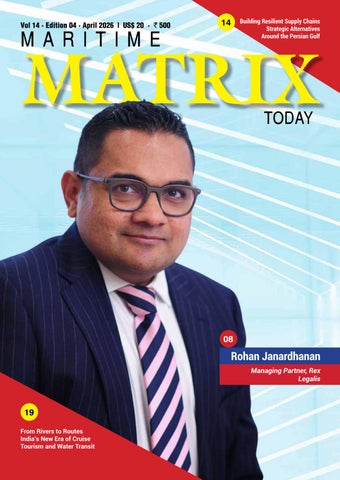
Law at Sea: The Man Steering India’s Maritime Legal Surge 08 Cover Story
Outpacing the Evolution of Cyber Threat
Safety Without Compromise Inmarsat’s Commitment to Global Safety Services
Lila Global Announces Lila Jamnagar, Marking a First for Indian-Flagged VLCC...
Africa’s Rising Role in Global Shipping How Bunkering Hubs Are Benefiting from Route Shifts
Finance Tech Racing Ahead, Governance Playing Catch-Up
Commitment in Spirit, Gaps in Execution
All advertisements in this magazine are placed with no liability accepted by the publisher for the material content therein. No responsibility is accepted by the publisher for omission or error or non-insertion of any advertisements. All advertisements and material in this magazine are subjected to approval by the publisher and are not necessary the opinion of the publisher. No liability is accepted for advertisements that are placed or any information that might be criminally connected. All information is checked to the best of our knowledge and is reliant upon the material submitted not being in contravention of all relevant laws and regulations and within the provisions of the Trade Practices Act.
Reproduction Prohibited
Maritime Matrix Today will not be responsible for the views expressed by contributors in their personal capacity. All rights reserved. Reproduction in part or whole without the permission of the Editor is prohibited.
Readers are recommended
To make appropriate enquiries before sending money, incurring expenses or entering into any commitment in relation to any advertisement published in this publication. Maritime Matrix Today does not vouch for any claims made by the Advertisers of Products and Services. The Printer, Publisher, Editor and Owner of Maritime Matrix Today shall not be held liable for any consequences, in the event such claims are not honoured by the Advertisers.
RNI: MAHENG/2013/50159
Published by Marex Media Pvt Ltd C-209, Morya House, New Link Road, Andheri West, Mumbai 400058 Email: info@marexmedia.com Printed by Young Graphics Printed at Young Graphics, 208 Shankala Industrial Premises, Gogatewadi, Goregaon(E), Mumbai-400 063

As 2026 unfolds, the global maritime landscape is defined by a striking paradox. While international waters are becoming increasingly fragmented due to geopolitical volatility, India is steadily consolidating its position as a major maritime power. This “blue shift” is not merely a series of isolated reforms but a structural transformation in the country’s strategic outlook, combining a rediscovery of maritime heritage with modern logistics and sustainability goals.
A key pillar of this transformation is the expansion of internal infrastructure. The operationalization of 20 new National Waterways, including the ₹12,000 crore NW-5 project, represents a significant effort to reduce India’s “logistics tax.” By connecting mineral-rich regions directly to major ports such as Paradip, India is beginning to treat its rivers as active economic assets rather than passive features. This effort is further supported by the East Coast Industrial Corridor, which promotes a multimodal system where rail, industrial clusters, and waterways function together, with the aim of increasing coastal shipping to 12 percent by 2047.
These domestic developments are unfolding against a backdrop of global uncertainty. The vulnerability of the Strait of Hormuz, a key route for about 20 percent of global oil trade, highlights the risks to energy supply chains. For India, which imports around 80 percent of its crude oil, maritime stability is essential. In response, the country is promoting self-reliant shipping through initiatives such as the ₹10,000 crore Container Manufacturing Assistance Scheme, aimed at reducing dependence on foreign carriers.
Legal and regulatory frameworks are also becoming increasingly important. As maritime disputes move toward international arbitration and environmental regulations such as the “polluter pays” principle under FuelEU Maritime become stricter, the need for specialized legal expertise has grown. Firms like Rex Legalis play a crucial role in handling vessel arrests and complex cross-border disputes between the Gulf region and the Asian subcontinent. At the same time, the digitization of maritime operations has created a governance gap, where financial automation must be matched with strong oversight to prevent large-scale errors.
India’s leadership in responsible ship recycling at Alang further reflects its commitment to sustainability. Along with initiatives such as the revival of historic ports like Lothal and the development of green hydrogen hubs, India is not only reconnecting with its maritime past but also positioning itself as a resilient and forward-looking leader in the global blue economy.
Kamal Chadha
Kamal Chadha Group CEO kamal@marexmedia.com
Shirish Kirtane
HOD Graphics shirish@marexmedia.com
Radhika Vakharia CEO & Editor radhika@marexmedia.com
Santosh Nivalkar
Sr. Graphic Designer santosh@marexmedia.com
Delphine Estibeiro Editorial Coordinator delphine@marexmedia.com
Manish Malve
Graphic Designer manish@marexmedia.com
Jagdamba Pandey Manager, Business and Promotion jagdamba@marexmedia.com
Bhavna Pimpale Coordinator bhavna@marexmedia.com

Rohan Janardhanan
Managing Partner
Rex Legalis is a premier Indiabased law firm that has rapidly ascended to become a dominant force in maritime and admiralty law. Recognized as the “Admiralty Law Firm of the Year” (2022–2024), the firm provides elite representation to shipowners, charterers, P&I Clubs, and maritime insurers. Strategically positioned along India’s East and West Coasts, Rex Legalis is renowned for its “rapid response” capability in high-stakes matters, including vessel arrests, cargo disputes, and emergency injunctions.
At the helm is Managing Partner Rohan Janardhanan, a seasoned practitioner with a unique dualjurisdictional perspective spanning India and Dubai. With over a decade of experience in crossborder transactions and maritime litigation, Rohan bridges the gap between the GCC and the Asian subcontinent. His expertise extends beyond “wet” and “dry” shipping matters into criminal and forensic law, offering clients a protective shield against complex regulatory actions, DRI proceedings, and
customs seizures. Whether navigating the intricacies of charterparty disputes or representing clients before the NCLT and NCLAT, Rex Legalis combines technical mastery with commercially practical solutions. The firm’s consistent top-tier nominations by IBLJ and Legal Era cement its reputation as a trusted guardian of international maritime interests.
In a candid conversation with Jagdamba Prasad Pandey of Maritime Matrix Today, Rohan Janardhanan shares his insights on the evolving legal complexities of the Indian coastline, the critical importance of swift legal intervention in vessel arrests, and how his crossborder experience in Dubai has shaped a more agile, commercially-driven approach to maritime disputes in the subcontinent.
Rex Legalis has quickly climbed the ranks to become an “Admiralty Law Firm of the Year.” What was the founding vision for the firm, and how have you maintained such a sharp focus on the niche maritime sector?
At Rex Legalis, we have a clear vision to build a specialised, full-service maritime law practice capable of addressing the complex and time-sensitive needs of the shipping and offshore industries. From inception, we have consciously focused on admiralty and maritime work, investing in domain expertise, global collaborations, and on-ground capabilities across key port jurisdictions. This disciplined approach, combined with consistent results in vessel arrests, disputes, and cross-border matters, has enabled us to establish a strong reputation in a highly niche sector.
You have a unique professional footprint in both India and Dubai. How does this multi-jurisdictional experience specifically benefit clients navigating cross-border trade between the GCC and the Asian subcontinent?
My experience across India and Dubai allows me to offer clients a seamless understanding of both legal systems, commercial practices, and regulatory frameworks governing cross-border trade. This dual exposure enables me to anticipate jurisdictional challenges, structure transactions efficiently, and provide coordinated dispute resolution strategies across the GCC and the Indian subcontinent. As a result, my clients benefit from practical, commercially aligned advice that reduces risk while ensuring swift and effective enforcement when required.
In maritime law, hours can mean millions of dollars. How is Rex Legalis structured to handle emergency

“vessel arrest” or “injunction” scenarios across India’s vast coastline?
We at Rex Legalis are structured with a strong onground network of local counsel and correspondents across all major port jurisdictions in India, enabling immediate action when urgent situations arise. Our internal teams operate on a rapid-response model, ensuring that pleadings, documentation, and filings for vessel arrests or injunctions are prepared and moved within hours. This integrated approach, combined with round-the-clock availability and coordination, allows us to secure timely orders and protect our clients’ interests in high-stakes scenarios.
You have a background in the criminal and forensic aspects of law. How has this expertise helped in complex cases involving the DRI, seized vessels, or misdeclared cargo?
My background in criminal and forensic law provides a distinct advantage in matters involving enforcement agencies such as the Directorate of Revenue Intelligence, particularly in cases of seized vessels and mis-declared cargo. It enables me to closely analyse evidentiary trails, documentation discrepancies, and intent, which are often critical in defending or prosecuting such matters. This integrated approach allows us to effectively navigate both the criminal exposure and the commercial implications, ensuring a well-rounded strategy for our clients.
With the shipping industry moving toward international arbitration, how does Rex Legalis support clients in forums like the LMAA, and what is the key to winning a demurrage recovery action?
We regularly represent our clients in international arbitration forums such as the London Maritime
Arbitrators Association and Singapore Chamber of Maritime Arbitration (SCMA), working closely with global counsel to ensure seamless handling of disputes from instruction to enforcement. Our approach combines strong contractual analysis with meticulous documentation, particularly in charterparty disputes, to build a persuasive and commercially sound case. The key to succeeding in a demurrage recovery action lies in precise record -keeping, strict compliance with notice requirements, and presenting a clear, time-based narrative of delay supported by contemporaneous evidence.
Given recent global supply chain shifts, what are the biggest legal challenges you foresee for Indian traders and P&I Clubs over the next three years?
Over the next three years, Indian traders and P&I Clubs are likely to face increased regulatory scrutiny, sanctions compliance risks, and disruptions arising from shifting global trade routes due to the current war situation and geopolitical tensions. The evolving sanctions landscape, particularly involving jurisdictions monitored by bodies such as the Office of Foreign Assets Control, will

require heightened due diligence in chartering, cargo sourcing, and payments. Additionally, disputes relating to force majeure, freight fluctuations, and contractual performance are expected to rise, making robust risk allocation and proactive legal strategy more critical than ever.
If you could give one piece of proactive legal advice to a foreign shipowner entering Indian waters for the first time, what would it be?
I would recommend that they consider filing a caveat before the jurisdictional High Court where the foreign shipowner’s vessel is expected to call or sail within Indian territorial waters. This proactive step helps ensure that no ex parte orders are passed without prior notice, thereby safeguarding the shipowner’s commercial interests. It is a prudent legal measure to maintain control and preparedness in potentially contentious situations.
What hobbies or interests do you pursue outside of work?
I am inclined towards swimming, golfing, and playing chess.
What is your favourite travel destination? London and Singapore
What type of music do you enjoy?
Indian Classical and vintage Indian Bollywood songs by Kishore Kumar and RD Burman.
Do you have a favourite book or author?
Power of your sub-conscious mind by Joseph Murphy
What’s your go-to way to relax after a busy day?
I truly enjoy indulging in good Chinese cuisine, spending lively time with friends, and then unwinding with some well-deserved rest.
What is your Philosophy of life?
Work hard, play harder.

From Mumbai to Dubai and beyond. A glimpse into the global journeys of the man steering India’s maritime legal surge, pictured here at the historic Royal Courts of Justice

• Seaspan technology continues to be a leader in the industry, setting high environmental goals
• Our fleet of Dual Fuel Vessels with Membrane & Type B Tanks sets us up for a strong future
• MAN ‘ME-GI Mark 2’ Main engines, a step further than present generation of main engines
• The ‘EGR (Exhaust Gas Recirculation)’ as well as ‘SCR (Selective Catalytic Reactors)” as means to bring down NOx emissions to Tier III levels

• COPES Company e-learning training platform completed from the comfort of your home
• Gender friendly accommodation facilities
• Female Engagement Champions across offices worldwide
• Quality growth
• Low LTIF & High retention
• Wages in top Quartile, and consistent operational excellence

Modern global supply chains remain heavily dependent on a handful of maritime chokepoints in the Persian Gulf and Red Sea. Any disruption at these narrow passages can rapidly affect energy flows, industrial supply chains, and global trade stability. Recent geopolitical tensions once again highlight the vulnerability of these routes and the urgent need for strategic alternatives.
Background
Following the recent conflict in the Middle East that began last month, the regional supply chain has effectively come to a standstill, with far wider global implications.
Much analysis already exists on the geopolitical implications of the current crisis. Therefore, this article does not address the geopolitical aspects in detail here. Instead, this article focuses on the need for resilient supply chains, possible alternate logistics routes through wider regional cooperation, and how the present crisis could affect India’s supply security and strategic investment needs.
The Strait of Hormuz remains one of the world’s most critical maritime choke points.
• Approximately 20% of global oil trade passes through the Strait of Hormuz.
Any collapse or destabilisation of Iran’s leadership could trigger internal conflict and unpredictable foreign-policy shifts, sharply increasing maritime risk perception.
Given the narrow geography of the Strait, prolonged insurgent or retaliatory activity would expose commercial shipping to elevated risks—even without a formal closure.
In such environments, cost escalation and uncertainty emerge long before physical disruption occurs. War-risk insurance premiums rise, vessel owners reassess exposure, and freight markets tighten as charterers compete for ships willing to call Gulf ports.
(1) Oman & Gwadar: Emerging Maritime Gateways Around the Persian Gulf
Oman: Immediate Maritime Alternative
Ports along the Omani coast offer a natural bypass around the most constrained geography of the Gulf.
Key ports include:
• Port of Duqm
• Port of Sohar
• Port of Salalah
These ports sit directly on the Arabian Sea, outside the enclosed waters of the Persian Gulf, offering comparatively lower operational and geopolitical exposure.


Exports from the principal Gulf producers (excluding Iran) broadly account for the following daily volumes:
Collectively (17.5 mn bpd), these flows represent nearly onefifth of global oil supply and one-third of the world’s seaborne oil trade.
Operationally, this translates to roughly 20–25 large crude and product tankers departing the Gulf region each day.
Even partial disruptions therefore have significant market
implications. Early estimates suggest that close to 1.9 million barrels per day of refining and production capacity in the Gulf region has already been affected, tightening supply and placing upward pressure on global oil prices.
Hydrocarbon and LNG exports can increasingly be redirected to such coastal terminals through regional pipeline infrastructure.
Existing bypass precedents already demonstrate this principle:
• East–West Pipeline in Saudi Arabia
• Habshan–Fujairah Pipeline in the UAE
While current capacity is insufficient to fully replace the throughput of Hormuz, these projects highlight the strategic logic of moving hydrocarbons to export terminals located outside maritime choke points.
Much discussion around the Strait of Hormuz focuses on oil and LNG flows. However, dry bulk commodities are equally exposed to maritime disruption.
Persian Gulf ports (excluding Iran and Oman) exports close to 107.50 million metric tonnes of dry bulk commodities

Unlike hydrocarbons, these commodities cannot be transported through pipelines. Their movement depends entirely on bulk carrier availability.
As a result, even moderate increases in maritime risk can disrupt supply through:
• higher war-risk insurance costs
• reduced shipowner willingness to call Gulf ports
• tightening freight markets
In such conditions, supply disruption occurs well before any physical blockade of shipping lanes.
To mitigate this vulnerability, Gulf producers may increasingly rely on dedicated inland logistics corridors connecting industrial production zones to export terminals outside the Persian Gulf.
One possible solution involves dedicated rail freight corridors linking GCC industrial regions with ports on the Omani coast.
Such corridors would enable bulk commodities produced across the Gulf to move efficiently toward Arabian Sea export gateways, without relying solely on maritime loading points inside the Gulf.
This inland logistics integration would significantly strengthen supply-chain resilience by shifting part of the transport network from vulnerable sea lanes to controlled land-based infrastructure.
Gwadar: Potential Land Bridge for Iranian Cargoes
While Oman offers an immediate maritime alternative for cargoes originating from the Persian Gulf, Gwadar Port represents a different strategic possibility.
Gwadar’s significance emerges primarily in the context of Iranian cargo flows.
If land connectivity across Baluchistan were stabilised in the future, Gwadar could potentially function as a Hormuz-bypass outlet for Iranian commodities.
Conceptually:
Iran → Baluchistan land corridor → Gwadar → Arabian Sea
Such a configuration would move cargo flows away from the narrow waters of the Persian Gulf and toward open ocean routes earlier in the logistics chain.
Although this scenario remains dependent on political and infrastructure developments, it illustrates how land-sea integration can reduce maritime choke-point exposure.
(2) Toward a Wider Gulf–Mediterranean Energy Corridor (Oil and Gas Corridor)
Beyond individual ports, a broader strategic concept involves the development of a Gulf– Mediterranean energy corridor connecting Gulf production centres with export terminals on the Arabian Sea and the Eastern Mediterranean.

This concept integrates:
• pipeline infrastructure
• coastal export terminals
• diversified maritime routes
Such a system could reduce dependence on three major maritime choke points:
• Strait of Hormuz
• Bab-el-Mandeb
• Suez Canal
For the shipping industry, disruptions in these chokepoints can translate into significant volatility in freight markets. Longer sailing distances, higher insurance premiums, and the need to reroute vessels around alternative routes such as the Cape of Good Hope can quickly tighten vessel availability and push freight rates upward, particularly in LNG and tanker segments.
A broader energy corridor could extend westward toward the Eastern Mediterranean, potentially reaching:
• the Sinai Peninsula in Egypt
• export terminals along the Israeli Mediterranean coast
This configuration would provide significant logistical advantages.
Very Large Crude Carriers (VLCCs) and LNG carriers lifting cargo from Mediterranean terminals could avoid transiting the Suez Canal, eliminating substantial canal dues and operational delays.
Estimated benefits include:
• approximately 12 days reduction in sailing time (approx 3500 NM one way)
• elimination of Suez Canal transit fees
• eliminates Additional War Risk premium, Piracy Risk, and improve Voyage Economics
• improved fleet utilisation and lower freight costs
• as the sailing days reduce, carbon emission cost is reduced for cargoes destined towards Europe
These efficiencies would apply particularly to cargo flows destined for Europe and the United States.
For example, Qatar and the UAE export roughly 85 million metric tonnes of LNG annually, historically with:
• around 70% destined for Asian markets
• about 30% shipped toward Atlantic markets
However, due to increased piracy activity in the Red Sea, this distribution has shifted closer to:
• 90% Asia
• 10% Atlantic markets
Such infrastructure would diversify export routes while improving resilience by bypassing the potential choke points of Hormuz Strait, Bab-el-Mandeb, and the Suez Canal.
Regional Integration and the GCC Visa
Infrastructure development alone is insufficient without parallel progress in regional mobility and economic integration.
The proposed Gulf Cooperation Council common multientry visa represents a crucial step toward greater regional coordination.
By facilitating movement of professionals, investors, and logistics operators across GCC states, the visa framework can
support:
• cross-border infrastructure projects
• integrated supply chains
• regional logistics networks
In this sense, mobility initiatives such as the GCC visa complement the broader objective of building resilient trade and energy corridors across the region.
In a world where risk perception can reshape trade flows faster than physical disruption, maritime infrastructure must increasingly be viewed as a strategic asset.
Several structural lessons emerge:
• price-only sourcing creates false efficiency
• lack of control over shipping turns freight into the real choke point
• ignoring parcelling and logistics integration magnifies disruption risk
• absence of long-term maritime strategy compounds vulnerability
India’s growing economy remains heavily dependent on maritime energy imports routed through sensitive chokepoints in the Middle East and the Red Sea. A substantial share of India’s crude oil and liquefied natural gas imports transit through the Strait of Hormuz before entering the Arabian Sea. Any prolonged disruption at this passage could therefore have direct implications for India’s energy security, refinery operations, and downstream industrial activity.
In addition to energy imports, India’s industrial supply chains rely on maritime flows of key raw materials including LNG, coking coal, limestone, and fertilizers. Disruptions affecting the Hormuz Strait, Bab El-Mandeb Strait or the Suez Canal could increase sailing distances, freight costs, and insurance premiums, thereby impacting both import costs and export competitiveness. For a rapidly growing economy seeking to expand manufacturing and infrastructure, supply chain resilience and diversified sourcing strategies will therefore remain increasingly important.
While China maintains supply security through pipeline connections with Russia, Turkmenistan and Uzbekistan, India’s exposure extends well beyond energy.
Indian supply chains depend heavily on the Persian Gulf for essential commodities including:
• fertilizers
• limestone
• dolomite
• petrochemical feedstocks
Oil and Gas
India imports approximately 45% of its total 26-28 million
tonnes per year (mtpa) of LNG from Qatar, followed by:
• Australia – about 10%
• United States – about 10%
Other imports come from spot purchases from Russia, West Africa, and the UAE.Since 28 February, no gas carriers have crossed through the Strait of Hormuz into the Indian basin.Qatar has already suspended operations and, unlike other commodities, gas cannot be stored immediately after production. Once production is halted it typically takes three to six weeks to restore optimal output levels.
Assuming the war stops today, the earliest imports from Qatar would likely reach India after one to two months.
Gas from Australia and the United States will take time to arrange, and it is difficult to secure spot cargoes without paying a premium. The same applies to sourcing cargoes from Russia or West Africa.
At the same time, ADNOC’s Ruwais refinery, one of the largest refining complexes in the world, has reportedly been hit by a drone strike and suspended operations. The facility processes approximately 922,000 barrels of crude per day, equivalent to around 125,000 metric tonnes per day.
The disruption comes at a time when the Persian Gulf accounts for roughly 18–20 million barrels of crude exports per day, most of which transits through the Strait of Hormuz. In metric terms, this represents approximately 2.5–2.7 million metric tonnes of oil moving through the Strait daily.
India imports roughly 5.0 million barrels per day of crude oil, out of which approximately 3.0 million barrels per day (around 60%) originates from the Persian Gulf region.
Potential diversification could include LNG supply from:
• Australia
• United States
• Oman
Fertilizers
The agricultural cycle introduces additional urgency.With the harvest season approaching, Indian farmers require fertilizer supplies by May.
India sources roughly 50% of its estimated 15 million tonnes per annum (MTPA) of fertilizers from Jordan and the Persian Gulf, with the majority coming from Gulf producers.
Another 35% comes from the Black Sea and Northwest Africa, where shipments again involve transit through the Red Sea.
During conflicts freight rates tend to increase sharply and with limited owned fleet capacity, securing shipping becomes difficult. Many European shipowners also avoid transiting high-risk areas such as the Red Sea during periods of conflict. This again highlights the strategic importance of maintaining access to controlled or owned tonnage.
India imports approximately 65% of its estimated 20 million metric tons (MTPA) limestone requirements for steel manufacturing from Persian Gulf ports.
Another 15% comes from Omani ports on the Indian Ocean. Any disruption to these supply chains could affect steel production and delay infrastructure projects.
Different commodities affect the Indian economy in unusual ways:
• Oil and Gas impacts the economy most severely
• Fertilizers affects agricultural output
• Limestone affects steel production and infrastructure development
Supply chain disruption of this magnitude can be detrimental for any economy resulting in stock market crashes
In an increasingly uncertain geopolitical environment can disrupt trade flows overnight, supply chains designed solely for efficiency are no longer sufficient. Governments and industries must begin incorporating strategic redundancy, diversified sourcing, and alternative maritime routes integrated land–sea logistics corridors will become as critical to economic security as the commodities themselves to ensure long-term resilience.
Disclaimer: The figures cited in this article are indicative estimates based on publicly available information and analytical tools. Readers seeking precise or updated market data are advised to refer to specialised market research providers and industry databases.
Copyright © 2026 Nikhil Sharad Modak “All Rights Reserved” About the Author

Nikhil Modak (FICS, EMBA (Finance), PGCSCM) is a shipping professional with over 25 years of experience, starting from ship management and later transitioning into shipbroking. He contributed to the management of K-Line vessels with K-Steamship (J.M. Baxi Group co) and shifted focus to commercial roles over the past 20 years. His expertise includes working with commodity traders and dry bulk ship owners, serving as General Manager of Chartering for ship owners and commodity trader, and acting as a competitive shipbroker.
He has experience from Handy size to Panamax vessels, with most recently managing part cargoes and parcels with the Clipper Group, specializing in steel, pipes, fertilizers, and agricultural products in the Red Sea, Persian Gulf, and Indian Ocean regions. Presently he is running his own shipping freight and sale and purchase brokerage and consultancy company (fix@ templarshippingservices.com) out of Singapore and focussing mostly on agri commodities and steel cargoes.
Last year, he wrote about the importance of building resilient and constructive supply chains in an article published in the newsletter of the Institute of Chartered Shipbrokers (ICS), where he is a Fellow Member.That article examined the Indian context, with particular emphasis on the risks of relying too heavily on a single geographic region for sourcing raw materials. Such overdependence can leave supply chains vulnerable to disruptions, especially in the event of escalating geopolitical tensions, potentially leading to serious breakdowns.We encourage readers to review that earlier article alongside this one for better context.
-Dr. Radhika Vakharia
India, being one of the world’s largest trading nations, relies heavily on sea transport—with over 90% of trade by volume moving by ship—but a large portion of this freight is now carried on foreign-flag vessels, creating three vulnerabilities: freight rates controlled abroad, shipping availability dependent on foreign operators, and strategic cargo exposed during crises.
Significantly also though, the recent sanctions regimes against countries such as Iran and Russia illustrate how shipping insurance has increasingly become a powerful geopolitical tool. International maritime trade depends heavily on Protection and Indemnity (P&I) insurance, and ships operating without approved coverage face severe operational restrictions.
Vessels lacking recognized insurance are often denied entry into major global ports, unable to secure financing from international banks, and prevented from loading or unloading cargo at key terminals. As most of the world’s maritime insurance framework is influenced by Western financial systems and institutions, sanctions can effectively restrict a country’s shipping activities by targeting insurance access rather than the ships themselves.
This situation highlights a strategic vulnerability for India, whose shipping industry remains largely dependent on foreign P&I providers. Without developing a robust domestic P&I insurance ecosystem, India’s maritime trade continues to be indirectly exposed to external financial controls and geopolitical pressures.
China as an example, has developed its own maritime Protection and Indemnity (P&I) insurance capability to reduce dependence on Western-dominated shipping insurance systems. The main provider is the China Shipowners Mutual Assurance Association (commonly known as China P&I Club), which was established in 1984 to provide liability coverage for Chinese shipowners.
India on the other hand, despite a few attempts, does not yet have a strong sovereign Protection and Indemnity (P&I) club largely because of historical reliance on the established Western

maritime insurance system, the relatively modest size of its merchant fleet, and the absence of a mature maritime finance ecosystem.
Now however the lesson for India is unmistakable. The current war in West Asia is a clarion call for India to rapidly & seriously tend to all the factors that will bring it a level of independence from foreign maritime control.
A serious maritime strategy must aggressively expand the Indian-flag fleet through incentives for domestic ship ownership and meaningful tax reforms for ship leasing, establish a sovereign protection and indemnity insurance system capable of operating even in high-risk situations, rapidly build tanker and LNG carrier capacity to secure energy transport, and develop a global maritime finance ecosystem.
Without these steps, India risks remaining a trading nation that depends on other countries’ ships to carry its lifelines—an uncomfortable position for a rising power in an increasingly uncertain world.
- Marex Media

The rise of river cruises and water metro systems in India reflects a broader transformation in the country’s approach to inland waterways. India has an extensive network of about 14,500 km of navigable rivers, canals, and backwaters, yet historically these resources remained underutilized, contributing barely 0.1–0.15% to total transport. In recent years, however, growing concerns over congestion, high logistics costs, and environmental sustainability have prompted policymakers to revive this sector. Inland waterways are now being positioned not only as an alternative mode of transport but also as a driver of tourism and regional development, supported by large-scale investments and policy initiatives.
River cruise tourism has emerged as one of the most dynamic segments within this revival. Under initiatives like the Cruise Bharat Mission, the government plans to develop 51 river cruise circuits across 14 states by 2027, alongside significant investment in terminal and vessel infrastructure.
Major waterways such as the Ganga, Brahmaputra, and Kerala backwaters have become focal points for cruise operations, offering a blend of cultural, spiritual, and ecological experiences. Luxury cruises on the Ganga and eco-tourism routes on the Brahmaputra are attracting both domestic and international tourists. This growth is generating employment, boosting local economies, and promoting heritage tourism, while also encouraging the adoption of cleaner technologies such as electric and hybrid vessels.Parallel to tourism, water metro systems are revolutionizing urban mobility in India.
The Kochi Water Metro stands as a pioneering example, integrating water-based transport with the city’s metro rail network. With 16 planned routes covering 76 km and 38 terminals, it connects island communities while offering an efficient and eco-friendly alternative to road transport.
The system already serves tens of thousands of passengers daily and is expected to scale up significantly in the coming years. Its success has inspired similar proposals in cities like Mumbai, Varanasi, and Guwahati, where waterways can help ease congestion and improve connectivity.
A key strength of these developments lies in the synergy between tourism and transport. Infrastructure such as terminals, jetties, and navigation systems can serve both cruise tourism and daily commuting, improving cost efficiency and utilization. Inland waterways also offer significant economic and environmental advantages: they are more fuel-efficient, reduce logistics costs, and emit less carbon compared to road and rail transport. For urban areas, water metros help decongest roads and lower pollution levels, aligning with India’s broader goals of sustainable and green mobility. At the same time, rising cargo movement on waterways, crossing over 145 million tonnes in recent years, signals growing acceptance of this mode of transport.
Despite this progress, challenges persist, including inadequate infrastructure, seasonal fluctuations in water levels, environmental concerns related to dredging, and limited private sector participation. Nevertheless, continued government support, technological innovation, and integration with national initiatives like multimodal transport planning are expected to address these issues. Looking ahead, inland waterways are poised to play a crucial role in India’s development trajectory by 2047, contributing to efficient logistics, sustainable urban transport, and a vibrant tourism economy. The rise of river cruises and water metro systems thus represents not just a sectoral shift, but a reimagining of how India utilizes its natural waterways for growth and sustainability.
-Dr. Radhika Vakharia
India’s maritime trade is vast, yet its presence in global shipping remains surprisingly small. The country has roughly 1,500 merchant vessels, accounting for less than 1.5 percent of the world’s total shipping tonnage. Despite being a major trading nation, India transports only about 7 to 8 percent of its own export import (EXIM) cargo on Indian flagged ships, leaving more than 90 percent of its trade dependent on foreign vessels.
A substantially larger domestic fleet would improve trade security by reducing dependence on foreign vessels for the movement of crucial imports such as oil, gas, coal, food, and fertilizers. Recent global disruptions, such as pandemics and geopolitical conflicts such as the current war in the highly energy-sensitive Iranian theatre, have highlighted the vulnerability of international supply chains and underscored the importance of maritime self-reliance for India. By investing in its merchant fleet, substantially & rapidly, India should strengthen its supply chain resilience, boost shipbuilding and maritime services, and increase its strategic influence in global trade.
India can expand its merchant navy fleet through a combination of financial reform, regulatory changes, and long term maritime planning. The government can encourage fleet expansion by providing tax incentives, easier access to financing, and maritime development funds, since ships require significant capital investment. Introducing cargo support policies that reserve a portion of strategic imports and exports, such as oil, coal, and fertilizers, for Indian flagged vessels would also create stable demand for domestic shipping companies.
Strengthening the domestic shipbuilding and repair industry through subsidies, infrastructure development, and technology partnerships can reduce dependence on foreign shipyards. At the same time, simplifying ship registration procedures and improving the ease of doing business in the maritime sector would encourage more vessels to operate under the Indian flag. These efforts can be aligned with national initiatives such as the Sagarmala Programme and Maritime India Vision 2030 to create a stronger and more self reliant maritime ecosystem.

Some of these initiatives have admittedly been taken up by the incumbent Government, but a lot remains to be done yet.
Building a strong merchant navy fleet is crucial for India both economically and strategically. At present, the country relies heavily on foreign shipping companies to transport the majority of its trade, resulting in billions of dollars in freight payments flowing out of the domestic economy every year. Expanding the number of Indian flagged vessels would also allow a larger share of this revenue to remain within the country, strengthening the maritime industry and creating more employment for Indians.
India should strive to be better prepared to take on the next big energy crisis. The writing is clearly on the wall: Time to fasttrack our fleet growth!
- Marex Media
-Dr. Radhika Vakharia
The escalating Iran-Israel-US war has drawn not only global attention for its geopolitical and economic shockwaves, but an equally grave and less visible, although highly-probable, consequence: a mounting environmental crisis driven by attacks on oil infrastructure and tankers across the Gulf.
Recent strikes on energy facilities, including refineries, gas fields, and export terminals, mark a dangerous shift in modern warfare. Oil and gas installations, once largely avoided due to their systemic importance, are now primary targets. The result is not just disrupted supply, but widespread pollution with long term ecological consequences.
When oil facilities are bombed, the immediate impact is dramatic. Massive fires release dense plumes of soot, hydrocarbons, sulphur dioxide, and nitrogen oxides into the atmosphere. In Iran, such strikes have already produced what scientists describe as “black rain,” toxic precipitation formed when polluted smoke mixes with rainfall. These emissions can travel well beyond the strike zone, degrading air quality across entire regions. The health risks are acute and severe. Exposure to airborne pollutants from burning petroleum can cause respiratory distress, skin irritation, and cardiovascular problems, while long term exposure is linked to cancer and chronic diseases. Urban populations are especially vulnerable, as oil depots are often located near densely populated areas.
Beyond air pollution, the destruction of storage tanks and pipelines leads to soil and water contamination. Crude oil and refined products seep into the ground, carrying toxic compounds, including heavy metals and carcinogenic hydrocarbons, into groundwater systems. This creates persistent environmental damage, affecting agriculture, drinking water, and ecosystems for years, if not decades.
A useful historical comparison highlights the scale of environmental damage war can cause. During the 1991 Gulf War, an estimated 7 to 9 million barrels of oil were deliberately released into the sea, creating one of the largest oil spills in history. In addition, around 3.5 million tons of oil contaminated land, forming vast “oil lakes” across the desert.
The maritime dimension further compounds the crisis. The Persian Gulf, through which roughly a fifth of global oil passes, is now a high risk conflict zone. Attacks on tankers

or shipping lanes raise the likelihood of oil spills, which can devastate marine life, coral ecosystems, and coastal economies. Even limited spills in such a semi enclosed body of water can have outsized and long lasting impacts due to slow natural dispersion.
The recent reports of strikes on regional energy hubs and tanker routes underscore this risk, as disruption to shipping increases the probability of accidents, leaks, or deliberate sabotage. The Gulf’s shallow waters and fragile biodiversity make it particularly susceptible to ecological collapse under sustained stress.
There is also a cascading effect. Pollution from oil fires contributes to climate change through black carbon emissions, while damaged infrastructure can leak methane, which is a potent greenhouse gas. Simultaneously, the war threatens desalination plants that supply fresh water to millions, raising the spectre of a broader environmental and humanitarian crisis.
In this conflict, the environment is not just collateral damage. It is a silent casualty. As attacks on energy infrastructure intensify, the Iran war risks triggering a prolonged ecological disaster, one that will outlast the conflict itself and reshape the environmental future of the region.
- Marex Media
In this conflict, the environment is not just collateral damage. It’s a silent casualty.
-Dr. Radhika Vakharia
In the history of India’s economic evolution, 2026 is emerging as the year the “infrastructure supercycle” shifted from blueprint to bedrock. The nation is no longer just building roads and laying tracks; it is constructing a cohesive, high-velocity nervous system designed to slash logistics costs and catapult manufacturing into the global big leagues.From the hum of Tunnel Boring Machines (TBMs) beneath Mumbai to the birth of private industrial hubs in the Thar Desert, India’s ₹5.98 lakh crore infrastructure bet is reshaping the geography of its economy.

The Mumbai–Ahmedabad High-Speed Rail (MAHSR) project, once mired in land acquisition delays, has entered its most technologically daring phase. As of March 2026, the focus has shifted to the 21-km underground stretch between Bandra Kurla Complex (BKC) and Shilphata.
In a major logistics win, two advanced Mixshield Tunnel Boring Machines (TBMs)—manufactured by Herrenknecht— arrived at the Jawaharlal Nehru Port in late March 2026. These machines are essential for the project’s “crown jewel”: a 7-km undersea tunnel beneath Thane Creek.
• Engineering Feat: The tunnel will reach depths of up to 114 meters, navigating complex marine geology.
• Speed of Execution: While the Gujarat section is nearing operational readiness for 2027, the deployment of these TBMs ensures that the “Mumbai end” stays on track for a 2028–29 full-corridor launch.
While the Union Government builds the “highways,” states like Rajasthan are building the “destinations.” The Rajasthan Industrial Park Incentive Policy 2026 represents a paradigm shift in how industrial land is developed in India.
The policy moves away from the traditional state-run model (RIICO) to embrace private developers through four distinct frameworks:
1. RIICO Allotment: Government land developed by private players.
2. Hybrid Model: Developers acquire 80% of the land; the government provides the final 20%.
3. Fully Private: Developers have 100% freedom to acquire and manage the park.
4. PPP Model: Joint ventures for mega-scale industrial zones.

By offering capital subsidies of up to ₹40 crore and stamp duty exemptions, Rajasthan is positioning itself as the primary warehouse for North India, leveraging its proximity to the Western Dedicated Freight Corridor (WDFC).
The Union Budget 2026–27 has solidified infrastructure as the primary driver of India’s GDP. The allocation of ₹5.98 lakh crore to the transport and logistics sector is not just a spending increase; it is a strategic reallocation toward multimodal efficiency.

A standout feature of the 2026 budget is the push for the 2,052 km East-West Dedicated Freight Corridor.By separating freight from passenger lines, the government aims to increase rail’s share of cargo from 27% to 45% by 2030, drastically reducing the “logistics tax” on Indian products.
The true trend of 2026 is integration. Through the PM Gati Shakti National Master Plan, 1,700 layers of data—from forest boundaries to gas pipelines—are now used to plan projects in weeks rather than years.
Multimodal Logistics Parks
India is currently developing 35 MMLPs that act as “hubs” where rail, road, and air meet.
• Efficiency: These parks allow for the “Trucks on Trains” (Ro-Ro) service, which has already saved an estimated 90 lakh liters of diesel on the Palanpur-Rewari stretch alone.
• Cost Reduction: Since the National Logistics Policy (NLP) was enacted, logistics costs have trended down toward 8% of GDP, nearing the global benchmark of 6-7% found in developed economies.
Despite the momentum, 2026 presents unique hurdles. The reliance on specialized machinery (like TBMs) from international markets remains a geopolitical sensitivity. Furthermore, “last-mile connectivity”—the short distance between a massive freight terminal and a small factory, remains the most expensive leg of the journey.However, the 2026 outlook is overwhelmingly positive. With ₹12.2 lakh crore in total public capital expenditure, India is no longer just “emerging.” It is building the physical foundation of a $7 trillion economy.
The synergy between high-speed rail, private industrial parks, and massive budgetary support is creating a “virtuous cycle.” Faster freight means lower costs; lower costs mean more exports; more exports mean more jobs. As the TBMs grind through the rocks of Mumbai and new factories rise in the sands of Rajasthan, the message is clear: India is moving faster than ever before.


Continuous updating is key to ensuring that the Cyber Security Management System for Ships maintains its effectiveness as a practical framework for managing, mitigating, and reducing cybersecurity risks, says ClassNK.Physical strikes on commercial shipping in early 2026 highlight the clear and present dangers facing seafarers and seagoing assets, but the past year has also reinforced the global industry’s growing exposure to cyberattacks. Maritime cybersecurity specialist Cydome reported a 150% increase in maritime OT cyber
incidents last year, with 87% of incidents involving ransomware. Meanwhile, cybersecurity firm CrowdStrike points to global industries experiencing an 89% increase in attacks by AI-enabled adversaries, where assaults on systems are automatically repeated to maximize opportunities for success.
At the same time, GPS spoofing and jamming techniques are now tools used not only by smugglers, pirates, and terrorists, but also by nation states in conflict.With ships more connected and digitally integrated than ever, the priority is to ensure that positioning information can be trusted and explained as the data source underpinning safety and regulatory requirements, sanctions-related due diligence, insurance response, and reputational risk, not just navigation.The growing use of IoT-
based tools and the advance of autonomous operations also make it vital to provide structured and proactive cybersecurity management that protects a ship’s entire attack surface, from onboard networks to navigation and engine control systems, as well as shore connectivity.
Continuity of protection, consistency of approach, and vigilance remain key to upholding the principles of cybersecurity: identify, protect, detect, respond, and recover. In addition, the rapid spread and evolution of threats demand that all defenses are constantly refreshed.
The imperative is especially clear at a time when the global fleet is ageing. Latest figures from UNCTAD identify 112,500 vessels in the global fleet in January 2025. Weighted for gross tonnage, the average age of ships increased by 3.2% during 2024, to 12.6 years. By vessel number, the average was 22.2 years—1.8% older than in 2024—across a global fleet that had already aged by three years on average between 2013 and 2023.Some portion of these ageing ships will continue to extend the life of OT systems that were not designed for the digital era, using legacy software that may no longer be feasible to patch.Indeed, while those managing older assets sometimes interpret the absence of calls for help as a sign that all is well, the reality may be that crew face the extra burden of trying to make obsolete systems work—systems that may not even detect a cyberattack, let alone respond to one.Third-party certification that assesses shipowners’ cyber vulnerabilities and provides a formal process to deliver verified resilience has become increasingly critical for ensuring effective defenses against rising maritime cybersecurity threats.
In line with provisions for cyber risk assessment adopted by the International Maritime Organization, ClassNK published comprehensive guidelines for cybersecurity certification in 2019 to mitigate cyber risks in both IT and OT, based on a combination of physical, technical, and organizational controls. The layered approach demands clarity not only about what needs to be done, but also about who needs to do it.The society subsequently offered extensive guidance on the IACS unified requirements E26 and E27 on cyber resilience for ship systems and ships. Furthermore, it has developed the Cyber Security Management System for Ships (CSMS) as a practical framework for managing, mitigating, and reducing shipboard cybersecurity risks.
Continuously under review and subject to updates, the CSMS process involves evaluating people and process controls, with certification based on an audit of a company’s cybersecurity policy, procedures, and emergency response, as well as a full risk
assessment of shipboard networks. CSMS certification verifies that management systems are in place to ensure organizational readiness across the company, as well as onboard ship.
ClassNK’s Guidelines for Designing Cyber Security Onboard Ships focus on secure network building, but the multilayered approach to cyber resilience also takes account of the phases of a ship’s life—from the ‘secure-by-design’ stage to secure operation and software development.
For newbuilds, the focus is on embedding security into the vessel’s DNA before it leaves the dock by verifying secure network design and mitigating risks using engineering standards. In this case, ClassNK provides the ‘CybR-G’ notation, which indicates that the ship’s cybersecurity control measures have been verified from the design stage onwards— through document review, construction, testing, delivery, and maintenance audits.In operations, where the focus is on shipboard inventory and network architecture, it is critical to verify that the documentation provided matches expectations. Ensuring that rogue devices are not connected and restricting USB use are widely accepted best practices. However, experience in shipboard network security also highlights that checking firewalls are properly configured and that backup files are complete is equally vital.
The IMO updated its Guidelines on Maritime Cyber Risk Management in 2024, but the speed at which technology is advancing, combined with fast-changing geopolitical events, makes it critical that cybersecurity services used by shipping keep pace with evolving threats.
This year, ClassNK is redoubling its vigilance in updating its cyber certification to verify that any given client’s CSMS functions effectively across the organization and onboard ship. Recent events reinforce the critical importance of verifying the availability of onboard IT/OT systems that contribute to safe navigation.ClassNK’s cyber specialists are constantly analyzing the latest cybersecurity reports and working with external experts to adjust their advice on best practices for onboard cybersecurity as new threats emerge. The organization also continues to share practical research and regulatory insights that support real-world ship design and operation and will soon update its ClassNK Security Series with a new set of Guidelines for Cyber Secure Marine Equipment.
Experience shows that cybersecurity isn’t just a code—it’s a culture. However, the right tools must also be in place to uphold cyber resilience and empower crews with clear protocols to sustain a cycle of continuous improvement.
When a distress alert is triggered at sea, there is no room for uncertainty. For tens of thousands of vessels worldwide, Inmarsat Maritime’s safety services provide a critical and dependable lifeline, writes John Dodd, Head of Maritime Safety, Inmarsat Maritime.
Maritime risk has not diminished with time. In 2025, the Inmarsat network handled more than 890 GMDSS distress calls, in line with recent years. Behind every one of those calls was a crew facing a real situation, whether severe weather, an onboard emergency, a security threat, or operational failure.
At the same time, the maritime environment is becoming more complex. Geopolitical tensions, shifting trade routes, weather extremes, re-emerging piracy risks, and growing cybersecurity threats are reshaping risk. Even digitalisation and decarbonisation – which promise a safer and more sustainable maritime world – may induce the information overload that contributes to human error.
Technology has evolved rapidly across the industry, but the need for dependable, globally available safety communications remains constant. Reliability, predictability, and resilience are essential under any conditions at sea.
Inmarsat C continues to play a central role in the safety ecosystem. As the most enduring, cyber-resilient, and widely used GMDSS satellite service, it supports distress alerting, distress messaging, global reception of maritime safety information (MSI), long-range identification and tracking (LRIT), medical advice/assistance, vessel monitoring, and ship security alert systems – delivering it all through a single, resilient terminal. The service is fully aligned with IMO and SOLAS requirements.
Inmarsat is also the only GMDSS provider to deliver comprehensive global maritime safety information (MSI) through an IMO-recognised Enhanced Group Call (EGC) system, allowing seafarers to receive every critical alert wherever they are sailing.
Behind the service provided by Inmarsat C is the company’s continued investment in its ground infrastructure, spacecraft redundancy, and L-band spectrum, which underpin its existing capabilities and enable further safety-focused innovation. These long-term investments ensure that Inmarsat’s safety services

continue to meet the demands of distress alerting, routine messaging, and vital MSI delivery worldwide.
In 2025, Inmarsat introduced the SafetyLink platform to simplify how operators manage the commercial and administrative aspects of safety services. Developed in collaboration with the International Telecommunication Union (ITU) and International Mobile Satellite Organization (IMSO), SafetyLink reduces billing complexity and supports compliance processes, reflecting a broader focus on making safety services easier to manage as well as dependable to use.
Inmarsat is also migrating to a new service delivery platform that complements current and future safety services through enhanced provisioning and user interface capabilities.
The company operates under an international agreement governing ship earth stations (SES) – a multilateral international agreement that holds greater authority than standard IMO resolutions. Signed by multiple nations on six continents, the SES Agreement allows Inmarsat GMDSS terminals to operate in the territorial waters of the signatory countries.
Shipowners and operators need confidence that their safety communications will remain stable, compliant, and globally supported for years to come. Inmarsat Maritime continues to invest in and strengthen its safety services with this long-term vision and responsibility in mind – so that when help is needed, seafarers can rest assured that their distress alert will reach the right authorities at the right time, anywhere in the world.

Lila Global Announces First Indian-Flagged VLCC Registered Through GIFT City
Gandhinagar: Lila Global today announced the acquisition of Lila Jamnagar, a 298,997 DWT Very Large Crude Carrier (VLCC) and the first vessel of its kind under the Indian flag registered through GIFT City.
The vessel is registered under RFK Shipping IFSC Private Limited in GIFT City and operated via the Lila Global platform. Backed by Indian-Overseas capital, Lila Jamnagar reflects overseas investment contributing to India’s maritime sector. Following the completion of dry docking, the vessel has officially commenced her first voyage under the Indian flag, sailing from the Far East toward the load port.
“This vessel reflects our commitment to strengthening longterm India-linked shipping capabilities, especially in the current geopolitical environment where timely energy transportation is vital” said Dr. Anil Sharma, Founder and CEO of Lila Global. “Investing in Indian-flagged assets is both an opportunity and a
responsibility. Lila Jamnagar demonstrates our belief in India’s maritime potential and energy infrastructure.”
The addition of Lila Jamnagar strengthens Lila Global and RFK Shipping’s engagement with the Indian PSU chartering market, where credibility, scale, and consistent operational standards are key. The vessel also supports India’s broader maritime objectives, including capital inflow, fleet growth, and energy security.
Lila Global is a maritime platform led by Dr. Anil Sharma, a recognized figure in international shipping with inclusion in the Lloyd’s List Top 100 World’s Most Influential People in Shipping for 16 consecutive years. The company focuses on disciplined investment, operational excellence, and long-term contribution to India’s maritime sector.

The global maritime industry is under going a major transformation as geopolitical tensions reshape traditional shipping routes. One of the most significant outcomes of this shift has been the growing importance of Africa’s coastal regions as critical refuelling hubs, also known as bunkering centres. As vessels increasingly avoid high-risk zones such as the Red Sea and the Strait of Hormuz, many are opting for longer but safer routes around the Cape of Good Hope. This diversion is driving a surge in demand for bunkering services along Africa’s coastline, creating new economic opportunities while also exposing structural challenges.
The rerouting of global shipping traffic is largely the result of escalating instability in the Middle East. Attacks on vessels in the Red Sea, particularly by Houthi militants, and broader military tensions involving Iran have made key maritime chokepoints unsafe. Shipping companies have responded by avoiding the Suez Canal and the Bab el-Mandeb Strait,two of the most important trade arteries connecting Europe and Asia.
Additionally, the closure or disruption of the Strait of Hormuz,through which a significant portion of global oil flows,has further intensified the need for alternative routes. As a result, major shipping firms such as Maersk, Hapag-Lloyd, and CMA CGM have rerouted their vessels around the southern tip of Africa.
While this detour adds significant time and cost to voyages, it offers a safer passage compared to conflict-prone waters. Ships traveling between Asia and Europe are now routinely navigating around the Cape of Good Hope, a route that had historically
declined in importance after the opening of the Suez Canal but is now experiencing a revival.
This shift in shipping routes has led to a boom in demand for bunkering services across Africa. Bunkering refers to the supply of fuel to ships, a critical requirement for longdistance maritime trade. As vessels take longer routes, they require additional refuelling stops, and African ports are ideally positioned to meet this need.Fuel suppliers operating in Africa have reported a sharp increase in activity. Established companies such as Monjasa have seen stronger demand, while new players including Vitol, Flex Commodities, and others are expanding their presence in the region.
In particular, West African ports, as well as emerging hubs in Namibia and Mauritius, are benefiting from increased traffic. Some companies have even launched new bunkering operations specifically targeting ships navigating the Cape route. This surge reflects not only short-term adjustments but also a broader realignment of global shipping logistics.The increase in traffic has been dramatic. According to industry estimates, diversions along the Cape route have risen significantly in recent months, indicating that what was initially seen as a temporary measure is becoming a long-term operational shift.
Shipping companies are increasingly treating the Cape route as more than just an emergency alternative. After nearly two years of disruptions in traditional shipping lanes, many industry leaders now view the rerouting as a “new operational reality.”
This shift is not merely a response to immediate security concerns but reflects deeper structural changes in global trade.
The unpredictability of geopolitical tensions, combined with rising insurance costs and security risks in traditional routes, has made the Cape route a more reliable option despite its longer distance.As a result, African ports are no longer peripheral players in global shipping but are becoming central nodes in the maritime supply chain. Their strategic location along this alternative route positions them to capture sustained demand in the years ahead.
The growing importance of African bunkering hubs has triggered a wave of investment in infrastructure and services. Ports are expanding their capacity to handle increased traffic, while fuel suppliers are investing in storage facilities, logistics networks, and offshore bunkering capabilities.
In Ghana, for example, operators are scaling up their operations in anticipation of long-term growth. Industry projections suggest that bunkering volumes in some regions could multiply significantly over the next decade.
Similarly, ports such as Walvis Bay in Namibia and Port Louis in Mauritius have emerged as key refuelling points. These locations offer strategic advantages, including proximity to major shipping routes and relatively efficient port operations.
Mauritius, in particular, has seen a notable increase in bunker fuel sales, with volumes nearly doubling in recent years. This growth underscores the potential for smaller nations to leverage their geographic position to become significant players in global maritime trade.
Despite the opportunities, the rapid growth of bunkering activity in Africa is not without challenges. Infrastructure limitations remain a major concern. Many ports are struggling to keep up with the surge in demand, leading to congestion and operational inefficiencies.For instance, bottlenecks at key ports such as Tema in Ghana highlight the need for significant investment in port capacity and logistics systems. Without such improvements, the region risks losing some of the potential benefits of increased shipping traffic.
Security is another critical issue. While the Cape route is considered safer than the Red Sea, it is not entirely free from risks. Piracy, particularly in certain parts of West Africa, continues to pose a threat to shipping operations.
Additionally, regulatory and tax-related challenges can hinder growth. In South Africa, for example, tax disputes and regulatory changes have led to a decline in bunkering activity at traditional hubs such as Algoa Bay. This has resulted in a shift of business to other ports in the region, illustrating how policy decisions can significantly impact competitiveness.
Another key challenge is the availability of fuel. The disruption of Middle Eastern oil supplies, particularly due to tensions around the Strait of Hormuz, has created uncertainty in global fuel markets. Reduced refinery output and supply constraints could limit the availability of bunker fuel, even as demand rises. This imbalance between supply and demand has the potential
to drive up fuel prices, increasing costs for shipping companies and potentially affecting global trade flows. The situation underscores the interconnected nature of the maritime and energy sectors, where disruptions in one can have cascading effects on the other.
Despite these challenges, the long-term outlook for African bunkering hubs remains positive. Several factors are expected to support sustained growth in the region.
First, Africa’s strategic location along major shipping routes ensures that it will continue to play a key role in global trade. As shipping patterns evolve, the continent is well-positioned to serve as a critical link between different regions.
Second, increasing intra-African trade is likely to boost demand for maritime services, including bunkering. The implementation of initiatives such as the African Continental Free Trade Area (AfCFTA) could further enhance the region’s economic integration and maritime activity.
Third, ongoing investments in port infrastructure and logistics are expected to improve efficiency and capacity, making African ports more competitive on the global stage.
Finally, the persistence of geopolitical uncertainty suggests that the shift away from traditional routes may not be temporary. Even if tensions in the Middle East ease, shipping companies may continue to use the Cape route as a hedge against future disruptions.The rise of African bunkering hubs represents a significant shift in the global maritime landscape. What began as a response to security concerns has evolved into a broader transformation of shipping routes and logistics networks.For Africa, this presents a unique opportunity to strengthen its position in the global economy. By investing in infrastructure, improving regulatory frameworks, and addressing security challenges, the continent can capitalize on its growing importance as a maritime hub.
At the same time, the situation highlights the vulnerability of global trade to geopolitical tensions. The reliance on a few key chokepoints has long been a risk, and recent events have underscored the need for more resilient and diversified shipping routes.
The diversion of ships around the Cape of Good Hope has reshaped global shipping patterns and brought Africa’s bunkering hubs into the spotlight. Increased demand for refuelling services is driving investment, creating economic opportunities, and redefining the continent’s role in maritime trade.
However, realizing this potential will require overcoming significant challenges, including infrastructure gaps, security risks, and supply constraints. If these issues are addressed effectively, Africa could emerge as a central player in the future of global shipping.

Maritime operations are becoming increasingly digitized. From freight invoicing and bunker cost reconciliation to port expense tracking and compliance reporting, automation is entering every layer of maritime finance.
The promise is clear. Faster processing, better visibility, and fewer manual errors across complex, global operations. But beneath this progress, a structural gap is emerging. Automation in maritime finance is advancing faster than governance.
Maritime finance is not a simple, centralized function. It operates across vessels, ports, jurisdictions, and regulatory frameworks. Every transaction carries layers of complexity, from currency fluctuations to varying port regulations and documentation requirements.
Automation is being introduced to manage this complexity.
However, when automation is applied to already complex and fragmented workflows, it does not simplify them. It accelerates them.
Port disbursement accounts may be processed faster, but inconsistencies in supporting documents still exist. Freight
invoices may be generated automatically, yet disputes remain due to mismatched data. The system moves faster, but the underlying issues persist.
In such environments, speed amplifies complexity rather than reducing it.
Automated workflows in maritime finance are increasingly responsible for executing decisions. Payments are triggered based on predefined rules, reports are generated from aggregated data, and compliance checks are integrated into systems.
But maritime operations rely heavily on context.
A delay at port, a change in voyage plan, or a last-minute regulatory requirement can alter the financial picture significantly. Automated systems, if not designed with contextual awareness, may process transactions based on incomplete or outdated information.
This creates a gap between operational reality and financial execution.
Without strong governance, automation can act on data that is technically correct but operationally irrelevant.
Fragmented Systems Across the Voyage Maritime finance systems are rarely unified. Data flows across vessel management systems, port agents, ERP platforms, and compliance tools. Each system captures a part of the journey.
Automation often operates across these fragmented systems.
As a result, dependencies increase. A data inconsistency at the source, such as an incorrect port charge or missing document, can propagate across multiple systems. Automated processes then carry this inconsistency forward, embedding it deeper into financial records.
What was once a localized discrepancy becomes a cross-system issue.
Tracing the origin becomes difficult, and resolution takes longer, not shorter.
The Governance Gap at Sea Governance in maritime finance has traditionally relied on manual verification and experienced judgment. Port expenses are reviewed, documents are cross-checked, and exceptions are handled based on operational knowledge.
Automation reduces the need for manual intervention, but it also reduces these natural checkpoints.
When automated workflows execute at scale, the absence of real-time oversight becomes a risk. Questions arise that are often not addressed upfront:
• Who validates automated ports expense calculations?
• How are discrepancies in shipping documents detected early?
• What controls ensure compliance across different regulatory environments?
Without clear answers, governance lags behind execution.
Risk is not eliminated. It is distributed across systems, often invisibly.
In maritime operations, scale is global. A single automated error in freight calculation, tax application, or port cost allocation can impact multiple voyages, vessels, and regions. The financial impact can escalate quickly.
Unlike manual processes, where errors are contained, automation allows them to scale across entire fleets.
What makes this more challenging is the delay in detection. By the time discrepancies are identified, they may have already affected reporting, compliance, and stakeholder trust.
Automation increases efficiency, but it also increases the speed at which errors travel.
The issue is not automation itself. The issue is the absence of governance designed for automated, distributed, and contextheavy environments like maritime.
Governance needs to evolve alongside automation.
This means:
• Embedding validation checks within automated workflows
• Ensure real-time visibility into financial processes across vessels and ports
• Creating clear ownership for data accuracy and decision logic
• Designing exception-handling mechanisms that account for operational variability
Traditional, periodic reviews are not sufficient in a system that operates continuously across geographies.
Governance must become continuous and integrated.
Maritime finance is at a turning point. Automation has the potential to simplify complex operations, improve transparency, and enhance decision-making across global networks.
However, without strong governance, it risks doing the opposite.
Faster processes without control lead to faster mistakes. Scaled workflows without validation lead to scaled discrepancies.
The objective is not to slow down automation, but to ensure that governance keeps pace.
Only then can automation truly support maritime operations instead of amplifying their challenges.
Otherwise, the industry risks building systems that move faster across oceans, but carry the same inefficiencies further than before.
The Author

Kashif Ahmad Senior Manager, Sales Yodaplus Technologies
For further queries or to discuss in detail the widening gap between maritime finance automation and governance, feel free to connect with me at kashif@yodaplus.com.
For Marex Media, Ms Delphine Estibeiro engaged in an insightful dialogue with Mr Rohith Agarwal, CEO of Guideship Consulting Services, on the Hong Kong International Convention for the Safe and Environmentally Sound Recycling of Ships. Their conversation examined India’s long-standing leadership in ship recycling, the paradox of its absence from key IMO registers, and the pressing need for administrative clarity to ensure that India’s global commitments are reflected in practice. With the industry already investing heavily in compliance, the discussion underscored both the achievements made and the urgent steps required to translate intent into effective execution.
For several decades, ship recycling has stood as one of India’s most significant industrial achievements, though it has often remained underappreciated in mainstream policy discussions. The yards at Alang have transformed thousands of end-of-life vessels into reusable steel and valuable materials, supporting a vast industrial ecosystem and providing livelihoods to thousands of workers. Over time, the sector has also demonstrated its ability to adapt to increasingly stringent regulatory expectations.
Well before the international community adopted the Hong Kong International Convention for the Safe and Environmentally Sound Recycling of Ships, many Indian ship recyclers had already begun aligning their operational practices with its principles. This included investments in improved infrastructure, safer handling of hazardous materials, structured Ship Recycling Facility Plans, and stronger occupational safety measures.
India’s decision to accede to the Convention was therefore seen as a natural and progressive step. In fact, India became the first major ship recycling nation to formally accede, a move widely welcomed across the global maritime sector. It was interpreted as a strong signal that India intended to lead the transition toward safer and environmentally responsible ship recycling worldwide.
However, the present situation raises a number of difficult and concerning questions.
The concern arises from official documentation published by

the International Maritime Organization (IMO).
According to the List of Ship Recycling Facilities Authorized under Article 12.1 of the Hong Kong Convention, there is a notable absence: no ship recycling facility from India appears on the list. This is deeply surprising given that India is one of the world’s largest ship recycling nations and was among the earliest to commit to the Convention.
An equally troubling issue appears in another IMO document—the list of Competent Authorities designated under Article 12.2 of the Convention. In that list as well, India does not appear.
For a country that proudly acceded to the Convention and publicly positioned itself as a leader in responsible ship recycling, the absence from both lists is difficult to reconcile.
Over the past decade, many ship recycling facilities in India have undertaken extensive upgrades in anticipation of the Convention’s entry into force. These upgrades involved substantial investments in infrastructure, environmental safeguards, hazardous material management systems, and worker safety protocols. Facilities implemented detailed Ship Recycling Facility Plans and adopted operational practices aligned with the Convention’s requirements.

In other words, the industry itself has made considerable efforts to prepare for compliance.
However, under the Convention framework, ship recycling facilities must obtain a Document of Authorization for Ship Recycling (DASR) from the national authority in order to be formally recognized as authorized facilities. This authorization is then communicated to the International Maritime Organization and included in the official global list.
Without the issuance and notification of DASRs, even compliant facilities cannot appear in the official list.
This suggests that the issue may lie not with the readiness of the industry but with the administrative process required for formal authorization.
The responsibility for implementing the Convention and establishing the necessary regulatory mechanisms lies with the Ministry of Ports, Shipping and Waterways, along with the authorities designated to oversee ship recycling within the country.
Acceding to an international convention is not simply a diplomatic or symbolic act. It requires the establishment of legal, administrative, and regulatory frameworks that enable the convention’s provisions to be implemented in practice. This includes the designation of competent authorities, issuance of authorization documents, and communication of these details to the International Maritime Organization.
The credibility of a country’s commitment ultimately depends on how effectively the convention is implemented domestically.
That is precisely where the irony becomes most evident.
India has frequently articulated ambitious plans for the ship recycling sector, including expanding the country’s recycling capacity, becoming the world’s leading destination for ship recycling, and securing inclusion of Indian facilities in the European Union’s list of approved ship recycling yards. These
goals are regularly highlighted in policy discussions and industry forums.
However, the same country currently does not appear in the fundamental lists maintained under the Convention by the International Maritime Organization. From an international perspective, this creates an uncomfortable contradiction.
Ship recycling is a global industry where credibility and regulatory certainty play a decisive role in commercial decision-making. Shipowners, insurers, classification societies, and financial institutions carefully examine international compliance frameworks before selecting recycling destinations.
When official records indicate that no Indian facilities are authorized under the Convention, it inevitably raises questions within the international maritime community about the operational status of India’s regulatory framework.
The intention should not be viewed as criticism for its own sake. The objective is to draw attention to an issue that directly affects the credibility of one of India’s most important maritime industries. Silence would only allow the problem to persist, potentially damaging the industry’s international standing.
India’s ship recycling sector has demonstrated its willingness to align with international standards. What appears to be missing at this stage is the administrative urgency required to complete the formal implementation process.
India’s Facilities Ready, But Await Authorization…
The path forward is relatively straightforward. The competent authorities must complete the necessary administrative processes, including issuing Documents of Authorization for Ship Recycling (DASR) to compliant facilities and formally notifying the International Maritime Organization of both the authorized facilities and the designated competent authorities.
Once this process is completed, India’s ship recycling facilities can rightfully appear in the official lists maintained under the Convention.
India has the expertise, infrastructure, and industrial capacity to lead the world in responsible ship recycling. The industry is ready. What is required now is timely administrative action to ensure that India’s commitment to the Convention is reflected in the international record.
Until that happens, one question will continue to linger within the global maritime community: How did the country that led the adoption of the Convention fail to appear in its implementation?


Nautic Fleet
Nautical Marine Management
Naavex Marine
NYK Group
Six Degrees Ship Management
Solaris Marine Services
Tomini Shipping
Udya Shipping Services
XT Shipmanagement


GAC Shipping (India) Private Limited Main office
GAC House, P.B. No. 515, Subramanian Road, Willingdon Island, Cochin 682 003, India
E: india@gac.com | T: +91 484 266 8372
CIN: U63090KL1983PTC003733


