UPK 8 YEARS
As the University Press of Kansas continues celebrating its 80th Anniversary, we proudly reect on eight decades of publishing books that advance knowledge, preserve history, andserve readers in Kansas and beyond. Since 1946, UPK has remained committed to publishing award-winning works that spark conversation and deepen understanding across history, politics, culture, law, Indigenous studies, and regional topics.
is Fall & Winter 2026 catalog highlights the strength and diversity of UPK’s publishing, featuring timely scholarship, compelling regional stories, and thought-provoking nonction.
As America approaches its 250th anniversary, UPK is also launching special America 250 promotions to spotlight books exploring the nation’s founding, evolution, challenges, and future. rough themedcollections,weinvitereadersto discover new perspectives on the American story. Visit our website for weekly updates.
We hope you enjoy exploring this season’s catalog and discovering the many stories, ideas, and voices that continue to shape our world.
Recent Awards

Distinguished Book Award for Best Edited Volume, Society for Military History
Fletcher Pratt Award, Civil War Round Table of New York
Named a Kansas Notable Book by the Kansas Center for the Book
General Wallace M. Greene, Jr. Award, Marine Corps Heritage Foundation
Named a Kansas Notable Book by the Kansas Center for the Book
General Wallace M. Greene, Jr. Award, Marine Corps Heritage Foundation
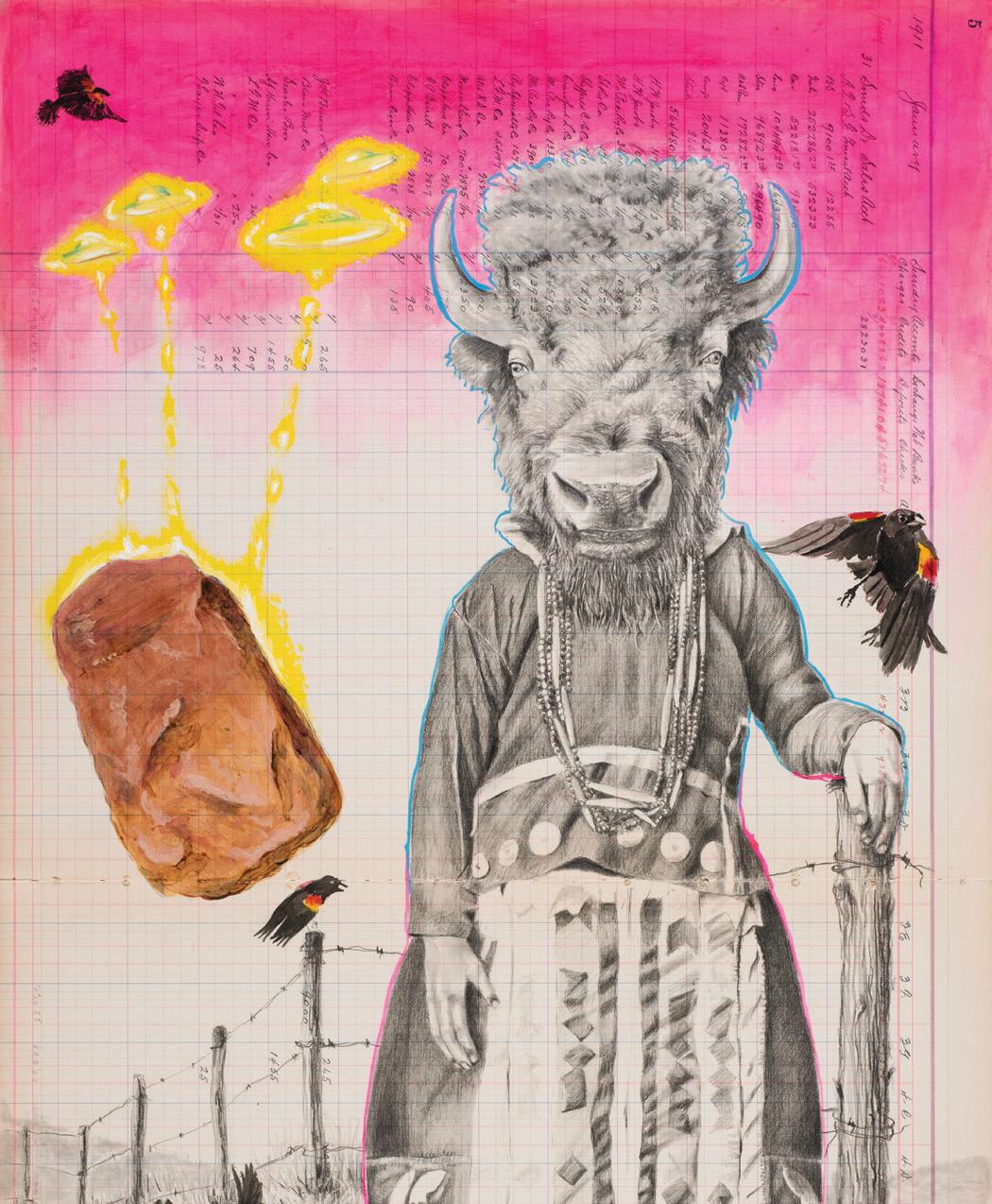
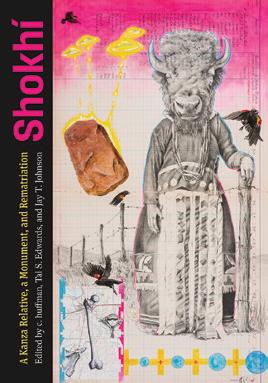
Cover art: Rematriation (detail) by Chris Pappan. See Shokhí, page 1.
Shokhí
A Kanza Relative, a Monument, and Rematriation
Edited by c. huffman, Tai S. Edwards, and Jay T. Johnson
For almost a century, the city of Lawrence,Kansas, displayed a 28-ton red quartzite boulder as a memorial to the town’s founders. However, this boulder, Iⁿ‘zhúje‘waxóbe (EE(n)) ZHOO-jay wah-HO-bay), had a centuries-long relationship with Kanza people (Kaw Nation citizens). In this powerful collection of imagery, analysis, and reection, Land is telling the story and the contributors explore narratives of place, how a Grandfather Rock became a monument, and how Kaw Nation citizens reunited with their relative, facilitatingIⁿ‘zhúje‘waxóbe shokhíbe (return him home, to Kanza people/Land).
In Shokhí, scholars, poets, activists, and artists explore the organizing and collaboration that brought Iⁿ‘zhúje‘waxóbe home to Kaw Nationowned Allegawaho Memorial Heritage Park in 2024. Indigenous and non-Indigenous contributors chronicle the winding path a group of people took to dismantle a monument, understand intersecting forgotten histories, rematriate a Grandfather Rock, and confront our ongoing colonial history.
c. huffman is a Kaw Nation Citizen with an MFA and an MDiv who sits at the intersection of privilege, dis/ability and Indigeneity; a place where poetry and theology dance. Her writing has appeared in e Ending Hasn’t Happened Yet, a poetry anthology edited by Hannah Soyer.
Tai S. Edwards is professor of history and director of the Kansas Studies Institute at Johnson County Community College. She is the author of Osage Women and Empire: Gender and Power and co-editor of Lyda Conley and the Fight to Preserve Huron Indian Cemetery, also published by Kansas.
Jay T. Johnson is University Distinguished Professor of Geography at the University of Kansas and director of the Centerfor Indigenous Research, Science, and Technology. His work has appeared in GeoHumanities, Geographical Research, Nature Sustainability, Sustainability Science, and other publications.
Lyda Conley Series on Trailblazing Indigenous Futures
AUGUST
504 pages, 198 color photographs, 5 maps, 7 x 10 Paperback ISBN 978-0-7006-4199-4, $34.99 (s)
Ebook ISBN 978-0-7006-4200-7, $21.99
“For Indian Peoples, the goal of rematriation is to restore relationships. Here the restored relationship is with a Grandfather Rock, just as the call for Land Back is a cry for a restored relationship with Grandmother Earth. I would hope readers of this book would come to a renewed understanding of American Indian cultures and the Indian knowledge about the personhood of all relatives including In‘zhúje‘waxóbe. Reading this book, we can all celebrate with Kaw People his return to his relatives”
Tink Tinker (wazhazhe/Osage Nation), Baldridge Professor Emeritus of American Indian Studies
“Through multigenre text and art, Shokhí documents the return home of the Kanza Nation’s Grandfather Rock. Oral history is interwoven with photographs, photographs interwoven with poetry, poetry interwoven with visual art. Compelling and comprehensive, Shokhí is a necessary read for all Kansans. Really, in its beautiful testament to the interdependent nature of human and non-(more-than)human, it is a necessary read for everyone.”
Hannah Soyer, author of Dreams in Which I’m Almost Human: A Memoir
“The journalistic heart of the nation comes from those closest to the people. Opinionated rises out of the past but speaks directly to the future at a time when it is most needed. This is America speaking.”
Bill Kurtis, author of Whirlwind: My Life Reporting the News
“It shouldn’t be surprising that a state forged by the Civil War would foster a tradition of provocative editorial voices. . . . Their ranks have sharply dwindled amid the news industry’s pressures today, but ClayWirestone persuasively argues that the need for courageous commentary hasn’t diminished.”
SusanPage,WashingtonBureauchief of USA TODAY, and author of The Queen and Her Presidents: The Hidden Hand That Shaped History, and a fourth-generation Kansan
“Fearless opinion journalism has long played a vital role in American democracy. Through spirited writing and engaging anecdotes, Clay Wirestone has done a masterful job in bringing to life the rich history of this craft, brilliantly illustrating why we must ensure its survival well into the future.”
Victor Pickard, author of Democracy Without Journalism? Confronting the Misinformation Society
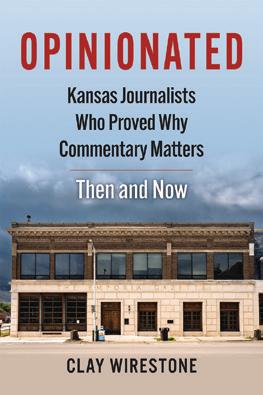
Opinionated Kansas Journalists Who Proved Why Commentary Matters—Then and Now
Clay Wirestone
William Allen White famously asked, “What’s the matter with Kansas?” But he was not the only local journalist raising important questions about the future of the Sunower State and the nation—not by a long shot. White lived during the golden age of print journalism, when local newspapers were at the center of their communities and opinion writers shaped the conversation of the day. Opinionated reminds us how truly signicant these hometown journalists were, and why commentary was—and is—essential to any society that values the freedom of expression.
Clay Wirestone, award-winning opinion editor at Kansas Reflector, takes readers on a tour of Kansas journalism from the 1920s to the 1970s, introducing us to the people who shaped public discourse in the heartland, including:
• e indomitable Mamie Boyd of the small town of Mankato who was a working journalist into her nineties and the only woman to receive the William Allen White Foundation Award for Journalistic Merit.
• Lucile Bluford of Kansas City, who used e Call to press tirelessly for civil rights and whose application to the University of Missouri led to the closure of its journalism graduate school.
• Hollie T. Sims, who founded the long-running e Negro Star in Mississippi before moving to Wichita, eeing racist hostility, and became a prominent journalist-activist.
• e aable Bill Meyer, who led the Marion County Record for decades before turning it over to his son. e paper was targeted by a police raid in 2023, sparking a national debate about freedom of the press.
With a quick wit and penetrating insight, Wirestone adds his own opinion pieces about the state of journalism today, how aspiring journalists can learn to write compelling commentary, and why local news outlets should be a crucial part of a diverse and democratic society. Opinionated is for anyone who understands the importance in knowing our shared history, for the journalists of today and tomorrow, and for anyone who believes in the power of free speech and a free press.
Clay Wirestone is opinion editor at Kansas Reflector, a native Kansan who attended the William Allen White School of Journalism at the University of Kansas, and a writer whose work has appeared in PolitiFact, e Topeka Capital-Journal, Concord Monitor (N.H.), and Mental Floss He has been published by more than 200 outlets in 30 states.
SEPTEMBER
208 pages, 24 photographs, 6 x 9 Paperback ISBN 978-0-7006-4305-9, $29.99 (s) Ebook ISBN 978-0-7006-4306-6, $14.99
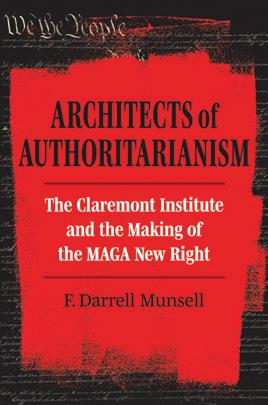
Architects of Authoritarianism
The Claremont Institute and the Making of the MAGA New Right
F. Darrell Munsell
From the Heritage Foundation’s Project 2025 and the Federalist Society’s decades-long campaign to shape the judiciary, private think tanks have long been the shadowy intellectual engine driving conservative politics. But the Claremont Institute remains the most consequential organization in shapingthe MAGA agenda. Founded in southern California in 1979, Claremont’s original mission was “to restore the principles of the American Founding to its rightful, preeminent authority” in American society. Now, historian Darrell Munsell uncovers how the Claremont Institute went from being a home for erudite political philosophers to serving as the base camp for the January 6 insurrection, Project 2025, and President Trump’s authoritarian agenda.
e institute’s political activism began with its endorsement of Donald Trump for president in 2016, followed quickly by its entry into the cultural battles against Black Lives Matter, multiculturalism, critical race theory, and the use of diversity, equity, and inclusion programs in public universities, government agencies, and commercial enterprises. By the end of Trump’s rst term, Claremont believed that “wokeism” was an existential threat to the Founders’ Constitution and was ghting to win the culture war at any cost—including attempting to reverse the results of the 2020 election.
In the wake of Trump’s 2020 defeat, Claremont lurched further rightward toward populism, Christian nationalism, and illiberalism. Led by John Eastman, Charles Kesler, omas D. Klingenstein, and a new generation of young, conservative activists—some from the furthest fringes of the far-right—the Claremont Institute is shaping the movement of National Conservatism with its devotion to replacing constitutional democracy with an authoritarian system of government. Claremont joined forces with the Heritage Foundation and other groups to dra Project 2025, the now-infamous blueprint for the second Trump administration.
Munsell’s revelatory history of the Claremont Institute pulls back the curtain on one of the most inuential organizations in American politics and a driving force of the MAGA ascendency. A must read for anyone seeking to understand the hidden forces behind Trump’s agenda.
F. Darrell Munsell is professor emeritus of history at West Texas A&M. He is the author of several books, including From Redstone to Ludlow: John Cleveland Osgood’s Struggle against the United Mine Workers of America. He has been involved in historic preservation work in Colorado and has written numerous articles on the history of Redstone and the Crystal River Valley.
OCTOBER
288 pages, 14 photographs, 6 x 9
Hardcover ISBN 978-0-7006-4285-4, $34.99 (t) Ebook ISBN 978-0-7006-4286-1, $14.99
“F. Darrell Munsell has written a compelling account of both the Claremont Institute’s transformation and the Institute’s transformation of the American Right. From attacks on CRT and cries of ‘Stop the Steal’ to the dissolution of the administrative state and the dismantling of the liberal consensus, Munsell helps us understand the ideological commitments and ultimate aims of the MAGA New Right. For those wondering how the UnitedStates has slid so rapidly toward authoritarianism, Architects of Authoritarianism is mandatory reading.”
Chelsea Ebin, author of The Radical Mind: The Origins of Right-Wing Catholic and Protestant Coalition Building
“In an eye-opening book, F. Darrell Munsell shows how Claremont radicalized and laundered the most inuential gures and ideas in right-wing politics today. In doing so, theybetrayedtheirfoundingprinciples and exposed darker impulses present in the Claremont mindset from the start.”
Joshua Tait, American conservatism historian and author of the Substack To Live Is to Maneuver
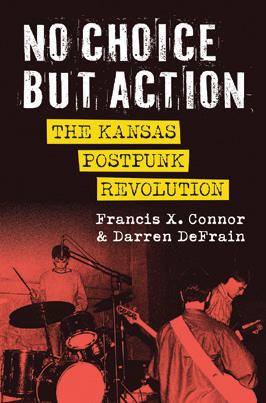
“Francis Connor and Darren DeFrain have thoroughly researched and written a fantastic book about post -punk music in Kansas. They examine the history of zines and institutions like college radio. All to show that pop rebellion in the Midwest was intellectually engaged and smarter than we thought.”
Kevin Mattson, author of We’re Not Here to Entertain: Punk Rock, Ronald Reagan, and the Real Culture War of 1980s America
“‘Kansans have always been ercely independent, somewhat rebellious, and dicult to categorize.’ No Choice but Action: Kansas Postpunk Revolution captures this essence. Learning about these postpunk bands, fans, and tastemakers from the Sunower State during a transformative time is one of the quickest ways to understand the true Ad Astra Per Aspera spirit.”
Matt Beat, public educator and creator of the Mr. Beat YouTube channel
No Choice but Action The Kansas Postpunk Revolution
Francis X. Connor and Darren DeFrain
When most people think postpunk, they picture London or Manchester— e Cure, PiL, Joy Division—or the coasts, from Minutemen in California to Bush Tetras in New York. But far from the major labels and media spotlights, a dierent kind of revolution was taking shape in the American heartland. No Choice but Action uncovers the wildly inventive, ercely independent postpunk movement that erupted across Kansas between 1978 and 1994—and changed Midwestern music forever.
e Embarrassment. Get Smart!. e Moving Van Goghs. Micronotz. Truck Stop Love. ese weren’t outliers. ey were the beating heart of a vibrant,self-sustainingculturalecosystempulsingthroughLawrence, Manhattan, Topeka, and Wichita. With no industry infrastructure to lean on, musicians built their own: basements turned into venues, cassette culture fueled DIY distribution, photocopied zines became lifelines, and word-of-mouth grew into a network strong enough to launch bands onto national stages.
With the fervor of lifelong insiders and the rigor of scholars, authors Fran Connor and Darren DeFrain take readers inside this scene with unparalleled access and insight. ey capture the personalities, the makeshi platforms, the electrifying shows, and the pure creative urgency that kept the music alive long before email, social media, or streaming. eir chronicle is as kinetic and unpolished as the era itself.
More than a regional history, No Choice but Action argues for Kansas postpunk as a crucial, overlooked chapter in American independent music—one whose inuence can still be felt in today’s DIY culture. Kansas wasn’t a footnote to postpunk. It was a force that helped dene the possibilities of American independent music.
Postpunk didn’t just happen in the Midwest. It exploded there.
Francis X. Connor is associate professor of English at Wichita State University and Associate Editor for the New Oxford Shakespeare.
Darren DeFrain is director of the writing program at Wichita State University. He has published a novel, e Salt Palace, and a collection of short stories, Inside & Out
SEPTEMBER
376 pages, 24 photographs, 6 x 9
Paperback ISBN 978-0-7006-4302-8, $29.99 (s)
Ebook ISBN 978-0-7006-4303-5, $14.99
The Wilmot Collins Story—From Liberian Refugee to the First Black Mayor in Montana
Daniel Blake Smith
Run tells the inspiring story of Wilmot Collins, who ed the brutal and bloody Liberian Civil War in the early 1990s—where over 250,000 Liberians were killed, including two of Collins’s brothers—and managed to make it to Helena, Montana, one of the whitest places on the planet. Enduring and overcoming racism and xenophobia, he joined the Montana National Guard, became an active member of the Helena community, and in 2017 rose to become mayor of the capital city and the rst Black mayor in Montana’s history.
Collins garnered a national reputation not only as a beloved Democratic politician in a ruby red state but also as a shining example of how being a racial and political outsider in a highly partisan society can be transformed into an eective and engaging form of political leadership.
Wilmot’s story highlights the tragic decision to abandon one’s homeland when it turns on its people. Collins came from a highly educated family and, when civil war erupted, he was fresh out of college working as a middle school teacher at Monrovia’s SOS Children’s Village School. He had recently found a great companion, Maddie Muna, whom he met aer college graduation. ey became fast friends and soon life partners in marriage. But they rst had to negotiate forces threatening their very lives.
rough extensive interviews and his masterful command of storytelling, award-winning author and lmmaker Daniel Blake Smith tells how Wilmot and Maddie, through great perseverance, plenty of ingenuity, and inspiring displays of generosity, journeyed to the United States and have made their new home a better place for everyone. Run oers an emotional, inspiring,and deeply personal story of survival, racial injustice, political hope, and the challenges one family faced to realize the American dream.
Daniel Blake Smith is the award-winning author of six books and a prize-winning lmmaker. Most recently, he is the writer and producer of the lm Mr. Wonderful, adapted from his novel of the same name.
OCTOBER
168 pages, 13 photographs, 5½ x 8½
Hardcover ISBN 978-0-7006-4299-1 $29.99 (t)
Ebook ISBN 978-0-7006-4300-4, $14.99
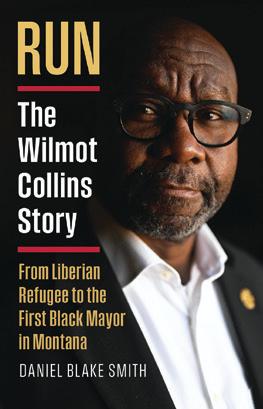
“Over the years, I’ve watched Wilmot transform adversity into purpose. From his early days working multiple jobs to his eventual role as Helena’s mayor . . . his journey is nothing short of inspirational.”
Pat Williams, US House of Representatives Congressman for Montana (1979–1997)
“Wilmot’s journey from seeking refuge from the Liberian Civil War to serving in public oce in Helena is a powerful reminder of what is possible when people are aorded safety and a chance to belong. Today more than ever, we need reminders like this one.”
Krish O’Mara Vignarajah, President and CEO, Global Refuge
“The American Dream we all want to believe in is captured in Wilmot Collins’s story. It would not have been reached without individuals and communities supporting him and his family, yet there is so much more.
Mayor Collins’s story is a lesson in personal perseverance, joy, commitment and unwavering optimism and idealism that things can always be better than they are today.”
Steve Bullock, Montana Governor (2013–2020)
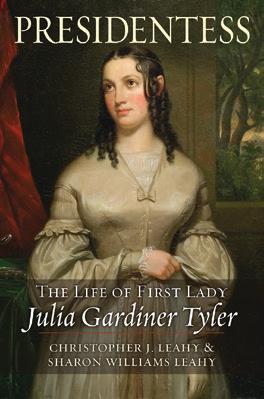
“Charismatic and celebrated, strategic and shrewd, inspiring and exasperating—the woman who emerges from the pages of Presidentess: The Life of First Lady Julia Gardiner Tyler is a historical force to be reckoned with. Using extensive sources, coupled with incisive analysis, Christopher J. Leahy and Sharon Williams Leahy provide a fresh and necessary corrective to Julia Tyler’s past treatment at the hands of historians. Her dramatic rst lady years are only one chapter in a fascinating American’s life.”
Catherine Allgor, PhD, President Emerita-Massachusetts Historical Society, and author of A Perfect Union: Dolley Madison and the Creation of the American Nation
“Christopher and Sharon Leahy’s extensive research adds new dimensions to the story of Julia Gardiner Tyler. . . . Readers will discover that Julia Tyler was a complex, controversial—and inuential— character in her own age and why her legacy remains so today.”
Susan Swain, series host for C-SPAN’s First Ladies: Influence and Image
Presidentess
The Life of First Lady Julia Gardiner Tyler
Christopher J. Leahy and Sharon Williams Leahy
Myths, rumors, and gossip have long circulated around First Lady Julia Gardiner Tyler. Commonly believed to be politically insignicant, most of our fascination with Tyler surrounds her reputation as a highly desired supercial irt. is salacious mythos was based on her status in a politically inuential New York family and the popular rumor that she posed for a sexually suggestive advertisement for a dry goods store in Manhattan.
Now, in the rst full biography of Julia Tyler, Christopher J. Leahy and Sharon Williams Leahy correct such longstanding misconceptions about President John Tyler’s second wife and establish her reputation as an inuential political force. Presidentess shows a presidential spouse who was more consequential than people realize and made a lasting contribution to the evolving role of rst lady.
Leahy and Leahy present a compelling portrait of a determined woman who came to embrace her new Southern identity aer marrying John Tyler, serving as a faithful defender of his views and values—including his decision to renounce the Union and join the Confederate government. In the aermath of the Civil War, she orchestrated a public relations campaign to restore and protect her legacy as well as that of her late husband, the “traitor president.” In her later years, she successfully lobbied Congress for a pension and reclaimed her status as a former rst lady. Presidentess casts a new light on Julia Gardiner Tyler’s life and legacy, including new revelations about the scandalous “Rose of Long Island” advertisement, an exploration of the dark side of New York City’s print culture, and Tyler’s essential role as an unwitting character in the presidential election of 1844. Presidentess gives a fully developed portrait of Julia Tyler, illuminatingthis controversial rst lady and this pivotal turning point in American history.
Christopher J. Leahy is professor of history at Keuka College. He is the author of President without a Party: e Life of John Tyler
Sharon Williams Leahy is an independent scholar with a master’s degree in historic preservation from the Savannah College of Art and Design. She is the author of several articles on rst ladies, including Julia Gardiner Tyler and Mamie Eisenhower.
The East Wing in American Society
SEPTEMBER
408 pages, 18 photographs, 6 x 9 Hardcover ISBN 978-0-7006-4267-0, $44.99 (x)
Ebook ISBN 978-0-7006-4268-7, $44.99
Democracy on the Edge
The Trump Elections and the Future of American Politics
John Kenneth White and Matthew R. Kerbel
Our recent elections have been anything but normal. In Democracy on the Edge, leading political scientists John Kenneth White and Matthew R. Kerbel unravel the elections of 2020, 2022, and 2024 to show how each represented a ashpoint in the reordering of political priorities and electoral coalitions. e consequences have the potential to redene our politics and shape our democracy for years to come.
In unpacking recent electoral cycles and placing them in broader historical context, White and Kerbel show that both major parties face unique diculties. Aer Barack Obama’s election, Democrats believed they were on the cusp of securing a majority that heralded a new era of political realignment around their multiracial dominance. at majority has not yet materialized. Meanwhile, Donald Trump’s hostile takeover of the Republican Party has transformed the GOP into a party completely beholden to him, embracing election denialism, conspiracytheories, and policies that are far out of step with the country beyond his base. e eorts of Republicans and Democrats are bueted by dramatic and unpredictable cultural and economic shis.
And underneath it all is a political system under unprecedented pressure. Our democracy faces its most severe test since the Civil War. e nal denouement of this political saga has yet to be written, but Trump’s election leaves us with the possibility of two unfamiliar outcomes—a brand of American authoritarianism or the establishment of a multicultural republic.
At the close of the Constitutional Convention, Benjamin Franklin was asked by a bystander what kind of government the framers had wrought. Franklin’s famous answer was, “A republic, if you can keep it.” Keeping the republic will depend on the fallout from the last three unprecedented election cycles. Ultimately, our future is up to us.
John Kenneth White is emeritus professor of politics at e Catholic University of America. In addition to his regular column in e Hill, he is the author of many books, including Grand Old Unraveling: e Republican Party, Donald Trump, and the Rise of Authoritarianism, also from Kansas.
Matthew R. Kerbel is emeritus professor of political science at Villanova University. He is the author of the popular political Substack Wolves and Sheep. In addition to many other books, he is the coauthor, with John Kenneth White, of American Political Parties: Why ey Formed, How ey Function, and Where ey’re Headed, also from Kansas.
AUGUST
236 pages, 6 x 9
Paperback ISBN 978-0-7006-4174-1, $27.99 (s)
Ebook ISBN 978-0-7006-4175-8, $21.99
“Democracy on the Edge depicts a Fourth Republic in the making, a riveting, clear-eyed tale of a nation positioned at a momentous crossroads. The American people, White and Kerbel show persuasively, face a profound choice between the darkness of authoritarian rule and the light of multiracial democracy, an unprecedented chapter in the never-ending struggle to dene who we are as a people.”
Sidney M. Milkis, White Burkett Miller Professor, Department of Politics, University of Virginia, and coauthor of Subverting the Republic: Donald J. Trump and the Perils of Presidentialism
“White and Kerbel’s chilling account should awaken all citizens concerned about the fate of the American experiment. The authors skillfully decipher the generational, cultural, racial, and gender cleavages that played a role in rendering the nation’s political parties and its once formidable institutions incapable of rebung Trumpism.”
Stephen F. Knott, author of TheLost Soul of the American Presidency: The Decline Into Demagoguery and the Prospects for Renewal
“David Hendrickson, a distinguished historian of American foreign policy, sums up the wisdom gleaned during his long career, in what can only be termed a tour de force. Not only is The Great Leagueof Peace and Power a model of erudition and shrewd judgment, it is beautifully written and punctures many academic and popular misconceptions about US relations with the world since 1776.”
Walter McDougall, author of The Tragedy ofU.S. Foreign Policy: How America’s Civil Religion Betrayed the National Interest
“No one presently writing—I mean no one—can match David Hendrickson’s grasp of the ambitions and contradictions that have shaped America’s role in the world, both past and present.”
Andrew Bacevich, Co-Founder, Quincy Institute for Responsible Statecraft, and author of Diplomat in Khaki: Major General Frank Ross McCoy and American Foreign Policy, 1898–1949
“With The Great League of Peace and Power, David Hendrickson makes another provocative and original contribution to the understanding of American history.”
Michael Mandelbaum, author of The American Way of Foreign Policy
The Great League of Peace and Power
250 Years of American Foreign Policy
David C. Hendrickson
e Great League of Peace and Power provides a lucid history of American foreign policy and international aairs from the Declaration of Independence in 1776 to its 250th anniversary in 2026. In this concise overview, David C. Hendrickson explores the principal ideas, debates, and strategic challenges that continue to shape today’s wars, alliances, and global commitments.
Hendrickson rejects the idea that America’s traditional policy of independence was “isolationist,” as it had internationalist elements from the beginning. e Founders wanted a new order in North America that would be the antitype of the European system of venomous rivalry among states. Twentieth-century leaders built a system of collective defense that, aer the end of the Cold War, morphed into a universal empire, oen with disastrous results.
At the heart of this story are erce domestic debates over power and principle. Hendrickson brings to life the enduring ideas that have guided and divided Americans for generations: neutrality and intervention, diplomacy and war, restraint and dominance. From the early republic to the age of Trump, he shows how these arguments never disappeared but instead resurfaced whenever the nation facedcrisis abroad.
Clear, authoritative, and deeply relevant, e Great League of Peace and Power speaks directly to today’s readers who are questioning America’s role on the global stage. Hendrickson ultimately argues that older American diplomatic traditions—grounded in peace, reciprocity, and limits on power—oer the best way forward in an era of global overstretch and rising needs at home.
As the United States reects on its 250th anniversary, this timely book oers a bracing reassessment of America’s past and a compelling lens for understanding its uncertain future.
American Political Thought
David C. Hendrickson is Emeritus Professor of Political Science at Colorado College where he taught until 2020. He is the author of numerous acclaimed works on American diplomacy and political thought, including Peace Pact: e Lost World of the American Founding and Union, Nation, or Empire: e American Debate over International Relations, 1789–1941, both from University Press of Kansas.
NOVEMBER
368 pages, 6 x 9
Hardcover ISBN 978-0-7006-4346-2, $37.99 (x) Ebook ISBN 978-0-7006-4347-9, $37.99
Nixon’s War with Students Campus Unrest in the Vietnam Era
J. Samuel Walker
College students frustrated with the state of American society and foreign policy under a Republican president, rising up in protest across the country. Sound familiar? With new sources and fresh perspective, esteemed historian J. Samuel Walker studies the campus crisis of the late 1960s and early 1970s under President Richard Nixon, during the protracted conict in Vietnam and roiling racial tensions in the wake of the Civil Rights Movement.
Walker tells how Nixon’s administration responded to the intense, and sometimes violent, unrest on college campuses across the United States, which became a prominent policy issue during the rst four years of his presidency. A Gallup poll taken in May 1970 showed that campus unrest was rated as the “country’s leading problem,” outranking the war, other international questions, racial conict, crime, and ination. Nixon was so concerned that he created a presidential commission to study the problem, identify its origins, and recommend ways to restore calm to the nation’s colleges that had erupted in disorder.
But Nixon was of two minds when it came to campus turmoil. On the one hand, he saw it as a problem that needed to be xed because it threatened the ability of institutions of higher learning to educate their students and to sponsor vital research. On the other hand, it was an irresistible opportunity to take advantage of the popular outrage with student protests. He hoped that attacking dissidents would appeal to the “silent majority” and build anew political coalition that would support his reelection campaign and the fortunes of the Republican Party going forward. Opting for political gain, Nixon dismissed and privately denounced the ndings of his own presidential commission before he had even read its report.
Drawing on many unused or little-known sources, Nixon’s War with Students is the rst book to examine campus disturbances as a national political issue—one that isas relevant and important today as it was then.
J. Samuel Walker is a professional historian who lives in the Washington, DC, area. He is the author of many books, including e Day at Shook America: A Concise History of 9/11, also from Kansas.
SEPTEMBER
224 pages, 8 photographs, 6 x 9
Hardcover ISBN 978-0-7006-4196-3, $39.99 (x)
Ebook ISBN 978-0-7006-4197-0, $39.99
“Did Richard Nixon write the playbook for the current regime’s assault on higher education? J. Samuel Walker’s lucid and balanced account of Nixon’s response to the student unrest of the 1960s shows how a politically astute, if unprincipled, president took advantage of the campus troubles to further his own career and that of the Republican party. It is a must-read for anyone concerned about the fate of America’s colleges and universities today.”
Ellen Schrecker, author of The Lost Promise: American Universities in the 1960s
“A thorough and thoughtful study of a subject—campus unrest—with sobering resonances today. Walker particularly excels at tracing the baleful impact of presidential leadership that furthered bitterness and division rather than understanding and reconciliation in a deeply divided America.”
Brian VanDeMark, author of Kent State: An American Tragedy
“An eye-opening account of campus activism during the Vietnam era.”
Luke A. Nichter, author of The Year That Broke Politics: Collusion and Chaos in the Presidential Election of 1968
“What does it mean to be a people? Americans traditionally look back to the Declaration of Independence to answer that question. We should also listen to what Thomas Jeerson had to say in the many Other Declarations
Jeremy Bailey brings to our attention in his important and illuminating new book. . . . The Other Declarations: Thomas Jefferson and the Language of American Democracy is essential reading at yet another critical moment in our national history.”
Peter S. Onuf, Thomas Jeerson Foundation Professor of History, Emeritus, University of Virginia, coauthor of Thomas Jefferson Survives: American Independence in His Time and Ours
“Writing the Declaration of Independence was the main source of Thomas Jeerson’s eternal fame. But as Jeremy Bailey notes in this concise, brilliantly incisive book, Jeerson was the author of numerous other declarations that were meant to inform and educate Americans on a wide array of matters. There was, however, one issue where Jeerson manifestly failed: his public neglect of the issue of slavery, an omission that vexes hismemory.”
Jack Rakove, William R. Coe Professor of History, Emeritus, Stanford University
The Other Declarations
Thomas Jefferson and the Language of American Democracy
Jeremy D. Bailey
omas Jeerson spent his life writing declarations. He believed that the written word could shape democracy, and he worked tirelessly to do so. Ironically, Jeerson’s authorship of the Declaration has stood in the way of our understanding of his many contributions to the practice of American democracy by way of his other declarations.
Renowned Jeerson scholar Jeremy D. Bailey shows how the founder wrestled with three fundamental and enduring problems in American democracy. e rst is the freedom of the press and the problem of disinformation in electoral politics, or what Jeerson called “false opinions in league with false facts.” e second is the tension between the necessity of westward expansion and the desirability of some protection of the natural right of Native nations to own their lands. And the third is the question of slavery, and whether the United States could ever bring an end to the peculiar institution. ese questions highlight timeless tension between the philosophical ideals and practical imperatives of democratic politics.
Jeerson was uniquely equipped, philosophically and politically, to address these diculties, but our understanding of Jeerson, and of his successes and failures, is surprisingly incomplete. e Other Declarations gives us a fuller picture of one of our most consequential founders.
Jeremy D. Bailey is Professor of Humanities at the Hamilton School at the University of Florida and formerly held the Sanders Chair in Law and Liberty at the University ofOklahoma. Among many books, he is the author of omas Jefferson and Executive Power and e Idea of Presidential Representation: An Intellectual and Political History.
American Political Thought
SEPTEMBER
216 pages, 6 x 9
Hardcover ISBN 978-0-7006-4282-3, $39.99 (s)
Ebook ISBN 978-0-7006-4283-0, $21.99
Napoleon’s Long Shadow
How French Military Genius Shaped the American Civil War
Timothy B. Smith
For the generation that fought the American Civil War, the wars of the early nineteenth century were not distant history—they were a professional guide. Military education at West Point and elsewhere immersed American ocers in the campaigns of Europe’s great commanders, and none cast a longer shadow than the Corsican general Napoleon Bonaparte. Despite decades of casual analogy, until now, no comprehensive study has ever examined how Napoleon’s campaigns shaped Civil War operations on the battleeld. rough a series of clear, apples-to-apples comparisons, author Tim Smith places nine of Napoleon’s campaigns alongside their closest Civil War counterparts. e result is a fresh interpretation of how the Civil War was fought. Smith arguesthat the war’s early years were profoundly shaped by earlier models of warfare, while its nal year marked a decisive break toward a more modern, industrial style of conict.
By placing these campaignsside by side, Napoleon’s Long Shadow not only claries how Civil War commanders operated, but also challenges long-held assumptions rooted more in legend than in reality.
Timothy B. Smith teaches history at the University of Tennessee at Martin. His many books on the Civil War include Early Struggles for Vicksburg: e Mississippi Central Campaign and Chickasaw Bayou, October 25–December 31, 1862; Bayou Battles for Vicksburg: e Swamp and River Expeditions, January 1–April 30, 1863; e Union Assaults at Vicksburg: Grant Attacks Pemberton, May 17–22, 1863; and e Siege of Vicksburg: Climax of the Campaign to Open the Mississippi River, May 23–July 4, 1863, all published by Kansas.
Modern War Studies
NOVEMBER
344 pages, 21 photographs, 18 maps, 6 x 9
Hardcover ISBN 978-0-7006-4349-3, $54.99 (x)
Ebook ISBN 978-0-7006-4350-9, $54.99
“Civil War–era ocers often referred to Napoleon, who towered over the mid-nineteenth-century military landscape. Timothy B. Smith pairs battles from the Napoleonic wars and the Civil War to oer a compelling examination of how West Point–trained generals compared to the ‘Little Corporal’ in planning, execution, and outcomes. His conclusions should spark spirited and fruitful debate.”
Gary W. Gallagher, John L. Nau III Professor of History Emeritus, University of Virginia
“Whether it be setting Shiloh side by side with Waterloo, or Chickamauga with Austerlitz, the similarities and contradictions Smith nds are eyeopening. Readers interested in the art of command will nd much to ponder in this richly researched and elegantly written narrative. And many will be surprised—and some challenged—by Smith’s conclusion as to who was the one true Napoleonic commander of the Civil War.”
William C. Davis, Retired Professor of History at Virginia Tech, and editor of Secret History of Confederate Diplomacy Abroad
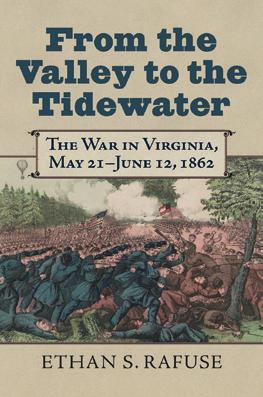
“Smartly written, deeply researched, and well-balanced in its analysis, From the Valley to the Tidewater oers the rst serious studyof military operations in Virginia during the crucial threeweek period from late May to mid-June 1862. It reveals how those operations impacted Union and Confederate war planners and aected soldiers, sailors, and civilians caught in the war’s path. Rafuse’s marvelous study is indispensable for anyone interested in the Civil War in the Old Dominion.”
Jonathan A. Noyalas, Hugh & Virginia McCormick Chair in Civil War History at Shenandoah University, and author of General Philip H. Sheridan: Life, War, and Memory
“In this revealing study, Rafuse connects the dots of a complex, evolving military tableau and convincingly explains how hope for conciliation declined as the will to ght hardened during this crucial period. Deeply researched and clearly written, this book is a must for any student of the war in the east.”
Hampton Newsome, author of Gettysburg’s Southern Front: Opportunity and Failure at Richmond
From the Valley to the Tidewater
The War in Virginia, May 21–June 12, 1862
Ethan S. Rafuse
In this new volume, Ethan Rafuse continues his history of the Civil War in Virginia that began with From the Mountains to theBay: e War in Virginia, January–May 1862, oering a comprehensive account that combines military narrative with an examination of how politicians and civilians grappled with the war on the home front.
By May 1862, the Union had achieved so much progress that it was possible to believe the hopes of those who thought the war could soon be brought to a triumphant end would be fullled. Yet by May 21 there were indications of challenging times ahead for the Union eort, as operational and logistical factors arrested the momentum of Union oensive eorts. is created opportunities for the Confederacy, whose eorts to exploit them produced signicant engagements at Front Royal, Winchester, Hanover Court House, Fair Oaks, Cross Keys, and Port Republic.
Fully understanding the war in Virginia during this period requires paying attention to matters beyond the movements of armies. It was not just events on the battleeld that would determine whether the Union could win the war in Virginia before the year was out. Defeating Confederate armies and navies and restoring territory to thecontrol of Union authorities was only the rst of a two-part formula Union policymakers had devised. e other part was rooted in a belief that support for the Confederacy was shallow and could be undermined through a conciliatory policy toward the Confederacy’s citizens.
As one phase in the war for Virginia ended, another began—one that would do much to answer the question of whether Unionhopes for a military victory signicant enough to heal the divided nation would be realized in 1862.
Ethan S. Rafuse is a professor of military history at the US Army Command and General Sta College. His books include McClellan’s War: e Failure of Moderation in the Struggle for the Union, Robert E. Lee and the Fall of the Confederacy, 1863–1865, and From the Mountains to the Bay: e War in Virginia, January–May 1862 and Guide to the Richmond-Petersburg Campaign, both published by Kansas.
Modern War Studies
NOVEMBER
480 pages, 10 photographs, 15 maps, 6 x 9 Hardcover ISBN 978-0-7006-4357-8, $59.99 (x) Ebook ISBN 978-0-7006-4358-5, $59.99
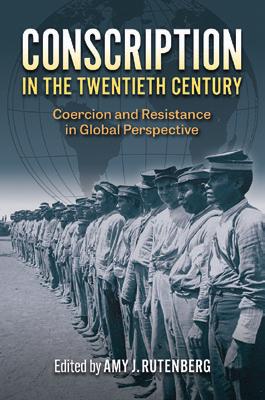
Conscription in the Twentieth Century
Coercion and Resistance in Global Perspective
Edited by AmyJ. Rutenberg
Americans oen view their military through the lens of condent exceptionalism—a belief that the challenges faced by other nationscould never take root in the United States. Our history, we tell ourselves, proves it. Yet a closer look at how Americans have responded to military service reveals a far more complicated story: moments of internal rebellion, mass resistance to conscription, ethically fraught wars, and recurring gaps between the military and the society it serves. ese realities call not for complacency, but for humility—and for serious engagement with the experiences of others.
Conscription in the Twentieth Century confronts one of the most fundamental questions in civil-military relations: Who serves? While oen framed as a uniquely American debate, this question has shaped national identity, citizenship, social cohesion, and political legitimacy across the world and in dierent types of government. Drawing on a remarkable range of international case studies, this volume shows how conscription has unied societies and fractured them, strengthened democratic legitimacy and exposed its absence.
At a moment when democracies confront politicized militaries, recruiting crises, declining public trust, and widening civil-military divides, the lessons of this book are both timely and urgent. Essential reading for students of military history and civil-military relations, Conscription in the Twentieth Century will also speak directlyto policymakers, military professionals, and anyone grappling with the future of democratic defense.
Amy J. Rutenberg is associate professor of history at Iowa State University, where she specializes in US history at the intersection of war, gender, activism, and civil-military relations. She is the author of Rough Dra: Cold War Military Manpower Policy and the Origins of Vietnam-Era Dra Resistance. Her work has appeared in Cold War History, e New York Times, and e Atlantic.
NOVEMBER
384 pages, 6 x 9
Hardcover ISBN 978-0-7006-4353-0, $59.99 (x)
Ebook ISBN 978-0-7006-4354-7, $59.99
“Beautifully written, intellectually stimulating and increasingly relevant, Conscription in the Twentieth Century speaks to the perennial question of ‘Who serves?’ With chapters from contemporary and historical cases written by experts in their disciplines, the book connects conscription to vital issues of citizenship, state authority, politics, society and the armed forces’ eectiveness in wartime. I simply cannot wait to share this book with my colleagues and students.”
Risa Brooks, coeditor of Creating Military Power: The Sources of Military Effectiveness
“Amy Rutenberg has assembled the rst historical analysis of conscription and resistance across dierent nations across the twentieth century. The range of these essays is remarkable, particularly for the global South, asis the attention to the varying contexts, paradoxes, and consequences of conscription, for armies, societies, and their politics. Framing by political scientists adds further value to the many nuancedperspectives.”
Samuel Watson, editor of The Oxford Handbook of American Military History
Praise for the First Edition
”Should be considered essential reading for those interested in understanding the modern American military. Any serious scholar of U.S. military history from 1900 forward should include this in their must-read list. Any student of African American or women’s historywould also nd Taylor’s analysis of the roles of both groups in military and civilian sectors insightful.”
Marine Corps University Journal
”A well-researched and discerning examination of the historical context of current debates about the nature of military service andcivil-military relations as a framework for larger discussions about service, citizenship, and democracy. William Taylor’s principal achievement here is to have persuasively shown that the study of changes in American military service during and since World War II, often in the face of strong opposition, gives us reason to hope that the bond between citizen and soldier can one day be reforged.”
Michigan War Studies Review
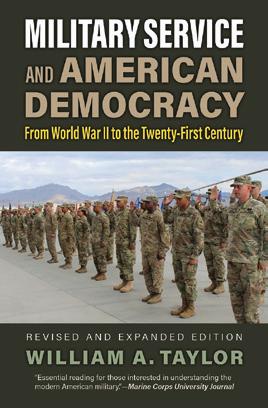
Military Service and American Democracy
From World War II to the Twenty-First Century
Revised and ExpandedEdition
William A. Taylor
In Military Service and American Democracy, William A. Taylor traces the long and contentious evolution of how the United States has built and maintained its armed forces—from the rst peacetime dra on the eve of World War II to beyond the conicts in Iraq and Afghanistan. Spanning the selective service era (1940–1973) and the All-Volunteer Force (1973–present), he shows how varying societal debates and changing policies about who serves in the military and how have shaped both the armed forces and the nation for more than eighty-ve years.
In this new edition, Taylor addresses both enduring military traditions and major changes driven by contemporary social and geopolitical forces, including recruitment and retention challenges, shiing public trust, the integration of women into combat roles, and expansion into cyber and space domains.
William A. Taylor is the Lee Drain Endowed University Professor and chair of the Department of Global Security Studies and Criminal Justice at Angelo State University. He is editor of the University Press of Kansas’s Studies in Civil-Military Relations series.
Modern War Studies
NOVEMBER
320 pages, 25 photographs, 6 x 9
Paperback ISBN 978-0-7006-4379-0, $34.99 (x)
Ebook ISBN 978-0-7006-4380-6, $32.99
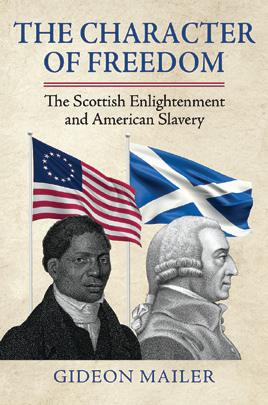
The Character of Freedom
The Scottish Enlightenment and American Slavery
Gideon Mailer
e concept of liberty—so important to the American founding—was signicantly informed by Scottish Enlightenment philosophy, which was central to the the Framers’ religious and political education. is intellectual tradition oered potential support for antislavery ideology. Some Founders, however, were also enslavers whose practices of bondage were in conspicuous contradiction with these professed ideals. What is the actual relationship between the Scottish Enlightenment and racial slavery? Gideon Mailer answers this question in e Character of Freedom
Mailer examines how enlightenment and evangelical religious ideas interacted with discussions of racial slavery in the Scottish Atlantic World from the 1740s through the 1840s. From Glasgow to Philadelphia, from Edinburgh to Princeton, and from Aberdeen to Virginia, Scottishfounded religious and educational bodies encompassed competing moral philosophical systems. Moral thinkers developed conceptions of liberty that reected their institutional and theological commitments.
In Britain, colonial America, and the United States, white thinkers were required to grapple with—or simply evade—the contradiction between their theoretical denitions of liberty and the slaveholding interests in their realm. In those same contexts, however, black Presbyterians were likelier to use Scottish moral philosophy to espouse a more radical abolitionist approach, eventually inuencing white theorists to adopt bolder agendas.
e Character of Freedom is an eye-opening look at the history of abolitionist ideas in the formative period of American political life. Spanning the Atlantic and exploring both white and black thinkers, Mailer’s groundbreaking work is a major contribution to our understanding of early American political thought.
Gideon Mailer is professor of history at the University of Minnesota, Duluth. He is the author of John Witherspoon’s American Revolution and Remembering Histories of Trauma: North American Genocide and the Holocaust in Public Memory.
AmericanPoliticalThought
JULY
416 pages, 6 x 9
Hardcover ISBN 978-0-7006-4228-1, $54.99 (x)
Ebook ISBN 978-0-7006-4229-8, $54.99
“The inuence of eighteenth-century Scottish moral philosophers (Francis Hutcheson, Thomas Reid, Adam Smith, and others) on Americans is well known, and that they frequently theorized about slavery. No one, however, has done what Gideon Mailer brilliantly achieves in this book by examining connections between these philosophers (or those they inuenced, many of them Presbyterians with evangelical convictions) and their stances on slavery . . . The book is comparative, intellectual, religious, and cultural history at its best.”
Mark Noll, author of America’s Book: The Rise and Decline of a Bible Civilization, 1794–1911
“Gideon Mailer takes up one of the biggest historical questions of our moment: Did the Enlightenment ultimately contribute to the rise of abolitionism or help justify chattel slavery in the New World? His original answer draws us deep into eighteenthcentury Scottish thought and then shows us the mutability of ideas, especially in the hands of black Presbyterians whom Mailer eectively restores to intellectual history.”
Sophia Rosenfeld, author of The Age of Choice: A History of Freedom in Modern Life
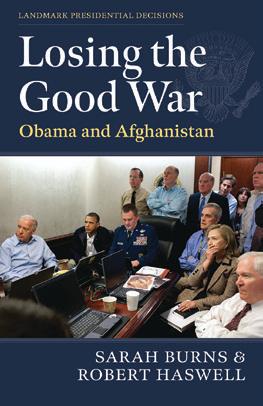
“This richly detailed study examines how President Barack Obama decided in 2009 to authorize a major increase of US troops in Afghanistan to defeat terrorist groups and support political stability and democracy. The nuanced analysis addresses endemic problems with achieving such far-reaching goals through evaluating the complexity of the war in Afghanistan across multiple presidencies. It explains how broad constraints from public opinion, particularly concerns about US national security, present fundamental challenges for presidents to reset expectations for military action.”
Meena Bose, Executive Dean for Public Policy and Public Service Programs, and Director, Peter S. Kalikow Center for the Study of the American Presidency, Peter S. Kalikow School of Government, Public Policy and International Aairs, Hofstra University
“For those wondering why Afghanistan became America’s longest war, Losing the Good War sheds light on how the pressures of domestic politics and national narratives can constrain even the most powerful leaders.”
Tizoc Chavez, author of The Diplomatic Presidency: American Foreign Policy from FDR to George H. W. Bush
Losing the Good War
Obama and Afghanistan
Sarah Burns and Robert Haswell
Barack Obama entered the White House in 2009 with a mandate to end the wars and occupations begun under George W. Bush. e American public and foreign policy–makers alike were ready to withdraw from these unpopular and unwieldy conicts. While Obama fullled his campaign promises with the “bad war” in Iraq, the “good war” in Afghanistan followed a very dierent path.
Unlike his predecessor, Obama chose to prioritize South Asia as the focus of the United States military. Following a strategic review, Obama and his military advisors decided to replicate the Iraqi troop surge in Afghanistan, embarking on a labor-intensive counterinsurgency campaign. Unlike the Iraqi surge, however, Obama placed an eighteen-month limit on the increased troop deployment promising a withdrawal in the summer of 2011. Despite a revised strategy that emphasized training the Afghan forces, the Afghan units struggled to perform in a leadership role, remaining dependent on American airpower. ese problems were compounded by the civilian side of the government that suered from corruption and appeared illegitimate to much of the Afghan population.
Aer Obama withdrew troops, the Taliban began their resurgence in 2014. Around the same time the Islamic State emerged onthe scene in Iraq and Syria, requiring new counterterrorism eorts that drained resources from Afghanistan and shied the US focus back to the Middle East, leaving Afghanistan more vulnerable to local and international extremists. Peace talks with the Taliban broke down, and the war dragged on—becoming an unwinnable quagmire.
As part of the Landmark Presidential Decisions series, Losing the Good War analyzes how Obama’s campaign promises translated into policy, particularly the decision-making around the surge. Sarah Burns and Robert Haswell shine a light on this mishandled episode in US foreign policy.
Sarah Burns is associate professor of political science at Rochester Institute of Technology. She is the author of e Politics of War Powers: e eory and History of Presidential Unilateralism (Kansas, 2019).
Robert Haswell holds a PhD from Carleton University (2026). His research interests include American foreign policy and United States military aairs.
Landmark Presidential Decisions
AUGUST
180 pages, 5½ x 8½
Hardcover ISBN 978-0-7006-4292-2, $99.99 (x)
Paperback ISBN 978-0-7006-4293-9 $24.99 (x)
Ebook ISBN 978-0-7006-4294-6, $24.99
Jefferson’s Landmark Deal
The Politics of the Louisiana Purchase
Lara M. Brown
omas Jeerson is one of the more inscrutable characters in American history. While he is best known for the Declaration of Independence and his conicting legacy on race and slavery, his pursuit of the Louisiana Purchase was a crucial decision for the trajectory of the country and the development of the presidency. In this volume of the Landmark Presidential Decisions series Lara M. Brown casts Jeerson as a shrewd and calculating politician. Brown examines the historical and political circumstances that led to the Louisiana Purchase, in which Jeerson’s inclination to pursue a strategy of misinformation and patient persuasion rather than engaging in a direct confrontation or a show of force with Napoleon helped to transform a series of accidents into a historic moment of luck.
In addition to exploring the international politics and domestic pressures that helped bring about this deal, Brown examines the larger theoretical issues related to the presidency itself. While Jeerson expressed concern about the constitutionality of the agreement and briey considered passing a constitutional amendment, his decision to follow Madison’s advice and move quickly on the purchase established the “national emergency” rationale upon which the “imperial presidency” was partly constructed. Moreover, Jeerson relied on American ministers to act as his representatives in executing the deal, underlining the importance of governance, communication, and the management of a burgeoning executive branch.
e Louisiana Purchase is essential to understanding territorial expansion, foreign policy in the early republic, and the perennial political dilemmas surrounding the ambiguity of Article II in the Constitution. Lara Brown expertly guides readers through one of the most consequential decisions in early American history.
Lara M. Brown currently serves as a senior policy advisor to the Center on Civility and Democracy at e Ronald Reagan Presidential Foundation and Institute. Previously, she held academic posts at the George Washington University and Villanova University. Among her scholarly publications, she is the author of Amateur Hour: Presidential Character and the Question of Leadership
Landmark Presidential Decisions
AUGUST
168 pages, 1 map, 5½ x 8½
Hardcover ISBN 978-0-7006-4240-3, $99.99 (x)
Paperback ISBN 978-0-7006-4241-0 $27.99 (x)
Ebook ISBN 978-0-7006-4242-7, $27.99
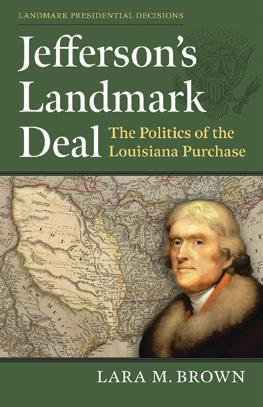
“At times I felt like I was reading the script of a movie or a multi-part Netix political drama. That is a compliment! Other authors far too often portray Jeerson as a philosopher or a sanctimonious ideologue, when in fact, he was just another politician of his era. The Louisiana Purchase is commonly depicted as the result of a situation where Jeerson took advantage of the opportunity when America’s interests aligned with France’s, but the reality was much more uid and complicated for both countries. Lara Brown does an excellent job at illuminating that state of aairs.”
Donald A. Zinman, author of The Heir Apparent Presidency and America’s First Wartime Election: James Madison, DeWitt Clinton, and the War of 1812
“This insightful analysis is a must-read for those interested in communication, policymaking, history, and political science, and is especially relevant to those interested in how the nation and its presidency have developed from Jeerson’s time to now.”
Mary E. Stuckey, author of Remembering Jefferson: Who He Was, Who We Are
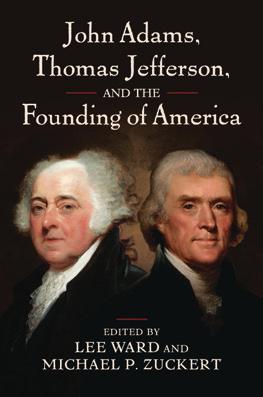
“The decades-long rivalry and friendship between John Adams and Thomas Jeerson is as fascinating as it is instructive. This ne volume of essays, from an all-star cast of scholars, is a tting way to mark the two hundredth anniversary of their famously well-timed deaths.”
Dennis C. Rasmussen, author of The Constitution’s Penman: Gouverneur Morris and the Creation of America’s Basic Charter
“The Adams-Jeerson story has been told many times, in historical scholarship and in American folklore. But that story is often told in a schematic and oversimplied way. John Adams, Thomas Jefferson, and the Founding of America makes the Adams-Jeerson story fresh again. These essays invite the reader to think anew about the questions and problems that Adams and Jeerson faced, both individually and in dialogue with one another.”
James H. Read, author of Sovereign of a Free People: Abraham Lincoln, Majority Rule, and Slavery
John Adams, Thomas Jefferson, and the Founding of America
Edited by Lee Ward and Michael P. Zuckert
John Adams and omas Jeerson died hours apart on July 4, 1826— exactly y years aer they draed the Declaration of Independence. Adams and Jeerson were undoubtedly two of the most important and consequential Founders. And yet, two hundred years aer their passing, they remain the subject of intense discussion as Americans continue to assess their legacy in relation to the nation’s identity and future.
To mark the bicentennial of the passing of Adams and Jeerson—and the 250th anniversary of the United States of America—this volume brings together some of the most important scholars of the early republic to oer new and original insights into their lives and legacies. ematic essays explore their presidencies, their disagreements about the meaning and value of democracy, and their views on education, religion, and science. Important and controversial topics, including the idea of natural aristocracy and the problem of slavery, are considered as well.
Beginning with an introduction by Gordon Wood, this masterful volume includes essays by Luke Mayville, Vincent Phillip Muñoz, Peter Onuf, Richard A. Ryerson, Darren Stalo, Brian Steele, George omas, Bradley ompson, Lee Ward, and Jean Yarbrough. ebook concludes with a three-act play about the Adams-Jeerson relationship coauthored by Michael Zuckert.
Lee Ward is professor of political science at Baylor University. He is the author of several books, including John Locke and Modern Life and Recovering Classical Liberal Political Economy: Natural Rights and the Harmony of Interests
Michael P. Zuckert is Dreux Professor Emeritus at the University of Notre Dame and Clinical Professor at Arizona State University. He was the founding editor of the journal American Political ought. He is the author of many books, including A Nation So Conceived: Abraham Lincoln and the Paradox of Democratic Sovereignty, also from Kansas.
American Political Thought
AUGUST
276 pages, 6 x 9
Hardcover ISBN 978-0-7006-4270-0, $99.99 (x)
Paperback ISBN 978-0-7006-4271-7, $39.99 (x) Ebook ISBN 978-0-7006-4272-4, $39.99
The White Ribbon Army Reconsidered
The Woman’s Christian Temperance Union After 150 Years
Edited by Adam Chamberlain, Janet Olson, and Alixandra B. Yanus
Originating as a series of local temperance crusades in 1873, the Woman’s Christian Temperance Union (WCTU) coalesced in November 1874 and soon became the largest women’s political organization in the United States. As champions of social reform, members identied themselves by the white ribbon bows they pinned to their dresses, a symbol of purity and commitment to the temperance cause, inspiring the nickname “the White Ribbon Army.”
Following President Frances Willard’s command to “Do Everything,” the WCTU developed a wide sphere of inuence in social reform circles. e WCTU’s global agenda included other reforms related to women’s traditional role as the center of the home and family, including surage, prison reform, and education. In the twentieth century, its message and methods inspired and mobilized not only white evangelical Protestant women but also those from other Christian denominations, racial and ethnic minorities, and their husbands and children who joined auxiliary organizations.
But what was once a powerful, organized global force has become an amorphous and contradictory caricature. e WCTU has been portrayed as socialist and ultra-conservative, ineectual and powerful, inclusive and divisive. Its long-term legacy as an inuential women’s network has been le underexamined, and there is a need for a reevaluation of the organization.
Marking the WCTU’s 150th anniversary, e White Ribbon Army Reconsidered brings together scholars from women’s and public history, political science, rhetoric, and religious studies. Its twelve essays explore the WCTU’s broad impact on politics, society, and culture, acknowledging the WCTU’s complexities and contradictions to provide a fresh reassessment of this once-powerful organization and to inspire further research.
Adam Chamberlain is professor of political science at Coastal Carolina University.
Janet Olson is the former archivist at the Frances Willard House Museum and WCTU Archives in Evanston, IL.
Alixandra B. Yanus is professor of political science at High Point University and the former Daniel German Visiting Distinguished Professor of Political Science at Appalachian State University.
AUGUST
340 pages, 7 photographs, 6 x 9
Hardcover ISBN 978-0-7006-4274-8 $99.99 (x)
Paperback ISBN 978-0-7006-4275-5, $37.99 (x)
Ebook ISBN 978-0-7006-4276-2, $37.99
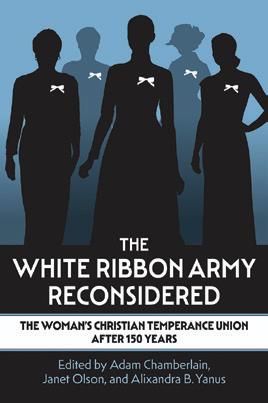
“The Woman’s Christian Temperance Union (WCTU) was unquestionably the most important women’s organization in American history. . . . The White Ribbon Army Reconsidered is a profound and much-needed historical investigation, that will provide a valuable scholarly touchstone for students of American and transnational history, sociology, gender studies, race and ethnic politics for generations to come.”
Mark Schrad, author of Smashing the Liquor Machine: A Global History of Prohibition
“This collection is essential reading for anyone seeking to understand how faith-infused women’s activism simultaneously advanced reform, revealed deep tensions, and transformed public life across national and international contexts.”
Ashley Boggan, General Secretary, General Commission on Archives and History of the United Methodist Church, author of Nevertheless: Methodist Women and Women’s Rights and Wesleyan Vile-tality: Reclaiming the Heart of Methodist Identity
“If only more politicians could reect on their political education with the candor and humor that Everett Dirksen does in this rare memoir from one of the truly greatnational leaders of the twentieth century.”
Raymond W. Smock, Historian of the US House of Representatives, 1983–1995
“In the foreword, Howard Baker writes ‘Virtually every idea [Dirksen] held, he held tentatively.’ To learn how a person with that approach can emerge as a giant on the national scene, and play a key role in the passage of the 1964 Civil Rights Act, is fascinating.”
Paul Simon, US Senator, 1985–1997
“A most exhilarating account of a perfectrole model for both budding politicians and anyone serving in elective oce.”
Robert H. Michel, US House of Representatives, 1957–1995
“Dirksen provides a case study in the making of an eective political leader. General readers in Illinois and elsewhere will enjoy his charming anecdotes, vivid character sketches, and a folksy wisdom.”
Patrick J. Maney, Professor of History, Tulane University
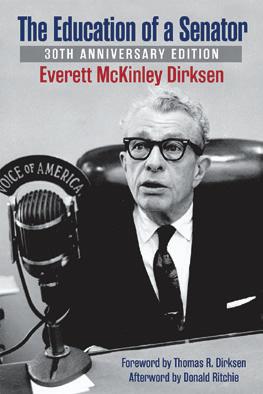
The Education of a Senator
30th Anniversary Edition
Everett McKinley Dirksen
Everett McKinley Dirksen was elected to the US House of Representatives in 1932 and served as the US Senate Minority Leader from 1959–1969, and he is best known for his role as the nation’s top Republican leader who facilitated the passage of the Civil Rights Act of 1964 against Southern Democrat intransigence. During his time in Congress, he captivated his colleagues and audiences everywhere with his rhetoric and his voice, and his legislative prowess earned him a reputation for being the “Uncrowned King of the Senate.”
Years aer Dirksen died unexpectedly in 1969, the Dirksen CongressionalCenterdiscoveredaroughmanuscriptoftheautobiographythat the Senator had been craing, which describes in his own voice and vivid recollection the major moments of his life that ultimately shaped the person who won the “impossible” race for US Senate in 1950 against its Majority Leader Scott Lucas.
e Education of a Senator is a must-read for anyone drawn to the personal stories behind public gures, oering a deeper appreciation for the compelling blend of Dirksen’s everyday humanity and remarkable leadership. Originally published in 1996, this 30th anniversary edition includes a new introduction from Everett Dirksen’s nephew, Tom Dirksen, and an aerword from Senate Historian Emeritus Donald Ritchie. It also includes dozens of photos from Dirksen’s personal papers that add a new level of detail about his life. In the context of current events that are dramatically shaping the story of our country, e Education of a Senator is a remarkable testament to an individual who le an indelible impression on Congress.
e Dirksen Congressional Center is pleased to introduce a new generation of readers, public servants, and future historians to Senator Everett McKinley Dirksen with the publication of this new edition.
Everett McKinley Dirksen is remembered as a prominent and eective congressional leader. As Senate Minority Leader (1959–1969), he became well-known for his indispensable role in successfully negotiating and gathering the support of his colleagues to pass the Civil Rights Act of 1964. Upon his death in 1969, his family and former sta collaborated with the Pekin community to establish the Everett McKinley Dirksen Congressional Leadership Research Center and advance the public’s understanding of the US Congress.
Congressional Leaders
SEPTEMBER
316 pages, 45 photographs, 6 x 9
Paperback ISBN 978-0-7006-4360-8, $29.99 (x)
Ebook ISBN 978-0-7006-4361-5, $29.99
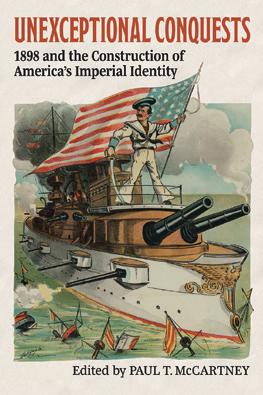
Unexceptional Conquests
1898 and the Construction of America’s Imperial Identity
Edited by Paul T. McCartney
e War of 1898—also known as the Spanish-American War—was a pivotal moment in American history, in which the United States initiated an ostensibly humanitarian war against Spain in April yet emerged eight months later with a colonial empire over the people it claimed to rescue. is was immediately followedby the Philippine-American War, an ugly conict in which the United States brutally suppressed Filipino nationalists who resisted American colonization. While historians have recognized the colonial ambitions of the United States throughoutits early history, the events of 1898 highlighted, in stark clarity, the tension between the nation’s exceptionalist claims to moral superiority and its highly unexceptional ambitions for imperial domination.
Unexceptional Conquests gathers some of the foremost scholars of the Gilded Age and American empire to examine American identity around 1898. Its chapters collectively argue that empire has gured more prominently in the construction of American national identity than many accounts acknowledge. As Americans grappled with the imperatives arising from their post-1898 colonial ambitions, they found themselves developing new legal and policy frameworks that challenged some inherited constructs, such as those concerning the proper scale of government or the value of self-government, while reinforcing others, such as those regarding gender, racial, and religious hierarchies. American beliefs and practices needed to bend to accommodate its new imperial status, given the unprecedented decision to acquire territories and peoples who were intended never to become states and citizens.
e contributors to this volume elucidate the cultural and intellectual origins and outcomes of these events. Without ignoring or downplaying the role of economic motivations for American conduct, this volume highlights the patterns of thought that both inuence and are inuenced by empire. Includes contributions by Sam Erman, Julian Go, Susan K. Harris, Fabian Hilfrich, Kristin L. Hoganson, Bonnie M. Miller, Julie Novkov, Louis A. Pérez, Bartholomew H. Sparrow, and Lanny ompson.
Paul T. McCartney is professor of political science at Towson University. He is the author of Power and Progress: American National Identity, the War of 1898, and the Rise of American Imperialism
OCTOBER
382 pages, 6 x 9
Paperback ISBN 978-0-7006-4296-0, $39.99 (x)
Ebook ISBN 978-0-7006-4297-7, $39.99
“Unexceptional Conquests sheds new light on the United States’ emergence as a global empire. Deploying analytical approaches from multiple disciplines, it reveals the rhetorical contortions and structural inequalities integral to building that empire. Collectively, its incisive chapters now represent the single best entry point to 1898 and its ongoing aftermaths.”
Oli Charbonneau, author of Civilizational Imperatives: Americans, Moros, and the Colonial World
“Finally, thanks to Paul T. McCartney, we have a compendium showcasing the most groundbreaking contemporary scholarship on the Spanish-American War and its complex origins, consequences, meanings, and legacies. Essays ranging topically from historiography, Christian nationalism, and gender and racial politics to media culture, labor protest, and constitutional jurisprudence, among other subjects, oer a rich mosaic of interdisciplinary research on the United States’ turn to ‘saltwater empire’ in the 1898 era. The result is an exceptionally illuminating guide to the making of a surprisingly unexceptional imperial nation.”
Justin F. Jackson, author of The Work of Empire: War, Occupation, and the Making of American Colonialism in Cuba and the Philippines
“This book is both timely and timeless. When examiningthe current struggles in the American constitutional order, German’s work oers a well-reasoned justication for turning towards Montesquieu, the Federalists, and the Anti-Federalists for answers. Bringing Montesquieu into a dialogue with the founders provides a unique lens on the controversies of the time that continue to have important lessons for today’s politics.”
Sarah Burns, author of The Politics of War Powers: The Theory and History of Presidential Unilateralism
“Montesquieu and the American Founders is a familiar topic among founding scholars, largely because of their common concern with separation of powers and the argument about small republics. But German has a dierent and highly welcome take on the subject. He takes o from the French thinker’s concern with ‘mores’ and in doing so reveals new dimensions of the founders’ thinking.”
Michael Zuckert, author of A Nation So Conceived: Abraham Lincoln and the Paradox of Democratic Sovereignty
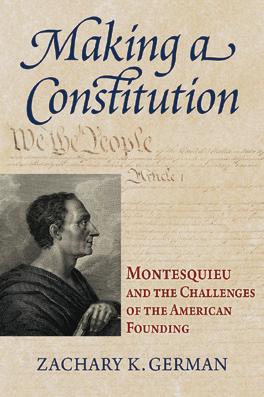
Making a Constitution Montesquieu
and the Challenges of the American Founding
Zachary K. German
Few thinkers loom larger over the American founding than Montesquieu. e framers repeatedly invoked his authority while draing, debating, and ratifying the Constitution—yet the true depth and complexity of his inuence has never been fully explained. In Making a Constitution, Zachary K. German oers the most denitive account to date, revealing how Montesquieu’s political philosophy shaped not just familiar concepts like separation of powers butthe very logic of American constitutional design.
German argues that Montesquieu’s central insight—the need to tailor laws and institutions to a people’s distinctive “spirit”—was foundational to how the framers understood the possibilities and limits of republican government. Drawing on Montesquieu’s spirit-oriented approach, German reframes the core problems of constitutionalism: how to reconcile liberty with republican rule, how to divide power vertically between levels of government, and how to separate power horizontally among institutions. He then shows how Federalists and Anti-Federalists alike, all steeped in Montesquieu’s thought, reached sharply dierent conclusions about how best to preserve liberty within the particular character and circumstances of the American people.
As the “spirit” of the American people has changed in profound ways since the founding, so too has our understanding of the Constitution. German reminds us that Montesquieu’s insights remain perennially relevant. At a moment of renewed controversy over constitutional meaning, this book oers a vital framework for rethinking the enduring challenges of American constitutionalism.
Zachary K. German is assistant professor in the Institute of American Civics at the Howard H. Baker Jr. School of Public Policy and Public Aairs at the University of Tennessee, Knoxville.
American Political Thought
NOVEMBER
280 pages, 6 x 9
Hardcover ISBN 978-0-7006-4325-7, $54.99 (x)
Ebook ISBN 978-0-7006-4326-4, $54.99
Read My Lips
George H. W. Bush and the 1990 Budget Agreement
John J. Pitney, Jr.
“Read my lips: no new taxes.” Withthat electrifying pledge at the 1988 Republican National Convention, George H. W. Bush sealed his nomination and unied a party. e promise became one of the most famous— and most consequential—lines in modern American political history. When President Bush broke it two years later, the fallout didn’t just derail a presidency; it permanently transformed Republican thinking about taxes, decits, and political survival.
In 1990, facing a ballooning decit, binding budget law, and the high-stakes nal phase of the Cold War, Bush made a fateful decision to accept a budget deal that included tax increases. e reaction was swi and brutal. Conservatives erupted in anger. Headlines screamed betrayal. Party unity collapsed. ough the agreement ultimately helped balance the federal budget, Bush paid a steep political price and lost his bid for reelection in 1992.
Drawing on rare rsthand experience and rigorous historical analysis, John J. Pitney, Jr.—who worked inside the Republican National Committee during thecrisis—reveals what really happened behind closed doors. He shows why Bush believed he had no viable alternative, how Democrats forced the issue, and why defense cuts were a nonstarter at a pivotal moment in global politics. Most importantly, Pitney traces how Republicans turned the 1990 budget deal into a cautionary myth: the belief that any tax compromise guarantees political ruin.
at lesson, embraced as doctrine, has shaped Republican scal strategy for decades. It has fueled resistance to decit reduction, constrained budget negotiations, and helped drive today’s federal debt. By revisiting the moment when the party’s modern tax orthodoxy was forged, this book oers essential insight into the roots of contemporary budget battles.
Authoritative and deeply revealing, this is the denitive account of how one broken promise changed American politics and why its consequences are still with us.
John J. Pitney, Jr. is Roy P. Crocker Professor of American Politics at Claremont McKenna College. He is the author of many books, including Aer Reagan: Bush, Dukakis, and the 1988 Election, also from Kansas.
Landmark Presidential Decisions
NOVEMBER
128 pages, 5½ x 8½
Hardcover ISBN 978-0-7006-4339-4, $99.99 (x)
Paperback ISBN 978-0-7006-4340-0 $27.99
Ebook ISBN 978-0-7006-4341-7, $27.99
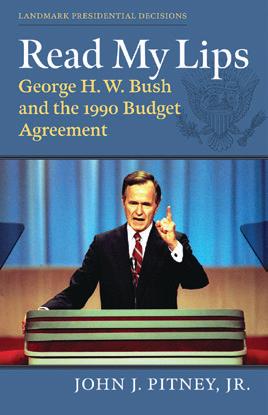
“If anyone is looking for the moment when the modern conservative movement was born, look nofurther than the moment when George H. W. Bush reversed his ‘readmy lips’ campaign promise, agreed to a signicant tax hike, and was vocally attacked notonly by the opposition party, but by Republicans who felt a deep sense of betrayal. John Pitney brings the memory of a player in this drama, as well as the skill of a scholar, to his graceful telling of this important story. It should be read by anyone who needs to know why today’s politics are as personal, as vicious, and as polarized as they have become.”
John Robert Greene, author of The Presidency of George H. W. Bush
“Read My Lips sheds light not only on the far-reaching political and economic consequences of Bush’s fateful reversal but also the lessons they oer with the benet of hindsight.”
Mark K. Updegrove, Chairman and CEO of the LBJ Foundation and author of The Last Republicans: Inside the Extraordinary Relationship Between George H.W. Bush and George W. Bush
“This is a magnicent, sweeping history of the Supreme Court and constitutional law from its earliest moments through today. In a very clear and accessible way, Professor Powe has written a book that will inform and entertain both experts and those with little background in constitutional law.”
Erwin Chemerinsky, Dean and Jesse H. Choper Distinguished Professor of Law, University of California, Berkeley School of Law
“Lucas A. Powe, Jr. is one of our nation’s most distinguished Supreme Court historians, as his writing has indelibly shaped how we understand broad swaths of the American constitutional landscape. In Supreme Control, Powe brilliantly excavates and illuminates one of the most important—and yet one of the most underexplored—topics in our constitutional order. . . . All Americans interested in the modern Supreme Court—and how we arrived at this improbable moment—will need to reckon with Powe’s engaging, provocative, and persuasive account.”
Justin Driver, author of Washington Post Notable Book of the Year and The New York Times Book Review Editors’ Choice The Schoolhouse Gate: Public Education, the Supreme Court, and the Battle for the American Mind
SupremeControl
The Long War for the Supreme Court—and Why Republicans Are
Lucas A. Powe, Jr.
Currently Winning
In Supreme Control, leading Supreme Court scholar Lucas A. Powe, Jr. explains how the United States arrived at the Republican-dominated Roberts Court that is transforming constitutional law and reshaping everyday American life. What once seemed unthinkable—a Court willing to overturn long-settled precedent to advance a single political vision—has become reality.
Powe argues that today’s Court fullls a decades-long Republican project: the creation of a reliably conservative Supreme Court. Built through a carefully orchestrated strategy culminating in the judicial appointments made during Donald Trump’s presidency, the Roberts Court represents an unprecedented concentration of power within one political coalition. Placing these developments in historical context, Powe shows how the current Court is only the latest in a long battle for partisan dominance of American law.
e struggle to control the Supreme Court, Powe demonstrates, is as old as the Republic itself. From Washington, Adams, and Jeerson to Lincoln, Grant, and FDR, presidents have sought a Court that would secure their constitutional priorities. Aer a string of controversial liberal rulings in the 1960s and 1970s by the Warren Court, conservatives launched a sustained, long-term eort to reverse that legacy. at campaign advanced unevenly for decades until it nally succeeded in the twenty-rst century with Donald Trump’s rst term.
Today, the consequences are unmistakable. e Court’s recent decisions on abortion, gun rights, religion, armative action, and executive power have thrust it into the center of American political life, with sweeping implications for democracy, governance, and individual rights.
As Americans continue to grapple with the Court’s immense authority, Supreme Control provides the clearest explanation yet of how we reached this critical moment in history and what it means for the nation’s future.
Lucas A. Powe, Jr. is the Anne Green Regents Chair in Law and professor of government at the University of Texas at Austin School of Law. He is the author of numerous books, including e Supreme Court and the American Elite, 1789–2020 (Kansas, 2022).
Constitutional Thinking
NOVEMBER
328 pages, 6 x 9
Paperback ISBN 978-0-7006-4328-8, $39.99 (x)
Ebook ISBN 978-0-7006-4329-5, $39.99
BIOGRAPHY | PRESIDENTIAL STUDIES | WOMEN’S STUDIES
Betty Ford
Candor and Courage in the White House
John Robert Greene
“A well-paced, insightful, and sympathetic account of Betty Ford’s two great starring roles as the rst feminist First Lady and the iconic celebrity who endured the all-too-typical descent into addiction, followed by therapeutic redemption. Greene integrates Betty Ford’s story into the largerdramas of the Ford presidency, as well as modern America in general. Brief, punchy, well-organized. . . . All should salute Greene for producing a most welcome biography of a woman who, sometimes reluctantly, sometimes willingly, helped Americans redene the boundaries of public discourse while expanding their expectations for the dicult role of the presidential spouse.”—History: Reviews of New Books
John Robert Greene is retired Professor Emeritus of History and Humanities at Cazenovia College. Among his other books are e Presidency of Gerald R. Ford, e Presidency of George W. Bush, and e Limits of Power: e Nixon and Ford Administrations
Modern First Ladies
JULY
186 pages, 13 photographs, 6 x 9
Paperback ISBN 978-0-7006-4371-4, $32.99 (x)
Ebook ISBN 978-0-7006-2865-0, $14.99
BIOGRAPHY | PRESIDENTIAL STUDIES | WOMEN’S STUDIES
Bess Wallace Truman
Harry’s White House “Boss”
Sara L. Sale
“An engaging and important addition to the literature on modern rst ladies. Sale shows how Bess Truman remade the oce of the rst lady to suit her own personality and along the way earned the admiration and respect of the American people. Readers who also want to know more about postwar politics will not be disappointed.”—Nancy Beck Young, author of Lou Henry Hoover
Sara L. Sale is professor of political science at Northeastern Oklahoma A&M College and author of e Shaping of Containment: Harry S. Truman, the National Security Council, and the Cold War.
Modern First Ladies
JULY
180 pages, 17 photographs, 6 x 9
Paperback ISBN 978-0-7006-4376-9, $32.99 (x)
Ebook ISBN 978-0-7006-4377-6, $32.99
The Discretionary President
The Promise and Peril of Executive Power
Benjamin A. Kleinerman
“ e most thought-provoking book about executive power written in a decade lled with important work on the subject. . . . is book should set the stage for conversations about discretionary power for years to come. . . . A fascinating, thought-provoking book.”—H-Net Reviews
“Kleinerman’s lucid style should attract anyone interested in a nuanced and scholarly examination of the underpinnings of and objections to the unitary executive.”—Harvard Law Review
Benjamin A. Kleinerman is assistant professor of constitutional democracy at Michigan State University.
OCTOBER
338 pages, 6 x 9
Paperback ISBN 978-0-7006-4372-1, $32.99 (x)
Ebook ISBN 978-0-7006-4373-8, $32.99
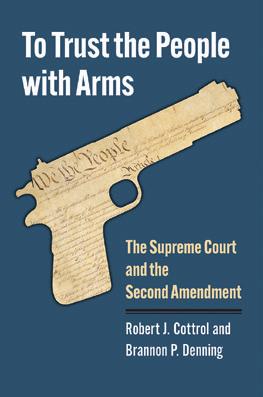
CONSTITUTIONAL STUDIES | LAW | BLACK STUDIES
To Trust the People with Arms
The Supreme Court and the Second Amendment
Robert J. Cottrol and Brannon P. Denning
Winner of the Thomas M. Cooley Book Prize
“Precise, accurate, comprehensive, dispassionate, and cogently argued— this history of the ongoing dispute concerning the right to bear arms and its proper limits is a must-read. If you think that you know what is right and what is wrong in this debate, the odds are that you are sadly mistaken. Cottrol and Denning have produced an eye-opener written with verve and grace.”—Paul A. Rahe, author of Republics Ancient and Modern
Robert J. Cottrol is Harold Paul Green Research Professor of Law and professor of history and sociology at George Washington University. He is the author of e Long, Lingering Shadow: Slavery, Race, and Law in the American Hemisphere and coauthor of Brown v. Board of Education: Caste, Culture, and the Constitution.
Brannon P. Denning is Starnes Professor of Law at Cumberland School of Law at Samford University. He is the author of e Glannon Guide to Constitutional Law: Powers and Liberties and the coauthor of American Constitutional Law: Powers and Liberties and Guns and the Law: Cases, Problems, and Explanation.
OCTOBER
368 pages, 6 x 9
Paperback ISBN 978-0-7006-4369-1, $29.99 (x)
Ebook ISBN 978-0-7006-3572-6, $59.99
WEST
True Tales of the Prairies and Plains
David Dary
“Dary’s writings have richly deserved his many awards and are as interesting asthey are informative. ese tales are as wide-ranging as the land they cover, rescuing settlers’ lore from obscurity and promising hours of reading enjoyment.”—e Oklahoman
“Drawn from contemporary sources and recent scholarship, this volume will please anyone who likes a good story.”—True West
David Dary is winner of the Cowboy Hall of Fame Wrangler Award, two Western Writers of America Spur Awards, the Westerners International Best Nonction book Award, and the Owen Wister Award for lifetime achievement from the Western Writers of America. He is the author of fourteen previous books, including Cowboy Culture, e Santa Fe Trail: Its History, Legends and Lore, and e Oregon Trail: An American Saga.
AUGUST
264 pages, 38 photographs, 6 x 9
Paperback ISBN 978-0-7006-4382-0, $27.99 (s)
Ebook ISBN 978-0-7006-4383-7, $14.99
KANSAS | GREAT PLAINS AND THE MIDWEST | NATURAL HISTORY
Elevations
A Personal Exploration of the Arkansas River
Max McCoy
Winner of the National Outdoor Book Award
Named a Kansas Notable Book by the Kansas Center for the Book
“McCoy uses the natural eastward ow of the Arkansas River as the prime organizing principle for his narrative, but we soon begin to realize that, just like biographies of complex individuals, the life story of this river contains a mix of tragedy, heroism, humor, and, in McCoy’s case, the opportunity to confront and wrestle with personal demons and failings.”
Great Plains Research
Max McCoy is an award-winning author and journalist. A regular Sunday columnist for the Kansas Reflector, he recently earned rst-place awards from the National Society of Newspaper Columnists and the Kansas Press Association. He is also a three-time Spur Award winner and a multiple recipient of the Kansas Notable Book Award.
SEPTEMBER
320 pages, 22 photographs, 1 map, 6 x 9
Paperback ISBN 978-0-7006-4375-2, $24.99 (t)
Ebook ISBN 978-0-7006-2603-8, $14.99

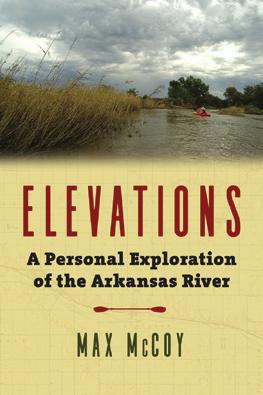
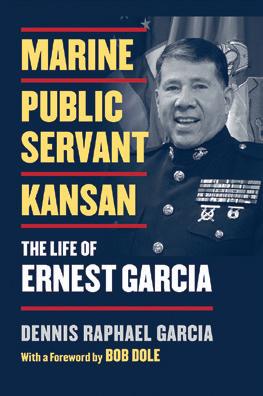
BIOGRAPHY | KANSAS | LATINX STUDIES Please give us code 24SCF26 when ordering by web or by
Marine, Public Servant, Kansan
The Life ofErnest Garcia
Dennis Raphael Garcia
Winner of the International Latino Book Award for Best Biography
“Ernie’s story, and that of his family, truly exemplies what it means to be American. e Garcias were immigrants to Kansas whose values and character shaped a community and all those with whom Ernie interacted. It is a story from which we can all learn.”—Kansas History
“ is engaging biography details Garcia’s humble beginnings in western Kansas to his rise as sergeant at arms for the US Senate, hobnobbing with the Washington elite. Rarely do we get apositive glimpse into the lives of Mexican Americans who are Republican, yet Dennis Raphael Garcia has shown us that Ernest Garcia remains true to his Kansas roots.” Valerie Mendoza, lecturer in American Studies, University of Kansas
Dennis Raphael Garcia, cousin of Ernest, is a retired attorney and teacher and the author of Las Madres: Latinas in the Heartland Who Led eir Family to Success. Formerly a Kansan, he now lives in California.
OCTOBER
222 pages, 23 photographs, 6 x 9 Paperback ISBN 978-0-7006-4370-7, $27.99 (s) Ebook ISBN 978-0-7006-2668-7, $14.99

University Press of Kansas
2502 Westbrooke Circle • Lawrence KS 66045-4444 Telephone 785-864-4154 • Orders 800-848-6224 E-mail upress@ku.edu • Orders orders@longleafservices.org Visit www.kansaspress.ku.edu Follow us on Facebook: www.facebook.com/kansaspress X: Kansas_Press Instagram: Kansas_press