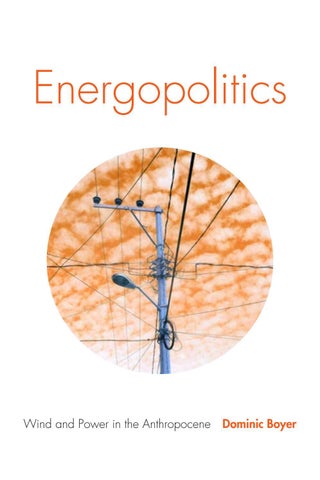
Energopolitics
Wind and Power in the Anthropocene Dominic Boyer
Energopolitics
Energopolitics Wind and Power in the Anthropocene Dominic Boyer
Duke University Press Durham and London 2019
© 2019 DUKE UNIVERSITY PRESS ALL RIGHTS RESERVED PRINTED IN THE UNITED STATES OF AMERIC A ON ACID-F REE PAPER ∞ DESIGNED BY COURTNEY LEIGH BAKER AND TYPESET IN MINION PRO AND FUTURA STANDARD BY WESTCHESTER PUBLISHING SERV ICES
Library of Congress Cataloging-in-Publication Data Names: Boyer, Dominic, author. Title: Energopolitics : wind and power in the Anthropocene / Dominic Boyer. Other titles: Wind and power in the Anthropocene Description: Durham : Duke University Press, 2019. | Includes bibliographical references and index. Identifiers: lccn 2018047267 (print) lccn 2019000347 (ebook) isbn 9781478004394 (ebook) isbn 9781478003137 (hardcover : alk. paper) isbn 9781478003779 (pbk. : alk. paper) Subjects: lcsh: Wind power—Research—Mexico—Tehuantepec, Isthmus of. | Renewable energy sources—Mexico—Tehuantepec, Isthmus of. | Renewable energy sources—Political aspects. | Electric power production—Mexico—Tehuantepec, Isthmus of. | Energy industries—Mexico—Tehuantepec, Isthmus of. | Energy development—Political aspects. | Energy policy—International cooperation. | Geology, Stratigraphic—Anthropocene. Classification: lcc tj820 (ebook) | lcc tj820 .b694 2019 (print) | ddc 333.790972/62—dc23 lc record available at https://lccn.loc.gov/2018047267 Cover art: Grid, La Ventosa, 2013. Photo by Dominic Boyer. This title is freely available in an open access edition thanks to generous support from the Fondren Library at Rice University.
For Cymene
Contents
Joint Preface to Wind and Power in the Anthropocene i x cymene howe and dominic boyer Acknowledgments xix Introduction 1 1 Ixtepec 27 2
La Ventosa 60
3
Oaxaca de Juaréz 95
4
Distrito Federal 127
5 Guidxiguie’ (Juchitán de Zaragoza) 158
Joint Conclusion to Wind and Power in the Anthropocene 194 cymene howe and dominic boyer Notes 199 References 225 Index 251
Joint Preface to Wind and Power in the Anthropocene
A Dynamic Duo Welcome to our duograph. You may be entering into the duograph through Ecologics or Energopolitics, but in each case, we invite you to engage both sides of this work. The duograph is a new and experimental form that needs your active engagement. But what is a duograph? you might rightly ask. A duograph consists of two single-authored ethnographies that draw from a shared fieldwork experience and the same archive of research material. As a textual form, the duograph emerged from our field research (2009–13) on the political and ecological dimensions of wind power development in Mexico’s Isthmus of Tehuantepec. The idea evolved partly out of experimental interest and partly out of necessity. The two of us spent many long evenings debating the significance of one aspect or another of the research and gradually found ourselves setting out from the center of the project in different theoretical and thematic directions. The fieldwork itself was a joint enterprise from start to finish; every interview, every meeting, every protest, involved both of us. We originally expected that the writing would follow a similar path toward a coauthored monograph. But while coauthoring offers many opportunities to learn and grow through dialogue, it also involves many compromises and ultimately must resolve in a synthetic voice and direction. We wanted to do this differently. We eventually realized how important it was to each of us that we be able to tell a different part of the immensely complex story unfolding in the isthmus. Cymene wanted to spotlight the salience of human-nonhuman relations
in energy transition while Dominic wished to concentrate on unraveling the political complexity of wind power. We decided to experiment by elaborating our different analytics and interests in companion volumes that are meant to be read together. A working definition of the duograph would be a conversation between researchers that materializes in two texts, which do not require analytic synthesis or consensus. We view the duographic form as a way to produce collaborative scholarship that helps to make visible the multiplicity of stakes and attentions existing within the practice of research collaboration. The observations and arguments found in each of these volumes emerged from close dialogue and are by no means incommensurable, but neither are they serial parts of the same narrative. They speak in parallel, but not always in unison. Characters, dynamics, and events crisscross them, but they are approached through different analytic lenses. We hope that the duograph offers an experimental prototype in collective authorship that may be of value to other collaborators and other projects elsewhere.
Wind Power in Mexico Our ethnography addresses a central question of our anthropocenic times: How can low-carbon energy transition happen? Or, put differently, What happens in those transitions? Who sets the agenda? Who—human and otherwise—is affected? And what are the political (in the broadest sense of the term) forces that shape the possibilities for low-carbon energy futures? These questions initially took shape at Busboys & Poets café in Washington, DC, in late 2008 as we prepared for a move to Houston, Texas, a global epicenter of the fossil fuel industry. We considered a number of different fieldsites of renewable energy production that appeared to be poised for rapid development. We looked at the desertec solar project in Morocco and nascent programs of wind development in Venezuela and Brazil among other cases. But the one that attracted and held our attention most strongly was Oaxaca’s Isthmus of Tehuantepec. A gap in the Sierra Madre Mountains creates a barometric pressure differential between the Gulf of Mexico and the Pacific Ocean, forming a wind tunnel in the isthmus where wind speeds regularly flirt with tropical storm strength. The istmeño wind is capable of overturning semitrailers with ease, uprooting trees, and stripping the paint off boats. This region—often said to be the least developed in a state that is the second poorest in Mexico—is considered to have among the best resources for terrestrial wind power anyx Joint Preface
where in the world. That potential was first tapped in the mid-1990s through government demonstration projects designed to lure transnational investment in renewable energy production. But wind development only really gained attention and momentum during the administration of President Felipe Calderón (2006–12). Although Calderón’s administration is better known for its drug war and for ceding sovereignty to cartels and capital, his climate change advocacy transformed Mexico from a pure petrostate into a global leader in low-carbon energy transition. Mexico passed some of the most ambitious, binding clean-energy legislation anywhere in the world, including a legal mandate that 35 percent of electricity be produced from non- fossil-fuel sources by 2024, with 50 percent of that green electricity expected to come from wind power, and with most of that wind power expected to come from the Isthmus of Tehuantepec. Private-Public Partnerships (ppps) in wind e nergy development mushroomed rapidly. Between 2008 and 2016 the wind energy infrastructure of the isthmus expanded from two wind parks offering 85 megawatts of production capacity to twenty-nine wind parks with 2,360 megawatts of capacity, a 2,676 percent increase in less than a decade that has made the isthmus the densest concentration of onshore wind parks anywhere in the world. Over the course of sixteen months of field research (in 2009, 2011, and 2012–13), we sought to cast as broad a net as possible and speak with representatives of e very group of “stakeholders” in wind development in Mexico. Conversations with community members and corporate executives; federal, state, and local government officials and ngo staff; industry lobbyists and antiwind activists; conservationists and media professionals; indigenous rights advocates, bankers, and federal judges, all provided a meshwork of perspectives, which we traced as we moved between the many communities of the isthmus; to the state capital, Oaxaca City; and finally to the federal capital, Mexico City. In total, we conducted more than three hundred interviews and participated in hundreds of hours of less formal conversations. Working with a team of local researchers, we were able to conduct the first door-to-door survey of reactions to wind development in La Ventosa—one of two isthmus towns that are now nearly completely encircled by wind parks. We sat in on governmental and activist strategy meetings and toured wind parks. We marched, rallied, and stood at the fulcrum of many roadblocks erected by opponents of the wind parks. We witnessed the evolving politics of solidarity between binnizá (Zapotec) and ikojts (Huave) p eoples whose shared resis tance to particular forms of energy infrastructure brought them into alliance after hundreds of years of interethnic conflict. We arrived at and left fieldwork Joint Preface xi
as committed advocates for low-carbon energy transition. But our experiences in Mexico taught us that renewable energy can be installed in ways that do little to challenge the extractive logics that have undergirded the atters, but it m atters mining and fossil fuel industries. Renewable energy m more how it is brought into being and what forms of consultation and cooperation are used. We thus came to doubt that “wind power” has a singular form or meaning. Everywhere in our research, it was a different ensemble of force, matter, and desire; it seemed inherently multiple and turbulent, in umans and nonhumans. To capture that multiplicity, we came volving both h to think about our object of research as “aeolian politics,” borrowing from the Spanish term for electricity derived from wind power, energía eólica. Three case studies of aeolian politics came to absorb us in particular— Mareña Renovables, Yansa-Ixtepec, and La Ventosa—the first is the most complex and is treated at length in the Ecologics volume. The other two are highlighted in the Energopolitics volume. All three represent distinct configurations of aeolian politics; two can be categorized as cautionary tales of failure and the other as an example of the successful achievement of what for many is the renewable dream come to life. And yet success and failure were always in the eyes of their beholders. In all three studies we have sought to balance the fact of anthropogenic climate change and the need for global decarbonization against the local salience of vulnerable statecraft, demands for indigenous sovereignty, and the other-than-human lives that inhabit the Isthmus of Tehuantepec.
Volumes ecologics Ecologics tells the story of an antidote to the Anthropocene, one that was both a failure and a success. The Mareña Renovables wind park would have been the largest of its kind in all Latin America, and it promised immense reductions in greenhouse gas emissions as well as opportunities for local development. In Ecologics we follow the project’s aspirational origins as well as the conflicts and ethical breakdowns that would leave it in suspension. Drawing from feminist theory, new materialisms, and more-than-human analytics, this volume of the duograph examines the ways that energy transitions are ambivalent: both anticipatory and unknown, where hope and caution are equally gathered. In the case of Mareña Renovables, distinct imaginaries of environmental care and environmental harm were in conflict, effectively xii Joint Preface
diagnosing the deeply relational qualities of energy and environment. The core argument that Ecologics advances is that the contemporary dynamics of energy and environment cannot be captured without understanding how human aspirations for energy articulate with or against nonhuman beings, technomaterial objects, and the geophysical forces that are at the center of wind power and, ultimately, at the heart of the Anthropocene. The analytic architecture of Ecologics is both anticipatory and interruptive, and readers are encouraged to engage with the work in an itinerant and wandering way. Three chapters focus on the case of the Mareña project, tracing its inception and the policy regimes and economic conditions that allowed for its initial development (chapter 2, “Wind Power, Anticipated”), following it through a series of dramatic standoffs and protests against the park’s creation among indigenous and mestizo communities in the isthmus (chapter 4, “Wind Power, Interrupted”), and finally witnessing the collapse of the wind power project itself resulting from multiple political, economic, and communicational impasses (chapter 6, “Wind Power, In Suspension”). These chapters are interrupted by others that focus on wind, trucks, and species respectively. The interruptive design is intended to mime the empirical, ethnographic dynamics of the research, where forces (like wind), technomaterial tools (like trucks), and other-than-human beings (creatures of all kinds) came to stall and vex human-designed notions of progress and infrastructural development. In Ecologics creatures, materials, and elemental forces are bound up with wind power as an analytic object, and they in turn invite new human responses to the paradoxes we face in a time of climatological uncertainty. energopolitics Energopolitics engages the case of Mexican wind power to develop an anthropological theory of political power for use in the Anthropocene anchored by discussions of “capital,” “biopower,” and Dominic’s own neologism, “energopower.” At the same time, the volume emphasizes the analytic limitations of these conceptual minima when confronted with the epistemic maxima of a situation of anthropological field research on political power. Those maxima not only exceed the explanatory potential of any given conceptual framework, they also resolutely demand the supplementary analytic work of history and ethnography. Concretely, the volume argues that to understand the contemporary aeolian politics of the Isthmus of Tehuantepec, one needs to understand, among other things, a contested history of land tenure, caciquismo (boss politics), and student/teacher/peasant/worker/fisher opposition Joint Preface xiii
movements specific to the region; the phantasmatic status of state sovereignty within Mexican federalism; the clientelist networks and corporatist machinations of the Mexican political parties; the legacies of settler colonialism; a federal government anxious about waning petropower and climate change; and a vulnerable parastatal electricity utility trying to secure its f uture in an era of “energy reform.” These forces are just as critical to Mexico’s aeolian politics as the processes and dynamics that are duly captured by concepts such as capital, biopower, and energopower. Energopolitics is thus an urgent invitation for Anthropocene political theory to unmake and remake itself through the process of fieldwork and ethnographic reflection. The invitation unfolds across five ethnographic chapters, each highlighting a different localization of aeolian politics. We begin with the as-yet failed effort to build a community-owned wind park in Ixtepec, then move east to the town of La Ventosa, which is successfully encircled by turbines that were built in the dominant ppp paradigm, yet has also been beset by uncertainty and unrest. We encounter the performative sovereignty of the state government in Oaxaca City as it searches for a means to regulate and profit from wind development and then journey northwest to Mexico City to interview those in government, industry, and finance who firmly believe they are steering the course of wind power in the isthmus. Finally, we return to Juchitán, which is not only the hub of local aeolian politics in the isthmus but also a town whose citizens imagine themselves to be the inheritors of a decades-if not centuries-long tradition of resistance against the Oaxacan and Mexican states. In this way, Energopolitics seeks to speak terroir to pouvoir, highlighting the need to resist anthropocenic universalism by paying attention to the profound locality of powers, agents, and concepts. As Claire Colebrook has argued, recognition of the Anthropocene should mark the “return of difference” that has been long called for in feminist and ecological criticism.
Collaboration in Anthropology Our duograph belongs to a long history of anthropological collaboration in research and writing. In the early decades of North American and Euro pean ethnology, the discipline’s close ties to fields like geography and natural history meant that the scientific expedition was an important apparatus of anthropological research practice. In the late nineteenth and early twentieth centuries, projects of linguistic and cultural salvage and analysis remained xiv Joint Preface
closely allied with archaeology and museology, which explains how some of the most ambitious and important collaborative anthropological enterprises of the era—Franz Boas’s Jesup North Pacific Expedition (1897–1902), for example—were organized principally around building natural history collections. As the twentieth century wore on, an individualistic model of field research came to predominate in American and European anthropology, at least normatively, and was celebrated for the transformative qualities of participant-observational immersion. But one would scarcely have had to scratch the surface of any ethnographer-informant dyad to illuminate the complex webs of social enablement—involving research assistants, translators, laborers, intermediaries, government agents—that made anthropological research in the classic Malinowskian mode possible. After the Second World War, a new emphasis on interdisciplinary area studies research in the social sciences expanded and intensified anthropology’s range of collaborative engagements around the world. Much as expedition-era anthropology was absorbed into colonial and imperial knowledge projects, the area studies era was imbricated with the national and international political dynamics of the Cold War. Governments sought to enroll anthropologists in military and intelligence operations across the world— Project Camelot being one of the most well known. However, anthropology was also broadening its epistemic ambitions and moving from cultural salvage projects toward a grappling with modernity and the complex cultural and social dynamics of cities, nations, and world systems. Interdisciplinary exchanges no doubt served to accelerate this shift. And 1950s enterprises like Cornell’s Vicos project in Peru (creating a “laboratory for social change”) or the mit Modjokuto project in Indonesia (which gave Clifford and Hildred Geertz their first fieldwork opportunity) cultivated the kinds of long-term interdisciplinary research networks that influenced graduate training and pedagogy as well.1 The postwar period also saw an efflorescence of anthropological research partnerships mediated through marriage and other life partnerships. Margaret Mead and Gregory Bateson are a classic example, Margaret Mead and Ruth Benedict a more elusive but possibly more substantial one. Then came the Geertzes as well as June and Manning Nash, Marilyn and Andrew Strathern, Edith and Victor Turner, and Margery and Eric Wolf, followed later by Barbara and Dennis Tedlock, Michelle and Renato Rosaldo, Sally and Richard Price, and Jean and John Comaroff, among others. Anthropology has seen many c ouples practice the crafts of research, teaching, and writing under at least a partly shared sense of identity, each navigating its Joint Preface xv
own relational dynamics as well as the dominant masculinist heteronorms of the discipline and the university in the twentieth century. Reacting to the still broader and more complex scale of post-1980s globalization and its social, economic, and environmental consequences, the twenty-first century has seen renewed interest in collaborative research partnerships. Three that have inspired our duograph in particular have been the Matsutake Worlds Research Group (Anna Tsing, Shiho Satsuka, Miyako Inoue, Michael Hathaway, Lieba Faier, and Timothy Choy), the Ethnographic Terminalia collective (Craig Campbell, Kate Hennessy, Fiona McDonald, Trudi Lynn Smith, and Stephanie Takaragawa), and the Anthropology of the World Trade Organization group (Marc Abélès, Máximo Badaró, Linda Dematteo, Paul Dima Ehongo, Jae Aileen Chung, Cai Hua, George Marcus, Mariella Pandolfi, and Phillip Rousseau).2 All are multi-institutional and international partnerships that have explored new ways of creating anthropological knowledge by crossing the boundaries between anthropological research practices and the arts. Collaboration itself is nothing new in anthropology; there is abundant evidence that it has been a productive dimension of anthropological research and writing since the discipline’s beginning. Further, intimate research partnerships have long fueled the production of anthropological knowledge. There is doubtless an important book to be written about how the particu lar qualities, subjectivities, and dynamics of particular collaborations have influenced the kinds of knowing and knowledge that those enterprises generated. But our intervention h ere is more limited. We have found it striking that the spirit of collaborative research has not always translated well into practices of authorship. Coauthored texts remain the exception rather than the rule in anthropology, even when they derive from jointly undertaken field research.3 The reasons for this gap are not s imple and involve considerations ranging from professional reputation to relational dynamics to institutional audit cultures that seek to impose a mathematics of individual accomplishment and accountability on the sociality of research, analytic, and writing practices. What is striking in our view is that there are relatively few models for collaborative writing beyond the model of the jointly authored single text that synthesizes analytic perspectives u nder a common “we.” This is why we have centered our methodological intervention on the duographic form: we are looking for ways to strike a better balance between individual ideation and expression and collaborative fieldwork and archiving. An important added benefit of the duograph is that it permits a more extensive analytic division of l abor between its volumes, as parallel yet distinct xvi Joint Preface
arguments can be developed with respect to the common research archive. In our case, the Ecologics volume’s close focus on how human energetic and environmental aspirations intersect with other- than- human beings and agencies complements yet also reframes the Energopolitics volume’s effort to offer a more nuanced and comprehensive set of analytics of (human) politi cal power, and vice versa. If the general premise of the entire research proj ect has been that a certain politics of energy is creating a situation of ecological emergency, then it is fitting, and we might say necessary, to be able to offer detailed conceptual and ethnographic accounts of both sides of the equation—energopolitical and ecological. Had we tried to compact all t hese storylines into a single, synthetic account, however, we might well have burst its seams or have been forced to simplify matters to the extent that neither side would have received its due. In the duographic form, meanwhile, two volumes working together in the mode of “collaborative analytics” can dive deeply into different dimensions of the research while still providing valuable ethnographic elaboration and conceptual infrastructure for each other.4
Your Turn One of our favorite rationales for the duograph is what is happening right now: you are deciding where to start. True to the lateral media infrastructures and expectations of this era, we aspire to offer a more dialogic, collaborative matrix of encounter with anthropological writing. We have sought the words to write; you now seek the words to read. We have left signposts as to where we think the volumes intersect. But you can explore the duograph as you like, settling into the groove of one narrative or zigzagging between them. Think of it somewhere between a Choose Your Own Adventure book and open- world gameplay. Follow a character, human or otherwise; riddle through the knots and vectors of aeolian politics; get bogged down somewhere, maybe in the politics of land or the meaning of trucks; then zoom back out to think about the Anthropocene. Or perhaps pause for a minute or two to watch the birds and bats and turbines that now populate the istmeño sky. Cymene Howe and Dominic Boyer
Joint Preface xvii
Acknowledgments
We gratefully acknowledge the following persons and institutions whose support made this duograph possible. The preliminary field research for the project was funded by a grant from the Social Sciences Research Institute at Rice University. Rachel Petersen and Briceidee Torres Cantú offered extraordinary research assistance in the early research phase. The main period of field research in 2012–13 was funded by the Cultural Anthropology Program of the Division of Behavioral and Cognitive Sciences at nsf (research grant #1127246). We further thank the Social Sciences Dean’s Office and especially our colleagues in Rice Anthropology—Andrea Ballestero, James Faubion, Jeff Fleisher, Nia Georges, Susan McIntosh, and Zoë Wool—for absorbing our share of administrative, advising, and teaching duties to allow us to undertake field research for a full year. We give thanks as well to our dear colleagues in Rice’s Center for Energy and Environmental Research in the Human Sciences (cenhs)—Bill Arnold, Gwen Bradford, Joe Campana, Niki Clements, Farès el-Dahdah, Jim Elliott, Melinda Fagan, Randal Hall, Lacy M. Johnson, Richard R. Johnson, Jeff Kripal, Caroline Levander, Elizabeth Long, Carrie Masiello, Tim Morton, Kirsten Ostherr, Albert Pope, Alexander Regier—and the Center for the Study of Women, Gender and Sexuality (cswgs)—Krista Comer, Rosemary Hennessy, Susan Lurie, Helena Michie, Brian Riedel, Elora Shehabuddin, and Diana Strassmann—for muchappreciated moral and intellectual support during the writing phase of the project. In the Isthmus of Tehuantepec, our debts are many. We would first of all like to thank the Istmeño binnizá and ikojts communities of Álvaro Obregón,
Ixtepec, Juchitán, La Ventosa, San Dionisio del Mar, and Unión Hidalgo for hosting us during different phases of the field research and for a great many conversations and small acts of kindness that helped this project immeasurably. There were certain individuals in the isthmus who became friends and allies in the course of this research and without whose support this duograph would never have been possible. Our special thanks to Isaul Celaya, Bettina Cruz Velázquez, Daniel González, Mariano López Gómez, Alejandro López López, Melanie McComsey, Sergio Oceransky, Rodrigo Peñaloza, Rusvel Rasgado López, Faustino Romo, Victor Téran, Vicente Vásquez, and all of their families. Our condolences to the family of David Henestrosa, a brave journalist who passed away shortly after our field research was completed. In Oaxaca City, Mexico City, and Juchitán, there were several organizations whose representatives helped enable particular parts of our research, including amdee, apiidtt, appj, cfe, cnte (Sec. 22), cre, edf Energies Nouvelles, Iberdrola Mexico, segego, semarnat, sener, ucizoni, and the Universidad Tecnológica de los Valles Centrales. We would also like to thank several individuals who helped us navigate the complex world of Mexican wind power. Thanks to Fernando Mimiaga Sosa and his sons for convincing us to make Oaxaca the focus of our research, to Sinaí Casillas Cano for his insights into the political contingencies of Oaxacan state governance of renewable energy development, to Felipe Calderón for answering our questions concerning the importance of wind power during his sexenio, to Laurence Iliff for a wealth of insights into the behind-the-scenes politics of Mexican energy, to Dr. Alejandro Peraza for an invaluable series of contacts among the power brokers of Mexican energy, and to The Banker, who remains anonymous but who gave us critical insights into the financial dimension of wind power development. Both the project and the duograph have benefited immensely from comments at several meetings of the American Anthropological Association, the Cultures of Energy Symposium Series, and the Petrocultures Research Group. Conversations with colleagues in the following forums were also critical in shaping the thinking that has gone into the manuscripts: the Climate Futures Initiative, Princeton University; Association for Social Anthropology Annual Conference, Durham, England; Earth Itself: Atmospheres Conference, Brown University; Energy Ethics Conference, St. Andrews University; Religion, Environment and Social Conflict in Contemporary Latin America, sponsored by the Luce Foundation and the Center for Latin American and Latino Studies, American University; Hennebach Program in the Humanities, Colorado School of Mines; Klopsteg Seminar Series in Science and Human xx Acknowledgments
Culture, Northwestern University; Colloquium for the Program in Agrarian Studies, Yale University; Rice University’s Feminist Research Group and cenhs Social Analytics workshop; Environments and Societies Institute, University of California, Davis; Global Energies Symposium, University of Chicago Center for International Studies; Durham Energy Institute; Yale Climate and Energy Institute; Rice University, Mellon-Sawyer Seminar; Centre for Research on Socio-Cultural Change, Manchester University; After Oil, University of Alberta, Edmonton; Institut für Europaïsche Ethnologie, Humboldt Universität zu Berlin; Electrifying Anthropology Conference, Durham University, sponsored by the Wenner-Gren Foundation; Parrhesia Masterclass, Cambridge University; Alien Energy Symposium, it University of Copenhagen. Thanks also goes out to friends and colleagues at the Departments of Anthropology at the London School of Economics; Ustinov College, Durham University; University of California, Los Angeles; University of California, Davis; Yale University; and University College London who were kind enough to invite us to share our work-in-progress with them. Paul Liffman has been immensely helpful throughout the life of this project, offering smart critique and always ready to provide context by drawing on his truly encyclopedic knowledge of Mexico’s political, economic, and social worlds. Our collaboration with Edith Barrera at the Universidad del Mar enriched our field experience, and back in the United States we were lucky to work with Fiona McDonald, Trudi Smith, and Craig Campbell, members of the Ethnographic Terminalia Collective, to imagine/incarnate the wind house installation of Aeolian Politics at the Emmanuel Gallery in Denver, Colorado. Lenore Manderson was also kind enough to review that project of imagining ethnography and wind differently. Anna Tsing and John Hartigan provided marvelous feedback on earlier chapters, and in later stages, the duograph benefited greatly from anonymous reviewers’ incisive commentaries. We appreciate especially their willingness to think with us on the experimental form of the duograph and for their wise handling of interconnections between the volumes. Thanks are also owed to the wonderful professionals at the University of Chicago Press, especially Priya Nelson, as well as Stephanie Gomez Menzies, Olivia Polk, Ken Wissoker, Christi Stanforth, and Courtney Baker at Duke University Press.
Acknowledgments xxi
Introduction
Anthropolitics Meets Anthropology in the Anthropocene This volume of the duograph is concerned with the relationship of energy to power in the context of the Anthropocene. It seeks to highlight and explore how the material and infrastructural dimensions of energy both enable and disable certain configurations of political power. The line of analysis questions whether political power in the conventional (human-centered) sense can really be taken to be an autonomous and efficacious domain. This has both theoretical and practical implications at a time when political power is a growing “matter of concern” in the struggle against processes like global warming and species extinction, when politicians are called upon to “get serious” about climate change, and when governments are implored to plan for energy transition or resilience to rising sea levels.1 How can we reform a human-centered understanding and practice of politics—anthropolitics—so that it can adequately comprehend and address the conditions and challenges of the Anthropocene? When Cymene and I wrote the proposal to the National Science Foundation for the grant that would eventually fund the main period of our field uman politi research, we more or less took for granted the significance of h cal power in addressing climate change. We said we wished to investigate the “political culture” of wind power development in southern Mexico in order to understand how a “vulnerable state” like Mexico was going to be able to orchestrate a diverse and potentially contentious field of stakeholders and follow through on the federal government’s ambitious clean electricity
production targets. We questioned whether “states, especially those already struggling to meet their current governmental obligations, possess the po litical authority to implement important programs of national development such as renewable energy.” But we did not question whether “political culture” itself—a term we used in a deliberately expansive way to signal not only the interactions between states and citizens but also the political negotiations and exchanges among stakeholders including local landowners, activists, political parties, ngos, journalists, and representatives of transnational corporations—was an assemblage from which one might reasonably expect efficacious responses to climate change and strategies for energy transition to emerge. But is the efficacy of political culture in the Anthropocene actually a reasonable assumption? What we did not emphasize in our grant proposal— and this is very likely because we w ere appealing to another equally anxious, if not equally vulnerable, state for funding—is that one of the articles of faith of the past thirty years of global governance is that market and technological forces are better positioned to answer any dilemma than any existing or imaginable configuration of political actors, instruments, and imaginations. The incremental and perpetually disappointing series of cop (Conference of Parties) meetings—even including the comparatively successful Paris cop 21 meeting in December 2015—have only seemed to reinforce this sense that the political process is inadequate to the task of engaging problems as massive and time sensitive as global warming.2 Across the world, liberal political institutions seem too compromised by corporatist and populist influence, too much in the hands of political professionals operating according to their own temporalities and interests, and too belabored by inflexible, archaic po litical technologies to compete with entrepreneurs and engineers when it comes to delivering solutions. This skepticism has been paralleled in the discursive realm of political theory as figures ranging from Wendy Brown to Chantal Mouffe to Jacques Rancière to Peter Sloterdijk to Slavoj Žižek have diagnosed the economization, overformalization, militarization, spectacularization, and technicization of liberal political institutions that have led to a golden age of political ritual, cynicism, and theater at the expense of a capacity for a literal politics that might be able to address urgent anthropoce uman) concern such as droughts, nic processes of common (and not only h flooding, warming, desertification, species extinction, plasticization, and oceanic acidification.3 Probing more deeply into the scar tissue of late liberalism, Elizabeth Povinelli offers a reminder that “biontological” crises are nothing new on the frontiers of settler late liberalism, and she recommends 2 Introduction
that we take the wisdom of those who live on those frontiers more seriously. In the register of a probative and experimental “Karrabing analytics,” ying. But the earth may be turning away from she writes, “The earth is not d ying forms certain forms of existence.”4 Featuring prominently among those d of existence is what I have termed “androleukoheteropetromodernity,” an ugly word commensurate with the ugly lifeworld designed over the past several centuries to enable the dominion and luxury of hypersubject white men. Yet back in the political centers of late liberalism, such a reckoning is held at bay by affective and epistemic investments in “markets” and “technology” as generative nexuses of innovations and solutions. These investments are also intimately attached to the political apparatus we call “neoliberalism.” Whether one wishes to schematize that apparatus through the unfolding dynamics of capital and its class affiliations or through the evolving relay networks of power knowledge, it is obvious that neoliberalism has had a historicity unto itself; that is to say, it came into being, rose to global authority, and is now—so it seems anyway—in a state of gradual dissolution.5 As that dissolution spreads, one finds that new and heterogeneous political potentialities are emerging. Whether one thinks of the racialized authoritarian movements rapidly gaining ground in many parts of the world today or the Arab Spring, the Occupy movement, the indignados of Spain, or the indigenous asambleas that are coming into being around wind parks in the Isthmus of Tehuantepec, it is difficult not to feel that new politics are seeking to be born that do not wish to be constrained by the inherited -isms (e.g., liberalism, socialism, communism, fascism, anarchism) of nineteenth- century European political philosophy. Neoliberalism appears to have lost much of its credibility and vitality as a world-making political ideology over the past decade. And yet it has no obvious heir-in-waiting, especially at the global level. Instead, a multitude of political experiments are emerging, often investing political attention and energy into smaller spheres of action. Some of these experiments, it goes without saying, embrace oppression, exclusion, and hatred in the manner of “integralist” movements past;6 some perhaps augur a “time of monsters.”7 On the other hand, one finds movements committed to peace and humanism in unprecedented ways—Iceland’s Best Party for one example.8 Measured within this human’s lifespan, there has never been a more invigorating time to think about political power. Things are happening in the world of politics, but they are escaping our conventional categories of analysis, often reducing analysts to a stilted language of “neos” and “posts” that, at the end of the day, seem inadequate for comprehending the processes of political formation we are witnessing. Introduction 3
Although perhaps an accidental conjuncture, the dissolution of neoliberal authority has occurred more or less simultaneously with wider mediatization and recognition of the Anthropocene. This has meant that there has been a vibrant zone of political experimentation focusing specifically on remediating anthropocenic vectors—for example, Transition Culture and the degrowth movement.9 It has also stimulated some critics of neoliberal capitalism—Naomi Klein and David Graeber among o thers—to argue that acknowledgement of the Anthropocene marks a definitive beginning of the end for capitalist consumerist society since we have finally come to experience the deterioration of ecological systems at a planetary level.10 The 1970s “limits to growth” and “tragedy of the commons” debates have been reactivated. But other theorists have abandoned the anthropolitical in favor of the ecopolitical. As Claire Colebrook writes, “The Anthropocene seems to arrive just as a w hole new series of materialisms, vitalisms, realisms, and inhuman turns require ‘us’ to think about what has definite and forceful existence regardless of our sense of world.”11 Although it is possible to take the antianthropocentric turn in the human sciences as another reminder of why paying attention to h uman political power seems quaint in the con temporary world, I would rather take it as a challenge and opportunity to recalibrate the anthropolitical to a postanthropocentric conceptual universe. In other words, let us ask, How, where, and to what extent does and should human political power matter in the contemporary world? I have argued elsewhere that human agency, at a planetary scale, is difficult to deny given not only the various phenomena clustered under the Anthropocene rubric but also the generative potentialities of practices like synthetic biology and nanoengineering on the one hand and the destructive potentialities of advanced weaponry on the other.12 Even if we have truly never been modern in an ontological sense, the fact that some h umans have been behaving as though they were modern for centuries now—creating a potent instrumentarium for terraforming/anthroforming the planet for their convenience along the way—demands accountability and, one hopes, remediation. This means, I would argue, that an interest in understanding or influencing the anthropoliti cal cannot be bundled together with a rejection of anthropocentrism, fair though that rejection may be. And here I would modestly propose that anthropology has an important role to play. As one of the more reflexively oriented disciplines within the human sciences, at least since the 1970s,13 anthropology has viewed its own methods and objects of investigation with no small amount of skepticism. However, as the one discipline that has anthropos inscribed in its very 4 Introduction
jurisdiction, it seems unlikely that anthropology w ill ever fully commit itself to a posthuman turn. As such, anthropology seems an excellent “culture of expertise” from which to stage a reproportionalization of the human in the human sciences. Moreover, whatever soaring theoretical, even philosophical, aspirations anthropological knowledge might have, these are always connected umbilically to the sociality and materiality of a changing world of humans and nonhumans.14 Anthropological knowledge is perpetually incomplete, disrupted, uncertain, somehow less than the sum of its parts. It is the right kind of knowledge for grappling with what Anna Tsing and her collaborators have termed “a damaged planet.”15 If Isabelle Stengers poses a cosmopolitical question, “How, by which artifacts, which procedures, can we slow down political ecology, bestow efficacy on the murmurings of the idiot?” then I would argue that the murmurings of the idiot—meaning not a fool but one who provides what Claude Lévi-Strauss once termed “the other message”—is precisely the domain of anthropological knowledge.16 It is thus an apt domain from which to elicit “hyposubjectivity” in the face of Timothy Morton’s diagnostics of “hyperobjectivity.”17
with t hese preliminaries in mind, a reader solely interested in the ethnography of wind power in the Isthmus of Tehuantepec could skip ahead to chapter 1. The remainder of the introduction is a more detailed discussion of theory of power in the Anthropocene. My purpose is twofold. On the one hand I wish to schematize the conceptual minima of an anthropological theory of political power for use in the Anthropocene. Concepts such as capital and biopower clearly belong to those minima, not least because of the profound influence that Marxist and Foucauldian theory have exerted over human-scientific analysis of political power in the past several decades. And, while their status is more contested, I think it is, for the same reason, necessary to briefly discuss the psychoanalytic theory of desire and Brian Massumi’s “ontopower” for what they might contribute to the analytics of political power. Since all these concepts share an inattentiveness to the energo-material contributions of fuel and electricity to political power, I also put forward my own neologism, “energopower,” to expand the set of minima in a direction that I believe is analytically crucial for understanding our (the planet’s, our species’) contemporary conditions. On the other hand, I wish to emphasize the delicacy, one might even say the preciousness, of these conceptual minima when confronted with the epistemic maxima of a situation of anthropological field research on political power. Those maxima not Introduction 5
only exceed the explanatory potential of any given conceptual framework, they also resolutely demand the supplementary analytic work of history and ethnography. For example, to understand the contemporary political culture of wind power development in the Isthmus of Tehuantepec, one needs to understand a deep history of colonial resource extraction and the more recent politics of land tenure and caciquismo (boss politics) specific to that region as much as one needs to understand the processes and dynamics captured by concepts such as capital, biopower, and energopower. To an anthropologist this may simply appear to be a sky-is-blue statement about the importance of ethnography to complement and validate theoretical intervention.18 But, as suggested above, my broader purpose here is to argue that if political theory wants to get serious about a critical engagement with anthropocenic phenomena, then it is going to have to become more anthropological along the way. The obvious problem baked into terms such as “Anthropocene” is their species-level universalism. This universalism often seems to be a rhetorical strength, especially when deployed to convince a species whose collective behavior is generating planetary effects while lacking a species-level political apparatus to take collective action. But without doubting that universalizing rhetoric can be efficacious in some contexts, the hailing of humanity as a species unfortunately obscures the differential culpability for global warming and environmental toxification, ignoring the fact that Northern empire has perpetrated these and other global conditions of precarity for centuries with impunity.19 Univeralist rhetorics also typically obscure the fact that the reasons for anthropocenic action and the impasses to its recognition and transformation are highly, one might even say fundamentally, various. The reasons that one wind park near Cape Cod might be challenged in court and that another would be blockaded near Juchitán cannot be reduced to a general condition of nimbyist self-interest. The same could be said of the support for utility-scale renewable energy projects in some corners of the global North and the support for postgrid energy solutions and degrowth in others. Moreover, the postanthropocenic futures that are being imagined and aspired to are equivalently multiple. For some, the struggle against the Anthropocene quests more or less to preserve familiar circuits of fulfillment in climatological terra incognita (e.g., sustainable green capitalism); for o thers, it is about resuscitating idealized past forms of life (e.g., nationalist nostalgia or indigenist restoration); yet for still others, it about a radical break with the past and present to prepare the way for hitherto-unrealized socio-ecological relations. 6 Introduction
My argument, then, is that political theory needs to embrace the fact that, as Claire Colebrook has put it, “the Anthropocene is the return of difference.”20 Taking difference seriously means a willingness to think across scales, to recalibrate the capacity of “the local”—meaning both locus/place and also those beings who inhabit particular localities—to affect and transform the translocal.21 It is in this respect that anthropological analysis of political power can play a valuable supplemental role as well as in Derrida’s sense of supplement as that which reveals an originary lack.22 Anthropological analysis thrives on the interillumination of translocal and local epistemics, on showing what universalizing schemata can and cannot reveal when confronted with an actual world of fluctuating, heterogeneous, and not infrequently contradictory signals.23 This is, then, a call for political theory to not so much “take ethnography seriously” as to accept ethnography’s invitation to unmake and remake itself through the process of fieldwork. Ethnography is a representational medium and as such will always game with words; those games do sometimes influence understanding for some interlocutors but not in the way that fieldwork, as ontomedium, can more fundamentally challenge and transform horizons and ways of knowing. If we wish to appreciate difference within the Anthropocene, fieldwork is a much-needed supplement to any theory of power. As a proof of concept, this volume turns loose a certain set of power concepts in Mexico to show where they can help us to gain interpretive traction on specific events and dynamics and also where a variety of local forces and forms exceed or disable them.
Conceptual Minima: Capital, Biopower, Energopower I have already proposed that capital, biopower, and energopower belong to the conceptual minima of an operational theory of political power in the Anthropocene. I discuss each of these terms in more detail below, but let me say at the outset that is this not intended to be a closed set of concepts, nor is my argument ontological in any sense. That is to say, first, there are many potentially valuable concepts missing here. I have selected these three not only to reflect key touchstones in recent political anthropological debate concerning the Anthropocene but also in light of the specificities of our case studies. Second, I resist (strongly) the idea that categorizing a type of power to enable the possibility of recognition and discussion corresponds to an Introduction 7
argument for the being of power.24 Capital, biopower, and energopower are conceptual lenses that help to bring into focus certain force relations. They do not represent singular forms of power per se. The “beings” that concepts like capital, biopower, and energopower signal should be regarded as multiplicities, diverse forces that have been bundled into more limited nominal forms as part of an analytical project. Nonetheless, I would argue that none of these concepts can be functionally derived from the others, nor should any of the force clusters be trivial thers. Each concept has its own analytic attentions ized with regard to the o and, by extension, its own uses. Karl Marx was able to use “capital” as an analytic instrument for examining the formalization, expropriation, and circulation of human productive activity, just as Michel Foucault was able to utilize “biopower” to explore objectification of and intervention in life from ethics to administration to science. As I have detailed elsewhere, “energopower” seeks to attend to the contributions of fuel and electricity to the possibility of modern life and its ways of knowing and being. Each of t hese power concepts is thus more a gestural shorthand than a name for a thing in the world.25 This makes sense if we supplement our typical English consideration of “power” as noun with the referentiality of the French pouvoir or the Spanish poder, which in their modal forms indicate the ability to do something—enablement. These are forces that allow other forces to happen. Enablement is indeed critical to my perspective on power in this volume. I am interested in what these power concepts enable us to understand about enablement in the world. With this focus on enablement in mind, I address each of these three categories briefly by turn. capital Kapital for Marx was a dimension of the objectification of h uman labor power, specifically a result of the manner in which the division of labor severed labor’s capacity to channel human will in the development of the self.26 Instead of an ideal dialectical process of self-realization through productive activity, “capital” signaled how the division of labor allowed labor power to congeal in such a way that it could be alienated from its source, circulate beyond the self, be appropriated and commanded by o thers, and thus be transformed into new social and material forms. Capital was, in this way, a means of remote enablement (yet one that was always enabled de infra by labor power). One thing that capital enabled was the emergence of a class of capitalists who parasitized the labor power of others. But capitalists were not puppeteers—creatures of 8 Introduction
ill and reason—in this paradigm; they w w ere more like mushrooms sprouting on a rotted log of alienated labor power, which was the true e nemy that communism sought to oppose. Nevertheless, once capital was set into motion on a mass scale and stabilized by institutions such as money and wage labor, quantifiable, appropriated labor time became the logic of social value in modern society. As Marx wrote in the first chapter of Das Kapital, “As values, all commodities are only definite masses of congealed labor-time.” In other words, commodities—useful things—were, in effect, masses of capital. But “congelation,” from the Latin verb “congelare” (to freeze together), is a slightly misleading translation of the a ctual noun Marx uses, “Gallert,” which refers to a gelatinization process in which different animal substances with the potential to yield glue (e.g., meat, bone, connective tissue) are boiled and then cooled to produce a “semisolid, tremulous mass, . . . a concentrated glue solution.”27 Rather than a freezing together of independent parts, “Gallert” suggests an ontological transformation accomplished by adding and then subtracting thermal energy—a recipe of different fleshy forms rendered through heating and cooling into a single sticky material: human labor, in the abstract, binding commodities, p eople, machines, and “nature” together with its glue. Indeed, this glue potential was unlocked by the thermal rendering process itself. Paul Burkett and John Bellamy Foster have argued that t here was a power ful energo-metabolic substrate to Marx’s theories of l abor power, alienation, and value extraction. On the topic of surplus value, they write, Of course, this value (energy) surplus is not r eally created out of nothing. Rather, it represents capitalism’s appropriation of portions of the potential work embodied in l abor power recouped from metabolic regeneration largely during non-worktime. And this is only possible insofar as the regeneration of labor power, in both energy and biochemical terms, involves not just consumption of calories from the commodities purchased with the wage, but also fresh air, solar heat, sleep, relaxation, and various domestic activities necessary for the hygiene, feeding, clothing, and housing of the worker. Insofar as capitalism forces the worker to labor beyond necessary labor time, it encroaches on the time required for all these regenerative activities.28 Seen in this way, capital becomes an appropriation, quite literally, of fleshy power, a sapping and storage of the regenerative potential of being. In the Grundrisse and the second volume of Das Kapital, Marx outlines a more differentiated understanding of capital’s forms and also a model of the Introduction 9
dialectical development from circulating capital t oward fixed capital and of fixed capital t oward automated machinery. That machinery constitutes at once infrastructure for the production of use values and also, in the manner of Gallert, a potential energy storage system, gathering and holding productive powers in technological suspension. In Marx’s vision, capital strives across its historical development to make itself independent of labor, to be able to absorb the productive powers of labor into itself. As one might expect of the vis viva of bourgeois political economy, capital seeks its liberty. The development of fixed capital—the part of the production process that retains its use form over a period of time rather than being wholly consumed in a production process—is the first stage of this process. Marx emphasizes that durability is crucial: fixed capital must durably stand in for direct human labor. The more decisive phase is the movement from fixed capital toward automated machinery, a productive apparatus that operates mechanically according to human design and in which “the human being comes to relate more as watchman and regulator to the production process . . . instead of being its chief actor.”29 Automation not only advances capital’s desire to durably emancipate itself from labor but also precipitates the final paradox between exchange value and use value that Marx believed would necessitate the eventual collapse of the capitalist mode of production. On the one side, then, [capital] calls to life all the powers of science and of nature, as of social combination and of social intercourse, in order to make the creation of wealth independent (relatively) of the labor time employed on it. On the other side, it wants to use labor time as the measuring rod for the giant social forces thereby created, and to confine them within the limits required to maintain the already created value as value. Forces of production and social relations—two different sides of the development of the social individual—appear to capital as mere means, and are merely means for it to produce on its limited foundation. In fact, however, they are the material conditions to blow this foundation sky-high.30 In other words, infrastructure stores the productive energies of labor in such a way that they can be released later in magnitudes that appear to transcend nominal inputs. Technology, as productive infrastructure, thus appears to be capable of generating and distributing use values with limited need for direct (human) labor power. Once the mass of humanity has those means of production at hand, “the worker,” as such, can disappear and with it the alienation of labor and the capital it breathed life into. 10 Introduction
In its bridging of labor, productivity, and infrastructure, capital remains a quite generative power concept in the Anthropocene, but perhaps not always in the standard critique-of-capitalism mode. Capital is a critical concept, to be sure, but it must be noted that capital also eventually plays an emancipatory role in Marx’s dialectical history, one that seems very much in line with contemporary scientific and political faith in the capacity of technology—and its hidden magnitudes of transformational labor power— to offer us salvation from anthropocenic damnation. Marx could almost be recruited for the accelerationist camp in today’s debates.31 But this also reveals what is problematic about classical Marxist analytics from the perspective of today’s damaged planet. Undoubtedly Marx was more attuned to metabolic and energetic questions than is often recognized, but there is no obvious “limit to growth” in his model. Anthropolitical and technopo litical domains seem to have potentially limitless powers at their command. The blind spot of Marx’s theory of capital is that he does not account for how machine labor is fueled in the first place and what the ecological consequences of all that fuel use might be. His story of the transformation from human to machine labor does not incorporate adequate attention to what empowers, in a physical sense, the propulsion of use value generation in the machine world. Any utopian project—whether automated cars or renewable energy—that positions technology as the means for enabling the perfection of modernity draws deeply from the conceptual well of capital. As a final note, I w ill have little to say about capitalism in this volume. It has a descriptive presence, of course, but I find it to be a red herring analytically. As Kaushik Sunder Rajan has argued, to speak of capitalism in the singular “is an absurdity.”32 I also do no more than gesture t oward the concept of the “Capitalocene.”33 I agree here with Dipesh Chakrabarty that there is a necessary division of labor between the analytic work of the “Anthropocene” and the “Capitalocene.” Both terms tell important yet partial truths about humanity’s history of geological and ecological impacts. biopower “Biopower,” in Foucault’s original articulation,34 in the elaborations of his philosophical and sociological interlocutors,35 and as it appears in the work of anthropological writing on power,36 signals the consolidation of concepts of life, sexuality, and population as objects and methods of modern governance. In a discussion of the related concept, “governmentality,” Foucault shows that life and population became both means and ends of modern po litical power: “Population comes to appear above all e lse as the ultimate end Introduction 11
of government. In contrast to sovereignty, government has as its purpose not the act of government itself, but the welfare of the population, the improvement of its condition, the increase of its wealth, longevity, health, and so on; and the means the government uses to attain these ends are themselves all, in some sense, immanent to the population.”37 Foucault denies the singularity and separability of the means and ends, causes and effects, bodies and knowledges, instruments and environments, and of course subjects and objects of modern power. But neither is he satisfied with a dialectical portrait of contingency in which subject-object relationality is held in a mutually constitutive dynamic as in the relationship between labor and capital. Foucault’s power concepts all denote networks of enablement composed of links and relays that cannot be analytically reduced below the level of a circuitry of forces and signs; in other words, the “apparatus” (dispositif) is a “system of relations” between “heterogeneous elements” including corporeality, ethics, discourse, institutions, laws, administrative procedures, and scientific knowledge.38 This is the operational architecture of biopouvoir. In this respect, the concept of biopower is an extension and refinement of Foucault’s general model of modern pouvoir. In Discipline and Punish, for example, he contrasts the distributed, discursive, and productive nature of modern power from the more centralized, excessive, and repressive character of sovereign power.39 Then, in the History of Sexuality, Foucault defines biopower as a discursive concentration on sexuality, reproduction, and life: “Bio-power . . . designate[s] what brought life and its mechanisms into the realm of explicit calculations and made knowledge-power an agent of the transformation of human life.”40 Rather than a Victorian repression of sexuality, Foucault stresses the relentless signaling, voicing, policing, and measurement of sexual instincts and activities that occurred during the Victorian period as the biopolitical organization of modern governance became increasingly sophisticated and detailed in its operation. He proposes biopower is much the same spirit as this volume does, not as a theory of political ontology but rather as a political analytics capable of mapping a network of modal enablement. Paul Rabinow and Nikolas Rose argue that Foucault’s concept work on biopower was both incomplete and historically specific; that is, it was a way of denoting the gradual conjoining of two force clusters during the eigh teenth and nineteenth centuries in Europe. The first force cluster was the anatomo-politics of the human body, “seeking to maximize its forces and integrate it into efficient systems,” while the second was “one of regulatory controls, a biopolitics of the population, focusing on the species body, the 12 Introduction
body imbued with the mechanisms of life: birth, morbidity, mortality, longevity.”41 Rabinow and Rose then offer their own more precise and generalizable formulation for “biopolitics”: “The specific strategies and contestations over problematizations of collective human vitality, morbidity and mortality; over the forms of knowledge, regimes of authority, and practices of intervention that are desirable, legitimate and efficacious.” One notes immediately that this formulation, like Foucault’s original, is anthropolitical, and in Povinelli’s terms, “biontological.” Biopower and biopolitics specifically concern the management and control of a human vitality that is distinguished doubly from a domain of nonhuman life and nonlife more generally. Rabinow and Rose, and many other anthropologists besides, have effectively retooled the biopower concept for twentieth-and twenty-first-century conditions by bringing together the sciences, politics, and economies of life, where “life” itself involves issues as far ranging as sexuality, reproduction, genomics, infrastructure, population, care of the self, and indeed “environment.”42 Still, life in the Foucauldian analytical imagination clearly centers on human life. This close anchorage to “the h uman,” even as it denies the authoritative overtures of “humanism,” is, I strongly suspect, one reason that the concept has proven so compelling among anthropologists as a way of gaining traction on political power. Another reason is that the analytics of biopouvoir, especially if generalized as Rabinow and Rose have done, are remarkably flexible and adaptable to almost any circumstance of governance. More than this, biopower captures rather elegantly many salient features of political power today, especially interventions of expertise and authority concerning health, security, and population. In Mexico, as we w ill find in the ethnography, governmental discourse on renewable energy development is deeply saturated by biopolitical reasoning in two respects. First, there is the abundant environmentality expressed by the federal government and renewable energy developers in the project of climate change mitigation, a project that is also tied to securing the safety of Mexico’s population as new vulnerabilities to drought and flooding are exposed.43 Second, there is the administrative concern to use wind resources to stimulate the circulatory economy of the Isthmus of Tehuantepec, to attract new resources for development, and to provide new opportunities and infrastructures for commerce, education, and health. Especially in the discourse of state and local governance, the project of wind power development is consistently articulated in biopolitical terms: as means of guaranteeing or improving the health and welfare of h uman environments, economies, communities, and individuals. Introduction 13
Yet the phenomena of the Anthropocene challenge the anthropolitics and technopolitics of the biopower concept as well. The shockwaves set off by overuse of carbon and nuclear energy—from rising seas to environmental toxicities and nuclear tragedies—have shaken the foundations of con temporary biopolitical regimes in such a way that we find fissures opening and fuel (sometimes quite literally) flowing into the groundwater of bios. This is why I believe the time has come to add “energopower” to our roster of concepts for analyzing political power. Foucault, I think, would approve in that his genealogical method was not designed to inquire into timeless conditions that endure throughout history but rather to examine “the constitution of the subject across history.”44 That is to say, if “biopower” is one of our most enabling keywords for analyzing political power today, it also seems appropriate in the spirit of Foucault’s original intervention to subvert it through new genealogical exercises lest we come to convince ourselves that “biopower” denotes some transhistorical form of modern power and subjectivity. energopower As a power concept, energopower draws attention toward the impacts of fuel and electricity upon the domain of the anthropolitical, including biopower, capital, and all its other force clusters. This line of thinking is by no means entirely new. I have argued elsewhere that anthropology and the human sciences have been punctuated by periods of very generative thinking about energy, particularly around times when t here were widespread perceptions of energy transformation and/or crisis.45 In the 1940s, for example, the coming into being of atomic energy precipitated both cornucopian and dystopian thinking about new energic plenitudes, their luxuries and dangers.46 In the 1970s, the reorganization of the geopolitics of oil and the experiential crisis of the “oil shocks” helped stimulate another period of thinking about energy, but one that was largely eclipsed again in the 1980s as Reaganism, neoliberalism, and finance capitalism stole center stage with promises of a return to prosperity and security.47 Still, the technocratic modernization narratives of the 1950s and 1960s were irreversibly disrupted in the 1970s, and feminist and post-Structuralist critiques of technoscience w ere the first tremors of the broader antianthropocentric turn that the h uman sciences are experiencing today.48 As global warming, climate change, and other anthropocenic phenomena became more actively mediated and more epistemically present in the first decade of the twenty-first century, energy has once again begun to spark at the margins of social theory.49 Two theorists in 14 Introduction
particular have helped to give shape and content to the ethics and epistemics of what I am terming “energopolitical” analysis. The first is energy futurist Hermann Scheer and his call for a decentralized “solar economy.”50 Scheer was one of the chief architects of Germany’s Energiewende (renewable energy transition) and cowrote Germany’s much-imitated feed-in tariff law that forced German utilities to guarantee long-term purchase agreements for renewable energy to create stability and incentives for solar and wind power producers. The effect of this policy intervention was an unexpectedly rapid shift toward renewable energy production in Germany. In large part thanks to the stimulus initially provided by Scheer’s feed-in tariff legislation, in 2017, of the 654.1 terawatt-hours of electricity in the German national grid, 16.1 percent came from renewable resources and 15.1 percent from wind power alone. However, there was immense political resistance to Scheer’s plan in the beginning, and his analysis of the various obstacles that rapid renewable energy transition faced helps to surface how energy infrastructure—particularly fuel supply chains and electricity transmission systems—exert a massive, hidden influence over political and economic systems. Scheer pointed to the adaptation of global and national economies to the “long supply chain” infrastructures characteristic of fossil and nuclear fuel resources. Scheer viewed twentieth-and twenty-first-century globalization as largely driven by the extraction and control of these fuels. He observed that long energy supply chains are, in their material nature, inefficient and thus demand allied infrastructures of translocal domination to guarantee unimpeded flows of critical resources. This domination imperative has deeply informed geopolitics even when it is masked by nationalist discourses of security and well-being, by post/neo/colonial missions of civilization and development, and most recently by the utopian logic of a self-regulating market. Solar energy—whether in its direct form of insolation or in the indirect forms of wind and biomass—has the physical advantages, Scheer argues, of ubiquity and superabundance, thus allowing for more efficient and decentralized short supply chains that are also more susceptible to democratic political control: “Shorter renewable energy supply chains will make it impossible to dominate entire economies. Renewable energy will liberate society from fossil fuel dependency.”51 Recognizing that reliance upon fossil and nuclear fuels has driven the world toward anthropocenic ruin, Scheer challenges the assumption that it is important to maintain large-scale power grids and pipeline systems at all. He calculates that even energy-intensive modernity can be maintained purely on the basis of small-scale solar, wind, Introduction 15
and biofuel resources given contemporary technologies. The resistance to infrastructural transformation thus has less to do with the fear of blackouts or “energy poverty”—although societal paralysis and devolution continue to be conjured to delegtimate renewable energy transition—but rather because of a more basic but also invisible codependence between our contemporary infrastructures of political power and our infrastructures of energy. This is to say that translocal high-voltage grids and fossil fuel infrastructures—both products of early twentieth-century political and industrial concentration that was enabled, in turn, by the burning of fossil fuels—evolved over the course of the twentieth century. They became primary instruments for the monopolization of political authority, thus constituting what I term an energopolitical apparatus reinforcing both the inertia of a particular organ ization of fuel and a particular organization of state-based political power. This convergence generated an energo-material path dependency, according to Scheer, one that resists the imagination of alternatives to the long-chained fossil-fueled status quo. For to imagine an alternative to “the grid” is, in essence, to imagine an alternative to centralized political authority, bureaucracy, and “the state” as well. Scheer’s analysis shows how a power concept like energopower has the capacity not only for critical traction on past and contemporary entanglements of fuel, electricity, and political power, it also has the capacity to provoke discussion as to how emergent energic infrastructures could contribute to the development of new forms of modern political and social experience. Scheer’s insistence on locally sourced, owned, and managed electricity echoes today in a surge of community-owned renewable energy projects worldwide. And, as we see in chapter 1, such initiatives belong to Mexico’s aeolian politics as a community-owned wind park in Ixtepec struggles to come into being against the energopolitical apparatus and inertia of the electricity parastatal, cfe (Comisión Federal de Electricidad), as well as the interests of transnational green capitalism, which has claimed the lucrative Oaxacan wind market for itself. In all such instances, “energopower” gives us a way to join together discussion of emergent postneoliberal political potentialities with the energic forms of “revolutionary infrastructure” that w ill necessarily 52 enable them. The other g reat inspiration for “energopower” comes from Timothy Mitchell’s prescient and influential Carbon Democracy project.53 No stranger to biopolitical analysis, Mitchell digs deeply into the history of carbon energy to surface the dependency of modern democratic power upon carbon energy systems: first coal, later oil, and now natural gas. Much like Scheer, 16 Introduction
Mitchell begins with the contemporary dependence of modern Northern life upon massive energy expenditure. He then retraces the way that the harnessing and organization of fossil fuels has shaped the trajectory and forms of modern political power. Mitchell shows, for example, how the consolidation of social democracy in the late nineteenth century crucially depended on the materialities and infrastructures of coal that allowed miners to establish chokepoints in fuel flows, which exerted immense pressure on dominant political and capitalist institutions until they eventually acceded to labor reforms.54 He then links the biopolitical norms of twentieth-century Keynesian welfarism to a regime of expertise that characterized oil as an inexhaustible and increasingly inexpensive resource that was capable of fueling the endless growth of national economies. This was certainly true in Mexico, where Lázaro Cárdenas’s nationalization of Mexico’s fossil fuel resources helped propel major biopolitical investments in the midtwentieth century. Mexico also benefitted from the oil shocks of the 1970s as the country became a key partner in the global North’s effort to reestablish secure flows of fossil fuels. Still, in Mitchell’s argument, “growth” and “economy” ultimately reveal themselves to be tokens of petroknowledge, whose apparent truthfulness was owed to a midtwentieth-century geopolitics of neoimperial control over the Middle East and its subsoil resources.55 When that control ruptured with the formation of opec, the foundation of Keynesian biopolitical authority disappeared rapidly. Growth declined radically across the global North, and a different configuration of life and capital—the one normally glossed as “neoliberalism”—exploited the crisis to assert its dominance. Although those politics consistently vowed a resurrection of Keynesian growth patterns, the historical record shows those promises to have been deliberate or accidental lies.56 In keeping with Mitchell’s and Scheer’s analyses, the renaissance of finance capitalism after the 1970s can be viewed as an effort to maintain value flows through the channels grooved by Anglo-American petrohegemony (not mention, of course, e arlier colonial and imperial relations), an “oil standard” replacing the “gold standard.”57 But rentier financialism, unsurprisingly, lacked Keynesianism’s investment in biopolitical development. Finance was, in the end, a more obviously parasitical method of extracting and consolidating value and one that perhaps could be judged weaker in terms of the energies it commanded directly. Keynesianism, as a state-centered political order, had the machinics and materialities of industrial petropower at its disposal, which allowed for massive projects of infrastructural and capital development, regardless of what purposes those proj Introduction 17
ects were meant to serve. Finance capitalism, on the other hand, could only indirectly access the centralized authority of the state and the powers of industry. In its core practice, it had to make do with the electric speed of information transfer and the opportunities for arbitrage that those created. Of course, as finance more securely positioned itself as the central nervous system of globalization, it was able to reorient and minimize biopolitical priorities through the leverage of debt and the constant threat of capital withdrawal.58 Although finance capital is by no means intrinsically hostile to infrastructure—the internet is an excellent example—its relationship to public infrastructure is at best ambivalent and more often directly or indirectly critical. We have seen that tension revealed of late in a wave of integralist infrastructural nostalgia for a period before finance capital became ascendant. The neoliberal disarticulation of the energopolitical capacities of the global North was masked by the incremental pace of the dissolution of public infrastructures, by the popular utopias of internet and real estate bubbles, and by fear-and warmongering designed to maintain attention elsewhere.59 But this masquerade existed only for the global North. In countries like Mexico, neoliberal policy regimes and structural adjustment policies led swiftly and obviously to misery for entire nations, especially for those strata that had gained prosperity through the exercise of Keynesian biopolitics. The financial crisis of 2007–9 gave the North a taste of what the South had been experiencing for three decades already. It left the dominant ideological order discredited even though it left the actual institutional apparatus of finance relatively untouched. Now, almost a decade on, there is a feeling of living in ruins, both infrastructural and imaginational.60 Perhaps those ruins will prove to be the fertilizer of something else, whether the return to fossil-fueled national glory dreamed of by Trumpists and Brexiteers or the solar emancipation aspired to by Scheerians the world over. Whatever intermediary forms of postneoliberal life we are now witnessing, the eschatology of the Anthropocene suggests that the further pursuit of growth as prosperity—whether Keynesian, neoliberal, or otherwise—points only deathward. This double bind remains powerfully suppressed since even our ready-made idioms of revolution tend to depend on massive energic magnitudes.61 The North has not yet found a way to imagine low-energy prosperity, freedom, and happiness. My argument is simply that energopo litical analysis offers a different set of analytical attentions than those of biopower and capital and, as such, may help enable us to tell different stories and imagine different futures. 18 Introduction
It is in this spirit that this volume is titled Energopolitics. I do not mean to suggest that energopower is the most important of our conceptual minima. Rather, I put forward energopolitics as a general project of inquiry, as a ill, for a conversation that I believe would be worthwhile to hashtag if you w pursue in greater depth. If Mitchell’s project offers a deep and rich political history of a specific trajectory of energic materiality and infrastructure conditioning anthropolitical emergence, then “energopower” offers a more general power concept that can serve to bring into juxtaposition many such cases of enablement, including the study of wind, land, and power offered in this volume. It is hopefully clear from my discussions of capital and biopower that rethinking them as power concepts focused on enablement helps to unlock their own energopolitical storylines as well. Finally, terminologically speaking, “energopolitics” joins together the modality of “pouvoir” with the Aristotleian ἐνέργεια (enérgeia, “activity”),62 which was later redefined by modern physics as “work,” most often as the capacitation for (mechanical) work. Although I find a narrow definition of “energy” as “work” conceptually disabling in many respects, combining “energy” in its capacitational sense with “pouvoir” creates a kind of double modalization in the term “energopolitics” that helpfully gestures toward the multiple and nested modes of enablement that I am seeking to map in the ethnography. more minima: desire, ontopower, . . . Such multiplicity suggests the need to broaden the set of conceptual minima beyond a conventional triad. In brief: please do. This set should remain open for addition and exploration. Two additional concepts that I have found valuable in this analysis are the psychoanalytic (Freudian) concept of “desire” and Brian Massumi’s Deleuze-inspired “ontopower.” I find the ontopower concept valuable less in terms of the militarization process that Massumi has recently documented at length and more in terms of the concept’s gesture toward a force cluster of affective “living powers” that exceed but also inform human political power.63 The winds of the Isthmus of Tehuantepec, for example, are ontopolitical, as anyone knows who has turned a corner and been knocked to the ground or has seen tractor trailers flipped over on the highway between La Ventosa and La Venta. Those winds are not reducible to any project of h uman political imagination or organization, although h uman beings have long sought to capture their powers, whether with words and songs or, more recently, with blades and Introduction 19
turbines. Across the world, aeolian ontopowers have come to have a special allure for anthropolitical projects of renewable energy development. But, at best, those projects seek to harness a force they know cannot be controlled or administered fully. In the Isthmus, binnizá (Zapotec) p eople have historically equated the winds with the cosmological force of life itself, bi, and when Christianity came, the north wind offered enough of a challenge to the power of the divine that it became known as “the devil’s wind.” Today, istmeños respect the power of el viento viejo (the old wind) at least as much as they respect local political power and certainly more than the translocal political power of the Mexican state. El viento is not a power that hides away, seeking to exert influence from afar; it is experienced more as a medium that courses around locals at all times, by turns irritating with gust-borne gravel and offering relief from subtropical swelter. Freudian desire (Wunsch), meanwhile, may be less obvious as a power concept, but in the context of thinking about pouvoir/enablement, desire offers a very valuable and specific insight. As I have written at greater ere length elsewhere,64 Freud’s late neurology and early metapsychology w strongly influenced by thermodynamics and electrical research, articulating a model of psychic operation as a largely homeostatic energy system managing exogenous and endogenous stimuli to maintain a tolerable load of excitation. The relationship between primary process and secondary process is the crucial dynamic. The primary process represents the psychic apparatus’s effort to reduce excitation that has been created by unconscious charging of memories into hallucinatory identifications. The psychic apparatus strains, irrationally to its core, to repeat past acts of need satisfaction, reducing pains of want through the pleasures of imaginary discharge. In other words, one searches always for that excessive pleasure of infantile satisfaction, drawing available objects and subjects into one’s field of desire even when it is not clear that they can offer any fulfillment whatsoever. To reduce this innate hallucinatory tendency, the primary process is interrupted by a secondary process of social-environmental conditioning that seeks to channel the search for pleasure instead through the intricacies of language and custom. The fact that the secondary process must continuously seek to repress and deflect the primary process creates a fundamentally entropic condition in the psychic apparatus. In instances of psychosis, neurosis, and dreaming, Freud believes we see how the weakening of secondary defense mechanisms allows the energy flows of the primary process to 20 Introduction
more directly influence the systems of consciousness and perception in the form of hallucinatory imagination. The concept of desire contains this drama within itself. On the one hand there is a mad pursuit of pleasure and fulfillment, on the other a constant attempt to temper and deflect the urgency of pursuit toward thoughts and behaviors that can be reconciled with our fundamental sociality in the form of social norms and, indeed, reason. But the primary process remains primary. It is the volcanic power of hallucinatory identification— unconscious belief that the pursuit of one’s present objects of desire w ill result in repetition of the excessive pleasure of past satisfaction—that pro ecause of its past pels us forward. Desire remains perpetually unfulfilled b orientation: it rejects the possibility of unknown forms of future satisfaction and pleasure. Instead, it constantly tries to commensurate and manipulate contemporary encounters to suit its (again, mostly unconscious) memory archive. It is thus possible to view desire as endless and eternal and, as Žižek writes, to see its ultimate function as self-reproduction: “Desire’s raison d’etre . . . is not to realize its goal, to find full satisfaction, but to reproduce itself as desire.”65 In this respect, I find the concept of desire invaluable in accounting for the apparent paradox that the global North continues to utilize ecologically toxic magnitudes of fossil fuels despite some level of rational awareness that this is not a good thing. This is precisely the paradox of desire: a backward-looking investment in past pleasure always seems to trump consciousness and reason precisely because the future has no memories to offer. Such desire continues to enable itself in pursuit of the past pleasures of carbon modernity. Likewise, when governmental actors and renewable energy activists, including the Hermann Scheers of the world, promise that a clean energy transition can be accomplished without loss and without sacrifice, one sees there, too, an attempt to define the future in terms of a memory archive constituted by the energic abundance of petropower. Even as we work to shift rationality toward a critical and transformational engagement with the Anthropocene, the concept of desire teaches us to respect the primary process that will do anything in its power to pull the future into the gravitational orbit of the past. It is a humbling reminder of the limits of reason to steer us toward a future that does not repeat the past. Somehow, we also have to create memories of the future that we hope to attain.66 This is why, to my mind, the work of the arts is so vital to unmaking the Anthropocene.67 Introduction 21
Ethnographic Maxima We these minima laid out, let us move from concepts to ethnography. As outlined in our joint preface, Cymene and I believe Mexico to be one of the richest and most rewarding cases of the ecological, social, and politi cal complexities of renewable energy transition across the world today. My ethnographic strategy in this volume is to structure the presentation of our fieldwork in such a way as to locate those situations, encounters, and relations where the conceptual minima are absolutely necessary to understand what unfolded in the course of our research. But I also spend a g reat deal of time exploring the abundant force clusters within southern Mexico that cannot be derived from concepts like capital, biopower, and energopower. We have termed the full ecology of these clusters surrounding wind power development “aeolian politics” as a way of defamiliarizing wind power as a more conventional object of contestation or salvation.68 Southern Mexico’s aeolian politics include, for example, a complex and contested history of land tenure in the region around Juchitán, whose lega ere is the cies exert a constant influence over wind power development. Th brokerage and lobbying work of ngos and fixers and unions. There are proj ect developers and financiers constantly laying groundwork for securing generous financial returns on their investments. Th ere are the clientelist networks and corporatist machinations of the Mexican political parties, in par ticular the pri (the Institutional Revolutionary Party) and prd (the Party of the Democratic Revolution), which often seem much more vital than the governmental bureaucracy they inhabit. There are the logics of caciquismo (boss politics) and student/teacher/peasant/worker/fisher opposition movements operating in the isthmus, whose principles both inform and exceed the political parties. There are historical tensions between Mexico City and Oaxaca City, between Oaxaca City and the Isthmus of Tehuantepec, and between the istmeño towns and the surrounding countryside, all of which must be taken into account. There are historical rivalries between the binnizá (Zapotec) and ikojts (Huave) peoples whose lands, seas, and winds are all affected by wind parks. There is a federal government that is anxious about waning petropower and climate change, a state government that is anxious to perform its own sovereignty, and a vulnerable parastatal electricity utility ( c fe) that is trying to stave off privatization. There is the infrastructural inertia of an electrical grid system that has been optimized for fossil- fueled thermoelectric energy supply. Th ere are the electrical engineers and grid administrators whose expertise is likewise optimized to manage baseload 22 Introduction
thermoelectric supply and who are skeptical of wind power for its intermittency. There are legacies of settler colonialism and racism that shape both the logic of governmental intervention as well as conceptions of local and indigenous sovereignty. There are the promises and entitlements of the Mex ere are alliances and disican Revolution, which have not been forgotten. Th junctures between federal and state bureaucracies in Mexico. And not least, there is the power of the wind itself, which howls and “jams corncobs in your nose” as the binnizá poet Victor Terán writes. In their cross-drafts and swirls, these many forces provide aeolian politics with its turbulent vortex. This is also no closed set, but all t hese forces belong to the maxima of an adequate anthropological analysis of wind power development in southern Mexico, and they are given their due in the chapters that follow. The importance of local, regional, and national scales of enablement vividly reminds us that anthropology of political power in the Anthropocene will always need to look beyond conceptual minima to comprehend its scenes of engagement. Fieldwork speaks terroir to pouvoir, highlighting the modal multiplicity of enablement that inheres in any situation of human life and endeavor.69 For the same reason, I have organized the ethnographic narrative as a journey between key places that we visited in the course of fieldwork to show how the political terroir varies substantially from site to site, destabilizing glosses like “political culture” or “wind power development” or “southern Mexico” while reinjecting difference and locality into them. Often in what follows, we shall see that the politics of land in the isthmus play an especially salient role in constituting local terroir. The isthmus contains at least three distinct land tenure regimes: the bienes comunales of ancestral indigenous communities, the bienes ejidales (ejidos) granted to landless peasants after the Mexican Revolution, and a heterogeneous array of forms of private land ownership—sometime de jure and more often de facto. None of these legal regimes w ere designed with the facilitation of energy “megaprojects” in mind. Projects of wind power development that seek to shepherd the isthmus from an agrarian past to a postindustrial future have thus had to navigate this uneasy terrain, seeking to satisfy communal and private owners without incurring the animosity of neighbors and inciting factionalism.70 Our passage begins in Ixtepec (chapter 1), where an ngo and a group of comuneros (indigenous communal landholders) sought to create Latin America’s first community-owned wind park, Yansa-Ixtepec, on communal agrarian land. Had it succeeded, this project would have ruptured a cozy arrangement of transnational capital, biopolitical aspiration, and energopo litical infrastructure that has put Oaxacan wind power into overdrive in Introduction 23
the past several years. The chapter surfaces the alternate political and social imagination wedded to Yansa-Ixtepec and the way it gave voice not only to different biopolitical expectations but also to a desire to reconnect to land and to strengthen indigenous sovereignty. We also explore at length the actors and infrastructures that strenuously opposed Yansa-Ixtepec’s effort to come into being. We then move east to La Ventosa (chapter 2), a town nearly wholly encircled by wind parks that have been constructed in the dominant private- public partnership ( p pp) model. We examine the logic and history of that model in detail but also the reasons that La Ventosa became its epicenter. Caciques (bosses) control the town, it is said, abetted by influential party- political networks and relationships with transnational energy companies; it was the bosses who decided that wind power was La Ventosa’s future. Dreams of broader white-collar prosperity for the town compete with machinations to expand political influence and to secure substantial rentier incomes. Walking the streets of La Ventosa for a house-by-house survey of community opinion, we came to understand the deep ambivalence that most La Ventosans feel about the rapid transformation of their lived environment, this “development” that will shape their community for decades to come. The Pan-American Highway takes us upland from the Isthmus of Tehuantepec to Oaxaca City (chapter 3), where we find a state government in disarray concerning wind power. The Oaxacan state finds itself cut out of the developmental loop by alliances between federal government agencies, transnational developers, and istmeño political leaders. Yet t hese same forces blame the Oaxacans for their failure to manage the rising tensions and violence surrounding the wind parks. As the government struggled to govern, we witnessed its agents participating in a variety of forms of “performative sovereignty” designed to project more secure control over the future of wind power development. However, the growing recourse to characterizing the isthmus as an eternal indigenous other, beyond the mestizo state and nation, could also be taken as a frank admission that it might be beyond the capacity of the Oaxacan Valley to influence, let alone control, what happens in its historically renegade province. Heading farther northwest, we eventually come to the locus of national political power, Mexico City (chapter 4), where we met the agents of biopower, capital, and energopower most closely affiliated with designing and enabling wind power development in the isthmus. We met a caravan of activists, a seasoned journalist on the energy beat, several engineers from the parastatal electricity utility, the deputy minister of electricity, the director of 24 Introduction
the federal energy regulatory agency, a transnational banker with millions invested in istmeño wind parks, and a former Oaxacan governor and party kingmaker who has become a fixer for the wind industry. We came to realize the extent to which (a) these agents and their agencies often work at cross- purposes to one another—thus shattering the often-mediated image of a consolidated federal political policy regarding wind power development— and (b) how little most of them know about the isthmus, its residents, and their reasons for supporting and opposing the parks. Finally, we return again to the isthmus, our passage ending in the center of aeolian politics, Juchitán (chapter 5), where alternative futures of istmeño wind power burn brightly in conflict with one another. We discuss how contemporary aeolian politics have been informed by a long history of Juchiteco resistance to foreign powers and how the history of land tenure and class conflict in the isthmus overshadows thinking about wind megaprojects today. We met the leaders of the local political factions and social movements that organized themselves both for and against the parks. And we discovered how the intrigues surrounding wind and power filtered down from elite machinations into the barrios. One way or another, Juchitecos believe they will be the ones to decisively determine the trajectory of istmeño wind power going forward. And now, with thanks for your readerly patience, theory stands aside and invites ethnography to do its work.
Introduction 25
Notes
joint preface 1. See Lynch 1982; Price 2016. 2. For more information on these partnerships, see Ethnographic Terminalia, http://ethnographicterminalia.org; “Anthropology of the World Trade Organization,” Institut interdisciplinaire d’anthropologie du contemporain, February 12, 2008, http:// www.iiac.cnrs.fr/article1249.html. 3. But here, as in other respects, we find the aforementioned collaborative partnerships trailblazing. See, for example, Matsutake Worlds Research Group 2009; the exhibition catalogs and zines produced by Ethnographic Terminalia, http:// ethnographicterminalia.org/about/publications; Abélès 2011. 4. See, for example, Boyer and Marcus, forthcoming.
introduction 1. Latour 2004. 2. The counterfactual that is usually offered to offset the failure of the cop process is the success of the Montreal Protocol of 1989. However, it is worth mentioning that this protocol also inadvertently accelerated global warming by shifting from the industrial use of chlorofluorocarbons to hydrofluorocarbons, a process that has taken a further three decades to address. 3. On the crisis and/or compromise of neo/liberal political institutions see Brown 2015; Mouffe 2005; Rancière 1998, 2001; Sloterdijk 1988; Žižek 1999, 2002. Swyngedouw (2009) offers a perceptive analysis of the “postpolitical,” technocratic character of environmental politics generally. Political anthropologists have recently begun to explore ironic responses to overformalized and performative modes of political practice, e.g., Bernal 2013, Boyer 2013b; Boyer and Yurchak 2010; Haugerud 2013; Klumbyte 2011; Molé 2013. These processes have meanwhile become a key focus of an
emerging anthropology of climate, e.g., Crate 2011; Crate and Nuttall 2009; Dove 2014; Fiske et al. 2014. 4. Povinelli 2016, 28. 5. Among many Marxist critics of neoliberalism, see especially Duménil and Lévy 2011; Harvey 2005, 2007; LiPuma and Lee 2004. For more Foucauldian takes on neoliberalism, see, e.g., Foucault 2004; Ong and Collier 2005. 6. On “integralism,” see Holmes 2000. 7. Muehlebach 2016. 8. Boyer 2013b. 9. See, e.g., Transition Culture, last updated February 2017, http://transitionculture .org; Degrowth, https://degrowth.org; Kallis 2011, 2018. 10. Klein 2015; Graeber 2010. 11. Colebrook 2017. 12. Boyer 2014. 13. Hymes 1972. 14. Haraway 2003; Kirksey and Helmreich 2010. 15. See Tsing et al. 2017. 16. Stengers 2005; Lévi-Strauss 1966. 17. Morton 2013; Boyer and Morton 2016. 18. For additional reflections on the ethics of anthropological theorization today that inform my position here, please see Boyer 2010; Boyer, Faubion, and Marcus 2015. 19. This is the key premise of the argument for the concept of “Capitalocene” over “Anthropocene.” 20. See Colebrook 2017. 21. Or, as Dipesh Chakrabarty has recently stated, “Today you need to both zoom out and zoom in. Unless you zoom in, into the finer resolution of the story, you don’t see what humans are doing to each other. But if you don’t zoom out, you don’t see the human story as a whole in the context of other species, in the context of history of life.” Cultures of Energy podcast, episode 19, June 10, 2016, http://culturesofenergy .com/ep-19-dipesh-chakrabarty/. 22. Derrida 1976. 23. See Boyer and Howe 2015 for a fuller discussion of the capacities and mobilities of anthropological knowledge. 24. Elizabeth Povinelli has made a similar argument concerning her neologism, “geontopower” (2016), arguing that it is not an effort to posit “a new metaphysics of power” but rather to “help make visible the figural tactics of late liberalism as a long-standing biontological orientation and distribution of power crumbles, losing its efficacy as a self-evident backdrop to reason” (italics original). A concept like “energopower” plumbs a similar rift as Northern biopolitical imagination becomes disrupted and disabled by ecological and geological forces unleashed by its very efforts to enhance life and civilization. 25. I will sidestep here the lively debate over the ontological status of objects and “correlationalism” in contemporary continental philosophy (Bennett 2009; Bogost 2012; Harman 2002; Meillasoux 2008; Morton 2013; Povinelli 2016). Although the 200 Notes to Introduction
epistemic attentions of this discussion are lively, its political attentions seem more impoverished, which makes it, on the whole, less urgent for this discussion of enablement. 26. The crucial texts that outline Marx’s philosophy of labor and capital are the 1844 Manuscripts (particularly the manuscript on “Estranged Labor”), The German Ideology, and the Grundrisse. See Marx (1861) 1974 and also https://www.marxists.org /archive/marx/works/1845/german-ideology/index.htm and https://www.marxists.org /archive/marx/works/1844/manuscripts/preface.htm. 27. Sutherland 2008. 28. Burkett and Foster 2006, 127. 29. See Marx (1861) 1974, notebook 7. 30. See Marx (1861) 1974. 31. Land 2011; Mackay 2014. See also Alex Williams and Nick Srnicek, “#Accelerate Manifesto for and Accelerationist Politics,” May 14, 2013, Critical Legal Thinking, http:// criticallegalthinking.com/2013/05/14/accelerate-manifesto-for-an-accelerationist -politics/. 32. Sunder Rajan 2012, 14. 33. Malm 2013; Malm and Hornborg 2014. 34. Foucault 1984, 143. 35. Among them, Agamben 1998; Deleuze 1995; Hardt and Negri 2000; Povinelli 2016; Rabinow and Rose 2006. 36. Among them, notably, Beck 2007; Biehl 2007; Briggs 2005; Cohen 2005; Ferguson and Gupta 2002; Franklin and Roberts 2006; Fullwiley 2006; Greenhalgh and Winckler 2005; Lakoff and Collier 2008; Petryna 2002; Redfield 2005; Sunder Rajan 2012. 37. Foucault 2000, 216–17. 38. See Foucault 1980. 39. Foucault 1979. 40. Foucault 1984, 143. 41. Rabinow and Rose 2006, 193. 42. See, e.g., Briggs and Nichter 2009; Greenhalgh and Winckler 2005; Petryna 2002. 43. Luke 1999; relatedly, Malette 2009. 44. Foucault 1993, 202. 45. Boyer 2014. 46. In anthropology, this thinking was epitomized by the work of Leslie White (1943, 1949, 1959). See also, as examples of broader public commentary on the promises and perils of atomic energy, O’Neill 1940; Potter 1940. 47. See, e.g., Adams 1975, 1978; Rappaport 1975, in the Whitean tradition alongside a robust literature on the cultural and social impacts of energy development for indigenous peoples (Jorgensen et al. 1978; Jorgensen 1984; Nordstrom et al. 1977), especially in terms of nuclear power (Robbins 1980), uranium mining (Robbins 1984), and oil extraction (Kruse, Kleinfeld, and Travis 1982; Jorgensen 1990). Laura Nader’s research on the “culture of energy experts” (1980, 1981, 2004) was pathbreaking and Notes to Introduction 201
helped set the stage for more recent ethnographies of energy experts (Mason and Stoilkova 2012) as well as for political anthropologies of carbon (Coronil 1997) and nuclear (Gusterson 1996; Masco 2006) statecraft. 48. See, e.g., Foucault 1984; Haraway 1985; Latour 1988. 49. This not only attracted renewed theoretical attention but also generated a much larger wave of ethnographic interest among anthropologists who have helped to renew energy as a research thematic. See, e.g., Appel, Mason, and Watts 2015; Behrends, Reyna, and Schlee 2011; Crate and Nuttall 2009; Henning 2005; Johnston, Dawson, and Madsen 2010; Love 2008; Love and Garwood 2011; Mason 2007; McNeish and Logan 2012; Nader 2010; Powell and Long 2010; Reyna and Behrends 2008; Rogers 2015; Sawyer 2004, 2007; Sawyer and Gomez 2012; Smith and Frehner 2010; Strauss and Orlove 2003; Strauss, Love, and Rupp 2013; Wilhite 2005; Winther 2008. 50. Scheer 2002, 2006. 51. Scheer 2002, 89. 52. Boyer 2016. 53. Mitchell 2009, 2011. 54. Mitchell 2009, 407. 55. Mitchell 2011, 173–99. 56. See, e.g., Harvey 2007; Duménil and Lévy 2011. 57. This is one of Mitchell’s central arguments: “When the global financial order was reconstructed after the Second World War, it was based not on reserves of gold, but on flows of oil. Gold reserves could no longer provide the mechanism to secure international financial exchange, because the European allies had been forced to send all their gold bullion to America to pay for imports of coal, oil and other wartime supplies. By the end of the war the United States had accumulated 80 per cent of the world’s gold reserves. The Bretton Woods Agreements of 1944 fixed the value of the US dollar on the basis of this gold, at $35 an ounce. Every other country pegged the value of its currency to the dollar and thus indirectly to the American gold monopoly. In practice, however, what sustained the value of the dollar was its convertibility not to gold but to oil. In both value and volume, oil was the largest commodity in world trade. In 1945 the United States produced two-thirds of the world’s oil. As production in the Middle East was developed, and the routes of pipelines plotted, most of this overseas oil was also under the control of American companies” (2009, 414). 58. See, e.g., Graeber 2011. 59. What I mean by “neoliberal disarticulation” is that petropower is no longer made to directly serve state interests as it was in the heyday of Keynesianism. Instead, the typical arrangement is an alliance between oil and gas corporations and certain political factions and institutions in order to allow petropower to be exerted on behalf of those corporations, their shareholders, and the speculative interests of the market. 60. See, e.g., Howe et al. 2015; Gordillo 2014; Gupta 2013. 61. Boyer 2016. 62. For Aristotle, “enérgeia” meant “activity” or “action” as distinct from δύναμις (dynamis), which meant “power” in the sense of capacity. James Faubion (pers. 202 Notes to Introduction
comm.) cautions against “any temptation to read back the Newtonian notion of mechanical energy into Aristotle. . . . What happens is that energeia is taken up in Latin as meaning (basically) the force or vigor of expression (of words but also of potentiae [potentials], which allows it to be brought into the same semantic field with vis (force, power) and vis viva (living force, living power) and which basically allows the classical distinction between energeia and dynamis to collapse into the singular notion of energy/force as it is codified in mechanistic physics.” Cara Daggett (2019) glosses Aristotle’s enérgeia as “dynamic virtue” and strongly differentiates it from the Victorian conceptualization of energy as work, which was shaped by, among other forces, empire, evolutionary theory, Presbyterianism and thermodynamics. 63. Massumi 2015. Along similar lines, the work of Jane Bennett on “vibrant matter” comes to mind (2009), as does Povinelli’s critique (2016) of the biontological premise of (Deleuzian) affect theory and vitalist thinking more generally. 64. Boyer 2013b, 152–56. 65. Žižek 1997. 66. As well as memories of the futures we wish to avoid; see, e.g., Oreskes and Conway 2013. 67. Many projects deserve recognition here. Those that have influenced this project most directly include the multimedia works of Brian Eno, Natalie Jeremijenko, Jae Rhim Lee, Smudge Studio, and Marina Zurkow as well as the “climate fiction” of Margaret Atwood, Paolo Bacigalupi, J. G. Ballard, Ian McEwan, Kim Stanley Robinson, Jeff VanderMeer, and Claire Vaye Watkins. 68. Howe and Boyer 2015. 69. I mean “terroir” here less in the specific sense of “soil” and more in the capacious sense of local “climate” and “environs.” It refers to the mesh of local power forms and forces that give a situation its distinct character, which we are only able to fully understand by being in that context. 70. I thank one of the two anonymous reviewers of the duograph for encouraging me to highlight the importance of the politics surrounding communal land tenure in this volume of the duograph. As they wrote in their notes, “One of the major c auses of internal community conflict is that a relatively small number of comuneros are the legal owners of the comunidad/ejido land (most but not all are men). The comisariado assembly is their collective space for decision making. The w hole comunidad agraria apparatus is heavily linked to the Mexican state imagination of rural agricultural productivity. This is a kind of terroir. . . . A[nother] major axis of intracommunal tension is between the citizens who are not commoners/land o wners and get no benefit from individual private sales/leases or even community land leases. The collective political space for these citizens is the municipality/agencia municipal. The municipio has very little tax money and may be trying to raise money for roads, schools, etc., through its limited land use change authorization policy.” These forms of tension are discussed at greater length in chapter 1 in the m atter of the bienes comunales of Ixtepec and in chapter 2 in the politics of the La Ventosan ejido and smallholder private landowners. Notes to Introduction 203