
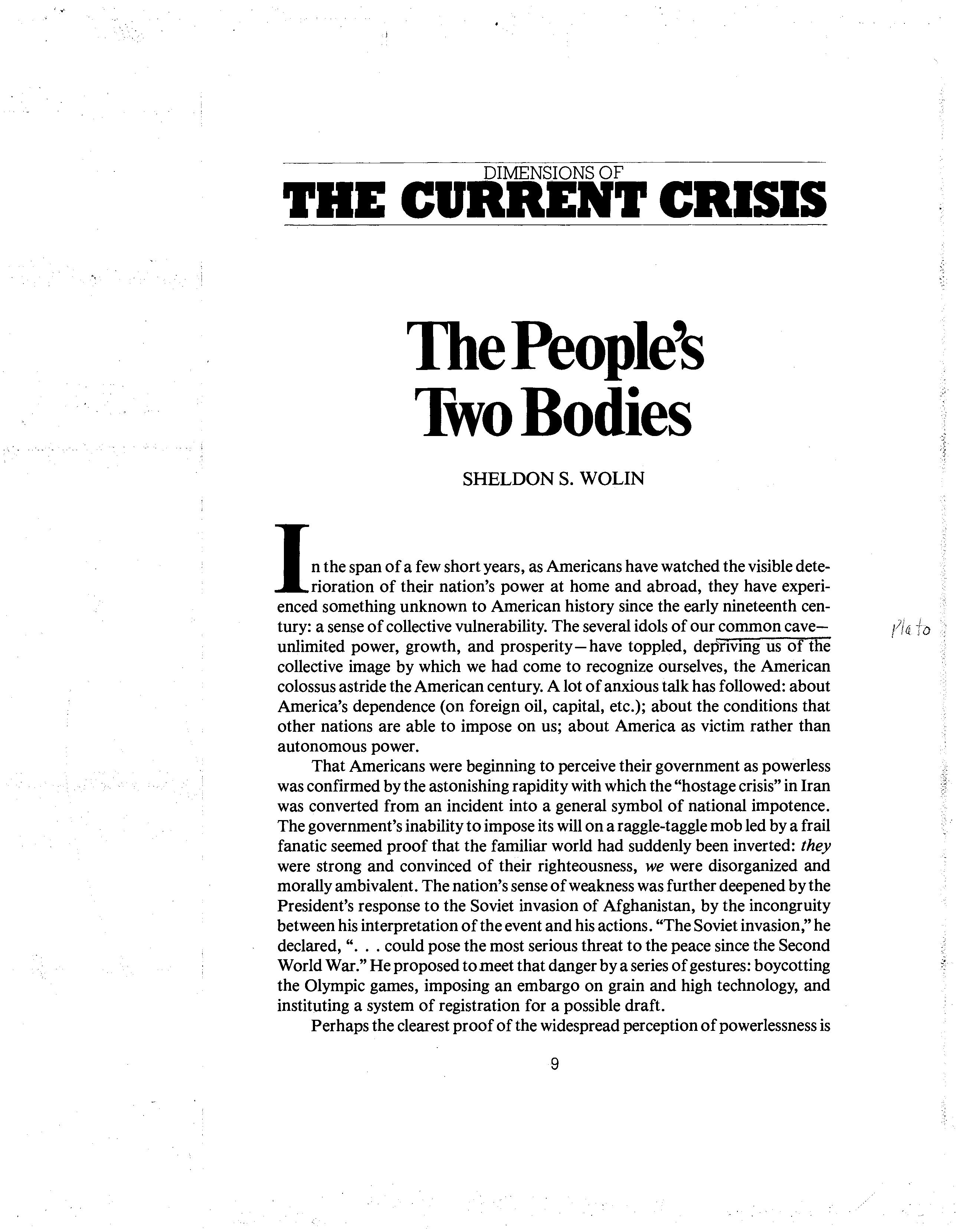
The People's Two Bodies
SHELDON S. WOLINIn the span of a few short years, as Americans have watched the visible deterioration of their nation's power at home and abroad, they have experienced something unknown to American history since the early nineteenth century: a sense of collective vulnerability. The several idols of our common caveunlimited power, growth, and prosperity- have toppled, depl'tvmg us of the collective image by which we had come to recognize ourselves, the American colossus astride the American century. A lot of anxious talk has followed: about America's dependence (on foreign oil, capital, etc.); about the conditions that other nations are able to impose on us; about America as victim rather than autonomous power.
That Americans were beginning to perceive their government as powerless was confirmed by the astonishing rapidity with which the "hostage crisis" in Iran was converted from an incident into a general symbol of national impotence. The government's inability to impose its will on a raggle-taggle mob led by a frail fanatic seemed proof that the familiar world had suddenly been inverted: they were strong and convinced of their righteousness, we were disorganized and morally ambivalent. The nation's sense of weakness was further deepened by the President's response to the Soviet invasion of Afghanistan, by the incongruity between his interpretation of the event and his actions. "The Soviet invasion;' he declared, ". could pose the most serious threat to the peace since the Second World War." He proposed to meet that danger by a series of gestures: boycotting the Olympic games, imposing an embargo on grain and high technology, and instituting a system of registration for a possible draft.
Perhaps the clearest proof of the widespread perception of powerlessness is
DIMENSIONS OF
TBE CURRENT CRISIS
9
The Current Crisis
in the eagerness with which virtually all segments of the American public have /. supported the extraordinary increases in defense spending over the past decade. Doubtless these trends have been encouraged and orchestrated by representatives of geographical regions and of specific sectors of the economy, just as they have been enthusiastically hailed by many trade unions. But knowing who is ''behind" the escalation of military spending is less important than grasping its meaning. There is broad support for it because of a deep fear about the loss of collective power and a desperate hope that a huge injection of money will arrest the decline in power.
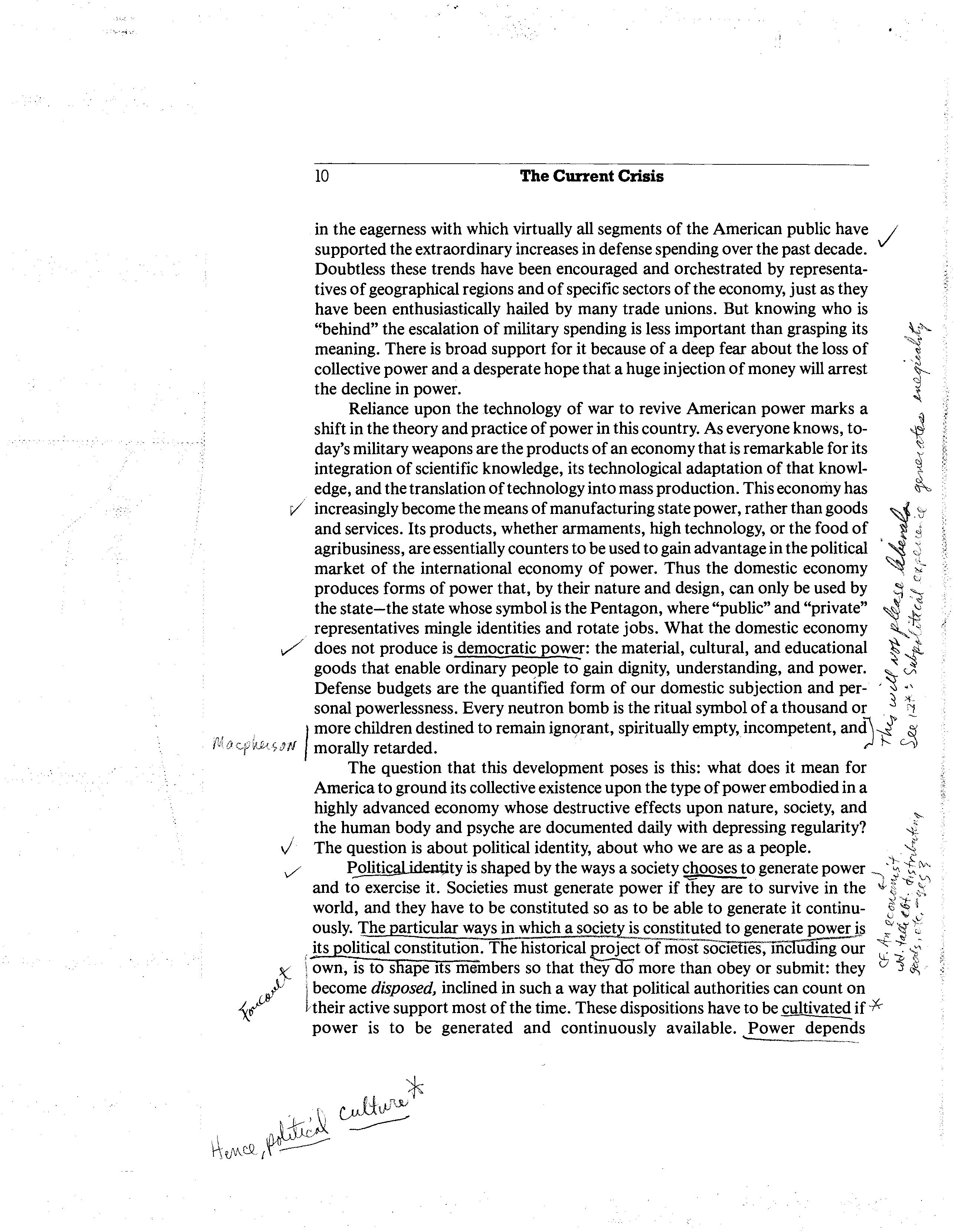
Reliance upon the technology of war to revive American power marks a shift in the theory and practice of power in this country. As everyone knows, today's military weapons are the products of an economy that is remarkable for its integration of scientific knowledge, its technological adaptation of that knowledge, and the translation oftechnology into mass production. This economy has v increasingly become the means of manufacturing state power, rather than goods and services. Its products, whether armaments, high technology, or the food of agribusiness, are essentially counters to be used to gain advantage in the political market of the international economy of power. Thus the domestic economy produces forms of power that, by their nature and design, can only be used by the state-the state whose symbol is the Pentagon, where "public" and "private" representatives mingle identities and rotate jobs. What the domestic economy V" does not produce is democratic power: the material, cultural, and educational goods that enable ordinary people to gain dignity, understanding, and power. Defense budgets are the quantified form of our domestic subjection and per- ·' sonal powerlessness. Every neutron bomb is the ritual symbol of a thousand or 1more children destined to remain ign9rant, spiritually empty, incompetent, and\ --J morally retarded. ) t.::
The question that this development poses is this: what does it mean for America to ground its collective existence upon the type of power embodied in a highly advanced economy whose destructive effects upon nature, society, and the human body and psyche are documented daily with depressing regularity?
J The question is about political identity, about who we are as a people. is shaped by the ways a society chooses to generate power and to exercise it. Societies must generate power if they are to survive in the world, and they have to be constituted so as to be able to generate it continuously. The particular ways in which a society is constituted to generate power is , jts political constitution. The historical of most \ own, is to shape 1ts members so that theyao more than obey or submit: they l become disposed, inclined in such a way that political authorities can count on hheir active support most of the time. These dispositions have to be cultivated if .fc' power is to be generated and continuously available. Power depends
lO

on an of dispositions. But dispositions are J) not something so trite as "learned behavior." They are inscribed demands of the kind that the village laborer had to "learn" in the factories and slums. Power is
not, therefore, an exchange or a transaction but an It is had on terms . that exact over time and become cumulattye. The terins of power take away ftom the place in which the collectivity is located and from the time in which it exists. A place consists of land, resources, and indigenous forms of life; time refers to the tempos and rhythms by which beings live and things exist: societies define time and enforce it (think of the mechanization of animal life). The most fundamental terms of power are those that exact from the members of a ' 1 collectivity by prescribing and proscribing activity that will enable. power to be -t;_y-B
generated and to be continuously available. The working out of the terms of r power determines the political identity of the collectivity. Power and identity are ney_er fixed once and for · the are historical projects bein worked o time and in a c ru.med space.
-c The current crisis is widely proclaimed to be a crisis of governmental power, but it may be wider and deeper than that. To ask, what have we become? we must first ask, what kind of people did we conceive ourselves to be?
0ur starting point is the eighteenth century, when the sovereign position of monarchs was challenged by revolutionary movements and when, in some countries, the soverW&nty of the pe_op,kwas,Proclaimed and the political/ theories of the day began to refer to ''the body of the people!' I want to suggest tliatirilneAineiicanpoliticaTlradition; the people has had two "bodies," with each standing for a different conception of collective of power, and o£ the terms of power. In one of these bodies the people was conceived to be politically active, while in the other it was essentially, though not entirely, passive. The one collectivity was political and democratic and can be called a body politic_; the other was primarily economic and intentionally antioemocratic and it can be called a political economy. Each of these bodies has a long tradition of theory and practice.
The classic statement of the body politic was the Declaration of Independence, its charter, the A,..rticles of The conception of political economy is more composite: the Constitution, The Federalist papers, and Hamilton's great state papers dealing with finance, manufacturing, and the interpretation of the powers of the national government. The first American body politic was formed by the revolution of 1776, the second by the ratification of the' Constitution.
On the first: revolution is the most radical action that a people can undertake collectively. Revolution means rejecting an established mode of authority,--· withdrawing the power that flows to it, and snapping the continuity between
,., '·5. l '-1 1 i ) r CF- · (;_y, P-et.£Ak:r tl<.o.J' ( ! f'.· "\ I f i f 1 -J_ "' -"') / Wolin I People's Two Bodies 11 >..''
J
•
The Current Crisis
past and future. The gravity of the act requires a people to ask themselves who they are as a collectivity, what justifies the destruction of their prior identity, and who they hope to become by reconstituting themselves.
The greatness of the Declaration of Independence was its sensitivity to these questions and its attempt to capture a new and emergent identity. For about ten years the colonists had been arguing and protesting about their status within the British Empire. The Declaration caught and preserved the moment when Americans renounced their status as colonial dependents who were required to accept and obey a system of political authority over which they exerted little control and in which they did not directly participate. In the words of the Declaration, the revolutionaries had determined "to dissolve the political bands which connected them" with the mother country, and "to assume among the powers of the earth the separate and equal station to which the laws of nature and of nature's God entitle them." The Declaration conceived of a new kind of political being, not the colonial subject of an empire, or even the "citizen," who demanded "the rights of Englishmen" and c;:specially the right not to be taxed by some distant authority. " All men are created equal with certain unalienable rights .... to secure these rights, governments are instituted among men, deriving their just powers from the consent of the governed. . . ."
The new conception went beyond even Aristotle's political man, who knew how to ru1e and be ruled in turn. The Declaration envisaged a being who wou1d not just participate in politics, but wou1d join in actually creating a new political identity, to "institute," "alter," or "abolish" governments, to lay a "foundation" and to organize power. The "self-evident truths" of the Declaration were not, as later generations often assumed, abstract and ideal constructions with no basis in experience, but a recapitulation of nearly one hundred years of practice. Not only had the colonists been practicing something close to self-government for over a century before the revolution, but in the years immediately preceding its outbreak they had telescoped and compressed that experience in novel ways. About two years before the Declaration, the committees of correspondence and the Continental Congress had been invented to coordinate the resistance of the colonies, and in May of 1776, the Congress instructed the colonial assemblies to undertake the one political act that alone compares in significance to the act of revolution: the founding of new governments that wou1d "best conduce to the happiness and safety of their constituents. . . ."
The Declaration summarized a political identity in the making, one that V stretched back to the Mayflower compact and to seventeenth-century ideas about political and religious associations as voluntary unions. That identity was perpetuated and strengthened in the eighteenth century by two profound political experiences, tbose of revolutionary struggle and of the construction of new political orders. Both experiences were experiences of action, of ordinary
12
people acting together to order their common existence. Thus the Declaration had a profoundly political conception of collective identity and a profoundly democratic conception of power; power was grounded in the deliberations of the governed and exercised within a structure that had been democratically organized.
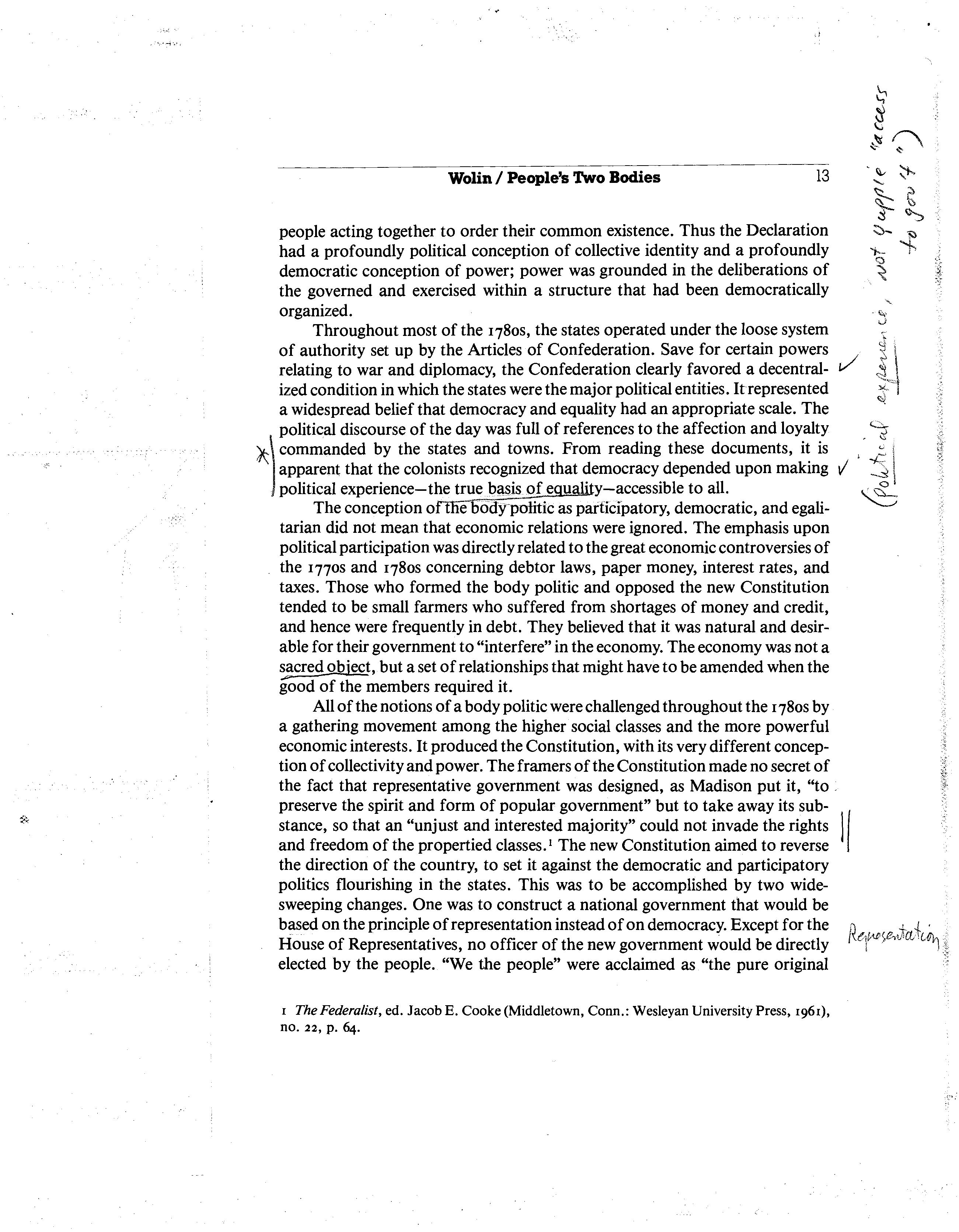
Throughout most of the n8os, the states operated under the loose system of authority set up by the Articles of Confederation. Save for certain powers relating to war and diplomacy, the Confederation clearly favored a decentral- V" ized condition in which the states were the major political entities. Itrepresented a widespread belief that democracy and equality had an appropriate scale. The political discourse of the day was full of references to the affection and loyalty commanded by the states and towns. From reading these documents, it is apparent that the colonists recognized that democracy depended upon making V political experience- basis of equality-accessible to all.
The conception o · e as participatory, democratic, and egalitarian did not mean that economic relations were ignored. The emphasis upon political participation was directly related to the great economic controversies of the 1770s and 178os concerning debtor laws, paper money, interest rates, and taxes. Those who formed the body politic and opposed the new Constitution tended to be small farmers who suffered from shortages of money and credit, and hence were frequently in debt. They believed that it was natural and desirable for their governmentto "interfere" in the economy. The economy was not a object, but a set of relationships that might have to be amended when the good of the members required it.
All of the notions of a body politic were challenged throughout the 178os by a gathering movement among the higher social classes and the more powerful economic interests. It produced the Constitution, with its very different conception of collectivity and power. The framers of the Constitution made no secret of the fact that representative government was designed, as Madison put it, "to . preserve the spirit and form of popular government" but to take away its substance, so that an "unjust and interested majority" could not invade the rights and freedom of the propertied classes. 1 The new Constitution aimed to reverse the direction of the country, to set it against the democratic and participatory politics flourishing in the states. This was to be accomplished by two widesweeping changes. One was to construct a national government that would be b(lsed on the principle of representation instead of on democracy. Except for the House of Representatives, no officer of the new government would be directly elected by the people. "We the people" were acclaimed as "the pure original
1 The Federalist, ed. Jacob E. Cooke (Middletown, Conn.: Wesleyan University Press, 1961), no. 22, p. 64.
Wolin I People's Two Bodies 13
l ol

The Current Crisis
foundation of all legitimate authority" (Hamilton), 2 but this was a formula to give the Constitution a legitimate basis, not to encourage an active citizenry.
The second change was aimed at breaking the power of the states where the democratic tradition of the body politic had taken hold. The Constitution created a centralized system of government with strong powers to tax, regulate, legislate, and coerce citizens who, hitherto, had been the objects of the state legislatures. Thus the citizen was placed in an entirely new set of relationships-with a government that was almost as remote as the British Parliament. At the same time, the state governments, to which the citizen stood closest, were forced to surrender or share many of the powers they had exercised during the era of the Articles of Confederation-powers over currency, commerce, and taxes.
Hamilton saw that the new Constitution would take hold only if it were able to attract the loyalties of citizens away from their state governments and local institutions and change democratic citizens into beings disposed to render "a due obedience to [the federal government's] authority." 3 The transformation of the citizenry would come about, he reasoned, if the activities of the national government were to penetrate the states and localities so as to become part of "the common occurrences of political life." The role of a strong state would be to promote, regulate, and protect the economic interests crucial to state powermanufacturing, commerce, banking, and agriculture-"those objects which touch the most sensible chords and put into motion the most active springs of the human heart " In appealing to self-interest and economic motives, Hamilton hoped to promote a new set of civic dispositions that would strengthen "the authority of the Union and the affections of the citizens towards it." 4
The nature of these "dispositions"- Hamilton himself used the word- and their potential for producing power were associated by Hamilton with the division oflabor and specialization. "The results of human exertion," he observed, may be immensely increased by diversifying its objects. When all the different kinds of industry obtain in a community, each individual can find his proper element, and can call into activity the whole vigor of his nature. And the community is benefitted by the services of its respective members in the manner in which each can serve it with most effect. 5
These dispositions ran squarely against the ones incorporated into the Declara-
2 Ibid., p. 146.
3 Ibid., no. 27, p. 174.
4 Ibid., p. 173.
5 "Report on Manufactures," in Papers on Public Credit, Commerce and Finance by Alexander Hamilton, ed. Samuel McKee, Jr. (New York: Columbia University Press, 1934), p. 195.
14
tion's conception of a body politic, for the "community" that he conjured up was not an association of equals or of sharers. By "diversifying" the "objects" set before man, the division of labor encouraged ''the diversity of talents and dispositions which discriminate men from each other." While it could be claimed that human potentialities were thus being encouraged, there is no doubt that this was not Hamilton's main aim. "The addition of a new energy to the general stock of effort" had as its end "the wealth of a nation, "6 that is, the foundation of the material basis of national power. Hamilton's concern with the human dispositions that generate power was part of a larger strategy to make activity the basis of political order. "The possession" of the "means of subsistence, habitation, clothing, and defense" is, he wrote, necessary to the perfection of the body politic, to the safety as well as to the welfare of the society; the want of either is the want of an important organ of political life and motion. . . . 7
The strategy was based on two assumptions, that the collectivity was symbolized in the state, not in the citizenry, and that state power was derived from the structure of the economy. 8 A political economy, in which the state would be grounded in economic relationships and act mainly through its administrative branch, was to be promoted by a system of subsidies and incentives:This vision was later incorporated into Hamilton's program for the national government to assume the war debts of the states, to establish a national bank ("a political machine of the greatest importance to the state''), 9 and to encourage "infant" industries. The dynamics of economic growth that would be unleashed by encouraging selfinterest was expected to produce "the momentum of civil power necessary to a great empire." 10
The emphasis upon the capacity of the new national political economy to generate great power was not an incidental consideration, but was central to a bold conception of the Constitution that envisaged a p-olitical society that would stretch from the Atlantic coast far into the unexplored westward regions. "Civil power properly organized and exerted is capable of diffusing its force to a very great extent; and can in a manner reproduce itself in every part of a great empire ... "(Hamilton). 11 The founders clearly understood that a large, expand-
6 Ibid., p. I96.
7 The Papers ofAlexander Hamilton, ed. H. S. Syrett, 26 vols. (New York: Columbia University Press, rg6I-I979), vol. Io, p. 291.
8 See Hrunilton's discussion in McKee, ed., Papers on Public Credit, pp. 227, 231.
9 "Report on a National Bank," in Syrett, ed., Papers of Alexander Hamilton, vol. 7, pp. 305 ff.
10 The Federalist, no. I3, p. 81.
I I Ibid.
! i ; I I Wolin I People's Two Bodies 15

The Current Crisis
"{Wstate l¥as inconsistent with a participatory body politic, but they knew as well t at there had to be concessions to the democratic tradition of "free government," in which, as one of its anti-Federalist defenders put it, "the people is the sovereign and their sense or opinion is the criterion of every public measure. " 12 They opted for a representative government because, as a system capable of being extended almost indefinitely, it fitted more snugly with an economy that was conceived in dynamic terms. At the same time, westward expansion was expected to dilute political passions and to frustrate popular political action. Enlarging the scope would increase the number of competing interests and thereby make it difficult for a majority will to form among such a widely scattered people. "Extend the sphere and you make it less probable that a majority of the whole will ... discover their own strength and act in unison with each other."
13 Thus the aim of the Federalists' was not only to found a strong state, but also to depoliticize the people. They posed a choice to Americans between "pure democracy," in which "a small number of citizens . . . assemble and administer the Government in person," and an extended republic, in which there was "the delegation of the Government to a small number of citizens elected by the rest." 14 The choice was between participatory democracy, with its inherent inability to generate sufficient power- a vision of America that Hamilton ridiculed as "an infinity of little, jealous, clashing, tumultuous commonwealths, the wretched nurseries of unceasing discord " 1 5 _.and, on the other hand, a powerful republic, "one great American system, superior to the control of all trans-atlantic forces or influence, and able to dictate the terms of the connection between the old and the new world. " 16
The two bodies coexisted throughout the nineteenth century. The democratic and participatory body politic found expression at the local levels-in the westward movemenfthat saw Americans founding along the way and improvising political forms to _meet their needs, and in the great Populist movements of farmers and workers after the Civil War. But it was the political economy that displayed the greater vitality. Its political component, the state, became more centralized and acquired a professional bureaucracy. Under the pressures of the world wars of the twentieth century and the Great Depression, the American state grew in size, power, and functions. Its economic· basis radically changed in nature, evolving from a society of small-scale producers and small farmers into an intfgrated economy dominated by large cor-·
12 The Anti-Federalists, ed .•Cecilia M. Kenyon (Indianapolis: Bobbs Merrill, 1966), p. 7·
13 The Federalist, no. 10, p. 64.
14 Ibid., pp. 61-62.
15 Ibid., no. 9, pp. 52-53.
16 Ibid., no. 12, p. 73·
v ! : 16

porations and mono o ·e d characterized by the concentration of economic wealth and power in a small number of giant firms. Despite ntu con 1cts etween "government and business," the union of the polity and the economy became ever tighter, as the antidemocratic, antipolitical implications of the terms of power under this form of collectivity became clearer.
After the victory ofWotld War II, Americans were taught, and they avidly learned, to conceive of themselves in the image of a nation of power, the greatest power in the world, the superpower among superpowers. American power was able to girdle the globe, police the world, claim the moon, and even, if necessary, destroy most life on earth. "Man holds in his mortal hands," John Kennedy declaimed at his inauguration, "the power to abolish all forms of human poverty and all forms of human life."
An incident recorded in Harry Truman's unpublished papers expressed perfectly the nation's self-intoxication with power during the postwar years. During the negotiations for ending the Korean War, Truman grew incensed at what he perceived to be the obstructionist tactics of the Chinese and Russians, and so he 'vented his rage and frustration by dashing off an imaginary ultimatum to them: "You either accept our fair and just proposal or you will be completely destroyed." 17
Although Truman never sent the ultimatum, such fantasies of power had begun to obsess Americans far beyond what was needed to sustain and protect collective life. Lyndon Johnson gave them expression for the space age:
We are, even now, concerned with what some currently regard as the ultimate weapon. . . . There is something more important than any ultimate weapon. That is the ultimate position-the position of total control over earth that lies somewhere out in space. 18
To support power that was cosmic rather than pofiiical, the citizenry would have to acquire civic dispositions corresponding to the new forms of power. What were the new elements being incorporated into the constitution of the collectivity? One was imperialism. The United States accepted almost every opportunity for htending its mflueii"ce to all parts of the globe, taking responsibility for stabilizing regimes perceived as favorable and destabilizing those deemed hostile, and for developing a world market in which the natural and human resources of the globe were organized mainly for the benefit of America. Accordingly, the American had to adopt the attributes of an imperial citizen. He had not only to support mtlitary and economic interventions abroad and to
17 Reported in New York Times, August 3, 1980, L-22.
18 Lyndon B. Johnson, The Vantage Point (New York: Populary Library, 1971), p. 276.
:>_._ .' I .·j l .:•,..·':-i· '. Wolin I People's Two Bodies 17
The Current Crisis
identify his own well-being-his job, his profession, his very identity-with the expansion of American power, but to profess a servile patriotism such that, for example he would submit to having his sons rot in the stinking jungles of remote lands. The imperial citizen could not be a democratic citizen, because imperial power called for dispositions different from those which generate democratic power. Democratic power, as Tom Paine had noted, is possible when people "mutually and naturally support each other." 1 9 Imperial power is not just more power, but qualitatively different: it is always remote and exercised far from where the citizen lives; he cannot feel immediately involved in it, nor is he required to. The dispositions needed from him were being defined by the code words of the imperial state: "national security" becomes the substitute for the "common good," and "defense spending" the primary means for promoting it. Each of these was a symbol that connected with the terms required for the new magnitudes of power and the dispositions of deference that they would exact. "National security" meant not only unquestioning support for wide discretionary power for the President, but support, too, for invasions of civil liberties and the harassment of dissenters. "Defense spending" meant not only applauding huge defense budgets, but identifying, too, with the corporate and financial institutions that actually produced the weapons and the jobs. The new vision of power was expressed by John Kennedy in his message to Congress of February 1961:

IAmerica has the human and material resources to meet the demands of national security and the obligations of world leadership while at the same time advancing well-being at home. But our nation has been falling further and further short of its economic capabilities.
These enlarged notions of the scope of American power signified the end of the Hamiltonian political economy with its vision of a powerful and autonomous nation-state grounded in a national economy and preoccupied with the development of its own territory. The new age would see the imperial state attempt to derive its power from and to assert its mastery over an interna\ tional economy. That change would undermine the political settlement established by the original Constitution of the Federalists. The institutions of representative government, including the party system that was developed to lend plausibility to the legitimation process of popular elections, would weaken and decline. The successors to Hamilton would take his case one step further. While careful to continue his tirade against democracy for arousing unrealistic
19 The Complete Writings of Thomas Paine, ed. Philip Foner (New York: The Citadel Press, 1945), vol. 1, p. 6.
18
expectations among ordinary people and for encouraging them to question the superior wisdom of elites, the new men would also turn against representative government itself. They had to find a new basis of legitimacy to replace the political compact that had drawn the original colonies and their citizens into "a more perfect union." One was found in a form of agreement, a social contract, that would signal the demise of the political citizen and the emergence of the voterJn return for the surrender of their political power, and along with If the practice of the arts of the citizen, Americans would be rewarded with purchasing power and "consumer sovereignty."
After World War II, Americans traded off or bargained away the vestigial remains of democratic citizenship in exchange for new forms of participation. They wanted to .Participate in the economy on a guaranteed basis, to share in the rising levels of consumer goods and in the expanding job market. In committing their being, individual and collective, to the economy, Americans did not explicitly reject political values of equality, participation, or popular sovereignty; nor did they specify that greater authority and discretion should be allowed to elected officials and bureaucrats, or that the principle of elitism, thinly disguised as meritocracy, should be the dominant social and political principle.
By a simple kind of action that spoke as eloquently as the provisions of any contract imagined by Locke, Rousseau, or Jefferson, Americans simply abdicated the political realm, allowing their civic involvements to languish to the point that by the 1 970s, scarcely one-half of the electorate could stir itself to vote in national elections, while the percentages ran even lower for local elections.
From the n>sos onward pgliti"al pa5si,yity was presented as a cjyjc virtue
The crucial requirement of the society, Americans were told increasingly, was "leadership," and hence they should always seek -"strong" Presidents to "provide" leadership. As for the citizen, he should think of himself as playing a "role" in a "system"-a supportive role requiring only that he stir himself on occasion and vote, so that those who ruled could thereby claim "authority" for their actions and exactions.
These civic dispositions, passive and deferential, were a natural· complement to the forms of rule that were rapidly taking hold. For this same period also saw the rise of the manager, the counterpart to the apolitical citizen. The new type was remarkable for ruling without the appearance of it. The manager combined professional skill with .selflessness, low visibility, and a pronounced aversion to public discourse. His unthreatening, technical Inien helped to conceal the authoritarianism inherent in the idea of "strong Presidents." It is an historical fact that the credit for systematically introducing "professional" management
'· Wolin I People's Two Bodies 19

The Current Crisis
into government belongs to the New Deal, the administration that, more than any other in this century, was identified with "social legislation" and with the policies and programs that came to form the provisions of the "social contract." Fittingly, the New Deal poetized the "managers," describing them as men with "a passion for anonymity."2o
The terms of the new social contract and the depoliticization of the body politic were confirmed at a specific moment when it seemed as though America might take a first step toward reclaiming its political life.
Throughout most of the '6os and the early years of the '7os, a continuous and vocal opposition was mounted against the legitimate rulers of the society and their policies. This resistance originated and remained outside the conventional political institutions. For the most part its forms were local, spontaneous, and improvised. It had started with the civil rights demonstrations of the early '6os, gathered momentum in the campus rebellions of the mid-'6os, and become ominous in the revolts that occurred in the urban ghettos of major cities. It reached a climax in the "Cambodian Spring" of I 970, when the extension of the Vietnam war into Cambodia provoked the greatest expression of antiwar opposition.
There were many ingredients in these events-youthful rebellion, black resentment, provocative cultural forms (such as rock), radically changing sexual mores, etc.-but also the possibility of a repoliticization of America, tion of the social contract that was stifling political life. But it never got much beyond the campuses and the ghettos. American working-class families were mostlyhostile, as were the overwhelming majority of middle- and lower-middleclass Americans.
The failure of the opposition politics of the I¢os to take hold and to encourage different dispositions toward power and authority was clearly demonstrated by the smashing electoral triumph of Nixorrin I 972. He received a larger majority of votes than any previous presidential candidate. It was not only a defeat for the forces of repoliticization loosely gathered around McGovern's candidacy but powerful evidence of how the terms of the social contract had sapped the political will of most Americans. The Watergate revelations, which disclosed a systematic pattern of lying, bribery, corruption, arbitrary exercises of power, and calculated invasion of the rights of private citizens, and the continual intimidation of public officials and private individuals by civilian and military agencies of the federal government, should have shaken the legitimacy of our most basic political iRstitutions. Instead the crisis was contained and then resolved by the resignation of the President.
By focusing upon the "abuses of power" by the President and the misdeeds
20 President's Report on Administrative Management, Washington, D.C., 1937.
20

of his henchmen, those who ran the system managed to avoid the fundamental question of what the political society had become, such that Richard Nixon was being punished for doing what his immediate predecessors had done less crudely; that with a public record of having lied, misrepresented, and offered himself to the major corporate and financial interests of the country, he had been reelected by an unprecedented popular majority of the American voters. The conclusion was not so much that the elites succeeded in containing the legitimation crisis, but that the citizens had dutifully honored their engagement. By the terms of the social contract the average American had agreed not to be actively engaged in the life of the citizen and not to challenge the enlarged authority and discretion of public officials, the increased power of bureaucracy over ordinary life, or the thinly concealed power structure in which public institutions and private corporations were striking daily bargains about the direction of the society and the use of its resources and common wealth.
The depoliticization of America is the necessary precondition for the current demand for "reindustrialization" that has become the slogan of the powerful political and economic forces rallying around the vision of a new, more rationally planned society. Its manifesto was composed by Business Week. Calling for a "new social contract" that would replace the politic; of conflict by a "collaborative relationship" among labor, management, and academia, this influential voice of corporate America coolly noted that "the drawing of a social contract must take precedence over the aspirations of the poor, the minorities, and the environmentalists." Declaring that "the goal must be nothing less than the reindustrialization of America," it stated clearly the antidemocratic, corporatist vision of the new America:----
... the question of whether the U.S. will reindustrialize depends on whether the business, bureaucratic, and political elites can get together to provide the leadership. 21
The vision, in its silence, adopts the advice recommended ironically by Brecht in The Solution:
Wouldn't it be simpler in that case if the government Dissolved the people and Elected Another?
Today's crisis is centeredin the economy, but not in economic problems as [(I such. The crisis is one of collective identity and of power because "the economy" has come to embody the identity of the collectivity and to serve as the ground of
21 Business Week, June 30, 1980, pp. 4, 5, 27.
Wolin I People's Two Bodies 21
The Current Crisis
its power. According to a 1977 poll, nearly 70 percent of Americans believed that while the economy could stand some improving, it was basically sound. This vote of confidence in "the economy" was in sharp contrast to the findings of a 1979 poll reporting that a majority of Americans (55 percent) believed that the "political system" needed revision or was completely outmoded. The civics lesson contained in the contrast had been delivered in a slightly earlier poll, which had found that 96 percent of those polled believed that Americans must be "ready to sacrifice for the free enterprise system." Clearly some profound displacement of loyalty had occurred in which citizens declared themselves in favor of getting rid of a significant part of their political order and, at the same time, announced that they were prepared to sacrifice for an economic system, even, apparently, for one that existed nowhere except in the prose of the inspired clercs of Mobil Oil and Citibank.
Historically the Carter Administration has played a pivotal role in expressing the meaning of "the economy," the new and depoliticized form of collectivity. Jimmy Carter correctly perceived that for such a collectivity the search for "energy" would be the moral equivalent of war, that "on the battlefield of energy we can seize control again of our common destiny," and that "every gallon of oil" saved "gives us more freedom ... that much more control over our own lives so that solutions to our energy crisis can also help us to conquer the crisis of the spirit in our country." 22 The historical mission of Jimmy Carter's pseudopopulism-with its laments about a lost purity and a government grown "distant" from "the people''-was to provide a mass basis for a new state-corporate, bureaucratic, technocratic, and managerial. "We are talking about the United States of America," Jimmy Carter thundered in his speech accepting renomination, "and those who count this country out as an economic superpower are going to find out just how wrong they are."
That speech pays reconsidering, for it was perhaps the most important statement of the nature of the new collectivity. Declaring that his administration had "laid the groundwork for a new economic age," he made it clear that the new ground would represent a reversal of the modestly progressive social policies of the New Deal tradition in the Democratic Party:
We've slashed government regulation and put free enterprise back into airlines, to trucking and the financial system of our country ....
Then he interred the New Deal for good and identified the concerns of the new collectivity:
This is the greatest change in the relationship between government and
22 Speech of July 15, 1979.
22
business since the New Deal. We've increased our exports dramatically. We've reversed the decline into [sic] basic research and development. And we have created more than eight million new jobs, the biggest increase in the history of our country.
The new collectivity in the new economic age would be devoted to "revitalization"-not of the body politic-but "revitalization of American industry"; the new citizen would be absorbed in the "real work [of] modernizing American industry," not in reclaiming his or her political self or recreating a common life. The President's speech was another expression of the forces that are exploiting the current crisis to accelerate the movement of the society toward a new and undemocratic form. The ideology for this new form starts from the claim that the crisis is located in the economy, whose woes are the result of the fact that American products are no longer competitive in the world market. Our declining competitive position, it is said, is due to lower productivity, inefficiency, lack of "discipline" among the work force, and an "adversary mentality" of trade unionists. But we must not only "reindustrialize" but emulate the proper model-which turns out to be West Germany or Japan. "We have two ways to go," warned an Assistant Secretary of Labor, "the way of the British or the way of the Japanese." 23
During the last several months something that looks suspiciously like a concerted campaign has been mounted against the "citizens" of the present political economy, contrasting the lazy and contentious American worker with the regimented enthusiasm of Japanese workers, who have appeared at their obliging best on several television shows, hopping up and down to canned music during their "breaks," making constructive suggestions about how to improve further their highly automated production lines, and displaying the serenity of a work force that has been given paternalistic reassurances of cradle-to-grave security. The television cameras did not stray from the factories to explore the political implications of a model citizen who would combine, in equal parts, the values of automation and of feudalism; much less have the media invited their audience to consider the broad implications of "learning" from West Germany and Japan, societies with old, rich authoritarian traditions and fresh totalitarian pasts, while turning away from virtually the only society, Britain, whose political values were once closest to our own.
The current crisis is inherent in the form of state power constituted by, and grounded in, an economy whose "dynamism" and "innovations" exact an awesome price in the destruction of received values, skills, knowledge, and the
23 New York Times, August 18, 1980.
Wolin I People's Two Bodies
23

The Current Crisis
basic human institutions for transmitting them. Family, school, and city: they have all been damaged and twisted to the point where they produce more despair than happiness. The present constitution of power, and the social contract that legitimates it, has produced the present deepening crisis. The crisis consists of two interrelated parts: the unprecedented magnitudes of power at the disposal of the American state and the peculiarly abstract quality of it. Think of the pro\!' posed MX missile system, its tracks winding through the "empty" spaces of western states, its lethal payload disappearing and reappearing, and its power wholly disconnected from any community. It is a symbol of contemporary power. It takes hold by destroying existing human relationships and then expanding its logic in the void it has created.
What is remarkable about these forms of power is that we know perfectly well that they are, at bottom, antihuman. Everyone knows that the two most powerful institutions of our society, the "private" corporation and the "public" bureaucracy, are unaccountable, unresponsive, distended, and inept. It is equally plain that the social evils that they produce are inherent in them, and that no subtlety of cost/benefit analysis can begin to comprehend the genetic and ecological damage done to generations unborn, much less even attempt to come to grips with the terrible demands that are being endlessly pounded into each generation of the permanently poor and the racially excluded. Everyone knows, too, that the dominant position of the corporation and the government bureaucracy means that the most powerful institutions in our society are radically antidemocratic. Both are hierarchical, and hence biased toward authority and elitism. Finally, everyone knows, too, that these institutions have betrayed and continue to betray the American promise: they have shaped a society of ever widening disparities of wealth that translate into increasing inequalities of power, of life chances, and of access to cultural and educational values.
Nothing short of a long revolution, aimed at deconstituting the present strucTUre of power, makes much sense. It is illusory to believe either that the same modes of power that, by their constitution, use up humans, society, and nature at a fearful rate can simply be "turned around" and trained in a more benign direction; or that the same human dispositions toward power-passivity by the many, control by the few-will serve as well for a new social order as for the current one.
The task is an enormous one-difficult, endless, full of unknowns. We need new forms, new scales, new beings. The forms need to be what constitutions truly are: life forms for taking care of a part of the earth and of the beings who are there. That constitution cannot be given; it can only come to be in the concrete actuality of people taking hold of conditions at hand and steadily shaping them· to accord with how they think equal beings should live and by what time they should order their lives together.
24