1
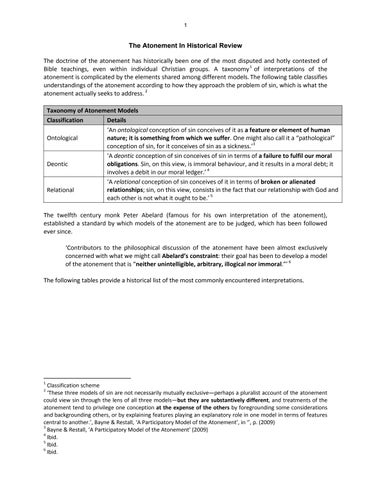
The Atonement In Historical Review The doctrine of the atonement has historically been one of the most disputed and hotly contested of Bible teachings, even within individual Christian groups. A taxonomy 1 of interpretations of the atonement is complicated by the elements shared among different models. The following table classifies understandings of the atonement according to how they approach the problem of sin, which is what the atonement actually seeks to address. 2 Taxonomy of Atonement Models Classification Details ‘An ontological conception of sin conceives of it as a feature or element of human nature; it is something from which we suffer. One might also call it a “pathological” Ontological conception of sin, for it conceives of sin as a sickness.’3 ‘A deontic conception of sin conceives of sin in terms of a failure to fulfil our moral obligations. Sin, on this view, is immoral behaviour, and it results in a moral debt; it Deontic involves a debit in our moral ledger.’ 4 ‘A relational conception of sin conceives of it in terms of broken or alienated relationships; sin, on this view, consists in the fact that our relationship with God and Relational each other is not what it ought to be.’ 5 The twelfth century monk Peter Abelard (famous for his own interpretation of the atonement), established a standard by which models of the atonement are to be judged, which has been followed ever since. ‘Contributors to the philosophical discussion of the atonement have been almost exclusively concerned with what we might call Abelard’s constraint: their goal has been to develop a model of the atonement that is “neither unintelligible, arbitrary, illogical nor immoral.”’ 6 The following tables provide a historical list of the most commonly encountered interpretations.
1
Classification scheme ‘These three models of sin are not necessarily mutually exclusive—perhaps a pluralist account of the atonement could view sin through the lens of all three models—but they are substantively different, and treatments of the atonement tend to privilege one conception at the expense of the others by foregrounding some considerations and backgrounding others, or by explaining features playing an explanatory role in one model in terms of features central to another.’, Bayne & Restall, ‘A Participatory Model of the Atonement’, in ‘’, p. (2009) 3 Bayne & Restall, ‘A Participatory Model of the Atonement’ (2009) 4 Ibid. 5 Ibid. 6 Ibid. 2