Center for Jewish Leadership and Ideas Parashat Ha’azinu (Deuteronomy 32:1-52) – Elul 5774
“I May Not Get There With You”: The Death of Moses and the Meaning of Covenantal Living Rabbi Shai Held
It is difficult to overstate the centrality of Moses to the book of Deuteronomy. As Bible scholar Patrick Miller notes, “Within the book of Deuteronomy Moses is not only the central figure but is virtually the only figure.” The only characters who speak in the entire book are God and Moses—and since the narrator so often quotes Moses quoting God, their respective voices begin to blend over the course of the book. On Deuteronomy’s account, Moses is God’s spokesman
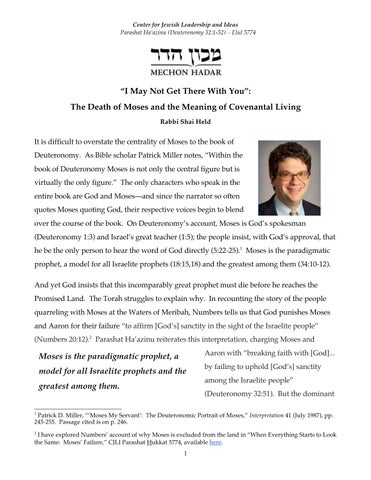
Rabbi Shai Held
(Deuteronomy 1:3) and Israel’s great teacher (1:5); the people insist, with God’s approval, that he be the only person to hear the word of God directly (5:22-25).1 Moses is the paradigmatic prophet, a model for all Israelite prophets (18:15,18) and the greatest among them (34:10-12). And yet God insists that this incomparably great prophet must die before he reaches the Promised Land. The Torah struggles to explain why. In recounting the story of the people quarreling with Moses at the Waters of Meribah, Numbers tells us that God punishes Moses and Aaron for their failure “to affirm [God’s] sanctity in the sight of the Israelite people” (Numbers 20:12).2 Parashat Ha’azinu reiterates this interpretation, charging Moses and Aaron with “breaking faith with [God]...
Moses is the paradigmatic prophet, a model for all Israelite prophets and the
by failing to uphold [God’s] sanctity among the Israelite people”
greatest among them.
(Deuteronomy 32:51). But the dominant
1 Patrick D. Miller, “‘Moses My Servant’: The Deuteronomic Portrait of Moses,” Interpretation 41 (July 1987), pp. 245-255. Passage cited is on p. 246. 2
I have explored Numbers’ account of why Moses is excluded from the land in “When Everything Starts to Look the Same: Moses’ Failure,” CJLI Parashat Hukkat 5774, available here. 1