
First published in India in 2002 by
Mapin Publishing Pvt.Ltd.
Ahmedabad 380013 India
Tel: 79-755 1833 / 755 1793 • Fax: 79-755 0955
email:mapin@icenet.net www.mapinpub.com
Simultaneously published in the United States ofAmerica in 2002 by Grantha Corporation 80 Cliffedgeway,Middletown, NJ 07701
Distributed in North America by Antique Collectors’Club
Market Street Industrial Park Wappingers’Falls, NY 12590
Tel: 800-252 5321 • Fax: 845-297 0068 email:info@antiquecc.com www.antiquecc.com
Distributed in the United Kingdom,Europe & the Middle East by Art Books International Ltd.
Unit 14,Groves Business Centre,Shipton Road Milton-under-Wychwood,Chipping Norton Oxon OX7 6JP UK
Tel: 01993-830000 • Fax: 01993-830007
email:sales@art-bks.com www.artbooksinternational.co.uk
Distributed in Asia by Hemisphere Publication Services 240 MacPherson Road
#08-01 Pines Industrial Building
Singapore
Tel: 65-6741 5166 • Fax: 65-6742 9356 email:info@hemisphere.com.sg
Text © Geeti Sen Photographs © as listed
All rights reserved under international copyright conventions.No part ofthis book may be reproduced or transmitted in any form or by any means,electronic or mechanical,including photocopy,recording or any other information storage and retrieval system,without prior permission in writing from the publisher.
ISBN: 81-85822-88-3 (Mapin)
ISBN: 1-890206-31-8 (Grantha)
LC: 2001090904
Edited by:Krishen Kak
Design by:Paulomi Shah/ Mapin Design Studio
Processed by Reproscan.,Mumbai
Printed by Tien Wah Press,Singapore
The publication ofthis book has been made possible with a partial grant from Koomber Tea Company Limited Kolkata
For my grandmother,Charulata Mukherjee, and her daughters Lata and Nita, and all the women ofIndia who have made possible the resurgence ofa new feminine spirit...
Captions
Jacket:
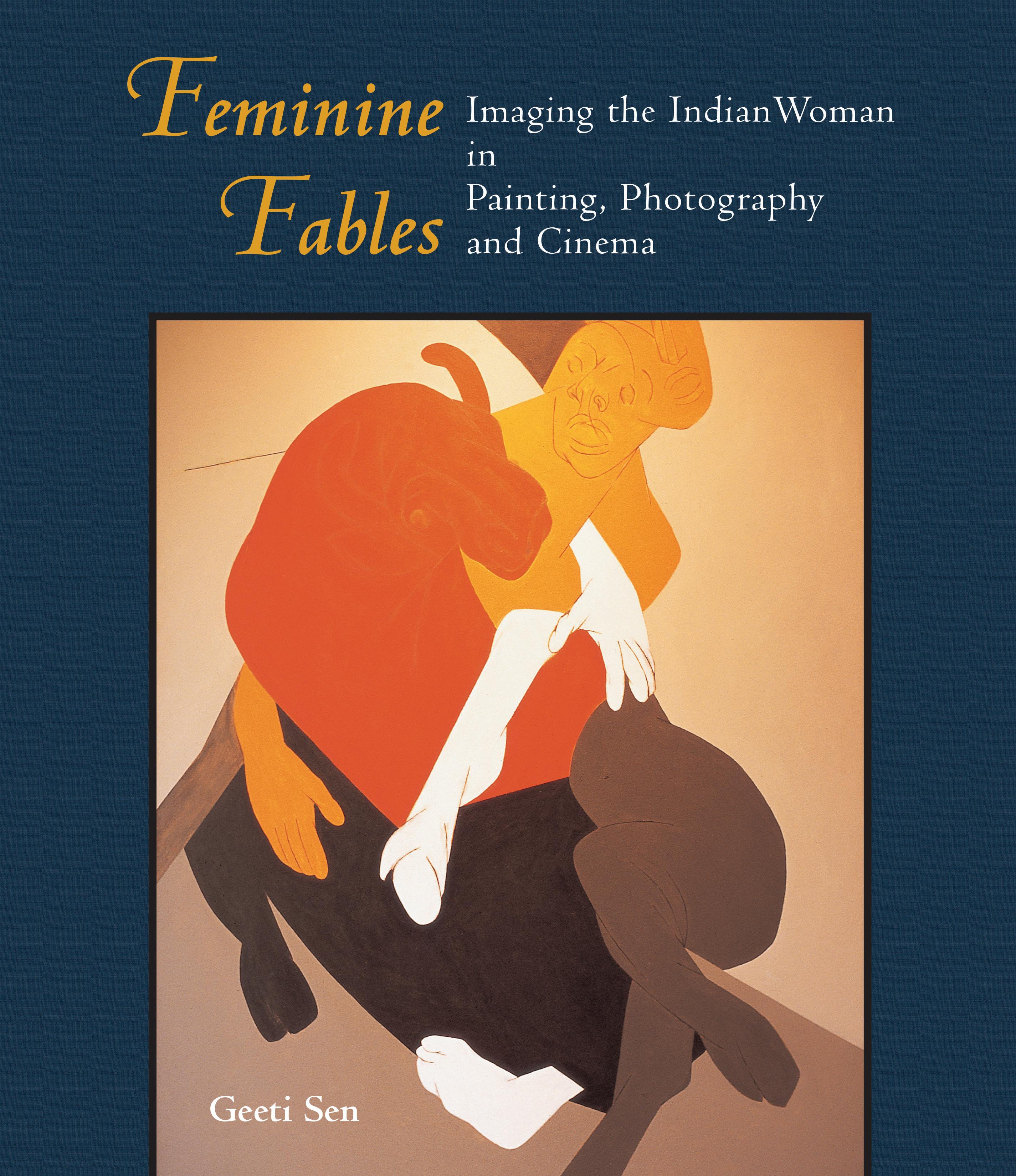
Front: Mahishasura Mardini, 1997 by Tyeb Mehta
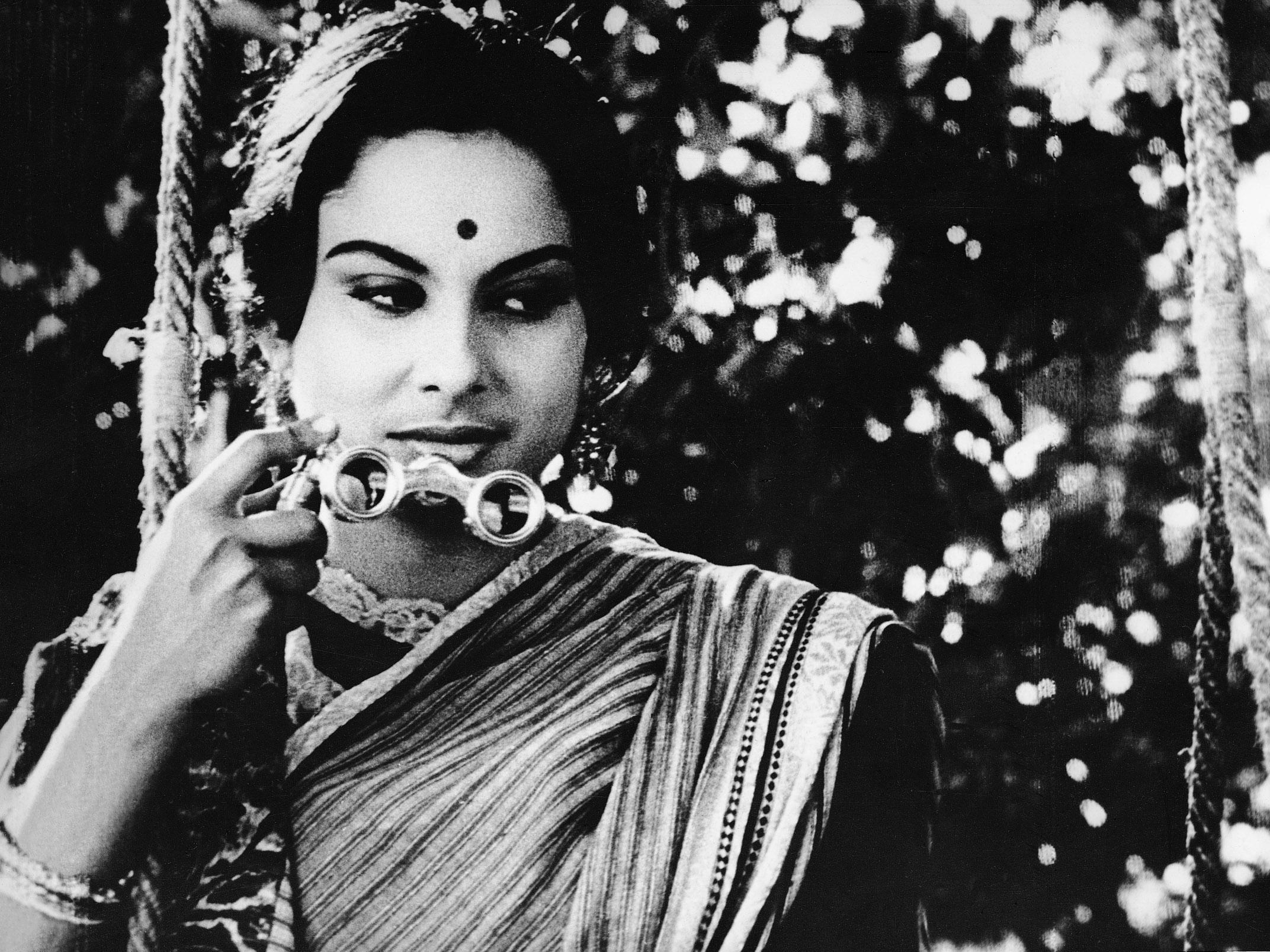
Page 2: Charulata, 1964,directed by Satyajit Ray.Film Still
Acknowledgements
Feminine Fables: introduction I Bharat Mata: woman or goddess?
II
Woman Resting on a Charpoy: the semiotics ofdesire
III
The Home and the World: inner and outer spaces
IV The Ceremony ofUnmasking: the ambivalence ofroles
V Hatyogini Shakti: the goddess within
This book has grown over five years,supported by the encouragement received from friends and cooperation from many institutions in India and the U.K.It has been initiated and indeed,inspired by the extraordinary vitality ofvisual images in India of the 20th century,sourced from contemporary art,popular posters,cinema photography and installations.
It was a privilege to have been selected as Fellow by the Jawaharlal Nehru Memorial Fund (1998–2000),giving me the opportunity to focus full time on research, interviews,travel and the collation ofvisual documents.I acknowledge with gratitude the unstinting support from the office ofthe Nehru Memorial Fund,and the interim leave granted from my work by Dr.Karan Singh,Dr.Kapila Vatsyayan and Trustees of the India International Centre.I thank the Director and staffofthe Nehru Museum and Library for furnishing me with a splendid room at the scholars’ annexe,where discussions with fellow scholars provided the necessary stimulus.
I should like to thank the British Council in Delhi and the Charles Wallace India Trust for providing a grant-in-aid which allowed me to pursue these interviews and research in the U.K. in October 1998.Discussions held with Richard Lannoy, Katherine Frank and Partha Mitter proved most useful in helping me formulate the original framework ofthis book.I am especially grateful to Richard Lannoy for his sustained interest in all the chapters,and not merely the text pertaining to his remarkable photographs ofAnandamayi Ma.In our continuing correspondence his inspired responses have brought insights to certain passages ofmy book.
The institutions consulted in my research include the Nehru Memorial Museum and Library,(in particular the Archives on Proscribed Literature),the Institute ofAdvanced Study in Shimla,the British Library London,the Chelsea School ofArts London,the libraries ofSahitya Akademi and Lalit Kala,the National Gallery ofModern Art and the Indira Gandhi Memorial (Museum) in Delhi.At the National Film Archives in Pune I was afforded special facilities for screening over 20 films, providing the framework (and most visuals) for chapter III.I acknowledge with gratitude the cooperation received from the Directors and staffofthese institutions.
I thank Anjali Sen,the former Director ofthe National Gallery ofModern Art,for granting permission to reproduce paintings by Amrita Sher-Gil and Raja Ravi Varma. I thank Jeremy Losty for granting permission to reproduce posters from the collection ofthe British Library,three ofwhich have never before been published,offering unique representations ofBharat Mata.
This book relies substantially on visual representation:the subtle process of transformation and subversion in an iconography which reflects the changing ethos and values ofthe 20th century.This is supported by archival material and interviews.Several friends have sustained my efforts with their encouragement,from the inception ofthis project and through various revisions ofthe chapters.In particular I am deeply indebted to Sumanta Banerjee for helping me develop the initial chapter on Bharat Mata,an image which has never received the critical attention it deserves.I thank Ashis Nandy for his tremendous encouragement,and Neera Chandoke,Mushir-ul Hasan and Shahid Amin for their insights on constructs ofnationalism.I acknowledge with gratitude Katha Kakar’s enthused response and suggestions from her own research on this topic.
For the more art historical and feminist intent ofchapter II,I am indebted to Susan Viswanathan,Mala Marwah and Priya Sarukkai-Chabria for their suggestions. Patricia Uberoi and Aruna Vasudev gave their invaluable time in reading through chapter III,inspiring my interpretations with their own writings on film.Dialogues with Richard Lannoy,Uma Vasudev and Sheba Chhachhi inspired me to complete perhaps the most difficult chapter IV of ‘unmasking’ the face.In pursuing the enigma ofIndira Gandhi I am indebted to Ranesh Ray for his guided tour around the Indira Gandhi Memorial.I may mention here the insights ofP.N.Haksar who had remained my mentor and guide before the writing ofthis chapter was initiated.
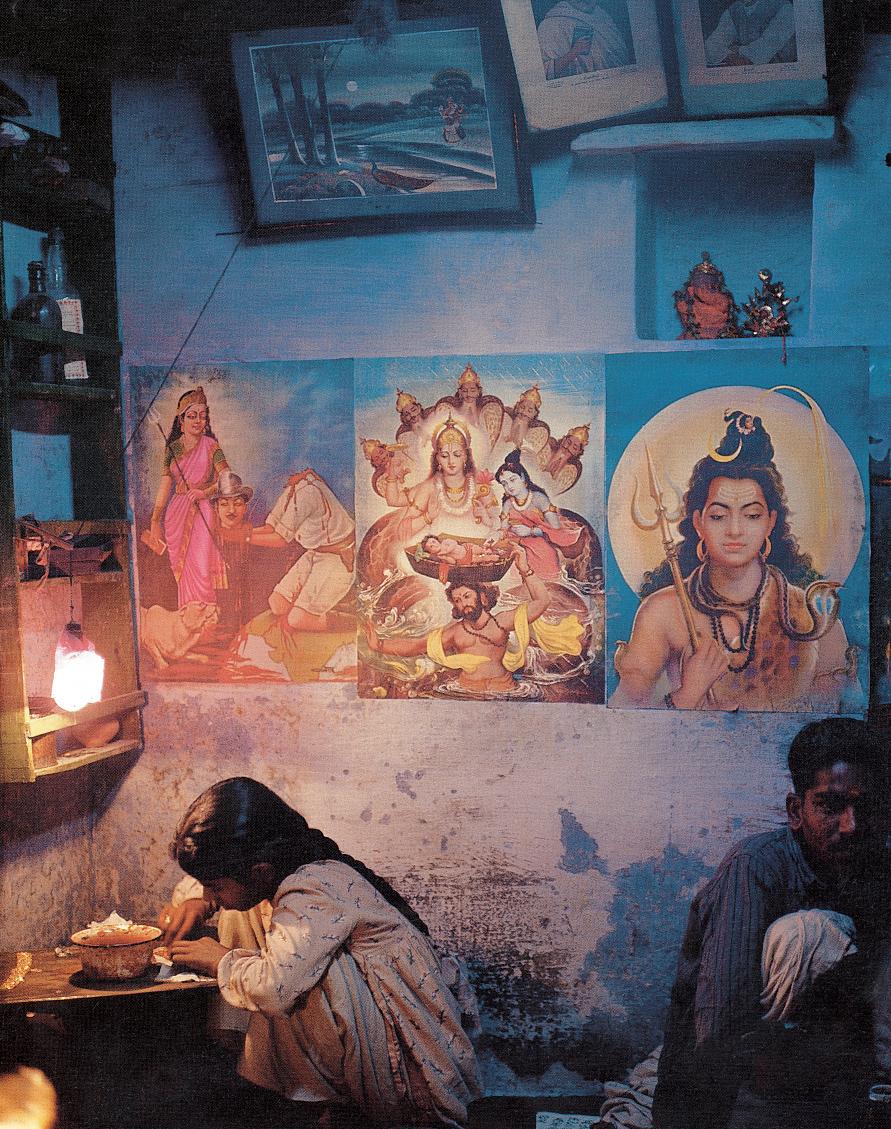
In the last chapter I have been deeply inspired by discussions with Chandralekha,Medha Patkar,Nirmala Buch,Nandita Das,and several other activists who embody the assertion ofa new consciousness amongst women in India.This ‘re-awakening’ ofa new identity is in some senses akin to the intensity ofnational fervour sweeping the country at the beginning ofthe 20th century,and this brings us full circle but with unexpected results.This intense fervour,divested ofits metaphysical notions,is equally manifest in the images by contemporary women artists to become perhaps an appropriate conclusion to this book.The ‘older’ values are represented most aptly in a wall painting in Varanasi,painted in the popular calendar idiom in the year 2001.I am grateful to Martin Brading who agreed immediately to photograph this essential mural.
Most ofall,I am grateful for the extraordinary power ofthis new iconography these new images ‘re-invented’ by artists,photographers and film makers,focusing on essential issues which concern the woman and form the raison-d’etre ofthis book.An invitation in 1996 to visit Mills College in California,for an exhibition curated by Mary-Ann Milford brought a new perspective to the work ofwomen artists.My interviews with Anupam Sud,Arpita Singh,Manjit Bawa and Gogi Saroj Pal had begun long before the genesis ofthis book,and these may have influenced the final choices made in my selection.To these I must add the fascinating discussions with Tyeb Mehta on the ‘demonisation’ ofMahisasura;and the illuminating interview with the late Devayani Krishna.Interviews held with Chandralekha,Pushpamala,Sheba Chhachhi, Kanchan Chander,Sadanand Menon,Raghu Rai,and film makers Shyam Benegal and Deepa Mehta have served to further strengthen my proposition:on the making ofthe new Indian woman.To all these friends and many others not named,I acknowledge my gratitude.
In production,this book has received financial support from Mr.S.K.Bhasin and the Koomber Tea Company Ltd.,Kolkata.I am grateful to the Sponsors who have seen the potential promise ofa book ofthis nature.I thank Mr.Gordon Fox and Mr.Peter Leggatt who with their sustained support and enthusiasm have encouraged me to complete the final stages ofthis work.
Finally,I should like to thank Bipin Shah and Mallika Sarabhai ofMapin Publishing,and Paulomi for her deep commitment to design this book,amongst many others ofoutstanding quality.
Geeti Sen 25th April,2002
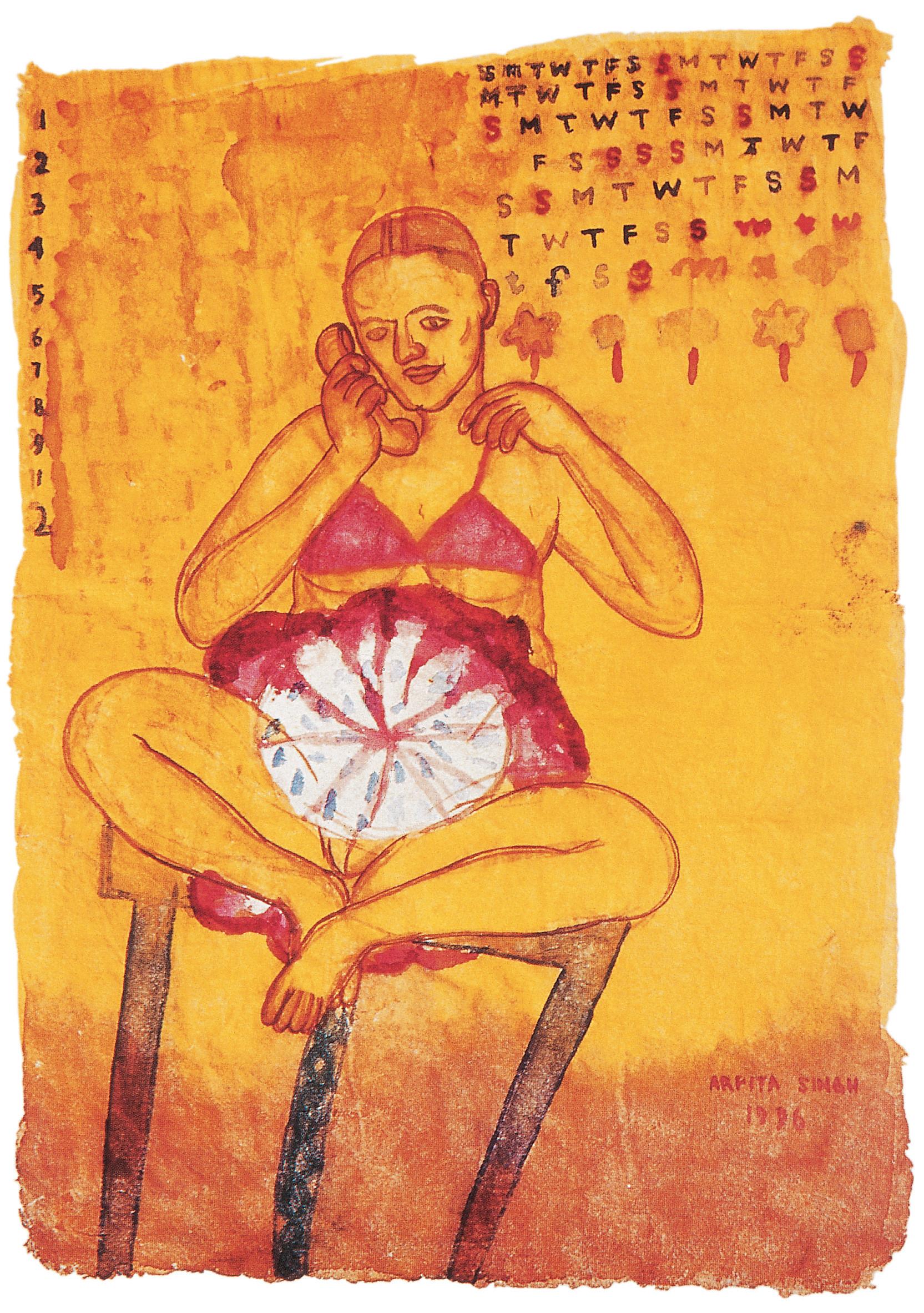
By Arpita Singh
he title ofthis book is inspired from water colours by Arpita Singh,who is amongst artists in India reinventing icons ofwomanhood.The title is appropriate because there would seem to be an essential difference between being feminist and being feminine.While the first professes a pro-active commitment to the cause,the second constructs a complex persona oflayered identities which subvert the meaning of being ‘feminine’today.Arpita’s deliciously pink lady is undressed to the bare minimum, perched on a stool and chatting on a telephone as minutes (hours,days,years) are ticking by.She flouts conventions,representing the phenomenon ofa new woman— deliberately provocative,raising questions and not merely eyebrows about changing perceptions.
Increasing attention to the gender discourse in India has been paralleled by the phenomenal rise today ofwhat might be described as ‘women’s power’.These debates have moved far beyond 19th century concerns about women and their emancipation.A hundred years later,feminists,activists,writers,artists and film-makers are engaged in rewriting a history ofthe woman’s identity,in redefining her freedom,in asserting the awakening to her own,vital sources ofenergy.
All this has left me with a sense ofunease.Many questions remain to be asked, and the rhetoric is still to be matched by realities ofthe day.In a country which has both idolised the woman and defiled her,two parallel traditions have run side by side through centuries.The ambivalence which had governed patriarchal norms at the beginning ofthe 20th century continues to shape sensibilities and beliefs today.Ashis Nandy has observed that women are themselves the first perpetrators:to sustain norms of‘moral’conduct which are now built into their psyche.Far away from the feminist discourse,recent field studies by Niranjana have shown that women working in the villages in Telengana continue to map their movements according to the boundaries in their terminology of‘olage/horage’,inner and outer spaces.
Ifthere has been a transformation in values,how can these changes be authenticated? The most discerning registers for perceiving change,it seems to me,lie with the new visual images.Here one finds a curious lacuna,where critical attention has been directed to collected essays,catalogues and reinterpretations ofmythology—but not to visual images as signifiers ofchange.A major part ofthe Indian tradition has always been visual and oral in its powers ofpopular persuasion—converting those who may have retained their orthodoxy to a wider set ofperceptions.
This book was conceived then,to trace the transformation in iconography and values over the span ofthe 20th century.Set against the feminist discourse,these icons raise a different set ofquestions about ‘seeing’the Indian woman.The visual statement is a more subtle signifier ofsensibility than any written text.More significantly,these icons reflect the changes in perceptions,beliefs and values by responding to the political and social climate ofthe time when they were conceived.A film such as Mother India which returns the goddess ofthe nation to becoming a woman ofthe village belongs essentially to the Nehruvian ideology ofthe 1950s.Likewise,the earlier
imaging of Bharat Mata—not as a woman but as a map reveals the obsessive concern with guarding her territorial sanctity in decades immediately before and after Independence.
This is not a book on art history or connoisseurship.It addresses wider social issues which concern every woman and her identity,and engages everyone concerned about women.My writing is grounded in readings in political and social analysis, psychology,film criticism,semiotics and theories ofart.I am indebted to the influential writings ofBankimchandra Chattopadhyay,and Rabindranath and Abanindranath Tagore which formulated the concepts for my first chapter;to the letters by Amrita Sher-Gil and Indira Gandhi,as well as observations by John Berger and Richard Lannoy which stimulated the genesis ofthe second and fourth chapters.Equally,my observations rely upon dialogues with ‘image makers’:the artists,photographers and film-makers who conceived the images,and who have articulated their views in statements as well as in graphic images.The vitality oftheir images has in turn, persuaded,cajoled and transformed my own personal definition ofwhat it means to be an Indian woman!
Five seminal essays in this book examine issues central to the paradox of ‘being a woman’.Each chapter is titled after a conceptual idea,which also happens to be the title ofthe central painting,film,etching or installation discussed in the chapter.It must be admitted these concerns were initiated from my personal experience,leading to universal concerns shared by women.To facilitate reading,my substantial research is placed as reference notes at the end ofeach essay.This is in lieu ofthe conventional bibliography usually placed towards the end ofthe book,since each subject deserves access to different disciplines.At times the discourse in this book raises more questions than it supplies answers.This is intentional.
That inherent paradox controlling norms and social conduct,mentioned at the start ofmy introduction,is summed up in a perceptive prognosis by Richard Lannoy (1971:114).He suggests:
The Indian woman is looked upon in turn with idealization,desire and alarm.
Women in India have been cast in these and other conflicting roles,mediated by men who were until recently the ‘image builders’.The ideal status was a privilege conferred by them:the woman was both divine and mortal,to be worshipped,desired, and also domesticated.Traditional texts and paintings usually defined these as distinct from each other.It was only in the early 20th century that the first two roles were brought together into that single,luminous image of Bharat Mata, in casting the woman as mother ofthe nation.Across the span ofa century she still invites our attention,for in her were invested the powers ofa ‘holy icon’,in her were invested all the aspirations ofour founding fathers as a personification ofa country waiting to be reborn...
The inception of BharatMata has been mentioned in passing by most writers on Indian nationalism.Yet the image has never received the critical attention which she deserves.For several reasons it is appropriate to begin woman’s history with Abanindranath’s emblematic image ofthe mother ofthe nation,for here she is imaged already with the conflicting notions (as noted by Nivedita,a woman ofthe time) of being both goddess and woman.For the artist,as much as for the reformers and the conservative patriarchs ofthe time,she represents an idealised vision rather than any down-to-earth reality.She also signifies the political history ofthe country as it
changed,bringing different perceptions ofwomen and their empowerment.At the end, she remains a prophecy,an ideal now disempowered.The question to be asked is what is her constituency today?
As the image of Bharat Mata evolves over a hundred years,she continues to represent the political aspirations ofeach decade.Engendered in 1882 as a bewitching goddess,she is modelled instead as a modest woman;then she is transformed unexpectedly in terrorist posters to allude to the goddess Kali;imaged in the years before Independence as a map ofthe country;and changed again into representing the female principle ofauthority in the film Mother India.And when she finally comes to be enshrined in her own temple in 1983,she no longer represents the nation but the aspirations ofone political party.With the icon of Bharat Mata, religion had been once been the means to unite the country into a nation.Now,ironically,with the same icon nationalism has become the pretext to unite the country under one religion.History, politics and religion become inseparable in her fascinating transformation.
Do gender differences in perception operate in the ways a woman is imaged? This becomes the essential question in my second chapter,in analysing Lannoy’s second category ofwoman as the object of desire.In defining a woman’s identity,the most essential aspect is her own body,her biological birthright that which engenders her being and which for centuries has been the cause ofgender discrimination.The body has been described as “the site ofviolence,exclusion,and abuse;it also has celebratory aspects which are revealed in imagery through artistic or aesthetic modes... ” (Thapan, 1997:3)
The second chapter moves from the woman as an emblematic metaphor into representations ofher physical,biological entity.Quite conceivably,this discussion could have focused on representations ofsexual abuse,ofbride-burning and dowry deaths,ofmourning female infanticide and other related issues.The mode adopted here is one ofcelebration ofwoman’s sexuality,which has been the subject of contestation.My approach is through the transformative and at times subversive vision ofwomen artists in India.This history begins with Amrita Sher-Gil,who evolved in the last three years ofher short-lived career to an indigenous sensibility in representing the Indian woman.Fifty years later,women artists have taken up her unfinished project.
In Indian painting and sculpture,the female body has always been given primary importance.The classification ofheroines has an extensive history in literature, art and aesthetic theory in this country.Parallels with western conventions ofbeauty are quite remarkable.As Berger has noted with incisive comment,visual representations ofwomen have been shaped by male definitions ofbeauty,by projecting the qualities desirable in a woman.Foremost among these is the undisputed convention ofimaging her as a passive recipient ofthe gaze,as theobjectofvision,a sight (Berger, 1972:47).
These definitions ofbeauty have not changed much,ifwe are to consider the present indices ofpopular cinema,calendar art and advertising in India.What has changed is that the woman’s body is being reclaimed by writers,performers and artists alike.Women artists have introduced a bold new iconography ofthe body which interrogates all traditional norms ofbeauty.Unlike the reticence ofmost male contemporaries,their work focuses on the body naked with a vengeance,making it the sole object for the viewer’s gaze.With deliberate intent they resort to the erotic,by punning on earlier conventions with delicious irony.
A familiar convention in Indian poetics is to project the woman as an allegory ofnature,to describe her incomparable beauty with similes ofher face like the moon,
her eyes like lotuses,her supple body like the creeper...In 19th century paintings by Raja Ravi Varma,her association with deer in the forest,with bovine creatures and with swans is contrived,but becomes hugely popular.Like the creatures in nature,the woman is to be tamed and domesticated.Exactly a century later,Gogi Saroj Pal invents new icons ofthe mythic woman-beast and the woman-bird,poised in a fluid state of metamorphosis between being human and animal,sophisticated and savage,demure and defiant.Like the courtesans ofold this woman/beast looks out boldly to confront you the intention being to both shock and seduce the viewer.
Arpita Singh’s treatment is more subtle.With few exceptions her women are situated in every-day life,and her analogies are drawn from most unexpected sources.A woman can develop from the identical outlines as a Volkswagan car,or she can sprout wings as she pines by the waterside with reference to Ravi Varma.She grows older of late,with sagging breasts or seated with child but within her are the same desires as ofa young woman.At times Arpita’s figure is saturated with the colour red to denote her own desires.Without possibly having recourse to Indian aesthetics,the semiotics of red had already been noted by Sher-Gil in her letters.In the 1990s the colour is used with new meanings,to connote not merely the erotic but to other aspects ofwoman’s sexuality:menstrual blood,childbirth,female violence and her rites ofpassage through life.Some ofthis is implicated in Kanchan Chander’s scroll painting titled Vatsalaya,and certainly in her series on the Torso which are both personal and universal statements. These experiments and those by several other women artists share in the legacy ofAmrita Sher-Gil,who began with several self-portraits in Paris which project her libidinous persona.Only on her return to India did she begin to address the predicament ofothers in India.Her last pictures moved beyond her self-image to focus on women who were more vulnerable than herself.As with her Woman Resting on a Charpoy, and as reasserted with Arpita’s Woman in Red, these picturesbecomeastatement by the artist:that the woman is not the object ofdesire,it is the woman herselfwho desires.
At its best and most provocative,as phrased by the feminist writer Lucy Lippard, “feminism questions all the precepts ofart as we know it”.Contemporary art by women all over the world introduces an approach to the personal and the subjective, by focusing on narrative histories.The personal narrative happens to be the starting point ofall four artists discussed in this chapter.At the same time,their work evolves beyond individual concerns ofthe selfto shared concerns ofthe community at large. The sharing ofthis experience as it moves from a personal to the universal statement is truly remarkable.We might mention here the work ofseveral other women artists from India following the same iterinary:Zarina Hashmi,Nalani Malani,Navjot,Nilima Sheikh,Arpana Caur,Pushpamala,Rumanna Husain,Anjum Dodiya,to name a few. That their work is not included in my purview is no indictment.
In the third chapter we move into Lannoy’s perception ofwomen who might be viewed ‘with alarm’.When women transgress their limits to begin exploring liminal spaces oftheir own desires,this becomes cause for alarm.Patriarchal norms thus endorsed the conventions ofwomen confined to the sanctity and security ofthe home, dividing them neatly into two categories ofthose within and the ‘others’ who belong to the world outside.These moral injunctions prescribed the social spaces and conduct for women.Hence the term antahpur to denote the ‘inner world’ where they lived out most oftheir lives in the 19th century.
Tracking these itineraries from the inner to outer spaces is the subject ofmy third chapter.It is not merely the physical spaces which confine women to the home but
their inner psychic spaces which are affected by social taboos.These spatial registers of movement are traced through literary narratives in novels,and followed in visual narratives in film.My chapter begins with a comparative study of Sahib Bibi aur Ghulam (1963) and Charulata (1964) since both films are based on literary classics set in the late 19th century.In both films,despite differences in treatment and sensibility,the lives ofthe women are dictated by social codes ofconduct.There is a clear divide between the duty (dharma) ofa wife and her liminal desires.In the first case dictated by feudal norms, ‘stepping out’ ofthe haveli is a transgression which brings with it the punishment ofdeath.In the second case ofa liberal family where the woman’s education was encouraged,Charulata’s ‘desire’ brings about a temporary rupture in marital relations.
Have conventions changed in regard to the dutiesofa wife? As they move into professional and public lives,how do women negotiate their dual identities? The conflicts in leading a double life that is both private and public is characterised in the film Bhumika (1977),based on the memoirs ofthe actress Hamsa Wadkar...The title ofShyam Benegal’s film means Role, appropriate in that it focuses on the seamless shift between two roles:acting in films and ‘enacting’ her sordid domestic life adored by her fans and stigmatised by her family.Her recourse is to run from both home and the film studio until ultimately she reaches a point ofno return.Outdoor spaces become her refuge,signifying her rebellion.
Cinema is the most persuasive ofall visual mediums in India,becoming an effective endorsement ofnew role models.Ifchanges in attitude are taking place this is owed to the sympathetic treatment by film-makers who are both men and women. From the 1970s a new genre ofsocio-realism is explored in films such as in Umbartha by Jabbar Patel, Bhumika by Shyam Benegal, Paroma by Aparna Sen, Ghattashraddha by Girish Karnad, Hazaar Chaurasi ki Ma by Govind Nihalani.These films move away from conventional heroines to portray women asserting their freedom.It is significant that such initiatives by women directors have aroused heated controversy and public attention,as in the films Paroma by Aparna Sen and Fire by Deepa Mehta.Both films deal with women making the ultimate choice to leave their homes and assert their freedom.In the case of Fire the raging controversy led to attacks on cinema halls and to
the closure ofthe film in November 1998.Both films explore the moral connotations ofinside/outside spaces for women in the home where their ultimate freedom is signalled by their moving into the ‘other’ space denied to them...
The statement by Simone de Beauvoir that “one is not born but becomes a woman ” is ofrelevance.In encoded social systems in India it is expected that the woman will ‘perform’ not one but several roles and responsibilities as she moves through her rites ofpassage in life.From interrogating socially defined spaces we move into the psychic ‘ spaces ’ ofthree Indian women who were in the public gaze,allowing them little privacy.Quite deliberately I have chosen women from three very different vocations:Anandamayi Ma in the enigma ofher spiritual presence,Indira Gandhi in control ofher political persona,and Meena Kumari who enacted the film script through her life.Photography captures that fluid state oftransition as these women transform from one persona into another.It captures the caprice oftheir being vulnerable and powerful,benign and vindictive.At the same time these portraits suggest how these women found a protective measure ofpreserving their identities by taking recourse to the mask.In the case ofthe screen heroine Meena Kumari we consider an extreme case ofthe loss ofher private identity where the face became the mask.
Is it possible to transcend this gendered identity? This can happen only through radical changes in self-perception by women through a conscious awareness to reclaim their right to an identity.The first chapter discusses how patriarchal norms had combined with political agendas to construe the image ofthe nation as being both goddess and woman.These values persist today in popular perception and calendar art, and they are revived in a spate ofpopular films stressing the divine power (adyashakti) inherent in all women.We return to these considerations in the final and fifth chapter at the end ofthe 20th century when a resurgence ofwomen’s movements is taking place across the country,to effect social and political changes.
This remarkable phenomenon has emerged in the last two decades changing the roles ofwomen in public spaces,creating women icons in politics and equally at the grassroots level.The strength ofthese movements lies in the change in their own self-perceptions,and in their united numbers in a common cause.As the women wage battle against the damning ofthe river Narmada or against the liquor licence,as they agitate for economic independence or for the formation ofthe new state of Uttaranchal,they are emboldened by traditional beliefs and tales ofthe goddesses waging war against the demons.
This shift in self-perception is taking place not only within women’s movements.A conscious change is found in the vision ofcontemporary artists and women writers alike,asserting a new (and old) identity.Several works with the title of Shakti endorse their new vision,imbued with a new dynamic energy.An essential and fascinating difference emerges now between the work ofmen and women artists from the 1990s,where women begin to privilege for themselves their latent powers ofenergy. As the new century dawns,we seem to be at the threshold ofnew convictions that unite personal identities with the strength ofwomen’s movements.It is ofsignificance that the reclaiming ofthis primal energy of shakti was not initiated from the orthodoxy; it does not originate from the politics offascism.On the contrary,it is being asserted by all women in India as their inherent birthright.
Do you not know that I have come to worship? Have I not told you that in you I visualise the Shakti ofour country? The geography ofa country is not the whole Truth.No one can give up his life for a map!
True patriotism will never be roused in our countrymen unless they can visualise the motherland—We must make a goddess ofher! My colleagues saw the point at once.‘Let us devise an appropriate image’,they exclaimed.‘It will not do ifyou devise it’,I admonished them.‘We must get one ofthe current images accepted as representing the country—the worship ofthe people must flow towards it along the deep-cut grooves of custom’.
Sandip in Ghare Baire by Rabindranath Tagore, 1916, translated into English by Surendranath Tagore as The Home and the World, 1919: Macmillan and Co.,London, 90–1, 154.
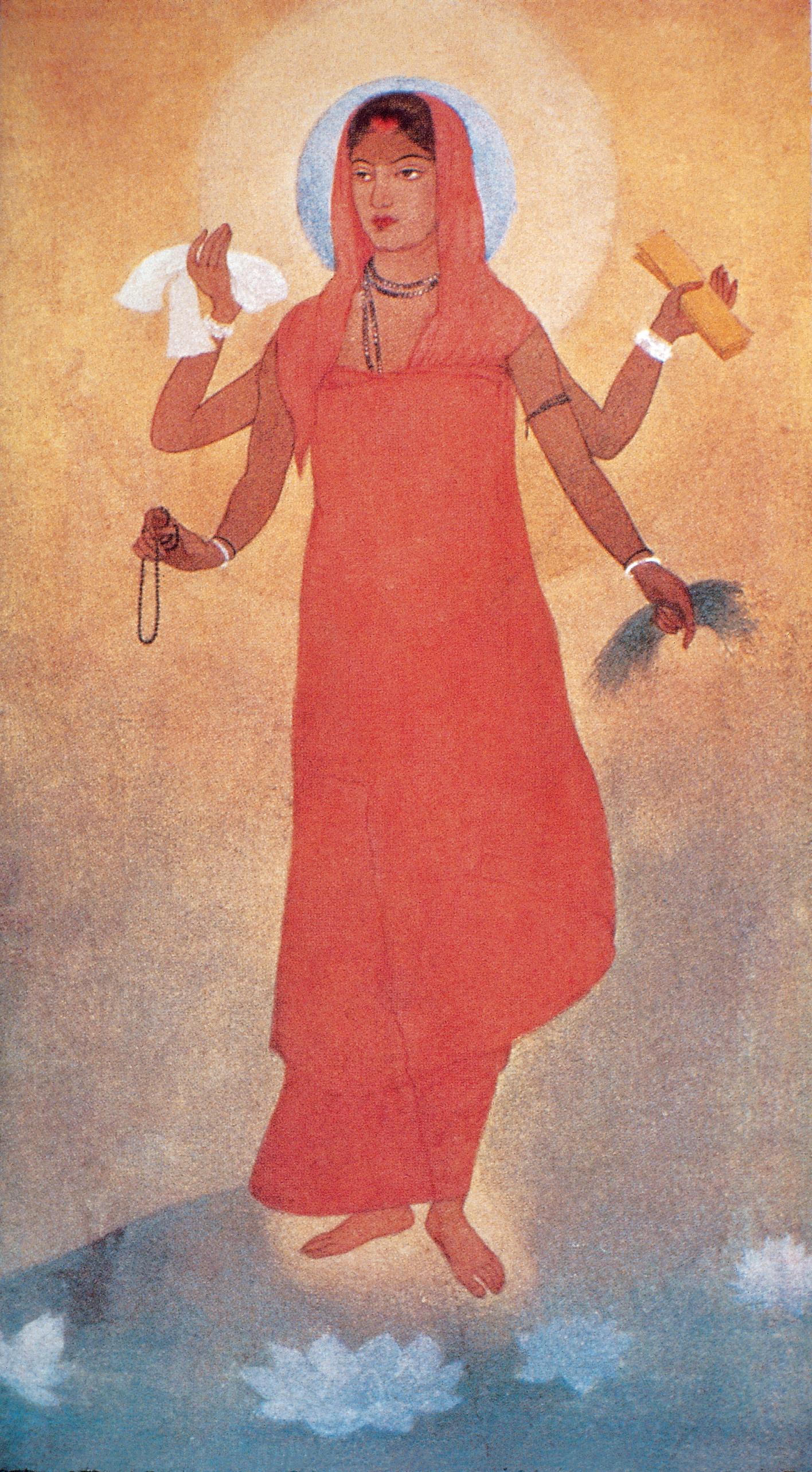
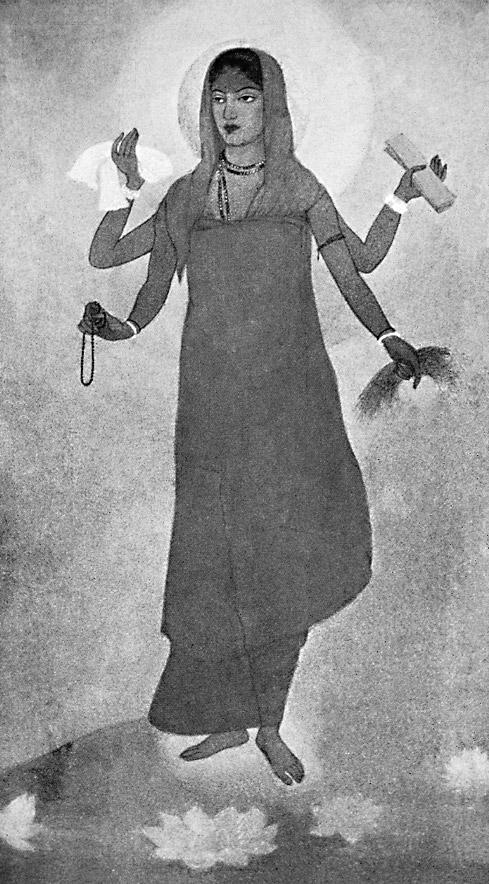
Bharat Mata, circa 1902–5
by Abanindranath Tagore
Water colour and wash on paper
Rabindra Bharati,Calcutta
The nation’s identity lay in the culture and more specifically in its womanhood.In the changed political and social environment the image ofwomanhood was more important than the reality.Historians and laymen would complete the process by ensuring through continued writings in the twentieth century,that the image also came to be perceived as the reality.1
unique icon ofthe woman is introduced early in the 20th century, investing her with the powers ofa new goddess.An image ofsuch luminosity and resonance that for ten decades she has continued to influence the minds and hearts ofthe Indian people,ofher politicians,activists,writers, artists and film makers.Over the 20th century two temples have been built to enshrine her image.Conceived among certain members ofthe intellectual elite as a secular concept,she is now embedded in the Hinduconsciousness ofthe popular imagination.The fascinating history ofher continuing transformation becomes the subject ofthis chapter.
Political sensibility as much as Indian aesthetics is transformed in the first decade by the patriotic fervour ofthe swadeshi movement sweeping the country.A concrete realisation ofIndia’s aspirations is found in the painting ofthe motherland titled Bharat Mata, conceivedby Abanindranath Tagore.2 This first model becomes our point of departure,raising interesting questions and contradictions on the imaging ofthe womanas-nation.Although she signifies the emergence ofa new India,she has been treated by most writers as a mere point ofreference for the politics ofnationalism.She deserves,in my opinion,critical re-examination.
Abanindranath constructs his icon in water colour,in delicate wash tints of saffron,pale greens and luminous whites,eschewing the thick colours and realistic effects ofoil paint in the Western idiom.He chooses to work in a technique indigenous to India, in colours which are considered auspicious.His archetype heralds an ideal ofthe Indian woman,endowed with a “golden body”,a fair complexion and fine features that bespeak her lineage.With feet more delicate than the white lotuses strewn below her,she rises gently to her full stature.Like our goddesses ofold,she is empowered with four hands,in which she holds not weapons but the four promised symbols for a reconstructed India: food (anna), clothing (vastra),a manuscript for education (siksha) and beads for spiritual salvation (diksha).
The woman is the pivotal focus in the painting as much as an icon or a symbol is construed in the Indian tradition for purposes ofmeditation (dhyana). Remarkably,there is absolutely no movement,no aggression in her figure or her calm demeanour.She stands in equilibrium,in the pose of samabhanga, holding out a promise of what is to come,not ofthe realities ofthe day.There is no narrative here,no background to relate her story nothing except the silhouette ofthe green earth which curves away from her and the vast,open sky which envelops her in its golden radiance...Unlike the primeval goddess Durga who bursts forth from a mountain armed with weapons to slay the demon buffalo Mahishasura,there is no drama to her emergence,no ensuing conflict,
no miracle performed.She stands poised and alert,offering us no miracles but just herself with the promise ofan identity and a future.
This symbolic imaging ofthe country was greeted with praise and with criticism,encapsulated in the polemics ofits day.3 Writings by the new Orientalists, including among them E.B.Havell,Nivedita and Ananda Coomaraswamy,rediscovered an Indian tradition,equipping Abanindranath and his followers with a sense ofIndia’s heritage and with the objectives ofcreating a ‘national’ art.In 1912 Coomaraswamy was to publish his seminal essays in his book Art and Swadeshi. In 1907 Sister Nivedita wrote an article in the newly-established journal ofthe Modern Review titled “The Function ofArt in Shaping Nationality” where she claimed that art was “one ofthe supreme ends ofthe highest kind ofeducation”.4 For an image to illuminate this high responsibility,she found her best answer in the newly engendered Bharat Mata. Inspired and impassioned,she had already written her first piece ofart criticism in the journal Prabasi.
We have here a picture which bids fair to prove the beginning ofa new age in Indian art.Using all the added means ofexpression which the modern period had bestowed upon him,the artist has here given expression to a purely Indian idea,in Indian form...T his is the first masterpiece,in which the Indian artist has actually succeeded in disengaging,as it were the spirit of the motherland...The misty lotuses and the white light set Her apart from the common world as much as her four arms,and Her infinite love.And yet in every detail,of shankha bracelet,and close-veiling garment,ofbare feet and open,sincere expression,is she not after all, our very own...at once mother and daughter ofthe Indian land...?5 (Italics mine)
It was appropriate that this luminous image was conceived by Abanindranath. A nephew ofthe poet Rabindranath Tagore,he was introduced as “the reviver ofthe Indian ideal ofpainting” by E.B.Havell,then Principal at the Government School of Art.6 Abanindranath and his followers,who were called by the epithet of ‘Abanpanthi’, broke with the imitators ofVictorian taste and returned for inspiration to their own heritage ofMughal and Rajput paintings and the Ajanta murals.
In the redefined purpose ofart,Abanindranath casts the woman into the emblematic role ofrepresenting the nation.But how does one embody the spirit ofthe motherland? Does the authority invested in Bharat Mata derive from the state,or from religion? Is she human or divine? Is she to be represented as a woman or as a goddess? This ambivalence in attitude haunts her conception from these early beginnings,and contributesto the essential paradox ofher changing persona.This question is never fully resolved as she is appropriated and reappropriated for different agenda through the century.
The ambivalence ofAbanindranath’s painting,with its subtle nuances of conflicting roles,was not lost upon Nivedita.Contradictions are clearly implicit in her identity.Is she virgin or married,or a female renunciate? As a sign ofher special status,her head is ringed with a halo in pale blue,expanding outwards into pale yellow.Placed on a level above the viewer,as though on a high pedestal,she is ready for worship.Her look is of authority,commanding obeisance.Yet she is also demure and comely,with her head covered and anointed with sindur at the parting ofthe hair,as befits a married woman.Once again, she contradicts this second impression by being clothed in the saffron robes worn by bairagis, those who have chosen the path ofrenunciation.While an icon would mesmerise
the worshipper,her eyes avert meeting the gaze ofthe viewer.In this sense particularly she remains essentially mortal,a woman ofthe home.Or,what might be expected ofa woman. Abanindranath builds his image on the chaste sahadharmini model construed by reformers and conservatives alike in the late 19th century,from Dayanand Saraswati to Loknayak Tilak.When Rabindranath describes this abstract notion of ‘Woman’ he defines her “sacred mission”.
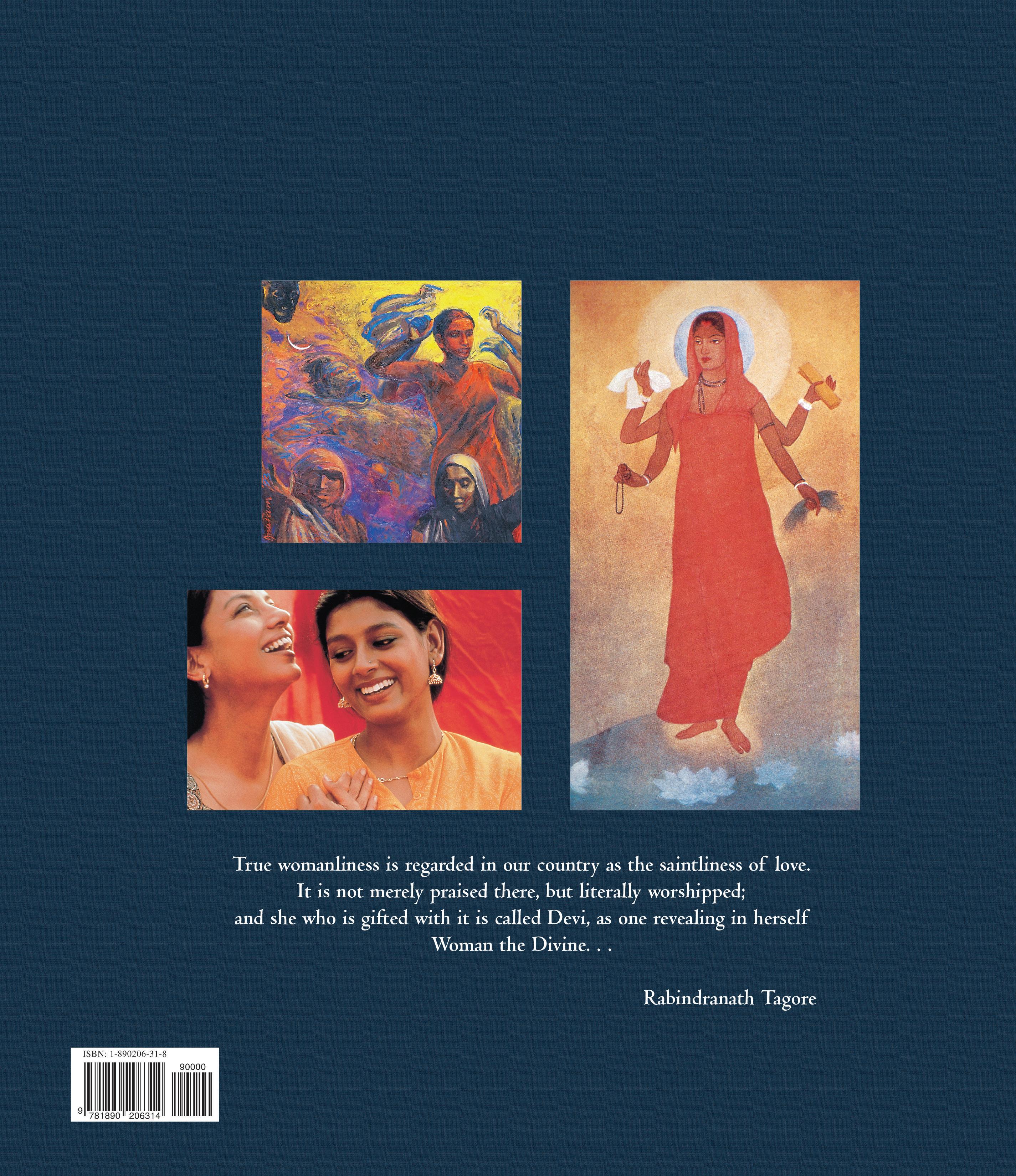
True womanliness is regarded in our country as the saintliness oflove.It is not merely praised there,but literally worshipped;and she who is gifted with it is called Devi,as one revealing in herselfWoman the Divine.That this has not been a mere metaphor to us is because,in India,our mind is familiar with the idea ofGod in an eternal feminine aspect... 7
Overnight,through the growing impact ofpolitical consciousness,cultural expression in Bengal was transformed into becoming part ofthe national agenda.The immediate cause ofthe swadeshi movement was the partition ofBengal by the British Government in October 1905.This act was followed by dissent moving like wildfire through the state,with the message of swadeshi propagated through magic lantern lectures, patriotic songs and popular jatras performed on the streets,as well as by the burning of foreign goods and shops.8 The widespread agitation prompted the national leader Gokhale to observe that “for the first time since British rule began,all sections ofthe Indian community...have been moved by a common impulse”.
The devotion to motherland which is enshrined in the highest swadeshi,is an influence so profound and so passionate that its very thought thrills and its actual touch lifts one out ofoneself.9
One ofthe abiding concepts to emerge from the swadeshi movement was the visual rendering of Bharat Mata.
Through the 20th century Mother India continues to be represented in a series ofpaintings,prohibited posters and calendar art.In 1957 Mehboob directed and released his internationally acclaimed film with the same title,which earned Nargis her reputation as the most celebrated screen goddess from India.10 Books also carried the identical title,including Katherine Mayo’s infamous work published in the 1920s which provoked the severe indictment from Gandhi ofbeing “a drain inspector’s report ” . 11
Notwithstanding the “distortion” he mentions,Pranay Gupte chose the same title for his book on Indira Gandhi,justifying his choice saying, “Mother India seemed an especially appropriate title for a biography ofa woman who was indeed that.”12
A book by Pupul Jayakar titled Indira Gandhi, with photographs by Raghu Rai,suggests how the late Prime Minister ofIndia chose to be projected publicly as heroic mother ofthe nation.13 A photograph included towards the close ofthis book depicts three women in the state ofTamilnadu mourning her death by paying homage to a wall poster depicting her martyred against a map ofthe country.Several films ofpatriotism such as
Aurat (1940),Kismet (1943) and Bambai Wali (1944) resort to an identical format by projecting the heroine against a map ofIndia.In calendar art and later in political posters for the Bharatiya Janata Party, Bharat Mata takes on the iconography ofthe goddess Durga, as a symbolic figure outlined against the Indian map.
Implicit in these is an argument being formulated in favour ofthe Indian woman as a site for the nation.This basic premise ofthe symbolic value of Bharat Mata is substantiated.The fact that it had little to do with the treatment ofwomen has done nothing to diminish its appeal.Why does this metaphor remain such an obsession? The reasons are fascinating,rooted in India’s culture,her immediate history and her politics.
Bharat Mata personifies the land as sacred,a concept that is not in any sense new to Indian iconography.The most powerful evocation ofthe Earth Goddess in her incarnate form as Prithvi is carved in the rock cut caves ofUdaigiri in Madhya Pradesh, dated by an inscription to A.D.410.14 Here,in a carving spanning 20 feet across,the colossal figure ofVaraha rescues the Earth Goddess from the ocean,lifting her figure to his shoulders while gods and sages aligned on both sides rejoice in the great miracle.
It is worth noting that in traditional Puranic texts India is male,described as Bharat andpeopled by descendants ofthe king by that name.The ambiguousness ofthis gender question is never entirely erased from our memory.In a more militant phase of nationalism and in his celebrated presidential speech of 1937,V.D.Savarkar’s rousing call reverts us to the notion ofthe ‘Fatherland’,privileging Hindus above all other religious communities living in India who are perceived as the ‘Other’
Every person is a Hindu who regards and owns this Bharat Bhoomi this land from the Indus to the seas,as his Fatherland and Holyland the land of origin ofhis religion and the cradle ofhis faith.15
Yet in the 19th century a remarkable change has taken place:the country is personified instead as Bharat Mata andimaged in the form ofa woman! The seductive appeal ofthis image returns in the language ofnationalist discourse as far removed from Savarkar as Gandhi and Tagore.Essential to our discussion on Bharat Mata, how does this transformation take place?
An immediate reason lay ofcourse in Bengal’s cultural legacy,ofbeing specifically associated with the mother cult and the Shakta tradition.Worship ofChandi, Durga and ofKali formed the basis for popular religion and ritual.These roots of worshipping the primordial goddess were revived in the Hindu melas begun in 1867,where indigenous crafts were revived and songs were sung to the Motherland.To cite one instance,a song by Ganendranath Tagore reminded the audience that under colonial rule ofthe Raj they were neglecting their ‘Mother’,while others were taking away “Mother’s treasures ” . 16
Perhaps,it can be argued,these tentative beginnings would have come to nothing and died a natural death.It is possible that religious beliefand political persuasion would have continued to maintain their separate existence,as they had for centuries under Islamic and British rule.Perhaps again,Abanindranath may never have conceived his image of Bharat Mata had it not been for two tidal waves that shook the complacency ofBengal.The first impact was from the influential writings of
Varaha rescuing Prithvi from the ocean Udaigiri caves,MP,dated by inscription AD 410 Reliefpanel in sandstone,detail
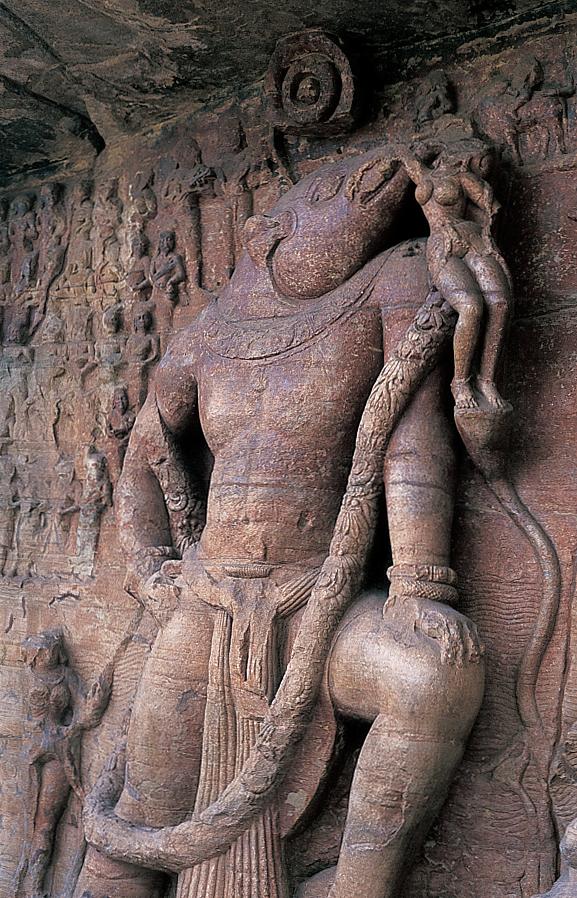
Bankimchandra Chattopadhyay,creating through his polemical writings and his novels the notion ofa theocratic state.17 The second shock wave followed two decades later,with the political persuasion ofthe swadeshi movement as briefly described above.
Essayist,novelist,satirist,and an influential writer in Bengali prose, Bankimchandra Chattopadhyay wrote 14 works offiction,moving between “the inevitability ofmoral orders and the inevitability oftheir transgression.”18 In his essays his focus is on the feeble depraved human condition in the country,his purpose is to rally the inert people to action.Social anarchy is preferable to no action at all,he assures us in Cancal Jagat. Perhaps Bankim’s greatest contribution was in gifting the country with a new perception ofher own history.For him the greatest ofsins (mahapap) was that India had conceded to a colonial reconstruction ofits history,perceiving domination by the Raj as inevitable necessity.He asserts that Indian history would now be written by her own children.19
In the best tradition of itihasa, his is a constructed,fabled history,a marvellous mix offact and fiction.20 Ifthe British historians had conferred on Indians the ignominy ofbeing an effeminate race,ifthey believed that the capital ofBengal was captured by a mere contingent of 17 cavalrymen,it was time to change all that and forge a new identity. For the first time then,a sense ofcohesive unity is voiced,assembling the dissimilar histories ofthe Rajputs,Maharathas and Sikhs (and ofcourse Bengal) to figure as the heroic uprisings of one country. With reference to Anderson’s useful term (and the title ofhis book) Bankimchandra is constructing an ‘imagined community’,where he still refers to people as jati. 21 In his most publicly acclaimed work of Anandamath, based on a scarcely noted rebellion of sannyasis in the 18th century,he sets out his new agenda.He conceives an ideal order ofsociety enforcing the highest discipline,where renunciation of personal life and even death for the sake ofthe country is endorsed as the highest principle.In Anandamath (1882) Bankimchandra begets the innovative image ofthe Motherland as a wondrous icon who is divine rather than a mere woman-in-the-flesh. Since this work earned him both fame and criticism,it invites urgent attention.22
The protagonist ofthe novel Mahendra is confused when he hears the hermit singing Bande Mataram.23 The first lines ofthe verse invoke with sonorous splendour the beauty ofthe land that is India: sujala,suphala,malayaja sitala,sasyasyamala, mataram. ‘A mother who is endowed with water,fruits,cooled by spring winds,verdant with crops,illuminated with clear moonlight,where trees are in full bloom... ’ He exclaims,not without reason, ‘But this is my country,this is not my mother!’ As the song progresses the image acquires the features ofa beautiful woman with a smiling face and sweet speech.She is transformed into an active woman-goddess,empowered with many arms,a woman saviour ofmankind,the mother who can prevent the forces ofevil: bahuvaladharini,tarini,ripudalabarini,mataram.
The second stanza ofthe song Bande Mataram differs from the first by being infused with religious sentiment.The verse invokes Bharat Mata as the embodiment of Durga, ‘the goddess-of-ten-arms to whom temple after temple is raised in the country’. “Tomarahe pratime gadi mandire mandire,twam hi Durga dasapraharana dharini”.These lines have earned Bankim notoriety among secularists as the villain ofthe piece as history would have it,the singing of Bande Mataram led to riots and a raging controversy between the National Congress and the Muslim League.In 1937 Jawaharlal Nehru consulted Rabindranath Tagore on his opinion.The poet laureate confirmed that this second verse was inimical to Muslim sentiments and tenets against the worship oficons.24
Through the song Bankimchandra prepares his readers for the vision ofthe Motherland.Mahendra is led into an underground temple where he perceives a
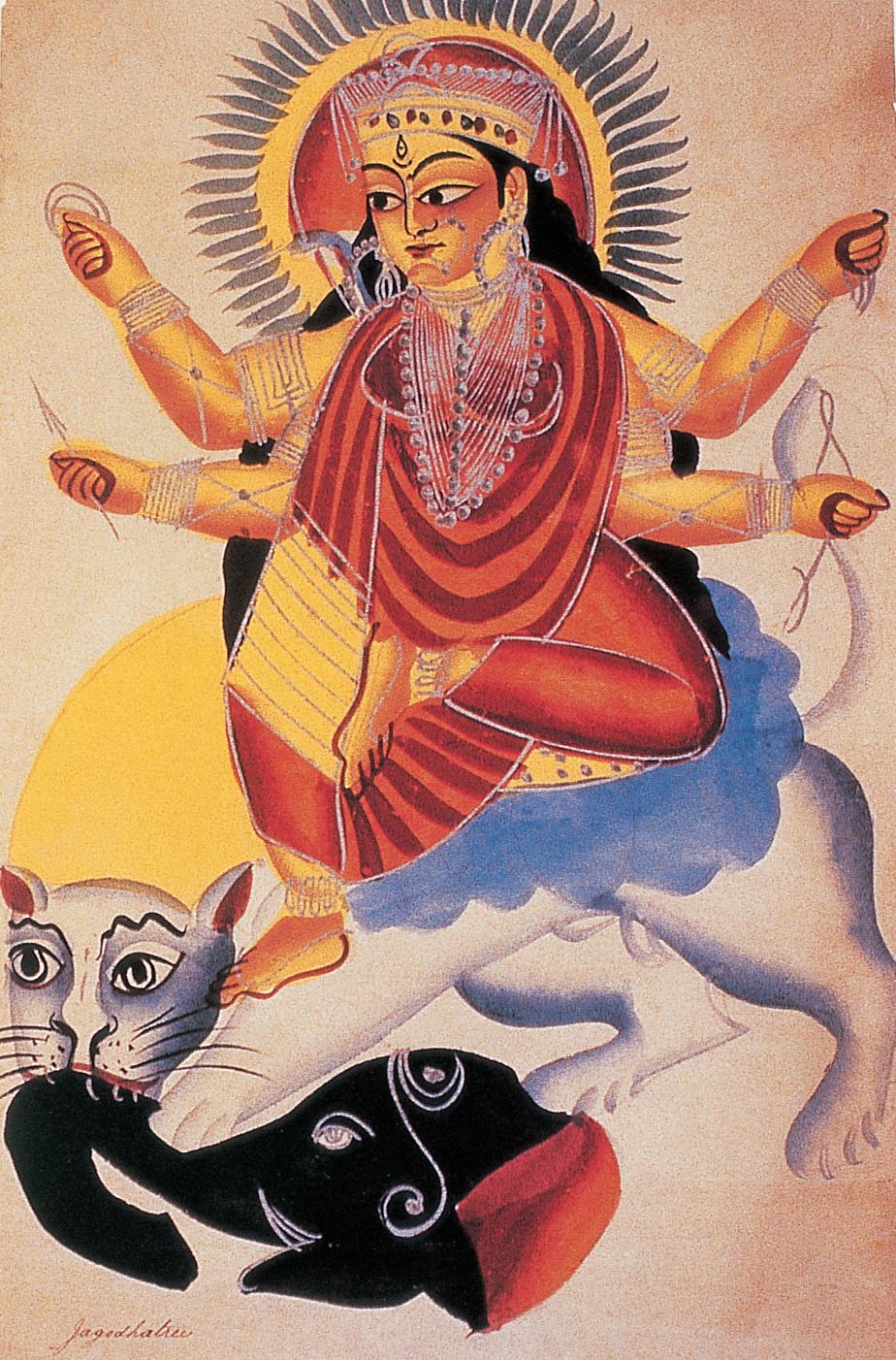
monumental image ofVishnu,seated with the resplendent image ofthe Mother on his lap.Worshipped by all,she is described as a bewitching enchantress (Mohinimurti),more beautiful than the goddesses Lakshmi and Sarasvati who are consorts to Vishnu and appear beside her.In the second chamber he witnesses Jagaddhatri,ruling the wild animals ofthe forest,gifted with all the riches ofthe earth and identified as the primordial Mother-that-was in the past.In trepidation he moves next to behold the black,naked and terrifying image ofthe goddess Kali.The hermit explains that this is what the Motherhas-become today. “She has been robbed ofeverything,that is why she is naked.Today the whole country is a graveyard,that is why our Mother wears a garland ofdead skulls”. With the hermit Mahendra at last ascends until their eyes are dazzled by light. “They saw a ten-armed golden idol (pratima) in the middle ofa marble temple,laughing in the light ofthe morning sun.The hermit bowed to her and said, ‘This is what our Mother will become’”.Initiation into the cult ofthe Mother is completed,and the narrative proceeds to deeds ofpatriotic fervour.25
It is this image ofthe Motherland as ‘revealed’ in Anandamath which deeply stirs the swadeshi movement,more than two decades after Bankim had conceived her. Janani janmabumischa swargadapi garyasi: “the Mother and the Motherland are more glorious than the heavens”, the words by the hermit to Mahendra after the song,become the solemn oath ofallegiance to move thousands to believe in the future ofa new nation. Bande Mataram was first sung by Rabindranath Tagore at the National Congress in 1896.On August 7th 1905 it was uttered
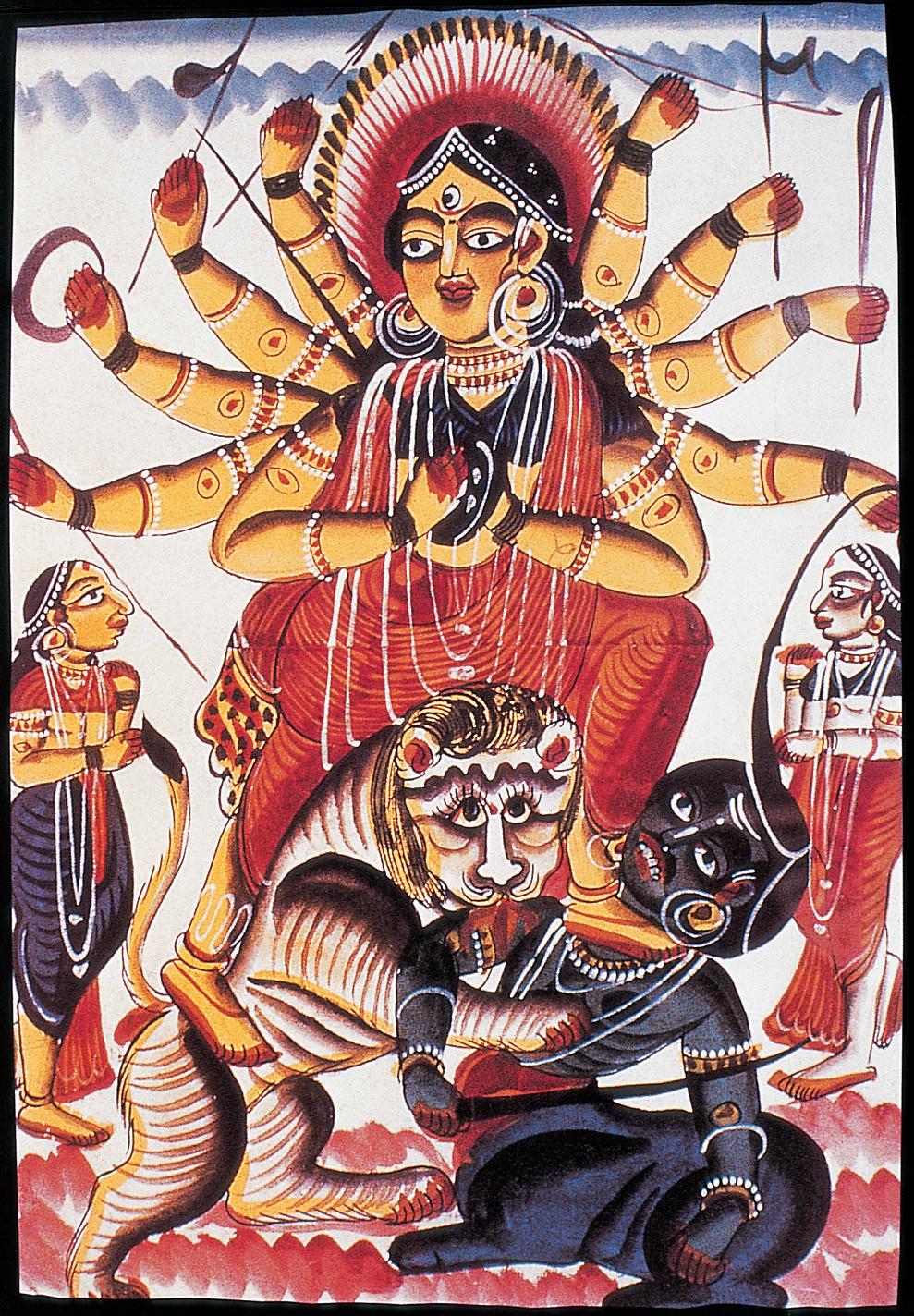
(Below,left)
Durga annihilating the Demon Mahisasura
Kalighat Painting, 19th century
Water colour on paper
Collection:Chester Herwitz
(Below,right)
Jagaddhatri, Kalighat Painting, 19th century
Water colour on paper
Collection:Chester Herwitz
as a ‘mantra’in the historic Town Hall meeting,in taking the vow of swadeshi and resolution to boycott foreign goods.Youthful votaries moved in procession through the streets with the slogan,then banned by the British Government.The Dawn reported that it had become “a battle cry and a divine inspiration” whereby “the streets and lanes of Calcutta and the rest ofthe province resound with the solemn watchword.”26
In this same year Bankimchandra’s image inspired Sri Aurobindo’s leaflet on Bhawani Mandir, written and circulated by him in 1905–6.In his vision the regeneration of India could only be effected by the energy of Shakti, given finite form in Bhawani,the Mother ofstrength.From 1906 to 1908 Aurobindo published a revolutionary paper also called Bande Mataram,in which he pays tribute in 1907:
The third and supreme service ofBankim to his nation was that he gave us the vision ofour Mother...it is not till she takes shape as a great Divine and Maternal Power in a form ofbeauty that can dominate the mind and seize the heart that these petty fears and hopes vanish in the all-absorbing passion for the Mother and her service... 27
This apotheosis ofthe Motherland takes place not merely in the east but all over the country.It receives overwhelming ovation in the south,where Subramania Bharati’s song offreedom is addressed to the new icon.Despite her being an ‘Aryan’ goddess from the north and his representing Dravidic sentiments from the south,he is inspired by Bankimchandra in describing all-India in verse.28
In this charged atmosphere ofa nation awakening to its identity,amidst the thundering sounds of Bande Mataram, the Bharat Mata is conceived by Abanindranath.In his personal reminiscences titled Gharoa and published many years later in 1941, Abanindranath recalls that his painting ofthe Bharat Mata was enlarged by a Japanese artist into a banner (pataka),then taken around in processions ofthe swadeshi movement.To support the movement against importing foreign cloth,his mother took to spinning on the charkha, and on seeing this Havell bought her a loom.29 The artist recalls the context of the swadeshi movement which had deeply involved the Tagore family;but he glosses over the inspiration for his image.His silence is tantalising!
In its time,the emergence of Bharat Mata had become almost inevitable.How else,to use Anderson’s useful term,could the bonding ofthe ‘imagined community’ of the nation be effected,the force ofa political movement be represented?30 Not through reason or rhetoric alone but through the compelling and persuasive power ofan icon! The compelling demand for an icon is graphically recorded by Rabindranath Tagore in his novel Ghare Baire, written a decade after the painting.From his own essays from about 1908 it is known that the poet had by then developed deep misgivings about the growing cult ofthe Bharat Mata,leading to a growing ofterrorism.The tenor ofhis writings changes from 1908,his reservations are expressed through the rational voice ofNikhil in the novel who is averse to cultism and anarchy.But Sandip,the charismatic revolutionary who storms in to change Bimala’s life forever,adds to her growing confusion when he pleads that he has “come to worship” her as the “Shakti ofour country”.Later Sandip reiterates his point as political strategy rather than his response to an actual woman,by asserting the need to visualise the motherland. “We must make a goddess ofher!” 31
In the discourse on nationalism,Hobsbawm proposes three inherent means ofunifying a nation.32 Ofthese,the first two oflanguage and ethnicity could be ruled out with India’s plurality oflanguages and cultures.This leaves one option ofreligious sentiment,suspect in that it might challenge the nation’s monopoly and claim to the loyalty ofthe people.However,Hobsbawm retrieves instances ofreligious icons such as the Virgin ofGuadalupe in Mexico and the Virgin ofMontserrat in Catalonia,used effectively in forging a national identity.He concedes:
Ifreligion is not a necessary mark ofproto-nationality (a nation in its formative stages)...the holy icons on the other hand,are a crucial component ofit,as they are ofmodern nationalism.They represent the symbols and rituals or common practices which alone give a palpable reality to otherwise (an) imaginary community... 33
As originally conceived by Bankimchandra,the Bharat Mata was precisely such a ‘holy’ icon,invented to forge national identity.Predictably,in the discourse on power and regeneration,from writers in differing disciplines such as Sarkar on swadeshi, Mitter and Guha-Thakurta on nationalist art,Sunder Rajan on gender,the Bharat Mata is claimed as a ‘nationalist’ icon,empowered with a purpose offorging national unity.34 Having established this claim and appropriated the image,it is dismissed in a few lines or paragraphs.She deserves,in my opinion,critical re-examination because the painting by Abanindranath is significantly different from what might be expected,especially after the received prototype in Anandamath.
Bharat Mata exudes a very different ethos from that compelling goddess described above in Anandamath. True,she is beatific,bathed in light,with curving contours ofthe earth,full-blown lotuses and the wash ofverdant greens hinting at her association with the sacred land which she personifies.The look ofcompassion in her eyes and the asexual treatment ofher body comply with her role as the Mother.There the affinities end between Bankim’s narrative/song and the picture due to the essential difference between a woman and a goddess.Unlike that vision granted to Mahendra,the painting envisages not a ten-armed idol in a marble temple,equipped with weapons,but a gentle and restrained woman holding in her four arms the requirements for daily life.She is human,a reassuring fact.Nothing in her demeanour suggests that she could be awesome, divine,a goddess.
But that is precisely the point! Her modesty and her serenity contribute to her limitations.She is too civilised,because she is born ofthe bhadralok. She lacks passion, anger,venom.She does not carry those attributes ofa martial leader which could incite a nation to revolt,as for example in the personification of La France by Delacroix.She would hardly fulfil the aspirations ofan impassioned woman like Bimala in Ghare Baire who gives vent to popular demand when she declares:
I am only human.I am covetous.I have anger.I would be angry for my country’s sake...fascination must be supplied to me in bodily shape by my country.She must have some visible symbol casting its spell upon my mind.I would make my country a Person and call her Mother,Goddess,Durga for whom I would redden the earth with sacrificial offerings.I am human,not divine.35
Bharat Mata, circa 1902–5 by Abanindranath Tagore Water colour and wash on paper Rabindra Bharati,Calcutta
Ifwe were to compare Bharat Mata to popular icons ofthat time ofthe goddess Kali,in Battala prints from Calcutta,the dramatic contrast makes the point.A black goddess,naked and furious,with her tongue red and bloodthirsty,wearing a garland ofhuman skulls often white heads from this period ofprotest against the sahibs ofthe Raj dances upon the prostrate body ofShiva.This may have been more appropriate for inspiring revolutionary fervour! As she strides forward with purpose,she embodies dynamic energy,the female principle of shakti. Despite the fact that she had declared Abanindranath’s painting to be a masterpiece,Nivedita shows the binary forces at work when she offers us a different but potential iconography for the Mother:
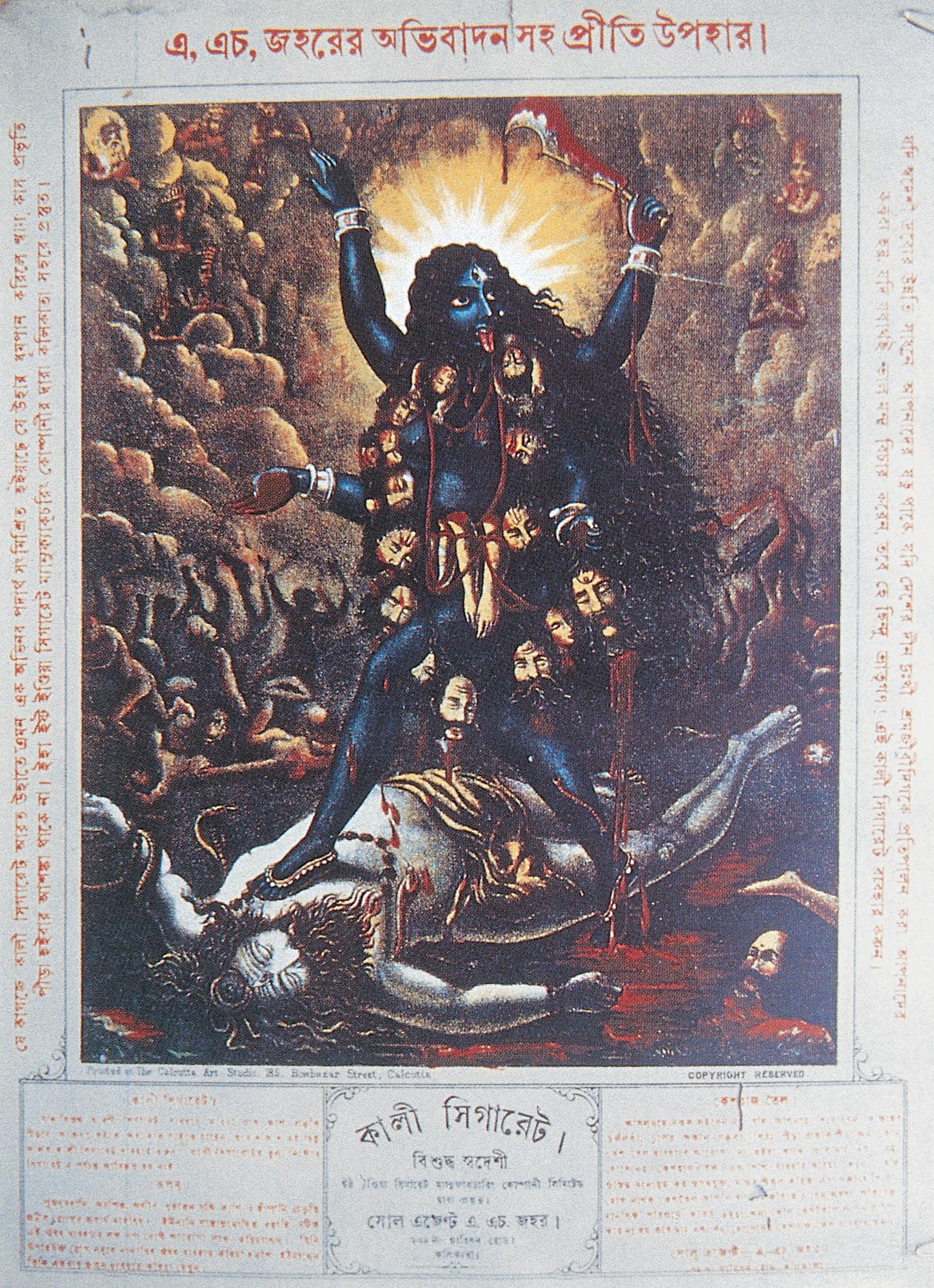
To Him,She is all beauty this woman nude and terrible and black who tells the name ofGod on the skulls ofthe dead,who creates the bloodshed on which demons fatten,who slays rejoicing and repents not,and blesses Him only that lies crushed beneath Her feet.36
There is every reason why Abanindranath’s painting could have imbibed this spirit ofunrepentant fury from images ofKali.He informs us in his memoirs that he had absorbed himselfin looking at pata painting to imbibe an indigenous spirit into his work.37 Kali was the goddess ofthe present age ofdeprivation (Kaliyuga), and two ofhis own students,Nandalal Bose and Asit Haldar, “produced bloodthirsty versions ofthe motherland”.38 The artist chooses instead to offer us a very different imaging of his Motherland.
In these studies on the early 20th century there is an implicit equation between the words ‘nationalist’ and ‘Indian’.But is that necessarily so,in the case ofan artist like Abanindranath? Apart from painting the Bharat Mata which he dismisses in two lines in Gharoa, and that he went to persuade people to boycott foreign goods,he never mentions his own active engagement in the politics ofnationalism.On the other hand, there is considerable evidence in his writings and lectures to show his concern for retrieving an Indian sensibility in art.
Twenty years had passed since Bankim conceived his vision ofthe Motherland,and at the time the nation had not taken concrete shape hence his anxiety about including the Mother ofthe Future.His novel Anandamath (1882) constructs the needs of apeople in search ofan identity, while the painting Bharat Mata (1902–1905) responds to the development ofa nation in the making.This crucial distinction is often overlooked when the two constructs ofthe narrative and the painting are super-imposed,collapsed into one image.I would say that this superimposition is dangerous,because the sentiments are different.The immediate reasons for promoting the image of Bharat Mata may have been political,but Abanindranath’s resolution was certainly different from Bankim’s bewitching goddess.It derives from his sensibilities as an artist and as a writer,rather than political compulsions ofthe time.
Among artists in the India ofhis time,Abanindranath was surely the most erudite,acknowledged in the world ofletters.Brought up in the Tagore household in an atmosphere ofliterature,he was both writer and artist,an occasional actor on stage once described with his tall build,features and toga-like robes as a Roman orator.But,as he notes in Gharoa, the desire grew among Indians to ‘give’ the country something oftheir own,something innate.So other forms ofexpression ‘fell away’ from him.39 What remained was painting:the study ofit,the experiment in techniques both foreign and indigenous to the country.
We may return to Abanindranath’s own writings to understand the spirit which informs his studies ofwomen,especially the Bharat Mata. His celebrated Bagesvari lectures at Calcutta University and his writings in TheModern Review are formal discourses on Indian aesthetics,and display his erudition.He discusses theory in Shadanga or the Six Limbs ofPainting and iconometry in Some Notes on Indian Artistic Anatomy.40 More revealing are his personal reminiscences in Gharoa, where he discloses his return to indigenous visual sources and his misgivings about the ‘ movement ’ that he had initiated.These are moments
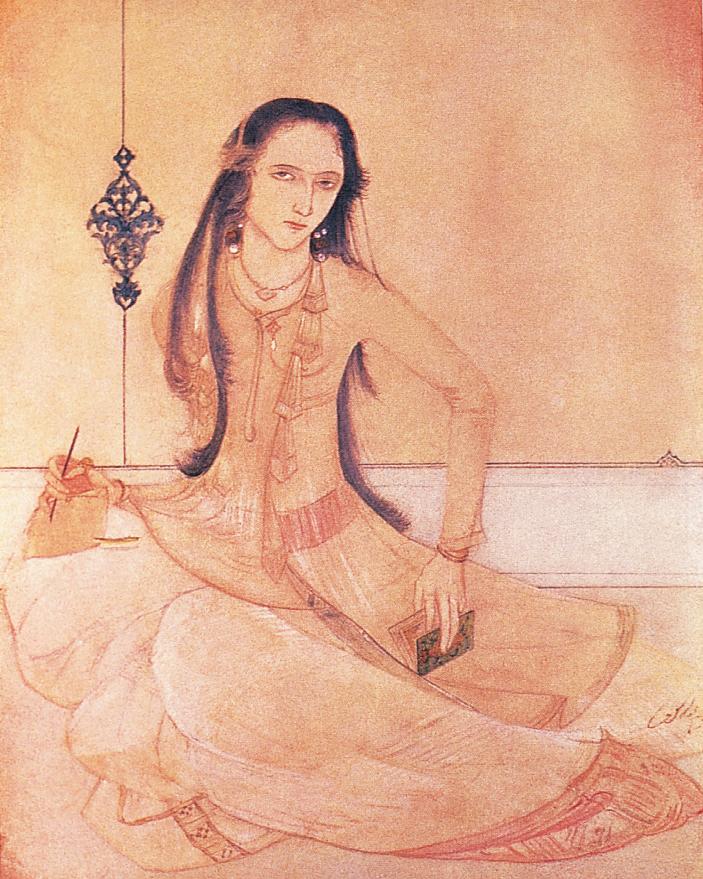
(right)
Zebunissa
By
Abanindranath Tagore, 1902
Line and wash on paper
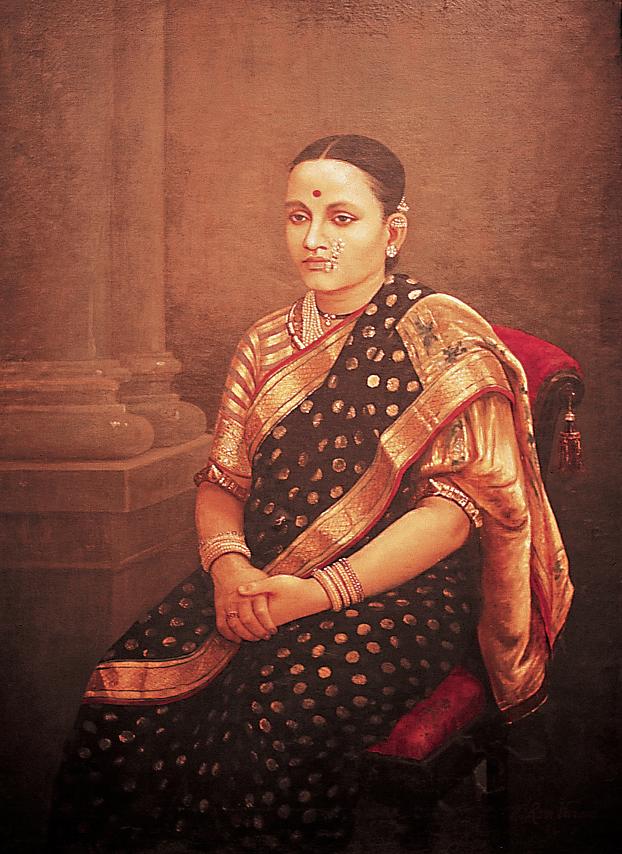
(far right)
Portrait ofa Woman
By Raja Ravi Varma,
1893
Oil on canvas
Collection:National Gallery of Modern Art,New Delhi
ofconfrontation,important for an artist innovating in style and technique more so than in subject matter.
It is sometimes forgotten that initially he was trained in Western techniques. The dramatic manner in which he abandoned his ‘British’ portraits to turn to local pata pictures is described casually in Gharoa. He goes on to emphasise that henceforth ‘a picture will have to be conceived as indigenous,it will have to be seen as indigenous’. “Chabi deshimote bhabte habe,deshimote dekhte habe” 41 The Krishnalila pictures painted about 1895 form the beginning ofhis initiation into what he describes as the ‘Indian technique’.He gives us reason to believe that he was influenced by his uncle Rabindranath into taking this first step.In a letter to the Santiniketan Patra he recalls the time before E.B.Havell arrived in Calcutta when indeed the search for Indian sources had already begun for Abanindranath.The letter creates the ambience ofthe 1890s.
The story ofCalcutta at that time is that Rabikaka had planned to illustrate the two journals Balak and Sadhana and his play Chitrangada, and had sent for me.Nothing but pictures in a hybrid style were available in our art schools and studios.In the art galleries were only Western style pictures,none with an Indian background...And,under Rabikaka’s advice,I read all the Vaishnava lyrics and started painting episodes from Krishnalila in the Indian technique...You will be surprised when I tell you that it took me a full year to finish the twenty paintings from Krishnalila... 42
Considering the need,representations ofthe Motherland from the late 19th century are rare to find.Research by Guha-Thakurta locates “one ofthe first identifiably ‘nationalist’ pictures produced as a visual appendage to the new nationalist anthem”,drawn in 1885 by Harischandra Haldar.43 This motherly personification ofthe song Bande Mataram, swaddled in a sari and seated among swirling branches with cherubs,is drawn from Victoriana and owes little to Indian sources.This is where Abanindranath’s search for ’Indian technique’ and for indigenous sensibility assumes importance.At the same time,his approach was very different from that ofhis celebrated near-contemporary in the south.Raja Ravi Varma
gained immense popularity by retrieving figures from Indian mythology but he painted themin oil on canvas with all the borrowed effects ofrealism from Western painting. Abanindranath was consciously searching for another idiom ofexpression.
His critique ofRaja Ravi Varma,his nearest rival in time,is to the point.He suggests in Gharoa that while Ravi Varma painted indigenous-like themes (deshi-moto), some ofhis pictures retained the foreign spirit (bideshi bhava). His example is Ravi Varma’s depiction ofSita, “like Venus”.This comparison assumes meaning when compared with his own depiction of Sita in Captivity where he seats her beside a barred window,a fragile wisp ofa woman eliminating all details ofthe figure and landscape.What emerges from this paring down to essentials is the mood ofthe painting,the pain ofher separation from her beloved husband (vipralabdha bhava).
For Abanindranath,the most essential element in a painting was bhava, the feeling or sentiment which would necessarily involve the participation ofthe viewer or listener,the rasika. Although he was the first to appreciate the finesse and sophistication of Mughal painting,he would exclaim, “infuse bhava in the picture!” He was inspired to emulate Mughal compositions and delicacy ofcolouring in his celebrated works such as The Final Moments ofShah Jahan, (1903) Aurangzeb examining the head ofDara,Sufi,Zebunissa, and his illustrations ofOmar Khayyam (1906–8).But he chose moments ofpoignant emotion as with the dying emperor gazing upon the Taj,moments which would elicit feeling, a particular responsefrom the viewer 44
In an essay on Sadrisya among the Six Limbs ofPainting, he comments on the use/misuse ofsimile in painting,using examples from nature to represent the earth mother.This passage is run through with irony,where he is obviously taking a dig at Ravi Varma’s representation ofShakuntala as a bovine woman-of-nature ingeniously used for advertising baby food!
‘Gomata’ is an older simile used in connection with the earth,but the globe has never yet acquired the likeness ofa cow...The cow simile may expect appreciation from the makers ofMellin’s food as well,but no artist has cherished it.The artist has never pictured the earth which trembles at the feet ofNataraja on the day ofDestruction in the image ofa cow,but in the likeness ofa lotus with a thousand petals.45
It was the inner essence that mattered to him,where he found support in Indian aesthetics.That a woman’s figure should be accentuated by the wet folds ofher sari,her dark skin glowing against the gold border and jewellery was anathema! We need only to look at Ravi Varma’s Portrait ofa Woman (1893) in the National Gallery ofModern Art,comparing her figure with Abanindranath’s delicate heroines of Abhisar and Devadasi, to note the essential difference in their approach.Ravi Varma used real-life models for his work,painting in oil on large canvases,introducing Western idioms ofpictorial depth and the illusion ofbackground to bring an impression of substance to his women. Abanindranath eschewed all these,paring his figures down to the essentials,returning to the small format ofthe miniature,to indigenous techniques ofwater colour and wash on paper.46
Clearly,the battle lines were drawn between Raja Ravi Varma and Abanindranath.Essentially their positions arose between the age-old opposition ofrealism and idealism in painting,a debate which had acquired moral overtones in Victorian
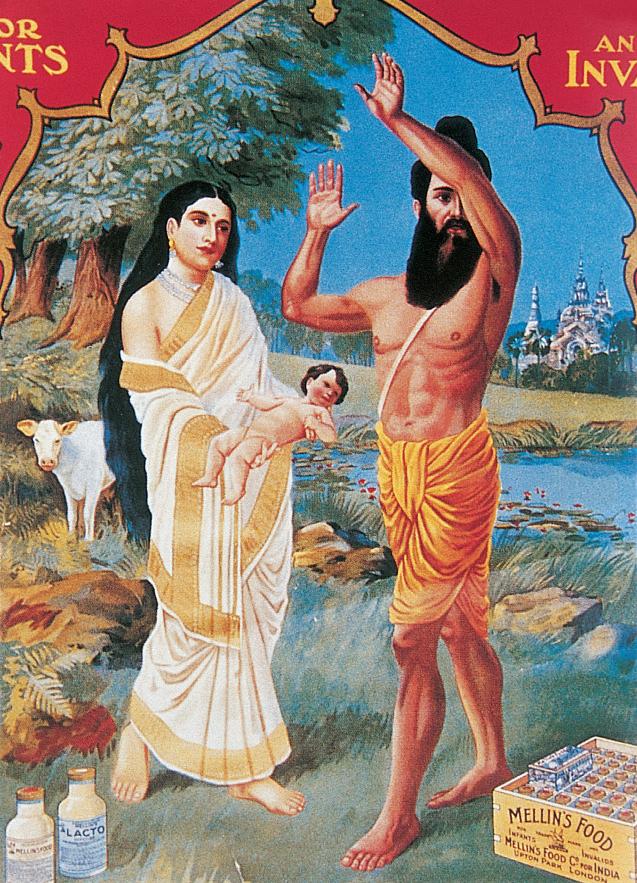
Birth ofShakuntala
By Raja Ravi Varma Poster for Baby food
England,as has been suggested by Guha-Thakurta.47 An article on Ravi Varma had appeared in the first issue ofthe The Modern Review, acknowledging him for recalling the country’s glorious history.Yet a growing suspicion crept in that,rather than being patriotic,he was introducing ‘foreign’ elements into Indian art.Nivedita berated Ravi Varma for his lack ofsensitivity in appropriating sacred figures from Hindu mythology and literature,for his gross renderings ofArjuna and Subhadra,and especially of Shakuntala as “a fat woman” lying on the ground in a recumbent position.48
And what was Abanindranath’s conception ofbeauty in a woman? Curiously enough,in his abundant writings there are no explicit references except one which may surprise us,since it is not ofan Indian woman.Yet as an Indian he cannot resist the use ofsimile to describe her beauty a simile which in some distant way finds itselfreflected in the radiance emanating from his painting of Bharat Mata.
The first time I met Nivedita was at a reception given at the American Consul’s in honour ofOkakura.With her white flowing gown reaching down to her feet,and a rosary around her neck,she looked like an anchorite hewn out ofa piece ofwhite marble...I do not know what your conception ofbeauty is.To me,this priestess represented the highest ideal ofbeauty.As I saw her,I was reminded ofthe description ofMahesvata in Kadambari,of beauty incarnate fashioned with the lustre ofmoonstones.49
These different aspects to the man,his grasp ofIndian poetics,his beliefin the inner essence are worth consideration when we look at his conception of Bharat Mata. She is notonly apolitical icon, commandeered for a specific purpose and moment in India’s national history,as is often commented about her.A closer look at his BharatMata suggests that she does not respond wholly to the political climate in which she was conceived.In a charged atmosphere where the singing of Bande Mataram had become a ‘ mantra’,she is not modelled after the celebrated mother ofthe nation by Bankimchandra.She is unlike popular bazaar prints ofKali used by his two pupils in imaging the motherland,invoked again with fierce energy as Kali the Mother by Nivedita.She is unlike Bhawani the Mother of Strength as conceived by Sri Aurobindo.Instead,she bewitches us by the equanimity of her presence,by her lustre,by her fragrant ambience.She represents instead, Abanindranath’s rendering of “beauty incarnate” in a woman.
This luminous icon is unique in his body ofwork,unlike any other renderings ofwomen by him.Abanindranath informs us that a Japanese artist copied the image on a silk banner to be taken out in processions in 1905,which means that his painting was already completed to serve as the model.The painting is never precisely dated by Nivedita.On the other hand,two artists ofthe Bengal School who were in his following,Binodbehari and Mukul Dey,both firmly assign the painting to the year 1902.50 Suppose that he had conceived the image prior to the swadeshi movement,would this alter our notion about the painting being part ofthe nationalist agenda?
Another critical factor has never been raised which seems to me most significant.In his memoirsAbanindranath describes in passing a different Bharat Mata than that seen today:which is with two hands holding food and clothing (anna vastra) and with two in the gestures of abhaya (do-not-fear) and varada (bestowing a boon) gestures appropriate for goddesses such as Lakshmi and Parvati but never accorded to women.51 This leaves us with two options,ofinferring that Abanindranath painted two versions of this painting; or that he changed the image. Whichever be the case,he deliberately changed the
image from the iconography ofa goddess to that ofthe Mother offering the country its four essential requirements transforming her from a religious into a secular icon.
The significance ofAbanindranath’s vision lies in the fact that his was much more than a political painting in the acclaimed ‘national’ style.Consciously deriving his inspiration from the sensibility ofVaishnav devotion not from the violent aggression of images ofKali in Bengal Abanindranath offers us an alternative imaging ofthe motherland,one that is opposed to the aggression ofa rising nationalism not merely in his own time but possibly in the future.In my opinion this is the real significance ofthis painting,and why it needs re-examination after nine decades ofsurvival and transformation.
Mother India now becomes a metaphor for the transformation ofIndia with its new aspirations.The business ofmaking images is fascinating to observe as a historical process “They (images) can be transformed,utilized,co-opted,inverted,diverted, subverted”,with new meanings to suit the political agenda.52 Bharat Mata is the inspiration for a genre ofsubversive art emerging from the second decade ofthe 20th century.Her transformation is astonishing! Significantly,the mother ofthe nation supplies the role model for ‘proscribed’ literature,a category where she is to be found today.53 Through the 1920s and ‘30s she is revived as an image ofinsurrection,radically different in spirit from the genteel sahadharmini model ofthe woman as conceived by Abanindranath.She appears in revolutionary pamphlets and posters,conceived by artists who often remain anonymous and where just the name ofthe printing press is recorded.Equally,she is represented in Europe,in the paper called Bande Mataram published from Geneva as the “Monthly Organ ofIndian Independence”.
Subversion ofthe old iconography follows almost immediately,appearing in an issue ofthe Bande Mataram being dated to Geneva,March 1913.54 Youthful and militant,Mother India not only embodies but is shaped as the map ofIndia.Her sari is wrapped tightly around her,wound between the legs leaving her free for combat.If there had been any doubt as to her purpose,she has been resurrected to wield a sword which is being drawn out from its scabbard.Three decades later this personification ofa defiant motherland perhaps inspired the heroic pirate queen Saudamani in Amar Jyoti (1939) directed by V.Shantaram,in arguably one ofthe first feminist films in India.
This image ofinsurrection is guided firmly by the French spirit of La Liberté Her conception owes much to Madame Bhikaji Cama,a Parsi and Indian nationalist residing in Europe.In the same year ofthis publication Madame Cama was described by the Government as ”the recognised leader ofthe revolutionary movement and was said to be regarded by the people as a reincarnation ofthe goddess Kali”.55 By her own admission Madame Cama was converted to believing in armed resistance after 1905.By 1909 her group of Bande Mataram was associated with V.D.Savarkar’s group,transforming Madanlal Dhingra into a hero-martyr.In Bande Mataram Madame Cama endorses political assassination and armed revolt with the bold statement:
Bande Mataram
Monthly Organ ofIndian Independence, 1913
Published from Geneva Collection:The British Library, London
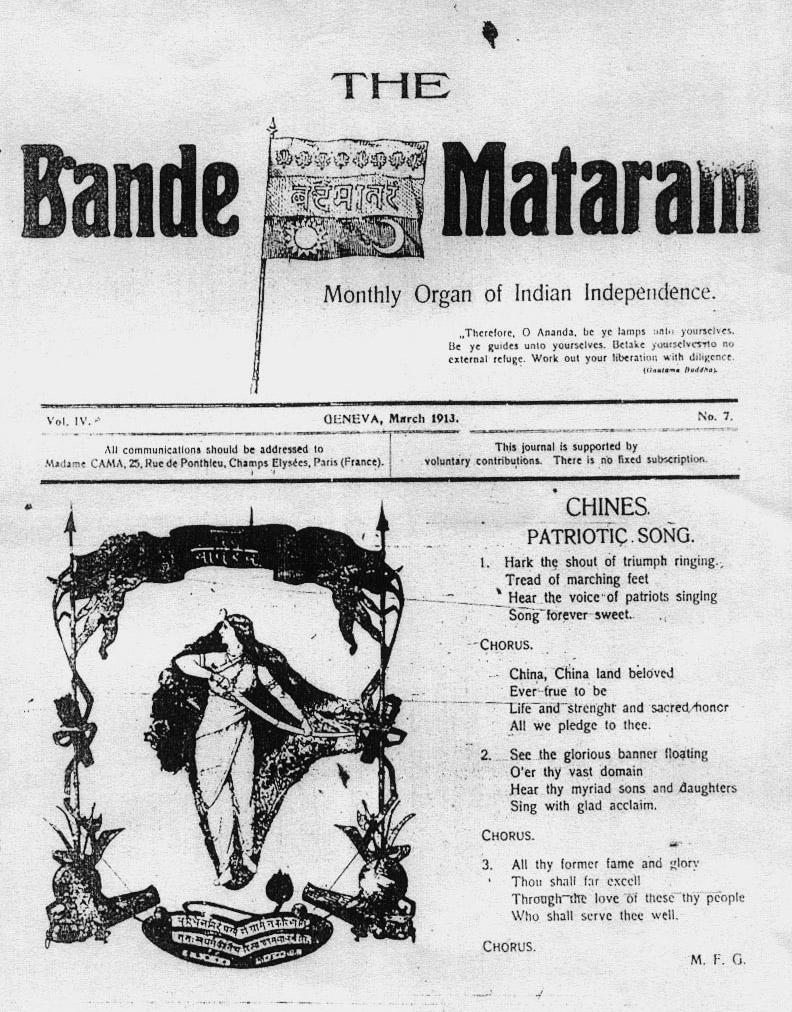
I also appeal to your patriotism to make the best ofyour stay in the West, by taking all kinds ofphysical training (which is not allowed in our country). Above all learn how to shoot straight because the day is not far away when for coming into the inheritance ofSwaraj and Swadeshi you will be called upon to shoot the English out ofthe land which we love so passionately.56
How did Madame Cama,a woman from the elite Parsi community of Bombay,come to be regarded as a reincarnation ofthe Hindu goddess Kali? She was one among three prominent women who played a major role in the terrorist movements in and outside India,and conceivably there were several others not so celebrated in history.Sister Nivedita worked with the RamaKrishna Mission but she was also an important member ofthe secret central revolutionary council,to which she supplied literature on revolutionary movements abroad.57 Sarala Debi nee Ghoshal belonged to the Tagore family,returned to Calcutta to take up the editorship of Bharati, and continued her formidable career “to become one ofthe most militantly nationalist women ofthe period”.58 She started a gymnasium,launched an active campaign through her paper exhorting young men to engage in physical culture,initiated the Pratapaditya festivals to revive the glory ofBengal’s history where Bande Mataram was sung in 1905.She is believed to have been a member ofthe inner circle ofrevolutionaries till her marriage and departure from Calcutta to Lahore.59
All three women came from privileged positions which lent them a certain political immunity,but which also meant that they stepped out ofthe conventional roles accorded to them in society.Were they in fact emboldened and inspired by the importance invested in women with the engendering of Bharat Mata? Here we are faced with a fascinating paradox which invites attention.At the very moment when the Indian woman is conferred the awesome role ofmother ofthe nation thereby losing her individuality to the cause ofnationalism there arise three individual cases ofwomen who embark voluntarily upon militant careers,associate themselves with the growing terrorist movement,and come to be associated in one way or another with the goddess Kali.Were all these three accidental,or were there changes occurring within the direction ofnationalism? An episode is recounted about Sarala Devi,elucidating my point.
Whether Sarala Debi was consciously inspired by Bankim’s model of womanhood (she was called Debi Chaudharani in her own heyday) in moments ofcrisis or not,it appears that the “mother-centered rhetoric of Hindu nationalism” had,by its use ofwomen as political symbols of national awakening,created a political space for women i.e.created the possibilities ofa Sarala Debi’s involvement in politics.Sarala Debi describes in her own memoirs that she had a favourite image ofKali placed on a table beneath her own portrait showing her with long open hair.When the Maharaja ofBaroda came to tea and was shown the favourite image ofKali he remarked, “Which Kali shall I look at;this one or that one?”60
Involvement for these women was not only political but tinged with religious undertones not perhaps as they saw themselves,but as they were perceived.This would not be altogether surprising,since at the time political ideology was influenced by religious beliefamong some terrorists.Sarkar’s chapter on secret terrorist groups working within India from 1902 suggests the change taking place among the revolutionaries from a secular outlook to the revival ofHinduism,with their own recognition that they needed
to be “trained up spiritually to face danger”,and that “the people ofIndia would not be made to do any work except through religion”.61 It was before Kali,the goddess ofdestruction,that terrorist societies made their initiates take their vows.This change begins to be perceived in a radical transformation in the persona of Bharat Mata, expressed through revolutionary posters.The mother ofthe nation now offers succour to terrorists and revolutionaries and like the goddess Kali she demands from them human sacrifice.
From the 1920s and early ‘30s Mother India acquires a new persona as she is offered the sacrifice ofhumans who willingly suffered martyrdom for the sake ofthe country.Blood sacrifice is welcomed,with titles to these posters such as Bhagat’s Curious Present and Sardar Bhagat Singh’s Wonderful Presentation. 62 Young Mother India is enthroned,and is being offered a head on a platter with blood fresh and dripping as the hero himselfpresents it with the comment, ‘ Mother! For thy freedom’s sake I offer my life.’ Bhagat Singh,the young terrorist who was awarded the death sentence and executed in March 1931,appears as the hero ofthe piece,retaining remarkable composure despite the circumstances.He appears as his usual dapper selfin shorts and white shirt,sporting his black moustache (which he sometimes twirls) with his hat slanted at a rakish angle as he appears in every popular calendar where he is canonised ever-after,along with Subhas Chandra Bose,Jawaharlal Nehru and Mahatma Gandhi.63
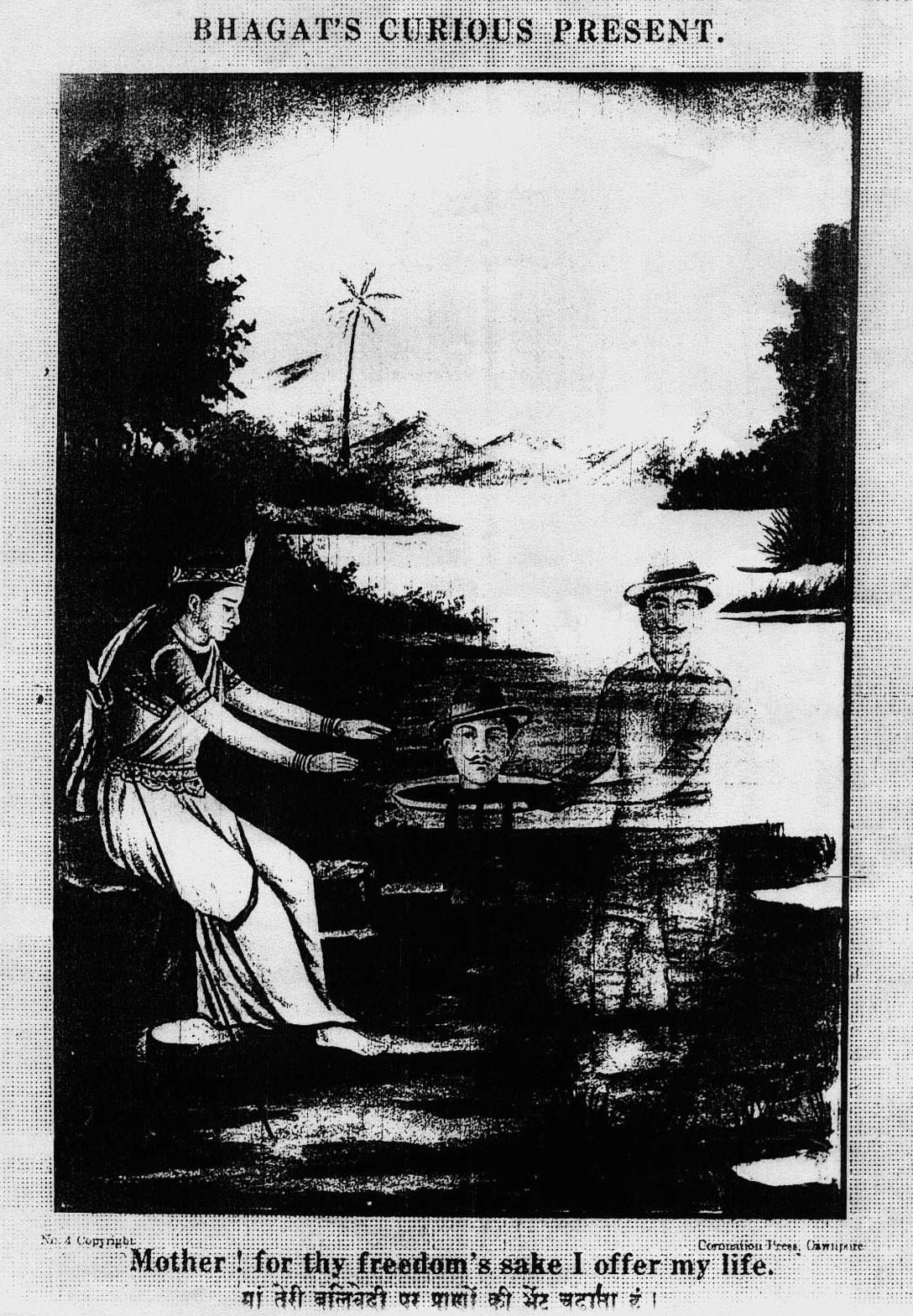
The comment by Bhagat Singh to the mother ofthe nation is inscribed in English as well as in Hindi,enabling the message to reach a wider audience.As he looks out straight at the audience (instead ofat Mother India who is looking at his ‘curious present’) he seems to be performing some kind ofconjuring trick.He offers the platter with his head set with the magic hat,which also appears ofcourse on his own head at the same angle.This poster is inscribed by hand above the picture and dated precisely to 14/1/32,within the year ofhis martyrdom.The second poster offers a more credible version.Here Bhagat Singh’s head is missing,decapitated from his body and appearing only once on the platter being offered to Mother India.Despite the blood it remains immaculate,unlike European paintings ofthe gory head ofJohn the Baptist offered to a young Salome who recoils in horror,or ofJudith surveying the decapitated head of Holofernes.In the rehearsed theatricality ofthis poster there is implicit the notion of immortality that comes with martyrdom.
The mother-of-the-nation is now enthroned and bedecked with jewels, wearing a crown and a waist girdle hugging her slim figure,with arm-bands,bangles and earrings no longer a martial woman as she appears in Madame Cama’s revolutionary paper but definitely what would be expected ofa goddess. She lays aside the weapon of the trishula beside her seat as her hands reach out with eagerness to accept the platter.The trishula itselfestablishes the link between her and the goddesses Kali and Durga,who wield the same weapon in their battles with demons.This new iconography suggests the merging ofthe identity ofthe Motherlandwith the militant goddesses ofthe Shakta tradition.These posters belie the truth,despite the innocence offolk theatre from which they seem inspired.Behind the image is the notion ofthe primordial goddess,at once malevolent and benevolent,to be feared as much as adored,demanding blood and her sacrificial victim.
Both posters are printed in Cawnpore,(Kanpur) in the heart ofnow Uttar Pradesh where the domination ofpatriarchal norms left little scope for the mother cult.
Bhagat’s Curious Present Revolutionary Poster,Cawnpore Collection:The British Library, London
Sardar Bhagat Singh’s Wonderful Present
Revolutionary Poster,Cawnpore Dated by hand to 14.1.32 Collection:The British Library, London
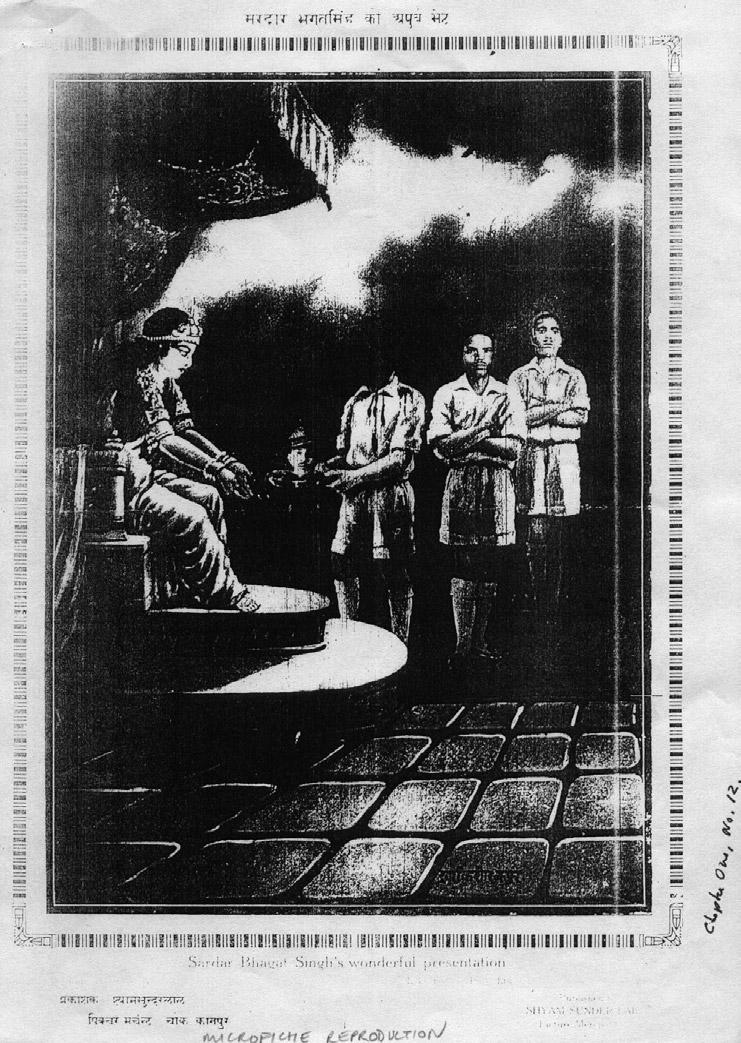
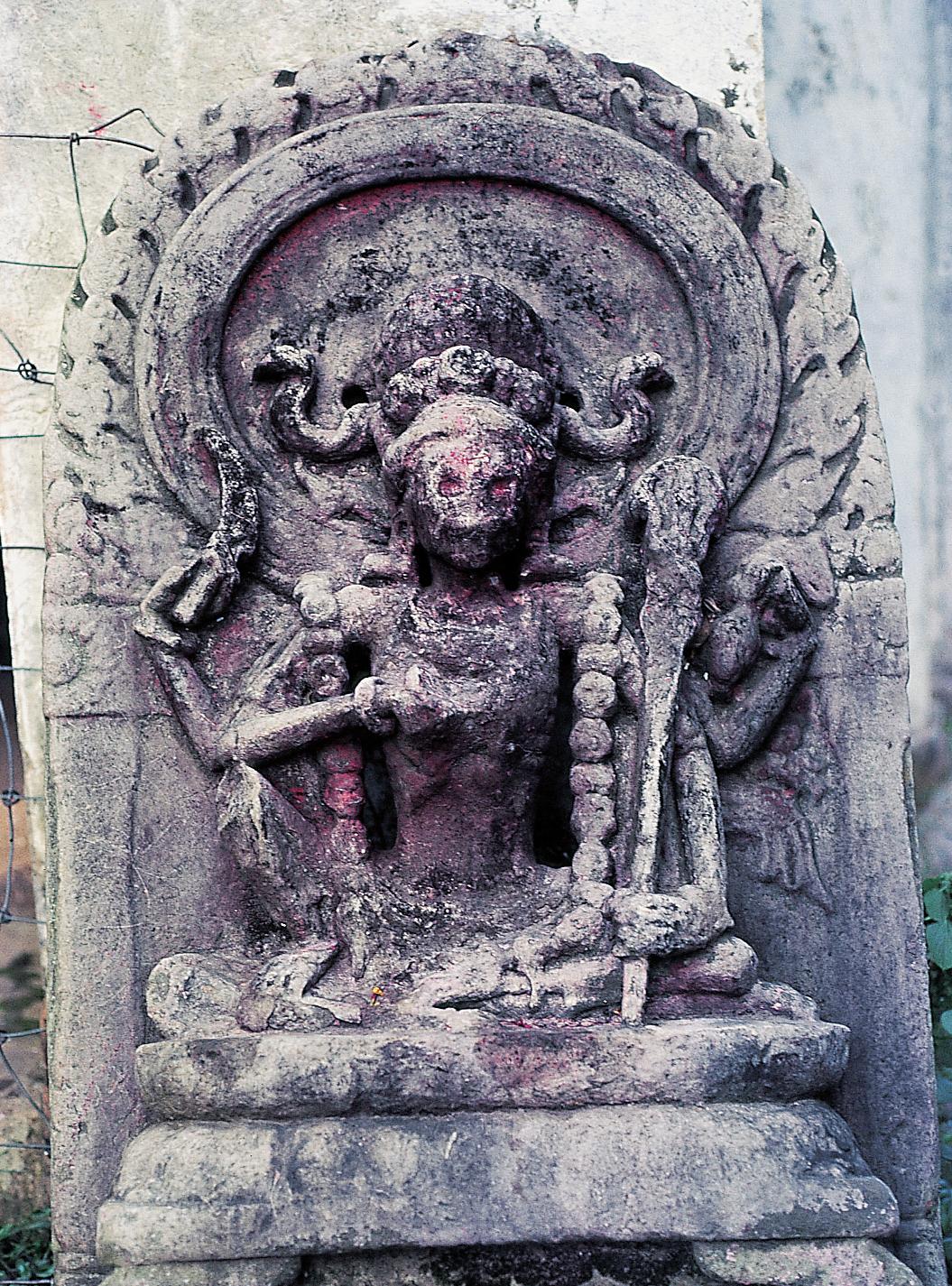
Kali
Image in worship
Kamakhyadevi temple,Assam, Stone, 9th century
Bhagat Singh’s own position in his writings including “Why I am an Atheist” offers little credibility to this image ofhis worshipping the Mother in the form of Kali.These posters on his martyrdom lack a local authenticity,while at the same time they confirm a pan-Indian iconography for Mother India as a ‘holy’ icon.This dialogue between the hero-martyr and the goddess ofthe nation is found in yet another series of posters from the Shaheed Bhagat Singh collection dated between 1924–31.64 The popular theme continues into calendar art in post-independence India,recently published in a photograph ofVaranasi taken in 1958 by Richard Lannoy.65
We cannot resist returning to Bankim’s Anandamath where the main theme is sacrifice by the santans for the Motherland,oftheir lives and their personal relationships.Equally,this need for sacrifice had been prophesied by Sister Nivedita in her impassioned writings in “The Voice ofthe Mother”:
Religions,called by whatever name, has been ever the love ofdeath.But today the flame ofrenunciation shall be lighted in My lands and consume men with a passion beyond control of thought.Then shall My people thirst for self-sacrifice as others for enjoyment.Then shall labour and suffering and service be counted sweet instead ofbitter.For this age is great in time and I,even I Kali,am the Mother ofthe nation.
66
Why is Kali,the fearful goddess ofdestruction,singled out from the pantheon ofgoddesses and appropriated by the terrorists to double as the mother ofthe nation? In the myth according to the Devi Mahatmya she is summoned by Durga to overcome the army ofdemons,and she rushes in howling with fury,crushing and eating her enemies, decapitating the demon generals Sumbha and Nisumbha.She alone can defeat Raktabija, by swallowing whole the army ofdemons produced by his drops ofblood.It is she who provokes the god Siva to a state ofdemented fury when he dances the tandava dance.67 David Kinsley’s comments are relevant as to why she would be invoked by the terrorists, because she would suit their objectives. “ Kali is a goddess who threatens stability and order”;which we might interpret as the world governed by the British Raj.Her worship sanctions the shedding ofblood as ordained ritual.She sanctifies the notion ofhuman sacrifice,and she offers redemption to those who stand outside the world oforder (dharma).
I would suggest that she is mother to her devotees because she gives birth to a wider vision ofreality than the one embodied in the order ofdharma.The
dharmic order is insufficient and restricting without a context without a frame,as it were.Kali frames that order,putting it in a compelling context... Standing outside the dharmic order,indeed threatening it,Kali may be viewed.as she who beckons humans to seek a wider,more redemptive vision oftheir destiny.68
Sacrifice for the country however,can be ofdifferent natures:militant,or passive.That described in revolutionary posters above derives inspiration from the Kali syndrome:of young men sacrificing their lives to the Mother,for the country in the cause offreedom.The other alternative,as perceived from a Gandhian perspective,might be the sacrificeby the men and also the women ofIndia. To correct the morally reprehensible and wrong notion ofblood sacrifice,or for that matter ofsacrificial victims,the next poster which addresses us is inscribed with the significant title of The Right Path ofLiberty.69 This poster ushers in another transformation ofMother India,with a new political agenda for women to participate in the struggle for freedom.
A radical shift in perception from terrorism to pacifism is to be seen in this poster,which projects a transformed image ofMother India and her demands.The nature ofsacrifice has changed from the supreme glory ofmartyrdom to principles of satyagraha: Gandhi’s ingenious strategy ofdefying the British government by courting arrest and going to jail.Prominent in the poster among leaders ofthe National Congress imprisoned are Mahatma Gandhi,Sardar Patel,Motilal Nehru,a youthful Jawaharlal Nehru and perhaps,Abdul Ghaffar Khan.Almost equally prominent (but smaller in size) are a few women,among whom Sarojini Naidu and possibly Kamaladevi Chattopadhyay can be recognised as leaders in the satyagraha movement. For the first time women in the plural rather than the singular are featured among the heroic, deserving attention because they too played a significant role in India’s fight for freedom.
This poster signifies crucially altered perceptions in the role ofwomen from the early 1930s.Gandhi’s acute insight into human nature,as well as his ingenious use ofan essential pragmatism made him develop the strategy ofnon-violence, ahimsa, as the primary means to bring about theindependence of India. By basing his principle method ofpassive resistance on the qualities offemininity,it is well argued that he reversed traditional notions ofthe freedom struggle being a masculine effort.70 By doing this he was not suggesting that they should be militant.For Gandhi, woman was the “embodiment ofsacrifice and therefore,non-violence.Her occupations must
The Right Path ofLiberty Revolutionary Poster,Lahore, circa 1932
Printed in Urdu and English Collection:The British Museum, London
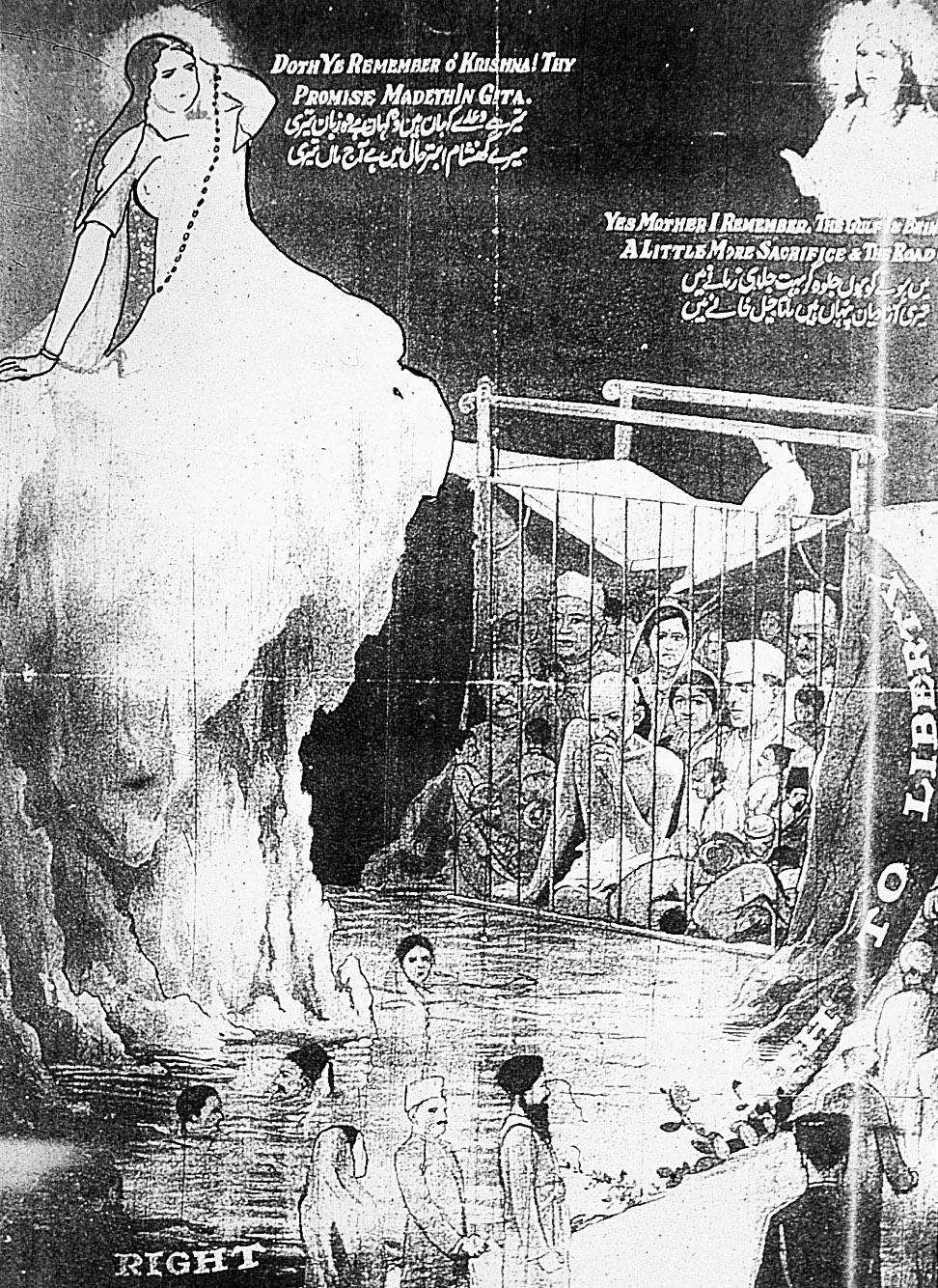
Imaging the Indian Woman in Painting, Photography and Cinema
Geeti Sen
208 pages, 117 colour illustrations
9.5 x 11” (241 x 279 mm), hc
ISBN: 978-81-85822-88-4 (Mapin)
ISBN: 978-1-890206-31-4 (Grantha)
₹2000 | $45 | £30
2002 • World rights