05 Fellows’ focus: current breakthrough projects by our academics
08 The world won’t wait: fresh approaches to environmental research
10 The Sex Discrimination Act: 50 years on
12 Leaving Fellows: moving on from Mansfield
14 Why Computer Science belongs at Mansfield now
16 New Fellows’ spotlight
18 Romantic dreams and archival research: a taster
20 Between randomness and structure: understanding networks
22 For Mansfield. Forever. Place
23 Meet our Estate Transformation Project team
24 Introducing the Margaret Foster Building
27 More Mansfield. Forever. Cornerstone philanthropy
30 An exciting new chapter for the Library
32 Greening the greenery
34 Alumni at the heart of Mansfield’s transformation
Produced by the Development team
Editor: Eleanor Hutson, Alumni Relations Officer
35 The story of the John Marsh Building
40 For Mansfield. Forever. Culture
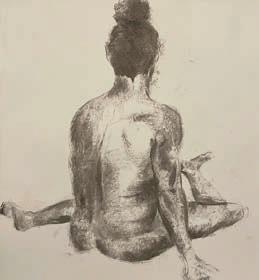
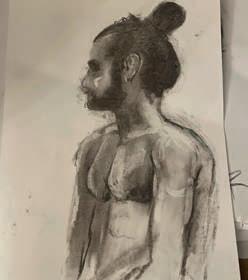
41 The Mansfield-Ruddock Art Prize 2025
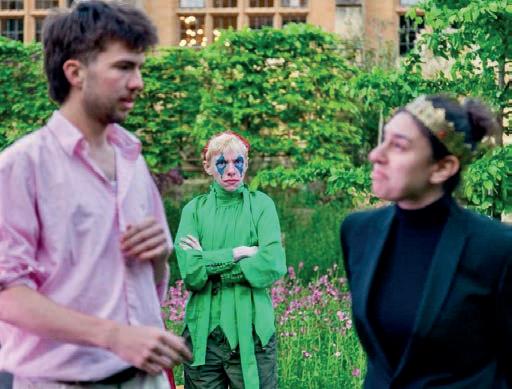
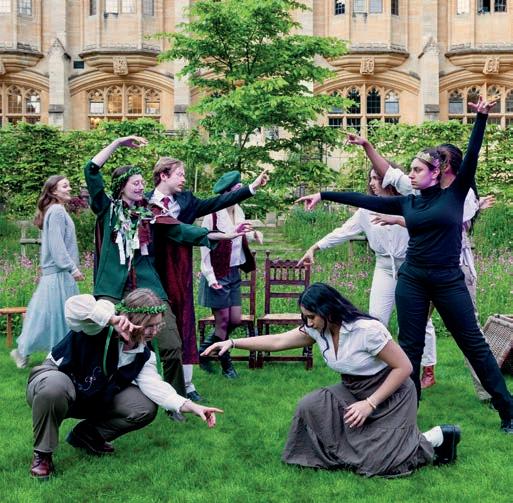
42 Just imagine: the arts at Mansfield
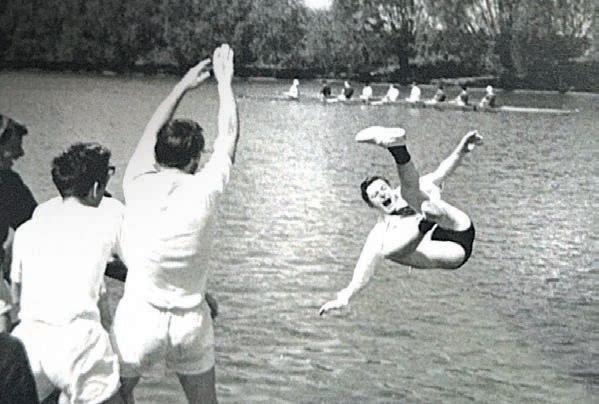
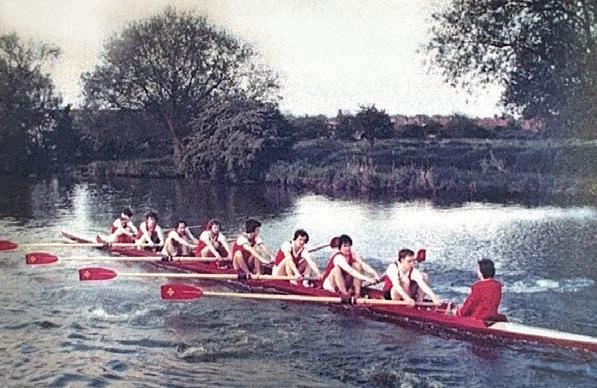
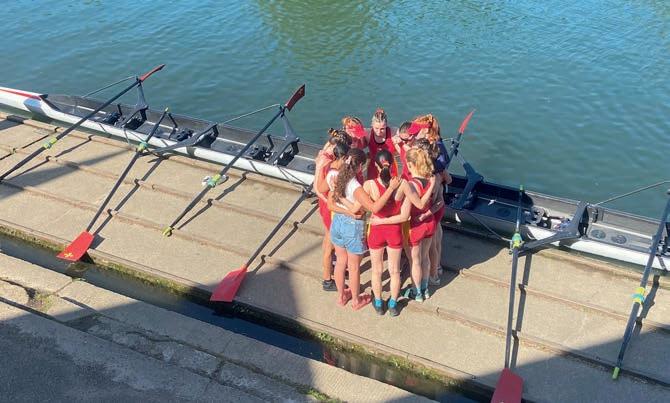
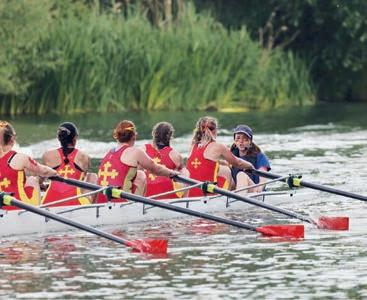
44 Diamond blades: celebrating 60 years of Mansfield College Boat Club
46 Beyond the welcome mat: Sanctuary at Mansfield
48 Supporting our future postgraduates: new endowed scholarships at Mansfield
50 Breaking down barriers: widening participation
52 What’s next?
54 Making a case: Mansfielders in Law
60 Mansfield on the shelves
62 The 1886 Circle: join the momentum
63 The gift of a chance encounter
64 Two generations, one Mansfield legacy of giving 66 Our supporters 72 Obituaries 76 A year of alumni engagement
79 Upcoming events in 2026
Copy Editor: Philip Harriss Design: Aligned Design Co Print: Lavenham Press Cover photo: Muhammad Umair
Photography: Images are credited to the generosity of our colleagues, academics, alumni and students, for which we give our gratitude and thanks. We would also like to give special thanks to photographers Gareth Ardron, John Cairns, Keiko Ikeuchi, Nicholas Joinson, Richard Kuehl, Ander McIntyre, Kendal Noctor, Nicholas Posner, Greg Smolonski, and Ian Wallman for their expertise.
Mansfield College
Mansfield Road, Oxford, OX1 3TF
T: +44 (0) 1865 270983
E: development@mansfield.ox.ac.uk
W: www.mansfield.ox.ac.uk
The paper used for this publication is FSC®-certified and carbon balanced, and the bag used is compostable. @MansfieldCollegeOxford @mansfieldoxford @mansfieldoxford
This is a landmark year for Mansfield. As we celebrate our 140th anniversary in 2026, we are also poised to break ground on the most ambitious transformation of our College in its history.
By the time you read this, we will be eagerly awaiting the outcome of our planning application to redevelop the Mansfield site. If permission is granted, work will begin in the autumn – the visible beginning of the campaign for our Estate Transformation Project: More Mansfield. Forever. Through this limb of our overarching campaign, For Mansfield. Forever., we are transforming our College to ensure it can thrive for generations to come.
But this is about more than bricks and mortar. It is about ensuring Mansfield’s values – inclusivity, curiosity, and courage – have the best possible home, forever. It is about creating spaces that enable our students, academics, and staff to flourish. And it is about making visible, in the heart of Oxford, what Mansfield has always stood for: excellence and openness, pluralism and welcome, debate and respect.
Change is rarely comfortable, but it can take us to a better place. Our plans are ambitious, but they are also true to Mansfield’s character: inclusive by design, grounded in our history as a Nonconformist college, and dedicated to widening participation and academic freedom in equal measure. Just as debate is sometimes uncomfortable – requiring us to listen carefully to views we may not share, and also to address and to listen to people whose perspectives we may previously have overlooked – it can also take us to deeper understanding. That is how we preserve Mansfield’s culture for the very long term, and why we continue to place respectful challenge, intellectual curiosity, and pluralism at the heart of all we do.
Our anniversary gives us the perfect chance to reflect on that tradition. This is also a year of celebration. Mansfield is 140 years old, and throughout 2026 we are sharing ’140 stories for 140 years’ – glimpses of our past, present, and future – across social media and College communications. I hope you will enjoy these, and perhaps share your own story. Collectively, they capture something I find extraordinary about this College: that we are a community which never pits excellence against inclusion, but sees both as inseparable facets of who we are.
The For Mansfield. Forever. campaign rests on three pillars:
People, Place, and Culture. The Place pillar is being brought to life through More Mansfield. Forever., the transformation of our site that will give future generations more space to live, learn, and thrive. But People and Culture are equally vital: People, the students, staff, academics, and alumni who embody Mansfield’s spirit; and Culture, the respectful challenge, openness, and intellectual curiosity that define our College. Together, these three pillars secure Mansfield’s future.
I want to thank all of you who are supporting this campaign – through generous philanthropy, through giving your time, or simply through showing your pride in Mansfield. Every contribution strengthens our shared future. Together, we are ensuring that Mansfield remains a game-changer: a place of welcome, a home of ideas, a community where all belong, and all can thrive.
I hope this magazine stirs warm memories of your own time here, as well as pride in the Mansfield of today – and excitement for what is to come.
For Mansfield. Forever.
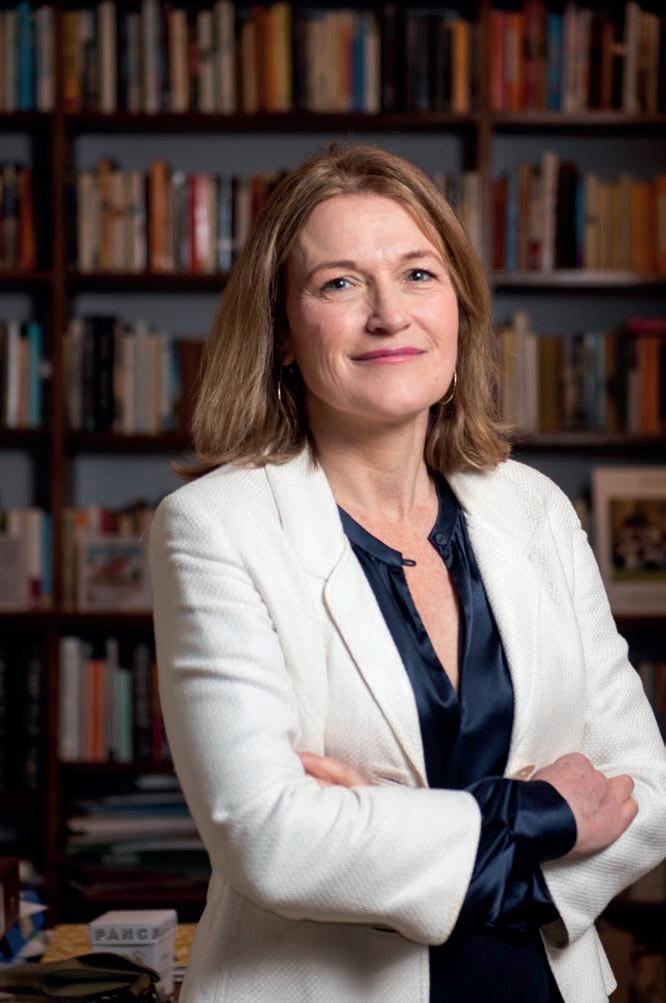
Helen Mountfield KC
We never stop changing lives. In fact we’re just getting started.
An essay isn’t normally life-changing. Nor is a cup of tea, or an hour’s conversation. And not one of those things is life-changing just because it takes place at an Oxford college, either.
But put the right people in the middle of all that – people who know how to nurture potential, how to ask a question that will make you reconsider your entire point of view – and suddenly, your life is heading in a completely new direction.
Mansfield’s people change lives.
There is a lot of change happening at Mansfield today: new buildings, new subjects, new challenges to face.
Yet alongside all that exciting, transformational change, some things will stay exactly the same: our commitment to inclusion, to world-class teaching and research, and to creating life-changing moments for the next generation of Mansfielders. Life-changing. Unchangingly.
Find out more www.mansfield.ox.ac.uk/people
Fellows’ focus
Mansfield’s world-class academics are stretching the boundaries of knowledge across the disciplines. Here are just some of the current breakthrough projects.
Mathematical modelling of batteries
Professor Jon Chapman Professorial Fellow in Mathematics and its Applications
I work on various problems in applied mathematics, one of which concerns developing mathematical models for batteries.
Energy storage is a crucial technology in the UK’s transition to a green economy. Batteries power electric vehicles, and can buffer the intermittency of renewable energy sources in both domestic and grid installations.
Models are useful in many different ways. For example, by predicting battery degradation we can develop strategies to minimise it, leading to improved battery management systems and longer battery life. Models can also be used to reduce the time and cost of developing new batteries, both by understanding how new materials impact performance, and by appreciating the trade-offs that exist between different design choices, through rapid digital prototyping.
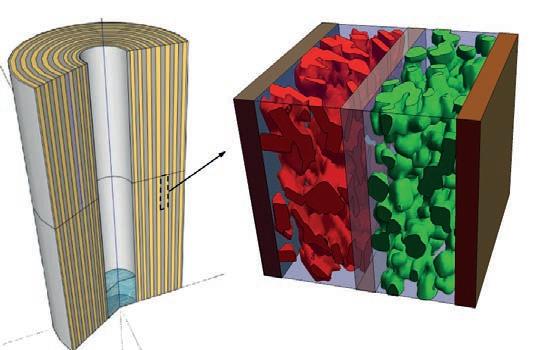
Several physical processes should be considered when making a model of a battery: electrochemical reactions,
heat, lithium and electron transport, mechanical stresses, electrolyte flow, etc. Our expertise is in taking such complex models and simplifying them using mathematical tools, so they are much more efficient to solve while maintaining required levels of accuracy.
A recent and rarely considered aspect of our work is mechanical deformation. As lithium shuttles back and forth between a battery’s electrodes during charge and discharge, the electrodes swell and contract, causing mechanical deformation within the battery. Over many charge/discharge cycles this leads to battery degradation. That’s why you should keep your phone battery between 20% and 80% charged – the mechanical stresses are worse when it’s nearly full or nearly empty.
We are delighted that Jon has been appointed Head of Department at the Mathematical Institute from Michaelmas term 2025.
Illustration of a lithium-ion battery
On the trail of women polar explorers
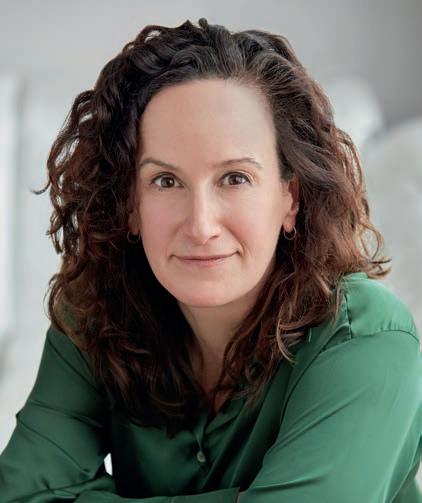
Professor Michèle Mendelssohn Tutorial Fellow in English; Professor of English & American Literature
Picture a polar adventurer.
Chances are, you’ll imagine a frostbitten man battling a snowstorm, or a ship trapped in ice. Names like Ernest Shackleton, Robert Falcon Scott, Robert Peary and Fridtjof Nansen may come to mind.
Now picture a woman polar adventurer.
What comes to mind? If you’ve drawn a blank, that’s worth thinking about.
Polar exploration literature has been powerfully shaped by notions of heroism, nationalism, whiteness and masculinity – obscuring many of the regions’ true stories.
In fact, women have long been writing about polar regions. They have lived in the Arctic for millennia – Inuit women cartographers like Iligliuk guided 19th-century Royal Navy officers seeking the fabled Northwest Passage; some Arctic communities were matriarchal – and have been visiting and writing about the Antarctic since the 19th century.
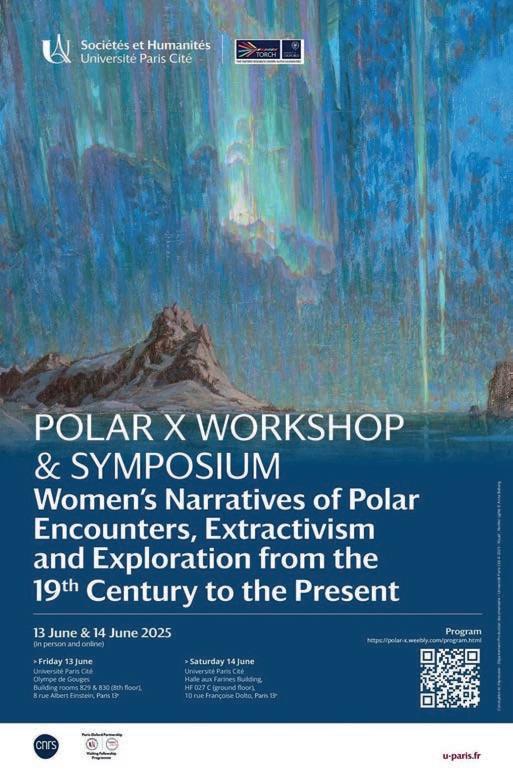
I’m currently working on a project to give more accurate accounts of life at the poles. Thanks to the Paris-Oxford Partnership, I founded and developed the POLAR X PROJECT, a collaboration with Professor Cécile Roudeau (Université Paris Cité) to rethink polar narratives.
We held the first POLAR X conference in Paris in June 2025. Over two days, researchers and creatives from around the world joined online and in person for rich, thought-provoking sessions discussing how new ways of framing polar encounters could reshape research and teaching.
Next, we’re establishing an interdisciplinary steering committee to guide the project’s future, building on the curiosity, generosity, and collaboration that marked the first POLAR X event.
Poster for POLAR X conference held in Paris, June 2025
Extractive geographies
Dr Amber Murrey Tutorial Fellow in Human Geography
For the past two years I’ve been living, researching, and teaching in Yaoundé, Cameroon, with trips to Addis Ababa and Lagos. As a political geographer, I explore the dynamics of power, place, and social change, focusing on neo-imperialism, authoritarianism, and resources in African societies.
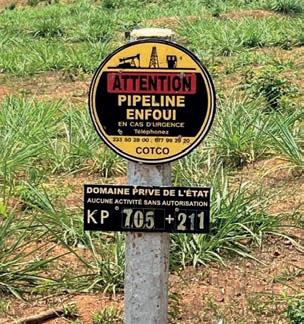
My forthcoming book, Knowledge, Sacrifice, Reciprocity: Researchers along a Pipeline, draws on a decade of ethnographic research along the Chad-Cameroon Oil Pipeline. It explores the complex encounters between communities and the social scientists who work on behalf of local communities, the state, corporations, universities, and NGOs. The book traces the frictions, solidarities, and ethical dilemmas that arise when research becomes entangled in extraction – such as anthropologists conducting animal sacrifice for fossil fuel companies, or economists modelling the cost of increasing disease rates along the pipeline corridor for transnational financial firms.
Extending this inquiry, I lead ‘Extraction & the Social Scientist’, a project examining complicity, accountability, and resistance within extractive industries globally. We study how social scientists operate as consultants, mediators, monitors, or scholar-activists – and how their knowledge can permit, reinforce, or unsettle the logics of capitalist extraction, and how scientists themselves narrate these phenomena. I’m currently collaborating with Cameroonian artists on an educational animation that brings these themes to wider audiences, tracing encounters between scientists and communities in Cameroon and Chad since the late 1990s.
These projects ask: how might social science move beyond extraction – not only as a topic of analysis, but as a reciprocal and accountable practice? In an era of populist mistrust of science, I argue that researchers are active participants in shaping political futures and we also bear responsibility for transforming how knowledge is created, circulated, and received.
This work has been funded through a British Academy/ Wolfson Fellowship WF22\220021, a British Academy Writing Workshop Award IWWAF\100013, and a Fulbright Scholar Award.
Signage marking the right-of-way of a subterranean crude oil pipeline in Nanga-Eboko, Cameroon
Dr Murrey leading a two-day writing workshop entitled ‘Defiant Scholarship in Africa’ in collaboration with the University of Buea in Yaoundé, June 2024
The world won’t wait
The Earth’s environmental problems are urgent, yet crucial research may take years to complete. Here Dr John Lynch, Lecturer in Geography at Mansfield and Senior Researcher with the Agile Initiative at the Oxford Martin School, explores fresh approaches to speeding things up.
Getting a research project going can be slow. A year can pass between the submission of a proposal and the project starting. It might take another year, or more, before results are ready to share. For environmental research with a focus on immediate impact, this is a problem: action can be delayed, windows of opportunity may close, and the issues addressed may change and worsen.
I’m currently involved in a project, the Agile Initiative at the Oxford Martin School, exploring whether we can overcome these problems through new ways of undertaking research. The Agile Initiative provides funding and support for smallto-medium ‘Sprint’ research projects. Proposals are sought from researchers throughout the University, and appraised on their timeliness, interdisciplinarity, and potential for positive equity impacts. The Sprints must demonstrate a clear environmental problem to address, and involve cocreation with stakeholders outside the University who can put the research findings into action.
Team sizes vary, from a couple of researchers to groups of 20 spanning multiple departments, but each project is expected to provide results and demonstrable impact within a year of starting. This follows a design and administrative set-up that has also been accelerated: some projects have gone from proposal to launch in months, allowing them to be more rapid and solution-oriented than is feasible with other research funding.
Across 16 Sprints, several environmental topics have been researched, from how Brazil might reach net-zero greenhouse gas emissions, to making physical models of the Earth System run more efficiently. I led a Sprint examining how different ways of comparing the two major greenhouse gases (carbon dioxide and methane) might impact mitigation priorities in agriculture and landmanagement.
The Sprints have worked with and supported decisionmaking for more than 40 partners: government departments, environmental organisations, private companies, charities and more. To date, they have resulted in over 50 outputs, from individual project reports, to guidance for equality impact assessment. Impacts are being tracked as each Sprint’s research is put into practice. Scientific papers from the first wave of Sprints have been published in academic periodicals, with more to follow.
However, it has been difficult to speed up the peer-review process and journal publication.
The Agile Initiative has demonstrated that rapid environmental research is possible. Given the increasing focus on translating research into impact, it could provide a model for how to support timely, solution-oriented studies. But the Initiative is an experiment – a research project funded through the Natural Environment Research Council. In assessing what has been achieved, we also need to consider where it has highlighted challenges and opportunities for further improvement.
Some challenges relate to the University’s research administration and the nature of academia. Researchers
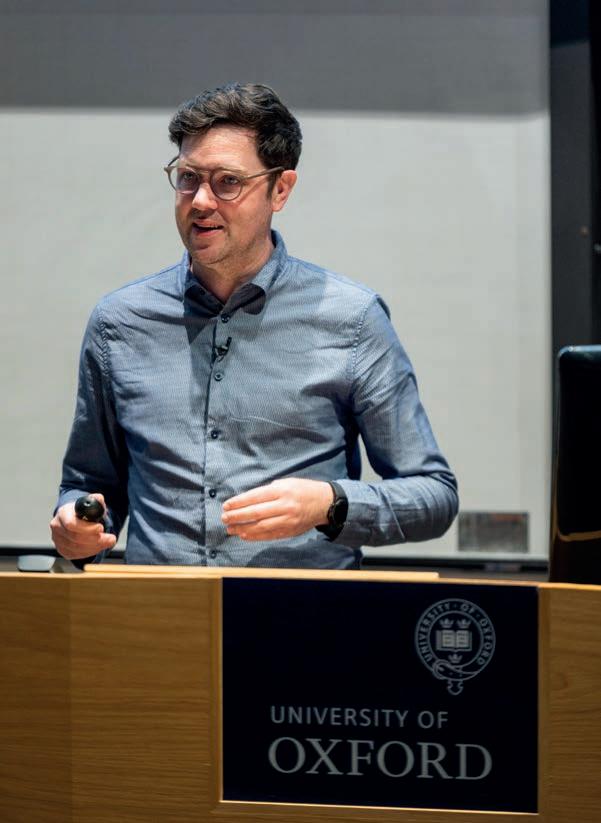
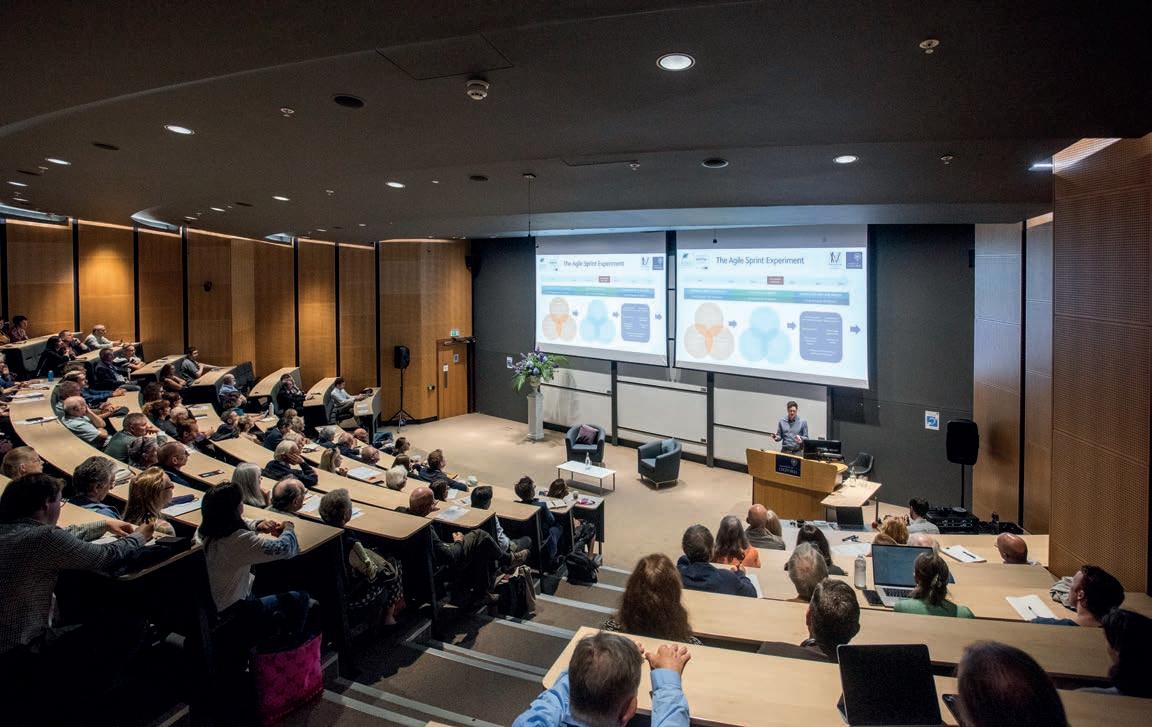
John Lynch shares the vision for the Agile Initiative at the ‘Meeting Minds’ event, part of Oxford’s alumni weekend
and departments are keen to work in an interdisciplinary way to benefit from the diversity of strengths across the University, yet coordinating this type of project is not always straightforward: transferring resources between departments puts an extra burden on administrative staff, especially with Sprint projects that are designed to move faster than a typical research grant. And although generating research impact and publishing papers rapidly can provide invaluable career development, a short Sprint project gives less security of employment for early career researchers.
There is more to be done in continuing to refine and develop positive new means of undertaking impactful environmental research, and more to explore in how to set up research at Oxford so it can facilitate this. We are already building a research culture that is keen to try new methods, work across disciplines, and maximise the impact of research.
The Agile Initiative has demonstrated that rapid environmental research is possible
Across the wide range of research projects and stakeholders, the importance of relationships between researchers and external partners has become especially clear. The strength of research undertaken at Oxford is well-recognised, but to achieve full potential, connection and communication with those who can put it into practice is vital. We found that when stakeholders engaged with research – not just at an organisational level, but with key individuals who are invested in the project and link up consistently over the research timeline – there is a clearer route to enacting its outcomes, and forming partnerships that persist beyond the project itself. This insight can help us plan even stronger, more effective policy-oriented research in the future.
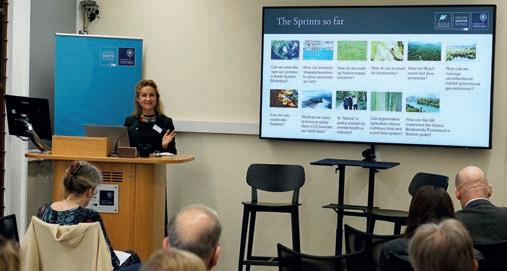
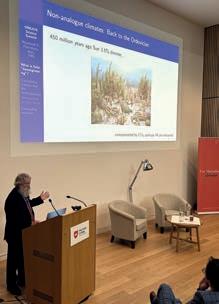
Professor of Biodiversity Nathalie Seddon, Director of the Agile Initiative, gives an update on the project
The Sex Discrimination Act: 50 years on
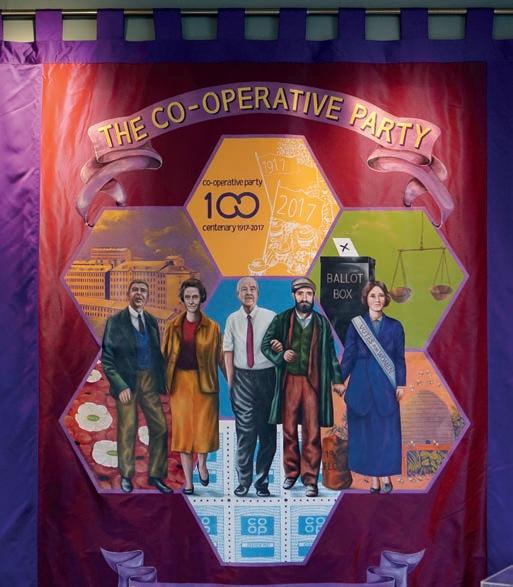
Joyce Butler, MP for Wood Green (from 1955 to ’79), was a lifelong activist for women’s rights, consumer rights, healthcare, environmental protection and peace – and the instigator of what became the Sex Discrimination Act, passed 50 years ago. A new exhibition curated by Associate Professor and Tutorial Fellow in History, Dr Lyndsey Jenkins, revisits Butler’s legacy.
In 1966, Queen Elizabeth used her Christmas broadcast to speak directly to women, reflecting on the 100 years since the first suffrage petition was presented to Parliament. But where the Queen highlighted progress, the MP for Wood Green, Joyce Butler, felt frustration at ‘how little we had actually achieved’. Butler was also looking ahead to the 50th anniversary of women’s suffrage in 1968, believing it presented a unique opportunity to address what she, like many women, saw as ‘unfinished business’ –particularly on equal pay.
Then, reading the newspaper one day, Butler was struck by the complaint of a woman bus conductor who couldn’t become a bus inspector. The woman was ineligible because she lacked experience driving buses. Yet she couldn’t get this experience, since bus companies didn’t hire women to drive buses. The relevant union was also opposed. Butler later wrote:
‘Like the light on the Road to Damascus, I realised that this job-and-training discrimination was the key to women’s failure to advance. We already had legislation against race discrimination – what was needed was a similar law for women.’
After years of campaigning, this legislation reached the statute book as the 1975 Sex Discrimination Act, but without Butler’s name attached or her contribution recognised.
My project is based on Butler’s uncatalogued papers at Bruce Castle Museum and Archive in Tottenham, north London. Butler was committed to women’s rights and women’s issues: she spearheaded the campaign to
improve access to cervical cancer screening; helped resist the backlash against abortion rights; and was among the first Parliamentarians to work on the issue of domestic violence. Add to this her longstanding campaign to promote equality in education, training, work, and the tax and social security system, and it’s no wonder she was described on her retirement by veteran feminist Hazel Hunkins Hallinan as ‘the national women’s MP’.
Rather than simply highlighting Butler’s individual achievements, I’m interested in understanding what her career reveals about the women’s movement, Labour Party, and British politics and society as a whole. Campaigns against sex discrimination or to promote cervical cancer screening brought together women from many walks of life: seasoned political activists and ‘ordinary’ women; devoted party members, stalwarts of women’s organisations, and those who wouldn’t have considered themselves ‘political’ at all. Without underestimating the challenges and
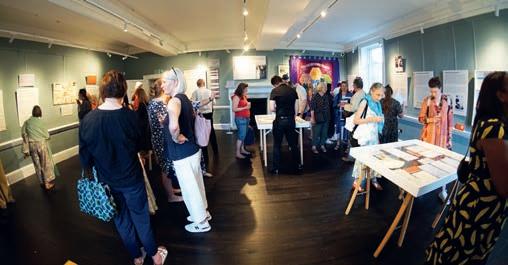
Joyce Butler Exhibition launch, June 2025
tensions women navigated, these campaigns demonstrate the diversity and range of the women’s movement at the time, even before the emergence of the women’s liberation movement in the late 1960s.
The project also challenges some established historiographical ideas: that after World War II, Parliamentary women prioritised party over sex, and that Labour women in particular neglected women’s issues in favour of class. Joyce Butler’s activism calls such preconceptions into question. Her career is just one example showing that Labour party women saw tackling gender inequality as integral to their politics. They worked hard – often across parties, and conventional political boundaries – to advance their interests.
Thanks to generous funding from the Arts and Humanities Research Council, and the support of colleagues at Bruce Castle Museum and Archive, I’ve assembled a team with specialist skills – in archives and cataloguing, community outreach and curriculum development – to make the most of this fascinating collection. I have curated an exhibition
at the Museum on Joyce Butler’s life and work, and am working on loanable and digital versions to promote the content more widely. Over the next year, we’ll be creating resources and putting together events, connecting past campaigns with contemporary concerns. I’m also adding to the collection by interviewing older women from Haringey and neighbouring boroughs about their work history, so we can understand how working life changed for women across this period in Butler’s own community.
It has been 50 years since the Sex Discrimination Act came into force alongside the implementation of the Equal Pay Act. So, also taking account of new workplace protections (including maternity leave), now seems an opportune moment to reflect on women’s contemporary position in the workplace – and how much further there is to go until women achieve the equality for which Joyce Butler dedicatedly campaigned.
You can visit ‘The National Women’s MP’ at Bruce Castle Museum and Archive, Lordship Lane, Tottenham, until June 2026.
I’m interested in understanding what her career reveals about the women’s movement, Labour Party, and British politics and society as a whole
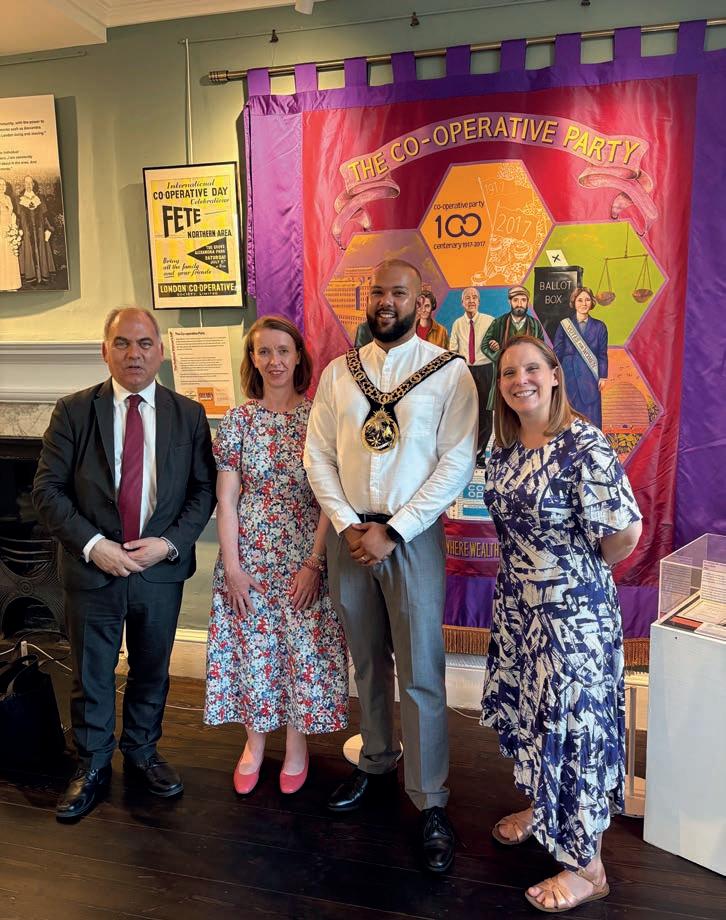
Left to right: Bambos Charalambous (MP for Southgate and Wood Green), Emily Arkell (Cabinet Member for Culture & Leisure, Haringey Council), Councillor Ahmed Mahbub (Mayor of Haringey) and Lyndsey Jenkins
Leaving Fellows: moving on from Mansfield
With the 2024/25 year wrapped, we bade a warm farewell to Professor Catherine O’Regan, Dr Andrea Bernini and Dr Candadi Sukumar.
From Bench to Bonavero and beyond
At Kate’s retirement dinner, I spoke with mixed feelings: celebrating her huge contribution to the Bonavero Institute of Human Rights and to Mansfield, but sad that the privileged part of my life in which she has been my colleague was drawing to a close.
Although Kate became a Judge of the South African Constitutional Court at the age of 37, her modesty means many of her College colleagues were unaware of what an iconic figure she is. But to those practising in the field of human rights, quite simply – Kate is a rock star.
I first came across her name in 2008 when, as a barrister, I argued, in a case called Watkins-Singh v Aberdare High School, that to forbid a Welsh Sikh schoolgirl to wear her kara was unjustified interference with her right to express her ethnic and religious identity. The legal climate then was not favourable to such claims. Were there perhaps any useful international precedents? Yes! In the records of the South African Constitutional Court, I discovered a recent judgment called Minister for Education KwaZulu Natal v Pillay, in which a Justice O’Regan explained with enviable clarity why we had nothing to fear from celebrating difference, and that uniform rules prohibiting a Tamil girl from wearing her nose stud were unnecessary and unlawful. It was a source of huge pride that I persuaded an English judge to transpose those important principles into English law (though Kate’s clear judgment did the work).
When I finally met Kate, as co-trustees of the Equal Rights Trust, I was happy to discover that ‘Justice O’Regan’ was just as admirable and kind in real life. And when I came to Mansfield, a year after Kate became the inaugural Director of the Bonavaro Institute, my hopes for working with her proved to be well-founded.
Kate has been a wise and trusted member of Mansfield’s Governing Body; and the kind of stimulating thinker you’d hope to find in your Fantasy League University.
Her principled human rights approach means she champions both a university based on ‘pluralism, tolerance and broadmindedness’, in which everyone is treated as equally worthy of dignity and respect, and one in which the best thoughts evolve through open dialogue and challenge.
In a world where we are increasingly invited to pit respect for equality, diversity and inclusion against respect for free speech, the positive insistence that these are essential twin virtues which go hand-in-hand to support democracy and academic freedom is vital. Kate articulates, lives and models her human rights values. I will miss her as a colleague, and wish her and Alec well in retirement.
Helen Mountfield KC Principal
Marking nearly three decades of Candadi Sukumar’s teaching at Mansfield
Dr Sukumar is retiring from teaching first-year mathematics to Mansfield physicists after a stint of almost three decades. Physics is a kind of conceptual poetry, but is written in the language of mathematics, and if you don’t speak mathematics then the physics won’t mean anything. Generations of Mansfield students have received expert linguistic schooling by Sukumar’s patient, careful and uncompromising tutorials, and they have thereby been able more fully to comprehend the mysteries of physics.
Sukumar’s own research has always focused on using mathematical ideas in ingenious ways, shedding light on intricate problems. It has included his development of new techniques in supersymmetric quantum mechanics, squeezed states in quantum optics, and atomic scattering. His most recent published work explores how Euler and Bernoulli numbers crop up in quantum optics, a characteristically ingenious ‘Sukumar’ discovery that links mathematics to physics. That link is emblematic of what he has done for Mansfield physicists.
Sukumar has been the most wonderful colleague and has challenged, amazed, and nurtured his students with an unflagging devotion. He has taught for several Oxford colleges, particularly Wadham which has been his main base in recent years, but Mansfield has remained a staple of his Oxford life since he started teaching for us in 1996. We will miss him enormously, but all wish him a long and happy retirement, during which I know he will continue to be productive: mulling over the deep connections between mathematics and physics. I look forward to keeping in touch and learning from him about his latest insights and inspirations.
Saying goodbye to Andrea Bernini
Andrea Bernini joined Mansfield in 2021 as a Career Development Fellow (CDF) in Economics after completing his DPhil and MPhil in Economics at the University of Oxford. Prior to that Andrea obtained a BSc in Economics & Econometrics at the University of Nottingham. He has also held visiting positions at Harvard University, the University of Venice and the European University Institute.
Andrea is an applied political economist. He has published several articles, some of them in the very prestigious Journal of Political Economy. His most recent published research has focused on understanding the social and economic impact of the 1965 Voting Rights Act in the United States.
While at Mansfield, Andrea mostly taught Microeconomics to our first- and second-year PPE students, but he also taught other Economics courses at the Department of Economics and at the Saïd Business School of the University.
After completing his CDF position at Mansfield, Andrea took up an Assistant Professor position at the University of Houston. We wish him all the very best in his future career.
To find out more about Andrea, please visit his webpage at: https://www.andreabernini.com/home.
‘My time at Mansfield has been an absolute joy. What makes the College special is its commitment to openness and access: creating a community where everyone feels they belong. I’ll always remember the lively conversations in Hall and the curiosity, warmth, and kindness that define Mansfield. It’s a place that brings together people from all backgrounds and perspectives, united by a shared belief in education’s power to make a difference.’ Andrea Bernini
Professor Stephen Blundell Professorial Fellow in Physics
Professor Vanessa Berenguer-Rico Michael Freeden Fellow in Economics
Why Computer Science belongs at Mansfield now
‘Studying Computer Science isn’t about mastering the latest tool, it’s about shaping the systems that define our lives’ writes Professor Sara Bernardini, Professor of Artificial Intelligence at the Department of Computer Science and Tutorial Fellow in Computer Science at Mansfield.
September 2025 marked a special moment for Mansfield: we welcomed our first cohort in Computer Science (CS), the College’s first new subject in three decades. CS sits naturally alongside Mathematics, Physics, Engineering and Materials Science, strengthening a scientific core where ideas flow both ways. CS speaks the language of mathematics; many algorithms draw intuition from physics and engineering. In turn, every scientific field now relies on computational methods for modelling, experiment and analysis. The connections reach further still: CS engages the humanities and social sciences whenever we discuss the impact of digital systems on
Mansfield’s first cohort of Computer Science undergraduates
ethics, law, culture and society. A college like Mansfield –curious, outward-looking, and proudly interdisciplinary – is the right place to study CS in conversation with the wider world.
At its best, CS unites principle and practice. Oxford has long championed that integration: rigorous theory, taught with mathematical clarity, paired with hands-on work on real problems. In my own teaching, I aim to combine exploration with discipline. Students encounter problems inspired by real deployments, such as how to plan the actions of a robot, how to reason under uncertainty,
and how to design algorithms that are both correct and efficient. They learn to frame questions precisely, analyse complexity, and build systems that work outside the lab. That blend of abstraction and application is the hallmark of a modern CS education.
Why launch CS at Mansfield now? Three reasons stand out. First, demand: computation has become a universal skill. Whether our graduates pursue research, industry, the public sector or entrepreneurship, computational thinking – decomposition, data fluency, algorithmic design – gives them durable tools in a fast-changing landscape. Second, mission: Mansfield is committed to widening participation and supporting talent from diverse backgrounds. Bringing CS into the College allows us to extend that mission into a discipline where access matters greatly and where representation can, and should, improve. Third, community: our scale and ethos support close-knit teaching, pastoral care and intellectual risk-taking. Students will learn CS, not in isolation, but as part of a supportive cohort embedded in a multidisciplinary college.
Artificial Intelligence (AI) demonstrates, perhaps more vividly than any other field, why CS matters now. Two decades ago, as I worked on AI planning at NASA, interest beyond the scientific community was modest. Today, AI techniques such as machine learning, optimisation, and natural-language models touch medicine, climate science, finance, logistics, education, and the arts. They accelerate discovery, reveal patterns in complex data, and help us design systems that adapt and learn.
Yet AI’s importance is not only what it enables, but how we use it. Employers increasingly look for graduates who can work with data and algorithms and who can reason critically about their limits: where models are robust and where they are brittle; what counts as fair or transparent; how to govern automation responsibly. That dual literacy, technical and ethical, is integral to a Mansfield CS education. We want students who can build and critique, who can design a model and also ask who benefits, who is harmed, and how to mitigate risks.
Consider the challenges ahead: diagnosing disease earlier, stewarding energy and resources, monitoring ecosystems, planning resilient infrastructure, and improving accessibility in education and public services. AI will not, by itself, solve these problems. But, used responsibly, it can amplify human expertise, speeding analysis, supporting decisions, and extending what is feasible. Understanding AI, therefore, becomes part of civic competence. If we do not understand the systems we increasingly depend on, we risk ceding our agency to them. Education restores that agency.
A college like Mansfield –curious, outwardlooking, and proudly interdisciplinary – is the right place to study CS in conversation with the wider world
learn how to make models rigorous and reliable, but also how to situate them within legal, social and environmental contexts. They will practise explaining technical choices, documenting assumptions, and designing for safety and accountability. And they will do so in dialogue with peers across disciplines: exactly the conversations that turn clever code into wise technology!
Finally, CS is a creative subject. Knowledge matters; so does imagination. The best ideas often arise when a clear abstraction meets a stubborn, real-world constraint, or when a student asks the question everyone else has overlooked. By launching CS now, Mansfield is investing in that creativity and in the responsibilities that come with it. We are inviting students to help build technologies that empower, rather than diminish, to harness computation for understanding as well as for efficiency, and to place human judgement at the centre of intelligent systems.
That is why this new subject belongs at Mansfield, and why it matters for the world our students will help to make.
At Mansfield, we will approach AI as CS in action: algorithms grounded in mathematics, implemented with care, evaluated against the grain of reality. Students will Sara Bernardini
New Fellows’ spotlight
Professor Rachel Murray Director of the Bonavero Institute of Human Rights; Fellow at Mansfield
Iam delighted to join Mansfield College to take up the position of Director of the Bonavero Institute of Human Rights. I have been a Professor of International Human Rights Law at the University of Bristol. There I co-founded with Professor Sir Malcolm Evans (now Principal at Regent’s Park College) the Human Rights Implementation Centre in 2009 and have served as its Director since.
My work has focused on three main areas: human rights in Africa, in particular the regional human rights system; monitoring places of detention and prevention of torture; and the implementation of judgments and decisions adopted by international human rights courts and other bodies. I engage regularly and frequently with governments, civil society organisations, the judiciary and parliamentarians, as well as those within the international courts and organisations, in particular the African Commission and Court on Human and Peoples’ Rights. All my work has a practical focus and output, and involves collaboration and partnership with these practitioners and organisations. I was awarded the Economic and Social Research Council Prize for Outstanding International Impact in 2023.
I have also run my own independent consultancy where I worked for, among others: the United Nations, the Organization for Security and Co-operation in Europe,
Open Society Foundations, Network of African National Human Rights Institutes, the Institute for Human Rights and Development in Africa, the African Committee of Experts on the Rights and Welfare of the Child, Amnesty International, and the CEELI Institute (an NGO dedicated to advancing the rule of law). I also sit as a magistrate.
Professor Mark McInroy Associate Professor in Contemporary and Systematic Theology; Tutorial Fellow in Theology at Mansfield
Ireceived my doctorate in Theology from Harvard Divinity School, and after postdoctoral research at the University of Cambridge I accepted a post at the University of St Thomas in St Paul, Minnesota, where I was Professor of Theology and Associate Chair of the Theology Department.
While at St Thomas, I founded and co-directed the Claritas Initiative on Beauty, Goodness, and Truth, an interdisciplinary project that examines the various ways in which aesthetic discernment (ie, judgments concerning beauty) lead to the discovery of truth and the bolstering of goodness in fields as diverse as mathematics, physics, chemistry, biology, psychology, sociology, law, engineering, and medicine.
Dr Christopher Pulte Associate Professor of Computer Science; Tutorial Fellow in Computer Science at Mansfield
Iwork in the areas of programming languages and software verification, where my aim is to understand how we can improve the way we develop software to make computers more reliable and secure.
Software is typically developed by ’testing and debugging’ – trying the software on a set of example inputs and examining whether the outputs are as expected. This is very effective for quickly discovering obvious problems but can miss subtle errors not exposed by the test cases, for instance in unexpected interactions of complex software components. Where this affects important software,
the consequences can be severe, such as in the recent CrowdStrike incident where an error in widely used lowlevel software caused worldwide computer shutdowns, and disruption to hospitals and GP surgeries, emergency lines, banks, and airlines. To improve the reliability of the software we depend on, my goal is to develop mathematical tools for analysing software correctness that can give higher assurance than testing – by systematically discovering errors or showing its correctness – and to build better programming languages that can help avoid some classes of errors in the first place.
Towards this goal, my past research has developed precise mathematical models of the complicated semantics (functional behaviour) of modern processor architectures, particularly their concurrency behaviour, as a foundation for analysing low-level software running on top of these processors. Building on this, I am now investigating techniques for mathematically proving correctness of systems software, low-level software such as operating systems and hypervisors that is particularly difficult to analyse, but crucially important for the correct and secure functioning of all computers.
Before moving to Oxford, I undertook my PhD and postdoctoral research at the University of Cambridge, and earlier this year started a Royal Society University Research Fellowship, entitled ’Systems Semantics and Verification’, on verification of systems software.
I am excited to join Mansfield College and look forward to welcoming, with Professor Sara Bernardini, the first cohort of Computer Science undergraduates in 2025/26.
The Claritas Initiative led me into several different academic fields, but at root I’m a constructive and historical theologian working in the Christian tradition. In my research I look closely at the history of theology, but do so in the ’constructive’ interest of putting forward systems of thought that are actually viable today, and not artefacts of a bygone era.
One arena in which I do this kind of work is ’theological aesthetics’, a subdiscipline within theology that rehabilitates the ancient and medieval notion that beauty is a divine attribute, or property of God. In other words, just as God is absolutely good in a Christian way of thinking, so too should God be regarded as absolutely beautiful. If such a claim sounds strange to us, that is because we are heirs of several centuries of treating beauty as a superficial, trivial category (something cosmetic), rather than something that touches on the very heart of reality.
Much of my research involves peeling back these layers of reflection on beauty to understand a deeper history of the term.
It’s challenging to think of beauty differently, but if it’s regarded as a robust, substantive concept, and if it’s applied to God, then some far-reaching implications follow for constructive theological efforts. Foremost among them, perhaps, is the notion that encounter with God bears noteworthy affinities with aesthetic experience, meaning that being in the presence of God is akin to being enraptured by a deeply moving piece of music, or entranced by a stunning work of art. Such thinking can put Christian theology on a different footing, and to many today it stands to revivify the field (and the Christian life more broadly) by putting it back in touch with a long-neglected feature of the Christian tradition.
Romantic dreams and archival research: a taster
Liz Yuen-Yuk Wan (DPhil English, 2021) is a doctoral candidate exploring British Romanticism, the Enlightenment, and narratology. Her thesis investigates dreams as a narrative strategy in the works of the canonical family of writers, William Godwin, Mary Wollstonecraft and Mary Shelley. Here, she shares snippets of her project, including a discovery made from archival research.
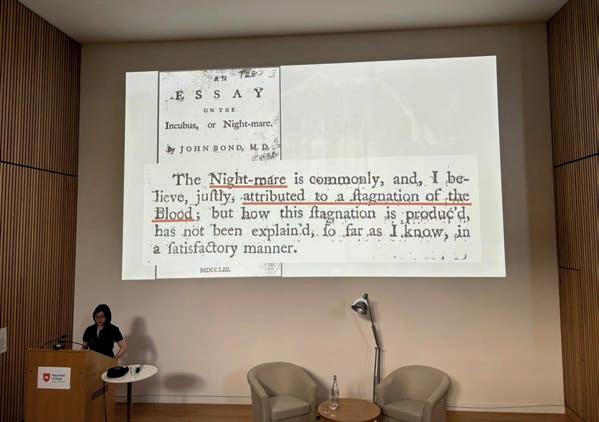
When I had the honour to present at the MCR/SCR Michael Mahony Seminar in May 2025, I asked for a show of hands to see how many people had experienced nightmares. At least three-quarters of those in the lecture theatre responded that they had. Indeed, dreams have been abundantly recorded from ancient civilisations to the present. If we were in 18thcentury Britain, doctors would explain that our nightmares were caused primarily by indigestion or the stagnation of blood. But while many novels in the Romantic period (c.1789-1830s) contain scenes of dreaming, the digestive system is hardly involved. In fact, none of the dreams in the fiction of the writers I analyse – William Godwin (a political philosopher), Mary Wollstonecraft (a founding British feminist), and their daughter Mary Shelley (the famous author of Frankenstein) – is related to the stomach.
My project asks two major questions. First, how did those authors weave dreams into their novels in relation to the dream theories they knew about? This drew me to a plethora of fascinating contemporaneous medical and philosophical treatises. Second, what were the narrative functions of dreams? To answer, I turn to narratology, which studies the structures of stories and storytelling methods. My thesis therefore fuses two strands of knowledge: intellectual history as embedded in the fictional works, and literary theory, which renders new textual interpretations. I aim to proffer alternative methods from traditional and anachronistic ways, such as Freudian analysis, to read dreams in literature.
Why, though, should we care about such dreams? Historically, the Romantic period saw an unprecedented interest in dreams. Authors and poets were enthralled by the imagination and the depths of the mind. Romantic dreams thus expressed subjectivity through metaphorical spaces and distinguished themselves ‘from the quasiliteral landscapes of 18th- or 19th-century realism’, according to Professor David Vallins from the University of Hiroshima. Narratively, as Dr Jonathan Glance (of Mercer University, Georgia) remarks, literary dreams are ‘not real dreams […] but conscious imitations of them, rooted in the cultural and historical apprehensions of their cause and content.’ Dreams in literature reflect the development of psychology in their period, the authors’ engagement with dream theories, the cultural trends of what made dreams seem realistic, and how authors (in)effectively used dreams as narrative strategies.
One rewarding aspect of my research is digging through archives to examine letters and manuscripts in search of evidence that my selected writers deliberately chose dreams as a creative medium. The Weston Library houses the Abinger Collection, which is one of the world’s most important depositories of material about the GodwinWollstonecraft-Shelley circle. There, I found two letters to Godwin from contemporaneous novelists on his second major novel, St. Leon (1799), which contains several dreams. The first missive is from Sophia Lee, who wrote, ‘I could wish you had not to a certain degree forestalled your own masterstroke by giving us Charles in a dream – I would
fain come upon him in all his military dignity without a previous idea that I might.’ The second letter is by Elizabeth Inchbald, who commented, ‘I think omitting the dream about Charles in the prison would highly encrease [sic] the pleasure of meeting him which is now anticipated.’ Lee’s and Inchbald’s remarks were confusing, because the two authoritative versions of the novel I was using do not specify Charles, the protagonist’s son, in the dream. However, the epistles led me to find the first edition of the work, in which St Leon beholds Charles in his somnial visions. Godwin partially accepted his friends’ criticism and anonymised the knightly figure to create a sense of mystery, and his revised edition became standard. Yet his retention of the dream confirms that he valued dreams as a narrative device.
My DPhil journey has taken me down many rabbit holes, and I am grateful that some of those adventures, like this ‘holograph hunt’, have turned out to be fruitful. I will continue to raise interest in the study of dreams, literature, and narrative techniques, and advocate for the value of archives in discovering possible authorial intentions. If you would like to try your hand at archival research, https://digital.bodleian.ox.ac.uk would be a dream (pun intended) place to start!
Letter from Elizabeth Inchbald to William Godwin, Dec 24, 1799. Oxford, Bodleian Libraries, MS Abinger c.5, fol.46.
Liz presenting at the MCR/SCR Michael Mahony Seminar, 29 May 2025
Between randomness and structure
Random graphs help us understand how networks form and evolve. Here Dr Adrian Fischer, Postdoctoral Researcher at the Oxford Statistics Department and Non-Stipendiary Junior Research Fellow at Mansfield, introduces his research on parameter estimation, used to fit random graph models to observed networks.
One of my current research projects, which I pursue together with my supervisor from the Department of Statistics, Professor Gesine Reinert, and Dr Wenkai Xu from the University of Warwick, is about parameter estimation for local dependency exponential random graph models.
A graph refers to a set of nodes and some of them are connected by a line (called an edge). In a random graph, the edges appear randomly. For example, imagine there are ten people at a party. For each pair of people, we flip a (not necessarily fair) coin. If it lands on heads, they become friends, and we draw a line between them. If it lands on tails, they don’t connect. When we’re done, we’ve built a random graph representing friendships. In this example, the people are the nodes, the friendships are the edges, and the randomness comes from the coin flips. This simple idea is very powerful: random graphs help us study how friendships form in social networks, how computers connect across the internet, or even how diseases spread in a population.
When we use random graphs to model real networks, we usually want the model to reflect reality, which is why the model typically depends on parameters. Referring to the previous example about forming friendships at a party, a suitable parameter here is the probability that the coin lands on heads. In this setting, parameter estimation is the determination of a parameter value such that the model behaves most like a given observed real-world friendship network. A good estimator in this case is the sample mean across all possible edges, ie the number of observed edges divided by the number of possible edges.
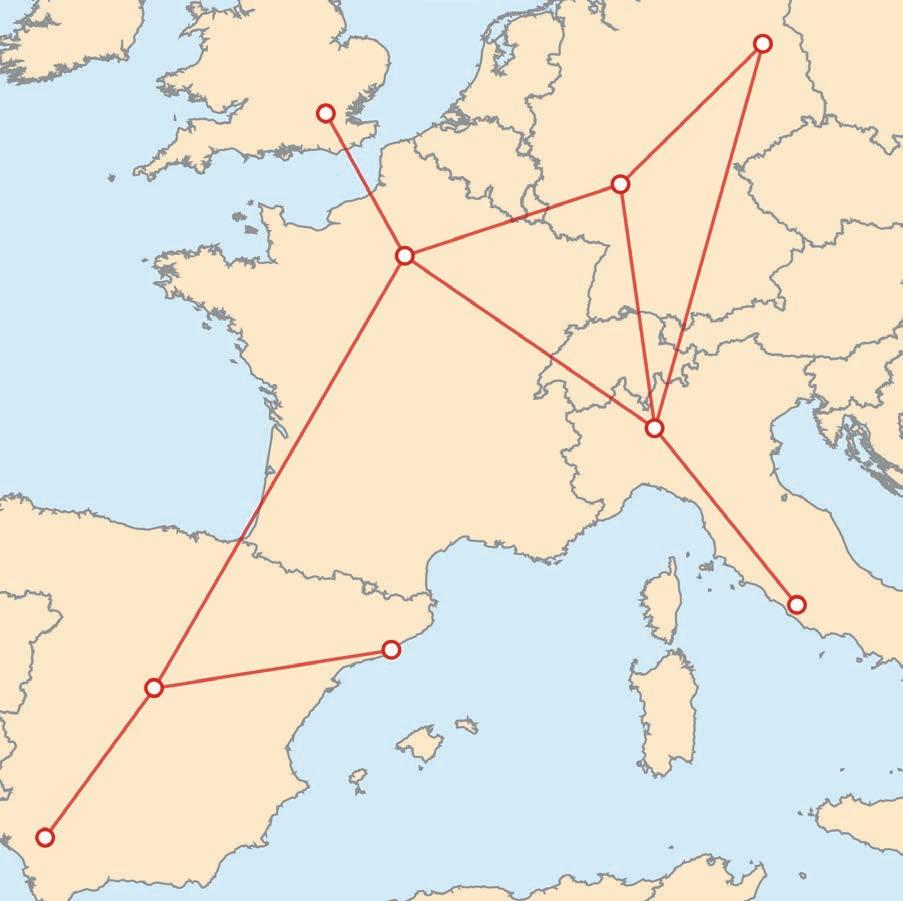
In our project, we consider a special class of random graphs – generated from so-called local dependency exponential random graph models. In these graphs, the probability of observing a certain edge structure only depends on specific statistics, such as the number of edges, two-stars or triangles. Each of these statistics is then associated with a weight that represents a parameter of the model. Moreover, we assume that the random graph can be divided into several neighbourhoods, and
Realisation of a friendship random graph (also called Bernoulli random graph) with 20 nodes and an edge probability of 30%
Random graphs help us study how friendships form in social networks, how computers connect across the internet, or even how diseases spread in a population
edges in different neighbourhoods behave independently from each other. Examples of neighbourhoods could be different countries, departments at a university or classes at a high school. Given an observed network, the objective of our project is to estimate the parameters in a local dependency exponential random graph model in a computational efficient way. For this purpose, we employ probabilistic tools from an area called Stein’s method.
Stein’s method is a powerful and elegant technique for obtaining distributional characterisations and approximations in probability theory. It was introduced in 1972 in the context of normal approximation by Charles Stein, who used the approach to give a proof of the combinatorial central limit theorem with a bound to quantify the normal approximation. At the heart of Stein’s method lie so-called Stein operators, which allow us to characterise probability distributions and are often of a simple form.
Parameter estimation in random graphs using these operators offers a notable advantage compared to
standard techniques such as the maximum likelihood method. The maximum likelihood estimator is defined as the parameter value that maximises the probability of observing the data at hand. For random graphs, however, this probability depends on a complicated normalising constant whose computation requires the summation over all possible edge structures. This can be a computationally heavy task, especially for large graphs. Conversely, parameter estimators based on Stein operators (Stein estimators) are usually independent of this normalising constant and therefore do not involve these tedious calculations. In addition, Stein estimators are often available in closed form whereas maximum likelihood estimators frequently require numerical optimisation methods. In the case of local dependency exponential random graphs models, the Stein estimator can be computed as the minimum of a strictly convex function.
In the future, we would like to extend the idea of Stein estimators to slightly more complex settings, such as random graphs without or with a more complicated local dependency assumption and distributions on manifolds.
A graph illustrating neighbourhoods: nodes located in the same country belong to the same neighbourhood
Adrian Fischer
More Mansfield.
From our beautiful and historic site in the centre of Oxford, we’ve transformed the futures of students from all backgrounds.
Now we urgently need to expand and improve our facilities so that tomorrow’s Mansfielders can enjoy a life-changing education in a world-class setting.
In essence, we need more Mansfield.
Through the Estate Transformation Project (ETP), we will secure our future while celebrating our past. We will provide world-class facilities, deliver an unmatched student experience, and bake in a new level of resilience and sustainability.
The Mansfield of tomorrow will be more spacious, so more of our students can live and study on site.
More environmentally responsible, so we can achieve net zero carbon by 2050.
And more sustainable, so we can face the future with even greater confidence.
Together, let’s bring the world More Mansfield. Forever.
Find out more www.mansfield.ox.ac.uk/place
Meet our Estate Transformation Project team
Embarking on the most ambitious transformation project in the College’s history is no mean feat. So far, it has taken a tremendous amount of work behind the scenes over a three-year period to bring the project from the initial idea through to the submission of a planning application to Oxford City Council in November 2025.
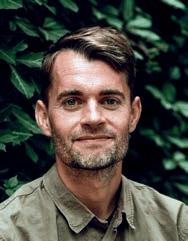
Richard Meier
Co-founder and CEO, Stories
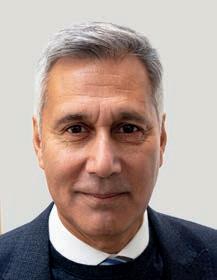
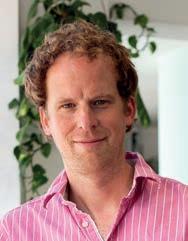
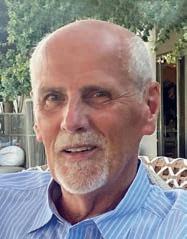
Richard is Mansfield’s ETP Sponsor at Stories (our development partner). He represents the project and advocates for it across all Mansfield’s stakeholders. Richard holds overall accountability for the ETP’s success.
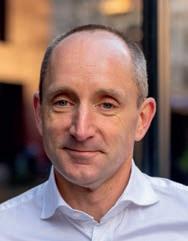
Mark Swinburne
Development Director, Stories
Mark is key to ensuring the deliverability of Mansfield’s ETP. He is responsible for the strategic direction of the project, leading us through the programme, procurement and construction logistics.
Steve Williamson Financial Consultant
Steve is Managing Director for Newmark’s Debt & Structured Finance UK & EMEA (Europe, the Middle East and Africa) Capital Markets team. He is using his extensive experience to advise us on a structured finance plan.
Led by Mansfield’s visionary Principal, Helen Mountfield KC, and diligently projectmanaged by Bursar, Clem Brohier, the Estate Transformation Project (ETP) group is made up of a stellar team of external consultants, each with extensive experience and expertise in the strategic planning, design, advising and implementation of groundbreaking projects of this scale.
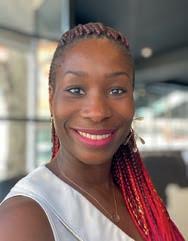
Phyllis Agbo Senior Development Manager, Stories
Phyl is the lead contact for Mansfield. Through consultation, she ensures the ETP delivers on the College’s requirements – from space provision and an enhanced experience to an asset that strengthens our financial sustainability.
Edmund Fowles Feilden Fowles Architects
Edmund is lead architect for the ETP. He has delivered prestigious projects across the UK, specialising in low-tech design that produces socially and environmentally responsible architecture rich in character.
Sean Mackenzie (History, 1998), Development Delivery Advisor
Mansfield alumnus Sean is supporting the project team on a pro bono basis, using his more than 20 years in the property industry to provide advice on financing and design development.
Introducing the Margaret Foster Building
Helen Mountfield KC Principal and Edmund Fowles Architect, Feilden Fowles
Later this decade, Mansfield will say goodbye to the John Marsh Building and welcome the Margaret Foster Building. The name has been chosen by the lead benefactor of our For Mansfield. Forever. campaign, Chris Foster (Maths, 1997) in honour of his late mother, Margaret Foster. Chris’s generosity and commitment to College has enabled us to embark on this project with confidence and ambition, and he wanted to recognise his mother’s role in his life.
The Margaret Foster Building will not only provide muchneeded modern facilities, but will also complete the architectural story of our site – linking the College’s 19thcentury origins with its 21st-century ambitions. To mark this exciting milestone, Principal Helen Mountfield sat down with architect Edmund Fowles, Director of award-winning practice Feilden Fowles, to talk about the ideas behind the design, the philosophy of low-tech architecture, and the power of inspiring spaces.
‘It’s about giving something back, ensuring future generations have the opportunities we had. All our futures are based on what has gone before. So I’ve chosen “the Margaret Foster Building” because, for me, it’s about giving a nod to the people who helped along the way, and what better symbol than a mother figure?’
Chris Foster (Maths, 1997)
Helen: Feilden Fowles won our architectural competition because the College loved your approach – with its environmental focus, pared-back beauty, and deep respect for place. Can you tell us more about your architectural philosophy and how it shaped your vision?
Edmund: I think our architectural approach is synonymous with our values, as individuals and collectively as a practice. Our driving force is how we can achieve the most positive social and ecological impact through our work. This has led to a diverse portfolio, from art galleries and museums to London’s most central urban farm, and the recent transformation of the Natural History Museum’s five-acre gardens into a series of outdoor living galleries, called the Urban Nature Project.
We describe our approach as ‘low tech’, an allencompassing philosophy, marrying both social and environmental values with the practical and physical challenges of making and renewing buildings. It’s an approach rooted in leanness, using fewer components, a preference for natural, low-embodied carbon materials, robustness, flexibility and a reduced reliance on technology – in essence, simplicity. These practical ideas combine with broader social, wellbeing and ethical ambitions, ranging from ensuring buildings have sufficient access to green space and natural daylight to the responsible sourcing and fabrication of materials, supporting and stimulating local craftsmanship. In this way it shares many of the social ambitions of the Arts & Crafts movement. We can recognise many of these virtues in Basil Champneys’ work and through his writings. He and his buildings have been an important starting point for conceiving how we shape the Margaret Foster Building.
Helen: I know you think deeply about how people experience spaces – and how important it is to create an inspiring environment in a college setting, where learning, thinking, studying, teaching, and community life all intertwine. How did that influence your design here at Mansfield?
Edmund: I think architects are often guided by personal experiences and an emotional response to a place. I was fortunate to read Architecture at Downing College,
We have carefully considered this sense of arrival and how the architectural language of the new buildings might balance warmth and generosity with formality
Cambridge, and this has certainly helped me understand the unique experience of living and studying within a collegiate setting like Mansfield. A college must fulfil the nurturing role of a home but also instil a sense of seriousness and focus. Coming from a modest state school in Essex to study in Cambridge, I still acutely remember the feeling of walking into Downing College’s Quad for the first time. It’s a feeling your students must share when they first arrive at Mansfield; the buildings convey a sense of care and dignity, and the setting encourages a feeling of calmness and concentration.
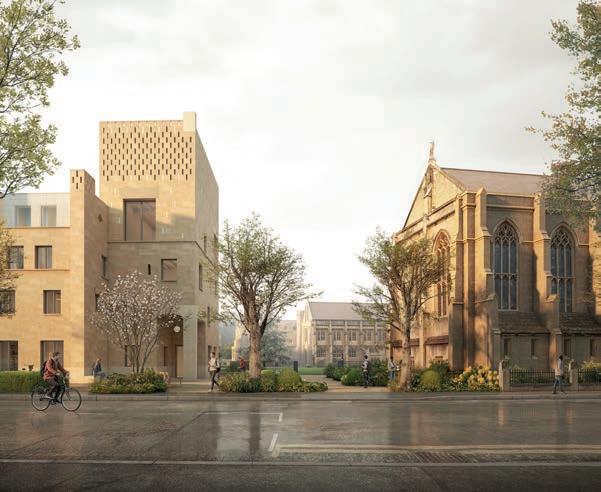
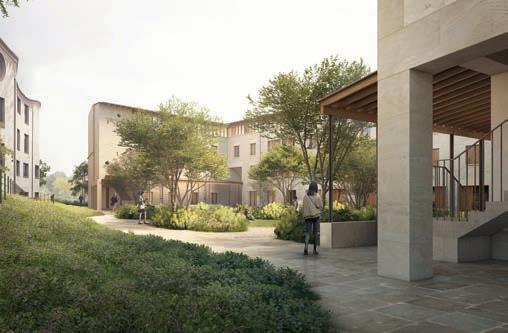
We have carefully considered this sense of arrival and how the architectural language of the new buildings might balance warmth and generosity with formality, encouraging concentration and the pursuit of focused study. A key move is the creation of a generous new welcome garden, replacing the current car park, and preserving Mansfield’s unique openness as a college, which is symbolically very important. The entrance is marked by a new tower – echoing Champneys’ own in scale and form, though set back from Mansfield Road as a further gesture of generosity, welcoming visitors into the new entrance garden.
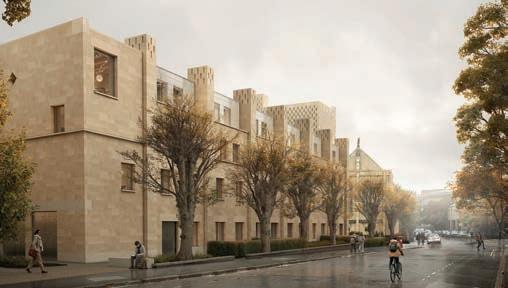
The careful arrangement of the building’s three wings defines a light and new south quad, where Staircase E currently stands. This has led to differing treatments to the elevations: externally onto Mansfield Road, a more protective, civic exterior, with an expressed rhythm of stone chimneys (for natural ventilation), but at the heart of the building a richly planted and biodiverse new south quad with covered walkways and areas to sit and socialise. This domesticfeeling quad has a more relaxed and informal language of façade, with proposals for reclaimed stone, some of which may even be taken from the John Marsh Building.
Helen: Mansfield is proud of its radical tradition of openness and diversity. Can you share your thinking on how architecture can support us to live, work, and be together as a community – and how this building helps achieve that?
Edmund: Architecture can play an important role in shaping the people and communities that dwell in it. This may be on a symbolic level by instilling a sense of collective pride or a distinct identity, down to the individual experiential scale, and how carefully designed spaces might help communities to flourish. Mansfield’s original buildings speak of the College’s radical, Nonconformist origins. Today Mansfield remains a disruptor, distinguished by its radical stance to access and widening participation, with the most diverse cohort of students in Oxford. It has an air of openness and a very welcoming and friendly environment. We believe the new buildings play an important role in reinforcing this sense of openness and in fostering a happy and supportive college environment.
For example, we have carefully considered the placement of key spaces, such as the new JCR on a prominent corner facing the southern gable of the Library and opening up onto a newly defined garden. This location is an intersection of significant routes east to west and north to south, allowing the JCR to feel at the heart of daily life and encouraging chance encounters between students living in different parts of the College. The spaces between the key functions are equally important, and great care has been given to the design of passages and walkways, thresholds and staircases: moments that all contribute to the rich daily experience of College life.
Architecture can play an important role in shaping the people and communities that dwell in it
We hope that on a civic scale the architectural language of the new Margaret Foster Building speaks of the confidence and optimism of Mansfield, as it leads the way in Oxford with social reform.
Helen: Finally, architectural design always draws on inspiration – sometimes from the past, sometimes from elsewhere. Where did you find inspiration for this project?
Edmund: Our starting point was, of course, Basil Champneys and we spent an enjoyable number of months getting to know the north range of buildings; spending time in the Crypt Café, Chapel Hall and the breathtaking Library.
We are also predominantly working with materials that Champneys used, namely stone and timber. It may sound
peculiar to describe this as progressive today, but given the nature of modern construction using an abundance of high embodied carbon materials such as concrete, and steel, we believe our method of construction is quietly radical. It’s a hybrid structure consisting of a timber frame with load-bearing limestone walls, paired with recycled stone to the south quad.
Working with stone, it has been hard not to attribute some of the design inspiration beyond the walls of Mansfield as we have looked to some of Oxford’s earliest stone structures. For example, from the Saxon Tower of St Michael’s to the distinctive rhythm of chimneys along Brasenose Lane, among many others.
Besides his built work we’re very fortunate that Champneys was also an avid writer and committed much of his thinking to the journals of his time. He even wrote an essay, ‘The Study and Planning of Collegiate Buildings’ in The British Architect (April 1900) where he advocates for the primary functions to be prominently scaled and legible. This approach is clear to see at Mansfield, as the Tower, Hall, Library and Chapel are all very clearly discernible as characters within an ensemble. This is an attitude we have tried to emulate, though in our case we have many more bedrooms to house: 174 in total!
In another essay, ‘Some Principles and Methods of Design’ in The British Architect (March 1891), Champneys goes on to set out his key tenets of design:
‘Make art your aim from the first
Keep clear of fixed ideas
Take your time
Quality before quantity’
He later goes on to add…
’…don’t be too clever!’
We’ve taken these on board and though we’re not trying to mimic Champneys’ Victorian Gothic Revival style, we have attempted to approach the design in his spirit – an honesty to material use, a delight in the craft of making, and of course achieving the highest quality.
More Mansfield. Forever.
Tess McCormick Development Director Cornerstone philanthropy to the Estate Transformation Project.
The Estate Transformation Project (ETP), or More Mansfield. Forever., is the most ambitious redevelopment in the College’s 140-year history – a bold reimagining of our Mansfield Road site to meet the needs of the whole academic community. The result will be sustainable, accessible, and inspiring, with new buildings and spaces, ensuring generations of students can live, learn and thrive here.
At the heart of this transformation will be a new landmark, the Margaret Foster Building, named after the late mother of alumnus and lead benefactor Chris Foster (Maths, 1997). Alongside Chris’s extraordinary support, other visionary alumni – Jan Fischer (PPE, 1989), and Sir Paul Ruddock (Jurisprudence, 1977) – are uniting behind this project to shape the future of Mansfield.
A college built on culture and aspiration
Reflecting on what inspired his support, Chris Foster observes: ‘Mansfield gave me two things: confidence and aspiration. […] Its warm, nurturing atmosphere builds confidence, and being around people with great ideas raises your own aspirations – like pulling the control rods out of a reactor.’
That sense of energy, he continues, is grounded in Mansfield’s enduring culture. ‘Culture is behaviour and choices over time. When you put young people in the right environment, they thrive, regardless of background. That’s what makes Mansfield great.’
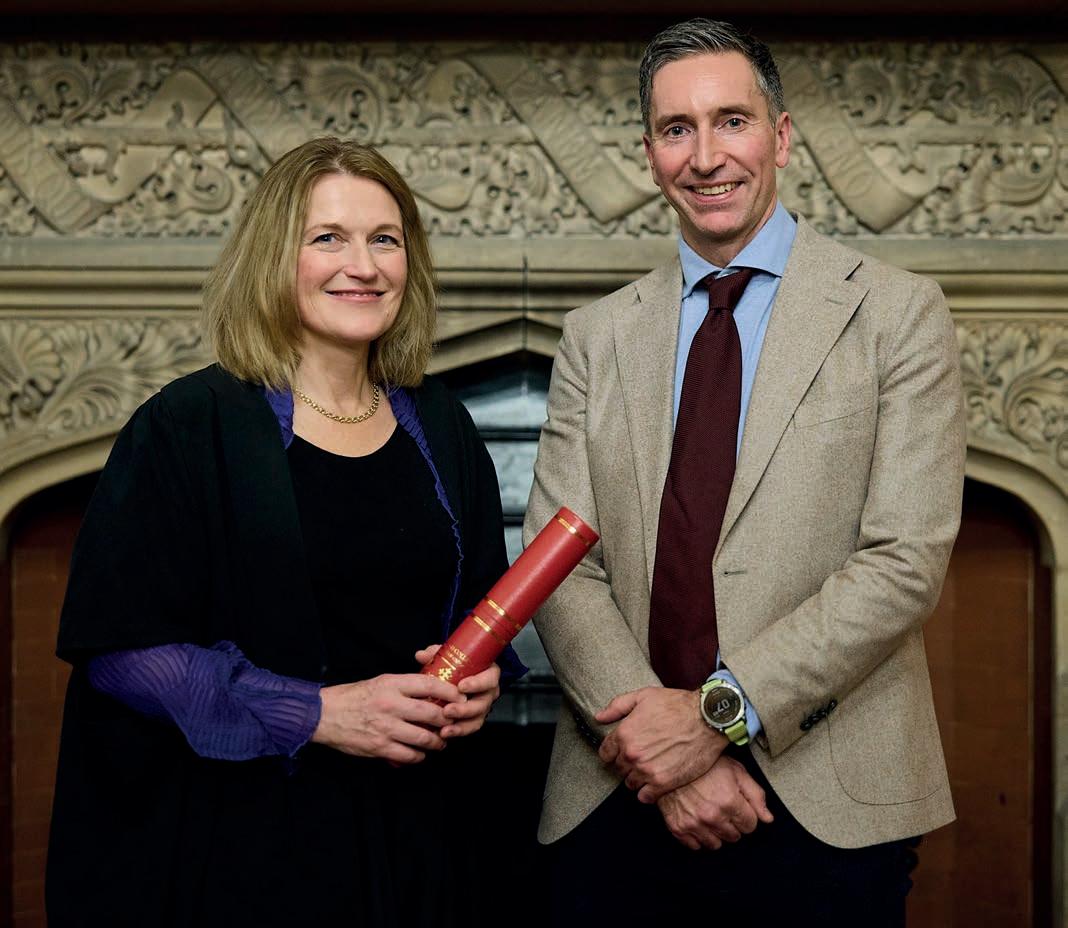
Helen Mountfield and Chris Foster
If you reach a point where you can give to an idea you believe in, you have a responsibility to do that
For Chris, who arrived at the College in the 1990s, Mansfield’s commitment to widening access to Oxford was already evident. ‘Back then, you were 13 times more likely to get into Oxford from a private school than from a state school. Somebody had to act, and Mansfield did.’
The College’s pioneering access work has since become central to our identity and underpins the importance of our campaign goal to secure Mansfield’s future.
‘The project clearly improves the College’s finances,’ Chris explains, ‘but the main thing is social cohesion. We live in a
time of disconnection, where algorithms reinforce division. The vaccine is face-to-face interaction – bringing young people together to see each other’s viewpoints. That’s the transformational aspect of this project.’
Honouring the people who shape us
For Chris, the naming of the new building has particular poignance. ‘I’ve chosen to name it the Margaret Foster Building,’ he says. ‘For me, it’s about giving a nod to the people who helped along the way, and what better symbol than a mother figure?’
Chris also sees his philanthropy to Mansfield as a tribute to the generations of students, tutors, and supporters who have made the College what it is today. ‘Jonas Salk, one of my heroes, once said his aim in life was to be a good ancestor. That’s what For Mansfield. Forever. is about: giving something back and ensuring future generations can thrive.’
Jan Fischer with the Kofi Annan Scholars
Sir Paul Ruddock
Jan Fischer
Collective action, increased impact
While Chris’s donation is the cornerstone of the campaign, he believes the success of For Mansfield. Forever. is dependent on the involvement of the whole Mansfield community.
‘What matters most is that everyone supports the campaign,’ he says. ‘That’s far more powerful than one person giving a large amount. When many people come together to say, “this is important”, others notice. It’s not just about today’s transformation – it sends a message to the future, creating a virtuous circle across generations.’ Chris’s conviction is shared by fellow alumni whose generosity is writing the next chapter of Mansfield’s story.
Jan Fischer came to Mansfield as a visiting student from Germany in the 1980s, and credits Mansfield with having a significant impact on his life. He comments: ‘Up until then I was a student in Munich, and I had not really left Germany before. Arriving at Mansfield I met so many different people from other countries, bringing their fresh perspectives and thoughts – it left a huge impression on me. I was welcomed and people came up to me and talked to me, and it soon felt a little bit like my family away from home.’
Jan has been a supporter of Mansfield for several years, funding – among other things – our Kofi Annan Scholarships and providing financial support for student experience, be that academic support or for wellbeing and community purposes. So, what made him want to make a generous gift to the ETP?
‘I had a distinct feeling a couple of years ago that this is now becoming a story – the success story of Mansfield –and I wanted to be a part of it, as I think this transformation project will have a big impact for the academic community and future talented students at Mansfield.
‘I would like to invite every alum to support this project and be part of the success story. I think what is important is the idea of a supporting network, a network that is growing and supporting the College into the future.’
Sir Paul Ruddock is one of Mansfield College’s very first Bancroft Fellows, our highest honour for philanthropy, and again has led the way in being the very first alumnus to make a cornerstone commitment in support of the ETP. Sir Paul explains, ‘I chose to give early support to the College’s Estate Transformation Project as I could see this is a bold vision and an ambitious endeavour: clearly a way Mansfield could improve its financial position in the very long-term – and its standing within the University – as well as the student experience. I also wanted to encourage other alumni to step up, at what is a pivotal moment for the College.’
Be a part of the change
As the College prepares to celebrate its 140th anniversary, the For Mansfield. Forever. campaign represents both continuity and renewal – a way to honour and sustain Mansfield’s founding mission of inclusion while equipping the College for the next century. The ETP is not just about bricks and mortar, it’s about creating an optimal environment for academic excellence, for fellowship, and for shared purpose. Every gift is a pledge of support for that goal.
As Chris Foster maintains, ‘No idea is better than the action taken upon it. If you reach a point where you can give to an idea you believe in, you have a responsibility to do that.’
With the Margaret Foster Building at its heart, this ambitious estate transformation will stand as a testament to the College community’s collective belief in Mansfield, and to the enduring spirit of a community determined to be, in Chris’s words, ‘good ancestors’.
Chris Foster
An exciting new chapter for the Library
The Library has long been the quiet heart of Mansfield – somewhere to read, to think and to belong. Now we’re shaping its next chapter as part of our Estate Transformation Project. We’re adding to what’s already there: more accessible space for everyone, with added comfort, the same cosy study feel, and improved sustainability. Still Mansfield. Only more so.
After writing this academic year’s Library update for the College Record, reflecting on an exceptionally busy and productive 2024/25 for the team, it feels especially timely now to look ahead and consider the many exciting opportunities presented by the new building project. This development will reimagine and enhance the Library’s facilities, while also significantly expanding capacity to meet the needs of the growing number of students living on-site and seeking dedicated study spaces. Importantly, we have a unique chance to be closely involved, ensuring our professional expertise helps shape the designs.
Current plans include the creation of modern, flexible study areas, a greatly improved environment with full step-free access for the first time, purpose-built storage for our increasingly prominent archive collection, and a dedicated
enquiry desk for closer contact with Library users. These changes will bring Mansfield Library firmly into the modern era, while safeguarding the historic character and atmosphere that our community treasures.
Regular Library users will be all too familiar with the idiosyncrasies of the heating and lighting, particularly in the Main Library. This year, we introduced blankets and small heaters to keep students comfortable during colder months, something that was greatly appreciated. Looking ahead, the renovation of the North Range will deliver more permanent and sustainable solutions, with secondary double glazing, a modern heating system, and new lighting. This part of the project will be carefully scheduled when the libraries are at their quietest, to minimise disruption. We hope to avoid a full decant of the Main Library, requiring only the removal of books from shelves near the windows. We are determined to ensure that these upgrades will not only transform the study environment for users but also significantly improve the sustainability of our much-loved 19th-century building.
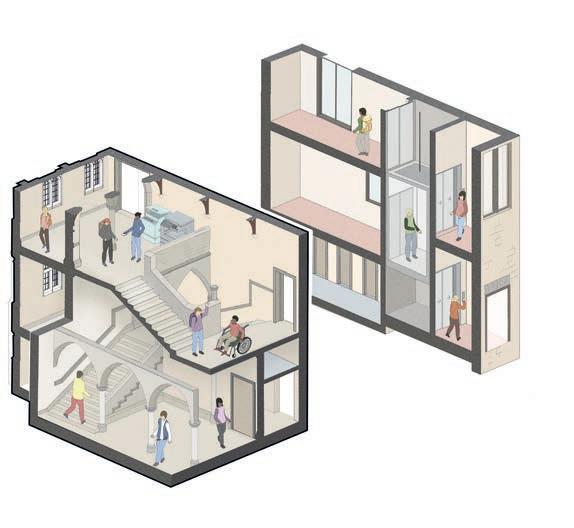
Like many historic structures, our spaces weren’t built with disabled access in mind. We plan to change this by installing a new lift at the back of the North Range. The prospect of accessible facilities is hugely exciting and will place Mansfield at the forefront of accessibility across Oxford’s college libraries. The construction may also incorporate expanded library office space, giving staff more room to manage materials and the increasingly varied activities and projects we undertake, as well as potentially accommodating future growth in library and archive staffing.
The ground floor of the North Range will also see significant improvements. Perhaps the most interesting development is the transformation of the current MCR into a bright, modern library space – after an MCR is opened in the new building. Plans include a mezzanine with individual study
Clare Kavanagh Librarian
Imagined North Range extension with lift access, by Feilden Fowles
on existing bay windows by Feilden
Oak framed secondary glazing is proposed to match use of oak throughout the Library. A uniform profile is applied to the mullions and transoms, referencing the design of the stone bay.
The existing seat and desk would be retained and positioned against the new proposal
A bespoke oak timber radiator enclosure is designed to integrate with the secondary glazing, also in oak
seating, collaborative group areas below, and a dedicated enquiry desk for in-person support. We’ll bring the study skills, wellbeing, and contemporary fiction collections here, freeing space in the Main Library to expand our academic collection. The new wellbeing area – with jigsaws, colouring materials, origami, and board games – will add to the welcoming environment, and the additional space may allow the smaller reading rooms to be booked for group study.
We’re also exploring the idea of purpose-built archival storage. Currently, the College archive is kept in cupboards in the Main Library, where space is limited and environmental conditions are difficult to control. A
dedicated facility would protect these materials in the right conditions and make them more accessible to researchers and visitors.
My postgraduate studies in Archival Management are designed to support this work, with the aim of making Mansfield’s archive more visible and widely used by both internal and external researchers. Of particular importance is the collection from the Mansfield House University Settlement, founded in 1889 in partnership with Mansfield students, which sought to expand educational opportunities in Canning Town - an endeavour that continues to reflect the College’s enduring commitment to outreach and accessibility today.
We have no doubt that this project represents an extraordinary opportunity for us and our libraries, ensuring they are fit for the future while remaining true to their heritage. These are inspiring times for the College community, and we are eager to play our part in shaping what comes next.
The proposed axonometric illustrates the relationship between the existing bay
Proposed illustration of secondary glazing
Fowles
Re-imagined Library landing with lift access, by Feilden Fowles
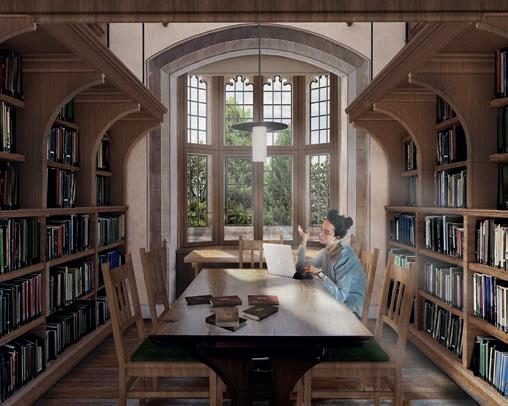
Illustration of the Library alcoves, by Feilden Fowles
Greening the greenery
‘Sustainability’. ‘Net zero’. ‘Carbon footprint’. These buzzwords are everywhere, including at Oxford colleges. But what is Mansfield doing to meet environmental goals, and how will the Estate Transformation Project (ETP) advance or hinder the process? Sophie Williams (Geography, 2023) digs into the plans for Mansfield’s gardens.
As JCR Environment & Ethics Officer, I was eager to examine the College’s strategy for achieving sustainability. Two terms into my role, I am proud to say that through the combined efforts of students and staff, Mansfield has won gold in the Green Impact Awards from the University of Oxford’s Green Impact programme, in recognition of the great sustainability work taking place across College. Green Impact is a United Nations awardwinning programme that provides a toolkit of effective actions for staff and students to take for improving sustainability at their college. But looking ahead to the ETP, specifically the gardens and landscaping, how is Mansfield going to build on this progress?
That’s where Tom Stuart-Smith Studio comes in. This landscape design practice, winner of multiple awards at the Chelsea Flower Show, has been appointed to oversee work on our landscape. The Studio’s vision for Mansfield is focused on three areas: Community, Accessibility, and Sustainability.
Community
Mansfield prides itself on being a welcoming, close-knit community and the new gardens are designed to reflect this; they will be a place specifically for students. Through these spaces, Tom Stuart-Smith Studio hopes the gardens will create even stronger bonds within the student body.
James Trevers, Associate at the Studio, explains that the new south quad will feature small spaces for students to relax or hold group discussions, with trees planted along the perimeter to provide privacy for ground-floor rooms. The Studio is also excited about Mansfield’s plans to replace the entrance car park with a greener, more inviting entryway for students, staff, and visitors.
Accessibility
Accessibility is about more than meeting regulations, it’s about creating spaces that foster inclusion, and that is precisely the Studio’s focus. It plans to integrate accessible routes into the main design rather than keeping them apart. For example, instead of having a ramp separate from the stairs leading to the Hands Building, there will be one unified route. The team is also considering other forms of accessibility, such as how colour and material choices may affect neurodivergent people. This approach highlights accessibility as a matter of thoughtful design, not just compliance.
Sustainability
When I first heard about the ETP, I was worried: large construction projects often mean high carbon emissions, waste, and biodiversity loss. However, the plans show that the team is committed to creating a sustainable space.
Mansfield prides itself on being a welcoming, close-knit community and the new gardens are designed to reflect this
A major focus is on reusing materials when possible. Demolition waste (concrete, stone, toilets, sinks, and more) will be crushed and reused as planting material, which not only recycles waste but also encourages deeper rooting, making plantings more drought-tolerant. This innovative method is still rare worldwide, and it will be exciting to see Mansfield adopting this new practice.
The Studio is also thinking into the future. It will be planting drought-resistant vegetation suited to a Mediterranean climate, following the UK’s predicted weather patterns in coming years. These drought-resistant plants will complement herbaceous vegetation with long flowering seasons, so both pollinators and people can enjoy a flowering garden for as long as possible. Don’t worry about losing your favourite flowers, however, as these innovative planting strategies will be combined with native plants too. Over the last three years the project has been shaped through a collaborative, consultative process across the
College, with regular input from Mansfield’s gardener, Tom Edgar. Tom is thrilled that the College is pushing the envelope in its approach to biodiversity. He explains that by anticipating how climate change will reshape the gardens, the new plans will ensure beautiful and resilient grounds for years to come.
Tom Stuart-Smith Studio, alongside architect Feilden Fowles, are merging Mansfield’s historic architecture with a forward-thinking design. The result will be a sustainable and inclusive space that reflects Mansfield’s values, now and into the future.
‘The landscape proposals seek to transform the College grounds into a welcoming space that supports student life. Using materials reclaimed from the demolition of the John Marsh Building, we plan to make recycled paving stones. Other waste materials will be crushed to make a gravel mulch for planting, a technique we have used elsewhere. Within this planting, species have been selected for their ability to thrive in a changing climate. Proposed trees such as a Kentucky Yellowwood (Cladrastis kentukea), Golden Rain trees (Koelreuteria paniculata) and Amur Maakias (Maackia amurensis) are lesser known, but capable of surviving a warming climate over the coming decades. Through our collaboration with architect Feilden Fowles, we will have a rainwater system that collects water from the roof of the new building to irrigate the gardens. With these new approaches, we hope to celebrate the College’s Nonconformist heritage and unify the historic buildings and the new south range.’ James Trevers (Associate at Tom Stuart-Smith Studio)
Sophie Williams
Alumni at the heart of Mansfield’s transformation
With more than 20 years of expertise in the property industry, Sean Mackenzie (History, 1998) has been appointed as a pro bono advisor on Mansfield’s Estate Transformation Project.
Around two years ago I was contacted by the Mansfield Development team, who learned that I had pursued a career in commercial property, as they were pulling together ideas for the as-yet-undisclosed Estate Transformation Project (ETP), which was to be of significant ambition and scale.
I spent three happy years studying Modern History at Mansfield and then, maybe not uncommonly among arts graduates, found the choice of potential careers somewhat bewildering. While my A-level choices had closed down an architecture degree (but the opportunity to live and study in Oxford more than outweighed the absence of this faculty in 1998), I then resolved to train as an architect in my early 20s. Facing the prospect of seven years more study, I was fortuitously offered a job (following endless speculative letters) by an architect who also ran a construction and property development business in London. This offered me an excellent window into the industry, and the chance to learn at close quarters from a successful entrepreneur.
Realising that the rigour of the design process can be a shared endeavour between both the client team and design professionals, I learned that the conceptualising and financing of projects are just as central to creating successful buildings as the architects’ drawings and engineers’ calculations. In 2007 I set up my own investment business with a fellow historian from Exeter University. Rolling forward 18 years, we have now developed and invested in over £350 million of UK commercial real estate and in doing so, delivered many buildings that we’re proud of alongside making good returns for our investors.
It has been a real privilege for me to return to Mansfield after 20 years to work with Helen, Clem, Tess and the Governing Body as a pro bono adviser, bringing industry experience to help make the ETP happen. It’s a very rare opportunity for any Oxbridge college (given that so many are principally listed buildings) to be able to remodel such a large part of an existing estate. And to have secured – through intelligent and careful consultation – such widespread support to actually deliver on this concept, demonstrates ambition and leadership of greater significance still.
The ETP will double the volume of accommodation that exists in the current arrangements of the John Marsh Building – much-loved but spatially very inefficient –and the remaining buildings that sit to the south. Once completed, the project will deliver transformational change in three key areas: first, an enhanced student experience; second, leading new teaching facilities; and third, dramatically improved out-of-term revenue generation. Looking at the project from an investment perspective, I think the final point will deliver real hidden value, because while, first-and-foremost, Mansfield will always be an educational institution, the College should from 2029 also own Oxford’s finest new city centre conferencing facilities – which will create strong and enduring additional income for decades to come.
The Margaret Foster Building certainly has a tough act to follow given the fond memories that so many of us hold of the John Marsh Building, but as many more students will be able to access a Mansfield education as a result of this transformational project, our shared tradition of lifelong memories made while living on the Mansfield site looks set to grow further into the future.
The story of the John Marsh Building
Simon Giddings (Physics, 1989), Mansfield Lives Project Lead, with contributions from the Mansfield Physical Archive and the Mansfield Lives Archive
A significant addition to the College
The elegant 1960s stone building running along the south side of the Quad has been a home away from home to perhaps a thousand Mansfield students over the last 60 years or more.
Before 1962
Of course, the John Marsh Building was not always there. The following image shows the existing College buildings viewed across the Quad from where the John Marsh Building would be constructed 10 years later.
Geoffrey
Going back even further, the following shows the south side of the Quad and the entrance from Mansfield Road. Pat Perks (née Gosling) was brought up by her grandparents at Mansfield during the 1930s and ’40s. Her grandfather, William Buckingham, was then the College senior servant and they lived in the Porter’s Lodge. The photo also shows tennis courts where the John Marsh Building would stand.
Mansfield Physical Archive c1962. Looking across the Quad from the north to the new building, with the doorway of the Porter’s Lodge facing on the far left
Mansfield Lives Archive. The John Marsh Building along the south side of the Quad looking towards Mansfield Road entrance. Courtesy of
Roper (Theology, 1962)
Mansfield Physical Archive: c1952
Mansfield Lives Archive: c1930s
Mansfield Lives Archive. The John Marsh Building along the south side of the Quad. Courtesy of Geoffrey Roper (Theology, 1962)
Official opening
The building was officially opened on 25 June 1962 by Queen Elizabeth, The Queen Mother. It was then colloquially known as the Rayson Building (after the architect, Thomas Rayson, who designed it) and did not become the ‘John Marsh’ until renamed in 1993.
Mansfield Physical Archive. Opening ceremony of the building with The Queen Mother and Principal John Marsh, 25 June 1962
Mansfield Physical Archive. Opening ceremony of the building, 25 June 1962
A home away from home: memories of the John Marsh Building
In Staircases A and D, you can get into the lofts through the cupboards in student bedrooms. Back then the cupboards weren’t locked, so students used to stash things up there. Sometimes you’d find little notes, like “all those who enter shall…” sort of thing. But once, the legs of the JCR ping-pong table disappeared. Nobody knew where they’d gone. Then, two years later, I found them hidden up in one of those lofts. Perhaps it was just a ploy to get a new table
Tony Berezny (Maintenance Manager, 1986-present)
I had accommodation on Staircase A. I remember sitting propped up in the window alcove looking out over the Quad where, in the summer, croquet was always popular. I also remember the cold of winter and ice forming on the inside of the windows at night. I remember the early morning ritual of gathering outside in the dark to run down to the Boathouse with my fellow novice rowers, and train on the Isis before dawn. I remember Lucy in the room opposite who always had a smile, and visiting Alex on Staircase B, who always had tea, biscuits and cake. Wonderful memories from a wonderful time in my life
Simon Giddings (Physics, 1989)
When I arrived at Mansfield from the US in October 1962, I had just completed a BA at Drew University and an exchange stint at Howard Univ. There to welcome me as one of the first people to occupy the “new block” was Derek Kingston, who kindly showed this newcomer to Oxford, and to England, around the College. I marvelled at having a sink in the space, though I was a bit concerned. I asked Derek, “So, who am I sharing with?”, accustomed to having a roommate in a space smaller than the front room of the room in Staircase D. In the intervening 63 years of our friendship (he was best man at our wedding in Mansfield Chapel in 1965) I have never seen Derek more incredulous, or struggling so much to answer seriously, “No one!” Thus began a life-long and life-changing relationship with Mansfield and Oxford
Don Rudalevige (Theology, 1962)
The Chaplain’s office was in 6-8 Mansfield Road when I was Chaplain there. My main memories of the John Marsh Building are the wonderful opportunities to have chats with Tess or Lucinda (when she was Senior Tutor) or any other staff through the windows! It was wonderful to walk across the Quad with one’s mind on never-ending to-do lists, only to be given a moment of joy through a serendipitous conversation through someone’s office window
Sarah Farrow (Mansfield College Chaplain, 2020-23)
The biggest wasp nest I’ve ever seen was up in the roof apex of the John Marsh. It was about the size of a small rowing boat – eight feet long, three feet wide, and 18 inches deep. You couldn’t shine a torch on it, because the moment you turned the light on, the wasps swarmed towards you. So, you had to flick the torch on, get your bearings, then flick it off and spray. The students on the top floor alerted us to the nest, because they said it sounded like the walls were humming
Tony Berezny (Maintenance Manager, 1986-present)
To the future
As the College enters an exciting new phase of renewal, the John Marsh Building will soon make way for the Margaret Foster Building (see p24). Since Mansfield’s founding in 1886, the south side of the Quad has been in quiet conversation with each new generation – evolving from tennis courts and a Porter’s Lodge that once housed a family in the 1930s, to the graceful residences that became home to hundreds of students over the past 60 years, and now to a new space created for learning, living, and connection. As we say goodbye to a building that has meant so much to so many, we carry its memories forward into the spaces and stories still to come.
Left: Mansfield Physical Archive. Interior of a student’s room in the new building, c1962. Centre: Mansfield Lives Archive. Room B10, John Marsh Building. Courtesy of Roger Finbow (Jurisprudence, 1971). Right: Mansfield Physical Archive. Geography tutorials with Dr Tony Lemon in his office inside the John Marsh Building, c1988
We are the torchbearers for fair access to a world-class education. And what does it mean to bear that torch? It is not just our responsibility to uphold the ideal, to keep the tradition alive, but to light the way. To lead, and to insist on progress.
The torchbearer does not walk behind the pack.
Our job is to keep leading the way – to push harder, to look further, and to take the risks necessary to break new ground, so that others can see the way forward too.
We will build new bridges, open new doors, and lay new roads. We will look where others haven’t, to uncover the next generation of brilliant young people.
And once they have joined us, and experienced everything that an education at Oxford can provide, they will light their own torches, and lead on.
Mansfield’s light will shine all the brighter.
The Mansfield-Ruddock Art Prize 2025
Now in its sixth year, the Mansfield-Ruddock Art Prize has quickly established itself as a distinctive platform for emerging talent from the Ruskin School of Art. The Prize is generously supported by Sir Paul (Jurisprudence, 1977) and Lady Ruddock, and the Ruddock Foundation for the Arts, whose vision has enabled Mansfield not only to champion creativity at Oxford but also to build a collection of contemporary art for the benefit of its students and the whole academic community.
This year’s Prize was judged by an eminent panel – design historian and curator Emily King (Chair), Turner Prizenominated artist Glenn Brown, and Professor Alixe Bovey, Dean and Deputy Director of the Courtauld Institute –who praised the submissions for their inventiveness and intellectual rigour.
New works from the Ruskin’s graduate (MFA) and undergraduate (BFA) degree shows were assessed. The MFA Prize was awarded to Joel Nichols, a Birmingham-born, Winnipeg-based artist whose interdisciplinary practice spans painting, ceramics, and printmaking. Nichols’ winning portrait reflects their sustained exploration of intimacy, vulnerability, and representation, deeply informed by their biracial Jamaican heritage and queer identity. Emphasising shared authorship between artist and sitter, Nichols’ work resists fixed meanings, instead offering vulnerability as a site of connection and mutual recognition.
The BFA Prize went to Azezia Edwards, whose degree show at the Ruskin was praised for its experimental use of media and acute sense of place. Edwards’ work situates personal memory within larger cultural and environmental narratives, reflecting an artistic voice that is at once formally adventurous and emotionally grounded.
A Highly Commended BFA Award was presented to Jarad Jackson, whose multi-disciplinary practice integrates sculpture, performance, and choreography. Jackson is a graduate of both the Royal Ballet School and the Ruskin. Recent works – including a reinterpretation of Anna Pavlova’s iconic ‘Dying Swan’ – examine the interplay between materials, movement, and environment. His use of scrap wood, steel, and live performance gestures towards the fragile-but-enduring links between body, object, and stage.
Mansfield is deeply grateful to Sir Paul and Lady Ruddock, and the Ruddock Foundation for the Arts, whose generosity ensures the Prize continues to inspire new generations of artists while enabling the College to – for the first time –develop its own collection.
Tess McCormick Development Director
Azezia Edwards
Jarad Jackson
Figure for landscape, 2025, Jarad Jackson
I painted, knowing I would fall short, 2025, Joel Nichols
Sir Paul Ruddock
Just imagine: the arts at Mansfield
With the active support of College, Mansfield students are encouraged to pursue passions beyond tutorials and essays and allow their creativity to flourish. The impressive results span the artistic spectrum – from staging plays to sketching portraits, and from reciting poetry to musical performance.
Drawing from life
Words at work
Poetry continues to thrive at Mansfield, with workshops and readings that bring writers and listeners together. These sessions give poets room to test new work, exchange feedback, and celebrate each other’s voices. Flavius Covaci (English, 2022), Poetry Society President, reports:
‘The College has enjoyed a year full of poetry and literature – from another delightful Mansfieldmas celebration in Michaelmas and a Valentine’s writing workshop in Hilary to various readings throughout the year and the launch of the Poetry Society’s anthology in the Principal’s Garden this Trinity. These encounters with verse led our students to start a JCR magazine titled Left-Field, which will continue to platform and champion Mansfield’s creativity in the coming year.’
In 2024/25, new weekly life drawing classes were introduced, offering students the chance to explore creativity in a relaxed and supportive setting. Led by drawing instructor Joseph Capel, who trained at the Royal Drawing School, the sessions focus on close observation and mutual respect. As Joseph explains:
‘Drawing is, at its core, concentrated observation and I believe it is an essential skill to so many disciplines. The life drawing classes are an opportunity to explore the process of observing and building a layered drawing, enhancing skills week after week. Beginner to advanced students and staff are very welcome and all resources are provided.’
Eleanor Hutson Alumni Relations Officer
Above left: Sketch by Alex Roden (DPhil History, 2022)
Above: Sketch by Alec Xu (DPhil Engineering Science, 2022)
Left: Sketch by Simon Hardy (MPhil Economics, 2025)
The weekly poetry group session, ‘Stop the Clock Sundays’
A new melody
You might catch the sound of piano melodies drifting down the corridors as you walk through Mansfield, or hear the Choir singing in Chapel on a Wednesday evening. Music is a constant presence in College life, and this year the tradition has been enhanced by an exciting new professional concert series: Music at Mansfield.
With the vision of our Music Director, James Brown, and thanks to donations from an anonymous individual, along with kind support from alumnus Jan Fischer (PPE, 1989), this new termly concert series brings world-class performances to Mansfield.
The inaugural concert, ‘The French Flute’, was performed by flautist Simon Kelly, presenting a programme of French music, while the second, ‘Shakespeare in Song’, featured soprano and harpist Eloise Irving, who was joined in one piece by voices from the College Choir.
These concerts are offered free of charge, forming part of Mansfield’s artistic contribution to the wider city and community. We look forward to welcoming more musicians in the coming terms and seeing the series continue to grow.
Drama in the Garden
In May 2025, the Mansfield Players brought Shakespeare to life with a three-day run of As You Like It, staged in the Principal’s Garden. The summer tale of lovers lost in the forest was given a fresh twist with a folk-inspired aesthetic and a live band playing traditional tunes. The production was a great success, with almost every show selling out. Mansfield Players’ President, Marianne Nossair (History, 2022), reflects on the experience:
‘I enjoyed producing Mansfield’s first garden play, As You Like It, working alongside a talented team of several Mansfielders and other Oxford students. My role as producer involved handling costs and budgets. We made a sizeable profit, ensuring that Mansfield Players retains a healthy budget for future artistic endeavours.’
Simon Kelly
Eloise Irving
Diamond blades: celebrating 60 years of Mansfield College Boat Club
Mansfield College Boat Club (MCBC) has spent 60 years showing that rowing at Oxford is for everyone, not just the tall or experienced. What began with borrowed boats is now a thriving community built on teamwork, talent, and friendship. As it celebrates its diamond anniversary, the club looks forward with excitement.
When I first came to Oxford, I saw rowing as a sport that belonged to other people: people who knew what ‘The Boat Race’ was, understood what a coxswain does, and were at least six feet tall. MCBC changed that perception, shaping my student life for the better.
As our College has Oxford’s highest proportion of statesector UK undergraduate admissions, many incoming Mansfield students start in the same boat I did (or perhaps more aptly, in no boat at all). Yet, with its ethos of inclusivity and determination, MCBC nurtures talent, community and success, from whatever source. To celebrate its diamond anniversary, I had the pleasure of diving into the archives, discovering stories, from freezing mornings to fantastic blades campaigns. Although decades separate the earliest memories from the most recent, kindred feelings flow down the 60 years.
‘I was JCR President the year Mansfield founded its boat club. We had a few talented rowers and a real enthusiasm to get the club off the ground, but no boat and little money. We put together what we could and approached other colleges to see if they would sell us an old boat. Not only was the boat club a great success in its own right but I am sure it was in those early days a major factor in raising the profile of the College within the University.’ Robert Smith (Chemistry, 1963)
Standing on the shoulders of the giants who – regardless of whether they were six feet tall – built up the club, Mansfield crews have won 30 sets of blades across Torpids and Summer VIIIs bumps competitions, with the most recent set obtained in 2023 by the Torpids W1, a crew and coach comprised of women who learned to row at Mansfield.
‘My happiest memories are truly from the other side, when I returned to the club in 2022/23 to coach the women’s team and got to witness that magic of buying into the team unfold.’ Martha Birtles (English, 2018)
This ‘magic’ connects generations of Mansfield students, extending beyond Oxford’s spires, conjuring up treasured memories and influencing onward journeys.
‘I rowed with 41 other Mansfieldians in Torpids and VIIIs. I warmly remember them all (with the aid of ten mounted and illuminated photographs).’ Tim Wilks (Modern History, 1976)
Torpids, 1966. Courtesy of Rob Porrer (French & German, 1963)
A painted Donnington Bridge. Courtesy of Margaret Collins (VSP: English, 1995)
‘Rowing at Mansfield quite literally changed my life [...]. I would not have competed for Wales or become a Director of British Rowing, I owe a lot to MCBC.’ Chris Jenkins OBE (PPE, 1977)
‘The boat was [made up of] all visiting Americans from Holy Cross and Boston College at Mansfield, nicknamed “the Mayflower” […]. That group continues to be in touch to this day.’ Tom Joyce (VSP: Politics, 1991)
‘I am truly grateful to the College for taking on novice rowers and providing a supportive environment […]. My time as an active rower at MCBC gave me a lifelong appreciation of the sport which has made me a better person in every way.’ Yang-Wahn Hew (Modern History, 1997)
Launching the next 60 years of success with continued support from Antonio Bonchristiano (PPE, 1984), a new W2 shell, Jen, funded by Anthony Dewell (Maths & Stats, 2002),
and a three-day training camp at Cambridge University Boathouse, subsidised by Chris Foster (Maths, 1997), MCBC continues to strengthen both its community and competitiveness. A new landmark pledge over the coming three years, from Chris, has also enabled the appointment of an experienced head-coach who joined the club in Michaelmas term 2025. Chris’s gift is also supporting a hardship fund so that all students can take part; and annual training camps. Thank you Chris! Equally vital are the alumni and friends whose regular gifts sustain the club, ensuring every crew benefits.
Having (somehow) spent three-quarters of my time at Oxford on the club’s student-run committee, I can attest to the incredible impact this generosity has for a club that relies on alumni support. There’s no doubt that the words below strike a chord with an ever-growing number.
‘I love MCBC because that team made my time at Oxford perfect!’ Alexander Walls (VSP: Politics, 2023)
Martha coaching the W1, Summer VIIIs, 2023
MCBC Summer VIIIs 60th Anniversary Dinner
Summer VIIIs, 1978. Courtesy of Tim Wilks (Modern History, 1976)
Beyond the welcome mat
Sanctuary at Mansfield continues to grow – not just in size, but in depth, meaning, and form. From encouraging the creative voices and scholarly work of those displaced by war and persecution, to nurturing poetry in our College, the welcoming ethos is alive and evolving.
Shukria Rezaei Communications Officer
It has been four years since Mansfield, alongside Somerville, became one of Oxford’s first University Colleges of Sanctuary. Since then, other colleges have followed suit, including the University itself. This expansion has not only brought visibility to the Sanctuary movement across Oxford, but has also opened more scholarship opportunities for displaced students across departments and colleges: a welcome development, indeed.
But Mansfield has always taken things one step further. While academic and financial support remain central, our commitment is also expressed through softer, more community-driven initiatives that foster everyday hospitality. We’ve embraced cultural celebrations, local outreach, and events that invite people in – beyond the welcome mat, not just to be seen, but to be heard.
The 2024/25 academic year was especially rich in this regard. In Michaelmas term, as part of our annual celebration of creativity and music in the Chapel, we had the privilege of
hearing poetry from recent migrants. Mansfield’s Writer in Residence, Kate Clanchy, also has a residency at the Ethnic Minority Business Service (EMBS) Community College, where Oxford’s new migrants come to learn English. The Chapel, usually quiet and contemplative, resonated with words written by the EMBS poetry group whose lives have been shaped by borders, conflict, and resilience.
In Hilary term, we launched a new annual event: The Alan Kurdi Lecture. Co-founded by Asima Qayyum (Executive Assistant to the Principal) and Natasha Treunen (Oxford’s University Sanctuary Coordinator), this academic lecture aims to publicise and applaud the research of students from Sanctuary backgrounds. It is named in memory of Alan Kurdi, the two-year-old Syrian boy who drowned in the Mediterranean Sea and whose image came to symbolise the refugee crisis.
Our first speakers were graduate students Tegan Hadisi (MPhil Development Studies, St Anthony’s, 2023) and
Sanctuary Seekers’ STEM Seminar, June 2025
We’ve embraced cultural celebrations, local outreach, and events that invite people in – beyond the welcome mat, not just to be seen, but to be heard
Yevhen Yashchuk (DPhil History, Wadham, 2023). Tegan’s talk, ‘Migrant TikTok: the Struggle for Digital Power’, explored how TikTok has transformed from a simple social media platform into a major digital battleground: shaping migration narratives, influencing public perception and impacting policy. Yevhen’s presentation, ‘Equipping for Hard Times: Invisible University for Ukraine’, explored academic solidarity in wartime. The evening was intellectually rich and emotionally resonant.
Mansfield’s Library is an especially beautiful and welcoming place. On International Poetry Day in March 2025, we hosted Kate’s Sanctuary Poets again, bringing them together with members of the Sanctuary community in the University. Poets from Hong Kong, Ukraine, East Timor, Kurdistan, and Afghanistan read alongside students from China and Romania in a celebration of individual voices and shared experiences.
Trinity term rounded off a year of meaningful Sanctuaryled events. In June, we welcomed Professor Dame Marina Warner to deliver the annual Sanctuary Lecture. Her talk explored ideas from her new book, Sanctuary: Ways of Telling, Ways of Dwelling, reflecting on her time working with migrant communities in Sicily. Through stories, myths,
and symbols, she challenged us to rethink the meaning of home, hospitality, and hope.
On the same day, Kate and I co-hosted a poetry reading by Nemat Ahangosh – a poet whose journey is, itself, a testament to survival and expression. A graduate of the University of Sussex, Nemat read from his new collection, The Color of Peace, which chronicles his path from Afghanistan, to India, to the UK. His performance was passionate and moving.
EMBS
Later in the term, our Janet Dyson Fellow in Mathematics, Professor Ian Griffiths, hosted a STEM Seminar for Sanctuary Seekers – a full-day event bringing together researchers and academics from across the UK. The seminar offered both networking opportunities and practical guidance on how to navigate the complex academic and industry sectors in the UK. Initiatives like this, sustained by Ian, are vital for opening doors and building confidence.
These events aren’t just dates in a diary – they’re part of a growing chorus of voices shaping what Sanctuary means at Mansfield. It’s a culture that understands Sanctuary not as a one-off gesture or fixed status, but as an ongoing, lived practice.
Our College proudly leads in this endeavour and in the future we hope to grow what has been planted: inviting in more voices, honouring more stories, and extending the warm welcome that epitomises Mansfield and makes Sanctuary a reality.
Community College poetry reading at Mansfield on International Poetry Day
Supporting our future postgraduates: new endowed scholarships at Mansfield
From Engineering to Human Rights – and now through the Oxford-Foster Scholarships –transformative gifts are enabling exceptional graduates to undertake studies in a wealth of disciplines at our College – opening doors for scholars, whatever their circumstances.
Jane Waghorn Head of Communications
Mansfield has always been about people. Our community is built on the belief that brilliance is found everywhere. For decades, Mansfield has led the way in widening access to Oxford for undergraduates who might otherwise have been excluded. Now, with the creation of the College’s first fully endowed graduate scholarships, we are extending that mission to postgraduate study.
Thanks to the extraordinary generosity of alumnus Chris Foster (Maths, 1997), the Oxford-Foster Scholarships will give outstanding students, from multifarious backgrounds, the chance to pursue graduate study at Oxford. Together with our other new scholarships – the Carnegie Africa Oxford Initiative (AfOx), the Jon Blanchard, and the McBain scholarships – they will ensure that Mansfield’s commitment to inclusion and academic excellence continues at every level of University life.
For many students, graduate study at Oxford can feel out of reach. Funding is scarce, particularly for UK students, and even the most talented candidates are often unable to take up their places. Mansfield, long a leader in widening access for undergraduates, has now taken a major step towards tackling this inequity at graduate level.
Thanks to a gift from Chris of £4.7 million, matched at a 2:1 ratio through the University’s Graduate Endowment Matched Scholarship (GEMS) scheme, Mansfield is responding to this challenge.
These scholarships are about removing barriers – making sure that talent, not privilege, determines who gets to pursue graduate research at Oxford
Chris Foster (Maths, 1997)
The Oxford-Foster Scholarships will provide full funding for up to five graduate students at a time, focusing on our Humanities subjects – English, History, Philosophy, and Theology – as well as Politics, one of Mansfield’s academic strengths. The first cohort of Oxford-Foster Scholars will arrive in 2026/27, pioneers on a flagship programme that will support academic excellence and inclusion for generations to come.
Principal Helen Mountfield KC described the new programme as of ‘enormous significance’ for Mansfield, adding: ’These scholarships not only create a permanent legacy that will support generations of talented graduate students, they also strengthen our mission to support academic excellence and inclusion at every level.’
Graduate students play a vital role at Oxford: they drive research, mentor undergraduates, and enrich the colleges’ intellectual life. By permanently securing places for outstanding scholars, Mansfield is declaring the importance of access and opportunity at our College.
Professor Ros Ballaster, Vice Principal and Professorial Fellow in English, emphasised the impact for the Humanities: ’Graduate study in Humanities is vital – it gives us the tools to interpret the past, understand the present, and shape the future. Funding is increasingly scarce, and our research communities will not flourish if we do not open them to everyone regardless of privilege.’
The Oxford-Foster Scholarships reflect Chris’s deep personal connection to Mansfield. His £25 million lead benefaction to support the For Mansfield. Forever. campaign has already transformed the College’s ability to plan for its future. With this additional gift, Chris has ensured that Mansfield’s commitment to fairness and excellence will be felt at every level of study.
Funding graduate scholarships is a strategic priority at Oxford University, and at Mansfield. Here we showcase just three of our funded scholarship schemes, which join our Helena Kennedy Scholarships, our Kofi Annan Scholarships within Oxford’s Weidenfeld-Hoffmann Programme, our Council of Lutheran Churches Sanctuary Scholarships, our Natural Environment Research Council (NERC)-Stott Scholarship and many others.
New from 2025/26, Mansfield is also proud to welcome Carnegie AfOx Scholars, in partnership with Mastercard. Thanks to a new grant from Carnegie Corporation of New York, up to five outstanding African graduate students each year (for the following three years) will join Mansfield on fully funded scholarships for one-year Master’s courses in the Humanities and Social Sciences. Subjects include Politics, International Development, and Education – fields where African leadership and expertise are urgently needed.
The Jon Blanchard Scholarship in English, established by Jon’s partner, Philip Bignell, honours the memory of alumnus Jon Blanchard (English, 1972), supporting graduate students whose work reflects Jon’s passion for education and opportunity. This scholarship exemplifies how generosity directly opens doors for the next generation of Mansfield students.
The Oxford-McBain Scholarships in International Human Rights Law, endowed in perpetuity through the generosity of Alastair McBain (Oriental Studies, 1974) and his family, with matched GEMS funding from the University, provide life-changing opportunities for human rights advocates worldwide. They enable students to pursue the prestigious part-time MSc in International Human Rights Law, run in conjunction with the Bonavero Institute of Human Rights.
From the Oxford-Foster Scholarships to the Carnegie AfOx, Blanchard, and McBain awards, and the many others now funded, Mansfield is significantly widening opportunity. These scholarships represent more than financial support: they affirm our belief in the potential of brilliant minds, regardless of background, helping ensure Mansfield remains true to its values of excellence, fairness, and global engagement.
Breaking down barriers
Through Oxford Hub’s Twinning Programme, an initiative to reduce educational inequality across Oxford, Mansfield is twinned with St John Fisher Catholic Primary School in Littlemore. Sarah Large (McBain Senior Access Officer) discusses the programme’s impact with Paul Higgins (St John Fisher’s Headteacher) and participating Mansfield students Dami Adedoyin-Adeniyi (History, 2023) and Johanna Barop (MPhil Economics, 2022).
How have you found the Twinning Programme?
Paul: It has helped break down barriers for our children, and it’s great for them to have accessible role models. The wider events, where their families have come, also reinforce the sense that this part of Oxford is for them too.
Dami: It’s really enjoyable and has given me insight into what being a teacher is like. We work one-on-one or in small groups, and what’s interesting is balancing different
skill levels and interests, figuring out the best way to communicate with different students.
Johanna: I like tutoring and I’ve done it for a long time but it’s been interesting learning the UK school system, as I’m not from here. It’s also been really nice connecting with a wider range of people. The most rewarding part is when the kids look forward to you coming – you know you’re a highlight of their day.
St John Fisher Year 6 students graduating at Mansfield, July 2025
Did anything surprise you?
Paul: I’ve been struck by the difference between the students who tutor – there’s a cliché that this is an ‘Oxford student’, but they’re all so different, which has been nice to see. You’re helping show people that Oxford is a city with many parts.
Dami: I was surprised by how fulfilling I found it when we’d talk about something one week, then the next week I’d return and the students remembered me and what we’d been talking about, and to see the improvement they made.
Johanna: Previously I’d mostly tutored one-on-one, but with St John Fisher we worked with multiple students. It’s a different experience because I’m switching between children and making sure everyone’s needs are met. The style of tutoring is also different because I wasn’t preparing lessons, materials were provided. I wasn’t expecting that.
What have you gained from being a tutor on the programme, and what would you like alumni to know?
Dami: It’s made me appreciate teachers and my tutors more. For alumni, I’d want them to know it’s a great thing Mansfield does. My friends at other colleges aren’t given the same chances to explore wider Oxford and meet people. It gave me the confidence to apply to other positions. Over the summer, I went to Nepal to tutor children in English.
You’re helping show people that Oxford is a city with many parts
Why did you get involved with the programme?
Paul: Academically, having people come in and push the children has been helpful, but I also wanted to break down barriers in Oxford. When I moved here, I didn’t know Oxford very well. I’ve come from and worked in an area of deprivation where children have big aspirations. In the school I came from, so many children went on to do incredible things and go to fantastic universities. I wanted to let our children see that this was an option. I hadn’t heard of Mansfield College, but I found out that one of my ex-pupils went to Mansfield and it felt like the Holy Spirit in action – that this was the link College for us.
Dami: It was something I saw, and thought would be nice to do – other than sitting in the Library all the time. I joined in my first term, and ended up really liking it.
Johanna: After my first-year exams, I wanted to do something to feel like I’m living in the city and contributing. I reached out to Oxford Hub. I like working with children and think it’s important to encourage them and give them all the teaching they deserve.
Johanna: It’s great for building interpersonal and leadership skills. I’m a first-year DPhil student and part of my research might involve younger children. Studying isn’t just about building knowledge, it’s about taking responsibility and living up to what it means to be at Mansfield and at Oxford. The tutoring programme really exemplifies that.
What difference has this programme made for your students, their families, and your staff, and why is it important to support such initiatives?
Paul: So much benefit. Tutoring helps our children academically, but it’s much more important for them to have people who appear like an older brother or sister. Some children just need a different voice to engage them. Also, the regular structure for visits really helps. There isn’t always a museum that has something related to the curriculum, but someone from a department can come and talk instead. The teachers always enjoy their first visit. They come back and say ‘that was lovely, we had a great time’.
For the wider community, the Nativity concert was a real success – feedback was so positive. The summer graduation was the same. Many people said: ‘this is brilliant, I’m so glad we did this’.
Supporting these programmes brings Oxford together, making people realise that colleges are welcoming. It makes the University feel less ‘other’ and humanises it.
What’s next?
I hope to be completing an internship in investor relations in Paris.
I am going back to the University of Iowa to finish my Bachelor’s degree in English & Mathematics. After that, I plan to pursue a Master’s in Creative Writing.
I will move back home to India and soon be joining a boutique litigation firm in Bangalore specialising in civil commercial disputes.
I will be moving on to my final undergraduate year at the College of the Holy Cross in Worcester, Massachusetts. I will then be applying to law school!
I’m moving on to the Bar Course at City University in my pursuit of becoming a public law and human rights barrister.
I am heading off to Spain for the next steps, but I will absolutely miss the Mansfield Community.
Josephine Bernier (VSP: Economics, 2024)
Charlotte Hudson (BCL, 2024)
Victor Garza (VSP: English & History, 2024)
Nidhi Kulkarni (BCL, 2024)
George Murichu (MSt Theology, 2024)
Marc Marandola Jr (VSP: Politics, 2024)
Mansfield’s newest alumni embark on the next stage of their exciting adventure. Here, they tell us their plans. The world is waiting!
Norman (Theology & Religion, 2022)
I’ve secured a contract with Osborne Clarke, a commercial law firm. I will be doing a Postgraduate Diploma in Law and the Solicitors Qualifying Examination funded by the firm, and then become a trainee solicitor.
Filip Sylwestrowicz (DPhil Theology & Religion, 2020)
I am to serve as a pastor at Redeemer Evangelical Presbyterian Church in Warsaw, and will also teach New Testament Studies at the Warsaw Baptist Theological Seminary. I look forward to being back in my home town and combining my pastoral vocation with teaching.
I am heading to the University of Reading for an MSc in Public Policy, where I’m excited to look at how housing, education, and queer studies connect.
Yixin Wang (VSP: Philosophy, 2024)
I will go back to my home university to complete my translation studies, and work my way back to get a BPhil in Philosophy!
Luca Siepmann (MPhil Politics: European Politics & Society, 2023)
I will be starting a PhD in Political Science at the LSE. I will also continue to work as a Research Assistant at the European Studies Centre here in Oxford.
Mia
Amelia Oxlade (Philosophy & Theology, 2021)
Making a case
What does a legal career look like? From City firms to chambers, public law to human rights, the routes are varied and the choices can feel daunting. We spoke to a current undergraduate studying Jurisprudence about options after finals, then asked Mansfield alumni working in legal professions to share their first steps, the lessons they learned, and their advice on making a difference.
Karma Gad (Jurisprudence, 2023)
As I enter my third year studying Law at Mansfield, I have found myself thinking increasingly about the future: about the career paths open to me, and about how best to build on the foundation that my time at Oxford has provided. I know I’m not alone in this. In 2024/25, I took on a variety of roles which have given me insights into the varied paths possible after completing a Law degree. I had the pleasure of serving in a Committee role on the Oxford Legal Assistance pro bono programme with the Law Faculty, and as President of the Mansfield Law Society. Beyond University, this summer, I completed a vacation scheme at a ‘Magic Circle’ law firm, which offered a perspective of a very distinct side of the legal world.
At Mansfield, conversations with my peers often turn to the question of ‘what next?’. There is a shared curiosity about the professions our studies might lead us towards. Naturally, one of the most valuable sources of insight comes from those who were once in our shoes: Mansfield’s alumni.
As the outgoing President of our Law Society, I have seen first-hand how inspiring it is for current students to hear from Mansfield graduates who have thrived in the legal field. Alumni stories help demystify what lies beyond finals and show us the diversity of opportunities available in a legal career. Their experiences illuminate the realities of legal professions beyond the law we study at University.
For this year’s edition of Mansfield Magazine, we spoke to several alumni working across different areas of law. Their stories illustrate the impact our College community continues to make in the legal world. We hope this will inspire future generations of Mansfield lawyers to follow in their footsteps.
At Mansfield, conversations with my peers often turn to the question of ‘what next?’
Karma speaking at the Oxford Union’s Formal Debates, May 2024
Sir James Dingemans (Jurisprudence, 1983)
What first inspired you to pursue a legal career?
I was told by my grandmother that I was very argumentative and would make a good barrister. I had no idea what a barrister was, but some time later I watched Crown Court on television. I then discovered what a barrister does, and after visiting the Inns of Court and other courts, I decided I would definitely try and become a barrister, and from the moment I started studying Law at Mansfield I was certain that I would like to become a lawyer.
Which area of law do you work in and how did you find your way there?
As a Court of Appeal Judge, I sit in both the Court of Appeal (Civil Division) and Court of Appeal (Criminal Division). This means that I work in all areas of the law. After graduating from Mansfield, I did a year at Bar School, then 12 months of pupillage (training for barristers), before becoming a practising barrister. I then became a Queen’s Counsel and a High Court Judge. As a barrister, I spent a lot of time doing constitutional cases from around the Commonwealth, and later represented Commonwealth countries in international arbitrations.
Can you share a moment, case, or project where you saw law making an impact?
I was instructed to represent a number of persons convicted of murder and sentenced to death, who were able to appeal to the Judicial Committee of the Privy Council. I still remember one particular case where the appeal, which involved a short point of law, was successful. The decision was announced straightaway and no retrial was ordered. The appellant woke up on death row and was released that morning.
What’s the most challenging part of your job?
There are lots of challenging parts of the job: from keeping up with legal developments over a number of areas of law; to reading numerous documents as part of preparing a
case. As a barrister, I think the most challenging part was to identify the winning point or fact for each case. As a judge, the most challenging part is attempting to get the right answer for every case.
Do you have any stand-out memories of your time at Mansfield that may or may not have influenced where you are now?
Professor Richard Buckley was the Law tutor at Mansfield (1975-93). He taught my long-suffering tutorial partner and me constitutional law and tort. He was an excellent tutor, and constitutional law and tort remain my favourite areas of law.
What’s a professional or personal achievement you are proud of?
I represented Nadia Eweida in the European Court of Human Rights, and was able to show in the case law that all the good things the court had said about religious freedoms amounted to nothing in practice. This was because every time a case concerning religious liberties came before them, it failed. Eweida won her case.
How do you like to spend your free time?
With family and friends, playing sport (I’ve had to give up rugby but am still involved with rugby disciplinary hearings) and sailing.
Do you have any life tips for our current students?
If you are going to practise law, choose an area of law that interests you, because you are likely to be much better at it, and will enjoy it more. Don’t give up your social and family life for the law: the law is very important, but it is not everything. Treat everyone as you would hope to be treated.
We are delighted that The Right Honourable Lord Justice Dingemans was appointed Senior President of Tribunals on 1 August 2025.
Sir James on the judging panel at Mansfield’s Law Moot, 2022
Sir James swearing in as Senior President of Tribunals at the Royal Courts of Justice, 2 October 2025
What first inspired you to pursue a legal career?
The 1980s TV programme, LA Law. The show assured me that life as a lawyer was all about coming up with the killer point in groundbreaking trials, earning lots of money and wearing suits with enormous shoulder pads. Then, a rainy day in April at Willesden County Court on my first outing as a barrister suggested to me that LA Law might not have been a documentary.
Which area of law do you work in and how did you find your way there?
My practice is made up of a combination of product liability and regulatory criminal work. Like most barristers, I arrived at these practice areas largely by chance. Early on in my time at my chambers (Henderson Chambers), I was fortunate to assist with a small role in a pharmaceutical group action and an even smaller role in the health and safety litigation following the train crashes at Southall and Ladbroke Grove. The group action led to another product liability group action, acting always for the producer of the product. The railway cases led to corporate manslaughter prosecutions, acting always for the defendant. Great luck has seen me able to continue working in a mixed civil/ commercial and criminal practice in these two areas.
Can you share a moment, case, or project where you saw law making an impact?
I see the law’s impact almost every day in my professional life. One stand-out moment for me though, was the Post Office litigation where several of my inspiring colleagues took on the civil claims of the aggrieved sub-postmasters and obtained an incredible result, which triggered the snowball of activities that provided some redress and compensation for hundreds of innocent, badly wronged people across the country.
What’s the most challenging part of your job?
It is addictive. So, stopping and just forgetting about it in the evening or over a weekend or on holiday, is not really an option.
Do you have any stand-out memories of your time at Mansfield that may or may not have influenced where you are now?
My admission interview with Professor Richard Buckley. I was petrified and felt very out of place, but Richard didn’t patronise me. He asked a series of questions about events in the world and history which touched on different points in my background that made me feel comfortable, and encouraged me to speak. It was the first example of skilful witness handling I’d encountered, and I’m still trying to emulate it.
What’s a professional or personal achievement you are proud of?
Loving the job I’ve done for more than three decades. Although, when I grow up, I want to play centre-forward for Liverpool FC, until then, I can’t think of anything I could enjoy more.
How do you like to spend your free time?
A perfect day would encompass a wonderful meal, chatting with friends and family about the unimportant stuff in life, reading a book with a great storyline, a burst of TV comedy and watching Liverpool.
Do you have any life tips for our current students?
I wouldn’t be presumptuous enough to suggest that I can give useful advice, but from my own experience I would say enjoy the hard work and take every moment you can to expand your horizons and be inquisitive.
Prashant Popat KC (Jurisprudence, 1987)
Prashant on the judging panel at Mansfield’s Law Moot, 2022
Prashant Popat KC (right) with Helen Mountfield KC (centre) and Sir James Dingemans (left)
What first inspired you to pursue a legal career?
I wanted to be a lawyer since I was a child, but I didn’t know why as I grew up in a small, rural town where I didn’t know many lawyers. Several experiences later solidified my interest in pursuing a legal career. First were my university studies, including my year as a VSP at Mansfield, in politics and human rights. Second was the year after university that I spent in Sudan, which was during a period of conflict and genocide in Darfur. Third was coming out. Though these experiences are very different, the through line for me was an appreciation of the role law plays in upholding societal norms and protecting marginalised groups.
Which area of law do you work in and how did you find your way there?
To become a lawyer in the United States, you need to complete four years of university and three years of law school. I was in law school during the Great Recession, and jobs were difficult to find. A law firm where one of my professors worked was hiring. I needed a job and that professor graciously helped me get an interview. So began my accidental career as a commercial litigator specialising in insurance recovery, representing policyholders in disputes with insurance companies. Over a decade later, I’m glad this is where I ended up.
Can you share a moment, case, or project where you saw law making an impact?
Law makes an impact in big and quiet ways. For example, I remember the day the US Supreme Court ruled a constitutional right to same-sex marriage and how we gathered in front of Stonewall to celebrate. In my practice, I’ve handled matters where a loss would likely have meant our client would close and many people would lose their jobs, and I’ve done pro bono work helping trans people legally change their names – a relatively small procedural matter but one that is very consequential for them.
What’s the most challenging part of your job?
The time, business, and intellectual demands of being a lawyer, which is why it’s important to be aware of them
and develop ways to ensure you’re taking care of yourself. Looking forward, I think the legal industry will be challenged by how AI is changing the practice of law.
Do you have any stand-out memories of your time at Mansfield that may or may not have influenced where you are now?
Few academic experiences prepared me to be a lawyer better than my time at Mansfield. The tutorial system –which requires analysing and synthesising a large volume of material, crafting and writing an argument, and defending your position – is great training for litigators.
What’s a professional or personal achievement you are proud of?
Following a mass shooting in Texas, I worked on a pro bono case aimed at keeping guns out of the hands of people who are legally not allowed to have them. The shooter was ineligible to purchase a gun because of a domestic violence conviction he received while serving in the military, but he could still buy it because the military was delinquent in reporting disqualifying records to the national gun background-check database. In the litigation, we represented several major US cities against the US Department of Defense and several branches of the military to correct their failures.
How do you like to spend your free time?
I enjoy spending time with friends and family, staying involved in community organisations and politics, travelling, and partaking in all the great food and culture that New York City offers.
Do you have any life tips for our current students?
This is a big question! One tip I would share is: be intentional about creating, cultivating, and maintaining genuine relationships based on shared interests and goals. For life generally, be kind, do what you can to make the world better, and read Mary Schmich’s essay ‘Wear Sunscreen’ (I know it was a cliché pop culture moment, but the advice is good).
Matthew Putorti (VSP: History & Politics, 2004)
Matthew (left) with film producer Richie Jackson (centre left) and friends at the Jonathan Cooper Memorial Lecture, 2023
Kathleen Russ (Modern History, 1986)
What first inspired you to pursue a legal career?
My father was my inspiration into law. He was a key figure in assisting the Pacific Islands (Kiribati and Tuvalu) in framing their independence constitutions. I’ll always remember walking along the shores of Fiji, where we lived, discussing this with him. It sounded fascinating, and from then, I became hooked on the law.
Which area of law do you work in and how did you find your way there?
I worked in one of England’s leading law firms, Travers Smith, for over 30 years. It was, and still is, an excellent commercial law firm. My own area of practice was mergers and acquisition in the private equity sector, with a focus on tax. My practice area was fast paced, high profile and dynamic. Projects I was involved with were often on front pages of newspapers, and successful investments transformed the lives of many involved. Over time, I moved into leadership. With Travers Smith’s history of over 200 years, I was proud to become the firm’s first female chair.
Can you share a moment, case, or project where you saw law making an impact?
I believe in the importance of entrepreneurship in creating opportunity in society. I have worked with entrepreneurs and have seen the role that they can play in helping transform small businesses into power houses of the modern economy. Through my legal work, I’m proud to have played a small part in helping this happen.
What’s the most challenging part of your job?
I retired from being a private practice lawyer a couple of years ago. Since then, I have taken on various board appointments, including a role on the board of a public sector body in Northern Ireland, which is focused on securing information recovery from the Troubles in a manner that promotes reconciliation. It’s one of the most complex roles I’ve ever undertaken but also one of the most rewarding. Building on my interest in human rights, I am also a council member of JUSTICE, a leading human rights charity, and a proud supporter of Refugees at Home.
Do you have any stand-out memories of your time at Mansfield that may or may not have influenced where you are now?
Mansfield was a special place for me. Above all, my time at Mansfield grounded me in my values and outlook. The values espoused by Mansfield, and particularly the importance it places on outreach, resonate strongly with me. I’m proud to be an alumnus of the College and proud also to have been offered the opportunity to chair the College’s Audit and Risk Committee for the next few years.
What’s a professional or personal achievement you are proud of?
My memories of Mansfield are dominated by history, hockey and friendships. I spent many happy hours representing the College at hockey – winning my hockey Blue in final year and playing against my younger sister, Brigid, who was
representing Cambridge. Hockey helped me find my happy place at the University and I’ve seen the power of sport doing the same for so many people. Coming full circle, I’m now privileged to be the Chair of England Hockey and the senior independent trustee at British Universities & Colleges Sport. I’m delighted to contribute to the sports sector professionally at this stage of my career.
How do you like to spend your free time?
These days, I happily split my time between doing board roles, watching hockey, playing padel tennis, and spending time with my husband and grown-up sons. I feel very lucky to spend time doing things I enjoy.
Do you have any life tips for our current students?
Feel the fear and do it anyway. Everyone struggles with self-belief at times, but what differentiates those who succeed from those who don’t, is being prepared to try. If you set yourself the ambition to climb to the top of the ladder, make sure you spend enough time at the start, being clear about which ladder you really want to climb and why. Most importantly, work hard, treat people well, and always remember the importance of kindness.
Kathleen and Brigid at the Blues hockey match
Kathleen in her role as Chair of England Hockey
Joel Semakula (Jurisprudence, 2014)
What first inspired you to pursue a legal career?
I think the seed was planted years before I ever set foot in a courtroom – sitting with my dad watching The Bill, completely gripped by the drama of the law in action. It really took root during my Year 10 work experience, when I spent a week as a barristers’ clerk in the Chambers of Mr Wilfred Forster-Jones. I saw the rhythm of chambers life up close – the preparation, advocacy, and sheer theatre of it all – and I was hooked. That early fascination and first-hand exposure convinced me this was the path I wanted to take.
Which area of law do you work in and how did you find your way there?
I specialise in planning, property, environmental and commercial law. My route wasn’t linear: I started in investment banking in New York, then worked as a Judicial Assistant at the Court of Appeal, before being called to the Bar. Planning law appealed because it’s a mix of law, politics, and real-world consequences – the decisions shape how we live, from the homes we build to the green spaces we protect.
Can you share a moment, case, or project where you saw law making an impact?
Right now, I’m acting for Tottenham Hotspur in their plans to build an elite women’s football training facility. It’s an exciting project to be part of, especially after the Lionesses won the Euros and the surge of interest in women’s football that followed. The case sits at the crossroads of sport, community, and regeneration – it’s about creating a space that will help develop world-class athletes while also bringing lasting benefits to the local area. I’m really enjoying it, not just because of the legal challenges, but because it feels like contributing to a moment of real momentum for women’s sport.
What’s the most challenging part of your job?
Law rarely gives you perfect answers. Most cases turn on fine margins, incomplete evidence, or competing public interests. The challenge is accepting that you can do your best, yet still face an uncertain outcome. That, and juggling deadlines when managing several cases in different areas of law across multiple time zones.
Do you have any stand-out memories of your time at Mansfield that may or may not have influenced where you are now?
One lasting memory is having Baroness Helena Kennedy as our Principal. She was a formidable presence but always incredibly encouraging, particularly for those contemplating the slightly terrifying route to the Bar. She had a knack for making you feel that however daunting it seemed, your voice had a place in the profession, and that you could, and should, aim high. That belief from her stayed with me long after I left Mansfield. This coupled with my fantastic and supportive professors, Andrew Higgins and Pavlos Eleftheriadis.
What’s a professional or personal achievement you are proud of?
Professionally, earning tenancy at my chambers was a huge moment – it’s a bit like passing the legal version of Gladiators. Personally, I’m proud of being the first leader of a social mobility initiative at my Inn of Court for aspiring barristers from underrepresented backgrounds (see the Griffin Access Programme). Seeing students I’ve worked with secure scholarships to support their post-university training to become a barrister is incredibly rewarding.
How do you like to spend your free time?
When I’m not in court, I perform improv and stand-up comedy – it’s the perfect counterbalance to legal work, and oddly, both require you to read the room and think quickly. I also love travelling, going to the gym and spending time with my British Blue Shorthair cat, Nabi, who has a talent for going missing just often enough to keep life interesting.
Do you have any life tips for our current students?
Don’t self-select opportunities, apply even if you think you’re not ‘the type’. The people who get ahead aren’t always the most talented, but they are the ones who put themselves forward. Also, find mentors who challenge and encourage you, you’ll learn as much from their failures as their successes.
Joel Semakula
Mansfield on the shelves
Mansfield is making its mark in print. Discover some of the latest works penned by our alumni, and Emeritus and Honorary Fellows, on our website at: www.mansfield.ox.ac.uk/ alumni/publications. Below is a selection of the books published since October 2024.
Dirt
Laura Baggaley (English, 1996)
The Angel Player
Andrew Beattie (Geography, 1987)
A Hobby of Mine
Rishi Dastidar (Modern History, 1996)
Routledge International Handbook of Feminisms and Gender Studies
Jeff Hearn (Geography, 1965) et al (ed)
US Politics: Annual Update 2025: 2024 Election Edition
Simon Lemieux (Modern History, 1984) co-authored
Canal Dreamers: The Epic Quest to Connect the Atlantic and Pacific in the Age of Revolutions
Jessica Lepler (VSP: Theology & History, 1998)
Interconnecting the Violences of Men
Jeff Hearn (Geography, 1965) et al (ed)
Dreamescapes
Jorge López Llorente (English, 2016)
The Bedtime Book of Even More Impossible Questions: Adventures for curious minds
Isabel
Thomas (Human Sciences, 1998)
Weeping and Tears in Luke’s Gospel Narratives
Sue Ann Mak (DPhil Theology & Religion, 2021)
Give It a Grow
Martha Swales (Human Sciences, 2007)
Have a publication to share?
Let us know by emailing development@ mansfield.ox.ac.uk, so we can add it to our website.
Alexander, Catherine and family
The 1886 Circle: join the momentum
Introducing the 1886 Circle, a new way to give with purpose.
Mansfield is proud to introduce the 1886 Circle, a new alumni initiative created to deepen connections, inspire giving, and sustain the College’s long-term ambitions. Quietly gaining momentum over the past year, the Circle is now launching publicly as part of a growing movement among alumni to give back with purpose.
Named after the year Mansfield relocated to Oxford and began a new chapter, the Circle reflects that same spirit of ambition and transformation. It offers alumni a meaningful way to remain actively engaged in College life and to help shape its future.
Membership begins at £1,886 per year, or £157.17 a month, with contributions supporting some of Mansfield’s most important work: from student bursaries and scholarships to access initiatives and capital improvements. For alumni under 30, membership starts at just £18.86 a month, making it possible for recent graduates to join early in their careers.
The Circle is more than a giving initiative – it’s a community. Members are invited to dine at Formal Hall once a year, attend special events, receive updates from College leadership and connect with like-minded alumni who share a commitment to Mansfield’s values. Over time, we hope to expand the Circle with regional and international gatherings, fostering new friendships and collaborations among alumni.
‘Our time at Mansfield, and what it has meant afterwards, is so important to both of us. We can genuinely say that our lives wouldn’t be the same if we hadn’t been there, so we are proud to support the College as members of the 1886 Circle and help others get the most out of their time at Mansfield.’ Catherine Wright (Modern History, 1999) and Alexander Wright (Modern History, 1999)
Since its inception, the Circle has already welcomed alumni from across generations, each helping to shape Mansfield’s next chapter. Our College is entering a period of exciting growth, with new buildings underway, a growing access programme, and continued academic innovation – the sense of momentum and opportunity is tangible. The 1886 Circle offers an organised way for alumni to join that journey as engaged partners.
If Mansfield set you on your path, the 1886 Circle provides a way to return: not only as a donor, but as a valued member of a growing alumni community – and a participant in the evolving story of our College.
To learn more or to join us, please contact James Bennett in the Development Office at joc.bennett@mansfield.ox.ac.uk, or visit https://www.mansfield.ox.ac.uk/1886.
Catherine and Alexander
The gift of a chance encounter
Having completed his postgraduate research at Mansfield in 2025, Joshua MacRae (MSt History, 2024) reflects on why now felt like the right moment for his first gift.
On a Tuesday morning last October outside the former History Faculty building on George Street, I met someone I recognised from online preterm Latin classes. Ours was a chance encounter, one which would shape the year of my master’s degree at Mansfield. Without the generosity of those who donated to a postgraduate scholarship, our paths may never have crossed. A student’s ability to pay should have no bearing on the chance of such encounters.
When I completed my course, I struggled to reconcile my forthcoming return to Edinburgh with my unfinished business at Mansfield. It was only after I submitted my dissertation that I understood not everything worth knowing comes from the pages of books. This can be a tough lesson for a researcher in humanities, but it’s an invitation to know oneself as well as any discipline. It was too late for me to accept that invitation in Oxford, but as I embark on fresh adventures elsewhere, I recognise that the end of my master’s is the beginning of my lifelong connection to Mansfield.
I’ve come to know dining halls as places of connection and conversation. Sharing a meal can be a reprieve from the demands of unread books and unwritten essays, a reminder that we are people before we are students. My awareness of this has motivated me to give the equivalent of a meal in hall to the Postgraduate Scholarship Fund every month. I may have found my favourite study spots in the Bodleian Libraries and guessed my way through College Choir rehearsals, but I’ll leave it to others to punt down the Cherwell or go walking in the Cotswolds. My gift is both a challenge to my successors at Mansfield to find that balance which eluded me between study and leisure, and also the means to follow through on it.
The campaign, For Mansfield. Forever., is a message that is most transformative when people live it. My monthly
My gift is both a challenge to my successors at Mansfield to find that balance which eluded me between study and leisure, and also the means to follow through on it
gift may lack the zeros before the decimal to fund an entire scholarship. Yet, it adds to a larger project, open to all alumni and friends of the College, whatever our circumstances. I trust that what I can give will help make chance encounters possible.
Joshua graduating from Oxford
Two generations, one Mansfield legacy of giving
What links a current student with one of our most senior alums, whose Mansfield story began nearly 75 years ago? Separated by decades, the Revd Tony Tucker (Theology, 1951) and Sally Sheridan (PPE, 2024) are united by their love for our College and a shared belief in giving back. Together, their stories highlight the enduring impact of philanthropy.
Verity Armstrong Legacy and Planned Giving Manager
Tony’s story: from student to staff to alumni supporter
Tony trained to be a minister at Mansfield. After graduating, he served as a minister in Summertown, while continuing to attend Chapel services at College. Encouraged by the then College Chaplain, Charles Brock, he later became a Samaritan and served as Chairman of the local branch. He then went on to become Head of Student Services at Oxford Brookes University, a role he held for 20 years.
After retiring, Tony returned to Mansfield as Associate Director of Ministerial Training, working with Charles Brock again in the 1980s and ’90s.
What was Mansfield like in the 1950s?
‘Mansfield was a small but friendly and welcoming community. I greatly enjoyed training to be a minister here. I vividly remember sermon classes, preaching to my cohort in Chapel and receiving critiques – a real baptism of fire!’
In which ways do you think the College has changed?
‘Mansfield has changed enormously over the years –there’s no room for tennis courts in First Quad anymore! The biggest change, perhaps, is that in my day it was still a Permanent Private Hall, with nearly everyone training to be a minister/missionary. That shared purpose made for a closeknit, like-minded community. While the student body has grown and diversified, the warmth of the community and its commitment to inclusion remain.’
What does the College mean to you now?
‘I’ve always been deeply grateful that Mansfield has played such a significant role in my life – it even brought me together with my late wife, which makes it all the more special. Mansfield has always felt like “home”, and its spirit has remained unchanged so I’ve always felt a strong desire to give back. I’ve been proud to support the College over the years. It’s my way of helping future students enjoy the same opportunities – to be nurtured, challenged, and to carry forward the Mansfield story.’
From one generation to the next: Sally’s Mansfield journey
While Tony’s connection spans decades, Sally is just beginning her journey, but she already shares the same strong sense of community and giving back. Applying to Oxford felt daunting when attending a state school in the North East of England. She wanted a small, welcoming college with a strong community of students from diverse backgrounds. The moment Sally visited Mansfield, she knew she had found the right place.
What has been your experience of College so far?
‘My time at College has been amazing: socially, academically, and personally. Mansfield fosters a supportive tight-knit community. I’ve built connections within my year and with older students. Academically, it’s been challenging but hugely rewarding. I’ve seen real growth in my critical thinking, writing, and self-confidence.’
What was it like to be a student caller in this year’s telethon?
‘It was a really great experience to speak directly with alumni and donors. Hearing how passionate people are about Mansfield, no matter how many years it’s been since they were here, was amazing and such a testament to the lasting impact the College has on its students.
‘Many spoke of lifelong friendships and how much they valued their time at Mansfield – and they wanted others to have the same opportunities.’
What would you say to someone considering supporting Mansfield?
Leaving a gift in your Will or planned gift to Mansfield, whatever the size, will have a lasting impact. If you would like to inform us of your legacy intentions or if you are interested in finding out more, our Legacy and Planned Giving Manager, Verity Armstrong, would be happy to hear from you. Please contact: verity.armstrong@mansfield. ox.ac.uk. You can find out more information on our website: www.mansfield.ox.ac.uk/wills.
‘I’d say that whatever amount you choose to give, whether now or leaving a gift in your Will, it really does make a difference. Donations help support every part of student life and allow Mansfield to continue having a meaningful impact.
‘I’ve personally benefited from this support: I receive an annual scholarship, and I was also given funding to help cover the cost of a new laptop, as well as some travel support over the summer.
‘To those who give: thank you! With so many causes out there, it means a great deal when donors choose to invest in Mansfield, its students and its future.’
Our supporters
We give our sincere thanks to the 520 people who have made donations to Mansfield in the last financial year (1 August 2024 to 31 July 2025), including those who have chosen to remain anonymous. We would like to give particular thanks and recognition to the members of our Sarah Glover Society, the 61 alumni and friends who have chosen to pledge a legacy gift to Mansfield.
The Bancroft Fellowship
This is the College’s highest recognition of philanthropy.
We thank our Bancroft Fellows for their exceptionally generous support:
Mr Antonio Bonchristiano (PPE, 1984)
Mr Jan Fischer (PPE, 1989)
Mr Chris Foster (Maths, 1997)
Mr Guy Hands (PPE, 1978) and Mrs Julia Hands MBE
Mr William Jackson (Exeter, Geography, 1983)
Mr Harry Leventis
Mr Alastair McBain (Oriental Studies, 1974)
Dame Lisbet Rausing PhD and Professor Peter Baldwin
Sir Paul Ruddock (Jurisprudence, 1977)
In memoriam:
The late Revd Dr Charles Brock (Theology, 1967)
The late Sir Joseph Hotung
We give thanks to the following who have given over £25,000 in support of Mansfield
The A B Charitable Trust (The Bonavero Family Charitable Foundation)
The A&S Burton Trust
The late Professor Robert Adams (Theology, 1959)
Dr Kazuo Araki (Medical Anthropology, 2018)
Atlantic Philanthropies (GB) Ltd
Mr David Bailey KC (Jurisprudence, 1984)
Mr Richard Baker (Maths, 1980)
and Mrs Lorraine Baker
Mr Sean Beck (Geography, 2001)
Professor Dame Jocelyn Bell Burnell FRS CH
Mr Philip Bignell (Christ Church, Maths, 1972) in memory of Jon Blanchard (English, 1972)
Mr Yves Bonavero (Philosophy & Modern Languages, 1996)
The late Revd Dr Charles Brock (Theology, 1967)
The GB Caird Memorial Trust
Mr John Caird
Carnegie Corporation of New York
The late Mrs Ursula Casswell
Mrs Deborah Chism (Jurisprudence, 1987)
Mr Nick Chism (Theology, 1987)
The City Solicitors’ Educational Trust
The Council of Lutheran Churches
Mr Anthony Dewell (Maths, 2002)
Mr Jo Elliot (New College, Physics, 1970)
Mr David Elsbury OBE
Mr Roger Finbow (Jurisprudence, 1971)
Mr Ronald Freeman
The late Mr Geoffrey Fuller (Jurisprudence, 1980)
The Garfield Weston Foundation
Mr Toby Gosnall (Engineering, 1989)
Mr Emmanuel Grenader (VSP, 2002)
Mr Vinod Gupta
Mrs Sarah Harkness (PPE, 1980) and Mr Peter Harkness
Mr Steve Harris
(Jurisprudence, 1982)
Mr Giles Harrison (Geography, 1986)
Mr Rhys Hedges and the late Mrs Jillian Hedges
Mr Yang-Wahn Hew (History, 1997)
The John Hodgson Theatre Trust
Mr James Hopkins (History, 1978)
Mr Ian Howard MBE (Jurisprudence, 1974)
Kanto Gakuin University
The late Dr Elaine Kaye (St Anne’s, History, 1948)
Mr Matthew Keats (Geography, 1989)
Mr Robin Ketteridge (Geography, 1984)
Mr Jason Klein (Jurisprudence, 1988)
Mr Donald Macdonald (English, 1984)
Mr Steven Paull (Jurisprudence, 1974) and Mrs Frances Paull
The Michael Peacock Charitable Foundation
Mr James Pearson (PPE, 1993) Phoenix Asset Management Partners
Mr and Mrs J A Pye’s Charitable Settlement
Mr Philip Rattle (English, 1984)
Mr Noel Reilly (Jurisprudence, 1977)
The Rhodes Trust
Mrs Kathleen Russ (History, 1986)
Mr Juan Sabater (VSP, 1984) and Mrs Marianne Sabater
Mr Stephen Sayers (History, 1972) and Mrs Cynthia Sayers
Schmidt Futures
The Schroder Foundation
Mr Martyn Scrivens (Jurisprudence, 1975)
The late Mr Robert Skelly (English, 1965)
Mr Jonathan Steinberg (VSP, 1988)
Mr Martin Stott (Geography, 1973)
Mr Timothy Throsby (Jurisprudence, 2009)
Mr Matthew Tipper (Geography, 1983)
The Trusthouse Charitable Foundation
Mr Carl Vine (PPE, 1994)
Mr Michael Walls (PPE, 1988) Waste Management International
Mr Joshua Weisenbeck (VSP, 2002) and Mrs Janine Weisenbeck
Mr John Willis (Geography, 1980)
The Wolfson Foundation
Alumni donors
1951
Revd Anthony Tucker
1959
Mr Victor O’Connell
1960
Revd Peter Moth
Revd Robert Scribbins
1961
Revd Robert Blows
Mr George Carcagno
Professor John Creaser
1962
Mr Antony Payn
Revd Donald Rudalevige
1963
Revd George Agar
Mr Andrew Daykin
Mr Chris Horrocks CBE
Revd Dr Bruce Matthews
Dr Kenneth Parker
Mr Robert Porrer
Mr David Reston
Mr Robert Smith
Mr John Thorndyke
1964
Mr Roy Foster
Revd Stephen Haine
1965
Revd Dr Noel Davies
Dr Fisher Humphreys
Mr Keith Lock
Revd Julian Macro
1966
Mr John Cooper
Mr John Dorrell
Mr Peter Froebel
Mr Christopher Hayman
Mr Ralph Holmes
Mr Peter Lerner
His Honour Paul Worsley KC
1967
Mr Sidney Blankenship
Mr Gregory Bowden
Mr Paul Jay
Mr Peter Johnson
Mr Frank Jurksaitis
Mr Malcolm Levi
The late Revd Dr Roy Long
1968
Mr Geoffrey Bott
Mr Michael Harris
Professor Dabney Townsend Jr
1970
Dr Philip Aylett
Mr John Bell
Revd David Ivorson
The late Mr Roger Jackson
Revd Dr Arnold Klukas
Revd John Landon
Dr Robert Lively
Mr Charles Long
Mr Jonathan Rooper
Mr Stephen Sheedy
1971
Dr Douglas Connor
Mr John Higgs
Mr Stewart Rutter
1972
Professor Eric Lund
Mr Craig Nelson
Mr James Roe
Professor Homer Rogers
Mr Stephen Sayers
1973
Mr Jonathan Arkush OBE
Mr Martin Stott
1974
Mr William Annandale
Mr Andrew Eastgate
Mr Ian Howard MBE
Mr Stephen Maguire
Mr Alastair McBain
Mr Ian Neville
Mr Steven Paull
1975
Mr David Bailey
Mr Ian Davison
Mr Chris Frewer
Mr Simon Gregory
Mr Charles Linaker
Dr Arthur Mielke
Mr Simon Morrow
Mr Martyn Scrivens
1976
Mr Crispin Barker
Mr Sean Crane
Mr Philip Dean
Mr Hugh Purkiss
Mr Robert Wakely
1977
Mr Chris Jenkins OBE
Mr Simon McKinnon CB CBE
Sir Paul Ruddock
Mr Jonathan Wells
1978
Mr Timothy Booth
Revd Richard Church
Mr Antony Cook
Mr Simon Dolan
Mr Philip Jemielita
The Honorable George Krol
Mr Colin Sedgewick
Mr Steven Thomas
Revd Richard Wolff
1979
Mr Bashir Ahmed
Mr Mark Beardwood
Mr Andrew Cannons
Mr Martin Christensen
Mr Martin Clemmey
Mrs Patricia Dean
Professor Jonathan Goss
Professor Glenn Holland
Mr Michael Ingledow
Mr Gavin Prosser
Mr Martin Riley
Mr Anthony Rybicki
1980
Mr Richard Baker
Mr Mark Jones
Mr Henry Kopel
Mr Paul Midwinter
Mr Paul Palmarozza
Mr Michael Russell
Mr Timothy Waters
1981
Mrs Melanie Clemmey
Miss Jane Coughlin
Mrs Melinda Cripps
Mr Geraint Rees
Mr Paul Vine
1982
Mr Rolf Howarth
Mr Richard Klein
Revd Iain McLaren
Mr Sean Moriarty
Mr David Testa
Mr John Weston
Mr Richard Young
1983
Mr Yogesh Bhagat
Mrs Lisa De Silva
The Rt Hon Lord Justice
Dingemans
The late Mr Saul Jones
Mr Daniel Pollick
Mr Matthew Tipper
1984
Mr Brian Ashe
Mr David Bailey KC
Mr Antonio Bonchristiano
Mr Andrew Davies
Mr Timothy Harris
Mr Andrew Hurst
Mr Robin Ketteridge
Mr Donald Macdonald
Mr Robert Mison
1985
Revd John Bremner
Mr Michael Holyoake
Mr Douglas Jeffery
Dr Joanne Musominari
Mr Stephen Pollard
Mrs Jane Roberts
Ms Jaee Samant CBE
Mrs Veronica Williams
1986
Mr Giles Atkinson
Ms Alexandra Clark
Mr Jon Fish
Dr Matthew Scott
Mr Timothy Storrie KC
Mr Rik Tozzi
1987
Mrs Deborah Chism
Mr Nick Chism
Mr Richard Darby
Revd Sandra Pickard
1988
Ms Lisa Baglin
Mr Timothy Burroughs
Mr Simon Jones
Mr Jason Klein
Ms Catherine McClen
Mr Jonathan Steinberg
Dr Richard Underhill
Mr Stewart Wilkinson
1989
Mr Neil Elton
Mr Jan Fischer
Mr Matthew Keats
Dr Toby Purser
Miss Frances Reynolds
1990
Mr Angelo Basu
Ms Joanna Jameson
Mr Joseph Nuttall
Mr Duncan Ruckledge
1991
Mrs Sian Croxson
Dr Paul Deslandes
Mrs Kathryn Flanders
Mr Andrew Fraiser
Dr Edward Goodwin
Mrs Shevaun Haviland CBE
Mr Alexander Johnson
Mr Thomas Joyce
Ms Gill Kirk
Mr Tom Lacy
Mr Daneree Lambeth
Professor Markus Mobius
Revd Martin Smith
1992
Mr Brian Arnold
Mr Simon Carmichael
Mr Andrew Croxson
Mr Paul Jackson
Mr Richard Kelly
Mrs Ellen Loughnan
Revd Kathleen Pryde
Mr Benjamin Shaw
Dr Matthew Simpson
Mr Matthew Sweeney
1993
Mr Stuart Ferguson
The Rt Hon John Glen MP
Mr Stephen Gough
Ms Barbara Guenther
Mrs Alexandra Harle
Mr Marc Murray von Gusovius
Mr James Pearson
Mr Zachary Schlappi
Mr John Zolidis
1994
Mr Tom Bray
Mrs Kumiko Brocklebank
Mr Finbar Clenaghan
Mr Alexander Coakley
Mr Richard Davies
Revd Tiffany-Alice Ewins
Mr Zachary Finley
Revd Derek Hopkins
The late Mr Christopher Hoskin
Ms Jeanane Jiles Hecht
Mr Simon Kennedy
Mr Andrew MacDonald
Revd Iain McDonald
Ms Shannon Tennant
Ms Brigitte Worth
Mr Andrew Young
1995
Mrs Catrin Bennett
Mr Simon Calhaem
Ms Olwen Greany
Mr Michael Margolis
Dr Deya Sanchez
Mr Stephen Tall
Mr Marcus Williamson
1996
Ms Laura Baggaley
Mr Timothy Berry
Mr Charles Classen
Ms Dawn Craig
Mr Rishi Dastidar
Professor Jane Hamlett
Mr Marcus Haywood
Miss Anna Jenkins
Mr Matthew Maclaren
Ms Munira Mirza
Mr James Selby
Mr Rhys Watkin
Ms Amber Wheeler
1997
Mr Philip Avery
Mr David Clyde
Mr John Doy
Mrs Deborah Edwards
Mr David Falkner
Mr Christopher Foster
Mr Yang-Wahn Hew
Mr Assad Maqbool
Ms Hayley McRae-White
Dr Jayne Nicholson
Mr Matthew Reed
Mr James Uffindell
1998
Ms Helen Bray
Mr Richard Colebourn
Dr Kate Flynn
Mr Martin Hall
Mrs Catherine Hodgkinson
Ms Chantal Hughes
Mr Damian King
Dr Rebecca Lodwick
Mr Sean Mackenzie
Ms Helen McShane
Mrs Emma Pell CBE
Mrs Mary Pert
Miss Emily Watt
1999
Mrs Marie-Anne Barnes
Mr Adrian Clark
Dr Christine McCulloch
Mr Tom McLaren Webb
Ms Elizabeth McManus
Mr Liam McShane
Mr Alexander Wright
Mrs Catherine Wright
2000
Mr Adrian Barlow
Ms Katherine Bilsborrow
Mr Thomas Casarella
Mr Robert Cumberland
Mr Marcus Edwards
Dr Emilie Prattico
Mr David Robson
Mrs Rebecca Sumner Smith
2001
Mr Sean Beck
Mr William Bonner
Mr Tom Buttle
Mr James Chatterjee
Dr Richard Day
Mr Simon Hale
Mr Timothy Hirst
Mr Onyemachi Njamma
Mr Nigel Simkin
The late Ms Catherine Thomas
Mrs Alina Turetskaya
Mr Jonas Twitchen
Mr Andrew Walker
2002
Mr Ryan Amesbury-Cooke
Mr Richard Bazzaz
Mr Erik Darcey
Ms Alexis Faulkner
Mr Jonathan Lord
Mr Markus Mittermaier
Mr Gregory Smye-Rumsby
Mr William Tyzack
Mr Georg von Kalckreuth
Mr Joshua Weisenbeck
2003
Mr Alastair Brown
Mr Matthew Castle
Revd Dr Chigor Chike
Miss Eleanor Coombs
Mr Mark Fennell
Dr Carlos Jaramillo IV
Mr Edward Mayne
Dr Katie Moore
Mrs Celia Newman
Mr Christopher Opie
Major Matthew Paterson
Mr Peter Ringlee
Mr Jack Sheldon
Mr David Wall
2004
Mr William Brewster
Mr Johnny Elliot
Mr Giacomo Fassina
Mr Emmanuel Grenader
Miss Alyssa Heath
Dr Valentina Iotchkova
Miss Alexandra Jezeph
Mr Benjamin Jones
Ms Helen McKenzie
Mr Matthew Putorti
Mr Richard Saynor
Miss Carina Watney
Mr Joseph Zhou
2005
Dr Horatio Boedihardjo
Mr Roy Cooper
Mr Richard Dyble
Ms Emma Gerrard-Jones
Mr Alex Guerra Noriega
Dr Daniel Harvey
Mr Charles Joseph
Miss Melissa Julian-Jones
Mr Thomas Leveson Gower
Miss Katherine Moore
Dr Caroline Roberts
Mrs Kate Shockley
Mr Daniel Thompson
2006
Mrs Kesar Andrews
Ms Ruth Cook
Mr David Hartmann
Ms Felicity Hawksley
Mr Reuben Holt
Mr Paul Maiden
Miss Lauren O’Donnell
Mr Michael Shaw
2007
Mr Luke Bullock
Mr Daniel Cowley
Mrs Marianne Dring-Turner
Mr Nicholas Gomes
Mr Chirag Goyate
Mr Perry Hartland-Asbury
Mr John Kerr
Mr Giles Rabbitts
Mr Daniel Seiderer
Mr Luke Webster
Mrs Joanna Wood
2008
Dr Nesrine Abdel-Sattar
Mr Andrew Campbell
Mrs Lydia Cocom
Mr Christopher Du Boulay
Mr Kevin Koplan
Dr Alasdair Morrison
Mr James Nettleton
Miss Eilise Norris
Miss Adina Wass
Mr Matthew Williams
Mr Simon Williamson
2009
Dr Cheng Cheng
Miss Rebecca Dragovic
Mr Alexander Ford
Miss Rachel Freeman
Mr Christopher Major
Dr Andrew McCormack
Mr Frederick Overton
Dr Andrew Parker
Ms Alisha Patel
Mr Alec Selwyn
Mr Nathan Webster
2010
Mr Oliver Cohen
Mr Matthew Dodd
Dr Sarah Harrold
Miss Rosemary Hart
Mr George Hasell-McCosh
Dr Andrew Jungclaus
Mr Christopher Lee Evans
Mr David Lukic
Dr David Macdougal
Mr Amir Sokolowski
Miss Sophie Wilson
Mr Oliver Wood
2011
Mr Kevin Ashby
Mr Matthew Bradbury
Mr James Fisher
Miss Natasha Halligan
Dr Franziska Kirschner
Mr Karl Laird
Dr Harry Mason
Mr Joseph Morris MP
Dr Erin Nyborg
Mr Daniel Orford
Mrs Bethany Roope
Mr Timothy Smith
2012
Mr Thomas Bates
Dr Peter Bergamin
Mr Thomas Blower
Mr Daniel Burridge
Miss Katherine Danks
Mr Adam Deane
Miss Nastassia Dhanraj
Miss Amy Francis
Miss Victoria Hawley
Ms Ariane Moshiri
Mr Ulysse Schnyder
Ms Dong Hee Seo
Miss Alice Willcox
Miss Tamsyn Woodman
2013
Mr Dalton Hale
Dr Tabitha Jones
Miss Emmeline Skinner
Cassidy
Miss Gina Sternberg
Miss Miranda Stock
Mr Pei Wang
Miss Fay Watson
Mr Tinger Wen
2014
Ms Josephine Bearden
Mr Toby Chapman
Mr Owen Clarridge
Mr Sebastian Fox
Professor Lukas Hensel
Mr Louis Jamart
Mr Kiran Modi
Mr John Tinsman
2015
Ms Kat Collison
Mr Michael Corbett
Ms Lydia Felty
Miss Ella Grodzinski
Ms Zoe Hodge
Mr Joseph Inwood
Ms Lucy McInerney
Miss Miriam Nemmaoui
Mr Alexander Oscroft
Mr Matthew Palmer
Mr Michael Railton
Dr Tarlan Suleymanov
Mr Matthew Sylva
2016
Mr Tariq Ali
Mr Jonathan Barrow
Dr Liyang Han
Mr James Howard
Miss Chloe Lettington
Mr Vladimir Lovric
Ms Margaret McGuirk
Miss Alicia Vidal
Miss Grace Walker
Mr Laurent Wu
2017
Mr Pedro-José Cazorla García
Ms Maya Little
Dr Alvaro Menduina
Mr Qihao Wang
Ms Fanmei Xia
2018
Miss Julia Adamo
Mr Oluwafemi Fakokunde
Mr Alexander Feldhaus
Mr Thomas Heyen-Dubé
Mr Patryk Imielski
Ms Marygrace King
Miss Charlotte Moore
Miss Boluwatife Soyebo
Mr Veera Vudathu
Dr John Wilkinson
Ms Charlotte Withyman
2019
Mr Alex Beck
Miss Sophie Gwilt
Mr Ewan Van Der Poel
Ms Flora Walker
Ms Kyana Washington
Miss Boston Rose Wyatt
2020
Hatam Barma
Mr Matthew Bowen
Mr Akram Ghauri
Mr Eric Zhang
2021-2022
Mr Jesse Addai-Poku
Miss Jessica Critchlow
Ms Ananya Jain
Mr Daniel Levin
We are extremely grateful for the following legacy gifts:
The late Mr Christopher Rivington OBE (English, 1970)
The late Professor David Marquand FBA FRHistS FRSA (Magdalen, 1954)
Friends and supporters
The AB Charitable Trust (The Bonavero Family
Charitable Foundation)
Professor Ros Ballaster
Mr Philip Bignell
Mr Ian Bowles
Ms Jillian Brown
Carnegie Corporation of New York
Mrs Kathryn Cooper and Mr David Cooper
The Council of Lutheran Churches
Mr Derek Cowdery
Mr Kenneth Davies
The Dennis Family Foundation
The Dewell Family Charitable Trust
Mrs Alison Edwards and the late Mr Michael Edwards
Mrs Jacquie Featherstone
Dr Heinz Fuchs
Mr Adam Gwilt and Mrs Diane Gwilt
Mr Rhys Hedges
Mr Richard Hitchcock
Mrs Brenda Hunt
Dr Gueorgui Kantor
Mr Alistair Kennedy
The McBain Family Foundation
Mrs Carol Mahoney Greatorex
Anne Mountfield
Ms Helen Mountfield KC
Mr Joe Muddiman
Mr David Perry
Mr John Pettit
Dr Colin Podmore MBE
The Ruddock Foundation for the Arts
The Sigrid Rausing Trust
Ms Colette Stein
Mr Richard Thomas
Mrs Margaret Wilmot
Members of the 1886 Circle
Mr Tariq Ali (History, 2016)
Mr David Bailey (Modern History, 1975)
Mr Richard Baker (Maths, 1980) and Mrs Lorraine Baker
Mr Jonathan Barrow (English, 2016)
Mr Alex Beck (MBA, 2019)
Mr Philip Bignell (Christ Church, Maths, 1972)
Mr Antonio Bonchristiano (PPE, 1984)
Mr Matthew Bradbury (Materials, Economics & Management, 2011)
Mr Thomas Casarella (PPE, 2000)
Mr Martin Clemmey (Geography, 1979)
Mrs Melanie Clemmey (English, 1981)
Mr Anthony Dewell (Maths, 2002)
Mr Simon Dolan (Maths, 1978)
Ms Lydia Felty (VSP, 2015)
Mr Jan Fischer (PPE, 1989)
Mr Christopher Foster (Maths, 1997) and
Mrs Katherine Foster
Miss Amy Francis (Physics, 2012)
Mr Christopher Hayman (History, 1966)
Mr Thomas Heyen-Dubé (History, 2018)
Mr Ian Howard MBE (Jurisprudence, 1974)
Mr James Howard (Geography, 2016)
Mr Andrew Hurst (Jurisprudence, 1984)
Mr Patryk Imielski (Theology & Religion, 2018)
Mr Thomas Joyce (VSP, 1991)
Mr Matthew Keats (Geography, 1989)
Mr Robin Ketteridge (Geography, 1984)
Mr Jason Klein (Jurisprudence, 1988)
Ms Cheryl Law (Human Sciences, 1999)
Miss Chloe Lettington (Jurisprudence, 2016)
Mr Donald Macdonald (English, 1984)
Mr Sean Mackenzie (History, 1998)
Revd Julian Macro (Theology, 1965)
Ms Elizabeth McManus (VSP, 1999)
Professor Markus Mobius (Maths, 1991)
Mr Kiran Modi (PPE, 2014)
Miss Charlotte Moore (Theology, 2018)
Mr Marc Murray von Gusovius (PPE, 1993)
Mr Steven Paull (Jurisprudence, 1974) and Mrs Frances Paull
Mr James Pearson (PPE, 1993)
Revd Donald Rudalevige (Theology, 1962) and Mrs Suzanne Rudalevige (St Hugh’s, Theology, 1962)
Sir Paul Ruddock (Jurisprudence, 1977) and Lady Jill Shaw Ruddock
Mr Juan Sabater (VSP, 1984) and Mrs Marianna Sabater
Mr Stephen Sayers (History, 1972) and
Mrs Cynthia Sayers
Mr Jonathan Steinberg (VSP, 1988)
Mr Martin Stott (Geography, 1973)
Mr Matthew Tipper (Geography, 1983)
Mr Rik Tozzi (VSP, 1986)
Revd Anthony Tucker (Theology, 1951)
Mr William Tyzack (Geography, 2002)
Mr Gregory Wall (Maths, 1995)
Mrs Maaike Wall (English, 1995)
Mr Michael Walls (PPE, 1988)
Mr Qihao Wang (Physics, 2017)
Ms Kyana Washington (VSP, 2019)
Mr Joshua Weisenbeck (VSP, 2002) and Mrs Janine Weisenbeck
Mr Tinger Wen (Materials Science, 2013)
Ms Charlotte Withyman (Materials Science, 2018)
Mr Alexander Wright (Modern History, 1999)
Mrs Catherine Wright (Modern History, 1999)
Mr Laurent Wu (Maths, 2016)
Special thanks to Professor Myles Allen CBE
Mr David Bailey KC
Mr Jamie Bragg
Ms Kate Clanchy MBE
Professor David Cole
Professor Matt Cook
Professor Colin Crouch
Professor Leah DeVun
The Rt Hon Lord Justice
Dingemans
Mr Simon Giddings
The Rt Hon The Baroness Hale of Richmond DBE PC FBA
Dr Ryan Hanley
Ms Schona Jolly KC
Ms Evgenia Kara-Murza
Upper Tribunal
Judge John Keith
Ms Eunjo Lee
Mr Andrew MacDonald
Mr Sean Mackenzie
Ms Ellie Middleton
Dr Albrecht von Moltke and Mrs Loraine von Moltke
Professor Elisa Morgera
Dr Reuben Ng
Professor Kate O’Regan
Mr Richard Ovenden OBE
Mr James Pearson
Mr Anuvrat Rao
Mr Noel Reilly
Sir Paul Ruddock
Ms Lucinda Rumsey
Mrs Kathleen Russ
Mr Brandon Saunders
Mr Joel Semakula
Mr Lemn Sissay OBE FRSL
Ms Jemimah Steinfeld
Mr Stefan Stern
Mr Timothy Storrie KC
Dr Stephanie Straine
Ms Martha Swales
Mr Luke Tryl
Ms Errollyn Wallen CBE
Professor Dame Marina Warner DBE CBE FBA FRSL
Baroness Sayeeda Warsi
Members of the Mansfield College Campaign Board
Mansfield College Alumni Association Committee
Mansfield’s 2025 Telethon Team
Obituaries
We are always saddened to hear about people we have lost from our alumni community, but we greatly appreciate it when you let us know. Friends and family are welcome to send words for the obituaries section of the Mansfield Magazine each year. We publish full obituaries on our website: https://www.mansfield.ox.ac.uk/alumni/obituaries. Below are summaries.
Martin Collier
JURISPRUDENCE, 1978
1959-2025
Martin Collier sadly passed away after a short illness.
Martin was born on 23 September 1959. He spent his early childhood growing up on the Suffolk coast before his family relocated to Farnham, Surrey, where he attended the local grammar school. He joined Mansfield in 1978.
Despite a keen interest in politics, Martin aspired to become a barrister and chose to study Law. He was called to the Bar in 1982 before joining Fenners Chambers in Cambridge. He built a respected chancery practice, and in his 40 years at Fenners, became something of an institution spending several years as head of his chambers where his courteous and patient nature made him a great mentor and well-liked member.
While in Cambridge, Martin met Sharon. They spent several happy years together in marriage and had two children, Alexandra (Alex) and George, as well as a grandson, Oliver.
Even with a busy legal practice and family, Martin was active in the St Ives community, Huntingdonshire, where he spent most of his adult life. He was Churchwarden of All Saints’ Parish Church for several years and a longstanding volunteer at the local food bank. However, he was best known locally for being a key figure in the fight to save the town’s Corn Exchange, later becoming a director of the community interest company that turned a venue set for demolition into a thriving entertainment space. This led him to scratch the political itch he got at Oxford, and he was elected with a group of independents tired of party politics dominating the town council. The ‘Independents for St Ives’ went on to win a clean slate of seats with Martin later serving as Mayor.
Although a prominent figure in his community, Martin remained private and never troubled others with his problems. A deeply traditional man, he was a lover of steam, real ale and notably the last member of chambers to wear pinstripe trousers to court. He was a great character who left a lasting impression in his work, community and, most importantly, on those who knew him closest.
George Collier
Roger Jackson JURISPRUDENCE, 1970
1952-2025
Roger Jackson passed away peacefully on 6 February, having suffered Parkinson’s disease for 13 years. He never complained, apart from the day when golf was no longer possible, and bridge and scrabble would have to suffice.
Roger graduated from Mansfield with a Law degree and entered his first job at Gordon Dadds. He then went to Slaughter and May and on to Radcliffe’s, finally finishing his career at Lloyds Bank in its property department, which he greatly enjoyed as the office was local –commuting was over!
In retirement he relished playing golf and bridge as well as having some lovely holidays in South Africa, Spain and Italy.
Roger is survived by his children: twins Robin and Tim, and Rosalind, and his stepchildren Alexandra and James.
I was lucky enough to have had 29 years with a lovely kind, gentle and intelligent man who was generous to a fault. He is much missed.
Lucy Jackson
Helen (Sian) Hiller JURISPRUDENCE, 1984 1965-2024
Sian’s friends were shocked to hear of her unexpected death from sudden medical causes last year. She had recently attended a gaudy, and as some of us observed, seemed to have aged best and least.
Sian was one of five lawyers in her year and became an integral part of a close-knit, supportive group that extended to friends reading other subjects. Her first year ‘green’ room in Staircase D was a regular haunt for many of us for coffee, chats and for playing the latest single. Her mother generously provided a classier blend of coffee, and soon Sian was hosting students across all years. She was a member of the Bar Committee and began her life-long passion for cocktails. In the second and third years, she was a great housemate and friend, never taking life too seriously, yet never neglecting the day job.
In the libraries and tutorials she was a solid comrade in arms when faced with the knottier aspects of law that not all of us grasped. Together we learnt not to laugh out loud in Roman Law tutorials at Merton, and to play for time convincingly in others. On the river she was a doughty member of W1, rowing for an enthusiastic and plucky crew who made up for a lack of outward success with a winning esprit de corps.
From Oxford Sian qualified as a solicitor, training at Allen & Overy. She later dedicated her professionalism to the Citizens Advice Bureau (CAB) in Swanley, before taking on a role as an experienced advisor. Sian was appointed Chief Officer of Kent and Westerham CAB in 2020. She led the introduction of remote advice services during the pandemic, and campaigned successfully to restore funding that was cut during the post-Covid years.
Sian loved to travel. She made new friends but remained loyal to old, meeting regularly and corresponding on her trademark green or lilac paper. She married and was a devoted mother to her two children.
Above all we remember with great love, affection – and now disbelief at our loss – a true, kind and calm friend: always supportive, always generous, always smiling and always Welsh. Sian was practical and wanted to get on. She was not to be underestimated (as the odd potential suitor found to their cost). She joined in and made our time at Mansfield fun.
We think now of a sunlit Quad and the walk to her room in Staircase D; the kettle on, we were young, and time stood still. We shall miss her very much.
Andrew Hurst (Jurisprudence, 1984), Susan Pemberton (Jurisprudence, 1984), Fiona Southern (PPE, 1984)
The Revd Dr Roy Long THEOLOGY, 1967 1942-2024
Born and raised in the East Midlands, Roy was encouraged by his parents to attend church as a teenager – an influence that sparked a lifelong love of Lutheran theology and liturgy. He joined the Lutheran Church in 1959 and moved to London to work for the Lutheran Council of Great Britain shortly after finishing school. It was during this time that he felt called to ordained ministry – a decision not initially supported by his family. A compromise was reached: Roy would first train as a teacher before pursuing theological study.
He completed a course in Education, Divinity, and English at Nottingham College of Education, followed by a year teaching in Leeds, where he also supported youth work at St Luke’s Lutheran Church. Having completed this training, Roy followed his vocation into ministry, studying Theology at Mansfield. On Reformation Day in 1970, he became the first English person to be ordained by the Lutheran Church in Great Britain (LCiGB).
Roy’s first call was to St Paul’s Lutheran Church in Corby, where he served for seven years. During this time, he also taught Religious Education part-time at Corby Grammar School. Over his years in ministry, Roy served several congregations in the LCiGB. Alongside his parish duties, he worked in the educational sector, notably as one of Her Majesty’s Inspectors of Schools (1984-2008).
Lifelong learning was central to Roy. He earned both a master’s and PhD from the University of Nottingham. His academic interests were wide-ranging, and throughout his retirement he remained active – writing papers, and publishing two books in 2017 to mark the 500th anniversary of the Reformation.
Roy was deeply committed to ecumenical and inter-church work. He cultivated strong ties with the Church of Scotland, contributed significantly to the Anglican-Lutheran Society, and worked closely with the Nordic churches – translating the Church of Iceland’s communion service into English and researching the Church in the Faroe Islands.
He was especially fond of his connection to Mansfield. A wooden plaque bearing the College crest hung above his desk, a symbol of his appreciation for the opportunity to study Theology – one of his greatest passions.
Roy will be remembered as a thoughtful pastor, dedicated educator, and a quiet but tireless advocate for ecumenism and scholarship. He leaves a lasting legacy in both church and education circles, having touched many lives with his wisdom, humility, and deep faith.
Sarah Farrow College Chaplain (2020-21)
John Plant MODERN LANGUAGES, 1963 1943-2025
John was born in 1943 in Paddock Wood, Kent. He attended Deansfield Junior School in Eltham Park, South East London, and continued his education at Colfe’s Grammar School.
In 1963, John was accepted to read French with Italian at Mansfield, graduating with honours. As part of this degree course, he spent one year as English Assistant at Gaston Fébus lycée in Orthez, and grew to love the region.
After graduation, John went to Uganda with the Ministry of Overseas Development where he obtained a Diploma in Education at Makerere University, Kampala, and then went on to teach at Jinja College. On returning to the UK, he taught French at both Judd and Skinners’ Grammar Schools in Kent, before being appointed Head of Modern Languages at Eaglesfield Boys’ Comprehensive School in London, not far from his parental home. He later became Head of Languages at Uckfield, and then at Mayfield Girls, where he worked from 1990 until retirement in 2005.
John was a true scholar, passionate about literature, poetry, and classical music. He disseminated his extensive knowledge with humility and wit. His love for history and tradition was evident, and he held strong convictions – being a proud royalist and an admirer of significant historical figures like Charles de Gaulle. His commitment to these ideals was so genuine that, upon acquiring French nationality, he became the first loyalist republican in French history!
Alongside his professional life, John found happiness in his family: first with his daughter Alice, and later with his second wife Alison, with whom he shared a lively household of four cats and a dog. Their move to France in 2014, after Alison’s retirement, marked the culmination of their dreams, and their nearly 30 years together only deepened their affection.
John faced life with compassion, dignity, and grace – traits that led his friend David Borthwick to describe him as ‘a true gentleman and a class act’.
Alison Plant
THEOLOGY,
William Rusch DPHIL
1963 1937-2025
William G Rusch, a Lutheran pastor and leader in the ecumenical movement, died on 16 January 2025 at 87. He was ordained in 1966, his ministry then taking the form of parish pastor, church executive, author, editor and professor.
For many years Dr Rusch served as a member of the Lutheran-Reformed, Lutheran-Episcopal, LutheranRoman Catholic and Lutheran-Orthodox dialogues in the USA, setting the stage for future agreements and understandings. He also served on committees of the World Council of Churches and the Lutheran World Federation.
Rusch worked to strengthen an ecumenical vision for the Evangelical Lutheran Church in America for nearly quarter of a century. He was a strong ecumenical witness, lived out through various full communion partnerships, ecumenical dialogues, councils and coalitions.
Rusch was a force for ecumenism. It was who he was, and what he embodied, as explained in his writing: ‘Ecumenism is the joyous experience of the unity of Christ’s people and the serious task of expressing that unity visibly and structurally to advance the proclamation of the Gospel for the blessing of humankind.’ Ecumenism: The Vision of the ELCA (1994).
Rusch received his bachelor’s degree (1959) and master’s degree (1960) from the University at Buffalo, The State University of New York. He received his Master of Divinity (1963) from the Lutheran Theological Seminary at Philadelphia and a Doctor of Philosophy (1965) from Mansfield College.
He was Associate Executive Director of the Lutheran Council in the USA; Director of Fortress Press; Director for Ecumenical Relations for the Lutheran Church in America; Director for the Commission on Faith and Order of the National Council of Churches of Christ; and Director of the Foundation for a conference on Faith and Order. Rusch’s teaching appointments included Tantur Ecumenical Institute (Jerusalem) and the Angelicum University (Rome). He held faculty appointments at New York Theological Seminary, The General Seminary of the Episcopal Church, and the Divinity School of Yale University.
Rusch wrote or edited 26 books and more than 100 articles in scholarly and church journals.
Harley Rusch
Catherine Thomas JURISPRUDENCE, 2001 1983-2025
After a long period of Cathy living graciously and courageously with cancer, we tragically lost her on 5 July 2025, aged 41.
In so many ways, Cathy’s life was a true Mansfield success story. She was an archetype of what the College stands for, and what it can do for young lives.
Cathy attended a state school in south-west Wales, which did not send candidates to Oxbridge. When she said she wanted to apply, she was told it was pointless.
But thanks to her determination, and her parents’ staunch support, she persisted. The Law tutors at Mansfield saw her potential. It proved to be the start of great things.
After graduating with her BA in 2004, Cathy went on to qualify as a solicitor, initially practising from Lincoln’s Inn in London. Her specialist field was family law. It was her calling: she was so supremely gifted, and her skills were perfectly suited to resolving those disputes, that she was promoted to partnership at the age of 26. This was unheard of then, and remains unheard of now.
Cathy went on to receive countless awards and testimonials, recognising her as one of the country’s top family lawyers. She seemed to possess levels of insight and ‘feel’ that took most people decades to accumulate. It was all built on the foundations of her time studying Law at Mansfield.
She also loved managing people and lifting junior lawyers. There are many talented litigators in the family law world to whom Cathy was a mentor, an inspiration and a friend.
However, Mansfield’s greatest gift to Cathy was the people she met. We fell in love at College, and we remained inseparable for the next 22 years. Most of Cathy’s dearest and closest friends were her Mansfield contemporaries. The bonds we forged at Mansfield were unbreakable.
Cathy was so many things. Words can never do justice to her many qualities. She was kind-hearted and generous to others; quick-witted and funny; courageous; compassionate; beautiful; athletic; ambitious and determined.
Finally, Cathy was also a devoted mother. She leaves behind two daughters, Isla (seven) and Sienna (three). Her love for them was beyond anything I can try to write here. My heart breaks every day that she was taken from us all too soon. They were her greatest achievement, and her greatest love.
Simon Hale KC (Jurisprudence, 2001)
Bruce Robinson GEOGRAPHY, 1972 1953-2025
Bruce passed away in April after a courageous struggle with an insidious form of early onset dementia.
After reading Geography, he qualified as an accountant at what is now PricewaterhouseCoopers (PwC), before embarking on a career in corporate finance in London and the Gulf. In the early 1990s, he established his own commercial property business and launched several successful funds before moving to Australia in the early 2000s.
At Mansfield, Bruce rowed for the first VIII and later endowed the Henty Fund, which sustains both the Henty Prize in Geography (awarded for the best second-year academic performance) and the Henty Travel Scholarship, which supports ambitious or unusual travel.
Bruce’s battle with Posterior Cortical Atrophy reflects well his attitude to life – characterised as it was by stubborn determination, optimism, good (black) humour and concern for others.
Bruce was a contrarian, a bon vivant, an intellectual and a man of action. A passionate sailor, windsurfer and motor racer, he was as at home stripping down a motorcycle engine as he was in a City boardroom. He is survived by five children, two grandchildren and a multitude of friends across the world, and will be dearly missed.
Jack Robinson
In memoriam
Peter Froebel MATHEMATICS, 1966 1948-2024
The Revd James Gould THEOLOGY, 1980 1938-2024
George Rupert Hill GEOGRAPHY, 1978 1959-2024
The Revd Ian Kirby THEOLOGY, 1992 1962-2024
The Revd Robert Jack McKelvey DPHIL THEOLOGY, 1956 1929-2025
A year of alumni engagement
We have had a wonderful year catching up with our exceptional alumni – at Mansfield and across the globe. Whether you’re joining an event in person or logging-in from afar, your continued involvement makes such a difference to College life. Here are some of the most memorable moments from 2024/25 in pictures.
Eleanor Hutson Alumni Relations Officer
Gaudy for 2000-09 Matriculands (28 September 2024)
Geography 1887 Society event (26 October 2024) Postponed from Trinity term 2024
Kofi Annan Scholars’ Welcome Tea (8 November 2024)
Law Moot and Dinner (23 November 2024)
Alumni Football Day (8 March 2025)
Gaudy for 1969 and previous Matriculands (15 March 2025)
Alumni Reception in London (27 March 2025)
Geography 1887 Society event (3 May 2025)
Sarah Glover Society event (15 March 2025)
Gathering Mansfielders in Boston (5 May 2025)
Leavers’ Celebration (18 June 2025)
The John Muddiman Student of the Year Awards were presented: Leigh Balment (Human Sciences, 2022) received the JCR award; and Alec Xu (DPhil Engineering Science, 2022) and Liz Wan (DPhil English, 2022) were joint winners for the MCR award.
Alumni Reception in New York City (8 May 2025)
MCBC Summer VIIIs – celebrating 60 years (31 May 2025)
Alumni Garden Party (28 June 2025)
Benefactors’ Dinner (28 June 2025)
Alumni Reception in Singapore (3 July 2025)
Upcoming events in 2026
February
Friday 6: Mansfield-Ruddock Art Prize talk
March
Friday 13: The Hands Lecture
Saturday 28 (afternoon): Sarah Glover Society event
Saturday 28 (evening): Gaudy for 1970-79 Matriculands
May
Saturday 9: Geography 1887 Society event
Saturday 30: MCBC Summer VIIIs Dinner
June
Saturday 27 (afternoon): Summer Garden Party
Saturday 27 (evening): Benefactors’ Dinner
TBC: Alumni Reception in London
TBC: Alumni Reception in New York City
Public talks and named lectures
Every Friday at 5.30pm during term time, Mansfield hosts a ‘Public talks’ lecture series. Entry is free and all are welcome.
Many of these talks are available on our YouTube channel, with permission from the speakers. So, if you can’t be with us in person, you can still catch them at a time that suits you, wherever you are in the world.
One College. Generations apart. United in giving back. Celebrating the power of generosity that spans a lifetime.
Revd Tony Tucker (Theology, 1951) met with Sally Sheridan (PPE, 2024), sharing stories and a shared passion for Mansfield’s future. See p64