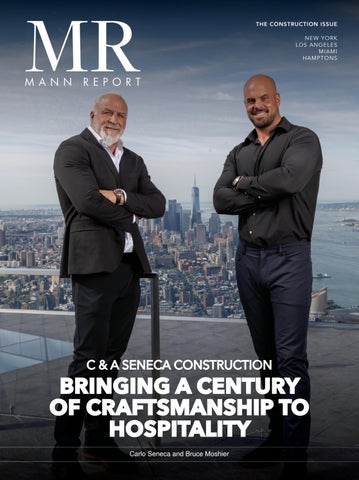
THE CONSTRUCTION ISSUE NEW YORK LOS ANGELES MIAMI HAMPTONS
C & A SENECA CONSTRUCTION
BRINGING A CENTURY OF CRAFTSMANSHIP TO HOSPITALITY Carlo Seneca and Bruce Moshier
THIS.
And so much more. For decades, we have built a real estate practice unparalleled in the US. Now, as the global legal powerhouse HSF Kramer, we are so much more. As the only law firm ranked in Chambers Band 1 on three continents, we continue to transform skylines and reshape landscapes. Please visit our website to learn more.
Kramer Levin is now HSF Kramer HSFKRAMER.COM
Helping Our Clients Build And Sustain Generational Wealth For over 25 years, Metropolitan Commercial Bank has been dedicated to helping clients grow their business and build generational wealth through our solutions-oriented, relationship-focused approach to banking.
MCBankNY.com Manhattan | 99 Park Avenue • 212 365-6700| 1431 Broadway • 212 643-6981 | 16 West 46th Street • 212 938-0770 | 1270 Lexington Avenue • 646 930-3386 Brooklyn 5102 13th Avenue • 718 851-2105 | Great Neck 111 Great Neck Road • 516 441-5232 © 2020-2025 Metropolitan Commercial Bank “Metropolitan Commercial Bank” is a registered trademark of Metropolitan Commercial Bank.
mannpublications.com
SEPTEMBER 2026
| MANN REPORT 1
MODERN BANKING GROUP
Sophisticated Financial Solutions For Middle Market Entities Whether you’re exploring new financial solutions or strategic partnerships, contact our team to learn more about our permanent financing, bridge loans, equipment finance, and working capital solutions.
MBG Lending Team
Steven Caligor
Lauren Calantone
Max Furman
Chief Lending Officer C&I / Middle Market Middle Market 212.323.1138 212.323.1178 212.323.1175 Scaligor@modernbank.com Lcalantone@modernbank.com Mfurman@modernbank.com
410 Park Avenue New York, NY 10022 2 MANN REPORT | SEPTEMBER 2026
Joseph Petrelli
Adam Reiss
Commercial Real Estate Commercial Real Estate 212.323.1137 212.323.1184 Jpetrelli@modernbank.com Areiss@modernbank.com
www.modernbank.com
212.323.1100
mannpublications.com
mannpublications.com
SEPTEMBER 2026
| MANN REPORT 3
DELIVERING THE FLEXIBILITY THAT TENANTS DESIRE Suites from 1,947 RSF, Full Floors 12,000 RSF Pre-Built and Furnished Space Move-In Condition Flexible Lease Terms
3,000 RSF High Fashion Showroom The Chelsea Arts Centre Abundant Natural Light Hudson Yards + High Line + Chelsea Piers
Move-In Ready Suite - 3,606 RSF Glass Front Offices, Delivered Furnished Possession March 1, 2026 Between Union Square + Madison Square
1,334 & 2,432 RSF Medical Suites Move-In Ready - Fully Built Immediate Possession Steps to Leading Medical Institutions
1001 Avenue of The Americas William Carr 212-400-6078
210 Eleventh Avenue Audrey Novoa 212-400-6091
915 Broadway Ben Waller 212-400-9515
380 Second Avenue James Caseley 212-400-6075
A CLOSE UP OF TWO WINNING OPPORTUNITIES UP
UP
AVENUE OF THE AMERICAS
DN
AVENUE OF THE AMERICAS
DN
tv
WEST 37TH STREET
WEST 37TH STREET
ENTIRE 16TH FLOOR
12,017 RSF - 8 PRIVATE OFFICES - 46 WORKSTATIONS TEST FIT - 1
PROPERTY FEATURES 16TH FLOOR
SCALE:
3
32 " = 1'-0"
JOB NO.:
43007.00
DRAWN BY:
JS
TULLER McNEALUS FELD
ENTIRE 20TH FLOOR
10,399 RSF - 12 PRIVATE OFFICES - 56 WORKSTATIONS
•
All space can be divided, fully furnished, turnkey
•
Private restrooms, full wet pantry with seating/lounge areas
•
Glass-front private workspaces for conference/meeting, office or
•
Walk to Times Square, Grand Central Terminal, Grand Central
•
1 0 0 1
6 T H
A V E N U E
.
N E W
Y O R K ,
N Y
DATE:
01/17/2024
collaboration use
Madison LIRR concourse, Penn Station with connection to Moynihan
Three sides of operable windows providing excellent natural light
Train Hall, and Bryant Park transportation hubs
We Build Partnerships That Last
For Information About ABS or The Services We Provide to Property Owners, Please Contact Company President, Gregg Schenker - 212.400.6060 - www.absre.com All information is from sources deemed reliable but is subject to errors or omissions of any magnitude, withdrawal from market, or changes in terms, all without notice. Brokers employment and payment only by written agreement.
4 MANN REPORT | SEPTEMBER 2026
mannpublications.com
LET US HELP YOU NAVIGATE THE MAZE EMPOWERING CLIENTS to cut through complexity and make informed, fearless decisions that turn obstacles into opportunities, across construction, real estate, commercial litigation, bankruptcy, and trusts and estates law.
1325 Avenue of the Americas New York, NY 10019 212.695.8100 goetzplatzer.com
mannpublications.com
SEPTEMBER 2026
| MANN REPORT 5
PRESIDENT/CEO Jeff Mann
EDITORIAL Editor Debra Hazel
Director of Communications and Marketing Penelope Herrera Director of Newsletter Division Kristen Pooran
West Coast Office: 578 Washington Blvd., Suite 827 Marina Del Rey, CA 90292 866-306-MANN (6266)
ART
Art Director Virginia Sanchez Cover Photography Alan Barry Photography
BUSINESS
Technology Consultant Eric Loh Distribution Mitchell’s Delivery Service
DIGITAL MEDIA CONTRIBUTORS Sheryl Berkley Brian Evetts Kris Kiser Bob Knakal David Naffis Joe Powell Stuart Saft Abe Schlisselfeld Carol A. Sigmond Sarah Terzic Roberto Vega-Peralta Trevor Vick Ernie Williams
mannpublications.com
Designers Virginia Sanchez
Editors Debra Hazel Penelope Herrera Rose Leveen Web Developer CS Designworks
East Coast Office: 450 7th Ave, Suite 2306 New York, NY 10123 212-840-MANN (6266)
The opinions expressed by our columnists are not reflective of the views and opinions of the publisher or the editorial staff of Mann Report. Publication of such views and opinions does not constitute endorsement by Mann Report. Any reproduction, including but not limited to internet usage, is prohibited without the express written permission of the publisher.
6 MANN REPORT | SEPTEMBER 2026
mannpublications.com
The Global Asset Experts Since 1903, Gordon Brothers has maximized liquidity through realizable asset value by providing the people, expertise and capital to solve business challenges. Through our firm’s comprehensive offering, we deliver integrated, custom solutions across the asset lifecycle all under one platform.
Asset Services
We provide businesses an understanding of the true value of their assets.
Asset Lending & Financing
We provide the capital to unlock the future.
Asset Trading
We monetize assets for companies while protecting their reputation. Our holistic solutions span the full spectrum of assets with deep areas of expertise in retail, industrial, real estate and brands.
©️ 2026 Gordon Brothers Group, LLC
mannpublications.com
GORDONBROTHERS.COM
SEPTEMBER 2026
| MANN REPORT 7
PROVIDING CAPITAL FOR TODAY’S NEEDS TO FUEL TOMORROW'S GROWTH
ASSET-BASED LENDING CPG+ FACTORING PO FINANCING EQUIPMENT FINANCING
Visit the difference at
rosenthalcapitalgroup.com 8 MANN REPORT | SEPTEMBER 2026
mannpublications.com
ONE MANN’S OPINION It’s September, and we’re back to the real word, but that doesn’t mean that fun will end — it just changes. And fun is the focus for our cover story, a profile of C & A Seneca Construction, which celebrates its 100th anniversary this year. Carlo Seneca, the fourth generation to run the company, refocused its work solely on hospitality nearly a quarter century ago, and is responsible for some of the greatest amenities in the city, from rooftop carousels to an upcoming nightclub zip line. It’s a story that’s as fun to read as the projects it describes. The fun also continues on the golf course. There’s still time to join us at The Mann Charitable Foundation’s Annual Golf Outing, being held on September 28 at the Fresh Meadow Country Club. It’s a day of golf, followed by dining and networking that funds research for geriatric diseases, Crohn’s and Colitis, Lymphoma, Macular Degeneration, along with raising money for the areas of NYC that need support, including Bronx Historical Society, Community Mainstream, National Jewish Museum, Jewish National Fund, Catholic Faith Network and Nassau County Law Enforcement Exploring, among others. Join us to support these causes and to honor Brian Steinwurtzel, CEO and principal of GFP Real Estate LLC; Jason M. Goldberg, Northeast regional sales manager at CIT Commercial Services and Humanitarian Award honoree Aaron Boyajian, managing partner at Goetz Platzer LLP. For more information, contact Penelope Herrera at pherrera@themanncharitablefoundation.com. Thank you in advance for supporting the Foundation and these great causes, and for supporting Mann Report.
“We don’t stop playing because we grow old; we grow old because we stop playing.” — George Bernard Shaw
mannpublications.com
SEPTEMBER 2026
| MANN REPORT 9
TABLE OF CONTENTS
SEPTEMBER 2026 Photo courtesy of RubberBond Solutions
EVENTS
50
14
Giving Confidence, Giving Hope: Delivering Good Hosts 2026 Women of Impact Summit
16
Jewish Children's Museum 20th Annual Golf & Tennis Celebration Honoring Kenneth C. Coder & Kenneth J. Coder, and David Pelton
18
NYIC Hosts Annual Banquet Awards, Honoring New York’s Top Credit and Financial Leaders
20
Two Ten Gala Raises Nearly $650,000 for Relief, Hardship and Education Programs
NEWS BRIEFS 22
Commercial News
26
Residential News
28
Management News
32
Tech Talk
36
Breaking News
FEATURES 46
From Landmarks to a Landmark
48
The Built Environment Is Missing an Identity Layer
50
Falls Are a Leading Cause of Playground Injuries at Hotels: Why Impact-Absorbing Surfaces Matter
52
Rooftop Greenery Home at Morgan North
54
Security Posture is Costing Commercial Properties Equity Value in 2026
10 MANN REPORT | SEPTEMBER 2026
mannpublications.com
SEPTEMBER 2026
TABLE OF CONTENTS
DEPARTMENTS
COVER FEATURE
9
One Mann’s Opinion
13
Editor’s Letter
58
Columns
90
Executive Changes
94
Commercial Corner: Eric Abramovich. Co-founder, Roc360
96
By the Numbers: Eve of Construction
40
C & A Seneca Construction: Bringing a Century of Craftsmanship to Hospitality
Photo courtesy of Alan Barry Photography.
COLLEGES 80
A New Advance at Old Dominion
AEC 84
Accommodating Accessibility, Beautifully
86
Hot Off the Printer: A Concrete Home
48 mannpublications.com
SEPTEMBER 2026 | MANN REPORT 11
EXCELLENCE IN PROPERTY MANAGE MANAGEMENT PPM
POWERED BY PRECISION BACKED BY HOSPITALITY
We elevate properties with integrity, precision, and a hospitality- first approach WH AT S E T S U S A PA RT
PROACTIVE
NEW DEVELOPMENT
SMART
MANAGEMENT
SERVICES
COST CONTROL
FINANCIAL
NYC COMPLIANCE
REAL-TIME
CLARITY
EXPERTISE
TECHNOLOGY
WHY PPM?
DIRECT ACCESS
HOSPITALITY
TRUSTED VENDORS
B OA R D PA RT N E R S H I P
TO LEADERSHIP
DRIVEN SERVICE
NETWORK
& ADVOCACY
390 5th Ave Suite 802
N e w REPORT Yo r k , N Y 10018 12 MANN | SEPTEMBER 2026
www.ppmnyc .com
T R A N S PA R E N T OPERATIONS
c o n t mannpublications.com act@ppmnyc.com
EDITOR’S
LETTER Summer is nearly done, but there’s still a lot of living left in our rooftops, as you’ll see in our Construction Issue. Our cover feature, on C & A Seneca Construction, discusses some of the joys and challenges this 100-year-old company has faced as it builds spectacular hospitality venues. Elsewhere, learn more about the award-winning zoned urban park above Morgan North. The story of 50 Hudson tells us how careful redesign and re-engineering can revitalize an old warehouse in a landmarked district. But construction is about more than aesthetics. UMIP’s Trevor Vick discusses how records continuity — with documentation available to all involved rather than siloed — is critical to safe construction. Playground safety is discussed by Rubberecycle’s Sheryl Berkley. And of course, we never really leave technology. EyeQ Monitoring’s Brian Evetts tells us of the ever-growing importance of security cameras, and the ever-increasing ways they can be used to benefit a property. Thanks as always to our columnists, who explore title insurance, rent laws and more. As we approach the last months of 2026, their wisdom means more than ever before.
VISIT US ON
mannpublications.com
FOLLOW US ON INSTAGRAM @mannreport
mannpublications.com
SEPTEMBER 2026 | MANN REPORT 13
EVENTS
Giving Confidence, Giving Hope: Delivering Good Hosts 2026 Women of Impact Summit At a moment when leadership is being redefined across industries, Delivering Good is shaping a more human conversation grounded in purpose, connection and action. Through the Women of Impact Summit at the Fashion Institute of Technology in New York City, leaders across retail, fashion, finance, media, technology and philanthropy gathered for conversations on leadership, innovation, mentorship and purpose. Anchored in a mission of “giving confidence, giving hope,” the summit highlighted how influence can uplift others and drive impact. Guests experienced the mission through the “Fill the Closet” activation, using QR codes to donate essential new items. As the closet filled, it became a reminder that every donation delivers confidence, dignity and hope. The day opened with “The Power of Generational Perspective: A Conversation with Mothers and Daughters,” featuring Jill Ehnes of Delta Faucet and daughter Clare Ehnes, alongside Jennifer Andrew of Bank of America, and daughter Olivia Andrew, moderated by Alessandra Piotti of David Yurman. The conversation set a reflective tone, highlighting how leadership is shaped across generations. As Ehnes shared, “When you take up space, you give other women permission to do the same,” a message that resonated throughout the Summit. Throughout the day, panels explored how purpose shows up across industries and career stages. “Women Behind the Brand: Where Purpose Meets the Customer” featured brand leaders Heather Salvatore Gruccio, Trish Donnelly, Mary Castilow, Erin Landon and Barbara Wagner from the presenting sponsor KnitWell Group, discussing how purpose continues to shape retail engagement. “Purpose and Profit: Women Leading Financial Change” brought together Seana Smith of Global X and Sonali Basak of iCapital, moderated by Allie Canal of NBC, to explore the alignment of financial performance with impact. In “Designing a Career with Purpose: Your
14 MANN REPORT | SEPTEMBER 2026
Path, Your Impact,” Danielle Garno led Maria Hedian, Stephanie Unwin and Angela Tandy in a conversation on building careers with intention. Panelists reflected on mentorship and risk-taking, emphasizing that meaningful careers are shaped as much by guidance as by the impact leaders create for others. Innovation and influence emerged as throughlines of the day. In “Innovators Shaping the Future,” moderated by Danielle Schmelkin of J.Crew Group, Rosalia Bucaro of QVC/HSN, Denielle Finkelstein of Unicorn in Every Stall and Corina Marshall of Another explored how bold ideas and adaptability are reshaping industries. This topic continued in “Using Your Voice for Good: Influence with Impact,” where Hili Banjo of Accenture moderated a conversation with leaders from Accenture, Droga5 and QVC Group on how authentic storytelling can drive meaningful change. In “Women Rising Together: Mentorship, Advocacy and Allyship,” leaders from Centric Brands, KeyBank and WHP Global — moderated by Michael Kors’ Sharonda Weatherspoon — highlighted the importance of support systems in advancing women’s leadership. The summit concluded with “Leadership Unscripted: A CEO Q&A,” moderated by Karyn Schoenbart of Duo Partners and featuring Melis del Rey of Supergoop!, Jill Granoff of Eurazeo Brand, Deirdre Quinn of Lafayette 148 New York and Mary Beth Sheridan of Guild Brands. The session invited audience participation and unfolded as a candid conversation on leadership, resilience and navigating complexity, with moments of humor that kept it refreshingly unguarded. A highlight of the day was the launch of the Delivering Good Awards Series, honoring leaders driving meaningful change. The inaugural Woman of the Year Award went to Andrea Weiss, followed by a surprise Women of Impact Award for Hili Banjo and a Future of Good Award for an emerging student leader.
mannpublications.com
Photos courtesy of Delivering Good
EVENTS
Karyn Schoenbart, Melis del Ray, Jill Granoff and Deirdre Quinn Melissa Campanelli and Karyn Schoenbart
Sharon Osen Rosalia Bucaro and Denielle Finklestein
Genevieve Koch and Juan Delgado Martinez
mannpublications.com
SEPTEMBER 2026 | MANN REPORT 15
Photos courtesy of Jewish Children's Museum
EVENTS
Jewish Children’s Museum 20th Annual Golf & Tennis Celebration Honoring Kenneth C. Coder & Kenneth J. Coder, and David Pelton Twenty years in, and the Jewish Children’s Museum’s Golf & Tennis Celebration is still growing. Nearly 220 friends and business leaders filled Cold Spring Country Club in Huntington, New York for the milestone anniversary, the largest crowd the event has ever drawn. Kenneth C. Coder & Kenneth J. Coder (Coder & Co. CPAs), and David Pelton (private wealth financial advisor) were honored this year, recognized for their generosity and longtime support of the Museum’s mission. In their remarks, both Coders spoke about the importance of being a model for children, while Pelton spoke about the battle against antisemitism and how words matter. “Twenty years, and with G-d’s help, the weather cooperated again,” said Mendel Spalter, director of development, Jewish Children’s Museum. “It’s become a bit of a tradition, the sun comes out, and it all comes together. That’s what faith and friendship do. When people unite with purpose and heart, they accomplish more than they ever imagined.”
Phil Rosen, Jeffrey Michael Rowan, Horing Welikson Rosen & Digrugillie rs P.C.
Hulbert, Santo Golino and
As always, the day brought together breakfast, barbecues, cigars, the ever popular “Rabbis on a Knish Cart,” a lively auction, cocktail reception and dinner. Located in Brooklyn, New York, the Jewish Children’s Museum provides exhibitions and programs on Jewish history and values for all children in an educational and entertaining format utilizing contemporary technology and a hands-on approach to learning. “It’s a privilege to honor our friends at such a special milestone,” said Matt and Mark Engel of Langsam Property Services. “Twenty years in, and it still comes down to the relationships this event builds, year after year.” Anthony Kenny and Nicholas Kenny, CAM Energy; Richard Guarino, Friedman, Roth and Ricky Wolbrom, Malc, Wolbrom & Associates
16 MANN REPORT | SEPTEMBER 2026
mannpublications.com
Mark Engel and Matt Engel, Langsam Property Services and Mendel Spalter, Jewish Children’s Museum Presenting award to Guests of Honor Ken Coder and Kenny Coder (Coder & Co. CPAs)
Alex Hirsch, Andrew Goldman and Austin Mandell, Millbrook Properties and Kyle McCarthy, Start Elevator
Anita Gupta (second from right) and friends, Chatam Management
Robert Frank, Academy Energy; Jimmy Frank, Cushman & Wakefield; Adam Frank, Stonegate and Paul Angerame and John Mari, Fivestar Electric
mannpublications.com
Yisroel Szpigiel, Jonathan Schreier, Seth Frankel and Michael Binder, LumaLex Law
SEPTEMBER 2026 | MANN REPORT 17
EVENTS
Mark Chesen, Matthew Karlson and Michael Goodman
Harvey Gross and Brendan Shannon
NYIC Hosts Annual Banquet Awards, Honoring New York’s Top Credit and Financial Leaders The New York Institute of Credit (NYIC) welcomed members, colleagues and industry leaders to Inside Park at St. Bart’s in New York City for an unforgettable evening of networking, celebration and recognition at the 2026 Banquet Awards. The event brought together professionals from across the credit and financial communities to celebrate the accomplishments of distinguished individuals whose leadership, dedication and service have made a lasting impact on the industry. The evening also provided an opportunity for attendees to reconnect with peers, strengthen professional relationships and recognize the importance of collaboration in advancing the credit profession. A highlight of the evening was the presentation of the 18th annual Conrad B. Duberstein Memorial Award to Judge Brendan L. Shannon of the U.S. Bankruptcy Court for the District of Delaware. This prestigious honor recognizes outstanding achievement, integrity and compassion within the bankruptcy judiciary. Shannon’s distinguished
18 MANN REPORT | SEPTEMBER 2026
career, commitment to fairness and dedication to public service exemplify the values that the award was created to celebrate, making him a truly deserving recipient. The event also marked a significant milestone for NYIC with the presentation of the 50th annual Leadership in Credit Education Awards. This year’s honorees, Martin Efron, managing director and head of factoring at White Oak Commercial Finance, and Michael S. Goodman, founding partner and managing director of SSG Capital Advisors, were recognized for their exceptional contributions to the credit profession and their longstanding support of NYIC. Through their leadership, mentorship and commitment to advancing credit education, both honorees have helped strengthen the industry and inspire future generations of professionals. By honoring individuals who have made meaningful contributions to the field, the evening reinforced NYIC’s ongoing commitment to fostering education, professional growth, leadership and collaboration throughout the credit community.
mannpublications.com
Photos courtesy of Justin V. Gross
EVENTS
Lori and Michael Goodman Vincent Roldan, Harry Malinowski and Jeffrey Cooper
Raffi Azadian, Jessie Szemraj, Alexander Kayfetz-Gaum and Harvey Gross
Brendon Shannon, Michael Goodman and Martin Efron
Brendon Shannon
mannpublications.com
Frank Turner and Peter Brockmeyer 2026 | MANN REPORT SEPTEMBER
19
Photos courtesy of Dirty Sugar
EVENTS
Two Ten Gala Raises Nearly $650,000 for Relief, Hardship and Education Programs Nearly 750 people from the footwear industry came together for a night of celebration, community and philanthropy at Two Ten’s annual gala. Leaders from across the industry convened at The Glasshouse in NYC to raise critical funds for the foundation’s hardship and disaster-relief grants, educational programs and community initiatives. The program also honored industry veterans Mark Lardie, former president and CEO of Rack Room Shoes, and Tacey Powers, executive vice president and general merchandise manager for shoes, accessories, home and kids at Nordstrom. The program kicked off with a video highlighting the story of Rebecca Felger Romano, a relief grant recipient and the manager of Felger’s Shoes in Houma, Louisiana. Romano received a grant from Two Ten in 2021 after Hurricane Ida damaged her home and forced her family business to close during storm recovery. “Asking for help from Two Ten was humbling,” Romano related. “I never thought I was going to be the person that needs help. Luckily, it was there in my greatest time of need, and I’m extremely thankful for what Two Ten was able to provide.” Shawn Osborne, Two Ten president and CEO, recapped the foundation’s most recent year, sharing that it awarded nearly $2 million to families facing hardships due to medical bills, housing insecurity and tuition costs. He also announced the launch of a new pilot program designed to provide increased financial assistance for colleagues facing extraordinary life challenges like medical diagnoses, the loss of a loved one and other devastating circumstances. President of Aldo Product Services and Two Ten board chair Jonathan Frankel also emphasized the importance of Two Ten in his remarks and encouraged gala attendees to continue supporting the foundation in any way
20 MANN REPORT | SEPTEMBER 2026
that they can. “Everyone in this room is very likely one degree of separation from someone who has turned to Two Ten in a moment of real need,” Frankel remarked. “Those moments are often private, when people have exhausted every option and simply need help getting back on their feet. When that moment arrives, Two Ten answers the call.” He later announced several live fundraising updates, including an additional $25,000 from Ortholite, $10,000 from Foot Locker Foundation and an additional $25,000 from Aldo Group. Two Ten scholars Joanna Ezzard and Joy Batra shared how receiving college scholarships from Two Ten helped them flourish in their respective fields. Ezzard, who worked as an associate at Foot Locker during high school, will be pursuing a master’s in data analytics this fall after recently graduating from Virginia Commonwealth University. Batra, a past Two Ten scholar, spoke about how a scholarship made it possible for her to attend Harvard graduate school for law and business and spend nine months acting in Bollywood before starting her own consulting business and becoming a published author. “I can say with confidence: Without Two Ten, none of that would have been possible,” Batra said. Lardie was presented with the A.A. Bloom Memorial Award in recognition of his extraordinary service to Two Ten and the industry for three decades. Powers was presented with the 2026 WIFI Impact Award in recognition of her leadership and dedication to advancing women in the footwear community. Frankel closed out the evening by thanking the 2026 gala sponsors, including Micro-Pak, Bordan Shoe, Power Rich, Zilsen, Alliant Insurance Services, Bay Rag and more.
mannpublications.com
EVENTS
Mark Lardie, Tacey Powers and Shawn Osborne
Joanna Ezzard
Mark Lardie and Shawn Osborne
Mark Lardie
mannpublications.com
Susan Itzkowitz and Tacey Powers
SEPTEMBER 2026 | MANN REPORT 21
COMMERCIAL NEWS
Center for Justice Innovation Takes 34,300SF at 520 Eighth Ave.
Photo courtesy of GRP Real Estate
GFP Real Estate and Open Impact Real Estate announced a 34,300-square-foot lease on behalf of the Center for Justice Innovation, a nonprofit organization focused on advancing community justice and public safety initiatives nationwide, at 520 Eighth Ave. The transaction includes a longterm extension, expansion and consolidation of the nonprofit’s administrative headquarters operations within the building.
The Center will relocate into approximately 34,300 square feet across a portion of the 18th floor and the entire 19th floor at the property as part of a new 20-year lease extension. The organization has occupied space at 520 Eighth Ave. since 1999, expanding over time as additional space became available within the building. The new layout will allow the Center for Justice Innovation to consolidate
operations previously spread across three non-contiguous floors into a more cohesive and efficient administrative headquarters designed to support future programmatic growth and evolving workplace needs. The redesigned space will feature expanded collaborative areas, flexible meeting and training spaces and modern workplace amenities intended to foster greater connectivity, increase in-office engagement and support the organization’s long-term operational strategy. “The new office will allow us to bring teams together more effectively, support future growth and continue advancing our mission in a modern, collaborative environment that better supports the way our teams collaborate and deliver services across New York City,” said Chief Financial Officer Matthew Savago of the Center for Justice Innovation. The transaction structure also provides the Center for Justice Innovation with the future ability to convert the lease into a leasehold condominium, allowing the nonprofit to benefit from tax exemptions available to qualifying nonprofit institutions. The tenant was represented by Open’s Stephen Powers and Jake Cinti. Landlord representation was handled in-house by Matthew Mandell of GFP Real Estate.
American Express Breaks Ground on 2 World Trade Center HQ New York City and State.
Photo via Business Wire
American Express broke ground on its new global headquarters at 2 World Trade Center (the American Express Tower), which will span nearly two million square feet and stand nearly 1,250 feet tall. The tower will be the final commercial building to complete the World Trade Center campus redevelopment. To celebrate the milestone, American Express executives and colleagues were joined by Lisa Silverstein, CEO of Silverstein Properties; New York City Mayor Zohran Kwame Mamdani; Kathryn Garcia and Kevin O’Toole, executive director and chairman, respectively, of the Port Authority of New York and New Jersey and Gary LaBarbera, president, Building and Construction Trades Council of Greater New York, among other government officials and project and community partners. “For American Express, this project is far more than a new headquarters. It is a reaffirmation of our belief in this city, our commitment to our colleagues and our enduring connection to the community we have proudly called home for nearly two centuries,” said Denise Pickett, American Express president of Enterprise Shared Services. “Since our founding in 1850, New York has shaped who we are, and in turn, we have sought to contribute to its growth, vitality and success. Today’s groundbreaking marks the next chapter in that shared story.” Throughout the ceremony, speakers underscored the importance of the project, not only for American Express, but also for Lower Manhattan and
22 MANN REPORT | SEPTEMBER 2026
“As we approach the 25th anniversary of 9/11, starting construction of 2 World Trade Center is not just a significant step forward for Lower Manhattan, but it is also an inspiring demonstration of New York’s strength and resilience in the face of adversity,” Pickett said. “This investment by American Express in a new, state-of-the-art tower advances our shared goal of completing the restoration of the World Trade Center as a site that supports commerce, remembrance, culture, community, transit and tourism for all the world to see.” Rising 55 stories, the new headquarters will feature flexible and modern workspaces and world-class amenities designed to foster innovation, collaboration and well-being for colleagues. A defining feature of the headquarters will be expansive outdoor spaces with three greeneryfilled terraces and six corner gardens meant to introduce nature into the vertical workplace rising 1,226 feet above Lower Manhattan. Mamdani highlighted the opportunities the project will create for the city. “I am proud to welcome American Express’s new global headquarters to Lower Manhattan. This is not just a sign of confidence in the future of our city – it is an investment in thousands of good jobs, the local economy, sustainability and the final piece of the rebuilt World Trade Center,” Mamdani said. “This project will continue to benefit New Yorkers for many decades to come.” The development is expected to create over 3,200 direct and indirect construction-related jobs in New York City during the duration of the project, with an estimated contribution of approximately $5.9 billion to the city’s economy and $6.3 billion to the New York State economy overall. Occupancy is expected in 2031. “This is an important milestone for our city, American Express and Silverstein Properties,” Silverstein said. “But it also symbolizes triumph, and what can be accomplished in this country following what happened here nearly 25 years ago.”
mannpublications.com
WELCOME TO ONE NOMAD. NOW GO PLACES.
Boutique office spaces with a single purpose— to be at the center of what’s next.
875 Sixth Ave • New York, NY Michael Kaufman • 212.471.4320 • michaelk@kfmn.nyc Ready for what’s next? Visit onenomad.com or kfmn.nyc to get in touch. mannpublications.com
SEPTEMBER 2026 | MANN REPORT 23
COMMERCIAL NEWS
JLL Arranges $617M for Grubb Properties Opportunity Zone REIT on securing a $240 million NAV credit facility from Bayview Commercial Mortgage Finance. The facility supports the consolidation of the 45-property portfolio while providing an equity commitment to assist in capitalizing Link Apartments 8 Carlisle. Additionally, JLL’s Debt & Equity Advisory group, in conjunction with Arrow Real Estate Advisors, arranged a $300 million senior construction loan from Maxim Capital Group and a $77 million mezzanine loan that was co-originated by GreenBarn Investment Group, Skylight Real Estate Partners, Axonic Capital and Meadow Partners. 8 Carlisle (Photo via PRNewswire) JLL’s Capital Markets group announced that its M&A and Corporate Advisory, Corporate Banking Advisory and Debt & Equity Advisory teams secured $617 million in financing for Link Apartments REIT and Link Apartments Opportunity Zone REIT. Both are Grubb Propertiesmanaged REITs, along with Link Apartments 8 Carlisle, a 64-story, Class A multifamily development in Manhattan’s Financial District. JLL represented the developer and REIT sponsor, Grubb Properties, in arranging the multi-tranche capitalization through a coordinated, three-phase advisory effort. First, JLL’s M&A and Corporate Advisory group served as advisors on the merger of multiple legacy Grubb Properties’ high-net-worth funds and subsequent re-branding to create Link Apartments REIT, an approximately $1.9 billion Grubb Propertiesmanaged real estate investment trust with a portfolio of 45 properties, including more than 5,600 multifamily units. JLL's Corporate Banking Advisory group, part of JLL’s Investment Banking platform, advised Link Apartments REIT and Link Apartments
“JLL’s ability to coordinate multiple advisory disciplines across this complex transaction was instrumental in achieving our vision for Link Apartments 8 Carlisle,” said Clay Grubb, CEO of Grubb Properties. “Their integrated approach to structuring the REIT formation alongside the project financing enabled us to efficiently consolidate our portfolio while capitalizing this landmark development in Lower Manhattan.” Link Apartments 8 Carlisle rises 64 stories and is one of the last properties to be delivered under The New York City Department of Housing Preservation and Development’s legacy 421-a program, where 30% of the 462 apartments will be allocated affordable. The property will be complemented by 6,285 square feet of retail space. JLL Investment Banking’s M&A and Corporate Advisory team was spearheaded by Senior Managing Director Steve Hentschel and Director Adam Coleman. JLL Investment Banking’s Corporate Banking Advisory group was led by Senior Managing Director Anthony Fertitta and Associate Jonathan Koletic. JLL Capital Market’s Debt & Equity Advisory team was led by Managing Director Stephen Van Leer, Senior Managing Directors Rob Hinckley and Jeffrey Julien, Managing Director Steven Rutman and Directors Alex Staikos and John Lowe.
Park Square Yonkers Breaks Ground and several thousand square feet of dedicated resident storage located within the building. Construction is expected to take approximately 24 months. The project architect is Perkins Eastman. “Park Square was my promise and commitment to Yonkers five years ago and today that promise is becoming reality through a $185 million investment in the city’s future. I firmly believe the best days for Titan and Yonkers are still ahead,” said Del Gais, senior executive, Titan Real Estate Development LLC. Photo courtesy of Titan Real Estate Development Titan Real Estate Development LLC has broken ground on Park Square Yonkers, a new mixed-use residential development at 1 Loehr Place in Yonkers, New York. The $185 million project will be 500,000 square feet, comprised of 340 residential units and approximately 20,000 square feet of prime street-level retail space, including 420 covered on-site parking spaces, integrated within the building’s envelope. Ten percent of the residential units will be designated as affordable. The seven-story project, developed by Mitchell Del Gais and Doron Pergament of Titan Real Estate Development LLC, will have a unit mix of 192 studio apartments and 148 one-bedroom apartments. Amenities will include a 15,000-square-foot elevated private outdoor courtyard, a double-height fitness center, a business center with working stations exclusive to residents, a luxury resident lounge, a boutique-style pet spa
24 MANN REPORT | SEPTEMBER 2026
Park Square will also be aligned to a new Yonkers Public School at Grant Park. It will be pre-K to eighth grade, and is estimated to serve around 800 students. It will allow access on nights, weekends and summers for community use, and will have amenities like a gym, library and a pool. The site, originally designated as part of the Mulford Gardens HOPE VI Revitalization Project, has remained undeveloped since its transfer to the City of Yonkers in 2019. The city formally awarded the site to Titan in 2023. In December 2024, the Yonkers Industrial Development Agency unanimously approved approximately $16 million in financial incentives for Park Square Yonkers. The incentive package includes approximately $3.8 million in sales tax exemptions, $1.5 million in mortgage recording tax exemptions and a 20-year PILOT agreement valued at approximately $10.5 million. Park Square is the second major investment in Yonkers for the sponsors, Del Gais and Pergament, who have also completed “Hudson Blue,” a 94-unit, high-rise residential building located at 70 Ashburton Avenue.
mannpublications.com
EXPERIENCE. EXCELLENCE. RESULTS. Holland & Knight’s New York Real Estate Practice Group and Real Estate Capital Markets Practice Group successfully closed deals worth more than $11.35 billion in 2024. From acquisitions, dispositions, development, condominium and cooperative formation and operation to hospitality, financing, leasing, land use and real estate capital markets, our attorneys do their utmost to deliver clients with exceptional results across all sectors.
$11.35 BILLION Real Estate Practice Group Acquisitions and Dispositions: $1.93 billion Financing: $4.1 billion Leasing: $3.2 billion Land Use: $290 million
Real Estate Capital Markets Defaulted Loans, Workouts and Liquidations: $1.83 billion
www.hklaw.com Stuart M. Saft, Partner | Real Estate Practice Group Keith M. Brandofino, Partner | Real Estate Capital Markets Practice Group New York, NY | +1.212.513.3200
mannpublications.com
Copyright © 2025 Holland & Knight LLP All Rights Reserved
SEPTEMBER 2026 | MANN REPORT 25
RESIDENTIAL NEWS
SothebY’s International Realty Expands into Vietnam Sotheby’s International Realty announced the opening of Vietnam Sotheby’s International Realty, marking the brand’s 18th office in Asia and further expanding its footprint across the continent. Headquartered in Ho Chi Minh City, one of the country’s principal luxury residential markets, Vietnam Sotheby’s International Realty will serve clients and represent carefully selected luxury residential properties and developments nationwide, from established urban centers and resort destinations to emerging markets. The company is led by Chloe Dang, co-founder and chief executive officer, who brings nearly two decades in media and 15 years in real estate, most notably as head of the real estate segment and a television anchor for a leading national financial and business news channel. “Vietnam’s luxury residential market has decisively evolved from an emerging frontier into a sophisticated, globally competitive investment
destination, driven by rising domestic wealth, significant infrastructure investment, and increasing international visibility,” said Philip White, president and CEO of Sotheby’s International Realty. “The country offers a compelling mix of dynamic global cities, culturally rich heritage centers, and world-class coastal destinations.” Dang is joined by James Miles-Lambert, co-founder and chairman. With extensive management expertise at one of Vietnam’s leading retail groups, Miles-Lambert provides strategic oversight across corporate governance, long-term growth planning and organizational development. “Our role is to serve as a trusted bridge between Vietnam and the world, connecting Vietnamese clients with premier real estate opportunities both within Vietnam and across key international markets, while showcasing select luxury residential properties in Vietnam to a global audience,” said Dang. The firm reports seeing strong momentum across the market, with domestic demand led by buyers from Ho Chi Minh City and Hanoi and cross-border interest growing in both directions. Affluent Vietnamese families are increasingly seeking international real estate for wealth diversification, global education opportunities and lifestyle mobility, while qualified international buyers are showing growing interest in luxury residential opportunities in Vietnam.
Realtor.com: Climate Risk Isn’t Stopping Home Buyers Home shoppers in some of the United States’ priciest markets continue to consider highrisk homes over lower-risk alternatives nearby, reported Realtor.com. Some 23.1% of U.S. homes, representing $11.2 trillion in value, face severe or extreme risk from wind, flood or wildfire, and buyer demand in some of the most exposed markets remains just as strong, or stronger, than in lower-risk areas nearby. The financial fallout no longer waits on the next disaster. Homeowners in high-risk areas already pay a median $192 a month in HOA fees, 53.6% more than in lower-risk areas. National Flood Insurance Program (NFIP) active contracts fell 4.5% between May 2025 and May 2026, and serious mortgage delinquency rates in Louisiana and Mississippi have run more than double the national average.
and draw 48% more views per listing. In Los Angeles County, severe or extreme risk homes are priced at 75% of those without such risks and draw 23% more views. The January 2025 Los Angeles wildfires only interrupted that pattern briefly: the views ratio between severe or extreme and lower-risk homes dropped from 1.21 in December 2024 to 1.11 the following month, then rebounded to 1.31 by March. The median monthly HOA fee for a home facing severe or extreme risk is $192, compared with $125 for lower-risk homes. The difference is widest in Delaware, South Carolina and Oregon at the state level, and in Portland, Oregon; Washington, D.C. and Seattle at the metro level. Flood coverage is also becoming harder to hold onto. Active NFIP policies fell from 3.62 million to 3.45 million between May 2025 and May 2026, with Texas seeing the largest drop at 7.8%. The decline follows the rollout of the NFIP’s Risk Rating 2.0 pricing model, which ties premiums more closely to a property’s individual flood risk. Oklahoma, Idaho, Mississippi and Alabama each saw active policy counts drop more than 6%. Median annual premiums are also climbing, projected to nearly double over time, from $689 in December 2022 to $1,288.
“Price is still the biggest motivator for a lot of home shoppers, even in places where climate risk is well known,” said Jiayi Xu, economist at Realtor.com. “But that doesn’t mean the risk disappears. It shows up later, in insurance premiums, HOA fees and financing, often after the sale is already done.”
Mortgage performance data shows where the pressure eventually surfaces. Louisiana and Mississippi have run persistently above the national average in serious mortgage delinquency, reaching 1.7% and 1.4% respectively by September 2025, compared with a national average of 0.8%. Florida and Texas started 2023 near the national average and have since climbed above 1.0%, reflecting both direct storm damage and the added strain of rising insurance costs.
In several of California’s most expensive counties, climate risk comes with a discount, and some buyers are choosing to take it. In Santa Clara County, homes facing severe or extreme risk are priced at just 78% the price of homes without severe or extreme risk per square foot
“Having the full financial picture, including future insurance costs and coverage availability, matters just as much as the purchase price,” said Xu. “There’s nothing wrong with choosing a high-risk area for affordability or lifestyle, as long as it’s an informed choice.”
26 MANN REPORT | SEPTEMBER 2026
mannpublications.com
RESIDENTIAL NEWS
Clever RE: Nearly Half of Recent College Grads to Move in With Their Parents back home to save money, those who live with their parents have a median of just $4,000 saved, compared with $12,000 among those who do not. Just 7% of current college students say they would actively choose to live with their parents after graduating. A third (33%) would prefer to buy a home, but only 13% of recent grads actually became homeowners.
Image via PRNewswire
Nearly half of recent college graduates (49%) had to move back in with their parents after graduating, and 46% of them still live there, according to a report from Clever Real Estate, a St. Louis-based discount real estate broker. In a survey of 1,000 Gen Zers, a majority (52%) said they’re more likely to move back in with their parents in the next five years than buy a home of their own. Of those who have moved back home, most (58%) blame the high cost of living. A majority of Gen Zers (59%) still rely on financial support from their parents, and 31% say their parents cover all of their bills. Although 67% of current college students would be open to moving
Despite the obstacles, owning a home within the next 10 years is the achievement Gen Z would find most impressive (32%), ahead of earning a six-figure salary (30%), getting married (12%) and being debt-free (12%). Just 8% of Gen Zers say they never want to own a home. In fact, over half (58%) say they are rooting for a housing market crash so they could actually afford to buy. Gen Z’s expectations, however, may still be too optimistic. Even with the median first-time buyer in the U.S. now hitting age 40, about 64% of Gen Z expect to buy a home before they turn 35. Gen Zers are willing to go to extremes to buy a home sooner. About a third would work overtime (35%) or take a second job (32%), while others would delay having children (21%), put off marriage (16%) or raid their retirement savings (10%). Some would go even further to avoid moving back in with their parents, with 19% willing to skip meals and 12% willing to live in their car.
The Kortney Wilson Group Launches Sports & Entertainment Division “Real estate has never been about transactions for me. It has always been about transition — executed with precision, and grounded in trust,” said Kortney Wilson, founder of The Kortney Wilson Group. “Athletes, entertainers and executives aren’t just buying a house. They’re navigating contracts, timing, privacy and a move that’s tied to their identity and their career. This division exists because I understand that world firsthand, and I know what these clients actually need from the person representing them.” Originally from Canada, Wilson relocated to Nashville in 1998 to pursue a career in music and entertainment. Her early career included a recording contract with Disney’s Lyric Street Records, a role on the ABC daytime drama “One Life to Live” and international success as a recording artist.
Photo courtesy of Kathy Thomas Photography
The Kortney Wilson Group, the Nashville-based luxury real estate practice led by Kortney Wilson, has launched a Sports & Entertainment Division, a specialized advisory service built for athletes, entertainers, executives and other public figures. The new division formalizes a practice Wilson has quietly built over years of representing high-visibility clients offering white-glove service, strategic market insight and absolute discretion.
mannpublications.com
She later became an established presence in the home and design space, starring in the HGTV’s and Hulu’s “Masters of Flip” and “Making It Home.” In early 2026, she returned to television with “Life Is Messy,” a design-driven series that further cemented her reputation for transforming not just homes, but the lives lived within them. After nearly 28 years in Nashville, Wilson’s real estate work evolved beyond traditional real estate into advisory-level representation — a shift that she said led directly to the creation of the KWG Sports & Entertainment Division. The division is designed for clients who require more than representation — they require someone with an understanding of contracts, timing, relocations, privacy considerations and the layered decisions that come with high-visibility careers.
SEPTEMBER 2026 | MANN REPORT 27
MANAGEMENT NEWS
FM and Pure Insurance Partner to Strengthen Loss Prevention for High-Value Homes FM, a commercial property insurer known for its science- and engineeringled approach to risk management, and Pure Insurance , a reciprocal insurer exclusively serving high-net-worth families across the United States and Canada, announced a strategic partnership that expands FM’s loss prevention capabilities to protect high-value residential homes. The partnership establishes a long-term collaboration to bring FM’s research, engineering and loss prevention expertise to Pure members to help build resilience in their properties. It also includes a risk-sharing reinsurance agreement under which FM will share in Pure’s underwriting results. Together, the companies will focus on developing new ways to help high-value homeowners better understand risk, strengthen resilience and prevent loss. Initial efforts will address the most complex
homeowner risks — including wildfi re-exposed properties — against which FM has helped its clients protect for decades. “We chose the Pure team as our partners as we enter this space because they share the belief that the majority of property loss is preventable through stronger understanding of risk and close collaboration with clients,” said Malcolm Roberts, chairman and chief executive offi cer of FM. “With FM’s engineering expertise, leading research capabilities and nearly two centuries of helping clients mitigate risk and build resilience, we see a unique opportunity to partner with Pure and bring that same approach to its members.” The partnership refl ects strong alignment of purpose between the two organizations, both of which are structured to prioritize the longterm interests of their clients and members and believe proactive loss prevention is key to lowering the cost of risk. “Pure has long believed that helping members identify and mitigate risk is one of the most important services we provide,” said Martin Leitch, chief executive offi cer of Pure Insurance. “FM has demonstrated, at scale, that a science- and engineering-led approach can materially reduce risk. We believe these same capabilities can be applied to high-value homes in ways that will lower the cost of risk for Pure members, and give us greater confi dence in how we assess and manage risk, which should allow us to responsibly expand the membership over time, including insuring certain risks that we might approach more cautiously today.”
Newmark Awarded 21MSF-Plus National Property and Project Management of 601W Companies’ U.S. Office Portfolio Newmark Group Inc. has secured a long-term property and project management assignment with institutional investor and developer 601W Companies, expanding the relationship through management of more than 21 million square feet of offi ce assets across the United States, including Chicago, New York, New Jersey and Los Angeles. Newmark secured the assignment through a coordinated effort led by Jesse Van Dyke, executive vice president, Midwest regional market leader, and Richard Holden, president, property management, who worked closely with 601W Companies to develop a customized program aligned with 601W Companies’ operating philosophy, longterm growth objectives and evolving portfolio needs. “This assignment refl ects the continued execution of our strategy to expand Newmark’s recurring revenue businesses while deepening
28 MANN REPORT | SEPTEMBER 2026
relationships with many of the industry’s most sophisticated owners,” said Luis Alvarado, chief operating offi cer. “Property management and project management are critical components of our fully integrated platform, creating opportunities to deliver long-term value for clients while strengthening the breadth and durability of our Investor Solutions business.” The 601W portfolio comprises more than 12 million square feet in Chicago and more than nine million additional square feet across key U.S. markets, including New York City, New Jersey and Los Angeles. Newmark has already begun providing services for 601W’s property at 333 South Grand Avenue in Los Angeles. Newmark will serve as a strategic operating partner across the portfolio, delivering customized property and project management services through an integrated program designed to support 601W Companies’ ownership objectives, enhance tenant experiences and drive operational performance across the portfolio. “Having proactively managed our portfolio through COVID-19 — including restructuring and extending fi nancings across our assets — we are well positioned for long-term growth and focused fi rmly on the opportunities ahead,” said Mark Karasick, managing member of 601W. “We were looking for a strategic partner with the platform, talent and fl exibility to match that ambition, and we are excited to work with Newmark on our path forward.”
mannpublications.com
WHERE AMBITION TAKES SPACE. For over a century, Kaufman has shaped New York City’s commercial real estate landscape. We combine deep market intelligence, trusted relationships, and tire eless dedication to deliver results that build lasting value.
FROM VISION TO VALUE. NEW WORK STARTS HERE.
TENANT REPRESENTATION LANDLORD REPRESENTATION PROPERTY MANAGEMENT CONSTRUCTION & OPERATIONS ACCOUNTING & FINANCE CONSULTING & EXPERTISE
www.kfmn.nyc
450 Seventh Ave
mannpublications.com
SEPTEMBER 2026 | MANN REPORT 29
MANAGEMENT NEWS
FMI Launches Training Institute FMI Corporation, a leading provider of consulting and investment banking services to the built environment, has launched the FMI Training Institute. The institute brings FMI’s leadership and performance programs into a clearer, more connected portfolio for construction and engineering fi rms. Today’s construction and engineering fi rms face greater complexity, larger teams and heavier operational demands than ever before. The FMI Training Institute addresses that need through immersive programs and custom cohort training, organized around two development tracks: Leadership and Performance. “Developing your people is one of the highest-return decisions a fi rm can make, as it improves retention and performance at the same time,” said Matt Kennedy, partner at FMI. “The FMI Training Institute
exists for fi rms ready to commit to that, with the goal of making this industry the best-led sector in the marketplace.” Leadership programs help professionals develop the self-awareness, communication, coaching and team leadership skills needed to lead others and shape organizational culture. Programs in this track include the Leadership Institute, Field Leader Institute, Emerging Managers Institute and Leadership Accelerator Series. Performance programs build the project execution, fi nancial management and business acumen skills that improve project and fi rm performance. Programs in this track include the Project Manager Academy and the Construction Business Academy. The Construction Business Academy builds on the legacy of the long-running Construction Executive Institute under a new name that better refl ects its scope and audience. “What has always made these programs different is that they were built for this industry from the ground up,” said Emily Cannon, senior director, programs at FMI. “Our participants aren’t working through hypothetical scenarios. They’re facing the kinds of decisions, pressures and team dynamics that construction professionals encounter every day, and that’s what makes the development stick long after the program ends.”
Savills Completes Eastdil Secured Acquisition Savills Plc has confirmed the completion of its acquisition of Eastdil Secured LLC for an enterprise value of $1.1125 billion (c.£827 million). This follows the announcement on March 12, 2026, of the proposed acquisition. The transaction brings together highly complementary service lines and geographic footprints to create a world-class platform spanning all key sectors. It transforms Savills Real Estate D. Michael Van Konynenburg Investment Banking’s presence, (Photo courtesy of Eastdil accelerating Savills strategy to Secured Savills) scale in North America while strengthening its leadership position in both EMEA and Asia Pacific. The transaction was funded through loan finance and the issue of new ordinary shares in Savills, representing approximately 16% of the group’s enlarged share capital, to the ultimate holders of equity interests in Eastdil Secured. This includes Guggenheim, Temasek and Wells Fargo along with the Eastdil Secured leadership team and Eastdil Secured’s senior employees, all of whom have become shareholders in Savills in exchange for their existing interests in Eastdil Secured. “By bringing Eastdil Secured Savills leading real estate investment
30 MANN REPORT | SEPTEMBER 2026
banking capabilities together with our occupier expertise and broader advisory platform, we are creating new opportunities to serve clients across the full real estate lifecycle,” said David Lipson, Savills CEO of Savills North America. “Just as important, our firms share a relentlessly client-focused, performance-driven culture grounded in strong advice, disciplined execution and a commitment to delivering the best possible outcomes for our clients.” Eastdil Secured will be rebranded to “Eastdil Secured Savills” and continue to operate its existing business model within Savills Group as its real estate investment bank. The combined group will be the number two advisory firm globally for prime commercial real estate transactions above $100 million. Tthe executive leadership of Eastdil Secured Savills includes the following appointments: Roy H. March as executive chairman, D. Michael Van Konynenburg as CEO and James McCaffrey as president. Van Konynenburg and McCaffrey will both join the Savills Group executive board. “This is an important milestone for our firm,” Van Konynenburg said. “With the transaction complete, we look forward to working alongside our colleagues at Savills to broaden the expertise and resources available to our clients while continuing to deliver the unparalleled capital markets expertise, execution and discretion that have long defined Eastdil Secured.” Eastdil Secured Savills will maintain key headquarters in New York, Santa Monica and London. Its 21 existing offices will join Savills’ network, which spans more than 70 countries.
mannpublications.com
Itinerary 8:30 AM
Arrival and Registration
9:00 AM
Breakfast/Brunch
11:00 AM
6:00 - 7:00 PM
Call to Carts
11:15 AM (Sharp) Shotgun Start
Dinner and Presentation of Golf Winners and Honorees
5:00 - 6:00 PM
Hors d’Oeuvres and Cocktails
Annual Golf Event
MANN CHARITABLE
The Mann Charitable Foundation is having its annual golf outing this year at the wonderful Fresh Meadow Country Club on Monday, September 28, 2026. Formed by Irving and Marion Mann,The Mann Charitable Foundation supports research to fight life-threatening diseases. Expect another amazing outing, supporting causes of mainly geriatric diseases such as Alzheimer’s disease, Crohn’s and Colitis, Lymphoma, Macular Degeneration, liver disease and more. We have our honorees, one of which will be receiving the Michael Kerr Humanitarian Award in honor of one of my best friends, Michael Kerr. We hope to see you there supporting our causes and spreading the awareness for a better future.
Honorees
Jason M. Goldberg Regional Sales Manager CIT Commercial Services (A subsidiary of First Citizens Bank)
September 28, 2026 Location
Tickets
Fresh Meadow Country Club 255 Lakeville RD, Lake Success, NY 11020
Golf $950 per person $3,800 per foursome Dinner and Cocktails Only $300 per person
Brian R. Steinwurtzel CEO and Principal GFP Real Estate Gural Family Properties
Michael Kerr Humanitarian
Co-Chairs Orin Wilf
Mitti Liebersohn
Frank Grimaldi Dean Palin
Aaron Boyajian Managing Partner Goetz Platzer LLP
For more information, please contact: Penelope Herrera pherrera@themanncharitablefoundation.com 212-840-6266 ext.313
mannpublications.com
SEPTEMBER 2026 | MANN REPORT 31
TECH TALK
AffordableHousing.com Debuts AI Housing Navigator More than 2.3 million American families rely on the Housing Choice Voucher Program to secure affordable housing, yet navigating the process often means understanding complex eligibility requirements, completing detailed applications, gathering documentation and following varying procedures. AffordableHousing.com announced the launch of its AI Housing Navigator, an agencyspecific artificial intelligence solution designed to make that process easier to understand and navigate. Unlike general-purpose AI tools, each AI Housing Navigator is configured using information approved by the participating housing agency, including its housing programs, policies, procedures, forms and local requirements. The result is guidance tailored to the agency a renter or property owner is working with. “Affordable housing changes lives, but navigating the process can be overwhelming,” said Richard Cupelli, founder and CEO of AffordableHousing.com. “After decades of working alongside renters, property owners and housing agencies, we’ve seen firsthand where confusion slows the process and creates unnecessary frustration.
The AI Housing Navigator brings together everything we’ve learned to provide trusted, agency-specific guidance and allows professionals to focus on the people and situations that need them most.” Each AI Housing Navigator is built around the participating housing agency’s approved content, allowing renters and property owners to receive guidance based on that agency’s specific programs and requirements. Housing agencies may also include additional approved content to improve the Navigator’s ability to answer questions unique to their communities. Renters will use the Navigator to learn about available housing programs and waiting-list opportunities; understand eligibility requirements and application terminology; receive step-by-step guidance through the housing application process; access housing agency policies, procedures and contact information and search for available housing. The Navigator connects directly to AffordableHousing.com’s housing marketplace, allowing renters to move seamlessly from learning about a housing program to searching for available homes. The Navigator can help them better understand accessibility features, neighborhood characteristics, schools, air quality, areas of opportunity and Housing Choice Voucher participation, giving families more context as they make housing decisions. For property owners, the AI Housing Navigator provides guidance on Housing Choice Voucher requirements, property listings, Requests for Tenancy Approval, rent reasonableness, inspections, leasing procedures, required documentation and local agency policies.
Security Properties Launches FirstPass Proprietary AI Underwriting Platform Security Properties, a real estate investment partner in the Pacific Northwest, announced the launch of FirstPass, a proprietary underwriting application powered by artificial intelligence (AI) and developed entirely in-house.
Photo via PRNewswire
Trained on decades of the firm’s own underwriting and operating data, FirstPass compresses the initial financial analysis of a multifamily acquisition from four to five hours of analyst work to less than five minutes.
The platform has been in active use across the firm’s acquisition pipeline for several months, including transactions currently under evaluation. Security Properties, headquartered in Seattle, has acquired or developed more than 111,000 residential units across the country over more than five decades. The firm’s new AI underwriting platform, FirstPass, is now used across its acquisitions pipeline to screen multifamily investment opportunities.
32 MANN REPORT | SEPTEMBER 2026
FirstPass takes the critical operating statements received during due diligence, including rent rolls and financial statements, and uses a machine learning algorithm to classify the data and enter it directly into the Security Properties underwriting model. The application pulls current U.S. Treasury rates and layers in deal-specific parameters such as transaction date, financing structure, location, rehab velocity and rent growth assumptions. It then generates a forward-looking view of operating performance across a variety of scenarios. Because the process is nearly instant, the team runs FirstPass continuously throughout underwriting and due diligence, updating assumptions as new information surfaces to sharpen the accuracy of each outcome. The goal of FirstPass is not only to increase efficiency from a workforce perspective, but to dramatically increase the firm’s deal sourcing velocity. A first read on an offering memorandum that once consumed most of an analyst’s day can now happen before the firm commits any meaningful resources, allowing Security Properties to evaluate opportunities across more markets at a higher frequency and pursue only the strongest. “FirstPass changes the math on how many opportunities we can seriously evaluate,” said Mark Bates, chief investment officer at Security Properties. “We can now run a rigorous first analysis on a deal the moment an offering memorandum hits our desk, before we ever enter due diligence. That means we turn over far more stones to find diamonds. We cast a wider net, and we only pursue the very best opportunities for our investors.”
mannpublications.com
TECH TALK
Henry AI Raises $16.5M Series A and Launches Henry Deal Henry AI Inc., an AI platform that automates backoffice knowledge work for commercial real estate (CRE) teams, announced a $16.5 million Series A led by FirstMark Capital, with strategic participation from Thomson Reuters Ventures and follow-on investment from Y Combinator, Susa Ventures, 1Sharpe, StoryHouse Ventures, Pioneer Pratt and Greenwall (Photo via Fund, RXR Arden Digital PRNewswire) Ventures, Karman Ventures and Coalition Operators. Adam Nelson, partner at FirstMark Capital, has joined Henry’s board of directors. Henry automates the document layer that has long functioned as CRE’s most expensive hidden cost: offering memorandums, underwriting, pitch decks and buyer lists. The platform has produced more than 20,000 client-ready deliverables representing more than $150 billion in underlying deal value. Analyst production time is down 90% and work previously estimated at 15 hours per deliverable now takes about 30 minutes of human review, with a platform-wide median turnaround of under four hours. More than 20% of Henry’s customers have reduced staffing requirements as a direct result. Commercial real estate firms sit on decades of proprietary transaction data, including underwriting models, client relationships and deal history,
scattered across old files and individual analysts’ heads. That is why Henry has launched Henry Deal, which turns a firm’s entire institutional memory into deliverables across the full lifecycle of a transaction. “Every deal in commercial real estate is buried under a pile of documents that someone had to make by hand,” said Sammy Greenwall, co-founder and CEO of Henry. “But the documents are just the surface. The real problem is that these firms are sitting on the most valuable data in the industry and can’t actually leverage it. We started by automating the deck. With Henry Deal, we’re shipping the system of record that turns that institutional knowledge into every deliverable a deal needs.” “What made Henry impossible to ignore was not just the growth, but the evidence that customers were beginning to treat it as an extension of their team,” Nelson said. “Henry combines deep commercial real estate expertise with a technical team that is translating that insight into product at remarkable speed. The company began with one of the industry’s most painful back-office bottlenecks; today, it is becoming the system firms rely on to underwrite, win and execute deals.” Henry will use the new capital to expand its engineering and product teams and build out from a document engine into the system of record for CRE deals. The proceeds fund that expansion, beginning with the June 15 launch of Henry Deal. “The bottleneck in CRE has never been the data — it’s the cost of turning data into finished deliverables,” said Adam Pratt, co-founder and CTO of Henry. “Every step in the deal chain has been done manually by expensive people under deadline pressure. We built Henry to automate that entire layer. Now we scale it.”
Zillow Launches Personalized Homebuyer Hub QSource Group Inc. announced the full launch of Qtren, an artificial intelligence (AI)-powered commercial real estate platform, and confirmed that the existing customer base of Alpha Office Escalations (AOE), the lease escalation platform QSource Group Inc. acquired earlier this year, is migrating onto Qtren. The launch unifies four capability pillars under one system: Document Intelligence, powered by AI lease extraction; Operational Intelligence, anchored by common area maintenance (CAM) reconciliation; Compliance Intelligence, covering tenant and vendor Certificate of Insurance tracking, and Financial Intelligence, covering budgeting and forecasting. A full release to U.S. commercial real estate customers is set for the second half of 2026. Commercial real estate has run its core financial and compliance operations on point solutions for decades: one system for lease abstraction, another for CAM reconciliation, a third for insurance compliance, a fourth for budgeting. Every handoff between those systems is a place where a number can drift, a certificate can lapse
mannpublications.com
unnoticed, or a reconciliation can take weeks instead of days. Hybrid technology, mixing internal and external systems, remains the industry norm. Qtrem was built on the opposite premise: one data layer, built AI-native from the start, so a lease clause extracted in Document Intelligence, a CAM calculation run in Operational Intelligence and a COI status tracked in Compliance Intelligence all feed the same Financial Intelligence output without a separate integration step. AOE customers migrating to Qtren report faster workflow completion across lease review, CAM reconciliation and COI tracking, paired with dashboards that surface portfolio status without manual assembly. “Qtren is building on everything AOE clients have always relied on: detailed reports and invoices that match each tenant’s lease, and input automation that reduces errors before a number ever reaches a tenant,” said Bill Brownfield and Larry Mayerhofer, co-founders of AOE and coauthors of The Escalation Handbook for Office Buildings “We’ve stayed closely involved as this next chapter comes together, and it’s clear that the rigor our clients trust is being carried forward, not replaced.” Qtren’s second-half 2026 release will extend the platform to U.S. commercial real estate customers with two additional capabilities: a Tenant Portal for tenant-facing self-service and a Vendor Portal featuring work order and COI management for maintenance, facilities and compliance operations. Both modules are in active development and will be released alongside the four core platform pillars already live for migrating AOE customers.
SEPTEMBER 2026 | MANN REPORT 33
Schulte Roth & Zabel’s Real Estate Group
TRUSTED ADVISERS ON DEALS THAT DEFINE THE MARKET COMPLETING BILLIONS OF DOLLARS IN TRANSACTIONS ANNUALLY FOR MANY OF THE MOST INFLUENTIAL PARTICIPANTS IN THE REAL ESTATE INDUSTRY
Schulte Roth & Zabel LLP New York | Washington DC | London www.srz.com The contents of these materials may constitute attorney advertising under the regulations of various jurisdictions.
34 MANN REPORT | SEPTEMBER 2026
mannpublications.com
Financing solutions built to match your vision
With over 75 years of experience and deep understanding of industry challenges, IDB’s Commercial Real Estate team supports property owners, developers and builders across every type of financing requirement. We can help you keep pace with changes in the marketplace, while maintaining high credit quality levels and providing the personalized service, efficiency and flexibility to fit your specific needs.
For more information about financing solutions that meet your specific needs, visit idbny.com.
Office
Mixed-Use
Multifamily
Industrial
Land
Retail
Hospitality
mannpublications.com SEPTEMBER ©2025. IDB Bank® is a registered service mark of Israel Discount Bank of New York. Member FDIC. 2026 | MANN REPORT 35
BREAKING NEWS
Green Street Launches MCP Server, Powered by GreenStreetAI Green Street, a provider of real assets intelligence, data, news and predictive analytics, announced the general availability of its MCP (Model Context Protocol) Server. This new capability connects Green Street’s proprietary private and public market intelligence directly into the artificial intelligence (AI) platforms real assets professionals already rely on, including corporate instances of Claude, ChatGPT and Gemini, with support for additional platforms coming soon. The MCP Server is the newest component of the GreenStreetAI capability, joining AI Summaries, which brings AI-generated executive summaries to Green Street research reports, and the forthcoming AI Assistant, a natural-language Q&A tool spanning more than 14,000 reports and decades of news archives. “This is about meeting our clients inside the tools they already use every day,” said Travis Valentine, chief technology officer at Green Street. “No new platform, no new login, just Green Street’s intelligence, available the moment a question comes up.” Built on the Model Context Protocol (MCP), an open standard for
connecting AI assistants to external data sources, the Green Street MCP Server gives users natural-language access to the same proprietary datasets that institutional commercial real estate organizations have trusted for more than 40 years — without leaving the AI platform they are already working in, and without manual searching, exporting or reconciling data across tools. At launch, the MCP Server connects to Green Street’s Research, Company Data, Company Sector Data, Market Data, Market Forecast, Sales Comps and single-property Automated Valuation Model (AVM) tools, spanning the United States, Canada, Europe and selected Australia depending on the dataset. Green Street’s pre-built prompts, including “Get Research Summary” and “Get Market Overview”, return ready-made research digests and market dashboards on demand, with a broader library of pre-packaged AI Skills being released frequently. Green Street designed the MCP Server to compress workflows that traditionally took days and weeks — underwriting a market, benchmarking a REIT or building an investment case — into a single natural-language conversation. Users can ask multi-dataset questions, such as comparing REIT valuations against transaction activity or ranking markets by risk-adjusted return, and receive answers grounded in Green Street’s data rather than generic web results. “With the launch of MCP Server powered by GreenStreetAI, we are meeting the changing ways clients consume and use our content to make critical decisions,” said Jeff Stuek, chief executive officer of Green Street. “MCP Server creates a powerful ability for clients to combine AI capabilities with trusted Green Street intelligence like never before.”
Arup Taps Kim-Diaz to Accelerate Impact in Eastern U.S. Global built environment consultancy Arup announced that Jee Mee Kim-Diaz is joining the firm as the Americas East Geography Leader, bringing nearly 30 years of experience leading complex urban development and infrastructure initiatives across the public and private sectors.
the firm’s integrated engineering, planning and advisory capabilities to deliver the greatest value for both clients and communities.”
Based in New York, she will lead more than 600 staff members across Arup’s New York, Newark, Boston, Washington D.C. and Chicago offices.
Among them are the Gateway Hudson Tunnel Program, the Fifth Avenue redesign, Metro-North Penn Station Access, the Brooklyn Tech Triangle, the New York-Presbyterian Hospital master plan, the Second Avenue Subway, Barclays Center and the World Trade Center redevelopment.
“Jee Mee has spent her career helping cities tackle complex challenges at the intersection of infrastructure, mobility, economic development and community outcomes. Her experience leading across the public and private sectors, combined with her deep understanding of our key markets, makes her exceptionally well positioned to guide our East Geography through its next chapter of growth and impact,” said Scott Russell, Arup’s Americas managing director. “As Arup deepens its influence across markets shaping the future of cities, including transportation, property, energy, water, healthcare, science and technology, Jee Mee is poised to elevate Photo via PRNewswire
36 MANN REPORT | SEPTEMBER 2026
She joins Arup from Arcadis, where she served as New York City metro area city executive. With nearly 30 years of experience steering complex urban development projects in the New York region and cities across the United States, her portfolio spans some of the region’s most significant transportation, civic infrastructure, healthcare and mixed-use development projects.
In her role as chief strategy officer at the New York City Department of Transportation under former Mayor Bill de Blasio, Kim-Diaz helped advance major city commitments, including 30 miles of protected bike lanes, 28 miles of bus lanes, permanent Open Streets and forwardlooking freight management strategies such as the Blue Highways pilot program. Kim-Diaz is an active civic voice helping shape the future of New York and the broader region. Through board positions at the Regional Plan Association, Urban Design Forum and Urban Land Institute New York, she helps advance conversations around transportation, urban development and the future competitiveness of cities.
mannpublications.com
Originated by Operators. Built for Borrowers. $826M
Loans Originated
Top 50 MSAs
Markets Served
2.5M SF
Built by Strategic Investor
$25–300M
Loan Size
Integritas Capital finances independent sponsors — delivering strategic solutions and certainty of execution.
Investor | Developer | Direct Lender www.integritascap.com 152 Madison Avenue, 14th Floor, New York, NY 10016. mannpublications.com
SEPTEMBER 2026 | MANN REPORT 37
BREAKING NEWS
Data Centers Nearing Residential Areas: Realtor.com A new report from Realtor.com has found that the share of U.S. home sales within five miles of a large (50-megawatt or larger) data center has more than doubled since 2018, rising from 0.67% to roughly 1.5% so far in 2026, as the number of large facilities operating nationwide grew more than sevenfold, from 49 to 347. Based on the full construction pipeline through 2027, that share is projected to approach 2.3% of all U.S. home sales. The report, which draws on home sales, listings and property tax records and facility-level data center insights from Aterio, also finds that the newest wave of large data centers are farther from cities, in less densely populated areas and increasingly in communities with below-median household incomes — a reversal from the early 2020s. “The data center buildout has moved fast and it is raising policy,
community and housing-market questions as it spreads and accelerates,” said Danielle Hale, chief economist, Realtor.com. “In the communities we studied, a new data center opening nearby wasn’t associated with meaningfully higher or lower home values than similar neighborhoods that didn’t get one. But the facilities coming online next are bigger, more remote and landing in communities with less experience managing an industrial neighbor, so that track record may not hold as a guide to what comes next.” The report models what would have happened had the data center industry stopped building in 2018. Under that scenario, the share of home sales near a large data center would sit at roughly 0.6% today, below where the market actually stands. The entire increase, in other words, traces back to facilities that didn’t exist in 2018 opening in new communities, not to more home-sale activity in neighborhoods that already had one. Housing stock turnover in ZIP codes near large data centers has tracked essentially the same as broader metro areas throughout the period. In 2015, just 12 U.S. ZIP codes contained a large data center; by June 2026 that had grown to 108, and is on pace to reach 125 by year’s end. The median large data center opening in 2026 is surrounded by roughly 70% fewer residential housing units per square mile than the median 2017 facility.
New Jersey American Water Awards $950,000 for Community Development Projects in Camden
Photo courtesy of American Water
New Jersey American Water and the New Jersey Department of Community Affairs announced that Camden nonprofits Heart of Camden and Parkside Business and Community in Partnership (PBCIP) have received a combined grant of $950,000 through the Neighborhood Revitalization Tax Credit (NRTC) Program.
Founded 30 years ago and led by Parkside residents, PBCIP, which received $800,000, is a community development corporation working to further develop the Parkside neighborhood through commercial revitalization, affordable housing and quality-of-life programs. “This investment will accelerate key initiatives, expand our reach and position PBCIP to deliver even greater impact across the Parkside community and city of Camden,” said Bridget Phifer, chief executive officer of PBCIP. Since 2020, the company has invested more than $2.3 million through the Neighborhood Revitalization Tax Credit program to support PBCIP’s work advancing affordable housing, commercial revitalization and economic opportunity. Recent investments have helped advance projects such as the Hardy Homes townhome development, which is expanding homeownership opportunities and strengthening the Parkside neighborhood.
38 MANN REPORT | SEPTEMBER 2026
For over four decades, Heart of Camden, which received $150,000, has worked to enhance the quality of life in the Waterfront South neighborhood through housing restoration, economic expansion and community development programs. “For more than four decades, Heart of Camden has worked alongside residents to strengthen the neighborhood through affordable housing, family support, arts and culture and community development,” said Carlos Morales, executive director of Heart of Camden. “This investment helps us continue building forward while ensuring that residents remain at the center of that progress.” The funding supports continued progress in Waterfront South, including the redevelopment of the historic Olsen Building at 1811 Broadway and a future neighborhood grocery market at 526 Ferry Avenue. Part of Heart of Camden’s broader Broadway Gateway initiative, the project will create new arts, retail and community spaces while preserving a historic neighborhood landmark. Since 2022, New Jersey American Water has provided more than $600,000 in NRTC funding to support Heart of Camden’s Waterfront South revitalization efforts. “Camden is home to New Jersey American Water, and we are proud to recognize two outstanding organizations making a difference in our backyard,” said Mark McDonough, president of New Jersey American Water. “PBCIP and Heart of Camden have long track records of delivering for their communities, and we are honored to support their critical work.” Administered by the New Jersey Department of Community Affairs, the NRTC Program enables businesses to apply state tax credits toward investments in nonprofit organizations leading neighborhood revitalization efforts guided by resident-driven, DCA-approved plans.
mannpublications.com
We’re banking experts. People experts, too. Customized banking solutions for every customer.
We may be one of the 10 largest banks in the U.S., but we never lose sight of the individual. Our Relationship Managers personally get to know your business, taking the time to understand your unique needs before offering their custom solutions. And with over 150 years of industry experience, you won’t just like working with us. You’ll love it.
tdbank.com/commercialbanking TD Bank, N.A.
mannpublications.com
SEPTEMBER 2026 | MANN REPORT 39
COVER STORY
C & A Seneca Construction
BRINGING A CENTURY OF CRAFTSMANSHIP TO HOSPITALITY By Debra Hazel Many companies celebrate a centennial with a party. C & A Seneca Construction, a family-owned company celebrating its 100th anniversary this year, builds the floors where the parties happen. Founded in 1926 by Anthony Seneca, the firm has remained family-owned and operated for four generations, evolving from a trade business into a dominant builder of hospitality spaces in the city. This transition became complete after Anthony Seneca’s great-grandson Carlo Seneca, CEO and president, redirected the company’s focus into the New York City hospitality sector and high-end residential amenity spaces nearly a quarter of a century ago. Since then, C & A Seneca Construction has worked with developers and brands including Related Companies, Tao Group Hospitality, Lightstone Group, Marriott, Silverstein Properties and Dream Hotel Group. C & A Seneca Construction has completed over $1 billion in New York City construction.
and outdoor pool overlooking the Freedom Tower; Above Rooftop, the largest rooftop in New York City and many hotel renovations. Over the years, the company has become known for craftsmanship, innovation, speed and an ability to accomplish designs that other builders would consider impossible.
Company founder Anthony Seneca was a millworker, with a gift for kitchen cabinets and other ornate woodworking. From there, his son Carlo Seneca, the second generation, progressed to building custom houses on Staten Island, developing such a strong reputation he had a two-year waitlist for his services. After, the third-generation Anthony Seneca expanded into commercial real estate, including strip retail centers, daycare centers and medical facilities throughout New York’s five “One day we could boroughs. These are the sites Carlo be building a spinning worked in his youth.
carousel on a roof, or a 32nd floor infinity pool over the Freedom Tower. It’s everchanging.” — Carlo Seneca
“I kind of kicked in the door by opening my own nightclub to come into the hospitality end, and from there, we haven’t stopped a day,” said Carlo Seneca, the fourth generation of his family to run the company. “That was in 2003. So, now it’s 23 years of just strictly hospitality building.” C & A Seneca Construction projects that have been completed or are in progress include: a full renovation of the 101st floor of 30 Hudson Yards, which includes Tao Group Hospitality’s Peak with Priceless and Avenue Sky Lounge; Brooklyn Tower’s amenity spaces with the largest outdoor pools in New York City; 222 Broadway’s Wrey residences amenity spaces with the largest indoor
40 MANN REPORT | SEPTEMBER 2026
Carlo Seneca never met his greatgrandfather but was in training with his father and grandfather from the age of seven. “I worked with them daily — every Christmas break, Thanksgiving break, Easter break and then during the summer every day,” he said.
That’s how he came to love the business — in time. “When all the kids are at the malls and playing, and you’re not able to go, at first you don’t love it,” he recalled. “But I really started getting excited when at around 10 or 11, I could jump in the big equipment like the bulldozer and backhoe. I was able to drive the trucks on the site — not on the street — and that’s when it started becoming really fun for a kid.” Carlo earned a civil engineering degree from Manhattan College. By the time he reached adulthood in the early aughts, he had another interest — nightclubs.
mannpublications.com
COVER STORY
CEO Carlo Seneca Courtesy of Alan Barry Photography
Cover location: Edge at Hudson Yards Courtesy: Alan Barry Photography
mannpublications.com
SEPTEMBER 2026 | MANN REPORT 41
COVER STORY “I was going out every weekend to all the clubs — the Tunnel, Limelight — with a friend who was an attorney,” Carlo remembered he said. “One day, we saw one of the owners and thought, ‘If he could do it, we could, right?’” The two found a location, raised the funds and opened a club in West Chelsea. True to family tradition, quality design mattered. Carlo hired globally renowned Stephane Dupoux of Dupoux Design as the designer and Joe Klineman as the architect to help him build a unique Miami vibe style club, Quo Nightclub — a highenergy Chelsea nightclub-lounge. “That was one of the core points to where we are. Once he saw how I built my own nightclub, with quality and speed, he said no one would work on anything for him in New York City but me,” Carlo said. “That has always been at our core — exceptional attention to detail, understanding and sticking to budgets and most importantly timelines, surpassing the expected. This creates long-standing relationships and fabulous end results.” As a result, Carlo Seneca built the long-awaited New York City branch of Buddha-Bar for famed owner of Buddha-Bar from Paris and Stephane Dupoux, which led to a restaurant for Sant Singh Chatwal and Greg Briar, and then hotels for Dream Downtown Hotel, Chatwal Hotel and many others. Today, the company focuses solely on hospitality and entertainment. “Specializing weeds out competition,” Carlo said. “And it’s also fun. Every project is different. One day we could be building a spinning carousel on a roof, or a 32nd floor infinity pool over the Freedom Tower. It’s ever-changing.” In time, he brought in Bruce Moshier, first as a project manager and now COO and partner, via an unusual route.
“It almost felt like fate — I answered a Craigslist ad, which wasn’t even common then, met Carlo and the connection was immediate,” Moshier recalled. “I had grown up working in construction, earned a degree in architecture, spent a few years in an architectural firm and I realized I missed the hands-on side of building. Joining Seneca gave me the opportunity to combine my construction background with my architectural education.” Together, the two oversee a team of 170 dedicated to building quality and keeping to timelines other construction firms might consider impossible. That speed and quality come from C & A Seneca Construction’s vertical integration — nearly all services except mechanical are inhouse, courtesy of two architects and more than 100 master skilled tradespeople. This can save weeks up front, Carlo noted. “It allows us to maintain control over every stage of a project — from fabrication to execution — rather than relying on outside subcontractors. The more we control internally, the better we can protect quality, maintain schedules and uphold Seneca’s reputation,” Moshier added. “It’s really part of our secret sauce: by managing the process ourselves, we deliver a more consistent product and keep projects moving efficiently.” The firm also continues to adapt to changing needs. The basics of hospitality remain the same, Carlo noted. “Owners and developers are still building expensive, large spaces. But what’s in them is changing. Entertainment is a sector that must adapt to the interests of each new generation.” “The trend has shifted away from massive mega-clubs toward more intimate, curated experiences. High-end lounges, private social clubs and supper clubs are thriving, offering exclusive atmospheres
Sake No Hana, Moxy Lower East Side, Construction by C&A Seneca Construction Courtesy of Michael Kleinberg Photography
42 MANN REPORT | SEPTEMBER 2026
mannpublications.com
COVER STORY and personalized hospitality,” Moshier observed. “Guests are looking for memorable experiences, and every venue now needs a standout feature — an ‘Instagram moment’ that makes it unlike anywhere else.” Unlike a decade ago, when much of the company’s work centered on large hotel renovations, demand has risen for high-end residential conversions and amenity-driven spaces, Moshier said. “Residential buildings have evolved far beyond a gym and bike storage — they now feature golf simulators, bowling alleys, dog parks, children’s play spaces, expansive indoor-outdoor pools and wellness-focused amenities that create a true lifestyle experience,” he said. A current project is seven floors of amenities at The Wrey at 222 Broadway. “I’ve never seen amenities like this in my life,” Carlo marveled. “The gym there is better than any luxury fitness gym yet built. The pool is 80 feet long in the lower level. Similarly, at the Brooklyn Tower, we’re doing three huge pools: one that is 80 feet long and two 40-foot-long pools.” Rooftops remain a focus, one the company has been accommodating for years. The Moxy Hotel rooftop, Moshier’s first project with the company, wanted a spinning carousel on a roof. The price was “astronomical,” Carlo said, but was too important to eliminate. “I told them that they should just buy the material, and I’d give it to them for free,” Carlo said. “We couldn’t delete it.” “The client came to us with nothing more than a sketch on a napkin and asked if we could design and build it so it would rotate,”
Moshier added. “We engineered the entire concept from scratch, figuring out everything from the structural system to the rotating electrical connections.” But the only person with the expertise to build it was working on another C & A Seneca Construction rooftop project. So, after informing that client what was going on, the carousel was constructed in pieces on the other building, disassembled, transported to the hotel and reassembled. “And every year, the Moxy Hotel decorates it,” Carlo said. “What draws everyone in is that carousel — it is a major draw.” That became the foundation of a long-term relationship with the client that resulted in multiple additional projects over the next decade. “Earning that level of trust — and keeping it over multiple projects — is something I'm incredibly proud of,” Moshier said. All the demand doesn’t mean that C & A Seneca Construction is growing too big. Carlo remains choosy about the company’s projects to ensure quality and keep relationships strong. However, the company was recently licensed and opened a new office in Miami led by Romeo Soriano, COO and partner for C & A Seneca Construction Miami, for future opportunities there. Soriano is presently overseeing The Thomas, a 17,000-square-foot new, Art Deco-inspired restaurant and supper club, set to open in Tribeca this fall for the hospitality and entertainment entrepreneur Brandon Voss. Guests will enjoy exceptional dining alongside live jazz, vocalists and specialty performances (imagine seeing aerialists soaring above the diners). “I like the way we’re doing it now. We have the best reputation, we perform, we always hit schedules. I have no need to get any bigger,” Carlo said. “I just want to stay the best, be the best, and have the best quality.” Carlo is preparing the company’s fifth generation, with his two sons and two daughters attending courses at the American Institute of Architects in their teens. “They don’t do work old-school as I did for my father and grandfather, but I do show them the sites and teach them,” he said. And it’s still fun.
Peak with Priceless Restaurant & Bar, Construction by C & A Seneca Construction, 30 Hudson Yards 101st Floor
“We’re doing a supper club right now. We have to figure out how to make a zip line so that I can have a dancer fly across the club,” Carlo said. “Every day has something different like that. That’s why hospitality is great, because there’s always something crazy.”
Courtesy of Alan Barry Photography
mannpublications.com
SEPTEMBER 2026 | MANN REPORT 43
JEWISH NATIONAL FUND-USA
LEONARD LITWIN NEW YORK CITY REAL ESTATE
TREE OF LIFE AWARD GALA ®
HONORING
, SHIMON SHKURY
MICHELLE KLEGER
President & Founder, Ariel Property Advisors Tree of Life® Award Honoree
Managing Director, Business Development, Kensington Vanguard National Land Services Gregory A. Davis Leadership Award Recipient
l
TUESDAY, SEPTEMBER 15, 2026 6:00 pm | Upper East Side, Manhattan
l EVENT CHAIRS
Laurent Morali, Kushner Glen Weiss, Vornado Realty Trust Ofer Yardeni, Stonehenge NYC
l HONOR ARY CHAIRS
David R. Greenbaum, Vornado Realty Trust Jeffrey E. Levine, Douglaston Development
l RSVP to jnf.org/treeof lifenyc More information Sarah Azizi, Tristate Director, Manhattan sazizi@jnf.org • 212.879.9305 x505 JEWISH NATIONAL FUND - USA builds a strong, vibrant future for the land and people of Israel through bold initiatives and Zionist engagement.
44 MANN REPORT | SEPTEMBER 2026
mannpublications.com
SOPHISTICATED COUNSEL FOR COMPLEX CONSTRUCTION. Zetlin & De Chiara LLP, one of the country’s leading law firms, has built a reputation on counseling clients through complex issues. Whether negotiating a contract, resolving a dispute, or providing guidance to navigate the construction process, Zetlin & De Chiara is recognized as a “go-to firm for construction.”
WWW.ZDLAW.COM 801 SECOND AVENUE • NEW YORK, NY mannpublications.com
SEPTEMBER 2026 | MANN REPORT 45
FROM LANDMARKS TO A LANDMARK On a sunny morning in late May, the tarp that covered 50 Hudson LLC’s six-story, mixed-use building was finally removed, unveiling a structure unlike any other on a historic block in Tribeca. The passion project was a multi-stage redevelopment project, which began in 2006, when developer Eric Schlagman and partner Miriam Rothstein purchased the property with the goal of restoring it and expanding it. Over two decades, the three-story building would ultimately be redeveloped twice and enlarged from 16,000 square feet to 18,500 square feet and later to 26,500 square feet with the addition of three stories, featuring a unique glass brick expansion. The combined developments ultimately added over 10,000 square feet to the original commercial building; the height of the facade went from 40 feet to 62 feet. But as any developer knows, dealing with the many intricacies of working in a historically preserved district in New York City takes aplomb, perseverance and savvy. “We purchased 50 Hudson Street (aka 46-50 Hudson Street) as a long-neglected, three-story office building in 2006,” explained Schlagman. “The building was built on the corner of Tribeca’s Duane Park in 1925 by the John F. Sarle Company, a paper-making firm, and designed by littleknown architect William F. Hemstreet.” It was subsequently occupied as a forensic engineering firm for about 50 years. In 1991, the New York City Landmarks Preservation Commission (LPC) designated the Tribeca West Historic District after
46 MANN REPORT | SEPTEMBER 2026
which any modifications to the property would require LPC approval. Designated as one of three factory buildings within the Tribeca West Historic District, 50 Hudson Street was actually originally a warehouse, not a factory. Rising just three stories, 50 Hudson Street was an anomaly even among its peers. The other two buildings rise 14 and 16 stories, respectively. “The building we acquired was covered in graffiti and soot. The windows were permanently frozen in place or missing, much of the brick was so stained and coated with carbon from the diesel generators at 60 Hudson Street that you couldn’t tell what color the building was,” said Schlagman. The team’s first renovation, done from 2007 to 2008, restored the original three-story building’s interior and exterior. A luxury penthouse floor with a vast wrap-around terrace was added, as well
mannpublications.com
FEATURES | TECHNOLOGY as an entirely new infrastructure with a high-speed elevator and shaftway, new windows and roof, along with repairs made to the masonry, steelwork and concrete. Surfaces were redone to expose the handsome interior brick work; the entire exterior was gently cleaned multiple times to return the façade to its original luster without damage. With the permission of the LPC, the second floor window sills were lowered substantially from chest to thigh height, more appropriate for the building’s new office use instead of a warehouse. The property is built just above the water table, so extensive work was needed
top of a nearly 100-year-old existing building. “Nearly every preservationist, historian and architect said an LPC approval was an ultra-long shot, or undoable,” he said. He began interviewing architects and designers in January 2014. That same year, Schlagman and Rothstein opened Bar Cyrk NYC, a cocktail bar and restaurant in 50 Hudson’s retail space. It caught the eye of famed architect and designer Thierry Despont, a long-time Tribeca resident, most famously known for restoring the Statue of Liberty. Despont took on the Herculean task of designing the addition and getting approval, working closely with Schlagman and structural engineer Anthony Gennaro. The development team further included preservationists, historians, landmarks consultants, photographers, renderers, attorneys and Jacobson/Shinoda Architects.
Photos courtesy of 50 Hudson LLC
to restore the below-slab drainage system as well as waterproofing the slab itself. Once completed, the building exemplified the early 20th-century commercial architectural style in which it was designed. After the first renovation, Schlagman’s original belief that the building was too small for the site was confirmed, but the approvals to enlarge it would be a very heavy lift. An enlargement would improve both the building as well as the two street walls it interpreted. He and Rothstein made the difficult decision to correct the scale and take on the huge task of getting permission to augment it. Their biggest challenge: creating an addition that the LPC would approve and deem appropriate. “We wouldn’t be able to use the usual convention of a non-visible addition, as is generally done when adding just a penthouse level to a building and setting it back from the street wall so it can’t be seen from the sidewalk,” continued Schlagman. “The task here was to build a fully visible addition facing onto historic Duane Park and for the addition to be equal in size to the original building on which it would rest. This is to say nothing of supporting the structure on
mannpublications.com
In 2016, while they struggled to create a viable addition plan, Schlagman contacted a glass company he worked with on Bar Cyrk NYC’s design and asked it to create a specific piece of polished glass, which would later become 50 Hudson Street’s unique glass brick façade, never before seen in New York City.
Because of the façade’s weight, Gennaro devised a unique way of supporting the perimeter load. These glass bricks have a compression strength of some 35,000 pounds per square inch, which compares with about 1800 psi for a common clay brick today, almost 20 times the strength. Unlike clay, the glass bricks cannot be cut during construction because their polished surfaces would be ruined. The luster and color of the bricks come from polishing the glass, which catches and refracts a greater amount of light than cast surfaces create. At night, when the building is brighter inside than outside, the mortar joints are also translucent and allow a small glow to pass through. A last-minute detail added by Despont, the glass columns at the corners weigh up to 1,200 pounds each. Each corner has three columns stacked on top of another. The appearance of each façade changes steadily approximately every 20 minutes, as the sun moves across the building from east to west. “After the presentation, the commissioners wanted to see more of the addition and asked Despont to add more glass bricks,” explained Schlagman. The LPC approved the project in late 2017, and by 2019 work began on the foundation, the superstructure of the lower floors and the transfer platform that would support the extra stories. COVID-19 paused the construction. It resumed in late 2021 and proceeded through the deaths of Gennaro, Despont and Steve Jacobson of Jacobson/Shinoda. “It’s deeply saddening to us that we weren’t able to share the project in its final form with each of them,” said Schlagman. “Each of their New York stories was so much a part of the New York story of this gem of a building.”
SEPTEMBER 2026 | MANN REPORT 47
The Built Environment Is Missing an Identity Layer BY TREVOR VICK
When two steel columns buckled on the 21st floor of the former Pfizer headquarters in Manhattan this July, the building safety industry watched a familiar sequence unfold. Investigators and engineers scrambled to reconstruct what had happened to the 37-story tower, which was then mid-conversion from office space into more than 1,600 apartments. Reporting from industry news sources noted that engineers examining the failure were cautioned against assuming that the visible damage marked the full extent of the problem, since major structural elements are interconnected and a failure in one area often signals stress elsewhere. Early accounts pointed toward a missing
48 MANN REPORT | SEPTEMBER 2026
steel reinforcement plate, a detail that should have appeared in the project’s engineering plans but never reached the columns themselves, according to engineers cited by The Real Deal. It would be easy to read this as a documentation failure. That framing undersells what happened. The tower did not lose its documentation. It lost records continuity. Every renovation, every code cycle, every material change was tied to whatever system, contractor or individual happened to be tracking it at the time. When that link broke, the connective thread of the asset’s history broke with it. The missing layer is not another document repository. It is a persistent
mannpublications.com
FEATURES | COMMERCIAL
identity that connects every record, inspection, permit, renovation, owner, engineer and software platform to the same physical asset over its entire lifecycle. Documentation Answers the Wrong Question This matters well beyond one incident, because even organizations with disciplined document management run into this failure mode. A document repository can answer what records exist on file. It cannot answer what has happened to a specific physical asset across its operating life. A recent industry analysis of facility continuity published in Continuity Insights found that as veteran facility managers retire, change jobs or move on, decades of undocumented building knowledge often leave with them, since that knowledge frequently lives in someone’s head rather than in a system. The same analysis cited IFMA projections that more than 45% of facility management professionals worldwide will retire within the next decade, a wave that will test how well institutional memory survives personnel turnover. That is the same failure described in two different ways. Whether the loss shows up as a retiring engineer who carried undocumented knowledge out the door, or a repository that cannot say what a structure can and cannot support after decades of alterations, the cause is identical. Nothing in these systems persistently follows the physical asset itself. The record lives with the software, the vendor or the employee, never with the infrastructure. What Emergency Response Actually Requires This is where the stakes sharpen. In a post-failure scenario, structural engineers, investigators and insurers are not simply looking for a folder of drawings. They need a reliable, continuous chain of custody for every material change made to a structure, traceable back to who made it, when and under what code cycle. A binder handed off at turnover cannot provide it. The same need extends well beyond structural engineering. Fire departments responding to an active incident, emergency management agencies coordinating a response, FEMA assessing damage after a disaster, insurance adjusters evaluating a claim, building officials issuing permits or certificates of occupancy and urban search-and-rescue teams operating inside a compromised structure all depend on the same continuous history of what a building is, what it can support and what has changed. What emergency response actually requires is closer to a VIN for a piece of physical infrastructure, a persistent identifier that every contractor, engineer, permitting office and software platform can reference over decades, regardless of who owns the data or which system created it. Imagine trying to investigate an aircraft if every maintenance record was stored under a different numbering system every time ownership changed. That would be unacceptable in aviation. Yet it remains normal for buildings. A Survey That Is Measuring Something Deeper Viewed this way, recent survey findings from ARC Facilities on
mannpublications.com
facility leader confidence are not really measuring documentation quality. They are measuring identity fragmentation. The survey found that many facility leaders describe only partial confidence in accessing critical building information when it matters most, with one respondent noting plainly that their organization lacks a reliable system and another describing an ongoing struggle to capture and retain critical knowledge. Low confidence in complete and accessible records is exactly what should be expected in an industry where every renovation, ownership change and software migration creates another chance for the connective thread between a physical asset and its history to snap. The Layer the Industry Never Standardized Over the past several decades, the built environment has methodically standardized layer after layer of how infrastructure gets built and managed. CAD standardized design. BIM standardized information. GIS standardized location. IFC standardized interoperability. Digital twins standardized representation. AI is now beginning to standardize intelligence. What none of those layers ever standardized is identity: a persistent, portable reference that follows a piece of infrastructure across every one of those systems and throughout its lifecycle. Each new platform generation has improved how information about an asset is captured, but none has solved for what happens to that information once the platform, the vendor or the employee who understood it moves on. A digital twin cannot remain continuous if the identity of the physical asset it represents is not continuous. That distinction is worth stating plainly. Interoperability tells systems how to exchange information. Identity tells systems what they are exchanging information about. The industry has spent 50 years perfecting the first problem while leaving the second essentially unaddressed. A Different Question to Ask The Pfizer conversion is useful not because documentation failed at a single point, but because continuity failed across an entire history of changes, and continuity ultimately depends on identity. The more productive question isn’t about how thoroughly infrastructure gets documented. It’s why so little of it carries a persistent identity across ownership changes, renovations, and software migrations. That question spans BIM, GIS, digital twins, AI, insurance, construction and government alike: every industry exchanges data about buildings without a shared way to identify what it describes. The built world has standardized nearly every way information is created, exchanged and analyzed. The next standard will not be another data format. It will be persistent identity. Trevor Vick is the CEO of UMIP Inc. and the founder of the Global Infrastructure Identity Standard (GIIS).
SEPTEMBER 2026 | MANN REPORT 49
Falls Are a Leading Cause of Playground Injuries at Hotels:
Why ImpactAbsorbing Surfaces Matter By Sheryl Berkley, Chief Technology Officer, Rubberecycle Corp.
Providing safe, family-friendly amenities is a priority for hotel owners and managers. While attention is often given to security, lighting and property maintenance, one of the most important safety features in a hotel playground is often overlooked: the surface beneath the equipment. I have seen firsthand that many hotel managers still assume grass, dirt or traditional mulch provide adequate protection. In reality, these materials offer limited impact absorption and can increase the risk of serious injuries when children fall. As hotels continue investing in family-focused amenities, playground surfacing should be viewed as a critical safety feature rather than an afterthought. Why Protecting Kids from Playground Falls Is Vital Falls remain one of the most common reasons children visit emergency rooms each year. According to the National Center for Biotechnology Information, falls account for nearly 30% of pediatric trauma cases. Playground accidents are a major contributor, particularly among younger children whose balance, coordination and judgment are still developing. For hotels, playground injuries can have consequences beyond a child’s immediate health and well-being. Serious accidents may lead to guest dissatisfaction, liability concerns, negative reviews and more. While many playground injuries involve
50 MANN REPORT | SEPTEMBER 2026
broken bones or sprains, head injuries are among the most serious concerns. Even relatively short falls can result in concussions or traumatic brain injuries when children land on hard, unforgiving surfaces. Because hotel playgrounds are often used by many guests every day, choosing the safest possible surfacing is an important riskmanagement decision. Why Grass and Dirt Are Not Safe Playground Surfaces One of the biggest misconceptions about playground safety is the belief that grass, soil or packed dirt are “soft enough” to cushion a fall. While these surfaces may appear safe, they do very little to absorb impact energy. Grass quickly wears thin in high-traffic areas beneath swings, slides, and climbing structures. Dirt also becomes compacted over time, creating a hard surface that offers minimal protection during falls. And while it’s commonly used for playground surfacing, traditional wood mulch can compact, scatter and freeze in colder climates. This reduces its ability to meet safety performance standards over time. This is especially important for hotel properties, where playground equipment often experiences far heavier daily use than residential backyard playsets. High traffic accelerates wear and tear on surfacing materials, making long-term performance a critical consideration.
Understanding HIC Scores and Playground Safety One of the most important measurements in playground safety is the Head Injury Criterion, commonly referred to as HIC. HIC scores are used to evaluate how effectively a playground surface reduces the force of impact during a fall and the likelihood of a serious head injury. In simple terms, lower HIC scores indicate better protection. This distinction matters because many playground surfaces can technically meet ASTM fall safety standards while still providing far less impact protection than higher-performing alternatives. Materials like engineered wood fiber may pass testing initially, but their safety performance can diminish as they compact, shift or freeze. Impact-absorbing rubber surfaces, by comparison, consistently achieve significantly lower HIC scores, as they offer greater protection against severe head injuries. For hotel owners and property managers, selecting a surface with superior impact attenuation can help create a safer environment for guests while demonstrating a commitment to child safety. Why Rubber Playground Surfacing Outperforms Traditional Materials Rubber playground surfacing is specifically engineered to absorb impact and cushion
mannpublications.com
FEATURES | MANAGEMENT Photos courtesy of RubberBond Solutions
falls. Whether using rubber mulch or poured-in-place rubber systems, these surfaces are designed to reduce the force transferred to a child’s body and head during an accident. Unlike grass or dirt, rubber surfaces maintain a flexible, shock-absorbing structure that helps soften landings. Highquality rubber mulch products can far exceed ASTM standards for impact attenuation. It provides a much higher level of protection than traditional loose-fill materials. Rubber mulch also offers practical longterm advantages over wood mulch and other alternatives. It is less likely to compact, decompose or scatter outside play zones. It also maintains more consistent depth coverage, which is essential for preserving fall protection over time. In colder regions, rubber remains more resilient and does not freeze into a hard surface the way woodbased materials often can. There are also persistent misconceptions surrounding rubber playground surfacing and health concerns. However, modern playground rubber products have been
mannpublications.com
extensively studied and continue to demonstrate strong safety performance. Evidence from the California Office of Environmental Health Hazard Assessment shows that quality rubber playground surfaces present no legitimate health risk concerns while dramatically outperforming many alternative materials in fall protection. Proper Installation and Maintenance Still Matter Even the safest surfacing material requires proper installation and routine maintenance. For loose-fill rubber mulch systems, maintaining the recommended depth of four to six inches is essential for preserving impact protection. Apartment owners and maintenance teams should routinely: • Inspect high-traffic areas beneath swings and slide exits.
• Rake displaced material back into place. • Check for thinning or uneven coverage. • Replenish material as needed. • Verify adequate coverage around all playground equipment. Regular inspections help ensure the playground continues providing the intended level of protection while extending the lifespan of the surfacing system. Make Hotel Playground Safety a Priority As more hotels invest in family-friendly amenities to attract guests, playground safety deserves equal attention. Impact-absorbing surfacing is an essential safety feature (just as important as well-maintained equipment, secure fencing and routine inspections). By choosing high-performance rubber for playground surfacing, hotel owners and managers can better protect children, reduce liability exposure, enhance the guest experience and reinforce their property’s reputation as a safe, family-friendly destination.
SEPTEMBER 2026 | MANN REPORT 51
FEATURES | COMMERCIAL A two-acre park is a boon in any densely packed city. Now imagine one on the top of a building. That’s the reality of the urban park atop Morgan North, the 645,000-square foot redevelopment of what was once New York City’s largest postal distribution center into a multi-use, sustainable property housing creative office space, a multilevel park and street-level retail. The 112,750-square-foot rooftop park is one of the largest intensive green roofs atop a commercial building in New York City. The building has received a LEED Gold certification and recently won the NYCxDesign Award in the Outdoor Space category and well as the Society of American Registered Architects (SARA) New York 2026 Excellence Award in the Landscape Design category. The SARA NY Design Awards attract entries from across the country and from around the world from individuals, firms and students of architecture and allied disciplines. The project team includes developer Tishman Speyer, landscape architect HMWhite, lead architect Richard J. DeMarco, AIA, principal of MADGI Design and design architect Shimoda Design Group. “Morgan North demonstrates that landscape is no longer simply an amenity — it is an essential part of transforming underutilized places into vibrant destinations where people want to work, gather, and connect,” said Hank White, founding principal of HMWhite, FASLA. “This landscape rooftop redefines how people experience work, community and daily life in the city. We are honored that SARA
New York has recognized a project that demonstrates how landscape architecture can unlock the hidden potential of our cities while improving human well-being and reconnecting people with nature. Located at 351 Ninth Avenue in Manhattan, Morgan North encompasses an entire city block between Ninth and 10th Avenues from West 29th to West 30th Streets. The building varies from a sixstory to a 10-story structure along its West 30th Street frontage. The site originally served as a rail yard for the Hudson River Railroad and then as a United States Postal Service (USPS) distribution center, erected in 1933. Rail tracks previously extended from the adjacent High Line spur into the second floor, resulting in a building with large footprints and increased structural capacities. The USPS continues to operate a mail distribution facility on the cellar and four lower levels. “The 645,00-square foot Morgan North redevelopment exemplifies the continuing national trend of leading commercial property developers and operators focusing on attracting tenants through expansive amenities and well-designed outdoor areas,” observed MADGI Design’s DeMarco. The outdoor areas include the 84,750-square foot seventh floor Garden Terrace; 30,000-square-foot pavilion roof and eighth and ninth floor terraces and an 8,000-square foot 11th floor Tower Terrace. The roof terrace has been completely reimagined as a landscaped oasis that offers a direct connection with nature, light and air. Features include a
Rooftop Greenery Home AT MORGAN NORTH 52 MANN REPORT | SEPTEMBER 2026
mannpublications.com
FEATURES | COMMERCIAL gathering space/yoga lawn, an open lawn for events, covered common plazas and trellis structures, a mini-theater area, Sunset Terrace, vegetable garden with raise planters, future groupings, decorative lighting, a 30,000-square-foot glass pavilion and speaker systems. The Rooftop Park features a natural-feeling, meandering landscape with a planting scheme representative of the distinct planting regions of New York State, designed by HMWhite. Coniferous hedgerows are arranged to mitigate prevailing winds and are combined with groves of canopy trees to soften and cool harsh sunrays. These landscape placemaking features also extend seasonal use. The woven pathways and the mosaic of varied landscapes create a sense of an oasis in the sky. A variety of spaces are designed for collaborative work, recreation and quiet inspiration. The ground plane is infused with areas for field games, nature walks, food, beverage and gathering areas . The landscape design is composed of a series of layers, which references Northeastern U.S. coniferous woodlands. It starts with the evergreen forest at the rooftop’s northern edge, transitions to a shrubland in its middle, and then flows into a low-lying wildflower meadow at its southern roof boundary. Each space offers a visually distinct landscape designed to improve comfort and awaken seasonal sensibilities. Landscape architecture highlights include an elevated walkway at perimeter to allow views over the parapet; varied plant types to create colorful micro-environments that promote varied seasonal experiences,
a variety of raised and sunken areas to create a feeling of natural topography and varied outdoor congregation area sizes to promote different types of activities — places for solitude and gatherings. The anchor access point to the massive Rooftop Park amenity space, the seventh floor’s new, 30,000-square-foot pavilion, features two 60-foot-wide clear span bays, a 17-foot-tall steel frame structure and a monumental skylight system. Interior work also includes restoration of the building's ninth avenue lobby as well as the creation of to additional lobbies. Additional team members included construction manager Urban Atelier Group, structural engineer Active Design Group Engineering, MEP engineer and lighting designer Cosentini Associates, LEED consultant Vidaris/Socotec and historic preservation consultant Higgins Quasebarth & Partners. “Our work was never about imposing something new upon something old but listening to what the building still had to offer — and answering with equal generosity,” said Shimoda Design Group Principal and Chief Creative Officer Joey Shimoda, FAIA, FIIDA. “At the crown of it all, one of Manhattan’s great rooftop parks opens to the sky — a reminder that nature is not a luxury, but a birthright. Everyone deserves beauty, air and a moment of restoration in the places they live and work.”
The Rooftop Park features a variety of spaces designed for collaborative work, recreation and quiet inspiration. The ground plane is infused with areas for field games, nature walks, food, beverage and covered gathering areas for work and play. Photo by Joe Thomas
mannpublications.com
SEPTEMBER 2026 | MANN REPORT 53
SECURITY POSTURE IS COSTING COMMERCIAL PROPERTIES EQUITY VALUE IN 2026 – Key Considerations and How to Combat em By Brian Evetts, Commercial Real Estate Solutions Lead at EyeQ Monitoring
With the summer months traditionally associated with increases in break-ins and as we head into holidays, property vandalism and after-hours incidents, traditional security approaches can leave commercial real estate (CRE) assets exposed. For commercial properties relying solely on security infrastructure that records incidents after they happen — or on costly guard patrols or full-time on-site security — there’s a good chance that your assets remain vulnerable to losses and operational disruptions.
•
Assuming visibility is the same as protection. A camera that only records footage for playback becomes a passive tool that documents problems but it doesn’t stop them. Instead of relying solely on security guards who can miss incidents during patrols, commercial properties should consider a system with virtual guarding capabilities that have broader real-time visibility and can take immediate action across multiple views at one time on the property.
If you’re one of many property managers who saw increased incidents this summer, fall is prime time to get ahead of planning for next year.
This can offer precise threat detection that accounts for false alarms, incorporates live audio deterrence to stop crime and connects to law enforcement within seconds when needed.
The following are important considerations owners and operators must address, along with practical steps they can take to reduce risk.
Virtual guarding can be implemented to disintermediate guard costs or in conjunction with guards to enhance overall security for fractions of the cost.
54 MANN REPORT | SEPTEMBER 2026
mannpublications.com
FEATURES | TECHNOLOGY •
Assuming cameras are operational and working until you actually need them. Camera technology done right is an entire ecosystem that includes servers, cameras, connectivity devices, internet, electric reliance and support technology to enable uptime. Similar to other server environments, they require health monitoring and proactive “breakfix,” also known as real-time maintenance. Too often, CRE operators install security cameras and assume they’re working as intended, only to discover after a critical incident that they aren’t. A proactive approach that continuously verifies system health is essential to maximizing long-term security and return on investment.
•
A proactive and thorough approach is not only more effective but reduces time and stress put on property and asset managers dealing with them in real time. Prioritizing surveillance in the areas most frequented. More customers entering through storefronts and more back-entrance vendor deliveries are great for business revenue but create more operational challenges. Active “centers” change how commercial properties operate, with the back entrance seeing increased vendor traffic and operational exposure, while storefronts generate interest from potential bad actors. Without structured and proactive oversight, these challenges become stress points for a property’s security posture. Building a thoughtful video surveillance design and proactive approach to mitigate current and future risks won’t create a perfect solution but they provide owners and staff with peace of mind knowing a solution is in place to address issues when they do arise. •
•
Time invested in pulling footage and dealing with incident aftermath. Something we constantly hear in conversations with prospects is, “We have cameras, but nobody is watching them,” or “The issue is not just crime and vagrancy, but the time our team loses dealing with the aftermath.” Many businesses install cameras for the appearance of security, but don’t have proper monitoring systems or the staff in place to make them truly effective. The challenge isn’t just that the incidents still occur, but the time that it takes teams to locate the footage for insurance and law enforcement documentation. This is often burdensome and can even delay or miss critical evidence.
•
encampments, convenience vagrancy and bad actors, resulting in decreased safety and satisfaction for staff and customers. Implementing the use of proactive video guarding with live audio-capable safety alert apps allow staff to feel safer during closing hours, with the ability to check in with security professionals in real time to share their exact GPS coordinates, send audio and video updates or use the live panic button in dangerous situations.
Safety concerns for staff members and customers near unhoused populations and criminals in urban areas. Businesses are seeing an uptick in crime tied to urban
mannpublications.com
Dumpster areas being treated like an afterthought vs. a security workflow problem. Dumpster enclosures were built to hold trash, not to absorb the operational fallout of poor visibility, illegal dumping, nuisance activity and more recurring afterhours problems. What looks like a minor service zone often creates outsized risk. By improving security workflows and therefore, visibility around one of the most overlooked parts of the property, operators can reduce recurring misuse, support cleaner operations and strengthen control over areas that often sit at the edge of staff’s attention.
•
Only using video cameras for security purposes vs. operational business intelligence (proactively using footage as a data source for decision-making). Today’s AI technology allows commercial leaders to go beyond traditional video surveillance, providing actionable operational intelligence that helps decision-makers save them time and money operationally, such as:
•
Preventing and disputing false liability claims, such as alleged slip-and-fall incidents, with verified video evidence. Providing clear video documentation to support legal action against individuals who violate property policies or cause damage. Identifying and addressing repeat offenders or individuals involved in on-site incidents, including fights or disputes, to enhance safety and compliance. Car counting through all entrances and exits, creating knowledge of traffic flow, influencing rent revenue and preventative maintenance to save on expenses. Monitoring vendor Service Level Agreement (SLA) adherence to ensure ROI on contracts and to avoid reactive tenant and customer complaints.
• • • •
In today’s increasingly complex security landscape, commercial property owners, property managers and operators can no longer consider security as “business as usual.” If your property’s cameras only record footage, they’re not working hard enough for you. Those who rely on outdated approaches will remain reactive. Those embracing remote video monitoring, a managed system and an eye on future-proofing for operational efficiencies will be better positioned to protect their people, their properties and their profits.
SEPTEMBER 2026 | MANN REPORT 55
Saving Lives in Israel 26th Annual Gala MONDAY, NOVEMBER 9, 2026 • 5:30PM
THE PLAZA HOTEL, NYC HONORING
Yitzhak Rabin Real Estate & Legal Leadership Award
Jason Barnett
RXR • Vice Chairman & Chief Legal Officer Yitzhak Rabin Real Estate & Business Leadership Award
Richard Chera Crown Acquisitions • Principal American Friends of Rabin Medical Center EXECUTIVE BOARD
BOARD OF DIRECTORS
A. Mitti Liebersohn Stephen Siegel Warren Diamond David Schwartz, Esq. Bess Freedman Gary Jacob Robert Sorin, Esq.
Richard Chera Michael Frain Magalie Laguerre Wilkinson Beth Miller Eidman Mitchell Moinian Bruce E. Mosler
Supporting Israel’s Rabin Medical Center During A National Emergency 56 MANN REPORT | SEPTEMBER 2026
Mitchell E. Rudin Harrison Sitomer Phyllis B. Trobman Philippe Visser
Register for Gala Attendance & Journal Ads: afrmc.org/gala-registration Contact 212-279-2522 • afrmc.org mannpublications.com
ABRAMS GARFINKEL MARGOLIS BERGSON, LLP
DYNAMIC LEGAL REPRESENTATION FOR YOU AND YOUR BUSINESS Abrams Garfinkel Margolis Bergson, LLP is a full-service law firm dedicated to smart, practical and cost-effective counsel.
Please contact Neil B. Garfinkel, Managing Partner, to see how AGMB can assist you.
NEIL B. GARFINKEL, ESQ. Broker Counsel to REBNY Abrams Garfinkel Margolis Bergson, LLP (212) 201-1173 Efax: (646) 778-3710 ngarfinkel@agmblaw.com www.agmblaw.com
Offices: New York City Office: 1430 Broadway, 17th Floor, New York, New York 10018 Long Island Office: 225 Broadhollow Road, Suite 102, Melville, New York 11747 Los Angeles Office: 5900 Wilshire Boulevard, Suite 2250, Los Angeles, California 90036 mannpublications.com
SEPTEMBER 2026 | MANN REPORT 57
COLUMNS
Condo-Co-op Helpline: New York City’s Fiscal Issues and Residential Real Estate New York City has significant budget challenges. These include the public schools, debt services, shortfall in revenue from public housing and capital maintenance backlog in public housing, to name but a few of the issues.
Carol A. Sigmond Partner Nossaman LLP
12 East 49th Street 22nd Floor New York, NY 10017
New York City also has significant revenue challenges. The city’s major revenue sources are personal income tax, property tax, sales tax and business taxes. Two of these revenue streams, the two largest, are subject to stress. There is an outflow of high-income households from New York State generally. The Citizen Budget Commission reports that between 2010 and 2022, New York State’s share of millionaires dropped from 12.7% to 8.7%. This generally equates to a loss of $11 billion in income tax revenue. The property tax is also in distress. New York City is overly reliant on Manhattan co-ops and condominiums. Condos and co-ops in Manhattan pay four times the tax on comparably valued singlefamily homes located in the five boroughs. New buildings pay substantially higher taxes than older buildings, based on the comparable used. Older buildings, even the “white glove” buildings on Park and Fifth Avenues, are compared to rent-controlled buildings, while new buildings are compared with market rates. Some of these issues were factored in the New York Court of Appeals decision in Tax Equity Now NY LLC v City of New York, 2024 NY Slip Op 01498, which found the system discriminatory. There are proposals that would require all primary residential properties in New York City to be evaluated and taxed on the same basis. In this scenario, there are likely to be property tax increases for no fewer than160,000 properties, many of them single-family homes located within the five boroughs. These proposals are not moving legislatively. Earlier this year, when Governor Kathy Hochul refused to consider an income tax hike and efforts for a 9.5% across the board property tax were equally rejected, New York City Mayor Zohran Mamdani sought a tax on second homes. In keeping with the general overtaxing of Manhattan apartments, the tax applies to single-family homes with a value of $5 million or more, but for co-ops and condominiums it applies to properties valued at $1 million or more.
58 MANN REPORT | SEPTEMBER 2026
The tax has been crafted to be targeted at the affected units only. Therefore, the pied-à-terre tax may not be applied to the building taxes; it must be a surcharge to the unit. It appears that only about 10,000 to 13,000 properties will be affected. For reasons that do not make sense, residents or owners of some 17,000 properties have been notified that the tax may apply to them. These residents and owners are understandably upset and angry, particularly those who are tenants or who pay New York State income tax. Those improperly notified have a means of exempting the property. If you are a tenant, landlord or resident, redacted leases and New York State personal income tax returns with all but the address and proof of execution or filing redacted should be sufficient. Aggressively short timelines have been extended, allowing time to file the required paperwork. According to the New York City Comptroller’s reports, the pied-à-terre tax will disappoint revenuewise. Reportedly, it will not produce the $500 million claimed by the mayor — the comptroller estimates collections of $340 million to $380 million. It may spur more high-income New Yorkers to relocate to lower tax jurisdictions, including Florida or Texas. Looming over all of this is the New York State Financial Control Board (NYSFCB), which is charged with ensuring the fiscal soundness of finances in New York City on behalf of bond holders. The NYSFCB may assert jurisdiction over the New York City finances in the event of a trigger, such as a failure to pay principal or interest on debt on time, ending a fiscal year in a GAAP-defined operating deficit of more than $100 million or a material deviation from the four-year financial plan. In recent years, prepayments have avoided a technical default. According to the NYSFCB report adopted August 12, 2026, New York City has an underlying deficit of $1.8 billion and is in the fourth year of deficit operations. These are troubling numbers, with other information provided by the NYSFCB suggesting that New York City’s financial woes are increasing. New York City leadership needs to focus on these issues or risk triggering the fiscal controls that might be imposed by the NYSFCB. This column presents a general discussion. This column does not provide legal advice. Please consult your attorney for specific legal advice.
mannpublications.com
Ready for tomorrow. Reach new heights with your insurance program, work with the real estate industry experts. o
Property and Casualty
o
Risk Management
o
Environmental Liability
o
Personal Lines
o
Employee Benefits & Life
o
Retirement and Private Wealth
Let’s protect what matters most to you.
hubinternational.com
HUB International Northeast
Frank DeLucia Senior Vice President (212) 338-2395 frank.delucia@hubinternational.com
Risk & Insurance | Employee Benefits | Retirement & Private Wealth mannpublications.com
SEPTEMBER 2026 | MANN REPORT 59
COLUMNS
How to Adopt a “Prosumer” Mindset for Fall Yard Care September represents a major shift for homeowners. As summer days fade away, their focus rapidly pivots toward preparing homes and yards for the colder months ahead. Smart homeowners know that the work done in our yards this fall will reap big rewards next spring and summer, and they are adopting a new standard in yard care with the rise of the “prosumer” mindset.
Kris Kiser
Outdoor Power Equipment Institute TurfMutt Foundation Equip Expo 1605 King St. Alexandria, VA 22314 turfmutt.com opei.org (703)549-7600
Armed with advanced analytics, localized data apps and highly precise outdoor power equipment, modern homeowners are approaching the fall transition like seasoned professionals. By deploying precision management strategies right in our own backyards, we can elevate our property’s environmental resilience, save valuable time and protect our home’s long-term curb appeal and value. The Data-Driven Lawn: Managing Your “Living Sponge” Effective fall maintenance begins by evaluating your yard’s primary natural asset: the lawn and other plants that make up the living landscape. Healthy turf and green space acts as a “living sponge,” naturally filtering water, absorbing heavy autumn rainfall, reducing runoff and preventing soil erosion that can compromise foundations or damage hardscaping. However, treating your entire yard with a one-sizefits-all approach is an outdated strategy. Today’s prosumer homeowners are using precision tools on a residential scale. Digital testing kits and mobile apps allow you to run rapid soil diagnostics right from your smartphone, revealing the exact nutrient deficiencies, pH imbalances and compaction levels of your soil, for example. Armed with this data, homeowners can tackle targeted, localized aeration, overseeding and planting tasks. Treating specific micro-climates — like that stubborn, shady patch under the oak tree versus the sunbaked front yard — maximizes seed germination and deepens root systems before the first frost hits. The result? A highly resilient outdoor ecosystem that survives winter dormancy and emerges vibrant and ready for all your backyarding activities in the spring. Precision Tools Meet High Performance The transition into fall requires substantial muscle — clearing debris, managing tree canopies and thinning out dead summer growth. Today’s outdoor power equipment offers myriad options to get the job done more quickly and easily. From battery and electric equipment to propane, hybrids and more efficient gasoline-powered equipment, homeowners can
60 MANN REPORT | SEPTEMBER 2026
choose the best equipment powered by an array of sources to fit their abilities and the jobs at hand. Keep Safety in Mind When operating any type of outdoor power equipment, it’s important to keep safety in mind: • • • •
Never disable, modify or remove safety devices. Always keep kids and pets away from operating equipment. Wear closed-toed shoes, long pants, safety glasses and hearing protection. Use caution when mowing or pruning on slopes.
Smart Integration: The USDA Hardiness Map and Tech-Guided Planning A major element of precision home management is utilizing regional data to guide your landscaping decisions. The USDA Plant Hardiness Zone Map, now seamlessly integrated into many smart gardening apps, provides definitive guidelines on exactly what to plant when based on your hyper-local weather patterns. September is prime planting season for trees, shrubs and perennials. Prosumer homeowners are utilizing these digital mapping tools to select native species that require less watering, naturally thrive in their specific ZIP code’s soil and provide critical winter habitats for local wildlife and pollinators. Integrating tech-guided planning ensures that every dollar and hour invested in fall landscaping directly contributes to a beautiful yard that is also purposeful. The Bottom Line for Your Home Ultimately, adopting a prosumer mindset toward seasonal transitions is a savvy investment in your property. Homeowners who utilize precision data and high-efficiency tools run tighter maintenance routines, incur less waste and significantly lower their long-term landscaping expenses. Beyond immediate weekend efficiency, a healthy, tech-managed outdoor space directly impacts your home’s equity. It signals to the neighborhood — and to future buyers — that your property is managed with forward-thinking care, inside and out. As we move through September, letting data, precision tools and sound environmental science guide your yard care is the smartest way to protect your biggest investment for the seasons to follow. To learn more about the many benefits of green space go to turfmutt.com.
mannpublications.com
mannpublications.com
SEPTEMBER 2026 | MANN REPORT 61
COLUMNS
Behind Back to School It’s that time of year again. Kids are going back to school — and in some parts of the United States, have already been back for nearly a month. For retailers, that’s usually been the last big sales push before the Halloween and year-end holiday seasons. But that might not be as true this year as higher prices flatten budgets, according to some recent research reports.
Debra Hazel
Debra Hazel Communications North Las Vegas, NV (201)618-5247
“Inflation is high and rising. Rarely do our employers increase our pay at the same rate,” said Elizabeth Renter, NerdWallet senior economist. The company projected sales of $611 per student (which includes college students as well), down $130 from last year’s average. “Even if you know back-to-school expenses come at the same time each year, they can be difficult to plan for when prices are rising faster than typical.” That may actually help the apparel sector based on one never-changing reality: replacing clothing for growing children is more important than upgrading technology. (Parents of college students, on the other hand, did plan on allocating monies to electronics.) The Deloitte 2026 Back-to-School survey reported that parents expected to spend 22% more on clothing and selective splurges, while cutting tech spending by 16%. School supply shopping was projected to be flat. Total spending was projected at $557 per K-12 student on average, down from $570 in 2025. So how were they planning on stretching that budget? By starting early, reported the National Retail Federation. More than six in 10 (62%) of shoppers had started preparing for the new school year by early July, down slightly from the 67% reported in 2025, but up from the 55% in 2024. Why? They were looking for deals and spreading out purchases to stay on budget. “Affordability is a concern for families and a top priority for retailers as we enter the back-to-school season,” said NRF Chief Economist and Executive Director of Research Mark Mathews. “Shoppers are keeping value front and center as they look for ways to make their dollars go further. Retailers are responding with a strong assortment of products, promotional events and more convenient shopping options, helping families find what they need while saving time and money.”
62 MANN REPORT | SEPTEMBER 2026
comparison shopping, and careful planning,” ICSC reported. Another method is spreading out the purchases. About half of shoppers (47%) say they plan to purchase only the essentials needed for the start of the school year and replenish supplies as needed throughout the year. Others (25%), said NerdWallet, scheduled their shopping for tax-free holidays. Others are spending less on discretionary items such as clothing and shoes beyond replacements, tech upgrades and premium items. “The average parent now allocates about 56% of their back-to-school budget to discretionary purchases, down from roughly 60% last year,” said JLL in its report, which reported projected budgets rising 11.7%. “More dollars are fl owing in; a smaller proportion of them are going toward non-essentials.” The largest increase, interestingly, comes largely from middle-income shoppers, defined by JLL as those earning between $50,000 and $150,000, who planned on increasing their budgets by 20%. Equally interesting are how people are deciding where to shop, and what’s helping them do so. Loyalty programs are having an influence, with 46% of shoppers surveyed by marketing firm Epsilon saying that they use rewards and perks to save money. Artificial intelligence is becoming more important, with nearly half of parents (especially millennials and GenZ) in the survey using AI to help with price comparisons, discounts and research. ChatGPT was the most popular tool, utilized by 64% of AI users. But most important for all in retail real estate, NRF expected shoppers to fill all of their needs in store. Only 50% of shoppers surveyed planned to purchase items online, down from 55% last year, visiting department stores (47%), discount stores (44%) and clothing stores (39%). ICSC’s research concurs, saying that 91% of its shoppers surveyed spent or intended to spend in a physical store, with 51% taking advantage of buy online, pick-up in-store options.
Similarly, ICSC’s back-to-school survey reported that more than half (57%) of its surveyed shoppers did most or all of their spending during June promotions like Amazon Prime Day, Walmart Deals and Target Circle Deal Days.
“Physical stores continue to play a central role in the back-to-school shopping journey as consumers compare products, look for promotions and purchase multiple categories in one visit,” ICSC said. “The survey shows shoppers continue to prioritize categories traditionally driven by instore shopping, particularly apparel and school supplies.”
“Consumers are approaching back-to-school shopping with a value-first mindset. Rather than cutting back, shoppers are looking for ways to stretch their budgets through promotions,
The final results will be revealed in October, but clearly the current economic environment is having an effect. The real test will be the holiday season. Hold tight.
mannpublications.com
LANGSAM PROPERTY LANGSAM PROPERTY SERVICES CORP., AMO SERVICES CORP., AMO
Langsam Property Services Corp. is a Bronx-based real estate management company. These buildings areislocated in the Bronx, Manhattan, Queens, Langsam Property Services Corp. a Bronx-based real estate management Brooklyn, and buildings lower Westchester company. These are locatedCounty. in the Bronx, Manhattan, Queens, Brooklyn, and lower Westchester County. Langsam is designated as an Accredited Management Organization (AMO), a standard of excellence management conferred by the Institute of aReal Langsam is designated as an in Accredited Management Organization (AMO), EstateofManagement standard excellence (IREM). in management conferred by the Institute of Real Estate Management (IREM). 1601 Bronxdale Avenue New Avenue York 10462 1601Bronx, Bronxdale Tel: 718. 518. 8000 Bronx, New York 10462 Fax: 718.518. Tel: 718. 518. 80008585 Fax: 718.518. 8585
Mark Engel, CEO Mark Engel, CEO
mannpublications.com
Matt Engel, Matt President Engel, President
SEPTEMBER 2026 | MANN REPORT 63 www.langsampropertyservices.com
COLUMNS
Commercial Real Estate Has Entered the Portfolio Era For years, commercial real estate rewarded owners who could identify a strong asset, improve operations and hold through the cycle. However, today’s market now requires owners and investors to look beyond individual properties and evaluate how each asset contributes to overall performance. While strong buildings still matter, they’re no longer enough. The firms that outperform understand how their assets work together, and where capital can create the most durable value.
Abe Schlisselfeld CPA, EA Real Estate Industry Leader CBIZ abe.schlisselfeld@CBIZ.com (212)201-3159
The Refinancing Wall is a Symptom The industry has spent the past two years focused on one real challenge: the refinancing wall. Loans are maturing in a market shaped by higher interest rates, tighter lending standards and more cautious capital providers. At the heart of the issue are underlying portfolio weaknesses that become impossible to ignore. For many owners, the most important question is whether a property still deserves more capital. When Portfolio Math Breaks Down For years, inexpensive capital and rising valuations concealed portfolio inefficiencies. A property could perform well on its own while creating strain elsewhere. A building might generate steady income, but a highercost loan could alter its return profile. Another asset might require significant improvements just as liquidity becomes more valuable. Decisions that once made sense from a tax or operational perspective may no longer support broader investment goals. That’s bad portfolio math. Individually, these decisions work, but together, they don’t. The greatest risk in today’s market isn’t owning the wrong property but failing to understand how each asset affects the overall portfolio. The challenge lies in deciding where capital should go next. Owners must decide whether to keep funding underperforming assets, redirect capital to stronger growth opportunities, or reposition, refinance or sell certain properties. Successful investors won’t only ask, “Can this asset perform?” Instead, they will consider, “Does this asset enhance the portfolio?” Rethinking Diversification Owners are changing how they think about diversification.
64 MANN REPORT | SEPTEMBER 2026
structures and investment timelines, rather than focusing solely on property type. Each factor influences performance under stress and determines how much flexibility owners have when conditions change. A portfolio that appears diversified on paper may still be concentrated in practice. Assets in different sectors can share similar tenant risks. Properties in separate markets may be exposed to the same economic forces. Debt structures set at different times can create uneven pressure across the portfolio. That doesn’t mean avoiding emerging sectors; it means evaluating them within the context of the portfolio. Data centers are a clear example. Demand for artificial intelligence, cloud computing and digital infrastructure has made them one of the most talked-about opportunities in commercial real estate. The growth potential is significant, but rapid expansion brings new considerations, including infrastructure demands, energy usage and regulatory scrutiny. Concentration can work for a time, but when conditions turn, the downside can appear quickly. A New Standard for Decision-Making Strong portfolios aren’t built around the market’s hottest trend. They’re built with the discipline and balance needed to adapt as conditions evolve. This perspective should inform every major decision. Acquisitions, dispositions, refinancing strategies and capital improvements must all be evaluated at the portfolio level. Capital allocation is becoming more constrained and more closely scrutinized. Investors, lenders and partners are applying more pressure on how and where capital is deployed, with less tolerance for underperformance or delayed returns. Owners must be more precise and willing to divest assets that no longer meet expectations. The market has become less forgiving, but it also presents opportunities for owners who are willing to rethink their approach. Better decisions begin with better visibility. Enhanced data and technology can give leaders a clearer view of where value is being created and capital is underutilized. Owners who understand these dynamics will be better positioned to navigate the next market cycle.
Historically, diversification reduced risk. Today, it’s equally about maintaining flexibility. A balanced portfolio provides owners with more options when market conditions change or new opportunities arise.
Commercial real estate will always be built on great properties, but the next generation of leaders will be defined by more than individual assets. They will be the owners who know how to build, manage and optimize high-performing portfolios.
Diversification has also become more complex. It now requires understanding exposure across geographies, tenant concentrations, lease duration, financing
Portfolio discipline will determine success, not the refinancing wall. When the math stops working, the market doesn’t wait.
mannpublications.com
mannpublications.com
ATTORNEY ADVERTISING
SEPTEMBER 2026 | MANN REPORT 65
COLUMNS
The Map Room Speaks: The Value of Information Is Declining. The Value of Judgment Is Increasing. For most of modern history, information was power. The best investors had access to better research. The best brokers had better market intelligence. The best lawyers knew more case law. The best doctors had more medical knowledge. Success often belonged to the people who simply knew more than everyone else.
Bob Knakal Chairman and CEO BKREA New York City (917)509-9501
Today, that advantage is disappearing. We are living through one of the greatest shifts in the history of business. Information has become abundant, instantaneous and, in many ways, free. Artificial intelligence (AI) has placed an extraordinary amount of knowledge into the hands of anyone with a smartphone or laptop. Within seconds, AI can summarize a book, explain a complicated legal concept, analyze financial statements, compare markets, identify trends and answer questions that once required years of study. This incredible advancement for society also changes the economics of knowledge. When something becomes widely available, it becomes less valuable. Information isn’t disappearing — it has become so abundant that it is no longer a sustainable competitive advantage. If information is becoming commoditized, what replaces it? Judgment. Judgment has always mattered, but in the age of AI, I believe it will become the single most valuable professional asset a person can possess. Information tells you what happened. Judgment helps you determine what matters. Information presents possibilities. Judgment identifies probabilities. Information answers questions. Judgment determines which questions to ask. Most importantly, information tells you what everyone else already knows or could know. Judgment allows you to see what everyone else has missed. Judgment allows you to look at things from a uniquely personal perspective. I’ve spent more than four decades selling commercial real estate in New York City. People often ask me how I can evaluate a property so quickly. They assume I have memorized thousands of comparable sales or can instantly calculate value in my head. Not so. My mind isn’t retrieving information as much as it is recognizing patterns. I begin asking questions almost subconsciously. Is there hidden development potential? Could this property become part of an assemblage? Are there unused air rights? Is rezoning possible? Which buyers would see value where others don’t? What is motivating the owner? What problem are they actually trying to solve? None of those questions came from reading a textbook. They came from thousands of buildings, negotiations and transactions over 42 years. Every success and every mistake added another layer of judgment. Eventually,
66 MANN REPORT | SEPTEMBER 2026
those experiences compounded into intuition. That is what expertise really is. The same principle applies in every profession. The best leaders are not necessarily those with the most information. They are the ones with the best judgment. Experience has taught them which signals matter and which ones are noise. Ironically, artificial intelligence (AI) makes this distinction even clearer. AI is remarkably effective at organizing and presenting information. It can identify patterns across enormous amounts of data, summarize reports and generate thoughtful analyses in seconds. I use AI every day, and it has made me more productive than ever. But AI has also reinforced something I have come to appreciate even more. It cannot live your experiences. It cannot make your mistakes. It cannot negotiate your difficult conversations. It cannot join you in the tense conference room where a single sentence can make or break a deal. It cannot develop your intuition through decades of disciplined practice. AI can accelerate learning, but it cannot replace the wisdom earned through living. Knowledge can be downloaded. Judgment must be developed. This has important implications for anyone early in their career. Many young professionals worry that AI will replace them. I see it differently. AI is lowering the value of simply knowing things, but it is dramatically increasing the value of becoming someone whose judgment others trust. The path to long-term success has not changed nearly as much as people think. You must still show up and do the work. You still have to make mistakes, learn from them and continue improving. There are no shortcuts to developing judgment — it is the product of disciplined experience over time. Every difficult client, failed presentation, negotiation that falls apart and problem you solve adds another layer that no technology can replicate. Perhaps that is the greatest opportunity hidden within the AI revolution. As information becomes increasingly abundant, the people who rise to the top will not be those who know the most. They will be those who consistently make the best decisions. They will be the professionals who recognize patterns others overlook, ask questions others never think to ask and create clarity when everyone else sees confusion. In a world overflowing with information, judgment becomes increasingly scarce. And as every student of economics knows, scarcity creates value. The future will not belong to those who possess the most information. It will belong to those who have developed the wisdom to know what to do with it.
mannpublications.com
Join Our Private Community
The Knakal Dealmakers Knetwork A Knakal Mentoring Program
The Fastest Way to Become a Top Broker. Learn from One. The Knakal Dealmakers Knetwork delivers the tools, training, and mentorship used to build a brokerage firm that sold for $100M and close over 2,394 deals…and counting! mannpublications.com
Scan the QR code and join now! SEPTEMBER 2026 | MANN REPORT 67
COLUMNS
Rent Laws Limit Availability of Housing, Part 1 There is a major shortage of housing in New York City, and while landlords and developers are blamed, part of the problem is that there is no incentive to build affordable housing. Another is that a large portion of rent-regulated housing is occupied by people who could pay market rates but do not move to avoid paying higher rent, enabling them to have second homes.
Stuart M. Saft
Partner and Real Estate Practice Group Leader Holland & Knight LLP 787 Seventh Avenue, Suite 3100 New York, NY 10019 stuart.saft@hklaw.com (212)513-3308
Affordable housing could be built if the City got out of the way. In 1920, facing a post-War housing shortage, the New York Legislature passed a law exempting new housing from property taxes for 10 years, resulting in 729,000 new housing units built in a decade. This is more than all of the housing built in New York City between 1970 and 2020. Unlike today, the State and City did not care what was built, how much profit the developer made, or whether the construction workers belonged to a union. However, after World War II, New York State enacted rent control laws, which limited rent increases regardless of the actual cost to operate the building. The law, intended to protect returning soldiers from price-gouging landlords, was supposed to be temporary but was followed by other laws that regulated rent increases and limited landlords’ ability to evict difficult tenants. Now, we have a rent freeze. Laws limiting or preventing rent increases create distortions in the market and, ultimately, shortages, which is contrary to what should happen. Rent control laws reduce the construction of new housing units and create an incentive among tenants to game the system. The simple answer to the absence of affordable housing is to build more housing, which will force the rents to go down, but what developer would want to do that or what lender would want to finance a developer in the current environment? The solution proposed by the current administration for a rent freeze on already below-market rent will neither reduce rent nor increase the supply because developing, operating, maintaining and repairing housing is complex, time-intensive and expensive. Then, they have to deal with ever-changing mandates. Moreover, the limitation on rent increases is a subsidy paid by every taxpayer who does not live in rent-
68 MANN REPORT | SEPTEMBER 2026
regulated housing, regardless of whether they need the subsidy. The housing situation is exacerbated by the fact that rarely does anyone give up their subsidy by moving out of a rent-regulated apartment, even when they no longer need the apartment. Not even death separates a tenant from their subsidized apartment as tenants have the right to pass on the apartment to future generations — regardless of their grandchildren’s financial need. Moreover, many people in rent-regulated apartments are no longer fulltime New York residents but retain their apartments and sublease all or part of their apartment at a profit or have a pied-a-terre. The rents are high for those who do not have a rentregulated apartment, but that is the fault of those holding on to their rent-regulated apartments, and not the owner of the building. There is no rationale as to why more than one million apartments subject to rent regulation are not means-tested. The question that is ignored is “Why should tenants pay a below market rent if they can afford to pay a market rent?” The legislature never considers whether someone who earns several hundred thousand dollars a year or has a large stock portfolio or a second home or who is not a full-time New York resident. Why should they have their rent subsidized, forcing young families to move out of New York City? Until 2019, there was a Luxury Decontrol procedure, where tenants with high rents and earning over $200,000 a year would lose their regulated status and be required to pay market rent to remain in a regulated apartment, but it was eliminated by the Housing Stability and Tenant Protection Act of 201 (HSTPA) for no apparent reason. If rents went up, real estate tax collections would also increase. Housing subsidy that allows someone earning hundreds of thousands of dollars a year to have their rent limited may not seem significant, but it is at the very heart of the housing shortage, because everyone who receives it believes they deserve it and demand zero rent increases. In the end, this is a political problem because it is City Hall’s supporters who are preventing other City Hall supporters from having housing. Having show trials that abuse landlords will not increase the supply of affordable housing.
mannpublications.com
More than 35 years of real estate, condominium & cooperative experience WilkinGuttenplan uses expert industry knowledge in accounting, audit, and tax services to assist New York City real estate owners, developers, and investors of commercial and residential properties identify opportunities and guide them on implementing strategies to stay ahead of changing times.
mannpublications.com
New York | New Jersey 212.247.9000 | 732.846.3000 wgcpas.com SEPTEMBER 2026 | MANN REPORT 69
COLUMNS
The Safety Blind Spot in New Builds That Could Cost Residents’ Lives Apartment safety has traditionally been measured by the strength of the building itself from stronger materials, updated codes, fire-resistant construction and better doors, windows, roofing, sprinklers and alarms. Those have helped make multifamily housing safer than it was generations ago.
Ernie Williams Founder Go To Green
203 Bear Road, Building 5 Van Alstyne, TX 75495 (813)758-9069
Now, severe weather, power failures, fires, active threats and infrastructure disruptions expose a more uncomfortable truth — walls are only one part of the safety equation. A building can be structurally sound and still become dangerous if the people inside don’t know where to go. That’s the next safety challenge for apartment owners, developers and property managers. The future of multifamily safety can’t only be about protecting the structure; it also must be about protecting the residents inside when seconds matter amid confusion. During an emergency, people don’t behave the way they imagine they will. They panic, freeze or follow crowds. They can run toward familiar hallways, even if those hallways lead closer to danger. They may not hear instructions clearly or they might not speak the same language as everyone around them. In those moments, a printed evacuation map on a wall or traditional exit sign isn’t enough. That gap between alert and action is where lives can be lost.
For owners and operators, this moves beyond just resident safety. It’s also a business continuity, liability and risk management conversation. When an emergency happens, property managers are judged not only by whether the building met minimum requirements, but by whether residents had a clear and reasonable way to protect themselves. Confusion, poor visibility and unclear routes can create devastating outcomes, and those outcomes can carry legal, financial and reputational consequences. Insurance carriers, regulators, residents and investors are all paying closer attention to resilience. In the multifamily industry, resilience shouldn’t just be limited to stronger roofs, flood barriers or backup power. It should include human movement or whether residents can find safety when the building is under stress. That means emergency technology must be considered earlier in the development and renovation process.
For multifamily housing, this is becoming an urgent issue. Apartment communities are housing more people in denser environments, often across larger buildings, mixed-use developments and multi-level properties. Meanwhile, severe weather events are becoming harder for owners and operators to dismiss as rare or isolated. Tornadoes, flash flooding, wildfires and high winds can turn a normal building into a crisis environment almost instantly.
If a system depends entirely on signs, alarms and hope, the system is incomplete.
That’s why emergency wayfinding should become part of the next generation of apartment and multifamily safety infrastructure. We have spent decades improving how buildings withstand emergencies. Now we need to improve how people move through them. The concept is simple. When danger appears, residents should be guided in real time toward safer routes and away from unsafe ones. That’s the thinking behind Go To Green, a red-light, green-light emergency pathway system designed to make the safest route immediately clear when confusion takes over. That kind of visual language is immediate, intuitive and translatable under pressure. It doesn’t require someone to read a long sign, understand a complex announcement or make a perfect decision while scared.
People need clear direction and they need systems that reduce hesitation and help them act. In public safety technology, the same principle applies. The best emergency tools are not always the most complex, rather sometimes the most powerful system is the one a frightened person can understand immediately.
This idea is especially important in apartment buildings because emergencies rarely affect every part of a property the same way. A fire may block one
70 MANN REPORT | SEPTEMBER 2026
stairwell but leave another one open. Flooding may make one exit dangerous while another remains usable. Severe weather may require residents to move away from windows and toward interior spaces. A security threat may require people to avoid certain corridors entirely. Static safety plans can’t always respond to dynamic emergencies. Real-time emergency pathway technology can.
The goal isn’t to replace existing safety systems. Sprinklers, alarms, emergency lighting, codecompliant exits and evacuation plans remain essential. The goal of emergency wayfinding is to help bridge the gap between recognizing danger and knowing how to escape it.
The apartment industry is entering a period where safety expectations are changing. Residents want to know that the places they live are not only built to code but built for real emergencies. Owners want to protect their properties, reduce exposure, and show that they’re taking safety seriously. Developers want to build communities that are resilient not just on paper, but in practice. Emergency wayfinding belongs in that conversation. A stronger wall may protect the building, but a clearer path may save the people inside.
mannpublications.com
Bringing Innovation to
property management Matthew Adam Properties is a long-time leader in bringing innovative ideas and programs to the properties we manage. Contact us to find out how we can innovate your building to a new level.
Ira Meister, President | 375 Pearl Street - 14th Floor | New York, NY 10038 T: 212.699.8900 F: 212.699.8939 imeister@matthewadam.com | matthewadam.com mannpublications.com SEPTEMBER 2026 | MANN REPORT 71
COLUMNS
Sustainable Design’s New Bottom Line: Performance and Economics
Roberto VegaPeralta Sustainability Director Vocon 3142 Prospect Ave East Cleveland, OH 44115 (216)588-0800
Sustainability in design and the built environment has become quieter and more pragmatic, but it has not slowed down.
Better buildings are more efficient and desirable, and they work harder for the organizations that occupy them.
Behind the scenes, the work itself continues and, if anything, it is even more embedded in how companies make decisions.
In practice, some of the most effective strategies are also the most straightforward. One of the first steps is to help clients understand how their buildings use energy. From there, targeted interventions (such as improved lighting systems, occupancy sensors, higher-performing envelopes and better solar control) can deliver meaningful reductions in energy use and costs.
Across corporate owners and developers, sustainability is shifting toward a more practical, results-driven approach. Rather than broad ambitions, organizations are focused on reducing operating costs, improving building performance and creating environments that better support employees. These priorities may sound different, but they point to the same outcomes. Sustainability is part of the core business strategy. That shift is driven by a simple reality: energy and performance have significant and growing financial consequences. That change is also reshaping how sustainability is discussed inside organizations. It is less often treated as a separate initiative and more often used as a filter for everyday decisions: which systems to prioritize, which materials to specify, how much flexibility to build in and where investments will have the greatest long-term impact. This makes the work more tangible. Instead of asking whether a project can support a sustainability narrative, teams are asking whether the design choices will reduce waste, improve performance, support occupants and hold value over time. In the United States, commercial buildings account for roughly 35% of total electricity use, according to the U.S. Energy Information Administration. Meanwhile, electricity demand and costs are rising, with the International Energy Agency projecting significant growth, driven in part by data centers and AI, including scenarios in which data center electricity demand more than doubles by 2030. For building owners and occupants, this creates a clear pressure point. Energy is no longer just a background operating cost; it is a critical and volatile part of the financial equation. This makes inefficient buildings increasingly expensive to own and operate. As a result, high-performance design is being evaluated differently. Decisions about building systems, materials, daylighting and space planning are not just environmental choices; they are investment decisions tied to long-term value, resilience and cost control. Companies are also taking a more serious look at how their spaces impact people. Research compiled by the World Green Building Council shows that a better indoor office environment, including air quality, lighting and thermal comfort, can lead to productivity improvements of 8% to 11%. In an environment where attracting and retaining talent remains a priority, building performance is directly connected to business outcomes. This is where sustainability becomes tangible.
72 MANN REPORT | SEPTEMBER 2026
Early-stage design has an outsized impact on long-term performance. The ability to quickly test options, compare outcomes and make informed decisions early in the process helps teams avoid costly inefficiencies later. Increasingly, digital tools, including AI-enabled design platforms, are accelerating that process, enabling faster iteration and better-performing outcomes from the start. A more pragmatic sustainability conversation also requires a longer view of risk. Buildings are increasingly being judged not only by how they perform today, but by how prepared they are for tomorrow’s expectations. Energy codes are becoming more demanding, reporting requirements are expanding and tenants are asking more sophisticated questions about efficiency, health and operational transparency. A space that meets only the minimum standard now may become harder to lease, more expensive to maintain or less competitive sooner than anticipated. This makes sustainable design a form of futureproofing. When owners invest in flexible systems, healthier materials, better controls and datainformed operations, they are protecting the longterm relevance of the asset. They are also giving occupants more confidence that the workplace can adapt as business priorities, regulations and employee expectations continue to change. The most resilient buildings will be those designed with enough intelligence and flexibility to respond to those pressures without requiring constant reinvestment. In that sense, sustainability is not simply a response to current cost concerns. It is a strategy for reducing exposure, preserving value and keeping real estate aligned with where the market is already moving. Corporations are not retreating from sustainability; they are rethinking it, shifting the conversation from broad commitments to measurable performance and greater emphasis on results. In fact, the companies making the most progress today are often talking about it the least. They are integrating sustainability into everyday decisions, treating energy, performance and workplace quality as fundamental to their business. Visibility may be lower, but the underlying drivers are stronger than ever. The economic underpinnings of this movement are likely to grow stronger as energy costs rise.
mannpublications.com
Complexity Simplified. Opportunity Realized. We turn what’s next into what’s possible, giving your business the clarity and confidence to grow. CBIZ. Insights that Impact. Accounting | Tax | Advisory | Benefits | Insurance | Technology Discover more at cbiz.com CBIZ is a consulting, tax and financial services provider that works closely with CBIZ CPAs P.C., an independent CPA firm that provides audit, review and other attest services. © Copyright 2026. CBIZ, Inc. NYSE Listed: CBZ. All rights reserved
mannpublications.com
CBIZ.COM
SEPTEMBER 2026 | MANN REPORT 73
COLUMNS
Streaming Has Put TV Advertising Within Reach of Every Broker in New York Picture a buyer who’s been hunting for an apartment in Park Slope for weeks. Nothing has clicked. Then, mid-episode on his favorite streaming service one night, an ad breaks in for a listing three blocks from where he’s been hoping to land: a quick walkthrough, a voiceover on the renovated kitchen and two-minute walk to the subway and a closing shot with the agent’s name and a QR code. He scans it, bookmarks the listing and two days later, calls the agent.
David Naffis Co-Founder and CEO Adwave Baltimore, MD (410)237-WAVE
That kind of ad, built around one listing and aimed at one neighborhood, is a fast-growing piece of real estate marketing. Ad-supported streaming has grown large enough in recent years to carry real local inventory. The twin growth of AI has brought down the cost equation for creation and distribution, meaning any agent or independent brokerage can release a TV spot without a national budget behind them. The Numbers Behind the Shift Connected TV (CTV) spending is projected to grow 13.8% in 2026, well outpacing the 9.5% growth expected across the ad market overall, according to the Interactive Advertising Bureau (IAB). Spend on CTV in the United States is on pace to hit close to $38 billion in 2026, according to eMarketer, and that growth means more inventory at more price points, which is exactly what turned TV from a franchise-only line item into something a broker with one listing can buy into for a single flight. However, this is still an evolving marketing segment. Most of the general advice around running an effective TV campaign still applies: a clear message, a strong visual hook in the first few seconds and a call to action a viewer can act on immediately. What’s new with CTV is that everything that happens before the ad airs, especially the targeting decisions that determine who sees it. A ZIP Code Is a Better Unit Than a Metro The old TV buy meant paying for reach across an entire market, whether most of that market could ever become a client or not. CTV replaces that with targeting down to the ZIP code and even down to the household. Geographic targeting is the easy part. A listing in Riverdale can run against a handful of surrounding ZIP codes instead of the whole Bronx. The bigger shift is what happens inside that footprint. CTV campaigns can target by household income, homeownership status, age range and life-stage
74 MANN REPORT | SEPTEMBER 2026
signals like a recent move or a growing family. A $2 million co-op and a $600,000 starter condo need different audiences even inside the same three ZIP codes, and income targeting keeps the ad from running against households that were never going to buy either one. A broker should define the income band and life stage of who buys a property like the one being advertised, and let that shape the targeting before geography narrows it further. Skip that step, and even a tightly drawn ZIP radius wastes spend on the wrong households inside it. Impressions Tell You the Wrong Thing The easiest mistake you can make with a TV campaign is grading it the way a social media post gets graded: how many people saw it, how many likes it picked up. That number tells a broker almost nothing about whether the listing sold faster or the phone rang more. Television has never offered the kind of clean, click-level attribution that digital ads promise. A viewer might see a spot on their couch and call days or weeks later; there’s no cookie connecting those two moments. That doesn’t make attribution impossible. It just means measuring the downstream signals that are visible. Start with a baseline for calls, site visits and walk-ins in a normal week, before the campaign launches. Then watch two things move against it: listing page traffic during the flight window, and inquiry volume through a tracked number or link so it isn’t folded into organic activity. Both are worth judging against that listing alone, since they run out when the listing does. The third signal moves on a longer clock. It’s a seller mentioning the ad, or a referral that opens with “I saw you on TV,” and it only shows up after a broker has run this on more than one listing over time. A flat-looking first campaign is worth a second look, and a second campaign, before judging the format at all. Reaching the Same Buyer Television still works the way it always has, on patience and repetition. What’s changed is who gets to use it, and how closely they can watch what it’s doing. An independent broker with one listing in Brooklyn now has the same shot at reaching that buyer in Park Slope that a national brand does, provided the targeting is tight and the read isn’t rushed after a single flight. That’s a real shift in who gets to compete for attention.
mannpublications.com
FLEXIBLE FINANCING THAT MAKES MORE POSSIBLE. Your business is unique. That’s why our flexible financing solutions are customized around you, so you always have the working capital you need to achieve your goals, today and in the future.
• Factoring • Asset Based Revolvers • Inventory Financing Facilities CONTACT US
mannpublications.com
(212) 887-7999 whiteoaksf.com/commercialfinance info@whiteoakcf.com
SEPTEMBER 2026 | MANN REPORT 75
COLUMNS
Is AI Recommending You? The two forces that influence whether or not you make the list
Sarah Terzic President Upspring PR
276 5th Ave., 8th Floor New York, NY 10001 (646)722-8146
A capital partner, a broker or a prospective tenant researched your company this week. They did not start with a referral or a Google search. They asked artificial intelligence (AI). ChatGPT, Gemini, Perplexity and Google’s AI Overviews now sit at the front of how people decide whom to invest with, partner with and lease from. Forrester’s 2026 Buyer Insights, drawn from a survey of nearly 18,000 business buyers, found that twice as many named AI their most meaningful research source as any other channel. Here is what makes this different from search. Google hands back a list of links and leaves the reader to judge. AI does the judging, synthesizing those sources into a single recommendation or summary. It describes what your company does, how you stack up against the field and whether you are worth a conversation, often before the reader ever reaches your website. And that verdict carries more weight than a search result. So the question for any commercial developer is simple: When someone asks AI which developers to consider in your market or your asset class, what does it say about you? How Visibility Actually Works AI builds its answers from a set of sources it trusts: your website, LinkedIn, the trade and business press, industry directories and awards and rankings databases. When someone asks a question about your market, the model assembles an answer from whatever those sources say about you. Say nothing, or say it unclearly, and you are invisible at the exact moment a decision is being made. Two things influence that visibility more than anything else: owned and third-party content. Success depends on having both working in tandem. When owned content and third-party validation reinforce one another, AI has greater confidence in its descriptions of your company and putting you forward. Miss one and you drop out of the answer. Owned Content: Everything You Control Primary owned channels, including your website and LinkedIn presence, form the foundation of your AI visibility. It is the first place AI checks, and the one place you have full authority over the information these models can draw from. The problem is that most commercial real estate websites are written for emotion, not extraction. “Best-in-class.” “Visionary.” “Trusted partner.” AI gets nothing it can use. Compare two versions of the same company. “A visionary developer creating exceptional places” tells AI very little it can reliably use or repeat. “A
76 MANN REPORT | SEPTEMBER 2026
New York-based commercial developer with six million square feet of Class A office and mixeduse space completed across Manhattan and the outer boroughs since 2015” communicates identity through structured, usable facts: who you are, where you build and what you build. The second gets indexed and cited. The first disappears. LinkedIn also plays an important role. It is one of the most widely indexed sources across major AI and search tools, with models particularly focusing on company pages, executive profiles and publicly visible posts. When company leaders post consistently with a clear point of view, they reinforce how an organization is described across the information ecosystem that AI platforms pull from. Third-party Content: Everyone Else Confirming It AI does not just take your word for it. It crossreferences your company’s identity against other independent sources to understand where the rest of the internet agrees. That is third-party content: coverage in the publications your core market reads, awards listed in searchable databases, verified directory listings and industry rankings. Each of these sources reinforces AI-powered findings in a different voice. This company is real, recognized and worth putting forward. A clear website makes you a single data point. Thirdparty validation turns your organization into an authenticated data point that the rest of the internet backs up. This is where a press strategy stops being optional. One feature in one publication is a single mention. Consistency is the signal. A company written about once a year reads as a footnote. A company published across respected publications every month reads as a category leader, and the models learn the difference. Why Clarity Beats Marketing Speak Now For decades, marketing rewarded the polished phrase. The AI era rewards the specific fact: named projects, real square footage, stated asset classes, actual markets. The developers winning in AI answers are not the ones with the best adjectives. They are the ones with the clearest facts. The advantage goes to the companies that shape what AI sees before their competitors do. Capital partners, brokers and prospects are already leveraging AI to research and evaluate you against competitors. In many cases, this first layer of due diligence comes before someone visits a website, reaches out or schedules a meeting. The only question left is whether you’re helping shape how AI responds when they ask.
mannpublications.com
mannpublications.com
SEPTEMBER 2026 | MANN REPORT 77
COLUMNS
Can Title Insurance Really See into the Future? First of all, no. But what it can do is provide coverage for something that hasn’t happened yet. And that is pretty spectacular itself in the title insurance space. If title insurance is known for anything it is for looking backwards from the Date of Policy, insuring against loss related to a title claim. Things that occur after the insured takes title just aren’t covered. Usually.
Joe Powell
NTP FACREL Vice President & Managing Underwriting Counsel National Commercial Services – Southeast Designated NCS Counsel Fidelity National Title Group 3301 Windy Ridge Parkway, Suite 300 Atlanta, GA 30339 (205)482-3042
That’s where the “Land Under Development” (LUD) series of endorsements come in. While these aren’t new in concept — they already exist for zoning, encroachments, minerals and energy projects, to name a few — a fresh one was recently added to the mix by the American Land Title Association (ALTA) Forms Committee and now soon to be published by the ALTA board of governors. Enter the ALTA 17.3 endorsement. Access to your real estate is already covered by both the ALTA Owner’s and Loan Policy forms. But that’s just legal access — no small thing — and not direct access for both vehicles and pedestrians at named, specific points of entry. The kind of access covered by the ALTA 17 series of endorsements is worth paying a little extra premium and takes more underwriting. It allows the insured to know that the specific point of ingress and egress to a very expensive commercial real estate development is covered and that there are no impediments to accessing the public road. Over the years, one of the pain points for real estate developers has been trying to get title insurance coverage for access when the access does not yet exist. In other words, there is a survey drawing of a beautiful piece of property but the curb cuts or permitted access to it have not been constructed or approved. Having a guaranteed specific point of access is crucial to not only the use and value of the development but its viability for debt financing. Lenders like to know the property can be driven into, that commerce can take place, and the loan can be repaid. ALTA 17.3 solves that issue (the future access issue, not actually servicing your debt!). It does so in two distinct ways. First, as of the Date of Policy,
78 MANN REPORT | SEPTEMBER 2026
it insures that the land actually abuts a named, existing public street — and that the right to use the future access improvement hasn’t already been quietly extinguished in the public records. That last point matters more than it might seem — it is not unheard of for access rights to have been relinquished by a prior recorded instrument without anyone catching it. Second, and more innovatively, the endorsement insures that upon completion of the access improvement — the curb cut or entry point — the land will have actual vehicular and pedestrian access to that street at that specific location. A few operational details are worth understanding. The “street” covered by the endorsement must be a named, existing public road, not a future one. Coverage is also tied to a specific, identified set of survey, site and elevation plans — prepared by a named architect or engineer, dated and referenced by project number and sheet count. This means the coverage tracks those plans precisely; a developer who departs materially from them could find the protection compromised. As with most endorsements, there is also a carve-out to be aware of — the 17.3 does not cover loss arising from postPolicy changes to the street itself, such as widening, narrowing, abandonment or vacation. That is a standard and reasonable limitation, but one worth knowing before you rely on the endorsement. While normally a title policy will only insure what is in the public records or what is shown on a survey at the Date of Policy (which is most always the date of acquisition of the land or the date the mortgage is filed), the land under development (LUD) endorsements allow title insurers to tie coverage to site plans that the Insured provides and must adhere to for the coverage to remain effective. Be on the lookout for the 17.3 to be adopted in your state. Even after ALTA creates endorsements, each insurer must adopt the form and file it for use in each state where filings are required, so availability will roll out over time. If your projects are in a state that does not require form filings, the 17.3 could be available even sooner. Ask your title representative whether it is available for your next transaction. It could make all the difference.
mannpublications.com
Your Legal Partner for Financial Excellence
RICHARD SIMON, ESQ. | PARTNER CHAIR, BANKING AND FINANCIAL SERVICES
JEFFREY ROSENTHAL, ESQ. | PARTNER CHAIR, BANKRUPTCY AND CREDITORS RIGHTS
Since 1930, Mandelbaum Barrett PC has prioritized providing clients with proactive legal protection spanning over 30 practice areas: Alternative Dispute Resolution Appellate Advocacy Banking & Financial Services Banking Litigation & Consumer Finance Defense Bankruptcy & Creditors Rights Cannabis Commercial & Corporate Litigation Construction Corporate CONTACT US: WWW.MBLAWFIRM.COM (973) 736-4600 mannpublications.com
Education Elder Emerging Markets Environmental ERISA & Employee Benefits Healthcare Hospitality Services Immigration Intellectual Property & Brand Management Internet Labor & Employment Life Sciences
Dental Matrimonial & Family Mergers and Acquisitions Personal Injury Privacy & Cybersecurity Real Estate Securities Special Needs Tax Trusts & Estates Veterinary White Collar & Criminal Defense Workers’ Compensation NEW YORK | ROSELAND | EDISON ELIZABETH | EATONTOWN | LYNDHUSRT DENVER | BOCA RATON | NORTH PALM BEACH SEPTEMBER 2026 | MANN REPORT 79
COLLEGES
A New Advance at Old Dominion In what will be the largest capital investment in the history of Old Dominion University in Norfolk, Virginia, the Commonwealth of Virginia has approved $250 million in funding for ODU’s Engineering & Arts Building. The move, the university said, “reflects the reflects the University’s commitment to advancing interdisciplinary education, expanding research, strengthening workforce development and deepening engagement with the Hampton Roads community.” “As the largest capital investment in the University’s history, we will be able to provide the sophisticated, dualpurpose spaces required to match our accelerating research trajectory, while anchoring interdisciplinary collaboration for decades to come,” said P. Murry Pitts, rector, Old Dominion University Board of Visitors. “This state support will draw premier talent and venture capital to Virginia, inspire commercial breakthroughs and reinforce the University’s mission to graduate the skilled professionals required to power a thriving Commonwealth.” VMDO Architects is partnering with ODU, Ballinger and Diamond Schmitt Architects
in translating the university’s vision into a building designed to foster collaboration, creativity and discovery. The three-story, 141,000square-foot facility will as a physical expression of Old Dominion University’s strategic vision, the team said. Advanced engineering laboratories, collaborative design studios, makerspaces, exhibition galleries, public gathering spaces and an 800seat performance hall will be woven together to create opportunities for discovery that extend beyond traditional academic boundaries. Rather than organizing disciplines in isolation, the Engineering & Arts Building brings together the Frank Batten College of Engineering & Technology and the College of Arts & Letters in a shared environment intentionally designed to encourage interaction, experimentation and new ways of solving complex challenges. “Our integrated design team was deeply energized and inspired by the way this project was conceived: a rare opportunity to imagine a building where the Frank Batten College of Engineering and Technology
80 MANN REPORT | SEPTEMBER 2026
mannpublications.com
COLLEGES Renderings by VMDO Architects/Ballinger/ Diamond Schmitt Architects
and the College of Arts and Letters no longer stand apart, but intersect, influence, and elevate one another,” said Joe Atkins, AIA, principalin-charge at VMDO. “The design builds on this idea of convergence and will act as a campus gateway and active beacon. It will promote innovation, put creativity on display and be a catalyst for interdisciplinary collaboration as a dynamic research platform and student hub. We look forward to it becoming a remarkable and memorable place for convening both the campus and the community.” Architecturally, the building expresses convergence through transparent research environments, interdisciplinary studios, collaborative commons and adaptable laboratories that encourage interaction while evolving alongside future technologies, teaching methods and research priorities. The Engineering & Arts Building is organized around a simple idea: that innovation takes place when disciplines intersect — where research, teaching, performance and making occur side by side.
mannpublications.com
Purposefully flexible, the building is designed to evolve alongside emerging technologies, research priorities, and teaching methods. Highlights include an advanced R1 engineering research laboratories, flexible wet and dry laboratories, heavy-duty high-bay research spaces, a motion capture laboratory, student design studios, fabrication and makerspaces, exhibition galleries, collaborative commons and an 800-seat performance hall. “The Engineering and Arts Building will bring transformative changes to our students. Those studying music, theater, dance, art and film will collaborate and present their work in a setting that is both beautiful and technologically advanced,” said Laura Delbrugge, dean, College of Arts and Letters at Old Dominion University. “By creating a space where connections between arts and engineering can thrive, we will seed innovation and excellence. The building will also serve as a valuable community asset. In its performing arts venues, collaborative spaces and labs, the public will witness scientific and cultural advances made by Monarchs.”
SEPTEMBER 2026 | MANN REPORT 81
82 MANN REPORT | SEPTEMBER 2026
mannpublications.com
KNOW GREATER VALUE From financing considerations, to property performance metrics, today’s real estate business is inundated with both challenges and opportunities. PKF O’Connor Davies has decades of experience working with a variety of assets including industrial, office and residential sites. Our experience in this complex field gives us the expertise to deliver strategic advice that drives real value. With the PKF O’Connor Davies Real Estate Team, our clients know greater service, know greater insights, Know Greater Value.
Edward O’Connor, Partner 201.712.9800 eoconnor@pkfod.com
pkfod.com mannpublications.com
SEPTEMBER 2026 | MANN REPORT 83
ARCHITECTURE | ENGINEERING | CONSTRUCTION
Accommodating Accessibility, Beautifully Accessible design hasn’t always been beautiful design. Changing that paradigm is one goal for Freedom Village on the Lower East Side. The new, 65,000-square-foot residence, which offers permanent and supportive housing, provides a real-world example of how design can help tackle housing and accessibility needs head-on. The project was developed via a close collaboration between JCJ and Barrier Free Living (BFL) — a nationally recognized organization dedicated to supporting individuals with disabilities so that they can live dignified lives free from abuse and bias. Every space within the building, including its 74 studio, one-, two- and three-bedroom apartments, is designed for universal accessibility on Day One, exceeding ADA and local requirements. The design, spearheaded by JCJ Architecture, implements a thoughtful approach to accessible interiors paired with a unique architectural presence in the rapidly changing neighborhood. JCJ Architecture is an employee-owned, diverse planning, architecture and interior design practice that offers comprehensive services to clients in the public and private sector. The building also holds administrative offices, community and support spaces, a rear garden and an elevated outdoor recreation area. Freedom Village challenges assumptions about the aesthetics associated with supportive housing through trauma-informed design, establishing an environment that is conducive to learning for those adapting to new ways of living while incorporating plenty of natural light and outdoor access. At the ground level, BFL’s signature colors
84 MANN REPORT | SEPTEMBER 2026
mannpublications.com
Photos courtesy of Garrett Rowland
adorn the lobby and elevator waiting area, Photos courtesy of Garrett incorporating pops of yellow and orange Rowland alongside vibrant patterns that simultaneously serve as a wayfinding tool through the space. The first floor is designed with clear sightlines throughout to promote security for both residents and visitors. On the second floor, where social worker offices reside, shades of BFL’s cobalt blue and plum create a sense of excitement and movement without being distracting. For those who cannot see in color, the palette was purposefully selected to signify entrances and signage in recognizable shades. The design rises to the challenge of meeting requirements from the State of New York, the Americans with Disabilities Act (ADA) and the distinct populations the facility serves, even when these statutes weren’t aligned. Each hallway within Freedom Village is widened to accommodate wheelchair traffic in both directions, with floor tiles that transition colors at the entrance of every unit to assist with wayfinding for the visually impaired. The spacious residential units feature bathrooms and kitchenettes fully equipped to handle a variety of needs and abilities. Counter heights and cabinets were strategically selected to accommodate the reach of someone in a wheelchair, while stoves shut off automatically once they reach a certain temperature as a safety precaution. For those who are hearing impaired, select units are outfitted with special devices featuring flashing lights that alert residents to someone knocking at the door. At the door itself, visual security holes are located at two different heights to cater to those using mobility devices. To promote the wellness of residents and staff alike, Freedom Village features two outdoor terraces on the second and ninth floors with sweeping views of the New York City skyline, hosting anything from occupational therapy sessions to social events. The exterior features a mix of materials that complements its stacked, three-dimensional architectural form. Utilizing the surrounding neighborhood’s color palette of burgundy red brick and spotted grey brick, the materials accentuate movement in the building. Art installations, including a neon-light installation at the entrance by artist Alicia Eggert, embrace the eclectic, creative nature of the surrounding Lower East Side.
mannpublications.com
SEPTEMBER 2026 | MANN REPORT 85
86 MANN REPORT | SEPTEMBER 2026
mannpublications.com
Photos courtesy of K4K Construction
ARCHITECTURE | ENGINEERING | CONSTRUCTION
A
n addition to a family home is a prototype in more ways than one. When K4K Construction Founder David Gonzalez and his wife planned an accessory dwelling unit (ADU) in their Sacramento, California home, they chose to pioneer technology with RIC Robotics, a provider of autonomous construction technology. The result — Sacramento’s first permitted 3D concrete-printed home — was printed in just 12 days, marking what the two firms call a significant milestone for residential construction and demonstrating how robotic building technologies are moving from pilots to realworld, code-compliant housing. Gonzalez and his wife, Estelle Gonzalez, chose to build the inaugural home in their own backyard before introducing the technology to prospective homeowners. Designed as a residence for Estelle’s parents, the ADU will serve not only as a family home but also as a proof of concept demonstrating that innovative construction methods can successfully meet the rigorous standards required for residential development. “When we decided to build this home, it wasn’t simply about trying a new construction method, it was about proving that innovative technology can deliver high-quality, code-compliant housing while helping address some of the biggest challenges facing our industry,” Gonzalez said. “Building this home for our own family gave us complete confidence in technology, and reaching this milestone reinforces our belief that autonomous construction is a practical solution that can help shape the future of homebuilding.”
mannpublications.com
The 1,200-square-foot ADU was one of the fastest seismic-complaint wall systems completed with 3D concrete-printed systems in the United States. Developed by K4K Construction using RIC Robotics’ autonomous construction technology, the project also established the first permitting pathway for a 3D concrete-printed residence in the City of Sacramento, creating a framework that could support future residential projects utilizing the technology. To bring the project to life, K4K Construction and RIC Robotics worked closely with the City of Sacramento throughout the permitting process, helping establish a code-compliant pathway for future 3D concreteprinted residential construction. The collaboration demonstrated how builders, technology innovators and municipalities can work together to responsibly introduce new construction methods while maintaining the safety, engineering and quality standards expected of traditional residential development. “This project demonstrates that autonomous construction has moved beyond experimentation into real-world residential development,” said Ziyou Xu, founder of RIC Robotics. “By successfully delivering a permitted residential project, we're demonstrating how robotics can help builders meet growing housing demand more efficiently while maintaining the quality and standards homeowners expect.” Completion of the printed wall system marks a major step toward delivery of the finished residence, with the project now progressing into the next phase of construction, including roof installation, mechanical, electrical and plumbing systems, interior finishes and inspections.
SEPTEMBER 2026 | MANN REPORT 87
YOU’RE INVITED TO
The 73 Top Hat Awards rd
OCTOBER 20TH, 2026 | 5:30 - 7:30 PM ARNO RISTARANTE 141 38TH ST - NEW YORK The Top Hat Award is a prestigious honor presented annually to an individual for lifetime achievement and dedication in the Credit Industry. We are proud to recognize Richard L. Stehl and Paul D. Schuldiner, who have reached new levels of achievement within our community. This year, we will celebrate their accomplishments with an award ceremony at Arno Ristorante.
Join Us to Honoo r
Richard L. Stehl
Paul D. Schuldiner
Register at 475toppers.com or scan the QR code
88 MANN REPORT | SEPTEMBER 2026
mannpublications.com
mannpublications.com
SEPTEMBER 2026 | MANN REPORT 89
Executive Changes Prologis Promotes Harvey, Sutton Prologis announced the promotions of Travis Harvey to global head of sevelopment, and Sheila Sutton to senior vice president, head of development management for Prologis’ U.S. East region, succeeding Harvey.
Sheila Sutton
Bringing more than 20 years of industry experience to the role, including 11 years at Prologis, Harvey will lead the company’s global development and construction platform across the Americas, Asia and Europe. He has assumed the responsibilities of Greg Bauer, who recently retired after 30 years with the company. “I’m grateful for the opportunity to build on the legacy Greg helped shape. Development is central to how we serve our customers, support the communities where we build and deliver value to investors,” said Harvey. “My focus will be on strengthening our platform, deepening our use of technology and data and continuing to support the talented teams that bring our projects to life around the world.”
Travis Harvey
Prior to joining Prologis, Harvey was vice president, land development with Flagler Global Logistics, where he was responsible for the development and monetization of strategic land assets in the state of Florida. He received
a bachelor’s degree in civil engineering from Florida International University and is a licensed professional engineer in the State of Florida. Most recently, Sutton served as vice president, development officer, overseeing new construction and development in Prologis’ New York and New Jersey markets. She joined the company in 2022 from Duke Realty, where she managed multiple build-to-suit projects throughout New Jersey and Pennsylvania, and oversaw the project management team responsible for the markets. She holds a bachelor of science in building construction from Virginia Tech and an MBA from Villanova University. She is a LEED-accredited professional. “Prologis has established a track record in the East Region for delivering innovative, high-quality logistics projects in some of the most important hubs in the global supply chain, from Toronto down to Miami,” said Sutton. “I’m excited to build on that momentum with our teams, customers and local partners as we continue to deliver projects that support local economies and communities.”
Photos courtesy of Prologis
Cityview Taps Franco as Managing Director of Asset Management Multifamily investment manager Cityview announced the hire of Gabi Franco as managing director of asset management. Based in the company’s Los Angeles office, Franco will lead Cityview’s asset management team, overseeing its development and value-add assets while working alongside the construction management, property management and development teams as Cityview continues to scale nationally. Franco has more than 20 years of experience leading institutional multifamily platforms, with deep involvement in acquisition strategy, capital deployment and asset-level decision-making across portfolios exceeding $11 billion in assets under management (AUM). His experience spans the full investment lifecycle, including Class A new development and valueadd repositioning of mid-rise, high-rise and garden-style communities. Gabi Franco
Photo courtesy of Cityview
90 MANN REPORT | SEPTEMBER 2026
“Gabi’s hire will help Cityview continue to raise the bar on operational excellence as we expand our vertically integrated platform across the U.S. and invest in new regions,” said Damian Gancman, chief operating officer at Cityview. “His track record building best-in-class
processes across development and value-add, paired with his deep interest in deploying new technology and AI, make him the perfect fit for Cityview.” Previously, Franco served as partner at Interstate Development, where he oversaw asset management for the firm’s multifamily portfolio and co-led investment pursuits, investor relations, due diligence and acquisitions. Prior to that, Franco was partner and head of asset management at Carmel Partners, where he provided strategic oversight of a multifamily portfolio spanning 20,000-plus units, 20-plus assets and eight institutional funds across gateway markets including Seattle, San Francisco, Los Angeles, Boston, Washington D.C., New York, Denver and San Diego. He also served on the firm’s investment committee, directed portfolio-wide budgeting and drove platform innovation through the rollout of AI-powered performance dashboards. Franco holds a master of science in real estate development degree from Columbia University and a bachelor’s degree from San Diego State University.
mannpublications.com
Jones Joins Rockefeller Group as Senior Managing Director to Lead Southeast Development Rockefeller Group announced that veteran real estate executive Mitzi Jones has joined the company as senior managing director, Southeast region, overseeing the company’s development business throughout the Southeast United States. Based in the company’s Atlanta regional headquarters, she succeeds John Petricola, who left the company at the end of July. In her new role, she will oversee Rockefeller Group’s development portfolio and pipeline spanning multifamily, industrial and office projects in several states including the Carolinas, Georgia, Florida, Alabama and Tennessee. The portfolio includes more than 1,200 multifamily units in three states, approximately 1.2 million square feet of industrial property in Georgia and South Carolina, as well as approximately 200,000 square feet of new office space in Atlanta.
Mitzi Jones
“Our Southeast region has grown tremendously in recent years, and has introduced exceptional development opportunities in virtually all property types,” said Brandi Hanback, executive vice president and head of
development nationally for Rockefeller Group. “Mitzi brings a tremendous amount of experience in the region, especially in multifamily development, and we’re looking forward to her bringing that to our projects, our partners and our pipeline as we continue to grow.” Jones boasts nearly 30 years of experience leading large-scale, high-density residential and mixed-use developments. Most recently, she served as chief development officer for Atlantic Residential. Her experience and responsibilities span site acquisition, entitlements, design, financing and project delivery. Over the past decade, she has spearheaded the development of more than 7,400 residential units and mixed-use projects totaling over $2.7 billion, spanning markets from Miami to Milwaukee. She was also instrumental in launching the Atlantic Residential Florida office. Prior, she served as vice president of design and feasibility at Lane Investment and Development Services.
Ripco Real Estate Appoints Lenaz as Senior Managing Director Independent retail real estate firm Ripco Real Estate has appointed Bill Lenaz as senior managing director. Based in the firm’s Red Bank, New Jersey office, Lenaz will focus on retail leasing, investment sales and strategic advisory services throughout the Tri-state area. His 30 years of experience includes representing retailers, shopping center owners, developers and investors across New Jersey and Staten Island, Long Island and Westchester and Rockland counties in New York.
Bill Lenaz
“Bill has built an outstanding reputation as one of the region’s premier retail brokers through decades of exceptional execution, deep market knowledge and trusted client relationships,” said Mark Kaplan, president of Ripco Real Estate. “His expertise in retail leasing, new
developments, and complex transactions aligns perfectly with Ripco’s platform and client-first approach.” Lenaz has extensive experience completing complex retail transactions for both new developments and existing shopping centers, advising clients through every stage of the leasing and development process. Throughout his career, Lenaz has been responsible for leasing more than one million square feet of shopping centers across the region. His transaction experience includes major national retailers such as Whole Foods, Best Buy, P.C. Richard & Son, Home Depot, Lowe’s, Tractor Supply, Barnes & Noble, Aldi and Trader Joe’s. He has also completed numerous transactions with leading pad-site users.
Photo courtesy of Ripco Real Estate
Rishty Named Chair of Debevoise & Plimpton Real Estate Group Debevoise & Plimpton LLP announced that Edward Rishty has been appointed chair of the Real Estate Group, effective immediately.
Photo courtesy of Ware Malcomb
Edward Rishty
Rishty focuses his practice on advising private equity funds, hedge funds, real estate developers, prominent family offices and sovereign wealth funds on the acquisition, disposition, financing and development of real estate, as well as joint venture and capital markets transactions involving real estate. “Eddie is an outstanding lawyer whose judgment and collaborative approach have earned the confidence
of clients and colleagues across the firm,” said Nicole Mesard, deputy presiding partner and a member of the Real Estate Group. “He combines deep transactional experience with a practical approach to serving clients and leading teams.” Rishty succeeds Peter Irwin, who will become the firm’s next general counsel as of October 1, succeeding the retiring Chris Tahbaz. “We are grateful to Peter for his exceptional leadership of our Real Estate Group for more than 14 years,” Mesard added.
Photo via PRNewswire
mannpublications.com
SEPTEMBER 2026 | MANN REPORT 91
Absolute Electrical Contracting of NY services commercial, industrial, residential and retail clients. Our construction division has the ability to do any task that is required of an electrical contractor. Our low voltage division provides electronic security, voice & data, fiber solutions and fire alarm installations for any size project. The project management team has over 100 years of experience.
Robert Romanoff, President 307 West 38th St., Suite 1301, New York, NY 10018 917.693.5416
92 MANN REPORT | SEPTEMBER 2026
•
Absoluteelectric.com
mannpublications.com
mannpublications.com
SEPTEMBER 2026 | MANN REPORT 93
COMMERCIAL CORNER
Eric Abramovich Co-Founder Roc360
What role do different lenders play? Lenders play an essential role. The ability to access capital ultimately determines whether a project moves forward or not. But in today’s market, the best lenders provide far more than financing — they help investors execute.
Eric Abramovich is the co-founder of Roc360, a real estate investment and financing platform serving residential real estate investors nationwide. Since cofounding the company, he has helped grow Roc360, focusing on expanding origination, building strategic partnerships and delivering financing solutions across bridge and rental lending. Prior to Roc360, he managed quantitative equity trading strategies at Deutsche Bank.
renovation projects on the side, which exposed us to the fragmented private lending market. That became the foundation of Roc360: connecting institutional capital with local operators working to bring quality, attainable housing to the market, while creating an institutional-quality investment strategy backed by real assets and housing demand.
How long have you been in the business? I’ve spent more than two decades in finance, but it all began with an opportunity that few college students ever get. While we were undergraduates at NYU Stern, my classmate and future Roc360 co-founder, Maksim “Max” Stavinsky, had landed a coveted role on Deutsche Bank’s quantitative equity long/ short trading desk. He encouraged me to join him, introducing me to the team led by our future founder, Arvind Raghunathan. Breaking into institutional finance while still in college gave us both an extraordinary head start and laid the foundation for what would eventually become Roc360.
Who inspires you? Jim Simons has always been an inspiration. He demonstrated how disciplined, data-driven thinking can create an enduring competitive advantage. His emphasis on intellectual rigor and continuous improvement has influenced how I approach building businesses.
That opportunity grew into a 27-year partnership. We went from running an office in Tokyo, launching a hedge fund and ultimately reinventing ourselves in business purpose lending to real estate investors. After leaving Deutsche, the three of us launched our Roc Capital Management, before co-founding Roc360 in 2014.
Capital alone isn’t enough. Investors are navigating rising construction costs, labor shortages, regulatory complexity and continued uncertainty around interest rates and capital markets.
How does Roc360 do this differently? What makes Roc360 different is that we’ve built a fully integrated platform, not just a lending business. By bringing together lending, capital markets, insurance, title, technology and asset management under one roof, we’re able to support the entire investment lifecycle.
The stakes extend well beyond investors. Expanding and rehabilitating the nation’s housing stock is essential to improving affordability, and residential investors play a critical role in making that happen.
What keeps you up at night? The U.S. national debt. Markets have a way of forcing reality eventually, and I worry we’ve become too comfortable assuming tomorrow will always look like today.
How did you get into the business? Max and I began investing in residential
94 MANN REPORT | SEPTEMBER 2026
What are the challenges facing residential investors today? Housing remains one of the most undersupplied sectors in America. Nearly half of all U.S. homes were built before 1980, and in parts of the Northeast that figure approaches 70%, creating an enormous need for renovation and modernization.
Unlike traditional banks, specialized private lenders like Roc360 underwrite each project on its own merits, evaluating the property, renovation scope, construction budget, timeline and exit strategy. That project-level approach allows lenders to structure financing around the realities of each investment, giving experienced operators the speed and flexibility to execute projects without forcing every borrower into a standardized credit box. By pairing institutional capital with specialized underwriting and market expertise, we’re helping investors renovate aging housing, build new supply and address one of the country’s most pressing challenges.
mannpublications.com
BHI IS THE FINANCIAL PARTNER YOU NEED TO HELP YOU GROW YOUR BUSINESS SECTOR EXPERTISE. TAILORED SOLUTIONS. The financial backing of a global bank, and the streamlined structure and agility of a boutique bank that will keep your business moving forward. BHI offers full commercial banking services that combine the personal attention of a prestigious boutique bank with the expertise and financial strength of Bank Hapoalim – the leading financial institution in Israel. With a footprint in the largest U.S. metropolitan areas, we are committed to creating innovative funding solutions for your short– and long-term needs and providing convenient banking and liquidity products for your everyday business needs.
www.bhiusa.com BHI is a registered service mark of Bank Hapoalim B.M. Member FDIC. Deposit accounts offered by the New York Branch are fully insured by the FDIC to the maximum extent permitted by law. Deposit accountsoffered by the Americas Tower Branch and Plaza Branch are not FDIC insured.
mannpublications.com
SEPTEMBER 2026 | MANN REPORT 95
BY THE NUMBERS
Eve of Construction When real estate development is slow, as it has been amid war, interest rate uncertainty and more in 2026, the construction industry feels the effects. Construction spending was down in the first half of the year nationally, though it appears to be picking up more recently. Perhaps that’s a sign that the industry is learning to live with uncertainty, as we can see by the numbers.
$2.1665 trillion The total construction spending in the United States in June 2026, down 3.2% year-over-year. (U.S. Census Bureau)
8.0 The construction backlog in months in July 2026, down from 8.9 in June. (Associated Builders and Contractors)
44% The percentage of women in construction who work in professional and management roles. (National Association of Women in Construction)
$109,820 The annual mean wage for elevator and escalator installers and repairers, the highest salary among construction and extraction occupations, as of May 15, 2026. (U.S. Bureau of Labor Statistics)
4.0% New York State’s percentage of U.S. remodeling activity (totaling $112 billion) in the first quarter of 2026, fourth after California (8.0%, $22.2 billion), Texas (7.3%, $15.4 billion) and Florida (5.5%, $15.4 billion). (National Association of Home Builders)
$100.3 billion The total value of nonresidential construction starts in June 2026, up 10.1% year-over-year. (ConstructConnect) Photo courtesy of Adobe/sculpies
96 MANN REPORT | SEPTEMBER 2026
mannpublications.com
Herrick Does That C O R P O R AT E CYBERSECURITY D I S T R E S S E D R E A L E S TAT E E M P LOYM E N T E N V I R O N M E N TA L FA M I LY O F F I C E S FINANCE
Come visit 2 Park in 2026
GOVERNMENT REL ATIONS
Purposefully Redesigned Built for What’s Next Herrick is a prominent, full-service firm headquartered in New York City, providing top-tier legal services.
L I T I G AT I O N P R I VAT E C L I E N T S R E A L E S TAT E RESTRUCTURING SPORTS TA X
ww.herrick.com Attorney Advertising
INSURANCE & REINSURANCE I N T E L L EC T UA L P RO P E RT Y I N T E R N AT I O N A L
Complex Markets. Clear Decisions. Looking for clarity in a market filled with trade-offs — growth, risk, and profitability? CBIZ turns complexity into opportunity with integrated insights and solutions. From strategy to operations, we help you protect margins, navigate change, and unlock growth.
Abe Schlisselfeld National Real Estate Leader CBIZ is a consulting, tax and financial services provider that works closely with CBIZ CPAs P.C., an independent CPA firm that provides audit, review and other attest services. © Copyright 2026. CBIZ, Inc. NYSE Listed: CBZ. All rights reserved
CBIZ.COM