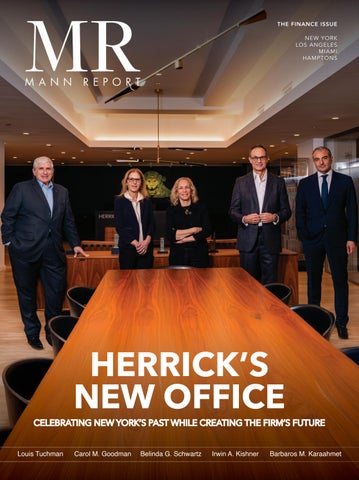
THE FINANCE ISSUE NEW YORK LOS ANGELES MIAMI HAMPTONS
HERRICK’S NEW OFFICE
CELEBRATING NEW YORK’S PAST WHILE CREATING THE FIRM’S FUTURE Louis Tuchman
Carol M. Goodman
Belinda G. Schwartz
Irwin A. Kishner
Barbaros M. Karaahmet
THIS.
And so much more. For decades, we have built a real estate practice unparalleled in the US. Now, as the global legal powerhouse HSF Kramer, we are so much more. As the only law firm ranked in Chambers Band 1 on three continents, we continue to transform skylines and reshape landscapes. Please visit our website to learn more.
Kramer Levin is now HSF Kramer HSFKRAMER.COM
Helping Our Clients Build And Sustain Generational Wealth For over 25 years, Metropolitan Commercial Bank has been dedicated to helping clients grow their business and build generational wealth through our solutions-oriented, relationship-focused approach to banking.
MCBankNY.com Manhattan | 99 Park Avenue • 212 365-6700| 1431 Broadway • 212 643-6981 | 16 West 46th Street • 212 938-0770 | 1270 Lexington Avenue • 646 930-3386 Brooklyn 5102 13th Avenue • 718 851-2105 | Great Neck 111 Great Neck Road • 516 441-5232 © 2020-2025 Metropolitan Commercial Bank “Metropolitan Commercial Bank” is a registered trademark of Metropolitan Commercial Bank.
mannpublications.com
JANUARY 2026
| MANN REPORT 1
2 MANN REPORT | JANUARY 2026
mannpublications.com
mannpublications.com
JANUARY 2026
| MANN REPORT 3
48th Annual
48th Annual Honoring
FRANK GRIMALDI
Gordon Brothers
Dinner Chair
TUESDAY MARCH 3, 2026 5:30 p.m. Cocktail Reception 7 p.m. Dinner Cipriani 42nd Street New York City
BENEFITING NATIONAL JEWISH HEALTH Funds raised will help support groundbreaking medical research and treatments for patients with lung, heart, immune and related disorders.
4 MANN REPORT | JANUARY 2026
CHRISTOPHER R. CARMOSINO Gordon Brothers
Dinner Treasurer RICHARD L. STEHL Otterbourg, P.C.
REGISTER TODAY
Mattie Shepheard | 212.297.0857 ShepheardM@njhealth.org
njhealth.org/FID
mannpublications.com
Ready for tomorrow. Reach new heights with your insurance program, work with the real estate industry experts. o
Property and Casualty
o
Risk Management
o
Environmental Liability
o
Personal Lines
o
Employee Benefits & Life
o
Retirement and Private Wealth
Let’s protect what matters most to you.
hubinternational.com
HUB International Northeast
Frank DeLucia Senior Vice President (212) 338-2395 frank.delucia@hubinternational.com
Risk & Insurance | Employee Benefits | Retirement & Private Wealth mannpublications.com
JANUARY 2026
| MANN REPORT 5
PRESIDENT/CEO Jeff Mann
EDITORIAL Editor Debra Hazel
Director of Communications and Marketing Penelope Herrera Director of Newsletter Division Cheri Phillips
West Coast Office: 578 Washington Blvd., Suite 827 Marina Del Rey, CA 90292 866-306-MANN (6266)
ART
Art Director Virginia Sanchez Cover Photography Isaiah Gill
BUSINESS
Technology Consultant Eric Loh Distribution Mitchell’s Delivery Service
DIGITAL MEDIA CONTRIBUTORS Ben Brandler Jennifer Brown Philip J. Consalvo Karen Giberson Merilee Kern Kris Kiser Bob Knakal Ira Meister John Meko Teresa Minnick Carol A. Sigmond Travis Terry Amanda Valente Evan West
mannpublications.com
Designers Virginia Sanchez
Editors Debra Hazel Penelope Herrera Rose Leveen Cheri Phillips Web Developer CS Designworks
East Coast Office: 450 7th Ave, Suite 2306 New York, NY 10123 212-840-MANN (6266)
The opinions expressed by our columnists are not reflective of the views and opinions of the publisher or the editorial staff of Mann Report. Publication of such views and opinions does not constitute endorsement by Mann Report. Any reproduction, including but not limited to internet usage, is prohibited without the express written permission of the publisher.
6 MANN REPORT | JANUARY 2026
mannpublications.com
mannpublications.com
JANUARY 2026
| MANN REPORT 7
8 MANN REPORT | JANUARY 2026
mannpublications.com
ONE MANN’S OPINION Happy New Year! I hope the just-finished holiday season was one of health, family, happy memories of times past and plans for the future.
The end of one year and beginning of the next is a particularly appropriate time for this month’s cover feature on Herrick Feinstein LLP’s newly renovated offices. We’ve featured some spectacular law office redesigns in the past, but Herrick’s story is unique. The nearly 100-year-old firm has occupied the same space for more than seven decades and sought to reinvent its offices for today’s law professionals while incorporating and highlighting its collection of historic New York artifacts — some dating from the 19th century! Herrick and TPG Architecture pulled it off thoughtfully and beautifully, as you’ll see. We at Mann Publications ended 2025 looking toward the future, hosting “Artificial Intelligence Unplugged,” an educational event in conjunction with our friends at CBIZ, and featuring keynote speaker Rob McGillen, chief innovation officer at CBIZ Financial Services. It was a wide-ranging discussion, filled with possibility. You’ll find photos in this issue. I’m still absorbing the content and am excited for more collaborations with CBIZ this year. Keep checking these pages. Meanwhile, keep us posted on your news and thoughts both for Mann Report and our many newswires. Contact me or our editor, Debra Hazel, at jmann@ mannpublications.com and dhazel@mannpublications.com. Now, let’s get to work!
“Be at war with your vices, at peace with your neighbors and let every new year find you a better man.” — Benjamin Franklin
mannpublications.com
JANUARY 2026
| MANN REPORT 9
JANUARY 2026
TABLE OF CONTENTS
EVENTS 14
Artificial Intelligence Unplugged Delivered High-Value Insights for Business Leaders
16
FEATURES The Market Enters 2026 With Momentum
52
How to Keep Your Apartment Building’s Sump Pump from Freezing This Season
18
54
20
St. Jude Spirit of Hope Event Raises the Bar for Giving
22
Anchin Hosts 20th Annual State of the Construction Industry Event
24
March of Dimes Westchester/Fairfield Real Estate Awards Breakfast Honors Fox and Stagg
60
50
REBNY Hosts Annual Commercial Holiday Lunch
American Friends of Rabin Medical Center Hosts 25th Annual Saving Lives In Israel Gala
Photo by Stillman Development
How the NYCEDC's Public Investment in Sunset Park is Creating a New Model for Economic Growth
58
Building Loyalty: How Smart Upgrades Boost Renewal Rates
60
Why Empty Nesters Represent a Strong Buyer Profile in Monmouth County
62
Pairing AI With The Human Touch
25
Project REAP Honored by ICSC
NEWS BRIEFS 26
Commercial News
30
Residential News
32
Management News
36
Tech Talk
40
Breaking News
10 MANN REPORT | JANUARY 2026
mannpublications.com
JANUARY 2026
TABLE OF CONTENTS
DEPARTMENTS
COVER FEATURE
9
One Mann’s Opinion
13
Editor’s Letter
66
Columns
90
Executive Changes
94
Commercial Corner: Mark Anthony Thomas, President and CEO, Greater Blatimore Committee
96
By the Numbers: Moderate Optimism
44
HERRICK'S NEW OFFICE: CELEBRATING NEW YORK'S PAST WHILE CREATING THE FIRM'S FUTURE
Photo by Isaiah Gill
COLLEGES 78
University of California, Riverside Completes Open Affordable Student Housing
AEC 82
A Grand Staircase for a Grand Magasin
84
America’s Top 10 ADUs of 2025: Tiny Homes, Huge Ideas
58 mannpublications.com
Photo courtesy of Bjorg Magnea
JANUARY 2026 | MANN REPORT 11
EXCELLENCE IN PROPERTY MANAGEMENT – POWERED BY PRECISON BACKED, BY HOSPITALITY At Peninsula PropertyPPM Management (PPM), we do more than manage properties—we elevate them. With a leadership team that is deeply involved, hands-on, and responsive, PPM is redefining the standard for property management in New York City. Our mission is simple: deliver results with integrity, precision, and a hospitality-first approach.
WHAT SETS US APART? Proactive Management
New Development Services
Stop issues before they start — from Local Law 97 to vendor oversight.
Schedule B, TCO phasing, hiring of staff, punch-list, insurance implementation.
Financial Clarity
Smart Cost Control
Clean, timely financials. No surprises – just strategic planning and transparency.
Energy savings, bulk contracts, vendor negotiations — we cut waste, not corners.
NYC Compliance Expertise
Real-Time Technology
DOB, HPD, LL88, LL97, FISP— we navigate every regulation so you don’t have to.
Track requests, tasks, and reports live through our integrated digital platform.
WHY PPM? Direct Access to Leadership No gatekeepers. No delays.
Hospitality Driven Service
Vetted Vendor Network
Board Partnership & Advocacy
White-glove care, no matter the building size
Trusted contractors. Competitive pricing.
Strategic decisions, long-term value.
Transparent Operations Every task tracked. Every dollar accounted for.
Let’s Talk About What Your Building Needs 385 Fifth Avenue , Suite 509, New York, NY, 10016
12 MANN REPORT | JANUARY 2026
www.ppmnyc.com
contact@ppmnyc.com mannpublications.com
EDITOR’S
LETTER Welcome to 2026! This month, our features fittingly look to the future, in finance, management and more. In our November/December issue, North Bridge Founder and CEO Laura Rapaport wrote about the growth of C-PACE financing in 2025. This month features a sequel, where North Bridge’s Managing Director Ben Brandler looks to future opportunities for this expanding vehicle. In addition, Philip J. Consalvo of PJCArchitecture tells us how design can help engender tenant loyalty, while Renovation Sells Co-founder Amanda Valente discusses the role artificial intelligence can play in home renovations. There’s still a lot of winter left, so take a look at the guide to keeping your multifamily building’s sump pump working through the season from Evan West, chief marketing officer of ePumps. And in a feature close to my Sunset Park, Brooklyn-raised heart, Jennifer Brown of the NYCEDC offers an update on its investments in the neighborhood and work to create a Harbor of the Future. I’m excited to see how all of the above will play out, and am looking forward to telling you about all that this new year will bring.
VISIT US ON
mannpublications.com
FOLLOW US ON INSTAGRAM @mannreport
mannpublications.com
JANUARY 2026 | MANN REPORT 13
Photos courtesy of Jack Miller
EVENTS
Artificial Intelligence Unplugged Delivered High-Value Insights for Business Leaders By Karen Giberson Mann Publications hosted a contentrich evening with Artificial Intelligence Unplugged, an event designed to bring clarity, practical expertise and fresh perspective to an industry eager to understand AI’s next evolution. Sponsored by CBIZ, the program convened senior executives from fashion operations and New York’s real estate community.
Microsoft Azure AI. McGillen began with an AI-generated video created using Synthesia — a striking demonstration of text-tovideo capabilities that underscored both the promise and limitations of today’s platforms. He followed with a fast overview of how AI is reshaping workflows, creativity and operational efficiency across sectors.
The night opened with a lively cocktail reception and networking hour, followed by a casual buffet dinner, each moment filled with fast conversation and idea sharing. Jeff Mann, CEO and president of Mann Publications, welcomed the group and set the tone for a forwardfocused discussion.
In fashion and consumer products, AI is accelerating design-to-market calendars, producing visual assets at scale, translating content for global audiences and optimizing inventory, assortments and planning.
The centerpiece was an insightful presentation from Rob McGillen, vice president of business innovation at CBIZ, who leads the firm’s AI practice and is widely recognized for his expertise in AI governance, controls and ethical implementation. His background spans pioneering work with Google DeepMind, IBM Watson, OpenAI, Anthropic and
Rob McGillen
In real estate, AI is improving property marketing, leasing, due diligence reviews, building management and fraud detection, and powering new platforms such as Elise. McGillen reminded attendees that rapid adoption brings heightened security exposure — an area where strong governance and controls are increasingly essential. He encouraged exploring
Nick Tuleu, Stephen Palmese, Jake Hulsh and Jesse Hulsh
Ira Cooperman, Gunjan Shah and Javier Carreras
Jeff Mann, Chloe Donnell and Craig Miller
John Cinosky and Aaron Boyajian
Gina Sabio and Phillip Bottari John and| Jeff Mann 2026 14Cinosky MANN REPORT JANUARY
Ted Carlson, Paul Magel and Jeff Mann
Deshard Stevens, Ted Carlson and Christian Schechinger mannpublications.com
Steve Kaufman and Leslie Harwood
Jeff Mann, Rob McGillen and Michael Sacco
Carol Sigmund and Joshua Deal
Karen Giberson and Joshua Kapelman
Rob McGillen, Cara Faske and Mitti Liebersohn
Matilde Reyes, Elena Reynolds, Leslie Schwartz and Nicolette Sinatra
emerging tools, including Matterport, a 3D AI platform that generates immersive virtual walk-throughs. He noted a transformational shift: 40% to 50% of consumers now use AI to research, discovering companies and products through contextual, conversational results rather than keyword-driven search engine optimization (SEO). That trend is projected to influence $750 billion in sales by 2026.
Andrew Postel, Allan Ellinger and Marc Heller
His message: AI doesn’t rely on keywords—it relies on context and intent. Brands, marketers and retailers must rethink traditional SEO strategies built for crawlers, not conversational intelligence. McGillen closed with a look at the rise of agentic AI, widely expected to fuel the next era of artificial intelligence. Attendees left energized — and many likely began rethinking their 2025 playbooks. Jay Neveloff and Nicole Fentor mannpublications.com
Paul Pagano, Frank Marsicano and Jason Goldberg
JANUARY 2026 | MANN REPORT 15
EVENTS
T
he Real Estate Board of New York’s annual Commercial Holiday Luncheon, held at the Metropolitan Club, was at capacity with over 200 guests, with a featured fireside chat with Marc Holliday of SL Green and Chef Daniel Boulud moderated by Steve Cuozzo of the New York Post. Guests featured top members from leasing, investment sales, development, property management and other commercial real estate disciplines. The wide-ranging conversation covered a general outlook on the state of the New York City market, perspectives on the new administration, how real estate and hospitality work together in shaping New York City, collaborations and various lessons learned from One Vanderbi lt t hrough One Mad ison, and the evolution of hospitality within commercial real estate. Another highlight of the luncheon was the announcement of the REBN Y's 2026 Most Promising Salesperson of the Year, which was presented to Ana Erickson of Savills.
REBNY HOSTS ANNUAL COMMERCIAL HOLIDAY LUNCH 16 MANN REPORT | JANUARY 2026
REBNY President James Whelan
mannpublications.com
Brian Rothschild, Bill Montana, James Nelson, Arthur Mirante, Daniel Birney and Heidi Steinegger REBNY's 2026 Most Promising Salesperson of the Year, Ana Erickson of Savills
Sandhya Espitia, REBNY; Chef Daniel Boulud; Bess Freedman and James Whelan, REBNY
Woody Heller, Branton Realty Services; Jeffrey Gural, GFP Real Estate and Elliott Warren, Kaufman Organization
mannpublications.com
Erik Edeen, Michael Green and Michael Rudder
Marc Holliday, SL Green; Chef Daniel Boulud and Steve Cuozzo, New York Post
Photos courtesy of the Real Estate Board of New York
JANUARY 2026 | MANN REPORT 17
EVENTS
Photos by Jenna Bascom Photography
AMERICAN FRIENDS OF RABIN MEDICAL CENTER HOSTS 25th Annual Saving Lives In Israel Gala
Tamar Herman, gala honoree; Philippe Visser and Carla Visser
18 MANN REPORT | JANUARY 2026
mannpublications.com
EVENTS More than 450 leaders of New York’s and the United States' real estate, finance and technology industries joined together at The Plaza Hotel in New York City for the American Friends of Rabin Medical Center (AFRMC) 25th Annual Gala to support saving lives in Israel at Rabin Medical Center, the country’s premier hospital. The Yitzhak Rabin Lifetime Real Estate Leadership Award was presented to Jay Neveloff, partner, chair of real estate, U.S. at Herbert Smith Freehills Kramer. The Yitzhak Rabin Real Estate Leadership Award was given to Philippe Visser, president of Related Office Development. Honorees were recognized for their
“outstanding leadership in their fields and for being trusted partners, loyal friends and exemplary philanthropists.” At the event, Dr. Noa Eliakim-Raz, director of the Returning Hostage Ward at Israel’s Rabin Medical Center, and now co-director of the Rehabilitation of Returning Hostages Clinic, spoke about her experience at Israel’s Rabin Medical Center and her team’s invention of “captivity medicine” — a first-of-itskind designed protocol for the treatment and care of released hostages. “For me, personally, the experience of treating these heroes made me rethink life and appreciate the little moments in life,” Eliakim-Raz said. “Thank you for standing with us in solidarity. It means
Gary Jacob, Jeff Mann and Cathy Jacob
Gary Barnett, Jonathan Mechanic and Scott Rechler
Gala Honorees Jay Neveloff and Philippe Visser
Rob Rorin, Jonathan Mechanic and Fried Frank colleagues
mannpublications.com
the world to us and to each and every returning hostage and their families. Together, we have brought them home and are helping them to heal. Thank you to all our American Friends of Rabin Medical Center here tonight, and across the country.” Gala Master of Ceremonies Magalie Laguerre-Wilkinson (CEO and founder of MagCap Media and AFRMC board member) spoke with Eitan & Daniel, two young Israeli men who were wounded in Southern Lebanon and treated at Israel’s Rabin Medical Center. Both young men suffered terrible injuries, with one of them spending several months in the ICU, undergoing 10- to 12-hour long surgeries.
Mitti Liebersohn
JANUARY 2026 | MANN REPORT 19
EVENTS
St Jude Patient Allia and her mom
St. Jude Spirit of Hope Event Raises the Bar for Giving The seventh annual St. Jude Spirit of Hope networking charity event brought together leaders in the construction and real estate industries for an evening of purpose in New York City. The event highlighted what these industries can achieve in support of the lifesaving mission of St. Jude Children’s Research Hospital. Approximately 300 guests gathered at Chelsea’s City Winery, overlooking the Hudson River, for an evening of gourmet food, craft spirits, live music and both a silent and live auction. The event raised $375,000 in support of the children and families of St. Jude Children’s Research Hospital — surpassing preevent estimates by about 7%. These funds directly support St. Jude’s promise: that no family ever pays for treatment,
20 MANN REPORT | JANUARY 2026
housing, food or travel while their child receives care. “St. Jude’s mission has always inspired me — saving children’s lives and supporting families facing unimaginable challenges. What really resonates with me is that every dollar raised goes directly to research and helping families, not administrative costs” said Athena Pappas, director of philanthropy at Forte Construction Corp., who served for the first time as chairperson of the Spirit of Hope Gala. Pappas’ relationship with St. Jude began many years ago as a volunteer and donor. Pappas, together with her committee — Neil Hirani of Hirani Group, Jason Katz of Columbia Capital, Sandra Y. Betterson of New York Life Insurance,
mannpublications.com
Photos by Matt Kane, Joe Quinto/Ipartypix and Forte Construction
EVENTS Nicholas Depinto and Richard Miensky of Highline Residential, Joshua Goldman of Avison Young, Brianna McClain of Grey Duck Wealth Management and Kishan Ramsammy of Hotaling Insurance — worked alongside dedicated volunteers, whose generosity and efforts were key to making the event a success. Founded in 1962, the Memphis-based St. Jude Children's Research Hospital treats approximately 8,000 children from all 50 states each year. Their research
mannpublications.com
and treatment efforts have significantly increased the childhood cancer survival rate from 20% in 1962, to more than 80% today. One of the evening’s highlights was welcoming Allia, a former patient of St. Jude. Her mother shared the challenging journey Allia faced after being diagnosed with pediatric brain cancer at just four years old. Today, at 25, Allia is healthy and thriving.
Costa and Alison Koulouris, Northeast Structural Steel
Chris and Danielle Koukounas, Premier Insulation
Tony Dagnachew, Richie Nicolo and Bill O'Brien, Dagnachew Electric
Samantha Saleh and Michael Paladino, Veris Residential
JANUARY 2026 | MANN REPORT 21
EVENTS
Photos by Ben Asen of Ben Asen Photography
Anchin Hosts 20th Annual State of the Construction Industry Event Full-serivce accounting advisory firm Anchin hosted its 20th Annual State of the Construction Industry event, convening many architecture and engineering executives, developers, contractors and policymakers to discuss the challenges and opportunities shaping the future of construction in New York City and beyond. This event, held in New York City, featured a keynote address by John Fish, chairman and CEO of Suffolk, followed by a dynamic panel of industry leaders. Moderated by Johnny Evers, president and CEO of ACEC New York, the panel included Carlo A. Scissura, president and CEO of the New York Building Congress; Dev Awasthi, vice president of New York City legislative affairs at the Real Estate Board of New York (REBNY); Elizabeth Crowley, president and CEO of the Building Trades Employers’ Association (BTEA) and Felice Farber, executive director of the Subcontractors Trade Association (STA). “This year’s discussions reaffirmed that technology, workforce development, and collaboration will drive the next era of progress,” said Phillip Ross, partner and coleader of the Architecture & Engineering and Construction Industry Groups at Anchin. “The industry’s resilience and creativity continue to inspire optimism for the future.” Fish delivered a forward-looking address on the state and direction of the construction industry, noting both persistent challenges and transformative opportunities. He emphasized the need for adaptable, technology-driven solutions to address labor, regulatory and cost pressures. He outlined how Suffolk is reimagining project delivery through a “master design builder” model. This is an evolution of the traditional “master builder” that integrates AI, data, and off-site manufacturing (OSM) to streamline operations, reduce rework and
22 MANN REPORT | JANUARY 2026
improve quality. He further described Suffolk’s investments in AI innovation, including a $40 million AI center, 15 dedicated AI staff and over $50 million invested across 58 technology startups to drive advancements in jobsite efficiency, scheduling accuracy, and sustainability. Fish also underscored the importance of rebuilding the American dream through housing affordability and workforce opportunity. The panel following the keynote explored pressing issues facing New York’s construction industry amid political change, budget pressures and evolving public priorities. Scissura highlighted the importance of steady infrastructure investment and vigilance around public funding flows, while Farber emphasized the challenge of balancing rising insurance and labor costs with maintaining fair wages and high-quality work. Crowley spoke to the economic vitality of unionized contractors and the need for a safe, modernized workplace; Awasthi underscored the urgent need to expand housing supply and affordability through strategic collaboration between government and industry. Panelists agreed that the industry’s future will depend on attracting a younger, more diverse workforce, integrating technology to improve efficiency and strengthening cooperation among contractors, developers and public agencies.
“Even in times of uncertainty, our shared commitment to innovation, quality and collaboration drives the sector forward ...” — Fred Ackerman
“This event reminds us why New York’s construction, design and real estate community is so exceptional,” added Fred Ackerman, partner and co-leader of the Architecture & Engineering and Construction Industry Groups at Anchin. “Even in times of uncertainty, our shared commitment to innovation, quality and collaboration drives the sector forward. As we look ahead to 2026 and beyond, adaptability, resilience and technology will continue to shape how we build and how we strengthen the economic and physical landscape of New York.” mannpublications.com
EVENTS
John Hunter, Alliant; Thomas Tripodianos, Welby, Brady & Greenblatt LLP and Phillip Ross, Anchin John Magdziak, Evgenia Abramova, Steven Linden and Paul Gevertzman, Anchin and Johnny Evers, ACEC New York
Fred Ackerman, Anchin
Fred Ackerman, Anchin; Dev Awasthi, REBNY; Felice Farber, Subcontractors Trade Association; Elizabeth Crowley, Building Trades Employers Association; John T. Evers, ACEC New York; Carlo A. Scissura, New York Building Congress and Phillip Ross, Anchin
Elizabeth Crowley, Building Trades Employers' Association; Felice Farber, Subcontractors Trade Association; Carlo A. Scissura, New York Building Congress and, John T. Evers, ACEC New York
mannpublications.com
John Fish, Suffolk Construction; Danielle Secor, Secor Strategies and Dev Awasthi, REBNY
JANUARY 2026 | MANN REPORT 23
EVENTS
Photos by John Vecchiolla
March of Dimes Westchester/Fairfield Real Estate Awards Breakfast Honors Fox and Stagg
Honoree Susan Fox, White Plains Hospital and Joe Simone, Simone Development Companies
Joe Simone, Simone Development Companies; Annette Trotta-Flynn, March of Dimes; Susan Fox, White Plains Hospital; Patricia Valenti, Newmark; Mark Stagg, Stagg Group and Tara Rosenblum, News 12 Network
Honoree Mark Stagg, Stagg Group and Adolfo Carrion Jr., Deputy Mayor of New York City for Housing and Economic Development and Workforce
The 2025 Westchester/Fairfield Real Estate Awards Breakfast was held at Brae Burn Country Club in Purchase, N.Y. March of Dimes NY/NJ Market honored Susan Fox, president and CEO of White Plains Hospital and regional senior vice president for the Hudson Valley/Montefiore Einstein, received the Martin S. Berger Lifetime Achievement Award, presented by Joseph Simone, president of Simone Development Companies. Simone is a past recipient of the award.
executives and a visionary leader in healthcare transformation. Over the past decade, she has led White Plains Hospital through a period of extraordinary growth, forging strategic partnerships, recruiting top clinical talent and expanding access to care across the Hudson Valley. Under her leadership, the hospital has become a tertiary care hub for Montefiore Health System and a regional leader in advanced healthcare delivery.
Mark Stagg, founder and president of Stagg Group, received the prestigious March of Dimes Real Estate Award. The award was presented by Adolfo Carrion Jr., deputy mayor of New York City for Housing and Economic Development and Workforce.
Through his leadership of the Stagg Group, Stagg has built more than 5,000 market rate and affordable housing units, with more than 3,000 additional units in the pipeline. His projects include The Riverdale Tower in the Bronx, West View Apartments in New Rochelle and Whitlock Point in the Bronx. His philanthropy also extends beyond his development business, supporting community causes such as Thanksgiving food drives, Camp Bronx and the continued expansion of White Plains Hospital.
The event brought together leaders from the real estate and construction industries to celebrate those making an incredible impact on their communities while supporting the mission of March of Dimes — fighting for the health of all moms and babies. The 38th annual breakfast drew nearly 500 attendees and raised over $1.3 million, a new record, to support March of Dimes research, programs and advocacy that improve maternal and infant health outcomes. Fox has been recognized as one of Westchester County’s most influential
24 MANN REPORT | JANUARY 2026
The Westchester/Fairfield Real Estate Awards Breakfast was emceed by News 12 Network’s Emmy Award-winning anchor/host/reporter Tara Rosenblum and co-chaired by Patricia Valenti, executive managing director of Newmark, and Don Bucci, managing director at JLL.
mannpublications.com
EVENTS
Taneshia Nash Laird, Jazmen Johnson and Erica-Nicole Harris
Taneshia Nash Laird, Lyneir Richardson, Makia Smith, Glory Omotayo, Susan Lee and Tom McGee
Project REAP Honored by ICSC for Leadership and Impact in Commercial Real Estate Project REAP (Real Estate Associate Program), a nonprofit for developing exceptional talent in commercial real estate, was named an Impact Award honoree “for leading our industry forward” at the 2025 ICSC CBC Retail Real Estate Reception at The Morrow Hotel in Washington, D.C. The event brought together retail real estate executives, policymakers and community leaders to recognize the achievements of industry leaders and highlight partnerships that foster more inclusive marketplaces.
ICSC President and CEO Tom McGee presents award to REAP Executive Director Taneshia Nash Laird
“We were excited to host our second annual CBC Retail Real Estate Reception to honor trailblazers for their leadership and community impact and celebrate our strategic partnerships,” said Tom McGee, president and CEO, ICSC. “In doing so, we hope to inspire the next generation of talent to step forward to further strengthen our industry.” Project REAP, represented by Executive Director Taneshia Nash Laird and Board Vice Chair Erica-Nicole Harris, was recognized alongside Maryland Governor
mannpublications.com
Photos courtesy of Project REAP
Morgan Wortham, Veronica Kamara and Jade Bolen
Wes Moore (represented by Maryland Secretary of State Susan Lee), ICSC Trustee Lyneir Richardson (CEO and cofounder of Chicago Trend) and Morgan State University’s Chapter of Diversity and Inclusion in Real Estate Institute (represented by Makia Smith and Glory Omotayo). Honorees were celebrated for their contributions to expanding opportunity and strengthening communities through commercial real estate. ICSC has been a key sponsor and partner of Project REAP since its founding in 1997, “ICSC’s recognition of Project REAP underscores the lasting impact of our mission: developing high-potential professionals and preparing them to thrive in an industry where exceptional talent drives success,” said Nash Laird. “As we approach three decades of creating career pathways in commercial real estate, we remain committed to ensuring that our alumni not only succeed individually but also shape the future of the industry.”
JANUARY 2026 | MANN REPORT 25
COMMERCIAL NEWS
Arrow Arranges $220M Financing for Brooklyn Multifamily corner of Lorimer Street and Broadway in Brooklyn, N.Y. The permanent financing was arranged by Arrow Real Estate Advisors’ Morris Betesh, founder and managing partner; Alex Bailkin, senior vice president, and Andrew Rosenberg, analyst. The capital structure included a fixed-rate senior loan originated by Blackstone, with participation from CenterSquare, and retired the prior $172 million loan from TPG. “These newly delivered Class A buildings underscore the sustained demand for luxury living in the heart of Williamsburg, and this permanent financing reflects that strength,” Betesh said. “Arrow created a highly competitive bidding environment across all execution types.” The two eight-story properties total 318,428 gross square feet and comprise 336 residential units, supported by six ground-floor retail suites and 221 below-grade parking spaces. Unit mix ranges from studios to two-bedrooms, featuring condo-level specifications including stainlesssteel appliance packages, modular closet systems, in-unit washers and dryers and rain showers with glass enclosures. Photo courtesy of Arrow Real Estate Advisors
Arrow Real Estate Advisors announced that it has arranged a $220 million permanent refinance on behalf of The Loketch Group, Joyland Group and Meral Property Group for two newly developed, adjacent multifamily properties. The properties, Lorimer House and Copper Lofts, are located at the
Amenities across both properties include indoor and outdoor lounges, state-of-the-art fitness centers, bicycle storage, live-work space, fulltime doorman service, activated rooftop spaces and a coffee and pastry residence lounge. Construction was completed on both properties in the summer of 2024 and were fully stabilized within nine months of delivery. The refinance replaces more expensive transitional debt on the property with a fixed rate and five-year interest only loan.
Sonida Senior Living to Acquire CNL Healthcare Properties for $1.8B The merger will create the eighth largest owner of senior living assets in the United States, with a combined portfolio of 153 owned independent living, assisted living and memory care communities totaling approximately 14,700 units. Upon closing, the combined operator expects to have an approximately $3.0 billion enterprise value and $1.4 billion equity market capitalization. “Sonida’s overarching objective is to capitalize on the long-term tailwinds of favorable demographics and supply constraints within senior living by operating and growing a best-in-class owner operator platform,” said Brandon Ribar, president and CEO. “This transaction represents an inflection point in our pursuit of that objective as it more than doubles Sonida’s number of owned units while deepening and expanding our exposure to the most attractive geographic areas for our strategy.” Newmark’s Chad Lavender, president of Capital Markets, North America, and Ryan Maconachy, vice chairman and co-head of healthcare and alternative real estate assets, advised Sonida on the transaction.
In a move that will create a $3 billion senior housing owner/operator with a national scale, Sonida Senior Living, an owner and operator of senior housing communities, has agreed to acquire CNL Healthcare Properties in a cash-and-stock transaction valued at approximately $1.8 billion.
26 MANN REPORT | JANUARY 2026
“This merger reflects the strength of Sonida’s leadership and strategy, pairing operational excellence with a platform well-positioned to capture the long-term demographic tailwinds in the senior living sector,” Maconachy said. Sonida will retain its NYSE ticker symbol and existing leadership team post-closing. The transaction is expected to close in the first half of 2026.
mannpublications.com
mannpublications.com
JANUARY 2026 | MANN REPORT 27
COMMERCIAL NEWS
Morgan Stanley Investing Acquires CAlifornia IOS Facility for $92M Morgan Stanley Investment Management, through investment funds managed by Morgan Stanley Real Estate Investing (MSREI), has acquired an industrial outdoor storage facility in Southern California for approximately $92 million. The property is subject to a long-term, absolute triple net lease with Oldcastle Infrastructure, a subsidiary of building materials company CRH plc. “This acquisition exemplifies MSREI’s strategy of sourcing and securing institutional-quality net lease investments in core logistics markets,” said Will Milam, head of U.S. investments at Morgan Stanley real Estate Investing. “The IOS facility is a mission-critical asset for Oldcastle and a cornerstone for regional infrastructure supply.” Located in Fontana, Calif.’s Southwest Industrial Park, the rare 26acre parcel is unique in scale, with virtually no comparable IOS parcels available in the region. Oldcast has operated at this location for over 30 years. “By shifting property expenses, taxes and manteanings obligation to the tenant, net lease structures mitigate real estate owners’ exposure to volatility and unexpected costs, making net lease cash flows among the most predictable in real estate,” said Lauren Hochfelder, co-CEO of MSREI. “Beyond the benefit of net lease, we expect U.S. industrial to benefit from the continued supply chain realignment, including increased onshoring of manufacturing.”
VICI Properties Announces $1.16B SaleLeaseback with Golden Entertainment the operating business of golden in connection with the closing of the transaction. The portfolio includes The Strat Hotel, Casino and Tower on the Las Vegas Strip; Arizona Charlie’s Decatur and Arizona Charlie’s Boulder in Las Vegas; Aquarius Casino Resort and Edgewater Casino Resort in Laughlin, Nev. and Pahrump Nugget Hotel & Casino and Lakeside RV Park & Casino in Pahrump, Nev. The properties feature approximately 362,000 square feet of casino space and over 6,000 hotel rooms. The transaction diversifies VICI’s real estate ownership in Nevada, and gives it entree to the Las Vegas Locals market, which it has long targeted due to consistent growth and favorable population increases. “We are thrilled to acquire seven new assets across the state of Nevada with stick, durable customer bases,” said John Payne, VICI president and COO. “We look forward to initiating a partnership with Golden, having long admired the ability of Blake and the Golden team to operate within the various dynamics of the Nevada gaming market.”
VICI Properties Inc. has agreed to acquire 100% of the land, real property and improvements of seven casino properties from Golden Entertainment for $1.16 billion. It also will enter into a triple-net master lease with a newly formed entity that will be owned and controlled by Blake L. Sartini, current chairman and CEO of Golden, that will acquire
28 MANN REPORT | JANUARY 2026
“At Golden, we have continued to refine our business in recent years to focus on our core casino and tavern operations in Nevada, and we believe this transaction is the right next step in our evolution to a private company,” said Sartini. “After many years of watching VICI’s success, we are excited to partner with VICI on this important strategic transaction and to explore potential opportunities to grow our company.” The transaction is expected to close in mid-2026. Deutsche Bank Securities is acting as VICI’s financial advisor, and Hogan Lovells US LLP and Herbert Smith Freehills Kramer LLP are serving as legal advisors to VICI.
mannpublications.com
mannpublications.com
JANUARY 2026 | MANN REPORT 29
RESIDENTIAL NEWS
Scenic Sotheby's International Realty Expands to Pensacola Jessica Duncan
JP Birdwell
International Realty as the firm extends its reach beyond Scenic Highway 30A and the Emerald Coast, bringing its globally connected brand and local expertise to one of Florida’s most dynamic coastal markets. “Pensacola has long been part of the Gulf Coast story, blending history, innovation and community in a way that deeply resonates with our mission,” said Blake Morar, broker-owner of Scenic Sotheby’s International Realty. “We’re thrilled to build a local presence here with such exceptional professionals leading the way.”
Photos courtesy of Scenic Sotheby’s International Realty
Scenic Sotheby’s International Realty is expanding its presence along Florida's Gulf Coast with the opening of a new office in downtown Pensacola. Located at 100 West Garden St., the firm’s fifth local office will serve buyers and sellers across both Escambia and Santa Rosa Counties, the firm announced. The expansion marks a strategic milestone for Scenic Sotheby’s
Joining the firm to anchor the Pensacola expansion are The Jessica Duncan Team and JP Birdwell. Jessica Duncan, a lifelong Gulf Coast local, brings more than a decade of experience and a reputation for excellence rooted in service, strategy and community impact. Raised in Pensacola and educated at the University of West Florida, Duncan combines deep regional insight with formal training in marketing, finance and real estate investment. Pensacola native Birdwell joins the firm as a rising force in Gulf Coast real estate. Known for his forward-thinking approach and commitment to revitalization efforts, he has also been instrumental in local neighborhood improvement initiatives and is developing a not-for-profit dedicated to restoring home exteriors for residents in need.
Ombelle Fort Lauderdale Unveils the Tower and Flagler Collections Each residence features 10-foot ceilings in main living areas, floorto-ceiling windows, glass terraces, open-concept layouts, Italian designer kitchens and bathrooms, designer-curated finishes, smart home technology and fully furnished options. Natural materials, clean lines and bright interiors define Ombelle’s modern aesthetic, merging sophistication with livability.
Photo courtesy of Dependable Equities
Ombelle Fort Lauderdale, developed by Brooklyn, N.Y.–based Dependable Equities, announced the debut of two distinctive luxury residential offerings: The Tower Collection and The Flagler Collection. Together, the new collections introduce a diverse selection of floor plans that expand the project’s lifestyle-driven portfolio and elevate the standard for luxury living in downtown Fort Lauderdale, Fla. The new collections offer larger, more livable layouts ideal for families, local professionals and seasonal residents. Pricing for the new residences begins in the $400,000s. Designed by ODA, Ombelle will feature two 44-story towers in the heart of Flagler Village, anchored by more than 100,000 square feet of private indoor and outdoor amenities inspired by wellness, creativity and social engagement. Located at 300 Northeast 3rd Ave., construction is expected to be completed in 2028. Situated on floors two through nine, the Flagler Collection will include studios, one-bedroom, one-bedroom plus den and two-bedroom residences. Positioned on floors 11 through 41, the Tower Collection will offer studio to four-bedroom residences with enhanced living areas, expansive terraces and panoramic city views.
30 MANN REPORT | JANUARY 2026
“Ombelle continues to be one of Fort Lauderdale’s most sought-after condominium developments, attracting buyers who prioritize modern luxury, thoughtful amenities and meaningful connectivity,” said Isaac Schlesinger, principal at Dependable Equities. “With the introduction of the Tower and Flagler Collections, we are offering an expanded range of layouts, from studios to four-bedroom residences, giving buyers more opportunities to experience the lifestyle and design that set Ombelle apart.” The extensive amenities program is anchored by Fort Lauderdale’s firstever Equinox Fitness Club. The 35,000-square-foot facility will offer elite training, spa services and holistic wellness programs. Ombelle residents will receive a founding membership, including a complimentary one-year membership with unlimited access to Equinox’s signature classes, on-demand sessions and coaching from top talent. In addition to Equinox, Ombelle’s onsite amenities include an expansive 10th-floor amenity level, curated by Arch Amenities: a landscaped indoor lounge, chef’s kitchen, dining room, coworking suite, library, music room, creative arts studio and a fully equipped game lounge. Additional amenities include a state-of-the-art fitness center, two resort-style pools with poolside bar, yoga studio, Pilates studio, Zen Garden, indoor and outdoor saunas, two indoor pickleball courts, golf simulator, children’s playroom, pet-friendly areas and outdoor lounges. Douglas Elliman Development Marketing is the exclusive sales and marketing partner for Ombelle Fort Lauderdale.
mannpublications.com
RESIDENTIAL NEWS
NAR Existing-Home Sales Report Shows 1.2% Increase in October due to homebuyers taking advantage of lower mortgage rates,” said NAR Chief Economist Lawrence Yun. “First-time homebuyers are facing headwinds in the Northeast due to a lack of supply and in the West because of high home prices. First-time buyers fared better in the Midwest because of the plentiful supply of affordable houses and in the South because there is sufficient inventory.” The total housing inventory was 1.52 million units, down 0.7% from September and up 10.9% from October 2024. The median existinghome price of $415,200 for all housing types is up 2.1% from one year ago — the 28th consecutive month of YoY price increases.
Existing-home sales increased by 1.2% in October over the previous month, according to the National Association of Realtors ExistingHome Sales Report. The report provides the real estate ecosystem, including agents and homebuyers and sellers, with data on the level of home sales, price and inventory. Sales rose 1.7% year-over-year. Month-over-month (MoM) sales increased in the Midwest and South, showed no change in the Northeast, and fell in the West. Year-overyear (YoY) sales rose in the Northeast, Midwest and South, and decreased in the West. “Home sales increased in October even with the government shutdown
The Northeast saw no change in the sales rate from September and rose 4.3% YoY. The median price of $503,700 was a 6.5% increase from October 2024. The Midwest saw a 5.3% increase MoM and a 4.6% YoY rise. The median price of $319,500 was a 4.6% increase from October 2024. Sales in the South rose 0.5% MoM and 2.8% YoY. The median price of $362,300 was a 0.3% increase YoY. In the West, sales declined 1.3% MoM and dropped 2.6% YoY. The median price of $628,500 was up 0.1% YoY. “Rents are decelerating which will reduce inflation and encourage the Federal Reserve to continue cutting rates and pulling back their quantitative tightening,” Yun added. “This will help bring more homebuyers into the market since the Fed rate has an indirect impact on mortgage rates.”
Trinity Southern and Serhant Break Ground on 29 Indian Creek in Miami Beach modern vision inspired by Miami Beach’s Art Deco heritage. Residences at 29 Indian Creek range from 820 square feet to just over 1,750 square feet, and are priced from $1.4 million to over $3 million. “29 Indian Creek is designed with a deep respect for the history and vibrancy of Miami Beach, and breaking ground on this project is a proud moment for our team,” said Bill Lozito, principal of Trinity Southern. “Our vision is to establish a new benchmark for luxury living that enhances the neighborhood while providing residents with an unparalleled standard of boutique living.”
Photo courtesy of Trinity Southern
Trinity Southern, in partnership with JMH Development and exclusive sales and marketing by Serhant New Development, have broken ground on 29 Indian Creek, a boutique collection of 22 residences, including 20 one- and two-bedroom condominiums and two rare two-story townhomes in the heart of Miami Beach. Located at 2901 Indian Creek Drive, the property is steps from the beach. Phased demolition and site clearing is underway, in preparation for foundation construction to begin, aiming toward anticipated project completion in early 2027. According to the developers, the groundbreaking at 29 Indian Creek proudly signifies what is destined to be Miami Beach’s most refined new residential address. Developed and built by Trinity Southern, with architecture, interiors and landscape by Urban Robot, 29 Indian Creek embodies a cohesive
mannpublications.com
Residences at 29 Indian Creek feature open-concept layouts with ceilings soaring over nine feet and floor-to-ceiling windows offering direct views of Indian Creek and the surrounding neighborhood while creating a bright, airy, and seamless indoor-outdoor living experience. Kitchens bost custom bone-white lacquered millwork, glass upper cabinets, expansive stone islands and a fully integrated premium Miele appliance package, including a built-in wine cooler in every unit. Bath suites are outfitted with freestanding Hansgrohe fixtures and backlit mirrors, while corner units offer wrap-around balconies. All residences include expansive terraces with Art Deco–inspired railings. Each of the newly built townhomes includes a 500-square-foot private terrace with a fully equipped summer kitchen and wet bar, designed for elegant entertaining and a unique indoor and outdoor living experience. “29 Indian Creek brings a new level of boutique luxury to an address in one of the city’s most dynamic neighborhoods, that reflect the energy, style and character of Miami Beach living,” said Ryan Serhant, founder and chief executive officer, Serhant.
JANUARY 2026 | MANN REPORT 31
MANAGEMENT NEWS
Mazzarini Launches Mazzarini & Co., Formerly BHDM Design Mazzarini & Co., formerly known as BHDM Design, announced the launch of its new identity, ushering in a new chapter for the New Yorkbased design studio. The rebrand reflects the firm’s evolution while honoring its roots in narrative-driven, hospitality-forward design. Envisioned by Principal and Creative Director Dan Mazzarini, this updated identity bridges the firm’s origin with its future trajectory, drawing on his formative years as a director at Ralph Lauren. “Reintroducing our studio as Mazzarini & Co. marks more than a new name — it reflects our ongoing evolution as a creative collective at the intersection of narrative and space,” said Mazzarini. “Our latest chapter underscores our vision by allowing us to push further: exploring fresh ideas, methods of collaboration and experiences that surprise and delight at every scale.” Since its inception in 2012 as BHDM Design, the firm has worked across four continents, collaborating with a global roster of internationally recognized clients from Ralph Lauren and Waldorf Astoria to Google and One Medical. Mazzarini & Co. has revitalized historic landmarks, including Grand Central Terminal and the Harvard Club of New York, while pioneering fresh concepts for developers, venture capital
firms and high-net-worth individuals seeking bespoke environments. The firm will continue to expand its reach across the hospitality, workplace and residential design sectors while embracing new opportunities for innovation and collaboration. Building on its legacy, the design studio remains committed to balancing strategy and creativity with heritage and beauty in each project. Guided by a discerning eye and concept-driven process, the team imagines design not only as decoration but as the most powerful vehicle for storytelling.
Photo courtesy of Mazzarini & Co.
Parks Associates: 41% of Apartment Renters Expect Their Internet Service Will Be Ready-to-Go at Move-In Connection is key for renters, according to a “Achieving Turnkey Connectivity: Elevating the Total Multifamily Experience,” a white paper from market research firm Parks Associates in partnership with Xfinity Communities (a division of Comcast Corp.). More than four in 10 (41%) of apartment renters expect that their internet service will be ready-to-go from the moment they move into a property. In addition, nearly 50% of apartment residents rated internet available at move-in a top consideration when searching for a new home. The white paper examines how properties can enable turnkey property readiness and a seamless move-in ready experience for residents. It addresses the growing challenges from vendor fragmentation and best practices for simplifying smart tech implementation. “With today’s renters skewing older, more family-oriented and often working remotely, robust digital infrastructure is a requirement,” said Kristen Hanich, director of research, Parks Associates. “Consumers are interested in a variety of amenities, some of which, like security cameras around the property, controlled access to the property and in-unit security systems, demand robust property connectivity.” The white paper also notes that while technology offers many benefits to the industry, fragmentation across the proptech ecosystem has created a variety of challenges for many owners and operators, on-site staff and residents. In 2024 Parks Associates study of multi-dwelling unit operators, the participants reported working with an average of 21.5 smart building partners.
32 MANN REPORT | JANUARY 2026
Photo courtesy of Parks Associates
“Today’s renters expect more than just four walls — they expect instant, reliable connectivity the moment they walk through the door,” said Ilan Eframian, vice president at Xfinity Communities. “At Xfinity Communities, we’re proud to help property owners meet that expectation with turnkey solutions that elevate the resident experience and simplify operations. Seamless Day One internet isn't just a convenience — it’s how we help properties stand out and keep residents happy from the start.” Sixty percent of multifamily owning or operating companies have managed WiFi in at least part of their footprint, with 13% reporting full penetration across their portfolios. “To achieve long-term success, owners and operators will need to exceed resident expectations for seamless connectivity while reducing complexity,” Hanich said. “They will also need to lay the groundwork for smart building innovation to improve operational efficiency and deliver future-ready asset performance.”
mannpublications.com
www.kaufmanorganization.com
A MODERN APPROACH TO COMMERCIAL REAL ESTATE POWERED BY A CENTURY’S WORTH OF EXPERIENCE
KAUFMAN'S REPOSITIONED PROPERTIES
WEST 23
155WEST23RD.COM mannpublications.com
MADISONSQUAREPORTFOLIO.COM
450SEVENTHAVE.COM JANUARY 2026 | MANN REPORT 33
MANAGEMENT NEWS
AmTrustRE Launches Sustainability-Focused Façade Retrofit at 59 Maiden Lane “We’re enhancing the experience inside and out, while respecting the day-to-day needs of our tenant community.” Originally constructed in the early 1960s, the 43-fl oor offi ce tower’s aging brick envelope is being reskinned by MdeAS Architects with a cutting-edge porcelain and high-refl ective metal panel facade system. The retrofi t includes the installation of high-performing windows and a dramatic tenfold improvement in building insulation, resulting in a signifi cant reduction in carbon emissions and energy use. “The revitalization of 59 Maiden Lane is a great opportunity for us to utilize the design techniques we have developed over the past 30 years and bring a new aesthetic and high-performance mindset to the building,” said Mike Zaborski, principal, MdeAS Architects.
Photo courtesy of AmTrustRe
AmTrustRE, a national real estate owner-developer with more than 12 million square feet of commercial, mixed-use and residential properties, has embarked on a forward-looking exterior retrofi t project at 59 Maiden Lane, designed to enhance the building’s energy performance and tenant comfort, without demolition or disruption to daily operations. “This transformation is about more than aesthetics; it’s about delivering a modern offi ce environment that today’s tenants can feel proud to be part of,” said Jonathan Bennett, president at AmTrustRE.
The upgraded façade will not only elevate the building’s aesthetic appeal but also provide measurable benefi ts in terms of enhanced tenant comfort and long-term operational effi ciency. Adding to the complexity and innovation of the project is the fact that the tower remains fully occupied throughout construction. All work is being conducted with zero or minimal disruption to tenants. “AmTrust is making a signifi cant investment in the future of 59 Maiden Lane as a place for work,” added Dan Shannon, principal, MdeAS Architects. “We are proud to create enduring value for this important offi ce building, whose new envelope will promote sustainability, an enhanced street presence and a continued interest from current and future tenants.” The project is expected to be completed in 2027.
Newmark Acquires Catella Valuation Advisory in Paris 3,200 properties in 2024. “This acquisition represents another step in Newmark’s ongoing strategy to expand our Valuation & Advisory capabilities across EMEA,” said John D. Busi MAI, FRICS, president, valuation and advisory. “Catella Valuation Advisory is widely regarded for its technical rigor, local expertise and client trust — values that align seamlessly with Newmark’s.” Founded in 2005, Catella Valuation Advisory includes a team of 12 leading valuation professionals with experience working on commercial real estate projects both locally and more broadly across Europe. The entire Catella Valuation Advisory team, led by Chief Executive Officer Jean-François Drouets and Managing Director Nicolas Brosseaud, will join Newmark in the coming months, operating under the Newmark brand while continuing to serve clients with the same leadership team.
Jean-François Drouets (Photo courtesy of Newmark)
Newmark Group Inc. has acuired Catella Valuation Advisory SAS, a Paris real estate valuation and advisory firm operating in all asset types, including office, retail, industrial, residential, clinics, nursing homes (EHPAD), hospitality and leisure. Valuation & Advisory is one of the company’s key pillars of development across EMEA and globally. Catella Valuation Advisory SAS, which has operated as a subsidiary of Catella France SAS, advised more than 180 clients and evaluated nearly
34 MANN REPORT | JANUARY 2026
Select Senior members of the team at Catella Valuation Advisory are members of Institut Français de l’Expertise Immobilière and the Urban Land Institute. Catella Valuation Advisory is also a member of Afrexim, Syndicat National des Professionnels Immobiliers, regulated by RICS and REV, and sits on The European Group of Valuers’ Associations’ Board. “Joining Newmark is a unique opportunity to broaden our scope of action and henceforth operate on a global and European scale,” said JeanFrançois Drouets, president of Newmark Catella Valuation. “We are grateful for the journey that brought us here and proud to join a platform that shares our commitment to excellence, innovation and integrity in client service.”
mannpublications.com
mannpublications.com
JANUARY 2026 | MANN REPORT 35
TECH TALK
Accruent and Esri Form Strategic Partnership to Unify Asset and Geospatial Intelligence performing and what actions are needed to ensure up-time, safety and operational efficiency. The partnership expands across Accruent, including flagship products like RedEye and Maintenance Connection, bringing unified asset and location intelligence to customers worldwide. By embedding GIS capabilities directly into Accruent’s platform, organizations can:
• • •
Accruent, a provider of solutions to unify the built environment, has formed a strategic partnership with Esri that integrates Esri’s ArcGIS platform with Accruent solutions, uniting asset, engineering and location intelligence to help organizations make faster, more informed decisions across the built environment. Through this integration, organizations can now connect geospatial data with asset, engineering and maintenance information, bridging a long-standing gap between GIS and asset management systems. The result is a single, location-aware view of critical infrastructure and facilities, enabling teams to visualize where assets are, how they’re
•
Accelerate time to value with an out-of-the box integration that eliminates the need for custom development and allows teams to immediately visualize and manage assets through map-centric dashboards and GPS-enabled search. Break down data silos by uniting engineering drawings, asset history and work orders within a single, location-aware platform – linking office and field operations. Enhance compliance and safety with a unified visual view of all asset records, supporting more accurate audits, preventing costly errors in the field and ensuring technicians know precisely where and how to perform work. Boost field productivity by enabling maintenance planners and technicians to instantly locate underground or remote assets and access all related documentation with a single click.
“This partnership brings together two market leaders with a shared vision — helping organizations connect the dots between where their assets are, how they perform and how they can be optimized,” said Israel Ortiz, vice president and general manager, Asset Solutions Group at Accruent. “By integrating Esri’s powerful location intelligence with Accruent’s asset solutions, we’re helping customers eliminate data silos and unlock new levels of safety, efficiency and insight.”
Axis Technical Group Launches Document Management and Analytics Platform for Real Estate title professionals. The platform’s machine learning models can recognize and extract complex information from even the most challenging document types, including handwritten notes often found on title documents. “DocScribe represents the culmination of years of hands-on experience and AI innovation,” said Kyle Valdes, business development lead, Axis Technical Group. “We’ve worked across every corner of the real estate and title ecosystem, from residential transactions to upstream oil and gas exploration, where accurate title document processing is missioncritical. Our clients can now leverage DocScribe to operate with greater efficiency, easily identify new trends and make faster, better data-informed decisions.”
Axis Technical Group announced the launch of DocScribe, an AIas-a-Service platform automates document management, data extraction and analytics. The system embeds Axis’s deep industry experience and 10-plus years of AI training and inference expertise into existing workflows to improve the productivity of real estate and
36 MANN REPORT | JANUARY 2026
DocScribe was built to bridge the digital divide that often separates smaller and mid-sized title firms from their enterprise competitors. The subscription-based, cloud-hosted platform delivers enterprise-grade capabilities at an accessible price point. Users can leverage DocScribe to quickly, accurately and cost-effectively build new title plants. Key features include AI-powered data extraction, including unstructured and handwritten information; advanced analytics and dashboards; customized reporting; strict control over data privacy and compliance; easily configured reports and streamlined deployment within days.
mannpublications.com
TECH TALK
Trimble Launches ProjectSight 360 Capture “Traditional methods of capturing and communicating project status are typically time consuming, complex and incomplete, making it difficult for contractors to collaborate, quickly correct problems and keep projects on budget and on schedule,” said Lawrence Smith, vice president and general manager of construction management solutions at Trimble. “Directly pairing critical project management tasks with 360-degree image captures gives users a clear picture of actual conditions and status on job sites, helping turn data into effective decision making.”
Photo via PRNewswire
Trimble has announced ProjectSight 360 Capture, a new functionality that provides comprehensive visibility into site progress through native integrations with 360-degree cameras, Trimble ProjectSight project management software and the Trimble Connect collaboration platform. ProjectSight 360 Capture enables construction teams to conduct virtual jobsite walkthroughs, track progress and resolve issues collaboratively — all online and with simple user interfaces. Built into ProjectSight, 360 Capture lets contractors easily record 360-degree imagery as they walk the job site. A cloud-based AI algorithm automatically processes the images, identifies key locations and links them to project drawings to create a living map of the site. Project managers can connect these images directly to workflows — such as change orders or RFIs — by embedding captures within requests. Through Trimble Connect’s common data environment, all imagery is shared and accessed in one centralized location, seamlessly connecting the office, field and broader technology ecosystem.
ProjectSight 360 Capture is easy to use and includes a number of benefits for construction teams in the field and the office. It automatically maps the user’s path, aligning the images to drawings to enable easy comparison of as-built conditions over time or against the design. AIpowered privacy filtering also blurs faces on the jobsite, protecting individual privacy. With up-to-date 360-degree captures, users can easily see progressto-plan changes and help keep projects on track. The captures also allow users to more easily see and markup issues, providing clear visual context for collaboration and dispute resolution. Once an issue is identified, records such as BCF Topics, RFIs, change orders and more can be made directly within ProjectSight, which connects to Trimble Viewpoint ERP solutions, Spectrum and Vista, or to the broader portfolio of connected Trimble solutions such as SketchUp 3D modeling software, Tekla structural BIM software, SiteVision in-field visualization software and more. “ProjectSight 360 Capture makes real-world data easy to capture and use, giving project managers critical insights through intuitive visualization and navigation,” said Smith. “By streamlining documentation, tracking changes over time and simplifying issue management across the Trimble ecosystem.”
Wint Introduces AI-Powered Water Temperature Analysis tenant buildings. Wint’s temperature analysis provides a foundation for addressing all of these challenges. Its first implementation focuses on the health of boilers — one of the most energy-intensive systems in commercial and residential buildings alike.
Wint, a provider of water management solutions for the built environment, announced AI-driven temperature analysis, a new capability that correlates water flow and temperature patterns throughout buildings, giving facility and sustainability teams a deeper understanding of how water behaves across systems. Roughly 30% of a building’s total energy use is linked to heating and cooling water through systems such as boilers and chilled-water loops. Water temperature stability also affects health and safety, as pathogens like Legionella can develop when water temperature drifts outside regulated ranges. In addition, consistent hot-water supply is vital for occupant satisfaction in facilities such as hotels, hospitals and multi-
mannpublications.com
By correlating water flow and temperature data, Wint’s AI-based Boiler Health Analyzer detects irregular patterns that indicate system inefficiency or malfunction. This allows facility and sustainability teams to identify overheating, which wastes energy and increases costs, as well as underheating or insufficient capacity, which can leave buildings without adequate hot water. With this added insight, organizations such as hotels, hospitals and campuses can prevent service interruptions and costly emergency repairs by detecting problems early and taking action before they escalate. “Correlating water temperature with flow patterns opens a new dimension in how we understand buildings’ water systems,” said Yaron Dycian, chief product and strategy officer at Wint. “Temperature directly impacts energy efficiency, water safety and reliability. By introducing boiler health monitoring as the first application of this capability, we’re helping our customers enhance system performance, reduce waste, prevent damage and advance their sustainability goals.”
JANUARY 2026 | MANN REPORT 37
Schulte Roth & Zabel’s Real Estate Group
TRUSTED ADVISERS ON DEALS THAT DEFINE THE MARKET COMPLETING BILLIONS OF DOLLARS IN TRANSACTIONS ANNUALLY FOR MANY OF THE MOST INFLUENTIAL PARTICIPANTS IN THE REAL ESTATE INDUSTRY
Schulte Roth & Zabel LLP New York | Washington DC | London www.srz.com The contents of these materials may constitute attorney advertising under the regulations of various jurisdictions.
38 MANN REPORT | JANUARY 2026
mannpublications.com
Financing solutions built to match your vision
With over 75 years of experience and deep understanding of industry challenges, IDB’s Commercial Real Estate team supports property owners, developers and builders across every type of financing requirement. We can help you keep pace with changes in the marketplace, while maintaining high credit quality levels and providing the personalized service, efficiency and flexibility to fit your specific needs.
For more information about financing solutions that meet your specific needs, visit idbny.com.
Office
Mixed-Use
Multifamily
Industrial
Land
Retail
Hospitality
mannpublications.com JANUARY ©2025. IDB Bank® is a registered service mark of Israel Discount Bank of New York. Member FDIC. 2026 | MANN REPORT 39
BREAKING NEWS
Autolane Secures $7.4M in Funding, Launches Curbside Operating System at Simon Centers in the San Francisco Bay area in May 2025, Autolane has demonstrated that dedicated autonomous vehicle infrastructure can reduce curbside pickup times by 50% or more via operational efficiencies in order communication, handoff and execution. Autolane has brought its technology to The Domain and Barton Creek Square in Austin, Texas, and Stanford Shopping Center and Great Mall in the San Francisco Bay area. The system coordinates autonomous vehicle arrivals, authenticates and guides parking and provides realtime stall management through a cloud-based dashboard.
Autolane, a provider of autonomous vehicle infrastructure, announced $7.4 million in funding co-led by Draper Associates and Hyperplane, with participation from Launch and Feld Ventures. Additionally, Autolane is deploying its curbside operating system at four Simon retail properties in Texas and California. “This funding and collaboration with Simon validates our vision that the future of retail and autonomous vehicles is inextricably linked,” said Ben Seidl, CEO and co-founder of Autolane. “Our technology creates orchestrated handoff zones that can serve both autonomous ridehailing passengers and delivery vehicles.” The funding will accelerate Autolane’s deployment across the retail, restaurant and commercial property sectors. The technology supports both autonomous ride-hailing services like Waymo and Tesla Robotaxi, as well as autonomous delivery vehicles serving retailers and restaurants within the shopping centers. Since launching its first full-scale test site
“As autonomous mobility evolves from pilot to scale, we recognize the importance of preparing our properties with the right infrastructure,” said Andy Hutcherson, senior vice president, innovation and customer experience at Simon, in the announcement. “This collaboration with Autolane allows us to integrate advanced curbside technology that enhances operational efficiency, improves the guest experience and positions our centers to support the next generation of autonomous transportation and delivery.” The investment from Draper Associates and Hyperplane comes as autonomous vehicle adoption accelerates nationwide. “[Autolane’s] work with Simon shows how quickly this technology can scale across some of America’s most iconic retail centers,” said Tim Draper, founding partner at Draper Associates. “Autonomous mobility has transitioned from experimental to inevitable, and the missing piece is infrastructure that can operate at scale,” said Samara Gordon, general partner at Hyperplane. “Autolane has built the connective tissue that lets autonomous vehicles function in the environments where people and goods move every day.”
JLL: Global Bidding Activity Improves “As capital deployment accelerated during the third quarter, institutional investors are signaling increased confidence in the market, even as uncertainty persists,” said Richard Bloxam, CEO, capital markets, JLL. “We expect business confidence will continue to improve and pave the way for continued capital flow growth into 2026.”
Chart courtesy of JLL
Bidder competitiveness has continued to improve globally, suggesting growth in capital flows across several asset classes, following a period of uncertainty, reported JLL’s proprietary Global Bid Intensity Index, an indicator for future capital flows. After bidder dynamics marked a turning point in July, the first improvement in 2025, momentum has continued to pick up. October 2025 posted the second-highest monthly gain over the past year in bidder dynamics, as competitiveness continues to improve — underpinned in part by the Federal Reserve’s interest rate cuts in September and October.
40 MANN REPORT | JANUARY 2026
The Living/Multi-Housing sector continues to lead bidding activity and sees the most competitive dynamics among property sectors, buoyed by near-record dry powder and housing shortages across many major markets. Bidding competitiveness also rebounded in Industrial and Logistics as trade policy uncertainty lessened, and retail liquidity is deepening for additional retail asset subtypes. While more transaction launches led to some softening in bidding competitiveness, consumer and retail spending continues to exceed expectations. For the Office sector, bid dynamics are on a remarkable upward path compared to all-time lows in late 2023. Investment sentiment shows a clear improvement. “Property sector performance fundamentals are holding up and asset valuations have generally held firm so far in 2025,” said Bloxam. “While market uncertainty will continue to impact decision-making, the growth picture is looking more positive for 2026. Having worked through various junctures of uncertainty over the past year, more investors are showing a higher tolerance for risk."
mannpublications.com
Ready for a Different Kind of Financial Partner? THEN YOU’RE READY FOR LOUIS C. CILIBERTI & ASSOCIATES
In today’s fast-moving and increasingly complex financial environment, successful business owners need more than just an advisor—they need a trusted partner who sees the full picture, anticipates change, and integrates every facet of their financial world. For over 30 years, Louis C. Ciliberti & Associates has delivered exactly that. We are a full-service financial firm and multi-family office that helps the most financially successful individuals and privately held companies in the nation. At Louis C. Ciliberti & Associates, we don’t just provide advice—we orchestrate and execute a total wealth strategy that aligns with our clients’ business goals, family needs, and long term vision.
WE BRING OVER 150 YEARS OF COMBINED EXPERTISE IN THE FOLLOWING FINANCIAL DISCIPLINES: •
Estate Planning
•
Business Succession Planning
•
Comprehensive Wealth Management •
•
Employee Benefits (Pension, Medical, Key Executive Retention)
•
Insurance Strategy & Risk Management
Banking Oversight, Lending Coordination & Bill Pay Services
SUCCESS IS A WELL SERVED CLIENT™ 980 Old Country Road, Plainview NY 11803 | 212-586-5148 • 631-293-2260 | www.lccassoc.com
mannpublications.com
Louis C. Ciliberti & Associates, Ltd. provides all investment advisory services through Concurrent Investment Advisors, LLC (“Concurrent”), an SEC Registered Investment Advisor. Brokerage Services offered through Purshe Kaplan Sterling Investments, Member FINRA/SIPC Headquartered at 80 State Street, Albany, NY 12207. Purshe Kaplan Sterling Investments and Concurrent Investment Advisors d/b/a Louis Ciliberti & Associates are not affiliated companies.
JANUARY 2026 | MANN REPORT 41
BREAKING NEWS
JPMorganChase Plans New 3MSF London HQ will consolidate in the new building as well as the existing property at 60 Victoria, and the firm will consider its options for 25 Bank St. “London has been a trading and financial hub for more than a thousand years, and maintaining it as a vibrant place for finance and business is critical to the health of the UK economy,” said Jamie Dimon, chairman and CEO of JPMorganChase. “This building will represent our lasting commitment to the city, the U.K., our clients and our people.”
JPMorganChase announced plans to build a new U.K. headquarters — a three million-square-foot tower at the Riverside development in Canary Wharf in London that will accommodate up to 12,000 employees. The plans are subject to a continuing positive business environment in the U.K. and the receipt of the necessary approvals and agreements at a national and local level. JPMorganChase currently operates in London primarily from two main buildings that it owns: 25 Bank St. in Canary Wharf (for its Commercial and Investment Bank) and 60 Victoria Embankment in the City (for Asset and Wealth Management). It also leases space at One Cabot Square to accommodate its International Consumer Bank, including Chase UK. Once the Riverside development is complete, London-based employees
Offering uninterrupted views across the River Thames to central London, the building is being designed by British architects, Foster + Partners, who also designed the firm’s headquarters at 270 Park Ave. in New York City. Construction is expected to take six years and will begin as soon as necessary approvals and agreements are in place. Canary Wharf Group is working as co-developer on the project, and the firm is being advised independently by Canary Wharf Group Chairman George Iacobescu. While the building is under construction, JPMorganChase will also make interim upgrades to the interior of its existing building at 25 Bank St. An independent study commissioned by the bank with a major consulting firm estimates that the combined project could contribute approximately £9.9 billion ($13 billion) to the UK economy over the next six years. In collaboration with Canary Wharf Group, plans include new public parkland surrounding the building, a redevelopment of the Canary Wharf dock and improved access to the Riverside area of Canary Wharf. The building itself will provide collaboration spaces, trading floors, terraces and rooftops, wellness spaces, nursing rooms, restaurants and cafés and ample bicycle parking spaces.
Siemens USA to Train 200,000 Electricians and Manufacturing Experts by 2030 “In an era of unprecedented digital transformation, the future of American industry depends on a skilled and AI-enabled workforce,” said Judith Wiese, managing board member and chief people and sustainability officer of Siemens AG. “That’s why Siemens is committed to creating accessible pathways for lifelong learning, helping individuals gain new skills or deepen their current expertise.”
In response to the United States’ urgent need for a skilled and adaptable workforce, Siemens USA has announced an expansion of its workforce development partnerships that it says will help train 200,000 electricians and manufacturing experts by 2030. Working alongside training partners and academic institutions, these efforts aim to equip workers with the skills needed to pursue careers both within Siemens and across industries, helping strengthen the broader talent pipeline powering U.S. industrial growth. Siemens will work with a nationwide network of community colleges, technical programs, trade organizations and industry leaders to build training pathways, such as certifications and hands-on technical programs. This nationwide effort is a cornerstone of Siemens’ broader strategy to advance U.S. reindustrialization and shape the emerging industrial tech sector. It also contributes to Siemens’ “Skills for Life” strategy, reflecting the company’s dedication to building strong local talent pipelines and supporting economic growth.
42 MANN REPORT | JANUARY 2026
Demand for skilled trades is surging. Driven in large part by the growth of digital tools and AI, electrician jobs are expected to grow 9% from 2024 to 2034, well above the national average. According to the U.S. Bureau of Labor Statistics, an estimated 81,000 openings are expected each year, largely due to retirements and career transitions. Manufacturing faces similar pressures with nearly half a million openings reported annually. A study by The Manufacturing Institute and Deloitte forecasted as many as 3.8 million new manufacturing positions needed by 2033, half of which could go unfilled without expanded workforce development. “Technology is only as powerful as the people behind it. And for decades, American industry and infrastructure have faced a persistent people challenge — struggling to fill open roles,” said Ann Fairchild, interim president and CEO of Siemens USA. “As the effort to reindustrialize our economy accelerates, and a new industrial tech sector emerges, now is the time to build workforce development ecosystems with the scale and impact needed to prepare a new generation of AI-ready leaders in the skilled trades.” Siemens’ objective is not only to develop its own workforce, but to help build a national workforce ecosystem that combines philanthropic investment, educational partnerships and cutting-edge training infrastructure. Siemens’ technical training ecosystems and industrywide talent pipelines already connect the company with more than 100,000 partners nationwide.
mannpublications.com
We’re banking experts. People experts, too. Customized banking solutions for every customer.
We may be one of the 10 largest banks in the U.S., but we never lose sight of the individual. Our Relationship Managers personally get to know your business, taking the time to understand your unique needs before offering their custom solutions. And with over 150 years of industry experience, you won’t just like working with us. You’ll love it.
tdbank.com/commercialbanking TD Bank, N.A.
mannpublications.com
JANUARY 2026 | MANN REPORT 43
HERRICK'S NEW OFFICE Celebrating New York’s Past While Creating the Firm’s Future By Debra Hazel
44 MANN REPORT | JANUARY 2026
mannpublications.com
COVER STORY
I
Photos by Isaiah Gill
t might be the ultimate New York City design opportunity: a storied law firm, newly recommitted to its long-standing offices, wanted to modernize its space to serve current and future clients and colleagues, while showcasing a historic artifact collection.
That was the challenge Herrick, Feinstein LLP (Herrick), a nearly 100-year-old firm, presented to TPG Architecture after it renewed its lease at 2 Park Avenue, a building it has occupied for more than seven decades. The goal: create attractive spaces to serve a modern law firm, while also highlighting uniquely historic New York art pieces, part of a collection begun in 1979 by the late Ed Abramson, then a managing partner at the firm. “Our new office space signifies our long-standing commitment to 2 Park Avenue, which we have called our home for the past 70 years,” said Belinda G. Schwartz, Herrick’s executive chairperson. Herrick is the longest-standing tenant at 2 Park Avenue and is one of the few law firms in New York City that has occupied the same space for such an extended period. “We are proud to have space within an historic building; the office seamlessly blends the charm of New York's architectural heritage with state-of-the-art facilities, featuring more than 50 artifacts spanning different periods of the city’s history.” The collection, now with more than 50 artifacts and objets d’art, includes a section of terracotta fresco from the Beach Pneumatic transit, the first subway system built in the U.S., various seals for the City of New York, a model of the nearby Empire State Building, made of ribbons and spools of thread, an IRT ticket box from 1890, a ride board from the Coney Island Steeple Chase Park from around 1897 and the original finial that sat atop the Woolworth Building. “Our collection is a tribute to New York City’s history, and our artifacts have become a part of the fabric of the firm,” said Carol M. Goodman, co-chair of Herrick’s litigation department, and a member of the executive committee that oversaw the project. “It is just a thrill to see our clients enjoying the collection as they read the descriptions set forth on plaques alongside the pieces.” She added that one of the firm’s first partners, Ed Abramson, described it best when he said, “It’s a way to tip our hat to the developers of the past as we represent people who are building future monuments.” But the redesign is not just about preserving or showcasing the past — its main goal is to serve the needs of current and future
mannpublications.com
attorneys and staff by creating an atmosphere where they want to come to the office to meet, learn and collaborate. With more than 65 attorneys in its commercial real estate law practice alone, Herrick represents owners, developers, governmental entities, notfor-profits, lenders, investors and other stakeholders in a diverse range of activities across the U.S., including acquisitions and dispositions, financing, development and construction, leasing, corporate/tax, litigation and restructuring. Founded in 1928, the firm also has specialized practices in sports, employment, intellectual property, tax law and private clients. Herrick’s lease was coming up for renewal at around the same time as the building’s ownership changed. “It was an interesting moment in time after COVID-19,” said Barbaros M. Karaahmet, Herrick’s chief operating partner and member of the executive committee. He and Goodman have been with Herrick for more than three decades and both knew Ed Abramson when they were young associates. “We looked at many different options, but we loved the building,” Karaahmet added. “We liked many of the spaces that we visited,” Goodman said. “But we all wanted to stay at 2 Park if possible. In addition to loving the building, you cannot beat the location which is centrally located for residents of NYC and commuters to Long Island, Westchester or NJ. We want to make it as easy as possible for our lawyers and staff to come to the office. The space has always been amazing, but now it is also state of the art and modernized.” Ultimately re-signing at 2 Park, the firm began interviewing various architecture firms that had worked on recent prominent projects. Designing with and for flexibility was the key objective to facilitate productivity and efficiency. “When TPG came into the offices, they fell in love,” Karaahmet said. “They had New York history right in front of them.” TPG Architecture ticked all the boxes and began an 18-month collaborative process to create the new space. “Herrick came to the table with an extraordinary asset: a legacy in real estate law and a remarkable collection of artifacts they were committed to featuring as a defining part of their new office. We treated those elements as essential to the story of the space,” said Jim Phillips, founder and managing executive at TPG Architecture. The redesign embraces a bright, clean, and refined aesthetic, replacing fluorescent-lit perimeter offices with open, light-filled spaces that feel fresh and timeless. Capitalizing on the building’s new amenities, including a multiple-room conference center, 150-person
JANUARY 2026 | MANN REPORT 45
COVER STORY
m u l t i p u r p o s e room, relaxed lounge, coffee bar and penthouse lounge with a terrace, TPG focused on creating intimate, engaging experiences in Herrick’s reception, café and transitional spaces between client-facing and attorney-only zones. Clean, streamlined forms, high-contrast finishes, and a careful balance between raw and polished materials define the space. Midcentury-inspired furnishings, including sculptural pieces such as the Knoll I-Beam coffee table, offer a timeless counterpoint to the historic artifacts. The result is an office that honors Herrick’s heritage while positioning the firm for the future. Early planning explored a universal office model, but ultimately, three tailored office types were introduced to better support the needs of the firm. A main focus of the design process was to foster in-office collaboration — most of Herrick’s team is now back about four days each week. “You can’t place a value on the importance of connecting with your colleagues,” Goodman noted. “The ability to walk by someone’s office to stop in and chat, or to ask a colleague to join you for coffee is critical to success and development. The value we place on collaboration and training is evidenced by our space.” In approximately the same footprint, TPG added almost 30 new offices, while creating common areas for people to gather, bring a laptop and collaborate. The bright and welcoming office, innovative
46 MANN REPORT | JANUARY 2026
design and flexible floor plan allow for enhanced teamwork — which is key given Herrick’s broad bench and multidisciplinary strengths. The firm’s commitment to in-office presence is also critical to preserving this team-oriented culture and supporting client service. The renovation also highlights Herrick’s commitment to new and evolving technology, evident in new conference rooms and office set-ups, which include sound proofing and privacy walls. “The final concept represents a great collaboration of ideas between our design team and their principals. It was a pleasure working alongside them to redefine how they work for the future,” TPG’s Phillips added. “They made thoughtful business decisions and recognized the value our partnership brought to that process. Herrick set an ambitious goal for the space to feel transformative, and together we created a new office that honors that mission." But the star of the show remains the art collection. Multiple drafts went back and forth between Herrick, TPG and lighting consultants to curate and organize these artifacts throughout the space, creating a gallery walk from reception and throughout the offices. A once hidden copper lion sculpture was rediscovered and now serves as a striking focal point behind the main reception desk. The firm moved to temporary space upstairs while its new space was being redone, allowing the firm the luxury of monitoring the progress of the redesign. The move and redesign also gave Herrick time to modernize itself in another way — digitizing nearly a century of files and eliminating a physical library.
mannpublications.com
COVER STORY
Carol M. Goodman, Louis Tuchman, Barbaros M. Karaahmet, Belinda G. Schwartz and Irwin A. Kishner
“It took us a year to pack up,” Goodman said. “Now we don’t have stacks of paper, and our file room is much smaller.” Meanwhile, Karaahmet and Goodman have their own favorite art pieces. “I loved the Roosevelt Hotel, which I’d pass on my way to Grand Central, so my favorite is the dial from its elevator,” Goodman said. Karaahmet’s choice is a bit sportier. “My piece is in the café,” he said. “It’s a cracked squash board that lists all of the courts where people played.” Even now, not all of the items are on display — some pieces remain in storage and others are yet to be placed. And while the collection isn’t being actively expanded right now, the team is keeping its eyes open if the right artifact comes along. They’re also creating a book about the collection in time for Herrick’s 100th anniversary, to be shared with attorneys and clients. The firm is still settling in, with some minor touches to be completed. But it’s already right at home in its newly reconceived space. “Our open-floor plan will strengthen our interdisciplinary capabilities and ensure that our clients can benefit from the full breadth of our firm’s knowledge and experience,” Karaahmet said. “We are incredibly excited for this fresh new chapter in our longstanding home.”
mannpublications.com
JANUARY 2026 | MANN REPORT 47
48 MANN REPORT | JANUARY 2026
mannpublications.com
SOPHISTICATED COUNSEL FOR COMPLEX CONSTRUCTION. Zetlin & De Chiara LLP, one of the country’s leading law firms, has built a reputation on counseling clients through complex issues. Whether negotiating a contract, resolving a dispute, or providing guidance to navigate the construction process, Zetlin & De Chiara is recognized as a “go-to firm for construction.”
WWW.ZDLAW.COM 801 SECOND AVENUE • NEW YORK, NY mannpublications.com
JANUARY 2026 | MANN REPORT 49
THE MARKET ENTERS 2026 WITH MOMENTUM By Ben Brandler, Managing Director, North Bridge
After two years of volatility, the commercial real estate finance market enters 2026 on firmer ground. The final months of 2025 brought renewed deal activity, more stable interest rates and a noticeable return of investor confidence. The Federal Reserve held rates steady through the first half of 2025, then delivered two quarter-point cuts in September and October, which helped ease financing conditions and restore clarity to the market. Tariffs have largely stabilized, and traditional lenders that stepped back during the uncertainty of the prior cycle are beginning to re-enter the commercial real estate space. Across most asset classes, the tone has shifted from hesitation to disciplined optimism. Commercial property assessed clean energy (C-PACE) financing is moving from niche to mainstream. After total C-PACE transactions passed the $10 billion mark in 2025, the momentum heading into 2026 points to a major shift in how C-PACE is used, moving from a niche retrofit tool to an institutional capital markets solution. Across every asset class, sponsors are looking for efficient, flexible capital to meet new market realities. C-PACE is filling that need and is a credible alternative to mezzanine debt and a tool for ground-up construction financing. This year, it will play a central role in construction lending, recapitalizations and efficiency and resiliency projects. What to Expect in 2026 Office’s continued recovery. Post-pandemic office valuations have largely settled, and traditional lenders have re-entered the market with clearer underwriting standards. The sector’s recovery is being driven by repositioning, renovation and recapitalization. Owners are focusing on amenities, flexible terms and energy performance, and capital is flowing toward well-located assets with strong fundamentals that match the expectations of the modern workplace. Senior housing and life sciences revival. Both sectors are primed for renewed growth as fundamentals begin to strengthen and capital gradually returns. Rolling four-quarter investment volume in senior housing reached its highest level since the second quarter of 2022, and a majority of investors surveyed plan to increase their exposure to the sector, according to a 2025 JLL report.
50 MANN REPORT | JANUARY 2026
At the same time, life science clusters in markets such as Boston, San Diego and the Research Triangle (the region anchored by Raleigh, Durham and Chapel Hill in North Carolina) are gaining momentum again. New construction in the life science sector has been virtually nonexistent since 2023 because of elevated costs and a correction that followed the rapid expansion of 2020 to 2022, but many analysts expect development to resume this year as demand stabilizes. Venture capital investment in life sciences is also rising again, although it remains below pre-pandemic levels, reported CBRE. A wave of development and redevelopment. Many new construction projects paused over the past few years as developers faced political uncertainty, rising inflation, higher interest rates, traditional lenders pulling back and unclear tariff impacts on materials and overall construction costs. Most of that uncertainty has now settled, and traditional lenders began returning to the market in the second half of 2025. With two interest rate cuts last year and clearer cost expectations heading into 2026, projects that were on hold are beginning to move forward again. New development pipelines are forming, and major redevelopments are being restructured to take advantage of a more stable cost environment and improved financing conditions. C-PACE Comes Into Its Own C-PACE financing is positioned for rapid growth. Several key trends will define the year ahead. Ground-up construction will lead the way. C-PACE is increasingly being used to finance ground up construction. According to PACENation, nearly 50% of C-PACE projects are now ground-up construction, a shift that would have been virtually unheard of five years ago, when C-PACE was used primarily for smaller retrofits. North Bridge pioneered an innovative structure that advances funds as work progresses and charges interest only on drawn balances. This model aligns with traditional construction loans, reducing the cost and complexity formerly associated with C-PACE. C-PACE replaces mezz. As sponsors focus on capital efficiency, C-PACE is becoming a more effective alternative to mezzanine debt
mannpublications.com
FEATURES | COMMERCIAL
or preferred equity. C-PACE is replacing traditional senior mezzanine financing altogether, allowing developers to reach higher leverage at a lower overall cost. Because C-PACE can finance virtually all qualifying hard costs for projects that are built to code, it provides a path to 70% to 80% total leverage without relying on mezzanine structures that carry higher pricing and tighter covenants. It is a passive, non-recourse, structure-light instrument that is long-term yet fully prepayable, giving sponsors flexibility while preserving project economics. Credit ratings will strengthen. As volume grows and deal structures become more uniform, C-PACE securitizations are expected to achieve higher credit ratings. Pools that were once rated in the single-A range are increasingly viewed as candidates for much higher ratings, with the potential to approach triple-A levels and move closer to the risk profile associated with government bonds. This evolution mirrors the early trajectory of the CMBS market, which also began as a niche financing product and eventually became a widely traded, institutionally accepted asset class once there was enough standardization, performance data and rating-agency comfort. As C-PACE follows a similar path, spreads are likely to tighten and
mannpublications.com
investor demand should broaden, creating a deeper and more liquid market for assessment-backed securities. Standardization will expand access. Program modernization across the country is making C-PACE more accessible and predictable for developers and lenders. In February 2025, Texas increased its maximum loan-to-value ratio from 25% to 35% and expanded repayment flexibility with capitalized interest and interest-only periods of up to five years. New York City released major updates in late 2024 that opened eligibility to new construction, major renovations and ground-leased buildings, introduced standardized interconnection requirements (SIR) exemptions for full electrification and certain pre-qualified measures, and allowed an incremental cost approach that makes compliance easier for large projects. New Jersey opened C-PACE applications for the first time in 2025, and New Hampshire recently finalized its enabling legislation. As more jurisdictions refine guidelines and streamline approval processes, C-PACE is becoming easier to integrate alongside traditional lending, which is accelerating adoption across asset classes nationwide.
JANUARY 2026 | MANN REPORT 51
FEATURES | MANAGEMENT
A
re you preparing your apartment building for winter? You may be focusing winterization efforts on heating systems, boilers, insulation and frozen pipes. However, another critical system is often overlooked: the sump pump. This small but powerful device quietly prevents flooding by removing groundwater and meltwater around the foundation. When temperatures drop, your building’s sump pump can become vulnerable; a single frozen discharge pipe or blocked line can disable the entire system, thus turning a safeguard into a major liability. Imagine this: during a January cold snap, the discharge line freezes solid overnight. As the next day’s snow melts, the pump can’t push water out, and it starts to collect in the pit. Within hours, you’re facing rising water in the elevator shaft or parking garage, equipment damage and an urgent call for emergency contractors. The good news? In my experience at ePumps (a water pump supplier), I have seen how foresight and seasonal maintenance can prevent these issues. Here’s how to keep your
building’s sump pump going strong all winter. Why Sump Pumps Freeze (and What’s at Risk) A frozen sump pump that isn’t just bad luck. It usually results from a mix of design and environmental factors. Common causes include poorly insulated or exposed discharge pipes, standing water in pipes or pits from inadequate drainage, unheated basements or garages where mechanical rooms drop below freezing and wind exposure at exterior pipe outlets (which speeds up ice formation). Understanding these causes is the first step toward prevention. The consequences of a frozen sump pump can be severe. Pumps can burn out from overworking against ice, and discharge pipes can crack or burst, ultimately causing leaks and flooding. Basements or garages may fill with water, which can damage electrical systems, vehicles and stored items. Insurance claims and tenant disruptions can also run into the thousands of dollars. In short, a $200 to $500 sump pump problem can quickly turn into a $20,000 flooding disaster if it is ignored.
Signs of Risk Before the deep freeze of winter, it’s smart to assess your sump pump setup for any vulnerabilities. Warning signs include a discharge pipe that runs along an exterior wall or outside the building, an outlet that terminates near a downspout, snow pile or lowlying area where water can refreeze and long, uninsulated pipe sections exposed to cold air. Other red flags are not completing a winterization inspection in the last year or standing water and ice buildup near the sump pit or discharge outlet. If one or more of these issues apply to your building, it’s time to take action before the first hard freeze arrives. Step-by-Step: How to Prevent Freezing Preventing sump pump freeze-ups doesn’t require a major investment. It mainly involves careful preparation and regular maintenance. Begin by inspecting discharge pipes to ensure they are properly sloped (at least ¼ inch per foot) so water drains completely. Insulate exposed or exterior pipes with foam sleeves, and in colder climates, add electric heat tape to keep water flowing. A freezeresistant discharge extension (such as a larger-
Winter Water Woes
How to Keep Your Apartment Building’s Sump Pump from Freezing This Season By Evan West
52 MANN REPORT | JANUARY 2026
mannpublications.com
FEATURES | MANAGEMENT diameter pipe or flexible hose) can also help route water away from the foundation. Sump pits and mechanical rooms should also be sealed and insulated. Keeping them in conditioned or semi-heated spaces (or using a small, safely operated space heater) can also make a significant difference. Test the pump before freezing temperatures arrive by filling the pit to confirm automatic activation and proper discharge. For taller or high-risk buildings, consider a backup pump or secondary discharge line in case one freezes. Checking for check-valve leaks is also important, as a faulty valve can allow water to flow back into the pit, refreeze and jam the float switch or impeller. Implementing these preventive measures early can help avoid midwinter emergencies and extend the life of your sump pump. Power and Backup Systems Matter Even a perfectly maintained sump pump won’t work if it loses power, and winter storms are notorious for causing outages. Building managers should plan for redundancy to keep pumps running when the grid goes down. Key
mannpublications.com
precautions include battery backup systems, which automatically take over if the primary power supply fails, keeping the pump active for several hours. For larger apartment complexes or buildings with critical infrastructure, such as elevator pits, backup generators can connect sump pumps to an emergency power circuit. On top of this, alarms and remote monitoring systems can send text or email alerts if the pump stops working or if water levels rise unexpectedly. This will give building managers time to respond before flooding begins. Maintenance and Recordkeeping Winter readiness isn’t a one-time event; it’s part of a year-round maintenance program. To keep your sump pump reliable, test the system monthly (especially from November through March). Also schedule professional inspections at least once a year to check electrical components, pit condition and discharge flow. Keeping detailed maintenance logs is also essential, as these records can assist with compliance, warranty claims and insurance documentation. It is also very important to train maintenance staff to spot early warning signs, such as
unusual noise, continuous running or water pooling near the pit. Preventive maintenance is far less expensive than emergency restoration and will help ensure that residents’ homes remain dry and comfortable throughout the winter months. Prevent Water Damage All Winter Properly winterizing your apartment building requires giving your sump pump the attention it deserves. A frozen or malfunctioning pump can quickly turn into a costly disaster, as it can cause water damage, equipment loss and unhappy residents. By taking proactive steps such as insulating discharge lines, testing pumps, ensuring backup power and maintaining detailed logs, you can prevent emergencies before they happen. With consistent maintenance and early preparation, your sump pump will remain a reliable guardian against winter water woes. Keep your building dry, safe and comfortable all season long! Evan West is the chief marketing officer of ePumps, a dedicated online supplier offering a broad range of waterpumping solutions, including submersible pumps, dewatering units, well and pond systems and accessories.
JANUARY 2026 | MANN REPORT 53
FEATURES | COMMERCIAL
BUILDING BROOKLYN'S FUTURE: HOW THE NYCEDC'S PUBLIC INVESTMENT IN SUNSET PARK IS CREATING A NEW MODEL FOR ECONOMIC GROWTH By Jennifer Brown, Senior Vice President of Portfolio Management at New York City Economic Development Corporation (NYCEDC)
The Sunset Park historic industrial waterfront district in Southwest Brooklyn is undergoing a generational transformation. With more than $2 billion in combined public and private investment across 200 acres of previously underutilized industrial property, the New York City Economic Development Corporation (NYCEDC) is positioning the district as a hub for industry, innovation and inclusive economic growth.
(BAT), MADE Bush Terminal, South Brooklyn Marine Terminal (SBMT) and Brooklyn Wholesale Meat Market (BWMM).
These investments are designed to maximize long-term returns on public capital while stimulating private-sector growth and enhancing workforce development efforts across manufacturing, creative and innovative industries. The investment in Sunset Park bolsters the city’s efforts to develop a Harbor of the Future, a reimagined, East River-connected network of innovation and growth.
With over 130 businesses and more than 4,000 jobs — many filled by Brooklyn residents — the district reflects the community it serves. New open spaces, cultural and community programming and workforce development initiatives ensure that Sunset Park’s future is built with and for its people.
NYCEDC’s redevelopment strategy focuses on using targeted public investment to modernize aging infrastructure and unlock private investment. The district includes the Brooklyn Army Terminal
Brooklyn Army Terminal Over the past decade, more than $500 million has been invested to modernize BAT. Built in 1919 and later becoming the nation’s largest military supply base during World War II, the 59-acre, 4.1 million-square-foot campus has been transformed under NYCEDC’s stewardship, exemplifying the agency’s commitment to generational renewal. Today, BAT is reimagined as a modern, institutional-grade industrial hub, offering premium large-format space to established manufacturers and opportunities for the green economy and innovation industries to incubate and expand. The comprehensive renovation includes the introduction of approximately 450,000 square feet of new leasable space over the next several years. BAT’s enhanced infrastructure, significant campus-wide improvements, improved public realm and other tenant-focused initiatives are all designed to support the more than 100 businesses that currently call it home, while focusing on local jobs and future growth in the industries of today and tomorrow.
Led by NYCEDC, the transformation prioritizes local job creation, sustainability and increasing public access. By combining upgraded public infrastructure with strategically repositioned industrial space, NYCEDC is activating the waterfront’s full potential.
A key goal of this investment is to reconnect the surrounding community to the waterfron, both physically and through community programming and targeted, hyper-local workforce development efforts.
BATWorks: $100 Million Climate Investment A centerpiece of BAT’s ongoing transformation is BATWorks, a state-of-the-art climate innovation hub. The world-class BATWorks hub will provide start-ups with space they need for product research and development, as well as for workforce training and job placement programming for New Yorkers. NYCEDC’s $100 million investment in BATWorks will help create over 600 jobs, serve 150 startups over 10 years and generate $2.6 billion in economic impact for the city. Developed with the Los Angeles Cleantech Incubator (LACI) and the Cambridge Innovation Center (CIC), BATWorks will be housed across approximately 200,000 square feet in BAT’s waterfront-facing Building A and will serve as a catalyst for New York City’s green economy.
This modernization strategy has diversified the tenant mix across highmargin sectors, including industrial manufacturing, food production, woodworking and specialty fabrication. Current occupants include Jacques Torres Chocolatier, The Konery, Norwegian Baked, MOMO Dressing, Green Mustache, MakerSpace NYC, Rooftop Films, ArtBuilt, technology manufacturer Altronix, national retailer Uncommon Goods, nonprofit fabric recycler Fabscrap and New York Embroidery Stuo.
54 MANN REPORT | JANUARY 2026
mannpublications.com
FEATURES | COMMERCIAL Photos courtesy of NYCEDC
Building A at MADE offers 140,000 square feet of leasable manufacturing space for industrial businesses and artisans, along with 30,000 square feet dedicated to events and community space.
mannpublications.com
JANUARY 2026 | MANN REPORT 55
FEATURES | COMMERCIAL
In 2025, early BATWorks programming was launched through interim campus facilities, hosting workshops, convenings and partnership development ahead of the opening of the permanent hub in 2028. BATWorks will anchor the Harbor Climate Collaborative, a new network linking climate innovation sites across the Brooklyn Navy Yard and Governors Island. Together, these sites will support millions of square feet of climate-focused workspace and education facilities, strengthen New York City’s ecosystem and create pipelines into high-quality green jobs. BAT’s sustainability leadership is reinforced by Sunset Park Solar, a community-driven clean energy initiative with Uprose and Working Power. The 725-kilowatt array atop BAT, constructed in 2025, will provide affordable renewable energy, saving roughly 150 lowincome households $1.24 million on bills while reducing emissions and protecting residents from energy cost fluctuations. MADE Bush Terminal Located less than a mile from BAT, the 20-acre MADE Bush Terminal (Manufacturers, Artisans, Designers and Entrepreneurs) is being reimagined as a modern center for innovative manufacturing and small business growth. Once a bustling shipping complex employing more than 35,000 people, MADE’s eight-building waterfront campus is being repositioned to honor its industrial heritage while building new economic momentum. Building A at MADE offers 140,000 square feet of leasable manufacturing space for industrial businesses and artisans, along with 30,000 square feet dedicated to events and community space. Surrounding the building are five new acres of landscaped public space, featuring plazas, pedestrian pathways and an emphasis on waterfront connections. NYCEDC recently secured over 20,000 square feet of leases with Pelle, Aripack and MushLume, bringing design-driven manufacturing, sustainable packaging and biodesign innovation to Sunset Park. MADE is also benefiting from major public-space investments along the waterfront, which was cut off from the surrounding community for decades and is now being reconnected. In the summer of 2025, NYCEDC broke ground on Pier 6, a five-acre former maritime pier now being transformed into a new waterfront park that will stabilize the structure, incorporate managed shoreline erosion, reuse historic industrial elements and preserve natural habitat. When it is completed in 2027, Pier 6 will offer the area recreation space, waterfront access and dramatic views of Lower Manhattan and the harbor. These upgrades complement the $38 million Bush Terminal Piers Park revitalization, adding tidal pools, sports fields, bike paths and waterfront trails, positioning the campus as a national model for equitable industrial waterfront redevelopment. In 2025, NYCEDC also announced that the growth and opportunity at MADE Bush Terminal will be further complemented by a second Sunset Park ferry stop at the site, enhancing the campus and its surrounding industrial and residential users’ connections to and
56 MANN REPORT | JANUARY 2026
from the Brooklyn waterfront via water transit. NYCEDC is launching the next phase of its transformation of MADE Bush Terminal through a new cultural partnership with Public Service, the creative studio behind Public Records, led by founders Shane Davis and Francis Harris. The partnership will re-envision and activate a 1,000-capacity venue on the campus, introducing a dynamic mix of public and private events, large-scale art installations and live music. Drawing on Public Service’s proven curatorial and creative vision, the revitalized venue will feature the same multidisciplinary programming that has defined the success of the flagship space. South Brooklyn Marine Terminal Adjacent to these revitalization efforts is SBMT, one of the most significant renewable energy infrastructure projects in the country. Currently under construction across 73 acres, SBMT is poised to become one of the largest offshore wind port facilities in the nation. The site is being transformed through capital investments from the City, alongside more than $1 billion in private funding. The project has created over 1,000 union construction jobs to date, catalyzing economic activity and workforce development in the region. Once completed, SBMT will support the staging, assembly and deployment of offshore wind components for the Empire Wind 1 project, which will ultimately deliver clean energy to over 500,000 homes and businesses in Brooklyn. SBMT will be the first place in the world to have port staging and assembly, operations and maintenance and an onshore substation all in one location. Brooklyn Wholesale Meat Market BWMM comprises over 200,000 square feet dedicated to food processing, cold storage, and distribution. It serves as a hub for wholesale businesses working across meat, poultry, fish and produce, playing a vital role in the region’s food supply chain. The market is currently operating at full capacity, reflecting strong demand for this type of infrastructure in New York City. Public Investment as an Economic Engine NYCEDC’s Sunset Park strategy demonstrates how targeted public investment can leverage private capital, create stable assets and catalyze local economic growth. By transforming underused waterfront properties into financially viable hubs for manufacturing, innovation and sustainable industry, NYCEDC is creating longterm economic returns. Sunset Park now stands as a clear model for how strategic public investment drives urban redevelopment. NYCEDC’s work across Sunset Park builds on the city’s broader strategy to develop the Harbor of the Future—a reimagined network of innovation and growth across New York City’s waterways. The Harbor of the Future includes emerging innovation centers at the Hunts Point Produce Market in the Bronx, the South Brooklyn Marine Terminal, a modern maritime port and vibrant mixed-use community hub at the Brooklyn Marine Terminal in Red Hook, the Science Park and Research Campus (SPARC) in Kips Bay in Manhattan, new sustainable housing and public space on the North Shore of Staten Island and an anchor research and educational partner with the New York Climate Exchange on Governors Island.
mannpublications.com
MODERN BANKING GROUP
Sophisticated Financial Solutions For Middle Market Entities Whether you’re exploring new financial solutions or strategic partnerships, contact our team to learn more about our permanent financing, bridge loans, equipment finance, and working capital solutions.
MBG Lending Team
Steven Caligor
Lauren Calantone
Max Furman
Thomas Stelmar
Joseph Petrelli
Adam Reiss
Chief Lending Officer C&I / Middle Market Middle Market Energy Commercial Real Estate Commercial Real Estate 212.323.1138 212.323.1178 212.323.1175 212.323.1119 212.323.1137 212.323.1184 Scaligor@modernbank.com Lcalantone@modernbank.com Mfurman@modernbank.com Tstelmar@modernbank.com Jpetrelli@modernbank.com Areiss@modernbank.com
410 Park Avenue New York, NY 10022
mannpublications.com
www.modernbank.com
212.323.1100 JANUARY 2026 | MANN REPORT 57
FEATURES | MANAGEMENT
Building Loyalty: How Smart Upgrades Boost Renewal Rates By Philip J. Consalvo, AIA, Principal, PJCArchitecture Residential building owners and property managers know that securing reliable and respectful tenants requires an investment of time and resources. The mistake lies in thinking the job ends with the signing of the lease. According to recent studies from property management company Zego, resident turnover can cost owners an average of $4,000 per unit. While some turnover such as relocation to a new city or a growing family cannot be avoided, the most common reasons that residents leave are entirely preventable. According to Zego, the top factors that renters cited when making their choice to renew were maintenance and repairs, security and appearance. The answer to retention isn’t a swimming pool or a luxury fitness facility; it is the implementation of thoughtful building upgrades that elevate daily experiences and reinforce a sense of care and security. The Art of the Lobby: Setting the Tone To start, take a close look at your communal areas. Visually appealing and functional common spaces set the tone for your entire building and directly influence perceived value. When helping clients evaluate potential improvements to their properties, we focus on accessibility, functionality and aesthetics.
58 MANN REPORT | JANUARY 2026
The lobby should be top of your list. After all, it’s the first area that potential tenants see when they visit a building, and it greets existing residents day in and day out as they come and go. The right design can create a brand for the entire building. That’s why we are seeing building owners increasingly embrace hospitality-inspired lobby designs with durable yet refined finishes, elevated lighting and tailored artwork. For historic properties, a thoughtful restoration that preserves original details such as flooring or plasterwork can strengthen the building’s authenticity and charm. Don’t forget that security is another primary factor on tenants’ wish lists. People want their homes to make them feel safe and in control. We recommend that building owners prioritize upgrading their concierge station and modernize their security systems. Additionally, with the rise of daily package deliveries, secure and well-organized package storage areas have become essential. Lighting is also critical: a bright and evenly lit space helps residents clearly see who is entering and exiting and conveys that the building is well-maintained and monitored. This communicates a level of care
mannpublications.com
potential, helping keep tenants satisfied for longer. Once again, lighting is foundational to creating open, calm and inviting interiors. In addition to optimizing access to natural light sources, we consider strategies such as widening existing window frames to further increase connectivity to the outdoors. When it comes to artificial lighting, a layered approach is essential for both functionality and ambiance. Ambient lighting provides overall illumination, ensuring that spaces feel bright and open without being harsh, while task lighting is critical in work areas such as kitchens and home offices. One tactic we use to enhance the sense of openness is minimal cove lighting, which subtly tricks the eye into perceiving ceilings as higher than they really are. In space-cramped markets like New York City, residents face a classic dilemma when selecting where to live: storage or living space? For us, solving this problem goes hand-in-hand with our spatial planning process. One strategy we use is to implement a core structure in the center of a unit, which provides an elegant solution for enclosing mechanical systems, coat storage and more, leaving perimeter spaces open for natural walkways and access to surrounding views. We also evaluate other opportunities for hidden storage — in built-in kitchen islands, banquettes, entry halls and more. A creative approach to optimizing storage space without sacrificing precious living space can help your occupants enjoy the best of both worlds. Most importantly, focus your attention on spaces where your residents spend the most of their time. The kitchen has evolved from a purely utilitarian area for food preparation into a multifunctional space where family members and guests naturally gather. Upgrading appliances, refreshing finishes and even making small improvements like hardware and lighting can go a long way in elevating the experience. Bathrooms, meanwhile, need to serve as personal retreats where residents relax, rejuvenate and reset. Thoughtful renovations like warm lighting, floor-to-ceiling showers and spa-inspired finishes can create a serene environment that enhances comfort and well-being. Photo courtesy of Bjorg Magnea
and attention on a subconscious level. Safety also means making a space functional for all, by meeting or exceeding ADA standards with accessible doorways, smooth transitions and ramps. These enhancements signal that the building is responsive to all residents’ needs. In-Unit Upgrades: The Foundations of Comfort and Efficiency At the end of the day, a lease renewal is an intentional choice to renew one’s day-to-day routines. Your tenants are more likely to stay when their personal spaces make their daily lives easier and more comfortable. The most effective in-unit improvements that owners can make are those that increase comfort, efficiency and day-to-day usability. One of the biggest ways we start to tackle in-unit improvements is by looking at an apartment’s layout and spatial planning. Optimizing the natural flow of an apartment space can have a major impact on both its feel and its usability. In many older buildings, dark and compartmentalized layouts hinder movement between living spaces, create a claustrophobic atmosphere, and severely limit access to natural light. Bringing in an architectural partner to strategically rework floor plans ensures each unit lives up to its
mannpublications.com
Materials Matter: Sourcing Smarter For common spaces and individual units, choose materials thoughtfully: they will set the tone for both style and lasting performance. When selecting materials, we consider both the character of the building and the desired atmosphere, carefully evaluating options that balance aesthetic goals with long-term performance. Our priority is durable, high-quality materials suited to the level of traffic in each space, with a preference for sustainably and locally sourced options whenever possible. Well-crafted materials maintain a fresh, “new” appearance far longer than lower-quality alternatives, standing up to daily wear with minimal deterioration and reducing the need for frequent upkeep. While these selections may involve a higher upfront investment, they pay off over time through lower maintenance costs, fewer replacements and a longer overall lifespan. Creating Spaces of Refuge The demands of modern society can be exhausting, and our shared goal as architects and building managers should be to shape spaces that provide a sense of refuge for residents. By thoughtfully designing common spaces and private residences that optimize comfort and day-today functionality, we can create environments that foster a lasting sense of security and encourage long-term tenancy. An intentional approach to upgrades can transform properties from places to live into places that truly feel like home.
JANUARY 2026 | MANN REPORT 59
FEATURES | RESIDENTIAL
M
onmouth County, N.J., is quickly establishing itself as a prime destination for luxury real estate, fueled by new residential developments, such as the highly anticipated Netflix Fort Monmouth project, and growing demand for turnkey living along the shore. Within this thriving market there has been a particularly strong interest from empty nesters, who are emerging as one of the county’s most prominent buyer profiles. This observation of recent shifts in demographic in the Tri-state area is primarily inclusive of empty nesters looking to downsize to avoid the hassles of large single-family homes, ditching square footage to prioritize their lifestyle. Based on regional builder and MLS trends, 40% to 50% of new construction buyers in Monmouth County are aged 55-plus, with elevator townhomes and
resort-style condos being the most in-demand products. Zillow and Builder studies confirm that buyers 55-plus prioritize lock-and-leave convenience, access to lifestyle amenities, proximity to family, easy commute, healthcare, community, security and longterm value investment. Instead of maintaining spacious suburban homes, buyers are seeking luxury developments that emulate resort-style living on waterfront locations, which has become a massive draw for this demographic. Empty nesters represent the strongest buyer profile in Monmouth County. More specifically, they are migrating from areas such as North Jersey (Bergen, Essex, Union and Hudson Counties) and New York City, classifying them as key feeder markets. Additionally, Monmouth and Middlesex’s residents themselves have been trading their suburban homes for new construction condos and an influx of out-of-state buyers coming from Staten Island, Brooklyn, Pennsylvania and Connecticut have been seeking seasonal or retirement living. With 136 active and recent listings across Long Branch, Asbury Park, Sea Bright and Monmouth Beach,
By Teresa Minnick, Director of Sales for The Atlantic Club Residences
WHY EMPTY 60 MANN REPORT | JANUARY 2026
Represent a Strong Buyer Profile in Monmouth County mannpublications.com
Photos courtesy of Stillman Development
the average unit spans nearly 2,000 square feet and trades around $1,058 per square foot. These turnkey, low-maintenance residences — averaging $1.98 million — offer the lock-and-leave lifestyle many downsizers crave. Long Branch and Asbury Park lead the activity, particularly in newer oceanfront developments like The Atlantic Club, South Beach and 1101 Ocean, where ocean-view homes command premiums of up to 30%. Over the past year, most sales have closed between $1.1 million and $2 million, underscoring that well-heeled retirees and lifestyle-focused buyers continue to fuel demand for modern coastal living in Monmouth County. We’re seeing two clear trends right now — luxury projects like The Atlantic Club Residences are setting record prices along the coast, attracting high-end and second-home buyers. Meanwhile, more affordable and mid-market new builds remain limited, largely due to land and approval challenges. National builders continue to drive volume and efficiency in the suburbs, but boutique local developers still lead when it comes to design and coastal lifestyle appeal. Overall, new construction in Monmouth County remains strong — with luxury moving the fastest. One standout property catering to the needs of this market is The Atlantic Club Residences, providing access to oceanfront residences, deeded parking/storage, lock-and-leave convenience, concierge services and more than 75,000 square feet of indoor and outdoor amenities designed for year-round, resort-style living. Located just about an hour from New York City in Long Branch, N.J., the Monmouth County community has undergone a remarkable transformation, emerging as a premier coastal oasis. The Atlantic Club Residences sits on the last remaining oceanfront plot in the area, offering buyers a rare opportunity for beach access paired with
mannpublications.com
FEATURES | RESIDENTIAL Manhattan-level amenities, custom-curated art installations and a sophisticated design. Neighboring the beach and surrounded by a variety of local businesses and popular areas such as Pier Village and the boardwalk, this development is ideal for empty nesters. “Empty nesters today aren’t just looking for a new home — they’re seeking a lifestyle. We’ve created a private, elegant country club atmosphere on the ocean where residents can enjoy all the experiences they wished for in their earlier years, without the upkeep. There’s no need to worry about roof repairs, snow removal, landscaping, or other home maintenance,” said The Atlantic Club Residences developer Roy Stillman. “It’s a true resort environment — with every amenity at your doorstep, attentive service and the comfort of knowing everything is taken care of. Add to that the ocean air, the proximity to loved ones, friends and familiar communities, and it becomes a very special opportunity — a place where life simply becomes easier and more fulfilling.” Amenities to choose include a yoga room, pet spa, fitness centers, a pool, lounges, concierge services, wellness amenities, umbrella and chair beach services and security. Walkable to the beach, dining and retail options, and with easy access to NJ Transit, Seastreak Ferry and Garden State Parkway exit 105, The Atlantic Club Residences sit at a pillar of convenience offering ease and accessibility for all lifestyles. Buyers are especially drawn to amenitized residences for its sanctuarylike atmosphere, refined design and convenience. It offers a peaceful coastal experience close to transportation, blending beauty and sophistication. Unlike some of the region’s livelier beach towns, Long Branch presents a more serene, country club-style environment, one that resonates strongly with today’s luxury buyer.
JANUARY 2026 | MANN REPORT 61
FEATURES | TECHNOLOGY
Pairing AI with the Human Touch: Rethinking the Role of Technology in Home Renovations By Amanda Valente, Co-founder, Renovation Sells
When preparing for a move, most people focus on what’s ahead of them, such as packing, logistics and the excitement of a new home. But it’s just as important to think about what’s being left behind. Selling a home is an investment opportunity, and an opportunity for a few smart updates to deliver a real return. Most homeowners underestimate how much a few smart renovations can enhance their home’s appeal and dramatically increase its value. The word “renovation” often conjures visions of months of dust and disruption. But pre-sale updates are different: focused, fast and financially smart. To challenge the idea that home renovations are prohibitively expensive we built InstantBid, an artificial intelligence (AI)powered resource that educates homeowners on the real costs of home upgrades — replacing guesswork with real numbers. AI as a Tool Amidst the many headlines about AI replacing jobs and reshaping industries, it’s easy to overlook a key truth: AI is a tool, not a replacement for agents. While it delivers speed and efficiency, it lacks the nuance and understanding that only humans can provide. When it comes to design and real estate, people often think of AI as a source of visual inspiration through virtual mockups or digital mood boards. But its real strength lies in information. Harnessing the speed and agility of AI-powered technology, InstantBid enables homeowners to scan their kitchen with their smartphone in under a minute. The platform maps cabinet measurements, appliances, counters and layouts, then combines that data with localized pricing from our national network of suppliers. The result is an instant, realistic estimate of what a kitchen update — from painting cabinets and updating counters to replacing backsplash and lighting — would actually cost. Through the capabilities of modern technology, homeowners can now receive clear, upfront pricing in minutes, with just a camera phone, and without ever calling a contractor. This level of transparency gives them the confidence to plan and make smarter renovation decisions. By removing the guesswork,
62 MANN REPORT | JANUARY 2026
homeowners gain a clear understanding of which updates they can reasonably pursue before selling. The Importance of the Human Touch The real value of technology isn’t in automation, but in connecting people. After the kitchen scan, the homeowners are quickly matched with a local renovation expert who can answer questions and guide the project in person, if the clients are ready to move forward. By pairing advanced technology with a trusted local network of real people, we can redefine what homeowners and agents can expect from the renovation process. That seamless handoff from digital scan to real conversation keeps technology from feeling cold or impersonal. Home sellers work directly with a renovation expert who lives in their community and understands both the market and their goals, ensuring they can act with confidence. While technology can inform the process, it’s the person on the other end who turns information into action and gives it real meaning. This applies to the entire real estate industry and, more broadly, to any field looking to integrate AI into their practices. It’s critical to harness AI’s strengths without losing sight of what truly makes the technology work: people. AI as an Assistant, Not a Replacement The renovation space will never, and should never, be replaced by technology, but it can absolutely be improved by it. Technology’s greatest strength is making the process more predictable. Homeowners deserve transparency around local costs, and technology helps provide that clarity. Our philosophy is simple: use AI as an assistant, not a replacement. Let it handle data and the speed, so people can focus on creativity, empathy and judgment — the skills only humans can do well. At the end of the day, nothing replaces meeting face-to-face with the person working in your home, seeing their expertise firsthand, asking questions in real time and building the trust that makes a renovation feel seamless and secure. AI tools can simply help us get there faster, by providing clear insights and guidance so you’re ready for that first handshake.
mannpublications.com
Photos by Taylor Brost
mannpublications.com
JANUARY 2026 | MANN REPORT 63
64 MANN REPORT | JANUARY 2026
mannpublications.com
ABRAMS GARFINKEL MARGOLIS BERGSON, LLP
DYNAMIC LEGAL REPRESENTATION FOR YOU AND YOUR BUSINESS Abrams Garfinkel Margolis Bergson, LLP is a full-service law firm dedicated to smart, practical and cost-effective counsel.
Please contact Neil B. Garfinkel, Managing Partner, to see how AGMB can assist you.
NEIL B. GARFINKEL, ESQ. Broker Counsel to REBNY Abrams Garfinkel Margolis Bergson, LLP (212) 201-1173 Efax: (646) 778-3710 ngarfinkel@agmblaw.com www.agmblaw.com
Offices: New York City Office: 1430 Broadway, 17th Floor, New York, New York 10018 Long Island Office: 225 Broadhollow Road, Suite 102, Melville, New York 11747 Los Angeles Office: 5900 Wilshire Boulevard, Suite 2250, Los Angeles, California 90036 mannpublications.com
JANUARY 2026 | MANN REPORT 65
COLUMNS
Condo-Co-op Helpline: Construction Industry Tariff Refunds On November 5, 2025, the Supreme Court heard oral argument in Trump v. V.O.S Selections, 25250, respecting the challenges to the Reciprocal and Fentanyl tariffs under the International Emergency Economic Powers Act (IEEPA). Technically, the argument concerned the Trump Administration’s appeal of a decision from the United States Court of Appeals for the Federal Circuit in V.O.S. Selections v. Trump, 25-1812, in which the IEEPA tariffs were found to be illegal.
Carol A. Sigmond Partner Greenspoon Marder LLP 1345 Avenue of the Americas Suite 2200 New York, NY 10105 carol.sigmond@gmlaw.com (212)524-5074
More practically, the Supreme Court was considering the proposition from Project 2025, via the Trump Administration, that the President of the United States does not lead a coequal (with the Congress and the Courts) branch of government but rather leads an all-powerful executive branch of government. This interpretation of the Constitution is being described as the “unitary executive.” The oral argument showed a three-way split on the Supreme Court. The three Democratic appointees — Justices Sonia Sotomayor, Elena Kagan and Ketanji Brown Jackson — appeared ready to affirm the Federal Circuit based on an interpretation of the IEEPA like that presented by the concurrence in the Federal Circuit. Under this analysis, neither the legislative history nor the language of the statute shows Congressional intent to allow the President to impose tariffs. From her questions, Justice Amy Coney Barrett was considering this position, too. Justices Barrett and Neil Gorsuch appeared to consider affirming the result in the Federal Circuit based on the Major Question Doctrine. This doctrine holds that there must be clear evidence that Congress intended to grant the President authority normally reserved for Congress. Under Article 1, Section 8 of the U.S. Constitution, the power to levy tariffs, taxes and duties is reserved for Congress. From their questions, neither Barrett nor Gorsuch saw any evidence that Congress intended to grant that unchecked power to levy tariffs to the president in the IEEPA. Consider in statutes where Congress has allowed
66 MANN REPORT | JANUARY 2026
the president to levy tariffs (e.g. section 232 of the Trade Expansion Act of 1962 or section 301 of the 1974 Trade Act), the power to impose tariffs is limited by duration, the requirement for reports and justifications, limitations on the goods that may be tariffed, the limitations on the purpose of the tariff and the amount of the tariff. These checks are absent from the IEEPA. Justices Clarence Thomas and Samuel Alito appeared to be ready to reverse the Federal Circuit based on the unitary executive interpretation of the Constitution. Chief Justice John Roberts and Justice Brett Kavanaugh did not reveal as much of their approach as the others. At times, based on the questions, both Roberts and Kavanaugh seemed inclined to reverse the decision based on the unitary executive theory. On other points, both seemed to be attracted to affirming the Federal Circuit based on the Major Question Doctrine. The view of many observers of the oral argument is that there are five votes to affirm the Federal Circuit decision, which would raise the question about refunds. Indeed, Barrett raised this question with Neal Katyal, the attorney representing the Respondents, including V.O.S. He pointed out that those in the litigation would recover the tariffs paid in the litigation. He also noted that procedures exist under 19 CFR 24.36 for the administrative recovery of wrongly collected tariffs. To the extent that anyone paid tariffs and has rights to recover them, the time is now to prepare the claim for reimbursement from the payor or the government, depending on the terms of the agreements under which the goods were sold by the importer to the claimant. Significantly, new cases attacking the tariffs are being filed daily, which would allow those litigants to claim refunds at the Court of International Trade (CIT). This column presents a general discussion. This column does not provide legal advice. Please consult your attorney for specific legal advice.
mannpublications.com
Bringing Innovation to
property management Matthew Adam Properties is a long-time leader in bringing innovative ideas and programs to the properties we manage. Contact us to find out how we can innovate your building to a new level.
Ira Meister, President | 375 Pearl Street - 14th Floor | New York, NY 10038 T: 212.699.8900 F: 212.699.8939 imeister@matthewadam.com | matthewadam.com mannpublications.com JANUARY 2026 | MANN REPORT 67
COLUMNS
The Future is Green: TurfMutt’s Top 2026 Outdoor Living Trends The TurfMutt Foundation, which has advocated for the power of green space for more than 15 years, predicts that 2026 will be a year of purpose, precision and pet-friendly managed landscapes. The family yard is no longer just a patch of grass; it’s an essential extension of the home, a sanctuary and a critical piece of the community’s green infrastructure. The TurfMutt Foundation expects outdoor living to become more intentional, consistent and smarter than ever before in the new year.
Kris Kiser
Outdoor Power Equipment Institute TurfMutt Foundation Equip Expo 1605 King St. Alexandria, VA 22314 turfmutt.com opei.org (703)549-7600
The Year-Round Living Landscape The seasonal yard concept fades as homeowners maximize their investment and personal enjoyment. Rejecting the notion that green living is a purely warm-weather endeavor, homeowners will extend the “backyarding season” across all four quarters — using winter to plan and purchase equipment, spring and summer to plant and enjoy outdoor activities and fall to make critical improvements for the year ahead. More localized knowledge, like using the USDA Plant Hardiness Zone Map, will be used to select the right plant for the right place. Right-Sized, Purpose-Driven Landscapes Every square foot of the 2026 yard will serve a function, reflecting a move toward highly-intentional, purpose-driven landscapes. Even smaller urban areas will be maximized with features such as living walls, container gardens and raised beds specifically. For larger properties, the trend shifts toward creating distinct “outdoor living zones” for entertaining, exercising or working, and a greater emphasis on productive hobby farms and large, well-managed garden plots. The key is curating an environment that enhances a homeowner’s lifestyle. Precision, Tech-Guided Gardening Driven by data held in the palm of the hand, homeowners will integrate artificial intelligence tools and smart apps to level up their outdoor spaces. From soil composition analysis to micro-climate tracking and image recognition to help improve plant health, homeowners will create personalized, hyper-local care plans for their yards and gardens. Backyard “Barkitecture” Pets, increasingly viewed as important family members, will become a primary design consideration. Durable “zoomie zones” for play, selecting pet-safe plantings, planting plenty of shade trees and selecting paw-friendly grasses will be incorporated. Built-in feeding and watering stations, puppy splash pads and dog houses that blend seamlessly with the home’s aesthetic also will trend. Pocket Forests and Mini Parks Inspired by new urban and community design principles committed to restoring local ecosystems and supporting local habitat, homeowners will create pocket forests — small, dense stands of trees and shrubs meant for their microclimate — within their own yards. This trend will mirror a
68 MANN REPORT | JANUARY 2026
strong, growing public demand for easily accessible neighborhood mini parks, walking trails and community green spaces, reinforcing the idea that the personal yard is a vital piece of a larger, connected ecosystem. “Prosumer” Purchases The modern homeowner will demand highperformance tools that offer commercial-grade power and durability, reflecting a new “prosumer” mindset. These purchases will prioritize environmental benefits and quiet operation, signaling a strong shift toward technology that not only delivers the power needed for the job at hand, but which is also easier than ever to use. No matter the driver, the future of outdoor living is one where every green space works harder for people, pets and the planet. The TurfMutt Foundation expects this shift to mark a new era in which intentionality defines the American landscape. For more information about the power of the green spaces in our communities, visit TurfMutt.com.
Parks, A Must-Have for U.S. Communities Just how important is public green space to Americans? Recent research conducted by The Harris Poll for the TurfMutt Foundation proves people want green space in their communities – and lots of it. Poll findings include: • 89% of Americans consider a good public park system a top community amenity. • 96% of respondents use public green spaces, like public parks, for recreation. • 89% feel communities should prioritize providing these spaces for community health and well-being. • 92% of Americans want more or better maintained public green space, such as public parks, school yards, dog parks, sports fields, etc. in their community. • 75% would prioritize public green space when looking for a new home. • 67% would be willing to pay more to live in a community with public green space over one without it. • Roughly three quarters of Americans (74%) find public green spaces more valuable than other community amenities, such as an indoor pool, indoor fitness center or indoor recreation center. To learn more, go to TurfMutt.com.
mannpublications.com
FLEXIBLE FINANCING THAT MAKES MORE POSSIBLE. Your business is unique. That’s why our flexible financing solutions are customized around you, so you always have the working capital you need to achieve your goals, today and in the future.
• Factoring • Asset Based Revolvers • Inventory Financing Facilities CONTACT US
mannpublications.com
(212) 887-7999 whiteoaksf.com/commercialfinance info@whiteoakcf.com
JANUARY 2026 | MANN REPORT 69
COLUMNS
Deb's Retail Dish & Deals: Lessons from a Church As I attended real estate conferences throughout 2025, artificial intelligence (AI) was discussed constantly. Topics mostly focused on logistics — how the technology can merge databanks to find synergies that can reduce energy, help engender customer loyalty, optimize layouts, track supply chain or predict maintenance schedules. That’s great for operators, and we’re likely just at the beginning of how U.S. retailers and shopping centers can use AI to make their businesses more efficient and profitable.
Debra Hazel
Debra Hazel Communications North Las Vegas, NV 89084 (201)618-5247
Shoppers don’t care. Shoppers want to be entertained or to be immersed in an experience, and that’s where augmented reality (AR) can play a huge role. A basilica in Spain may have some of the answers. My recent vacation visit to La Sagrada Familia in Barcelona was a revelation (pun intended) in more ways than one. The last time I saw Antoni Gaudi’s Gothic masterpiece was years before the basilica’s 2010 consecration — it’s been in various stages of building for more than 140 years, and another tower is still under construction. Now, however, visitors can tour the entire building, accompanied by a smartphone audio guide that makes this spectacular achievement come alive.
Show Santa Claus or the Easter Bunny over the years, or a video of how the displays were constructed. (I love time-lapse videos of Disneyland decorations changing from Halloween to holiday literally overnight.) If a center or lobby is being renovated, give guests a hint of what’s to come. Follow Pokémon’s example by offering virtual treasure hunts on a regular basis. Place virtual art in strategic locations and change it regularly so shoppers will return and look for the new. There’s no limit to what inventive marketing teams can dream up and implement to create their own miniature virtual theme parks inside their centers. It just takes the will, the expertise and the money to do so. Yes, the tech can be expensive to implement and maintain, and those negotiations with content providers may be tricky. But technology is becoming more affordable, thanks to our old friend AI.
At various locations along the tour route, an AR symbol appeared. Focusing the phone on the appropriate space resulted in AR taking the viewer soaring into the rafters to better see the construction, images of future building and more. It brings greater understanding of the builders’ goals and achievements — and keeps the guests there longer, even in the pouring rain I experienced at the start of the visit.
In an October 2025 piece in Medium.com, software developer Konstantinos Liakopoulos discussed the blending of Augmented and Virtual Reality, “where language, perception and design merge into seamless world-building.”
Why aren’t retailers — and retail landlords — exploring more of that technology to enliven their own facilities? Yes, there have been Pokémon contests that take shoppers around a mall, and some stores are enabling virtual try-ons of apparel or placement of furniture (Ikea). Nike allows shoppers to scan items and get more information about the product. I’ve tested cosmetic shades using my phone (to varying degrees of success).
“In AR and VR, this means we’re approaching a moment when anyone can build a world with nothing more than their voice,” he wrote.
There have been AR installations in shopping centers, such as BBC Frozen Planet’s experience at the Mall at Short Hills and other centers years ago. They were great one-time promotions, but imagine a full integration of AR and the physical center that entertains, not just sells product.
Today’s shoppers, especially young shoppers, expect this type of immersion. Gen Z is already using tech to check prices, virtually experience products and more. But they also want to touch the products — a 2025 Colliers study said 92% of respondents cited “the ability to see, touch and try products in real life as a key reason to visit physical stores. Gen Z blends channels with seamless continuity — using digital for discovery and research, then physical spaces for validation and experience.”
Wayfinding is an easy and obvious use of AR to guide shoppers, replacing touchscreens with their own phones — and make it fun, please? Allow shoppers to point a phone at an empty stage and see a concert that took place a week, a month, a year ago. Use that experience to promote the next
70 MANN REPORT | JANUARY 2026
live event, which features real people performing real works created by themselves or other real people. Do not run afoul of performers and writers unions and negotiate rights of image use and replay accordingly.
This doesn’t even require expert artists, he continued. Generative AI is eroding the need for use of tools to create these new worlds.
If a 140-year-old church, funded solely by private donations (no government monies), can pull off an immersive experience that entertains, informs and keeps you there for another hour, so can U.S. retailers and landlords.
Blending the two can be a win/win for all.
mannpublications.com
LANGSAM PROPERTY LANGSAM PROPERTY SERVICES CORP., AMO SERVICES CORP., AMO
Langsam Property Services Corp. is a Bronx-based real estate management company. These buildings areislocated in the Bronx, Manhattan, Queens, Langsam Property Services Corp. a Bronx-based real estate management Brooklyn, and buildings lower Westchester company. These are locatedCounty. in the Bronx, Manhattan, Queens, Brooklyn, and lower Westchester County. Langsam is designated as an Accredited Management Organization (AMO), a standard of excellence management conferred by the Institute of aReal Langsam is designated as an in Accredited Management Organization (AMO), EstateofManagement standard excellence (IREM). in management conferred by the Institute of Real Estate Management (IREM). 1601 Bronxdale Avenue New Avenue York 10462 1601Bronx, Bronxdale Tel: 718. 518. 8000 Bronx, New York 10462 Fax: 718.518. Tel: 718. 518. 80008585 Fax: 718.518. 8585
Mark Engel, CEO Mark Engel, CEO
mannpublications.com
Matt Engel, Matt President Engel, President
www.langsampropertyservices.comJANUARY 2026 | MANN REPORT 71
COLUMNS
P3s Work Best When There’s Actually Trust
Travis Terry CEO
Immortal Strategies 97-08 69th Ave. Forest Hills, NY 11375 tterry@immortalstrat.com
For more than two decades, I’ve worked at the intersection of public and private interests, helping businesses and nonprofits navigate the complex terrain of New York City and State and, in some cases, national approval processes. I’ve seen firsthand how, when done right, public-private partnerships (P3s) unlock transformative projects that deliver real benefits to communities, from affordable housing and social services to infrastructure upgrades and job-creating developments. And I’ve seen how, when done wrong, they become mired in mistrust, misinformation, political friction and brand depreciation. Today, as we confront the dual challenge of a cooling economy and steep reductions in social services caused by the so-called “One Big Beautiful Bill,” P3s aren’t just helpful, they’re becoming essential. Government alone can’t fill the growing gaps in resources, and many businesses are recognizing that their long-term success is tied to the health of the communities around them. The need for collaboration has never been clearer. P3 success doesn’t come from transactional thinking or the belief that you can simply “manage” public stakeholders like an internal function. It comes from trust, transparency and genuine civic commitment, qualities that are increasingly in short supply in our polarized, hyper-online environment. Having worked on dozens of initiatives that required alignment between residents, advocacy groups, regulators, elected officials and private-sector partners, I’ve learned that the best outcomes come from treating public engagement as a relationship, not a checkbox. I’ve found the following approaches help organizations achieve goals and deliver results for communities when pursuing P3s in New York: Listen to the Community Every neighborhood has its own identity, priorities and concerns. Before proposing a project, study the community deeply. How do residents want to improve their quality of life? What have elected officials and local leaders said publicly? Listening first — and customizing your approach accordingly — is essential. There’s no one-size-fits-all strategy. As the saying goes: all politics is local. Communicate Clearly, Early and Often Trust is built through transparency, and silence is one of the fastest ways to destroy it. From the earliest stages, communicate the project’s goals, benefits, risks and economic realities in accessible language, not jargon. Use every tool available: digital platforms, printed materials, community working groups, town halls, one-on-one meetings and local media outlets. In today’s media environment, misinformation spreads faster than facts. A single rumor on a neighborhood Facebook group can derail months
72 MANN REPORT | JANUARY 2026
of hard work. Proactive communication, before there is confusion or pushback, is your best defense. Communities do not need perfection; they need clarity, honesty and responsiveness. When people feel informed, they feel respected. See Government as a Partner Whatever you feel about their politics, public officials are stewards of the public interest. Their resistance (probably) isn’t personal, but because they are judged by what they do for their constituents. Collaborate with them constructively, avoid intimidation tactics and focus on shared goals. The most successful projects are those in which government and private entities work together. Build Relationships Early Approvals are easier when you’ve already earned trust. Join Chambers of Commerce, community boards or nonprofit boards. Be present, engaged and consistent. Establishing civic credibility isn’t necessarily a fast process, and people tend to know when it’s a tactic more than genuine. Being an active community member builds goodwill that money and marketing can’t buy, but it does pay dividends when it matters most. Embed Civic Commitment Into Your Business Your company’s reputation matters. If your organization lacks a track record of civic engagement or has faced ethical challenges, you start at a disadvantage. A strong corporate social responsibility program, in which executives and employees are visibly involved, builds trust, attracts talent and makes you a more appealing partner to the public sector. P3 collaboration works best when you’re already a community ally. Reverse Engineer the Approval Process Too many organizations enter the approval process blind. Learn who holds influence, from elected officials and their staffs to community boards, labor unions, advocacy groups and the media outlets that matter to them. Understanding their priorities and how they communicate will help you target your outreach, anticipate problems and build strategic alliances that add value and momentum. Beyond the Approval Getting to “yes” is just the beginning. Many P3s falter after approvals because public benefits aren’t delivered or communication stops. Stay engaged throughout the project lifecycle. Deliver on promises, maintain relationships and keep lines of communication open. That’s how you build a reputation and earn repeat P3 work. Government will need help implementing bold ideas and transformative projects. But it also needs partners who understand that progress is built on trust. Public-private partnerships can be powerful tools for change — if we treat them as relationships, not just transactions.
mannpublications.com
mannpublications.com
JANUARY 2026 | MANN REPORT 73
COLUMNS
The Importance of the Co-op Proprietary Lease In the frantic rush to purchase their dream home, coop buyers often overlook the building’s proprietary lease. This can lead to problems down the road. The proprietary lease, required in all co-ops, in effect establishes a landlord-tenant relationship between the co-op corporation and the shareholder. In a co-op, the buyer purchases shares in a corporation and does not actually buy the property as in a condominium, which does not have a proprietary lease but has other documents. This article focuses on co-ops.
Ira Meister
President and CEO Matthew Adam Properties Inc. 375 Pearl St. , 14th Floor New York, NY 10038 (212) 699-8900 imeister@matthewadam.com
What is included in the proprietary lease? The proprietary lease covers maintenance and repair obligations along with such issues as permitted uses, subletting, alterations and transfers. For instance, what are the requirements for subletting an apartment? Does the co-op permit it? Does it require board approval? Does the board need to approve the sub-tenant? Does the proprietary lease permit a buyer, such as a consultant, to use a second bedroom in the apartment as an office? Maybe. Some buildings allow business use if it does not involve significant traffic. Non-permitted uses could include a daycare center or a psychiatrist’s office. Other buildings restrict all businesses, even those of a self-employed graphic designer or a writer. And what about the post-pandemic rise in out-of-office work? From the co-op’s viewpoint, without a well-crafted proprietary lease covering a myriad of regulations and circumstances, it can find itself on the losing end of lawsuits with individual shareholders. Some argue that the initial proprietary lease is often weak because it was drafted by the sponsor who wanted as few restrictions as possible. Whatever the reason, cases abound where a shareholder obtained judgement against the co-op because the proprietary lease did not contain, or was not sufficiently specific about, an issue. This has included such basic matters as who is responsible for damage caused in the apartment from a leaking pipe in the walls or an upstairs apartment, the fee policy for sublets, evicting a shareholder or subtenant for excessive noise and payment for an ancillary service, such as a storage bin.
74 MANN REPORT | JANUARY 2026
Boards should periodically review the proprietary lease so it includes protection for both the co-op and its shareholders. With advances in technology, the changing ways of doing business and increased government regulations, many proprietary leases have become obsolete. Additionally, financial institutions often will not provide financing for buildings whose proprietary lease expires in less than 35 years. If the proprietary lease expires, the building ceases to be a co-op. Other items should include late fees; house rules, including the mechanism to enforce them; who can live in the apartment; a specific provision for a flip tax; which alterations require board approval; the type of insurance required by the shareholder and access to the apartment if the shareholder refuses to provide a key to the building. To ensure the proprietary lease contains wording that protects the co-op and individual shareholders, the board should have its attorney review the lease and propose changes. If desired, a board committee can be formed to work with the attorney. The board should also consider including a format for arbitration to settle disputes more quickly and at a lower cost. Once the board has approved the changes, the amended lease goes to a vote of shareholders. If the vote includes changing the term of the lease, a super-majority (which could range from 66% to 90% depending on the expiring lease) is required for approval. Otherwise, it’s a simple majority. While it would seem that all shareholders would favor updating the lease, there often are objections to provisions regarding the flip tax, subletting policies, alterations and repairs. For instance, if several shareholders are contemplating subletting, they would argue for the most lenient requirements, while a shareholder with a family might argue for the most stringent rules. We advise the board and its advisers to maintain transparency and provide informational updates. Having an opaque process and then handing the revised lease to shareholders demanding a positive vote can result in a negative reception and extended fight for approval.
mannpublications.com
More than 35 years of real estate, condominium & cooperative experience WilkinGuttenplan uses expert industry knowledge in accounting, audit, and tax services to assist New York City real estate owners, developers, and investors of commercial and residential properties identify opportunities and guide them on implementing strategies to stay ahead of changing times.
mannpublications.com
New York | New Jersey 212.247.9000 | 732.846.3000 wgcpas.com JANUARY 2026 | MANN REPORT 75
COLUMNS
The Map Room Speaks: The Power of Local Nothing beats local market knowledge. Not even the farcical myth of the “foreign buyer.” Some brokerages have offices all over the globe; some have just one office in the local market. I have always maintained that understanding the market in the most granular way is the best competitive advantage a broker can have. Let me explain.
Bob Knakal Chairman and CEO BKREA New York, NY (917)509-9501
I have been active on social media since January of 2023 and it has prompted many younger brokers around the country to DM me, email me and text me questions looking for advice and tips on how to be better brokers. The first question I ask them is, “What area of the business do you specialize in?” Let’s say they respond by saying they specialize in selling multifamily buildings in Kansas City. My next question is, “How many multifamily buildings are in Kansas City?” No one ever knows. Sometimes people will guess at a figure. I then ask them many questions about market metrics, and they never know any of the answers. Their concerns are always the same: how to compete with senior brokers in their markets who have been doing what the young broker wants to do for many decades. The first thing I tell them to do is to purchase a map and draw a line around what they consider to be the boundaries of the market. Once that is done, do some field work and drive/walk every block to count and catalog the buildings. Do a comp study for the past three years for that particular product type, and dice and slice the data so you know all the numbers. Then call a potential client and impress them with your market knowledge. I can picture the call now: “Hi, Mr. Owner, I’m Jeanette and I sell multifamily buildings in Kansas City. There are 4,327 apartment buildings in the market, and last year 216 were sold. The year before 185 sold, and the year before that, 224 were sold. Last year, the average price per square foot was $154 per square foot which was up 17% from the year before. The average price per unit was $179,000 and the average sale price was $8.6 million, etc.” Think about the reaction that owner would have. They would be impressed and would always want to take Jeanette’s call. Furthermore, I guarantee that the brokers with decades of experience in the market have no idea what those numbers are. This is the way to differentiate yourself, and that differentiation leads
76 MANN REPORT | JANUARY 2026
to a significant competitive advantage. This is true because local market knowledge reigns supreme. And you don’t have to be at one of the big global giants to gain that knowledge. The global firms try to claim that their international networks are a big advantage because they are going have the brokers in the Antarctica office bring the billionaires from there to overpay the local owner for their asset. This is the biggest bunch of b.s. that has ever been concocted. My opinion is based on personal experience. I spent over four years at CBRE (1984-1988), three and a half years at Cushman & Wakefield (2014-2018), and almost six years at JLL (2018-2024). During those approximately 14 years, I sold 552 properties. How many of those buyers do you think were brought to me from any of those brokers in offices around the world? Zero. Further, how many offers do you think were brought to me by brokers from any of those offices around the globe? Zero. It’s all b.s.! It’s a great talking point in a pitch, but that’s about it. Certainly, foreign capital is a part of the market but mainly in two asset classes. Foreign capital in New York is typically active in institutional office building sales and operating hotel properties. And many of those entities have satellite offices in New York City already and are known to most brokers here. When it comes to land sales, the fallacy of the foreign buyer is even more pronounced. Recently, what was probably the best development site in the entire world — a large site with about 276,000 buildable square feet right on Central Park at the northeast corner of 61st Street and Fifth Avenue — was put on the market for sale. The brokers (from a big four global firm) pitched the sellers on their international reach and said they would provide equity for the buyer from foreign sources. After an extensive marketing program, the buyer was a local developer (to whom I had sold five sites) and their equity source was the same source they had used on their past few deals. If a foreign buyer was not going to purchase that site, what are they going to buy? Nothing beats local market knowledge — nothing. Especially when you know the numbers forward and backward. Be the market authority, and no one will be able to beat you — especially those big firms with the mythical “foreign buyer.”
mannpublications.com
mannpublications.com
JANUARY 2026 | MANN REPORT 77
COLLEGES
University of California, Riverside Completes Open Affordable Student Housing
Yes, housing affordability is an issue even for college students. That’s why McCarthy Building Companies, in partnership with the University of California, Riverside (UCR), Riverside Community College District (RCCD) and design partner Solomon Cordwell Buenz (SCB) completed the North District Phase 2 Student Housing development — an intersegmental housing project delivering 1,568 beds across 429 apartment-style units — in just 21 months. Located on nearly 1,200 acres in Southern California’s Inland Empire, UCR hosts more than 26,000 students and 1,100 faculty, and has been ranked 24th among public universities by The Wall Street Journal/ College Pulse. Situated on UCR’s main campus, the 424,000-squarefoot development is the first completed public intersegmental housing project in the country, providing affordable student housing for both UCR and RCCD students. This innovative approach provides RCCD students with access to fouryear campus amenities and support services — an immersion model designed to improve academic outcomes and retention, McCarthy said. The project achieved substantial completion as scheduled, thanks in part to McCarthy’s innovative use of prefabricated cold-formed steel (CFS) wall and floor panels. Manufactured off-site and delivered just in
78 MANN REPORT | JANUARY 2026
time for installation, these components enabled production rates of up to 18,000 square feet per week, accelerating timelines while improving safety, quality control and sustainability. “This project represents a breakthrough in how we think about access to housing and education,” said Sarah Carr, vice president at McCarthy. “By delivering high-quality, affordable housing in record time, we’re helping to expand opportunities for students across the region and creating a replicable model for institutions nationwide.” Over 50 trained CFS crew members, along with four cranes and lean scheduling techniques, helped drive rapid progress, allowing earlier interior buildout and ensuring housing was ready for the arrival of students for the fall 2025 semester. Zero failed inspections and full inspector-of-record (IOR) confidence in the off-site quality control process further underscored the project’s execution excellence. This fast-track delivery was enabled by a design-build novation model that brought McCarthy, SCB and key trade partners into alignment early. With construction starting before the design was fully complete, the team leveraged real-time Building Information Modeling (BIM) coordination, early procurement strategies and collaborative planning to reduce rework and accelerate critical path activities.
mannpublications.com
COLLEGES
Photos by University of California
“These buildings serve as a physical embodiment of the unique commitment and partnership between UCR and RCCD to lift up and transform the lives of a deserving and diverse student body,” said Jacqueline Norman, UCR campus architect and associate vice chancellor. The $285 million project received $126 million in state funding through California’s Higher Education Student Housing Grant Program, reinforcing its mission to expand affordable housing access for diverse and underrepresented student populations. Rising seven stories, the two buildings offer single- and doubleoccupancy rooms within one-to-four-bedroom apartments complete with kitchens, living rooms and in-unit amenities like air conditioning and high-speed Wi-Fi. The community is centered around wellness and student life, featuring a café/market, study lounges, a fitness center, courtyards and new recreation fields adjacent to a central park. The buildings evoke UCR’s mid-century architectural character, with a material palette of Norman brick, stucco and exposed architectural concrete, enhanced by the scenic backdrop of rugged, semi-arid
mannpublications.com
mountains that surround the campus. Their design leverages the construction typology by extending the concrete podium beyond the façade to create a monumental loggia that provides welcome shade and identity to the community’s public realm. As the campus’ second all-electric student housing project designed by SCB, it is on track to earn LEED Gold certification, with sustainability features that include energy-efficient systems, water conservation measures and improved indoor air quality to support student well-being. “The North District 2 project, with its monumental pedestrian loggia, was always envisioned as both a literal and symbolic gateway to the UCR campus,” said Tim Stevens, principal with SCB, the design firm for the project. “It is especially meaningful as a welcoming threshold for RCCD transfer students, embodying the spirit of an intersegmental campus community. By embracing a higher-density residential model, UCR not only advances affordability but also creates an inclusive, supportive environment that enriches the student experience and strengthens connections.”
JANUARY 2026 | MANN REPORT 79
263 West 38th | Between 7th & 8th
High-end Midtown Pre-built
Partial Floor Availability: 3,500 - 4,800 RSF AVAILABLE IMMEDIATELY Commission Paid on Signing | High Ceilings | Fully Furnished Virtually Column Free | Attended Lobby with 24/7 Access Easy Access to: A, C, E, B, D, F, M, N, Q, R, W, S, 1, 2, 3, 7, PABT, Penn Station & PATH
Darell Handler, COO 646.597.6171 dhandler@handler-re.com Richard Farley, SVP 646.597.6179 rfarley@handler-re.com
80 MANN REPORT | JANUARY 2026
212.398.1888 Handler-re.com
Kyle Galin, Vice President 646.998.6012 kgalin@handler-re.com Alex Bush, Senior Director 646.517.8782 abush@handler-re.com
mannpublications.com
KNOW GREATER VALUE From financing considerations, to property performance metrics, today’s real estate business is inundated with both challenges and opportunities. PKF O’Connor Davies has decades of experience working with a variety of assets including industrial, office and residential sites. Our experience in this complex field gives us the expertise to deliver strategic advice that drives real value. With the PKF O’Connor Davies Real Estate Team, our clients know greater service, know greater insights, Know Greater Value.
Edward O’Connor, Partner 201.712.9800 eoconnor@pkfod.com
pkfod.com mannpublications.com
JANUARY 2026 | MANN REPORT 81
ARCHITECTURE | ENGINEERING | CONSTRUCTION
A GRAND STAIRCASE FOR A GRAND MAGASIN
Synergi, an award-winning international team of engineers, fabricators and installers of turnkey architectural stairs, announced the completion of its work on Printemps New York, the luxury French retailer’s first U.S. flagship. Located inside the reimagined One Wall Street building in New York City, the department store’s centerpiece is a sculptural helical stair that defines the main hall and anchors its architectural identity — reflecting Printemps’ vision to merge Parisian elegance with modern luxury. Founded in 1865, Printemps is one of France’s most storied department stores, renowned for its legacy of haute couture, beauty and design. Its new 54,000-square-foot New York flagship marks a major international expansion, bringing the brand’s signature blend of fashion, art and lifestyle to the U.S. market for the first time. Working alongside French architect Laura Gonzalez and construction manager Schimenti Construction, Synergi’s
Photos courtesy of Synergi
82 MANN REPORT | JANUARY 2026
mannpublications.com
ARCHITECTURE | ENGINEERING | CONSTRUCTION centerpiece unites multiple retail levels, serving as both a focal point and a structural connector. The stair features illuminated marble treads, brass handrails and custom millwork, all executed with the precision required to integrate into the landmark building’s restored framework. “A stair like this demands equal parts engineering control and craft,” said Tracy Lea Neff, president, Synergi. “Every curve, connection and finish was coordinated through our in-house engineering and project management teams to achieve the precision this project required. It’s a perfect example of how performance and beauty can coexist — proving that engineering excellence can elevate artistry. The result is a centerpiece that’s both structurally sophisticated and timeless in its aesthetic.” Serving as the project’s engineering-assist and fabrication partner, Synergi’s in-house engineering and detailing teams modeled the stair’s complex geometry in 3D — aligning form, structure and finish before fabrication began. Digital modeling unified every trade within
mannpublications.com
a shared 3D environment, ensuring coordination from concept through installation. Built in 1931, One Wall Street’s historic structure required that all work be completed with minimal disruption to active tenant spaces above and below at the 50-story, 654-foot tall Art Deco building. That control carried through fabrication, where Computer Numerical Control (CNC)-machined oak components, full-scale templates and on-site testing ensured seamless alignment across every curve and connection. “Delivering a project of this caliber inside a landmark like One Wall Street required seamless coordination across every discipline,” said Dan Motill, project executive, Schimenti Construction. “Synergi’s professionalism, precision and responsiveness were critical in navigating a complex submittal and installation process within an active, historic environment. Together, we achieved a result that balances design ambition with technical excellence — a centerpiece the entire team can be proud of.”
JANUARY 2026 | MANN REPORT 83
AMERICA’S TOP 10 ADUS OF 2025: TINY HOMES, HUGE IDEAS
Across the country, small is solving big problems. Maxable's annual “Best ADU of the Year” just named its Top 10 tiny-home standouts for 2025. These are projects that nail beauty, code, budget and livability even as they offer the owners multigenerational housing, rental income and backyard flexibility. “ADUs aren’t a fad; they’re accelerating,” says Paul Dashevsky, CEO of Maxable, which provides resources to the ADU industry. “New rules, smarter design and homeowner creativity are redefining what’s possible in a few hundred square feet.” From a 567-square-foot Massachusetts cottage built for aging-in-place to a Spanish-style San Diego retreat that mirrors its main home, this year’s finalists prove great design scales down elegantly and pays off.
By Merilee Kern
Here are the 10 best ADUs that have earned their keys in 2025.
Chamomile Cottage, Arlington, Mass.
Alora ADU, San Diego
Modular Design and Build: Backyard ADUs Size: 567 square feet; 1 bed, 1 bath
Designer: Ruland Design Group Builder: Glann Fick, Coastline Construction Size: 1,000 square feet; 2 bed, 2 bath duplex
If a cozy cup of tea was an ADU, we think it would look like this! Designed to bring an aging father closer to his family and young grandchildren, this modular build balances warmth, accessibility and beautiful design. As one of the first detached ADUs completed under Massachusetts’ new ADU law, it also marks a milestone for backyard living in the state. Built with collaboration between Backyard ADUs and a homeowner with impeccable design taste, the result is both functional and heartfelt. Chevron wood flooring, warm olive walls and a charming fireplace make the space feel like home from the moment you step inside. Skylights fill the rooms with natural light, while the Americans with Disabilities Act (ADA)-compliant bathroom ensures comfort and safety for years to come.
This project is a beautiful example of how ADUs can bring generations together while adding long-term value to a property. The homeowners created not one, but two attached backyard homes. One was designed for an aging mother, and the other for rental income to support the family. Together, the units make space for four generations to stay close while still maintaining privacy and independence. Both ADUs were designed with light, openness and connection to the outdoors in mind. High ceilings and clerestory windows fill the interiors with natural light, while large sliding glass doors open to private patios for easy indoor-outdoor living. Each space feels modern and welcoming, complete with well-appointed kitchens and roomy islands perfect for family meals or morning coffee. It’s a true example of multigenerational living done right.
84 MANN REPORT | JANUARY 2026
mannpublications.com
ARCHITECTURE | ENGINEERING | CONSTRUCTION
This ADU project breathes new life into an old, historic building, while preserving its authentic character and respecting its roots. Building a modern structure within a 138-year-old structure was an innovative solution to achieve this. In historic Curtis Park, Denver’s oldest neighborhood, an 1886 brick carriage house stands as a testament to the passage of time. The building sits inside the boundaries of Denver’s historic Curtis Park, so all exterior design and material selections had to be approved through the city’s Landmark Commission.
Brick House ADU, Denver Designer and Builder: ADU4U Size: 938 square feet;1 bed, 1.5 bath
ADU4U turned this once-unlivable structure into a cozy, modern home while preserving its historic charm. To bring it up to today’s safety standards, the team strengthened the old brick with a new steel frame and carefully reused original materials throughout the interior. The hayloft door became the powder room door, and the old floor joists were turned into a beautiful kitchen peninsula. Now, this lightfilled ADU perfectly balances historic character with modern comfort. It’s truly a shining example of how old buildings can be reimagined for today’s living.
Copperline ADU, San Diego
Longview ADU, Washington D.C.
Designer and Builder: SnapADU Size: 980 square feet; 2 bed, 2 bath
Designer: Ileana Schinder Builder: J Cabido Designs
This Spanish-style ADU in Rancho Santa Fe was designed to blend seamlessly with the community’s strict architectural standards. The homeowner, a roofing contractor, personally installed the boosted tile roof to match the main home, turning HOA requirements into an opportunity to create a timeless retreat.
This project is a creative transformation of an abandoned garage and storage space into a bright and efficient one-bedroom ADU. By keeping the original structure’s footprint, the design team minimized both construction costs and the visual impact on the surrounding property. Every detail was planned with sustainability in mind. From upgraded insulation to energy-efficient mini splits and an energy recovery ventilator, the ADU meets Washington D.C.’s strict environmental standards while maintaining year-round comfort. Restoring the building’s existing openings allowed natural light to flood the interior, creating a warm and inviting space that feels much larger than its footprint. The result is a thoughtful blend of preservation, sustainability and smart design, breathing new life into what was once an overlooked structure.
Today, the ADU serves as a private space for family and guests. Every element, from hand-textured stucco to arched porch openings and copper gutters, was carefully chosen to mirror the primary residence. Inside, faux wood ceiling beams add warmth to the great room, while custom shelving and professional-grade appliances enhance the kitchen. Each bedroom features an en suite bath and walk-in closet, with a back entrance leading to a mudroom and laundry area. mannpublications.com
JANUARY 2026 | MANN REPORT 85
Photos courtesy of Merilee Kern
Sagebrush ADU, Menlo Park, Calif.
Ashby ADU, Piedmont, Calif.
Designer: Inspired ADUs Builder: Integrum Construction
Designer: Tuan Le Design Builder: Atelier19AD6 Size: 800 square feet; 2 bed, 1 bath
This ADU is a masterclass in craftsmanship and timeless design. Every detail, from the cedar shake siding to the copper flashings, was carefully chosen to mirror the main home and create a seamless, cohesive look. Instead of competing with the original architecture, it enhances it, feeling like it has always been part of the property. Natural materials play a starring role here. The cedar and copper will continue to age beautifully, adding warmth and character to the exterior over time.
Built on a steep slope, this project faced challenges with utility coordination, subcontractors, supply chain delays and neighbor considerations, yet the team navigated every obstacle to deliver a standout result.
Inside, handmade tile, custom cabinetry and a cozy loft make the space feel elevated yet inviting. Every inch was designed with intention, with a goal of balancing function, beauty and authenticity. This ADU proves that small-scale construction can be both refined and enduring.
The unit is fully electric, with a heat pump, water heater and solar panels, making it efficient and environmentally conscious. Skylights and floor-to-ceiling four-panel sliding glass doors fill the interior with natural light, creating a bright, airy atmosphere. The modern design continues on the exterior with sleek wood paneling that complements the contemporary interior. The result is a stylish, functional ADU that maximizes both the spectacular views and the livable space.
This daring ADU was built on top of the homeowner’s existing house to preserve the garage while creating a luxurious, functional space. What started as a bold idea and labor of love resulted in a retreat that balances comfort, style, and modern California living. The design maximizes natural light, features high-end finishes, and offers seamless indoor-outdoor flow. Privacy for the main house was carefully considered, and practical choices like spa-like micro-cement in the bathroom create a durable, low-maintenance, and rental-friendly space. More than just a guest house, this ADU is a thoughtfully crafted space that inspires relaxation and connection.
Elevare ADU, San Diego Designer: Sergio Perlata Builder: HM Construction Size: 479 square feet; 1 bed, 1 bath
86 MANN REPORT | JANUARY 2026
mannpublications.com
ARCHITECTURE | ENGINEERING | CONSTRUCTION
Brushstroke ADU, Newcastle, Calif.
Alcove ADU, Los Angeles
Designer and Builder: A+ Construction ADU Builders Size: 1,198 square feet plus 800-square-foot deck; 3 bed, 2 baths
Designer: Homeowner Builder: Doobek Brothers Size: 593 square feet; 1 bed, 1 bath
The client didn’t want to separate three generations of their family, so they built a second home in their backyard. This ADU allows their parents to live independently with their own routines and art studio, while staying just steps from family dinners, grandkid hugs and everyday life together. At 1,200 square feet, the ADU includes three bedrooms, two bathrooms and a large open living area. The layout prioritizes comfort, easy movement and aging-in-place, with wide circulation paths, direct deck access from the primary bedroom and plenty of natural light. A dedicated art studio with custom cabinetry and large windows supports the grandmother’s creative routine. The best feature? An 800-square-foot covered deck and carefully chosen exterior finishes. All of these details make the ADU feel integrated with the main home, creating a thoughtful, functional and long-term living space for the whole family.
What started as a retrofit for a carport turned into a fully functional ADU, making smart use of limited space while navigating strict city codes. Because the property sits on a hillside, any addition beyond the existing roofline would have required expensive drainage to the street, so the design works entirely within the original footprint. The interior feels calm and spacious thanks to thoughtful layout, finishes and furniture. A double wall between the kitchen and bathroom cleverly hides appliances while providing storage for cleaning supplies, making the space feel open and uncluttered. Temperature and sound insulation reduce energy costs for both units, making it highly efficient. Windows were sized to align with the upstairs unit, creating visual harmony. With parking right outside and a potential deck planned for the upper unit, this ADU demonstrates how careful design can turn code restrictions into a livable home.
Today’s Accessory Dwelling Units aren’t just tiny homes; they’re often big on innovation with many across America offering a masterclass in architectural and interior design ingenuity, space optimization and aesthetics.
set to grow among real estate investment and revenue-oriented homeowners: those who want a convenient and elevated experience for their guests, and others focused on smaller, energy-efficient homes with reduced environmental impact.
Some designs are so progressive, they are redefining what’s possible in small-space living, blending creativity with functionality in ways that are as practical as they are stunning.
These modern ADUs are not just about adding square footage; they're about enhancing lifestyles, fostering intergenerational living and creating sustainable housing options for the future.
As of October 2025, Shovels.ai's database hold information on 2.8 million permits for ADUs, with California and Washington State topping the list, with 32% and 6%, respectively. In the years ahead, the popularity and relevance of ADUs is only
mannpublications.com
Merilee Kern is an internationally regarded brand strategist and analyst who reports on cultural shifts and trends as well as noteworthy industry change makers, movers, shakers and innovators across all categories, both B2C and B2B.
JANUARY 2026 | MANN REPORT 87
NYC
SOUTHAMPTON
R O S LY N
1 1 6 E 60 th St , New Yor k , NY tbar.nyc | 212.7 7 2.0 4 0 4
26 8 El m St , S ou thampton , NY
1363 Old Northern Blvd, Roslyn, NY
tbar. sh | 63 1 . 283 .0202
tbar.li | 516.27 7.2466
88 MANN REPORT | JANUARY 2026
mannpublications.com
Property Management Banking
Meet your extraordinary team. Extensive years of Industry Experience covering Deposits, Lending and Technology.
1412 Broadway, 7th Floor New York, NY 10018
At Webster Bank, you’ll find products designed for the property management industry – and a team of professionals with the experience to put them to work for you. Your Webster Bank Relationship Manager and Property Management Team know the challenges you face and give you access to the tools you need to effectively manage them.
Rainier “Ray” Guanlao Segment Leader Sr. Managing Director Office: 212.661.0790 Cell: 908.720.4223 rguanlao@websterbank.com
Anna FusGorniak Managing Director, Relationship Manager Office: 212.661.0236 Cell: 917.231.6758 afusgorniak@websterbank.com
John Kowalski Managing Director, Relationship Manager Office: 212.661.2307 Cell: 646.629.9586 jkowalski@websterbank.com
Mark Reid Managing Director, Relationship Manager Office: 215.900.1874 mreid@websterbank.com
Trevor Hintzen Director, Relationship Manager Office: 212.661.0739 Cell: 917.727.5272 thintzen@websterbank.com
Robert Mallimo Director, Relationship Manager Office: 212.661.0943 Cell: 631.620.4444 rmallimo@websterbank.com
Value, solutions and service – put our resources to work for you.
Property Management Banking from Webster Bank Scan for more information about our relationship-priced, tailored packages. mannpublications.com
JANUARY 2026 | MANN REPORT 89
Executive Changes Ripco Welcomes Gang as Vice President Commercial real estate brokerage firm Ripco Real Estate has named Adam Gang as vice president. Gang brings to Ripco nearly 20 years of expertise in global real estate strategy within the luxury, fashion and consumer industries. With a background in law and a proven ability to secure flagship locations and drive transformative expansions, Gang has helped shape the retail presence of luxury brands including Celine, Givenchy, Tag Heuer, Fendi, Marc Jacobs and Pucci.
Adam Gang
Gang has also negotiated flagship leases for Balenciaga, Yves Saint Laurent, Dior, Gucci, Apple, McQueen, Bottega Veneta, Rimowa, Bulgari, Coach, Stuart Weitzman and Canada Goose. He spearheaded Kering’s market entry into Mexico, oversaw Tory Burch’s global real estate strategy, led the acquisition of premier space on Rodeo Drive, played a key role in securing flagship properties on Fifth Avenue and structured a joint venture for a mixed-use development at Hudson Yards.
“Adam’s experience across the world’s most iconic brands and his track record in executing complex, high-profile transactions make him a tremendous asset to Ripco,” said Mark Kaplan, president of Ripco Real Estate. “His expertise and unmatched relationships will elevate our luxury practice and further enhance our ability to deliver exceptional results for our clients across all markets.” Gang will focus on expanding the firm’s luxury retail platform across the country. His arrival reunites him with Aracibo Quintana, now executive vice president at Ripco’s Miami office, following their collaboration at Apple, where they helped shape innovative global retail strategies. Earlier in his career, Gang held leadership roles at luxury brands including head of real estate at LVMH and Kering; global head of real estate for Coach, Tory Burch and Canada Goose; director of real estate for Apple and head of store development for Away. He holds a J.D. from the Cardozo School of Law.
Bruehl to Lead Christie’s Hamptons Expansion Ed Bruehl, a fixture in Hamptons luxury real estate for 19 years, has joined Christie’s International Real Estate Group, the exclusive affiliate of Christie’s International Real Estate serving New York, New Jersey and Connecticut, with a goal of expanding the brand’s Hamptons reach and recruiting into all areas of the East End. Bruehl has more than $1 billion in career sales. An investor at heart, Bruehl approaches every transaction with an eye for value and opportunity. Deeply attuned to both on- and off-market deal flows, he identifies potential upsides for his clients — whether guiding buyers seeking long-term growth or sellers aiming to maximize returns.
Ed Bruehl
90 MANN REPORT | JANUARY 2026
“We are thrilled to welcome Ed at Christie’s. I have followed Ed’s impressive career and in him see a drive and moral compass that aligns with our company philosophy,” said Ilija Pavlovic, president and CEO of Christie’s International Real Estate Group. “He understands that Christie’s is an international brand that has deep connections to each community we are a part of. We look forward to expanding throughout the Hamptons and continuing to support new and present
clients in the way only Christie’s can.” To increase Christie’s visibility for the Hamptons flagship office at 26 Park Place, East Hampton, the firm will establish a broadcast studio to host Bruehl’s well-known YouTube videos and podcast. In addition, the office will host community events as part of Christie’s initiative to serve every member of the community with the same uncompromising commitment — from starter homes in Springs to south-of-the-highway estates — delivering hallmark care and attention in every detail. Originally hailing from California, Bruehl began his career at Morgan Stanley in New York City before relocating to the East End in 2002. His background in finance informs his measured, data-driven approach to real estate. Most recently, Bruehl spent a decade at Saunders & Associates. He started his real estate career at Sotheby’s International Realty. At both firms he was a top-producing associate broker known for his confidentiality, integrity and deep knowledge to support the home buyer and the investor.
mannpublications.com
Nilsen Named President of the Board of Directors for PWC New York Professional Women in Construction NY (PWC NY) announced that Katie Nilsen, vice president, development and strategy at E-J Electric Installation Co., has been appointed as president of the board of directors for PWC New York for 2026.
Katie Nilsen
Entering the construction industry later in her career, Nilsen has a track record of driving strategic growth through design-build innovation, national pursuits and industry partnerships.
She will lead PWC’s New York board of directors in advancing the organization’s mission of promoting, supporting and connecting women and diverse professionals across the architecture, engineering, construction (AEC) and real estate industries.
She has been recognized as an ENR Top 20 Under 40, and Women We Admire Top 50 Leader. A recipient of the Fordham REI Construction Leadership Award, she is working to help advance women and promote diversity in the AEC industry through her leadership role with PWC NY.
“This organization has been a powerful force in creating opportunities and elevating women leaders in construction and related industries,” Nilsen said. “I look forward to working with our dedicated board, members and partners to continue building an inclusive and innovative future for our industry.”
“PWC New York is excited to welcome Katie Nilsen as our new board president,” said Gina Rivera, executive director at PWC New York. “Her leadership, industry expertise and passion for mentoring will continue to strengthen our community and expand opportunities for women and diverse professionals in the AEC industry.”
Lessen Appoints Lyman as Executive VP of Commercial Sales and Key Accounts Lessen, a platform powering end-to-end property services and technology solutions for real estate operators, has appointed Chris Lyman as executive vice president, commercial sales and key accounts. In this role, Lyman will lead the expansion of Lessen’s commercial business, drive customer growth across strategic and enterprise accounts and further accelerate sales operation capabilities. Lyman will spearhead the development of Lessen’s commercial growth roadmap through 2026, including expanding the company’s presence through direct sales and strategic partnerships. He will also work closely with product and operations teams to evaluate, plan and commercialize emerging software and AI offerings.
Chris Lyman
“Chris brings a rare combination of expertise in commercial strategy, software innovation, and hands-on operational leadership,” said Jay McKee, CEO of Lessen. “As we enter our next phase of growth — with technology, automation and AI fundamentally reshaping property operations — his leadership will help ensure we stay ahead
of the market and continue delivering transformative value to our customers.” Lyman brings more than 20 years of experience across software development, private equity growth strategy and global enterprise sales. Most recently, he served as the Americas leader and regional vice president of sales for Salesforce’s private equity practice, where he built the Americas business from the ground up, forming relationships with over 130 private equity firms and advising portfolio companies on commercial excellence and digital transformation. Before that, he led Salesforce’s value consulting team for the manufacturing and distribution sector and helped launch the company’s Manufacturing Cloud. Lyman’s background spans multiple industries, including technology, manufacturing, distribution and financial services, with deep experience supporting private-equitybacked companies through transformation and expansion.
Halstead Promoted to Chief Strategy Officer at Brown Harris Stevens Lessen, a platform powering end-to-end property services and technology solutions for real estate operators, has appointed Chris Lyman as executive vice president, commercial sales and key accounts. In this role, Lyman will lead the expansion of Lessen’s commercial business, drive customer growth across strategic and enterprise accounts and further accelerate sales operation capabilities.
Christopher Halstead
Lyman will spearhead the development of Lessen’s commercial growth roadmap through 2026, including expanding the company’s presence through direct sales and strategic partnerships. He will also work closely with product and operations teams to evaluate, plan and commercialize emerging software and AI offerings.
“Chris brings a rare combination of expertise in commercial strategy, software innovation, and hands-on operational leadership,” said Jay McKee, CEO of Lessen. “As we enter our next phase of growth — with technology, automation, and AI fundamentally reshaping property operations — his leadership will help ensure we stay ahead of the market and continue delivering transformative value to our customers.” Most recently, Lyman served as the Americas leader and regional vice president of sales for Salesforce’s private equity practice. Before that, he led Salesforce’s value consulting team for the manufacturing and distribution sector and helped launch its Manufacturing Cloud.
Photo courtesy of Brown Harris Stevens
mannpublications.com
JANUARY 2026 | MANN REPORT 91
TAY S CONNECTED THROUGH OUR SOCIAL MEDIA CHANNELS Mann Report is a monthly business-tobusiness magazine that delivers everything its readers need to know on the current state of the commercial and residential real estate markets.
@Mannpublications | @Mannreport @Mann_pub Mann Publications View our website mannpublications.com to check out our digital magazines
Photo courtesy of Adobe/ Vladitto
92 MANN REPORT | JANUARY 2026
mannpublications.com
mannpublications.com
JANUARY 2026 | MANN REPORT 93
COMMERCIAL CORNER
Mark Anthony Thomas President Greater Baltimore Committee
Mark Anthony Thomas is president and CEO of the Greater Baltimore Committee (GBC), a leading voice of the private sector in the Baltimore region. In his 2.5-year tenure, Thomas has repositioned GBC as the region’s business and civic engine — uniting more than 300 partners behind the first 10-Year Economic Opportunity Plan, building a stronger platform for business investment and innovation; advancing strategies to tackle vacant housing and public safety; introducing “Bold Moves,” the region’s first unified economic brand and integrating UpSurge Baltimore, BLocal and the Economic Alliance of Greater Baltimore into the GBC. How long have you been in the industry? I describe myself as an accidental economic developer. For more than a decade my career was rooted in communications and media, with a focus on economic and urban issues. After earning my MBA, I became the pilot fellow for Fuse Corps in Los Angeles, leading major reforms of the city’s Board of Public Works and economic development functions. That role placed me directly at the intersection of leadership, policy and investment. Since then, I’ve spent more than a decade working in Los Angeles, New York City, Pennsylvania and, now, Maryland. In New York, I served as a senior vice president at NYCEDC, where I helped launch major job creation and industry initiatives in life sciences, technology and global business attraction. What brought you into the industry? I was drawn to economic development by the wave of innovation transforming American
94 MANN REPORT | JANUARY 2026
cities. They had become laboratories for technology, architecture, revitalization and creativity — and I wanted to be part of shaping that change. Who inspires you? Fearless people. Prolific problem solvers. People who can blend different forms of creativity and make magic. Lately, I’ve been especially inspired by younger professionals and artists. Their energy and perspective push me to think differently about my own work. What has inspired the “rebirth” of Baltimore? It comes down to timing and having the right people in place to reimagine what Baltimore’s waterfront can be. Baltimore’s waterfront is a natural emerald necklace, linking colonial streets, historic neighborhoods and world-class redevelopment sites. What’s driving this rebirth is a shared commitment among public and private partners to transform these spaces into vibrant, mixed-use destinations that honor our history while embracing modern urban life. Projects like Harbor Point, Baltimore Peninsula, Rash Field Park and the reimagined Harborplace are part of a larger movement: to create a waterfront that is active, inclusive and sustainable . What challenges and opprtunities are you facing? In 2023, the GBC developed a multi-year plan that explored key areas where the
business community could make an impact, including public safety and the city’s vacant housing crisis. If we’re successful, lives and communities will be better. We’ve made tremendous progress reducing violence to historic lows and putting a plan in place that will drive investment into communities that have historically been forgotten. How can other cities emulate what Baltimore is doing? Honestly — give us a few years. The scale of what we’re building is just now getting ready for prime time. Our vacant housing initiative alone is targeting 37,000 properties. At the same time, our Downtown RISE (Revitalization, Investment and Streetscape Enhancement) strategy is linking more than $8 billion in projected development to reposition the city’s core and extend the charm of our waterfront into surrounding blocks. Baltimore’s waterfront already rivals the scale of what New York has done across its five boroughs, while staying accessible to the people who live here. The long-term vision is to elevate it into one of the world’s truly great urban destinations. What keeps you up at night? That we might miss the window of opportunity. Right now, Baltimore has alignment — business, civic and political leaders are working together in a way the city hasn’t seen in decades. My focus is making sure we convert that alignment into real results before the moment passes.
mannpublications.com
BHI IS THE FINANCIAL PARTNER YOU NEED TO HELP YOU GROW YOUR BUSINESS SECTOR EXPERTISE. TAILORED SOLUTIONS. The financial backing of a global bank, and the streamlined structure and agility of a boutique bank that will keep your business moving forward. BHI offers full commercial banking services that combine the personal attention of a prestigious boutique bank with the expertise and financial strength of Bank Hapoalim – the leading financial institution in Israel. With a footprint in the largest U.S. metropolitan areas, we are committed to creating innovative funding solutions for your short– and long-term needs and providing convenient banking and liquidity products for your everyday business needs.
www.bhiusa.com BHI is a registered service mark of Bank Hapoalim B.M. Member FDIC. Deposit accounts offered by the New York Branch are fully insured by the FDIC to the maximum extent permitted by law. Deposit accountsoffered by the Americas Tower Branch and Plaza Branch are not FDIC insured.
mannpublications.com
JANUARY 2026 | MANN REPORT 95
BY THE NUMBERS
Moderate Optimism As 2026 begins, commercial real estate professionals are optimistic in the year ahead — albeit much more cautiously so. Tariffs, a volatile macroeconomic environment and more took their toll last year, and many are waiting to see how they will continue to affect 2026. It all depends on where you look, with investors staying close to home (literally, in housing) and keeping an eye on the emerging power of Gen Z, as we can see by the numbers.
68% The percentage of Avison Young professionals who said they were bulling on the commercial real estate market in 2026. (Avison Young, “Outlook 2026”)
1.1% The single-family rental sector’s share of core institutional investment, more than manufactured housing, data centers and senior housing combined. (PwC/ULI, “Emerging Trends in Real Estate 2026”)
170% The higher value of real net worth of Gen Z in 2025 vs. households aged 18 to 34 in 2019 (Newmark, “Luxury Retail: Meet Gen Z”)
$100 billion-plus The expected volume of CMBS in 2025, the third straight year transactions will top the $100 billion mark (Colliers, “2026 CRE Outlook”)
20 million square feet The amount of office space that will be delivered cumulatively from 2026 to 2028, just 0.4% of current stock. (Cushman & Wakefield, “United States Outlook 2026”)
83% The percentage of survey respondents who expected revenues to improve by year end, compared with 88% in 2025. (Deloitte, “2026 Commercial Real Estate Outlook”)
96 MANN REPORT | JANUARY 2026
Photo courtesy of Adobe/ Drobot Dean
mannpublications.com
Herrick Does That C O R P O R AT E CYBERSECURITY D I S T R E S S E D R E A L E S TAT E E M P LOYM E N T E N V I R O N M E N TA L FA M I LY O F F I C E S FINANCE
Come visit 2 Park in 2026
GOVERNMENT REL ATIONS
Purposefully Redesigned Built for What’s Next Herrick is a prominent, full-service firm headquartered in New York City, providing top-tier legal services.
L I T I G AT I O N P R I VAT E C L I E N T S R E A L E S TAT E RESTRUCTURING SPORTS TA X
ww.herrick.com Attorney Advertising
INSURANCE & REINSURANCE I N T E L L EC T UA L P RO P E RT Y I N T E R N AT I O N A L
REAL ESTATE
Navigate the Complex, Unlock the Profitable - Meet Abe Schlisselfeld, CBIZ National Real Estate Leader
CBIZ.COM