THE FALL ISSUE NEW YORK LOS ANGELES MIAMI THE HAMPTONS
FASHION MANNUSCRIPT
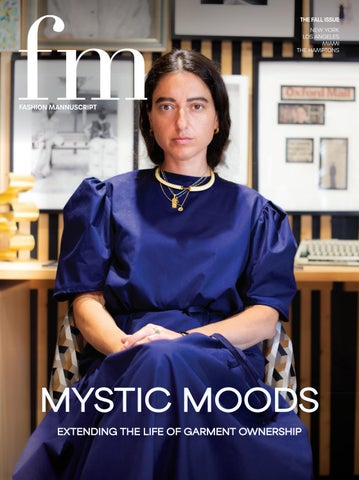
MYSTIC MOODS EXTENDING THE LIFE OF GARMENT OWNERSHIP
COMMERCIAL SERVICES. STRENGTHENED. CIT Commercial Services is now First Citizens Bank. Legacy experience continues with the financial strength of a top-tier bank. Help secure your supply chain and improve cash flow with specialized asset-based lending, factoring, and working capital solutions. Learn more at firstcitizens.com/wcf
FIT FO R YOU R A M B ITION
©2026 First-Citizens Bank & Trust Company.
MOVING FASHION FROM SHIP TO SHORE
Your Trusted Logistics Partner Our mission is to deliver reliable, highquality logistics services that ensure your shipments are secure, efficient, and ready for any destination ahead.
©Copyright 2018 Dynamic Worldwide. All Rights Reserved.
INTERNATIONAL AND DOMESTIC FREIGHT
AND DOOR TO DOOR
FASTER
EXCEPTIONAL SERVICE
COMPLIANCE THE RETAIL WORLD DELIVERED. FOCUSED Smarter. Faster. Cheaper.
WHY CHOOSE US?
OUR SERVICES: AIR FREIGHT Fast and reliable air transportation for urgent and high-value shipments.
OCEAN FREIGHT Competitive rates for large volumes, consolidations, or LCL shipments.
CUSTOMS BROKERAGE Compliance driven team of customs experts to streamline your supply chain.
DIGITAL PLATFORM Real-time track and trace data, analytics, messaging and more!
Powered by a global network of offices and agents, KRIEGER Worldwide provides solutions to deliver your goods on time. With competitive rates, tailored solutions, cargo insurance, and exceptional customer service our experts strategically develop a personalized plan to move your cargo door to door.
CONTACT US: 310-668-5700 www.nkinc.com
www.dynamiconline.com | 973.344.6300 | sales@dynamicworldwide.com
FM | 1 August 2026 mannpublications.com NY | NJ | NC | FL | CA | HONG KONG | SHENZHEN | SHANGHAI | QINGDAO | GUANGZHOU | VIETNAM | INDIA | BANGLADESH | SRI LANKA | PAKISTAN | CAMBODIA
DELIVERING THE FLEXIBILITY THAT TENANTS DESIRE Suites from 1,947 RSF, Full Floors 12,000 RSF Pre-Built and Furnished Space Move-In Condition Flexible Lease Terms
3,000 RSF High Fashion Showroom The Chelsea Arts Centre Abundant Natural Light Hudson Yards + High Line + Chelsea Piers
Move-In Ready Suite - 3,606 RSF Glass Front Offices, Delivered Furnished Possession March 1, 2026 Between Union Square + Madison Square
1,334 & 2,432 RSF Medical Suites Move-In Ready - Fully Built Immediate Possession Steps to Leading Medical Institutions
1001 Avenue of The Americas William Carr 212-400-6078
210 Eleventh Avenue Audrey Novoa 212-400-6091
915 Broadway Ben Waller 212-400-9515
380 Second Avenue James Caseley 212-400-6075
A CLOSE UP OF TWO WINNING OPPORTUNITIES UP
UP
AVENUE OF THE AMERICAS
DN
AVENUE OF THE AMERICAS
DN
tv
WEST 37TH STREET
WEST 37TH STREET
ENTIRE 16TH FLOOR
12,017 RSF - 8 PRIVATE OFFICES - 46 WORKSTATIONS TEST FIT - 1
PROPERTY FEATURES 16TH FLOOR
SCALE: JOB NO.: DRAWN BY:
3
32 " = 1'-0"
43007.00 JS
TULLER McNEALUS FELD
ENTIRE 20TH FLOOR
10,399 RSF - 12 PRIVATE OFFICES - 56 WORKSTATIONS
•
All space can be divided, fully furnished, turnkey
•
Private restrooms, full wet pantry with seating/lounge areas
•
Glass-front private workspaces for conference/meeting, office or
•
Walk to Times Square, Grand Central Terminal, Grand Central
•
1 0 0 1
6 T H
A V E N U E
.
N E W
Y O R K ,
N Y
DATE:
01/17/2024
collaboration use
Madison LIRR concourse, Penn Station with connection to Moynihan
Three sides of operable windows providing excellent natural light
Train Hall, and Bryant Park transportation hubs
We Build Partnerships That Last
For Information About ABS or The Services We Provide to Property Owners, Please Contact Company President, Gregg Schenker - 212.400.6060 - www.absre.com All information is from sources deemed reliable but is subject to errors or omissions of any magnitude, withdrawal from market, or changes in terms, all without notice. Brokers employment and payment only by written agreement.
2 | FM
August 2026
mannpublications.com
Let us help you take your vision from the drawing board to the runway Whether you are an apparel manufacturer or a fashion owner, IDB understands the changing dynamics of the retail environment — including the growth of e-commerce — and stands ready to assist you with financial solutions tailored to your needs. Our dedicated bankers not only specialize in Apparel & Consumer Products, but also leverage their strong client relationships and extensive global connections to deliver new opportunities, as your preferences, supply channels and fashions evolve.
To learn more about what we have to offer, visit idbny.com Apparel mannpublications.com
Consumer Products
Electronics
Health, Beauty and Wellness August 2026
FM | 3
PRESIDENT/CEO Jeff Mann EDITORIAL Editor Rose Leveen Editorial Consultant Debra Hazel Associate Editor Penelope Herrera Director of Communications and Marketing Penelope Herrera Graphic Design Virginia Sanchez Director of Newsletter Division Kristen Pooran
West Coast Office: 578 Washington Blvd., Suite 827 Marina Del Rey, CA 90292 866-306-MANN (6266)
ART DIRECTOR Virginia Sanchez
BUSINESS Technology Consultant Eric Loh
COVER PHOTOGRAPHY Mystic Mood
DISTRIBUTION Mitchell’s Delivery Service
CONTRIBUTORS Amy Tsai Angela Rhea David Harouche Debra Hazel Kristen Kelbon Maegan Watson Merilee Kern Paul Magel Rabbi David Laine Ron Friedman Sarthak Brahma Shahrooz Kohan Shannon Hynds Sherilyne Dougherty Tatiana Muñoz
California Distribution MD Service West Coast Advisor Daniella Platt DIGITAL MEDIA Virginia Sanchez Web Developer CS Designworks
I
A m A
a W
M S
m M W
i k W
e T
East Coast Office: 450 7th Ave, Suite 2306 New York, NY 10123 212-840-MANN (6266)
The opinions expressed by our columnists are not reflective of the views and opinions of the publisher or the editorial staff of Fashion Mannuscript. Publication of such views and opinions does not constitute endorsement by Fashion Mannuscript. Any reproduction, including but not limited to internet usage, is prohibited without the express written permission of the publisher.
4 | FM
August 2026
mannpublications.com
ONE MANN’S OPINION Hello, everyone. It’s time for the September issue of Fashion Mannuscript. August is a big month for trade shows, including Magic in Las Vegas, a staple for many of our readers and contributors on the West Coast. My good friend Ron Friedman, who always writes stellar, insightful articles, is sharing his recent experience and how it reflects the state of retail and the consumer later in the magazine. Because so many shows happened last month, we wanted to highlight some that haven’t been in the magazine yet.
— Banana Yoshimoto Over time, one by one, they come back to life.” “Truly happy memories always live on, shining.
I hope you enjoy our newest issue of Fashion Mannuscript, and I hope you’re having a great summer! Antonia Saint NY and Wacoal leading the way. more always at the forefront. This month, we’re specifically highlighting innovations in garment and shoe construction, with brands like As always, I am committed to bringing readers the newest and coolest information about fashion, with topics like AI, 3D printing and are solely dedicated to connecting with followers and promoting our content. We’re also working on expanding our social media presence on Instagram, X and LinkedIn. We’ve brought new people onto the team who Miami Swim Week, SwimShow and Atlanta Apparel, while August is bringing shows like Curve, WWIN and Magic. Summer trade shows are already underway, and they’re ramping up as we roll into August. June and July brought exciting shows like Paraiso me at even moreSacco tournaments in August to support important organizations like the Jewish Children’s Museum and Sephardic Bikur Holim. Michael Merilee Martin Fund, BigKern Brothers Big Sisters and more. You can read about these events and see great photos from them in the magazine. You’ll find Marshal Cohen While we’re in the process of planning our golf outing for October, I have been attending several charity tournaments, including for the Jack Krieger Worldwide its own,Frank fillingDeLucia an important niche that brings law and fashion together. I can’t wait for you to read about Francesca and Nicole! Dora Lau kind firm that specializes in intellectual property (IP) and brand protection—something vital to the fashion industry. Esca is in a league of Debra Hazel We have a spectacular cover story about Francesca Witzburg and Nicole Dolgon, two talented lawyers from Esca Legal. Esca is a one-of-aDavid Harouche Daniella Platt even busier, but I’ll tell you about that after we talk about the most exciting part of Fashion Mannuscript’s August issue: our cover story. Annabella Lawlor mannpublications.com The summer is coming to a close, but things haven’t slowed down at Mann Publications. This month was a whirlwind and August will be CONTRIBUTORS
New York City and Los Angeles will always be the home bases of Fashion Mannuscript, but we’re also branching out, especially through global expansion. As the world changes, the Mann Publications team is changing with it, with a mission to keep readers in the know about the most important fashion news, not only here but worldwide. My father always said, “The only thing that’s constant in fashion is change,” and I keep this in mind for each issue. Our photo events are also great. Naturally, several of the events were out in the Hamptons, where many New Yorkers spend their summer weekends. Fashion people will go anywhere to experience what’s new in the fashion world, and the Hamptons is known for its brand pop-ups, parties and more. I hope you all had a happy summer. I can’t wait for a very productive fall with the team. I also want to remind everyone that the Mann Charitable Foundation’s golf outing is coming up on Sept. 28, 2026. If you haven’t registered yet, you can reach out to pherrera@ themanncharitablefoundation.com.
“It is change, continuing change, inevitable change, that is the dominant factor in society today. No sensible decision can be made any longer without taking into account not only the world as it is, but the world as it will be.” — Isaac Asimov
mannpublications.com
August 2026
FM | 5
Hi, readers! As we transition from summer to fall, I am excited to present Fashion Mannuscript’s September 2026 issue. This month’s cover features Mystic Moods, a fashion brand that’s looking beyond its own customers. Mystic Moods was founded by Alina Stanila, whose experience across the fashion industry and interest in a textile’s history led her to an intersecting project: creating an independent fashion studio and fashion technology company. Mystic Moods’ dual function—producing thoughtfully designed limited-edition fashion collections while building architecture that gives customers and brands agency over their garments’ life cycles—stands out in the fast-paced fashion industry. Beyond the cover, this issue features a diverse range of stories, from newer independent brands to those with decades-long legacies. In particular, I’m excited to share details about two new trade shows: Los Angeles-based Preface and the Copenhagen International Fashion Fair. You can also read about Mars The Label, a British fashion house launching a U.S. warehouse to support its growing American customer base. This story—and others throughout the magazine—embodies Fashion Mannuscript’s mission to provide coverage that delves deeper into the fashion industry. To conclude, I want to express my continued gratitude for the relationships I’ve built as editor of Fashion Mannuscript. Our talented contributors make this magazine what it is. As fall approaches, I look forward to nurturing these connections and forging new ones. I hope you all enjoy this month’s coverage!
6 | FM
August 2026
mannpublications.com
mannpublications.com
August 2026
FM | 7
AUGUST 2026
FASHION FAVORITES
42 ON THE COVER: Beyond the Checkout: How Mystic Moods Is Extending the Life of Garment Ownership
14 Accessories Council Hosts Its Annual Holiday Press Preview
COVER FEATURE
16 Ramy Brook Toasts to Summer Style With Exclusive Hamptons Luncheon
18 Monse Welcomes Pre-Fall 2026 Collection With Evening Celebration in the Hamptons
Photo courtesy of Mystic Moods
FASHION FABULOUS
82
5 One Mann’s Opinion
6 Editor’s Letter
22 411 Executive Changes
58 411 Tech
Photo courtesy of Baye London
8 | FM
August 2026
mannpublications.com
The company behind fashion’s most respected brands. Entrepreneurial financing and credit protection for contemporary, designer and luxury brands. For decades, we have safeguarded receivables and protected companies from unnecessary credit risk. Quietly. Reliably. Since 1932.
PRIVATE CREDIT | FACTORING | CREDIT PROTECTION N E W YO R K | LO S A N G E L E S | LO N D O N
mannpublications.com
August 2026
FM | 9
Photo courtesy of Splay
FASHION FORWARD 38 Starlust Jewelry: Turning the Zodiac Into a Celebration of Connection
40 Dressing Generations: Inside the Family Business Behind Jovani
THE DEPARTMENTS 27 Logistics
55 Techwear
56 Tech Feature
61 Columns
77 Editor’s Picks
78 Fashion Sphere
85 Mann’s Tradeshow Connections
94
Last Look: Deux par Deux Turns 40: Growing up Without Losing Its Sense of Play
10 | FM
August 2026
48 Taft’s Ghost Floral Collection: Celebrating Craftsmanship, Character and the Beauty of Time
50 Hayden Cherouny: Building the Everyday Wardrobe
56 Built From the Foot Up: How Splay Is Bringing Natural Movement and Better Design Into the Footwear Mainstream
78 Mars The Label Launches US Warehouse, Strengthening Commitment to American Customers
80 Elite Eleven Blends Athleisure Performance Apparel With Style and Ease
82 Baye London: A Swimsuit Built From a Better Question
mannpublications.com
Seamless Underwear Onewith Swimsuits Feel as Good as 92 Capsule Collection Pronovias Presents the Separates 62 Idealized Femininity The ‘New Look’ and the Image of 52 Resort 2025 Collection With Aknvas Presenting ‘Once Upon Tomorrow,’ a 44 Winter 2025 Collection Coach Introduces 42
mannpublications.com
August 2026
FM | 11
FASHION FAVORITES
12 | FM
August 2026
mannpublications.com
FASHION MOVES FAST. SO SHOULD YOUR LENDER. Our creative solutions are tailored to meet your working capital needs now, so you can tackle every phase of your business with confidence.
• Factoring • Asset Based Revolvers • Inventory Financing Facilities
CONTACT US mannpublications.com mannpublications.com
(212) 887-7999 whiteoaksf.com/commercialfinance info@whiteoakcf.com August June | July2026 2024
FM FM| |13 11
FASHION FAVORITES Priti Moudgill (Peripherii)
Photos courtesy of Accessories Council
Accessories Council Hosts Its Annual Holiday Press Preview 14 | FM
August 2026
mannpublications.com
Damola Sulaiman
The Accessories Council hosted its annual holiday press preview in the organization’s showspace near NYC’s Fashion Avenue. The event brought together a curated selection of Accessories Council members representing jewelry, footwear and apparel, along with media, retailers, buyers, influencers and stylists—all preparing for the holiday gift season ahead. The brands represented at the preview included Altaché, Arid Blayne, Avermore, B.Brave by SK WiLBUR, Cara Accessories, Esthera, Guzema, Kelley Kouture, Mèsan, Naveda, Nicole Miller, Peripherii, Platinum Born, Sattaché, Silhouette and Simon G. A stocking-stuffer gifting suite offered a complimentary selection of fashion and beauty accessories. Jewelry cleaning kits from Simon G., perfumes from Betsey Johnson, vintage jewelry from R.J. Graziano, and earrings from Cara Accessories and Baublebar were
among the many options guests could choose to fill their Silhouette tote bags with. Signature scents from Scent Marketing Inc., which develops custom fragrances, drifted through the space, offering guests their own personalized scent to take home.
(Mèsan) FASHION FAVORITES
Holiday-inspired drinks at a makeyour-own coffee bar were paired with Kika Nutrition’s chocolate granola bites and brownies made with the brand’s nutrition powder. Beyond the interactive activations, the morning gave attendees the opportunity to connect with both established brands and emerging designers. One of the Accessories Council’s ongoing commitments is to create an inviting space for connection. Guests had the chance to see and handle new collections firsthand, while brand representatives shared the passion and personal histories behind their work, from the inspirations that sparked a new collection to the hurdles they overcame along the way.
Marley Lovinger (Arid Blayne)
Amy Devan and Anita Devan (Naveda) Mariana Lenha (Guzema)
Haley Evans (Altaché) Wilbur Pack Jr. (B.Brave by SK WiLBUR)
mannpublications.com
Jenny Walkup (Simon G.)
August 2026
FM | 15
FASHION FAVORITES
Photos courtesy of Travis Bass
Ramy Brook Toasts to Summer Style With Exclusive Hamptons Luncheon 16 | FM
August 2026
mannpublications.com
FASHION FAVORITES
Contemporary womenswear brand Ramy Brook hosted a summer luncheon in the Hamptons, bringing together a thoughtfully curated community of creators, tastemakers, influencers and friends of the brand, all dressed in Ramy Brook’s Summer and PreFall 2026 collections. The perfect excuse to style the latest from the brand, guests enjoyed an afternoon of cocktails, a seated lunch and unforgettable moments shared with one another.
Kate Love
Set against the backdrop of the iconic private golf club, The Bridge, the upscale luncheon complemented the renowned architecture of Roger Ferris. Encapsulating the essence of the brand’s newest collections, the setting felt intimate and relaxed, sophisticated and luxurious. Each guest left with a unique gift experience featuring luxury-adjacent brands such as Crown Affair, Mark & Graham, MacKenzie Childs and more. The bespoke gift selection served as a heartfelt thank-you for joining an afternoon celebrating fashion, community and female empowerment. Amy Julliette Lefévre
Ramy Brook Sharp
As Ramy Brook continues to cultivate meaningful connections with its customers, the Hamptons remain at the heart of the brand’s story. Home to its Southampton boutique, the region has become a natural extension of the Ramy Brook lifestyle. From dressing the Surf Lodge staff for the second consecutive year to maintaining a strong presence throughout the season, Ramy Brook continues to establish itself as one of the Hamptons’ defining fashion brands year after year.
Sharareh Siadat Lauren Besselman
mannpublications.com
Ramy Brook Sharp, Michelle Cordeiro Grant, Valeria Lipovetsky and Yhasmina Ferrara
August 2026
FM | 17
FASHION FAVORITES
Photos courtesy of Kevin Czopek/BFA.com
Princess Olympia of Greece and Devorah Rose
Monse Welcomes PreFall 2026 Collection With Evening Celebration in the Hamptons 18 | FM
August 2026
mannpublications.com
FASHION FAVORITES
Fernando Garcia and Laura Kim
Sailor Brinkley-Cook
TV personality and writer Devorah Rose hosted an intimate summer evening in honor of the Monse brand, alongside its co-founders and creative directors, Laura Kim and Fernando Garcia. The evening brought together a curated group of leaders across fashion, entertainment, beauty, media and culture, celebrating Monse’s distinctive approach to modern American fashion by transforming the space into an immersive expression of the house’s Pre-Fall 2026 world. Oversized sunflowers, their petals playfully plucked, stood alongside tiered silver platters overflowing with cherries, echoing the collection’s hand-drawn cherry motif. Guests moved through the setting with seasonal cocktails and exceptional bites before discovering the collection through an intimate, private styling experience. Bringing together Monse’s clients, tastemakers, editors and longtime supporters, the evening embodied Rose’s enduring approach to hospitality: creating thoughtfully designed spaces where fashion, culture and conversation intersect.
mannpublications.com
Anthoni James and Janaina Devieira
Devorah Rose, Macrene Alexiades, Fernando Garcia, Princess Olympia of Greece and Laura Kim Laura Kim and Macrene Alexiades
Set at a private Hamptons residence, key opinion leaders gathered for an elegant summer evening in Water Mill, New York. Complementing the fashion, Tamara Comolli Jewelry brought its signature world of colorful gemstones and effortless luxury to the evening, offering a curated selection of pieces that invited guests to play with unexpected pairings. An artfully composed grazing table turned the evening’s menu into part of the installation, with tiered cherries, seasonal produce, artisanal cheeses, endless Kaluga caviar and bites styled into an abundant still life. Botanical spritzes and champagne flowed throughout the evening, while a Malfy Gin cart served its signature “Malfy spritz.” As the sun began to set, the celebration evolved into a private Monse styling suite, giving guests an intimate look at a curated selection of the brand’s current and upcoming collections. The tables were adorned with crimson cherries, a playful nod to Monse’s latest collection and its signature unexpected details.
August 2026
FM | 19
Ready for tomorrow. Insurance for the apparel industry’s every need. Reach for your goals with HUB. o
Contingent Business Interruption
o
Credit Insurance
o
Ocean Marine Insurance
o
Price Valuation
o
Supply Chain Distribution
o
Much more!
Let’s protect what matters most to you.
hubinternational.com
HUB International Northeast
Frank DeLucia Senior Vice President (212) 338-2395 frank.delucia@hubinternational.com
Risk & Insurance | Employee Benefits | Retirement & Private Wealth 20 | FM
August 2026
mannpublications.com
The Global Asset Experts Since 1903, Gordon Brothers has maximized liquidity through realizable asset value by providing the people, expertise and capital to solve business challenges. Through our firm’s comprehensive offering, we deliver integrated, custom solutions across the asset lifecycle all under one platform.
Asset Services
We provide businesses an understanding of the true value of their assets.
Asset Lending & Financing
We provide the capital to unlock the future.
Asset Trading
We monetize assets for companies while protecting their reputation. Our holistic solutions span the full spectrum of assets with deep areas of expertise in retail, industrial, real estate and brands.
©️ 2026 Gordon Brothers Group, LLC
mannpublications.com
GORDONBROTHERS.COM
August 2026
FM | 21
FASHION 411
EXECUTIVE
KNITWELL GROUP APPOINTS JESSICA SIBLEY TO BOARD OF DIRECTORS
KnitWell Group, a retail apparel company with eight American brands, including Ann Taylor, Chico’s, Loft and Talbots, announced the appointment of Jessica Sibley, Time magazine’s chief executive officer, to its board of directors. Sibley is an accomplished chief executive and transformation leader with more than two decades of experience driving growth, innovation and business evolution across globally recognized brands. As CEO of Time, a position she has held since 2022, she has led the revitalization of the 103-year-old brand into a diversified global enterprise spanning journalism, digital media, live events, television and film production, and strategic partnerships. Under her leadership, Time has accelerated revenue growth, expanded its global audience, advanced digital and AI innovation, and strengthened its position for long-term success as one of the world’s most trusted and influential media brands. Prior to joining Time, Sibley served as chief operating officer and chief revenue officer at Forbes and held senior leadership roles at The Wall Street Journal and Bloomberg. Across her career, she has built a track record of revitalizing brands, unlocking new avenues of growth and leading businesses through periods of significant transformation. “Jessica has a remarkable track record of helping great brands evolve while staying true to what customers love most about them,” said Lizanne Kindler, chief executive officer of KnitWell Group. “Her deep experience leading transformation, driving sustainable growth and building meaningful connections with customers will bring valuable perspective to our board as we continue to strengthen and grow our portfolio and position our brands for the future.” “I am honored to join the KnitWell Group board of directors,” said Sibley. “KnitWell’s portfolio is built on iconic brands that have earned enduring trust and loyalty from generations of customers. Throughout my career, I have focused on helping established brands evolve, deepen their cultural relevance, strengthen customer engagement and connect with new audiences while remaining true to their heritage. I look forward to working with Lizanne and the leadership team as they continue to build on the company’s strong foundation and pursue new opportunities for growth.”
22 | FM
August 2026
Photo courtesy of KnitWell Group
mannpublications.com
FASHION 411
CAMPAIGN
ATHLETA’S FALL CAMPAIGN CENTERS WOMEN IN CONVERSATIONS ABOUT STRENGTH Athleta unveiled its Fall 2026 campaign, “My World. My Rules.” More than a seasonal campaign, it signals Athleta’s next era—one that places women and their selfauthored stories of strength back at the heart of the brand while challenging traditional definitions of performance, progress and power. Set to the soundtrack of “Self ish Soul” by Sudan Archives—a song that celebrates the powerful act of refusing to conform for approval—the campaign follows three remarkable women who have broken barriers in historically male-dominated spaces: archer Sofia Napoli, martial artist and stuntwoman Jewelianna Ramos-Ortiz, and motorsport athlete Jordan Rand. Set against Iceland’s dramatic landscapes and directed by Laura Jane Coulson, the campaign captures the stories of these three women rewriting rules in their respective spaces, reaffirming the truth that strength and femininity are not opposing forces but expressions of the same power. “Our ambition is to inspire a female-first world where women live in their full power, and that world begins to take shape when we stop playing by the rules that were never written with us in mind,” said Erika Everett, chief marketing officer at Athleta. “Every woman experiences strength differently. This campaign champions those stories of strength and celebrates all the ways that women move through the world on their own terms.” Showcasing Athleta’s Fall 2026 collection, the campaign features performance pieces and lifestyle apparel reimagined through a modern lens. From performance pleats and satin sets to technical outerwear and versatile active essentials, the assortment reflects the brand’s balance of innovation, versatility and design-led functionality—all styled through a fresh creative lens that signals Athleta’s evolving aesthetic. “My World. My Rules.” will roll out across Athleta’s channels including digital, social, email and in-store. Extending the campaign beyond traditional media, Athleta will also bring its vision of a female-first world to Olivia Rodrigo’s inaugural Daisy Chain Fields Festival.
mannpublications.com
Photo courtesy of Athleta
August 2026
FM | 23
FASHION 411
CAPSULE
SAMSØE SAMSØE AND MADELINE ARGY LAUNCH CO-DESIGNED CAPSULE COLLECTION Danish brand Samsøe Samsø launched a fully co-designed capsule collection with British creator and podcast host Madeline Argy, the next step in a partnership that began when Argy became the brand’s first-ever ambassador in 2025. Where their earlier work together centered on campaigns, this collection marks Argy’s debut as co-designer, her first credited role in shaping a fashion collection rather than fronting one. The capsule builds on the effortless styling from the duo’s first shoot together, when Argy discovered how much a single look could change through layering, an approach she has carried into her own personal style since. The collection comprises seven styles: two tops, two dresses, two skirts and a cap. The palette stays quiet, drawing on gray, pastel, champagne, white and natural tones, animated with everyday check and stripe prints. Branding is kept minimal, tucked into interior details rather than displayed outwardly. “I’ve always been drawn to pieces that feel effortless, things you can throw on without overthinking but still feel like yourself in,” said Argy. “Working on this collection with Samsøe Samsøe was about creating a wardrobe that feels lived in, versatile and quietly confident. We obsessed over the small details, so every piece feels intentional but never precious. I hope it’s the kind of collection people reach for again and again because it simply fits into their everyday lives.” The campaign was shot by photographer Justin Leveritt inside an empty New York apartment, its f loor-to-ceiling windows framing the city skyline while street sounds echo through the space. The setting nods to Argy’s recent move to New York, with the spare, lightly furnished interior meant to evoke the feeling of having just moved in: undone yet deliberate. Styling and lighting throughout lean into a natural, calm mood that ref lects the collection’s late summer character.
24 | FM
August 2026
Photo courtesy of Samsøe Samsøe
mannpublications.com
FASHION 411
DENIM
UNTUCKIT LAUNCHES ITS FIRST DENIM COLLECTION
Across the denim category, fit has taken a back seat to oversized, overly relaxed silhouettes, and real cotton has become harder to find in a market increasingly built on synthetic blends that prioritize stretch over substance. Untuckit is stepping in to restore balance with a focused approach built on fit, authentic fabric and a tightly edited set of essential washes. The brand’s new jeans are designed for customers who want a clean, polished denim fit. They are neither skinny nor relaxed; instead, the silhouette strikes the right balance, draping comfortably through the hip and thigh and featuring a streamlined straight leg. Crafted from real indigo denim in a durable twill weave, the collection delivers the classic look and feel customers expect from great jeans. The fabric is designed to wear in naturally over time, while doublereinforced pockets and custom hardware add lasting durability to every pair. “Denim had gotten too sloppy. Too relaxed, too synthetic. Too far from what actually makes a great pair of jeans,” said Chris Riccobono, co-founder of Untuckit. “We saw the same opportunity in denim that we saw in shirts: restore the fit, bring back real cotton, and make it simple again.” Available in three versatile washes—dark, light and rinse denim—the collection is designed to make getting dressed easier. The dark wash offers a more elevated, refined option for work, dinner or a dressedup occasion; the light wash delivers an easy, lived-in look for off-duty days; and the rinse denim provides a clean, classic foundation that can be styled in virtually any way. The denim launch represents the next chapter in Untuckit’s continued expansion beyond shirting. Since introducing shirts designed specifically to be worn untucked, the brand has grown into a full lifestyle destination, offering customers a thoughtfully designed wardrobe for work, weekends, travel and every occasion in between.
mannpublications.com
Photo courtesy of Untuckit
August 2026
FM | 25
26 | FM
August 2026
mannpublications.com
Photo courtesy of Adobe/moofushi
THE MOVEMENT OF FASHION
SUPPLY CHAIN, LOGISTICS AND FINANCE mannpublications.com
August 2026
FM | 27
LOGISTICS
Flashback Part 27 20th- to 21st-Century Fashion Industry History: Los Angeles By Ron Friedman
Hello again! Fall is just around the corner, bringing us the beginning of college football, the NFL season and the MLB playoffs, with the Dodgers hopefully going for three in a row. I hope they can do it. I always look forward to this time of year, as the summer heat ends and the cool fall weather approaches. My current research indicates that the toy and fragrance/skincare industries are performing better than the apparel industry. The food industry has also seen tremendous growth since COVID changed everything. The days when everyone came into the office five days a week are over, even though employers want them back. It appears that the new norm is at least three days a week, if that. That means people aren’t buying as much apparel, since they work from home in shorts and T-shirts. I can only hope for the day when everyone comes back to the office on a regular basis, which will benefit the apparel industry and also bring more lunchtime business to restaurants. Back to the office will also mean more collaboration and better training opportunities. I know I may be old-fashioned, but I see the benefits of being in the office.
28 | FM
August 2026
The 2026 edition of Magic Las Vegas was held Aug. 10 to 12 at the Las Vegas Convention Center, and I had the privilege of speaking on a panel with moderator Edward Hertzman, Maria Contino of Rosenthal Capital and Chris DeRosa of First Citizens Bank. The audience of 100 owners and buyers listened to us discuss how to finance an apparel company using the following financing methods and requirements for borrowers:
Growth Remains Modest
• • • • •
Rather than pursuing aggressive expansion, many brands are focused on protecting profitability through tighter inventory management, pricing discipline and cost control. Increasing sales is difficult, with limited retailers to expand the business and consumers less interested in apparel and more interested in spending their money on other activities.
Asset-based lending Factoring Purchase-order financing Inventory financing Lending underwriting criteria
The discussion led to many great follow-up questions from the audience, and our panel was very insightful for the participants. I am always curious to know the number of attendees at the show. While I do not have that information directly from Magic, I asked taxi drivers and restaurants how busy they are when Magic comes to town. The prevailing answer was that attendance at the show seems to be light this year. What are the economic factors that are impacting the apparel industry?
Industry analysts broadly characterize 2026 as a low-growth year for fashion and apparel. Market growth has continued, but generally at low single-digit levels, as consumers remain selective with discretionary spending. Several industry studies cite ongoing economic uncertainty, inflationary pressures and shifting consumer priorities as limiting factors.
Tariffs and Trade Pressures Perhaps the most significant issue discussed across the industry in 2026 has been the impact of tariffs and changing trade policies. Industry reports note that tariffs have forced many apparel companies to reevaluate sourcing strategies, diversify manufacturing locations and absorb higher costs throughout the supply chain.
mannpublications.com
LOGISTICS
Brands that rely heavily on imported merchandise have experienced margin pressure as they balance increased costs against consumers’ resistance to price increases. As a result, sourcing diversification has become a strategic priority for retailers and manufacturers alike. Tariffs have led many companies to negotiate increased pricing with retailers, and the government is now providing refunds after the Supreme Court ruled against the administration’s tariffs under the International Emergency Economic Powers Act. The refunds are slowly returning to importers, and retailers are seeking to obtain their share of those funds. The question is whether retailers will give refunds to consumers who had to pay the additional cost. My guess is no!
Consumers Are Increasingly Price Sensitive The apparel consumer in 2026 is more value oriented than in prior years. Research indicates shoppers are: • • • • •
Comparing prices more aggressively Delaying discretionary purchases Trading down to lower-priced alternatives Spending a greater share of income on experiences rather than physical goods Supporting vintage clothing as a viable option, with its sales growing
Fashion companies therefore face the difficult challenge of maintaining margins while avoiding pricing actions that could suppress demand.
Polarization of the Market One of the clearest trends is the ongoing polarization of apparel spending. Growth is increasingly concentrated at two ends of the market: • •
Value and essentials, where consumers seek affordability Premium and luxury brands, where higher-income consumers remain relatively resilient
Mid-market retailers continue to experience the greatest pressure as they compete simultaneously with discount competitors and premium brands.
and a strong understanding of evolving consumer preferences. Change is good, and the best will survive with proper planning and by hiring the best people to drive the business forward. Until next time, remember what I always conclude with—if you are not having fun, then do something else!
Ronald S. Friedman, CPA, is an advisory and assurance managing director in the Los Angeles office of CBIZ and a practice leader in the firm’s consumer and industrial products group. Contact him at ron.friedman@cbiz.com.
Artificial Intelligence Becomes Mainstream AI is an important factor for any manufacturer to bring into the business. Enterprise resource planning (ERP) systems have been available for years, and now AI will assist further with: • • • • •
Demand forecasting Inventory optimization Merchandising decisions Marketing personalization Supply chain management
Outlook The apparel industry is not in crisis, but it is operating during a period of heightened pressure and transformation. Retailers continue to buy, consumers continue to spend, and innovation remains active. However, success increasingly depends on disciplined inventory management, flexible sourcing strategies, operational efficiency
Photo courtesy of Yan/Adobe
mannpublications.com
August 2026
FM | 29
LOGISTICS
One Retailer, Two Rulebooks: The Logistics of Shipping Apparel and Footwear to the Same Stores By Shahrooz Shawn Kohan, CEO of AIMS360 Picture the meeting every founder dreams of. A large retail chain loves your clothing line. Then the buyer leans in and asks about your shoes, too. Same company, same stores, twice the business. Founders chase these meetings for good reason. One purchase order from a major chain can put a brand in hundreds of stores at once, a reach that would take years to build store by store. Here is what nobody tells you in that meeting. Inside most large retail companies, clothing and shoes are handled by different teams with different rules. To them, you are not one supplier. You are two. Each side hands you its instruction manual and may even receive your goods at a different warehouse. That manual is usually called a routing guide. It tells suppliers exactly how products must be packed, labeled, shipped and billed. Follow it, and you get paid in full. Break a rule, even by accident, and the retailer fines you by quietly subtracting money from your payment. No phone call. No warning letter. The money is simply gone. In the industry, these fines are called chargebacks. Retailers are not cruel. They run enormous warehouses on tight schedules, and one mislabeled box slows the whole line. The fines add up faster than most people think. Industry estimates suggest 5% to 15% of supplier invoices to retailers take some kind of deduction. The Retail Value Chain Federation, which has surveyed both sides for years, found that these charges typically run between 0.25% and 1.25% of an invoice. That sounds tiny. Multiply it across every shipment in a season across two product categories, and it becomes a real number taken from profit already earned. So where do the two rulebooks differ? Three places matter most. First, packing. Clothing usually must arrive ready for the sales floor. That means price tags already attached, garments on the exact hanger the store uses or folded the way the store wants, and a label on the outside of every box stating what is inside, so workers never have to open it to find out. Shoes follow a different logic, because the shoe box itself goes on the shelf. The rules cover that box too: how it is labeled, how it is priced and how many pairs go into each shipping carton. Some retailers want
30 | FM
August 2026
cartons of one size. Others want an assortment of sizes in a mix they choose. Guess wrong, and the fine arrives.
in charge of the rules for both categories, because when two teams ship two categories in two different ways, the retailer sees one sloppy supplier.
Second, sizes. A shirt might come in six sizes. One shoe style, once you add half sizes and widths, can be 30 or more separate items in a single color. The retailer’s computer system must know each one before you ship, with its own product number. Miss even one, and that part of your delivery gets refused at the warehouse or fined.
Then ask for your report card. Most large chains grade suppliers on delivery, accuracy and paperwork, and will share the grade if you ask. Review it every season, and problems get caught while they are cheap to fix.
Third, paperwork. Large retailers do not email you orders. They use an electronic ordering system, known as EDI, that sends purchase orders and expects your responses back in an exact digital format, including an electronic packing list sent before the truck arrives. The clothing side and the shoe side of the same retailer may require different versions of that paperwork with different deadlines. Send it late or in the wrong format and another fine lands. Both sides do agree on one thing: the calendar. Every order comes with a delivery window, and many warehouses also require a booked appointment, like a doctor’s office for trucks. Arrive too early or too late, and the retailer can fine you or cancel the whole order. When your clothing and shoes travel on the same truck, a delay in one category can push the other past its window. I have watched a late shoe shipment take down a well-prepared clothing delivery beside it. And there is no worse season to learn this than fall, when holiday orders crowd every retailer’s calendar at once.
The conclusion is simple. A retailer that buys both your clothing and your shoes is your most valuable customer, and also the one grading you twice. The distribution is worth it. Learn both rulebooks, and the fines shrink, your payments arrive whole, and the reorders grow. Ignore the second rulebook, and you will fund the retailer’s fine print out of your own pocket, one silent deduction at a time. Shahrooz Shawn Kohan is the CEO of AIMS360, the consumer brands software company that has helped apparel, footwear and other product businesses run orders, inventory and retailer shipping for more than 40 years. Its in-house team has years of hands-on experience implementing electronic data interchange (EDI) connections to major retailers. AIMS360 has served more than 10,000 brands, connects to more than 350 retailers through built-in EDI and has processed over $45 billion in orders.
I have spent years helping apparel and footwear brands build these electronic connections to major retailers, and the pattern never changes. Brands that respect the rulebooks get paid in full and reordered. Brands that improvise pay tuition on every shipment. So what should a brand shipping both categories do? Five things. Get both manuals before the first box ships, and have someone read every page. Set up every size and width in the retailer’s system before the first order, not after. Ask the buyer exactly how cartons should be packed, and never assume the shoe rules match the clothing rules. Do a practice run of the electronic paperwork weeks before your first real deadline. And put one person
mannpublications.com
LOGISTICS
Cotton, China and the New Trade Reality for Fashion Importers By Shannon Hynds, CEO of Quickcode For companies sourcing cotton, one of the biggest trade risks heading into fall goes beyond the simple cost of a tariff. It is the growing overlap among tariffs, forced labor enforcement and supply chain traceability. Recent U.S. trade actions have put new pressure on China-linked cotton and textile supply chains and raised the compliance stakes for importers sourcing from alternative production hubs. As brands prepare for the September selling season and begin planning 2027 sourcing strategies, shifting production from one country to another may no longer be enough. On July 23, the U.S. Trade Representative (USTR) announced final Section 301 duties on imports from 60 economies over concerns that those countries were not adequately prohibiting or enforcing restrictions on goods made with forced labor. Subject to exemptions, the additional rate is generally 10% to 12.5%, with special calculations for certain products from the European Union, Japan, Taiwan, South Korea and Switzerland. For fashion, cotton is particularly important because the issue extends well beyond finished garments. Cotton can move through multiple stages of a global supply chain, from farming and ginning to spinning, yarn production, fabric manufacturing, dyeing and garment assembly. That makes it difficult to assess risk based solely on where a finished product was manufactured.
Why China’s Cotton Supply Is Under Scrutiny The U.S. government has long identified cotton and textiles as high-risk sectors for forced labor enforcement. USTR’s 2026 Section 301 report notes that forced labor concerns are well documented in cotton production and that certain textile manufacturers are already on the Uyghur Forced Labor Prevention Act (UFLPA) entity list. Citing an April 2026 U.S. Department of Agriculture (USDA) report based on Chinese government statistics, USTR states that Xinjiang accounted for 92.8% of China’s cotton production in the 2025 to 2026 marketing year. This creates a significant compliance consideration for importers. On July 31, the Forced Labor Enforcement Task Force added 43 entities to the UFLPA entity list, its largest expansion since enactment. The additions include apparel and cotton companies. Under
mannpublications.com
the UFLPA, goods produced wholly or partly in Xinjiang, or by entities on the entity list, are subject to a rebuttable presumption that they were made with forced labor and are therefore prohibited from entering the country. Customs and Border Protection (CBP) is responsible for enforcing that presumption.
The Cost of Getting Sourcing Wrong The financial impact of these measures can go well beyond the duty rate itself. A shipment containing cotton-based merchandise may face additional duties depending on its tariff treatment. However, if CBP determines that the merchandise falls within the scope of UFLPA enforcement, the consequences can be far more serious. Shipments may be detained, creating potential storage, demurrage, reexport and inventory costs while the importer works to establish admissibility. That creates a difficult equation for brands operating on tight seasonal calendars. A shipment arriving weeks late can be more damaging than a higher tariff because the merchandise may miss its selling window altogether.
Moving Production Does Not Automatically Eliminate Risk The natural response to higher China-related costs is to look elsewhere. Vietnam, Bangladesh, India and other major apparel-producing markets can all play a role in diversification. However, changing the country listed on a purchase order does not necessarily change the underlying supply chain. Cotton and textile production can span numerous countries and suppliers before a finished garment reaches a U.S. port. A brand may source a garment from one country, while the fabric, yarn or cotton originated elsewhere. This is where supply chain mapping becomes important.
A More Data-Driven Approach To Sourcing Importers need greater visibility into the products and suppliers behind each shipment. That means maintaining up-to-date supplier records, identifying upstream material sources, screening suppliers and entities against relevant government lists, and preserving documentation that shows how products move through the supply chain. Technology can help that process. Automated screening and classification tools can monitor regulatory changes, compare supplier and product information against updated requirements, and flag transactions for human review. This gives compliance teams better information earlier in the sourcing and import process—particularly valuable when regulations change faster than traditional manual processes can accommodate.
The September Question for Fashion As the fall season approaches, importers should view the latest measures as part of a widespread shift in U.S. trade enforcement rather than as an isolated tariff event. China remains an important part of global textile manufacturing, but its role is being evaluated through the combined lenses of cost, geopolitical exposure, forced labor risk and supply chain transparency. At the same time, alternative sourcing countries are not insulated from changing U.S. trade policy. For brands, the question is no longer, “Where can we make this garment most affordably?” It is, “Can we prove where every important input came from, understand the applicable trade requirements, and respond quickly when those requirements change?”
Recent analysis of U.S. tariff policy also illustrates why country diversification is not a simple solution. Research from the Peterson Institute for International Economics found that clothing imports did not quickly shift away from China under the 2025 tariff changes, partly because competing apparel-producing countries faced their own tariff pressures. The objective should therefore be resilience rather than simply finding the country with the lowest tariff.
August 2026
FM | 31
LOGISTICS
Fashion’s ESG Reckoning Why the Textile Supply Chain Must Become More Transparent By Angela Rhea, Vice President of Product and Industry Consultant at TradeBeyond
Fashion has always been a global industry. A single garment can involve raw materials from one country, yarn production in another, dyeing and finishing somewhere else, and final assembly halfway around the world. That complexity has helped fashion become faster, more affordable and more responsive to consumer demand, but it has also made the industry’s environmental and social impacts increasingly difficult to manage. Today, that is changing. Environmental, social and governance (ESG) expectations are moving deeper into the fashion supply chain, driven by regulation, consumer scrutiny and growing recognition that sustainability cannot be separated from sourcing. For apparel brands and retailers, the question is no longer simply whether a product is sustainable. It is whether they can prove where it came from, what it contains, how it was produced and what happens to it after the consumer is finished with it.
ESG Starts With a Proactive Product Strategy For fashion companies, sustainability decisions are often made long before a garment reaches
32 | FM
August 2026
a store. Fiber selection, material composition, supplier selection, manufacturing processes and production volumes can all influence a product’s environmental footprint. That makes strategic sourcing one of the most important ways to embed ESG into the fashion life cycle. Choosing recycled fibers, reducing material waste or working with suppliers that meet established environmental and social standards on Day 1 of the design process can have a greater impact than trying to address sustainability after production is complete. Yet those decisions require reliable information from suppliers and manufacturing partners. This is where the industry’s longstanding data challenges become an ESG challenge. Fashion supply chains frequently rely on large networks of suppliers and subcontractors, with information distributed across spreadsheets, emails and disconnected systems. When product information is incomplete or inconsistent, it becomes difficult to verify material composition, assess supplier performance or substantiate sustainability claims. As ESG requirements become more specific, that lack of visibility creates both compliance and business risk.
EPR Changes the Economics of Fashion Extended producer responsibility (EPR) is one of the clearest examples of how sustainability is becoming an operational issue for fashion brands. EPR shifts responsibility for a product’s end-of-life management to producers, requiring companies to help fund or facilitate collection, recycling, reuse and other forms of recovery. In apparel, this can mean financial obligations based on the products and materials placed on the market. California’s Responsible Textile Recovery Act represents an important development in the United States, while the European Union is moving toward mandatory textile EPR across member states. Under the EU framework, fees can be eco-modulated, meaning products with characteristics like greater durability or recyclability can receive more favorable treatment than products that are difficult to recover. This creates a direct financial connection between product design and sustainability. A fashion company that understands the materials in its products can make more informed decisions about design, sourcing
mannpublications.com
LOGISTICS
and potential end-of-life costs. A company that cannot reliably identify its materials may find itself reacting to regulatory requirements after products are already in production.
Traceability as an Advantage
The Rise of Product-Level Accountability The next stage of fashion’s sustainability journey will focus on individual products rather than broad corporate commitments.
The growing emphasis on ESG is also accelerating the industry’s move toward greater supply chain traceability. Traceability is not simply about knowing which factory produced a finished garment. Now, brands need visibility into materials, processing facilities and the various stages that occur before final assembly. That information can support sustainability objectives, but it also strengthens resilience.
Digital product passports are one example. The European Union’s developing framework is expected to require more accessible product information across the life cycle, supporting objectives around sustainability, circularity and transparency. For fashion companies, this will place greater emphasis on product-level information such as fiber composition, recycled content, durability and other relevant attributes.
Fashion companies are navigating geopolitical disruption, shifting sourcing markets, transportation volatility and changing trade policies at the same time they are facing greater sustainability requirements. Diversifying suppliers can reduce exposure to disruption, but it also makes supply networks more complex.
The implications extend beyond regulatory compliance. Product-level data can help brands make better sourcing decisions, identify opportunities to improve materials and provide consumers with more meaningful information. It can also reduce the gap between what a company says about sustainability and what it can actually demonstrate.
A transparent supply chain gives brands greater ability to understand those networks and respond when conditions change. If production needs to move from one country to another, for example, companies need to understand whether alternative suppliers meet their quality, compliance, labor and environmental requirements. ESG data can therefore become part of broader supply chain risk management.
Sustainability Claims Will Face Greater Scrutiny Fashion has long relied on terms such as “sustainable,” “eco-friendly” and “conscious” to communicate environmental attributes. But as regulations governing environmental claims tighten, companies will need stronger evidence
behind those statements. This puts greater pressure on the connection between product data and marketing. A sustainability claim should be traceable to information that demonstrates why the claim is accurate. Without reliable data from suppliers and throughout the production process, brands risk making claims that are difficult to substantiate.
Building a More Responsible Fashion Supply Chain The fashion industry’s ESG challenge ultimately comes down to visibility. Brands cannot effectively manage what they cannot see. They cannot demonstrate responsible sourcing without understanding their supply networks, accurately calculate or manage emerging EPR obligations without reliable product data, or make credible sustainability claims without supporting evidence. Fashion’s global supply chains will remain complex, but complexity does not have to mean opacity. As ESG moves from voluntary commitments to enforceable requirements, transparency will become one of the industry’s most valuable assets.
Photo courtesy of Andrea Izzotti/Adobe
mannpublications.com
August 2026
FM | 33
LOGISTICS
Why Production Complexity Is Reshaping the Fashion Supply Chain By Tatiana Muñoz, Director of U.S. Business Development at Hardis Supply Chain Fashion has always been a business of change. Trends can emerge overnight, collections are constantly refreshed, and consumers expect products to be available wherever and whenever they choose to shop. What has transformed is the scale and speed of that change.
Consumers may discover an item online, order it for home delivery, purchase it through a marketplace, reserve it for pickup or return a store purchase by mail. Inventory now needs to serve several channels simultaneously. That changes the role of the warehouse.
Today’s fashion supply chain is being asked to do far more than move garments from factories to stores. It must navigate fragmented global production networks, volatile demand, shorter product cycles, multiple sales channels, rising expectations for sustainability and traceability, and an increasingly complex returns environment.
Rather than simply storing products, modern distribution operations must continuously determine where inventory should go and how orders should be fulfilled. Store replenishment, e-commerce orders, wholesale shipments and returns can all compete for the same stock. This makes real-time inventory visibility increasingly important. Without it, companies can find themselves making decisions based on information that is already outdated.
The result is a fundamental shift in how fashion companies need to think about production and logistics. The competitive advantage is no longer simply having the right product; it’s about the ability to move, position and replenish that product quickly enough to respond when the market changes.
The Production Puzzle Keeps Getting Harder Fashion production has become a balancing act between global scale and local responsiveness. Brands and retailers may source materials from one country, manufacture in another and distribute through a network of regional warehouses before products reach stores, websites or marketplaces. At the same time, companies are diversifying their suppliers to reduce geopolitical and operational risk. That creates resilience, but it also adds complexity. Every additional supplier, manufacturing location, product variation or distribution point adds another layer to the flow of goods and information. Fashion businesses also contend with enormous product catalogs. A single collection can involve multiple sizes, colors, styles and packaging configurations, creating thousands of individual stock-keeping units that must be tracked accurately. Then there is the question of timing. A product that arrives two weeks late may miss the peak of a trend. Inventory that arrives too early can tie up working capital and warehouse capacity. An inaccurate view of stock can lead to missed sales in one location while excess inventory sits somewhere else. In fashion, timing is often as important as quantity.
The Omnichannel Reality The traditional journey from factory to distribution center to store is no longer the only model.
34 | FM
August 2026
The challenge is not just visibility, however. It is coordination. Warehouse processes need to connect with the broader supply chain so that inventory can be received, stored, picked, packed, shipped and returned with as little friction as possible.
Automation Is Becoming Part of the Answer As volumes increase and labor remains a significant operational consideration, fashion companies are also looking toward automation. Robotics, automated storage and retrieval systems, conveyor systems, intelligent sorting and other technologies can help warehouses process greater volumes with greater consistency. But technology alone does not solve an operational problem. Automation is most effective when it is connected to a clear understanding of how products and orders move through the facility. Warehouse management systems act as the layer coordinating these activities, connecting people, inventory and equipment while providing the data needed to make decisions.
creates another logistics event. It must be received, inspected and classified, then either returned to inventory, redirected, repaired, marked for resale or otherwise processed. This is where operational visibility can directly affect both customer experience and margins. The faster a suitable returned item can be assessed and made available for resale, the greater the opportunity to recover its value. Conversely, delays can turn potentially sellable inventory into markdowns or waste.
Complexity Isn’t Going Away Fashion companies cannot eliminate complexity. The industry is built around variety, speed and changing consumer preferences. The goal, instead, is to make that complexity manageable. That means creating supply chain operations that can accommodate new channels without rebuilding processes from scratch, handle fluctuations without sacrificing service and integrate new technologies without adding another layer of disconnected systems. For fashion leaders, the warehouse is part of that strategic equation. It is where the physical reality of production meets the commercial promise made to the customer. As fashion continues to move faster, the companies best positioned to compete may not necessarily be those that produce the most or operate the largest networks. They will be the ones that can turn complexity into coordination, connecting inventory, people, technology and processes well enough to keep products moving at the speed the market demands.
For fashion businesses, flexibility matters as much as automation. A warehouse must be able to handle different products and packaging formats while adapting to seasonal peaks, promotions, new collections and changing fulfillment requirements.
Returns Are Part of the Product Journey Fashion also has a unique relationship with returns. Online shopping has expanded consumer choice, but it has also made returns an unavoidable part of the retail model. Every returned garment
mannpublications.com
LOGISTICS
The Great Retail Reset: Why Efficiency Has Become Existential for US Retail By Sarthak Brahma, CEO of Hex Advisory Group For 15 years, healthy growth has allowed U.S. retail to defer hard decisions on cost architecture, vendor sprawl, store productivity, tech debt and brand silos in acquisition-built portfolios. That era has ended. The National Retail Federation’s (NRF’s) projected 4.4% increase in U.S. retail sales for 2026 masks mounting pressure on both sides of the profit and loss (P&L) statement. Every one-cent rise in gasoline prices strips around $1.5 billion from consumer spending. A 15% Section 122 import surcharge, a flat tax on imports, is now embedded in landed cost. Nike, Under Armour, Caleres and Allbirds have posted sharp margin deterioration as tariffs, discounting and freight volatility converge. Walmart’s hourly wage exceeds $18 in many markets. The consumer has not collapsed; they have bifurcated. The 2026 Hex Index, a proprietary benchmarking and intelligence platform powered exclusively by pricing data from live contracts, found that the top quartile is responsible for 60% of incremental spend, while middle-income households absorb most tariff inflation. Top-line growth is done. Structural efficiency is the primary lever left. The push for retail efficiency now hinges on four major strategies: divest, federate, AI-first and layoff. Yet 90% of boards still run them as fragmented workstreams, with brutal results. Every quarter spent running them as disconnected levers, rather than as one operating model with sequencing, quick wins and a business case, costs 60 to 80 basis points of earnings before interest, taxes, depreciation and amortization (EBITDA). The carnage is proof. Saks Global filed for Chapter 11 in January 2026 with $1 billion in debtor-inpossession (DIP) financing. Forever 21 (Round 2), Joann, Big Lots and Eddie Bauer have liquidated. Macy’s has stretched its 150-store closure program into 2028 to harvest real estate value. Nine of the 10 largest retail bankruptcies since 2024 share the same structural flaw: leverage engineered for a near-zero-interest-rate era colliding with a debtrefinancing environment above 5%. Layoffs have shifted from stores to corporate and technology roles. Amazon shed 16,000 corporate roles in January, with CEO Andy Jassy openly linking future cuts to AI. Walmart consolidated 1,000 tech and product roles. Target ran its largest restructuring in a decade. Tech cuts in the first quarter of 2026 totaled 81,000, nearly triple the prior quarter. We read this as headcount premiumization, not reduction. AI is absorbing commoditized work, while AI-ops, data
mannpublications.com
engineering and model-risk skills command a 50% to 60% wage premium, per our data. The middle is hollowing, and survivors cost more. This is where the offshore global capability center (GCC) stops being a tactic and becomes the operating chassis. India hosts more than 1,800 GCCs, with over 2 million professionals. Retail and consumer-packaged goods (CPG) alone account for over 85,000 professionals, with 25-plus launches in 24 months. Best Buy, Target, Walmart, Lululemon, Lowe’s, TJX, Costco and Victoria’s Secret are no longer running ticket factories. They are running product. Industry estimates place retail’s generative AI value pool at $400 to $660 billion annually. Our view is that no U.S. retailer can capture more than 15% of it without a federated, product-grade GCC at its core.
sacrifices years of margin. Integrating them into one operating model produces lower cost bases, product-grade GCCs and back offices that compound margin year after year. The real threat is not tariffs, inflation or the bifurcated consumer. It is institutional inertia. It is the naive belief that the same age-old procurement cycle—six months to select a vendor, 12 more to sign a contract, and another board meeting to explain the margin loss—will somehow produce a different outcome the hundredth time around. The reset window is barely open in 2026. It may not be open at all in 2027.
Our client work tells the same story in four ways. At a Fortune 500 omnichannel retailer, the GCC case focuses on balancing efficiency with the reclaiming of subject-matter expertise, evaluating every function before any lift-and-shift migration. At a global sportswear brand, a build-operate-transfer model delivers flexible, AI-led managed services tied to performance rather than headcount. At an acquisition-built fashion portfolio, central standards meet brand-level adoption through a unified playbook, addressing the reality that decentralized cultures often leave the chief financial officer (CFO) with accountability but not authority. At a fast-fashion Asia-Pacific (APAC) marketplace planning a U.S. launch next year, consolidating finance, HR and cataloging onto a unified enterprise resource planning (ERP) system with AI-led quality control is ending Exceldependent fragility. The Hex thesis—that retail survival now requires a single, C-suite-unified operating model rather than piecemeal cost cutting—is uncomfortable but increasingly undeniable. Retail’s efficiency mandate is a single decision, jointly owned by the CFO, chief information officer (CIO), chief operating officer (COO) and chief human resources officer (CHRO). That lockstep is utopia in most bureaucratic retailers. Divest underproductive assets before activists do the capital-allocation math for you. Build multinodal, AI-native GCCs that reduce vendor dependence on core products and intellectual property (IP). Rearchitect backoffice functions as AI-first managed services tied to outcomes, not labor arbitrage. Preserve scarce onshore talent for the customer and AI-product layers. Running these as disconnected programs
August 2026
FM | 35
LOGISTICS
Three Things Every Fashion Brand Needs To Do Right Now By Paul F. Magel, President of BlueCherry by CGS Every year, the fashion industry gathers to worship at the altar of “the next big thing.” We buy software like we buy fabric: impulsively, in excess and with the blind hope that it will somehow look better on us than on the mannequin. The result is that the average brand’s tech stack now resembles a poorly tailored suit: expensive, constricting and bursting at the seams. We have spent billions of dollars convincing ourselves that buying more software equals building a better business. It does not. If your technology infrastructure requires a small army of consultants just to get your SAP platform to speak to your product life-cycle management (PLM) solution, you do not have a digital ecosystem. You have an expensive hostage situation. If you actually want to get a measurable return on your technology investment, you have to stop treating your tech stack like a trend report. Here are the three things every fashion brand needs to do right now to survive the current landscape.
1. Prune the Franken-Stack (Modernize by Simplifying) Most fashion brands do not have a cohesive technology strategy; they have a digital archaeology site. Layer upon layer of legacy software, point solutions and custom code are held together by nothing more than prayers and a truly terrifying amount of manual Excel data entry. Every time a new problem arises, leadership panics and buys another niche app. Stop buying more Band-Aids. True technology modernization is not about adding new features. It is about aggressively cutting out the clutter. You need a single, unified digital backbone that connects your design, production and logistics. If a piece of software does not natively integrate with your core enterprise system via open application programming interfaces (APIs), it belongs in the trash. Simplicity breeds agility. Every redundant system you eliminate reduces data friction, eliminates security vulnerabilities and cuts down on the licensing fees that are currently bleeding your margins dry.
36 | FM
August 2026
2. Stop Chasing the AI Magic Bullet (Fix Your Data Foundation First) Let’s talk about the absolute hysteria surrounding artificial intelligence. Right now, executives are throwing AI at their workflows the way a desperate designer throws glitter at a bad dress. They expect a magical algorithm to instantly fix their demand forecasting and revolutionize their marketing copy overnight. Here is the hard truth. AI will not fix a disconnected supply chain. If your operational data is inaccurate, fragmented or trapped in departmental silos, feeding it into an AI engine will only help you make catastrophic mistakes at a much faster speed. AI is an optimizer, not a savior.
can pivot production instantly, meet compliance regulations without panic and actually deliver products before the trend cycle moves on without you.
One Final Thought Technology should serve your business, not the other way around. Stop treating enterprise software like disposable fast fashion that you can replace next season. Invest in a clean, unified platform, demand data integrity across every department, and remember that no amount of fancy AI can outmaneuver a fundamentally broken operational foundation.
Before you try to automate your entire universe, you must build an integrated data management infrastructure. You have to clean your historical data, validate your demand signals and centralize your global supply chain visibility. Once your foundational data is actually accurate and visible in real time, AI tools can effectively step in to predict disruptions and optimize inventory levels.
3. Move Supply Chain Optimization Out of the Silo For decades, fashion brands have treated supply chain logistics as a back-office utility. A problem for the warehouse managers to solve while the executives focus on creative direction and retail store footprints. That era is officially dead. In today’s volatile global market, your supply chain is your business strategy. Optimizing your supply chain does not mean badgering your factory partners for a five-cent reduction on a zipper. It means implementing real-time operational traceability that connects production floors directly to retail demand. If your sales teams cannot see production delays instantly, you will continue to mark down stale inventory while missing active trends. True optimization requires collaborative platforms that connect your vendors, compliance metrics and financial layers into a single workflow. When your entire operation shares a single source of truth, you
mannpublications.com
Expertly designed financing Capital One® Commercial Banking offers you the financial services your business needs to succeed. You get customized solutions designed by a dedicated team of Consumer Products bankers with a combined track record of more than 75 years in the apparel, footwear, accessories and beauty sectors—and they’re backed by the full-services capabilities of a top 10 U.S. bank.* Let us create a solution that matches your vision.
capital.one/commercial
*Note: Rank excludes banks with high non-loan asset concentrations: Goldman Sachs, Morgan Stanley, BONY, State Street, Charles Schwab. Ranks as of 9/30/2019. Based upon total gross loans and total aggregated domestic deposits for bank holding company. Sources: SNL, FDIC, company reports.
mannpublications.com Products and services are offered by Capital One, N.A., NMLS ID 453156, Equal Housing Lender and Member FDIC. © 2020 Capital One. mannpublications.com
August 2026 FM | 37 June | July 2024 FM | 39
FEATURE
Starlust Jewelry
Photos courtesy of Starlust Jewelry
Turning the Zodiac Into a Celebration of Connection In a univer sity town known for independent businesses, creative energy and a strong sense of community, Kennon Young has carved out a distinctive place on Burlington, Ver mont’s beloved Church Street. A formally trained jewelry designer, Young has become a go-to local resource for clients looking for something increasingly difficult to find: expertise paired with a highly personal, conciergestyle experience. For years, clients have sought Young out for custom jewelry, engagement rings, gemstone expertise and appraisals. Today, they can also visit him for something considerably more celestial. Young is the founder and designer behind Starlust Jewelry, a Vermont-born fine jewelry brand that transforms zodiac signs into symbols of relationships. Its signature concept combines two astrological signs into a single necklace that represents two people and the connection between them. Think mother and daughter. Sisters. Best friends. Romantic partners. A grandparent and grandchild. Even someone wishing to keep the memory of a loved one close. “I don’t sell jewelry; I sell romance,” Young explained. “Jewelry can be purchased in a department store where you can also buy potato chips and underwear. That’s not my product or market. People who demand romantic attachment to what they wear are my clientele.” Burlington’s Neighborhood Gemologist There is something fitting about Starlust emerging from Burlington, a city that 38 | FM
August 2026
combines the energy of a university town with the intimacy of a community where independent businesses become part of everyday life. Young’s credentials stretch far beyond the traditional jewelry counter. His interest in jewelry began in high school, where a jewelry fabrication elective introduced him to the craft. At 18, he moved to San Francisco to attend the Revere Academy of Jewelry Arts, studying old-world bench techniques including stone setting, chasing and repoussé. He later became a graduate gemologist through the Gemological Institute of America and studied valuation in personal property through the Rhode Island School of Design extension school. In 2016, he became an accredited master gemologist appraiser through the American Society of Appraisers. Those disciplines allow Young to approach jewelry as designer, gemologist, appraiser and craftsman. For clients, that means having a conversation with someone who understands how a piece is made, why a gemstone is special, what gives jewelry value and how to translate sentiment into something wearable.
the foundation of Starlust Jewelry. The signature necklace collection allows customers to select any two zodiac signs and combine them into a single design, available in sterling silver, 14-karat yellow, white and rose gold, and platinum.
Two Signs, One Story
T he simplicity creates countless interpretations. A mother can pair her sign with her child’s. Best friends can create an alternative to a traditional friendship necklace. Couples can combine signs for an anniversary or birthday. Someone grieving can pair their sign with that of a person who has passed, creating a subtle memorial.
Starlust’s signature idea began not as a business concept but as a gift. Young created a necklace for his wife, Gwen, combining their zodiac signs: Aries and Libra. The design represented each of them individually while physically connecting their symbols within one piece. That gift eventually became
“When I have the rare privilege to see the look on my client’s face when they see their new piece for the first time, [it] makes it all worth it. The countless renditions, attending to the smallest details, and even pouring some of myself into the designs. It all matters greatly when creating something of intrinsic mannpublications.com
FEATURE
value,” Young explained. The jewelry doesn’t dictate what the relationship should be. The wearer gives the pairing its meaning. A Different Kind of Personalized Jewelry Personalization has become central to modern jewelry, from initials and names to birthstones and engraved dates. Zodiac jewelry offers another layer because a sign can represent identity and personality. Starlust takes that idea further by asking a different question: Who belongs beside you? That turns an individual zodiac symbol into a relationship piece. It also makes gifting personal without requiring someone to design an entirely custom jewel. Knowing two birthdays is enough to create a pairing specific to the recipient and someone important in their life. For university students, parents, alumni and Burlington locals, the concept can also mark a particular chapter, especially mannpublications.com
in a college town where relationships are constantly formed, celebrated and carried elsewhere after graduation.
Yet the emotional premise remains simple: jewelry often marks the people we love.
From Church Street to Anywhere
An engagement ring represents a partner. A birthstone can represent a child. An inherited jewel connects generations. Starlust applies that emotional language to astrology, using zodiac signs as shorthand for the people who make up someone’s personal universe.
While Burlington locals and visitors can seek Young out in person, Starlust extends beyond Vermont through its online collection. That combination of local expertise and digital accessibility ref lects the evolving role of the independent jeweler. Behind the website is not an anonymous jewelr y company but a working gemologist and designer with decades of experience and a physical presence in the community where the brand began. Young’s designer collection expands the celestial theme with individual zodiac designs in 14-karat yellow, white and rose gold as well as platinum, accented with lab-grown diamonds intended to evoke stars in the night sky. Future designs are envisioned with additional diamonds, birthstones and meaningful gemstones.
For Burlington, that story can begin with a conversation with Young on Church Street. For those farther away, it can begin with two signs and two people. If you could keep someone important to you written in the stars and close to your heart, whose sign would you pair with yours?
August 2026
FM | 39
Photos courtesy of Jovani
DRESSING GENERATIONS Inside the Family Business Behind Jovani A first prom. A black-tie invitation. A wedding. Years later, perhaps, the wedding of a son or daughter. For more than four decades, Jovani has built its business around the moments people remember and the dresses they wear for them. What began as a family-run eveningwear company in New York’s Garment District has grown into an international fashion house spanning prom, bridal, cocktail, pageant, eveningwear and motherof-the-bride. Behind that growth is another generational story. Jovani was founded by Jacob Maslavi and later passed into the hands of his sons, Abraham and Saul Maslavi. As the brothers expanded the company their father started, Jovani was also building relationships with generations of women.
40 | FM
August 2026
From One Generation to the Next For Abraham, Jovani was part of life long before it became his career. He and Saul grew up around the family business, watching their father navigate an industry built on relationships, instinct and an understanding of what women wanted to wear. When the brothers eventually took on larger roles, they inherited more than a fashion company. They also inherited the reputation and retailer relationships built alongside it. Taking over a family business, however, is different from simply preserving it. Shopping moved online, and social media transformed how trends spread. Red carpet images became instantly accessible, and younger consumers began discovering brands on screens rather than on store racks.
mannpublications.com
FEATURE The brothers had to determine which parts of Jovani belonged to its history and which needed to evolve. What remained was the company’s focus on occasion dressing. What expanded was the definition of an occasion. Growing up With the Customer There is no single Jovani woman. A 17-year-old shopping for prom may respond to a silhouette she saw online days earlier. A mother of the bride may consider construction, fit, comfort and how a gown will photograph throughout a long evening. A bride arrives with an entirely different set of expectations. Jovani’s growth has depended on learning to speak to each of them without making the collections feel disconnected. Over time, that has taken the company beyond its eveningwear beginnings and into the prom, bridal, cocktail, pageant and mother-of-the-bride categories, which collectively cover an increasingly wide span of a woman’s life. Designed for Women At Jovani, the perfect dress has never been about asking a woman to fit a certain mold. It is about creating a dress that fits and celebrates the woman wearing it. With styles offered in sizes ranging from 00 to 24, the brand designs for different body types, ages and stages of life. That philosophy is especially present in the work of designer Julie DuRocher. Designing from a woman’s perspective, DuRocher considers how a gown will actually feel on the body: where the waistline falls, how a silhouette creates proportion, where structure or draping can offer support, and how a woman will move through an evening wearing it. For Jovani, flattering design is not synonymous with hiding the body. It is about understanding it. Strategic construction, thoughtful proportions and carefully chosen fabrics allow the brand to interpret trends for the women who will actually wear them. Ultimately, a dress succeeds when the woman who puts it on feels like the best version of herself. Dressing Generations There is something fitting about a multigenerational company building its business around milestones. Fashion is often preoccupied with youth and newness, but special-occasion dressing works on a different timeline. Every year brings another graduating class shopping for prom, another wedding season and another group of mothers watching their children celebrate milestones of their own. That cycle has allowed Jovani to grow without leaving its original customer behind. Instead, the relationship can change as she does. More than four decades after Jacob Maslavi founded the company, his sons are carrying Jovani into its next chapter. The collections have changed. The customer shops differently. The industry surrounding the company has transformed. But the family behind it remains. And perhaps the most telling measure of what they have built isn’t simply that Jovani has dressed women for generations. It’s that, increasingly, it has the opportunity to dress generations of the same family. mannpublications.com
August 2026
FM | 41
Beyond the Checkout:
How Mystic Moods Is
e f i L e h t ding
n e t Ex p i h s fo r e n w O t n e m r a G
42 | FM
August 2026
mannpublications.com
COVER FEATURE
Fashion brands invest significant time in bringing a product to market. Collections are designed, materials selected, samples developed, and products prepared for sale. Yet once a garment reaches the customer, the infor mation created during that process is often left behind. Mystic Moods, an independent fashion studio and fashion technology company based in Reading, England, was founded on the belief that the customer journey should not end at the point of purchase. Working outside the traditional fashion calendar, the business develops seasonless, limited-edition collections while building technology designed to support customers throughout the life of a garment. The idea behind the company did not begin as a business plan. It began years earlier, in vintage shops, flea markets and charity rails, where Mystic Moods’ founder and creative director, Alina Stanila, spent long stretches of time studying secondhand garments rather than buying them for the sake of it. What drew her in was not the clothing itself but the evidence of its making—a stitch, a button, a textile that seemed to carry its own history. Each piece felt like a fragment of someone’s labor and memory, and the idea of it being discarded without a second thought was difficult to accept. That instinct, long before it had anything to do with fashion technology, became the foundation of an ethos: research first, design as translation, and making as a dialogue with what already exists. That grounding was shaped further by a career spent across contrasting parts of the fashion industry, including time within a luxury heritage house and later within highstreet-scale production, before the decision was made to found an independent studio. The combination gave Stanila an unusually complete view of the industry—both the craft-led decision-making that goes into a considered garment and the volume-driven realities of how most clothing is actually made, sold and eventually discarded.
p
Mystic Moods itself reflects that dual grounding. The company is not bound by seasonal drops or industry calendars; design and making unfold throughout the year, focused on seasonless, limited-run pieces intended to resist overproduction. Deadstock and vintage fabric are worked into new collections wherever possible, on the belief that a rescued material can carry as much value and beauty as a new one. The idea grew directly from the company’s own fashion practice. Creating a garment involves careful decisions about materials, sourcing, sampling and production before it ever reaches a wardrobe. Once sold, however, customers can lose easy access to information about the product, including what it is made from, how it should be cared for and what should happen when they no longer wish to keep it.
mannpublications.com
August 2026
FM | 43
COVER FEATURE
Rather than viewing that as the end of the customer journey, Mystic Moods saw it as the beginning of a new one. “So much goes into developing a garment— we know that,” said Stanila. “We wanted that to carry on after the sale, not stop at the till. Customers increasingly want to know what they own, how to care for it properly and, eventually, what to do with it when they no longer need it.” That thinking led to the Mystic Moods app, launched on the Apple App Store and Google Play in November 2025. Scanned via a QR code on the garment itself, it gives each piece its own digital journey—material composition, provenance, care guidance and, when the time comes, a clear next step rather than a shrug. “What we ultimately wanted to do was give our customers a road map away from landfill—whether that’s returning a piece for store credit, donating it locally or recycling it responsibly—instead of it being the default simply because no one showed them another option.” Rather than treating end-of-life as an afterthought, each pathway is built into the app itself, giving customers a clear, guided route to follow instead of defaulting to whatever is easiest. For Mystic Moods customers, those pathways ref lect the brand’s own circular model, including its retur n-for-store-credit option. The broader technolog y, however, is being developed to give other brands flexibility in how they support life-cycle activity, rather than requiring them to adopt the same operational model. That same activity can help brands better understand what happens to their products after the point of sale and support customers in choosing clearer life-cycle pathways in an effort to divert more garments from landfill. Every stage of development has been infor med by the fashion business itself. T he technolog y has evolved through designing, making and selling collections, with customer feedback shaping new functionality as the platfor m develops. Rather than building software first and looking for an application, Mystic Moods has used its own studio as a live environment to develop and validate the technology. T h at q u e s t i o n — wh e t h e r m e a n i n g f u l environmental change can also make
44 | FM
August 2026
mannpublications.com
COVER FEATURE commercial sense—is one that Stanila has explored beyond the studio as well, as the author of a book examining the hidden costs of fast fashion and the real economics of sustainable transformation. The conclusion reached there mirrors the one built into Mystic Moods itself: sustainability is not a constraint on a business, but it only works as an advantage if it is grounded in something operational, not aspirational. That work is now expanding into the Mystic Moods life-cycle platform, a whitelabel software-as-a-service (SaaS) platform being developed for other fashion brands. Building on the foundations established by the Mystic Moods app, the platform is designed to give a brand’s customers a clear pathway away from landfill—toward repair, resale, donation or recycling— under that brand’s own identity, without requiring the brand to develop its own lifecycle technology. Mystic Moods is not building a compliance or regulatory system. What it is developing is a way to give customers a clear road
map and a sense of ownership over their garments beyond the point of sale, with the aim of keeping more clothing in use and out of landfills for longer. Even so, the broader policy backdrop makes that visibility increasingly valuable. In October 2025, the European Union for mally adopted extended producer responsibility legislation for textiles, requiring all member states to have operational schemes in place by April 2028 that hold brands financially responsible for what happens to their products at end of life. The U.K. has yet to introduce an equivalent requirement, although work around producer responsibility and circular textiles continues to develop. For Mystic Moods, however, the starting point was never regulation. It was a practical business question: If so much goes into creating a garment before it is sold, why should the support available to customers stop once they take it home?
g ar ments remain connected to the information created during their design and manufacture, helping customers make better-infor med decisions throughout ownership. As the company develops the Mystic Moods life-cycle platform for other brands, its focus remains the same as it was from the beginning: extending the value of a garment beyond the sale through better infor mation, stronger customer engagement and clearer lifecycle pathways. It is a focus that traces back further than the company itself—to a habit of paying attention to details others might pass by, and a conviction, for med long before Mystic Moods had a name, that nothing well made should be allowed to simply disappear.
By combining a working fashion studio with customer-facing technology, Mystic Moods is developing a model in which
Photos courtesy of Mystic Moods
mannpublications.com
August 2026
FM | 45
AMERICAN FRIENDS OF RABIN MEDICAL CENTER WE SUPPORT INNOVATIVE MEDICAL TREATMENT AND HEALTHCARE AT ISRAEL’S RABIN MEDICAL CENTER FOR ONE MILLION PATIENTS ANNUALLY
ISRAEL’S PREMIER HOSPITAL: RABIN MEDICAL CENTER OF PETACH TIKVAH DAVIDOFF CANCER CENTER • JUSIDMAN EMERGENCY & TRAUMA CENTER FELSENSTEIN MEDICAL RESEARCH CENTER • GOUR SASHA HOSPITALIZATION TOWER
AMERICAN FRIENDS OF RABIN MEDICAL CENTER
HELEN SCHNEIDER WOMEN’S HOSPITAL • RAPHAEL RECANATI GENETICS INSTITUTE
212 279-2522 or afrmc@afrmc.org
636 BROADWAY, SUITE 618 NEW YORK, NEW YORK 10012
212-279-2522 AFRMC@AFRMC.ORG www.afrmc.org WWW.AFRMC.ORG 46 | FM
August 2026
mannpublications.com
takecont ol STYLE & MATERIAL MANAGEMENT
B2B + B2C E-COMMERCE
PRODUCTION MANAGEMENT
ACCOUNTS RECEIVABLE
INVENTORY MANAGEMENT
SHIPPING MANAGEMENT
WAREHOUSE MANAGEMENT
SALESREPS & ROYALTIES
3PL INTEGRATION
EDI BULK & DROPSHIP
CUSTOMER MANAGEMENT
RETURN MANAGEMENT
ORDER MANAGEMENT
CARD PAYMENT PROCECSSING
18 HRS SAVED
Fashion brands do not fa behind because of demand. hey fa behind when inventory orders production and reportin are disconnected. AIMS360 is your end to end business operations software now powered by AI so your team stays a i ned accurate and ready to sca e. ,
,
,
-
-
,
,
,
W E E K LY
,
MORE ACCURATE
I N V E N TO RY
2x+
Less manual work. Fewer errors. More visibility.
40%
Fewer stock issues. Better planning.
REVENUE GROWTH
Grow existing channels. Unlock new ones.
aims360.com
mannpublications.com
-
hello@aims360.com
-
August 2026 FM | 47 (310) 361-5710
FEATURE
Taft’s Ghost Floral Collection Celebrating Craftsmanship, Character and the Beauty of Time
T
he air of late summer is beginning to shift. That heavy, sun-drenched humidity is giving way to the faint, crisp whisper of early autumn, a sacred inflection point in fashion when wardrobe reset buttons are pushed and new chapters are written. For Taft, this season signals far more than a simple turn of the calendar. As summer seamlessly bleeds into fall, the brand is stepping into a major, soulful refresh. Shedding old skins and leaning deeper into its heritage of rebellious craftsmanship, Taft is reminding the style world that true design isn’t static; it is a living, breathing creative act. Anchoring this milestone transition is Taft’s most poetic creation to date: the recently launched, limitededition Ghost Floral collection. Built by hand and shaped by time, the Italian-crafted capsule turns the traditional relationship between wearer and footwear completely on its head. In a world obsessed with keeping luxury goods pristine and untouched, Ghost Floral embraces the exact opposite philosophy. Most dress shoes are engineered to fight off time—resisting every scuff, crease and step as if wear were a flaw to be avoided. Taft views daily wear as the ultimate design tool. Handcrafted in small
48 | FM
August 2026
batches in Italy from premium gold-grade leather and featuring resoleable Blake-stitch construction, the Ghost Floral collection transforms the natural friction of daily life into an essential part of the artistic process. Upon opening the box, each pair arrives shrouded in a dark, mysterious finish over an intricately embossed floral pattern. But as the shoes enter the real world, the true alchemy begins. Through Taft’s signature hand-finished brush-off technique, the dark top layer gradually wears away with every step, every season and every mile traveled. Beneath the surface, a warm, glowing honey leather emerges along the raised floral relief. The artisan in Italy begins the work, but the wearer ultimately completes it. Because no two lives are lived the same, no two pairs will ever age alike. Every crease becomes a memory, every mark a badge of honor, and every evolving patina a one-of-a-kind fingerprint of the person moving inside them. This transformative spirit spans three distinct, meticulously engineered silhouettes that cater to every corner of a modern wardrobe. The Russell Bit Loafer brings the Ghost Floral philosophy into daily rotation, featuring a sleek genuine leather outsole
mannpublications.com
Photos courtesy of Taft
FEATURE
and Taft’s signature bit hardware. As the finish naturally evolves across the vamp, the loafer shifts from a polished classic to a deeply personal heirloom that reflects every room it has entered. For those drawn to rugged versatility paired with elevated craftsmanship, the Lewis Boot serves as a lifelong companion. Built with a durable studded rubber outsole, full leather linings and a removable German-engineered comfort footbed, it’s designed to weather the elements while developing a rich, dimensional character along its seams. Meanwhile, the Rome Boot delivers the most expressive interpretation of the living finish. Outfitted with a bold, grounded lug sole, it commands attention as its dark outer coat gradually sheds, revealing striking, highcontrast honey tones that reward anyone looking closely. Ghost Floral sets the tone for Taft’s larger summer-intofall transformation. For more than a decade, the brand has treated footwear as a canvas, blending old-world techniques with unexpected, creative materials. With this collection, Taft proves that true style is never finished in the factory—it is lived, earned and shaped by time.
mannpublications.com
August 2026
FM | 49
Hayden Cherouny
Building the Everyday Wardrobe 50 | FM
August 2026
mannpublications.com
Photos courtesy of Hayden Cherouny
Photos courtesy of Sunshine Society
FEATURE
For designer Hayden Cherouny, the most successful piece of clothing is not necessarily the one that makes the biggest statement. It is the piece that quietly becomes a favorite— the skirt reached for again and again, the trousers that work from morning through evening, the familiar silhouette that eventually inspires a search for another version. This relationship between clothing and everyday life sits at the heart of Hayden Cherouny, the New York-based label named for Cherouny. Now, with Fall/Winter 2026, Cherouny presents the brand’s second collection, building directly on the foundation established with its debut earlier this year. Rather than treating the new season as a departure, the designer sees it as a continuation: a chance to revisit ideas, silhouettes and fabrics introduced in the first offering and develop them further. The result is a compact six-look collection—four womenswear looks and two menswear looks—that feels increasingly assured in its point of view. “I aim to create foundational pieces that can become an essential part of someone’s closet,” Cherouny explained. “Though I love creating garments for a certain moment in time or event, what really interests me is how specific articles become a part of someone’s everyday.” That philosophy is particularly evident in the collection’s approach to proportion. Shorter skirts from the debut evolved into longer iterations for Fall/Winter 2026, including the Long Relay Skirt, a standout in deep wool suiting designed to transition easily from day to evening. The idea is not simply to reproduce a successful design but to explore what happens when a familiar garment is subtly altered—lengthened, refined or reinterpreted—while maintaining the qualities that made the original compelling. Fabric plays an equally important role. Plaids became an early focus for the season as Cherouny explored how the familiar pattern could be elevated. Suiting fabrics remain central to the brand’s developing vocabulary, including a deep gray-green striped wool that connects the Fall/Winter 2026 collection to the materials of the debut. The palette and textiles give the clothes a quiet sophistication while keeping them grounded in the practicality that defines the designer’s approach. For Cherouny, however, the distinction is often in the details. Rather than relying on overt embellishment, he uses construction, fit and technical elements to shift classic silhouettes into something more individual. The collection’s cargo pants are a particularly strong example, incorporating considered details that give the utilitarian staple a more refined character. Across the six looks, familiar garments reveal their individuality through closer examination. That attention to fit and construction has roots in Cherouny’s professional background. After studying fashion at Parsons School of Design, he worked with luxury clothing brands in New York before moving to Los Angeles, where he began working with stylist Jared Ellner on the development of his capsule collection. The experience proved formative, exposing him to the world of styling and sharpening his understanding of fit and precision. Cherouny’s experience
mannpublications.com
working across design and styling continues to inform a label centered on how clothing actually functions on the person wearing it. The result is a young brand that feels less interested in chasing the new for its own sake and more invested in developing a recognizable wardrobe over time. Even the label’s existing offering reflects this approach, with pieces such as the Striped Vale Polo described as a reworking of a timeless silhouette through tactile fabrication and refined proportions. For Fall/Winter 2026, Cherouny says the response to his first collection gave him the confidence to trust his instincts and to lean further into the elements that resonated most. “I wanted this collection to feel like a progression—more refined, and a truer expression of the brand than the last,” he said. It is an apt description of a label that’s still in its formative stages but already establishing a clear philosophy: fashion designed not simply to be noticed, but to be lived in. As Hayden Cherouny continues to develop, its ambition is refreshingly straightforward—to create the pieces that eventually become the ones you cannot imagine your wardrobe without.
August 2026
FM | 51
YOU’RE INVITED TO
The 73 Top Hat Awards rd
OCTOBER 20TH, 2026 | 5:30 - 7:30 PM ARNO RISTARANTE 141 38TH ST - NEW YORK The Top Hat Award is a prestigious honor presented annually to an individual for lifetime achievement and dedication in the Credit Industry. We are proud to recognize Richard L. Stehl and Paul D. Schuldiner, who have reached new levels of achievement within our community. This year, we will celebrate their accomplishments with an award ceremony at Arno Ristorante.
Join Us to Honoo r
Richard L. Stehl 52 | FM
Paul D. Schuldiner
Register at 475toppers.com or scan the QR code
August 2026
mannpublications.com
Expertise you can count on no matter what path your business takes
WELLS FARGO CAPITAL FINANCE FACTORING ASSET-BASED FINANCING ACCOUNTS RECEIVABLE MANAGEMENT ACQUISITION FINANCING INVENTORY FINANCING IMPORT AND EXPORT FINANCING LETTERS OF CREDIT
In an industry that endlessly strives for the next big thing, having the flexibility to adapt at a moment’s notice is key to success. With Wells Fargo, you get the strength and stability you need, along with the nimbleness you want. Our flexible financing may support your growth, and our proven track record in factoring and receivables management helps make sure you’re ready for whatever’s next. Tap into our knowledge, experience, and broad offering of products so that your business’ success never goes out of style. Learn more at wellsfargocapitalfinance.com/apparel. Peter Pugliese Senior Vice President, Regional Sales Manager 212-703-3551 peter.pugliese@wellsfargo.com
© 2018 Wells Fargo Capital Finance. All rights reserved. Wells Fargo Capital Finance is the trade name for certain asset-based lending services, senior secured lending services, accounts receivable and purchase order finance services, and channel finance services of Wells Fargo & Company and its subsidiaries. IHA-5534901
mannpublications.com
August 2026
FM | 53
ANNUAL GOLF OUTING 9.28.26
CAN’T MAKE IT TO THE OUTING? YOUR COMPANY CAN STILL BE PART OF IT. SPONSOR A TEE T E SIGN AND SHOW YOUR TE Y UR SUPPORT FOR THE YO T E MANN TH M NN MA CHA H RITA HA T BLE FOUNDATION TA FOUNDATI T ON WHILE TI W ILE PUTTING WH PUTTI T NG YOUR TI Y UR BRAND IN FRONT YO F ONT OF FR CHARITABLE EVE V RY GOLFER VE GOLFE F R ON THE FE T E COURSE TH EVERY
COMPANY TEE SIGNS
SPONSOR’S NAME ON TEE GREEN SIGNS
$500 $500 $5 0
54 | FM
FOR MORE INFORMATION, CONTACT P H E2026 RRERA@THEMANNCHARITABLEFOUNDATION.C OM August mannpublications.com
THE FASHION MANNUSCRIPT PRESENTS:
TECHWEAR Bringing you the latest breakthroughs in software, I.T. and fashion technology. From creative solutions to insights from experts, we are the source for all things fashion tech. mannpublications.com
Photo courtesy of Unsplash
August 2026
FM | 55
Built From the Foot Up: How Splay Is Bringing Natural Movement—and Better Design—Into the Footwear Mainstream
How Splay Is Bringing Natural Movement and Better Design Into the Footwear Mainstream 56 | FM
August 2026
mannpublications.com
Photos courtesy of Splay
TECH FEATURE
last that more closely mirrors the foot. Its wider forefoot allows the toes to move and spread, while its zero-drop platform supports a more natural stance. Flexible outsoles are designed to move with the foot instead of controlling it. Yet the brand’s technical proposition is only part of the story. Historically, natural and barefoot footwear has occupied a niche corner of the market, with styles often prioritizing function over aesthetics. Splay views design as the bridge between the category’s biomechanical benefits and broader consumer adoption. “If a shoe is technically sound but people don’t feel confident wearing it, the design has not fully succeeded,” Cooper said. “Our goal is to make natural footwear feel visually familiar, culturally relevant and easy to incorporate into everyday life.” That thinking is apparent across the collection. Rather than developing shoes that share one minimalist silhouette, Splay interprets familiar footwear archetypes through its “natural performance” framework. The Rev brings a classic skateinspired sneaker, while the Freestyle offers an understated everyday profile. The Runner V1 pairs the visual language of a running shoe with a spacious toe box, zero-drop geometry and responsive cushioning. The Runner V1 in particular illustrates how Splay balances natural movement with the expectations of today’s consumer. Its construction combines a 4.5-millimeter rubber outsole, a 10-millimeter ethylene-vinyl acetate (EVA) midsole and a removable 4-millimeter insole, creating a cushioned experience without introducing a heel-to-toe differential. A nylon-and-suede upper gives the shoe a fashion-forward look, while half sizing improves fit precision. For decades, footwear innovation has largely followed a familiar formula: add more cushioning, more support and more structure. Splay is taking the opposite approach, building shoes around the natural shape and movement of the human foot and demonstrating that functional design does not have to look overtly technical. Led by former Nike footwear designer Aaron Cooper, Splay creates zero-drop, foot-shaped shoes for adults and children. Its designs give toes room to spread, position the heel and forefoot at the same height, and flex naturally with the wearer. The result is a growing collection that applies barefoot-inspired principles to recognizable fashion categories, from high-performance and skate sneakers to slip-ons and everyday shoes. “Footwear has become very good at asking how much more we can add,” said Cooper. “At Splay, we started with a different question: What does the foot actually need from a shoe, and what may be getting in its way?” That philosophy challenges many of the conventions that have defined modern sneaker design. Traditional footwear is often constructed around a tapered toe box, raised heel and rigid sole. Splay’s footwear begins with an anatomical
mannpublications.com
This balance is important as consumers increasingly expect footwear to transition between daily activities. A sneaker may need to work for a morning walk, a commute and the rest of the day without reading exclusively as athletic equipment. For retailers, that shift creates an opportunity to merchandise natural footwear as part of the wider lifestyle market rather than isolate it as a specialist wellness product. Splay’s approach also reflects a broader reassessment taking place across fashion: innovation does not always require adding new components or increasingly complex technology. Sometimes, it comes from reconsidering the assumptions built into an existing product. “The human foot is already an incredibly sophisticated piece of design,” Cooper said. “Our job is not to redesign it but to create footwear that respects it.” By pairing anatomical construction with style, Splay is making a case for a different future of footwear—one where technical innovation begins not with the shoe but with the person wearing it.
August 2026
FM | 57
TECH 411
ARC’TERYX INTRODUCES FIRST PRODUCT UNDER ITS SYSTEM 0 FRAMEWORK Arc’teryx recently announced System 0, a new framework that reimagines how products can be designed, manufactured, used, repaired and ultimately regenerated. System 0 represents the next evolution in sustainability in the outdoor industry, embedding circular thinking across an entire product life cycle while maintaining the uncompromising performance standards that define the brand. The first product being introduced as part of the System 0 platform is the Sperro SV jacket, a multisport mountain-grade hardshell engineered for durability, repairability and disassembly at end of life—the stage that has traditionally been the greatest challenge to circular design. Sperro SV is the f irst product to be certif ied by Testex Circularity, a leading standard Arc’teryx copiloted to fill a gap in circular product standards. The certification surpassed the brand’s expectations, confirming the jacket’s unique capacity for long-lasting wear, quick and easy repair, and the ability to undergo a cutting-edge chemical recycling process to maximize material reuse. Sperro SV has been extensively tested by alpine professionals, including search and rescue teams from Vancouver’s North Shore Rescue. It is reinforced at common failure points, including the brand’s first easily replaceable zipper slider, and comes with three years of unlimited, out-of-warranty repairs. When Sperro SV is no longer repairable, the chemical recycling process grinds up the fabric, separating nylon materials from the Gore-Tex membrane, and returns the material to Aquafil to be regenerated into new virgin-grade Econyl yarn. “At Arc’teryx, we design products to perform for the long-term. System 0 asks us to think even bigger,” said Katie Becker, chief creative officer of Arc’teryx. “It represents a mindset shift for our entire design team and a powerful evolution in how we innovate. We deliberately started with one of the hardest problems—a hardshell, the most complex product we make. If we can solve circularity here, we believe we can apply what we learn across our entire system. And we know we’re just getting started.”
58 | FM
Photo courtesy of Arc’teryx
August 2026
mannpublications.com
TECH 411
LYT INC. UNVEILS SCREENLESS, LIGHT-POWERED LYTBAND
Lyt Inc. introduced LytBand, a screenless smart band engineered to operate perpetually from ambient light, eliminating the single largest source of health-data loss in consumer wearables: the charging gap. Designed around custom indoor-optimized photovoltaic cells and an ultralow-power dual-chip AI architecture, LytBand is purposebuilt for unbroken, 24/7 biometric sensing without ever asking the wearer to plug it in. Every conventional fitness band and smartwatch shares the same invisible failure mode. When the user removes the device to charge it, hours of overnight data are lost. Resting heart rate trends, heart rate variability recovery, temperature baselines, sleep-stage architecture and electrodermal stress signatures simply do not exist for that window. LytBand eliminates this vulnerability by removing the charging event itself. The device self-sustains on indoor and outdoor ambient light, harvesting energy continuously through photovoltaic cells integrated across its entire bezel surface—an architectural decision enabled by the band’s screenless design. Custom organic photovoltaic cells are engineered specifically for low-light indoor environments—office fluorescents, home LEDs, vehicle interiors—where most people spend the majority of their day. Unlike conventional wearables that drain their batteries and then demand aggressive fast-charging, LytBand trickle-charges constantly. Small amounts of charge arrive throughout the day whenever light is present, preserving both cycle life and calendar life. LytBand’s architecture aligns with a broader industry shift toward unobtrusive, passive health monitoring. By eliminating the screen entirely, LytBand converts the surface area a display would have occupied into productive photovoltaic real estate, while removing the power burden that screens typically impose. “For every other band on the market, charging is a feature—something you have to do,” said John, hardware engineer at Lyt Inc. “For LytBand, it’s not a feature; it’s an absence of one. You simply wear it and live your life.”
mannpublications.com
Photo courtesy of Lyt Inc.
August 2026
FM | 59
561 7th Avenue Northeast Corner of West 40th Street
Newly Built, High-end Full Floor ENTIRE 11TH FLOOR: 3,944 RSF • New Building Installation • Landlord will Build to Spec for Qualified Tenant • 3 Sides of Windows • Flooded with light • 24/7 Building Access • Owner Occupied • Access to all transit
Darell Handler, COO | 646.597.6171 | dhandler@handler-re.com Kyle Galin, Vice President | 646.998.6012 | kgalin@handler-re.com Leader2026 | 646.747.4686 | ileader@handler-re.com 60 | Isaac FM August
212.398.1888 | Handler-re.com mannpublications.com
COLUMNS
DEB’S RETAIL DISH AND DEALS: BEATING THE HEAT By Debra Hazel
DEBRA HAZEL Debra Hazel Communications North Las Vegas, Nevada 201-618-5247 This month’s leases include apparel, dining and unique entertainment, including private screening rooms! All About Apparel Parisian cashmere fashion house Kujten has leased approximately 1,531 square feet on the ground floor and 1,036 square feet on the lower level at 92 Greene St., totaling more than 2,500 square feet. The store will serve as the brand’s second New York City location, following the opening of its Madison Avenue flagship in 2025, and is expected to open in fall 2026. Dunhill will open a New York City flagship at 821 Madison Avenue next year, reported WWD. Food, Glorious Food Coffee company 7 Brew has signed leases for five new locations across New Jersey and New York. The New Jersey locations are 207 Route 17 South in Upper Saddle River; 1005 Raritan Road in Clark; 132 Route 31 at Raritan Town Square in Flemington; and 21 Hampton House Road at Hampton Plaza in Newton. The final location will be 45 S. Route 9W at Samsondale Plaza in West Haverstraw, New York.
mannpublications.com
Just Gems
Leavin’ on a Jet Plane
David Yurman is coming to 685 Fifth Ave., formerly Coach. Sustainable jewelry brand Age of Stones has signed a new retail lease at 107 Sullivan St. The brand, operated by brothers Lautaro and Tomás Garcia de la Peña, produces jewelry entirely from recycled silver. Each piece is handcrafted and transformed into timeless forms imbued with meaning. In addition to its online store, Age of Stones operates pop-up booths at artist markets in Chelsea, Williamsburg and Miami.
Airport hospitality group OTG welcomed three celebrated dining brands to John F. Kennedy International Airport’s Terminal 5, where the recent opening of Melt Shop, The Halal Guys and Nom Wah Tea Parlor will offer a taste of New York City’s diverse and iconic food culture. As part of an ongoing commercial redevelopment of Terminal 5, these new restaurants will provide travelers with authentic, high-quality dining experiences that are unique to New York’s neighborhoods.
Wining and Dining
That’s Entertainment
Felice has opened its new flagship restaurant at the corner of Fifth Avenue and 26th Street in the Flatiron District, bringing the family-run Italian brand to one of Manhattan’s most design- and culture-driven neighborhoods. The space is built around a simple idea: a restaurant designed to feel like part of daily life, not just a place for occasions. Since 2007, the restaurant brand has grown to 14 locations across New York, Connecticut, Florida and beyond.
Jealous of the A-listers and critics who see movies in private screening rooms? Metro Private Cinema, a first-of-its-kind venue offering 20 individual private movie and dining suites, has opened its first-ever location in a two-story, 15,000-square-foot space (formerly a Duane Reade drugstore) at 131 Eighth Ave. in Chelsea. The building includes 20 individual private movie suites that can each accommodate a range of four to 20 guests.
The Emmes Group of Companies is welcoming Diner 24 to 1674 Broadway at the intersection of Broadway and West 52nd Street. Scheduled to open this fall, the two-story restaurant will occupy more than 5,200 square feet and reimagine a beloved institution for a new generation of diners, featuring viral menu items such as towering “crazy shakes,” foot-long hot dogs, triple-decker burgers, decadent breakfast creations and comfort-food classics made with premium ingredients. This fall, ice cream lovers will have a new option: Scoop N Scootery at 162 Bleecker St.
Dear U International, a South Korea-based global entertainment technology company focused on how fans and K-Pop artists connect, signed a longterm lease for the entire ground floor of 24 Union Square East to debut Bubble House New York, its first permanent brick-and-mortar location and flagship U.S. store. The experiential concept will blend merchandise, exclusive activations and fan engagement experiences designed to connect artists and fans in a physical setting.
Gregorys Coffee, the New York City-based specialty coffee brand that’s partnered with Craveworthy Brands, has signed a franchise agreement to expand its presence on Long Island with three locations. The franchisees are brothers Ricky and Nick Singh, the operators behind Pop’s Pizza NYC. Paris Baguette and franchise owners Devanshu and Ameeshi Patel announced the opening of the newest bakery café at 60 Centennial Drive in Long Branch, New Jersey. Barolo Restaurant Group will open Barolo West at 260 W. 49th St.
Around the US Venturi Bold Brew, a Georgia-based premium nitro cold brew company, announced the launch of Caffé Venturi, a cold brew fusion bar opening soon in downtown Atlanta. The debut location, developed in partnership with Azalea Fresh Market, marks the first in a national network of Caffé Venturi cafés opening across the country. Issaquah Commons, an open-air lifestyle center in Issaquah, Washington, announced that Uniqlo and J.Crew Factory will soon join the center’s tenant lineup.
August 2026
FM | 61
COLUMNS
BEYOND TRENDS: HOW LUXURY CLIENTS ARE REBUILDING THEIR CLOSETS WITH INTENTION By Maegan Watson
When viewed through the lens of wardrobe building, quality becomes more important than quantity. Most people do not need 10 black boots. They need one exceptional black boot that fits perfectly, complements their lifestyle and works across multiple outfits.
MAEGAN WATSON Founder, Watson Style Group
For years, luxury fashion was often synonymous with accumulation. More was more. Closets grew larger, purchases became more frequent, and wardrobes filled with pieces acquired for a moment, a trend or a single occasion. Today, a different mindset is emerging among luxury consumers. The most sophisticated clients are no longer focused on owning more clothing. They are focused on building wardrobes that work. Across the industry, affluent clients are reassessing what luxury means in practice. Rather than chasing seasonal trends or collecting designer labels, they are investing in wardrobes built with intention. Every addition serves a purpose. Every purchase supports a larger vision. The goal is not a closet full of clothing. It is a wardrobe full of possibilities. The strongest wardrobes are not measured by the number of garments they contain. They are measured by how effortlessly they support a person’s life. A successful wardrobe allows someone to move seamlessly through the places, events and experiences they love. Whether attending a board meeting, traveling internationally, hosting friends or enjoying a casual weekend, the right wardrobe provides complete outfits that are ready to wear. Decisions become easier because every piece works together. This shift represents a significant departure from the traditional luxury buying model. Instead of asking, “Do I love this item?” clients are increasingly asking, “How does this fit into my wardrobe?” That question changes everything.
62 | FM
August 2026
The same philosophy applies across categories. A beautifully tailored blazer, an impeccably crafted handbag or a versatile coat often delivers more value than several trend-driven purchases that quickly lose relevance. Luxury clients are becoming more discerning about where they invest and why. They are also recognizing that true style rarely comes from wearing a single brand from head to toe. The most elegant wardrobes blend labels, price points and eras. They combine established luxury houses with emerging designers. They mix investment pieces with sentimental finds. The result feels personal rather than prescribed. In fact, some of the most stylish individuals are difficult to identify by brand alone. Their wardrobes do not rely on logos or overt displays of luxury. Instead, they communicate confidence through thoughtful curation, exceptional fit and consistency of personal style. Luxury today is becoming less about visibility and more about refinement. For many clients, rebuilding a wardrobe also means rediscovering what they already own. Over decades, most people accumulate extraordinary pieces that have simply fallen out of rotation. Some no longer fit properly. Others reflect a different stage of life. Many remain hidden in the back of closets despite retaining significant value and relevance. A wardrobe rebuild begins with a comprehensive evaluation of these existing assets. Tailoring often plays a critical role. Bodies change over time, and clothing should evolve alongside them. Strategic alterations can transform forgotten garments into favorites once again. Clients are often surprised by how much value already exists within their closets. Pieces purchased years earlier may feel entirely new when styled differently or integrated into a more intentional wardrobe strategy. This approach is not only practical but also sustainable. Extending the life of existing garments reduces unnecessary consumption while preserving craftsmanship that may be difficult to find today.
As a result, many luxury consumers are becoming less interested in disposable fashion and more interested in what might be considered future vintage. Future vintage pieces possess lasting relevance. They are beautifully made, thoughtfully designed and capable of evolving with the wearer over time. They transcend seasons and trends because they are selected for longevity rather than novelty. These purchases are often characterized by exceptional construction, timeless proportions and versatility. A future vintage piece can be styled multiple ways, worn repeatedly and reinterpreted year after year without feeling dated. This long-term perspective is reshaping purchasing behavior among affluent consumers. Rather than acquiring items impulsively, clients are making deliberate additions that strengthen the wardrobe as a whole. Nothing enters the closet without a clear purpose. A new jacket may complete five existing outfits. A handbag may fill a specific lifestyle need. A dress may solve an upcoming travel or event requirement while remaining versatile enough to wear again in different settings. Every purchase earns its place. The result is a wardrobe that feels lighter, more functional and ultimately more luxurious. As economic uncertainty, sustainability concerns and changing consumer values continue to influence the fashion industry, intentional wardrobe building is likely to become increasingly important. Luxury consumers are demonstrating that the future of fashion is not necessarily about buying less but about buying better. The most successful wardrobes are no longer collections of random acquisitions. They are carefully curated ecosystems designed to support real lives. Beyond trends, beyond logos, and beyond excess, luxury clients are creating wardrobes defined by purpose. In doing so, they are redefining what modern luxury looks like: thoughtful, personal and built to endure.
mannpublications.com
WELCOME TO ONE NOMAD. NOW GO PLACES.
Boutique office spaces with a single purpose— to be at the center of what’s next.
875 Sixth Ave • New York, NY Michael Kaufman • 212.471.4320 • michaelk@kfmn.nyc Ready for what’s next? Visit onenomad.com or kfmn.nyc to get in touch. mannpublications.com
August 2026
FM | 63
WHERE AMBITION TAKES SPACE. For over a century, Kaufman has shaped New York City’s commercial real estate landscape. We combine deep market intelligence, trusted relationships, and tire eless dedication to deliver results that build lasting value.
FROM VISION TO VALUE. NEW WORK STARTS HERE.
TENANT REPRESENTATION LANDLORD REPRESENTATION PROPERTY MANAGEMENT CONSTRUCTION & OPERATIONS ACCOUNTING & FINANCE CONSULTING & EXPERTISE
www.kfmn.nyc 64 | FM
August 2026
450 Seventh Ave
mannpublications.com
COLUMNS
THE HIDDEN COST OF SPEED: WHAT RETAILERS LOSE WHEN EVERYTHING BECOMES IMMEDIATE By David Harouche
Retailers today generate more communications, more content, more directives and more data than ever before. Frontline employees often operate in a constant state of information consumption as new promotions, product launches, operational updates, visual merchandising changes, compliance requirements and customer initiatives arrive continuously. The result is a growing paradox. The faster information moves, the easier it becomes to mistake activity for progress.
DAVID HAROUCHE Founder and CEO, Multimedia Plus
Retail has spent the better part of two decades pursuing one goal: speed. Faster fulfillment, faster communications, faster product launches, faster decision-making and faster responses to changing customer expectations. The pressure is understandable. Consumers have become accustomed to near-instant gratification. Information is available immediately, products arrive the same day, and trends can emerge and disappear within weeks. Retailers have had little choice but to accelerate alongside them. In many ways, this focus on speed has delivered tremendous benefits. Organizations are more connected than ever before. Field communications that once took weeks now take minutes, and operational updates can be distributed across thousands of stores almost instantly. Yet beneath these gains, many retailers are beginning to encounter a less visible challenge: speed solves many problems, but it can also create new ones. As organizations accelerate, they often compress the time available for understanding, alignment and execution. Information moves faster through the business, but not necessarily deeper into it. A message can be delivered in seconds, but that does not mean it has been understood. A training module can be completed in minutes, but that does not mean a skill has been developed. A task can be marked complete yet still be executed incorrectly.
mannpublications.com
Many organizations have become extraordinarily efficient at distributing information. Far fewer have become equally effective at confirming understanding. The systems that deliver information have evolved rapidly, while the mechanisms for validating comprehension have often remained unchanged. This challenge becomes particularly evident during periods of rapid change. Product launches, seasonal transitions, new initiatives and organizational transformations demand both speed and precision. Yet the urgency surrounding these efforts can make it difficult to pause long enough to ensure execution remains aligned. In some organizations, the focus gradually shifts from understanding the message to simply keeping up with the volume of messages. Completion becomes the objective rather than comprehension. The consequences are not always immediately visible. They often appear later as inconsistent execution, customer experience gaps, operational friction or missed opportunities. Leaders may see tasks completed and communications delivered while remaining unaware that stores interpreted those directives differently. What appears to be a speed advantage can gradually become an execution challenge. Artificial intelligence will only amplify this dynamic. Retailers can now generate communications, training content, product knowledge materials and operational updates faster than ever before. What once required days can now be created in minutes. This is an extraordinary advantage. It also introduces a new challenge. As content creation becomes easier, content consumption becomes harder. The bottleneck
shifts from producing information to absorbing it. Organizations can create more content than ever before, but employees still have the same number of hours in a day. The retailers that benefit most from AI may not be the ones creating the most content. They may be the ones that become most disciplined about what deserves their employees’ attention. None of this suggests retailers should slow down. The realities of modern retail demand agility, and organizations must be capable of responding quickly to changing conditions. The competitive landscape leaves little room for delay. The opportunity is not to reduce speed. It is to balance speed with clarity. Forward-thinking retailers are beginning to recognize that execution quality depends as much on understanding as it does on communication. They are investing in mechanisms that create feedback, validation and visibility rather than simply increasing the volume of information flowing into stores. Instead of asking, “Did we send it?” they are increasingly asking, “Did it land?” Instead of measuring communication activity, they are measuring operational understanding. Instead of focusing solely on completion rates, they are examining execution quality. Technology will continue making organizations faster. AI will accelerate content creation, communications, training development and decision support even further. The pace of retail is unlikely to slow anytime soon. But as speed becomes easier to achieve, it may become less of a differentiator. The retailers that outperform in the years ahead may not be the fastest organizations. They may be the ones that maintain understanding, alignment and execution quality while moving at speed. In an industry that often celebrates acceleration, that may become one of the most valuable capabilities of all.
August 2026
FM | 65
COLUMNS
HOW HOSIERY, LEGWEAR AND ACCESSORIES ARE DRIVING BIGGER RETAIL VALUE By Amy Tsai
This shift is important for retailers to recognize, as customers are shopping differently. They may not always be looking for a completely new wardrobe; more often, they are looking for a piece that makes what they already own feel fresh again. Beyond versatility and value, consumers want to participate in trends without starting from scratch.
AMY TSAI CEO, Leg Avenue
For years, retailers have treated accessories and smaller fashion categories as the final step in the selling process. Hosiery is near the register. Gloves might be grouped separately. Layering pieces and statement accessories were often viewed as items that completed a look, rather than as pieces that shaped it. Thankfully, that is starting to change. Across the fashion landscape, I’m seeing retailers and consumers place greater value on pieces that help shoppers refresh and extend what they already own. Hosiery, textured legwear, gloves, layering pieces and statement accessories are no longer seen as just addons. In many cases, they are becoming the defining elements of an outfit. People still want novelty. They still want to feel expressive and current. What has changed is how they weigh each purchase. Shoppers want ways to update their wardrobes without buying entirely new outfits. This is a meaningful opportunity for categories that offer immediate, visible change at lower price points. At Leg Avenue, our family company has spent decades designing hosiery, accessories and styling pieces. I’ve seen firsthand how these categories can transform a look while giving consumers an affordable way to refresh their wardrobes and express their personal style.
66 | FM
August 2026
Smaller categories are the best answer. They allow the customer to experiment with trends or change the mood of an outfit. A pair of textured tights, a statement accessory or a layering piece can make a familiar dress feel current again. The impact can be significant at a more accessible price point. From a business standpoint, these categories also create natural add-on opportunities. A customer purchasing a dressier skirt is often open to adding hosiery, gloves or other accessories to complete the look. Of course, this helps retailers increase basket size, but the value goes beyond the extra items in the cart. These pieces also help retailers keep assortments feeling fresh without relying solely on new apparel introductions. Apparel requires larger commitments, longer development cycles and more f loor space. Smaller categories can move faster. They can bring in novelty and seasonal relevance without requiring a full reset. For retailers, that kind of f lexibility is important. Savvy merchandising is highly important. These pieces perform best when displayed as part of an outfit, not hidden as afterthoughts. If hosiery is only on the shelves as a packaged basic, customers may not immediately understand its styling potential. When gloves or accessories are separated from the apparel they complement, the customer has to do more of the work. Retailers should make purchase decisions easier by showing the full look. This means styling hosiery with dresses or pairing gloves with occasion pieces. Many retailers are building displays around moods, colors or occasions, while using digital merchandising
to recommend complete looks. The goal is to help customers see how a small piece can make a huge difference to an outfit. Take a simple black dress as an example. When I see it styled with sheer patterned tights, it suddenly feels polished and fashion-forward. Switch to fishnets, and it becomes edgier. Over-the-knee styles are more playful, while lace gloves and leggings move the same dress in a more romantic direction. The foundation hasn’t changed. The accessories are doing all the work. For consumers, it means more f lexibility from one core purchase. For the retailer, one apparel item can now support multiple moods, occasions and selling opportunities. That is where smaller categories become much more strategic. At Leg Avenue, we’ve long believed that the details are what bring a look to life. A single pair of hosiery, gloves or accessories can completely change how an outfit feels. What I find especially interesting now is that consumers aren’t just using those details only for special occasions. They use accessories every day to make core apparel feel more personal and versatile. The thing I want to express to retailers is simple: the most impactful pieces in a wardrobe are not always the largest investment items. As consumers continue to prioritize versatility and value, the smaller categories need a more intentional place in retail strategy. They can help build basket size, refresh existing inventory and make the shopping experience feel more styled and complete. Retailers that give these categories a more intentional role in their merchandising strategy will be better positioned to meet consumers’ growing demand for versatility, value and self-expression. When merchandised thoughtfully, even the smallest pieces on the f loor can create some of the biggest retail value.
mannpublications.com
SUSTAINABILITY WITHOUT COMPROMISE INNOVATION WITHOUT LIMITS. A COMMUNITY MOVING TEXTILES FORWARD—TOGETHER. Discover what’s next in performance textiles at Functional Fabric Fair. Join us for a curated sourcing event connecting you with top suppliers, industry leaders, and brands driving the future of activewear, outdoor gear, and performance fashion. Trend Forum
Innovation Zone
Expert Talks
Explore 12 essential fabric categories curated by a jury of textile experts, and experience the season’s most innovative materials—up close and firsthand.
Discover cutting-edge products before they launch and get an exclusive first look at breakthrough materials and technologies shaping the future of performance textiles.
Engage with industry leaders through dynamic sessions that spotlight the latest trends, innovations, and sustainability practices driving outdoor and active textile design.
FUNCTIONAL FABRIC FAIR WINTER
FUNCTIONAL FABRIC FAIR SPRING
FUNCTIONAL FABRIC FAIR SUMMER
FUNCTIONAL FABRIC FAIR FALL
January 21-22 2026 Orlando, FL
April 7-9 2026 Portland, OR
July 7-9 2026 New York, NY
October 26-28 2026 Portland, OR
New!
April 7
At the PGA Show
mannpublications.com
Day 0 Sustainability Workshop
July 7
Day 0 Sustainability Workshop
LEARN MORE AT
October 26
Day 0 Sustainability Workshop
August 2026
FM | 67
Itinerary 8:30 AM
11:00 AM
Arrival and Registration
6:00 - 7:00 PM
Call to Carts
11:15 AM (Sharp)
9:00 AM
Breakfast/Brunch
Shotgun Start
Dinner and Presentation of Golf Winners and Honorees
5:00 - 6:00 PM
Hors d’Oeuvres and Cocktails
Annual Golf Event
MANN CHARITABLE
The Mann Charitable Foundation is having its annual golf outing this year at the wonderful Fresh Meadow Country Club on Monday, September 28, 2026. Formed by Irving and Marion Mann,The Mann Charitable Foundation supports research to fight life-threatening diseases. Expect another amazing outing, supporting causes of mainly geriatric diseases such as Alzheimer’s disease, Crohn’s and Colitis, Lymphoma, Macular Degeneration, liver disease and more. We have our honorees, one of which will be receiving the Michael Kerr Humanitarian Award in honor of one of my best friends, Michael Kerr. We hope to see you there supporting our causes and spreading the awareness for a better future.
Honorees
Jason M. Goldberg Regional Sales Manager CIT Commercial Services (A subsidiary of First Citizens Bank)
September 28, 2026 Location
Tickets
Fresh Meadow Country Club 255 Lakeville RD, Lake Success, NY 11020
Golf $950 per person $3,800 per foursome Dinner and Cocktails Only $300 per person
Brian R. Steinwurtzel CEO and Principal GFP Real Estate Gural Family Properties
Michael Kerr Humanitarian
Co-Chairs Orin Wilf
Mitti Liebersohn
Frank Grimaldi Dean Palin
Aaron Boyajian Managing Partner Goetz Platzer LLP
For more information, please contact: Penelope Herrera pherrera@themanncharitablefoundation.com 212-840-6266 ext.313
68 | FM
August 2026
mannpublications.com
COLUMNS
THE HOLIDAYS OF FALL 2026 By Rabbi David Laine
•
water and perform the Tashlich ceremony, in which we ceremonially cast our sins into the water. Greetings: On the f irst night of Rosh Hashanah, we greet each other by saying, “May you be inscribed and sealed for a good year.”
Yom Kippur
RABBI DAVID LAINE
Yom Kippur, happening on Sept. 21, 2026, is part of the High Holidays, along with Rosh Hashanah. Meaning the “day of atonement,” Yom Kippur is a day of fasting and prayer that begins at sundown. It is a time for G-d and the Jewish people to come together. Sukkot
The Jewish New Year, known as Rosh Hashanah, marks the day G‑d created Adam and Eve, five days after the entire universe was created. Since the main purpose of creation was man and woman, it is celebrated as the “birthday of the world.” This year, the festival of Rosh Hashanah falls on Sept. 12 to 13, 2026. Rosh Hashanah actually means “head of the year.” Just like the head controls the body, our actions on Rosh Hashanah have a tremendous impact on the rest of the year. On Rosh Hashanah, the Jewish people coronate G-d as the king of the universe. It is a day of prayer, a time to ask G-d to grant a year of peace, prosperity and blessing. Rosh Hashanah Observances and Customs •
•
•
•
Shofar: The central observance of Rosh Hashanah is blowing the shofar (ram’s horn) on both mornings of the holiday, which is normally done in synagogue as part of the day’s services. Holiday foods: Rosh Hashanah feasts traditionally include round challah bread and apples dipped in honey, along with other foods that symbolize our wishes for a sweet year. Candles: As with every major Jewish holiday, women and girls light candles on each evening of Rosh Hashanah and recite the appropriate blessings. Tashlich: On the first afternoon of Rosh Hashanah, it is customary to go to a body of
mannpublications.com
Sukkot begins on Sept. 26, 2026, and ends on Oct. 2, 2026. It commemorates the clouds of glory with which G-d surrounded the Jewish people in the desert, protecting them and providing for all their needs during their 40 years of wandering. During Sukkot, it is a mitzvah (commandment) to eat and spend time in the sukkah, a temporary outdoor shelter. Every limb and cell of the person is completely surrounded and encompassed by the sukkah. Another special mitzvah of Sukkot is the shaking together of the “four species.” These are the etrog (citron), lulav (palm branch), haddasim (myrtle branches) and aravot (willow branches). One explanation among many is that each species represents a different type of Jew. The fact that the Mitzvah requires all four species symbolizes our oneness as a people. All four species are waved in all four directions and up and down, signifying that G-d is everywhere. Simchat Torah Simchat Torah is on Oct. 4, 2026. On Simchat Torah, we conclude the reading of the Torah. We immediately begin reading the Torah again from the beginning, symbolizing the continuity of the Torah and Jewish tradition. To celebrate, we dance with the Torah scrolls.
Round Challah Recipe Ingredients: •
1 package (¼ ounce) active dry yeast
•
1 cup warm water (110°F to 115°F)
•
¼ cup honey
•
¼ cup oil
•
2 large eggs, room temperature
•
1 ½ teaspoons salt
•
3 ¾ to 4 ¼ cups all-purpose flour
•
Egg wash (1 large egg and 1 teaspoon cold water)
Directions: 1.
In a small bowl, dissolve the yeast in warm water. In a large bowl, combine the honey, oil, eggs, salt, yeast mixture and 2 cups of f lour; beat on medium speed until smooth. Stir in enough of the remaining flour to form a soft, sticky dough.
2.
Turn the dough onto a f loured surface and knead until smooth and elastic, about six to eight minutes. Place in a greased bowl, turning once to grease the top. Cover and let rise in a warm place until doubled, about one hour.
3.
Punch down the dough, then turn it onto a lightly floured surface. Divide the dough into thirds, rolling each portion into an 18-inch rope.
4.
Place ropes on a greased baking sheet and braid them. Starting at one end of the braid, loosely wrap the dough around itself to form a coil. Tuck the ends under and pinch to seal.
5.
Cover the dough with a kitchen towel and let it rise in a warm place until doubled, about 45 minutes. Meanwhile, preheat the oven to 350°. Once risen, whisk the egg with water, then brush the egg wash over the loaf. Bake until golden brown, 25 to 30 minutes. Remove from the pan to a wire rack to cool.
Wishing you a happy, healthy and prosperous year!
August 2026
FM | 69
COLUMNS
YOUR AI MODEL MAY LOOK FLAWLESS, BUT YOUR LEGAL EXPOSURE ISN’T By Kristen Kelbon
That is why older model and influencer agreements may fall short. They were written for photography, retouching, cropping and conventional composites, not for synthetic performers or digital replicas that can be used indefinitely. New agreements should separately address AI generation, alteration, training, distribution, duration, territory, approval, compensation and combinations with other people or products. Separate, specific consent is more defensible than boilerplate language. AI Regulation Is Tightening Fast
KRISTEN KELBON Corporate Attorney, Fox Rothschild
AI can put a new face on a campaign, tailor virtual fitting experiences and generate product concepts in minutes. That speed is attractive, but it can turn a routine marketing decision into a dispute over consent, identity, data or ownership. For fashion and retail executives, the question is no longer whether to use AI but whether the business has permission, proof and established guardrails. AI Consent Gaps: Who Actually Said Yes? AI-generated models, influencers and altered likenesses raise a basic question: Did the person agree to this use? A brand may start with a real model’s photograph, digitally change the clothing or setting, and end with an image that looks like a new performance. It may also create a fictional model or use an AI version of an influencer’s face, voice or body. Each scenario can implicate several legal rights, including rights of publicity, false endorsement, contract rights and identity rights. Consent matters most when a result suggests that a person wore, promoted or endorsed something they never saw. Recent litigation makes the risk concrete. In Pujols vs. Rainbow USA Inc., a model alleged that the retailer used generative AI to create images from her likeness. The dispute asked whether an agreement covering routine edits and touch-ups also covered poses, settings and compositions the model never approved. The early ruling left the issue unresolved, but the case warns brands to distinguish photo editing from generating a new depiction.
70 | FM
August 2026
The New York State Fashion Workers Act addresses consent for digital replicas of real fashion workers. It requires specific, prior written consent before a model’s digital replica is created, used or disseminated, with the agreement addressing the intended use, duration and compensation. The law reflects a broader regulatory trend: individuals should have meaningful control when their likeness, voice, image or labor is used in AI-generated content. Brands should treat consent as a precondition to production, not a post-launch disclosure. New York’s Synthetic Performer Law addresses a separate issue and illustrates a simple core obligation: tell consumers when a model is AI-generated. The disclosure is a transparency label for AI-created people in advertising, reflecting lawmakers’ growing focus on transparency in commercial AI content. Brands should review their current marketing, identify ads featuring synthetic performers and establish a procedure for determining when disclosure is required, making the label part of the creative approval process before launch. International campaigns must account for the European Union’s Artificial Intelligence Act. Its transparency rules require certain AI-generated or manipulated content to be identifiable, including through machine-readable marking and clear public labeling. Campaigns created for one market can spread quickly through social media, marketplaces and retailer sites, so regional teams should establish a procedure for when labels are required.
cause regulatory, financial and reputational harm. Where biometric privacy laws apply, consumers’ written authorization is required before collection. Transparency is essential not only for data privacy compliance and regulatory requirements but also for consumer trust. Without clear notice about collection, use and retention, brands risk losing customers. Before launch, brands should map what the tool collects, where it goes and how long it is retained, as well as applicable notice, consent and deletion requirements, including whether the experience can work without identifying data. Put Guardrails To Work: An AI Playbook 1.
Use AI-specific consent: Update model, influencer, photographer and agency agreements with clear limits on generation, edits, training, duration, territory, approval and pay. Do not assume a general right to “alter” or “edit” content covers a new digital likeness.
2.
Track the asset: Keep a simple record of the AI tool used, source files, permissions, prompts, human approvals, labels, vendors and every channel where AI-generated or AI-altered content appears.
3.
Label before publishing: Build disclosure checks into the content workflow, use available provenance or watermarking tools, and require human review before a campaign goes live.
4.
Adopt an internal policy: Approve a limited set of AI tools, prohibit confidential or biometric inputs unless cleared, document human creative contributions, and give a team the power to pause, correct or remove questionable content.
Build for What Comes Next The goal is not to keep AI out of fashion. The goal is to ensure that every synthetic face, design and customer interaction can be traced to appropriate permission, established processes and responsible judgment. Brands that build those habits now can innovate and explain their choices when a model, customer, regulator or partner asks.
Personalization’s Hidden Biometric Trap Virtual try-on, body scanning, face matching and other customer-facing tools may collect measurements or facial geometry that qualify as biometric information. Data privacy breaches are a core risk: compromised biometric identifiers are difficult to change and can
mannpublications.com
mannpublications.com
August 2026
FM | 71
DALLAS Defines Fashion
Curating the Best Brands in the Best Place Apparel & Accessories Market
OCTOBER 20-23, 2026 72 | FM
August 2026
mannpublications.com
COLUMNS
TRACEABILITY STARTS EARLIER THAN WE THINK By Sherilyne Dougherty
SHERILYNE DOUGHERTY Founder and Designer, Designs by Sherilyne (703) 627-9936 When we talk about traceability in fashion, the conversation usually begins with materials, factories and supply chains. As a designer, I have come to think it should begin even earlier. For me, traceability begins with a question: Where did the design itself come from? I think about that question every time I begin a collection because my designs often start far away from a studio or production facility. They start while I am traveling, usually with a camera in my hand. I might notice how late-afternoon light changes the color of water, the unexpected palette within a garden, the pattern of an architectural detail or the rhythm of an old street. I photograph something because it makes me stop. At that moment, I rarely know whether the image will ever become fashion. But sometimes it does. One of my collections began with a sunset I photographed at Longboat Key, Florida. I was looking across the gulf as the sky shifted through gold, orange and deepening blue. Initially, the photograph was simply a way to preserve the moment. Later, sitting at my computer and studying the image differently, I began to see something else: color, movement, repetition and the possibility of a textile.
mannpublications.com
That experience changed the way I think about traceability.
accessible. I welcome that direction. But I also hope we do not make traceability only about data.
We often define traceability as our ability to follow a garment backward through its production journey. That is increasingly important as our industry faces greater expectations for transparency. But from a designer’s perspective, I believe there is another layer worth considering: creative provenance.
Fashion is still a creative industry. Knowing where the fiber came from matters. Knowing how and where a garment was produced matters. But I think there is also value in knowing that the print on a dress began with an actual place, an original photograph and the eye of the person who saw possibility in it.
Can we trace a design back to the idea, image or artwork that started it? In my own work, I can. Every print begins with a photograph from my travels or with a photograph of one of my paintings or a piece of my fused glass artwork. I know the source because I created it. I know where I was, what caught my attention and why I chose to preserve it. Of course, having an original image is only the beginning.
For independent designers, that can be powerful. We may not operate at the scale of global fashion houses, but we often have something much more direct: proximity to the creative process. We can tell you why a collection exists because we were there when the idea first took shape.
One of the things I have learned as a designer is that a beautiful photograph does not necessarily make a beautiful garment. An image that is striking on a screen can lose its impact when repeated across fabric. Colors behave differently on textiles. A composition that works beautifully on a scarf may be completely wrong for a dress. So, I experiment. I adjust the scale, placement, lighting and composition. I look at how the artwork interacts with the shape of the garment and where the strongest elements fall on the body. Then comes the fabric sample, followed by a finished piece that I can actually touch, wear and evaluate. There are designs I love on the computer that never make it through that process. That, too, is part of traceability.
I believe customers increasingly want that connection. They are not only asking, “What am I buying?” They are also asking, “What is the story behind it?” My collections have some fantastic stories from all over the world. As designers, perhaps we should be prepared to answer both. When I look at that photograph of the sunset at Longboat Key, I still see the evening I took it. But I also see everything that happened afterward—the experimentation, the textile tests, the revisions and, eventually, the finished pieces. There is an unbroken line between those things. And maybe that is the simplest way I can describe traceability from a designer’s perspective: the ability to follow what we create all the way back to the moment it began.
Behind a finished garment is a trail of decisions: what was kept, what was changed and what was rejected. Those decisions may be invisible when someone first sees the piece on a rack, but they are part of its history. Technology is now giving the fashion industry increasingly sophisticated ways to document product journeys. Digital product passports and other traceability initiatives are moving us toward a world in which information about materials, manufacturing and a product’s life cycle can become much more
August 2026
FM | 73
STEP STEP INTO INTO SPRING F SPRING FA FALL LL Look ahead to bright days Look bright andahead sunny to styles as days you source and sunny styles as you source Spring/Summer ’24 and more at Spring/Summer ’24 and more at Atlanta Apparel this October. Atlanta thisfor October. See fullApparel collections the next See full collections for the next for season asbrand well as top brands Position your with a for season well as top and brands Resort,asAccessories, Shoes. Resort, prominent adShoes. Don’t Accessories, missbanner the oneand market Don’t miss thecan one market where you find everything placement in our weekly where you can find everything you need in one place, with you need in one place, digital newsletters affordable hotels andwith plenty affordable hotels and plenty of award-winning dining and ofentertainment award-winning diningnearby, and options entertainment options nearby, B a n n e r a d s c l i c ktrend t o y presentations o u r w e b s i t eto inspire trend presentations to inspire you, and fun activations to make you, and fun activations to make your trip memorable. your trip memorable.
INTO THESE DEAL INTO DEALS LS
50,000+ sends weekly
FUTUREMARKET MARKETDATES DATES FUTURE C lickable ads redirect to your website
For more inf information, nfo nf formation, please contact: Kristen Pooran kpooran@mannpublications.com (212) 840-6266 ext. 315
28 | FM June | July 2024 74 | FM
August 2026
October 10–14, 2023 October 10–14, 2023 February 6–9, 2024 February 6–9, 2024 April 9–12, 2024 April placeme 9–12, 2024 Premium placements e nts June 4–7, 2024 June 4–7, 2024 July 30–August 2, 2024 July 30–August 2, 2024 October 15–18, 2024 October 15–18, 2024
6 months $5000 0 12 2 months $7500
Atlanta-Apparel.com Atlanta-Apparel.com mannpublications.com #atlapparel | @apparelmarkets #atlapparel | @apparelmarkets mannpublications.com
Welcome to Welcome to The Entrepreneurial Bank The Entrepreneurial Bank
Helping Our Clients Helping Our Clients Build and Sustain Wealth Build and Sustain Wealth, One Client a Time One Client atat a Time.
For more than 20 years, our bankers have worke For more than 20 years, our bankers have worked alongside middle-market and small business owne alongside middle-market and small business owners during the good times as well as the not-so-good during the good times as well as the not-so-good – tailoring our traditional and innovative bankin tailoring our traditional and innovative banking products and services to meet the challenges an products and services to meet the challenges and seize opportunities in front of our client seize opportunities in front of our clients.
Laura Capra Laura Capra
Executive Vice President Executive Vice President 212 659-0606 | LCapra@MCBankNY.com 212 659-0606 | LCapra@MCBankNY.com Metropolitan Commercial Bank Metropolitan Commercial Bank Business • Commercial • Personal Banking | Global Payments Business • Commercial • Personal Banking | Global Payments 99 Park Avenue • 12th Floor • New York • NY • 10016 99 Park Avenue • 12th Floor • New York • NY • 10016 © 2022 Metropolitan Commercial Bank | “Metropolitan Commercial Bank” is a registered trademark of Metropolitan Commercial Bank. mannpublications.com mannpublications.com ©mannpublications.com 2022 Metropolitan Commercial Bank | “Metropolitan Commercial Bank” is a registered trademark of Metropolitan Commercial Bank.
August 29 FM|| 91 June | July 2024 2024 FM August 2026 FM | 75
THE ULTIMATE LUXURY GOLF CAR HAS ARRIVED Crafted from only the highest quality automotive materials, and through the most revolutionary design in the industry, Garia creates vehicles that perform even better than they look. Recognized as much for its functionality and usability as for its modern Scandinavian aesthetic, the Garia is not just your average golf cart. It’s a golf car.
76 | FM
August 2026
mannpublications.com
EDITOR’S PICKS
EDITOR’S
1
PICKS
2
1. Oddli: 3/4 Sleeve Boat Neck Top in Red Orange Designed and constructed in Los Angeles from breathable cotton jersey, this top features a boat neck and intentionally cropped sleeves for seasonal versatility. The hem sits at the waistline, offering flexible styling options depending on the rise of the bottoms paired with it. $80 | oddly.com 2. American Trench: Retro Crew Socks in Kelly Green/Royal Blue Made from a natural, unbleached cotton blend, these quarter-length socks feature classic retro stripes and a cushioned footbed for added comfort. Designed specifically for warm-weather wear, they keep feet cool while adding a sporty touch to any look. $15 | americantrench.com 3. Sundae School: Hanbok Chino Pants in Olive Crafted from 100% garment-washed cotton, these pants feature a relaxed, barrel-fit silhouette inspired by traditional Korean dressing. Unique details, such as an asymmetric f ly, are paired with an elastic waistband for comfort and adjustable cuff straps for customization. $130 | sundae.school 4. Earth Tu Face: Jasmine Solid Perfume Balm Formulated with botanical oils and beeswax, this solid perfume infuses the skin with the scents of jasmine grandiflorum and jasmine sambac. It is hand-poured into a natural seashell compact, adding a whimsical touch. $69 | earthtuface.com 5. Reformation: Grow Tote in Yellow Stripe Canvas Cut from deadstock polyester canvas, this oversized tote delivers a spacious, durable design for carrying essentials. Its yellow striped pattern adds a pop of color that transitions well from summer to fall. $148 | reformation.com
3
4 5
5
6
6. Merrell: Relay Fly Zip in Stucco These low-profile shoes elevate the traditional sneaker with a distinctive form and futuristic design. A front zipper closure adds a unique design element and enables easy slipon wear, while a mesh upper ensures breathability. $100 | merrell.com
mannpublications.com
August 2026
FM | 77
FASHION SPHERE
Mars The Label Launches US Warehouse, Strengthening Commitment to American Customers British fashion house Mars The Label has officially opened its first U.S. warehouse in Ohio, marking a major milestone in the brand’s international expansion and reinforcing its commitment to meeting the rapidly growing demand from its U.S. consumer base. Recognized for its signature body-contouring silhouettes and statement occasion wear, Mars The Label has become a favorite among it-girl tastemakers, including Khloé Kardashian, Dua Lipa and Megan Thee Stallion. The new distribution center will enable eligible customers across the mainland USA to receive next-day delivery, with express shipping options available for shoppers in Alaska and Hawaii. The opening will also improve product availability, allowing sold-out styles in the U.S. to be fulfilled by the brand’s U.K. warehouse. Home to one of Mars The Label’s fastest-growing consumer communities, the U.S. has become a key focus for the label. The expansion represents a significant investment in its American consumers, bringing the brand closer to stateside shoppers while supporting faster fulfillment, improved stock availability and easier access to its latest collections. “The States have always been a key part of our business, from the people we work with, the events we do, to our beautiful ‘Mars girls’ in the States,” said Arianna Ajtar, founder of Mars The Label. “It felt like a natural progression to offer our USA customers the same fast nextday delivery we offer in the U.K., and I’m so excited to see where this next bold move takes us.”
luxury womenswear market, her early designs focused on creating a more premium product at a price point that felt achievable for her, her friends and her following. Now an eightfigure, female-run business with two Miami Swim Week showcases under its belt, the brand’s commitment to quality craftsmanship and functional glamour remains unchanged. Mars The Label is a celebration of individuality and the female form, brought to life by Ajtar’s unwavering passion and dedication. The brand has utilized its designs and influence to redefine confidence for women of all shapes and sizes, offering statement-ready styles from swimwear to occasion wear. After a strategic brand refresh in February 2025, Mars The Label has committed to releasing capsule collections that underscore its values of timelessness, impeccable quality and accessible luxury. Mars The Label’s expert contouring designs focus on enhancing natural beauty by accentuating the lines and shapes that define the female form. The precision and artistry are intended to make every “Mars girl” feel empowered, confident and undeniably sexy. As Mars The Label continues to capture audiences worldwide, its core mission remains the same: to redefine fashion for the modern woman. The launch of its U.S. warehouse marks the next step in Mars The Label’s international expansion, streamlining fulfillment operations and delivering a faster, more seamless shopping experience for its growing community of American consumers.
Mars The Label was founded in 2016 by Ajtar in her family home in Manchester. Looking to close the noticeable gap in the affordable
78 | FM
August 2026
mannpublications.com
FASHION SPHERE Photo courtesy of Mars The Label
mannpublications.com
August 2026
FM | 79
The $460 Billion Rise of Everyday Activewear
Photo courtesy of Elite Eleven
Elite Eleven Blends Athleisure Performance Apparel With Style and Ease
By Merilee Kern, MBA 80 | FM
August 2026
mannpublications.com
A
thleisure is no longer a niche offshoot of the fitness industry. It has become a major global apparel category, shaped by a fundamental change in how consumers dress, as clothing once associated primarily with exercise now routinely crossing into travel, leisure and everyday life. That shift continues to create opportunities for brands that balance performance, comfort and fashion rather than treating those qualities as separate propositions. The category is substantial. Grand View Research valued the global athleisure market at $422 billion in 2025 and estimates it will reach $459.8 billion in 2026, with the market projected to grow to $892.5 billion by 2033, representing a compound annual growth rate of 9.9% from 2026 through 2033. North America accounted for 32.8% of global athleisure revenue in 2025, while the United States was the largest individual country market. Women accounted for 40.5% of the market by end use, while offline channels accounted for 65.7% of athleisure sales. The broader activewear category is demonstrating similar momentum, valued at $440.4 billion in 2025, estimated to reach $477.6 billion in 2026, and approaching $920 billion by 2033. That convergence of fitness, fashion and daily dressing provides a fitting backdrop for Elite Eleven, the Melbourne-born activewear company whose assortment spans performance apparel, athleisure and lifestyle pieces for women and men. Founded in Australia in 2014, Elite Eleven traces its beginnings to founder Benn Martiniello’s bedroom, where he and cofounder Lisandro Paz packed the company’s early daily orders. Sports were always central to the young business. In 2015, Elite Eleven fulfilled its first wholesale apparel orders for soccer and other sporting clubs. The following year, the company moved further toward e-commerce, launching a new website and expanding its range in March 2016. Women’s activewear subsequently became an important part of the business, with Elite Eleven’s company timeline documenting the arrival of its first dedicated women’s collection in 2018.
mannpublications.com
FASHION SPHERE Today, the brand’s assortment spans women’s and men’s activewear, athleisure, lifestyle apparel and accessories, with options designed for both training and everyday wear. That versatility reflects one of athleisure’s defining characteristics, as apparel with roots in sports and exercise increasingly plays a role throughout the rest of the day. Elite Eleven’s evolution has also expanded from online commerce to physical retail. The company opened its first Melbourne pop-up store in November 2020 and moved into its first permanent retail location in October 2021. Its published company history records the opening of its 11th Australian retail store in 2024, while its current store locator lists 20 locations across Victoria, New South Wales, Queensland and Western Australia. That progression from a bedroom-based operation to a multichannel activewear business parallels a broader shift across athletic apparel, as contemporary apparel increasingly moves between gyms and everyday activities, alongside the continued convergence of sports and fashion. For consumers, the result is a category increasingly difficult to define simply as workout clothing, with activewear moving among exercise, errands, travel and casual social settings. Market forecasts suggest that crossover still has considerable runway. The global athleisure market is projected to more than double its 2025 value by 2033, and the broader activewear market is forecast to follow a similarly strong trajectory. For Elite Eleven, those trends closely align with the territory the Australian company has progressively occupied since 2014. What began with a small assortment and orders packed by two friends has expanded into activewear, athleisure, e-commerce and physical retail. As the traditional boundary between clothing worn for exercise and clothing worn for everyday life continues to fade, Elite Eleven is one brand building its business around that increasingly fluid definition of active style.
August 2026
FM | 81
FASHION SPHERE
M
ost swimwear starts with a shape. Kerry Sykes started with a question: Why does a piece of fabric this small carry so much power over how a woman feels in a room, on a beach or in her own skin? The answer became Baye London, a swim and resort wear label built less around trend cycles and more around the particular, specific relief of finally finding something that fits. Sykes’ own path to that question spans three countries. Born and raised in South Africa, she began her career there before relocating to London, where she spent years building her expertise in lingerie and swimwear design, learning the architecture of support, structure and fabric that most swimwear brands treat as an afterthought. It was there, across seasons of studying textiles and talking to women about what actually made them feel confident, that the idea for Baye London began to take shape. She now designs from Ponte Vedra Beach, Florida, a coastline that shows up in the brand’s palette as much as its name does. Baye, short for “be all you envision,” is as much a mission statement as a monogram. That mission plays out first in the fabric. Baye London works in premium, buttery soft Italian Carvico fabric, made from
regenerated Econyl nylon and elastane blends, a sustainable material chosen for its high stretch, breathability and ability to withstand the things that actually wear a swimsuit down: chlorine, sea water, sunscreen and suntan oil, without losing shape or color over a season of real wear. It’s also fully opaque when wet, addressing one of the quiet anxieties that follows women into the water. Fit details like inner support and adjustable, removable straps aren’t marketed as innovations so much as basic respect for the body wearing them. The collections themselves read like a map of Sykes’ own life. Florida Palm leans into the brand’s adopted coastline, with saturated color stories and structured silhouettes built for sun. Cape Town carries the ease and warmth of her origins, with embroidered kaftans and relaxed resort pieces meant to move easily from sand to lunch table. London Broderie brings a more tailored European sensibility, with bold colors, delicate broderie detailing and considered tailoring that nods to her years designing in the U.K. Together, the three collections function less like separate lines and more like chapters of the same story, each one a coastline Sykes has actually lived on.
e y a B n o d n Lo
A Swimsuit Built From a Better Question
82 | FM
August 2026
mannpublications.com
Photo courtesy of Baye London That story is easy enough to shop into. The full range is available on the brand’s website, with detailed size guides designed to take the guesswork out of buying swimwear online, plus shipping to anywhere in the United States. It’s a detail that matters more than it sounds: for a category where fit anxiety keeps so many women from buying with confidence, a size guide that actually tells the truth is its own kind of luxury. The unboxing is its own small ceremony. Every order arrives in a branded Baye London box, wrapped in tissue paper, the kind of presentation that turns a swimsuit purchase into an occasion rather than a transaction. Tucked inside every order is a Baye London wet bag, a detail that reads as a small afterthought until you’ve actually used one. Pack it flat with the suit inside for the trip out, then use it on vacation to keep a wet swimsuit from ruining the rest of the suitcase. It’s a two-way piece of design thinking that outlasts the box it came in.
FASHION SPHERE
“I never wanted to design for a body that doesn’t exist,” Sykes said, explaining the philosophy behind the brand. “Every woman I’ve ever spoken to has some version of the same story: a suit that didn’t sit right, a color that made her feel visible for the wrong reasons. I wanted Baye to be the opposite of that experience.” It’s a modest way to describe what is, in practice, a fairly radical proposition in swimwear: designing for the body a woman actually has, not the one the industry has spent decades pretending is standard. Baye London isn’t chasing a single silhouette or a single coastline. It’s chasing the feeling of finally getting it right and building a brand, one collection at a time, around a question most of the industry never bothered to ask.
What comes next is still taking shape. Sykes has just finished designing her newest collection, informed by a fresh round of travel, and set to launch in spring 2027. She isn’t saying where yet, only that the destinations behind it will start surfacing on Baye London’s social channels in the months ahead.
mannpublications.com
August 2026
FM | 83
84 | FM
August 2026
mannpublications.com
TRADESHOWS
EXCLUSIVE DETAILS FOR SHOWS IN: • Dallas • Denver • Las Vegas • Los Angeles • Nashville • Orlando • New York
MANN’S CONNECTING THE FASHION INDUSTRY WITH THE WORLD OF TRADESHOWS mannpublications.com
Photo courtesy of Unsplash August 2026 FM | 85
CIFF etes l p m Co h t 7 6 Its n o i t Edi Strengthening Copenhagen’s Position as a Global Fashion Destination
The Copenhagen International Fashion Fair (CIFF) opened the doors to its 67th edition during Copenhagen Fashion Week Spring/Summer 2027, welcoming more than 1,100 brands, 194 hosted international buyers and media, and thousands of fashion and lifestyle professionals from around the world under this season’s theme, “The Big Splash.” Inspired by the public pool, this season’s concept celebrated CIFF as a place where brands, ideas, cultures and people come together to create new business opportunities and meaningful connections across the global industry. “This edition of CIFF reflects the direction we’ve been moving in for some time. We’re evolving from being a trade fair to being a platform. We are not a hall with stands; we are the place where relationships are built and maintained, increasingly yearround rather than twice a season,” said Sofie Dolva, director of CIFF, before the show began. “This season brings that development into focus, bringing together brands, buyers and inspiring concepts in ways that give people something they can actually use on Monday morning, while showing how close partnerships and meaningful connections continue to drive the industry forward.”
Photo courtesy of Darling Creative Studio
86 | FM
August 2026
mannpublications.com
Photo courtesy of Darling Creative Studio
TRADESHOWS New Collaborations and Experiences Visitors arriving at CIFF were welcomed by a series of new brands, concepts and collaborations, including the new CIFF × Cueva collaboration with New York-based retailer Cueva. Known for its curated approach to independent menswear and community-driven retail, Cueva brought an international retail perspective to CIFF’s business-tobusiness platform.
Photo courtesy of Jeremy French
The CIFF x Cueva space also featured Cueva’s collaborations with Barena (Venice), Doppiaa (Milan), YMC (London) and Small Talk Studio (New York), which were available exclusively at CIFF for purchase by visitors. Blending retail with wholesale, the partnership created a meeting point for brands, buyers and the wider fashion community while celebrating physical retail as a space for discovery and connection. CIFF also launched its partnership with Paraiso Miami Swim Week, presenting an international showcase of leading swim, resort and activewear brands alongside an official opening event with Elle Denmark. The existing exhibition areas continued to present a strong mix of brands, including G-Star, Sjöklint, Bruuns Bazaar, Bestseller and DK Company, which celebrates its 25th anniversary this year. CIFF also welcomed No Rules Running x CIFF, developed in partnership with Boozt. Open to everyone, the initiative reflected CIFF’s growing strategic focus on activewear and lifestyle.
Photo courtesy of Jeremy French
Building Stronger Global Connections Through the CIFF Concierge Program This season, CIFF hosted representatives from leading retailers and department stores, including Galeries Lafayette, Liberty, Selfridges, Harrods, Harvey Nichols, Mytheresa, Rinascente, Antonioli, NK Retail, Vallgatan 12, Ounass, Beymen, Rubaiyat, 10 Corso Como, Takashimaya, Tom Greyhound, Saks Almaty and Colbo NYC, reinforcing Copenhagen’s position as a leading meeting place for the global fashion and lifestyle industry.
the Netherlands and Luxembourg), Poland and the Middle East, while continuing to expand its international community across Europe, Asia and North America. CIFF Media Live Throughout the three days, CIFF broadcast live from a dedicated podcast, welcoming a lineup of founders, creative directors, buyers and industry leaders shaping fashion across retail, design and culture. Guests included Scott Lipinski, CEO of Fashion Council Germany; Justin Felizzari, owner of Cueva; Marco Ouwerkerk, owner of Hans Boodt Mannequins; senior buying executives from Boozt and Colbo; and brands such as 66°North, Ivy Oak, Oakley and Snow Peak. Strategic Partnerships Driving Industry Growth Strategic partnerships continue to play a central role in CIFF’s evolution as a year-round platform. The continued partnership with Bauer Media Outdoor gave participating CIFF brands access to Denmark’s largest digital outdoor advertising network, extending their visibility beyond the CIFF grounds and into the wider consumer landscape. CIFF also welcomed K3 Fashion Solutions as a new strategic partner this season. As an official Microsoft partner, K3 supports fashion and lifestyle brands with intelligent business infrastructure and digital innovation. CIFF 67’s ambition remained clear throughout the show: to strengthen Copenhagen’s position as one of the world’s leading fashion destinations while challenging the traditional trade fair format through year-round initiatives, strategic partnerships and international a c t i vat i o n s — c re at i n g m e a n i n g f u l commercial opportunities and lasting connections that extend far beyond the three days of CIFF in Copenhagen.
Leading up to CIFF 67, CIFF placed a particular focus on strengthening relationships across Benelux (Belgium, mannpublications.com
August 2026
FM | 87
TRADESHOWS
Inside Preface LA: Rethinking the Modern Trade Show Preface returned to Los Angeles with two days of fabric sourcing, trend insight and industry conversation, bringing together 30 exhibitors in an intimate setting alongside a curated educational program featuring trend forecasts and panel discussions. The boutique fabric trade show once again positioned education a n d c o m mu n i t y a l o n g s i d e sourcing, creating an environment designed to inspire conversation, discovery and new ideas. Founded in 2018 with the goal of building relationships and creating a new kind of space for the fashion community, Preface has continued to take a more personal, curated approach to the traditional trade show experience. 88 | FM
August 2026
For Melissa Morrin, creative director and owner of BlankSlate Concepts, the experience offered a refreshing perspective on what a modern trade show can be. “After I attended the LA Preface show, I felt truly inspired. Having something new, intimate and well curated feels like a breath of fresh air for our industry. I have been craving a more innovative experience when it comes to a show, and I believe that Preface is focused on building that kind of community,” said Morrin. That sense of intimacy is central to Preface’s identity. Rather than focusing solely on the transactional side of sourcing, the show brings together a carefully selected group of suppliers, makers, designers mannpublications.com
Photos courtesy of Danica Carver
and industry voices to create opportunities for meaningful connection. The result is an experience that encourages attendees to explore not only what materials are available but also the ideas, innovations and cultural shifts that may influence the next generation of fashion. A central part of this season’s programming was curated by Here|After and Denim Dudes, who created a forum for designers, product teams and industry professionals to step outside the traditional trade show format and consider the cultural forces shaping the future of fashion and denim.
TRADESHOWS
to the conventional trade show model. Its intimate scale, curated selection and emphasis on conversation create room for attendees to slow down, discover new possibilities and build relationships. The summer edition of Preface underscored the show’s role as a meeting point for innovation, inspiration and community, and it may be precisely what the industry has been craving.
Amy Leverton, owner and founder of Denim Dudes, presented a Fall/Winter 2027-2028 denim forecast on both days of the show, examining the cultural shifts, consumer behaviors and design directions expected to influence denim’s next generation. The presentation provided attendees with a forward-looking perspective, connecting broader cultural movements with the practical considerations of product and design development. Brew Creative, a longtime Preface collaborator, also presented “A Cutting, Not a Copy,” an Autumn/Winter 2027 seasonal trend forecast. The sessions explored emerging color, material and design directions across the broader fashion landscape, offering attendees fresh insights and inspiration. The program’s most discussion-driven session came Wednesday afternoon with Heritage 2.0’s panel, “From Preservation to Reinvention.” As renewed interest in raw denim and Japanese selvage continues to introduce heritage products to a new generation, the panel explored how designers and makers are moving beyond straightforward reproduction and nostalgia. The conversation reflected a broader question facing the industry: How can established materials, techniques and traditions be reinterpreted for a changing consumer and cultural landscape? Alongside the educational programming, Preface featured a curated selection of 30 exhibitors spanning innovative textiles, manufacturing, traceability and denim production. Chaintex, Meho Silk, Chicley Fabrics, Laguna Fabrics and Draper Knitting Company were among the companies represented, while the denim-focused lineup curated by Denim Dudes included Cone Denim, Star Fades International (SFI), Collect and Mount Vernon Mills. The carefully selected exhibitor mix reflects Preface’s original mission. The show was created to bring innovative concepts and sourcing together, showcasing textiles and materials that offer alternatives to conventional approaches. Sustainability and innovation have remained integral to the show’s identity, while its boutique format allows suppliers and makers to engage with attendees in a more direct, personal way. At its core, Preface is about beginnings. The name itself speaks to the first chapter of the design process—the point where ideas take shape and designers search for the materials that will help tell their story. For an industry increasingly seeking more meaningful ways to connect, Preface offers an alternative
mannpublications.com
August 2026
FM | 89
TRADESHOWS
Kingpins Brings the Global Denim Industry Together in NYC Kingpins New York took over Pier 36, pulling together the brands, mills and makers shaping denim’s next chapter. The floor was packed, the talks were blunt, and the installations were unconventional in the best way. The buyer list read like a denim “who’s who.” Alexander Wang, Veronica Beard, Karl Lagerfeld, R13, Ralph Lauren, Calvin Klein, Kith, John Varvatos, J.Crew, Naked & Famous, Kontoor, Gap, Marc Jacobs, Madewell, Macy’s, Centric Brands, Mamiye Brothers, G-III, Catalyst and Sunrise Brands all came through Kingpins New York. Attendance included a mix of new companies, backed by a strong core of retur ning attendees whose continued commitment keeps the denim community connected and exploring new collections and ideas together. “Every time we set up our events, it feels less like a trade show and more like a reunion,” said Kingpins CEO Vivian Wang. “This industry moves fast, but for two days, everyone stopped to actually talk to each other about where the denim industry is right now and where it is headed next. The conversations happening on our show floor are shaping the denim industry of tomorrow—and that’s the strength of our community, and it’s what keeps me optimistic about the future.” More Than 70 Exhibitors and MiniShows Despite thunderstorms delaying flights across the U.S. in the days before the show, every exhibitor still made it—proof of how much the industry values showing up and connecting in person. In total, the show featured 71 booths and two focused minishows: the “Jeanius Hub,” spotlighting innovation from Lab Denim, Make the Dot, Unspun and Woptag, and “Made in Japan,” highlighting craft and precision from Ideablue, Ice, Japan Delivery Service and Rainbow Textiles.
90 | FM
August 2026
mannpublications.com
Photos courtesy of Team Una Zhu
The Boxes: Denim as Art, Ritual and Play Three installations turned the show floor into something closer to a gallery. “Anniversary d.d.p.” by Andrew Berul recreated the artist’s studio practice, a “sanctuary of isolation adjacent to the industry,” built around ritual and atmosphere. “Camo For Peace,” a collaboration between Tonello and Transnomadica, pulled from an archive of nearly 15,000 vintage garments to rework camouflage as ethic rather than tactic— repaired, redyed and given new life through Tonello’s finishing technology. With “148 Lab” by Cocinado en Medellín, visitors were taken back to the 2000s with a handson DIY denim kitchen, building toward a collaborative “Exquisite Corpse” piece that went to auction. Initiatives, Installations and Inspiration The Lildenim styling session brought four underground New York labels—General Experiment by Laurence Wei, Cleioner by Kendrick, Gekka by Nicholas Lu and Greco by Benjamin Greco—into one room to show what collaboration looks like when the designers already know each other. Community Tapestry, woven by Sarab NYC’s “Mahmoud the Weaver” in collaboration with Kingpins Show, turned textile waste from 10 exhibitors—AGI Denim, Artistic Milliners, Bhaskar Denim, Blue Diamond, Envoy Textiles, Freedom Denim, Naveena Denim (NDL and Mills), Master Textile and Soorty Denim—into 10 one-of-a-kind handwoven pieces. All were available for purchase, with 50% of every sale going to Fabscrap NYC. Oak & Acorn presented the future denim makers lab with Marist University and Artmill, handing its signature jumpsuit to a new generation of designers to reengineer as a future artifact of American workwear. The show also paid tribute to a legend, holding an installation curated by Christine Rucci with Glenda and Marta Goldschmied to celebrate the life and work of Adriano Goldschmied.
mannpublications.com
August 2026
FM | 91
Milan Licul
141 West 38th Street New York, NY 10018 Tel: 212-944-7420 Fax: 212-944-0450 www.ArnoRistorante.com 92 | FM
August 2026
mannpublications.com
ANTIITHEFT WATER RESISTANT FOR TRAVEL & EVERYDAY August 2026 FM | 93
mannpublications.com
LAST LOOK
Deux par Deux Turns 40: Growing up Without Losing Its Sense of Play For four decades, Deux par Deux has approached children’s fashion with a simple conviction: practicality does not have to come at the expense of personality. As the Canadian brand celebrates its 40th anniversary in 2026, that philosophy is finding fresh expression in its Fall/Winter 2026-2027 collection, where coordinated wardrobes, colorful prints and everyday functionality come together for a new generation of families. The season’s back-to-school offering is conceived almost as a design system. Clothing and accessories share common color palettes and graphic worlds, allowing pieces to be mixed, layered and interchanged with ease. Collections such as Ivy Kids, with its tartans, stripes and academic references; the pastel-toned Poodle Chic; the rich forest greens and strawberry shades of Frosted Strawberry; and the navy-andcamel Varsity League extend from clothing into coordinated backpacks and accessories. It is an approach rooted in a lesson Deux par Deux has learned over 40 years: children’s wardrobes work best when individual pieces are designed to work together. That understanding of both children and parents has been part of the company from the beginning. Deux par Deux was founded in Montreal in 1986 by Maurice Elmaleh and Claude Diwan, who set out to create a distinctly Quebec-based children’s fashion label at a time when the Canadian market was heavily influenced by imports. Their early “balloon” jumpsuits, with generous silhouettes and oversized exclusive prints, immediately established a playful visual language that stood apart. The brand later became a pioneer of oversized children’s snowsuits and earned major recognition in Canadian fashion, including three Griffe d’Or awards. That creative heritage remains central to the company today. Collections continue to be designed entirely in Montreal, with an emphasis on original prints, coordinated silhouettes and detailed craftsmanship. The result is a recognizably expressive aesthetic that has helped Deux par Deux build an audience worldwide while retaining a strong sense of place. The company entered a new chapter in 2018, when Zacharie Elmaleh, son of the founders, took the helm. Rather than reinventing the brand’s visual identity, Elmaleh focused on
94 | FM
August 2026
changing how it reached consumers. Under his leadership, D e u x p a r D e u x a c c e l e r at e d i t s d i re c t - t o - c o n s u m e r e-commerce business, invested more heavily in digital storytelling and expanded categories such as outerwear, accessories and school bags. That shift also gave the company a more immediate understanding of what families wanted. Elmaleh has described e-commerce as a way to see, in real time, which products resonate, what customers search for and where new categories might have potential. Backpacks are one example: what began as a relatively small offering grew as the company saw clear consumer interest. For Back-to-School 2026, the category has evolved into a complete accessories collection. Backpacks, insulated lunch bags, pencil cases, gym bags and art smocks appear in coordinated prints ranging from florals, hearts and unicorns to dinosaurs, gaming motifs, camouf lage and g raphic geometrics. Made primarily from recycled polyester, the collection combines playful design with details intended for daily school life, including water-repellent finishes, padded compartments and easy-care materials. There is also a broader idea of longevity running through the brand. Deux par Deux recently partnered with Poshmark on Relove, a resale initiative designed to help clothing move from one family to another once a child has outgrown it, creating an especially natural proposition in a category where garments are often outgrown before they are worn out. Perhaps the clearest measure of Deux par Deux’s longevity, however, is emotional. Many of today’s customers first encountered the brand as children and now dress their own families in it. For a company turning 40, that intergenerational relationship is both a legacy and a challenge: nostalgia may reopen the door, but contemporary design, quality and relevance are what keep families coming back. With its latest collection, Deux par Deux appears to understand that balance well. Its next chapter is being built through new channels, new categories and a growing international audience, while the vivid prints, Canadian creativity and sense of childhood imagination that started the story remain firmly intact.
mannpublications.com
LAST LOOK
Photos courtesy of Deux par Deux
mannpublications.com
August 2026
FM | 95
BHI IS THE FINANCIAL PARTNER YOU NEED TO HELP YOU GROW YOUR BUSINESS SECTOR EXPERTISE. TAILORED SOLUTIONS. The financial backing of a global bank, and the streamlined structure and agility of a boutique bank that will keep your business moving forward. BHI offers full commercial banking services that combine the personal attention of a prestigious boutique bank with the expertise and financial strength of Bank Hapoalim – the leading financial institution in Israel. With a footprint in the largest U.S. metropolitan areas, we are committed to creating innovative funding solutions for your short– and long-term needs and providing convenient banking and liquidity products for your everyday business needs.
www.bhiusa.com BHI is a registered service mark of Bank Hapoalim B.M. Member FDIC. Deposit accounts offered by the New York Branch are fully insured by the FDIC to the maximum extent permitted by law. Deposit accountsoffered by the Americas Tower Branch and Plaza Branch are not FDIC insured.
96 | FM
August 2026
mannpublications.com
PROVIDING CAPITAL FOR TODAY’S NEEDS TO FUEL TOMORROW'S GROWTH
ASSET-BASED LENDING CPG+ FACTORING PO FINANCING EQUIPMENT FINANCING
Visit the difference at
rosenthalcapitalgroup.com
Plan Smarter for What’s Next In the fashion industry, timing is everything. CBIZ helps apparel brands navigate changing consumer demand, margin pressure, and growth opportunities with insight that supports confident planning and stronger performance.
CBIZ. Insights that Impact. Discover apparel industry insights at CBIZ.COM
Accounting | Tax | Advisory | Benefits | Insurance | Technology CBIZ is a consulting, tax and financial services provider that works closely with CBIZ CPAs P.C., an independent CPA firm that provides audit, review and other attest services. © Copyright 2026. CBIZ, Inc. NYSE Listed: CBZ. All rights reserved
Learn more about CBIZ Consumer & Industrial Products