E-Newsletter E-Newsletter
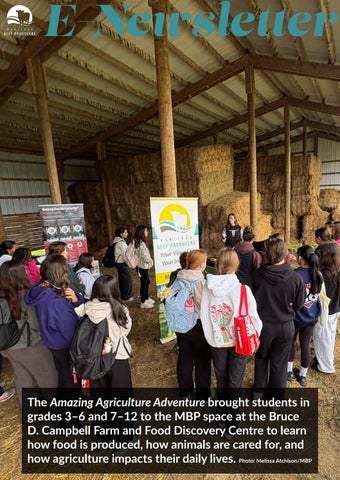
The Amazing Agriculture Adventure brought students in grades 3–6 and 7–12 to the MBP space at the Bruce D. Campbell Farm and Food Discovery Centre to learn how food is produced, how animals are cared for, and how agriculture impacts their daily lives. Photo: Melissa Atchison/MBP
NEWS AND HIGHLIGHTS Government of Canada invests in safety on Canadian farms
MPI expands hail estimating services in Winnipeg / continued support in SW
Canadian farmers work hard every day to feed our country, but farm work comes with real risks. Investing in safety training, health awareness, and practical tools helps keep farmers, their families, and farm workers safe...
Following an extraordinary response to the severe weather events that impacted customers across Manitoba this summer, Manitoba Public Insurance is expanding hail estimating services to all Winnipeg Service Centres to provide customers with more options for appointments and greater flexibility to have their vehicles assessed closer to where they live or work. Estimating appointments are continuing in Boissevain and Killarney to assist in processing claims related to the July 5 storm in the area. MPI expects to remain in the region throughout the fall to ensure customers can continue accessing the support they need close to home...
September 25, 2026
Agricultural Crown Lands Leases and Permits Regulation Engagement Source: https://www.gov.mb.ca/agriculture/landmanagement/crown-land/ Manitoba Agriculture is asking for feedback on proposed changes to the Agricultural Crown Lands Program. These changes would update the Agricultural Crown Lands Leases and Permits Regulation under The Crown Lands Act. In fall 2025, Manitoba Agriculture asked producers, Indigenous governments and organizations, industry partners, and the public for input through the ACL Program Review. This feedback helped shape the proposed changes. The changes focus on how leases are awarded, how much land one leaseholder can hold, and how modern leases can be renewed. Based on what we heard, the proposed changes would strengthen the Agricultural Crown Lands Program by: Improving How Leases Are Awarded: Moving from an auction-based process to an application-based process. This would give new and emerging producers a better chance to access land.
an Animal Unit Month limit so agricultural Crown lands are available to more producers and are not held by only a few large leaseholders. Allowing Modern Leases to Be Renewed: Allowing modern leases to be renewed for additional 15year terms, where requirements such as Treaty Land Entitlement and Duty to Consult are met. This would give producers more certainty for long-term planning. More information about these proposed changes can be found in the Manitoba Agriculture Crown Lands Lease and Permits Regulation Proposed Changes. How to Participate All Manitobans are invited to provide feedback on the proposed changes. Comments can be submitted through the Manitoba Regulatory Consultation Portal at http://reg.gov.mb.ca/home until October 2, 2026. Your feedback will help shape future updates to the regulation and improve the program. For more information, please contact Manitoba Agriculture at agcrownlands@gov.mb.ca.
Limiting Total Leaseholder Holdings: Bringing back
October 8 deadline to Apply for Disaster Financial Assistance for June 2026 Heavy Rains Manitoba has established a DFA program for the 2026 June Heavy Rains. • Program Announcement Date: July 10, 2026 • Deadline to request DFA: October 8, 2026 Primary residences, farms, businesses and nonprofit organizations with impacts related to the heavy rains may apply to the DFA program. Insurable damages are not eligible for DFA. Secondary properties such as cottages are never
eligible for DFA. In addition, DFA does not assist with loss of income, revenue, wages, market share or opportunity. Refer to the DFA webpage for more details. Apply for DFA • Deadline to submit invoices and event related expenses: July 12, 2027 You can also download the application form and print it, call to have one mailed to you, or visit your municipal office.
Manitoba Agriculture Information re: Protecting Livestock Sellers Against Payment Defaults Manitoba Agriculture has information on its website aimed at helping to protect livestock sellers against payment defaults. This information includes the following: For example, under provincial requirements, any person purchasing livestock must hold a valid Livestock Dealer or Agent Licence, unless the animals will be kept for at least 30 days. Licensed entities include: • Individual order buyers • Auction marts • Abattoirs that are not exclusively custom slaughtering All licensed dealers and agents must be able to present a valid pocket licence upon request. Sellers should request to see this licence before proceeding with a sale. In addition, all advertisements to buy livestock must clearly indicate that the dealer is licensed and must include the licence number. Further, the Livestock Dealers and Agents Licensing Regulation is designed to protect livestock sellers against payment defaults. All licensed dealers are required to maintain a bond, with coverage amounts based on their annual sales volume. In the event of a default, sellers may submit a claim against the dealer’s bond to recover full or partial value of the livestock. Payment Requirements • Payment must be made no later than one day after price determination. o Allowing additional time constitutes credit extension, which may void bond protection. • If payment is made by cheque, the seller must deposit or cash the cheque within eight business days of price determination. o Failure to do so is considered an extension of credit. • If a cheque is returned NSF, the seller has seven business days to notify Manitoba Agriculture and initiate a bond claim. These timelines ensure fairness and allow Manitoba Agriculture to administer the regulation effectively. Licensing Information New Livestock Dealers and Agents in 2026 New Livestock Dealers and Agents Licensed Dealers, Suspensions and Cancellations Licensed Livestock Dealers and Agents List Licence Suspensions and Cancellations For complete details, go to: https://www.gov.mb.ca/agriculture/livestock/other/dealer-and-agent-license/ index.html
Complete the AAFC September Agroclimate Impact Reporter Survey Agriculture and Agri-Food Canada (AAFC) is collecting AIR reports for September. As harvest is being completed across the country we continue to see challenging conditions in many regions of the country. Whether your dealing with excess moisture, drought or ideal conditions we want to hear from you. Help AAFC verify the impacts of weather events in your region. Please respond to one of the links below: English French During extreme weather events knowing the severity and extent of the impacts is vitally important in ensuring producers get the assistance that they need. To get added to the email reminders, all you need to do is send a quick email to droughtwatch@agr.gc.ca with AIR Reporter in the subject line. To learn more about AIR, follow this link. To view previous Agroclimate Impact maps, follow this link. Or see some of the other resources we produce on the AAFC Weather and Drought home page. Thank you for your participation!
Canadian Cattle Association leadership and staff welcomed Parliamentarians and officials back to session with a fall BBQ on Parliament Hill earlier this week. The annual BBQ brings together politicians and producers to share a meal, connect over Canadian beef, and talk about the issues that matter to cattle producers across the country. Pictured: Tyler Fulton, CCA President; Minister of Agriculture and Agri-Food and the Member of Parliament for Malpeque, Prince Edward Island Heath MacDonald; and Andrea Brocklebank, CCA CEO.
Age verification IN THE CLTS What is age verification? Age verification is the process of validating an animal’s age. Recording a birth date is one component of that process. If an animal's age is in question, dentition is considered the most accurate method of age determination. Producers can voluntarily record the birth date of an animal that was born on their farm and identified with an approved CCIA indicator (tag) in the Canadian Livestock Tracking System (CLTS) to support age verification.
FLAG: Enter birth date information before 12 months. The CLTS flags birth date information entered or modified after twelve months. It was introduced in 2022 by the Canadian Food Inspection Agency (CFIA) for the BSE Program and updated in 2026 from 9 months to 12 months. Birth dates can only be entered by the herd of origin. Birth dates may be used at slaughter to determine whether an animal is under 30 months of age. Being under or over 30 months may affect the animal’s value. Late entry or modification after twelve months trigger a pop-up window notification in the CLTS and is noted when a report is generated.
Age Verification is not mandatory. Age verification is not mandatory to report as it is not regulated data in Canada. Some specialty beef cattle programs require that animals are age verified to qualify. Producers can voluntarily record birth date information in the CLTS database.
How do I enter a birth date? To enter a birth date, you must have a CLTS database account. To set up and activate a CLTS account, contact CCIA: Phone: 1‑877‑909‑2333 Email: info@canadaid.ca If you do not have access to a computer or the internet, you may authorize a third party to submit information on your behalf. Third-party options may include a neighbour, relative, or local veterinary office. Contact CCIA by phone or email to receive a list of approved webservice providers from our Client Support Team.
How can I confirm that an animal I have purchased is age verified? How do I create a birth date certificate? After an animal’s birth date is recorded in the CLTS database, a birth date certificate can be created. The certificate is generated using the CCIA tag/indicator number.
There are two options: Search for a birth date using the animal’s identification number(s). Generate a birth date certificate. The CLTS database allows users to generate a birth date certificate for any livestock with a recorded birth date. To provide confidence in the birth dates recorded in the system, if a birth date is entered or modified after the animal is twelve months of age, a flag will appear on the tag history and the birth date certificate. Once an animal has left the farm of origin and ownership has changed, a new owner cannot enter or modify the animal's birth date in the CLTS database. Only the herd of origin (where the animal was born) can submit a birth date in the CLTS database.
CLTS Birth Date Flag Changing from 9 to 12 Months to Better Reflect On-Farm Realities Effective October 1, 2026, the Canadian Livestock Tracking System (CLTS) birth date flag will change from 9 months to 12 months (365 days), providing producers with additional time to enter or update birth date information before a flag is applied. Existing records flagged under the previous nine-month threshold will have the flag removed if the birth date was entered within 12 months. This is a one-time update to align existing records with the new 12-month threshold. Going forward, once a record is flagged, the flag cannot be removed. The flag was introduced in 2022 at the request of the Canadian Food Inspection Agency’s (CFIA) BSE Program. Following industry feedback, the threshold is being updated to better reflect on-farm production and record-keeping realities. Producers can voluntarily record the birth date of animals born on their farm and identified with an approved CCIA indicator to support age verification. Age verification is not mandatory, and birth date information is not mandatory regulated reporting in Canada. What does the birth date flag actually mean? Beginning October 1, if a birth date is entered or modified more than 12 months after the animal’s reported date of birth, the CLTS will flag the record. This flag will appear in the animal’s tag history and on its birth certificate. Importantly, the flag does not mean the producer has done something wrong, is non-compliant, or that the birth date is considered inaccurate. It is a transparency and data-integrity indicator showing that the birth date was entered or changed after the established 12-month threshold. A flag does not require any additional verification steps from the producer. CCIA or CFIA will not automatically contact a producer to verify the birth date simply because a flag appears on the record. For example, if an older cow loses a tag and the producer re-tags the animal and enters an accurate birth date, the record may be flagged because the information was entered after 12 months. The flag itself does not indicate that the birth date is incorrect. Why does the timing of birth date information matter? Birth date information may be used at slaughter to help determine whether an animal is under 30 months of age, which may affect the animal's value. If an animal's age is in question, dentition is considered the most accurate method of age determination. If you choose to record birth date information in the CLTS, enter it before the animal reaches 12 months of age to avoid the birth date flag. See the accompanying infographic ‘Age Verification in the CLTS’ for more information on birth date reporting, birth certificates and age verification. If you have further questions, please contact CCIA at 1-877-909-2333 or info@canadaid.ca.
MBP Accepting Applications for The Environmental Stewardship Award Manitoba Beef Producers (MBP) is accepting applications until Friday, December 18, 2026 for consideration for the local awarding of The Environmental Stewardship Award (TESA). Since 1996, TESA has recognized producers who go above and beyond standard industry conservation practices and set positive examples for other cattle producers and the general public. As stewards of a vast portion of the Canadian landscape, Canada’s beef cattle producers play a significant role in protecting and enhancing the environment. They continuously strive to improve existing stewardship conservation practices to create a sustainable future – always farming for tomorrow. At the local level, a producer receives provincial recognition for their outstanding environmental contributions. In Manitoba, this occurs in conjunction with MBP’s annual general meeting in February. All provincial award recipients then move forward to compete for national recognition from the Canadian Cattle Association (CCA). The national TESA recipient is announced during the CCA’s semi-annual meeting held in mid-summer or early fall. Each nominee exemplifies significant innovation and attention to a wide range of environmental stewardship aspects in their farm or ranch operation. Such innovations extend beneficially to areas far beyond their land, including water, wildlife and air. How to Nominate All beef cattle operations in Canada are eligible to apply for consideration for TESA. Interested producers can either nominate themselves, or be nominated by another individual or an organization. All methods are equally encouraged. More details and the application form can be found at: TESA Information Note: If you are a producer who is considering self-nomination, MBP can provide you with guidance and suggestions on completing the application process. The completed application form, along with all supporting documentation (such as letters of support, photos and/or videos), is to be submitted to Manitoba Beef Producers by email to info@mbbeef.ca no later than Friday, December 18, 2026. If you have questions, please contact the MBP office at 204-772-4542.