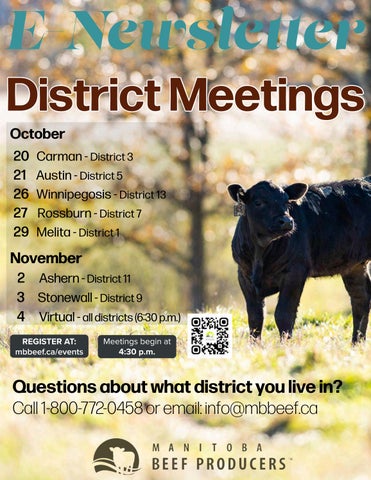
E-Newsletter District Meetings October 20 Carman - District 3 21 Austin - District 5 26 Winnipegosis - District 13 27 Rossburn - District 7 29 Melita - District 1
November 2 Ashern - District 11 3 Stonewall - District 9 4 Virtual - all districts (6�30 p.m.) REGISTER AT: mbbeef.ca/events
Meetings begin at 4:30 p.m.
Questions about what district you live in? Call 1-800-772-0458 or email: info@mbbeef.ca
NEWS AND HIGHLIGHTS AgriStability Reminder for Producers Hit by Weather Events & Flooding To help Manitoba producers impacted by significant early summer rains and resulting flooding in June and July (2026), the governments of Canada and Manitoba have agreed to the following targeted AgriStability enhancements: waiving the 2025 application late filing penalty; increasing the 2026 interim payment rate from 50% to 75% and late participation for 2026.
October 25 Deadline to Take National Water Security Strategy Survey The Government of Canada is inviting Canadians to share their views to inform the development of a National Water Security Strategy via an online platform accessible through the Canada Water Agency website. Complete the survey by October 25.
CCIA Livestock Traceability Survey The Canadian Cattle Identification Agency wants to hear from producers and livestock industry stakeholders about what they need from the next generation of livestock traceability and information systems. The survey is open until November 25, 2026.
October 16, 2026
Manitoba Agriculture Information re: Protecting Livestock Sellers Against Payment Defaults Manitoba Agriculture has information on its website aimed at helping to protect livestock sellers against payment defaults. This information includes the following:
These timelines ensure fairness and allow Manitoba Agriculture to administer the regulation effectively.
For example, under provincial requirements, any person purchasing livestock must hold a valid Livestock Dealer or Agent Licence, unless the animals will be kept for at least 30 days. Licensed entities include: • Individual order buyers • Auction marts • Abattoirs that are not exclusively custom-slaughtering
New Livestock Dealers and Agents in 2026 New Livestock Dealers and Agents
Licensing Information
Licensed Dealers, Suspensions and Cancellations Licensed Livestock Dealers and Agents List Licence Suspensions and Cancellations For complete details, go to: https://www.gov.mb.ca/agriculture/livestock/other /dealer-and-agent-license/index.html
All licensed dealers and agents must be able to present a valid pocket licence upon request. Sellers should request to see this licence before proceeding with a sale. In addition, all advertisements to buy livestock must clearly indicate that the dealer is licensed and must include the licence number. Further, the Livestock Dealers and Agents Licensing Regulation is designed to protect livestock sellers against payment defaults. All licensed dealers are required to maintain a bond, with coverage amounts based on their annual sales volume. In the event of a default, sellers may submit a claim against the dealer’s bond to recover full or partial value of the livestock. Payment Requirements • Payment must be made no later than one day after price determination. • Allowing additional time constitutes credit extension, which may void bond protection. • If payment is made by cheque, the seller must deposit or cash the cheque within eight business days of price determination. • Failure to do so is considered an extension of credit. • If a cheque is returned NSF, the seller has seven business days to notify Manitoba Agriculture and initiate a bond claim.
Celebrate October being Chili Month with the taste of Canadian beef!
As the temperatures drop, there’s nothing better than a big, hearty bowl of chili to warm you up. Our friends at Canada Beef have several chili recipes to choose from and some creative uses for leftovers. Try out this Classic Beef Chili recipe for your next meal! For the full recipe visit: https://canadabeef.ca/recipes/classicbeef-chili/
Water, Soil, Grasslands and Grazing Focus of National Climate Change Assessment MFGA, CCA and project partners supported by AAFC for National Scale Assessment of Climate Change Impacts on Grazing Lands Across Eight Canadian Watersheds (MFGA media release, October 16, 2026) Manitoba
Forage and Grassland Association (MFGA) will lead a one-year Agriculture and Agri-Food Canada (AAFC) project to better understand how climate change will impact water, soil and grassland productivity across eight Canadian watersheds, three which have been completed in Manitoba. AAFC’s Canadian Agricultural Strategic Priorities Program has awarded MFGA with up to $237,347 for the MFGA Aquanty Model to be run across the watersheds using high-resolution climate projections and integrated hydrologic modeling. The project will quantify drought, flood, and waterstress risks and translate results into practical indicators and decision-support tools for producers. “As cattle producers, we work outdoors every day, we can see our climate is in flux,” said Zack Koscielny, MFGA chair and a mixed farmer from Strathclair, Manitoba. “We seem to see too much water or not enough water. By looking at grasslands and grazing, this project will help producers better prepare for the times ahead especially around water and grasslands.” "Canadian producers experience the impacts of climate change firsthand, and having tools to
navigate risks like drought and excess water is vital to their long-term success," said the Honourable Heath MacDonald, Minister of Agriculture and Agri-Food. "This investment under the Canadian Agricultural Strategic Priorities Program gives our cattle and forage sectors the data needed to improve decisionmaking and ensure our grazing lands remain sustainable and resilient for years to come." Alberta’s Old Man River and Battle River watersheds, British Columbia’s Nicola River, Ontario’s Saugeen River and Quebec’s Chaudière River will serve as project watersheds. Manitoba’s Oak River, Swan Lake and Pembina Valley watershed have had the climate change analysis completed and will be added to the project outcomes. The model results will be supported by a project advisory team that will use the results to inform the Canadian cattle industry and stakeholders on potential risks that climate change imposes on grazing sustainability, through effects on water resource availability and grassland productivity. The project team includes MFGA, the Canadian Cattle Association (CCA), Aquanty, the Centre for Land Conservation and Alberta’s Food Water Wellness Foundation, which has
Water, Soil, Grasslands and Grazing Focus of National Climate Change Assessment MFGA, CCA and project partners supported by AAFC for National Scale Assessment of Climate Change Impacts on Grazing Lands Across Eight Canadian Watersheds conducted extensive soil and carbon research with the province’s cattle producers. “Healthy grazing lands, profitable forage crops and the abundance and necessity of water resources are foundational cornerstones of Canada’s beef industry,” said Karla Hicks, Chair of the Canadian Cattle Association Environment Committee. “Understanding how climate change may affect these resources is essential for producers and for the ecosystems they steward. This project will help strengthen the science needed to support a resilient and competitive Canadian beef sector.”
Analysis results will be generated for the key grazing regions across the country and will be summarized into actionable insights for producers and the broader cattle industry. Communicating potential climate change impacts to the industry is a core component of the project. MFGA will host the project on the existing MFGA Aquanty portal at MFGA.net and the full project will be translated into French and English on the MFGA website. For More Information: Duncan Morrison, Executive Director, MFGA: Duncan@mfga.net Tina Zakowski, CCA Communications Manager: Contact@cattle.ca
Apply for 2027 Summer Internships
Location: Calgary
and advocacy. Interns will have the opportunity to engage directly with CCA and divisions staff, board members, councils, and key industry stakeholders to help overcome challenges and advance priorities important to the Canadian beef industry. Students are also encouraged to propose summer projects for consideration.
Overview:
Canadian Cattle Association internship
The Canadian Cattle Association (CCA) is the national voice of Canada’s 60,000 beef producers. Founded by producers and led by a producer-elected Board, CCA works to address issues of concern to Canada’s beef producers.
Responsibilities:
The Beef Cattle Research Council (BCRC) is Canada’s industry-led funding agency for beef, cattle and forage research. The BCRC is committed to delivering and supporting initiatives that effectively accelerate the development and uptake of research findings and outcomes by industry. Canfax provides expert analysis of markets and trends in the ever-changing North American beef industry. Canfax Research Services (CRS) provides industry with statistical information and economic analysis, focusing on both the Canadian and global beef markets. CRS Analysis supports a variety of industry activities including annual business planning, results and performance analysis, priority setting and policy evaluation. CCA, BCRC, and Canfax/CRS are each looking for a talented, self-motivated individual to participate in our CCA Summer Intern Program. There are a total of three internships available. Job Description: These internship positions provide a unique opportunity for students interested in the Canadian beef industry across a broad range of topics including (but not limited to) public policy, research, sustainability, communications,
•
Assist with youth program delivery (Canadian Cattle Young Leaders & Canadian Cattle Youth Council). This will include at CCA’s Semi-annual meeting in August and at the Spring Forum.
•
Assist in communicating about advocacy efforts and policy enactment (social media, stakeholder outreach, media management, website maintenance, etc.).
•
Assist with the development of communication updates to member organizations.
•
Observe association meetings (board, committees, working groups).
•
Perform other duties as assigned to advance CCA activities.
Beef Cattle Research Council (BCRC) internship Responsibilities: •
Support BCRC knowledge mobilization efforts including website and social media content development and maintenance.
•
Assist with event preparation and development.
•
Support scientific and special topic reviews in a wide variety of areas.
Apply for 2027 Summer Internships •
Assist in BCRC’s research evaluation processes.
•
Must have excellent research, writing, and communication skills.
•
Perform other duties as assigned.
•
Must be able to work in CCA’s Calgary office.
Canfax/Canfax Research Services (CRS) internship More information on the Canfax/Canfax Research Services internship Responsibilities: •
Covering staff vacation: feeder market analyst (radio report, data entry and analysis), member and database coordinator (website, report template).
•
Cost of production indexing.
•
Conduct literature reviews on a wide variety of topics.
•
Write fact sheets and blog articles.
•
Perform other duties as assigned.
Qualifications: •
Applicants must be enrolled in undergraduate, graduate, or postgraduate studies.
•
Applicants should be enrolled in an agriculture or associated program, have beef production experience, and/or an expressed interest in pursuing a career in the Canadian beef industry.
•
Must be available for the duration of the internship—April through August.
Please send cover letters and resumes to Jennifer at admin@cattle.ca with the subject line: CCA Summer Intern and indicate in your cover letter which specific internship(s) you are interested in. Candidates can apply to more than one internship. The deadline for applications is October 30, 2026. We thank all candidates for their interest; however, only those selected for an interview will be contacted. Canadian Cattle Association is an Equal Opportunity Employer and Prohibits Discrimination and Harassment of Any Kind: CCA is committed to the principle of equal employment opportunity for all employees and to providing employees with a work environment free of discrimination and harassment. All employment decisions at CCA are based on business needs, job requirements and individual qualifications, without regard to race, colour, religion or belief, national, social or ethnic origin, sex (including pregnancy), age, physical, mental or sensory disability, sexual orientation, gender identity and/or expression, marital, civil union or domestic partnership status, past or present military service, family medical history or genetic information, family or parental status, or any other status protected by the laws or regulations in Canada.
Age verification IN THE CLTS What is age verification? Age verification is the process of validating an animal’s age. Recording a birth date is one component of that process. If an animal's age is in question, dentition is considered the most accurate method of age determination. Producers can voluntarily record the birth date of an animal that was born on their farm and identified with an approved CCIA indicator (tag) in the Canadian Livestock Tracking System (CLTS) to support age verification.
FLAG: Enter birth date information before 12 months. The CLTS flags birth date information entered or modified after twelve months. It was introduced in 2022 by the Canadian Food Inspection Agency (CFIA) for the BSE Program and updated in 2026 from 9 months to 12 months. Birth dates can only be entered by the herd of origin. Birth dates may be used at slaughter to determine whether an animal is under 30 months of age. Being under or over 30 months may affect the animal’s value. Late entry or modification after twelve months trigger a pop-up window notification in the CLTS and is noted when a report is generated.
Age Verification is not mandatory. Age verification is not mandatory to report as it is not regulated data in Canada. Some specialty beef cattle programs require that animals are age verified to qualify. Producers can voluntarily record birth date information in the CLTS database.
How do I enter a birth date? To enter a birth date, you must have a CLTS database account. To set up and activate a CLTS account, contact CCIA: Phone: 1‑877‑909‑2333 Email: info@canadaid.ca If you do not have access to a computer or the internet, you may authorize a third party to submit information on your behalf. Third-party options may include a neighbour, relative, or local veterinary office. Contact CCIA by phone or email to receive a list of approved webservice providers from our Client Support Team.
How can I confirm that an animal I have purchased is age verified? How do I create a birth date certificate? After an animal’s birth date is recorded in the CLTS database, a birth date certificate can be created. The certificate is generated using the CCIA tag/indicator number.
There are two options: Search for a birth date using the animal’s identification number(s). Generate a birth date certificate. The CLTS database allows users to generate a birth date certificate for any livestock with a recorded birth date. To provide confidence in the birth dates recorded in the system, if a birth date is entered or modified after the animal is twelve months of age, a flag will appear on the tag history and the birth date certificate. Once an animal has left the farm of origin and ownership has changed, a new owner cannot enter or modify the animal's birth date in the CLTS database. Only the herd of origin (where the animal was born) can submit a birth date in the CLTS database.
CLTS Birth Date Flag Changing from 9 to 12 Months to Better Reflect On-Farm Realities Effective October 1, 2026, the Canadian Livestock Tracking System (CLTS) birth date flag will change from 9 months to 12 months (365 days), providing producers with additional time to enter or update birth date information before a flag is applied. Existing records flagged under the previous nine-month threshold will have the flag removed if the birth date was entered within 12 months. This is a one-time update to align existing records with the new 12-month threshold. Going forward, once a record is flagged, the flag cannot be removed. The flag was introduced in 2022 at the request of the Canadian Food Inspection Agency’s (CFIA) BSE Program. Following industry feedback, the threshold is being updated to better reflect on-farm production and record-keeping realities. Producers can voluntarily record the birth date of animals born on their farm and identified with an approved CCIA indicator to support age verification. Age verification is not mandatory, and birth date information is not mandatory regulated reporting in Canada. What does the birth date flag actually mean? Beginning October 1, if a birth date is entered or modified more than 12 months after the animal’s reported date of birth, the CLTS will flag the record. This flag will appear in the animal’s tag history and on its birth certificate. Importantly, the flag does not mean the producer has done something wrong, is non-compliant, or that the birth date is considered inaccurate. It is a transparency and data-integrity indicator showing that the birth date was entered or changed after the established 12-month threshold. A flag does not require any additional verification steps from the producer. CCIA or CFIA will not automatically contact a producer to verify the birth date simply because a flag appears on the record. For example, if an older cow loses a tag and the producer re-tags the animal and enters an accurate birth date, the record may be flagged because the information was entered after 12 months. The flag itself does not indicate that the birth date is incorrect. Why does the timing of birth date information matter? Birth date information may be used at slaughter to help determine whether an animal is under 30 months of age, which may affect the animal's value. If an animal's age is in question, dentition is considered the most accurate method of age determination. If you choose to record birth date information in the CLTS, enter it before the animal reaches 12 months of age to avoid the birth date flag. See the accompanying infographic ‘Age Verification in the CLTS’ for more information on birth date reporting, birth certificates and age verification. If you have further questions, please contact CCIA at 1-877-909-2333 or info@canadaid.ca.
MBP Accepting Applications for The Environmental Stewardship Award Manitoba Beef Producers (MBP) is accepting applications until Friday, December 18, 2026 for consideration for the local awarding of The Environmental Stewardship Award (TESA). Since 1996, TESA has recognized producers who go above and beyond standard industry conservation practices and set positive examples for other cattle producers and the general public. As stewards of a vast portion of the Canadian landscape, Canada’s beef cattle producers play a significant role in protecting and enhancing the environment. They continuously strive to improve existing stewardship conservation practices to create a sustainable future – always farming for tomorrow. At the local level, a producer receives provincial recognition for their outstanding environmental contributions. In Manitoba, this occurs in conjunction with MBP’s annual general meeting in February. All provincial award recipients then move forward to compete for national recognition from the Canadian Cattle Association (CCA). The national TESA recipient is announced during the CCA’s semi-annual meeting held in mid-summer or early fall. Each nominee exemplifies significant innovation and attention to a wide range of environmental stewardship aspects in their farm or ranch operation. Such innovations extend beneficially to areas far beyond their land, including water, wildlife and air. How to Nominate All beef cattle operations in Canada are eligible to apply for consideration for TESA. Interested producers can either nominate themselves, or be nominated by another individual or an organization. All methods are equally encouraged. More details and the application form can be found at: TESA Information Note: If you are a producer who is considering self-nomination, MBP can provide you with guidance and suggestions on completing the application process. The completed application form, along with all supporting documentation (such as letters of support, photos and/or videos), is to be submitted to Manitoba Beef Producers by email to info@mbbeef.ca no later than Friday, December 18, 2026. If you have questions, please contact the MBP office at 204-772-4542.