
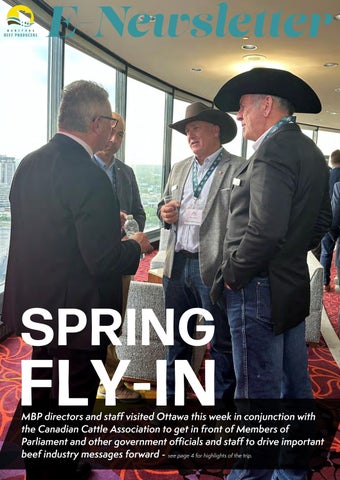
MBP directors and staff visited Ottawa this week in conjunction with the Canadian Cattle Association to get in front of Members of Parliament and other government officials and staff to drive important beef industry messages forward - see page 4 for highlights of the trip.
Gladstone
Date: Tuesday, June 2, 2026
Time: 9:30 a.m. to 3:30 p.m.
Place: Gladstone Auction Mart - PTH 16 W
Killarney
Date: Wednesday, June 3, 2026
Time: 9:30 a.m. to 3:30 p.m.
Place: Killarney Auction Mart - ¾ mile South of Hwy 3 & 18
Coffee and registration
Precision Pastures: Enhancing Grazing with Virtual Fencing
Dr. Mary-Jane Orr – Manitoba Beef and Forage Initiatives (MBFI)
The Mineral Match-Up: What Your Cows Really Need
Rachel Claassen-Haeusler - Masterfeeds Representative
Cattle Health on Pasture: Common Issues and Practical Solutions
Dr. Tanya Anderson – Gladstone Vet Clinic
Dr. Christian Scott – Pembina Valley Vet Clinic
Long-Distance Doctoring: Remote Drug Delivery Done Right
Local Veterinarians and practical producer experiences Hands-on practice with RDD equipment and targets
Smart Implanting: Hands-On Techniques and Economic Benefits
Ben Hamm, Farm Management Specialist & Cindy Jack, Livestock and Forage Specialist – Manitoba Agriculture Practice using implant guns on cattle ears
Lunch will be provided. Please pre-register by Friday, May 29, 2026, to assist with meal planning. Contact Manitoba Agriculture at: 1-844-769-6224 or agriculture@gov.mb.ca. Registration fee at the door - $25

The Food Safety and Traceability Program is designed to assist Manitoba agri-food and agri-product sectors in adopting and improving food safety and traceability practices. The intake for this program is currently open; funding requests will be accepted on a first-come, first-served basis until 11:59 PM on July 16, 2026, or until available funding has been allocated.
The Honourable Heath MacDonald, Minister of Agriculture and Agri-Food, has launched the application period for the fourth cohort of the Canadian Agricultural Youth Council. Young people
On May 25th the Honourable Dominic LeBlanc, President of the King’s Privy Council for Canada and Minister responsible for Canada-U.S. Trade, Intergovernmental Affairs, Internal Trade and One Canadian Economy, met with provincial and territorial trade ministers to discuss Canada-U.S. trade relations and preparations for the upcoming review of the Canada-United States-Mexico Agreement (CUSMA).
The 2026 season is off to a slow start across much of the country, with cool, wet conditions dominating many Agricultural regions. However, several significant storm events have improved

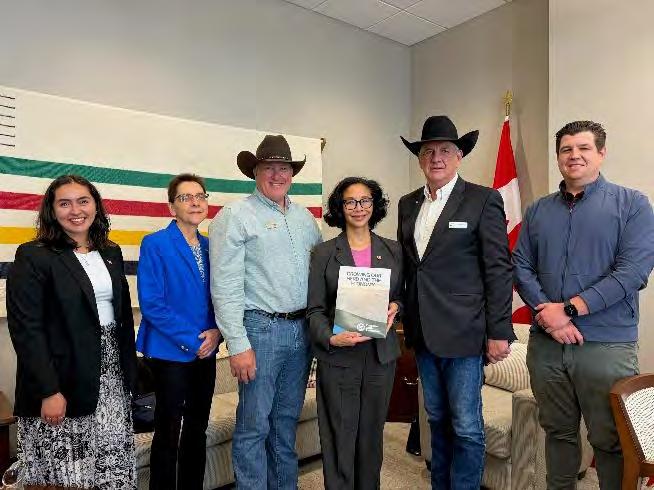
(From left to right: Daniela Lombardo, Maureen Cousins, Brian English, Flordeliz (Gigi) Osler, Arvid Nottveit, and Carson Callum. Photo courtesy Canadian Cattle Association.)
(Cover photo from left to right: Hon. Heath MacDonald, Minister of Agriculture and Agri-Food, Ryder Lee, General Manager, Canadian Cattle Association, Brian English, MBP District 6 Director, and Arvid Nottveit, MBP President and District 11 Director. Photo courtesy CCA.)
A delegation from Manitoba Beef Producers (MBP) and staff from the Canadian Cattle Association (CCA) met with a variety of elected officials and government staff in Ottawa May 26-27 to advance topics of importance to the Canadian beef industry. This included MBP President Arvid Nottveit, District 6 Director Brian English, CEO Carson Callum, and Senior Policy Manager Maureen Cousins, as well as CCA staff Gabriela Guigou, Animal Health and Care Manager and Daniela Lombardo, Policy Manager.
Elected officials MBP had the opportunity to meet with included the Hon. Rebecca Chartrand, Minister Responsible for the Canadian Northern Development Agency (MP for Churchill Keewatinook Aski), the Hon. Kevin Lamoureux, Parliamentary Secretary to the Leader of the Government in the House of
Commons (MP for Winnipeg North), Terry Duguid, Chair of the Standing Committee on Natural Resources (MP for Winnipeg South), Ben Carr, Chair of the Standing Committee on Industry and Technology (MP for Winnipeg South Centre), James Bezan (MP for SelkirkInterlake-Eastman), Ted Falk (MP for Provencher), Dan Mazier (MP for Riding Mountain), Branden Leslie (MP for PortageLisgar), Grant Jackson (MP for Brandon-Souris), and Colin Reynolds (MP for ElmwoodTranscona). The delegation also met with Manitoba Senator Flordeliz (Gigi) Osler.
A primary focus of discussions was on Canadian beef industry concerns about the proposed Mercosur trade deal. The sector is concerned that Mercosur beef has lower standards in labour, environment, quality, animal health and food safety. MBP strongly encourages producers to tell your friends and family that trade diversification should not come at the expense of Canada’s domestic production base or our most important trading relationships. Visit www.cattle.ca/mercosur to help raise awareness and to learn more about how to get industry concerns across to federal officials on this critical trade file.
Other matters discussed with the MPs and Senator included the need for cost-shared premiums for Livestock Price Insurance, which would be beneficial in particular to young producers, and which help level the playing field when it comes to cost-shared premiums already available in areas such as crop insurance. The importance of completing the Lake Manitoba Lake St. Martin Outlet Channels project to reduce the risk of flooding was also raised, among other topics.
Additionally, there were meetings with staff from Agriculture and Agri-Food Canada (AAFC) where the focus was on Mercosur, LPI and other
business risk management tools. MBP is also seeking adjustments to the Advance Payments Program (APP). One relates to cow/calf producers’ interest in having the APP adjusted to allow for having an in utero calf (use of breeding inventory) as a means to secure a cash advance. A second requested change relates to cattle producers being allowed greater flexibility around repaying cash advances, specifically the ability to pay them off earlier if their cash flows allow as opposed to having to wait until the

MBP also met with staff from Environment and Climate Change Canada (ECCC) where the environmental benefits of beef production on the Canadian landscape was discussed, along with the need to address challenges related to water management, both flood and drought related.
MBP thanks all the elected officials, Senator Osler and staff from AAFC and ECCC for spending time with our delegation to learn about various matters facing the sector, as ways to help grow the Canadian beef herd. MBP also thanks the staff at the Canadian Cattle Association for helping to arrange these important advocacy activities. They are extremely valuable.
Manitoba Transportation and Infrastructure is advising motorists to use caution as 4-H members participate in a provincewide highway cleanup on May 30 from 9 a.m. to 3 p.m., weather permitting. All 4-H participants will be wearing high-visibility safety vests and cleanup areas will be marked with signage.

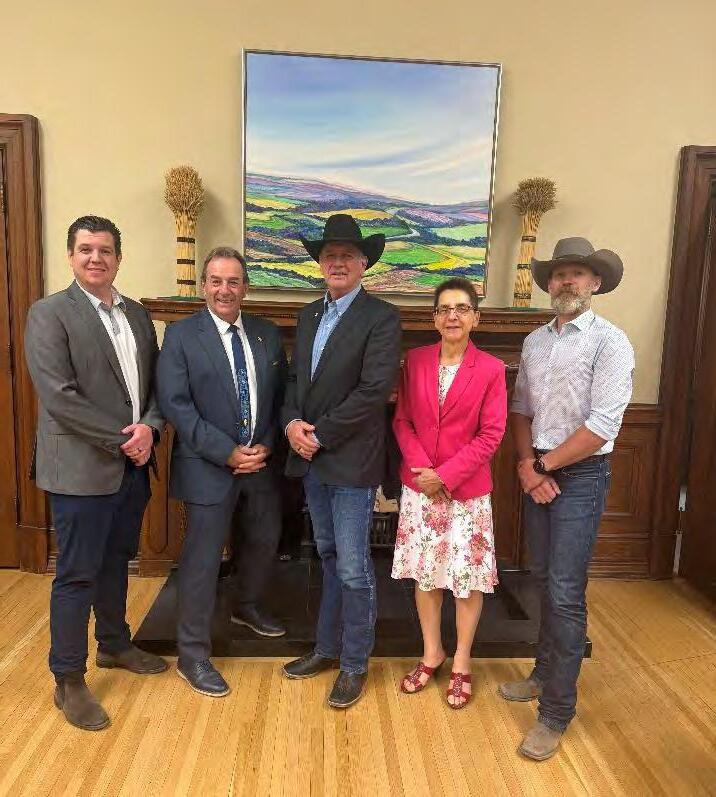
MBP representatives met this week with the Hon. Ron Kostyshyn and staff this week
The Agricultural Crown Lands Leasing Program, efforts to expand livestock inspection services in Manitoba (including the need for a dedicated RCMP resource to help support theft and fraud investigations), concerns related to the proposed federal Mercosur trade agreement, and pest management were among the topics discussed.
L-r: Carson Callum, MBP CEO; Minister Kostyshyn; Arvid Nottveit, MBP President; Maureen Cousins, MBP Senior Policy Manager; and Matthew Atkinson, MBP Past-President and Crown Lands Committee Chair. MBP thanks the Minister and his staff for this valuable engagement.
StatsCan’s farm cash receipts for January to March 2026 show total livestock receipts rose 5.5% to $11.6 billion in the first quarter, on continued gains in most prices.
Receipts for cattle (+$286.2 million) and calves (+$104.3 million) accounted for nearly two-thirds of the increase in livestock receipts in the first quarter.
For more information, please visit Statistics Canada.
Statistics Canada’s 2025 farm income date found that livestock receipts rose 13.3% to $45.3 billion in 2025, mainly on gains in prices for most livestock commodities. This was the fifth consecutive increase in livestock receipts and the largest increase since 2021. All provinces reported increases in 2025, led by Alberta (+$2.1 billion; +17.7%) and Ontario (+$1.0 billion; +10.2%). Cattle and calves drove the increase in livestock receipts in 2025, rising 22.5% to $20.6 billion, primarily due to higher prices (+24.4%) as marketings fell (-1.5%).
For more information, please visit Statistics Canada.

Toronto, ON — May 25th, 2026 — As Canadian and Mercosur negotiators meet in Toronto this week for a critical round of trade talks, the Canadian Cattle Association is on the ground to work with the Canadian negotiating team and ensure we get the best outcome for Canadian beef producers.
The CCA is calling on the federal government to reject any expansion of beef market access in a potential trade agreement with Mercosur countries, as it would put significant pressure on Canadian farmers and ranchers, weaken long-term food security, and risk creating new trade tensions ahead of the upcoming review of the Canada-United States-Mexico Agreement (CUSMA).
“Canadian beef producers support fair, science-based trade, and at the same time, Canadian beef cannot become a bargaining chip,” said Tyler Fulton, President of the Canadian Cattle Association. “Canada already imports more beef, proportionally, than almost any major beefproducing country in the world. Expanding access for Mercosur beef would undermine Canadian producers at a critical time for our industry.”
“Canadian farmers and ranchers operate under some of the highest standards in the world for animal care, food safety, sustainability, and labour,” continued Fulton. “Our producers should not be economically penalized for maintaining high standards while competing against jurisdictions with significantly lower production costs driven by weaker standards.”
In 2025, Canadian beef imports reached their highest level since 1993, representing approximately 30 percent of domestic consumption. Meanwhile, imports from Mercosur countries have increased by 238 percent since 2021. The CCA warns that further expansion of imports would discourage herd rebuilding in Canada and increase reliance on imported beef at a time when producers are beginning to recover from years of drought, rising costs, and market instability.
Industry leaders have also raised concerns about the broader trade implications of a Mercosur agreement that includes expanded beef access, particularly as Canada prepares for the review of the Canada-United States-Mexico Agreement (CUSMA).
“We at the CCA are also concerned about the broader impact this could have ahead of the CUSMA review”, added Fulton. “The United States remains Canada’s most important beef trading partner, and the federal government should be focused on strengthening North American trade relationships, not creating friction or concerns around backdoor access into the North American market.”
While supportive of trade diversification efforts, the CCA believes any agreement must deliver meaningful benefits for Canadian producers and protect the long-term viability of the domestic beef sector.
As negotiations continue in Toronto this week, the Canadian Cattle Association is urging negotiators to stand firmly behind Canadian farmers, ranchers, and rural communities, and reject any deal that compromises the future of our domestic industry.
-30-
For further information, contact:
Tina Zakowsky
Communications Manager Canadian Cattle Association 403-451-0931
zakowskyt@cattle.ca
Ariella Kimmel
Communications Support in Toronto 613-884-9125
ariella@winstonwilont.ca




The public comment period for the Beef Code of Practice update is already halfway complete and producer input is needed in these final weeks.
The Beef Code sets the national on-farm standard of care for beef cattle in Canada and has been around since 1981.
Producers are encouraged to take 20–30 minutes to submit comments before the June 12 deadline to help ensure strong producer input in shaping the direction of onfarm animal welfare in our sector for the next decade.
Click Here to Participate in the Public Comment Period
What Updates are in the Draft Beef Code?
Updated areas in the draft Beef Code, among others, include:
• Enhanced requirements to provide pain control for painful procedures (castrating, disbudding/dehorning, branding) for all ages of cattle and a requirement to provide pain control for assisted difficult calvings, for both cow and calf.
• New requirements to monitor cattle more frequently during heat waves/high humidity and during adverse cold weather to promptly assist cattle not coping, and to provide shelter (natural or man-made) from high winds during cold weather.
• New sections on mud & moisture and nonambulatory cattle, and expanded section on weaning.
The Canadian Cattle Association has prepared a high-level summary of the draft Beef Code. This summary is intended to highlight key areas of change and support initial review; however, it is not exhaustive. Producers are encouraged to review the full draft Code and provide comments.
Draft Beef Code English French Producer Summary of Draft Beef Code Content English French
Here are some sample questions to guide your feedback as you review the content:
• Are the standards workable on your operation?
• How the Code applies across different production systems
• Are there areas that may need clarification or adjustment
• What is working well and should remain unchanged
Visit the Canadian Cattle Association website at www.cattle.ca/beef-code to explore frequently asked questions, access additional resources, and request a recording of the Public Comment Period webinar for producers.

Manitoba Beef Producers (MBP) is accepting applications until Friday, December 18, 2026 for consideration for the local awarding of The Environmental Stewardship Award (TESA).
Since 1996, TESA has recognized producers who go above and beyond standard industry conservation practices and set positive examples for other cattle producers and the general public. As stewards of a vast portion of the Canadian landscape, Canada’s beef cattle producers play a significant role in protecting and enhancing the environment. They continuously strive to improve existing stewardship conservation practices to create a sustainable future – always farming for tomorrow.
At the local level, a producer receives provincial recognition for their outstanding environmental contributions. In Manitoba, this occurs in conjunction with MBP’s annual general meeting in February. All provincial award recipients then move forward to compete for national recognition from the Canadian Cattle Association (CCA). The national TESA recipient is announced during the CCA’s semi-annual meeting held in mid-summer or early fall.
Each nominee exemplifies significant innovation and attention to a wide range of environmental stewardship aspects in their farm or ranch operation. Such innovations extend beneficially to areas far beyond their land, including water, wildlife and air.
All beef cattle operations in Canada are eligible to apply for consideration for TESA. Interested producers can either nominate themselves, or be nominated by another individual or an organization. All methods are equally encouraged. More details and the application form can be found at: TESA Information
Note: If you are a producer who is considering self-nomination, MBP can provide you with guidance and suggestions on completing the application process.
The completed application form, along with all supporting documentation (such as letters of support, photos and/or videos), is to be submitted to Manitoba Beef Producers by email to info@mbbeef.ca no later than Friday, December 18, 2026. If you have questions, please contact the MBP office at 204-772-4542.