E-Newsletter
Long Weekend Eats
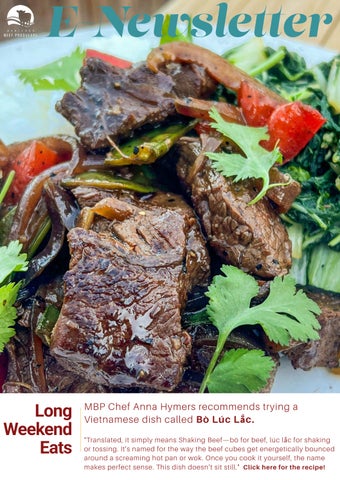
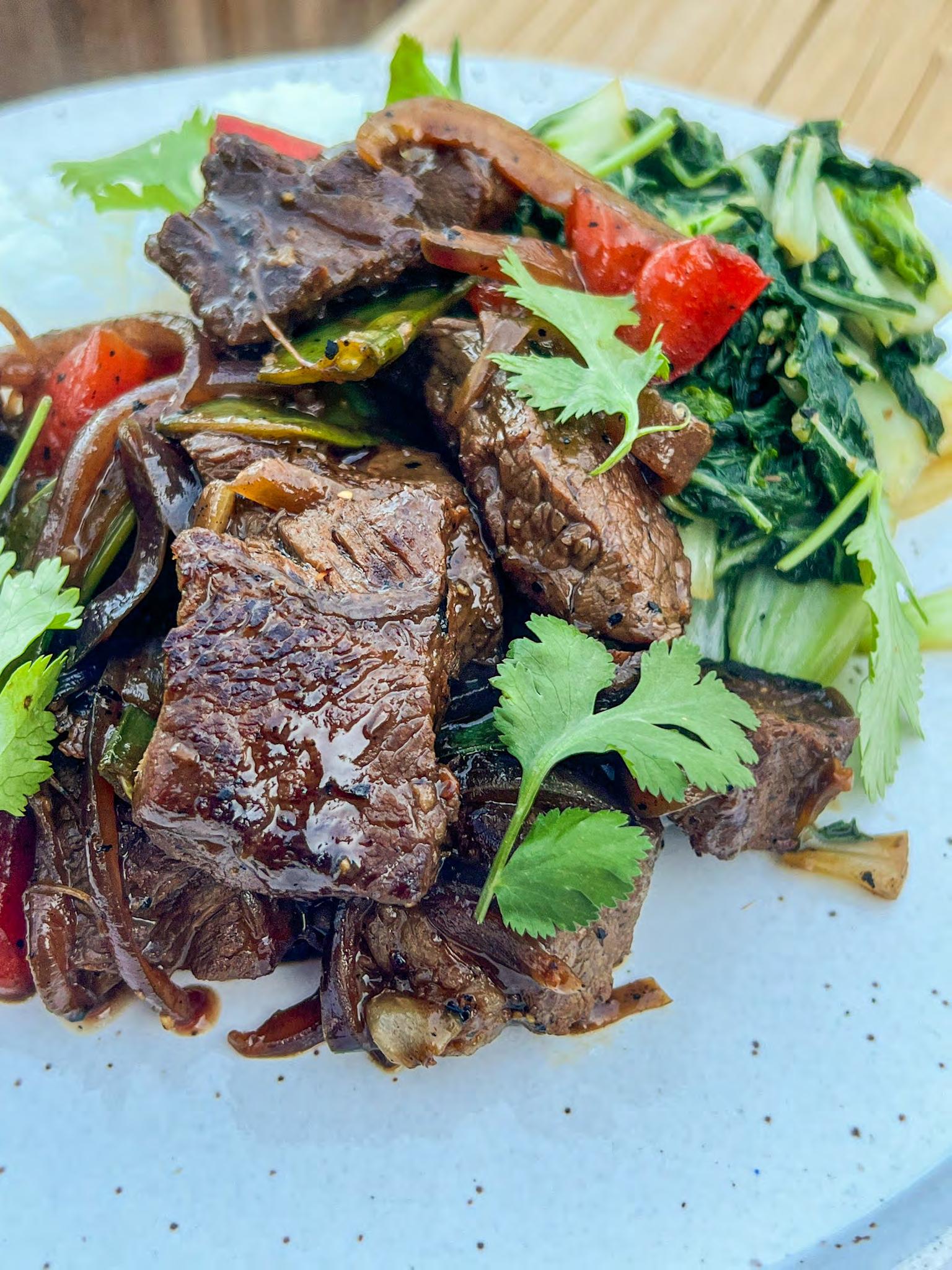
MBP Chef Anna Hymers recommends trying a Vietnamese dish called Bò Lúc L ắ c.
"Translated, it simply means Shaking Beef—bò for beef, lúc l ắ c for shaking or tossing. It’s named for the way the beef cubes get energetically bounced around a screaming hot pan or wok. Once you cook it yourself, the name makes perfect sense. This dish doesn’t sit still." Click here for the recipe!



NEWS AND HIGHLIGHTS
Current MB Fire & Travel Restrictions
Open fires are prohibited from April 1 to Nov. 15, except under a burning permit or in enclosed approved firepits such as grated campfire pits in provincial campsites. For information re. current municipal burning restrictions and other wildfire information, click the link above. Report wildfires to 1-800-782-0076.
Construction Begins on PTH 100 and PTH 3 Interchange Project
Construction is moving ahead on the new Provincial Trunk Highway 100 and 3 interchange near Oak Bluff. Drivers will see more construction activity in the area including temporary traffic control and automated flagger assistance devices. Currently, no
Canada Road Safety Week Underway
The Manitoba government is reminding drivers to share the roads responsibly by exercising caution around motorcycles and bicycles, and by slowing down and moving over for tow truck operators, roadside assistance operators and emergency vehicles as part of Canada Road Safety Week. The Manitoba government continues to take action to improve road safety through legislation, including the recent amendments to the Highway Traffic Act, which came into force on Jan. 1, establishing clear rules for drivers when passing cyclists and providing tow truck operators with additional options to enhance safety working in traffic.

Applications for The Environmental Stewardship Award
Due to MBP by December 18, 2026
Manitoba Beef Producers (MBP) is accepting applications until Friday, December 18, 2026 for consideration for the local awarding of The Environmental Stewardship Award (TESA).
Since 1996, TESA has recognized producers who go above and beyond standard industry conservation practices and set positive examples for other cattle producers and the general public. As stewards of a vast portion of the Canadian landscape, Canada’s beef cattle producers play a significant role in protecting and enhancing the environment. They continuously strive to improve existing stewardship conservation practices to create a sustainable future – always farming for tomorrow.
At the local level, a producer receives provincial recognition for their outstanding environmental contributions. In Manitoba, this occurs in conjunction with MBP’s annual general meeting in February. All provincial award recipients then move forward to compete for national recognition from the Canadian Cattle Association (CCA). The national TESA recipient is announced during the CCA’s semi-annual meeting held in mid-summer or early fall.
Each nominee exemplifies significant innovation and attention to a wide range of environmental stewardship aspects in their farm or ranch operation. Such innovations extend beneficially to areas far beyond their land, including water, wildlife and air.
How to Nominate
All beef cattle operations in Canada are eligible to apply for consideration for TESA. Interested producers can either nominate themselves, or be nominated by another individual or an organization. All methods are equally encouraged. More details and the application form can be found at: TESA Information
Note: If you are a producer who is considering self-nomination, MBP can provide you with guidance and suggestions on completing the application process.
The completed application form, along with all supporting documentation (such as letters of support, photos and/or videos), is to be submitted to Manitoba Beef Producers by email to info@mbbeef.ca no later than Friday, December 18, 2026. If you have questions, please contact the MBP office at 204-772-4542.
Share Your Feedback on the Beef Cattle Code of Practice
By: Tyler Fulton, President, Canadian Cattle Association
The public comment period for the Beef Cattle Code of Practice (Beef Code or the Code) is open from April 13 through June 12, 2026 at www.nfacc.ca/codes-of-practice/beef-cattle
The Beef Code outlines expected and recommended animal care practices for beef cattle and is subject to a regular review process. The public comment period is an opportunity for anyone who has an interest in how beef cattle are raised in Canada, including consumers, veterinarians, foodservice professionals, and producers, to review the draft content and share their feedback.
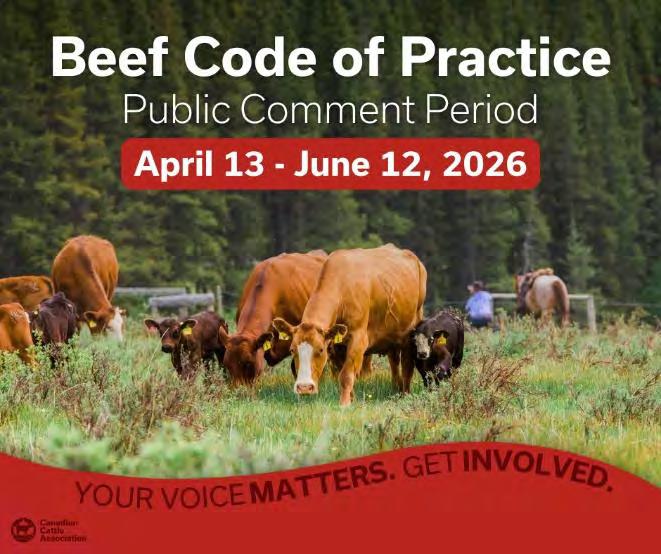
Feedback gathered through the public comment period is critical in the code development process and helps determine the content of the final document. Having strong producer feedback from all regions of Canada will be an important step in this process.
The Beef Code is one of 14 Codes of Practice in Canada that provide critical guidance for the care and handling of farm animals. The Codes of Practice serve as our national understanding of on-farm animal care requirements and recommended practices. They serve as reference materials for regulations, extension tools, and the foundation for animal care assessment programs. General information on farm animal codes of practice in Canada can be found at https://www.nfacc.ca/codes-ofpractice
The Beef Code is meant to drive continuous improvement in animal welfare and is built to be scientifically informed, practical, and reflect societal expectations for responsible farm animal care. The Code uses an outcome-based approach that focuses on achieving successful standards while allowing for flexibility in how these outcomes are met rather than dictating the exact processes or methods to be used.
The National Farm Animal Care Council (NFACC) (www.nfacc.ca) oversees the process of developing and reviewing Codes of Practice through a structured, multistakeholder process that includes producers, veterinarians, scientists, transporters, processors, retailers, government, and animal welfare representatives. CCA is a member of NFACC and serves as the national commodity organization responsible for initiating the code review process for its sector, in alignment with NFACC’s established review timelines. Decisions are science-informed and consensus-based.
The review process involves two committees: the Code Development Committee and Scientific Committee. The Code Development Committee updates the Code if required and the Scientific Committee reviews literature to determine priority welfare issues and summarizes the available research for use by the Code Development Committee. Scienceinformed, industry leadership on code development, reviews, and revisions ensures a code that reflects an animal care standard that is grounded in practicality while considering the diversity of Canadian beef cattle producers.
Share Your Feedback on the Beef Cattle Code of Practice
Codes of Practice are used as a reference document for developing extension and educational materials, the foundation of onfarm quality assurance programs, and to inform regulatory frameworks. Maintaining an up-todate Code informs potential policy conversations with industry expertise backed by science and prevents rules written by people far from primary production. A current Code can help inform policy by showing what’s workable and already in place, providing helpful context and a frame of reference on acceptable practices and standards of care in Canada.
The content and layout of the draft code available for public comment remains largely consistent with the current Beef Code, which can be viewed at www.nfacc.ca/codes-ofpractice/beef-cattle. The proposed draft incorporates new scientific evidence and updated practices in beef cattle care.
The code committee uses a consensus-based process to propose changes. The draft code changes have been suggested with consideration for scientific evidence, societal expectations and feasibility to adopt in a wide variety of regions and production systems.
There are six sections or “chapters” in the Code. Key topics of interest to producers are highlighted here. Producers are encouraged to review the document in full to provide feedback.
Animal Environment
• New section on mud and moisture to describe welfare impacts of mud and moisture, including reduced coat insulation and foot health problems
• An emphasis on the importance of safe, low-stress cattle movement that protects both cattle and handlers
• Considerations for housing severely sick or injured cattle
Feed and Water
• Stronger guidance on feed and water testing, toxic feeds, feed bunk management, and use of nutritionists
• Proactive action to address cattle in poor and declining body condition scores
• Additional detail added on proactive strategies to manage use of snow as a water source
Animal Health
• Detailed guidance around veterinary care and herd health management, disease reporting, and emergency preparedness
• Emphasizes the importance of an active Veterinary-Client-Patient Relationship, working with a veterinarian, and developing and regularly updating a herd health program
• New subsections on reproductive disease, neurologic disease, and pink eye
Animal Husbandry
• Increased information on low-stress handling and behavioural signs of stress
• Prod use language clarified
• New requirements for prompt care, safe handling, and access to feed and water for non-ambulatory cattle
• Increased requirements to provide pain control for painful procedures provided in consultation with a veterinarian
Share Your Feedback on the Beef Cattle Code of Practice
• Attention drawn to importance of increased monitoring around weaning, and new content on pre-weaning, weaning, and post-weaning periods
Transportation
• Revisions to align requirements with updated transport regulations and remove duplications
• Focus on assessing fitness for transport and enhanced guidance around preparations for transport
On-Farm Euthanasia
• More practical, clear guidance for euthanasia methods and decision making, including increasing specificity around appropriate firearms and ammunition for different classes of cattle
• Updates to include references to farmer-specific mental health resources
To learn more about the history of the Beef Code, the review process and how the Code is used, visit https://cancattle.wixsite.com/cattle/post/what-isthe-beef-cattle-code-of-practice
Following the public comment period, the next steps are for the Code Committee to consider the submitted feedback within the context of improving the Code and submit a Code amendment to NFACC for formatting and publication. The Code Committee also summarizes the feedback received noting how the Code Committee considered this feedback. CCA will share progress and updates as they are available. The finalized Code is expected to be released in the second quarter of 2027.
Producers, please visit www.nfacc.ca/codes-ofpractice/beef-cattle before June 12 to ensure your feedback and opinions are considered!
Manitoba Agriculture Summer Pasture Workshops
“Beefing Up Herd Health on Pasture”
Gladstone
Date: Tuesday, June 2, 2026
Time: 9:30 a.m. to 3:30 p.m.
Place: Gladstone Auction Mart - PTH 16 W
Killarney
Date: Wednesday, June 3, 2026
Time: 9:30 a.m. to 3:30 p.m.
Place: Killarney Auction Mart - ¾ mile South of Hwy 3 & 18
Agenda
Coffee and registration
Precision Pastures: Enhancing Grazing with Virtual Fencing
Dr. Mary-Jane Orr – Manitoba Beef and Forage Initiatives (MBFI)
The Mineral Match-Up: What Your Cows Really Need
Rachel Claassen-Haeusler - Masterfeeds Representative
Cattle Health on Pasture: Common Issues and Practical Solutions
Dr. Tanya Anderson – Gladstone Vet Clinic
Dr. Christian Scott – Pembina Valley Vet Clinic
Long-Distance Doctoring: Remote Drug Delivery Done Right
Local Veterinarians and practical producer experiences Hands-on practice with RDD equipment and targets
Smart Implanting: Hands-On Techniques and Economic Benefits
Ben Hamm, Farm Management Specialist & Cindy Jack, Livestock and Forage Specialist – Manitoba Agriculture Practice using implant guns on cattle ears
Lunch will be provided. Please pre-register by Friday, May 29, 2026, to assist with meal planning. Contact Manitoba Agriculture at: 1-844-769-6224 or agriculture@gov.mb.ca. Registration fee at the door - $25