
E-Newsletter


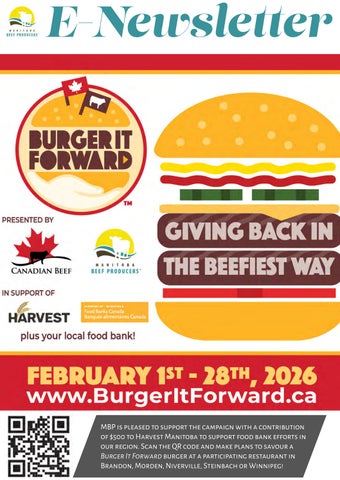
MBP is pleased to support the campaign with a contribution of $500 to Harvest Manitoba to support food bank efforts in our region. Scan the QR code and make plans to savour a Burger It Forward burger at a participating restaurant in Brandon, Morden, Niverville, Steinbach or Winnipeg!
NEWS AND HIGHLIGHTS
Federal expansion to AgriStability support to include pasture-related feed costs
Canada secures expanded market access for meat products following Ministerial Mission to Indonesia
Deadline to Enrol in AgriStability for 2026 Program Year is April 30
The Honourable Heath MacDonald, Minister of Agriculture and Agri-Food, announced that the AgriStability guidelines have been amended to add pasture-related feed costs as an allowable ... AgriStability is a tool to help producers manage risks and financial losses due to tariffs, poor yields, low commodity prices, or rising input costs. AgriStability provides support ...
Phishing scam impersonating Manitoba RCMP
Manitoba RCMP are warning the public about an elaborate online phishing scam involving con artists impersonating police officers …
Following the historic signing of the Comprehensive Economic Partnership Agreement (CEPA) by Prime Minister Carney and President Prabowo in September, the ...
Manitoba Growers Invited to Join Prairie Sustainability Project
The Prairie Precision Sustainability Network (PPSN) is seeking Manitoba producers to participate in a prairie-wide university research project focused on converting low-producing ...
National Survey of Farmer & Rancher Mental Health in Canada
The University of Guelph and the Canadian Centre for Agricultural Wellbeing have started their 3rd National Survey of Farmer and Rancher ...


NEWS AND HIGHLIGHTS
Livestock estimates, January 1, 2026
Canada’s cattle herd rose on January 1, the first year-over-year increase since 2018. Inventories rose in all categories of cattle and calves on January 1, 2026, on account of increased international imports paired with reductions in slaughter and international exports. Cattle producers held 11.1 million cattle and calves on their farms on January 1, 2026, up 2.5% from one year earlier. For more details, including provincial data click on the headline.
Manitoba Specific Information from the Statistics Canada January 1, 2026 Livestock Estimates
The following is the Manitoba herd size comparison on a year over year basis, i.e. January 1, 2025 to January 1, 2026.
• The number of cattle on all operations in Manitoba was 920,000, up 15,000 head
• The number of head on beef operations was 846,100, up 15,100 head
• The number of head on cow-calf operations was 653,300, up 15,700 head
• The number of head on feeder and stocker operations was 121,800, down 2,600 head
• The number of head on feeding operations was 71,000, up 2,000 head
• The number of head on dairy operations was 73,900, down 100 head


Manitoba Transportation and Infrastructure’s Hydrologic Forecast Centre reports the outflow from the Shellmouth Reservoir will increase
MBP Met With MASC Board of Directors To Discuss Variety of Topics
Representatives from Manitoba Beef Producers met February 26 with the Manitoba Agricultural Services Corporation (MASC) board of directors and key MASC staff to discuss matters affecting the local beef industry.
This included a discussion of the recently announced satellite-based forage insurance project for the 2026 crop year in Manitoba This technology will be used to estimate soil moisture and better predict forage production, with a focus on moisture deficiency. MBP has been advocating for initiatives like these which should help reduce program reporting requirements and help improve production estimates for forage producers MASC will offer participation in the pilot to approximately 50 forage insurance participants for the 2026 crop year at no additional cost. MASC will work with groups like MBP to select participants to ensure a representative sample across different Manitoba regions and production systems. MBP sees value in this pilot project, and continues to advocate for pasture and forage insurance programs that are most responsive to producers needs with the least possible administrative burden.
additions for some time and thanks the federal and provincial governments and MASC for making these changes

Also discussed with MASC was the recent announcement that the list of damaging species under the Wildlife Damage Compensation program has been updated to include more species. This change will see compensation for crop damage caused by blackbirds and raccoons, as well as for livestock injury or death caused by vultures, eagles, hawks, and ravens. MBP had been seeking these
Challenges related to large populations of elk and deer were discussed, such as damage to feed and to farm infrastructure like fences. There are also concerns about the possibility of disease spread from wildlife to livestock. MBP requested action on the resolution passed at its recent AGM seeking changes to the Wildlife Damage Compensation for Crop Damage program to increase the level of compensation for extended grazing forages so it better reflects the costs producers incur related to the loss of feeding resources. Support is being sought as well for financial assistance for fencing initiatives or other risk mitigation practices to help reduce the risk of wildlife eating stockpiled feed. MBP encouraged continued MASC engagement with the Department of Natural Resources and Indigenous Futures on wildlife-related matters and strategies to help manage situations like these. There was also a discussion of predationrelated matters, and the need for consistent application of predation claims adjusting processes, as well as for referrals of affected producers with an eligible claim to the targeted predator removal program.
There was a discussion about the workings of the Manitoba Livestock Association Loan Guarantee Program. As well, other lending programs that beef producers may use were also raised, including
MBP Met With MASC Board of Directors To Discuss
Variety of Topics
increases to the lending limits under the direct loan program and the stocker loan program which were made in 2025. Also raised by MBP were questions related to provincial residency requirements and how those affect the ability of a Manitoba producer to get loans on livestock that they may wish to feed in another province.
The need for a level playing field related to risk mitigation programs was raised. MBP restated its request for MASC and governments to consider cost sharing of Livestock Price Insurance program premiums. Cost-shared premiums similar to what crop producers receive under AgriInsurance would help level the playing field for beef producers when it comes to risk protection program affordability.
Similar programs for livestock producers are already cost-shared in the United States (such as the Livestock Risk Protection program or LRP), providing them with a competitive advantage over our producers. MBP requested improvements to the website interface for LPI to make the site more user friendly. MBP also indicated that producers are seeking greater transparency of price determination for the LPI program and asked for more information sharing about this.
MBP thanks the MASC board of directors and staff for the engaging discussions and the continued opportunities to collaborate on matters affecting Manitoba’s cattle sector.


Province Issues February Flood Outlook
Low-to-Moderate Risk of Spring Flooding Predicted Across Manitoba
(February 25, 2026 Province of Manitoba media release) Manitoba Transportation and Infrastructure’s Hydrologic Forecast Centre reports the risk of spring flooding is low to moderate for most Manitoba rivers heading into the spring runoff period.
Spring flood risk remains largely dependent on weather conditions from now through the melt period, including additional snowfall and spring rainfall, as well as the snowmelt’s timing and rate.
Most Manitoba lakes are expected to remain within desired operating ranges after spring runoff and the risk of flooding along Manitoba lakes is low.

A moderate risk of flooding is in effect for the Red, Pembina, Assiniboine, Souris and Qu’Appelle rivers, the Interlake region including the Icelandic and Fisher rivers, and portions of the Saskatchewan River in northern Manitoba. A low flood risk is in effect for Red and Assiniboine river tributaries including the Rat and Roseau rivers. Eastern Manitoba, including the Winnipeg River basin and Whiteshell lakes area, and most Manitoba lakes have low risk of spring flooding.
Current basin conditions indicate generally low to moderate spring runoff potential. Soil
moisture at freeze-up was near normal to below normal across most of Manitoba, winter precipitation has ranged from near normal to below normal in many regions and soil frost depths are generally shallower than normal, allowing greater infiltration of meltwater. Snow accumulations are generally within the normal range, except for parts of southern Manitoba where snow accumulation remains below typical values for this time of year.
Lake levels across the province are within operating ranges. Lake Winnipeg and Lake Manitoba are wellbelow normal for this time of year, and inflows into
most major lakes are expected to be below seasonal normals, reflecting generally drierthan-normal conditions across contributing river basins.
The Red River Floodway is not expected to be operated under normal or favourable weather conditions but may be operated under unfavourable conditions to reduce water levels within the city of Winnipeg. The Portage Diversion may be operated under unfavourable weather conditions or to mitigate ice-jamming on the lower Assiniboine River. The Shellmouth Reservoir is being operated in consultation with the Shellmouth Liaison Committee to reduce
Province Issues February Flood Outlook
Low-to-Moderate Risk of Spring Flooding Predicted Across Manitoba
downstream flood risk while maintaining water supply and recreation objectives.
Outflow from the Shellmouth Dam is expected to increase today to 1,000 cubic feet per second (cfs) from the current 768 cfs. A further increase to 1,300 cfs will happen tomorrow as part of normal winter operations. This increase is expected to cause up to a two-foot rise in water levels along the Assiniboine River from Shellmouth to Brandon. The rise will diminish as the river approaches Winnipeg.
Ice-cutting and breaking activities are underway along the Red River to reduce the risk of ice-jam flooding. There is also risk of flooding on other rivers that are historically affected by ice jams including the Saskatchewan, Carrot, Swan, Icelandic and Fisher rivers.
Ice conditions and spring weather will play a key role in determining breakup timing and localized flood potential.
Spring flood risk will continue to depend on weather conditions through the melt period. As temperatures warm and ice strength deteriorates, Manitobans are reminded to stay off waterways, rivers and retention ponds.
The Manitoba Emergency Management Organization continues to work with local authorities, First Nations and emergency management partners to prepare for potential spring flooding. This includes reviewing emergency plans, sharing information, and preparing resources for flood response, as well as co-ordination with Indigenous Services Canada and Manitoba Municipal and Northern Relations for First Nations and northern communities.
An updated flood outlook is expected to be released in late March.
The 2026 spring flood outlook report is available at:
https://gov.mb.ca/floodinfo/pdf/2026/february _2026_flood_outlook_report.pdf


In response to producer feedback and concern about proposed amendments to Part XV (Traceability) of the Health of Animals Regulations, the Canadian Cattle Association (CCA) has launched an online traceability feedback survey to ensure that producers have an opportunity to share their feedback.
This survey is based on the proposed regulations that were anticipated. The proposed regulations are not in place, and the publication date has been paused. Producer feedback collected through this survey will be used to inform CCA’s next steps. CCA will use feedback collected through the survey only in aggregate. No personal information will be shared.
Take the survey here: https://www.surveymonkey.com/r/NS9WSFD
Canadian Beef Industry Statement on AAFC Research Cuts
(February 3, 2026) The Canadian Cattle Association (CCA) and the Beef Cattle Research Council (BCRC) are concerned about Agriculture and Agri-Food Canada (AAFC) reductions affecting research farms, facilities, programs and research expertise at Nappan (Nova Scotia), Quebec City (Quebec) and Lacombe (Alberta). We recognize the fiscal pressures facing the federal government; however, the cuts will have far-reaching impacts for cattle producers, the beef industry, consumers and Canada’s efforts to grow the economy and diversify export markets.
In the past decade, Canada’s beef producers increased their own research contributions by over 600%, viewing research as an investment in future economic growth and competitiveness. Public-good research remains essential where market incentives are limited, or independent expertise is required for regulatory, trade and consumer confidence. AAFC’s national capacity is particularly important to maintain in the areas of food safety, carcass quality and grading, and forage breeding and management.
“Canada’s beef producers rely on a stable, high-performing public research network to deliver the tools, evidence and innovations that keep farms resilient, food safe and our sector competitive,” explained CCA President Tyler Fulton. “When research capacity is lost, it isn’t quickly rebuilt. Cattle producers and the public pay the price for years and even decades.”
Negative Consequences for Beef and Forage Research
Forage is the foundation of the beef industry. Canada cannot have a competitive beef industry or efficiently respond to industry priorities without abundant and productive forages. The capacity to continue building in these vital programs has been lost through the closure of
the Lacombe, Nappan and Quebec research stations.

Dr. Vern Baron conducting swath grazing research at AAFC Lacombe
Extensive work conducted at the Lacombe Research and Development Centre exploring extended grazing practices allowed producers to cut winter-feeding costs and survive through the BSE crisis. While a small number of beef producers had begun attempting this practice, clear guidance by Dr. Vern Baron at AAFC Lacombe allowed other producers to begin implementation when it was needed most. In recent years, Dr. Baron began collaborating with AAFC researchers in Quebec led by Dr. Annie Claessens and Dr. Annick Bertrand, to develop higher-yielding, winter hardy alfalfa varieties. At AAFC Nappan, Dr. Yousef Papadopoulos, John Duynisveld and Dr. Kathleen Glover have been focused on forage and grazing strategies for Atlantic Canada’s unique climate and acidic soils. Among multiple accomplishments, they have developed grazing management programs for Eastern and Atlantic Canada and bred improved trefoil, red clover and alfalfa (e.g., AAFC Trueman) varieties that have been adopted across the country. This research program has developed more productive and economical pasture mixes for Eastern Canada and low-cost methods to rejuvenate pasture stands that would also improve forage germination and establishment. Critically,
Canadian Beef Industry Statement on AAFC Research Cuts
collaborations between these AAFC sites and agricultural universities led to a highly productive network that benefits forage and beef producers across the entire nation. The effectiveness of this network and the benefits it provides to Canadian beef producers are compromised by the loss of these facilities.
Beef grading is fundamentally important to pricing beef carcasses. With the closure of AAFC Lacombe, Canada has lost its only robust meat science program and will not have the scientific expertise needed to address questions of grade equivalency in any of the foreign export markets the Canadian beef sector is hoping to diversify into. The team of beef grading researchers at Lacombe developed the instrument grading technology that is currently in use worldwide. Dr. Oscar Lopez-Campos at Lacombe has been responsible for upgrades to Canada’s beef grading system for several years, working to harmonize it with the U.S. system. He has examined methods to go beyond simple “yield grade” estimations and has developed ways to fabricate individual beef carcasses to optimize the value of the cuts in each carcass. His accomplishments also include developing a methodology to translate Canadian beef carcass quality grades into Japanese equivalents to bolster Canadian beef marketing efforts.
The Lacombe research station was also home to the food safety team led by Dr. Xianqin Yang. Food safety research solves problems before they reach Canadian or international consumers. This program developed and validated procedures that packing plants use to wash hide-on carcasses, carcass rinses and pasteurization methods and improved methods to clean conveyor belts, knives and other equipment. These advances have contributed to significant decreases in E. coli O157:H7 related food safety recalls in Canada. After a major E.
coli outbreak in 2012, Dr. Yang determined how to safely cook needle-tenderized beef so that Health Canada could label it appropriately. Food safety is a common “non-tariff trade barrier.”
We fully recognize the fiscal pressures facing the federal government and understand that spending reductions are necessary given the unprecedented situation Canada is facing. In anticipation, we engaged AAFC, requesting and trusting that industry priorities be considered. Elimination of critical expertise in forage breeding, carcass grading and food safety seems shortsighted and may have long-term impacts on ensuring the stability and longevity of Canada’s beef industry.
Where Do We Go from Here?
Research is an investment, not a discretionary expense. The BCRC believes the decision to close the Nappan, Quebec and Lacombe research stations may result in long-term, debilitating consequences for our industry including:
• The potential loss of unbiased, independent expertise in Canada in critical areas including forage breeding and management, beef quality, carcass grading and food safety.
• The potential loss of innovative and effective forage breeding and management solutions that can respond to adverse conditions including cold, drought, flooding and poor-quality agricultural soil.
• The potential loss of Canada’s ability to respond to food safety concerns and crises with science-based evidence and action plans.
Canadian Beef Industry Statement on AAFC Research Cuts
• The potential loss of Canada’s ability to modernize our beef carcass grading system in response to changing genetics, management practices, consumer preferences and international market demands.
When considering the loss of critical capacity in these research areas, BCRC Chair Dean Manning noted, “Efficiency should mean smarter coordination of a national network, not the erosion of irreplaceable expertise. While the intent may be efficiency, the reality is that Canada loses the capacity to generate the learnings and innovations that maintain and improve sustainable and safe food production.” He added, “I believe that Canada’s beef producers are ready to partner on solutions rather than the elimination of critical research capacity.”
The CCA has requested that if the closure of these facilities stands, critical capacity and programs be transferred as outlined below.
• Maintaining a national carcass quality and grading research program is critical. The CCA requests that Dr. Oscar LopezCampos’ program be transferred to another institution such as the University of Guelph, which has a federally inspected research abattoir
• We understand that Dr. Xianqin Yang’s position may be transferred to
Lethbridge Research and Development Centre. The CCA requests that this be confirmed to ensure adequate support is available to maintain the critical food safety research being conducted.
• The CCA requests that the Nappan and Quebec City forage breeding programs be maintained or transferred with researchers maintaining access to forage breeding plots and support.
• If AAFC chooses to cancel projects midway through their completion, the CCA requests that the investments industry has made be refunded.
The CCA and the BCRC remain committed to constructive engagement with Minister MacDonald and AAFC officials to ensure critical research capacity is preserved, transitions are well managed and producer-funded projects deliver the intended outcomes.
For further information, contact:
Tracy Herbert
Knowledge Mobilization and Communications Director
Beef Cattle Research Council
306-850-5026 | herbertt@beefresearch.ca
Tina Zakowsky Communications Manager Canadian Cattle Association
403-451-0931 | zakowskyt@cattle.ca

Contract Part-Time Project Manager
Livestock Inspection Services
Manitoba Beef Producers (MBP) is the exclusive voice of the beef industry in Manitoba. It represents roughly 6,000 beef producers across the province. Based in Winnipeg, MBP is a non-profit organization with four staff and a producer-elected board consisting of 14 district directors, each representing cattle producers in a specific region of Manitoba.
MBP’s mission is to represent all Manitoba beef producers through communication, advocacy, research, and education within the industry to governments, consumers and others; to improve prosperity; and to ensure a sustainable future. Funded by producers through the collection of a cattle check-off, MBP is committed to ensuring a sustainable future for the province’s beef industry for the benefit of our beef producer members and all Manitobans.
THE ROLE:
Manitoba Beef Producers’ membership has given direction to see an expanded livestock inspection service implemented in the province. The contract Project Manager will lead the coordination of this effort with direction provided by the multi-stakeholder Manitoba Livestock Inspection Services Working Group (MLISWG). The development and implementation of a mandatory identification inspection system for cattle in Manitoba will help facilitate livestock tracking and help mitigate potential financial losses to producers and other stakeholders related to theft and fraud.
KEY RESPONSIBILITIES AND ACTIVITIES:
• Lead in the development and coordination of the Strategic Plan for implementation.
• Responsible for the planning, implementation, and tracking of specific short-term and long-term goals for the project, which have a beginning, an end and specified deliverables.
• Working with the proponents, provide input into the development of modernized legislative, regulatory and policy frameworks to support expanded inspection services.
• Assist in the creation and provision of tools needed to support expanded inspection, such as information management systems like digital manifests, communications strategies to inform producers and other stakeholders about the implementation of expanded inspection (including its value to the beef industry), etc.
• Liaise with other stakeholders on matters such as the creation of a Manitoba-based RCMP Livestock Investigation Unit, the modernization of the provincial brand registry system, etc
• Coordinate meetings for the MLISWG to ensure the project remains on track.
QUALIFICATIONS FOR THE POSITION:
• Postsecondary education in agriculture, preferably animal science, or a suitable combination of education and experience;
• Strong understanding of the agriculture/agri-food sector, including beef production;
• Understanding of beef industry supply chain;
• Knowledge of legislative and regulatory processes, including the ability to review and analyze legislation and regulations is a definite asset;
• Experience in writing documents for government and industry an asset;
• Strong oral and written communication skills and attention to detail are essential;
• Skilled in writing and editing research or project reports, including financial reporting;
• High comfort level for public speaking and giving presentations;
• Ability to work on multiple projects simultaneously in a fast-paced environment;
• Experience with organizing and participating in trade shows, extension events, etc.;
• Experience in dealing with producers and the general public;
• Strong technical abilities, i.e. experience with Microsoft Office suite, virtual meeting platforms, etc.;
• Able to build solid relationships with teammates, project partners and other specialists by fostering teamwork, partnership and collaboration in virtual or face-to-face settings.
• A highly motivated self-starter able to work both in a self-directed manner, and as part of a small team.
• Valid driver’s license.
Note: Some occasional travel is required, mostly within Manitoba. Occasional evening work may be required.
COMPENSATION:
This position will be a contracted, part-time term position for 24 months. Compensation will be determined in the interview process.
REPORTING STRUCTURE:
The term position of Project Manager-Livestock Inspection reports to MBP’s Chief Executive Officer.

