PUBLISHED BY MANITOBA BEEF PRODUCERS
SEPTEMBER 2026
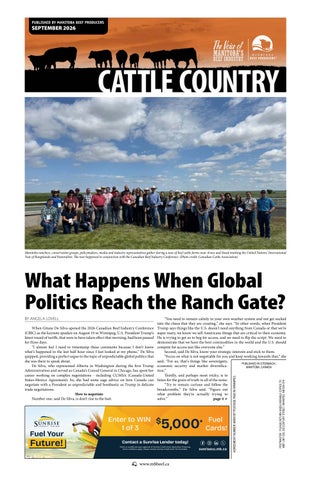
Manitoba ranchers, conservation groups, policymakers, media and industry representatives gather during a tour of beef cattle farms near Arnes and Stead marking the United Nations’ International Year of Rangelands and Pastoralists. The tour happened in conjunction with the Canadian Beef Industry Conference. (Photo credit: Canadian Cattle Association)
What Happens When Global Politics Reach the Ranch Gate?
Contact a Sunrise Lender today! *Entry is conditional upon approval of Sunrise Credit Union Agriculture Financing. Some conditions apply. Please contact Sunrise Credit Union for full details.
www.mbbeef.ca
POSTMASTER : PLEASE RETURN UNDELIVERABLE COPIES TO: MBP, UNIT 220, 530 CENTURY STREET, WINNIPEG, MB R3H 0Y4
When Gitane De Silva opened the 2026 Canadian Beef Industry Conference (CBIC) as the keynote speaker on August 19 in Winnipeg, U.S. President Trump’s latest round of tariffs, that were to have taken effect that morning, had been paused for three days. “I almost feel I need to timestamp these comments because I don’t know what’s happened in the last half hour since I last looked at my phone,” De Silva quipped, providing a perfect segue to the topic of unpredictable global politics that she was there to speak about. De Silva, who represented Alberta in Washington during the first Trump Administration and served as Canada’s Consul General in Chicago, has spent her career working on complex negotiations - including CUMSA (Canada-United States-Mexico Agreement). So, she had some sage advice on how Canada can negotiate with a President as unpredictable and bombastic as Trump in delicate trade negotiations. How to negotiate Number one, said De Silva, is don’t rise to the bait.
“You need to remain calmly in your own weather system and not get sucked into the chaos that they are creating,” she says. “In other words, when President Trump says things like the U.S. doesn’t need anything from Canada or that we’re super nasty, we know we sell Americans things that are critical to their economy. He is trying to get us to beg for access, and we need to flip the script. We need to demonstrate that we have the best commodities in the world and the U.S. should compete for access just like everyone else.” Second, said De Silva, know your strategic interests and stick to them. “Focus on what is not negotiable for you and keep working towards that,” she said. “For us, that’s things like sovereignty, PUBLISHED IN STEINBACH, economic security and market diversificaMANITOBA, CANADA tion.” Thirdly, and perhaps most tricky, is to listen for the grain of truth in all of the noise. “Try to remain curious and follow the breadcrumbs,” De Silva said. “Figure out what problem they’re actually trying to solve.” page 4 AGREEMENT NUMBER 40005187 POSTAGE PAID IN WINNIPEG.
BY ANGELA LOVELL
2
CATTLE COUNTRY September 2026
A Look at CBIC and the CCA Semi-Annual Meetings What a summer it turned out to be. The torrential rains in June were followed by a hot and humid July and a dry August, at least in some parts of Manitoba. As President of Manitoba Beef Producers (MBP), I was very involved with the Canadian Beef Industry Conference (CBIC) held in Winnipeg this August. Also, I am on the board of the Canadian Cattle Association (CCA). They held their semi-annual meetings at the same venue as CBIC. CCA has 5 policy committees that met. These three-hour meetings cover a wide range of topics of concern to all sectors of the cattle industry. They are made up of cattle producers from across the country who provide direction for advocacy efforts with federal and provincial governments. I will summarize one or two topics from each committee meeting. I sit on the Domestic Agriculture Committee along with MBP director Byron Falk. There we received an update on the Canadian Federation of Agriculture-commissioned a study to compare Canada’s tax environment to that of the United States. The CCA has supported this research. The results of this study will aid CCA in their advocacy efforts with the federal and provincial governments. Accounting firm MNP presented on farm succession rules within a family. There was considerable discussion on expanding the definition of family. For example, currently the Canadian Revenue Agency does not recognize nieces and nephews as family in relation to succession planning. MBP director Falk also sits on the Environment Committee. They discussed Environment and Climate Change Canada’s (ECCC) 2030 initiative. This is a federal commitment to protect and conserve 30 per cent of the land and water of Canada by 2030. Protected land can be private land and can still be used for grazing cattle. Preserving pasture for grazing is important to the cattle rancher however there are many different types of conservation agreements offered in Canada so the committee asked for clarity about the ECCC approach. Also, I reported on the impacts of large elk herds on farms and ranches in Manitoba. MBP director Matthew Atkinson is the chairperson of the Animal Health and Care Committee. Emergency preparedness and disease response were two topics discussed. They were timely discussions given the recent flooding in Manitoba this June and the current forest fires in British Columbia. Some
Our breeding program is focused on creating fertile cows that efficiently raise calves, are reliably repeatable, have excellent udders and feet and require minimal replacements (longevity); traits required to be profitable in the cow business.
ARVID NOTTVEIT President’s Column
committee members from the British Columbia Cattlemen’s Association were unable to attend because fires were threatening their cattle, fences and buildings. Disease response discussions covered providing timely and appropriate support for ranches that have had their herds quarantined due to a disease outbreak like TB. Falk also sits on the Foreign Trade Committee. Of course the Canada, United States and Mexico trade talks were discussed but the federal trade representative at the meeting also reported on other trade deals the federal government had signed or were pursuing. The trade deal with the Mercosur countries which include Argentina, Bolivia, Brazil, Paraguay and Uruguay is stalled largely because of matters related to beef. These countries wanted to increase their beef exports to Canada but the provincial beef organizations including MBP, led by the CCA organized opposition to the proposed deal. I am vice chairperson of the Food Policy Committee and Atkinson is also a member. The committee had an interesting presentation about GLP-1s. These drugs are prescribed for people who suffer from type 2 diabetes. They are also a very effective weight loss drug, so effective that doctors recommend individuals on this medication increase their beef consumption to maintain a healthy balanced diet. It will be interesting to see what effect this new drug has
on the demand for beef. Having the CBIC and CCA meetings at the same time attracted the attention of the media and government officials. Birtle, Manitoba rancher and CCA president, Tyler Fulton chaired a meeting that included the agriculture ministers and deputy ministers from Alberta and Saskatchewan, Manitoba’s deputy agriculture minister and his director of ministerial affairs, along with representatives from the corresponding provincial beef organizations. This informal lunch meeting was a great opportunity to connect with these ministers and officials and to share ideas on how to grow the cattle industry. The CCA also helps the cattle industry by encouraging research through the Beef Cattle Research Council (BCRC). The areas of animal health, forage and grassland productivity ,and feed efficiency and utilization are studied. Examples of research include development of a test to help treat pneumonia in feedlot cattle, intercropping legumes with corn to extend winter grazing, and studying the manure of feedlot cattle to improve feed efficiency. BCRC shares the results of this research through articles, podcasts, webinars, infographics, and social media reels. One reel dealing with calving had over two million views. All of this information and much more is available on the BCRC website. MBP district meetings are fast approaching. If you have any ideas that would benefit the beef industry I encourage you to contact your MBP district representative or the MBP office. Then come to a fall meeting and speak up or maybe become a district representative. I look forward to seeing you there.
Delegates from across the country were in Manitoba for the Canadian Beef Industry Conference and the Made in Manitoba tour organized by MBP. The visit included pitstops at Sawmill Creek Livestock near Stead and Lochwood Farms near Arnes to hear about ranching, resilience, succession planning and raising cattle in a landscape shaped by forests and wetlands. (Photo credit: David Hultin/MBP)
MH Frances 433 Tidy Feet & Udder...
THE DEFINITION OF FEMININE AND FUNCTIONAL.
Recognize and permanently conserve the wildlife habitats and biodiversity supported through your farming practices when you establish a Conservation Agreement with Manitoba Habitat Conservancy.
STEFAN BOUW
ediecreekangus.com
204-232-1620 DISTRICT 1
TYLER FEWINGS TREASURER
DISTRICT 5
STEVEN MANNS
Boissevain-Morton, Brenda-Waskada, Grassland, Cornwallis, Elton, Norfolk-Treherne, Deloraine-Winchester, and Two Borders North Norfolk, Oakland-Wawanesa, Glenboro-South Cypress, and Victoria
DISTRICT 2
MARK SCHRAM
Argyle, Cartwright-Roblin, KillarneyTurtle Mountain, Lorne, Louise, Pembina, and Prairie Lakes
DISTRICT 6
BRIAN ENGLISH
Pipestone, Riverdale, Sifton, Souris-Glenwood, Wallace-Woodworth, and Whitehead
DISTRICT 3
DISTRICT 7
Cartier, Dufferin, Grey, MacDonald, Portage la Prairie, Rhineland, Roland, Stanley, Thompson, Montcalm, Morris, and Ritchot
Ellice-Archie, Hamiota, Prairie-View, Riding Mountain West, Rossburn, Russell-Binscarth, and Yellowhead
DISTRICT 4
MATTHEW ATKINSON PAST PRESIDENT
ANDRE STEPPLER
BYRON FALK
TYLER FULTON
DISTRICT 8
Clanwilliam-Erickson, Glenella-Lansdowne, De Salaberry, Emerson-Franklin, Hanover, Harrison-Park, Minto-Odanah, Oakview, La Broquerie, Piney and Stuartburn, Montcalm, North Cypress-Langford, Rosedale, Morris, Ritchot, Springfield, Ste. Anne, Taché, and West Lake-Gladstone R.M. of Piney and Reynolds
Learn more at mbhabitat.ca or call 204.784.4350
DISTRICT 9
DISTRICT 13
DISTRICT 14
Alexander, Brokenhead, East St. Paul, Lac Du Bonnet, Rockwood, Rosser, St. Andrews, St. Clements, St. Francois Xavier, West St. Paul, Whitemouth, Woodlands, LGD of Pinawa, Reynolds, Springfield, Ste. Anne, and Taché
Dauphin, Ethelbert, Gilbert Plains, Grandview, Roblin and Mossey River
Minitonas-Bowsman, Mountain, and Swan Valley West
TREVOR SUND
MATTHEW GOUDIE SECRETARY
DISTRICT 10
ADAM DMYTERKO
Armstrong, Bifrost-Riverton, Fisher, and Gimli
DISTRICT 11
ARVID NOTTVEIT
Coldwell, Grahamdale, St. Laurent, and West Interlake
DISTRICT 12
MIKE BROWN
Alonsa, Lakeshore, McCreary, and Ste. Rose
DALE CAZAKOFF
MANITOBA BEEF PRODUCERS
SENIOR POLICY MANAGER
Ph: 1-800-772-0458
MANAGER, COMMUNICATIONS AND MARKETING & EDITOR, CATTLE COUNTRY
Unit 220, 530 Century Street Winnipeg, MB R3H 0Y4
PH - (204) 772-4542 FX - (204) 774-3264 info@mbbeef.ca www.mbbeef.ca
CHIEF EXECUTIVE OFFICER Carson Callum
Maureen Cousins
David Hultin
FINANCE
Debra Fedak
OFFICE ASSISTANT Jennifer Patryluk
RESEARCH AND EXTENSION SPECIALIST Melissa Atchison
Designed by onPoint
www.mbbeef.ca
CATTLE COUNTRY September 2026
3
Beef Industry Conference a Success, Trade and Inspection Services Updates and More Greetings friends and industry partners, What a week in Manitoba for the Canadian Beef Industry Conference (CBIC) in mid-August. It was wonderful to see many folks in the beef industry from across the country, as well from the United States and Mexico enjoy friendly Manitoba. We kicked off the week with a Manitoba Beef Producers-hosted tour of the Interlake region. Thank you so much to the families of Laura and Ryan Plett and of Scott and Janine Duguid, as well as Ducks Unlimited Canada (Oak Hammock Marsh) for being excellent tour stops during the day. As well, thank you to TD Agriculture for sponsoring the tour. Throughout the week, the conference provided multiple opportunities for delegates to connect with industry leaders, government officials, and researchers to learn and to share insights about the beef industry. Multiple industry meetings were hosted during the event, such as the Canadian Beef Check Off Annual General Meeting, Canadian Roundtable for Sustainable Beef AGM and the semi-annual meeting of the Canadian Cattle Association (CCA). These meetings covered many topics of importance to the industry, such as succession, business risk management tools, the certified-sustainable initiative, and dealing with weather-related impacts in the sector, among others. Trade was also a key issue that was discussed in multiple meetings and side discussions. When it comes to trade, it goes without saying that the top area of focus is Canada’s trading relation-
CARSON CALLUM
Chief Executive Officer's Column ship with the United States. Shortly after the conference, trade talks fell apart between Canada and our neighbours to the south. This has led to a trade war in which tariffs have been implemented on many goods from both countries. It is very unfortunate it has come to this, but I will say that the beef industries in Canada and the US are both aligned on the importance of free and open trade between our two countries. Both the Canadian and US beef industries rely on the great trading relationship we have fostered over many years, so we are urging government officials on both sides to get back to the negotiating table. As of August 25th, no direct tariffs have been placed on beef or beef products, but this isn’t to say that overall supply chain impacts won’t be felt to the cattle industry. During the week of CBIC, MBP got the opportunity to sit down with our neighbours from Saskatchewan and Alberta, which included their Ministers of Agriculture and cattle groups, to discuss areas of opportunity in the beef sector. This was a great way to discuss key priorities between our national partner, the CCA and the Prairie provinces. MBP also had important meetings of our Manitoba Livestock Inspection Working Group
during the conference, which was very beneficial to our efforts on advancing that file. We are engaging regularly with the provincial government on needed legislative and regulatory changes to support an expansion of inspection services. We also continue to advocate for provincial government support for a dedicated RCMP resource to help on matters related to livestock-related theft and fraud. I want to greatly thank all of the sponsors, delegates, and industry colleagues who attended and supported CBIC. Overall, it was big success. A special thanks to David Hultin, MBP’s Communications and Marketing Manager, for his great organization of our industry tour at the start of the week. Also, thanks to the rest of the team at MBP for their support throughout the week. Finally, thank you to MBP President Arvid Nottveit and to beef producer Kirstine Tapley for co-chairing the event. As we approach the fall, there is lots is on the go. We continue to focus on important areas in Manitoba with our lobby efforts, such as strategies to help address predation and elk damage, improving BRM tools, the Next Agricultural Policy Framework, and flood preparedness and response, among others. Our fall district meetings are also right around the corner, kicking off on October 20th. Director elections are being held in odd-numbered districts. I want to encourage folks to come to their closest meeting to engage with directors and staff. At these meetings MBP is seeking member feedback as we look to update our Strategic Plan. There are both headwinds and opportunities in the industry and that means as an organization we need to look at where we are focusing our efforts. As well, we will give an overview of our organization’s financial outlook and have a discussion about the MBP check off. Check out our website and this edition for final details on district meeting dates and locations. We look forward to seeing many of you there. As a final note, please keep an eye out on our social media channels, website, and Cattle Country for details on our 48th AGM in 2027. We are finalizing these details, but it will take place in Winnipeg in February 2027. All the best, Carson.
@ManitobaBeef Manitoba Beef Producers ManitobaBeef www.mbbeef.ca
4
CATTLE COUNTRY September 2026
Page 1
Politics Reach the Ranch Gate?
What does President Trump want? So, what is it that President Trump wants to achieve when it comes to CUSMA? It’s important to understand that CUSMA is a unique agreement in that it has mandatory review dates (the last one was July 1, 2026) and a sunset clause that says the agreement ends in 2036, unless any party gives six months’ notice before that to pull out. Why did President Trump push for these clauses in the agreement? Think of it as a real estate lease, De Silva said. “If you are negotiating some type of long-term lease agreement, you would want the opportunity to reassess if market conditions change, and you’d want an end date to see if you could go back on the open market and get a better deal,” she said. “But a trade deal is not a transaction. It’s a long-term relationship, so different principles apply.” CUSMA did not expire on July 1, and while Canada and Mexico have stated they want to renew or extend the agreement, the U.S. has said they don’t want to extend it, and wants amendments. “The problem is if all three countries can’t agree, we have to undergo this annual review every year until 2036,” De Silva said. “So, do we even want CUSMA to succeed as bumpy as our relationship is with our neighbour to the south? I would say yes, because at a minimum, we need time to rewire our trading relationships. The U.S. is still the world’s largest economy, and we send more than 70% of our exports there, and we can’t replace that market overnight. As we think about what we want in this review, we need to keep those long-term needs in mind.” Thinking a way ahead While it’s clear what some irritants to the U.S. are, such as our dairy supply management system, the boycott of U.S. alcohol, Canadian tariffs on autos and auto parts, and digital streaming rules, they do want a joint economic security response to China and access to Canada’s energy and critical minerals, uranium and potash. “We are going to have to make some hard decisions because there’s probably not going to be a perfect agreement,” De Silva said. “When you’re facing down a bully that is much bigger than you, and the U.S. economy is 12 times bigger than ours, we’re not going to win in a fight. This is a situation we need to think our way out of. We need to be patient, we need to be prepared, and we need to be strategic.” U.S. still our major trading partner We also need to understand that while efforts are being made by the federal and provincial governments to diversify into other export markets, bring down
interprovincial barriers to domestic trade, and de- do all this while keeping front of mind, the Canada velop the transport and energy infrastructure needed that we want, not only for today, but for our children to ensure Canadian exports can reach new markets, and for our grandchildren.” and address the plethora of regulatory hurdles, it’s What does this mean specifically, for agriculture? going to take a long time to achieve these goals, and in This is your moment, said De Silva: Don’t waste the meanwhile, the Canadian and U.S. economies are it! deeply integrated. “The federal government is giving the agriculture “Whether we like it or not, the United States is sector an opening. They’re taking agriculture more and will remain for the foreseeable future our most seriously today than they have in a long time,” she important relationship,” De Silva says. “We still have said. “If you see a problem, if you see a regulatory or billions of dollars of trade that flow across that border policy barrier, you need to name it, and come up with every day. More than 30 U.S. states still have Canada suggestions on how to fix it. And if you don’t know as their number one export market. Trade with the how to fix it, ask your elected officials, ask the govUnited States still accounts for more than 70% of our ernment, ask your industry associations to convene total exports and 25% of our GDP. We are still very a conversation where you can brainstorm ideas. You much captive to the U.S. market.” need to pay attention to what’s happening on these Opportunities for Canada trade deals, and you need to speak up. You need to The current geopolitical situation does, though, provide input.” present a huge opportunity for Canada. Canadian The CUSMA negotiations have huge implications energy is critical to the U.S. economy and that has for the agricultural industry and there are going to be been made clear by the impact of the war with Iran, some hard conversations ahead warned De Silva. which, through its closure of the Strait of Hormuz, “People are going to have to put their big boy or can now control 20% of the world’s oil, 30% of the big girl pants on and we are going to have to have some world’s gas and 40% of the world’s fertilizer supplies. hard conversations,” De Silva said. “No one wants That presents a huge opportunity for Canada. infrastructure in their backyard. No one wants a giant “This war has reminded us all how dependent transmission tower. No one wants a data centre. Yet we are on energy and how deeply vulnerable we are those things have to go somewhere. They’re critical to to supply disruptions, and also that energy is life. It the economy.” impacts everything. It impacts the price of diesel, Polarization does not build a country, does not gasoline, and all the inputs you need to produce the build a community, engagement does, De Silva said. best beef in the world,” De Silva said. “This does “We need to be honest with people about the present an opportunity for Canada if we are able to upside of what we’re proposing and also the downside seize this moment, because we are blessed with pretty and how we intend to deal with that,” she said. “This is much every resource there is. Having these resources not a problem for government to fix. This is a problem makes Canada way more relevant geopolitically. We for us to fix as a nation. I encourage you all to engage have things that the world needs. And exporting more with people to get comfortable with having those raw resources is the fastest way to boost our economy, hard conversations because we’re definitely living in if we can get those resources to tidewater. So now is interesting times, but I do believe that with challenge the moment to build and build things quickly.” comes opportunity, and it’s up to each and every one To seize the opportunity, though, means every- of us to take advantage of those opportunities.” one will need to work together. “Everyone’s going to have to work well together in the sandbox of federal government, provinces, territories, local SERVICES governments and look for those efficiencies Lois McRae in our regulatory system,” De Silva said. RR 1 B ox 5 7 “Industry needs to play its part; you need to Brandon, Manitoba R7A 5Y1 get out in communities and sell them on the h: 204-728-3058 c: 204-573-5192 economic benefits of a project that is not the f: 204-727-7744 role of government. We need to commit to keystonelivestockser vices5@gmail.com advancing reconciliation and engaging in LIVESTOCK INSURANCE meaningful consultations and partnership specializing in livestock insurance for over 48 years with Indigenous peoples. And we need to
Keystone Livestock
What Factors are at Play in U.S. Trade Policy and How Does it Affect Canadians at the Ranch Level? BY ANGELA LOVELL The disappearance of the U.S. middle class and working class Over the past 35 years in the U.S. there has been a major shift in wealth distribution. Whereas incomes for the working and middle class have barely increased, there has been substantial growth for the top 10% of incomes and exponential growth in the top 1% of incomes. “It means that the American dream for the average person is getting harder and harder to achieve,” said Gitane De Silva in her keynote address at the 2026 Canadian Beef Industry Conference (CBIC) on August 19 in Winnipeg. “They feel they are being left behind and they are looking to leaders to tell them that their future will be better and not worse. This is the feeling behind the Make America Great Again movement.” Trump loves tariffs It’s a statement De Silva is confident making following her long career in trade negotiations, including CUMSA, as Alberta’s representative in Wahington during the first Trump Administration, and as Canada’s Consul General in Chicago.
“He fundamentally believes that the global trading system has been unfair to the United States and he wants to reset the table,” De Silva said. “He sees tariffs as a means of asserting U.S. dominance and…that too many countries have taken advantage of the United States for too long.” Trump also sees tariffs as a way to bring investment and manufacturing back to the U.S. “We have seen him publicly pressure both companies and countries to move their manufacturing to the United States, and any trade deal that he has concluded with any other country requires that country to make major investments in the United States as part of the deal,” De Silva said. Trump needs money “He wants to make the tax cuts from his first administration permanent, and they will cost the U.S. Treasury $4.5 trillion U.S. dollars,” De Silva said. “That is a big hole in the budget that needs to be filled. And he sees tariffs as a way to do that. At the beginning of the year, he tried to tell Americans that…tariffs could replace U.S. income tax, trying to sell to Americans that tariffs are taxed on foreign countries, but we know that is not true. It is a tax that is paid by the U.S. importer and ultimately
www.mbbeef.ca
passed along to the U.S. consumer, but that doesn’t matter. Facts don’t matter in this situation because he is so deeply committed to tariffs.” Americans are beginning to push back against tariffs Twenty-five states now are suing the White House over their approach to tariffs, as well as two major U.S. trade unions, but it doesn’t mean an end to tariffs is in sight, said De Silva. “It gives me hope that the tide is about to turn, but we need to acknowledge that protectionism predates Trump,” she said. “Things like Buy America has been around for decades. So, I think you’ll continue to see more of that.” It’s a global shift Protectionism is not just happening in the United States. “People are turning inward, which is what happens when the world gets big and scary,” De Silva says. “This is not a suddenly Trump leaves office and there’s some switch that’s flicked and we go back to normal. There is no normal. There’s only moving forward. But I don’t think we’ll see the same blanket approach to tariffs because at some point economic reality will kick in.”
CATTLE COUNTRY September 2026
5
Where Does Beef Fit into the GLP-1 Story? BY ANGELA LOVELL It is estimated that about three million people across Canada are currently taking GLP-1 medications, and that number is set to grow significantly in the next five years. Why does that matter to Canadian beef producers? Because people taking this medication for weight loss will have lower appetite, and therefore lower food intake, it becomes even more important for them to be diligent about the food choices they make to ensure they maintain adequate nutrition and muscle. That means having a high level of protein in their diet, and beef is not only protein-rich, but also contains all the essential nutrients needed to maintain a healthy body, making it a natural fit in the diets of GLP-1 users. What is a GLP-1? GLP-1 (glucagon-like peptide-1) started out as a niche medication for people with diabetes, but has become a mainstream drug used by many Canadians for weight loss, and is now being explored for other conditions such as fatty liver, addictions, Irritable Bowel Syndrome (IBS) and brain health. But an increasing number of Canadians are taking GLP-1 medications (known by brand names such as Ozempic and Wegovy) for weight loss. GLP-1s are naturally occurring hormones that our bodies produce that regulate appetite, digestion and blood sugar. The pharmaceutical GLP-1s provide a dose that is high enough to reduce appetite, slow digestion and make people feel full for longer, and so is highly effective for weight loss. New versions of these medications are being developed, including a pill form, and new uses are being discovered for them, while generic versions are reducing costs, all factors that are expected to increase demand and usage. How do GLP-1s work? GLP-1s work by changing the way people eat, and affect the reward pathways that dictate appetite.
“When you’re on this drug, typically you will have a smaller appetite, you might want smaller portions. If you eat too much, you might feel nauseous,” said Canada Beef’s Director of Health and Nutrition, Karine Rekunyk, in her presentation about GLP-1 sat the Canadian Beef Industry Conference in Winnipeg on August 19. “But there is also a change in what you might be interested in eating. You might have less interest in high-fat, sweet, or really energy-dense foods, maybe less interest in alcohol, less cravings. Users can experience significantly reduced appetite, leading to meaningful weight loss.” But weight loss is only part of the story. With reduced appetite and food intake, there is a risk of reducing the four key nutrition priorities of a healthy body: protein, nutrient density, fiber and hydration. “Fiber is important when you’re taking a GLP-1, because it slows the motility of your gut, and you need to focus on fiber to offset some of those side effects like constipation and nausea,” Rekunyk said. “It has the same effect on your signals to drink and feel thirsty. So, you have to intentionally make sure you’re hydrating, otherwise you can become dehydrated.” Special role of protein But protein deserves special attention when taking GLP-1s because it has a critical role in maintaining muscle, which can be lost as people lose weight. “Good muscles are needed for strength, mobility, and balance, which is so important as we age. It reduces your frailty risk,” Rekunyk said. “It’s also related to your glucose metabolism. The more muscle you have, the better blood sugar control you have. And we think there is an association between long-term weight management as well. So, the goal for people on GLP-1s is not just to lose weight, but maintain as much muscle mass as you can while you’re on that transition.” The two ways to do that are to optimize protein intake and resistance weight training, both of which go hand-in-hand to convert the protein into muscle.
Beef has an important role It is clear that beef can have an important role to play in the diet of people using GLP-1 medications, because of its high protein density and nutritional value. As an example, said Rekunyk, a 100-calorie serving of beef has almost three times the amount of protein as the same serving of chickpeas. “When you’re on a calorie budget, how much protein density really matters,” she said. “You just can’t do it without a lot of meat in your diet.” Beef also contains the more than 40 essential nutrients that the body needs every day such as vitamin B12, potassium and iron. “It is such an obvious story for beef,” Rekunyk said. “Beef is one of the most nutrient dense foods we have to offer. It’s extremely high in key nutrients that are commonly deficient in the diet of Canadians, making it a particularly valuable protein out of all the animal proteins, and that really is our strategic advantage.”
Do the GLP-1 Protein Math
To help people on GLP-1 medication determine how much protein they need per day, Canada Beef has developed its GLP-1 Protein Math Calculator (available on its website at https://canadabeef.ca/protein-math/). It’s a simple two-step process that, based on a person’s weight, calculates the low and high-end daily protein intake required. Multiplying your weight (in kilograms) by 1.2 gives you your lower daily protein target, and multiplying your weight by 1.5 gives the upper daily protein target.
How Aware are GLP-1 Users About Their Dietary Needs? Canada Beef recently conducted an online research survey through Ipsos to get a better understanding how GLP-1 usage by Canadians affected their attitudes and behaviours about beef, as well as the challenges they are facing. Of 2,096 Canadians aged 18+ that were surveyed, 15% (or 315 people) were using GLP-1s with roughly equal numbers using it for diabetes and weight management. That study uncovered a few interesting facts. Of the 315 people using GLP-1s, around 85% understood that they needed to increase their protein intake, but that didn’t always translate into action. More than half of the sample group reported no change in their beef consumption after starting
the medication, although around 21% reported a decrease in consumption and 17% an increase. What was interesting was that many GLP-1 users find it hard to source advice on what they can eat, how much protein or calories they need, or help with recipes and meal planning. That has led Canada Beef to develop a GLP-1 communications plan that includes digital, social media resources, 30,500 booklets and pamphlets that have gone out to doctor’s offices and health clinics, webinars, videos and advertisements specifically talking about healthy eating while on weight loss medication, and demonstrating how beef is a protein dense, and nutritionally healthy choice. They have also targeted health and fitness
We offer financial incentives and technical support to help you with energy efficiency upgrades.
www.mbbeef.ca
audiences, including Gym TV, and have a dedicated page on the Canada Beef website with recipes for GLP-1 medication users. And they are developing educational materials, menu ideas and product labels for retailers. Canada Beef’s Director of Consumer Marketing, Michele McAdoo, presented some of these resources to attendees of the 2026 Canadian Beef Industry Conference in Winnipeg on August 19, and encouraged them to be advocates for this promotional campaign. “If you know someone on a GLP-1, please share our resources, let them know about thinkbeef.ca and our videos,” she said.
6
CATTLE COUNTRY September 2026
How to Optimize Value and Avoid the Discounts BY ANGELA LOVELL A panel discussion at this year’s Canadian Beef Industry Conference in Winnipeg in August brought together cattle buyers and sellers to try and shed some light on how marketing and buying decisions are made, and how producers can optimize their value and avoid discounts when making marketing decisions. How and when do you start making marketing decisions about your cattle? It depends on the class of cattle being marketed at the time, said panelist Karla Hicks of Bluestone Home Grown Angus Beef near Parkbeg, Saskatchewan. “Right now, I am obsessing over yearlings because we don’t have them contracted and we have lots of grass, and water is good, so I am not really worried, but I am constantly on my phone I looking to see if there have been any yearlings move,” she said. It comes down to resources When Hicks is looking at marketing, it comes down to how much grass and other resources they have available, which has all too often been the determining factor for selling animals in the past. “After 2019 the drought started to cripple us,” she said. “In 2020 we lost 50 lbs. off our weaning weight and in 2021 we lost another 100 lbs. and all of a sudden, my premium calves were suffering under the conditions and I just had commodity cattle. That was when we made the painful decision to not market them in the fall anymore and hold our entire calf crop over, and sell the big steers in May depending on how the grass was. There was a year when we had to sell most of our calves in May into other people’s grasser markets because our grass never started that year.” Do your research Although Hicks has good relationships with a number of buyers in the area, and that is important, it also pays to research the markets, shop around, talk to other producers, and not being married to one particular option. “You have to be watching everything,” she said. It’s important to think about how you can make life easier for yourself when it comes time to marketing your animals, and prospective buyers too. As an example, Hicks has started preconditioning calves. “It is the greatest thing we have done because when we are weaning calves I am not worried about snowstorms or anything else rolling in and putting extra stress on them,” she says. “The health of our cattle changed instantly and if that is good for me, I can only imagine how good it will be for my buyer if we start selling calves in the fall again.” Have you ever made a management decision to try and gain more value from your cattle? Hicks admits that yes, they have definitely done this on their farm, and had both good and bad results. After using horned Hereford bulls on their black Angus cows for 10 years they started to get feather necks on some of their calves, which were basically unsellable in their market. “When you see your drag of calves come towards you, and they pulling calves out, it’s a gut punch,” she said. At that point, they decided to make the switch to Charolais bulls and that’s proven to be a good marketing decision. “Switching to the Charolais bulls has flipped everything for us,” she said. What options do cattle producers have to sell their cattle today? Options for marketing cattle have definitely evolved over the past decade or two, and there are now more choices for producers in terms of where, how and when they sell their cattle. There are still a lot of traditional overnight stand sales, said Allan Munroe, President of the Livestock Markets Association of Canada and owner of Killarney Auction Mart, during the panel discussion. “Cattle are delivered the day before and stay in a dry pen overnight and then sell the next day as weight on as they walk in the ring.” A number of years ago the co-mingle presort sale became more popular, where cattle are weighed and sorted a day or two prior to the sale and put into simi-
lar type pens. “It is like running a sale before you have a sale, there is a lot of work for the two days before the sale, but then the sale goes really quickly, and that’s where you can run large numbers through in short order,” Munroe said. In the last 10 years there has been a growing trend towards show lists. “We will take cattle in and sort one owner packages the day before, weigh them with a pencil shrink as a presort, and with that method we have the names and health protocols that goes out the night before the sale,” Munroe says. “In our barn that has been successful and the ones that don’t make those packages we still sell them overnight stand in a dry pen and weighed as they walk in the ring.” Video and online sales are also becoming more popular, and the advantage is that all the information and conditions can be available for prospective buyers prior to the sale. “Those are the main auction methods and then you have direct sales and the assembly yard that you can drop them off at and negotiate,” Munroe added. What are the trends in cattle marketing? Producers are doing a better job all the time, says Munroe. “We are not seeing as much mixed-up cattle, we are seeing better bulls, more consistency, and more focus on vaccinations and doing a good job in general,” he said. “The presorts are a tremendous way of marketing cattle – you can manage your shrinks, you can get into bigger groups, there are a lot of advantages. We are seeing growth on the show list side, because it’s less anonymous, and people want to build their brand and say what vaccinations they have had and whatever program they fit into.”
“If we have to sort them a few times it breaks down that one package and then we don’t have the advantage of being able to track that large package of cattle quite as well,” he said. Genetics important Frame size and genetics have become increasingly important especially to feedlots. “When are they going to be harvested? How heavy can we make them?” Wright says. “If we are waiting for markets, like today, to go back up in the fed cattle prices, if we can keep them for an extra 30 days if they are not already priced, maybe we can wait our way out of these things, so the genetics have become really important.” Producers need to watch their calves body condition, Wright said. “Are they fleshy or are they green? Has the producer taken all the good out of them with the creep feeder? If they are fleshy and are not going to perform as well, we can’t pay the price for them,” he said. “Sometimes producers kill their calves with kindness, and keep in mind they are trying to sell pounds and [equate] the more pounds they have got the more money they are going to get.” Keep them clean Tag is something that buyers will avoid at all costs, so producers need to make sure their cattle are clean when they send them to the auction. Wright explained, “We had a situation where we got some bad steers in, and one of the guys shaved one of the steers and took all the hair off the belly and the back legs, and it weighed 80 lbs. That was 80 lbs. of manure that we were buying that we weren’t getting paid for.” Finally, anything that is non conform such as horns, stags or pregnant heifers are going to be discounted. “There is no reason for them to be there,” Wright said. “Horns is a management practice and we have certain customers who, if you send them a calf with horns it’s free because they don’t want them.” What role does the cattle futures market play in determining the price of cattle? Futures give an opportunity to manage price risk and the futures market also sets the mood for purchases, said Wright as part of the panel. “We have had three or four days of red ink and lots of volatility with the Mexican cattle coming up, tariffs, economies and everything else, and nobody wanted to buy any cattle yesterday unless they were giving them away,” Wright said. “We need to see three or four days of green ink on the board to get them enthusiastic about buying some cattle.” Is forward contracting a good idea? Forward contracting is all based off the futures market which is another reason buyers watch it closely, and if producers do the same it can provide them with more options to market their cattle and secure pricing they are comfortable with. “We are seeing more producers, backgrounders, feeders and cow/calf guys looking at getting away from their traditional marketing,” Wright says. Using cow/calf as an example, there are, he said, producers who have always sold their cattle at the same time in the fall and always will, but while they can still deliver the cattle at that time, there are opportunities throughout the year to price those cattle ahead of time for a deferred delivery. “You don’t know until you deliver them whether you are above the price or below the price, but you have got the comfort of a sound bid on those cattle, a legal document, and you can sleep at night because you have taken the opportunity to sell those cattle,” Wright said. Know your cost of production But what is vitally important, whether a producer is forward contracting or not, is knowing the cost of production, Wright emphasized. “You have to know your cost or production and have a price in mind,” he said. “When it comes to marketing your calves, you need to know what it cost you to raise that calf so you know if the current market is a good time to be selling, or if you need to extend the ownership. It helps you formulate a realistic asking price and assists with risk management decisions.”
When producers are ready to market their cattle, it is useful to know what might be going through prospective buyers’ heads, which, first and foremost, according to long-time cattle buyer, Rick Wright, is “It’s not what I can buy, it’s what I can sell.” What are cattle buyers looking for in the cattle they buy? When producers are ready to market their cattle, it is useful to know what might be going through prospective buyers’ heads, which, first and foremost, according to long-time cattle buyer, Rick Wright, is “It’s not what I can buy, it’s what I can sell.” After 45 years in the business, Wright knows what buyers look for and one of the big things he emphasized as part of the panel, is building relationships. “Feedlots track performance, so if you have a good set of calves and you have a relationship with us and we can move those cattle and the [buyer] likes them, the next year when I phone them and say your calves are coming up for sale, if they have had a good experience [with your previous calves], they are quite active, if they have had a bad experience they don’t want them,” he explained. Healthy and low-stress handling Health protocols are also important as are implants, so producers need to provide information about what exactly they have treated cattle with and when, and what implants have been used. Another thing that buyers look for is cattle that are handled using low stress methods whether that is at the farm, the auction mart of during transportation. “Cattle that are stressed that arrive at the feedlot that we provide, don’t react as well to the protocols, and so if we can go to operations that have reduced stress, with good training and drivers that have good training that helps us sell the cattle,” Wright said. Timely delivery and shrink Timely delivery is another factor that contributes to the health of the animals, and weaning information showing when calves were weaned and what they have been on for a ration is vital to help feedlots prepare for them. “Shrink is important to me and to you as well,” Wright said. “When we have the high prices that we have right now, shrink management becomes a priority on both sides. We can’t pay $5 or $6 or $7/lb. for cattle that have no shrink on them.” Buyers also look for uniformity in the weight breaks so cattle can be placed as a package in one pen.
www.mbbeef.ca
CATTLE COUNTRY September 2026
7
Sowing the Seeds of Forage Success MBFI-DUC Partnership Provides Farmers with Advice and Financial Support BY MARY-JANE ORR, MBFI GENERAL MANAGER When Kevin Bridgeman decided to renew 70 acres of forages on the family farm near Binscarth, he wanted a recipe for success. After some research, he found a program that delivered both results and incentives. “Sowing grass is a bit of an adventure. It’s an expensive, risky thing sometimes,” says Bridgeman, who manages 250 cattle and 150 horses with his wife, son and daughter-in-law on 1,400 acres. “But the help and support through this program really makes a big difference.” Launched in the 2023 crop year, Amplifying success in grassland restoration and enhancement - connecting
extension, agronomy, and incentive has consistently provided producers with the agronomic advice to successfully establish new forage stands. Delivered in partnership by Manitoba Beef & Forage Initiatives (MBFI) and Ducks Unlimited Canada (DUC), the project has supported restoration of perennial forages on previously cultivated or marginal areas, and enhancement of tame stands through sod-seeding legumes. To date, the program has supported 11,206 acres of perennial forages in southwest Manitoba. “Every farm is different, so every planting is different,” explains Charlotte Crawley, a DUC forage program specialist. “We work with farmers to customize seed blends, tailor fertility recommendations and help with ongoing management recommendations to ensure forage productivity and farm profitability for the life of the forage stand and beyond.” The program was made possible with funding from Manitoba Habitat Conservancy (MHC) through the Conservation Trust. Established by the Province of Manitoba, the Conservation and Grow Trusts are an innovative way to fund nature-based approaches to climate change mitigation and habitat conservation. The Trust has provided $1.8 million over three grants to the MBFI-DUC forage partnership since 2023, driving the adoption of best management practices that will help ensure long-term success. Participating farmers receive relevant extension materials including tip sheets, video, podcasts and
President: Norbert deRocquigny 204-745-7930 Secretary: Sandra Brigden 403-638-7741 sandra.mbsimmental@gmail.com
Oct. 30th Manitoba Ag Ex Simmental Show Brandon, Mb Oct. 31st 1st Annual Rich Mc Family Event Sale Pilot Mound, Mb Nov. 7th Cherry Creek Farms Online Bull & Female Sale FarmGateTimedAuctions.ca Nov. 16th Rainbow River Simmentals Online Sale FarmGateTimedAuctions.ca Nov. 19th Pembina Triangle Simmental Assoc. 46th Annual Sale Cypress River, Mb Dec. 1st Keystone Konnection 48th Annual Sale Brandon, Mb Dec. 2nd Maple Lake Stock Farms Fall Bred Heifer Sale Hartney, Mb Dec. 7th Northern Light Bred Heifer & 2 Year Old Bull Sale Rossburn, Mb Dec. 8th Cream of the Crop Simmental Sale FarmGateTimedAuctions.ca Dec. 9th Premium Picks Simmental Sale Kenton, Mb Dec. 11th OPT Bred For Success 2nd Annual Female Event Darlingford, Mb Dec. 13th Bonchuk Farms Female Production Sale Solsgirth, Mb Dec. 14th JP Cattle/Rocky Meadow Fall Bull & Commercial Heifer Sale McAuley, Mb Dec. 22nd Mar Mac Farms Simmental & Red Angus Dispersal Brandon, Mb Dec. 31st Manitoba Simmental Association Scholarship Deadline - Apply Today! 2026 A.O Henuset Ambassador T WIN MEADOW LIVESTOCK Treherne, MB
2026 Scholarship Secipients KARA DE ROCQUIGNY & IVY PERKIN
www.mbsimmental.com view our facebook page or website for up to date info!
Forward Flow StartS Here
MSA_CC Sept 2026.indd 1
2026-08-19 12:53 PM
Every Great System Starts with a Great Plan
Hydraulic Squeeze Chute with Head Holder
S-Alley with Manual PA Squeeze Chute
A better cattle handling system starts with better planning. Hi-Hog works with producers to design Custom Cattle Handling Systems using Hi-Hog’s proven line of standard equipment. Built around our Common Connector System, each layout is designed to fit your operation while giving you the flexibility to expand, modify, or add equipment as your needs change. It’s a smarter investment that grows with your ranch. Ready to start planning your system? Contact Hi-Hog at salesinfo@hi-hog. com
www.hi-hog.com
1-800-661-7002 www.mbbeef.ca
opportunities to attend events at the MBFI demonstration farm showcasing forage establishment and grazing technologies. Extension support also includes one-onone agronomic consultations through the term of the program agreement to maximize stand productivity. “I heard about the program on the radio and was going to seed grass anyway,” recalls Bridgeman, who was one of the original participants. “That motivated me to phone DUC. I watched their online video and talked with Charlotte, who encouraged me to seed heavier than I would have in the past,” at 12.5 pounds per acre with a Bourgault air seeder. Bridgeman says the year before planting, livestock manure had been spread on the field so a light cultivation was done to reduce hard-packed areas. He sprayed Roundup prior to seeding and fertilizer was also spread with a coulter at a rate of 10 lbs of potash, 70 lbs of urea and 20 lbs of phosphate. For strong first-year stands with longevity, the following is recommended: 1. Seed early at same timing as cereal crops 2. Invest in quality seed 3. Apply phosphate at 30 lbs per acre 4. Say ‘no’ to companion crops 5. Seed heavy at a minimum of 12 lbs per acre 6. Account for seed coating when setting rates 7. Seed shallow, no deeper than ¾” 8. Ensure good seed to soil contact using an air seeder or seed drill if possible 9. Diversity pays, so seed multiple species to ensure establishment across field variability 10. Limit competition with weed control before seeding and cutting early in year one 11. Remove the crop as silage to prevent swaths from hindering seedling growth Weather always plays a big part in seeding perennial forage fields and Bridgeman says he got the right rain at the right time, resulting in an excellent establishment. “The first year, we took a cut for round bale silage,” he says. “The next year, we got three cuts off that field! In my end of the country, that’s a rare thing. Last year, I got four bales per acre and my bales weigh 1,400 pounds. And, we got a second cut off it.” Beyond the agronomic success, the forage program pays farmers direct incentives. In fact, nearly 60 per cent of the program funding from Conservation Trust has flowed directly to landowners. This year, participants are receiving $125 per acre to establish forages on cultivated land. While the incentive program is targeted at key habitat areas for nesting waterfowl, the agronomic and extension services are available to support all producers interested in establishing or enhancing forage stands. “Linking ag extension with rebates for establishing forages is unique to the MBFI-DUC partnership funded by the Conservation Trust,” says Crawley, herself a cattle farmer in the Rapid City area. “We realized that funding dollars from the Trust could be stretched with matching grants from other sources. Ultimately, farmers benefit because the program links extension and incentive-based programming at the farm gate.” With long track records of field testing forage establishment and management practices, MBFI and DUC were the perfect match to share our learned experiences with producers. MBFI has multi-year demonstrations in sod-seeding legumes in tame pastures, establishment of diverse blends in marginal areas and a living library of forage variety plots. DUC has helped farmers in Manitoba, Saskatchewan and Alberta establish over 150,000 acres of forage in the past five years, converting cultivated fields to sustainable grasslands and thereby increasing operational resilience and biodiversity. “I would absolutely recommend the forage program to others,” says Bridgeman. His establishment was recognized as one of the top five among participants in 2023 based upon plant density, height, diversity and lack of weeds. He also established another 50 acres under the program in 2024 and plans to keep reapplying for support as he renews other areas across his farm. To learn more about the program, visit ag.ducks. ca/program/grow-more-forage/.
8
CATTLE COUNTRY September 2026
The Bottom Line: Factors Behind the Aggressive Cattle Market No matter where I go or to whom I talk, the question I always get asked is, “How long is this aggressive cattle market going to last?” To answer that question, we must look at what caused the surge in the cattle prices. The main reason is drought. The difference between this drought cycle and the one 10 years ago is the length and the amount of the country that drought conditions have affected. The drought area went from regional pockets to the majority of the cow-calf areas and has lasted at least two years longer than predicted. Even now there are large areas that are still under the threat of drought. Drought conditions on pasture, combined with short hay crops, forced producers to sell off, resulting in the smallest beef cow herds in decades. The supply and demand fundamentals kicked in, with strong demand for beef and an expanding, more efficient feeding industry wanting more cattle to feed. Even in some of the areas with a little more moisture, the pastures have not fully recovered from the drought, resulting in lower stocking rates. Heifer placements in the feedlots exceeded 36% of the cattle on feed, indicating that producers were not retaining and breeding replacement stock. Record prices for cattle have been broken monthly since the fall of 2024. Many producers took advantage of the great market and sold most of their calves.
RICK WRIGHT The Bottom Line
To date, there has been very little heifer retention. Even if producers started now with the 2025 calf crop and retained more heifers, it would be the end of the decade before we would see any substantial increase in the beef cow herd. During that rebuilding phase, the number of feeder cattle available would be short due to the reduction of heifers going to the feedlots. Based on the projected supply of feeder cattle, current prices are very achievable for the next three to five years. The other side of the equation is “demand”.
Despite the high prices in the store, packers are currently operating at a loss per head harvested. There have been reports of plants losing between $200 and $300 per head. This has resulted in some plants reducing harvest numbers to the minimum hours per week in order to retain staff and meet the demands of their customers. Up until now, packers have offset the reduction in the harvest numbers with the heavier carcass weights at the plant. Simply put, the beef production numbers have not fallen as much as the cow herd. Reasonable feed costs, combined with feedlots slowing down the gain and adding days on feed, have made larger carcass weights and better grading cattle. As the number of cattle placed on feed continues to drop each month, the amount of meat available will also decline, leading to potentially higher prices in the stores. Although the larger packers are currently losing money on the beef harvest, they enjoyed some very profitable days in the past two years, allowing them to bank some nice profits in the beef business. One of the larger companies just reported one of the best financial years in the protein industry last year, with huge profits from the pork and poultry sectors. That trend continued into the first quarter of 2025. I beg to differ with Donald Trump’s claims that the USA doesn’t need Canada. Processors in the northern states may need fed cattle from Canada in the near future just to keep their plants operating. Does the feeder cattle market have the opportunity for even higher prices? That is a tough question. There has to be a top sometime, and we may be near that peak. On the American side of border current sales of calves for fall delivery are selling for $100 to $200 per head cheaper than the same quality and weight of calves being sold on the Canadian marketing platforms for fall delivery. This price discount includes delivery to Canadian locations. This price differential has terminal feedlots from Alberta and Saskatchewan sourcing feeders from Washington, Montana, North and South Dakota. Ontario feedlots will source from Missouri, Virginia, Kentucky and North Carolina. It looks as though Canada will be a net importer of feeder cattle again in 2025, a trend that started about five or six years ago. If that price differential continues into the fall run, it may contribute to a price cap. Combine the Canadian imports and the lack of feeder cattle imports from Mexico due to the New World Screwworm, and the Americans will be short of cattle. Once heifer retention starts for real, the supply of feeder cattle will be even smaller. This projected supply supports my thought that barring a Black Swan or an even bigger drought in the corn growing regions, feeder cattle prices should not show any significant decline in the next few years. It certainly looks like the cow-calf producer is in the driver’s seat from some time. I mentioned in a previous Bottom Line that many of the working class can no longer afford beef on a regular basis, and that some beef cuts have become a luxury food to be eaten on special occasions, somewhat like lobster. Somehow, some of my readers (only a few) interpreted those comments to mean that I thought they should take less for their calves. Nothing can be further from the truth. I have spent the past 45 years defending and supporting the cattle industry, especially the cow-calf sector, and I will continue to do that until I no longer make a difference. The cattle producers deserve every penny they can get and are finally getting paid for their hard work and investment. The current prices are driven by demand, and if demand decreases, so does the price. Enjoy these prices, but don’t take them for granted. There will be adjustments in the future. Will we go back to the prices of 2015 and 2016? Probably not, but when the cattle numbers get back to 2020 inventory, and with the improvement in genetics and feeding efficiencies, today’s prices may not be there! The good news is that the fundamentals support strong feeder cattle prices for the next four to five years. Until next time, Rick
Does the feeder cattle market have the opportunity for even higher prices? That is a tough question. Despite record high retail and wholesale beef prices, beef has been able to maintain its market share. With a 22% decline in the cull cow harvest, ground beef has seen a bigger price percentage increase than the muscle cuts. Some shoppers are choosing lesser quality cuts to meet budget restraints. Both export and domestic demand is strong.
www.mbbeef.ca
CATTLE COUNTRY September 2026
9
StockTalk Q&A Feature Brought to you by Manitoba Agriculture Kristen BouchardTeasdale Livestock Specialist-Beef Manitoba Agriculture
Kristen.BouchardTeasdale@gov.mb.ca Every Bale Has A Story - Feed Testing Tells It You’ve spent the summer watching the weather forecast, hoping for that perfect stretch of sunshine to put up some good quality feed. Sometimes everything lines up just right, and you head to bed feeling pretty good about the bales sitting in the field. Other times, a surprise rainstorm, a breakdown at the worst possible moment, or some other curveball gets in the way. That’s farming—there are plenty of factors beyond our control and this summer has been no exception. After the bales are hauled home and silage is a wrap (literally), it’s time for the next step: planning a feeding program for the herd. The good news is that this part is much more within our control. And it all starts with feed testing. Taking samples of the feeds you have on hand and sending them away for analysis is one of the most valuable management tools available. While it’s tempting to estimate feed quality based on appearance, experience, or harvest conditions, those estimates are still just educated guesses. Feed test results often reveal surprises—both good and bad. Hay that looks average may test exceptionally well, while that beautiful green bale may not be quite as nutritious as expected. At the end of the day, a ration is only as accurate as the numbers used to build it. Feed testing takes the guesswork out of the equation, helping ensure your cattle receive the nutrition they need while allowing you to make the most of the feed you’ve worked so hard to harvest. Sample Collection A good feed test starts with a good sample. Before you begin sampling, it’s worth taking a little time to organize your feed inventory into similar groups, or “lots.” For example, bales can be organized according to field and cutting. Each lot should be sampled separately, as feed quality can vary considerably between them. To get started, you’ll need a few basic supplies: a forage probe, a clean pail for mixing samples, freezer bags, and a permanent marker for labeling. If you don’t own a forage probe, don’t worry—one can usually be borrowed from your local Manitoba Agriculture Service Centre or Watershed District office. Just be sure to call ahead before making the trip to confirm one is available. Sampling Dry, Baled Forages Following a few simple guidelines will help ensure your feed test results accurately represent what your cattle will be eating: • Use a forage probe to collect samples. Handgrabbing flakes of hay may seem easier, but it rarely provides a representative sample.
• Obtain cores from 20 bales for each sample you wish to submit. • Sample bales to a depth of 12 to 15 inches. • For round bales, insert the probe into the curved side of the bale. • For square bales, sample from the end of the bale. • Place all cores (from the grouping you are sampling) into a clean pail and mix them thoroughly. • Once mixed, collect a subsample and place it in a large freezer bag. Remove as much air as possible before sealing. • Clearly label the bag with your name, address, forage description, cutting, and the date it was harvested. • Store samples in a cool, dry place until they are shipped. Laboratories Several laboratories across Canada offer feed analysis services. For a Manitoba based option, producers can access: Central Testing Laboratory Ltd. Unit 9 – 851 Lagimodiere Blvd., Winnipeg, MB R2J 3K4 Phone: 204-237-9128 | Fax: 855-754-1046 Website: https://www.ctl.mb.ca/popular-testing-packages/ For feed analysis and mycotoxin testing we must send our samples a bit farther afield: Prairie Diagnostic Services Inc. 52 Campus Drive, Saskatoon, SK S7N 5B4 Phone: 306-966-7316 Website: https://www.pdsinc.ca/services/feed-and-forage-testing For a complete list of feed testing laboratories across Canada, visit: https://www.beefresearch.ca/ producers/canadian-feed-testing-labs/ What Type of Analysis Should I Choose? Once you’ve decided which laboratory you’d like to work with, the next step is selecting a forage analysis package. One of the first things you’ll notice is that labs typically offer two methods of analysis: Near Infrared Reflectance Spectroscopy (NIRS) and Wet Chemistry. NIRS uses different wavelengths of light to estimate the type and amount of nutrients present in a feed sample. The calibration equations used in NIRS are developed using wet chemistry results, which are considered the gold standard for forage analysis. NIRS is generally faster and less expensive, while wet chemistry may provide more accurate results for certain nutrients, particularly minerals. If you choose NIRS, make sure the laboratory is using calibration equations that are appropriate for the type of feed being analyzed.
For example, a calibration developed for mixed-grass hay may not be suitable for trefoil straw. Using the correct equation is important for obtaining reliable results. So, what should you include in your feed test package? For most beef cattle producers, the following measurements provide the key information needed to evaluate forage quality and balance rations: • Dry Matter (DM) • Crude Protein (CP) • Total Digestible Nutrients (TDN) or another measure of energy • Fibre: Acid Detergent Fibre (ADF) and Neutral Detergent Fibre (NDF) NDF is sometimes omitted from basic forage packages, but it is worth including because it helps predict how much forage an animal is likely to consume. • Calcium (Ca) • Phosphorus (P) • Magnesium (Mg) • Potassium (K) • Sodium (Na) Optional Tests Worth Considering • Trace Minerals Many forage testing packages offer trace mineral analysis as an add-on. Knowing the levels of minerals such as copper, zinc, manganese, molybdenum, and sulfur can be very valuable when troubleshooting nutrition issues or formulating mineral programs. In Manitoba, elevated levels of molybdenum and sulfur are not uncommon in feed and water sources. These minerals can interfere with copper absorption and utilization, resulting in a copper deficiency even when dietary copper levels appear adequate. Left unaddressed, copper deficiency can reduce animal health, reproductive performance, growth, and overall productivity, creating significant hidden costs for an operation. • Nitrates Nitrate testing is recommended when feeds have been exposed to stress conditions such as drought, frost, hail, or other factors that may lead to nitrate accumulation. Certain forage species are more prone to elevated nitrate levels than others. • Mycotoxins If hay, silage, grain, or greenfeed was harvested under damp conditions or shows signs of mold growth, testing for mycotoxins is recommended. Mycotoxins can negatively impact cattle health and performance, even when mold is not immediately visible. Need Help Choosing a Feed Test Package? If you’re unsure which analysis package best fits your needs, don’t hesitate to reach out to your local Livestock and Forage Extension Specialist with Manitoba Agriculture. They can help you select the most appropriate tests and interpret the results for your operation. Contact information for Manitoba Agriculture’s Livestock and Forage Extension Specialists can be found below. The Beef Cattle Research Council (BCRC) has an excellent feed testing resource that provides sampling instructions for a wide range of feed types, including wrapped silage, grains, pellets, by-products, and alternative feeds. If you’d like more information on feed sampling and feed quality analysis, scan the QR code.
Share Your Voice In the next issue of Cattle Country, a Manitoba Agriculture forage or livestock specialist will answer a selected question. Send your questions to Elizabeth.Nernberg@gov.mb.ca. StockTalk for Cattle Country is brought to you by Manitoba Agriculture. We encourage you to email your questions to our department’s forage and livestock team. We are here to help make your cattle operation successful. Contact us today. Kristen Bouchard-Teasdale Beausejour Kristen.BouchardTeasdale@gov.mb.ca 431-337-1688
www.mbbeef.ca
Cindy Jack
Portage
Juanita Kopp
Beausejour Juanita.Kopp@gov.mb.ca
Cindy.Jack@gov.mb.ca
204-825-4302
Elizabeth Nernberg
Roblin
204-247-0087
Elizabeth.Nernberg@gov.mb.ca
204-768-0534
10 CATTLE COUNTRY September 2026
Computer Modeling by UM Researchers Shows that Cattle Production Benefits Biodiversity WRITTEN BY NOLAN DYCK, DEPARTMENT OF ANIMAL SCIENCE, UNIVERSITY OF MANITOBA. In the previous Cattle Country publication (August 2026) students from the University of Manitoba discussed applications for the use of precision agriculture in cattle production. In this article, Nolan Dyck, a master’s student in the Department of Animal Science under the supervision of Drs. Marcos Cordeiro and Gabriel Ribeiro (University of Saskatchewan), takes a closer look at how cattle production and prairie grassland biodiversity are connected. When the phrase “endangered ecosystem” is mentioned, the first ecosystems that come to mind are often, if not always, the Amazon rainforests of South America, or the Great Barrier Reef of the coast of Queensland, Australia. This is an understandable response, as these ecosystems contain thousands of unique, vibrant, and memorable species, and their importance has been an important subject of discussion and conservation for decades. It may come to some surprise then to learn that the temperate grasslands of North America are also an endangered ecosystem. Temperate grasslands include the tall, mixed, and shortgrass prairies that once spanned
the interior plains of North America, from Mexico to Canada. However, many of those areas have been lost to annual cropping. The World Wildlife Fund’s 2025 Plowprint Report, which reports annually on the conservation of the Great Plains of North America, states that nearly 2 million acres of grasslands were converted for agriculture in 2024 alone. In Canada, the push for more annual crop land and land development has led to more than 70% of temperate grasslands being destroyed and fragmented, with more being threatened every year. The role of temperate grasslands Temperate grasslands play many vital roles in the environment, such as producing food and sequestering carbon in their dense, deep root systems that also hold the soil in place. Grasslands offer a critical diverse habitat for many species that are economically important as they manage pests and invasive species, as well as help pollinate crops. Grasslands are also a critical resource for the beef industry for grazing and winter feed. With over 90% of grasslands being owned privately, the role of grassland stewardship and conservation is trusted
www.mbbeef.ca
to Canadian beef producers as landowners. Therefore, producers play an essential role in preserving this important ecosystem for future generations. While the importance of maintaining and protecting temperate grasslands in Canada is clear, large-scale research focused on understanding the positive and negative impacts of beef production on grasslands including the associated plant and animal diversity is limited. To address this gap in knowledge, Nolan Dyck is leading a research project that aimed to characterize the impacts of land use on grassland biodiversity in southern Saskatchewan. A computer model maps distributions of grassland plants The project, funded by the Saskatchewan Agriculture Development Fund, used a computer model to map the distribution of over 200 grassland vascular plants in Saskatchewan. This map was then related back to land cover associated with both crop and beef production. Researchers obtained data regarding the location of these various species in the province and, using a computer model, determined where else the species was likely to be found based on weather variables (annual precipitation, temperature, and soil properties) and landcover (Figure 1) data. They then created a prediction map that highlighted which areas are the most likely to have each plant species. The individual prediction maps for each of the 200+ species were then combined into an overall measurement of grassland species’ richness (Figure 2). The resulting map was then compared to the estimated land use of beef production in Saskatchewan, including land for grazing (Figure 3), hay and annual crop production. Traditionally, research of this scale would require an enormous effort to manually search and document all the grassland areas in the province. However, by leveraging digital datasets and mathematical models, the team at the University of Manitoba was able to map biodiversity across the agricultural region of Saskatchewan using computers. What the computer model shows us The results suggested that areas with more pasture and forage have higher plant diversity, while areas with higher annual cropland have lower plant diversity, although there is no direct relationship between biodiversity richness and grassland demand of the beef industry. These results suggest that cattle presence does not relate to biodiverse areas directly but is related indirectly through their utilization of productive pastureland and native grassland through grazing. In other words, the need for grasslands as a source of feed for cattle ensures that grasslands remain intact and biodiverse. The take home message Overall, these results suggest that the beef industry positively contributes to the conservation of biodiversity in grassland habitats in Saskatchewan. Given the similarities between grassland areas in Saskatchewan and Manitoba, it could be expected that these beneficial effects are also true in our province, although this would need to be validated through similar investigations here. This type of research is important to producers because it can help better illustrate the value of grasslands and the role of the beef industry in maintaining them. The new knowledge is also important for consumers and policy makers as it may help to improve consumer perspectives regarding the beef industry and guide policymakers in protecting and supporting beef production. What are the next steps in this project/research? This research project serves as a first step in measuring the effects of beef production on grassland biodiversity. Future work may focus on expanding this research into Manitoba and other provinces. Additionally, this research may serve as a guide for future survey efforts documenting grassland species and beef grazing systems in areas of Saskatchewan that have previously been ignored. The next step would be to investigate how different management practices affect productivity and biodiversity which would cast some light into practices that promote profitability while ensuring biodiversity maintenance in Manitoba.
CATTLE COUNTRY September 2026 11
Health Concerns During Late Fall Grazing BY DR. TANYA ANDERSON Past drought conditions and fewer pasture acres have forced producers to implement more intensive pasture management strategies. Soil testing with targeted application of fertilizer and utilization of special pasture mixes, polycrops and annuals have improved pasture productivity to simultaneously extend the grazing season while allowing forage stockpiling. However, better pasture management can create health issues during the fall grazing season. As the days shorten and temperatures cool off, plants mature, dry down and start to enter dormancy especially if it has been a drier summer. If it rains and warms up, this cycle is disrupted and new fresh growth can occur. Cattle grazing this lush new growth can develop a variety of health issues depending on the forage and pasture management. Grass tetany (Hypomagnesemia) can develop on heavily fertilized pastures in both early spring or later fall. High potassium levels slow magnesium absorption from the rumen. Older lactating cows are most prone as they lose magnesium through their milk and are less able to mobilize additional magnesium from their bones. If the weather shifts to cool cloudy days resulting in a reduction in feed intake, blood magnesium levels can further drop. Symptoms include nervousness, irritability, aggression, difficulty breathing, excess salivation, unsteady gait, tremors, twitching, seizures and collapse. Sudden deaths are not uncommon. Stressors like gathering, sorting and transport can also trigger outbreaks. Grass tetany’s cousin, milk fever (calcium deficiency), while much
less common in the fall as compared to the spring, can occur in pregnant cows grazing heavily fertilized fall pastures. Frothy bloat can develop while grazing rapidly growing legume pastures like alfalfa and clover. Fermentation gases become trapped in the stable foam that develops following digestion of the soluble leaf proteins. This prevents eructation (burping) of the gases leading to increased pressure in the rumen and abdominal distension. This results in rapid cardiovascular collapse and death if untreated. While most legume varieties are low-bloat, the risk still remains if damp leaves and rapid regrowth. Consider grazing these fields in the later afternoon or early evening once the dew has burned off. Annual cereal crops (oats, barley, wheat), corn, sorghum, Sudangrass, millet, canola and some common broadleaf weeds like pigweed, kochia, Canada thistle and lamb’s quarters are high nitrate accumulators when stressed by drought, frost or hail. The risk increases exponentially if the pasture has been heavily fertilized with nitrogen. Rapid death following sudden weakness with staggering and stumbling is not uncommon. Cyanide toxicity looks similar and occurs following ingestion of certain prussic acid accumulating varieties of Sorghum, Sudangrass, arrowgrass or chokecherry leaves. In my experience, Atypical Interstitial Pneumonia, commonly known as Fog Fever is a common cause of isolated cases of sudden respiratory distress, collapse and death following ingestion of lush green forages high in the amino acid L-tryptophan. Cows and yearling heifers are most at risk.
Another common health issue is SARA (SubAcute Ruminal Acidosis). Cattle grazing lush grass in an intensively managed rotational grazing system develop bouts of overload which is often manifested by mild diarrhea, intermittent loss of appetite, a loss of body condition and increased lameness manifesting as horizontal grooves, sand cracks, sole ulcers, double soles, bruising and slipper foot. Effective prevention strategies and pasture management techniques can significantly reduce the risk of these issues. Review your mineral program and pasture feed test results with your nutritionist to ensure you have an adequate calcium, magnesium and salt ratio. Avoid grazing of rapidly growing pastures especially wheat and oats. Introduce cattle slowly to bloat prone pastures and consider the use of antifoaming agents or slow release monensin boluses. Consider using fertilizers with lower phosphorus and controlled potassium levels during fall applications. Feed hay before turning cattle out onto lush pasture to avoid glut feeding or delay grazing until after a hard frost. In herds with a high incidence of foot issues and “easy keeping” genetics, consider the addition of monensin and mineral buffers like sodium bicarbonate or magnesium oxide to the pasture mineral to lessen the effects of SARA while supplementing dry hay or straw for extra fiber. Strip grazing also can limit gorging. Every operation has its challenges. Discuss your health concerns with your veterinarian and nutritionist following this summer’s grazing season and look at how you can improve for next year.
Manitoba Government Supporting Livestock Producers with Lower Costs, Stronger Protections (August 26, 2026 Province of Manitoba media release) The Manitoba government is bringing forward regulatory changes that would extend the freeze on Agricultural Crown Lands (ACL) forage-leases rental rates at $3.66 per animal unit months into the 2027 growing season, keeping leases affordable for livestock producers, Agriculture Minister Ron Kostyshyn announced today. “Trump’s trade war is putting pressure on Manitoba farmers, and keeping Agricultural Crown Land leases affordable helps put more money back into producers’ pockets,” said Kostyshyn. “We’re freezing forage-lease rental rates for another year and adding more supports to help Manitoba producers with lease renewals and the allocation of Crown lands.” In addition, the proposed regulatory amendments would provide a pathway to consecutive lease renewals for certain leases issued since 2019. Under the previous system, leases returned to auction after 15 years, meaning a producer who had worked and invested in the land for years could lose access to it mid-career to a higher bidder. “By re-establishing a path to lease renewal for forage leases, this government is showing it listened to our number one concern,” said Brent Benson, president, Manitoba Crown Land Leaseholders Association. “Ranchers need more certainty in their operation to make it viable for young producers to enter the industry. This announcement provides some much-needed optimism for the next generation to get into ranching.” The proposed regulatory changes would also re-establish a points-based system for allocating ACL leases and introduced a cap on the amount of ACL that any one producer or their related entities could lease, with limited exceptions. Over the coming months, all Manitobans have an opportunity to provide feedback on the proposed changes through Manitoba government consultations. Today’s announcement follows engagement with the public, producers, communities and Indigenous governments. Further engagements on the proposed regulations are planned before they come into effect. To learn more about the proposed regulatory changes, visit https://engagemb.ca/hub-page/manitoba-regulatory-accountability.
www.mbbeef.ca
12 CATTLE COUNTRY September 2026
Cup-inspired Cooking BY ANNA HYMERS Although the World Cup wrapped up more than a month ago, I couldn’t help but let it linger as inspiration for this month’s recipe. As someone who doesn’t typically watch soccer, I’ll admit that being one of the host countries pulled me straight into the excitement. The energy, the colours, the national pride — it was impossible not to get swept up in it. And as a recipe developer, hearing commentators talk about different countries and watching fans celebrate their cultures instantly gets my creative gears turning. Food is one of the easiest ways to explore a place you’ve never been, and while I tend to lean more toward Asian and European flavours in my everyday cooking, the strong South American presence in the tournament nudged me into the Latinosphere. I don’t cook a lot of South American cuisine, mostly because I’m not as wellversed in it as I’d like to be. I understand some of the broader flavour profiles, but I’d be doing the entire continent a disservice if I pretended it was one unified style. Just like the United States has its fiercely defended regional barbecues, Japan has distinct ramen traditions, and India has countless regional curries, South America is a tapestry of culinary identities. Each country, and often each region within those countries, has its own techniques, ingredients, and traditions. I still have plenty to learn about those nuances, but one thing stood out immediately in my research: rice and protein are foundational across much of the continent. That simple, comforting base became my starting point. Arroz (rice) con (with) Carne (meat) — a straightforward name for a dish built on familiar, satisfying staples. And when I say satisfying, I mean deeply comforting. I’ve been in a few conversations lately where someone asked, “What’s your ultimate comfort food?” It’s a deceptively simple question, but almost everyone I’ve talked to answers with something tied to their childhood: a dish a parent made, something served at every holiday, or just a regular Tuesday night meal on the family dinner table. Comfort food isn’t just about taste; it’s about memory, safety, and belonging. Even I grew up with a dish similar to this mishmash creation, something warm, filling, and endlessly adaptable. That’s why Arroz con Carne feels right for this moment. It’s inspired by South American flavours, shaped by my own experiences, and rooted in the universal idea that comfort often comes in a bowl — shared with people you care about, during moments worth remembering. Enjoy!
Photo credit: Anna Hymers
Arroz con Carne (Yields 6-8 portions)
3. Add the diced onion and julienned peppers to the pot. Sauté 2–3 minutes until softened. Add 2 tsp Canola oil garlic and cook 1–2 minutes more, avoiding 275g or 3 ea Italian sausage, ½” coins burning. Season lightly with salt and pepper. 2 lbs Grilling steak (ribeye or strip), 1” cubes 4. Stir in the minced adobo peppers, paprika, 1 small Onion, diced oregano, and cumin. Cook for about 2 minutes ½ ea Green, red and yellow peppers, julienne until aromatic. 2 tsp Garlic, minced 5. Add the canned tomatoes and use their liquid 2 Tbsp Adobo peppers in sauce, minced to deglaze the pot, scraping up browned bits. 284mL Canned diced tomatoes Simmer for 1-2 minutes. 1 Cup Black beans, drained and rinsed 6. Add the butter and let it melt. Stir in the rinsed 1 tsp Paprika rice, coating it well. Toast for about 2 minutes, 1 tsp Dried oregano seasoning again with salt and pepper. ½ tsp Cumin 7. Add the black beans, sausage, and steak back 2 Cups Long grain rice, rinsed into the pot. Pour in the beef stock gradually 2 Tbsp Butter while stirring to combine. 1L Beef stock, no salt added 8. Bring to a boil, then reduce heat to a low simTo Taste Salt and Pepper mer. Cover and cook for 28–30 minutes until the rice is tender and the liquid is absorbed. Garnish: 9. Fluff the rice gently and finish with chopped Chopped parsley or cilantro parsley or cilantro. Serve with lime wedges. Lime wedges
METHOD: 1. Heat a large Dutch oven over mediumhigh heat and add the canola oil. Add the sausage coins and sear until browned on both sides. Remove with a slotted spoon and set aside. 2. Pat the steak cubes dry and season generously with salt and pepper. Add to the pot and sear on all sides in the rendered sausage fat. Remove and set aside.
Notes: • If the rice is slightly firm after 30 minutes, add ¼ cup stock or water, cover, and cook 5 more minutes. • For extra heat, use spicy Italian sausage, or add in additional adobo pepper/sauce for added smokiness. • Seasoning as you go helps to deepen the flavour in each layer of cooking.
District Meetings October 20 Carman - District 3 21 Austin - District 5 26 Winnipegosis - District 13 27 Rossburn - District 7 29 Melita - District 1 November 2 Ashern - District 11 3 Stonewall - District 9 4 Virtual - all districts (6�30 p.m.) REGISTER AT: mbbeef.ca/events
Meetings begin at 4:30 p.m.
Questions about what district you live in? Call 1-800-772-0458 or email: info@mbbeef.ca
www.mbbeef.ca