
BY ANGELA LOVELL
The National Farm Animal Care Council (NFACC) released a new draft Beef Code of Practice on April 13, and launched a 60-day public comment period to collect feedback on proposed changes to the Code.
Leigh Rosengren, Chief Veterinary Officer, Canadian Cattle Association, and a producer representative on the Beef Code Committee emphasizes how important it is that beef producers provide their input about the proposed changes to the Beef Code during the 60-day comment period.
“This is your opportunity to contribute to the process,” Rosengren says. “Because producers are directly affected by these changes, and have the ability to lean in with the practical implications and the practical reality of what this means to them on farm and potentially some solutions or alternatives that would work better for them, that gives the Code Committee something to consider as we move from the draft to the final product.”

Beef producers’ experience and input is especially important as this public comment period is open to everyone across Canada, including people who may have a different perspective or expectations of the beef sector. The majority of responses received to a 2024 Beef Code Priorities Survey conducted prior to the review were from ‘concerned citizens’ and from consumers, with only one out of five responses coming from beef producers.
“It is important that producers provide the rationale and any supporting evidence they have as to why there is a comment being made,” says Melissa Atchison, Manitoba Beef Producers (MBP) Research and Extension Specialist. “If they provide some rationale that is logical, it can inform meaningful changes in the draft content. It is important for producers to engage in this in a robust way because this is a tool that protects us. Having a strong Code of Practice and keeping it up to date helps us earn public trust. We need to demonstrate that we have self-motivated self-improvement as an industry and animal welfare is something we monitor and care about, but it’s also
about protecting our ability to ranch and farm in the way that we know works, and that’s responsible while also being profitable and flexible in a world that’s watching us.”
What is the Beef Code or Practice?
The Beef Code of Practice is a national consensus-based standard for farm animal care, handling and welfare that establishes a minimum standard of care for the beef industry and serves as a reference to respond to consumer, public and international queries. The Code is integrated into the Verified Beef Plus (VBP+) program and serves as a basis for assessments and producer training.
page 5


As this is my first column, let me introduce myself. Back in the year 2000 my family and I moved from irrigation country in southern Alberta where we had a small cattle and grain operation to Peonan Point on the north end of Lake Manitoba. Previous to that I worked on farms and ranches in British Columbia, Alberta and Saskatchewan.
Six years ago, I got a call from retiring MBP director Robert Metner encouraging me to take his place as the MBP representative for District 11. I received a few more supportive calls from other ranchers and after winning the election at the district meeting I became the MBP representative.
Around that time the provincial government had made changes to the Agriculture Crown Lands (ACL) regulations that many ranchers, myself included, did not favour. Over the next few years, I saw firsthand how MBP balanced the desires of ACL leaseholders with the need of ranchers wishing to become leaseholders. I saw how effective advocacy and engagement by MBP board members and staff with the government works. As former Canadian Cattle Association (CCA) Executive Vice-President Dennis Laycraft said, “You have to come to the government with three solutions to every problem.” This solutions-based approach has led to positive engagements with government staff, Ministers and MLAs and MPs.
Recent advocacy involving MBP sought to improve the federal Advance Payments Program, which is administered via Manitoba Livestock Cash Advance (MLCA). Initially the program was only available to crop producers but in recent years was extended to cattle producers after provincial beef organizations including MBP and CCA advocated for inclusion. This year the interest-free limit is $250,000. This is the portion of advances on which the Government of Canada pays the interest on behalf of producers. MBP, along with the CCA and other provincial cattle associations continue to petition the federal government to make $350,000 the permanent interest free amount. It’s a great program that saves beef producers thousands of dollars in interest payments every year.
Another priority for MBP is the provincial government’s review of rural veterinary services. In the late 1960s the number of rural veterinarians began to drop.


ARVID NOTTVEIT President’s Column
In response the provincial government established Veterinary Service Districts (VSDs) equipped with a veterinary hospital built with assistance from provincial and municipal governments. The province established a local board for each district and a fee schedule for veterinary services, all in an effort to attract veterinarians to rural areas. In recent weeks MBP directors and staff participated in provincial consultations in various communities where producers, vets and VSD reps were asked about what is or isn’t working with the current service delivery model and what that might look like in the years ahead. There was also an online survey where stakeholders could provide similar feedback and we hope some of you provided feedback. Having access to veterinary services is very important to our members and MBP has ongoing engagement with the province and groups like the Manitoba Veterinary Medical Association about this.
In addition to responding to issues, MBP is active in promoting the beef industry to consumer audiences by talking about the advantages of cattle for the environment, the health benefits of eating beef or the work of MBP. Recently, we welcomed over 2,500 visitors to our booth at the Royal Manitoba Winter Fair while the Discover Agriculture in the City event generated nearly 400 quality engagements at a suburban mall in Winnipeg. Our digital presence is important too, and I’m excited to see that our Great Tastes of Manitoba videos have exceeded 200,000 cumulative views during Season 36. These are great ways to promote the benefits of beef.
Sadly, there are groups who oppose the beef industry. The recent decision by a university in Quebec to exclude beef from its menu in the cafeteria drew national media attention. However, the announcement also resulted in media requests from beef producers to respond. The Public Stakeholder Engagement
Division of the CCA along with Beef Producers of Quebec responded with scientific evidence showing that cattle and beef are beneficial to the environment and to personal health. Eating beef does not cause cancer or obesity and is a great source of protein and minerals like iron that are important dietary requirements especially for young university students. A negative event became a positive opportunity.
I’ll close with a light-hearted comment.
A government official asked a cowboy, “What is the greatest challenge facing your ranch?”
“What day is it?” the cowboy replied.
The timing and severity of drought, flood, disease, markets or bad press are difficult to predict. But we know they can happen and how we respond is within our control. The best solutions come from people with ‘cow poop on their boots.’
Stepping first into a board role and now the president’s seat is both an honor and a responsibility. Looking back on these first six years, the journey has revealed lessons that go far beyond governance and strategy — it’s about leadership, relationships, and personal growth. I’m looking forward to working with the directors across the province along with the staff at the Winnipeg office in what should be another busy year for MBP.
I cannot stress enough that engagement with MBP matters so that our directors and staff know what is on your mind. Please don’t hesitate to connect with us through our digital channels, at events or meetings, or by giving us a call.
See you right back here in the June edition.




DISTRIC T 1 TYLER FEWINGS
Boissevain-Morton, Brenda-Waskada, Grassland, Deloraine-Winchester, and Two Borders
DISTRIC T 2 MARK SCHRAM Argyle, Cartwright-Roblin, KillarneyTurtle Mountain, Lorne, Louise, Pembina, and Prairie Lakes
DISTRIC T 3 ANDRE STEPPLER Cartier, Du erin, Grey, MacDonald, Portage la Prairie, Rhineland, Roland, Stanley, Thompson, Montcalm, Morris, and Ritchot
DISTRIC T 4
BYRON FALK De Salaberry, Emerson-Franklin, Hanover, La Broquerie, Piney and Stuartburn, Montcalm, Morris, Ritchot, Spring eld, Ste. Anne, Taché, R.M. of Piney and Reynolds
DISTRIC T 5 STEVEN MANNS Cornwallis, Elton, Norfolk-Treherne, North Norfolk, Oakland-Wawanesa, Glenboro-South Cypress, and Victoria
DISTRIC T 6 BRIAN ENGLISH Pipestone, Riverdale, Sifton, Souris-Glenwood, Wallace-Woodworth, and Whitehead
DISTRIC T 7 TYLER FULTON
PAST PRESIDENT Ellice-Archie, Hamiota, Prairie-View, Riding Mountain West, Rossburn, Russell-Binscarth, and Yellowhead
DISTRIC T 8 MATTHEW ATKINSON Clanwilliam-Erickson, Glenella-Lansdowne, Harrison-Park, Minto-Odanah, Oakview, North Cypress-Langford, Rosedale, and West Lake-Gladstone
DISTRIC T 9 TREVOR SUND Alexander, Brokenhead, East St. Paul, Lac Du Bonnet, Rockwood, Rosser, St. Andrews, St. Clements, St. Francois Xavier, West St.
Greetings folks. The year is moving along faster than I’d like to see. However, spring is not moving very quick. It’s been an interesting winter, with many ups and downs in temperature. As well, snow seems to plentiful, even with mid-season melts. I hope the final melt in spring is not so rapid that it leads to excess moisture challenges and flooding. That being said, more moisture is generally better than being on drought watch. We shall see how it plays out.
It’s been a busy month at MBP with many industry meetings and topics of discussion. These include traceability, the Code of Practice for the Care and Handling of Beef Cattle, pest management, and trade concerns to name just a few. At the Canadian Cattle Association (CCA) AGM, topics like these were discussed at length. Traceability was front and centre, and it led to CCA’s statement in late March, which effectively says our industry cannot support the proposed changes to traceability regulations brought forward by the Canadian Food Inspection Agency (CFIA), but that there is support for traceability overall. There is a need for improvements in certain areas that are industry led. CCA, MBP, and all provincial cattle associations will be taking this message strongly to CFIA. It is important to note that in light of the sector’s concerns, the CFIA had paused any regulatory changes back in January to get more industry feedback.
All of these topics and the leadership happening in the sector brings me to important point I want producers and industry colleagues to know. Lots of work is happening behind the scenes. Working on complex issues can take a lot of time. Not every topic is front and centre in social media or other media. However, it still means we want to hear from you on areas of opportunity or concern so we can advocate effectively. Having tools to assist with pest management is an

CARSON CALLUM Chief Executive Officer's Column
example of this. MBP has been part of an advocacy effort to see permission from the federal government to allow for emergency use of strychnine for control of Richardson Ground Squirrels which can cause extensive damage to pastures and crop lands, and whose holes can lead to injuries for cattle. Saskatchewan and Alberta were successful in achieving emergency access to this product in certain scenarios, as their governments made the formal ask to the federal government. As this column goes to print, MBP has been working behind the scenes to advocate for the Manitoba government to take a similar emergency use request to Health Canada. Our work is supported when you contact us with examples of challenges you are facing, to strengthen our message even further.
In his column MBP President Arvid Nottveit has mentioned the importance of engagement in the sector. A really important engagement we want all producers to take part in is the public comment period for the updates to the beef Code of Practice. The Code has been in place for many years, with the first one being developed in 1991. The Code sets the standard of care for beef cattle in Canada. It covers topics such as housing, feed and water, handling, euthanasia, transport, and other important management practices. It includes both recommended practices and requirements for producers to follow. The Code is updated every five to 10 years, to ensure the science that informed its development is up to date. On Monday, April 13, 2026, the public comment period opened. I want to strongly encourage producers to take part
in it, and check out website or visit CCA’s website for more information on how to engage in it. For more information about Codes of Practice (which cover off several different commodities) go to the National Farm Animal Care Council’s website: https://www. nfacc.ca/
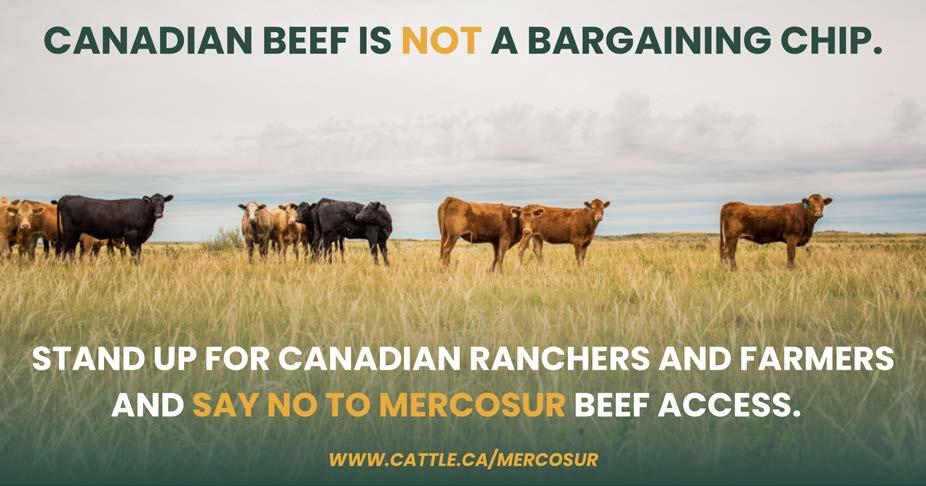
On the national front, CCA has been working on the Mercosur trade deal campaign and we need producers help raise awareness with elected officials of its potential effects on the beef industry. The Government of Canada is looking to finalize a trade agreement with Mercosur which includes the largest, lowest-cost beef producers in the world. Canadian beef is a main sticking point in negotiations, but Canadian beef farmers and ranchers should not be used as a bargaining chip. A beef deal with Mercosur risks undermining farmers and ranchers at a time when we are rebuilding the Canadian cattle herd. We have nothing to gain and much to lose in these negotiations. To help the CCA and MBP oppose this, please visit https://www.cattle.ca/mercosur to sign up for the form letter that will contact your Members of Parliament.
Before I close, thank you to MBP’s staff and directors for making our presence at the Royal Manitoba Winter Fair in Brandon a success. It is always a great way to demonstrate the responsible care of cattle and the benefits the beef industry provides in Manitoba and across Canada, including being an important economic driver and in supplying a variety of ecosystem services.
I hope to see many of you at the Canadian Beef Industry Conference in Winnipeg this August. Stay tuned for further details.
Here’s to a great and safe spring, Carson
Margins have never been higher. Don’t leave them unprotected. Lock in a market floor price with a Livestock Price Insurance policy—because today’s market may not be tomorrow’s. Producers can choose from a wide range of coverage and policy lengths.
Policy purchases are available Tuesday – Thursday from 3 p.m. to 12 a.m. (CST).
The last day to purchase LPI – Calf policies is June 11, 2026. Visit LPI.ca or call 1-844-782-5747 to purchase your policy.
BY ANGELA LOVELL
What often holds farm and ranching operations back from being more successful is financial reporting, said Wyoming farm business analyst and consultant, John Haskell in his virtual presentation at the Manitoba Beef Producers AGM in Brandon on February 12.
For more than 20 years Haskell has helped farmers and ranchers build successful businesses by focusing on the financials and he shared a few of the important things they need to get right to ensure business success.
It is possible to generate an incredible amount of profit and wealth in agriculture, Haskell said, but the way that we think matters and has powerful effects. “We have to develop an ethos that we are responsible for the outcome, so whether our business is successful or failing we take responsibility and are accountable for it,” he said.
Financial Literacy – the reports
Understanding the financial side of the business can influence outcomes, and Haskell discussed the three major financial reports that are important to understand and follow.
ultimately it will erode equity on the balance sheet.”
The Balance Sheet lists assets such as tractors and buildings, and liabilities such as short-term and long-term debt.
Key Performance Indicators
However successful a business is there are always things that can improve its performance, and the Key Performance Indicators (KPIs) to watch, said Haskell, are:
• Overhead costs
Although a great place to start is reducing overhead costs, this can be limited, Haskell advised. “If your overheads are out of control you have to get those under control but at a certain point there is a limited return to that time spent invested.”
• Gross margin per unit
This is a powerful lever but often doesn’t tell the whole story because while a business could have a high gross margin per unit, it may still not have much income. “You want to make sure you are optimizing gross margin, not maximizing gross margin,” Haskell said.
overhead structure, and a little bit can go a long way,” he said.
• Depreciation
These are non-cash losses that can erode equity. “If I start with a 500lb heifer calf and turn her into a bred cow and keep her long enough that she comes in open and we cull her, the price we are going to see for each of these things is going to cycle up, then down,” Haskell gave as an example. “We can sit and watch this passively or we can do something about it. The most profitable businesses that we see among breeding herds manage this appreciation and depreciation very carefully. We see businesses that turn the replacement cost of a cow into a revenue stream; so instead of paying $250 a head to replace a cow, they actually earned $250 a head.”
• Properly structure debt
Because agricultural operations are heavily debt dependent and capital intensive, making sure they have properly structured debt is one of the most important things business owners can do to manage debt and consistently make payments, Haskell said.
At the moment, beef producers are taking advantage of a high market, but according to Haskell, there are a few things they need to pay attention to if they want to remain successful throughout the inevitable ups and downs.
Cashflow is simply how much money is coming out and going into the business every month over the course of the year.
“Understanding how your money flows through the system is important,” he said. “We need to build a model in our business of how money comes into the business and where it goes. Importantly, we want to know where money comes into the business and where it leaves the business.”
The Profit and Loss statement includes the actual business income and expenses.
“Pretty much everything on a Profit and Loss (P & L) statement that is not revenue is money that leaves the business. The leftover from the money that comes in and the money that leaves, that can go on your balance sheet as retained earnings, and you can use that to buy additional assets, service debt, and grow your business,” Haskell said. “If that’s negative, of course it erodes. If the business is losing money on the P & L,
“Same with overhead costs. There are places where if you cut too far you are going to cause additional problems.”
• Gross product
This is the total economic value that is created and ultimately captured by the business. “Marketing has a huge influence on gross product,” he said. “It has no upside limit. We see businesses that have over 100% ROIs (return on investment). Those businesses are focused on generating the maximum amount of value from the resources they spend.”
• Turnover
Haskell described turnover as doing more of what you are doing. “Leasing more land to run more cattle, improving our grazing practices, water development, those kinds of things allow us to run more units with the same basic

“We want an appropriate mindset around debt; we don’t want to be too enthusiastic about debt but also don’t want to panic and get ourselves in trouble by trying to get out.”
• Understand your business drivers
Every business is unique, so know the three KPIs that you need to keep most focused on, advised Haskell. “You can improve one and hurt others and we want to be very careful about that. Usually there are a few things we can focus on to make a dramatic difference,” he said.”
• Huge power in focus
Many businesses that Haskell works with have around five enterprises, and generally only two or three of them are doing well. “Cutting low performing enterprises or reforming them so they become good performing enterprises is a great idea,’ he said. “Operational complexity increases management complexity by the power of two, so as we increase that complexity that is often where people start to spiral.”
Haskell is a big believer in ‘putting your eggs in one basket’. “We get good at what we do, and we should execute it at a very high level,” he says. How to build a successful business
At the moment, beef producers are taking advantage of a high market, but according to Haskell, there are a few things they need to pay attention to if they want to remain successful throughout the inevitable ups and downs.
1. If you have cash to reinvest in the business, the best thing to invest in is assets that generate more cash.
“Every time I have extra money if I reinvest in cows I have increased my income, if I buy a truck, it comes off my income, but it doesn’t increase my cashflow in the future, only increases my expenses,” Haskell says.
2. If you are committing to debt now you are probably going to be paying it back in low markets, so you need to be aware of that, Haskell advised.
3. Growth is a long-term, exponential process –characterized by a long, flat beginning before it curves upward.
“Make sure you understand that patience and careful monitoring at the beginning stage is very important,” Haskell said. “You have to reinvest in the business to build long-term wealth. We have the ability to generate higher returns in the ag business and can reinvest them tax free, and that can have really great long-term effects.”
BY ANGELA LOVELL
The path to better mental health is not always an easy one and if anyone should know it’s Brett Gardiner, who was the keynote speaker at Manitoba Beef Producers’ annual general meeting in February in Brandon.
Around 10 years ago, while in the thick of a successful career as an award-winning rodeo announcer and speaker, Gardiner began to struggle with his own mental health.
“I was struggling to show up how I wanted to,” said Gardiner. “I had started this tremendous career, but something felt like it was missing. I was struggling to show up as the dad I wanted to be, as the friend I wanted to be, and I didn’t know what it was.”
One thing Gardiner learned was that he wasn’t alone in his struggles. His experiences led him back to the classroom and he now also practices as a clinical and sports performance psychologist.
our mindset is, because it’s the filter we walk through the door with,” Gardiner explained. “Assess where that mindset is for change, are we willing to make that move or be open to it? Are we open to conversations today that can move us forward?”
2. Turn intention into behaviour.
“How do we take an idea and shift it into behaviour? How do we get to show up and do our best? We have the power to decide how we show up.”
3. Education is awesome.
“I had to learn about myself because if I don’t know what I am, how do I change it?,” Gardiner
there? Try to build capacity for those moments when stress and anxiety goes up. Don’t make any major decisions for your family at the end of harvest or calving season,” Gardiner advised.
6. Live in the gap
“This is where freedom lives; having the ability to live between stimulus and response,” Gardiner said. “There are lots of things that are going to hit us and stimulate us because we live in this reactionary world, but how big can we make this gap? It’s the ability to know that whatever happens and whoever says what, we can take a breath and decide how we show up, and to be in control of our response. If we can slow it down enough to be rational in this space, we can take the power back.”
“I wasn’t alone, I couldn’t do it alone, but we were never meant to do it alone,” he says. “Reaching out for help is our best move.”
One of the first things Gardiner learned was that he wasn’t alone in his struggles, and in hindsight, says he realizes that he was lacking the tools to be able to show up as he wanted to.
“I wasn’t alone, I couldn’t do it alone, but we were never meant to do it alone,” he says. “Reaching out for help is our best move.”
Below are the main themes that Gardiner shared with AGM attendees that he believes are crucial to make the changes necessary for better mental health.
1. Mindset matters.
“It is important that we understand where
Page 1
Sometimes, Gardiner said in summary, we just need to put a little gas back in the tank.
admitted. “How can we make sure to educate ourselves so that we have the appropriate information, and that we can protect our focus, because where our focus flows, our energy flows.”
4. Vulnerability is non-negotiable.
“Vulnerability doesn’t mean pouring out your heart and soul, it means hanging in for 10 more seconds even if you don’t like the way this feels, and don’t want to have this conversation,” Gardiner said.
5. Battle for baseline
“What is my baseline and how do I get back
It guides animal health and welfare standards used by the Canadian Roundtable for Sustainable Beef and some provinces incorporate the codes into their animal protection regulations.
“The Beef Code of Practice benefits industry because it provides a standard for generally recognized practices, so if there’s an issue, or an animal that is a questioned to be in distress, we have the standard of care to assess against,” says Atchison.
The Code is updated every 10 years with a review after five years to make sure that everything is in line with current practices, scientific literature and new technologies that might be available.
“The Code update is initiated by the beef industry through the Canadian Cattle Association, which demonstrates the industry’s strong commitment to self-improvement and accountability,” Atchison says.
The Beef Code Committee is made up of representatives from stakeholders across the Canadian beef sector including producers, transporters, veterinarians, national animal welfare advocacy associations, provincial animal protection enforcement authorities, provincial and federal governments, retail and food service, and researchers/academics. A Scientific Committee reviews current literature around identified priority welfare areas, and provides a report to help inform the draft code. NFACC facilitates the process and ensures consistency and transparency.
“Everyone has to arrive at a standard of care that’s informed by science, but it also has to be consensus-based with the different stakeholders that have different priorities around the table,” Atchison says. “That makes it defensible to people who may scrutinize our industry.”
Value of the Code to beef producers
“Having a current code of practice that reflects the practices that are common in industry is an absolute must for not just the industry but for producers themselves,” says Leigh Rosengren. “It gives producers tools to talk to concerned neighbours, consumers and to the people buying their beef about what we do on farms and why we do it. It provides clarity and guidance to ensure that the practices they are doing meet societal expectations. It also provides tools to push back against outside forces that want to regulate animal welfare on farms without the producer voice at the table. It serves, empowers and protects producers.”
Once the comment period closes, the comments will be compiled into theme areas and reviewed by the Code Committee to inform the final content of the Code that should be released in 2027.
Producers can get more information about the current Beef Code of Practice and the proposed changes at the Canadian Cattle Association’s website of the National Farm Animal Care Council website (see links below).
Learn more about the proposed changes to the Beef Code of Practice at https:// cancattle.wixsite.com/cattle/post/what-is-the-beef-cattle-code-of-practice
The 60-day public comment period closes on June 12, 2026. Producers can submit their comments at the following link: https://www.nfacc.ca/news?articleid=480
There are six chapters to the Beef Code of Practice and below are the highlights of the proposed changes to each section:
Animal environment
This chapter includes updates regarding heat and cold stress with emphasis on timely assistance to animals that are not coping well with adverse weather. It also includes a new section on welfare impacts of mud and moisture. There are also updates around facilities, and safe, low-stress cattle movements that are in part achieved through people and their actions, but also through well designed facilities.
Feed and water
Includes new information about monitoring nutrition and focuses on prevention of poor body condition in mature cattle. There is also some additional information (but minimal changes) around using snow as a water source.
This chapter has been significantly expanded to include other classes of cattle (besides feeders) such as breeding stock and cows. There is also greater emphasis on the importance of producers having an active and good working relationship with their veterinarian.
Animal husbandry
New in this chapter is a section about drafted on non-ambulatory cattle, including appropriate care for them, and appropriate ways of handling them if they need to be moved, such as ensuring they have access to feed and water. There is more emphasis on low-stress handling and some incremental changes for pain control for painful procedures, including additional procedures (besides castration and de-budding) such as branding, spaying and difficult births. The section on weaning has also been expanded.
Transport regulations have changes significantly since the last Code, so this chapter focuses on decision making about whether animals should be transported prior to leaving the farm, and the preparatory actions to be taken prior to the farm gate. The Code does not apply to the animals in transit, so the intent is to help producers make good decisions about what animals should be transported, and if they should be transported, where and how.
Although there are not substantial changes in the content of this chapter, the presentation is improved and clearer and has additional material around decision making criteria and how to make timely decisions. It also provides some tools in recognition of producer mental health, particularly around decisions on euthanasia.
Q: With the current prices for beef, I am thinking about increasing my herd size. Currently I continuous graze my pasture as it is mostly native forages and very stoney. I do not want to go through all the trouble of trying to establish tame forages on this poor land. What can I do to improve productivity on this land?
A: First you could consider utilizing annuals to supplement the pasture early in the spring and late in the fall with corn grazing, or swath grazing. Even stockpiling a portion of the pasture while you utilize annuals will also help to extend the grazing which is the most economical way of feeding your cattle and potentially supporting more animals.
Secondly, another option is subdividing your pastures into paddocks and start rotationally grazing the land that you do have in pasture. This will allow for rest and recovery of the plants and more importantly of their root systems creating healthier plants resulting in higher forage yields.
Rotational grazing is an effective and sustainable pasture management strategy that extends grazing days, improves forage productivity, and reduces pressure on other grazing lands and most importantly increases overall profit. By dividing pastures into multiple paddocks and rotating livestock through them, producers can ensure rest periods that promote pasture resilience and longterm productivity. Simple tools - such as electric wire and stepin posts - can be used to establish a basic rotational system.
By controlling when, where, and how long livestock graze, rotational systems increase and maintain vigorous root growth, healthier plant communities, and more hardy pastures. Rotational grazing also allows for a lot more flexibility in grazing certain paddocks at different times of the year, based on growth of the separate paddocks. The result is:
• More forage over the grazing season
• Better animal distribution
• Enhanced soil and ecological health
• Reduced feed costs and pressure on supplemental grazing lands
A study from the University of Guelph in Ontario for the Greenbelt Foundation looked at the economics of rotational grazing in 2020. Not only was the same land base capable of supporting more animals, but it also reduced the days on feed in the winter due to extended grazing and increased the bottom line.
There also were additional benefits: namely reduced weed pressure due to more even grazing pressure from the animals, increased pasture drought resistance due to better forage coverage and improved pasture resilience.
Rotational grazing also aligns with the foundational principles of sustainable pasture management:
1. Balance livestock numbers with available forage supply.
Stocking rates must reflect current forage growth and environmental conditions.
2. Manage livestock distribution.
Rotational systems prevent spotgrazing and ensure even forage utilization.
3. Balance grazing periods with adequate rest.
Rest periods during the growing season are essential for plant recovery and longterm productivity.
4. Avoid grazing during sensitive periods.
• These include:
• Flooded or saturated soils
• Drought conditions
• Early-season wildlife nesting
• Times when forage growth is extremely slow
The Beef Cattle Research Council (BCRC) website has detailed information on managing and planning your grazing systems https://www.beefresearch.ca/ pasture-101/managing-planning-grazing It is crucial to start early for the planning process, but any planning at any time is better than doing nothing at all. Many watershed districts now have programs to help with the implementation of capital costs and mentorship to develop grazing plans as well.
Rotational grazing is becoming an important on-ranch management strategy that also has social, economic, and/or ecological benefits by rotating cattle on the land, at which ranchers can make adaptive management decisions.
For more information contact any Manitoba Agriculture Livestock and Forage Extension Specialist.
In the next issue of Cattle Country, a Manitoba Agriculture forage or livestock specialist will answer a selected question. Send your questions to Elizabeth.Nernberg@gov.mb.ca.
StockTalk for Cattle Country is brought to you by Manitoba Agriculture. We encourage you to email your questions to our department’s forage and livestock team. We are here to help make your cattle operation successful. Contact us today.
Kristen Bouchard-Teasdale Beausejour 431-337-1688 Kristen.BouchardTeasdale@gov.mb.ca
Cindy Jack Portage 204-768-0534 Cindy.Jack@gov.mb.ca
Juanita Kopp Beausejour 204-825-4302 Juanita.Kopp@gov.mb.ca
Elizabeth Nernberg Roblin 204-247-0087 Elizabeth.Nernberg@gov.mb.ca
Pam Iwanchysko Dauphin Pamela.Iwanchysko@gov.mb.ca
Josie Pedersen Killarney 431-266-0171 Josie.Pedersen@gov.mb.ca



As I put pen to paper for this edition of Cattle Country, it is early April, and there has been a lot of volatility in the cattle market for the past few weeks. The light-weight grass cattle market continues to defy any fear of lower yearling prices for this fall; demand is very aggressive! The heavier feeder cattle over 850 pounds have shown some resistance but are still off side as per the fed cattle market. The fed cattle market had a strong surge, especially in the east. It looks like the announcement that China will take Canadian beef has put some spark in the fed-cattle market for mid-summer and early fall marketings. The cull cow market is at all-time highs with both feeding-style cows and butcher cows in strong demand.
The biggest surprise right now is the heifer market! The demand for 700-pound plus heifers to breed is very aggressive. Each week large numbers of replacement-type heifers are going into breeding programs across western Canada. Some of the markets in Alberta had reported that demand for breeding heifers had started to decline due to the price point of the heifers and the forecast of dry weather this summer. I had mentioned in the last edition of Cattle Country that Canada was at the “starting gate” for a rebuild of the cow herd. The demand for heifers indicates that there should be an abundance of bred heifers available for sale this fall.
Most of the auction markets in Manitoba have gone to their seasonal schedules and are operating every second week. Some will soon be closing for the

summer break. I would advise that you call your local marketing representative to confirm sale dates before delivering any stock.
In March, I was invited to attend the Traceability Dialogue Day in Ottawa that was organized by the Canadian Cattle Association (CCA). I attended as a representative of the Livestock Markets Association of Canada. Each province had representatives from its provincial cattle association. The mood of the meeting could be described as “tense,” at best. Before I was even checked into my room, Saskatchewan delegates advised me that their members were demanding a “hard no,” and they were bound to bring that message to the table. Both Alberta and Manitoba had publicly announced that they were not supporting the proposed changes prior to the meeting.
At the summit, the attendees were divided into groups with five information stations. Each group went to each station, answered questions, gave opinions and observations on traceability - what was needed, what was important, what was redundant?
When the session was over, the total results of each of the five stations were condensed and presented to the group. The idea was that this information

would be the basis of discussion and assist CCA in developing the future direction of traceability in the cattle sector.
The Canadian Food Inspection Agency (CFIA) had high-ranking representatives at the meeting observing and listening to the final presentation by the facilitator. I was told by the CFIA representatives that CFIA is in the process of being restructured. What that means will be revealed when the final reporting structure is presented. Frankly, I don’t know if the CFIA pause on the proposed traceability regulatory changes was the result of the public outcry or the restructuring of CFIA. Regardless, the current traceability regulations are still in effect.
The next day, the CCA meetings started, and traceability was one of the discussion topics both inside and outside the meeting rooms. When the meetings were complete, a motion was passed stating that CCA did not support the proposed CFIA changes expected in Canada Gazette II.
I want to share my observations from the many discussions. First and foremost, the majority of people were not against traceability for cattle. The majority have a lack of trust in the federal government and CFIA. As producers, they fear and resent the authority and power given to CFIA. Most would be more supportive of the traceability file if industry had more control and input into the program. There appeared to be more discontent in the west than in the eastern part of Canada. The provincial cattle organizations in the west are afraid of massive checkoff refund requests if they support traceability changes, and that fear obviously influenced their support. It also seems that the majority of the livestock associations dropped the ball when it came to communicating with the members on the progress of the traceability file. Producer organizations were at the table from 2011, when talks began. It appears that the representatives assumed that the producers who elected them to represent industry would trust that they were working for the best long-term interests of the industry. In the eyes of the vocal members in opposition, those people and their organizations failed them.
The challenge for CCA and the provincial organizations will be how to wrestle some of the power away from CFIA and put it into industry’s hands without jeopardizing the integrity of the Canadian beef industry in the eyes of our trading partners and consumers.
The next steps for traceability will be for CCA and provincial member organizations to convene an industry-led Task Force to work for producers on a risk-based approach to disease preparedness and emergency management. Traceability is not going away! CCA and other industry groups have listened to the concerns of their members while at the same time recognizing that in reality Canada needs a workable traceability system that, in the event of an outbreak of a communicable disease, will get Canadian beef and beef products back into the domestic and international markets as quickly as possible. Emergency preparedness will assist the Canadian industry from becoming like England and other European countries. Those countries have the stringent traceability requirements that they have now because they were not prepared for foot and mouth disease.
After the restructure of CFIA is complete, industry will know who they will be dealing with at CFIA and how CFIA will react to industry’s lack of support for the proposed regulatory changes.
Going forward, the government will have the difficult job of rebuilding the trust of the primary beef producers. Producers will also have to remember that the beef industry needs CFIA to keep trade opportunities open, work on containment and eradication of certain disease outbreaks, and maintain Canada’s reputation for supplying safe beef to the world. So, the traceability soap opera continues…
Until next time, Rick.
The opinions expressed in this article are the author’s own and do not necessarily reflect the views or positions of Manitoba Beef Producers.
BY PETER FROHLICH, NATIONAL CENTRE
From March 3-5, researchers, government representatives, farmers and industry members had the opportunity to discuss the sustainability of our food systems at the 11th Annual Sustainability of Canadian Agriculture Virtual Conference, co-hosted by the National Centre for Livestock and the Environment (NCLE) at the University of Manitoba and Agriculture and Agri-Food Canada (AAFC). Speakers explored topics on strengthening food resilience in First Nations Communities, redefining sustainability beyond greenhouse gas emissions, and new models for researcher and producer engagement. The event featured panel discussions, a GHG farm emissions modelling workshop and student presentations highlighting the latest in food systems research.
Defining and measuring sustainability
Defining sustainability is challenging; is it environmental, economic or social, what are we measuring and how? Tyler McCann, Managing Director at the Canadian Agri-Food Policy Institute, highlighted the many metrics that must be considered when assessing sustainability, including soil health, carbon, biodiversity, economics – to name a few. He emphasized the need to recognize farmers’ practical realities and to adjust perspectives on sustainability in response to changing political landscapes. McCann added that sustainability can serve as an opportunity for farmers to mitigate risks like extreme weather, climate change, commodity price volatility and others. Leveraging sustainability can also create marketing opportunities for industry. For example, several organizations, including the Dairy Farmers of Canada have set goals to reduce greenhouse gas emissions, demonstrating their commitment to sustainably feed Canadians and the world.
Koen Deconinck is an economist at the Trade and Agriculture Directorate of the OECD (Organization for Economic Co-operation and Development) whose work includes examining carbon footprints from many of the world’s leading food companies. Although many companies and countries have calculated carbon footprints, the measurement methods can differ and therefore make comparisons difficult. To mitigate this challenge, the OECD and global partners have developed guidelines that are necessary for reliable carbon footprint measurement. The guidelines include using up-to-date science-based methods to collect data and farm-level calculation tools, ensuring good reporting, effective data sharing across supply chains among others.
This session was moderated by Ellen Goddard, Agricultural Economist, and former Co-operative Chair in Agricultural Marketing and Business, University of Alberta.
Removing barriers and strengthening food resilience in First Nations communities
Monica James is the Assistant Vice-President of Indigenous Financing at Farm Credit Canada (FCC). In this role, she supports Indigenous farmers, food producers and community-owned enterprises by expanding access to capital, building capacity and fostering industry connections that help Indigenous peoples reclaim their inherent right in agriculture and food economy. James provided insight regarding Canada’s journey with Indigenous agriculture and explored the barriers that persist today for Indigenous farmers to access capital to build capacity. James emphasized that to be successful, Indigenous-led capital requires an understanding of the Indigenous world view with a need to build stronger relationships across the agricultural ecosystem.
Vanessa Hines is a Program Coordinator from Fox Lake Cree Nation working on the community’s Food for All Program. This innovative program teaches young people how to grow food in shared gardens and backyards and includes traditional hunting and wild harvesting. The initiative includes several locations containing raised planter boxes to grow vegetables and facilities for laying hens and broiler chickens. The program includes a learning kitchen and a Biovator, a device that transforms organic matter into compost to build soil health. Hines says the program has re-established food production in Fox Lake, engages youth and creates employment opportunities while contributing to the health and wellness of the community.
Cheryl Melnyk is the Health Director of the Gambler First Nation located northeast of Winnipeg. She shared the success realized through Good Life with Food Futures project, an Indigenous-led healthy food security and community development initiative. The project includes the establishment of food forest permaculture sites and a geodome with aquaponics, hydroponics and raised garden beds designed to grow fruits, herbs and vegetables year-round to provide fresh
produce to the community. The geodome also serves as an educational space where residents can learn about sustainable agriculture, environmental stewardship, and the importance of self-sufficient food systems. Melnyk added that this project is strengthening local food resilience and improving the health of the community.
This session was moderated by Kyle Bobiwash, Assistant Professor and Indigenous Scholar, Department of Entomology at the University of Manitoba. Redefining sustainability beyond greenhouse gas emissions
Sarah Pogue is a physical scientist and model developer at AAFC who shared her knowledge regarding ecosystem services (ES) and their benefit to local communities. She highlighted the research underway, including use of agri-environmental indicators (data on soils, climate, topography and land use), field studies like the Living Labs projects and models to better understanding the effects of agriculture on ES. In addition, a range of knowledge that includes Indigenous voices is required to better understand the potential impacts of land management and stewardship on ES. She added that the impact of agricultural activities must also include the impact on farmer health and well-being.
Meagan King is an Assistant Professor in the Department of Animal Science at the University of Manitoba who examines strategies to improve life on farms for people and animals. She highlighted the One Health and One Welfare framework where environment, human and animal health are interconnected and that farmer well-being is increasingly recognized as a key component of agricultural sustainability. King introduced different components of well-being, the stressors farmers face, including the notion of being a “good farmer”, and the lack of control associated with farming including weather and markets and the importance of having strong community connections. She summarized results of the University of Guelph’s 2021 National Survey of Farmer Mental Health that found farmers reported higher levels of stress, anxiety, depression and burnout than the general public among other key findings.
King also shared early results of the University of Manitoba’s LEAP (Leveraging Ecosystems to transform Agriculture on the Prairies). This project is designed to advance sustainable farming by integrating perennial agriculture and ecosystem-based practices with a significant farmer engagement component. The team consulted with 40 farmers across the Prairies, who reported that they are excited about improving soil health, supporting the next generation of farmers and building sustainable operations. They also identified concerns including accessing land and capital, tariffs and rising costs of inputs.
Lisa Ashton is the Director Agriculture Policy at RBC Thought Leadership. She shared insights from the RBC Climate Action Institute, a group within RBC that examines, connects stakeholders and promotes practical actions to support Canada’s transition to a low-carbon economy. The Climate Action Barometer, an index and a national view of climate action in Canada, suggests that overall (national trend) climate action has decreased between 2024 and 2025. However, research indicated that approximately one third of Canadians listed action on climate as one of their top three priorities. Although there has been incremental year-over-year improvement on climate action, it has been relatively low compared to other sectors. Overall, absolute agricultural emissions in Canada have been relatively stable, however emissions intensity has decreased since 2019. Ashton added that farmers drive climate action through on farm efficiency including improvements in fertilizer use, feed efficiency and on farm fuel use.
This session was moderated by Tim McAllister, Principal Research Scientist, Lethbridge Research and Development Centre, AAFC.
New models for research and producer engagement
Michelle Carkner is an Assistant Professor in the Department of Plant Science at the University of Manitoba with experience creating participatory and co-design research networks with farmers and industry. Through her work, she has demonstrated that farmer engagement is a great way to incorporate farmer realities into research and to quantify what is already being done on farms leading to more effective and quicker adoption of new practices. It is an educational twoway street with co-benefits for both researchers and farmers. Carkner highlighted lessons learned from three studies she worked on including the Canada wide Participatory Plant Breeding Project, the Nature+ project in Africa and LEAP. Carkner added that the building of these type of relationships also translates to exceptional training opportunities for students.
Melissa Arcand is an Associate Professor in the Department of Soil Science
at the University of Saskatchewan and a member of the Muskeg Lake Cree Nation in Treaty 6. Through her research, she includes Indigenous communities who play a key role in climate mitigation integrating Indigenous knowledge into programs that aim to reach emission targets. In the co-design research model, there is a third party which is the community. Projects including Agriculture Climate Solutions Living Lab – Bridge to Land Water Sky, Restoration of the Green Lake Trail at Mistawasis and Muskeg Lake Food Forest operate within this co-design model. These projects also demonstrate that Indigenous communities have additional co-benefits and goals that are fundamental to transformation and include food sovereignty and security, access to traditional plant foods and medicines, employment and economic development opportunities, as well as language revitalization.
Alain and Nicolas Philippot are dairy farmers from St. Claude, Manitoba. The father and son team shared the history of their farm, its transition from crops to dairy (and forages) and their mission to improve soil health and biodiversity on their land. They continually improve their operation by collecting data and seek out new information which has inspired them to join the LEAP team. The information from this project will help them make data-driven decisions regarding the sustainability of their farm. From their perspective, the scientists working on this project have helped push their operation forward and provide an incentive to continue their efforts to reach their production and environmental goals while ensuring financial sustainability.
Clayton and Quinn Robins operate a family-run beef cattle operation in southwestern Manitoba. They work with researchers from several organizations (including the LEAP team), to evaluate sustainable practices including long-term annuals grazing strategies on their farm. Robins sees value in working with researchers because it includes access to data that would have otherwise been cost prohibitive to collect, as well as access to expertise, both of which contribute to production decisions that help to advance the overall sustainability of the Robin’s farm.
This session was moderated by Joanne Thiessen Martens, Assistant Professor, Department of Soil Science, University of Manitoba.
Twenty-one graduate students featured their research focused on improving the sustainability of agriculture in 3-minute videos. The short videos covered topics ranging from livestock production, entomology, agronomy and soil health to grain storage and processing. The top videos were submitted by Ryan Hay, Emily Robb and Larissa Scott from the University of Manitoba. Larissa also received the People’s Choice Award for her research that explored rumen microbiome solutions for mitigating greenhouse gas emissions of cattle.
Approximately 100 conference participants joined the Holos training workshop and received hands-on training using the model which is designed to estimate and reduce greenhouse gas emissions based on information entered for individual farms.
The 2026 Sustainability of Canadian Agriculture Conference organizing committee would like to thank all speakers, session and student video moder-
ators and conference participants for making this annual conference a success. For questions and comments about the conference please contact Peter.Frohlich@ umantoba.ca. See you all next year!
Visit the SCAC 2026 conference website to view recorded presentations, information about speakers, student research videos and more. https://umanitoba. ca/agricultural-food-sciences/sustainability-canadian-agriculture-2026












(March 27, 2026 Agriculture and Agri-Food Canada News Release) The Government of Canada recognizes the vital role that livestock producers play in supporting Canada’s agri-food sector, which drives economic growth and supports the prosperity of rural communities across the country. When unexpected animal health events occur, we are committed to providing effective support to help producers recover and rebuild.
The Honourable Heath MacDonald, Minister of Agriculture and Agri-Food, announced that the Government intends to propose amendments to the Income Tax Act to extend the income tax deferral period for livestock producers in Alberta, Saskatchewan, and Manitoba who received compensation for animals ordered to be destroyed due to the 2024 and 2025 bovine tuberculosis events. This measure responds to concerns from livestock producers about the challenges of replenishing their herds during the same tax year in which they received the compensation.
Under the Health of Animals Act, the Canadian Food Inspection Agency provided compensation to livestock producers whose animals were ordered to be destroyed due to the 2024 and 2025 bovine tuberculosis outbreak. While section 80.3 of the Income Tax Act currently allows for a one-year income deferral, the proposed amendments would allow affected
The extended tax deferral schedule was developed following engagement with livestock producers and collaboration with the Canadian Cattle Association and reflects the time needed for herd replenishment.
Under the Health of Animals Act, compensation is designed to help producers recover from extraordinary losses due to federally reportable animal diseases.
The Government recognizes that producers may face challenges in replenishing their herds following a disease event. In some cases, replacement purchases may extend over several years. In 2017, the Government of Canada announced an
livestock producers to defer this compensation over a prescribed schedule from 2026 to 2030, providing them with greater flexibility to manage their incomes and sustain their operations as they rebuild their herds.
“Canada’s producers are the backbone of our rural communities and are essential to our agri-food success story. This extended tax deferral period would address the unique realities faced by producers as they rebuild their herds after animal health events. The Government of Canada remains committed to giving producers the support and stability they need to keep the sector strong and resilient.”
- The Honourable Heath MacDonald, Minister of Agriculture and Agri-Food
extended tax deferral period for producers who received compensation under the Health of Animals Act due to the 2016 and 2017 bovine tuberculosis outbreak in Alberta and Saskatchewan that forced the destruction of livestock.
To help producers manage the impacts of extreme weather on forage yields, producers also have access to the Livestock Tax Deferral Provision. In February 2026, new regions were added to the final list of prescribed regions for the 2025 Livestock Tax Deferral. The Livestock Tax Deferral provision allows farmers that carry on a farming business in a prescribed area, who sell all or part of their breeding herd due to drought, excess moisture, or flooding, to defer a portion of sale proceeds to the following year.
As a result, producers who received amounts as compensation in 2025 or 2026 under the Health of Animals Act as a consequence of the forced destruction of their livestock because of the 2024 and 2025 bovine tuberculosis outbreaks would have the option of including those amounts in income for tax purposes, as follows:
• up to 100% of the compensation deferred to the 2027 tax year, with at least 83% included in income in 2027
• up to 17% of the compensation deferred to the 2028 tax year, with at least 9% included in income in 2028
• up to 8% of the compensation deferred to the 2029 tax year, with at least 4% included in income in 2029
• up to 4% of the compensation deferred to the 2030 tax year, with the remaining 4% included in income in 2030
The Government of Canada will continue working with industry and provincial partners to protect animal health, support sector resilience, and ensure producers have the resources they need to sustain their livelihoods and rural communities.
Associated links
Bovine tuberculosis investigations: https://inspection.canada.ca/en/animal-health/ terrestrial-animals/diseases/reportable/bovinetuberculosis/investigations
Health of Animals Act – Compensation for Destroyed Animals and Things Regulations: https://laws-lois.justice.gc.ca/eng/regulations/sor2000-233/FullText.html
2025 Livestock Tax Deferral for regions impacted by drought, excess moisture or flooding: https:// agriculture.canada.ca/en/agricultural-production/ weather/livestock-tax-deferral-provision/2025livestock-tax-deferral-prescribed-regions
BY MARY-JANE ORR, GENERAL MANAGER, MANITOBA BEEF & FORAGE INITIATIVES (MBFI)
The Brookdale Research Farm operated by Manitoba Beef & Forage Initiatives (MBFI) is growing in size by 42 per cent, with a comprehensive study into virtual fencing planned for the new acres this spring.
The land expansion goes hand in hand with new producer collaborations at MBFI, bringing together the economics of grazing with vetting new technologies and its long-term benchmarking of grassland productivity.
“I think there’s tremendous opportunity with grazing collars,” says Brett McRae, a beef cattle producer in southwest Manitoba. ”The technology of virtual fencing right now is like the iPhone back in the 2000s, but soon, those collars will be an important tool for herd management. The project we are proposing will help provide the management precision and economic data for cattle farmers that grain farmers have had for years.”
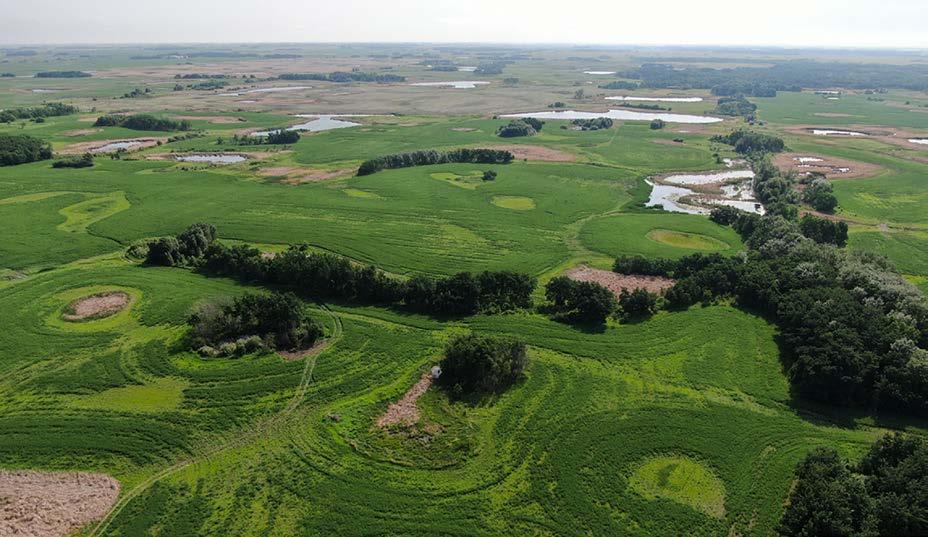
To document those marketing decisions determining the class of cattle and grazing management, McRae will utilize the new addition to Brookdale Research Farm; Odanah Pasture is 467 acres immediately north of the existing farm. The former cropland was purchased by Ducks Unlimited Canada (DUC) in 2020 and the natural habitat restored before MBFI negotiated long-term usage with the conservation agency on the $1 million property.
MBFI and its partners announced the farm expansion on March 16 at the Manitoba Legislative Building with Agriculture Minister Ron Kostyshyn.
“This partnership is a win for habitat restoration and a win for forage and livestock production,” says Ducks Unlimited Canada (DUC) Head of Communications and Outreach – Prairies, Karli Reimer. “In the future, farmers will use data from the newly expanded Brookdale Research Farm to make land use decisions that are beneficial to their operation and the environment.”
With 123 wetland basins sprinkled among re-
stored and natural uplands, Odanah Pasture provides the opportunity to ask questions on a commercial scale within a landscape familiar to Manitoba cattle producers.
“As a producer, I see the value of research that helps us manage grasslands in ways that support productive cattle operations, healthy ecosystems and biodiversity,” says Melissa Atchison, a cattle farmer from Pipestone who works as a Research and Extension Specialist with Manitoba Beef Producers and is current Finance Chair with Beef Cattle Research Council (BCRC). “This expansion will increase MBFI’s capacity to quantify, validate, and qualify beneficial practices on a field scale to support research and demonstration activities that help strengthen the longterm environmental and economic sustainability on these unique landscapes.”
To guide research on the new acres, MBFI engaged with producers, industry representatives and academic researchers. Recommendations emphasized retaining the commercial scale of study, benchmarking the transition from tame hay production to high-capacity rotational grazing and - most importantly - transparent capture of the economics of grazing.
In the upcoming season, McRae - a 2026 Outstanding Young Farmer nominee - will showcase virtual fencing, GPS ear tags and grazing economics at scale in collaboration with the MBFI team and his wife, Chantel. The McRaes own and operate McRae Land & Livestock southwest of Brandon, a 300 head cow-calf operation including replacement heifers.
“I’m a big believer in the principles of soil health and tailoring management to what the land needs,” says McRae, whose operation spans over 70 miles on owned and rented land. “Economics are hugely important but we’re also in tune with what the land needs. If you cover that, the economics will follow.”
Virtual fencing, also known as grazing collars or GPS collars, is an emerging technology in Canada.
Cattle wear collars that track their movements through GPS signals and farmers can set up virtual fences via their phone or computer to control rotational grazing moves. Noise cues warn livestock when they approach a programmed digital fence boundary and the collar delivers a mild electrical pulse if the cow strays beyond the designated area. Demonstrations in 2024 and 2025 at MBFI and locations in Saskatchewan and Alberta found that cattle wearing the collars stayed within set boundaries more than 99 per cent of the time.
“I’ve been watching virtual fencing develop for several years,” says McRae. “Now, it seems like the technology has potential at the field scale because some elite producers are already using it.”
McRae plans to use poly wire for herd management on part of Odanah Pasture and grazing collars on the other portion. He will track and share his costs, returns and management decisions, allowing other producers to compare directly to their own operations. The study can benefit not only Manitoba’s 6,000 cattle farms but beef operations anywhere.
“What’s possible with this pasture? What do other cattle producers in Manitoba need to know? Those are some of the questions that I’ll be looking at,” says McRae. “Economically and ecologically… does this work?”
Founded in 2014, MBFI manages nearly 2,000 acres for field-scale research and farm demonstrations to improve economic and environmental impacts of beef production. Projects include precision ranching, rangeland drought response, soil health assessment, pasture rejuvenation, habitat assessment, herd health and forage variety testing. MBFI is supported through the Sustainable Canadian Agricultural Partnership strategic grant, Ducks Unlimited Canada, Manitoba Beef Producers and Manitoba Agriculture.
For more information or to start a conversation, please email MBFI at information@mbfi.ca or call (204) 761-3300.

BY ANNA HYMERS
You’d think that developing recipes for a living would mean I’m never short on ideas. Sadly, that’s not always the case. Every now and then, my brain just… stalls. This is despite the fact that my shelves are overflowing with cookbooks, my Instagram feed is basically a nonstop food parade (with the occasional dog video for balance), and my wife has recorded just about every cooking competition show known to humanity. And yet—creative block still happens.
This month’s recipe wasn’t my idea at all. Full credit goes to my wife, who was watching one of those shows when a contestant made a Vietnamese dish called Bò Lúc Lắc. Translated, it simply means Shaking Beef bò for beef, lúc lắc for shaking or tossing. It’s named for the way the beef cubes get energetically bounced around a screaminghot pan or wok. Once you cook it yourself, the name makes perfect sense. This dish doesn’t sit still.
My first reaction? “But…I don’t have a wok.” Her solution was immediate and decisive: a trip to our favourite local kitchen store. Honestly, kitchen stores are my version of a candy shop—except the candy is stainless steel and wildly more expensive. Still, I walked out with a shiny new wok and zero regrets.
Once home, I did a bit of digging into how Shaking Beef is usually made. The good news? I already had most of what I needed. I added a few extra vegetables to stretch the dish, because that’s just how I cook. Traditionally, ribeye is the go-to cut since it stays tender with fast, highheat cooking. But you’ve got options—tenderloin, skirt steak, flat iron, or flank (just make sure to cube it against the grain). If you’re using a tougher cut, an overnight marinade makes a huge difference.
As for vegetables, this is where you can really make it your own. Carrots, broccoli, asparagus, green beans, anything that can handle a quick sauté is fair game.
All in all, this recipe came together thanks to a TV show, a gentle push toward buying a wok, and a reminder that inspiration often shows up when you’re not actively looking for it. Shaking Beef has officially earned a spot in our weeknight dinner rotation—and my wok and I are still getting to know each other.
Enjoy!

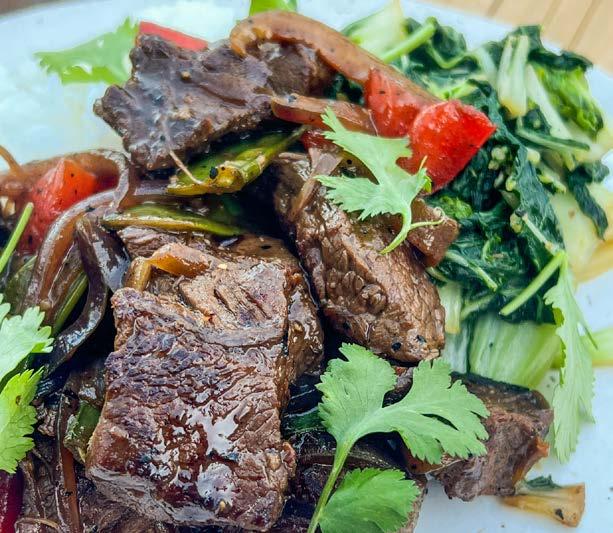
(Yields about 4 portions)
Ingredients:
1 ½ lbs Grilling Steak (trimmed of any large pieces of excess fat and cut into 1 ½” cubes)
Marinade:
1 tsp Garlic, minced
2 Tbsps Brown Sugar
1 tsp Corn Starch
¼ tsp Black Pepper, ground
¼ Cup Oyster Sauce
1 Tbsp Fish Sauce
2 Tbsps Soy Sauce
1 ½ tsp Canola Oil
1 tsp Black Vinegar (or Rice Vinegar)
Other Ingredients:
6 ea Baby Bok Choy, rough chopped
1 Cup Snow Peas, rough chopped or left whole
1 Red Pepper, rough chopped
½ Large Red Onion, rough chopped
METHOD MARINADE:
1. In a large bowl, whisk together all marinade ingredients until the brown sugar and cornstarch are fully dissolved.
2. Add the beef cubes to a large sealable bag or bowl and pour over the marinade. Massage well so every piece is evenly coated.
3. Refrigerate for at least 4 hours, or overnight for deeper flavour and tenderness.
COOKING METHOD:
1. Remove the beef from the marinade, letting the excess drip off. Reserve the marinade.
2. Place a wok (preferred) or large nonstick skillet over high heat and let it get very hot. This dish relies on intense heat.
3. Add 2 tablespoons of neutral oil and swirl to coat the pan. When the oil is shimmering, add half the beef in a single layer. Do not stir.
4. Once the beef hits the pan, shake the wok forward and back using short, confident motions. This tossing action sears the cubes quickly and evenly without piercing or stirring them.
5. As the beef browns, splash in a tablespoon or two of the reserved marinade. Continue shaking the pan so the sauce caramelizes and clings to the meat.
6. When the beef is deeply browned on all sides but still slightly pink inside, transfer it to a bowl. Repeat with the remaining beef.
7. With the pan still hot, add 3–4 tablespoons of water and swirl to loosen the browned bits from the bottom. Pour this flavourful liquid over the resting beef.
8. Add another drizzle of oil to the pan and return it to mediumhigh heat. Add the bok choy, snow peas, red pepper, and red onion. Stirfry for 3–4 minutes, shaking the pan occasionally, until the vegetables are crisptender.
9. Return the beef and any accumulated juices to the wok. Add the remaining marinade and shake everything together until the sauce thickens slightly and the beef is just heated through.
10. Taste and adjust seasoning with a splash of soy sauce if needed.
11. Serve immediately with hot white rice.