live within a habitat or region. It has gained increased attention as an indicator for ecosystem health. Prairie grasslands are critical to maintain biodiversity and provide many other beneficial ecosystem services such as food production, carbon storage, and reduction of soil erosion. They help cycle nutrients, energy and water, and provide a home for various beneficial and endangered species that may naturally control pests and invasive species. Despite the various benefits of grasslands in Canada, they continue to be threatened by human activities including being converted to crop production.
Beef production in Canada relies heavily on extensive and intensive use of agricultural land and affects both native and tame grasslands, impacting the types of landcover and the numerous species that share these spaces. Most of temperate grasslands in the prairies are privately owned, which illustrate the key position that Canadian beef producers have as landowners and stewards in maintaining grasslands and managing biodiversity within their livestock systems.
To better understand how beef production in Canada interacts with plant species within the various landscapes and habitats on the prairies, more information is required. To address this gap in knowledge, Nolan Dyck, a master’s student in the Department of Animal Science under the supervision of Drs. Marcos Cordeiro and Gabriel Ribeiro (University of Saskatchewan), is working on a research project that aims to characterize the impacts of beef cattle production on biodiversity in southern Saskatchewan.
The project, funded by the Saskatchewan Agriculture Development Fund, uses a computer model to map the distribution of over 200 plant species and relate them back to land cover associated with both crop and beef production. While the model outputs are still being analyzed, preliminary results suggest that areas dominated by pasture grasslands used for grazing support biodiversity more effectively than other agricultural land uses. As expected, human activities reduced biodiversity across the province, but areas dominated by pastureland and grazing activity were shown to have fewer negative effects on biodiversity compared to areas where cropping or urban development were prevalent.
These findings highlight the positive role that beef grazing systems play in maintaining habitats for plants and plant biodiversity and may help better illustrate the importance of cattle production for future policy development and conservation. While the research did not extend into Manitoba, it could be expected that these findings are also true for our province. The UM research team is eager to invest in similar work in Manitoba in the future.
Please stay tuned for results and updates on these projects in the upcoming issues of Cattle Country. For more information on these and other UM projects that explore the use of precision agriculture in beef cattle production systems please contact: Marcos. Cordeiro@umanitoba.ca
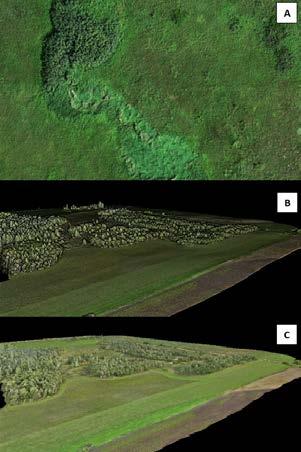
An example of drone images (A,B,C) showing how hyperspectral and LiDAR technology capture grassland vegetation and landscape structure to help estimate forage productivity and yield.
(Photo credit: Maria Luna Mino)
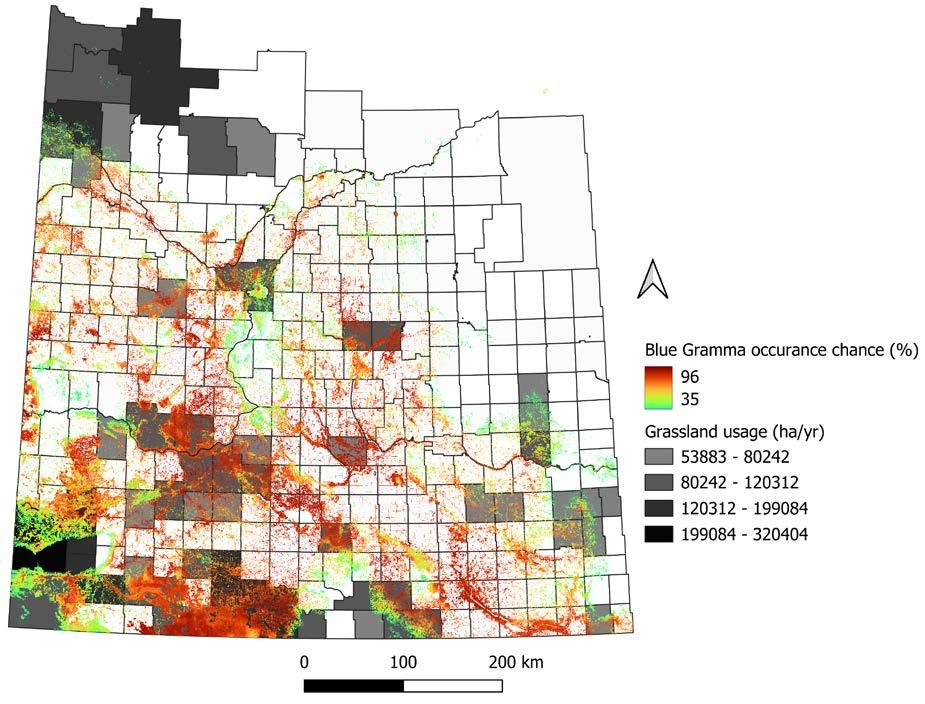
Species distribution map of Blue Grama grass for Saskatchewan. Red areas show a very high chance of the species being present, while
species being present. Darker shaded counties in the background represent areas with high grassland usage. (Photo credit: Nolan Dyck)
• Do not allow the animals to eat too much straw without a protein supplement to help digestion, or compaction will occur.
StockTalk Q&A Feature Brought to you by Manitoba Agriculture
• Use feed testing, and see your Farm Production Advisor or your feed consultant to balance the rations to meet the animals’ requirements.
Sabrina.Kendall@gov.mb.ca
Chaff and Grain
Question: It is looking like my feed supply will be tight this year, so I’m considering using crop residue as feed. Can you tell me more about this?
• Chaff, surplus grain and weed seeds, the most nutritious part of the cereal residue, are a byproduct of harvesting. Equipment is available for most combines that will collect the chaff and place it on top of the straw swath for baling, or it can be blown on to a wagon. Chaff can then be placed in piles on the field for early winter feeding.
Answer: Severe weather events can significantly impact crop production and the feed supply available to livestock. When we are looking to extend the grazing season and keep feed costs low, opportunities exist for cattle producers to work with their crop-growing neighbours to feed cows, salvage poor cash crops, and benefit the land.
Grazing crop residue is one way to do that, commonly on cereal acres, or corn stalks. On the cereal
land, straw, chaff, grain from harvest losses and any subsequent regrowth can all be consumed by cattle. In a corn field, leaves, husks, and unharvested cobs/ lost kernels can be eaten.
A University of Nebraska study found that for every bushel of grain corn harvested, approximately 40 lbs. of residue is left behind on a dry matter basis. If we just consider the readily consumable leaves and husks at 16 lbs./bu, an average yielding corn crop (147 bu/ac) would have 2,352 lbs. of potential feed per acre! This is quite an opportunity to use to your advantage. Alternatively, if a crop was damaged or delayed during
Average Nutritional Value of Cereal Straw and Chaff (Manitoba)
• Supplemental nutrients will be required to balance the ration. known as a populations animals of a needed necessary. frozen. crops. type (fescues mares. balance leaves value. leaves weather. graze ewes. harvest, of
the growing season and not worthwhile harvesting, it could also be grazed or used as greenfeed or silage.
When approached with a proposal to graze the residue in their field, a common concern of crop producers is the loss of nutrients (e.g., nitrogen, phosphorus, potassium) and organic matter when that residue is consumed rather than incorporated into the soil. However, as animals graze, they are returning these nutrients to the land via their manure and urine, leading to an almost net zero change in soil fertility.
The cattle will also consume any grain left on the field from combine losses, as well as weeds, which will reduce volunteer crops and weed pressure in the next growing season. To help producers on both sides of the residue grazing proposal make decisions, the Beef Cattle Research Council has an online calculator for valuing crops as livestock feed and plenty of other resources available via the following QR code.
Infrastructure and management are key factors when considering grazing crop residue. Firstly, a written agreement between the cattle producer and crop producer should be made, outlining details such as price, who is responsible for what, and whose insurance is liable should something happen. A fenceline will need to be established, and portable electric fencing supplies may need to be purchased to employ rotational or strip grazing, which limits the animals’ access to certain portions of the field at a time and controls their intake. A reliable water source will also need to be supplied, as well as access to some form of shelter.
A feed analysis of the crop should be completed to formulate rations so that we can appropriately match the class of cattle to the feed available and supplement them as needed to meet their nutritional requirements (see table below). Once turned out on the residue, the animals need to be carefully monitored for body condition score, how much of the intended feed they are consuming and how they are consuming it, and the condition of the land base to avoid any compaction or degradation. Most importantly, producers should always have a backup plan in place.
Working with your crop-producing neighbours can be a win-win situation benefitting both parties, as well as the cattle, and the land. However, careful management is required with infrastructure, feed testing, and cattle condition being key considerations.
* ADF = Acid detergent fiber, an indication of potential digestibility of the forage ** TDN= Total digestible nutrients, an indication of the potential energy value of a forage
Note: These are average requirements that will vary with stage of pregnancy/ fleshing/lactation, as well as with cold weather.
Bale Grazing
SHOW Field Day & AGM
Share Your Voice
Bale grazing involves harvesting forage as round bales and moving them to winter feeding sites on pasture. Generally, you would select pastures where you can use the manure for crop fertilization. Bale grazing requires some planning in the fall to place the bales where they can be easily accessed by the livestock, and to ensure that excess nutrients are not being applied. See MAFRI's Bale Grazing factsheet for more details.
Grazing Tips
In the next issue of Cattle Country, a Manitoba Agriculture forage or livestock specialist will answer a selected question. Send your questions to Elizabeth.Nernberg@gov.mb.ca.
StockTalk for Cattle Country is brought to you by Manitoba Agriculture. We encourage you to email your questions to our department’s forage and livestock team. We are here to help make your cattle operation successful. Contact us today.
Kristen Bouchard-Teasdale Beausejour Kristen.BouchardTeasdale@gov.mb.ca 431-337-1688
Cindy Jack Portage Cindy.Jack@gov.mb.ca 204-768-0534
Sabrina
• Use bales in a separate feeding area, or as part of a larger pasture that is being swath grazed. They can be used on their own, or as an alternate feed source to swaths or stockpiled pasture when snow is deep or during a snowstorm.
www.mbbeef.ca
A First Look at What the Fall Markets Might Bring
Concerns over drought in Manitoba have all but evaporated in the past month. The cattle producers’ worries about feed have shifted from, “Will we have enough feed?” to “How are we going to get the hay up, deal with flooded out crops and fix the fence lines damaged by the falling trees from the windstorms?”
Access to pastures has been restricted in many areas due to washed out roads. Doing wellness checks and treating foot rot and pink eye has become more difficult. Some producers are even worried about how this wet weather, followed by extreme heat, will affect the breeding programs on the pastures.
At the feedlot level, pens have become swamps. Feeding performance has declined and despite the best effort of the feedlot operators, the cattle are stressed. Buyers are nervous about purchasing and taking deliveries of new inventory from some regions. There has been talk from feedlot operators about adding RCC (rolled compacted concrete) to their pens. Those that have it already installed are reporting considerably fewer problems in the pens. Needless to say, both the cow calf producers and the feedlot operators will have to work through numerous challenges over the next few months.
Demand for fed cattle is stout, despite the packers’ best efforts to drive the prices lower with reduced harvest numbers per week. Canadian feeders saw a top of $6.00 dressed in Alberta for a very short time at the
the wind, especially on the light-weight feeder calves for fall delivery.
During the second week in July the feeder and fed cattle prices on the futures were lower, cash yearling prices were 20 cents per pound higher.
Once again, the question being asked is, “How
is the fall pricing looking and have the prices peaked?”
end of June. Consumers are showing some resistance, but the export market is still solid.
Once again, the question being asked is, “How is the fall pricing looking and have the prices peaked?”
To answer that question we have to watch what is happening south of the border. Basic cow herds are running at 70-year lows. Any rapid expansion is off the table for this year. The United States cattle country is still in drought, and drought is what got us to this point in the cattle cycle to start out with. Combine the current projections with the possibility of no Mexican cattle moving north, and supplies will be short again this year.
In Canada we may be at the end of the contraction section of the cattle cycle. The two main indicators for a turnaround are a reduction in the number of cows going for harvest and lower numbers of heifers on feed and the percentage of heifers in the daily kill. At the end of June, heifer slaughter in Canada was down 8%. There were approximately 10,000 fewer heifers placed on feed in Alberta and Saskatchewan feedlots in the first five months of 2026. Cow slaughter was down 6% for the same time period. Both indicators are signalling that Canada could be ready to turn the corner and start rebuilding. That will not hurt the fall market this year. If producers hold back more heifers, that only shorts the market on feeder cattle for sale.
Another factor that will play an import part in the cattle market this fall will be the exchange rates on Canadian currency. Last year, Canada was a major importer of feeder cattle. This spring they imported 500,000 head, up over 40,000 from the previous year. At the current feeder cattle prices in the USA and the exchange on the dollar, Canadian feedlots’ purchasing power has eroded considerably. That could keep a lot of those imported cattle in the USA this fall. If the big feedlots in Ontario, Alberta and Saskatchewan can’t source cattle from the USA, they will have to go back to their traditional sources for feeder cattle. With that in mind, Manitoba sits in the ideal location.
That brings us to the topic of demand which has more influence on the calf and yearling prices than supply. Demand is what makes the marketplace and across all sectors of the beef industry it has been robust and that is what is keeping our prices strong.
Applications
for The
The cash demand for feeder cattle is good, too. The spread between the futures market and the current cash prices being paid is large. The futures are preaching caution while cash demand shows no fear. Some of the cash cattle being purchased are showing $200 to $300 per head off side the futures markets. The large video auctions in the south selling forward pricing for fall calves are $100 to $120 higher than a year ago for the same calf crops from the same ranches. The American cattle feeders are traditionally sensitive to movements on the futures, but currently they seem to be throwing some caution to
Forward delivery contracts and electronic sales for Canadian calves and yearlings are good with higher prices than last year. Sales in the first week of July established the following prices. Yearling steers for fall delivery are 40 cents per pound higher. Yearling heifers are 30 cents higher. Six hundred-pound steers are approximately 50 cents per pound higher. Heifer calves for fall delivery are 40 cents higher than last year. The cost of feed is the same as last year or lower at this time. Interest rates are steady compared with last year. Fuel is higher and the Canadian currency rate has reduced Canada’s competitiveness to import feeders. All in all, the feeder market looks respectable for this fall. You can still expect some volatility, but a major crash is not predicted.
Environmental Stewardship
Award Due to MBP by December 18, 2026
Manitoba Beef Producers (MBP) is accepting applications until Friday, December 18, 2026 for consideration for the local awarding of The Environmental Stewardship Award (TESA).
Since 1996, TESA has recognized producers who go above and beyond standard industry conservation practices and set positive examples for other cattle producers and the general public. As stewards of a vast portion of the Canadian landscape, Canada’s beef cattle producers play a significant role in protecting and enhancing the environment. They continuously strive to improve existing stewardship conservation practices to create a sustainable future – always farming for tomorrow.
At the local level, a producer receives provincial recognition for their outstanding environmental contributions. In Manitoba, this occurs in conjunction with MBP’s annual general meeting in February. All provincial award recipients then move forward to compete for national recognition from the Canadian Cattle Association (CCA). The national TESA recipient is announced during the CCA’s semi-annual meeting held in mid-summer or early fall.
Each nominee exemplifies significant innovation and attention to a wide range of environmental stewardship aspects in their farm or ranch operation. Such innovations extend beneficially to areas far beyond their land, including water, wildlife and air.
self-nomination, MBP can provide you with guidance and suggestions on completing the application process. The completed application form, along with all supporting documentation (such as letters of support, photos and/or videos), is to be submitted to Manitoba Beef Producers by email to info@mbbeef.ca no later than Friday, December 18, 2026. If you have questions, please contact the MBP office at 204-772-4542.
Dealing With Pasture Foot Rot and Pinkeye
BY: DR. TANYA ANDERSON, DVM
Sometimes you have to be careful what you ask for. Most producers were crying for rain only a few weeks ago and now those in the western and central areas of the province are dealing with devastating floods that have turned many pastures and hayfields into lakes and swamps.
Accessing cattle on pasture to treat for both foot rot and pinkeye can be challenging in a normal year if heavy bush, but darting from a boat brings a new set of challenges. At this time of year, many cattle producers are out hunting… with Remote Delivery Devices
loaded with a low dose long-acting antimicrobial in the quest to treat foot rot and pinkeye. Excess water can result in herd outbreaks. Prevention prior to pasture turnout is the key to success.
Don’t send unsound animals to pasture. Check for muscle asymmetry and hunched backs. Both are common symptoms of underlying lameness. If a foot has a visible issue like excessive toe length, corkscrew claw, other claw deviation, an interdigital fibroma, laminitis rings or sandcracks (vertical or horizontal), consider culling, keeping at home or treating prior to turnout. Remember that simple foot rot always responds to antibiotics. If there is no/little response or
the response is good but lameness then recurs, there is another underlying issue and the animal requires veterinary attention. Unfortunately this year’s wet conditions make getting cattle out of pasture for veterinary treatment near impossible.
Check eyes prior to turnout and again at weaning time in the fall. Cancer eye can mimic pinkeye - talk to your veterinarian to learn how to spot the differences and initiate early treatment of cancer eye. Cows with cancer eye will not respond to pinkeye treatment and many will be unsalvageable after a few months on pasture. Fly strike can also complicate cancer eye cases and becomes a serious animal welfare concern.
Hoof-trimming maintenance of herd sires and management of individual cows to allow them to raise their calf prior to possibly culling in the fall should be done from both an economic and animal welfare management aspect. Feeding programs - especially those on higher grain rations or those that vary in type/quality as the seasons change can be hard on feet. Mineral inadequacies, especially of copper, zinc and iodine can predispose to both foot rot and pinkeye. Vitamin A is also critically important for pinkeye
Herds in wet areas can expect an increased number of pinkeye and foot rot cases. While standing in water is a natural defense for relief from fly bites, it also creates an opportunity for the soft tissue between the toes to get soft and make it more prone to foot rot and mechanical damage. Cattle bunched together also allows face flies feeding on eye secretions to easily transfer pinkeye bacteria between cattle.
It is generally accepted that 100 flies per side or 200 flies total per beef cow is the point where it decreased weaning weight will cause economic losses. Various control methods exist - fly tags, pour-on, spot-on and spray-on insecticides, dust bags, ropes filled with oil and insecticide, oilers, rubbers, misters
Garlic and IGR (Insect Growth Regulators) in mineral are also effective against flies though they must be started at least a month prior to the fly season. Use a mineral specially formulated to enhance foot health and consider having it medicated with chlortetracycline for the prevention of foot rot. But remember that it must be accessible to cattle - a challenge in a flood situation where cattle no longer need to come to the usual water sources where mineral feeder stations are kept. Providing multiple stations throughout the field can help ensure cattle access salt and mineral especially as the demand increases under
Which control options would be most suitable varies depending on pasture conditions, bush cover and types of cattle - yearlings versus cow/calf pairs. Don’t hesitate to reach out to your veterinarian for advice on best control options for your individual situation. Your local vet can also provide information on Remote Delivery Devices and drug uses. Hopefully the grazing season doesn’t requires too much “hunting”.
GPS Tags Provides More Than Just Location
MBFI Assessing Data-rich Systems for Producers
BY MARY-JANE ORR, MBFI GENERAL MANAGER
It’s the call that no cattle producer wants to get. “Hey,” says the neighbor, “I think your cows are out.” Fortunately, a tech tool can keep constant track of your herd while also providing valuable information on the individual animals.
GPS tracking has been commercially available for two decades but the last few years have brought important advancements: cheaper pricing; lightweight, solar-powered tags; near real-time tracking; and a wealth of animal behavior data instantly accessible via your smartphone.
This summer on several pastures Manitoba Beef & Forage Initiatives (MBFI) is evaluating the very latest in GPS tags. We are assessing the claims that the technology offers massive benefits for remotely monitoring herd location, health status and reproductive heat cycles while also saving cattle farmers time with routine herd checks or finding that missing bull during breeding season.
Our interest in GPS tracking began when MBFI was launched in 2015. The best option when we started investing in the technology was the Lotek LiteTrack collar. Costing as much as $1,800 each in 2020, we installed the collars before the herd was turned out for summer grazing. Battery powered and light-weight, each Lotek collar was programmed to our specifications and logged its location until manually turned off. In-season data could be collected by visiting the herd and, while in close proximity, downloading the data to a hand-held receiver. Tracking data was used in several research studies including an evaluation of grazing behavior on annual and perennial forage varieties for stockpile and management techniques for improving marginal pastures.
Showcasing the academic merit of GPS tracking herd movements, Dr. Kateryn Rochon from the University of Manitoba led an important study assessing the relationship between the abundance of ticks in pastures and on cattle, linking tick species diversity, ecology and the potential of those ticks to transmit disease. We supplied the Lotek collars deployed on three herds in western Manitoba. The data documented where the cattle spent time on the pastures, helping provide a link between ticks found on pasture and ticks pulled from individual cows. A podcast about her findings is available at https://www.mbfi.ca/tick-distribution-abundance Learn more about other studies with the Lotek collars at https://www.mbfi.ca/ gps-collars.
With the technological limitations back then, we hoped the rechargeable collar battery would power the unit as long as needed. We hoped the collar was actually logging the data, to be manually downloaded in the fall. These hopes were not always met, leading to gaps when raw data was reviewed following the grazing season. Things got better in the early 2020s when the CERES TAG became available in Canada.
Developed in Australia, the CERES TAG is solar-powered and transmits data direct-to-satellite. It’s also an ear tag instead of a bulky collar. Not only can you establish a geo-fence and receive immediate alerts on your phone or computer when cattle stray, you can receive a wealth of near real-time information on your herd’s health and even fertility. These tags were tested on nine farms from 2021-2023 as part of the Livestock Predation Prevention Pilot Project. A multidisciplinary committee led the project and a detailed report can be found on the Manitoba Beef Producers website.
CERES availability in Canada really kicked down the door for livestock monitoring, herd tracking and animal health, triggering a surge of similar units from other makers. And following feedback from producers, MBFI is evaluating emerging technologies in real-world settings to verify both product claims and the business case for producers.
Smart Paddock and 701x GPS ear tags are being tested on MBFI pastures and collaborating producer sites this summer. Each product is expected to provide similar live GPS remote monitoring. However, each has trade-offs in tag design, connectivity, management software and price including purchase costs and ongoing subscription fees.
Another product from Australia, Smart Paddock is based around the Bluebell GPS SmartTag which, in the spring of 2026, cost around $70 per unit. The tags are streamlined but require a gateway tower – at additional cost – to communicate to the internet covering the area where the cattle will be grazing. The system dashboard looks like a video game, graphically illustrating your animals on your land and offering status updates, health alerts and suggested action items. While the cost of the tags is more affordable than 701x, a paid annual subscription is required to access the data. We are evaluating this system at MBFI’s Johnson Farm with our yearling heifers.
The second system under review is the 701x Autonomous Rancher. A North Dakota product, it just became available in Canada in February 2026. The company similarly states that the system provides GPS tracking, activity and health insights such as out-of-fence text alerts, pasture utilization heat maps, bull mounting data and reproductive alerts. Also based around a solar-powered ear tag, the 701x does not require a gateway tower and provides a different tag design for cows and calves allowing for more herd coverage.
The XTPro is larger, requiring two tag pins, is designed for cows or bulls and has the capacity to communicate directly through either cellular or satellite. This tag costs about $175 per unit and you need to purchase a specialized tag applicator. A smaller tag – the XTLite – is designed for calves and costs about $20 per unit. While the XTtLite does not offload data directly to a satellite, it can offload to a nearby XTPro tag which can then upload to satellite. Or you can load tag data directly into your phone via Bluetooth, provided you are within range.
We have the 701x system up-and-running at two locations. Waggle Spring Ranch near Douglas is a great example of low productivity, expansive pastureland with sandy soil challenged by bush encroachment and leafy spurge. Meantime,
McCrae Land & Livestock has the tags on cows and calves on rented pasture that’s almost an hour drive from their base and a high risk should the cattle get out.
In these trials, MBFI is asking a simple question: does this technology make business sense for a producer? Obviously, that will largely depend on your individual operation. Potentially, remote monitoring has great applications for producers managing large landscapes or the cattle farmer finding value in grazing patterns and health alerts that have never been readily available in a scalable and easily-accessible form.
Our capacity at MBFI to evaluate emerging technologies is made possible through strategic grant funding provided by the Sustainable Canadian Agricultural Partnership. We’ll be sharing our field testing outcomes this fall at Manitoba Beef Producers regional meetings and also through the MBFI’s Beef and Forage Roundup podcast.
For now, we can say a tool exists to make short work of finding that bull in the bush or letting you know exactly where cows have been and exactly where they are... before the neighbor calls!
MBFI Research Technician Lauren McKee installing 701x tags at Waggle Springs Ranch (photo credit: MBFI)
XTPRO tag from 701x installed (photo credit: MBFI)
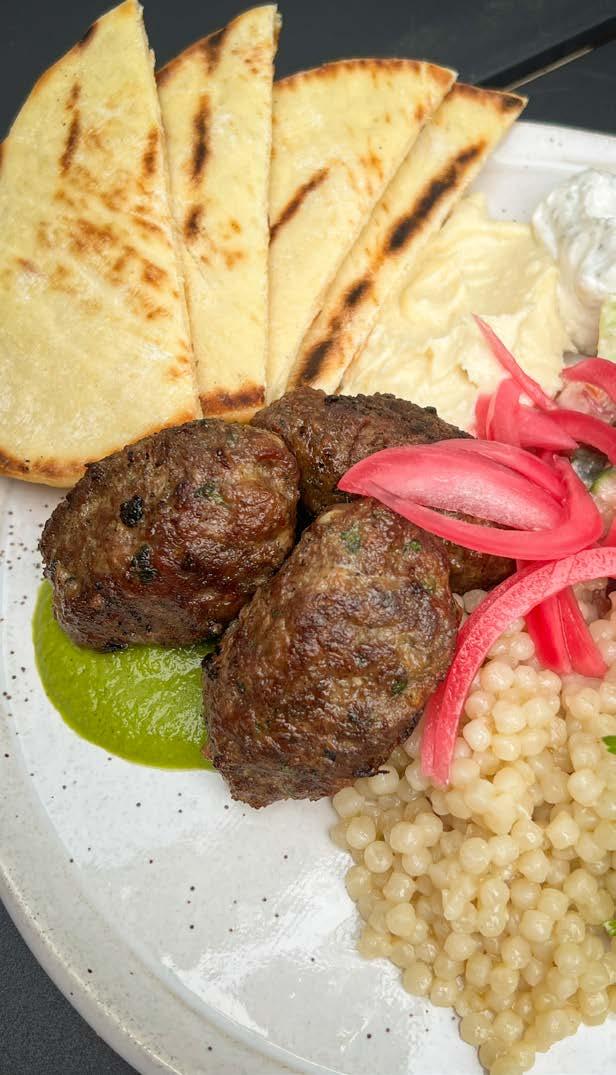
Kofta Kebabs: The Weeknight Dinner That Knows How to Dress Up
BY: ANNA HYMERS
I’ve made these Kofta Kebabs more times than I can count, and somehow, I’m still not tired of them. In fact, I’m ashamed it’s taken me over four years to publish this recipe for you. That alone should tell you something. They’re savoury, warmly spiced, deeply flavourful, and just easy enough to switch things up a bit without having to completely revamp your pantry.
One thing I love most about cooking is how flexible it can be. This dish can be quick and casual, or it can become the centrepiece of a beautiful, build-yourown-style dinner. Short on time? Pick up some naan from the bakery section, grab a container of hummus, toss together a chopped Greek salad, and you’re well on your way. Add the kofta, and dinner can be on the table in under an hour, which is exactly the kind of kitchen math I support.
If you want to make more of an occasion of it, these kebabs are equally happy sharing the table with buttery lemon couscous, fattoush or tabbouleh, grilled vegetables, pickles, warm Middle Eastern-style breads, and a few generous spreads. They’re perfect for the kind of meal where everyone builds their own plate and every bite tastes a little different. It’s interactive, relaxed, and far less chaotic than a taco bar—though I say that with deep respect for tacos.
These kebabs also play very well with a good sauce. The tzatziki from the Beef Souvlaki recipe in the August 2024 issue of Cattle Country would be a natural fit here, adding that cool, creamy balance to the warm Levantine spices. If you’re after something brighter and a little more assertive, the Zhoug from the August 2023 issue brings an herby, spicy lift that cuts through the richness beautifully.
More than anything, though, this dish has a special place in my kitchen because it was the first meal I cooked for my partner on our second date. I was absolutely trying to impress her—and thankfully, the kofta did most of the heavy lifting. Since then, these kofta kebabs have become a go-to in our home and a reliable favourite with friends and family. They’re approachable, flavour-packed, and quietly impressive, the dinner-party equivalent of showing up well dressed without looking like you tried too hard. Enjoy!
1. In a small bowl, whisk together all dried spices until well combined.
2. In the bowl of a stand mixer fitted with paddle attachment, mix together the spice blend, chopped parsley, onion, garlic, egg and panko on medium speed until well combined, about 1 minute. Scrape sides as needed.
3. Add ground beef and continue to mix for another 1-2 minutes until well combined and starting to stick to sides of bowl.
4. Portion mixture into 10-12 balls, and shape into football shapes, tapered at the edges.
5. Cover and refrigerate for at least 30 minutes then skewer through the middle with metal or wooden skewers (skewers are optional).
6. Cook for about 8-10 minutes on a hot BBQ, in a hot cast iron pan, or oven set to 425F until internal temperature reads 165F.
7. Serve with your favourite naan bread or pita, with middle eastern spreads such as tzatziki, tahini or hummus and fresh chopped herbs and vegetables.