A Cow Patty is More Than Just Dung
BY: ANGELA LOVELL
When you see a cow patty in a field, it’s more than just dung; it’s actually home to a community of organisms that are interacting to help break the dung down and return nutrients back to the soil to promote the growth of new forage.
Now producers can learn more about these insect communities thanks to a new guide compiled by Dr. Kevin Floate, an Agriculture & Agri-Food Canada (AAFC) scientist who has spent the past 30 years researching this unique community of insect species.
Cow patty critters: An introduction to the ecology, biology and identification of insects in cattle dung on Canadian pastures is the first comprehensive but easyto-read guide to dung insects in Canada. It contains more than 200 images and is a resource that cattle producers can use to understand the diversity of insects and the variety of activities they carry out in dung.
The guide includes tools and instructions for

producers about how to identify dung insects such as flies, beetles, wasps and mites and describes the biology for different members of these four groups in plain language.
Ultimately, Dr. Floate’s hope is that having this reference freely available to the public will spur further research and interest from farmers, ranchers and students on this important and practical topic. Although specific to Canada, the guide can be used throughout North America and in Europe, where many of the dung insects now in North America originated. Should we care about these dung insects?
Yes, you should, says Floate, because undegraded dung has a cost associated with it.
“The most direct cost is that it’s reducing the amount of grazing surface available in the pasture. So, if dung didn’t break down at all that surface area is lost from future production,” he says.
Nutrients leaching out of a fresh cow pie also overfertilize the immediate area around it producing a green halo effect. That enriched forage is unpalatable for cattle
who avoid grazing it, further reducing the grazing area in the pasture.
Valuable allies
Arguably one of the most valuable services these beneficial insects in dung provide is in helping to reduce populations of pests such as face flies, stable flies, and horn flies.
“These three pest species all breed in cattle dung, but by virtue of the beneficial insects that are working collectively to break that cow patty down and scatter it, it reduces the suitability of the patty as a breeding site for the pest flies,” Floate says. “We have a free army of labour helping us reduce populations of pest flies.”
For ranchers, land managers, naturalists or conservationists dung insects are valuable allies. They provide ecosystem services such as pollinating plants and being a food resource for small mammals, birds and bats, and besides returning nutrients to the soil, these insects can aerate soil, improve water drainage and disperse the seeds of native plants.
page 8
www.mbbeef.ca PUBLISHED BY MANITOBA BEEF PRODUCERS AUGUST 2023 POSTMASTER PLEASE R ET URN UNDELIVERABLE C OPIE S TO MB P, UNI T 220, 530 CENTU RY S TREE T, W NNIPE G, M B R3H 0Y4 CANADIAN PUBLIC AT IONS MAIL P RODU CT SAL ES AG REEMEN T NUMBE R 40005187 P OS TA GE P AID IN W INNIPE G.
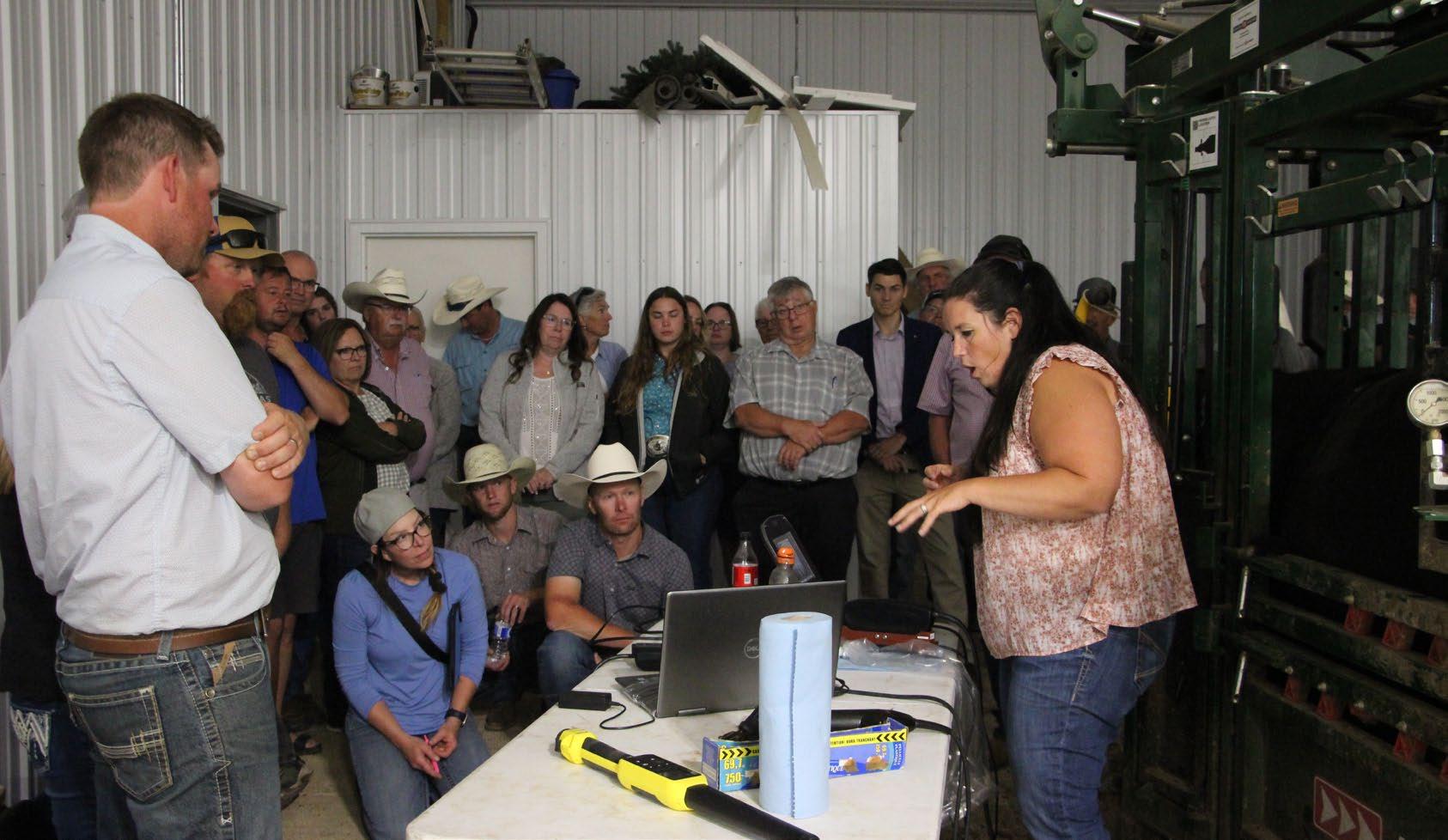
It was a full house on July 11 for the MBP Producer Knowledge & Outreach Session as technician Jamie Jensen lead a hands-on ultrasound demonstration and discussion. Results of the demo will be available in an upcoming edition of Cattle Country. (Photo credit: Mary Paziuk)
Sign up for e-Statements and enter to WIN1 of 3 e-Bikes! Sign up for e-Statements through online banking. The deadline to enter is August 31, 2023. Must be a Sunrise Credit Union member to enter. Free membership until October 19, 2023! Winners will be contacted on September 1, 2023. e-Bikes valued at $3,000, provided by Stream ‘n’ Wood. Visit sunrisecu.mb.ca for more information. SINCE 1998
How Well Positioned Are We as Cattle Producers?
How well positioned are we as cattle producers?
That is a provocative question I’ve been asking myself lately owing to the recent consolidation within the purchasers and processors of grains, so let’s examine the advantages and disadvantages of this trend and apply it to the cattle world and how producers may find themselves positioned going forward.

I know some folks might argue that there is no advantage to seeing larger scale processors for cattle, however, that is not always the case. Aside from the usual cost savings associated with operating on a bigger scale, the larger processing facilities are far better positioned to market every cut to its maximum value, often being able to add close to $100 per head. On the flip side, this does put us at the mercy of having fewer large-scale buyers for our product.
However, I feel a big advantage for our livestock industry and one that we should work hard to maintain is that, unlike much of the cash crop sector, we maintain independence in the product we grow. We aren’t required to buy a trademarked seed or seedstock to
MATTHEW ATKINSON President’s Column
produce a calf. This is becoming a more unique situation all the time and one we should strive to maintain. If we can freely purchase cows and bulls, with only a goal of a more efficient herd or a better calf crop, and not being required to pay a product license fee to do so, we are in a much stronger position. I, for one, am proud of this independence and think it is key to our profitability going forward.
Looking ahead to this fall with good projections for calf sale prices, seeing a high demand for beef and competitive price predictions in the longer-term, it makes me think of how best to capitalize on this. By necessity we have all spent the past several years learning how to do things on tighter margins and with more affordable
and efficient feeding methods due to pricing and weather-related challenges owing to drought, to floods, and storms.
So, based on these experiences along with innovations and herd management decisions, I would hazard a guess that most producers are more efficient on a perhead basis. Now, seeing some fair prices for cattle and hopefully some rain leading to not-too-expensive feed costs, it is time to maintain these efficiencies to have as profitable a herd as possible.

Unfortunately, as cattle producers, when we see higher prices for calves, we tend to see the quality of cattle herds decreasing. Those less profitable cows, whether the ones that are never quite toeing the line or getting a little long in the tooth, are still in the profit column as opposed to costing us money. However, it’s important to remember all those hard-learned lessons, maintain that quality and efficiency and therefore, be as profitable as we can be.
What do you think? Drop me a note via info@ mbbeef.ca and share your thoughts.
DISTRIC T 1 ALFRED EPP
Boissevain-Morton, Brenda-Waskada, Grassland, Deloraine-Winchester, and Two Borders
DISTRIC T 2
NANCY HOWATT
Argyle, Cartwright-Roblin, KillarneyTurtle Mountain, Lorne, Louise, Pembina, and Prairie Lakes
DISTRIC T 3
ANDRE STEPPLER
Cartier, Du erin, Grey, MacDonald, Portage la Prairie, Rhineland, Roland, Stanley, Thompson, Montcalm, Morris, and Ritchot
DISTRIC T 4
BYRON FALK De Salaberry, Emerson-Franklin, Hanover, La Broquerie, Piney and Stuartburn, Montcalm, Morris, Ritchot, Spring eld, Ste. Anne, Taché, R.M. of Piney and Reynolds
DISTRIC T 5 STEVEN MANNS
Cornwallis, Elton, Norfolk-Treherne, North Norfolk, Oakland-Wawanesa, Glenboro-South Cypress, and Victoria
DISTRIC T 6
VACANT
Pipestone, Riverdale, Sifton, Souris-Glenwood, Wallace-Woodworth, and Whitehead
DISTRIC T 7
T YLER FULTON PAST PRESIDENT
Ellice-Archie, Hamiota, Prairie-View, Riding Mountain West, Rossburn, Russell-Binscarth, and Yellowhead
DISTRIC T 8
MATTHEW ATKINSON
Clanwilliam-Erickson, Glenella-Lansdowne, Harrison-Park, Minto-Odanah, Oakview, North Cypress-Langford, Rosedale, and West Lake-Gladstone
DISTRIC T 13
DISTRIC T 9 TREVOR SUND Alexander, Brokenhead, East St. Paul, Lac Du Bonnet, Rockwood, Rosser, St. Andrews, St. Clements, St. Francois Xavier, West St. Paul, Whitemouth, Woodlands, LGD
MARY PAZIUK Dauphin, Ethelbert, Gilbert Plains, Grandview, Roblin and Mossey River
2 CATTLE COUNTRY August 2023
www.mbbeef.ca
COMMUNICATIONS AND MARKETING LEAD David Hultin RESEARCH AND EXTENSION SPECIALIST Melissa Atchison D ES IGNE D B Y Print Studio One C AT T L E CO U N TR Y E D I TO R David Hultin LIVESTOCK PREDATION PRE VENTION PROJEC T COORDINATOR Ray Bittner O F FIC E A SS I S TA N T Jennifer Patryluk FINANC E Deb Walger DISTRIC T 14 DALE
Minitonas-Bowsman, Mountain, and Swan Valley West MA NI TOB A BE E F PROD U C E R S Ph: 1-800-772-0458 Un i t 220, 530 Ce n t u r y S t ree t Wi nn ipe g, MB R 3H 0Y 4 PH - (204) 772-4542 FX - (204) 774-3264 info@mbbeef ca www.mbbeef ca Carson Callum GEN E RA L M AN AG E R
CAZAKOFF
DISTRIC T 10 MIKE DUGUID SECRETARY
DISTRIC T 11 ARVID NOTT VEIT
DISTRIC T 12 MARK GOOD TREASURER Alonsa, Lakeshore, McCreary,
Ste. Rose Maureen Cousins POLI C Y AN A LY S T
of Pinawa, Reynolds, Spring eld, Ste. Anne, and Taché
Armstrong,
Bifrost-Riverton, Fisher, and Gimli
Coldwell, Grahamdale, St. Laurent, and West Interlake
and
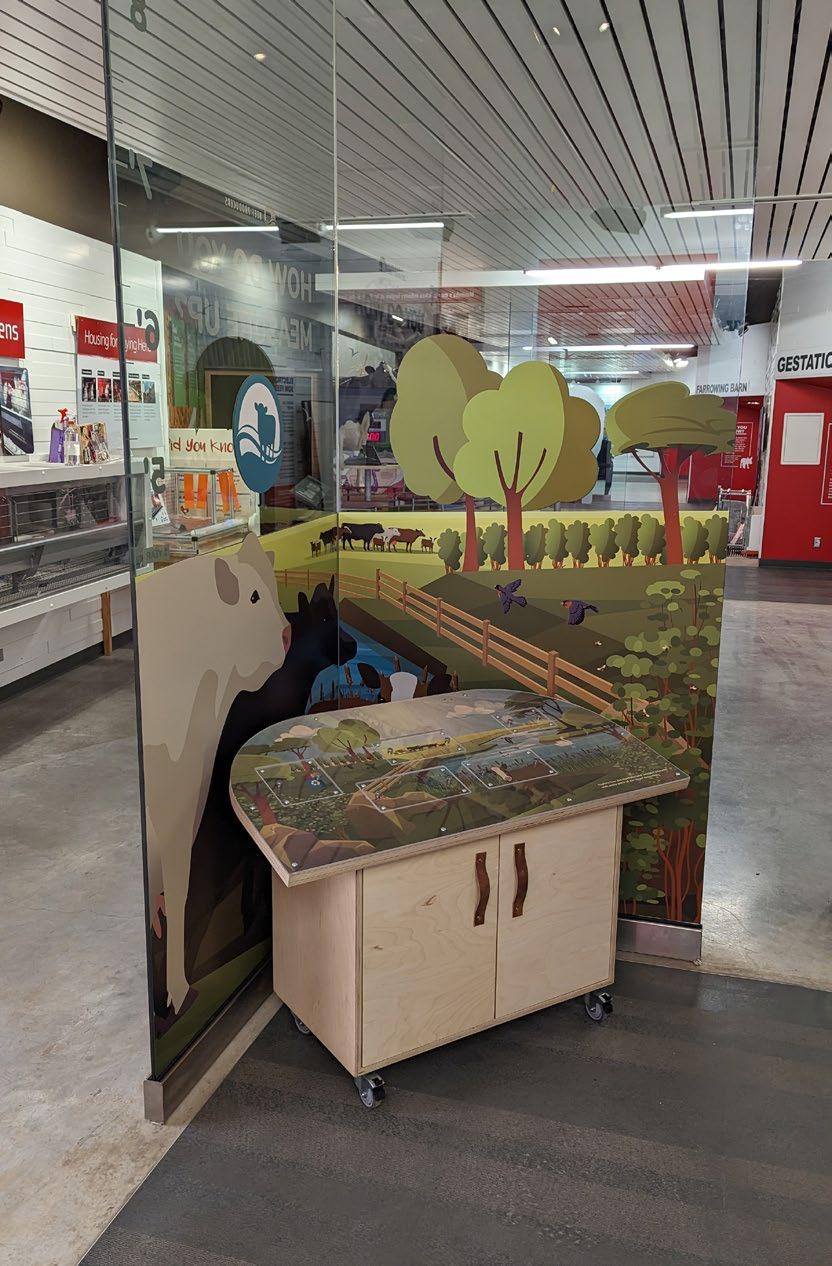
The University of Manitoba’s Bruce D. Campbell Farm and Food Discovery Centre is a hands-on interpretive centre that allows visitors of all ages to explore the ways food is grown, raised, and made in Canada. Manitoba Beef Producers worked with Print Studio One + 36North Marketing to refresh our exhibit space by designing and building a new interactive display table and installing wall and floor graphics, allowing viewers to learn how the Manitoba beef industry interacts with the many parts of our larger ecosystem. (Photo credit: David Hultin/MBP)
A Busy Summer of Advocacy Work
Another year, and another interesting summer. This year, spotty rains in Manitoba have led to variable growing conditions. Unlike 2021, where things were consistently dry across the west, many areas of the province have received either too little, just enough, or too much moisture. Some districts are in really good shape, while others are drier than normal. I am hoping producers are still able to get decent winter feed put up this summer. Price outlook is also very positive, so optimism in the sector is very evident.
There are many important files that remain a priority for Manitoba Beef Producers’ board and staff. There was a recent consultation period on proposed changes to the Agricultural Crown Lands Leases and Permits Regulation and some of the proposed changes offer positive steps forward. I hope many producers got the opportunity to put forward comments to the regulatory portal to help inform these changes or any future ones moving forward. MBP participated in this process.

Predation is also an ongoing concern on which MBP advocates with government to find avenues to support affected producers. MBP is in the final months of its pilot project looking at on-farm risk mitigation strategies to help reduce negative livestock/predator interactions. We look forward to using this information to support future efforts and to inform discussions with government, such as the need for a rapid response unit to deal with problem predators causing multiple losses on farms and ranches.
Another key area of focus for MBP and the cattle sector in Canada is the importance of a robust traceabil-
 CARSON CALLUM General Manager’s Column

ity system with simple reporting methods for producers. The CFIA recently conducted a consultation on new reporting criteria for animal movement for industry moving forward to allow for swift trace-outs of diseases as they arise. The beef industry was clear in its response to CFIA that without a simple method for producers to report this animal movement into the proper source, it will be difficult to comply with the requirements. The beef industry needs financial support to utilize new technologies so as not to increase the administrative burden at the farm level.
I believe there is a lot of benefit here if we as a sector understand the need for simple and swift reporting for animal disease monitoring, but also understand the potential secondary benefits of technology-based movement reporting. These secondary benefits could include things like carcass data being transferred back to the cow/calf producer. It could also be utilized in livestock inspection to help reduce fraudulent activity or theft. I look forward to continuing to investigate technologies that could help with this effort and all the side benefits of a robust tracking system. I would encourage producers to begin investigating RFID tag reader options as an important step and to explore whether you might be
eligible for funding for readers through the Sustainable Canadian Agricultural Partnership’s Food Safety and Traceability Stream.

I want to thank everyone who attended our second summer producer outreach session at Steppler Farms on July 11th. This was a great informal event with greetings from Agriculture Minister Derek Johnson, an ultrasound cattle judging contest, and a great meal. Thanks to Andre and Katie Steppler for letting us host at their beautiful sales barn and to the Miami Variety for the wonderful beef on a bun meal. I look forward to hosting these summer events around the province in upcoming years.
As a reminder, we have district meetings coming up this fall for our even-numbered districts where director elections are required. I really hope the timing works for you to come out and hear what MBP has been up to over the last year, get a chance to converse with your peers, and share a meal. You will notice that we have included a tentative meeting schedule in this edition of the newspaper to help you make plans for October and November. Please be sure to check the September edition of Cattle Country, our e-newsletter, and the MBP social media channels for any updates to the dates and locations. We will also hold a virtual district meeting to provide updates.
Before we know it, it will be fall. I hope harvest season goes starts off well. I also hope that the market fundamentals continue to support strong prices this fall.
All the best.
Carson
3 CATTLE COUNTRY August 2023 www.mbbeef.ca
Did you know? MBP distributes a free, Subscribe Today! mbbeef.ca/news/ Half-page and full-page advertising opportunities also available. Contact Jennifer for more information. 1-800-772-0458 1-800-990-1390 Fisher Branch, MB PAUL GREGORY P.Ag JAMIE PACKULAK B.Sc. Agriculture, Agronomy PRODUCTION | MARKETING | RESEARCH & DEVELOPMENT Pasture and Hay Blends | Custom Blending Delivery Available Producing high quality seeds to the most demanding specifications in the industry. Grasses | Legumes | Native Species Unparalleled expertise in the production of alfalfa seed. For information and events check out the MAA website! www cdnangus ca/manitoba-angus-association/ P: 1-888-622-6487 E: mandi mbangus@gmail com Manitoba Angus Association 2 0 2 3 N A T I O N A L A N G U S S H O W A G E X B R A N D O N , M B O C T O B E R 2 6 T H , 2 0 2 3 J A C K H A R T M E M O R I A L F O U N D A T I O N F E M A L E A W A R D S E P T E M B E R 1 S T , 2 0 2 3 A P P L I C A T I O N D E A D L I N E - V I S I T T H E W E S B I T E F O R M O R E I N F O R M A T I O N O N H O W T O A P P L Y 3 5 T H A N N U A L K E Y S T O N E K L A S S I C R E D & B L A C K A N G U S S A L E C A N A D A R O O M B R A N D O N , M B D E C E M B E R 5 T H , 2 0 2 3
Canada and Manitoba Invest $2 Million to Enhance Capacity of Rural Veterinary Services Districts
(June 22, 2023 Joint Federal/Provincial Government News Release) The governments of Canada and Manitoba are investing $2 million through the new Sustainable Canadian Agricultural Partnership to enhance the capacity of rural veterinary services districts throughout Manitoba, federal Agriculture and AgriFood Minister Marie-Claude Bibeau and Manitoba Agriculture Minister Derek Johnson announced.
Each district will be eligible to receive up to $75,000 toward the purchase of large-animal veterinary equipment, which will allow them to offer expanded services in their district, noted the ministers. The funding will assist clinics in modernizing their equipment, which may support the recruitment and retention of veterinarians in rural areas. The investment promotes overall animal health and welfare, supports a resilient food chain, and helps ensure Manitoba is well-prepared for animal disease emergencies, added Johnson.
The ministers noted this investment builds on other recent initiatives implemented to expand the province’s animal health-care capacity to support the ongoing success of the agricultural sector. In 2022, the Manitoba government expanded its training agreement with the Western College of Veterinary Medicine to address the critical need for veterinarians and invested in a modernized animal health laboratory information management system to strengthen the provincial animal disease surveillance program.
“Canadian producers and ranchers take animal care very seriously. This investment will allow rural veterinarians access to essential modern equipment so they can provide timely animal health care.”
— The Honourable Marie-Claude Bibeau, Minister of Agriculture and Agri-Food
“Manitoba’s veterinary services districts provide essential veterinary services in 26 rural locations and account for over 80 per cent of the Manitoba clinics providing large-animal hospital services. Investing in large-animal veterinary services is vital to the continued resiliency and sustainability of Manitoba’s livestock sector.”
—Manitoba Agriculture Minister Derek Johnson
“Manitoba’s beef producers certainly value the essential services provided at the veterinary services district sites throughout the province. Government investments in large animal veterinary equipment are key components in supporting veterinary staff as they provide quality care for beef cattle. This is an important initiative.”
— Matthew Atkinson, president, Manitoba Beef Producers
Quick Fact
The Sustainable Canadian Agricultural Partnership is a five-year, $3.5-billion investment by Canada’s federal, provincial and territorial governments that supports Canada’s agri-food and agri-products sectors. This includes $1 billion in federal programs and activities and a $2.5-billion commitment that is cost-shared 60 per cent federally and 40 per cent provincially/ territorially for programs that are designed and delivered by provinces and territories.
4 CATTLE COUNTRY August 2023 www.mbbeef.ca
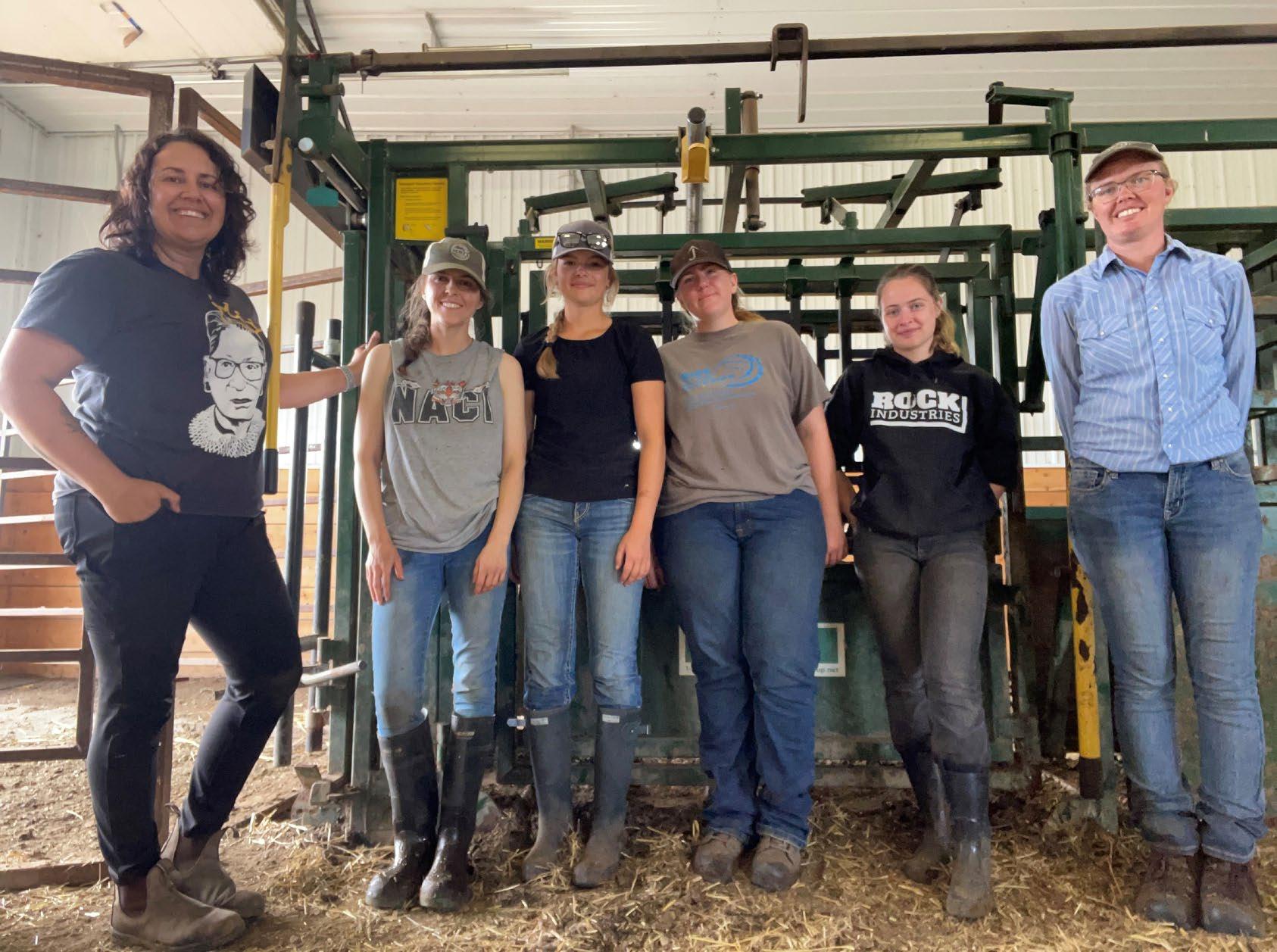
Manitoba Beef Producers’ Research & Extension Specialist, Melissa Atchison, was at the Manitoba Beef and Forage Initiatives (MBFI) Johnson farm site in June for a demo/proof of concept project on implanting suckling calves where she was joined by MBFI Research Technician Leah Rodvang (far right). Stay tuned this fall for results and a hands-on workshop. (Photo credit: MBFI)
New Funding Available for Manitoba Agriculture Producers and Processors to Support Sustainability Initiatives and Food Safety Improvements
(June 22, 2023 Joint Federal/Provincial Government News Release) The governments of Canada and Manitoba are providing funding under the Sustainable Canadian Agricultural Partnership (Sustainable CAP) to support Manitoba producers and processors in the areas of environmental sustainability and food safety and traceability, federal Agriculture and AgriFood Minister Marie-Claude Bibeau and Manitoba Agriculture Minister Derek Johnson announced.
Food Safety and Traceability Program
The Food Safety and Traceability Program provides funding to assist the agri-food and agri-product sectors to adopt or improve food safety and traceability practices. Both food safety and traceability are important not only for public safety, but also a requirement for many customers, associations and regulators.
The Food Safety and Traceability Program will provide up to 60 per cent of eligible expenses, up to a maximum of $30,000 for food safety initiatives and up to 50 per cent of eligible expenses, up to a maximum of $30,000 for traceability initiatives.
Examples of eligible expenses include:
• developing and implementing preventative food safety programs;
• purchasing food safety and traceability-related equipment; and


• consultant fees and training costs.
Food safety and traceability are critical in food processing and distribution to protect consumer safety and markets. It is important that food and ingredients are able to be quickly traced back to the source to prevent or reduce harm to the public, Johnson noted.
RFID Readers an Eligible Expense
Note: Primary producers are eligible only for the traceability portion of the Pre-Approved Food Safety & Traceability Equipment Rebate Program). Eligible expenses include Radio-frequency identification (RFID) readerd (panel or wand), as well as lot code or tag printers, bar code scanners, and Provincial Sales Tax (PST).
Sustainable Agri-Processing Program
The Sustainable Agri-Processing Program (SAP) offers grant funding toward private companies’ sustainability initiatives. Funding is available in the following areas:




















• The Building Envelope, Lighting and Ventilation



Upgrades stream helps applicants assess and upgrade agri-food and agri-product facilities and equipment to create energy savings and greenhouse gas reductions to contribute to Manitoba’s GHG emission reduction goals. Funding is available for up to 50 per cent of the project cost, up to a maximum of $25,000 per project.
• The Input Use Efficiency stream aims to reduce agri-food and agri-product wastage during harvest, storage of crops and ingredients and processing by providing funding towards the purchase of assets and systems that will mitigate wastage. Funding is available for up to 50 per cent of the project cost, up to a maximum of $50,000 per project.
• The Water Use Efficiency stream provides funding for projects that help reduce the amount of water used by agri-processors in production and sanitation processes, treatment of wastewater prior to being disposed or returned to the municipal system or to the recovery of nutrients
“Today’s announcement will support Manitoba producers and processors in their efforts to deliver a safe and reliable food supply while adapting themselves to climate change. Reducing waste, becoming more efficient with water usage, and finding innovative ways to create a more sustainable food system all strengthen the competitiveness of the sector.”
— The Honourable Marie-Claude Bibeau, Minister of Agriculture and Agri-Food
“Our government continues to support Manitoba producers in assessing and improving their operations to address growing consumer and ecological demands for sustainably produced food. Our government is proud to offer programming that emphasizes sustainability and that leverages traceability as an effective tool to prevent and respond to animal health or food emergencies, making Manitoba food products more competitive on a global scale. Manitoba has one of the safest supplies of food in the world, and must continue to evolve and innovate to keep up with current safety requirements.”
— Manitoba Agriculture Minister Derek Johnson
from wastewater. This funding aligns with the Manitoba government’s Water Management Strategy , which guides future actions, decisions and investments to protect the province’s water resources and ecosystems while sustainably growing the economy and communities. Funding is available for up to 50 per cent of the project cost, up to a maximum of $250,000 per project.
• The Waste Use Efficiency stream supports projects that help reduce or divert agri-processing waste products, byproducts or coproducts. Funding is available for up to 50 per cent of the project cost, up to a maximum of $250,000 per project.
Quick Facts
• Eligible applicants for the Sustainable AgriProcessing Program include primary producers, agri-food processors, agri-product processors, licensed commercial kitchens, Indigenous communities, groups and governments, food and ingredient wholesalers and abattoirs.
• Eligible applicants for the Food Safety and Traceability Program include agri-food processors, agri-product processors, licensed commercial kitchens, food warehouse distributors and Indigenous communities, groups and governments.
• The Sustainable Canadian Agricultural Partnership is a five-year, $3.5-billion investment by Canada’s federal, provincial and territorial governments that supports Canada’s agri-food and agri-products sectors. This includes $1 billion in federal programs and activities and a $2.5-billion commitment that is cost-shared 60 per cent federally and 40 per cent provincially/territorially for programs that are designed and delivered by provinces and territories. For complete program details, including eligibility requirements and application deadlines, go to: https://www.gov.mb.ca/scap/index.html

5 CATTLE COUNTRY August 2023 www.mbbeef.ca
Manitoba Beef Producers
ManitobaBeef
@ManitobaBeef
MBFI Welcomes Brandon Youth for a Day of Discovery
BY: DR. MARY-JANE ORR, MBFI GENERAL MANAGER


Manitoba Beef & Forage Initiatives’ (MBFI) trial run in youth programming was a great success with all hands on deck this June for our first elementary school field trip.
MBFI extension coordinator Josie Pedersen took the lead in developing an action-packed day building connections on how cattle are raised, how wildlife habitat is maintained, and the food we eat in Manitoba. Brandon’s Waverly Park School grade three and four students were fantastic guests and eager learners through a variety of guided activities.
The morning started off highlighting “Where Does Canadian Beef Come From?” an animated infographic produced by Canada Beef. The beef cattle production pathway was presented from cow-calf farms to being ready for market, showcasing where livestock live on the land and, the people that raise high quality protein for Canadian families. Students were surprised to learn the number of beef producers in Manitoba and how long it takes to raise an animal to harvest.
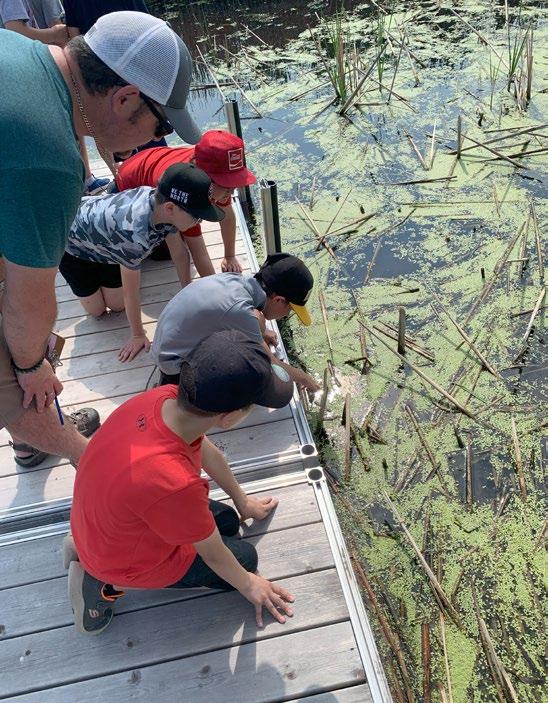
MBFI’s cow-calf herd at the Brookdale Farm station provided the real-world example of how cows live on the land and share the landscape to create valuable habitat for a diversity of creatures. The 42 grade three and four students split into smaller groups and headed out to explore the Learning Centre grounds, meadow trail, and wetland viewing dock. Using the “Field Notebook” developed by Ducks Unlimited Canada, students made observations on the types of plants and signs of wildlife found in different areas. Group sharing revealed a diversity of birds, amphibians, insects, plants, and animals that all live on the farm. The group favorite by far were the new calves waiting with their moms to head out to pasture.
A huge thank you to Leanne Sprung, Manitoba Agriculture Leadership Specialist in Youth Development, for supporting planning of the day and leading an Agriculture in the Classroom “What’s in Your Lunchbox?” activity.
Following lunch and games on the Learning Centre grounds, students spilt into two groups and dived into the afternoon for hands-on learning showing how calves are born, what cows eat, and how growing forage for cows is beneficial for the environment.
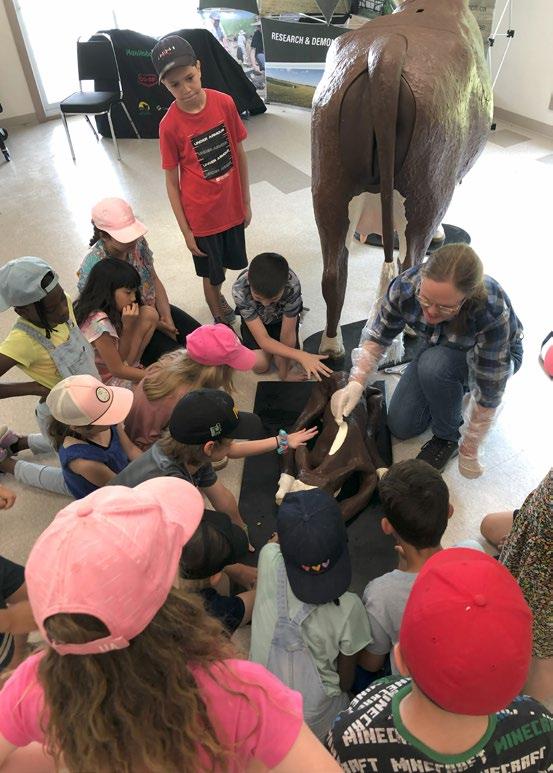
In the Learning Centre, Josie and MBFI research technician Leah Rodvang introduced what a breeding cow’s life is like on the farm, how they give birth, and how farmers or veterinarians assist cows in calving emergencies, using the 4-H Manitoba dystocia model
Clover. The life-sized cow and calf model were a huge hit with the students as they were able to take turns feeling inside Clover and determine where the head and hooves were in the birth canal. Staff then provided a demonstration in how a cow may be assisted with calving and students were thrilled to see and touch the ‘newly-born’ calf.
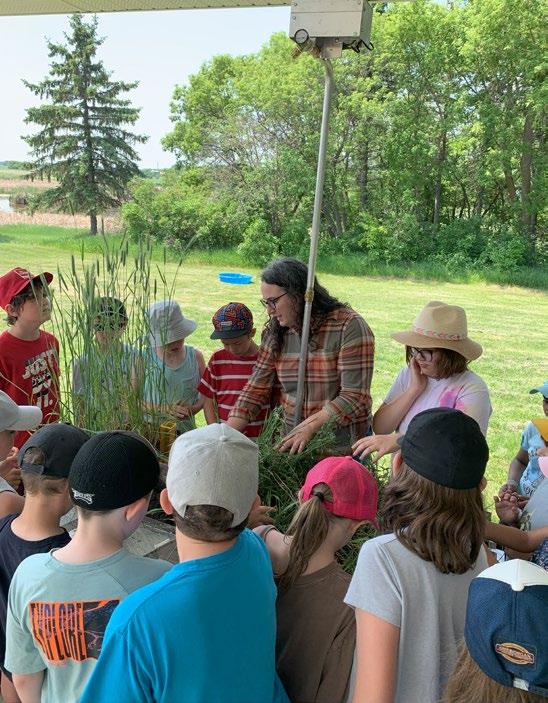
In the outdoor classroom patio, students handled and compared different samples of forage learning how cows and calves need balanced nutrition to grow and maintain their health. I myself illustrated how growing forages for livestock to graze or to be harvested improves water infiltration and quality. With sod samples collected from MBFI pastures and cropped fields, students watched for differences as a rainfall simulator delivered a two-inch rain event. The rain simulation was a hit in the heat of the afternoon, and students were amazed by how well the rotationally-grazed grassland sample
absorbed water and prevented soil erosion compared to bare soil. Students were eager to dig into the samples to see all the dense roots and organic matter in the grassland samples. We rounded out the day with downtime activities including chalk art on the patio and wetland creature paper models.
It was a fantastic experience having the Learning Centre grounds come alive with youth and have meaningful conversations with students on their questions and observations about the farm. The day would not have possible without the collaboration of Waverly Park Elementary teachers Daniel Cowell and Jodie Stapleton. We look forward to further developing our youth programing opportunities and building connections to beef cattle production and the public.
For more information or to start a conversation please email MBFI at information@mbfi.ca or call us at 204-761-3300.
6 CATTLE COUNTRY August 2023 www.mbbeef.ca
Waverly Park Elementary students investigating wetland creatures at MBFI Brookdale Farm. (Photo credit: MBFI)
Waverly Park Elementary students digging into how growing forages improve water infiltration. (Photo credit: MBFI)
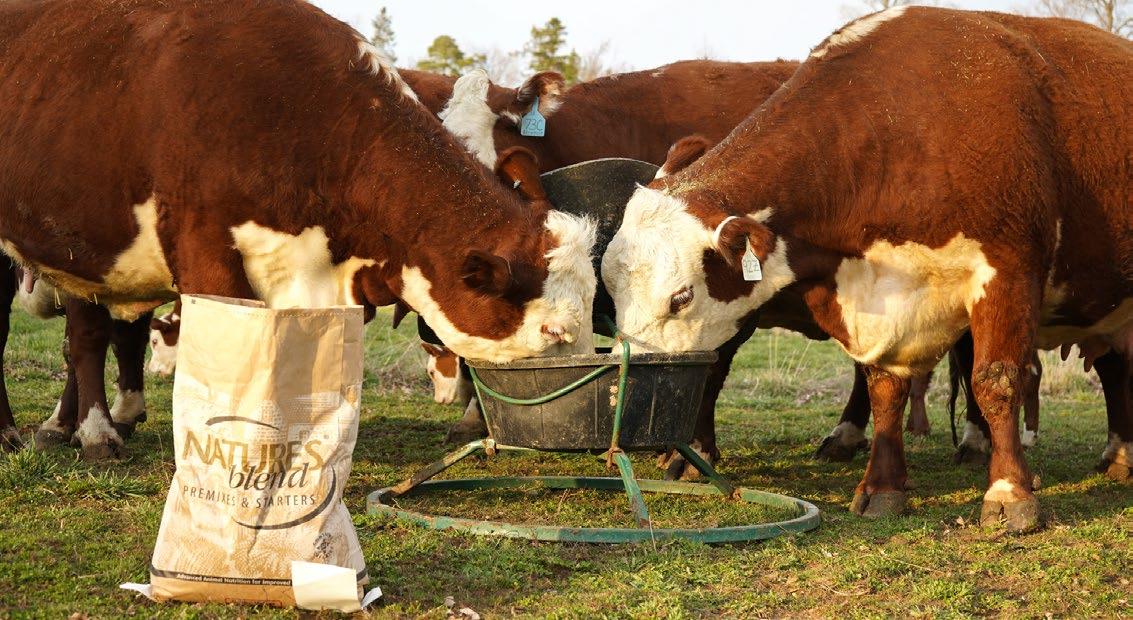
THIS SUMMER SKIP THE LICK! GVF offers on farm consultation with regular service and support to ensure that your herd is performing to its maximum potential. 1-866-626-3933 grandvalley.com Advanced Animal Nutrition for Improved Human Health. Replace expensive lick tubs with high quality, palatable Nature’s Blend Cattle premix. Feed this perfect pasture mineral complete with organic source of selenium, essential minerals, and vitamins in a free choice mineral feeder and provide the superior nutrition your herd needs. Also Available with Garlic
Waverly Park Elementary students hands-on learning with MBFI’s Leah Rodvang and 4-H Manitoba’s Clover cow dystocia model. (Photo credit: MBFI)
Science Supports Productivity-Enhancing Technologies’ Effects on the Environment
BY PETER FROHLICH, NATIONAL CENTRE FOR LIVESTOCK AND THE ENVIRONMENT, UNIVERSITY OF MANITOBA




It is estimated that the world population will reach nine billion people by 2050 and sustainably produced animal protein can play a key role in addressing the resulting food security challenges. Productivityenhancing technologies (PETs) such as implants and feed additives have been used effectively to improve growth and feed efficiency of beef cattle. However, the use of PETs has been banned in Europe and other markets as consumers are increasingly asking for “freefrom” or “natural” products.
Some consumers may not be aware of the environmental implications of removing conventional PETs from production systems. Recent research at the University of Manitoba has helped address this question by examining the impact of removing PETs on the environmental footprint of beef production.
What Are Productivity-Enhancing Technologies?
There are several types of PETs used in conventional beef production. These include feed additives such as ionophores and beta-adrenergic agonists (BAAs) or implants which are placed between the skin and the cartilage of the ear of an animal.
Environmental Benefits of PET Use – Scientific Evidence
A team of researchers at the University of Manitoba led by Dr. Kim Ominski from the Department of Animal Science and Dr. Tim McAllister from Agriculture and Agri-food Canada have examined the impact of removing conventional PETs or replacing them with natural feed additives such as fibrolytic enzymes and essential oils.
As a member of this team, Dr. Isaac Aboagye found that replacing conventional feed additives in feedlot diets with natural feed additives increased greenhouse gas (GHG) emission intensity for steers and heifers by 5.8% and 6.7% and ammonia emission intensity by 4.3% and 6.7%, respectively. In addition, replacing conventional feed additives with natural feed additives increased both the land and water required to satisfy the feed demand of steers and heifers by 7.9% and 10.5%, respectively. Eliminating the use of implants all together in cattle increased both land and water use by 14.6% and 19.5%, GHG emission intensity by 10.5% and 15.8%, and ammonia emission intensity by 3.4% and 11.0% for
heifers and steers. The study concluded that the use of conventional PETs can increase animal performance and reduce the environmental impacts of beef production.

A second study, conducted by team member Emily Boonstra, modeled environmental impacts associated with the removal of PETs from Canadian feedlots using cattle performance data from trials conducted at the Agriculture and Agri-food Canada Research Development Centre located in Lethbridge, Alberta. This study also determined that PETs used in conventional beef production systems have lower GHG and ammonia emissions, as well as land and water use compared to production systems without PETs.
Markets and Consumers
There are several countries that allow the use of PETs including Canada, US and Mexico and other large beef producers like Australia and Brazil. These countries rely on export markets and therefore must meet requirements of those countries that do not allow use of PETs, including the European Union.
Some of today’s consumers perceive that PETs have negative impacts on the environment, food safety and animal welfare. More then half of consumers from 69 countries who participated in the online Nielsen Global Health and Ingredient-Sentiment Survey indicated that they preferred meat and other products that did not receive growth hormones and antibiotics. It is important to note that these online responses may contain inherent biases as they are based on claimed behaviour or willingness to purchase rather than direct measurement of product purchases within the food service and retail sectors.
Since consumers have a strong influence on the direction of markets there is a need to ensure that these end users have the information necessary to make informed decisions that are rooted in sound scientific knowledge. Studies like those conducted at the University of Manitoba and other institutions provide the information needed to make sure consumers and policy specialists make informed decisions to ensure a continued profitable and environmentally sustainable beef production system in Canada.
The University of Manitoba welcomes Dr. Gabriel M. Dallago as a new Assistant Professor at the Department of Animal Science. Dr. Dallago has a background in animal science with an emphasis on the use of precision technologies to improve the productivity, welfare and sustainability of livestock production systems. His research focuses on using information gathered from feeding, milking and environmental monitoring systems to guide changes in management practices and enhance efficiency in livestock production.

7 CATTLE COUNTRY August 2023 www.mbbeef.ca
Questions about what district you live in? Call the MBP office at 1-800-772-0458 or email: info@mbbeef.ca TENTATIVE DISTRICT MEETING SCHEDULE District 4 DIRECTOR Byron Falk 18 OCTOBER Location to be determined District 10 DIRECTOR Mike Duguid 19 OCTOBER Arborg-Bifrost Community Centre District 6 DIRECTOR Vacant 23 OCTOBER Oak Lake Community Hall District 2 DIRECTOR Nancy Howatt 24 OCTOBER Baldur Community Hall District 12 DIRECTOR Mark Good 30 OCTOBER Ste. Rose du Lac Community Hall District 14 DIRECTOR Dale Cazakoff 1 NOVEMBER Swan River Elks Hall District 8 DIRECTOR Matthew Atkinson 2 NOVEMBER Neepawa Legion All Districts 7 NOVEMBER Virtual Meeting 7:00 pm Start 4:30 pm start time TREHERNE OFFICE: Kathy Murray (204) 871-1569 RESTON OFFICE: Carol Graham (204) 821-4943 BOISSEVAIN OFFICE: Tom Moran (204) 305-0276 BRANDON OFFICE: Kasie Cullen (204) 724-0583 FOR MORE INFORMATION
MHHC PAYS Landowners to Conserve Wildlife Habitat On Private Lands. Find out more: www.mhhc.mb.ca
CALL:
page 1 Healthy dung insect communities valuable
Identifying healthy dung insect communities
Healthy dung insect communities can be very different depending on the geographical location, but locally, communities should contain the same species that are adapted to that area.
“Dung insects are strong fliers and are attracted to fresh cattle dung by the odour that comes off the patty. It’s not uncommon for dung insects to travel several hundred metres if there’s a strong odour plume for them to follow,” Floate says. “So, if they’re not developing in the cow patty on a pasture, where just over the fence there’s a healthy dung insect community there’s something wrong with that cow patty. It could be the chemicals that are being used on the cattle. That would be my first suspicion.”
Looking at the number of insects attracted to a cow patty shouldn’t be relied upon as the only indicator of whether the community is healthy, Floate says.
“What’s really important is whether the eggs of those colonizing insects develop to produce adults,” Floate says. “Chemical residues may not affect the number of insects attracted to the patty or they may, we just don’t know. But what actually develops inside the pie, that could be greatly reduced. So, we have to be a little bit careful how we interpret insect activity.”
Improving animal health
Dung insects also have a role to play in animal health, obviously by helping to reduce pest fly populations by taking away their breeding sites, but also to help reduce parasite load in a pasture.
“The cow will pass infective stages of the parasites into the dung, and cattle that graze near the dung later in the season can be reinfected,” Floate says. “By scattering the cow pie, the non-pest insects reduce pest populations of both flies and parasites affecting livestock.”
How do you maintain a healthy dung critter community?

There are things that producers can do – and not do – to help maintain a healthy dung critter community on their pastures.
For a start, they should be aware that some chemicals applied to cattle to control parasites, when they are turned out onto pasture in the spring, can pass through the cattle and come out in the dung.
“If you put chemicals on cattle designed to kill pest insects, residues of those chemicals in the dung can kill beneficial insects to reduce the ecosystem services that they provide,” Floate says.
Floate adds that he would never advise a producer not to use a chemical product on their cattle because it’s a decision based on so many variables, but he does suggest producers check to see if they really need to treat their cattle.
“Obviously, you want to maintain the health of the animals and there are economic considerations to maintain the ranching operation, but I would say, check to see if you need to use a product to begin with,” Floate says.
“Does the parasite load on the pasture justify the need for treatment? In areas with a moister climate, parasite burdens tend to be higher on pastures so there’s a greater rationale. But if you’re living in a drier part of North America, maybe the parasite load isn’t as big as you think it is. But if there’s a need to apply a parasiticide, maybe find out what products are available on the market. If ranchers are trying to walk that fine balance between protecting the animals from parasites and protecting the beneficial insects in dung, they may have some options.”
“In some cases, producers may not have the option, for example if they are mixing their cattle with other cattle on a community pasture, they maybe obligated to treat,” Floate says.
Disturbing or altering habitat also has an effect on the dung insect community.
“Insects will come in and find the dung but you’ll have fewer individuals and species of insects in a stubble fallow field than in an undisturbed native grassland,” Floate says. “We have some native species of dung beetles that we find commonly on native grassland in southern Alberta. We don’t find
them as often in tame pastures.”
The guide book contains suggestions and resources for ranchers about how to assess their situation and help them make decisions that can preserve these dung insects and benefit from the work they do.
The guide is free to download from AAFC’s website in either French or English at the following links: https:// publications.gc.ca/site/eng/9.913866/publication.html (English) https://publications.gc.ca/site/eng/9.913867/ publication.html (French)
Floate says he welcomes feedback from producers and ranchers using the guide about any additional information that they would like to see included in future versions.
First indicators of soil health
One of the first things that Brian Harper noticed 15 years ago, when he stopped using chemical parasite control products on his cattle, was the number of dung beetles in the pasture.
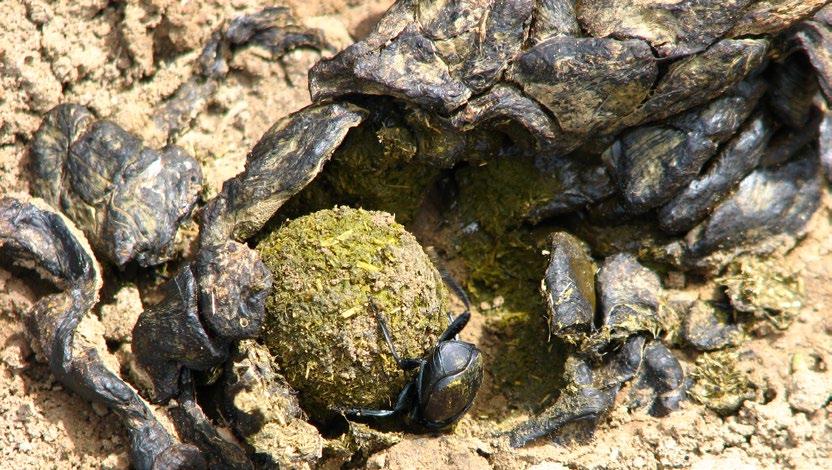
“There were probably lots of other things happening but the dung beetles were the first indicator because they were big enough for us to see them,” he says. “The breaking down of the cow pie sped up once we stopped killing off the life that lived in it and that cycling started to happen a lot faster. We started to notice other signs of soil health improving, such as the grass was thickening up, the leaves were getting wider on the forages, and the regrowth was faster.”
Harper, who has a cattle operation close to Brandon, admits the first few years were tough, but he was convinced that continuing to use chemical products would lead to the creation of superbugs and poor genetics in his herd.
“Once we quit using pour-on products the genetics sorted themselves out,” he says. “The cattle that were the most susceptible couldn’t handle the load and they would go down the road. Because we were selecting for the animals that were less susceptible, the herd has grown in that direction and we don’t have any lice issues any more.”
Over the past 18 years Harper has incorporated many different regenerative practices and grazing systems on his farm to focus on building soil health and improving the genetics of his herd. It takes a lot of patience and time, but that’s really the point of building a self-sustaining system that’s healthier for the land, the ecosystem and the health of the cattle.
“If we stop looking for a silver bullet and focus on the health of the soil, that’s the only silver bullet we need, and if we can keep that soil functioning the way it’s meant to, all of those other issues will go away,” he says.
www.mbbeef.ca
8 CATTLE COUNTRY August 2023
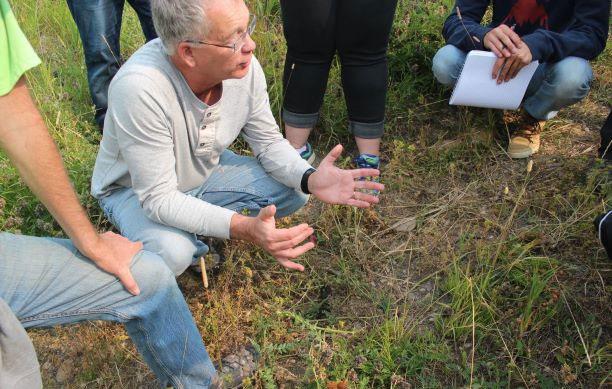
Dr Kevin Floate speaking to students. (Photo credit: Dr Cameron Goater U Lethbridge)
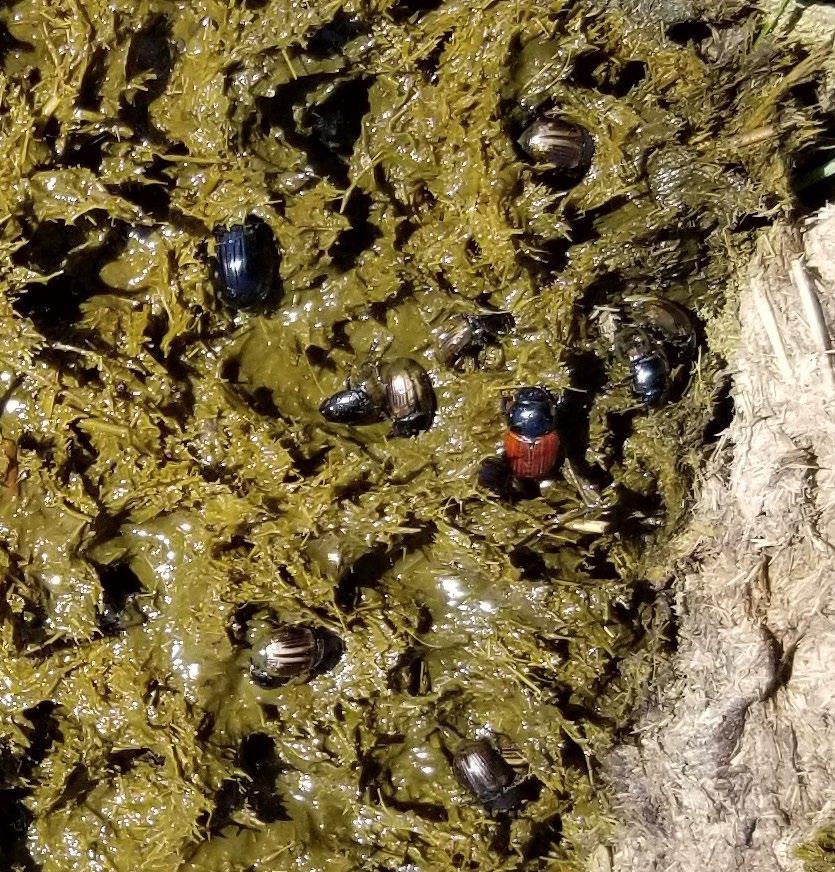
Beetles feeding in a fresh cow pie. (Photo credit: Kevin Floate)
Keystone livestock specializing in livestock insurance for over 45 years LIVESTOCK INSURANCE Lois McRae & Joyce Gordon RR 1 Box 57 Brandon, Manitoba R7A 5Y1 h: 204-728-3058 c: 204-573-5192 f: 204-727-7744 marmacfarms1@gmail.com SERVICES
Beetle forming a ball of dung for burial elsewhere. (Photo credit: Geoff Holroyd)
StockTalk Q&A Feature Brought to you by Manitoba Agriculture
It is also important to note that NSAIDs should not be given concurrently with steroidal anti-inflammatories, such as dexamethasone, as they have additive effects that can be detrimental to the gastrointestinal system.
deanne.wilkinson@gov.mb.ca

Q: A few of my cows calved late on pasture and their calves will need to be castrated and dehorned this fall. Are there ways to make these procedures less stressful on the animals?
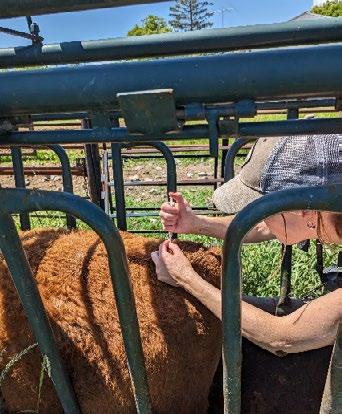
Answer: Although routine husbandry practices, like castration and dehorning, should be performed early in a calf’s life, it is understandable that certain circumstances necessitate an animal being castrated or dehorned at an older age. When performing these procedures on older animals, some additional considerations must be addressed to ensure that optimal animal welfare is achieved.
Through input from industry experts, the National Farm Animal Care Council has created species-specific Codes of Practice which outline the standards of practice and identify industry requirements. The inability to meet these criteria generally means that welfare standards are not being met. The Code of Practice for the Care and Handling of Beef Cattle require that all bulls over six months of age receive pain control for castration. Pain control must also be given to animals undergoing horn removal after the horn bud has attached, which occurs between two and three months of age. These requirements demonstrate that pain control is an essential part of beef production.
Understanding a few concepts about pain can help producers determine when pain control medications (e.g., analgesics) should be used. Pain is an uncomfortable or distressing sensation caused when a stimulus causes actual or possible tissue damage. Pain pathways involve a complex system of chemical mediators, which send signals between the site of stimulus and the central nervous system. As with human medicine, discomfort can be minimized by altering these chemical mediators through the use of different medications.
Pain in cattle has many consequences, including production impacts like decreased feed intake and reduced average daily gains. This is due to the many physical changes induced by pain, such as increased heart rate, blood pressure and cortisol levels, which negatively affect appetite, physiological processes and overall well-being. Experiencing pain can also cause behavioural changes like anxiety, depression and agitation.
Even with the significant effects of pain, many barriers seem to prevent adequate pain management in the industry. Producers may not properly identify when cattle are in pain because concealing pain is an evolutionary adaptation of prey species. The misconception also exists that cattle may not be experiencing pain in certain situations, but mammals have similar pain pathways and numerous studies indicate that cattle experience pain just like humans.
Logistical challenges to implementing routine pain mitigation strategies also prevent regular use of analgesics. Certain medications may involve administering an additional injection and require a few minutes to take effect, which can slow down processing times. Owners may also avoid using medications having a longer meat withdrawal time (the established waiting period between drug administration and when an animal can be slaughtered, which ensures drug residue levels in meat are safe for human consumption). The cost of treatment is also a barrier, as it is easy to see the upfront cost of an analgesic, but appreciating the production losses due to pain can be less obvious.
The most frequently used analgesics used in beef production are non-steroidal anti-inflammatories (NSAIDs) and local anesthetics. These medications have different modes of action and optimal pain control often involves using them concurrently, in a multi-modal approach. The Beef Cattle Research Council has an informative summary table of the available analgesics and various trade names which can be found on their website or by scanning the QR code on this page.
NSAIDs are likely the most common analgesics used by producers, as they are readily available by prescription from a veterinary clinic and reasonably safe to use. These medications reduce inflammation and pain through decreasing prostaglandin production, but they will not completely eliminate pain during a surgical procedure.
When considering which NSAID to choose, producers should take into consideration the duration of action, route of administration and meat withdrawal times for each specific medication. One of the most versatile NSAIDs used is meloxicam, which is available in an oral suspension that lasts just over 48 hours and a subcutaneous injection lasting 72 hours. Its long-acting ability and strong analgesic effects make it a good option for mitigating post-procedure pain. Another commonly used NSAID is flunixin meglumine, which is a once daily medication. It is available in topical form, a nice option compared to the injectable form, which must be administered intravenously.
Local anesthetics, such as lidocaine, are the other main analgesic used in beef production. Their frequent use in human medicine and dentistry is due to their ability to provide pain-relieving effects within a few minutes and lasting just under two hours. Their mode of action involves blocking the pain signal being sent from the area of stimulus to the central nervous system (CNS). They also have the ability to enhance the effects of NSAIDs, demonstrating their usefulness in a multi-modal approach to analgesia. Local anesthetics may not be as readily available, as there is the potential for inappropriate use, but discussions with the herd veterinarian can determine how it can be incorporated into a pain mitigation plan. If dehorning or castrating older animals, producers may be more comfortable with their veterinarian performing the procedures and local anesthetics can easily be used.
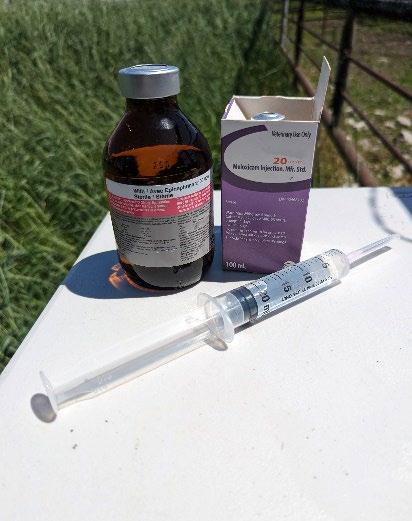
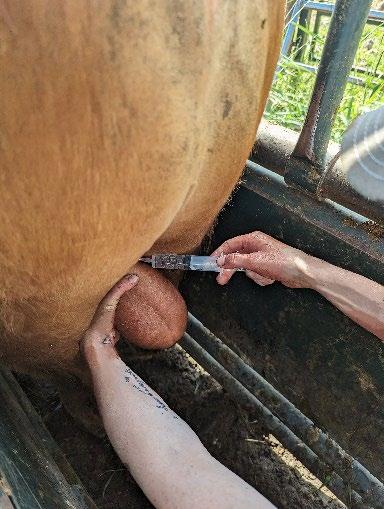
Lidocaine can be used in nerve blocks, which involve placing anesthetic near a specific nerve to prevent that nerve from sending pain signals from the area it serves to the CNS. Nerve blocks can be performed near the horn, numbing the area around the horn and making dehorning less painful. Castrations can be made less painful by giving an epidural, which involves lidocaine injection into the epidural space (the space around the spinal cord) at the top of the tail head, and provides pain relief to various areas in the hind end.
Lidocaine can also be given as a ring block, which involves injecting the anesthetic in a circular fashion around the area that will be surgically excised. It is important to combine lidocaine with an NSAID to provide longer-acting pain relief, as these procedures will result in pain for several days and lidocaine only lasts for the duration of the procedure. New local anesthetic options, lidocaine-infused castration rings, are also in development and should be available in Canada in the near future. These castration rings will topically apply lidocaine to the neck of the testicle and provide longer-term analgesic effects while the band is restricting blood flow to the testicle.
For the calves in question, the analgesic protocol will depend on their specific age and size. Dehorning any animal over two to three months of age requires the use of an NSAID and possibly a local anesthetic. Castrating bulls older than the newborn stage should also include an NSAID to provide longer-acting pain relief and possibly a local anesthetic to numb the testicular area. If either of these procedures is conducted in calves over a few months of age, producers should discuss analgesic protocols with their veterinarian and decide whether treatment options can easily be implemented by farm personnel or if they should be conducted by a veterinarian.
Proper pain mitigation protocols are an integral component of beef production, as public perception is essential to maintaining a market. Consumers need to feel confident that cattle owners make welfare and animal comfort a priority through minimizing distress to the animal. The routine use of analgesics also ensures improved economic outcomes by optimizing productivity through improved average daily gains and overall animal health.
Share Your Voice
In the next issue of Cattle Country, a Manitoba Agriculture forage or livestock specialist will answer a selected question. Send your questions to Elizabeth.Nernberg@gov.mb.ca.
StockTalk for Cattle Country is brought to you by Manitoba Agriculture. We encourage you to email your questions to our department’s forage and livestock team. We are here to help make your cattle operation successful. Contact us today.
Andrea Bertholet Killarney 204-851-6087 Andrea.Bertholet@gov.mb.ca
Kristen Bouchard-Teasdale Beausejour 431-337-1688 Kristen.BouchardTeasdale@gov.mb.ca
Shawn Cabak Portage 204-239-3353
Pam Iwanchysko Dauphin 204-648-3965
Shawn.Cabak@gov.mb.ca
Pamela.Iwanchysko@gov.mb.ca
Cindy Jack Arborg 204-768-0534 Cindy.Jack@gov.mb.ca
Juanita Kopp Beausejour 204-825-4302
Juanita.Kopp@gov.mb.ca
Elizabeth Nernberg Roblin 204-247-0087 Elizabeth.Nernberg@gov.mb.ca
9 CATTLE COUNTRY August 2023 www.mbbeef.ca
Deanne Wilkinson Extension Veterinarian Manitoba Agriculture
Lidocaine injection into the spermatic cord to decrease pain sensation during castration.
A lidocaine epidural being administered to provide analgesia in weanling bull calf.
Two commonly used pain management medications, lidocaine and meloxicam.
We are excited to announce our new MSA Secretary SANDRA BRIDGEN Minnedosa, MB

to


10 CATTLE COUNTRY August 2023 www.mbbeef.ca Announcement - The Interest Free portion of Loan advances for the remainder of the 2023 Program Year have been increased to $350,000.00 *Producer total Advance Limits have been increased to $1,000,000.00 as well. Manitoba Livestock Cash Advance Inc. www.manitobalivestock.com Subject to Credit Approval 1-866-869-4008 “Our friendly staff await your call!” #212-530 Century St. Winnipeg MB R3H 0Y4 Loan Advance Commodities include: Livestock, Grains & Oilseeds Low Interest Bearing Loan Rates Our breeding program is focused on creating fertile cows that efficiently raise calves, are reliably repeatable, have excellent udders and feet and require minimal replacements (longevity); traits required to be profitable in the cow business. www.ediecreekangus.com MODERATE MATERNAL EASY CALVING EASY FLESHING ECA DUCHESS 66W We would like to announce our Fall "Grazing & Genetics Tour" to be held in October. Date yet to be determined. THE EMBODIMENT OF FERTILITY & LONGEVITY At the age of 14, this OCC Legacy daughter sold a bull through the 2023 sale, corn grazed on a quarter section through the winter, and is due to calve early again this year.
Hickson
Brigden
President: Donovan
204-570-1862 Secretary: Sandra
403-638-9377
2023 MANITOBA SIMMENTAL DONATION HEIFER
BERT’S NR SIMMENTALS
MB tickets available now
contact Sandra 403-638-9377 www.mbsimmental.com
A huge thank you
LAURELLY BESWITHERICK MSA secretary/treasurer from 2016-2023 for all your hard work, time and dedication to the Manitoba Simmental Association.
graciously donated by
Haywood,
please
view our facebook page or website for up to date info!
Will We See a ‘Pair of Fours’ this Fall?
Like most people in the livestock business, I am a bit of a gambler. If you know me personally, you know that I like to play poker. Today, as I write this article, I am looking at a “pair of fours.”

Now, in the game of poker, a pair of fours is not usually a very good hand! However, in the cattle business, a “pair of fours” looks impressive. We have fed cattle prices at over $4.00 dressed delivered to Alberta, and the price of 450-pound feeder steers has reached $4.00 a pound. There you have it, the pair of fours. In the 43 years that I have been in the cattle business these are the highest prices I can remember. Things are looking promising for the fall feeder market. Cash sales are currently very aggressive on feeder cattle, and the forward contracts for yearlings off the grass and wet-nosed calves look very strong.
Many producers are cautiously optimistic but are fearful of a repeat of 2016 when the cattle market collapsed after 18 months of good prices. Barring crop failure in the USA corn growing regions or a border closure, the current market prices for feeder cattle look sustainable for four to six years. We may have reached a new threshold in the cattle prices that is here to stay. The USA currently has the smallest cowherd in the last 52 years, and there is not considerable expansion predicted for at least two years.
As a cattle producer, you may want to revisit your marketing strategy and timing this year. To take advan-
tage of this current market, producers will have to really pay attention to good management practices. Some producers may look at changing the time of year they normally sell their calves. Last year was the first year in the past five that it really paid to carry your calves over until spring. Managing your shrink will be even more important this year. You sell pounds, and every pound will be worth big dollars. Some producers will reconsider how and where they sell their cattle this year. At the 2023 Livestock Markets Association of Canada convention, a panel of feedlot operators and cattle buyers told the attendees that they preferred the show-list sales and regular sales compared to the pre-sort and video sales. The reasons were different from panelist to panelist, but the message was clear.
High prices for cattle do not always guarantee profits. The feeder cattle markets are based on the estimated feed costs, fed cattle futures and contracts. Those estimates can change daily. Changes in the cattle and grain futures, the interest rates, beef demand and market access can change quickly and influence cattle

• GRASSFED: “True North Foods is partnered with A&W Canada to supply Canadian grassfed beef for A&W’s grassfed burger program.



• SERVICES: Whether you are a specialty producer looking to get your product to a speci c market or distributor, or if you are producing commodity livestock for sale, we can partner with you. From our multi-species capabilities to our ability to handle smaller volumes, we o er excellent capabilities for producers in the Canadian Prairies to maximize their pro tability.
• FACILITY: We have a state-of-the-art facility to allow us to reach markets across Canada, the USA, and beyond. We understand producer’s needs, their care for their animals, and their honest, straightforward nature. Call us to hear how we can work together to get your product to market.
prices. Higher interest costs for carrying inventory in the feedlots will influence the market as well. With $2,700 to $2,800 feeder cattle coming off the grass, the interest costs to carry them to market this year will be higher. With $1,800 to $2,000 fall calves that are in the feedlot even longer, the costs of feeding will be higher.
A number of producers in B.C. this week pre-priced their fall calves using the auction platform. The sales were strong and by all reports the sellers received higher prices than they were expecting. I expect that more producers will be exploring forward pricing options as a form of price protection. With input and operating costs going up faster than the cattle market, producers could be facing tighter margins next year, even if these current prices are maintained.
Currently there are very few cattle auctions happening in Manitoba. The weather will determine how soon the fall run will start. At the end of June, Manitoba auction markets had sold 150,100 cattle in 2023. That was an increase of 15% over 2022. Much of the increase was price driven on the feeder cattle and the larger numbers of cull cows and bulls coming to market. Western packers were active buyers on the cow market, harvesting just under 6,500 in the third week of June. Exports of cull cows to the USA continued to drop due to the increased competition from western packers.

On the fed cattle market, prices reached $410.00 dressed, and carcass weights continued to drop as the strong prices brought the cattle to harvest sooner. It looks like the fed cattle market may have reached its peak in June. Domestic consumer resistance to the higher beef prices and cheap pork prices in the stores could stall the demand for beef at the current prices. The better cuts of beef may be on the verge of becoming a luxury food like lobster. If that is the future of beef, there will not be the need for a herd expansion or more beef cows.
The Canadian cattle industry is in a precarious position ‒ record prices with cautious optimism on the producer side, and consumers facing high inflation and interest rates, resulting in less buying power for their disposable income.
The one thing for sure is that the auctioneers will have to learn a whole new chant this fall with three and four-dollar calves compared to the one- and two-dollar prices that we have been accustomed to.
Until next time, Rick
11 CATTLE COUNTRY August 2023 www.mbbeef.ca
RICK WRIGHT The Bottom Line
| trever.frattinger@truenorthfoods.ca | 306-536-6193
www.truenorthfoods.ca
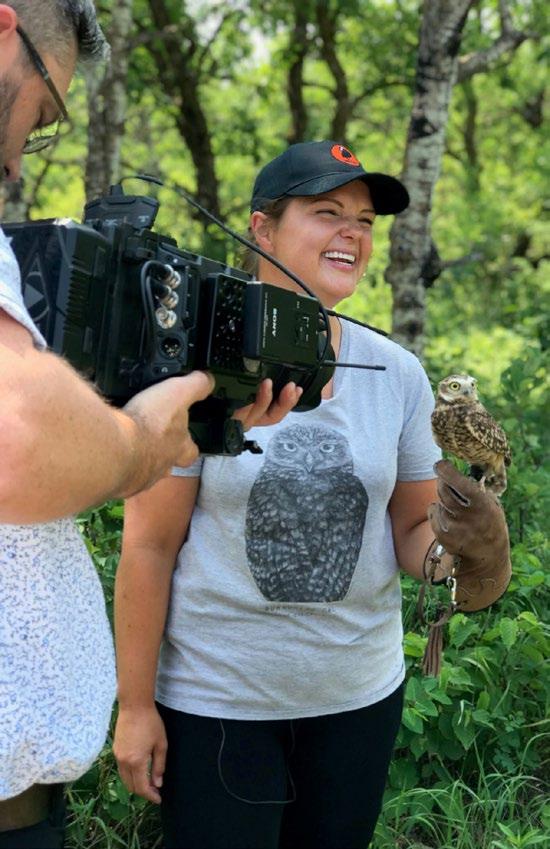
The Canadian Cattle Association’s Public and Stakeholder Engagement team along with Story Brokers Media House - the groups who produced the critically acclaimed documentary Guardians of the Grasslands - were in Manitoba at the end of June working on a new film about species at risk across Canada. The documentary film crew captured interviews with beef producers Melissa and Trevor Atchison as well as the Manitoba Burrowing Owl Recovery Program. Pictured: Alexandra Froese, MBORP Executive Director, along with brand ambassador, Bindi. (Photo credit: David Hultin/MBP)
Punchy Fresh Flavours for Summer
BY: ANNA BORYS, MBP FOOD EXPERT
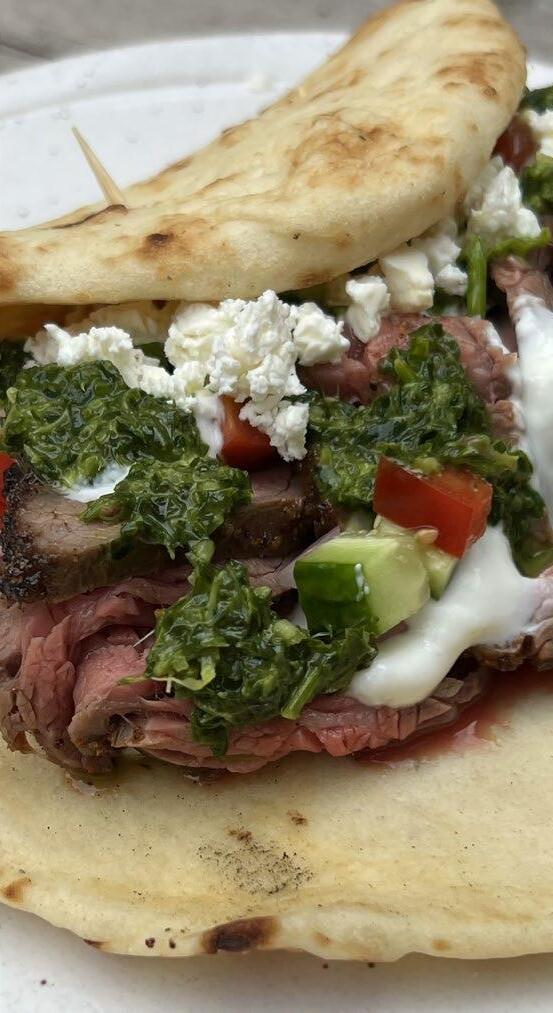
As we are well into grilling season, I like to switch up my meat selection. Recently I was at my local butcher shop and noticed flank steaks on sale, so I scooped up a couple for myself, eager to try some new recipes.
I’m hugely into Middle Eastern food right now. It’s probably one of my favourite cuisines. It brings big and bold flavours while driven by the freshest of ingredients. Mint, parsley, lemon, garlic, olive oil, fresh veggies, and not to mention the fragrant spices! I love dishes that involve a lot of condiments. It makes for a fun and interactive meal where every bite is a “choose your own adventure”. Along with the naan and steak, it’s best served with some freshly chopped veggies like tomato, cucumber, onion, and then a variety of spreads, such as hummus, tzatziki, tahini, or zhug (pronounced skOOG), an Israeli spicy pesto which is part of this recipe
and can really be used as a condiment for many dishes. This meal can be served as wraps, or you can just rip off a piece of warm garlic naan and scoop any topping of your choice.
The shawarma spice blend for the meat I found at Bulk Barn. They sell a TON of spice blends, and although I typically like to mix my own spices, I gave the convenience blend a shot, and it was delicious! If your local store doesn’t have a Shawarma blend, you might have all the spices needed in your spice drawer to blend your own with a quick online recipe. However, take note that the pre-mixed spice blends may already have salt added, so if you make your own, you may need extra seasoning. I mix the Shawarma blend with some olive oil and lemon juice to create a thick rub and that’s what goes all over the flank steak before it goes on the grill. I also like to sprinkle a bit extra dry spice blend after the rub goes on to get the crispy edge bits.
The heating up of the naan is crucial as it makes the bread extra soft and chewy with that quick steam step and prevents cracking when rolling up your wrap. This recipe is guaranteed to be a crowd favourite with fresh, bold flavours!
Enjoy!
Be sure to watch episodes featuring Manitoba Beef Producers and Chef Anna Borys October 7 and November 25 on CTV Winnipeg. Full episodes of ‘Great Tastes’ can also be streamed on demand at greattastesmb.ca or on the @ GreatTastesTV YouTube channel. You can follow along with exclusive behind the scenes content, recipe tips, meal plans and more at @GreatTastesMB on Facebook, Instagram, Twitter and Pinterest.

Flank Steak Shawarma Wrap with Zhoug
(Yields 2 portions)
ZHOUG
• 1 bunch Cilantro
• 1 bunch Parsley
• ½ Cup Mint Leaves, fresh
• 2 Chili Peppers
• 1 Tbsp Garlic, minced
• 1 Lemon Juiced
• 1 Tbsp Honey
• ½ tsp Kosher Salt
• ¼ Cup Extra Virgin Olive Oil
SHAWARMA:
• 1 ½ Tbsp Shawarma Seasoning Blend
• 2 Tbsp Canola Oil
• 2 tsp Lemon juice, fresh
• 390 g Flank Steak
• 2 each Garlic Naan
OPTIONAL TOPPINGS:
• Hummus
• Tzatziki
• Feta
• Diced cucumber, tomato, red bell pepper and red onion
METHOD ZHOUG:
1. Place all ingredients in a food processor and blend on high until completely combined and resembles pesto. Transfer to a container and keep in fridge for up to 2 weeks.
METHOD SHAWARMA:
1. Pre-heat grill on high heat (450°F)
2. Whisk together seasoning blend, canola oil and lemon juice.
3. Season flank steak with salt then using your hands, coat flank steak with shawarma rub on all sides. Lightly sprinkle with a bit extra of the dry shawarma seasoning.
4. Place steak on grill and cook until desired doneness. (For medium rare, cook to 125°F, about 4-5 minutes a side). Pull steak off grill and allow to rest at least 10 minutes.
5. Turn grill off. Wrap naan bread in tin foil and lay flat on grill for about 2 minutes just to heat and lightly steam naan. Pull off.
6. Slice rested steak across the grain in very thin ribbon-like pieces.
7. To build wrap, lay naan flat, smear with hummus, tzatziki, desired amount of meat, then top with diced veggies, zhoug and feta cheese. Roll up wrap and enjoy!
12 CATTLE COUNTRY August 2023
www.mbbeef.ca
Photo credit: Anna Borys
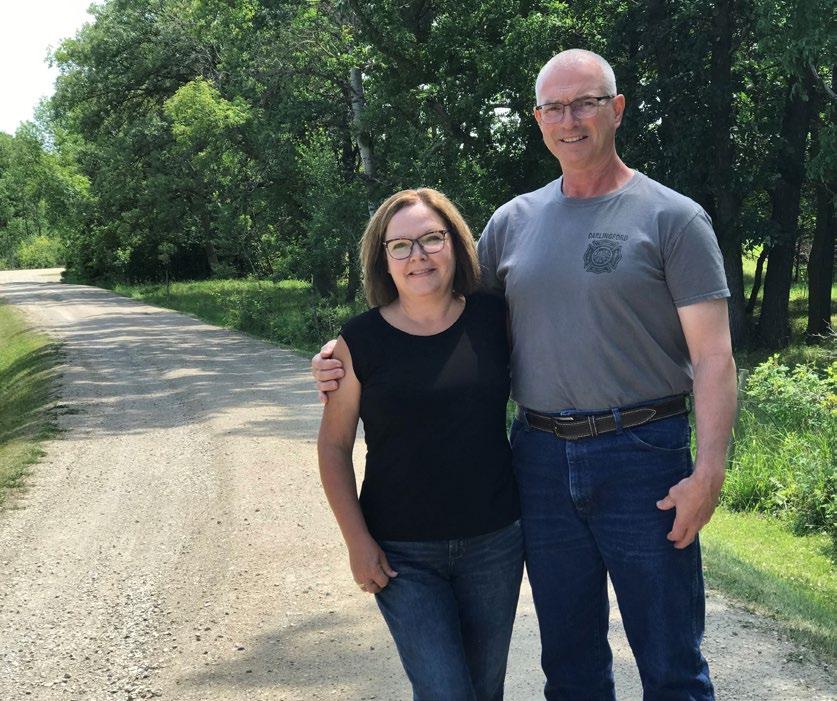
Filming for the upcoming Season 34 of Great Tastes of Manitoba continued in the Frank Digital studio kitchen with Chef Anna Borys and out in the field with Glen and Pam Lowry at their farm in the Darlingford area. The Lowry’s (along with Lisa and Cameron Hodgins) are the featured farm families this year for the popular Before the Plate series that will air during each MBP episode. (Photo credits: David Hultin/MBP)
