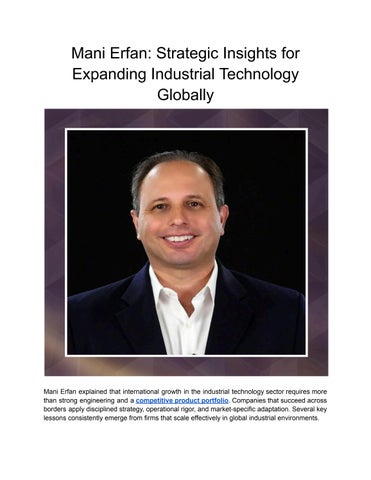
Mani Erfan: Strategic Insights for Expanding Industrial Technology Globally

Mani Erfan explained that international growth in the industrial technology sector requires more than strong engineering and a competitive product portfolio Companies that succeed across borders apply disciplined strategy, operational rigor, and market-specific adaptation. Several key lessons consistently emerge from firms that scale effectively in global industrial environments
The first lesson is that deep market intelligence precedes successful expansion Regulatory frameworks, capital expenditure cycles, infrastructure readiness, and procurement culture shape industrial ecosystems Companies must evaluate not only demand potential but also industry concentration, government incentives, and competitive density. Data-driven market selection prevents capital misallocation and reduces exposure to underperforming regions.
Second, localization determines adoption speed. Industrial buyers expect compliance with national technical standards, safety certifications, and environmental regulations Aligning product specifications with regional voltage systems, digital protocols, and operational norms builds credibility. Beyond technical adaptation, culturally informed negotiation strategies and relationship management practices significantly influence contract outcomes
A third lesson involves channel architecture. In many regions, established distributors, engineering firms, and system integrators dominate purchasing decisions Strategic partnerships accelerate market penetration by leveraging trusted local networks. However, governance structures, performance metrics, and contractual safeguards must be clearly defined to protect brand positioning and margin structure
Operational readiness also differentiates successful global players Industrial clients prioritize lifecycle reliability, not just initial installation Companies must invest in regional service infrastructure, spare parts availability, and skilled technical support teams. Consistent post sale engagement strengthens retention and increases recurring revenue opportunities
Financial resilience is equally critical. Currency volatility, geopolitical shifts, and varying taxation systems can materially impact profitability Scenario planning and sensitivity analysis should inform capital allocation decisions. A phased entry model with measurable performance benchmarks allows leadership teams to scale responsibly while preserving flexibility
Finally, leadership alignment drives sustainable growth. International expansion requires cross-functional coordination between engineering, compliance, finance, and commercial teams Clear governance and accountability prevent fragmentation and execution gaps Industrial technology firms that internalize these lessons are better positioned to transform international opportunities into a durable competitive advantage and long-term global growth