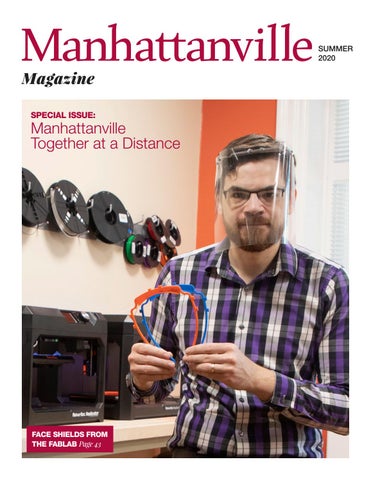
SUMMER 2020
Magazine SPECIAL ISSUE:
Manhattanville Together at a Distance
FACE SHIELDS FROM THE FABLAB Page 43
SUMMER
THE MISSION OF MANHATTANVILLE COLLEGE IS TO EDUCATE STUDENTS TO BE ETHICAL AND SOCIALLY RESPONSIBLE LEADERS IN A GLOBAL COMMUNITY.
WE ARE COMMITTED TO: Ensuring the intellectual, ethical, and social development of each student within a community of engaged scholars and teachers; Encouraging each student to develop as an independent and creative thinker in pursuing career and personal goals; And providing a diverse, inclusive, and nurturing environment that develops in each student a commitment to service and leadership within a global community.
What’s Inside FEATURES
12 Professor
John Murray
14 Poets in
the Pandemic
20 School of Nursing 36 New Course on COVID-19
52 The Show Must Go On DEPARTMENTS
10 Letter from the President
18 In the News 54 Athletics 57 Class Notes 58 In Memoriam
Jean Kennedy Smith
60 Condolences
3
4
M AN H AT TAN V I L L E C O L L E G E
Magazine SUMMER 2020 PRESIDENT Michael E. Geisler, PhD VICE PRESIDENT FOR INSTITUTIONAL ADVANCEMENT Sarah E. Kelly
SUMMER
Work life during quarantine HAS INCLUDED OUR PET COMPANIONS JOINING – AND SOMETIMES PHOTOBOMBING – STAFF AND FACULTY VIDEOCONFERENCES.
ASSISTANT VICE PRESIDENT FOR COMMUNICATIONS AND MARKETING Cara Cea EDITORS Kristin O’Callaghan Katherine Palmer CREATIVE DIRECTOR Kaya Phillips DIRECTOR OF ALUMNI RELATIONS Polly Schmitz
Manhattanville Magazine is distributed to alumni, faculty, staff and friends of the College. Please send correspondence to alumni@mville.edu. alumni.mville.edu Copyright © 2020
5
To see more photos of the pets of faculty and staff joining virtual meetings, click here.
6
M AN H AT TAN V I L L E C O L L E G E
MANHATTANVILLE’S NEW School of Nursing and Health Sciences is now open! Page 20
SUMMER
7
VIRTUAL EVENTS
SUMMER
9
Take My Phone, Please! Thursday, September 10 7:00 p.m. to 8:00 p.m. (EST) Professor Joni Siani's compassionate connection with the first digitally socialized generation has students literally saying, "Take my phone, please!" Learn positive strategies for curtailing social media and texting. MYAS Happy Hour: September 2020 Wednesday, September 23 7:00 p.m. to 8:00 p.m. (EST) All alumni who graduated between 2010 and 2020 are invited to our second Manhattanville Young Alumni Society (MYAS) Virtual Happy Hour. Join MYAS co-chairs Paula Creary '11 and Charles Rusch '17 for great conversation and a drink (or two)! Due to the COVID-19 pandemic we have shifted our alumni events to a virtual format. We have a variety of events planned, ranging from academic lectures, updates on college programs, departments, and initiatives, to social gatherings in the virtual space. For the latest schedule of events, click here.
AWARDS PRESENTED PRE-PANDEMIC SCHOOL OF EDUCATION (SOE) RECEIVES BEST PRACTICE AWARD In March, the American Association of Colleges for Teacher Education (AACTE) recognized Manhattanville’s School of Education (SOE) with the 2020 Best Practice Award in Support of Multicultural Education and Diversity. The award recognized SOE’s exemplary Changing Suburbs Institute (CSI) program, which has prepared teacher candidates to meet the needs of an increasingly diverse student population since 2005 and has grown to include sixteen suburban schools across eight districts in Westchester County. Explained SOE Dean and Professor Shelly Wepner, EdD, “We have found a way for our teacher candidates to be immersed in schools that represent the diversity they will encounter when seeking employment.” Wepner accepted the award on behalf of the school during a ceremony at the AACTE’s 72nd annual meeting in Atlanta. BLACK STUDENT UNION DISTINGUISHED ALUMNI AWARD TO REVEREND EDWARD MULRAINE ’92 Manhattanville’s Black Student Union (BSU) kicked off African Heritage/Black History Month by presenting its Distinguished Alumni award to author, publisher, pastor, and activist, Reverend Edward Mulraine ’92, DMin, PhD (Hon.) ’16. Professor Emeritus Jimmy Jones, DMin, introduced Mulraine, who went by the name “Ebony” when he was a student, as a man who has dedicated his life and work to effect real change ever since his undergraduate years as the BSU president who consistently engaged students and administration to improve representation and understanding. In accepting his award, Mulraine thanked his longtime mentor and addressed the current students by stressing the importance of sustained engagement—and occasional disruption. “It’s good to be nice. It’s good to be respectful,” he said. “But it should not diminish your authority and the change you want to make.”
Staff from the Center for Student Accommodations reminded students that the disruption to campus life did not put the Valiant community “on pause.”
PROFESSOR MARK NOWAK WINS CREATIVE CAPITAL AWARD Earlier this year, Manhattanville Professor of English Mark Nowak was one of fourty-one artists selected out of pool of 4,000 applicants to receive a Creative Capital Award worth $100,000. Nowak’s winning proposal will expand the Workers Writers Workshop, which he founded, to create the Worker Writers School: Mobile Unit (WWSMU). This “pop-up” forum will bring the classroom to low-wage workers such as taxi drivers, nannies, home-health aides, manicurists, cashiers, and those in food service. (See page 50 for examples from a recent haiku workshop.)
10
M AN H AT TAN V I L L E C O L L E G E
From The President
When I wrote to you for the fall 2019 issue of Manhattanville Magazine, I could not have foreseen the unprecedented challenges that lay ahead. In forty years in higher education, I have not experienced anything remotely resembling the current crisis. Not only do we find ourselves in a global pandemic, but we are experiencing a groundswell of unrest around racial injustices. The brutal killings of Breonna Taylor, Ahmaud Arbery and George Floyd and the recent violence in Kenosha, Wisconsin, have sparked anger, frustration, and pain across the country and within our community. We stand behind our mission to provide “a diverse, inclusive, and nurturing environment” but, as we have heard from our alumni and students, there is more work to be done. My letter to the community was intended to launch us into some tough and honest conversations at Manhattanville about racial injustice. These conversations are not easy and not theoretical. They are about processing feelings and emotions; they are about empathy; they are about action. The Center for Inclusion offers a Call to Action web page with a list of ways to become involved in the movement. And we have begun a series of forums and will keep you informed of ways to join in the conversation. Like so many institutions, the College has also been facing financial challenges caused by the pandemic and resulting market downturn. Despite this, we have provided refunds and credits for a portion of room and board to assist our students’ families with their own financial burdens. We are anticipating a drop in enrollment for fall that will exacerbate our challenging financial situation. As a result, we have had to make very tough decisions regarding budgets, personnel and salary cuts to maintain financial viability and ensure the future of the College. But amid all this, I am continually amazed and proud of the ingenuity, fortitude, and compassion shown by our entire community. With little time to prepare, we transitioned an entire semester of curriculum online (page 42). Remote teaching continued through the spring and while it cannot replace the communal learning experience of face-to-face instruction, we have maintained our sense of community, some examples of which you will see in this digital issue that showcases the heart and soul of this institution and its ability to rise to new heights under the most taxing circumstances. One faculty member, Amy Bass, created a “trailer” for students as they embarked on their new remote learning adventure (page 33). Student Health and Counseling staff created a video offering comfort and resources to students who are experiencing anxiety (page 32). Performing arts students created videos of performances to fulfill class requirements and were featured in BroadwayWorld (page 52). Faculty and students created a virtual Earth Week that was featured on WNBC (page 48). We have also been doing what we can to help the wider community. The College donated food and personal protective equipment to health care workers on the front lines. Assistant Professor Justin Capalbo ’10 has been using 3-D printers from the FabLab at the Center for Design Thinking to produce face shields to donate to local health care facilities (page 43). What we learned in the quick transition to remote learning will prepare us well for the future as teaching and learning will likely be forever altered with more hybrid options available to cater to all student needs. And, thanks to a number of decisions we have made over the past ten years, with the most recent examples being the introduction of the School of Nursing and Health Sciences (page 20) and the Center for Design Thinking, Manhattanville is well positioned for the future. We have been very busy planning our safe return to campus in the fall. For details, see our fall plans on our campus reopening web pages. Our motto rings true now more than ever: “To a valiant heart, nothing is impossible.” Until we can meet on our beautiful campus, I wish you and your loved ones good health!
Michael E. Geisler, PhD
SUMMER
11
12
M AN H AT TAN V I L L E C O L L E G E
SUMMER
13
In Memoriam
Murray’s passion for the field of sociology contributed to both the growth and success of his department. He believed deeply that the study and questioning of political, economic, and cultural forces that shape the world had the power to open students’ minds. As he said in an interview from 1993, “The value of [sociology] is that it makes our students freer human beings, less pinned in by the media and by their peers in forming their opinions. They can think for themselves. They can act in their own interests. And, I think that’s great.”
In Memoriam John D. Murray, PhD (1939-2020) Manhattanville College mourns the loss of beloved teacher, friend, and lifelong Valiant, John D. Murray, PhD, who died on March 30. Professor Emeritus Murray arrived at Manhattanville in 1975, tasked with creating a new department of sociology, and for more than forty years, he was an innovative educator deeply engaged with fostering success at the College. A native of Lynn, Massachusetts, Murray graduated with an AB in sociology from Merrimack College in Andover in 1961 and an MA in 1964 from the University of Massachusetts, Amherst. In 1969, he earned his PhD from the University of Massachusetts, Amherst and was hired as a professor of sociology at Rutgers University, where he taught for six years before accepting a position at Manhattanville. During his tenure at the College, Murray was twice elected faculty chair as well as chair of the sociology and anthropology department. He served as a chair and member of numerous service committees, including the Faculty Status Committee and the Institutional Planning Committee. In addition, he was a contributor and author to various Middle States reports. Murray was also instrumental in developing the common course requirement for all first-year students, and he won numerous grants for the College. Murray contributed to many scholarly publications and in 1986, coauthored the book Warwords, US Militarism, the Catholic Right, and the Bulgarian Connection with his colleague David Eisenhower. He participated in many professional groups, including the American Sociological Association, the Eastern Sociological Society, the American Association of University Professors, and the Society for Industrial Archeology.
Although he spent much of his life at Manhattanville, Murray’s New England roots remained unshakable. He was a lifelong Boston Red Sox fan, who never missed a game and a proud “Tip O’Neill” Democrat. He loved gadgets, Saab cars, Italy, and classical music, as well as spending time with his friends who noted both his ready sense of humor and his compassion. One very close friend recalled that during a particularly difficult time in his son’s life, it was Murray who stepped up as a compassionate and consistent mentor to help his son move forward. When Murray retired in 2013, the many well-wishes from students and faculty reflected how deeply he impacted others. “From you I learned generosity, compassion, a sense of moral commitment, perseverance, loyalty…” said one former student, while a faculty member wrote, “You offer belonging to newcomers in our campus community and share your inspiration freely.” Murray felt the same way about his students. “Invariably, out of nowhere, someone will come up with a question or observation that I had not thought of before. I love this job!” Murray was preceded in death by his parents, John and Marion, sisters Anne Murray Collins and Margaret Murray. He is survived by his sister Susan Murray Sullivan, brother, Gene Murray, and many nieces and nephews.
14
M AN H AT TAN V I L L E C O L L E G E
SUMMER
Alumni Respond
Poets in the Pandemic Early this spring, as the coronavirus forced a sudden suspension of normal activities, it also acted as a powerful accelerant for the production of poetry. Artists metabolizing loss, fear, anger, confusion, and love in real time began writing and sharing their work via email and social media posts. One result of this prolific poetic engagement is a new and extraordinary anthology, Together in a Sudden Strangeness: America’s Poets Respond to the Pandemic, edited by Manhattanville alumna Alice Quinn ’70. A former poetry editor of The New Yorker and recent former executive director of the Poetry Society of America, Quinn succeeded in assembling eighty-five works from a diverse group of American poets, including Ada Limón, Joshua Bennett, Billy Collins, Cornelius Eady, Evie Shockley, Li-Young Lee, Major Jackson, Susan Minot, Vijay Seshadri, and Yusef Komunyakaa. According to Quinn, she was first tapped to gather and edit the poems by her former New Yorker colleague David Kuhn, a literary agent. “He saw that people were emailing poems to each other, and he called and asked, ‘What do you think about an anthology of poems about this moment?’” Within 24 hours, Quinn was scrolling through her contacts. “I’m very aware of poetry’s impact and power in a dramatic time,” said Quinn, recalling the profound connections readers felt to poems published by The New Yorker immediately after 9/11, including “Try to Praise the Mutilated World,” by Adam Zagajewski and “I Saw You Walking,” by Deborah Garrison. To begin curating poems quickly while also casting a wide net, Quinn relied on a kind of crowd sourcing: “That very day, on March 27, I included an ‘Anthology wish list’ which I sent with my appeal to 125 poets asking, ‘If you know of anyone who is writing poems addressing this moment whom you admire and who is not on this list—and there are a lot of poets who aren’t—would you please recommend them and send me their email addresses?’” She received another 120 names and within a few weeks was corresponding with well over 200 poets. Quinn’s pitch to the poets was simple: “If you are writing poems addressing this time, I would like to hear from you.” Quinn knew that she would invite the widest range of work if she didn’t suggest any thematic parameters.
Once the poems started coming in, the book sprinted from conception to gestation to delivery in exactly forty days. The symbolic weight of that length of time wasn’t lost on Quinn, who pointed out that it was not only biblical, it also mirrored the original quarantino imposed in medieval Italy during the bubonic plague. Curiously, the works are arranged in alphabetical order by the poets’ surnames. Quinn admitted that this choice might have had a “shortcut aspect to it” but that once they were assembled, this editorial decision revealed unexpected serendipity: The book actually runs from A to Z, with lines that begin and end the book as if they were assigned to do just that. It starts with open-ended questions that Julia Alvarez asks in her poem “How Will This Pandemic Affect Poetry?”—”Will the lines be six feet apart?/Will these hexameters be heroic like Homer’s?/(Will) (each) (word) (have) (to) (be) (masked) (?)”—and concludes with the tender last lines in Matthew Zapruder’s “Poem for Rupi Kaur”—“I love my son/his little bear pajamas/my wife/the grass/the ends of poems.” Although the anthology is technically whole and complete, Knopf Senior Editor and contributing poet Deborah Garrison suggested that Quinn “keep the barn door open” for more submissions that were sure to follow; and, in fact, Quinn already has twenty more poems in hand. The first published iteration of the anthology is an eBook from Knopf and an audiobook by Penguin Random House, both of which were released on June 9. A hardcover of the anthology is slated for release in November along with a simultaneously updated eBook available to all who buy the eBook now. The technological feat of this, Quinn said, “charms but mechanically eludes” her. Whatever form this anthology might take in the future, however, Quinn believes it will remain both timely and timeless. Even as the initial shock of the pandemic fades and new traumatic events grip the nation, Quinn said that the poems born from the pandemic will continue speaking with power and relevance because these poems “intrinsically speak to the issues of inequality,” she explained. “It’s the unequal access to health care and groceries and jobs and money and a roof over your head,” she said. “Everything that is going on right now, was tucked into the pandemic moment.”
Storm by Kamilah Aisha Moon Night squall raging, black branches batter every window as the sky lashes the city. Without devices, all I can do is shelter in place— & wait the latest nightmare out, find other sources of power as I sit in the dark save for a candle burning for my mother writhing in an ICU & for the world to make it against all odds. In every sense, I burn in the unseen places, head filling with smoke, each hour lived in a dense haze. Millions weather this 21st-century unholy Passover, homes bereft & singed forever. The unruly rich in charge deign themselves gods, maniacal & merciless. Every warning unheeded, no bona fide mark of protection this time, no choice in the losses raining almost everywhere. Candlelight for two is a date; I faintly remember those. Candlelight alone is a séance— forgive me, my dearly departed for crying out so often, for still needing you so damn much.
15
16
M AN H AT TAN V I L L E C O L L E G E
SUMMER
17
Professors in Print
Katherine Cunningham, EdD, associate professor of literacy education—Start with Joy: Designing Literacy Learning for Student Happiness; Stenhouse, September 2019. In her latest book, Cunningham argues that happiness must be as much of a priority in teaching as proficiency or achievement. Children come to school to become better readers, writers, and thinkers, but they also walk into classrooms hoping to be happy. Cunningham draws on a vast trove of research to prove that literacy learning is full of opportunities for students to learn tools that will help them live a happy life and lays out a path and framework for powerful literacy instruction that focuses on joy. Laura Katen, adjunct professor of communications—The Communication Habit: Strategies That Set You Apart and Leave a Lasting Impression; McGraw-Hill Education, March 2020. In this book, Katen immediately sets up her foundational premise as a communication coach: “First impressions are made in seven seconds or less—so it’s imperative that you make every moment count.” From there, she lays out the tools she employed with executives and entrepreneurs to help them successfully navigate those fleeting opportunities. From learning how to speak someone else’s “language” to nonverbal messaging, from impactful listening techniques to the art of confident (not arrogant) self-promotion, Katen offers practical time-tested techniques to educate and empower the reader to effectively communicate.
Geoffrey Kidde, DMA, professor of music—Learning Music Theory with Logic, Max, and Finale; Routledge, February 2020. In this innovative guide intended for educators, musicians, music students, “and anyone interested in music theory and the connections between technology and education,” Kidde discusses how powerful software applications Digital Audio Workstation (DAW), Audio Programming Language (APL), and music-printing programs can be used to enhance musicians’ understanding of music theory as well as their programming skills. Chris Manning ’05, MFA, artist, adjunct professor of visual arts, and exhibitions manager at the Aldrich Contemporary Art Museum in Ridgefield, Connecticut— Everything, As Perfect as it Seems; Aint-Bad, Spring 2020. Manning’s first monograph comprises a decade of work using the medium of instant photography, or Polaroids, which he described as “an autobiographical excavation of the self.” Through the curated images, Manning presents “the repetitive and immediate nature” of instant photography to expose how the “fragments of tangible memory, a portrait of what has, and will, always form us.”
Mark Nowak, MFA, professor of English and founder of the Worker Writers School – Social Poetics; Coffee House Press, March 2020. Poet and activist Mark Nowak cites Langston Hughes’s 1947 essay, “My Adventures as a Social Poet,” as the inspiration for the title of his latest book, Social Poetics. Hughes wrote that his work was “about people’s problems—whole groups of people’s problems—rather than my own personal difficulties,” which Nowak sets as his jumping off point to explore the impact of poetry that is transmitted from the center of collective understanding. He connects poetry born out of recent social movements, such as Occupy Wall Street and #BlackLivesMatter, with working class poetics from the 1930s, and highlights the uprisings that occurred in places like Watts in 1965 and Attica Prison in 1971. Nowak also draws upon decades of his own experience running poetry workshops with worker centers around the world to underscore how poetry might both reveal and empower solidarity among all workers. Harvey Rachlin, coordinator of music business and music internships—Song and System: The Making of American Pop Music; Rowman and Littlefield, February 2020. Rachlin’s entertaining and encyclopedic tome explores more than a century of pop music, from New York’s Tin Pan Alley in the late 19th century to global streaming services like iTunes and Spotify. The leitmotif throughout Rachlin’s research is the
“symbiotic relationship” between pop songs and the music business and how they have always informed and shaped each other—for better and for worse. Lori Soderlind, MFA, director of the MFA in Creative Writing program— The Change: My Great-American, Postindustrial Midlife Crisis Tour; University of Wisconsin Press, June 2020. In The Change, awardwinning writer Lori Soderlind creates a touching and often humorous midlife memoir in which she takes stock of her life by taking leave of it—if just for a little while. Saying farewell to her college teaching job and her partner, Jessica, Soderlind sets out from New York in a used trailer with her elderly dog, Colby, as her copilot for a freewheeling road trip through American cities grappling with their own painful transformations rooted in past loss and present realities. Soderlind’s travelogue traverses both internal and external landscapes, and her encounters with local characters trigger poignant memories that she reveals with a disarming precision. By the time she circles back home, Soderlind has deftly plotted the shared human journey of loss, acceptance, humility, and love.
18
M AN H AT TAN V I L L E C O L L E G E
SUMMER
19
Manhattanville in the News
Professor of Biology and virologist, Anna YeungCheung, PhD, discussed the disparities of death rates within different regions of China and the occurrence of the illness among young health care workers on NPR’s “All Things Considered.” Professor Yeung-Cheung also was tapped for her expertise in articles appearing in Slate; The Daily Beast; Mother Jones; the Ledger; Townhall; The Journal News/Lohud; the Courthouse News Service; and the New York Post. Victoria Fantozzi, PhD, associate professor of childhood education/early childhood education, was quoted in an article in The Journal News highlighting the challenges facing teachers, families, and school districts during the massive regional transition to online learning. Economics professor Jim Bryan, PhD, joined more than 500 academics and political figures endorsing an op-ed in two British publications, The Independent and The London Economic, that called for universal basic income in the fight against coronavirus.
Professor of Sport Studies Amy Bass, PhD, and Professor of Visual Studies and Art History Lisa Rafanelli, PhD, spoke with several news outlets on the innovative COVID-19 course, including an article in The JournalNews/LoHud and for a segment on WCBS Radio that also appeared on MSN.com. Bass spoke with Inside Higher Ed and also penned personal essays and articles related to the pandemic for The Forward and CNN, and on the COVID-19 course for The Hechinger Report. Bass spoke with WAMC Northeast Public Radio for three segments and an interview with her for the Associated Press appeared in 100s of news outlets nationwide, including The New York Times
Associate Dean of Academic Affairs, Nursing, Orhan Hakli, DNP, RN, FNP-C, contributed to an article in US News and World Report debunking the myths about the immune system in the age of coronavirus.
Justin Capalbo ’10, assistant professor of Communications and Media who runs the Center for Design Thinking’s Fabrication Laboratory, or “FabLab,” was featured in multiple news outlets, including NBC/Today, MSN, News12, Patch, Westchester Magazine, and Yahoo!News, for his work using 3-D printers to create plastic face shields for health care workers. Poet, activist, and Professor of English, Mark Nowak was featured in a profile by the Times Union for his efforts posting a virtual haiku workshop in which poems created by participants of his Worker Writers School are shared via social media. Associate Provost for Academic Innovation and Design Thinking Alison Carson, PhD, and Associate Dean of Clinical Education for the nursing school Patricia Stout-Traina, MS, RN, CNS, wrote an article for the Westchester County Business Journal, “New technologies, training to meet COVID-19 challenge.”
Dean of the School of Nursing and Health Sciences, Debra Simons, PhD, RN, wrote an article for the Westchester County Business Journal about the effects of social distancing on older adults and the unique physical and emotional challenges this population faces during the pandemic. Manhattanville’s head coach for women’s basketball, Kate Vlahakis, spoke with The Journal News/LoHud for the article, “High School Basketball Recruiting Adapts to COVID-19 Quarantine,” about how quarantine restrictions have affected, and in some ways strengthened, connections to prospective student athletes and their families. Biology and Environmental Studies Professor Nancy Todd, PhD, spoke with WNBC about how Manhattanville was commemorating the 50th anniversary of the first Earth Day with a week-long celebration with virtual events, including an online tree planting. A real tree will be planted when everyone returns to campus. For additional press featuring Manhattanville, visit our news web page.
20
M AN H AT TAN V I L L E C O L L E G E
SUMMER
INTRODUCING
21
The School of Nursing and Health Sciences In January, President Geisler announced that Manhattanville received approval from the State of New York to officially open the new School of Nursing and Health Sciences. In making the announcement, President Geisler noted that the College was uniquely poised to cultivate the capabilities and skills of a new generation of nursing students. “Empathy and collaborative spirit are central Manhattanville qualities that are integral to success in nursing, and these qualities are enhanced through the College’s foundation in liberal arts and commitment to design thinking,” said Geisler. He added that opening the school was an “exciting step for the future of Manhattanville.” Just two short months after the announcement, it was clear that this future would include the catastrophic realities of a global pandemic. Suddenly, the coronavirus (COVID-19) cast into high relief the vital urgency of having enough trained nurses to staff hospitals, clinics, and nursing homes; and this seismic shift in national focus infused Manhattanville’s nursing school with a new urgency and relevance.
Prospective students proudly display their acceptance letters to the Accelerated Second-Degree nursing program. Joining them are Brian Sondey, director of Graduate Admissions, and Patricia Stout-Traina, MS, CNS, RN, associate dean of the nursing school.
IF NOT NOW, WHEN? The question facing the new Dean of the nursing school, Debra Simons, PhD, RN, CCMR, was whether it was advisable, or even feasible, to forge ahead with the first day of classes, slated for May 26. Over the course of her forty-year career as a practicing nurse and higher education administrator, Simons said that she had never faced the spectrum of uncertainties impacting this decision. The College had halted all in-person instruction,
athletic activities, and events, and no one knew what the future would hold. Fortunately, Simons did not have to make this decision on her own. In the disorienting days after classes went remote, Simons said she experienced firsthand the Manhattanville ethos of community spring to life, as a collaborative think tank of faculty and staff from different departments reached out and offered to help with advice and technical implementation. Among the supportive volunteers gathered around the virtual table were Christopher Pappas, PhD, associate professor and biology department chair, Bancha Srikacha, instructional technologist at the Center for Teaching, Learning, and Scholarship, and Alison Carson, associate provost for academic innovation and director of the Center for Design Thinking (CDT), who Simons recalled saying, “Deb, I want to make sure that you have all that you need to do this lift.” Simons also heard from Assistant Professor of Communications Justin Capalbo ’10, who offered to donate face shields he was making with 3-D printers from the CDT so that all nursing students and faculty would have proper coverage (see page 43). “Justin has just been like a light for us,” said Simons. “This is the wonderful thing about Manhattanville, we haven’t grown so large that we can’t connect with each other, across disciplines, to solve problems. It’s just incredible.” After exploring all options that might help devise the best course of action for the students and
22
M AN H AT TAN V I L L E C O L L E G E
SUMMER
Fortunately for faculty and staff, the nursing field had a distinct advantage already incorporated into its instruction methods. As Simons explained, most nursing school curricula already rely upon a plethora of sophisticated virtual platforms, including simulated clinical labs. “I’ve opened up four simulation centers in my career so I’m very familiar with these products.” The Manhattanville nursing school chose virtual tools from a variety of sources, including ATI, which creates virtual simulation environments, or Vsims, allowing students to log in on their computers and “enter” an online clinical space. There they interact with “patients” and react to various hypothetical situations. “It’s so immersive,” said Simons. “For every hour that [a student] is in there, it counts as two hours of clinical time. It’s that
23
intensive.” The missing piece, of course, is “the human touch,” said Simons who hopes to move Manhattanville nursing students into real clinical training spaces as soon as that is deemed safe. In the meantime, Simons is confident that Manhattanville’s inaugural class will receive all the support they need to get started. “We’re going to make sure that the students are right on track so they’re successful,” said Simons. “Then they’ll pass their NCLEXs (the standardized nursing licensure tests) and go out and become the superheroes that we know nurses are.” For more information about Manhattanville’s nursing programs, click here.
NURSES NEEDED, STAT.
MANHATTANVILLE STANDS READY TO ASSIST.
the school, it appeared that all roads led to the same destination: open the nursing school on time, albeit from a virtual platform. “The biggest thing was that we felt we had an ethical obligation to our profession to fuel this pipeline,” said Simons. “So, it was full steam ahead!” By late March, Simons issued a statement announcing the decision: “Manhattanville College is moving ahead with enrollment of its inaugural class to replenish the workforce. In the midst of this unprecedented health emergency, these students will look to the guidance and information provided to keep the public and themselves safe. Manhattanville’s modern curriculum includes training on the COVID-19 pandemic as well protection of the public and themselves using PPE.” The new school welcomed students on May 26 when the first cohort of second-degree seekers began remote classes amid the pandemic. The school offers two Bachelor of Science in Nursing degrees: one designed for traditional 4-year and transfer students and the other accelerated for second-degree students who have already earned an undergraduate degree.
VIRTUAL REALITY IS THE NEW REALITY The heart of Manhattanville’s nursing school resides within Founder’s Hall and its newly constructed, stateof-the-art labs. Originally, students were slated to start their training in these spaces, which were designed to fit whatever “real life” hospital scenario the instructors required, including maternity and pediatric wards. All labs are equipped with the latest diagnostic technology as well as interactive manikins that could mimic physiological responses, such as reactive pupils, heart and lung sounds, and blood pressure variations, and allow hands-on treatments such as IV and catheter insertion and drawing blood samples.
Years before the coronavirus pandemic highlighted the nation’s vital need for health care workers, the United States faced a chronic nursing shortage stemming, in part, from an aging patient population coupled with an aging workforce exiting the labor market. In fact, the Health Resources and Services Administration projects a cascading number of retirements over the next ten years, with more than 1 million registered nurses leaving by 2030.
Knowing that the school would not be able to allow access to the labs during quarantine, Simons and her team had to reconfigure the nursing program to be effective virtually. It was a real team effort, said Simons, with Patricia Stout-Traina, associate dean, investigating virtual programs to augment clinical hours; Orhan Hakli, associate dean, tackling the move to online classroom instruction; and Megan Ostroski, director of compliance, setting up virtual advisement sessions for students to ease their transition (and their anxiety) as they began this new learning environment.
While the coronavirus crisis may deter some prospective students from entering the field, Simons said that it spurred others to jump in. “We got 126 inquiries in one week for our Second-Degree program!” she said, noting that some schools might only see that number in a year. “You know, when we saw the 9/11 attack, we saw an increase in military recruitment,” she explained. “What we see [now] is people becoming very altruistic. I think that the human caring element has really taken a front seat to fear.”
“Those nurses who were saying, ‘Oh, let me hold on for a little bit,’ are now saying ‘I’m burnt out. It’s time for some new blood to come in,’” said Dean of the nursing school, Debra Simons. “Now more than ever we need to fill the pipeline.” The inaugural class of second-degree students graduating next year may expect to enter a professional field that has experienced more than a decade of explosive job growth, which shows no sign of slowing down. According to the Bureau of Labor Statistics, the RN workforce is projected to expand by 17 percent each year through 2028, with a demand for more than 200,000 new RNs to fill vacancies each year through 2026.
Simons said that the school received a letter from New York Governor Andrew Cuomo in March asking for supplies and qualified nurses.“Manhattanville College has a rich history and tradition of community response during times of great need,” said Simons, PhD, RN, who responded to the Governor. “We are now faced with a health care crisis which will cause tremendous strain on our already understaffed nursing workforce. We are ready to begin the work of preparing the nurses of tomorrow.”
24
M AN H AT TAN V I L L E C O L L E G E
SUMMER
25
Nursing and Health Sciences
Manhattanville Welcomes its First Class of
labs. At that point, Sondey announced that there was just one more order of business before they left. Calling each person’s name, he distributed personalized envelopes to everyone and then invited them all to open them simultaneously. The room went suddenly quiet except for the faint sounds of ripping paper. As the nursing candidates began reading their letters, looks of confusion quickly dissolved into smiles, then laughter, and finally cheers and applause echoed around the lab. Then, of course, came the photos and the hugs. Lots and lots of hugs.
NURSING STUDENTS
“That was such an exciting experience!” said DiChiara, who was the last one to open her envelope. “I was not expecting that at all. It just felt so welcoming.” With her parents there to share her joyful moment, DiChiara said that she immediately felt at home. “It was like family,” she said. A few short weeks after this event, the coronavirus pandemic exploded in New York, the campus was closed for the semester, and health care workers suddenly became the first line of defense in a national emergency. Brandt and DiChiara both said that they recognized the inherent dangers that nurses faced, but not because they were watching daily news footage. They were already working on the front lines in local hospitals. Brandt is a patient care technician (nursing aide) on the Cardiopulmonary Unit at Northern Westchester Hospital and DiChiara is a Health Unit Coordinator at Phelps Hospital. Before enrolling in the Accelerated Second-Degree nursing program, Mary DiChiara already had health-care experience working as a Health Unit coordinator at Phelps Hospital in Westchester, New York.
Brandt’s work pairs her with a nurse, and she is assigned to a maximum of six patients. “I usually work on the [cardiopulmonary floor], however, with this virus going on they have merged the staff from multiple floors, so I often…end up getting floated to different floors,” said Brandt, who noted that the unusual situation has allowed greater learning opportunities. “I want to be a critical care nurse, so being exposed to the ICU has been amazing.” DiChiara reported a similar experience. “I went from being on a medical/surgical floor with only twelve beds to one of the COVID units with twenty-eight beds,” she said. “I’m gaining a lot of knowledge and experience…that’s for sure!” “It’s scary, obviously, what’s going on right now, but it kind of excites me more to become a nurse, because I want to help,” said DiChiara. Brandt echoed her classmate’s desire to be part of the solution. “During this crazy time, I wish that I could be a nurse right now…I could definitely make more of an impact.”
Newly-minted nursing student Mary DiChiara along with her parents, John and Christine, enjoyed the "big reveal" when Mary was surprised with her acceptance letter.
Back in March, Carolyn Brandt and Mary Kay DiChiara arrived as prospective second-degree nursing students, excited to tour Manhattanville’s new School of Nursing and Health Sciences. Little did they know they would leave campus as members of the school’s inaugural class. In the weeks leading up to the Open House, Associate Dean Patricia Stout-Traina , MS, CNS, RN, and Director of Graduate Admissions Brian Sondey had devised a plan to surprise Brandt, DiChiara, and other applicants with their acceptance letters. The “big reveal” would happen after they wrapped up their tour of the clinical learning
Fortunately, Brandt and DiChiara, who started virtual classes on May 26, won’t have to wait long to join the official ranks of nursing professionals. The accelerated pace of Manhattanville’s Second-Degree Program will allow them to graduate in four consecutive semesters. No doubt, when Brandt and DiChiara receive their diplomas, they will once again hear laughter, cheers, and applause, but this time neither will be surprised.
26
M AN H AT TAN V I L L E C O L L E G E
SUMMER
27
Titsa Pelzman Endowed Scholarship in Nursing Established Simone Lutz ’73 has never put much stock in the idea of happenstance. “I have a little saying,” she explained. “‘Coincidence? I think not.’” But ask Lutz if she believes in “fate,” and she will tell you a story. Two years ago, an unusual letter arrived in the mail addressed to Lutz. It was a solicitation sent by the children of Lutz’s longtime friend, a retired professor at a State University of New York. The kids were hoping to raise funds to establish an endowed scholarship in their mother’s name. Lutz recalled being a bit surprised. “They’re average people like me,” she explained. “And I just thought, ‘What a neat thing for them to do.’”
Titsa Fotopulos Pelzman ’49 in her early days as a nurse
Fast forward to 2019. Lutz was speaking with her mother, Titsa Fotopulos Pelzman ’49, about the upcoming event commemorating the seventieth class reunion for Manhattanville’s original school of nursing, established in August of 1943 in response to the shortage of nurses created by World War II.
The school was called the Aloysia Hardey School of Nursing, which awarded degrees through 1948. According to Lutz, her mother made it clear that she had no intention of missing the reunion. In fact, the 96-year-old Pelzman had already arranged a car service to pick up two of her former classmates to make sure they could all attend. When Lutz heard this, she immediately nixed her weekend plans and instead got into her car and headed to Manhattanville. When Lutz arrived at Reid Castle, the event was already underway, with President Geisler addressing the gathered alumni. Lutz was ushered to a seat by her mom and was still getting herself settled when she heard President Geisler announce to the audience that he had exciting news to share: Manhattanville was on track to open a brand-new School of Nursing and Health Sciences in 2020. Lutz remembered the invitation she had received two years earlier. “My heart just stopped!” she said. “The hair on the back of my neck stood up and I said, ‘This is exactly what I wanted!’”
Left to Right: Mary Carracino ’49, Joan Perry Rogers ’49, June E. Mulvaney Romain ‘49, MD, and Titsa Fotopulos Pelzman ‘49
Titsa Pelzman ’49 and her daughter, Simone Lutz ’73, at the seventieth reunion event.
That same afternoon, Lutz set about working with the Office of Institutional Advancement to see how she might establish the Titsa Pelzman Endowed Scholarship for Nursing. She learned that an endowment is essentially a one-time gift that keeps on giving. The initial capital—seed money—is held by the College, and the scholarship is funded by the interest it earns. This structure allows the scholarship and the honored legacy to live on in perpetuity. According to Laura Newman, the senior director of institutional giving at Manhattanville, scholarships can be named for one individual, as in Titsa’s case, or for a family, a faculty member, an alumni class, a geographic region, or an organization. The Pelzman scholarship committee, led by nursing school Dean, Debra Simons, will choose a senior-year recipient who demonstrates financial need, a commitment to nursing and a spirit of compassion, academic merit, and who hails from an underserved community. “Mom is thrilled,” said Lutz, who remains amazed at the sequence of events that brought the scholarship into existence. At the same time, she has no doubt that this was always meant to be.
28
M AN H AT TAN V I L L E C O L L E G E
SUMMER
29
Manhattanville Responds
Every spring, Manhattanville is a hive of activity as the community marks the time-honored rites of the season—concerts and recitals follow spring break, playoffs follow the regular season, and Commencement and Reunion follow final exams. But for the first time in recent memory, Manhattanville could not carry on with the natural order of things. The global pandemic caused by the novel coronavirus (COVID-19) upended all predictable patterns: by mid-March, Manhattanville’s campus was empty, most students had dispersed, and all upcoming events were canceled. Looking forward, it seemed that the only certainty would be uncertainty.
Even before the New York governor’s office ordered all nonessential businesses to close, members of Manhattanville’s administration, faculty, and staff were working around the clock to help ensure the health and safety of the entire community and to maintain open channels of reliable information. President Geisler, PhD, and all members of the President’s Cabinet, tethered themselves to the daily bulletins issued by state and federal agencies—sometimes navigating new waters by the hour—to chart a course forward. Multiple online meetings were held, featuring a changing patchwork of faculty and staff faces that gathered to discuss the latest health data, incoming concerns voiced by students and families, and still unfolding logistical difficulties. All the while, the entire College community was tasked with nothing less than shifting all curricula and systems of learning and advisement from in-person to virtual
“What’s the next move when you don’t know what the game is?” – Mark Rylance as Rudolf Abel in Bridge of Spies
spaces. It was a monumental challenge. And, of course, the challenge continues. If the Manhattanville community’s response over the last few months is any barometer of its future, however, then there is reason to believe that sunny days lie ahead. Through all the fear, grief, and confusion that the pandemic brought, Valiants never stopped engaging with each other and searching for solutions. Whether it was departments posting messages of hope, IT workers troubleshooting online issues; faculty devising brand new lesson plans and organizing donations for local health care workers, or students finishing final projects with pride, the College never stopped moving forward. Over the summer, the College surveyed students about their preferences for course delivery for the Fall 2020 semester and found that a majority hoped for an oncampus experience. Comprehensive safety measures
have been taken to make this possible to the extent allowed by the state and a detailed reopening plan can be found here. Campus life will look different in the fall with masks, social distancing, remote meetings and events, and athletic competitions postponed. Most classes have shifted to a hybrid format to reduce the density on campus, and faculty and students have been given the option to participate in classes remotely. News 12 was on campus to capture the excitement of incoming students beginning to move into the residence halls, albeit with extensive restrictions and safety measures as President Geisler explained. Classes began August 31. While it’s true that the last chapter of this year has yet to be written, in some sense, Manhattanville has told its story again and again during this crisis; and it’s one of compassion, ingenuity, and resilience. In other words, it is a truly Valiant tale.
30
M AN H AT TAN V I L L E C O L L E G E
SUMMER
CMNTY
31
INSTAGRAM TAKEOVER
“EDUCATION IS THE MOST POWERFUL WEAPON WHICH YOU CAN USE TO CHANGE THE WORLD.” – Nelson Mandela
On July 17, students took over the Manhattanville Instagram account to hold a discussion on making positive and lasting change through the Black Lives Matter movement. The Instagram Live takeover was facilitated by students involved in the new “CMNTY Initiative” on campus. Started by student-athlete Chris Brown, CMNTY, or Cooperative Multi-Race National Transformative Youth, was started to foster unity and growth within the community. Brown spoke about students leaving campus for spring break at the onset of the pandemic and then being told that classes would be remote for the remainder of the semester and students were to remain home. Brown spoke about the murder of George Floyd happening during the pandemic, which was already a really challenging time for students. “The support from the alumni has been amazing and that’s been really the base of our group,” said Brown. “Knowing that they’ve been through the same things that we’ve been through and they’ve graduated and gone on to do great things in life, it makes us feel better. These people have been in our shoes.” Sheerin spoke about her reaction when hearing of the murder of George Floyd. She felt an urgent need to take action and was inspired to join the CMNTY movement. Brown and Sheerin acknowledged President Geisler and the President’s Cabinet for the detailed response to a June 21st letter from students and alumni that suggested changes that would help make campus a “safe space for every color and race.” Brown thanked President Geisler for committing to providing more support for student groups on campus such as the Black Student Union and initiatives for retaining students of color. “In this last [response] he just hit it on the head. He addressed everything. There are action plans. It’s not just words but things that will go into effect when we go back to school.” The students went through the action plan point by point while students and other community members commented in the live chat. The recording of the discussion can be viewed here.
Center for Inclusion
Kahlil Koromantee, program coordinator for the Center for Inclusion, posted a message last spring to students about dealing with the fears and challenges of separation.
Kahlil Koromantee, program coordinator for the Center for Inclusion, did a “check in” with students from his home in Peekskill, New York, and imparted a calming, practical message about dealing with the challenges of social distancing and fears about the virus. “I’m planting seeds, not only for my garden but for the academic year coming up,” said Koromantee. “Find out what works for you—poetry, art, checking on your elders.” Koromantee also shared his concerns for his own mother, who is 86 years old. “She’s very fragile so that’s on my mind,” he said. In a very personal way, Koromantee’s post encouraged students to keep taking care of themselves and others so they can take care of the future.
32
M AN H AT TAN V I L L E C O L L E G E
SUMMER
WE'LL BE COMPASSION seeing you
33
Manhattanville Responds
The College received a message on Facebook from alumna Jen Bauer-Conley ‘04. “A group of Dance and Theatre alumni from over the years heard that Mark Cherry and Beverly Meyer were retiring, so we wanted to put together a little tribute to them… Hope everyone at Mville is taking care and staying safe!” The half-hour long video with farewell messages from alumni can be viewed here. Cherry was named Artist-in-Residence in 2004 and was instrumental in developing Manhattanville's Bachelor of Fine Arts degree in Musical Theatre. Cherry has been Stage and Musical Director for more than twenty-five of the college's musical productions. He directs “The Quintessentials,” Manhattanville's pop vocal group, and taught several musical theatre classes.
“IF PEOPLE DID NOT LOVE ONE ANOTHER, I REALLY DON'T SEE WHAT USE THERE WOULD BE IN HAVING ANY SPRING.” #WEVEGOTTHIS
– Victor Hugo, Les Misérables The sudden end to all in-person instruction and campus activities did more than rob students of daily social interactions with teachers and peers. It introduced real feelings of grief for all that was lost, according to Melissa Boston ’00, PsyD, associate dean of Student Health and Counseling. College students thrive on social interactions and also rely heavily on the support of their peers to move through difficult times,” said Boston. “The anxiety and stress that the pandemic has caused families is often intense, and students are likely longing for face-to-face interactions, hugs from their friends, and an escape from their families more than ever.”
Look for an article on Cherry and Meyer and their valued contributions in an upcoming Manhattanville Magazine.
Faculty and staff also experienced the same troubling feelings, which spurred many of them to reach out to students and offer their condolences and support. Some posted personal communications of hope and reassurance, some gave advice about ways to stay connected and centered, some made fun videos set to music, and some even shared photos of their new coworkers (their pets). But all relayed one underlying message: no Valiant is ever alone.
Professor of Sport Studies Amy Bass, PhD, created a faux movie trailer to inspire her students to stay strong during the challenges ahead. Her inspirational montage conveyed can-do messages backed by a triumphal soundtrack worthy of every sports comeback movie ever made. #WeveGotThis
MOVEMENT, MASTERY, MINDFULNESS, AND MEANING Visiting Assistant Professor of Communications and Media Joni Siani incorporated self-care into her curriculum by asking students in her Interpersonal Communication class to create daily plans to practice “the Four M’s—movement, mastery, mindfulness, and meaning.” Every day the students would engage in some form of movement, worked on mastering a personal goal, were mindful of how much media they consume, and identified the people, ideas, or actions that give their life meaning.
34
M AN H AT TAN V I L L E C O L L E G E
SUMMER
35
Manhattanville Responds
LOVE,
In addition to maintaining a daily food service, Chartwells put together special items for students, such as Easter bags filled with treats and “Quarantine Snack Packs,” which included items such as a Bubly seltzer, granola bar, and instant oatmeal; dining hall workers each took home a free Easter ham; and Chartwells also arranged a large food donation to the Community Center of Northern Westchester.
Manhattanville
Marshalling resources for food donations is nothing new for Potter’s team, which participates in food drives every year. But the sudden disruption this spring forced them to find new ways to follow through. In March, for example, Chartwells was gearing up for its annual event, “One Million Acts of Good,” in which it teams up with General Mills and Minnesota-based nonprofit MATTER to distribute healthy food to various charities. Just after the large shipment of food arrived on campus, however, New York State issued its decision and the event was canceled. Potter quickly improvised a new plan. She reached out to Craig Donnelly, Manhattanville’s community service coordinator, who suggested donating the food to Westhab, an organization that runs a local family shelter. Soon, Potter along with Marketing Intern Elizabeth Chit-Sanchez, and Westhab Youth Services Coordinator Ivan Smith, had loaded a Westhab van with over 3,000 nonperishable food items ready for delivery. Westhab’s Youth Services Coordinator Ivan Smith and Senior Director of Dining Services Khara Potter (photos taken before mandatory masks and social distancing).
Throughout the New York State-mandated campus closure, Chartwells Dining Service proved a vital source of nourishment, both literally and figuratively, for members of the Manhattanville community and beyond. Senior Director of Dining Services Khara Potter said that she and her team continually looked for ways large and small to support and comfort others, whether they were students unable to return home in March, essential workers servicing the campus, Westchester community organizations, or frontline health care workers.
In addition to these local donations, Potter had the idea to help people beyond New York after a phone call she had with her childhood friend, Suda McNeil, who is now an ICU nurse at First Health Moore Regional Hospital in North Carolina. “She shared with me that [the nurses] don’t have time to eat, barely get a break and that they don’t have snacks to munch on throughout the day,” said Potter. “These are humans who are working long hours, are away from their families and who are caring for those affected by COVID-19.” In response, Potter and her team made fifteen goodie bags packed with granola bars, chips, bottled water, sweet treats and “encouraging messages thanking them for all their hard work and dedication during these tough times,” said Potter.
Chartwells delivered special “snack packs” to thirty students who had been unable to return home and remained housed on campus. “We tried to create something that was fun and made up of goodies they would like,” said Khara Potter, senior director of Dining Services.
36
M AN H AT TAN V I L L E C O L L E G E
SUMMER
37
Manhattanville Responds
Manhattanville Together…at a Distance: COMING TOGETHER AS A COMMUNITY IN THE AGE OF COVID-19 NEW COURSE ABOUT THE IMPACT OF COVID-19 IS AMONG THE FIRST IN THE NATION Students and faculty at the College have been exploring what we have learned from the pandemic and how it will shape the future through a remote summer course, one of the first of its kind in the nation. “As a small liberal arts college, Manhattanville is uniquely positioned to break down this complex situation,” said President Michael Geisler, who addresses students at the end of the course. “In this summer mini-course, we come together as educators, scholars, and learners to see how our ideas and experiences intersect to build knowledge and community even when we aren’t physically together, marking the beginning of our students’ college career in a special way during this unique moment in time.’’ The course is called, “Manhattanville Together…at a Distance: Coming together as a community in the age of COVID-19.” The COVID-19 course offered incoming first-year students ways to make sense of the pandemic and to connect with their peers about the uncertainties they are facing, uniting them at a difficult time. The two-credit course, offered free of charge, has helped acclimate incoming students to the College and the available instructional technologies and resources. The course brought together faculty from across campus to explore the pandemic and its effect on our lives through the lens of nearly all academic disciplines at the College: the arts, writing, math and science, nursing, education, psychology, international studies, sport studies, literature, communications and business. Classes began in July. “The faculty who created this course came together to talk about how disorienting and scary this time must be for graduating high school seniors and we wanted to really actively reach out and show them what it means to be part of an engaged, compassionate, and curious campus community,” said Visual Studies and Art History Professor Megan Cifarelli, PhD. Straying from the typical lecture-style class, this course is conducted more like an informal conversation
Pictured above - Faculty discussing memes and social media related to the pandemic. Top to bottom: Professor Paul Ellis, PhD, Assistant Professor Steffi Shook, PhD, Associate Dean for nursing Patricia Stout-Traina, Professor Christopher Pappas, PhD.
with experts together on screen. Podcast-style conversations helped students understand the ways that different fields look at evidence, and the different kinds of conclusions that can be drawn, while live discussion sessions with various faculty allowed students to ask questions in real time and connect with one another. “This course takes a look backwards to provide context and build meaningful connections across centuries,” said Lisa Rafanelli, PhD, professor of Visual Studies and Art History. “Artistic expression is such a key element of how we process our lived experiences, and COVID-19 is no different. It is through art in all its forms—music, art, theater, photography, literature, dance—that we memorialize our shared experience to create our mark through time, encompassing expressions of joy and sorrow, hope and fear, triumph and tragedy.” “The academic component I was privileged to work on with my colleagues focused on the many COVID-19 memes that can be found all over social media, dissecting these artifacts through all of the different lenses that we each have to create new and important perspectives,” said Christopher Pappas, PhD, professor of biology. “This course is truly innovative,” said Cifarelli. “We’ve looked at the few other undergraduate COVID courses out there, and ours is entirely unique and very rich.”
38
M AN H AT TAN V I L L E C O L L E G E
SUMMER
Manhattanville Responds
Faculty in a videoconference in the course. Left to right, top: College Archivist Lauren Ziarko, MA, MLIS, Professor Lisa Rafanelli, JD, PhD, Professor Binita Mehta, PhD; Left to right, bottom: Professor Nada Halloway, PhD, Professor Caralyn Bialo, PhD, and Professor Carmelo Comberiati, PhD.
“I am thrilled to offer the keynote and offer a perspective from sport studies and all of the fields that it pulls from— history, sociology, politics, the sciences, media, and so much more,” said Amy Bass, PhD, professor of Sport Studies and chair of the Division of Social Science and Communication. “It was the NBA that really woke America up as to what living in a pandemic could mean, and I think using the lens of sports to unpack some of the cultural, scientific, and political aspects of COVID-19 is a provocative and engaging way for students to launch their college careers at Manhattanville.” In the flurry of media attention to the COVID-19 course, learning design firm SHP captured the ground-breaking significance of it: “This kind of disruptive, real-time addition to the course catalog is exactly the kind of innovation higher ed should embrace. Doing so delivers a more personalized, equitable and—dare we say —interesting experience for students. In the wake of COVID-19 and massive changes to its underlying infrastructure, isn’t that exactly the kind of opportunity higher ed should seize?” Kate Cassino, CEO of Hobsons, wrote: “Inspiring creativity by faculty and staff at Manhattanville College, giving new students a way to positively remember the difficult days of the pandemic.” Nearly twenty-five percent of the faculty at Manhattanville participated in the course, as did Director of the Library Jeff Rosedale and Special Collections Librarian Lauren Ziarko. Michael Castaldo, from the department of Communications and Media, edited hundreds of hours of recordings faculty made in their homes into polished mini documentaries. Nearly 100 students enrolled in the course, meeting in groups with seven faculty members leading discussion. The final project for each student is the production of a COVID-19 “artifact” that captures what they want future students at Manhattanville to know about the experience of the COVID-19 pandemic from the perspective of an incoming first-year student. These artifacts will be part of a permanent, online collection of COVID-19 materials in the Special Collections of the Manhattanville College library and will be available to alumni. Students are excited to have the opportunity to put their hard-won experiences to work making Manhattanville history. As Ziarko said in the course, “Now is the time to document our story.” To learn more about the course, the faculty leading it, and to view a brief video—click here.
Humanity and natural disaster:
HOW DO WE FIND MEANING?
39
40
M AN H AT TAN V I L L E C O L L E G E
SUMMER
Manhattanville Responds
POSTING SONGS
of Support
A catchy tweet made by Student Affairs used the Full House theme song to remind students to stay connected and reach out with any problems during a difficult time because “Everywhere you look. Everywhere you go. There’s a heart…and a hand to hold on to.”
High School Musical’s “We’re All in This Together” theme song was the supportive message sent from Manhattanville’s graduate programs, including the School of Professional Studies, the Office of Graduate Admissions, and the MFA program.
Using the famous Toy Story tune, “You’ve Got a Friend in Me!”, the Admissions Office created a fun video that let prospective and accepted students know that they would be there for them—to Infinity and Beyond!
Throughout the pandemic, Student Health and Counseling (SHAC) has continued to care for Manhattanville students, offering critical resources through telehealth visits and online outreach efforts. Messages of support and safety information ensured that wherever students were sheltering in place, they knew that SHAC was there to help.
Coping Tips Shared by Professionals at SHAC TAKE CONTROL OR LEAVE IT TO THE UNIVERSE People generally feel anxiety when they don’t have control over a situation and when there are many unknown variables. It’s helpful to recognize the things over which you have little to no control and to say, “if it’s something I can’t control, it’s a waste of energy to spend too much time worrying about it. I need to focus on what I can control instead.” The simple act of letting go of the things over which we have no control can be quite anxiety reducing. Find ways in which you can feel in control over your life when things have been turned upside down, even if it’s as simple as making a schedule, setting definitive times to read and times to relax, following a workout routine, and establishing specific times for practicing self-care. LOOK AT THE BRIGHT SIDE Life doesn’t always go how we want it to, there are ups and downs, times of misery and times of joy. Things are ever-changing. It is helpful to engage in metacognition; to recognize which thoughts are helpful versus harmful, and then work to mindfully decrease the harmful ways of thinking. It doesn’t help to allow anxiety and depression to convince us of the worst, or that things are not going to get better. It’s much more helpful to have confidence in the people who are guiding us, the healthcare workers who are working around the clock to take care of those who are sick, and the scientists who are working around the clock to find a vaccine. Using the mantra, “this too, shall pass,” can help provide a sense of hope. FEELINGS AREN’T FACTS It is okay to feel whatever we might be feeling. Pushing feelings away is not helpful, and usually it’s nearly impossible. Feelings are involuntary and are what make us human. However, it is also important to remember that feelings are not facts, just because you “feel like it’s never going to get better,” doesn’t mean it won’t. Anxiety and
41
depression can be very persuasive, and when we are feeling something intense and uncomfortable, it is helpful to remind ourselves of the facts rather than allowing fear or sadness to take us to the worst case scenario. ENSURE SOCIAL CONNECTION Social isolation can lead to feelings of loneliness, and loneliness can lead to feelings of sadness and even depression. We utilize technology to help stay connected. Facetiming and Skyping friends, having virtual hang outs, talking on the phone, all of these things can help bring people together. We are reminded at a time like this, we can take some comfort in knowing that we all really are in this together; we are all navigating this unprecedented situation as best we can. TRY SOMETHING NEW Learn a new skill, be more mindful, take time for yourself to reflect, exercise outside, read, write, meditate, cook, garden, do something you might not ever have done before. An opportunity to move outside of one’s comfort zone is an opportunity for growth. LIMIT EXPOSURE TO MEDIA We are all bombarded by the media with negative news. It’s incessant and also can greatly contribute to feelings of discomfort and fear during an already difficult time, especially for people who generally feel anxious. It’s advisable to limit media consumption to only specific, reputable news sources. If there’s ever a time for mindless television, it’s now! SELF-AWARENESS It is important to be self-reflective and to recognize when you’re not doing okay. There’s no shame in having a hard time, we are not robots, we are humans. It’s important to be aware of the signs and symptoms of depression and anxiety, and to take action to identify these signs and symptoms early, as early identification leads to positive prognosis. When you’re not feeling okay, it’s often helpful to seek counseling. No one needs to go through a hard time alone. — SHAC Associate Dean Melissa Boston ’00, PsyD, with input from Assistant Director Elana Light, PsyD, Staff Psychologist Joanne Hwang, PsyD, and Counselor Christine Podber, MS.
42
M AN H AT TAN V I L L E C O L L E G E
SUMMER
43
Manhattanville Responds
FABLAB
“THE TRUE SIGN OF INTELLIGENCE IS NOT KNOWLEDGE BUT IMAGINATION.” – Albert Einstein Social distancing did not prevent faculty and staff from putting their heads together metaphorically to devise creative solutions that could benefit Manhattanville and the larger community. From IT staff creating online platforms and delivering remote support seven days a week, to faculty members dedicating their time and talent donating (and fabricating!) vital protective gear for local health care workers, the ingenious work of Manhattanville’s caring and committed men and women gave credence to the saying, “To a valiant of heart, nothing is impossible!”
Face Shields
Soon after campus classrooms went dark, a bank of 3-D printers from the Center for Design Thinking lit up, and they have been working ever since. The machines were being commandeered for the common good by Justin Capalbo ’10, assistant professor of communications and media who runs the Center for Design Thinking’s Fabrication Laboratory, or “FabLab.” Capalbo’s mission? To produce plastic face shields for health care workers on the front lines of the pandemic. Capalbo’s own mother is a nurse working on the COVID floor of a Long Island hospital, and listening to her experiences on the job spurred him to act. “I felt helpless, like I couldn’t help her at all,” he said. “She would come home every night having to quarantine herself.”
Capalbo began collaborating with peers at Columbia and Cornell who were also searching for ways to use 3-D printers to help heath care workers. Landing on an open-sourced pattern created by Erik Cederberg of the Swedish company 3DVerkstan, Capalbo began testing the design on the Manhattanville printers. He found that the laser-cut plastic shield and visor band took only ninety minutes from start to finish. By the first week in April, Capalbo had donated dozens of face shields to health Justin Capalbo ’10 care facilities in the area. After his work was featured on local news stations and posted on social media, Capalbo fielded dozens of requests for the shields as well as offers for monetary donations to help fund the project. To date, Capalbo has produced and donated close to 400 face shields to health care facilities including Montefiore New Rochelle Hospital, Richmond University Medical Center, NewYork Presbyterian Hospital, NewYork Presbyterian Weill Cornell Medical Center, and Columbia University Medical Center. The College also collected other personal protective equipment (PPE) and supplies from the labs at Manhattanville to donate to healthcare workers. “The campus community is very appreciative of the College's effort to support this initiative and we are all grateful for Justin Capalbo’s contributions to help protect those on the front line,” said Professor of Biology Chris Pappas, PhD. Pappas spearheaded the collection that included about 600 autoclave bags (for biohazard waste disposal), 1,000 nitrile gloves, 100 disposable aprons, 30 N95 masks, 50 nuisance masks, and 100 bouffant caps.
44
M AN H AT TAN V I L L E C O L L E G E
SUMMER
45
Manhattanville Responds
I.T. TO THE RESCUE! Well before New York State mandated school closures in March, Manhattanville had already started laying the groundwork for administrative connectivity in the case of a catastrophic event, said James (Jim) Russell, chief information officer and vice president for digital strategy and planning. This preventive action allowed the Information Technology (IT) department, including contracted workers from the technology company Ellucian, to pivot quickly and deliver virtual platforms for everything from staff meetings to payroll deposits to remote learning. Russell’s team assisted faculty, students, and staff with the transition to remote work in record time. The College uses Microsoft Teams, a group collaboration and video chat tool, and saw an increase of 16,280 percent in usage over a 120-day period since early March. Russell spoke with Westchester Magazine about moving to remote work, teaching and learning: “From meetings to Russell often makes the trek to campus from his home with his family in business travel to how we teach and learn, COVID has changed the Bronx via bicycle. our world and there will be no going back. We had some incredible tools in our pocket that users hadn’t been ready for yet. We had contingency plans and knew some tricks. Thanks to our team here, we responded to the needs of our community and they adopted in weeks some digital transformations that we thought would take years. Trust mattered. Communications mattered. Those two together told us that community mattered. We have gotten through this crisis together so far. And we need to maintain trust, communications and community to get through the rest of this crisis as well as the recovery that is coming.” THE HEROES BEHIND THE SCREENS Here’s to the nimble minds, steely resolve, and endless patience of IT workers who kept Manhattanville moving forward. In a letter to the community, President Geisler recognized the heroic efforts of the IT team with a special note of thanks to Bancha Srikacha, instructional technologist and a graduate student working toward his doctorate in educational leadership at Manhattanville: “With imperturbable patience, good will, endless energy and unflappable good manners, Bancha Srikacha, our Instructional Technologist, has stepped forward when we needed him most. He has done so on his own initiative, without a directive from me, like one of my favorite characters from American literature, Jurgis, in Upton Sinclair’s classic The Jungle who, whenever things got even tougher for his family than they had already been before, simply said, “I will work harder!” Like Upton Sinclair’s fictional character, Bancha Srikacha, in his quiet, unassuming way, simply moved up his game, saying quietly and reassuringly, “I will work harder.” Thank you to Bancha for setting such a great example for all of us, and thank you to all of you who have followed his example!” Special thanks also to: Katie Kelley, executive director for Ellucian; Heather James, senior programmer for Ellucian; Tabitha Rice, business analyst for Ellucian; Jairo Umali and Joel Diaz, helpdesk technicians for Ellucian; Angelo Balbueno, systems administrator for Ellucian; Mitul Patel, network administrator for Ellucian, Nancy Corso, a technical and data specialist; Trever Perkins, a data manager, and Thomas Talamini, senior user services manager for Ellucian.
Fundraising for FRONTLINE WORKERS Anna Yeung-Cheung, PhD, professor of biology and founding member of the advocacy group New Yorkers Supporting Hong Kong (NY4HK) joined Hongkongers4US and other activist organizations to kick off “Masked Heroes,” a GoFundMe campaign. In one month, they raised more than $300,000 to purchase surgical masks, which were provided to approximately thirty hospitals in New York and New
Jersey. In addition, NY4HK donated 300 gowns to Trinitas Health Foundation, and Yeung-Cheung, who serves on the board of the Hong Kong Democracy Council (HKDC) in Washington, DC, worked with US Congressman for New Jersey, Chris Smith, to deliver 4,000 surgical masks to CentraState Healthcare System in Freehold, New Jersey.
46
M AN H AT TAN V I L L E C O L L E G E
SUMMER
47
Manhattanville Responds
“PODRÁN CORTAR TODAS LAS FLORES, PERO NO PODRÁN DETENER LA PRIMAVERA.”
(You can cut all the flowers but you cannot keep spring from coming.) – Pablo Neruda Even after the coronavirus forced Valiants to disperse, leaving the campus to stand in eerie silence, the Manhattanville community continued teeming with life. Adapting to a new, often virtual, reality for the school year, faculty, students, and staff got on with the tasks at hand, connecting with each other wherever they might be, from backyards and parks, to kitchens and living rooms. They posted final projects, including senior dance and theatre performances, and hosted a virtual Earth Week with videos, original student-designed graphics, and a virtual tree planting. They marked student achievements, including online doctoral defenses and an
undergraduate awards ceremony. And they organized virtual shindigs, such as the Black Student Union’s Dance Party, Student Health and Counseling’s meditation and cooking demonstrations, as well as happy hours and yoga classes for Manhattanville employees. Even prospective students joined in the fun from afar by sharing selfies festooned in Valiant gear while holding up their acceptance letters. Of course, nothing can replace the experience of living, working, and learning at Manhattanville, but until the day the community can return to its collective home on a hill, their spirit of resilience will ensure that the community lives on.
Nicole Joseph, EdD ’20 (lower right) Zoomed in to defend her dissertation titled, “Feelin’ Some Kind of Way: The Lived Professional Experiences of Midlevel Black Women Administrators in Community Colleges through the Lens of Black Feminist Thought.” (clockwise from top: Jeff Kaplan, PhD, Susan Iverson, EdD, Gwen Roundtree Evans, EdD, and Nicole Joseph)
DOCTORS DO Make House Calls
RESILIENCE
Despite the pandemic, a group of doctoral candidates from the Educational Leadership doctoral program successfully defended their dissertations in April, bringing the number of EdD graduates from 2019-2020 to 19. Students entered virtual Zoom rooms to meet with committee members
and then waited in separate breakout rooms while the deliberations occurred. “Although doctoral defense proceedings have always allowed guests to attend, family and friends often don’t have time to travel to campus,” said Professor of Higher Education Leadership Susan Iverson, EdD.
The “silver lining” of the online setting, said Iverson, is that more people could be there to support the students, producing some lovely impromptu moments. “When Nicole [Joseph, EdD] was congratulated on her successful defense, her son suddenly appeared to give her a hug!”
48
M AN H AT TAN V I L L E C O L L E G E
EARTH DAY IN
Cyberspace
SUMMER
EARTH DAY LIVE! This year’s April celebration marking the fiftieth anniversary of Earth Day was set to be a spectacular campus affair, one that the organizing committee had been planning since last fall. By mid-March, however, it was clear that the pandemic would cancel everything. “We were about to send the calendar invites out and have posters made right after spring break, when we learned we'd be going online,” said committee member and Professor of Art History Gillian Hannum, PhD. Instead of scrapping the events, Hannum and the other committee members changed course to create “Earth Day LIVE!”: a place for Valiants to be inspired and encouraged “to actively work towards countering climate change…” Calling on her previous experience making ePortfolio web pages for Manhattanville’s Atlas program, Professor Hannum suggested creating a page to showcase all of the “events.” The result was a fabulous array of multidisciplinary Earth Day activities and posts, including students’ art, design, and essays, as well as animal kingdom interactions and activities for kids. For example, first- and second-year students of Biology Professor Nancy Todd, PhD, created detailed scientific posters about endangered species; students of Jim Frank, MFA, professor of communication and media, designed original Earth Day logos; and Peter Gardella, PhD, professor of world religions, conducted a “live” online tree planting with students. (Real trees will be planted in the future near the Nun’s Cemetery behind the Center for Design Thinking.) Committee member and Adjunct Professor of Biology Lucia Maestro, MSc, noted the positive feedback for this “one-stop shop” web page. “The majority of my students decided to explore some of the hands-on practice ideas posted in the page and used their own households and backyards to experiment and get creative with routine changes,” said Maestro. “The best part of it is that opposed to the activities that we would have offered on campus, the confinement restrictions opened a great chance for the students to share these activities with members in their own households; they really seemed to enjoy this experience and the opportunity to spend time together while accomplishing these assignments.”
49
For committee member Susan McGlaughlin Mustacato ’86, planning the Earth Day events was part of her studies to earn her Certificate in Sustainability from the School of Education (which she recieved in May). “My capstone project involved working with student engagement on campus,” said Mustacato with a chuckle. Unfortunately, by mid-March almost everyone had to leave campus, which meant that the committee had to switch gears. “I was amazed at how quickly the professors were able to pivot,” said Mustacato. “I mean, it was impressive. We had sixteen different live events planned.” Mustacato said studying sustainability at Manhattanville during this pandemic has certainly highlighted the way people interact with their environments. “All of the concepts that are in the [Manhattanville] program are really relevant now,” Mustacato said. “It’s not just being ‘green’…it actually has to do with public health, poverty, inequality, and all the issues that are coming up during this pandemic.” Going forward, she said, we all have an opportunity to continue engaging with the ideas of sustainability. “As the country comes back, everything is going to be reimagined,” she said. “And the Manhattanville certificate program is a huge opportunity for students. It’s a cool place to be.” VIRTUAL ART INSTALLATION After the pandemic halted all in-person classes, art students in the sculpture class of Professor Christopher Manning ’05, MFA, were forced to scuttle plans to display their Earth Week artwork (opposite page) on the campus quad. Nevertheless, the group followed through with their prepandemic assignment, considering work from The Aldrich Contemporary Art Museum in Ridgefield, Connecticut, as inspirational jumping off points to explore “our current environmental state.”
50
M AN H AT TAN V I L L E C O L L E G E
SUMMER
51
Manhattanville Responds
“Beds full, low on masks th 8 floor, I gown up and watch A boat drift from shore” — PAUL HLAVA For decades, English Professor and Founder of the Worker Writers School Mark Nowak has conducted writing and poetry workshops around the world as well as holding monthly classes at Pen America in New York, the largest writers and human rights organization in the world. According to Professor Nowak, these forums offer low-wage workers, including immigrants and refugees, avenues of expression and empowerment through solidarity.
When the pandemic halted all in-person gatherings, Professor Nowak kept the connection going by hosting virtual workshops, one of which asked participants to use Japanese haiku as their means of expression. The strict format—three-lines, with each line having a prescribed number of syllables (5-7-5) —has produced compelling work, which can be found on the group’s Instagram.
52
M AN H AT TAN V I L L E C O L L E G E
SUMMER
53
Manhattanville Responds HOME STUDIO Senior Theatre Major Danielle Case ’20 completed an assignment for her “Dance on Camera” class with her original choreographed work titled “Bad Dreams” (AKA “Me Dancing is a Nightmare”) on YouTube.
The Show
Must Go On!
Forced separations pushed dance and theatre students into creative, long-distance collaborations. SINGING AND SHELTERING "TOGETHER" While most musical theatre students had to find ways to synch up their singing online, Samantha Altmas ’23 and Nanami Harada ’20 have been practicing together in person since early March. Harada, who is from Japan, was staying with the Altman family over Spring Break. After the campus sent students home, the Altmans invited Harada to shelter-in-place with them. Since then, the two students, both members of the Manhattanville vocal ensemble, the Quintessentials, have practiced together. You can see their work in this class assignment for Adjunct Professor Michael Bartoli’s class, Acting for Musical Theatre, in which they sang “In His Eyes” from Jekyll and Hyde. After posting their work, Harada and Altman were thrilled to find a comment from actress Andrea Rivette, who sang that same song in the original Broadway run of the musical.
DANCERS ON THE MOVE Chair of the Department of Dance and Theatre Shawn Bible, MFA, kept his Modern III dance class in shape with online warm-up and workout sessions. Check out his upbeat, albeit dizzying, time-lapse video of one class to get a glimpse of the hard work students did from home. SENIOR SHOWCASES Broadway World featured performances by graduating theater majors from around the country, including a talented trio of Manhattanville seniors: Pedro Nuño Silva ’20, singing “So In Love” from Kiss Me, Kate; Jonathan Tyus Williams ’20, singing “I’ll Be Here Tomorrow” from The Grand Tour; and Nanami Harada ’20, singing “We Kiss In a Shadow” from The King and I.
TEN DANCES The Spring Dance Concert may have been cancelled but Professor Bradley Beakes honored the students’ achievements by creating “Ten Dances,” a video that showcased rehearsals as well as virtual performances posted from home. QUARANTINE CABARET This spring’s cabaret show, celebrating the music of Irving Berlin, could not go on in the Castle as planned. However, the Directors, Professors Mark Cherry and Beverly Meyer, relied on clever online editing to piece together a full student show, complete with tunes and spoken patter. See the performances here. MUSICAL THEATRE RECITALS: SENIOR SPOTLIGHTS When Nanami Harada arrived in the US from Japan three years ago to pursue her dream of musical theatre performance, she spoke no English. She earned her AA from Rockland Community College in three semesters and is completing her BFA at Manhattanville in three semesters. She was featured in A Grand Night for Singing and Company, and won first place in the Arlene Kaplan music competition. She sang soprano in the Manhattanville vocal group, the Quintessentials.
“I am amazed, really, at the brave faces and can-do attitudes that I saw from them week to week.” Mark Cherry, artist-in-residence for Musical Theatre and Music
Tia Inoue ’20 is a native of Hawaii. She was an athlete in high school who discovered her passion for musical theatre at Manhattanville. Cast in the principal role of Christmas Eve in Avenue Q when just a sophomore, Inoue went on to play Lily McBain in Swingtime Canteen, Jenny in Company, and she won second place in the Arlene Kaplan music competition. She sang soprano in the Quintessentials. Errica Moran ’20 is from Braintree, Massachusetts, and has been dancing "all her life." She continued her dance training at Manhattanville, appearing in numerous Dance Concerts and served as president/choreographer of both Manhattanville’s Dance Ensemble and Performance Team. She was featured in Showtune, and played Mrs. Tottendale in The Drowsy Chaperone and Amy in Company. She also staged two numbers for A Grand Night for Singing. Moran was a co-recipient of the Music Department's top honor, the Morgan Prize. Pedro Nuño Silva is a native of Portugal. He is a business management major and music minor, and is the first music minor to enroll in the Musical Theatre Senior Capstone seminar and perform a senior recital. Silva has performed in numerous Dance Concerts, is president and choreographer of the Crescendbros, Manhattanville’s male a cappella group, and MIMO, the College’s hip-hop troupe. He was featured in Showtune, played Robert Martin in The Drowsy Chaperone, and Bobby in Company. He sang bass in the Quintessentials. Jonathan Tyus Williams is from California. His natural comedic ability became evident when he was featured in Showtune. He went on to play Underling in The Drowsy Chaperone, David in Company, as well as the title role in the student-run B@M (Broadway at Manhattanville) production of You're a Good Man, Charlie Brown. He sang tenor in the Quintessentials.
54
M AN H AT TAN V I L L E C O L L E G E
SUMMER
Athletics
To Our Valiant Athletes, As you are all aware by now, in early March the NCAA announced the cancelation of all remaining 2019-20 winter championships, as well as all Spring 2020 championships. Subsequently, the Skyline Conference, in which our teams participate, announced the cancelation of the spring athletic seasons including all championship competitions. These decisions signified the end of Manhattanville’s 2019-20 athletic seasons; and on March 13, I sent an email informing our community of this news. Looking back, we can wholeheartedly know this was the right thing to do for the health and safety of our studentathletes, coaches, and support staff, but I would be remiss to not acknowledge the heartbreak, disappointment, and confusion this news brought to all of us, especially our graduating seniors. As a Valiant Community we all stand together with them as they continue to grieve what could have been, the championships we could have won, the records athletes could have broken, and the team experiences they all could have shared. While nothing will replace the lost seasons, I am grateful that the NCAA approved a waiver that will allow all student-athletes participating in spring sports an additional year of eligibility. This means, among other things, that our seniors who choose to attend graduate school will have the opportunity to compete as Valiants once again. I have never been prouder of our student-athletes, coaches, and support staff as I am now, watching them handle this unprecedented disappointment with grace and understanding. The ability of everyone to adjust to remote learning while moving their academic monitoring, recruiting, alumni events, and team meetings online has been nothing short of extraordinary. Thank you to our entire Valiant Community for your support, loyalty, and encouragement. I feel it, our studentathletes feel it, and our entire staff feels it. I look forward to seeing you at our games in the fall. Stay healthy. Stay safe. Stay connected. Go Valiants!
Manhattanville College School of Professional Studies is Open for Business!
Get to Work on
YOUR FUTURE TODAY GRADUATE BUSINESS DEGREES LEARN from leading business professionals with industry-driven content CAPITALIZE on our extensive faculty and alumni job network WORK around your schedule with accelerated weekend and evening classes
PROFESSIONAL AND CERTIFICATE PROGRAMS UPDATE your resume MEET an organizational need
Julene Caulfield, MAT ’11 Director of Athletics and Recreation Fall 2020 Season: As colleges and athletic conferences across the country made the difficult decision to postpone Fall sports competition due to COVID-19, Manhattanville College announced that formal conference and non-conference intercollegiate athletics competition for the Fall sports will be postponed.
PREPARE for certification ATTEND business networking events
Take Advantage of Your ALUMNI DISCOUNT!
55
56
M AN H AT TAN V I L L E C O L L E G E
SUMMER
57
The Class of 1970 could not commemorate their fiftieth reunion in May, but a tightknit group celebrated their lifelong Valiant friendships with a special audio reading and discussion of Emily Dickinson poetry led by classmate Alice Quinn ’70, the former poetry editor for the The New Yorker.
Virtual Celebrations
and Gatherings
Manhattanville’s campus may have been quiet this spring, but cyberspace was buzzing with Valiant activities commemorating graduates, past and present. Here is a small sampling: President Geisler delivered a personal message to all graduates from his home on campus. In lieu of the Baccalaureate ceremony, Manhattanville faculty created a special by Senior Awards 2020 video event to recognize achievements by the graduating class. There was also a 2020 Valiant Award Ceremony to commemorate the outstanding efforts by undergraduates. A virtual toast to the Class of 2020 was held on May 16, with remarks offered by President Geisler, Senior Class President Jasmine Colon ’20, faculty, and staff members as well as a vocal performance by the Quintessentials. Students shared photos and
The School of Professional Studies (SPS) made national news with a special guest, Olympian Mike Eruzione, who joined its Zoom gathering for master’s degree graduates. The former captain of the 1980 Olympic hockey team, whose winning goal during the “Miracle on Ice” game sealed the American victory over the Soviet Union, spoke to newly minted graduates about finding hope and overcoming seemingly insurmountable odds. The Associated Press ran a story on Eruzione’s appearance in the virtual celebration that was picked up by outlets nationwide.
memories online using the hashtag #MvilleGrad2020, which the College shared on social media channels and as part of the virtual toast. Assistant Professor Steffi Shook, PhD, of Communications and Media held a very unique virtual commencement ceremony using the massively popular multiplayer game Club Penguin Rewritten, which allows players to walk around, dance, and chat as penguins. “Seeing the students march across the igloo and be celebrated by their classmates and professors did my heart good,” said Shook. The directors, faculty, and staff of the Manhattanville College Doctoral Program in Educational Leadership created individual tribute pages for their 2020 graduates using Flipgrid, which allowed friends, family, and faculty to post personal messages of congratulations.
Throughout the spring, we heard from many alumni who shared their experiences during the pandemic and passed along their concerns and well wishes for classmates. For a list of these Class Notes, please click here. Other Class Notes will appear in the fall magazine.
CLASS NOTES
58
M AN H AT TAN V I L L E C O L L E G E
SUMMER
59
In Memoriam
Alumna Jean Kennedy Smith ’49
Upon the passing of alumna Jean Kennedy Smith ’49, President Geisler released the following statement: “I, along with the rest of the Manhattanville College community, am deeply saddened by the passing of alumna Jean Kennedy Smith ’49. Ms. Kennedy Smith is an integral part of the legacy left by a long line of Kennedy women who attended Manhattanville going back more than 100 years. Ms. Kennedy Smith is known for much more than her family name. The first Kennedy woman of her generation to take on a political role, she was a diplomat, an activist, and an author, after spending much of her life as a wife and mother of four. She was appointed by President Bill Clinton in 1993 as the United States Ambassador to Ireland, a role she served in for 5 years. As ambassador she is known to have played a pivotal role in the initiatives that resulted in the Belfast Agreement or “Good Friday Agreement,” a key development that led to the peace process and an end to the conflict of more than 30 years between Northern Ireland and the United Kingdom.
Our community takes pride in the fact that the College was a part of the life of such a prominent and successful woman, and we enjoy sharing the legendary stories of the connections made by Kennedys through their Manhattanville experience. One of our favorites is the introduction of Ethel Skakel Kennedy ’49 to her husband Robert F. Kennedy by her college friend, Jean Kennedy Smith. Ms. Kennedy Smith was an active, generous and engaged alumna who came back to campus for lectures and events such as the dedication of Kennedy Gymnasium in 1957 in memory of her sister, Kathleen Kennedy. We are thankful to Ms. Kennedy Smith for her contributions to our campus community and offer heartfelt condolences to her family.” Read the article on her passing in The New York Times. To hear the College archivist, Lauren Ziarko, speak about Ms. Kennedy Smith and the legacy of Kennedy women at Manhattanville, watch her recent News 12 interview where she highlights the role of the College and its “impact on seeding the idea of giving back to your community.”
60
M AN H AT TAN V I L L E C O L L E G E
SUMMER
Condolences
Condolences Alice Dunn Campbell ’44 sister of Barbara Dunn Goodman '41 (RIP) Jacqueline Quinn Smith ’45 sister of Elaine Quinn McHugh '43 (RIP) and Marjorie Quinn '47, and aunt of Catherine McHugh '79 Sally Chapman LeBlond ’46 cousin of Muriel Morgan Bodkin '58, Rita Morgan Boyle '57 (RIP), Annette Hughes Hillary '62, Mary Hughes Moeller '64 Mary Ann Page Eaton ’46 Mary Stewart RSCJ, '47, MA '52 sister of Patricia Stewart, RA '48 (RIP) Eileen Mackey Tokar ’47 Elizabeth "Betty" Hourigan Burke ’48 sister of Rosina Hourigan Bairstow '38 (RIP) and Mary Hourigan Powers '41 (RIP); cousin of Ruth Hourigan Brown '37 (RIP), Jane Hourigan Rown '39 (RIP), and Kathryn V. Graham '69; aunt of Patricia Powers Woodlock '69, Marie Flanigan '70, Carolyn Graham McLaughlin-Smith’72 Monique Barbet Swift ’50 Shirley Ellis Cummings ’50 sister of Jean Ellis '44 (RIP) Anne Tracy Bricker ’51 Joan Brennan Sweeny ’51 Ellen McCauley McGarty ’51 sister of Susan McCauley Connolly '53 Marcia O'Keeffe McGoldrick ’52 aunt of Trudy Fulham Sullivan ’71 Helen Douarie Igoe ’53 Oonah Ryan, RSCJ, ’54 Kathleen Mullan Hentges ’55 Margaret McDonnell McDonnell Murphy ’55 sister of Charlotte McDonnell Harris '43 (RIP) and Barbara McDonnell Hennessy '53 (RIP); cousin of Marie Murray Harris '40 (RIP), Mary Cuddihy MacGuire '42 (RIP), Anne Murray O'Neil '46 (RIP), Jane Murray Sheridan '48 (RIP), Margot Murray O'Mara '58, and Thomas Harris ’75; aunt of Villette Harris ’58 Isabelle Gutekunst Quinn ’56 daughter of Isabelle Lonergan Gutekunst '21 (RIP) Marcia Fennelly Gowen ’57 Margaret Burden Childs ’58 former trustee
Mary B. Butler ’58 Patricia Sullivan Hitt ’59 Edwina O'Shea Reid ’59 cousin of Anne O'Shea Keefe ‘50 (RIP) Carol McKenna Kane ’60 Jean Hunter, RSCJ, MA ’61 sister of Elizabeth Hunter, RSCJ '47 (RIP) and Rosemary Hunter '44 (RIP) Marjorie Lane Bycraft ’61 Voncile White 61, MAT '67, EdD Joyce Earl Penn ’62 Virginia "Ginny" Gill Jacobs ’62 Dorian Brice Hunt ’62 Sheila Henrion Caseley ’63 Joanne Will Oldham ’64 Mary Therese "Terry" Hanson Quattrone ’64 Domenica "Donna" Dittmeier, MAT '66 Dorothee Didden Riederer ’66 Elizabeth Greenwood Klehr ’67 Rosalie Calve ’68 Mary Catherine “Kay” Munsch Sullivan ’68 Gail O'Connor Bushey ’68 Dr. Mary Herget ’70 Ruth Callahan, MA '71 Ruth Ann McNamara ’71, PhD Catharine Moore, MA '72 Diana Zacharia Worby '74, MA '75, PhD Dante Flagello ’78 Jane B. Ward, MAT '79 Donald Eric Remensperger ’81 Ralph E. Lauricella, MAT '83 Suzanne L. Plein '84, MA '96 John Merola ’96 Robert Roach, MPS '96 Jean Kennedy Smith ‘49, daughter of Rose Fitzgerald Kennedy ‘10 (Academy of the Sacred Heart), (Hon.) (RIP), sister of Eunice Kennedy Shriver ‘43 (Hon.) (RIP), sister-in-law to Ethel Skakel Kennedy ‘49, ex-sister-in-law to Joan Bennett Kennedy ‘58 (Hon.), aunt of Maria Shriver ‘77, cousin of Margaret “Marnee” Burke Devine ‘47, Mary-Jo Gargan Clasby ‘54, Margaret L. Devine ‘72
Condolences are offered on the death of the brothers of Alice Berdan ’66 Elizabeth Schiavello ‘76 Condolences are offered on the death of the husbands of Maureen Dempsey Walsh ’57 Susan Keane ’58 Ann King Miller ’59 Former husband of Sheila McConville Fane ’67 Barbara Ann McGuire Cook ’68 Condolences are offered on the death of the grandchildren of Granddaughter and great-grandson of Ethel Skakel Kennedy ’49 Condolences are offered on the death of the mothers of Linda Chandler Keeler ’69 Nancy Visocki ’74 Peter D. Jenny ’75 Elizabeth Schiavello ’76 Cynthia Ferritto Wynn ’77 Karen Kolb ’80 Jazmin Machado Fernandez ’81 Mother-in-law of Gary Ackland ’85 Julia Long-Ackland ’87 Christine Efthimion Melendez ’88 Condolences are offered on the death of faculty, staff, friends, and Board members Mary-Louise Fennessy, former faculty Mary Efthimion, former faculty John D. Murray, PhD, professor emeritus of Sociology Renee Roff, former staff, School of Ed Carol Sica, former Director of Special Events and wife of former president Marcia A. Savage Edith Sorin, former faculty
61
62
M AN H AT TAN V I L L E C O L L E G E
SUMMER
63
On Board
THANK YOU
BOARD OF
Trustees DWIGHT HILSON, MAW ’09 Chair MARY FOLEY COOPER ’69 Vice Chair MICHAEL C. DUNN ’77 Vice Chair WILLIAM HUMPHREYS Vice Chair MARY O’GORMAN FAY ALLAN ’67 Trustee PAUL A. CUMMINS ’94 Trustee BRIAN M. DONAGHY Trustee SHEILA FALVEY FINNERTY ’87 Trustee FRANK FURBACHER ’09 Trustee
to our essential workers!
MICHAEL E. GEISLER, PHD Trustee, Manhattanville College President
HELAINE SMITH ’88, DMD, MAGD, MBA Trustee
ANN JABLONSKI, RCSJ, PHD Trustee
JOHN TOLOMER Trustee
MARION JORDAN ’70 Trustee
ANTHONY VICEROY Trustee
NANCY KING ’66 Trustee
MICHAEL WATSON, MS ’96 Trustee
LINDA PISTECCHIA KIRKPATRICK ’99 Trustee
AMY ZHANG ’93 Trustee
ALICE D. LEAHEY ’69 Trustee
D.H. (DON) CALLAHAN ’78 Trustee Emeritus
CHRISTOPHER N. LEWIS ’97, JD Trustee
ELIZABETH J. MCCORMACK ’44, PHD Trustee Emeritus
AUSTIN PURVES, PHD Trustee
SCOTT PIERCE Trustee Emeritus
Alumni Association Board of Directors Grace Butler, RSCJ ’64, MA ’69
Susan Landino ’82
Joseph T. Schippa, B.Mus ’78, MAT ’81
Caroline Conzatti ’99, secretary
Lisa Loscalzo ’82
Inger Stapleton ’05
Paula Creary ’11
Patricia Hansen O’Connor ’85
June Lue Wang ’67
Stephanie Kloss Donoghue ’82
Michael Panella ’08, MS ’10
Regina Warren ’68
Frank Furbacher ’09, president
Charlie Rusch ’17
Danuta Karpinski Wenzel ’76
Lori S. Gage, MA ’02
Marlene Sallo ’86, vice president
President’s Advisory Council Cathy Allman, MAW '01
Donna A. Johnson, MS '12
Elizabeth Adams Smith '81
Stephanie Kloos Donoghue '82
Erica A. Meloe '83
Nicole Wadsworth, DO '91
Cathy French '68
Patricia M. O'Grady '61
Ryan Beaudry '08
Gretchel L. Hathaway '79
Katy Tucci, MS '05
Steve Waldinger '85
Rosemary B. James '91
Maria Stolfi '15, MS '19
Matt Anderson