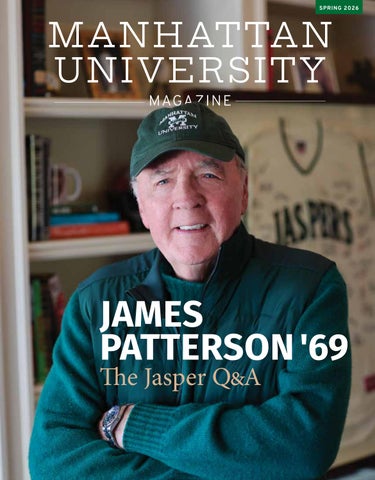
JAMES PATTERSON '69
The Jasper Q&A
Art by Bernardo Ramonfaur, Monterrey, Mexico.
Ad Designed By Tony Tirado.
A MESSAGE FROM THE PRESIDENT
Dear Friends,
Welcome to the Spring ’26 issue of the Manhattan University Magazine. After what felt like a never-ending winter, we are starting to see signs of spring on our beautiful Riverdale campus. Students are back after their spring break, and we are bursting with activities to be enjoyed by our entire school community and beyond. We welcome you — our alumni — to participate in as many of the events as possible. You may find a listing on the school website at www.manhattan.edu/events
In this issue we celebrate two of our most well-known alums — James Patterson ’69 and Ambassador Charles A. Gargano ’79 (MSCE); honor two of our School of Engineering alums who were recently inducted into the prestigious National Academy of Engineering — our past President, Milo Riverso, Ph.D. ’81 and current Board of Trustees member Thomas Z. Scarangello, ’79 and ’82; and recap our most recent De La Salle Medal Dinner where we raised over $1.5 million and honored another alum and Board member, Jose Minaya ’94, the Global Head of BNY Investments and Wealth.
In addition, we are particularly honored to share over two dozen drawings and sketches by Holocaust survivor, Marcel Roux, donated to our Holocaust, Genocide, and Interfaith Education Center by Helene and Ken Orce ’65. These never-before-seen pieces are on display at the O’Malley Library Gallery. This is an exhibit that is so important to see since the drawings serve the purpose for which the artist created them: to testify to history and ensure that the suffering and crimes of the Holocaust are remembered and documented for future generations.
Each of these stories embodies the Lasallian spirit of faith in God, respect for all, a quality education, concern for the poor and social justice, and an inclusive community that is the essence of all that we do at Manhattan University.
I am so proud of the accomplishments of so many of our alums and equally proud of the great accomplishments of our current students, many of which you can read about in this issue.
As we celebrate our country’s 250th anniversary of its founding, let us take pride in the various contributions that so many Jaspers have made over the past 173 years in the arts, business, and engineering. Our size may be relatively small in numbers, but our footprint looms large!
My thanks to all of you.
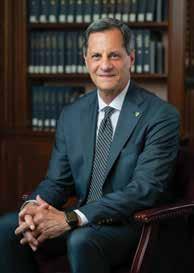
Frederick Bonato, Ph.D.
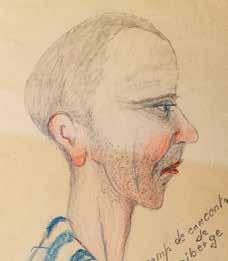
LOST STORIES OF THE HOLOCAUST
Discover the works of Holocaust survivor Marcel Roux, whose chilling yet powerful drawings depicting life inside a concentration camp were nearly lost to history.
4 INAUGURATION OF PRESIDENT DR. FREDERICK BONATO
Manhattan University celebrates the historic event officially appointing its 22nd President.
12 MINI BAJA
Learn more about the Jasper mechanical engineering team as they rev up for one of the most prestigious, hands-on competitions.
14 GIFT FROM AMBASSADOR
CHARLES A. GARGANO, ’79 Towering Redbrick Arches — Symbols of the University for Over a Century — Named in Ambassador Gargano’s Honor.
15 DE LA SALLE MEDAL DINNER
Manhattan University commemorates its 75th De La Salle Medal Dinner by honoring Jose Minaya ’94, currently SEVP and Global Head of Investments and Wealth at Bank of New York Mellon Corporation (BNY).
20 EMANATIONS/ITERATIONS
Revisit Brother Ralph Bucci’s sprawling art exhibition featuring dozens of his smoke-fired, clay-built ceramic sculptures.
48 THE MARCOCCIA FAMILY
A family legacy of Jaspers
60 ALUMNI NOTES
62 IN MEMORIAM
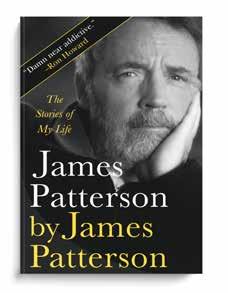
CHOPPING WOOD WITH JAMES PATTERSON ’69
In a riveting and candid Q&A, one of the most prolific, best-selling authors of all time — and proud Jasper — offers a detailed look at his life, legacy, lessons and work ethic.
SIXTH
BOROUGH FILM FESTIVAL
Learn about the beginnings, development and big winners of Manhattan University’s inaugural event, which turned the Riverdale campus into a dynamic, global, weekendlong celebration of film and storytelling.
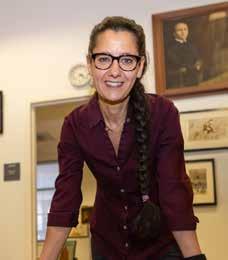
THE GUARDIAN OF LASALLIAN HISTORY & MORE: AMY SURAK
Manhattan U’s longtime archivist guides us through her winding, storied career path, and explains her roles and responsibilities as well as her intricate workflow.
"Manhattan Gets You Ready."
— James Patterson
CREATIVE DIRECTOR/ EDITOR
Robert Cole
ASSOCIATE EDITOR
Kiran Aditham
DESIGNER
Kyle Willis
CONTRIBUTORS
Mehnaz Afridi, Ph.D.
Jason Black
Claudia Cardona
Judy Cooper
Zach Dovel
Edward Fernandez
Ann Gulino
Barbara Herlihy
Fran Hernandez
Joey Jarzynka
Seth Kovanic
Matthew Perrino
Madeleine Rosado
Pauline Spitzer
Amy Surak
Tony Tirado
PHOTOGRAPHERS
Ben Asen
Josh Cuppek
Kevin Dale
Brian Hatton
Melissa Kelly
Anissa Latif
Ryan Montemarano
Bella Muccari
Ian Peters
COVER PHOTO
Susan Patterson
MANHATTAN UNIVERSITY CELEBRATES HISTORIC INAUGURATION OF 22ND PRESIDENT, DR. FREDERICK BONATO
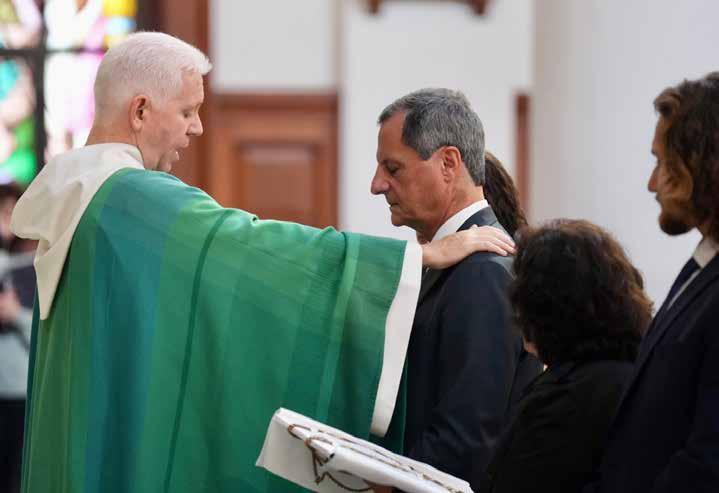
History was made on October 20, 2025, as Manhattan University celebrated the Inauguration of our 22nd President, Frederick Bonato, Ph.D.— a milestone day that brought together students, faculty, alumni, trustees and friends of the institution to the Chapel of De La Salle and His Brothers for Mass followed by Investiture and the reception at Kelly Commons.
During his captivating and motivational address, Dr. Bonato — who was officially named Manhattan University President a few months prior in July 2025 – conveyed a vision for the future built on Lasallian Catholic values, innovation, inclusion and student success.
With over 30 years of experience in the education field as a professor and administrator, Bonato spent nearly two decades teaching psychology at Saint Peter’s University in New Jersey, where he chaired the department and, as the President of the Faculty Senate, established a reputation for brokering collaborative relations between faculty and administration. At Saint Peter’s, he also served as the University’s Director of Faculty Research and Sponsored Programs, where he facilitated the
grant process, and finished his tenure there as Executive Vice President & Provost.
Holding a B.A., M.A. and Ph.D. from Rutgers University, Dr. Bonato also served as Associate Provost for Academic Affairs at Montclair State University and played a pivotal role in health-related initiatives, including launching the School of Nursing and the Center for Clinical Services. In addition, he held the position of President of the Eastern Psychological Association, was elected to the International Academy of Aviation and Space Medicine in 2015 and was recently appointed as Vice President for Education & Research for the Aerospace Medical Association, where he worked for 14 years as the Editor-in-Chief of its peer-reviewed journal, Aerospace Medicine and Human Performance
Dr. Bonato’s leadership continues to inspire our community to strive for excellence and propels us forward while staying true to the mission that has guided Manhattan University since 1853.
Thanks to everyone who attended to commemorate this historic occasion. MU
Pictured L-R: Father Edward Beck, President Frederick Bonato, Ph.D.
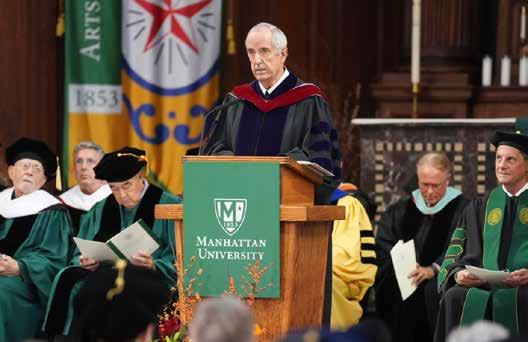
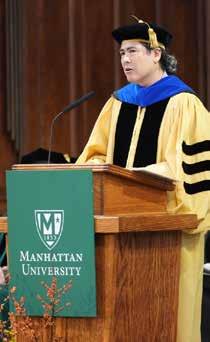
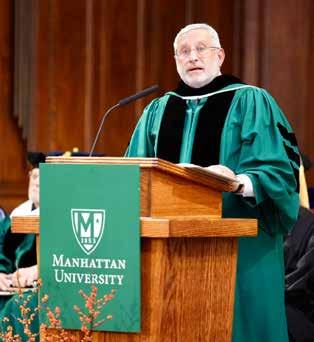
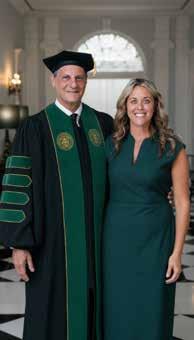
1) Brother Robert Berger '73, FSC, D.Min., delivered the Invocation
2) President Frederick Bonato and his fiancée, Nicole DeCapua, Ed.D.
3) J. Patrick Abulencia, Ph.D., associate professor of Chemical Engineering, gave greetings and congratulations from the faculty
4) Representing the Manhattan University Board of Trustees was Fredric Marro, member of the Executive Committee of the Board of Trustees as well as the Chair of the Board's Athletics Committee
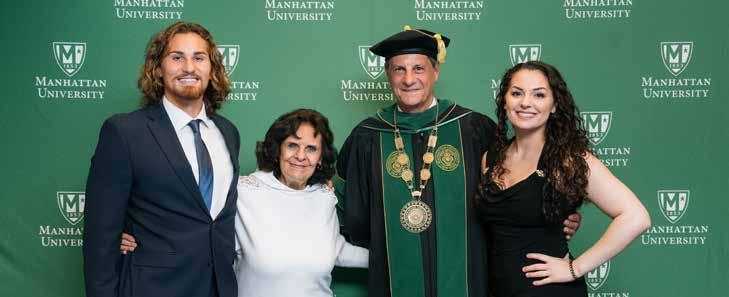
5) L-R: President Bonato's son Victor Bonato, mother Joanne Bonato, President Bonato and his daughter Vienna Bonato
TWO MANHATTAN UNIVERSITY ALUMS ELECTED TO PRESTIGIOUS NATIONAL ACADEMY OF ENGINEERING
Milo
Riverso, Ph.D., P.E., and Thomas Z. Scarangello, P.E., Become Members of the Class of 2026
Manhattan University proudly announced that two of its graduates Milo Riverso, ’81, Ph.D., P.E., and Thomas Z. Scarangello, ’79 and ‘82, P.E., have been elected to the National Academy of Engineering (NAE) Class of 2026. Election to the prestigious organization is among the highest professional distinctions awarded to an engineer in the U.S. According to the NAE website, membership recognizes those who have made outstanding contributions to “…engineering research, practice, or education….and to the pioneering of new and developing fields of technology, making major advancements in traditional fields of engineering, or developing/implementing innovative approaches to engineering education.”
Part of the National Academy of Sciences, Engineering, and Medicine (NASEM), NAE’s mission is to advance the welfare and prosperity of the nation by recognizing the expertise of the most accomplished engineers.
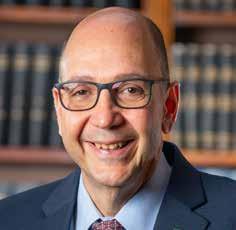
Milo Riverso, a 1981 graduate of Manhattan University as well as its 21st President, is a senior executive with over 45 years’ experience leading complex organizations in program management, design, construction, and education. As the President of Manhattan, he oversaw the transition from a college to a university, among other accomplishments. He is a past President and CEO of STV Group, Inc., where he oversaw a workforce of 2,300 and drove exponential growth in revenue, ultimately leading to a landmark partnership with The Pritzker Group. Prior to his tenure at STV, he was the President and CEO of the New York City School Construction Authority where he transformed the infrastructure serving over one million students. Riverso served as Chair of the National Academy of Construction, the Construction Management Association of America (CMAA), the New York Building Congress, and holds executive leadership positions with the National ACE Mentor Board and Columbia University’s Center for Buildings, Infrastructure, and Public Spaces. He is a registered Professional Engineer with master’s
and Ph.D. degrees from Purdue University. He stated, “I am deeply humbled by this recognition and attribute this accomplishment
to the rigorous academic training I received at Manhattan University and Purdue University which laid the foundations for a wonderful career.”
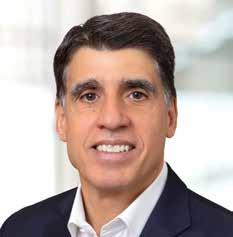
Thomas Z. Scarangello, who holds both bachelor’s and master’s degrees from Manhattan University and a Professional Degree in Engineering Mechanics from Columbia University, is a Managing Principal and Senior Advisor at Thornton Tomasetti (TT) – a firm
that optimizes the design and performance of structures, materials, and systems for projects of varying sizes and complexities. He served as TT’s Chairman and CEO for over a decade and guided its expansion into advanced digital practice, automation, and integrated project delivery. Scarangello has been responsible for many of the world’s most complex and recognizable building projects, including longspan stadia and arenas, high-rise towers, and resilient infrastructure. He is a past Chair of the New York Building Congress; a member of the National Academy of Construction as well as the Structural Engineering Association of New York; a Trustee of St. Patrick’s Cathedral; a member of the Board of Advisors of Columbia University’s Center for Buildings, Infrastructure, and Public Spaces; on the Board of Directors of the Urban Design Forum, and a member of the Board of Trustees at Manhattan University. Scarangello stated, “I am deeply honored to be elected to the National Academy of Engineering. Manhattan University played an important role in shaping my early foundation as an engineer, and I was fortunate to follow in the footsteps of mentors such as Charlie Thornton and Richard Tomasetti, both Manhattan alumni and NAE members whose leadership and commitment to engineering excellence had a profound influence on my career.”
Frederick Bonato, Ph.D., President of Manhattan University, stated, “It is an honor to add Milo and Tom to the ranks of Manhattan graduates who have received this high recognition in the engineering community. We are so very proud of their accomplishments and the contributions each of them has made to the engineering profession and to Manhattan University.”
Echoed NAE President, Tsu-Jae Liu, “Election to the National Academy of Engineering is the highest professional honor accorded to an engineer in the United States. It recognizes engineers whose technical achievements and leadership have made a lasting impact.”
Milo Riverso, Ph.D., P.E.
Thomas Z. Scarangello, P.E.
COOPER
L essons & C arols
C hristmas C oncert
Manhattan University continued its timeless annual holiday tradition with the 2025 Festival of Lessons and Carols, which took place on December 7, 2025, in the Chapel of De La Salle and His Brothers.
Featuring scripture, an opening prayer delivered by Father Edward Beck, lessons of faith and an abundance of joyous song, including holiday
favorites such as Let it Snow and O Holy Night, the Festival drew hundreds to watch and enjoy performances by the Manhattan University Orchestra led by conductor Sharon Gunderson, and the Manhattan University Singers, conducted and directed by Andrew Bauer, Director of Performing Arts. MU
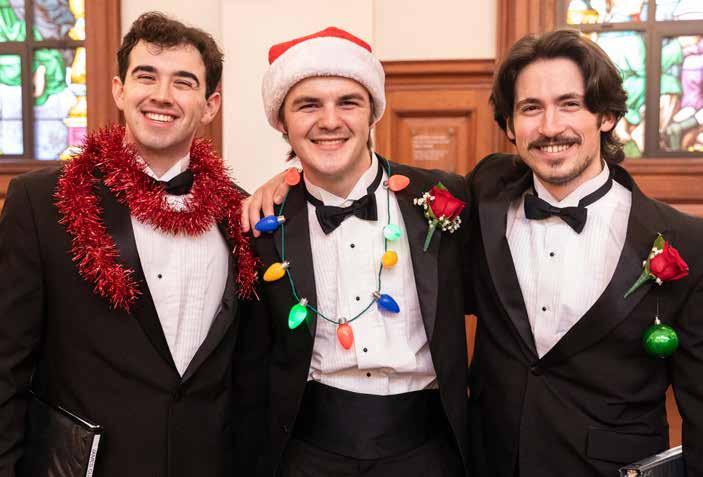
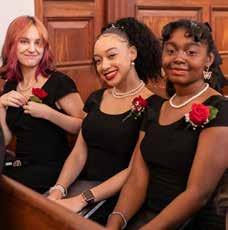
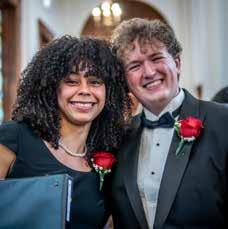
Photos L-R: James Cullen, Owen Sweeney & Dean Corvino
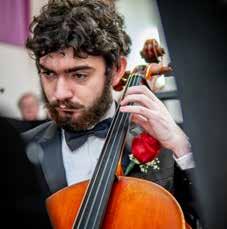
Cellist Kevin Cullen
L-R: Sarah Richnavsky, Savannah Traverzo, Gabriella Dickson
L-R: Layla Luciano and William Walker
MANHATTAN UNIVERSITY STUDENT RECEIVES BENJAMIN A. GILMAN SCHOLARSHIP
Scholarship Enables Pell Grant Recipients to Study Abroad
David Pozo ’26 was awarded the prestigious U.S. Department of State’s Benjamin A. Gilman Scholarship through the Institute of International Education at the State Department. According to the Department’s website, the Gilman Scholarship “…supports students of limited financial means to study or intern abroad, providing them with skills critical to our national security and economic prosperity.” Applicants must be receiving a Federal Pell Grant during the time of their applications.
Pozo, a Bronx, NY native and a first generation college student, is a senior at Manhattan University majoring in Criminology and minoring in Computer Science; upon graduation in May, he plans on getting his master's at John Jay College of Criminal Justice with a focus on forensics and cybersecurity. In addition to the Gilman Scholarship, he was accepted into the America On Tech program, a highly selective initiative designed to provide technical training and career development opportunities to underrepresented students, and was the recipient of a Higher Education Opportunity Program scholarship. In addition to his academic credentials, Pozo has been involved in competitive chess since childhood. “Chess taught me discipline, critical thinking, and accountability," he said. "These translated directly into my academic and personal development. I learned how to break down complex systems, anticipate outcomes, and remain composed in high-pressure situations.”
Frederick Bonato, Ph.D., President of Manhattan University, stated: “This is such a wonderful opportunity for David. The Gilman Scholarships are well-known for the broadening experience they offer students, and I know that David will take full advantage of studying in a foreign country and all that it offers.”
Pozo’s studies through the Gilman Scholarship will take him to Argentina shortly after his graduation from Manhattan University.
MU
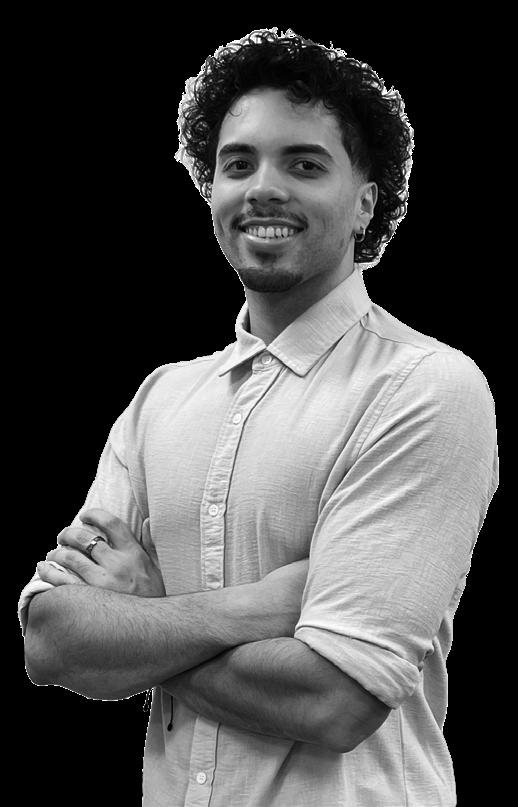
Manhattan University Student Awarded IEEE S cholarship
Paul
Harrison '27, a Junior Majoring in Electrical Engineering, Named a 2025 IEEE Power & Energy Society Scholarship Plus Initiative Recipient
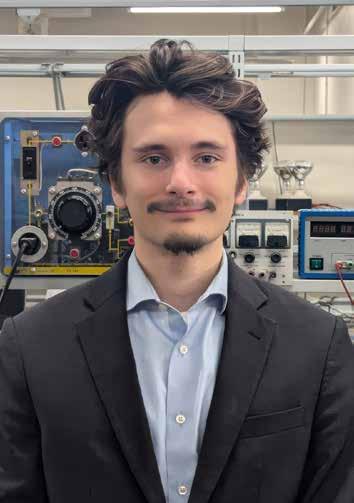
Paul Harrison, a junior in the University’s School of Engineering, has been awarded the prestigious IEEE PES Scholarship which carries a $10,000 stipend.
According to the IEEE (the Institute of Electrical and Electronics Engineers) website, it is the world’s largest technical professional organization whose core purpose is to foster technological innovation for the benefit of humanity. It is a global network of more than 486,000 engineering and STEM professionals across a variety of disciplines.
The scholarship awarded to Mr. Harrison is given to a high-achieving undergraduate student in an electrical engineering program with a focus on making a future impact across the power and energy industry. To be eligible for the award, a student must be a U.S. or Canadian citizen; the award was established to address the aging workforce within the power and energy sector in those countries.
Harrison, a native of Carmel, NY (Putnam County), originally
thought he would be a lawyer. However, during his high school years, he was involved in a stage crew program working on both electrical and sound elements for various productions which started his path to engineering. He is scheduled to graduate in May 2027 with a B.S. in Electrical Engineering with a concentration in power grids and green energy along with a concentration in Applied Artificial Intelligence. Harrison is a recipient of the Manhattan University Trustee Scholarship, awarded to students in the top 5% of the applicant pool, and is a member of the Gamma Alpha chapter of Eta Kappa Nu, positioning him in the top quarter of his electrical engineering classes. Additionally, he is the Vice President of the IEEE Manhattan University Student Branch and the President of the 7x24 Exchange Student Chapter where he promotes mission-critical/data center industry awareness, particularly in energy efficiency and cooling. Harrison credits the incredible
network of Manhattan University alumni and the caring nature of his professors for his success.
Kathryn Jablokow, Ph.D., Dean of the School of Engineering and herself an electrical engineer, commented, “Paul’s achievements thus far are a true testament to his academic abilities, his leadership skills, and his research activities with faculty from our electrical engineering department. The Jasper network continues to support our current students positioning them to become leaders in their chosen fields. Paul is a superb example of someone who will make a positive impact in electrical engineering and beyond.”
According to Harrison, who plans to pursue a master’s degree upon graduation, “A dream job would be working on grid infrastructure or doing micro-grid work for data centers to lessen their strain on the grid. I want to make a positive lasting impact in my field and hope to give back by also becoming an adjunct professor.” MU
WHERE TIMELESS WORDS FIND
NEW VOICES
Each month, something quite extraordinary happens on the Riverdale campus: A faculty member steps before a camera, opens a beloved text, and reads aloud, offering the Manhattan community a few minutes with Dickinson, Shakespeare, Tennyson, or Poe. This is Classic Readings, the Kakos School of Arts & Sciences’ monthly celebration of literature and storytelling.
Conceived as an “edutainment” initiative, part education and part performance, the series features works from the public domain alongside original compositions by students and faculty. Since its October 2025 debut with a haunting rendition of Poe’s The Raven , the series has grown into a beloved campus tradition that spans disciplines and generations.
The Classic Readings series aims to foster interdisciplinary connection across writing, theatre, and digital media, while showcasing the remarkable range of talent within the University community. Readers have ranged from deans and professors to the Brothers of the Christian Schools, each bringing a distinct perspective to the works they perform.
This season has brought together an impressive roster of voices and texts. In October, Mark Pottinger, Ph.D., opened the series with Poe’s The Raven , setting a dramatic tone for what was to come. Deirdre O’Leary Cunningham, Ph.D., Associate Professor of English, followed in November with Ella Wheeler Wilcox’s
Thanksgiving , a timeless reflection on gratitude and community. Dean Marcy Kelly, Ph.D., of the Kakos School of Arts and Sciences, brought warmth and holiday spirit to December with Clement Clarke Moore’s 'Twas the Night Before Christmas . The new year opened with Br. Robert Berger, FSC, reading Alfred, Lord Tennyson’s Ring Out, Wild Bells , a call to moral renewal drawn from his larger elegy, In Memoriam . February brought Brian Chalk, Ph.D., reading Shakespeare’s Sonnet 116 just in time for Valentine’s Day, and March welcomed spring with Shawn Ladda, Ph.D., Professor of Kinesiology, reading Emily Dickinson’s Dear March, Come In . April closed the season with Margaret Groarke, Ph.D., reading Langston Hughes’s April Rain Song , a lyrical meditation on the soothing, restorative beauty of a spring rain. The academic year will close in May with a bilingual reading of Guillaume Apollinaire’s May , presented in both French and English by Kristell Lowe, Vice President for Student Life. New performances are released monthly and available to the entire Manhattan community and the public on the University’s website. Whether rediscovering a childhood favorite or encountering a poem for the first time, Classic Readings reminds us that the written word, spoken with care, still has the power to move us. MU
To view the Classic Readings Series, visit: manhattan.edu/classic-readings
MEET SANTO, THE CAMPUS MINISTRY’S ADORABLE NEW MASCOT
There’s a playful, energetic and very lovable new resident on campus who’s been charming the Manhattan University community since his arrival.
Meet Santo, the adorable English black labrador who has been taken in by the priests at our Campus Ministry and embraced as their new mascot. One of a litter of 12 English labs born to two show dogs in New Jersey, the fittingly named pup is also being trained as a service dog to assist those with hearing impairments.
As expected, Santo’s arrival has been a huge success, especially with students, according to Father Edward Beck, Campus Ministry Co-Director and University Chaplain. “We've had more students than ever
visiting our Campus Ministry Cornerstone space in Miguel 209,” he said. “Many come in every day just to say hi to Santo. Some come in just because they need a hug, others want to take him for a walk or play with him in Cornerstone."
Fellow Campus Ministry Co-Director and University Chaplain Father Robert Joerger added, “The campus community has welcomed Santo with open arms and he is helping us further build the community in turn!”
For those who happen to be on campus during weekends, Santo also makes an appearance at Mass every Sunday evening at 7:30 p.m. in the Chapel of De La Salle and His Brothers. MU
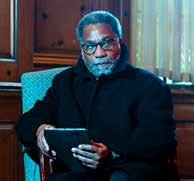
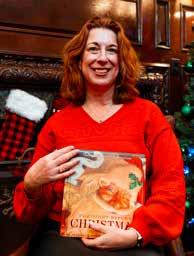
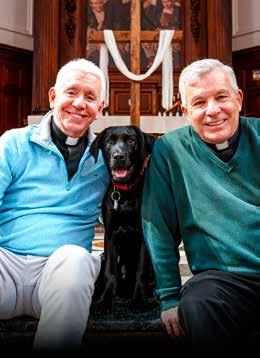
Photo L-R: Fr. Edward Beck, Santo and Fr. Robert Joerger in the Chapel of De La Salle and His Brothers.
Top Photo: Mark A. Pottinger, Ph.D., Professor of Music and Musicology & Chair Communication, Sound & Media Arts
Bottom Photo: Marcy Kelly, Ph.D., Dean of the Kakos School of Arts and Sciences, Professor of Biology
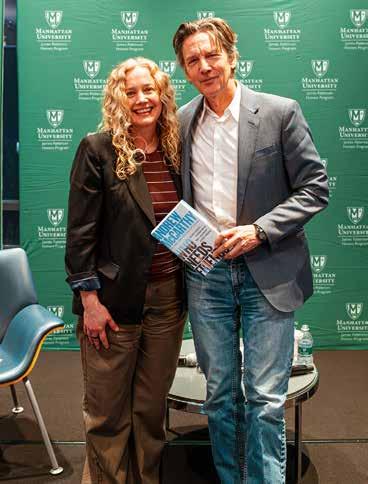
ACTOR/AUTHOR ANDREW MCCARTHY VISITS MANHATTAN U TO DISCUSS NEW BOOK, ‘WHO NEEDS FRIENDS’
As part of its James Patterson Honors Program Speaker Series, Manhattan University welcomed actor, director and author Andrew McCarthy — star of classic films such as Pretty in Pink, St. Elmo’s Fire, Less Than Zero and Weekend at Bernie’s — to discuss his new book, Who Needs Friends: An Unscientific Examination of Male Friendship Across America.
Inspired by a conversation with his son, Sam, who questioned McCarthy’s own friendships with men, Who Needs Friends finds the 1980s Brat Pack icon and award-winning travel writer embarking on a 10,000-mile, cross-country journey of self-discovery, reconnecting with old friends and exploring the state of male friendships in general, interviewing everyone from cowboys to preachers and musicians along the way about the challenges of forming bonds and forging deep connections.
Taking the stage at Kelly Commons for the event, which took place on March 24, 2026 and was organized by Dr. Michele Saracino, Professor of Religious Studies and Executive Director of the James Patterson Honors Program, McCarthy offered the packed house of students, alumni and community members plenty of candid insights and observations on male bonding, loneliness, intimacy, vulnerability and the importance of just being there for one another.
During the evening’s discussion, which was moderated by Dr. Kelly Marin, Professor of Psychology and Chair of Manhattan’s Social and Behavioral Sciences Department, the author engaged the audience with several anecdotes, including about his travel writing, as well as a Q+A in which he deduced that young people may already understand friendship more deeply than older adults give them credit for. He cited his own films like St. Elmo’s Fire, which he said took young people seriously and often focused more on friendship than romance, resulting in a more profound and grounded story.
McCarthy’s appearance made for an enlightening, entertaining experience, further illustrating the significance and prestige of the James Patterson Honors Program Speaker Series. MU
MANHATTAN U STUDENTS STAR IN PRIME VIDEO SERIES, THE COLLEGE TOUR
A group of Manhattan University students will take center stage in an upcoming episode of the Amazon Prime Video documentary series, The College Tour.
Now entering its 16th season, the innovative and informative show, hosted by Alex Boylan, provides viewers with an inside look into college life in institutions across the country and around the world, with each episode highlighting a specific campus through the perspectives and experiences of current students.
The Manhattan episode, which will
premiere on the streaming service on June 16, 2026, features five students in particular — Shu Amanuma, an International Studies major with a concentration in Global Affairs; graduate student Joseph Brennan, who’s pursuing his MBA in Professional Accounting; Leyla Mercado, a double major in Political Science and Criminology; Accounting major Christopher Parson; and Civil Engineering major and Economics minor Ioannis Rountos.
If you’re a Prime member, be sure to watch and support your fellow Jaspers! MU

Pictured, L-R: Kelly Marin, Professor of Psychology, Manhattan’s Chair of Social and Behavioral Sciences, and actor/director/author Andrew McCarthy, who visited campus to promote his new book, Who Needs Friends: An Unscientific Examination of Male Friendships.
MINI BAJA

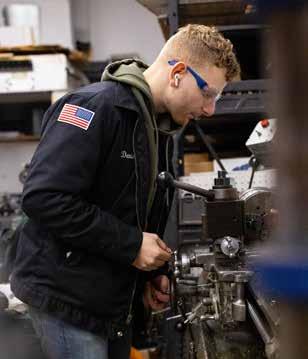
Photo this page, Joseph Moog.
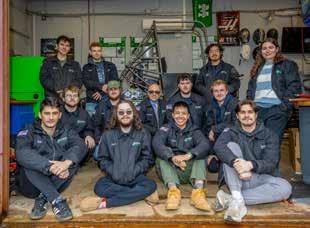
Facing page – Top Photo - From back left to right: Joseph Moog; Christian Danial; Leobardo Rivera; Vanessa DiPilato. From middle left to right: James Conway; John Clark; Dr. Peyman Honarmandi; Phelim Clery; Raymond Mitchell. From front left to right: Robert Qeta; Gabriel Haynes; Brandon Padre; Miguel Dumeng
Middle Photo – Christian Danial
Bottom Photo - Joseph Moog; Raymond Mitchell
Manhattan University’s Mini Baja team is preparing to compete in one of the most prestigious hands-on engineering competitions. In June, the team will travel to Rochester, NY, to participate in the Society of Automotive Engineers’ (SAE) annual intercollegiate Baja competition, where more than 100 schools from around the world will put their vehicles to the test.
The competition is designed as a senior capstone project in the mechanical engineering curriculum, where students have the chance to apply what they have learned in the classroom to real-world design as they build an off-road vehicle from scratch on campus.
During the four-day competition, students will build, test and compete in the SAE Baja competition. SAE Baja consists of two main events: static and dynamic. Static events involve the design presentation, vehicle performance presentation and marketing presentation, while dynamic events encompass acceleration and braking tests, a hill-climb ability test, maneuverability test, suspension test and endurance test.
The competition challenges students to apply their mechanical engineering education to a realworld industry setting as they balance a budget, work with a team of 12 students and handle design, analysis and manufacturing while following SAE rules and regulations.
Throughout the academic year, students have been building the vehicle in the SOE-Mahan Building on campus. In the shop, students are delegated various tasks such as
welding, machining and working with other specialized tools.
For associate professor of mechanical engineering and Mini Baja faculty advisor Peyman Honarmandi, Ph.D., the project is as much about learning from mistakes as it is about building a car. He encourages students to experiment and embrace new challenges in the shop, often reminding them, “to not be afraid of messing up. Just do it. That's why we are here.”
Honarmandi noted that the project appeals to students interested in the automotive industry. “There are a lot of students interested, and they're actually really passionate about the auto industry,” he said.
That passion is evident in Joseph Moog, a senior mechanical engineering major and president of the Mini Baja project. Moog has been involved since his junior year, and after competing with last year’s team in South Carolina, he stepped into a leadership role. According to Moog, the experience closely mirrors what engineers face in the professional world.
“This is definitely one of the most intensive engineering projects on campus,” Moog said. He explained that students not only design and build the car from scratch but also manage the project’s finances.
Collaboration with outside sponsors and companies transforms the project from a classroom exercise into a real-world industry experience. As Moog noted, “This is probably the closest you get to running a business and being in the industry. With this project everything matters, and we're dealing with all real companies.” MU

MANHATTAN UNIVERSITY ANNOUNCES MAJOR GIFT FROM AMBASSADOR CHARLES A. GARGANO ’79
Towering Redbrick Arches — Symbols of the University for Over a Century — Named in Ambassador Gargano’s Honor
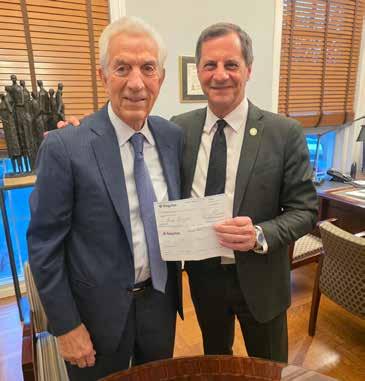
Manhattan University announced a donation of $1 million from Ambassador Charles A. Gargano, a 1979 Masters graduate from its School of Engineering. The towering red brick arches that flank Memorial Hall and offer a welcoming spirit to the iconic Quadrangle on the campus have been important structures for over 100 years and will henceforth be called the Charles A. Gargano, P.E. '79 Arches. The gift was finalized in December 2025.
Ambassador Gargano had a varied and significant career. He served as the deputy administrator in 1981 for the Urban Mass Transit Administration (UMTA), the U.S. Ambassador to Trinidad and Tobago from 1988 to 1991, and from 1995 to 2007 was the Vice Chairman of the Port Authority of New York & New Jersey. In the latter position in the aftermath of the September 11th terrorist attacks, Ambassador Gargano spearheaded the reconstruction of lower Manhattan, earning the
moniker as New York States’s “Economic Czar”.
Born in Avelino, Italy, Gargano and his family emigrated to the United States when he was four years old, settling in Brooklyn. He received his B.S. and MBA from Farleigh Dickinson University and, in 1979, earned his MS in Civil Engineering from Manhattan University. He also was awarded an Honorary Doctorate of Science Degree from Manhattan in 2011.
Frederick Bonato, Ph.D., President of Manhattan University, stated, “Ambassador Gargano has worked tirelessly to ensure that all citizens are granted the same possibilities for success — not just the privileged few. He is a public servant in the truest sense, combining vision with execution, heart, and strategy. The mission of Manhattan University prepares graduates for lives of personal development, professional success, civic engagement, and service to their fellow human beings. Ambassador Gargano is our mission personified.”
In addition to this most recent gift to the University, Ambassador Gargano dutifully served on the University’s Board of Trustees from 1994 to 2007 and in 1996 the Ambassador Charles A. Gargano Scholarship was founded by a group of friends; the scholarship consistently supports Manhattan University students in need of financial aid.
At the dedication ceremony, Ambassador Gargano stated, “My heart is always with Manhattan University, and being a permanent part of the brick and mortar solidifies my belief that with an education and those who help along the way, it is possible for anyone to succeed and, in turn, provide others with the tools for success. Manhattan isn’t just a place to get a diploma; it’s a community where men and women from all walks of life learn from the examples set by the Christian Brothers. It is a true honor to be part of this legacy of service through the gift of education.” MU
Photo (L-R): Ambassor Charles A. Gargano, '79, Manhattan University President Frederick Bonato, Ph.D.
De La Salle Medal Dinner
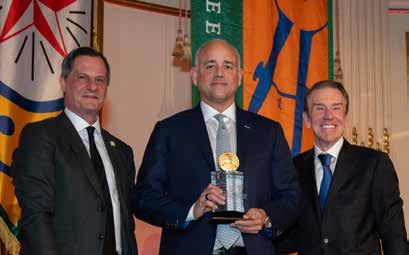
The 75th De La Salle Medal Dinner, Manhattan's premier fundraising event generating support for student scholarships and other forms of student aid, was held on Thursday, March 19, 2026, at The Plaza in New York City. This year’s honoree was Jose Minaya ’94, who currently serves as SEVP and Global Head of Investments and Wealth at financial services giant, Bank of New York Mellon Corporation (BNY).
During his time at Manhattan University, where he earned his bachelor’s degree in finance and now sits on its board of trustees, Minaya devoted himself to both the gym and library, where he was able to exercise with his baseball teammates and study with his classmates, respectively. After being accepted to the U.S. Marine Corps officer candidate school upon graduation, Minaya’s financial career took off on a whim when he attended a job fair and visited the booth for J.P. Morgan, where he quickly began working in investment banking along with mergers and acquisitions.
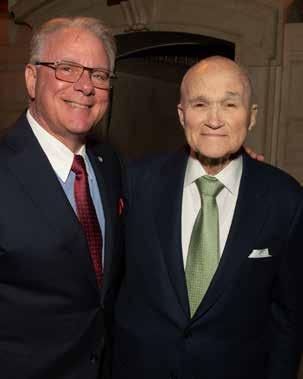
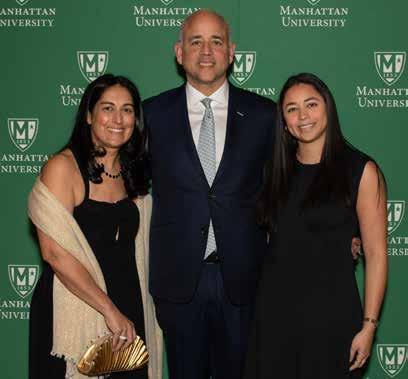
Clockwise from left:
Photo 1: 2026 De La Salle Medal Honoree José Minaya ’94 is pictured with his wife Romy (left) and daughter Isabella (right).
Photo 2 L-R: Thomas Mauriello, Manhattan Senior Vice President for University Advancement and Raymond W. Kelly ’63, former NYPD Commissioner
Photo 3 L-R: Manhattan University President Frederick Bonato, Ph.D.; 2026 De La Salle Medal Honoree Jose Minaya '94 and De La Salle Medal Dinner Chair Ken Kencel
However, his path would lead back to education and the Amos Tuck School of Business at Dartmouth, which he attended as a Robert Troigo Fellow, earned his MBA in general management and now serves on its board of advisors.
During his storied career, Minaya enjoyed a 20-year run at Teachers Insurance and Annuity Association of America (TIAA) before joining fellow financial services powerhouse, Nuveen, eventually becoming its CEO within three years and taking the company to trillion-dollar status in business.
At the De La Salle Medal Dinner, Minaya delivered an extremely inspirational speech upon receiving the event’s award, in which he attributed his success to the values instilled in him during his upbringing. Growing up in Washington Heights, he learned the importance of family, faith, and education. The executive also spoke about the profound influence his mother has had on his life, as well as the impact of his wife and children. MU
LOST STORIES OF THE HOLOCAUST
Featuring the work of Marcel Roux
An
Unknown Artist — Drawn from the Camps, 1942-1945
"He drew when words could not reach — a pencil held against forgetting."
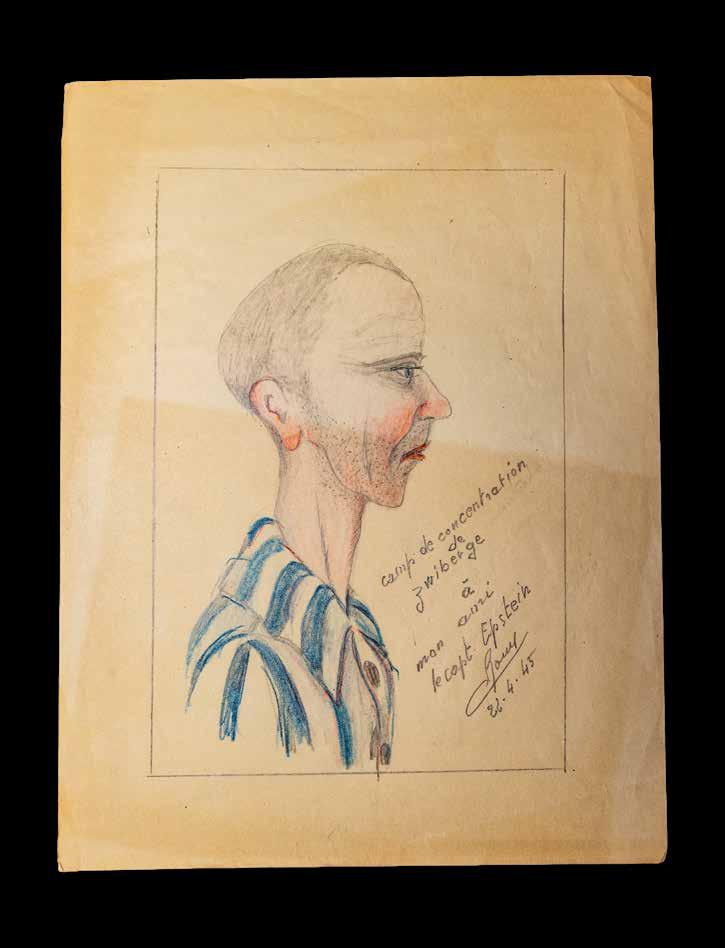
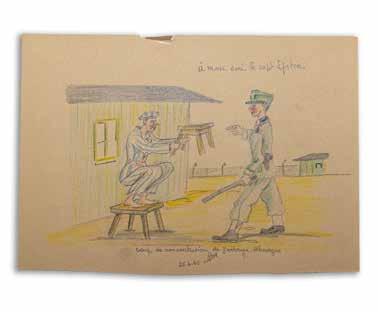
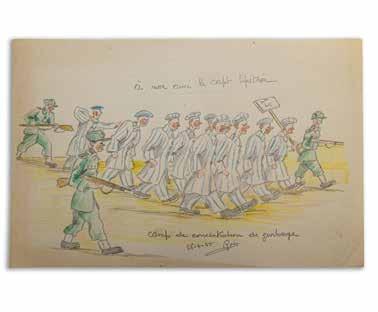
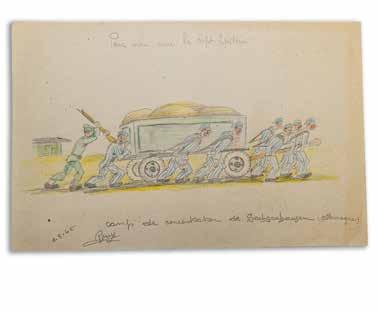
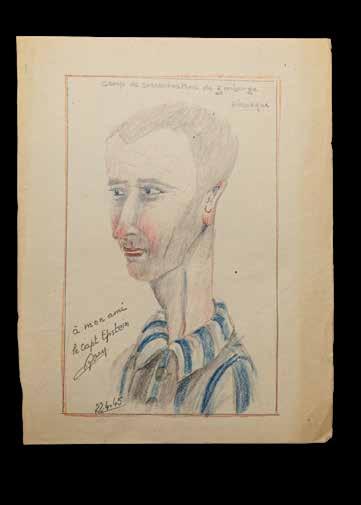
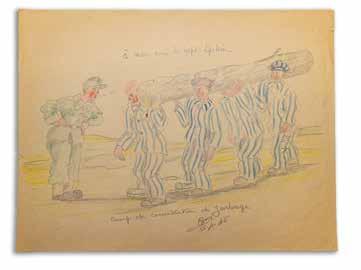
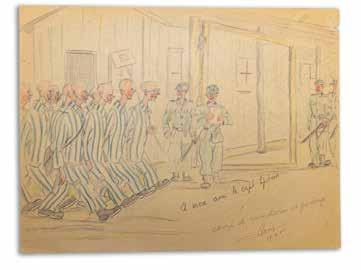
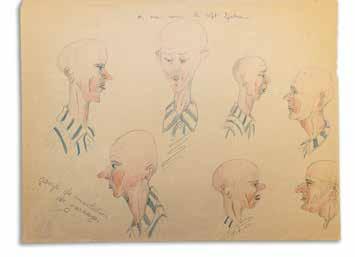
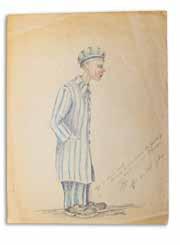
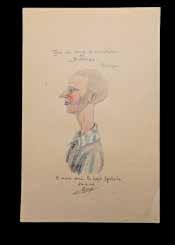
Marcel Roux was a witness. Within the barbed wire of Nazi concentration camps, he quietly rendered what he saw: the striped uniforms, the broken bodies, the relentless machinery of destruction. His drawings — gifted to a friend, nearly lost to history — are among the rare visual records made from inside the camps themselves. These works were dedicated to à mon ami le Capt. Epstein — to his friend, whose name alone survives alongside the images.
Kenneth (Ken) and Helene Orce have been great friends and supporters of Manhattan University for many years. A 1965 cum laude political science graduate and former member of the University’s Board of Trustees, Ken went on to Harvard Law School where he was an editor of the Harvard Law Review and spent over 40 years at the law office of Cahill Gordon & Reindel. When he was about to start his junior year at Manhattan, Ken’s father suffered a fatal heart attack. Not being financially well off, Ken was certain he would not be able to continue his college education. Upon hearing of the loss of Ken’s father, administrators at Manhattan University (then Manhattan College) told Ken that he need not worry about tuition and to continue his education at Manhattan. As Helene has commented, “Just when you think it’s the end of the world, the sun starts shining again.” This spirit of giving in the true Lasallian manner remained with Ken and Helene and, over the years, they have become major donors to Manhattan.
It is this connection that brought these significant sketches from the Holocaust to Manhattan University.
THE DISCOVERY
In the early 1990s, Helene and Ken Orce purchased a house in Westchester County, New York, from Ruth Epstein, widow of Dr. William Epstein, a medical doctor who had served in the U.S. Army during World War II. Taking possession of the house on January 15, 1993, the new owners found the house had not been renovated in many years and undertook substantial reconstruction work.
While demolishing a closet in the master bedroom, they discovered a black leather case measuring approximately 13.75 by 10.5 by 1.5 inches. The only marking was a taped inscription: Capt. Epstein - Please Return 20 Field Hosp.
CONTENTS AND INITIAL RESPONSE
Inside the case were drawings; 16 postcards of European sites; numerous photographs of beaches, buildings, and U.S. military aircraft and personnel; small Nazi posters; two handwritten notes to Dr. Epstein; news articles about a camp liberation; and other memorabilia.
The discovery unsettled the new owners.
Though their purchase contract included all personal property left in the house, they felt the case might hold sentimental value for Mrs. Epstein. Shortly after the discovery they contacted her, but her assistant reported she had no interest in anything left behind. Mr. & Mrs. Orce set the case — with its contents intact — aside until 2009. They later learned Mrs. Epstein had died around 2005.
UNCOVERING THE HISTORY
In 2009, considering what to do with the drawings, the owners contacted Mr. Niv Goldberg, Manager of the Holocaust Art Archive & Art Collection Database at Yad Vashem Museums Division in Jerusalem. After examining the drawings sent by email, Goldberg provided crucial historical context that transformed the Orces' understanding of what they possessed.
THE ARTIST: MARCEL ROUX
The 26 drawings were executed by Marcel Roux at the Langenstein-Zwieberge Concentration Camp in Germany during the two-week period between April 18 and May 1, 1945 — immediately following the camp’s liberation by the U.S. Army on April 13, 1945.
Marcel Roux, born May 20, 1904, in Arles, France, was a French prisoner at the camp. (He should not be confused with a well-known artist of the same name who lived many years prior.)
Roux’s suffering had been prolonged and extensive — before arriving at Langenstein-Zwieberge, he had already been imprisoned at both Sachsenhausen and Buchenwald concentration camps.
HISTORICAL SIGNIFICANCE
The inscriptions on the drawings clearly indicated they were created by Roux specifically for Captain Epstein of the American liberating forces and given to him as a gift. This practice carried profound historical significance.
Such gifts were not uncommon among recently liberated prisoners and their liberators, but they represented far more than simple gestures of gratitude. Former prisoners often created artwork in the hope that the liberators would publicize or distribute the images to raise awareness about Nazi crimes and the suffering endured by concentration camp inmates.
For survivors like Roux, who had endured the horrors of multiple concentration camps over years of imprisonment, creating this artwork in the immediate aftermath of liberation served multiple vital purposes. First, it was a way to document the atrocities while memories were fresh and evidence still visible. Second, it represented an attempt to ensure the world would know what had happened— that the truth could not be denied or forgotten. Third, it gave the artist agency in telling his own story after years of dehumanization.
The timing is particularly significant: these drawings were created in the two weeks immediately following liberation, when the physical evidence of Nazi crimes was still present and the emotional impact was raw. Roux worked quickly, perhaps sensing the importance of capturing these moments before the camps were dismantled and survivors dispersed.
The drawings also represent an important form of primary source documentation. Unlike photographs taken by liberators, which showed the camps from an outsider’s perspective, artwork created by survivors like Roux offered an insider’s view — images filtered through the lived experience of someone who had endured the system’s brutality firsthand.
PRESERVATION
Dr. Mehnaz M. Afridi of Manhattan University was given the charge of these materials and she wanted to fulfill a promise to the Orce family by helping preserve and tell the story of Holocaust survivors. Dr. David M. Buyze is the researcher for
this exhibit and he did much background information gathering that formalized the story of Marcel Roux.
Captain Epstein kept these drawings for the rest of his life, suggesting he understood their importance. They remained hidden in his closet for decades, surviving his death and his widow’s move to another residence. The fact that they were carefully preserved in a leather case with his military hospital marking indicates he valued them as significant wartime documents.
After learning the full story and historical significance of the collection from Yad Vashem, Mr. and Mrs. Orce made the decision to donate the colored pencil sketches to the Holocaust, Genocide, and Interfaith Education Center at Manhattan University, Mr. Orce’s alma mater.
This exhibit also recorded how historical artifacts can remain hidden for decades before chance brings them to light. From Captain Epstein’s role in liberating concentration camps in 1945, through nearly fifty years of storage, to accidental discovery during home renovation, these artworks traveled an unlikely path to Manhattan University.
The drawings now serve the very purpose for which Marcel Roux created them: to testify to history and ensure that the suffering and crimes of the Holocaust are remembered and documented for future generations.
We honor and acknowledge Helene and Ken Orce for this contribution to Holocaust history, remembering how non-Jews were heroes and resisters of fascism in partnership with their Jewish brethren. MU
EMANATIONS ITERATIONS
Clay Sculptures of Brother Ralph Bucci
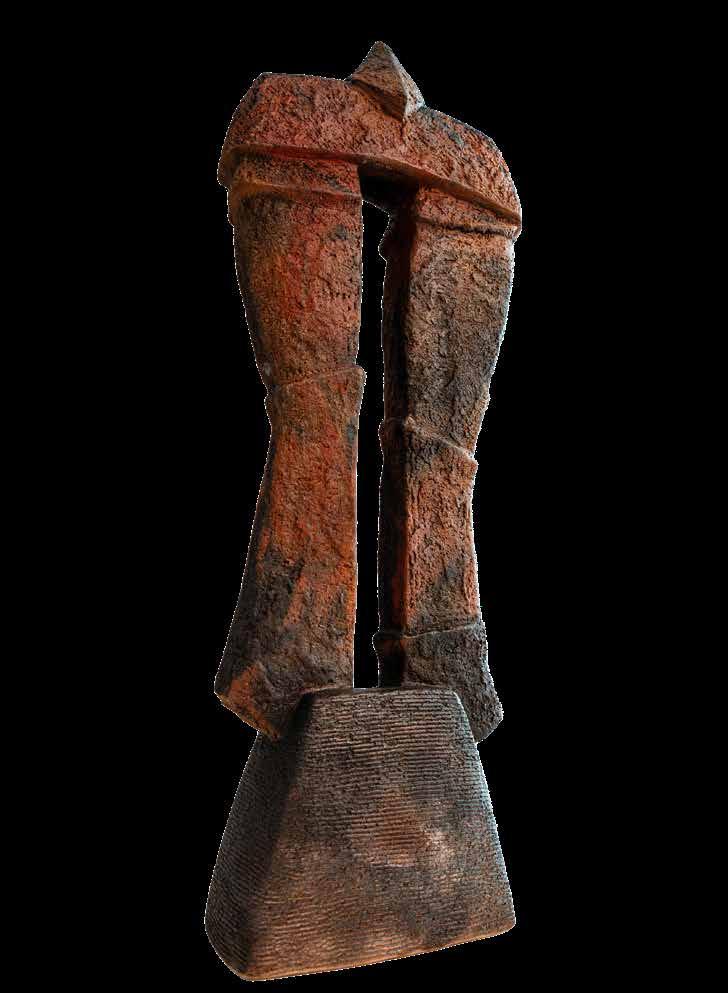
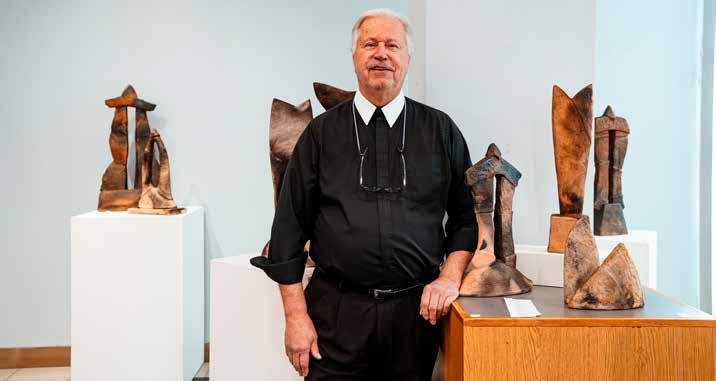
If you visited Manhattan University’s O’Malley Library Gallery between January 22 and March 1, you likely came across a sprawling art exhibit titled Emanations/ Iterations. The exhibit featured 27 small-scale, smoke-fired ceramic sculptures that were inspired by prehistoric stone formations, like the iconic Stonehenge in Wiltshire, England. And all 27 of these pieces were created and sculpted by Manhattan’s very own Brother Ralph Bucci, FSC, MFA.
Brother Ralph’s passion for art goes back as far as his passion for religion. He came to admire the Brothers during his high school years at La Salle Academy in Providence, RI and entered the Novitiate at Narragansett, RI at the age of 18. Bucci was a novice there for 12 months and took his first vows shortly afterward, officially becoming a Brother. From there, Brother Ralph went to Washington, DC, studying Italian Literature as an undergrad and as a student Brother at Catholic University, where his passion for art developed. Brother Ralph took his very first clay course as a college senior, which would end up having a profound effect on his life and artistry.
Brother Ralph’s experiences at Catholic University influenced him to combine art and education into a career. He attended Rhode Island College and acquired a master’s in education. Over the next few years, Brother Ralph worked at his alma mater, La Salle Academy, in various roles, including as assistant vice principal, and briefly taught at Salve Regina University in Newport, RI. During the mid-1980s, he attended George Washington University to pursue an MFA in ceramics.
“Once in grad school, my interest in art became more intense,” he said. “My focus shifted from college work to some time spent in the studio.”
After completing his MFA in 1987, Brother Ralph returned to Salve Regina University to work in the art department. He taught 2D and 3D design and a ceramics course and became director of the McKillop Gallery (now Antone Gallery), managing its exhibits. In 1999, he became Salve’s Director of Academic Advising.
After roughly 14 successful years at Salve, Brother Ralph longed to work at a Brothersponsored school again and in 2005, he landed a role at Manhattan University (then Manhattan College). He led the mentorship program there for two years, doubling both the student and mentee participation. In 2007, Brother Ralph became Director of Residential Life.
Despite his love for Manhattan University, however, Brother Ralph took a sabbatical to focus on clay-making and religious studies. He returned to Manhattan College in 2018 as an on-campus recruiter, assisting the director of the Veterans’ Program and working with veterans to develop their resumes. Today, Brother Ralph continues to operate in a similar role, volunteering to work with Manhattan University athletes and other students on their resumes and leading relaxation meditations.
Throughout all of this, Brother Ralph has never forgotten about his passion for the arts. He took painting courses and workshops over the years, but it was always ceramics that appealed most. Inspired by several clay artists — such as Stephen de Staebler, Peter Voulkos, Viola Frey, and Rich Hirsh — Brother
Ralph continued to hone his craft over the years, often entering regional exhibits in the Rhode Island area. In March 2025, he was part of a three-person exhibit at the Providence Art Club, and a four-person show at the DeBlois Gallery in Newport later that year, leading to his latest exhibit: Emanations/ Iterations at Manhattan University.
Emanations/Iterations featured 27 of Brother Ralph’s small-scale, smoke-fired ceramic sculptures, which touch on three themes: dolmen, scapes, and closed vessels. Dolmens encapsulate megalithic structures and mysterious doorways, scapes refer to hill or mountain landscapes, and closed vessels are forms that were initially vessels with closed tops that morphed into what Brother Ralph calls “mysterious artifacts” during the building process. The exhibit included photographs of both the building process and smoke-firing processes of the pieces.
In explaining the exhibit and its title, Brother Ralph said, “Artmaking embodies the sympathetic methodologies of our development — our physical bodies, our personal psychologies, and our spiritual realities. Emanations/Iterations may be considered a metaphor for one’s growth — be it physical, psychological, spiritual, or all three simultaneously. At some critical point, we chose a personal direction because of an inspiring experience we’ve had. As we move in that direction, we grow, we change, we morph, a little at a time, as we add experiences, include new thoughts, and deepen our beliefs. We continue to discover our inner strengths and renew ourselves.” MU
Brother Ralph Bucci, surrounded by his sculptures
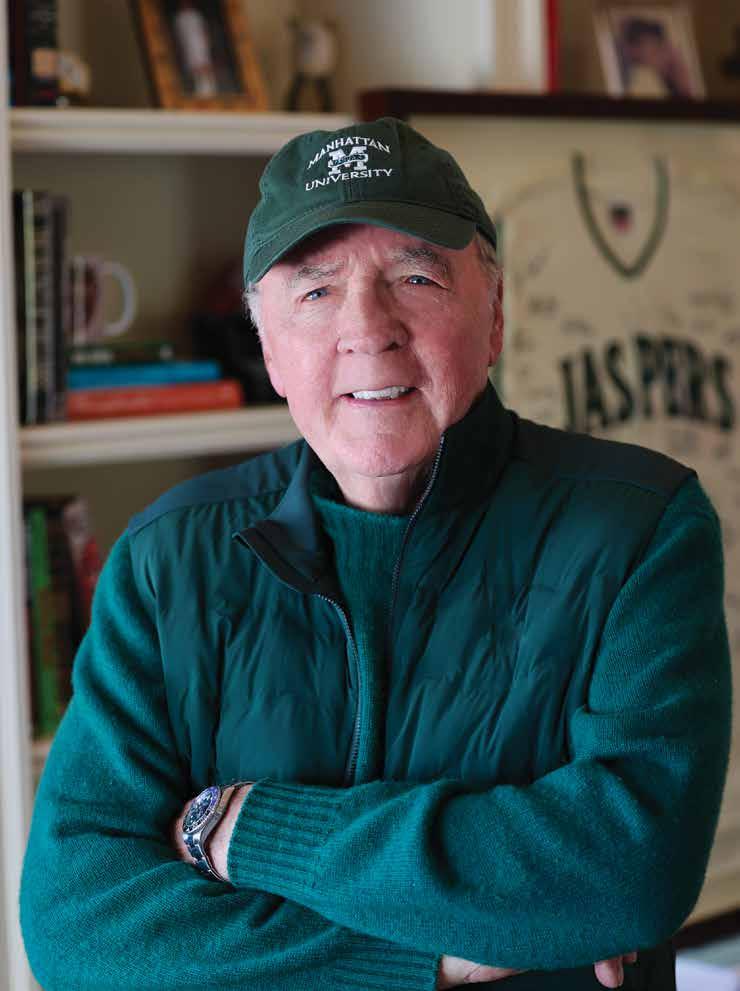
WITH JAMES PATTERSON '69 COVER
CHOPPING WOOD
“You're lucky if you find something that you love to do in life, and then it's a miracle if somebody will pay you to do it.”
James Patterson ’69 has achieved the kind of life that you’d only expect to find in fiction. Known for his fast-paced storytelling and extraordinary output, Patterson has authored or co-authored hundreds of titles across genres, including bestsellers like Alex Cross and The Women’s Murder Club series. He’s sold hundreds of millions of books worldwide, becoming one of the most successful and widely read authors to ever pen a novel.
Much of Patterson’s story began right here at Manhattan University (then Manhattan College). In addition to being a literary phenomenon, Patterson has also become a generous, longstanding supporter of the Manhattan community. Working closely with Michele Saracino, Ph.D., Executive Director of the James Patterson Honors Program and Professor of Religious Studies and her team, Patterson launched his latest contribution to Manhattan University in Fall 2025: the James Patterson Honors Program (JPHP) — a program designed to bring together a distinctive group of students and prepare them for lives of success, integrity, and purpose.
In this Jasper Q&A, Manhattan University sits down with James Patterson to discuss his storied life. We cover the profound influence of his grandmother and chopping wood, his days at Manhattan College, his successful advertising career (as well as his disdain for it), his outlook on life and family, the newly launched James Patterson Honors Program, his writing process, and his prolific career as an author.
What drew you to enroll in Manhattan College?
It’s a little complicated. I actually did not apply to Manhattan. I went to a Catholic high school in Newburgh, New York: St. Patrick's Christian Brothers High School. I applied to Harvard, Yale, Colby [College], and Bates [College]. My family and I didn’t know how this process works. So come January or February, we haven't heard from Harvard, Yale, Colby, or Bates. We go to see the principal, Brother Leonard, and he says, “Oh, we never sent any of your papers to Harvard, Yale, Colby, and Bates. But you do have a scholarship at Manhattan College!” [laughs]
I then applied to Hamilton [College] myself and got in, but I decided to go to Manhattan anyway. And it was a great experience. Had I not gone to Manhattan, I don't think I would have wound up running J. Walter Thompson when I was in my 30s and becoming the best-selling author in the world. So it all worked out well.
I would say so! I know you majored in English. Was it always your goal or intention to become a published author?
Somebody once said, “You're lucky if you find something that you love to do in life, and then it's a miracle if somebody will pay you to do it.” And I love to write. At Manhattan, I wrote for The Quadrangle and the literary magazine. There was one creative writing course that we all had to take. I think it was in my freshman or sophomore year. The professor, a poet, said to me, “You write well enough, but stay away from fiction.” [laughs]
I then went to graduate school at Vanderbilt and took a creative writing course, and the professor there said, “No, no, you have a gift, you have a gift.” So that encouraged me. I was going to try writing books anyway, even if he hadn’t said that, but it was great to receive that kind of enthusiasm. I did get support at Manhattan in terms of writing for The Quadrangle and the literary magazine, but I'll never forget: “You write well enough but stay away from fiction.” He was probably right, but I didn’t listen.
How could he possibly have been right? I think the numbers speak for themselves.
Well, hopefully the books speak for themselves.
You’ve contributed so much to Manhattan University. Your most recent contribution to Manhattan is the James Patterson Honors Program. How did this program come to be?
It started with, “I want to do something more.” I had this notion for the honors program. These days, parents pay a lot of money for their kids’ education. And at the end of it, they want to feel like their kids are ready — not that they paid a lot of money and their kid becomes a barista at Starbucks. That’s not an attractive outcome. What separates Manhattan is: we are going to get you ready. In this day and age, I think that mission is very attractive to students and their parents.
Manhattan has always been, from when I was there, a college that prepares you for the real world. It was no nonsense. I was prepared to run J. Walter Thompson, I was prepared to work as hard as I do. And that’s still what the school is. Manhattan has always been a place where you feel like people are behind you. You feel like you’re seen here, and a lot of kids like that — this idea of: “We see you. We know you’re here. We care about you. We want to do the right thing by you. We want you to succeed.”
So did you approach Manhattan and say, “I have this idea for a program, I would love to do this, let’s work together?”
Pretty much. I’m trying to help the school in a very tough environment. I was on the board a while back, and I knew that for a lot of small colleges, it’s a struggle. So how do we help Manhattan become even better? They continue to perform well academically, but what will give them some edge?
The James Patterson Honors Program is about a third of incoming freshman. We help that group become better speakers, better writers, and better thinkers. We help them become more confident, so that when they graduate from Manhattan, they’re totally ready for the world. That’s what this program is. That’s what it’s all about.
So this program helps students become better writers, speakers, and thinkers. Do you want to talk about what’s being implemented to help them?
There are special classes for them. Everybody in the honors program has an advisor. We bring in public speakers for them. We’ll bring in accountants or lawyers
who can tell students exactly what they do in the real world rather than hear it from their guidance counselors, a lot of whom haven’t really worked in that profession. We bring in speakers who can say, “Here’s what a corporate lawyer does, here’s what a defense lawyer does. Here’s what your day looks like. You want to be a lawyer? Well, do you want to do this or that?”
There’s also a program for high school kids to help them get ready and give them experience with Manhattan as a possible choice for college [The Summer on the Quad: the James Patterson Enrichment Program]. We also have a program in the summer where kids who’ve had problems with courses can attend summer school inexpensively. We’re just getting people ready. Manhattan gets you ready, if you want to use a slogan from my ad days.
You said earlier that you wanted to help out Manhattan in a tough environment. When you say “tough environment”, I’m wondering what you mean by that. Is it students not being able to find jobs in their majors, or is it the high cost of living?
All of those things. That’s just the reality. There are a lot of schools that don’t think it’s their job to prepare you for the world. A lot of college professors don’t think it’s their job to do that. And that’s fine, you can go to one of those schools. But at Manhattan, there’s more focus on getting you ready to go out into the world and be successful as a thinker, as a worker, as a partner, as a parent — whatever your choices are. I also hope this program gives students a sense of togetherness — the notion of, “We have one another’s backs. We’re all getting ready together.”
Is there anything else you’re doing to try and help Manhattan University?
We’re trying to help the basketball team. I think it’s good to have winning programs. The basketball team should win. The end. It’s doable, so we’ll see where that goes.
Everyone knows that you worked in advertising for many years. How did you start working in the advertising business?
I have worked in advertising, but I've been clean for over 25 years now. [laughs] It was kind of an accident. I took no advertising courses at Manhattan, no marketing courses
ever. But when I moved to New York City after graduating, I needed a job. I actually tried to become a cab driver. I had long hair and an army jacket on, and the guy chased me out of the place for having long hair. So I didn't get a job as a cabby.
Then a friend of mine had a contact at J. Walter Thompson. I went in and spoke to them, and they asked me for a portfolio. I wrote sample TV commercials and sample print ads for the portfolio. I had a girlfriend at the time who was an art director, and she drew up print ads for me. At the time, you would go to an agency, give them a portfolio, and they would eventually make a decision. But what I did is: I brought them a portfolio, and then the next week, I brought them another portfolio, and then the next week, I brought them a third portfolio. So they said, “Well, this kid obviously has a lot of enthusiasm”, and they hired me.
What was your first job?
I was a copywriter, writing ads. I was lucky. When I started working there, about every two weeks, the agency lost an account and started firing all these senior people. Theoretically, you would say that’s bad, but they were paying me so little that it wasn't worth firing me. Normally, when you're a young copywriter at an ad agency, you never get to work on television. But they fired so many people that they let me write television ads.
The first TV ad I did was for Ford, and it was the highest–scoring automobile commercial of the year. After that, I wound up producing seven TV commercials during my first year, which would have been good for five years normally. So J. Walter Thompson lost these accounts, fired all these expensive copywriters, and I wound up getting a break and taking advantage of it.
Did you watch the series Mad Men when it aired on AMC or subsequently?
Mad Men was before my time. When I was in advertising, the attitude wasn’t, “Let’s go out and have martinis at lunch.” I liked every other episode, but it didn’t relate to me. It was another period.
Is there a particular character in Mad Men that you find most credible in the advertising industry?
The lead was credible in terms of somebody with star power who you’d build an agency around. Most of the people who
run these places are pretty charismatic, as Don Draper was.
In terms of the advertising industry, what has changed the most over the years and what do you feel always remains the same?
I really don’t think about advertising. I didn’t like it when I was there. The only thing I liked was making little movies, but I was writing books on the side all the time. I couldn’t wait to get out of there.
Really? That’s an interesting tidbit. So books were always your passion? That was always what you really were drawn to, what you always really wanted to do?
Oh, 100%. I had no interest in advertising. I was successful, because my instincts were strong. Manhattan College helped me develop those instincts. That’s important.
My grandmother also always said, “Go chop some wood.” Meaning don't talk about it, just go do it. So, I would work in advertising, and then I would come home and write my novel. What's so hard about that? At that point, I’m by myself. I'm a kid in New York. I would go home, sit at the kitchen counter, and I would write the first novel, which eventually got published.
This is a great segue because my next question was going to be about The Thomas Berryman Number. This is your first novel, correct?
Yes, so this is semi-interesting. At that point, I was a little literary snob [laughs]. When I was writing the first novel, I needed my confidence to build, so I sent a note to three writers I admired. Larry Woiwode was one, Thomas McGuane was the second, and I don’t remember the third. But only McGuane wrote back. He sent me a postcard from
"My grandmother also always said, 'Go chop some wood.' Meaning don't talk about it, just go do it."
Most people wouldn't have the time and stamina to work on novels while working a full-time job. How did you juggle/balance that? What made you want to keep writing, even though you already had a job?
If you love to do something and you want to do it, then you do it. That’s the way I was brought up. My grandmother was my biggest fan. She said, “You can do anything you want to do…except play in the NBA because you can't go to your left.” [laughs] I might have been able to be a scrub at Manhattan, but I was never going to be a big deal. But my grandmother always encouraged me. One of her lines was, “Hungry dogs run faster.” [Hungry Dogs is the name of Patterson’s Substack page]. She always encouraged me to be a hungry dog.
Montana and said, “Dear, Jim, write a good book. Your friend, Thomas McGuane”. It was very cool. And then Berryman was one of my favorite poets. That’s where the name Thomas Berryman came from.
That’s really cool. How did you eventually land that first deal?
The Thomas Berryman Number was turned down by 31 publishers. I didn't have a literary agent initially. I was sending the manuscript out by myself. Then there was a story in the New York Times Book Review about a young agent who was looking for writers, so I sent him a cardboard box with the manuscript in it. About a day later, a receptionist at J. Walter Thompson told me
that I had a call from that agent's office. I said, “Oh, gee, I can't believe they turned it down that fast.” But then the agent told me on the phone, “No, no, I love it. I'm going to sell it.”
He initially sold the book to a young editor at a small publisher. I worked with that editor for about a month. He helped the book, but then he turned it down. My agent told me, “Don't worry about it. I'm going to sell it.” And he sold it in the next couple of days to Little, Brown.
About a year later, I get a phone call, and a woman says, “I'm with the Mystery Writers of America. The Edgar Awards ceremony is coming up, and we haven't been able to reach you. Your book has been nominated for Best First Mystery Novel, and we’d like you to come to the ceremony.” She gave me the date of the ceremony, but I couldn’t go for some reason. And then she said, “No, no, you have to go. You won.” [laughs]
I went to the ceremony with my mother and father. The Thomas Berryman Number won an Edgar Award for Best First Mystery Novel. In those days, if you claimed to be a writer but weren't published, then people didn't accept you
during the Vietnam War. I got a high number in the draft because back then, they had a lottery for the draft. And to keep that high number, I had to leave school if I was going to avoid the draft. At that point, nobody wanted to go to Vietnam, so I left Vanderbilt.
Before I did, I was planning to write my master’s thesis on an obscure novelist, but I was told to write fiction instead. So I wrote a piece of fiction that I totally forgot about. Now, there's an article coming out in a business magazine, and the woman writing it, an unbelievable researcher, actually went back to Vanderbilt and obtained the fiction that I wrote. She told me, “You always say you're not a very good stylist, but there's an incredible amount of style in the pages you wrote at Vanderbilt.” I remembered that I wrote it but didn't remember anything about the book, so I then went and retrieved the story to read what I had written. I wouldn't have published it, but I did think the writing was pretty good.
That is interesting. Was that a novel or a short story?
It was going to be a novel. I never finished it though.
"There was one creative writing course that we all had to take [at Manhattan]. The professor, a poet, said to me, 'You write well enough, but stay away from fiction.'"
first Alex Cross book. The outline was about 330 pages. I read it and thought it was pretty good the way it is. I added maybe 100 pages or so. That's where the short chapters in the book came from, that colloquial kind of storytelling. Along Came a Spider was initially just a very, very long outline.
Oh wow. Is there a box somewhere in one of your houses that’s filled with incomplete or unpublished manuscripts that no one has ever seen?
No. The first love of my life developed a brain tumor and died in her 30s. After that, I couldn't write for about a year or a year and a half. I did try to write a manuscript, and it was awful. I destroyed it. I literally destroyed it. But that and the Vanderbilt fiction are the only things I’ve written that I didn’t publish. At this stage, I know what I'm doing.
That’s still pretty incredible, though, that you’ve managed to do that. You would think that maybe, in the beginning, there were more unpublished manuscripts. Maybe the one you destroyed would’ve become a New York Times bestseller.
No, I don’t think so.
My grandpa, because I work in publishing, always asks me this next question, so I'm going to give him the answer straight from you. How do you find the time to write so many books?
I don't even think about it. For starters, I'm co-writing a lot of books now, so that makes it easier. I do outlines for every book. The outlines are usually 40 to 60 pages.
as a writer. So when I won, my whole speech was, “I guess I'm a writer now.” That was it. That’s the way it was back then.
The Thomas Berryman Number got me going a little bit and made me a little bit of money. It also helped my advertising career because now the agency saw that I wrote a published, awardwinning novel.
Was The Thomas Berryman Number actually your first completed manuscript? Or is there a manuscript that came before it that's never been published for some reason?
Well, this is semi-interesting. I went to Vanderbilt
The Thomas Berryman Number made you become a writer. Was there a book or a point in time where you feel like the tides turned and you became a huge writer?
Oh, it was the Alex Cross books. The second book I wrote, Season of the Machete, was awful, a hideous book. I didn't know what I was doing, I didn't do research. I needed a mentor really. I published a few books after that, and they were all mediocre at best. So I sat down and said to myself, “What do I do well? What do I do not so well? How do I make something that’s going to really sell?” That's when I sat down and wrote an outline for Along Came a Spider, which was the
I advise writers to consider using outlines. They save a lot of time. They focus you. It’s a lot easier, at the end of a month or two, to throw an outline in the trash than it is to get eight months into a novel and then realize it’s not working. You can continuously rewrite an outline, and you can do it in pieces, which are easier to deal with. An outline condenses every chapter into a paragraph, which helps you determine what’s the core of the scene, what’s the core of that chapter. And anytime you sit down to write, you’re not really looking at a blank piece of paper because you know what you’re supposed to do that day. There’s that chapter from the outline. Outlining isn’t for everybody. I think it’s useful, but it’s not useful for everybody. But you’d better be a good writer if you’re not going to outline because I would say that not outlining has a huge failure rate.
I'm not a slave to the outline though. Sometimes, you're writing, and you think, “This killer was supposed to die here, but I like him,
and I'm going to keep him around.” Or you think, “This character has become a lot more interesting than I thought they were.” Even though I write outlines, I usually change the ending from the outline.
I‘m also very quick with my writing. I was juggling running J. Walter Thompson while writing novels on the side. It wasn’t like I was a copywriter who could leave at 5 in the afternoon either. My advertising job was seven days a week. It was a lot of pressure. It was very demanding.
Is there never a time where you feel like, “Oh, I just don’t feel like writing today.” That never happens for you?
No, I write seven days a week. There was a period — I don’t remember exactly when this was — when I wrote over 2,600 pages in that year. I was doing these bookshots, these novellas, and I was writing a lot of them myself. I think I wrote two full length novels that year. Now I’m mostly working on Alex Cross, which I'll write myself. Occasionally, I’ll have to rewrite something that didn't work out very well. And then there’s the co-writing.
How does the co-writing even work? How do you get paired up with these people? Do you approach them, or do they approach you?
It really depends. President Clinton and I have the same lawyer, Bob Barnett. Clinton reads everything, but he also reads a lot of mysteries. Barnett always wanted the President to write a mystery, but Bill didn’t want to do it. Barnett suggested, “What about writing a book with James Patterson?” And the President said, “Why would James want to write with me?” [laughs] But I thought working with Clinton would be cool. I also thought that he would bring authenticity to the story. I’ve written three books with him now, and they’ve all been political thrillers. Usually, you do your own research, and you make stuff up. But with Clinton, I didn’t have to do that. Even if the story is a little over the top, he could say, “Here’s what the secret service would do if that happened.” Or if we got a threat from North Korea, he could say, “Here’s how it would be handled.”
With Dolly Parton, it was the same thing. She brought authenticity to Run, Rose, Run What would happen when a young woman with a lot of talent arrives in Nashville? It doesn’t matter how much talent they have, it’s still a slog.
I just finished a novel with Viola Davis, and I think it's the best legitimate novel I've ever done as opposed to a mystery. I think it’s really, really good. The Viola Davis novel — not to pat ourselves on the back — is in the spirit of To Kill a Mockingbird. It's a big, southern drama, a very controversial courtroom drama, and takes place in Alabama. The main character is a black judge, and Viola had a lot of thoughts. There’s also a young woman, a 13-year-old character, who’s been raped, and Viola had a lot of thoughts about that as well. She was really helpful, and she’s very smart. She wrote a bestselling autobiography herself.
I also just finished a novel with MrBeast, believe it or not. MrBeast has five times as many followers as Taylor Swift! I wanted to work with him because I knew that if we did a good book, it would get a lot of kids reading and thinking, “I never read a cool book before”.
And this is a cool book. It’s just an unbelievable adventure. What drives the narrative allows us to do one incredible scene after another. And we wanted to do it that way because we wanted a lot of his fans to think, “Oh my God, I can’t stop reading this thing.”
That’s really cool. Do you have titles yet for either of these books?
The Viola novel is called Judge Stone The novel with MrBeast is called The Most Dangerous Game
Do these have on-sale dates yet?
Judge Stone [came] out March 9, 2026. The Most Dangerous Game comes out September 1, 2026.
So sometimes, people will come to you asking if you’re interested in writing a book. Other times, will you seek out authors to work with?
No, people come to me. For the most part, I’m not interested in seeking out co-authors. I just have too many projects. There were two or three co-authors who came from J. Walter Thompson. I knew them, I knew they were talented, I knew I could work with them. To some extent, it really is my way or the highway, but I try to do it in a good way. I’m always looking for people who can write scenes after I give them the story.
Do you create the story yourself and then share it with your co-author?
100%. They get an outline of 40-60 pages. I then encourage them to add their thoughts. It gets them emotionally involved, and sometimes, their thoughts are good.
How do you divide the writing with your co-author?
It’s different with every single book. It varies with who I'm writing with. Sometimes, it's back and forth in terms of chapters. But in all cases, I always do the lengthy outline and then whatever rewrites are needed. Sometimes we alternate, where I'll write some chapters and the other person will write some chapters.
On some level, it’s like you’re writing for a TV series. You have a writer’s room, where you establish the voice of the character. You establish how the characters talk. I don't know if that's going to help your grandfather, but that's how it works [laughs].
How many hours would you say you write a day?
I don’t even think about it. If there’s something on my mind about a particular book, I’ll go into my office at maybe 5:30 or so. I’ll write until 7. A lot of mornings, Sue and I will go out and play an hour or hour and a half of golf early. Then I’ll come back, write, and have lunch. And then I’ll knock off at maybe 5 or 6 in the afternoon.
So you’re writing almost 10 hours a day. I don’t think I do. It goes in stages. It depends on what’s going on. I also do a lot of interviews now on Substack and elsewhere.
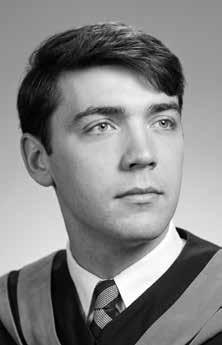
James Patterson, Manhattan Graduation Photo, 1969
That’s actually been really cool. I’ve interviewed James Clear, Bill Clinton, Dolly Parton, Kwame Alexander, Steven Van Zandt, Stacey Abrams, B. J. Novak, Patricia Cornwell, Kathy Bates. It’s really cool because I get to interview people and ask questions.
Do you actually know how many New York Times bestsellers you've written? I couldn't find a number on the internet.
I don’t know. I know I set a Guinness World Record, but that's all I know. That stuff isn't important to me.
Is there a genre that you're interested in writing but feel reluctant to do so for whatever reason?
No, I’m not afraid. I’m doing a romantasy right now. There are certain genres I don’t have an interest in doing. I wouldn’t write regular romance novels because I don’t entirely get them. I wouldn’t write a novel about a general because I don’t understand that world, and I wouldn’t be able to write the dialogue. That just wouldn’t work for me as a lead character. I couldn’t write a real military thriller. The best projects are the ones where I can’t wait to start. Challenges are good. Writing with MrBeast was a challenge. Writing a romantasy is a challenge, but it’s a cool challenge. I had never really done that kind of fantasy before, so it’s a fun thing to try.
What do you think is the biggest challenge for the publishing industry as a whole versus when you were first starting out as a writer?
The marketing is terrible. During the time of [Ernest] Hemingway and [F. Scott] Fitzgerald, people knew about them. They couldn’t wait for the next book, they were interested. Mario Puzo from The Godfather would sell 8 million copies in paperback. You don’t have that kind of enthusiasm about the books that come out now. Publishers just aren’t getting the word out. The movies are pretty good at it, but publishing is too quiet. It’s also too one-sided. They need to be able to publish both the left and the right. You’ve got half the population on the left and half on the right, and you need to be able to talk to the whole country, I think. It shouldn’t be a big deal.
I know you're big on disruption— disrupting industries, disrupting the norm. So given that, what are your thoughts on AI? Do you embrace it?
Here’s my funny thing about AI. Joe [Walsh] was the wildest guy in the rock and roll group the Eagles when they would go on the road. And he
was asked what he thought the effect of AI would be on music. He basically said, “Listen dude, until AI can go out, wreck a hotel room, and throw the television into the swimming pool, I’m not worried about AI’s effect on music.” It’s pretty funny, but it’s also kind of true. On its own, AI would never figure out a way to wreck a hotel room and throw a television into the swimming pool until it was fed that. But where’s it going? It has the potential to do a lot of good things in terms of moving faster and getting information faster. It seems to make a lot of weird mistakes right now, but nobody really knows where it’s going yet.
But are you concerned at all as a writer that maybe AI will replace you or any writer? It’s not going to replace me. It won’t happen that fast, so that part I’m not worried about. One thing it will replace are the hacks. It will replace, for sure, people with no imagination, writing in hack language. If you read a lot of political speeches, they’re so awful. There’s nothing to them. AI will be able to replicate that because there’s no soul in them. Can AI write great speeches? Not yet. Can AI write a great novel or even a good novel? Probably not yet, no.
So obviously, you're having a fantastic career. Is there something that you're the most proud of, something that you consider your greatest achievement at this point?
I kind of don’t think that way. There’s been a lot of things that I’m delighted to have. What's important to me is my wife and our son. That may seem corny to some people, but it's not for me. My line about Sue is: if Sue ever leaves me, I'm going with her. Part of the reality is: every once in a while, there’s a couple of hours where I can’t stand her, but there’s never a day that goes by where I’m not in love with her. And that’s a big deal. That’s a very fortunate, lucky thing in my life. There are things I feel very lucky about. I feel lucky that I’m able to write books and write every day. I’m proud of my book with Viola [Davis]. I’m proud of creating Alex Cross and the Women’s Murder Club. I like all the books that I wrote with Mike Lupica so far. I think all of them are good. I’m proud of our son. He’s a good guy, a moral, ethical dude. He never got a B at Brown [University] and didn’t even work that hard. He’s smart. He must take after his mom.
What skills are needed for a young college graduate to break into a career in New York City?
Being able to speak well. That’s really
important. A lot of kids don’t speak very well, and that’s really, really useful. Being able to write well is another one, even if it’s just writing out a plan on how to sell your idea. When you’re looking for a job, you initially have to sell yourself, and then once you’re in the company, you have to sell your ideas. Outlining, I think, is hugely important for speeches. It lets you bullet out, “What’s the rationale behind this?”
Young college graduates also need to understand that companies want to hire people who are going to make their job easier. Companies are looking for eagerness, for enthusiasm, for people that you want to be around. When I was running J. Walter Thompson, for the most part, I would only hire people who were talented and good to be around. I didn’t want talented and trouble because life is too short. You spend too much time with these people. Every once in a while, I made the mistake of hiring trouble, and it was almost always a disaster.
What piece of advice would you give to every Manhattan University graduate?
I don’t really do advice. But there's some language that I came across a couple of years ago, and I think it's actually more important for the students at Manhattan than it is for me. And the language is: “My time here is short. What can I do most beautifully?” That's what guides me in terms of the projects that I'm going to do or not do.
The one thing that I do caution people about is: don’t pay that much attention to the stuff that you’re nodding your head at because you’re already doing it. The stuff that you’re shaking your head “no” at — that’s the stuff you should pay attention to because that’s the stuff you’re not doing. And if you’re going to get better, it’s going to be at the stuff you’re not doing.
Is there anything else you want to mention? Anything else that you feel is important that should be included?
I think it’s useful for students, parents, and whoever else reads this to know that James Patterson went to Manhattan University, got a really good education, and he did really, really well in the world. I don’t think it would’ve happened without Manhattan. I was ready after graduation. Manhattan prepared me for the business world — advertising and the clients that we had. A lot of people today have a “Woe is me” mentality. We try not to do that at Manhattan. No woes here. Just go chop some wood. If you want to do it, do it.
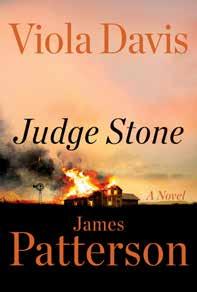
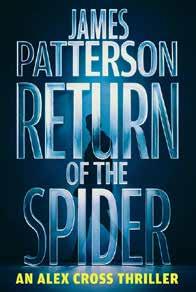
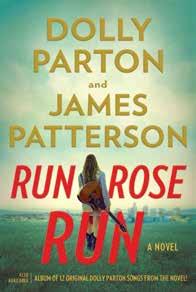
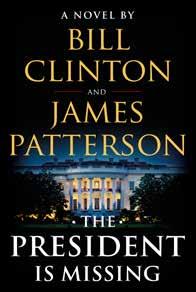
The Surrealistic Storyteller: Sebastian Castillo '11
Sebastian Castillo ’11 didn’t plan on becoming a published author. He was more interested in art during his childhood in Venezuela. Born and raised in the city of Caracas, Castillo lived there with his American mother and Venezuelan father, both of whom were professional ballet dancers. Dance was a passion that Castillo didn’t inherit from his parents, though he did have an interest in music. “I enjoyed my childhood in Caracas. I ate many empanadas,” he quipped.
The Emergence of a Literary Force
Ultimately, it was his parents’ divorce that drove him from Venezuela. When he was 8 years old, his mother attained a new job as a rehearsal director at Ballet Hispanico in New York City. Castillo moved to America with his mother, while his father remained in Venezuela. Castillo continued to visit his family in Caracas over the years, though America soon became his new home. He became obsessed with music during his teenage years. He played in several bands, often practiced guitar, wrote his own lyrics, and recorded his own music. This interest in music and lyrics gradually fueled a passion for literature. It also spawned an interest in a new kind of writing: prose.
Castillo took his interest in literature and writing off with him to college. Wishing to stay in the New York City area, he enrolled in Manhattan University (then Manhattan College), where he majored in English and Philosophy. He also won the first Mark Taylor Memorial Scholarship as well as the Branigan Research Fellowship, to help pay for tuition. During his college years, he became a more fervent reader. He even won the McGoldrick Medal in English. Several of his MU professors helped influence his love for literature and writing, such as Rocco Marinaccio ’81, Ph.D., Adam Koehler, Ph.D., David Witzling, Ph.D., Ashley Cross, Ph.D., Deirdre O'Leary, Ph.D., David Bollert, Ph.D., and Eoin O'Connell, Ph.D.
Upon his graduation in 2011, Castillo decided to use his passion and talents to pursue the path of an author. After publishing a short story called Knife Man in 2012, he went on to obtain his MFA from Temple University in 2015. Castillo often writes about memory. His stories contain elements of the surreal, the abstract, and even semi-
autobiographical details. A couple of his protagonists are named after himself, though there’s little resemblance between them. His biggest literary influences include Muriel Spark, Iris Murdoch, and Dag Solstad. His childhood also inspires much of his writing.
Over the years, Castillo has worked as an adjunct English professor at several universities in the Philadelphia area, where he currently resides. In the past, he taught at Philadelphia University, the Community College of Philadelphia, and La Salle University. Now he juggles teaching at the University of Pennsylvania, Moore College of Art & Design, and Temple University. Temple’s library is actually where Castillo does much of his creative writing. He even briefly taught at his alma mater, Manhattan University, prior to his move to Philadelphia. The young writer completed his first manuscript in 2017, 49 Venezuelan Novels, a collection of 49 one-page stories that delve into magic and the surreal. In most cases, an aspiring author will seek out a literary agent who will get their manuscript into the hands of editors and hopefully secure a deal at a book publisher. Castillo, however, took a different path. “I got very lucky,” he said. “I cold submitted the book to a small press, and about a month or two later, they accepted it for publication. This happened as well with my second book, Not I.” 49 Venezuelan Novels was published in 2017, while Not I was published in 2020. Castillo published his third book in 2023 — this time, with the aid of a literary agent. His third novel, SALMON, is about a young poet who travels to a mysterious country named Salmon to escape the mundane cycle of life.
Castillo’s status in the literary world has been recently rising. His first book, 49 Venezuelan Novels, was out of print for a few years but has been recently republished with a different press in a bilingual edition. Castillo was also recently approached by an editor to write a piece for The New York Times Magazine, an essay that talks about book clubs and the literary camaraderie that comes with them. On top of all this, he published his most recent novel in June 2025: Fresh, Green Life. Set on a single snowy night, it’s a black comedy about a
young writer who, after a year of self-imposed exile, attends a New Year’s Eve party in hopes of reconnecting with old classmates. Fresh, Green Life has been getting a lot of hype in the literary world. In addition to rave reviews, it was named a Best Fiction Book of the Year by Kirkus Reviews, a notable publication in the literary world. Since 2017, Castillo has published four books. So which one is his favorite? “My favorite is always what I'm working on currently,” he said. And Castillo is working on a new novel, his current favorite, which has the working title, After Eden. “It's about a man who accidentally returns to Caracas, Venezuela, on a day-long layover, after having been away for a number of years, only to discover his parents, both ballet dancers, are performing a ballet titled 'After Eden' that very evening. And so, he travels to the theater to see his parents dance, with the expectation that the experience will deliver to him something that has long been missing in his life. My parents did actually dance this ballet, in 1986, two years before I was born.” Like many of Castillo’s works, After Eden seems to contain semi-autobiographical elements — and will likely be another novel to look out for when it hits the shelves. MU
The Media Mastermind: Michael Grabowski, Ph.D.
A
Career
in Media, from
Winning
Emmy Awards to Co-Creating MU’s Sixth Borough Film Festival
There was something about sitting in a dark theater with other people, experiencing a story all together on the big screen, that made Michael Grabowski, Ph.D., fall in love with cinema and the power of storytelling. Yet despite this passion, Grabowski didn’t think that a career in media was actually realistic — a belief that he would prove false in the future. “When I was in high school, I thought a more practical major would be computer science, so I studied programming, as well as several STEM subjects,” he said. As only a junior at Medina High School in Ohio, Grabowski was hired by a company called Process Control Systems (now known as Compucharts). He started out programming visual routines but quickly moved on to producing code for entire systems, writing graphic routines for the first personal computers. One client Grabowski worked for was the pharmaceutical company Upjohn, which is now a part of Pfizer, in Michigan. There, he wrote code that controlled research fermentation tanks that grew genetically modified bacteria for research. He later ended up writing code for some of their production tanks that made pharmaceuticals as well. And he did all of this before stepping foot onto a college campus.
Grabowski attended Ohio State University as an electrical engineering and computer science major. During his first two years of school, he worked for Mocar in West Virginia, which is a part of BP Oil. Grabowski had to obtain excused absences from school so that he could take weeklong business trips on site to install and test his code. The future certainly looked bright for this aspiring STEM worker — but his path would soon change. Grabowski never forgot about his love for movies and decided to take a photography and film course, an experience that would completely alter his life’s trajectory. Realizing where his true passions lied, Grabowski changed his major to photography and cinema, later adding a second major in history. “I was lucky to be able to study under documentary filmmakers, like the Oscar-winning documentary filmmaker Peter Watkins and pioneering computer animator Jeff Light, who later went on to work for George Lucas’ Industrial Light and Magic,” he said. “Light introduced me to short animations by the company that later became Pixar. I also worked on some independent films while in school.”
By the time he graduated in 1993, Grabowski was already working at a television station as a production technician. He won two regional Emmy
Awards in Columbus, OH, the first for his work on a feature news series at WCMH-TV in 1993 and the second for his editing for WWHO-TV in 1994. It was during this time period that Grabowski experienced one of the most pivotal moments in his life. “I was the technical director during the news broadcast of the O.J. Simpson car chase,” he recalled. “That led me to question the purpose and ethics of television news, which led me to study at New York University.”
After wrapping up a co-production between WCMH and PBS on two wildlife documentaries hosted by Jack Hannah, Grabowski moved to New York City. In 1996, he attained a master’s degree in media ecology at New York University (NYU), studying media theory and ethics under the renowned professor Neil Postman. Grabowski also spent time working on concert films, documentaries, and short and feature films, including working for the Oscar-winning director Jonathan Demme. “I really admired not only Demme’s films, but how he treated actors and crew on set,” said Grabowski. “He really cared about the people he worked with and respected everyone's humanity, which can be a rare thing in Hollywood. It taught me how to treat crew with respect and have fun on set when you are making a project.” Grabowski later worked as the manager for the television station at New York University, NYUTV, where he decided to continue his education. He pursued a doctorate in culture and communication, which he completed in 2006. He began to study neurocinematics, which attempts to understand what happens to our brains as we watch movies. Part of these studies included researching virtual reality (VR), a relatively new technology at the time. “I realized by making observations about the differences between traditional framed film and television and immersive media like VR, I can test how our brains perceive those environments differently,” explained Grabowski. “When I started building VR environments for my research, I saw how game engines were used in that process. That made me dust off my old programming skills, and after building a few VR environments, I started exploring the world of game design.”
At NYU, another career path opened for Grabowski: teaching. After teaching workshops in television production and editing, he was hired as Master Teacher of Postproduction for NYU’s School of Continuing Education, a role that combined administration, curriculum development, and instruction. However, he realized this was not quite
the right fit for him. “I taught so many students that I only knew them by their Social Security number.”
Grabowski then took a tenure-track position at the College of New Rochelle in 2002, teaching communication arts. But despite earning tenure and promotion there, this was not the right fit either. “It was too small to have the resources needed to adequately teach film production,” he explained.
It was 2010 when Grabowski finally found his home in higher education at Manhattan University (then Manhattan College). “MU is just the right size,” he said. “It is a small school that allows me to follow students along their entire progression, from first year students to graduating seniors. I know their names and continue to follow them in their careers, which allows me to connect them with current students for mentoring and internships. Yet MU is also big enough to have the resources needed to teach production well. When I first saw the television studio the University was building, I realized it wasn't just a classroom with three cameras in it. It was engineered so that students can learn in that space and then go into the city and feel comfortable in professional production settings.”
At Manhattan University, Grabowski has taught courses in game design and development, film and video production, film and video editing, television studio and field production, digital storytelling, the psychology of VR perception and production, media theory, and the history and structure of the video game industry. “These industries — film, virtual production, VR, and game design — are all converging as forms of digital media,” he said. “I think it’s important for students in the future to be comfortable moving from one medium to another, as we tell stories in all of them. It is our role as storytellers. That is the through line for all of these media.” In 2023, Grabowski became Director of the Game Design & Production major. In this role, he developed the curriculum for this program and launched the major and minor in 2024. “I actually modeled our curriculum after the structure
of video game companies, building concentrations in narrative/storytelling, design, and coding,” he explained. “This allows students to specialize in their area of interest, while providing them opportunities to learn how to communicate with other departments.”
Over the years, Grabowski also became a published author. In 2015, he published Neuroscience and Media: New Understandings and Representations. It’s an edited collection of chapters that analyzes how media takes advantage of evolved brain processes and how the brain itself is represented in media, shaping our understanding of what our brains are and do. Grabowski worked with over 20 contributors on the project, such as leading experts in neuroscience and cognitive psychology, cultural anthropologists, and film scholars. His second book, 2024’s Ethics of Virtual Reality: Technology and Experience, originated from a talk that Grabowski delivered at a conference in Zürich about virtual reality and documentaries. “I examine issues like, who should control the development and use of VR: hardware manufacturers, platform providers, software developers, or users themselves?” he contemplated. “How will people access virtual worlds, and will there come a time when it will be difficult to choose not to use VR? What risks of harassment, misrepresentation, or abuse does VR have? I walk readers through different ethical frameworks to help them think through these issues.” Grabowski is currently hard at work on another book, which examines the ethics of the most hotly debated technology today: artificial intelligence (AI). Grabowski certainly has a lot to be proud of, including raising three children. He also takes particular pride in seeing his graduates work in media industries in New York and around the world, including major television networks, several film studios, public relations and advertising firms, and new media ventures. “It makes me so
happy when they let me know about their latest career advances, stories they produced, and job or internship openings at their companies,” he said. “I'm particularly proud when alumni tell me that something they learned in one of my classes helped them succeed with a project or challenge in their professional career.” However, one of Grabowski’s crowning achievements is undoubtedly Manhattan University’s Sixth Borough Film Festival, which he co-founded with Robert Cole, the school's Executive Director of Marketing. Cole approached him last spring with the idea of creating a film festival, and Grabowski was immediately on board. The Sixth Borough Film Festival was named after the student seating section in the Draddy Gymnasium, an idea that came from student Billy Walker '26. “The name signifies that the festival takes place on our campus, an idyllic retreat from the city while still being a part of and connected to the city,” Grabowski explained. “The festival brings a high-profile event to the Manhattan University campus, giving students an experiential learning opportunity in organizing and running an international festival.” Grabowski now teaches an experiential learning course connected to the festival. The 26 students enrolled help to plan and run the festival, each one responsible for leading a different department. Students are also researching other film festivals to understand what makes each one unique, as well as the common challenges and issues that each festival faces. “I always say that the best way of learning something is to do it,” said Grabowski. “Students are learning everything from organizational management to leadership, communication, and intercultural understanding. I believe that storytelling is what makes us human. It builds and preserves culture, provides us with myths of origins, and allows us to imagine possibilities that we can make real.”
Sixth Borough Film Festival

During the weekend of April 10-12, hundreds of attendees, including emerging and established filmmakers, stage and screen icons, and, of course, students and faculty, descended upon Manhattan University’s campus to take part in the school’s inaugural Sixth Borough Film Festival (SBFF).
A dynamic, global celebration of film and storytelling, complete with all-day, weekend-long screenings of dozens of cinematic works in Hayden 100 and Kelly Commons and Q+A discussions with over 20 filmmakers who represent the creative voices shaping the future of cinema, the SBFF was hosted by the Kakos School of Arts and Sciences and was a rousing success, garnering an astounding 183 submissions from 30 countries, spanning genres including Fiction, Documentary, Horror, Animation and Music Video, in categories
such as Best Narrative Short and Feature Film, Best Documentary Feature Film, Best Student Film and Best Bronx Tale.
The SBFF was originally conceived by Manhattan University Executive Director of Marketing Robert Cole as a way to extend the University's brand. Recognizing the positive marketing potential of a successful film festival, he wanted to further highlight the institution's reputation as an international leader of academic excellence. Sharing his idea with Professor of Communication, Sound and Media Arts Michael Grabowski, Ph.D., the two media professionals co-founded The Sixth Borough Film Festival with the enthusiastic support of Manhattan University President Frederick Bonato, Ph.D., the University's Vice President for Enrollment Management and Marketing Stephen Pugliese, Ph.D., and
Dean of Manhattan's Kakos School of Arts and Sciences Marcy Kelly, Ph.D. The festival's name itself came from senior Communication major William "Billy" Walker, who proposed The Sixth Borough Film Festival. The name stuck, and SBFF was off and running.
Regarding what inspired his concept for SBFF, Cole explained, “The idea behind the Sixth Borough Film Festival was to embrace storytelling from voices around the world. Filmmaking encourages critical thinking and that is what education is all about. The Sixth Borough Film Festival is yet another way for Manhattan University to support the arts and its role in education and society.”
Describing the development of SBFF, Grabowski recalled, “Starting in August [of 2025], we put together a call for entries that reflected both our position as a university and
Photo from the film Green Bay, USA Director: Shawn Antoine II
our location in New York City and the Bronx. We were very careful to create a focus and purpose for the festival, and I think that was the appeal for many of the people who submitted. I was floored when we received so many entries, which allowed us to be selective and choose the best-quality films.”
While assembling a judging panel to review the immense amount of creative work posed an early challenge, Grabowski and fellow organizers didn’t need to look any further than within to fill the pool, as the jury was composed of a number of esteemed Manhattan faculty members: Jeff Cherubini, Ph.D., Carol Ciancutti, M.Ed., LMHC, Thom Gencarelli, Ph.D., Margaret Groarke, Ph.D., Deirdre O’Leary, Ph.D., Mark Pottinger, Ph.D., Laura Redruello, Ph.D. and Evelyn Scaramella, Ph.D. The panel was joined and led by Honorary Jury Chair, Enid Kent, the legendary star of stage (Our Town, The Time of Your Life to name a few) and television (M*A*S*H) as well as a tireless community advocate in Los Angeles.
Not only did the amount of submissions for the festival “greatly exceed expectation” according to Grabowski, but the overall response to the marketing campaign surrounding SBFF has truly validated Cole’s original vision, as the event has generated nearly 70 million social media views. The campaign also pushed significant traffic to Manhattan.edu pages including the homepage, degree program listings, and admissions, with top audiences coming from India, Canada, the United States, the United Kingdom, and Brazil.
Top Photo: Two-time Tony Award nominee and noted film actress and singer Daphne RubinVega was the recipient of The Sixth Borough Film Festival's Vanguard Award for her visionary contributions to film, theatre, television and music. Photo by Michael Mansfield.
Bottom Photo: movie poster from Secret Mall Apartment, Best of Festival Recipient
Reflecting on his proudest achievement of the festival, Grabowski said that it was uniting the campus and local community while putting students at the forefront. “Seeing our students take charge and ownership of this festival has been extremely gratifying for me,” he added. “I really wanted this to be a student-run festival, and students stepped up and made it their own. I am so happy they took such pride in putting together what was an amazing event.” MU
The Sixth Borough Film Festival Awards Luncheon
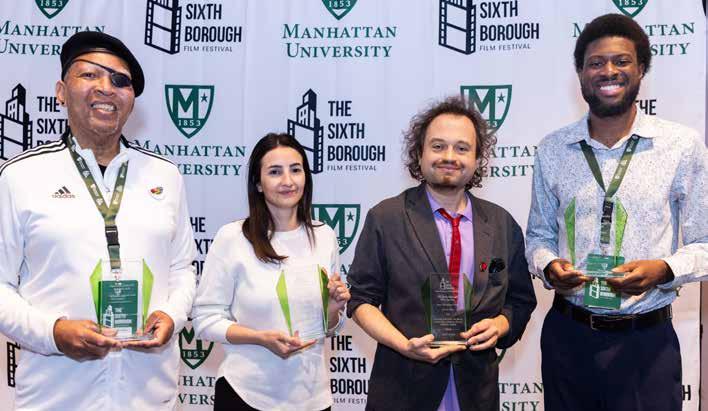
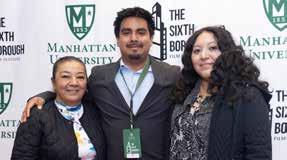
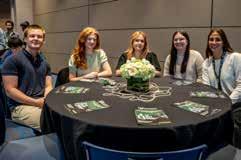
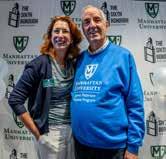

Top L-R: SBFF award winners Emmitt H. Thrower, (Spray Can Stories), Aslı Demirbaş (Suçlu), Bob Clark (Autistic Mode), Samuel Ogunremi (Nebuchadnezzar)
Middle left L-R: Lucila Olano, Aureliano Morales ‘26, Marielos Ramos
Middle center L-R: Dylan Woolcott ‘26, Kara Horne ‘26, Flynn Myers ‘27, Sadie Fox ‘27, Naomi Aristone ’26
Middle right L-R: Marcy Kelly, Ph.D., Dean, Kakos School of Arts & Sciences, Brother Robert Berger '73, FSC
Bottom left L-R: Gail Conklin, Assistant Director of Office Events & Conference Services, Barbara Herlihy, Executive Assistant, President’s Office
Bottom right L-R: Michael Grabowski, Ph.D., Professor of Communication, Kakos School of Arts & Sciences, Jason Silva ‘26

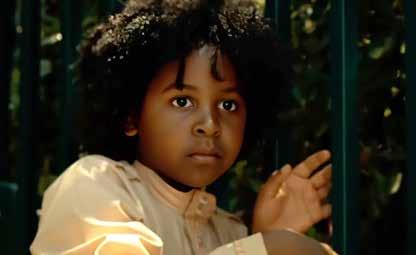
Imam
Director:
Merlich Merlich, France
Director: Hannil Ghilas
Carry My Couch, Canada
Director: Katie Lawrence and Christopher Lawrence
Greeshmaant, India
Director: Sagar Mashalkar
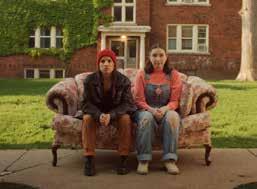
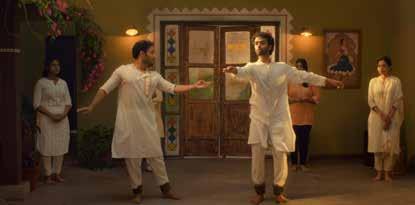
Without further ado, here are your winners for the Inaugural Sixth Borough Film Festival:
Best Animation Film
Autistic Mode, USA
Directors: Bob Clark, Nix Busby, Charles Moss, Malcolm Thomas, Gabrielle Teaford
Best Bronx Tale Film
Spray Can Stories, USA
Director: Emmitt H. Thrower
Best Documentary Feature Film
Ali vs. Ali, Iran
Director: Alireza Rofougaran
Best Documentary Short Film
Shucking Tradition, USA
Director: David Helfer Wells
Best Horror Film
Nebuchadnezzar, Canada
Director: Samuel Ogunremi
Best Music Video
Siddharta – “In the Sky”, Slovenia
Director: Ven Jemersic
Best Narrative Feature Film
Eugene O’Neill’s The First Man, United Kingdom
Director: Hardeep Giani
Best Narrative Short Film
Suçlu (The Guilty), Turkey
Director: Bulut Kırbaş
Best Student Film
Give a Reason Not to Stay with You, Argentina
Director: Antarki Fuego, Laureano Grasso
Audience Favorite Award
Carry My Couch, Canada
Director: Katie Lawrence & Christopher Lawrence
Best of Festival
Secret Mall Apartment, USA
Director: Jeremy Workman
Jury Chair Award
Dancing in Tomorrowland, USA
Director: Jakob Roston
Vanguard Award Winner
Daphne Rubin-Vega

From top to bottom:
and His 9 Friends, Indonesia
Jordan Gersson Salim
An Advocate for Democracy: Margaret Groarke, Ph.D.
A Career
Dedicated to Public Service and Education
Margaret Groarke, Ph.D., has devoted her life to public service and education. She grew up in the northwest Bronx, not far from Manhattan University. Her journey in public service truly began, however, at Harvard University, where she originally enrolled because of her passion for drama, for which there were many opportunities at the school. However, Groarke wound up studying in an interdisciplinary honors program called Social Studies instead. As an undergraduate student, she worked on projects to address poverty and homelessness in Boston and Cambridge, and also participated in the student campaign to end apartheid in South Africa.
Groarke was supposed to graduate in 1984, along with the rest of her class. Instead, she decided to take a year off after her junior year when a unique opportunity presented itself: working for then-Congressman Chuck Schumer in Washington, D.C. Groarke served him as a legislativecorrespondent, ensuring that Schumer's constituents received substantive answers to letters they had written to him addressing issues. “I had interned for a magazine in D.C. one summer, and the chance to return to D.C. and work on Capitol Hill was very appealing,” she said. “Chuck was a lot of fun to work for. He was hardworking, smart, and clearly ambitious, and I knew that he would advance in politics.”
After completing this role, Groake returned to Harvard to finish her senior year. As part of her major, she was required to write a senior thesis. She wrote hers on the many efforts to register and mobilize voters in the 1984 presidential election. “Researching and writing a 90-page senior thesis as an undergraduate was a big challenge,” she recalled. “I interviewed people who were registering voters, and visited the Boston Board of Elections, which was still keping records in ink on paper. Writing and revising the thesis was really hard work, but I was proud of what I accomplished.”
After graduating from Harvard, Groarke returned to her hometown of the Bronx to work as a community organizer
for the Northwest Bronx Community and Clergy Coalition. There, she organized tenants in troubled buildings and pushed the city to fund the rebuilding of vacant buildings and lots. “I worked with amazing people who made time, between working and raising their kids, to make their neighborhoods better in big ways,” she said. “It was a really formative experience.”
After four years of full-time community organization, Groarke decided to take a step back. “I needed time and space to think through some of what I had learned about power from the organizing I had done,” she said. “I wasn't sure what my next career move was, but I wanted to learn more about movements and politics.” During this time, Groarke became greatly influenced by the written work and activism of political scientist Frances Fox Piven, who was a professor at the CUNY Graduate Center. It was there that Groarke ultimately decided to pursue her doctorate, which was focused primarily on American electoral and movement politics, though she also studied theories of power and European politics. For her doctoral dissertation, Groarke returned to her efforts to register and mobilize voters in the 1984 presidential election, which earned Ronald Regan his second term in office. “Turnout did not increase very much despite all those efforts,” she said. “The obstacles that campaign faced led advocates to push for federal legislation to make it easier to register to vote. I wrote my doctoral dissertation about the struggle to pass that legislation.”
During her time at CUNY, Groarke taught her first college class at John Jay College and then taught part-time at Lehman College for seven years. She graduated from CUNY with her doctorate degree—and also with different career goals from when she first started. “I wasn't originally sure that I would seek a teaching job when I started my Ph.D.,” Groarke said. “But I came to be very drawn to the idea of teaching. I enjoyed guiding my students in exploring new ideas and developing new abilities, and I've enjoyed connecting them with learning experiences and career opportunities.”
Inspired by her time at Lehman,
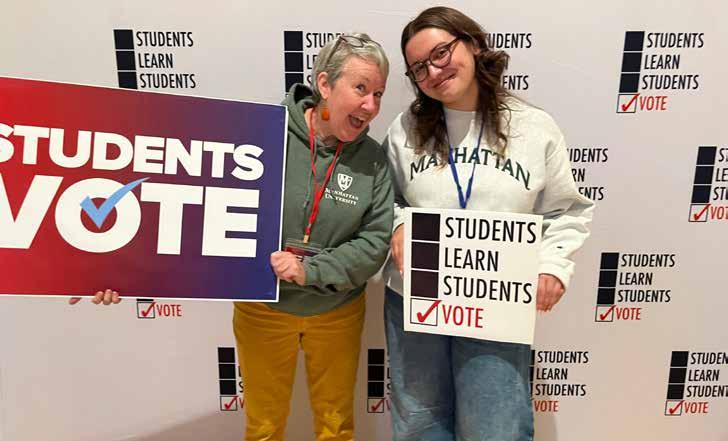
Groarke sought out a full-time role in higher education. She began teaching in the Political Science department at Manhattan University (then Manhattan College) in 1999, her first full-time tenure-track job — and she’s been here ever since. “While I appreciate many things about my Harvard education, it wasn't a place where it was easy to develop close relationships with professors,” she said when explaining what drew her to Manhattan University in the first place. “Most of my classes were large, and I didn't feel invited to go to office hours. Teaching at a place like Manhattan, where classes are small and there's a lot of faculty mentoring students, seemed like the right fit for me. At our best, we are a community of people who are contributing our best efforts to providing our students an excellent education and opportunities to develop one's leadership abilities and interests and values.” Groarke was also eager to get a faculty job in the Bronx, where she could use her Bronx and New York City connections to enrich her students’ education.
In addition to teaching political science courses, Groarke was asked to direct Manhattan University’s Peace Studies program, an interdisciplinary degree program for students who want to explore issues of peace, war, justice, and injustice. Established in 1966, Manhattan's is one of the oldest Peace Studies programs in the United States. As director, Groarke planned the curriculum for majors and minors and created opportunities for the entire Manhattan University community to learn about issues of peace and justice. Right after 9/11, she organized a day-long series of lectures and panel discussions about related issues, which attracted hundreds of students. Groarke also brought in a wide variety of speakers and events, including a one-woman play about Dorothy Day. She served in this role for 11 years. In the spring of 2024, Groarke became chair of the Department of History, Political Science and International Studies. As department chair, Groarke assists with planning courses, hiring faculty, assessing and improving the curriculum, communicating with students, reaching out to prospective students, and responding to various requests for information or action from administration.
During her time at Manhattan, Groarke also worked with Stephen Kaplan, Ph.D., on creating Manhattan University’s first Parental Leave Policy for new parents, one of her proudest accomplishments so far. “When I got pregnant, there was no provision for what would happen if a faculty member gave birth in the middle of a semester,” she said when
explaining her motivation behind this achievement. “So I negotiated my own leave, and when I returned, worked with others to establish a formal policy.” Another proud accomplishment of Groarke’s was working with students to create a non-partisan voter engagement effort on campus called Jaspers Vote. Over the past decade, Jaspers Vote has registered voters, helped students get absentee ballots or find their polling place, held debate watch parties, and encouraged students to exercise their right to vote. “I have found Manhattan a place where a person or group with a good idea can move it forward,” she said.
Outside of teaching, Groarke still has a love for drama. She enjoys going to the theater and often sings with the Manhattan University Singers. She also reads everything from fiction to American history. Groarke also remains an active member of her community, having served on the board of Project Vote to ensure that all eligible Americans can exercise their right to vote. And to this day, she remains involved with the Northwest Bronx Community and Clergy Coalition (now known as Our Bronx), representing Manhattan University on the board of the organization. Our Bronx will be centrally involved in the redevelopment of the Kingsbridge Armory that’s less than two miles away from campus, controlling the development of approximately 25% of the enormous property. And of course, Groarke continues to keep a close eye on political affairs.
The political landscape has certainly changed since Groarke began studying political science in the 1980s. “We are in a period of democratic backsliding,” she said. “I have seen this happen in Hungary, where I spent one of my sabbaticals, and now we are seeing it in the United States. One of our big current issues is that changes in our media environment have made it harder for people of different political views to agree on basic facts. This makes it very challenging for us to discuss our differences, which is so important in a democracy.” To combat political backsliding, Groarke emphasizes the importance of democracy in the classroom, through political science courses like Democracy, Power and Participation, US Government and Politics, Public Opinion, Parties and Elections, US Presidency, and Central and East European Politics. “We all live in a society,” she said. “Understanding how power works in that society, and how to participate in the decision-making process of one's society, is important for every citizen in a democracy to understand.” MU
Photo L-R: Margaret Groarke, Ph.D.; Professor, Political Science; Chair, History, Political Science and International Studies; Coordinator, Community Engaged Learning pictured with Manhattan University Political Science Major Danica Mason '26
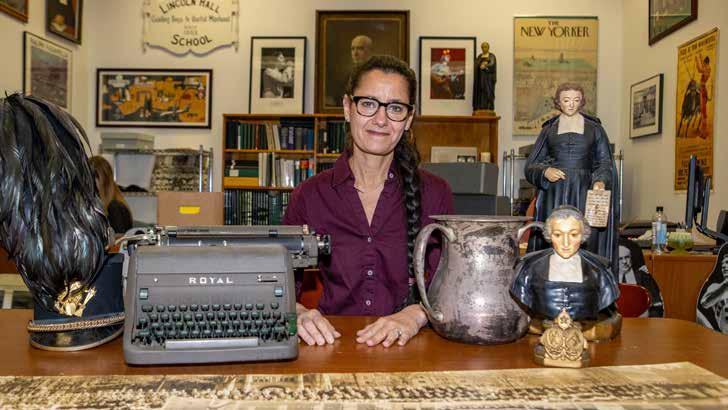
The Guardian of Lasallian History & More:
Amy Surak
If you had told 7-year-old Amy Surak that she’d one day become an archivist at Manhattan University, working to preserve historical artifacts, she probably would have laughed in your face. Growing up in Westchester County, Surak would often visit Washington, D.C. with her parents and brother to explore the city’s historical institutions during her youth. Surak, though, was hardly enthused by these trips. “I was very unhappy that we were not on a warm, sunny beach vacation, and so I pouted and complained my way through all the museums,” she said. “It was very unpleasant. My parents still remind me about it.”
Surak didn’t develop an interest and passion for historical materials until she went off to college, enrolling in Bryn Mawr, an all women's school, where she majored in history and minored in Italian Literature. “I wanted to go there because I realized the value of an academically focused institution,” she explained. “I chose Bryn Mawr in particular because of its rigorous liberal arts education and progressive
orientation.” While attending Bryn Mawr, Surak worked for the special collections and rare book department. She processed Dutch maps from the 17th century, 19th century watercolor costume design prints, and a rare book collection on pugilism (boxing). “It was exciting and varied and incredibly unique,” she said. “I knew that part of my excitement was experiencing the tangible documentary connection to the past, the evidential primary of original records, and the sense of discovery that comes from working with them. I knew that I needed to pursue a career working with historical collections.”
However, Surak didn’t land her dream job right away. After graduating in 1996, she moved to Chicago, where she worked in cytogenetics at the University of Chicago. She kept her foot in the humanities world, however, taking history classes at the University of Chicago and working weekends at the Chicago Historical Society. Surak came back to New York City in the fall of 1997 to attend graduate school at New York University, where she studied history, archival
management, historical editing, and museum studies. While in graduate school, she began working in various archives and museums throughout Manhattan, such as the New York Historical Society, the Jim Henson Archives, the College of Insurance, and the New York Public Library.
In 2000, Surak was working on a Catholic history book project with a colleague, researching and writing about an organization with a connection to Manhattan University (then Manhattan College). As part of the project, she visited the College to conduct oral history interviews with current and former faculty members. When she tried doing research in the College’s Archives, she learned that Manhattan no longer had an archivist and was asked if she could recommend someone to fill the position. That someone would eventually be Amy Surak herself — although it wasn’t just passion that ultimately landed her the job, but the tragedy of September 11, 2001.
Surak was working downtown in the New
York University Archives on that fateful day. From the street corner — with a crowd of dirtied, frightened, and devastated people — Surak watched the destruction of the World Trade Center. She decided right then and there that she needed to work as far away from downtown as possible. She called Manhattan College, asked if they were still looking for an archivist, and told them that she was interested in the position. Surak officially began working as an archivist at Manhattan College on January 2, 2002. And she’s been here ever since, now serving as Director of Archives and Special Collections. “When I first started, I had the great fortune of working beside Brother Luke Salm, an incredible theologian and historian with a dry, witty sense of humor,” Surak recalled fondly. “He taught me so much about St. John Baptist de La Salle, and his charism, and the history of the Institute.” Over the years, Surak has formed deep friendships with other members of the Christian Brothers community. “The Brothers have welcomed me into their communities throughout the world, and I am grateful for these relationships.”
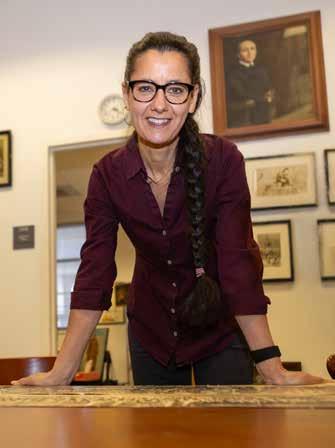
But what does a university archivist actually do? To understand Surak’s job, one first needs to understand the process. Organizations, such as Manhattan University, have a responsibility to ensure that certain materials are retained and preserved. The Archives is usually the last stop in the life cycle of these materials. When records are no longer active, they are transferred to the Archives to be preserved for legal and historical purposes. Manhattan University also receives donations from other organizations. “When apostolates close, Manhattan University is typically the first consideration for these materials,” said Surak. “Organizations and people understand and feel reassured that we will professionally maintain these materials in optimal condition forever.”
That is basically the core of Surak’s job. She appraises, collects, arranges, describes, preserves, and makes materials available for research. She and her team handle all forms of recorded information, from slides to manuscripts, from reel-to-reels to rare books, from holy relics to digital photographs, from ephemera to paintings. “We maintain all these materials because they have an enduring value,” she said. “They are considered informationally, historically, economically, legally, or intrinsically valuable.”
items in the most hospitable environments to slow this inevitable deterioration. She also performs basic conservation techniques and mitigates any risk to these materials, including potential theft. No one has ever tried to steal any items in the Archives—although someone did try to steal a laptop from the Archives once. Surak works to maintain seven separate Archives and a large museum collection, establishing and maintaining control, both physical and intellectual, over these collections. But these collections don’t just contain materials that belong to Manhattan University. The school also serves as the repository for the majority of the De La Salle District Archives in the United States. For added context, the Christian Brothers Institute was established in 1680, meaning some materials date back as far as the 17th century. “One item that jarred me when I came across it was a rare book from the 18th century in which the parchment was made from the skin of a human, a criminal who was executed in 1759,” said Surak. “I was not prepared for the macabre and ethical issues this item brought up.”
Since Brother Luke passed away 17 years ago, Surak has been the only archivist working at Manhattan University. She does, however, receive assistance from student workers. Three
“When I first started, I had the great fortune of working beside Brother Luke Salm, an incredible theologian and historian with a dry, witty sense of humor,” Surak recalled fondly. “He taught me so much about St. John Baptist de La Salle, and his charism, and the history of the Institute.”
Materials in the Archives are either organic in nature or digital. Ironically, digital materials are the most fragile, despite being the most current assets. With continual, frequent updates in software and hardware, digital assets quickly become outdated and are no longer useable or visible. “Maintaining healthy digital assets is an endless, continuous process that requires archivists to become more technically savvy,” noted Surak. Organic materials, on the other hand, break down over time with exposure to light, temperature, humidity, and environmental pollutants. Surak stores these
of her former student workers have actually become archivists themselves. Surak now sees them at professional conferences and meetings. “I would say that’s my greatest professional achievement so far,” she said. “It’s terrific knowing that I helped inspire their careers.” But outside of the Archives, it’s the people of Manhattan University that Surak loves most. “Manhattan has always had a warm, welcoming, and supportive community, from its bright faculty, administrators, and staff to all the earnest students,” she said. “It genuinely feels like a family.” MU
A Bronx Tale: Fabian Monzon '25, '27
A Future MBA Driven by a Passion for Fashion
From earning his bachelor’s degree to pursuing his MBA, Fabian Monzon ’25, MBA ‘27 has been a true Jasper. But before he fell in love with Manhattan University, Monzon was enamored with the arts. As a teenager from the Bronx, he would travel to Manhattan to explore the city’s street art, iconic museums, and art galleries. Musical artists, such as Tyler the Creator, A$AP Rocky, and Mac Miller, also played a crucial role in developing his artistic passion. Before long, Monzon was inspired to engage in his own creative expression. He’s done everything from classical painting and freeform art to modern art and digital design. Monzon’s greatest love, though, has always been fashion. “My father owned a lot of nice clothes and would give them to me as I grew,” he said. “I’ve always loved different types of fabrics and nice designs. Both go hand in hand. But sometimes, I would see a design or a piece that I felt had a lot more potential, and I would envision how I would go about making it myself.”
Despite his interest in fashion, Monzon lacked the confidence to pursue it as a career. In 2020 — during the height of COVID, with little else to do — he spent a lot of time in deep reflection. “I saw this as an opportunity to explore my soul and dig deep into my own psyche to see what was holding me back and what I was struggling with,” he said. “There was a lot of asking myself, ‘What do I want to do and accomplish in my lifetime? Who am I, and what are my dreams?’” At the end of this introspective journey, Monzon committed himself to pursuing fashion as a career. He conceived an idea for a clothing brand and company, though it wouldn’t take shape for another 4 years. Another decision that Monzon had to make during COVID — where should he to go to college?
Growing up in the Bronx, Monzon was familiar with Manhattan University, especially since his older brother, Judbin Monzon ’21, had been a student there. “He showed me around the campus after he graduated, and I immediately felt immersed and one with my environment,” he said. “Manhattan University is also relatively close to where I live, so it felt like I was destined to go there.” Monzon made friends early in his freshman year, friends that he remains close with to this day. “Looking back, that moment really shaped my whole experience because it gave me a strong foundation and a community I can
still count on,” he said. “Those friendships helped me grow both socially and personally. We supported each other through classes, late nights, and big transitions. Being around people who pushed me, motivated me, and showed up for me made MU feel like home.”
Guided by his passion and love for the arts, Monzon majored in Digital Media Art and minored in Psychology and Marketing. “I wanted to understand the language of colors, shapes, and visualization, so I can communicate my own visions in the world,” he said. While at MU, Monzon developed his idea for a clothing brand into a sustainable business called Saint Abel LLC. Monzon describes it as a New York–based luxury streetwear brand built around purpose, faith, and identity. The brand focuses on premium quality, strong fit, and timeless silhouettes instead of fast-fashion trends. Saint Abel LLC blends clean, minimal design with heritage symbolism, so every piece feels intentional, not random. Each drop is designed like a chapter of a story, using details like subtle coordinates, crests, and iconography to create meaning without being loud. Monzon comes up with his fashion designs in a way that he describes as unorthodox. “I’ll go for walks, listen to music, and let my mind wander. Sometimes, I’ll hear a certain word or a certain drum pattern in a song, or I’ll see the color of fabric that somebody is wearing, and a string of images and ideas will come into my head, and I’ll write them down in my notes. Or this could happen when I’m in class, when I hear a new word or a philosophy that stimulates my mind. After I write it down, I make a quick mockup and draw it on paper or on my phone. As time passes by, I’ll look at it again to see if I still like the idea or I’ll adjust it.” Monzon and Saint Abel LLC were even featured in Lotus, Manhattan University’s student-run fashion magazine, and in its runway shows. In 2025, Monzon officially formed Saint Abel LLC into a company. He registered it with the state of New York and completed the necessary legal documentation to identify it as a legitimate business entity — all while completing his bachelor’s degree. “In creating a business, you must be dedicated,” he said. “You must take every loss as a lesson to grow, slowly inching towards what you consider to be success.”
After graduating in 2025, Monzon decided to pursue an MBA, a move that was once again partially inspired by his brother. “He went on to get his master’s at Fordham,” he said. “When I saw how far he took his
education, it lit up a fire in me.” Monzon also thought that an MBA would help him with his own company, allowing him to build a business foundation that could scale his ideas and create stability. Unlike his brother, though, he decided to pursue an MBA at Manhattan University. “Going here for my master's made the most sense,” he said. “I wanted to continue my education at a university that offers great education programs and has a great community.” His acceptance into MU’s MBA program is his proudest achievement so far.
Monzon is currently studying finance and economics. And as he’s learned, graduate school is very different from undergrad. “The workload is more concentrated, and the expectations are higher,” he said. “You usually take fewer classes, but each one is more intense, with more reading, writing, projects, and deadlines. It’s also more self-directed. Professors expect you to stay on top of the material without as much step-by-step guidance. Because of that, time management becomes a bigger deal. You really must plan your week, stay organized, and pace yourself.” This rings especially true for Monzon. During the day, he works as a graduate assistant for the department of Conference Services and Events. Then at night, he attends MBA classes and completes his assignments. And throughout all of this, Monzon continues to work on Saint Abel LLC. “I try and find some time to block out during my day to work on some designs, talk with manufactures, and try on samples,” he said. “I’m slowly building something from the ground up.”
After graduating in 2027, Monzon plans to start working in finance, specifically in roles related to securities. “My goal is to grow professionally by learning the business from the inside, strengthening my technical skills, and taking on responsibilities that help me advance over time,” he said. But Monzon doesn’t plan to forget about his creative side and his love for the arts. After establishing his financial career, he plans to pursue an MFA. “It is the love of elevating my creativity and curiosity, as I grow into a newer version of myself, that keeps me pursuing my goals in the arts,” he said. “For me, an MFA is a way to keep evolving as an artist and creative thinker while still building a stable and ambitious career in finance. Ultimately, I want a future where I’m able to succeed professionally in finance while continuing to develop and express my creativity at a high level.” And of course, Monzon plans to continue expanding Saint Abel LLC. He'd eventually like to hire a team of employees (right now, he's the sole employee). He also plans to start it as an online business, eventually opening a brick-and-mortar in the future. “I want my business to be up and running, smoothly organized, consistent, and growing in a way that’s sustainable,” he said. “I want a career that reflects growth — not only financially or professionally, but personally too. I want to look back and see that I became a better, more disciplined, more confident version of myself while building something meaningful and lasting.” MU
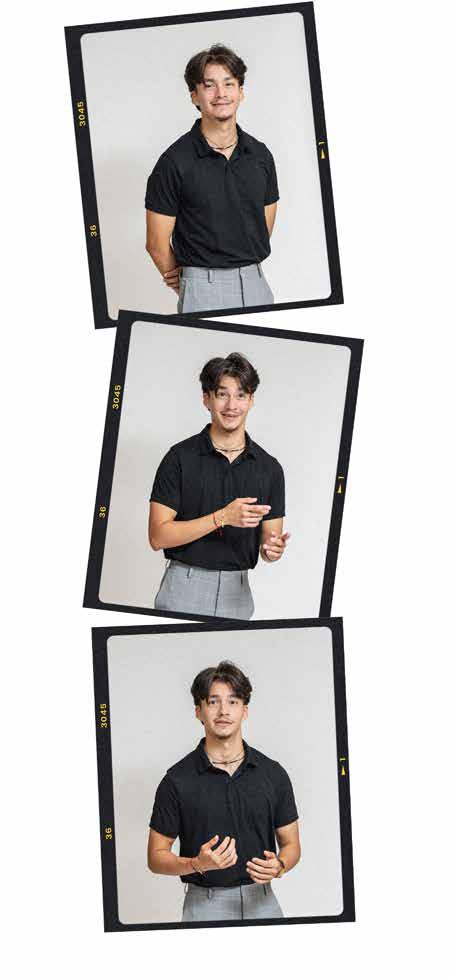
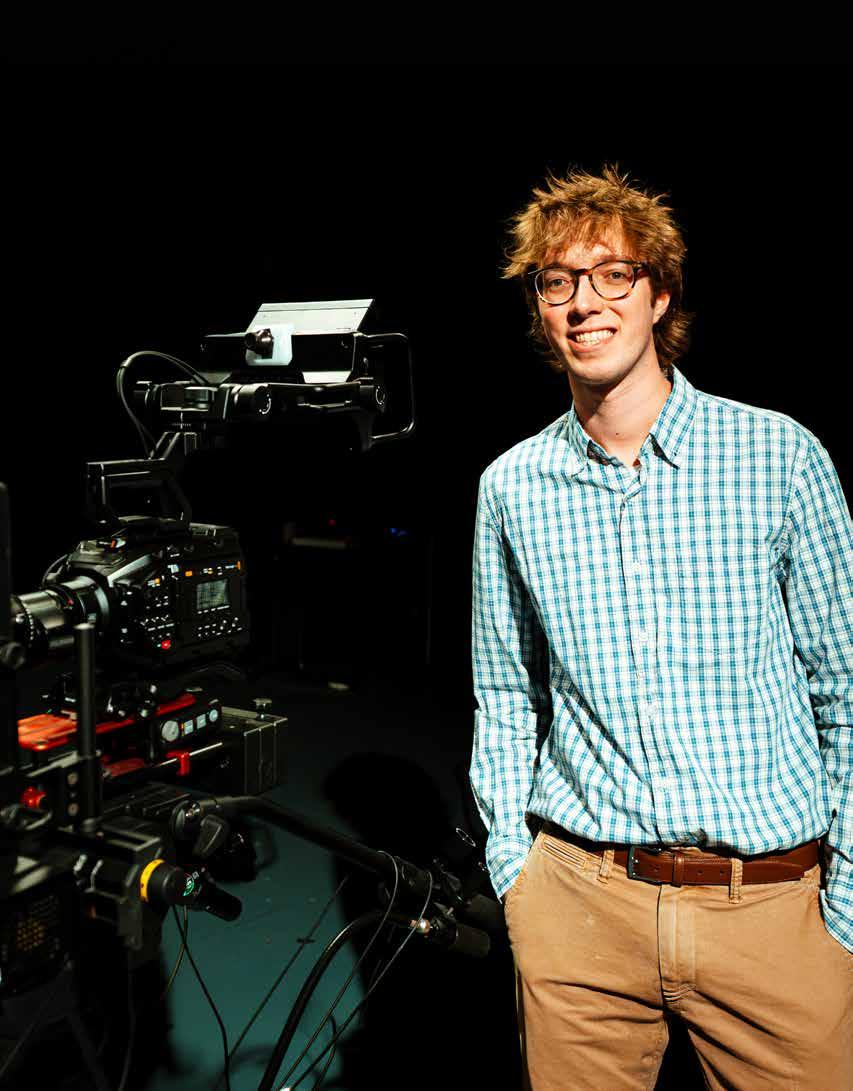
I-95 South Bound and Beyond: Sam Wofford '26
Manhattan is the place to be if you’re looking to forge a career in media and communications. That’s one of the things that drew Sam Wofford ’26, an out-of-state student, to New York City and Manhattan University. Wofford grew up in Charlotte, North Carolina, splitting his time between South Carolina and West Virginia, where his father and mother had grown up respectively.
Wofford’s interest in media and filmmaking was born during his adolescence. “I just love media,” he said. “TV shows, movies, books, albums, magazines, documentariesthey all tell stories about humans and cultures, and if you listen, watch, or read purposefully, they can help you understand yourself.” His all-time favorite movies are an interesting blend of classics, horror, and comedy. The list includes Superbad (2007), 2001: A Space Odyssey (1968), It’s a Wonderful Life (1946), Donnie Darko (2001), and The Shining (1980), with the Disney Pixar animated film Wall-E (2008) sitting at number one. But Wofford did more than consume media. He grew up acting and loved being on stage or in front of a camera, doing everything from theater performances in high school to making his own short films with friends. Wofford’s passion for media grew during his years at Myers Park High School, where he took film classes. “At my core, I loved telling stories — making people laugh, cry, or just think. But even then, I didn’t think it would be something I could make a potential career out of,” he admitted.
Wofford was drawn to Manhattan University after touring the campus before his senior year of high school. “I found everyone to be so hospitable, and I felt really welcomed here, which was super-important for me as an out-of -state student,” he said. The University's smaller size, its close proximity to New York City, and its foundation in the liberal arts also convinced Wofford that Manhattan University was the right fit for him.
Wielding his passion for media, Wofford became a Communication major, which has allowed him to explore both the art and history behind media. “Media hasn’t always just been made with the modern technology you see today,” he said. “Media is how knowledge has been shared since the earliest days of humankind. At the root of every single subject — math, languages, sciences, engineering, whatever it may be — is some kind of media. Communications as a whole really backs
everything. I would argue that communications is extremely important to study if you want a nuanced perspective of education, history, and culture.” It wasn’t until Wofford’s sophomore year at MU, however, that his eyes were opened to a possible career path in the media field. “In my sophomore year here, I took a communications class called Intro to TV Studio, which was the first time I really got my hands on professional equipment,” he said. “I found myself enjoying being behind the camera just as much as I loved being in front of it, and I think it was then that I realized this is something I could never get bored with.”
Wofford has certainly been spending a lot of time behind the camera. On a whim, he ran for secretary of Manhattan Media Network (MMN), Manhattan University's media production club that focuses on shortform content, as well as professional-style studio work — and he landed the role. As secretary of MNN, Wofford makes videos, helps studio shoots, and conducts club outreach and organization. Wofford also recently made a short comedy film with two friends called The Sharks of Montauk, which kept him laughing through all three stages of the production process. “I love the broadness of filmmaking and media production in general,” he said. “There are so many technical jobs I can learn, and there’s also always the opportunity to keep on acting. Whether it’s writing scripts, filming on a production site, or editing in Avid Media Composer, I find myself becoming more and more passionate every day.”
Wofford’s busy and active student life doesn’t stop there. During his senior year, he was elected vice president of WRCM, Manhattan University's student-run, independent campus radio station. In this role, he often plans and runs sound for concerts that are hosted by WRCM, such as the WRCM Bash earlier this fall. “We had six performers/bands, and it was a challenge, but it was so worth it,” he said, recalling his fondest memory at MU so far. “So many people came together to hear student-led bands. It was really heartwarming, and I was so grateful to be at the center of it all.”
On top of that, Wofford was elected vice president of MU’s chapter of the Public Relations Student Society of America (PRSSA), where he runs meetings that explore the world of public relations and helps with professional development workshops. He even took the photos for PRSSA during a LinkedIn headshot
photoshoot. Additionally, Wofford has written two articles for MU’s fashion and lifestyle magazine, Lotus. One piece was a men's fashion style guide. The other was a fashion article about how glasses don't just have to be a tool to help people see - they can also be a style piece. Wofford is also a part of several honors societies, such as Phi Beta Kappa, Epsilon Sigma Pi, and the communication honors society, Lambda Pi Eta. And finally, he works as an admissions ambassador/tour guide.
In addition to majoring in Communication, Wofford is also minoring in Music, which has always played a major part of his life. He’s been playing both guitar and bass since he was young and also dabbles in music production, live recording, and mixing. “Music is extremely compelling to me because in studying it, there are so many different subject layers,” he explained. “You can study the ‘math’ behind music, the history behind music, or the performance aspect of it. Music truly grounds me, and I love exploring new sounds, going to concerts, and writing music myself.” More recently, Wofford added another minor to his academic portfolio: Religious Studies. “I genuinely think that the religious studies classes here are some of the most interesting classes MU offers,” he said. “All of the professors are amazing, and I’ve gained a far more nuanced worldview on cultures and societies of both the Western and Nonwestern worlds. Religion was also a major part of my upbringing, as I grew up Episcopalian, and I still align myself with the values instilled in me at church every Sunday.”
So what are Wofford’s grand plans after graduation? He hopes to do some traveling and explore the world. Once he gets back, though, the multitalented student plans to get focused and forge a career for himself in the media production industry. Wofford would love to write and produce movies and TV shows, particularly in the comedy and horror genres. “Writing for horror and writing for comedy are similar in a way,” he said. “You have to know a lot about the human psyche. If I made a feature film, I think it’d seem like some kind of combination of Kevin Smith, Paul Thomas Anderson, and David Fincher.” Wofford also has a vague interest in teaching communications himself. “I may try to get a Ph.D. someday as well, because I could totally see myself becoming a professor,” he said. “So, if there are any communication professor openings at MU here in about 20-25 years, I’ll probably be applying!” MU
Rising to the Challenge:
Maria Azevedo '26
I wanted not only to understand how the body works, but to gain the knowledge and skills necessary to help others during their most vulnerable moments.
It’s been an interesting journey to Manhattan University for Maria Eduarda Azevedo ’26. She was born and raised in the state of Bahia, Brazil. As Azevedo says, she was “always surrounded with good values, good food, good music, and an extremely loving and supportive family.” But one thing she didn’t have was access to private healthcare insurance. Growing up in Brazil, her family relied entirely on the public healthcare system. “While the system is designed to serve everyone, it is not always able to meet every need,” she explained. “When you are sick, you are in a vulnerable position. You depend on knowledge and support that you may not have.” Azevedo experienced this dilemma herself when a close family member became ill during her adolescence. For nearly three years, she accompanied this family member to countless medical appointments, witnessing firsthand how complex and overwhelming navigating healthcare can be. “Seeing this from a young age shaped the way I understand healthcare, not just as a science, but as a deeply human experience,” she said. “From childhood, I felt drawn to being on the other side of that experience. It inspired me to pursue a career in medicine and to become someone who can guide, support, and advocate for patients as they navigate similarly challenging situations. I wanted not only to understand how the body works, but to gain the knowledge and skills necessary to help others during their most vulnerable moments.”
Azevedo’s experience solidified her path. She knew she wanted to work in medicine but didn’t know where in higher education to pursue this goal. That, however, soon changed. While in high school, Azevedo participated in the RISE Challenge, a global initiative designed to identify and support young people committed to community service and solving global issues. The RISE Challenge selects 100 global winners each year, offering lifetime benefits, including scholarships, mentorship, and funding for their projects. Azevedo submitted a drinkable rainwater project to the RISE school, she was selected as one of the 100 global winners, an opportunity that granted funding for her undergraduate studies. For Azevedo, this incredible support opened many doors to higher education, including to colleges in the United States — a path that greatly
intrigued her. “I wanted to experience life away from home and grow not only academically and professionally, but also personally,” she explained. “I was also looking for better opportunities for career development, which meant moving away from home. So, I decided to try studying and starting a new life in a new country.” Leaving her family in Brazil wasn’t easy. But as Azevedo says, “They are by my side, regardless of distance. Everything I do is for them, to share with them, to make them proud.”
Azevedo wound up enrolling in Rhodes College in Tennessee as an undecided major — and she did it without ever stepping foot on campus. In fact, her first time visiting America was when she traveled to Rhodes College by herself at the start of the first semester. There was definitely a bit of culture shock when she initially arrived. “The social values are pretty different, from concepts of race and ethics to how friendships and social interactions are built,” she said. “I also miss Brazilian spices, steak, and fruits.” Azevedo completed a semester at Rhodes College but didn’t feel like it was the right fit for her. She came to realize that she wanted to be in a place where she could immerse herself more fully in both personal growth and diverse opportunities. This led her to explore institutions in New York City, one of them being Manhattan University. “From my very first interaction, the transfer admissions team at Manhattan University was exceptionally welcoming and supportive, especially Elena Kreatsoulas,” said Azevedo. “This strongly influenced my decision to transfer.”
Azevedo transferred to Manhattan University for the second semester of her freshman year. And this time, she had found the right fit. “MU is truly a place where deep and lasting connections can form,” she said. “I have met people here who have become fundamental parts of my life, and I know I will carry them with me well beyond my time at the University.” Azevedo is now a biology major, pursuing a pre-health concentration. In conjunction with this, she served as a patient advocate at Saint Barnabas Hospital, where she observed the fast-paced environment of the emergency department while supporting patient care and communication. Azevedo also worked as an assistant in an endocrinology clinic, where she gained hands-on experience with clinical procedures, such as taking vital signs and
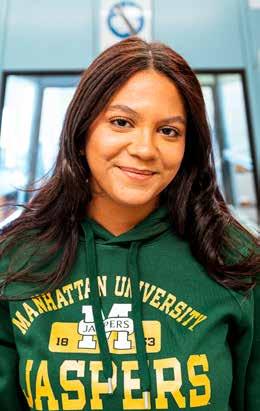
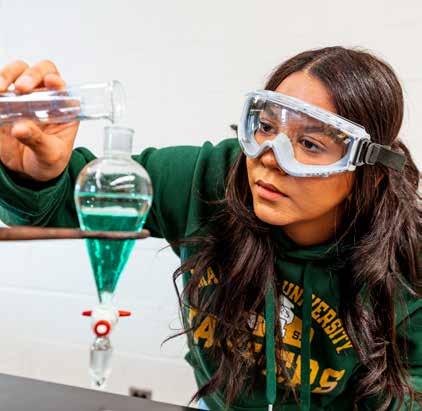
assisting with blood work. In this role, she also served as a translator for Portuguese-speaking patients, helping bridge communication gaps in a highly diverse clinical setting. “One particularly meaningful experience involved communicating biopsy results to a patient in their native language, ensuring they fully understood their diagnosis,” she reflected. “Feeling I was part of the chain who took that burden off of his shoulders was incredible.” More recently, Azevedo was accepted into the CHAM Leaders Program at Children’s Hospital at Montefiore, where she will begin shadowing in the neonatal department.
On top of this, Azevedo has managed to carve time out of her busy schedule for research projects. She conducted summer research through the Kakos Research Program, where she investigated the impact of gene-linked cholesterol levels on seizure activity. After submitting her work for consideration, Azevedo's research was selected to be a part of the Sigma Xi Conference. Since then, she’s been assisting Bryan Wilkins, Ph.D., with molecular research at his laboratory within the Chemistry and Biology Department. “Dr. Wilkins has been an exceptional mentor,” she said. “I am excited to continue working with him in upcoming summer research.” But Azevedo’s extracurricular activities don’t end there. She’s also involved in a number of organizations and societies. She participates in Conversations to Remember, a student-led initiative aimed at reducing social isolation among seniors. Through weekly virtual interactions, she helps foster meaningful relationships and provides companionship and emotional support, contributing to improved well-being and connection for older adults. Azevedo is also the secretary of TriBeta, MU’s Biology Honors Society, where she helps with general organization, sends emails and reminders to members, and assists with events. She also serves as the Mentorship Coordinator for Alpha Epsilon Delta, MU’s Pre-Health Honors Society. There, she organizes the peer mentorship program, pairing younger classmen with juniors and seniors to help guide them in resume building, LinkedIn networking, and career development. Additionally, Azevedo is a contributor to the American Society for Biochemistry and Molecular Biology (ASBMB), reporting on member news, professional achievements, and developments within the biochemistry and molecular biology community at a national level. She also works as a tutor at the Center for Academic Success. On top of that, she’s involved with the Biology
Club and the Psychology Club. Azevedo also hopes to soon be inducted into Sigma Xi for her research history and selection at the Sigma Xi Conference. Of all these achievements, what’s Azevedo’s greatest accomplishment so far? “It’s been my ability to fully immerse myself in diverse opportunities — research, leadership, clinical experience, and service — while staying grounded in a strong sense of purpose,” she said. “Navigating this path as an international student has come with its own set of challenges, requiring resilience, adaptability, and a strong sense of self-direction. Along the way, I have faced moments that pushed me to step back, reinvent myself, and learn how to seek support. These experiences taught me that growth is not always linear, but it is always meaningful. I have a deep internal drive that keeps me moving forward, even in uncertain moments.”
So what are Azevedo’s plans after graduation? She plans to remain in New York City and work as an Emergency Medical Technician (EMT) while preparing for the Medical College Admission Test (MCAT). She also wants to take time to travel and spend a lot of time with her family back in Brazil. After that comes the challenge of medical school, though Azevedo feels ready for it. “Manhattan University has provided me with rigorous academic training, and meaningful research opportunities,” she said. “The combination of coursework and leadership experiences here has strengthened both my technical skills and my commitment to service.” Azevedo plans to remain in America for medical school and already has her eye on Albert Einstein College of Medicine, an institution that she’s actually been working with for the last year. Upon graduating, she’d like to be a doctor that specializes in emergency medicine, neurology, or cardiology. “My ultimate career goal is to have a multidisciplinary role,” she said. “Working as a physician while also advocating for health equity programs and collaborating with organizations that promote public health. I hope to contribute to reducing healthcare disparities both in the United States and outside.” Azevedo isn’t sure whether she’d stay in America beyond medical school and work as a doctor here. But at this point in her journey, there is one thing she is sure of: herself. “I have learned to trust myself, to recognize how far I have come, and to continue striving for more,” she said. “I remain committed to growing, working hard, and dreaming bigger with each step I take.”
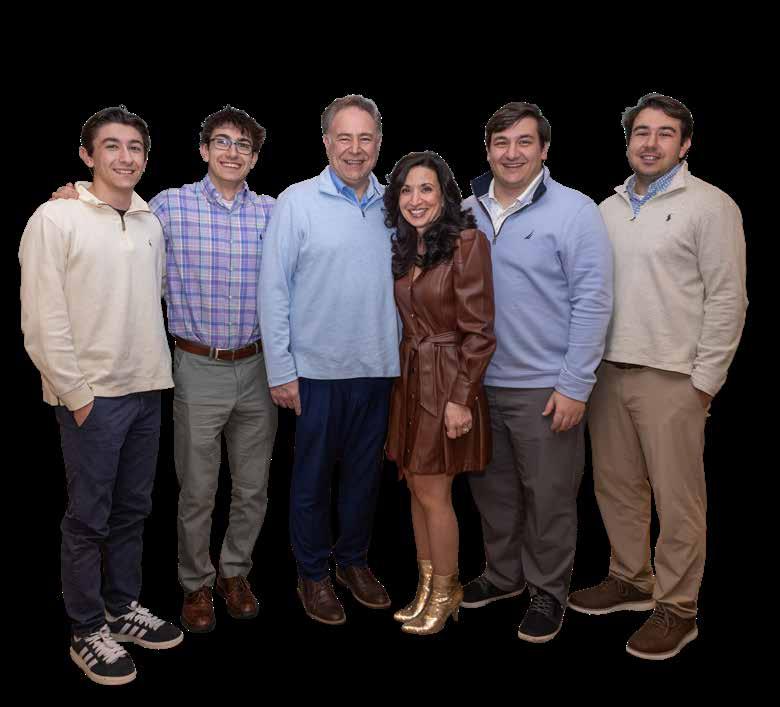
THE MARCOCCIA FAMILY
A Family Legacy of Jaspers
From left to right Marco, Giancarlo '27, Luigi '94, Olimpia '94, Nicolino '22, Vito Marcoccia '25
“I’m proud of the tight-knit community and the Lasallian values that students are held to.”
— Giancarlo Marcoccia ’27
Giancarlo Marcoccia ’27 is currently studying at Manhattan University — but he’s not the first member of his family to do so. The Marcoccia roots run deep within the Manhattan community. He comes from a whole family of Jaspers, generations of family members who have proudly graduated from Manhattan University over the years.
The Marcoccia family legacy begins with his parents, Luigi Marcoccia ’94 and Olimpia Piccirilli (Marcoccia) ’94. Growing up in Tuckahoe, NY, Luigi was seeking a local, commuterfriendly school for college. “A close friend recommended it for its strong reputation, central location near the city, and robust alumni network across many companies in the city,” he said. Several of his second cousins attended Manhattan University (then Manhattan College): Rino Lembo ’90, Rino’s wife, Susan Zappia (Lembo) ’92, Rossano Baldassarra ’92, Joseph Lembo ’93, and Steven Lembo ‘97. Luigi, however, is the first member of his immediate family to enroll. Olimpia, better known as Pia, has a similar story.
Having grown up in Bronx, NY, she was very familiar with Manhattan College. Both of her older siblings attended the college — her sister, Dora Piccirilli (Baldino) ’84, and her brother, Alfonso Piccirilli ’85. Even Pia’s sister-in-law, Maria Pane (Piccirilli) ’85, attended the school. “Both of my older siblings attended Manhattan and were successful there,” said Pia when explaining why she chose Manhattan College. “But I also loved math and science and knew Manhattan was well known for its engineering program. I felt it was the best fit for me.”
Luigi majored in Finance and Marketing, while Pia majored in Electrical Engineering. Interestingly, it wasn’t their majors that brought them together, but their shared heritage and their interest in a certain school organization. Both Luigi and Pia were members of Manhattan College’s Italian Club, first meeting at the organization's Christmas party in December 1990 — and it was basically love at first sight. Soon after, the pair started dating and have been together ever since, eventually marrying in September 1997.
Luigi landed a role at Morgan Stanley after graduation. Since 2006, he’s been working at a leading opportunistic credit firm, Strategic Value Partners, and currently serves as Vice President. Meanwhile, Pia worked as an Electrical Engineer for the New York City Transit Authority. She retired from that role when they began their family in 2000 and had their first child. Together, the pair has raised their kids in Tuckahoe, NY, where Luigi had grown up.
Giancarlo is the third of four brothers — and also the third Marcoccia child to attend Manhattan University. His two older brothers, Vito Marcoccia ’22 and Nicolino Marcoccia ’25, both graduated from MU. Vito is now working as an electrical engineer, while Nicolino is working as a mechanical engineer. Giancarlo, on the other hand, is following his father into business. He’s majoring in Accounting with a minor in Economics. The youngest Marcoccia brother, Marco, is currently a junior in high school and has not yet committed to a university.
Despite this streak of legacy, Luigi and Pia never pushed their kids to attend Manhattan University. “Ultimately, we left the decision up to them, but subconsciously, we were hoping they would go there,” they said. And Giancarlo agrees. “With many family members having attended Manhattan, I consistently heard strong praise for the school growing up,” he said. At Manhattan University, Giancarlo is a part of the Beta Alpha Psi (BAP) honor society, Accounting Society, and a member of the Ultimate Frisbee club team. He also works for the recreational center, helping referee intramural sports. After graduation, he plans to attend Manhattan University (of course) for graduate school to pursue his MBA and then earn his Certified Public Accountant (CPA) certification.
The legacy likely won’t end there. Giancarlo would like for his own children to attend Manhattan University, though, like his parents, he wouldn’t pressure them to go there. With decades of legacy, the Marcoccia family are proud Jaspers. “Manhattan laid a great foundation for us both,” agreed Pia and Luigi. “I’m proud of the tight-knit community and the Lasallian values that students are held to,” added Giancarlo. MU
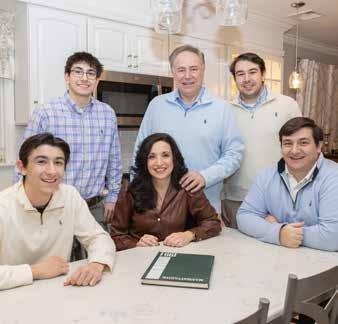
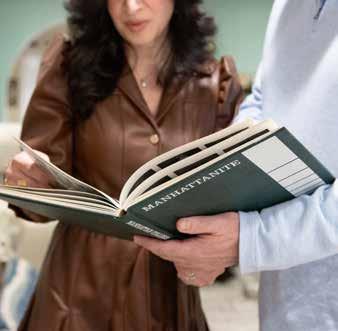
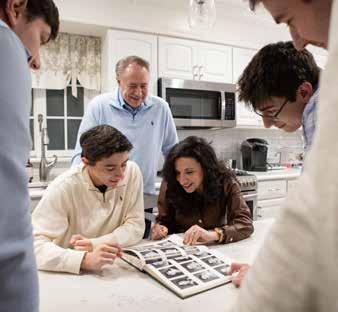
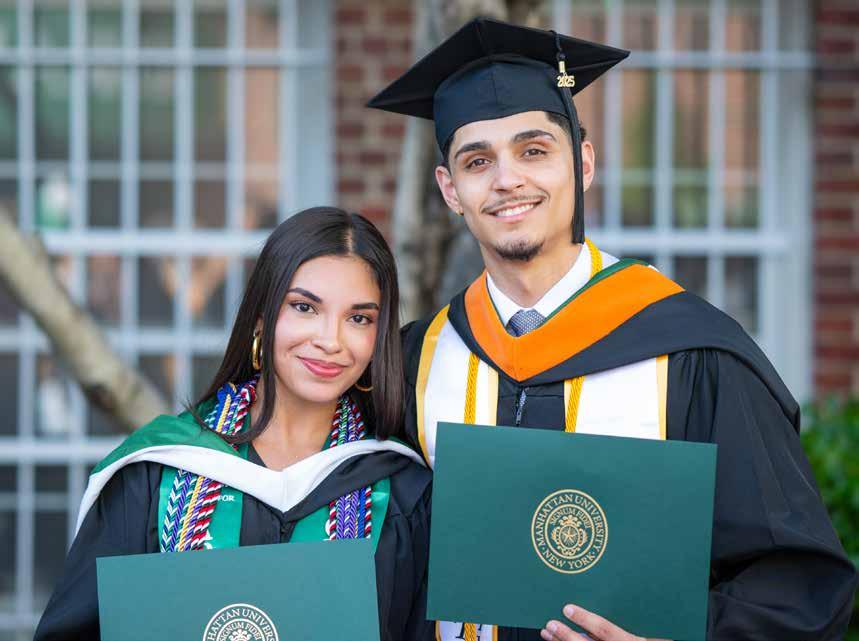
JASPER GUARANTEE
A TUITION YOU CAN COUNT ON
WHAT IS THE JASPER GUARANTEE?
Starting fall 2026, all undergraduate and transfer students at Manhattan University will benefit from a guaranteed fixed tuition rate. The Jasper Guarantee addresses one of the most pressing concerns for students and families: affordability and transparency in college education pricing.
WHY IT MATTERS?
PEACE OF MIND
The Jasper Guarantee gives you predictable costs so our students can focus on academics and opportunities.
GUARANTEED RATE
Manhattan’s average tuition for the entering class of 2025 was approximately $22,000. The incoming tuition guarantee will be calculated from a baseline cost, which factors in generous financial aid and merit packages that are based on GPA, strength of high school, and other criteria. Federal and state aid eligibility is determined upon FAFSA application and University evaluation.
LOCKED-IN PRICE
Once you enroll at the University, your baseline tuition rate will not increase for eight consecutive semesters, no surprises, no sudden tuition hike. Institutional fees are billed additionally and are subject to change.
RETURN ON INVESTMENT
Manhattan ranks in the Top 10% of U.S. Colleges Overall and #20 in Salary Impact Nationwide (Wall Street Journal, 2025).
Visit manhattan.edu or contact admit@manhattan.edu for more information.
APPLY NOW
Secure your future with confidence. Applications for Fall 2026 are open — don’t miss out!
Myles Brown ’29 was born to be a swimmer. He began taking lessons at the age of six months, doing Mommy and Me classes, in his hometown of Queens, NY. He later participated in Saf-T- Swim for about three years, quickly completing all the levels there. Noticing his talent and skill, Brown’s mother encouraged him to start swimming competitively. She enrolled him in Nu-Finmen Swimming, a program that provides opportunities and competitive training for minority youth. By the age of 8, he was swimming competitively for Nu-Finmen’s club team. Brown later went on to attend Academy Charter High School in Long Island. At that time, the school didn’t have a swim team, but Brown’s ambitious mother changed that. She asked the school to create and fund a swim team in order to combat racist stereotypes. Academy Charter listened, and its varsity swim team was born. Brown joined the team in his freshman year. There, he met one of his most important mentors: his coach, Taenika SandsHendricks. “She made me realize my potential in the sport of swimming and pushed me when I didn’t have all the resources,” he said. It was during his junior year that Brown began to take his athletics more seriously. He committed himself to becoming a Division 1 swimmer and tried out for the Long Island Aquatic Club (LIAC). A reputable swim club, the LIAC is #1 in the state of New York and is ranked #5 nationally. In tryouts, Brown was asked to do a 50-yard swim of each stroke: butterfly, backstroke, breaststroke, and freestyle. He was immediately recruited to the club and was told to report to practice the first week of September. “It was at LIAC where I developed my skills and honed my craft in the two short years left of high school, which put me in a position to begin at Manhattan University as a Division 1 swimmer,” he said. It was also at LIAC where Brown met another significant mentor: his club coach, Mike Lennon. “I showed up at LIAC to practice eight times a week over two years,” said Brown. “Coach Lennon catered to my work ethic. He also helped me develop my sprint freestyle.”
Brown came to specialize in the 50-yard freestyle, as well as the 100-yard freestyle, the 100-yard butterfly, and the 200-yard freestyle. During his time at LIAC, the swim club became Senior Metropolitan Short Course and Long Course champions. The team also maintained its impressive state and national rankings of #1 and #5, respectively. As for his varsity performance, by the end of his senior year, Brown was a three-time Nassau Swimming All-Conference champion, a three-time All-Division champion, a 3-time MVP, and a three-time swim team captain. He also holds eight records at Academy Charter High School, including the 50-yard Freestyle, 100-yard freestyle, 200-yard freestyle, 500-yard freestyle, and 100-yard butterfly.
Brown’s athletics earned him a partial scholarship to fulfill his dream and become
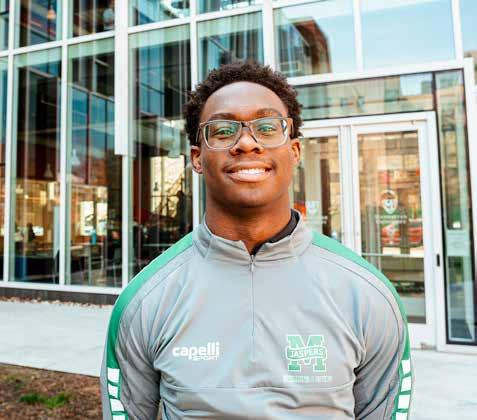
a Division 1 swimmer at Manhattan University, where he was recruited to the team by coach Brian Hansbury. “Manhattan’s team has a sprint program that I saw myself immediately contributing to,” he said. “I also think competing in a high-end Division 1 conference like the Metro Atlantic Athletic Conference (MAAC) will help me become faster at the end of my four years here.” But Brown was also drawn to the college for another reason: its renowned engineering program.
Aside from swimming, Brown had grown up with an appreciation for architecture, in particular high-rise buildings. “My parents would buy me a LEGO set every week during my early childhood,” he said. “My father would also take me to Times Square every Friday. Seeing its amazing infrastructure really piqued my interest in engineering. I wanted the opportunity to be a part of the process of developing buildings.”
As a student at Manhattan University, Brown is pursuing a major in Civil Engineering, and is part of the Black Student Union (BSU), which led to one of his favorite memories at Manhattan University so far: speaking on a panel about his experiences as a person of color athlete at a predominantly white institution, alongside other people of color on the track team and in coaching roles. Brown is also a member of the American Society of Civil Engineers (ASCE), and hopes to one day develop a career in civil or structural engineering, working on high-rise buildings with abstract architecture. He also hopes to obtain a master’s degree in structural engineering. But until then, Brown’s focus remains on his athletics.
His collegiate swimming career is off to a hot start, as Brown and his swim team made
it to the 2026 MAAC Championships. They were less than a second away from breaking the 200-yard freestyle record. Brown was the only freshman who competed in this relay. He was also the only freshman to compete in the 400yard freestyle at the championships. Although he was feeling sick at the time, Brown won and nearly achieved his personal best time. “This is my proudest moment at Manhattan University so far,” he said. “My coach took a chance on me, and I was able to show up for my teammates despite feeling under the weather.” By the end of the championships, Brown was ranked in the top 25 in the 200-yard freestyle — and he accomplished this feat as only a freshman. Brown plans to continue competing athletically after college. He already has his eyes on the 2028 Olympics, where he hopes to compete on the world stage. “I would first need to qualify for an event with the Olympic Trials,” Brown explained. “To get there, I need to get stronger in the weight room and in the pool. I also need to perfect my craft and technique in the pool to give myself a fighting chance to swim at such a high level.” As an American-born citizen, Brown could, of course, compete in the Olympics for the United States. But his mother’s and grandparents’ Jamaican citizenship also makes him eligible to swim for Team Jamaica. “Competing for team Jamaica is one of my biggest dreams,” said Brown. “I would love to make Team USA, but I would also love to represent my other heritage internationally and compete for Jamaica. God willing, I’ll be on the Olympic stage in Los Angeles in 2028.” No matter what happens, though, the future seems bright for this aspiring swimmer and engineer. MU
Photo credit: Ryan Montemarano
PERRINO
The Flash:
Aliann Pompey ‘99, MBA ‘03
A Jasper Olympian's Story
For someone who initially had no interest in running, Aliann Pompey ’99, MBA ‘03 has come a long, long way. Her career, both as an athlete and now as a coach, has left a tremendous impact on the world of track and field. Pompey’s incredible story begins in Guyana, where she was born and raised. Her family lived in a rural area, right by the ocean. When she wasn’t reading avidly, Pompey spent much of her time with animals. Her family raised chickens, ducks, sheep, pigs, and cows. She and her siblings even had ‘pet’ sheep. At that time, it was her sister, Allison, who was the track star. “My sister was always really, really fast,” said Pompey. “When we were in Guyana, she ran and made traveling teams at an early age. There’s been times in Guyana when people have recalled me running in primary school, but they’re really thinking of Allison.”
Despite her love for Guyana, Pompey’s family emigrated to America after her parents’ divorce. Her father wanted his children to pursue higher education, and several family members, who were already living in America, advised him that this trajectory would be more realistic if they relocated to the United States. The Pompey family moved to New York, bouncing from Latham to Watervliet before finally settling down in Cohoes.
The transition from Guyana to America was not an easy one for the young Pompey. “Our accents and vernacular immediately set us apart,” she said. “We had different words for things — for example, rubbish versus garbage — so we had to get past that. The weather for me was the biggest thing. In Guyana, we would look out the window and dress based on the sunshine. I remember my first spring in America. It was a bright April morning, but when we went outside and that cold air hit, it was the most shocking thing. We understood the concept of American seasons, but experiencing it was jarring. I had no reference point, and our bodies took a really long time to adjust.” One area where Pompey didn’t struggle, however, was her education. Upon emigrating to America, she was placed in the 7th grade, until one of her teachers noticed that Pompey already knew all the coursework. Her teacher advocated for Pompey to move up to the eighth grade, a suggestion that concerned her guidance counselors. “They were worried about my ability to adjust socially,” she said. “My father made the argument that it would be an adjustment regardless of where they placed me, so I chose to advance.”
It was here in America where Pompey became involved in sports — but not because she wanted to. “I weighed about 80 pounds or so, and my dad was concerned about my weight and general growth,” she said. “Our doctor
recommended that I pick up a sport, so I can be more active, which would lead to me eating more and perhaps filling out.” Pompey participated in field hockey as a student at Shaker Middle School in Latham. She later tried volleyball at Cohoes High School but only for a part of the season. In search of a new sport, Pompey decided to follow in the footsteps of her sister, Allison, who was already on the track team at Cohoes High. She joined her sister in running the 100/200-meter dash for the track team. But Pompey’s path, and subsequently her life, changed during her senior year in 1995. Her teammate was injured during a track meet, which prompted coach Paul Wheeler to ask Pompey to run in her teammate’s place. That event was the 4x400-meter relay — and it would become the focus of Pompey’s entire athletic career. Although it was her first time running this particular event, Pompey finished with the fastest split of everyone. Impressed by her performance, Wheeler entered Pompey in the individual 400-meter dash, where she also performed well. At the end of the season, Pompey entered the New York State meet, a competition featuring the best athletes in track and field all over New York. And she emerged as the victor of the 400-meter. “It was like I came out of nowhere,” she laughed. “I didn’t start the 400-meter until my senior year, and now suddenly I’m winning major competitions. Suddenly, I was getting all this attention and recognition.”
Because of her decision to advance, Pompey graduated from Cohoes High School early, a couple of months after her 17th birthday. Her athletics earned her an academic scholarship to Manhattan University (then Manhattan College), which covered a substantial part of the cost. Unconvinced that she could turn her athleticism into an actual career, Pompey decided to pursue engineering, though she changed her major within the first week. “I didn’t think I’d be able to manage the workload,” she explained. “I switched my major to finance. I thought it made sense being in New York City. It was also the most exciting and glamorous career at that time.” This thought process is also what pushed her to later pursue an MBA in finance. Pompey went on to become a Dean’s List student, a member of the Student Athlete Advisory Committee, and president of the African Caribbean American Club.
Unsurprisingly, Pompey also became a member of Manhattan University’s track and field team. She ran for Coach Joseph Ryan, one of her greatest mentors. “I actually didn’t run well during my first year at Manhattan,” Pompey confessed. “I went from having all this attention to
completely disappearing. It wasn’t until my senior year that I really excelled and got attention again.” And excel she did. As a Jasper, Pompey holds seven Manhattan records. Her 500-meter race indoors, with a time of 1:09.38, is both an ECAC and NCAA Collegiate record. She also holds the MAAC 400-meter Indoor and Outdoor records, as well as the Metropolitan Conference 400-meter Indoor and Outdoor records. In addition to these records, Pompey holds eight Individual Metropolitan Titles in the 200-meter and 400-meter. She was named All-East in the 200-meter and 400-meter six times. She was even selected to be captain of Manhattan’s track and field team. “Coach Ryan was serious about us having mentors to find jobs and set us up for life after school,” she said. “This role made me start thinking of myself in a leadership role. I didn’t see myself that way before.” Pompey’s crowning achievement and proudest moment at Manhattan was winning the 400-meter at the 2000 NCAA Division I Track & Field Championships, becoming the first Jasper female to win an NCAA title. By the end of her senior year, Pompey was ranked 12th in the world in the indoor 400-meter dash. This ranking soon opened the door to an even greater opportunity: the Olympics. “You had to perform at a certain level in order to qualify for the Olympics,” Pompey explained. “You had to be ranked at a certain number in the world.” During her senior year, representatives from Guyana reached out and asked her to compete for her home country in the Olympics. There was literally no one in Guyana who was faster than her. But what about her MBA and that glamorous finance job? “I felt my MBA and financial career was always something I could come back to,” she said. “Track as an athletic career had a shelf-life, so I let that guide my decision. And winning the NCAA and qualifying for the Olympics was the ultimate dream. After that, the story wrote itself.” And it turned out to be an incredible story. Pompey paused her MBA and spent the next 12 years focusing on her athletic career, competing in
various international sporting events. Representing Guyana, she competed in four Olympic Games in 2000, 2004, 2008, and 2012. In 2002, she won the gold medal at the Commonwealth Games. She was the first woman from Guyana to win gold at the Commonwealth Games — and no female athlete from Guyana has done it again since. Pompey reflected on that triumphant moment: “It was a great feeling. I remember the last 50 meters thinking, ‘The line is right there. There are too many people between me and the line, but I have enough to get past them.’ You can see in the race exactly where I lowered my head on the homestretch and made my final move to the finish line. I didn’t even do a victory lap after that. I ran to find my team-mates and officials because I already knew the significance of what just happened.” A few weeks later, Pompey was honored with a parade and week of activities in Guyana by various governmental ministries. At the end of the season, she was named to the 2002 IAAF World Cup team as part of the 4x400. Pompey’s victories came with more than medals and honors. They also attracted some very cool sponsorships, like Adidas. Her six-year contract included a guaranteed salary and a bonus structure based on her athletic performance, such as qualifying for the Olympics. She was also sponsored by company that was new to the sports apparel market: a little-known brand called Under Armour. At that time, in the early 2000s, Under Armour was focused on football. Through serendipitous events, which involved tackling obstacles from the TV show American Gladiators, Pompey became Under Armour’s first track and field athlete. Both Adidas and Under Armour provided her with gear, from running shoes to casual everyday wear. “They tested out a lot of products on me. It was a top moment of my life,” she said, laughing. “I loved it.” These sponsorships paved the way for Pompey to become a fitness model. She appeared in print ads for Nike, Equinox, and, to her surprise, the Canadian Olympics. “My athlete friends in Canada sent me a photo one day,” she
Photo credit: Vincent Dusovic courtesy of St. John's University Athletic Department
explained, again laughing. “It was a billboard of me, in Canada — in support of Canadian athletes! They used a black and white filter to modify my Guyana uniform. I basically became the face for the campaign.”
Pompey racked up a dizzying number of honors and accomplishments over the years. In 2003, she took home a bronze medal for the 400-meter at the Pan American Games. In 2006, she was selected as one of the top 25 MAAC all-time performers. In 2009, Manhattan University inducted Pompey into its Athletic Hall of Fame. The following year, she earned a silver medal at the Commonwealth Games, becoming Guyana’s only multi-medal athlete in track and field. In total, Pompey competed in the IAAF World Indoor Championships five times, placing fifth in the 2010 Championships, and she’s competed in the World Championships in Athletics 11 times. Throughout all of this, Pompey set five records for Guyana for both the 200m and 400m, indoors and outdoors. Her personal best time of 50.71 seconds was achieved at the 2009 World Championships in Berlin. “I never felt alone at World Championships or Olympics,” Pompey reflected. “I would get nervous, even scared. But when I was representing Guyana, I somehow felt more buoyant.
It always felt like I had a country behind me or lifting me up.”
So, what does an Olympic athlete do when she decides that her track career is over? For Pompey, the answer didn’t turn out to be finance. She had actually gone back to Manhattan University to complete her MBA in finance in 2003. After retiring from track, Pompey tried her hand at finance and worked at NY Life Securities, where she had actually interned during her years as an undergrad. But she knew early on that finance was a mistake and not the right fit for her. “I was just coming out of sports, out of a high energy career,” she explained. “Sitting behind a desk for eight hours a day just didn’t appeal to me.”
Pompey’s friend, another athlete, was working for a non-profit organization that taught life skills through sports. Looking for a change, Pompey followed her friend to PowerPlay NYC for three years before moving on to become the Director of Educational Development at Armory
Foundation. She worked with the Armory College Prep program, a college access program for athletes, and found it to be a better fit. The program was only 30 participants when she started. It quickly grew to over 200. “As the program grew larger, I got further and further away from working one on one with the athletes,” Pompey said. “I started missing that terribly.”
By 2014, Pompey was ready for yet another career change. That’s when the job of assistant coach for St. John’s University’s track and field team opened up. She applied for the role and met with Jim Hurt, the head coach at the time. Pompey was hired on the spot. Although she had helped train Manhattan University athletes and private clients over the years, St. John’s was Pompey’s first official coaching job. She was finally back to working one-on-one with athletes, primarily responsible for sprints, hurdles, and jumps. Pompey had finally found her career path post-Olympics. “I’ve always loved traveling, and coaching allows me to do that,” she said. “More importantly, it exposes me to such a broad base of people. I meet people from all age brackets — athletes, their coaches, their families — and they all have something to teach. I love soaking that up.”
After seven years as assistant coach, Pompey got another new job. She became director of the St. John’s track and field program. “On a consistent basis, my messaging is about removing the obstacles we place in our way,” she said when describing her coaching style. “I’m diligent about the language we use to describe ourselves, our self-talk, and our mental approach to difficult things.” Under Pompey’s leadership, the Red Storm has had multiple Big East championships, MVPs, and high point scorers. Her athletes have qualified for the NCAA Championships several times and have broken numerous school records. Pompey hasn’t coached any Olympic athletes at St. John’s. At least, not yet. She feels confident, though, that we’ll see some of her current athletes in a future Olympics.
Pompey has held many other titles besides coach over the years. She was a board member for the Manhattan College Alumni Society and the president of the Manhattan College Black Alumni Club. She had to step away from both roles, however, to focus on other international opportunities. From 2015-2023, she served as a member of the Panam Sports Athlete Commission. In 2019, Pompey was elected president of the Panam Sports Athlete Commission, working to advocate and amplify the voices of athletes in the Americas within the Olympic movement. In that role, she worked as a member of the Athletes’ Commission of the Association of National Olympic Committees and as an International Olympic Committee’s Athlete Liaison. Four years later, Pompey was also elected as president of the Metropolitan Athletic Conference, overseeing the cross country, indoor, and outdoor conference championships and implementing changes aimed at keeping the Mets relevant. She served two terms in that role. Since she began competing in 2000, Pompey hasn’t missed an Olympics in-person. Only now, she travels there as an official rather than as an athlete. Pompey attended two Olympics (2016 and 2020) as an assistant manager for the Guyanese track and field team. She attended the last one (2024) as an executive board member of the World Olympians Association, a role she earned in 2020. One of her proudest accomplishments, though, was creating the Aliann Pompey Invitational (API). The first of its kind, the API is an annual track meet in Guyana that attracts the most high-level athletes in the world. “As a competitor, I always wanted to compete at home, at a high level, more than anything,” she said when explaining why she founded the API. “I didn’t have that opportunity. I also wanted the people who supported me during the 12 years of my athletic career to see me compete in person against the best. The API was meant to give the Guyanese athletes and people that experience.” Pompey still visits her friends and family in Guyana. Since 1999, she’s gone back to her home country at least once a year. She also still runs, though now it’s for different reasons. “Fitness and aesthetics are my goals now,” she said. And even after her many accomplishments, Pompey still feels strong ties to Manhattan University. “I grew up at Manhattan,” she said. “I came as a teenager, stayed while I was a professional athlete, got my master's, and then gave back via clubs and other organizations. I love the people there and take every chance I get to meet new people. The school has given me a lot. I always felt supported. Whenever I visit, it feels like coming home.” MU
Manhattan University Men’s Volleyball Begins Inaugural Season
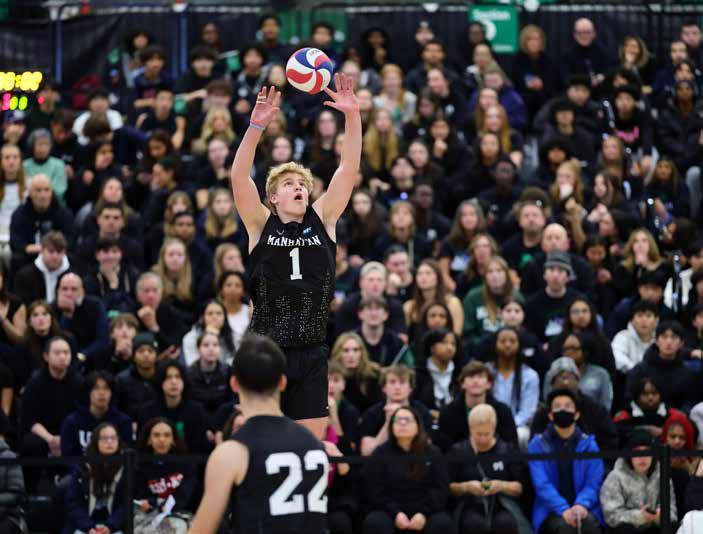
After two years of development and high anticipation, the Manhattan University Division I Men’s Volleyball program officially began its acing, digging and spiking action in Spring 2026. The Jaspers team is guided by Head Coach Chris Schortgen, who came aboard after spending three seasons at Hunter College, where he led his volleyball squad to the CUNY Championship Game each season and was twice named CUNYAC Coach of the Year. During his storied career, Schortgen also served on the coaching staff for Pratt University Women’s Volleyball from 2018-2020 and in 2019, was named to the Hudson Valley Intercollegiate Athletic Conference Co-Coaching Staff of the Year.
Regarding why he made the move to Riverdale, Schortgen said, “What
attracted me to Manhattan University was the opportunity to grow the sport as the 30th D1 Men's Volleyball program in the country. I believe our institution has all the great pillars to build a strong program having strong academic standards, great facilities/meal options and a great location for students to explore for social- or career-driven opportunities.”
One of Schortgen’s primary objectives as Men’s Volleyball Head Coach is to serve as a positive role model for his players as he and his team work to prepare them for either continuing their playing careers or starting their post-graduation professional lives. “Our goal is for our team to have a positive presence and impact on campus and succeed in the classroom, community and court,” he
added. “I believe we can create one of the top programs in our conference, then East Coast, then country, but one step at a time.”
Having officially joined Manhattan University in the Fall of 2024, subsequently playing a pivotal role in recruiting and team building, Schortgen describes his experience thus far: “It has been exciting having moved here from Austria with my wife to start a new life,” he said. “It’s been amazing to see the support from the campus, administrators, students and the community for our first home match. I think we have a special opportunity here to introduce men’s volleyball to those who have never had access to the sport plus work with the youth boys’ volleyball community to help grow the sport.”
a lumni calendar
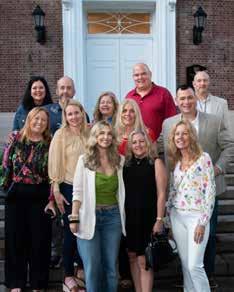
June 5-7, 2026: Reunion Weekend
All alumni, especially graduates of classes ending in 1 and 6, are invited back to campus for Reunion Weekend 2026 to celebrate their time at Manhattan. The weekend kicks off with the Cloud Nine III Harbor Cruise and JasperFest on the Quad, an all-campus party that is perfect for our young alumni. On Saturday, festivities continue with the Golden Jaspers 50th Anniversary Luncheon, Jasper Wine Tasting and Picnic, and a series of special recognition receptions honoring milestone reunions. Reunion Weekend is a cherished opportunity to reconnect with your alma mater, friends, and classmates; relive your favorite Manhattan memories; and revisit your days living in the dorms. We can’t wait to welcome you back to campus!
Thursday, June 11, 2026: Young Alumni Summer Kickoff Rooftop Reception
Kick off summer in style with fellow Graduates of the Last Decade at our rooftop reception in Manhattan. Catch up with your college friends, expand your network and enjoy the open bar and apps, all in front of a gorgeous view of the New York City skyline.
Friday, July 17, 2026: 17th Annual Jersey Shore Alumni Luncheon
Whether you're a proud Jersey Shore local or just passing through, we invite you to our 17th annual luncheon event at the beautiful Essex and Sussex in Spring Lake, NJ. Join us for an afternoon of delicious food and drinks, the opportunity to reconnect with fellow Jaspers, as well as meet new members
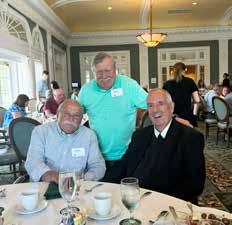
of the Jasper alumni community. Join us to reminisce, make new memories and hear exciting updates on the University. You don't want to miss this!
Monday, July 20, 2026: 29th Annual Construction Industry Golf Outing
The Leewood Golf Club in Eastchester, NY once again plays host to our annual Construction Industry Golf Outing, a signature Alumni Relations summer event for Manhattan University engineering Jaspers and friends.
In 2018, the Construction Industry Golf Outing Committee launched a transformative 10-year initiative driven by a deep commitment to the University. The goal is to raise $1 million to renovate and modernize classrooms and labs and create a state-ofthe-art structures lab — a vital educational

resource within the Civil Engineering department. These enhancements will give students unparalleled opportunities to apply their engineering skills to real-world projects.
Thursday, July 23 and Friday, July 24, 2026: Saratoga Day at the Races Alumni Outing
Join fellow Jaspers for an unforgettable two-day experience in beautiful Saratoga Springs, NY, during the height of the racing season! Experience the thrill of thoroughbred
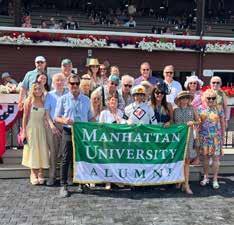
racing at Saratoga Race Course, one of the world's most celebrated sporting venues, as recognized by Sports Illustrated. Advance registration is required and cancellations are non-refundable.
Saturday, August 8, 2026: Alumni Afternoon in the Hamptons
Join Kathleen and Tom Groark '71, the ultimate Hamptons hosts, as they open their beautiful home in Sag Harbor, alongside our
dynamic co-hosting duo, John Kirrane '78 and John Rasulo '86, for an afternoon of drinks, lunch, and the chance to catch up with fellow Jaspers and friends. This event promises to be a fantastic gathering of the Manhattan University community, featuring a ride on Tom's pontoon boat.
Friday, September 25, 2026: Jasper Lacrosse Alumni Golf Outing
We invite Men’s Lacrosse Alumni, family, and friends to the 4th Annual Jasper Lacrosse Alumni Golf Outing. This year’s outing will be held at The Wild Turkey Golf Club at the Crystal Springs Resort in Hamburg, New Jersey, on Friday, September 25, 2026.
Manhattan University’s Head Lacrosse Coach, Doug Sage, will join us and give a program update during the cocktail hour. There will also be golf prizes and raffles/auctions for great experiences/gifts. But most importantly,
your participation and all proceeds from the event will significantly impact the support of Manhattan University Men’s Lacrosse, a cause we all deeply care about.
October 25, 2026: Open House & Alumni Legacy Brunch
Manhattan University hosts this annual event for alumni with children or grandchildren who are prospective students. The Open House allows families to connect with the college community, learn about academic
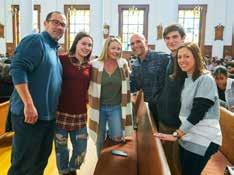
programs, and explore the campus. The event includes a Morning Mass held in the Chapel of De La Salle and His Brothers followed by a special Legacy Brunch for alumni and their prospective students.
Saturday, November 7, 2026: 47th Annual
Athletic Hall of Fame
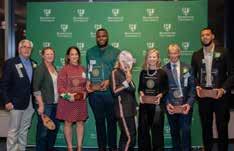
The Manhattan University Athletic Hall of Fame, originally established in 1979, honors our greatest Jasper athletes, coaches, and supporters. There are now more than 250 Hall of Fame members, and we look forward to inducting the 2026 Class this fall! Join us for an evening of Jasper camaraderie, inspiring stories, and memorable speeches showcasing Manhattan University’s very best.
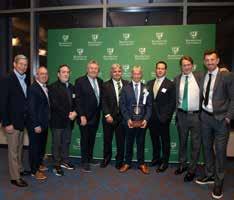
To register for our upcoming events, please visit: https://alumni.manhattan.edu/events/events-calendar.php
If you have any questions or would like additional information regarding the Alumni Calendar, please contact the Alumni Relations Office at (718) 862 7432 or alumni@manhattan.edu
a lumni notes
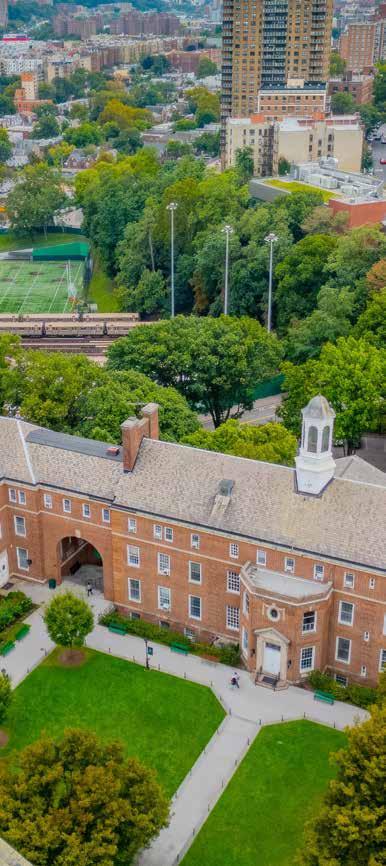
1973
PASQUALE (PAT) CARLUCCI published his second book on baseball, Baseball in Paradise: A Century of Spring Training Bradenton, Florida, in November 2025. All profits go to charities, including The American Red Cross.
1989
CATHERINE HISSIGER BRAINARD earned a master’s in Social & Public Policy from Empire State University in December 2025 as well as a Certificate in Advanced Studies in Children & Family Advocacy. Earning this degree has served as a catalyst for moving beyond her teaching career and segueing into advocacy work.
1993
SHAWNE ROBINSON has launched a new college sports data analytics platform named Tosch.ai, which collects previously scattered data and applies AI-powered insights to help studentathletes and their families make more informed decisions about where to continue their academic and athletic careers.
1994
ANTHONY ANNUNZIATA was awarded the 2025 Energy Engineer of the Year by the New York Chapter of the Association of Energy Engineers.
2005
MICHAEL C. FERRI was promoted to the partnership at Philadelphia-based law firm, Duane Morris LLP.
MIKE SCOLLINS wrote and executive-produced the feature film comedy Brian, which had its world premiere in March at South by Southwest in Austin. Starring Ben Wang, William H. Macy, Randall Park, Edi Patterson and Natalie Morales, Brian is co-executive-produced by Seth Meyers.
2012
ERICA A. MULLIGAN of Pearl River, NY married Robert J. Green of Clarks Summit, PA on Saturday, June 14, 2025 at St. Margaret’s of Antioch Church in Pearl River. The reception was held at the Hilton Pearl River and everyone had an amazing time. The bride obtained both Bachelor’s and Master’s of Science degrees in electrical engineering from Manhattan University (2012, 2014). Erica is a licensed professional engineer (PE) employed in New York City, and the groom is a Property Manager in Brooklyn. The couple is very excited to begin the next chapter of their lives together.
2019
GABRIELLE PUGLIA-PESCE won Educational Services Professional of the Year (2025-2026) at Long Branch Public School District for exemplary commitment to the students and community of George L. Catrambone Elementary School in Long Branch, New Jersey.
Photo credit: Ioannis Rountos '28
NYC St. Patrick's Day Parade
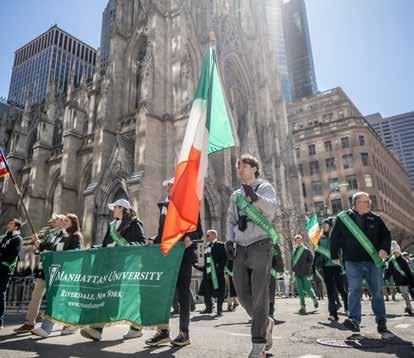
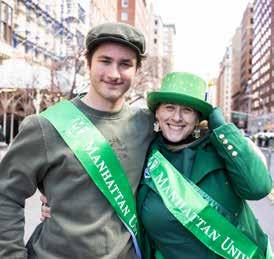
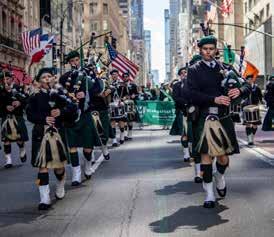

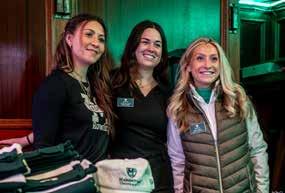
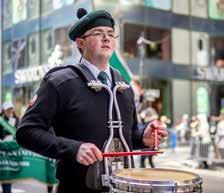
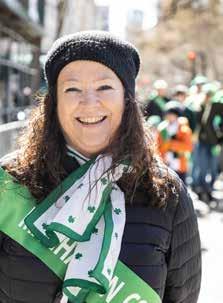
1946
Ralph J. Luciarello, 12/15/25
1949
Edmund M. Burke, 2/3/26
Edward T. Callahan, 2/15/26
1950
John F. Vittone, 1/10/26
1951
C. Robert Bruckmann, 11/24/25
Paul Donlan, 3/11/26
Thomas J. Doyle, 2/24/26
1952
Joseph F. Croce, 11/20/25
John J. Gentile, 2/17/26
Joseph F. Lynch, 1/13/26
Frank J. Stiefel, 10/13/25
1953
Richard F. Flanagan, 11/13/25
1954
Jerome J. Daraio, 10/14/25
Ralph J. Taylor, 2/24/26
1955
Michael J. Flynn, 12/24/25
Paul T. Higgins, 11/1/25
Peter J. Magee, 1/9/26
John T. Montilino, 1/27/26
Daniel J. Murphy, 3/3/26
Francis C. Pandullo, 2/21/26
Michael A. Wahlig, 11/20/25
Robert J. Woodward, 1/10/26
1956
John M. Ashe, 9/30/25
Francis A. Breslin, 9/24/25
Thomas Donnelly, 11/14/25
Frank C. Mascari, 6/28/25
William T. McDermott, 11/21/25
John R. Pitrelli, 10/26/25
1957
James T. Bauer, 9/29/25
Thomas P. McGuire, 2/21/26
Otto G. Obermaier, 9/26/25
1958
Donald Bergin, 6/10/25
William Bernich, 1/13/26
John E. Boehm, 10/18/25
Robert Carty, 3/23/26
Robert J. Hanlon, 9/20/25
William J. Renard, 11/26/25
Joseph L. Soprano, 12/6/25
1959
Robert D. Brady, 11/8/25
John R. Leahy, 6/4/25
Bernard P. O’Prey, 6/15/25
Richard C. Roth, 2/2/26
Anthony P. Vaccaro, 9/24/25
1960
Charles Flanagan, Esq. 3/20/26
Owen Mallon, 9/19/25
Joseph J. Zagursky, 3/3/26
1961
Roger C. Bowen, 1/16/25
Thomas Joseph Greene, 3/5/26
Martin J. Hayes, 12/11/25
Charles J. McDermott, 6/5/25
1962
James Amato, 3/9/26
Conrad A. Barile, 11/20/25
Jack Bova, 3/16/26
John E. Cinguina, 2/2/26
John J. Colligan, 10/31/25
John J. Healey, 11/24/25
William T. Sforza, 11/29/25
Gideon M. Varga, 12/9/25
1963
Donald J. Cameron, 10/5/25
Donald J. Cummings, 1/3/26
Ronald J. Petro, 12/5/25
Ronald J. Velino, 6/25/25
1964
John J. Clancy, 3/10/26
Daniel M. Dondiego, 2/2/26
Thomas J. Downing, 2/18/26
John J. Neuhauser, 9/30/25
John D. Scholle, 12/27/25
Donald J. Sullivan, 10/14/25
1965
Robert J. Bienkowski, 3/5/26
Henry J. Chlupsa, 2/12/26
Daniel J. Devescovi, 10/27/25
Vincent L. Teofilo, 1/10/26
Donald D. Vandemark, 12/30/25
Michael J. Walsh, 11/25/25
Kenneth M. Weinig, 9/24/25
1966
John J. Callanan, 9/20/25
George J. Cappiello, Jr., 2/11/26
Leonard V. Ceccacci, 9/26/25
Victor Gerley, 3/8/26
Philip A. Mitchell, Jr., 12/9/25
Miriam L. Montella, 12/29/25
Roger J. Watson, 2/23/26
1967
Francis G. Conrad, 2/8/25
James F. Conway, 10/31/25
Francis J. Dotzler, 10/10/25
George L. Paolacci, 2/8/26
Donald M. Quigley, 2/19/26
John W. Rechtzigel, 3/5/26
Vincent D. Sgroi, Jr., 3/12/26
William Ambrose Scully, 11/11/25
1968
Vincent T. Ciuryla, 1/15/26
Bernard S. Duffy, 1/25/26
Eugene P. Ferguson, 1/6/26
James T. Kilroy, 3/4/26
William T. Mahoney, 2/17/26
Hugh J. McCollum, 2/7/26
1969
James R. Brocato, 2/27/26
Gregory F. Burde, 9/20/25
Harry Henky, Jr., 10/11/25
1970
Carmen L. Guarracino, 4/7/25
Frank T. Olton, 9/8/25
Maureen C. Polchinski, 3/4/26
Richard J. Sinnott, 2/3/26
Denis M. Troy, 2/6/26
Kathleen M. Whelan, 9/30/25
Roger W. Wszolek, 8/24/25
1971
Mary M. Henshaw, 11/28/25
Thomas G. Jordan, 9/21/25
James E. Matthews, 9/14/25
David Montegari, 3/11/26
Louis D. Neuburger, Jr., 10/16/25
Janice Ruotolo, 3/10/26
1972
John G. Black, 3/8/26
John McCabe, 2/13/26
William Osborne, 3/15/26
1973
Norman J. Lau, 2/20/26
William J. Merriman, 9/21/25
James Warnke, 1/12/26
1974
Pasquale J. Basso, 10/21/25
1975
Sheila E. Seldin, 9/11/25
1976
Robert E. Cheromcha, 10/27/25
William J. Viola, 2/1/26
1978
Matthew Kearney, 11/14/25
1979
James M. Roseboom, 9/23/25
1980
Edward A. Kiene, 12/28/25
John R. Quinn, 10/30/25
Joseph L. Wall, 9/3/25
1981
Stephen F. Lafergola, 11/24/25
Francis J. Neeson, 10/15/25
1985
Thomas A. Connelly, 9/1/25
Maureen Maher, 9/21/25
Margaret C. Rich, 10/13/25
1986
Douglas Monahan, 3/22/26
1989
Timothy J. Kilduff, 1/11/26
1992
Vincent Perfetti, 2/1/26
Anthony Annunziata, 7/21/25
Rosaleen Tallon-DeRos, 9/21/25
1995
Shawn L. Holliday, 1/9/26
Gail A. Dray, 2/15/26
Jessica Podolak, 3/11/26
Thomas J. Camisa, Jr., 1/29/26
Josie Marie Regan, 9/28/25
Shelly D. Berndt, 3/7/26
2016
Wilfredo Muniz, Jr., 1/17/26
Thaddeus James Dupper IN MEMORIAM
Thaddeus “Thad” James Dupper ‘79, a proud and devoted Jasper, passed away peacefully at his home in Castle Rock, Colorado on Saturday, June 7, 2025. He was 68 years old.
Dupper was born on January 17, 1957 in Bay Ridge, Brooklyn, New York. He graduated from Xaverian High School in Brooklyn, where he developed a passion for Science, Technology, Engineering, and Math (STEM). Dupper’s passion for STEM inspired him to earn a Bachelor of Science in Computer Information Systems from Manhattan College in 1979.
Technology came to define much of Dupper’s long and storied professional career. He rose up to become CEO and Chairman of the Board of a telecommunications company called Evolving Systems in Englewood, CO. After that, he became CEO of Secure64, a cybersecurity company in Greenwood Village, CO. After retiring, Dupper founded his own company in 2021 and became CEO of Dupper Analytics, a data analytics company that develops cloudbased solutions. There, he mentored high school and college students in business practices and coding — work that brought him deep satisfaction and purpose.
Outside of the technology sector, Dupper also harbored a passion for creative writing. He wrote and published three suspenseful thriller
Fred Dwyer, Sr.
Fred Dwyer, Sr., the longest-tenured track and field coach in Manhattan University history, passed away at the age of 94 on Friday, January 16, 2026. Born on July 19, 1931, in Brooklyn, NY and raised in East Orange, NJ, Dwyer was known as "Champ" by family and friends — and it’s easy to see why.
Dwyer attended Villanova University, where he became an exceptional athlete in track and field and earned All-American honors as a senior and became a four-time IC4A mile champion. Dwyer’s athletic feats landed him in Sports Illustrated and on The Ed Sullivan Show as a guest. He was even invited to dine with President Dwight D. Eisenhower at the White House for the honor of Outstanding Athlete in Track and Field.
In 1969, Dwyer became head coach of Manhattan College’s track and field program, a position he’d hold for an impressive 24 years. Under his leadership, he established the Jaspers as a respected,
novels that came to be known as the Andrew Russell series: Attack on Nantucket, The Torchlight Gambit, and Operation Shattered Ice. The first book, Attack on Nantucket, was inspired by his own fond memories of Nantucket, MA. Dupper also had a passion for woodworking and enjoyed building furniture. As a lover of classic cars, he especially prized his 1966 Shelby Mustang.
Dupper was a committed member of his various communities. He remained devoted to his alma mater, Manhattan University, over the years. He also served on the board of the Colorado Children’s Chorale and on the Finance Committee of the Archdiocese of Denver. A man of faith, Dupper and his family were members of Pax Christi Catholic Church in Lone Tree.
Above all, Dupper’s greatest joy was his family, with whom he cherished every moment. Dupper is survived by his wife of 24 years, Jean (Russell) Dupper, and their two children: Andrew Russell Dupper and Katherine “Katie” Elizabeth Dupper. He is also survived by his siblings, Mark Andrew Dupper, Michael Alfred Dupper, and Maryeugene Dupper, as well as several nieces and nephews. His loyal golden retriever, Tucker, remained faithfully by his side and brought him great comfort and joy. Thad Dupper’s legacy of love, humor, and devotion will remain with his family always.
dominant force in the world of track and field. In 1973, he was named NCAA Coach of the Year after leading the cross-country team to an IC4A Championship and the Jaspers to a NCAA Indoor National Championship. In total, Dwyer coached 41 All-Americans and four Olympians while leading Manhattan University to four IC4A Championships and 19 Metropolitan Championships, breaking approximately 250 school records in the process.
Dwyer’s illustrious career ended in 1993 with another Coach of the Year award. He has since been inducted into six different Halls of Fame, including the Manhattan University Athletics Hall of Fame.
Dwyer is survived by his devoted wife of 67 years, Jane Anne, and their five children — Fred ’82, Jane ’85, Jim ’86, Joe ’87 and Tara ’92 — all graduates of Manhattan University, as well as his children’s spouses and multiple grandchildren.
Gideon Michael Varga, Jr. ‘62, Ph.D.
Gideon Michael Varga, Jr. ‘62, Ph.D., a proud and devoted Jasper, passed away on December 9, 2025, in Palm Beach Gardens, Florida at the age of 79.
Born on February 13, 1941, to Mathilda (Compte) and Gideon Michael Varga, Sr., Varga, Jr. was raised in Ho-Ho-Kus, New Jersey — a place he cherished deeply and always considered home. He attended Ridgewood High School before enrolling at what was then Manhattan College, where he earned his B.S. in Organic Chemistry. He went on to receive his Ph.D. in Inorganic Chemistry from Georgetown University.
Varga, Jr. built a distinguished career spanning more than four decades, including over 20 years with Exxon followed by 20 years
with the U.S. Department of Energy, where he focused on critical environmental issues. His work reflected both intellectual rigor and a deep commitment to responsible stewardship of natural resources.
Varga Jr.’s legacy at Manhattan University is both enduring and transformative. Through an extraordinarily generous estate commitment, he made an incredibly impactful planned gift — ensuring that future generations of students will have access to the same life-changing education that shaped his own journey. His philanthropy reflects a deep and lasting belief in the mission of his alma mater and the power of education to change lives.
Varga, Jr. is interred at Maryrest Cemetery in Mahwah, New Jersey.

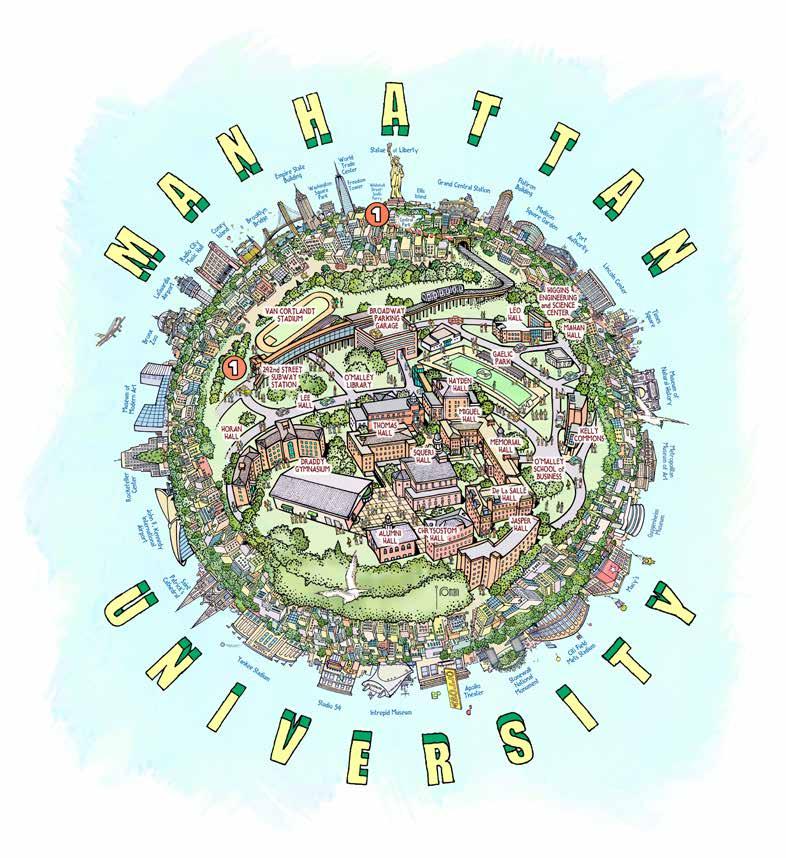
Illustration by John Roman