The Role of Automation and Intelligence in Modern XOps
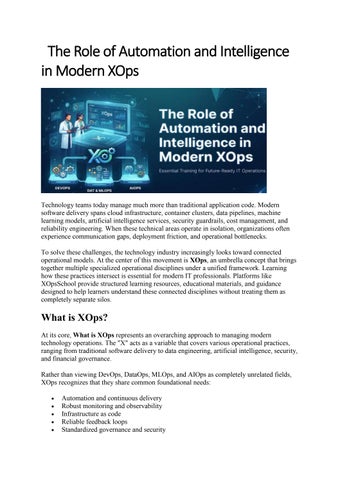
Technology teams today manage much more than traditional application code. Modern software delivery spans cloud infrastructure, container clusters, data pipelines, machine learning models, artificial intelligence services, security guardrails, cost management, and reliability engineering. When these technical areas operate in isolation, organizations often experience communication gaps, deployment friction, and operational bottlenecks. To solve these challenges, the technology industry increasingly looks toward connected operational models. At the center of this movement is XOps, an umbrella concept that brings together multiple specialized operational disciplines under a unified framework. Learning how these practices intersect is essential for modern IT professionals. Platforms like XOpsSchool provide structured learning resources, educational materials, and guidance designed to help learners understand these connected disciplines without treating them as completely separate silos.
What is XOps? At its core, What is XOps represents an overarching approach to managing modern technology operations. The "X" acts as a variable that covers various operational practices, ranging from traditional software delivery to data engineering, artificial intelligence, security, and financial governance. Rather than viewing DevOps, DataOps, MLOps, and AIOps as completely unrelated fields, XOps recognizes that they share common foundational needs:
Automation and continuous delivery Robust monitoring and observability Infrastructure as code Reliable feedback loops Standardized governance and security
Organizations adopt XOps thinking to break down departmental walls. By sharing operational principles across teams, developers, data scientists, and infrastructure engineers can collaborate more effectively.
Why XOps Matters in Modern IT Traditional IT operations often struggled when applications, data systems, and machine learning models were deployed using entirely different workflows. Disconnected processes create blind spots, making it difficult to trace errors or monitor performance across complex cloud-native architectures. XOps thinking addresses these challenges by encouraging:
Standardized Automation: Applying repeatable deployment patterns across applications and data pipelines. Unified Observability: Collecting metrics, logs, and traces from diverse systems to maintain system health. Collaborative Culture: Encouraging cross-functional responsibility for system reliability and performance. Continuous Improvement: Using rapid feedback to refine operational workflows continuously.
Major XOps Disciplines Understanding XOps requires looking at the individual disciplines that form its foundation.
DevOps DevOps focuses on software delivery, CI/CD pipelines, containerization, infrastructure automation, and close collaboration between development and operations teams.
DataOps DataOps applies agile and automation principles to data engineering. It emphasizes reliable data pipelines, data quality checks, orchestration, and continuous data delivery.
MLOps MLOps manages the machine learning lifecycle. It covers model versioning, automated testing, continuous deployment, and model monitoring in production environments.
AIOps AIOps leverages artificial intelligence and machine learning to analyze operational data, automate anomaly detection, correlate events, and streamline incident management.
SecOps
SecOps integrates security practices directly into operational workflows, ensuring that compliance and vulnerability management happen continuously rather than as an afterthought.
FinOps FinOps brings financial accountability to cloud operations, helping teams monitor, analyze, and optimize technology spending.
Platform Engineering Platform engineering builds internal developer platforms and self-service tools, enabling engineering teams to deploy code efficiently while maintaining governance.
XOps Training Building expertise across these interconnected areas requires comprehensive XOps Training. A well-rounded training path helps learners move past basic tool usage to understand architectural relationships. Effective learning resources guide students through foundational software delivery, cloud infrastructure, automation scripting, container orchestration, and specialized operational domains like data and machine learning. Understanding how these areas connect allows engineers to design resilient systems that scale effectively.
XOps Certification For professionals looking to validate their knowledge, pursuing an XOps Certification can provide a structured roadmap. Certification preparation helps learners organize complex technical information, follow a logical syllabus, and test their comprehension through structured evaluations. While a certificate demonstrates familiarity with core concepts, it is important to remember that certification alone does not replace hands-on experience. Practical application, troubleshooting real-world scenarios, and building actual projects remain essential for true professional competence.
XOps Course An effective XOps Course should follow a logical educational progression, moving from foundational concepts to advanced integrations. Learners should expect a curriculum that covers: 1. 2. 3. 4. 5.
Core XOps fundamentals and terminology DevOps principles and CI/CD workflows Cloud infrastructure and automation tools Data operations and pipeline reliability Machine learning and AI-supported operations
6. Observability, monitoring, and incident response 7. Security, compliance, and FinOps basics Choosing the right course depth depends on an individual's existing technical background and career goals.
XOps Tutorial Practical learning is greatly enhanced by following a targeted XOps Tutorial. Tutorials help bridge the gap between abstract theory and hands-on execution by demonstrating how to configure automation tools, set up monitoring dashboards, deploy containerized workloads, and manage operational workflows. Working through practical guides allows learners to build confidence and understand how different technologies interact within a live environment.
XOps Tools XOps is not a single software product or proprietary tool. Instead, it relies on a rich ecosystem of technologies chosen based on specific architectural requirements. Operational Focus
Common Tool Categories
Example Technologies
Source Control & CI/CD
Version control, pipeline automation
Git, GitHub Actions, GitLab CI/CD
Containers & Orchestration
Container runtimes, cluster management
Docker, Kubernetes, Helm
Infrastructure Automation
Infrastructure as code, configuration management
Terraform, Ansible
Observability
Metrics, logs, traces, dashboards
Prometheus, Grafana, OpenTelemetry
GitOps & Delivery
Declarative continuous delivery
Argo CD, Flux
Selecting the right tools depends on team skills, existing infrastructure, security requirements, and scalability needs rather than simply following industry trends.
DevOps Training Because DevOps forms the bedrock of modern software delivery, foundational DevOps Training is a crucial stepping stone. Mastering source control, continuous integration, containerization with Docker, and orchestration with Kubernetes provides the essential skills needed before exploring broader operational frameworks.
AIOps Training As IT environments generate massive volumes of monitoring data, AIOps Training teaches professionals how to use machine learning models to filter noise, detect anomalies, correlate alerts, and automate incident response, reducing manual toil for operations teams.
MLOps Training Managing machine learning models in production requires specialized knowledge. MLOps Training focuses on experiment tracking, model validation, automated retraining pipelines, and monitoring model drift to ensure reliable performance over time.
DataOps Training Data-driven organizations rely on continuous data flow. DataOps Training helps data engineers build reliable pipelines, automate data testing, monitor data observability, and ensure high data quality across analytical and operational systems.
How XOps Connects DevOps, DataOps, MLOps, and AIOps Each operational discipline serves a distinct purpose, yet they share common operational DNA. DevOps ensures reliable application delivery, DataOps maintains trustworthy data pipelines, MLOps manages machine learning lifecycles, and AIOps applies intelligence to monitoring. By unifying these practices under an XOps mindset, organizations can apply consistent automation, robust observability, and shared governance across all technical assets.
Who Can Benefit from XOpsSchool? 1. DevOps and Cloud Engineers Professionals looking to expand their skill set beyond standard infrastructure and application delivery into data and AI operations.
2. Data Engineers Data professionals seeking to apply reliable operational practices, pipeline monitoring, and automated testing to data workflows.
3. Machine Learning Professionals Practitioners wanting to connect model development with reliable deployment, scaling, and production monitoring.
4. IT Operations and SRE Professionals Reliability engineers aiming to incorporate observability, automation, and AIOps techniques into their daily routines.
5. Developers and Technical Learners Developers looking to gain a holistic understanding of how modern applications run, scale, and are maintained in production.
6. Technology Teams and Organizations Engineering leaders and organizations striving to align development, infrastructure, data, and security practices under a cohesive strategy.
Common Mistakes When Learning XOps
Treating XOps as a single software tool rather than an operational philosophy. Attempting to learn every specialized discipline simultaneously without solid fundamentals. Focusing exclusively on passing exams without gaining practical, hands-on experience. Ignoring essential practices like security, observability, and data quality. Adopting popular tools without evaluating whether they fit the organization's actual needs.
Best Practices for Learning XOps
Start with solid foundational concepts in DevOps and cloud infrastructure. Learn automation principles and infrastructure as code early in your journey. Practice setting up monitoring, logging, and observability dashboards. Explore specialized domains like DataOps and MLOps gradually. Build integrated small projects that combine multiple operational workflows. Keep documentation of your learning experiments and project configurations.
Learning Goal
Recommended XOps Area
Skills to Develop
Application Delivery
DevOps
CI/CD pipelines, containerization, Git workflows
Cloud Infrastructure
Cloud Operations
Infrastructure as code, networking, automation
Data Reliability
DataOps
Pipeline orchestration, data quality testing, observability
Model Deployment
MLOps
Model versioning, experiment tracking, serving automation
Intelligent Monitoring
AIOps
Anomaly detection, alert correlation, incident automation
8-Step XOps Learning Guide 1. Understand What XOps Means: Learn the core philosophy of connected IT operations and umbrella frameworks. 2. Build DevOps Foundations: Master source control, CI/CD pipelines, and container basics. 3. Learn Cloud and Infrastructure: Study cloud platforms, networking fundamentals, and infrastructure as code. 4. Learn Observability and Reliability: Understand monitoring metrics, logging, tracing, and incident management. 5. Explore DataOps: Learn reliable data pipeline orchestration and quality monitoring. 6. Explore MLOps and AIOps: Understand model deployment lifecycles and AIassisted operational monitoring. 7. Learn Security and Governance: Study SecOps integration, compliance, and FinOps cost management. 8. Build an Integrated Practical Project: Combine multiple disciplines in a hands-on project to see how systems interact.
FAQ
1. What is XOps in simple terms? XOps is an umbrella approach that connects various IT operational disciplines—such as DevOps, DataOps, MLOps, and AIOps—into a unified, automated framework.
2. How is XOps different from DevOps? While DevOps focuses primarily on software delivery and infrastructure, XOps extends those principles to cover data pipelines, machine learning models, security, and financial operations.
3. What disciplines are included in XOps? XOps commonly includes DevOps, DataOps, MLOps, AIOps, SecOps, FinOps, and Platform Engineering.
4. Is XOps suitable for beginners? Beginners should start with basic DevOps and cloud concepts before exploring specialized XOps disciplines.
5. What should an XOps training path include? A comprehensive training path covers foundational automation, cloud infrastructure, CI/CD, observability, and specialized domains like data and machine learning operations.
6. What is the purpose of XOps certification? Certification helps learners organize study materials, follow structured syllabi, and test their knowledge against established concepts.
7. What should learners look for in an XOps course? Look for courses that offer logical progression, clear explanations of core concepts, and practical exercises rather than rushed overviews.
8. Which tools are commonly associated with XOps? Common tools include Git, Kubernetes, Terraform, Prometheus, Grafana, Ansible, and various CI/CD and data pipeline orchestrators.
9. How are DevOps, DataOps, MLOps, and AIOps connected? They share common operational needs, including automation, observability, continuous testing, and reliable feedback loops.
10. How can someone start learning XOps?
Begin by mastering basic software delivery and cloud foundations, then gradually explore specialized operational areas through structured learning resources and hands-on projects.
Conclusion Modern IT environments require more than isolated technical skills. By adopting an XOps mindset, professionals and organizations can bridge the gaps between software development, data engineering, machine learning, security, and infrastructure operations. Utilizing structured learning platforms like XOpsSchool helps learners navigate these connected disciplines effectively, fostering deep technical understanding, practical automation skills, and long-term operational success.