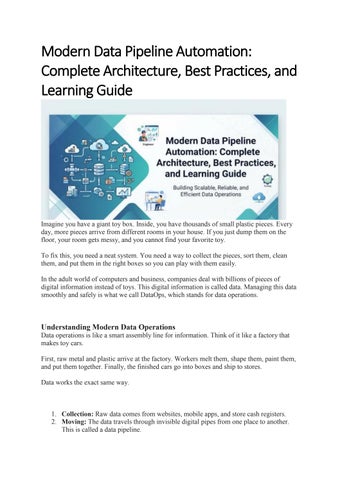
Modern Data Pipeline Automation: Complete Architecture, Best Practices, and Learning Guide
Imagine you have a giant toy box. Inside, you have thousands of small plastic pieces. Every day, more pieces arrive from different rooms in your house. If you just dump them on the floor, your room gets messy, and you cannot find your favorite toy. To fix this, you need a neat system. You need a way to collect the pieces, sort them, clean them, and put them in the right boxes so you can play with them easily. In the adult world of computers and business, companies deal with billions of pieces of digital information instead of toys. This digital information is called data. Managing this data smoothly and safely is what we call DataOps, which stands for data operations.
Understanding Modern Data Operations Data operations is like a smart assembly line for information. Think of it like a factory that makes toy cars. First, raw metal and plastic arrive at the factory. Workers melt them, shape them, paint them, and put them together. Finally, the finished cars go into boxes and ship to stores. Data works the exact same way.
1. Collection: Raw data comes from websites, mobile apps, and store cash registers. 2. Moving: The data travels through invisible digital pipes from one place to another. This is called a data pipeline.
3. Cleaning: Computers check the data to make sure it is not broken, missing, or messy. 4. Storage: The clean data goes into a safe digital warehouse so managers can look at it and make smart choices for their business.
If something breaks on an assembly line, the factory manager notices it right away and fixes the machine. In the digital world, keeping data moving smoothly without breaking is a big job. That is why engineers use special tools and rules to keep everything running like clockwork.
Why Data Operations Matters When a company builds a digital product, its computer systems create endless streams of information. If this information gets stuck, delayed, or mixed up, bad things happen. Imagine a weather app on your phone. If the data pipeline breaks, the app might tell you it is sunny outside when a heavy storm is actually starting. That happens because the data did not update properly. Teams use structured methods to stop these mistakes before they happen. They want to make sure that information moves fast, stays clean, and remains safe. When teams work together using shared rules, they spend less time fixing broken computer files and more time building helpful apps for users.
The Role of TheDataOps.org Learning how to build and manage these digital assembly lines can feel confusing at first. There are many new words, tools, and rules to remember. This is where TheDataOps.org comes into the picture. TheDataOps.org is an online learning platform and knowledge hub. Its main purpose is to help people understand modern data operations, automation, and professional skills. The website does not sell software or run secret computer systems. Instead, it acts as an open library. It collects guides, training materials, and technical concepts in one place so learners, engineers, and IT professionals can study how modern data systems work.
Exploring Available Learning Resources Depending on what a reader wants to learn, the platform offers several clear resource categories.
DataOps Training Training resources help people learn the core ideas behind data operations from scratch. Beginners can read about how data moves from a source computer to a storage warehouse. These guides explain the basic steps in simple language so anyone can grasp how digital assembly lines function.
DataOps Certification and Courses For professionals who want to prove their skills, structured courses and certification paths offer a clear way to study. These resources outline what a student needs to know, such as how to set up automated tests or how to monitor pipeline health. They give learners a roadmap to follow during their professional development.
DataOps Tools and Platforms A carpenter needs a hammer and saw. A data engineer needs different tools to build and watch over information systems. The platform shares information about popular software used for scheduling tasks, moving files, and storing records securely. It explains why certain tools fit specific jobs.
Data Pipeline Automation and CI/CD Automation means setting up computers to do repetitive chores by themselves. Instead of an engineer manually copying files every morning, automated scripts handle the job while everyone sleeps. Continuous Integration and Continuous Delivery, often called CI/CD, help teams test new code changes quickly before sending them into a live production environment.
Data Observability and Monitoring Observability is like having a dashboard filled with green and red lights for your digital pipes. If a pipe gets clogged or water pressure drops, a light turns red. In data systems, observability tools show teams whether their data is fresh, complete, and flowing correctly.
Data Quality Management Data quality means checking that the numbers and facts inside a computer are correct. If a customer buys a shirt online for twenty dollars, the database should never record the price as two million dollars. Validation rules catch these errors instantly.
Practical Implementation Steps When a team wants to set up a reliable data workflow in a real company, they usually follow a clear path:
1. Spot the Problem: Figure out what data needs to move and where it needs to go. 2. Design the Pipeline: Draw a simple map showing how information travels from the source to the final storage spot. 3. Choose the Right Tools: Pick software that fits the project size and budget. 4. Build and Automate: Write the code to move the data automatically without human help. 5. Add Tests: Put up digital guardrails that check if the data is clean and accurate. 6. Watch the System: Set up monitoring dashboards so you know immediately if something breaks.
Benefits of Modern Data Operations Using structured data practices brings several helpful results for technical teams:
Fewer Surprises: Automated tests catch broken files before they reach important business reports. Saved Time: Engineers do not have to fix the same manual mistakes every single day. Better Reliability: Data arrives on time and stays fresh for users who need it. Clear Visibility: Dashboards make it easy to see the health of every digital pipeline at a glance.
Challenges and Common Mistakes Even with good tools, managing data systems can be tough. Teams often face real hurdles during daily work.
Tool Overload: Using too many complicated software programs at once can confuse the team. Skipping Tests: If engineers forget to test their data pipelines, silent errors can slip through unnoticed. Poor Documentation: If no one writes down how a pipeline works, new team members will not know how to fix it when it breaks. Ignoring Data Quality: Moving dirty data faster just means you get bad results faster.
To avoid these mistakes, teams should start simple, write down clear notes, test their work often, and keep their pipelines as straightforward as possible.
Frequently Asked Questions What is TheDataOps.org? TheDataOps.org is a specialized online learning platform focused on modern data operations, automation, pipeline management, and professional skill development.
Who should use these learning resources? The resources are useful for beginners, data engineers, developers, IT professionals, and technical teams who want to understand how to build and manage reliable data systems.
Do I need advanced coding skills to start? While some technical background helps, many introductory guides explain core concepts in simple terms so beginners can follow along and build their knowledge step by step.
What does pipeline automation mean? Pipeline automation means setting up computer programs to move, clean, and store data automatically without needing a person to push buttons manually every time.
Why is data observability important? Data observability acts like a health monitor for your digital information. It helps teams spot old data, missing files, or broken pipelines quickly before they cause bigger problems.
How does training help a data engineer? Training resources help engineers learn best practices for testing, monitoring, and scaling data workflows in real-world production environments.
Does the website guarantee a job or certification? No. The platform provides educational resources and knowledge materials to support learning, but it does not promise employment, salaries, or guaranteed test success.
What is the difference between data quality and data observability? Data quality focuses on whether the actual numbers and facts inside the data are correct and complete, while observability focuses on the overall health and movement of the pipeline itself.
Conclusion Managing information smoothly is an important part of any modern digital project. By treating data like a well-run assembly line, teams can keep their systems clean, fast, and reliable. Platforms like TheDataOps.org serve as helpful educational hubs, offering training materials, course guides, and technical insights on automation, observability, and data quality. Exploring these resources can help technical learners build stronger skills and create better data workflows for the future.