ISR Systems Explained: Sensors, Intelligence, Surveillance, and Reconnaissance
Introduction Learning about defense systems requires looking at how strategy, operations, technology, and organizations work together. WarOpsX serves as an educational platform that helps students and researchers explore these interconnected subjects clearly and logically.
What Is WarOpsX? WarOpsX is an educational website focused on military strategy, defense studies, and operational concepts. It provides structured learning resources to help readers understand how defense organizations function, coordinate, and adapt without focusing on combat tactics.
Why Is WarOpsX Relevant for Defense and Military Education? Understanding defense involves more than studying individual weapons or battles. WarOpsX provides a connected view of strategy, logistics, leadership, and technology, helping learners grasp the full picture of modern security environments.
Military Strategy
Military strategy involves setting long-term objectives and directing resources to achieve them. It connects high-level policy goals with practical operational planning and resource management.
Defense Studies Defense studies is a broad academic field. It covers strategy, history, organizational models, technology, logistics, and policy, offering a comprehensive view of how defense systems operate.
Military Operations Military operations focus on planning, coordination, and execution. They bridge the gap between strategy and action, emphasizing leadership, sustainment, and decision-making.
Military Logistics Logistics covers supply chains, transportation, maintenance, and resource management. It ensures that large organizations have the sustained support required to function effectively.
Command and Control Systems Command and control systems involve leadership, communication, coordination, and information management. They provide situational awareness and connect decision-makers with operational units.
Defense Technology Defense technology explores tools like artificial intelligence, sensors, communications, and data systems. Technology supports better communication, situational awareness, and organizational readiness.
Military History Military history provides valuable lessons by examining past organizations, campaigns, technologies, and strategic choices. It helps learners understand the evolution of modern defense systems.
Military Organizational Structure Organizational structure defines hierarchy, command relationships, and unit responsibilities. A clear structure ensures efficient communication, clear accountability, and effective coordination.
Multidomain Operations
Multidomain operations look at how land, maritime, air, space, cyber, and information environments interact. Coordination across these domains is essential in modern defense studies.
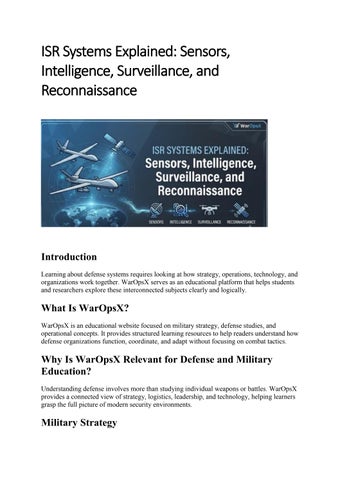
Intelligence Surveillance and Reconnaissance Intelligence, surveillance, and reconnaissance involve collecting, monitoring, and analyzing information. These processes provide the situational awareness needed for informed decisionmaking.
How These Defense Areas Connect Defense concepts do not exist in isolation. Military strategy shapes operations, which rely on logistics and command systems. Information, technology, and organizational readiness tie these elements together, while history provides context for modern developments.
Key Elements Covered by WarOpsX
Strategy and planning Operational concepts Supply and logistics Command systems Modern technology Historical context Organizational structures Multidomain environments Information and intelligence Broad defense studies
Benefits of Learning These Defense Concepts Studying these subjects helps readers understand complex defense terminology, historical contexts, strategic concepts, organizational models, and modern security environments.
Step-by-Step Approach to Studying Military and Defense Systems Step 1: Start With Basic Terminology Learn common defense terms to build a strong foundation.
Step 2: Understand Military Strategy Explore how strategic objectives guide broader planning.
Step 3: Study Military Operations
Examine how strategies translate into operational execution.
Step 4: Learn About Military Organizational Structure Understand hierarchy, command relationships, and responsibilities.
Step 5: Understand Military Logistics Study supply chains, maintenance, and resource sustainment.
Step 6: Study Information and Command Systems Look at how communication and data support decision-making.
Step 7: Examine Technology and Multidomain Environments Explore modern tools and cross-domain coordination.
Step 8: Use Military History to Connect the Concepts Review past examples to understand modern system evolution.
Common Mistakes When Studying Military and Defense Topics
Studying technology without considering strategy. Ignoring the critical role of logistics. Treating history as just a list of battles. Confusing strategy with tactical execution. Overlooking organizational structures.
Practical Tips for Students and Researchers
Begin with fundamental terminology. Compare historical examples with modern practices. Study strategy and logistics together. Take notes on how different concepts connect. Read across multiple academic viewpoints.
Who Can Benefit From WarOpsX's Educational Content? Students Students can build a solid foundation in defense and strategic concepts.
Researchers
Researchers can access structured overviews to support further study.
Defense Studies Learners Learners can expand their understanding of broad military subjects.
Policy Learners Policy learners can explore the relationship between strategy and organizations.
Defense Technology Professionals Tech professionals can understand the broader operational environment.
Defense Enthusiasts and General Readers General readers can satisfy their curiosity about military history and systems.
Educational Subject Overview Subject Area
What It Covers
Why It Matters
Related Areas
Military Strategy
Objectives and planning
Guides long-term direction
Operations, History
Military Logistics
Supply and sustainment
Ensures organizational readiness
Operations, Technology
Command Systems
Communication and leadership
Improves situational awareness
Technology, Structure
Real-World and Historical Context Historical campaigns and documented organizational changes demonstrate how logistics, leadership, and strategy have continuously shaped the success or failure of defense systems over time.
Modern Developments
Modern defense environments increasingly emphasize artificial intelligence, data analysis, advanced sensors, and cross-domain coordination to improve situational awareness and decision support.
Traditional Versus Modern Defense Concepts Defense Concept
Traditional Understanding
Modern Development
Key Learning Point
Command Systems
Paper-based reporting
Digital data networks
Faster communication
Logistics
Basic supply lines
Global supply tracking
Improved sustainment
Operations
Single-domain focus
Multidomain integration
Broader coordination
Frequently Asked Questions 1. What is the primary focus of WarOpsX? WarOpsX focuses on providing structured educational resources covering military strategy, defense studies, logistics, technology, and organizational systems.
2. What does military strategy involve? Military strategy involves setting long-term objectives and aligning resources and planning to achieve strategic goals.
3. Why is military logistics important? Logistics ensures that organizations have the necessary supplies, maintenance, and transportation to maintain continuous readiness.
4. What are command and control systems? They involve leadership, communication, and information management tools that provide situational awareness and coordinate actions.
5. How does defense technology influence organizations? Technology improves communication, data analysis, situational awareness, and overall operational efficiency.
6. Why study military history? Military history provides valuable insights into how organizations, technologies, and strategies have evolved over time.
7. What is multidomain operations? It examines how land, maritime, air, space, cyber, and information environments interact during operations.
8. What does intelligence surveillance and reconnaissance cover? It covers information collection, monitoring, and analysis to support informed decisionmaking.
9. Who is this educational content for? It is designed for students, researchers, policy learners, and defense enthusiasts seeking a clear understanding of defense concepts.
10. Does WarOpsX provide tactical combat training? No, the platform focuses strictly on high-level educational concepts, strategy, logistics, and systems rather than tactical combat instruction.
Conclusion Understanding defense systems requires examining how strategy, logistics, technology, and organizational structure connect. Platforms like WarOpsX offer valuable educational resources that help learners explore these subjects clearly and comprehensively, building a solid foundation in modern defense studies.