Master in DevOps Engineering Training for DevOps Career Success

Introduction
The world of software development has changed. It is no longer just about writing code. It is about how that code is delivered, managed, and secured. This is where DevOps comes in. Many engineers are now looking for ways to grow their skills. One of the best ways to do this is through the Master in DevOps Engineering (MDE) program.
What is Master in DevOps Engineering (MDE)?
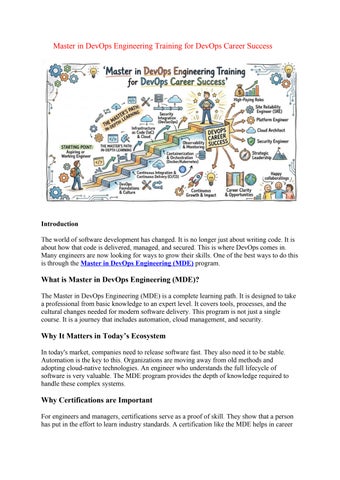
The Master in DevOps Engineering (MDE) is a complete learning path. It is designed to take a professional from basic knowledge to an expert level. It covers tools, processes, and the cultural changes needed for modern software delivery. This program is not just a single course. It is a journey that includes automation, cloud management, and security.
Why It Matters in Today’s Ecosystem
In today's market, companies need to release software fast. They also need it to be stable. Automation is the key to this. Organizations are moving away from old methods and adopting cloud-native technologies. An engineer who understands the full lifecycle of software is very valuable. The MDE program provides the depth of knowledge required to handle these complex systems.
Why Certifications are Important
For engineers and managers, certifications serve as a proof of skill. They show that a person has put in the effort to learn industry standards. A certification like the MDE helps in career
growth. It gives confidence to employers that the professional can handle real-world challenges. It also helps in keeping up with the fast-moving tech world.
Certification Overview
Track Level Who it’s for Prerequisites Skills Covered Recommended Order Official Link
DevOps Master Engineers & Managers Basic Linux & Coding CI/CD, IaC, Cloud, Monitoring Foundation -> MDE Click Here
Provider: DevOpsSchool
Why Choose DevOpsSchool?
Choosing the right place to learn is very important. DevOpsSchool is preferred because the focus is on practical learning. The trainers have deep industry experience. The curriculum is updated regularly to match what companies are asking for. It provides a community where learners can grow together. The support provided during and after the training makes a big difference in a student's career path.
Certification Deep-Dive: Master in DevOps Engineering (MDE)
What is this certification?
This is a high-level program that covers the entire DevOps landscape. It integrates development, operations, and security into one cohesive learning track.
Who should take this certification?
It is meant for software engineers, system administrators, and technical leads. Anyone who wants to lead a DevOps transformation in their company will benefit from this.
Skills you will gain
Setting up automated CI/CD pipelines.
Managing infrastructure as code using modern tools.
Monitoring and logging for large-scale systems.
Container orchestration and management.
Implementing security at every stage of the pipeline.
Real-world projects you should be able to do
Building a fully automated deployment system for a web application.
Setting up a self-healing infrastructure on a public cloud.
Creating a centralized logging and monitoring dashboard for microservices.
Automating security scans within a delivery pipeline.
Preparation Plan
7–14 Days Plan
Focus on understanding the core philosophy of DevOps.
Learn the basics of version control and shell scripting.
Review the MDE syllabus thoroughly.
30 Days Plan
Start working with container tools.
Set up a simple CI/CD pipeline.
Spend time learning basic cloud services.
60 Days Plan
Deep dive into infrastructure automation.
Work on a capstone project that combines all tools.
Practice troubleshooting common deployment issues.
Common mistakes to avoid
Focusing only on tools and ignoring the culture.
Skipping the basics of Linux and networking.
Not practicing with real-world scenarios.
Best next certification after this
Same track: Advanced Kubernetes Security.
Cross-track: Site Reliability Engineering (SRE).
Leadership / management: DevOps Leader or Engineering Manager track.
Choose Your Learning Path
1. DevOps Path
This is for those who want to bridge the gap between development and operations. It focuses on speed and quality of delivery.
2. DevSecOps Path
Best for security-minded engineers. It ensures that security is not an afterthought but a core part of the process.
3. Site Reliability Engineering (SRE) Path
Ideal for those who love stability and performance. It applies software engineering principles to operations tasks.
4. AIOps / MLOps Path
Perfect for engineers working with data science teams. It focuses on automating the deployment of machine learning models.
5. DataOps Path
Designed for data professionals. It brings the agility of DevOps to data integration and data quality.
6. FinOps Path
Best for those interested in the financial side of the cloud. It helps in managing and optimizing cloud costs.
Role → Recommended Certifications Mapping
DevOps Engineer: Master in DevOps Engineering (MDE).
Site Reliability Engineer (SRE): SRE Practitioner Certification.
Platform Engineer: Cloud Infrastructure Master.
Cloud Engineer: Professional Cloud Architect.
Security Engineer: Certified DevSecOps Professional.
Data Engineer: DataOps Master Track.
FinOps Practitioner: Certified FinOps Associate.
Engineering Manager: DevOps Leader Certification.
Next Certifications to Take
For any learner finishing the MDE, growth should continue.
Same-track: Advanced Container Orchestration.
Cross-track: Site Reliability Engineering.
Leadership-focused: Strategic Engineering Management.