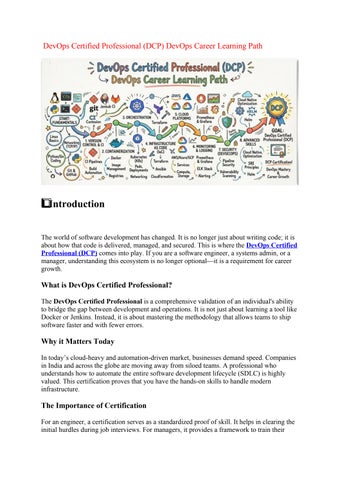
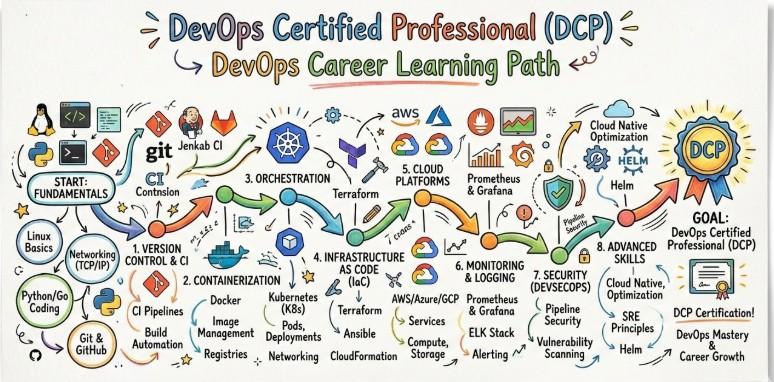
DevOps Certified Professional (DCP) DevOps Career Learning Path
1️Introduction
The world of software development has changed. It is no longer just about writing code; it is about how that code is delivered, managed, and secured. This is where the DevOps Certified Professional (DCP) comes into play. If you are a software engineer, a systems admin, or a manager, understanding this ecosystem is no longer optional—it is a requirement for career growth.
What is DevOps Certified Professional?
The DevOps Certified Professional is a comprehensive validation of an individual's ability to bridge the gap between development and operations. It is not just about learning a tool like Docker or Jenkins. Instead, it is about mastering the methodology that allows teams to ship software faster and with fewer errors.
Why it Matters Today
In today’s cloud-heavy and automation-driven market, businesses demand speed. Companies in India and across the globe are moving away from siloed teams. A professional who understands how to automate the entire software development lifecycle (SDLC) is highly valued. This certification proves that you have the hands-on skills to handle modern infrastructure.
The Importance of Certification
For an engineer, a certification serves as a standardized proof of skill. It helps in clearing the initial hurdles during job interviews. For managers, it provides a framework to train their
teams consistently. It ensures that everyone is speaking the same technical language, which reduces friction in large-scale projects.
2️Certification Overview Table
Track Level Who it’s for Prerequisites Skills Covered Recommended Order Official Link
DevOps Professional Engineers & Managers Basic Linux/Coding CI/CD, IaC, Cloud Start here Click Here
Provider: DevOpsSchool
Why Choose DevOpsSchool?
Choosing the right platform for your learning journey is critical. DevOpsSchool is preferred by many because it focuses on real-world industry scenarios rather than just theoretical knowledge. The curriculum is updated regularly to match the fast-paced changes in the tech industry. With a strong community of experts and practical lab sessions, it ensures that the learner is job-ready from day one.
3️Certification Deep-Dive
DevOps Certified Professional (DCP)
What is this certification?
This is a professional-level program designed to teach the core pillars of DevOps: Culture, Automation, Lean, Measurement, and Sharing (CALMS). It focuses on the integration of various tools into a single, cohesive pipeline.
Who should take this certification?
Software Developers looking to understand operations.
System Administrators moving toward automation.
Project Managers overseeing technical teams.
Skills you will gain
Automated build and release management.
Configuration management and Infrastructure as Code (IaC).
Containerization and orchestration.
Continuous monitoring and logging.
Real-world projects you should be able to do
Setting up a fully automated Jenkins pipeline for a Java/Node.js app.
Managing multi-container environments using Kubernetes.
Automating cloud infrastructure provisioning using Terraform.
Preparation Plan
7–14 Days Plan: Focus on core concepts. Learn the "why" behind DevOps. Familiarize yourself with Git and basic Linux commands.
30 Days Plan: Deep dive into CI/CD tools and Containerization. Start building small local projects.
60 Days Plan: Work on end-to-end automation. Focus on monitoring, security integration, and cloud deployment.
Common mistakes to avoid
Focusing only on tools and ignoring the cultural aspect.
Not practicing enough on Linux environments.
Skipping the basics of networking and security.
Best next certification after this
Same track: Advanced DevOps Architect.
Cross-track: DevSecOps Certified Professional.
Leadership/Management: Certified DevOps Manager.
4️Choose Your Learning Path
Finding the right path is essential for long-term career success. Here are six structured routes:
DevOps Path: Best for those who want to master the general flow of software delivery. It focuses on speed and reliability.
DevSecOps Path: Ideal for security-minded engineers. It focuses on "shifting security left" by integrating checks into the CI/CD pipeline.
Site Reliability Engineering (SRE) Path: Best for those interested in high availability and scalability. It applies software engineering principles to operations tasks.
AIOps / MLOps Path: Perfect for data-centric roles. It involves automating the deployment and monitoring of machine learning models.
DataOps Path: Designed for data engineers. It focuses on improving the quality and cycle time of data analytics.
FinOps Path: Best for cloud architects and finance leads. It focuses on optimizing cloud costs and driving financial accountability.
5️Role → Recommended Certifications Mapping
Your Current Role Recommended Certification
DevOps Engineer DevOps Certified Professional
Site Reliability Engineer SRE Certified Professional
Platform Engineer Kubernetes & Infrastructure Specialist
Cloud Engineer Cloud DevOps Professional
Security Engineer DevSecOps Certified Professional
Data Engineer DataOps Professional
FinOps Practitioner FinOps Certified Specialist
Engineering Manager DevOps Leader / Manager
6️Next Certifications to Take
Based on industry trends for software engineers, the following steps are recommended:
For the DevOps Learner: * Same-track: DevOps Expert level.
o Cross-track: SRE Practitioner.
o Leadership: Digital Transformation Leader.
For the Security Learner:
o Same-track: Advanced Security Automation.
o Cross-track: Cloud Security Architect.
o Leadership: CISO Certification Path.
Several institutions provide excellent support for these programs:
DevOpsSchool: A leading provider of hands-on training that focuses on the entire DevOps ecosystem. They offer extensive lab support and expert-led sessions.
Cotocus: Known for specialized consulting and training in modern engineering practices. They help bridge the gap between academic learning and industry needs.
ScmGalaxy: A massive community-driven platform that provides resources, tutorials, and training specifically for Software Configuration Management and DevOps.
BestDevOps: Focuses on curated content and training for individuals looking to master specific DevOps tools and methodologies.
devsecopsschool.com: A dedicated platform for learning how to integrate security into every stage of the DevOps lifecycle.
sreschool.com: Specialized in teaching reliability, scalability, and the operational side of large-scale systems.
aiopsschool.com: Provides training on using Artificial Intelligence to enhance and automate IT operations.
dataopsschool.com: Focuses on the intersection of data engineering and operations for faster data delivery.
finopsschool.com: Offers education on cloud financial management and cost optimization strategies.
8️FAQs Section
General Career FAQs
1. Is the DevOps certification difficult? It requires a good understanding of both code and systems, but with consistent practice, it is manageable.
2. How much time is needed to prepare? Usually, 2 to 3 months of steady study is recommended for a professional level.
3. Are there any prerequisites?
A basic knowledge of Linux and at least one programming or scripting language is helpful.
4. In what sequence should I take certifications? Start with DevOps, then move to specialized tracks like Security or SRE.
5. What is the career value of this certification? It significantly increases your marketability and often leads to better salary packages.
6. Can a fresh graduate take this? Yes, but it is highly recommended to gain some basic coding knowledge first.
7. Is cloud knowledge necessary?
Yes, modern DevOps is almost inseparable from cloud platforms like AWS, Azure, or GCP.
8. Does this certification help in getting a remote job? Many global companies look for certified professionals for their distributed teams.
9. How long is the certification valid?
Generally, it is valid for two to three years, after which a renewal or advanced level is suggested.
10. What roles can I apply for?
You can apply for DevOps Engineer, Build/Release Engineer, or Automation Consultant roles.
11. Is coding a major part of the exam?
The focus is more on scripting and automation logic than heavy application coding.
12. How does this help a manager?
It helps managers understand the bottlenecks in their team's delivery process.
DevOps Certified Professional Specific FAQs
1. What is the passing score?
Typically, a score of 70% or higher is required to pass.
2. Are the exams hands-on?
Many versions of the program include practical lab assignments or scenario-based questions.
3. Does it cover Kubernetes?
Yes, container orchestration is a core part of the DCP curriculum.
4. Is Jenkins included in the training?
Jenkins is usually the primary tool used to teach CI/CD concepts.
5. Are there community forums for help?
Yes, platforms like ScmGalaxy provide great support for students.
6. Can I retake the exam?
Yes, most providers allow a retake after a specific cooling-off period.
7. Is the certificate recognized globally?
Yes, DevOpsSchool certifications are recognized by many MNCs.
8. Does the course cover Terraform?
Yes, Infrastructure as Code is a major module in this certification.
9️Testimonials
Rohan, DevOps Engineer: "The clarity I gained regarding CI/CD pipelines was immense. My confidence in handling complex deployments has grown significantly after this program."
Anjali, SRE: "The focus on real-world application helped me understand how to reduce system downtime. It provided a very practical approach to reliability."
Vikram, Cloud Engineer: "I was able to transition from a traditional admin role to a cloud-native role smoothly. The skill improvement was visible within weeks."
Suresh, Security Engineer: "Integrating security into the build process was always a challenge. This certification gave me the tools to make it a reality."
Meera, Engineering Manager: "The program gave me a better framework to guide my team. It improved our deployment frequency and overall team morale."
The DevOps Certified Professional certification is a powerful tool for anyone in the tech industry. It provides the structured learning needed to navigate the complexities of modern software delivery. By focusing on both tools and culture, it ensures long-term career stability and growth. Strategic planning and a commitment to continuous learning will ensure that you remain a top-tier professional in the global market.