Certified DevOps Manager Basics for Professionals
1. Introduction:
The role of a manager in the technology sector is being redefined by the rapid adoption of cloud-native technologies. It is observed that traditional management styles, which focused heavily on top-down delegation, are no longer sufficient in a world of continuous integration and delivery. A Certified DevOps Manager is expected to be more than just a supervisor; a deep understanding of how code moves from a developer’s laptop to a production environment must be possessed.
This certification matters in today’s ecosystem because the complexity of software systems is increasing daily. Automation is no longer just a luxury—it is a necessity for survival. When engineers are empowered with the right tools and a supportive culture, productivity is boosted significantly. For both individual engineers and established managers, the importance of certification cannot be overstated. It is seen as a benchmark of quality and a commitment to staying relevant in a competitive global market. A structured learning path is provided, which ensures that every critical aspect of the DevOps lifecycle is mastered.
2. Certification Overview & Institutional Support
Track Level Who it’s for Prerequisites Skills Covered Recommended
Leadership Expert Senior Leads, Managers 5+ Years IT Exp ROI, Culture, Scaling Post-Professional Link
Why
Choose
DevOpsSchool?
When a training provider is selected, the depth of the curriculum and the quality of mentorship are usually the primary concerns. DevOpsSchool is chosen by thousands of professionals because the transition from theory to practice is handled with extreme care. Real-world challenges are simulated in a lab environment, allowing students to fail safely and learn quickly. The instructors are not just teachers; they are practitioners who have spent decades managing infrastructure at scale. Furthermore, a lifetime of community support is offered, ensuring that help is always available even after the certification is obtained.
3. Certification Deep-Dive: A Strategic Analysis
What exactly is the Certified DevOps Manager program?
This program is an advanced leadership track that bridges the gap between technical execution and business strategy. It is focused on how DevOps principles can be applied at an organizational level to improve efficiency and reduce costs.
Who is encouraged to enroll?
Enrolment is encouraged for Software Architects, Infrastructure Leads, and Engineering Managers. It is also highly suitable for Project Managers who wish to gain a deeper technical understanding of automated workflows.
Skills that will be acquired
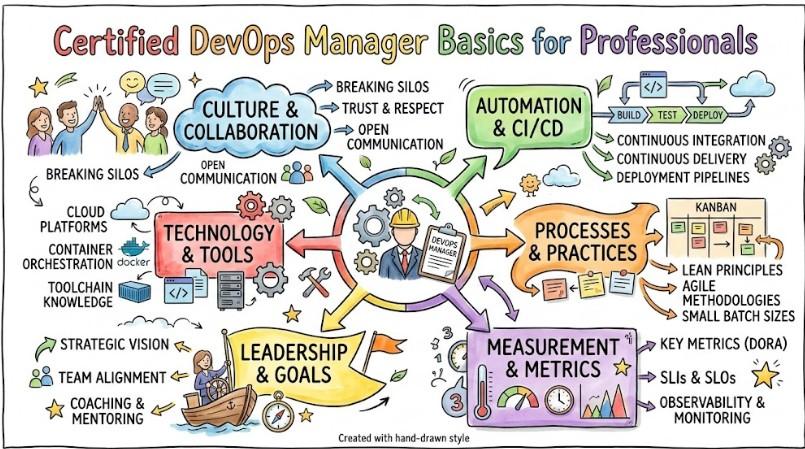
Strategic Automation: The ability to decide what should be automated and what requires human intervention is developed.
Cultural Transformation: Techniques for breaking down silos between development and operations teams are mastered.
Metric-Driven Management: Mastery over DORA metrics (Deployment Frequency, Lead Time for Changes, etc.) is gained to track team performance.
Cloud Governance: Knowledge of how to manage security and compliance across multi-cloud environments is provided.
Financial Oversight: Skills in managing cloud budgets and optimizing resource usage are polished.
Real-world projects to be completed
Pipeline Audit: A comprehensive review of an existing CI/CD pipeline is conducted to identify security gaps and speed bottlenecks.
Scaling Strategy: A plan for migrating a monolithic application to a microservices architecture while maintaining 99.9% uptime is created.
Incident Management Framework: A structured "blameless post-mortem" process is designed for a mid-sized engineering team.
Detailed Preparation Plan
7–14 Days (Phase 1): The fundamental philosophy of the "Three Ways" of DevOps is studied. The official course documentation is reviewed, and initial diagnostic tests are completed to identify weak areas.
30 Days (Phase 2): Deep dives into toolchains are performed. The integration of security into the pipeline (DevSecOps) is practiced. Case studies from industry leaders like Netflix and Google are analyzed to understand large-scale management.
60 Days (Phase 3): Focus is shifted toward management frameworks. Mock interviews and advanced scenario-based exams are taken. Final projects are submitted for review by industry mentors.
Common mistakes to be avoided
Ignoring Feedback Loops: A common error is building automation without setting up proper monitoring and feedback channels.
Tool Obsession: Many candidates focus solely on learning "how" to use a tool rather than "why" it is being used in the first place.
Neglecting Soft Skills: Communication and empathy are often overlooked, yet they are the foundation of a successful DevOps culture.
Recommended Next Steps
Same Track: Advanced Site Reliability Engineering (SRE).
Cross-Track: MLOps Professional for data-driven environments.
Leadership: Chief Technology Officer (CTO) Roadmap.
4. Specialized Learning Paths
The DevOps Path
This path is best suited for those who aim to master the general flow of software. Every stage from code commit to production monitoring is covered in great detail.
The DevSecOps Path
This is recommended for security professionals. It is taught that security must be a shared responsibility rather than a final gate. Automated security testing and compliance-as-code are the core focuses.
The Site Reliability Engineering (SRE) Path
This is designed for those who value stability. Software engineering principles are applied to operational tasks. Concepts like Error Budgets and Service Level Objectives (SLOs) are mastered.
The AIOps / MLOps Path
As AI becomes mainstream, this path is becoming essential. It focuses on the deployment and management of machine learning models within a standard DevOps framework.
The DataOps Path
This is the preferred choice for Data Engineers. It ensures that data pipelines are as reliable and automated as application pipelines, focusing on data quality and speed.
The FinOps Path
This path is dedicated to cloud cost management. It is designed for those who need to balance technical performance with financial accountability.
5. Role to Certification Mapping
DevOps Engineer: Encouraged to pursue the Certified DevOps Professional first.
SRE: The Certified SRE Practitioner is the most logical step.
Platform Engineer: Kubernetes and Cloud Native certifications are recommended.
Security Engineer: The DevSecOps Specialist track is essential.
Engineering Manager: The Certified DevOps Manager is the primary recommendation for this role.
6. Training and Support Ecosystem
DevOpsSchool
A comprehensive learning environment is provided where students are mentored by industry veterans. The focus is kept strictly on practical, hands-on experience.
Cotocus
Highly specialized training sessions are delivered here. It is known for its intensive labs that simulate complex production environments.
ScmGalaxy
A massive repository of tutorials and tool-specific guides is maintained. It serves as a primary resource for community-driven learning.
BestDevOps
Fast-track certification programs are offered for busy professionals. The curriculum is updated quarterly to reflect the latest industry changes.
DevSecOpsSchool.com
A dedicated platform for security-focused DevOps training is provided. It covers advanced topics like container security and automated auditing.
Sreschool.com
All aspects of reliability and uptime are taught here. It is the go-to place for aspiring Site Reliability Engineers.
Aiopsschool.com
The intersection of Artificial Intelligence and IT Operations is explored. Students are taught how to use AI to predict and prevent system failures.
Dataopsschool.com
This institution focuses on the automation of data workflows. It is essential for teams handling large-scale data processing.
Finopsschool.com
The principles of cloud financial management are taught. It helps organizations gain visibility and control over their cloud spending.
7. Frequently Asked Questions (FAQs)
General Industry Questions
1. What level of difficulty is expected?
A moderate to high level of difficulty is maintained to ensure the value of the credential.
2. How much time should be allocated for study?
At least 5 to 10 hours per week over two months is recommended.
3. Are there specific prerequisites? Experience in the software industry is preferred, though not always mandatory.
4. In what order should certifications be taken?
Foundation levels should be completed before moving to Managerial or Expert tracks.
5. What is the long-term career value?
Higher salary brackets and leadership roles are typically accessible to certified individuals.
6. Is this recognized globally?
Yes, the standards are aligned with global industry requirements.
7. Are labs included in the training?
Yes, hands-on lab access is a standard feature of the recommended programs.
8. Is there support for job placement?
Many of the listed institutions provide career guidance and interview preparation.
9. Can a non-technical manager take this?
Yes, but a basic understanding of software concepts is highly beneficial.
10. Is cloud experience needed?
Working knowledge of at least one major cloud provider is advised.
11. How is the exam conducted?
Exams are typically administered through an online proctored system.
12. Is study material provided?
Comprehensive e-books and video lectures are usually included in the enrollment.
Certified DevOps Manager Specific Questions
1. Is financial planning a part of the course?
Yes, managing budgets and resource ROI is a key module.
2. How is team culture addressed?
Soft skills and change management strategies are deeply integrated.
3. Does it differ from PMP?
Yes, it is much more technical and specific to the DevOps lifecycle.
4. Are modern metrics like DORA covered?
Yes, measuring delivery performance is a primary focus.
5. Is it suitable for the Indian market?
It is highly valued by top IT firms and MNCs across India.
6. Can it lead to an SRE lead role?
Absolutely, the management principles are universal across SRE and DevOps.
7. Is there a community forum for students?
Yes, active forums are provided for networking and troubleshooting.
8. Are the certificates verifiable?
Yes, all certificates come with a unique ID that can be verified online.
8. Professional Testimonials
Arjun
"The depth of knowledge gained during the program was exceptional. Practical solutions were provided for problems that were being faced in my daily work."
Sarah
"Confidence was built throughout the course. The transition into a leadership role was made much easier by the strategic modules."
Kenji
"The focus on real-world projects was a game-changer. It was not just about passing an exam, but about truly understanding the systems."
Fatima
"A clear path for career growth was finally found. The mentorship provided was invaluable for my professional development."
Rajesh
"Skill improvement was noticed by my peers almost immediately. The framework for governance is now being used across my entire department."
9. Conclusion: Securing Your Future
The journey toward becoming a Certified DevOps Manager is one of continuous growth. In an industry that never stands still, the ability to lead with technical authority is a rare and valuable asset. By choosing a structured path through recognized institutions, a foundation for long-term success is built. Strategic planning and a commitment to lifelong learning are encouraged for all who wish to stay at the forefront of the technological revolution.