MCCM Magazine Dec 2025 Jan 2026

Page 1


Managing Construction

Shaping the

Future

Through Growth

From Portside

Beginings to Industrywide leadship.

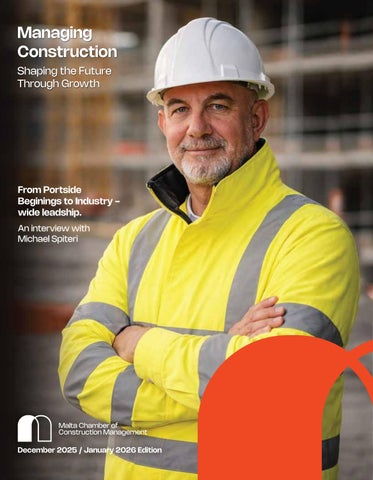
An interview with Michael Spiteri

December 2025 / January 2026 Edition
Publications and Financial Officer:

As we close another year and step into 2026, this edition of Managing Construction reflects an industry at a critical transition point. Across these pages, a clear message emerges: construction management in Malta is evolving, not only in scale and complexity, but in responsibility, accountability, and purpose.

This issue brings together voices from across the profession to examine themes that are no longer optional but essential. From early risk analysis and dispute avoidance, to the adaptation of international contract standards, sustainability in materials, cultural heritage protection, and the growing role of digitalisation and artificial intelligence, the articles highlight a sector that must think more strategically, act more collaboratively, and plan with greater foresight.

Equally important is the focus on people, future professionals, current practitioners, and the communities affected by our decisions. Whether through professional recognition, education, ethical practice, or improved governance, the direction is clear: raising standards in construction management is fundamental to improving the quality of Malta’s built environment and, ultimately, quality of life.

As editors, we see this publication not merely as a r ecord of industry activity but as a platform for informed discussion, critical reflection, and shared learning. We hope this edition challenges assumptions, sparks dialogue, and supports professionals in navigating the demands of a rapidly changing industry.

As we look ahead, the task before us is not simply to build more—but to build better, with integrity, competence, and long-term vision.

Photo Credit: Unknown

Photo edits: In-House

Editorial enquiries: info@mccm.org.mt

Advertising: info@mccm.org.mt

Who We Are

The Chamber is the voice of the construction managers at the various levels operating in Malta and beyond. We promote and expect, high standards in, quality, ethics, integrity and to be at the forefront of innovation of the local built environment. Through our input we strive to influence policies and regulations that impact the industry and their impact on the common good.

To promote science and technological advancement in the process of building and construction for the public benefit.

To be at the forefront of public education, encouraging research and sharing the outcome from this research.

To make sure that advancement in the built technology is aimed at improving the quality of life of the public in general.

To enhance professionalism, encourage innovation and raise quality in construction management.

To promote high standards and professional ethics in building and construction practices.

To promote the highest levels of integrity in every decision that we take that affect others.

To respect all those affected by our decisions

TO BE THE DRIVER OF A CULTURAL AWARENESS CAMPAIGN STRIVING FOR PROFESSIONALISM IN THE CONSTRUCTION INDUSTRY.

Mission Statement

40 | 2025 was the Year the Market Stopped Believing in us

42 | Continuous Two-Way Slabs and Simple Two-Way Slabs

44 | Transitioning Malta’s Constuction Industry to Standarised FIDIC Contracts

46 | The Impact of Artificial Intelligence

50 | Events

Message from THE PRESIDENT

This article marks my fifth contribution in the sixteenth edition and serves both as a closure to 2025 and a starting point for 2026.

We have just emerged from our most recent AGM, held in November, which brought about several positive and noteworthy outcomes. During this AGM, we welcomed 43 new members—an encouraging figure that confirms we are attracting more professionals working within the management sphere of construction projects.

Moreover, we were honoured by a promising address from the Hon. Minister Dr Jonathan Attard, who confirmed a conclusive initiative towards the legal recognition of our profession. This process will move forward through a series of meetings between the Ministry, the Building and Construction Authority (BCA), and the MCCM at the beginning of the year, with the first introductory meeting already having taken place in early December. This initiative will serve as preparation for the forthcoming consultation with the BCCC, followed by Cabinet approval and the subsequent parliamentary process.

For the benefit of those who were not present at the AGM, the remainder of this article reflects the essence of my address delivered on that occasion.

As a starting note, I would like to thank the Council members—Fabrizio, JoAnne, Edward, Mario, Stephan and Jurgen—who continue to dedicate their time and energy to the Chamber. I would also like to acknowledge the students who join us because they believe in this profession, and all our members who encourage us to continue doing more of what we do. We do this because we are the professionals who stand beside clients, entrepreneurs and visionaries—helping turn ideas into reality by managing processes, leading teams, and coordinating the many stakeholders involved throughout the entire project lifecycle.

As we come to the end of the year, we can look back with pride at the number of CPD and COP sessions delivered—sessions that have become one of our key signatures: spaces where we learn, debate, and collaboratively solve problems.

Encouragingly, the committee is already working on the programme for the first quarter of 2026, with upcoming sessions focusing on materials, safety, and procurement, as well as planned site visits.

In addition, we are exploring opportunities for Erasmus funding in the coming year. Should this materialise, it will provide our members with the opportunity to participate in job-shadowing experiences abroad, gaining exposure to international construction project management practices.

That said, all of this requires a considerable investment of time and energy, and as a Council, we are increasingly finding ourselves stretched. We can only do so much. I therefore humbly encourage anyone who can spare some time to assist in any capacity—be it PR, marketing, outreach, meetings, write-ups, or other support functions—to come forward and lend a helping hand to ensure the Chamber continues to operate and grow as it has.

As a final note, I would like to thank you all for your trust, support, and commitment. Please continue to participate in our activities and to share your opinions, concerns, and suggestions so that we can continuously improve what we do. I wish you all a prosperous new year, filled with positive expectations for our profession.

Together, through our professional input, we will continue raising standards and shaping a better Malta.

The Chamber’s Fifth Annual General Meeting

The Malta Chamber of Construction Management (MCCM) saw two events in the last half of this year, the networking event in June and the more recent AGM at the end of November. These events highlighted the unwavering dedication of our chamber to promote the construction project management profession in the local built environment scene and celebrated achieved milestones.

As I look back on the past year, I don’t just see a period of activity—I see a decisive shift in how our Council advocates for the Maltese Built Environment industry. Our focus hasn’t just been on maintaining achieved milestones; it’s been on pushing for professionalization, direct member value, and securing the strength of our future workforce.

Our primary role is to lead and advocate for our members and construction project management, and this year, the Council has been exceptionally proactive in this.

Firstly, we have significantly strengthened our ties through persistent and effective outreach meetings with key industry stakeholders. With these discussions aimed to ensure our members’ voices are heard at the highest levels and that our standards remain central to policy decisions.

This year has seen the decisive progress on the recognition of the Construction Project Manager role, further were discussed by our president Andrei Cachia and hon. Minister Dr. Jonathan Attard, who highlighted the decision to set up a working group to prepare proposal to be presented to parliament. We also met with the President the hon. Myriam Spiteri Debono earlier this year, and our collaborative efforts with the

A celebration of milestones

Building and Construction Authority (BCA) have been essential in moving this forward.

Furthermore, we have focused on expanding our network. This year saw the successful negotiation of new affiliations and the rekindling of existing Memoranda of Understanding (MOUs). These partnerships are not just formalities; they demonstrate our commitment to providing our members with an expansive professional network and essential

communication channels. We use these pages for regular posts detailing:

• Upcoming events organized by the chamber.

• Available CPDs and roundtable sessions

• Events and courses of interest organised by our local

Another foundational pillar is to support your professional growth. We have focused on providing direct, tangible benefits to help you advance your careers.

For those members committed to achieving international standards, specifically those following the CIOB Professional Review path to obtain MCIOB, there is the invaluable benefit of the CIOB’s mentoring program, which is offered free of charge, you may contact me directly to provide information and support as I am an active mentor within that program. We are also committed to making knowledge easily accessible. Our social media platforms—both LinkedIn and Facebook/Meta—have become vital

Future Growth and Engagement

No industry can thrive without investing in the next generation, and I am thrilled to report a substantial increase in student members this year.

To better support these future leaders, we have:

• Created a dedicated chat group to enable students to discuss, collaborate, and foster a supportive peer network.

• Additionally, we encourage students to join programs run by our partners, namely ICPMA Youths, the CIOB's Student Membership and Leaders of Tomorrow initiatives. These programs are

So, as we look ahead, the path is clear. We’ve solidified our leadership through relentless outreach, ensuring our industry operates with the professionalism it deserves. We’ve enhanced the value of your membership by providing accessible, professional development and mentoring opportunities, and I encourage you all to take advantage of the wealth of knowledge available through our partners. And finally, in closing let us remember that Our success isn’t built on what we plan to do, but on what we are

CIOB's Company Membership Support

CIOB is known across the industry as being a community made up of individual members. We have, however, offered a company membership scheme for many years, with an accreditation process not dissimilar to our process for individuals who go for chartered status.

A key piece of work during 2025 was the expansion of our company membership offer to provide more support for companies and keep pace with the needs of this ever-changing industry.

This work also acknowledges that it’s becoming increasingly important to clients - big and small - to work with construction companies adhering to recognised, established standards. CIOB’s company membership is an opportunity for commercial organisations to distinguish themselves, confirm their credentials and demonstrate their competence. Our chartered companies have the organisational

capability to deliver not just the right skills, knowledge and experience but also the ethical behaviours that build trust, helping clients manage their liabilities, costs and reputations.

As with many of our recent developments, these updates have been driven by members, and we have also expanded the designations available. Depending on the focus of a company’s work, a member organisation can choose to be listed as a Chartered Building Company, a Chartered Building Consultancy, a Chartered Construction Management Company or a Chartered Construction Management Consultancy. The very latest development is that we have launched a new directory of Chartered Companies. This is a powerful online tool that makes it easy for construction clients to connect with a variety of professional, experienced firms.

We all know that there is a global and growing band of committed individual CIOB members, advancing the industry in many ways. I am delighted that so many company members are signing up to stand alongside them, all committed to delivering a quality built environment.

Engagement and Vision

Why We Should Stop Ignoring Early Risk Analysis in Construction Projects

Cost and schedule overruns remain a persistent challenge in construction projects. While responsibility is often attributed to the construction or management teams, the root cause may also be earlier in the process: projects are too often launched with fixed baseline values that are unrealistic from the outset. In the pressure to win work, organisations frequently present the lowest possible price, omitting any structured assessment of project risks. This optimistic bias assumes that everything will go according to plan, despite widespread industry experience demonstrating the opposite.

Early risk analysis—performed even at a preliminary planning stage—offers a practical and cost-effective way to counter this problem. It does not require advanced software or sophisticated simulations, although the choice of method should depend on project complexity and phase.

What it really requires is the willingness to pause and reflect on what might go wrong—or right. A simple, structured conversation with the people who know the project best already brings enormous value.

Multiple studies show that most construction project difficulties arise not from the absence of advanced tools, but from the absence of any risk assessment at the outset. Modern contingency estimation reviews indicate that even simple qualitative approaches can already provide measurable benefits.

Over the years I’ve seen a consistent pattern: when teams skip this early reflection, problems multiply later on. When they take even a minimal approach—identifying key risks, estimating basic probabilities, and having an honest discussion about potential impacts—the project becomes more predictable and far less stressful for everyone involved.

One of the most practical ways to bring discipline to this process is through risk-based contingency. Instead of adding an arbitrary percentage on top of the estimate, we can actually justify the contingency.

The first step is risk identification. Ideally, organisations should maintain a risk register or checklist; however, even a basic brainstorming exercise involving technical specialists and key stakeholders already brings significant value.

Errors in design, late changes and unforeseen ground conditions consistently emerge as the main sources of deviation—risks that a structured early assessment can detect and address.

Once risks are identified, teams can assess their probability of occurrence, relying on expert judgement or historical data. The next step is estimating the impact, considering both cost and schedule effects. A simple probability-impact matrix is enough. Multiply probability by impact, sum the results, and suddenly the contingency is no longer guesswork; it becomes a reasoned allowance based on the project’s actual exposure.

This approach not only improves estimate accuracy but also reduces contractual conflict. When risks are acknowledged early, project teams can define responsibilities, mitigation strategies and escalation procedures with greater clarity. A modest investment in early risk analysis therefore increases transparency, strengthens client-contractor alignment and enhances the overall robustness of the project plan.

I genuinely believe the sector would benefit immensely from embracing a minimum, structured approach to early risk analysis, simple, honest and consistent. It doesn’t slow projects down – although it requires a depth analysis during design phase; but it strengthens them, in an overall analysis. It creates more realistic budgets, more credible schedules, and more collaborative relationships.

If we want better project outcomes, we have to stop being optimistic by default and start being realistic by design.

The Adaptation and Mutation of FIDIC Contracts and Their Impact on Dispute Resolution in the Maltese Construction Industry - Part 1

Introduction

The Fédération Internationale des Ingénieurs-Conseils (FIDIC) suite of contracts has achieved international prominence as a standard framework governing construction projects, balancing the interests of employers and contractors through a coherent allocation of risk, procedure, and dispute resolution. In Malta, the adoption of FIDIC forms—particularly within public procurement—has been viewed as a necessary step toward aligning local practice with European and international norms. Yet, in practice, these contracts are often heavily amended, “adapted”, or, more problematically, “mutated” to suit local administrative and legislative preferences. Such mutation, especially through uncoordinated amendments or indiscriminate incorporation of clauses from other models, undermines the structural integrity of the FIDIC system. The doctrinal and legal consequences of this phenomenon vary, and one may argue that the mutation of FIDIC contracts has increased the incidence of disputes in Malta by eroding the clarity and coherence that underpin their legal operation.

The Doctrinal Integrity of FIDIC Contracts

FIDIC contracts are predicated on a systemic balance of rights and obligations. Their internal coherence lies in the interdependence of the General Conditions, Particular Conditions, and procedural clauses that regulate claims, risk allocation, and dispute resolution. The 2017 editions of the FIDIC Red, Yellow, and Silver Books codify a precise mechanism for contract administration, particularly concerning notices, determinations, and dispute avoidance. Sub-Clause 3.7 (Determinations) and Clause 21 (Dispute Avoidance/Adjudication Board, or DAAB) provide an integrated system ensuring that disputes are addressed promptly, based on clear procedural preconditions. This internal logic functions effectively

only if the clauses are maintained in their intended relationship. Alterations that delete or reassign

Mutation through Adaptation: The Maltese Context

While FIDIC explicitly allows amendment through Particular Conditions, such adaptation must clarify, not contradict, the General Conditions. In Malta, however, the process has often gone beyond legitimate adaptation and veered into mutation—a term used to describe the arbitrary modification or hybridisation of FIDIC forms.

This mutation typically arises from attempts to reconcile FIDIC with local law, particularly the Civil Code (Chapter 16 of the Laws of Malta), which governs obligations, liability for defects, and performance. Maltese contracting authorities often insert or replace clauses to reflect statutory procurement rules or administrative preferences without ensuring consistency with FIDIC’s procedural structure. The result is a “hybrid” contract—neither truly FIDIC nor fully Maltese—which generates interpretive uncertainty and disrupts the doctrinal equilibrium of the standard form.

From a legal standpoint, the mutation of FIDIC undermines the principle of contractual certainty. Maltese courts, following civilian interpretative traditions, construe ambiguous provisions contra proferentem and according to the parties’ presumed intention under Article 1002 of the Civil Code. Where mutated FIDIC clauses conflict, the court must reconstruct the parties’ intention ex post facto, often disregarding the original FIDIC logic. This invites litigation rather than dispute avoidance—precisely the opposite of FIDIC’s purpose.

Legal

Responsibility for damages during construction

On 8th October 2025 the Small Claims Tribunal handed down a ruling of some significance, concerning a dispute between two property owners. One of the property owners demolished their terraced house and replaced it with a block of apartment. During the demolition and construction, the other property owner (next door neighbours, with adjoining properties) suffered a number of damages.

Said damages were brought to the developer’s attention; developer promised to make good, but years passed, the project was completed and this promise never materialised. The owner of the damaged property sent two official letters, calling on the other to make good the damages, even providing a report drawn up by a perit confirming said damages and the cause of the same. Since this did not lead to the other making good for the damages, action was instituted before the Small Claims Tribunal, which deals with monetary claims of up to €5,000. The damages as quantified by the perit of the plaintiff (that, is the party who instituted court proceedings) estimated damages to be about €6,000 and therefore technically proceedings should have been instituted before the Court of Magistrates (civil jurisdiction) which decides monetary cases between €5,001 and €15,000. However, plaintiff reduced his claim to below €5,000 in order to avail himself of the fact that Small Claims Tribunal claims tend to be decided faster than Court of Magistrates proceedings and are also considerably cheaper.

The individual who caused the damage raised a number of pleas including:

1. that the action was time-barred because the alleged damages had occurred more than two years before action in court was instituted;

2. that the plaintiff had the opportunity to make a claim before the Building & Construction Authority (BCA) which had imposed adequate financial guarantees and even required the developer to take out an insurance policy against third party damages;

3. that the developer had always promised to make good the damages, but wanted to use his own workers. The fact that the plaintiff refused to allow the developer to send his own workers was what led to a stalemate and the repair work never getting done;

4. that the claim of over €6,000 was exaggerated. The Small Claims Tribunal ruled as follows:

• the official letters were lodged in time and therefore had interrupted the two year prescriptive period. Furthermore the continued promises to pay on the developers’ part interrupted prescription and therefore the case was not time-barred;

• on the existence of BCA guarantees and insurance which plaintiff failed to make use of, the Small Claims Tribunal accepted the explanation of plaintiff that he did not do so because he did not know about these possibilities. The Tribunal also ruled that the existence of the BCA guarantee and insurance policy did not serve to extinguish the Civil Law action for damages;

• that the owner of the damaged property was not obliged to accept the offer of the other party, to use his workers. In other words, the Small Claims Tribunal confirmed that the person who suffered damage to his property had every right to choose his own workers to carry out repairs, and was not in any way obliged to accept the other party’s insistence to send workers himself to do the job;

• on the other hand, regarding the claim being exaggerated, the Tribunal accepted the evidence of the defendant’s architect and, while upholding the plaintiff’s request to be compensated for the damage his property suffered during the demolition and subsequent construction, reduced the award to approximately half of what plaintiff claimed.

International fib Concrete Sustainability Conference

The International Conference “Concrete Sustainability: Materials and Structures - Low Carbon Concrete” (CSMS 2025) was organized by the University of Malta and the International Federation for Structural Concrete fib, with the support of Xjenza Malta and the collaboration of Philip A Tabone and other leading entities. CSMS 2025 brought together leading international researchers, engineers and industry professionals to share the latest innovation in concrete and discuss sustainable construction practices. The International Conference was held on the 12th December 2025 at the Aula Magna of the University of Malta Valletta Campus while a Workshop was organised on the 15th December 2025 in the Cittadella in Gozo.

The conference is the 4th international event in the CSMS Series, organised by the Construction Materials and Structural Monitoring Research Group, at the Faculty for the Built Environment, University of Malta in

collaboration with fib, and addressed the latest developments and innovation in concrete and reinforced concrete structures. During past events in 2018 and 2023, the University of Malta hosted the fib Commission 7 Sustainable Concrete, Task Group 7.8 meeting. The Task Group addresses “Recycled Materials and Industrial By-Products to produce High-Performance Concrete Structures” and is led by Professor Ruben Paul Borg, of the University of Malta. The conference series addresses key areas in cement-based materials and structural engineering, in particular the latest innovation and advancement in research and industrial applications towards sustainability and resilient infrastructure.

CSMS 2025 focused on the latest breakthroughs in

Low Carbon Concrete in Malta

The Conference included keynote lectures by Professor Kamal Khayat, a world-renowned concrete scientist and Vice-Chancellor at University of Missouri S&T, who shared insights on self-consolidating concrete (SCC) and high-performance concrete applications. Professor Khayat’s pioneering work in rheology has transformed construction practices worldwide, improving efficiency, safety, and sustainability.

The conference also featured sessions on recycling and reuse strategies, digital technologies, AI and inspection of concrete bridges, 3D concrete printing and innovative low-carbon mortars and binders, with key contributions by local andinternational experts, including Prof. Ruben Paul Borg, Prof. Carl Debono, Prof Edward Gatt, Dr. Himanshu Sharma, Ing. Loai El Mawed and Industry partners.

The Conference Chair Prof Ruben Paul Borg opened the conference presenting key concepts in low-carbon concrete, resilient infrastructure and quality in construction. The event in Malta was launched by Hon. Jonathan Attard, Minister for Justice and Construction Reform, together with the US Ambassador in Malta H.E.Somers Farkas, Ing. Abigail Cutajar, CEO Climate Action Authority, with contributions by Prof. Simon Fabri, Pro-Rector for Research, University of Malta and Dr. Melchior Cini, Xjenza Malta, Director R&I Unit. The Conference Proceedings were published by the University of Malta, and available for reference as for previous editions in the CSMS Conference series. Special recognition was given to collaborative projects

supported by XJENZA Malta, HORIZON 2020 and HORIZON Europe, at the Faculty for the Built Environment, showcasing how research and industry partnerships are driving eco-friendly, high-performance construction solutions. In particular, CSMS 2025 is supported by Xjenza Malta’s RNS Programme through the HIPERCRETE project at the Faculty for the Built Environment.

Key sessions of the conference included the CSMS 2025 Concrete Industry Forum, a panel discussion led by Perit David Xuereb with industry representatives including the CEO of the Building and Construction Authority Perit Roderick Bonnici, President of Kamra tal-Periti Perit Andre Pizzuto, MCCM President Mr Andrei Cahcia and directors and representative from Central Cement Ltd, Attard Bros Ltd, Philip A Tabone Co. and Xjenza Malta, discussing the future of quality concrete in Malta. An Industry Exhibition was also hosted in parallel to the event.

The Workshop on the 15th December 2025 at the Cittadella in Victoria Gozo further explored applied research and practical solutions. It was opened by Hon. Perit Clint Camilleri Minister for Gozo and Planning and Perit Edward Scerri, Vice President of the Gozo Business Chamber.

The CSMS 2025 Conference continues the mission of accelerating sustainable, resource-efficient construction, positioning the University of Malta in the international drive towards innovation in low-carbon and high-performance concrete for sustainability in concrete and resilient infrastructure.

Professor Perit Ruben Paul Borg, is Academic at the University of Malta and Chair of the CSMS Conference. He is Convenor of the fib Commission 7 Sustainable Concrete, Task Group 7.8 meeting: “Recycled Materials and Industrial By-Products to produce High-Performance Concrete Structures”. He leads projects in Low-Carbon Concrete and Resilient Infrastructure. ruben.p.borg@um.edu.mt

30 Years Later:

The Valletta Convention’s Legacy in Malta

Archaeological remains face a number of challenges and potential loss due to factors such as conflict, climate change, and development. The loss of monuments and sites highlights the need to safeguard cultural heritage. As continued investment in modern housing and infrastructure remains essential for national growth, preventive measures remain a must to safeguard cultural heritage.

The year 2025, marked two major anniversaries: the centenary of Malta’s Antiquities Act (1925) and the 30th anniversary of Malta’s ratification of the European Convention on the Protection of the Archaeological Heritage (Revised), popularly referred to as the Valletta Convention. In addition, the recently revised Cultural Heritage Act (2002) plays a central role in defining how archaeological work is currently being managed. Together, these instruments have transformed the governance of local cultural heritage. They have established procedures for managing archaeological remains, expectations for reporting discoveries, and the mechanisms by which development must proceed when cultural heritage is at risk.

A recent publication by the Superintendence of Cultural Heritage (SCH) reported 1,250 archaeological discoveries between 2003 and 2023, most of which emerged during development-led excavations. In the same publication, 98 significant discoveries were further discussed. These findings reveal that the islands’ archaeological landscape extends well beyond traditionally recognised historical areas, and their identification and documentation was a direct result of the following:

• the Valletta Convention’s requirement for archaeological monitoring during excavation

• the Cultural Heritage Act’s establishment of the SCH

• strengthened regulation and reporting procedures

• professional archaeologists present on sites that previously would have been excavated without monitoring

One of the convention’s most influential measures is the “polluter pays” principle, under which developers must fund the archaeological work required for their projects. This incentivises the need for early planning and risk assessment to cater to project costs, taking into consideration all possible scenarios, from monitoring to archaeological discoveries.

Before these policies were implemented, much heritage was lost simply because there were few trained professionals, and developers lacked guidance. Today:

• early consultation can significantly reduce unplanned delays

• developers can establish more realistic budgets and timelines

• multidisciplinary collaboration (archaeologists, engineers, planners, GIS specialists) improves planning accuracy

• archaeological risk is increasingly understood as a manageable project variable

This approach has not halted development. Instead, it has encouraged a more organised, evidence-based model that supports both economic growth and heritage protection.

As the country where the Valletta Convention was drafted and signed, Malta has a unique responsibility and opportunity to demonstrate good practices. The creation of a national archaeological GIS database, ongoing refinement of procedures, and integration of heritage considerations into planning policy reflect a modern, transparent, and collaborative approach that other small island states can look to as a model.

The significant number of archaeological discoveries continue to show that monitoring remains essential. Proactive methods are applied by the regulators involved. However, stakeholders and professionals in

A cluster of interconnected agricultural trenches and postholes filled with soil material.

in the field should engage further in:

• greater use of desk-based assessments and predictive modelling before applications

• strengthening geospatial data integration

• requiring preliminary archaeological evaluations in high-risk zones

As construction continues across the islands, maintaining and strengthening heritage standards remains essential. Policies and conventions must evolve alongside new technologies and national priorities. The archaeological heritage beneath our feet is finite and irreplaceable, and its protection is not a barrier to progress but a foundation for responsible and sustainable development.

References

Council of Europe (1992/1995) European Convention on the Protection of the Archaeological Heritage (revised). Valletta.

European Archaeological Council (2018) The benefits of development-led archaeology in Europe and beyond. EAC Occasional paper no. 14.

Government of Malta (1925) Antiquities (Protection) Act. Government of Malta (2024) Cultural Heritage Act (Revised Edition).

Superintendence of Cultural Heritage (2023). The Superintendence of Cultural Heritage: 20 years of archaeological discoveries, 2003–2023.

Partially articulated skeletal remains with funerary ware inside a rock-cut tomb.

Rethinking Development in a Changing Cultural Landscape

Malta’s built environment is experiencing unprecedented change, with an impact in multiple factions of society. With construction output quadrupling between 2000 and 2021, the fastest rate of growth in Europe, our islands have experienced a profound transformation, seemingly driven by rapid population growth, subsequent housing demands and economic expansion (Eurostat, 2022, 2023; National Statistics Office, 2022). This intensifying pressure on land and historic urban areas raises an urgent question: what does Maltese society really value when it comes to its built environment, and how could those values guide a sustainable future?

A Landscape Under Pressure

Malta’s compact area, just 316 km², contains three UNESCO World Heritage Sites, and a dense concentration of Urban Conservation Areas (UCAs). Apart from an increase in new-build construction, government grant schemes are directed towards encouraging rehabilitation of older properties, contributing to more construction activity within historic areas. These intersecting pressures make Malta a ‘living lab’ for analysing the balance between development and preservation. However, while society’s priorities influence what gets built, approved, or demolished, no comprehensive study has assessed what those priorities actually are.

Changing Priorities in the Built Environment

Through a nationwide survey across different ages, education levels, occupations, and localities, the values

currently prioritised in Malta were analysed to uncover attitudes toward development and heritage. This research starts to identify the principles locals hold most strongly, and what this means for the future of urban planning and heritage management. The priorities identified ranked as follows:

#1 Spatial Well-Being This top-ranked theme includes work-life balance, mental and physical well-being, good-quality buildings, open spaces, and thoughtful urban planning. Essentially, it reflects people’s desire for a healthy and well-designed environment. For the construction sector, this signals strong public demand for better urban liveability.

#2 Urban Sustainability High value is here placed on air quality, water distribution, cultural heritage, and well-planned routes and streets. The desire to integrate heritage within urban development reflects the public’s understanding that heritage is not a barrier to development, but a component of sustainable urban life.

#3 Safeguarding the Natural Environment Concerns linked to climate change, biodiversity, and natural habitats rank third. This aligns with global sustainability trends and growing local attention to environmental degradation.

#4 Prosperity This includes financial growth, job opportunities, and education. While still important, its lower ranking suggests that purely economic arguments no longer outweigh social and environmental concerns.

#5 Sustainable Living Standards This cluster covers environmental quality, heritage protection, and sustainable practices, however, shows lower prioritisation. These elements, though, are already embedded in other priorities.

#6 Economic and Social Development Traditional drivers, such as market growth, economic expansion, and community development, rank last. This does not necessarily mean that they are unimportant, but rather that society is more concerned with well-being, sustainability and the character of the built environment.

What Shapes These Priorities?

The study also explored which demographic factors —

age, gender, occupation, location — affect the prioritisation of values. Surprisingly, almost none had a strong influence. Only gender and tenure of residence showed statistically significant relationships. This suggests that the value shift is broad-based and not limited to specific sectors of society.

Implications for Malta’s Construction and Heritage Sectors

The ongoing research offers important insights for architects, planners, developers, and policymakers. Firstly, well-being and quality spaces are at the forefront, with society at large desiring better-designed towns, more green spaces and balanced development, and not simply more buildings. Secondly, heritage is considered to be a part of sustainability, with heritage protection linked to quality of life, revealing opportunities for adaptive reuse and design that respects historic context. Environmental considerations can no longer be secondary; air quality, climate change, and biodiversity now sit at the centre of public concern, this crucial for future planning and ESG-focused development. Economic growth alone does not justify development - with “prosperity” ranked mid-tier and “economic development” at the bottom, the public expects construction projects to bring social and environmental value as well. Finally, a new integrated model is emerging, with an overarching societal value system evident. Resilient and sustainable urban transformation is crucial, with a blend of sustainability, environmental stewardship, and respectful growth.

This study marks the first phase of a doctoral project which aims to create a national framework for managing change in the built heritage sector, one that allows for the integration of public engagement in

study is being carried out at the University of Malta, with PhD supervision under the auspice of the Department of Construction and Property Management (Faculty for the Built Environment), and is funded by the Tertiary Education Scholarship Scheme (TESS). The study is published in Darmanin, C.J., Dalli Gonzi, R., Grima, R., Grima S. (2025). Change Management and Value-Assessment Systems in Built Heritage Assets: A Case Study for Malta, Europe’, European Research Studies Journal, Volume XXVIII, Issue 1, 288-307.

Eurostat. (2022). Key Figures of European Business. European Union. https://ec.europa.eu/eurostat/documents/15216629/15230677/KS-06-22075-EN-N.pdf/930f2188-48cb-ef84-678e-e6f96682b072?t=167284115 5329

Eurostat. (2023, July 6). Population and population change statistics. Eurostat. https://ec.europa.eu/eurostat/statistics-explained/index.php?title=Population _and_population_change_statistics#:~:text=Population%20change%20at%2 0national%20level,-The%20population%20of&text=Luxembourg%2C%20Irel and%2C%20Cyprus%20and%20Malta,decreases%20(see%20Table%202) National Statistics Office. (2022). Census of Population and Housing 2021: Preliminary Report. National Statistics Office. https://nso.gov.mt/wp-content/uploads/Census-of-population-2021-publica tion-web.pdf

How Smart Tools Mitigate Risks and Unlock Sustainable Financing

As urban environments grow increasingly complex and expectations from regulators, financiers, and communities continue to rise, traditional project management methods are struggling to keep pace. Fragmented information, manual processes, and limited site visibility are no longer sufficient to manage the risks and challenges of construction workflows.

This is where digital transformation becomes indispensable. Smart tools are revolutionizing how projects are designed, monitored, and delivered,

of digitalization is its ability to reduce uncertainty. Many construction risks stem from incomplete information or delays in detecting on-site issues. Real-time monitoring, enabled by IoT sensors, drone imaging, and smart materials, provides continuous insight into structural behavior, environmental conditions, and worker safety. With access to live data, project teams can intervene early, preventing small issues from escalating into costly delays or accidents.

Digital twins add another critical layer of protection. By creating dynamic virtual replicas of physical assets, teams can simulate the effects of excavation, extreme weather, nearby construction, or long-term environmental stress. This "test-before-you-build" approach allows engineers to anticipate risks, optimize construction sequencing, and enhance safety protocols. Digital twins also improve collaboration

Gabriella Borda

among architects, contractors, and public authorities by offering a shared model to evaluate design and risk decisions.

Beyond risk mitigation, digital tools are reinforcing the governance frameworks that underpin project success. Cloud-based platforms now enable teams to maintain transparent, traceable records of inspections, change orders, site progress, and compliance checks. This level of documentation builds accountability, reduces disputes, and ensures decisions are evidence-based. For insurers and lenders, such transparency is becoming a prerequisite; for contractors, it is a key competitive advantage.

Digital transformation is also reshaping construction financing. As sustainable and resilience-focused funding models gain traction, financiers increasingly demand verifiable, high-quality data to assess environmental performance, governance standards, and long-term asset viability. Digitally managed projects are better equipped to meet these expectations. Detailed records of material sourcing, waste reduction, energy performance, and environmental impact help demonstrate compliance with green financing frameworks and international criteria. This can lead to improved lending terms, lower insurance premiums, and eligibility for guarantee schemes.

Continuous digital monitoring also opens the door to innovative financial instruments. Sustainability-linked loans, transition finance, outcome-based payments, and insurance-linked financing all rely on accurate, real-time data. These tools reward strong digital governance and resilience planning, aligning project financing with measurable outcomes rather than static projections.

Climate-related risks add further urgency. With rising temperatures, increased rainfall, and mounting coastal pressures, investors are seeking assurance that assets will remain viable over time. Digital twins, predictive analytics, and AI-assisted hazard mapping help quantify exposure and demonstrate future-proofing strategies. Developers who embrace these technologies can attract long-term capital and embed resilience into their business models.

For construction companies, digital transformation is

no longer a technological upgrade, it is becoming a core driver of industry competitiveness. Firms that invest in digital capabilities can deliver safer projects, reduce liability, enhance operational efficiency, and more effectively meet regulatory expectations. These capabilities also support stronger ESG performance, improving investor confidence and public trust.

The future of construction management will depend on integrating these technologies into cohesive digital governance systems that capture data across the entire project lifecycle. Such frameworks unify risk management, safety oversight, environmental monitoring, and quality assurance into a single digital ecosystem. This integration not only ensures compliance but fosters continuous improvement and transparent stakeholder communication.

“Ultimately, digital transformation bridges the gap between risk mitigation and sustainable financing. By improving data quality and enabling predictive, evidence-based decision- making, it empowers the industry to build safer, more resilient, and financially attractive projects. As construction enters a new era of complexity and opportunity, digitalization is emerging not as a mere enhancement, but as the foundation of a more secure and sustainable built environment.

Interview with Michael Spiteri:

Turning Insights into Impact:

Michael Spiteri has spent the last three decades working in health and safety across sectors such as maritime, construction, manufacturing, and public services. Over the years, he has contributed to improving safety practices in a variety of workplaces. In this interview, he reflects on his career journey, his motivations, and how he remains involved even in retirement.

Q: You have had a long and dynamic career in health and safety. Where did it all begin?

I started my career as a clerk in the early 1980s at Valletta Port, working closely with a unionised group of 27 clerks. That early period gave me valuable hands-on experience and a solid understanding of day-to-day operations and what workers were facing. By the early 1990s, I was managing operations for the same group and got involved in improving working conditions, upgrading facilities, and pushing for safer, more respectful workplaces.

Let’s not forget that around the same time, Malta introduced health and safety regulations to enhance working conditions. That gave me more support for what we were trying to do at the workplace level and helped drive things forward in a positive way.

Q: When did you begin formalising your knowledge in this area?

I pursued a Diploma in Industrial Relations, which gave me a solid understanding of employment conditions, workers’ legal rights, and the importance of safe and healthy workplaces. That was a turning point for me.

Q: Your background also includes advanced maritime training. How did that shape your approach?

Yes, I hold a Master’s License in Navigation, Seamanship, and Meteorology from a UK maritime school. I gained sea time and practical experience during five years of harbour and coastal touring our islands for tourists before receiving the license.

That training taught me discipline and precision. The Master of a vessel is responsible for the safety of the crew, passengers, and ship, requiring proper qualifications and strict safety compliance.

In maritime work, you need to plan carefully, act methodically, and always be ready for the unexpected. That mindset stayed with me and shaped how I approach risk management and safety on land as well.

Q: When did Occupational health and safety become your primary focus?

That happened in 2006, when the new cargo operator VGT took over Valletta Port. I was appointed Health and Safety Officer, and that role changed the trajectory of my career.

I conducted the first formal risk assessments for cargo operations, including container handling, RORO operations, and conventional ship-to-shore activities. I also developed safety policies, led toolbox talks with stevedores, and introduced safety planning in a way that made sense to workers.

During that time, my knowledge expanded further, thanks to hands-on training courses and sessions on OHS, as well as through IOSH. The combination of knowledge, local practices, and international standards has helped me stay effective and up to date.

Q: You eventually transitioned into an even wider role. Tell us about that.

In 2010, I moved into a new health and safety company and began applying health and safety management across multiple sectors, including Methode Electronics, Wasteserv, ABB, Halmann Vella, financial institutions, hotel chains, and major construction contractors. Each workplace came with its own challenges—different risks, different ways of working.

Health and safety is a complex and continuous task. It takes real effort and commitment, and I was involved in committee meetings where we addressed tough issues and tried to find practical solutions. Changing mindsets and workplace culture can be challenging, but when a company prioritises safety every day—not just for appearances—that is when real progress occurs.

Q. So how did you adapt your skills when you first began working on construction sites?

(this article is the first of a two-part series)

It was a new environment for me at the time, but I approached it with the same discipline and attention to detail I had developed over the years. My background gave me a solid understanding of risk, planning, and accountability, so I didn’t just rely on checklists—I knew what to look for. I carried out assessments and thorough inspections, stopped work when necessary, held toolbox talks, and followed up with the client to make sure corrective actions were taken. I also kept proper records and never let concerns slide. Construction safety demands consistency, clear communication, and confidence, and I made sure to bring all three.

Q: While all areas of safety are important, are there any particular concern areas in construction you tend to highlight more often based on your experience?

All areas are important—every detail matters on a work site. Hazards like ground works, open edges, PPE, tools, diseases, unclear instructions and deadlines can quickly turn into serious injuries if ignored. Even minor mistakes can cause serious issues. However, if I had to pinpoint the areas I mostly focus on from my experience, it would be scaffolding and crane lifting operations. These are high-risk activities, and yet, they are still too often underestimated.

Q: Any kind of issues you have come across in these areas?

Yes. Numerous times, I have come across scaffolds with missing ties, poor bracing, and defective materials, as well as hoisting unbalanced loads with poor rigging and damaged slings. The consequences of getting it wrong in these areas can be serious—even fatal. That’s why, for me, these operations are not just technical matters; they are also about mindset. It takes proper training with a strong sense of responsibility. It was always one of the first things I checked when I stepped onto a site. I cannot stand seeing these risks ignored— These tasks are high-risk and leave no room for shortcuts.

Q: You have also been heavily involved in training. Why is that important to you?

Because training shapes how people think and work. Even before BICC, I was already delivering classroom-based sessions. At BICC, I lectured workers, junior architects, and site managers through interactive sessions—not just lectures, but discussions

A Lifelong Commitment to Safety — From Portside Beginnings to Industry-wide Leadership JOIN US

MALTA CHAMBER OF CONSTRUCTION MANAGEMENT

Instil professionalism, innovation and quality - Continuing Professional Development Opportunies - Affiliation with the Chartered Insitute of Building Preparation for the Cosntruction Project Manager Warrant An active community willing to improve the industry Built around the busy schedules of professionals www.mccm.org.mt

and assessments.

Q: Today, you serve as the Health and Safety Consultant to MCCM. What are your thoughts on the Chamber’s role?

MCCM plays an important part in promoting better practices and raising the profile of health and safety in construction. What makes it stand out is its long-term vision.

It doesn’t just respond to accidents—it works to build a safety culture through management, leadership, guidance, and ongoing professional development. I’m proud to support its mission and grateful to Mr. Jesmond Chetcuti for encouraging me to join.

Q: You mentioned experience earlier—how valuable is it when it comes to working in health and safety?

Experience helps you connect theory with reality. Health and safety is not something you can fully understand from books alone. You need to see how people behave under pressure, how equipment fails unexpectedly, and how plans on paper do not always translate on the ground.

I once inspected a scaffold that had just been certified by a competent person. Works had already started. But something did not sit right with me. After a closer look, I noticed that although the structure met the basic requirements, some ringbolts were slightly tilted downward, and the standards of the lifts below were out of plumb. This indicated that the structure had shifted. It might have looked fine to the untrained eye, but experience told me that if left unaddressed, it could eventually lead to a collapse.

One more instance that I recall involved a certified mobile crane. The U-bolt clips on the cable's dead end were put in reverse position and staggered, which was a significant mistake that could reduce its grip and load-holding capacity. Fortunately, it was noticed, and operations were halted.

These details matter—and experience helps you catch them before they cause harm.

Q: Foreign workers are a major part of the construction workforce today. From your experience, what are the biggest health and safety challenges when it comes to managing a

Annual General Meeting 2025

multicultural site, especially when it involves language barriers?

Communication is one of the main problems we face. Many foreign workers don’t speak or understand English or Maltese well. They might nod when given instructions, but often they haven’t really understood—this is a serious risk on-site.

Supervision is another issue. Some subcontractors arrive without a clear point of contact, and it’s not always confirmed that their workers have had a proper safety briefing. That’s when things can go wrong. In the end, the Project Supervisor is responsible for making sure everything is properly coordinated.

When I came across these situations during inspections, I often stopped work and gave a short ‘toolbox talk’ or briefing on the spot. It was a simple way to make sure everyone understood what needed to be done and to deal with any immediate dangers.

These quick talks should be part of the daily routine, especially on sites with mixed teams. They help build a shared sense of responsibility and give workers a chance to ask questions or raise issues. I always made sure to keep a record of each one.

Q: OHSA is often described as a diligent authority. In your view, has it been making meaningful improvements?

Yes, I do believe that OHSA has made significant strides recently. The Authority has become more visible, more proactive, and more committed to both enforcement and education. There is now a stronger focus on promoting awareness instead of just handing out penalties.

Q: While OHSA has become more proactive, accidents still occur in Malta. How do you see this balance between progress and ongoing challenges in workplace safety?

It is true—accidents still happen. That is the reality in any industry, especially in high-risk sectors like construction, and not just in Malta. While we are seeing some progress, there is still a long way to go for a cultural change. But changing how we approach safety does not happen overnight; it takes time, consistency, and a shared commitment from everyone involved.

And of course, it is not just about one organisation. Continued collaboration between the BCA, regulators, employers, and workers is essential. Everyone has a role, and if we each play our part, we can keep moving things in the right direction.

Q: Then, in your opinion, what needs to be done for a cultural change in construction?

Cultural change takes time, but it begins with changing how people view health and safety—not as a burden or cost, but as a shared responsibility. In my opinion, three elements are essential for real, lasting change: these are education, accountability, and leadership.

We need to start with education. Health and safety should be introduced early—ideally as part of the national curriculum—so that children grow up with a basic understanding of risk, prevention, and personal responsibility. This helps create a generation that sees safety as a normal part of everyday life, not

just something tied to regulations.

Next is accountability. Everyone involved in a project—whether planning, managing, or doing the work—must understand their role and take responsibility for it. This includes proper supervision, consistent enforcement, and being present on site. Real oversight means being there and acting when needed. Finally, leadership plays a crucial role. People responsible for running the site set the tone for safety. If they lead by example, explain things clearly, and take action when something isn’t right—even if it means stopping work—the whole team is more likely to take safety seriously.

Q: After so many years, what keeps you engaged with health and safety today?

Even though I am officially retired, I still feel involved in the industry. I continue to offer support where I can—whether it is giving advice, delivering the occasional training session, or just staying up to date with changes in regulations and industry practices. Occupational health and safety is not something you just switch off from—it becomes part of you and how you see things. What keeps me engaged is knowing that experience still has value. I learned along the way that even small improvements can prevent safety risks— and that kind of knowledge is worth sharing. These days, my role may be more behind the scenes, but I still enjoy contributing when the opportunity comes. It keeps me active and in touch—and more importantly, it keeps me learning.

Q: Any message for the next generation of safety professionals?

Absolutely. If you are getting into health and safety, do not just focus on the paperwork. Safety is about people, not just rules. That is what matters. And to do that properly, you have to go beyond the desk. You need to visit the site, observe the actual working conditions, and speak to the people on site. That means listening, observing, and communicating clearly. Whether you are working with site workers, architects, managers or supervisors, your ability to earn trust and build a real safety mindset will matter more than just quoting regulations. And remember—no one ever knows it all in this field. There’s always something to learn.

There is a Japanese proverb I really like: “Vision without action is a daydream. Action without vision is a nightmare.” It is a strong reminder that in health and safety, having a clear plan matters—but so does the way you carry it out. Legal notices are important; they provide the structure we need. Risk assessments and method statements alone are not enough. If they are not put into practice and updated the right way, they lose their purpose. Real progress comes when safety becomes part of how people think and work every day—not just something written in a file, but something proactively lived on site.

Thank you, Michael, for taking the time to share your experiences and reflections. Your dedication to improving workplace safety over the years is both admirable and inspiring, and it’s been a privilege to hear your story.

Windows in Passive House:

Why they matter in Malta (more than you think)

If insulation is the building’s “winter coat” and airtightness is the “zip”, then windows are the parts we interact with every day: we look through them, we open them, we blame them. In Malta, they can be the difference between a home that feels calm and stable, and a home that constantly needs the air-conditioner to fight a losing battle.

Let’s start from zero. A window is not just a hole with glass. It is a controlled interface between indoors and outdoors. In a warm, sunny and humid climate, the aim is simple: keep unwanted heat and humidity out, let daylight in, and avoid that familiar “hot spot” feeling next to the glazing.

This is where myth number one appears: “Passive House means triple glazing everywhere.” Not necessarily. What matters is choosing the right glazing for the right façade. South- and west-facing windows in Malta can receive intense solar radiation, so the key is often solar control: glass that reduces excessive solar gains while still allowing good daylight. Sometimes a high-quality double glazing is the smartest option. Sometimes triple glazing makes sense for comfort or acoustics. The “best” choice depends on orientation, shading, and how the building is actually used.

Myth number two is the one that costs the most money: “A good window is a good window, installation is easy.” Unfortunately, no. Even a great product can perform poorly if it is installed with gaps, weak seals, or a thermal bridge around the frame. Think of pouring water into a premium bottle with the cap half open: the product isn’t the problem—the connection is. In Passive House projects, the window perimeter is designed and built so insulation and airtightness remain continuous.

There’s also a common myth that “you can’t open windows in a

Passive House.” You absolutely can. The point is not that you can’t—it’s that you often don’t need to. In summer, opening windows during the day can bring in heat and humidity that you then have to remove actively. It’s like driving with the AC on and the windows down: allowed, yes—smart, not always. (Small spoiler: balanced mechanical ventilation with heat recovery can keep air fresh, filtered and quiet with very low energy use, while you still open windows when you want to.)

Finally, a Malta-specific nuance: in winter, if the envelope is excellent—good insulation, minimal thermal bridges, strong airtightness—comfort depends mainly on stable indoor surface temperatures and no drafts. Whether the structure is “light” or “heavy” becomes secondary. Summer is different. When you get unwanted heat gains (sun, cooking, people, forgotten shading), a building that cannot “dump” heat effectively—often through night ventilation when conditions allow—will pay for it in electricity.

This is also why the smartest window is not automatically the one with the lowest U-value, but the one with the right solar control and shading strategy.

In Malta, Passive House windows are not a luxury. They’re simply the smartest way to make performance—and comfort— actually happen.

A Net Zero Economy

Introduction

The global construction sector accounts for nearly 37% of carbon emissions, with embodied carbon from materials contributing around 16% of this footprint. Decarbonisation is no longer optional; it is a regulatory and societal imperative aligned with the Paris Agreement and the EU Green Deal. Malta, legally bound to achieve climate neutrality by 2050, faces unique challenges due to its spatial constraints and reliance on imported materials. Against this backdrop, the Construction Project Manager (CPM) emerges as a pivotal figure in steering projects toward sustainability and compliance with international standards such as FIDIC’s Carbon Management Guide and ICMS life-cycle carbon reporting frameworks.

The Strategic Role of CPMs

Traditionally focused on scope, cost, and schedule, CPMs now shoulder responsibility for environmental performance. Their influence spans the entire project lifecycle—from design and procurement to execution and handover—making them uniquely positioned to embed decarbonisation objectives into every decision. A Maltese pilot study by Ruth Borg, Rebecca Dalli Gonzi and Simon Paul Borg confirms that CPMs exert the greatest impact during pre-construction (43%) and construction phases (28%), where material choices, logistics, and energy strategies are defined.

International Standards and Best Practices

Global frameworks provide CPMs with actionable tools include:

• FIDIC Carbon Management Guide introduces mechanisms like Carbon Balance Sheets, contractual emission budgets, and incentive structures to reward low-carbon performance.

• ICMS 3rd Edition integrates life-cycle cost and carbon reporting, enabling transparent benchmarking across projects.

• Net Zero Carbon Building Practices advocate for renewable energy integration, circular economy principles, and embodied carbon reduction through material innovation.

These standards are not theoretical—they are increasingly embedded in tendering processes and funding eligibility criteria, making sustainability a competitive advantage.

The MCCM’s Role in Malta

The Malta Chamber of Construction Management (MCCM) champions professional development and sustainability in the local industry. Through many collaborations with entities, MCCM promotes best practices, innovation, and responsible growth, aligning Malta’s construction sector with EU decarbonisation pathways. MCCM’s advocacy for upskilling and reskilling should ensure that CPMs are equipped to lead this transition, fostering a culture of accountability and continuous improvement.

The Role of Construction Project Manager in Malta’s Building Industry – Part 15

Tangible Actions for CPMs

To translate ambition into impact, CPMs can adopt the following strategies:

1. Integrate Carbon Targets into Project Plans

• Establish emission budgets at the tender stage and monitor performance using digital dashboards.

• Apply Life Cycle Assessment (LCA) tools to quantify embodied and operational carbon.

2. Prioritise Low-Carbon Materials

• Specify alternatives such as low-carbon concrete, recycled steel, and bio-based composites.

• Engage suppliers with sustainability certifications and enforce responsible sourcing codes

3. Optimise Construction Processes

• Implement prefabrication and modular construction to reduce waste.

• Electrify site equipment and adopt renewable-powered site offices.

4. Leverage Technology for Efficiency

• Use Building Information Modelling (BIM) to simulate energy performance and optimise resource use.

• Deploy AI-driven scheduling to minimise idle time and emissions.

5. Champion Circular Economy Principles

• Design for disassembly and reuse, extending asset life and reducing landfill waste.

• Incorporate material passports for traceability.

6. Stakeholder Engagement and Training

• Conduct sustainability workshops for teams and clients.

• Advocate for incentives and policy support, bridging gaps between regulation and practice.

Malta’s Decarbonisation Roadmap

Malta’s National Energy and Climate Plan and Low-Carbon Development Strategy emphasise renewable energy, energy efficiency, and circular economy principles. CPMs, supported by MCCM, can accelerate these goals by embedding sustainability i nto design, procurement, and construction workflows, ensuring compliance and unlocking co-benefits such as cost savings and enhanced market reputation.

Conclusion

The decarbonisation of Malta’s building industry is a shared responsibility—but CPMs hold the levers of change. By aligning with international standards, leveraging MCCM’s leadership, and implementing tangible strategies, CPMs can transform construction projects into catalysts for a net-zero future. This is not just about compliance; it is about redefining value, resilience, and legacy in Malta’s built environment.

Individual Expression in your Interiors

As a seasoned designer here in beautiful Malta, I have had the pleasure of witnessing a significant transformation in the world of home design over the years, and as we draw closer to the end of 2025, I find myself reflecting on this shift: the days when catalogue homes, with their cookie-cutter layouts and generic finishes, dominated our landscapes, seem to be fading away.

Today, I see a wonderful shift toward more personal and individualized approaches that truly reflect the hearts and souls of those who inhabit these spaces. Perhaps we are more aware in the importance of giving soul to our surroundings, our surrounding at the end of the day do ignite our senses, inspire us and effect how we feel in a certain space.

One of the most exciting trends I’ve observed is how homeowners are increasingly infusing their unique personalities into their interiors. The kitchen, for example, is no longer just a place for cooking; it's becoming an expression of passion and creativity. I often find myself recommending open shelving instead of top cupboards, where cherished cookbooks, art

pieces, handmade pottery, and artisanal utensils can be displayed. These elements not only open up the space but also invite warmth, a sense of belonging and wonderful conversation starting points. They tell a story about the families who gather there, making the kitchen the true heart of the home.

Alongside this trend is the minimalist Wabi-Sabi style that celebrates the beauty of imperfection and authenticity. This aesthetic resonates deeply with many, encouraging a connection to nature through organic forms and soothing neutral colors. The simplicity and tranquility of this style foster a sense of calm in our hectic lives, and it beautifully complements the more personalised elements homeowners are embracing. Although both are opposites they are both adaptable ways in which we can truly make our spaces truly our own.

The evolution doesn’t stop with living areas and kitchens. I’ve noticed a remarkable shift in bathrooms and flooring choices as well. Many clients are moving away from traditional tiled floors and walls, favoring materials like micro-cement and Clay based lime plasters that create a more seamless, organic look. Clay, in particular, has caught my attention in the past years— not only for its aesthetic appeal but also for its sustainability and unique properties in humid structures. It boasts minimal wastage during application and releases low to no volatile organic compounds (VOCs), making it a healthier choice for

indoor environments. The trend towards clay based paints is also increasing, reflecting a greater consciousness regarding quality materials, their impact on our well-being with increased knowledge on choosing the right material for its intended application.

Throughout my career, I've always believed that a home is a canvas for selfexpression. As homeowners seek to surround themselves with art and unique pieces gathered from auctions or antique shops, they contribute to a narrative that speaks volumes about who they are. Each item holds a story, adding layers of depth and character to the space. This process of personalisation not only enhances aesthetics but also instills a sense of confidence—the very act of showcasing one’s unique tastes and values to the world is a powerful statement of individuality.

The decline of the catalogue home and the rise of personalised interior design marks a remarkable cultural shift toward authenticity and selfexpression.

“As we embrace statement art, antiques, and distinctive finds, our homes become a creative tapestry that reflects our journeys.”

It’s a testament to our confidence as individuals; when we surround ourselves with things we love, we create not just a dwelling but a sanctuary that speaks to who we are. As we reflect on this vibrant time in interior design at the close of 2025, we are reminded of how our spaces can evolve into dynamic reflections of ourselves, encouraging us to continuously embrace our uniqueness as we design our lives.

Chadwick Lakes Ecological Rehabilitation: Emotional Intelligence:

In today’s fast-paced and interconnected world, technical expertise alone is no longer enough. Whether in leadership, relationships, education, or health, people increasingly realise that success depends on something deeper — the ability to understand and manage emotions, both one’s own and others. This ability is known as emotional intelligence (EI), and it is transforming how we view intelligence, communication, and human potential.

What Is Emotional Intelligence? Emotional intelligence can be defined as the capacity to recognize, understand, and manage our emotions while also being aware of and influencing the emotions of others. Psychologists Peter Salovey and John Mayer first defined it in 1990 as “the ability to monitor one’s own and others’ feelings and emotions, to discriminate among them and to use this information to guide one’s thinking and actions” (Mayer, M & Salovey, P, 1990).

Their framework identified four main components of emotional intelligence:

1. Perceiving emotions – accurately recognising emotions in oneself and others;

2. Using emotions – harnessing emotions to facilitate problem-solving and creativity;

3. Understanding emotions – comprehending emotional language and the causes of feelings; and

4. Managing emotions – regulating one’s emotions to promote personal growth and social harmony.

Later, Daniel Goleman (1995) popularized the concept in his best-selling book Emotional Intelligence: Why It Can Matter More Than IQ. Goleman expanded the theory to include five elements: self-awareness, self-regulation, motivation, empathy, and social skills. According to Goleman, these emotional abilities can often determine success more accurately than IQ alone.

The Roots of Emotional Intelligence While emotional intelligence may seem like a modern discovery, the concept has deep historical roots. Ancient philosophers such as Aristotle emphasised emotional balance, stating that “anyone can become angry—that is easy—but to be angry with the right

person and to the right degree, at the right time, for the right purpose, and in the right way—that is not easy” (Rowe, C & Broadie, S, 2002).

Similarly, Confucius in China taught self-awareness, empathy, and self-control as the foundations of moral living. Buddhism emphasised mindfulness and compassion as essential to inner peace. These early teachings align remarkably well with what modern psychology now calls emotional intelligence — the understanding that emotion and reason must work together for wisdom and balance.

Science Catches Up with Philosophy The scientific exploration of emotions began in the 19th century with Charles Darwin’s The Expression of the Emotions in Man and Animals (1872), which argued that emotions are vital for communication and survival. Later, psychologists like William James (1884) and Carl Lange proposed that emotions are linked to physiological responses in the body — a groundbreaking realisation that emotions were not just feelings but also measurable biological processes.

An extract from a typical Finishes’ BOQ

Throughout the 20th century, researchers began recognising that intelligence extends beyond logic and reasoning. Edward Thorndike (1920) introduced the idea of social intelligence, describing it as the ability to understand and manage people effectively. David Wechsler (1943), creator of one of the first IQ tests, also noted that “non-intellective” factors such as emotions and personality contribute significantly to intelligent behaviour. These theories laid the groundwork for emotional intelligence as we know it today.

Daniel Goleman and the Rise of EI When Daniel Goleman published Emotional Intelligence in 1995, the world took notice. Drawing on the work of Salovey and Mayer, as well as advances in neuroscience, Goleman argued that emotional intelligence could be a more powerful predictor of success than IQ. He demonstrated that self-awareness and empathy are crucial for leadership, teamwork, and resilience.

In Goleman’s model (1998), emotional intelligence consists of five core skills:

1. Self-Awareness – understanding one’s emotions, strengths, weaknesses, and their impact on others.

2. Motivation – pursuing goals with energy, persistence and optimism.

3. Social Skills – managing relationships, inspiring others, and communicating effectively.

4. Empathy – sensing others’ feelings and perspectives.

5. Self-Regulation – managing impulses, adapting to

The Power of Understanding Emotions

Part 1of 3

change, and staying calm under pressure.

These skills, according to Goleman, can be learned and strengthened over time, offering hope that anyone can become emotionally intelligent through awareness and practice.

The Brain and Emotion Scientific advances have further validated emotional intelligence. Neuroscientists like Joseph LeDoux (1996) and Antonio Damasio (1994) found that emotional responses are rooted in the brain’s limbic system, particularly the amygdala, which processes emotional stimuli. The prefrontal cortex, on the other hand, helps regulate emotional impulses and make rational decisions. This means that emotion and reason are biologically intertwined, not separate, as once believed.

As Damasio (1994) demonstrated in Descartes’ Error: Emotion, Reason, and the Human Brain, people who suffer damage to emotional centres of the brain struggle to make decisions, even if their logic and memory remain intact. Emotions, therefore, are not barriers to thinking — they are essential to it.

Why Emotional Intelligence Matters Emotional intelligence affects nearly every aspect of human life. In the workplace, EI predicts leadership effectiveness, employee satisfaction, and collaboration. According to a Harvard Business Review report, leaders with high emotional intelligence create more engaged teams and deliver better results. Goleman (1998) noted that “emotional competence accounts for nearly 90% of what sets star performers apart from average ones.” In education, emotional intelligence helps students manage stress, build empathy, and improve learning outcomes. Social-emotional learning programs, now implemented in schools worldwide, teach children skills

like emotional regulation and empathy — foundational traits for future success (CASEL, 2023).

In personal relationships, emotional intelligence fosters trust, empathy, and understanding. People with higher EI are more likely to communicate effectively, resolve conflicts, and maintain healthy connections. Studies have even linked emotional intelligence to better mental health, as individuals with strong emotional skills are more resilient to stress, anxiety, and depression (Schutte et al., 2007).

Developing Emotional Intelligence The encouraging truth about EI is that it is not fixed. Unlike IQ, which remains relatively stable, emotional intelligence can grow throughout life with self-reflection and practice. Some effective strategies include:

• Mindfulness meditation, which enhances self-awareness and emotional regulation.

• Active listening, which strengthens empathy and communication skills.

• Journaling, which promotes reflection and recognition of emotional patterns.

• Feedback and coaching, which help individuals understand how their emotions impact others. Organisations also use EI training programs to improve leadership and teamwork. These programs focus on cultivating empathy, improving communication, and fostering emotional balance — all vital in today’s diverse and dynamic workplaces.

The Future of Emotional Intelligence As society becomes increasingly digital and automated, emotional intelligence is more relevant than ever. Artificial intelligence can process data, but it cannot replicate empathy or human connection. In this context, EI is emerging as the defining skill of the 21st century — the key to thriving in a world where emotional understanding bridges cultures, technologies, and generations.

Goleman (2021) recently emphasised that emotional intelligence remains a “meta-skill,” influencing every other ability we have — from creativity and leadership to resilience and adaptability. In essence, EI allows us to remain human in an age that is rapidly changing.

Conclusion Emotional intelligence is not a fleeting trend; it is a timeless truth backed by both ancient wisdom and modern science. It reminds us that success and happiness are not determined solely by intellect, but by empathy, awareness, and compassion. As Aristotle noted more than two thousand years ago, emotional mastery is the highest form of intelligence — one that helps us lead not only smarter lives, but kinder and more meaningful ones.

Dispute Avoidance and Resolution under FIDIC Contracts

In the previous article published in this magazine, we examined the principal causes of disputes in construction contracts, identifying five core areas: contractual issues, management and communication shortcomings, technical challenges, time-related pressures, and external factors. In this article, we focus on dispute avoidance and resolution mechanisms under FIDIC Contracts.

Disputes are an unfortunate but common feature of construction projects, particularly those involving complex works, multiple stakeholders, and evolving site conditions. FIDIC contracts, widely used internationally and increasingly adopted in Malta and similar jurisdictions, recognise this reality and provide a structured framework not only for dispute resolution, but, importantly, for dispute avoidance.

Dispute Avoidance as a Core Objective

One of the strengths of FIDIC contracts is their emphasis on preventing disputes from arising in the first place. This is achieved through clearly defined roles, detailed procedural mechanisms, and an emphasis on early communication. The contract administrator (the Engineer under most FIDIC forms) plays a pivotal role in managing the contract fairly and impartially, ensuring that issues are addressed promptly before they escalate.

Key dispute-avoidance tools set in FIDIC include:

• Clear allocation of risks and responsibilities

• Detailed notice provisions

• Strict timelines for claims and determinations

• Requirements for contemporary records

• The obligation to act in good faith

When these mechanisms are properly applied, many disputes can be resolved at the project level without formal proceedings.

Early Notification and Claims Management

FIDIC contracts require parties, particularly the Contractor, to notify potential claims promptly. Clauses relating to claims (e.g. Clause 20 in 1999 editions and Clause 20/21 in the 2017 editions) impose strict time limits for giving notice of events that may lead to additional time or cost.

These notice provisions are not simple formalities. They serve several dispute-avoidance purposes:

• They alert the Engineer and Employer early

• They allow mitigation measures to be implemented

• They ensure transparency and fairness

• They prevent “surprise” claims at a later stage

Failure to comply with notice requirements can result in claims being time-barred, which itself is a frequent source of disputes. Proper contract administration and disciplined record-keeping are therefore essential.

The Role of the Engineer

Under FIDIC, the Engineer is required to act impartially when making determinations, even though appointed by the Employer. This self-styled adjudicative role is central to dispute avoidance. Fair and reasoned determinations on variations, extensions of time, and payment issues can prevent disagreements from escalating into formal disputes.

However, where parties perceive a lack of impartiality or delays in determinations, tensions can quickly rise. For this reason, the competence and independence of the Engineer are critical to the success of the FIDIC dispute-avoidance framework.

Dispute Avoidance/Adjudication Boards (DAABs)

A major development in modern FIDIC contracts is the enhanced role of the Dispute Avoidance/Adjudication Board (DAAB). Unlike earlier Dispute Adjudication Boards (DABs) in the 1999 version, the DAAB under the 2017 editions is intended to be appointed at the outset of the project and remain involved throughout its duration.

The DAAB serves two functions:

1. Dispute Avoidance – by providing informal advice, opinions, and guidance when issues begin to arise

2. Dispute Adjudication – by issuing binding (but not final) decisions when disputes grow

This proactive involvement often enables disputes to be resolved before they escalate, saving time and costs for both parties.

Formal Dispute Resolution Path under FIDIC

When disputes cannot be avoided, FIDIC provides a hierarchy of dispute resolution mechanisms designed to encourage settlement before arbitration or litigation.

1. Engineer’s Determination - The first step typically involves a formal determination by the Engineer. While not always accepted by both parties, this step can

resolve a significant proportion of disagreements if handled properly.

2. DAAB Decision - If dissatisfaction persists, the dispute may be referred to the DAAB. The DAAB’s decision is binding and must be complied with immediately, even if one party intends to challenge it later. This ensures project continuity and cash flow, a crucial aspect in construction.

3. Amicable Settlement - FIDIC contracts usually provide a cooling-off period following the DAAB decision, during which the parties are encouraged to reach an amicable settlement. Many disputes are resolved at this stage, particularly once parties have the benefit of an independent DAAB decision.

4. Arbitration - Only if all previous steps fail does the dispute proceed to arbitration, typically under internationally recognised rules. Arbitration is intended as a last resort due to its cost, duration, and adversarial nature. Arbitration in Malta is governed primarily by the Arbitration Act (Cap. 387 of the Laws of Malta).

Why Arbitration Is the Last Resort

Arbitration under FIDIC contracts offers neutrality and enforceability, particularly for international projects.

However, it is expensive and time-consuming, and it can permanently damage reputation and commercial relationships. For this reason, FIDIC’s multi-tiered approach is deliberately structured to encourage resolution at earlier stages.

From a practical perspective, projects that reach arbitration often reflect failures in contract administration, communication, or early dispute management rather than unavoidable technical disagreements.

Common Pitfalls in Practice

Despite the robustness of the FIDIC framework, disputes still arise due to:

• Poor understanding of contractual obligations

• Failure to issue timely notices

• Inadequate records

• Informal agreements not properly documented

• Delayed or biased determinations

• Lack of familiarity with DAAB procedures

Training, professional competence, and disciplined contract management are therefore essential to making FIDIC’s dispute-avoidance mechanisms effective.

Building and Construction Authority

BCA Malta: 2025

The Year of Accountability and Sustainability

The year 2025 marked a pivotal turning point for Malta’s construction sector, with the Building and Construction Authority (BCA) spearheading a rapid and robust reform agenda. Moving beyond its role as a reactive regulator, the BCA transitioned into a proactive guardian of public safety, professional integrity, and environmental sustainability. The Authority's achievements throughout the year were defined by comprehensive regulatory changes and a renewed focus on supporting both the public and responsible professionals.

The Foundation of Accountability: Mandatory Licensing

The most significant legislative milestone of 2025 was the rigorous enforcement of mandatory licensing for all contractors involved in demolition, excavation, and building works, effective from July. This measure brought long-overdue accountability to the industry. Within a few months, the BCA successfully processed and issued licenses to over 3,000 operators, culminating in the launch of Malta’s first comprehensive National Register of Contractors. This register provides transparency, ensuring that only qualified and accredited professionals are entrusted with key projects.

Safety and regulatory reform also featured prominently. Early in the year the BCA signed a

landmark agreement with industry stakeholders to draft the country’s first comprehensive National Building and Construction Code, consisting of 17 building codes and 6 construction codes, to be implemented over a three-year period. These codes cover key areas such as structural integrity, fire safety, ventilation, demolition and excavation practices. Through this initiative the BCA is raising the bar for professional standards and aligning Maltese practice more closely with European norms.

Strengthening Safety and Citizen Support

Protecting the citizen was a clear priority for the BCA that continued in 2025. In response to public concern, the Authority dramatically enhanced its public-facing support mechanisms. The dedicated helpline, 138, launched in 2024, continued to offer residents real-time assistance and a central point of contact for construction-related issues and safety concerns. This continues with the BCA established professional assistance service, where it provides free technical and legal advice from a panel of architects and lawyers to individuals impacted by ongoing works. To minimize disruption during the peak tourism season, the BCA continued its annual commitment, that of implementing the annual cessation of demolition and excavation works in summer touristic areas, pausing disruptive activities between June 15 and September 30.

The Building and Construction Authority, in collaboration with the University of Malta, is currently delivering the Diploma in Construction Management, a specialised programme designed to strengthen the skills and competencies of professionals within the construction sector. The course provides participants with a solid foundation in project management, building regulations, site operations, and emerging industry practices. This ongoing initiative also forms part of a wider effort to raise industry standards, enhance safety and quality, and support the continuous professional development of those working in Malta’s built environment.

Beyond these initiatives the government’s 2025 budget reinforced the BCA’s role: the construction sector reforms were underpinned by enhanced funding, enabling the BCA to increase inspections, apply stop-work orders and deploy advanced compliance tools.

Driving the Green Transition

In parallel with its safety and regulatory reforms, the BCA launched two major financial schemes aimed at accelerating the construction sector’s green transition. In May, the Authority introduced the "Ixtri Proprjetà Sostenibbli" (Buy Sustainable Property) Scheme. This initiative offered significant financial support, up to €9,000, to homeowners purchasing energy-efficient residential properties that meet stringent minimum performance requirements.

Following up in July, the "Irrinova Darek" (Renovate Your Home) Scheme was rolled out, providing grants of up to €15,000 for energy-saving upgrades and comprehensive home renovations. These schemes collectively underscore the BCA's commitment to reducing Malta’s carbon footprint, promoting greener building practices, and simultaneously easing the financial burden on homeowners looking to modernize their properties.

2025 stands as a year of transformation for the BCA: from issuing hundreds of licences, to signing an agreement for the drafting of the national building codes, to empowering consumers, the Authority has made tangible progress. While challenges persist, particularly ensuring full implementation and industry buy-in, the direction is clear; a safer, more professional, sustainable built-environment in Malta.

(Part 1)

2025 Was the Year the Market Stopped Believing Us

What the data from 2025 reveals about trust, risk and construction quality — and why Malta is feeling tomorrow’s rules today

If 2025 is remembered simply as a year of “stabilisation”, we will have misunderstood what actually happened.

Yes, inflation eased. Yes, interest rates peaked. Yes, European real estate investment activity stopped collapsing after falling by more than 50% between 2021 and 2023. But from a European vantage point — particularly from Belgium and Luxembourg, where capital, regulation and risk converge daily — 2025 will be remembered for a more fundamental shift: it was the year construction and real estate moved from promises to proof.

For over a decade, the industry always had an explanation. Cheap money masked inefficiency. Then Covid explained delays. Then supply chains, labour shortages and inflation took their turn. In 2025, most of those excuses lost credibility. What remained was far less comfortable: measurable performance.

Capital Didn’t Leave — It Started Saying “No”

European investment volumes did improve in parts of 2025, particularly in the second half of the year. But the more revealing statistic is not how much capital moved — it is how much didn’t.

Across core European markets, a large share of assets formally launched for sale failed to transact. In several segments, fewer than one in three marketed assets actually closed. Deals did not collapse because buyers vanished, but because buyers, banks and insurers could not validate key assumptions: future energy costs, renovation obligations under EU rules, construction quality, or the feasibility of refinancing.

This marks a break from previous cycles. Historically, weaker assets sold at lower prices. In 2025, many assets simply became unfinanceable on acceptable terms. They didn’t reprice — they stalled. That is not a

valuation issue. It is a trust issue.

The Cost Problem Wasn’t Price. It Was Uncertainty.

Construction data across Europe shows a sector that bottomed out in 2025 rather than recovered. According to Euroconstruct, total construction output across Europe grew by only around 0.3% in 2025, with a more meaningful rebound expected in 2026 at around 2.4%, driven mainly by infrastructure and civil engineering rather than housing.

Germany, often a leading indicator, illustrates this shift clearly. Residential construction remained weak, with completions expected to fall to around 225,000–230,000 units in 2025, while public investment — including a €500 billion infrastructure programme — is expected to drive growth from 2026 onwards.

For construction leaders, the key change was not volume, but risk allocation.

Across Belgium, the Netherlands and Germany, contractors increasingly refused fixed-price contracts. Indexation clauses, open-book models and shared-risk procurement became standard. Banks responded by expanding technical due diligence. Insurers responded faster still, tightening exclusions and increasing deductibles for water ingress, fire risk and workmanship.

By 2025, the implication was clear: if a project was difficult to insure, it was difficult to finance — and therefore difficult to build or sell.

When Insurance Became the Real Planning Authority

This shift did not happen in isolation. According to Swiss Re, global insured losses from natural catastrophes exceeded $100 billion for the sixth consecutive year in 2025. Insurers responded by repricing risk structurally, not temporarily.

In Europe, this culminated in a significant regulatory

signal. In late 2025, the European insurance supervisor EIOPA proposed building-level natural catastrophe risk scores, designed to make physical risk visible and comparable.

For the construction sector, the message is simple: risk is moving closer to the building — and directly into the feasibility equation.

This is why insurers are no longer pricing yesterday’s buildings. They are pricing tomorrow’s climate.

AI’s First Real Job: Exposing Optimism

Despite the hype, data from 2025 shows AI adoption in construction remains limited. Surveys indicate that around 45% of construction firms are not using AI at all, while roughly a third are only running pilot projects.

Yet AI is already influencing outcomes in one critical way: scrutiny.

AI tools are being used to compare project budgets, schedules and risk assumptions against large datasets of completed projects. When timelines are unrealistic or risks underplayed, the system flags it. Confidence without evidence becomes measurable — and therefore negotiable.

This explains a paradox of 2025. Some of the best-performing assets were also the least exciting. Simple, well-documented, predictable buildings often outperformed more ambitious ones. They were easier to insure, easier to finance, and easier to explain.

Why Malta Feels Tomorrow’s Rules

Today

Malta brings these European dynamics into sharp focus.

Construction and real estate represent around 10% of Malta’s economic output. Malta also has the highest share of artificial land surface in the EU, meaning there is virtually no room to absorb mistakes.

In Q1 2025, Malta’s Residential Property Price Index rose by 5.7% year-on-year, even as approved new dwellings fell by around 18% compared with the

previous year. Later in 2025, approvals rebounded sharply, underlining the volatility of the pipeline. More importantly, Malta implemented mandatory contractor licensing in July 2025, issuing over 2,200 licences, and introduced new construction site safety regulations strengthening responsibility and enforcement.

From a European perspective, these are not administrative details. They are signals of alignment with a market where professionalism, documentation and accountability are prerequisites for capital. In a market with limited land, volatile supply and rising prices, construction quality becomes economic infrastructure — not a technical detail.

2026: Where the Numbers Point — Not the Narratives

Three data-driven signals are already shaping 2026:

• Infrastructure-led growth, with European construction rebounding primarily through public and civil engineering investment

• Hardening housing policy, including EU-level regulation of short-term rentals and €375 billion in public and regional bank commitments by 2029

• Proof replacing promise, as insurance risk scoring, tighter financing and data-driven scrutiny reshape feasibility

What This Means for People Who Actually Build Things

The lesson of 2025 is not that quality matters. That has always been true. The lesson is that markets no longer pay for intention.

In 2026, construction leaders will be judged less on vision and more on what they can demonstrate: predictable delivery, robust documentation, insurable risk and long-term performance.

For Malta — where land is scarce and construction carries outsized economic weight — this shift is not theoretical. It is already shaping who gets financed, who gets insured, and ultimately what gets built.

The next cycle will not be built by those who promise the most. It will be built by those who can open the file — and let the facts speak for themselves.

Continuous Two-Way Slabs and Simple Two-Way Slabs

Slabs are fundamental structural elements in reinforced concrete buildings, providing flat surfaces for floors and roofs while transferring loads to supporting beams, columns, or walls. Among the various slab systems, two-way slabs are commonly used when the slab is supported on all four sides and the ratio of longer span to shorter span is less than two. Two-way slabs can be broadly classified into simple (simply supported) two-way slabs and continuous two-way slabs. Although both types distribute loads in two directions, their structural behaviour, load transfer mechanism, reinforcement detailing, and practical applications differ significantly.

Simple Two-Way Slabs

A simple two-way slab is a slab that is supported along all four edges, but the supports allow rotation at the edges, meaning no moment continuity exists across supports. Each slab panel behaves independently, and the bending moments are calculated assuming simply supported boundary conditions.

Structural Behavior

In simple two-way slabs, bending moments develop primarily at mid-span in both directions. Since the slab is free to rotate at supports, negative (hogging) moments at the supports are minimal or neglected. The slab carries load by bending in two perpendicular directions, and load distribution depends on the aspect ratio of the slab.

Load Distribution

Load transfer in simple two-way slabs is governed by elastic theory or coefficient methods such as those given in design codes.

The slab distributes loads to all four supporting edges, but each panel behaves independently without continuity from adjacent panels.

Reinforcement Detailing

Reinforcement in simple two-way slabs is mainly provided at the bottom of the slab in both directions to resist positive bending moments. Top reinforcement near supports is minimal and usually provided only for crack control or temperature and shrinkage effects. The reinforcement layout is relatively straightforward.

Advantages

• Simple analysis and design

• Easy reinforcement detailing

• Suitable for small spans and lightly loaded structures

• Economical for isolated slab panels

Limitations

• Less efficient use of material

• Higher mid-span moments compared to continuous slabs

• Greater deflections

• Limited suitability for large spans or heavy loads

Continuous Two-Way Slabs

A continuous two-way slab extends over multiple supports, such as beams or columns, with continuity maintained across these supports. Adjacent slab panels are structurally connected, allowing moments and shear forces to be redistributed throughout the slab system.

Structural Behavior

Continuous two-way slabs develop both positive moments at mid-span and negative moments over supports. Due to continuity, the slab is partially restrained against rotation at supports, leading to reduced mid-span moments compared to simple slabs. This redistribution improves structural efficiency.

Load Distribution

Load distribution in continuous slabs is more complex. The loads applied to one slab can be transferred to adjacent slabs through moment continuity. Design codes provide moment coefficients specifically for continuous two-way slabs, accounting for interior slabs, edge slabs, and corner slabs.

Reinforcement Detailing

Reinforcement detailing in continuous slabs is more extensive. Bottom reinforcement is provided at mid-span for positive moments, while top reinforcement is essential over supports to resist negative moments. Additional reinforcement is required at corners and edges to handle torsional effects and cracking.

Advantages

• Reduced mid-span bending moments

• Smaller slab thickness possible

• Improved structural efficiency

• Better control of deflection and cracking

• Suitable for large spans and heavy loads

Limitations

• More complex analysis and design

• Detailed reinforcement placement required

• Higher construction skill needed

• Slightly increased detailing and supervision cost

Comparison Between Simple and Continuous Two-Way Slabs

Aspect Simple Two- Continuous Way Slab Two-Way Slab

Support Simply Continuous Condition supported on over multiple edges supports

Moment Mainly positive Positive and Distribution moments negative moments

Structural Lower Higher Efficiency

Reinforcement Mostly bottom Top and bottom steel steel required

Deflection Less effective Better control Control

Design Simple More complex Complexity

Suitable Small to Moderate to Spans moderate large

Construction Easier Requires skilled detailing

Practical Applications

Simple two-way slabs are commonly used in small residential buildings, isolated floor panels, and

structures where simplicity and speed of construction are priorities. Continuous two-way slabs are widely adopted in multi-story buildings, commercial complexes, hospitals, and educational institutions where structural efficiency, reduced deflection, and long-term performance are critical.

Conclusion

Both simple two-way slabs and continuous two-way slabs play important roles in reinforced concrete construction. Simple two-way slabs are easy to design and construct but are less efficient in material usage and performance. Continuous two-way slabs, while more complex in analysis and detailing, provide superior structural behavior through moment redistribution, reduced deflection, and improved load-carrying capacity. The choice between the two depends on factors such as span length, loading conditions, structural continuity, economy, and construction feasibility. A sound understanding of their differences enables engineers to select the most appropriate slab system for a given project.

Transitioning Malta’s Construction Industry to Standardised FIDIC Contracts

The Maltese construction industry has historically relied on traditional and tailor-made construction contracts, a system shaped by decades of project-specific drafting practices and informal agreements. Kurt Borg Coppini’s 2020 dissertation reveals that while these traditional forms were once sufficient, they no longer meet the needs of an industry characterised by large investment values, complex architectural detail, and multi-layered subcontracting chains. The research demonstrates that transitioning to standard forms of contract, particularly the FIDIC suite, can deliver cost, legal, procedural, and safety advantages for Malta’s construction sector.

Traditional Contracts: Familiar but Flawed

Findings show that the dominance of traditional construction contracts persists because they are perceived as simpler, flexible, and cheaper at the outset. They evolved at a time when construction was “simple agreement type,” without the large-scale

infrastructure or multidisciplinary teams present today. However, the 2020 study identifies several consistent shortcomings:

• Ambiguity and lack of clarity provide fertile ground for disputes.

• Documents are drafted by different parties, increasing misinterpretation.

• Contractors face unclear expectations on time, cost, and responsibilities.

• Disputes frequently centre on variations, delays, and risk apportionment.

The research highlights that when disputes arise, the local courts are left to interpret contractual gaps, due to the absence of a specialised Construction Act in Malta.

Risks in the Current System

The results show that the existing traditional framework fails to provide balanced allocation of risks, exposing contractors and employers to unforeseen financial consequences. With modern projects involving:

• higher capital investment,

• shorter timelines,

• numerous trades and subcontractors,

• greater design complexity,

the lack of standard dispute-prevention mechanisms leads to rising litigation and arbitration, particularly around cost escalation and delays.

Results and Findings

Based on the 2020 Dissertation by

Benefits Identified in Adopting the FIDIC Standard

The dissertation establishes that the FIDIC suite is increasingly aligned with the needs of Malta’s construction economy. Key results demonstrate that FIDIC contracts offer:

• Shared and transparent risk allocation

• Clauses adaptable to different project scales

• Internationally tested procedural pathways

• Established dispute resolution mechanisms

• Improved clarity of roles and communication

The research stresses that the balanced nature of FIDIC reduces disputes before they escalate, protecting relationships and preserving financial stability for both employer and contractor.

Regulation, Arbitration, and Industry Progress

Findings note that the introduction of the Malta Arbitration Centre Act (2002) provided important structural support for dispute resolution; however, the absence of standard forms in earlier years meant that arbitration provisions were not embedded in traditional contracts. The dissertation indicates that standardisation could allow courts and arbitration bodies to build legal precedent, increasing predictability and reducing risk.

Conclusion from the Results

The dissertation ultimately argues that the Maltese construction industry stands to gain through the progressive elimination of ad hoc and purely tailormade agreements, replacing them with standardised contracts such as FIDIC across medium and large-scale projects. The evidence shows that such a shift would:

• Reduce disputes and legal ambiguity

• Encourage transparency and efficiency

• Strengthen regulatory frameworks

• Protect both contractors and employers

• Align Malta with international construction practice

Overall, the results indicate that the short-term convenience of traditional contracts places long-term risk on all construction stakeholders, and that adopting the FIDIC suite represents a logical, strategic step toward professionalism, cost stability, and safer project outcomes in Malta.

The Impact of Artificial Intelligence on the Construction Industry:

Abstract

The construction industry has long been criticised for low productivity, fragmented processes, and resistance to technological change. While other industries have successfully leveraged digital transformation, construction continues to lag behind. Artificial Intelligence (AI), particularly when integrated through Building Information Modelling (BIM) and data-driven tools, presents an opportunity to address long-standing inefficiencies. This article summarises research conducted as part of a Master of Science in Construction Project Management, exploring architects’ perceptions of AI and evaluating its impact on architectural practices, creativity, efficiency, and project delivery. The findings reveal both strong potential benefits and significant barriers to adoption, particularly within small and medium-sized architectural practices.

1. Introduction

Artificial Intelligence is increasingly influencing the built environment, from design automation and parametric modelling to construction planning and facility management. Despite this, the construction industry remains one of the least digitised sectors globally.

Studies show that construction productivity has stagnated since the late 1960s, contrasting sharply with manufacturing and agriculture, which have benefited from automation and advanced analytics.

This research sought to investigate how architects perceive AI, whether it is viewed as an opportunity or a threat, and how AI-related technologies, most notably BIM, are influencing architectural work. The study places particular emphasis on design creativity, efficiency, labour challenges, and implementation barriers, offering insights grounded in professional practice rather than purely technical theory.

2. Research Methodology

The study adopted a qualitative, phenomenological research approach, aiming to capture architects’ lived experiences and perceptions of AI within real project contexts. Semi-structured interviews were conducted with twelve experienced architects, all of whom were involved in decision-making within their firms. Participants had varying levels of experience, ranging from early-career professionals to architects with over 40 years in practice. The interviews explored:

• Awareness and understanding of AI

An Architect’s Perspective

• Perceived opportunities created by AI

• Influence of AI on design and creativity

• Labour shortages and automation

• Benefits, challenges, and lessons learned from BIM adoption

Interview data was analysed using thematic analysis, allowing recurring patterns and contrasting viewpoints to emerge. This approach ensured that the findings were grounded in professional judgement and industry realities rather than abstract technological optimism.

3. Key Findings and Research Outcomes

3.1

Awareness

and Understanding of AI

A significant outcome of the research was the variation in AI understanding among architects. While some participants demonstrated a clear grasp of AI as data-driven decision-making and predictive analytics, others associated AI primarily with automation or futuristic concepts.

This inconsistency highlights a knowledge gap within the profession, suggesting that AI adoption is hindered not only by cost or technology, but also by limited conceptual clarity and practical exposure.

3.2 Opportunities Created by AI

Across all interviews, participants broadly agreed that AI has the potential to:

• Improve design efficiency

• Reduce errors and rework

• Enhance project coordination

• Support data-driven decision-making

Architects highlighted how AI-enabled BIM tools allow early detection of clashes, improved cost forecasting, and better integration between disciplines. Several participants noted that problems traditionally discovered on-site can now be identified during the design phase, significantly reducing delays and variations.

The research confirms that AI’s most immediate value

lies in risk mitigation and efficiency gains, rather than full automation of creative tasks.

3.3 Influence on Architectural Design and Creativity

One of the most debated outcomes of the study was AI’s influence on creativity. The findings revealed two contrasting perspectives:

• AI as a creativity enabler: Many architects argued that AI and parametric tools enhance creativity by allowing designers to explore multiple configurations quickly, simulate performance outcomes, and visualise complex forms using virtual reality.

• AI as a creative constraint: Others expressed concern that BIM libraries and automated tools encourage standardised solutions, potentially limiting experimentation and originality, particularly for architects with limited software expertise.

Overall, the research suggests that AI does not replace creativity, but rather amplifies or constrains it depending on the user’s skill level and organisational approach.

3.4 Labour Shortage and Automation

Labour shortages emerged as a major concern, especially among senior architects. Most participants believed AI could alleviate pressure by:

• Automating repetitive tasks

• Improving construction planning and sequencing

• Enhancing site monitoring through data analytics

However, scepticism remained regarding the pace of adoption. Several architects emphasised that cultural resistance, fragmented supply chains, and limited contractor readiness slow down the practical impact of AI on labour productivity.

The study concludes that AI can support, but not immediately solve, labour shortages without wider industry reform.

3.5 BIM: Benefits and Challenges

BIM was widely recognised as the primary gateway for

AI adoption in construction. Key benefits identified included:

• Improved coordination and collaboration

• Early clash detection

• Integrated cost and time analysis

• Better lifecycle asset management

Despite these advantages, BIM adoption remains limited. Major barriers identified were:

• High upfront investment costs

• Training requirements

• Lack of standardisation

• Resistance from contractors and smaller firms

Many architects noted that BIM is perceived as viable only for large projects, limiting its uptake in small-to-medium developments, particularly in local markets.

4. Discussion

The findings indicate that AI is widely viewed as beneficial, yet adoption is constrained by perception, cost, and industry culture rather than technological limitations. Architects with hands-on experience using AI tools tended to hold more positive views, while those without exposure were more cautious or resistant.

A key outcome of the research is the recognition that AI adoption is as much a change-management challenge as it is a technical one. Without education, leadership, and incentives, particularly from public authorities, AI risks remaining underutilised despite its proven advantages.

5. Conclusions and Practical Implications

This research confirms that Artificial Intelligence has the potential to significantly improve efficiency, quality, and collaboration within architectural practice and the wider construction industry. However, realising this potential requires:

• Greater awareness and education

• Strategic investment in skills and training

• Cultural acceptance of digital transformation

• Stronger leadership from industry bodies and government

AI should not be viewed as a threat to architects, but as a strategic tool that enhances professional judgement and design capability. Firms that embrace AI early, at an appropriate scale, are likely to gain a competitive advantage in an increasingly data-driven construction environment.

Education & Development CPDS

As the industry comes to terms with the requirements of the Building Safety Act, organisations are looking for simplified ways to comply with the regulation and mitigate risk for both future and existing building projects.

https://www.ciobacademy.org/product/the-challenges-and-opportunities-present ed-within-the-building-safety-act/ The challenges and opportunities presented within the Building Safety Act

Sustainable Procurement-How small changes can make a big impact

Shaping the future as a modern professional in construction management: Leading the way to a sustainable future

This webinar explores the role of sustainability in shaping purchasing decisions and the impact products can have across the whole life cycle of a building.

https://www.ciobacademy.org/product/sustainable-procurement-how-small-chan ges-can-make-a-big-impact/

This is Part 3 of a 3-part series empowering construction management: Leading the way to a sustainable future. Within this 3-part webinar series members of our Tomorrow’s Leaders Community, alongside CIOB senior members and industry experts explore and discuss the main issues and challenges the built environment is facing.

https://www.ciobacademy.org/product/shaping-the-future-as-a-modern-professional -in-construction-management-leading-the-way-to-a-sustainable-future/

Events 2026

MALTA CHAMBER OF CONSTRUCTION MANAGEMENT

Events - 1st Quarter 2026

CPDS

28th Jan. Plan • Prevent • Rescue: Practical Working-at-Height Strategies for Site Managers a CPD

12th Feb. QA processes a COP by MCCM

26th Feb. Procurement#1 - Traditional and D&B

12th Mar. Procurement#2 - Management Contracting and Discretionary Methods

28th Mar. Procurement#3 - Business Breakfast Case Study Workshop

Malta Chamber of Construction Management would like to thank its Partners

Turn static files into dynamic content formats.

Create a flipbook
Issuu converts static files into: digital portfolios, online yearbooks, online catalogs, digital photo albums and more. Sign up and create your flipbook.