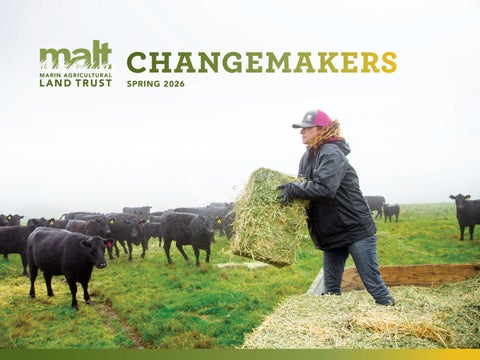
A NEW FRAMEWORK FOR AGRICULTURAL CONSERVATION
For 46 years, MALT has permanently protected nearly 59,000 acres of Marin County farmland. That protection continues—and remains essential.
But we’ve learned that keeping land in agriculture requires more than preventing development. It requires ensuring the farms and ranches on that land can remain economically viable while delivering the environmental benefits we all depend on—local food, clean water, wildlife habitat, carbon storage, and wildfire resilience.
MALT’s new Strategic Framework recognizes this reality. These aren’t separate initiatives—they’re interconnected approaches that reinforce each other. When a dairy family uses a restoration grant to remove invasive species, they’re improving both their pasture productivity and wildlife habitat. When a shepherd builds a prescribed grazing business, she’s creating wildfire resilience while proving new economic models work. When vegetable farmers access leased land, they’re demonstrating the next generation can still farm here—if we build the systems that support them.
Our framework addresses five interconnected dimensions:
Support a Healthy Local Food System
Protect farmland and work with partners to expand land access, and support the agricultural workforce that makes everything possible.
Expand Environmental Benefits
Invest in practices that improve soil health, water quality, wildlife habitat, and biodiversity on working lands.
Build Climate Resilience
Accelerate climate-smart agricultural practices that help farms adapt to drought, wildfire, and changing conditions while strengthening regional resilience.
Connect With Community
Create opportunities for people to understand and experience the public benefits of private land conservation.
Strengthen Our Organization
Build the capacity, partnerships, and resources needed to accomplish this work for decades to come.
The following pages introduce five women farmers and ranchers whose work embodies these interconnected approaches—showing how they work in practice, and why supporting agricultural viability matters as much as protecting the land itself.
JENNIFER BERETTA
Why Family Dairies Matter to Everyone


Jennifer Beretta sometimes can’t remember her phone number. But she remembers the ear tag numbers of her cows from fifteen years ago. “The cows are an extension of my family, my heritage.”
That depth of care extends across two operations—her family’s nationally-recognized Santa Rosa dairy and her uncle’s 3,000-acre Dolcini Jersey Dairy in Marin, where she manages grants and strategic planning in what she calls her ‘free time.’ Across both operations, she sees what most people miss: dairies aren’t just about milk. They’re the connective tissue helping hold the entire agricultural system together.
Marin’s ranches and farms depend on an economic network that only survives when there’s critical mass. Feed suppliers, veterinarians, equipment dealers, processors, nutritionists— they all need enough volume to stay in business. Dairies provide much of that volume.
“That’s what it takes to keep these dairies running—lots of hands, lots of family members working to support the greater whole,” Jennifer explains. This includes the dairy workers, many from Marin’s Latino community, whose daily care keeps operations running.
But keeping dairies running also requires investing in the land itself. In 2024, invasive French broom had overtaken parts of the Dolcini Ranch, threatening native grasslands and increasing wildfire risk. The restoration work was essential— but expensive, more than the family could afford to tackle on their own.
Jennifer secured $40,000 through MALT’s small grants program, then paired it with Natural Resources Conservation Service funding to multiply the impact: invasive plant removal, native grass seeding, compost application, improved water systems, and new fencing for rotational grazing. Today, native grasses are returning and the ranch’s fire risk is reduced.
She represents the leadership Marin agriculture needs— grounded in lived experience, committed to keeping the whole system working, and rooted in generations of knowledge about what these landscapes require.
Get the full story: malt.org/jennifer-beretta

“Generations before us worked so hard to keep it in the family. I got to see how hard they worked. That’s why I work so hard at what I do—to make sure this is here for the next generation. For all of us.”
JENNA COUGHLIN
Creating New Pathways Into Farming


Land in Marin County costs more than a new farmer can often afford. For Jenna Coughlin’s generation, the traditional pathway into farming—buy land, build a business—is extremely challenging. So she created a new one.
Through Shepherds of the Coast, her Native-owned business based in Tomales, Jenna manages sheep and goats for prescribed grazing across Marin and Sonoma counties. Her animals move strategically across varied landscapes—conservation properties, vineyards, residential acreage—serving as precision instruments for land healing. Reducing wildfire fuel, restoring native plant communities, improving habitat. She
doesn’t own the animals. She doesn’t own the land. But she’s built a viable farming career anyway.
The model works through creative partnership. Guido Frosini of True Grass Farms owns the sheep that Jenna manages for prescribed grazing projects. The animals improve landscapes and are ultimately raised for meat. She focuses on day-to-day flock management and ecological outcomes; he handles ownership and marketing. It’s a business partnership born from necessity—and it’s becoming essential for next-generation farmers facing West Marin’s economic realities.
demands mounted, and drought added pressure. The dairy that had defined her family for over a century couldn’t sustain them anymore.
“Letting go of the dairy was one of the hardest decisions we’ve made. It’s in our blood. But we’re raising beef cattle now—we’re still ranching, still on this land.”
Adaptation requires investment. Since 2019, Marissa has partnered with MALT on water infrastructure, erosion control, and invasive species management. The most recent project: $40,000 through MALT’s small grants program for solar installation. The system now powers water pumps and freezers for their beef operation, independent of PG&E’s aging grid.
Six generations of history, each facing different tests of whether they could hold on.
But what Marissa brings—the grit to make hard choices, the courage to change course when needed, the unwavering commitment to this land—that’s what makes the partnership work. She’s not just a recipient of support. She’s a co-creator of Marin’s agricultural future.
Get the full story: malt.org/marissa-silva

MOIRA KUHN
Building a Farm on Borrowed Ground


Moira Kuhn grows some of Marin’s most beautiful produce on land she’ll likely never own. Her 15-acre certified organic operation on the MALT-protected Volpi Ranch near Petaluma is one of about twenty row crop farms in the county.
She supplies restaurants and Saturday shoppers at San Francisco’s Ferry Plaza Farmers Market with winter chicories, heritage kales, and vegetables that make chefs rethink their menus. Her husband Jesse started farming here in 2002, when ranch owner John Volpi took a chance on a newcomer—a gesture of faith Jesse and Moira have never forgotten.
Together they’ve built a life on leased ground—raising three children, mastering clay soil, building lasting customer relationships that have sustained them through every setback.
“People talk to me about what my succession plan is,” Moira says. “And I was like, what succession plan? I’m not going to pass a lease off to someone else.”
That reality shapes every decision. The new greenhouse could transform their operation—faster planting, reduced labor costs, better efficiency. “We did this because it’s going to streamline things, make us more money—get us back into
the black. There’s always a chance we won’t get the full use of it. But you invest anyway.”
Leasing means constant uncertainty. When they lost 30 acres at the Marin French Cheese Factory to an ownership transition, they started over. When the 2021–22 drought hit, one field had to shut down. “Jesse and I talk about there’s only so many new plots of land that we have in us to start. We only have one or two more left to break in.”
Without ownership, the possibilities she envisions remain out of reach: paid farm apprenticeships, worker housing, pathways for the next generation.
First-generation farmers like Moira are proof the system can still work—and the first to feel when it’s breaking. Keeping them farming requires land access, lease security, worker housing, infrastructure support—one broken link and the whole chain fails.
MALT’s Strategic Framework now prioritizes land access alongside protection. MALT has permanently protected over half of Marin County’s privately owned farmland. Protecting its farmers requires partnership—bridge loans, pathways to ownership, lease security. The question isn’t whether farmers like Moira will keep showing up. It’s whether the systems can evolve fast enough to let them stay.
Get the full story: malt.org/moira-kuhn
“People talk to me about what my succession plan is. And I was like, what succession plan? I’m not going to pass a lease off to someone else.”
–MOIRA KUHN

DAYNA GHIRARDELLI
Why Agriculture Needs Advocates


When Dayna Ghirardelli’s family protected two ranches with MALT conservation easements—the 723-acre McDowell Ranch and 539-acre Duncan Ranch—they thought they’d secured their ranching future. Those easements permanently prevent development, contributing to more than 10,000 acres of contiguous protected land in Marin County.
But last fall, Dayna faced a threat that conservation easements couldn’t stop.
As Executive Director of the Sonoma County Farm Bureau, she learned early about Measure J—a ballot initiative that
would have made some ranching illegal on Sonoma County land, forcing about two dozen multi-generational family farms to close within three years. For operations spanning the Marin-Sonoma border like her family’s, the measure would have collapsed the entire regional food system both counties depend on.
Dayna had spent her career building bridges across the dairy industry—from UC Cooperative Extension to Clover Sonoma to the California Milk Advisory Board. She knew these families. She understood what was at stake. And she knew how to bring people together.
Over the following months, she spoke to more than 65 community organizations. The coalition she built didn’t usually occupy the same room—ranchers and environmentalists, local food advocates and farmworker communities. Five city councils passed resolutions against the measure. Farmers stepped outside their comfort zones on social media, answering neighbors’ questions. The conversations resonated. People who’d never thought about agriculture began defending it.
The campaign revealed how wide the gap in public understanding had grown. Measure J’s proponents labeled these operations “factory farms”—but the reality was multigenerational families practicing organic, pasture-based ranching on land they’d stewarded for decades. On election night, voters rejected Measure J by 85%.
“We have to keep these conversations going,” Dayna says. “When people understand what’s really at stake, they show up.”
The fight illustrated what MALT’s Strategic Framework recognizes: agricultural viability requires work on multiple fronts. MALT protects land through conservation easements. Partners like farm bureaus defend agriculture from policy threats that could make farming economically impossible on that protected land. Both matter—for farmers and for anyone who values local food, open space, and the landscape that defines our region.
Get the full story: malt.org/dayna-ghirardelli

Post Office Box 809
Point Reyes Station, CA 94956
(415) 663-1158 | farmland@malt.org
RETURN SERVICE REQUESTED
Photos: Matt Dolkas, Paige Green, Jeff Lewis, Maggie Sowell, and Michael Woolsey.
Printed on recycled paper using soy based inks.

Be A Changemaker
Protecting farmland is just the beginning. Your gift helps ensure the farms and ranches in Marin can thrive— delivering local food, clean water, wildlife habitat, and climate resilience for generations to come.
Give by May 31 and your gift will be matched dollar-for-dollar, up to $400,000.
Donate Today: malt.org/give