MALATE LITERARY FOLIO
TOMO XXXII BILANG 1
Ang mga nagwagi sa ika-30 na dlsu annual awards for literature
at ika-5 na dlsu annual awards for visual arts
MALATE LITERARY FOLIO Tomo XXXII Bilang 1 Karapatang-ariŠ 2016
A
ng Malate Literary Folio ang opisyal na publikasyon ng sining at panitikan ng Pamantasang De La Salle - Manila, sa ilalim ng awtoridad ng Student Media Office (SMO). Ang mga komento at mungkahi ay maaaring ipahatid sa:
Rm. 160-MLF, St. La Salle Hall, De La Salle University-Manila, 2401 Taft Avenue, Malate, Manila. E-mail address: mlf@dlsu.edu.ph Facebook: fb.com/malateliteraryfolio Twitter: @malatelitfolio
Nananatili sa indibidwal na may-akda o may-dibuho ang karapatangari ng bawat piyesang ipinalimbag dito. Hindi maaaring ipalathala muli o gamitin sa anumang paraan ang alin man sa mga nilalaman nang walang karampatang pahintulot ng may-akda o may-dibuho Ang tomong ito ay hindi ipinagbibili. Ang pabalat ay likha ni Hannah Grace Villafuerte
INTRODUKSYON
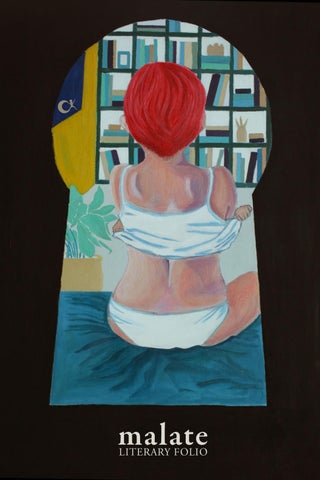
On the cover of this folio, the spectator is made to look
at a subject, caught in the act of removing garments. One can notice that the body of the subject imitates the silhouette of the keyhole, fitting the gap where the eyes of the spectator are fixed. Other elements, such as the books on ledges, the leaves of a plant, and the creases of a cloth, demand lesser attention as they vaguely illustrate the situation. In terms of space and color, the emphasis on the figure makes the observer revert his attention to it. While the image implies the suspension of undressing, the imagination is lead to project emotions, desires, and fantasies. One is even tempted to anticipate what will happen next. Let us suppose that the figure knows the presence of the viewer. Expecting that someone is able to peer through the hole, it turns its back. It conceals its face and its private body parts. Given the illusion, the viewer is allowed to stare. The knowledge of viewing and being viewed at, ties the spectator and the subject’s consciousness, allowing each one to think that he is not alone. The author looking through his work is different from that of the reader’s reception of what he reads. With
i
the use of his medium, the author selects and combines details from his knowledge and arranges them to a composition he sees fit for the reader to examine on. Aside from self-expression, the author yearns to communicate his personal and unique visions. Similar to the subject through the keyhole, the author provides the perspective and the experience. If the work of art is successful, the reader is able to immerse, anticipate and recount. This issue of Malate Literary Folio contains the pieces which reflect the attempts of its writers, poets, artists and photographers to heighten the consciousness of the audience in the present context. Various worlds, languages, images and metaphors are rendered to be enjoyed and to be scrutinized. Featuring several of the winning works from 30th DLSU Annual Awards for Literature and the 5th DLSU Annual Awards for Visual Arts, the publication invites the reader to absorb, to engage and to evoke.
PAMELA JUSTINE F. LITE Punong Patnugot
ii
NILALAMAN Introduksyon Prosa
Pahina 10533: Filipino 12 Modyul Para sa Mag-aaral Yunit 1 Janssen Dale Cunanan
The Bereaved Chandral Selim
i 68
86
Sining
Paborita 43 Kris Bernadine Samonte
Out of the Box 63 Noriko Hannah Joy Paderes
Disposition of Thoughtfulness Juan Paolo Terrado
Ang Kwento ni Balong 66 Czyrone Angelo Galang
64
iii
Epinephrine 79 Noriko Hannah Paderes
Aninag Meryl Ann Batara
Yugto 95 Hannah Grace Villafuerte
83
Tula
For Lasting Architechture 44 Maria Isabel Cabal
Tirador Mesandel Virtusio Arguelles
62
Ahas Mesandel Virtusio Arguelles
65
Dagitab 84 Ira Katrina Mendez
On the Dead Arianne Puno
81
Retrato
Wonder/Wander Maria Margarita Uy
49
Off the Grid Jed Nathan Daya
67
iv
Revolver 80 Pedro Rodrigo Dimaano
Untitled 82 Juan Carlo Ona
Purge 85 Erika Zenn Ang
Tanaw 96 Erika Zenn Ang
Pasasalamat
xii
v
mga nagwagi sa ika-30 na
DLSU Annual Awards for Literature at ika-5 na DLSU Annual Awards for Visual Arts The Varying States of Travelling Songs Arby Darren Medina Short Story: 2nd Place Masquerade Katrina Alyssa Tankeh Short Story: 3rd Place The Gift of Lu-Ha Liana Selena Regala Short Story: 3rd Place
2
28
Human Approximations Jeremy Yumul Poetry: 1st Place
20
9
Catharsis Pauline Navarro Poetry: 2nd Place Anna O Czyrone Angelo Galang Drawing: 2nd Place
vi
36
Dalagita’s Demise Cheliza Angela Acance Drawing: 3rd Place
37
Feeling This Juan Paolo Agoncillo Drawing: 3rd Place Psychedelic Ma. Celina Gilmo Drawing: 3rd Place Spirit of the Smoker Roan-Dy Contreras Drawing: 3rd Place Space Oddity Juan Paolo Agoncillo Painting: Honorable Mention
38
Daydream Christopher Sum Painting: Honorable Mention
vii
Song for The North Pamela Justine Lite Painting: 2nd Place
39
Gossip Luigi Shirvani Painting: 2nd Place Bantilaw Francisco Gabriel NuĂąez Photography: 2nd Place
40
Flight or Fight Miguel Antonio Luistro Photography: 2nd Place
41
Follower Christopher Sum Photography: 2nd Place
viii
mga hurado sa ika-30 na
DLSU Annual Awards for Literature at ika-5 na DLSU Annual Awards for Visual Arts Short Story Ms. Erika Carreon Ms. Susan Lara Poetry Ms. Conchitina Cruz Mr. Vincenz Serrano drawing
Ms. Christina Dy Ms. Ana Katrina Ocol painting
Mr. Aris Bagtas Mr. Iggy Rodriguez Photography Mr. Joey Alvero Ms. M.M. Yu
Paalala: Ang mga kategoryang Maikling Kuwento, Tula, Essay at Sanaysay ay napawalang-bisa dahil sa kakulangan ng mga kalahok.
ix
PATNUGUTAN Pamela Justine Lite Punong Patnugot Miguel Antonio Luistro Pangalawang Patnugot (oic) Jericho Miguel Aguado Tagapamahalang Patnugot Hannah Grace Villafuerte Patnugot ng Sining John Vianney Ventura Patnugot ng Retrato Arianne Puno Patnugot ng Tula Maria Katrina Gindap Tagapamahala ng Marketing at mga Magaganap Jibril Mercado Tagapangasiwa ng Dokumentasyon (oic) Ira Katrina Mendez Tagapamahala ng Pagmamay-ari
x
MGA SENYOR NA PATNUGOT Julian Russel Noche Francisco Gabriel NuĂąez
TAGAPAYO Mr. Johann Vladimir Espiritu
MGA KASAPI Erika Zenn Ang Meryl Ann Batara Maria Isabel Cabal Janssen Dale Cunanan Jed Nathan Daya Dianne De Guzman Pedro Rodrigo Dimaano Luke Perry Embate Charlene Ferrer Jan Lorenzo Luna Arby Darren Medina Juan Carlo Ona
Alecsandra Denise Ongcal Noriko Hannah Joy Paderes Diana Rose ParreĂąo Kris Bernadine Samonte Bernadette Patricia Santua Chandral Selim Adele Paul Tangoan Katrina Alyssa Tankeh Juan Paolo Terrado Janelle Mae Usal Maria Margarita Uy
STUDENT MEDIA OFFICE Anna Loraine Balita-Centeno DIRECTOR Patricia Baun COORDINATOR Ma. Manuela Agdeppa SECRETARY
xi
30th DLSU Annual Awards for Literature
Tomo XXXII Bilang 1
The Varying States of Travelling Songs ARBY DARREN MEDINA paglalarawan ni Hannah Grace Villafuerte
2
Malate Literary Folio
O
n the fourth day of the fourth month from the four hundred mouths of the four hundred men came the songs of the Forgotten. “Wait. Who are the Forgotten?” The Forgotten are those who dwell in the realm of the Comeand-Go. They slip in and out of consciousness hoping to one day creep back into remembrance. The Forgotten are you. The Forgotten are I. Soon you and I will become We. Since then, the men of Kanta have been singing in their sleep. “Where can Kanta be found?” Kanta is a part of a large chain of islands callen the Kalimot archipelago. Kanta is where all lost voices go. Unlike the other islands Kanta is located above Kalimot. You see, sound travels upwards rising with the wind. There is also an island for lost dreams called Panaginip. It is located beneath the waters for when dreams are lost, they tend to sink. “Have you been to Panaginip?” When I was a child, my father dropped me into a river. Like lost dreams, children also have a tendency to sink. The current carried me out into the ocean and from there I sank deeper until I landed in Panaginip. I spent fourteen years there. All that I know, I have learned from the dreams. “How did you get back to the surface?” I became a song. The people of Kanta assigned Kun to watch over the men, to listen to the songs while the others slept.
3
Tomo XXXII Bilang 1
“Why does Kun have to stay up and listen to the songs?” Because when someone sings, it would be rude not to listen. My father once shot a man for sleeping through his soulful performance of Frank Sinatra’s My Way. Songs desire to be heard. “What happens if they are left unheard?” They will travel to ears that are willing to listen. Kun eventually grew tired and started to sleep during her watch. Four days later, the Kooks arrived. “Who are the Kooks?” The Kooks have been flying around Panaginip for four years looking for Kanta. They have been hired to collect songs from the island. “What have they brought?” Meat and candy. “What do they get in return?” Fire. The Kooks collect vinyl records that land on the shore. “Where are the Kooks from?” The Kooks reside on a gigantic pile of earth that they claimed as their own. Its name cannot be said, only sung in the tongue that only they can sing.
4
The Varying States of Traveliing Songs
“And the vinyl?” The vinyl came from the Wurlitzer. The Wurlitzer from the diner. The Wurlitzer that dragged out of the diner is then shoved into the backseat of a truck. Like the other diners, this diner was finally going digital. The PodPlayers were coming in this week, filled with four thousand four hundred forty-four songs. Hundreds of cookie cutter pop stars all packed into one tiny handheld device, all of them with their insides hollowed out to make room for more glitter—more glam. They bring the Wurlitzer to the nearest pier, empty it of its coins and then chuck into the sea. The Wurlitzer sinks and crashes into the seabed. Carried by the currents, the vinyl spill out and float to where all lost voices go. The Kooks melt the records down in an open fire pit that they set up at the center of the island. From the pit comes black smog, from the smog comes rhythmic coughing. The Kooks extract the black muck from the burning pit and load it into their planes. They leave their payment of meat and candy before they head home. The planes bring the black muck to the Kooks’ factories. One of the factories refines the muck and morphs it into tents. These muckmade tents are then packed into willow wood boxes. One of the tents packed into one of the boxes is sold to the Swinks. “Who are the Swinks?” The Swink family own The Swink’s Travelling Circus, headed by Ma Swink and Pa Swink. The Swinks toured across the country with their band of not-so-merry-men bringing fun and wonder to all who watched their troupe perform. “Why do they need a new tent?”
5
Tomo XXXII Bilang 1
Candied bacon. The sickly sweet scent rose and dissipated across the town, from the Sunny Oats Kindergarten which was located near the town square to the Holmon Correctional Facility at the edge of town which housed Amarathi Finch, a migrant who used to work at the local All-Mart, before he decided to stab an elderly woman forty-four times while humming the tune of the Hokey Pokey because she had asked him to double bag her groceries. He breathed in the fumes from his cell, a mixture of caramelizing cotton candy and burning human flesh. Now, the Swinks check on each of their acts, as they do before each show. First on the list is Bombo, Bear-kin juggler, rider of The One Wheel. She is wearing her training collar, affixed with a hook that will hold her big red bow tie during the show. “Isn’t Bombo a boy’s name?” Bombo is the name given by the Swinks to all of their unicycled juggling bears. This current Bombo has only been Bombo for four months. The Swinks lost their last Bombo to a gangrenous wound inflicted by means of their previous method of conditioning. They have since switched to the more efficient Shock-o-Matic 4000, a collar for animal persuasion. The bear teeters on the edge of the stage. The Swinks then check on their acrobats, flipping and twisting in the air. With no safety nets below, there are no room for mistakes. “No nets?” Ma Swink wanted one of those new PodPlayers. The Swinks examined their budget and saw that the nets were only necessary if anyone actually fell. “It’s their job not to fall,”
6
The Varying States of Traveliing Songs
thought Ma Swink. The Swinks then turn to the empty stage. The hippos descend from the heavens. They bow as they land and on cue they perform their drug-induced rendition of the Hokey Pokey. “The Hokey Pokey?” Putting out just so they can go back in their tanks. In the end, that’s what it’s all about. “How will it end for the hippos?” The hippos will be boiled in their tanks. The Swinks smile. They are ready for the first stop of their tour. It was a day that would not be forgotten. Fourth of April, summer of ninety-four, the circus was in town. Despite his mother’s disapproval, the Boy, age ten, son of the butcher, would be going to the circus today, his day. The Mother argued with the butcher the night before, the topic: The Dangers of Bringing Our Nine-Year-Old Son to the Circus. The mother opens with “I heard there would be fire breathers, those animals are filthy, we don’t know where those clowns have been, and that tent does not look safe.” The father rebuts with “loosen up, it’ll be great, he’ll be with me, and I already bought tickets.” The mother concedes. She fell asleep on the couch that night, the blare of the sirens not enough to wake her. I can’t remember if I cried When I read about his widowed bride But something touched me deep inside The day the music died.
7
Tomo XXXII Bilang 1
So bye-bye, Miss American Pie Drove my Chevy to the levee, but the levee was dry And them good old boys were drinkin’ whisky in Rye The town sang for days. Singing, “This’ll be the day that I die, this’ll be the day that I die.”
*This piece was first published in Plural Online Prose Journal’s 4th issue (http://www.pluralprosejournal.com/Issue04_2016/) 8
Malate Literary Folio
Human Approximations JEREMY YUMUL paglalarawan ni Pamela Justine Lite
9
Tomo XXXII Bilang 1
An Acrobatic Show They have no need for words. At most, these are used to introduce them as they begin to cast off their bodies’ limitations. Watch these skin and sinew, reaching for some of what nature denied to us. A woman pirouettes and turns like a swan on the forehead of another woman. Two men meet on a tightrope: one, outwitting gravity as he balances a bike, the other mocking it as he totters around with his umbrella. Forget theatre antics or poetry. These bodies are acts by themselves. See how one is contorted into a box. How bodies turn themselves into a tower that reaches for the sky, where two bodies swirl in their swings, reaching out to each other, even for a while— only to return to the ground, where they bow with our simian form that can barely climb.
10
Human Approximations
Fragments A singularity would’ve been better. But no, my love for you was constructed of fragments. It started with the flick Of a curved lip, then the ear, the left one particularly, just peeking out from your hair, from which cascades the rest of your body which in time I start to chart by heart. And your movements, the way You press your lips To a cup, the spaces made by your palms spread as you raise them to answer a question—those too. And isn’t it only human nature? To chase that glimpsed opening—a forbidden place like the sky, or a sliver of light from under a box— it must lead somewhere. I delved farther, deeper, constantly assuring myself that there is, there has to be something more. I filled in the faults with treasures I wanted to see. Your birthmark? A constellation. Your body’s limber? Coordinates,
11
Tomo XXXII Bilang 1
for where I could piece in my own fragments—only to find myself knotted in my own courses. I teach myself now to break apart the singularities I have grafted upon you. It should be the same only backwards: search for the quivers in your voice, dislocate the arches I carved perfectly in your spine, your legs. Return all those mistakes, faults, I chose to discard. The hardest lesson is to bury the slivers I have made myself.
12
Human Approximations
Oceans I stand like a child again and search the horizon where sea and sky meet— only to be reminded of how little my view has changed. I revert my gaze back to the reflections continuously forming and breaking in the water, the waves multiplying the mirrors. You are not a drop in the ocean. You are the entire ocean in a drop, says Rumi, the master. Always trying to return to the primal root of things, what would he say now, if I ask which drop would be easier to restore? Would he, reduce it as a quest of the beloved, and dismiss the untraveled roads and selves? Or would he, like the poet he is reveal and conceal the answers and questions together? Or maybe he would turn to the sky, that resembles the oceans so much; the sky, that we have travelled back and forth to with our machines and eyes, only to find that it promises nothing
13
Tomo XXXII Bilang 1
but infinity? Or how about silence? It is easier, after all, to leave the ocean where we were born and banished from long ago, as it is. The tide is closing in now and I sink into the ocean. There are no mirrors here.
14
Human Approximations
Peace Love I can tolerate. Joint accounts are better in some aspects after all. Competition also brings about the best in us: two suitors bidding for the same woman— now think what they’d pay. Peace? Now that’s the least profitable proposal we’ve ever thought of. An investment that would demand more, just to keep it in place and nothing else. Laws? Those can provide jobs like litigators; innovations like the guillotine; efficiencies, bureaucracies. Religions? Those provide purpose that makes masses and monarchs move, and even offer possible perpetuities. But Peace? Who can even list that as part of their assets? We attest that it’s the best for everyone. Everyone? A person alone can barely decide the best for himself.
15
Tomo XXXII Bilang 1
And would Peace even have an economic system? Communism comes close, but who would rule Peace? Maintain it, once implemented? Can it even grow outside its jurisdiction? War? Now there’s an opportunity. From the get-go of its business plan: expansions of everything, from anthems to armies, banners to bombs. Its interests would outlive inflation and the lives who funded it. From scientists to soldiers, mistresses to minstrels: see how there is a chance for everyone to profit. And need I count how many contracts and countries are broken, subtracted, how many prisoners and poems are made, added, through these transactions? But Peace? It promises nothing but itself. Songs, plays, monuments? By the third day, we’d tire of all that and only Peace would be left.
16
Human Approximations
And think about its previous ambassadors, the analysts who advised its implementation. The return? At least a loss of their limbs or heads. And its cost? We have yet to even calculate or consider that.
17
Tomo XXXII Bilang 1
Regret An entire account composed of the mistakenly and untaken ventures of all others: ‘buts’, ‘would haves’, ‘should haves’, ‘what ifs’. Its inventories also include those lost balloons, some unfinished paintings, letters left unsent, a piano waiting, broken mirrors. In its records are names like mother, Mr. Gonzalo, that coach, friends, enemies. But all these are filed under mine. No room for erasures or corrections: it simply lists them cohesively and cleanly. Regret. Our mistakes and inefficiencies so efficiently sorted and maintained. It regularly alerts us of our expenses; always leaves notices at our doors, with no return address. Too late to tear up the terms. Forgetting, would do no good: if anything
18
Human Approximations
it would just prolong the sequence of payments. Lies, curses, trues written wrongly on test papers—all these weigh now like boulders. And all those blind turns, those narrow escapes from lovers— all these paths now point accusingly. And who’s there to turn to? An account keeper, impatiently tapping his right foot, shaking his head, always holding some papers.
19
Tomo XXXII Bilang 1
The Gift of Lu-Ha LIANA SELENA REGALA paglalarawan ni Pamela Justine Lite
20
Malate Literary Folio
I. .
The women from Kayi’s tribe, according to her grandmother, have
always been special. Different from the women from other tribes, the women in this tribe had straight hair and a darker complexion. They were better weavers, bearers of sons more than daughters, mothers of warriors, and had eyes designed by the gods. She said, back in the time when gods resided in the earth, their people were under the protection of Lu-Ha, god of the most pure waters. Lu-Ha provided many fish, water to drink, rain that cures sickness, and delivered the souls of the dead to the afterlife. Before, the dead were placed in small boats, wrapped in the most colorful cloths weaved by their wives or daughters with patterns that represented their life as providers or warriors and the well wishes of the ones left behind. These boats were filled with flowers, harvests, and gold. Before the sun would set, the boats carrying the dead are pushed to the sea and, at night, it is believed that Lu-Ha would direct these boats to the afterlife and the bodies of warriors to the island of the gods so, when morning came, there will only be the calm sea. But there came a time where people wanted more, expected too much and began to envy tribes having gifts they didn’t possess. They fought with men from other tribes, complained to Lu-Ha, withheld their offerings, and demanded they receive all of the gifts Lu-Ha could give because were they not the better tribe? They were told it was done for them to forge friendships and that no tribe is greater than the other but, instead of making allies, the Datus became angry and tribesmen tried to take advantage of each other. They withheld cures found only in their territory, stole fish from each other, adorned the dead with more gold so Lu-Ha would prioritize theirs, and many more. The result was war between the tribes. Tribesmen, led by their Datus, divided the seas into territories, made borders on where tribes could fish, sold the cures they gathered from the rain for unreasonable prices, hoarded all the fish they could get hoping the other tribes would have no more to catch and this angered Lu-Ha greatly. It rained heavily for six days
21
Tomo XXXII Bilang 1
with the darkest clouds, roaring thunders, powerful lightning, and then, nothing. For weeks, the people waited but there were no more gifts from LuHa. Men tried to drink the water from the sea but it was salty, they had to build nets to catch fish and, even then, they didn’t catch that many. Water from the rain no longer cured the sick and the dead remained floating on the waters come daylight. For days, the dead remained floating until it was decided that they had to be kept underneath the earth until Lu-Ha would take them. The leader of Kayi’s tribe, at that time, decided to offer all the women in their tribe to Lu-Ha by throwing them over the waterfalls to appease the god. One, Two, Three, the widowed, the old, the barren, Four, Five, Six, the mother, the pregnant, the young, Seven, Eight. . . Eventually, when only a handful of women were left, Lu-Ha appeared with heavy rain and strong winds that had trees falling in his anger and the Datu to his knees. There were so many different versions of the encounter in the old books but, in the end, Lu-Ha decided for only one last gift to the women left and those women who will be born into the tribe. There will be no more abundant fish, the sea will remain salty, there will be no more cures from the rain, and no more delivering of the dead but the women, as decreed by Lu-Ha, will cry once in their lifetime true tears of happiness which, when drank, will double the drinker’s lifetime, give him good health where he will have no need for cures and a place with Lu-Ha in the island of the gods after death. However, they will also cry once, true tears of sadness which will bring instant death to anyone who drinks it, even the ones who drank the tears of true happiness. After that, Lu-Ha disappeared and the gods no longer resided in the earth, only looking down from beyond the skies like the god A-Raw, god of love and warmth, who provides light. The elders in the tribe still believe that Lu-Ha sometimes looks down on his people whenever it rains without the clouds blocking the sunlight. They said it was the god A-Raw trying to convince Lu-Ha to come back to the earth. He
22
The Gift of Lu-Ha
never did and there were no other signs of him watching over Kayi and her tribe. II. Despite this story being sung by the women every time it rains, it still didn’t change how selfish the tribes have become. Despite the anger of Lu-Ha, the waters remain divided, the sea remains salty, the nets barely catch fish, the rain no longer cures, and the tides are low or high depending on the moon. In some years, for months, there will be no rain and no fish to catch. The tribes blamed each other and the Datus would wage wars on a whim. None of the Datus wanted to lose the areas they claimed to belong to them and tribesmen were awarded for any kind of revenge taken against the other tribes. Now, the few women in their tribe who would shed true tears of happiness and true tears of sadness in their lifetime are exploited just like the waters blessed by Lu-Ha. Her grandmother, daughter of a Datu, had her tears of true happiness when she gave birth to Kayi’s mother. Shortly after that, she cried true tears of sadness when she found out her husband drank the tears of happiness to extend his life because he wanted to become the next Datu and that was the only reason why he married her. Even then, her tears of true sadness were harvested as a poison to use by her husband against his enemies. There were still very few women in Kayi’s tribe, most of whom would wish they wouldn’t give birth to a daughter so they won’t experience the same suffering of being used for their tears. Some of these women were lavished with gifts by warriors who hope to collect true tears of happiness but most, if not all, of these gifts were taken right after their tears of true happiness were harvested. Women who’ve shed their true tears of happiness were tossed aside and ignored. Some were treated like slaves, their children were taken from them, and they were tortured, raped even, until they have suffered enough to cry true tears of sadness because, during war, poison was very much needed by the tribe. As soon as they have cried their tears of sadness and happiness, they were set free. They were expected
23
Tomo XXXII Bilang 1
to integrate back into their life in the tribe as bearers, mothers, and weavers. No one could complain because such pain was needed to harvest tears of sadness for the Datu. It is not so much different now. Women are still showered with gifts but, those who don’t want to lose these gifts and the kind of life offered to them by tribesmen for possessing their tears, made a vow to never be satisfied or truly happy. It never worked for those who were never satisfied by material things, they would dream of true love. Some of these women were tricked by their suitors, warriors who would end up being only after their tears of true happiness and sadness. Love became a weakness and a tool for deceit. Some would hide their tears in bottles, trying to fool the rest that they haven’t cried yet their tears of happiness and it would work for a time. Some were forced to sell their tears while others poisoned themselves when they could no longer take it. Very rarely would anyone hear a happy ending from the women in the history of this tribe. They would sing about the glory of the Datu, the warriors, and their husbands but would whisper at night to their daughters how they had their hearts broken. They would warn the young daughters of the tribe not to dream or believe in true love. Others warned that there is only sadness after the only moment of true happiness in their lifetime. For generations this has been going on and despite the efforts of grandmothers and mothers to protect their daughters and granddaughters from the same fate, tribesmen were still in the practice of harvesting true tears of happiness and true tears of sadness, still blinded by the power they received from the tears. III. “What are you thinking about?” Saya is Kayi’s childhood friend, the only girl of the same age in their generation. It was something to celebrate at that time, two daughters being born in the same year. “The little girl from the fire” Kayi replied. A young girl in their
24
The Gift of Lu-Ha
tribe had cried her true tears of sadness last night when her mother died in the fire that burnt their house down. Everyone present was too busy trying to put the fire out and nobody noticed the little girl crying beside her mother’s corpse until it became quiet and they realized she had cried her true tears of sadness and died. Her mother had not yet explained to the child the gift of tears for she was very young and, when it came, nobody was there to collect it. The little girl’s tears dripped down to her cheeks then to her lips. The next morning, both bodies were buried where their house used to stand. The Datu arrived with a decree that as soon as the daughters of the tribe were old enough to understand, they will be taught of the story of the tears so no tears of sadness nor of happiness will be wasted like what happened last night to the little girl who had died without even crying her tears of happiness. Saya moved to sit beside her, arms pressed against hers for comfort, long hair cascading to Kayi’s back when she rested her head on Kayi’s shoulder. It wasn’t the first time they have mourned for a daughter of the tribe, mourned for themselves because they were daughters of the tribe and not just daughters of their mothers and fathers, unprotected against the custom of reaping of tears. They were on the verge of yet another war which started with a fisherman’s son getting 3 pieces of fish from the territory of a neighboring tribe. He was killed immediately. The Datu of Kayi’s tribe, her grandfather, has claimed that such fish can only be found in their territory and if the fish were found in the waters near the other tribe, then that area is part of his territory and that the other tribe must pay for their false claim and for fishing in his waters for years. He demanded that the other tribe’s Datu withdraw his claim on the waters mentioned or he will seek revenge. It was clear that the revenge he seeks, however, is not for one of the sons of the tribe who was killed. The Datu of the other tribe refused and there had been revenge after revenge between the two tribes since, including the fire last night. One of the tribesmen has claimed that a flaming arrow bearing the mark from the neighboring tribe flew and hit the little girl’s house.
25
Tomo XXXII Bilang 1
It has caused more anger in their Datu now that a daughter of the tribe is dead, wasting her true tears of both happiness and of sadness. Kayi was called by her grandfather right after the burial, tasked to cry her true tears of sadness on the waters of the neighboring tribe as a last revenge before the inevitable war. The Datu believed that if warriors from the other tribe would take water to drink from where the tears of sadness were placed by Kayi, most, if not all, men would fall. Then, only the reserve warriors would go into battle assuring their tribe of victory and he could finally claim back his territory. He said it was her duty as a daughter of the tribe and the granddaughter of the Datu. IV. “May the gods guide and protect you.” There were no more gods residing in the earth but it was the only prayer Saya could give her. She had wanted to be with Kayi but their fathers have decided it was stupid to send two daughters, both of which have not shed either of their tears, to another territory. Saya would remain to cry her tears of happiness and then, they would reap her true tears of sadness. When the god A-Raw was beginning to retreat, Kayi left to head to the neighboring territory. She hoped the night would come to hide her but A-Raw was inching slowly and she briefly wondered if the god was watching what she was about to do and would report to Lu-Ha what has become of the tribes that were once under his protection. She supposed she has arrived at the enemy’s territory but it looked no different from theirs. The trees were the same, the soil and flowers were the same, and there was nothing that divided the water between both tribes. She sat by it and watched as a fish from their water just swam to the other side, not caring of the division decreed by both Datus. Back in her tribe, she supposed that the warriors were preparing for battle. Some were making one last effort to make their women cry true tears of happiness to increase their chances of returning. She didn’t want to think about the women who were
26
The Gift of Lu-Ha
expected to cry their true tears of sadness or of Saya who was expected to cry both soon. She thought of the Datu and the wars as the fishes swam freely between the waters. The sky was beginning to darken. She closed her eyes and hoped Lu-Ha would bring her tears. She waited. She thought of the life before the tears, how things would have been if the Datus didn’t demand to have more than what Lu-Ha had given. She thought of the women being used, lavished by gifts to make them cry true tears of happiness and then tortured to reap their true tears of sadness. She thought about the little girl who died from the fire once again. She thought about her future and Saya’s. She blamed the Datu for what he was forcing her to do now. It was only the Datus that divided the waters. She opened her eyes and watched as A-Raw slowly inched to submerge himself in the waters. Maybe it was returning to Lu-Ha. Maybe that is where all the gods have gone. Maybe Lu-Ha was there too, not in the sky but beneath the waters with the abundant fish, the cures, and their dead. She placed her hand in the water, submerged to her hand, to her wrist, her elbow, then to her shoulder. If only she could reach far enough to the gods. She needs to reach Lu-Ha. She needs to ask the god to take back the gift of tears, to end this war by bringing back all the fish, the cures, and all the other gifts. By daylight, there was no sign of Kayi anywhere.
27
Tomo XXXII Bilang 1
Masquerade KATRINA ALYSSA TANKEH paglalarawan ni Hannah Grace Villafuerte
28
Malate Literary Folio
Sunlight had only barely filled the sky when Mishka and her father arrived. From the window of the passenger seat, Mishka gazed at the school’s entrance where a woman in grey stood at the curve of the driveway, her hands behind her back. She was smiling.
Her father stepped out of the car, walked over to the woman and shook her hand. “Good morning, Mr. Farman,” she said, still smiling. “Was it you whom I talked with on the phone the other day?” “Yes, sir. I’m Ms. Tiongson, your daughter’s class adviser.” Mr. Farman apologized for bringing his daughter in so early. He glanced back at Mishka, whose head, a waning crescent engulfed in a clump of clouds, was half-hidden behind the car window, her blinking eye like a star. Getting the signal, she stumbled out of the car and tightened the strap of her backpack. She approached the two but stayed behind her father. “Oh, it’s not a problem, sir,” Ms. Tiongson said. She turned to the little girl who was only up to her father’s waist. She wore a loose white blouse over a green checkered skirt and a pink scarf cradling her head. “You must be Mishka.” Mishka tilted her head─the woman’s eyes shone, her skin the color of sand, her head topped off with crisp black hair, its ends grazing her shoulders. Mishka nodded. He kissed Mishka on the cheek and whispered something in her ear. He straightened his back and gestured his farewell to Ms. Tiongson before walking back to his car. Ms. Tiongson’s clasped Mishka’s shoulder and together they watched Mr. Farman speed out of the driveway and back into the streets of the city. “Shall I take you to your classroom?” Mishka nodded again. At the gate, the security guards bowed their heads, but Mishka felt their eyes on her as she and Ms. Tiongson walked towards the hallway of the main building. “That’s a very pretty scarf.”
29
Tomo XXXII Bilang 1
Mishka tightened her fingers around a patch of pink cloth. “Thank you,” she said, her mouth barely moving. “It’s a hijab.” “Do other little girls like you wear it, too?” “My dad told me never to take it off when I’m outside the house.” “I see,” Ms. Tiongson said, the light fading from her face. “You were here during the summer orientation, am I correct?” “Yes,” Mishka said. “So, you know where the classrooms are?” “The second grade classrooms are near the clinic.” “Yes, that’s right. Very good.” Beyond the entrance hall, they passed the clearing between the main buildings. The sight was familiar to Mishka but it was much darker and colder than she last remembered. In the dim light of the morning, the stone benches appeared to her like tombs that slept under blankets of shadows cast by the trees. The white statues with wings and swords lined the corners of the field, their heads twisting to follow her with a stare. Mishka looked away. They reached the building by the clinic and climbed a flight of stairs, stopping in front of a classroom at the end of the hallway. The inscription on the plaque pasted on the door read “St. Catherine.” Ms. Tiongson saw the look of confusion on Mishka’s face and told her that all classrooms were named after saints. “You’ll learn about them in class soon.” As Ms. Tiongson switched the lights on, Mishka was greeted by perfectly arranged plastic chairs, all facing a blackboard. Ms. Tiongson told her to pick any seat she wanted. Mishka watched Ms. Tiongson as she strode across the room with a deer-like grace, the metal keys tinkling in her skirt pocket. The air conditioner groaned before it coughed cool air into the classroom. “It’s already a little past six so some of your classmates might arrive soon,” Ms. Tiongson headed for the door. “Will I expect to see you joining us later?” Mishka did not answer. She walked to the far end of the
30
Masquerade
room, occupying a seat that rested on the wall, and fiddled with a keychain that dangled from the zipper of her backpack. Ms. Tiongson gave her one last glance before closing the door. The keychain on Mishka’s bag was no bigger than her thumb. It was a tiny model of the earth in a shiny black coating with carved lines that separated the oceans from the lands. She pinched it with two of her fingers, just as she always did, and forced the world into a tortured orbit between her thumb and her forefinger. The loose screw connecting the globe to the chain untightened itself completely─the ball slipped from Mishka’s fingers and rolled down the aisle. The spinning slowed a few seats away. Mishka lunged for the globe before it could go any further. She picked it up from where it stopped between the gaps of the wooden planks and rose to return to her seat. A man in a cloak stood at the opposite end of the aisle. Mishka froze. The figure was fully clothed in a robe, the color of damp wood, that swept the ground and showed no sign of human flesh. A hood arced over its head. Mishka could not see the man’s face but she knew he was looking at her. Mishka grasped her scarf, burying her fingernails in the softness of the cloth. “Who are you?” Mishka asked, her voice no louder than a wisp of wind. She stared at the gaping black hole where the man’s face should have been and wondered if he had any face at all. “Why are you here?” The man’s hood quivered, and Mishka stepped back. “No, I don’t know who you are,” she said, her hands falling limp on her sides. A hint of a pale, bony finger peaked from the rim of the robe’s cuff; it pointed to itself. “No, I don’t. I’ve never heard of that name.” He hovered closer. Taking a few more steps backward, Mishka shook her head. Her breaths lengthened, deepened, quickened into rampant gulps of air. She covered her ears with her palms. “No, no, no, no,
31
Tomo XXXII Bilang 1
no, no─” The cloaked man spread his arms, letting the robe fall to the floor. His limbs were no more limbs than they were skin and bones. He wore a shift, tattered and torn on the ends. His body was bathed in blood. All Mishka could see in his eyes was a pool of shadows. Ms. Tiongson walked back from the faculty center to see a group of chattering children in backpacks and stroller bags standing outside the St. Catherine classroom. “Why aren’t you inside your classroom yet?” “It’s locked, Miss,” a boy answered, pointing to the door. Ms. Tiongson struggled to recall whether she accidentally locked the door behind her before leaving. “Is there anyone inside?” They fell silent. She scanned the heads of the children, muttering numbers in her mind. She lost count. She dug in her pocket for the keys and pushed the right one into the keyhole. Mishka was nowhere to be found. The room was quiet and almost the same as it was before Ms. Tiongson left it, except for a few misaligned chairs. Her backpack sat on the chair at the back. The air conditioners were still open. The window on the farthest left of the room was slightly ajar, a gleam of light falling upon a piece of cloth that hung on top of the blackboard. It was pink and swayed like a flag. Ms. Tiongson yanked it off, its threads stretching, torn apart by the pull of her arms and the resistance from the wooden crucifix nailed onto the wall.
32
Masquerade
33
Tomo XXXII Bilang 1
34
Malate Literary Folio
5th DLSU Annual Awards for Visual Arts
35
Tomo XXXII Bilang 1
CZYRONE ANGELO GALANG
Anna O charcoal on paper
36
Malate Literary Folio
CHELIZA ANGELA ACANCE
Dalagita’s Demise graphite on paper
37
Tomo XXXII Bilang 1
JUAN PAOLO AGONCILLO
Space Oddity acrylic on canvas
38
Malate Literary Folio
PAMELA JUSTINE LITE
Song for the North acrylic on canvas
39
Tomo XXXII Bilang 1
FRANSISCO GABRIEL NUÑEZ
Bantilaw 40
Malate Literary Folio
MIGUEL ANTONIO LUISTRO
Flight or Fight 41
Tomo XXXII Bilang 1
42
Malate Literary Folio
KRIS BERNADINE SAMONTE
Paborita acrylic on canvas
43
Tomo XXXII Bilang 1
MARIA ISABEL CABAL
For Lasting Architechture ORIGINS “Suffering’s not one substance.” -Rachel Zucker I created a myth of my mother, as anyone lacking would to manage confusion. She smokes, never cooks. She tried once, but you can imagine what sort of woman would forget the salt. To seal the deficiency, I made myself and others believe that what came out of her, as she exhaled, was vapor from an age-old glacier she must keep within. The nourishment she could only possibly give was space—denying us of contact. Saving us. Only growing older, I see that there really is a certain coldness in her, one that refuses release, an infliction— sealed in by no one but her own mother.
44
Malate Literary Folio
Others believed nourishment could mean only provision. Completeness. It meant, to us, an independence from the myth.
45
Tomo XXXII Bilang 1
THE FIRST LIGHT, AND THEN DARKNESS 1 Sentimentality is the constant enemy of the least-loved. I know this fear because of you: either, you are remembered for the wrong achievements, or not remembered at all. When our mother reports to relatives, she fails to show equal favor, only your portraits in the living room—I learned faster, better. Spoke with more certainty. But because you came first, you had the benefit of fascination. The first child—the first encounter with tenderness. By my arrival, I was already expected to utter, to crawl, to strengthen myself. They had no more patience to spend watching a repetition, despite its refinement. Even after you have left home, news of you travels first. 2 If this was a competition we were bound to have, I meant never to win. How could you have been so slow? To think the bruises that coward spent on you meant the lesson of love you could only find outside the home. Remember as children, when you taught me never to run from the disasters I’ve caused? To break the furniture with intent, and unfazed, take the punishment: I learned what home meant outside of love—and the responsibility was in the difference. I could have chosen the lesson that saved you.
46
For Lasting Architechture
ROOT In this house dominated by one heritage, I feel my father’s presence in the likeness of the Mahogany tree that looms over our home. There is no legend behind it, no allusions I could make of its specific texture or history. I can only speak of its physical presence— heaving in cadence with the earth it stands in. If this metaphor succeeds, it is because you can imagine the silence they share. Silence is the lie of human translation: I hear him. I hear him the loudest. In fact, I find myself, even from a distance, drawing the youth he sheds with every turn of the newspaper, every nod in my direction.
47
Tomo XXXII Bilang 1
48
Malate Literary Folio
MARIA MARGARITA UY
Wonder/Wander photo essay
Among bustling crowds on the streets of Japan, the footsteps of
people are the most prominent detail. The ebb and flow of city life implies nothing but lifeless exhaustion. But scattered around the city are traces of reprieve in the sea of back-breakers. Little sprouts of joyful youth bloomed here and there, running across the streets filled with imagination and glee, doing whatever they wanted whenever they wanted. “Wonder/Wander� was created with the idea that spawned from children freely expressing their emotions and tackling the world without fear. This series explores the nostalgia that we feel when thinking back to our childhood, when the world seemed to be at the palm of our hands, when the worst of our worries consisted of petty fights and playtime mishaps. These are memories that demand to be remembered for these are the times where we felt free. To wonder is innate and to wander is to act upon it. Venturing out into the open and to discover pieces of this world is something that people will never stop doing. Because inside everyone one of us is a child that keeps on dreaming.
49
Tomo XXXII Bilang 1
50
Malate Literary Folio
51 51
Tomo XXXII Bilang 1
52
Malate Literary Folio
53
Tomo XXXII Bilang 1
54
Malate Literary Folio
55
Tomo XXXII Bilang 1
56
Malate Literary Folio
57
Tomo XXXII Bilang 1
58
Malate Literary Folio
59
Tomo XXXII Bilang 1
60
Malate Literary Folio
61
Tomo XXXII Bilang 1
MESANDEL VIRTUSIO ARGUELLES
Tirador gumawa kami ng tirador ako at bunsong kapatid hinihintay kami sa bukid ng mga maya sa sanga natagpuan namin ang isa payapang nagpapahinga marahan ngunit matatag binanat ko ang tirador buong tiim na umasinta habang pigil ang hininga ng kapatid nananabik sa nakaambang pagpatay
62
Malate Literary Folio
NORIKO HANNAH JOY PADERES
Out of the Box watercolor on paper
63
Tomo XXXII Bilang 1
JUAN PAOLO TERRADO
Disposition of Thoughtfulness watercolor on paper
64
Malate Literary Folio
MESANDEL VIRTUSIO ARGUELLES
Ahas biglang tinuklaw ng ahas ang kamay ng aking kapatid habang nangangahoy kami sa gubat bumulagta siyang nangingisay kaya agad kong hinipan ang sugat na noon din ay naghilom kasabay ng pagkamatay ng ahas hindi ahas sa loobloob ko ang papatay sa aking kapatid
65
Tomo XXXII Bilang 1
CZYRONE ANGELO GALANG
Ang Kwento ni Balong embroidery on paper
66
Malate Literary Folio
JED NATHAN DAYA
Off the Grid 67
Tomo XXXII Bilang 1
JANSSEN DALE CUNANAN
Pahina 10533: Filipino 12 Modyul Para sa Mag-aaral Yunit 1
[Ang teksto ay isang apropyasyon mula sa iba’t ibang online module ng K-12 program na matatagpuan sa website ng Deped.] Ikaw at ang Katotohanan bilang Pera, Pera bilang Katotohanan Tungkol Saan Ang Modyul Na Ito?
Kumusta ka na kaibigan? Ako ang una mong aralin. Aking ikinagagalak na iyong paguukulan ng pag-aaral ang dalawang akda ng ating dalawang magigiting na bayani. Una, isang tulang sadyang para sa iyo. Magtuturo ito ng mahahalagang aral ng ating pangunahing bayani ng mga kaisipang nagpapahalaga sa paggamit at pagpapalaganap ng sariling wika. Kaibigan, ikaw ba’y kaisa ni Rizal ukol dito? Dapat kang tularan kung ganoon.
68
Malate Literary Folio
Sa akdang ito, pansinin mo rin ang kamulatan, kamalayan at pag-ibig ni Rizal sa lipunan at sa bayan. Alam mo bang ang batang si Jose ay nagkaroon ng edukasyon mula sa kanyang ina na kahit hindi nag-aral ng pagtuturo ay naging mabisang guro. Patunay rito, sa gulang niyang walong taong gulang naisulat ng pinakadakila sa ating mga bayani na si Dr. Jose P. Rizal ang tulang, Sa aking Mga Kabata. Maniwala ka, samantalang ito’y gawa ng isang batang wawalong taong gulang, ang malalim na diwa nito at ang kaganapan sa sukat, sesura at tugma nito ay kahanga-hanga. Sabi nga, ito ang inaakalang unang tula ni Rizal, ngunit maaaring may nauna pa. O, hindi nga ba’t sadyang natatangi ang talinong taglay ni Rizal. Ikaw man, malay mo baka may potensyal ka ring tulad niya. Walang masama kung susubukan mo. Di ka dapat mag-alala, tutulungan kitang maging madali at tiyak na magiging magaan mong mauunawaan ito upang huwag kang malihis sa diwa at isipan ni Dr. Rizal. Ang bayani namang si Emilio Jacinto, kilala mo ba? Magaling, tama ka, siya nga ang Utak ng Katipunan. Ang sinulat niyang “Ang Pag-ibig” ang ikalawang akda na pag-aaralan mo ay masasalamin ang sinabi niyang “Walang lalaki maliban sa isang duwag ang makatatagal na pagmasdan ang unti-unting pagkamatay ng kanyang lupang sinilangan.” Natitiyak kong maiibigan mo ito sapagkat may kaugnayan ito sa tunay na kahulugan at kahalagahan ng pag-ibig. Sa gulang mo ngayon, nasisiguro kong sasang-ayon ka na ang pag-ibig ang pinakadakila sa lahat ng damdamin ng tao. Minsan mo na bang nasubok ang kahalagahan ng mga taong nakapaligid sa iyo? Nasuklian mo ba ang pagkalinga’t pagmamalasakit na kanilang ipinakita’t ipinadama? Sadyang kaypalad ng mga taong nakalasap ng tunay na pagmamahal sapagkat hindi lahat ay napag-
69
Tomo XXXII Bilang 1
uukulan ng ganitong pagtatangi. Ligaya rin ng sinuman na ang pagmamahal na kanilang ipinadama ay suklian din ng 2 gayon. Sa ganitong pagkakataon, isang katotohanan na ang pagtanaw ng utang na loob ang pinakatampok sa mga kagandahang-asal, kung baga sa mga hiyas ang pinakapalawit nito ay ang karunungang, tumanaw ng utang na loob na sukatan ng buong puso at walang hanggang pasasalamat. Sumasang-ayon ka ba sa sinasabing ang Pilipino maging kayong mga kabataan ay katutubong makata sa puso, diwa at sa salita. Totoo yan! Patutunayan ko sa iyo! Ngayon pa lang binabati nakita ng buong lugod. Batid kong magtatagumpay ka! Kaibigan kaya mo ito! Simulan mo na!
1. Basahin mo. . . Para Kanino Ka Bumabangon? ni Mrk Angales I Para kanino ka bumabangon? Para sa anak? Para sa kabigan? O sa hindi mo Kakilala? Para sa bato? Para sa sarili? II NAng hapon na iyon, snundan ko ang nakagawian kung daanan pauwi. Sinalubong ko ang liwanag mula sa isang pares ng mga kandila
70
Pahina 10533: Filipino 12 Modyul Para sa Mag-aaral Yunit 1
na nakatirik sa bangkets. Sa tabi, ang tandang lalake -ang “ matandang hangal� na ni minsan ay hindi nanghingi ng salapi o anuman bagkus ay siya pa ang nagbibigay ng paliwanag sa sinumang maabutan; hawak ang kanyang palad, susuray-suray na parang isang makatang gustong ilingaw ang maligalig niyang nakaraan. naalala ko kung paanong bigla siyuang sumulpot sa tabi ng drayber ng nasakyan kong dyip; kung paano niyang naantala panandalian ang takbi ng oras naming mga pasaheto; kung paano niya sinimulang murahin isa-isa ang imperyalismo at mga diktador na para bang isa siyang tagapagmulat natiing mga maaapi. dumating sa ating nanlilimahid ang maamong mukha nagpapahayag ng pera. Nang hapong iyon, nakahiga ang matanda sa tabi ng daan, tila himbing na hinbing tulad ng isang sanggol nilalampasan ng mga tanong hindi nagbihay ng bigat sa kanyang mga salita para sila matigil sa paglalakad, kahit sansaglot, para nila mapansin ang nalalaing na panahon na nalaladas tulaf ng buhok ng isang naligalig
71
Tomo XXXII Bilang 1
nang hapong iyon, pinaglamayan ng bangeta ang kanyang bangkay ganito siya ginuguminita ng mga drayber at tindera: hindi siya nanghingi kahit na singkong duling sa ating lahat. Gisto lang niyang mapakinggan Hinndi maliwanag sa atin kung ano ang ikinamatay ng matandang oantas bagamat maliwanag ang dahilan ng pagkamatan ng mga welgista sa Nestle Cabuyao. Alam nating namatay sa atake sa puson si Roel Baraquio Ala, nating namatay sa sakit sa atay at bato si SAmuel Opulencia Alam nating pintay sina Melton Roxas at Diosdado Fortuna Bumangon sial mula ginafangan masukal at mapangani na daan. Bumangon sila para iunat ang gulugod ng unyonismo ihampas ito sa nakasunggab sa ating dambihalang mga kamay na halimaw sa imperyalisma Bumangon sila nang ubod-lakas kaya ibuwal
72
Pahina 10533: Filipino 12 Modyul Para sa Mag-aaral Yunit 1
IV. Kung maaari huwag mong ipilit sa akin na sumasarap ang akong umaga KApag may Nescafe Classic na puro at tuney; na tinutulungan kiing umahon ang isang tao kapag may Nescafe Classing na puro at tunay; na parang buong bayan na rin ang bumabbangin kapag may Nescafe Classic na puro at tunay. May mga bumabangon para sa angak at kaibigan. At sa hindi kakilala May mga bumabangin para sa bata. At isip-bata. May mga bumabangon para sa marami. MAy mga bumabangon para sa sarili. May bumabangon para sa isang tasa ng kape Para sa ikalawa, ikatlo, ikaapat. May nagtitimpla para magising ang ulirat. May nagtutulug-tulugan pa rin sa lahat. May nagdudunung-dunungan at akala mo mulat. V. Sa susunod na iyong uusisain kung para kanino ako bunabangon, maaari bang ibalik ko sa iyo ang tanong?
73
Tomo XXXII Bilang 1
2. Mga Katanungan Kaninong proyekto ang management program na ito? Magaling, di ba? Bakit ito kinastigo? Kaya mo yan kid, di ba? Ano ang naging dulot ng katiwaliang ito sa mga mahihirap na mamamayan? Kumusta? Paano mo maipakikita ang paggalang at pangangalaga sa iyong sarili? Ilang puntos ang nakuha mo? Bakit? Ano-ano ito? Sino kaya ang nanalo? Ano kaya ang natanggap niya bilang premyo? Ginagawa mo ba ang mga ito? Kapag dakila ba ang pagmamahal, ito ba ay may hangganan? Sino-sino at ano-ano ang dapat mong bigyan ng pagpapahalaga? Sigurado ka na ba sa isinulat mo? Gaano mo ito kadalas gawin?
74
Pahina 10533: Filipino 12 Modyul Para sa Mag-aaral Yunit 1
Naalala mo pa ba ang awiting ito? Bakit? Alam Mo Ba? Marami ba? Ilang sako ang makukuha? Bakit? Ano ang gagawin mo sa ganitong mga sitwasyon? Ano ang gagawin mo upang makuha mo ang pulot? Paano? Nasagot mo bang lahat? Ano ang idinulot ng pangyayari? Ano ang bunga o epekto? Bakit nangyari? Paano niya naisakatuparan ang kanyang hangarin sa buhay? Saan napapaloob ang lahat ng karapatan? Bakit? Pati rin po ba kayo ay gagamit na rin ng uling? Paano mo maipagmamalaki ang iyong kakayahan? Saan ba galing ang uling ninyo?
75
Tomo XXXII Bilang 1
Bakit? Ano ang katangian ni Haring Butiki? Bakit? Tama ba ang iyong mga sagot? Handa ka na bang bumasang muli ng kuwento? Ganoon ba? Ano na ba ang alam mo? Bakit? Handa ka na ba? Ano kaya ang kanyang nadama nang siya’y mahulihan ng droga? Nakikilala mo ba kung sino ang mga imbentor ng mga bagay na ito? Bakit? Magkano lahat ang katotohanan niya? Naunawaan mo ba ang iyong binasa? Anu-ano po ang itinuturo sa kanila? Paano tinuturuan ang mga bata noon? Anu-ano ang kanilang pinagaaralan?
76
Pahina 10533: Filipino 12 Modyul Para sa Mag-aaral Yunit 1
Sino ang nagbigay at tumanggap nito? Bakit? Sa iyong palagay, alin ang katapusan ng kuwento? 3. Gawin Mo Nagkaroon kayo ng paligsahan sa paaralan. Sino kaya ang nanalo? Ano kaya ang natanggap ng nanalo bilang premyo? Alamin natin sa usapang mababasa. Kumpletuhin ito sa pamamagitan ng paglalagay ng angkop na pangngalan sa bawat pangungusap. Piliin ang sagot sa mga salitang nasa kahon.
Ikaw : Panalo si ______ sa timpalak ng ________. Ikaw : Oo, binigyan nga siya ng isang malaking ________. Ikaw : Tama si ________. Mahusay nga siyang ________. Ikaw : Kaya nga gusto kong maging tulad niya. 4. Ano Ang Natuklasan Mo? Ipaliwanag mo ang sumusunod na pahayag: 1. Ang pera ang nagpapalaya sa tao. __________________________________________ __________________________________________ __________________________________________
77
Tomo XXXII Bilang 1
2. Ang pera ang liwanag ng kalayaan. ___________________________________________ ___________________________________________ ___________________________________________ 3. Ang pera ang batayan ng kaasalan ng tao. ___________________________________________ ___________________________________________ ___________________________________________ Ipabasa sa guro ang iyong ginawa. Kapag pumasa ka sa kanya binabati kita at napagtagumpayan mo ang mga pagsasanay at pagsubok sa modyul na ito!
78
Malate Literary Folio
NORIKO HANNAH JOY PADERES
Epinephrine watercolor on paper
79
Tomo XXXII Bilang 1
PEDRO RODRIGO DIMAANO
Revolver 80
Malate Literary Folio
ARIANNE PUNO
On the Dead They’d roam the carcass back and forth nipping over and over. Their dirty, white bodies fill in the deep gouges they made—breeding, spreading until the skin gives way and the remains mangled. After bones are left they’d disperse and tell the others how sweet or bitter I was the next corpse over. The maggots have burrowed deep in my head.
81
Tomo XXXII Bilang 1
JUAN CARLO ONA
Untitled collage
82
Malate Literary Folio
MERYL ANN BATARA
Aninag mixed media
83
Tomo XXXII Bilang 1
IRA KATRINA MENDEZ
Dagitab Nagsitayuan ang sunod-sunod na hilera ng mga manonood sa tanghalan nang sumiklab ang babae sa entablado. Sinimulan ito ng pagtukso ng apoy sa kanyang mga paa, unti-unting linalamon ang bawat parte ng kanyang katawan. Sumusunod sa musika ang kanyang bawat galaw, sa liyab ang bawat indak – minamarkahan ang bawat espasyo ng entablado. Nabighani sila sa pumapanaw na kislap ng liwanag na tuloy-tuloy na sumasayaw hanggang abo na lamang ang kanyang iniwan.
para kay Geth
84
Malate Literary Folio
ERIKA ZENN ANG
Purge 85
Tomo XXXII Bilang 1
CHANDRAL SELIM
The Bereaved
Ed had that look. The look of a man who had been sitting in
traffic for fifteen minutes ready to fuck the world with his bare hands. With a hushed voice, he swore on eight saints and two Gods, before it occurred to him that someone had died, and he was about to be a leech. It wouldn’t matter if he was late or not. Besides, it wasn’t possible to be late to a wake. He counted to ten, over and over and over, until he fooled himself into thinking that he was calming down. He had woken up late that morning, his hair matted down to his forehead and his bed empty except for the McSweeney’s he had been reading the night before. He smiled as he murmured his prayer. Say I’m weary, say I’m sad, say that health and wealth have miss’d me. Ed adored the Romantics because he was a man, and culturally, he was aware that he probably shouldn’t. In high school, he attended a school run by nuns and thus, he had a penchant for breaking rules that he didn’t need to answer to in the lawful, societal sense. He
86
Malate Literary Folio
wore bright orange underwear, and occasionally gave head to the occasional one night stand. Ed left his house at 4:30 pm. The digital clock on his dash read 6:15. If he started moving, he wouldn’t be late, but then fuck , no one is ever late to a wake. It had started to rain an hour into Ed’s commute, and it reminded him of that Higad song that he loved, and whose title always escaped him. It started with a “for”, but he was probably mistaken. It probably started with a “the” like most titles did. The pouring was an unexpected feature of that day’s tragedy, a wink from the heavens. The thunder made the ground rumble, and the clouds rolled to an unheard tune, dark and violent in the sky. The dead’s name was John Hinto, and Ed had loved him. Outside it smelled like freshly cut grass. The road he had driven from was dark and eerie from the lack of streetlights. It was quiet except for the gurgling sound his car made. Ed made a mental note above the previous mental note to get an oil change, but like all the mental notes before it, Ed was going to forget. He saw the chapel from a distance, bustling with activity. It was a wide one-storey building, surrounded by corpses marked by marble tombstones. A few people in dark clothing were standing outside, smoking cigarettes, voices mute from the distance. Ed struggled to settle his nerves as he stepped out of his car. There was a certain impoliteness that he associated with stepping over the dead, and so he said a silent prayer when he spotted a narrow stone path that led up to the atrium. Inside, it was marble floors and stone walls. There was a large wooden sculpture of a crucified Jesus mounted on one wall, and he made an obligatory sign of the cross upon seeing it. The building housed about four rooms for this sort of occasions. He had been there before, covering some other person’s funeral. John Hinto’s family and friends and enablers were innocuously loud. He heard cymbals and laughter from inside the room. He signed his name on the guest book and stepped inside.
87
Tomo XXXII Bilang 1
The room was well-lit, but misted with thick cigarette smoke and Ed knew, coughing as he elbowed his way past people, that there was someone smoking weed too. The band was right up front, next to the casket. Ed looked away quickly and found a safe spot at the back of the room, deeming it a good vantage point, and patted his pockets to retrieve his leather-bound notebook and matching clicky pen and began to take notes. The whole room was crowded and noisy, filled with people who looked, well, interesting. People with interesting green hair and interesting dreadlocks and interesting leather pants. It was a glorious sight though, the craziness of it all. He recognized faces in the pews, and was surprised that the people he recognized mingled with those he didn’t. During covered deaths, reporters were usually roped off in one area and occasionally offered food or coffee, but more often, not. No one bothered to feed the parasites during a tragedy, no one bothered to be so polite. Celebrities were scattered all over the place, feeding off the energy. Lovi Poe was having a conversation with a man dressed in pajamas, and a very out-of-place looking John Lloyd Cruz formed a third of a triad, talking to Higad’s bassist and drummer, Elo Jimenez and Obet Bondoc. Ed glanced back at the casket for a minute. John Hinto’s open casket was made of dark refurbished wood and it was atop a white booster. Surrounding it were a mountain of purple flowers and cheap incandescent light bulbs on expensive looking gold light fixtures. Looking over his dead body was a woman with a full sleeve of Chinese-themed tattoos wearing a red dress. The band, made up of older musicians, started playing one of the sadder Higad songs. Ed couldn’t remember whether it was “Handle” or “Modo”, only that it was one of the really pit of despair circa-2004 ones that used a lot of violins. A middle aged woman who either got something done or simply just aged very well sat conspicuously beside him. Ed didn’t have time to size her up before she was asking him his name and leading him to the snack bar. She slipped into her background story—in a way one obviously does after having met a total stranger, obviously—how she’s John’s ex and, surprisingly, also his cousin,
88
The Bereaved
and that her name was Carla. “I stayed in touch with him through his father,” she said, winking, as if this was an inside joke Ed was in on. It became very obvious, very quickly, that she was high on something. “And you are—?” “No one. I’m a journalist,” he said. “Well, that’s obvious, love,” she said, laughing. “Were you a fan?” “Everyone was, he was really something. By the way, I should tell you.” Ed scratched the back of his neck. “Everything you say is on the record,” he said apologetically, even though he wasn’t. There were two kinds of people in this world; the kind who liked seeing their names on magazines, and the kind who didn’t. Carla fell into the former, and she tells Ed, gratuitously calling him dear, that I don’t mind, you’re not my first, would you like brewed or 3-in-1? Again, Ed was shocked at the display of hospitality. He could hear the guests whooping behind him as the song came to a glorious end. Brewed, he said, thank you. “What did you think of him?” Carla asked. “I, umm,” he started, thinking his coffee was too hot, “thought he was quite the brilliant musician. I really, I was, I’m,” he stumbled on his words. He took a deep breath, “I was very sad to hear of his death.” She smiled despite the melancholy in her bloodshot eyes. She blinked away the tears gathering in her eyelids. “Me too, I never thought I would outlive him. Motherfucker lived like mad.” “I’m sorry for your loss,” he told her, kindly. She waved off his generosity, but levelled him with her eyes. There was recognition in her scrutiny, and it made him uncomfortable. The look of a woman who had seen something unexpected, like a snail molesting concrete in the middle of the city, or a man who wore his grief better than his topsiders. He wondered what she saw that made her approach him in the first place. “When’s your birthday?” she asked, unexpectedly. Ed gave her his first real smile, “What?” She suddenly looked very serious and sober. “When’s your
89
Tomo XXXII Bilang 1
birthday, Ed?” He shifted from one foot to another, eyeing the advancing lion, “A month ago, July 13.” He said, confused. “Lucky 13,” she muttered under her breath. “Come with me,” she beckoned. “To where? I’m doing my job.” She rolled her eyes at him and grabbed him by his forearms—her hands slid against the fabric of his bomber jacket, and held on tight at his wrist, “I’m helping you. Stop stuttering, I’m as far away from a date rapist as they come. Come on.” “I have an assignment,” he insisted. “Look, love,” she said, “I’m giving you a belated birthday present.” Ed was a senior in college when Higad exploded in the mainstream media, and at that time when it mattered, he insisted that he was one of the few people who liked them before they “went big”. They were hip and fresh because they were trying to be anything but, and they wrote songs about Coffee-Mate, and bad break ups and getting high on Tuesdays. Higad was the voice of Ed’s generation, lost in translation, quiet, subversive, opinionated, and confused. The Higad boys represented everything he couldn’t be despite his aggressive self-conscious self-criticism and money: attractive, talented, famous. When Ed caught wind of their frontman’s untimely death, he didn’t believe it. He went to dinner with his mother and ordered marinara. When it was confirmed a few hours later, he was in bed, post-masturbatory happy. He hunched next to his bed and cried before he called his editor. He begged Daniel to let him do a posthumous human interest piece on it. A real inside view, he promised, something that would sell more than an obituary. Daniel was a pencil-pushing polo-wearing straight edge and didn’t understand the fascination until Ed forced him to listen to Gatorade Days, Higad’s most powerful album (a case could be made for Term 3, though, or Paminta Walking).
90
The Bereaved
Daniel gave him three days before the deadline and he was on the second. Carla led him to the very first pew in front of the casket. He started counting to ten. Carla introduced him as “Ed, who is sorry for our loss.” She was still holding his wrist. In front of them was a woman eating pancit from a paper plate, wearing a pink boa in her head and a sash across her torso that said: Mother of the Dead. She had a shocking amount of eye-liner on for an older woman. She wore her grief well, hidden in a skin-tight leopard print pantsuit and was mostly made of her waist-length dyed black hair. She looked up at Ed, nonplussed by his obvious lack of adornments. She raised her eyebrow at Carla. “What do you want me to do to the square? Eat him?” Ed almost didn’t hear her because of the noise. Her voice was small and feminine and it was tempting to describe her as a “lovely lady”. The band started to play another song. Carla was admonishing John Hinto’s mother, and called her “Auntie”. Ed debated which was more inappropriate, calling her Mrs. Hinto or Morticia. He was simultaneously terrified and delighted of his luck. Those nuns knew what they were talking about, he thought, when they said no good deed goes unpunished. “On the record?” Morticia snarled. It took Ed a second to figure she was speaking to him. “If you don’t mind, Ma’am.” She dismissed propriety with a shake of her head, “I won’t if you call me Helen. You journalists are too fucking polite.” Straight in was a good strategy for these things, Ed realized, especially for mothers who don’t participate in the crying business. While he found them intimidating and quick, it was better to talk to mysteries than blatant grievers—it made his job a little more interesting. He wrenched his arm away from Carla and tried to remember that he was an experienced journalist finally on familiar ground. He did his business efficiently—recorder, notebook, pen. She started without prompting. Carla squeezed his shoulder and moved away.
91
Tomo XXXII Bilang 1
“Do you know who Janis Joplin is?” “Yes!” Ed answered, insulted. “And you know that song, I need you to come on, come on?” When she sang, Ed remembered John Hinto’s power on stage, and the 2 hours he spent waiting in line to watch a live performance. A girlfriend broke up with him because of that night, and all he could remember was John Hinto screaming his pain into the audience, and having them sing it back to him. Ed jumped and danced with everyone else, and at the end of the night, his shirt clung to his body, and he smelled like beer and punk rock. He told her yes. Piece of my Heart, yes, of course. “Good. In no way in this entire interview are you to imply that I was a bad mother, or that I didn’t parent well, and that because his Dad was a boyfriend and not a husband, I fucked him up. Because Janis Joplin. And Piece of My Heart. Do you understand me, boy?” He did, and he told her so. He asked her how he died. She breathed and dropped her empty paper plate beside us. “My son had always been a little different from the rest of us and you see hints of it in his music. You know it?” He nodded, thinking he could do without the constant condescension. “Good. Listen to, and take this down, man. Driver, Sweetener and I think it was Act 3, Scene 4? He was less inclined to embrace his slice of chaos. He fucking overdosed. Heroin.” She shook her head. “Fucking stupid,” she muttered. Ed blinked. “I didn’t know that he used.” She looked at him like he thought he was stupid. He asked her, “Was it a surprise?” “The drug use? God, of course not. He was deeply creative, my boy. He needed a little nudge, to keep himself going.” She leaned back, and carelessly threw her arms behind the pew, “It was how much he used that just, fucking,” she sighed, “gutted me. It always is, don’t you agree? Death, I mean. A surprise. He was so fucking young. He had a lot of good goddamn years left. But that doesn’t matter anymore.”
92
The Bereaved
“As a mother, how did you feel when you heard the news?” “Janis Joplin,” she warned. Ed struggled to rephrase the question. No matter what structure, the word “mother” would have still had a negative connotation. There’s a first for everything, he mused. He looked at her, employing a certain helpless look that always worked for his own mother. When she started to talk, he was relieved to be so universal. “I was devastated. I had just talked to him a few hours before, and he promised to jam next week.” She smiled at the memory, and leaned in close as if to tell a secret. “But I invited all his friends today, I think this would have made him very happy.” Her breath smelled of alcohol. “He was always so concerned about what other people thought. He was intuitive, so fucking scarily intuitive. When he was in high school, I read one of his poems and it was about the evil of standardized tests,” she guffawed and shook her head, “He was supposed to be so fucking great.” “He was,” he told her, “I thought he was really, really amazing.” She laughed, delighted. “And what makes you think I give a fuck about what you think?” Ed felt his chest constrict, and he reached between them to turn off the recorder. Just then, a man who looked relatively normal, considering the environment, approached them. In his face was something that told of horror. “Helen,” he says, “we need you.” She staggered and struggled to stand in her knee-high, chunky boots. “I had too much,” she murmured at the man, who cradled her in his arms. At a far wall behind them, Ed could see a small sign that said “Alcoholic Beverages” slashed with a red line, next to it was a larger “No Smoking” sign. He watched them walk towards the connecting room, and shut the door once inside. At the exit, they asked for guests to pick rolled pieces of paper as a parting gift. The papers were separated into two baskets on the floor
93
Tomo XXXII Bilang 1
labeled “secrets” and “not”. Ed took a chance. He took one of the smaller scraps, nondescript and white. It was ripped right at the right hand edge. It had that look. It looked of quiet discord, the kind of rip that would only get worse because of the incessant flicking of the person who didn’t want it to get worse. Ed took his time getting back to his car, his eyes downcast. He was careful not to slip on the wet steps. He wondered how he was going to write this story. How does one write a posthumous human interest piece on somebody still so clearly alive? A song started playing in his head, and this time, he remembered which it was. Tinkerbell Lady, from Higad’s The Year I Called Brenda, Jane. It wasn’t their best, but it was their last, and something about it was worth mentioning. He was supposed to see them perform it live. He still had the ticket in his wallet. In Ed’s head, John sang, “Kill me with kindness, kill me with your magic dust. Kill me with pilgrim’s hands, tell me you’ll save me.” Ed rolled out his party favor when he was safe inside the car. It was a cut out from a page, a photocopied piece of ruled paper. It said: No one can know about this. But water me, senseless.
94
Malate Literary Folio
HANNAH GRACE VILLAFUERTE
Yugto digital art
95
Tomo XXXII Bilang 1
ERIKA ZENN ANG
Tanaw 96
Malate Literary Folio
97
PASASALAMAT Mr. Johann Vladimir Espiritu; Dr. Ernesto Carandang II at ang Departamento ng Filipino; Dr. Dinah Roma Sianturi at ang Departamento ng Literatura; ang Bienvenido Santos Creative Writing Center; College Editors Guild of the Philippines; Bigas Hindi Bala Volunteers ng Polytechnic University of the Philippines; Ourselves the Elves, Mrs. Fin, at ang Uno Morato; Farewell Fair Weather, Rome Gomez, 88City, Identikit, Kombo Kombo at ang 888 Vibers; Tanza Oasis Hotel and Resort; Mr. Javy Luistro at ang Aloha Bar & Grill; Ms. Christel Kimberly Cantillas, Ms. Christa Dela Cruz, Mr. Ivan Mendez, at Mr. Mesandel Virtusio Arguelles; Ms. Erika Carreon, Mr. Jose Renato Evangelista, Ms. Gesuina Puangco, Ms. Eunice Sanchez, Mr. Daniel Roque, Mr. Kevin Roque, at Ms. Ysabelle Bondoc; Mr. Joey Alvero, Mr. Camillo Villanueva, at Mr. Jay Javier; Ms. Lorna Carandang at ang Cresta Monte Resort; Mr. Nemesio Miranda, Mr. Alwin Reamillo, Mr. Anthony Palomo, at Mr. A.G. De Mesa at ang Nemiranda Arthouse; Mr. Czyrone Angelo Galang, Ms. Joanna Paula Queddeng Mr. Harris Guevara, Mr. Edgar Samar, Mr. Allan Popa, Mr. Mark Cayanan, Ms. Conchitina Cruz, Mr. Adam David, at Mr. Mark Angeles, Mr. Alvin Yapan, Mr. Vim Nadera Jr.; Books from the Underground; Ang Pahayagang Plaridel, The Lasallian, Green & White, Green Giant FM, Archers Network, at ang Student Media Council; Dean Fritzie Ian Paz-De Vera, at ang Office of Student Leadership Involvement; Mrs. Anna Loraine Balita-Centeno, Ms. Patricia W. Baun, at Mrs. Ma. Manuela S. Agdeppa, at ang Student Media Office; Mr. Mon Mojica, Mrs. Myrna Mojica, at ang MJC Press Corporation. At higit sa lahat, sa mga kasapi’t kaibigan ng Malate Literary Folio, noon at ngayon. xii