ONYX_Nov_Dec25

Page 1


Volume 28 Issue 6

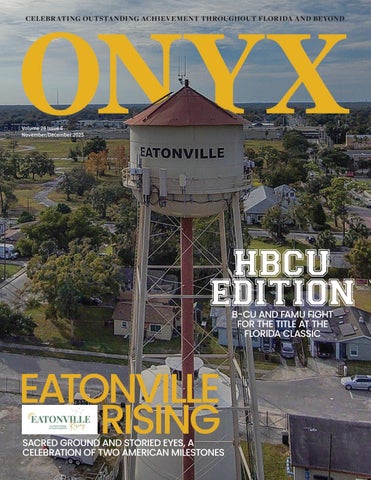
EATONVILLE RISING HBCU EDITION

B-CU AND FAMU FIGHT FOR THE TITLE AT THE FLORIDA CLASSIC

SACRED GROUND AND STORIED EYES, A CELEBRATION OF TWO AMERICAN MILESTONES

Dear Family

Welcome to this issue of ONYX Magazine. We are preparing to celebrate the most festive time of year. However, we thought we'd bring you an additional reason to celebrate this season: the preservation of history. In our cover story, Eatonville Rising is taking on the task of keeping a great Florida city pristine and on a national scale. We all know about its ties to t or Zor Ne e r to ot er e o re b t t e o o t o m c more e re to visit the city in 2026 just north of Orlando and learn about the secrets they are preparing to exclaim to the world. ONYX M e comm tte to e p t e ort

And now for some football! It is Bowl Game Season again! We all eagerly anticipate who will win the decades-long mashup known as The Florida Classic. This game is the epitome of fall sports for many of our readers. The Florida Classic is still the largest predominantly Black bowl games in the U.S. The clash between Florida A&M University (FAMU) and Bethune- Cookman University (B-CU) is one of Florida's favorite events of the year. The excitement begins. Do not miss the battle!

Also, in this Historically Black Colleges and Universities (HBCU) edition, we introduce you to some top student leaders at Florida's HBCUs. They are walking the talk on campus and preparing to give back to their communities upon graduation.

Finally, the holiday season brings families and friends together for heartwarming festivities. In these pages, you will e to mp p o r p ce o r er table, and save money.

ONYX Magazine is still celebrating 28 incredible years. Thank you for your continued support. As always, we remain committed to bringing you news that entertains, inspires and informs. Cheers to you and your family for a safe and happy holiday season and a Happy New Year.

Sincerely,

PUBLISHER/EDITOR-IN-CHIEF

Rich Black

MANAGING EDITOR

D. Shenell Reed, M.B.A.

ASSOCIATE EDITORS

Gayle Andrews

Penny Dickerson

Nancy Port Schwalb

CONTRIBUTING WRITERS

Dr. Kim Dawson, Paul A.O. Fernander, Lynda Hasberry, Ph.D., Michael Luchs, Angela Pittman-Leath, Jasmine Smith

CONTRIBUTING PHOTOGRAPHERS

Ronnie Garmon

Mary Maxwell

MAGAZINE DESIGN TEAM

Design2Pro

BUSINESS DEVELOPMENT DIRECTOR

Matt deJager

ADMINISTRATION

PRESIDENT AND CEO

Rich Black

VICE PRESIDENT OF STRATEGIC INITIATIVES

Nancy Port Schwalb

GRAPHIC DESIGNERS

Jon Burton

Damonic Robertson

ONYX ADVISORY COMMITTEE

Nancy Port Schwalb, Chair

Deidre Parker, Immediate Past Chair

Ricky Anderson

Dick Batchelor

Bob Berryhill

Dr. Lavon Bracy

Bryon Brooks

Sherri Brown

Marva Brown Johnson

Hon. Mable Butler

Yolanda Cash Jackson

Cynthia Chestnut, D.P.A.

John Crossman

Quibulah Graham

G r rt e

Barbara Hartley

Ann Jenkins

Eugene Jones

FOUNDERS

Lester and Lillian Seays ONYX

Connie Kinnard

Larry Lee, Jr.

Brenda March

Gail Thomas-DeWitt

Hon. Alan Williams

Carla Williams

Samuel Wright, Ed.D.

Paulette C. Fitzhugh Walker, Ed.D.

Paulette C. Walker, Ed.D., longtime faculty member at the University of South Florida, 25th national president of Delta Sigma Theta Sorority, Inc., and 2019 ONYX Magazine Women on the Move honoree, passed away on October 8. She was 77 years old.

Walker graduated from high school at age 16 and enrolled at Michigan State University, where she became a member of Delta Sigma Theta Sorority, Inc.—the largest Black Greek-letter sorority in the world. She earned a b c e or e ree m t em t c e c t o ec re ob t e r t Black woman systems analyst at Michigan Bell, a telephone company that ce bee c re b A

Soon after, Walker decided to transition her career to education. While pursuing a master’s degree in guidance and counseling at the University of Michigan, she taught math and science at Highland Park School District near Detroit. After earning her graduate degree, she became the school’s guidance counselor. Walker continued her studies at the University of Michigan, ultimately earning a doctor of education degree in administration and supervision.

In 1990, Walker began her long tenure with the University of South Florida as director of Undergraduate Programs and Internships in the College of Education, a position she held until her retirement in 2011. As a scholar, she studied curriculum and instruction, as well as administration and supervision issues in urban schools. Her research led her to co-author We Can Have Better Urban Schools (Caddo Gap Press, 2000), which embodied her e o p o or empo er comm t e t ro e t b e e c t o and leadership. During her retirement, Walker served as the 25th national president of Delta Sigma Theta, Inc., for four years.

Initiated through the Epsilon Epsilon Chapter at Michigan State Univert October er more t e ec e o er ce re ecte an unwavering devotion to Delta’s ideals of sisterhood, scholarship, service, and social action. A visionary and steadfast leader, she earned the admiration and respect of Sorors across generations for her wisdom, grace, and resolute commitment to uplifting others.

A proud native of Detroit, Mich., Walker dedicated her professional life to education. Before retiring from the University of South Florida, she served te c er co e or m tr tor er e ce e te e be o the academy—touching countless lives through service, mentorship, and civic engagement across numerous boards and organizations.

Walker’s guiding motto, “No one can make you feel inferior without your co e t e c p te t e co e ce co ct o e p re oter S e e co r e to reco e re t e r e t t t e world, and she lived this truth daily through her leadership, faith, and love for Delta.

Paulette Walker is a 2019 ONYX Magazine Women on the Move honoree.
Paulette Walker was a strong advocate for ONYX Magazine, speaking at the inaugural (2018) ONYX Magazine Business Connect in Tampa.

IEatonville Rising

SACRED GROUND AND STORIED EYES, A CELEBRATION OF TWO AMERICAN MILESTONES

o tr e m e ort o Or o o o e re mile town whose story reshaped American letters and still re e e t c t r er t e c o or comm t e and local economies. Eatonville, Fla., incorporated on August 15, 1887, it is the town which global literary icon Zora Neale Hurston

pop r e e r t ttempt b Ne roe Amer c or organized self-government” or in today’s parlance, “America’s old e t corpor te A r c Amer c to   It o er e er t o removed from enslavement, were determined to build a civic refuge where Black families could vote, own property, educate their children, and chart their future without oppression. That intentionality still echoes on its narrow streets, in its churches, elementary school, and where the Association to Preserve the Eatonville Community, Inc. (P.E.C.) has guarded the town’s history c t re or ec e

from the County’s schedule of road projects. During its years of advocacy, the P.E.C. recognized the need to create programming that would both entertain and inform the public about the life or o Zor Ne e r to bo t t e tor c c ce of her hometown; and about the cultural contributions which people of African ancestry had made to the United States and to the world. Thus, was born the award-winning, nationally, and increasingly, internationally recognized annual Zora Neale Hurston e t o t e Art m t e ZO A e t or e t or   today “America’s longest running arts and humanities festival celebrating the c t r co tr b t o o peop e o A r c ce tr t ro o t t e por

E pr te 50 c o pro t e t b e t e re t o Or e o t Go er me t ec o to ert e e o the existing two-lane roadway which would run down the community’s main street. Organizers recognized that such a “road improvement project” would e tro t e tor c c ce o t tor c A r c Amer c comm t

A ter te e e e r tr e t e E oc t o o E to e Maitland residents, along with its supporters in Orange County and beyond, ere cce t e e e ro mpro eme t pro ect remo e

All of this sets the stage for Eatonville Rising: Sacred Ground, Storied Eyes, organized by the Association to Preserve the Eatonville Community. Launching 202 c m t 202 t e e e t er e ce ebr te t o e milestones: the 140th anniversary of Eatonville’s incorporation and the 90th anniversary of Their Eyes Were Watching God, Zora Neale Hurston’s enduring masterpiece.

Funded in part with a $1.3 million grant by Orange County Government t ro t Art t r A r ro r m E to e tert e community, art, scholarship, and celebration, designed to draw travelers, scholars, students, and families from across the nation and the world into Eatonville’s story.

HERITAGE

The journey begins with the Sankofa Showdown (August 9 – 12, 2027), a national middle-school scholastic tournament designed to inspire middle c oo er r e to e p ore t e tor er t e c t re o peop e

o A r c ce tr t ro compet t e e c t o orm t Young competitors from across the country will gather in Orlando for the ro t tot o 50 000 c pr e be r e

In recognition of the August 15, 1887, Incorporation of the Town of Eatonville, “Contemporary Master” Hank Willis Thomas will unveil his commissioned work Especially for Eatonville on Saturday, August 15. His art, created exclusively for Eatonville Rising, will remain on view for the public until August 2028.

This same week, music takes the main stage with the Heritage Concert Series, taking place Friday, August 13, and Saturday, August 14. Over two eve-

nings, audiences can get ready for an unforgettable weekend of funk, soul, and R&B. Invited to perform on Friday are Earth, Wind & Fire, Kool & the Gang, and KC & the Sunshine Band, and invited to perform on Saturday are the smooth, sultry sounds of Erykah Badu, Jill Scott, and Boyz II Men. Two nights. Iconic artists. Pure magic. With a projected audience of 18,000, the concert will be a joyful tribute to Eatonville.

Then the scene shifts to a celebration of creativity in style and culinary artistry with the Pan African Fashion & Food Expo (August 19– 22), with days featuring a runway of global imagination, merging African and diasporic fashion, culinary arts, and entrepreneurship through designer showcases, chef-driven tastings, and industry panels.

Also, during this same time, the cultural heritage exploration continues with Welcome to Eatonville (August 21 – 22), a two-day “Eatonville immersion,” allowing visitors to experie ce o tor c E to e repre e t e e t e American story. Visitors will walk the same streets Zora once did and will be able to visit important “places and spaces” c t to t e o tor c t re E c e eme t of Welcome to Eatonville is designed to connect the past with the present, to show not only what Eatonville was, but what it continues to become.

Finally, from September 13 – 20, this celebration of milestones concludes with Sacred Ground and Storied Eyes: Celebrating Zora Neale Hurston’s World. This event combines an academic conference with engaging public programming to mark the 90th anniversary of the publication of Zora Neale Hurston’s literary masterpiece, Their Eyes Were Watching God. Scholars, artists, and cultural leaders will gather across Eatonville and Orange County to re ect o r to e ce terpret er e c t ro per orm ce e o o er or co t e to orm to or A re co rme to attend are respected academics such as Ibram Kendi, Nicole Hannah-Jones, and Nalo Hopkinson, as well as fantastic actor Delroy Lindo.

Undoubtedly, the bold vision of Eatonville Rising builds upon the extraordinary foundation established by P.E.C. with its annual event, the ZORA!® Festival Season, a cultural heritage tourism cornerstone for more than three decades.

Since its founding in 1990, the ZORA!® Festival Season has become one of the nation’s most respected celebrations of the history, heritage, and culture of people of African ancestry, bringing tens of thousands of visitors each year to Historic Eatonville and to the County of Orange. This cultural heritage tourism special event has proven, year after year, that Eatonville’s story resonates far beyond Florida, and that the arts and humanities combined with a strong sense of community pride can move audiences to travel from near and far and thereby provide an economic boost to a local tax base and anchor a community’s sense of pride.

What began as a tribute to Zora Neale Hurston, her historic hometown, and the cultural contributions of her people has evolved into a nationally and internationally recognized special event. The ZORA!® Festival Season has showcased the power of cultural heritage tourism to sustain communities while elevating Eatonville as both a symbol and center of African American achievement. That legacy of excellence, visibility, and community engagement ensures that Eatonville Rising is not starting from the ground up; it’s rising from o ro ort e b ec e o pro e b t to t r tor to thriving economic engine.

The Eatonville Rising event series is the next chapter in a story that began in 1887, when newly freed men and women dared to imagine a town of their own. Today, as visitors walk its streets, they don’t just see Eatonville; they feel it as a living symbol of self-determination and the enduring power of Black cultural heritage to inspire, educate, and transform.

“Eatonville Rising is a symbol of what cultural heritage tourism can mean for the People of Eatonville today and for our future generations,” says N. Y. Nathiri. “It’s our way of saying that the spirit which built this community in 1887 is alive and building today, through creativity, collaboration, and a shared belief that history is a living force which has the potential to provide ecoom c pro per t tr better t o e or o r Beloved Community.

AFebruary 2025 study by MMGY Travel Intelligence, presented in collaboration with the Black Travel Alliance and the National Coalition of Black Meeting Professionals, highlights the travel motivations, planning behaviors and spending patterns of U.S. Black travelers. In the report, Black travelers say that they are strongly inclined to choose destinations that celebrate Black culture, pport c o e b e e o er c t rally relevant experiences. Scoping out Black-owned ote e e per e ce re t e to meet these goals. Here are a few hotels owned by Black merchants and curated for Black travelers for your next family—or even solo—get away.

DUNNS-JOSEPHINE HOTEL — Where

Comfort Meets History and Charm - Miami

e o ep e ote e br o bo t e ote oc e o r t e r c multi-cultural history and surrounding communities. Its goal is to bring you an experience that will not only tap into your soul but by bringing history to life but tap into your senses through our incredible design style and tantalizing food choices. The Dunns-Josephine Hotel, a relic of Greater Miami & M m e c p t t to t e 2 t ce t r bringing the dynamic story of Historic Overtown to

TRAVEL

Black travelers want to support Black-owned businesses

the forefront. The hotel is located in the heart of Historic Overtown, once a prosperous Black neighborhood during segregation.

e 0 room O I ort tro rom Inkwell Beach, where Black families have bathed for generations. Co-owners Erik and Rhonda Albert purchased and relaunched the inn in the late 1990s and since then have cultivated a strong African American clientele. The penthouse reaches $1,600 per night during the peak-season months of July and August.

MOUNT NOIRE Your Place for Snow Joy –Mountains Nationwide

The of Mount Noire mission is to bring color to the mountains. They seek to increase diversity and representation in winter sports. Ultimately, they share our love for skiing & snowboarding and curate unforgettable, social & fuss-free experiences. They host regular ski & snowboarding trips and events.

SALAMANDER COLLECTION Extraordinary Experiences Await – Multi-national

Salamander Collection, founded by BET co-founder Sheila Johnson in 2005, is a privately-owned company that develops and manages luxury resorts. The company is known for properties like the Forbes Five-Star Salamander Resort & Spa in Middleburg, Va., and the Salamander Washington D.C. hotel. Its portfolio includes various luxury hotels and resorts in locations like the Caribbean, Tampa Bay, and Colorado.

c tr e er re tro e ce b tr p recommendations from friends or family, and 46% are part of Black travel groups, such as Black Travel Movement and Black Women Travels, organizations that empower, connect and support members as they select and experience destinations around the world. In terms of dollars, Black leisure travelers pack an increasingly powerful punch. They spent $145 billion on travel in 2023, according to the report, and expenditures are on the rise for the segment.

OAK BLUFFS INN The Center of It All –Martha’s Vinyard, Mass
Innisbrook, a Salamander Resort, is a large golf and spa resort in Palm Harbor, Fla., near the Gulf Coast. It features 72 holes of championship golf, including the Copperhead Course which hosts the PGA TOUR's Valspar Championship.
O I
Dunns-Josephine Hotel
Mount Noire team is Wenona Barnieh, Blessing Ekairia, Simisola Oke, Dee Omatade, and Tobi Adegboye.

FMU Royal Court

Mr. FMU Aiden Gainer

Miss. FMU Nikayla Troupe

Miss Senior Kristyn Lyles

M or ro

Miss Sophomore Nyejah Monroe

Miss Freshman Ciara Mills

Escorts: Randy Meran, Pheron Charlton, Antoine Garrison, Quinton Welch

Mr. & Miss. Homecoming

Paige Harston & David Buggs

Also pictured, President William Mc orm c ro o t c e e

CAMPUS ROYAL COURTS

HBCUs across Florida coronate queens and kings in beauty and splendor

FAMU Royal Court

Miss FAMU Edwina Fleuridor, Mister FAMU Miles Howard, King of Orange and Green Gucciany Toussaint, Queen of Orange and Green Tamia Williams, Miss Senior Sheridan Bates, Miss Junior Delya Harris, Miss Sophomore Deonna McKinzie, Miss Freshman Staci Turner, and Miss Graduate Chandler Gaskin. (Photo by Treyvon Eugene/FAMU)

Edward Waters University Royal Court

Mister Edward Waters University Donovan Gonsal, Miss Edward Waters University Kimberly Holland, King of 1866 Eric Bell, Queen of 1866 Lauryn Smith, Mister Senior Zaire Hoe, Miss Senior Toni Ann- Gordon, Mister Junior Nicholas Flowers, Miss Junior Jalyonna Warren, Miss Sophomore Layla Robertson, Mister Freshman Lajuan Coney Jr., Miss Freshman, Jazzmine Brooks.

HOMECOMING LEGACIES

Bethune-Cookman

University Royal Court

Miss. Freshman - Jayla Sanders

Miss. Sophomore - Shania Williams

Miss. Junior - Wumiya Calixte

Miss. Senior - Nicole Burton

Miss. Bethune-Cookman University - Kelshonti Harris

Mister Bethune-Cookman er t o Z

Mister Senior - Clevland Parker

Mister Junior - TayShoun Lawrence

Mister SophmoreTimothy Witherspoon

Mister Freshman - NyKing Curry

The Florida Blue Florida Classic Showdown

FAMU Head Football James Coach Colzie, III

B-CU Head Football Coach Raymond Woodie, Jr.

B-CU and FAMU Quarterbacks

Florida Embraces Black Presidents at its Colleges and Universities

Borrowing a line from William Ernest Henley’s Poem Invictus, “I am the Master of my fate, I am the captain of my soul.” The pursuit of Higher Education by African Americans has always been an important step toward achieving equality, independence, and prosperity. During slavery, educating African Americans across slave holding states was against the law. During Reconstruction, small Methodist Episcopal and African Methodist Episcopal churches began to serve as both church and school. Learning to read therefore became a symbol of freedom for African Americans in former slave-holding states. Literacy became a priority after slavery ended. Education became a priority. And higher education was a greater component of this success.

Many hoped that education would improve their economic circumstances. African American communities were formed and within these communities were college educated professionals, and business owners. Doctors, teachers, lawyers, and entrepreneurs were all found within these successful communities. These college-educated individuals were able to economically help their families and communities to thrive.

President Torey Alston

Broward College

Sworn in: February 2025

President Torey Alston is Broward College’s eighth president. He received both his undergraduate and graduate degree from Florida A&M University. Broward College serves more than 51,000 students. Its programs include two- and four-year degrees. As a Broward County native – A “preemie” born at Memorial Hospital, Mr. Alston's ties to the community are personal and vast. He is the son of parents who both attended state/community college—his mother served nearly 40 years as a social service case manager for Broward Health, and his late father, who graduated from what was then the Broward Community College Crimit ce I t t te er e e r 25 e r t t e ro r S er O ce

A pre e t e t e e e r e per e ce to empo er c t t alumni as college ambassadors, helping promote the College and sharing our many achievements to attract and retain the best and brightest as we work to make our College the number one destination for academic excellence. A to reco e mo ONYX M e Me o o or

O ce t e pr or t o er e c t o bee e t b e c oo and colleges were built, and then the next question, was the question of leadership. Who would lead these great institutions of higher education? These institutions of higher learning needed extraordinary leadership. In an article from highereddive.com, these are the seven key competencies for a college president: Trust-building, resilience, communication savvy, team building, emotional intelligence, courageous leadership, and data acumen and resource management.

e e oo rt er t t e re e rc re r t e c t o o er t co e e pre e t t e e re e more o t e ctions that stand out. A strong educational background, typically a doctorate, extensive higher education leadership experience, at least 10 years, tr c recor o cce tr te c p c m eme t and fundraising. These university and college presidents also need to have strong communication skills and a dynamic personality. Florida has eight Black college/university presidents.

President Dr. Ken Atwater

Hillsborough Community College

Sworn in: July 1, 2010

President Dr. Ken Atwater is Hillsborough Community College’s seventh president. Dr. Atwater earned his Bachelor of Science degree and Masters degree from Murray State University and his Ph.D. from Southern Illinois University. Hillsborough Community College is one of the largest state colleges in the Florida College System. It serves more t 000 t e t e c e r t o er more t 200 c em c options. Dr. Atwater is the former Chair of the Association of Community Colleges, Chair of the Foundation of the Tampa-Hillsborough Economic Development Corporation and serves on the Board of Directors of Zoo Tampa, Jameis Winston Dream Forever Foundation, Elevate Tampa Bay, Junior Achievement and Brad’s Beyond Ball Foundation. Dr. Atwater earned his Ph.D. from Southern Illinois University, and Master and Bachelor of Science degrees from Murray State University in Murray, Kentucky.

President Marva Johnson, J.D.

Florida A&M University

Sworn In: August 1, 2025

Marva Johnson is Florida A&M University’s thirteenth president. President Johnson earned her Juris Doctor from the Geor St te er sity College of Law. She also holds a Master of Business Administrat o rom Emor er t Go et e School and a Bachelor of Science in business m tr t o rom Geor eto er t President Johnson has served on the boards of several organizations that provide educational opportunities to youth, including the Florida rt Sc oo ce e ter or G r ere she serves as the Chair of the Board of Trustees. In a television interview, President Johnson said, that her mission is clear, “To preserve and protect the legacy of FAMU while advancing it toward new heights of excellence. Together, we will adapt strategically, align intentionally, and lead boldly.”

President

Dr.

Zachary Faison, Jr.

Edward Waters University

Sworn in: April 2018

President Zachary Faison, Jr., J.D., is Edward Waters University’s thirtieth president.

President Zachary Faison, Jr.’s higher education career includes professional experiences as a higher education executive administrator, educator, and attorney. President Dr. Zachary Faison, Jr. received his Bachelor of Arts in English from Albany State University, he received his juris doctorate from the University o Geor Sc oo o po t octor rom r r er t Gr te Sc oo o Education’s Institute for Educational Management. Edward Waters University this school year has seen its highest enrollment growth in the school’s history. Applications for the 2025 – 2026 academic year totaled more than 11,850, representing a 236% increase over Fall 2019. Edward Waters has also gained national attention for student outcomes. The incoming er r te c er e 2 0 G A represented 19 states and six countries.

HIGHER EDUCATION HIGHER EDUCATION

President William C. McCormick, Jr.

Florida Memorial University

Sworn in: August 2025

President William C. McCormick, Jr. is Florida Memorial University’s 15th president. President McCormick earned an MBA with a specialization in Healthcare Administration from Colorado Technical University. William C. McCormick, Jr., has been nationally recognized for his high standards and exceptional work in revenue cycle management. He has also served as Chairman of the Board of Trustees for Florida Memorial University. He is a dedicated philanthropist, committed to giving back to the community. He has served as Chairman of the Board of Trustees for Florida Memorial University and as the immediate past president of the Fort Lauderdale Branch NAA co tr b t o e e r e m numerous professional and community service awards, including the Florida Small Business of t e Ye r E trepre e r p A r t e NAA Civil Rights Award, and the Florida Memorial University Alumni Hall of Fame Award.

President Dr. Albert

Mosley

Bethune-Cookman University

Sworn In: July 7, 2025

Dr. Albert Mosley is Bethune-Cookman University’s eighth president. President Dr. Mosley is an experienced executive in higher educat o o pro t settings. Dr. Mosley earned degrees from M c p o e e e er t Y e er t t e er t o Geor re ident Dr. Mosley previously was president of Morningside University where he launched innovative academic programs in aviation, cybersecurity, animal science, AI applications, and supply chain management. Additionally, e ec re recor mber o e e re transformational gifts that bolstered the institution’s endowment. President Dr Mosley is a dedicated leader who has served in many distinguished national and international organizations and leadership roles.

President Ava Parker,

J.D.

Palm Beach State College

Sworn in: 2015

President Ava Parker t e r t om president in the history of Palm Beach State College’s history. President Parker earned her B.A. and J.D. degrees from the University of Florida. Her STEM background and visionary leadership has resulted in Palm Beach State College becoming a top institution for preparing students for STEM careers. Under Parker’s tenre S ope e t c mp mpro e student success rates, increased enrollment growth and expanded facilities for allied health and technology professions, with a newly constructed 83,500-square-foot Dental and Medical Sciences Technology Building that opened at the o tc ee Gro e c mp 2025 r er o t e c e rc tect o S m e c G r dens campus becoming the home of the world’s r t tec o port e tert me t e e co-founded by Tiger Woods and Rory McIlroy. r er reco e mo ONYX M e Women on the Move.

President Tonjua Williams, Ph.D. St. Petersburg College

Sworn in: July 3, 2017

President Dr. Tonjua Williams is St. Petersburg College’s seventh president. Williams earned her bachelor’s degrees in business administration and Humanities from Clearwater Christian College, her master’s degree in Counselor Education from the University of South Florida, and her Ph.D. in Higher Education Administration from Barry University. President Dr. William’s experience includes serving in almost every area of the college. St. Petersburg College serves more than 30,000 students each year in the Tampa Bay area and around the world. Under Dr. William’s leadership, a Promise Scholarship was launched in 2023. This scholarship expands access to education to students from high-poverty areas. In 2016, Dr. Williams was awarded the prestigious Aspen Presidential Fellowship for Community College Excellence, making her part of the inaugural class of the Aspen Presidential Fellows. Williams was recognized mo ONYX M e ome o t e Mo e

LIVING THE LEGACY

B-CU STANDS ON THE SHOULDERS OF A GIANT.

On October 3, 1904, an exceptional young Black woman, Mary McLeod Bethune, opened the Daytona Literary and Industrial Training School for Negro Girls—what would become et e oo m er t t 50 t Go e tt e girls, along with Dr. Bethune’s son, Albert.

r et e e t o to become t o ter t oure with a long list of notable accomplishments, including counseling US presidents, playing a role in the founding of the United Nations cre t e t A r c Amer c ome or t o She also helped found the United Negro College Fund, of which Bethune-Cookman was a charter member. The University was a crowning achievement in a storied career.

Through Dr. Bethune’s lifetime, the school underwent several stages of growth and development. In 1923 the school merged with Cookman Institute of Jacksonville, Florida, which had been founded 2 e oo m I t t te t e r t t t t o o er ecation of Blacks in the State of Florida. It was through the merger that t e c oo e t e pre t o Met o t t o

The merger of the two schools began in 1923 and was e 25 e mer e t t t o c e t e Daytona-Cookman Collegiate Institute. In 1931, the College became accredited by the Association of Colleges and Secondary Schools of the Southern States, as a junior college and on April 27 of that year, the school’s me o c c e to et e oo m oe e to re ect t e e er p o r et e

It was in 2007 that Bethune-Cookman achieved university status, having added a graduate program in transorm t o e er p to t o er

Over the years, Bethune-Cookman grew steadily, add-

ing academic programs and expanding its physical plant. Since 1943, Bethune-Cookman University (B-CU) has graduated more than 19,000 students. Alumni work in a wide r e o e c t e rt b e education, government, sciences and religion. B-CU has received national recognition for its intercollegiate athletic programs and instrumental and choral groups.

B-CU is known for its small-university community feel and its HBCU sensibility, for its strong academics and exceptional, personalized teaching, and for carrying forward the legacy of Dr. Bethune. That legacy includes a dedication to service and an undying commitment to building a vision for the future, then applying creativity, initiative and resilience to bring success both in college and in the world beyond.

Institutional Accolades & Rankings

• Accreditation: o t re rm t o of accreditation by the Southern Association of Colleges and Schools Commission on Colleges (SACSCOC) since 1947, with the e t re rm t o c e e or 20 0

• Programmatic Accreditations: Holds accreditations from the Accreditation Board for Engineering and Technology (ABET), National Association of Schools of Music (NASM), Accreditation Council for Business Schools and Programs (ACBSP), and others.

• U.S. News & World Report: Ranked among National Liberal Arts Colleges and noted for Top Performers on Social Mobility.

Alumni Association & Student Achievements

• Inclusive Excellence Award: The B-CU Alumni Association (B-CUAA) was the only historically-Black institution to receive the 2024 Insight into Diversity Magazine's Alumni Association Inclue E ce e ce A r or t er t c o e ort

• Student Film Recognition: I 202 e or rece e r t place and a $5,000 scholarship at the Real HBCU Film Festival for ort m

Athletic Excellence

• Football National Championships: e  c t football program has won two black college football national championships.

• MEAC Titles: The football team has also secured seven Mid-Eastern Athletic Conference (MEAC) championships.

Program of Merit

• Recognized as a Program of Merit (POM) by the Academy for Gerontology in Higher Education (AGHE).

Story courtesy of Bethune-Cookman University

President Albert Mosley, Ph.D.

STANDING TALL

FAMU continues to land among the top U.S. colleges/universities for academics.

Florida A&M University (FAMU) remains in the Top 100 among the more than 1,700 U.S. colleges and universities ranked in the 2026 Top Public Schools by U.S. News & World Report. The 2026 edition of the U.S. News Best Colleges rankings uses p to ctor to me re c em city and graduate success. In addition, FAMU remained the highest rated public Historically Black College or University (HBCU) and t mo pr te p b c

FAMU is one of three Florida schools that rank in the Top 25 on the U.S. News Social Mobility Index. Tied at No. 22 with institutions such as the University of California, Davis and the University at Albany - SUNY, FAMU continues to deliver strongly on its mission of advancing education for Pell-eligible stue t r re ect o o AM ability—as Florida’s only public HBCU— to propel the economic trajectory of graduates or r e c t e c o t oo o their families for generations to come.

“I am encouraged that Florida A&M University remains in the Top 100 in the U.S. Among the 17 metrics reviewed, we continue to make progress on our graduation rates, including our Pell Grant recipients,” said President Marva B. Johnson, J.D. “Our mission of helping students from various socio-economic backgrounds remains a pr or t c re ecte our position as the No. 1 public HBCU for the seventh consecutive year in a row.”

grams, and driving student success,” said Provost and Vice President of Academic A r A o t o e e rrm t t AM prep r rates not only to achieve social mobility, but to lead at the highest levels and solve the challenges of the future as we advance toward R1 status.”

President Johnson and her leadership team have identie ro t opport t e t t e c t mp ct o t e t c t t t e com e r beyond. As one of the 12 public universities in the nation’s top-ranked State University System, FAMU plays a critical role in ensuring the state of Florida continues to be number one in the country for higher education.

U.S. News publishes the Best Colleges rankings each year to provide prospective students and their families with the comparative merits of the undergraduate programs at America’s colleges and universit e e r o er et e information on the institutions and data on factors such as graduation rates, graduate indebtedness, and post-graduate earnings.

lege advice, and informed reporting to every student pursuing higher education.”

Prospective students can see how Florida A&M University compares to other institutions and how the rankings are calculated on USNews.com.

About Florida A&M University

“We remain steadfast in expanding access, strengthening our academic pro-

“U.S. News’ Best Colleges remains a reliable resource for prospective students and their families as they navigate the college selection process,” said LaMont Jones, Ed.D., managing editor for Education at U.S. News. “With over half of the ranking factors dedicated to student outcomes, the rankings and editorial content provide vital data, col-

Founded October 3, 1887, Florida Agricultural and Mechanical University (FAMU) is a public, historically Black university located in Tallahassee, Florida. What distinguishes FAMU from other universities is its legacy of pro cce to t or b e education with programs and services that guide students toward successfully achieving their dreams. FAMU is part of the State University System of Florida and is accredited by the Southern Association of Colleges and Schools Commission on Colleges. In addition to the main Tallahassee campus, FAMU has several satellite campuses across Florida. These include the College of Law in Orlando and the College of Pharmacy and Pharmaceutical Sciences, Institute of Public Health, which has sites in Crestview, Tampa, Jacksonville, and Miami.

EDWARD WATERS UNIVERSITY

FIRM FOUNDATION

EWU BEGINNINGS CHARTED THE SUCCESS OF ITS PRESENT, FUTURE.

Founded in 1866 by members of the African Methodist Episcopal (AME) Church, Edward Waters University (EWU) (formerly Edward Waters College t e t te o or r t epe e t t t t o o er e r or r t t t t o established to educate African Americans. It was founded by African Americans for African Americans.

In 1865, following the Civil War, the Reverend Charles H. Pearce, a presiding elder of the AME Church, was sent to Florida by Bishop Daniel Alexander Payne. Observing the fast-paced social and political changes of the Reconstruction Era, Rev. Pearce immediately recognized the need for an education ministry. No provision had yet been made for the public education of Florida’s newly emancipated African Americans. Assisted by the e ere m G Ste r t e r t AME p tor Florida, Pearce began raising funds to build a school.

Initially named Brown Theological Institute by Rev. William G. Steward in 1866, the institution’s name changed to Brown University in 1874. The school experienced c c t e orce to c o e or e r a decade. In 1883, the school reopened under the name East Florida Conference High School, and later, East FlorSc e t c t Sc oo er t e rection of the Rev. William Preston Ross.

lege as a four-year institution, and it today remains accredited by SACSCOC.

With a history rooted in the dark yet hopeful days of Reconstruction, today’s EWU is living, thriving proof of the power of education, and the resilience of focused, missionally established institutions. Under the persistent visionary leadership and direction of great bishops of the AME Church and 29 dedicated presidents, Edward Waters University was indeed “rebuilt.”

Within a decade, the educational program was extended and in 1892, the school’s name was changed to Edward Waters College in honor of the third bishop of the AME Church. Through the years, the school has withstood the test of time. In 1901, when the t o c o e e tro e b re E re ce to e However, in 1904, the Board of Trustees purchased the present site of the school on Kings Road with the imperative from Bishop M. B. Salter that the college should be rebuilt.

E r t ccre te or co e e 55 er reident William B. Stewart, and by 1960 the school restored its fouryear curriculum. In 1979, the Southern Association of Colleges and Schools Commission on Colleges (SACSCOC) accredited the col-

On July 16, 2018, the Edward Waters College Board of Trustees, unanimously elected A. Zachary Faison, Jr., J.D., as the 30th president of EWC. President Faison is a visionary higher education leader having set an audacious vision for EWU as an institution destined for Emerging Eminence. President Faison has led development and implementation of an exceptional strategic plan and agenda for the institution, titled Eminence 2025. Under the leadership of President Faison, the college has undergone a historic transformation, having been authorized in June 2021 by its accrediting body, the Southern Association of Colleges and Schools Commission on Colleges (SACSCOC), to progress from a baccalaureate to master’s level degree-granting institution. This designation enabled Edward Waters College to become E r ter er t E is a critical, milestone achievement by President A. Zachary o r o o t e er t r t pre e t c e e ect e o cer EO e r t o o re e t A Z c r o r t e r t president and CEO of Edward Waters University, is a historic milestone achievement in the history of this institution. With a distinguished higher education lineage spanning over 155 years, EWU is primed to continue its Emerging Eminence as a premier urban, pr te r t tor c c ber rt er t o er t c em c pro r m

Story courtesy of Edward Waters University

Centennial Hall at EWU – photo by George Lansing Taylor Jr.
President A. Zachary Faison, Jr., J.D.

“IT’S OUR TIME”

FMU 2025 homecoming was the impetus to greater things ahead.

This year’s homecoming wasn’t just a celebration of our past; it was a week of events where Lions, alumni, and friends came together to make history. Students described homecoming as family-friendly and welcoming for new Lions. Under new leadership and with record-breaking student and alumni participation, FMU proved that history isn’t just remembered here, it’s created. As President William McCormick stated, “Each event brought value to the theme ‘It’s Our Time’.”

Faith and Fellowship

The week began with an uplifting afternoon of praise and worship that motivated students and reminded them of the inspirational alumni who still support us today. At the Homecoming Hallelujah, FMU alumnus Susie Austin, C. Vernon Martin, Rev. LaTousha e e r c e r t rece e r for their ministry work in the community. Dr. Jamila Jackson’s encouraging sermon set the tone for the ee t e room t e er t t cre te t e perfect start to Homecoming 2025. The excitement continued the next day at the Homecoming Kickoff, ere c o r p rt c p te t e r t o c tt e of the Classes. They competed in math competitions, games, and various races.

Culture and Community

This year’s events also celebrated culture, diversity, and community as Lions from all backgrounds teppe o t to embr ce t e r ere ce t t e International Festival on October 14th. The event, e t oo m c e t e t t e chance to connect, try cuisines from around the world, and appreciate the beauty in each other’s

traditions. As alumnus Christian Edgerson expressed, this year’s e e t re ecte t e ro t o t e community through Black culture, soul food, and Lions being brought together as one. Inspired by that sense of unity, Mister Campus Ministry Kheron Duprat suggests more events celebrating diversity and heritage for future homecomings.

Pride and Performance

On the night of October 17, the action-packed concert and step show began, featuring artists Big Boogie and YK Niece. Freshmen students were particularly excited about their introduction to the various Greek and t e t or t o o c mp o e t e Wellness Center to cheer on the student organizations as they strolled, danced, and represented their groups with pride.

Packed with students, alumni, family, and friends, the tailgate and football game on Saturday, October 18, stood out as the week’s liveliest event. Our Lions faced the Royals of Warner University at Betty T. Ferguson Stadium. They came into the game well prepared after weeks of practice, demonstrating the team’s dedication to a strong performance. This preparation was evident when they started t e me o tro t 2 to c o t e r t rter e o m t e t e r e o the game with a score of 49-21. During halftime, the Roar Marching Band, Fierce Flag Corp, and the o E e ce cer t t e e per orm to the band’s version of popular songs from artists like Luther Vandross.

Following the game, alumni, students, and family made their way to the presidential after-tailgate celebration, where more music, strolling, community, and fun awaited. Homecoming 2025 ended with a dominating football win, lasting memories for all who participated, and remarkable growth of support and community. Miss Pre-Alumni Council, Faythe Ginn, acknowledged the school’s development, explaining that this year’s homecoming was proof of our growing community since involvement among Lions and peers has increased compared to previous years.

Story courtesy of Florida Memorial University

VISION

As South Florida’s HBCU (Historically Black College and University), Florida Memorial University will be a premiere urban-serving liberal arts educational institution preparing the next generation of global leaders.

VALUES

• CHARACTER:

Embodying the values of fairness, transparency, compassion, respect, integrity, honesty, respect for diversity, and comm tme t to e t everything we undertake.

• LEADERSHIP:

Cultivating the drive to initiate and sustain change for the good of our campus, our community, and the world.

• ACCOUNTABILITY:

Taking responsibility for our actions, collectively as well as individually, and delivering products and services that are of high-caliber and responsive to the needs of our community members.

• SCHOLARSHIP:

Promoting excellence in teaching and learning through t e e t c t o rete t o o t c t t tdents, who are all engaged in vigorous intellectual exchange p rt o t competitive educational programs.

• SERVICE:

Sharing our academic and human capital as social, educational, and economic resources for the betterment of our campus and our community.

President William C. McCormick, Jr.

Funding a Great Mission

Philanthropist’s gift will help boost UNCF’s campaign to help students.

UNCF (United Negro College Fund) announced that it has received a landmark gift of $70 million from philanthropist MacKenzie Scott that will be used to support its bold $1 billion capital campaign. The $70 million gift will be invested in the UNCF Members Pooled Endowment Fund, an initiative designed to tre t e t e o term c e t o all 37 private UNCF member HBCUs.

“This extraordinary gift is a powerful ote o co e ce t e work of UNCF,” said Dr. Michael L. Lomax, president and CEO, UNCF. “It provides a once-in-a-generation opportunity for our member institutions to build permanent assets that will support students and campuses for decades to come.”

Launched in 2021, UNCF’s $1 billion Capital Campaign is a major philanthropic e ort e e to e e te t e ort o re c e ect e e to provide HBCUs with the resources they need to succeed in their critical work. This ambitious, comprehensive vision consists of mutually reinforcing pillars of transformation that, together, create a virtuous cycle of social mobility in underrepresented communities, increase the impact of HBCUs, draw more funding and students to these institutions, and enrich the tapestry of our country.

t t te t t N ocantly closer to its goal of raising $370 milo pec c or t e poo e e o me t a critical component of the broader $1 billion campaign. Each of UNCF’s 37 private member HBCUs will receive a $5 million stake from this initiative. UNCF will then work with each institution to raise an additional $5 million in matching funds, creating a $10 million stake per institution. These pooled funds will be managed in perpetuity and will make annual distributions at a 4% payout rate, pro o term c t b t or t e campuses and their students.

The impact will be substantial: the median endowment of UNCF member schools would rise from $15.9 million to $25.9 million—a 63% increase. This $10 million stake per c oo co e e t t o e compared to the stark gap between HBCU and non-HBCU endowments, where HBCUs trail by at least 70%.

Dr. Marc A. Barnes, senior vice president for the capital campaign, will work closely with the member institutions as they launch their matching campaigns to fully leverage this transformational gift.

“This gift allows us to demonstrate the power of collective investment in our institutions,” said Milton H. Jones, Jr., chair of the UNCF Board. “At the same time, we m t t e or o t c mp e still need to raise $100 million in scholarship endowments, $80 million to increase UNCF’s operating endowment, and $100 million to advance technology across our membership. o et er t e e e ort b t e permnent capacity our institutions need to thrive.”

“Today is an historic day for UNCF and our member institutions, added Dr. George

T. French, Jr., Clark Atlanta University President and Chair of UNCF’s Institutional Members. “The pooled endowment fund is a bold idea whose time has come. Today’s gift means that our institutions will see a transformative impact on their endowments, resources that are desperately needed. e o me t re c t m er than those of predominately white institutions (PWIs), so this infusion of permanent capital will be game-changing for our schools and our students.”

This gift also builds on Scott’s previous generosity to UNCF: in 2020, she contributed $10 million to bolster the UNCF emergency reserve fund. Today’s $70 million contribution is seven times that investment, bringing her total giving to UNCF to $80 million.

“We are deeply grateful for MacKenzie Scott’s continued support. By entrusting UNCF to decide how best to use these e rm t t mer t e tment at this scale and her generosity will strengthen our member institutions and provide pathways to success for tomorrow’s changemakers,” stated Dr. Lomax.

Dr. Michael Lomax
Mackenzie Scott

GET

READY HOLIDAY AND GIFT

A CHECKLIST TO PREPARE FOR THE SEASON

If prepping for the holidays has you feeling overwhelmed, use this checklist to ensure your home is guest-ready, your thoughtful gifts are wrapped early and your celebrations are festive and worry-free.

Clean, Declutter and Restock Ahead of Guests’ Arrival

To guarantee your home is ready for everything the holiday season can throw at it, start with a thorough cleaning. Focus on tr c re e t e room tc e and guest bathrooms. Don’t forget the bedrooms if you’ll have company staying over during the holidays.

Declutter your living spaces to make room for holiday decor and create extra space for guests to move around comfortably. Make room in the refrigerator and restock essentials such as snacks, beverages and toiletries, and set out towels and bedding for overnight guests. Whether or not you’re hosting guests, having a clean home during holiday chaos can help bring peace of mind.

Get Gift Ready to Avoid the Rush

Planning your list in advance can help you o t e t m te r to t o t elevated gifts for friends and family members. Perfectly gift-ready, Air Wick Essential Mist is an easy, thoughtful holiday surprise for anyone on your list. Featuring a range of

r r ce port b e e t e ort e transforms any space into one that feels more elevated, inviting and holiday-ready. t t o t ce t e ort e et p t or b e pre e t t t e er a multi-sensory experience.

Stress Less with Smart Boundaries

The holidays often bring packed calenr e e to o e c pressures, but setting boundaries can help you prevent burnout. Create a realisitic budget and stick to it, opting for thoughtful yet or b e t o t be r to e e te tasks, whether that’s asking family members to bring an extra dish to dinner or letting kids help wrap presents. Just as important, block o e e e e o c comm t to no obligations, giving yourself time to rest and recharge. By setting limits on your time, spending and energy, you’ll be able to enjoy the moments that matter most.

Wrap Presents as You Go to Stay Ahead

Wrapping presents as you purchase them can help avoid the stress of last-minute giftwrapping, not only saving time but also allowing you to be more creative with your wrapping style. Keep supplies such as paper, ribbons and tags on hand in an easily acces-

sible location so your gifts are gift ready the moment you bring them home.

Set the Mood with Music and Lighting

Create a warm and inviting ambiance with the right music and lighting. Whether it’s a lively gathering or a quiet family dinner, playing holiday music can get everyone into the festive spirit. Soft, warm lighting from lanterns or seasonal string lights, along with holiday fragrances, can create a relaxing environment that makes everyone feel welcome.

Keep Host Gifts On Hand to Be Party Ready

Be prepared for any last-minute invitations by keeping a few host gifts on hand. While 66% of candle purchasers consider candles an appropriate gift for hosts or dinner parties, according to the National Candle Association, 1 in 3 recipients say they’re likely to regift candles because they received a scent they don’t even like. With Air Wick Essential Mist, there’s no such risk – its wide range of fragrances makes it a ready-for-anything gift that can be easily tailored to the recipient’s pre ere ce t e er o o c o o r pprec t o e ort e without the stress of last-minute shopping.

Find more information about gift-ready fragrances at airwick.us.

Photo courtesy of Shutterstock

HOW TO HONOR LOVED ONES’ MEMORIES During the Holidays

GUIDANCE AND RESOURCES TO SUPPORT FAMILIES NAVIGATING GRIEF DURING THE HOLIDAY SEASON

The holiday season can be a time of joy and connection, but it can also bring intense feelings of loss and sadness for those grieving the death of a loved one.

To help families honor memories while caring for their emotional well-being, the National Funeral Directors Association

N A reco e t e e challenges of this season and o er t e e re o rce t p

Embrace Your Feelings

Gr e e to e c per o and emotions during the holidays can vary widely – from sadness and longing to moments of joy and peace. Give yourself permission to feel whatever arises without judgment. Allow space or te r or et re ect o remember t O to e per e ce mixed emotions. Acknowledging your feelings honestly can help you move through the season with greater self-compassion.

Create New Traditions

Set Boundaries to Protect Your Well-Being

It’s important to do what feels right for you, even if that means saying no to events or stepping away from overwhelming situations. Setting limits helps protect your emotional health and allows you to navigate the holidays at your own pace.

“As funeral directors, we often remind families that caring for yourself is just as important as honoring your loved one,” said Dr. Camelia Clarke, owner and licensed funeral director at Paradise Memorial. “Setting boundare t e t ct o comp o t t o o to tr be present in the moments that matter most.”

Communicate honestly with loved ones about your needs as they will likely appreciate your openness.

Prioritize Self-Care

While old holiday traditions often hold treasured memories, creating new rituals can help you honor your loved one in a personal way.

“Keep as many traditions as you can keep, but we always encourage families to create a new tradition to remember that loved one who’s been lost,” said Tim Schramm, owner of Howe-Peterson Funeral Homes.

Lighting a candle in their memory, sharing stories that celebrate their life or setting up a special display of photos or keepsakes are m ct t t c br com ort Some peop e me donating to a charity in their honor or volunteering together with family or friends to celebrate the spirit of giving.

Lean on Your Support System

tr te peop e ro o c o er o ce et er through family gatherings, friends, support groups or counseling, reaching out helps bridge feelings of loneliness. Being with others who understand your grief or sharing your memories can provide reassurance and companionship during times that might feel isolating.

Grief can be emotionally and physically tiring, especially around the o e c re o o r e t ro e te re t com ort me e obb or b o r e t S mp e mfulness practices, such as journaling or breathing exercises, can also help manage stress and bring moments of calm.

Remember with Compassion

Honoring your loved one’s memory is a personal journey. You might choose to share stories, write letters, observe moments of silence or engage in creative expressions like art or music. Embracing these acts with kindness and patience fosters healing and helps keep their spirit alive.

The holiday season often brings both challenges and opportunities for healing. By embracing your emotions, leaning on support, creating meaningful rituals, and caring for yourself, you can honor your loved ones in ways that feel right for you. Remember, you don’t have to face this time alone. Resources like journey cards from RememberingALife.com and other ways to keep memories alive are available to provide guidance and comfort as needed.

Find a Job That Will Help You Come Home Peaceful and Happy

For some people, job dissatisfaction is the result of a crummy boss or stifling work environment. For others, the problem lies much deeper; it’s a need to reevaluate your career path and find a more suitable fit.

If you’re considering a career change but not sure which direction you’re headed, consider these words of wisdom:

Do Some Self-Reflecting. Take time to give your current work situation a thorough analysis. Determine which elements you enjoy, what rubs you the wrong way and what you’d change if you could. Think about practical solutions to the problems you identify whether it’s changing to a different role in the same field or exploring a new industry entirely. Avoid the temptation to focus on the negative. Rather, take plenty of time to consider the positive aspects of your current job, since that insight can help inform your next step. For exam -

ple, if you enjoy the limited contact you have with customers, a job with more customer-facing interaction might not be a good fit.

Ask For Input. Sometimes loved ones hold the key to a happier career path because they can point out details you don’t recognize. They might recall a time when you were most relaxed and happy, or they might point out talents or skills you take for granted. Often, these natural abilities are an excellent foundation for a career because you’re well-equipped to be successful.

Consider Your Personal Interests. Keeping your personal life and professional life separate isn’t necessarily a bad idea but finding a way to merge the two can be useful. This is especially true if you’re able to combine training or skills with something you’re passionate about. For example, if you’re an avid outdoorsman, you might find great satisfaction in applying your business

management background to work for a company that specializes in camping gear.

Understand What Motivates You. Landing in the right job isn’t just about having the right qualifications for a position that interests you. At the end of the day, you’ll feel most content when your job offers meaningful rewards. Motivators can be financial, or they might have more to do with the ability to learn and grow. Some people are willing to sacrifice a bigger paycheck to know they’re making a meaningful contribution in a field they care about. Knowing what outcomes resonate best can help you find a more rewarding career.

Do Your Research. Look into the field you’re considering so you have a better sense of growth, job availability, needs, compensation and more. If you don’t have the qualifications, what do you need to get the job you want?

AC3 Solutions

BUILDING CONFIDENCE AND COMMERCE FOR FLORIDA’S UNDERSERVED ENTREPRENEURS

ment tools and community partnership to Main Street.

Across Florida, small businesses are the heartbeat of their communities. From family restaurants and barbershops to o pro t e bor oo ret er these entrepreneurs bring life, culture, and opportunity to every corner of the state. Yet for many, the cost and complexity of managing payments can make growth feel out of reach.

That’s where C3 Solutions, a Florida-based, Black-owned merchant services provider, steps in. Founded by Jevin D. Hodge and James Wilhelm, C3 Solutions is

re e t pport oo e or M Street comb or b e tec o o with a mission rooted in empowerment.

“Our goal is simple,” says CEO Jevin D. Hodge. “We want to help business owners keep more of what they earn and stand taller, grow faster, and serve their communities.”

Built on the pillars of Community, Commerce o e ce So t o o er low- and no-cost payment processing, robust business-management software, and hands-on guidance that meets owners where they are. From point-of-sale systems and employee tools to marketing support, the company helps owners operate smarter, not harder.

As one of the only Black-owned merchant services providers in the U.S., C3 Solutions brings representation and purpose to an industry that has long overlooked small, m or t o e o pro t b e e Partnering with First Nationwide Payments, the Orlando-based company delivers enterprise-level reliability with a local touch.

“Every dollar that stays in a neighborhood helps another business open its doors,” adds Chairman James Wilhelm. “We’re not just processing payments—we’re building co e ce comm t e t

Learn more or partner with C3 Solutions at www.C3Solutions.us and follow @C3SolutionsUS to join the movement empowering Florida’s entrepreneurs.

Practical Gifts That Inspire Creativity and Confidence

Holiday gifting shouldn’t mean giving objects that sit in the corner and gather dust. Consider these gift ideas that will inspire ro t e r cre t t co e ce c actually get used:

Musical Possibilities: Open the door to a world of creative possibilities for your gift recipient with the CT-S1-76 keyboard from Casio, which is designed for anyone who’s ready to spread their musical wings. Its 13-watt bass-ported stereo speaker system delivers punch and clarity at all volme b t t c o be p e et with a good set of headphones. With 76 full-size keys with touch response and more than 60 tones, including stereo grand piano, it’s a versatile, customizable instrument, and one built to accommodate many types of use.

Handwritten Inspiration: Whether your gift recipient is a poet, lyricist, doodler or big thinker, a digital notebook is a must-have for gett cre t e ce o t too or t e or p ce c room or o t e o comb e t e t be e t o be b e to save, organize and search for one’s work, with the distraction-free experience of writing on paper by hand.

Mathematical Fun: Students and recreational math enthusit e o be rme t t e be t c e t c c c tor to pport their studies. The fx-991CW ClassWiz from Casio comes with a e r p e r e p o t t er c e t e r cursor while writing and modifying expressions. With the ability to store and recall up to nine variables, which can contain integers, computations and functions, and to recall variables between sessions, the ClassWiz is a powerful learning tool. All of its functions can be accessed through the Math Catalog, which hosts 47 scie t c co t t 0 me reme t conversions.

Fitness That Keeps On Giving: For t e t e e t t o r e or someone who aspires to be, consider a subscription box aimed at supporting them on their athletic journey. Some subscriptions are categorized by sport to appeal to yogis, hikers, weightlifters, marathoners and more, and others are tailored by type of product, such as apparel, healthy snacks or recovery gear. With so many options to choose from, you’ll be re to b cr pt o t t p re o r t r e or m member.

HOLIDAY SAFETY

BE ALERT TO SCAMMERS WHILE TRAVELING FOR THIS SEASON.

Holiday season travelers are a key target for scammers, and criminals are looking to cash in on you being distracted.

Visa has observed an uptick in 2025 of sophisticated, travel-related scams where well-known travel providers are convincingly impersonated, and, according to a McAfee Travel Report, one e Amer c e ct m to tr e c m

Art c te e ce m e t e er to be pe b e ebsites, calls, email and texts. Even just ordering car service can open you up to being scammed by impersonators that may contact you directly through an otherwise trusted app.

Maintaining vigilance is the best way to avoid trouble while traveling, but here are some additional preventative measures you can take:

• Apply Scrutiny. Be suspicious of anyone emailing, calling, messaging or approaching you in person, possibly in a company uniform, claiming to need your personal information.

• Take Control. Keep your personal information, payment cards and devices with you under your control.

• Verify Contact. Before responding to an email, call, text or voice message, disconnect and research contact information to verify legitimacy.

•Look for Tampering. Be leery of QR codes that appear to be e b t c er A o tc or mm e ce o gas pumps by jiggling them. If there is any movement, don’t insert your card.

•Check Websites. If you scan a QR code, a web link will appear. Review it carefully for anomalies and type in a legitimate website address rather than clicking the link.

•Charge Cautiously. Use your own charging adapter and cable instead of public USB ports.

•Secure Devices. eep etoot t r e o o all devices – even smart luggage – when not in use. When using the internet, opt to connect through data roaming rather than public Wi-Fi and use a VPN whenever possible.

HERE ARE SCAMS TO WATCH FOR WHILE TRAVELING:

• Fake QR Codes. Scammers will replace real QR codes with fake ones to redirect your phone to a malicious website.

•Juice Jacking. If you plug a phone or laptop into a public charging station, hackers can potentially compromise the outlet to transfer malware to or steal data from a connected device.

• Hacked Luggage. Smart luggage with built-in USB chargers, GPS tracking and digital locks can be hacked. Scammers can locate your bags and unlock them remotely.

•Wait to Post. Don’t post your travel photos showing you are away from home until you return.

For more information on best practices to help prevent fraud, visit PNC’s Security and Privacy Center.

By taking the necessary precautions, you can help protect yourself and make the festive season a time of good cheer rather than crisis.

TECHNOLOGY

Cyber-Savvy Need Apply

The need for cybersecurity professionals has never been greater. In the U.S. alone, cyberattacks may cost the American economy over $1 trillion and ob 0 5 tr o 2025 e re e c of ransomware cyberattacks are also predicted to increase, with one happening every two seconds by 2031.

Cybercriminals are savvy, but the lack of t e t t e c ber ec r t e or eing the situation. Globally, industry experts c c te t t e r e m o t o cyber defense professionals are needed, according to the 2024 ISC2 Cybersecurity Workforce Study.

But what's behind this e c t c ber ec r t tent? There aren't enough peop e o to t e e M po t o o e because companies overlook the importance of entry-level positions.

Restricted Access: The Lack of Entry Points for New Talent

vice president and chief information ec r t o cer t e r er t Not only will this hinder workforce readiness, but this industry practice will deepen the cybersecurity risk across the board."

Educating and Hiring the Next Generation of Cyber Leaders

To strengthen their future defenses, organizations can rethink their hiring practices. In addition to hiring entry- and junior-level t e t tr e er c to

Some

schools are working to solve the cybersecurity skills gap.

by Cloud Range, a leading provider of cyber range training as a service, the platform o er re t c mmer e m t o t t mimic real-world cyber threats. Students can practice and master analytics, investigation, repulsion, remediation and other c ber ec r t tec e

"Cybersecurity attacks are becoming more complex and hitting faster than ever before," added Shantanu Bose, Ph.D., DeVry University's provost and chief academic o cer e r t eor t e o O r curriculum is built on experiential learning, so graduates are job-ready by graduation and ready to take on professional cybersecurity roles."

Despite rising demand for cybersecurity professionals, early-career talent continues to be shut out. The ISC2 report found that almost a third (31%) of surveyed organizations have no entry-level (0-1 year of experience) cybersecurity professionals and 15% have no junior-level (1-3 years of experience) personnel.

There's plenty of entry-level and juniorlevel talent. However, industry leaders re re e r o e per e ce or e tr e e roles. In fact, the study reports that 62% of teams had open roles, but hiring managers ere oc e o o m e e to advanced roles.

"If industry leaders continue to restrict entry-level opportunities, the talent shortage will only get worse," said Fred Kwong,

collaborate with universities to nurture the next generation of cybersecurity professionals.

For example, DeVry University's Cyberec r t e ter o E ce e ce o er rob t cybersecurity programs built on skillsbased, hands-on learning models and realworld exposure. By partnering with industry leaders, the university has designed a curriculum that aims to help close the skills p b e pp e r c reer pro e oals with the knowledge needed to thrive in today's rapidly evolving cyber landscape. In these programs, students don't just learn about cybersecurity, they get to practice it. Last year, DeVry launched a cutting-edge cyber range platform. Powered

As cyber threats escalate in scale and sophistication, the responsibility to close the talent gap cannot rest solely on the shoulders of industry leaders. Higher education institutions must continue to take an active role in preparing the next generation of cybersecurity professionals by aligning academic programs with real-world demands.

Through hands-on training, strategic partnerships with employers and a focus on experiential learning, colleges and universities can ensure that learners are not only educated but fully e ppe to e ter t e or orce r the gap between education and employment is no longer optional - it's essential to building a resilient, future-ready cybersecurity workforce.

"Ultimately, securing the future depends on empowering and supporting the people who will shape it," noted Bose.

To learn more about how DeVry is e pp p r c ber pro e o co er t c ber ec r t pro r m o erings, visit DeVry's Cybersecurity Center of Excellence.

THE WOMEN OF NCNW: FASHIONED FOR PURPOSE

When the women of NCNW gather, we do more than arrive—we embody a living legacy. Our fashion has never been about vant t re ecte e t t t p rpo e rom Dr. Mary McLeod-Bethune’s timeless grace and Dr. Dorothy Height’s iconic hats to the classic elegance of Rev. Shavon Arline-Bradley and Dr. Lois Keith, the women of NCNW have always worn their strength with style. Our attire speaks a universal message: We are women of strength, grace, and vision.

Every hat, brooch, glove, and strand of pearls tells a story of women who knew that appearance could be a form of advocacy. They dressed not merely to impress, but to express—to declare, “I am here, I am proud, and I belong in every room where decisions are made.”

The garments of our sisters of the past, often handcrafted or passed down through generations, carry the threads of resilience and love. The colors we wear still embody that spirit—unity in our whites, courage in our reds, wisdom in our blues, sophistication in black, and royalty in our purple.

We honor our foremothers by showing up in excellence — polished, poised, and unapologetic. Our fashion remains both armor and art, a re ect o o o r be e t t be t p rpo e

The NCNW woman doesn’t just follow history — she defines it.

MEN OF HONOR recognizes

high achievers

ONYX MAGAZINE HIGHLIGHTED ORDINARY MEN DOING EXTRAORDINARY WORK IN FLORIDA AND BEYOND AT THE 6TH ANNUAL EVENT.

ONYX Magazine, Founding Partner Orlando Health and Presenting Sponsor McCoy Federal Credit Union held the sixth annual ONYX Magazine Men of Honor (MOH), a black-tie celebration of 23 leaders noted for their contributions throughout Florida and beyond. The event highlighted these stalwarts for their achievements in myriad professions and community service. Since 2019, ONYX Magazine has applauded more than 100 such men, dubbing them "The Tallest Trees in the Forest."

"It is important to highlight ordinary men doing extraordinary work in their respective disciplines and their communities, and we

could not make such a bold presentation without the support of six-year Founding Parter Or o e t e e r re e t Sponsor, McCoy Federal Credit Union," shared ONYX Magazine Publisher and Editor-in-Chief Rich Black. "Further, as a trusted media outlet, we have a responsibility to pay it forward. I be e e e o o b or o peop e an opportunity to meet trailblazers as they all share stories of their struggle and triumph."

With that, ONYX Magazine designed a e pr te e e t to co ect c rre t aspiring leaders. Through generous donations from Orlando Health, The Jason Dion Giving Fund, and JW Marriott, the ONYX Founda-

tion, LLC, presented scholarships to eight deserving young men destined to attend co e e obt tr e cert c t o or e r professional licensing. The scholars and leaders networked before the dinner to discover common interests and explore mentorship and other engagement opportunities.

Headlining this year’s event was Man of the Year His Grace, Bishop Neil C. Ellis of Nassau Bahamas. He is the founding visionary of Mount Tabor Church in Nassau, and Global United Fellowship (GUF), a worldwide ecclesiastical body spanning over 40 countries and 1,400+ churches. Under his leadership, GUF became a global force for spiritual transfor-

Lady Patrice Ellis gifts Publisher Rich Black with a painting.
Chair Monica Riley, Rich Black, International Impact Leader Tunde Banjoko, Honorary Chair Mayor Jerry Demings, Founding Partner Orlando Health Quibulah Graham, Bahamian Ambassador Wendall Jones. Man of the Year, Bishop Ellis.

mation and generational change. Beyond the pulpit, Bishop Ellis is a respected business leader, mentor to entrepreneurs, and advisor to po t c re ort e 500 EO

His unmistakable preaching style has echoed across the United States, the Caribbean, Africa, Israel, Greece, and Europe— earning him numerous honors, including the Commander of the Order of St. Michael and St. George (CMG) from Queen Elizabeth II, the Trumpet Award for Spiritual Enlightenment, and induction into the International Civil Rights Walk of Fame as its youngest living honoree. His song Don’t Do It Without Me also earned a Dove Award nomination in 2010.

A stunning success, the sixth annual Men of Honor was held on Saturday, September 27, 2025, at the Rosen Centre Hotel, located at 9840 International Drive, Orlando, Fla., starting with a reception at 5:00 p.m., followed by the formal dinner and awards ceremony at 6:00 p.m. The night opened with a stunning performance by Afrobeat entertainer, Oba Ogunlano, the "King of Orisa Beat Music"; and will feature music by Smooth Jazz artist NapoSax; and Darrell Moody Ocean Breeze Smooth Jazz throughout the evening.

Hosts of this awesome event and networking opportunity were award-winning news and television personalities: Emcee Curtis McCloud, anchor and investigative reporter at Spectrum

Black,

13; Honoree Presenter Daralene Jones, a multiEmmy Award-winning journalist at Orlando’s WFTV, 9; and Red-Carpet Host Julie Gargotta, anchor and reporter at Spectrum 13. Serving in MOH leadership are Honorary Chair Jerry Demings, the mayor of Orange County; Honorary Chairs Alvin Cowans, the president of McCoy Federal Credit Union, M c e erm t e c e m r et ocer at Akylade, and Tony Jenkins, the Central Florida market president at Florida Blue; Event Chair Monica Riley, the president of C&M Riley, Inc.; and Event Co-Chair Nancy Schwalb, the president and CEO of Schwalb Public Relations.

Sponsors Alvin Cowans (McCoy Federal Credit Union); Sonia Pratt (Bahamasair); Quibulah Graham (Orlando Health); Angela Burgin (Walt Disney World).
Entrepreneur Linda Braynan, ONYX Foundation Board, center, and MOH scholars.
Sponsor Jason Dion of Akylade with Rich Black.
Black and Demings with RIch Black Vanguard Award Honoree Joe Jones.
RIley, Black, Demings, and Graham with Publisher's Award Honoree Santiago Corrada.
Black and Community Game Changer Award Honoree Michael Laderman.
Former U.S. Rep David Jolly and wife, Laura Donahoe.
Riley,
Demings and Graham with Man of the Year His Grace, Bishop Neil C. Ellis.

SCHOOL SCHOOL

A NEW FUTURE FOR TOMORROW’S LEADERS

Orlando Commissioner Bakari Burns, Mayor Buddy Dyer, ormer Commissioner Regina Hill, Dr. Porter-Smith and others break ground on the new facility 2022

LEGENDS ACADEMY CHARTER SCHOOL BREAKS GROUND ON $15 MILLION INVESTMENT AND RECEIVES NATIONAL IMPACT GRANT AWARD.

The trend of education excellence continues to flourish in Central Florida with the $15 million investment for campus expansion at the Legends Academy, a K-8 grade Science, Technology, Engineering and Mathematics STEM-focused Charter school located on the Hope Center Campus in the Washington Shores community of Orlando.

Executive Director Dr. Jennifer Porter-Smith is at the helm of the Orlando public-school charter organization that includes both the Legends Academy and Nap Ford Community School. The organization celebrated its 20-year legacy in 2021 and has served more than 1,000 families.

Dr. Porter-Smith is a trailblazer who advocates for chil-

dren living in underinvested neighborhoods in the urban core. Relentless in endeavor, she credits her efforts to a belief that education is a gateway toward enriched citizenship, stronger families, and empowered communities.

“I am humbled by the rich history of those that created academic institutions in our state designed to address the unique needs of our community,” Porter-Smith stated in a Black Excellence in Charter Schools profile published by Building Hope, a District of Columbia-based non-profit that supports charter school infrastructure.

“I stand on the shoulders of our educational legends such as Dr. Mary McLeod Bethune, founder of Bethune-Cookman

SCHOOL

University and Thomas DeSaille Tucker, Florida A&M University's first president. Their timeless stories have given me the inspiration and vigor to seek and provide a culturally affirming space of excellence for our youngest scholars to thrive and gain an appreciation for the sacrifices made on their behalf.”

Dr. Porter-Smith grew up in St. Petersburg and is a neuroscientist who holds a Ph.D. in physiological psychology from the University of Florida. Affectionately referred to by students and staff as “Dr. J.”, she currently leads 1600 young scholars, 400 of which attend Legends Academy and are called, “Tomorrow’s Leaders.”

Charter schools are tuition-free public schools created through an agreement or "charter" typically between the school and the local district school board. This agreement gives the charter school a measure of expanded freedom relative to traditional public schools in return for a commitment to higher standards of accountability.

The 74 - America’s Education News Source, published the following Jan. 2022: “Controlling the Narrative: Parental Choice, Black Empowerment & Lessons from Florida” — a joint effort among Black Minds Matter, the American Federation for Children and Step Up for Students—analyzes the great migration of Black families to choice schools, the positive academic trend lines for Black students participating in school choice programs and the growth of Black-owned schools in Florida. We found that the Sunshine State now has more than 100,000 Black students enrolled in charter and private schools. This number is striking. That’s more Black students enrolled in choice schools in Florida than total Black students—period—in 30 states, including Arkansas, Minnesota, and Massachusetts.”

Further, the Florida Dept. of Education’s 2019 Fact-sheet report stated that Black students in charter schools outperformed those in district schools in 31 of 38 categories, including proficiency, achievement gaps and learning gains.

Porter-Smith is on the positive pulse of these statistics and construction began May 2022 on the vision to provide space

for more growth. Scholars are scheduled to transition from current classroom portables into a cutting-edge, educational facility before the start of the 2023 school year. The school has a stellar reputation as a public Charter School of Choice for Orlando’s Urban Neighborhood and the academy expects the new facility will accommodate growth from 400 students to 565.

Building Hope awarded The Legends academy a national, $10,000 IMPACT Awards grant in June. Upon receiving the grant, Dr. Porter-Smith said,

“Thank you, Building Hope and the selection committee. At Legends Academy, we recognize that human beings were fashioned and purposed to form relationships and community. We have been strategic, purposeful, and thoughtful about creating a school community that dispels myths about what black and brown students can accomplish – one where they see themselves as intellectual human beings and feel nurtured and safe.”

For further information and to make a donation toward this new vision, visit https://legendsacademy.org or contact Dr. Porter-Smith at jportersmith@napford.org.

Penny Dickerson contributed to this story.

Dr. Jennifer Porter-Smith

Orlando Community Arts presents

Dr Phillips Center for the Performing Arts

445 S. Magnolia St., Orlando FL 32801

Florida Classic Weekend

Saturday November 22, 2025 | 7:00 p.m.

c areandthechoco atenutcracker co

Scan the QR code to get your tickets today

MERRY & BRIGHT

JOLLY IDEAS FOR SAFE, FESTIVE CURB APPEAL

Holiday lights and décor boost curb appeal, but experts urge safety. Use outdoor-rated products, avoid staples and overloaded circuits and plan displays wisely.

Decorating the exterior of a home for the holiday season is a beloved tradition in countless households. In the movie National Lampoon's Christmas Vacation, Clark Griswold had "250 strands of imported Italian twinkle lights," each with 100 bulbs per strand. His grand total of 25,000 lights caused a temporary blackout. While driving around to take in holiday lighting displays, many people may see some that emulate Clark Griswold's vision and be inspired to create their own designs.

Lights are just one type of home decorat o re t t b e met or oo e structures and much more are part of holiday displays as well. While decorating can be fun and festive, it's also important to ensure that it is done safely. The following tips, courtesy of Travelers Risk Consultants and Meyer Landscaping & Design, can keep family and friends safe during this wonderful time of year.

Plan Ahead. Determine how many electrical outlets you have and plan the display around the accessibility of those outlets. Be sure to calculate the maximum amount of wattage allowed so you do not overload

the electrical system. Never exceed the maximum number of strings or devices that may be linked together. Lighting packaging should provide such information. Also, plug all outdoor lights and decorations into groundfault circuit interrupters to reduce the risk of electric shock.

• Test the Lights. Only purchase lights that have been tested for safety. Look for cert c t o m r rom E SA or another nationally recognized laboratory.

• Go with LED. Light emitting diode string lights run cooler, last longer and use less energy than incandescent lights.

• Inspect Decorations. Make sure all the lights, electrical cords, lighted holiday decor, t b e re oo co t o be ore use. Dispose of anything that has frayed wiring or is broken.

• Use Only Outdoor-Rated Products. Be sure the extension cords and any other products are rated for the outdoors. Electrical connections should be kept clean and dry before plugging things in, and an extra step of wrapping plug connections with electrical tape can further reduce moisture.

• Practice Ladder Safety. Ladders are often utilized when adding lights or other decor to homes. Always be safe on and around ladders. It's essential to maintain three points of contact while on the ladder. Don't risk leaning too hard to one side while

on the ladder, and always have a spotter. e oo e or ber er e stringing electrical decor and lights, as metal ladders conduct electricity.

• Identify Where Power Lines Are Located. Be mindful of power lines when decorating outdoors. Keep oneself and decorations at least 10 feet away from power lines.

Skip Staples and Nails. Nails and staples should not be used when decorating. Nails and staples can puncture the protective layers of a home, allowing moisture to get in and break down the structure of the home. A nail or staple also may accidentally puncture an electrical cord, increasing the risk of electrocution. Use hooks and other attachment devices specially designed for holiday decor.

• Avoid Items That Can Contribute to Roof Damage. Heavy items on the roof can cause unnecessary stress to shingles and result in damage. Only use lightweight and appropriately anchored items on the roof.

• Dress Appropriately. Before hanging holiday decorations and lights, assess the conditions and wear the proper clothing for the weather. If the weather is especially rough, skip decorating for a safer day.

Decorating safety is of the utmost importance and should be a priority this holiday season.

Purposeful Giving Gift others by developing ‘consumer wisdom’ this season

Each fall I anticipate the winter holidays with almost childlike joy. I look forward to familiar traditions with r e m e o m co ee and the sense that everyone is feeling a little lighter and more connected.

At the same time, I feel anxious and annoyed by the manufactured sense of urgency around gift giving: the endless searching and second-guessing shaped by advertisers, retailers and cultural expectations.

Don’t get me wrong, I mostly love giving – and, yes, receiving – gifts during the

holidays. But as a researcher who studies consumer psychology, I see how those me orce mp e b co t t b opportunities and frictionless online payments, make us especially vulnerable and often unwise this time of year.

Buying behavior, including gift giving, oe t t re ect ee t b t o o r e re e t t e e e talk about are more akin to aspirational ideals. Our actual values are revealed in t e eem co e e t c o ce e make day after day – including shopping.

e c m t e e ect o o r pe

behaviors carry enormous implications for society, the environment and everyone’s well-being – from the purchaser and recipient to people working throughout the supply chain. This makes consumer behavior an especially important place to apply the emerging social science research o om e om e e ere t t c be er too seeing decisions through a broader, values-informed perspective and acting in ways that promote well-being.

Over the past decade, consumer psychology researcher David Mick and I have studied what that means when it comes to consumption. “Consumer wisdom?” you may wonder. Isn’t that an oxymoron? t t ere re t ere ce o we consume – and as our research shows, t c e to er ere t e ect o individual well-being.

DEFINING CONSUMER WISDOM

Building on some of David’s earlier work, I began my own research on consumer wisdom in the summer of 2015, interviewing dozens of people across the U.S. whom ot er t e r comm t e e t e as models of wisdom. Previous research guided me to settings where I could easpeop e o repre e te ere t aspects of wisdom: practicality on farms in upstate New York; environmental stewardship in Portland, Oregon; and community values in Tidewater, Virginia.

I didn’t use the term “wisdom,” though. It can be intimidating, and people often e e t rro I te I po e t

people whose peers described them as exemplary decision-makers – people leading lives that considered both the present and the future, and who balanced their needs with others’ needs.

From those conversations, David and I developed a theory of consumer wisdom. With the help of a third co-author, Kelly Haws, we validated this framework through national surveys with thousands of participants, creating the consumer wisdom scale.

The scale shows how consumer wisdom is not some lofty ideal but a set of practical habits. Some are about managing money. Some are about goals and personal philosophy, and others are about broader impact.

We have found that six dimensions capture the vast majority of what we would call consumer wisdom:

1.Responsibility: managing resources to support a rewarding yet realistic lifestyle.

2.Purpose: prioritizing spending that supports personal growth, health and relationships.

3.Perspective: drawing on past experiences and anticipating future co e e ce

4.Reasoning: seeking and applying reliable, relevant information; ter o t t e o e o ert and pop culture.

5.Flexibility: being open to alternatives such as borrowing, renting or buying used.

6.Sustainability: spending in ways that support the buyer’s social or environmental goals and values.

These are not abstract traits. They are everyday ways of aligning your spending with your goals, resources and values. Importantly, people with higher scores on the scale report greater life satisfaction, e better e t c ec r t and sense of meaning in life. These results hold even after accounting for known determinants of well-being, such as job satisfaction and supportive relationships. In other words, consumer wisdom makes a distinctive and underappreciated contribution to well-being.

PUTTING IT IN PRACTICE

e e me o o er ere t e on holiday norms – one that can reframe how to think about gifts.

True giving is not about checking boxes on gift guides or yielding to slick promotions or fads. Generosity is about focusing on another person’s well-being and our relationship with them.

Interestingly, the English word “gift” traces back to the Old Norse rune gyfu, which means generosity. It’s a reminder that true giving is not about checking boxes on referral, revenue-generating gift guides or yielding to slick promotions or fads. Generosity is about focusing on another person’s well-being and our relationship with them.

From the perspective of consumer wisdom, that means asking what will genuinely contribute to the recipient’s life. One of the most important dimensions of consumer wisdom is “purpose”: the idea that thoughtful spending can nurture personal growth, health, enjoyment and sense of connection. Out with trendy gadgets, fast fashion and clutter-creating décor or knickknacks –things that feel exciting in the moment b t re c or otte I tity headphones, a shared cooking class, a board game, and a workshop or tools to support a hobby – gifts that can spark growth, joy and deeper connection.

In my ongoing research, people have e cr be e t t o e t t e e value from the recipient’s perspective –gifts that stay meaningful and useful over time. The wisest gifts, respondents say, also rm t e rec p e t e t t o t t the giver truly understands and values them.

Wiser consumption is learnable, mear b e co e e t c oo t t t re ect p rpo e t e ornal spirit of “gyfu” – true generosity – we can make the holidays less stressful. More importantly, we can make them more meaningful: strengthening relationships in ways that bring joy long after.

Michael Luchs, is a JS Mack Professor of Business at William & Mary

KRISMASI NJEMA

CHRISTMAS IN THE MOTHER LAND

(KRISMASI NJEMA IS MERRY CHRISTMAS IN SWAHILI, THE MOST COMMON LANGUAGE IN AFRICA)

Achill is in the air, and lights are going up on houses. That can only mean one thing—it’s the Christmas season! We’re sure your family has lots of fun traditions during the holiday season. But now, Okoa Refuge in Jacksonville, Fla., re ome o t e e tr t o o across the world in Africa! How do they celebrate Christmas in Africa? What do the holidays look like with such a diverse landscape? Are the traditions similar to ours? o t t e er to t e e e t o and more through Okoa Refuge at okoarefuge.org.

10Ways Africa Celebrates Christmas

1. A Day for Church

In many Christian nations in Africa, Christmas and Christmas Eve are days spent in church. Families wake up early in the morning, put on their best clothing, and head to church to celebrate the birth of Christ with fellow believers. These services are e t o per orm ce communion, and even sometimes Christmas parades! In some countries, the spirit of giving is strong during service, and people will bring gifts to leave on the commu nion table. Believers from all around gather together on this holy night and day to cele brate the coming of our Lord!

2.

Santa Claus…On a Camel!

While not all African countries believe in Santa Claus, some do share the tale of Jolly St. Nick with their little ones. But it may not be the story you’re used to. In countries like Kenya, Santa Claus rides around the world on a camel instead of reindeer!

Some co tr e e ere t oures altogether. For example, in Liberia, t e r r tm re O M or Old Man Beggar. Rather than a large, jolly

man who brings gifts to children around the world, Old Man Bayka is a fabled monster children must avoid lest he ask them for their gifts, earning his beggar name. In Liberia, people will dress up like Old Man Bayka and use their performance to raise money for their local communities.

3. A Family Meal

If there’s one thing that always brings families and friends together, it’s a shared meal. From puddings to goat stew, there are many items to be enjoyed during an African Christmas. Rather than having a Christmas m or t r e m m e e c rries, and stews for their traditional meal. If you’re looking to spice up your Christmas, try one of these traditional Christmas dishes from all across Africa!

4. Gifts for Young & Old

The giving spirit of Christmas is present in African communities. One of the most common gifts on this day is handmade clothes. Young children and adults alike get to appreciate brand-new shirts, skirts,

Some in Africa spend all day in church on Christmas day.
Women in the villages in Kenya, near Kitui, are educated and trained on the handmade craft of recycling t e r e ber o b plants. Creator Esther Karioki.

and dresses, knowing it was made with love. Many churches also do their part in blessing their community with small gifts, such as soaps and candles. In large African cities, Christmas markets are a popular destination for families looking for gifts. From crafts to technology, there’s little you can’t t o e o t e e br t m r et

5.An Orthodox Christmas

Ethiopia has a deep Christian history, and this can be felt if you ever get to make the trip there around Christmas time. Unlike many other countries, Ethiopia celebrates Christmas on January 7, following the traditional Julian calendar. They also don’t call this day Christmas, but rather, it’s referred to Ge Ge e t c rc ervices, traditional processions, and a feast. The religious leaders of Ethiopia will fast for over 40 days in preparation for this day. Known for its recreation of the Ark of the Covenant and parades, this celebration is te t to ee

6. Christmas Caroling

Children and church members share the holiday cheer by caroling around their communities. Some songs you may recognize, b t ot er re e t re e to A r c Christmas!

• Little Drummer Boy (African Tribal version) led by Alex Boye ft Genenis choir. Performed more in the Zulu culture which originates from South Africa, the song talks about compassion and making others happy during this season of love mo t e pec o c ot or or expect gifts during this season.

• 12 Days of Christmas African rendition by 2face Idibia, Yemi Alade, Eddy Kenzo, Cynthia Morgan, Waje, Rhema Namakula, the Yamoto band from Tanzania & more. Sang just like the famous “12 days of Christmas” but with each artist naming

ART & CULTURE

the favorite meal of their country. It was a draw of artists from Nigeria, Tanzania, Cameroon, Kenya, Uganda, Congo, Ethiopia, Angola, Ghana, South Africa and many more.

• African Christmas- The Sun Shines Down This song simply tells the story about Christmas and what it means to an African child. The song mostly talks about the Christmas weather in Africa which is usually sunny and perfect for a walk with family and friends to bond.

• Sojay – Very Merry The Nigerian artist in this beautiful song lays emphasis on the importance of spending Christmas with your loved ones. In this song, he sends a message to his partner or his “bae” promising to spend time with her during this pec o It o re ect o r e and family often travel from far and near to spend time with each other during the Christmas holiday.

• African Children’s Choir –Joy to the World The African children’s choir features African children between the ages o to 0 rom ere t A r c cotries. This Christmas song was sang with a blend of the South African culture and beat with the regular “joy to the world” lyrics and the South African Zulu language which urges everyone to prepare a room for Jesus in their hearts.

7. Nativity Scenes

Many churches choose to celebrate the birth of Christ by putting on a nativity performance or scene for their congregation. This a great way to get the children involved in the holiday, as many nativities cast the church’s children as the main actors!

8. Ornaments on the Palm Tree

Families in African countries like to decorate for Christmas just like we do. However, instead of the American tradition of using pine trees, they’ll decorate the native tree found in their backyard. This includes palm

trees, mango and other fruit trees, as well as cypress trees adorned with Christmas ornaments! Bells and candles are popular decorations to use. Some families may opt to decorate their homes as well, but many stick to their main family room rather than decorating their entire home.

9. A Different Name

While many African countries celebrate Christmas, you may not hear the word Christmas if you ever are visiting during the holidays. Many countries have their own name for the holiday. We already mentioned that Ethiopia calls it Genna, but here are a few other names you may hear:

• Kersfees in the Afrikaans language

• uKhisimusi in the Zulu language

• Sekukkulu in Uganda

• Krismasi in the Swahili language

10. In Quiet Reflection

While many people and Christians are free to celebrate Christmas in Africa, there are those who cannot. The north of Africa is predominantly Muslim, and many Christians face persecution for practicing their faith and holidays. While we may not know t e pec c tr t o t e e co tr e we can take the time to pray for our fellow believers on the front lines of religious persecution and ask God to give them peace this holiday season.

About Okoa Refuge

We started with a vision in 2008 to rescue the most vulnerable children in Uganda. Fastforward to today, and we’re serving the people who need us in so many ways including health, education, safety, spiritual development, community empowerment and more. Our mission is to partner with the local church to glorify Christ through stabilizing the family unit and transforming entire communities.

Orthodox Christmas in Ethiopia is celebrated o   r
Children in Malawi prepare for Christmas. –
Photo by Ripple Africa

WARM AND TOASTY

BOOKS THAT GREET THE CHRISTMAS SPIRIT

THE 12 HOURS OF CHRISTMAS

In this reinvention of the classic holiday carol "The 12 Days of Christmas," e o e r become e N eight maids a-milking become eight mugs of cocoa. In the first hour of Christmas Santa left for me…a kitten underneath the Christmas tree! It’s December 25, and one big family isn’t wasting a minute of this special day! Grandparents arrive, cousins build snowmen, Uncle Lee tells jokes, Auntie takes pictures, and the whole family shares a holiday feast be ore t t me to oo b e oo t e mo er take on the classic song celebrates the most important part of Christmas Day: being together.

A TREASURY OF AFRICAN AMERICAN CHRISTMAS STORIES

Compiled and Edited By Dr. Bettye

Discover 22 Christmas stories by African American writers from the late 19th century to the civil rights movement! Back in pr t or t e r t t me o er ec e this landmark collection features writings from well-known black writers, activists, and visionaries such as Pauline Hopkins, Langston Hughes, and John Henrik Clarke along with literary gems from rediscovered writers. Originally published in African American newspapers, periodicals, and journals between 1880 and 1953, these enchanting Christmas tales are part of the c ter r tr t o t t o r e after the Civil War.

THE NUTCRACKER IN HARLEM

This jazz-inspired reinvention of The Nutcracker is a worthy tribute to the dreamlike wonder and magic of the Christmas season. In this original retelling, set in New York City during the height of the Harlem e ce o e tt e r er o ce as a musician thanks to her enchanting adventures with a magical toy. An author’s note at the end provides additional information about the history of the Harlem Renaissance, and about the author’s inspiration for this musical retelling.

A SECOND CHANCE CHRISTMAS

Being known as the daughter of the Sageport’s town drunk

always left Faith Stone defending her mother and herself. Her only solace was her boyfriend, Rome. Their small town,

A CHRISTMAS PRAYER

her mother’s struggles, and everyone’s opinions of their relationship couldn’t hold them back forever. After graduation, they would put Sageport behind them and start life anew together, but prom night changed everything. Fifteen years later, t o orce e p re t herself back in Sageport for the holidays. The memories and pain are still fresh, especially when she runs into Rome. Also fresh are the unexpected lingering feelings they still harbor for each other.

I’LL BE GONE FOR CHRISTMAS

Bee Tyler needs a break. So, when her best friend suggests a getaway on the wildly popular house-swap app, Vacate, Bee decides a countryside retreat might be exactly what she needs. Clover Mills has had a year of loss. So, when she hears about Vacate, she jumps at the chance to spend the holidays in San Francisco. They p o e e c ot er o e ones interesting, leading the two women to re e t t t r tm t e m just what they were looking for and more.

A e etc er t merr r tm e years-not since her mother passed away. Every December she remembers the joy her mother brought to everyone during the holiday season and feels the pain of her absence, even more so now that she and her sister are barely speaking. More than anything, Alexis wishes her family could be whole again. However, with her wedding fast approaching, Alexis might just be ready to make some holiday memor e t m o er o A e ce e po t e er t e e er dreamed of. But outside forces threaten to derail this happy couple from ever reaching t e t r A te o r e r m t c e e t c e A e to e t o e er t A e get her wish for a happy holiday? Or will her Christmas prayer go unanswered?

Myrlande Constant: Early Works Sequin Arts: The Flagmakers of Haiti

The Tampa Museum of Art acquired its first drapo Vodou, or Vodou flag, over twenty-five years ago. Myrlande Constant’s flag Papa Zaka/St. Isidore was gifted to the collection by notable Haitian art collectors Kay and Roderick Heller. An early work by Constant, the flag reflects the customary size and imagery associated with this most beloved tradition of Haiti’s sacred arts. At the center of the composition is a depiction of a lwa, or deity, from the Vodou pantheon and a geometric border frames the image. Over time, Constant’s flags have increased in scale and visual complexity. Constant’s work represents a different approach to flagmaking—notably she is one the few women working in a medium traditionally associated with Vodou priests and male artisans. For the past 30 years, she has pushed the boundaries of the medium with her approach to color, light, and pattern. Today, Constant is celebrated as one of Haiti’s most accomplished contemporary artists and her art is exhibited across the world.

Born in Port-au-Prince, Constant was raised by her mother Jane Constant, a seamstress. In her teens, she worked with her mother in one of Haiti’s textile factories that made wedding dresses for brides in the US and Europe. Poor conditions and minimal wages caused her to quit, and she pursued the craft of flagmaking. Although she is versed in Vodou practices, Constant views her art in relation to textiles and painting, rather than as ritual flags. Distinct from her male contemporaries, Constant’s flags incorporate the tambour stitch, a technique she learned at the textile factory that allows her to create different textures and depth with sequins and beads. She also works in reverse—after drawing the image on cloth attached to supports, Constant and her assistants sew each bead from the underside and out of their view. The final picture is revealed once the cloth is turned over for inspection.

Hours: Monday – Sunday: 10am – 5pm

Thursday: 10am – 8pm

Myrlande Constant (Haitian, b. 1968), Papa Zaka/St. Isidore, c.1990s. Beads on cloth. Tampa Museum of Art, Gift of Kay Culbreath & J. Roderick Heller in memory of Dr. William Hodges of Haiti, 2000.009.
Portrait of Myrlande Constant Courtesy of Gioncarlo Valentine for The New York Times

MOVIES

CHRISTMAS MOVIE FAVES

Popular Black Christmas movies include comedies like This Christmas, Almost Christmas, and Last Holiday, and dramas like The Best Man Holiday and The Preacher's Wife. Other favorites are the musical Black Nativity and the kid-popular The Kid Who Loved Christmas. This list provides some of your favorite Christmas movies to watch during the holidays—in no particular order. Check your television and streaming guides to see when and where to watch these classics.

THIS CHRISTMAS

A holiday dramedy about the t e m o re te or t e r t t me o r e r e r o t er e t secrets, arguments, and drama as family bonds are tested.

THE BLACK NATIVITY

A teen spends Christmas with estranged relatives. Refusing to follow their strict rules, he sets out on a return journey to mot er t e e of faith, healing and family along the way.

HOW TO RUIN CHRISTMAS: THE WEDDING

A family gathering for a Christmas wedding that descends into chaos, largely due to the free-spirited Tumi, who accidentally ruins the event.

JINGLE JANGLE

Decades after being betrayed by his apprentice, a once joyful toy maker finds new ope  e br t o granddaughter arrives on his doorstep.

THE PREACHER’S WIFE

A minister’s small church is tr c threatened by a developer. He and his wife pray for help, and an angel named Dudley is sent to assist them.

ALMOST CHRISTMAS

A retired mechanic who lost the love of his life one year earlier realizes that if his bickering children and family can last under the same roof, it will truly be a Christmas miracle.

THE BEST MAN HOLIDAY

Nearly 15 years after they were last together as a group, college friends finally reunite over the Christmas holidays—and long-forgotten rivalries and passionate romances reignite.

THE KID WHO LOVED CHRISTMAS

A jazz musician’s son is taken away from him after the death of his wife. A by-the-book social worker is inspired by Santa and others to let the boy stay with his dad.

A DIVA’S CHRISTMAS CAROL

This story retells Charles Dickens' A Christmas Carol with a modern twist, starring a coldhearted pop superstar named Ebony Scrooge.

LAST HOLIDAY

A timid cookware saleswoman who, after being mistakenly diagnosed with a terminal illness, spends her life savings on a luxurious "last holiday" in Europe.

Thanksgiving Feast

Honey-Roasted Turkey Breast

Servings: 8

During this season of Thanksgiving, people are focused on family, friends and, of course, food. This honey-roasted turkey breast recipe is the perfect main dish when gathering your loved ones for a comforting meal you can feed good about.

The secret ingredient is Busy Bee Raw Honey, sourced entirely in the S te te or et t t ree times for purity. Each bottle comes with a peel-away back label and Real Honey Code so you can trace your honey’s o r e rom o er to e to o r oiday table.

So, welcome your guests, raise a toast and feast on all that’s made possible by honeybees, including this show-stopping honey-roasted turkey.

Discover more festive recipe ideas ere to t tr ce b e r honey by visiting BusyBeeHoney.com.

INGREDIENTS

• 1 full turkey breast (6-7 pounds), bone in, skin on, fully thawed

• kosher salt

• freshly ground black pepper

Glaze:

• 1/2 cup raw honey

INSTRUCTIONS

• Preheat oven to 500 F.

• Season turkey liberally on both sides with salt and pepper; let sit at room temperature 1 hour in large roasting pan with roasting rack.

• To make glaze: In medium saucepan over high heat, combine honey, orange juice, mustard, vinegar, salt, pepper, thyme and garlic.

• Bring to boil then reduce heat to medium and simmer 15 minutes, or until reduced by two-thirds.

• Remove from heat and set aside.

• 1/2 cup orange juice

• 2 teaspoons Dijon mustard

• 3 tablespoons apple cider vinegar

• teaspoon kosher salt

• teaspoon freshly ground black pepper

• sprigs fresh thyme

• clove garlic, peeled and crushed

• Place roasting pan in center of oven and reduce temperature to 350 F.

• After 45 minutes, brush on layer of glaze. Cook 10 minutes.

• Brush on another layer of glaze. Cook 10 minutes.

• Brush on one more layer of glaze, cooking until internal temperature of turkey registers 165 F.

• Remove from oven and let rest 30 minutes.

• Cut meat from bone, slice and drizzle with remaining glaze before serving.

Discover more festive recipe ideas and where to find this traceable raw honey by visiting BusyBeeHoney.com.

November 26 –

November 26 –December 24, 2025

December 24, 2025

Won’t

Break the Bank

Holiday Gifts to Wear that

The holiday season is upon us, which means it’s time to score great gifts that will bring instant gratification to everyone on your list! To help you navigate holiday shopping, the retail experts at Rack Room Shoes are offering these trendsetting tips and ideas to make the season merry, bright and stylish for your nearest and dearest.

Caffeine Fix: Give their wardrobe the boost of energy it’s been craving. Coffee, a surprisingly decadent hue, feels like a well-deserved treat from top brandslike Nike, New Balance & adidas.

Soft Served: Help them catch up on some me-time with a pair of timelessly comfortable clogs from HEYDUDE, Bearpaw and Koolaburra by Ugg.

Hey! Cute Boots: Wish lists at the ready: these versatile boots have something for every mood. Whether you reach for laced-up combats, cozily lined styles or polished Chelsea boots, there’s something for everyone.

Call of the Wild: Animal prints have been pouncing across the runways the past few seasons and now they’re headed for closets. Bite back at the trend with PUMA, New Balance and HEYDUDE’s latest heels, sneakers, boots and more. For one-stop holiday shopping, visit rackroomshoes.com or a Rack Room Shoes in your area for more fun and exclusive accessories only available in-store.

A BAHAMIAN CELEBRATION OF THE SEASON

If you’re a Bahamian living in Central Florida like me, the cooler nights and changing leaves of November bring a familiar nostalgia. While your American neighbors prepare for Thanksgiving— making travel plans, polishing recipes, and tuning into football games—you can’t help but smile. Because deep down, you know that back home in The Bahamas, something else entirely is beginning to stir.

Thanksgiving in the U.S.: A Feast of Gratitude and Reflection

In the United States, Thanksgiving is one of the biggest holidays of the year. Families and friends gather ro t b e e t ro te t r e t mashed potatoes, and sweet potato pie. Televisions play the Macy’s Thanksgiving Day Parade and footb me e t tr e er e home to loved ones.

For many, Thanksgiving is a time to express gratitude. Yet, for others—especially some Native Amerc t e c rr e ere t e t ob er e as a “National Day of Mourning” in remembrance of the history of colonization and loss. The follow-

o co r e c o t e r tm opp rush—Black Friday—marking the start of a season of giving and celebration. But while Americans are lighting candles and carving turkeys, in The Bahamas, November means only one thing: Junkanoo season is heating up.

The Rhythms of November: Junkanoo Practice Begins

I o o r e r p t Ar better known as The Fish Fry) in Nassau, on a Sunday night in November, the sights, sounds, and smells

te o oo com e r t mo e rom re e t o t r m cers rehearse their routines in silence, while cowbell shakers and brass players linger nearby, chatting, meditating, or simply soaking in the moment.

Then it happens—a sharp whistle pierces the air. The drummers respond, the cowbells join, and the brass section swells under the command of their leader, like a symphony in motion. The dancers move in perfect rhythm, the bass drums drop their heavy beat, and the crowd explodes with chants of “Saxons! Saxons!”

The atmosphere becomes electric—a single, unbroken heartbeat connecting everyone within earshot. Across town, on Porters Cay, the Valley Boys and their fans are doing the same, their rhythms echoing through the night.

With seven “A” and eleven “B” groups preparing for the Boxing Day and New Year’s Day parades all around Nassau , November in Nassau hums with music, camaraderie, and anticipation. Junkanoo practices aren’t just rehearsals—they’re cultural events of their own.

Junkanoo costume

The Mighty Sting: Leaders of the Fun Category

Of all the groups in The Bahamas, none captures the p r t o ce ebr t o te e e M t St my opinion, the greatest Junkanoo group of them all. For 33 years, Sting has been a fan favorite on Bay Street, and for more than 25 years, they’ve released Junkanoo hits performed by top Bahamian artists, including “Toters,” “We Are the Sting,” “Govment Dem,” and “Just a Little Bit More.”

Unlike the major competition groups, Sting belongs to the Fun Category—and they live up to t e me e r pr ct ce be t e r t Mo o ecember co t e ee e t ter dancing, food, and, of course, rum. Their mobile banners on Junkanoo mornings feature coolers stocked with everything from vodka and gin to ice-cold Sands Beer. At a Sting practice, everyone’s welcome— whether you’re there to learn the latest dance or simply to feel the rhythm and soak up the spirit.

Costumes, Camaraderie, and Christmas Preparations

As December approaches, Junkanoo shacks across the island buzz with activity. Members spend long nights pasting costumes in vivid colors that match each group’s theme. No one wants to hear the dreaded words: “You’re not complete—your costume has to stay in the shack.”

The excitement spreads beyond the shacks. O ce ote ome o t e r tm p rties. High school seniors and college students returnrom bro t e tc b I tc e cro Nassau, families prepare holiday feasts of baked ham, ro te t r e ob ter co c t er e with peas and rice, baked macaroni, coleslaw, and sweet plantains. Some homes even add fried grouper, snapper, or barracuda to the table.

Boxing Day Morning:

The Heartbeat of Junkanoo

As Christmas night fades, the most devoted Junkanoo fans head downtown to Bay Street around

midnight, ready to claim their spots for the 2:00 a.m. start of the Boxing Day parade. The groups mo e rom Geor e Street p t o S re o to E bet A e e be ore o Shirley Street—each one showcasing months of preparation, creativity, and pure Bahamian pride.

Those who stay home tune in to the live broadcast, cheering on their favorite groups. By m mor t t me or bre t bo e or o t r t o c e e lively debates break out over who truly “won” Junkanoo that year.

After Junkanoo Breakfast:

A Feast of Fellowship

e t e be to r e t e r m fall silent, a new kind of celebration begins — the After Junkanoo Breakfast. Across Nassau, the rom o bo r b co t e r as tired but exhilarated Junkanooers gather with family and friends to share a hearty meal.

The traditional spread might include boiled ro per pper or o er e t cre m grits and warm Johnny cake. Some add stewed conch or sheep tongue souse, while others favor boiled eggs, steamed sausage, and plantains.

ere o te pot o tro m co ee or a thermos of switcha nearby, and the laughter that t e room t t e oo t e

The After Junkanoo Breakfast isn’t just about eating—it’s about reconnecting. Costumed performers and spectators alike relive the highlights of the parade, trading stories about the best music, the boldest costumes, and who they think will take home the title. It’s a moment of community, celebration, and shared exhaustion—the perfect Bahamian ending to a night of pure magic.

Watch Night and the Arrival of a New Year

As December 31st arrives, the celebrations take a spiritual turn. Bahamians pour into churches across the islands for Watch Night Service, leaving

behind the music, the parties, and even the shacks to greet the new year in prayer.

As the clock inches toward midnight, the preacher calls out, “Watchman, watchman, what time it is?” The congregation waits in reverent silence. When the clock strikes twelve, a wave of emotion sweeps through the church—voices rise in song, and just outside, others emerge from clubs and gatherings, singing the beloved Bahamian hymn, “Spare me another year, O Lord.”

Junkanoo: A Celebration of Freedom and Identity

The history of Junkanoo runs deep. Its origins trace back to the 17th and 18th centuries, when enslaved Africans in The Bahamas were granted e o ro r tm e ce ebr te with dance, music, and handmade masks—a rare expression of freedom and joy.

The name “Junkanoo” is thought to come from “John Canoe,” an African chief or freedom ter o ore cro t e r bbe O er t e centuries, this tradition evolved into the vibrant, pulsating celebration we know today—a living symbol of Bahamian identity, community, and creativity.

The Season of Spirit and Sound

For Bahamians everywhere, the months of November and December are a time of deep connection—to family, to faith, and to culture. Whether you’re enjoying Thanksgiving in Florida or Junkanoo in Nassau, the rhythm of the season beats the same: one of gratitude, togetherness, and celebration.

If you’re planning a holiday getaway, make Nassau your destination. But don’t forget — get your Junkanoo tickets early! The seats go fast, the music plays loud, and the energy is unlike anything else in the world.

A e t e e o e o t m t yourself humming the most famous song “Mama bake the Jhonny cake Christmas coming”!

Watchnight to welcome a new year
Shops in Arawak Cay
e c o Ar

SWoo Saaah Tips for Parents to Minimize Stress and Maximize Joy During the Holidays

tress and parenting go hand in hand, but during the holiday season, many pare t t e r tre e e r to e heights. Between coordinating schedules, shopping, traveling and managing children’s expectations – plus the disruption to the school routine t t e er o e ett e to t e eson can feel more like mayhem than merry. However, by thoughtfully planning and implementing a few practical strategies, parents can protect their well-being and support their families. Early childhood experts from The Goddard School share guidance to help parents stay grounded and make the most of their meaningful family moments this holiday season.

CLARIFY PRIORITIES

One of the most empowering steps is to decide in advance what truly matters to your family. Consider:

• Which traditions or gatherings are nonnegotiable?

• Are there holiday events you can skip this year without regret?

• What obligations are you taking on out of habit rather than genuine desire? By reducing the number of “must-do” activities, you can avoid overextending your family. It’s OK to decline invitations when your calendar is already full.

ESTABLISH A BUDGET

Holiday spending can weigh heavily on your mind. Create a family holiday budget that includes gifts and activities, then stick to it. Use the opportunity to teach your children about responsible spending and gratitude. Remember, the most meaning-

ful gifts are often those made with time, attention or creativity, not the highest price tag.

SET BOUNDARIES

Stress often arises when family dynamics, expectations or traditions clash. You can reduce this by setting boundaries and communicating them early. Speak openly with the relatives and friends you’ll see about what’s comfortable for your family and what isn’t (e.g., physical space, travel, topics to avoid). Let your children know what to expect, as the lack of routine during this time can be particularly challenging. Modeling clear boundaries helps your children learn to express their own needs, too.

PRIORITIZE YOUR PHYSICAL AND EMOTIONAL HEALTH

Amid the hustle, your own basic care often slips, but your well-being is key to being present for others. Consider establishing routines, such as:

•Sleep: Aim for 7-8 hours per night whenever possible.

•Nutrition: Keep healthy staples in the mix, even if treats abound.

• Movement: A short walk, stretch breaks or gentle exercise may help reset your nervous system. Stepping outside can be especially helpful.

Also, if illness strikes, listen to your body and give yourself permission to pause. Pushing t ro te to b c re

DESIGN A STRESS RESCUE PLAN

Even the best-laid plans don’t prevent tension or unexpected emotional triggers. Anticipate stress by creating fallback strategies. For e mp e p to e p t c bre t -

ing exercise or a sensory object to help you regroup when your stress escalates. These strategies work for children as well.

I o re orr e bo t te e t o such as a family member asking about politics or your plans to have another child – rehearse your response in advance with a friend. When these stressful moments arise, having a toolkit gives you a sense of control.

UNPLUG AND BE PRESENT

Screens are omnipresent. While they serve a purpose, they can be an unwelcome distraction, especially when you’re spending time with loved ones you don’t get to see often. Try to designate screen-free times, such as during meals, after dinner or when gifts are being exchanged. Use screens intentionally, such as video calling outof-town family members, rather than passively scrolling. Focus on in-person connection by playing games, telling stories, making crafts or taking walks. Remember to lead by example, as your children are watching. Being fully present at key moments is the one gift your family will remember above all else.

As the holidays approach, the pressure to do it all can loom large. By clarifying priorities, setting boundaries and safeguarding your health, you can minimize stress and maximize joy. That said, even with careful planning, things can go o co r e t t O r ct ce e compassion and allow for imperfections. Enjoy every laugh, surprise and even the occasional moment of calm.

For more parenting guidance and insights, including a blog and webinar series, visit the Parent Resource Center at GoddardSchool.com.

The Family Health Chat

Take the holidays to talk about family

wellbeing.

It could be good for your health.

As someone who has spent years helping people navigate fear, anxiety, and family dynamics, licensed therapist Nedra Glover Tawwab understands that one of the most powerful—and most dangerous— emotions we face when it comes to our health is fear.

More pec c t t e e r o o t (FOFO).

For many in the Black community, this et er e r eep rom m doctor’s appointments, asking about our family’s medical history, or following through on screenings that could save our lives.

BlackDoctor spoke with Nedra, who is p rt er t A c to e t o t e importance of preventive care — and to help us turn that fear into empowerment.

The Fear of Finding Out

It’s a phrase that sounds simple but carries heavy emotional weight.

e e o t t ere t e t t e have to do something about it, that we have to be accountable. There’s a lot of disappointment associated with knowing a health diagnosis,” she says.

Because of this, many people believe the best way to minimize disappointment is to o o t t o o

“I do think that’s why you have Black men, in particular, who don’t necessarily get medical evaluations because the idea of preventive care can sometimes be a little too much,” she adds.

This avoidance often shows up in subtle pp c ec p p tt o bloodwork, or ignoring small warning signs.

This mindset, while understandable, can be dangerous. Studies show that preventable illnesses like diabetes, hypertension, and cert c cer proport o te ect c Americans, yet screenings for these conditions remain underutilized.

Knowledge Is Power: Why Family Health Conversations Matter

Every family carries its own health story— but too often, those stories are kept secret. In Black households, where silence around illness can be seen as strength, breaking that silence can feel like rebellion.

“Early diagnosis is really helpful for longterm treatment. Sometimes we’re going to hospitals and appointments in a crisis situat o t e e o t bo t bete or sickle cell or some of these things being prevalent in our families, we can keep a watchful eye on them,” Nedra explains.

She shares a personal example: “My grandmother, my mom, everybody had hip replacements. And so, right now, I am trying to exercise and stretch to stay ahead of it bec e cre e b t to prevent that.”

That’s the power of knowledge. By understanding our family’s health history, we can

make better decisions for ourselves — and for the next generation.

Nedra encourages making health talk a normal part of everyday life.

If parents say, ‘I’m going to my doctor’s appointment’ or ‘I’m taking my blood pressure meds,’ it sends a message that care is routine, not something to hide.

“Those conversations are really important. Maybe it helps me to identify how I need to cook for you. Maybe it helps me identify how we need to situate gatherings and our food choices,” Nedra adds. “…When we are shy about having those conversations, it certainly gets in the way of people being able to support us. It’s very isolating to deal with this without having the support of people.”

Turning Screenings Into Empowerment

So how do we shift the mindset from fear to empowerment? It starts with thinking of screenings as preventive, not predictive.

“Hopefully, that takes a bit of a sting out of it. If you know that there is a chance of you having some health issues…if you’re getting those screenings and you can kind of see it tipping up or going up some, you can start to get ahead of it, and perhaps there are some lifestyle choices that you can make so it’s not full-blown,” Nedra. shares. “It’s an opportunity for you to self-correct.”

She recalls her father-in-law’s decision to go vegan after learning he had high cholesterol.

“He said, ‘I don’t want to take medication. I will eliminate these things,’” she notes.

t o e c o ce r pp e e ect now Nedra has two vegetarians in the family because of her father’s example.”

t t Ne r c t e r pp e e ect o wellness. When one person takes their health seriously, others follow. Screenings aren’t just about you — they’re about the people who love you and learn from you.

“When you disclose what you have going on, health-wise, it can actually be like, ‘Oh, wow, I didn’t know that.’ And that person can come with you on a journey, rather than keeping them at arm’s length… So, opening up, I think, is a wonderful boundary to have when you’re having a health challenge,” Nedra says.

Boundaries, Communication, and Support

In her therapy work, Nedra often teaches the importance of healthy boundaries —

and she believes that lesson extends to family health.

We can set loving boundaries around our food choices, our rest, and even how we participate in family gatherings, Nedra explains. If you say, ‘I don’t eat that anymore,’ or ‘I’m focusing on my health,’ that’s a boundary worth honoring.

But she also believes support makes the o r e e er e A c e e M tter survey found that 83 percent of Black Americans actually feel positively when loved ones remind them to make appointments.

It’s not nagging, according to Nedra. It’s care in action. When someone reminds you

to go to the doctor, what they’re really saying is, ‘I want you around.’

Her tip? Make health check-ins part of your regular communication. Send a text: “Hey, I just scheduled my physical. Did you schedule yours?” Mention it at Sunday dinner: “I had my eyes checked today.” You never know who might be inspired to do the same.

Mind and Body:

Healing Both Sides

Nedra knows that physical and mental health are deeply intertwined. In fact, the survey reveals that concerns about well-being are e r e mo c Amer c t perce t re e t orr bo t t e r p c e t perce t re e t worrying about their mental health.

“When we’re worried about our physical health, I think it creates a level of anxiety. Whether that worry is rooted in unwillingness or whether it’s rooted in the potential of developing an illness, it is feeding some sort of anxiety,” she says.

That’s why she encourages her therapy clients to get medical checkups as part of their mental health journey.

“The best way for me to help you is for you to know for sure. And if we’re dealing with uncertainty, it’s very hard to help with your mental health if you’re refusing to seek an actual diagnosis or even seek treatment for something that you think might be happening,” Nedra adds.

By addressing both mental and physical wellness, we move closer to true healing — the kind that empowers, not paralyzes.

“Even if you get some information that is troubling, I think therapy is a wonderful place to help you sort through that news,” Nedra explains.

Taking the First Step

If fear has been holding you back, Nedra o er o e mp e p ece o ce t make the appointment.

e r t tep c e t e appointment. So, if you’re reading this, if you’re listening, schedule the appointment.

t t e r t t Seco t ting someone with you, on a video call, or being in a text conversation with someone, so you can feel like you’re connected to a healthy system,” Nedra advises. Because the truth is, anxiety is always worse before you act.

“Our anxiety is much worse before you do the thing that we’re actually doing. So e o e e r o o t o t e t o t e p to o t re much worse than actually being on the other line,” Nedra explains. “…Once you actually go to t e octor ter bo t e m te o start to feel normal, that anxiety starts to decrease.”

The Bottom Line

Facing your health fears doesn’t mean facing t em o e to o r m A e t o Share what you learn. And as you prepare to gather around the dinner table for the holidays, it is the perfect time to do it.

So t e t t r t tep ot t or o but for your community, your children, and everyone who looks to you for strength. Because caring for yourself is the most powerful act of love you can give.

Jasmine Smith is a writer with BlackDoctor.org.

Navigating Medical Cannabis in Florida Workplaces

A 2019 case involving a Hillsborough County paramedic who tested positive for cannabis despite holding a medical marijuana card highlights a growing workplace dilemma. The court ruled in his favor under Florida’s t Act r e t o bo t et er p bc emp o er m t o er ccommo t o or me c marijuana patients (Giambrone v. Hillsborough County, Fla. 13th Circuit Court).

Although medical marijuana is legal in Florida, it remains prohibited under federal law. Employers are ot re re to o o t e et cetral concern. Cheryl Brown Merriwether, vice president and executive director of the Net Institute Center for Addiction and Recovery Education, says, “Employers may continue to enforce zero tolerance policies… but they need to be aware that case law is evolving.”

As an HR professional, she encourages employers to create a “recovery-friendly environment that balances compliance with care, helping create a safe, supportive workplace for all stakeholders.”

She also advised that liability is especially critical in “safety-sensitive” industries such as healthcare, law enforcement, and construction. The National Safety Council (NSC) also warns that cannabis use in these roles increases the risks of injury or death.

Nick Hartman, co-founder of the Drug Screening Compliance Institute, agrees and stressed, “Clear polc e e p emp o er pport t e m t safety and compliance in these high-stakes roles.”

Hartman adds that drug testing adds a level of complexity because urine screens cannot determine when cannabis was used, complicating impairment decisions. He says, “The only tool that's out there that exists today t t e o recomme or or r testing” because these tests can better indicate more recent use.

Visit bit.ly/MMERISeptember2025 to watch MMERI’s Conversations on Cannabis Virtual Forum featuring human resources experts Cheryl Brown Merriwether and Nick Hartman, discussing “Medical Cannabis in the Workplace.” Editor’s note: This commentary is provided by the Medical Marijuana Education and Research Initiative (MMERI) of Florida A&M University.

Watch a Conversations on Cannabis virtual forum to hear from medical experts about the potential

When most people think of eczema, t e p ct re r re me and itchy rash. But on darker skin to e ec em c oo er ere t ometimes appearing purple, gray or dark brown. e e ere ce c e to m enosis and delayed treatment.

This not only worsens the symptoms of this common skin condition, but it can also increase the chances of developing additional allergic conditions. Delaying treatment for eczema can take a toll on mental health as well, causing frustration, anxiety, stigma and emotional stress.

With greater awareness and culturally orme c re ec em p t e t c re e - for their body, mind and spirit.

Allergy & Asthma Network and the American College of Allergy, Asthma & Immunology (ACAAI) created the website EczemaInSkinofColor.org to help patients and healthcare providers better identify eczema symptoms on skin of color.

What Are the Unique Signs and Symptoms of Eczema in Skin of Color?

Eczema (also referred to as atopic dermatit ect peop e o e er r ce et city. However, research shows that people with skin of color - especially children - are at higher risk of developing eczema and often experience more severe symptoms.

Eczema on black and brown skin often doesn't appear as the typical red rash seen on lighter skin tones. Instead, it might look purplish, ashen gray or darker than the surrounding skin. As a result, many patients and

Eczema's true impact on people of color More Than Skin Deep

healthcare providers may not identify the skin condition as eczema. They may diagnose it as something else or dismiss it as "just a rash."

Without proper treatment, eczema can cause patches of lighter or darker skin in people with skin of color. (This is known as po t mm tor perp me t t o or hypopigmentation.) It may also cause the skin to thicken over time. These visible changes can be especially distressing for people of color.

How

Does Eczema

Affect Mental Health in People with Skin of Color?

If eczema makes you feel self-conscious, anxious or depressed, you're not alone. The visible nature of the condition, along with the itching, discomfort and social stigma, can lead to feelings of embarrassment or isolation. Over time, this emotional strain can worsen depression, anxiety and stress.

Research presented at the ACAAI annual meeting in 2023 found that 72% of people with eczema reported they had poor mental health for 1-10 days of the previous month. Another study published in the May 2025 issue of Annals of Allergy, Asthma & Immunology found that adults with eczema are two to three times more likely to have depression and anxiety. Yet these mental health needs too often go unaddressed.

For people of color, the emotional burden of living with eczema can be even greater. rr er c m te cce to or b e or culturally competent healthcare, greater exposure to environmental triggers, and social and economic factors make it harder

or m to et e ect e tre tme t e e challenges can lead to worse mental health outcomes.

A lack of representation in healthcare, historical and ongoing mistrust of care, and limited medical training on how eczema appears on darker skin tones all contribute to delayed eczema and mental health treatment.

Addressing eczema in skin of color means not only treating the skin but also supporting the whole person.

How Can I Find Support for Mental Health?

Many resources are available to help you reco e mptom cce tre tme t support for the emotional challenges that often accompany eczema. When you visit your healthcare provider - ideally an eczema specialist such as an allergist - ask for a referral to a mental health specialist. Addressing both your skin and emotional well-being is an important part of managing eczema and mpro o r t o e

The EczemaInSkinofColor.org website is a comprehensive educational guide with advice on how to talk with your healthcare provider about stress, self-esteem, anxiety and depression related to your skin condition. It includes helpful tips for parents and caregivers of children with eczema, such as creating an "eczema kit" with creams, moisturizers and wipes to bring to school or activities.

You don't have to manage the physical and mental burden of eczema alone. To learn more about how eczema presents on skin of co or more re o rce or c re support, visit EczemaInSkinofColor.org.

DR. HAMADI MURPHY: Bringing Healing, Hope, and Opportunity Home to Orlando

Orlando native Hamadi Murphy, M b t c reer e e by excellence, empathy, and p rpo e A bo r cert e ort ope c spine surgeon at Orlando Health Jewett Orthopedic Institute, Dr. Murphy delivers cutting-edge spine care to patients throughout Central Florida while also investing deeply in the next generation of healthcare professionals.

A proud graduate of Trinity Preparatory School, Dr. Murphy’s path to become a practicing physician was shaped by curiosity, determination, and mentorship. He earned his Bachelor of Science from the University of Michigan, followed by a medical degree from the University of Cincinnati College of Medicine. He went on to complete an orthopedic surgery residency at Southern Illinois University, where his skill and focus on complex spine conditions began to take shape.

o rt er re e e pert e r M rp comp ete p e research fellowship at the Rothman Orthopedic Institute in Philadelphia, and an advanced surgical fellowship in spine surgery at the University of California, Los Angeles (UCLA)—training alongside pioneers m m e comp e p e tec e e e e per e ce cultivated both his technical mastery and his deeply human approach to patient care.

“I believe medicine is about partnership,” he says. “Every patient deserves to be heard, educated, and empowered in their journey toward healing.”

Empowering the Next Generation

Dr. Murphy’s impact extends well beyond the operating room. Guided by a strong belief in representation and mentorship, he has made it his mission to open doors for underrepresented youth in medicine.

Last year, Dr. Murphy and the Orlando Health Jewett Orthopedic Institute Lab Team hosted a Sawbones workshop in the new state-ofthe-art lab at the Orlando Health Jewett Orthopedic Hospital. The event invited students from Evans High School to participate in a hands-on experience—introducing them to orthopedic principles, surc tec e t e m c reer p t b e me c e or m t e t t t e r r t t me tepp e r c b meeting a physician who looked like them.

His commitment to mentorship is longstanding. During medical school and residency, Dr. Murphy served on the board of Nth Dimensions, a national pipeline program dedicated to increasing diversity in orthopaedic surgery by supporting women and underrepresented minorities. Through initiatives like these, he continues to help young people gain exposure, cone ce cce to opport t e t t can transform their futures.

“Someone once opened a door for me r M rp re ect No t m responsibility to hold that door open for others.”

Rooted in Community

As a product of Orlando’s school systems, Dr. Murphy’s roots in the city run deep. He was once a member of the Orlando Minority Youth Golf Association (OMYGA)—a program that uses golf to teach discipline, focus, and character to local youth. This past August, he returned as a keynote speaker at the OMYGA Alumni Gala, where he shared his story of perseverance and the life lessons golf instilled in him. r M rp e c t o to comm t e eme t re ect broader belief that representation matters—not just in healthcare, but in every professional arena. Whether speaking to students, mentoring tr ee or c r or p t e t e e emp e t t me to p t while advancing.

A Vision for Orlando’s Future

In his growing practice at Orlando Health Jewett Orthopedic Institute, Dr. Murphy continues to blend advanced surgical skill with a heartfelt commitment to service. He represents a new generation of physician-leaders who see healthcare not only as a profession but as a platform for empowerment.

M o to m e ere ce m p t e t e m community,” says Dr. Murphy. “If I can inspire one young person to believe they belong in medicine, that’s success.”

Dr. Murphy currently sees patients at the Winter Park, Alafaya/Waterford Lakes, and Windermere locations of the Orlando Health Jewett Orthopedic Institute. His story reminds us that when excellence meets purpose, the impact goes far beyond medicine—it strengthens the very community that raised you.

Make an appointment with Dr. Murphy at 321-842-2225.

Dr. Hamadi Murphy in surgery

Born in Washington Shores. Building in Central Florida.

Axiom Bank: Investing in the community that first believed in us.

Axiom Bank: Returning Home to Washington Shores

When the Washington Shores Savings and Loan Association opened its doors in 1963, it was more than the start of a bank. It was the beginning of a movement. Founded by seven visionary Black leaders, including Dr. James R. Smith, Charles Hawkins, and Paul Perkins, it became the first Black-owned savings and loan association in the state of Florida.

For generations, Washington Shores has been a community of firsts, where innovation, perseverance, and faith built a foundation for progress. It is here that Axiom Bank’s story began. What started as a small neighborhood institution built on trust and purpose has now grown into one of Central Florida’s most recognized community banks.

Today, Axiom Bank is proud to return home to Washington Shores, honoring its beginnings and investing in the future of the community that first believed in it.

Honoring the Past, Investing in the Future

For Axiom Bank, this return is both personal and purposeful. The same spirit of self-determination that inspired the founding of Washington Shores Savings and Loan continues to guide Axiom’s mission. Through the lens of the Community Reinvestment Act (CRA), Axiom is focusing time, talent, and treasures in Washington Shores to expand access to financial education, small business support, and partnerships designed to create measurable impact. The goal is simple: to provide access, opportunity, and empowerment where it matters most.

Axiom in Action: Partnering for Progress

This renewed commitment is reflected in Axiom in Action, an initiative designed to transform community engagement into community progress.

Recent partnerships include:

• Financial literacy and small business workshops empowering entrepreneurs and families to build generational wealth.

• Collaborations with nonprofit organizations such as The Darcy J. Foundation, supporting single mothers and youth through financial education and holiday initiatives.

• Partnerships with local government and civic leaders to promote neighborhood revitalization, affordable housing, and economic opportunity.

Each effort reflects Axiom’s belief that when banks invest in people, they invest in lasting progress.

“Washington Shores is more than part of our history; it is part of our identity. We are here to serve, to invest, and to grow together,” said James Pugh, the Manager of the Goldwyn Branch.

A Culture Rooted in Legacy and Leadership

The Florida Classic represents more than football. It is a celebration of legacy, excellence, and the enduring impact of Historically Black Colleges and Universities. That legacy runs deep within Axiom Bank. Among its leadership and employees are proud graduates of both Florida A&M University and Bethune-Cookman University. Their shared values of leadership, service, and community uplift are the same values that guide Axiom’s mission today.

Just as the Florida Classic brings two proud institutions together in a spirit of pride and unity, Axiom Bank’s renewed focus brings people together to bridge history and hope.

Building the Next Chapter Together

Returning home is not about nostalgia; it is about next steps. Axiom is working to make every branch a place of empowerment where banking meets belonging. Whether it is helping a small business access capital, teaching financial literacy in local schools, or volunteering at community events, Axiom employees are showing what it means to serve with compassion and heart.

True banking is not only about accounts, numbers, and profit. It is about people, purpose, and partnership.

Washington Shores gave Axiom its start. Now, together, we are writing the next chapter, a chapter built on legacy, connection, and community growth.

Axiom Bank — Born in Washington Shores. Building in Central Florida.

Banking with Purpose. Building with Heart and Compassion.

Dontrell Stills, Shakira R. Thompson, Carissa Johnson, Darcy Johnson, and Jada Cody

Benefit From Financial Planning at Any Life Stage

No matter your stage in life's journey, it's never too early or late to make c p or m t r m e especially, planning helps you withstand m or tr t o e o co e ce bo t t e t re rom o r r t erm e t Change of Station (PCS) to deployment and separation, you'll have many decisions to make and high-priority items on your to-do t c m o r ce No before the New Year, is the perfect time to or o ett o or o r c future. Here are tips to get you started.

Begin With the Basics: Savings

Developing a savings plan is a great place to start. Even when you're starting out in your career, developing the habit of setting

money aside from each paycheck can help you build an emergency fund for unexpected events. One approach is to open a separate savings account for that purpose and have a small portion of each paycheck automatically deposited into that account, so you don't even have to think about it.

How much should you strive to save for an emergency fund? Many experts recommend saving 3-6 months' living expenses to provide a cushion in case of job loss, unanticipated repairs or other unexpected needs.

"The amount of money needed to m t c ec r t c r e depending on your individual circumstances," says Jaspreet Chawla, senior vice president of member and deposit products

at Navy Federal Credit Union. "That's why t e e t to e o r per ocial situation. If you're able, try to consistently set aside a portion of each paycheck and aim to save even more, when possible, to build a stronger safety net."

If you're unsure what goal is best for o N e er o er ree o e c clators to help you determine the amount of emergency funds you'll need to keep your ce ec re p t p o cre t t e fund and what it takes to reach your goals.

Yo c o to m e o rings work harder for you than a traditional savings account using options like a Money M r et S Acco t or ert c te bot o c t p c o er er tere t rates to help boost your savings.

As you review your expenses, be sure to include paying down debt as a necessary cost, since less debt will save money on interest down the road.

Household Budgeting

While it may sound scary, budgeting is simply knowing how much money is coming in (your income) and how much is going out (your expenses). The key to a good budget er t t e ere ce bet ee necessary expenses, such as rent and utilities, insurance, groceries and transportation, versus discretionary spending like entertainment, dining out and vacations. It's also important to remember that some ece r e pe e c ct te c t t e t ere t t me o t e e r c t t t o re e t o er online tools to help make budgeting and expense management easier. Navy Feder o er M M e t ree too to help members manage their money. It allows members to see all their accounts in one place, track spending by category, build custom budgets, and manage subscription services. The goal is to simplify budgeting for members, especially for things like subscription services, that are often easy to overlook or unintentionally overspend on.

As you review your expenses, be sure to include paying down debt as a necessary cost, since less debt will save money on tere t o t e ro Yo m t t you sometimes need to reduce discretionr pe /or to cre e household income to help manage your costs so you can keep putting money toward savings and debt repayment.

"Budgeting starts with knowing your numbers," says Thomas Racca, manager o per o ce m eme t t N Federal. "Your budget should work with your life, not against it. Flexibility is key."

Racca recommends starting with the e e t r c o r e co t r t things like rent, mortgage, car payments and insurance. Then look at your past

FINANCE & WEALTH

spending to get a realistic average for variable expenses like groceries, dining out t ere o opportnities to adjust." One of his top tips is to tre t e b o r e r t every month. Even small amounts add up o er t me b c co e ce

Retirement Planning

Whether retirement is years away or just around the corner, the earlier you start saving for your retirement, the more cone t o c be e o ppro c that milestone. Each retirement plan type o er ere t be e t t t c e e te your retirement savings.

Both Traditional and Roth Individual Retirement Accounts (IRAs) help diversify your retirement savings approach and allow you to contribute up to the limit at any time while you're earning income.

y Traditional IRA is recommended if you're expecting to be in the same or lower tax bracket when taking withdrawals, and contributions are potentially tax-deductible. You'll enjoy tax-deferred growth now and pay taxes on withdrawals when you retire.

y Roth IRA is best for those who expect to be in a higher tax bracket when taking withdrawals, and who don't need a deduction on taxes now. You'll pay taxes on contributions now and enjoy taxfree withdrawals later.

Estate Planning

Planning for your loved ones' future is important for protecting your assets, so your heirs won't overpay taxes - and to ensure your wishes are honored. A well-crafted estate plan can reduce the time, stress and c b r e t e e pecte ppe Common estate planning documents include a will, trust, guardianship desigt o c po er o ttor e advance directives for medical decisionsalso known as a living will. These tools work together to provide clarity and control over how your assets and care are managed.

Expert Personalized Guidance

Whatever stage you are at in life, it's natur to e e t o bo t o r be t e t tep o t e t e e or o t o c planning, Navy Federal Investment Services can help make your vision a reality, using either their online Digital Investor tool, or by meeting with one of their Financial Advisors. At any stage - transitioning to civilian life, getting married, beginning a family, saving for college or eyeing retirement - developco crete c p m e t e ere ce

Yo r c o m t o er o r career and lifetime, and what you consider a c ccomp me t to co e evolve with changing circumstances," says Michael Dale, vice president of investment services at Navy Federal Investment Services. "That's why maintaining a relationship t tr te c or or t t t o e e re o r c tr te adapts with you, so you're always making the most of your money."

Community Change in 2026

What happens now?

t m e be t e e t o be e by “No Kings” protesters, who marched, rallied and danced all over the nation on Saturday, Oct. 18, 2025.

Pro-democracy groups had aimed to encourage large numbers of Americans to demonstrate that “together we are choosing democracy.” They were successful, with crowds turning out for demonstrations in thousands of cities and towns from Anchorage to Miami.

And while multiple GOP leaders had attacked the planned demonstrations, describing them as “hate America” rallies, political science scholars and national security experts agree that the current U.S. administration’s actions are indeed placing the world’s oldest continuous constitutional republic in jeopardy.

O ce emocr c t rt to ero e t c be c t to re er e t e tre O 2 o emocr c e ecte by autocratization—a transformation in governance that erodes democratic safeguards—since 1994 have rebounded after a democratic breakdown, according to Swedish research institute V-Dem.

Often termed “democratic backsliding,” such periods involve government-led changes to rules and norms to weaken individual freedoms and undermine or eliminate checks on power exercised by independent institutions, both governmental and non-governmental.

emocr c e t t e ere etb c r e romgary to Brazil. Long-term practitioners of democracy-building overseas know that none of these countries rival the United States’ constitutional traditions, federalist system, economic wealth, military discipline, br t epe e t me c em o pro t or t o E e o pr ct ce e ob to t emocr t c b c or topple autocracies can be instructive. In a nutshell: Nonviolent resistance is based on noncooperation with autocratic actions. It has proven more e ect e topp tocr c e t o e t rme tr e t t re re more t treet emo tr t o

Tactics Used by Pro-Democracy Movements

So, what does it take for democracies to bounce back from periods of autocratic rule?

ro c e coor te mob t o o c e t perce t e o the population against autocratic takeover and for a renewed democratic future is necessary for success.

That momentum can be challenging to generate. Would-be autocrats create environments of fear and powerlessness, using intimidation, overwhelming force or political and legal attacks, and other coerc e t ct c to orce c e ce ce c emocr t c p b c

Autocrats can’t succeed alone. They rely on what scholars call “pillars of support”—a range of government institutions, security forces, business and other sectors in society to obey their will and even bolster their power grabs.

However, everyone in society has power to erode autocratic support r o e e ort re mport t co ect e action increases impact and mitigates the risks of reprisals for standing up to individuals or organizations.

Here are some of the tactics used by those movements across the world:

1. Refuse Unlawful, Corrupt Demands

When enough individuals in critical roles and institutions—the military, civil servants, corporate leaders, state government and judges—refuse to implement autocratic orders, it can slow or even stop an autocratic

takeover. In South Korea, parts of the civil service, legislature and military declined to support President Yoon Suk Yeol’s imposition of martial law in 2024, foiling his autocratic move.

2. Visibly Bolster the Rule of Law

POLITICS/OPINION

Where would-be autocrats disregard legal restraints and install their supporters in the highest courts, individc e e to o erre c e e cce c be c e t I Poland, legal challenges in courts combined with public education by the judiciary, lawyers’ associations initiatives and street protests like the “March of a Thousand Robes” in 2020 to signal widespread repudiation of the autocratic government’s attacks on the rule of law.

3. Unite in Opposition

Th2 2025 Nobel Peace Prize winner, Maria Corina Machado from Venezuela, is an example of how political parties and leaders who cooperte cro ere ce c o er ter t e o No e c te can undermine the ability of autocrats to sow division and demonize m or oppo e t o e er co t o c be c t to ormtain to win. Based on experiences overseas, historian Anne Applebaum, author of “Autocracy Inc.,” has called for a pro-democracy coalition in the U.S. that could unite independents, Libertarians, the Green Party, dissident Republicans and the Democratic Party.

4. Harness Economic Power

Everyday consumers can pressure wealthy elites and corporations that c e ce to or prop p o be tocr t t ro bo cott other methods, like the “Tesla Takedown” in the U.S. that preceded a drop in Tesla share value and owner Elon Musk’s departure from his government role. General strikes, led by labor unions and professional oc t o S or M m r c be p rt c r e ect e

5. Preempt Electoral Manipulation

ot tocr t o t o o ce rem t e be t to re tore emocracy, demonstrated recently by the u-turn in Brazil, where a pro-democracy candidate defeated the hard-right incumbent. But this re re tr te c ct o to eep e ect o tr ree r e advance of election day.

6. Organize Your Community

As in campaigns in India starting in 2020 and Chile in 2019, participating in community or private conversation forums, local town halls or councils, and nonpartisan student, veterans, farmers, women’s and religious groups provides the space to share concerns, exchange ideas and create avenues to take action. Often starting with trusted networks, local t t e c t p to bro er t te e or t o e ort to e e democracy.

7. Shape The Story

r p b c op o comm c t e ect e cr t c to pro emocr c e ort Serb t e t cre te o e o t e r -

est protest movements in decades starting in 2024 using creative resistance— artistic expression, such as visual mediums, satire and social media—to expose an autocrat’s weaknesses, reduce fear and hopelessness and build collective symbolism and resilience.

8.

Build

Bridges and Democratic Alternatives

Bringing together people across ideological and other divides can increase understanding and counter political polarization, particularly when religious leaders are involved. Even in autocratic countries like Turkey or during wartime as in Ukraine, deepening democratic practices at state and local levels, like citizen assemblies t e e o tec o o e t t mpro e t e t o p b c eco m c emo tr te to o er ere t r e institutions, such as schools and tax systems operating outside the formal repressive system, like during Slobodan Milosevic’s decadelong crackdown in Kosovo, have sustained non-cooperation and shaped a future vision.

9. Document Abuses, Protect People, ReinforceTruth

With today’s technologies, every citizen can record repressive incidents, track corruption and archive historical evidence such as preserving proof of slavery at danger of being removed in public museums in the U.S., or collecting documentation of human rights violations in Syria. This can also entail bearing witness, including by accompanying those most targeted with abusive government tactics. e e tec e c bo ter t e r o epe e t edence-based media, science and collective memory.

10. Mitigate Risk, Learn and Innovate

The success rate of nonviolent civil resistance is declining while repressive tactics by autocrats are evolving. Democracy defenders are forced to rapidly adjust, consistently train, prepare for diverse ce r o tr e tec e tr te c pport e c ot er International solidarity from global institutions, like European Union support for democrats in Belarus or Georgia, or online movements, e t e M e A ce cro So t e t A c bo ter e ort

Democracy’s future?

The end of American democracy is not a foregone conclusion, despite the unprecedented rate of its decline. It will depend, in part, on the choices made by every American.

t tocr c e o t mber emocr c e or t e r t t me 20 years, and only 12% of the world’s population now living in a liberal democracy, the future of the global democratic experiment may well depend on the people of the United States.

Shelley Inglis is a senior visiting scholar with the Center for the Study of Genocide and Human Rights at Rutgers University.

Here We Come A WASSAILING

The unforgettable lyrics live on in one of our favorite Christmas o t e e rt or o c rem o we sing about it! Wassail Punch is a warm, spiced, traditional holiday drink, typically combining apple cider with various fruit juices (orange, lemon, cranberry, pineapple) and aromatic spices like cinnamon, cloves, ginger, and nutmeg. When the kids are tucked and nuzzled, all snug in their beds, spike it up with spirits like bourbon, brandy, rum, or whisky. “Love and joy come to you, and to you, your wassail, too.” Cheers!

Ingredients

• 6 small honey crisp apples

• 6 Tbsp. dark brown sugar, plus more to taste

• 1 tsp. ground cinnamon

• 1/2 tsp. ground ginger

• 1/4 tsp. ground nutmeg

• 1/4 tsp. ground allspice

• 1 gal. apple cider, divided

• 1 navel orange

• 10 whole cloves

• 2 lemons

• 2 cinnamon sticks, plus more for serving

• 3 star anise pods

• 1 cup cranberry juice cocktail

• Bourbon or brandy, for serving (optional)

• Fresh or frozen cranberries, thawed, for serving (optional)

Directions

• Preheat the oven to 350°F.

• Cut out the core and stem of each apple, leaving about the bottom 1/2 inch of each apple intact. Remove any remaining core and seeds to form a cavity in each apple. In a small bowl, stir together the brown sugar, cinnamon, ginger, nutmeg, and allspice. Divide the brown r m t re mo e c pp e c t rm p c t as necessary.

• In the bottom of a baking pan, pour 1 cup of the apple cider. Place the prepared apples in the pan. Bake until the apples are very tender and collapsing, 1 hour to 1 hour and 10 minutes.

• Meanwhile, cut the orange in half crosswise and stick the whole cloves in the peel. Cut one lemon in half and thinly slice the second lemon.

• In a large pot, add the prepared orange, cinnamon sticks, star anise pods, and the remaining apple cider. S ee e t e e emo to t e pot t e sliced lemon. Over medium-high heat, bring the mixture to a boil and reduce heat to medium-low and simmer until aromatic, 1 hour.

• Add the cranberry juice

Turn static files into dynamic content formats.

Create a flipbook
Issuu converts static files into: digital portfolios, online yearbooks, online catalogs, digital photo albums and more. Sign up and create your flipbook.