
FILAM-April-2026

Page 1


AFTA, PACCAL

How FilAm organizations make a difference

AFTA, PACCAL How FilAm organizations make a difference

How Filipino IT talent finds its wings
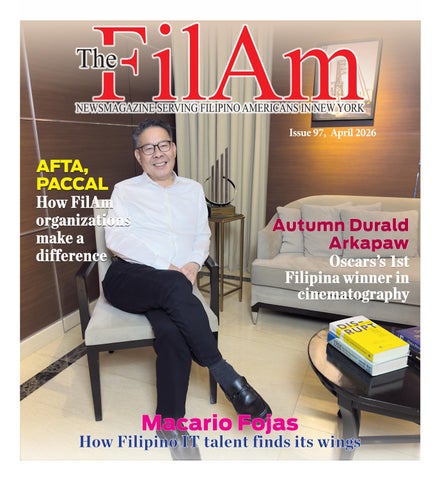
Macario Fojas

Letter from the Editor

Nancy Guthrie and the ‘ missing white woman syndrome’

On February 1, Nancy Guthrie was taken from her home in the mountainous outskirts of Tucson, Arizona. In the weeks since, the country has not stopped looking for her.

The search has been vast and unrelenting. The Pima County Sheriff’s Department, the FBI, U.S. Customs and Border Protection, and volunteer search-and-rescue teams have poured in resources, manpower, and time to find the 84-year-old woman.

But Guthrie is not an ordinary missing person.

She is the mother of a prominent NBC News journalist and is believed to be a wealthy widow, living alone in a sprawling Catalina Foothills home with a pool and expansive grounds.

Flier released by the Pima County Sheriff’s Department

Nearly two months later, the search continues, and so does the spotlight. Media coverage has not dimmed. Her story still merits broadcasts, dominates social media feeds, and fuels true crime podcasts. Even as investigators quietly acknowledge that the case has grown cold.

With few new developments, some coverage has begun to recycle familiar threads: the masked figure caught on CCTV, the son-in-law, the neighbor, the delivery driver who passed by at a critical hour. Each was scrutinized, questioned, and ultimately cleared. No clear suspect has emerged. Yet the story persists, sustained by speculation more than facts.

Founding Editor

Cristina DC Pastor

Managing Editor

Rene Pastor

Address

P.O. Box 8071

New York, NY 10116

And that persistence raises an uncomfortable question: Why is it that hundreds of people vanish but their names rarely make national headlines. Their faces do not circulate widely. Their stories, if told at all, flicker briefly in local news before disappearing into silence.

The disparity is not accidental.

Newsworthiness often follows a familiar formula: proximity to power, wealth, or visibility. A missing person tied to a recognizable media figure, living in an affluent neighborhood, offers a narrative that audiences are conditioned to follow. It feels urgent, dramatic, and perhaps most importantly relatable

to the viewers that advertisers and networks prioritize.

By contrast, many of the missing come from the margins: working-class communities, immigrant families, people of color, the elderly without connections, or individuals struggling with mental health or housing instability. Their disappearances are no less tragic, no less deserving of attention. But their stories do not seem to matter in the national consciousness.

Advocates have long called this imbalance the “missing white woman syndrome,” a pattern in which cases involving white, affluent women receive disproportionate media coverage compared to others. The phenomenon is not new, but each high-profile case—like Guthrie’s—throws it into sharper focus.

There are practical consequences to this imbalance. Attention drives resources. Media pressure can accelerate investigations, generate tips, and keep cases alive in the public mind. When coverage fades, so too can momentum.

For families of the missing who never receive that spotlight, the silence can be as devastating as the disappearance itself. In the end, the question is not whether Nancy Guthrie deserves the attention, because she does. Every missing person does.

The question is why so many others do not.

Contributing Writers

Marissa Bañez

Tricia J. Capistrano Joel David

Maricar CP Hampton

Ludy AstraquilloOngkeko

Lindy Rosales

Dubai’s deserted streets and malls; OFWs brave bomb attacks as they go to work

DUBAI, United Arab Emirates

– The streets and metro were half-empty. It was the first day of a work week. It should have been teeming with people beating the morning rush.

Not today.

The malls were open but I didn’t see the usual crush of tourists, shoppers and expats. People stayed home. Some were out, but only to buy necessities at a nearby store or withdraw money from the ATM. What’s keeping the Emiratis indoors? A combined U.S.-Israeli attack on Iran in the early hours of February 28, a Saturday.

In retaliation, Tehran let off a barrage of missiles and drones that rained on the Gulf, comprising the United Arab Emirates, Saudi Arabia, Bahrain, Oman and Kuwait. The besieged country has been fighting off jets, missiles and military firepower targeting U.S. bases across the Middle East.

It’s a clean-up drive, if you will, causing shrapnel and shards to free-fall everywhere. Already, a Filipino caregiver has been among 58 people injured in what is being called the “Iran War.”

The state-run Emirates News Agency said the UAE Ministry of Defense has so far dealt with 165 ballistic missiles, two cruise missiles and 541 Iranian drones since the start of the attacks. The ministry said that on the morning of the second day of the attack, UAE air force and air defense forces destroyed 20 ballistic missiles, while eight missiles fell into the sea. They also destroyed two cruise missiles and 311 drones.

The relentless firepower has struck ordinary civilians, disrupting work and lives. Some have fallen onto someone’s backyards; others have landed – and exploded – at a five-star hotel in plush Palm Jumeirah, the world-class Burj Al Arab and, yes, the concourse of Dubai International Airport’s (DXB) terminal 3.

The ministry indicated that some debris fell on various areas of the country as a result of air defense systems intercepting ballistic missiles and drones, leading to damage to civilian properties.

| Airports closed

The airports were closed. But it has been announced that hotels are accom -

modating stranded tourists and billing the government for the expenses. It was a move rarely seen in other countries, and instantly praised here.

The morning of Saturday saw everyone confused and in panic. Radio reports said attacks were launched on Iran while peace talks were in progress. By early afternoon and into the night, till the time of this writing, a tit-for-tat has ensued.

Iran fired missiles and drones; the U.S. and Israel fired back. One casualty is Iran’s supreme leader, Ayatollah Ali Khamenei, 86, who died with other leaders at his compound on Saturday. The news sent shivers as it could only mean the war may not be ending soon.

| Sounded like thunder

This could also mean Filipinos – and other migrant – workers will have to brave going out on their way to and from work. They have no choice.

“Nakaka-nerbiyos. Parang kulog,” said healthcare worker Sheryl A. Palacios-Manalo of Abu Dhabi.

Leslie Pableo, a media practitioner and public relations specialist, said they first encountered an interception the night of February 28. They were hunkered down in bed around 12 midnight when they “heard a loud boom and saw a white flash in the sky.”

"Seeing and hearing that firsthand was something I never imagined I would experience," she said.

A lot of people have been wondering out loud: How can they go to work like this? The metro and buses, which millions of people of different nationalities use for transportation, say it all: halffilled. So were the streets and shops.

But all too human that we are, as German philosopher, Friedrich Wilhelm Nietzsche once said, “we will find a way in all these till it’s over, as this, too, shall pass.”

Journalist Jojo Dass has been living in Dubai for 18 years. Currently, he writes for the UAE-based Khaleej Times and contributes to Philippine publications including Rappler, GMA News Online, and The Manila Times. He also is an editorial consultant at The Global News DXB, a UAE-based social media site.

A near-empty Union Metro Station.
The forlorn-looking Omar Bin Al Khattab Street.
The taxis idling at curbside: Where are the passengers? Photos by The Global News DXB; Jojo Dass

Autumn Durald Arkapaw: First woman, 1st black and 1st Filipino Creole to win an Oscar for Cinematography

She is of Filipino descent through her mother, Peggy Bautista, who hails from Pampanga, Philippines.

Her maternal grandfather, Guillermo Pagan Bautista, was a resistance fighter during the Japanese occupation of the Philippines and a survivor of the Bataan Death March. Autumn Durald Arkapaw considers him "the most important man in my life" and has a tattoo of his initials in Baybayin script on her wrist. The fact that she chose to honor her grandfather with a tattoo in Baybayin script speaks to her dedication to her Filipino heritage. Baybayin script is an ancient, pre-colonial Philippine script (syllabic alphabet) traditionally used for Tagalog, featuring 17 characters (14 consonants with inherent 'a' sounds, three vowels). It was historically used before the Spanish colonization and is now experiencing a resurgence in modern art, tattoos, and cultural branding.

Autumn's connection to her Filipino heritage is deeply rooted in her family traditions and cultural practices. She grew up surrounded by her mother's large Filipino family in the Bay Area and credits her "Mama Lyn" as a second mother figure.

Although she hasn't visited the Philippines, Autumn maintains a strong connection to her roots through food, customs, and storytelling. She loves her culture. Autumn's Filipino heritage has significantly influenced her work, particularly in her Oscar-winning film "Sinners." She's drawn to stories that explore identity, culture, and family legacy, reflecting her

She remains connected to her roots through food, customs, and storytelling.

Photo: www. autumndurald.com

own experiences as a mixed-heritage individual.

As for her Life philosophy, Autumn believes in shooting from the heart and embracing vulnerability in her work. She emphasizes the importance of finding a community that shares her vision, and values creativity over perfectionism.

Autumn's approach to cinematography is deeply personal, drawing inspiration from her multicultural background and family influences. She's passionate about telling diverse stories and amplifying underrepresented voices, as seen in her work on "Sinners" and "Black Panther: Wakanda Forever".

She is married to Australian cinematographer Adam Arkapaw, who

was present at her historic Oscars win together with their son Aedan, born in 2016. She also acknowledged her parents who were in the audience, proud as any parents would be! Guest columnist LMarilyn Crawford is an accomplished and award-winning Brand Architect, known for strategic marketing, investor relations, business development, media relations, and tourism. She was the keynote speaker for Harvard University Women in Business, Air Force, and many more. Entrepreneur and Humanitarian of the Year are among her accolades. She was published by Harvard University, Black Enterprise, and more.

Autumn receives her award for the movie 'Sinners.

Faith and family help a Filipino nurse at YU's Katz School achieve a dream

On September 19, 2005, Sarah “Cheeky” Arnaldo Arciaga, a clinical assistant professor in the Bachelor's in Nursing program at Yeshiva University's Katz School of Science and Health, boarded a plane for New York for the first time.

The moment should have felt triumphant—she had just earned a rare opportunity to pursue a Master of Science in Nursing in the United States. Instead, her heart was heavy.

Back home in the Philippines, her daughter was turning 3, and her 5-yearold son was happily caught up in the excitement of his little sister's birthday celebration. Leaving them behind, even temporarily, felt unbearable. Yet the journey that began that day, shaped by faith, sacrifice and determination, would transform not only her own life, but the lives of her family and the many students she would one day teach.

Arciaga's path into nursing began years earlier in Manila, where she earned her Bachelor of Science in Nursing in 1996 from Philippine Christian University, an experience that grounded her in the values of compassion and service that would guide her career. Even then, she believed nursing was more than a profession. It was a calling rooted in caring for others.

Her story took a pivotal turn when her mother noticed a small newspaper ad describing an opportunity through the Global Scholarship Alliance for Filipino nurses to study in the United States. Arciaga had not been planning to leave the Philippines, but her parents saw something more for her.

"They kept telling me my career would bloom more abroad," she said. "I didn't want to go. My priority was my kids."

Still, her mother insisted she apply, and the two traveled three hours to Ortigas Center in Manila to submit the application. Arciaga passed the preliminary exam and was invited to an interview, where one question changed everything: if she received the scholarship, would she be willing to leave her family behind?

On the long trip home to Cavite, she told her mother the truth—she knew she could succeed academically, but she didn't know how she could leave her children. Her parents gave her the answer: they would help raise them while she studied. That promise gave her the courage to continue.

While Arciaga pursued her degree

in New York, her husband embraced the responsibilities of both father and mother. With the help of her parents, he ensured that their children were cared for and surrounded by love.

"If I relied only on myself, I would not have made it," she said. "My strength came from my family and faith in the Lord."

After earning her graduate degree, she honored her scholarship agreement and returned to the Philippines for several years to serve as an educator, sharing what she had learned abroad with the next generation of Filipino nurses. For her, the decision was simple. Her family was there and she believed in giving back.

In 2013, she earned a Doctor of Philosophy in Development Administration from Philippine Christian University, deepening her leadership skills. Another opportunity brought her back to New York, first to St. Paul's School of Nursing in Queens, where she taught nursing fundamentals and pediatric nursing, and then to Long Island University's Harriet Rothkopf Heilbrunn School of Nursing, where she taught several courses and led the Fundamentals Laboratory.

Mentorship played a key role in Arciaga’s journey, particularly through her relationship with Peggy Tallier, Ed.D., senior associate dean and professor of nursing at the Katz School, whose leadership style deeply influenced her.

At the Katz School today, Arciaga is a laboratory instructor. She also runs a biweekly open lab, giving students time to practice essential nursing skills. Students value those sessions so much that one described the opportunity as “VIP access” to their professor. For Arciaga, those moments matter. She isn’t just teaching technical procedures. She is teaching professionalism, compassion and dignity in patient care.

It’s in those moments—guiding students, sharing hard-earned lessons and shaping future nurses—that the sacrifices she made years ago come full circle. Her children are no longer the toddlers she left behind. Both are now professional registered nurses. When the family sits together at dinner, they often talk about their shared profession and the meaning behind it.

"It is a noble and stable profession," she said. "Not only because of the career, but because you serve humanity."

Pictured from right: Sarah “Cheeky” Arciaga with her children, who are now professional registered nurses, and husband.
In 2013, Sarah “Cheeky” Arciaga shared a joyful moment with her mother in the Philippines after receiving her doctoral degree.

‘Melania:’ All fashion, no substance

I finally got to stream on Amazon the much talked about documentary “Melania,” about the Slovenian-born Melania Trump, the nation’s second foreign-born First Lady after the British-born Louisa Adams, wife of John Quincy Adams, the sixth U.S. President.

After watching it with strictly non-political bias lens, to summarize it would be for me: all pomp, fashion, and spectacle, yet no substance.

“Melania” documents the daily activities which she undergoes in the 20 days leading up to her husband Donald’s re-election to a second term as President. Trump is the second president to be re-elected on a non-consecutive term since Grover Cleveland who served as U.S. President in 1885-1889 and 1893-1897.

Now I was hoping that this film documentary would chronicle and specify what her specific goals and intentions were once she would return to the White House and resume her roles from her husband’s first term as President from 2017 to 2021. More importantly I would have been very interested to learn about what substantial accomplishments she had made during her first tenure as First Lady. Alas, that is not what we get by watching this film, which merely documents Melania’s immediate concerns and activities revolving around preparations for her husband’s second-term inauguration. We see her selecting the right wardrobe and hats and coordinating with her assistants on how extravagant the presidential inaugural parties should be in ushering the First Couple’s White House political comeback.

Some of history’s greatest U.S. First Ladies have had remarkable legacies both during and after their time in the White House, such as Eleonor Roosevelt who was known for her post-World War II humanitarian work for refugees; Jackie Kennedy whose White House restoration works reinvigorated the public interest in American presidential history; and Nancy Reagan who is well remembered for her anti-drug use campaign efforts throughout the 1980s.

What will Melania Trump be most renowned for many years from now? What has she accomplished during her husband’s first presidential term? What are her goals for President Trump’s second term? “Melania” only momentarily addresses those is -

sues, albeit so brief that one may hardly remember. And yet these are the very things that I wanted the documentary to focus on. Quite the opposite, except for some charity-related interviews, it almost entirely ignores such matters when they mean the most, especially at this time.

As interesting as it is to know about how the Trump family go about their lives at their affluent residences in New York City and Mar-a-Lago, Florida, these are trivial matters that pale in comparison to a real issue of substance: what true meaningful works which the First Family have accomplished for the nation as a whole, and not just when it comes to the actual work of the President and First Lady.

I realize that this documentary’s focus is on Melania alone, but I still would have been just as invested to see and understand the notable contributions which the rest of the Trump family have made for the good of the nation, including the children, Donald, Jr., Eric, Ivanka, Tiffany, and Barron. Of course, only time and history can properly judge years from now Melania Trump’s greatest legacy, but it would have been nice if this film could have served as a powerful reminder of what she has already achieved up to this point, and in especially in that regard, “Melania” is a huge letdown.

She is the nation’s second foreign-born First Lady.
Only time and history can properly judge Melania Trump’s greatest legacy.

J-1 and H-1B visa teachers to be honored as ‘cultural bridges’ in diverse American classrooms

The International Association of Multicultural and Filipino American Educators, Incorporated (IAM FAME INC.) is set to host a gala event shining a spotlight on the vital role Filipino educators play in the American school system.

The Cultural Exchange & Achievement Celebration will take place on March 21, 2026, in Elgin, Illinois, honoring the dedication and excellence of international teachers serving under J1 and H1b visas.

As American classrooms grow increasingly diverse, these educators have emerged as essential "cultural bridges," bringing global perspectives to local communities and fostering an environment of mutual respect and high academic achievement.

| Extraordinary leadership

This year’s event will highlight individuals whose innovative practices and heroic dedication have transformed the lives of students across the United States, the organizers said in a press statement.

Among the high-level recognition awardees:

• The Outstanding Leadership & Excellence Award will be presented to Dr. Abner Pineda. This award recognizes a lifetime of service, groundbreaking scholarship, and his "Magnum Opus" achievement in the field of higher education.

• The Pillar of Excellence Award will be bestowed upon Romana Veracruz Vasquez, whose visionary leadership and foundational contributions have been the cornerstone of Chicago Chapter IAM FAME INC.’s success.

• The Tanglaw ng Lahi Award is conferred upon Dr. Roy Biñas Basa in recognition of his distinction as the 2024 New Mexico Teacher of the Year. This award honors his dedication to excellence and the immense pride he brings to the Filipino community as a world-class educator in the United States.

| 2026 International Teacher Awardees

Here are the 2026 award recipients and their achievements presented in statement form for the IAM FAME INC. celebration:

Outstanding educators to receive award in Chicago

pioning global literacy and interconnectedness within the classroom.

• The International Teaching Pinnacle award is bestowed upon Hasmine D. Tila for her groundbreaking international educational contributions.

• Gerald P. Bansag is recognized as the Filipino Diaspora Educator of the Year for his transformative leadership and profound passion for teaching.

• The Distinguished International Teacher award honors Analisa C. Ramos for her sustained excellence and significant contributions to cross-cultural education.

presented to Jonica T. Alcantara for her outstanding contributions and excellence within the J1 Visa Exchange Program.

• Dr. Winston B. Leal is honored with the Beacon of Leadership award for serving as a powerful and transformative light in the field of education.

• The Global Filipino Teaching Excellence award recognizes Dainalyn T. Baliscao for her outstanding achievements and significant global pedagogical impact.

• Maria Lourdes R. Gaddi receives the Worldwide Pedagogy Leadership award for establishing new international benchmarks in teaching and educational leadership.

• The Global Bridging Teacher award is bestowed upon Agnes Mercado for her excellence in fostering global understanding and connecting diverse cultures.

• Michael V. Delim is honored with the Golden Compass Award for his visionary leadership in helping students navigate the complexities of the modern world.

• The Community Cultural Champion award recognizes Jocelyn Delos Santos for her outstanding and significant contributions to the cultural life of the community.

• Dr. Maria Lucia Manalo is presented with Outstanding Classroom Leadership and Innovative Award for transforming the traditional classroom into a dynamic environment of discovery.

• Dr. Ana Isabel G. Espino is presented with the award for Excellence in Inclusive Teaching & Community Leadership for her unwavering commitment to classroom equity and community empowerment.

• Antonina Llanos is presented with the Global Educator in Innovation award for transforming the learning experience through creative pedagogy and the strategic integration of technology.

• Christine Joy Delos Santos is honored with the Filipino International Exchange Teacher of the Year for demonstrating exceptional teaching performance, leadership, and cultural advocacy.

• Jayson H. Hernandez is honored with the Global Educator Excellence award for his innovative teaching methods and unwavering commitment to student success.

• The Outstanding Cultural Exchange award is presented to Marilou Delos Santos in recognition of her exceptional skill in building bridges between cultures.

• Joy M. Ammogawen receives the Global Classroom Champion award for her dedication to cham -

• Elizabeth Laulita is presented with the Cultural Impact Teacher award for her vital work in advancing diversity, literacy, and mutual understanding.

• The EduHero Teacher Award is given to Dr. Fructuoso O. Salao for his heroic dedication to his students and his spirit of classroom innovation.

• Mary Ann A. Halvorson is recognized with The Ambassador of Education award for her successful efforts in bridging schools with the wider world.

• The J1 Cultural Teacher Excellence award is

| Excellence without borders

The theme of the event centers on the idea that education knows no boundaries. By celebrating the Filipino diaspora’s contribution to the U.S. educational landscape, IAM FAME INC. reaffirms its mission to foster an inclusive and interconnected world.

"These educators represent the heart of our mission," an IAM FAME INC. representative stated. "They don't just teach subjects; they build the cultural bridges necessary for the next generation of global citizens to thrive."

‘A

Spoonful of Sugar:’ The

comedian in uncertain times

When the world is most uncertain is precisely when jokes are most needed, and most dangerous. That power is also why comedians so often become targets of political backlash.

“Humor is always a part of our culture,” said Herbert Siguenza, founding member of the performance troupe Culture Clash. Speaking during an ACoM virtual briefing, Siguenza noted he was heading to a funeral that day. “Although it’s sad, there’ll always be somebody who comes up to the altar, right, and says something funny… and everyone needs that as a release.”

Siguenza, whose group was formed in San Francisco and has performed satirical sketches and plays in English and Spanish since 1984, described the comedian’s social role as that of an outsider: “We can make fun of the right and left. We’re just commenting on the ridiculousness of everything… You’re outside societal morality and norms just a little bit.”

| Death camp jokes

Topical material sometimes hits too close. When it comes to immigration enforcement, for example, Siguenza said, “It’s like making death camp jokes; they’re just not going to go over…When I see federal officers taking people out of their cars, out of their homes, and they’re separating their kids, it’s like, how do I make a joke about that?”

Siguenza had similar concerns about the current administration signaling pressure on late-night comedy hosts like Jimmy Kimmel and Stephen Colbert: “That’s fascism 101, you shut down the comedians first…The court clown is the first guy to go because he had the liberty for a while to say anything he wanted about the king, and then suddenly he said something wrong.”

In response to a “Late Show” rerun last December in which Colbert teased Trump for hosting the Kennedy Center honors ceremony — which aired the same night CBS broadcast the Kennedy Center Honors ceremony to low ratings — Trump demanded CBS “put him to sleep” and pull the already-canceled show immediately rather than let it run through its planned May 2026 finale.

For five days last September, ABC did suspend “Jimmy Kimmel Live!” following pressure from Trump and his officials over a monologue by Kimmel regarding Trump’s allegedly indifferent reaction to a journalist’s question about the murder of Turning Point USA founder Charlie Kirk.

Humorist and journalist Emil Amok Guillermo noted the irony in how the same company that could cancel Colbert — Paramount, which owns CBS — could continue airing “South Park” episodes involv-

ing “Trump, naked, small penis, impregnating Satan.”

Guillermo suggested that satirical ridicule may be more impregnable and more cutting than political commentary dressed up as comedy: “What ‘South Park’ did was just lay out ridicule. And fascist autocrats hate ridicule, which is why the ultimate lesson is: Watch more ‘South Park.’”

“Humor comes out of pain. Humor comes out of tension. When it’s so tense and the pain is so real, that’s the perfect moment for humor. It’s the antidote to all of that,” Guillermo continued, adding that in his own columns he uses “a Mary Poppins theory: ‘A spoonful of sugar helps the medicine go down.’ …That’s the job of the comedian to poke holes at the big bubble that we’re living in, and to try to get at what’s real.”

| ‘Humor is agreement’

For Samson Koletkar, co-founder of Desi Comedy Fest, the engine of comedy is simpler and more democratic.

“Humor is agreement,” he explained. “If I tell a joke and you laugh, it’s because you agree with me, and if you don’t agree, you don’t laugh. And that agreement is a very instant thing. You can’t plan for it. A lot of people are thinking the things we say out loud, and then the shock and the humor comes from the fact that somebody actually said it out loud.”

Koletkar, who has also run the stand-up club Comedy Oakland for 17 years, pushed back on the idea that comedians have a unique imperative or moral position: “Sometimes they try to put themselves too high up on the horse, like we are the truth speakers. Only as long as people are laughing — when they don’t, you change your truth a little bit as well … Everybody’s on the same playing field.”

Regarding censorship, “Comedians are born out of a rebellious state of mind. If you ever tell a comedian not to say something, that is exactly what they will talk about,” he said. – American Community Media

From left, Samson Koletkar of Desi Comedy Fest, journalist Emil Amok Guillermo, and Herbert Siguenza of Culture Clash
‘Humor is a part of culture.’ Image generated by Canva AI/ACoM

Macario Fojas: Building Seven Seven and championing Filipino talent

Life was anything but easy for Macario Fojas, president and cofounder of Seven Seven Global Services, Inc., a Filipino-owned IT company based in New Jersey.

In 1982, he was enrolled at Fordham University, pursuing a master’s degree in Finance and Quantitative Methods. By day, he worked as an encoder in New York to support himself. By night, he attended classes from 6 p.m. to 10 p.m., carrying a full academic load.

After long days that blurred into late evenings, he would travel an hour and a half back to Jersey City, where he lived alone. The routine was relentless -- work, class, commute -- for one year and three months under a trimester system. It remains one of the most difficult periods of his life.

There was barely time to rest, much less reflect. Yet, it was also transformative. He came to believe deeply in the idea that growth is forged through hardship, echoing the sentiment of Nvidia CEO and Founder Jensen Huang, who once said, “I wish upon you ample doses of pain and suffering.” For him, struggle was not a deterrent—it was a teacher.

“You will truly learn when you suffer. “He said momentarily musing in an interview with The FilAm, “

It was years later that Fojas, 69, in the hum of an office cafeteria, that a “dream began to take shape,” the seed for what would become Seven Seven was planted amidst a casual conversation with a colleague.

He said, “I outlined a vision to create better lives for Filipinos by providing opportunities for them to take their talents overseas.”

That moment would eventually give rise to a company founded in both entrepreneurial drive and national pride.

The name “Seven Seven,” he admits, carries a personal meaning known only to a close circle. What he shares is simple: seven has always been his favorite number, and the name felt right—perfectly aligned with the company he wanted to build.

Founded in 1996, Seven Seven has since grown into a global IT and knowledge services company with a workforce of thousands. With operations spanning the Philippines, the United States, Singapore, Hong Kong and Australia, the company reflects his long-held ambition: to build the foremost Filipino-owned IT firm on the world stage. At its core, he said Seven Seven helps businesses “transform through technology, bridging strategy with execution using cloud solutions, machine learning, and artificial intelligence.”

Through Seven Seven’s own training academy, the company drills Filipino IT professionals in emerging technologies. While he acknowledges that the most advanced developments in AI are driven by major global players—companies like OpenAI and Google—he believes the playing field is still wide open.

“It’s a wild west out there,” he says. “You have to join the crowd or risk being left behind.” For him, the goal is

clear: to ensure that Filipino talent remains competitive, adaptive, and visible in a rapidly evolving industry.

| Unconventional childhood

His own story was shaped by an unconventional childhood. Born into a family of four siblings—two brothers, one sister, and himself as the youngest—he was sent at the age of 5, like his siblings before him, to live with their grandfather and grandaunt in Sampaloc, Manila.

The arrangement was to give them the best Jesuit education at Ateneo, far from their hometown of Tanza, Cavite.

It was a life marked by distance from his parents, who would fetch them on Friday nights and return them on Sundays. Summers were spent back in Cavite, but the formative years unfolded largely under the care of their grandfather.

His father, a government lawyer who worked

Fojas attends a networking event hosted by Seven Seven to connect with clients and partners.

under Finance Minister Cesar Virata, and his mother, a businesswoman who managed multiple businesses that she inherited, provided a strong but distant presence. In that environment, his older brother Edwin stepped in as a father figure. The experience, while unusual, instilled independence and self-courage, qualities that would prove essential during moments of crisis.

The aftermath of the September 11 attacks in 2001 and the global financial downturn of 2008 both dealt heavy blows to Seven Seven. Business slowed, profits declined, and key clients struggled. Yet through perseverance and faith, Fojas steered the company forward.

“God knows we have a good purpose,” he says in reflection.

Recognition for his work has followed. In 2024, he was named Techblazer of the Year at the Asia CEO Awards and received the Technology Entrepreneur of the Year award in the Philippines from Ernst & Young. A year later, he became the first Industrial Engineering graduate to receive a Lifetime Achievement Award from the University of the Philippines College of Engineering Alumni. Still, he measures success not in accolades, but in impact. For him, the most meaningful moments come when former employees—once trainees under his program—return as successful professionals to say thank you. These are the intangible returns that matter most.

| Partner for life

While studying at Fordham, he met his wife, Delle, on a group date. He recalls knowing instantly that she would be his partner for life.

“It may sound weird, but it’s true that I knew she was going to be my wife when I first laid my eyes on her,” he said. “We fell in love and soon got married.”

Together, they built both a family and a business in tandem, she leading sales with boldness and confidence, he ensuring operational strength and profitability. Their partnership helped drive growth.

They have one son, Miguel, now 36, who is exploring his own path, including interests in broadcasting. As a father, he has tried to instill the same independence that defined his own upbringing. For him, growth still comes from experience, from trial and error, from finding one’s own way.

Looking ahead, he envisions a successor who shares his grit and purpose, someone unafraid to challenge him, to bring new ideas, and to lead with both courage and discipline. Intelligence, he believes, is essential, but so is the willingness to be tough when necessary.

“I like being surrounded by people smarter than me,” he says. “That’s how we move forward.”

The story of Seven Seven is not just of success, but of purpose, a company sustained by the belief that opportunity, once created, must be shared. Golf is his favorite way to unwind.

Fojas dedicates his win at the EY Entrepreneur of the Year Awards Philippines to his family, his team and the future of technology.
With wife Delle and son Miguel. Together, Mac and Delle built a family and a business in tandem.

Calendar of Events

| Ongoing until September 30, 2027

iRehistro Overseas Voter Registration

Visit website for details: https:// irehistro.comelec.gov.ph/ovf1.

| Ongoing until May 29, 2026

Nominations for the 2026 Presidential Awards For Filipino Individuals and Organizations Overseas

Download: https:// presidentialawards.cfo.gov.ph/ forms-and-guide/

| April 8

Induction ceremony for Eve Cho Guillergan, Judge of the Civil Court of the City of New York, Queens County Ceremonial Courtroom, Room 101

89-17 Sutphin Boulevard Jamaica, NYC

RSVP at ECGinduction@gmail.com

| April 10

Art & Activism symposium

University Center The New School 63 Fifth Avenue NYC

| April 11

First FILCA (Filipino Catholic Apostolate) General Assembly Rectory of St. Patrick's Cathedral (Entrance on East 51st Street, near the corner of Madison Avenue)

Contact for details: filcc.ny25@gmail.com

| April 18

PIDCI’s 2026 Mrs. Kalayaan

Astoria World Manor 25-22 Astoria Blvd. Queens NYC

| April 19 to May 1

Sacred Pilgrimage in Central Europe: Hungary, Poland, Czech Republic and Austria (with Fr JM Manolo Punzalan)

Contact Nuovo Tours to reserve your space nuovotours@gmail.com

| April 19

Formal launch of SAUP Foundation (with Sounds of Manila)

The Grayclift 122 Moonachie Avenue Moonachie, NJ

| April 22

Asian American Federation 2026 Impact Awards Tribeca 360 10 Desbrosses Street, NYC

| May 1

CUNY Asian American Film Festival

Call for Submissions deadline Email info@aaari.info

| May 7 to June 4

Spring 2026 Adult Conversational Filipino, Beginner 1 (with teacher Agnes ‘Bing’ Magtoto)

Tuition for the 5-week course is $300.00/person plus an additional $25 registration fee to cover administrative costs, a total of $325. For more information, contact 774-257-4669 / info@ filschool-nynj.org

| May 24

2026 Santacruzan sa Katedral (by FILCA)

St. Patrick’s Cathedral 5th Avenue, NYC

| June 21

Search for the next Ginang Filipinas Tri-State queens For information, call or text:

Pia Pascual 551-347-8418

Leah Amadiz 917-930-6129

| July 12 to 21

Very Important Pinoy Tour: Manila, Dumaguete, Cebu Visit: www.VIPtourphilippines.com

| July 22 to 25

FANHS National Conference

Crystal Gateway Marriott 1700 Richmond Hwy Arlington, VA

| August 9

22nd People’s Ball

Newark Liberty International Airport Marriott 1 Hotel Rd, Newark, NJ

| August 14 & 15

NaFFAA National Empowerment Conference 2026

Theme: ‘Harnessing the Power of Community: Starting With Us’

Hyatt Regency Aurora-Denver Conference Center 13200 East 14th Place Aurora, CO

| August 15 to 16

29th Fiesta in America EXPO American Dream 1 American Dream Way East Rutherford, NJ

| September 7 to 18

Central Europe Pilgrimage of Faith With Fr. Leandro Dela Cruz of the Church of St. Ann, Lawrenceville, N.J. Contact info@nativitypilgrimage.com

| 2027

| July 7 to 24

48th Annual Philippine Nurses Association of America, Inc. National Convention Inter-island cruise in Hawaii

AFTA’s Balik Turo at 33: How FilAm teachers built a quiet movement of diaspora-driven learning

On a humid August morning in Manila, a group of teachers gathered inside a c lassroom at the Philippine Normal University. Some have traveled from remote provinces; others have flown from New York, New Jersey, and California. At the front stood a Filipino American educator who has spent decades teaching in the United States. Her voice was steady, her gestures familiar, her presence both foreign and deeply Filipino. She was here for one purpose — to teach back, to give back, to honor the place that shaped her.

This scene has repeated itself for more than 30 years. It is the living heartbeat of Balik Turo, the flagship program of the Association of Fil Am Teachers of America (AFTA). What began in 1993 as a modest “return to teach” mission has grown into one of the most enduring diaspora driven education initiatives in the Filipino world.

| How AFTA was born

AFTA’s story began not in Manila, but in New York City.

In 1989, roughly 300 Filipino teachers faced visa uncertainty. They had come to the United States to teach in public schools, but shifting immigration rules threatened their ability to stay. Instead of giving up, they organized — advocating for themselves, for their students, and for the right to continue serving American classrooms.

Their efforts contributed to the passage of the Immigration and Nationality Act of 1990, which extended the H 1 visa and opened pathways for Filipino educators to remain in the U.S. Out of this victory came a formal organization: the Association of Filipino Teachers in America, later renamed the Association of Fil Am Teachers of America.

| The visionary Lumen Castaneda

Among AFTA’s early leaders, Lumen Castaneda stands out as a force of nature. A retired New York City public school teacher, Castaneda brought charisma, discipline, and a fierce love for the Philippines into every room she entered. She served multiple terms as AFTA president and became the face of the organization during its formative years.

Castaneda deeply believed that Filipino teachers abroad had a duty to “return to teach,” not as saviors but as partners. She helped shape Balik Turo’s philosophy: that knowledge should circulate, not stagnate; that migration should not sever ties, but strengthen them; and that teachers, more than any other profession, carry the power to transform nations.

Her leadership gave Balik Turo its soul — a blend of professionalism, humility, and patriotic devotion.

| How Balik Turo began

Balik Turo started in 1993 with a simple idea: Filipino American teachers could return home during the summer to share what they had learned in U.S. classrooms. It was initiated by then-President Lilia Juele and implemented in 1994. According to AFTA, President Fidel V. Ramos welcomed the first delegation in Malacanang. The early sessions were small — a handful of volunteers conducting workshops in borrowed rooms, often paying their own way. But the impact was immediate. And soon, AFTA said, several colleges and universities, as well as provincial participants from Luzon and the Visayas, came on board.

Teachers in the Philippines were hungry for new strategies, new perspectives, and new ways of thinking about learning. AFTA volunteers introduced approaches in literacy, Mathematics, Science, classroom management, and assessment that were not yet common in Philippine schools. More importantly, they brought encouragement — a reminder that Filipino teachers were part of a global profession, connected to colleagues across oceans.

Balik Turo is traditionally held during the U.S. summer break, usually July to August, when FilAm teachers are free from their school-year duties. This timing allows educators from New York, New Jersey, California, and other states to travel to the Philippines without disrupting their U.S. teaching schedules.

During these sessions, AFTA volunteers teach a wide range of topics: project based learning, differentiated instruction, literacy strategies, Math and Science pedagogy, classroom management, curriculum map-

ping, assessment design, and technology integration. During the pandemic, the Balik Turo Webinar Caravan expanded this reach, offering digital teaching strategies and drawing more than 1,200 teachers from across the Philippines and the U.S. Typically, 10 to 20 FilAm teachers travel for each in person mission, while hundreds of Filipino teachers attend the sessions. In virtual years, participation has reached into the thousands.

| A new generation: Rena Pedaria

Today, AFTA is led by Rena O. Pedaria, an adjunct lecturer at the City University of New York. Pedaria represents a new generation of FilAm educators — globally trained, community rooted, and deeply committed to the Philippines.

Under her leadership, AFTA has strengthened its institutional partnerships, including with Bukidnon State University, where the organization conducted its third Balik Turo program in 2025. Pedaria has emphasized continuity, collaboration, and the importance of building long term relationships with Philippine schools and universities.

She often describes Balik Turo as “a circle of learning,” where teachers from both countries grow together. Her leadership ensures that the program remains relevant, responsive, and grounded in the realities of modern education.

Balik Turo is more than a training program. It creates pockets of innovation, inspires teachers who often feel unseen, and strengthens the bridge between the Philippines and its global community. – Philippine Daily Mirror

Lumen Castaneda
Rena Pedaria

Flocerfida Samaniego: Haircutting for Jersey City’s seniors

Except for the occasional stumble or fall, 72-year-old Flocerfida Samaniego continues to practice the craft she has known for most of her life -- trimming, shaping, and caring for people’s hair.

For nearly a year now, she has been a quiet presence at the PACCAL office in Jersey City where seniors sit patiently beneath her careful hands, grateful for both the service and the company.

PACCAL -- the Pan American Concerned Citizens Action League now on its 34th year --serves the city’s senior residents, advocating for their health and human service needs.

Once a month, Flocerfida arrives to tend to hair that has grown thin with age or brittle from years of dye and bleach. Known for her gentle touch, she charges $20 per client, half paid by the client and half by the organization. When asked why she still works instead of slowing down at 72, she offers a shy laugh.

“Ok naman, kumikita ako,” she said simply. Haircutting has been part of her life for more than three decades. She learned the craft from her mother, a tireless beautician in Ildefonso, Bulacan. The eldest of nine children, Flocerfida remembers watching her mother work constantly to support the family. “Bawat panganak niya, gupit na rin siya nang gupit,” she recalled with a smile, describing a woman who never seemed to stop cutting hair.

Flocerfida came to the United States in the 1990s. A beauty salon later petitioned for her, and by 1998 she had become an American citizen. Today she works at another salon as well, balancing her livelihood with the small but meaningful service she offers PACCAL’s seniors.

Despite having family in the Philippines—she is the only sibling in New Jersey, while two others live in California—Flocerfida says she hopes to retire in the United States.

“Andito ang health insurance, ako pa naman lagi may sakit,” she said with candor.

Her body has slowed in recent years. Last year alone she estimates she fell at least seven times— sometimes a simple trip, other times a full tumble to the ground. A nurse told her that balance problems are common among women her age and advised caution. Now she pushes a shopping cart for support when walking around the neighborhood. She stubbornly refuses to use a cane.

“Ayoko, nakakahiya,” she said, waving away the idea.

Still, her visits to PACCAL remain a bright part of her routine. The customers whose hair she styles bring stories from their travels and daily lives. “Ok naman, marami silang kuwento,” she said. “Mga biyahe nila, kung saan saan sila nagpunta.”

Executive Director Ria Serrano said PACCAL offers seniors far more than practical assistance. The organization arranges health screenings, food and transportation support, housing assistance, and social outings that keep the community vibrant. Members recently wandered through the lush grounds of Untermyer Gardens in Yonkers, marveling at the orchards and sweeping landscapes. A casino trip doubled as a lively fundraiser, while a visit to Holland Ridge Farm to view a glowing sea of tulips is being planned for April.

The group also gathers for Saturday dance workshops, gentle exercise sessions, and employment workshops for those still seeking work.

For Flocerfida, the monthly haircut sessions are about more than earning a few dollars. They are moments of companionship in a life that can sometimes feel solitary. Living alone, she values the simple act of conversation as much as the work itself.

“Mag-isa lang ako,” she said with a small shrug. “At least dito may nakakausap.”

Samaniego is a quiet presence at the PACCAL office as she trims hair. Courtesy of PACCAL
Saturday dance workshops
On board a bus to an Atlantic City casino

Feeling hopeful at Radburn school’s Philippines Culture Day

“H

appy Culture Day!!!”

Students at Radburn Elementary School, a public school in Fair Lawn, New Jersey, echoed that greeting while marveling at Filipino artifacts and other items during their Philippines Culture Day.

They put on bamboo conical hats and Filipino clothing, and decorated a cardboard jeepney. They ate Filipino food – pancit, lumpia, pandesal, queso de bola, and ube treats. They were treated to a Filipino martial arts demonstration, ancient Baybayin script writing lessons, and traditional dances. Some teachers even tried the tinikling.

Every year since the 1980s, the school highlights a country or culture that's represented within the school community, allowing the kids to have an all-day immersive experience. This year, Atty. Kristine Vo spearheaded the organization of the events and other details for the Philippines Cultural Day, which took place on March 13, 2026.

I participated as an author of children’s books, featuring a Filipina fairy. I introduced the Fortune Fairy of Hope in my first book, Hope and Fortune, and gave her a “cameo appearance” in my second book, Hues and Harmony (How the Rainbow Butterfly Got Her Colors). I told the kids about how the Fortune Fairy of Hope represents the Philippines through her clothing – her terno, tapis, and giniling – and that she is based on my Filipina mother.

But my books aren’t Filipino-centric. I created my characters to represent several cultures and races. I wanted them to resonate with as many people as possible and to plant seeds of curiosity in my readers about others who may not look, think, or live like them.

Unfortunately, the world (not just the USA) is increasingly xenophobic, with people closing their ears, eyes, hearts, and minds to others who look, think, and live differently. They don’t want to know about other cultures and traditions. They want to stay within their comfort zones, distrusting and hating everything and

everyone beyond, oftentimes with no basis except for a vague discomfort with and fear of the unknown.

I recently wrote a published piece entitled Lost and Light in which I said that “what defeats fear is knowledge and being enlightened.” The first step in defeating fear of the unknown and unfamiliar is being open to learning and then, hopefully, building mutual understanding upon common grounds, while respecting differences.

I’ve always liked learning about other people and cultures – through travel, books, music, art, fashion, conversations. Despite cultural dissimilarities, there are basic human traits that we all share to some degree. That’s a good starting point toward the enlightenment that defeats the dark space inhabited by fear, distrust, and hatred.

The Radburn students, most of whom were not of Philippine ancestry, were clearly excited to learn about us. They listened with interest as I told them about what the Fortune Fairy of Hope symbolized.

I’ve done about 75 book readings in several states. Almost every single kid – regardless of their racial or cultural

backgrounds – has been very open to learning about the diverse characters in my books. Many tell me they like my books (like a few of the Radburn students) and some adults have thanked me with tears in their eyes.

I’m always optimistic about our world after my readings…until I see the news, which is filled with stories about xenophobia. What’s the tipping point at which people become either accepting of others or xenophobic?

I believe xenophobia is grounded in insecurity about one’s supposed place in a hierarchical society, whether based on race, color, creed, gender, fame, or wealth. What many people don’t realize or refuse to acknowledge is that much, if not all, of that has been engineered and manipulated by a few people for their own purposes and aggrandizement.

A stark example is the “politics of resentment,” attributed to former President Lyndon B. Johnson: “If you can convince the lowest white man he's better than the best colored man, he won't notice you're picking his pocket. Hell, give him somebody to look down on, and he'll empty his pockets for you.”

Although Johnson was speaking from his perspective as a politician, the under-

lying principle applies to everything upon which xenophobia is rooted. Flattery will get you everywhere.

The seemingly endless cycle of hatred and distrust against each other destroys our sense of humanity – the common ground that binds us together at the most fundamental level. Sometimes, it’s overwhelmingly distressing.

Still, it’s this feeling of despair that makes me grateful for the Philippines Culture Day. The kids’ joyful cries of “Happy Culture Day” as they celebrated a culture unlike theirs was heartwarming and hopeful. As the Fortune Fairy of Hope said: “Give yourself permission to cry. Just know that things will get better as time goes by.”

Hope springs eternal.

Marissa Bañez is a lawyer and children’s book author. She is a frequent contributing writer to The FilAm and has published numerous articles, essays, and reviews with several publications.

A Filipiniana blouse made of pineapple fabric and other Philippine souvenir items. Photos by Marissa Bañez
Radburn students do the ‘pandanggo sa ilaw’ folk dance
Pancit in cups

From the iconic jeepneys to the new electric taxis: Exploring the PHL using public transport

Taking public transportation like NJ Transit, catching the MTA train, or flagging down a yellow cab is pretty common for anyone living, working, or visiting the New York City area.

During my recent trip to the Philippines with my wife and our baby boy, we decided to take a similar approach by using different modes of public transportation to explore and experience the country in a more local way.

There are a variety of transportation methods to choose from, depending on your needs and preferences. You can drive if you have a vehicle or hire private drivers if that best fits your situation. I even drove my wife Bianca’s aunt’s car a few times during this trip (thank you, Tita!).

But beyond that, public transportation is an option to consider. What stood out to me during this trip was seeing more international travelers using public transportation. Personally, it’s all part of the cultural immersion and part of the fun.

Here are a few options:

| MRT/LRT

It was Chinese New Year, and we wanted to visit the oldest Chinatown in Binondo, to get fresh Lumpia. At the same time, we wanted to make sure we were actually hungry, so we planned to walk around nearby Intramuros first. My brother was also visiting from New Jersey, so it turned into a great family day—re-exploring historical sites, visiting churches, and walking through Fort Santiago.

We decided to take the BGC bus to Makati, then catch the MRT and LRT train from there.

Cost: Each ride was less than $0.25 per person, one way. less than $1 total per person.

Tip: The MRT/LRT is great for getting around Metro Manila. You can tap at certain stations if you have GCash, and you’ll notice security at every entry point and along boarding areas.

| Jeepney

It was a Monday, and I had to catch up on some work. We decided to visit a local café in Cavite that we saw on TikTok called Naya Experience. The baristas there not only champion Filipino coffee but are also winners of the Da Vinci Barista Craft 2026. To get there, we took a jeepney from Bacoor to Imus, Cavite.

Cost: Less than $0.25 each way

Tip: Jeepneys are great for getting around the city. Learn “Bayad po” for payment and “Para po” to signal your stop.

| Tricycle

It was getting close to dinner time. We had just finished Horchatas by the beach and were chatting with Kiddo from El Union. He recommended a Tatler-awarded Ilokano restaurant tucked away in a quieter area called Makan at Eliseo. Poqui-poqui, anyone? We decided to take a tricycle for the ride.

Cost: Less than $1 each way

Tip: Tricycles are ideal for short distances and inner roads. Around 2–3 people can fit, and one person can sit behind the driver.

| Electric Taxi

It was time to shop for souvenirs for family and friends back in NYC and NJ, so we headed to Greenhills. While the

tiangge (flea market) area is known for classic finds like keychains and T-shirts, I came across a pop-up in the newer Greenhills Mall featuring Pinangga Ethnic Hand Embroidery, who sells pieces that support Filipino indigenous heritage and give jobs to women from marginalized communities.

We booked an electric taxi through Green GSM Philippines. The experience felt modern and convenient. New vehicles, multiple payment options, and a smoother ride overall.

Cost: Varies. Less than $6 each way (similar to going from Central Park to Wall Street in NYC).

Tip: Electric taxis are a great “go green” option. You can hail one like a yellow cab or book through the Green GSM Philippines app. Currently available in Metro Manila.

| Grab (similar to Uber)

It was time to explore a bit outside Metro Manila, so we headed to Biñan, Laguna to visit cultural sites like the Alberto Mansion, where José Rizal spent part of his childhood with his mother, Teodora Alonso Realonda. We even got to visit Chef RV, someone we’ve followed on YouTube. For this trip, we booked a ride using Grab.

Cost: Varies. Less than $15 from Cavite to Binan

Tip: Grab is great for flexibility options, including passenger count and scheduled pick-ups.

| Bus (for long trips)

It was time for a longer adventure, so we took a midnight Partas bus near the surf waves of La Union. The ride took about 4.5–5 hours, dropping us right in Urbiztondo just in time for sunrise and coffee by the beach. The next day, we took another bus to Baguio for a quick mountain escape—Korean BBQ lunch, a walk around the city, and a visit to the night market. Later that night, we took a Solid North bus back to PITX.

Cost: Less than $18 from Pasay to La Union

Tip: Buses are great for long-distance travel. Some offer deluxe options with recliner seats, WiFi, TVs, and restrooms. There’s a wide array of transportation options when getting around the Philippines, especially in Metro Manila. Do a bit of research ahead of your trip and choose what best fits your travel style and comfort level. And as with using transportation anywhere in the world, always take the proper safety precautions. It adds another layer to the travel experience, making it easier to explore, connect, and immerse yourself in the country’s everyday life.

Electric Taxi Bus
MRT

Marcos Jr. seeks support for non-permanent UN seat to ‘help calm voices of division’ in the world

Pr esident Ferdinand Marcos Jr. sought United Nations support for the Philippines’s candidacy for a non-permanent seat on the United Nations (UN) Security Council.

In a speech at the United Nations Headquarters, he urged member states to back the Philippines’s latest bid for a Security Council seat for 2027-2028, amid rousing applause from about 200 community leaders in attendance.

“Our contributions across the whole spectrum of UN work, since its inception, are borne out by history. Always ready to be part of the solution, the Philippines has regularly proven itself to be an independent, trusted partner, an innovative pathfinder, and a committed peacemaker,” Marcos said during a special address to the UN General Assembly in New York City on March 9.

“In the midst of mounting challenges and uncertainties, our United Nations needs steady, committed, experienced hands; and we humbly offer ours – to serve in the UN Security Council for 2027 to 2028,” he added.

The current non-permanent members of the UNSC are: Bahrain, Colombia, Democratic Republic of the Congo, Denmark, Greece, Latvia, Liberia, Pakistan, Panama, Somalia. They were elected on June 3, 2025 and slated to serve for two years.

They join the five permanent members -- China, France, Russian Federation, the United Kingdom, and the United States – as they deliberate important global issues.

“The Philippines stands ready once again to contribute, to help calm voices of division, provide a voice of balance, to shun ambition for service, and always as a voice for principled peace,” Marcos said. “And thus, I stand before you to humbly petition for your support for the Philippines in the elections on the 3rd of June, 2026.”

Former Consul General in New York Mario de Leon welcomed Marcos’s “strong reaffirmation” that multilateralism and respect for international law “remain essential to preserving peace” amid rising geopolitical tensions.

De Leon said the Philippines’s record of consensus building, peacekeeping and adherence to international norms shows why the country is a “credible and principled candidate” to serve again as a non permanent member of the Security Council.

“The Philippines was previously elected as a non-permanent member of the UNSC in 1957, 1963, 1980-1981, and 2004-2005,” as reported by the Stateowned Philippine News Agency. It was “actively engaged” in UN peacekeeping since 1963, deploying

Proudly in attendance are about 200 members of the Filipino American community.
Marcos Jr. stepping into the world stage. ‘Our United Nations needs steady, committed, experienced hands; and we humbly offer ours.’ Facebook photos

Marcos Jr. meets with United Nations Secretary-General António Guterres at the UN headquarters. PNA photo

nearly 15,000 Filipino peacekeepers to 21 peacekeeping operations and special political missions, it added.

De Leon said the country’s voice would help “advance diplomacy, stability and cooperation” in an increasingly complex global environment.

Loida Nicolas Lewis, chair of the Coalition for Filipino Amerasians, said Marcos’s speech covered the Philip-

pines’s history with the UN “from being a co founder in 1946 up to the present, the failure of diplomacy to avoid war in various parts of the world and the Philippines’s stand for the rule of law.”

She said the speech reminded her how “deeply embedded” the country has been in the UN system’s evolution.

Foreign Affairs Secretary Ma. Theresa Lazaro told Inquirer she viewed the pres-

The President joins First Lady Lisa Araneta Marcos in the gallery. With them are Foreign Secretary Theresa Lazaro, Philippine Ambassador to Washington D.C. Jose Manuel Romualdez (2nd row, left) and Philippine Permanent Mission to the UN Ambassador Enrique Manalo.

ident’s presentation as “a comprehensive reminder” of Manila’s contributions to UN peacekeeping, migrant protection, and women’s empowerment.

FilAm activist Andan Bonifacio, one of the protesters who gathered outside The Pierre Hotel, where Marcos was staying, described the president’s speech as the “ultimate performative male moment.”

“How can Marcos campaign for the

UNSC when his administration remains the biggest obstacle to the Filipino people’s security?” asked Bonifacio, national chairperson of Anakbayan USA.

“From corruption scandals, to the inflation crisis, to opening the entire country to extensive U.S. military presence, which puts a target on the country’s back – the people’s livelihood, safety and sovereignty are under threat.”

Review of ‘The Girl Who (Thought She) Looked Like Kamala Harris’

Gene P. Del Carmen’s The Girl Who (Thought She) Looked

Like Kamala Harris is a heartwarming and empowering coming-of-age story that beautifully captures the essence of courage, identity, and the quiet power of influence. Through the eyes of 12-year-old Paula, readers are drawn into a journey that is both deeply personal and universally relatable. From the very beginning, Paula stands out as a character shaped by strong values—courage instilled by her U.S. Marine father and compassion nurtured by her school-teacher mother. These traits come to life when she confronts a bully, setting the tone for a story that celebrates inner strength over fear. Yet, what

makes this narrative truly compelling is its emotional depth and the way it explores how role models can shape a young person’s sense of self.

The introduction of a senator— who has overcome her own life adversities—adds a powerful layer to the story. Their unexpected friendship becomes a source of inspiration, showing how mentorship and shared resilience can ignite confidence and purpose. The connection subtly reflects the importance of representation, identity, and believing in one’s potential, especially during the formative years of youth.

Del Carmen’s storytelling is simple yet impactful, making it accessible for younger readers while still resonating with adults. The book carries an uplifting mes -

sage: that strength, kindness, and self-belief can guide us through life’s challenges and help us rise above them.

The Girl Who (Thought She) Looked Like Kamala Harris is more than a story—it’s a celebration of bravery, influence, and the beauty of discovering who you are meant to be.

Rating: 5/5 – An inspiring and meaningful read that empowers young minds to embrace courage, compassion, and identity.

of Books, Inc.

https://citiofbooks.com/ Email: aruiz@citiofbooks.com

Issue 97, April 2026

Filipinos in Dubai

Duties amid danger

‘Melania’ documentary Pure pomp and pageantry
Ferdinand Marcos Jr. at the UN PHL President faces the world

Turn static files into dynamic content formats.

Create a flipbook
FILAM-April-2026 by Mike Kurov - Issuu