For decades, Mainsheet has been the authentic voice of the Catalina community. Every article, technical tip, and fleet report is created by the people who know these boats best—the owners who sail them. We are a magazine built on shared knowledge, community camaraderie, and a mutual passion for the Catalina lifestyle.
COLUMNS:
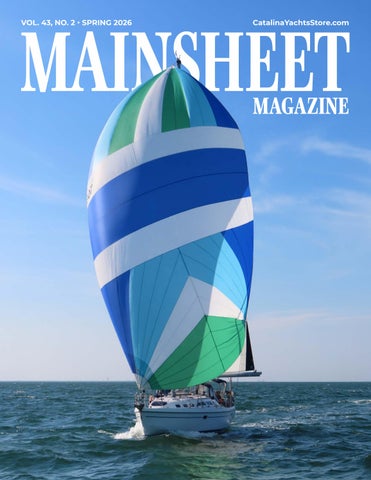
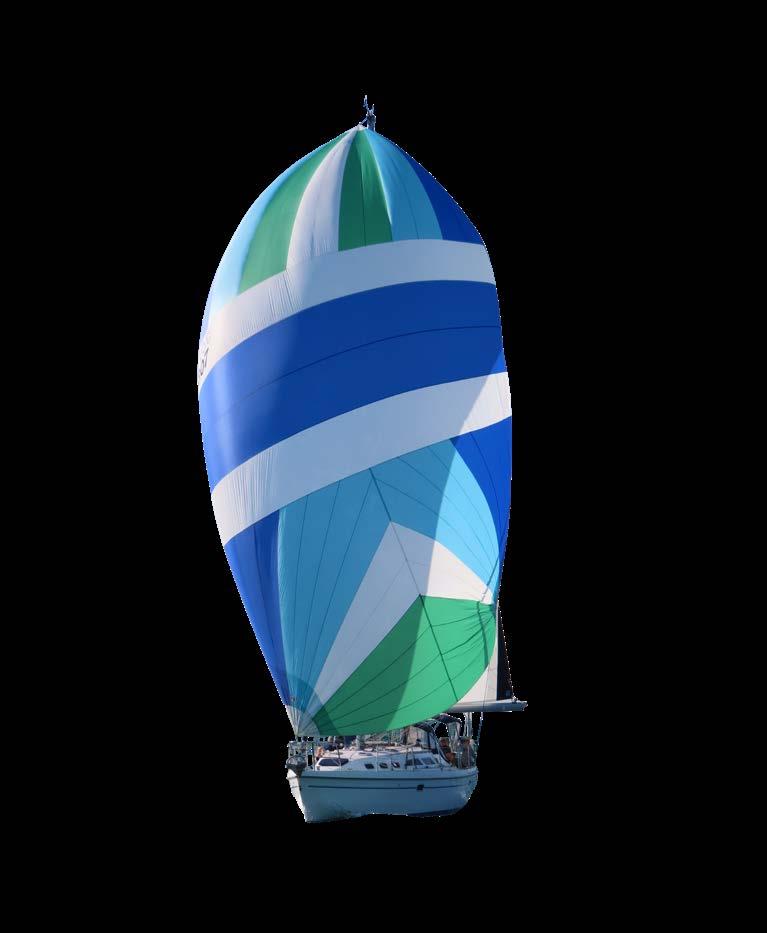
10 About Our Cover Storms, Volcanoes…and Second Place
Catalina 380/385/387/390
12 Destinations
The Secret is out on Montague Harbour
Catalina 470
16 From The Bridge
A Lucky Reminder of My Mortality
Catalina 4 Series
36 The Essential Owner’s Manual Supplement
From preventative maintenance to clever performance upgrades, this section features technical advice, DIY projects, and safety-vetted modifications to help you keep your Catalina in peak condition.
FEATURES:
18 The Long and Winding Road from Non-Sailors to C425 Owners
Part 3: We Leave the Dark Side and Return To the Catalina 425 Light
Catalina 4 Series
22 Vellamo’s Valhalla
Cruising North Queensland’s Great Barrier Reef Catalina 470
30 Extended Adventure in the Caribbean
In 2020 we, a newly retired Canadian couple, decided after some health challenges that life is too short and to go on a sailing trip.
Catalina 380/385/387/390
50 The Pulse of the Fleet
Stay connected with official reports, fleet updates, and regional milestones from our National and International Associations across the world.
From the Publisher:
A Legacy Continued
By Holly Hannah, Publisher, Mainsheet Magazine Digital Edition
There are certain names in sailing that mean more than the boats themselves.
For so many in our community, Frank Butler was one of those names. His vision built not only sailboats, but opportunity — boats that were accessible, capable, and meant to be used. Boats that carried families across bays, across oceans, and into lifelong memories.
For me, this story is also personal.
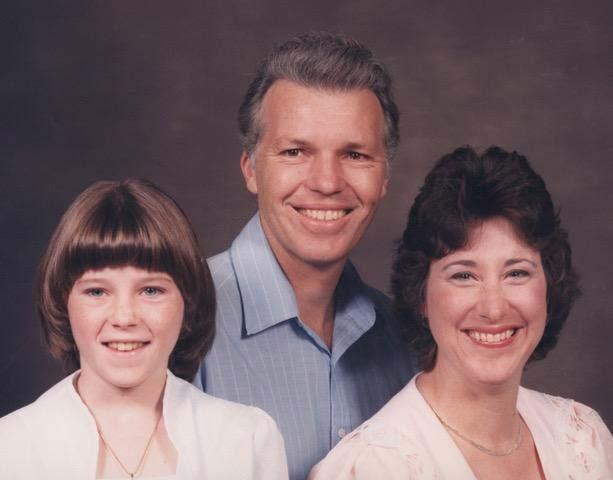
My mom, Sharon Day, worked alongside Frank for decades. She was part of the heartbeat behind the scenes — supporting owners, strengthening relationships, and helping shape the spirit that made Catalina Yachts feel like more than a manufacturer. She believed deeply in the people who sailed these boats and in the community that formed around them.
Mainsheet Magazine has always been a reflection of that belief.
It has never simply been a publication. It has been a gathering place — where owners share voyages, lessons, technical insight, and the stories that only sailors understand. Its purpose has never been about ink or paper. It has always been about connection.
Publisher & Advertising Contact
Catalina Yachts Store
Holly Hannah
holly@catalinayachtsstore.com
www.CatalinaYachtsStore.com
That purpose matters now more than ever.
Catalina boats may be built of fiberglass and teak, but the Catalina legacy has always been built on people. On owners who cross oceans and those who cruise close to home. On families who race together on Wednesday nights. On couples who anchor in a quiet cove and remember why they started sailing. On first-time owners who step aboard and feel their world expand just a little.
That is the heartbeat of Mainsheet Magazine
Bringing this magazine forward in a digital format through Catalina Yachts Store is both an honor and a responsibility. This is not about looking backward — it is about carrying a vision forward. A vision rooted in service to owners, in shared knowledge, and in the belief that sailing is at its best when it is shared.
This digital edition allows us to expand that connection in new ways — reaching owners wherever they are, highlighting your stories, preserving technical wisdom, celebrating rendezvous and races, andhonoring the legacy that Frank, my mom, and Gerry helped build.
Whether you have owned your Catalina for decades or are dreaming of your first one, you are part of this community. These pages are yours. Fair winds. –Holly Hannah, Publisher, Mainsheet Magazine Digital Edition
Layout & Design
Landis Productions
David Landis
david@landisproductions.com
www.landisproductions.com
Tech Advisor
Gerry Douglas gerard.douglas@gmail.com
Join an Association or Renew Your Membership:
Contact your association directly to join an association or to renew your membership. If you are paying by check, make it payable to your Association.
Catalina 470 www.catalina470.org
Catalina 470
7030 Balmoral Forest Rd. Clifton, VA 20124
Catalina 4 Series 445, 440, 425, 42, 400 Catalina4series.org
Catalina 4 Series 23 Plumrose Ct. Portland, CT 06480
All Catalina Association Fleet 21, Chicago Region www.catfleet21.com
April Hansen april.hansen@sbcglobal.net
Catalina Association of New England (CANE) www.allcatalinane.org
Primary Contact Email: canesailor@gmail.com
• Commodore: Clive Jacques
• Membership Chair: Dan Jacques
• Treasurer: Ross
Your Voice. Your Magazine. Our Legacy. How to Become a Contributor:
As an association member, you have a unique opportunity to see your stories, technical innovations, and adventures published in these pages. This is the ultimate member perk: the chance to contribute to the official record of the fleet.
Submit to Your Editor: Reach out to your specific Association or Tech Editor (listed below) with your articles and high-resolution photos.
The Curation Process: Our editors work with you to refine submissions to ensure we are sharing the most relevant and high-quality content with the entire fleet.
Expert Vetting: To ensure the highest safety standards, all technical modifications are reviewed by our Technical Advisor, Gerry Douglas, before publication.
Reach out to your editor and start your submission today or visit the association’s websites for full lists of association officers. Help us tell the next chapter of the Catalina story.
SUBMISSION DEADLINE DATES TO YOUR ASSOCIATION: April 1 (Summer) • July 1 (Fall) • October 1 (Winter) • January 1 (Spring)
Catalina 470 National Association www.catalina470.org
Association News
Julie Olson voyagerC470@yahoo.com
Tech Notes
Joe Rocchio jjr@onward.ws
Catalina 4 Series Association www.catalina4series.org
By Bob Armstrong, Silver Lining2, 2001 C380 TM WK, Yanmar 3JH3E, Tampa Bay, Florida
A little background on Silver Lining2 (our original SL was a Catalina 320): We bought her in Florida in October 2020 but took possession in Rio Dulce, Guatemala, in December 2020 during the peak of COVID. Our trip to sail her the 1,250 miles home took several months of planning and was plagued with numerous obstacles and delays that caused many crew changes, multiple COVID tests, and flight changes. Just getting insurance, Coast Guard
documentation, and arranging transportation from Guatemala City to the marina in Fronteras was a logistical Rubik’s Cube. We did not get an insurance binder until about three hours before closing.
Before deciding to buy, I had to find a qualified surveyor to look the boat over, send back photos, and then proceed with a survey acceptable to the insurance company. I was hoping to avoid the 3-hour drive to the airport, 3.5-hour flight, and the 7–12hour drive to get on the 20-minute lancha ride to the marina. The boat looked great; in-water survey was excellent. The surveyor had to delay the out-ofwater survey while he went to Honduras for another job. He was then delayed in that country and not allowed back into Guatemala, so he had to reroute through the USA before returning to Guatemala. Problem was, I was running out of time to have the survey completed, so we found another surveyor to finish the in-water portion. We got a waiver from the insurance company on the out-of-water survey since the boat had just had a bottom job a few months earlier, but I had to have that completed within 15 days of returning to Florida.
The day we closed, we had a Lloyd’s of London insurance policy that had a named storm exclusion. A few hours after closing, my wife and I headed over to the yacht club to celebrate our new purchase. The news comes on, and the Hurricane Center announces Eta as a named storm! So there we are, celebrating our new boat — that we had never actually stepped on or seen in person — which is in a foreign country
and now has NO INSURANCE coverage! FUN! (Time for an extra drink or two!)
Our flights from Florida were delayed and rescheduled over a period of a month and a half by Category 4 Hurricanes Eta and Iota, which both made landfall near the Honduras–Guatemala border in early and mid-November, washing out three bridges and blocking two major highways with mudslides between the airport and the marina. We had an active volcano in the vicinity, political unrest in Guatemala City, Honduran migrant caravans near our marina, and severe flooding that put the docks underwater and caused the river to run up to 8 knots, shutting it down for navigation. We weren’t sure we could even get the supplies we needed to get home, as the local markets couldn’t be restocked. Then the government decided not to let anyone leave with a boat that didn’t have the same captain who brought the boat into the country.
The delay moved us from the end of hurricane season into winter in Florida and Central America, adding cold fronts and strong northerlies as we headed north through the northbound currents between the Yucatán and Cuba — possibly serious large seas and less-than-ideal conditions.
An interesting trip for my wife and me and two friends. Belize was locked down due to COVID and would not allow anyone in by land, air, or sea. We had heard of yachts being harassed for even anchoring on the inside of the reefs, so we went north and took the offshore route by the atolls. The problem with that route was that there had been some piracy reported offshore where we made the turn north at Belize. From there, we continued north by the atolls and up the coast of Mexico, west of Cozumel into Isla Mujeres, Mexico, for the night, and then across the Gulf to Florida. It was great sailing — riding the 3–4 knot Yucatán Current north for about 12 hours and then turning easterly.
Hours later, our autopilot decided to quit working, so we hand-steered the next 200–300 miles, encountering the southbound part of the Gulf Loop
Current at 2–3 knots as we closed in on the Florida coast — in the wrong direction! We made it to Key West on December 22nd, just before Christmas. Got everyone home for the holidays, then my wife and I were back on the boat on the 26th to sail her the rest of the way to her home on Snead Island, Florida, hand-steering the next 200 miles.
We’ve been asked a number of times if it was worth all the trouble it took to buy, insure, take possession, and get her home. I always tell them — without a doubt — the 380 was worth every bit of effort it took to get her home. Absolutely a fantastic boat! –Bob Armstrong, Catalina 380 (2001, #307, TM, WK, Yanmar 3JH3E), Tampa Bay, Florida
QUINTE CANVAS - Top Shop Inc.
Destinations:
The Secret is out on Montague Harbour
Story
and
photos by Mitch Miller, C470-43
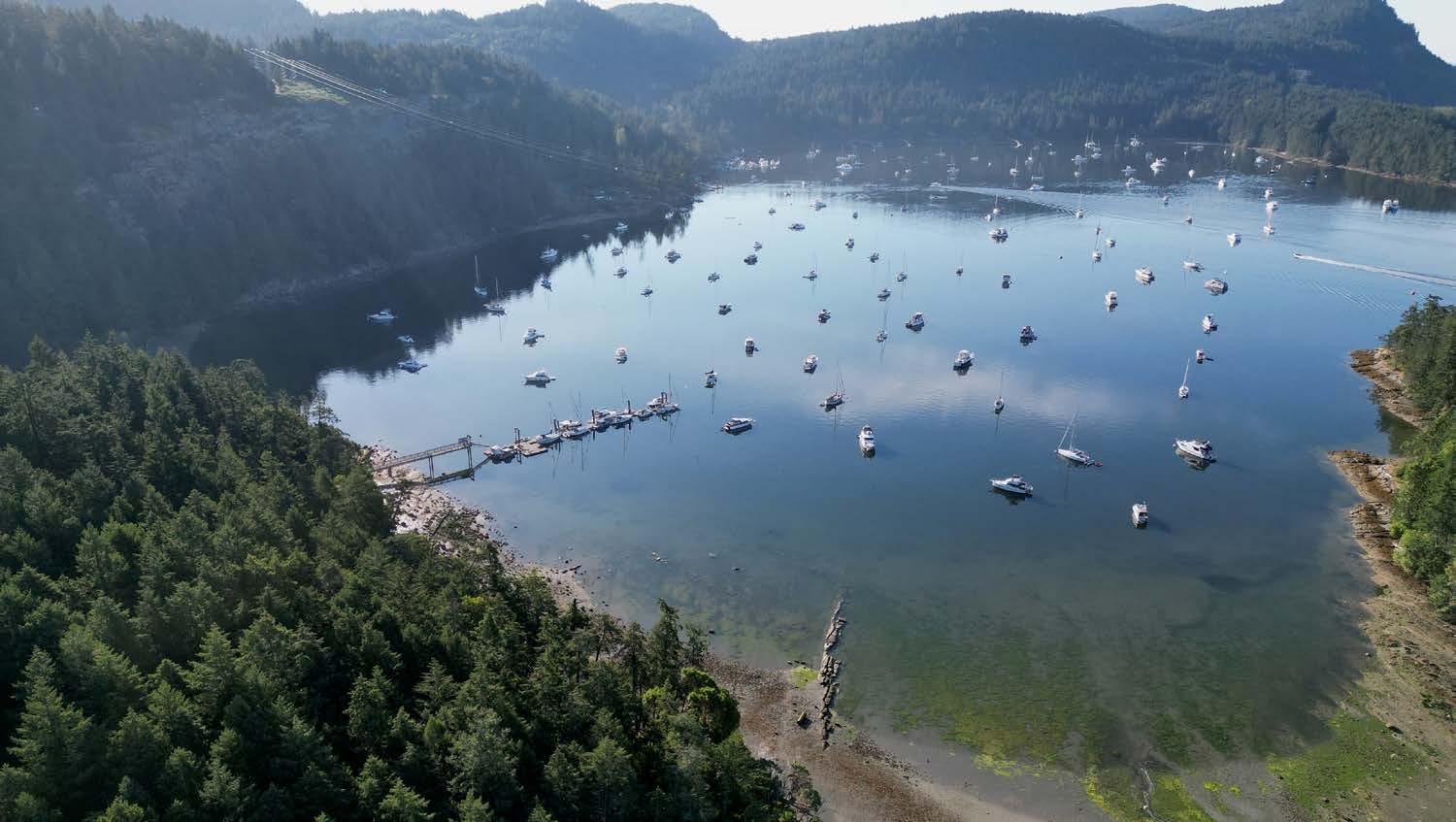
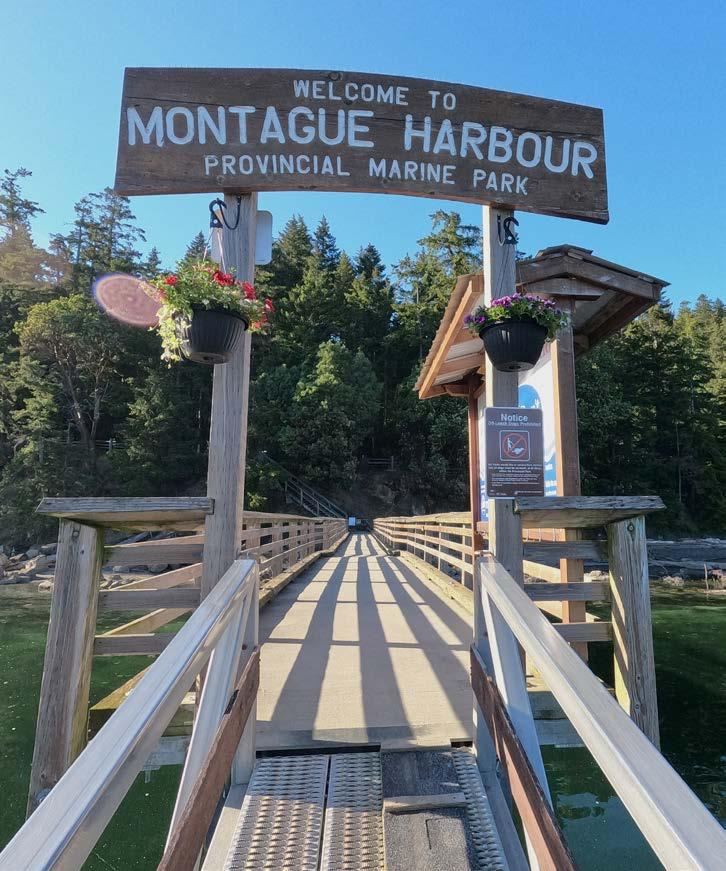
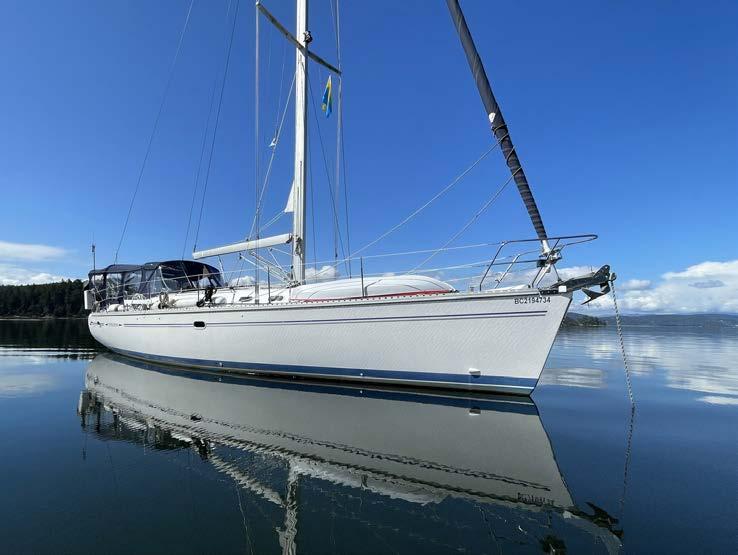
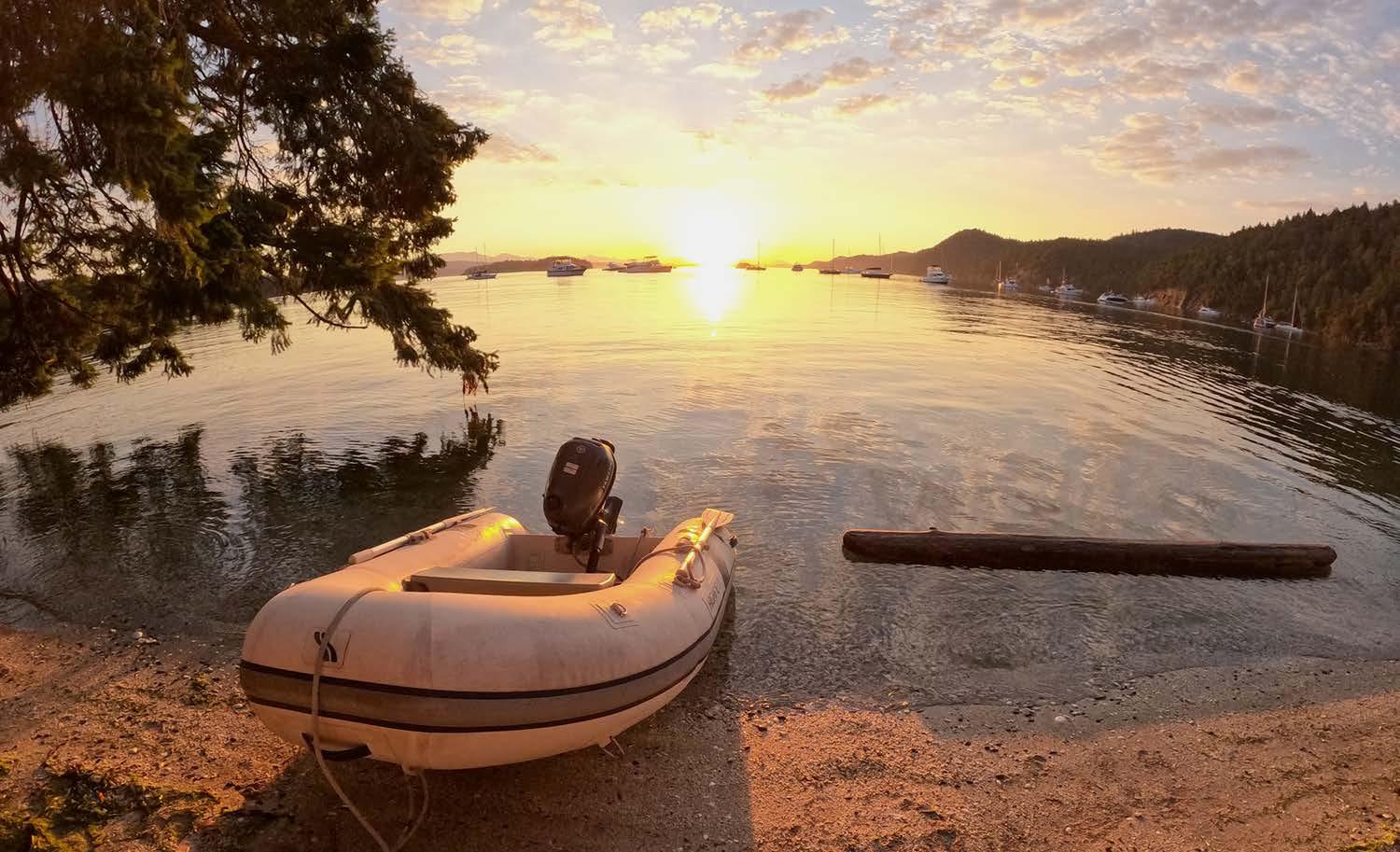
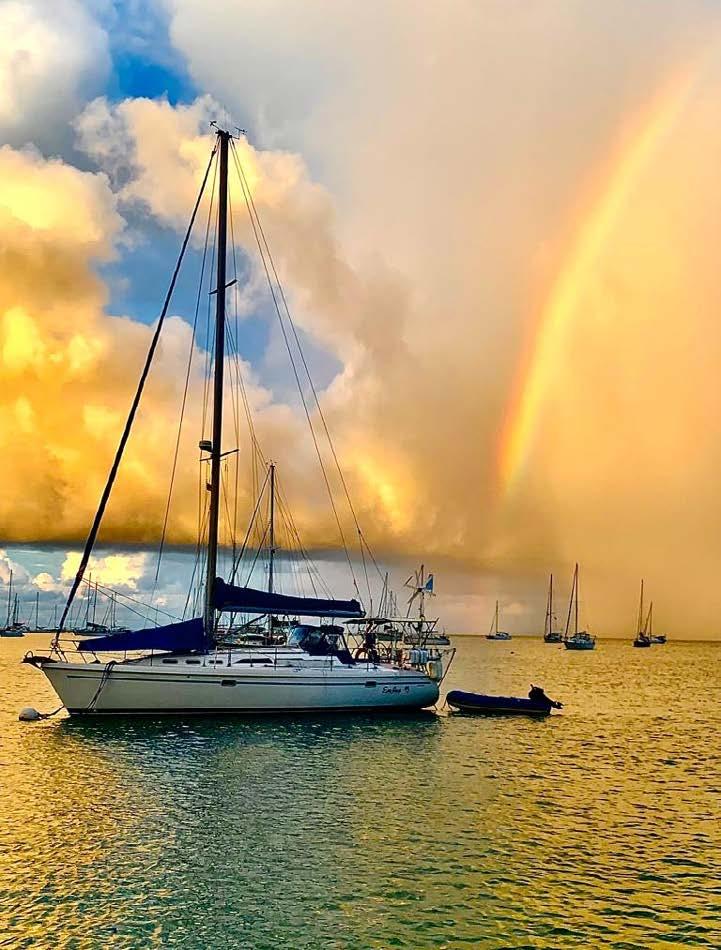
Montague Harbour at Galiano Island is without a doubt, our favourite destination when we are cruising in the Canadian Gulf Islands. Whether it’s because of the sunsets that never disappoint, or the magical white shell middens that form such magical beaches, we seem to spend more time here than at any other destination.
To catch the best sunsets, we always anchor off the beach on the north
Tumblehome
side of Montague Harbour Marine Provincial Park. The anchorage is fairly well-protected from most directions with excellent holding in mud and shell, and there is plenty of room for everyone who arrives. Fortunately, there is also good cell service here so you can send your amazing sunset photos to your friends and family.
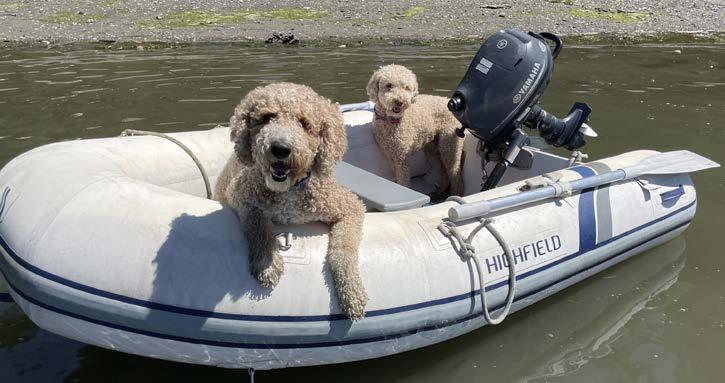
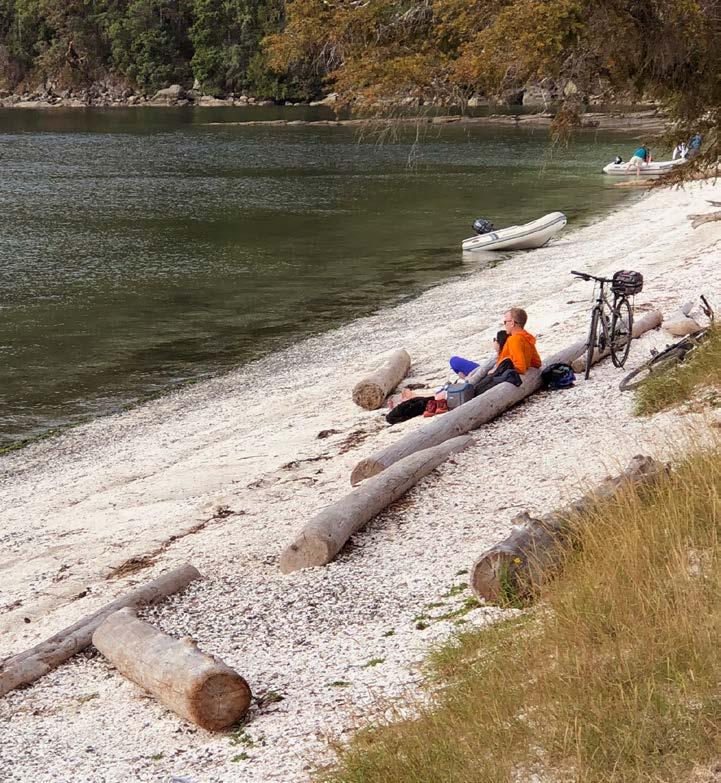
This anchorage is close to a beach where you’ll find logs to tie your dinghy to. If you enjoy walking, there is a great 1.5 km loop trail around Gray Peninsula that takes you to perfect little white-shell beaches where you’ll find some shade, a place to swim and room to relax. If you have your mask and
snorkel, you can dive down and get some Dungeness crabs for your dinner.
The white shell beach middens were created by the First Nations peoples that lived there for thousands of years harvesting clams and oysters. The beach may feel a little prickly to tender feet, but they are very clean, and you and your dog won’t get covered in sand. The blue green water and bright white beaches will make you feel like you’re somewhere exotic and exciting, like the tropics.
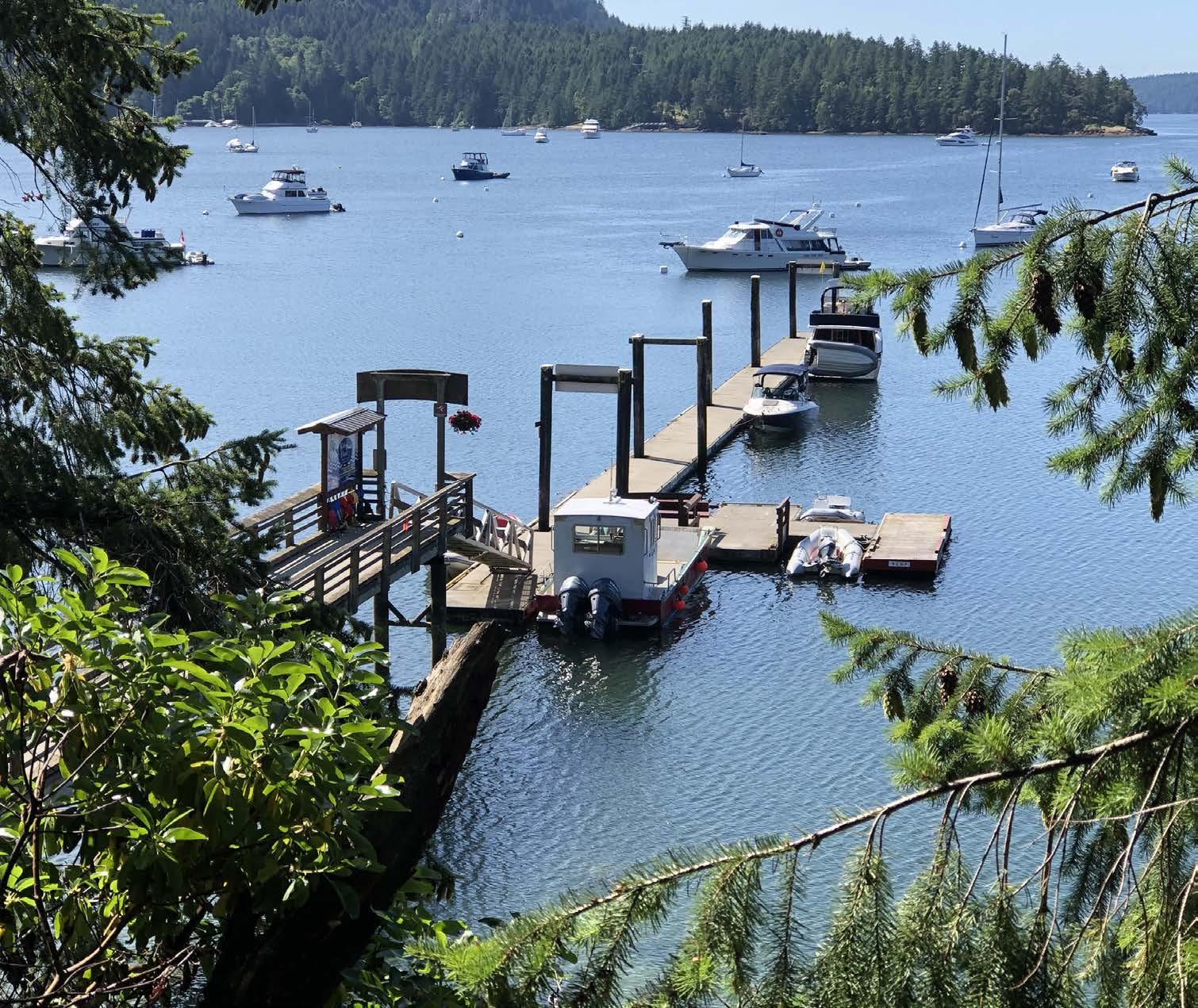
It’s usually quite calm at night, but if the weather forecast calls for NW winds, you may feel more comfortable swinging on a mooring ball inside Montague Harbour. A Park Ranger in a tender will stop by around dinner time to collect the $14 CDN daily fee. There is also a park dock that can accommodate smaller vessels and tenders. The park has well-maintained pit toilets and fee-based garbage disposal for the campground and boaters.
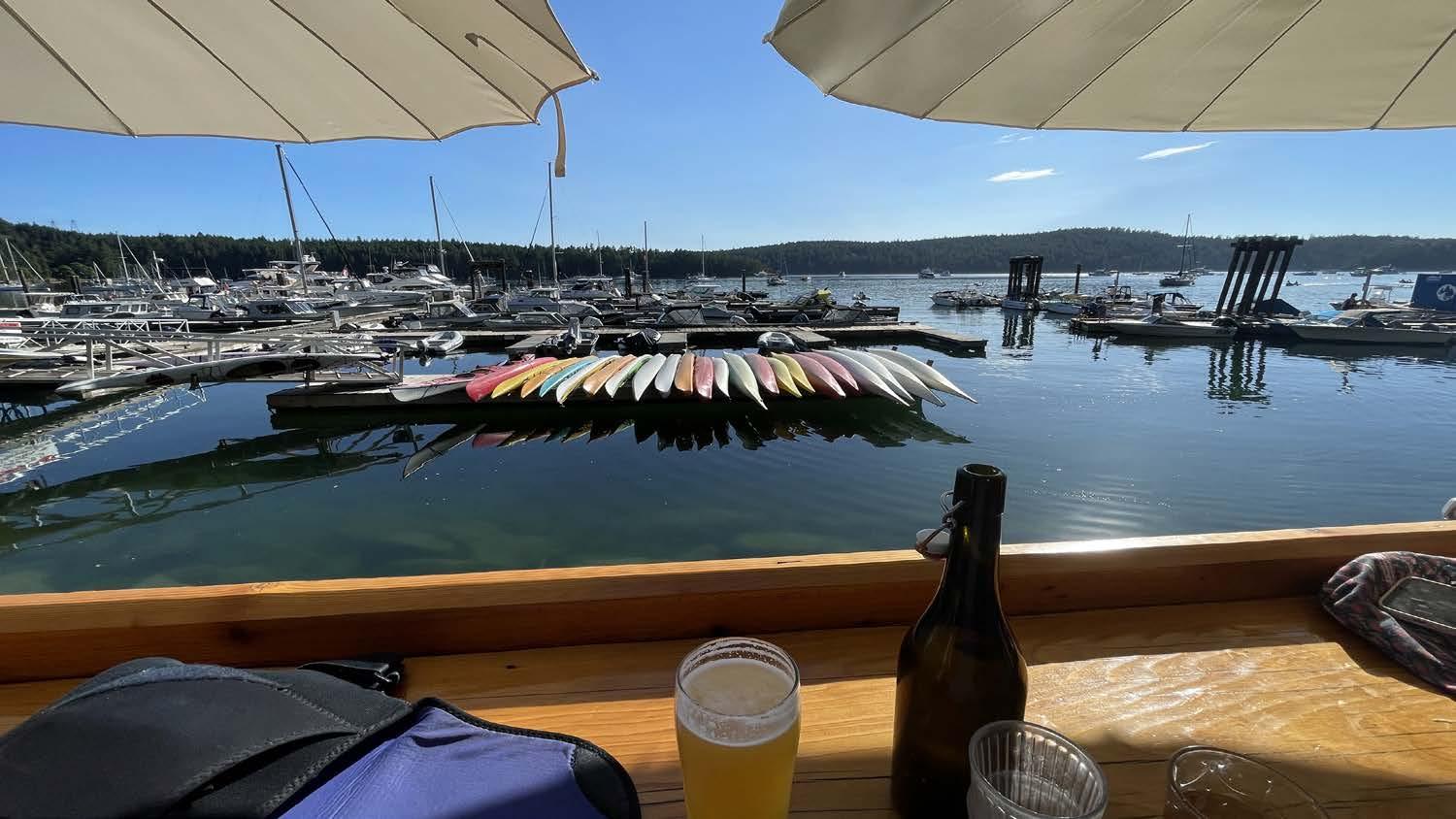
Inside Montague Harbour, there is a small pub called The Crane and Robin Restaurant where you’ll
COLUMNS MAINSHEET
COLUMNS MAINSHEET
Destinations: (Continued)
find simple, satisfying fare such as fish tacos and local beer on tap. The pub is connected to a local shop where you can find basics and souvenirs, but it is only open during the summer. You can also rent bikes there to roam around the island.
If you’re feeling a bit more adventurous, you might want to visit the Hummingbird Pub. Getting there is easy in the summer as the pub offers a pub bus service since it’s a 5.5 km trip to the eastern side of Galiano Island. While the Montague Harbour Park has a dock, lots of well-maintained mooring balls
and plenty of room to anchor, it doesn’t have any cell service - and you’ll miss out on the best view of the sunsets. So it is for those two very important reasons we always prefer to drop our hook on the north side of the Park. So there you go; the secret is out!
LINKS:
• island_keeper@hotmail.com
• www.maritimeed.com
• www.facebook.com/millermarinetraining/
From the Bridge:
A Lucky Reminder of My Mortality
C4 Series Associaion Editor Bruce Whyte
On the Rappahannock River in Virginia. It was an overcast November afternoon. The wind was 5-8 knots of wind from the NW. A mild stern slap on the transom. I was alone and enjoying the peace and quiet just securing the boat for winter. The wind was pushing me towards the dock. So, port side against the dock, dock in front, and a smaller boat on the starboard side of the dual slip. I met the dockmaster on the way to my boat and we talked about stopping the annoying slap on
the stern that always accompanies northerly winds. He suggested it was calm enough that the two of us could swing our boat around and put the bow into the irritating wind. Another owner assisted and once done after only 10 minutes, and once partially secured, the two helpers left and took off into their comfy and warm homes on the water.
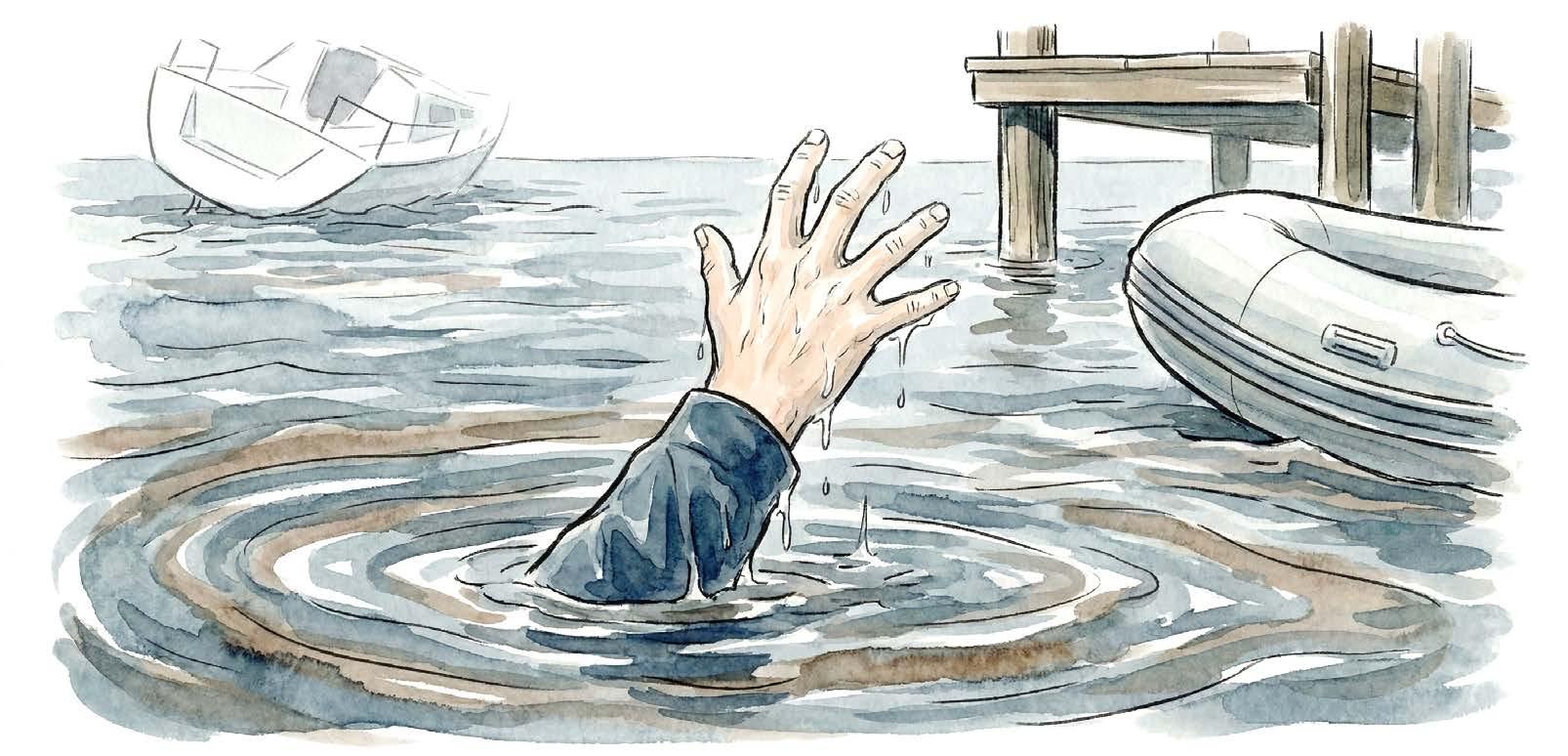
I started re-securing the boat to the dock which required the removal of the dinghy hanging over the stern on low davits and now banging against the dock. I cleared the starboard side davit lines, moved to the port side. Released the davit line on the davit, moved to release the secondary line…UH HO… OH NO…SPLASH. Thoughts in rapid millisecond procession were:
1. there is no-one that will hear me
2. missed grabbing the dock on the way in
3. saw the dirty brown water approaching
4. heard a loud splash
5. realized that was me
6. needed to protect my head while falling, and
7. needed to avoid the crustaceans on the underneath of the dock or my arms, chest and legs would be severely damaged.
And then the coldness of the water shocked me. How very cold! And the only help had just walked away and into their boats with heat running and probably a wee dram in their hands. Therefore, they were essentially not even there as they would never hear me.
Being November, I was wearing several layers of clothing, but not a PFD. Why not a PFD? I was at the dock doing something I had done dozens of times. No worries mate.
The scene looked like a small contained calm piece of water. But, at the stern of my boat was the dinghy, unsecured and lying right across the stern. The dinghy had its outboard motor, the swim steps were not in the water because of the closeness of the dock, and there were no visible steps into the water from the dock. Not visible because I was below the level of the dock and could not see them, even thought they were only about 10 yards away.
Now I am 77 years young, somewhat overweight, and certainly not physically fit. I tried to pull myself enough to grab one of the handles on the top/side of the dinghy. But without any firm support, it was doomed, very tiring and draining. I could not reach the top of the dock. And I was starting to feel cold. I took a rest to think about what to do. I had been yelling for help, but my two mates here were rightly down below. I could hear a child on the shore not too far away, but I presumed they could not hear me.
COLUMNS MAINSHEET
I decided to try to crawl onto and over the outboard motor propellor. So, kneeling on the prop, clenching my teeth against the severe pain of putting all my weight on the sharp blades of the prop, balancing precariously on that one blade while the dinghy swayed sideways and back, I actually felt I had secured a footing with one knee. Reaching across I could then grab the handle on the dinghy and fell into it
So, what happened? Why did I fall in the first place? Why could I not get out of the water any faster. Firstly, I was in the process of releasing the dinghy from its davits and had left it totally unsecured without a second thought. Nor did I give it a third or fourth thought. Routine work on a boat. But it was not just routine. It was moving a heavy boat into the wind and partially exhausting myself. And I took my eyes and what little brain I have right off track and did not focus on the basics.
As to question number 3, why could I not get out of the water any quicker. Weight. Too much and out of condition. Not as young as I believe I was still. So, seemed reasonable to shake a few of my mates by giving them a quick lesson focus, focus and focus.
Luckily, I don’t have my boat moored further north. I am not sure the outcome would have been the same if I had been in Wisconsin for example. Or even worse, the North Sea. –Bruce Whyte
3
The Long and Winding Road from Non-Sailors to C425 Owners
By Jon Arck, C425 #95, Tweety Bird •
Part 3: We Leave the Dark Side and Return To the Catalina 425 Light
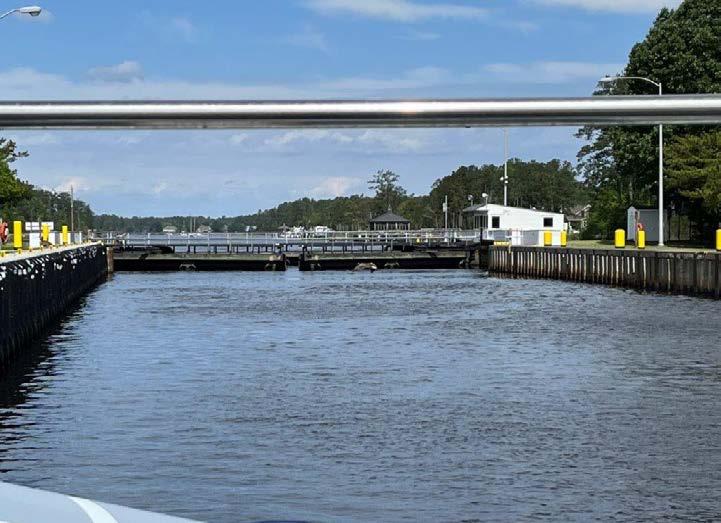
After topping-off the fuel tanks and emptying the holding tanks, we departed Annapolis on May 2 at 0900 on our 983-mile adventure, sailing through the night (at up to 10.1 kts in 24 knots of wind on the starboard aft quarter!), arriving at the ICW in the morning. We entered the ICW at Norfolk and continued to Coinjock (yes, that IS its real name!) for 176 miles, where we ran out of fuel because someone who had handed-over the boat to us had turned-on the auxiliary, 18-gallon tank, rather than the standard 62-gallon one (we stopped about ½ mile short – in eyesight -- of the Coinjock Marina and needed Boat US to tow us in – the only time I’d ever needed a tow). We docked at 2000, switched to the regular tank, purged the air from the line and fuel pump, and refilled the auxiliary tank.
We left the next morning, Thursday 5/4, for Beaufort, NC (another 160 miles), where we arrived
Catalina 4 Series
at 0700 on Friday, 5/5, refueled and anchored at Moorhead at the head of the Pongo River.
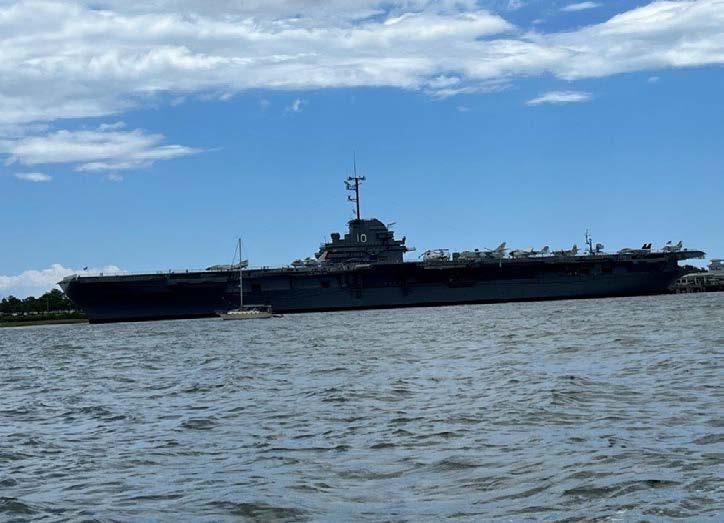
We departed Beaufort on the 6th at 0900, and anchored 1 mi from Wilmington River, departing the next morning for Charleston, arriving at Safe Harbor Charleston, where we refueled and toured the USS Yorktown aircraft carrier.
Fortunately, Safe Harbor Charleston had an authorized Yanmar dealer with whom we’d scheduled a 50-hour service the next morning. After it was
Tweety Bird leaving Annapolis, 10.1 knots down the Bay
Passing Beaufort on the curvy ICW — it got worse than this – and had shoaled-over in some spots!
performed (I had to lend the mechanic a secondary oil filter), we departed at 1400.
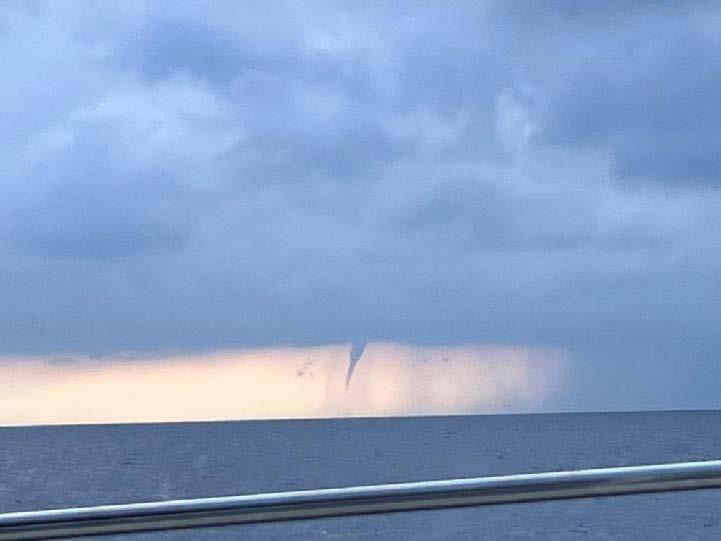
We had planned to stop at St. Augustine (100 miles away) but decided to bypass it and sail through the night directly to North Palm Beach. While abeam Oak Hill (21 miles north of Cape Canaveral), we spotted a waterspout about 5 miles to port at 2030, used radar to maneuver between storm cells.
Fri., 5/12, we arrived at Soverel Harbour Marina in Palm Beach Gardens at 1200, a total of 983 miles and several ICW groundings.
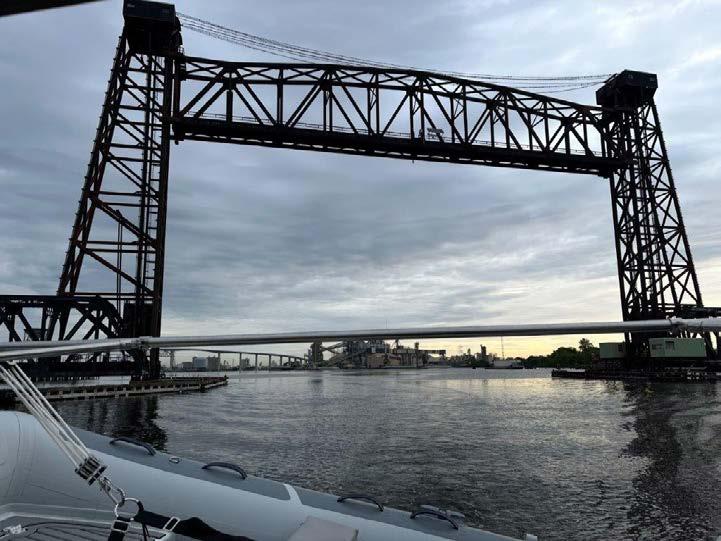
We’ve since moved to Riviera Beach Marina, and now enjoy a floating dock and a 12-minute motor out the nearby Lake Worth Inlet to the ocean (rather than the previous hour’s trip under three bridges – one of which is fixed at ~65 feet and required timing of the tides).
Since moving to Florida, we’ve been very active, joining the Castaways Sailing Club in North Palm Beach and the Palm Beach Sailing Club, and participating in numerous social, sailing, and racing events. I’ve also joined the Coast Guard Auxiliary and look forward to teaching the Florida-required Safe Boating course and performing vessel safety checks.
We’ve sailed Tweety Bird on daysails, one-and two-day races, and several two-day overnighters. As the Castaways’ Cruising Chairman, I’ve scheduled several 2025 overnighters to No Name Harbor/
Great Bridge lock and bridge
USS Yorktown
Gilmerton Bridge, Chesapeake
Water spout
The Long and Winding Road (Continued)
Biscayne Bay, the Dry Tortugas, St. Augustine, and the Bahamas with a few other sailing clubs.
We also joined the Catalina 4-Series (C4S) Association, and I’ve been appointed interim Commodore (along with interim officers Vice Commodore Allen Wrench, Secretary Mike Davis, and Treasurer/Membership Tom Sokoloski, along with Directors to help build-up the Association. I attended this year’s Catalina Owner’s booth at the Annapolis Boat Show to meet-and-greet current and potential Association members, and enjoyed swapping stories with several of you. I look forward to a year of Association-building and an active membership!
Epilogue
So, what did it take to go from non-sailors to owners of a C425?
For us, the journey started with lessons on J24s in San Francisco Bay in 1995 and ended in May 2023 at Riviera Beach, as owners of a 2023 Catalina 425. A total of approximately 86,933 miles was spent in the air and on the water, along with many hours on the phone and Internet to reach the conclusion that the C425 was the boat for us. That may seem a little extreme, some might say, obsessive, and they’d be correct – and that is why I know that we made the right choice.
And throughout the entire journey and since, my wife, Gloria, has been right there, encouraging, advising, and supporting me.
Tweety Bird arriving at her new home
Tweet Bird now racing with the Castaway Club
With one of the longest coastlines in the world and more than 10,000 beaches there’s lots of room – Australia has plenty to offer the cruising sailor.
No one “owns” beaches here, anything below the highest tide mark is crown (public) land so we have the freedom to beach our tender and explore shorelines as we travel. Except for the Whitsundays, Gold Coast and Sydney Harbour, we’ve never found it difficult to find safe and uncrowded anchorages while cruising the eastern coast of Australia.
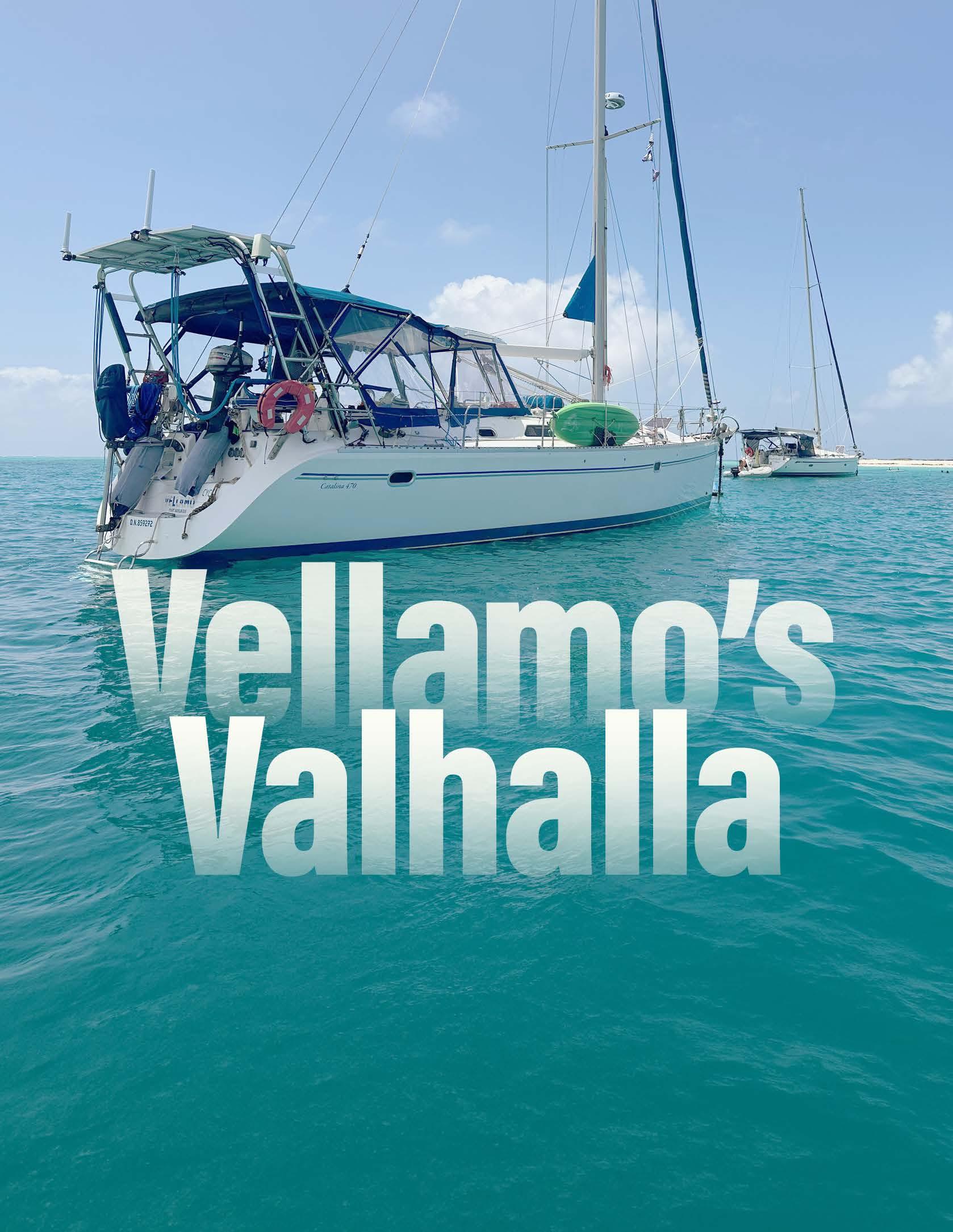
We purchased Vellamo C470 #87 during the COVID-19 pandemic after she had returned to Australia from a world circumnavigation as Sukha (Mainsheet Winter 2018). After taking delivery in Queensland in November 2020, we express-sailed 1000 nm directly back to our home state of South Australia to make her our own. The plan was to enjoy cruising familiar waters before heading north to escape our chilly southern winter. We had both sailed the eastern coastline many times as racing or delivery skipper/crew and were eager to explore it in our own boat.
In June 2021 we headed off for a short trip to see how far we’d get, initially aiming for three months or so. We returned in February 2022. On that trip we made it up to Magnetic Island in northern Queensland. We stopped for a day and stayed for nearly three months, falling more and more in love with the island every day.
2022 was spent back in South Australia replacing our Sunbrella dodger with a hard top designed and built by Matt and our mate Peter. Matthew also replaced our standing rigging, fitted a saloon air conditioner and replaced the old lead acid golf buggy batteries with LiFePo4. In the galley it was time for a new microwave and reassignment of pantry storage. I designed new clears for our hard dodger and sides; we like to have the ability to enclose our cockpit for sun, wind and rain protection.
We rented out our home and left Adelaide in December 2022. The plan this time was to sail to Tasmania (Mainsheet Fall 2023) where we’d base the boat while Matthew competed in the Sydney Hobart yacht race and we could also attend the
world famous Wooden Boat Festival in Hobart. We spent months exploring some remote anchorages and the pristine wilderness that Tassie is famous for before jumping back up to the mainland when the temperatures began to drop.
In September we arrived back in northern Queensland, choosing to base Vellamo on our favourite island and explore the Great Barrier Reef and surrounding islands for the next few years.
We are still here!
Why did we stay? Read on!
MAGNETIC ISLAND
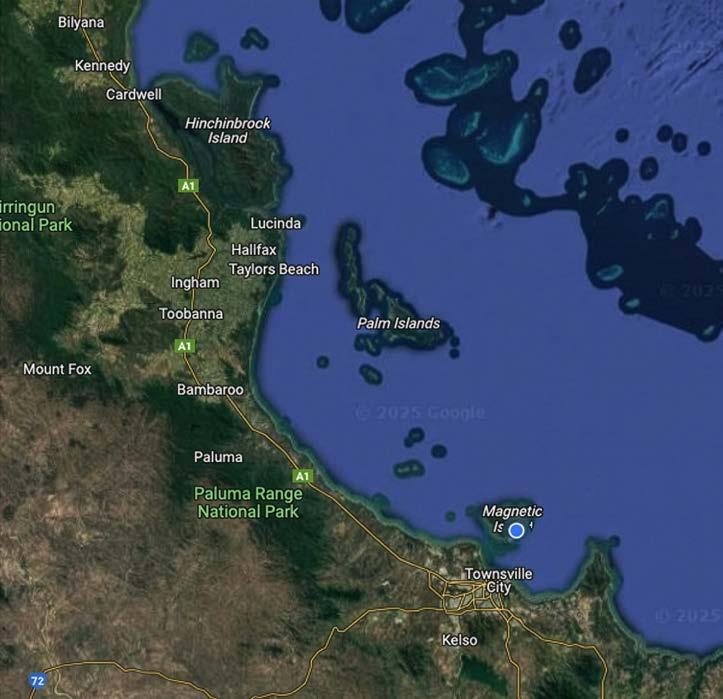
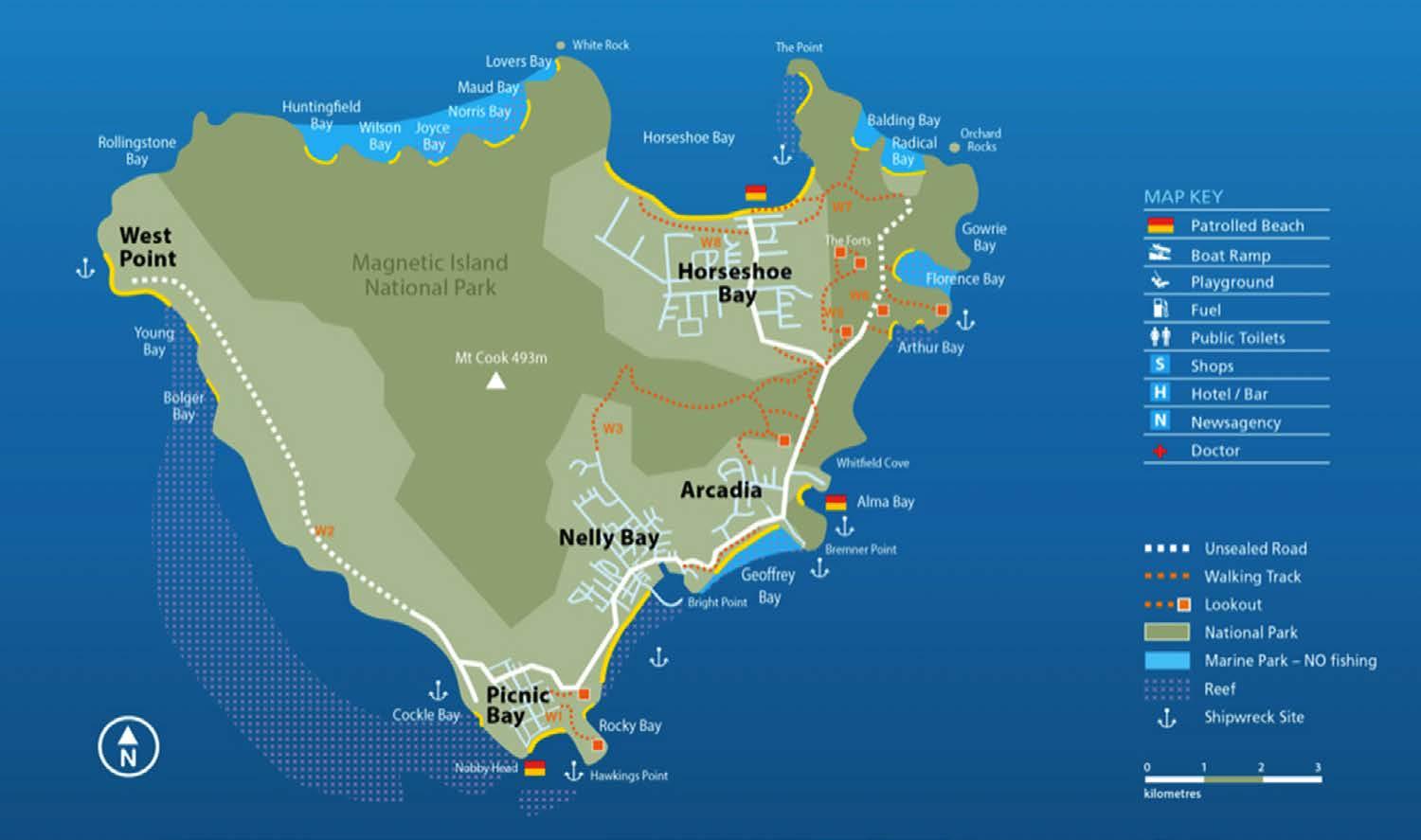
The Whitsunday Island group is Australia’s famous yacht cruising destination, but with just an overnight sail north, cruisers can find an escape from the charter boats and holiday crowds. “Maggie” is a popular stop with cruisers heading north to Cairns or back south. Just 8 km offshore from Townsville, the island is considered a suburb of that city but, with 78% protected as National Park and just 2,500 permanent residents, laid-back “Maggie” is arguably the most scenic, accessible and popular tropical island in Australia.
The only fully self-contained island within the Great Barrier Reef Marine Park, cruisers choose Horseshoe Bay, with its protection from the SE trades,
North Queensland cruising grounds
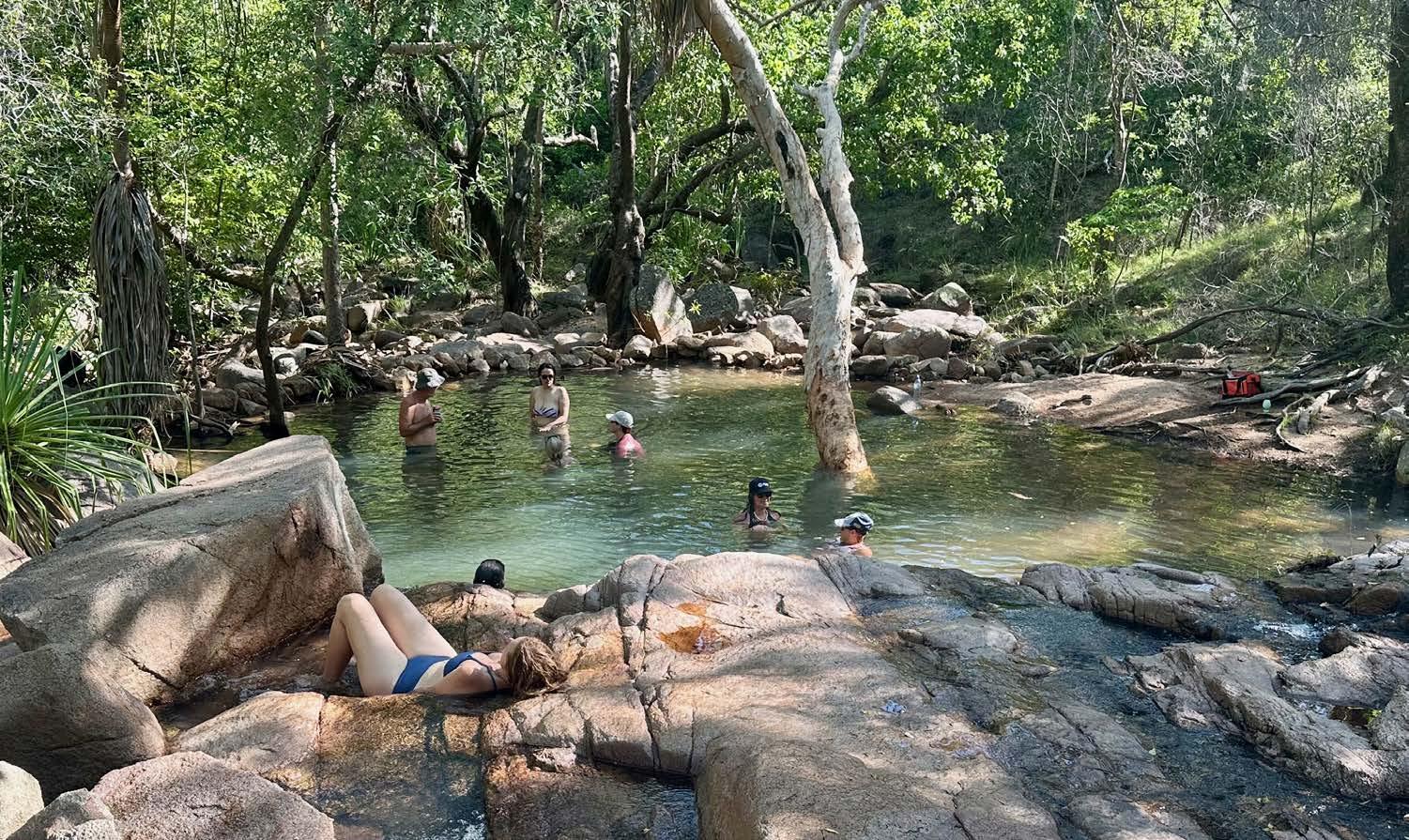
(Top) Magnetic Island, (bottom) Magnetic Island watering hole
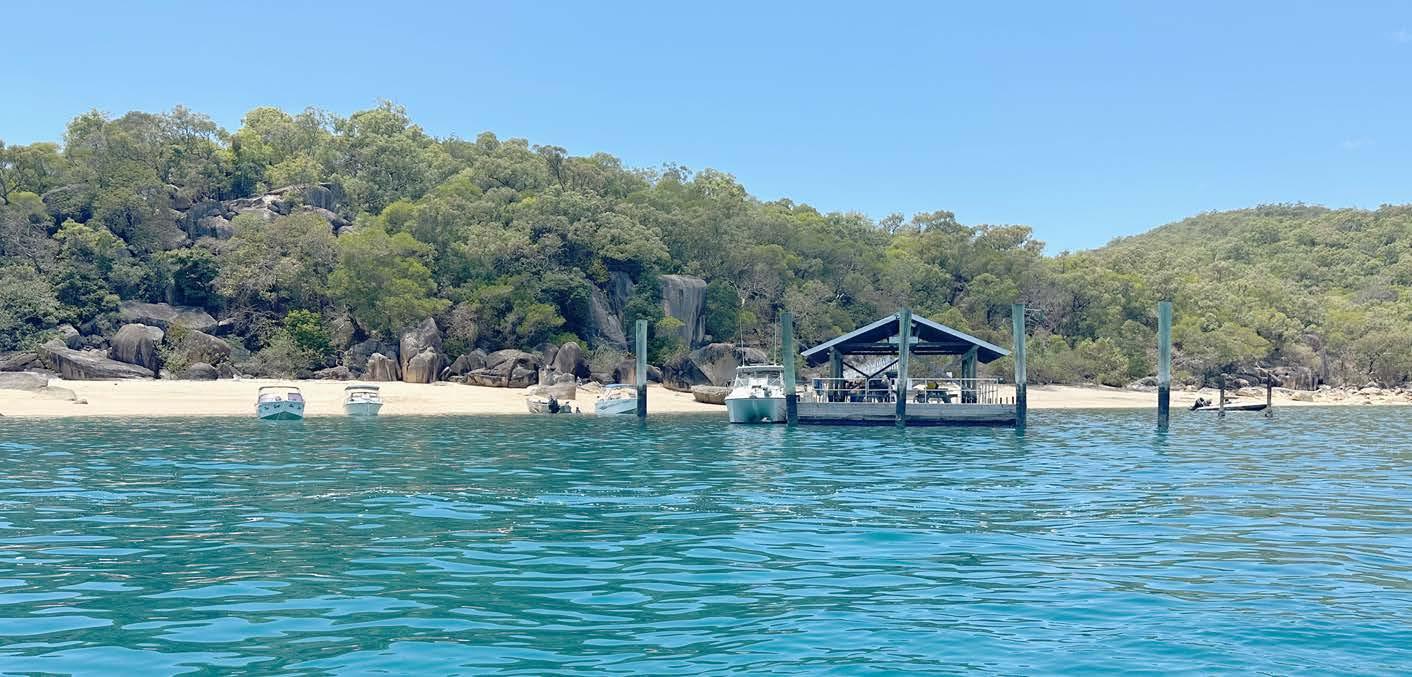
ample room and good holding, as a ‘home base’ until the northerlies begin to blow. Catamarans congregate closer to the beach under the headland dividing Horseshoe from Balding and Radical Bays, while deep keel monos sit comfortably further out. There are waterfalls to swim under in the wet season and the island itself is the perfect size to circle on a day trip with lunch and snorkelling stops along the way. Walking trails connecting bays offer great half-day adventures and a chance to stretch those sea legs. Cafes, take away food outlets and taverns adjacent to Horseshoe Bay’s beachfront park are a mecca for locals, cruisers and tourists.
Truly tropical, Maggie enjoys a stable, warm and mostly sunny climate with temps ranging from 25C in July to a warmer 32C in December. Peak tourist season is June - October and the island’s transient population increases on most weekends with the arrival of day-trippers from Townsville.
THE PALM ISLANDS
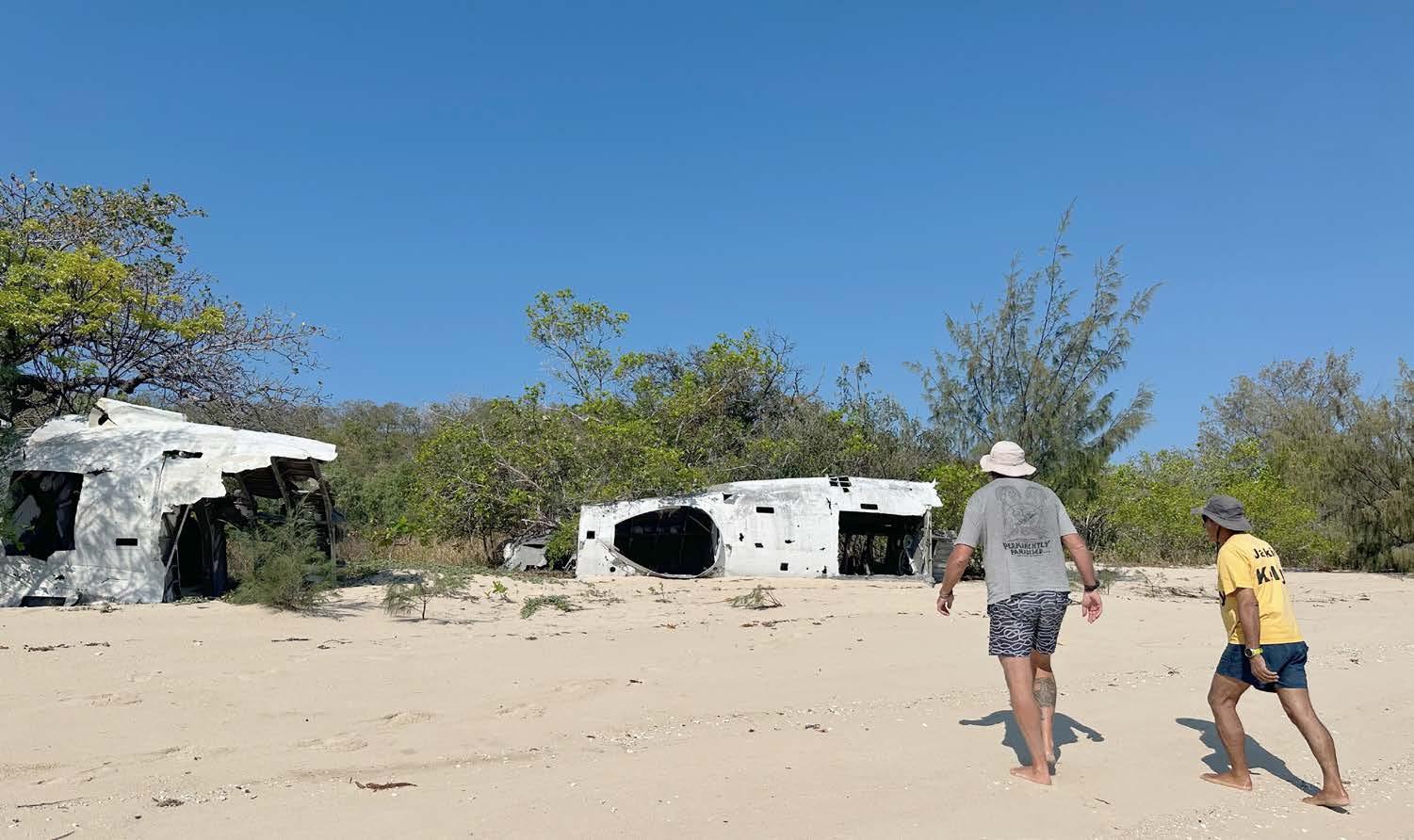
A short sail/motor from Magnetic Island, the Palm Island group is a locality of 16 islands including an aboriginal shire on Great Palm Island. Great Palm is similar in size to Maggie but has fewer inhabitants. With steep forested mountains rising more than 500m above uninhabited small bays and sandy beaches, it’s one of our favourite places to visit. Many cruisers believe that you can’t go ashore as it’s an aboriginal shire, but we find we are welcome ashore and even re-supply at the Palm Island Supermarket. One of our favourite Palm Island discoveries to date was visiting the remains of Catalina Flying Boats left on the shore at the end of WW2.
Other favourite islands in the Palm group include:
Orpheous Island
This 12 km long “private” island is home of the Orpheous Island Lodge. At more than $2,000 AUD per person per night, it caters to just 28 guests who arrive
Palm Island Catalina Flying Boats
Yanks Jetty at Orpheus Island
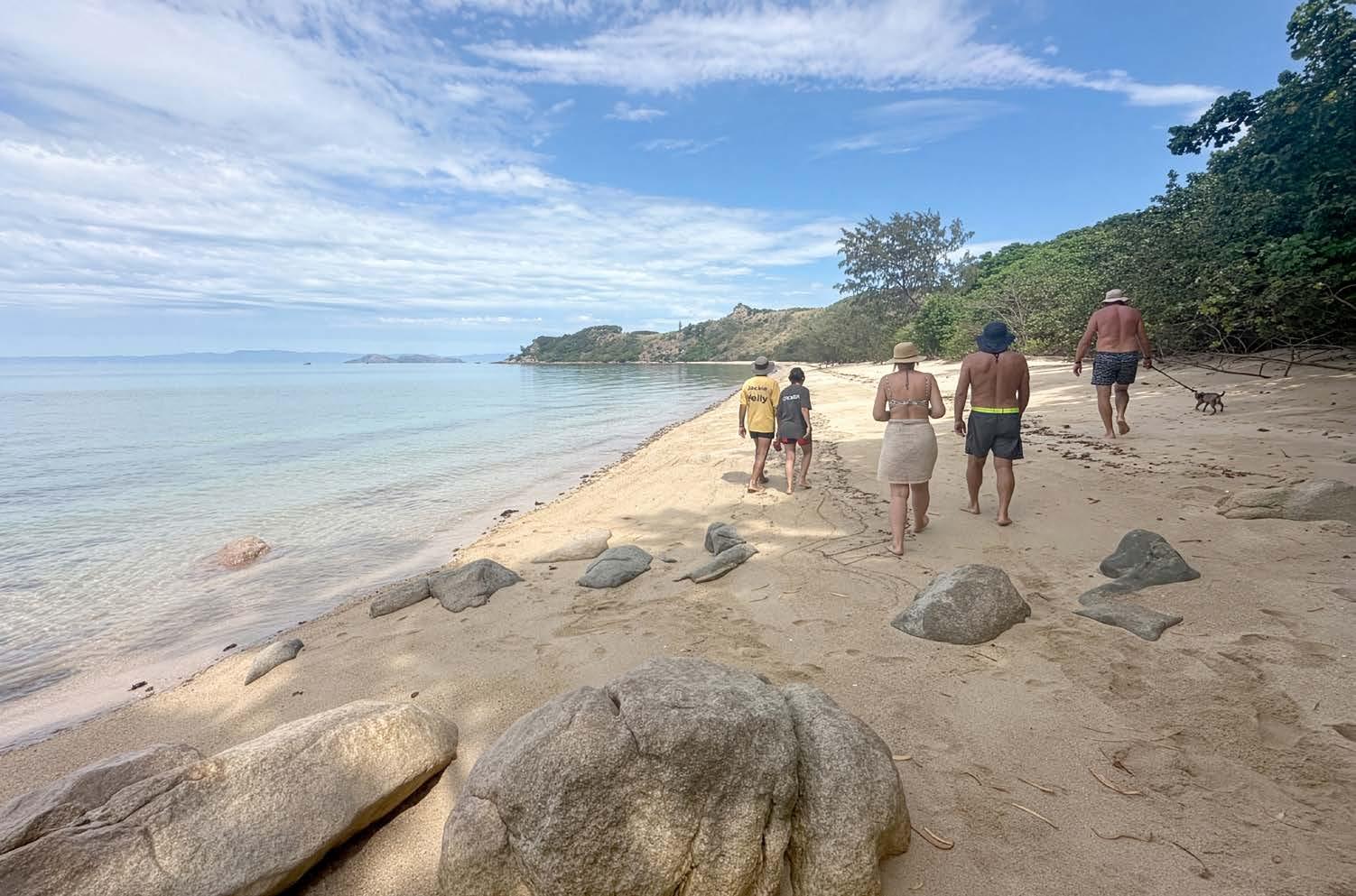
Quiet beaches and bays on Palm Island
by helicopter. No one owns the water though, and we love to anchor in Hazard Bay near the resort where we can snorkel from the back of the boat and visit the expansive bed of Giant Clams nearby. We respect the privacy of resort guests but often take advantage of the island’s walking trails, one which leads to the famed “McArthur’s pool.” Myth has it that General McArthur himself ordered it built when he was visiting the island, but I still haven’t found conclusive proof. What we do know though is a man-made pool was certainly built there during the war years.
Fantome Island
Fantome Island Lock Hospital and Lazaret Sites are a heritage-listed former leper colony, the remains of which can be explored when you go ashore. Cared for by the nuns from the Franciscan Missionaries of Mary, Fantome was home to a community of indigenous “lepers” whose marginalized existence was hidden
from white society at the time. The hospital remained absent from historical records for decades. It’s a sad chapter of our history and exploring this lovely island can be sombre undertaking when you know the stories.
Brisk, Esk, Fly and Havannah Islands
Only a short sail/motor away from the larger islands, these offer great day stops or overnight anchorages in good conditions. We love to explore the unspoilt beaches and bays with other cruisers, sometimes spending days just hopping from one place to another. Every time we visit, we discover something new and beautiful.
Hinchinbrook Island
The mountains of Hinchinbrook Island rise dramatically from mangrove surrounds and on a leisurely sail down the channel between the island and mainland, you’d be forgiven for thinking you’ve finally arrived in Jurassic Park. In confirmation, you might even see massive saltwater crocodiles sunbathing along the banks, as we have. This is not a place to explore in an inflatable tender (locally known as “croc teething rings”) but is always a captivating sight from the safety of Vellamo. A national park, it’s popular with campers, hikers, kayakers and cruisers. Zoe Bay, on the eastern side of the island, is a “holy grail” for yachties. Often exposed to the prevailing SE trades and ocean swell, it’s accessible only in the best conditions. Once ashore though, the famous Zoe Falls are a bucket list item that every cruiser wants to tick off.
THE GREAT BARRIER REEF
From Maggie and Palm, our favourite places are Lodestone, Keeper, Wheeler and John Brewer Reefs. 2020 saw the opening of the Museum of Underwater Art (MOUA) at John Brewer Reef that transformed part of the world’s largest coral reef system into a living art piece.
The museum features a series of installations by world-famous underwater sculptor Jason deCaires Taylor that highlight reef conservation, restoration, education, and a deep connection to the community.
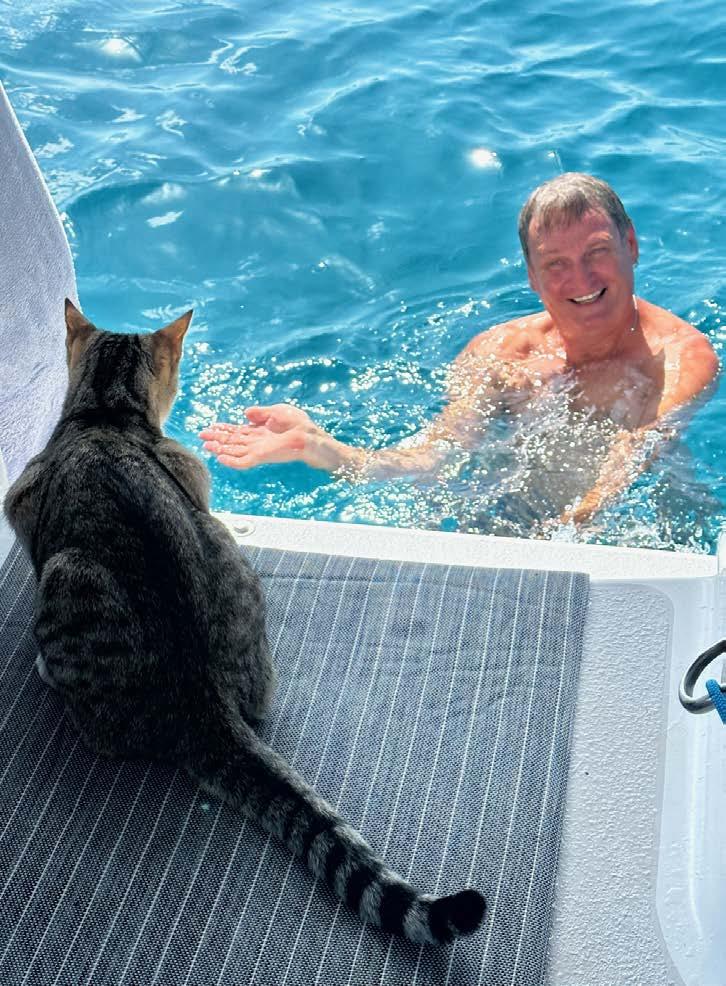
Time for a swim supervised by ship’s cat Tora
We carry dive tanks and a compressor on Vellamo but, as we sail two-handed, we rarely dive unless there is someone above to confirm our safety. At 15m depth we dived on the Coral Greenhouse (video on our SV Vellamo Facebook page) and it was stunning. Snorkelers can view the Sentinels, Reef Guardians and other installations from the surface.
It may take half a day to get to some of the reefs from Magnetic Island or the Palm group but, once you’re out there, it’s surreal. Imagine being on anchor, beyond view of land, in pristine turquoise waters, often without another boat in sight. The water is warm and the coral and fish life as wonderful as you would expect from the world-famous Great Barrier Reef.
This is why we live where we do. Another island or reef is always beckoning. A little north of Hinchinbrook we even dropped in to visit Australia’s very own “Catalina Island” and this season we will revisit it and head even further north into the waters of Far North Queensland. In Australia many cruisers are required by insurance to return their boats below a certain latitude for Cyclone season, but we choose to remain. Cyclone Kirrily passed over the top of us last season and Vellamo came out unscathed.
Catalinas are tough! We love our C470 and I often say that there’s not a lot I would change about her, even if we could. That’s the true test of a liveaboard yacht, isn’t it?
Catalina Island behind us
Great Barrier Reef
Sudbury Cay
By Martin and Swmbo Hill
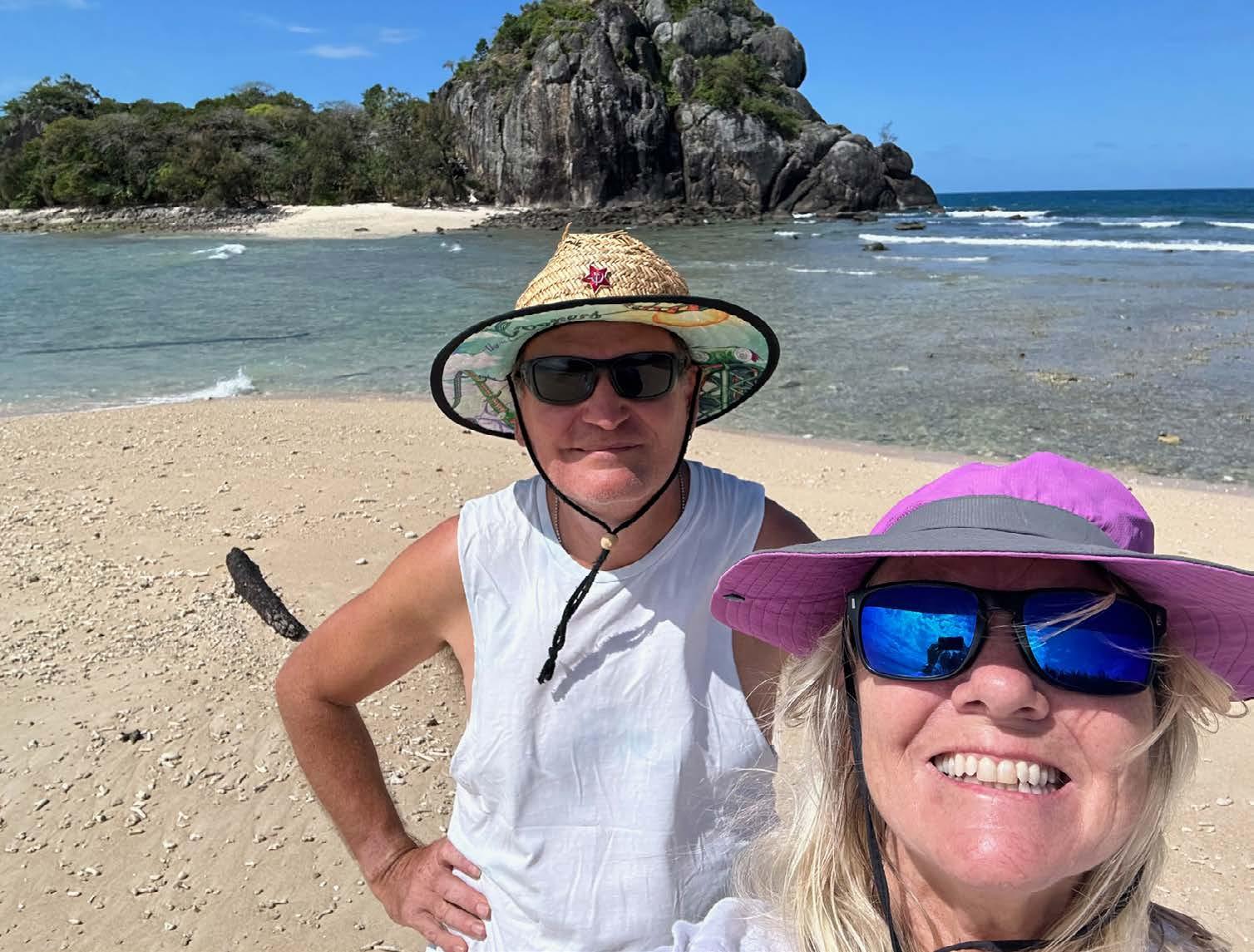
In 2020 we, a newly retired Canadian couple, decided after some health challenges that life is too short and to go on a sailing trip.
I had some previous sailing experience and had completed an intermediate cruisers course in Vancouver, also we owned a 22 foot day sailor at home on the straits of Juan de Fuca. I was a ships Captain before I retired due to ill health. Swmbo was a willing participant but not much sailing experience.
The first questions were where, what boat and how long? The how long question was decided by BC health insurance, normally they allow snowbirds to leave for a maximum of 6 months without losing coverage but we found out that on request they will extend that to 2 years. So 2 years was the answer.
Regarding where, not wanting to do long ocean passages, we thought that perhaps the sea of Cortez or the Caribbean might be fun. We did consider the Mediterranean but it seems to be quite expensive and crowded in summer, very windy in winter. I would have loved the South Pacific but Swmbo wasn’t happy about the long passages.
We visited numerous boat shows and boats for sale, probably annoying a lot of brokers along the way. We chartered a 38 foot hunter for 10 days and cruised the Gulf islands of BC from which we learned 3 things. One, she loved it, two, not in a vee berth and three, not on a hunter.
After endless hours of scrolling through web sites we eventually found a boat that we liked in a place that we liked at a price that we could live with.
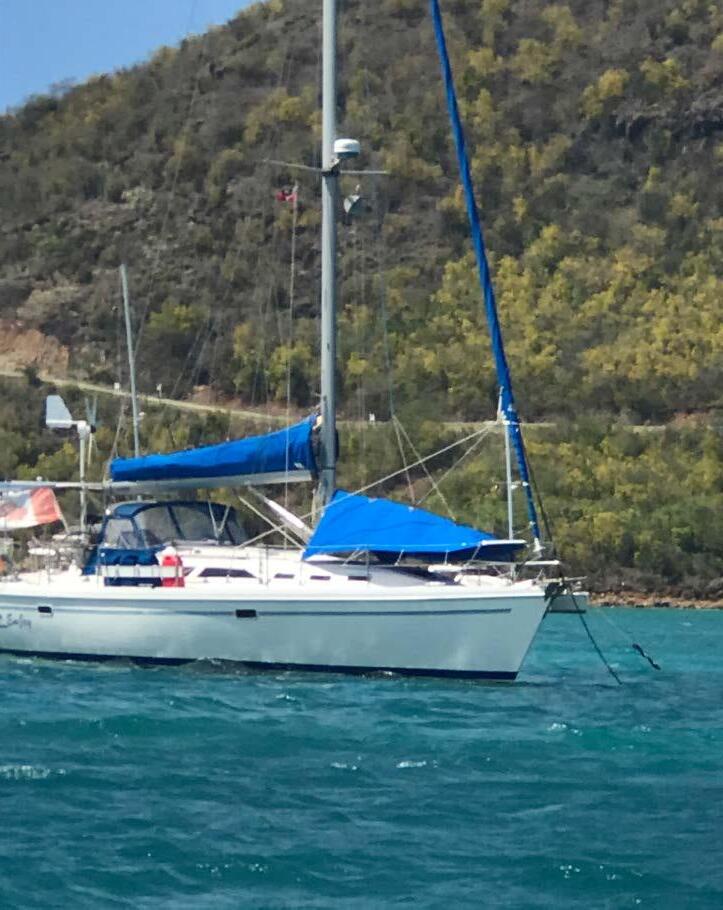
The boat was a Catalina 380. The owners, a young couple, had bought her in the US and sailed down the windward islands to Grenada, where they stayed. The boat was structurally sound although it needed some upgrades, nav system not working, running rigging, all the usual signs of neglect. The 380 has one big disadvantage in my opinion and that is the very deep unprotected rudder. On the plus side it is a good solid boat, well laid out and perfectly capable for our plans. The open airy aft cabin was a huge selling point for us as we both hate vee berths.
We later discovered what a massive difference the walk through stern made when boarding to and from the dinghy and I would never now consider a cruising boat without one.
Grenada quarantine
Extended Adventure in the Caribbean (Continued)
Perhaps when I was 20 I wouldn’t care, but at 60 it was bliss.
So, we bought the boat sight unseen subject to survey. Risky. As it turned out, the surveyor in Grenada did a reasonable job, although how he missed the rotten floorboards in the galley and the totally knackered house batteries is a bit of a mystery. We also found out later that the fridge was a very inefficient piece of crap, despite a PO surrounding it with spray foam. Barely able to cope with Caribbean temperatures, it just about drained my house batteries every night, on setting 2 of 10.
Having purchased the boat, rented out our house in Canada and being effectively homeless we got the first available Air Canada flight to Grenada and 10 days quarantine in a hotel.
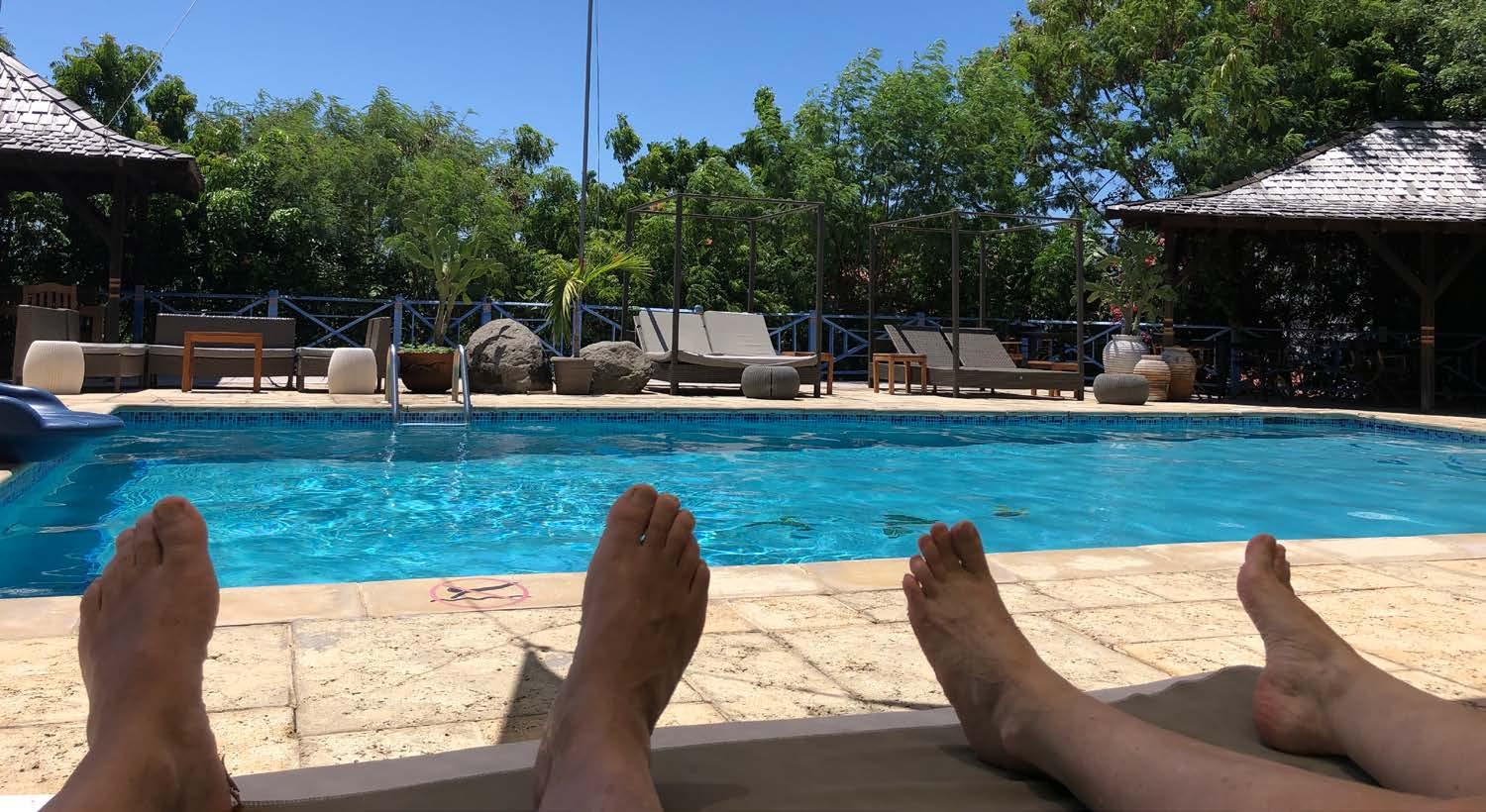
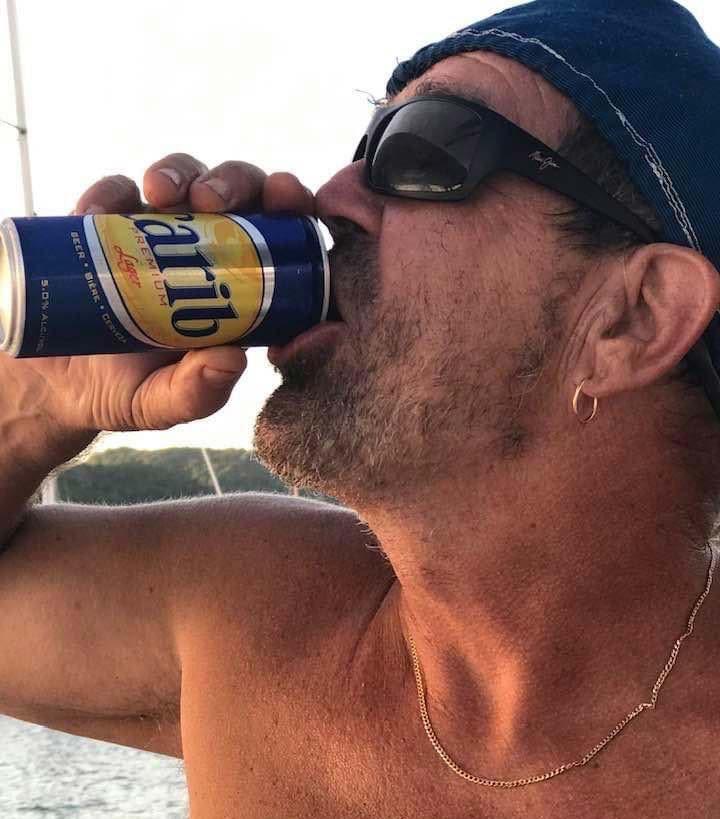
It was pretty hard really, all that sunshine and beer around the hotel pool which was dedicated to quarantining guests.
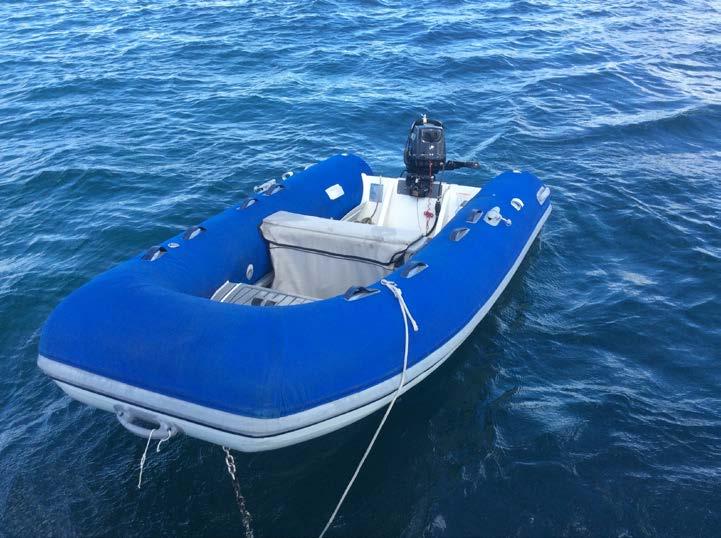
At this point, I really should have invested in a water maker. Water was available everywhere we went but being on anchor or ball I was hauling jerry cans of water in the dinghy. We used about 4 gallons per day so a dinghy trip every few days to top up. We experimented with various rain catchers and found that a dam aft of the port side filling cap was effective in heavy rain but it didn’t rain very often.
Anyway, the buying process was not too painful. Major items we replaced were sails, running rigging
The new family car!
(which degrades fast in the tropics), all electronics, all batteries, rib and 15hp outboard.
We also added 480W solar panels and controller, AIS and a lot of spare parts.
Just a little aside on power generation, we did not have a generator. 480W solar panels and 3 agm house batteries were enough at anchor although the fridge made it all a bit border line at night. We also had a 6 blade wind generator which I never thought much of until we tried night sailing. We couldn’t have run the auto pilot at night without it.
Which leads us to everyone’s question, what did it cost?
Well, in 2020 we bought the boat for US$70,000. During the 2 years, for replacements, spare parts, repairs and upgrades and maintenance, including one haul out, about $40,000. 2 years later we sold her for $65,000. So realistically, owning and operating the boat for 2 years cost about $45,000, not including fuel, moorings, groceries and beer. I know other people who do it for much less and some for much more.
We spent most of the first season in Grenadian waters due to Covid restrictions making travel to other countries difficult. We had a permanent mooring ball in Prickly Bay, which cost about $300 per month for a premium mooring near the marina. There are cheaper moorings and anchoring is free. Like many places, you have to pay for a cruising permit. Despite covid we managed to do quite a lot of short sails and explored Cariacou and Petite Martinique. We started settling in to the live aboard life quite quickly getting used to the boat and the lifestyle. Finding the best stores and restaurants, a bit of tourist stuff, lazy afternoons on the beach. All the good stuff.
One thing I noticed at the start is how eccentric, diverse and slightly mad the other cruisers are.
We found it very easy to settle in and make new friends, absolutely everywhere we went except for BVI later, where the wealthy charterers looked sideways at us scruffy liveaboards. Don’t go to the BVI.
The locals were lovely. Everywhere except BVI. There is always the odd one that you cannot trust but generally lovely friendly people.
Towards the end of the first season it felt like time for a change so purely on a whim we decided to spend the hurricane season in Curacao. We had never sailed at night before but it seemed like a good idea so off we went. We had a really nice downwind sail for 5 days apart from some violent thunderstorms on the last night. Escorted by whales the final sunrise saw us approaching Spanish Waters as I put my clothes back on. We stayed for 3 months, great place, excellent bars and restaurants, nice people, lots of hiking and snorkeling. Everybody speaks English and Dutch. Well I guess it was Dutch but could have been Martian for all I know. Willemstadt is a very pretty old town and the buses are cheap and reliable.
I don’t want to talk too much about the places we went to as it is up to you to discover them, except for BVI. Don’t go there.
We spent a great 3 months in Curacao, we really appreciated the European style grocery stores with far better choices than we were used to in Grenada.
AFTER 1 YEAR THE FLAG IS FADING. Spare gas red jerry stored on deck. Water blue jerries are on the other side. Diesel yellow is at the stern.
Eccentric and diverse. The hat was a canvas gps cover.
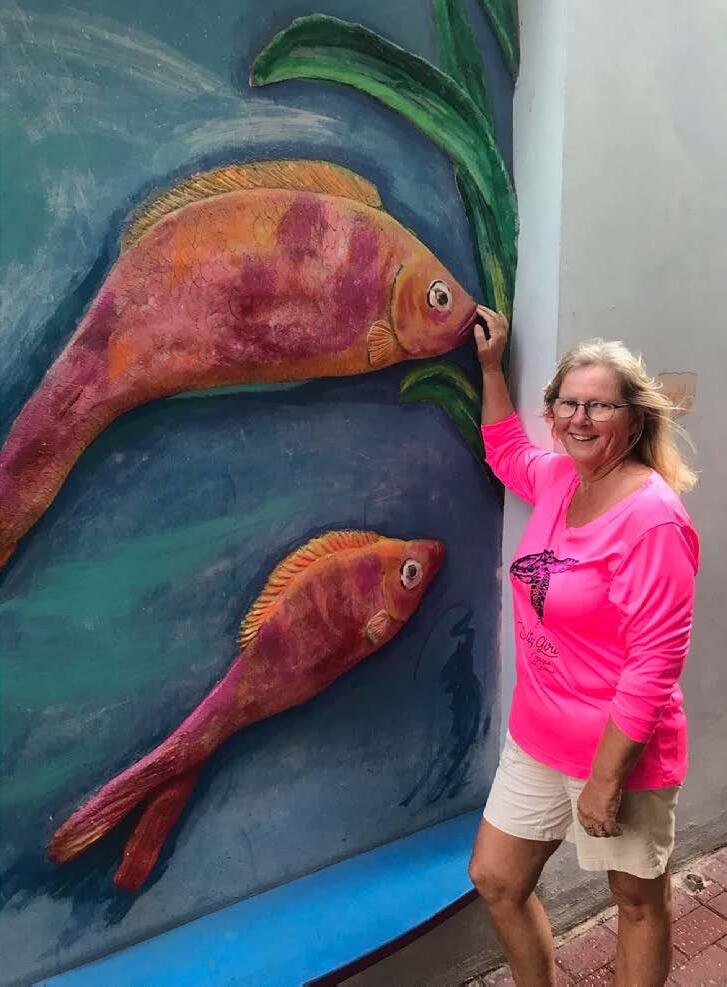
Street Art In Willemstadt
Curacao with our new foredeck sun shade.
Extended Adventure in the Caribbean (Continued)
Our favourite restaurant, just a few minutes dinghy ride from our anchorage, put on a cruisers social every Thursday night with a 2 choice menu and everybody sat at one long table. Lots of cheap beer and wine, lots of new friends.
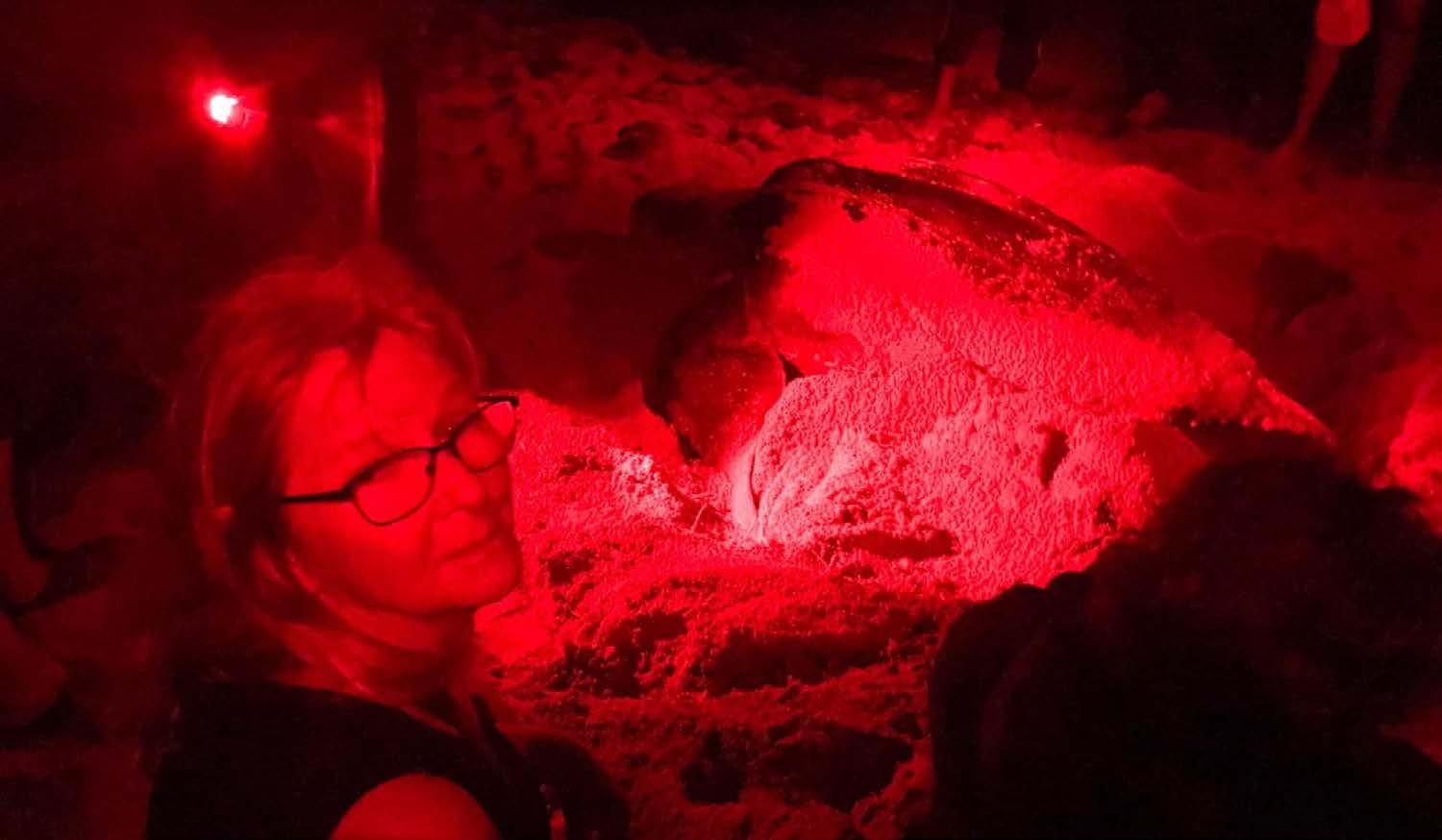
The cruisers nights were quite well established in a lot of places. Very often they involved games of dominos or scrabble, that sort of thing. Facebook groups were a good way to find out what was going on, as was the morning vhf cruisers net. We went on some great group trips, a most memorable one was getting together to hire a mini bus one night to go and watch the turtles lay eggs.
Some islands have hash house harriers if that is your thing. Moonlight dinghy drift parties. Everywhere we went, someone was organizing something.
After three months in Curacao, we had to either extend our visa (the forms were all in Dutch) or leave the country for a while, so we had the boat hauled out for the annual bottom job, it grows fast in the
Caribbean, and flew home to visit friends for a few weeks. Then back to Curacao, do all the never ending maintenance and wait for a weather window.
Finally, we spotted a nice window, I thought, and we set off to explore. 6 days to BVI, the auto pilot kept crapping out in the heavy seas, regular thunderstorms made me get up to reef, too rough to cook. Not fun. Finally, on final approach to BVI, all the crud stirred up by the bad weather got in to the filters and stopped the engine. Surrounded by rocky islands, too tired to sail and no wind anyway, and I initially didn’t have a clue what was wrong. I would restart the engine, it would run for a minute then die again. Eventually my exhausted brain figured it out after several attempts as I put the secondary filter in forgetting the o-ring. At least now in calm water the autopilot was working.
Starving and exhausted we anchored at Sopers Hole, had a beer and went to bed. Got up next morning to face the wrath of the nastiest customs and immigration officers because we did not check
Massive leatherback turtle. Swmbo on the left.
in immediately on arrival. On politely enquiring, we were told that their rules say you have 24 hours to check in, so I was only getting screamed at unofficially.
Don’t go to BVI. I might have mentioned that already.
Snottiness and disdain from locals everywhere we went. Charter customers in clean clothes had no interest in socializing with us live aboard plebs in our scruffy shorts, long hair and sandals.
We had to get the fuel tank cleaned. Apart from that we wanted nothing more to do with that place and decided to get out of there as fast as possible. Every bay we passed was packed, wall to wall charter boats. Unable to find anybody to polish our fuel, we emptied and cleaned the tank ourselves, recovering as much fuel as possible by letting it settle in jerry cans for 48 hours then through a baha filter back in to the cleaned tank. About 10 gallons were too filthy to keep, so paid the fuel dock to dispose of it. They probably filtered it and sold it.
This was over Christmas too. The one saving grace in Sopers Hole was the excellent Indian curry restaurant. Avoid the famous restaurant at the marina full of snotty servers and stuck up holiday makers.
It seemed like we waited forever for a weather window. The trip South from BVI crosses some pretty windy stretches and you need to pick your days. We went island hopping from there, it is pretty nice when you sail out in the morning and you can see your destination rising out of the sea on the horizon. Saint Martins, Antigua, Guadeloupe, Martinique and all kinds of lovely places all the way back to Grenada. Very often we would meet old friends and make new ones.
After finishing up in Grenada we put the boat on the market, sold her for a bit less than what we paid and flew home, almost exactly 2 years later.
Sometimes I look back and wonder if I would do anything different and the only thing I wish I had done was put in a water maker. Most anchorages are clean enough. Perhaps I should have spent a bit more on a boat that needed less work. Perhaps I could have
Goodbye EmJay.
been less anal about things being perfect, squeezed a little more life out of the old dinghy and outboard. But I think we did ok.
I also have a list in my head of things I did not do during those 2 years. They include;
• Wearing socks, shoes with laces or long pants
• Having a hair cut
• Having a long hot shower
• Wearing a watch
• Driving a car
• Having a sleepless night (except night sailing in thunder storms!)
• Watching television
• Having tan lines.
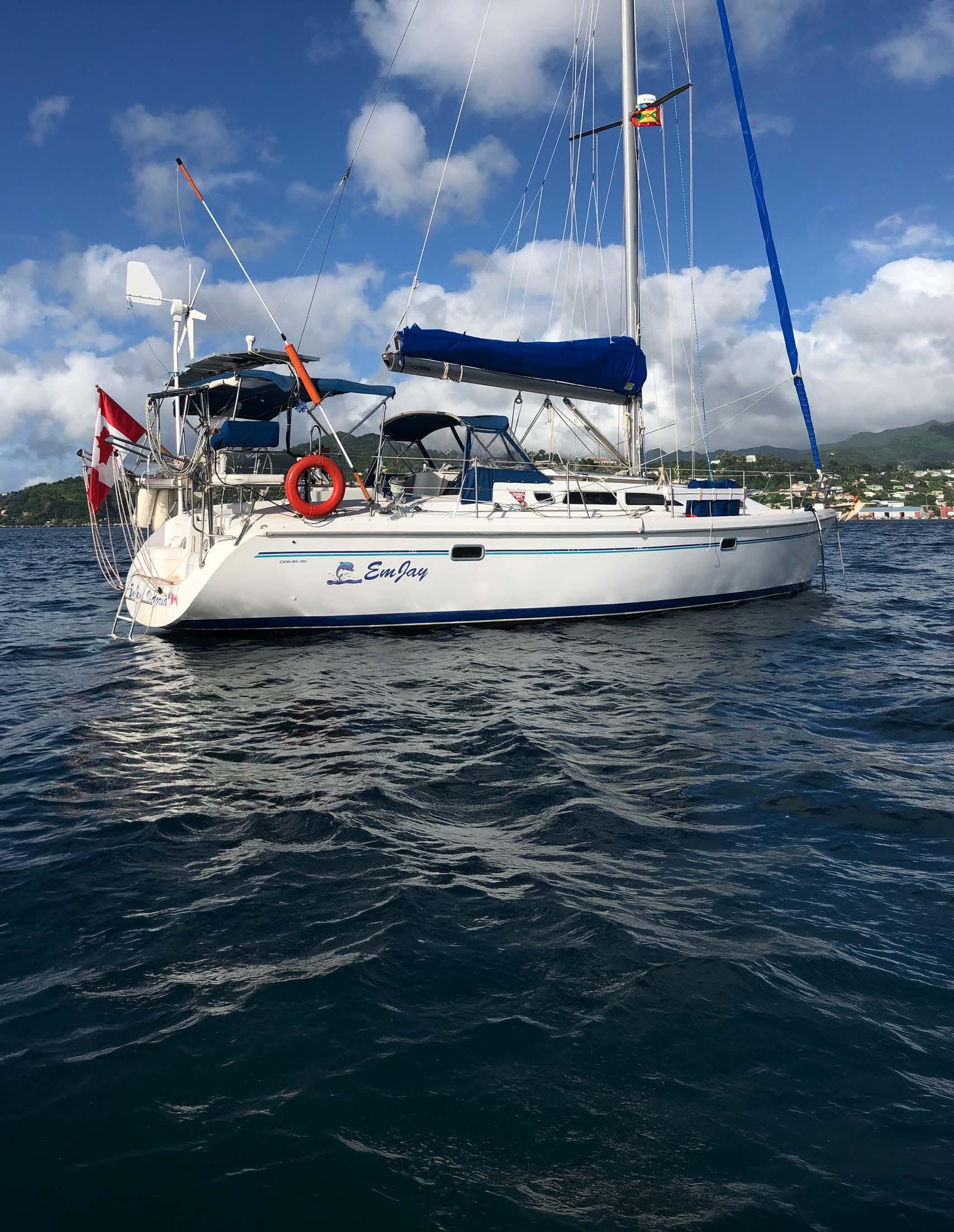
Here is a final picture of EmJay, taken from my friends dinghy as he took me with my luggage ashore on the last day. I had tears in my eyes.
PS. Canadians sometimes ask me what SWMBO stands for. It is a British term of endearment. It is an abbreviation of She Who Must Be Obeyed. Happy sailing! Carpe Diem! –Martin and Swmbo Hill
TECH NOTES
Technical Information & Safety: The following material is intended for informational and community-sharing purposes only. The techniques and modifications described reflect the unique experiences of the individual authors. Mainsheet Magazine, Catalina Yachts Store, and the National and International Associations (including their respective editors and authors) do not endorse these modifications and are not responsible for any damage, injury, or loss resulting from their application. Safety is the owner/operator’s responsibility; always verify technical details against official vessel specifications and consult with a certified marine professional before performing safety-critical work.
Catalina 470 National Association:
Why a Clean Engine Bay Might Save Your Voyage
C470 Association Technical Editor
Joe Rocchio jjr@onward.ws
By Joe Rocchio, C470 Tech Editor and Captain Jeff Vegas Howard
Have a backup: a plan, a component!
A recent discussion among C470 owners centered on throttle and gearshift control problems. One common theme: these never occur at a convenient time. The advice: know how to manually operate the engine speed control at the engine and the transmission shift lever at the transmission. In an emergency when the remote control doesn’t work and a limp-home operation is needed, these skills will save the day.
The C470’s throttle/shift lever (Morse Control) is located at the starboard helm. From the base of the levers, two cables (30 feet long and sealed at both ends) enable the stiff twisted SS actuating wire to transmit the lever motion to the shift lever or the fuel feed (speed) control arm on the engine by sliding back and forth in the fixed sheathing. The cables take a circuitous route from the control unit, down to under the helm, along the aft side of the aft bulkhead of the aft stateroom, under the cabinets on the port side, across the base of the forward side of the forward bulkhead of the stateroom to either the transmission or engine the actuating levers.
Cables age, friction increases, corrosion occurs, sheath terminations come loose or break, etc. that can result in a sudden failure to operate. So: learn how to actuate the control levers manually (may need a 12-mm wrench to enable manual movement). If you are going to be away from port for a while –carry a spare (Teleflex and U-flex are OEM suppliers)
Cleanliness is next to Seaworthiness…
In the Spring 2020 Mainsheet Tech Notes I wrote that I had found “one of the best tools for diagnosing engine maintenance problems is a clean engine and engine pan.” This has served me well over >80K nm aboard C470-126 Onward. C470-03, Ship of Fools, owner Jeff Vegas Howard relates his recent experience to emphasize this principle. Captain Jeff writes:
First of all, let me assure you, I am no neat freak. I’m not exactly Oscar Madison, but I am closer to that persona than I am to Felix Unger. My desk is always a disaster, my kitchen is typically rather disheveled and my bedroom is generally untidy. But if you look at my engine room, you should see everything neat and clean. Why “should,” and not “will”? Because it’s an engine room.
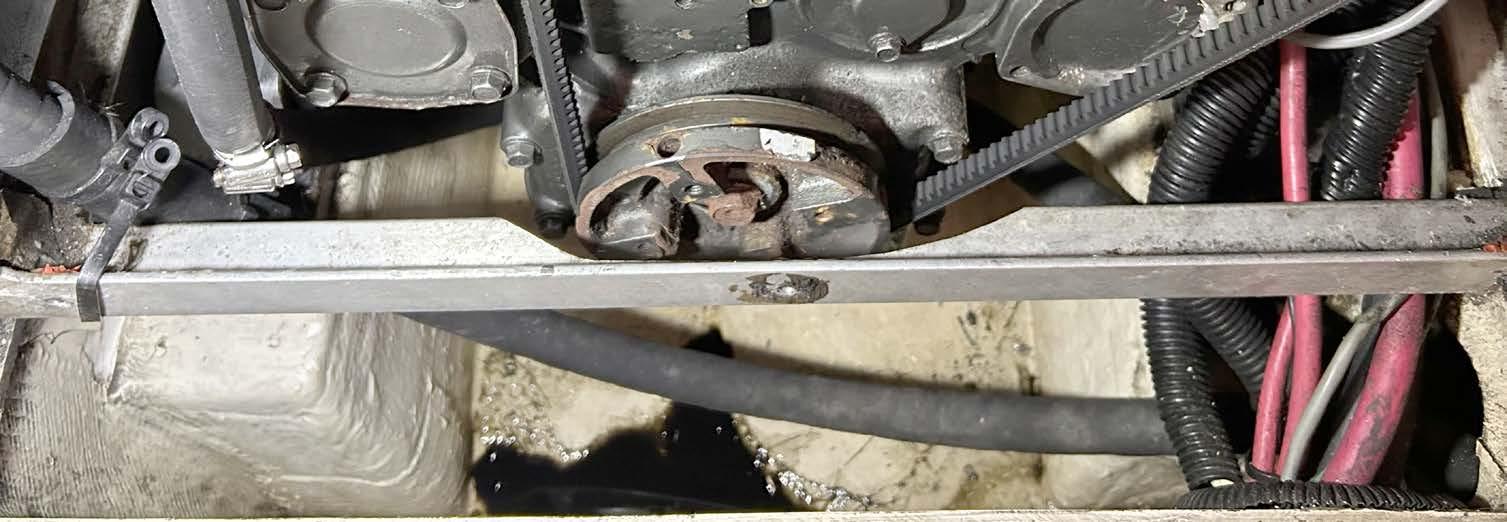
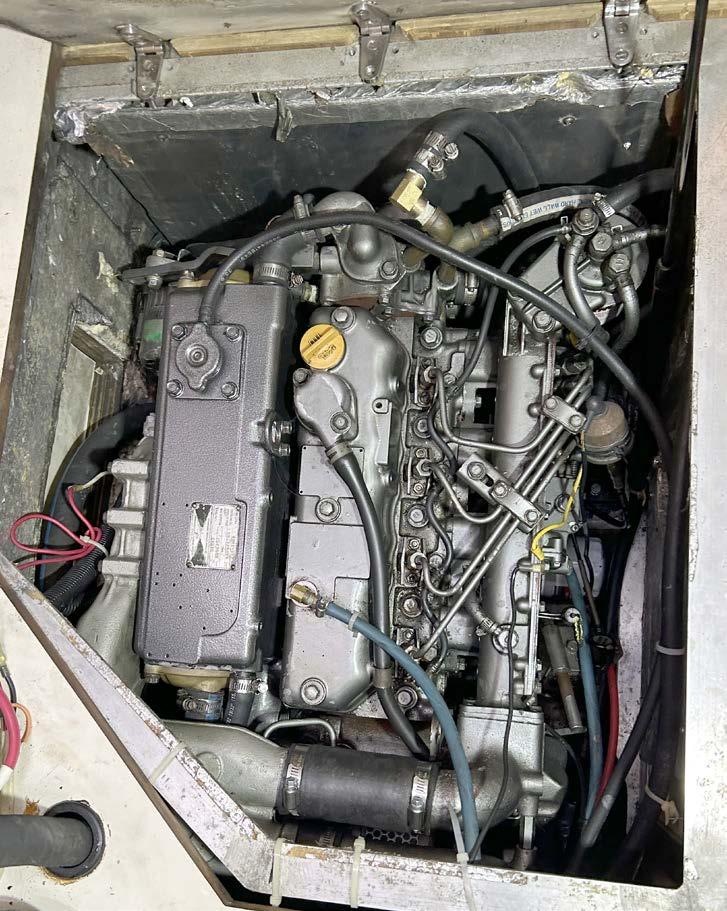
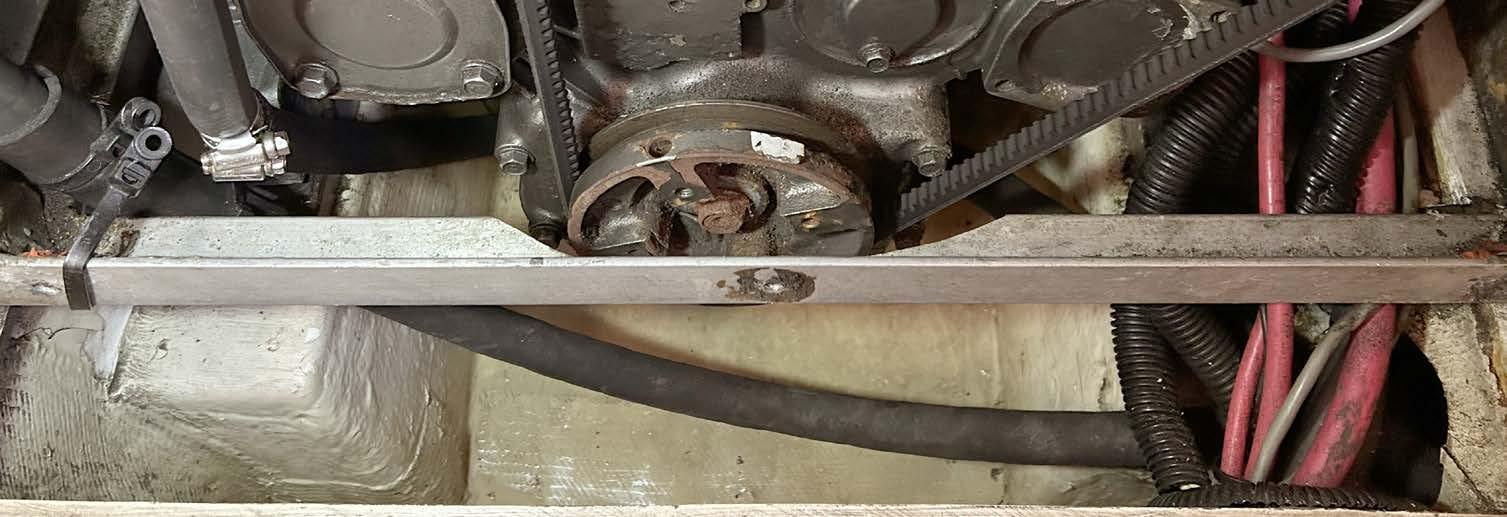
When I bought Catalina 470-03, I noticed that underneath the engine, the theoretically white floor, was just filthy. Clearly, the previous owner had not found it important to keep that clean and tidy. No problem. I got a bargain on the boat, so cleaning it up was a project that I put on my “list,” along with some maintenance things like changing the oil and the impeller. The engine space is pretty tight, so I remember wishing I could come up with a way to get it all clean under there.
Because of my schedule, we planned to take a one week trip to Catalina Island before doing any regular maintenance. It was a fantastic trip (it always is),
and when we returned from our voyage, I decided to change the impeller because the previous owner wasn’t sure when he had changed it last.
Although an impeller is typically about a 20 minute job to change, on the C470, it’s an extra 2 - 3 hours of work because of where it’s located and
This does not show how dirty it was when I bought Ship of Fools.
A very tight space to work in.
TECH NOTES MAINSHEET
the things that you have to remove to get to it. No problem, I invited some friends over and we began to work on it together. When we finally removed the impeller, we discovered it had begun to break apart, so now I needed to remove and bathe the heat exchanger because we could see pieces of the impeller in there. Wow, that engine compartment was really tight, and when trying to remove the heat exchanger, I “rounded” a bolt. I called a very reputable mechanic to get some help, and he discovered that the turbo charger was leaking oil, and
the oil leaking from the turbo charger had “pitted” the air cooler. So the turbo charger, the air cooler, and the heat exchanger all were removed in order to get them rebuilt and cleaned up.
Be careful what you wish for.
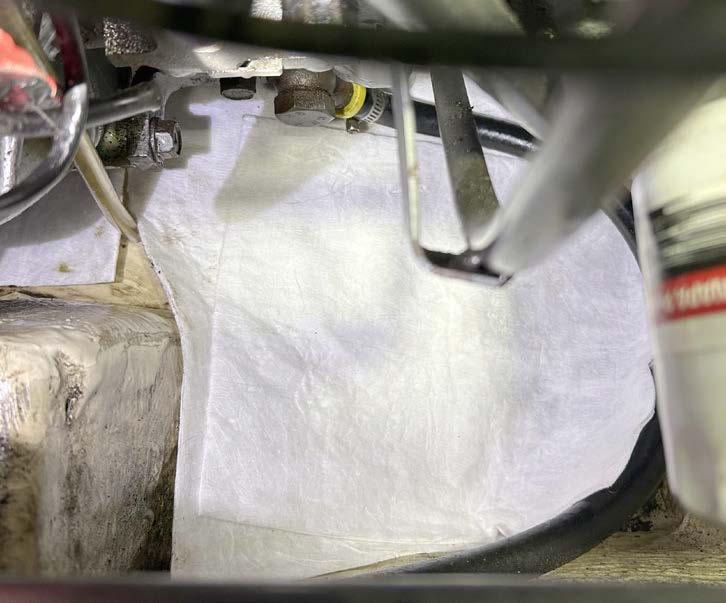
Remember when I wished that I could get that space under the engine all cleaned up? Well now that I had all these parts removed, it was actually rather easy LOL. So I got in there with some good environmentally-friendly degreaser, cleaned it all up, and now it looks like it should. Additionally, all around the engine itself, there were just places where it was a little bit grubby or grimy and I wiped those areas down as well. Finally, the three pieces I had sent off for work, came back, so the mechanic returned and installed them. The impeller had also been replaced, and everything was reassembled. We tested it for leaks in the coolant system. There was one hose clamp that wasn’t tight enough when we were checking everything, so it was tightened down. Then I placed absorbent pads underneath the entire engine to really help spot new issues, like leaks. If a leak happens without the pads, it will just “run”, but the pad will show you where it is dripping.
While in the middle of the repair, I had arranged to move to a different marina. The morning after the engine was repaired we took Ship of Fools about two miles to the new marina and put her in the slip.
After cleaning the engine and underneath.
Place absorbent pads under the engine for an even better view of new problems.
Now remember this boat was new to me, and the engine made a little bit more noise than I thought it should. It turns out that it wasn’t the engine. It was the black plastic cover that should have been screwed down adjacent to the engine. The screws were missing, so the rattling was making the extra noise. Before moving to the new marina, I put the two of the three screws needed into this device hold it down and stop it from vibrating. When we arrived at the new Marina, I decided to put the third screw in. At that time, I noticed that the first two screws had vibrated their way out. I used some blue Loctite and started to put the two screws back in when I noticed that the rear part of my engine seemed rather dirty. I looked around to see why it would be so dirty, and it turns out my new turbo charger was leaking oil! I’m not sure that I wouldn’t have thought to look at that turbo if the engine was supposed to be dirty, but since it was supposed to look freshly cleaned, and it was dirty today, bingo!
Keep your engine wiped down and clean, and it will alert you to problems as they arise instead of after they have grown into really large (more expensive) problems. I wish you fair winds and following seas. –Captain Jeff Vegas Howard
Captain Jeff Vegas Howard is a USCG 100-ton Master Captain who currently berths his Catalina 470 in San Diego. He teaches sailing in group and private lessons, takes out charters and does sailboat deliveries. In 2024 he delivered a 42’ Leopard Catamaran from Ft Lauderdale, FL to San Diego, CA – 66 days, 5,200 nautical miles through the Panama Canal.
TECH NOTES MAINSHEET
REMEMBER:
Your nose is the next best indicator. Clean any engine part or surround surface (these should be sealed and not porous) that gets diesel or oil spilled on it with a cleaner that has a good surfactant to lift the thin film of diesel or oil (Fantastic is one product that works well). Then, when your nose detects oil or diesel odor – look for a problem. –Joe Rocchio
Note from Gerry Douglas, Tech Advisor:
Good thoughtful advice from Joe Rocchio and Jeff Vegas Howard, as always. Check the control cables, especially at the ends where they usually fail. It would be wise to remove the shifter unit from the deck to inspect the cable if necessary and re-caulk the unit to prevent water to contacting the cables. If you feel increased friction when operating the controls detach the cables at the engine to determine if it is in the cables. Replace if suspect, failure can have serious consequences when docking. This is a job that always takes much longer than anticipated, but the peace of mind is worth the trouble.
Catalina 380/385/387/390 International Association:
Fuel Filter & Strainer: Smarter Placement, Easier Service
C380/390 Association
Technical Editor
Rick McGregor
RMcGregor@mcgcreative.com
C385 Association
Technical Editor
Bill Templeton pbtemp6816@verizon.net
Special thanks to Alfred Daum for submitting this article. –Rick McGregor
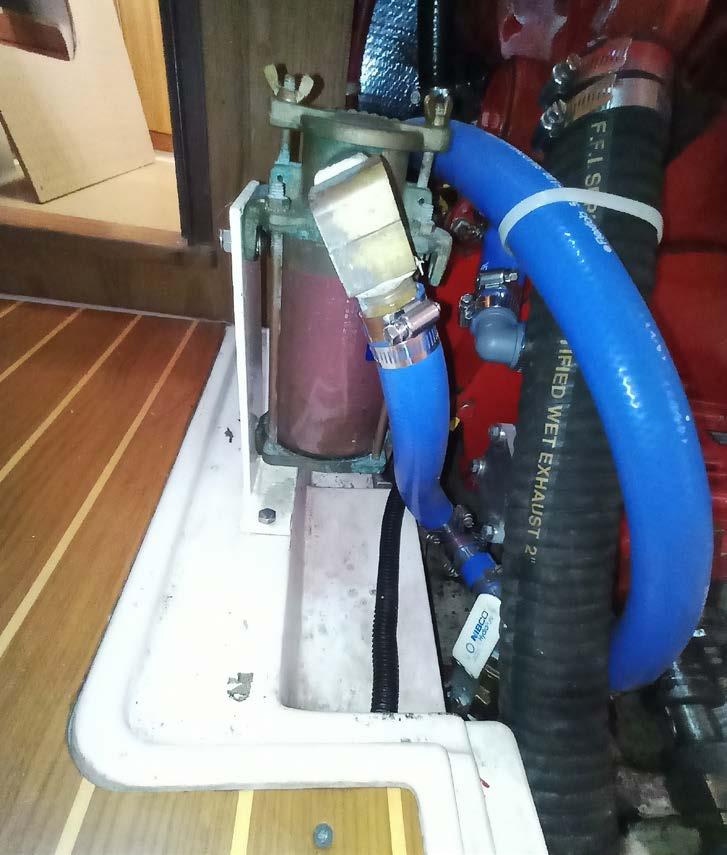
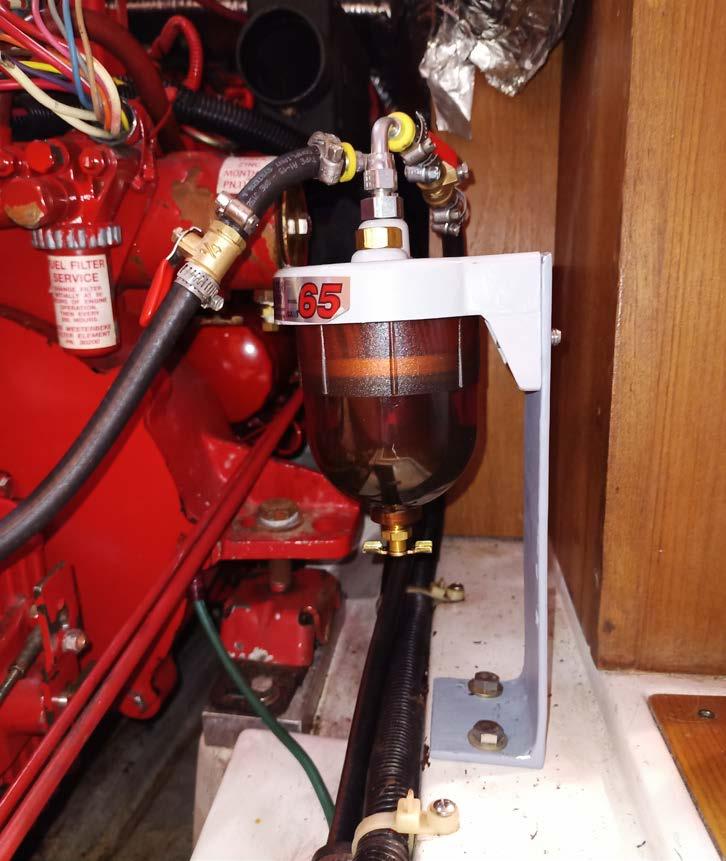
Rather than struggling to service the Fuel Filter and Raw Water Strainer, which are located underneath C-380 Center-line mattress again this commissioning season, I chose to move them. Figuring it wouldn’t be too challenging to relocate them nearer the Westerbeke 42B (Mitsubishi K4F) engine with a well thought out plan.
First off measure, then remeasure for filter support brackets. Assuring adequate clearance between the filter housings and the insulated clearance engine to avoid damaging the sound insulation. I used 1/8” (3.175mm) thick mild steel flat stock for bracket’s leg and base. Drilled all required mounting holes, then MIG welded base to leg. Temporarily mounted the brackets to stringers, then filters to brackets. Sand blasted, primed and painted brackets with Pettit “Protect” primer, Pettit Easy-Poxy top coat. 316 Stainless Steel fasteners used to mount and assemble everything together. A key point in the process is “measuring twice” to avoid any cover interference
Relocated Strainer
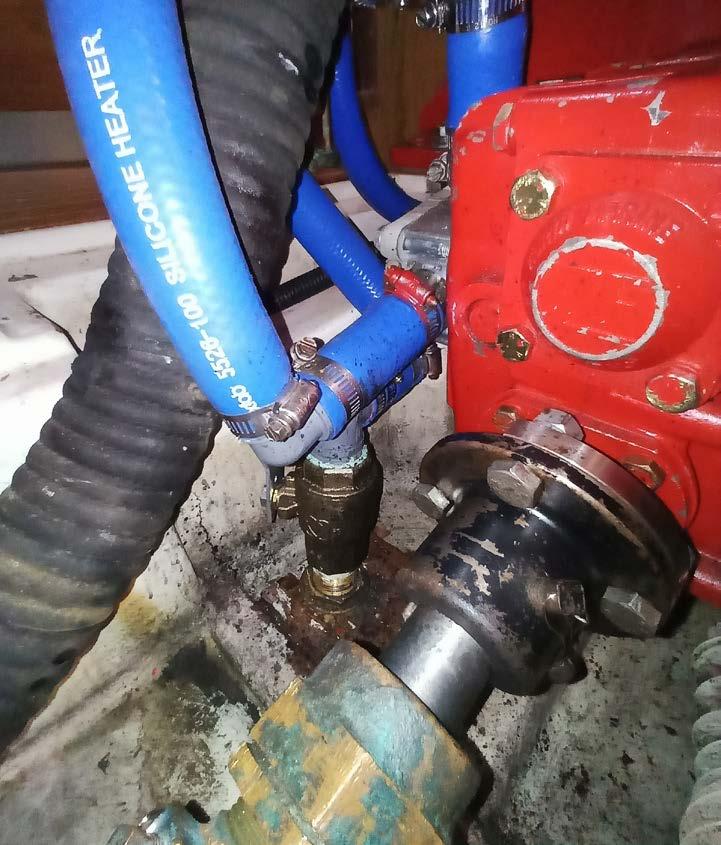
issues prior to permanently mounting the filter housings. In the original configuration the sea water flows from sea water pump to a “Tee” fitting that splits the flow between the heat exchanger and the transmission cooler. The outflow from the trans cooler and heat exchanger then recombined by another Tee fitting.
The outlet for the Tee was then flows into the wet exhaust manifold. This original configuration results in an uneven flow distribution between the heat exchanger and the trans cooler. To address this I chose to route the flow full output of the sea water pump to the trans cooler, then from the trans cooler
to the heat exchanger, eliminating both tee’s and having full flow through the trans cooler and the heat exchanger.
In actual operation, heat exchanger inlet water temp is under 90 F when tested with a heat gun.
The location of the original 1-inch Marlon 90° sea water valve wasn’t ideal, as I wanted a straight shot up from the thru hull to the sea water filter. I cut it off with an oscillating saw and installed new 1-inch straight thru-hull with bronze ball valve.
I switched to reinforced silicon hoses for sea water use over ten years ago. After fighting to get those hoses loose to access plugged thru-hulls (sea grass, fish line), I switched to reinforced silicon. These are not cheap, but man are they easy to slip off a fitting.
I converted to a “DAHL 66” fuel/water filter instead of using the old RACOR. The new filter meets engine fuel flow requirements and takes up less room. I use 30-micron pre-filters in the DAHL and 10-micron secondary filters in the Westerbeke engine filter. I installed small ball valves on the filter
inlet and outlet to assist in stopping fuel flow during annual draining/filter changes.
April is normally warm enough to accomplish bottom painting and hull waxing at my Port Clinton, Ohio marina. After our seasonal hull work was completed the boat was splashed and checked for leaks.
Turning on the key switch, I bleed air from engine as the fuel lines are primed. After verifying there are no fuel leaks, I open the sea water valve and crack the sea water strainer lid to remove air. Once I have verified there are no fuel or raw water leaks, we fire up the engine.
Everything runs smoothly and after the engine has warmed up we motor to our dock. Very happy with the results of this project I check below and find water under the Hurth transmission which turns out to be unrelated to the filter relocation project.
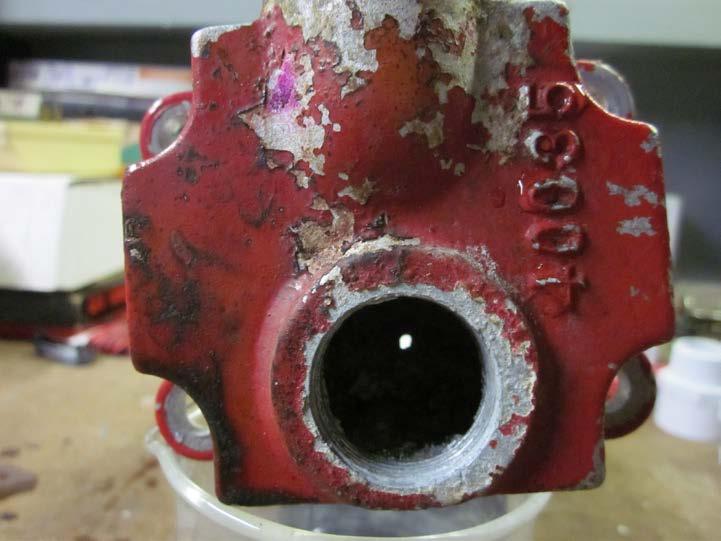
Thank goodness we launched in the morning! Close Inspection of the sea water cooler revealed a hard to detect tiny corrosion hole in the rear of the aluminum cooler where it attaches to the transmission.
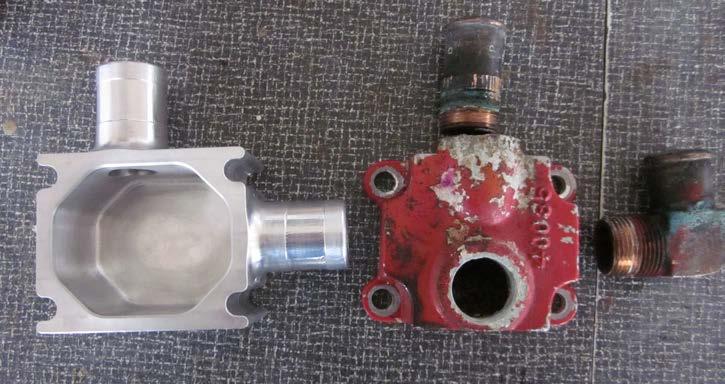
As the boater saying goes, BOAT stands for “break out another thousand. I was able to quickly locate a cooler manufactured by “MR COOL” that was in-stock and could be delivered within a week. When the new cooler arrived I found that the “ports” were differently configured than on the original with
Fuel Filter New Location
Hole in Cooler
TECH NOTES MAINSHEET
both ports in the cooler body, rather than one on the body and one on the cover. This meant that my hose from the thru hull to the pump wouldn’t line up as planned.
Thank goodness I had silicon hose left over. To make this new part work, it required numerous 90-deg 1-inch elbows. So much for my straight shot to the sea water filter. I dusted off some Engineering Formulas for fluid hydrodynamics and calculated that the additional elbows wouldn’t cause too much water flow restriction, which allowed me to press on with installation.
I’m not happy with having the additional elbows and hose clamps, fearing the increased possibility of leaks, but feel that the leaks would be easy to access right under the engine cover. I accomplished this project in 2021. Each season I am glad I did. One note: AYBC requires the fuel filter to have a metal bowl if it is close to the engine. I still need to purchase the metal bowl for the DAHL filter!
Why did the aluminum trans cooler fail? First off, brass hose adapters were threaded into the
Ports no match
aluminum cooler. 5000 and 6000 series aluminum alloys have a corrosion potential (voltage) difference of -0.500 to -0.600 volts in a corrosive liquid when connected to most copper alloys. I dock on a fresh water river that is loaded with acidic organic matter, which is internally corrosive to an aluminum/copper connection. I am the fourth owner, first owner docked on the Chesapeake Bay. This means salt water flowed through the cooler for a few years. The reason the cooler failed on the interior backside, this area of the casting is thinner than the cover along with fluid turbulence caused by sea water flowing into the cover port and impacting cooler rear, then changing direction out the side led to corrosion product erosion. Sorry, reminiscing from some of my old corrosion engineering days. Getting to the point: if you have a Hurth transmission cooler, you may wish to inspect it. The MR.COOL unit has hose fittings, but maybe not be in the same place as yours. –Alfred Daum, C380 #202
Note from Gerry Douglas, Tech Advisor: :
Nice article and nice work by Alfred Daum. Having good access to the filters is a great improvement, that I first incorporated into the “5 Series “ Catalina’s with a dedicated filter lockers. I caution against replacing Marlon valves with Bronze ball valves due to the increased maintenance and need for bonding.
New Cooler with Sea Water
Fine-Tuning the Catalina 385
Some considered the Catalina 385 a step up from the original C36; better, I think, to consider the 385 a little sister to the 445. The 445 was introduced in 2009 as an addition to the Ocean Series and representative of Catalina’s “new direction” at that time. Cruising World reviewed the 385 in their February 2012 issue:
“Incessant market demand for ever-more spacious interiors has led to incremental yet ultimately substantial increases in the average freeboard, beam-to-length ratio and transom width of modern sailboats. Unchecked, this volume-driven trend will undoubtedly exceed limitations affecting sensible deck layout, sailing performance, seakindliness, and aesthetics. With the Catalina 385, a midsize cruiser, Catalina Yachts’ Gerry Douglas is purposely bucking that tide by returning to what he believes are more balanced proportions and traditional styling. The 385 presents the appealing look of a “modern classic,” and from this there are numerous practical effects to be had. For example, the lower freeboard allows the on-deck workstations to be brought closer to the center of gravity, thus reducing motion and enhancing safety. The moderate beam translates into better tracking and less of a penchant for the boat to round up when pushed onto a heavy heel. Not having to contour the deck to conform to excessive spatial requirements below. Gerry Douglas has tacked off from the main fleet, so to speak, to ‘de-content’ the boat – that is, not crowd it with a boatload of modern accoutrements and gadgetry.”
I would recommend reading this article in its entirety, simply google Catalina 385 reviews. By excerpting these key phrases from the Cruising World review I wish to justify my concentration on “finessing” space available helping make the Catalina 385 even more of a complete midsize cruiser and modern classic. I will continue to report on modifications and adaptations. I know there are many improvements out there that we all have made. Please send them to me to share with the entire Catalina family at pbtemp6816@verizon.net
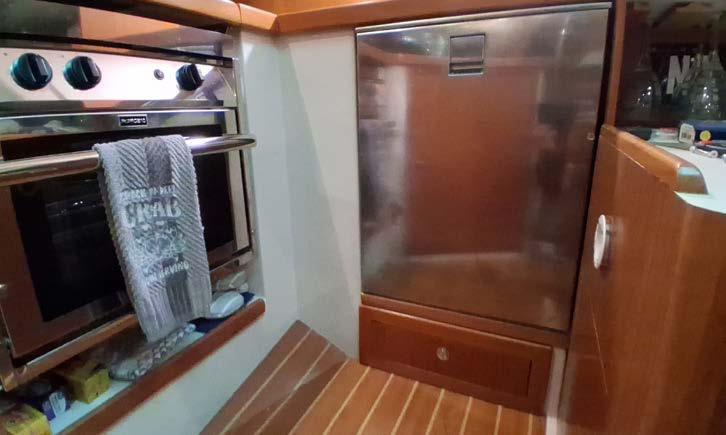
This quarter I present what may be a simple job home in the kitchen … but a bit more challenging in a boat …. reversing the refrigerator door to gain easier access. Keep those cards and letters coming! –Bill Templeton
Refrigerator Door Reversal on the Catalina 385
Since purchasing our C385 at the Annapolis Show October 2018, several things have changed. We are older (I just turned 76), between Pat and I we have three new knees, cervical 5, 6, 7 fusions with discectomies, cataract surgeries and Impending shoulder work. I sometimes think that instead of offering Mark II designations to their line, Catalina
TECH NOTES MAINSHEET
should look into ADA versions. Anything that eases getting around and using the boat I look at closely. When I researched reviews of the 385 for my Tech Editor comments in this issue, I stumbled across a mention about “pinched” access and room in the galley.
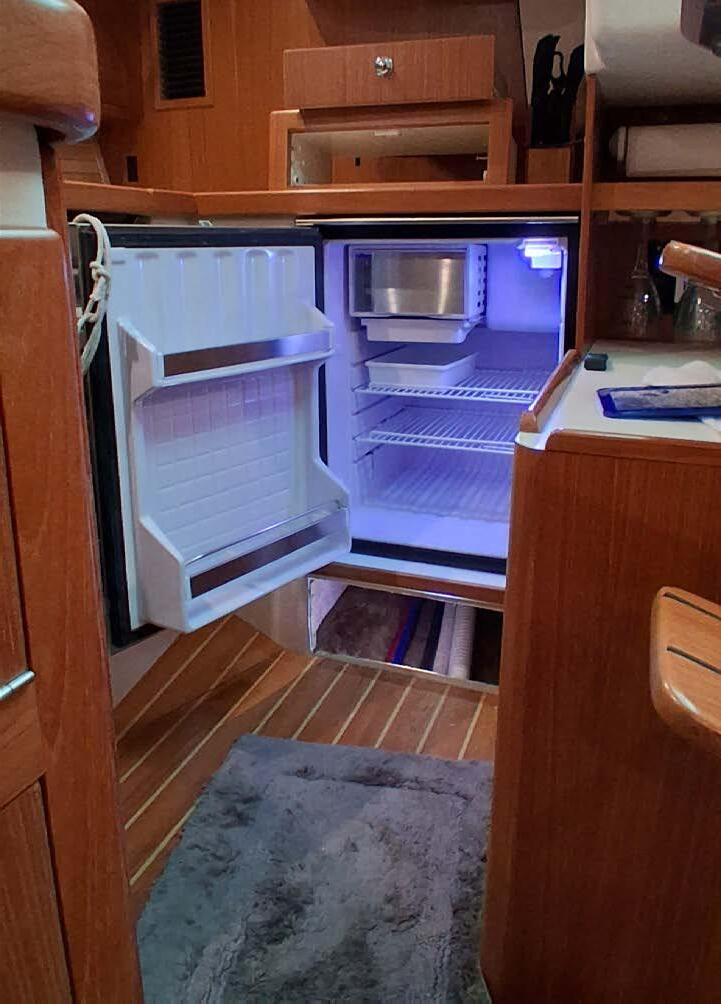
With our frailties I must agree with that comment. I always check out other boats (different manufacturers and different sizes) at the Annapolis Shows, thought the drawer style refrigerators were pretty cool … even mentioned same to Jon Ames. With a little research I found that Isotherm offered a drawer version of the Classic Cruise refrigerator that is installed in the 385. However, I don’t think the drawer would clear the fire extinguisher port on the side of the engine box, and I would have a hard time justifying a $1600 - $2000 expense to replace a perfectly good unit. With a drawer style fridge you could still be pinned in the galley with little
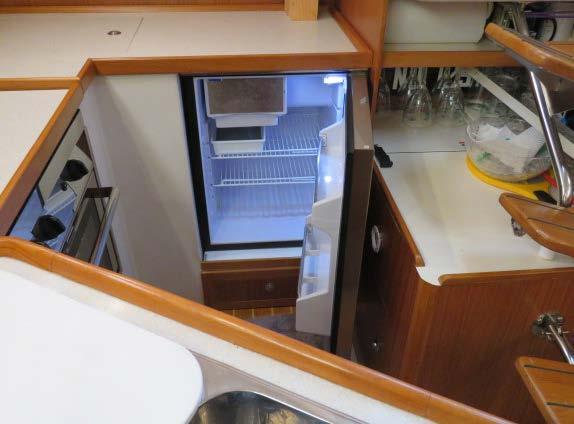
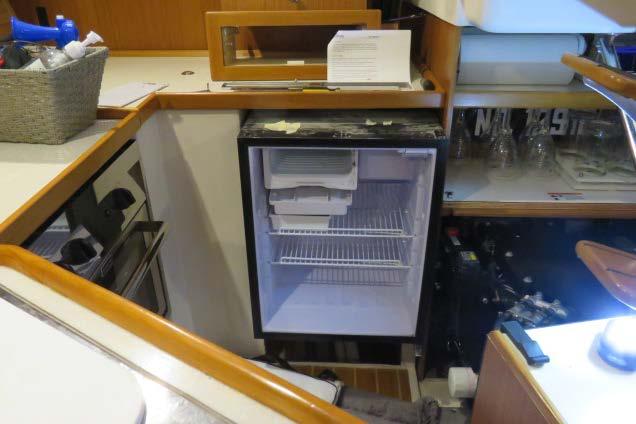
room to move. What about a simpler and cheaper alternative? Reverse the door! If it can be done then you would not be “trapped” in the galley area by the door and the door itself would not block reaching into the fridge. I contacted Jon at the Catalina Factory who told me how the fridge was anchored in place. Remove the drawer and drawer frame below the unit to access two screws that go up into the attachment board (it has a strip of teak trim) under the unit. That attachment board has four semicircular detents for the “feet” of the refrigerator box so the fridge and anchoring board must be slid out together. Move the engine box …. I didn’t initially and with such tight clearances scratched some teak surfaces. Fortunately only minor damage I touched up with the varnish that came with the boat. When pulling the unit and attachment board together be careful not to damage the teak trim under the fridge…. It requires some force to slide things out and that trim could be easily
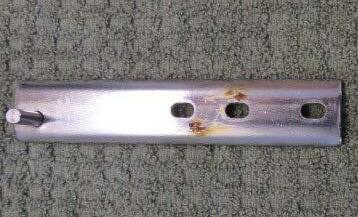
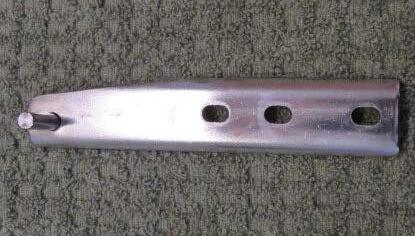
Hinge after modification to center door on front of refrigerator cabinet, note corner ground off to permit turning of hinge to allow centering door on the refrigerator unit
cracked or broken …. Yes, I learned this the hard way but was able to repair (glue) the damaged trim ….. can’t even see the repair unless you know to look for it. The electrical connections to the back of the fridge are plenty long enough to get the unit out.
According to the Isotherm Classic Cruise owner’s manual reversing the door is simply moving the hinge brackets from right to left. I don’t know if what I encountered was typical of the Isotherms in general or unique to mine …..I had to modify the hinge brackets to allow them to turn slightly to square the door on the box and not be in the way when returning the unit into its recess.
After remounting the door, carefully sliding the unit back into place, reattaching with the two screws
from below, replacing the drawer frame and drawer everything looks as before.
I hope you agree the access to the fridge is greatly improved. Now we simply open the door and reach in without any acrobatics…. an added bonus, now we can remove/move the shelves which we could not do before when the door opened against the engine box.
–Bill Templeton, Catalina 385-081 Makani Kai
Hinge before modification to center door on front of refrigerator cabinet.
Catalina 320 International Association:
Companion Way Cleanup
C320 Association
Technical Editor
Mark Cole
fiddlersgreen08@icloud.com
Special thanks to Scott Westwood for submitting this article. –Mark Cole, fiddlersgreen08@icloud.com
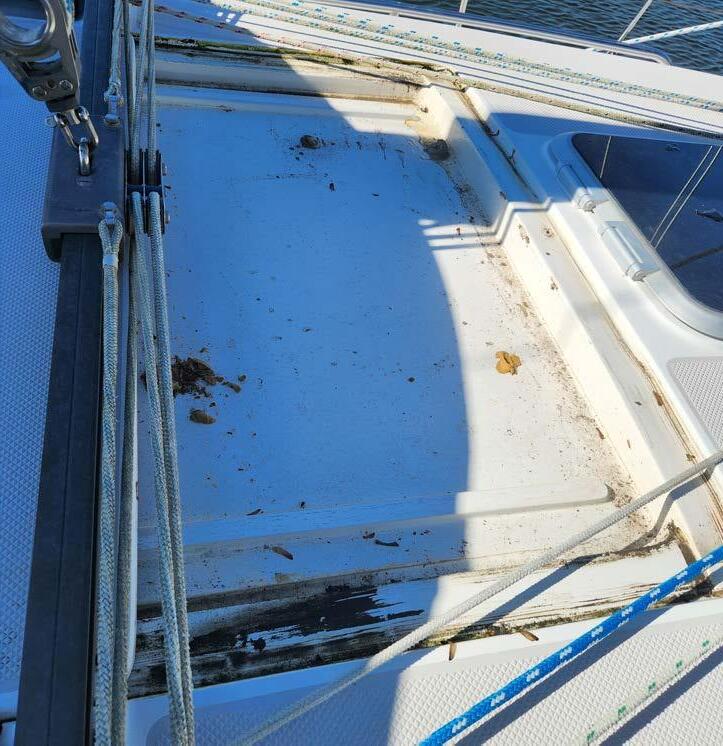
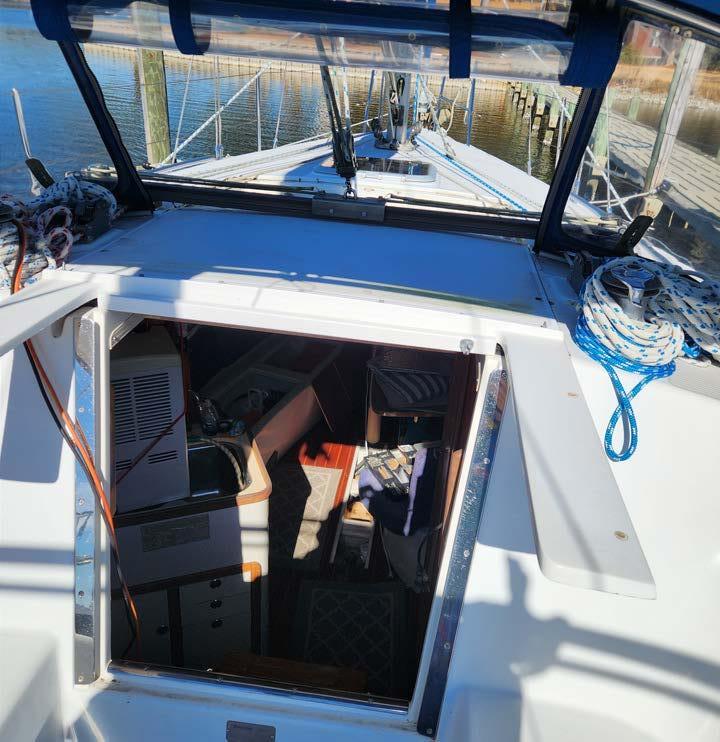
We love our C320 and after 10 years, we finally got the cockpit enclosed. We plan to test it out soon. One issue that has always bothered me was the track under the companionway slide hatch. I am told it is also referred to as a “turtle”? It is the cover over the slide that keeps the slide in place’
We tend to anchor so we normally point into the wind and rain and sit in the cockpit looking aft. We have always had a bimini, dodger, and connector
so sitting in the cockpit during some rains was not usually a big issue. The only bother was the track under the slide hatch draining into the cockpit. Water falls along the forward bulkhead where you normally lean back. Also, the water collects under the cockpit cushions you are sitting on.
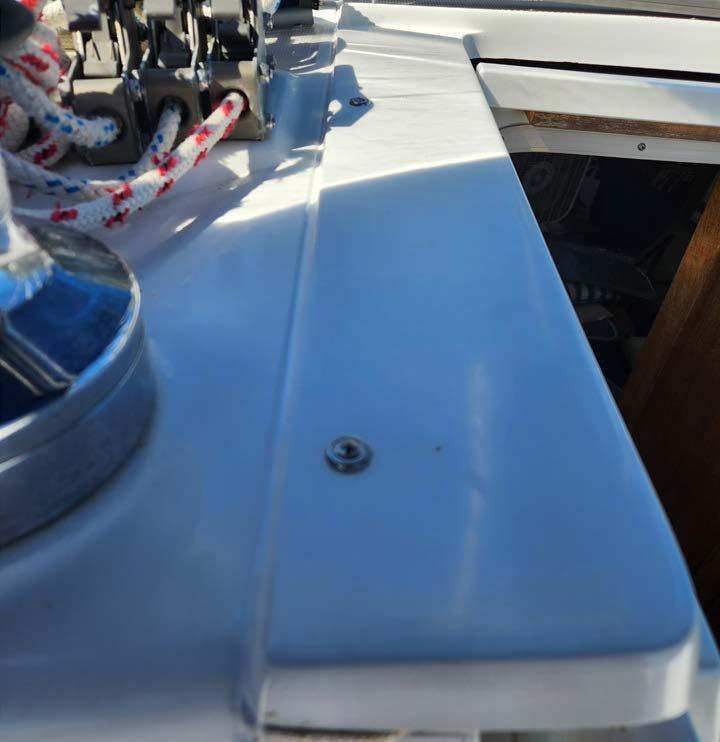
I decided to try sealing the hatch to keep the cabin-top water from coming into the cockpit. Removal is easy. About 9 screws and just slide it aft and pick up under the traveler. It was pretty nasty under there. Mud, leaves and dirt were everywhere. Also, what we around here call dirt dobbers. They look almost like wasps but no stingers. They build tubular nest made of mud. They will stain your sails when they find a way past your sail cover. (They always find a way.)
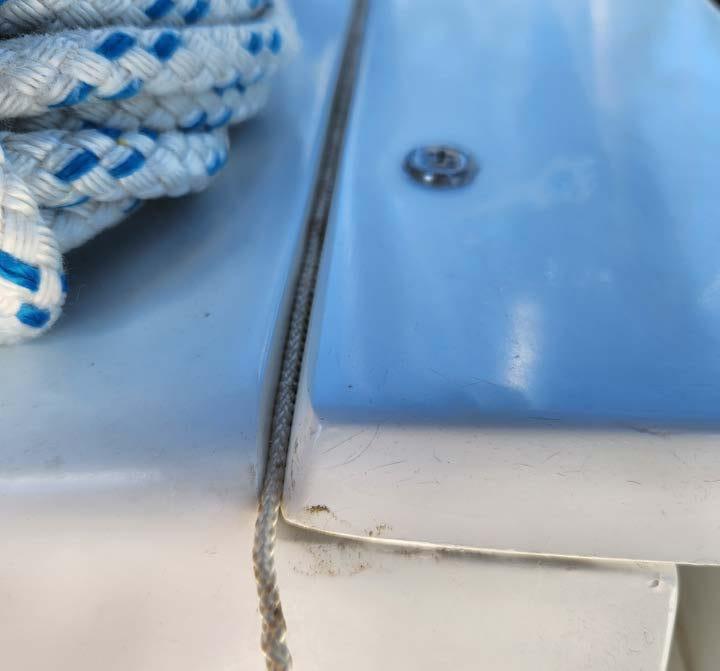
After cleaning everything I simply re-installed the slide hatch. Before re-installing the hatch I lubed the slide’s contact points so the slide would move easier. I hope that’s not an issue in rough seas. Moves very easy now. I was worried I wouldn’t be able to get the slide hatch off next time so I imbedded a string in the joint so I could use it as a pull string to break the seal. I used an old worn/dull flat head screwdriver to tuck in the string. Then taped off the joint and used a white flexible gutter caulk instead of 4200. Hoping it wouldn’t turn brown in the sun or crack with age. Time will tell.
So far it seems to be working. Any water that might get past the seal and string should still drain out like normal. This would tell me the seal is broken. We haven’t been in a real blow yet but at least the track is not draining into the cockpit. –Scott Westwood, C320 #517, Vandemere, NC
Note from Gerry Douglas, Tech Advisor: :
Nice job by Mark, sealing the sea hood is a good idea that was incorporated on later model Catalinas. Lubricating the sliders is a great idea, later Catalina’s have low friction high density plastic tape on the bearing surfaces on the deck, this may be available through the parts department.
Catalina 28 International Association:
From Tank to Tap: Deep-Cleaning Your Water System
C28 Association
Technical Editor
Ken Cox
kenneth_cox@sbcglobal.net
When is the last time you took a really good look at your fresh water system? We have boats out there that are in their mid-30’s and I would bet that most of you have not given this system a really good look in a few years. Yeah, I know you drain it, winterize it, flush it and hey it works it must be OK, we really don’t get very deep into it, there is sailing to do, am I right?
I would start with saying I do not believe there is any one right way for everybody. So here are some thoughts on the care and protection of your water system.
First, how do you use it? The solutions that you need vary depending upon your usage. If your a cruiser you need it clean, really clean to start and a good ongoing treatment plan to keep it that way. It your a periodic trip taker getting it right with a little pre-trip treatment every year. Maybe your a week ender and use they system but maybe just use one take to save some maintenance time, or possibly rotate between the tanks with a little shock when you change over. Leaving water just setting creates its own set of issues as well. If your a day sailor, maybe you don’t even use it, again, that has its set of issues as well. But give it some thought.
How much water do you use in your normal usage style? Do you just shower, do the dishes and wash the boat with it and drink bottled water, do you cook with tank or bottled water or do you also drink
it right out of the tank? All of these things should influence how to maintain your system.
Lets take a tour through your system and see what we find. Maybe you just commissioned it for the summer of have used it a while and have a funny taste or smell. Or maybe I just got you to wondering just how long it has been since you looked at it. Chances are high it’s been too long.
Lets inspect it, I mean really inspect it. Start with the tanks, take the inspection cover out and look inside, any particles or debris laying at the bottom? Feel under the top inside of the tank, is it squeaky clean or does it feel slick and a bit slimy? Next, lets inspect the hoses, all of the hoses, tank to tap! Do they still feel soft and subtle or a bit on the hard side? Any places starting to cut where the go through bulkheads? Can you see in the hose or had it discolored, maybe looks a bit black inside of it? Maybe take the aerators off of each sink, any calcium deposits, sandy type material or rubber debris? Chances are high, very high that you see some issues.
Now lets take a systematic approach to fixing what you have found. As boat projects go it’s not a real expensive project but pretty time consuming and can provide a satisfying peace of mind and confidence about your water system.
Where do we start? Lets make it clean and sanitary from the tank to the tap! So start at the tanks. If you had slime or discoloration clean it with a good biodegradable soap, like Dawn, there are others I just happen to use this one, if it’s good enough to clean oil slimmed ducks then it’s good enough for me, the key is biodegradable.
With maybe a 1/3 of a tank of water or what ever is in it, put a good shot of soap into it and use a long handled soft brush or maybe even a toilet brush as
they get into corners well, maybe both! Scrub every inch that you can reach, it could be a bit tight and if you have big arms maybe solicit your wife or teenager or grand teenager, it’s not child labor and won’t take long either. Once scrubbed well, fill it to the brim and force it out of the vents if you can and see how they flow as well, are they clogged? If so they need cleaned as well. Now run it out, use all of the faucets and don’t forget the cockpit shower as well. Once, it’s empty fill it up again and repeat the process.
We now have near empty clean tanks maybe with a bit of soap residue, we’ll get to that in a minute. Next, remove those old hard, discolored hoses, you may even have some black mold in there, get rid of it with new hoses. Your can get a 50’ roll of clear reinforced, FDA approved hose for about $58. Get a connecting nipple as well. Start at the tank and connect the new to the old and start pushing it in, use a helper to gently pull and guide it. If you pull too hard you could disconnect it so push more that pull. This is the hard part that will take the time. Also change any tank vent lines that need it.
Next, at the water pump clean the screen filter. Consider using a screw on filter for the garden hose that fills the tanks and keep it on the boat to insure that all incoming water is free of debris and contaminants.
This would also be a good time to install a winterizing by-pass at the water heater, making winterizing much easier. They run about $30 and is an easy install. Tie up your hatch cover so it doesn’t fall and break your nose, don’t ask how I know. Have the water heater in by-pass mode for the next step. Remove any filters at the faucets and get replacements if needed and after the next step reinstall them after all flushing steps are done. Now fill the tanks one more time for a final flush and when you have them full, cup your hand around the fill hose and try to flush out the vents one more time. Pump them out as far as they will go. Fill the tanks one more time and as you are filling them add household chlorine bleach. This is a strong shock cycle so add 1/4 cup of bleach for every 10 gallons of water to the tank.
TECH NOTES MAINSHEET
At each faucet open each valve both hot and cold one at a time until you smell the bleach. Once done, let set for about three hours and they should now be totally clean and sanitary. Again, pump out all of the water, through each of the faucets. Next with water only flush the tanks again through each faucet, do not forget the shower in the cockpit as well. The chlorine smell should be much less but do it again one more time. If the smell of chlorine was not reduced add a table spoon of peroxide to a tank, let set for an hour and flush it out again, it should be gone and any residue that might remain after the next step is safe to drink.
Next is the final fill of water that you will use. Fill the tanks one last time again adding bleach at 1/4 cup per 20 gallons of water. Top off the tanks, make sure the system is bled, turn the water heater valve back to the use position and top the tank after doing so.
For the future if you winterize with the proper solutions and run a single tank through in the spring with the normal amount, not the shock amount of chlorine you should be good to go and have a clean system for years to come. Please no vinegar or Voldka in the future.
As always, fix it fast and sail it faster. –Ken Cox, ACADIA #317
Note from Gerry Douglas, Tech Advisor:
:
Ken describes a good method for cleaning and disinfecting the water system. The factory recommended method is in most CY owners manuals and if followed seasonally should keep the tanks clean. I caution against adding “soap” to the tanks, this can be very difficult to eliminate and you may see bubbles at the taps for months. In many models it is fairly easy to remove the tanks and steam and pressure wash the tanks if the are really dirty or have grown inside.
MAINSHEET ASSOCIATION NEWS
The Heart of the Community: While the sails may differ in size, the spirit remains the same. This section serves as the dedicated home for our National and International Associations—a space to share the local updates, fleet milestones, and regional connections that keep the Catalina community thriving. Whether you are looking for camaraderie or local fleet events, these reports highlight the active bonds that make owning a Catalina a truly shared experience.
Catalina 34/355 International Association:
Secretary’s Report
C34/355
Association Secretary Stu Jackson #224 Aquavite
C34/355IA Membership rose to 458 from last quarter’s 415, and includes 21 C355s.
It’s the 21st Century (continued) from the last Mainsheet issues
We’ve previously noted our transition to email renewal notices and PayPal payments. The strike at Canada Post ended soon after the holidays, but we’re still glad that our new renewal system has bypassed the snail mail system and that membership is doing well. Thank you all. Yet another reminder: Now that we’re using email for renewals, your up-to-date email addresses are critical, so if you’ve changed them recently it would be helpful for us to know. We have only had very few renewal notices “bounce” so far, but please contact me at mraquaq@aol.com with any edress updates, thanks. Please also check your spam folders to see if any renewal notices have been misdirected at your end. We send them out in early March, June, September and December in anticipation of preparing mailing lists for the magazine.
Second Catalina 34 and More
In the February 2019 edition of Mainsheet, I wrote again about skippers “who have owned two Catalina 34s, including Tech Editor John Nixon, our friends the Engelharts from San Francisco and many others,” as well as Susan Ray in Hawaii who has owned three.
Among new C34IA members we are now meeting skippers who are purchasing boats that were previously owned by people who we knew well. We received this email from Steve Ryan, who now skippers Music (#21583): “Music is a fine first boat. We are really enjoying her. Plan on sailing her up and down the coast, so outfitting her accordingly. Port is Emeryville, CA.” The previous owners of Music were Bob & Susan Engelhart who had owned two C34s, and who were our friends and active in our SF Fleet One when we lived in The Bay Area where we sailed Aquavite for the first of her 18 years with us.
Trust you are enjoying a fun 2025. And, as always, many thanks from all of us to all of you for supporting the C34IA. –Stu Jackson, #224 Aquavite
Catalina 22 National Sailing Association:
Association Editor Report
C22
Association Editor Rich Fox rich_fox@yahoo.com
Congratulations to David Hayslip who is the 2025 Catalina 22 National Champion. David and 23 other Catalina 22s participated in the Catalina 22 National Championship Regatta held on Lake Worth, Texas, the week of June 7 to 12, 2025. The event was hosted by the Lake Worth Sailing Club. C22NSA Vice Commodore Julia Brandt lead the work effort for the regatta.
David Hayslip is now a seven-time National Champion winning his first Nationals back in 1987. David and the Hayslip family have been part of the Catalina 22 National Sailing Association for over 40 years, and the Class is most fortunate to have David continuing to serve as C22NSA Chief Measurer. Crewing for David were Robert Cary and Rhonda Hundley-Harper.
The winner of the Silver Fleet with seven boats was Jennifer Bennett. Thirteen boats participated in the Spinnaker Fleet with Justin Chambers taking home the first-place finish.
A record number of lady skippers took the helm and participated in the 2025 Catalina 22 National Championship Regatta. Lady skippers included Jenny Beltman (Colorado), Susan McKinnon (Florida), Jennifer Bennett (Alabama), Carrie Hatfield (Texas), Allison Hyland (Texas), and Katie McBride (Oklahoma).
Skippers, crew and their families from all across the United States participated including Alabama,
Gold, David Hayslip
Silver, Jennifer Bennett
Spinnaker, Justin Chambers
Arkansas, Colorado, Florida, Georgia, Kentucky, Michigan, Oklahoma, Texas, and Washington state.
At the annual general membership meeting held on Sunday, June 8, the C22NSA annual awards were presented to the following:
• Cruising Family of the Year - The Duncan McBride Family
• Leadership Award -Richard Gailey
• Sandy Kennedy Award - Michelle Weist
• Award of Excellence - Rich Fox
• Best MainBrace Article - Chris Woolsey
• Best Regional Commodore - Katie McBride and Richard Gailey
• Betty Gay Clements Women’s Memorial TrophySusan McKinnon
• Dick King Sport Trophy - Allyson Hyland
• Long Distance Award - Don Woodhouse
• Newest Racer Award - Aaron Noble, Susan McKinnon, Allyson Hyland, Jenny Beltman and Carrie Hatfield
• Sportsman Award - Keith Bennett
• Youth Sailing Award - Austin Breeden
• Women’s Skipper Recognition - Susan McKinnon, Katie McBride, Jennifer Bennett, Allison Hyland, Jenny Bellman, Carrie Hatfield
• Lifetime Achievement Award - Mike Bracket
The annual Catalina 22 Great Lakes Cruise was held the week of June 21 to 27, 2025 sailing on the waters of Green Bay. The home port for the eight-
boat fleet for the week was Sister Bay (Door County), Wisconsin. The highlights of the cruise included a day-long sail to Death’s Door, shoreside camaraderie, and plenty of exploring the nearby towns throughout Door County.
Looking ahead to 2026
Mark your calendars for the week of May 23 to 28 for the Catalina 22 National Championship Regatta to return to the Pensacola Yacht Club located in Pensacola, Florida. Mark Heinold will lead the work effort at PYC to put on a fun week of racing! The Notice of Race, Sailing Instructions and online registration are now available on the www.catalina22.org website.
The number of racing and cruising events in the Catalina 22 National Sailing Association is off to a fantastic start this year. As of the end of February, there are 19 events scheduled throughout the year on the calendar. A complete list of events is available on the www.catalina22.org website.
Finally, I want to congratulate Holly Hannah and David Landis for all their hard work and commitment to bring Mainsheet magazine back to the Catalina Yachts sailing community. I have had a few conversations with Holly, and I have no doubt that Mainsheet is in good hands to carry on for many years to come! –Rich Fox
Lady Skippers
Great Lakes Cruise
The “Grand Old” Catalina 22 National Sailing Association
By Tom Winans, Founder of the Catalina 22 National Sailing Association in 1972
How It All Started
I met Frank Butler in an unusual way which much later I personally found to be amusing. It is the story of how I was sold my first sailboat by a “sneaky” Frank Butler. It started out with another icon of the sailboat racing world, Tom Linskey. “Scuttlebutt Sailing News” reported that quote: “When Dave Ullman won three 470 World Championship titles (1977-78, 80), he did it with (crew) Tom Linskey, himself a dinghy legend from California.”
The first time I saw Tom Linskey he was testing a Coronado 15 for Frank Butler, who was watching the action from a Marina del Rey dock. My dad and I were on another dock, also watching the show. It was in 1967.
his sailboat handling skills by tacking in and out of narrow channels between row after row of boat slips in Marina del Rey, Los Angeles. Frank left. We stayed. We were mesmerized by Linskey’s sailing prowess. He was amazing. He made it look so easy, so graceful. When Linskey came up the gangway, we paid him his due. We praised him lavishly, and it was sincere praise. He asked where did Frank go?
“Who is Frank?” “You mean you didn’t know you were talking to the man who designed and built this boat? The owner of Catalina Yachts?” I thought “Aw, Frank, you got me!”
That is how it all started, with Frank Butler putting one over on my dad and me.
Frank noticed that we were interested, and he came over to us and talked to my dad and I about the Coronado 15. At the time, I knew who Tom Linskey was from reading about his racing victories, but I did not know who Frank Butler was. And I did not know that the skipper of the beautiful high-aspect sailboat we were watching was none other than Tom Linskey. Frank made his way over to our dock and joined us. Standing on that dock and watching the test sailing of the Coronado 15 with Frank Butler and hearing him rave and rave about the boat is what sold us that boat. Frank did not tell us he was raving about the boat that he designed and built. He acted like just another sailing enthusiast who happened to be down at the marina when this young fellow, Tom Linksey, happened to be “showing off”
Now I wanted to have a Coronado 15. It was worlds away from the Omega 14 that I had learned to sail in. You could tell it had agility, speed, and spirit. (By the way, “tricky” Frank Butler built the Omega 14 too, something that I also did not know at the time.)
How I loved racing my Coronado 15 for those two glorious years that followed, 1968-1969, with my father as crew. Then my world really started to change when my dad and I bought Catalina 22 “Sunspot,” sail number 407.
It seems like it was too big of a coincidence that I was present for testing Coronado 15 hull number 1 in 1967, and then again for Catalina 22 hull number 1 in 1969.
We went down to the factory sometime in 1970 and met up with Frank Butler in his office. He personally gave us a tour of his factory. He asked us what sail number we wanted, showing us a list of the boats in production. The available sail numbers were all in the 400s. There was lucky number 7. Mickey Mantle was number 7. Sure, worked well for him! Our sail number had to be number 407.
Tom Winans and Frank Butler
ASSOCIATION NEWS MAINSHEET
A young Tom Winans, watching poetry in motion as young Tom Linskey sailed his boat, had fired my imagination. Maybe I could someday be a Champion? If I had never witnessed Tom Linskey sailing a Coronado 15 that day, I would have never met Frank Butler, never bought a Coronado 15, and never bought a Catalina 22, never started the Catalina 22 National Sailing Association. And never been a National Champion.
After cruising around for a while in our Catalina 22, my competitive urge would not go away. I found myself racing boats in the harbor who did not know they were racing me. So, I did something
rather audacious. “Little old Nobody me” got an appointment with the Man himself, Frank Butler, told him my idea, told him I would like to call a big race to kick things off, and asked him for a mailing list of all Catalina 22 boat owners in California. He gave it to me! Then I asked him for money! To my everlasting surprise, he instantly had a check written for $100 for postage.
I went home and contacted all the Catalina 22 owners in my local area, asking them to come to a meeting if they were interested in forming a boat owners’ club. I called the club a “fleet.” They elected me Fleet Captain, and announced we were Fleet #1 of the future Catalina 22 National Sailing Association! It is pretty funny to me now: We were Fleet #1 of a National Sailing Association that did not exist, a rather dubious honor.
Next, I said we needed to fire up some imaginations to give this a jump start. I asked the new Fleet 1 membership to help me host the first “Catalina 22 State Championship Regatta.” Talk about audacious. During the event, we formally voted to establish the Catalina 22 National Sailing Association.
Today, now that I am 77, it gives me a lot of pleasure and even a sense of pride to see how successful both the Catalina 22 and its National Sailing Association have been over the past 50 years. All the members and officers, past and present,
Tom Winans
ASSOCIATION NEWS MAINSHEET
should feel proud. I look back at my sailing years and fondly remember so many special people and events that my Catalina 22 “Sun Spot” provided that made life good. Looking back, I can see that life’s never been better than those 10 years that I Iived, breathed, and dreamed Catalina 22 National Sailing Association sailing and racing.
Note from C22NSA Editor Rich Fox: Tom Winans was not only the founder of the Catalina 22 National Sailing Association, but he also served as its first Acting Commodore, as the MainBrace Editor from 1972 to 1980, and was the 1973 Catalina 22 National Champion.