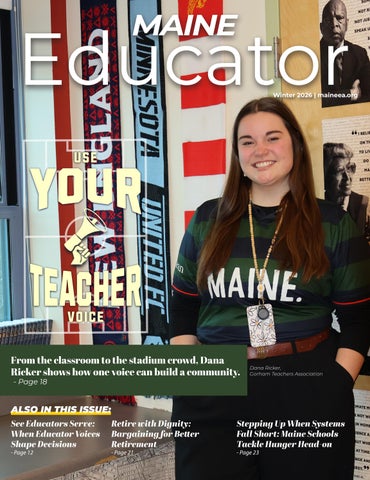
Maine Educator Winter 2026

Page 1


Dana Ricker, Gorham Teachers Association

86, NUMBER 2

CONTENTS

COVER

12 Use Your Teacher Voice

From the classroom to the stadium crowd, Dana Ricker shows how one voice can build a community.

SPECIAL SELECTIONS

In the Know

6 Quotes and Numbers

Professional Learning Wrapped

8 Check out how many members participated in MEA Professional Learning in 2025

MEA Winter Conference

9 February 21 in Bangor

Social Media Savvy

11 Know your rights and protect your online privacy

MEA Bulletin Board

11 Stay up to date on the latest events from MEA

Read Across Maine

27 See details for our upcoming Read Across Maine contest

What I Love About School

28 See details for our upcoming Maine Educator magazine cover contest

Celebrate Diverse Books

29 Celebrate a nation of diverse readers with these recommended books!

DEPARTMENTS

Winter 2026

FEATURES

See Educators Serve

16 What inspires educators to run for office? We asked a few MEA members who have been serving different levels of government to find out.

Retire with Dignity: Bargaining for Better Retirement

20 For many years, a career in education came with a promise—work hard, serve your community, and retire with security. That promise was anchored by the Maine Public Employees Retirement System (MainePERS). But today, things look very different.

Over

500

Days

Without a Contract: Maine Community College Faculty

Sound the Alarm

22 Despite record enrollment and increased workloads, full-time faculty in the Maine Community College System (MCCS) have been working without a contract since July 1, 2024— over 500 days and counting.

Stepping Up When Systems Fall

Short: Maine Schools Tackle Hunger

Head-on

22 When SNAP benefits were disrupted in November, educators and communities mobilized to keep students fed and reminded us what public schools are all about.

Hargrove

Cole

Board of Directors

District A: Pamela Kinsey

District B: Lauren Remington

District C: Kendrah Fisher

District D: Ally Loukas

District E: Thresa Mitchell

District F: Jill Plourd

District G: Valerie Pinkham

District H: Stephenie Michaud

District I: Rick Beaulè

District J: Jason Curry

District K: Tom Walsh

District L: Rebecca Manchester

District M: Stephanie Wigginton

District O: Michael Grillo

District P: Lisa Henderson

District R: Kay Grindall

District ESP: Jay Nicholson

Student: Julia Gay

Maine Educator (ISSN #1069-1235) is published by:

Maine Education Association 35 Community Drive, Augusta, ME 04330-8005 Phone: 207-622-5866 Fax: 207-888-2070

POSTMASTER: send address changes to:

Maine Educator

35 Community Drive, Augusta, Maine 04330-8005

Non-Profit US Postage paid at Augusta, Maine and additional mailing offices.

For advertising rates and information please contact:

Shawn Berry 35 Community Drive, Augusta, ME 04330 207-622-5866

Follow us on social media

President's Message

Breaking Through the Noise

I was overweight and acne ridden, awkward and uncomfortable, yet my Junior Seminar teacher assigned me to portray Newt Gingrich, the dynamic GOP leader selected as Speaker of the House for a historic Republican majority. I did the policy research, knew the positions and agenda, drafted bills, and attempted to make compromises—but when the Mock Congress convened, I lacked command of the floor. My voice was yet to be found.

My teacher pushed me beyond my comfort zone—and I loved it. I wanted more policy discussions, more debate, and more democracy. The unit inspired senior year course work, a college major in Political Science, and a graduate program in Social Studies Education. It influenced decisions to sit on municipal boards, getting involved in MEA committees and local leadership, and motivated bids for school board of directors.

Throughout my education I learned to argue positions, research evidence, and consider different perspectives. But too often, I was focused on “winning”, rather than understanding. Over time, I learned that the most rewarding moments— and in some ways, the biggest achievements—came from losses.

One such moment was when I was on the school board. An educator had crafted a new course in response to student interest. The educator was well qualified and had worked with the curriculum committee to secure approval, yet several board members opposed the proposal and moved to remove the course from the proposed Program of Studies for the following school year.

When the vote was taken, the majority of the board voted to remove the course from the Program of Studies. When final adoption followed, I cast the lone dissenting vote. It failed— overwhelmingly.

In the back of the room, a large group of students in the crowd stood and applauded my opposition to a Program of Studies without their course. They felt supported and in the following weeks organized and worked towards solutions with Administration, the Curriculum Committee Chair, and School Board Chair. Subtle successes can be found in defeat.

School board meetings used to be seen as routine and sometimes even boring, but currently many communities across the state are experiencing outside groups attending meetings to insert division and drama into what should be thoughtful local

processes. Increasingly, school governance has become a stage rather than a productive forum.

I encourage you to find your voice. Work to organize your community and your networks, elevate the positive work happening in our schools, and help shape the narratives that define them. Even in moments that feel like losses, our students, staff, and families will feel your support. Your support matters. Your voice matters.

Scenes from President Hargrove’s Travels:

Jesse Hargrove
Sarah Wilkinson (AFUM) and I joined Support Maine’s Public Schools to deliver IDEA birthday cakes to Maine’s congressional delegation and advocate for IDEA funding.
Joined members of Lewiston EA to show solidarity with our Somali students and community members. MEA

We Need Your Voice

Happy New Year! Another trip around the sun completed. Another year in the books. And a brand-new year ahead. And if you are like me, every January you take a moment (hopefully with a cherished pet by your side – for me, our beloved cat, Abby) to reflect on all that has happened the past year, assess what has come and gone, and find a path forward to embrace change and the possible. It is also the chance to listen to that voice in your head to take the hard path, the path that challenges you to be brave and try new things.

Given all that is happening in the world, there are a lot of opportunities to be courageous, to engage, to live our values, and to speak up for our beliefs and our communities. No matter what side of the political spectrum you are on, one thing is clear—public education and democracy are under attack. Now is the time to get more involved in your union. Unions were made for this moment, and we are collectively stronger when more members engage in the work.

There are many paths to get involved at both the local and state level to add your voice to our collective whole. Here are a few that can have immediate impacts on our work together.

1. Engage in MEA lobbying efforts.

Every legislative session, MEA advocates at the State House for the things our members believe in like equity in public education and a professional wage for all educators. As MEA is a member-driven organization, we need YOUR voice to help us influence elected officials on the issues you care about. A new legislative session has just begun, and I invite you to participate in a lobby day to talk with your representatives about the issues about which you are passionate.

2. Participate in the MEA political process for the 2026 election.

Whether we like it or not, elections impact everything we do. The folks who win those elections ultimately make decisions about our lives, our professions, and public education. MEA has a robust screening and endorsement process that is completely member driven. All local presidents, MEA Representative Assembly (RA) delegates, members of the Government Relations Committee, and the MEA Board of Directors may participate in the candidate screening and endorsement process. If you are in one of those categories, I encourage you to use your voice to

impact the process and exercise your right to advocate for a candidate that you believe in. The outcome of the 2026 election could significantly change our current reality.

3. Take an active role in your union.

Your local association and MEA (and NEA) all need to hear from you and need your participation to be as powerful and influential as we can be. Seek out opportunities to be involved at the local or state level. Become an association or building representative. Run for a local executive board seat or officer position. Join an MEA committee. Run to be an MEA or NEA RA delegate. There are a variety of ways to get engaged in your union to bring your unique perspective to the conversation. We need everyone’s voice at the table.

As the new year progresses and history unfolds, MEA is here along with over 23,000 members standing with you to take on the challenges that currently exist in public education and the world we live in. If we stand and speak together, our voices are amplified and exponentially more powerful.

Together,

Rachelle

In the Know

75%

of Educator endorsed candidates won their elections in November. Learn how MEA members are making an impact by serving at both the local and state level in the article See Educators Serve on page 14.

Over 550 Days!

MEA members were profiled by the Portland Press Herald as 2025 Mainers To Be Thankful For. Read their stories here: bit.ly/PPHMEAThankful

Dr. Leigh Alley (AFUM)

of the University of Maine at Augusta was honored with the 2025 Giraffe Award from the Maine Children’s Alliance.

"Getting involved doesn’t require a big gesture. Sometimes it’s as simple as showing up, listening, and supporting the systems that help students meet their most basic needs. When communities rally around schools, especially in moments like this, we help ensure that every child enters the classroom ready to learn.”

Lauren Remington in an op-ed to the Bangor Daily News. Read Lauren's op-ed here: bit.ly/LaurenMEA

Fifty years ago, the Individuals with Disabilities Education Act (IDEA) passed. In December, MEA President Jesse Hargrove and AFUM member Sarah Wilkinson joined Support Maine's Public Schools to deliver birthday cakes to Maine’s federal delegation in celebration of the progress in providing education programs that help students with disabilities reach their full potential and to remind them of the importance of fully funding and protecting IDEA.

The Maine Community College Faculty Association has been working without a contract since July 1, 2024. Learn more about how you can support them on page 22.

MEA and Lewiston Education Association Members in Lewiston to support the Somali Community. Read about the rally: bit.ly/LewistonRallyMEA

Cook's Corner

Getting Strategic About Your Professional Learning

Whether you’re preparing to attend a conference, enrolling in an asynchronous course on our Learning Hub, or drafting a professional certification renewal plan, being intentional about how we invest our professional learning time ensures meaningful growth and impact.

Educator Effectiveness Tools

Start by self-assessing with your district’s educator effectiveness tool to identify strengths and areas for growth. Feedback from your evaluator can also highlight opportunities for targeted professional learning.

Emerging Focus Areas

Explore topics that spark curiosity and reflect innovative, cutting-edge trends in education. While these areas may not be essential for your current role, they can enhance your practice and positively influence student outcomes.

→Example: Using artificial intelligence to deliver personalized learning support.

Academic Requirements

These are courses required for graduation or certification. They provide the foundational knowledge and skills necessary to meet program standards and professional qualifications.

→Example: Human development, teaching students with exceptionalities.

Student Demographics

Focus on topics and subject areas tailored to the populations you serve, based on the region where you live and work. These areas help you understand and address the unique needs, backgrounds, and experiences of your students.

→Scan QR Code to sign up! Or visit: maineea.learnupon.com

LEARN MORE

MEA WEBINAR

Keeping Disruptive Students Engaged: Examining the Need for Targeted Classroom Management Training

- FEB. 25, 4:00PM - 5:30PM

Visit: maineea.org/events/category/webinar/

Director of Training & Early Educator Engagement mcook@maineea.org

Maine’s Every Student Succeeds Dashboard

To better understand the students you work with, the Department of Education provides a dashboard with statewide, district, and school-level data on demographics, assessments, behavior, chronic absenteeism, educator workforce, graduation rates, and more. Visit: maine.gov/doe/dashboard

→How to Access Data:

1. Select Year → Choose statewide, district, or school.

2. Use the drop-down to select your district or school.

3. Click on categories such as Student Demographics or Chronic Absenteeism.

→What You’ll Find:

• Demographic breakdowns by race/ethnicity, economic disadvantaged, homelessness, and disabilities, including percentages and trends over time.

• Chronic absenteeism data showing the percentage of students missing more than 10% of school days, broken down by demographic groups.

→Why It Matters:

Analyzing this data can reveal gaps in meeting student needs. For example:

• A growing number of multilingual learners may prompt you to seek training on supporting language development.

• Rising chronic absenteeism might lead you to attend sessions on family engagement or strategies to reduce absenteeism.

Remember, MEA offers a growing collection of professional learning opportunities, ranging from in-person conferences to asynchronous online courses (scan the QR code to explore our offerings).

Be sure to mark your calendar for our upcoming webinar series, Experiencing and Managing Challenging Student Behavior in Schools, facilitated by leading experts in the field.

Mallory Cook

Bringing learning closer to you.

That’s thousands of hours invested in professional growth toward recertification.

Expanding flexible professional learning opportunities for members in every role.

Proof that MEA members never stop learning.

Educators hold a visible place in their communities—and that means what you post online matters. Today, more than ever, teachers find themselves under the microscope for everything they say, wear, or share, whether in the classroom or on social media. The choices you make, even well-intended ones, can affect your job, your family, and your profession.

Here are some tips to help you navigate social media responsibly, protect your privacy, and understand your rights.

Social Media Savvy: Know Your Rights and Protect Your Online Privacy

→Be Smarter Than Your Smartphone

• Maintain good moral character online. Maine rules require educators to furnish evidence of good moral character when requested. Your personal social media activity can be part of that picture.

• Keep your work and personal accounts separate. Remove your employer’s name and add a disclaimer that views are your own.

old photos, adjust privacy settings, and untag yourself from posts you don’t want public.

• Verify friend requests and watch for phishing. Never share passwords or sensitive info.

→Prevent Doxing Doxing—publishing private information online—can lead to harassment. Reduce your risk:

• Remove birthdays, phone numbers, and workplace details from public profiles.

• Make accounts private and limit searchability on platforms like LinkedIn.

→If You’re Targeted:

• Ensure physical safety and contact law enforcement if your address is exposed.

→Know Your Rights Educators do have First Amendment protections, but they’re not unlimited. Ask yourself:

• Am I speaking as a private citizen? Posts tied to your official duties may not be protected.

• Is my post about a matter of public concern? Topics like school funding or academic freedom often qualify.

• Could my post disrupt school operations? Even off-duty speech can be restricted if it causes significant workplace disruption.

• Review your workplace social media policy and reach out to your Association Representative or Local President about any questions you may have regarding it.

• The internet is forever. Privacy settings help, but screenshots and shares can make posts permanent.

→Crank Up Your Privacy Settings

• Use strong passwords and two-factor authentication. Consider a password manager like the one through Google and Apple or another service like Bit Warden.

• Review privacy settings regularly. Limit what others can see, including location and contact details.

• Monitor your online presence, delete

• Document threats and report harassment to platforms and your district.

• Reach out to your union for support.

For more on educator rights and advocacy, visit: nea.org/advocacy-rights for guidance on free speech, workplace protections, and social media policies.

NEA has a 30-minute online course available for members to sign up and take on the Protections and the Limits of Protections for Off Duty Speech. Members need to:

1) Create an account neapartnera.learnupon.com/users/sign_up 2) Go to the course (Social Media and The First Amendment: An NEA Training for Public School Employees ) neapartnera.learnupon.com/store

When Dana Ricker moved to Maine four years ago, she didn’t imagine screaming into a megaphone, “Our Home is Here... at Fitzy Park...” to thousands of Mainers packing the stands at Fitzpatrick Stadium for each Portland Hearts of Pine soccer game. But the same voice that commands attention in her middle school social studies classroom now rallies an entire fan base.

Growing up in Minnesota, soccer was not on Ricker’s radar, but while studying abroad in England during her junior year, two things shifted her thinking: she met her future husband, Josh—a lifelong soccer fan from Maine—and she realized she wanted to become a teacher.

Originally a criminal justice major focused on juvenile delinquency, Ricker always imagined working with kids, but not in a classroom. The summer of her junior year, she worked at a camp and fell in love with it. “My campers were middle school-aged, and I loved it,” she says. Friends noticed too. “They told me, ‘You’d be such a good teacher,’ and I had this moment of, that’s basically what I’m doing—why wouldn’t I be a good teacher?”

That offhand comment from a friend became the spark she needed. “I felt like criminal justice was a lot of reaction to things,” she says. “Teaching felt preventative—almost like catching things beforehand.” By December, she emailed her advisor, switched majors, and committed to a fifth year to earn her teaching certification.

“I had never thought of education before,” Ricker says. “I just really enjoyed history, so it was a perfect fit.” Her college, University of Wisconsin–Eau Claire— originally a teachers’ college—had a strong education program. “I already had friends in education, and I met some professors because they taught history. It

felt like everything lined up.”

After graduation, Ricker and Josh moved to Maine, where he grew up. Here Ricker began her teaching career, first at Oxford Hills, and now at Gorham Middle School where she teaches middle school social studies and is a member of the Gorham Teachers Association.

→A Voice that Commands the Masses

Initially, Ricker’s involvement with Dirigo Union—the Hearts of Pine supporters’ group—was simply a way to support her husband. “Josh is a huge soccer fan and always has been,” Ricker explains.

“I never watched soccer growing up. I have never played soccer. My high school didn’t even have a soccer team,” she says.

At first, Ricker stood quietly in the back at Dirigo Union events, there to cheer on her husband. But she says she’s not wired to stay silent. “I’m a very opinionated person,” she laughs. “They’d ask, ‘What do we think about this?’ and I’d chime in from the back, ‘I think you should do this!’ I had ideas, so I started putting them out there.”

In the back of her mind, she imagined herself as a capo. For those unfamiliar

with European soccer, the term might sound foreign. Many Mainers hadn’t heard it until Ricker grabbed the bullhorn at Fitzpatrick Stadium and energized “The Zoo” fan section.

“People initially think I’m like a cheerleader on the sidelines if they haven’t seen me,” she says. “Once they experience it, they get it immediately. There’s nothing like it in American sports.”

For soccer fans, the capo—the leader of chants and cheers in the supporters’ section—is crucial, rallying energy and coordinating songs throughout the match. Ricker first imagined herself in the role after watching a woman capo lead the crowd at a Minnesota United game. “I remember thinking how awesome it was to see a woman commanding the energy of the stadium.” Naturally, Ricker saw herself in that role for the Dirigo Union, and others did as well.

While Ricker doesn’t have a background in soccer, or a lifetime of fandom to lean on when developing chants, she does

Continued on the next page →

have a background in music, theater, and teaching, which she says has been valuable. “I like to think I understand how cadence and lyrics work. I model a lot of our chants after European clubs—and then adapt them for us.”

Her skills are put to great use, and her presence is hard to miss as fans pile into Fitzpatrick Stadium for a Hearts of Pine home game. If she isn’t one of the first people you see, she’s definitely one of the first people you hear. Her voice has become the heartbeat of the fan section.

And it's no surprise her classroom skills come alive on game day. Ricker says she introduces a new chant to the crowd the same way she would explain something to her class of seventh graders. “If we have a new chant, we spend the first 10 minutes before kickoff teaching it [to the crowd],” she says. “"I explain it the same way I would explain a new concept to my seventh graders: ‘First, we’re going to do this; then this.’ Then I recap and make sure they heard me. I explain each chant five different ways.”

That ability to teach a crowd something new has become her superpower. “Other capos sometimes just say a chant once and assume people will get it,” she notes. “But my teaching background makes this whole process much easier.”

→Classroom Capo

Sometimes, the chants at Fitzpatrick Stadium find their way into Ricker’s lesson plans. This year, while teaching eighth graders about the Civil War, she tied in the song, Ballad of the 20th Maine, which the Dirigo Union start each game with at Fitzpatrick Stadium.

“We were learning about the 20th Maine,” she explains. “It was a way for my students to see a part of their state history they can be proud of—and how it impacts pop culture. History is not just a stagnant thing in the past. I love being able to show how culture works and sports are a part of culture.”

That lesson sparked deeper conversations. “We talked about how the song could be digested by other people, how it could be used by the club,” she says. “It was a way for students to analyze their own culture—what does being a Mainer

mean to them? How does that translate to sports culture? And if you don’t like sports, how can you still be part of it? Social studies class reflects culture so much, and that’s my favorite part."

Her students embraced the connection. “Later, one of my students said, ‘I actually looked up Andrew Tozier—he was a real person. Did you know that, Mrs. Ricker?’” she recalls with a smile.

Ricker’s bedazzled megaphone even makes appearances at Gorham Middle School. As a member of the school’s leadership team, she helped revive pep rallies this year. “Our principal described the vibe he wanted, and everyone turned to me,” she says. “‘This feels like something you’re uniquely qualified for.’ And I thought, you’re right—I am.” It’s great to see the two worlds collide. “I brought out my bullhorn and said, ‘Here we go.’ It felt like a Hearts of Pine game,” she laughs. “I’m way more hyped than the kids are, and that’s my favorite thing.”

Students love sharing their excitement for the Hearts with her. “Even out of season, I have three students who constantly ask, ‘Did you see the new signing, Mrs. Ricker? What do you think?’ One student is obsessed with JayTee Kamara,” she says. Ricker even messaged Kamara on Instagram so he could send a note to her student. “It is such a cool way to connect with my students.”

The Hearts have become part of school culture, too. “It’s so cool to see kids wearing the merch,” Ricker says. “Before the Hearts, to get a 13-year-old boy to wear a T-shirt that says, ‘Lead With Your Heart,’ you’d have had to pay him a million bucks.”

→A Community Built on Voice and Vision

For Ricker, Hearts of Pine has become more than soccer—it’s a reflection of Maine itself. “It’s as much about community as it is about soccer,” she says. “The team is intentional about building community, so it feels natural that fans do the same. Through their work with youth soccer teams and their involvement with New Mainer groups, they’ve become a bridge that reflects the community around us.”

That bridge matters in a state where diversity varies widely. “A lot of the state

is very diverse, but a lot of the state is very not diverse,” Ricker explains. “This feels like a really big bridge from what people might have been used to.”

However, she admits that some of the most powerful moments are often the quiet ones. “There have been a couple of times this year where little girls came up just to say hi,” Ricker recalls. “Sometimes it’s about nothing, sometimes it’s chatting about soccer—but that's been the most special part for me.”

One memory stands out. “I met a girl at a game one week and mom texted me a picture of us talking,” Ricker says. “And then there’s this photo of her off in the distance with a little camera, taking

"It says a lot to be a woman taller than everyone else, taking up the most space, being the loudest-and being praised for it. That's not the case everywhere."
Dana Ricker Gorham Teachers Association

pictures of her group because she thinks it’s the coolest thing in the world. Just them wanting to come say hi—it makes me so happy.”

For those girls, Ricker is proof that there’s a place for them in sports. “It says a lot to be a woman taller than everyone else, taking up the most space, being the loudest—and being praised for it,” she says. “That’s not the case everywhere.”

Despite her confidence on gameday, she laughs about not knowing every rule. “I might not know why a player is offsides or not offsides,” she admits. “But I still have a place there because I’m using what I excel at—and that’s enough.”

Her talent—her voice—has built something rare, which Ricker says is not common for other teams in the league. For her students, and young Hearts of Pine fans, that voice means more than chants. It means seeing themselves reflected in a team and a community that celebrates them. It means discovering what leadership, inclusion, and joy sound like when a teacher’s voice carries across a grandstand.

“I had absolutely no fear going up to it. I knew we were going to build something, and it would be great. It feels so good to be part of something bigger.”

See Educators Serve

When John Soifer stepped into the voting booth to vote in the 2024 election, he noticed that there was no one running to represent him on the school board. As a retired special educator and union leader, Soifer knew the importance of the seat, and impulsively wrote down his name.

MEA members like Soifer, have seen firsthand how invaluable the insights and expertise of educators are to policy discussion. From local school boards to Congress, elected leaders make choices every day that shape our schools, communities, and professions.

Across Maine, dozens of active and retired MEA members are already stepping up, serving on school boards, city councils, and the state legislature to make sure your voice is represented at every level of government—and they want you to join them.

What inspires educators to run for office? We asked a few MEA members who have been serving different levels of government to find out.

→A Voice at the State House

Representative Jan Dodge spent her decades-long career as a music educator involved in MEA’s advocacy work through MEA Lobby Days at the State House,

serving on the Government Relations Committee, and as a leader in her local association.

After retiring, she moved back to her hometown of Belfast and quickly became a familiar advocate and leader through the Waldo County Retired Teachers group, Aging Well Waldo County, and the chamber of commerce. So, it is no surprise that when an open seat emerged in the Maine House of Representatives, neighbors encouraged her to run.

Dodge admits the decision to run didn’t come easily. “I had moments of selfdoubt. It wasn’t something I had planned to do,” she reflects. “I prayed about it, and within two weeks I had people step up to be a campaign manager and a treasurer. That’s when I realized this was what I was supposed to do.”

“I’ve introduced bills—some don’t pass—but the discussion brings a new perspective to the table. People ask questions and you can reveal the ‘behind the scenes’ of how schools really work.”

Bringing

a Classroom Perspective to Policymaking

Now in her fourth term serving in the Maine House, Dodge says running gave her the chance to bring the voice of an educator to policy conversations—a perspective often missing in Augusta. She has spent nearly eight years doing just that.

“I’ve introduced bills—some don’t pass—but the discussion brings a new perspective to the table,” Dodge says. “People ask questions and you can reveal the ‘behind the scenes’ of how schools really work.”

One example is a bill she introduced to guarantee students at least 30 minutes for lunch. While the proposal didn’t pass, Dodge says it sparked important conversations about school policies, in this case a conversation about how scheduling impacts nutrition and equity in schools.

“If you haven’t served lunch duty or been the last in the line for lunch in the school cafeteria, you don’t realize how little time kids have,” Dodge says. But for her, this bill wasn’t only about time, it also aimed to reduce food waste and address hunger. When students have more time to eat, they consume more of their meal, waste less food, and return to class, better prepared to learn.

“Even though the bill ultimately didn’t become law, I am proud to say that it sparked important conversations about how scheduling impacts nutrition, and food waste in schools,” she explains.

Dodge said over the course of her four terms, she is most proud of the breadth of her committee work. “I introduced legislation that was heard in front of nearly every committee—bills that impact retirees, schools, educators, labor, but also bills that impact the environment or energy policy,” she reflects. Her approach to service in the House is much like her teaching, show up, listen, learn, and have a broad influence.

→Educators Make Great Representatives

Before running for State Representative, Dodge had not run for office before. Like many first-time candidates, she discovered how much there is to learn at

the State House but says that it shouldn’t stop anyone. “The amount of learning is huge. But that shouldn’t be a deterrent. Educators are used to learning fast, adapting, and juggling a lot—those skills translate.”

According to Dodge, there are many practical skills and parallels between teaching and serving in the legislature. “In the legislature you work with all different personalities, you must follow rules and procedures, eat lunch on the fly, and balance multiple priorities. These are all things we do as educators every day."

→Shaping Decisions That Matter

Since being elected to the Auburn School Committee, Rich says she is proud of how she and her colleagues continue to operate in a respectful and collaborative way, and the role she plays in bringing an educator’s perspective to decisions, especially during contract negotiations.

“We know education better than anyone else on a board, she says. “Why wouldn’t we want an expert in the field? It’s better for contracts, better for policy, better for students.”

constituents and neighbors made a point to share how much they appreciated her hard work, responsiveness to emails, and persistence.

→Just Do It!

Whether at the local or state level, MEA members are helping to shape policy and strengthening schools. They want others to join them. “Start asking questions now. Talk to your union leaders,” Rich suggests. “Reach out to me—I’d love to talk to people about running.”

“We know education better than anyone else on a board. Why wouldn’t we want an expert in the field? It’s better for contracts, better for policy, better for students.”

Jaye Rich Auburn School Committee

→Bringing Educator Voices to Local Leadership

Those same skills matter just as much at the local level. Each year, hundreds of positions on local school boards and school committees are up for election. Like statewide offices, these roles are critical for shaping education policy and the working and learning conditions of our colleagues and students—and they offer a valuable opportunity for both active and retired educators to serve.

For Jaye Rich, a multilingual teacher in Lewiston, stepping up to run was about representation, and reality. “I think it’s important to have educators on a school board, especially someone who worked through COVID and after COVID,” she said. “Education has changed since then, and I wanted our educators to feel like they had a voice.”

Rich isn’t alone in believing educators make a difference. Soifer, serving on the RSU 18 School Board, shares that perspective. For him, serving on the board is a way to move beyond advocacy and create direct change.

“Being on the school board was a more direct way to work toward something I care deeply about. Education for children,” he said. "We [the RSU 18 School Board] have started to turn things in a better direction. We have a new superintendent, which is very positive. And I’ve worked to help elect people who will bring fresh perspectives.”

→Running for Office Can be Fun!

Rich leaned on local leaders for guidance, including former Auburn mayor and MEA connections, as she learned the ropes of fundraising and endorsements. Then came the hardest—and most rewarding— part, meeting voters face-to-face.

“The most intimidating part is knocking doors,” Rich says. “But it’s the most rewarding. You have great conversations, and it’s a good opportunity to find a way to disagree respectfully.” Those conversations helped Rich connect with neighbors and learn what they wanted for their schools.

Dodge says she found these conversations rewarding as well. Throughout her four campaigns, she made it a priority to talk to as many constituents as possible and to stay accessible to them while serving in the Maine House. That effort did not go unnoticed. After her first term,

Serving in public office may seem intimidating, but those who have done it say educators already have the skills to succeed. They bring expertise no one else can offer, and that perspective strengthens decisions on everything from contracts to curriculum.

No matter where you choose to serve—on a school board, in the state legislature, or beyond—your voice leaves a lasting impact, and it may surprise you how much you love the experience.

Dodge reflects on her eight years in office, saying she enjoyed being a legislator as much as teaching. For her, the privilege of voting never loses its power.

“When a bill comes to the floor and I reach out and push my button to make my vote, I know that I am giving my constituents and educators in Maine a voice," she reflects. “And I always get goosebumps because in that moment, I have the privilege of using my voice to make a difference."

Learn about the MEA's endorsement process

Continued on the next page →

→How MEA’s Endorsement Process Works

Why do we endorse candidates?

MEA brings together members to screen candidates who support us and advocate for pro-education policies that support our schools, our students, and our professions. Endorsing and electing candidates who support MEA’s goals increases the Union’s ability to pass legislation that benefits our students and schools.

Who Decides?

The Screening and Endorsement team is made up entirely of MEA members consisting of MEA Officers, MEA Board of Directors, MEA Government Relations Committee, Local Association Presidents or their designees, and MEA Representative Assembly (RA) delegates.

What are the issues?

MEA Members determine MEA policy priorities through member-led proposals and discussions. Screening and Endorsement questionnaires are created based on issues identified by MEA RA delegates, MEA Officers, Board of Directors, and Government Relations Committee members.

LEARN MORE

Check Out the Latest MEA Scorecard

MEA created a searchable database to make it easier for you to find your lawmaker so you can learn how they voted on important education and union issues to help you make an informed decision come election time.

Visit: maineea.org/meascorecard →Should You Run for Public Office?

→The Process

As an educator and union member, you’ve shown your commitment to doing everything you can to improve outcomes for your students. But imagine your potential impact as an elected official, where you could leverage your passion, experience, and insights to improve public education on a larger scale.

If you think running for office at any level is something you are interested in, reach out to MEA’s Government Relations Director, Jan Kosinski at jkosinski@maineea.org

MEA prides itself on having a clear, fair, and democratic process leading up to the endorsement of a candidate.

Step 1

Following the June Primary, questionnaires on public education issues are sent out to candidates. All questionnaires must be filled out by the candidate and returned to MEA by the deadline to be considered for the Screening and Endorsement process.

Step 2

The Screening and Endorsement team meets in July to evaluate the questionnaires. MEA members on the Screening and Endorsement team lead discussions to determine which candidates align with MEA policy priorities and propose candidates for MEA’s collective endorsement.

Step 3

The Screening and Endorsement team sends endorsement recommendations for candidates to the MEA Board of Directors who make the final decision on endorsements by the Union.

Get involved and be part of the MEA Representative Assembly!

Write a Resolution Example of a Resolution (belief statement) Resolution C30. RESOLVED: That the MEA believes all students must attend safe schools to optimize learning

Write a New Business Item Example of NBI (1-year action item)

That the MEA gather current information to an MEA position that clearly defines what appropriate space, proper heating/cooling/ ventilation systems, sufficient maintenance and air/water quality standards are in schools.

MEA RA

Resolutions and New Business Items will be discussed at the MEA RA in May.

Want to learn more about the MEA RA and ho w to become a delegate? Visit: Maineea.org/ra Submit Forms Visit: maineea.org/ra

Contact your local president or call Alex Bellami at 207-888-3948 or email at abellami@maineea.org

Retire with Dignity, Bargaining for Better Retirement

For many years, a career in education came with a promise—work hard, serve your community, and retire with security. That promise was anchored by the Maine Public Employees Retirement System (MainePERS). But today, things look very different.

Over the past few decades, Maine’s pension system for educators has undergone significant changes. The most dramatic shift came in 2011 under Governor Paul LePage, when cost-ofliving adjustments (COLAs) were cut. COLAs are critical because they help retired educators keep up with rising prices. Without them, benefits lose value year after year.

Why does this matter? Pensions don’t just support retirees—they strengthen our schools. When educators know they’ll have a stable retirement, they’re more likely to stay in the classroom. That

means better instruction and a consistent environment for all students.

→What is the Maine Public Retirement System (MainePERS)?

All teachers, certified professionals (such as school nurses and school counselors), and Education Technicians (Ed Tech) II and III in Maine’s public schools are part of MainePERS — the state pension system which provides retirement benefits for Maine’s public sector employees, including educators.

Many likely assume that these public servants have an amazing pension system that will take care of them throughout retirement. Unfortunately, this is far from reality.

Consider a teacher or an Ed Tech II who worked in Maine schools for 30 years. At their “normal retirement age," they will be eligible for a pension equal to 60% of

the average of their highest three years of wages. If living on 60% of your income sounds like a challenge, that’s because it is—especially since, as of 2025, only $26,429 of that pension receives a costof-living adjustment (COLA). Anything above that amount loses value over time. In 2025 retirees received only a 2.7% COLA—a maximum increase of only $59.74 per month.

→Not All Public Retirement Plans Are Created Equal

Not all school employees in Maine are part of MainePERS. Some, including Ed Tech I, custodians, and bus drivers, are covered by Social Security instead. In both systems the employee and employer make mandatory contributions—but contributions to the system differ significantly.

Employees covered by Social Security pay 6.2% of their salary to Social Security, whereas teachers and Ed Tech II and III pay 7.65% of their wages into MainePERS. For employees covered by Social Security, the school department pays 6.2% of an employee’s wages into the Social Security system. By contrast, the school department only pays 4.47% of a teacher or Ed Tech II and III’s wages into MainePERS, and historically that figure has been well below 4%.

The result? MainePERS members pay more toward their retirement than employees on Social Security, and school departments pay less into MainePERS for each employee than they pay into Social Security.

→Bargaining for Better Retirement

Many school departments provide a 403(b) match for employees covered by Social Security—matching a percentage of the employee’s contributions to help them save for retirement. While all school employees can contribute to a 403(b), most districts do not provide a match for school employees who are members of MainePERS—teachers, certified staff, and Ed Tech II and III.

This is often due to a misconception that they are ineligible for a 403(b) match because they belong to MainePERS. But these two retirement programs have absolutely nothing to do with one another.

While MEA has been working at the State House to address the shortcomings of MainePERS and strengthen our public retirement system, a few locals are improving their retirement benefits by bargaining a 403(b) match into their contracts.

This year, the Cape Elizabeth Education Association (CEEA) negotiations team led by Karen Johnson, Tom Kohan, Hilary Roberts, and Mark Ashe bargained a 2% match into the Ed Tech II and III contract beginning in the 2027-2028 school year. This will help reduce the disparity between employee and employer contributions to MainePERS versus Social Security.

They also demonstrated the impact that even a modest match can make. While 2% may sound small, it can compound over time. For example, an employee earning $35,000 who contributes 2% of their pay—roughly $58 per month—at a 5% rate of return will accumulate nearly $48,000 in 20 years—a meaningful boost to retirement security.

→Make the Most of Your Match

While a 403(b) match is a great way to help school employees retire with dignity and offset the current shortcomings of MainePERS, it is important to realize that many 403(b) plans come with high fees and low performing investment options. To ensure the match truly benefits employees, districts should offer at least one high-quality, low-cost provider—such as Fidelity, Vanguard, or the MaineSTART program offered by MainePERS—all of which offer access to target-date index funds.

Why does this matter? Fees can quickly erode savings. Some providers charge 1.25% to 3% annually, which can “eat up” an employer’s match. In the example above, a 1.25% fee would reduce the final balance by more than $6,000, and a 2% fee would cost the employee nearly $10,000. If your district doesn’t offer a lowcost option, advocate for adding one or negotiate it into your contract.

→Get to Know Your Contract—And Plan Early!

Thinking about retirement benefits might feel like trying to hit a moving target, but there are small steps you can take today. Start by understanding your options

early—not just when you approach normal retirement age. In addition to 403(b) and other investment options, many educators work part-time outside the classroom or entered education as a second career. With the recent elimination of Social Security Offset Penalties—known as GPO/WEP—some may qualify for Social Security benefits in addition to MainePERS upon retirement. To get a complete picture of your retirement options, consult a fiduciary

Normal Retirement Age: Your normal retirement age is the age at which you can retire without your benefit being subject to an early retirement reduction.

In Maine, the normal retirement age varies based on the type of retirement plan and the individual's hire date:

• 60 years old if you were hired before July 1, 1993, and have at least one year of service credit immediately prior to reaching age 60

• 62 years old if you reached age 60 with at least one year of service credit and then reached age 62 with at least one year of service credit immediately prior to reaching age 62

• 65 years old if you were hired before July 1, 2011, and did not reach age 62 with at least one year of service credit.

Additionally, if you have 25 years of service, you may still retire, but your retirement benefit will be reduced.

Source: bit.ly/MainePERShandbook

A 403(b) is a tax-advantaged investment account for school employees similar to a 401(k) in the private sector. It is simply a special type of investment account that the IRS makes available to school employees to help them save for retirement in a way that provides a tax benefit.

who understands public pensions and 403(b) plans.

And check your current contract language. Are you taking advantage of the retirement benefits offered by your district such as a 403(b) match? Is a match included in your contract? If not, consider advocating for these benefits in future negotiations. Even a modest match can make a big difference over time.

MaineSTART is a program from MainePERS that provides an excellent retirement savings program for school employees.

• It uses low-cost, high-quality Vanguard funds.

• It offers both pre-tax and Roth options.

• It charges very low fees: 0.03% versus 1.25% (or more) from other providers.

• It offers simple investment choices like target-date retirement funds.

• While stocks have historically provided superior returns, the program also offers bonds and money market funds for more conservative investors.

Contributions into Retirement Systems:

• Social Security employees pay 6.2% of their salary into Social Security, and their employer matches that with another 6.2%.

• MainePERS members (teachers and Ed Techs II and III) pay 7.65% of their wages into MainePERS, while school departments contribute only 4.47%—and historically, that figure was even lower.

NEA Member Benefits: As a member of MEA and NEA, you have access to resources to help you explore retirement options and resources. bit.ly/nearetiremea

Meet Mark

Mark Ashe has taught economics and personal finance in public schools for more than 25 years. He is a licensed investment advisor and fiduciary. The commentary in this article is not professional investment advice or an endorsement of any kind. This article is for informational purposes only and should not be relied on to make any investment decisions.

Mark Ashe Cape Elizabeth EA

Over 500 Days Without a Contract: Maine Community College Faculty Sound the Alarm

Despite record enrollment and increased workloads, full-time faculty in the Maine Community College System (MCCS) have been working without a contract since July 1, 2024—over 500 days and counting.

Enrollment at Maine’s seven community colleges has surged since 2020, driven in part by the Free Community College Program passed by the Legislature in 2021. This fall, enrollment exceeded 20,000 students. Yet faculty numbers have remained stagnant, creating a widening gap that places increasing pressure on educators. Larger course loads, additional responsibilities, and limited resources have become the norm.

Members of the Community College Faculty Association (CCFA) are vital to the mission of the MCCS and in addressing Maine’s workforce challenges. However, according to a survey conducted by CCFA,

56% of faculty have considered leaving their positions in the prior three years due to salary concerns. Such an exodus would be devastating for students and would strip the system—and Maine—of invaluable institutional knowledge and expertise.

Community college faculty bring a rare combination of expertise: they are not only masters of their disciplines,

"People around the state are facing inflationary pressures, and community college faculty are not immune to that. Our wages have not kept up with inflation. Meanwhile enrollment is at a record high and faculty numbers remain stagnant. This combination creates a recipe for disaster."

trades, and professions, but also skilled educators who understand how to teach a diverse and dynamic student population. That teaching expertise takes years to develop—and once it’s lost, it is not easily replaced.

“People around the state are facing inflationary pressures, and community college faculty are not immune to that,” said Mike Tardiff, President of KVCC’s chapter of CCFA. “Our wages have not kept up with inflation. Meanwhile enrollment is at a record high and faculty numbers remain stagnant. This combination creates a recipe for disaster. We need resources to recruit and retain the best educators for Maine’s students.”

"Ten years later, with a master’s degree, I send students out [to their jobs] making $10 more an hour than I earn with a decade of experience working at the community college"

→Wages Falling Behind

Systemwide wages have not kept pace with inflation, adding financial strain to faculty already juggling extra roles. According to CCFA, 91% of faculty report seeking additional work to make ends meet, and more than half have considered leaving the system due to stagnant wages. Faculty have experienced a real wage decrease since 2020, with the sharpest drop, 3%, occurring in 2022.

An electrical instructor from Kennebec Community College (KVCC) shared the financial trade-off many faculty face. “The trades are important, but when we ask people to come here [the community college system] to teach, we’re asking them to make a big sacrifice. Many of us could earn more working directly in the trades. I do this because I want to give back and help the trades grow—but we lose credibility with our students when we’re making half of what they earn right out of school.”

Jessica Gleason, Physical Therapy Clinical Education Coordinator at KVCC, took a $20,000 pay cut to teach at the community college. “Ten years later, with a master’s degree, I send students out [to their jobs] making $10 more an hour than I earn with a decade of experience working at the community college,” she says—a reality reflected in statewide data showing Maine faculty salaries lag behind both inflation and regional averages.

→Student Success Depends on Faculty

Our community colleges serve over 33,000 Mainers annually, providing critical education and workforce training. Faculty members are essential to this mission. Without competitive pay, Maine risks losing experienced educators and undermining the overall success of our students.

Even so, faculty say the issue is not just about compensation—it’s about student outcomes. “When you invest in faculty, you invest in committed, seasoned faculty members that support student success,” Gleason said.

Shari Ward, faculty member at Northern Maine Community College (NMCC) and President of Community College Faculty Association (CCFA), described how this imbalance affects students. “We are being stretched thin. We feel forced to take overloads,” she said. “When enrollment was down, [the administration] cut faculty positions, but now that enrollment is at an all-time high, faculty have not been hired back. That has a direct impact on our students— I am losing time for the one-to-one interaction with my students that make the Community College experience special.”

TAKE ACTION

Support Community College Faculty

The full-time faculty at the Maine Community College System have been working without a contract since July 1, 2024. Meanwhile, the System has experienced record enrollments. Unfortunately, this record growth in enrollment has not been met with hiring record numbers of full-time faculty. This has meant increased demands on faculty. Despite these demands, the faculty have been instrumental in supporting students' success.

Please support the full-time faculty in their efforts to negotiate their contract by emailing MCCS President David Daigler, the Board of Trustees and Governor Janet Mills. Tell them that too much time has passed, and the full-time faculty deserve a fair contract now.

Average Faculty Salary at a Public 2-Year College:

Average faculty salaries at public two-year colleges in Maine rank 37th in the nation. Here's how Maine stacks up against nearby states and the national average.

Shari Ward, Community College Faculty Association President

Stepping Up When Systems Fall Short: Maine Schools Tackle Hunger Head-on

When SNAP benefits were disrupted in November, educators and communities mobilized to keep students fed and reminded us of what public schools are all about.

Maine educators understand that learning starts with a full stomach. So when Supplemental Nutrition Assistance Program (SNAP) benefits were interrupted during the government shutdown in November, schools didn’t wait for solutions—they mobilized. Across the state, educators and community partners sprang into action to make sure students and families had what they needed, proving once again that public schools are the heart of their communities.

"We really did notice that we had hungry students. More and more, we were hearing that students didn’t have enough to eat at home, or they didn’t have breakfast. So, our staff began to talk about how to put something together to help students outside of school."

Since 2021, Maine has benefited from state legislation ensuring that all students enjoy free school meals, but educators know that any looming program cuts could reduce students’ access to meals outside of the classroom and impact their engagement in school.

Over the last few months, teachers, school nurses, education technicians, food service workers, bus drivers, and other essential school employees have gone above and beyond across the state to ensure that students’ needs are met, and students do not go hungry.

→When Hunger Hits Home, Schools Respond

As a guidance administrative assistant at Orono High School, Heidi Clarke sees signs of food insecurity in students first-hand. To address the increase in the growing needs of the school, Clarke helped start a weekend backpack program to make sure students had food at home.

“We really did notice that we had hungry students,” Clarke explains. “More and

more, we were hearing that students didn’t have enough to eat at home, or they didn’t have breakfast. So, our staff began to talk about how to put something together to help students outside of school."

When the program began three years ago, it served 12 families. Today, it serves around 30, with support from the Orono Health Association, which helps fill bags weekly. Clarke says, as the need grew, so did the partnership, which is what helps keep the program sustainable.

When the news of SNAP benefit disruption spread in November, anxiety spiked. “I had students coming to me, signing up for the program,” Clarke says. “Parents were calling the school. It was on their minds, and families were anxious.”

Clarke says the goal of the program is to remove the stigma from asking for help. One student reached out to Clarke in November to gather information about the program. “His parents wanted to do it for a year, but they thought he’d be embarrassed to bring the bags home,” she says. “He took the initiative himself because he knew his family needed the support.”

→Fueling Hope, One Jeep Load at a Time

In late October, Orono staff gathered after school to brainstorm a fast response to the delay of SNAP benefits. They landed on something fun and visible, a rolling donation drive where students and community members could step up to fill

the principal's unmistakable purple Jeep.

“We made a video with students the very next day,” Clarke recalls. “Students, including our school mascot, led the whole thing. The Jeep was parked outside of sporting events and in a daily drop-off spot behind the school.” Donations from the students, families, and community members poured in.

Clarke says to add some extra fun, “Our principal promised if the students filled

the Jeep once, they could duct tape her to the wall. If students filled the Jeep twice, they could duct tape our principal and assistant principal to the wall.” Students, however, exceeded expectations and were able to fill the Jeep four times!

“All of the food we collect stays right here to serve students in our district,” Clarke explains. “We now are able to load the weekend food bags with additional items each week and keep items on hand for students who need an extra snack or lunch.”

"We’ll

put out a message ‘Hey, we’re looking for a washing machine,’ and someone steps up. Because learning can’t happen when basic needs aren’t met.”

Beth Whitehouse Medway Middle School

→From Awareness to Action: Medway Students Step Up

At Medway Middle School, teachers Beth Whitehouse and Kelley Waite say their school community has been stepping up to meet student needs for years, but now with the increased awareness around food insecurity among students, the community has rallied behind them.

“This isn’t something we just started this year, we have been supporting families for years, by buying groceries, helping with heating oil or wood, supporting them during the holidays,” Waite says. “Our administrator has bought medicine, groceries, even wood and oil for families,” Whitehouse adds. “We’ll put out a message ‘Hey, we’re looking for a washing machine,’ and someone steps up. Because learning can’t happen when basic needs aren’t met.”

Whitehouse, Waite, and their colleague Olivia Whitehouse help to oversee the Medway Middle School Student Council, a group of around 16 young leaders in grades five through eight committed to organizing service-learning and activities that engage the entire school community.

In November, their students organized a food drive and delivered donations to

the local food bank where they stocked shelves and learned how their donations move to families throughout the community. “They were flabbergasted— eighty families needed help that week,” Waite said. That experience left an impression, so when food benefits were disrupted this fall, students were quick to spring into action.

Waite and Whitehouse say they talked with students about the impact that the interruption in food benefits would have. “Knowing how much families relied on the food pantry, students said they were interested in starting their own food pantry,” Whitehouse said.

Students led the donation effort. They worked to promote their new food pantry and the food drive. They connected with local groups, schools, agencies, and community members and began collecting everything from toilet paper and shampoo to canned goods and pasta.

Stepping Up When Systems Fall Short: Maine Schools Tackle Hunger Head-on

Continued on the next page →

Orono High School students and the Red Riot mascot recorded social videos to promote their food drive.
Medway Middle School students received donations from local businesses for their food bank.

They even organized complete meal kits like spaghetti dinners and pancake breakfast boxes, and worked to secure fresh meat, dairy, and produce, so families had more than just shelf-stable items.

Their commitment went beyond collecting food. Students met donors with a smile and made sure every supporter received a handwritten thank-you note. Their hard work has not gone unnoticed. Waite and Whitehouse say keeping the pantry stocked hasn’t been a challenge. Each time items go out, new donations pour in to replace them, often with unexpected touches like birthday cakes. “Our community is incredibly generous,” Waite says. “All it takes is a message, and people show up.”

“We feed the kids 24/7 at school,” Waite says. “Snacks in every classroom, fridges in rooms, a cafeteria share table for packaged items,” she explains. “Every teacher gives each student what they can, even if it is a hug or a kind word.”

The pantry is open to anyone in the community. They say one colleague, Casey Savage, even makes a point to show up after hours and during vacations to ensure families have what they need. “It’s rewarding that when someone calls for help, we can say, ‘We’ve got you,’” Waite shares.

"You can’t teach the feeling they get when they help others—their eyes sparkling because they know their work matters."
Kelley Waite Medway Middle School

→Teaching Empathy Through Action

Student-led service projects are doing more than filling shelves—they're building bridges between schools and communities. “We want them to think beyond themselves,” Whitehouse explains. “That can be hard for middle schoolers, but this group is all about it. They’re caring, loving, and concerned for the future.”

Educators say efforts also help dismantle harmful assumptions and reduce stigma around asking for help, while raising awareness of food insecurity close to home. “A lot of people think food insecurity is about people not working,” Clarke explains. “But many parents have multiple jobs. Costs are high. Families are trying their best.”

Waite and Whitehouse say, the impact goes beyond food. “Students are gaining all those 21st-century skills— communication, collaboration, problemsolving,” Whitehouse explains. “And they’re learning that doing things for your community will come back to you eventually.”

The most rewarding part has been watching students step into leadership roles and the transformation that service learning has had on each of them. “You can’t teach the feeling they get when they help others—their eyes sparkling because they know their work matters,” Waite reflects.

The theme that emerged from every conversation? Everyone needs help from time to time. And when schools make that truth visible, the culture shifts. “Making it public took away the stigma,” Clarke says.

anymore. They see they’re not alone—and

Medway Middle school students accepting donations from community members.

WHAT I LOVE ABOUT SCHOOL WHAT I LOVE ABOUT SCHOOL

MEA invites students Pre-K-12 to submit art depicting the theme “What I Love About School.” Finalists will be selected in the following categories Pre-K-2, 5-8, 9-12, and one overall winner chosen from the finalists to have their work showcased on the cover of the magazine.

DEADLINE: MAY 1, 2026

DEADLINE: MAY 1, 2026

THEY CALL ME TEACH: LESSONS IN FREEDOM

Having secretly learned to read and write, a young Black enslaved boy surreptitiously teaches those skills to others in stables, moonlit fields, and cabins.

WILL'S RACE FOR HOME

Tired of working on land they don’t get to own, Will and his father journey from Texas to Oklahoma during the land rush of 1889, racing thousands of others to stake a claim for their Black family.

UP IN SMOKE

When her brother is arrested for the murder of a woman at an anti–police violence protest, Black teen poet and activist Monique teams up with her childhood friend Cooper to find the real culprit, unaware that Cooper is hiding a critical truth that could destroy them both.

Lead With Your HEART

The first time I walked into Fitzpatrick Stadium for a Hearts of Pine game, I expected soccer. What I didn’t expect was the roar of voices led by an educator, megaphone in hand. That educator was MEA member Dana Ricker (Gorham TA), and I knew immediately her story belonged in the Maine Educator.

Like many across the state, I’ve become captivated—maybe even a little obsessed—with the Hearts since attending my first game. Watching Dana lead thousands of fans in chants and cheers is inspiring, but it’s not just about soccer. It’s about building community, creating representation, and showing young people that their voices matter too. Dana leads with her heart, and in doing so, she teaches others to do the same.

Over the last year, I have been constantly reminded just how much our voices matter—whether in a stadium, a classroom, at the bargaining table, or in the halls of government. MEA members lead with their hearts every day: advocating for students, serving on school boards, and standing together in solidarity.

In this issue, you’ll read stories of members who stepped up to make a difference. From educators serving in public office (See Educators Serve, page 16) to bargaining teams fighting for better retirement benefits (Bargaining for Better Retirement, page 20), and schools rallying to support families during the SNAP benefits disruption (Stepping Up for SNAP, page 22). And of course, Dana’s story of leadership on and off the field (Use Your Teacher Voice, page 12).

Director

Last year, I watched my mom run for the town council for the third time after losing twice—and she won. Her determination inspired me to follow her lead. On January 6, 2026, I was sworn into my first term as a city councilor.

Stepping into this new role has made me even more grateful for the members who are already out there making a difference— educators serving on school boards, in the legislature, and in their communities to ensure our voices are heard where decisions are made. It takes sacrifice. It isn’t always easy, but it is always worth it, and your leadership is deeply appreciated.

No matter where you use your voice, your union is here to amplify it. And if at first you don’t succeed, follow my mom’s lead and keep trying. Sometimes the third time really is the charm.

Samantha Burdick

Turn static files into dynamic content formats.

Create a flipbook
Issuu converts static files into: digital portfolios, online yearbooks, online catalogs, digital photo albums and more. Sign up and create your flipbook.
Maine Educator Winter 2026 by Maine Education Association - Issuu