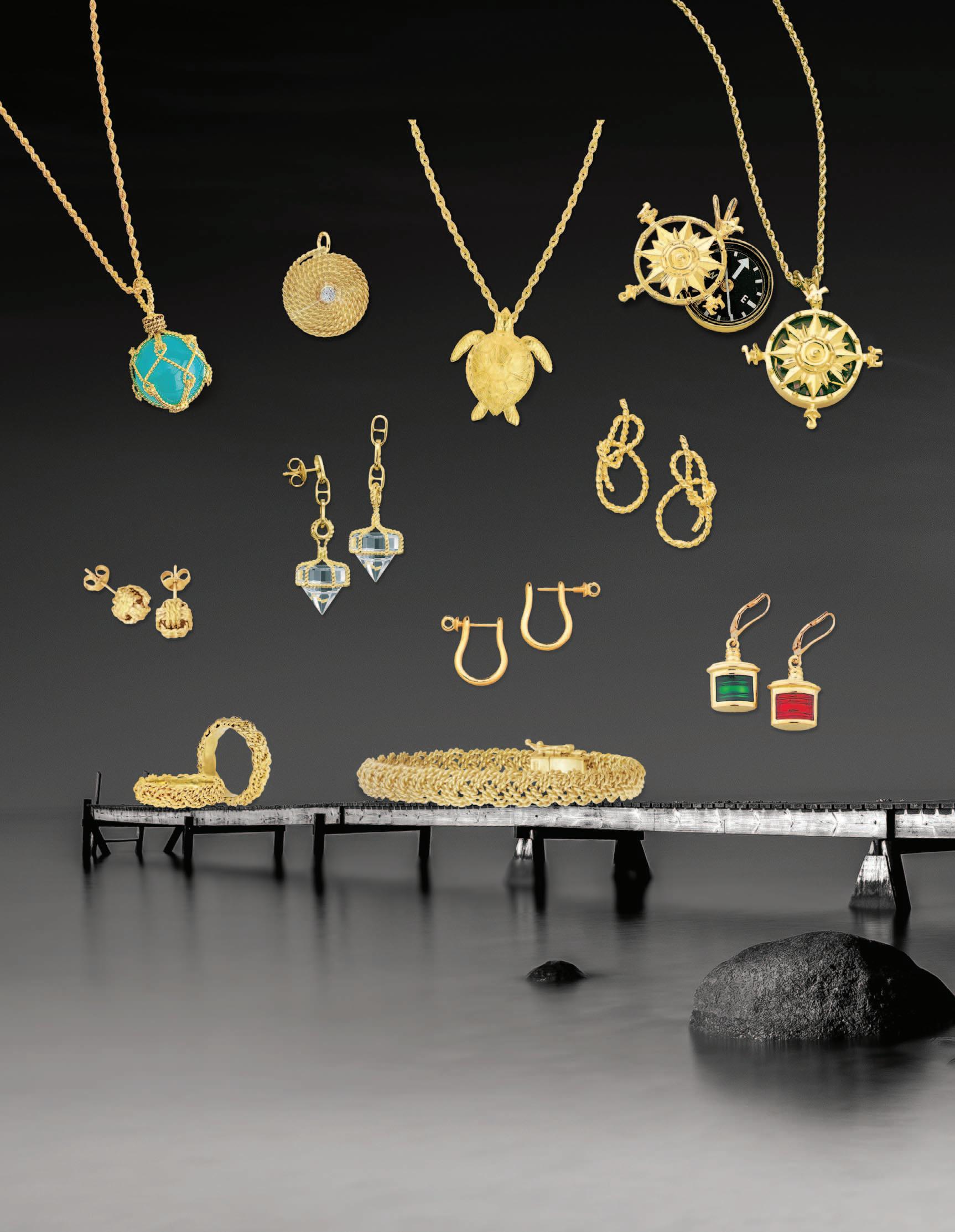
A - Fish Float Sphere with Aqua Chalcedony Pendant (U.S. Patent D678,110)-----------n/a -------------$2500.
B - Flemish Coil with Diamond Pendant (matching earrings available) -------------------$2100. ------------$2650.
C - Compass Rose with working compass Pendant -----------------------------------------------$2750. ------------$3750.
D - Sea Turtle with Diamond Eyes Pendant ---------------------------------------------------------------- $2450. ------------$3500.
E - Bowline Knot Earrings (please specify dangle or stud) ------------------------------------------$1400. ------------$1900.
F - Deck Prism Anchor Chain Dangle Earrings (matching pendant available) --------------n/a -------------$2750.
G - Monkey's Fist Stud Earrings (matching pendants available)---------------------------------$1750. ------------$2400.
H - Original Working Shackle Earrings ----------------------------------------------------------------------$1200. ------------$1650.
I - Two Strand Turk's Head Ring with sleeve (additional designs available) -------------$2900. ------------$3750.
J - Two Strand Turk's Head Bracelet --------------------------------------------------------------------------$5300. ------------$7200.
K - Port & Starboard Hand Enameled Dangle Earrings ------------------------------------------------n/a -------------$2750. •18" Rope Pendant Chain-------------------------------------------------------------------------------------------$900.
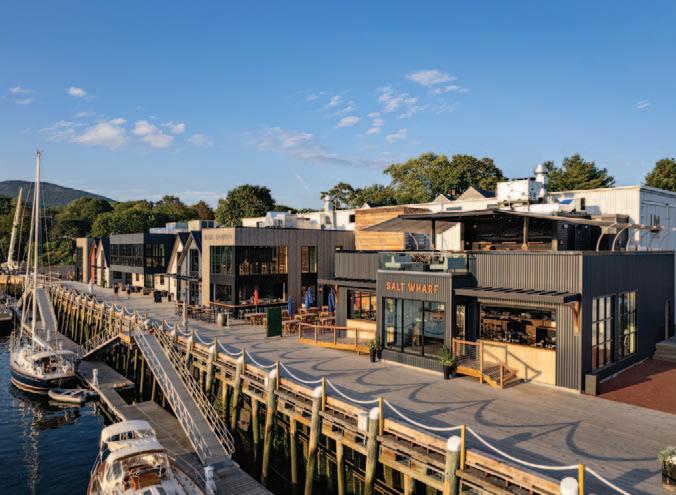
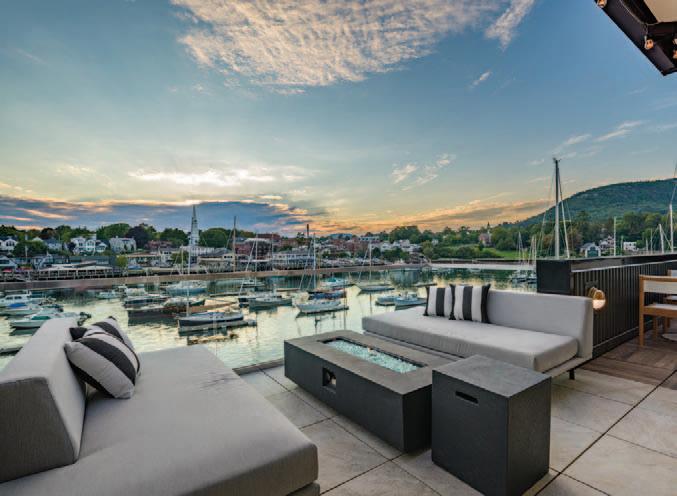
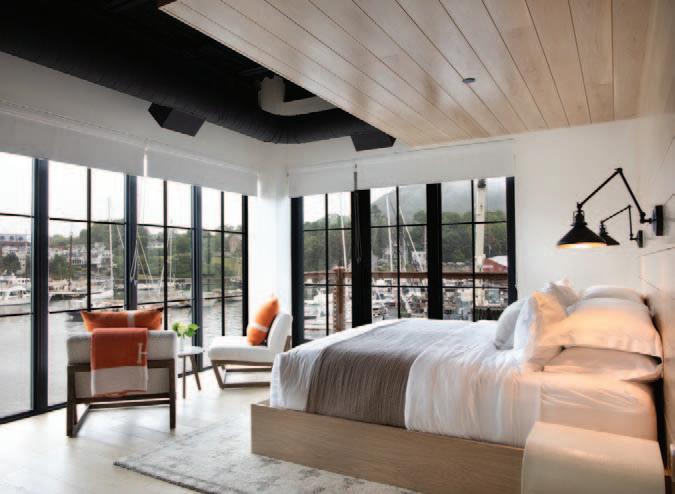
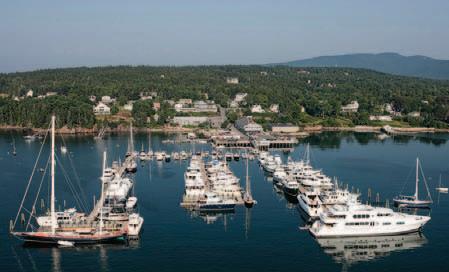
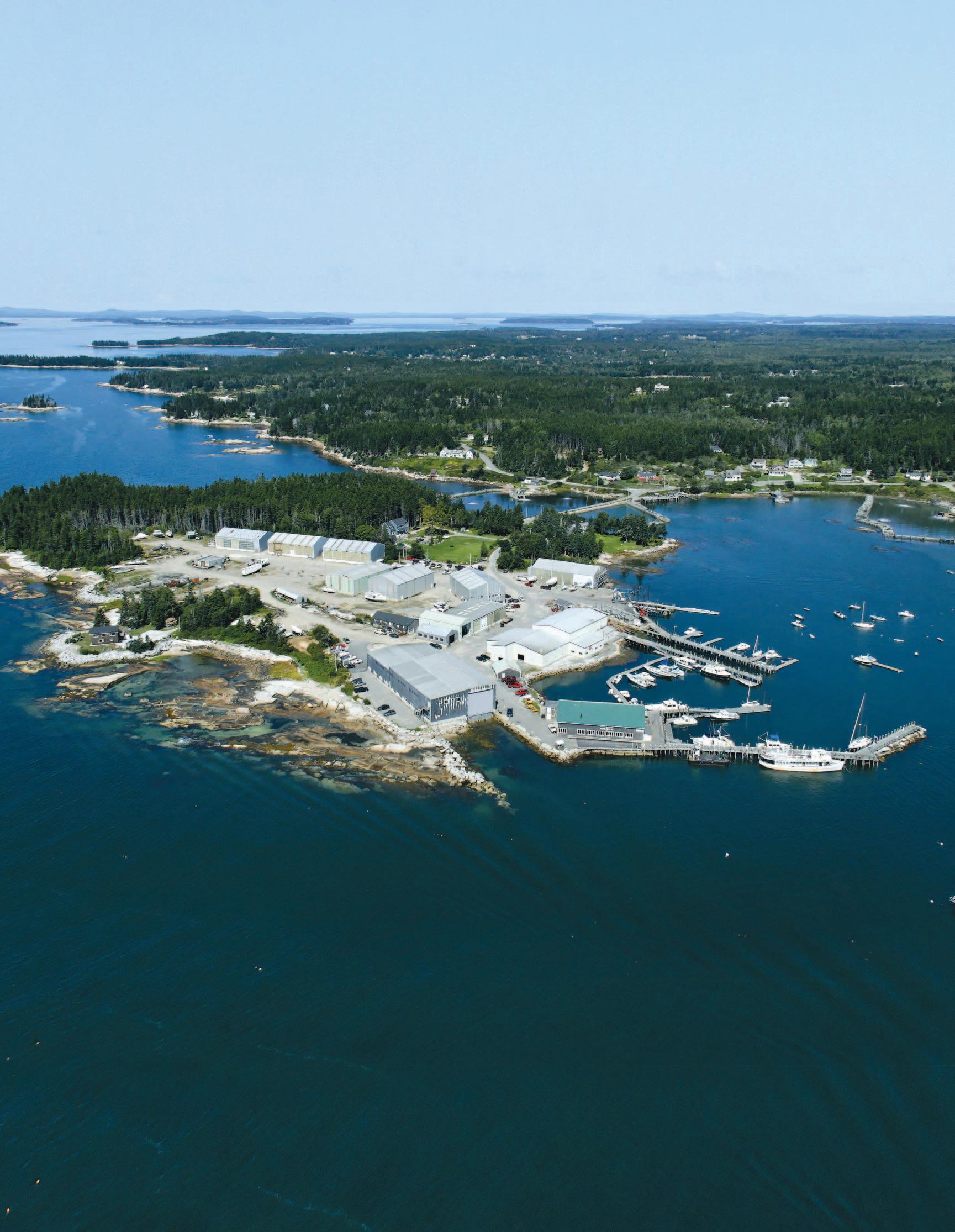
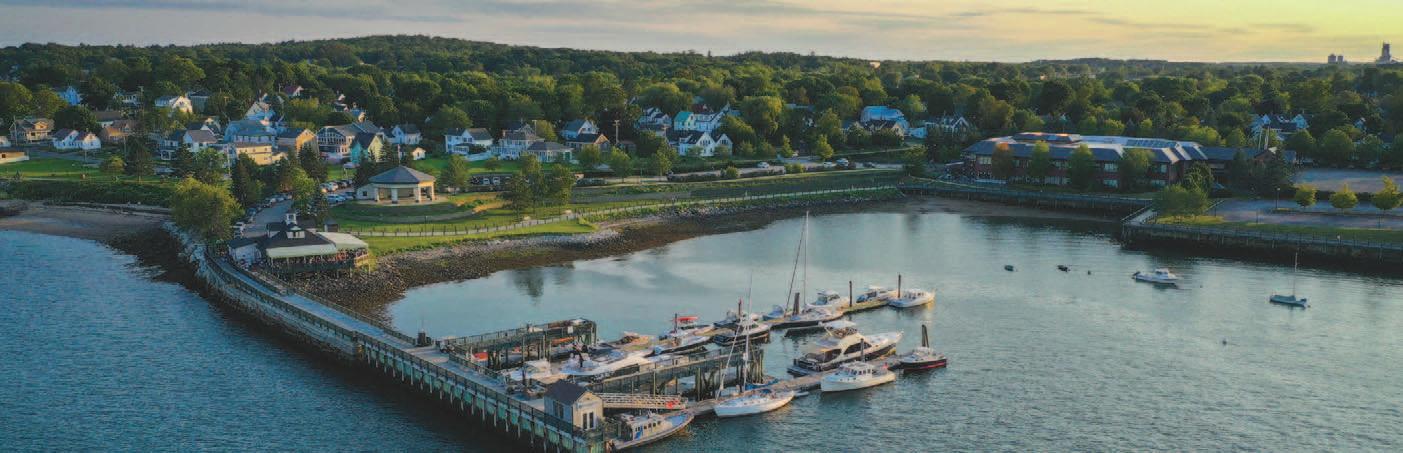
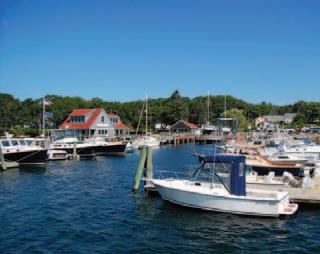
Lyman-Morse welcomes you to our modern marina facility in the heart of Camden Harbor. All the marina services you love about Lyman-Morse, plus dockside dining experiences, retail, on-shore lodging, outdoor spaces, customer lounge, and more to enjoy.
Lyman-Morse Camden is a cruiser’s paradise, complete with the amenities and scenery rarely found in a single destination. Our full-service boatyard and marina offers dockage, moorings, fuel, 3-phase power, 110-ton haul out capabilities and launch service with heated indoor storage up to 150’.
Contents
FEATURES
34 Loving and Conserving the North Woods
Story by Karin R. Tilberg • Photos by Jerry Monkman
From 1990 to 2015, a wide array of individuals and organizations cooperatively pitched in to conserve the wilderness they found in Maine’s North Woods
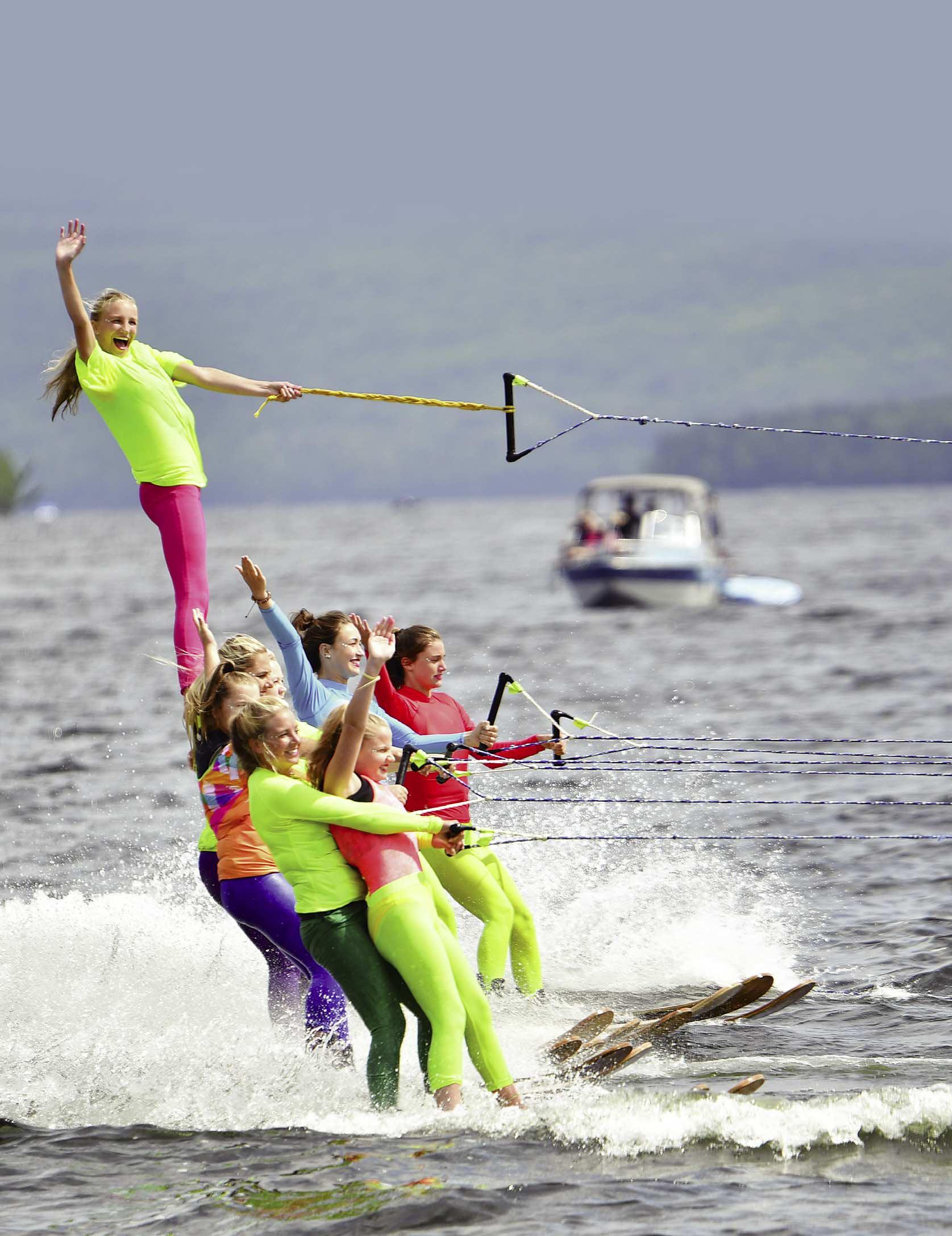
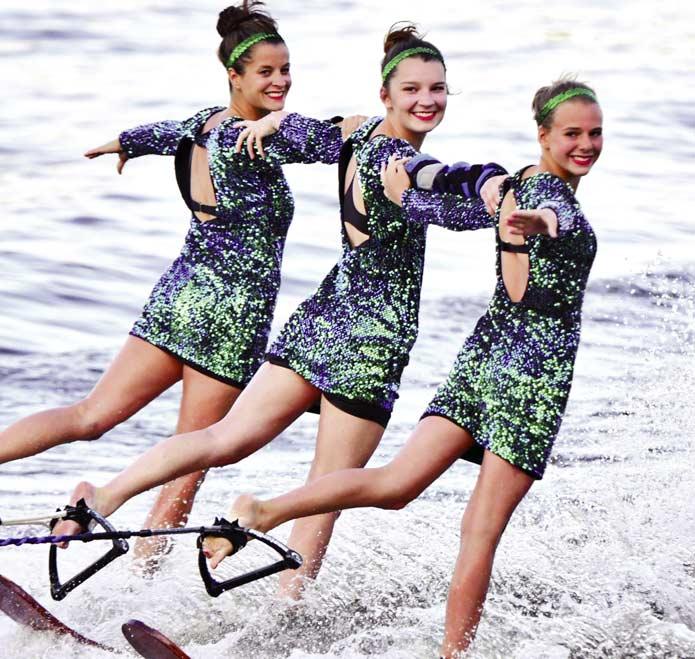
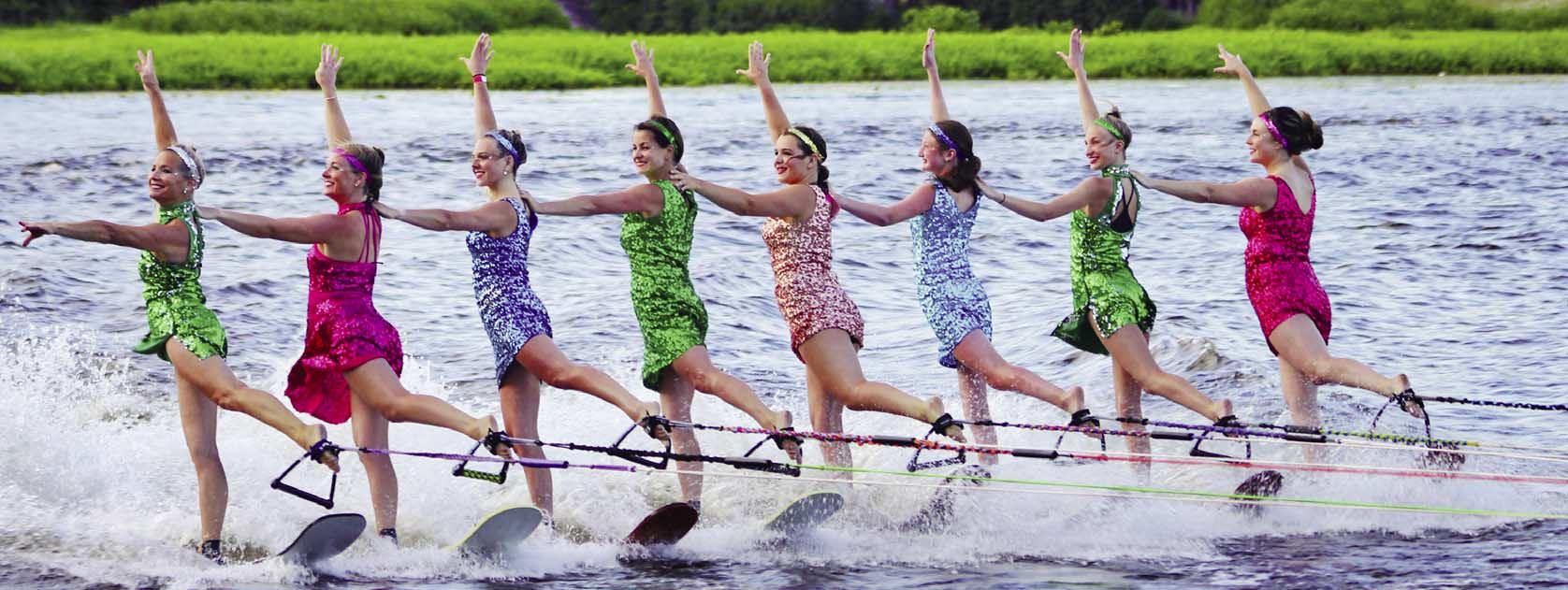
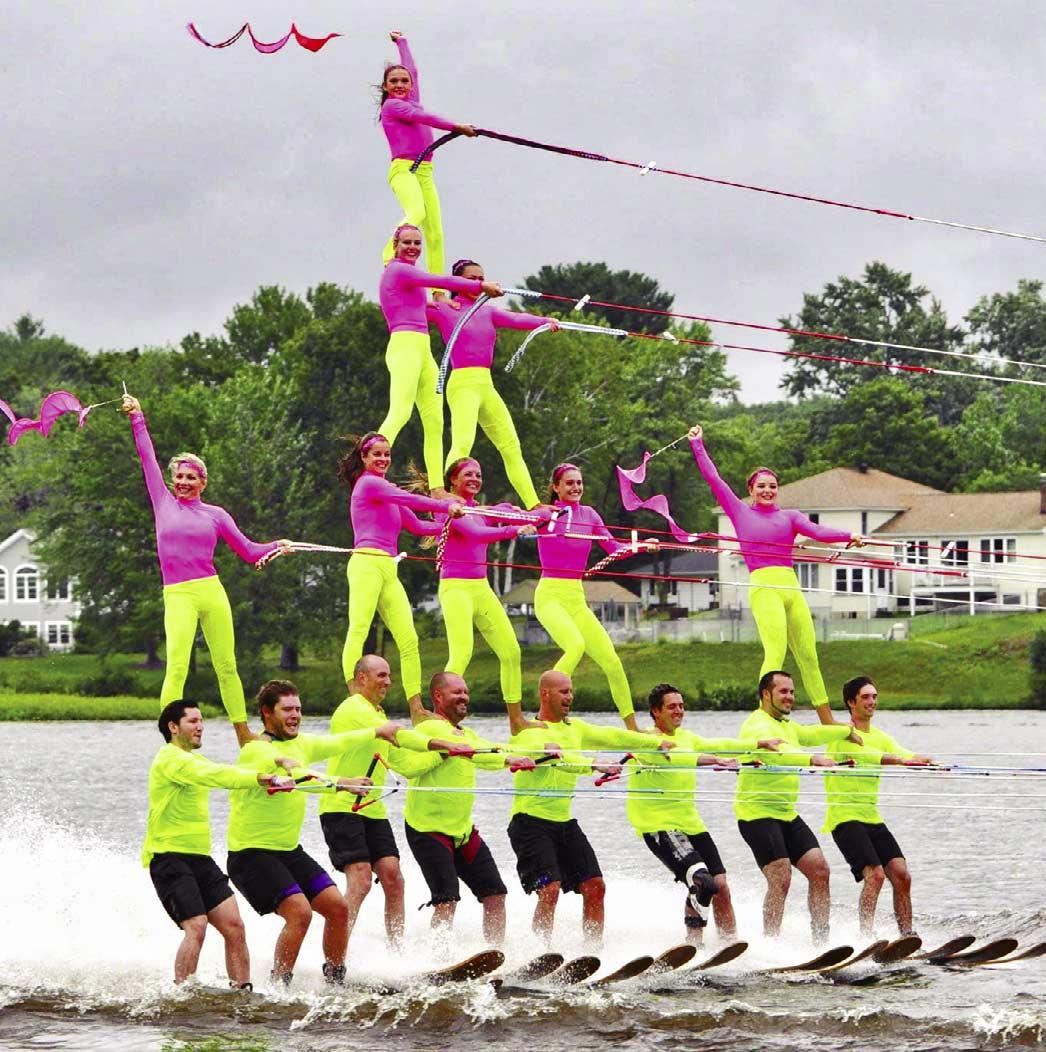
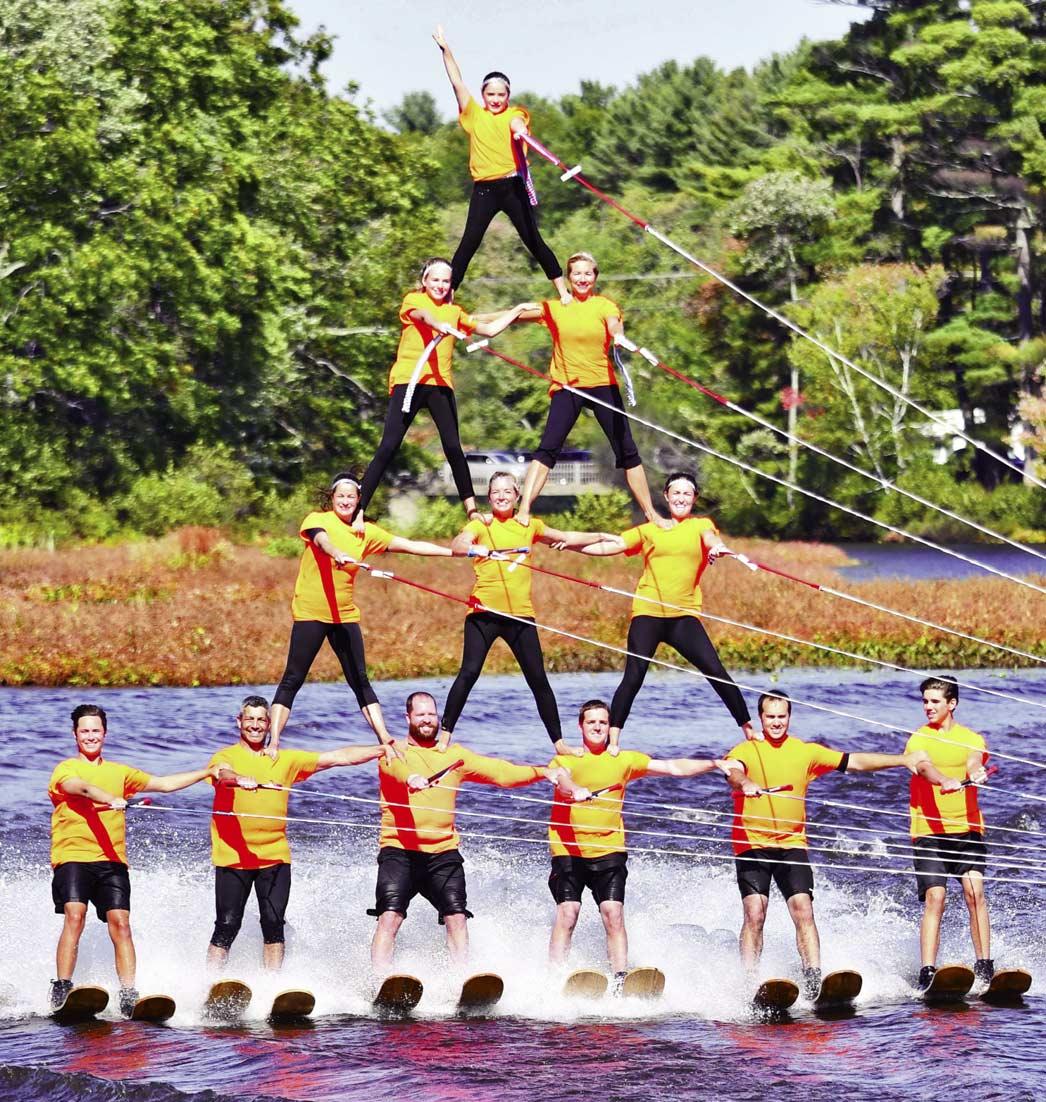
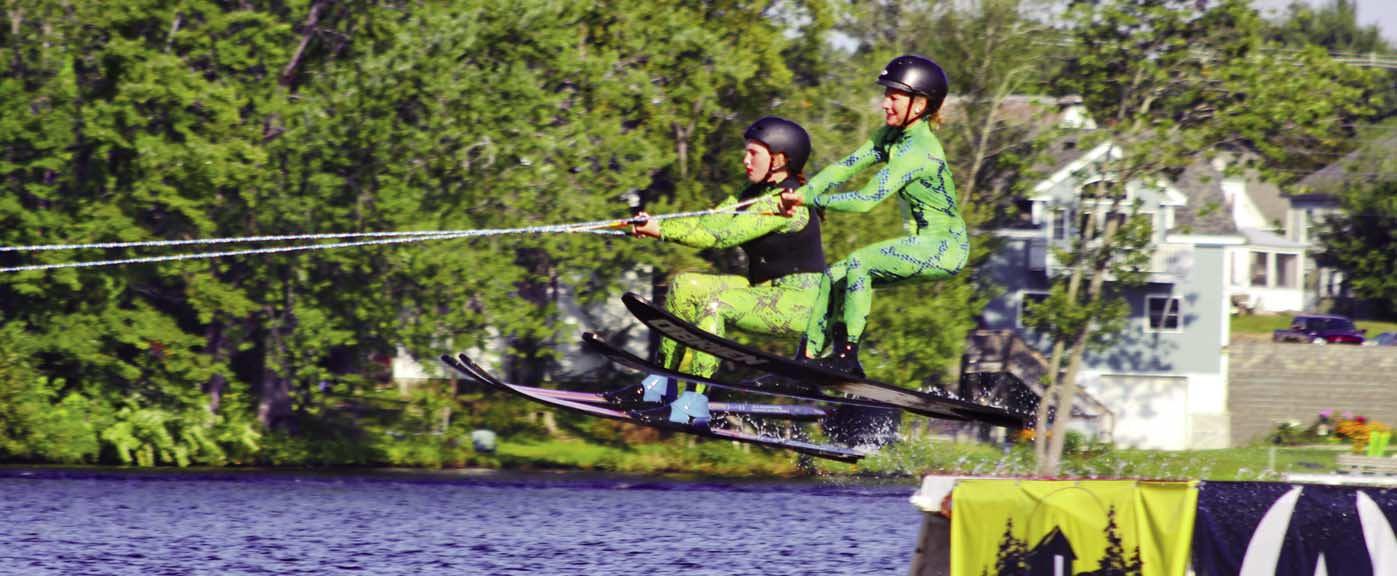
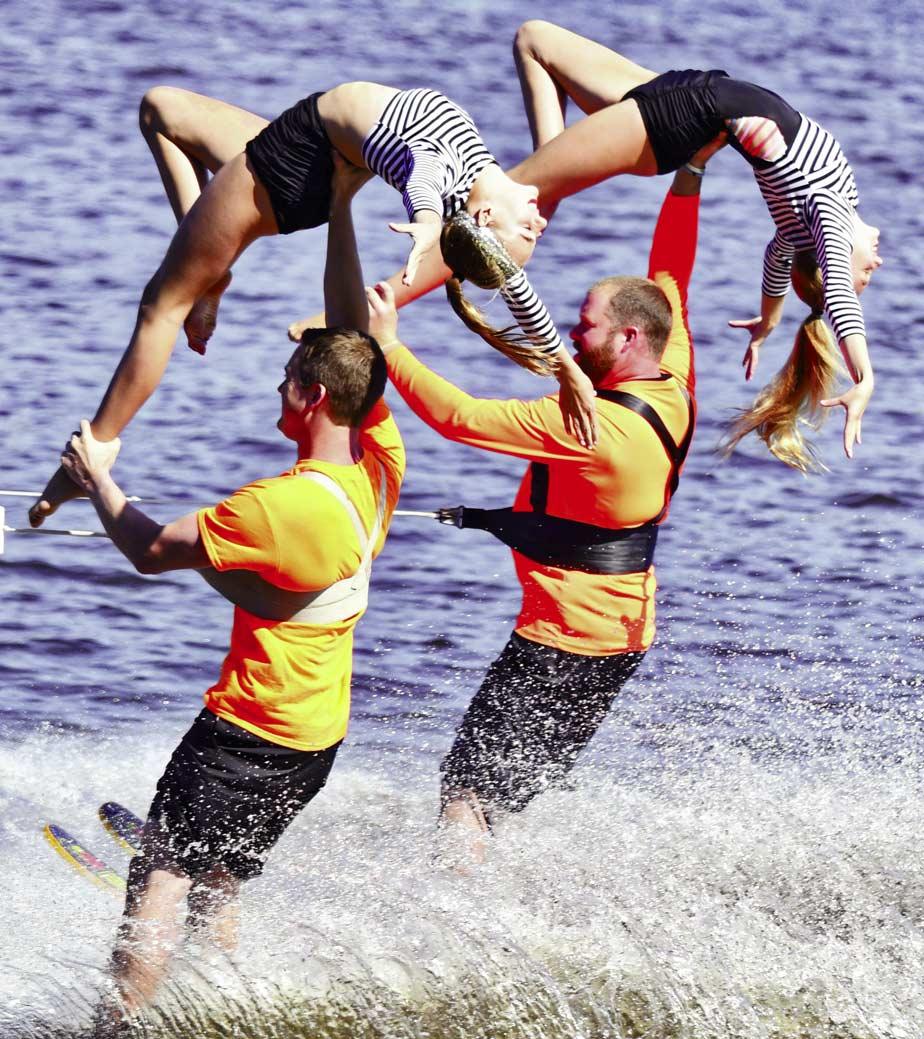
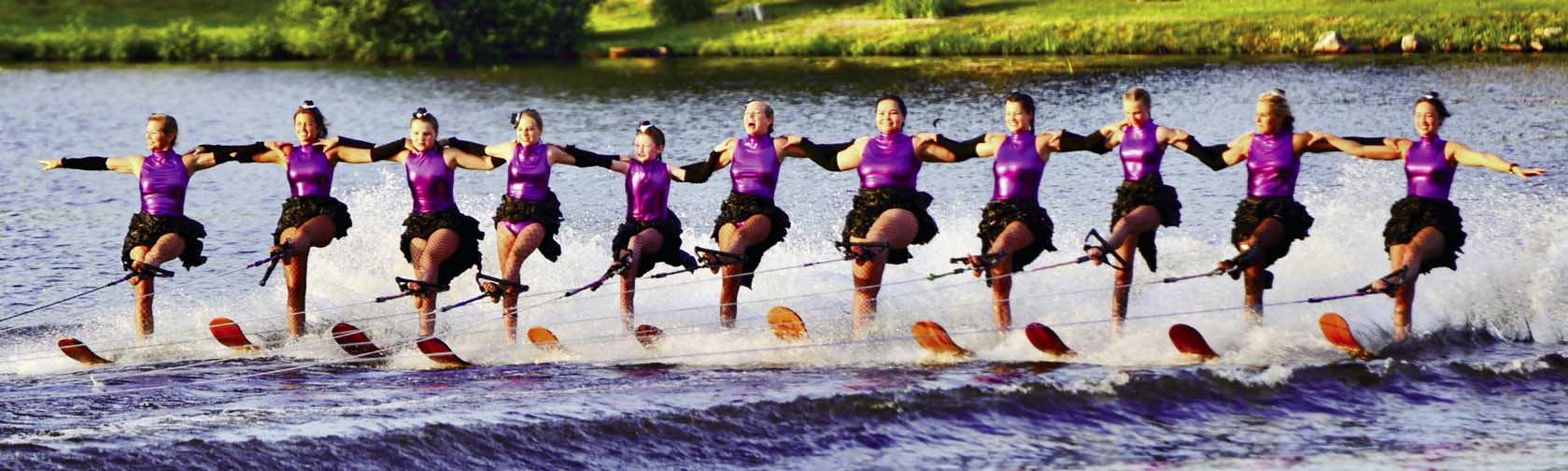
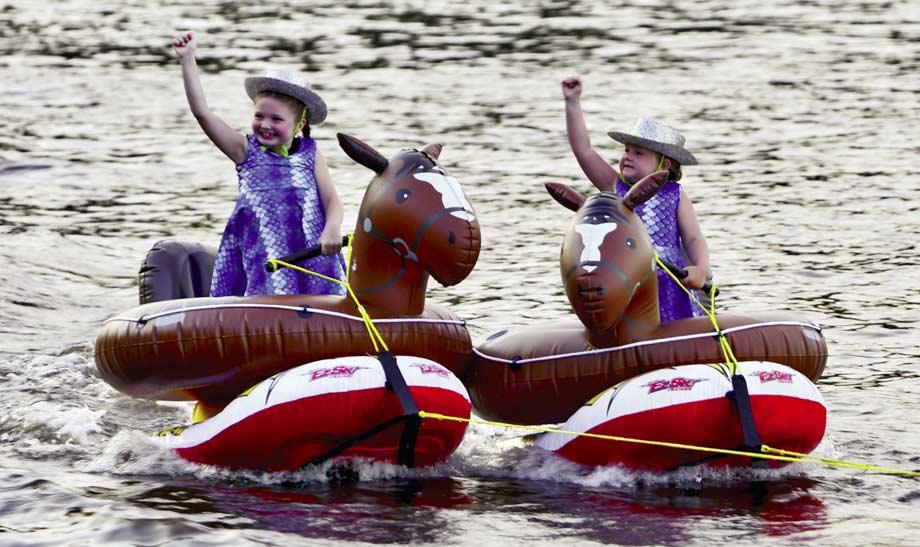
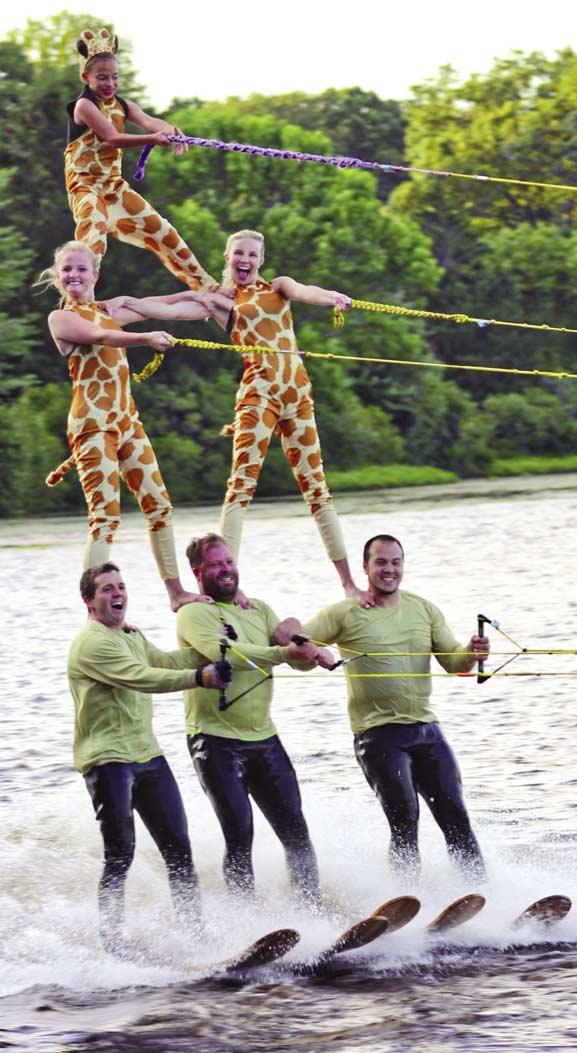
40 Maine Attraction Water Ski Show is Broadway on Water by Clarke Canfield
Flips, jumps, twirls, pyramids—they’re all part of the Maine Attraction Water Ski Show on summer evenings in Sanford
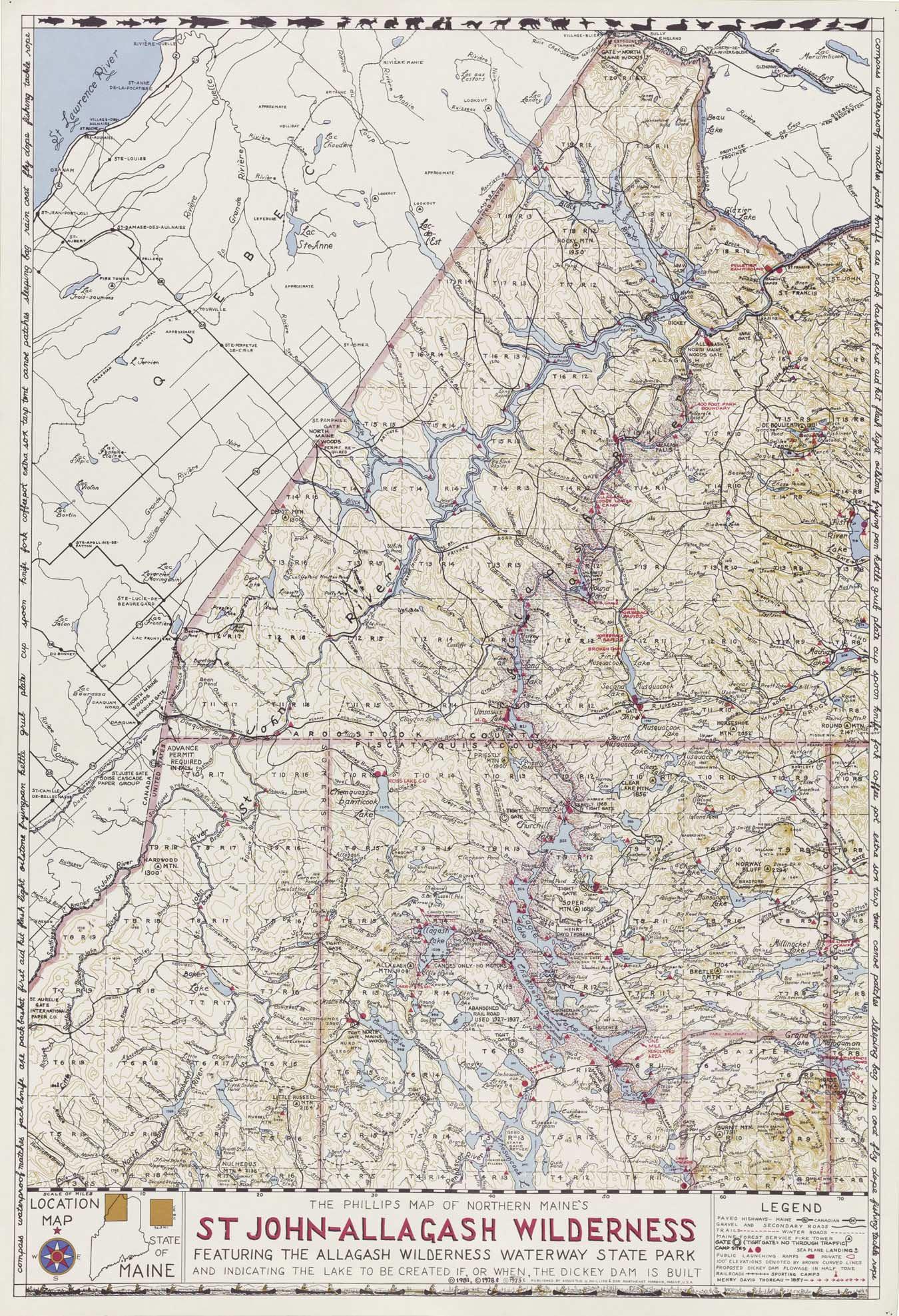
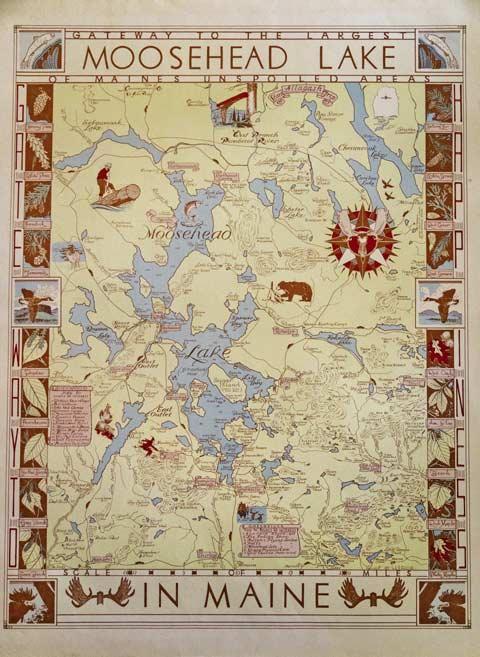
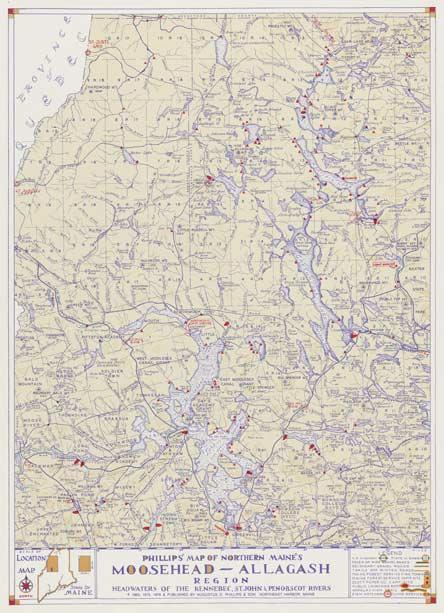
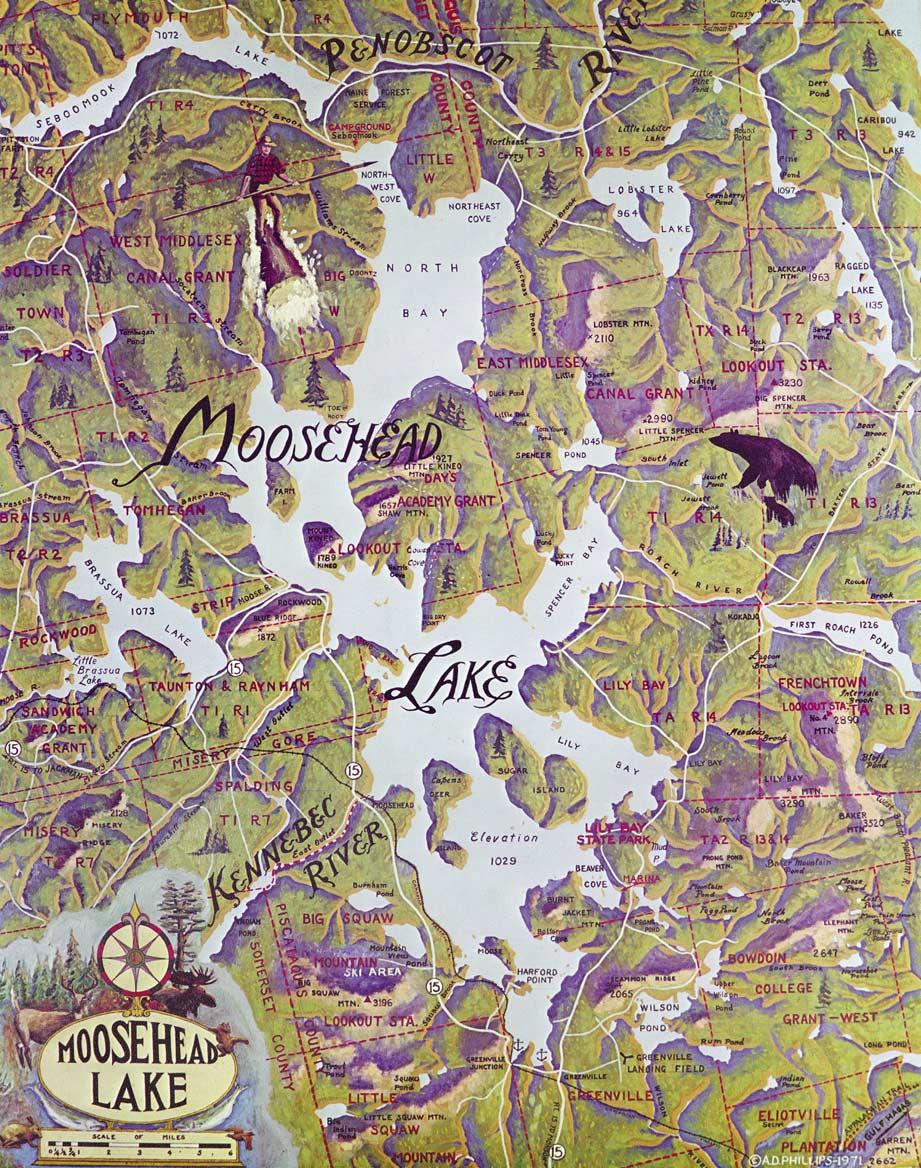
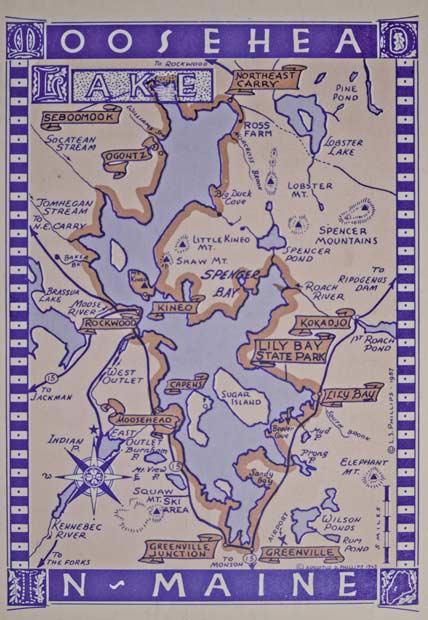
46 Keepsakes from the Phillips Brothers’ Maine by Catherine P. Jewitt and John T. Meader
Photographers and cartologists, the Phillips Brothers spent decades in the 1900s creating maps and postcards that were both artful and useful wayfinding tools and keepsakes for visitors to Maine
52 Discovering Maine’s Rivers, Lakes, and Ponds on the Fly by Ben Emory
A sailor gets a whole new look at outdoor life in Maine when he learns to flyfish
MAINE ART FEATURE
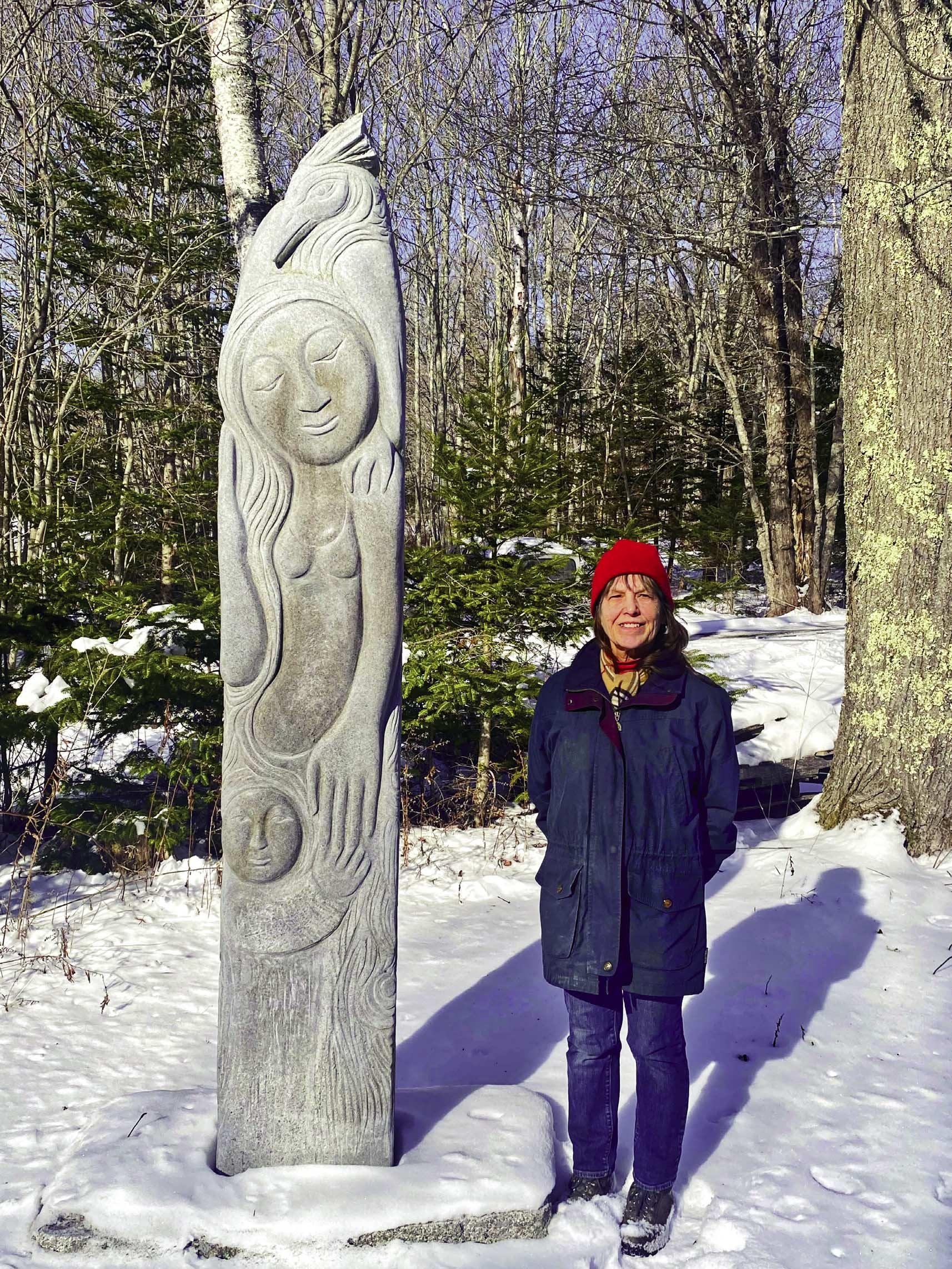
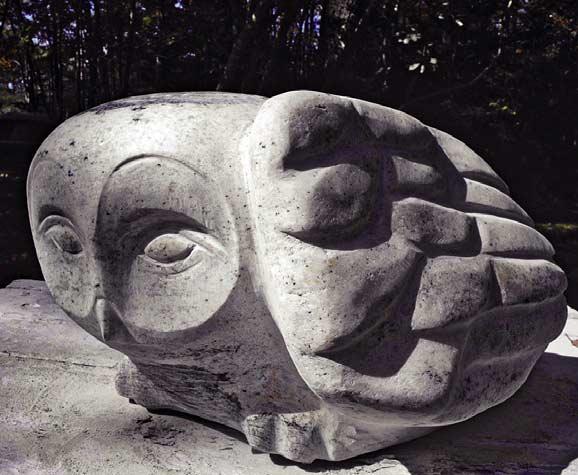
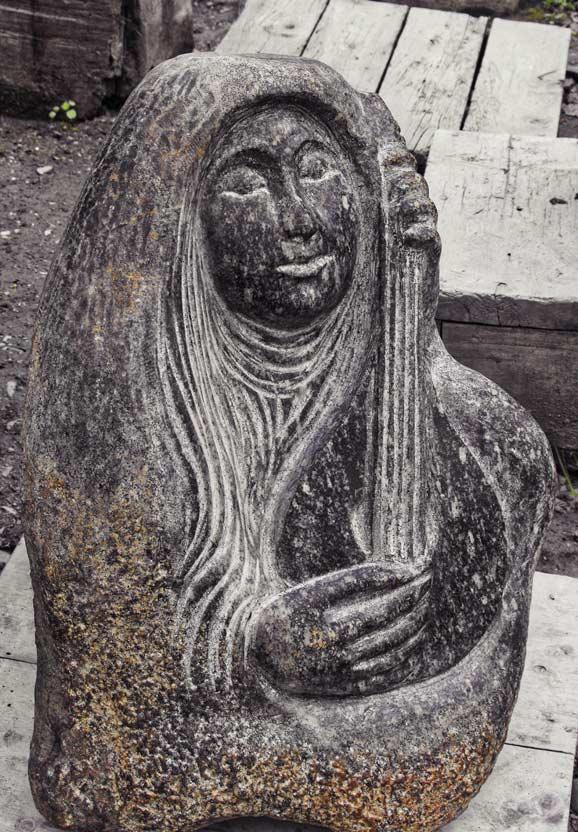
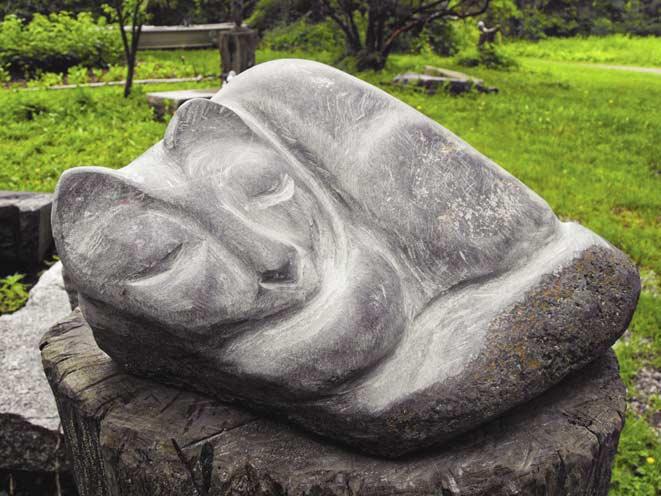
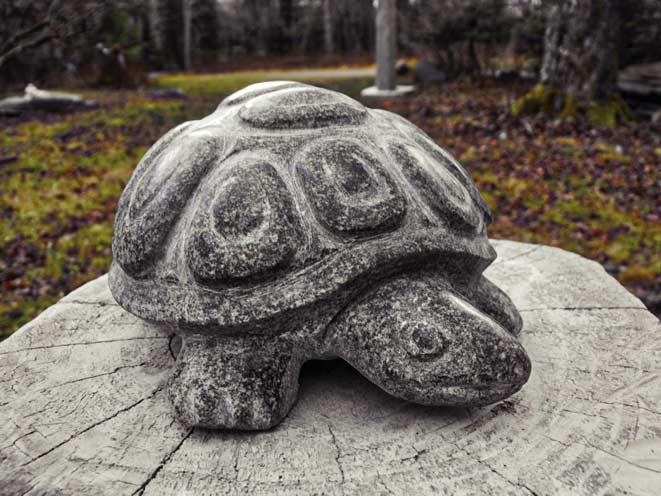
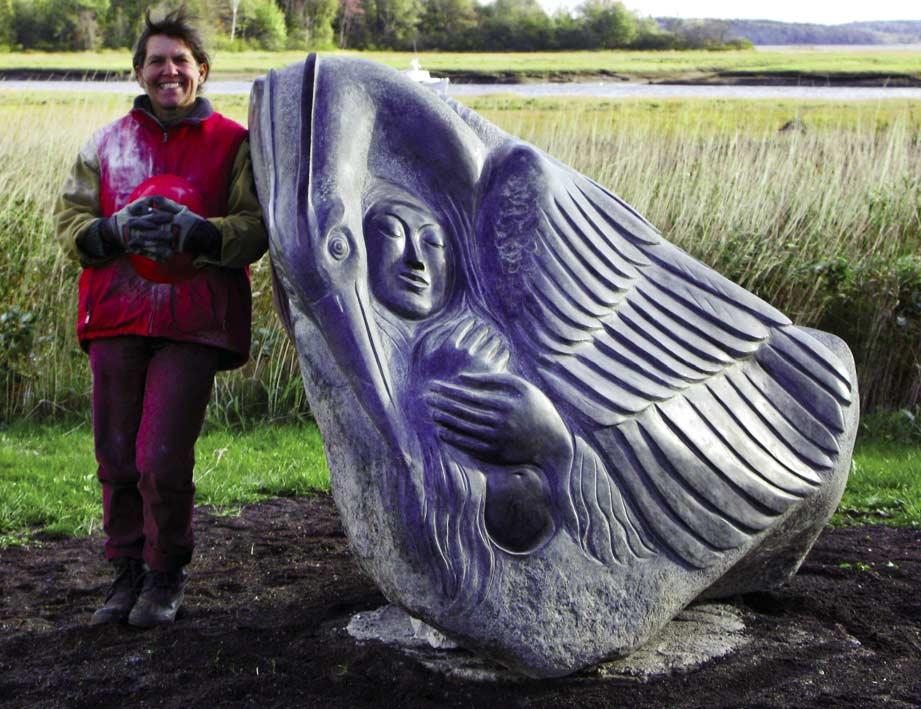
58 Lise Bécu’s Benevolent Hand by Carl Little Tenants Harbor-based sculptor Lise Bécu brings life to stone
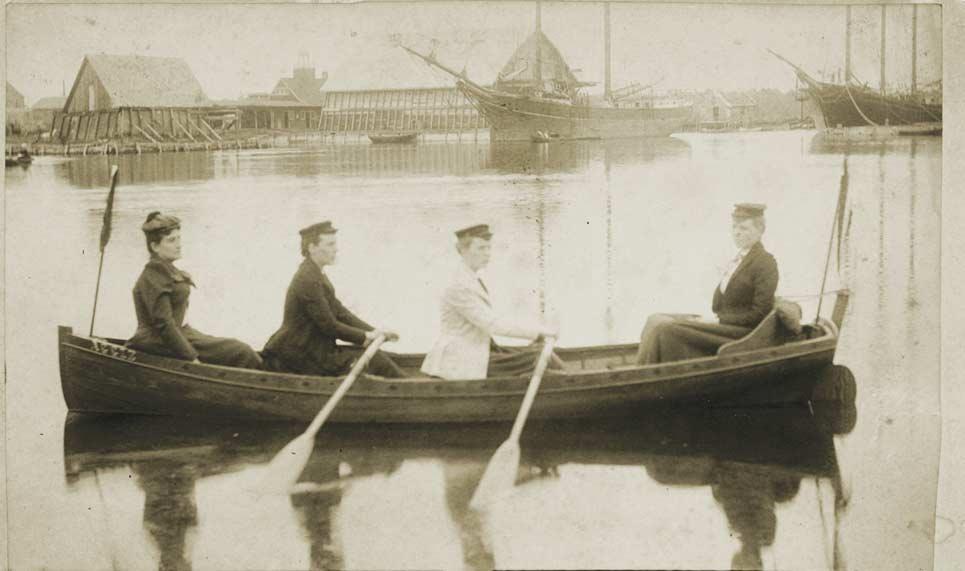
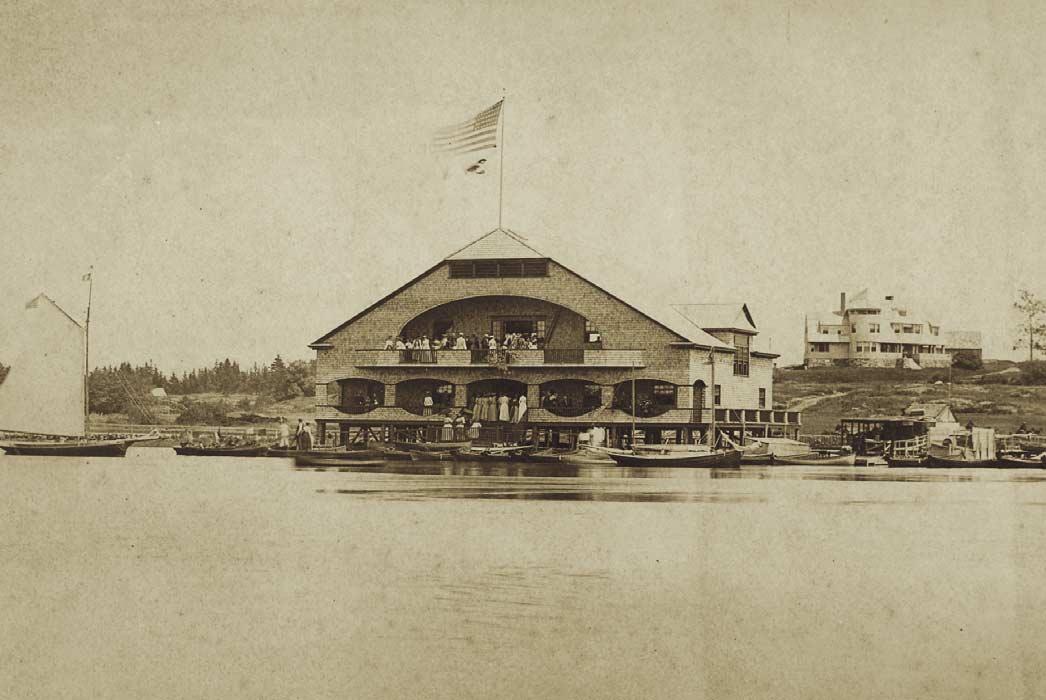
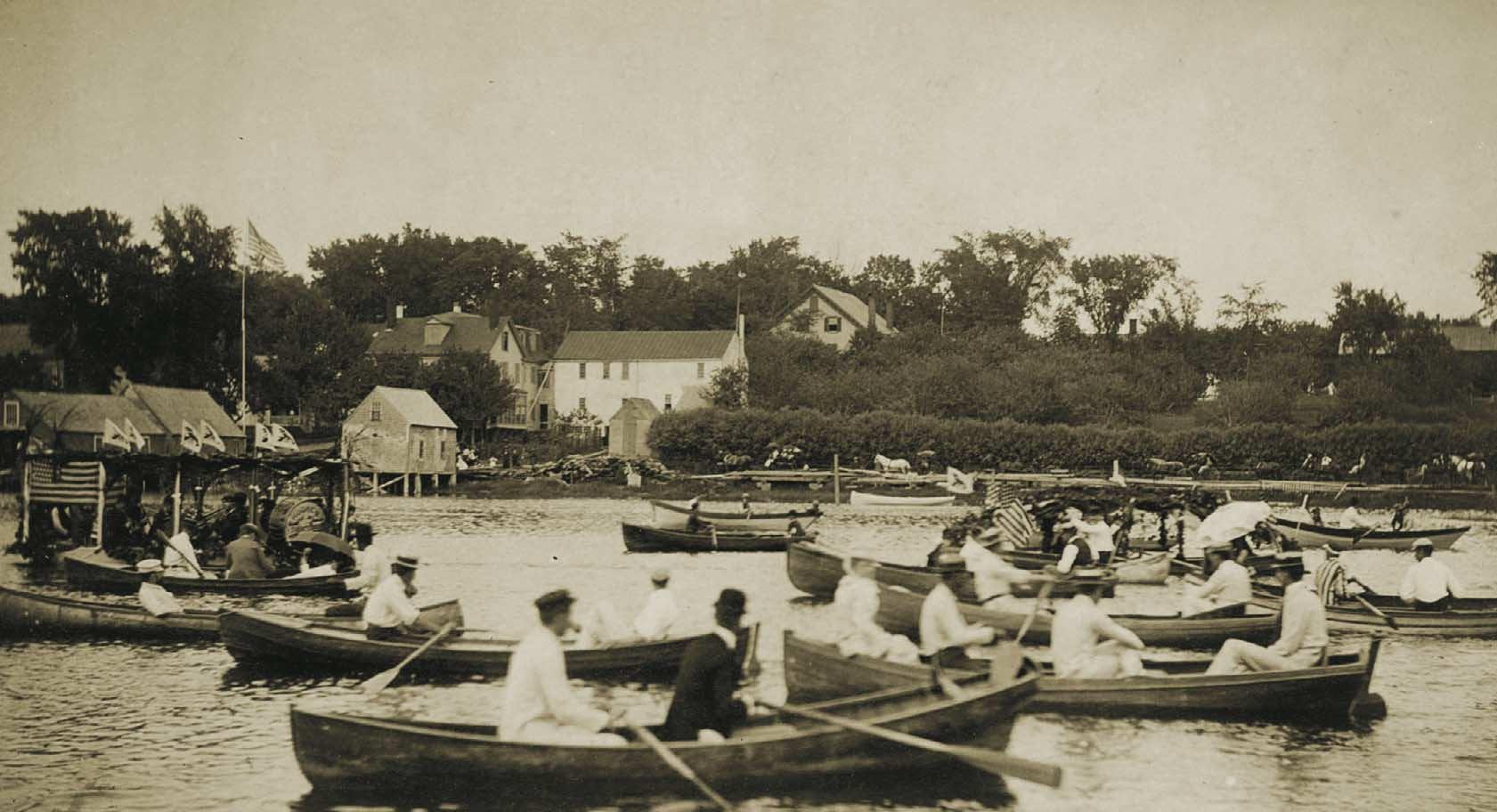
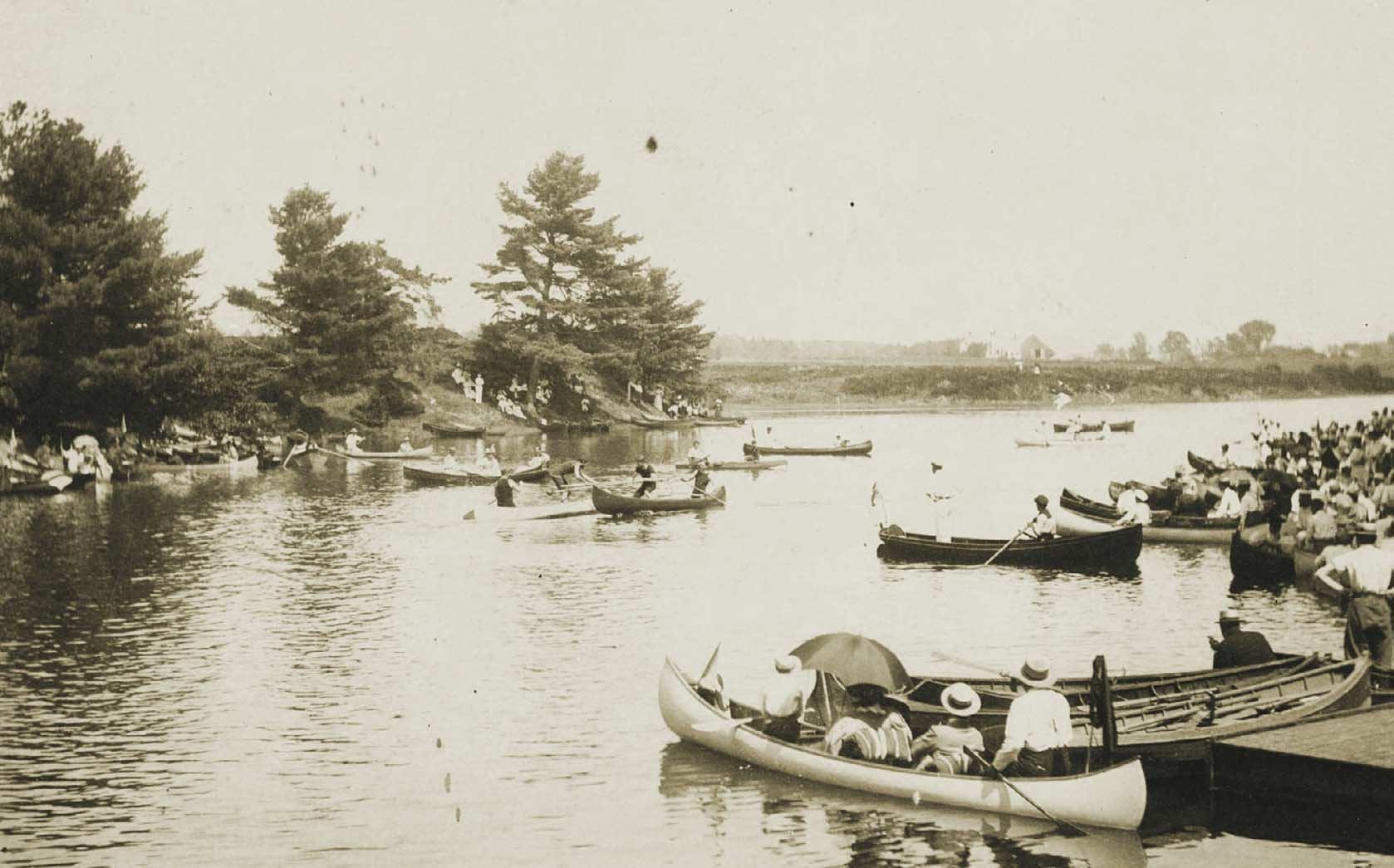
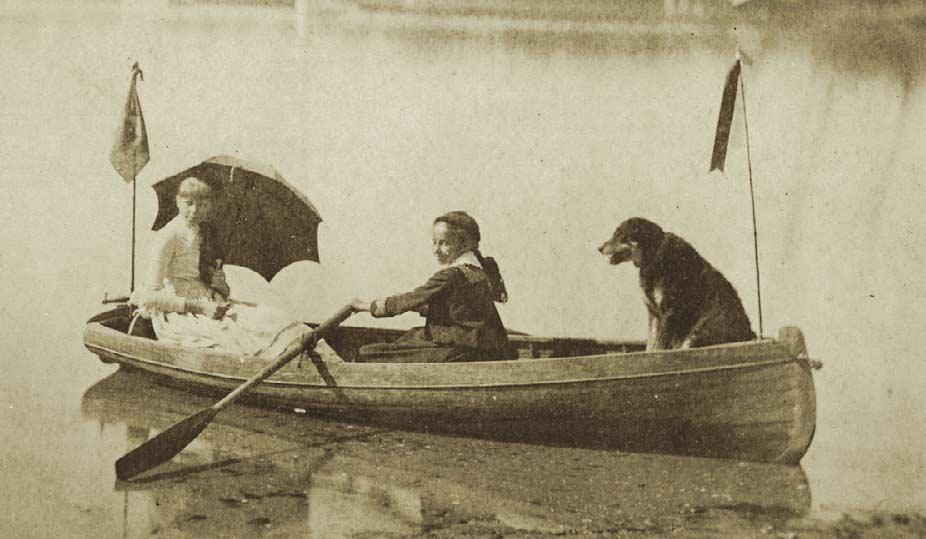
62 When Canoes Ruled the Kennebunk by Earle G. Shettleworth Jr.
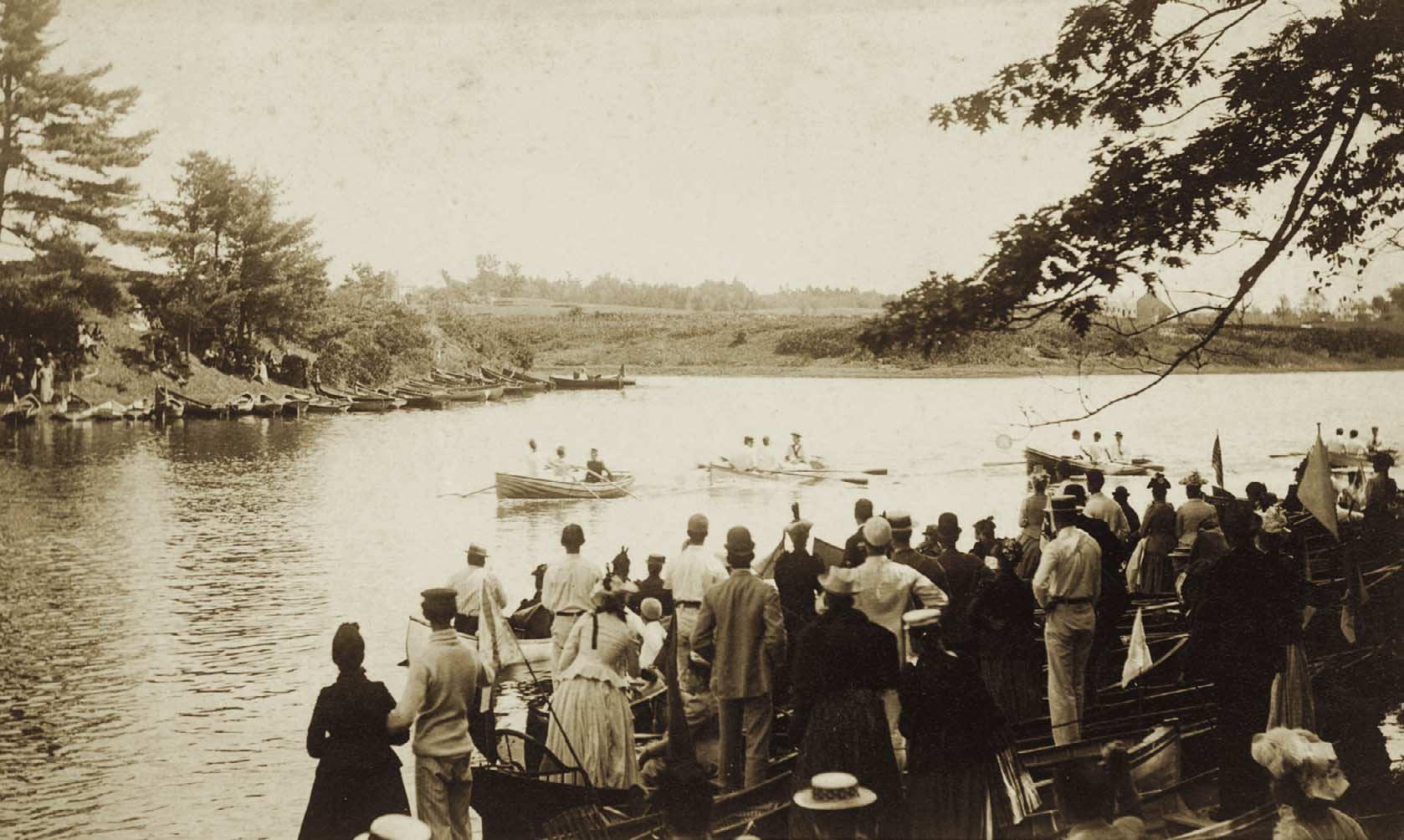
When it opened in the late 1800s, the Kennebunk River Club relied on canoe races to attract new members from the Cape Arundel summer colony
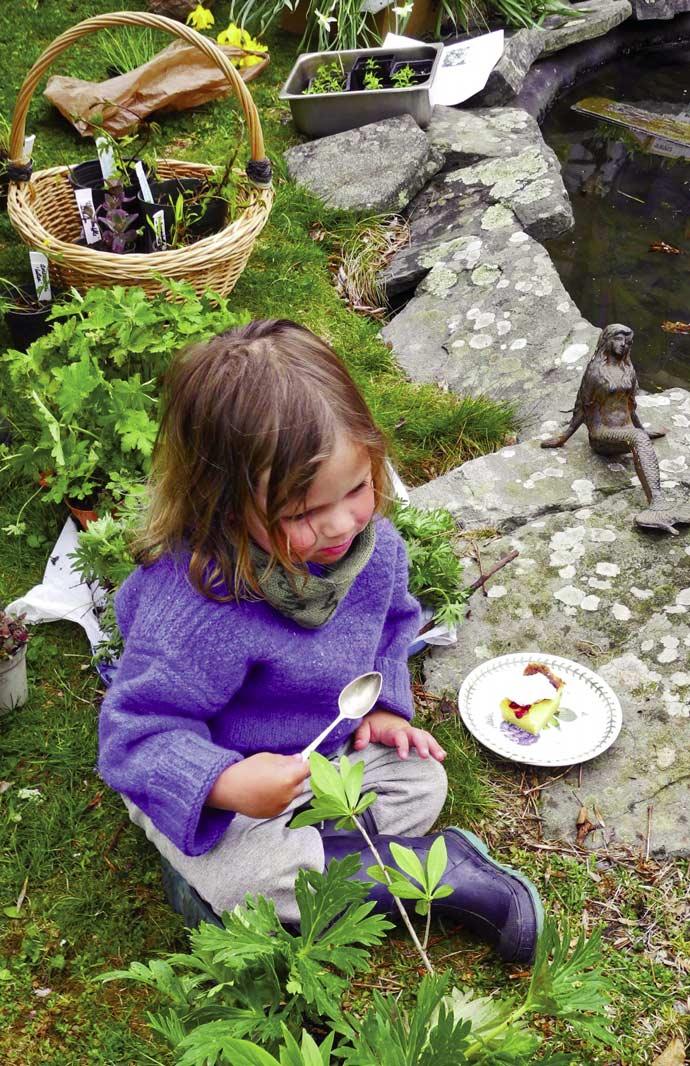
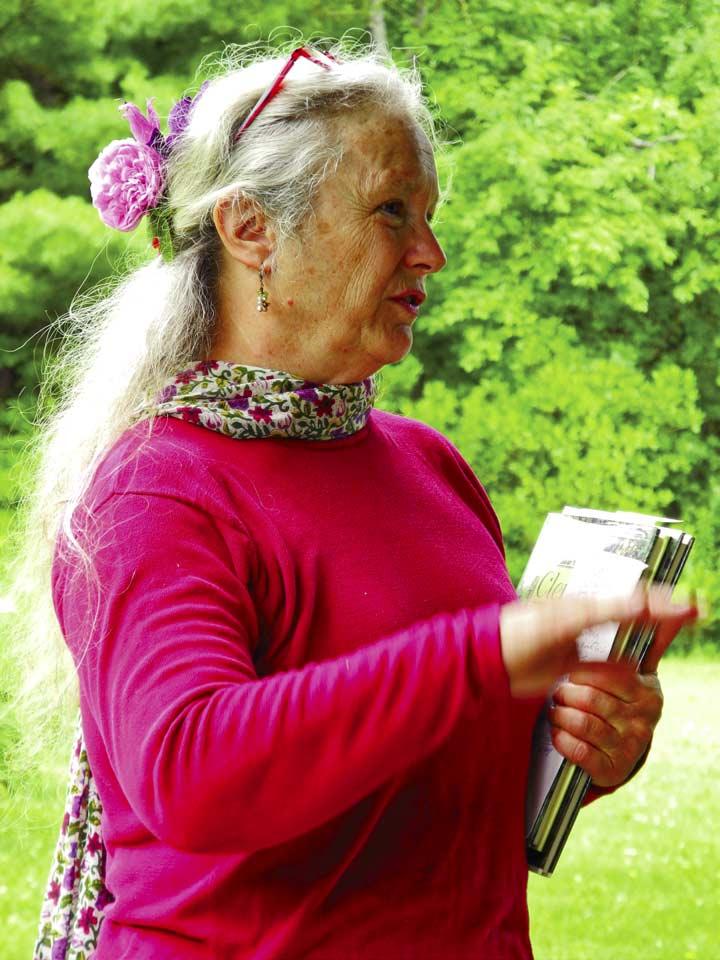
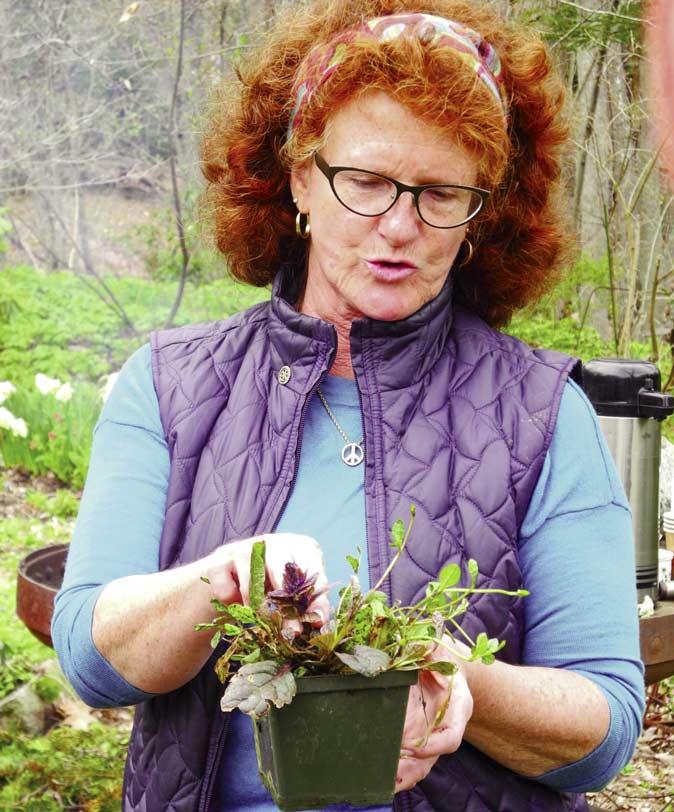
65 Sign of Spring: Camden’s Mother’s Day Perennial Swap by Lynette L. Walther
A Camden Mother’s Day perennial exchange has become an annual spring tradition
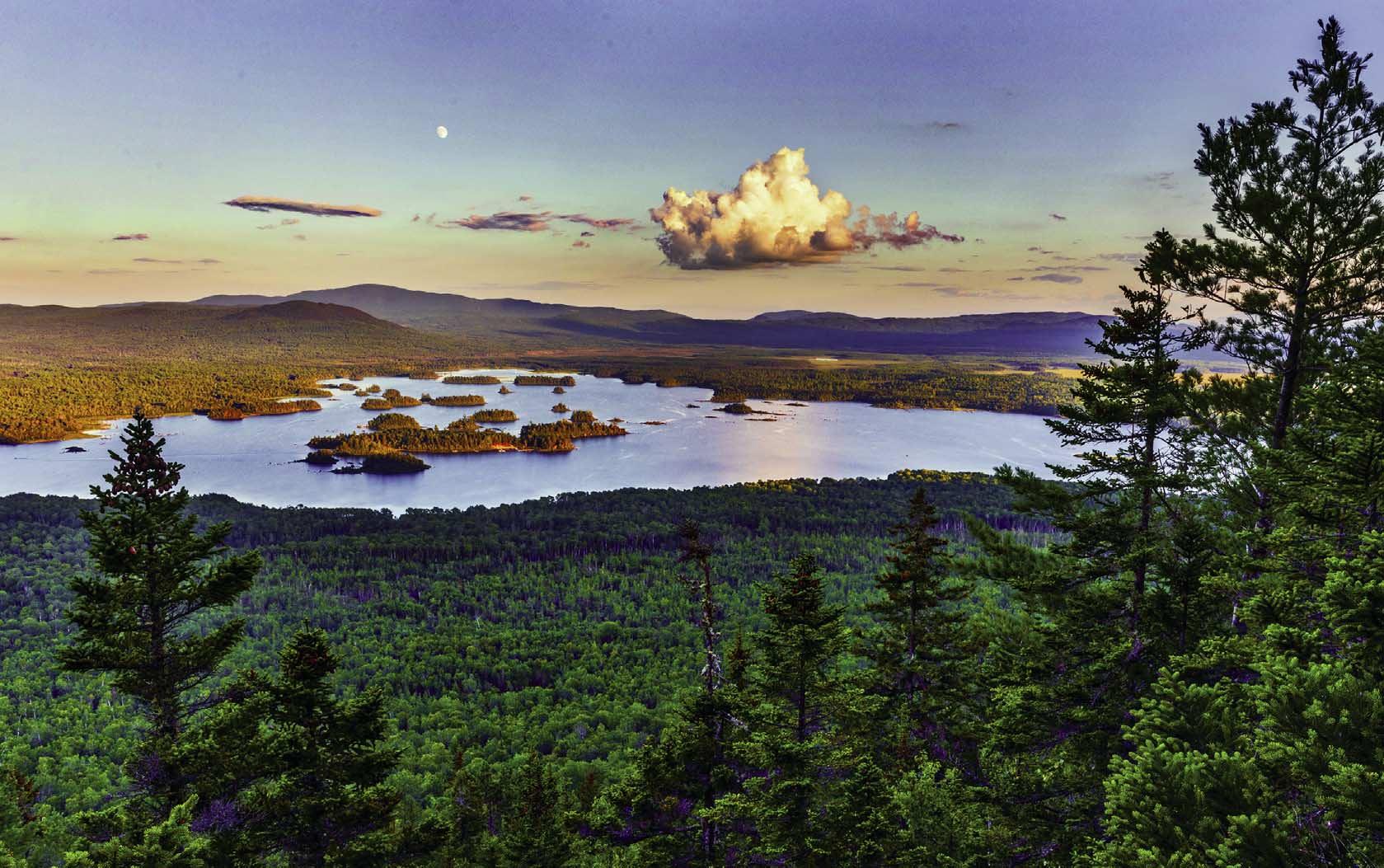
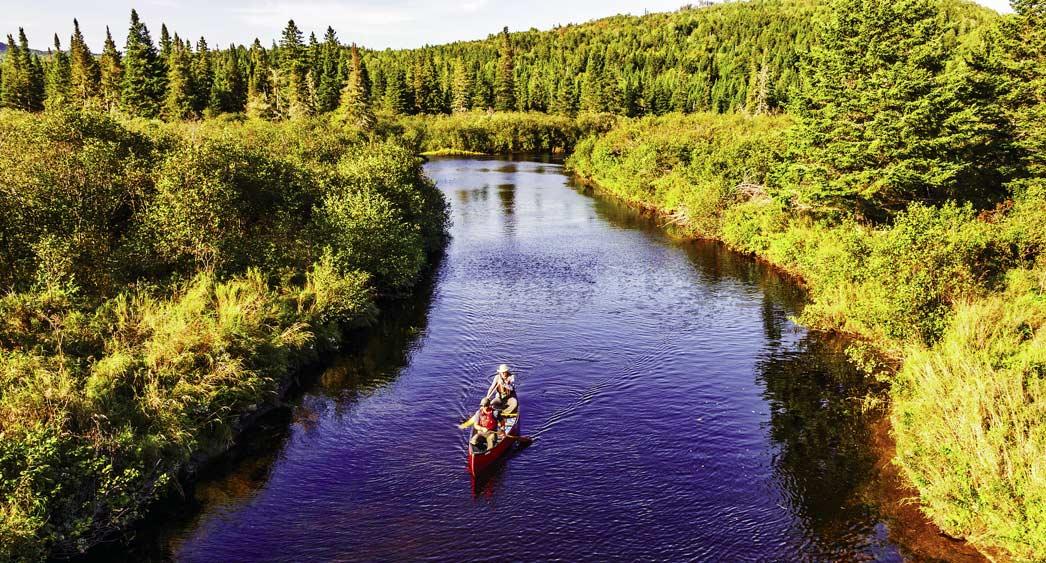
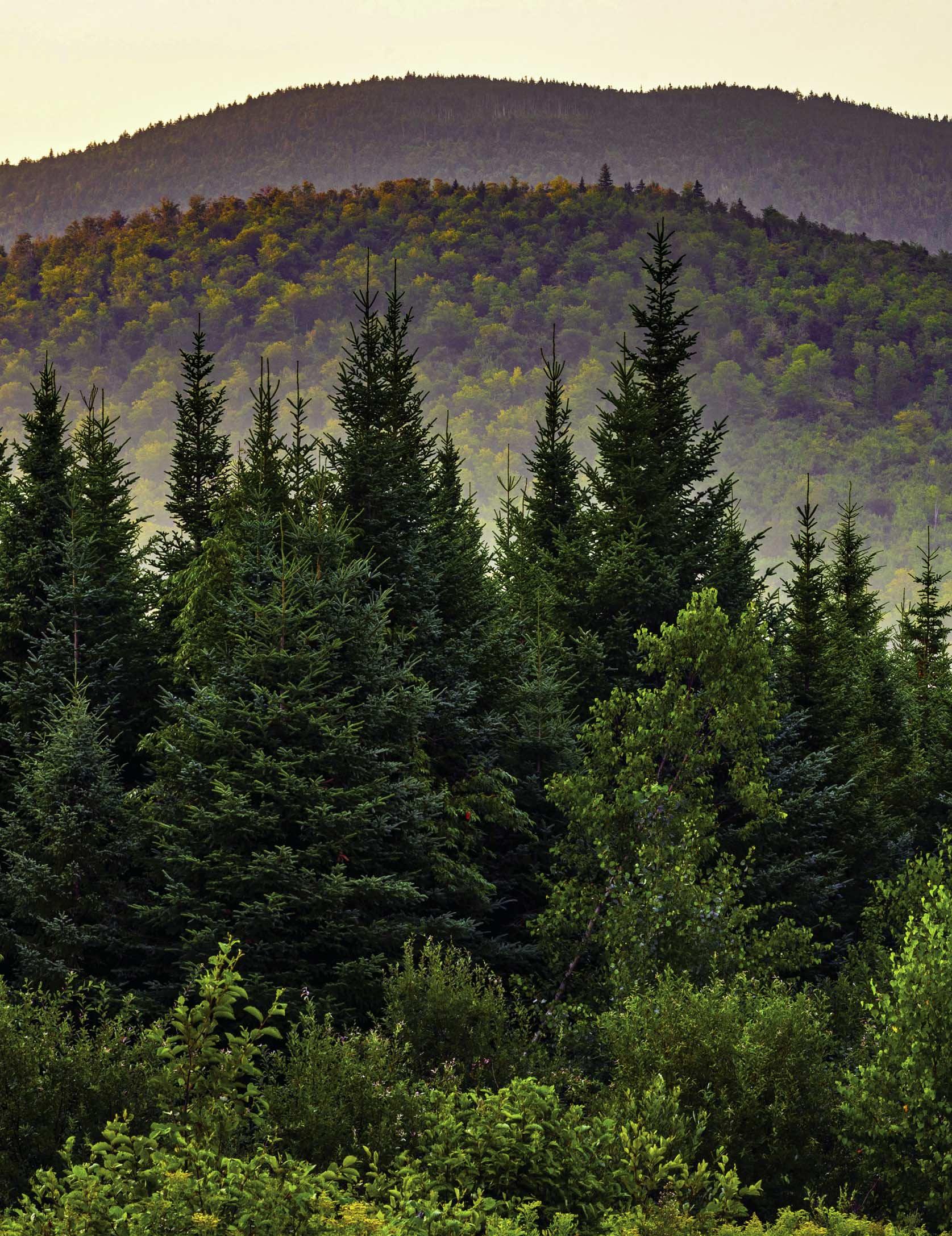
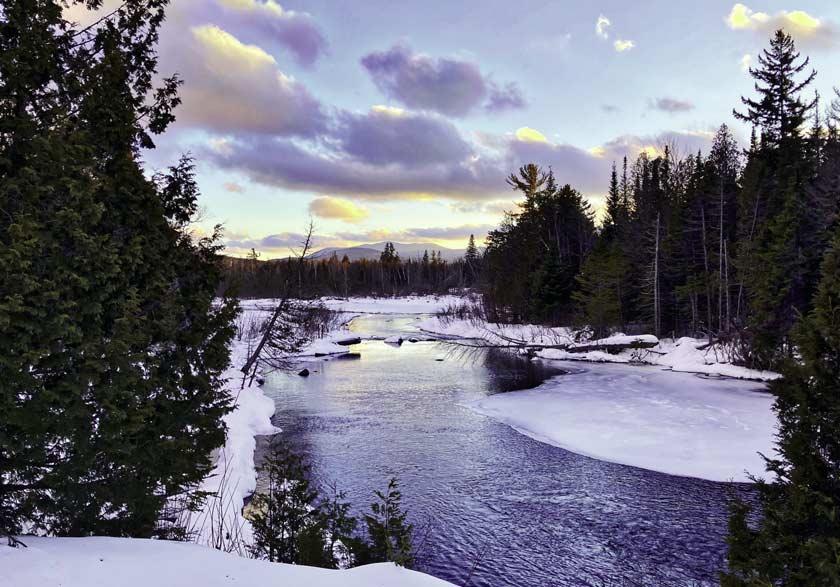
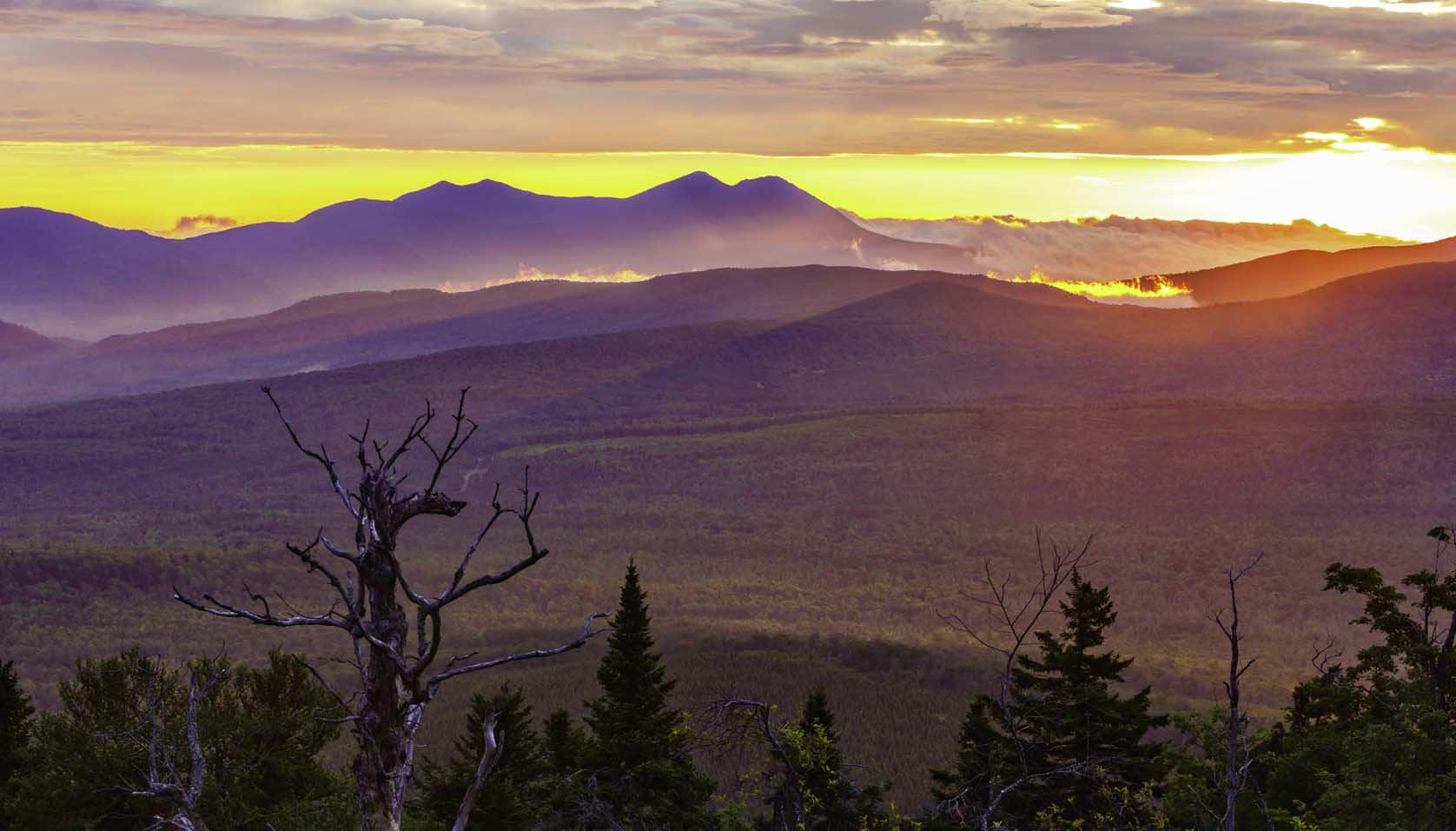
ABOVE: Over the course of a remarkable 25 year’s worth of conservation efforts, more than 4 million acres of land were added to Maine’s North Woods. Photo by Jerry Monkman. See story on page 34.
DEPARTMENTS
17 A Letter From Home by Lenny Ackerman
By chance, on a stop en route to a Canadian fishing trip, a New York angler discovers what will become his “magnificent” camp on a lake the in the North Woods
25 Waterfront Profile by Polly Saltonstall Classic canoes and wood boats find new life at the Kimball Pond Boat Barn in Vienna, Maine
29 Off the Drawing Board by Art Paine
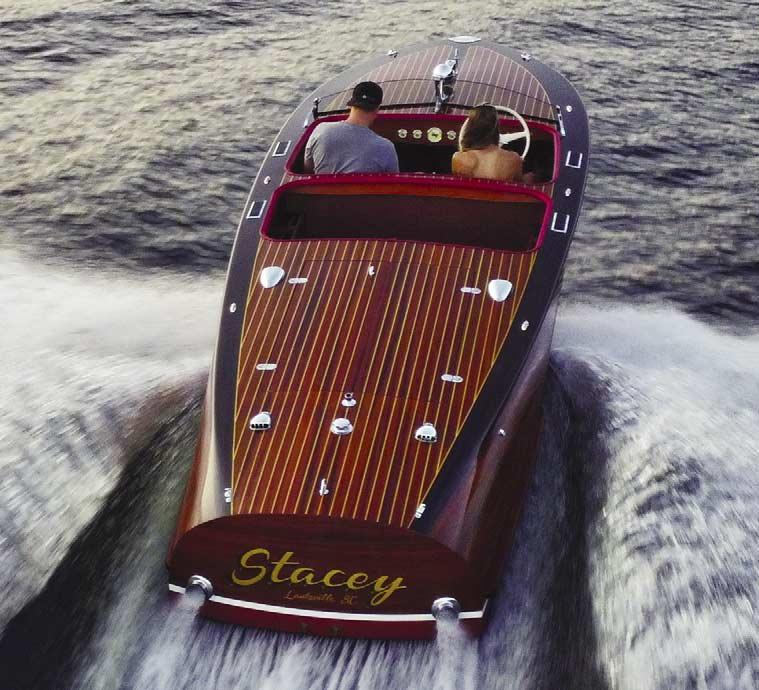
With a yearning for a classic mahogany runabout, an intrepid boat guy ponders an affordable and doable kit boat fit for Golden Pond
69 Small Adventures by Mimi Bigelow Steadman Flagstaff Lake is a northern Maine destination with a history as interesting as it is haunting
Facebook @ Maine Boats, Homes & Harbors
Twitter @maineboats | Youtube @ maineboats1
Instagram @maineboats
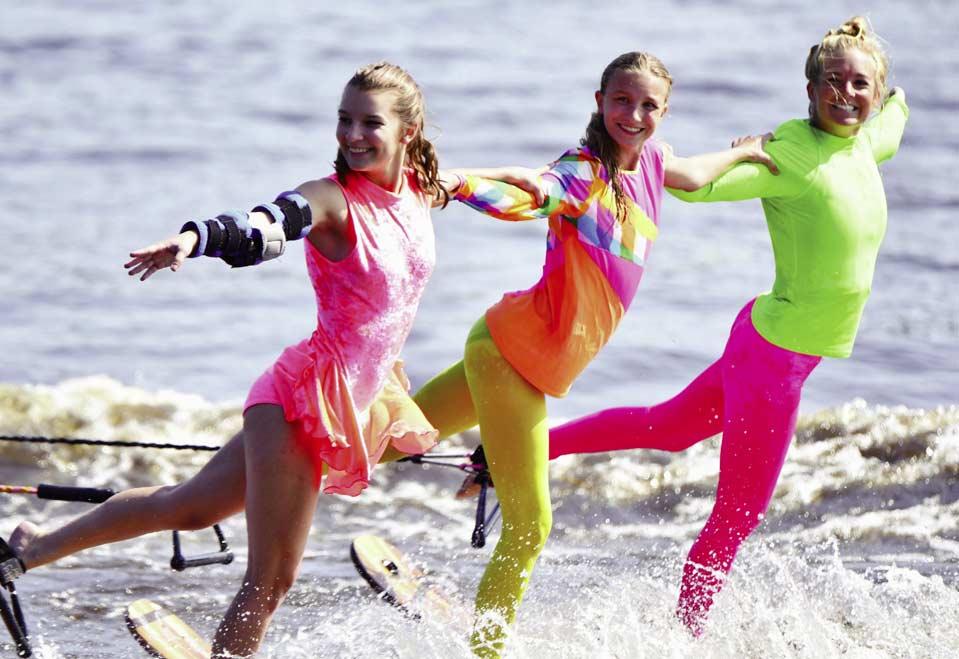
For nearly four decades the Maine Attraction Waterski Show Team has been dazzling summer audiences with its colorful costumes, acrobatic moves, and intricate scripted routines. Photo by Paul Auger. See story page 40.
Ourstoreisonly 45secondsaway www.Crossjewelers.com The Gull
Find Pure Magic
The gull is serene. The gull is smooth. Give him a coast, a cliff and a sea breeze and he can glide forever. If suddenly gulls became rare like one in a thousand and if there was a sighting of a gull the Audubon crowd would call one another, grab their binoculars and find places on the shore to catch a glimpse.
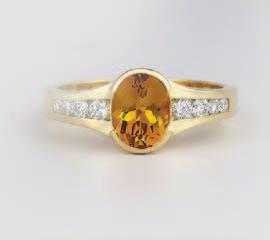
We have captured the pose. We have captured the serenity. We have the gull’s morning glide with outstretched wings studded with diamonds. And at the very center we place a gem: blue sapphire, green Maine tourmaline, citrine, pink sapphire and more. Each Gull ring is pure magic as it sails along the coast.
Check out our website. We have dozens of Gull rings that sit low, close, and comfortable. Twenty minutes online and you can find your favorites and choose one.
You’ve sat on your boat at dawn with a cup of coffee, rocking at anchor and listening to the gulls waking on the shore. A Gull ring would be a nice way to recognize your years together. Do you have someone who would really love a ring like this?
Atlantic Sunrise Citrine
Blue Sapphire
SparHawk Maine Tourmaline G3587.....$4,650
MAINE BOATS, HOMES & HARBORS
Publisher: Ted Ruegg
Editor: Mark Pillsbury
Editor at Large: Polly Saltonstall
Managing Editor: Jennifer W. McIntosh
Copy Editor: Gretchen Piston Ogden
Contributing Editors
Ben Ellison, Ben Emory, Ted Hugger, Nancy Harmon Jenkins, Ron Joseph, Carl Little, Bill Mayher, Eva Murray, Sandra Oliver, Art Paine, Greg Rössel, Laurie Schreiber, Peter H. Spectre, Mimi Bigelow Steadman, Ken Textor, Lynette L. Walther, Karen O. Zimmermann
Contributing Photographers
Billy Black, Tyler Fields, Alison Langley, Benjamin Mendlowitz, Art Paine, Sarah Szwajkos
Contributing Illustrators
Candice Hutchison, Ted Walsh
Design: Kat Woodworth
Production: Tim Seymour Designs, LLC
Advertising Ted Ruegg • 800-565-4951
Classifieds: Amy Gordon • 203-912-3421
Advertising Coordinator: Julie Corcoran
Office Manager & Special Projects: Sean Graves
Boats of the Year Editor: Laurie Schreiber
MAINE BOAT & HOME SHOW
Show Manager: Kate Holden • 207-632-7369 showmanager@maineboats.com
Subscription rate: $29.95 for six issues in the U.S. and its possessions. Standard postage paid at Burlington, VT.
Address editorial communications to editor@maineboats.com or Editor, Maine Boats, Homes & Harbors, P.O. Box 466, Rockland, ME 04841. Guidelines available at maineboats.com.
BY MARK PILLSBURY
Talking ’Toons
HAVING SPENT summers growing up on a modest-sized lake, I have a vague recollection of the first pontoon boat that came puttputting into the cove in front of our camp. It looked sort of like the wooden swim raft the old man built and kept afloat with four 55-gallon drums, arranged two to a side. Spring and fall he’d tow it to deep water and back behind the family row boat. I think the pontoon boat, with its small gas outboard, was probably about as seaworthy and moved about as fast.
Thinking back though, I’d imagine the people aboard were quite pleased about being nautical pioneers. it was the start of the ’60s, after all, and pontoon boats were just then making their way east from the Midwestern lakes where they were born. These early adopters were probably enjoying what at the time was the ultimate sundowner vessel, back in the days when highballs were all the rage.
I mention this because after an adult life spent on the ocean where pontoon boats are a rarity, I was in for quite an awakening when I visited boat shows in Boston and Portland this winter. At the former, vast rows of pontoon boats filled the aisles, while in Portland, a much more intimate collection dominated the Portland Sports Complex. Being of the sailing persuasion, I guess I’d just not paid attention to what has become the vessel of choice for inland waters.
Nationwide, more than 50,000 pontoon boats are sold annually. And here in Maine, more than 13,000 were registered in 2023, the most recent stats available.
With Maine’s freshwater lakes, ponds, and rivers top of mind, I was determined to get myself a ’toon tutorial and see what these increasingly lavish party platforms are all about.
My first question? What do you need to know to buy a pontoon boat?
In Portland, at the Moose Landing Marina stand, salesman Russell Charleston said the first things he asks customers are the acreage of their lake or pond, the typical wind conditions, and the number of other boats that will be kicking up a wake. Charleston is owner of Pinkham’s Cove Marine in Belgrade and gets his Starcraft inventory through Moose Landing, in Naples.
A simple two-pontoon boat with a modest-size engine might work just fine on a small lake where you can’t go that fast or where big wakes or wind-driven chop won’t be a factor, he said. And it might be all an older couple needs to enjoy a quiet ride around the shoreline.
Two-pontoon boats have their drawbacks though. They are limited in the size of the engine they can carry and they can have the tendency to nosedive if too many passengers want to sit up front. In the 1980s, builders began to add a third, center tube, which greatly enhances a boat’s stability and performance.
Charleston says larger tri-toon Starcrafts can handle up to a 400-hp engine, which is powerful enough for waterskiing and tubing, and can plow through big waves should a summer squall rile open waters. And the center hull has strakes the length of it so the boat jumps up on plane.
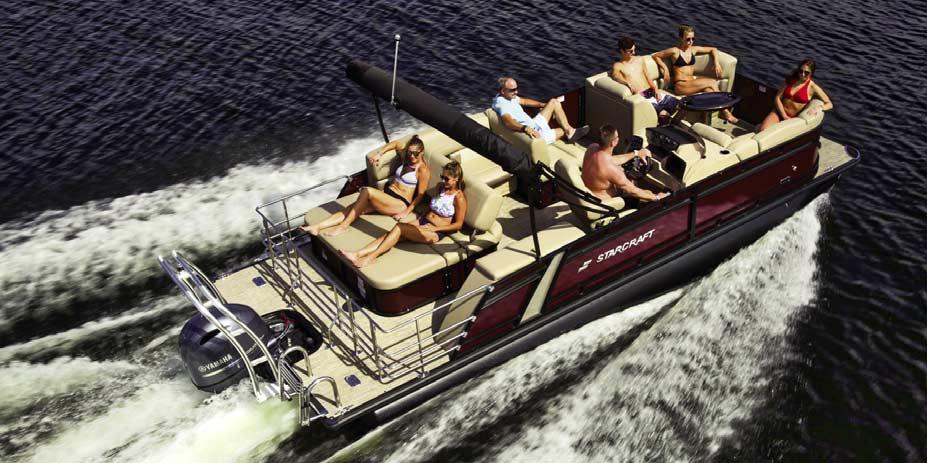
The Moose Landing display, like several others, featured multiple models ranging from, say, a basic 16-footer, with a price tag of just over $20,000, to one of the more popular sellers that comes in a number of configurations, including one that sports an overhead arch and aft lounge that folds up to become a bar with four stools. It has lighted drink holders from bow to stern, of course, and is powered by a 300-hp Yamaha. It can be yours for right around $130,000.
Kurt Westcott, a salesman for the Goodhue Boat Company on Sebago Lake, offered more good advice. He tells customers to walk the show and find a layout they like—pedestal seats, wraparound couches, fishing gear, and lounges are all options—and then find a dealer to work with. Most builders carry a range of models, from entry-level to premium—and will have multiple layouts available, Westcott said.
His company carries Premier boats, with options such as composite or aluminum side panels, instrument packages, high-end sound systems, and the like. Goodhue can also offer multiple outboard engines, if speed is a concern. Westcott said he has whipped along Sebago at 72 miles an hour on a pontoon boat, a personal best.
Seventy-two mph on a pontoon boat? Yikes! What’s next, a boat that can fly? Actually, an old friend, Parker Stair, chief sales and marketing officer at Montara Boats and Helios Marine Group, might have the answer. Montara has developed a range of models with a pontoon-boat deck but a wake-boat hull. He said they are going after the customer who has a pontoon boat for mom and pop, a jon boat for fishing, and a wake boat for the kids and grandkids all on their dock.
The hybrid—call it a monotoon?— can replace the three boats with one. And so, the quest for fun on the water goes on.
Climb aboard a pontoon boat and it’s all about chillin’ on the water. Or if speed’s your thing, that works too.
Photo courtesy Moose Landing Marina
GROWING UP ON THE COAST of Maine offered a special kind of solitude. While not without its challenges, I knew from early on I was lucky. I remember thinking about people who grew up in places not on the ocean and wondering what life was like for them; what did they do all summer—and where did they swim? As an adult one of my greatest joys is boat ownership and its rhythm that follows the seasons: the sanding and painting, the launching, the summer cruising, the paddling and rowing, the hauling, the hibernation, and the dreaming about the next cycle. Center Harbor in Brooklin is my home anchorage, where Runaway, my 34-foot Webbers Cove lobsterboat spends the summer on a mooring passed down to me from my father. It’s my portal to a season spent living aboard, cruising in Penobscot Bay, and embracing the place that is my home. This summer, I look forward to connecting with the many communities in Maine in my new role as Show Manager for the Maine Boat & Home Show. Maybe I’ll even visit some of them on Runaway.
Visit maineboats.com/the-maine-i-love for more images by Kate Holden.
We welcome photo submissions of the Maine you love at editor@maineboats.com.
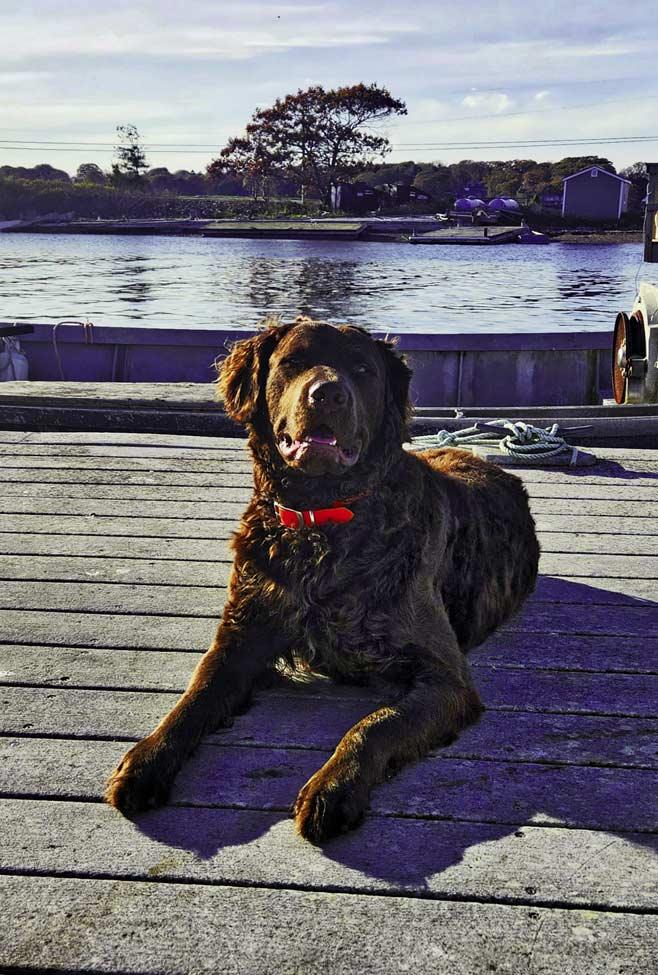
HIS LINEAGE may be rooted in the Mid-Atlantic, but make no mistake, Griffin is a Mainer through and through. The Chesapeake Bay retriever, who turned 3 in April, was born in Sedgwick, where his people, Abby Alexander and Carl Anderson, retrieved him from a breeder. As a pup, Griffin tagged along to hunt lobsters aboard Carl’s boat, the Danica Hailey , which fishes from Cooks Lobsters on Bailey Island. These days, he’s a little too big and sometimes in the way on the workboat, but he still loves hanging at the wharf, watching the guys load bait trays and work on their gear. He’s always up for a skiff ride and loves to swim. “We love to have Griffin at the wharf with us because of his goofy personality and his way of making everybody laugh,” Abby said. At home on Orr’s Island, he’s a good pal to Abby and Carl’s lab, Bailey, and Abby noted that Griffin’s smart enough to know not to mess with her horse when they go to the barn. He’s also a scholar, and currently enrolled in nose works class, where he’s learning to identify scents for tracking. Hopefully, he’ll one day lead his people to antler sheds, since when fishing season ends, they head north to Portage, Maine, to play in the snow and woods. Snow’s his favorite thing besides the ocean, Abby noted, adding, “You’ll never have a bad day if you have Griffin around!” N
Send a photo of your water-friendly dog &
Photo courtesy Abby Alexander and Carl Anderson
Funds, Marinas, Lobsters, & Vikings
Funding disputes
Maine has been caught in the crosshairs of federal cost-cutting efforts. Attendees at the Maine Fishermen’s Forum in March, for example, were shocked to learn that the Trump administration had cancelled $4.5 million in funding for Maine Sea Grant. Founded in 1971, the federal-state partnership program overseen by the University of Maine is funded by NOAA, and local entities, including UMaine and the state government. Maine Sea Grant runs business development, research, and marine science education and outreach, and estimates that its work results in $23.5 million in annual economic impact for Maine’s fisheries.
Republican U.S. Senator Susan Collins later announced that the Trump administration had agreed to let the program re-apply for the funds. But it was unclear when the money would be restored.
Sen. Angus King, I-Maine, and Rep. Chellie Pingree, D-1st District, issued a statement contending that the Trump administration decided to defund Maine Sea Grant as retaliation, noting that there did not appear to be any similar cuts at other Sea Grant programs. While they said they were pleased the administration had reconsidered, they argued Maine Sea Grant should not have to reapply for “funding that was improperly taken away from them in the first place.”
Federal cuts for community improvement projects, meanwhile, forced the town of Friendship to put on hold plans to rebuild the town wharf, which was damaged by storms more than a year ago. The town had sought $950,000 to replace the municipal wharf and repair the abutment. The news of the federal cuts came just days after voters approved local financing that would have been the town’s share of the project.
In other related federal funding news, an article by the Associated Press noted that money for lower-carbon emission systems on the waterfront has been frozen or become unavailable due to budget cuts. The changes are designed
to replace old diesel-burning engines and outdated at-sea cooling systems and are touted by environmentalists as a way to reduce seafood’s carbon footprint. Salmon harvesters in Washington state, scallop distributors in Maine, and halibut fishermen in Alaska were among those who told The AP their federal commitments for projects like new boat engines and refrigeration systems have been rescinded or are under review.
New Maine Boat & Home Show Manager Kate Holden
Marine industry marketing and communications veteran Kate Holden has been named Show Manager for the 2025 Maine Boat & Home Show, which returns to Rockland on August 8 to 10.
Holden brings more than 25 years of experience working for a range of companies, including a 13-year stint on the executive management team for IBEX, an international trade event, where she oversaw the company’s overall brand development, marketing, analytics, and reporting.
The boat show, a production of Maine Boats, Homes & Harbors magazine, celebrates life on the coast.
“We’re excited that Kate’s joining our team,” said Ted Ruegg, owner and publisher of MBH&H. “She brings the skills and energy needed to put on a topnotch event, and her deep connections to Maine’s waterfront industries will be
vital in helping us attract a diverse range of exhibitors to the state’s only in-water boat show and expo of coastal lifestyle companies.”
Holden grew up in Brooklin, Maine. She earned degrees from the University of Maine and the University of Southern Maine, and began her professional career at WoodenBoat Publications, where she worked in circulation, advertising sales, marketing, and show management. A Portland resident, Holden serves on the American Boat and Yacht Council’s Board of Directors.
Held annually on the Rockland waterfront, the Maine Boat & Home Show showcases new and used boats, marine gear, fine arts, jewelry, furniture, crafts, food, and family fun.
For attendee and exhibitor information, contact Holden at 207-632-7369, via showmanager@maineboats.com or visit maineboats.com/boatshow.
Storm recovery grants
Maine recently awarded $2 million in grants to 40 Maine businesses and nonprofits to support their recovery from the devastating storms of winter, 2024.
The grants were the second and final round of the Business Recovery and Resilience Fund, established as part of the $60 million storm relief package approved by the Legislature last year. The state previously awarded approximately $8 million to 109 businesses and nonprofits. That’s in addition to $21.2 million in grants to help rebuild 68 working waterfronts and $25.2 million in grants to help 39 communities build more resilient infrastructure.
“The storms of last winter remain a stark reminder of the vulnerability of our people, businesses, and communities have to serious flooding, storm surge, heavy winds, and lashing rains,” said Governor Janet Mills, in a news release. “Recovering from the damage takes time, and I’m grateful to the Legislature for their support of the historic $60 million storm relief package enacted last year, which is continuing to help Maine
Kate Holden
Photo courtesy Sunset Ridge Photography
On Tides and Tidal Currents
There is a Tide —by William Shakespeare
“There is a tide in the affairs of men,
“Which, taken at the flood, leads on to fortune;
“Omitted, all the voyage of their life
“Is bound in shallows and in miseries.
“On such a full sea are we now afloat;
“And we must take the current when it serves, “Or lose our ventures.”
The motion of the sea
Vertical—the rise and fall of the tide
Horizontal—the ebb and flow of the tidal current
Describing the tide
A coming tide is in flood.
A going tide is in ebb.
The top of the tide is its maximum high.
The bottom of the tide is its maximum low.
Stand of the tide is the period when there is no vertical motion of the tide; i.e., the tide is at the top of high water or the bottom of low water.
(Note: Slack water, often used in reference to the tide, actually applies to tidal current. It is the period when there is no horizontal motion of the water; i.e., the tidal current is running neither in nor out.)
Tidal extremes
Neap tides—those that rise and fall least from the mean level Spring tides—those that rise and fall most from the mean level; aka full-drain, high coast, and moon tides
In most parts of the world, these tides occur twice in the lunar month.
The highest tides in the world
Sea of Okhotsk
Northern coast of Australia
English Channel
Ungava Bay, Quebec, Canada
Bay of Fundy, New Brunswick and Nova Scotia, Canada
The highest tides of all are near the town of Wolfville, Nova Scotia, in the Minas Basin off the Bay of Fundy, where the tidal range runs as much as 45 feet.
Factors affecting the height of tide computed from tables
—The heights of tide given in the tide tables are predictions, not guarantees.
Heights lower than predicted are likely to occur when the atmospheric pressure is higher than expected, and vice versa.
—Strong winds can affect the rise and fall of the tides considerably, even if the wind is far offshore. Strong onshore winds (blowing from the sea toward the land) and a low barometer
reading tend to increase the height of high water. Strong offshore winds (blowing from the land toward the sea) and a high barometer reading tend to decrease the height of high water.
—During a major storm, the height of the tide can be off by several feet (plus or minus, depending on the direction of the wind), and the time of the tide can be off by as much as an hour.
—In places where there is a large inequality between the two high or two low tides during a tidal day, the predictions of height of tide are less reliable than elsewhere.
Wind and tide
Lee tide—The wind blows and the tide runs in the same direction.
Weather tide—The wind blows and the tide runs in opposite directions.
In summer in the Northeast United States, the wind and tide do this in sounds, bays, and estuaries, generally speaking: The wind usually comes in with the flood.
If the wind and tide come in during the morning, the wind will stay all day.
If the wind and tide come in during the afternoon, the wind will not last long.
If the wind comes in strong against an outgoing tide, expect a long blow.
“There is no end to the mystery of the tides.
—Hilaire Belloc
“A caution, always work the tides.”
—Frank Cowper
Old tidal superstitions
Boys are born on the flood, girls on the ebb.
Sick people who last to the turn of the tide will survive at least to the next one.
Life ends with the ebb.
“He went out with the tide and the sunset,” was a phrase I heard from a surgeon describing an old sailor’s death under peculiarly gentle conditions.
—Walt Whitman
“I saw from the beach, when the morning was shining, “A bark o’er the waters move gloriously on,
“I came when the sun o’er the beach was declining, “The bark was still there, but the waters were gone.”
—T. Sturge Moore N
Contributing Editor Peter H. Spectre lives in Spruce Head, Maine.
businesses rebuild and be ready for the weather challenges of the future.”
Meet the newest Hinckley
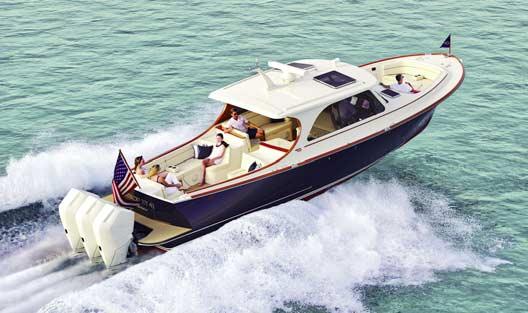
The folks at Hinckley have introduced the new Hinckley 41. Propelled by triple Mercury Verado V10 outboards, it can reach speeds of nearly 60 mph. From its forward seating to its spacious swim platform and innovative storage solutions, the new model is designed to enhance life on the water.
Electric lobstering
Construction will start soon on what will become the first Canadian-built lobster fishing boat to be powered entirely by electricity, according to a report by the Canadian news site Electric Autonomy and a lengthy article in National Fisherman.
The Membertou First Nation in Cape Breton, Nova Scotia, along with three Canadian partners, has been developing the zero-emission vessel since 2023.
“An electric lobster vessel is the natural next step in our drive toward becoming leaders in the production and use of renewable electricity,” according to Terry Paul, chief and CEO of Membertou.
The new vessel will be named Lektrike’l Walipotl, which means “electric boat” in Mi’kmaw.
Membertou partnered with Allswater, ship designers in Bedford, Nova Scotia; Halifax-based vessel-to-grid company, BlueGrid Energy; and the non-profit Oceans North Conservation Society in Ottawa to develop the vessel, according to reports. The goal is to electrify the province’s entire fishing fleet, according to a report from Oceans North.
The boat will have bi-directional charging capabilities developed by BlueGrid, which means that when it isn’t in use, power stored in the batteries can be fed into the grid.
Lektrike’l Walipotl is expected to begin testing and prepare for deployment this year.
Lobster profits up, landings down Maine’s commercial harvesters earned $74 million more in 2024 than in 2023, with landings valued at $709.5 million, according to preliminary data released by the Maine Department of Marine Resources. The increase was largely driven by a $46 million jump in prices paid to lobstermen at the dock, for a total take of $528.4 million on the strength of a $6.14 per pound price. But in a troubling sign for the future, the actual lobster catch declined by more than 10 million
pounds to 86 million, hitting a 15-year low. Lobster catches peaked in 2016 at 132.6 million, according to DMR. The number of licensed fishermen and traps set also decreased in 2024, according to the preliminary data.
Maine’s softshell clam fishery was the state’s second most valuable in 2024 at $15.5 million, with harvesters earning $58,971 more than in 2023.
> Town Dock continued on page 72
Hinckley 41
Photo courtesy Hinckley Yachts
A Grand Camp
BY LENNY ACKERMAN
THE CESSNA SEAPLANE circled the western shoreline of East Grand Lake, at the edge of the Maine border with Canada. My buddy, Ted Stratigos, had given the pilot the latitude and longitude of his family fishing camp, located on one of the rocky coves. From my cramped position in the back of the small cabin, I squinted out the window for any visual clues we might be getting close. I had never been there, so I wasn’t exactly sure what to look for, and I was distracted by the surrounding lake scenery.
Ted, his significant other, Lori, and I had planned a trip to the Restigouche River in Canada to fish for salmon that weekend, intending for me to meet them at the camp and then drive the hour or so up to the lodge in New Brunswick, Canada, the following morning.
The pilot announced he had a landmark in sight: Greenwood Island, a small, uninhabited, fully forested mound in the middle of the lake surrounded by ancient glacial boulders. I could see Ted and Lori on a dock, waving a bright yellow blanket. It was summer, 2016, and that ride in the rear seat of a claustrophobic seaplane was for me the start of a different kind of fishing adventure.
Though I’d not seen the far north before, I had made trips to southern Maine for years with my wife, Judie, from our home in East Hampton, New York. Camden had become a regular destination for us starting in the late 1990s. We were enchanted by the quintessential, coastal New England town nestled between the Camden Hills and Penobscot Bay. Over the next five summers we stayed in various rentals in the area, always drawn back by the natural beauty, the hiking and boating, and the uncrowded, unhurried pace of life. It was an idyllic period, while it lasted. In 2004, Judie suffered a debilitating stroke, and though she fought back for a spell and our summer visits resumed, a second stroke further limited her mobility in 2012.
After that setback, urged by Judie and my daughters to go, during the next several years I fished throughout the United States, Alaska, Canada, the Amazon, Patagonia, New Zealand, Iceland,
eastern Europe, England, Ireland and Wales. No place was too far or exotic, which is how I found myself in that seaplane, meeting Ted and Lori.
The dock was slippery with a heavy coat of mildew and lake debris. As I greeted my friends, I glanced at the upward sloping property dense with weeds and overgrown bushes. The remains of an old log pile were scattered off to the side. Behind all the rough growth some 20 feet from the dock was a rather grand but decrepit log cabin with a green, mildewed roof topped by an old brick chimney. A few ragged remnants of wire mesh screen clung to the framing around the front porch, and in the grass before it, a metal signpost lay flat on the ground. As we walked up, I could see it was a corroded “For Sale” sign.
We were standing on the neighbor’s land. There were simply too many submersed boulders in front of Ted’s camp next door for the Cessna to land safely. The owner of the derelict property was
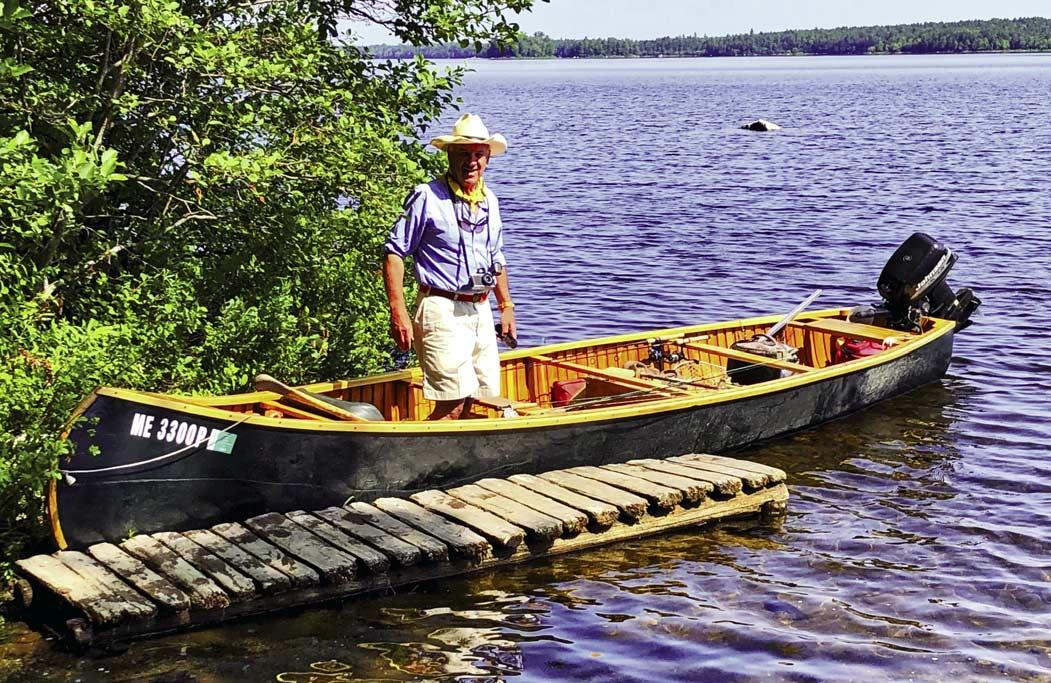
The author sets up his East Grand Canoe for an excursion on the lake.
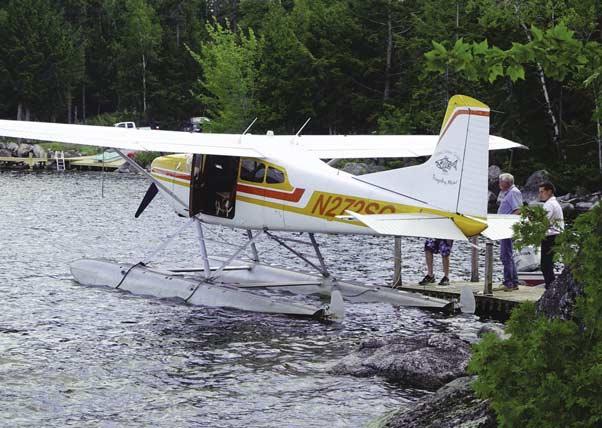
Seaplanes are one of the transportation options for visitors to northern waters like East Grand Lake.
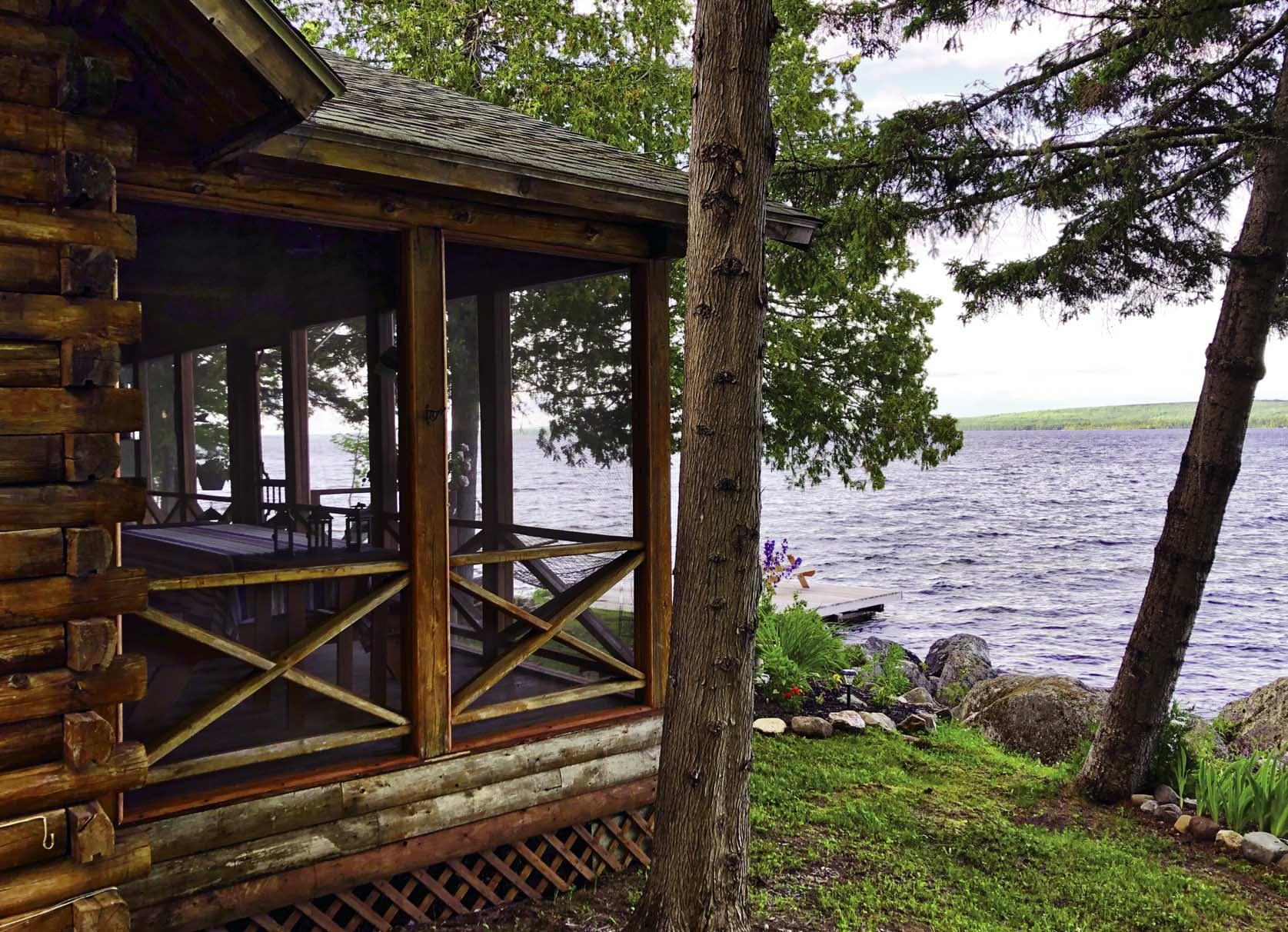
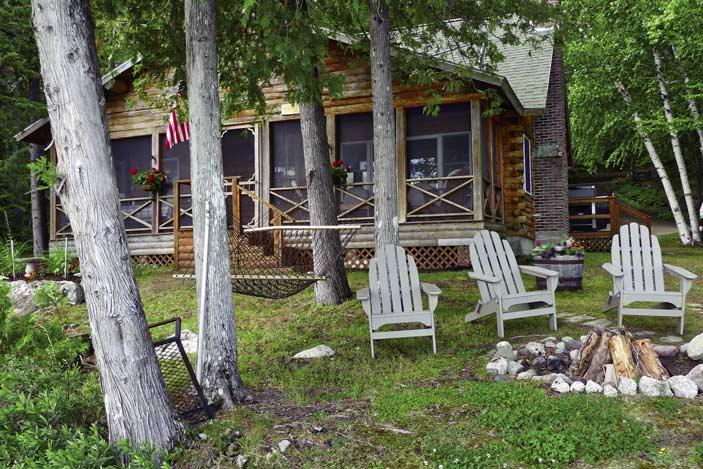
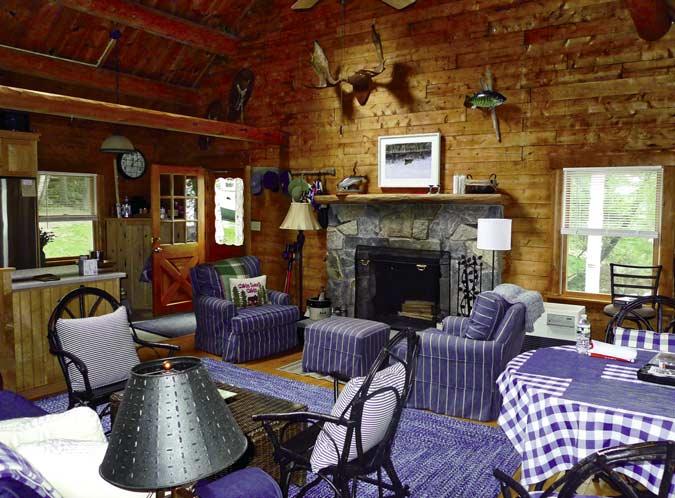
[ABOVE]: The screened porch at Camp Kabrook has a tremendous view of the lake. [MIDDLE]: A fire ring in the front yard is well-situated for lakeside evening entertainment. [BELOW]: The camp’s stone fireplace is welcome on cool summer nights and in the shoulder seasons.
a retired woman from New Hampshire, but she hadn’t used the camp for years and in the meantime had put it on the market. I began to poke around. A smaller second log building in even worse condition was to the rear. I turned back to look out at the view of the water and stopped. For a moment everything was still—the water, the air, the trees. It seemed in that instant that even the birds fell silent. This was a rough gem of a campsite set in a blanket of evergreens on a secluded lakefront. Perfect. That night, drifting off to sleep at Ted’s camp, I thought about how Judie would enjoy sitting on the porch overlooking East Grand Lake and, more importantly to her, how she would love being involved in the refurbishment and decoration of that tiny pearl in the woods. I felt a renewed surge of optimism about a future for us together in Maine. It would be a simple “home waters” place where we could spend time off the grid with our girls and friends. No more foreign fishing expeditions, as I would be able to cast for the lake bass and salmon right from the dock. I could make it work. I went back the next morning before we set out to write down the broker’s information on that overturned sign.
I fished for Restigouche salmon over the next few days, but didn’t catch any. My mind was elsewhere the whole time. Conversations centered on East Grand Lake as I peppered Ted with questions about his family camp and the worndown camp next door.
Ted’s family history at East Grand Lake dated back to 1963, when his father, Chris Stratigos, an engineer with Grumman Aerospace on Long Island, learned about land for sale in northern Maine from a co-worker. That summer, the Stratigos family packed up the old Ford station wagon and headed north to East Grand Lake.
There, Chris met up with a local logger who owned lakefront property that he reputedly won in a poker game and now was selling off as single lots. A new logging road had opened on the west side of the lake, but only went about a half mile in. The secluded two-acre waterfront property Chris Stratigos bought would have no car access for another year. After carrying their gear
the last half mile, an area was cleared for a tent and that was camp for the next two weeks. By the late 1960’s, the tent was replaced by a pop-up trailer, and later trees were cut down on site and spoke-shaved clean to serve as logs for a 20- by 40-foot cabin. The building rested on a foundation of four large granite
rocks, of which there were many on site (the newly cut road was eventually christened, appropriately, “Boulder Road”).
The Stratigos family camp was one of the first on East Grand Lake, and the original buildings still stand and are used to this day by Chris’s children and grandchildren.
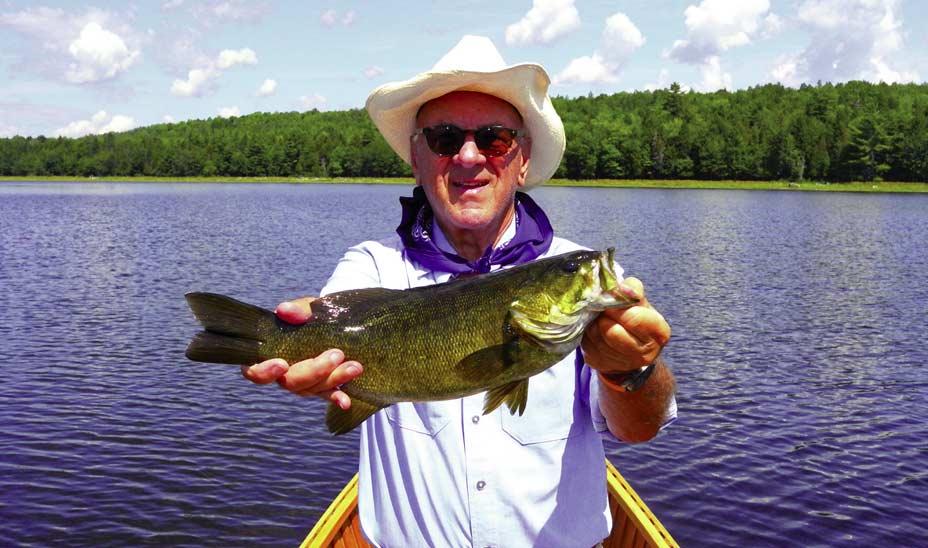
A smallmouth bass is the catch of the day during a fishing trip on East Grand Lake.
And, of course, other camps had also been built around the lake, including the one next door that had caught my eye.
Thenatural history of East Grand Lake is glacial, formed as it was during the last ice age. The thousands of massive prehistoric sub-surface boulders (the bane of many an outboard motor)
are the timeless remnants of it. Its waters teem with various species such as landlocked salmon, lake trout, yellow perch, white perch, smallmouth bass, largemouth bass, American eel, and brook trout, among others. Long before the first seaplane alit on its glassy surface, the lake and its environs were inhabited by the indigenous Passamaquoddy and
Maliseet tribes, followed by pre-colonial European settlers. The plentiful natural resources in the region provided ample sustenance and materials to maintain their ways of life.
During the 1800s, life around the lake underwent rapid change when it became a hub of the burgeoning lumber industry. Tree trunks were floated down to sawmills for processing and then transported along to other destinations in the region. For nearly 100 years, logging was the essential economic activity in the area. Danforth, the closest community to East Grand Lake, was officially incorporated in 1840 and was, until the decline of the timber industry in the mid-20th century, a thriving, all-American small town. The advent of summer recreational activities on the lake, like fishing and boating, has revived the economy somewhat, but Danforth remains largely depressed.
After returning to East Hampton, I set aside the idea of buying the camp for a while. In the spring, on a whim, I called the Danforth broker to see if the proper-
A 1958 Aerocraft Aeroline RSD aluminum runabout is equally adept as a fishing platform and classic lake cruiser.
ty was still available, and it was. Though I hadn’t seen any of the interiors, other than what was posted on the realtor’s website, I told her I would pay the asking price. It was only after I signed the contract that I flew up to walk around inside the two cabins and inspect what I had unflinchingly bought.
One month passed between the final contract and the closing, which was on August 8, 2017. Judie died unexpectedly at home the next day. I didn’t return to Danforth for more than a year after her death.
It was Lori who finally coaxed me back up to Maine. The two cabins were cleaned out and I stopped along the way at the L.L. Bean store in Bangor to buy some furnishings. Slowly, a warm, inviting home away from home was created out of those two old, rundown cabins on Boulder Road. I called the camp “Kabrook,” a blend of my daughters’ names, Kara and Brooke. In 2019, I met Patti, my new love in my life, who has made the camp what it is for me today— home waters.
Each spring since, I’ve evicted what must be the same family of mice that have been living there for generations. The kitchen was improved with modern appliances, but the original old kerosene heater keeps us warm on those early May visits when trout season opens. Recently
I built a third cabin on the property—a small library-office-painting shed to house my books and other hobbies. Since buying the camp I haven’t needed another fishing trip abroad. I take my morning coffee down to the
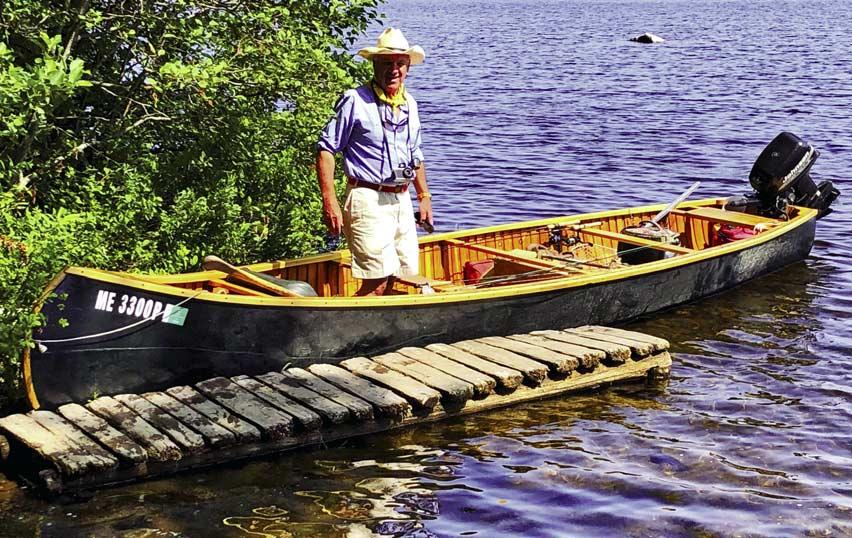
dock and cast for small mouth bass, then afternoons my guide and friend Andy picks me up dockside with his canoe for jaunts on the lake to search for top-ofthe-water bass. Greg, the camp caretaker, and I regularly go fishing for trout in beaver ponds he assures me no one else knows about. I take float trips with my 20-foot East Grand canoe and regularly explore Baskehegan and Spudnick lakes.
Camp Kabrook is now the home waters that Judie and I had always hoped to build together. It is a peaceful place, with morning sun each day over Greenwood Island. I am reminded of something I said to Ted during that first trip to Danforth: “I’ve fished in some of the most beautiful rivers, lakes, and streams all over the world, and East Grand is the most magnificent lake I have ever seen.” N
Lenny Ackerman is a lawyer, a columnist for The Mountain Messenger newspaper, and the author of three books: Here Back East , Fishing the Morning, and Fishing to Home Waters.
Land Trusts Rally to Preserve Western Maine Landscape
WORLD-CLASS fishing, hunting, and camping. A sustainable timber harvest that supports local communities and Maine’s economy. Habitat for wildlife, clean air and water, and a critical carbon sink.
These are just a few of the many offerings in western Maine’s Magalloway region. An ambitious new conservation initiative is aimed at preserving a majestic, 78,000-acre swath of these peaks, valleys, and rivers for all the people and wildlife that depend on these lands.
The stakes are high. This region, like so many in Maine, is subject to potential private development that would restrict public access to the land. But now, through an innovative partnership of land conservation organizations known as the Magalloway Collaborative, there is a concerted effort to maintain these lands and waters as a shared resource for the people of Maine. The Collaborative has entered into a contract with Bayroot LLC, the current landowner, and has until May 2026 to raise the $62 million required to fund the purchase.
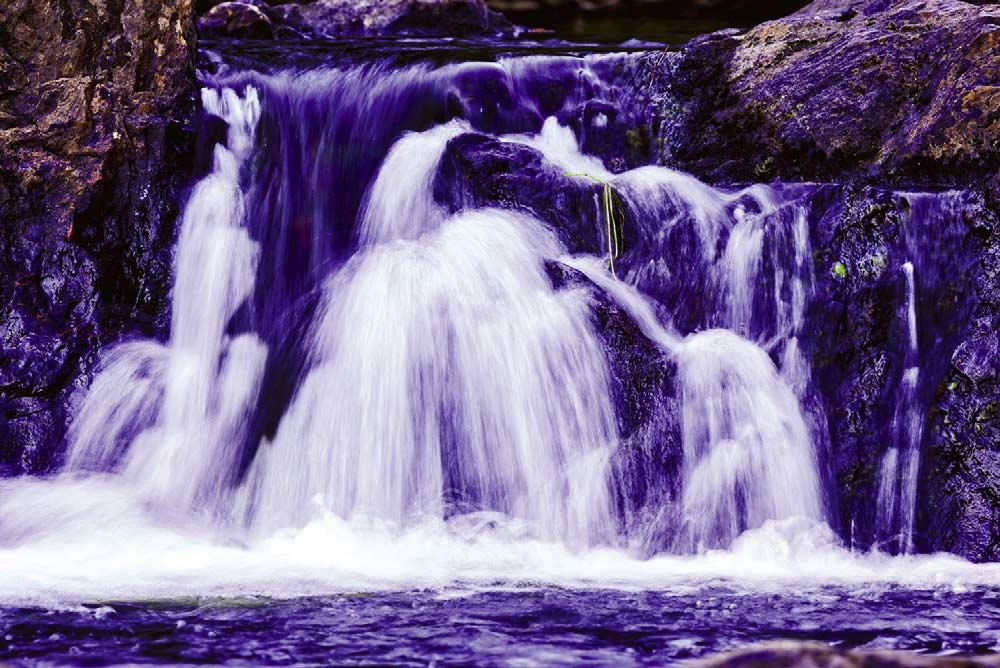
Little Boy Falls on the Magalloway River offers beauty and world class trout habitat.
Sponsored by the Ocean Ledges Fund of the Maine Community Foundation.
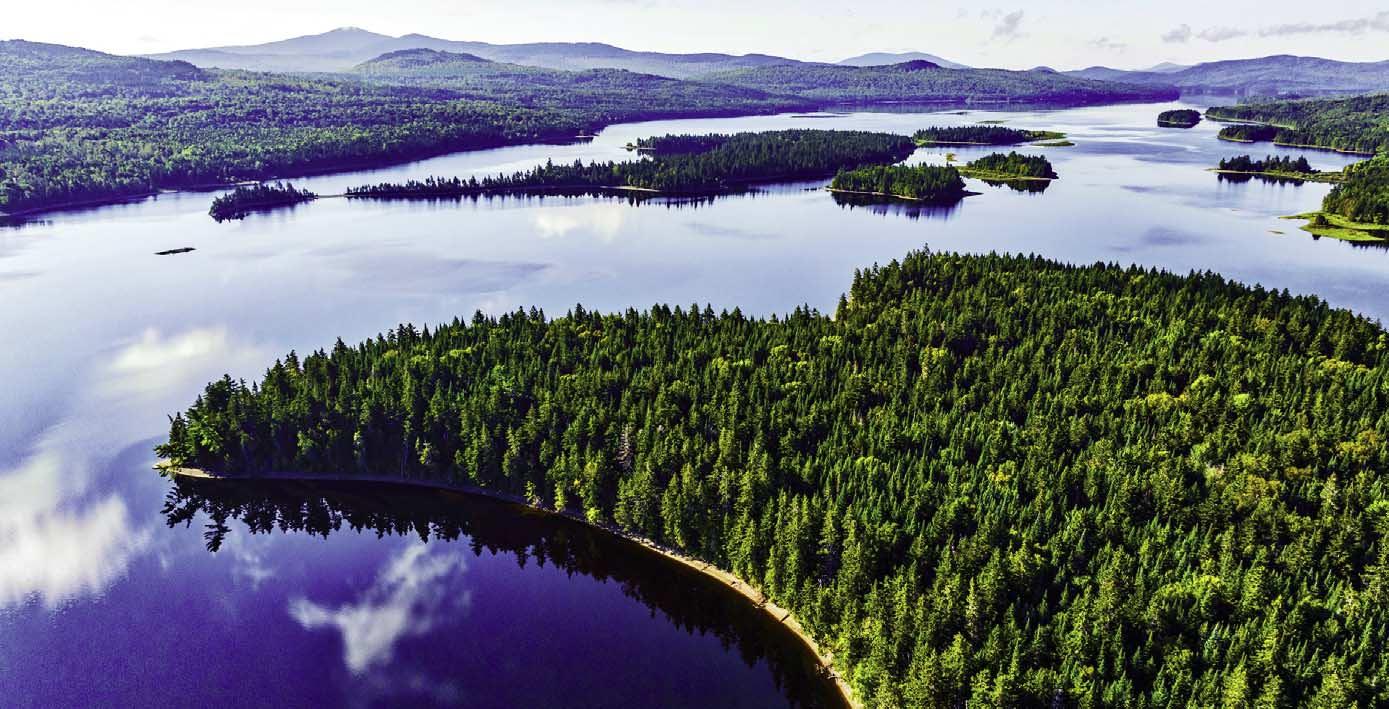
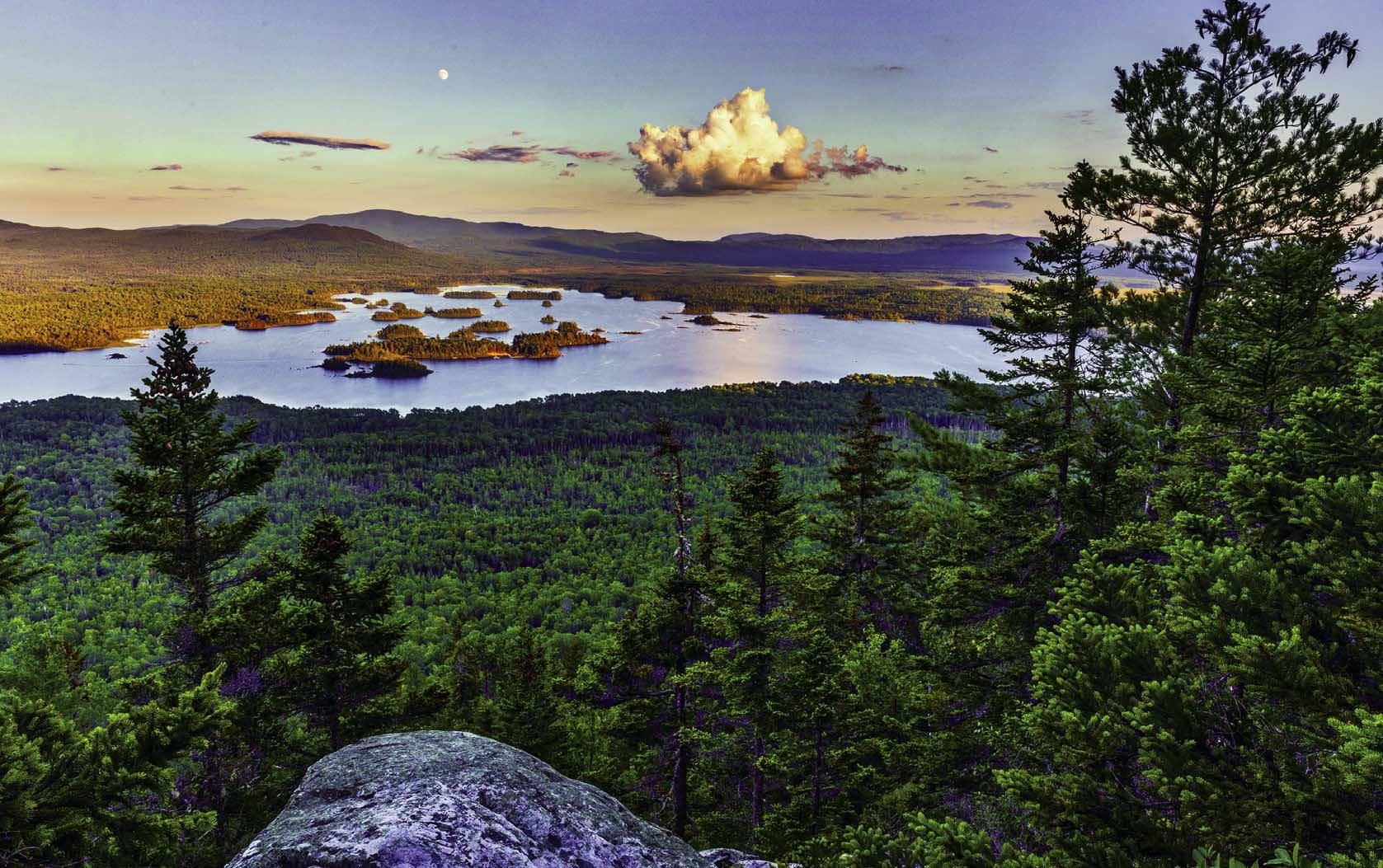
Aziscohos Lake’s islands, waters, and shoreline lie in the heart of the Magalloway conservation project area and offer excellent recreational opportunities.
Photos by Jerry Monkman/EcoPhotography
The Collaborative, which includes Rangeley Lakes Heritage Trust, Forest Society of Maine, Northeast Wilderness Trust, and The Nature Conservancy, is noteworthy for the diversity of interests it represents. Each organization has a unique conservation mission, and collectively the four groups will work together through this project to support forest product businesses, recreational uses, and wilderness.
Maine’s lands—and how they are used and managed—often inspire debate, but uniting sometimes at-odds viewpoints is the shared recognition that the development of vast landscapes is a losing proposition for Mainers. The Magalloway Collaborative embraces that commonality. It represents the promise of land conservation: a shared philosophy of care for Maine’s lands and waters and a steadfast dedication to their preservation. And when one considers what it is that these groups have joined together to protect, the impetus for their partnership becomes crystal clear.
The outdoor recreation opportunities offered by Magalloway’s forests and waters are many—with superb hunting, fishing, camping, and other activities that connect us with the land and the state we call home. In a testament to the project’s significance for the region’s economy, the project has the endorsement of the Sportsman’s Alliance of Maine, Rangeley Region Guides’ and Sportsmen’s Association, as well as the Rangeley Lakes Snowmobile
Club, the Rangeley Town Manager, and Maine’s Department of Inland Fisheries and Wildlife. As more and more of northern New England’s landscapes are cordoned off, the Magalloway lands and waters will remain a haven of access, while supporting the local economy.
The conserved lands of the Magalloway project will not only benefit the Mainers who use the land, but the remarkable wildlife that resides there. The Magalloway region teems with creatures both common and rare that all depend on intact interior forests to forage, breed, and raise their young. Iconic Maine species live here: moose, bobcat, even the elusive Canada lynx, a federally endangered and state species of special concern. The project’s conservation design—from 60,000-plus acres of sustainably managed timberlands to more than 10,000 acres of unmanaged wilderness—will create a vibrant tapestry of habitat for the region’s many species and their ecological needs.
The protection of Magalloway’s 170 miles of rivers and streams, in particular, would be a major conservation triumph. These waterways have been identified as one of the last brook trout strongholds in the eastern United States under future climatewarming scenarios. The Magalloway conservation agreement stipulates the creation of 100-foot no-cut buffers along these high-priority streams and rivers, ensuring that the water remains cold and well oxygenated for these and other native fish.
The project will help safeguard this sparkling biodiversity even beyond the project’s borders. The land lies in the northern reaches of the Appalachians, connecting 500,000 acres of conservation lands in a critical ecological corridor that permits wildlife to move across the landscape. This mobility is all the more vital as temperatures rise with climate change: Many species are projected to adapt by shifting their ranges north.
The potential positive impact of this historic project is greater than the sum of its parts. It offers an inclusive paradigm for conservation that unites people and groups with varying priorities in the pursuit of one dearly held goal: a collaborative, sustainable future for western Maine.
For those interested in learning more about the Magalloway project or in supporting the $62 million fundraising goal, visit magalloway.org or scan the QR code below.
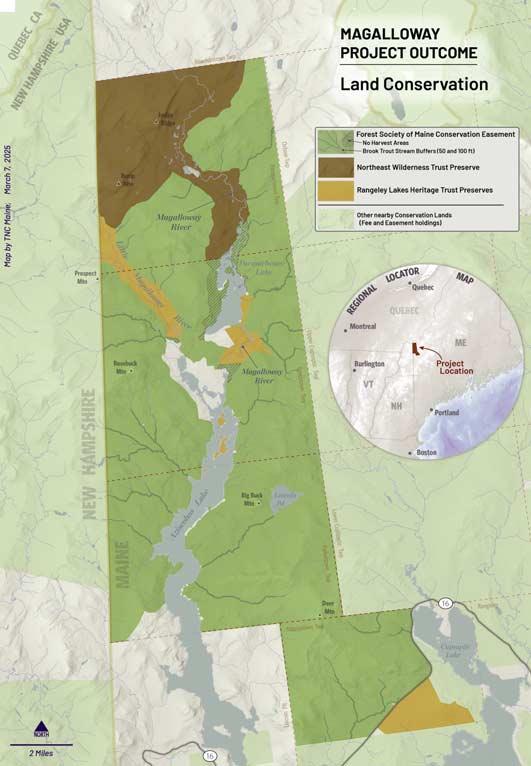
This map shows proposed conservation outcomes of the Magalloway Project.
Wildlife abounds in the Magalloway region.
The Upper Magalloway River provides remote canoeing and fishing opportunities.
ADMIRAL SPONSOR
REGISTER TODAY FOR THE 9th ANNUAL
CAMDEN CLASSICS CUP
JULY 24-26, 2025 | CAMDEN, MAINE
ALL PROCEEDS TO BENEFIT HOSTED BY
REGISTER AT:
COMMODORE SPONSOR
Where a Classic Boat Finds New LIFE
STORY & PHOTOS BY POLLY SALTONSTALL
IF YOU CALL BOB BASSETT at the Kimball Pond Boat Barn and he’s not there, you will hear a cheery message on his answering machine: “Wooden boats kept afloat.”
He’s not kidding.
For almost 25 years, Bassett has been saving small wooden boats and woodand-canvas canoes, many of them his customers’ family heirlooms. Canoe enthusiasts—including members of the Wooden Canoe Heritage Association of which Bassett is regional president— consider him a master at giving new life to worn out boats.
“I like old boats with a good history,” he said. “I like to bring boats back from being headed to the landfill.”
During a recent visit, his cluttered
shop, down a dirt road in Vienna, Maine, (it’s pronounced Veye-enna) contained several classic canvas canoes in various stages of restoration, including a circa 1905 17-foot Morris, an early E.M. White model that was used at the Oquossoc Anglers Association on Cupsuptic Lake in the Rangeley region, and a circa 1920s canoe of uncertain heritage.
An open-air shed nearby held a halfdozen more small craft, some awaiting new owners, others awaiting restoration, including a very early 13-foot Morris canoe that Bassett says is quite rare, one of only five of its kind.
Located in Veazie, Maine, Charles and Bert Morris built wood-canvas canoes from 1891 until their plant burned in 1919. The Morris brothers;
E.M. White, who built wood-canvas canoes in Old Town around the turn of the century; and E.H. Gerrish of Bangor, who worked from the 1880s until the early 1900s, are considered the earliest builders of canvas-covered wood canoes in Maine.
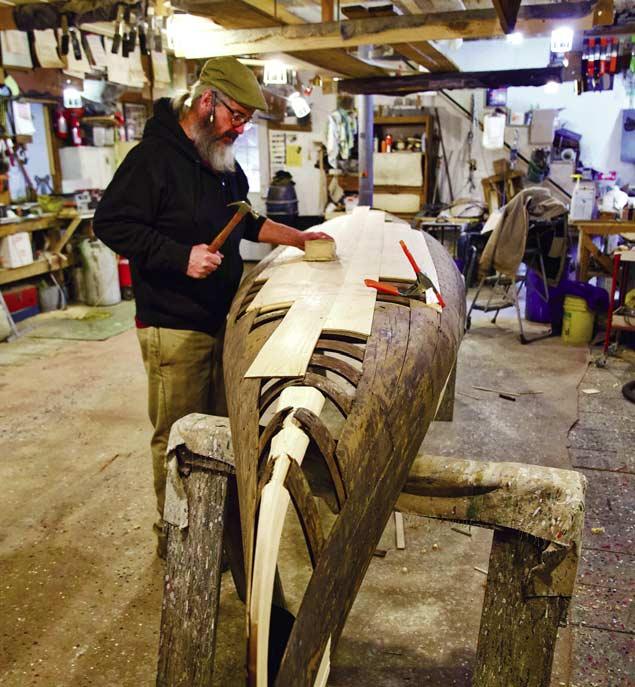
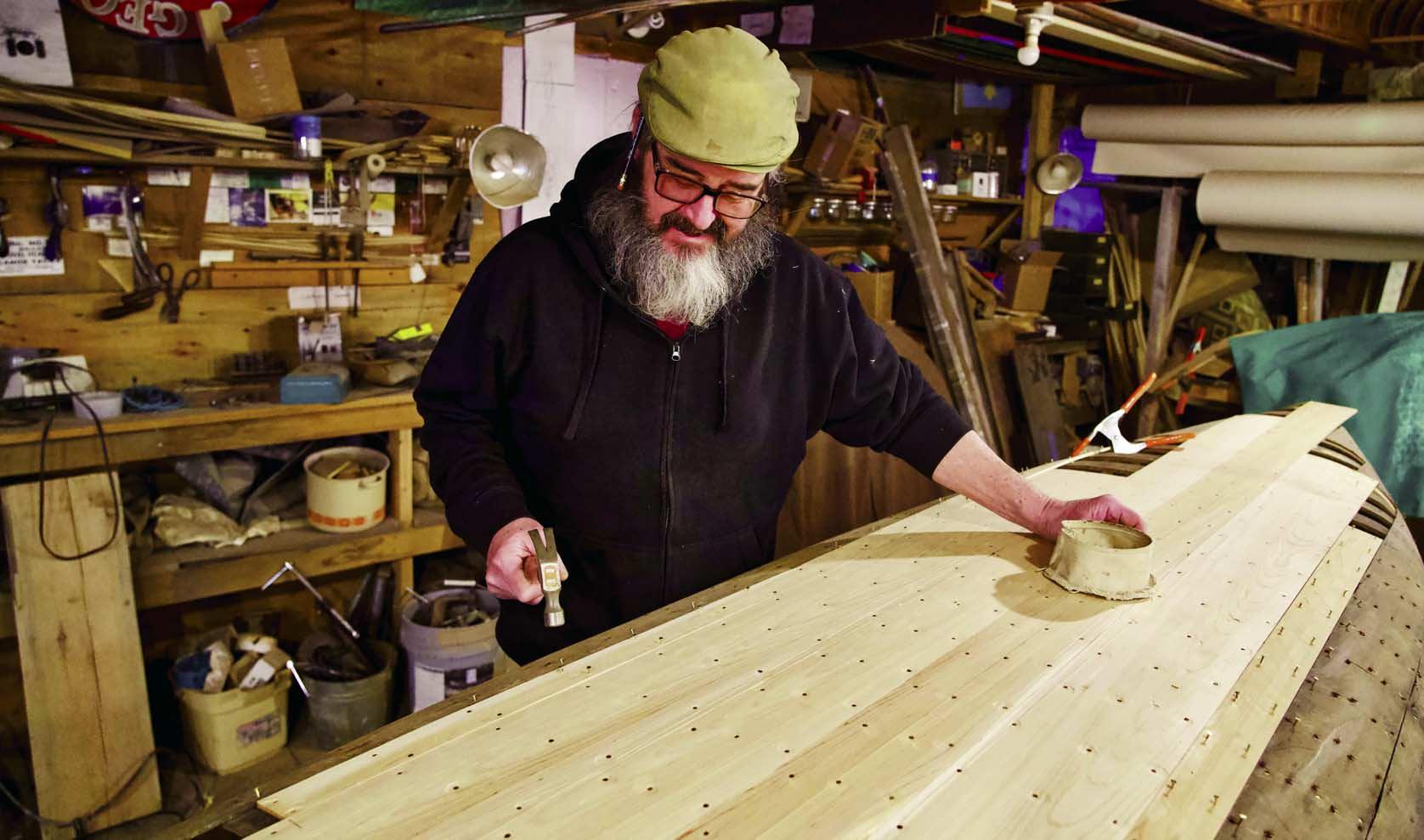
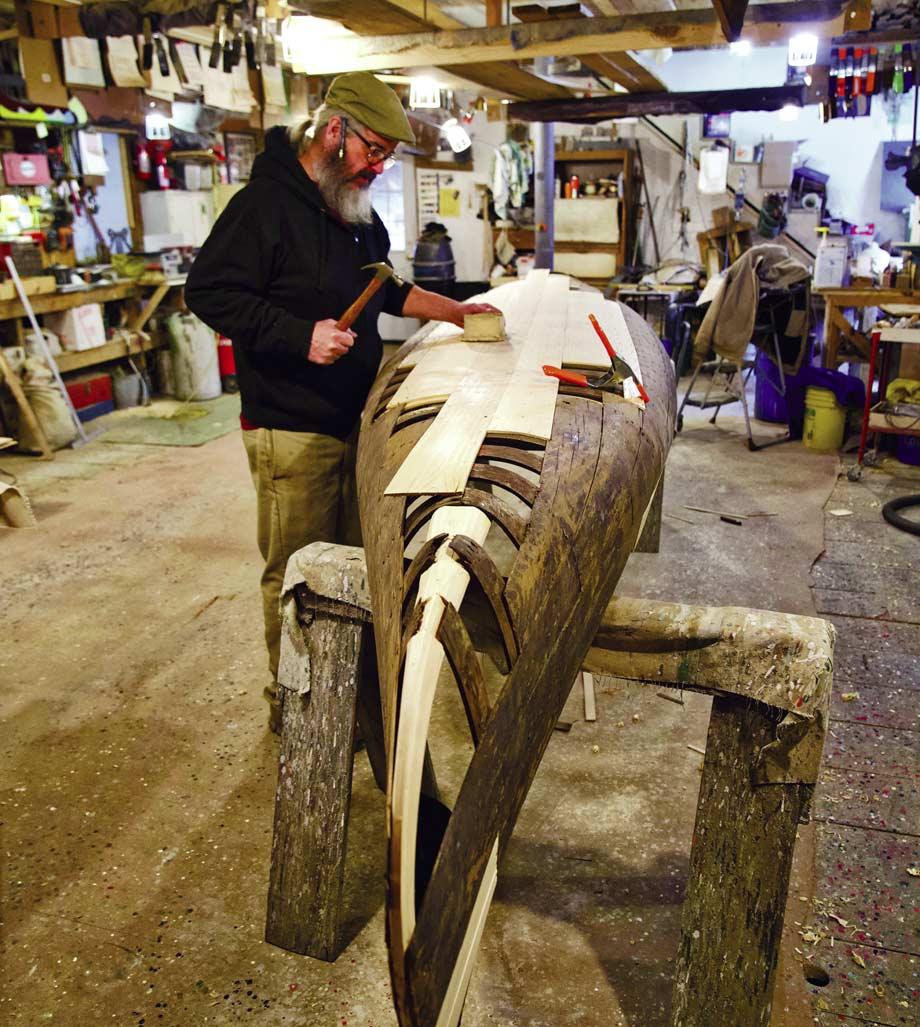
Trim, with a bushy salt-and-pepper beard and gray hair pulled back in a pony tail under his flat cap, the 69-yearold Bassett eagerly explained his process, using the Morris as an example. Upside down on saw horses, the canoe has been stripped of its canvas cover and features a patchwork of bright new white cedar planks nestled among old ones, dark with age.
When a canoe comes into his shop, the first thing Bassett does is remove the
Canoe restorer Bob Bassett planes white cedar into thin planks to replace rotton ones. He attaches them with brass clinch nails
canvas and thoroughly clean what’s left. He then documents the extent of the damage, marking wood that needs replacing. First to be fixed are any broken or damaged ribs, then come the stem, thwarts, rails, and finally planks. For those, Bassett mills rough white cedar boards, running them through his planer and then sanding them down to narrow planks as thin as 3/16 of an inch.
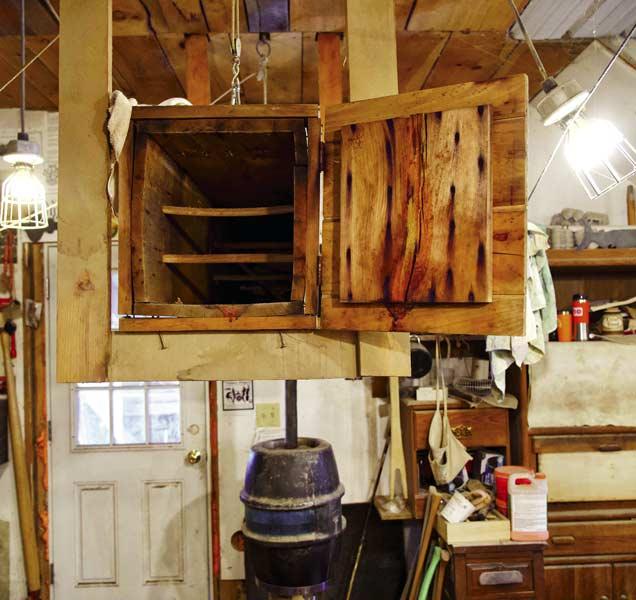
Planks, ribs, and other wooden parts are bent into shape after being steamed in a homemade contraption that includes heating water in an old beer keg set on a propane burner. Tubing for the steam runs up into a 6-foot long, 12inch square pine box hanging from the ceiling. In one of many ingenious touches in the workshop, the steam box can be raised up out of the way when it’s not in use thanks to a set of wooden braces.
“I make everything myself,” Bassett explained. “My father always fixed everything. That’s where I got it.” The elder Bassett worked as a maintenance machinist for General Electric, he added.
Bassett can make paddles—a drawing on the wall shows a design for one he made as a wedding present for a friend—but he prefers not to. The other thing he doesn’t do is caning for seats. That work is sent to someone in Jefferson, Maine.
Looking around the shop, it seemed that Bassett does have tools for just about everything. Benches along the walls contain tins of small brass and copper fasteners, sharp clinch nails, and screws of all sizes. Dozens of different sized spring and C clamps cling to ceiling beams and are
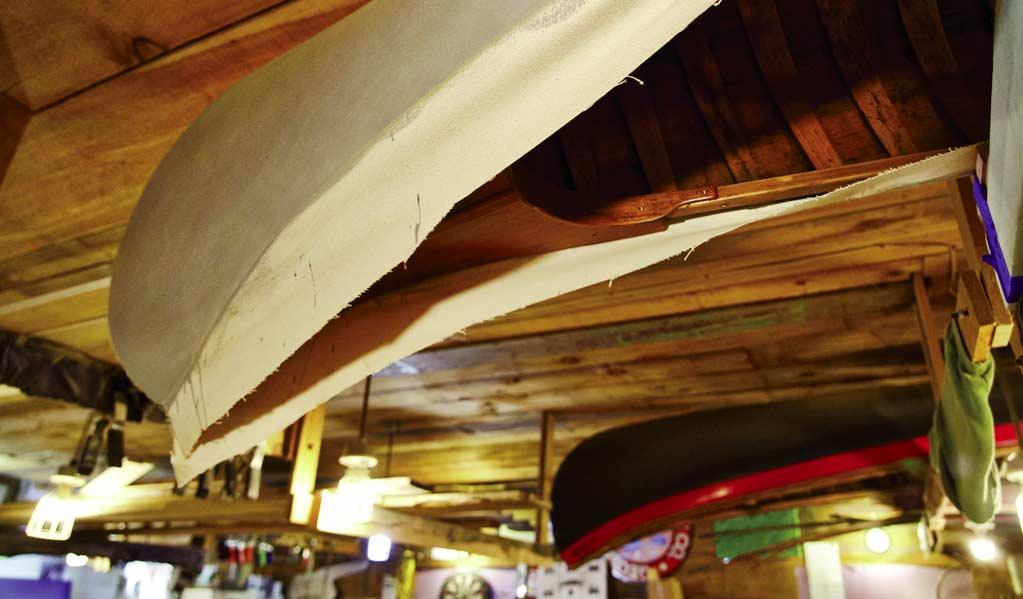
Top left: Bassett’s homemade steam box. Top right: the canvas on the canoe in the foreground has been replaced and awaits paint
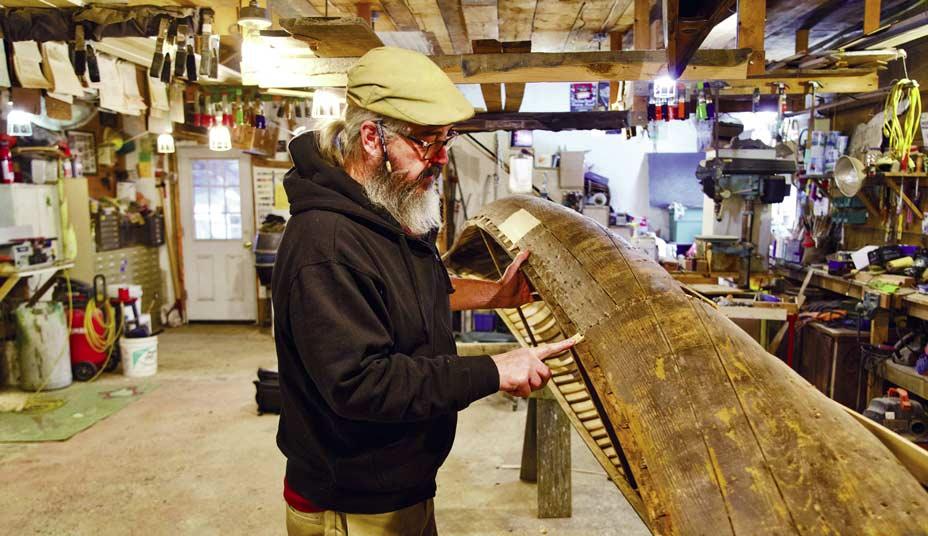
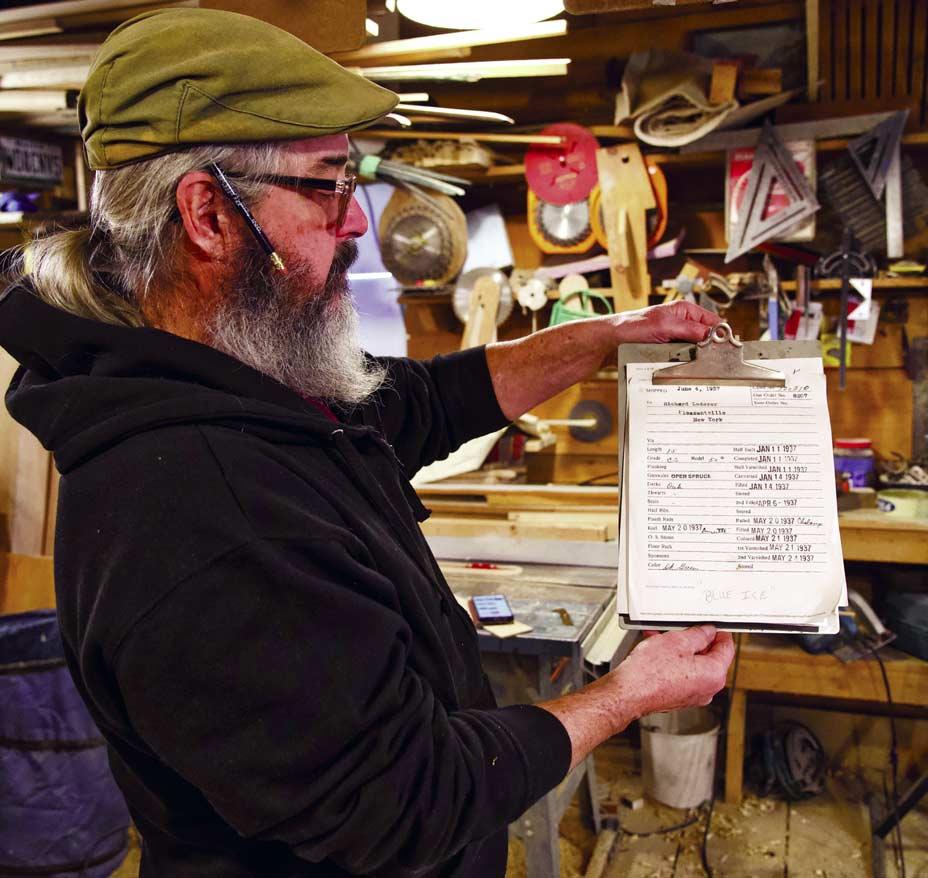
The black and red canoe in back is a vintage E.M. White build once used at the Oquossic Anglers Club. Below, Bassett shows where he plans to attach new rails on a vintage Morris 17-footer. On the clipboard is a copy of 1937 work orders for an Old Town canoe.
stacked in drywall buckets. Tacked to the walls or hanging on hooks are posters, paint samples, chisels, hammers, saws, scissors, hand planes, levels, tape measures, and more, along with extraneous items such as a trumpet—Bassett plays once a week with a local old-time jazz group—and a dart board that Bassett says he rarely uses. Mechanical equipment includes table and band saws, and a planer. The shop is heated by a hardworking Jotul stove.
A half-dozen clipboards hanging from a central beam contain work orders and job details. Bassett pulls down one to show paperwork, dated 1937, for an Old Town canoe he restored. The Old Town builders’ files have been digitized and owners can contact the Wooden Canoe Heritage Association for copies if they know their boat’s serial number, Bassett said. Up high, shelves hold old canoe parts, including a folding wood chair with cane seating and several sets of varnished planks fastened in a semicircle that were used as seat backs on vintage Old Towns.
This circa 1905 Morris 17-footer required extensive repairs but the boat had sentimental value to its owner as it had belonged to her father.
Asked if he ever has trouble finding things, Bassett erupted in laughter. “I can’t wait to tell my wife you asked that,” he said with a grin.
After planking is completed, new canvas is stretched over the hull. Big rollers in a corner hold wide bolts of #10 and #12 white cotton duck. Getting the canvas on the boat entails a complicated process of clamps and a ratchet that cinches the cloth as much as 15 to 20 percent tighter over the hull.
Bassett then applies a mixture of paint, oil, and silica to the stretched canvas, rubbing it to fill in all evidence of the cotton’s weave. He lets that harden for six weeks, before sanding and painting as many as six coats of color, always using Kirby Paints.
“George Kirby would sell me paint and then call to see how it was going,” Bassett said. “I’m a loyal guy.” (The Kirby he referred to is father of the current company president, also named George Kirby.)
Painting doesn’t happen until the spring when all the woodworking has
been done and there is less risk of sawdust getting in the way.
Raised in a small New Hampshire town on a pond, Bassett has loved boats all his life. He acquired his first one, a 7foot pram, with money from his 8th birthday. After working as a carpenter for many years, including doing woodwork on fiberglass boats, he moved with his wife, Carol, to Vienna in 2000.
“I like old boats with a good history. I like to bring boats back from being headed to the landfill.”
There he built his shop almost entirely out of 15,000 feet of pine harvested from his land, and then started looking for boats to repair. A 2003 class at the WoodenBoat School with Maine canoe guru Rollin Thurlow really got him going. Bassett’s copy of The Wood Canvas Canoe, a Complete Guide to its History, Construction, Restoration, and
Maintenance , by Thurlow and Jerry Stelmok, is worn and held together with tape, evidence of its long-time use as a key reference.
Bassett usually works on two boats at a time during the winter, and is booked out for work at least a year and a half. Depending on the amount of damage, a typical job takes him upwards of 150 hours. The cost, which can run as high as $5,000 or more, is usually far more than most boats are worth, he said. Rather, most of them have sentimental value to their owners. “They belonged to Dad or Grandpa, or Uncle Dave,” he said.
Asked to describe a favorite project, Bassett didn’t hesitate.
“The next one.” N
Polly Saltonstall is MBH&H’s editor at large.
For More Information
Kimball Pond Boat Barn Vienna, ME 207-578-0876 www.boatbarn.wcha.org
BY
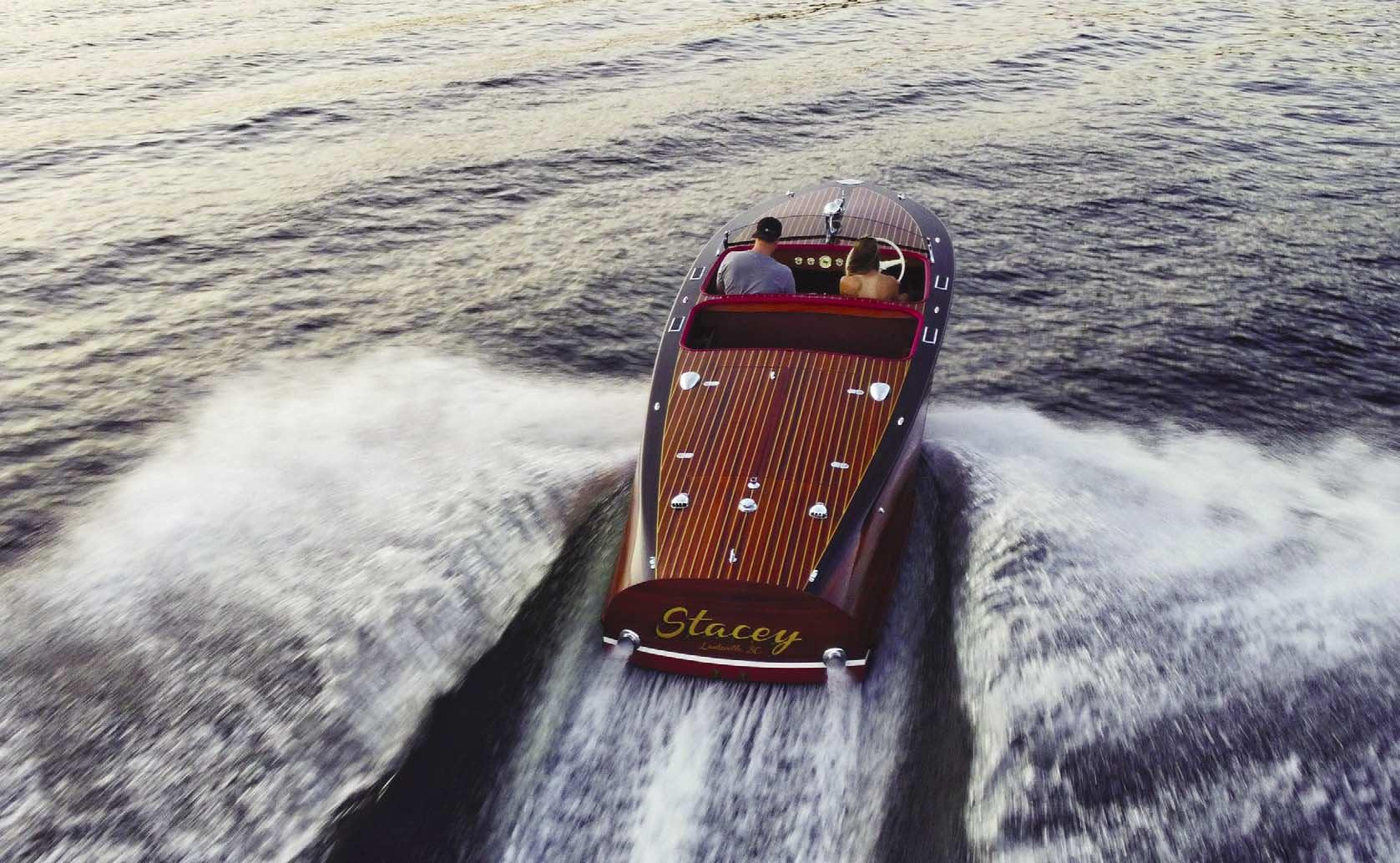
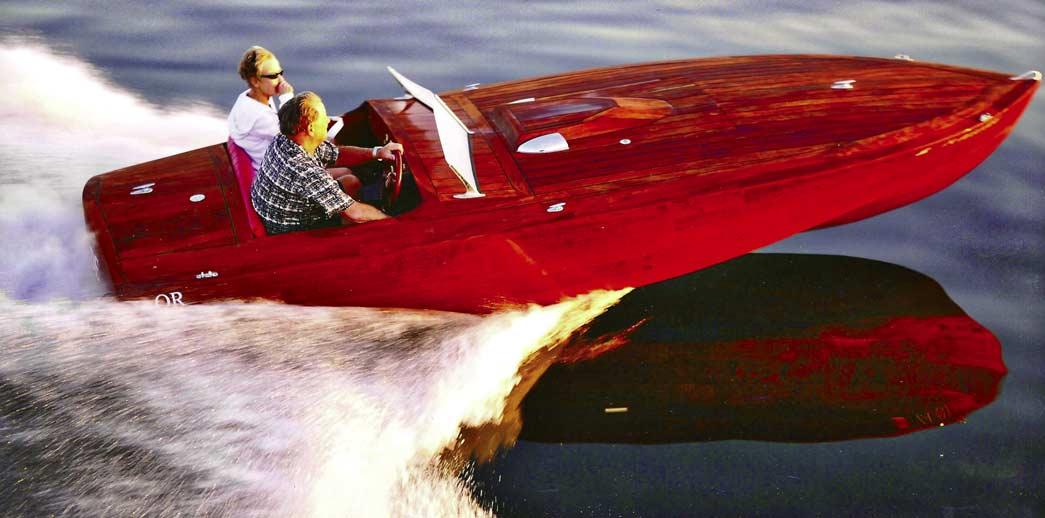
Nothing says “Lake Cruiser” like a long slender inboard-powered mahogany speedboat.
Boats For Golden Pond
ILOVE GREAT POND in Belgrade, Maine. It’s the real “On Golden Pond” celebrated by Hollywood, though New Hampshire, frankly, sweetened the deal for film makers, so the movie was shot on Squam Lake instead. The whole Fonda-Hepburn element about fading parents and feisty daughters is independent of locale. But the loons, starry nights, and the geezer driving mail around to cottages—that was really real—and all ours here in Maine.
Great Pond isn’t always golden, except near sunset. Other times, it’s just pristine clear swimmable fresh water and lots of loons singing loony tunes. My draw to the pond was crewing and racing on sailboats with an old friend. This under the auspices of Great Pond Yacht Club, whose members mostly live in what Mainers call “camps,” though I think of them as enviable waterfront homes. Most have docks, or perhaps lifts; one or two even have float-in boathouses. And of course, boats.
The best thing the movie “On Golden Pond” had that lured me like a trout to a dry fly was mahogany inboard runabouts. I can’t afford a Jaguar E-type car, and maybe my fast-driving days are behind me. But I can still build a boat. In fact, at age 80, I go to work and do that nearly every day, so I have this dream about a camp and a runabout, and rumbling counterclockwise around Golden
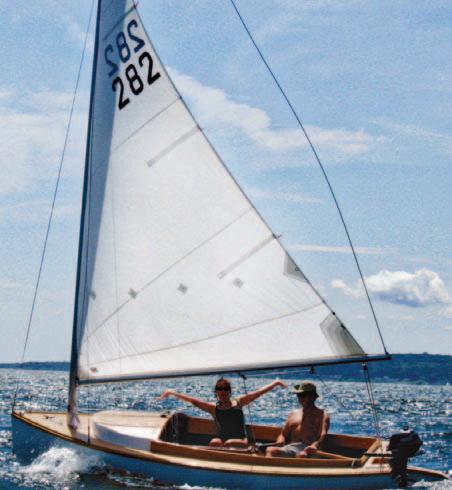
The Glen-L Zip model is the company’s most popular little runabout.
Pond. (My steering wheel, like the Jaguar’s, would be on the starboard side so the continuous left turn puts me adjacent to friends ashore, with whom I could gam.) The dream even has me in a strapped-down bucket hat delivering mock mail.
The design factor, appropriate to this column, is easy, there being just a single option that’s remotely possible. I can’t afford a vintage Chris-Craft or Hacker or Italian-built Riva. Nor can I commission Mark Peters or Bob Stephens or any of several other great designers for a custom design. That would be too time and cost prohibitive. And I wouldn’t undertake a design myself since I lack familiarity with the mathematics involved in “developable” twisted surfaces. (More on that later.)
As to the aesthetics, that is a nonissue. Only a fool would fail to mimic the winners of various marine concours d’elegance. So, there remains just the single
option that was always part of the dream anyway—and half the fun: building that runabout myself using Glen-L plans and patterns.
Even in my early childhood, when I loved boats above all else, I knew about
Glen-L kit boats. This company’s alluring designs were featured on the cover of Popular Mechanics all the time, and in that era, dads were building them at their modest homes, in garages alongside their kids. For the record, I was a kid and lived in such a place, and we had a one-car garage. In my early teens, with only grudging parental buy-in, I built my first boat (a Blue Jay sailboat) in our garage.
But back to those Glen-L beauties. It turns out that the company, after all these many years, is still in business. And in this era when labor costs are unthinkable, you can easily afford their plans, patterns, and helpful parts. And if you have above average amateur skills (and a shop), there is no reason you can’t go out there and construct a vessel that will have you waterskiing or racing about in a showstopper of your own.
Glen L. Witt was the genesis of all this, selling boat plans from California starting in 1956. He was a visionary in that baby-boom marketplace, and was able to design good rowboats, sailboats, runabouts, and cabin cruisers. The man was adept at understanding the concept of “developing” curves out of flat surfaces, even in sexy speedboats that twist a flared bow back into extreme stern tumblehome. At its most extreme, they call this a “barrelback.”
Plywood had been a spinoff of World War II gunboat and floatplane construction for the military, and its marine grade had become available in quality comparable to today’s. Most Glen-L kits
In completing a Glen-L from plans, it's much about the details.
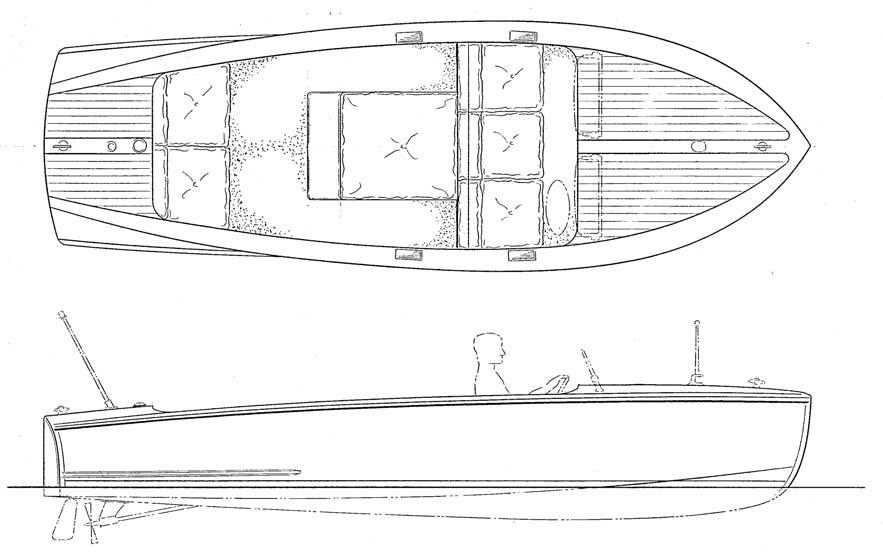
The line sketch of the Key Largo shows seating for a big gang of loon-lookers.
of that era were designed for this material. But in some cases where a flat skin couldn’t be twisted or bent without bumps, (developable describes this attribute) to shape the sorts of speedboats I’m lusting after, Witt specified single or double planking.
If you have above average amateur skills (and a shop), there is no reason you can’t go out there and construct a vessel that will have you waterskiing or racing around in a showstopper of your own.
In those days, the typical amateur builders were—dare I say—more capable of fixing their own cars, or plumbing, or whacking things together out of wood. Extra good news today is twofold: Glen-L and its kits are still available and attainable. Secondly, epoxy and coldmolding techniques are now employed to keep Glen-L kits simple enough for an average builder to tackle, while at the same time, the end product is more durable and affordable.
Thus, my dream not only endures but improves.
The hard-chine runabout that would be my preference no longer must be based on a “developable” wood hull panel. Nor would the wood used for constructing it require any “torturing”— an old boatbuilder’s term for bending wood in unnatural ways, though there’s no pain involved. In other words, there would be no need for tapered, lapped, or caulked planking.
Modern Glen-L kits have eliminated steam-bending, so every patterned part can be hand-bent into shape. The company keeps in touch with most builders and provides manuals and advice so it’s quick to get the project going—and virtually impossible to get the all-important hull shape wrong. This is in keeping with Witt’s original vision. He designed and tested methods easy enough for a homebuilder to master. Modern Glen-L kits’ epoxy and double, triple, or quadruple skins of cold-molded planking are far easier and stronger, and unlike the spiled
or splined planking on a Riva or a ChrisCraft, they’re permanently leakproof.
If I were to play out my runabout dream, inasmuch as a long, sleek inboard with two or three cockpits would be the ideal, I only have so much time and money. Therefore, I would opt for GlenL’s fairly modest Key Largo model, with a few personal modifications.
The 22-foot Key Largo, like many of Glen-L’s plans, is designed to allow a builder to build a lengthened version. This is partly intended to deal with variations in shop or garage size. I would build the longest version they allow for, based just on looks.
This particular model has only a single cockpit, and although I’d love to show off long-drawn-out teak or mahogany deck planks with faux-holly splines, as Glen-L’s website points out, most lake activities, such as fishing, tubing, and partying, recommend a single cockpit of maximum size.
Glen-L has never recommended diesel inboards, and their engineering, especially of bed logs, is geared to the
lighter weight and greater thrust of fairly simple gas inboard engines. The Key Largo has a nice shallow shaft angle that I like, but a yacht designer is always tempted to throw a little ego into matters. I’d opt for a modern four-stroke outboard, located farther aft towards the back of the cockpit, flanked by two seats—my own take on an inboard outboard. Plus, placing an outboard there guarantees it is remote from swimmers’ or skiers’ legs and feet.
I spoke with Joshua Colvin, owner of Glen-L boats, in Idaho, of all places. When I told him of these outboard musings and asked his permission to make changes, he said, “It’s a terrific idea. I’ve had it myself.”
Mark Fitzgerald is my powerboat guru, and he likes engine weight aft. And as an aside, the term “reliable outboard” was for a long time an oxymoron, but we are finally there. These modern fourstroke engines are safe, reliable, and always start.
I’d fix the motor straight ahead and steer with a pair of good-sized rudders
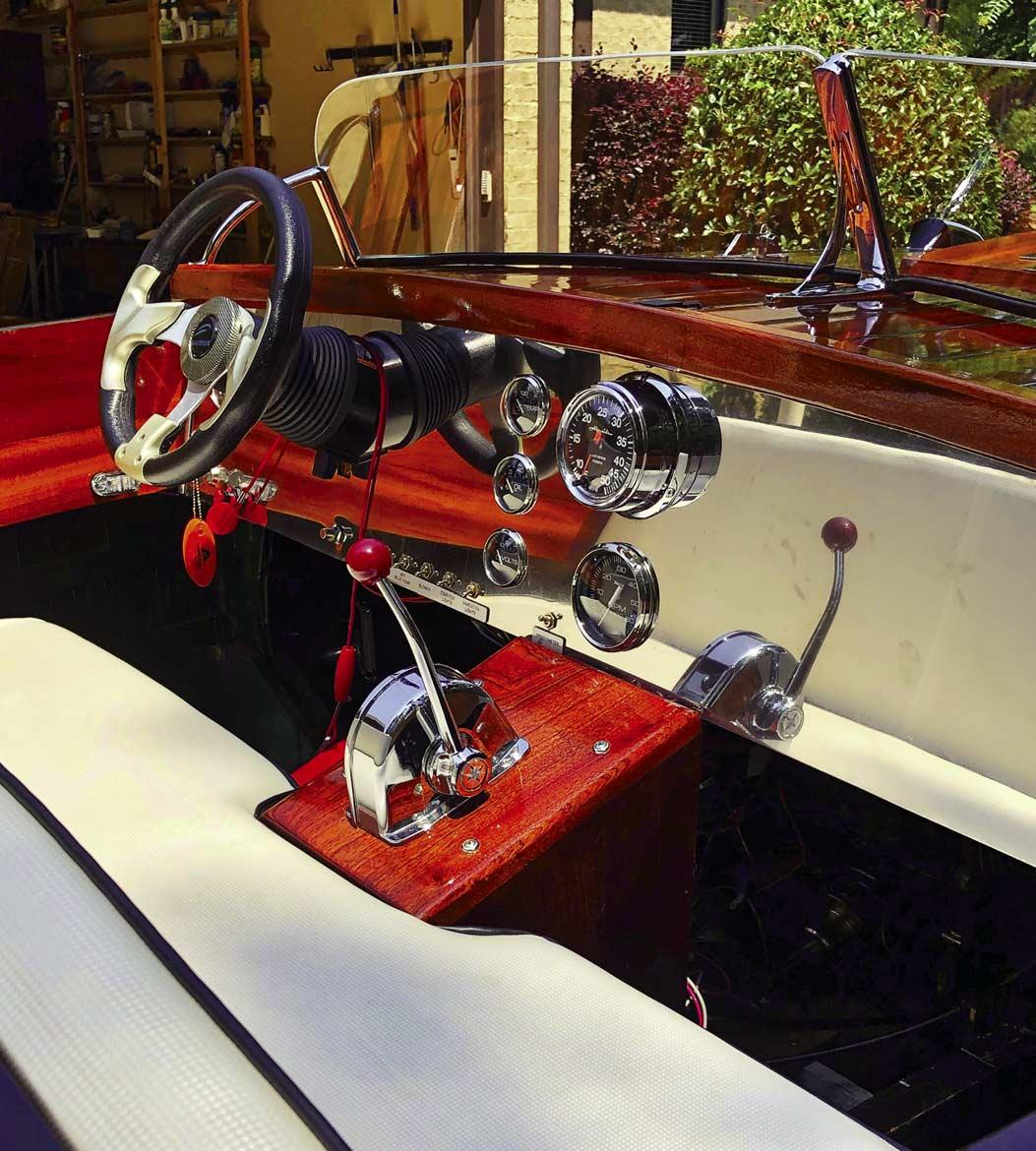
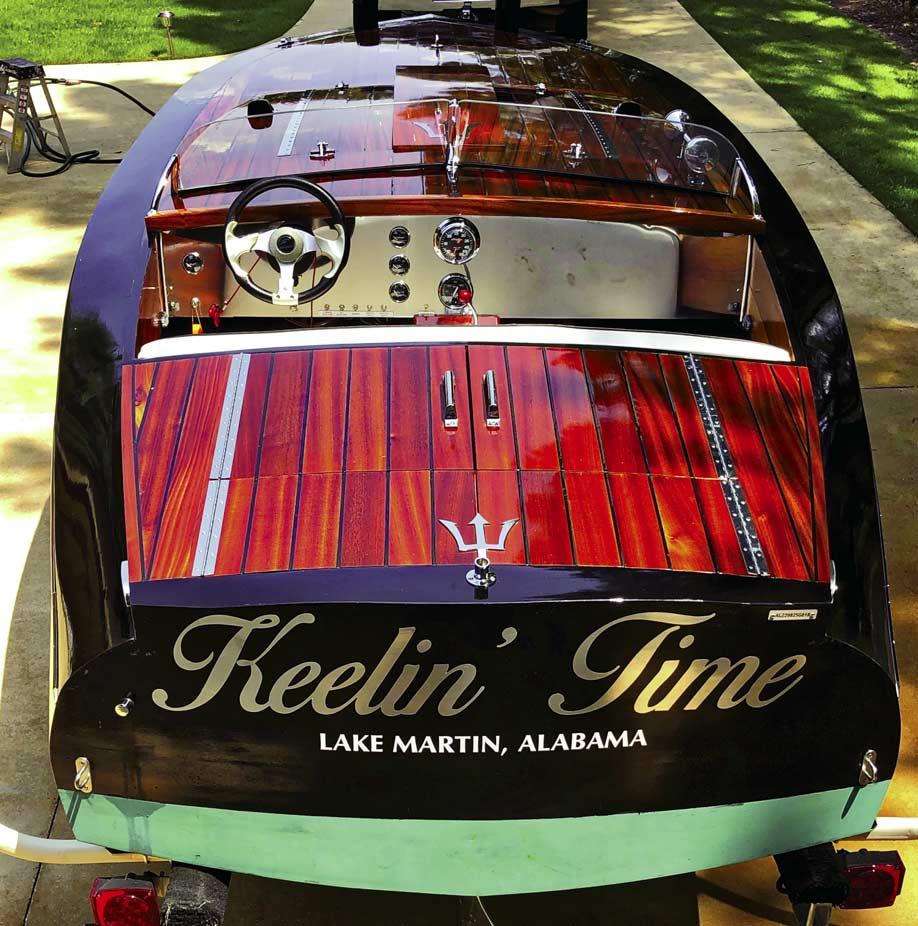
On a mahogany lake runabout like Keelin’ Time, it’s all about the deck.
outside the prop wash. The motor would hide beneath a table-box with planking that matched the fore and aft show-off decks. In the end, my Key Largo would have a glass-like varnish job—that goes without saying.
The Key Largo is a moderate barrelback design and, to my eye, extremely snazzy looking. Who would know this is an amateur kit boat? It looks like a prize-
accumulating classic that is appropriate to come out and play with the six or seven such runabouts on Great Pond.
In my dream, I would still have the outsized chrome-plated exhaust pipes and occasionally blast the bass notes of a hot V-eight from Bose speakers, just inside their nozzles. Most of the time I would demur, though, and show off the moderation of my four-stroke that runs
silent as a landlocked salmon, so as not to perturb man, bird, nor beast.
I’ve done a brief spreadsheet of costs, assuming zero for my labor. Without the engine I could build this boat for $30,000. Most of the exquisite tropical hardwood required is just eighth-inch veneer, applied by a method I’ve used involving foam rubber blankets and clamps, that I call “poor man’s vacuum bagging.”
If I’m right, then the only part of the dream that is unworkable is the pondside camp. But I’ve chosen a boat of sufficiently small weight that I can tow it behind the Subaru. And did I tell you? Great Pond in Belgrade, two hours from my home, has a big parking lot and public launching ramp. Dream-Ho! N
Contributing editor Art Paine is a boat designer, artist, and writer who lives in Bernard, Maine, and is still dreaming.
For More Information
Find a variety of Glen-L boat plans at www.glen-l.com or call 562-630-6258.
At Farrin’s, pride in our workmanship has been continuously applied in over 50 years of building boats.
Our craftsmanship in design and construction will give your custom project the quality that has made Maine famous in the boatbuilding industry. This is the time to plan ahead for your new boat, rebuild, repower. We have openings for your project in July 2025. Check out our updated website!
The sweeping sheer and tumblehome transom make Glen-L’s Key Largo model an absolute dream.
Loving and Conserving the
STORY BY KARIN R. TILBERG
BY JERRY MONKMAN
WHAT characterizes the North Woods? It is rough, utilitarian, desolate, and vast. It is a place of powerful rivers that drain its lands—the Penobscot, Kennebec, Androscoggin, Allagash, St. John, Machias, and St. Croix. It is a place of mountains shaped by the glaciers of the past that emerge from the spruce and fir forests with granitic splendor. It is a place where you can
feel wildness in the moss underfoot and in the lynx, moose, pine marten, and other animals that live here. There are thriving wild native brook trout—the healthiest populations in the eastern United States. Much of the North Woods has been designated as globally significant for migratory songbirds. It has inspired magnificent art, writings, and scientific discovery.
In my humble view, the untamed
qualities of Maine’s North Woods are a match for other regions in the western United States and Alaska. One has to be intrepid when exploring the North Woods. There are few directional signs, and trailheads are often not well marked. A traveler needs to be brave and prepared on the interlaced network of dirt roads that extend for miles and miles, roads renowned for shale bits
PHOTOS
that puncture the strongest of tires. Extremely important is knowing how to read maps and follow a compass, for one can get lost easily—even in this age of GPS. Being self-sufficient is essential. The North Woods is not manicured or neat. The place is rough, chaotic, and not easily enjoyed. And there are insects— blackflies in the spring, mosquitoes in early summer, and later, the horse
flies. It is not pretty in a quaint, tidy manner. Still, is there a landscape within the heart that emerges when you know you have found home? I had a “home” I was unaware of until I first experienced it—Maine’s North Woods. I am not alone in loving the North Woods; its power, mystique, and undeveloped bigness enrich the soul for many individuals. I write because of historic conservation
The Roach River headwaters will make their way to the sea.
Inset photo by Karin Tilberg
measures that have unfolded in this place that I love.
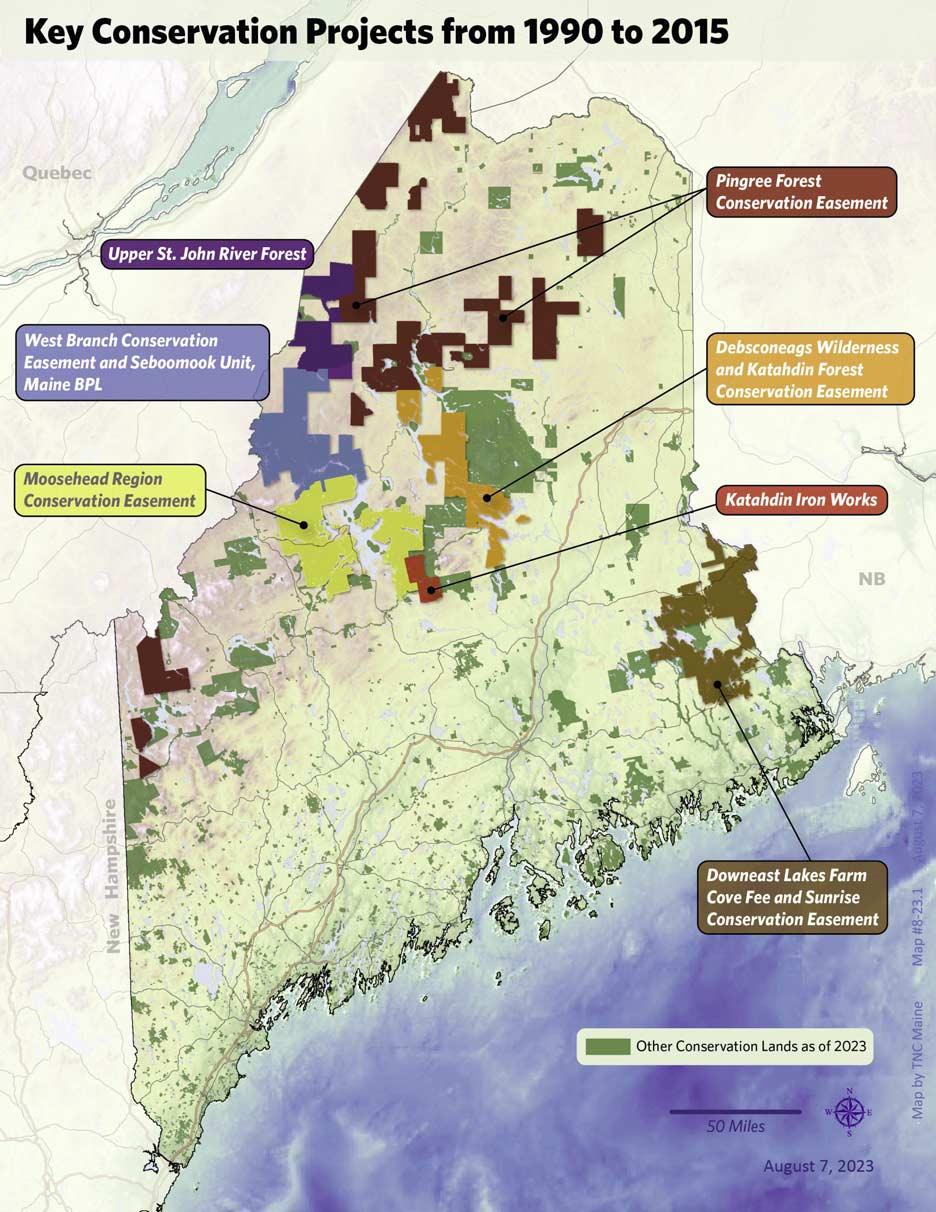
The magnitude of conservation in Maine’s North Woods from 1990 to 2015 resulted from a massive shift in land ownership from primarily paper companies to a diverse array of landowners. Conservation achievements in this era included players from major state, regional, and national conservation groups such as The Nature Conservancy, the New England Forestry Foundation, Trust for Public Land, the Forest Society of Maine, The Conservation Fund, and many others along with Maine state agencies and elected officials. Challenges and achievements captured imaginations. The willingness of forest landowners to work with conservation partners in pursuing conservation easements and acquisitions was essential. Thousands of individuals engaged in debates, funding, and conservation outcomes.
Other significant conservation in the North Woods has taken place since 2015, but the opportunities that led to these were second or third generation from
the big paper company sales and family estate planning initiatives characterizing the late 1980s through the early 2000s.
Maine’s Great North Woods—12 million or so acres, three and a half times the size of Connecticut—reverberates as a vital part of American history. The North Woods is the home of the Wabanaki. Their ancestors were the first people to inhabit this region, doing so for 12,000 years. It forms the backdrop for European settlers who made their home here, for breathtaking logging lore, for an era of papermaking, and for famed outdoor recreation adventurers and feats. This hauntingly beautiful yet roughly powerful place has inspired legends from antiquity and artists and writers of all genres.
The North Woods contains a rich diversity of ecosystems, from alpine tundra and boreal forests to ribbed fens and floodplain hardwood forests. It is home to rare plants and animals. It has been designated a globally Important Bird Area, or IBA, by the National Audubon Society. It is the last stronghold for wild
brook trout in the eastern United States. Unfragmented forests and diverse topography make it a highly resilient landscape in the face of climate change. The forests sequester and store carbon equivalent to approximately 91 percent of greenhouse gases emitted every year in Maine.
The inland waterways are a vital connector of forests to the marine world. Fish, wildlife, trees, and plants have evolved in an interconnected circulatory system of forests, rivers, and ocean environments. Atlantic salmon symbolize healthy, connected ocean and freshwater systems as they live and move between both; indeed, salmon are creatures of the forest.
In the late 1980s, approximately 5 percent of Maine’s statewide total of just over 20 million acres was either in public ownership or conserved in a permanent manner. (For this discussion, the term conservation refers to public ownership, ownership by non-governmental organizations with a conservation mission and in a permanent status, or with permanent conservation easements on the
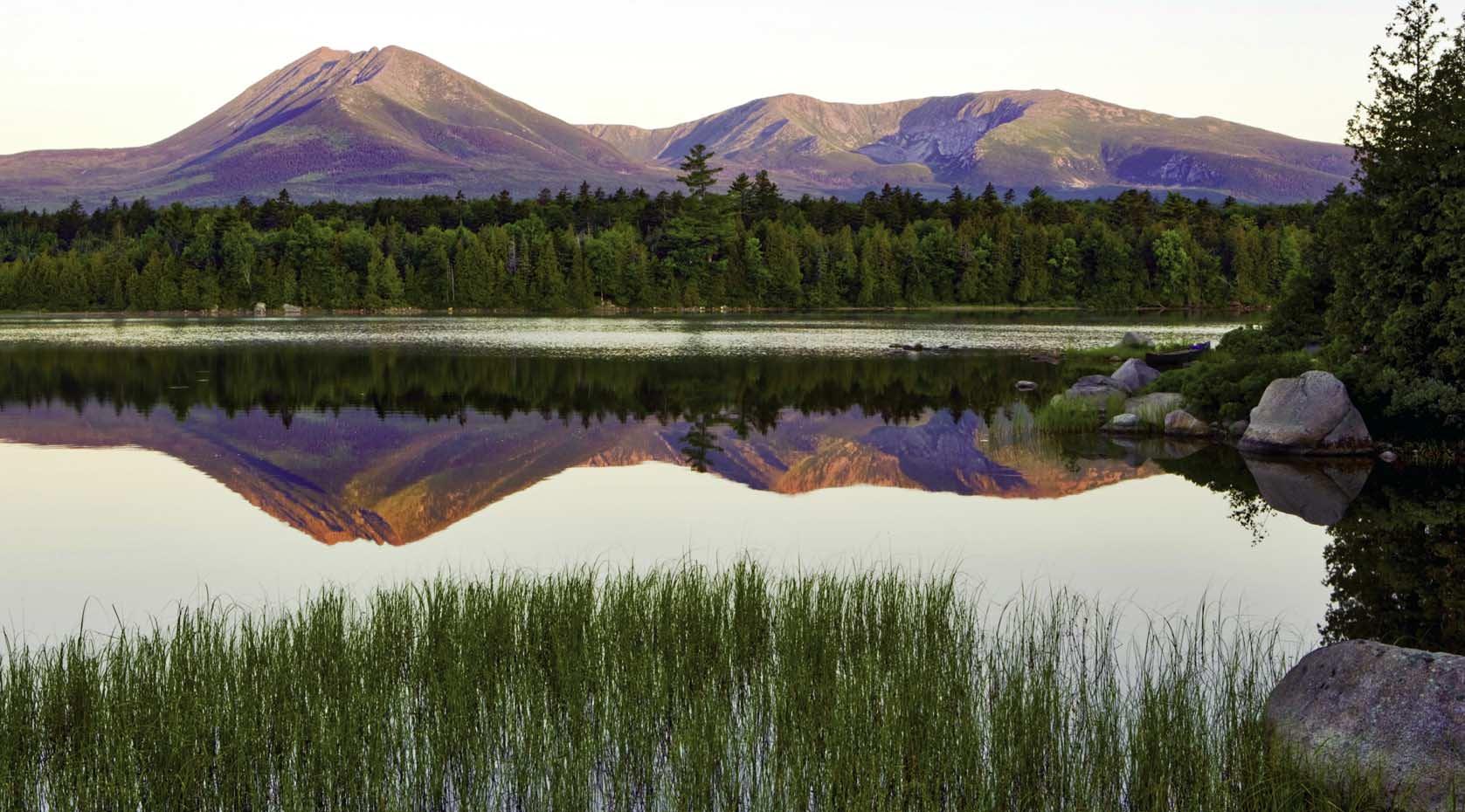
Stunning lakes, mountains, and forests create a vast landscape.
land.) In less than three decades, the amount of conservation lands rose to 21 percent of Maine, amounting to 4 million acres. Embedded in this dramatic increase lie stories of people who care about Maine’s forests, who depend on woodlands for livelihoods, and who demonstrated incredible generosity. There were residents in the few communities near the big woods, guides depending on the woods, mill workers and truckers not only depending on the forests for livelihood but hunting, fishing, and relaxing. There were members of Wabanaki nations who supported measures to sustain rivers and forests that have been their home since antiquity. There were conservation organizations, boards of directors, and individuals who took significant financial risks. And there were forest landowners willing to consider unusual conservation strategies, often waiting years to close on projects.
Until the 1980s, land holdings in the Maine woods did change ownership, but only occasionally, usually resulting from corporate mergers. A defining feature was mills owning forestland that supplied them. However, by 2015 all the paper mills had disposed of their timberlands.
Why this sell-off? Drivers included peaking of paper demand in North
The contiguous unfragmented forests today look much as they have for centuries.
Courtesy of The Nature Conservancy, Maine Chapter
America, high energy prices and intensified global competition, belief that mills could obtain needed fiber on the market and through supply contracts, and emergence of institutional and other investors interested in owning managed timberland. Also, the 1986 Tax Reform Act removed beneficial capital gains treatment for paper company ownerships.
Many new owners were timber investment management organizations, or TIMOs. Investor funds were pooled to acquire large tracts of forestland. Typically, the TIMO would acquire forestland, manage it for a period of time (for 37example, 15 years) and then sell the property. Another new form of forest owner was a real estate investment trust, or REIT, which owns, and in most cases operates, income-producing real estate.
The new TIMO and REIT owners sent ripples of anxiety through rural communities. Would they divide and sell the land? Would they post no-trespassing signs and prohibit hunting and fishing? How would these new owners manage the landscape-scale forests of Maine?
The story of Great Northern Paper illustrates the bewildering, intense quality of these sales. Founded in 1898, GNP
began manufacturing paper in 1900 and carved the mill town of Millinocket out of the woods. Strategically located on the West Branch of the Penobscot River, Millinocket enjoyed an abundant supply of wood for the log drives that brought wood to the mill, and available hydropower.
GNP assembled its 2.3 million acres by the late 1950s. In the late 1980s, the Maine lands supported two large paper mills and a large sawmill, employing upwards of 4,000 workers. In 1991 the Maine operations with the land were sold to Bowater, Inc. In 1998, Bowater began selling the landholdings in pieces. By 2005, GNP’s forest empire of 2.3 million acres had fragmented: about 60 percent was owned by financial investors; about 28 percent by forest-related entities; 50,000 to 60,000 acres were designated ecological reserves owned by conservation organizations; and 500,000 acres were conserved with working forest conservation easements. GNP’s massive ownership had split into at least 15 ownerships.
Essential to North Woods conservation have been conservation easements. A conservation easement is a voluntary, legally binding agreement between a
landowner and a land trust, governmental agency, or other qualified entity, through which certain rights inherent in ownership of the property are permanently transferred. The essential purpose of conservation easements is to protect in perpetuity the natural, scenic, agricultural, recreational, forest, or open space values of the property or maintain or enhance a parcel’s air or water quality.
Conservation easements are relatively inexpensive compared to fee acquisitions of land, which stretch scarce conservation dollars. The cost of purchasing an easement on forestland in the North Woods is usually less than half that of acquiring the property outright, depending on rights transferred in the easement and the land’s amenities.
One example of many extraordinary conservation successes during this era was the courageous purchase by Downeast Lakes Land Trust of 27,080 acres and the neighboring purchase by the New England Forestry Foundation of a conservation easement on over 311,648 acres. The seller was a TIMO that had bought its land from Georgia Pacific. At the time, as Maine director for the Northern Forest Alliance, I traveled
At 12 million acres, the North Woods is larger than three times the size of Connecticut.
frequently to Grand Lake Stream, a small village in eastern Maine surrounded by expansive lakes and waterways. I met wonderful people in Grand Lake Stream. Some owned small businesses, many were Maine Guides making their livelihoods by bringing so-called “sports” to fish and hunt, and some had retired there. Then, and perhaps still, Grand Lake Stream hosted more Registered Maine Guides than anywhere else in the state.
In 1999, Georgia Pacific had sold 446,000 acres surrounding this region to a TIMO in a dramatic, unexpected sale. It shook the community deeply. What would happen to the miles of undeveloped lakeshore that formed the backbone of the guiding economy? Would development harm fisheries and scenic resources they depended on for their livelihoods? Would the new owner’s forest practices threaten wildlife habitat? Would traditional uses and public access for fishing and hunting be closed off? Would buyers liquidate the forest resource that many depended on for logging work?
Residents were motivated to act. Forming Friends of the Downeast Lakes, later evolving into the Downeast Lakes Land Trust, they enlisted as an experienced partner the New England Forestry Foundation (NEFF), which had led the effort that resulted in a conservation easement on over 700,000 acres of Pingree family lands in the North Woods. I recall sitting in a living room on the shores of West Grand Lake as this humble group considered protecting over 300,000 acres of forestland with extremely valuable shorelines. “How much is this going to cost?” Keith Ross of NEFF was asked. “Well, perhaps $30 million and perhaps millions more,” he replied. There was complete silence in the room.
Such sums were fantastical to this group. After a long silence, heads slowly begin to nod in assent as they turned to one another seeking affirmation. To a person they agreed, “OK, let’s go for it.” I have seen other acts of citizen courage, but this moment was unforgettable. The place meant so much, and fate had put at risk their home and well-being. They were going to fight for it.
Those working on the project worried over years that they would not come
up with the funding and suffered true angst. Steve Keith, first executive director of the Downeast Lakes Land Trust and one of the heroes of this story, credited board and committee members’ passionate support of the project for its success. Multiple collaborating organizations helped, and the easement and land purchases were completed in 2005.
Such gritty perseverance and unwavering dedication of many individuals from all walks of life form the backdrop behind the efforts leading to multi-year, complex, exhausting, and profoundly inspirational initiatives to conserve land in the North Woods. Conservation was accomplished in a fashion that honors Maine traditions and benefits and is accepted by the great majority of Maine people. In most other parts of the country, major conservation achievements have only accrued after pitched public battles. Usually, Maine’s conservation achievements are the result of collaboration.
Numerous initiatives continue to conserve the forested landscape of Maine’s North Woods by committed landowners, individuals, governmental agencies, donors, and organizations that value its unique, increasingly rare attributes. Efforts expand to acknowledge this region as the Wabanaki homeland and find ways to support their enduring relationships with the woods and to return to them culturally significant land that was wrongly taken. Maine’s North Woods may well become even
more important as resilient habitat for plants and animals, for carbon storage, for new wood fiber commodities and long-lived wood products, and as a place to find personal strength and renewal. Let’s not dally in continuing to bring conservation to the great North Woods of Maine. N
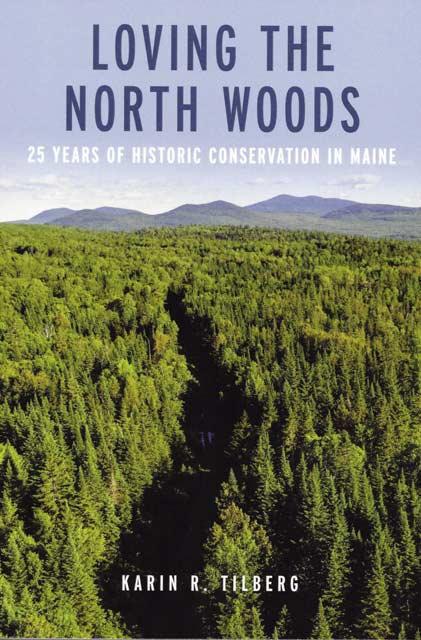
Karin Tilberg recently retired as president of the Forest Society of Maine following decades working on Maine conservation in the private and government sectors. She holds a Wildlife Biology degree from the University of Vermont and a law degree from the University of Maine School of Law. She lives in Salsbury Cove. This article was adapted from her book, Loving the North Woods: 25 Years of Historic Conservation in Maine, published by Down East Books.
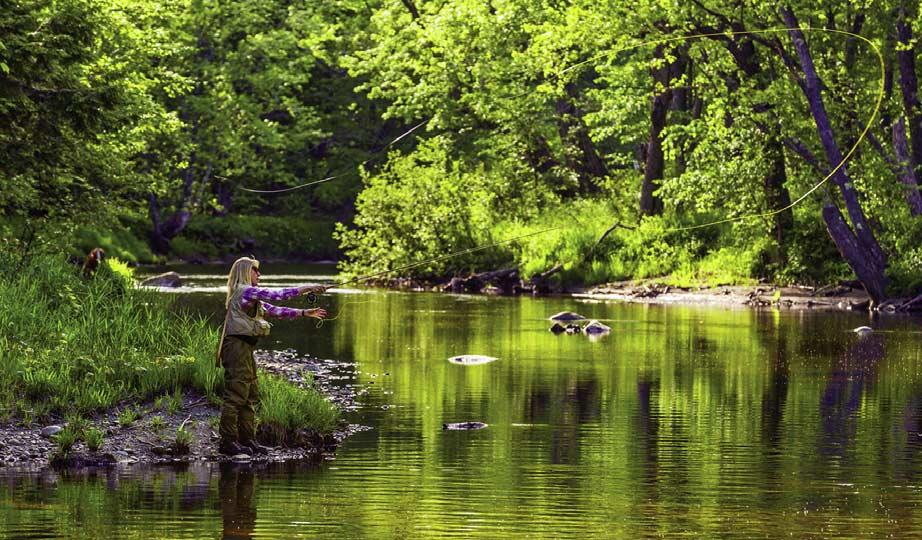
Casting on a stream brings peace and connection deep in the forest.
Maine Attraction WATER SKI SHOW is Broadway on Water
BY CLARKE CANFIELD
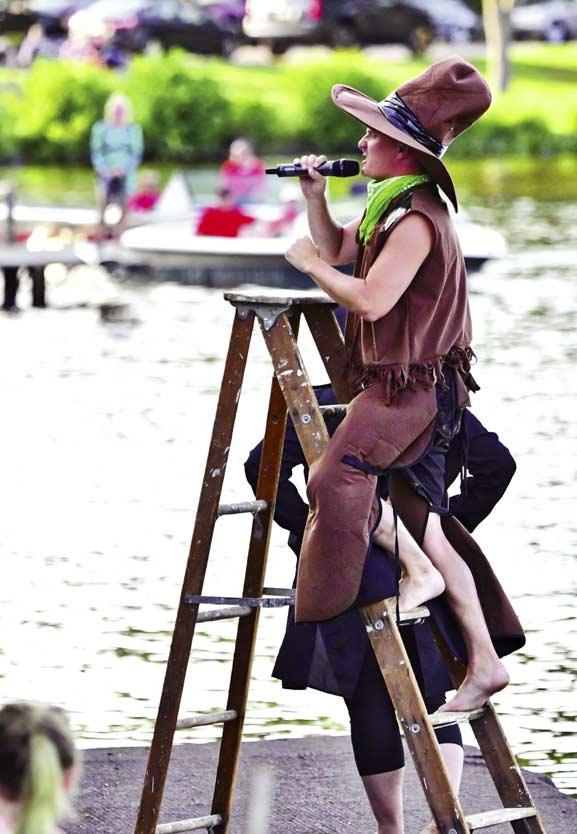
MEMBERS of the Maine Attraction Water Ski Show Team are more than just water skiers. They’re daredevil acrobats, fearlessly flipping, twirling, and spinning as they fly across the water and through the air. They’re entertainers as they wave flags, dance, and whiz by on four-level human pyramids in colorful matching costumes. And they’re actors as they fol-
low a choreographed script with a story line and music that would do Broadway’s show district proud.
Now going into its 37th year, the allvolunteer team puts on weekly hourlong shows on an old mill pond in Sanford, entertaining hundreds of people who line the shores and give their oohs and aahs and rounds of applause. The team has about 55 people in all; besides
the 35 or so skiers, there are boat drivers, announcers, sound technicians, a costume crew, choreographers, a dock crew, and more.
“We like to call it Broadway on water,” said Katie Gray, who runs the show.
Gray’s parents, Mark and Lori Hegarty, started the Maine Attraction Water Ski Show Team in 1989 after
Above and below: The Maine Attraction Water Ski Show Team has been turning heads for decades on Number One Pond in Sanford.
(This page at bottom):
Photo by Sarah Ouellette This page top and opposite page: Photos by Paul Auger (3)
moving to Maine from Florida, where they were professional water skiers at SeaWorld. They were ready to start a family, and decided to move to Sanford so Mark could join a friend in the home construction business.
That first year, the team had about six guys and six girls, Lori Hegarty said. “Since then, it’s grown and grown and grown through the years.”
Team members come from all walks of life: high school and college students, a nurse, a lumber yard worker, an engineer, an occupational therapist, town and school employees, and on and on. Lori Hegarty, at 64, is the oldest member on the team. The youngest is Gray’s son, Gunther, who is 3.
“We’re all over the place,” Gray said.
Team members don’t have to know how to ski to become a part of the team. But what is required is a strong commitment for six months of the year to ensure the show goes on.
Team
members come from all walks of life: high school and college students, a nurse, a lumber yard worker, an engineer, an occupational therapist, town and school employees, and on and on.
The team begins practices every winter inside a local gym to master their moves on land before hitting the lake several evenings a week come warm weather to perfect their routines. The shows are held at 6:30 p.m. every Thursday in July on Number One Pond. A crowd begins showing up half an hour early along William Oscar Emery Drive for pre-show festivities, toting chairs and blankets. Many bring picnics, others enjoy food from a food truck that typically shows up with hot dogs, Italians, ice cream, and the like.
Top and bottom: It takes months of practice on land and on the water to perfect the show’s numerous routines, including the impressive and crowd-pleasing multi-level pyramids.
Above: Skiers can fly up to 20 feet through the air off this jump ramp in the pond.
At right and below: Many of the ski routines would make ballet dancers proud.
Each summer brings a distinctive theme, with different music, costumes, and choreographed acts that follow a script. A sampling of past shows includes “Gilligan’s Island,” “Jungle Ski Safari,” “The Wild West,” “Pirates,” “Hometown High,” and “Christmas in July.”
In addition to the free weekly performances in July and another on Labor Day weekend in Sanford, the team each year takes its show on the road to Rangeley Lake in western Maine and Lake Winnipesaukee in New Hampshire. They also compete in regional water ski show tournaments against teams from other states; they won in 2021 and came in second in 2022 and 2024.
They were even once called upon to do a high-energy television commercial for Twisted Tea, which aired two summers ago (bit.ly/3Da41i2).
Photo by Sarah Ouellette
Photos by Paul Auger (2)
Not surprisingly, all that time together creates bonds among the team members until they, essentially, become a family of sorts.
Erin Fraser, along with her younger sister, joined the team 14 years ago as a senior in high school. Today, she skies on the base tier of a female pyramid team
while also serving as a choreographer for dance portions of the show. One routine features members who dance on a barge that is anchored by the shore, then perform a ski routine before returning to the barge for more dancing.
“Skiing isn’t even my favorite part,” Fraser said. “I love our team so much;
Boating
Photo by Paul Auger
Photo by Sarah Ouellette
they’re like an extended family. I just love being around everybody. I just love hanging out and being with the team.”
Besides bringing its members together, the ski show team also brings the community together for fun outings. The skiers feed off the crowds when they whoop and holler, knowing they’re putting on an entertaining performance.
“We’ve had people come up to us after the show who say we saw you on Facebook or on the news or read about you,” Fraser said. “People come from three hours away just to watch our show. It’s not just local people; people travel to see us—which is really cool when people tell us that.”
The team is a non-profit and performs for free but relies on sponsorships and individual donations to help pay for the equipment, skis, costumes, gas, and the upkeep of four boats. A donation bucket is passed through the crowd during the shows’ intermission, and the team also holds a fundraiser every St. Patrick’s Day.
Lori Hegarty still skies on the team while serving as vice president and sec-
retary. Her husband, Mark, is the primary boat driver and team president.
When she thinks about it, Lori Hegarty isn’t all that surprised that the Maine Attraction Water Ski Show Team keeps chugging along, even decades after it was founded. When Hegarty was a young girl, her father started a similar water ski show team in Wisconsin that is still going strong under the name the Altoona Ski Sprites.
“I guess I had a little foresight into thinking that maybe this was something that could continue for a long time, because his ski team did the same thing in Wisconsin,” she said. “And now here I am in Maine following in my father’s footsteps. Here we are, some 30-something years later and still doing it.” N
Clarke Canfield is a longtime journalist and author who has written and edited for newspapers, magazines, and the Associated Press. He lives in South Portland.
For More Information
Maine Attraction Water Ski Show’s 2025 schedule is available at maineattractionwaterski.com.
An announcer provides commentary on every choreographed act. Each scripted show has a theme, such as the Wild Wild West, shown here in 2019.
Photo by Paul Auger
Map image courtesy of the Penobscot Marine Museum
Keepsakes from the Phillips Brothers’ Maine
BY CATHERINE P. J EWITT AND JOHN T. MEADER
TO look at a Phillips Brothers’ map of Maine is to receive an invitation from cartographers Luther and Gus Phillips to explore more than the quickest route to one’s destination. Between the early 1930s and the mid 1970s, their depictions of the state were as much works of art as wayfinding tools.
The men got their start as creators and purveyors of pictorial maps and photographic postcards. Later, Gus, the younger of the two, introduced recreational and painted maps to his cartographic output.
Both their love for traveling in Maine’s wilderness regions and for supporting themselves as visual artists were integral to the establishment of The Phillips Maps of Maine and State O’ Maine Post Cards businesses.
Luther—who founded the companies—soon took on his brother as an apprentice. Initially, Luther drafted the maps, and Gus added the color.
Ben Meader, a cartographer well acquainted with the Phillips Brothers’ work, described their workflow as more than just cartography—they were also their own distributors. “The Phillips brothers traced, inked, painted, and lettered their maps from scratch. The maps were published and distributed by the authors themselves—often covering hundreds of miles across Maine—and
sold directly from the back of a station wagon.” Delivery trips often included research into new roads, lodging, and tourist sites, resulting in revised editions, he noted.
By the 1940s, Phillips maps and postcards of interior Maine were appearing in many of the sporting camps throughout the North Maine Woods—maps were used as camp decoration, and the postcards were sold to the lodgers. There were maps of the Allagash and the St. John rivers, the Rangeley Lakes Region, the Moosehead Lake Region, Baxter State Park, the Grand Lake Stream area, and Sebago Lake.
In their travels, friendships developed between many of the business owners and the brothers as they delivered orders year after year. While
Augustus “Gus” Phillips, 1898-1975.
(Above) Luther Phillips, 1891-1960.
(At left) Phillips’ map of Northern Maine’s St. John-Allagash Wilderness.
Photos courtesy of Phillips family
Luther’s approach to his clientele was businesslike, Gus would often linger to chat, frequently over a cup of coffee and a piece of apple pie. His delivery routes frequently included overnight stays, often at Augustine’s in Shin Pond or at Pray’s at Ripogenus Dam, on the west branch of the Penobscot River, places where he developed lifelong friendships.
When he could afford a flight, Gus flew with one of the several bush pilots he had befriended, photographing aerial postcards of the lakes and waterways of the North Maine Woods. Although Luther and Gus shared some similar artistic and business goals, they clearly took different paths in life.
Luther Savage Phillips, as a teenager, worked summers at the Asticou Inn at the head of Northeast Harbor. Sometimes wealthy visitors sponsored local youths, providing educational opportunities off-island. Luther’s father, an educator and truck farmer, gave his permission when Luther was offered just such a sponsorship to attend Phillips Andover Academy in Andover, Massachusetts. The summer after graduation he toured Europe with his sponsor and then matriculated at Yale. After two years at Yale, Luther transferred to the Massachusetts Institute of Technology, and in 1914 graduated from the Department of Architecture. He joined the Navy and
attended the US Naval Academy in Annapolis, Maryland. His naval travels took him to many foreign ports; while in Turkey, he met his future wife.
While Luther graduated from MIT, Gus completed his formal education in Maine, entering Hebron Academy for his junior and senior years of high school. There, Gus played several sports and relished his English classes, excelling at
By
the 1940s, Phillips maps and postcards of interior Maine were appearing in many of the sporting camps throughout the North Maine Woods— maps were used as camp decoration, and the postcards were sold to the lodgers.
recitation and memorizing poems. After graduating in 1919, Gus briefly attended the University of Maine, but by October, he was working as a Maine Guide.
Guiding “sports”, as the guests were called, in the Maine woods led him to buy land and a small house in Greenfield. He then married his high school sweetheart, Mary Craig, who had been a neighbor’s governess back in Northeast Harbor. By the late 1930s, Gus and Mary had five children and had moved back to Northeast Harbor. A series of seasonal jobs—including cutting and sluicing ice, delivering produce from the family garden, and chopping and delivering cords of wood—supplemented his map and postcard income.
The map and postcard business required many hours of dedication on top of his other jobs. Still, Gus deliberately carved out time to paint island views during the late 1930s. His plein air painting later would inspire him to do painted maps as well.
Sometimes he brought his youngest daughter, Mary Jane, with him. Many years later it was she who donated Luther’s and Gus’s maps and postcards to the Penobscot Marine Museum in
Mount Kineo on Moosehead Lake is pictured in this Luther Phillips postcard.
The dam at East Outlet with Wilsons on Moosehead Lake in the background. Postcard by Luther Phillips.
Searsport, Maine. The Phillips brothers created dozens of maps and hundreds of postcards. There were maps of both coastal and inland areas. The locations that intrigued the Phillips brothers often received multiple treatments. Along the coast, it was numerous maps of Mount Desert Island, while inland we find four different maps of Moosehead Lake.
The brothers were drawn to this part of Maine frequently, as they boated, walked, and flew over the landscape. Their earliest Moosehead map is Luther’s 1953 pictorial map. The edge of the map is framed by the hand lettered statement GATEWAY TO HAPPINESS and illustrations of local tree specimens. Luther identifies many local businesses, some on a scroll such as Sanders Store, The Indian Store, and Folsom’s Flying Service. Numerous sporting camps are identified on waterways.
Ten years later, Gus’s life had changed. Luther passed away on Christmas eve in 1960, leaving Gus the sole proprietor of the map and postcard companies. His first order of business was to fill current orders and republish older maps and postcards. Eventually he found the time to create more of his own
On several Phillips maps, Gus and Luther share quotes by their favorite writers— frequently Shakespeare or Thoreau—as well as wordsmithing of their own. Indeed, captivating their audience is a skill common to the brothers’ artistry.
work. In 1963 he published his recreational map titled “Phillips’ Map of Northern Maine’s Moosehead-Allagash Region.” Creating a recreational map is different from a pictorial map. Here Gus focused on the specific features vacationers would seek, including paved and gravel roads, trails, public boat launches, and wilderness campsites.
The third map is Gus’s painted map, titled simply “Moosehead Lake.” By
(Left): Luther’s 1953 pictorial map of Moosehead Lake, colored and updated by Gus in 1971.
(Right): Gus’s 1965 recreational map of the Moosehead-Allagash Region.
Painted map of Moosehead Lake by Gus Phillips, 1971.
painting light and shadows to depict the rugged terrain surrounding the lake, Gus illustrated the three-dimensionality of the region. By combining the use of 3D terrain with the imagery of loggers and animals, Gus used elements of both pictorial and recreational maps, creating his own cartographic style. He chose to
remind us of the flora and fauna in the region by embellishing the cartouche with painted evergreens, fish, and local animals.
Among the hundreds of postcards that the brothers created, only a couple dozen or so were “map postcards.” Among them was the popular Moose -
Gus Phillips’s Maine, Then and Now
What happens when a cartographer, a photographer, and a writer walk into a museum?
Eight years ago, the Phillips Collection of postcards, slides, and maps was given to the Penobscot Marine Museum in Searsport by Gus’s daughter, Mary Jane “MJ” Phillips Smith. Soon, cartographer Ben Meader, his father, photographer John Meader, and I, a retired English teacher, met at the Penobscot Marine Museum to help sort and organize the postcards in the Phillips Collection.
My grandfather, Gus Phillips, placed each postcard into its own sealed and labeled envelope, often with its original slide or negative. As we unsealed those envelopes and recorded their contents, we were impressed by the variety of subjects and locations throughout Maine that Gus photographed as proprietor of State O’ Maine Post Cards. As
head Lake card, their fourth unique map of Maine’s largest lake. Originally drawn and printed in black and white, later editions were colored.
On several Phillips maps, Gus and Luther share quotes by their favorite writers—frequently Shakespeare or Thoreau—as well as wordsmithing of
Mainers who had visited many of the locations in the postcards, we frequently stopped to ask “Do you remember…” We compared various postcard views to our own experiences, sparking conversations about whether the locations in Gus’s images from the 1960s are still the same, different, or totally gone today.
Over lunch at Anglers Restaurant in Searsport, we discussed how to share Gus’s creativity, explorations, and travels throughout Maine. As a result of this conversation, we created the blog “Postcards from Gus: A Modern Travelogue Through Maine’s Past.”
We invite you to join us as we revisit Gus’s Maine, comparing what he saw to what we find today. You can find our blog entries at sandboxatlas.org/postcards-from-gus.
—Cathy Phillips Jewitt
Clockwise from top left: Postcards of Maine’s inland lakes and waterways by Gus Phillips include Birch Point Camping Area at Pleasant Lake, Island Falls; Sturdy canoes on the shore of West Grand Lake; Middle Fowler Pond in Baxter State Park; and Mount Katahdin from Abol Bridge on the Penobscot River.
Photos of postcards courtesy of John T. Meader (4)
their own. Indeed, captivating their audience is a skill common to the brothers’ artistry. It is demonstrated by Gus in the early 1960s—this time in wood rather than on paper—when he carved 48 small panels, which depict local flora and
fauna, for the gates that welcome visitors to Thuya Garden in Northeast Harbor.
On Gus’s 1971 Phillips Map of Northern Maine’s St. John-Allagash Wilderness, he included a cursive list of useful items to take on a fishing trip—fly dope, extra
socks, canoe patches, and waterproof matches—all relatable to those with their own camping memories, and good advice to beginners. Gus continued making maps and shooting postcards until close to his death in 1975.
The Phillips artistry invites one to interact with the brothers’ work, and by extension, excites curiosity about the artists themselves. Thanks to the Penobscot Marine Museum’s preservation and the interest of new generations who are discovering the Phillips brothers’ artistry, Gus’s and Luther’s invitation to explore Maine continues. These men, ordinary Mainers with extraordinary talent, put Maine attractions on the map. N
Catherine Phillips Jewitt is a Presque Isle, Maine, native and a retired teacher who taught in both boarding and public schools for 39 years. John Turner Meader of Fairfield, Maine, is a photographer and an astronomy educator. He has travelled to Maine schools and libraries for 38 years with his business Northern Stars Planetarium.
Phillips postcard maps of Moosehead Lake: Luther’s 1953 original and Gus’s 1963 version.
Photos of map postcards
courtesy of John T. Meader (2)
Discovering Maine’s Rivers, Lakes, and Ponds ON THE FLY
BY BEN EMORY
IHAD NO IDEA the sport of casting flies for fish would so sharpen my appreciation of Maine’s history, cultures, and the natural systems that can be found between the North Woods and the sea. This discovery came following widowerhood, when I decided that this old dog could—indeed must—learn new tricks, especially since it involved sharing the passion for flyfishing my coach and now wife, Karin Tilberg, enjoys.
The learning curve for me was—and still is—long, challenging, and a window on an extraordinary obsession. Still to come is mastering tying flies to the clear,
unbelievably skinny monofilament leaders that one can hardly see. Sure, I’ve tied knots in ropes of all sizes, but the leader on a fly rod is something totally different. And the variety of flies! Which type and size to use on what waters for what fish, at what season, and in what weather? Just the names of the flies are mind-boggling and perhaps ludicrous: Maple Syrup, Grizzly Wulff, Montreal Whore.
On a drive north into Aroostook County, my wife directed without warning that we turn into a nondescript driveway in Stacyville. It led to a small
building housing what may be Maine’s most extraordinary fly shop. Owner and retired game warden Alvin Theriault greeted us warmly as we walked past vast tables of flies. I think Theriault said he ties about 13,000 flies a year, and he has helpers too.
Karin’s knowledge of the places and people of the North Woods is deep, having had a long career in forest conservation; she recently retired as president and CEO of the Forest Society of Maine. She already knew Theriault and his work, but I was stupefied to discover the scale of this supply source for fly fishermen.
The author develops his casting from a perch at the water’s edge.
(At left)
Photo by Karin Tilberg. (At right)
Photo by Ben Emory
The essence of the North Woods enchants as the sun sets over a remote pond in the western Maine mountains.
Discussions about fly choices have led me to a much greater understanding of the life cycles of many insects, enhanced by watching a mayfly hatch on Kennebago Lake. Mayflies in all stages from birth to death and from water bottom to above the surface are prime spring food for eastern brook trout and landlocked salmon. There are flies to mimic every stage, and the correct choice from the tackle box is crucial for successful fishing.
I would also learn that Maine’s North Woods are the primary refuge in the United States for eastern brook trout. These multi-hued fish of spectacular beauty are an iconic creature of Maine, as are moose, puffins, and lobsters. The state’s Department of Inland Fisheries and Wildlife labors hard to protect these fish, establishing State Heritage Fish Waters. These water bodies have not been stocked with eastern brook trout or Arctic char in at least 25 years. Stocking and live bait are prohibited to minimize the risk of devastation by invasive species. Maintaining the intact forested landscapes around brook trout waters is essential to their well-being too, because the forests provide nutrients and cooling shade, and they filter pollutants.
Landlocked salmon are of the same species as sea run Atlantic salmon but smaller. According to a 2014 Orvis News posting by Phil Monahan, it is now believed that landlocked salmon evolved from “certain Atlantic salmon that simply stopped going to the ocean” and are not descendants of fish trapped by the rebound of land following glacier
retreat, as once believed. The thrill of hooking these high-energy fighters on a light flyrod entices many anglers to Maine’s fresh waters. I’ve landed a few up to about 12 inches, but on the East Outlet at Moosehead Lake, I found the drawbacks of inexperience. A strong strike was followed by the fish charging me. I failed to keep tension on the line, and the speeding salmon escaped.
Though Karin has been my primary instructor, I have been privileged to spend a few days with Registered Maine Guides. When I lost that salmon, the guide was quick to point out my failure to keep the line taut. Each time we’ve gone with a professional guide I’ve made it clear at the outset I’m a beginner eager for advice. Last May I was with four different guides in two days in northwestern Maine. They rowed double-ended fiberglass Rangeley boats with an angler in the bow and stern. I received much great coaching in addition to engrossing conversation spiced with wonderful tales and laughter. And, as an avid rower, I asked to take the oars to test these excellent boats.
The coaching I received from the guides was not completely consistent, but that is to be expected. Their knowledge, skill, and passion are remarkable and
The author and his wife, Karin Tilberg, take a shore break during a day of fishing in a high-tech drift boat made of aircraft aluminum.
Maine is the last stronghold for eastern brook trout, especially in areas designated as State Heritage Fish Water.
Below: Photo by Ben Emory. Above: Photo by Scott Snell
truly central to the long cultural history of “sports” coming to the Maine woods. Part of what they know is how to prepare lunch over a shoreside fire—bacon, burgers, fried potatoes, coffee. Yum!
All our fishing has been catch-andrelease except during a September sojourn at delightful Nahmakanta Lake Wilderness Camps, owned by Don and Angel Hibbs. Fishing from a canoe on a remote pond, its shores kept wild and undeveloped by a conservation easement held by the Forest Society of Maine, we retained two trout to take back to the sporting camp’s kitchen. Using my mackerel-cleaning skills acquired on Eggemoggin Reach, I knelt at the edge of the pond and sliced open and scraped clean our dinner. Respectful of Wabanaki traditions of paying due homage to wildlife for the sustenance they give, we found catching and preparing these fish a reverential experience.
For me, underlying the enjoyment of flyfishing is the opportunity to be afloat, regardless of the craft, and explore new waters. We’ve cast our flies from western
Maine to the Downeast Lakes and from Mount Desert Island to a remote pond north of Baxter State Park. And we’ve fished from canoes of aluminum and plastic; Rangeley boats of wood and fiberglass, powered by oars and outboards; and an aluminum Lund skiff. Even though made of modern materials, the canoes connect us to one of the Wabanaki’s greatest technological achievements, the birch bark canoe.
A FULL SERVICE YARD
Lightweight, able to be built and relatively easily repaired from widely available natural materials, the birch canoes were perfectly suited for Maine’s myriad waterways.
A totally new type of craft to me is the drift boat. Eager to give me the experience, my wife arranged for a weekend at Wilsons Camps on Moosehead Lake, next to the East Outlet. Scott Snell, owner of the camps with his wife Alison,
Moosehead Lake’s East Outlet.
Photo by Ben Emory
is a noted drift-boat guide. On a gray October morning he had us afloat at first light. Drift boats are a very niche craft, designed and built for the specific purpose of fishing in fast flowing rivers and streams with navigable, although often challenging, rapids. Their origins on Oregon’s McKenzie River are beautifully documented in Roger L. Fletcher’s book Drift Boats and River Dories: Their History, Design, Construction, and Use . Today, they have become popular for fishing rivers with white water in Maine. Dory-like, they have flared sides, high freeboard, small transoms, and a lot of rocker to the bottom to facilitate sliding past rocks in rapids. Construction has evolved from boards to plywood to, in the case of Scott’s new boat from Oregon, aircraft aluminum.
The drift-boat guide rows facing the bow. How Snell used the oars to slow the boat as needed and to angle the boat to the current to control the direction of travel, especially through the boulders and foaming wildness of rapids, was fascinating. He’d anchor frequently in quieter spots, the anchor line controlled by a
foot brake and the anchor dropping from an arm extending aft from the transom.
From my seat in the drift boat’s stern, I watched Karin in the bow have the most exciting, prolonged tussle with a leaping salmon that I have yet witnessed before she finally landed it into the net Snell held over the side. After a fast photo, it was released and swam off.
nated by the National Audubon Society as globally significant for migratory song birds. During spring, the woods are alive with bird song.
That energized salmon strengthened my sense of connection to the extraordinary ecosystem—to the creatures and plants of the waters and woods all around. While fishing close to forested shores, I have been as awed by the birds as the fish. Maine’s North Woods is the largest area in the United States desig -
The joy of being immersed in this natural world was encapsulated by a calm evening casting toward the circles of fish rises while standing in a Grant’s Camps’ Rangeley boat off the northeast shoreline of Kennebago Lake. Thrushes sang from the forest as the sun dropped in a sky turning from blue to purple and gold above the low pyramid of West Kennebago Mountain, which darkened with the evening’s onset. We watched other boats anchored in the same area with anglers patiently casting in the quiet, also savoring the privilege of being there. For me, flyfishing has brought a whole new connection to nature and enhanced appreciation of the imperative to sustain and properly manage Maine’s North Woods. N
Ben Emory splits his time between Salisbury Cove and Brooklin, Maine. He is the author of Sailor for the Wild—On Maine, Conservation and Boats, published by Seapoint Books.
Lise Bécu and her stunning Mother Totem on a sunny winter day in Tenants Harbor. 2016, granite, 8' x 16" x 8"
LISE BÉCU’S Benevolent HAND
IN THE DEAD of this past winter, sculptor Lise Bécu’s home in Tenants Harbor on the St. George Peninsula offered a cozy retreat from the chill outside. Seated at a table in the kitchen, Bécu recounted her life in sculpture, starting with humble beginnings in the town of Chandler on another peninsula, the Gaspé in Quebec, Canada. Through study, skill, and determination, she became a beloved and acclaimed carver of stone, represented today by several of Maine’s best-known galleries.
Bécu’s first stone carvings were “barely etched” because “it was so hard to get into that granite.” Nowadays she has grinders with “great big diamond wheels,” a far cry from the hammer and chisel she started out with.
Bécu is a brilliant animalier, an artist of animals. Her creatures include all manner of birds, plus rabbits, turtles, snakes, and an elephant. Each one has character, its features etched with a benevolent and loving hand. A cat curls into itself; a colorful trout swims by, open-mouthed; a horned bison grazes.
The sculptor goes with the flow, letting the subject emerge from the contours of the chosen stone. Watching the PBS documentary about Leonardo da Vinci, she found alignment with what the Renaissance artist said about having to practice seeing familiar forms in unfamiliar places. “That’s how I work,” she said.
Among Bécu’s signature pieces are sculptures that combine figures, usually female, with an animal, often a bird. In
Mother Totem , a stunning granite piece that stands 8 feet tall, a crested peacock perches atop a woman, one of its claws gripping her shoulder. The graceful stonework and the heartfelt nature of the presentation give the sculpture a sacred quality.
Bécu considers Spirit of the Marsh , carved at the 2011 Schoodic International Sculpture Symposium in Prospect Harbor, to be her most ambitious work and the most exciting piece she has ever made. Working with fellow sculptor and symposium founder Jesse Salisbury, she extracted a black granite boulder from the Pleasant River Quarry in Addison and transformed it into a stunning representation of a figure cradled in the wings of a great blue heron.
“We are totally intertwined with nature,” Bécu has said apropos this piece, which is permanently sited by a marsh in Addison. She chose the heron as a symbol of skill and patience. “I also like that the Iroquois people considered it an omen of good luck,” she has noted.
A number of stone walls run through the 3-acre lot Bécu shares with her husband, musician, boatbuilder, and fisherman Robin Elliott. These walls supply material for her sculptures as does a vein of basalt in the area. From time to time, someone will bring her a stone or she’ll see one at a neighbor’s and ask for it. She has also found stones along the road and on the coast.
Bécu prefers hard stone, but on occasion will work in alabaster and limestone. She doesn’t mind if the stone is beat up. “To me,” she explained, “there’s a certain beauty in the cracks and wear.”
The sculptor works on several pieces at a time, moving from one to another. “You need to stop, step away,” she noted, adding, “You don’t see it anymore if you
Above: Bécu has a special passion for birds. Snowy Owl, 2024, gneiss stone, 9" x 16" x 12"
Below: Mandolin Player might be a self-portrait of the musician-sculptor. 2018, gneiss stone, 24" x 16" x 12"
look at it for too long.” On a February day she had several works in progress, including a first for her: a woman with a lobster.
Growing up in Quebec, Bécu recalled, there was little art in the schools. For several years, she received guidance in painting and illustration through the Famous Artists School. She had pleaded with her mother to buy a subscription from a door-to-door salesman. “My mother always said that’s where she made her mistake,” she recalled with a laugh. Founded by
members of the Society of Illustrators in New York City, the school provided critiques of monthly assignments through the mail.
As a youngster, Bécu often went to church where the services were long and in Latin. “There wasn’t much to do but look at the art,” she recalled. “My favorites were the 12 Stations of the Cross carved by Médard Bourgault.”
Bourgault (1897-1967) was a founder of the École de Sculpture Sur Bois in Saint-Jean-Port-Joli, Quebec. After briefly attending the college-level Cégep
de Rivière-du-Loup—she spent most of the time in the art studio—Bécu enrolled in this school of traditional wood sculpture where she studied with the founder’s nephew, sculptor Pierre Bourgault. She loved carving in wood. She also remembers being drawn to Inuit art at the Hudson’s Bay Company store.
While at the school in the mid1970s, Bécu met Steve Lindsay, a sculptor from New York. The two married and moved to Maine in 1977. They lived with their two daughters in a house across from the Wildcat Quarry in Tenants
Bécu is a brilliant artist of animals.
Left to right: Cat (Sleeping), 2023, basalt, 11" x 6" x 8"; Bison, 2011, granite, 15" x 5" x 11"; Turtle, 2024, granite, 4" x 7" x 8"
A masked Bécu working on Men and Birds in a Boat, 2011.
Harbor. “There was a lot of stone carving tools left behind,” Bécu has recounted, “so I started banging on stone.” She was glad to shift to stone as wood would eventually crack or rot—or attract carpenter ants as one of her pieces once did in Judith Leighton’s gallery in Blue Hill.
Bécu’s first stone carvings were “barely etched” because “it was so hard to get into that granite,” she recalled. Nowadays she has grinders with “great big diamond wheels,” a far cry from the hammer and chisel she started out with.
Mexico, about half way between Albuquerque and Santa Fe. She recalls the hot springs and dining on trout caught in a nearby river. She befriended several artists, including acclaimed Chippewa sculptor Rollie Grandbois (1954-2016).
Bécu has done her own mentoring over the years. She mentions a neighbor, Noah Bly, whom she has known since he was a baby. When he started making knives as a teenager, she suggested he work on a forge. After going to school to become a mechanic and working in his
In 1979 Bécu studied at the Arts Students League in New York City with Sidney Simon, one of the founders of the Skowhegan School of Painting and Sculpture. She was also his studio assistant. Further practice took place in 1986 and 1987 when she rented studio space with Joan Esar who ran the Atelier Sculpt at the University of Quebec, Montreal. She later participated in cultural exchanges in Finland and France.
Maine sculptors Bernard Langlais, Clark Fitz-Gerald, Jane Wasey, Cabot Lyford, and others inspired Bécu to pursue her carving art. Langlais’s studio assistant Bill Coyne (1950-2020) gave her a place to stay in Brooklyn while she was taking classes at the Art Students League.
From 2005 to 2010, Bécu spent winters in the Jemez Mountains of New
father’s shop, he started Ridge Forge Metalworks. “He’s got more work than he can handle,” she reported with pride in her voice.
Although best known as a sculptor, Bécu has always painted and drawn. Today, some of those works are stored away in an upstairs room of her Tenants Harbor home.
In the mid-1990s while living in Portland, Bécu helped paint the scenic backdrops for The Nutcracker after they built a new stage for the Merrill Auditorium. She is nostalgic for those days when “you could live somewhere on a handshake.”
Recently, Bécu has been making remarkable collages using recycled magazines. These works in progress—“far from finished,” she noted—remind her
of the stained glass windows in her childhood church.
This new art avenue is due in part to the wear and tear Bécu has experienced as a sculptor. “The actual carving isn’t bad,” she explained, “but the moving the stone around—it’s so heavy.” While not ready to hang up her stone-working tools, she is exploring other means to satisfy her creative desires.
When not making art, Bécu plays the fiddle. For a number of years, she performed with her husband, a country blues guitarist, who at age 7 studied classical music with Elizabeth Riley (19102016), a protégé of Andrés Segovia. These days she teams up with Rosey Gerry, a woodcutter from Lincolnville, to perform traditional country, rock tunes, and singalongs in libraries, farmer’s markets, churches, and other venues.
Bécu’s first instrument was a $50 fiddle purchased at Elmer’s Barn in Cooper’s Mills in 1980. A German-made violin dating from 1860 and a made-in-Maine mandolin were gifts from friends. Her sculpture Mandolin Player might be a self-portrait.
The house in Tenants Harbor is filled with art, including paintings by Elliott’s father, James Elliott, who was director of the Portland School of Fine and Applied Art. Bécu’s small ceramic and terra cotta sculptures line a shelf, and there’s a drawer full of her ideas for children’s books.
The surrounding property doubles as a sculpture garden. With snow on the ground, carved animals and figures stand out here and there against the winter landscape. Several out buildings serve as workshops for her and her husband. Bécu tends to move indoors in the winter, but once it gets over 40 degrees, she’s back outside, ready to turn a piece of stone into a work of enduring art. N
Carl Little’s most recent publications are Blanket of the Night: Poems and the monograph John Moore: Portals. He lives on Mount Desert Island.
For More Information
Lise Bécu is represented by the Caldbeck Gallery in Rockland, Courthouse Gallery Fine Art in Ellsworth, and June LaCombe Sculpture in Pownal.
Bécu created Spirit of the Marsh “to be a peaceful and benevolent presence.” 2011, Addison black granite, approx. 4½' x 4½' x 2'.
Photo by Jesse Salisbury courtesy
Schoodic International Sculpture Symposium
When Canoes Ruled the KENNEBUNK
BY EARLE G. SHETTLEWORTH JR.
IN the years following the Civil War, summer colonies developed along the Maine coast, from York Harbor to Grindstone Neck, in downeast Winter Harbor. Prominent among these was Cape Arundel, which was established by the Kennebunkport Sea Shore Company in 1873. As this summer resort attracted visitors, boating on the Kennebunk River became a popular pastime. In 1888, summer residents started the Lobster, Boat and Canoe Club. To stimulate membership, the club held canoe races on the river for men, women, and boys. After successful seasons in 1888 and 1889, the Lobster Boat and Canoe Club became the Kennebunk River Club. In March 1890, the club contracted with the local builders Meserve and Nason to
A crowd gathers on the shore of the Kennebunk River to watch a canoe race held by the Kennebunk River Club.
Women enjoyed canoeing on the Kennebunk River.
All photos by Aaron B. Houdlette courtesy of the Maine Historic Preservation Commission
construct a 45- by 75-foot clubhouse from designs by architect Frederick W. Stickney of Lowell, Massachusetts. Opened on August 2, 1890, the Kennebunk River Club is a striking example of the Shingle Style favored for New England recreational buildings and summer cottages during the late 19th century.
The river façade of the clubhouse presents a pleasing classical appearance, with its series of five small arches on the first story supporting a large second story arch that is encompassed by a broad gable roof.
On July 30, 1890, The Wave, a twiceweekly seasonal newspaper in Kennebunk, described the view from the second story: “The upper balcony commands a view of the shore from the piers, past Wells, York, and York Nubble, of the river itself inland, and the foothills of Mount Washington so that seashore and country are united in a view unsurpassed on the Maine coast.”
With its combination of social space and boat storage, the new clubhouse immediately became the focal point for summer activity on the Kennebunk River. Although several types of boats were used on the waterway, the canoe was the most popular, until it was replaced by motorized craft in the 1920s.
Beginning in 1888, Joseph Ranco, a member of the Penobscot Nation in Old Town, built birch bark and canvas canoes in Kennebunkport during the summer months. He was joined in this work by other Penobscot Native Americans, as well as members of the Passamaquoddy Nation from Pleasant Point in Eastport.
Summers, the Kennebunk River was often crowded with canoeing enthusiasts.
Opened in August 1890, the Shingle Style clubhouse of the Kennebunk River Club is still in use today.
These canoe builders also guided canoeing excursions on the river.
The Kennebunk River Club’s early boating activities are documented through photographs by Aaron B. Houdlette, who operated a summer studio in Kennebunkport during the 1880s and ’90s. Born in Dresden, Maine, in 1831, Houdlette was listed as a
daguerreotypist in Richmond in the 1860 census. By 1875 he was working as a photographer in the Boston area, where he was active until his return to Richmond in 1898. There, he continued to practice photography until his death in 1909.
While Houdlette’s Kennebunkport photographs record many aspects of late
19th century summer life, his views of canoeing on the Kennebunk River are especially engaging depictions of the sport.
Today the Kennebunk River Club retains a central role in the recreational and social life of the Cape Arundel summer colony. Tennis joined boating when the club absorbed the Arundel Casino many years ago. The historic boathouse is still actively used, having been restored in 2009. This distinctive Shingle Style building is a living landmark, having been recorded by the Historic American Building Survey in 1965 and listed in the National Register of Historic Places in 1975. N
Earle G. Shettleworth Jr. directed the Maine Historic Preservation Commission from 1976 to 2015, and he has served as Maine State Historian since 2004.
To learn more about Joseph Ranco
Read Benson Gray’s article “Joseph Ranco: An Early Master Canoe Builder” in MBH&H’s September/October 2023 issue #184.
Photographer Aaron B. Houdlette captured this picture of a girl giving the family dog a canoe ride.
The Kennebunk River Club sponsored canoe races for men, women, and boys.
Sign of Spring Camden’s Mother’s Day
PERENNIAL SWAP
PHOTOS & STORY BY LYNETTE L. WALTHER
WINTER weather extremes, a short growing season, biting insects and all the other challenges that come with growing things in Maine have brought together a loose confederation of committed gardeners in Camden, who, come spring, reaffirm their kinship and share their love of plants on Mother’s Day.
This May will mark 40 years that this group of mothers and daughters, an occasional father and son, and now grandchildren have come together at the home of Susan Shaw. The annual gathering gives all an opportunity to reconnect in their busy lives, sample delectable treats, take in Shaw’s glorious gardens bursting with thousands of daffodils and spring-flowering plants, and share a spring day outdoors. But most importantly, these gardeners come together to swap plants.
“Cynthia Anthony and I started this tradition,” said Shaw, when her son was a baby. “None of us had much money to
Susan Shaw, hostess of the annual Mother’s Day perennial exchange, is also ringmaster when it’s time to pick plants.
Sylvan Cartwright, a gardener-in-waiting, is ready to sample treats and enjoy the day.
splurge on plants. Though, yes, we did anyway. Our gardens had grown and we did have enough to share. I had some delights that my mom had shared with me from her northern New Jersey garden. I had a passion for old fragrant roses and herbs.
“Cynthia and I invited friends, and made a few snacks to share,” Shaw added. “Her sister, Janice Anthony, already had amazing gardens and intriguing plants to share. Though a few of us thought we should try an exchange in the fall, it didn’t catch on. Somehow Mothers’ Day seemed the best.”
Shaw recalled that when it was a smaller group, “we each took numbers, and had time to enjoy watching what everyone chose first.” These days, the exchange has become a bit more formalized, and those children have all grown up now. Now, more often their grandchildren accompany them to the event.
Over the years, the plant offerings have in some cases become more sophisticated and rare. It is the place where one might encounter the uncommon double bloodroot or a double trillium, a choice hybrid hosta or perhaps heirloom tomato seedlings or other heirloom perennials rarely found at a garden center. But just as likely there will be the tried-and-true standbys. The only plants not welcome at the exchange are weeds.
Shaw and her guests look forward to each year’s gathering and welcoming new participants.
This is not a group of plant snobs conversing mainly in Latin—although many are quite comfortable tossing around
Susan Dorr describes one of the plants she brought to the exchange. Each plant gets an introduction, often with advice on how and where to grow it.
botanical names. Shaw, herself, is a daylily hybridizer of national acclaim. But this crowd is hardly a closed society. Longtimers often bring along new neighbors or family members.
This Mother’s Day exchange is where many novice gardeners go away with more than just some hardy perennials. They get the opportunity to learn a lifetime’s worth of practical plant knowledge from a group of seasoned gardeners.
At the Shaw house, the snack table is usually groaning with an overload of hand-baked and freshly prepared treats, the offerings of food and friendship are generous all around. One by one, the participants arrive, each laden with their plants. There is plenty of time for socializing, exploring Shaw’s spring garden brimming with flowering bulbs, hellebores and more, and of course discussing new plants before the real fun begins.
Shaw gets the ball rolling by introducing the 10 or 12 plants she has to offer for the exchange.
At the appropriate time, Shaw calls the assemblage to order. She gets the ball rolling by introducing the 10 or 12 plants she has to offer for the exchange. She explains what each plant is and usually adds the correct botanical name. She shares whether it flowers, what color the flowers are, and what time of the season to expect them. She details how big the plant gets and whether it likes full sun, partial shade, or any other pertinent growing information.
This process of presenting the plants then goes to the next person. Granted, it takes quite a while to get through all the offerings, and it is frequently interrupted with specific questions. This is now serious business, after all, and everyone wants to know all they can about what’s there for the choosing.
When all the participants have spoken, Shaw tells everyone it is time to, “Select your first plant!” A somewhat orderly scramble ensues as everyone goes after the one they have their heart set on. Fortunately, some bring multiples of the dozen or so plants they have to offer.
After checking that the first round is completed, Shaw calls for a second, and so it goes until nearly all the plants have been re-distributed. Any extras find good homes, either with those assembled or via one of the many upcoming non-profit plant sales that attendees might be working with.
And so, each Mother’s Day, everyone goes home with at least a dozen new plants and warm memories. Mamma
mia, the Camden exchange has now become a perennial on its own—and promises to thrive and grow as the years go by. N
Contributing Garden Editor Lynette L. Walther is the recipient of the GardenComm Gold Award, Maine Press Association’s Community Columnist Award, and National Garden Bureau’s Exemplary Journalism Award, among others. She gardens in Camden.
Since 2016, Seamus Hourihan, owner of Thirst, a Gunboat 55, has been cruising and racing the Atlantic and Caribbean, from Nova Scotia to Grenada. When it came to servicing his 57-foot-long, 24-foot-wide catamaran, Seamus turned to PYS for solutions.
“You can’t haul a catamaran of this size just anywhere,” Seamus explained. “Options in Massachusetts and New Hampshire were nonexistent, and I was aware of only two yards in Maine—until I found PYS.”
PYS tackled major challenges, from blistering bottom paint and leaking deck hatches to sticking doors and windows, as well as engine and hydraulic maintenance. “All these projects were completed on time for the spring 2021 launch,” Seamus noted. Since then, he has returned annually for service whenever he’s not sailing the Caribbean.
Seamus praised PYS for their proactive and responsive approach. “PYS has been critical in resolving problems remotely and investigating root causes to prevent future issues. Their team is friendly, attentive, and delivers practical solutions.”
At PYS, we take pride in our exceptional service, state-ofthe-art facilities, and a team you can trust. Experience the PYS difference for yourself!
100 West Commercial Street, Portland Maine (207) 774-1067 • www.PortlandYacht.com
FLAGSTAFF LAKE: What Lies Below
WITH Kingfield and Carrabassett in the rearview mirror, we continued on Route 27 another 15 or so miles to the village of Stratton. Part of the town of Eustis, it lies in a valley in Maine’s northwestern mountains. Just beyond the commercial center, we pulled into a scenic turnout beside Flagstaff Lake—at more than 27 miles long, Maine’s fourth-largest lake. We’d come to learn the unsettling backstory of this expanse of water, which spreads out below the towering peaks of the Bigelow Mountain Range.
I’d heard bits of the heart-tugging tale years ago, and then again more recently when I joined a wintry snowshoe trek beside the lake to spend a night at Flagstaff Hut, part of the Maine Huts & Trails system. When the frozen lake lured us onto the ice, I was captivated by thoughts of what once happened beneath us.
On our more recent visit, on a sunny day last October, we rendezvoused at the turnout with Master Maine Guide Jeff Hinman, who operates summertime nature and history pontoon-boat tours
It was difficult to imagine how hard it was for all the families of the Dead River Valley to face the obliteration of their homes, their land, and their livelihoods, and to have to start over somewhere else.
here. He’d brought along a map showing how differently the view in front of us had looked before 1950. That’s when Central Maine Power flooded the Dead River Valley to create Flagstaff Lake as a reservoir to hold spring runoff from the Upper Dead River watershed; the water is later drawn down to power hydro dams on the Kennebec River.
“Flagstaff village was here,” Hinman said, pointing to the old, hand-drawn
Today, visitors get views of Flagstaff Lake from the Cathedral Pines Campground, with the Bigelows beyond.
This photo of Flagstaff’s Main Street, now in the Penobscot Marine Museum’s collection, appears on an information sign by the lake.
map. “Dead River village was over here.” The hamlets of Bigelow and Carrying Place were also flooded. Residents were notified of the plan years in advance, though many thought it would never happen. Over the course of several decades, CMP bought up numerous houses and farms. Other owners moved their structures out of harm’s way. Some were still awaiting settlements from CMP when their homes were inundated.
“The roofs stuck up out of the water afterwards,” Hinman said. “The next winter when the lake froze, crews went out and burned them. When the water is low, you can still see old stone foundations below the surface.”
On a couple of informational signs beside the lake, I found an early 1900s
If you go to Flagstaff Lake
On the Water
For those trailering their own boats to Flagstaff Lake, a launching ramp can be found diagonally across Route 27 from the scenic turnout just north of the village of Stratton, and at Cathedral Pines Campground. The private marina at Flagstaff Landing has slips available both seasonally and nightly. Master Maine Guide Jeff Hinman cautions that the lake is shallow, and old tree stumps left from clearcutting done prior to the flooding can pose a hazard. Boaters who are unfamiliar with the lake should exercise caution.
Do
From late May through September, Jeff Hinman operates Flagstaff Scenic Boat Tours aboard his 22-foot pontoon boat. Two-and-a-half-hour trips highlight the area’s history and wildlife. Other tours include full-moon cruises and wildlifephotography outings. In a former church built in 1878 at the center of Stratton village, the Dead River Area Historical Society houses collections pertaining to native people, logging, guides and sportsmen, and the lost villages. It’s open on weekends in July and August.
Eat
Expect a warm welcome at the White Wolf Inn & Restaurant from owner Sandy Isgro, who bakes bread every morning. It stars in such sandwiches as grilled cheese and a turkey club with roasted-in-house turkey. Across the road, order from the large menu of comfort food at Backstrap Bar and Grill There’s a meat market in the back room; the packaged game sausages (venison, duck, boar, and more) are excellent. Open for breakfast, brunch, and lunch, the Looney Moose Café
serves such perennial favorites as chili in a bread bowl, meatloaf, and burgers. Get there early to score some of the freshly made donuts. One of 11 locations throughout Maine, Brickyard Hollow Brewing Company can be found in a renovated barn at Flagstaff Landing. The menu includes lots of popular pub food, plus the company’s own craft beers. Accommodations and a marina are also on site.
Paddle and Hike
Accessible year-round, the nonprofit Maine Huts & Trails system offers more than 50 miles of non-motorized, multiuse wilderness trails that lead to several off-grid eco lodges. The trails are free to the public; most are considered easy. Some are groomed for winter skiing. Bordering much of Flagstaff Lake, the Bigelow Preserve provides exceptional opportunities for backwoods hiking and climbing. Covering more than 36,000 acres of public land, it encompasses all seven summits of the Bigelow Mountain Range, including one of Maine’s 10 4,000-foot-plus peaks. A segment of the Appalachian Mountain Trail runs through the preserve. The 740-mile-long Northern Forest Canoe Trail passes across Flagstaff Lake. Kayaks and canoes may be rented at Cathedral Pines Campground. Lodgers staying at Flagstaff Landing have complimentary use of kayaks and canoes. Remember that this is a reservoir—check the dam release schedule in advance of your outing. Also bear in mind that winds can pick up quickly over this large expanse of water. Set on 300 acres, the town-owned Cathedral Pines Campground includes a sandy beach on Flagstaff Lake that is also open to daytime visitors at no cost. It also maintains 115 tent and trailer sites in a quiet, wooded setting.
Prior to being flooded, Flagstaff village was a waterside community.
Photo courtesy Penobscot Marine Museum
photo of Flagstaff Village’s Main Street showing E. J. Leavitt’s General Store and Post Office before the flooding. There was also an “after” picture of the building standing in water up to its second story. Other photos captured Evelyn Leavitt assisting a customer in the general store, and a class of youngsters posing on the elementary-school steps. It was difficult to imagine how hard it was for all the families of the Dead River Valley to face the obliteration of their homes, their land, and their livelihoods, and to have to start over somewhere else.
In 1950...Central Maine Power flooded the Dead River Valley to create Flagstaff Lake as a reservoir to hold spring runoff from the Upper Dead River watershed.
The name Flagstaff hints at another historic event: In 1775, Colonel Benedict Arnold and 1,100 soldiers embarked on an arduous expedition up through the Maine wilderness in a failed attempt to capture British-held Quebec City. (This occurred several years before he became a traitor.) Legend has it that Arnold planted a flagstaff here before moving on, and the village’s name commemorates his gesture.
The Arnold Expedition visit also inspired the name of the Bigelow Range. According to a contemporaneous account, Major Timothy Bigelow summited one of the peaks in the long mountain ridge “for the purpose of observation.” He’d reportedly hoped to see the spires of Quebec City from the top. Obviously, his geographical knowledge was flawed.
A much more serious miscalculation led to a fatal midair collision over the lake in 1959. During a radar training mission conducted by the U.S. Air Force’s 37th Fighter-Interceptor Squadron (out of Burlington, Vermont), one of the Convair F-102 Delta Dagger fighters accidentally struck the wing of a Lockheed T-33 Shooting Star that was posing as an enemy aircraft. Both planes crashed. The crew of the T-33 ejected successfully, though one man died when his parachute malfunctioned. The pilot of the F-102 was never found.
In the winter of 1979, a local man snowmobiling on the lake came upon part of the F-102 protruding from the ice. Hinman knew him and related the story to us: “He removed one of the bombs from under the wings, took it home, and set it on his kitchen table. When he called authorities to alert them of his discovery, they stressed that the bombs on the plane were still live. So when officials came to his house to be directed to the crash site, he hid the
Flagstaff Memorial Chapel was built from parts of a church that stood in Flagstaff Village before the flooding.
bomb in the trunk of his wife’s car! In the end, he did turn the bomb in.” The hazardous wreckage was safely destroyed by authorities.
After leaving Hinman, we drove a few miles farther to the Cathedral Pines Campground. Walking on its sandy beach beside Flagstaff Lake, we spied fresh moose hoofprints. We weren’t treated to a sighting of the animal, but it was exciting to think it could be in the piney woods nearby. As we took in a panorama of the lake and the Bigelow peaks just beyond, we watched a family paddle by in two kayaks. I wondered if they knew about the dramatic events that unfolded here.
Before leaving the area, we made one more stop on Route 27. The Flagstaff Memorial Chapel was built using the pulpit, pews, bell, and other parts from a church where Flagstaff villagers once worshipped. The simple, white structure, and the relocated graves beside it, are a poignant reminder of a sorrowful chapter in Maine’s history. N
Contributing editor Mimi Bigelow Steadman lives on the Damariscotta River in Edgecomb.
The
This street view of Flagstaff Village shows a well-kept neighborhood.
Above:
Photo by Mimi Bigelow Steadman
Maine oysters were once again in high demand in 2024, earning growers and harvesters $14.9 million on the strength of an 11-cent price per pound increase for harvesters, which placed the fishery as Maine’s third most valuable. In fourth place was menhaden, a favorite bait of lobstermen, which earned Maine fishermen $13.2 million at the dock. Maine elver harvesters earned $12.2 million, ranking it Maine’s fifth most valuable as a result of a $1,239 per pound price paid to fishermen.
Cangarda goes to Turkey
The last American steam yacht has left the country. The classic 1901 steampowered yacht Cangarda was loaded onto a transport ship at Front Street Shipyard in Belfast last fall for a transatlantic crossing to Turkey after Turkish businessman Rahmi Koc bought her to display in his Rahmi M. Koc Museum in Istanbul. Built at the Pusey and Jones Shipyard in Delaware, the 136-foot vessel primarily served as a private yacht,
although during World War II it was loaned to the Royal Canadian Navy for war use. Stuck in the mud in Boston Harbor in the late 1990s, the boat was restored for Robert McNeil, an Islesboro summer resident who stored her at Front Street. Cangarda was a frequent sight around Penobscot Bay in recent years, and at classic yacht regattas where she served as a tender.
Women in the water
More than 1,500 women joined hands and walked into the icy cold water in South Portland to celebrate International Women’s Day last March in what organizers said was the coldest and
largest women’s day dip in the United States. The long line of hand-holding women stretched the length of sandy Willards Beach as they entered what one participant described as 37-degree water together with screeches and laughter. It was the fifth such women’s day dip organized by Two Maine Mermaids, regular water dippers who call themselves Ebb and Flow and run a web page devoted to cold water experiences.
Marinas bought and sold
Two Maine marinas, Safe Harbor Rockland, the former Yachting Solutions Yacht Basin, and Safe Harbor Great Island in Harpswell, were among those sold last
The International Women’s Day dip at Willards Beach had the largest number of participants in the U.S.
Photo by Polly Saltonstall
winter by Safe Harbor holdings. The investment firm Blackstone Infrastructure acquired all of Safe Harbor’s 138 marinas across the United States and Puerto Rico for $5.65 billion. The Dallasbased Safe Harbor was acquired in 2020 by Sun Communities for $2.11 billion.
Boston Marine Services, an affiliate of Ocean Havens, has acquired Boston Boatworks, which had filed for bankruptcy earlier this year.
Ocean Havens operates marinas in Boston and Provincetown, Massachusetts, and Portland, Maine, including the Fore Points Marina.
Meanwhile, Hinckley Yachts has added to its holdings with the acquisition of Bay Bridge Marina on Kent Island in Stevensville, Maryland. Fullservice Bay Bridge Marina spans approximately 15 acres, with 243 floating slips for boats from 30 to 130 feet.
Lost through the ice
Who do you call when things sink through lake ice? Folks in Maine this winter called Greg Canders, of Bangor, according to an article in the Bangor
Daily News. This winter found Canders hauling a U-Haul out of a lake, finding a pair of Bucksport-area dogs that fell through river ice, and floating a snowmobile up through 180 feet of water— all while recovering from a broken arm, the newspaper reported. Canders started diving in 1970 when he was 16 and took up ice diving about a decade later, according to the BDN . He’s recovered outdoor vehicles as large as a full-sized John Deere skidder and snow grooming equipment used for trails.
Whatever does fall into the water, Canders told the BDN , he is willing to find it. “I’ve had a lot of great experiences, seen a lot of great places and met a lot of great people” through diving, he said.
Sea-run fish in the news
Efforts to restore passages for sea-run fish species on five Maine water bodies have provided several Maine towns with the opportunity to have a commercial river herring harvest. The Atlantic States Marine Fisheries Commission has approved commercial fishing opportunities for alewife and blue-
back herring on Sewall Pond, Wight Pond, the Pennamaquan River, Chemo Pond, and Pushaw Lake, according to a news release.
Meanwhile, efforts are underway to restore fish passages at the Mill Brook Dam in Searsport, Pitcher Pond Dam in Lincolnville, and Chickawaukie Pond Outlet in Rockland. The Penobscot Indian Nation, in collaboration with state, federal, and local partners, is leading the collaborative project to address long-standing barriers that have severely impacted native fish populations, according to a news release from the Penobscot Nation. Currently, there is no effective passage at the three sites.
The initiative aims to assess structural and environmental conditions, explore engineering solutions, and implement actions to allow fish to reach historic spawning areas.
And moving on to bigger fish: 300 mature Atlantic salmon were released this year into the upper reaches of the East Branch of the Penobscot River, as part of a three-year effort to restore populations of this critically endangered
A Marina Holdings Company
species. “The East Branch of the Penobscot has lots of high-quality habitat for Atlantic salmon, but mortality in both the marine and freshwater environments prevents many from reaching it,” said Department of Marine Resources Scientist and project lead Danielle Frechette. “One of the best ways to help Atlantic salmon move towards recovery is to have more adults spawning in this high quality, but largely vacant habitat.”
It is estimated that 100,000 Atlantic salmon once made the annual spawning migration back to the Penobscot River. However, dams, log drives, pollution, and overfishing combined to bring Atlantic salmon to the brink of extinction. Poor survival in the ocean has made the problem worse. The salmon released into the Penobscot were raised in a collaborative effort involving federal, state, and Native American agencies, as well as the University of Maine and Cooke Aquaculture USA.
Biologists will track the released salmon as they spawn and make their way out to the ocean, using a combination of canoe surveys to look for redds, which are nests where salmon deposit eggs, and acoustic telemetry to track tagged salmon.
Ferry bids too high
Plans for a new hybrid ferry to replace the Margaret Chase Smith , which runs between Lincolnville and Islesboro, were set back this winter when the bids came in way above budget. Maine State Ferry Service Director William Geary sent a note about the issue to members of the service’s advisory board last winter, according to the Bangor Daily News
“The two bids received were millions more than funding available and we will not be awarding a contract based on these bids,” he said.
The Maine Department of Transportation had secured a $28 million grant to cover 80 percent of the cost of the new boat, but the bids that came in were in excess of $41 million, according to the news report. “MaineDOT will be evaluating next steps over the next weeks and months, including monitoring the status of existing and future grant funding and programs at the federal level,” Geary wrote.
Bottom wrap with potential Finsulate USA, a Maine-based, womanowned business, has launched a new product designed to protect vessels while safeguarding marine ecosystems, according to the Maine Technology Institute, which has been working with the company.
Finsulate Wrap uses a biomimetic solution inspired by sea urchins to create a microscopic fiber structure that naturally prevents marine growth without the chemicals usually found in anti-fouling paint. Expanding beyond anti-fouling solutions, the company has developed a marine product line that includes HyG Motors’ electric thrusters and the ShipCare Pro Bio Fouling Management System, creating an ecosystem of clean boating technologies, according to MTI.
The company’s impact extends beyond environmental benefits. Boat owners who choose Finsulate Wrap enjoy significant time and cost savings by eliminating the annual cycle of sanding, scraping, and repainting. With a single application lasting five or more years, the solution quickly becomes economically advantageous while contributing to cleaner waterways, according to MTI.
People in the news
Boatbuilder Lyman-Morse has made three strategic additions to its leadership team, according to a news release.
To manage its growing marine business, Lyman-Morse has established a new Marine Group, encompassing boatbuilding, yacht services, work boats, brokerage, and marina businesses in Camden and Thomaston. Ron Lone has been appointed vice president of Marine Operations to lead these initiatives. Lone most recently worked as COO of a private investment company specializing in private aviation, airport services, and fuel recycling and refining. Before that, he had a 25-year career as a partner in a business law firm.
Pete Orne joins Lyman-Morse as chief financial officer. His over 30 years’ experience in finance range from working as a derivatives and stock specialist on the American Stock Exchange, as contract CFO for Swans Island Blankets, conducting business assessments for the Maine Venture Fund, and most recently
as CFO/COO for 2 local school systems. Additionally, Orne owned Aegis Bicycles, a carbon fiber bicycle manufacturer.
Mark Higgins will serve as general manager of Lyman-Morse’s Camden Operations. A Maine Maritime Academy graduate with a degree in Marine Engineering Technology, Higgins has held leadership roles at General Dynamics, American Overseas Marine, Edison Chouest Offshore, Tidewater Marine International, and the Maine State Ferry Service. Most recently, he was chief operating officer of the Steamship Authority.
In Castine, the Maine Maritime Academy Board of Trustees has selected Craig Johnson, an MMA graduate, Class of 1991, as its new president.
Johnson has served as the Academy’s chief operating officer since August 2022, and interim president since June 2024. His background includes three decades of maritime industry work for companies such Seacor Holdings and XL North, and he was a founding partner in Flagship Management, an international maritime search and consulting firm. Craig held a USCG First Assistant Engineer and Third Assistant Engineer license.
Did the Vikings come to Maine?
A collection of sites in Lubec previously identified as having a possible connection to Norse settlements is raising interest from anthropologists. While evidence continues to be circumstantial, those who visit the sites agree they are worthy of further exploration for the clues they may offer to early Norse, Acadian, or Wabanaki settlements, according to an article in the Quoddy Tides
Finding Norse ruins in North America—aside from the famed L’anse aux Meadows in Newfoundland— would be a significant discovery. For decades, amateur archaeologists and artifact hunters in the state have been looking for concrete evidence that the Norse came to Maine during the time of the Greenland colony between 985 and 1300 A.D., but findings have consistently been discredited, according to the news article. Despite visits from several knowledgeable experts in their field, the Lubec ruins remain unexplored by a dedicated research team, the newspaper story noted. N
This Duffy 37 was especially laid up and elegantly finished out in 2000 for a sailor/engineer intent on safe and comfortable coastal power cruising. The current owner spent many years replacing and adding systems for more safety and comfort, any weather navigation, on- and off-boat monitoring, and energy independence. Perfect for a couple, but easily manageable solo, Gizmo is in Camden Harbor ready to put many more miles under her long keel and protected running gear, at effective speeds ranging from 8 to 18 knots, with fuel burn as low as 3.5nm per gallon.
Asking $275,000
www.Panbo.com/Gizmo or call/text Ben at 207-236-2326
100% cotton twill front panels, 100% polyester mesh mid and back panels, 7-position adjustable strap. Available in Navy/Stone, Burnt Orange/Stone, Olive/Khaki. $25
Maya and the Lost Cat by Caroline Magerl
A lyrical, charmingly offbeat tale about wanderlust and family, rescue and finding home. $30
MBH&H Hat
100% pre-washed cotton. Available in maroon, steel blue, natural, cactus, or teal, with powerboat, sailboat, or classic logo in a complementary color. One size fits most adults (adjustable band). Kids’ sizes available too! $25
This delightful book gathers the best of the MBH&H Boatyard Dogs column into a single volume. A wonderful gift for anyone who loves dogs and boats. Compiled by John K. Hanson Jr. and Polly Saltonstall. $25
MBHH
Latin T-Shirt
This clever shirt is for everyone who has “Plures Naves Quam Mentes” (More Boats Than Brains)—including YOU!
A top-seller at the MB&H Show. Garment-dyed cotton with a soft, comfortable feel. Sizes S-XXL, generous cut. Yam, Chile Pepper, Caribe Blue. $25
Water Bottle
25-oz. double-wall 18/8 stainless steel thermal bottle with copper vacuum insulation, threaded stainless steel insulated lid, carrying handle, stainless steel rim and base, and powder coated finish—gift box included. $30
Caribe Blue
Caught at Maynard’s Camps, Moose River, Rockwood, Maine
AMAN SHOWS his catch of trout that were caught at Maynard’s Camps, on the Moose River, in Rockwood, Maine. He is identified as Native American Chief Needahbeh. Chief Needahbeh (promounced Ne-DAH-ba) was the proprietor of Needahbeh’s Shack, a tackle shop at Moosehead Lake in Greenville. A Native American Penobscot, he was also known as Chief Roland Nelson and frequently demonstrated his native traditions at sporting shows. N
This photo, catalogue number LB2007.1.110178, is part of the Eastern Illustrating & Publishing Company collection at the Penobscot Marine Museum in Searsport, Maine. It appears in The Early Twentieth Century in Glass Plate Photography, by W.H. Bunting, Kevin Johnson, and Earle G. Shettleworth Jr., published with the Penobscot Marine Museum.
The day we start making compromises is the day we stop building boats. We craft with intention and tradition at every curve and cabinet—using skills sought the world over. At the end of every excursion you’ll be asking yourself, “Who knew fine woodworking could fly this fast.”