
MAINE’S REGATTA DAYS: GLEAM’S Team Stays Race Ready!
Another Great “Gatsby ” FROM HYLAN & BROWN
Take a HIKE in PORTLAND
A Photographer MEETS HIS MUSE


BOATS, HOMES HARBORS
JULY/AUGUST 2025











MAINE’S REGATTA DAYS: GLEAM’S Team Stays Race Ready!
Another Great “Gatsby ” FROM HYLAN & BROWN
Take a HIKE in PORTLAND
A Photographer MEETS HIS MUSE
JULY/AUGUST 2025
A new generation of luxury family yachts with stunning designs, superior appointments, and innovative features, proving that Marex truly is the King of the Sea.
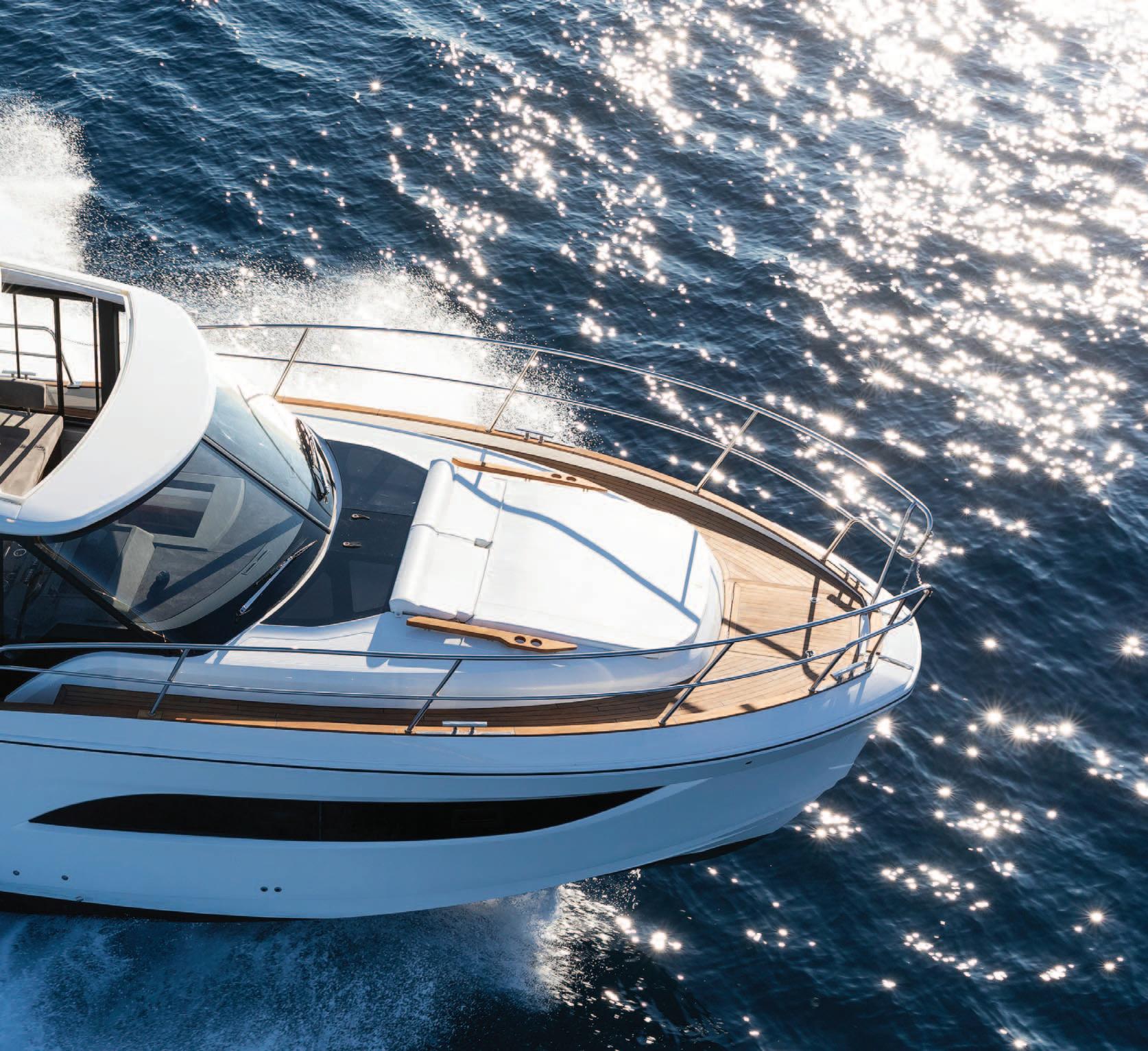
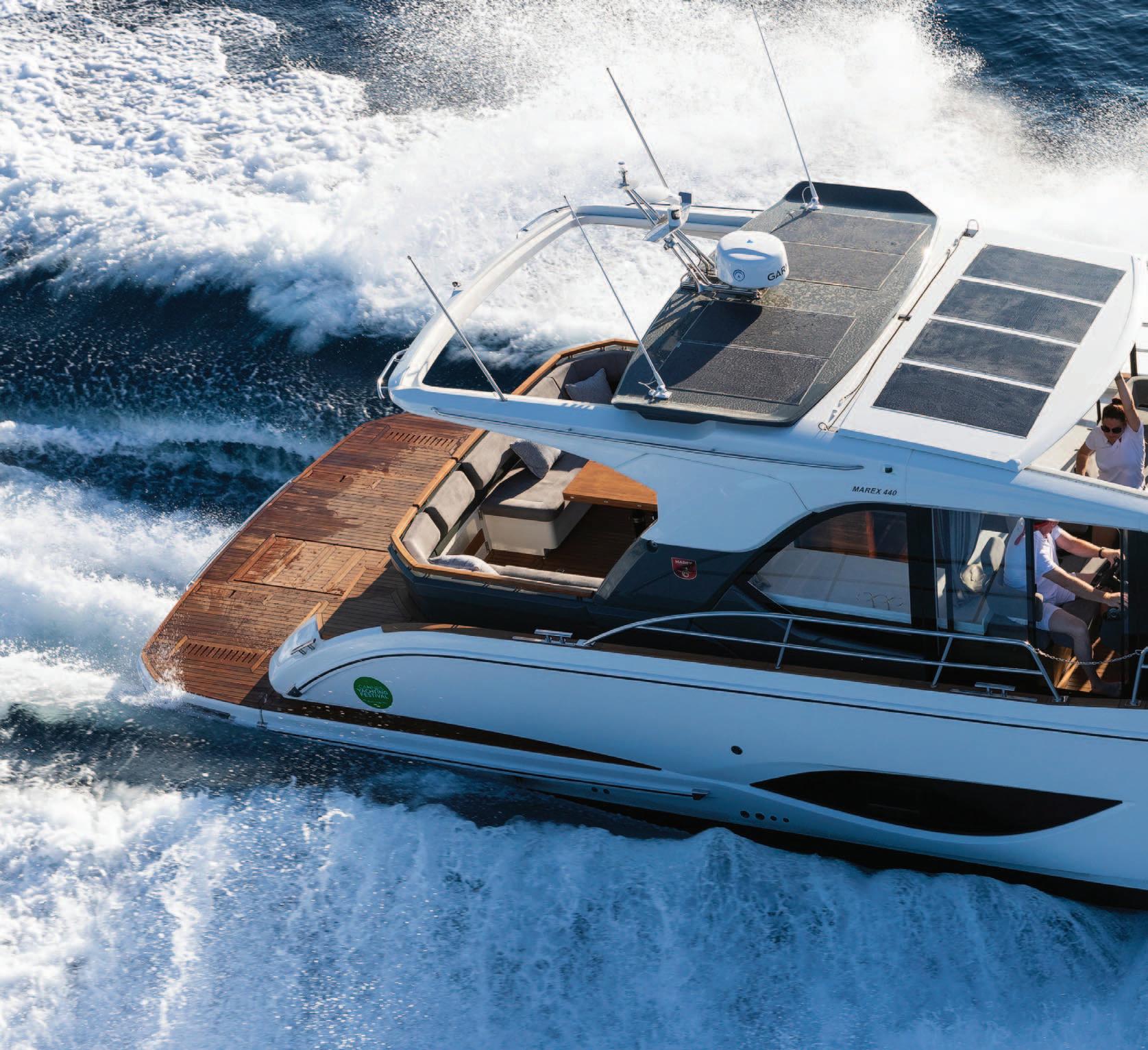
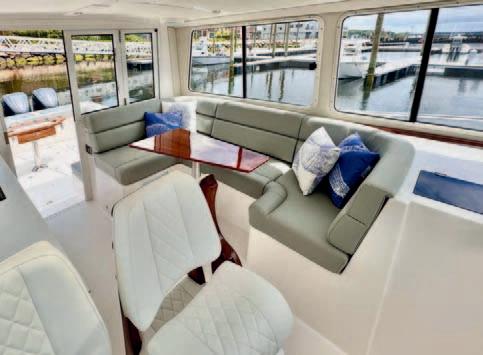
State-of-the-art luxury family cruising is an unmatched experience aboard the epic Marex 440 Gourmet Cruiser. Enjoy an unforgettable cooking experience with its full-beam, U-shaped galley layout—the largest in its class, creating a chef’s dream.
Discover why this model continues to win so many awards and accolades.


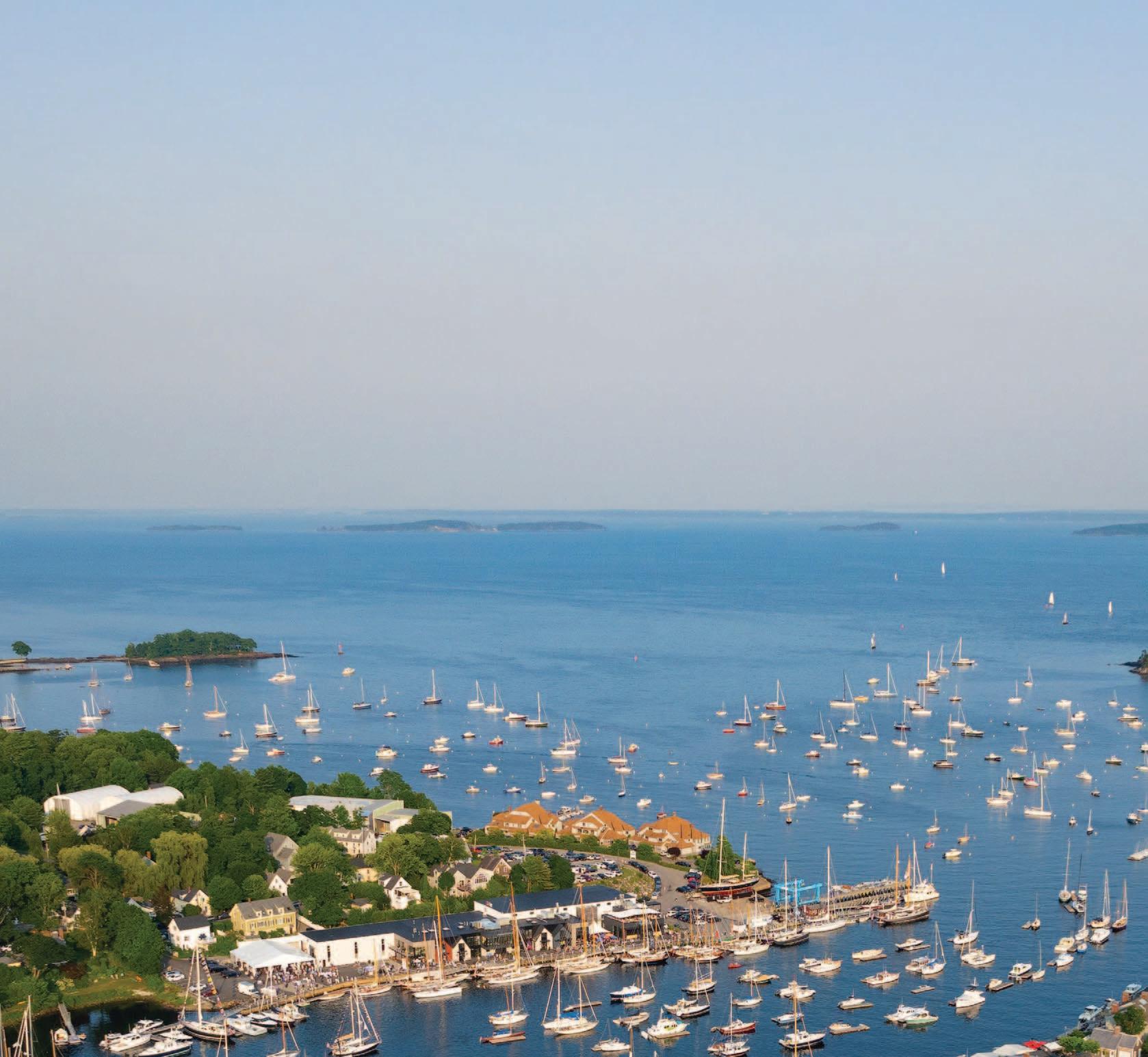
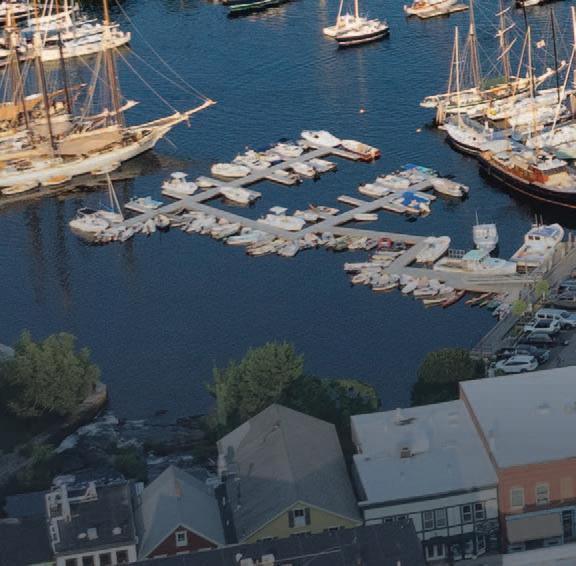
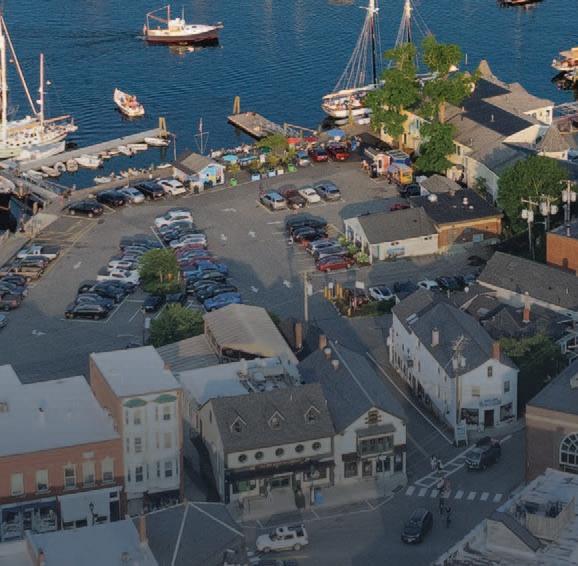
Camden, Maine isn’t just your favorite harbor in summer—it’s the smartest place to keep your boat in the off-season. At Lyman-Morse, we offer full-service winter storage backed by decades of boatbuilding and refit expertise. From simple layup to major upgrades, we handle it all—right here on the waterfront.
•Heated indoor & outdoor storage
•Complete refit and service capabilities
•Storage starts at just $6sq/ft
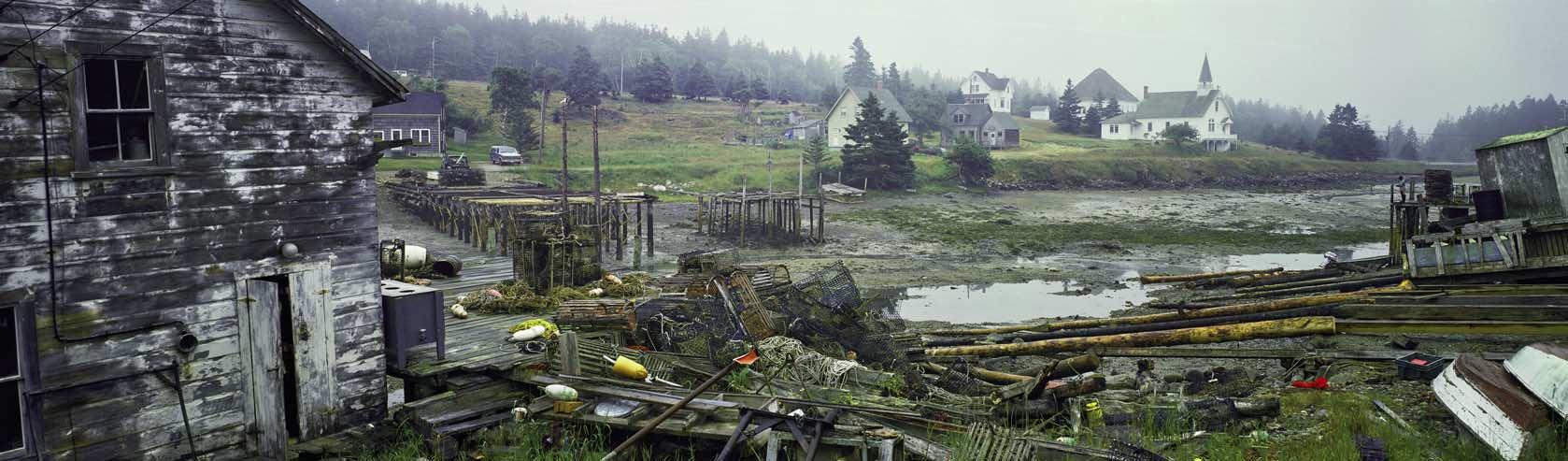
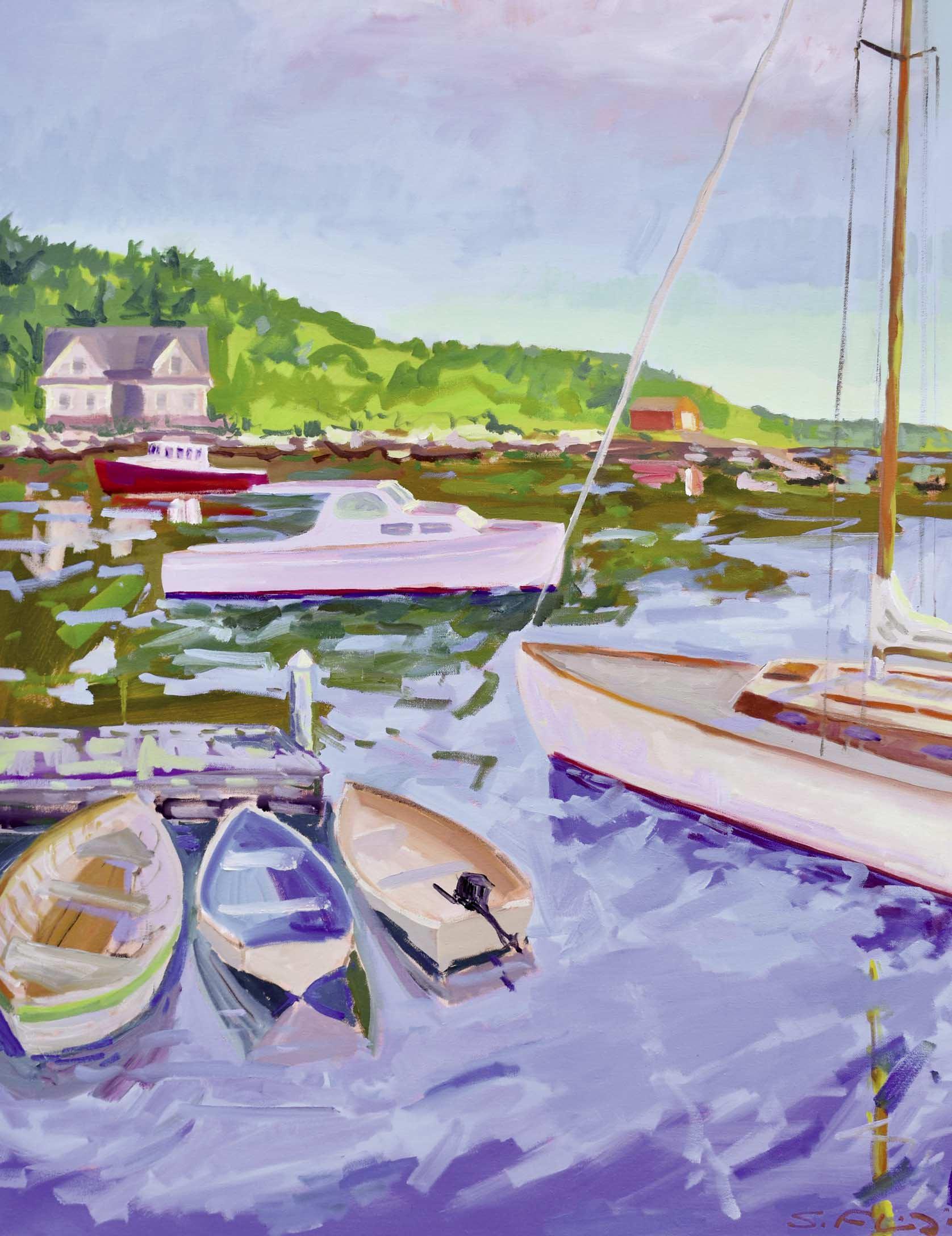
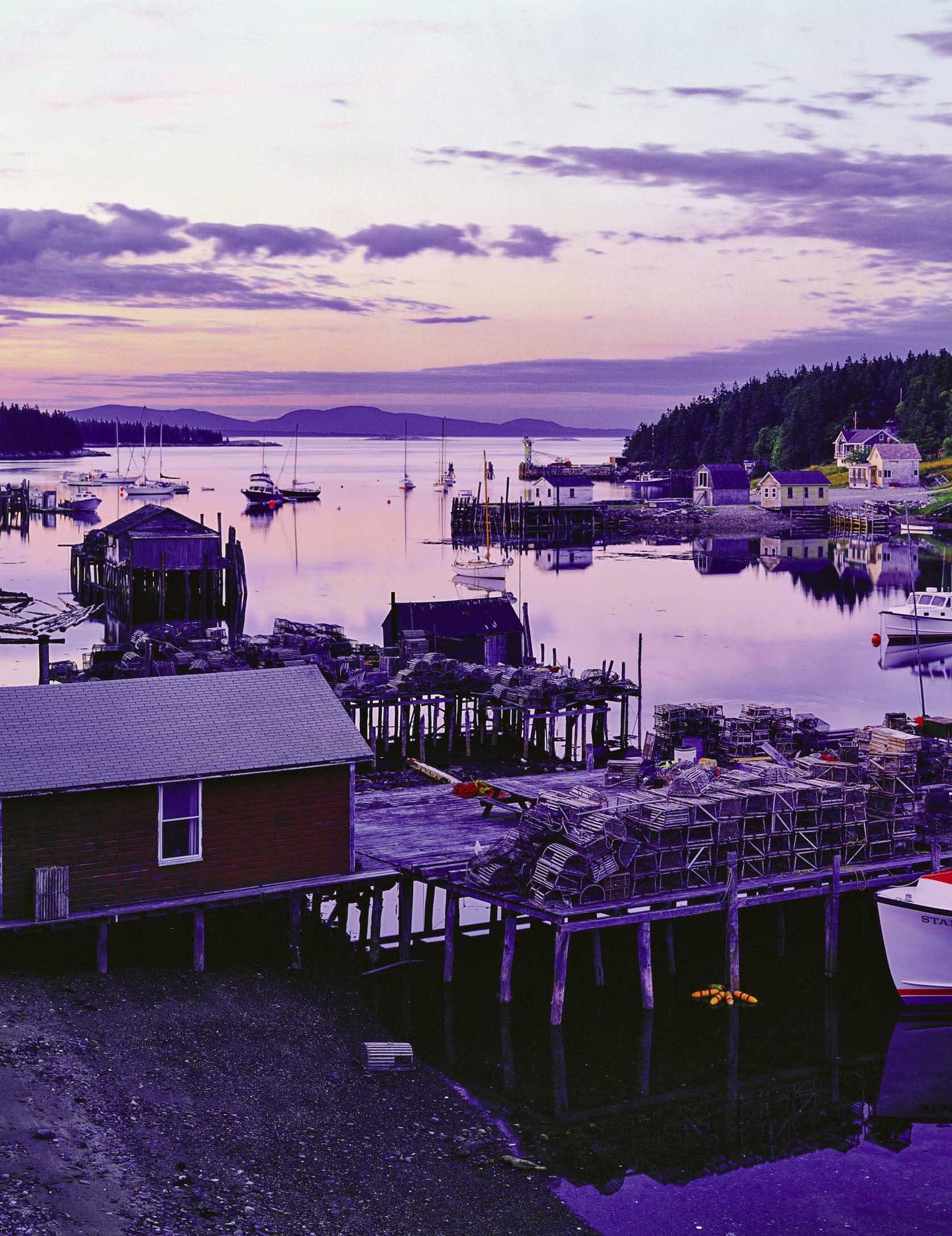
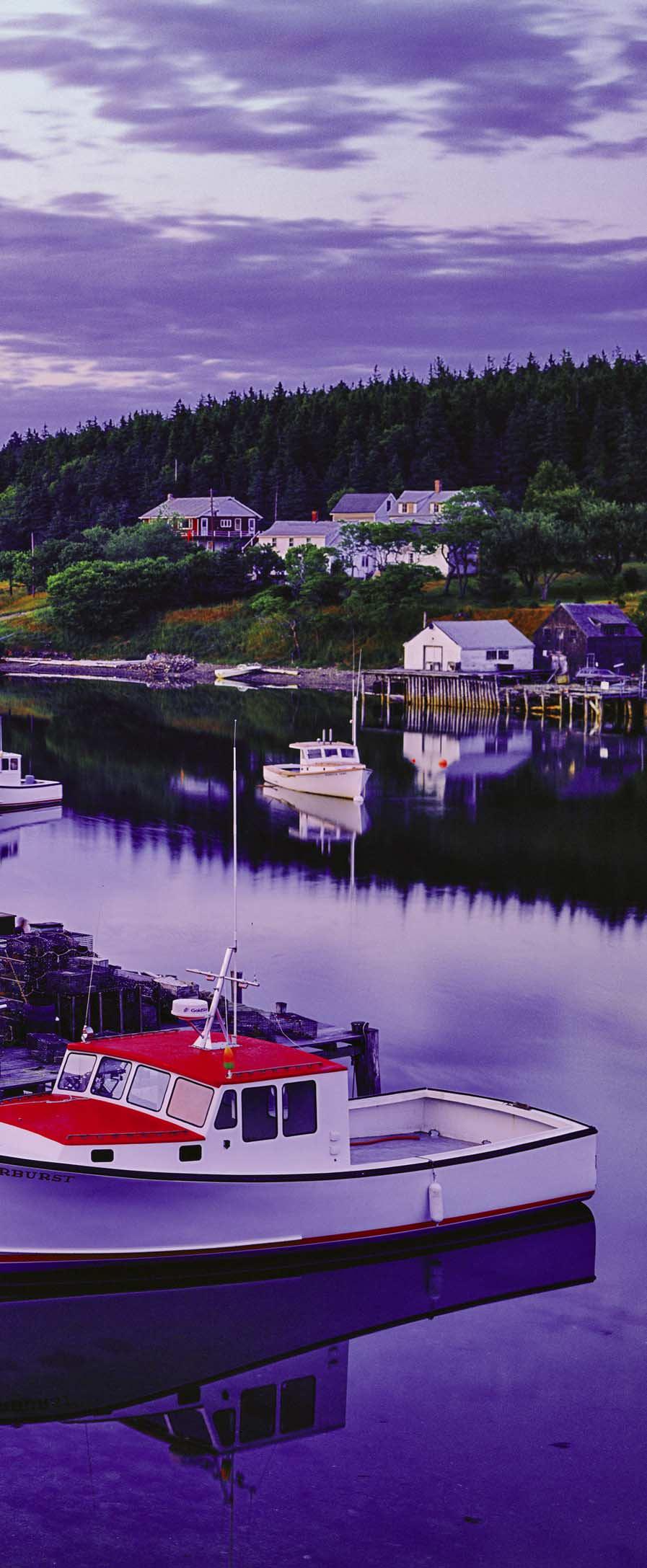
A touch of gray only enhances Jack Ledbetter’s panoramic view of the Frenchboro wharf and church. See story on page 48.
24 The Great Gatsby II by Stephen Rappaport
A family that was delighted with their original Hylan & Brown day cruiser wanted something bigger and better, the Gatsby II
30 Carrying the Torch by Ted Hugger
The vintage 12-Meter Gleam, in her eighth consecutive decade of racing, is still sailing fast
AROUND THE YARDS
38 Luxury Built in Maine by Mark Pillsbury
As Hinckley Yachts continues to expand the service side of the business, boatbuilding remains strictly focused in Maine
44 Hitting the Trails by Clarke Canfield
Behind Portland’s hustle and bustle lies a vast network of walking trails
MAINE ART FEATURE
48 Seize the Light: Jack Ledbetter’s Photographic Vision by Carl Little
Jack Ledbetter, a Georgia-born photographer, found the ultimate muse on the Maine coast
56 It’s a Small World on the Midcoast by Eva Murray
The by-chance spotting of an old fishing boat wreck on a Muscongus Bay island stirs up family connections and memories of wooden boat building
62 Before Vacationland, Maine was “Sardineland” by Letitia Baldwin
Penobscot Marine Museum’s “Sardineland” salutes Maine’s once premier industry
68 Camden Yacht Club and Its Generous Benefactor, Cyrus H.K. Curtis by Earle G. Shettleworth Jr.
The Camden Yacht Club remains a Shingle Style gem

16 A Letter From Home by Polly Mahoney
A midnight encounter with a bear helps a group of canoers bond and teaches a Maine Guide a lesson or two
21 Waterfront Profile by Sean Graves
The Rockland schooner chef Anna Miller spends her off season in a kitchen ashore, of course
71 Small Adventures by Mimi Bigelow Steadman Nestled between Lincolnville and Belfast, Northport is worth a detour from the beaten path of Route 1
75 Good Reads by Letitia Baldwin, Ben Emory, and Mark Pillsbury Reviews of three books rooted in Maine: A Story of the Grand Lake Canoes, Delicious Discoveries in a Maine Mapmaker’s Kitchen, and The Adventures of a Maine Peanut


Twitter @maineboats | Youtube @ maineboats1
Instagram @maineboats
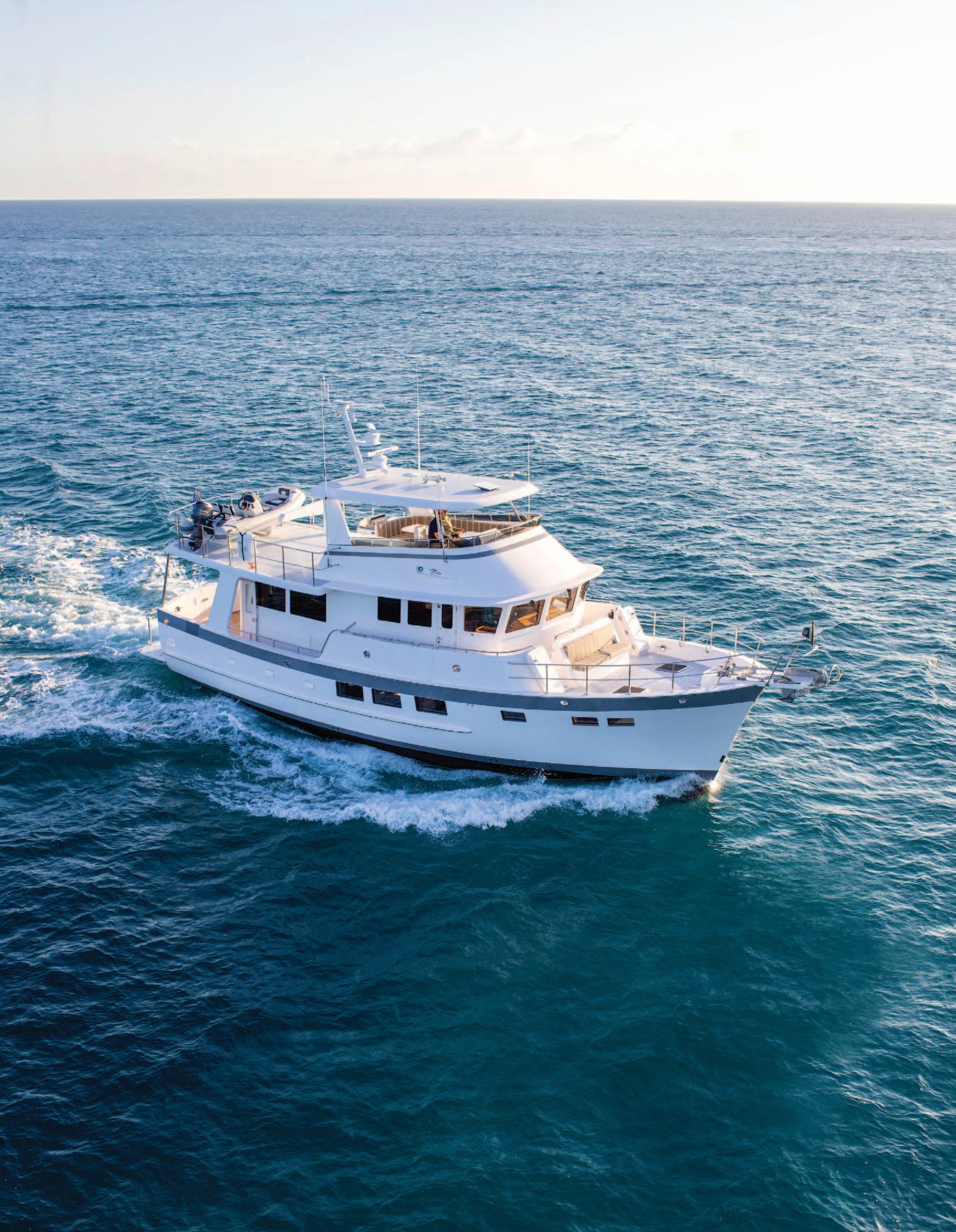
At Kadey-Krogen we are always thinking, always designing, and always perfecting. This continuous journey began in 1976 and has led to the new Krogen 60 Open—the introduction of a new era of long-distance cruising. The twin engine, island-friendly draft 60 Open is ready to cross an ocean in unrivaled style. Where will your Krogen take you?

MAINE BOATS, HOMES & HARBORS
Publisher: Ted Ruegg
Editor: Mark Pillsbury
Editor at Large: Polly Saltonstall
Managing Editor: Jennifer W. McIntosh
Copy Editor: Gretchen Piston Ogden
Contributing Editors
Ben Ellison, Ben Emory, Ted Hugger, Nancy Harmon Jenkins, Ron Joseph, Carl Little, Bill Mayher, Eva Murray, Sandra Oliver, Art Paine, Greg Rössel, Laurie Schreiber, Peter H. Spectre, Mimi Bigelow Steadman, Ken Textor, Lynette L. Walther, Karen O. Zimmermann
Contributing Photographers
Billy Black, Tyler Fields, Alison Langley, Benjamin Mendlowitz, Art Paine, Sarah Szwajkos
Contributing Illustrators
Candice Hutchison, Ted Walsh
Design: Kat Woodworth
Production: Tim Seymour Designs, LLC


Advertising Ted Ruegg • 800-565-4951
Classifieds: Amy Gordon • 203-912-3421
Advertising Coordinator: Julie Corcoran
Office Manager & Special Projects: Sean Graves
Boats of the Year Editor: Laurie Schreiber
MAINE BOAT & HOME SHOW








Show Manager: Kate Holden • 207-632-7369 showmanager@maineboats.com
SUBSCRIPTION SERVICES
Orders, renewals, address changes, questions, gifts 800-710-9368 (U.S. & Canada) or visit maineboats.com


TO SELL MBH&H IN YOUR STORE 800-565-4951













Maine Boats, Homes & Harbors (ISSN 0894-8887) is published six times a year: January/February, March/April, May/June, July/August, September/October, & November/December by Frigate Publications, P.O. Box 466, Rockland, ME 04841, 207-594-8622. Fax: 207-593-0026, email: info@maineboats.com. ©2025. All rights reserved. No part of this magazine may be reproduced in any form without written permission from the publisher.
Subscription rate: $29.95 for six issues in the U.S. and its possessions. Standard postage paid at Burlington, VT.
Address editorial communications to editor@maineboats.com or Editor, Maine Boats, Homes & Harbors, P.O. Box 466, Rockland, ME 04841. Guidelines available at maineboats.com.
BY
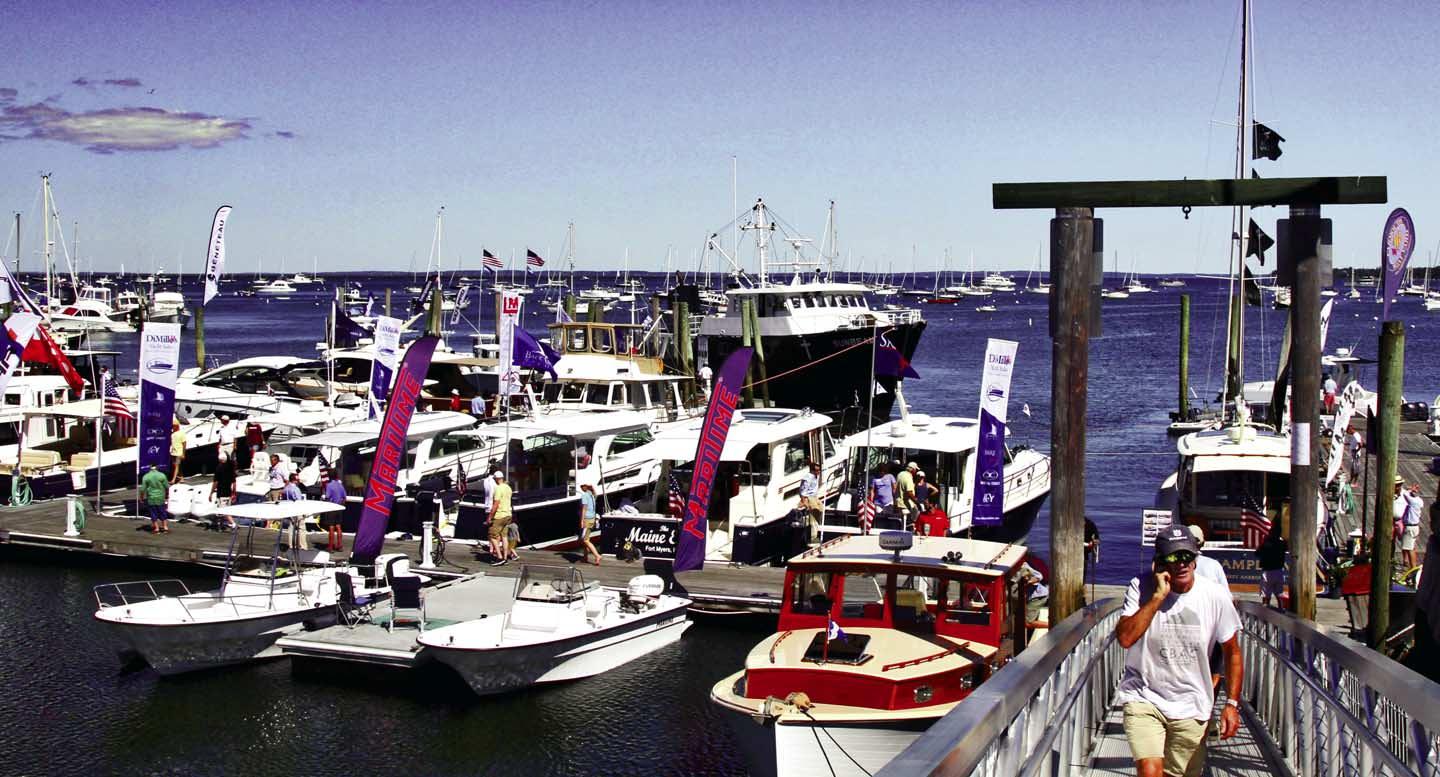
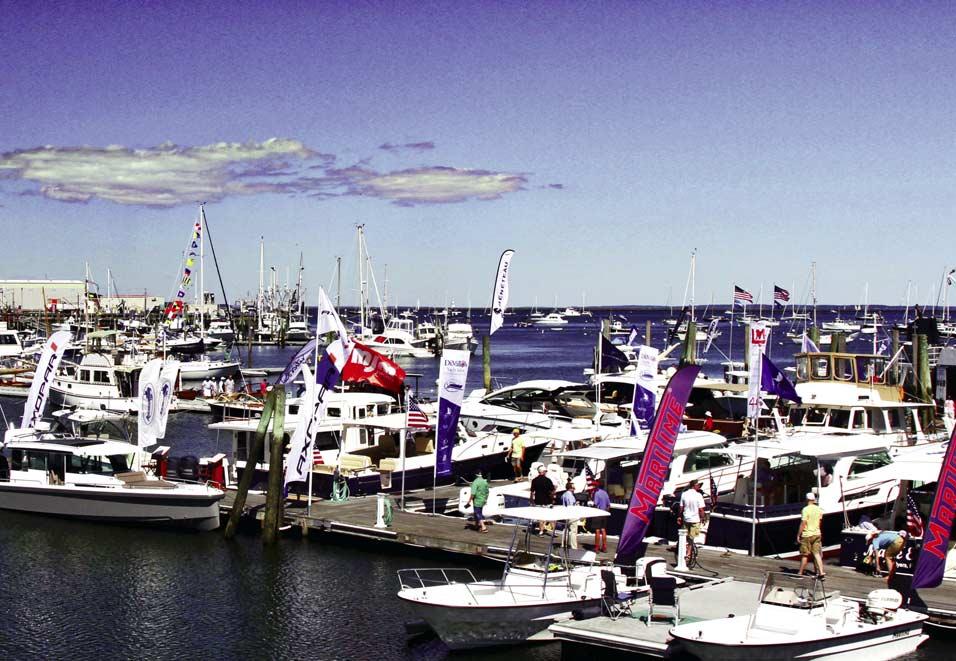
IF YOU LIKE BOATS (and honestly, who doesn’t?), fine craftsmanship, paintings, Maine-made home furnishings, jewelry, food, music, and more, then Harbor Park in Rockland is the place to be the second weekend of August.
The Maine Boat & Home Show opens its gates for the 20th time on Friday, Aug. 8, for a three-day celebration of coastal living at its best. As in years past—the show made its debut in 2003—this year’s festival continues to be the largest in-water boat show north of Newport, Rhode Island.
But the watercraft—power and sail, new and used, big and small—are only a part of it. The show also features several tents worth of exhibitors as well as an extensive lineup of outdoor land displays of ways to enjoy Maine at home and off the water.
For vessels, this year’s fleet will range in size from a 60-foot Kadey Krogen trawler to handy skiffs from the likes of C. Dworsky Wooden Boats and Portland Pudgy. Visitors can tour Sabres, Back Coves, and Hinckleys, and well-known builders such as Hodgdon Yacht Services
and Lyman-Morse will be on hand too.
Ditto for some of Maine’s largest yacht brokers such as DiMillo’s, Yachting Solutions, East Coast Yacht Sales, and Moose Landing Marina—they will all have boats on display.
The Maine Boat & Home Show opens its gates for the 20th time on Friday, Aug. 8, for a three-day celebration of coastal living at its best.
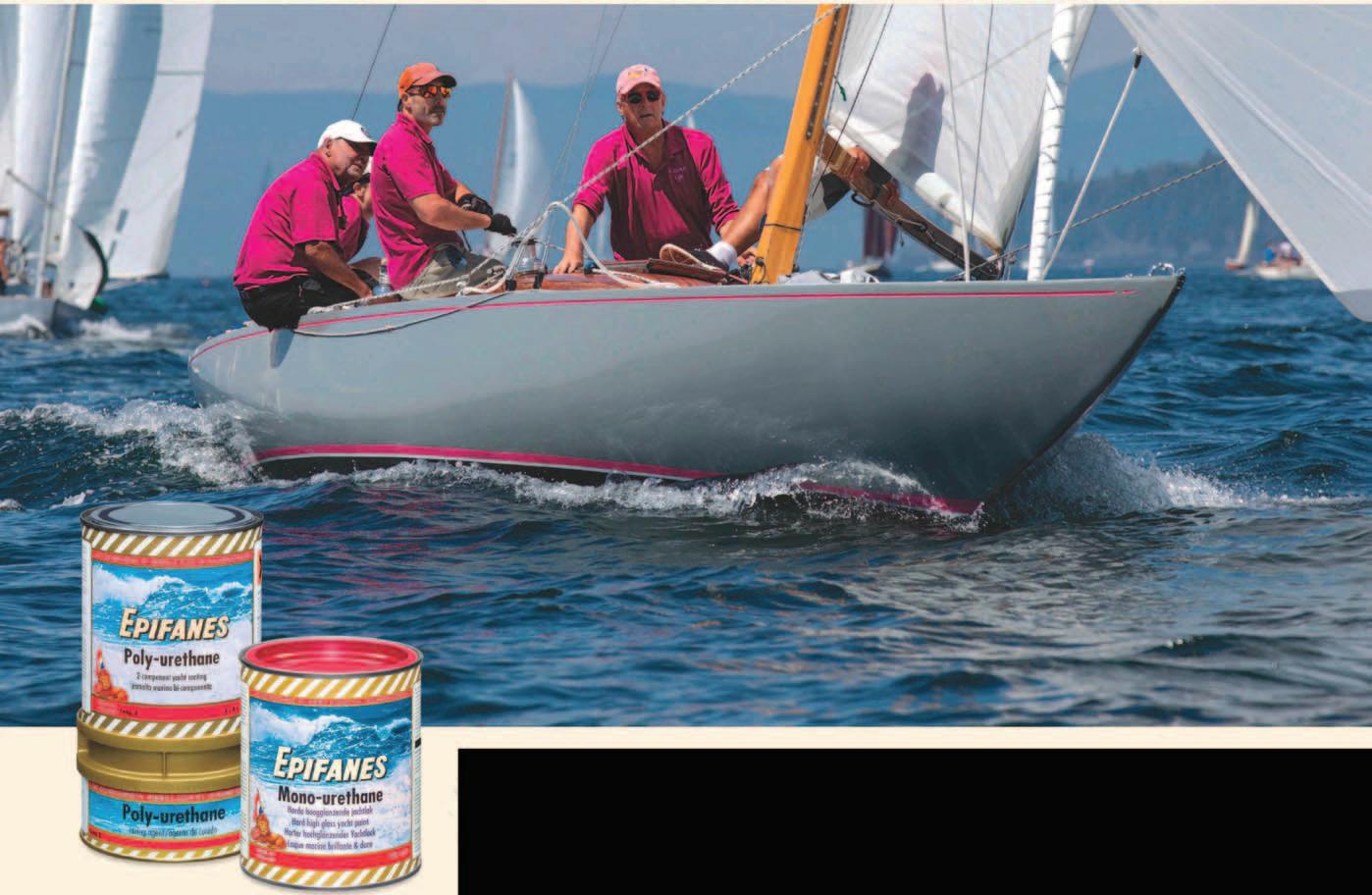
Longtime show supporter Epifanes is sponsoring this year’s daily entertainment. Musical acts include Blue Hill Brass Band, together now for 41 years; Nashville-based Sweet Megg; and local Rockland roaming violinist Cara Lauzon.
New for this year will be an educational component to the show. Friday will feature a day’s worth of vendor demos and on Saturday there will be separate seminars on how to buy and own a sailboat and powerboat. Attendees will hear advice from industry experts who will discuss vessel types, financing
and insurance, and what to expect once that dream boat is yours.
All three days, area plein air painters will be in action on the show grounds, including Rockport artist Stephen Florimbi, creator of this year’s show poster. On Sunday, their works will be on display in the education tent.
From cannons to cutlery to outboard motors to model boats, furniture, lamps, jewelry, stonework and wood-fired ovens, there’ll be craftspeople and vendors to meet and lots to see. And kids will have their own fun with a host of activities just for them.
True confession: For years I vowed to visit the Boat & Home Show in Rockland, but New England summers being short and me being elsewhere, sailing trips and family outings always got in the way. But this year, well, I’m here. And part of the show, so to speak. So, there’s no way I’m going to miss it. Like the rest of gang here at MBH&H , hope to see you there! N
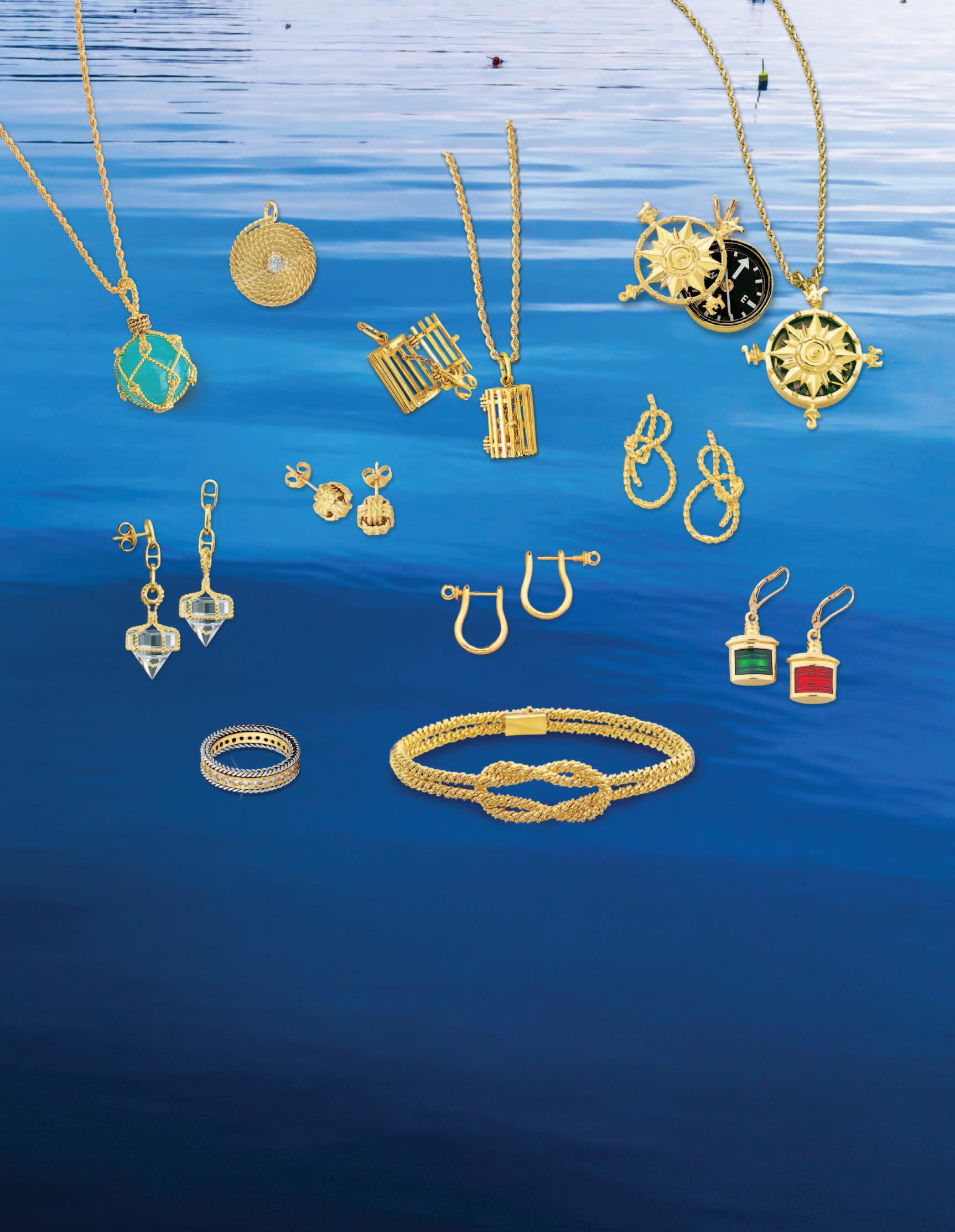
14k18k
A - Flemish Coil with Diamond Pendant (matching earrings available) -------------------$2100. ------------$2650.
B - Fish Float Sphere with Aqua Chalcedony Pendant (U.S. Patent D678,110)-----------n/a -------------$2500.
C - Maine Lobster Trap with keeper lobster Pendant ------------------------------------------------ $1400. ------------$1950.
D - Compass Rose with working compass Pendant -----------------------------------------------$2750. ------------$3750.
E - Bowline Knot Earrings (please specify dangle or stud) ------------------------------------------$1400. ------------$1900.
F - Monkey's Fist Stud Earrings (matching pendants available) ---------------------------------$1750. ------------$2400.
G - Deck Prism Anchor Chain Dangle Earrings (matching pendant available) -------------n/a -------------$2750.
H - Original Working Shackle Earrings ----------------------------------------------------------------------$1200. ------------$1650.
I - Port & Starboard Hand Enameled Dangle Earrings -------------------------------------------------n/a -------------$2750.
J - Reef Knot Bracelet ---------------------------------------------------------------------------------------------------$6500. ------------$8500.
K-Rope Bands with Continuous Diamonds Ring (additional designs available) -----$4300. ------------$5900. •18" Rope Pendant Chain-------------------------------------------------------------------------------------------$900.


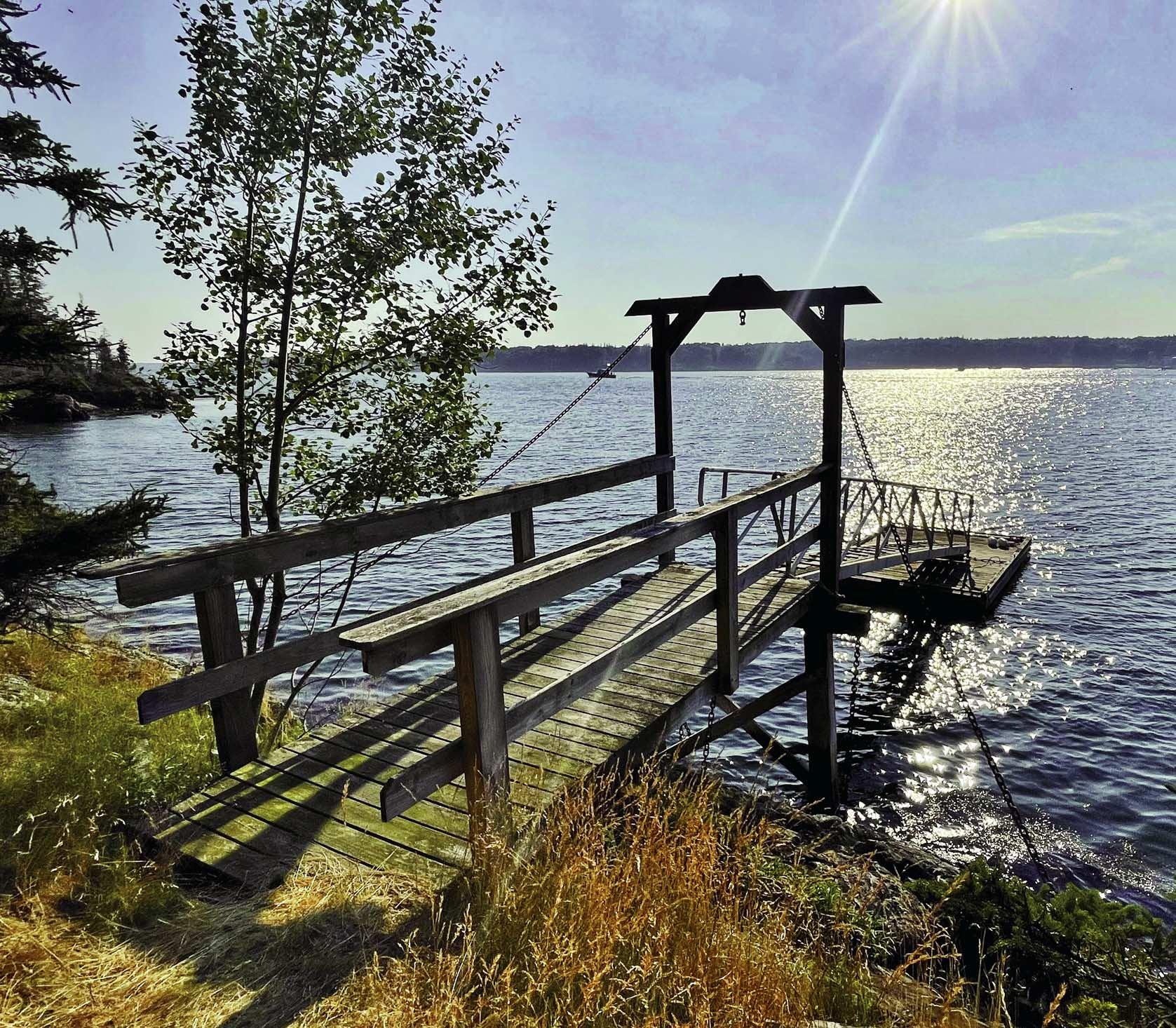
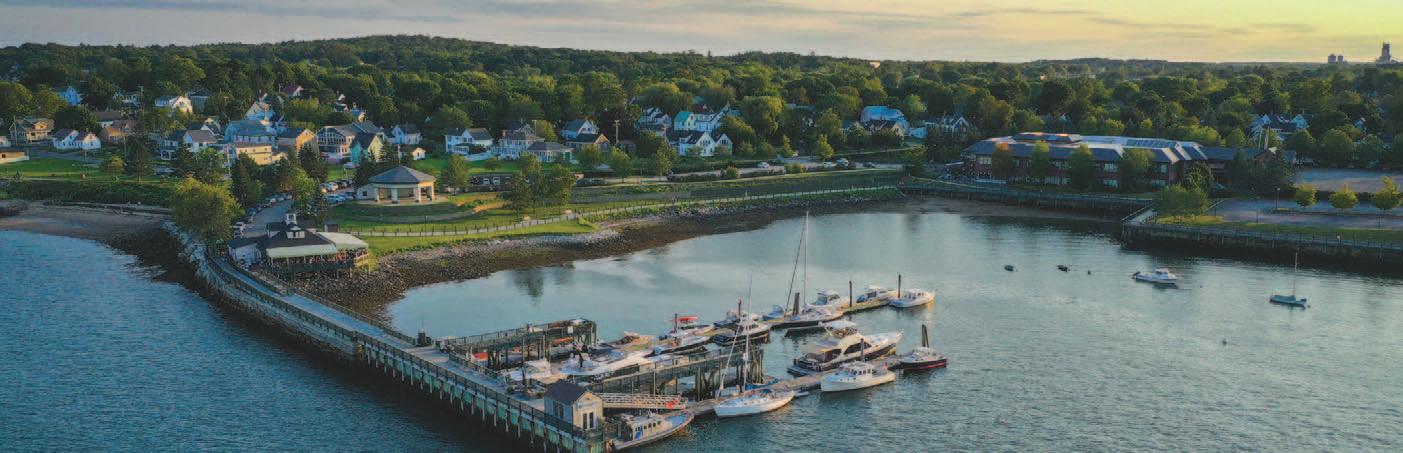
ALTHOUGH MONROE ISLAND is only 4 miles from Rockland and a mere 400 yards from Owls Head Harbor, this quintessential Maine island provides a secluded refuge with clear night skies in good weather and deserted cobble beaches. A Maine Coast Heritage Trust preserve, Monroe Island is also part of the Maine Island Trail and is an excellent example of the successful efforts to preserve Maine’s coast and islands for public enjoyment. There are hints of the island’s history in the remains of a World War II Naval range marker on the northernmost point, along with overgrown stone walls and cellar holes from abandoned logging camps. Along 2 miles of hiking trail, you can experience fern groves, salt marshes, and evergreen forests. If you’re looking for evidence of the prehistoric, don’t miss the exposed granite bluffs on the east side of the island, which are crisscrossed with pegmatite veins and littered with glacial erratics. As captain and owner of the ketch Morning in Maine, I know the island well. Every Sunday morning, I head there for a 6-hour tour with guests, who will beachcomb, hike, explore, and enjoy a lobster roll lunch on their sail home to Rockland.
Visit maineboats.com/the-maine-i-love for more images from Textured Alpine Photography.
View Morning in Maine excursion details at amorninginmaine.com/sailing-trips/monroe-island-adventure.




WeinventedthePPicnicboatAndwe ’ veneverstopped We invented the P perfecting it. The new of timeless design and is the best seat in the technology deliverin more than iconic—it’s precision, designed fo by a legacy of excep journey that is a Welcome
Scan the QR cod
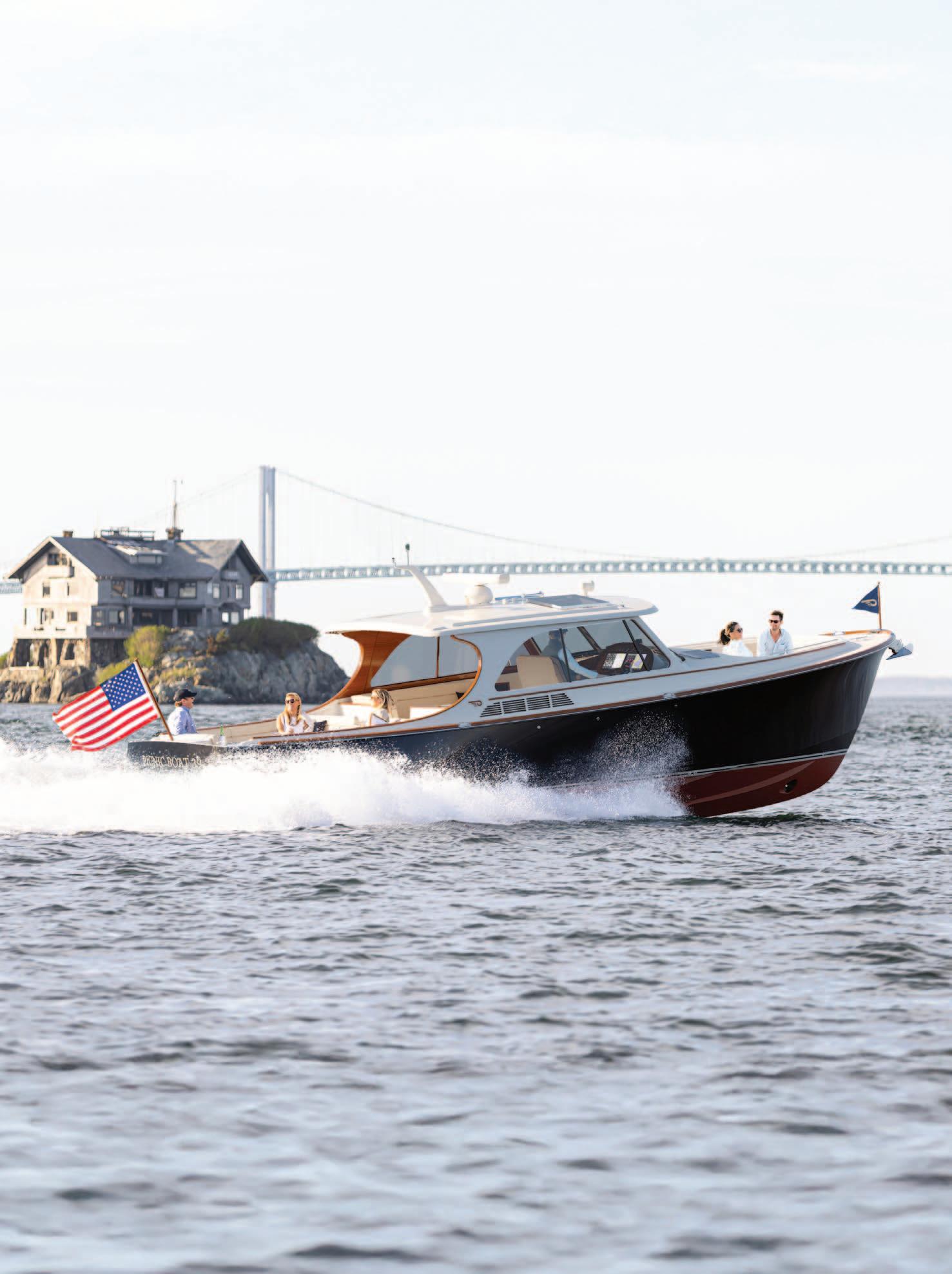
Picnic boat. And weve never stopped Hinckley Picnic Boat 39 is a masterpiece d modern ingenuity. Every seat on board house and with cutting edge JetStick 4 ® ng go-anywhere capability this model is s extraordinary. Crafted with meticulous or boundless adventures, and supported ptional service, the 39 invites you on a as unforgettable as the boat itself. aboard the Picnic Boat 39. de to experience Hinckley’s new Picnic Boat.

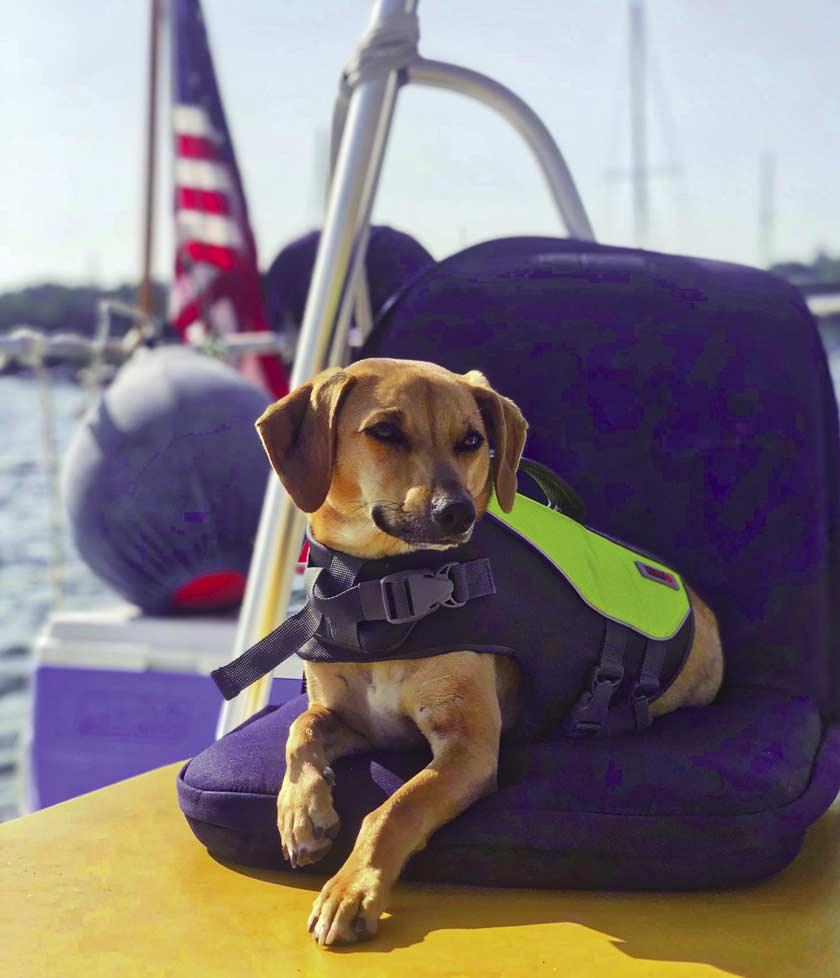
SIX-YEAR-OLD FANCY is a dog that loves a cat, so long as the cat is Kahuna Nui, a Crowther Shockwave 35 that during sailing season can be found at Handy Boat in Falmouth. Fancy’s person, Emily Davis of Nobleboro, said the pup can be a little high maintenance ashore and around other dogs—hence her name—but on the family catamaran owned by Davis’s uncle, she’s happy standing watch or just napping in the sun. Maybe the wind and waves remind her of her childhood in Puerto Rico. Davis, co-founder of OpBox in Woolwich, met Fancy at a Valentine’s Day weekend event put on by a Westbrook animal shelter. She was a rescue dog, and her papers were in Spanish. When not sailing or watching Davis and crew enjoy a dip in Casco Bay—Fancy doesn’t care for swimming herself—she can sometimes be found at the family’s camp on Duckpuddle Pond in Nobleboro. Freshwater activities include kayaking and rides on Davis’s two-person paddle boat, which Fancy prefers since she can have her own seat—but she doesn’t love paddleboards. Freshwater, saltwater, Fancy enjoys them both, Davis says. “She does very well on the water, it calms her down.” N









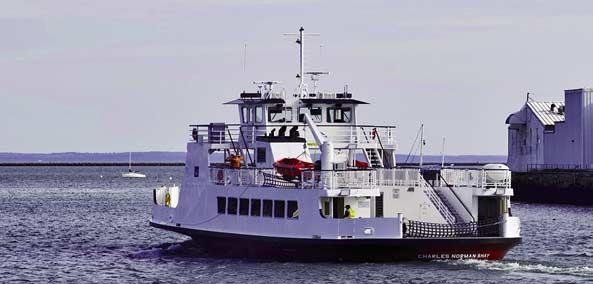
Just a year after raising its fares, the Maine State Ferry Service implemented another rate hike, effective June 1, to meet what it called unanticipated rising costs. Ticket prices for walk-on passengers and vehicles were expected to rise by about 13.5 percent, according to a news report in the Working Waterfront.
By state law, half the service’s operating budget must come from fares and fees. The other half comes from the state’s highway fund. But fares and fees have only reached the 50-percent threshold in just three of the last 10 years, according to ferry service officials. As a result, the state highway fund has had to be tapped for an additional $4.6 million, according to Bill Geary, the Department of Transportation’s multimodal director, and a recent director of the ferry service.
“We need to adjust the tolls to cover half the increased cost,” Geary said.
State ferries serve the island communities of Frenchboro, Swan’s Island, Islesboro, North Haven, Vinalhaven, and Matinicus.
Bigelow Laboratory has added a new building, the Harold Alfond Center for Ocean Education and Innovation, to its East Boothbay campus.
An $8 million gift from the Harold Alfond Foundation was essential to breaking ground on the physical expansion that will, in turn, expand opportunities for business innovation and applied research, and enhance the institute’s education programs, Bigelow noted in a news release.
The 25,000-square-foot addition constitutes a 40-percent increase in the laboratory’s footprint, providing space to accommodate a growing staff—and a growing portfolio of research.
The expansion includes high-tech
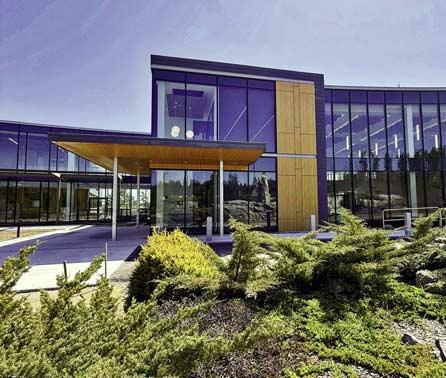
teaching labs and classrooms. Cuttingedge laboratory facilities will accommodate several new research groups, while newly endowed funds will provide kickstarter grants to explore promising, early-stage ideas. At the centerpiece of the expansion is a 300-seat forum.
In addition to the support of the Harold Alfond Foundation, the new center was made possible by other gifts totaling $13 million and $12 million in federal funding through the National Institute of Standards and Technology 2023 Construction Grant Program. A $2 million maintenance endowment from an anonymous donor will permanently support capital repairs and equipment replacement to ensure the long-term viability of the new space.
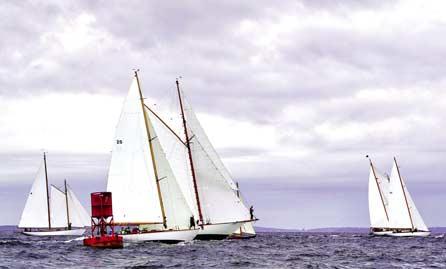
News that the U.S. Coast Guard plans to remove more than 150 buoys and other aids to navigation, such as day beacons, from coastal New England waters, including Maine, caused an uproar this spring from mariners.
In a Local Notice to Mariners, the Coast Guard said the change was intended to support “the navigational needs of
the 21st century prudent mariner,” to deliver effective, economical service and best maintain the most critical risk reducing buoys. This “improvement” is made possible, the notice stated, by the widespread use of GPS and electronic navigation systems that have made older aids to navigation superfluous.
The buoys targeted for removal include ones marking harbor entrances, ledges, and other routes and hazards. Some are lighted, while others have gongs, bells or whistles, according to the notice.
About 40 buoys slated for removal are in Penobscot Bay, including both bell buoys outside Camden Harbor and the can guarding the Northeast Ledges, as well as both bells at the ends of the Eggemoggin Reach.
But boaters, both commercial and recreational, were not convinced. Not all skippers have access to the necessary electronics, which also are not always reliable, opponents argued.
The presence of physical markers are important navigational alternatives when electronics fail, or when boating in the fog or at night, mariners told various news organizations.
Even the Coast Guard’s own navigation Standards Manual warns against “over reliance on a single source of vessel positioning data, such as AIS, GPS, radar, or navigation aids, for safe navigation and collision avoidance,” one mariner noted. Opponents include representatives of the fishing industry, boatbuilders, and others. This writer could not find anyone who supported the move.
The Camden Yacht Club, one of many organizations asking its members to submit comments, noted the savings, which it pegged at $12 million, would be a drop in the bucket of the Coast Guard’s
overall $13.8 billion budget. CYC members Dick Cease and Mark Van Baalen noted that wise mariners know not to rely on a single method of navigation. “These buoys serve an important navi-
| BY PETER H. SPECTRE
gational purpose by providing ground truth to electronic navigation systems such as GPS. Numerous incidents and casualties related to failures or discrepancies in these systems are continuously
“I’ve faced this winter’s snow and sleet, I’ve felt the summer’s shower,/ but every night I’ve lit the lamp up yonder in the tower.”—From “The Light-Keeper,” by Joseph C. Lincoln
The progress of lighthouse lights
Earliest—open wood or coal fire 16th century—tallow candle 1763—oil lamp with an open flame intensified with a simple reflector 1780—oil lamp with cylindrical wick, glass chimney, and simple reflector
Early 19th century—catoptric system; complex reflector in parabolic shape gathers light rays into a concentrated beam 1823—Fresnel's dioptric system; lenses concentrate and focus light rays into a horizontal beam
Mid-19th century—catoptric and dioptric systems combined Mid-19th century—introduction of kerosene fuel 1858—first use of electric arc lamp
Early 20th century—incandescent electric light bulbs in use
A few U.S. lighthouse facts, according to the U.S. Coast Guard
First lighthouse—Boston, Massachusetts, built 1716
Oldest lighthouse in service—Sandy Hook, New Jersey, built 1764
Newest shoreside lighthouse—Charleston, South Carolina, built 1962
Tallest lighthouse—Cape Hatteras, North Carolina, 191 feet
Highest lighthouse (above sea level)—Cape Mendocino, California, 515 feet
First American-built west coast lighthouse—Alcatraz, San Francisco, built 1854
First lighthouse to use electricity—Statue of Liberty, 1886
First Great Lakes lighthouses—Buffalo, New York and Erie, Pennsylvania, built 1818
Most expensive lighthouse (adjusted cost)—St. George’s Reef, California, built 1891
First lighthouse built completely by the Federal Government—Montauk Point, New York, 1797
The first lights built by the U.S. government’s Lighthouse Establishment
Cape Henry, Virginia (1791)
Portland Head, Maine (1791)
Tybee, Georgia (1791)
Seguin, Maine (1795)
Bald Head, North Carolina (1796)
Montauk, New York (1797)
Bakers Island, Massachusetts (1798)
Cape Cod, Massachusetts (1798)
Hatteras, North Carolina (1798)
Ocracoke, North Carolina (1798)
Gay Head, Massachusetts (1799)
Eatons Neck, New York (1799)
Why many white lighthouses were painted with stripes or bands of red, and all lightships were painted red: White objects recede in fog; red stands out.
The range of visibility of lights
Nominal range—the maximum distance at which a light can be seen in clear weather.
Luminous range—the maximum distance at which a light can be seen under the existing conditions of visibility.
Geographic range—the maximum distance at which a light can be seen taking into consideration the curvature of the earth and the height of eye of the observer.
Light characteristics of lighthouses and other aids to navigation
F.—Fixed; a continuous, steady light
Fl.—Flashing; single flashes at regular intervals, the duration of light being less than that of dark
Fl.(2)—two flashes
Fl.(2+1)—two flashes, then one
Q. or Qk. Fl.—Quick flashing; not less than 60 flashes per minute
E.Int.—Equal interval; on and off for equal periods
I.S.O.—Isophase; same as equal interval
Occ.—Occulting; the total duration of light in a period is longer than the total duration of darkness, and the intervals of darkness are usually of equal duration.
Morse (A)—Morse code “A”; short flash followed by long flash
“So to night—wandering sailors pale with fears
Wide o’er the watery waste a light appears, Which on the far-seen mountain blazing high
Streams from lonely watch towers to the sky.”
—From Homer’s Iliad, trans. by Alexander Pope N
Contributing Editor Peter H. Spectre lives in Spruce Head, Maine
reported in the maritime press. It is also simply not true that all navigators have access to, and employ, electronic navigation systems,” they wrote.
The Coast Guard set a June 13 deadline for feedback on its plan. The agency’s map showing which aids to navigation were slated for removal (navcen.uscg.gov/msi) was difficult to navigate. An unofficial one (uscg-marker-removals.webflow.io) promoted by several online commenters gave a clearer picture, but this writer was unable to confirm all the information.
Moose Island Marine, a long-time Eastport chandlery has a new owner. Dean Pike handed over the helm to Matt Lacasse, according to a story in the Maine Coastal News. Lacasse previously had bought Pike’s boatyard, which he renamed Deep Cove Marine.
“I did not want to take on too much, but it made good sense to have it,” Lacasse told the newspaper. “They were built together and they are meant to be together and we do a lot of business here. We can save a lot of money by owning it.”
Pike began the business in the Quonset hut in 1980 and operated it there until 1995 when he moved into a new building. He carried everything a boater, whether commercial or pleasure, might need, according to the news story. In 1984 he bought property on the other side of the road from the Boat School and started the boatyard that he sold to Lacasse.
Born in Calais, Lacasse came to the Boat School in 2002 and then went to work for Pike in 2003. He later left and worked at several other marine-related companies before returning to work again for Pike.
Pike has been involved with trying to re-open the Boat School in Eastport, which closed in 2012. He plans to remain involved with that effort for the time being, according to the newspaper.
After 22 years under the ownership of founders Julie and Phil Michaud, the Portland Boat Show has been acquired by Portland Yacht Services, according to a story in Mainebiz and a news release from PYS.
A full-service boatyard on West Commercial Street, Portland Yacht Services is owned by Joanna and Phineas Sprague Jr., who ran the Maine Boatbuilders Show for many years.
“This acquisition aligns with our mission to support and enhance the boating community in New England,” Jason Curtis, vice president of operations for Portland Yacht Services, said in a release. “Our team is eager to build upon
the show’s rich tradition and introduce new elements that reflect the evolving needs of boaters.”
The 2026 edition of the Portland Boat Show is scheduled to take place from Feb. 25 to March 1 at the Portland Sports Complex, located at 512 Warren Ave.
Maritime classes in Belfast
Students at Belfast Area High School are
> Town Dock continued on page 79
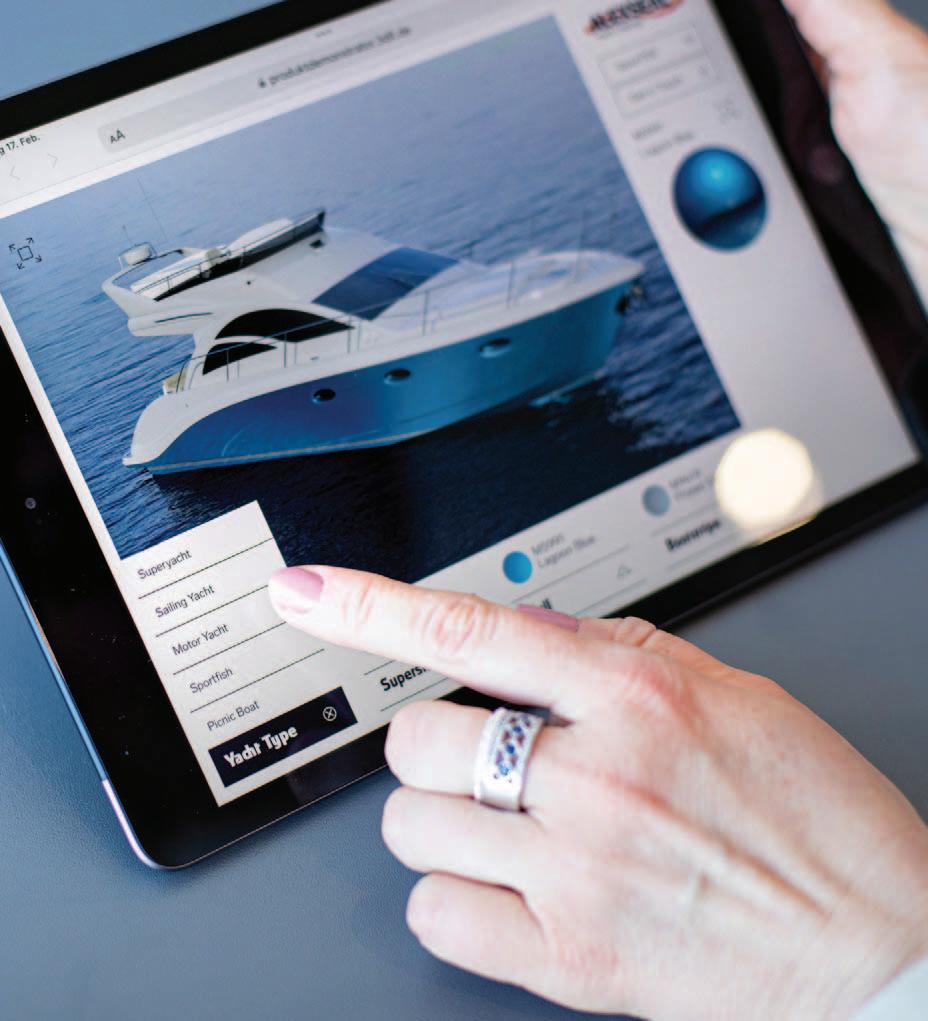
5 yacht types, 121 solid and metallic color shades, and endless color combinations for hull, superstructure, and bootstripe – that’s our digital ALEXSEAL color configurator. The perfect tool to choose your favorite color shades.
From now on, there are many chances for a first impression of your new yacht’s surface.
Scan the QR code to explore the color configurator →
BY POLLY MAHONEY
WOKEN in the middle of the night by noises at our island campsite, I was out of the tent screaming at the top of my lungs and standing in my T-shirt, underpants, and moccasins, staring at a black bear that wouldn’t leave. My dog had never seen me acting so crazed.
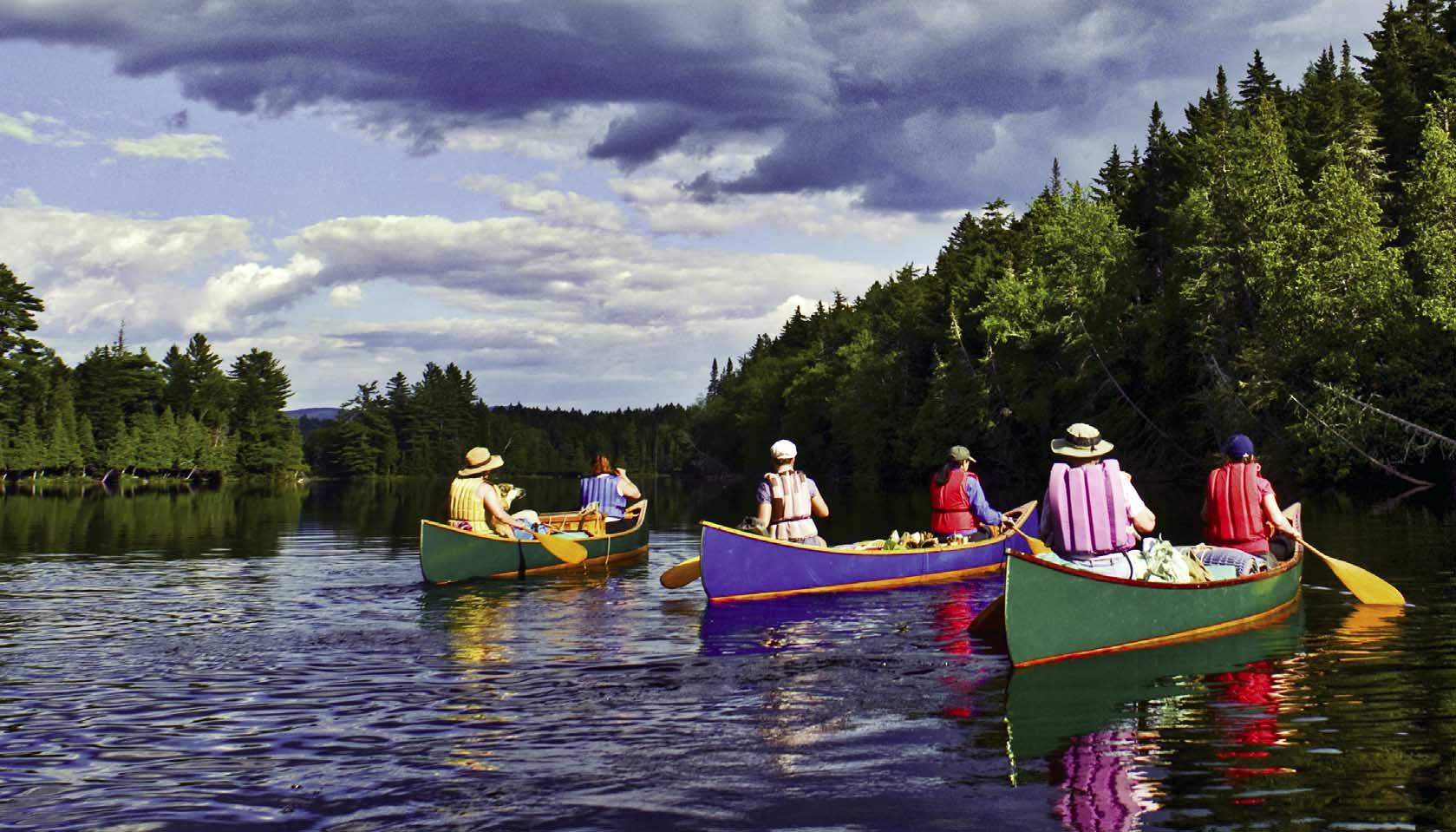
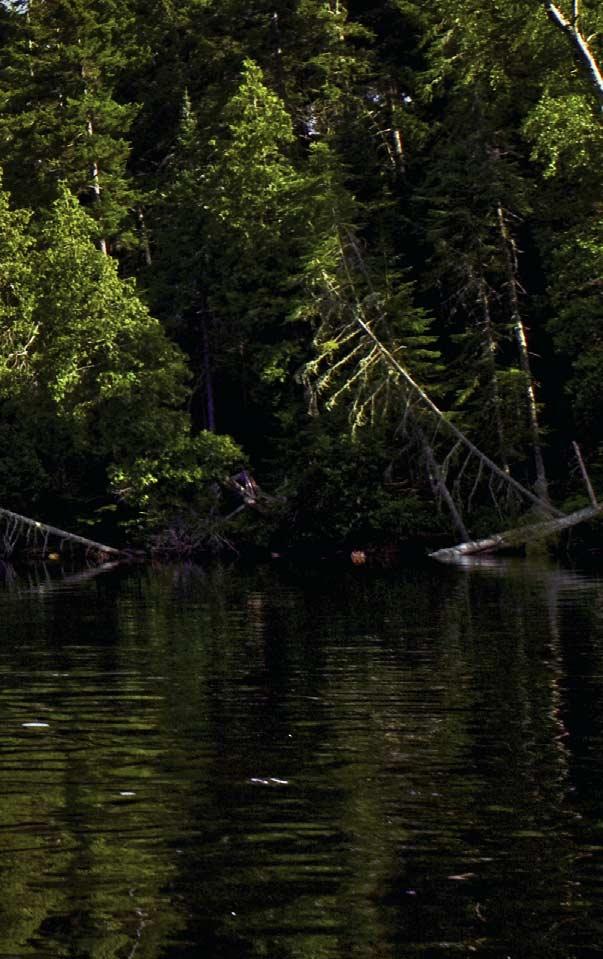
I was leading a women’s canoeing weekend on Lake Umbagog with Mahoosuc Guide Service. Our group of 11 included clients ranging in age from their mid 50s to late 70s, a very capable 21-year-old co-guide, and an assistant.
We’d met on a Friday at the Mahoosuc Mountain Lodge in North
Newry to do our final packing of gear into dry bags, and then loaded the van and headed up the road 12 miles to the start of our adventure. There was a lot of chitchat on the way up as people were getting to know each other and there were many questions of anticipation and excitement. One woman asked me if I ever saw bears and I said, “Very rarely and if you do it is a real gift!”
Little did we know.
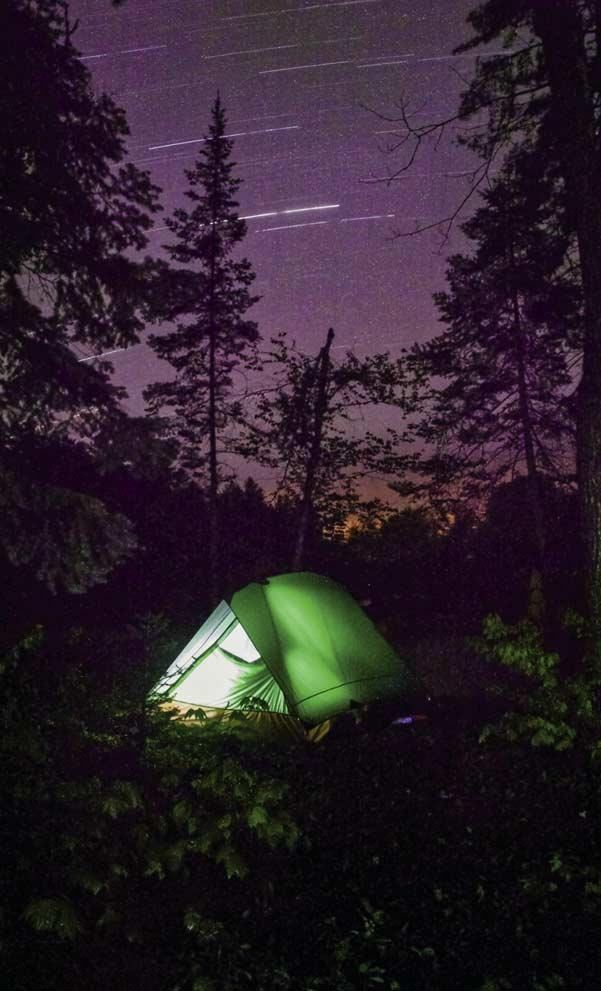
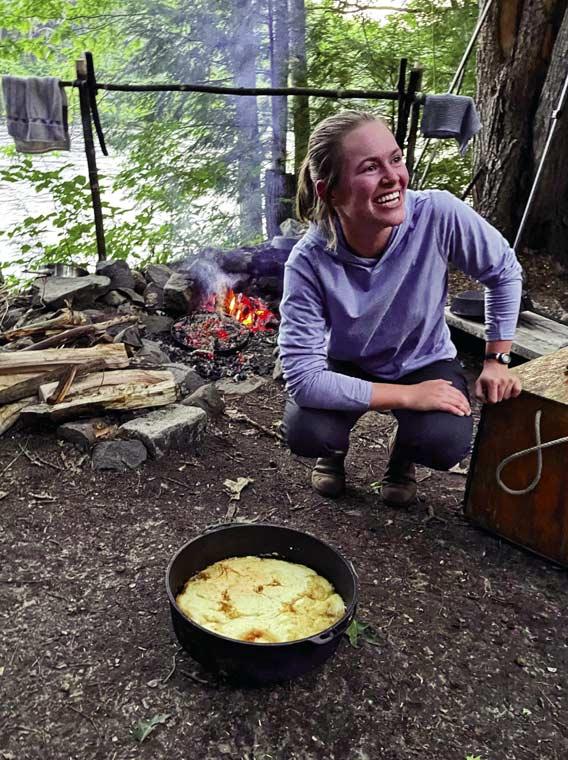
At the lake, we had our paddling instruction, loaded the canoes, and paddled to the north end of Big Island and our campsite for the night. We had a delicious dinner of fried salmon fillets and many other goodies, topped off with strawberry shortcake and whipped cream. The shortcake we baked in the reflector oven set by the campfire. After dinner we all sat and visited and told stories and then went to bed with full bellies, happy to be out on the beautiful lake and lulled to sleep by calling loons.
Ashirah, my co-guide, Diane, my extra helper, and I shared a tent set up close to the picnic table, food, and fire ring. My chosen sled dog for the trip, Murphy, was tied close to the food and tent for extra protection and to warn us of animals or scare away squirrels.
I was awakened at 1 a.m. by the sound of ripping canvas outside my tent. I shot upright from my sleeping bag and shone my headlamp out the door into the eyes of what I thought would be a racoon. I soon realized it was too big and the eyes too far apart, though. Instead, it was a big black bear staring straight back at me—only 4 feet from my tent.
I quickly woke up my tentmates exclaiming, “You guys, it’s a bear! Right outside!”
I pulled on my moccasins and ran outside, yelling and running at the bear. It retreated behind a big pine tree only 25 feet away, then would slowly peek its head around the tree and look at me. I quickly got some pans from the picnic table and banged them together and charged toward the bear and tree again thinking it would run away. No luck! It did the same thing: peeked out from behind the tree with very human like movements. It felt like a person wearing a bear suit.

Then I thought I’d try running at the bear with Murphy, my dog, to see if that would scare it. I had Murphy on a leash in one hand, banged pots with both hands, and yelled at the top of my lungs.
The bear came out from behind the tree but retreated behind it when I ran at him screaming. Murphy, of course, was scared to death of me, having never witnessed such behavior in his life, and he was trying to get away.
When I realized this wasn’t working, I asked Ashirah if she had any ideas since she had spent six years apprenticing with
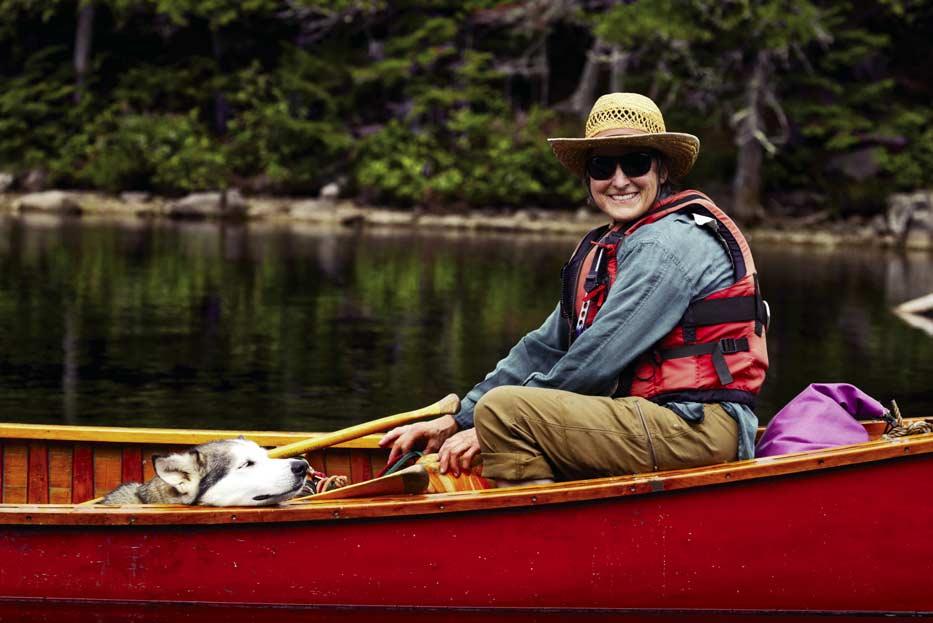
a well-known Maine guide and hunter. Ashirah stands about 4-foot-11 tall and has a very quiet, self-assured and peaceful manner about her. When I asked her opinion, she stood and thought for what seemed like five minutes but probably was five seconds and said “No, I really don’t know. That bear really isn’t afraid.”
Meanwhile all the women were awake yelling, “What is going on out there?” And I was yelling back, “Stay in your tents!” I didn’t want anyone to have
any encounters with the bear.
Since my experienced co-guide didn’t have a solution, I thought I’d better continue my aggressive protest and try to get the bear to leave us and our food alone. So, I once again chased it to the tree, but this time it came back out and stood up on hind legs, waving its head back and forth and growling at me.
There I stood—just 10 feet away—in my T-shirt, underpants, and moccasins with my adrenaline running full speed. I
was yelling a very primeval scream, banging pots, and hanging on to Murphy, who was freaking out and still trying to get away. As we stood there staring at each other—the bear growling and me screaming—I think we had similar thoughts at the same time: I was thinking: It could get me in a split second with one swipe of a front paw, what am I, nuts? The bear was thinking: This is a crazed woman who is going to attack me. So, at the same second, we both retreated.
Meanwhile Ashirah and Diane had loaded a canoe into the water and were putting our food into it to float it away from camp. The bear had been watching this over my shoulder and decided to circle around to go for the canoe, passing right by a couple of the guests’ tents.
The bear was obviously after our food and I was still yelling for people to stay inside, not wanting anyone to get hurt.
One woman was alone in her tent and feeling very nervous. She heard her water bottle bang on the tree outside as the bear’s back hit it as he walked by, and she was beside herself. Though I told her to stay put, she climbed out—just as the
bear was at her tent door. Luckily, it decided to give up on the food and headed off, leaving us be.
After the bear left, I called out, asking if anyone had food in their tents. A couple of women in a tent farthest away said they had apples but were afraid to come out because they could hear the bear walking in the woods close by. Ashirah went to retrieve the fruit.
My Mom, in her early 70s, was on the trip with a good friend and regular client of ours. I learned afterward that apparently before the bear had awakened me, he had untied our pack basket liner and had pulled out cookies and plums and taken them and eaten them right outside their tent. They had been lying in there awake, afraid, and wondering what to do. My Mom had whispered to her friend, “I don’t know about you but I’m putting my shoes on!”
After the bear left, we had to figure out how to hang our food in case our visitor decided to come back. Still in shock from what had happened, I searched in vain for branches big enough
for the job. Then much to my surprise, I saw Ashirah shimmying up a tree in her bare feet, T-shirt, and underpants. She was a good 30 feet up with a rope in her mouth and was using a small piece of rope around her feet to grip the trunk of the tree with every step up.
Ashirah and her husband had lived in various types of shelters for years without running water or electricity. I said, “Wow, Ashirah, how did you know how to do that?” She said, “I saw it on TV once about seven years ago on the Discovery Channel.”
That cracked me up, hearing it from someone who I would never think of as watching television. We were both laughing away at 1 a.m. “Don’t make me laugh,” she said from her perch. “I might fall!”
Thanks to her tree-climbing knowhow, we hung our food and went to bed. Everyone else seemed to pass quickly to sleep but I stayed on alert all night, my ears perking up with every little noise, though the bear didn’t return.
The next morning it was amazing to see where he had been and the remnants
of our cookie wrappers. We packed our gear, loaded the canoes, and moved on to our next campground, where we hung our food before bed and had a lovely rest of the weekend.
On Sunday we met a game warden and told him of our encounter. He said “Oh yes, we know that bear.” Apparently, it had been going to sites every night and stealing food, coolers, etc. for about a month. He said they’d been trying to live-trap the animal to take him to central New Hampshire.
So that’s my bear story. It totally bonded our group and will be in our memories forever. It was a very special experience. Although that bear was hungry for our food, I feel he taught me a lot about courage and tenacity, and I thank him or her for that. N
Polly Mahoney and Kevin Slater own the Mahoosuc Guide Service in Newry, Maine. They run canoe expeditions and fishing trips in warm weather and lead sled-dog tours through the winter. You can find out more at mahoosuc.com



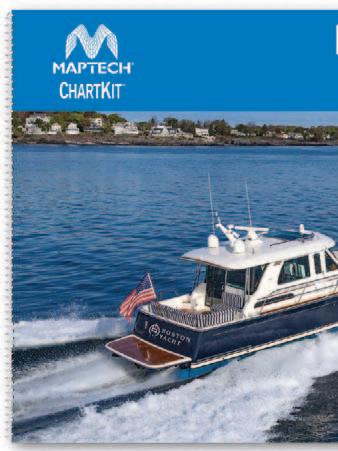





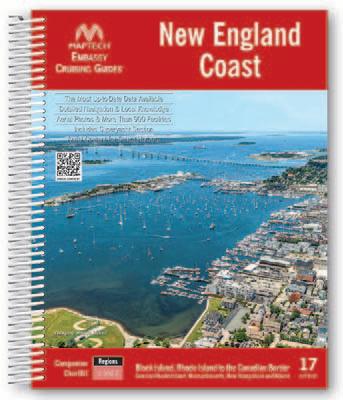
ChartKit® – Get the Big Picture! Go beyond the limits of digital screens with our large, 22" x 17" charts. Includes GPS waypoints, magnetic courses, multiple chart scales and free digital charts and software. Easy to use and fully referenced.
Embassy Cruising Guide® – Accurate and Reliable! Features marina locations, navigational advice, anchorages, local knowledge, aerial photography and video. The most comprehensive cruising guide available! There is no substitute for paper charts and guides.







BY SEAN GRAVES
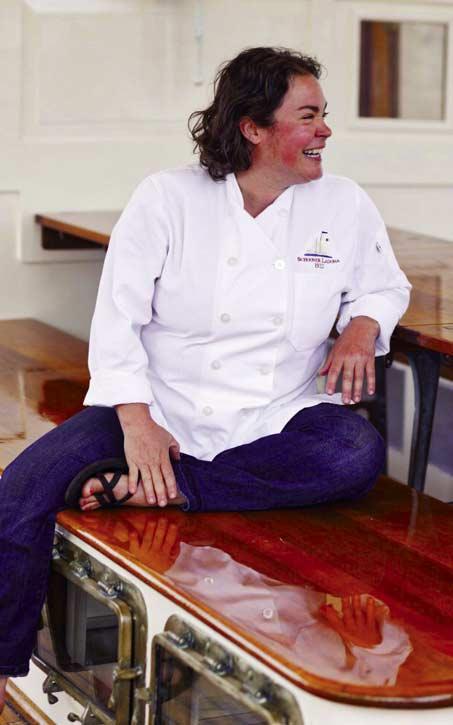
ONCE THE LEAVES fall off the trees and the last holdouts of Maine’s tourist season depart for warmer pursuits, life slows down a bit for many of the state’s year-round residents. For Chef Anna Miller, though, who oversees the galley operation of the schooner Ladona, her work moves from a kitchen on the water to one on land.
After summer operations are completed on Ladona, Miller moves about a half mile inland to In Good Company, a restaurant in downtown Rockland. “All I know how to do, is cook,” Miller said. “People say, ‘we don’t see you at the restaurant in the summer’ and I say ‘well, if you look out that window, you can see the boat from here.’”
A two-week family vacation in 1999 convinced Miller to stay in Maine and enroll in culinary school. When it came time to find a summer internship, she decided cooking on a schooner sounded like fun. “I thought, ‘They’re probably looking for a cook,’ so I did some research and I’ve been with the boats ever since.”
To add to her winter workload this year, Miller got the chance to help raise funds that will go to the repair efforts of a beloved local landmark, the Rockland Breakwater Lighthouse. The lighthouse was badly damaged in storms the previous winter. Schooner Ladona is a member of the Maine Windjammer Association, a fleet of historic sailing vessels that offer trips along the coast to their guests
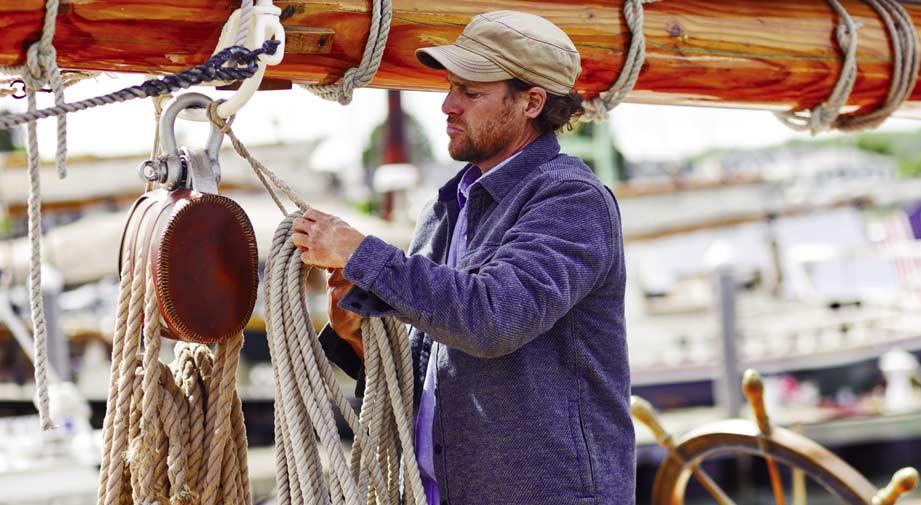
With wooden spars and blocks and friendly crews, traditional schooners like Ladona draw visitors to the midcoast’s working waterfront.
from May to October. The vessel calls Rockland home, and so the breakwater is dear to Miller’s heart and to those of the other windjammer crews. The chance to help was too great to pass up.
On a chilly Saturday in early March, Miller and the chef of the schooner Lewis R. French , who refers to himself simply as O.B., cooked up a storm of their own at the Carriage House in Thomaston, creating a prix-fixe dinner for 25 guests to benefit the lighthouse
repairs. In addition to a menu that consisted of Miller’s halibut in three sauces and O.B.’s apple hand pies, as well as charcuterie and salads from other members of the fleet, diners were treated to stories of life aboard the windjammers by the ships’ captains.
“I’ll do anything to talk about the boats and to bring more attention to the cause,” Miller said. “Particularly the lighthouse, because walking out there is such a special event. I tell all my guests about it.”
Beyond working throughout the colder months, Miller spends her down time on land snowshoeing, visiting with her sister and nephews, and going to potlucks and game nights with friends, many of whom are schooner cooks and crew themselves.
“Our schedule on the boat is all out until the end of summer. We get a few hours off in between trips before we get ready for the next one, so in wintertime we take advantage of the slow down.”
The off season is also a time of research, menu prep, and recipe testing. “I’m one of those crazy cooks that, even on my days off, I cook. I try a lot of recipes out over the winter to see if it would be appropriate for the boat and how it would translate.”
One of the challenges of cooking on a schooner is working with the ingredients that are available at a given moment. Miller relies on two giant bags of produce that arrive weekly from a local community-supported agriculture venture, and she buys proteins from the area butcher counters and farms, but she
rarely plans her meals too far in advance. “It all depends on what’s available from the fishmonger, what’s in season at that particular time of year. I open the bags of vegetables on my galley counter, and I get inspired. I love surprises. Sometimes in the morning, people are like, ‘what’s for dinner’ and I’m like, ‘I’m still figuring that out.’”
It takes years of dedication in a kitchen to make three meals a day, on the fly, for more than 20 guests and crew while holding down your pots and pans and working in a small ship’s galley. It’s what Miller does in the winter to prepare and how she relies on the tight community of cooks aboard other ships that makes her trips a success.
“We’re all open about sharing. We’re just out there to help each other because we’re just one big family. In the off season, we all still spend time with each other. This is a really cool thing to experience with other people that are like-minded.”
Whether she is exchanging texts at 0400 out on the boat with another schooner chef or going over her plans for
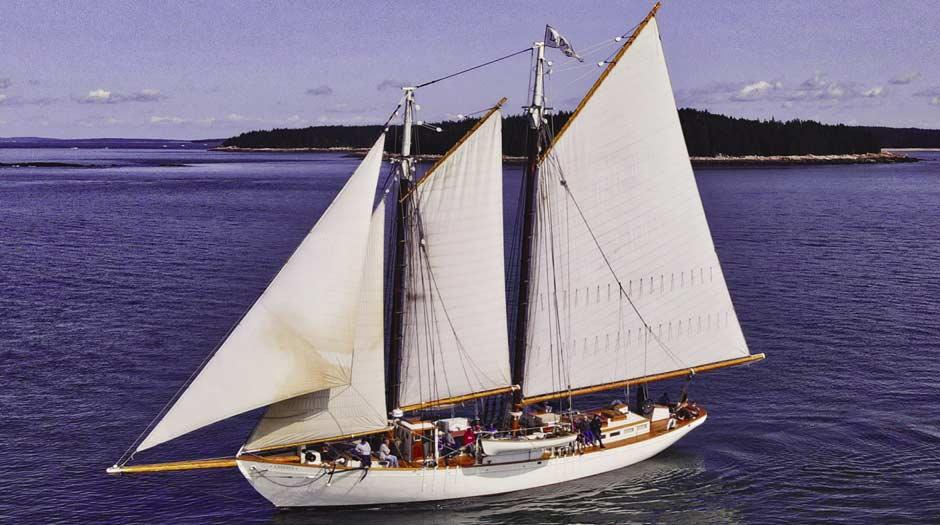
The schooner Ladona has a rich history, having won the 1923 Bermuda Cup, patrolled for enemy submarines in World War II, and functioned as a sail training vessel in the 1970s.
the following season with a local purveyor, Miller knows that working together is the key. When you’re leaning on your community and giving back to it, it makes the work seem a little less daunting. N
Prior to joining the staff at MBH&H as office manager, Sean Graves spent 20-plus years working in hotels, restaurants, and a food truck. He lives in Warren, Maine, with his wife, daughter, and two hounds.
Roof repairs at the Rockland Breakwater Lighthouse have been completed and siding work and other improvments are ongoing. Fundraising to repair and maintain the lighthouse is also still underway. Donations can be made to the City of Rockland, noting on the check that it is for Breakwater Lighthouse, or at the lighthouse’s Facebook Page, facebook.com/breakwaterlighthouse.

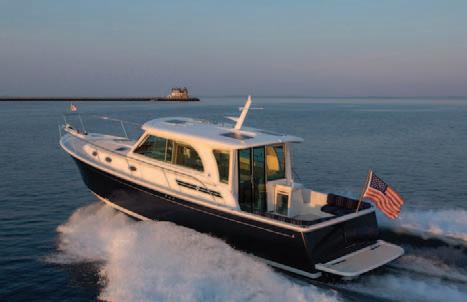
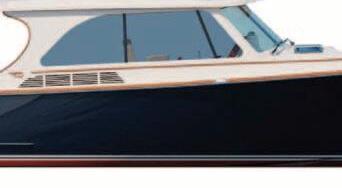
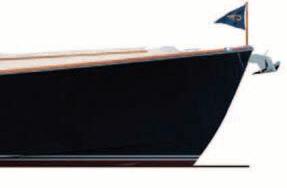
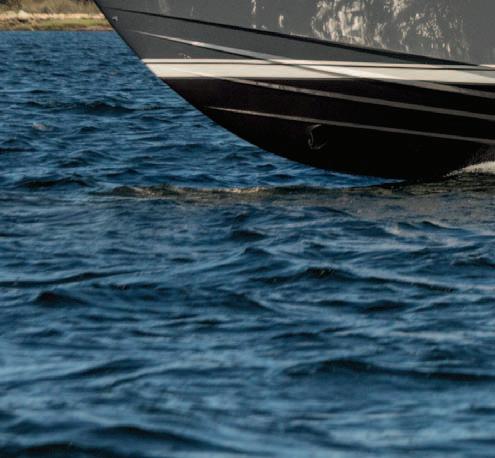
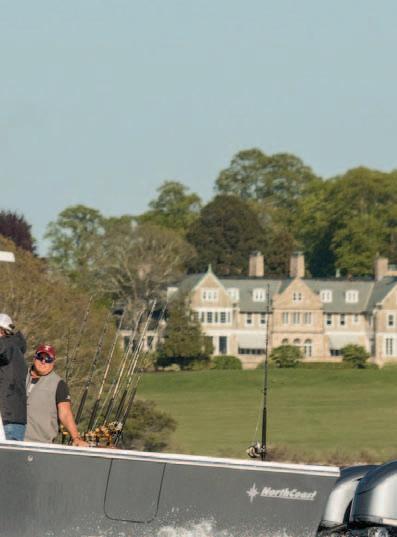
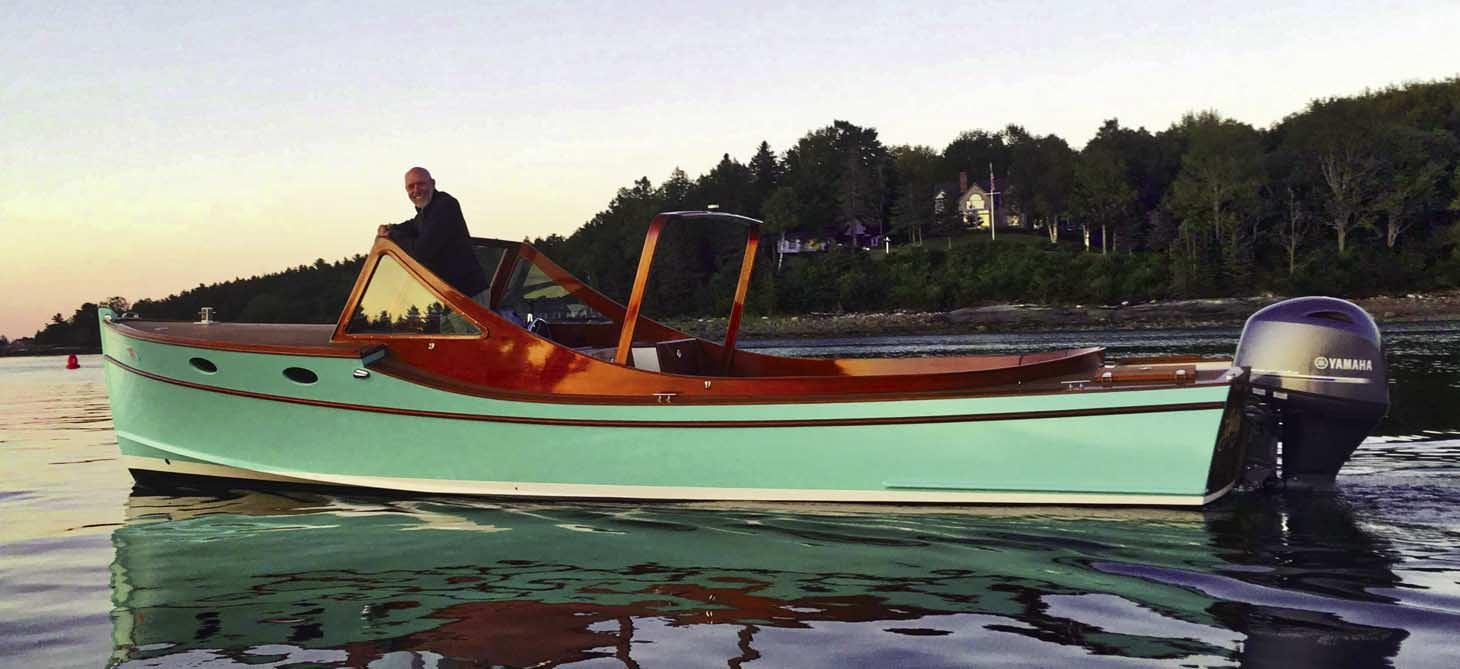
Maritime elegance defined, the Hylan & Brownbuilt Gatsby II shows a sweeping sheer, subtle tumblehome, and modern hull form that combine a traditional look with modern performance.
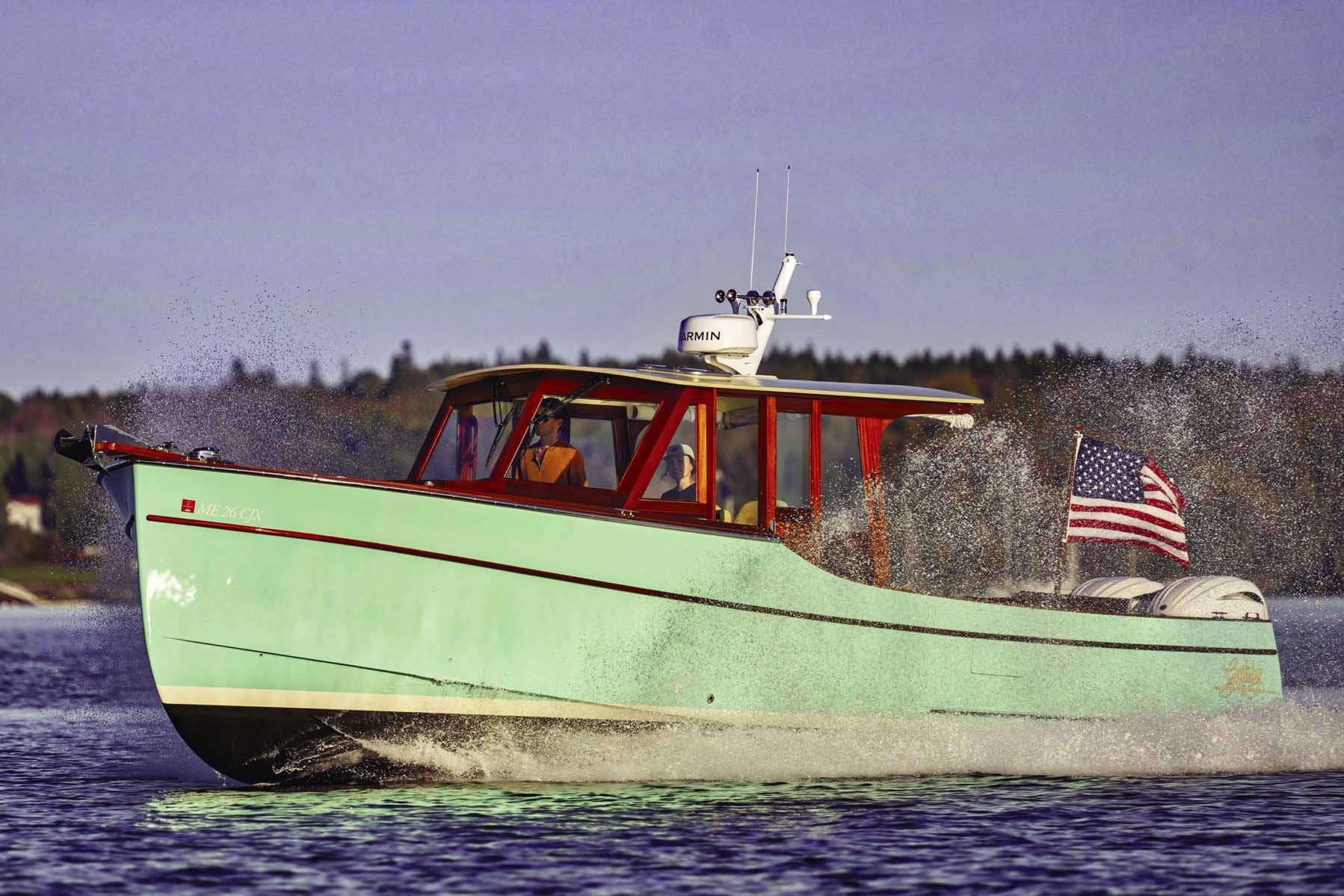
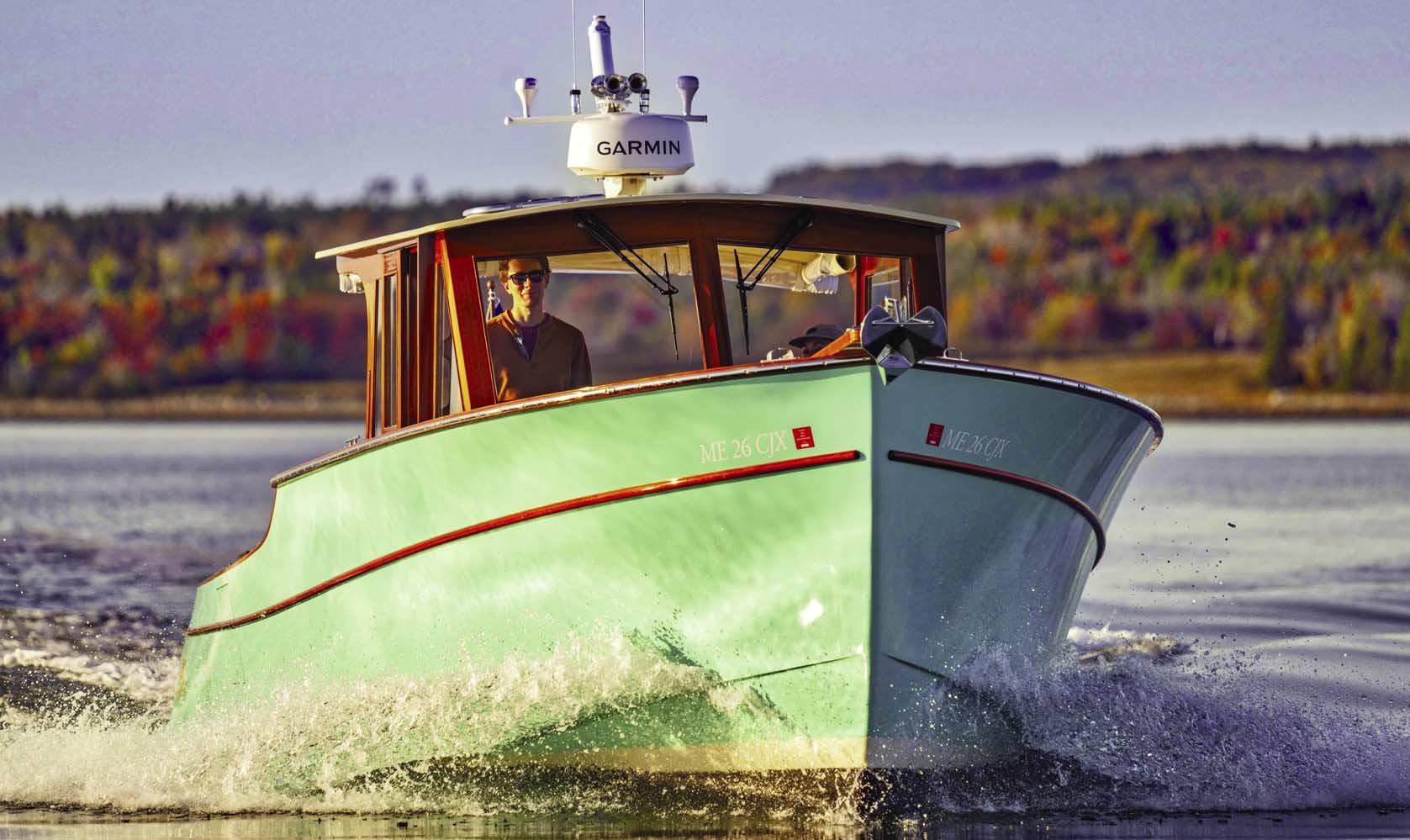
Viewed bow on, the twin outboardpowered Gatsby II might have been built at one of the famous boatyards that crafted yachts that F. Scott Fitzgerald’s Jay Gatsby might have seen on the waters of Long Island Sound.
BY STEPHEN RAPPAPORT
IF YOU’VE SPENT any time around the water, you know that the adage,
“There’s no such thing as an ugly boat,” is patently false. Even in Maine, it’s not that hard to find some boat, moored in a harbor otherwise filled with classic yachts and handsome lobsterboats that, by design or dereliction, insults the eye.
Then there’s the rare boat that in even the most elegantly stocked harbor, or any harbor for that matter, stands out for its sweetness of line and proportion, quality of finish, and just plain “wow factor.” To my eye, that boat has to be the Gatsby II , a beautiful 32-foot day boat
The customer wanted a boat with the same graceful elegance of their existing boat, but one that was larger and “more teched out.”
built for a repeat customer by Hylan & Brown in their Brooklin boatshop, on the shore of the Benjamin River.
Launched last year, the Gatsby II can trace its roots back to 2018 when Hylan & Brown designed and built a 26-foot6-inch runabout—the Gatsby —for an
experienced sportfisherman and his family, who had a new waterfront home in Rockport, one of Maine’s most picturesque harbors.
The family was delighted with their new boat and used it extensively for picnics and day trips around Penobscot Bay.
“They loved it,” boatbuilder Ellery Brown said recently, but eventually, “they wanted a bigger boat, more capable, drier, better ride, bigger for more family.” So, after three years of enjoyment, the customer returned to the boatshop where the Gatsby had been built and discussions about a new and larger boat began.
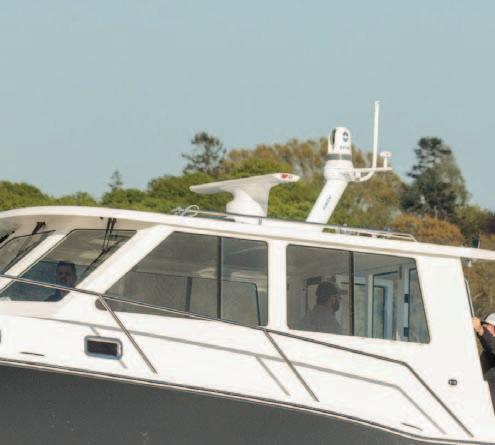
The project was complicated. The customer wanted a boat with the same graceful elegance of their existing boat, but one that was larger and “more teched out,” Brown said. The new boat would have, among other features, a wrap-around stern seat, hull doors for ease of boarding, and, eventually, a walk-around pilothouse that would replace the Gatsby’s open cockpit.
“That’s not where we started,” Brown said.
Matthew Smith, a naval architect from Barrington, Rhode Island, was called on to develop the lines and structural design for the new boat. Brown said that Smith was chosen because of his experience with powerboats and because he had done drawings for wood construction used by Hylan & Brown. “I mean, he’s not just a fiberglass guy,” Brown said.
Smith was able to take a ride on the original Gatsby before he began designing the new boat, a process that involved many discussions with the owners and the builder, and production of many conceptual draft plans.
“He was consulting with me on construction details and with them on aesthetics,” Brown said, explaining Smith’s approach. “We finally got it, got a layout everyone was okay with, and he drew up some lines.”
Smith also designed the pilothouse,
LOA: 31' 6"
Beam: 10' 4"
Electronics: Garmin VHF, AIS, 16" multifunction display
Water, waste: 20 gallons, plastic Fuel: 250 gallons, aluminum Engines: twin Yamaha F250 XSBs
BUILDER:
HYLAN & BROWN
10 Frank Day Lane, Brooklin, ME
207-359-9807
dhylanboats.com
though, Brown said “we tweaked it a bunch” during construction. As the project developed, Hylan & Brown’s Ben Parson produced detailed construction drawings of specific construction elements.
At 31 feet, 6 inches on deck, the Gatsby II is only 51⁄2 feet longer than the original Gatsby. But the new boat displaces approximately 10,000 pounds, about three times as much as the smaller boat. Part of that additional displacement is attributable to the boat’s 10-foot-4-inch beam, but much of it comes from the boat’s glass-sheathed, cold-molded, cedar-strip-and-marine-plywood hull construction, its custom fittings, and the
Seakeeper gyroscopic stabilizer. The Gatsby II is powered by twin Yamaha F250 XSB outboards with digital electric steering and Helm Master EX controls that incorporate a single joystick and an integrated autopilot. The joystick controls a Vetus bow thruster, as well. Hardware also includes an electric windlass on the bow for convenient anchor handling.
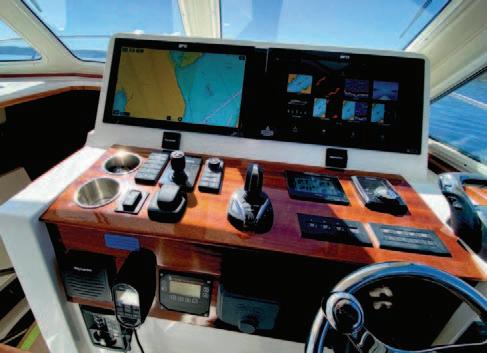
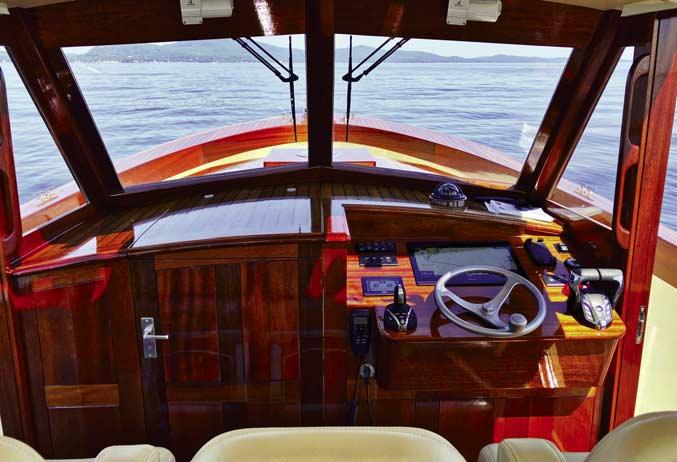
The joystick is primarily for use in low-speed, close-quarters handling situations; there is a handsome, conventional wooden wheel at the helm. With digital controls, all engine operations— steering, shifting, and throttle—are via a fly-by-wire system so there are no hydraulic hoses connecting the helm to the engines.
“When you use that joystick, what’s actually happening is remarkable,” Brown said. “It’s doing all the things at once, maybe shifting the two motors in opposite directions and throttling.” The boat has a full complement of electronics—radar, VHF, and AIS—at the helm. Control central is a 16-inch Garmin multifunction display.
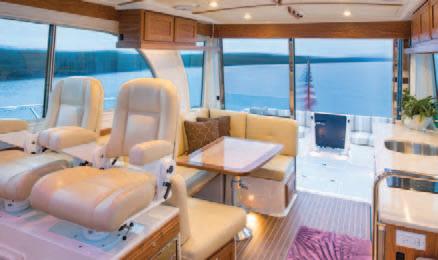
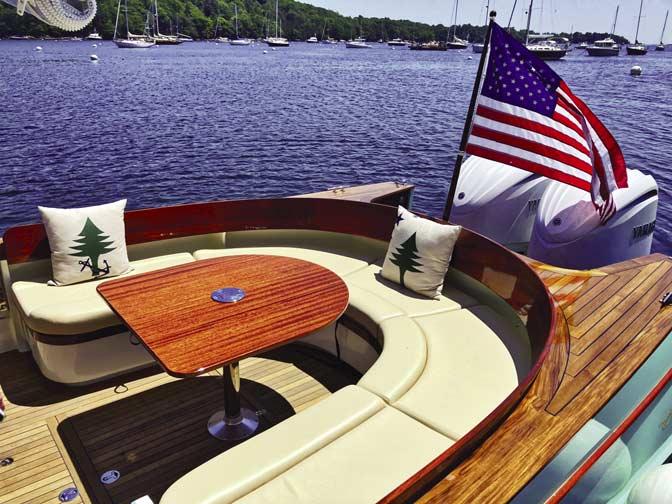
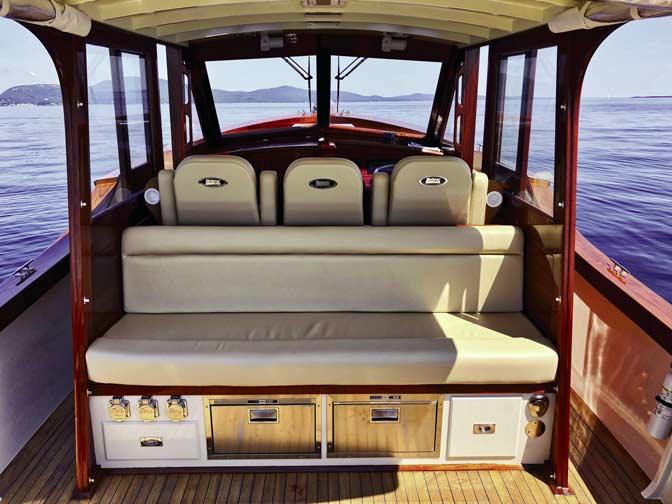
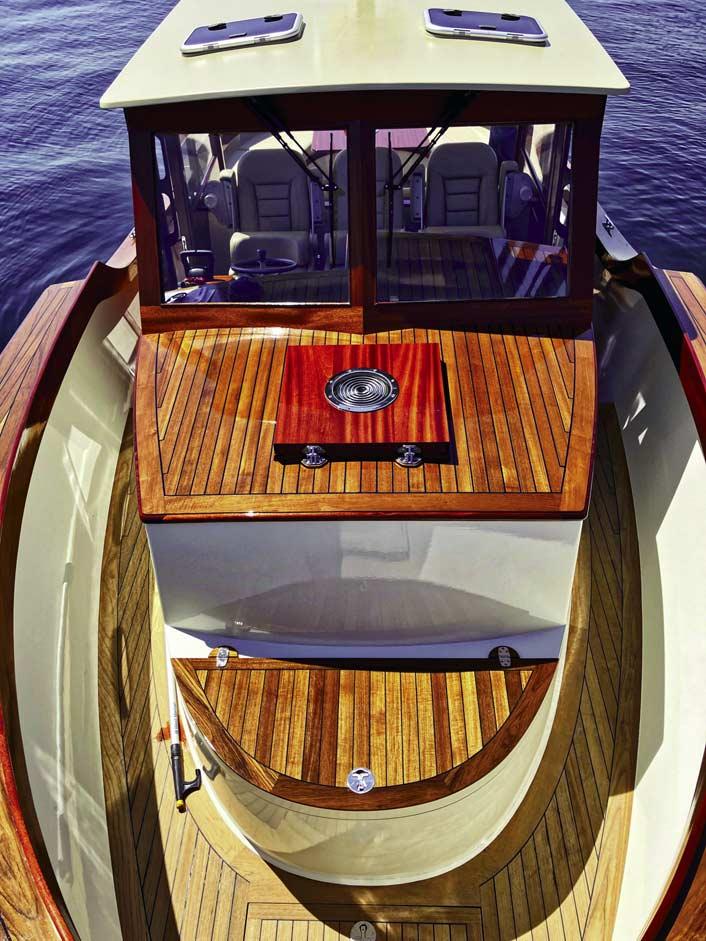
The Gatsby II is definitely a day boat. Seating includes triple helm chairs in the wheelhouse and a custom bench and curved transom settee in the aft cockpit, which is designed for real comfort underway and at rest. It features lush custom upholstery.
by

Charming seaside villages and soft, sandy beaches. Waterfront lobster shacks and artisanal ice cream shops. Some trips never leave us: recalled often and savored always.
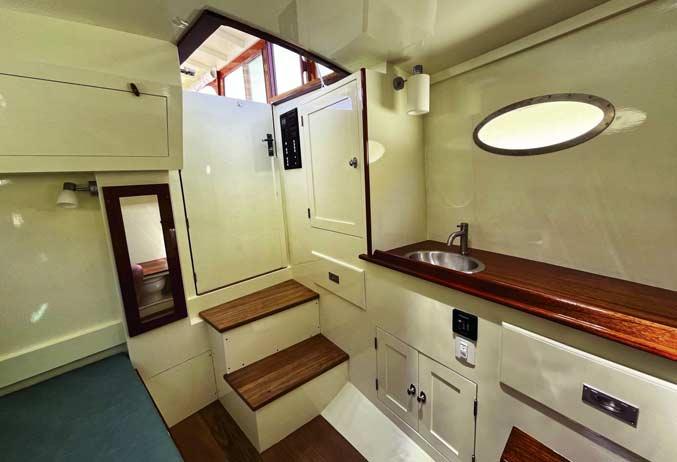
Amenities include an enclosed head below, and a single bunk on which the owner can enjoy an occasional nap, but no galley, no hot water, no heat, and no air conditioning.
The level of finish on the Gatsby II is extraordinary. The custom hull color is the product of many trials and the same as was used on the earlier Gatsby . The interior finish is offwhite, the house and trim are varnished; the decks are teak.
Despite the boat’s classic appearance, Brown said that “almost no solid wood” was used in its construction. The varnished house was built using a thin sipo veneer over a marine plywood structure, and the teak decks were laid over plywood, with seams caulked using black West epoxy. That kind of construction saved a huge amount of weight and contributes to the stability of the exterior joiner work so “all the joints stay tight, the varnish stays attached,” Brown said.
In late March, the Gatsby II was in the Hylan & Brown shop where the crew was preparing her for a second season on the water, but it won’t just be sitting at the owner’s dock. According to Brown, the boat saw plenty of action last year and attracted plenty of attention.
“They get around,” Brown said. “All summer I heard, ‘I think I saw that boat at Bar Harbor, I think I saw that boat in the Fox Islands Thorofare.’ It’s not just that it needed to look pretty sitting on the dock. They used it.”
Stephen Rappaport is a writer and editor, has lived in Maine for more than 35 years, and is a lifelong sailor.






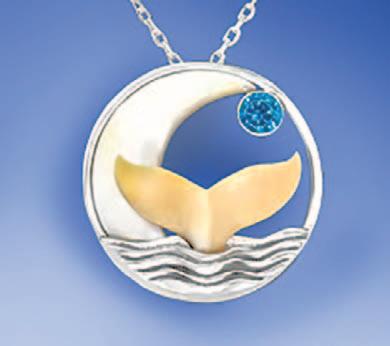

Mysteries of the Sea Whale Tail Blue Topaz Style # X4543
Because our state has forests, mountains, lakes and of course, the ocean. Our ocean is our front yard. It’s salt, wind, waves, islands, and land which reaches its long fingers to the sea. Maine is easy. Maine is relaxing and welcoming too. We create jewelry to touch the mind, heart, and soul. Check out our website and you will see we design with truth, space, and freedom.
Creatures of the sea. Time and tides, the ebb and flow of life on 2/3 of the Earth. Here we show in detail life's mysteries on and beneath the waves. Each piece a conversation starter, contributing to finding new friends, interesting people.
(SHOWROOM NOT OPEN) WE ARE NOW EXCLUSIVELY ONLINE!
Shipping is always Safe, Fast and FREE
Anywhere USA
BY TED HUGGER
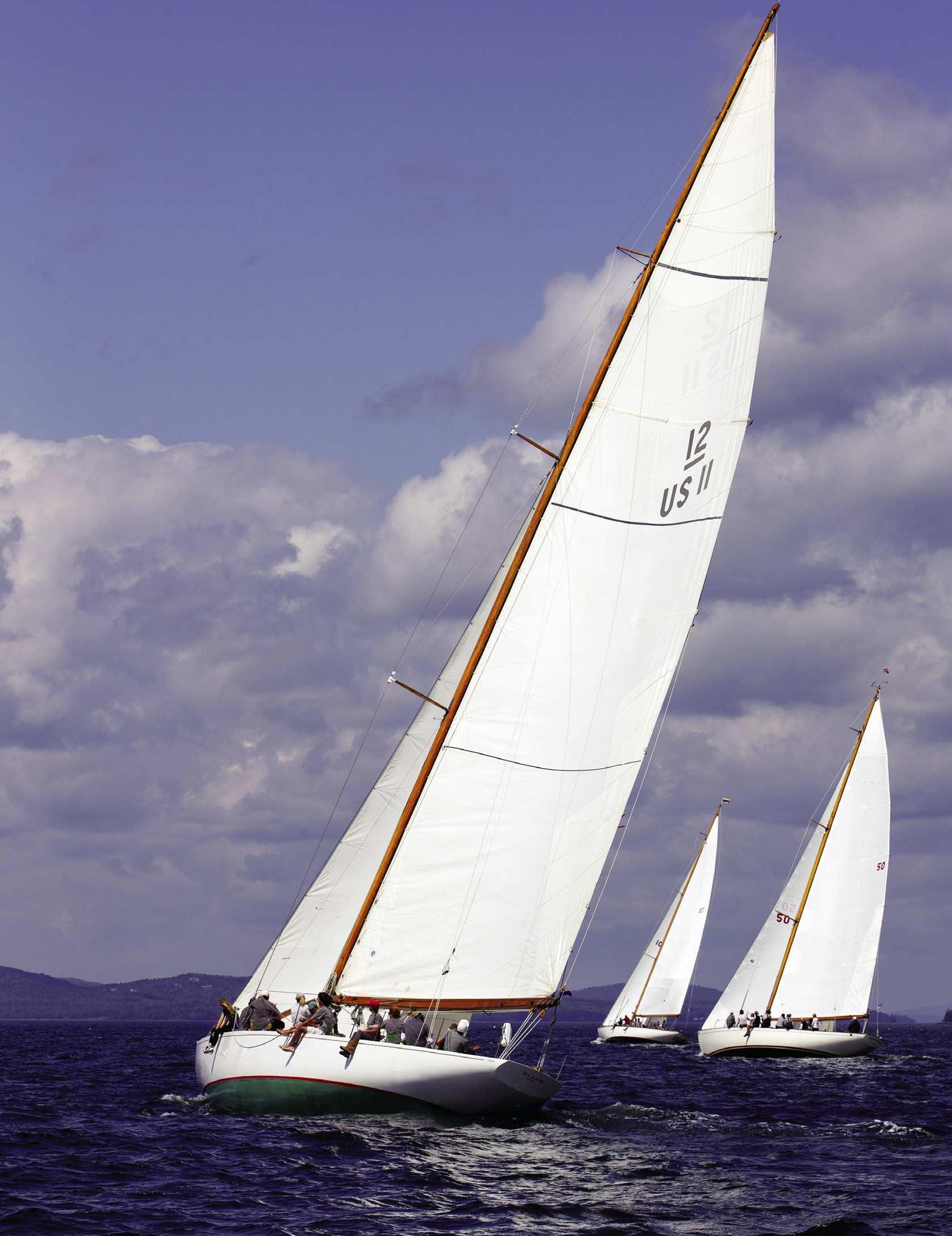
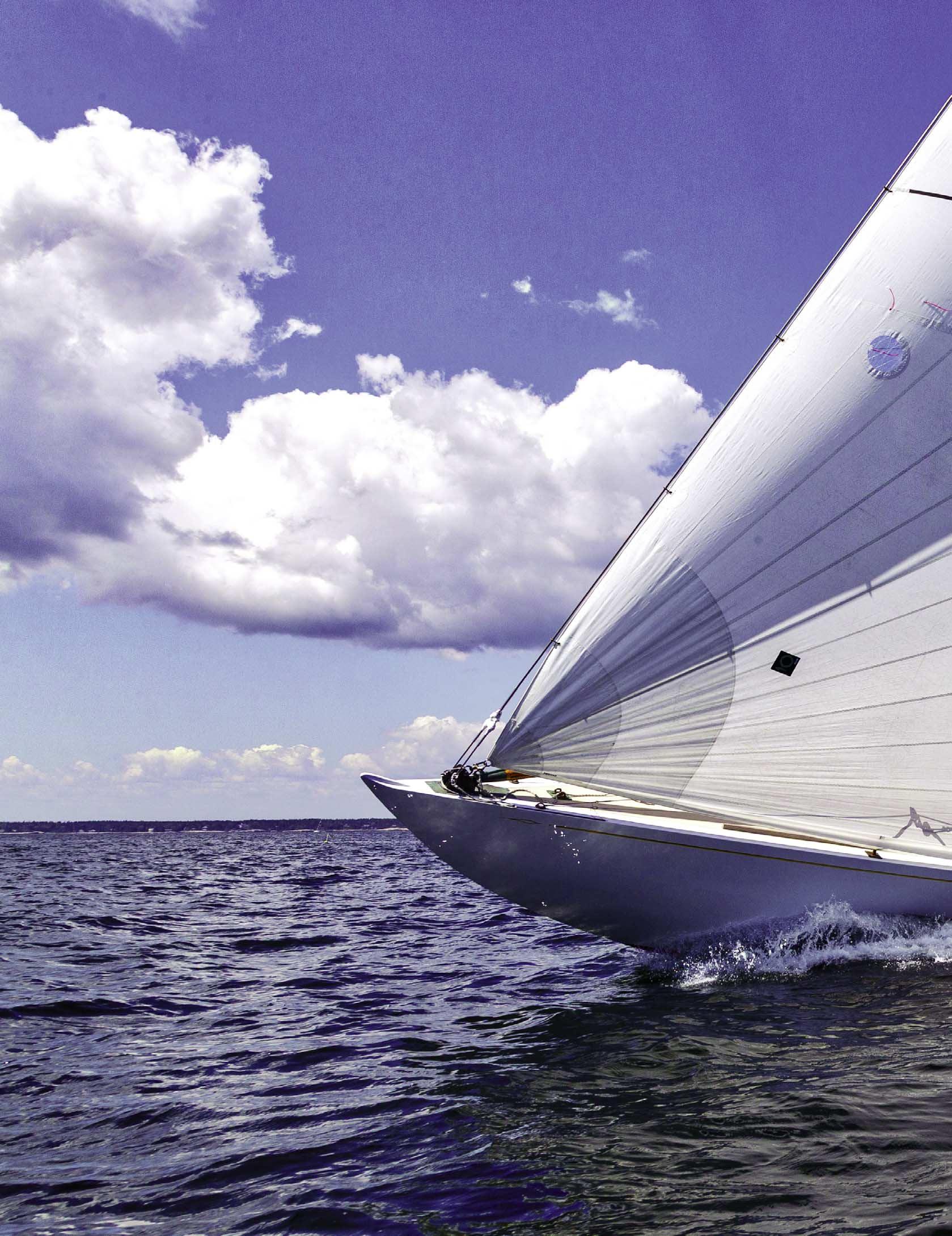
WHEN THE RACE COMMITTEE signals the start of this summer’s Boothbay Harbor Yacht Club Regatta and Shipyard Cup Classic Challenge, the 88-year-old 12-Meter racing yacht Gleam and her crew expect to be there on the line with sails set, varnish sparkling, and ready for another summer of spirited racing.
For her owners, Dennis Gunderson and Andy Tyska, the rewards of having taken over stewardship and maintenance of a stunning wooden classic are immediate.
“When a 12-Meter takes the course, everybody stares,” Gunderson said. “A 12-Meter yacht under full sail with a giant main and genoa set on her towering mast is an amazing experience. As she heels in the breeze you feel the raw power—it is absolutely palpable.”
Tyska owns Bristol Marine with facilities in Boothbay Harbor; Bristol, Rhode Island; Somerset, Massachusetts; and Jacksonville, Florida. Gunderson is the general manager for the Bristol Marine Boothbay yard. Tyska and Gunderson acquired Gleam in 2020.
For eight decades and counting, the 12-Meter Gleam has been at the starting line and ready to race.
The 2025 regatta season along the Midcoast of Maine that’s become a favorite of sailors and spectators alike starts off with the granddaddy of all regattas: the Boothbay Harbor Yacht Club Regatta/Shipyard Cup Classic Challenge. Now in its 51st year, this two-day event is the oldest regatta in the state, and it attracts boats and crews from far and wide, many of which then travel on to several more venues over the next two weeks leading up to the famed Eggemoggin Reach Regatta in Brooklin, the largest wooden boat regatta in the world. For information on racing or spectating, contact the events, below.
Boothbay Harbor Yacht Club Regatta / Shipyard Cup Classic Challenge
Saturday, July 19-Sunday, July 20 [Boothbay Harbor]
Lead Sponsors: Bristol Marine, Clearstead Trust, Hodgdon Yacht Services, J. Edward Knight, Boothbay Harbor Yacht Club info@Boothbayregatta.com 207-633-5750 boothbayregatta.com
Camden Classics Cup
Thursday, July 24-Saturday, July 26 [Camden]
Lead Sponsor: Lyman-Morse; Charity: LifeFlight info@camdenclassicscup.com Instagram: @camdenclassicscup camdenclassics.com
Castine to Camden Classic Feeder Race
Thursday, July 31, 2025 [Castine]
Lead Sponsor: Castine Yacht Club fred@northlandforest.com kevinjcoady@aol.com castineclassic.com
Camden to Brooklin Feeder Race
Friday, August 1 [Camden/Lyman-Morse]
Lead Sponsor: Camden Yacht Club cyc@camdenyachtclub.org 207-236-7033 camdenyachtclub.org/camden-brooklin-woodenboat-race
Eggemoggin Reach Regatta
Saturday, August 2 [Brooklin/WoodenBoat Campus]
Lead Sponsors: Rockport Marine, Brooklin Boat Yard, WoodenBoat Publications err@rockportmarine.com 207-236-9651
www.eggemogginreachregatta.com
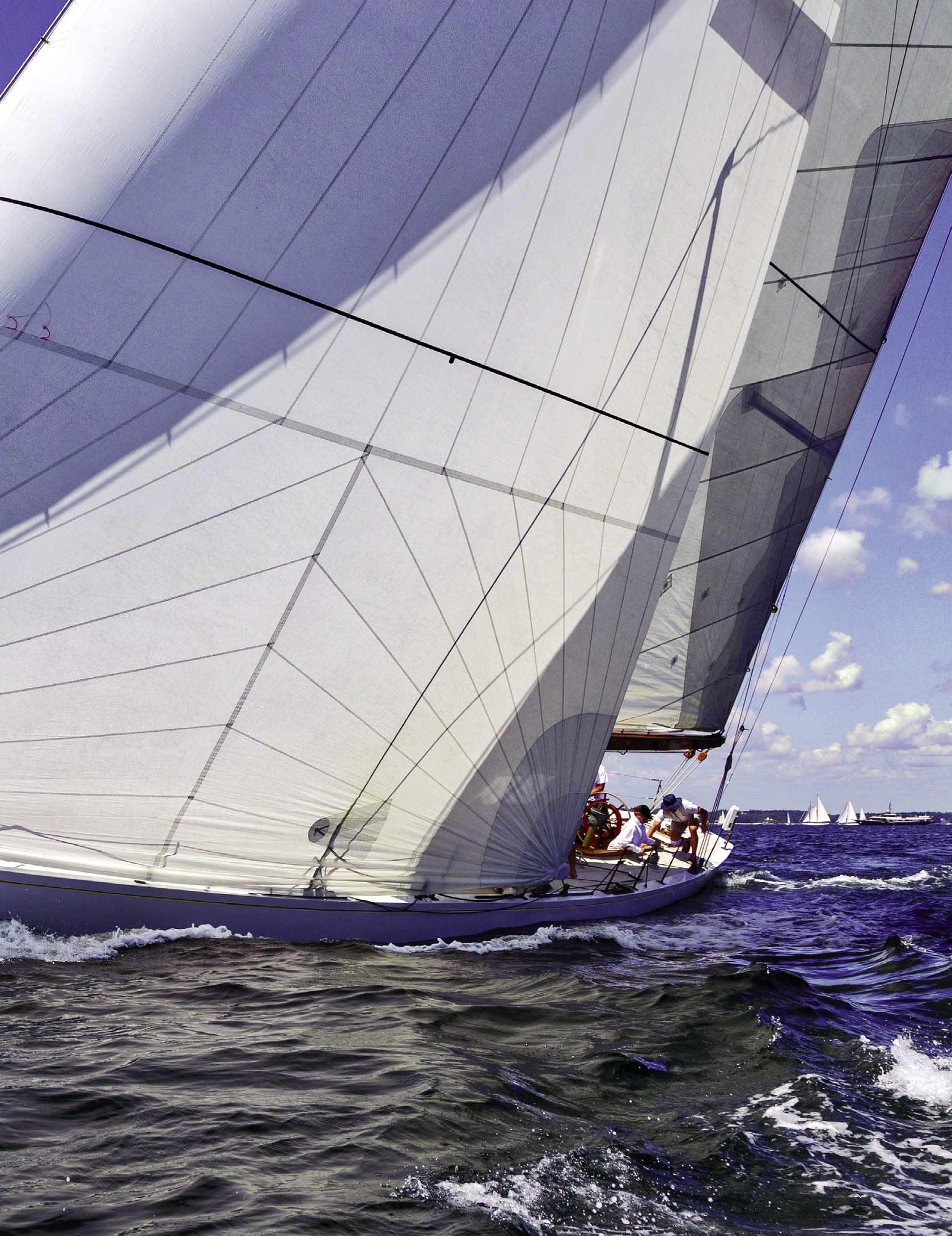
The team remains infatuated with the 12-Meter, which despite its age, still sails upwind better than many modern boats. Noted Gunderson, “Her helm is always balanced. Downwind, she flies an enormous spinnaker set on a 30-footlong wooden pole. The equipment is all large and powerful, yet the way that she handles it all—it’s pure elegance and style.”
Gleam and other vintage 12-Meter yachts are racing thoroughbreds, yet their unique feature is that these 1930s-era boats were designed for dual purposes. On deck, the 12-Meters are all business: competitive, high performance racing machines during the day. In the evening, the owners and crew would often spend the night aboard, wining and dining in elegant, richly appointed interior accommodations before the next day’s races.
“I’ve been lucky to sail and race many classic boats, and I’ve been part of some big classic yacht projects over the years,” Gunderson said. “But Gleam is particularly special to me, simply my favorite boat ever built.”
Gleam was launched in 1937 by the famed Harry B. Nevins Yard in City Island, New York. Clinton Crane designed the boat and had her built for his personal use. “He designed Gleam as a racer-cruiser for his family. Crane was before his time, designing 12-Meter yachts long before the famous America’s Cup 12-Meter class was established in 1958. Yet his influence was felt even then,” said Gunderson.
Despite her age, Gleam played a major role in the design of Columbia , the successful defender of the 1958 America’s Cup against the British challenger, Sceptre. “While Columbia was designed by a young Olin Stephens, it was Clinton Crane who mentored Stephens and who shared Gleam ’s tank-test data for use in developing Columbia’ s lines,” Gunderson recalled. “When the boats are side-by-side, you can actually see a lot of the familiar lines and shared design details of the two yachts.”
Gleam was tapped to serve as a trial horse for Columbia for the 1958 America’s Cup challenge, and she also matchraced Vim, a defense candidate that sparred with Columbia to represent America in the finals.
“The enjoyment of being on the racecourse is just 10 percent of what it is to own and take care of a classic yacht like Gleam. There’s a lot of demanding work—the other 90 percent—that goes into being able to arrive at the starting line ready to race,” Gunderson said.
Many of the sailing yachts of Gleam’s vintage survive today as a result of major structural renovations and rebuilds over the years. But Gleam is all original and out there racing every summer. “She’s been maintained for nearly 90 years and has never received the full restoration that many of the boats of this era undergo. It’s a work of passion for us. If you don’t love working on boats—varnishing, painting, scrubbing bilges and all that not-so-glamorous work—then you’re not going to enjoy racing classic yachts,” Gunderson said.
Gleam ’s numbers are impressive. She’s 70 feet overall, weighs 60,000 pounds, carries a 96-foot-tall mast, and sports a 40-foot-long boom. She boasts a deep draft of 8 feet,
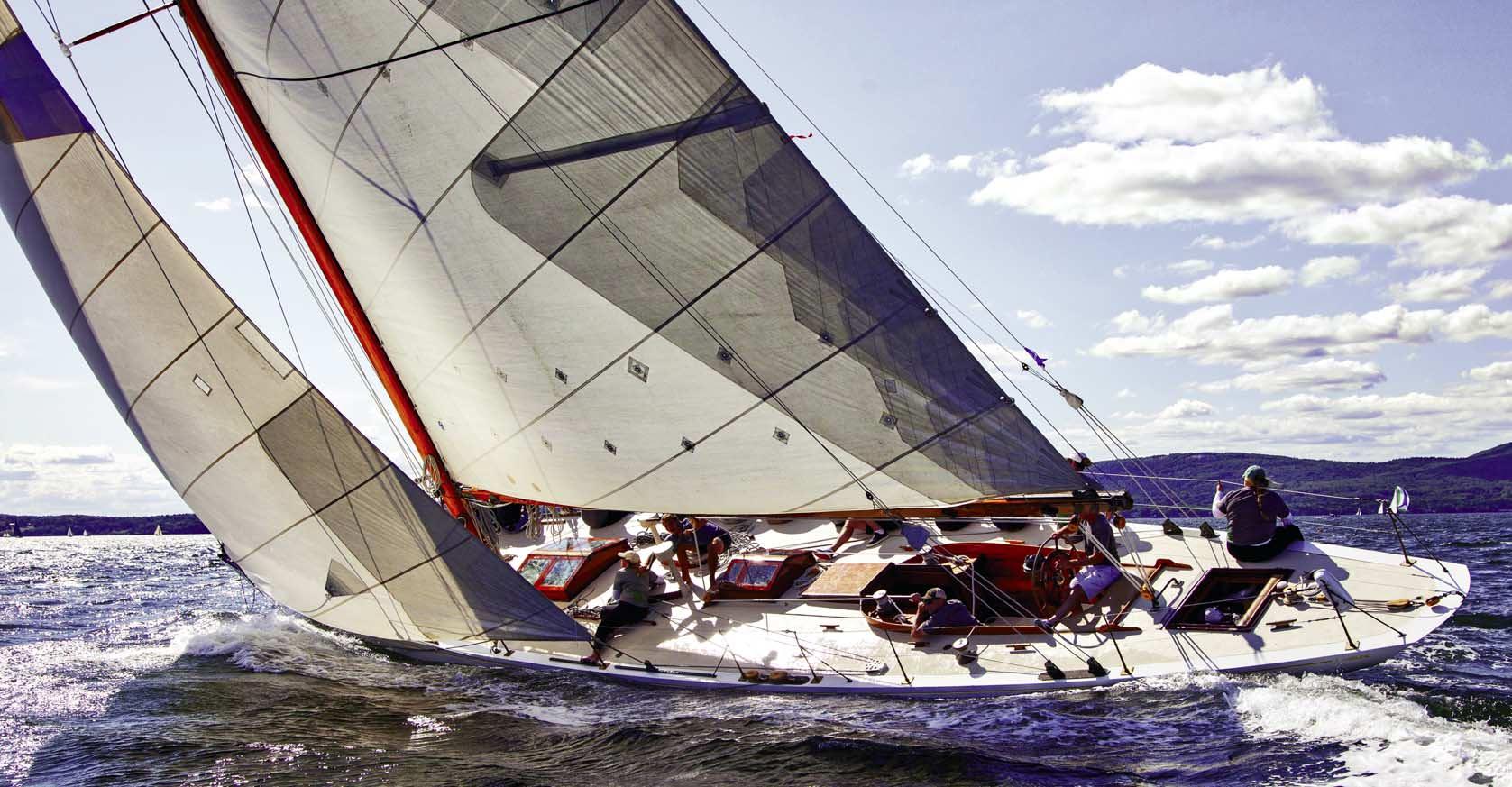
10 inches, and flies 1,900 square feet of sail area. From hull to deck to rig to sails—everywhere one turns, rigorous and methodical maintenance is required to race the boat safely and with any sort of expectation to be competitive. Just a bottom paint job takes 100-plus hours every season.
Why do Gunderson and Tyska put the time and effort into campaigning Gleam? They’ll tell you that one reason rises above the rest: “Going upwind aboard a vintage 12-Meter in 15 knots of breeze, screaming across Penobscot Bay with a bone in her teeth is a feeling that very few people get to experience. It’s a thrill that is both exhilarating and addictive,” Gunderson said.
Gunderson values being able to share such extraordinary experiences with friends and especially younger sailors. “We need a minimum of 12 to 13 people on board in order to safely race the boat. Sometimes we have as many as 20 crew. To accomplish a maneuver like a spinnaker set requires each crew member to execute two or three different tasks over the course of 20 or 30 seconds. When you see that happen and your team does it well, it’s rewarding and so much fun!” Gunderson said.
“It’s a special opportunity for me to be a part of her long and storied history,”
Gunderson added. “For example, railroad executive and financier Harold Vanderbilt chartered Gleam for the 1938 season to race with the 12-Meter fleet in Newport. The next year, he went on to win the America’s Cup with the J-Class Ranger. When I’m at the helm of Gleam, I know it’s the same wheel that Vanderbilt held racing on Narragansett Bay in 1938. Today, I get to do the very same thing, and that’s pretty cool.”
Gunderson takes extraordinary pride in his stewardship of such a notable piece of American maritime heritage.
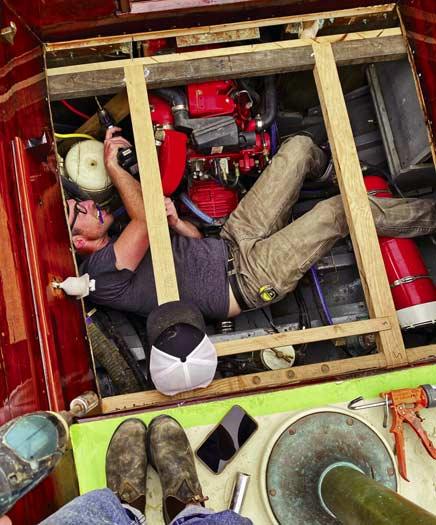
Gleam provides a training platform for up-and-coming trades people as well. “Today, we’re replacing planks on three different boats in our boat yard. The number of places you can go to get that type of work done on boats like Gleam or [the] Ernestina Morrissey is rapidly dwindling. So being able to keep that tradition of boatbuilding going and keep that technical knowledge in play is something that Andy and I value. From the start, the goal for us was to make sure that Gleam helps continue the tradition.”
Gunderson noted, “At the same time, we’re providing an opportunity for young people to experience what it means to sail a boat like Gleam ,” The program allows young sailors to make a leap in their sailing experience from racing smaller boats to learning the skills necessary to race a vessel like a 12-Meter. Helping maintain and sail Gleam instills a solid work ethic and an understanding of the importance of maintaining a yacht. In addition, it encourages the teamwork that is required to sail safely and to compete successfully.
Gunderson proudly singles out two young crew members who are starting their fifth summer season sailing aboard Gleam. Caroline Williams began when she was a 19-year-old sophomore in college and has been with Gleam
•LOA 40’ 5” • Beam 13’ 2” • Headroom 6’ 5”
•Ellis-designed semi-displacement hull with full keel
•Single diesel engine of your choice (440 to 650 hp)
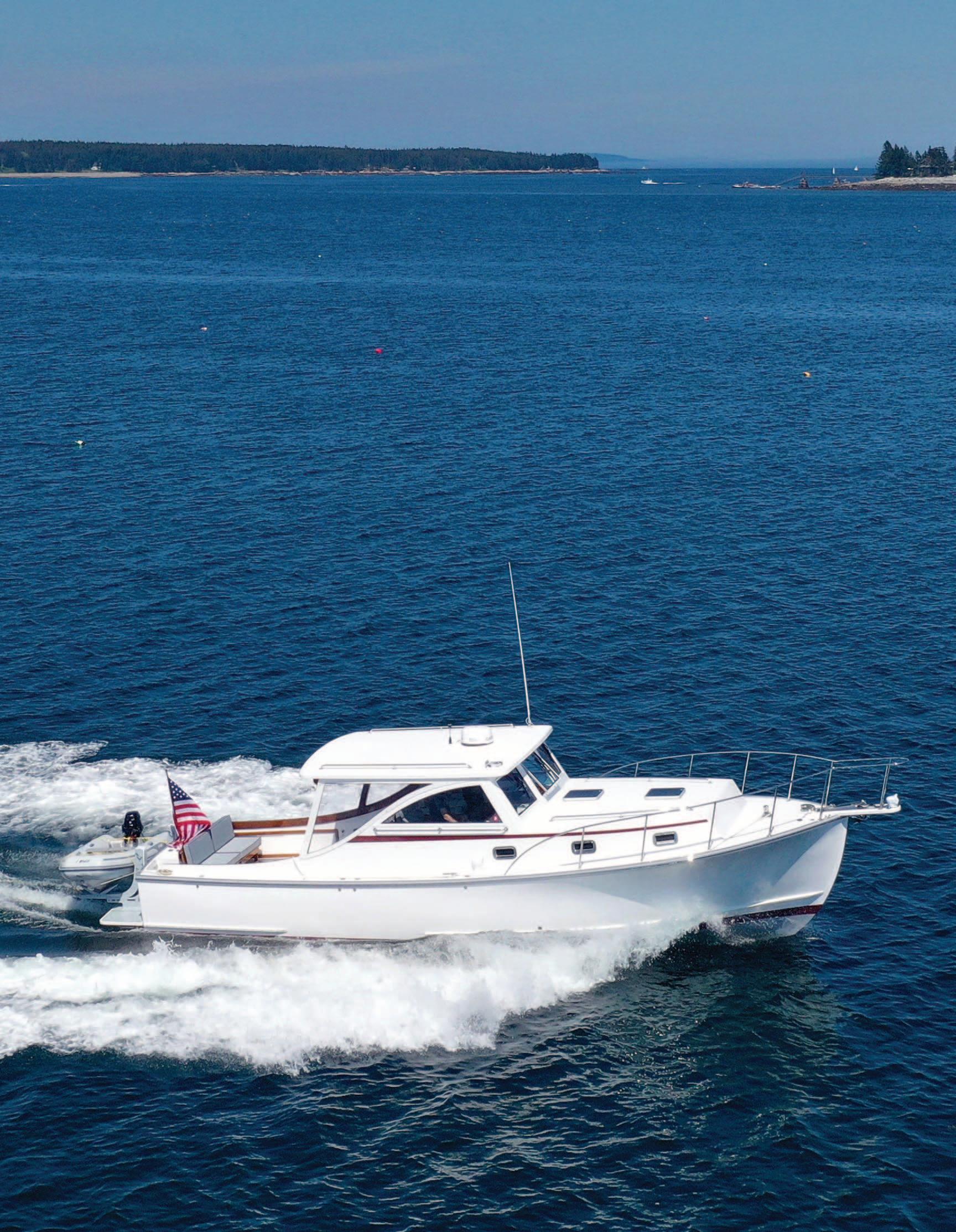
•A spacious cabin with galley, breakfast nook, berth, head, & shower.
•Ellis Cantilevered Seats and fold-out salon tables for entertaining.
•Truly accessible mechanical and electrical systems.
•Easy tender deployment with many davit options.
•Work with the Ellis Team to build your dream Ellis 36.
•Purchase a pre-owned Ellis from Ellis Boat Brokerage.
•Charter an Ellis from the Ellis Charter Fleet.
every summer since. And Simon Morin, who started at age 22, took over as fulltime captain in 2024 and helped move the boat back and forth from Newport to Maine.
“Both Caroline and Simon have fallen in love with the boat, the same way I did. They bring their friends on board, and it doesn’t take long. They sail with us for one or two days and they’ve completely fallen in love with the boat,” Gunderson said.
“Gleam was my first job as a captain after I earned my license when I was 23. And it was aboard Gleam where I met my wife that summer. So, we have memories of sailing together when we first started dating, working on the boat together just like the kids that work on her now,” Gunderson said.
Classic boat regattas play a significant role in Gleam ’s active summer season. The first event in Maine is the Boothbay Harbor Yacht Club Regatta/ Shipyard Cup Classic Challenge in the third week in July. And then the Camden Classic regatta beckons the fleet to Camden for a weekend of racing. The following week, the classics gather in Castine, race to Camden, and from there to Brooklin, followed by the Eggemoggin Reach Regatta. In all, a typical season has Gleam competing in a dozen or more regattas in Maine and on Rhode Island’s Narragansett Bay.
Gunderson said that he loves seeing the boat function as a place of connec -
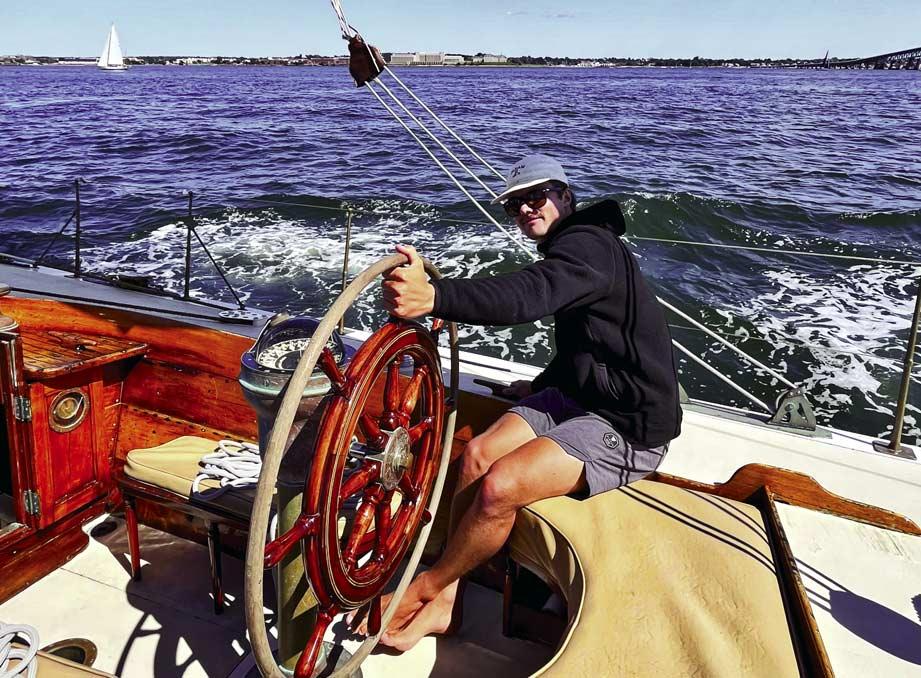
tion for sailing enthusiasts of all ages. The oldest crew member on the Gleam team is 83, and the youngest are in their teens.
“Those three weeks of sailing and racing from Boothbay all the way up to Brooklin are the highlight of our summer schedule,” said Gunderson. One of Gleam ’s competitors is Black Watch , a 68-foot Sparkman and Stephens yacht built in 1938, also at the Nevins Yard. Crewed by long-time friends, Gunderson allowed that Black Watch is sailed exceptionally well. “There’s a rating disparity between the two boats, but we really enjoy racing against each other. There may be a hundred boats on the water racing, but all we’re doing—and I know all Black Watch ’s crew is doing—is focusing on the race between the two of us.
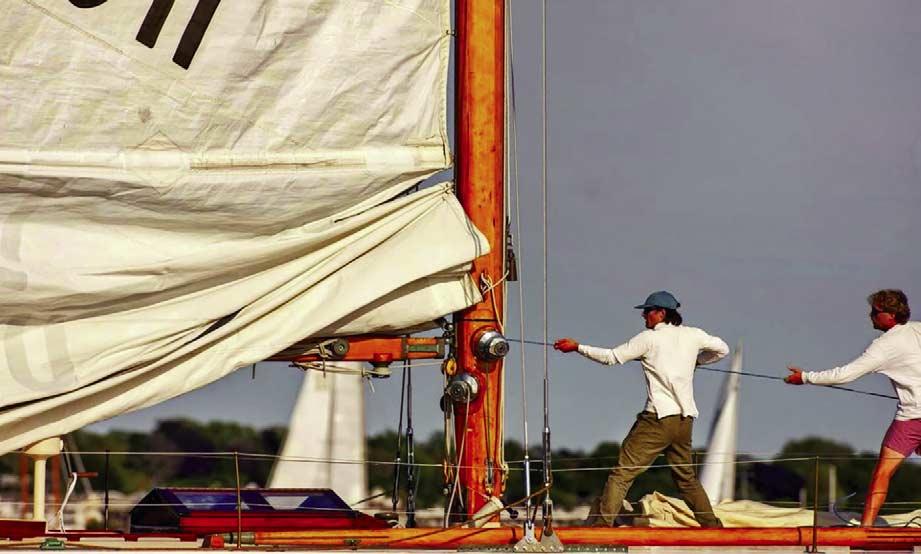
The teams have grown remarkably close over the years. “Last year, we had a couple of great weeks of racing in Boothbay, and then again in Camden. At the Eggemoggin Reach Regatta, after our final day of three weeks of intense racing, the Black Watch crew challenged the Gleam crew to a game of frisbee on the lawn.
“While the yacht racing is always fierce and competitive, that game of frisbee was more competitive than the regatta races,” Gunderson recalled. “We may trade places on the racecourse all day long and push each other to go faster and to perform our maneuvers better. But that game of ultimate frisbee was the most fun we had that season.”
And who won the frisbee contest? “Oh, I think Gleam won the frisbee game,” Gunderson said with a chuckle. “I won’t mention who may have won the regatta the week before, but the frisbee game, I think, went Gleam’s way.”
And then there is the joy that Gleam brings to anyone who sees her out on the water in a breeze, rail buried, spray showering the fore deck as she glides over the waves. Observers are treated to a breathtaking glimpse of maritime history in action. “Just being able to carry the torch forward,” Gunderson said, “and making sure that Gleam shows up for another racing season is an unmistakable honor.” N
Ted Hugger is a freelance writer living in Damariscotta. He cruises out of Southport Island with his wife and a very spirited Cardigan Welsh Corgi aboard their Grand Banks 42.












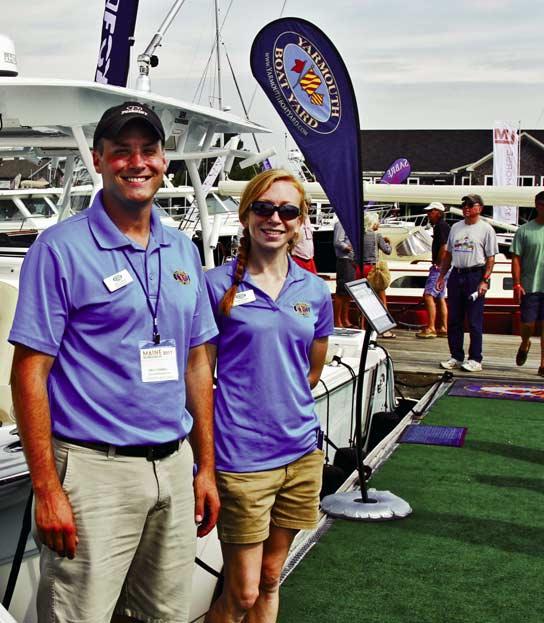
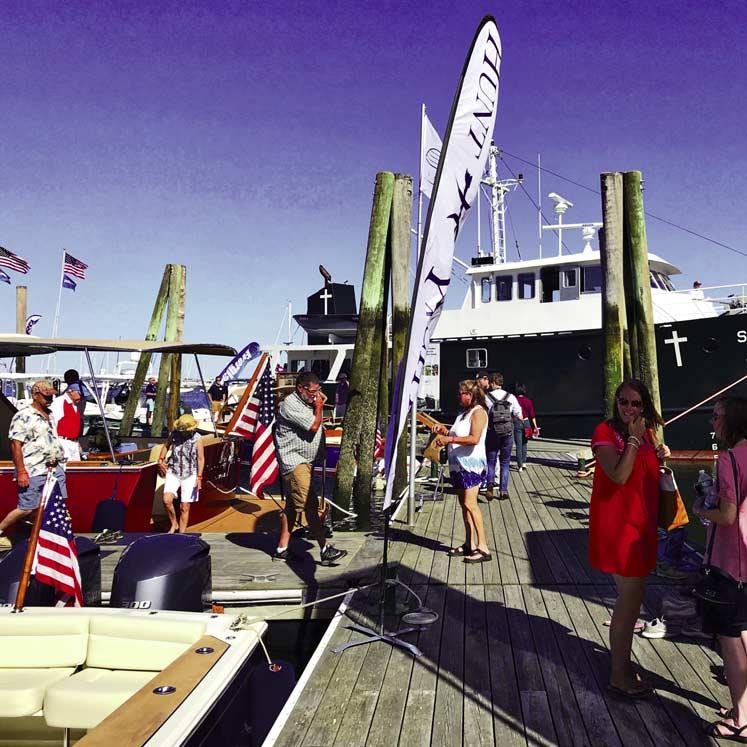
A fleet of beautiful boats in the water and on land N Marine products and expert advice
Tents filled with artisans, craftspeople, and boatbuilders N Daily live music N Plein air painters
Sunday art show N Fabulous local food trucks N Free educational seminars
Inflatables
Tenders
Dinghies
Cruisers
Trawlers
Special events and live demos
Luxury Yachts Powerboats
Sportsfishing boats
Marine electronics
Boat accessories
Portable electric motors
Green cleaning products
Pontoon docking systems
Signal cannons
Boatyards
Brokerage
Engines & power
Home décor
Antique stoves
Live-edge furniture
Hand-crafted jewelry
Nautical chart designs
Ship models & miniatures
Upcycled sail tote bags
WWII-style binoculars
Granite designs
Windows & flooring Custom
Inflatable hot tubs
Wood-fired ovens
And so much more








$15 General Admission
$30 Weekend Pass for 3-day access
Buy online at maineboats.com/boatshow or daily at the gates starting at 9:45. Kids under 12 are free.
Friday, August 8
Blue Hill Brass Band
Saturday, August 9
Sweet Megg (jazz, blues, and country)
Sunday, August 10
Cara Lauzon, fiddler (world music)


Bring the whole family for free activities for younger sailors
Face Painting, Chalk Drawing
Build a Boat, Rain Gutter Regatta
Nautical-themed fun

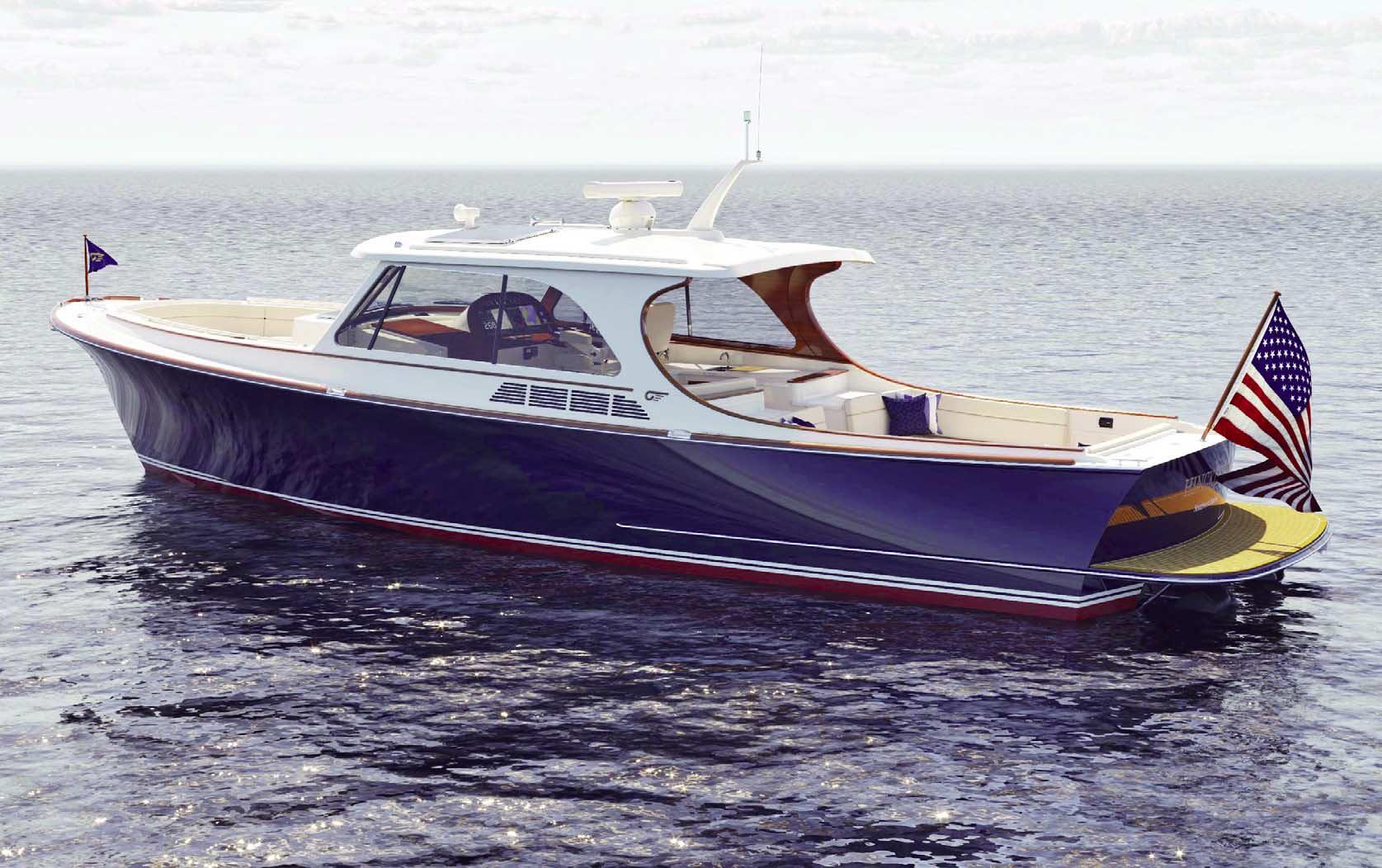
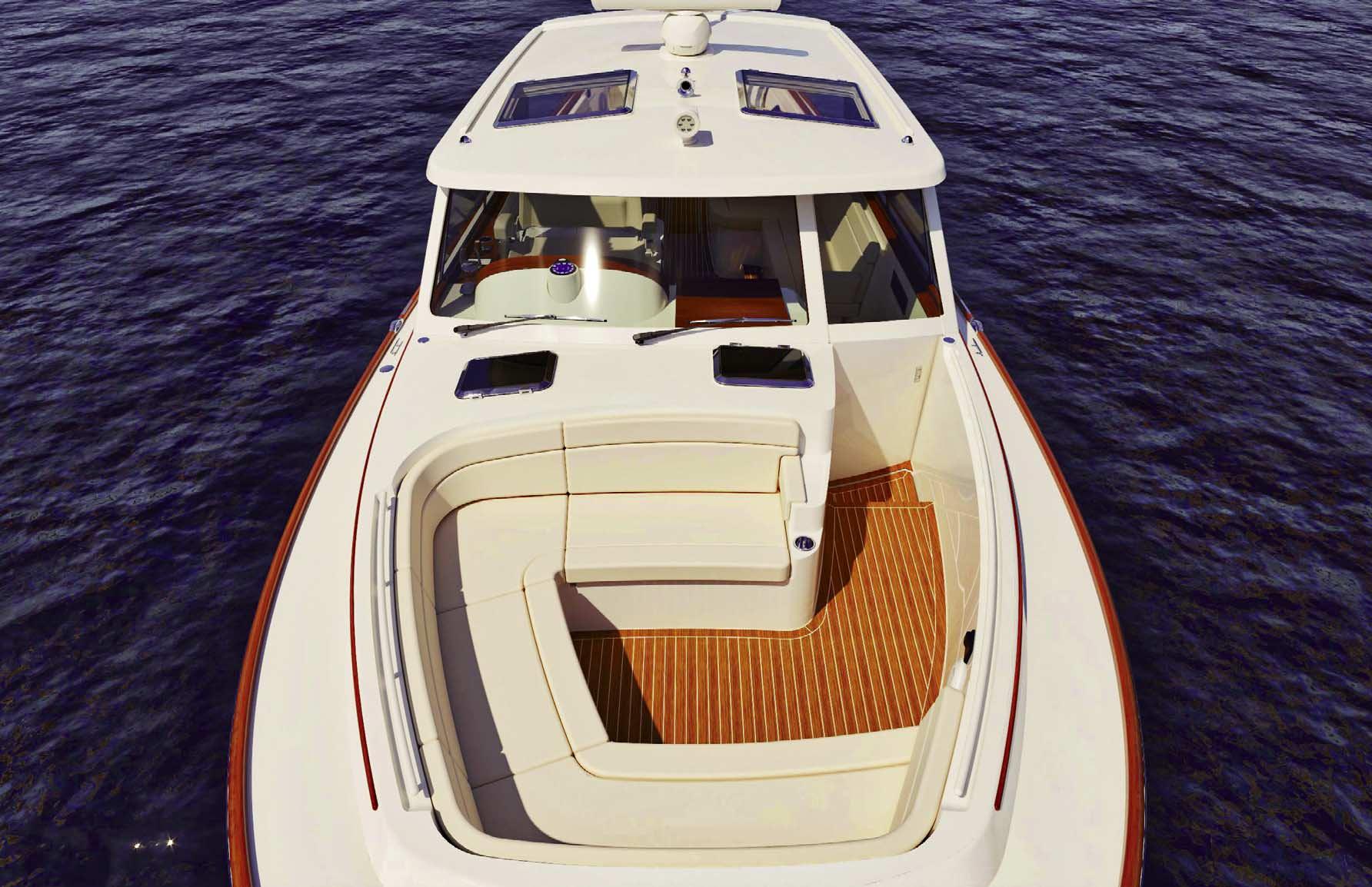
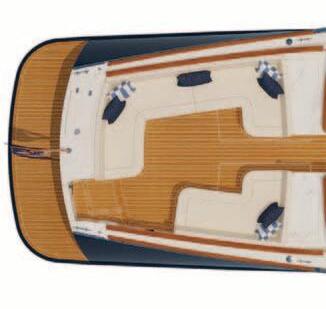
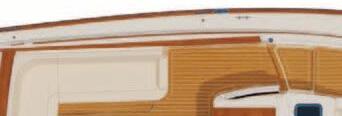
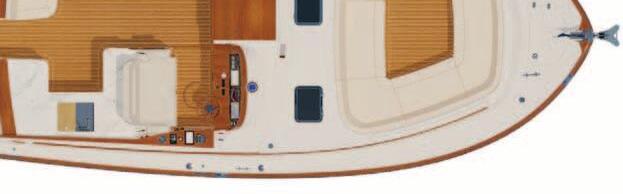
appears as a compilation of curves in the rendering above. It will feature a foredeck seating area, a first for the Picnic line.
STORY
&
PHOTOGRAPHS
BY MARK PILLSBURY
JUST as a boatbuilder lays a keel many months, and sometimes years, before a yacht emerges from a shed for launch day, Hinckley Yachts, whose roots run deep in Maine, has already begun making plans for its 100-year anniversary in 2028. Among the ways the company will mark that milestone are upgrades to improve the sprawling service and storage yard located on the site in Southwest Harbor where it all began, said Scott Bryant, company vice president of marketing, during a springtime tour of the facility and production lines located at its nearby campus in Trenton.
The company’s current owners, Bryant said, are well aware of Hinckley’s reputation as a pinnacle lifestyle brand and are willing to invest in improvements to make its Southwest Harbor location—now one of 10 Hinckley service yards on the East Coast—an upgraded destination for customers.
On the day an MBH&H colleague and I visited in early April, already boats were being pulled from cavernous indoor storage sheds, where their bottoms had been painted and other work done over the winter. Despite the cold windy setting, they were ready to be
Interior woodwork on the powerboats built today is of furniture quality but also made to withstand the pounding environment it will be living in aboard craft designed to cruise at 30-plus knots.
splashed. A few, in fact, had already been delivered to clients, who typically return to the Hinckley yard annually from
home ports anywhere from Winter Harbor to Martha’s Vineyard. In coming weeks, the pace of work would pick up quickly, yard general manager Kirk Ritter said, with some 350 sail and powerboats to be waterborne in time for the upcoming season.
Hinckley Yachts was founded by Henry R. Hinckley’s father, Benjamin, to service lobsterboats and the yachts of summer residents. Henry took over four years later and the company built its first boat, Ruthyeolyn, a 36-foot “fisherman,” in 1933, according to the history page on the company’s website.
Five years later, the yard launched the first sailboat, a 28-footer designed by Sparkman & Stephens. And for the remainder of the century sailboats were the focus—high-quality vessels that tended to keep their value over the years because of the build quality and timeless lines.
In 1989, the company launched its first fiberglass powerboat, Talaria, and in 1994, it introduced the first Picnic Boat, a 36-footer, designed by Bruce King. To say the boat made a splash
would be quite the understatement, and as demand for powerboats grew, fewer and fewer sailboats were built.
Today, the company launches on average 35 boats a year—all power—
ranging from 35 to 57 feet.
Unlike many other builders that focus solely on manufacturing and leave sales and service to dealers, Bryant and longtime salesman and current brand





advisor Phil Bennett described Hinckley as taking a vertical, all-inclusive approach to the business. In addition to building and selling boats directly to its customers, the company offers a range of
concierge services to owners that can include captains and delivery service, annual maintenance plans, and brokerage services for when an owner decides to sell or upgrade.
From the beginning, Hinckleys have always been built in Maine, first at the Southwest Harbor yard, and more recently at modern manufacturing facilities in Trenton, adjacent to the airport.

At the time of our tour, the company was on the cusp of opening a satellite carpentry shop in Topsham, Maine, to tap into a wider network of craftsmen.
But in recent years, under various
owners, the company has expanded well beyond the Pine Tree State. Hinckley’s corporate offices are in Portsmouth, Rhode Island, where the company also has its largest service yard. Eight other
service centers line the East Coast, down to Florida, including a relatively new acquisition, Bay Bridge Marina on Chesapeake Bay.
In its early years, Hinckley earned

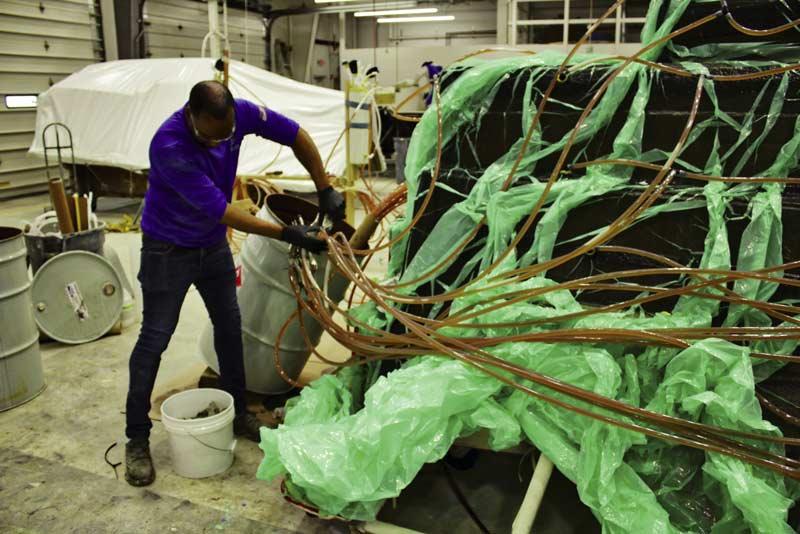
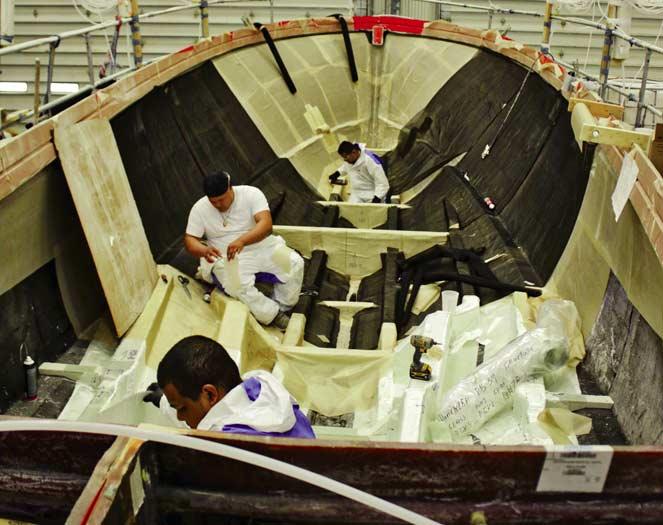
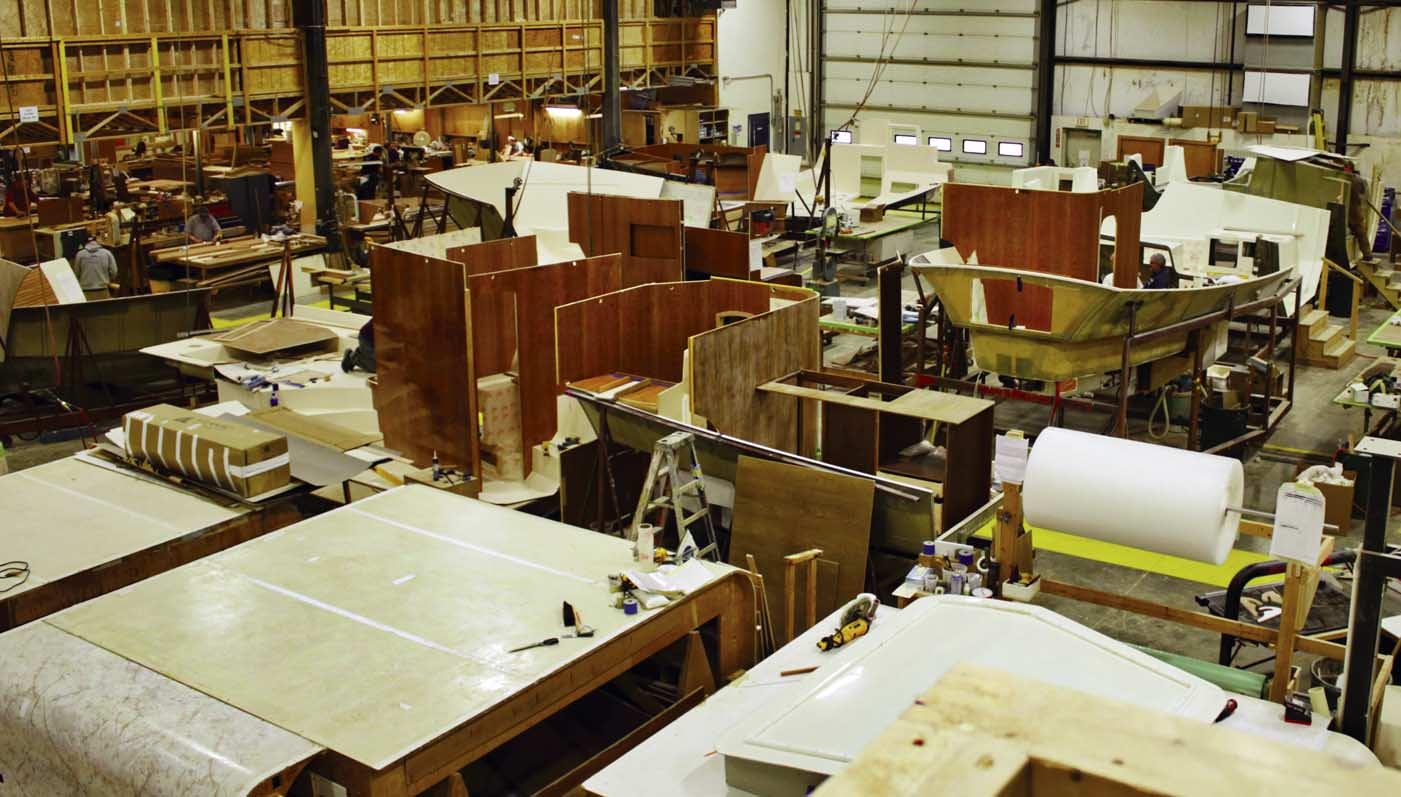
favor with sailors because of the highquality castings and other components it used to build boats. It was an early adopter of spray-combined resin infusion molding, or SCRIMP construction of fiberglass vessels, and at its Trenton facility today, Hinckley continues to rely on high-end production methods for building hulls, decks, and parts. In the composites shop we visited, green plastic vacuum bags and tubing covered molds filled with fiberglass cloth and foam coring, drawing precise amounts of resin into the layup to ensure weight and strength metrics were met.
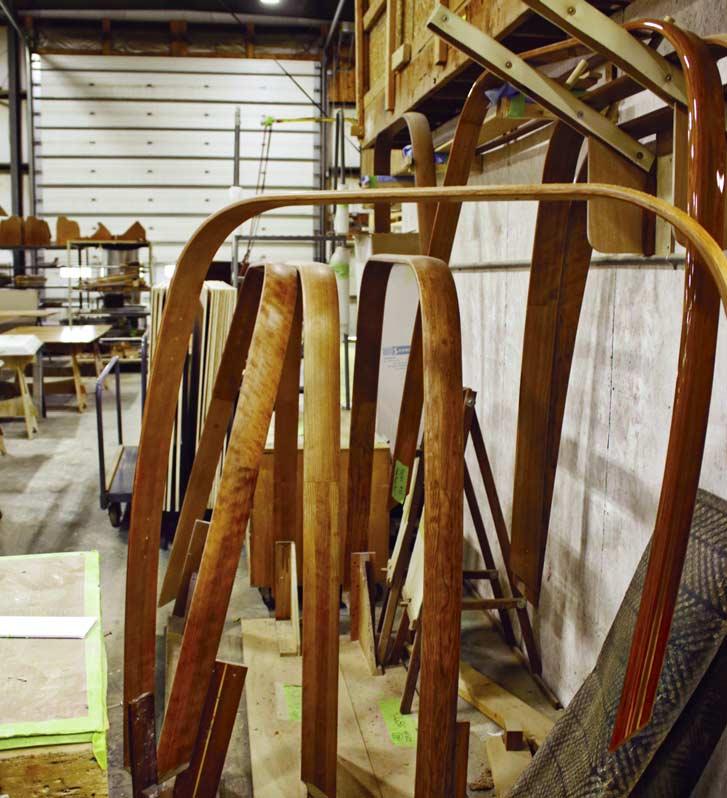
It was another story entirely in the woodshop, where craftsmen carefully shaped choice pieces of teak, American cherry, and the like to build furniture parts by hand. Bennett said interior woodwork on the powerboats built today is of furniture quality but also made to withstand the pounding environment it will be living in aboard craft designed to cruise at 30-plus knots.
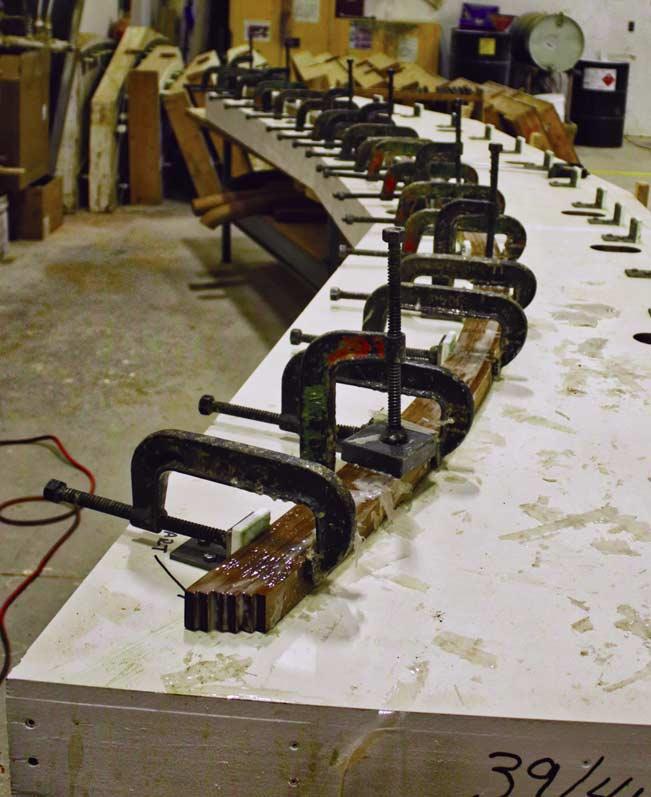
In one room, we watched as a fiveaxis milling machine cut pieces of foam to exact specifications; in another, wood-
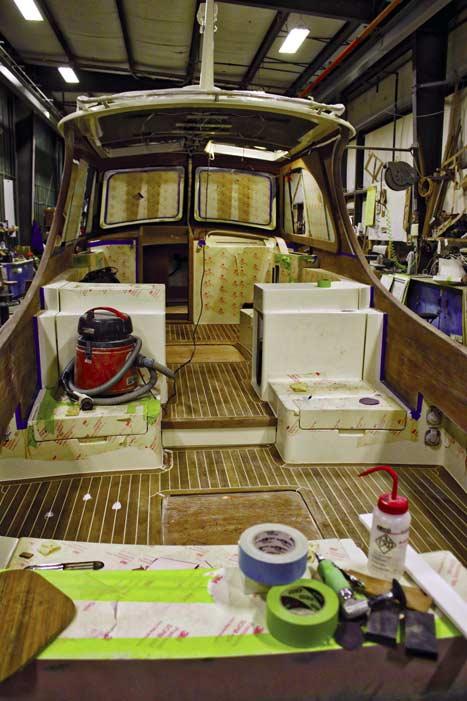
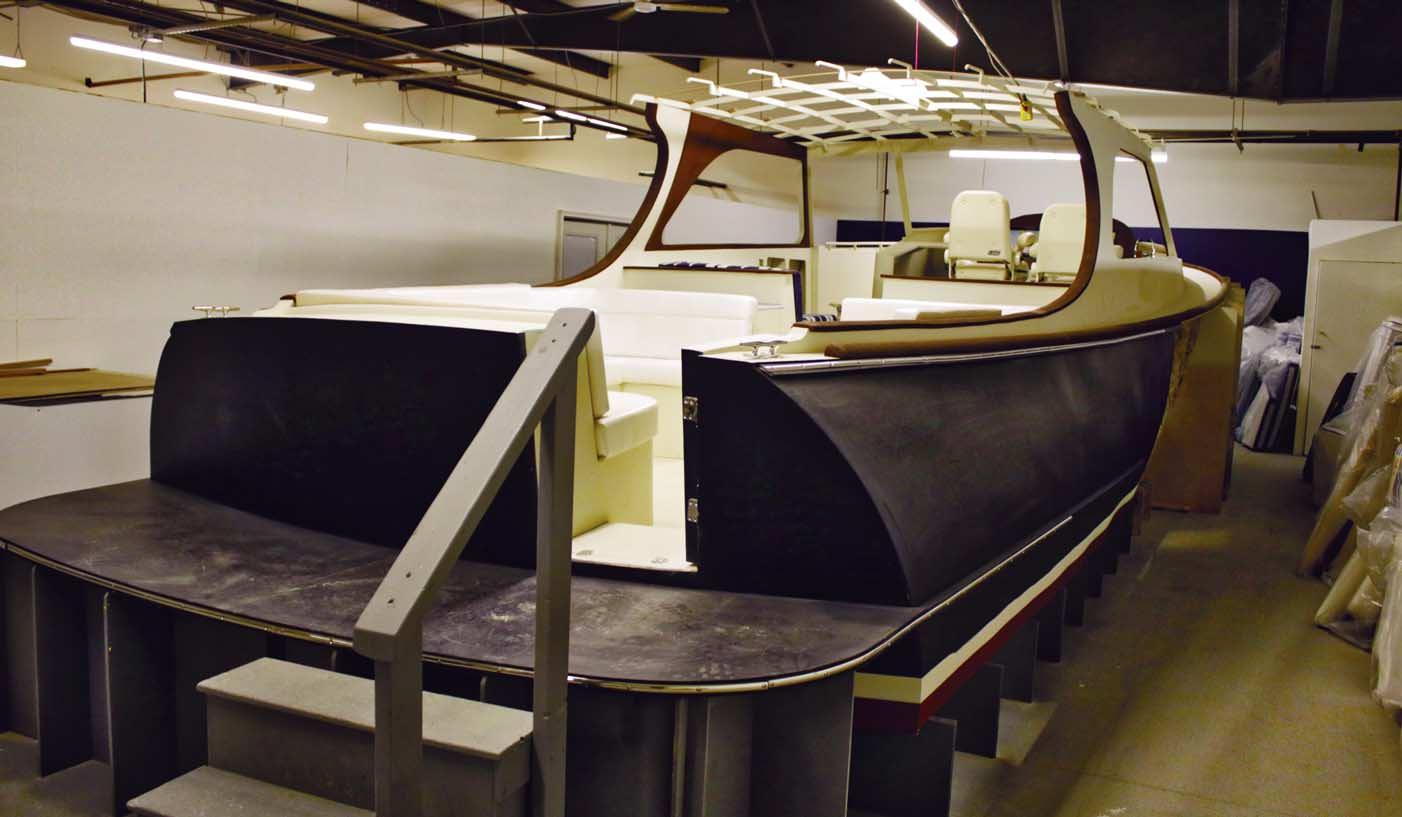
It won’t be long before this new Hinckley is ready for the water.
workers laminated thin veneers into complex curves and other angles. Having had the opportunity to visit many production builders over the years, I can honestly say Hinckleys are not being built to a price point.
At one station on the production line, we heard a bell ring followed by an announcement on the intercom telling the crew a new Hinckley had just been sold. It was a practice started during the pandemic to boost morale, Bryant said. Minutes later a second sale was confirmed. It was a good day for the dedicated crew.
In early April, the push was on to have Hinckley’s newest model, the Doug Zurn-designed Picnic Boat 39, ready for sea trials in early July. We visited the mock-up room, where a full-scale model of the boat sat. There, engineers and others on the team had sat and tweaked seats, tried different types of foam and fabrics for cushions, decided if a shelf was too narrow or a cabinet door needed to be a tad wider for better access. Those decision had been made, of course; we also got to see the actual boat well underway on the production line. Hopefully on the next visit we’ll get to see the finished product. And go for a ride, if we’re lucky. N
Mark Pillsbury is MBH&H’s editor.








BY CLARKE CANFIELD


VENTURE into Portland and you’ll encounter lots of cars, lots of buildings, lots of pavement. That’s to be expected in Maine’s largest city.
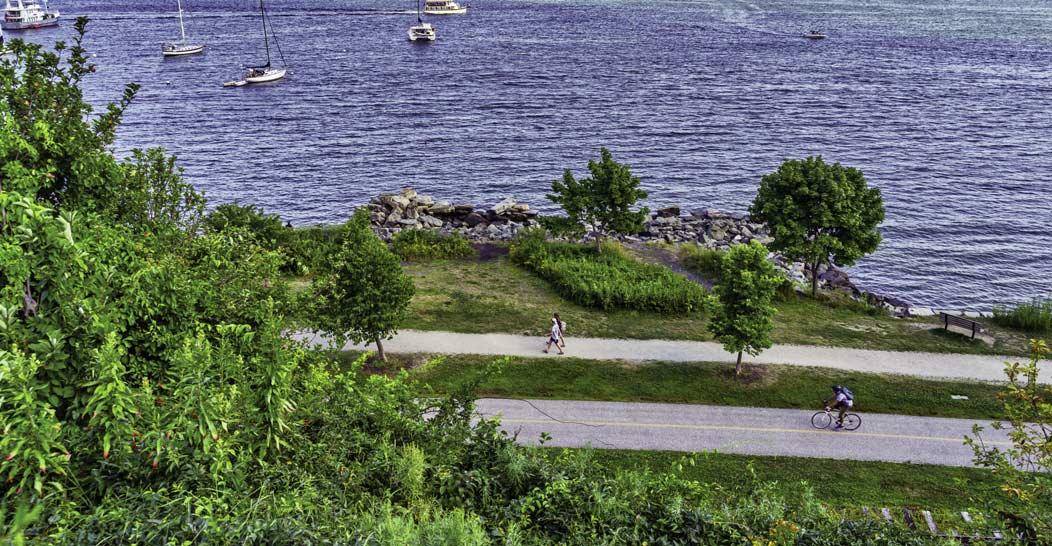
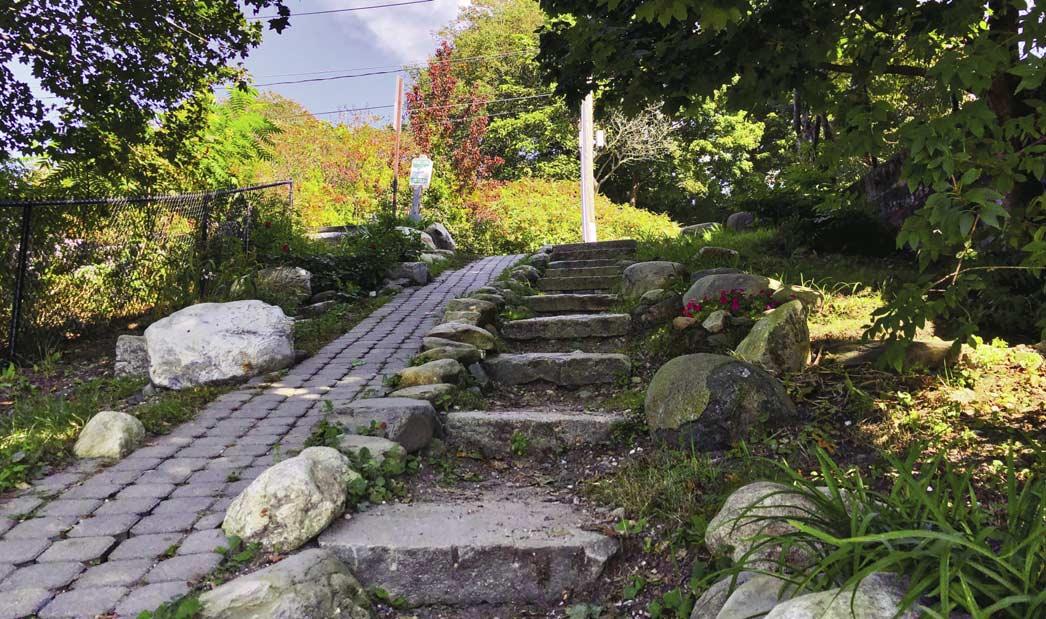
But behind the asphalt, the streets and highways, the countless traffic lights, and the hubbub of the city landscape lies a network of nearly 100 miles of walking trails that offer a more serene and peaceful side of Portland.
The pathways are part of Portland Trails, an urban land trust with trails that pass through woods and marshes, across fields, alongside rivers and the ocean waterfront, on boardwalks and, yes, even along city streets. The trail
network is a quick and easily accessible way for people to get in touch with nature and leave behind the everyday worries of city life.
Mary and Chris Copeland are regular users of the trail system, calling it a vital resource for the city. The ready access to the trails in Portland is a marked difference from when they lived in Brooklyn, New York. There, they had a very limited selection of outdoor green spaces to use.
“When you’re in a place where it isn’t easy to do, it becomes such a stark contrast,” Chris said. “Here there are trails everywhere, and there’s urban planning for the integration of trails. And if you go somewhere where that isn’t

the case, it becomes abundantly clear.”
What further resonates with them is that the trails are there for everybody, Mary said. “The Portland Trails system, there’s no barrier to entry,” she said. “You can just go and enjoy the trails, and it doesn’t cost anything.”
Portland Trails’ vision is straightforward: to cultivate “a healthy, inclusive, and vibrant community, enriching the quality of life for all.”
The numbers tell part of the story of how Portland Trails has become rooted into the fabric of the city since its founding in 1991. According to the organization, 95 percent of Portland


residences are located within a quartermile of a trail in the network. Each year, there are more than 1 million visits to the walkways.
Portland Trails has more than 1,200 members and hundreds of volunteers who help maintain the network each year. Its annual budget is approaching $800,000. Fifty-five percent of its revenue comes from individual donations and memberships, and 40 percent from corporate contributions and grants and investments.
The trails range from as long as 5 or 6 miles to as short as 50 feet or so, said Bailey O’Brien, Portland Trails’ communications and events manager. Those short trails serve as connectors between urban neighborhoods, providing shortcuts to make it easier to move about the city. “That’s one of the cool things about being an urban land trust,” O’Brien said.
The two most popular trails are owned and maintained by the City of Portland but are still part of the Portland Trails walkways network. The most-used trail is the 3.5-mile Back Cove Trail loop around the city’s Back Cove, which has great views of the city’s skyline. Next up is the 2.1-mile Eastern Promenade Trail, which follows the shoreline from the city’s east end to the ferry terminal.
On its trail map, Portland Trails provides detailed descriptions of 15 of its more popular trails, many of which are suitable for both walking and biking. They go by names such as Canco Woods, East Bridge Trail, Evergreen Woods, Fore River Sanctuary, Presumpscot River Preserve, Riverside Trail, Stroudwater River
Trail, Thompson Point Trail, and the Viriginia Woods & Graves Hill. Beyond those trails, there are dozens more that are part of the network.
Portland Trails was incorporated 34 years ago, but its origins go back decades earlier, to when Tom Jewell used to
Portland Trails’ vision is straightforward: to cultivate “a healthy, inclusive, and vibrant community, enriching the quality of life for all.”
explore what is now the Fore River Sanctuary when he was growing up in a nearby neighborhood in Portland. Jewell was one of Portland Trails’ co-founders, along with Nathan Smith and Dick Spencer.
That personal connection he felt as a youngster with the sanctuary’s freshand saltwater marshes, forests, and Portland’s only natural waterfall (now called Jewell Falls) set in motion Jewell’s determination to somehow preserve Portland’s natural beauty.
That original vision has grown to include trails in Portland, Westbrook, Falmouth, and South Portland. While Portland Trails itself owns about 150 acres of land, the rest of the network for the most part is owned by municipalities or private landowners. In many cases, Portland Trails has negotiated easements with property owners granting public access on the trails.
“It was all volunteer for a while. Then we hired a part-time director and a full-time director. Now I don’t even know how big the staff is,” said Jewell, who’s now 73. “It’s certainly grown way beyond my expectations. But it’s been rewarding to be part of the effort.”
Reflecting back, Smith said it’s more important than ever for people —children in particular—to maintain a connection to the outdoors and all it has to offer.
“This is part of the layering and depth of living in the world, to appreciate the richness of what’s around us,” he said.
Nowadays, Portland Trails has an office in Portland’s East Bayside neighborhood that it shares with the Bicycle Coalition of Maine. It has nine employees and is headed by Jon Kachmar, who has decades of experience in natural resource management and who became executive director in 2023.
Beyond maintaining its network of trails, Portland Trails also serves as an advocacy group. It works on initiatives such as improving pedestrian and bicycle safety and raising awareness among low-income and immigrant communities of the benefits of the trails and outdoor spaces.
Besides having an appreciation for all Portland Trails has to offer, Mary and Chris Copeland also have a soft spot in their hearts for the trail network. After all, it was on the Eastern Promenade Trail where Chris pulled out a ring and proposed to Mary.
Later, it was shortly after walking that same trail, that Mary went into labor with their first son, Teddy, who is now closing in on 5.
“I don’t know if it was intentional that we were on the trail system during these big moments in our lives,” Mary said. “Maybe there was a natural gravitational pull because we like being outside and are active people.” N
Clarke Canfield is a longtime journalist and author who has written and edited for newspapers, magazines, and the Associated Press. He lives in South Portland.
FOR MORE INFORMATION
Visit Portland Trails online at trails.org.
IN BROOKLIN, MAINE, affectionately known as the Wooden Boat Capital of the World, a remarkable opportunity is unfolding—one that invites boatbuilders, sailors, and preservationists everywhere to help safeguard the living traditions that shaped a coast, a culture, and a craft.
Brooklin holds a unique place in maritime history. It was here that Jon Wilson established WoodenBoat magazine, sparking a revival that carried wooden boatbuilding into a new era. Today, a new chapter is being written at Friend Memorial Public Library, where a bold effort is underway to preserve two extraordinary collections and make them available to the world.
In 2023, Wilson donated his personal trove of more than 6,700 rare and out-of-print nautical books and journals to the library—a collection built over five decades, unmatched in scope and depth. Soon after, celebrated maritime photographer and Brooklin resident Benjamin Mendlowitz added his own legacy: an archive of over 500,000 images capturing the artistry, spirit, and resilience of wooden boats around the globe.
To steward these treasures—and to welcome future additions—the library is building the Anne and Maynard Bray Maritime Research Center: an accessible, light-filled space designed to preserve, protect, and expand a living archive of maritime craftsmanship.
The Center is named in honor of Anne and Maynard Bray. Maynard, a leading historian of American shipbuilding and yachting, has authored landmark monographs and hundreds of articles chronicling the rich traditions of the craft. His late wife, Anne Bray, also brought considerable expertise to the field, serving long and ably as the librarian for Jon Wilson’s
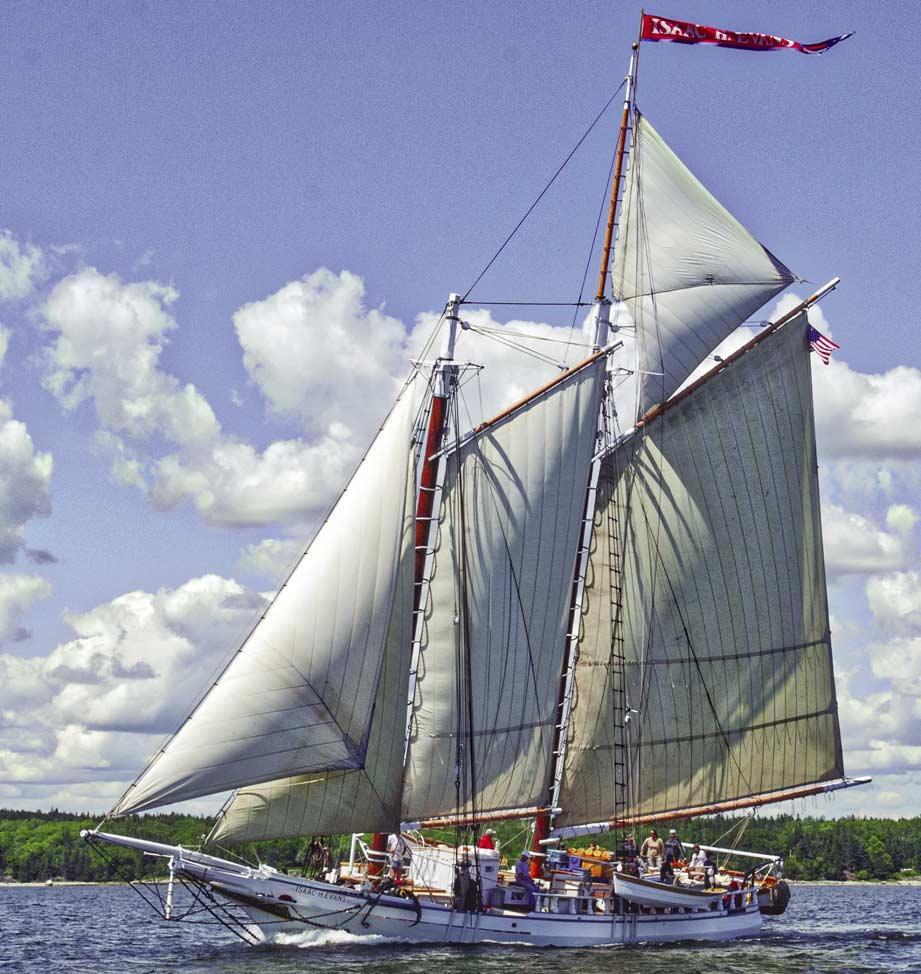
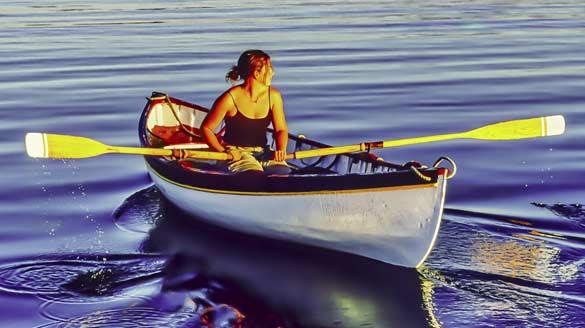
Above: The schooner Isaac Evans makes its way on Eggemoggin Reach. At left: The Peapod from the schooner Stephen Taber glides through the water.
collection. Their contributions to preserving wooden boat knowledge are profound. Without Anne, Maynard, and a few other key figures from Brooklin, such as Joel White from Brooklin Boat Yard, the wooden boat revival that gained momentum more than 50 years ago might never have come to pass.
This effort is about more than a building. It is about ensuring that the knowledge, craftsmanship, and spirit of wooden boats remain alive, accessible, and inspiring to generations still to come. It’s about keeping the legacy of wooden boats vibrant and strong.
Already, the campaign has inspired remarkable generosity from those who understand what is at stake: not just the preservation of rare materials,
but the stewardship of a living tradition that has shaped communities, industries, and imaginations for centuries.
You are invited to be part of this legacy and carry forward the knowledge and passion that continue to shape wooden boat culture around the world.
To make a gift or learn more about the Anne and Maynard Bray Maritime Research Center, visit campaign.friendml.org or contact Robert Baird, Campaign Chair, at campaign@friendml.org.

https://campaign.friendml.org/woodenboats
BY CARL LITTLE
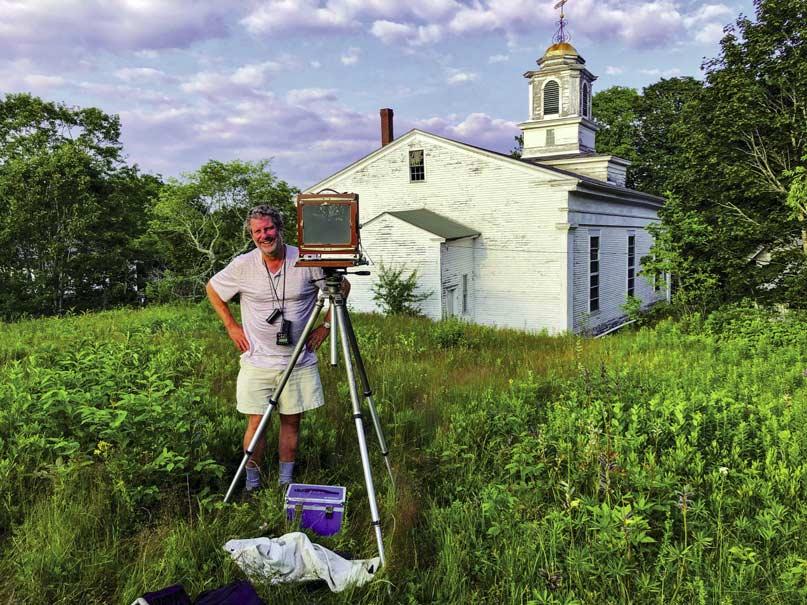
Vermont-based photographer Angela Drexel took this portrait of Ledbetter on a photo field trip to Sedgwick. Jack Ledbetter with his Deardorff Camera, First Baptist Church of Sedgwick 1837
SOME YEARS AGO , on a family trip to Baker Island, one of the Cranberry Isles, as we walked out onto the “dancing rocks” on the far side, we encountered a man with a very large camera on a tripod standing on one of the granite ledges. The camera, a large format wooden Deardorff, was aimed toward Mount Desert Island and the photographer appeared to be waiting around for something, checking his watch, studying the view.
This was Jack Ledbetter preparing to seize the perfect light. For many of his vistas, that’s Ledbetter’s modus operandi: to find that moment when the illumination is just right and then open the shutter.
The photograph Ledbetter took that day is one of many panoramas of the Maine coast by this consummate camera artist, in over 40 years spent exploring his adopted home. While he has also photographed Mount Katahdin and other settings, coastal views are his specialty, acclaimed for their clarity and composition.
While surrounded at home on Mount Desert by Acadia National Park, Ledbetter avoids it in the summer when the crowds show up. He recalls how he’d have to wait for visitors to disperse before getting a shot of the Bass Harbor Light, an iconic subject that makes
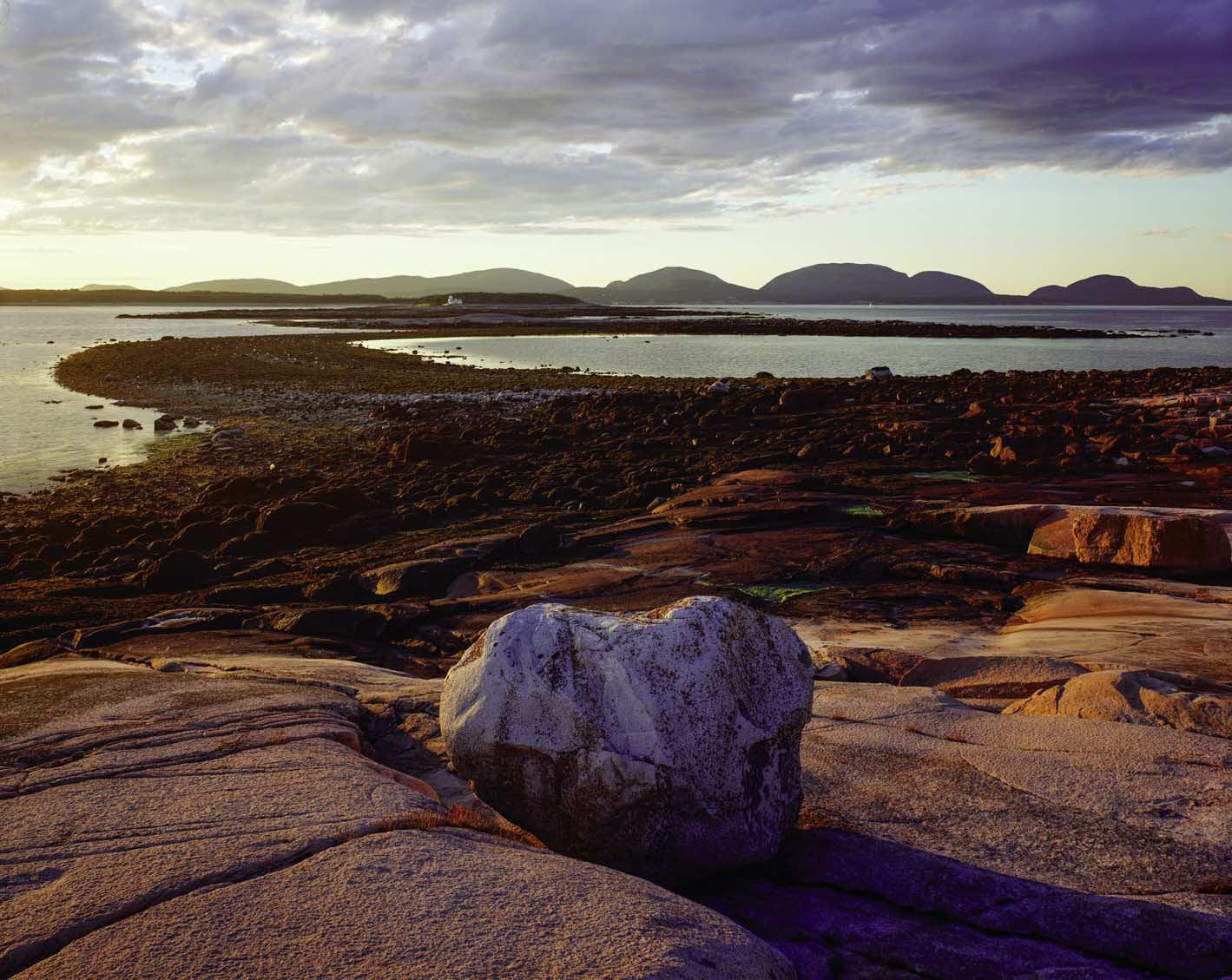
for a fine sunset picture. If he does venture into the park, it’s apt to be to a less frequented spot like Little Hunters Beach.
Ledbetter prefers going to the offshore islands where there are few distractions and exceptional vistas. Frenchboro has been a regular destination, its working harbor a welcome respite from the hubbub of the mainland. He keeps a small Boston Whaler in Northeast Harbor, which allows him to camp out on nearby islands where he can catch both sunrise and sunset. He has also ventured further afield, to Matinicus and Criehaven on the outer edge of Penobscot Bay.
After four decades photographing Maine, Ledbetter continues to find new places. He mentioned Harriman Point Preserve in Brooklin, managed by Maine Coast Heritage Trust. Since discovering this picturesque coastal prospect a few years ago, he has been back more than a
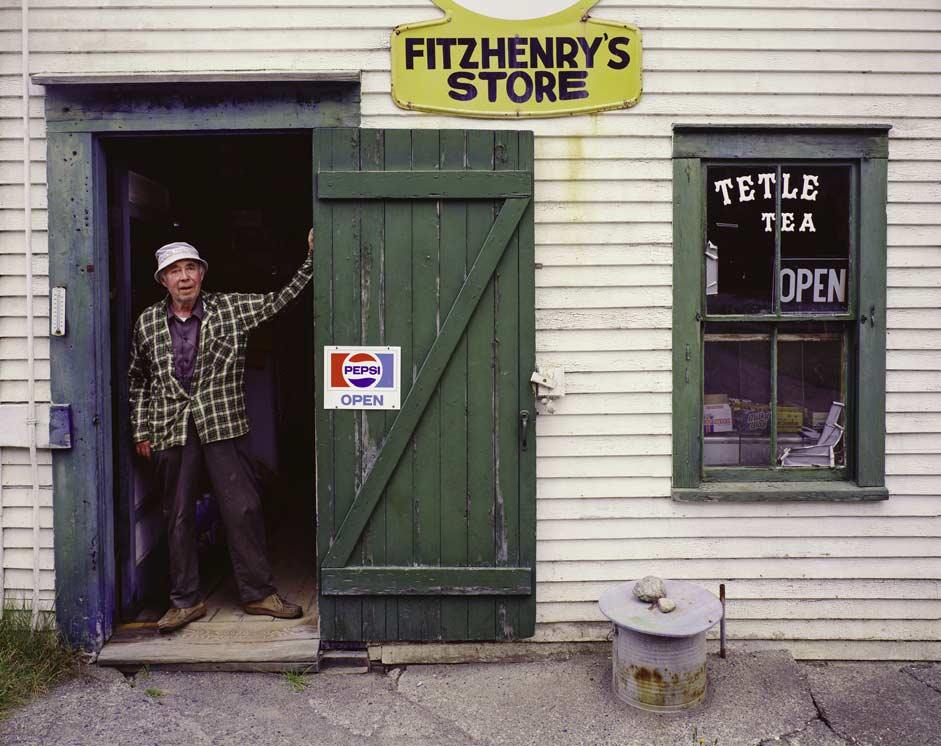
dozen times.
Ledbetter has a story for nearly every photo he’s ever taken: the time, the place,
the circumstances. For his portrait of Pancho Cole, an early College of the Atlantic graduate who stayed on Mount
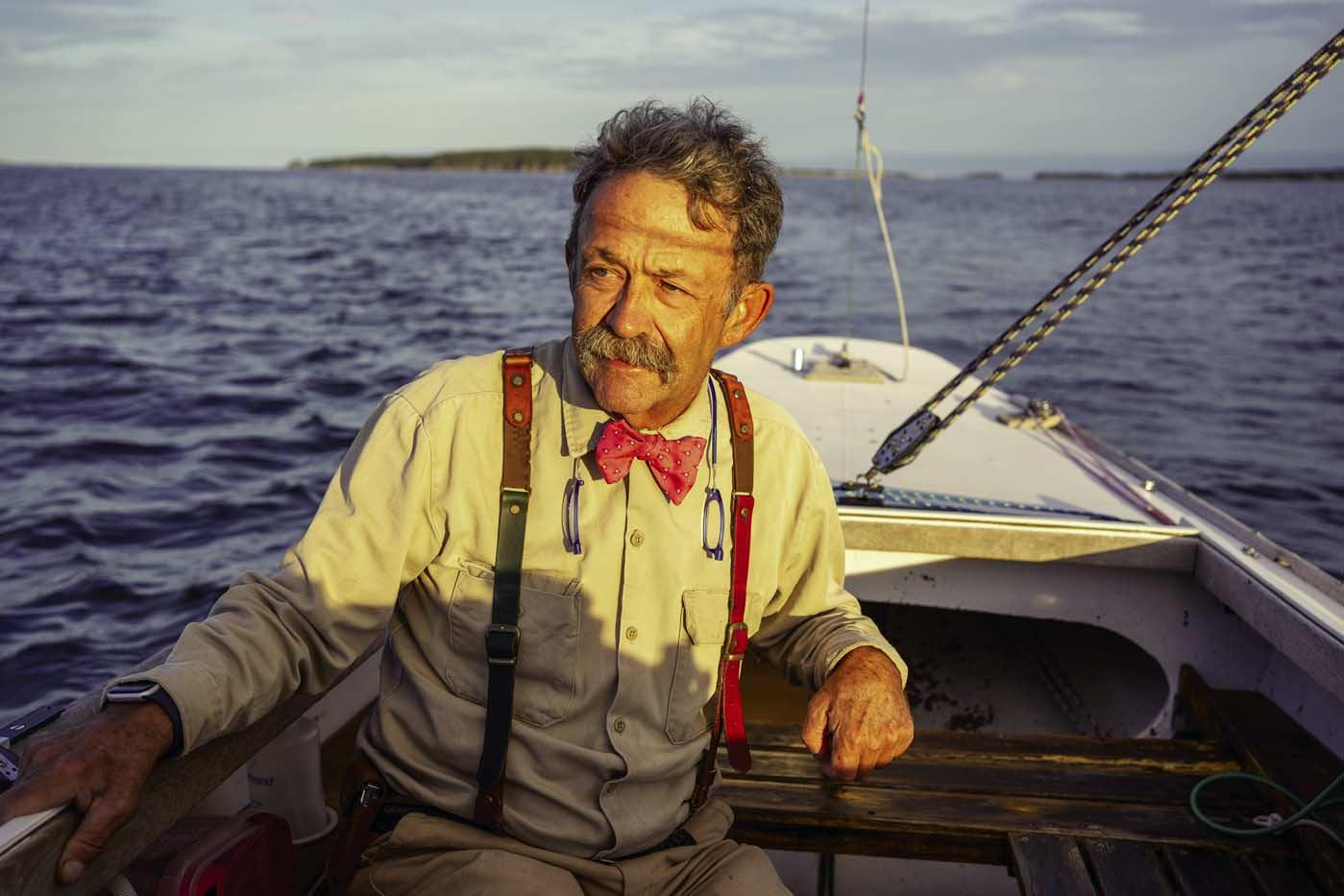
In setting up this shot of Pancho Cole in his Luders sailboat, Ledbetter asked him to “show up as you are.” Pancho Sailing his Luders Sailboat. Each photograph is limited to 20 prints.
Desert Island to work in IT, he joined him on his Luders 16 sailboat. In bowtie and suspenders, Cole concentrates on the wind and sails. Ledbetter has another photo of his former assistant, photographer Sarah Butler, in a boat built at her family’s boatyard at the head of Somes Sound. He has been slowly assembling a series of portraits of individuals with traditional boats.
Over the years Ledbetter has gone out of his way to photograph older buildings in Maine, drawn to their character and what they represent in a community. “In an odd way,” he explained, “you want to photograph things that need a little paint on them.”
The First Baptist Church in Sedgwick is such a structure. A prime example of Greek Revival architecture, the weathered building was on its way to collapse when the Sedgwick-Brooklin Historical Society set out to save it. The church is in better shape these days, Ledbetter reported, thanks in part to a 2023 grant from the Maine Community Foundation’s Belvedere Historic Preservation and
Energy Efficiency Fund to restore its roof.
Asked about his personal pantheon of favorite photographers, Ledbetter mentions some of the giants of American photography, among them, Paul Strand, Ansel Adams, Eliot Porter, Lee Miller, Saul Leiter, William Eggleston and F. Holland Day. The last-named, known for his pictorial style, has influenced Ledbetter’s own soft-focus studies of nudes.
Ledbetter also looks to Winslow Homer and Andrew Wyeth for inspiration. “They are Maine,” he said, “and when I see their images, I’m blown away.”
In June 2024 he attended “Picturing Maine: The Wyeth Family in Historical Context,” a week-long program hosted by the Farnsworth Museum and led by Victoria Wyeth, Andrew Wyeth’s granddaughter, and Margaret Creighton, Professor Emerita of American history at Bates College. One of the highlights was walking through the little farmhouse in Cushing where Wyeth lived and visiting his studio, a small space in the yard. “There’s still a jacket laying over the easel,” Ledbetter recalled.
Ledbetter was born in Albany, Georgia, near the Florida border. His family once farmed pecans and various row crops, including cotton, peanuts and, in wintertime, wheat.
Diagnosed with dyslexia, Ledbetter was sent to Aiken Preparatory School in South Carolina. As it turns out, the boarding school had a very good photography program. One of his teachers, Tish Meyers, taught him how to use the dark room in sixth grade. He had a 35millimeter Agfa Rangefinder camera courtesy of his parents.
In seventh grade Meyers and her husband, science teacher Douw Meyers Jr., invited Ledbetter to spend August with their family in Christmas Cove, their summer home in South Bristol, Maine. A University of Maine graduate, Mr. Meyers remained connected to the state.
Compared to Georgia, where the heat forced one inside to fans and air conditioning, they went sailing nearly every day, making trips to Monhegan and elsewhere. Ledbetter found it mind-boggling—and



































































































his impressions of pea soup fog and glorious sun stayed with him.
Ledbetter attended a community college in Albany, Georgia, studying the three Rs. His family wanted him to have that foundation before he went off to pursue photography. Which he did: At age 20, he moved to New York City to study at the International Center of Photography.
Founded in 1974 by HungarianAmerican photographer Cornell Capa, the school on Fifth Avenue and 94th Street was new and exciting. A number of renowned Life magazine photographers, including the founder’s brother, Robert Capa, were still around. Guest lecturers included such luminaries as Alfred Eisenstaedt.
“It was a magical time,” Ledbetter recalled. Armed with a 4-by-5 Graflex camera and later a compact Toyo View, he explored the city like a tourist, taking photographs of landmarks, Central Park, the Brooklyn Bridge, and the like. He remembers getting high marks for a photo he took of the Statue of Liberty as seen from the back.
After a year and a half, Ledbetter returned to Georgia and started doing commercial work. He took photographs for a manufacturer of crop dusters (one of his shots ended up on the cover of a trade magazine) and did work for politicians, through an ad agency.
Bored to death, Ledbetter questioned whether he wanted to stay in Georgia for the rest of his life. After serving as teaching assistant for a Parsons School of Design landscape photography class at Lake Placid in 1983, he decided to head to Maine to visit his friends in Christmas Cove. On that trip he drove to Lubec and was wowed by the downeast landscape.
On his way back, Ledbetter stopped for a few nights on Mount Desert Island, his first visit to his future home. He was amazed by the access to public lands and the sheer beauty of Acadia. He also thought there might be a market for landscape photography if he returned.
Back in Georgia, Ledbetter couldn’t get Maine off his mind, so in July 1985, he made a fateful decision, to head north and take his chances. Considering it was the height of summer, he lucked out and
found a bungalow to rent from lobsterman David Thurlow in Bass Harbor through Harriet Whittington at the Knowles Company in Northeast Harbor. “The stars do align,” he said.
Ledbetter returned to that same spot the following summer, happy to be in the north and surrounded by a wealth of motifs. He remembers at the time that many of the traps on the Bass Harbor wharf were still wooden as were
some of the lobsterboats. He relished this sense of history.
That year Ledbetter decided to stay for the winter. He eventually bought an old schoolhouse in Tremont, but never stayed in one place for that long, moving around the island over the years.
Looking for a gallery to represent him, Ledbetter was directed to Aurelia “Thistle” Brown, who owned Wingspread Gallery in Northeast Harbor. He

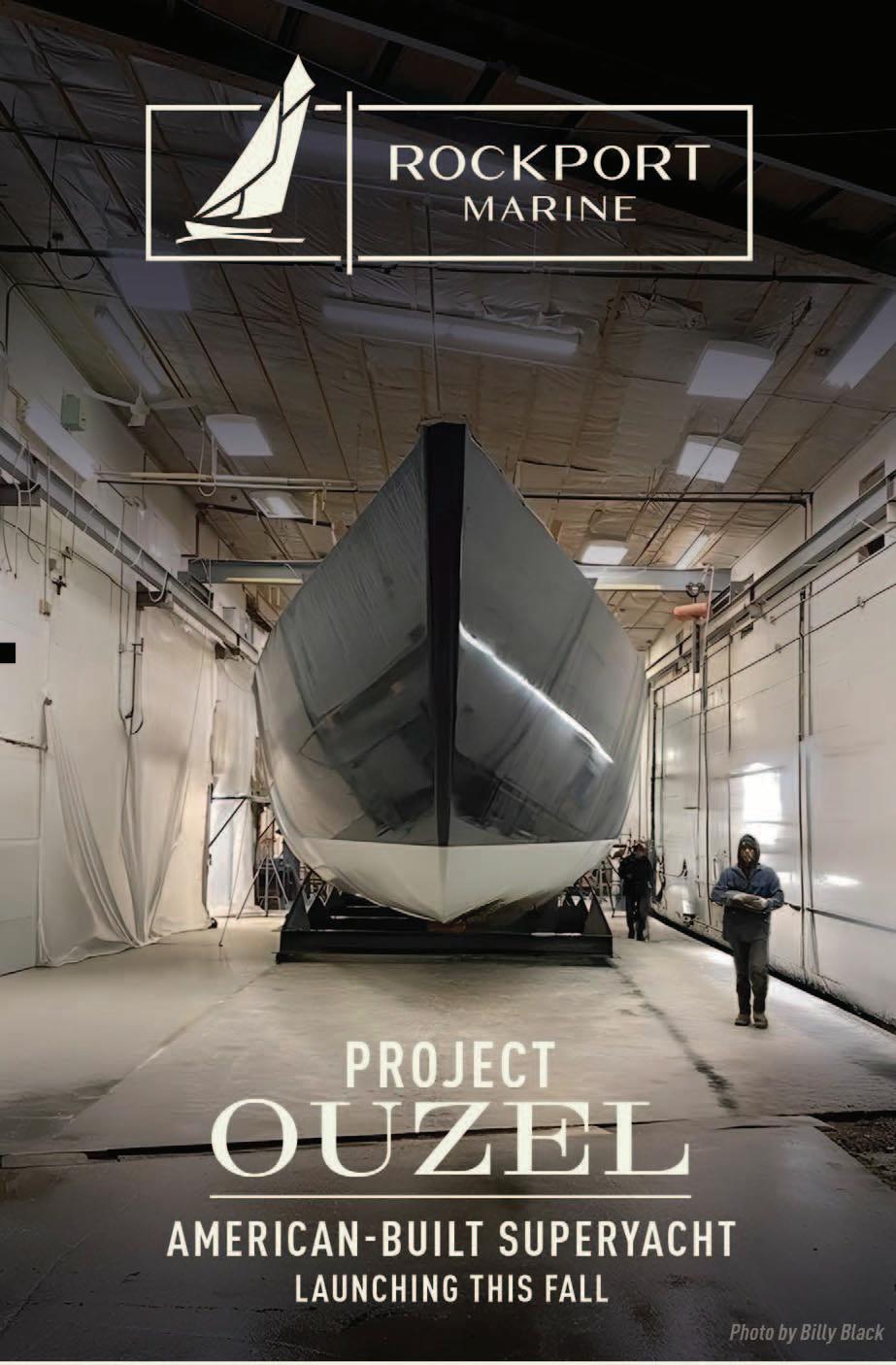
laughed in recollecting how Thistle was more interested in the canoe on the roof of his truck than his photographs, but she took him on—and they went canoeing.
Brown put Ledbetter “on the fast track” to connecting him with Mount Desert Island’s wealthy summer community. He mentions with pride that two estates in Seal Harbor own 50 of his prints. She also taught him the ways of a gallerist, which helped him when he set up his own shop at the end of Main Street in Northeast Harbor in 1991. The space includes a dark room, a set-up for framing, and walls to display his work— a place to welcome what he modestly calls “a small but loyal following.”
One of Ledbetter’s collectors, the late art historian John Wilmerding, purchased a number of photographs over the years. When he ran out of wall space, he donated pieces to the Farnsworth and Portland museums. He also commissioned Ledbetter to photograph one of his favorite structures, the Charles Bulfinch-designed meeting house in Lancaster, Massachusetts.
David Rockefeller provided another commission, a photographic record of the Rockefeller Garden, which had been created between 1926 and 1930 by Abby Aldrich Rockefeller and famed garden designer Beatrix Farrand. For a year Ledbetter had carte blanche access to photograph the grounds. The prints are in the Rockefeller family archives in Tarrytown, New York.
Rizzoli published a coffee table book of Ledbetter’s photographs in 1989. The photographer dedicated Maine: The Coast and Islands to his mother “who gave me both the means and the motivation to carry though this project.”
When he isn’t visiting an outer island, Ledbetter can be found in his shop, developing film—he still uses a dark room—or sending files off to New York City for scanning. He still does commercial work to help make ends meet, including portraits, weddings, and special places. He also devotes time to organizing exhibitions for the Wendell Gilley Museum in Southwest Harbor.
Ledbetter bought his first digital
camera in 2010 after being satisfied by the quality of prints. Today, he owns a “very serious” Fuji—and likes the “instant gratification” after years spent in dark rooms or waiting for prints to be processed in a distant city.
Ledbetter maintains a Georgia connection, spending six weeks or so in Albany each year to “recharge his batteries,” but Maine is his home and principal muse. Every September he rents a house in Christmas Cove where the magic began some 60 years ago. There’s no Wi-Fi in the house, which is just fine with him. N
Carl Little’s most recent books are the monograph John Moore: Portals (Marshall Wilkes) and Blanket of the Night: Poems (Deerbrook Editions). He curated the exhibition “Quarries: Muse and Material” for the Monson Arts Gallery in Monson, Maine, which runs through October. Little thanks Sarah Penley for finessing the images for this article.
You can see more of Jack Ledbetter’s work on his website, jackledbetterphotography.com.
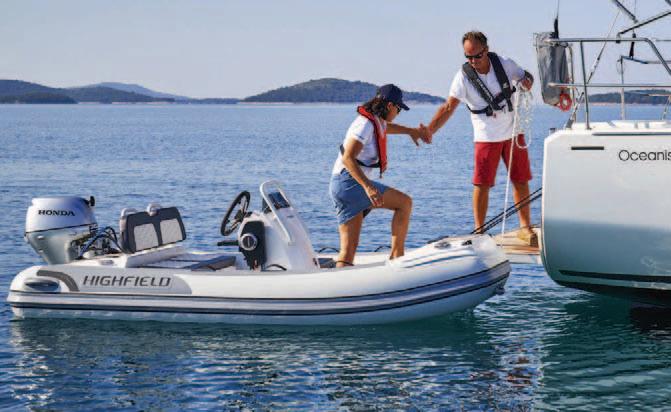
See us at the Maine Boat and Home Show August 8-10
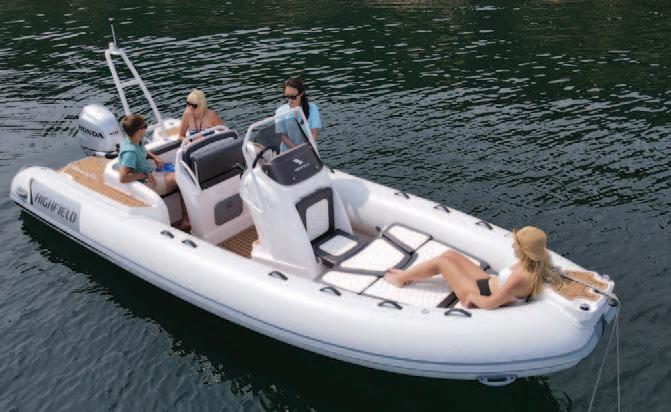
Highfield Boats is the world’s number one in the RIB tender sector. The full product line includes boats from 6 to 26-feet, built with performance and strength in mind.
For more information, call us, visit our website, or see us at the Maine Boat & Home Show!
100 Ebenecook Road, Southport, Maine 04576 207.633.2970 • sales@hodgdonyachtservices.com hodgdonyachtservices.com • highfieldnorthamerica.com


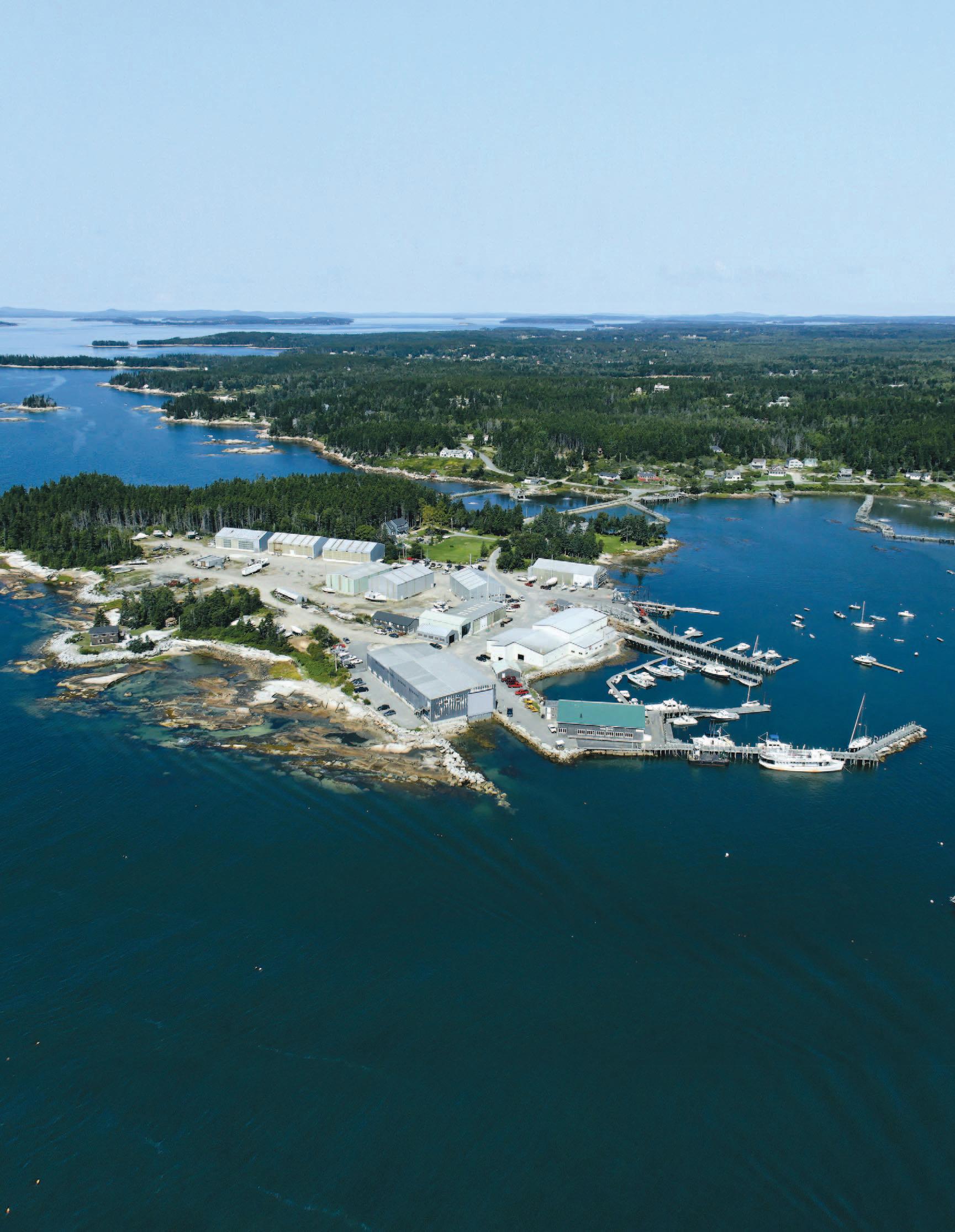

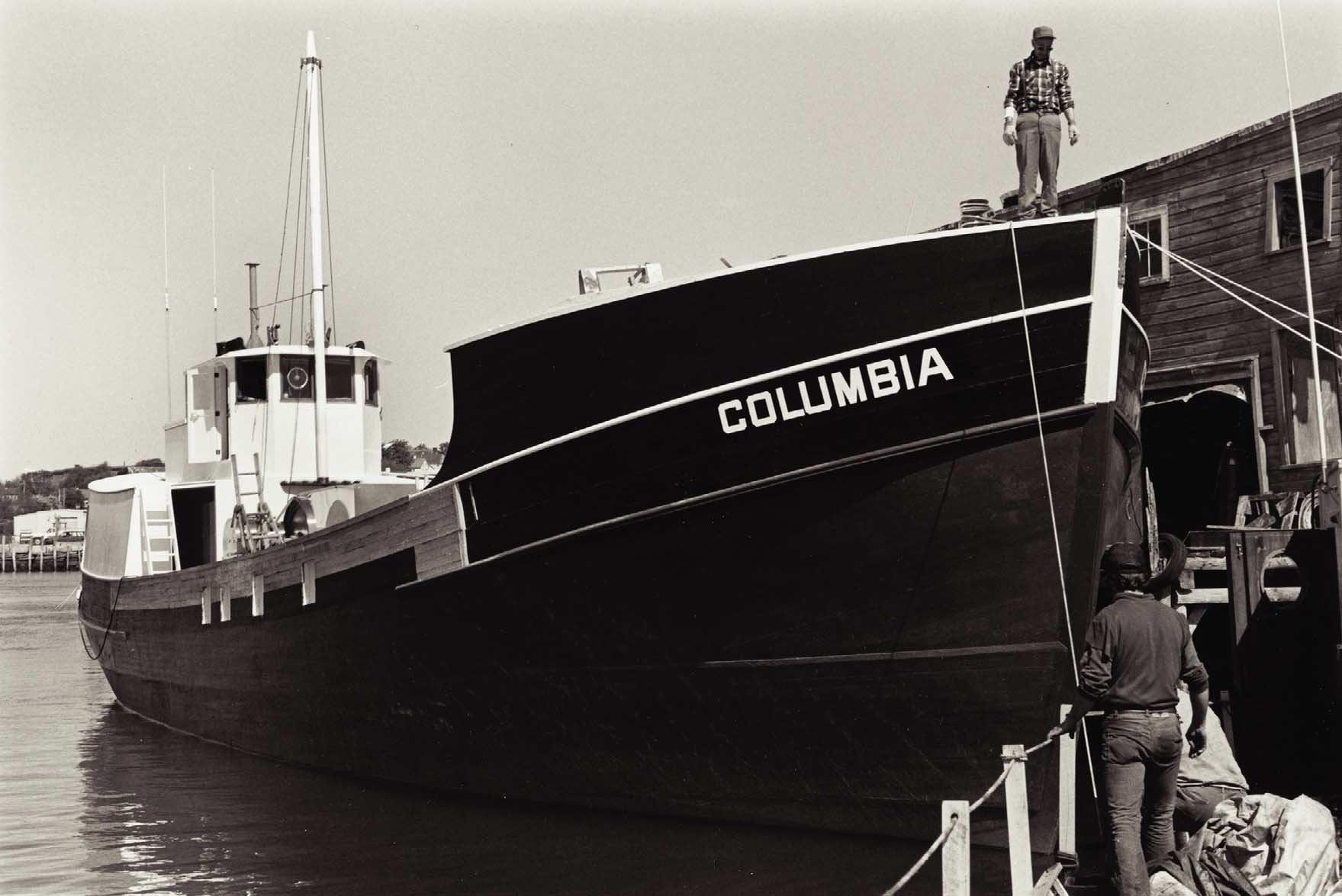
During a training flight, a chance encounter with a derelict fishing boat leads a pilot to a family connection and the waning days of wooden boat building.
BY EVA MURRAY
BEING A PILOT without a plane, I don’t get to fly often.
So, one October day in 2023, Certified Flight Instrument Instructor Chris Carroll and I had scheduled a date for a knock-the-rust-off dual flight around the Midcoast.
Knowing that I was a member of a local volunteer search and rescue group, he suggested checking out a wrecked boat he’d found off Louds Island in Muscongus Bay while flying a route for Penobscot Island Air from Vinalhaven to Portland. He said, we could “set up a mock search, as though we were looking for survivors aboard,” which sounded good to me. That day’s flight was fun and it was a useful exercise, but the boat we
circled held no particular meaning for me. It was just some forsaken old wooden fishing vessel, I supposed, presumably damaged in a storm.
But then later that day, I met up with my daughter, Emily, at an event in Freeport, and I happened to mention the mock search flight over the wreck.
“Oh, that’s the boat uncle Ben worked on, isn’t it?” she asked. “I’ve been to that wreck. I have photos that David took from his kayak.”
Wait—what?
My daughter and her husband, David Mackeown, are
Registered Maine Guides, and she teaches sea kayaking with L.L. Bean’s Outdoor Discovery Programs. The two have gunkholed all over the Midcoast in their kayaks. Earlier that day, as I flew over it, I’d had no idea the wreck off Louds Island had any connection to me.
My brother, Ben, died in 2021. At his memorial gathering in 2022, somebody had a two-page centerfold spread from the Rockland Courier-Gazette dated May 9, 1985, about the launching of the scallop dragger Columbia that week at the Newbert & Wallace yard in Thomaston. The story introduced the men who had built her, my then 19-year-old brother included.
Emily and David then told me about discovering the wreck.
“We were planning this kayak trip in July, 2020, as something we could do together with some friends during Covid because it was all outdoors,” my daughter said. “We put in at Round Pond, spent the night camping on Thief Island, and we were paddling around and just stumbled across this thing. It was low tide, but you could still paddle up to the boat and all around it. The superstructure was kind of collapsing on one side. I took pictures of it to try and figure out more about it later. I did some research and found out the specs, and that it was considered a bit of a hazard now, and all of that, but the name didn’t mean anything to me.”
David mentioned how, “We just came upon it, like ‘Oh, hey, look at that!’ We had actually been at a beach just a little way around the island, for a picnic and swim, not knowing the wreck was nearby. We had no idea there was a family connection.”
Emily added, “I think I figured that out at Ben’s memorial. When I saw the newspaper clippings about the launching, I thought, “I’ve seen that boat!”
This triggered recollections of my brother as a teenager, talking about his boatyard jobs. Ben first worked at Erik Lie-Nielsen’s yard in Thomaston, beginning (I think) in 1981, before moving to the nearby Newbert & Wallace yard. He often spoke about the people he worked with, some of whom had skills that seemed right out of the history books. The specialized lexicon of wooden boats and hand-tool carpentry became my brother’s language, and his admiration for the skills of the older fellows was evident.
He talked about the older boatbuilders like Raymond Wallace, the yard’s owner, and Richard Dennison of South Thomaston, who clearly made an impression. They were his mentors. In later years, Ben became a finish carpenter, working on high-end construction, and he credited these men with teaching him to strive for quality as a carpenter, how to care for tools, and importantly, how to learn from those more experienced.
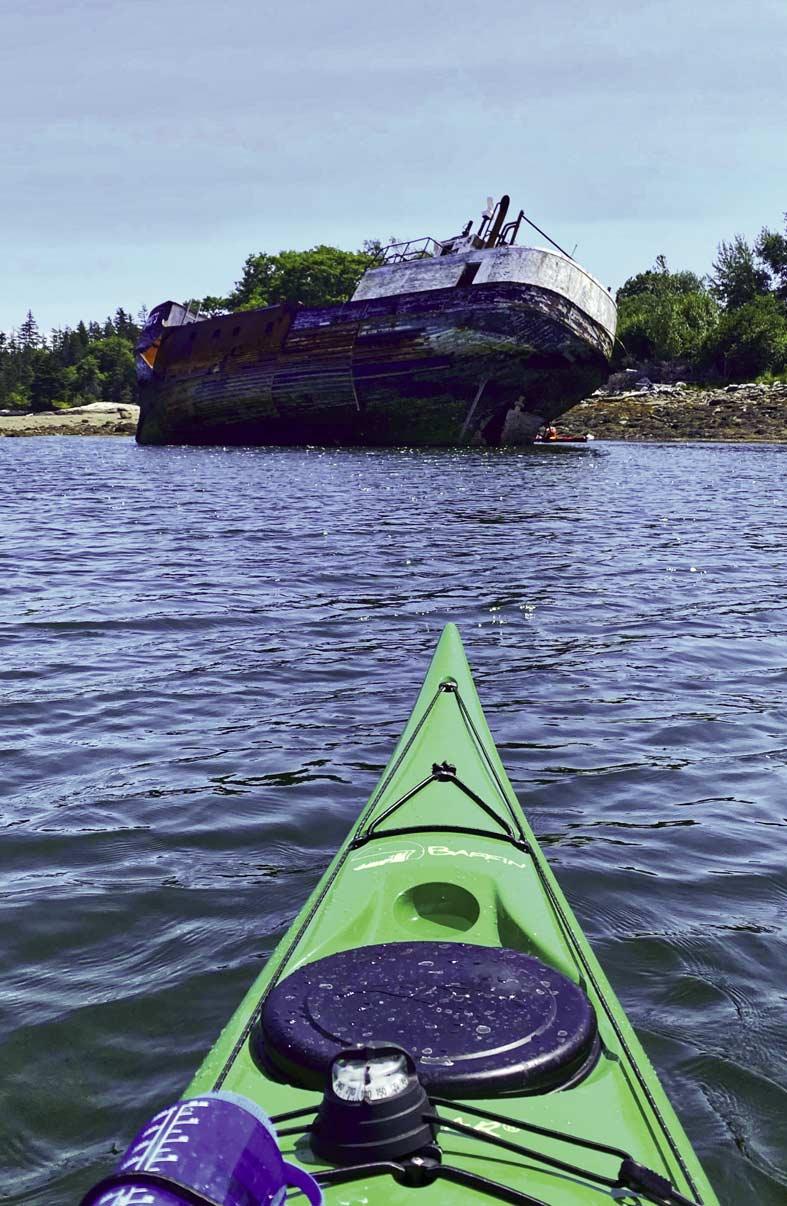
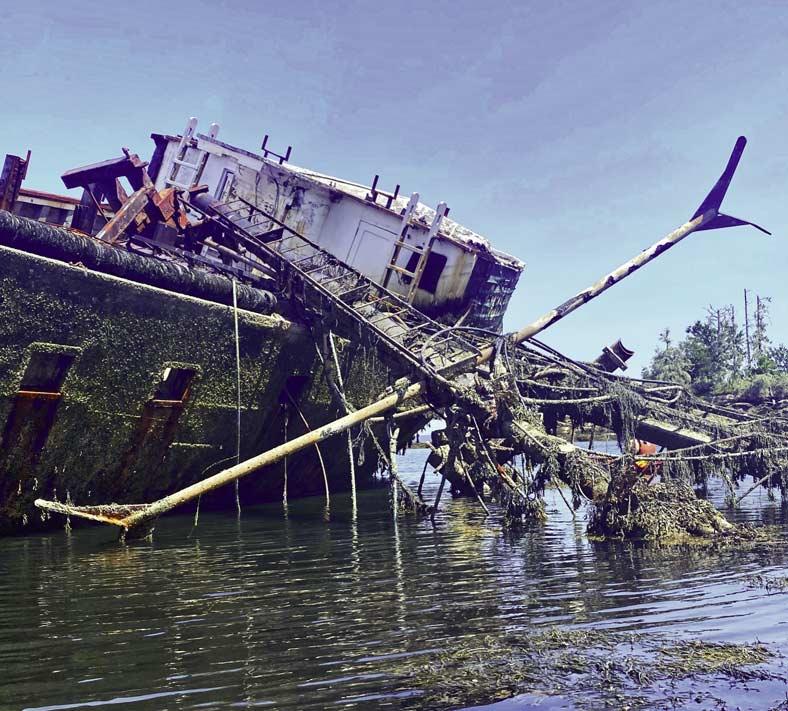
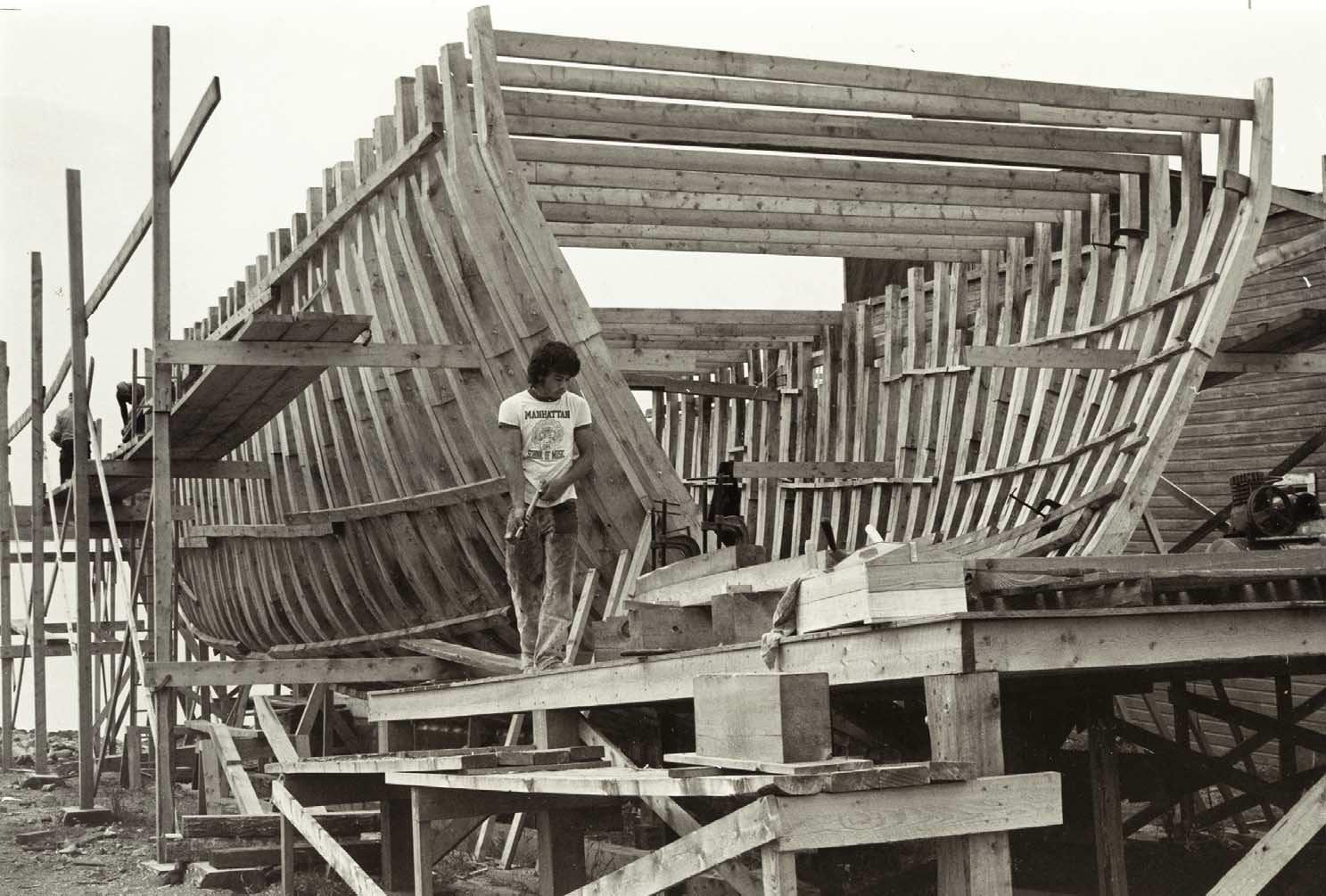
Connecting my short flight over the wreck with my daughter’s kayak trip and then finding out that my brother worked on construction of the boat would have been coincidence enough, but it seemed that the Columbia was still hankering for my attention.
Early in 2024 I was picking up something at E.L. Spear Lumber and Hardware in Rockland when Charlie Bagnall, across the contractor’s desk, told me that he thought he used to work with my brother. Sure enough, it turned out Bagnall was another of the guys from the boatyard who was mentioned in the 1985 CourierGazette story about the Columbia. Later that year, in December, Bagnall shared some boatyard memories with me.
“When I started (at the yard) the Columbia’s keel was laid, and about six or eight of the ribs had been put up,” Bagnall recalled. “There was no upper decking or anything else, so I worked on the Columbia almost from the beginning. I was about 24 or 25 years old and had just gotten married.”
I asked whether he was an experienced carpenter or boatbuilder before that. “Not at all,” he said. “The older guys, if they liked you, they took you under their wing
and they taught you everything. Raymond Wallace—he owned the boatyard, Bentley Watts, Richard Dennison…”
I mentioned how my brother used to walk a mile or so many mornings to catch a ride to work with Dennison. Bagnall recalled that the craftsman had a farm to take care of in addition to his full-time job in the boatyard. “On top of working his eight hours of ‘bull work,’ Richard would go home and take care of the cows and everything else. These were tough old timers!”
“ There were three or four of us young guys—Bentley Watts’s son Tim was there, too—and as the older guys saw that we were progressing, learning, they’d give us our own projects to work on,” Bagnall told me. “We started cutting out all of the planking. All of the lumber for those boats was cut at the sawmill that was right there. From what I remember, the truck brought those logs in, Raymond and the guys would run them through the sawmill that we had right there, we’d “stick” them, but for bending we didn’t need the lumber totally dried.
“Those planks were 2 inches thick, 18 or 20 feet long. We’d put them in a
steam box for bending; there was a big wood boiler that was cooking all the time. Six or eight of us would carry one oak plank out and wedge it onto the side of the boat and bend it to shape. That oak was probably from Knox County. I know it was a local guy who used to come to the yard with his log truck.”
Bagnall said, “Ben and Tim and I got so we were able to do some things. They’d give us a pattern for a particular plank, we would cut it out and bevel the edges for the caulking that was done later on. I worked on the Columbia until we launched it, and then we were doing some final painting and tweaks.”
As Bagnall and I both had a history with hardware stores, I asked about specialty tools.
“An adze, for example—yes, that was hard to learn to use, you had to be pretty precise with it,” he said. “But that was one of those things that the old-timers had down in the yard. They taught us how to do that stuff. It was really fun.
“The tools that were used to caulk and put the cotton in the seams, those things get passed down now. I don’t know how else anybody would find that kind of tool.”

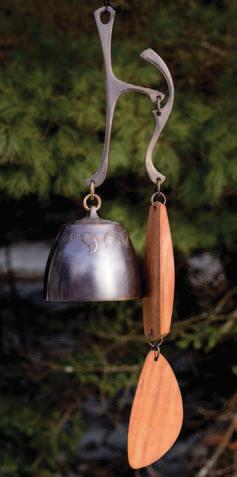



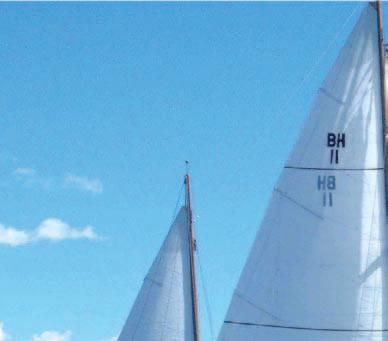

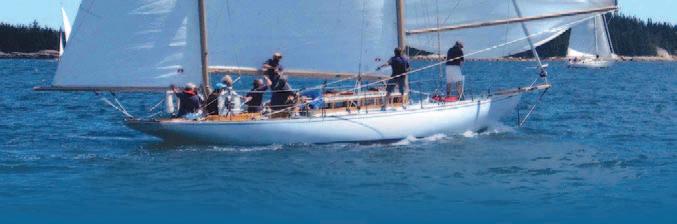
“I can remember heating pitch,” he added. “After they caulked the seams, they poured pitch and it would cool down in the seams, and then we’d chisel that off, smooth.”
“We were always using chisels that those older guys had. I remember one time Raymond bought some 12-inch by 2- or 3-inch-wide hand chisels, and he bought all of us young guys each one. It was a meaningful gift because we could show that we could use those tools.”
Bagnall continued, “The owner of the Columbia had two or three Newbert & Wallace wooden scallop draggers in New Bedford, and he was adamant that he wanted another wooden one, he didn’t want to go to the steel. He was having this one done, and it was out of the ordinary that a yard would still do it.”
“I think those old timers realized it was the last boat like that they were going to build,” Bagnall said.
Kevin Miller, in the Portland Press Herald in 2017, wrote that Columbia “was the last of a generation of wooden draggers that bridged the gap between
the age of sail-powered fishing schooners and the rise of steel ships.”
If you look up the Columbia online now, you will find newspaper articles about various shipwrecks that are considered obstacles or potential hazards on the coast. A call to the Bristol Town Office to ask about the wreck’s current status or efforts to do something with this particular old boat confirmed a couple of things: First, Louds Island is not part of Bristol or any other municipality. Second, clearing a wreck is an expensive process, and plans are being made to remove the Columbia from the Louds Island shore, but nothing is likely to happen immediately. Nothing planned by humans, anyway; we’ll see what winter weather brings.
I am still hoping to fly over the Columbia again, and possibly kayak out to it with my daughter and son-in-law, this time remembering my brother, who had been one of Maine’s youngest oldschool wooden boat builders.
I will ask my sister if she has seen a 12- by 3-inch chisel among Ben’s old
tools, so I can bring it along next time I go to E.L. Spear’s and show Charlie Bagnall. It is indeed a small world. N
Eva Murray has contributed to Maine publications for 25 years. A year-round resident of Matinicus Island since her year-long stint as a one-room school teacher in 1987, she has promised her island neighbors she won’t write about them too much. Murray often seeks out freelance writing work that requires a hard hat.
According to an account from the Rockland Courier-Gazette in 1985: the Columbia was 88 feet long, had a 1,000-hp Caterpillar engine, a 6-foot propeller, and was built of an estimated 80,000 feet of oak. Construction took almost two years, beginning June 1983.


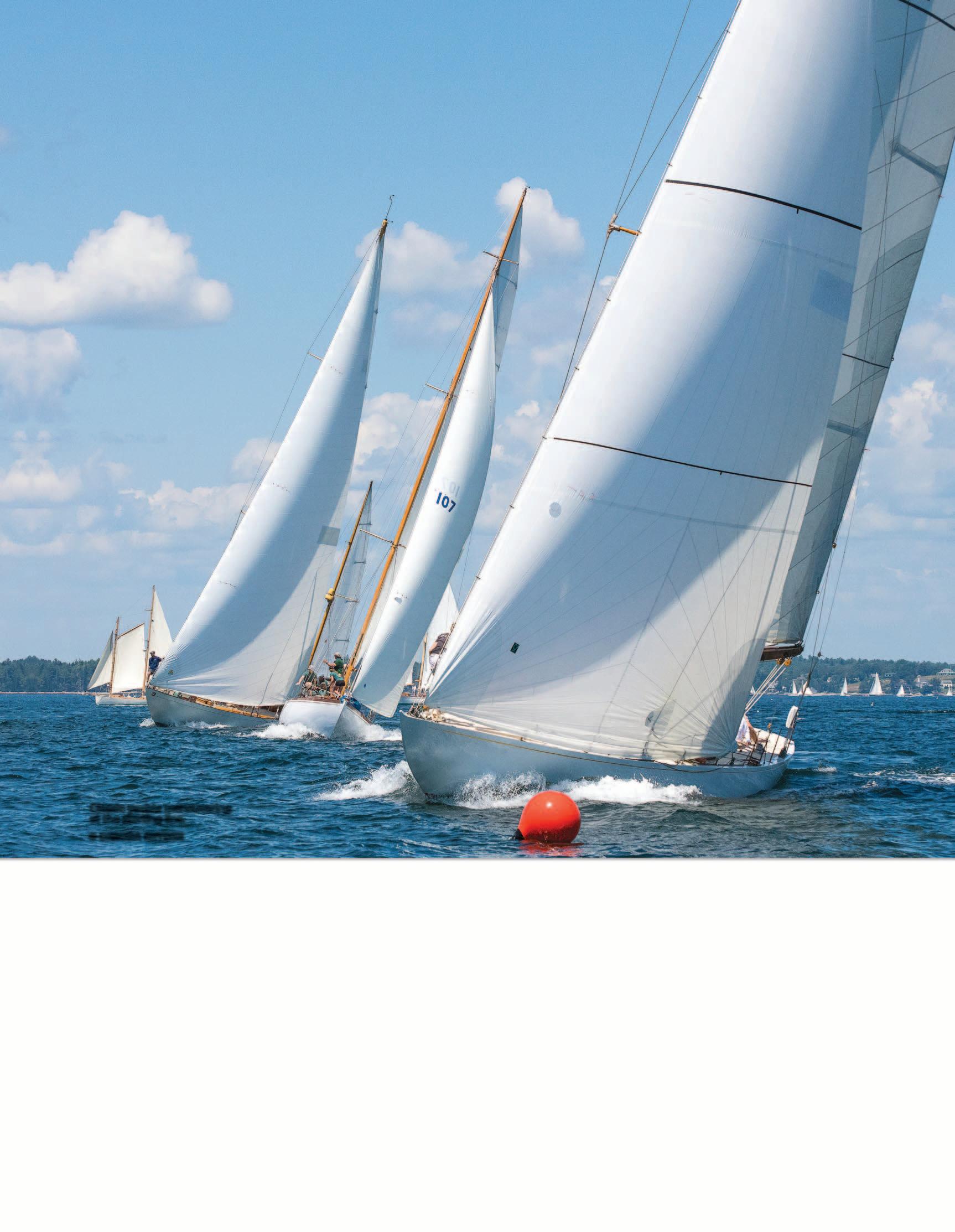




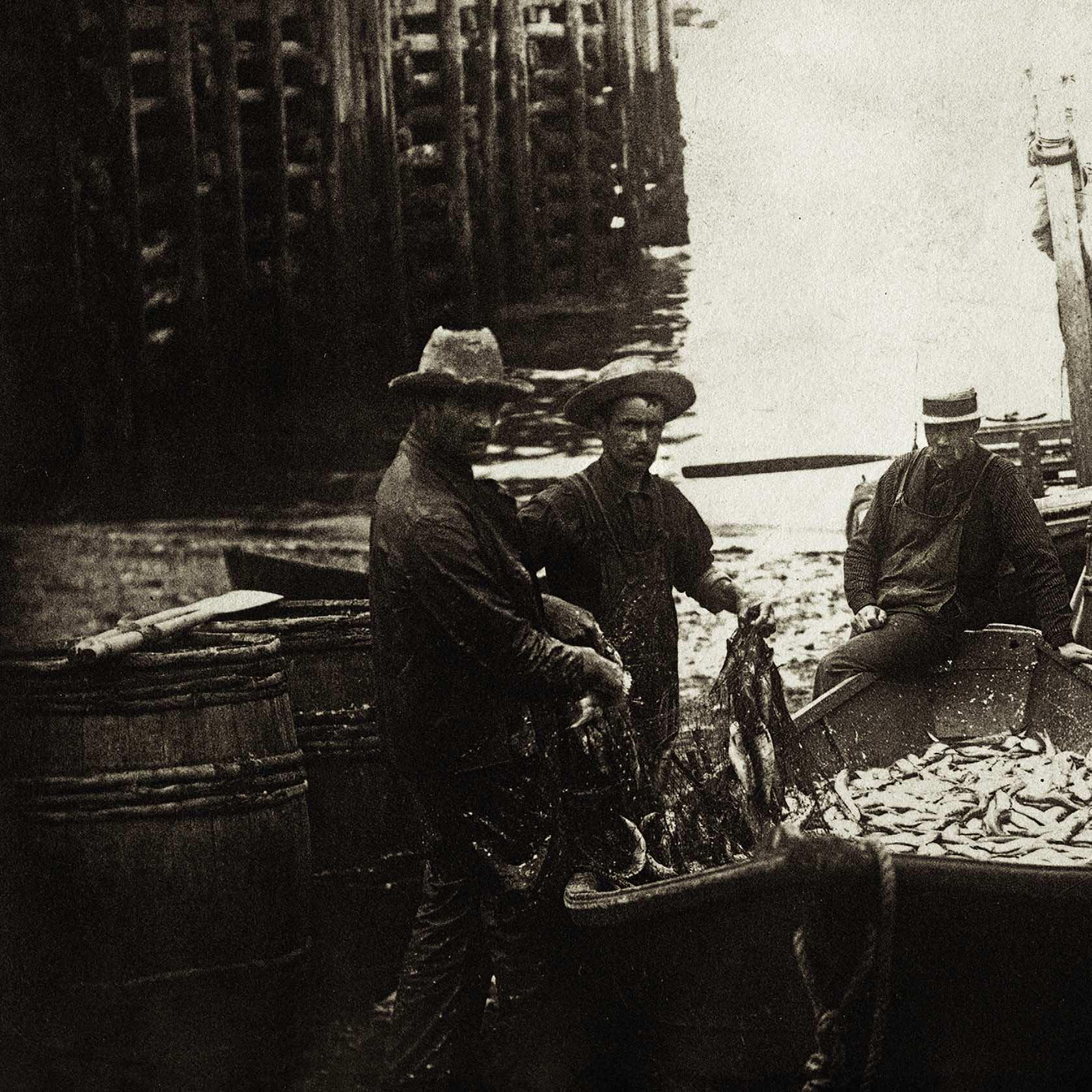
From
Now
them
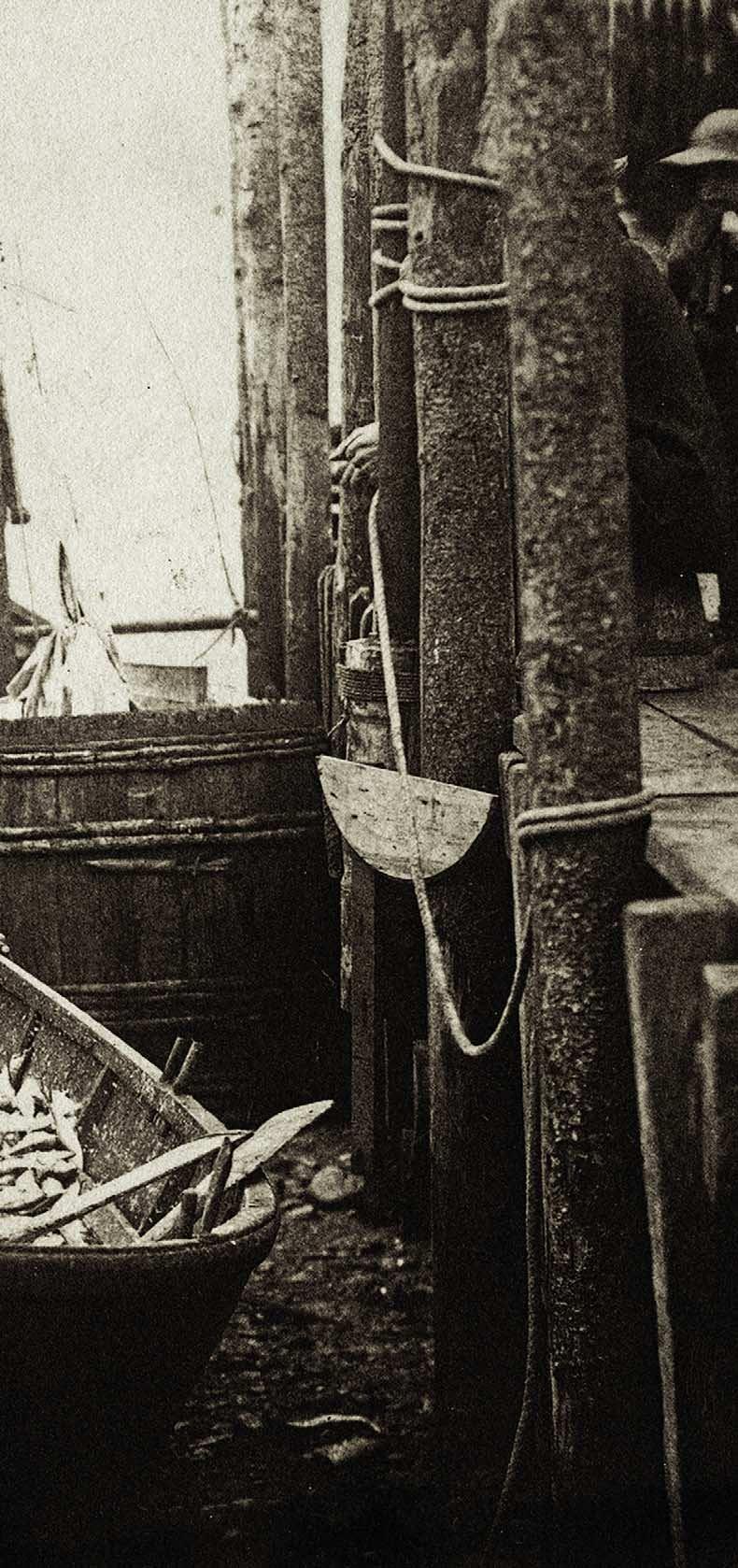
BY LETITIA BALDWIN
WHEN the whistle blew, fingers flew. In eight minutes, Rita Willey packed 64 sardine cans and reclaimed her title as the World Champion Sardine Packer at the 1983 Maine Seafoods Festival in Rockland. It was her fifth trophy, including three straight wins, and came with a $1,000 cash prize.
Coming from the nearby town of Thomaston, Willey needed the prize money. The mother of four did not have daycare and occasionally had to bring her kids to work during her shift at the cannery. At the 1983 contest, Willey’s husband Lanny bragged his wife was so quick “she could turn off the lamp and get into bed before the room gets dark.”
“Friends claimed Willey could throw a 10-pound bag of potatoes in the air and have them peeled and diced before they hit the pan,” the late Bangor Daily News reporter Emmet Meara wrote in his contest coverage.
Willey is among thousands of Mainers who worked in myriad facets of Maine’s once burgeoning sardine industry. The fishery’s greatest catch surpassed 84 million metric tons in 1950. The Thomaston sardine packer, her arch rival Pat Havener of Friendship, and many generations of other workers figure prominently in Penobscot Marine Museum’s new “Sardineland” exhibit that opened this May in Searsport and runs throughout this season and all of the 2026 season, May to October. Plans include a Sardine Fest this coming Oct. 4, 2025.
“Sardineland” is PMM’s first exhibit covering all aspects of Maine’s sardine industry. The state once was home to 89 canneries from Eastport to Portland and sardines were the major source of income in coastal towns. Drawn from the museum’s rich photo collection, many of the compelling photos illustrating the show were shot by award-winning Finnish-American
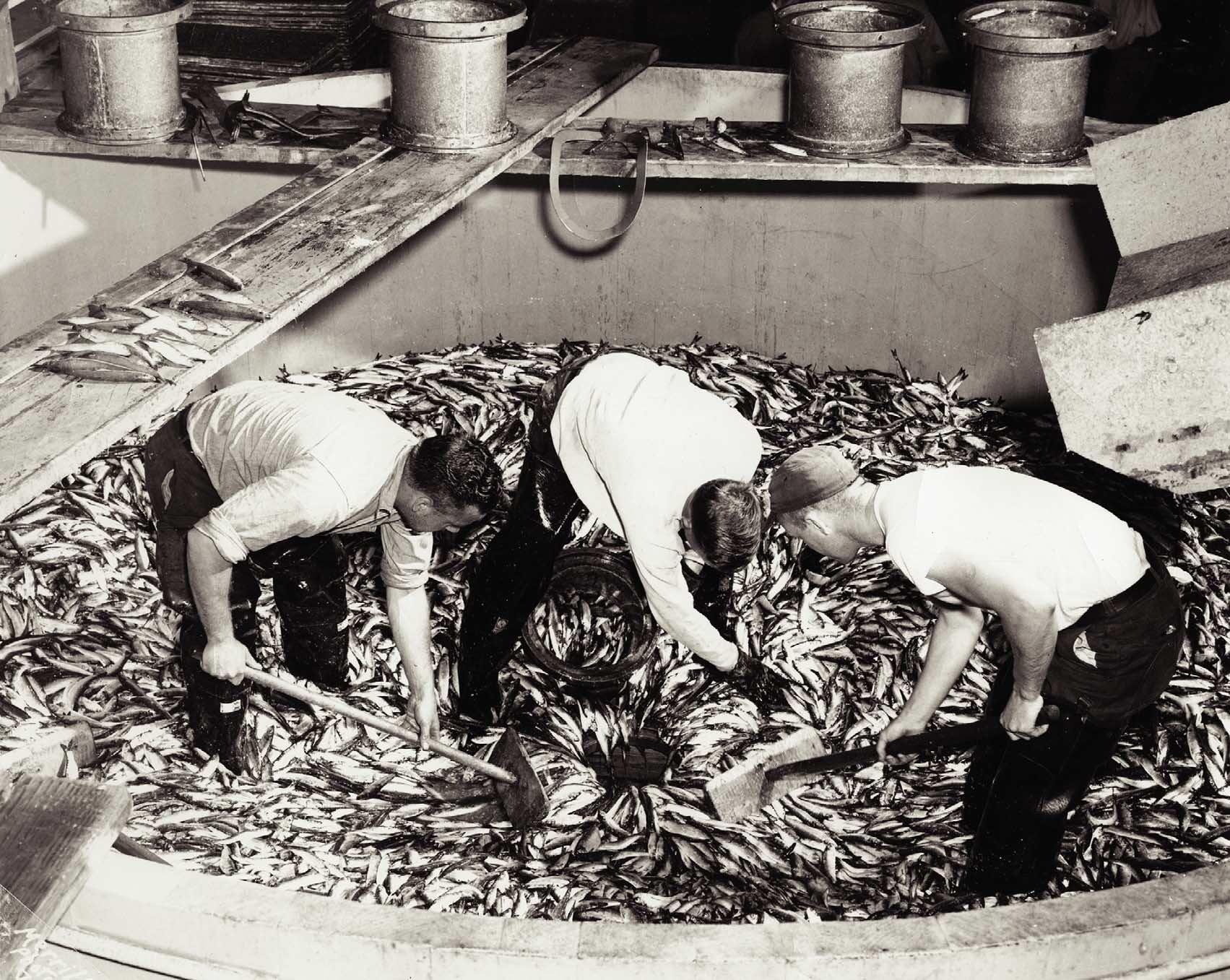
photojournalist Kosti Ruohomaa. Famous for his portraits of working Americans, the Life magazine photojournalist was hired by the Maine Sardine Council to document its industry in the 1950s. Marine images taken by Stonington’s Jeff Dworsky, Red Boutilier, Peggy McKenna, and Carroll Thayer Berry also are featured.
“It’s a universal story of a boom business that collapsed,” museum photo archivist Kevin Johnson said. He likens the fishery’s eventual crash to the rapid rise and fall of other finite natural resources such as coal and timber.
“Over the 135-year history of the Maine sardine industry, people handled herring from net, to can, to shipping carton. The process changed, and automation eliminated jobs, but through it all, it took human hands to make the final product,” wrote Cipperly Good, the museum’s Richard Saltonstall Jr. Curator of Maritime History. She researched the herring’s

journey from the ocean to wharf and the many hands and machines they passed through to produce canned sardines. In the digital montage, Good describes in layman’s language the many jobs in the canning process over a period that lasted from 1900 to roughly 2000. For instance, the cannery workers called “cutters” used scissors to snip off pre-steamed juvenile herrings’ heads, intestines and tails in order to fit usually nine to 12 juvenile herring per can. The “saucers” then added oil, spring water, or sauce to the can.
In “Sardineland,” visitors can view artifacts from Maine’s first refrigerated sardine carrier, the now-defunct Jacob Pike. The exhibit includes a digital slide show with photos of the boat and short film clips that include the Pike and other sardine carriers from the day. The Jacob Pike, which could carry over 90 tons of herring, was commissioned by Moses Pike for the Holmes Packing Co. of Rockland and named for his father. A sistership, the Mary Anne, was also built at the Newbert & Wallace yard in Thomaston. The Pike was launched in

1949, and the Mary Anne, a year earlier. The Jacob Pike was heavily damaged in 2024’s winter storms, and at last report was in a Portland salvage yard.
In preparation for “Sardineland,” PMM staff held listening sessions earlier
this year in Belfast and Lubec to record former workers’ knowledge and memories. Those sharing recollections ranged from sardine packers to lobstermen who sourced herring bait from the canneries to a physician who treated injured
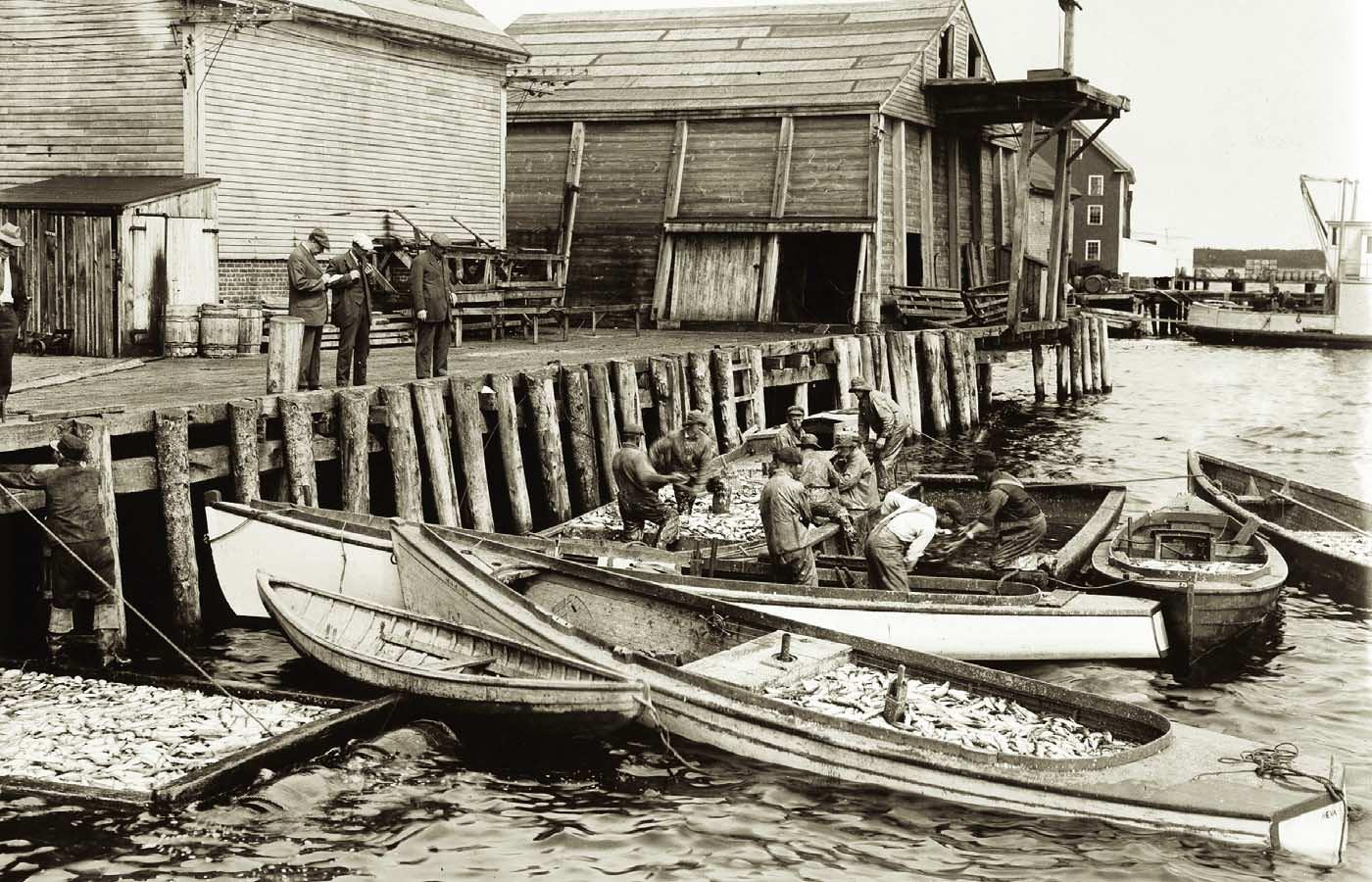
workers. Their faces, voices, and recollections are woven into the show and bring the industry to life.
Anne Shure attended the Belfast session. During the 1970s, she worked for three summers at Stinson Canning Co.’s cannery in town. She remembers being paid a penny for every can she packed. The job made her want to go to college. Like other packers, she taped her fingers as protection from the sharp scissors, according to The Working Waterfront.
“I got carpal tunnel,” Shure said. “I’d have to sleep on my hands, because they would keep going [unconsciously].”
“Sardineland” chronicles the sardine industry’s decline following World War II when canned sardines had been an affordable, protein-rich staple for both troops and civilians.
“Sardines were working-class lunches. You stuck them in your lunchbox and off you went,” recalled Maine food historian and writer Sandy Oliver, who lives on the Penobscot Bay island of Islesboro. While on the phone, Oliver fetched a 6.7-ounce tin of Bar Harbor

Smoked Kippers from her 19th-century farmhouse’s pantry. She noted the canned smoked herring only has 205 calories and is a cheap source of protein and calcium that doesn’t require refrigeration.
Ironically, it was electric refrigeration that changed Americans’ lives and broadened their food options. Frozen fish sticks nudged aside the tinned product popular among older folks. Canned tuna’s popularity took a toll, too.
The U.S. fishery’s swift advances in technology to catch herring—from brush weirs to midwater trawlers—and
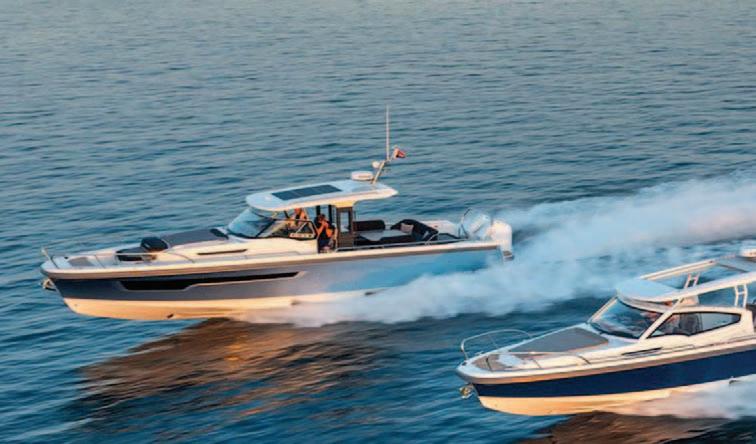




an influx of foreign vessels greatly depleted stocks over time, culminating with Bumble Bee Foods’s 2010 closure of its factory in Gouldsboro’s Prospect Harbor. PMM has a display devoted to the last U.S. sardine cannery.
Besides the story of the industry’s demise, “Sardineland” also shows how Belfast, Portland, Rockland, and some other impacted coastal communities eventually were able to reshape and reboot their economies. N
Letitia Baldwin is a freelance writer who lives in the downeast towns of Gouldsboro and Cranberry Isles. She previously worked as the Arts & Leisure editor at The Ellsworth American and style editor at the Bangor Daily News.
“Sardineland” runs through Oct. 11, 2025, at Penobscot Marine Museum in Searsport. In 2026, the exhibit will reopen in late May and close Oct. 26. Hours are 10 a.m. to 5 p.m., Tuesday through Saturday. Call 207-548-2529 or visit penobscotmarinemuseum.org. The logo for Sardineland (above) was designed by Norma Whitman.
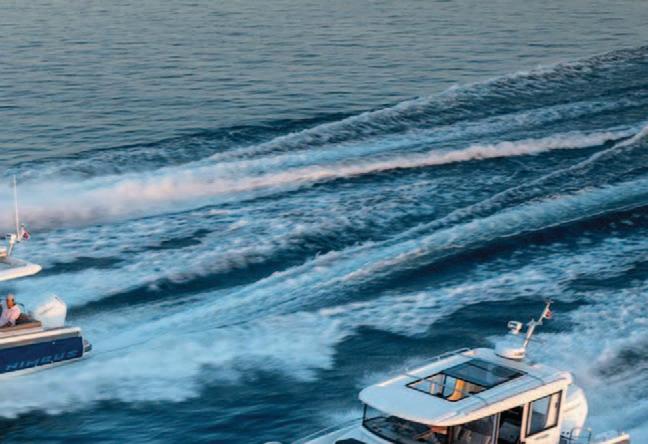
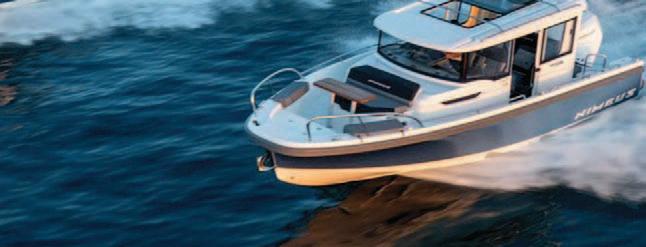








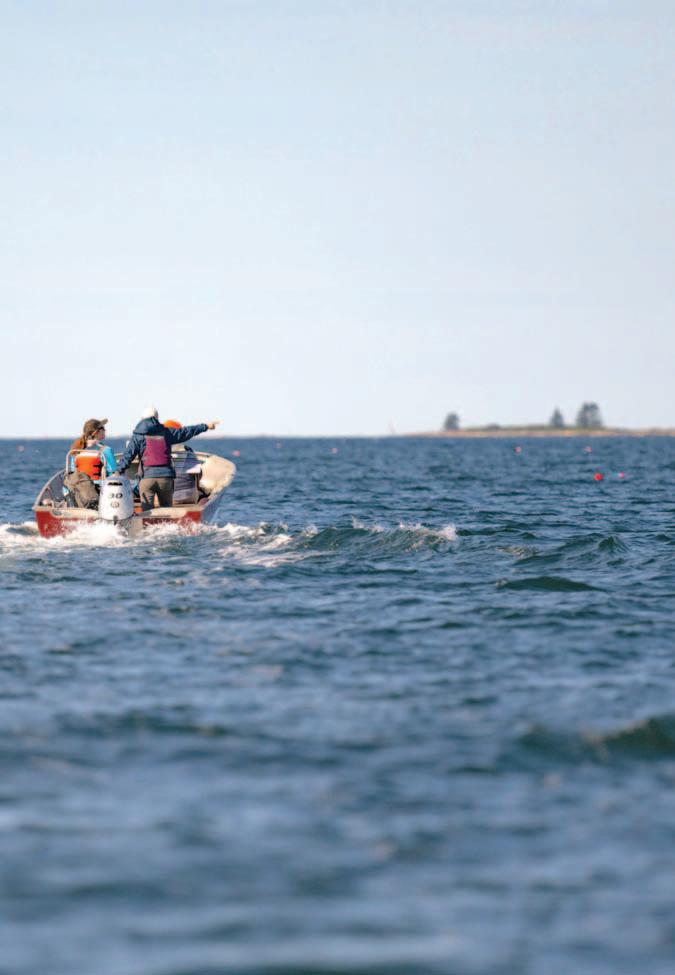
Discover Maine’s most expansive recreational resource at
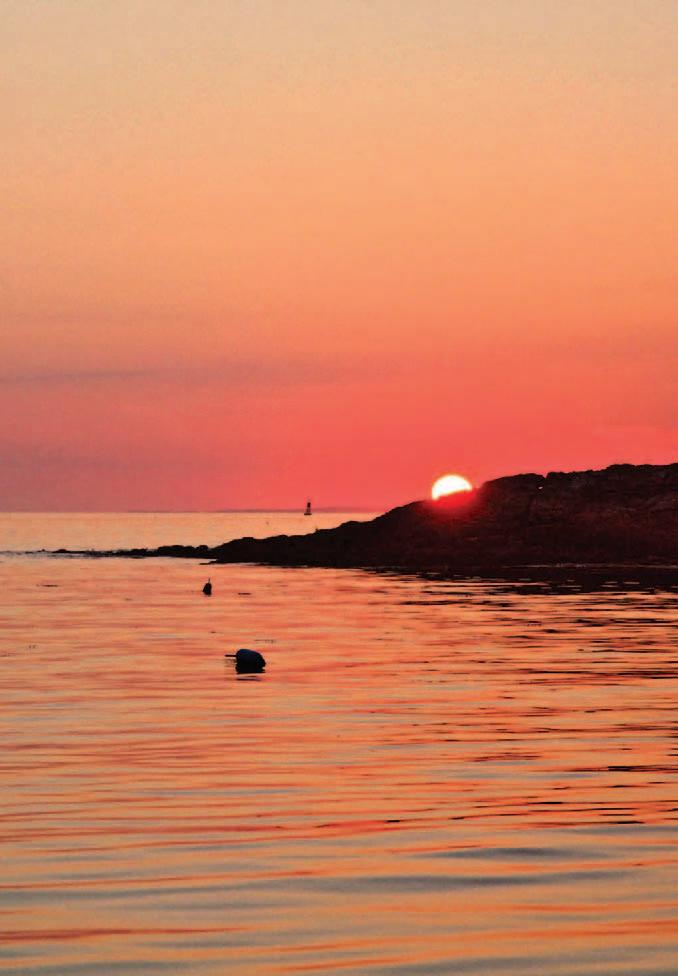













orkboats o chts & W

At Farrin’s, pride in our workmanship has been continuously applied in over 50 years of building boats.
Our craftsmanship in design and construction will give your custom project the quality that has made Maine famous in the boatbuilding industry. This is the time to plan ahead for your new boat, rebuild, repower. We have openings for your project in July 2025. Check out our updated website!


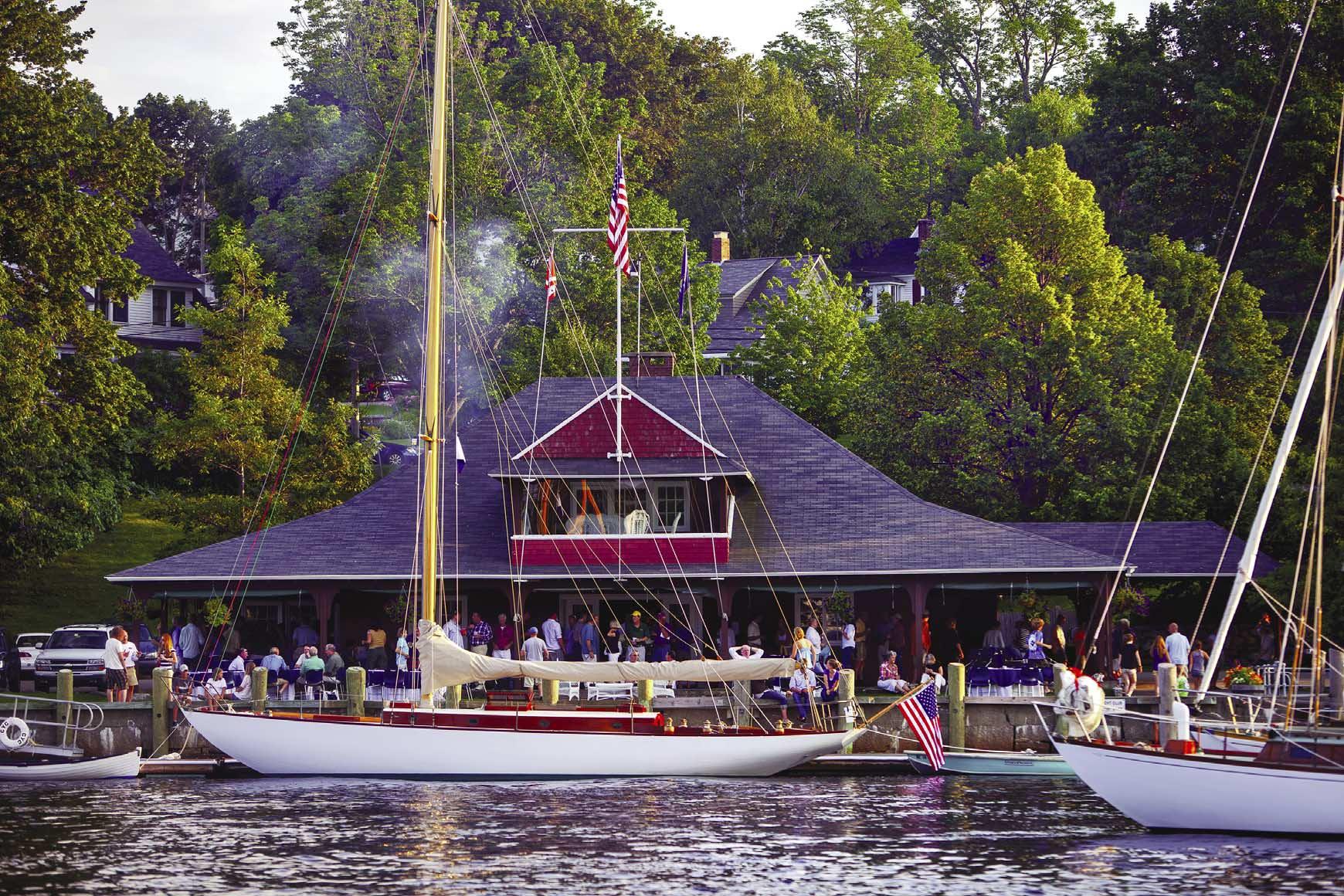
BY EARLE G. SHETTLEWORTH JR.
ALL ALONG the Maine Coast, yachting under both sail and power became an increasingly popular pastime for residents of the summer colonies that flourished in the late 19th and early 20th centuries. And, as the ranks of recreational mariners grew, they came together to found yacht clubs and erect buildings in which to host their social activities.
The Camden Yacht Club is headquartered in one of the state’s most historic of these club houses. By 1906, when the CYC was founded, Camden had
become the major summer colony of the midcoastal region, attracting wealthy families from Boston, New York, Philadelphia, and Chicago. One of the club’s founding and most prominent members was Cyrus H.K. Curtis of Philadelphia. He was a Portland native who owned a publishing empire of newspapers and magazines that included the Ladies Home Journal and the Saturday Evening Post
In 1903, Curtis built Lyndonwood, a spacious cottage on Beauchamp Point in Rockport, a summer community devel-
oped by fellow Philadelphian Charles Henry. Curtis was an avid yachtsman and served as the Camden club’s commodore from 1909 to 1933. In 1907 he commissioned the Lyndonia , a steam yacht that brought him to Maine each summer. Then in September 1911 he announced that he would build “a neat and convenient club house” for the CYC.
He acquired a 1.5-acre site on the west side of the harbor that was occupied by lime kilns and sheds. That fall Curtis employed the local architectbuilder Cyrus P. Brown to clear the
property in preparation for construction to begin early in 1912. At the same time, he secured plans from John Calvin Stevens of Portland, Maine’s most accomplished architect. Correspondence from Curtis to Stevens indicates that the client took an active role in the design of the building.
Brown constructed the Camden Yacht Club between January and July 1912. The project cost its donor between $60,000 and $75,000 dollars. The club house opened on July 4th, with Gov. Frederick W. Plaisted and representatives of six other yacht clubs in attendance. The celebration included a grand ball held that evening.
The Camden Yacht Club is one of Stevens’s finest Shingle Style designs, notable for its graceful simplicity. As the Camden Herald for July 12, 1912, observed, “The beauty and convenience of the building is sufficient testimony to his taste and ability.” On three sides, a sloping hip roof overhangs the eaves, creating a wrap-around porch supported by Arts and Crafts posts. The front balcony affords a panoramic view of the harbor, the town, and the Camden hills, while an oriental-style porte-cochere extends from the rear wall to mark the entrance. Inside the club, a 30-by-45-foot main room features a large brick fireplace.
Given Stevens’s mastery of planning Shingle Style summer houses, it is not surprising that the Camden Herald would comment, “the whole atmosphere
TOP: The side and rear elevations of the Camden Yacht Club include the port-cochere over the entrance in this early 20th century photo.
MIDDLE: Cyrus Curtis traveled from Philadelphia to his summer home in Rockport aboard his steam yacht the Lyndonia between 1907 and World War I. After the war, he replaced the Lyndonia with a larger yacht of the same name.
BOTTOM: In addition to building the Camden Yacht Club, Cyrus Curtis was the major donor for the reconstruction of Montpelier, the General Henry Knox Mansion in Thomaston, in 1929-30. Here Curtis is shown at the dedication of the mansion on July 25, 1931.
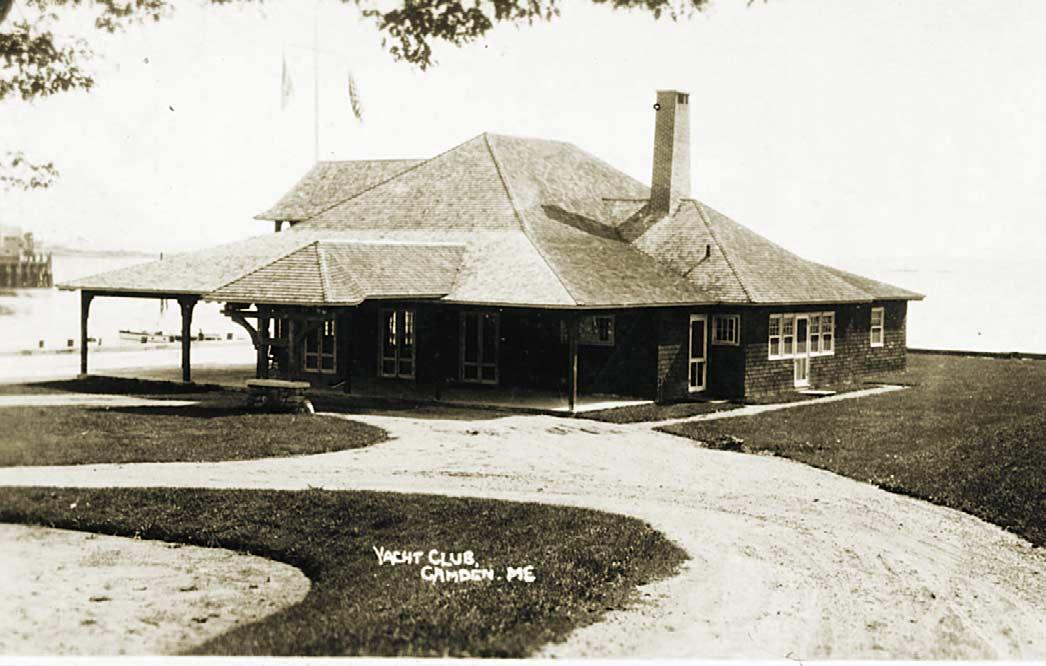
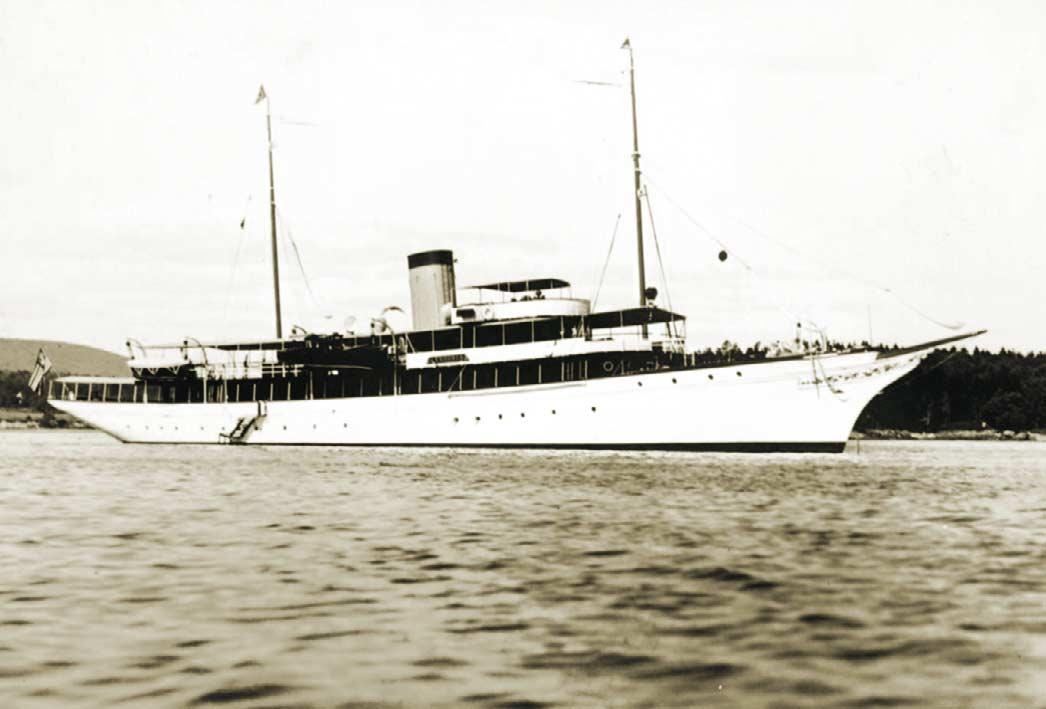
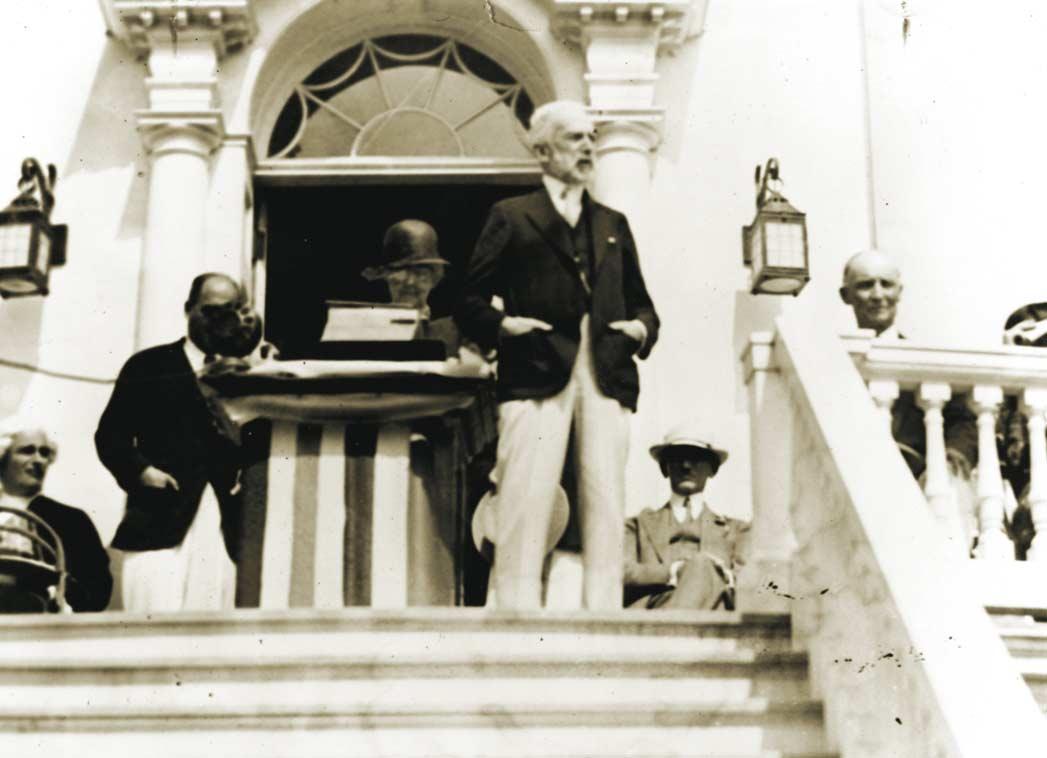
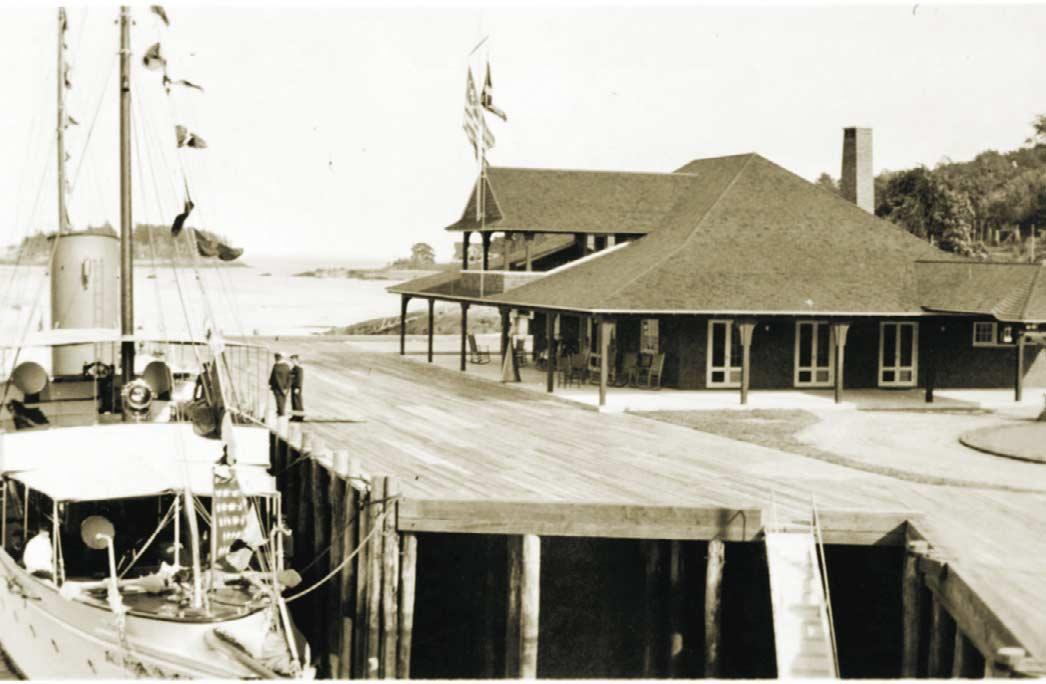
reminds one of a beautiful cottage home.”
Curtis’s enthusiasm for yachting never waned. At the outset of World War I in 1917, he answered the U.S. Navy’s call for small craft by transferring ownership of the Lyndonia to the federal government. In 1920 he replaced the Lyndonia with a larger, more elegant yacht of the same name, which he sailed for the rest































of his life. When he died in 1933, the New York Times reported, “Mr. Curtis spent much of his time and transacted much of his business aboard his palatial yacht Lyndonia built at a cost of more than $500,000. In Portland, Boston, or New York Harbor, he was accustomed to call meetings of his executives aboard his yacht.”
At the annual meeting of the Camden Yacht Club in August 1926, Commodore Curtis declared his intention to give the property to the Town of Camden with the stipulation that it be used “perpetually for a yacht club and other community purposes.” Camden accepted the gift at a town meeting later that year. Nearly a century later, this coastal landmark remains a testimony to the generosity of its donor and the skill of its architect. N
Earle G. Shettleworth Jr. directed the Maine Historic Preservation Commission from 1976 to 2015, and he has served as Maine State Historian since 2004.

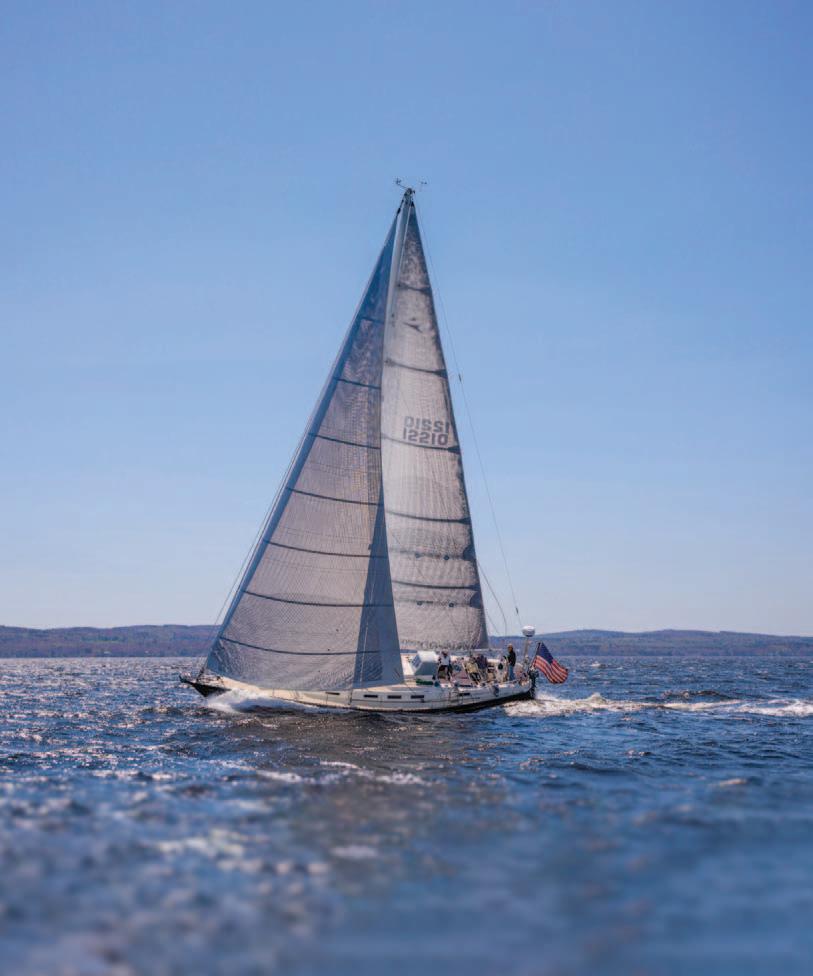




















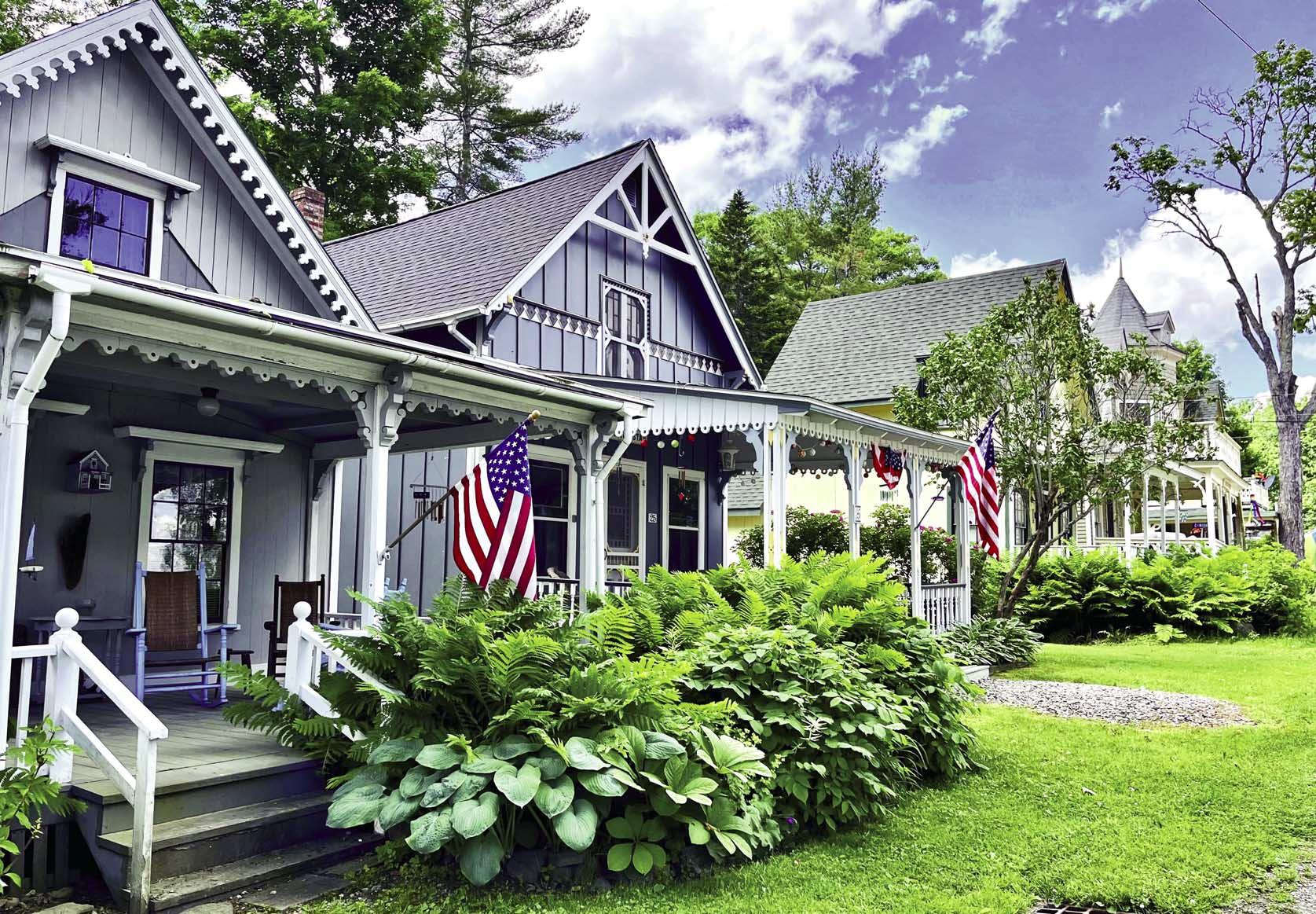
WITH NO TOWN CENTER, Northport often goes unnoticed by drivers passing through on Route 1. But last August, we decided to get off the main drag and take a meander through this Midcoast town, wedged like a slice of pizza between Lincolnville and Belfast.
First, we turned onto Beech Hill Road, following it up through fields, blueberry barrens, and stands of skinny trees. We passed a big, fancy house under construction, but most of the homes we saw appeared to belong to average, hardworking Mainers. As we headed back down Beech Hill toward Route 1, we were treated to a perk that residents enjoy every day: a sweeping view of Penobscot Bay and its islands.
After driving east on Route 1 for a few miles, we exited onto Cross Street, which led to Bayside Road. Soon, we arrived in Bayside Village, a sweet little
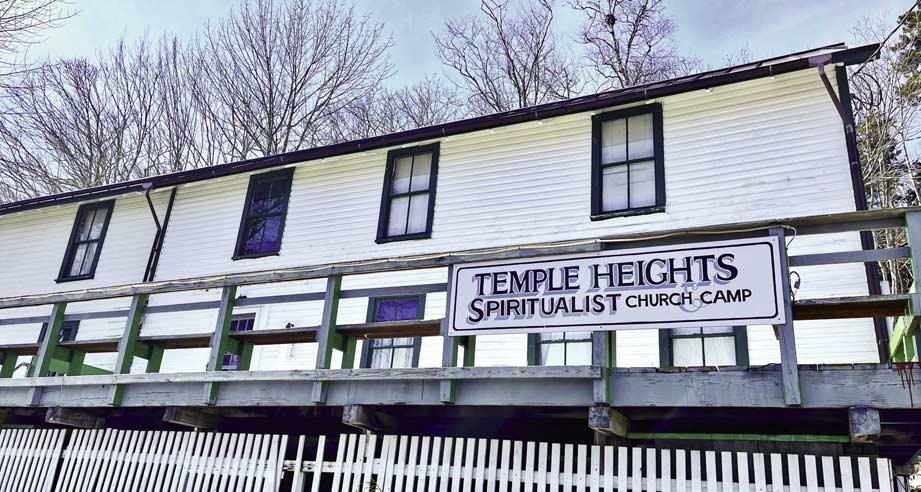
neighborhood of diminutive, gingerbread-trimmed houses squeezed sideby-side on handkerchief-sized lots. It’s always a treat to enter this charming hamlet. People strolled through the irregular grid of narrow, shady streets, stopping to chat with neighbors relaxing on their porches.
At the center of the community, we came to grassy Ruggles Park, which slopes to an open harbor, filled on that sunny afternoon with small sailboats bobbing on their moorings. I was especially smitten with a lineup of nearly
identical, peak-roofed cottages marching up the eastern edge of the park.
It felt as though we’d stumbled upon an earlier, simpler time. Indeed, it was a different time when, in 1848, Methodists from throughout Maine established the Northport Wesleyan Grove Camp Meeting here. As the years passed, congregants at this annual summertime religious convocation replaced their original tents with more permanent, but still pint-sized, dwellings. By the turn of the 20th century, the quaint enclave had transitioned to a secular summer colony
A small indentation on a stretch of bold shore, Bayside harbor offers more protection than you might expect. A few transient rental moorings are available (contact Harbormaster Scott Monroe at 207-323-4565) and there is also space for a few transient vessels to drop anchor. Depending on their size, dinghies may be tied up at the wharf, though there are restrictions on length of stay. Boats may also be launched at Ruggles Park Beach. Membership in the Northport Yacht Club, headquartered at the wharf in Ruggles Park, is open to all, with no initiation fee and very modest annual fees. The club maintains a very active sailing school for kids, hosts a number of social gatherings, and sponsors races throughout the summer, including a round-Islesboro race in early September.
Do
Bayside’s past is full of intriguing tidbits. For example, it was written in the Belfast Republican Journal in 1871 that underbrush would be “cleared away so that the hitherto hidden recesses where the wicked and perverse have assembled, will be under better supervision—thus pushing Satan’s skirmish line further away.” Uncover more stories at the Bayside Historical Preservation Society’s Bayside Cottage Museum , tucked into a little house named Shady Grove that dates from the 1880s. It’s open on Sunday afternoons, June through August. Check out Bayside Arts’ calendar of summer events held at the Community Hall and elsewhere in the village. Part of Bayside, the Northport Golf Club ’s nine-hole course is open to the public. Everyone is welcome to attend Temple Heights ’ spiritualist church services, held on Thursday evenings and Sunday mornings in season; they’re followed by a potluck meal. The fee for workshops and classes is $35. Other sessions range from $20 to $100. For those who wish to stay longer in the community, rustic rooms may be booked in century-old Nikawa Lodge . While Oak Hall is a private
named Bayside. Steamships called at the wharf beside Ruggles Park, depositing vacationers eager for a sojourn in the peaceful village.
Today, the 28-acre Bayside National Historic District encompasses more than 150 tiny antique houses. Many bear signboards announcing the Maine location from which the original owners came, such as Rockport, Orono, South Thomaston, and Bangor.
Over the 15 years that Ian Bruce has lived here, the boatbuilder and artist has seen a marked increase in year-round
mansion, tours can be arranged in advance by visiting oakhallestate.org.
Eat
Open seasonally and highly regarded, The Hoot serves internationally inspired breakfast, brunch, and dinner dishes made with locally sourced ingredients. At Margaret’s, you can enjoy an abundantly filled lobster roll or fried seafood with a side of antiques—be sure to browse all the treasures for sale inside. Top off your visit to this popular roadside spot with a hot fudge sundae or root-beer float. The Bayside Store dishes up subs, pizzas, burgers, freshly made soup, prepared entrees, and a good selection of beer and wine. At The Scone Goddess , you’ll find flaky scones fresh from the oven, plus scone mixes to make at home. Satisfy your craving for good bagels at the cupola-topped cottage where Spark Bagel turns out sourdough bagels in a variety of flavors, as well as bagel sandwiches.
Paddle and Hike
Stop at Maine Outdoor Sportsman on Route 1 to rent kayaks, canoes, and paddleboards by the day or week. The store’s extensive inventory includes gear and apparel for a variety of outdoor pursuits such as camping, hunting, and fishing. The store also has an outdoor shooting range and archery course, plus an indoor archery range. Coastal Mountains Land Trust oversees a number of properties in Northport, including the McLellan-Poor Preserve, whose 66 acres of dense forest and field are laced with several easy trails; and the 230-acre Newman and Breslin Preserve, whose 1.1-mile hillside trail meanders down to Pitcher Pond. CMLT’s Saint Clair Preserve offers an easy, short (0.15 mile) trail to a hidden pond that’s ideal for birding and fishing. Also overseen by CMLT, the 73-acre Mount Percival Preserve has a moderately challenging trail that climbs to the summit and the remains of an early rusticator’s shingled tower, which once provided views of the bay.
residents. He recalled the effect of one article in The New York Times : In just one week, four cottages were being jacked up so cellars could be dug beneath them in an effort by new owners to winterize them.
“It’s still quiet in the winter, though,” he said. “Some year-rounders prefer it then. I enjoy the summertime, with a bicycle brigade of youngsters wheeling around, and people walking by with glasses of wine or carrying casseroles to gatherings.”
In addition to neighborhood gettogethers, Bayside’s summer calendar is filled with events at the Community Hall and elsewhere, including dances, lectures, musical performances, and exhibitions. “One afternoon, a friend and I heard singing,” Bruce said. “We took our folding chairs to Ruggles Park and found that an opera singer was performing.”
A few miles west along the coast from Bayside, we came to a second collection of small, Victorian-era cottages, this one clinging to the side of a steep hill. Since its founding in 1879, Temple Heights Spiritual Camp has drawn healers, mediums, spiritualists, and others interested in communicating with the dead. One of the world’s oldest continuously operating spiritualist camps, the organization hosts workshops, message circles, private readings, spiritual healings, table-tipping sessions, and church services throughout the summer. The services are open to visitors, and anyone can sign up for the other offerings. I’m intrigued.
Just inland from Temple Heights and Bayside, we stopped at a pair of stone pillars flanking a driveway leading to Oak Hall—at 20,000 square feet, Maine’s largest single-family residence and a staggering contrast to the petite cottages nearby. I scanned the colonnaded porticos of the Colonial Revival redbrick façade and tried to picture the grand staircase, two-story-tall Aeolian organ, and nearly 50 elegantly furnished rooms inside. They include living, sitting, music, and dining rooms; two solariums; 11 bedrooms; and 12 bathrooms.
Still a private home, Oak Hall was built between 1912 and 1914 as a summer mansion for Chicago investment banker Ira M. Cobe. I wondered why
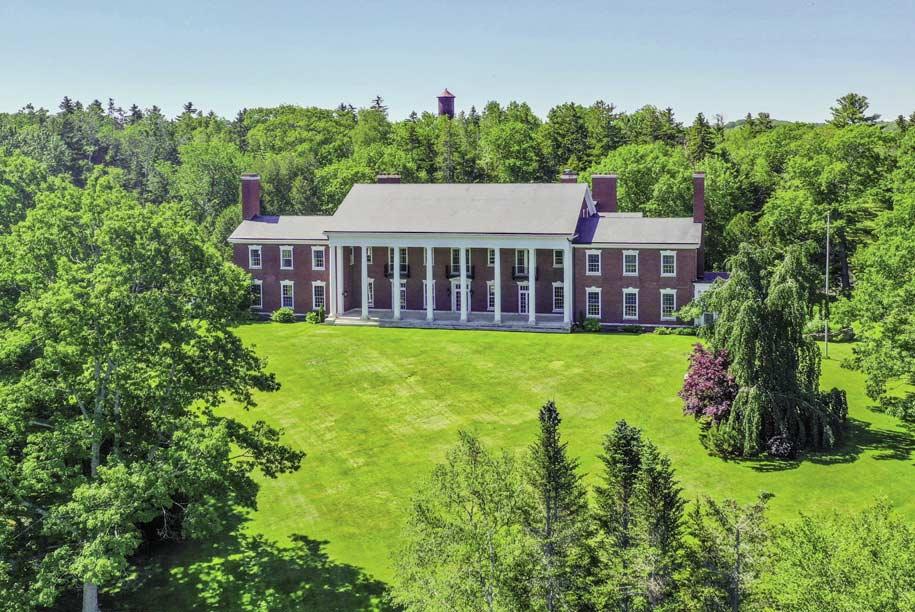
he’d chosen this location instead of Bar Harbor or another of Maine’s monied summer colonies. It turns out his wife, Anne, was a native of Belfast and wanted to be near her family.
Mulling over the importance of such bonds with others brought to mind something I’d been told by longtime Northport resident Judy Berk: “We don’t have a town center. We bump into friends at the dump,” the photographer and environmental steward had said with a laugh. “We have a give-and-take table at the town hall. When somebody
needs something, we’re all there for them. It crosses any political lines.”
Motorists speeding through Northport on Route 1 don’t see those ties that bind. But no doubt these caring connections are what weaves the town together—from homesteads on upland farmland to clusters of cottages by the sea, from modest dwellings to a grand mansion or two. N
Contributing editor Mimi Bigelow Steadman lives on the Damariscotta River in Edgecomb.
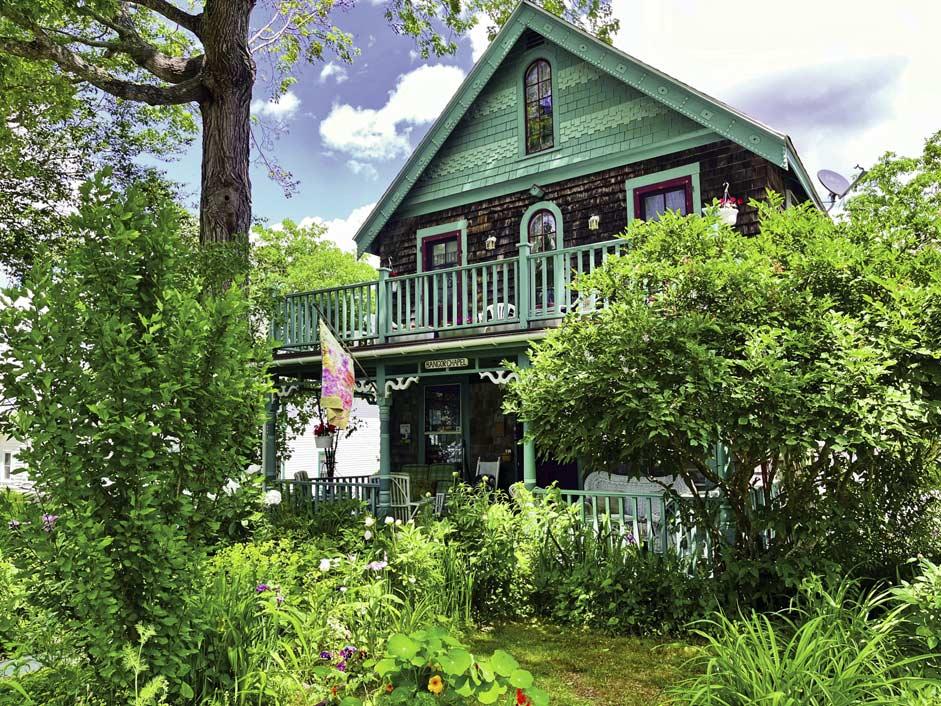
ADMIRAL SPONSOR
REGISTER TODAY FOR THE 9th ANNUAL
JULY 24-26, 2025 | CAMDEN, MAINE
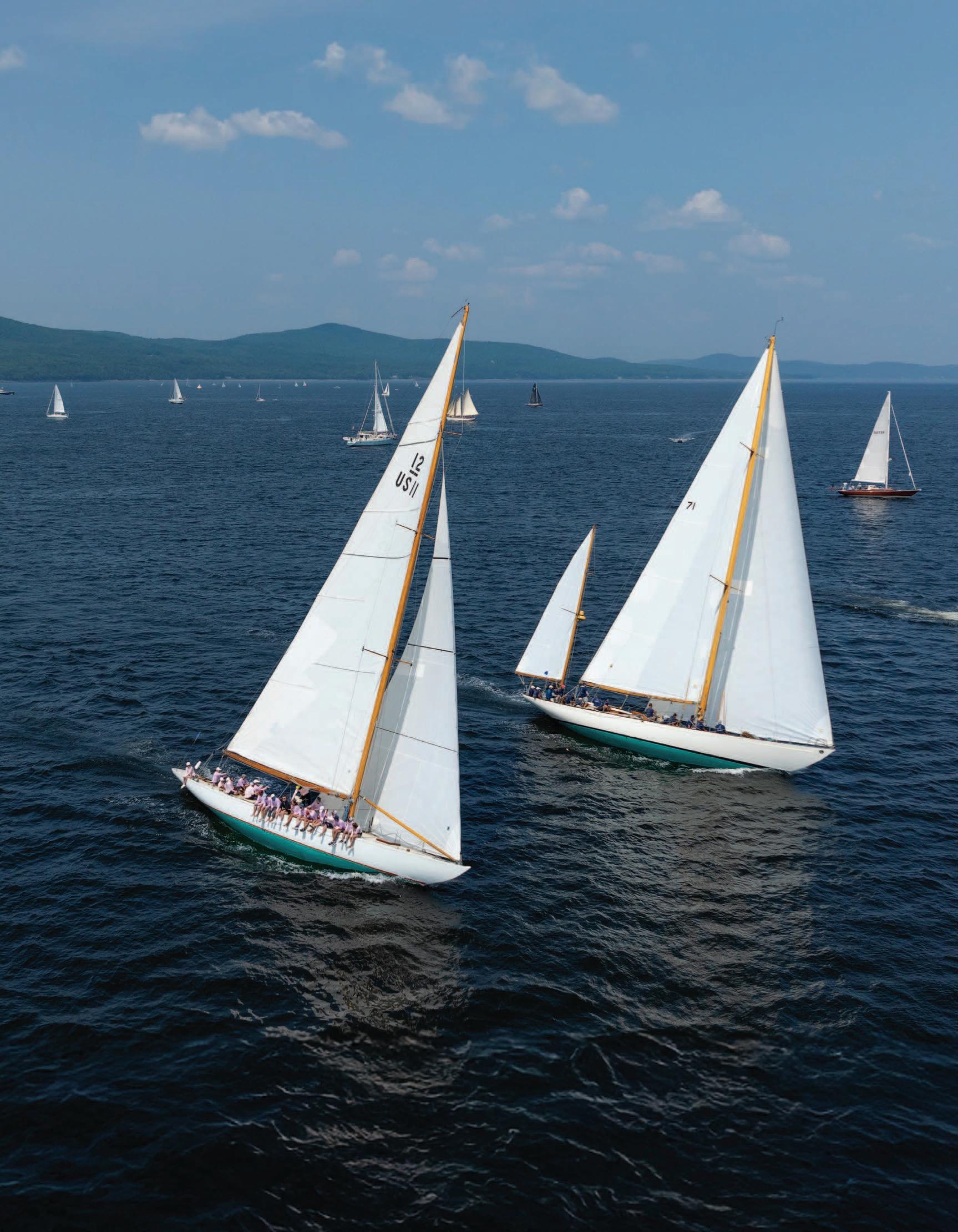
ALL PROCEEDS TO BENEFIT HOSTED BY
REGISTER AT:

COMMODORE SPONSOR

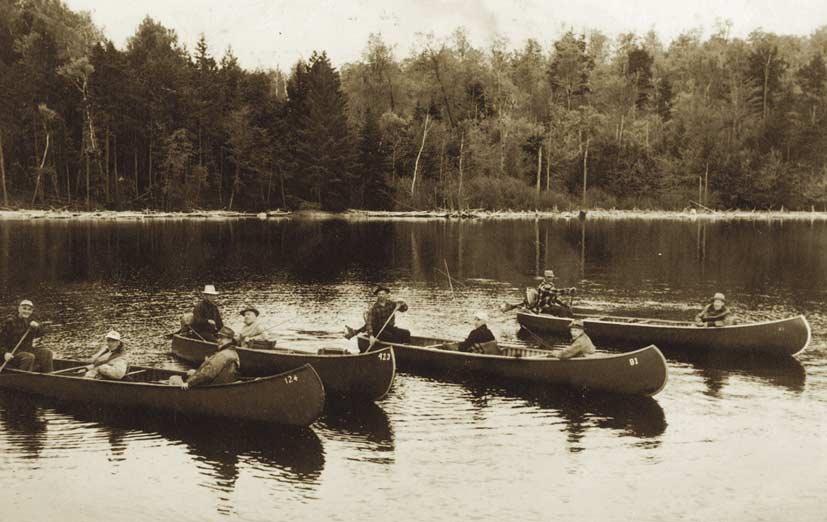
The Story of the Grand Lake Canoe
by Dale Wheaton,
St. Croix Historical Society, 2024
Some Maine watercraft are inextricably linked to particular towns through the names by which they are known. Think Friendship sloops, developed for lobstering under sail; Rangeley boats, originally double-ended but now with a transom for outboards, and used for pleasure fishing on the lakes of that region; and, most notably here, the Grand Lake canoes. These square-sterned canoes, about 20 feet long with relatively high freeboard, have evolved to handle well under both paddle and outboard on the frequently choppy waters of the Downeast Lakes region surrounding the tiny village of Grand Lake Stream.
The St. Croix Historical Society, based in Calais, Maine, has done all who love Maine history and traditional watercraft a great service by publishing in 2024 The Story of the Grand Lake Canoe by Dale Wheaton, who sadly passed away the year of publication. All proceeds from sale of the book go to the Historical Society.
Coming from one of the local families of canoe builders, Wheaton lovingly



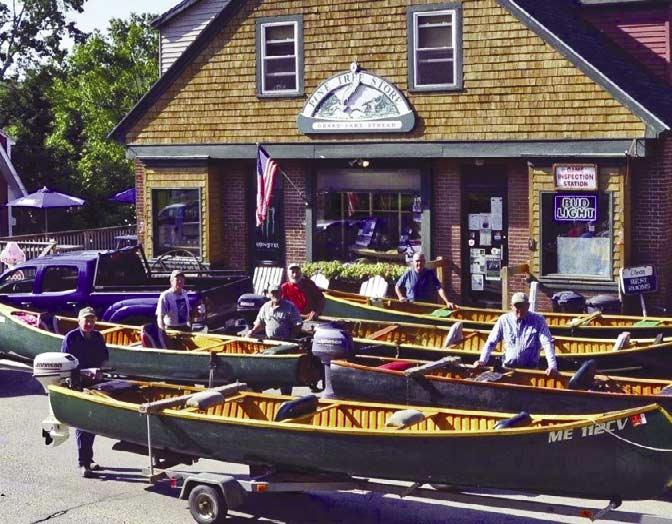
chronicles the history of a beautiful region, stories of guides and canoe builders, and explains how each builder used his own and guides’ experiences to optimize hull shapes. Photographs, some quite old, and extensive footnotes add to the wealth of information.
Grand Lake Stream lies about 30 miles inland from the sea, not far from the Canadian border in a region where the Great North Woods sweep downward toward the Gulf of Maine. The area’s abundance of hemlocks offered large amounts of bark for the tannin to support in Grand Lake Stream one of the world’s largest leather-tanning factories in the late 19th century. The village grew up along the stream of the same name to house the workforce for harvesting the trees and running the factory.
What Indigenous people had long known, visitors discovered even before the Civil War: The fishing from Passamaquoddy birchbark canoes was spectacular. Guides transported and taught their clients, the so-called “sports,” arriving from afar. Despite the tannery’s decades of noise and pollution, fishing
held up. When the tannery closed in 1898, sporting camps for anglers and hunters joined the guides as the basis of an economy that still thrives today. Wheaton was himself a sporting camp owner, with his wife.
Canoes are essential in that region. Wood-and-canvas construction replaced building with birch bark in Maine as the 19th century ended, and the new century brought the outboard motor. Guides still needed to paddle in small streams and close inshore, but the speed of outboards was advantageous for traveling longer distances and quicker access to the best fishing spots. Several local families, Wheaton’s relatives included, produced multiple generations of craftsmen dedicated to providing guides and sports with canoes that became known as Grand Lakers. At the height of building these masterpieces of design and craftsmanship, several builders operated completely independently of each other within the village’s confines. The Story of the Grand Lake Canoe is a marvelous tribute to this Yankee individualism, the canoes it produced, and the Downeast Lakes region.
—Ben Emory




Culinary Landscapes: A World of Delicious Discoveries in a Maine Mapmaker’s Kitchen by Jane Crosen, Maine Mapmaker/ Waterbird Press, 2025
Chain of Lakes lies in the easternmost county in the United States. Shaped by melting glaciers, the interlocking waterbodies—First, Second and Third Chain lakes—are surrounded by once logged, sparsely inhabited forests in Washington County’s unincorporated Township 26.
This remote place, where logs were driven down Chain Lake Stream during the timbering era, is a fitting setting for Maine mapmaker Jane Crosen’s second cookbook Culinary Landscapes: A World of Delicious Discoveries in a Maine Mapmaker’s Kitchen . Solo or joined by her husband/co-culinary adventurer Richard Washburn, she wrote and assembled much of Culinary Landscapes at their seasonal camp on First Chain Lake. In winter, home is the Hancock County town of Penobscot, which the Bagaduce River flows through.
Crosen grew up in the southern Maine town of Cumberland. She has always lived near salt or freshwater bodies. In her 20s, a three-year stay at Scotland’s spiritual community, Findhorn, on the North Sea, nurtured her passion for locally grown and sourced food. Crosen’s knowledge of typography and calligraphy sprang from working as a typesetter. Her fascination with maps and mapmaking ability evolved while serving as an editor at Yarmouth-based mapping company, DeLorme Publishing. Her design and editorial skills were further enhanced at WoodenBoat magazine in Brooklin.
These facets of Crosen’s life all are reflected in Culinary Landscapes, from her careful choice of Perpetua and Goudy Old Style fonts and finely crafted writing to her color photos and pen-and-ink illustrations throughout the airy cookbook. They also characterize her 2009 cookbook Maine Mapmaker’s Kitchen and her handsome, expanded editions of George N. Colby’s 1881 atlases of Hancock and Washington counties.
While exploring Maine and beyond, Crosen either knows of or seeks food that’s in season in the wild or harvested by farmers, fishermen, and other local purveyors. At First Chain Lake, the modest cabin may lack electricity or running water, but it is rich in the author’s idea of amenities. The small kitchen is stocked with mint, marjoram, sage, thyme, dill, and other herbs—grown in her and Washburn’s big garden in Penobscot—
and homemade spice rubs for cooking maybe chicken thighs and foraged chanterelles or Persian-spiced lambchops on a two-burner Coleman camp stove. Other cooking platforms include an old Avalon Regency woodstove and Smoky Joe charcoal grill.
Weather permitting, Crosen eats on the camp’s screened porch—another luxury—where the table is set with her richly patterned “landscape” placemats. She composes scenes from strips of old garments and scraps from sewing projects.
Depending on the day ahead, Crosen might grab a quick bite, say her scratch English muffins with blood orange marmalade. A leisure breakfast might be multigrain pancakes with strawberryrhubarb sauce.
The mapmaker loves to eat well but doesn’t want to miss seeing May flowers in bloom and other outdoor adventures. Through Culinary Landscapes, she strives to make that possible for others too.
—Letitia Baldwin


The Adventures of a Maine Peanut by a Doctor and a Weatherman, pictures by a Daughter and a Grandfather, and edited by a School Teacher; Samir Haydar and Todd Gutner, 2024
A family outing interrupted by a strong summer gale, a parted mooring line and cherished boat gone missing, encounters at sea with a variety of marine life, and a fortuitous rescue by the skipper of a tuna boat—what more could you ask for in a good Maine sea story?
Not much, it turns out. The Adventures of a Maine Peanut is a lively children’s tale that’s recounted by the gulls of Casco Bay. After all, they were the only ones that could have witnessed what happened
between the time “Peanut the 24-foot Eastern” with a funny name broke free from a mooring in Kettle Cove, near Cape Elizabeth, and was found floating without a scratch four days and some 50 miles later off Ogunquit.
At home, Peanut lives alongside the friendly sailboat Mama Cita , the Albin Mise en Place, Maiden Maine and Sweet Pea, a pair of Eastern-like hulls, and the small lobsterboat Gail Louise. During its adventure, Peanut misses those friends but encounters the likes of Franny the turtle, curious seals named Steve and Christopher, Mr. White the shark, and a pod of porpoises named Ben, Teddy, Berm, Mike, Dickie, and Shaw.
It’s a whimsical, almost true story, written by Samir Haydar, a Portland doctor, and his friend, Todd Gutner, a television weatherman, after an annual family Father’s Day outing to Richmond Island off Portland was cut short by a storm, and the Haydars’ Eastern 24 went on an unexpected walkabout at sea.


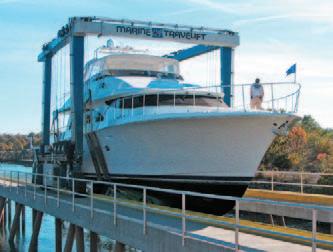
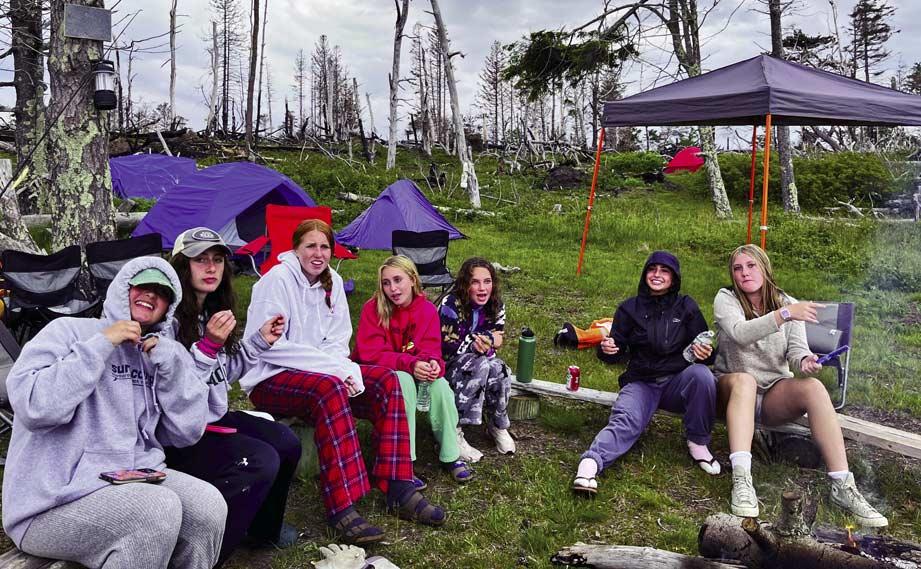
The book is wonderfully illustrated by Samir’s youngest child, Franny, and amateur nature illustrator and photographer Jim Newton—another Richmond Island devotee. It was edited by Todd’s wife, Rachel, a Falmouth teacher, so like the annual outing, the book is very much a family affair.

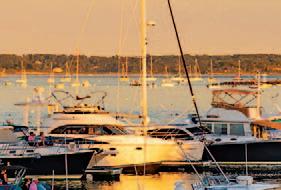


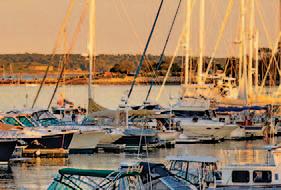

Widely available in Maine bookstores and online, it’s a book that will keep the kids entertained on a summer’s night on the coast, up to camp, or in a woodsy cabin in the mountains. Wherever you choose to read it, you are all bound to get a kick out of Peanut’s nautical adventure.
—Mark Pillsbury

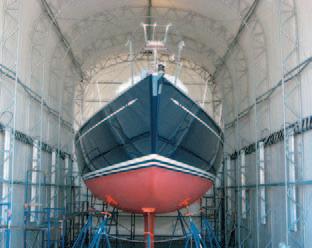





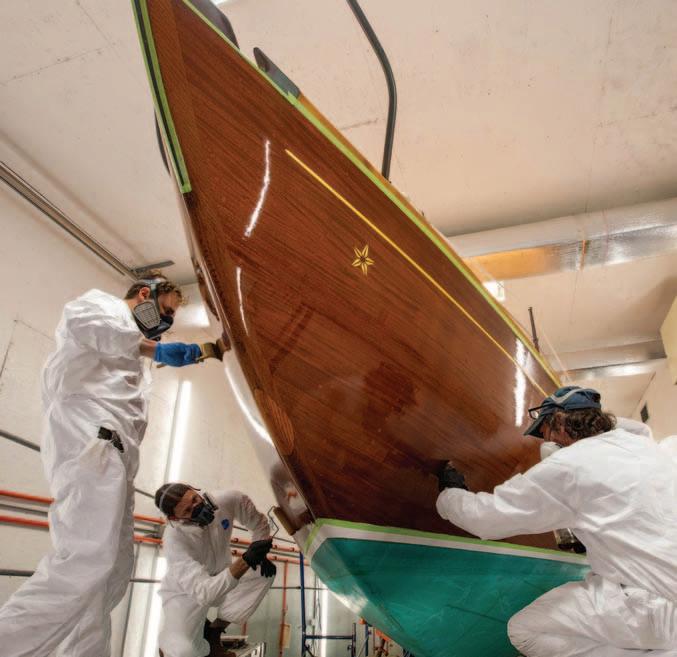

charm
Exceptional musicians and singer-songwriters from near and far grace the stage at Turner Farm’s classic post and beam barn. Join us for an unforgettable musical experience where guests are treated to sweeping sunset views of lush farmland along the Fox Island Thorofare. Ferry access from Rockland.
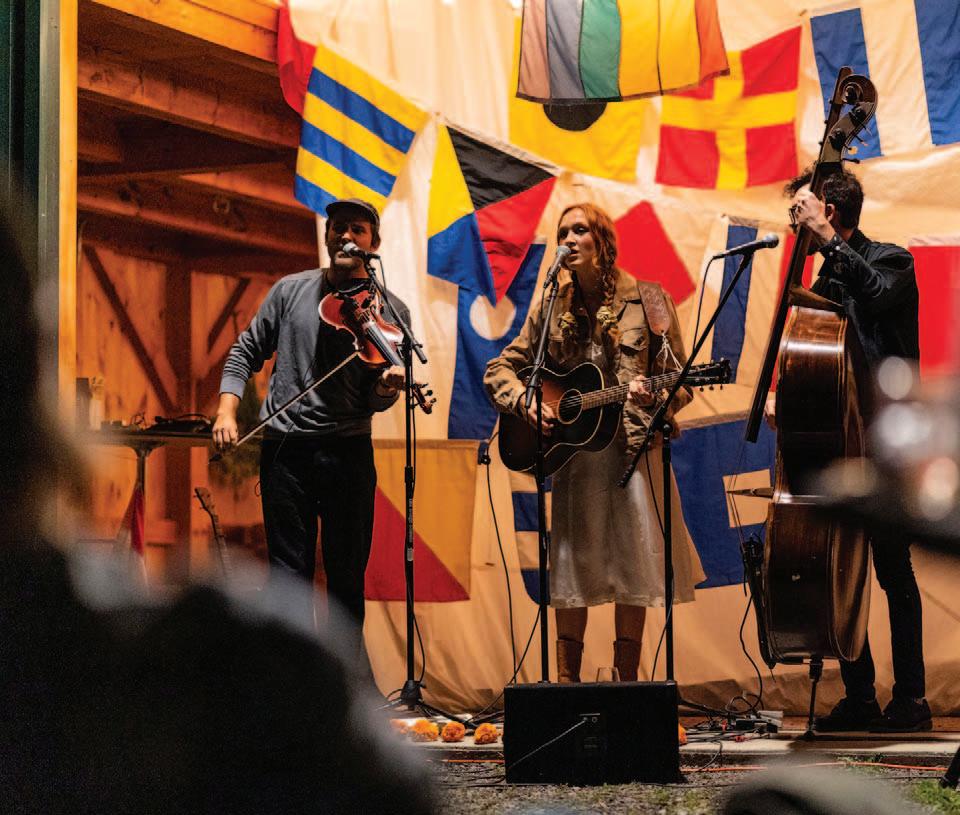
Check out the 2025 Summer lineup, secure tickets, and explore lodging options for an immersive island experience at www.CrabtreeSessions.com
> Town Dock continued from page 15
getting an in-depth education in all things maritime, thanks to a waterfront-focused multidisciplinary program called the Belfast Marine Institute. Started by history teacher Charles Lagerbom, the program features multidisciplinary, STEAMbased coursework; student-led research; internship opportunities; and community engagement. Goals for the program, according to a story in the Working Waterfront, include promoting an understanding of the issues affecting the marine environment, and an awareness of the many available marine-related scientific, technological, and commercial careers.
Students in the program have experienced diving through a SCUBA discovery course, and engaged with the community through field trips and involvement in Maine’s Fishermen’s Forum and World Oceans Day. They also have been certified in cold-water safety training, first aid, CPR, and AED, according to the Working Waterfront
With two years of intense, grant-
powered development behind it, the Marine Institute is focused on expanding to include topics like sea stories, navigation, ocean chemistry, small business development, computer science, and technical drawing.
It’s great to see high school students being grounded in industries that play such a key role in the Maine economy.
Keeping track of which Maine programs have been lost as a result of federal funding cuts and which have been restored as a result of lobbying or legal action has been confusing. Last month, for example, the University of Maine’s Advanced Structures and Composites Center announced the layoff of nine employees as a result Washington’s funding cuts, which also put a halt to the university’s floating offshore wind energy turbine platform project.
Then just a short time later, U.S. Sen. Susan Collins announced an $8 million partnership between the U.S. Department of Transportation’s Advanced
Research Projects Agency and UM’s Composites Center focused on developing technologies that will deliver bridges at half the cost, in half the time, and with twice the lifespan of many current bridges, according to a news release form the senator’s office.
The press release additionally stated that the senator has “secured more than $18 million in Congressionally Directed Spending for UMaine’s Advanced Structures and Composites Center through her role on the Senate Appropriations Committee.”
In its story about the cuts and layoffs, the Bangor Daily News reported that they occurred after the Trump administration paused millions in awards to help the center build floating turbines and complete other projects.
More than a dozen plans to bolster Maine communities against the threats of climate change will have to find new sources of funding after the Trump administration announced plans to end

the Federal Emergency Management Agency program titled Building Resilient Infrastructure and Communities, or BRIC, last spring, according to a report in the Maine Monitor
Funds not yet distributed to local grantees must be returned to the U.S. Treasury or the Disaster Relief Fund, a separate FEMA program that reimburses localities after disasters strike, according to the report.
A total of 18 resilience projects in Maine saw their BRIC applications terminated with the cancellation of the program, a spokesperson for the Maine Emergency Management Agency told the Monitor
Of those projects, MEMA was able to find alternative funding for 14, said MEMA spokesperson Vanessa Sperrey.
The news of those cuts was followed by news of yet more funding cuts, this time in the Hazard Mitigation and Grant Program, a billion-dollar program that states have long used to protect vulnerable homes and infrastructure from floods and other disasters. N

Over the bar
The boating world lost one of its heroes last spring with the passing of Carl Cramer, former publisher of WoodenBoat magazine. His longtime friend wrote this tribute:
We met many years ago at the launching of Whitefin , the 92-foot wooden Bruce King-designed sailboat. It was a big celebration that combined all the things that Carl loved: beautiful boats built of wood, crowds, and a good party. I shared this love and we became great friends.
A few years later, Carl took over my job as advertising director at WoodenBoat. I was starting Maine Boats & Har-
bors , and as a serial launcher of magazines, Carl understood the perils of publishing. His first move at WoodenBoat was to hire me as an independent ad sales rep. That revenue stream was key to my ability to grow MBH&H. Carl loved boats, and he loved publishing, and he was passionate about combining the two. First with his work at WoodenBoat magazine, then with his creation of a sister publication, Professional Boatbuilder , and then IBEX, the globally important International Boatbuilding Exposition and Conference. Under Carl’s direction, and as he would be the first to point out, the hard work of the excellent staff, all three became vitally important in the world of boats. Besides being a serial publisher, Carl also was a serial boat owner. He loved buying boats—sail, power, and human driven—each one unique. As was Carl. Brilliant, intense, fun-loving, loyal, and so wise. I will miss him, as will legions of his friends and fans.
—John K. Hanson Jr.




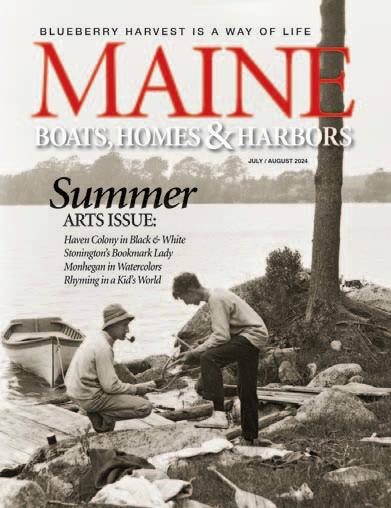







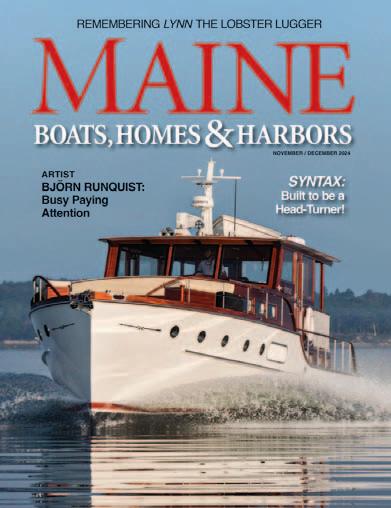
















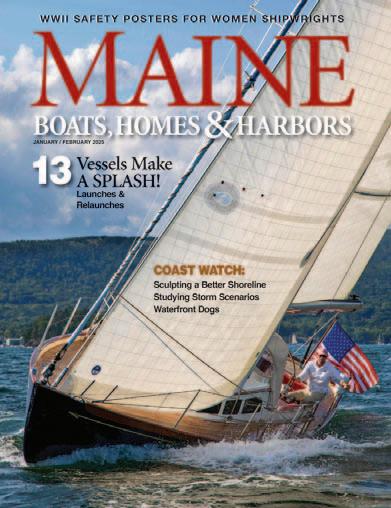


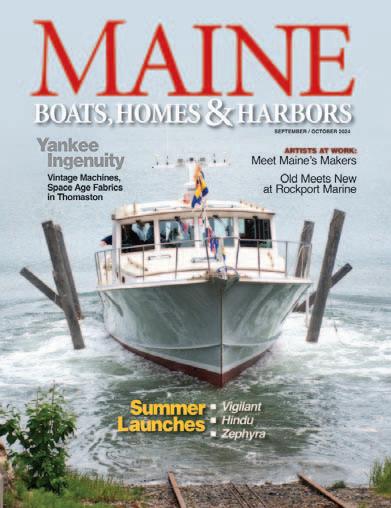



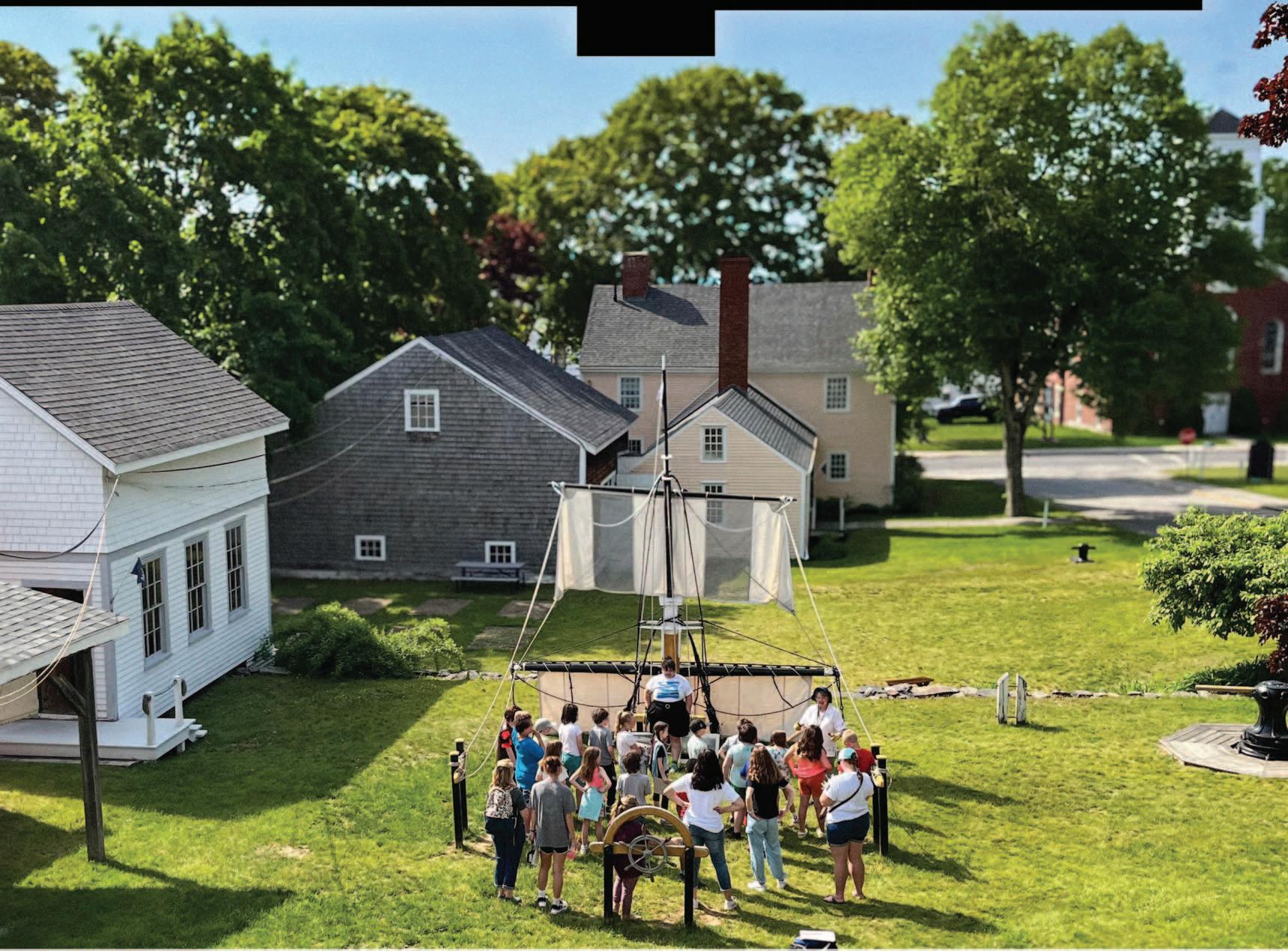



Composite Boatbuilding
Contact Admissions for more informa on admissions@landingschool.edu 207.810.2286




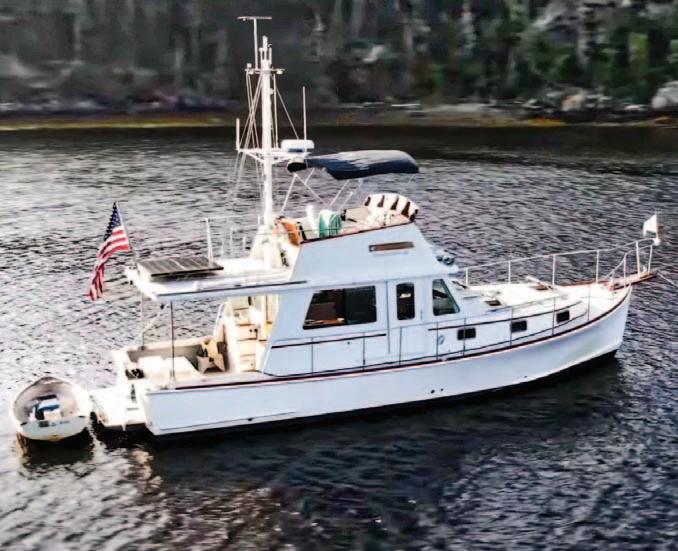

Get away from it all
This Duffy 37 was especially laid up and elegantly finished out in 2000 for a sailor/engineer intent on safe and comfortable coastal power cruising. The current owner spent many years replacing and adding systems for more safety and comfort, any weather navigation, on- and off-boat monitoring, and energy independence. Perfect for a couple, but easily manageable solo, Gizmo is in Camden Harbor ready to put many more miles under her long keel and protected running gear, at effective speeds ranging from 8 to 18 knots, with fuel burn as low as 3.5nm per gallon. Asking $275,000
www.Panbo.com/Gizmo or call/text Ben at 207-236-2326 • Yacht Design • Marine Systems • Wooden Boatbuilding • Boatyard Management
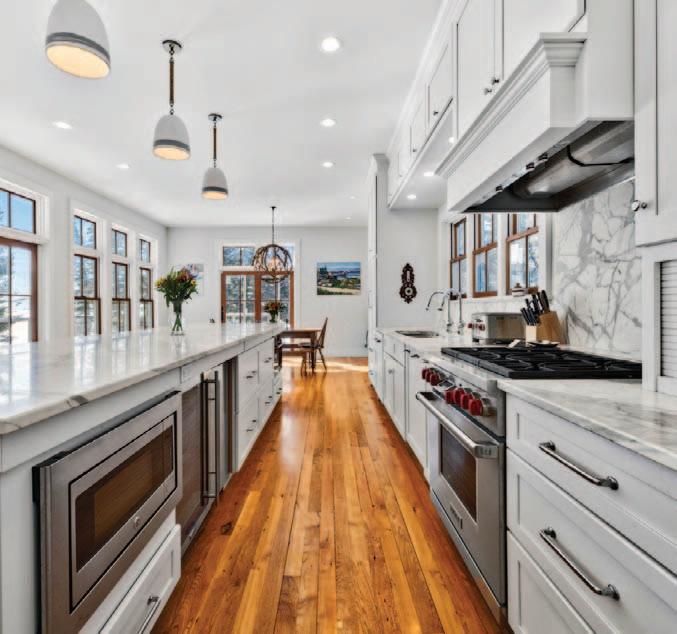




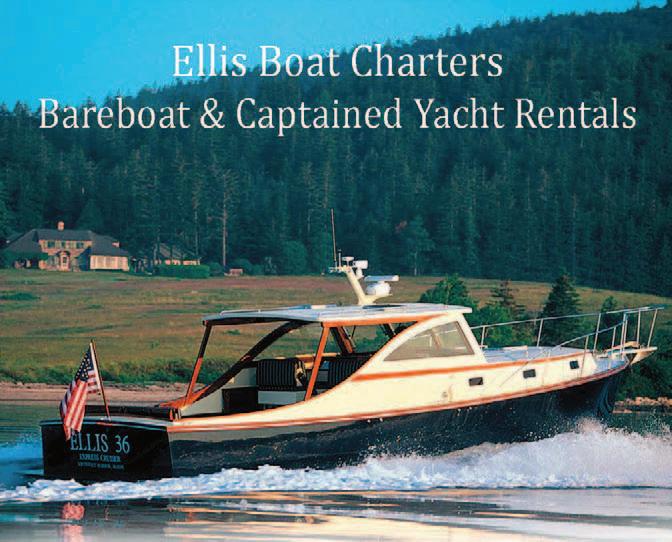
Explore the Coast of Maine from the helm of a well-maintained Downeast Cruiser. All vessels are fully equipped for live-aboard cruising. The 2025 Ellis Charter Fleet includes Hinckley, Back Cove, Wilbur, and Ellis yachts. View the vessels on line at:


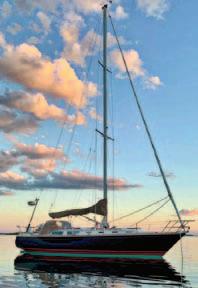

•Original Gloucester Gull Dory 15'6", designed and built by Phil Bolger
•Gloucester Gull dory 16'
•Herreshoff sail/row Columbia/dinghy 11'6"
•2 Dory-like dinghies 13' Pictures available.
•Peapod sail/row dinghy 13'6"
•One 12' double-paddle canoe 15lbs
•One airplane, Avid Flyer high lift wings, aerobatic wings, floats.
•One 50-foot canal boat
•Complete set of WoodenBoat magazines
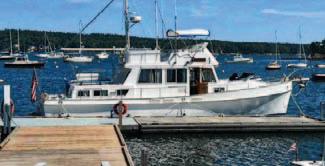
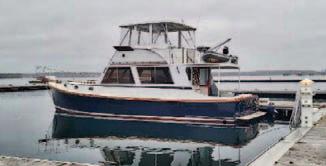
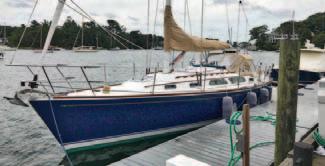
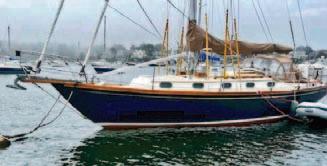
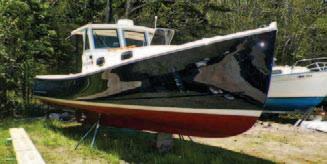
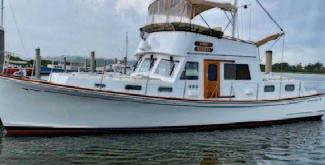
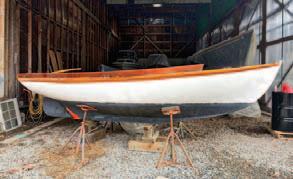

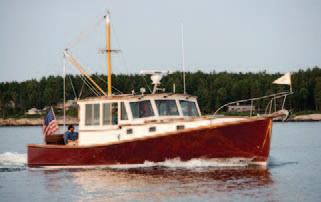
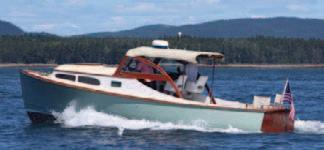
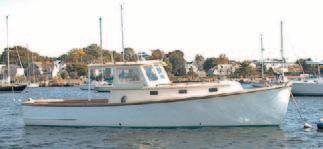
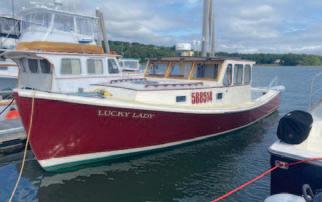
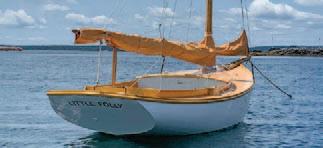


















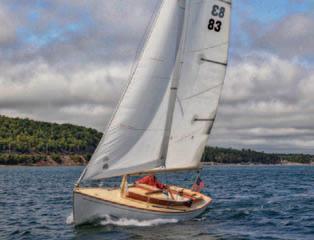

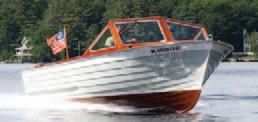
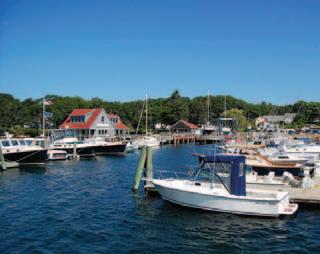










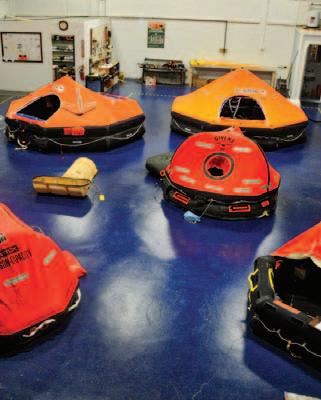

Alexseal 15 Allen Insurance & Financial 40
Artisan Boatworks 78
Attardo Architecture 67
Back Cove Yachts C4
Billings Diesel & Marine Services ..............55
Boothbay Harbor Yacht Club Regatta ........61
Camden Classics Cup ...................................74
Camden Coast Real Estate 41
Compass Marine Surveys 85
A.G.A. Correa & Son 8
Crabtree Sessions 78
Cross Jewelers 29
Custom Coatings

Boatyard Dog Cap
100% cotton twill front panels, 100% polyester mesh mid and back panels, 7-position adjustable strap. Available in Navy/Stone, Burnt Orange/Stone, Olive/Khaki. $25



Maya and the Lost Cat by Caroline Magerl
A lyrical, charmingly offbeat tale about wanderlust and family, rescue and finding home. $30
MBH&H Hat
100% pre-washed cotton. Available in maroon, steel blue, natural, cactus, or teal, with powerboat, sailboat, or classic logo in a complementary color. One size fits most adults (adjustable band). Kids’ sizes available too! $25

Boatyard Dog® T-Shirt (far left)
100% cotton, preshrunk. Unisex adult: Orange, Vineyard, S-XXL. Ladies (feminine cut): Sky Blue, Tropical Blue, Pink, Vineyard, S-XL. Youth: Iris, Tropical Blue, Pink, Crimson, XS-XL. $25

This delightful book gathers the best of the MBH&H Boatyard Dogs column into a single volume. A wonderful gift for anyone who loves dogs and boats. Compiled by John K. Hanson Jr. and Polly Saltonstall. $25
MBHH

This clever shirt is for everyone who has “Plures Naves Quam Mentes” (More Boats Than Brains)—including YOU!
A top-seller at the MB&H Show. Garment-dyed cotton with a soft, comfortable feel. Sizes S-XXL, generous cut. Yam, Chile Pepper, Caribe Blue. $25
Water Bottle
25-oz. double-wall 18/8 stainless steel thermal bottle with copper vacuum insulation, threaded stainless steel insulated lid, carrying handle, stainless steel rim and base, and powder coated finish—gift box included. $30
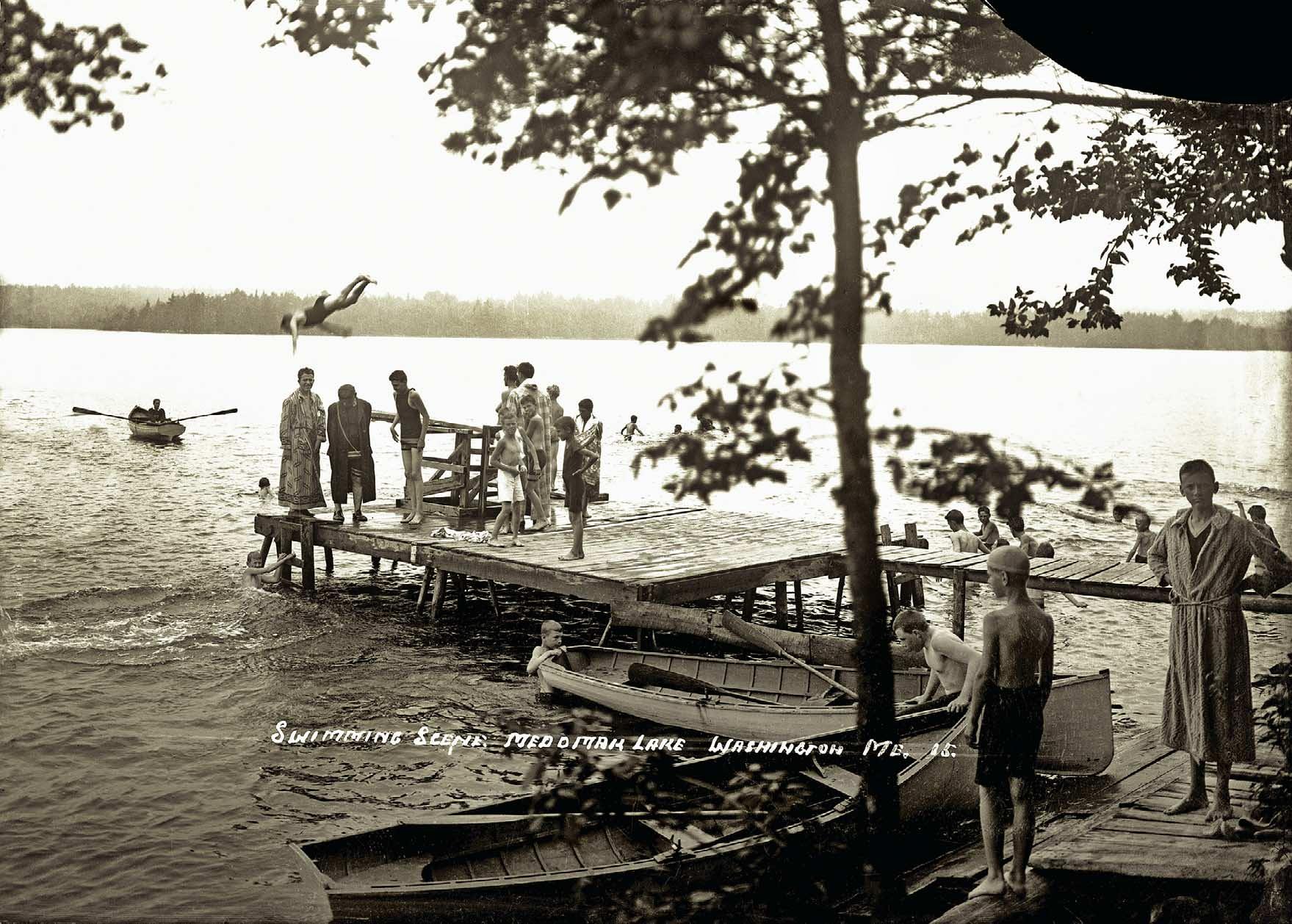
ASA BOY, FRANK E. POLAND spent his summers at his ancestral home in Washington. He roamed the woods, swam in the lake, and learned much about nature. Later, as a schoolmaster in a large city, he wanted to give other boys the same delights he had enjoyed as a child. In 1904, with the help of Walter Bentley, he brought 24 boys to his family home on Washington Pond, and the Medomak Boys Camp was created. It remained an all-boys camp until the 1960s when it became co-ed. After Poland’s death in 1964, the camp had various owners, and is today a family camp and retreat center. In the book Maine on Glass, in which the photo appears, the authors write, “Note the handsome pulling boats. [Eastman Illustrating & Publishing Co.] lake photos include many shapely watercraft as pleasurable to contemplate as to row. Their motorized successors—including droning jet skis and high-powered dragsters—now endanger swimmers, rowers, paddlers, loons, and lakeside tranquility. Note also the notexactly-natty robes, practical defense against sun, mosquitos, and chills, if not the gibes of youthful critics.” N
Swimming Scene, Medomak Lake, LB2007.1.111041, is part of the Eastern Illustrating & Publishing Collection at the Penobscot Marine Museum in Searsport, Maine.










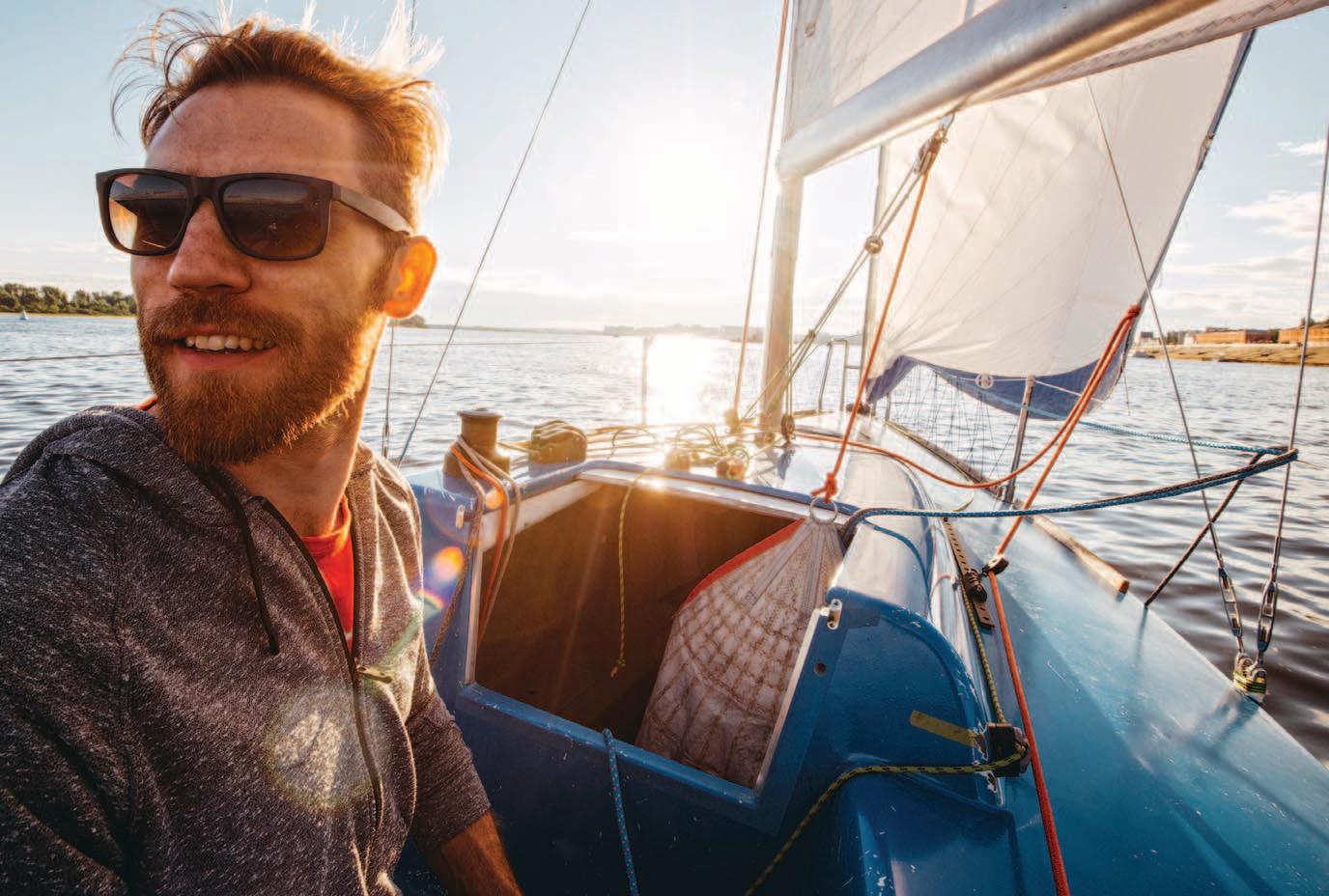
















For over 20 years, we’ve built yachts in Maine that combine classic elegance with advanced technology. Crafted by the most skilled artisans, each Back Cove embodies tradition and innovation. We take pride in our work, knowing that one day, you’ll call it yours.