THE 115th ANNUAL EXHIBITION OF CONTEMPORARY ART:
American Solastalgia
August 30, 2026— March 5, 2027
“Artists know something that almost no one else does: how to work inside contradiction without resolving it too soon, how to hold opposites—beauty and rupture, grief and desire, the personal and the political, the exquisite and the catastrophic—and let them live together without forcing a resolution.” —Julie Mehretu, painter, June 15, 2026 The eight artists represented in The 115th Annual Exhibition of Contemporary Art: American Solastalgia offer comfort and confrontation, solace and challenge. We are grateful for their refusal to look away from the grim realities of the world we inhabit, for acknowledging loss, and for sustaining a belief in a different future. We thank co-curators, Charlotte Hecht, PhD, and M. Stang, PhD for their vision and gracious handling of a traumatic theme without diluting it. All Maier staff assisted in the creation of this exhibition and accompanying programming: Administrative Manager, Kathleen Fort; Registrar, Jake Lofaso; Curator of Education, Laura McManus; Guard and Preparator, John Spanich, and Gallery Monitor, Melinda Wheeler. Randolph College students and museum and heritage studies majors, Carter Heckeroth ’28 and Ren Hicks ’28, contributed significantly to this project. Heckeroth researched artists represented in the exhibition and compiled in-depth information on each to be used in docent training and accessed by Museum visitors. Hicks worked with professor Stang on an intensive investigation into current best practices for sustainability efforts in museums, which resulted in recommendations for the Maier. While we could not adopt every recommendation, several were implemented, such as a 20 percent reduction in printed catalogs and vinyl-free signage for the exhibition. We shifted away from the font we have traditionally used for labels, choosing one designed to require about 30 percent less ink. Based on ideas Hicks discovered during their participation in Randolph’s Summer Research Program, McManus and local artist Jill Jensen stepped in to explore alternatives for the exhibition title wall, resulting in something not only in line with the exhibition’s theme, but also a work of art itself. Again, our deepest gratitude goes to Mary Gray Shockey ’69 for 15 years of fully supporting the College’s Annual Exhibition. She is an important contributor to Randolph’s visual art legacy, carrying on a tradition initiated by other exceptionally committed women who built the collection and educational engagement centered on it. Martha Kjeseth Johnson, director Maier Museum of Art at Randolph College
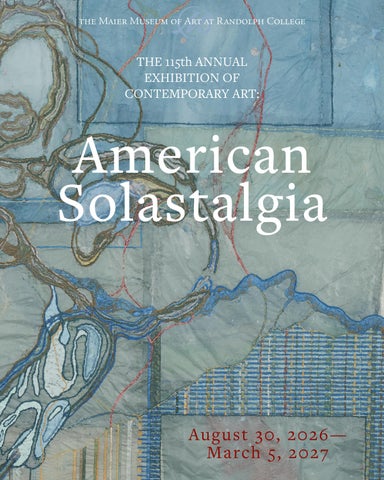
On the cover: Nancy Cohen, Blue Storm of our Anxieties (detail), 2020, paper pulp and handmade paper, 70 x 81 in.
Maier Museum of Art at Randolph College 115th ANNUAL EXHIBITION OF CONTEMPORARY ART
American Solastalgia American Solastalgia explores how environmental change is rapidly and irreversibly transforming the landscapes we call home in the United States. A combination of the words nostalgia and solace, environmental philosopher Glenn Albrecht first conceived “solastalgia” in 2005. Solastalgia, Albrecht writes, is “the direct experience of transformation or destruction of the physical environment (home) by forces that undermine a personal and community sense of identity and control.” It is, put simply, “a form of homesickness one gets when one is still at ‘home.’” In curating the 115th Annual Exhibition for the Maier Museum of Art at Randolph College, we selected works that redefine the terms of our nation and its landscapes. Across the United States, there are a great many intersecting forces and events that might create conditions for solastalgia: massive wildfires, destructive floods, prolonged droughts, industrial waste, and the increased energy demands of large-scale computing infrastructure. American Solastalgia thus brings together art that invites reflection on the genre of American landscapes in light of these conditions. Significantly, the absence of painting allows a wider spectrum of practices to emerge, helping to unsettle any notion of the genre as bound by a set tradition. In painting’s stead, photographic, sculptural, and mixed media works highlight regions affected by ecological shifts to raise questions about extraction, stewardship, belonging, memory, and migration. These diverse approaches document American lands and their histories, united by an undercurrent of solastalgia. Experimentation is a key feature of each artist’s approach to this documentation. Nathalie Miebach visualizes data into forms that facilitate embodied knowledge of climates and landscapes. Miebach’s tactile structures render complex scientific information perceptible to all audiences. Restless Refugium, for instance, records changing bird behaviors in response to environmental pressures through woven reeds, foregrounding adaptation as both an ecological reality and a lens through which to consider human responses to climate change. Meanwhile, Ian and Nicole and its related works render water data from Daytona Beach, Florida, following two catastrophic hurricanes. Playfully constructed, this series celebrates a beach community’s resilience amid immense challenges. Offering a distinct but equally compelling exploration of water, Nancy Cohen uses layers of
handmade paper to construct evocative portraits of waterways in the Northeast. The two large paper pulp tapestries in this exhibition are part of a greater body of work that responds to the rivers around her home in New Jersey and depicts the persistence of riverine life within polluted ecosystems. In deep blues and quilted paper, Cohen’s abstractions elicit the emotions that might emerge from a strong tether to a particular place or time. With Blue Storm of Our Anxieties, Cohen’s turbulent forms and saturated color fields capture elements of environmental precarity Americans might have experienced during the COVID-19 pandemic. Working along the Mississippi River and engaging directly with the landscape of Southern Louisiana and New Orleans, Hannah Chalew gathers material for artmaking from the environment around her. Her sustainably made sculptural assemblages and drawings also foreground paper, “plasticane” (which she makes from sugarcane waste byproduct and shredded plastic litter), and inks derived from natural and industrial material such as tannin-rich oak tree galls, bricks, or fossil fuels. Chalew’s material poignantly evokes the layered histories embedded in her local landscape; sugarcane production, first made possible by enslaved labor, is still a staple of the economy, as are the petrochemical factories and refineries that line Louisiana’s infamous “Cancer Alley.” Abbey Hepner joins Chalew in pushing the boundaries of traditional landscape representation in her installation and photographic work. Her series of snow globes depict the infrastructure of American energy—radioactive waste sites, oil derricks, solar panels and wind turbines—within an object usually reserved for nostalgic scenes or tourist attractions. Hepner invites viewers to think about the fraught practice of memorializing landscape, particularly locations of extraction and power production. With Blue of Distance, by comparison, these themes of memory and place are echoed in blue-tinted landscape images made using now-obsolete polaroid film. The motif of the wind turbine is also at play in Cara Romero’s striking photograph, Evolvers. In this piece Romero, an Indigenous photographer and citizen of the Chemehuevi Indian Tribe, responds to the increasing development of the Mojave Desert for renewable energy. She depicts four young Chemehuevi boys running through a desert landscape strewn with towering turbines. In the face of environmental change, her photography centers Indigenous worldviews, refusing settler colonial representations of the desert as empty land that is ready for extraction. The long entanglement of land use and displacement extend beyond the Mojave into broader regional narratives of mobility across the American West. Joshua Villalobos’s multidisciplinary practice centers the many realities shaping Latino experiences against the backdrop of Southern California. Through layered references to labor, religion, politics, and cultural identity, his work considers migration not only as a movement across geography but also as an ongoing negotiation between visibility and invisibility in the United States. Both of Villalobos’s works are photographic and recycled, at once reclaiming materials and modes of representation for migrant experiences. Likewise interested in imaging invisibility, Kate Greene’s photographic works bring attention to the unseen forces that shape a person’s understanding of place. In the selected photographs from Greene’s Black Sun series, it is possible to observe the historical residues that linger within changing landscapes from New England to the Gulf Coast. Her work expands the exhibition’s consideration
of cultural memory, revealing how histories are present in a place whether or not they are fully perceptible to people visiting it. And, finally, Jon Verney’s installation upends nostalgia through overt acts of revision. While Verney’s broader practice often interfaces directly with the landscape, your dreams are feeding back turns toward the constructed nature of memory itself by removing the original subjects of found photographs with paint. The resulting images isolate their backgrounds without fully elevating them to the foreground, identifying spaces from an American past that feels uncanny. Stripped of many of their key markers and people, these images now hover between memory and erasure to contour what remains when the people who once inhabited our personal and collective histories are gone. With the artists who work in and alongside changing landscapes, American Solastalgia presents climate change as neither an unsurvivable crisis nor an abstract phenomenon; instead, it treats ecological challenges as both lived and localized realities. In acknowledging how a shifting sense of place ushers in feelings of grief and longing, the exhibition balances loss with possibility to consider how every person has a stake in the redefinition of the landscapes they inhabit. Through the exhibition’s varied perspectives and media, we ask that viewers contemplate what it means to call the United States home in a future when we either adapt to change or fail to meet its demands.
Charlotte Hecht, co-curator Charlotte Hecht is an interdisciplinary scholar of visual culture and American environmental history, based in Denver, Colorado. Her recent projects have focused on historical and contemporary American landscapes impacted by industrial production. She has a doctorate in American Studies from Yale University and has worked in museum education and interpretation at the Yale University Art Gallery, the Smith College Museum of Art, and the Department of the Interior Museum.
M. Stang, co-curator M. Stang is the Ainsworth Visiting Scholar of American Culture at Randolph College. They hold a joint PhD in American studies and film & media studies from Yale University. Their research focuses on the overlapping histories of secularization and policing in the visual culture of public amusement in the United States. As an arts education and collections management specialist, they have held positions with the Yale University Art Gallery, the University of Michigan Museum of Art, and the Motown Museum.
Hannah Chalew
My artwork explores what it means to live in an era of global warming and ecological uncertainty, rooted in Southern Louisiana as a microcosm of our shifting world. I am interested in the deep entanglements between resource extraction and the communities and ecologies that bear its costs; histories still unfolding in the landscape around me. I approach them through materiality, sensory experience, and personal connection. Working across drawing, sculpture, and immersive installation, I build layered environments from sugarcane, plastic, scrap metal, living plants, water, scent, and handmade paper and inks. I combine these unlikely materials in formations that are seductive and uneasy at once, drawing the viewer into speculative ecosystems hovering between ruin and regeneration. Since 2018, I have worked to make my practice as fossil-free as possible through my material choices, studio energy sources, and refusal of fossil fuel funding. This is an ongoing discipline; a way of staying honest with myself about the contradictions embedded in this work and offering a slower, more intentional paradigm as an antidote to the culture of convenience, consumption, and short-term profit that has brought us to this precarious moment. I make this work to hold grief and wonder together, sitting with ecological anxiety while remaining open to interconnectedness and the possibility of change. It invites a different quality of attention: to what surrounds us, what we’ve inherited, and what we might yet nurture as we move toward a more livable world for all creatures.
Hannah Chalew, Study for Tangled Bank, 2023, ink made from fossil fuel pollution, iron, oak gall and sheetrock on paper made from sugarcane and disposable plastic waste (“plasticane”) and Tangled Bank, 2023, metal paper made from sugarcane combined with shredded disposable plastic waste (“plasticane”), iron oak gall ink, ink made from brick. Photo credit: Stephen Lomonaco
Nancy Cohen There is a fine fragile line between existence and its opposite, a line we all walk and which the small and large environments that contain us walk as well. Waterways, in particular, with their almost human balance of fragility and strength, their perseverance through adversity—much of it inflicted by us—trace lines of stress and hope through our landscapes—and a strong line through the body of my work. I am deep into a body of work that I think of as paper tapestries, using pulp and handmade paper to create large-scale abstracted map-like landscapes of waterways. Often, but not always, they are rivers or adjacent landscapes that are adapting, surviving, but showing strain under difficult, often climate-related circumstances. The drawings are constructed sculpturally. I begin by making pigmented handmade papers and then assemble them, still wet, in a quilt-like fashion; later I draw on these constructed surfaces with various densities of paper pulp. The wet pulp on the dried sheets causes a buckling on the surface that appears very much like stitching. The finished works speak to the physicality of the body and simultaneously evoke an intimate sense of touch, in a way akin to being in nature experiencing both vastness and quiet moments of focus.
Nancy Cohen, Blue Storm of our Anxieties, 2020, paper pulp and handmade paper, 70 x 81 in.
Nancy Cohen, Tacking Home, 2019, paper pulp and handmade paper, 97 x 74 in.
Kate Greene I use photography as a vehicle for questioning cultural mythologies connected with the American landscape. I am interested in the persistence of the past in relation to place; how sites contain and configure narratives that signal ideologies and the role photography plays in holding these systems in place. My artistic practice is an attempt to unravel this dilemma. I weave multiple modes of photographic vision to draw lines between landscape narratives, perception, and alternative structures of imagination. Catherine de Zegher asserts that feminist art practices allow us “to see and to focus on what is in eclipse...or has different qualities of perceptibility.” I constantly consider how experimental photographic practices employed by women can be viewed as acts of resistance to maledominated historical ways of seeing. This is evident in the way that I approach landscape photography, pushing against a “straight” methodology that upholds troubling modernist dogma—one in which the psychology of the American landscape is deeply intertwined. I am drawn to sites connected with unresolved narratives and uncanny histories as they embody liminality and point toward open-endedness. I use methods such as infrared capture, extended exposure, and cameraless photography as conceptual gestures, enacting each landscape’s unseen history from a feminist perspective. In the studio, I construct and photograph formal arrangements of materials, substances, images, and objects, as a foil for how I look at the landscape. This process allows me to question knowledge structures and probe how traces of the past can appear in new forms. By reducing and transforming objects, spaces, and gestures that have gendered or socio-political connotations, into formal (and often sculptural) building blocks, my images resist simplistic readings and prompt the viewer to reconsider the relationship between vision, knowledge, and authority.
Kate Greene, Forest study no. 2 (Freetown-Fall River, Ma), 2023, archival inkjet print, framed with UV laminate, 28 x 36 in.
Kate Greene, Seascape study no. 3 (Grand Isle, La), 2023, archival inkjet print, framed with UV laminate, 32 x 26 in.
Abbey Hepner This exhibition features work from two series that explore distance, memory, and the transformation of contemporary landscapes. The photographs in Blue of Distance were created with expired Polaroid 669 film, purchased when Polaroid stopped manufacturing instant analog film in 2008. The film’s unique color echoes Rebecca Solnit’s description of blue as the color of distance, the space between oneself and what can never fully be reached. The works occupy a threshold between presence and absence, documentation and memory. The kitsch object of the snow globe became popularized during a time of industrialization, responding to a deep-seated need for connection with a disappearing natural world. As our modern landscapes continue to transform, I ask questions about what kinds of sites evoke nostalgia now. By trapping the modern-day industrial landscape in miniature, I attempt to gain power over it, even as these sites rest in a permanent nuclear winter. Together, these works consider how landscapes become repositories of desire, nostalgia, and ecological grief. They reflect on the changing environments we inherit and the emotional distances that arise when familiar places are altered, rendered inaccessible, or lost.
Abbey Hepner, Marin Headlands Army Bunkers, 2012, original Polaroid, 4.25 x 3.25 in.
Abbey Hepner, Project Y, 2026, snow globe, plastic figures, 6.25 x 6 in.
Nathalie Miebach
For nearly two decades now, I have been making work that explores the science behind extreme weather events and the complicated human responses that unfold as our world is becoming hotter, drier, and wetter. The base material of my work is weather data, collected from buoys, satellites, and research sites, that I combine with anecdotal and personal experiences from survivors and disaster recovery efforts. My main method of translation is that of basket weaving, which functions as a simple, tactile grid through which to interpret data into sculpture, wall installations, and 2D/3D musical scores. Central to this work is my desire to explore the role visual aesthetics play in the translation and understanding of scientific phenomena such as climate change and the complicated human responses it ensues. Collaborative musical performances are further ways I translate and explore the behavior of meteorological data. In 2009, I began the Weather Score Project, which is based on musical scores built entirely out of weather data. I use these scores in collaborations with composers while also building sculptures and installations that incorporate musical references and signatures that could be performed. What began as a scientific inquiry into weather has now merged into a more nuanced integration of music, sculpture, craft, and data to better understand the human response to climate change.
Nathalie Miebach, Restless Refugium, 2026, reed, plastic, wood, data, 30 x 22 x 24 in.
Nathalie Miebach, Ian and Nicole, 2023, paper, rope, data, 12 x 9 x 1 ft.
Cara Romero As an Indigenous photographer, I embrace photography as my tool to resist Eurocentric narratives and as a means for opening audiences’ perspectives to the fascinating diversity of living Indigenous peoples. My approach fuses time-honored and culturally specific symbols with 21st-century ideas. This strategy reinforces the ways we exist as contemporary Native Americans, all the while affirming that Indigenous culture is continually evolving and imminently permanent. Sometimes I portray old stories, such as creation stories or animal stories, in a contemporary context to show that each grows and evolves with ensuing generations. I use vibrant color, experimental lighting, and photo-illustration to explore ideas of how the supernatural world overlaps with our everyday lives. In combining form and content, I reflect a uniquely Indigenous worldview that shows the resilience and beauty of our thriving cultures. Here, self-representation through photography battles the “one-story” narrative that casts complex, living cultures into stereotypes, instead offering multilayered visual architectures that invite viewers to abandon preconceived notions about Native art, culture, and peoples.
Cara Romero, Evolvers (detail), 2019, limited edition archival fine art photograph printed by the artist on Legacy Platine paper, 15 x 48 in.
Jon Verney I am a visual artist whose practice interweaves the materiality of painting and photography to explore themes of dissolution, memory, and transformation. Fueled by haptic curiosity and wonder, I use found imagery, natural phenomena, and chance to inform my work. In the series, your dreams are feeding back, I worked with a large cache of found photos sourced online, carefully painting over the humans and animals depicted within. The subjects become pools of color and light, the liquid dynamics within the contours of their bodies suggesting fluid, interior states of being. Similar to spirit and aura photography, or thermal imaging—where organisms’ heat signatures are described in abstracted neon colors—these paintings give the impression of seeing a different type of invisible essence. As a group, they function as a family album of sorts, a collection of strangers united in prismatic obscurity, whose energies emanate forward, bleed into, and interfere with one another’s. Accentuating their age and anonymous status, the overpainting depicts the inhabitants of these snapshots as apparitions, ghostly and phantasmal, signatures of some otherworldly presence.
Jon Verney, there will always be light, 2021, acrylic, ink, found chromogenic print, wood, 4 x 4 in.
Jon Verney, your dreams are feeding back (interior currents), 2021-2026, acrylic, ink, found chromogenic prints, wood, (approx 304 elements), Each element is 3.5 x 3.5 in.
Joshua Villalobos My multidisciplinary practice critically engages with themes of identity, cultural duality, and socio-political structures, particularly within the Latino experience in the United States. I also explore the intersections of politics, labor, class, gender, consumerism, and cultural signifiers. Drawing from my personal and collective history, I explore the tensions between assimilation, resistance, and self-definition. My work integrates references from literature, art, history, catholic symbolism, and political theory to examine the conflicts between identity, culture and socio-political structures, visibility and invisibility, and the ways in which identity is constructed, performed, and contested. I explore themes like double consciousness, cognitive dissonance, and cultural translation. I investigate the dissonance that arises from existing between two cultural paradigms, constantly negotiating between authenticity and assimilation. Additionally, I address immigration, class, and the economic structures that define immigrant labor and status in the United States. Through the use of symbolism and materiality, I convey ideas that encompass loaded signifiers of history, mythology, religious colonial shame, and cultural repression.
Joshua Villalobos, Untitled (Recuerdo), 2025, bottle caps, photo, 20 x 30 in.
Joshua Villalobos, Recuerdo Transitorio #1, 2026, bottle caps, resin, and photo, 18 x 24 in.
ARTIST BIOS HANNAH CHALEW is an artist, educator, and environmental activist raised and currently working in New Orleans. She received her BA from Brandeis University in 2009 and her MFA from the Cranbrook Academy of Art in 2016. She’s exhibited widely around New Orleans and has shown around the country at Wave Hill, Bronx, NY; Laumeier Sculpture Park, St. Louis, MO; Dieu Donné, New York, NY; Asheville Museum of Art, Asheville, NC; Minnesota Center for the Book Arts, Minneapolis, MN, and other venues. Her work has been featured in Frieze, The Art Newspaper, Art Review, The New York Times, American Craft, Hand Papermaking, BOMB, Hyperallergic, Burnaway, and more. Her work is held in the collections of the City of New Orleans and the Ogden Museum of Southern Art. Her work is included in two creative atlases by writer and activist Rebecca Solnit, Unfathomable City: A New Orleans Atlas, co-authored with Rebecca Snedeker and Nonstop Metropolis: A New York City Atlas, coauthored with Joshua Jelly-Schapiro. In 2022, she was awarded the South Arts Southern Prize as well as the South Arts Louisiana State Fellow honor. NANCY COHEN’s work in handmade paper and glass examines resiliency in relation to the environment and the human body. Recent exhibitions include Nancy Cohen: The State We’re In at Kathryn Markel Fine Arts in NYC: New Acquisitions at The New Jersey State Museum, Trenton, NJ; Legacies in Paper: Nancy Cohen, Sara Garden Armstrong and Helen Heibert at the Robert C. Williams Museum of Papermaking in Atlanta, GA, Sculpting with Paper: Hand Papermaking at Dieu Donné at The Turchin Center for Visual Arts, Boone, NC; Yvette Molina: A Promise to the Leaves at the Tang Museum in Saratoga Springs, NY and Transgressing Lands: Eleven Contemporary Artist Reimagine a Horizon at The Boiler in Brooklyn, NY. Awards include six fellowships from the NJ State Council on the Arts, four from MacDowell, two from the Jersey City Arts and Culture Trust Fund, two from the Brodsky Center, two from the Tides Institute, The Murray Reich Distinguished Artist Award and a Pollock Krasner Foundation Grant. Other residencies include Yaddo, Millay Arts, Dieu Donné, Wheaton Arts, Pyramid Atlantic, Women’s Studio Workshop, and Bullseye Glass. KATE GREENE explores the edges of perception, using photography as a tool to question visibility, historical residue, and the unseen. Rooted in a feminist engagement with landscape and material, her practice traces signals, remnants, and transmissions that resist fixed form or stable meaning. Greene received an MFA from Yale School of Art and a BFA from Massachusetts College of Art and Design. Her work has been showcased in exhibitions at venues including the Center for Maine Contemporary Art; the deCordova Museum and Sculpture Park; the Worcester Art Museum; the Institute of Contemporary Art, Maine; the Visual Arts Center at the University of Texas at Austin; the Rhode Island School of Design Museum of Art; the Guatephoto Festival, Guatemala City; Museum Dr888, Drachten, the Netherlands; Bodega Gallery, Philadelphia; Daniel Cooney Gallery, New York; and Eighth Veil, Los Angeles. She has taught widely, most recently at Massachusetts College of Art and Design, Rhode Island School of Design, and the Hartford Art School Graduate Program. ABBEY HEPNER is an artist and educator based outside of St. Louis, Missouri. Hepner holds an MFA in photography from the University of New Mexico. She teaches at Southern Illinois University Edwardsville as an assistant professor of art and area head of photography. Hepner’s artistic practice examines health, technology, and our relationship with place through photography, performance, video, and installation-based work. She frequently works at the intersection of art and science, investigating biopolitics and the use of health as a currency. Hepner is originally from Utah, where her ancestors were downwinders who suffered in the aftermath of the United States’ nuclear testing. Her work on nuclear issues began shortly after the Fukushima disaster
in 2011 when she traveled across Germany documenting the decommissioning of nuclear plants. Shortly thereafter, she lived and volunteered in Japan before attending graduate school in New Mexico. She has been an artist in residence at the Banff Center for Arts and Creativity in Canada and has presented at numerous Society for Photographic Education conferences. Her monograph, The Light at the End of History, about nuclear issues was published by Daylight Books in 2021. NATHALIE MIEBACH explores the intersection of art and science by translating scientific data related to meteorology, ecology, and oceanography into woven sculptures and musical scores/performances. Miebach is the recipient of numerous awards and residencies, including a Pollock-Krasner Award, Virginia A. Groot Foundation Award, TED Global Fellowship, Massachusetts Cultural Council Fellowship, and a nomination to the World Technology Award, Brother Thomas Award, and the Women to Watch Smithsonian Award. She did her undergraduate studies in Chinese and political science at Oberlin College, and received an MFA in sculpture and an MSAE in art education from Massachusetts College of Art. Her work is shown nationally and abroad, and has been reviewed by publications spanning fine arts, design, and technology. She lives in Boston. CARA ROMERO was raised between contrasting settings: the rural Chemehuevi reservation in Mojave Desert, California and the urban sprawl of Houston, Texas. Romero’s identity informs her photography, a blend of fine art and editorial photography, shaped by years of study and a visceral approach to representing Indigenous and non-Indigenous cultural memory, collective history, and lived experiences from a Native American female perspective. Since 1998, Romero’s expansive oeuvre has been informed by formal training in film, digital, fine art, and commercial photography. Maintaining a studio in Santa Fe, Romero regularly participates in Native American art fairs and panel discussions, and was featured in PBS’ “Craft in America” (2019). Her awardwinning work is included in many public and private collections internationally. JON VERNEY works in painting, photography, and video to describe notions of transformation and transcendence through landscape and materiality. Raised in a rural community in Western Massachusetts, Verney later moved to Boston to attend Massachusetts College of Art and Design. Shortly after earning his BFA in painting, he emigrated to Florence, Italy, where he worked for three years as a darkroom technician and teaching assistant at Studio Art Center International. Returning to the United States in 2014, Verney moved to Ann Arbor, Michigan, to pursue his MFA from the Stamps School of Art & Design at the University of Michigan. There, he received numerous grants from the University to fund his creative research into his thesis, Thermophile, including a Smucker-Wagstaff Scholarship and an International Project Grant to conduct fieldwork in the Yellowstone Caldera, Iceland, and the Salton Sea in California. Upon earning his MFA in 2016, Verney has been an artist in residence at the Vermont Studio Center and worked at UMMA, the University of Michigan Museum of Art, as a researcher with the museum’s extensive photography collection. JOSHUA VILLALOBOS is a multidisciplinary artist and preparator, born in Costa Rica, living and working in California. In 2013, he earned his Bachelor of Fine Art in painting and drawing from Otis College of Art and Design in Los Angeles, having previously completed MICA’s pre-college program in Baltimore. He has been represented in various group exhibitions on the West Coast since 2011, including We Are Making People’s Days As Much As We Are Ruining Them in 2013.
The 115th Annual Exhibition of Contemporary Art
AMERICAN SOLASTALGIA August 30, 2026—March 5, 2027 Hannah Chalew Study for Tangled Bank, 2023 ink made from fossil fuel pollution, iron, oak gall and sheetrock on paper made from sugarcane and disposable plastic waste (“plasticane”) 22 x 34 in. Tangled Bank, 2023 metal, paper made from sugarcane combined with shredded disposable plastic waste (“plasticane”), iron oak gall ink, ink made from brick 72 x 24 x 24 in.
Nancy Cohen Blue Storm of our Anxieties, 2020 paper pulp and handmade paper 70 x 81 in. Tacking Home, 2019 paper pulp and handmade paper 97 x 74 in.
Kate Greene Bell jar study no. 1, 2023 archival inkjet print, framed with UV laminate 20 x 16 in. Bell jar study no. 3, 2023 archival inkjet print, framed with UV laminate 20 x 16 in. Forest study no. 2 (Freetown-Fall River, Ma), 2023 archival inkjet print, framed with UV laminate 28 x 36 in. Forest study no. 4 (Freetown-Fall River, Ma), 2023 archival inkjet print, framed with UV laminate 28 x 36 in.
Seascape study no. 3 (Grand Isle, La), 2023 archival inkjet print, framed with UV laminate 32 x 26 in.
Abbey Hepner America the Beautiful, 2017/2026 snow globe, plastic figures, sound 7.25 x 6 in. Fort Barry Bunkers, 2012 original Polaroid 4.25 x 3.25 in., 9.625 x 9.125 in. Fort Barry Bunkers 2, 2012 original Polaroid, double exposure 4.25 x 3.25 in. Headlands Center for the Arts, 2012 original Polaroid 3.25 x 4.25 in. Marin Headlands Army Bunkers, 2012 original Polaroid 4.25 x 3.25 in., framed 9.625 x 9.125 in. Marin Headlands 2, 2012 original Polaroid 4.25 x 3.25 in. Peaks, 2012 original Polaroid 3.25 x 4.25 in. Pledge of Allegiance, 2016/2026 snow globe, plastic figures, sound 7.25 x 6 in. Project Y, 2026 snow globe, plastic figures 6.25 x 6 in. Utopia, 2017/2026 snow globe, plastic figures 6.25 x 6 in.
Nathalie Miebach Ian and Nicole, 2023 paper, rope, data 12 x 9 x 1 ft. Ian and Nicole Sketch, 2023 watercolor on paper 16 x 20 in. Life Lines, 2021 paper on canvas 36 x 48 in. Restless Refugium, 2026 reed, plastic, wood, data 30 x 22 x 24 in.
Cara Romero Evolvers, 2019 archival fine art photograph on paper 19 x 61 in. Purchase made possible by the Louise Jordan Smith Fund, 2023; 111th Annual Exhibition
Jon Verney your dreams are feeding back (interior currents), 2021-2026 acrylic, ink, found chromogenic prints, wood, (approx 304 elements) Each element is 3.5 x 3.5 in.
Joshua Villalobos Recuerdo Transitorio #1, 2026 bottle caps, resin, and photo 18 x 24 in. Untitled (Recuerdo), 2025 bottle caps, photo 20 x 30 in.
ABOUT THE ANNUAL EXHIBITION OF CONTEMPORARY ART The First Annual Exhibition was installed at the College in 1911. It is the longest-running series of original exhibitions of contemporary art staged annually by any small liberal arts college in the United States. Careful acquisition from each of the Annuals has resulted in Randolph College’s outstanding collection of American art, chiefly paintings, works on paper, and photographs dating from the 19th, 20th, and 21st centuries. The Annual Exhibition of Contemporary Art has been an important and distinctive academic experience, year after year fulfilling its original goal of providing students with a primary resource which brings them closer to understanding and appreciating art as an expression of their own time in history.
Images are reproduced courtesy of the artists. Catalogue design by Janet Fletcher, Studio 5 Graphics, Lynchburg, Virginia. Printed by Bison Printing, Bedford, Virginia.