101st Annual Exhibition of Contemporary Art: Bridges Not Walls R
andolph College’s Maier Museum of Art presents the 101st Annual Exhibition of Contemporary Art: Bridges Not Walls, opening August 31 and running through December 7, 2012. Bridges Not Walls will feature six artists: Edgar Endress, Assaf Evron, Muriel Hasbun, Sook Jin Jo, Jiha Moon, and Kukuli Velarde.
converging in this country is nothing new, but public visibility has increased dramatically over the past few decades, as has the ability of artists to be exposed to and influenced by one anothers’ work. Randolph College also has a longstanding commitment to cultivating a global perspective in a liberal arts setting. The College has embarked on a five-year, cross-curricular, measurable plan to move away from the old model of mere “tolerance” for diversity toward “intercultural competence,” a philosophy with more depth and integrity. Intercultural competence is about bridging cultural differences and recognizing commonalities in values, expectations, and beliefs.
FALL SEMESTER 2012
The first exhibition of the next 100 years reaffirms the College’s longstanding commitment to contemporary American art education and highlights the fact that so much significant contemporary American art is created by people from other countries who have made America their home. Artistic talent from around the world
August 31–December 7, 2012
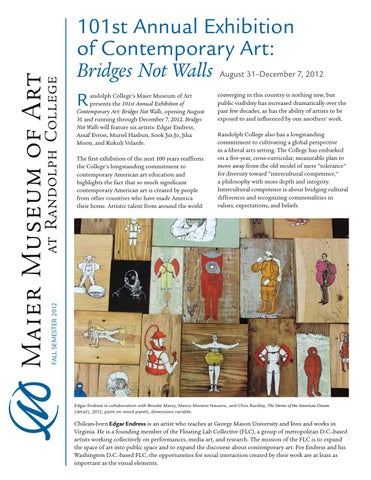
Edgar Endress in collaboration with Brooke Marcy, Marco Moreno Navarro, and Chris Rackley, The Shrine of the American Dream (detail), 2012, paint on wood panels, dimensions variable.
Chilean-born Edgar Endress is an artist who teaches at George Mason University and lives and works in Virginia. He is a founding member of the Floating Lab Collective (FLC), a group of metropolitan D.C.-based artists working collectively on performances, media art, and research. The mission of the FLC is to expand the space of art into public space and to expand the discourse about contemporary art. For Endress and his Washington D.C.-based FLC, the opportunities for social interaction created by their work are at least as important as the visual elements.
Maier Museum Staff Danni Schreffler Office Manager Hannah Cohen Gallery Monitor Martha Kjeseth Johnson Director Debbie Spanich Museum Registrar John Spanich Security Guard the Maier Museum of Art at Randolph College is a member of the College Art Association, the American Association of Museums, the Virginia Association of Museums and the Association of Academic Museums and Galleries
2
This initiative permeates all aspects of campus life academic program and extracurricular activities. Artists selected for the 101st Annual Exhibition of Contemporary Art: Bridges Not Walls have brought with them cultural traditions and alternative ways of expressing themselves, and have successfully fused these with their adopted American identity. They reveal aspects of American society that are perhaps seen more clearly from an “outsider’s” perspective, challenge cultural stereotypes, and ultimately remind us that we are all products of immigration and mixed heritage. The First Annual Exhibition was installed at the College in 1911. It is the longest-running series of original exhibitions of contemporary art staged annually by any academic institution in the United States. Careful acquisition from each of the Annuals has resulted in Randolph College’s outstanding collection of American art, chiefly paintings, works on paper, and photographs dating from the 19th, 20th, and 21st centuries. For over a century, the Annual Exhibition of Contemporary Art has been an important and distinctive academic experience, year after year fulfilling its original goal of providing students with a primary resource which brings them closer to understanding and appreciating art as an expression of their own time in history.
Assaf Evron, untitled (installation #7) from the series Crystal Habit, 2009, archival ink jet print, edition of 5, 43 1/4 in. x 32 1/4 in.
Assaf Evron was born in Israel and currently lives and works in Chicago. He works in a variety of media, primarily photography. His subjects are often peculiarities of Israeli landscape, whether they be abandoned military vehicles or native flora. Evron’s work in Bridges Not Walls is a series of photographs entitled Crystal Habit. Muriel Hasbun is the daughter of a Salvadoran man whose parents were Christian Palestinians and of a French-born mother whose family was originally Polish and Jewish. Raised in El Salvador, Hasbun now lives and works in Maryland. Her works in Bridges Not Walls are about reflecting on the multiple geographies that make up her mixed heritage and accompanying political circumstances which directly affected her family. Protegida (Watched Over), a work first exhibited at the 50th Venice Biennale in 2003, consists of three photographic triptychs alluding to experiences on her mother’s side of the family. X Post Facto is a series of photographs originating with her father.
Sook Jin Jo was born in South Korea and lives and works in New York City. Bridges Not Walls includes a video of her performance piece, Crossroads, as well as a site-specific installation entitled Frames. Empty picture frames of varying sizes are suspended in the middle of the space at eye level allowing people to gaze through them. It is interactive and theatrical. Instead of placing the frames on the walls, Jo puts them into the space of the viewer who then surveys them from the periphery. Observing one another through the lattice of suspended frames, visitors may see even familiar faces in a different light. Jo suggests that our treasures, our masterpieces, are each other. She redirects the reverent gaze of museum-goers, turning them way from the inanimate object on the wall, and toward the living beings sharing a space and an experience together, whether they are strangers or old friends. Jo gently and gracefully nudges us to build bridges and reinforce community. For her the first step is to recognize and value our common humanity. Jiha Moon is a South-Korean born artist who lives and works in Atlanta, Georgia. Her work is a “mash-up” of the cultures which define her. Within her multi-layered paintings one finds Korean and American symbols interwoven. Because of the dense imagery, her work commands a long look, a focused examination for which the viewer is richly rewarded as one discovers abstract Lichtenstein brushstrokes, bandana prints, orange pylons, emoticons, or Georgia peaches.
Top: Sook Jin Jo, Crossroads, 2008, still photograph from video of one-hour installation & performance, Itaparica, Brazil Sponsored by Sacatar Foundation, USA/Brazil Bottom left: Jiha Moon, Springfield-Butterfly Dream, 2010, ink & acrylic, fabric, embroidery patches on Hanji paper, 81.5 in. x 30 in. Bottom right: Kukuli Velarde, Venusina, 2009, oil and acrylic on aluminum, 72 in. x 48 in.
Kukuli Velarde is a Peruvian artist with American citizenship who lives and works in Philadelphia. The 101st Annual Exhibition of Contemporary Art: Bridges Not Walls includes several paintings from Velarde’s Cadavers series, so named in response to assertions that “painting is dead.” In these works, Velarde examines popular North American culture from the context of a Latin American origin. Taking images from colonial Peruvian painting and contemporary culture, she fills them with references to stereotypical roles of women and religious iconography. Martha Kjeseth Johnson, Director Maier Museum of Art at Randolph College
3
Randolph Commemorates 100th Annual Exhibition With Purchase of Work by Betye Saar Saar established her reputation as an important American artist in the early 1970s. During her 40-year career, she has become known for her consistently beautiful, challenging, and topical artwork, and she continues to contribute to the lexicon of American art. The following is text from an email from Betye Saar to Maier Director Martha Kjeseth Johnson regarding Nevermore: Dear Martha,
Betty Saar, Nevermore, 2010, mixed media on paper, 66 in. x 35 in.
R
andolph College has added Betye Saar’s Nevermore to its distinguished collection of contemporary American art. The 2010 mixed media collage, which was part of Randolph’s 100th Annual Exhibition of Contemporary Art: The Vision Endures held at the Maier Museum of Art at Randolph College in the fall of 2011, was purchased to commemorate the extraordinary anniversary of the College’s annual exhibition. A number of alumnae made donations toward the purchase. Saar is one of the most significant contemporary African-American female artists active today, and this piece will be the first of her works to be represented in Randolph’s art collection. Now in her 80s, 4
J.H. Burford, Interior of a Slave Ship, 1836, lithograph
Thank you for your letter regarding my artwork, Nevermore. I am very pleased that it has created such interest. I am compiling my notes and writing an essay about the creative process of Nevermore. But briefly, it began in 1972 when my 94-year-old great aunt Hattie passed away. She brought her trunk from Kansas City, Missouri when she came to California c. 1930s. The trunk contained many of her personal items: hankies, gloves, letters, dance cards and photos. I saved these items and “recycled” them into my collages and assemblages. The black dress in Nevermore was in my aunt’s closet. The dress is an evening gown (too low cut for day-wear) made of sheer silk netting (not lace). It was worn over a slip and probably made in the 1940’s. I love vintage clothing so I took the dress when she passed away. In the 1970’s I was slim enough to wear it and later it was worn by my even slimmer eldest daughter, Lezley. I then used the dress in several art installations. The garment hung on a black wire hanger and was suspended from the ceiling. It cast a wonderful shadow and the random air currents in the room caused it to gently and eerily sway. Age began to take its toll and I retired the dress into the mixed media collage, Nevermore. An enlarged reproduction of a slave ship cargo diagram was glued to heavy black Japanese handmade paper. The net dress was placed over it and tack-stiched to hold in place, then glued to the paper. In in its last “incarnation” the dress becomes a mourning veil. The ravens (the mythological messengers between the world of life and death) grasp the shoulders. The ‘dressveil” covers the slave ship cargo diagram. Black sea fan coral anchors the diagram. The diagram symbolizes the African slave diaspora and the dress-veil mourns those lost at sea. The title is from the Edgar Allen Poe poem...”quoth the raven Nevermore”. Betye Saar May 2012
Recent Acquisitions
T
he Maier has recently received gifts from donors who wish to honor connections between Randolph College and the community. Village Station, Virginia, [Evington] by Ray Parker Hamaker, was given by Scott and Dave Wiggins. A graduate of RandolphMacon Woman’s College Class of 1912, Parker Hamaker taught biology at R-MWC and at Shanghai, and later at Lynchburg College. She was involved in the Lynchburg Art Club, Woman’s Club, Lynchburg Historical Society, Poetry Workshop and other organizations. The donors inherited the watercolor through their grandmother, to whom the artist originally gave the painting. Learning of the artist’s involvement with the Lynchburg area over many years, they decided to place it back in the community to which Mrs. Hamaker contributed so much. Another recent acquisition came to the Maier through its connection to Dorothy “Dot” Harrison who taught in the College’s physical education department between 1925 and 1966. During that time her nephew, Bill, attended Virginia Episcopal School. The two were very close and, Dot often loaned him her car to get around town. Many years later, Mr. Harrison received a large, untitled painting by Elliott Twery that belonged to his aunt. Although he hoped to display it in his home, the size prohibited doing so. Instead, he has given Randolph the energy-filled oil in honor of Dot Harrison and her years of service to the College. Sadly, the Virginia School of the Arts, a Lynchburg icon for 25 years, closed in May. With the blessing of the artist, the board of directors donated a watercolor by Anne Massie to the Maier. During the summer, it was exhibited in the Maier, and is to be displayed in the Student Center upon completion of the current renovation project. Dance Rehearsal III will serve as a wonderful reminder of the camaraderie among the arts in this city, and of the institution that served generations of young students so well. Lynwood Good, a friend of the College, has presented another original painting by Virginia artist Herb Jones to the collection. Legacy is his sixth gift of art by the late painter who specialized in landscapes of the Virginia, Maryland, and North Carolina tidewater regions. Herb Jones sought “to convey the emotional experience and mood” of the places he depicted. His work received many awards and commissions, and Jones was nominated for the First and Second Governor’s Award for the Commonwealth of Virginia. TOP TO BOTTOM: Ray Parker Hamaker, Village Station, Virginia, n.d., watercolor on paper, 13 1/2 in. x 17 1/2 in. Elliott Twery, untitled, n.d., oil on canvas, 53 7/8 in. x 95 5/8 in. Anne Adams Robertson Massie, Dance Rehearsal III, 1993, watercolor on paper, 21 3/8 in. x 29 in. Herb Jones, Legacy, 1976, watercolor and graphite on paper, 17 in. x 22 in.
5
Travel with us to the Dale Chihuly exhibition at the VMFA
V
Dale Chihuly, Fiori di Como (detail)
olunteers, members, and visitors to the Maier Museum of Art at Randolph College are invited to join us to view the major, site-specific exhibition by internationally renowned artist Dale Chihuly at the Virginia Museum of Fine Arts on Friday, November 2, 2012.
Chihuly is credited with revolutionizing the Studio Glass movement and elevating the medium of glass from the realm of craft to fine art. His work remains at the cutting edge of the technical and virtuoso possibilities of glass as a medium. At the VMFA he will install work in the 12,000-square-foot special exhibition galleries as well as other parts of the museum. The exhibition includes many iconic works for which Chihuly is known as well as site specific installations, taking advantage of the soaring atrium and reflecting pools of the McGlothlin Wing. Chihuly is renowned for his ambitious architectural installations around the world, in historic cities, public museums and gardens. Ninety-seven exhibitions in seven countries have presented artworks by the artist during the last decade, which have been enjoyed by more than 10 million visitors. The presentation at the VMFA is Chihuly’s third major U.S. museum exhibition in recent years. Record-breaking crowds attended exhibitions at the de Young Museum in San Francisco in 2008 and the Museum of Fine Arts, Boston, in 2011. Source: “Chihuly at VMFA” VMFA, Press Room. 23 Feb. 2012. Fall Trip details: Registration/Payment Deadline: Monday, October 8, 2012 Departure: Friday, November 2 at 8:30 a.m. from Norfolk Avenue in front of the Recreation and Dance Building (formerly known as the PER building) Arrive at VMFA: 11:30 a.m. for lunch at Best Café or Amuse Restaurant (on-site; not included) Exhibition Entry: 1:00 p.m. Departure from VMFA: 3:30 p.m. Return to Lynchburg: Approximately 6:00 p.m. Cost: $46/person (includes bus transportation and admission to the Chihuly Exhibition) Cost for VMFA Members (free admission): $30/person An audio guided tour is also available on-site for an additional $5. There will be no docent guided tour for this exhibition. If you have any questions or would like to register for the trip, please contact Office Manager, Danni Schreffler, at (434) 947-8136 or museum@randolphcollege.edu.
6
About the Helen Clark Berlind Symposium The Helen Clark Berlind Symposium was established by friends and family of Helen Clark Berlind ‘58, to honor her memory on the occasion of the 80th Annual Exhibition of Contemporary Art. The Symposium has expanded and extended the educational impact of the Annual Exhibition every year since then as scholars and artists are invited to discuss issues relevant to each Exhibition. The moderator for the 21st Annual Helen Clark Berlind Symposium is Andrea Pollan, director of the curator’s office in Washington, D.C. Pollan has worked for more than 23 years in the visual fine arts. Trained as an art historian at Yale University, she has organized over 125 exhibitions of contemporary art for museums and galleries regionally and nationally. She has written numerous catalogs and exhibition brochures. Pollan has juried scores of art exhibitions and art fairs in the region including an exhibition at the Corcoran Gallery of Art. She served as exhibitions director of the McLean Project for the Arts in Virginia and was curator at the Arlington Arts Center. Pollan received an Arts Administration Fellowship from the National Endowment for the Arts in 1994. She has served on various boards, most recently for the D.C. Chapter of ArtTable, a national association of women arts administrators. She is currently director of the curator’s office in Washington, D.C., which invites curators (museum curators, critics, artists, collectors, educators, and aspiring students) to organize exhibitions of works by an artist or art collective. Guest curators also provide supporting essays defining the cultural significance of that particular artist to contemporary art practice.
Calendar Fall 2012
All programs are open to the public. Admission to the galleries is free. For an up-to-date events calendar, also see http:// www.maiermuseum.org/exhibitionsevents/. Sign up for e-mail announcements by e-mailing museum@randolphcollege.edu. Also, follow us on Facebook: www.facebook.com/maiermuseum and on Twitter. August 31 The 101st Annual Exhibition of Contemporary Art: Bridges Not Walls opens
Gallery talk by artist Sook Jin Jo, 3:30 to 4:30 p.m.
Opening Reception, 4:30 to 6:30 p.m.
September 15 The 21st Annual Helen Clark Berlind Symposium: Gallery talk by artist Edgar Endress, 11 a.m. to noon
Gallery talk by artist Muriel Hasbun, 2 to 3 p.m.
Gallery talk by artist Assaf Evron, 3 to 4 p.m.
16
The 21st Annual Helen Clark Berlind Symposium:
Gallery talk by artist Jiha Moon, 11 a.m. to noon
Panel Discussion moderated by Andrea Pollan, director of the curator’s office, Washington, D.C., with panelists Edgar Endress, Assaf Evron, Muriel Hasbun and Jiha Moon, 2 to 3:30 p.m.
October 13–16 Maier closed for Randolph College fall break November 2 Fall Trip to VMFA: Dale Chihuly Exhibition 22–26 Maier closed for Thanksgiving December 8 Maier closed for Randolph College winter break until January 2
Visit www.maiermuseum.org/exhibitionsevents/ for an up-to-date events calendar.
New Faces at the Maier Welcome new office manager, Danni Schreffler! On Monday, May 7, Maier staff welcomed a new colleague, office manager, Danni Schreffler. Danni is a graduate of Lynchburg College where she majored in business administration and minored in museum studies. While earning her master’s degree in English she served as graduate assistant at the Daura Gallery. “Danni has the perfect combination Office Manager Danni Schreffler & of strengths for Intern Hannah Neifert ‘14. this position,” said Martha Kjeseth Johnson, director “She possesses wide-ranging skills that are not often found together in the same individual. We are delighted she is with us!” Danni has been on staff for a short time and has already made significant contributions to the efficiency and productivity of Maier operations. Please stop by and say hello!
Summer 2012 Maier Intern, Hannah Neifert We were pleased to have Hannah Neifert ‘14, as the recipient of a paid summer internship. Hannah is a rising junior majoring in art history with an emphasis in museum studies. She participates in the campus club FRAME (Future Restorers, Artists, and Museum Enthusiasts), and took part in their Love at the Maier and the Valentine’s Day children’s crafting events. In addition to these strengths, Hannah brings organization skills and even cheerleading experience, which can always come in handy in promoting art! She said, “I am thrilled to spend eight weeks surrounded by the wonderful collection the Maier Museum of Art offers and to gain new experience in a museum workplace.” This fall, Hannah will be heading off to England for a year at the University of Reading. Favorite movie:
Fun facts about Danni and Hannah:
Danni: Beauty and the Beast Hannah: Rushmore Least favorite movie: Danni: Rudy Hannah: Gremlins Favorite artist: Danni & Hannah: Caravaggio
Little-known fact: Danni: took four years of auto body/collision repair training in high school Hannah: secret dream is to be a National Geographic journalist/photographer
7
2500 Rivermont Avenue Lynchburg, Virginia 24503-1526
Non-Profit Org. US Postage PAID Permit No. 6 Lynchburg, VA
✃
General Information
Join the Maier Museum of Art Today!
$35 Special (students, educators, Randolph College employees and seniors [over 60]) $45 Individual $65 Family/Household $100 Friend $250 Patron $500 Sponsor $1,000 Mary Frances Williams Society $2,500 Benefactor $5,000 Maier Circle I am a R-MWC or Randolph College alum. Class year:________ I am interested in volunteering as a docent or receptionist. I am interested in helping in other ways. Please call me.
Members receive benefits including Maier
Gift Shop and program discounts. Patron and higher levels receive additional benefits. (Detailed benefits available upon request, or online at www.maiermuseum.org/support) Please make all checks payable to the Maier Museum of Art and mail to the Maier, Randolph College, 2500 Rivermont Avenue, Lynchburg, VA 24503. Memberships are taxdeductible and valid for one year.
Name Street Address City
State
Home phone
ZIP Code Work phone
E-mail Address
Directions
FROM U.S. 29S: Exit at 29 Business Lynchburg. After crossing the James River, turn right onto Main Street (which becomes Rivermont Avenue). Proceed 1.8 miles and turn right onto Quinlan Street. U.S. 29N: Exit at 1A/Main Street/Downtown. Turn right onto Main Street (which becomes Rivermont Avenue). Proceed 2.7 miles and turn right onto Quinlan Street. U.S. 460: Exit at Candlers Mountain Road. Follow signs for US 29N (see above). Interstate 81: At Exit 188 take U.S. 60 East to Buena Vista. Follow Route 501S to Boonsboro Road. Turn left onto Boonsboro (which becomes Rivermont Avenue) and proceed 4.1 miles. Turn left onto Norfolk Avenue. On foot from the front campus of Randolph College: Proceed to the back of Main Hall, down the hill, and follow the Associates Walk (between the tennis courts and the playing fields) and the Betton Walk up to the Maier.
Fall Semester 2012
Hours Academic year: Tuesday–Sunday, 1–5 p.m. May–August: Wednesday–Sunday, 1–4 p.m. Galleries closed to the public: October 13–16, 2012 November 22–26, 2012 December 8, 2012–January 2, 2013 Admission is free. For information about tours and programs, please call 434-947-8136.
Visit the Maier online at www.maiermuseum.org www.facebook.com/maiermuseum