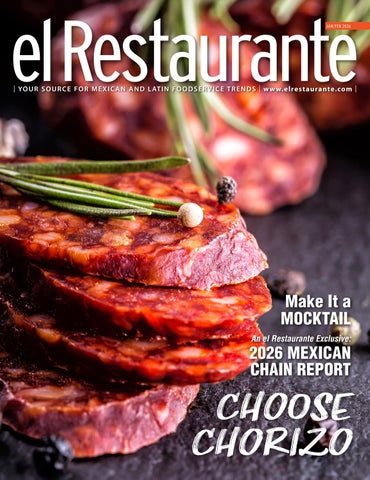
el Restaurante, January/February 2026

Page 1


Mrs. Molina and her tortilla-wrapped chorizo and eggs

That was the first thing I thought of when I started writing the cover story for this issue. For the first few years of both our boys’ lives, Mrs. Molina was a constant presence — more an adopted abuela than the babysitter we had originally asked her to be. Her tortilla-wrapped chorizo and eggs were often waiting for me when I dropped our sons off before I headed to work. She didn’t want me to go hungry (not that there was a chance that that was going to happen!).

That made me think about food as a currency of love — one that would not exist in such rich and diverse abundance without the immigrants who brought their recipes to the country that for them held so much promise.

My Italian aunts…my Latvian mother-in-law…the Molina family… the Rashids (the refugee family from Malaysia we met almost 10 years ago) — all have shared the foods of their homelands, using it in times of celebration and sadness to convey, in some small way, how much they care.

And that brings me to the outrage I and most everyone in my universe feels at the abhorrent, inhumane treatment immigrants are now experiencing. My outrage has been compounded by the fact that they’re often targeted in restaurants, where food brings so many people together.

Mexican restaurants are a prime target. That agents in Minnesota ate in a Mexican restaurant before returning to abduct workers there (see our news item on page 6) was beyond reprehensible… and it’s what made me decide to take off the kid gloves and enter the political fray.

There is little, it seems, we can do to stop ICE in its tracks; speaking out is my attempt at showing solidarity with the hard-working immigrants and those working to protect them.

If you have stories about what’s happening in your restaurant/ your community that you would like to share, please email me at kfurore@restmex.com. My hope is that in the future, there will be no stories about ICE abuses left to tell.

Stay safe, stay positive…and continue uplifting your community by serving the Mexican and Latin food that has always been and will always be the culinary currency that brings friends and families together.

PUBLISHER

Ed Avis

EDITOR

Kathleen Furore

ART DIRECTOR Ala Ennes

CONTRIBUTING WRITERS

Natalia Otero

MAIN OFFICE phone: 708.267.0023

PRESS RELEASES TO: kfurore@restmex.com

MAILING ADDRESS P.O. Box 13347 Chicago, IL 60613

SHIPPING ADDRESS 1317 W. Belden Ave. Chicago, IL 60614

AD SALES/ENGLISH Ed Avis 708.218.7755 e davis@elrestaurante.com

Suzanne Bernhardt 678.880.9282 suzanne@elrestaurante.com

AD SALES/ESPAÑOL Alfredo Espinola 52-55-4006-9540 alfredo@elrestaurante.com

Published by Maiden Name Press, LLC Volume 29, Number 1 el Restaurante (formerly el Restaurante Mexicano) (ISSN 1091-5885) is published six times a year by Maiden Name Press, LLC 1317 W. Belden Ave., Chicago, IL 60614

All contents copyright© 2026 Maiden Name Press, LLC. Nothing in this issue may be reproduced in any form without publisher’s consent.

Kathleen Furore, editor

We confess. When it comes to freshpacked flavor, we’re a show off.

Old California® pioneered clear, easy-open pouches for foodservice tomato products in 1999. We figured the vine-ripened quality of the reddest, richest, sweetest, California tomatoes available was something discerning customers would want to see. No wonder the nation’s finest restaurants love us!

For the quality you desire, choose the best ingredients –The Original Old California Freshpack Pouch from Neil Jones Food Company!

For more information, call 800.291.3862 | njfco.com/see2believe

INTRODUCING THE EL RESTAURANTE INGREDIENT PRICE TRACKER:

A “Smart Buying” Tool for Restaurant Operators

RUNNING A MEXICAN RESTAURANT

SUCCESSFULLY requires managing money carefully — and smart buying is a key part of that. If you have an idea of where prices are headed, and what’s a good buy and what isn’t, success should come more easily.

el Restaurante wants to help — so we’re distilling the countless bits of data about ingredient prices into information that can help you succeed. We’ll provide forecasts for prices of the ingredients you most commonly need: avocadoes, limes, lettuce, tomatoes and other produce; beef, chicken and pork; and alcoholic beverages.

To do that, we will read and analyze USDA data about produce and meat prices, plus data from organizations that track alcoholic beverage prices. We also will speak with Mexican restaurant owners nationwide to learn what they are seeing, and occasionally survey readers for broader data. We’ll combine that information into brief, clear reports written from the perspective of a Mexican restaurant owner making purchasing decisions.

We will post the reports at elrestaurante.com and include them in our eMex newsletter. Our plan is to post the first one during the first week of February, then post updates every other month.

This tool will evolve as we develop it and get feedback. So please be on the lookout for the first edition in a couple of weeks, and don’t hesitate to reach out to us with suggestions for improvement.

ARE YOU READY FOR INCREASED ICE RAIDS?

The news was shocking, but not surprising: On January 15, four ICE agents ate at El Tapatio Mexican restaurant in Willmar, Minnesota and then returned that night to arrest three of the employees, according to an article in the Minneapolis Star-Tribune. The behavior seems inhumane, but it is par for the course during these troubled times.

“The Administration’s surge in worksite enforcement actions across the country is part of a disturbing pattern: an immigration enforcement system focused on instilling fear rather than on upholding the law,” wrote attorney David Asser, a partner in the firm Messner Reeves, in a blog post on the Colorado Restaurant Association website.

Is your restaurant prepared for an ICE raid? Since the current crackdown began, there has been much written on this topic (click here to read an el Restaurante article on the topic), but restaurant managers with some experience in this area are now offering more ideas and key reminders about how to deal with what’s to come:

• Prepare an innocuous code phrase in advance, such as “That really big order is ready.” If ICE agents arrive, say the code phrase calmly so employees know what’s going on and can wait it out in a private space.

• ICE agents do not have the right to enter the private spaces in your restaurant such as those clearly marked “Employees Only” without a judicial warrant signed and dated by a judge.

• Don’t accept something from DHS or ICE called “warrant of remova/ deportation” in place of a bona fide judicial warrant.

• Keep the door to private areas closed — an open door is an invitation. Also, alert staff that only management can grant access. That way they can honestly say, “I am not authorized to let you in.”

• Teach employees that remaining silent is their right — and that includes non-verbal communication. So, if an ICE agent says, “Everyone is who is not a citizen should go stand over there,” everyone should remain standing still.

• Delay, delay, delay. Hold up ICE agents in your front-of-house while someone calls the restaurant owner and/or your lawyer, who, hopefully, can hustle over and ensure the ICE agents have the correct paperwork… and send them packing if they don’t.

Many state restaurant associations are offering webinars and written guidance. Take advantage of those resources to make sure you are up to date on exactly how to deal with this problem.

El corazón de cada tortilla

Masa de maíz orgánica

Masa de maíz no transgénica

Masa de maíz c onvencional

EL FUERTE DE LORETO Customer service and well-executed cuisine fuel success in Philadelphia

When Ricardo Sandoval talks about his restaurant, El Fuerte de Loreto in Philadelphia, he does so from a place of memory, discipline, and patience.

His story — marked by migration, constant learning, and family work — is a clear lesson for the industry: the combination of impeccable customer service and well-executed cuisine ultimately bears fruit.

THE VALUE OF EXPERIENCE

Sandoval is originally from San Mateo Ozolco in the state of Puebla, just two hours from Mexico City.

“My parents emigrated here in 1998 and brought us over in 2004. We arrived in Philadelphia, and I’ve always been here,” he recalls. His parents, Asunción Sandoval and Mariaelena Ventura, opened the door to a new life for him. “They gave us the opportunity to learn another language, to grow personally, and to get a better education.”

In 2013, then 19-year-old Sandoval enrolled to study gastronomy at Philadelphia’s JNA Institute of Culinary Arts, and graduated in 2015.

“I focused on embracing all the principles of gastronomy; everything related to cooking, from making a sauce to preparing a dish,” he recalls.

The seed for his eventual restaurant, however, came from home. His father had worked for years as a waiter, first in Mexico City and then in Philadelphia, where he trained at some of the city’s most iconic restaurants. He worked with renowned chef George Perrier at Le Bec-Fin and later at Brasserie Perrier, where he perfected his service.

“My dad learned a lot and trained as a waiter for over 20 years. He tried the service floor, but he didn’t stay there,” Sandoval says. “My dad focused more on hospitality: welcoming people, talking to customers.”

Sandoval, too, started as a waiter but didn’t like that role.

“I was really attracted to the kitchen environment, working under pressure. I felt capable,” he says.

Driven by his passion for back-of-house spots, he worked as a chef at La Scala, then as sous chef at Scarpetta, both in Philadelphia. But he had the hunger to learn more, which is what led him to work with chef Chris Scarduzio at contemporary Italian restaurant Teca.

BREAKING OUT ON HIS OWN

Armed with his degree and several years of experience, Sandoval decided the time was right to set out on his own. The idea of opening a restaurant came naturally.

“My dad and I had a chat, and I said to him, ‘Why don’t you and I open a restaurant? You know how to communicate with customers, and I have many years of experience in the kitchen; we can make a perfect duo.’”

The initial plan was to open in 2019, with a clear concept: to honor their Puebla roots. The name they chose does just that: “It comes from the Fuerte de Loreto, an iconic base in Puebla, linked to the Battle of May 5.”

But the road was not linear. The pandemic delayed everything, and El Fuerte de Loreto finally opened on May 5, 2023, with a

El Fuerte de Loreto’s menu moves beyond Mexican basics and includes elements of Mexican, Italian, and French cuisines.

menu featuring elements of Mexican, Italian, and French cuisines.

“There are many Mexican restaurants, but they all sell tacos and are very basic. I wanted to do a fusion of cuisines,” he explains. “We brought the most iconic Mexican breakfasts, such as chilaquiles and enchiladas, but with a sophisticated twist,” he says, adding that mole poblano occupies a special place on the menu.

“Sometimes we bring mole from the state of Puebla, based on various spices, chiles, and chocolate; it’s thick and it’s the iconic dish,” he says. In the evening, homemade pasta and Italian-style fish with Mexican sauces appear. “We leave Mexican Mexican, Italian Italian, and sometimes we combine the two.”

Customer response initially was great.

“At first, we were the sensation, family and friends came, but after the fifth or sixth month, everything slowed down,” Sandoval recalls, noting that there were days with empty tables. “We thought, ‘Did we do the right thing? Was it not the right time?’”

That’s when one of the most important lessons came.

“The key is not to give up when there are no customers. You tend to think it didn’t work, but the important thing is to be consistent,” he stresses.

Sandoval adjusted the menu, tried specials, measured results, and learned how

to promote himself.

“I started learning how to advertise myself. Social media is the best tool today,” he says. Facebook, Instagram, and TikTok became allies.

Family support also was crucial. His mother joined the team when business began to grow.

“She is in charge of making all the Mexican sauces for our family; she is responsible for the recipes,” Sandoval says. He, in turn, shares Italian and French techniques with her. Today, his parents, and his wife, Ivonne Samora, who works as a waitress and hostess on weekends, are integral members of the El Fuerte de Loreto team.

BUSINESS IS BACK

Sandoval’s perseverance paid off.

“In 2024, after two years of hard work, we said, ‘OK, we’re there,’” he says. “The key to working as a family is respect and keeping things very clear.”

Operationally, Sandoval applies a philosophy of making full use of ingredients.

“If I use something in the morning, I have to use it in the evening — the same ingredient, but in different dishes,” he says. That versatility helps him connect with his clientele, who are 60 percent American, 40 percent Hispanic. “Americans are looking for Mexican food, and Hispanics are looking for something different, which is why this concept worked.”

The attention to service, inherited from his father, completes the equation.

“The key is the combination: good food and welcoming customers. A restaurant without good service doesn’t work, and good service with bad food doesn’t work either,” Sandoval says.

The reviews confirm it: Customers feel at home.

Ricardo Sandoval celebrates the restaurant’s 2nd anniversary with mom Mariaelena, wife Ivonne, and dad Asunción.

For flavor, just add fire.

Take the simplicity of salsa to new levels of sophistication with the deep, rich flavors of HERDEZ® Quemada Charred Salsas.

4 unique flavors unlock elevated dishes:

|

REQUEST A SAMPLE

|

AVAILABLE AT DOT FOODS

Salsa Roja #780082

Salsa Verde #780081

Poblano Salsa #780080

Chipotle Salsa #780069

Salsa Roja | Salsa Poblano
Salsa Chipotle
Salsa Verde

FROM THE CURED SPANISH VERSION TO THE FRESH, CRUMBLY MEXICAN MEAT, CHORIZO MAKES ITS MARK ON RESTAURANT MENUS.

Choose Chorizo

“OUR CHORIZO DISHES ARE VERY POPULAR, AND PEOPLE REALLY SEEM TO LOVE THEM. THEY ARE MY FATHER’S RECIPE…OUR CHORIZO DISHES ARE UNIQUE, ESPECIALLY SINCE WE MAKE THEM IN-HOUSE, SO PEOPLE TEND TO WANT TO TRY THEM WHETHER THEY ARE FIRST-TIME DINERS OR REGULARS.”
– JENNY DI SAPIO, Folklore and Bodega Sur

| BY

FURORE | Does your menu lean toward the cuisines of Spain or Latin America? Is it authentic Mexican?

Or do you offer a fusion menu with fare that falls somewhere in between?

Whatever your concept, you can incorporate chorizo in many ways — it just depends on the kind of meat you want to feature. In fact, there are so many types of chorizo, depending on its country of origin, that it’s tough to sum it up in a way that covers the myriad culinary nuances.

El Pollo Norteño, a family-run Mexican restaurant with six locations in Santa Ana, Anaheim, Garden Grove, Lake Forest, and Corona, California, does a good job of explaining the basics.

“When it comes to Mexican chorizo, there are distinct differences that set it apart from other varieties of chorizo found in European or Latin American cuisines…While Spanish chorizo typically contains pork, paprika, and garlic, Mexican chorizo is made with fresh ground pork and a blend of aromatic spices and seasonings. Common spices used in Mexican chorizo include chile powder, cumin, coriander, oregano, and cloves, giving it a bold and spicy flavor profile distinct from its European counterparts,” the restaurant’s

fun fact

Chorizo arrived in Mexico with the Spanish conquistadors (and their pigs). In the 16th century, Hernán Cortés introduced pig farming in the Valley of Toluca; the animals, raised on local corn and within large grazing areas, were leaner than their Spanish cousins. This resulted in meat better suited for fresh sausage, a tradition for which Toluca soon became renowned. In fact, the local soccer team is affectionately known as “los choriceros,” aka “the sausagers.”

– FOOD & WINE: WHAT’S THE DIFFERENCE BETWEEN SPANISH AND MEXICAN CHORIZO

Bodega Sur’s Choriboard

blog says. “Another distinguishing feature of Mexican chorizo is its texture. Unlike Spanish chorizo, which is typically cured and dry-aged, Mexican chorizo is made with fresh ground pork and is often sold raw. This results in a softer and more crumbly texture.”

And that just scratches the surface!

Because there are so many versions of this versatile sausage, we reached out to three restaurants to find out how they’re using chorizo in their restaurant kitchens.

FOLKLORE AND BODEGA SUR, Chicago

Argentinian fare is the calling card at Folklore and Bodega Sur, sister restaurants in different neighborhoods on the Windy City’s popular north side. Argentinian chorizo stars in several offerings on the meat-forward menus, according to Jenny Di Sapio, co-owner of both establishments.

“Chorizo in Argentina is more like an Italian sausage. It is the main part of our asado, or traditional barbecue. We make our traditional, or classic chorizo, spicy chorizo, and morcilla in-house for both restaurants,” Di Sapio explains.

Folklore’s Chorizo Trio, a selection of homemade Argentine sausages, includes classic/traditional chorizo, spicy chorizo, and morcilla, accompanied by chimichurri. Bodega Sur also serves a three-sausage chorizo dish, the Choriboard, along with a popular street food called the Choripan that’s made with homemade Argentine chorizo served in a sandwich with chimichurri.

“The chorizo and the spicy chorizo are the most similar, since the only difference is the spice level,” Di Sapio explains. “The morcilla is a blood sausage made with the restaurant’s

own Argentine spices.” The specifics about the restaurants’ chorizos might be a little confusing to customers (“We do have to explain how each of the three chorizos are different,” Di Sapio says), but that doesn’t negatively impact sales.

“Our chorizo dishes are very popular, and people really seem to love them. They are my father’s recipe. People come to buy them cooked and prepared to eat at our restaurants, and they also buy them raw, to cook and prepare for home or for barbecues, from my family’s butcher shop,” she reports. “Our chorizo dishes are unique, especially since we make them in-house, so people tend to want to try them whether they are first-time diners or regulars.”

And does the bottom-line benefit make the labor-intensive prep process worthwhile?

Morcilla vs.Chorizo

While often paired with chorizo, morcilla technically isn’t chorizo. One big difference: “Pig’s blood is an essential ingredient in morcilla and has a major impact on its taste, appearance, and consistency, whereas blood is not a factor in chorizo,” a story about Morcilla at The Spruce Eats explains. “While both undergo a curing process (morcilla is usually briefly boiled first), the aging period is much longer for chorizo than it is for morcilla.” And that raises another significant difference: “Whereas Spanish chorizo is usually sliced thin and eaten much like an Italian salami, morcilla is only semi-cured and therefore must be cooked before eating, either on its own or as an ingredient in other preparations.”

Folklore’s Chorizo Trio
“From a food cost standpoint, “[Mexican] chorizo is a good ingredient to carry. You don’t have to use much of it. Because of its strong flavor it really stands out in most dishes. " – EXECUTIVE CHEF JOEY VAZQUEZ, Chicheria

“Our chorizo is a lot of work to make, but we do it for the love we have for this food item and because it makes us unique in the market,” she adds.

CHICHERIA MEXICAN KITCHEN, Atlanta

A chorizo special created for a popular springtime food fest has become a best-selling sandwich at Chicheria Mexican Kitchen, a Baja-inspired concept at The Works in Atlanta’s Upper Westside.

“The Chorizo Smashburger was created specifically for Atlanta Burger Week as a way to showcase bold flavor while staying true to the smashburger format,” Chicheria Executive Chef Joey Vazquez recalls. “We wanted something that felt familiar but still exciting, and chorizo gave us just that. Our guests loved

it so much, we ended up making it a staple on the menu. Many people have stated they couldn’t even tell it was gluten free.”

That now-famous burger isn’t the only menu item that is spiced up with chorizo.

“Chorizo is a versatile ingredient that works well across our menu — burger, brunch, appetizers, and even sauces. Guests are always curious and open to trying new flavors, and chorizo fits that trend while still feeling approachable,” the chef shares. “Beyond the Smashburger, we’ve used chorizo in a few dishes such as breakfast-style burgers, our brunch bowl, Cali salad, and as a add-on in our queso — very popular — and specials where it can really shine,” Vazquez says. “Overall, chorizo really pops when used correctly — and our guests love it!”

The news about Mexican chorizo isn’t only positive from the customers’ perspective; it’s a positive on the food cost front, too.

“From a food cost standpoint, [Mexican] chorizo is a good ingredient to carry,” Vazquez reports. “You don’t have to use much of it. Because of of its strong flavor it really stands out in most dishes.”

Mexican Chorizo: A Very “Brunchable” Ingredient

If you’re looking for ways to spice up your breakfast and brunch menus, glancing at the menu at La Llorona Cantina Mexicana in Philadelphia (named one of Philadelphia’s Standout Mexican Restaurants by Thrillist in 2022) is a good place to start. Mexican chorizo stars on several dishes, with a wide range of creative options on the brunch menu:

• The Chorizo Benedict, handmade sopes topped with chorizo, poached eggs, and chile de árbol hollandaise sauce, served with a side of home fries with corn, onions

• The Chorizo Burrito, a flour tortilla filled with scrambled eggs and mixed cheeses, served with lettuce, sour cream, pico de gallo and salsa verde on the side

• The three-egg Huasteco Omelette bursting with a filling of chorizo, nopalitos and beans, plus Monterey and cheddar cheeses, on a bed of pasilla salsa, topped with avocado, pico de gallo, and micro cilantro, and accompanied by home fries with corn, onions

Creative Salsas

AWARD-WINNING CHEF REVEALS SECRETS TO SALSAS THAT ELEVATE YOUR RESTAURANT

MOST MEXICAN RESTAURANTS have basic salsas they serve with the chips they offer — and many don’t veer far from those few recipes.

But should they? Are there benefits to experimenting with creative new salsa recipes?

To answer those and other questions, Editor Kathleen Furore reached out to Darryl Holliday, whose recipe for Smoky Oaxacan Charred Cucumber & Jobo Salsa (prepared in the kitchen at Simple Culinary Solutions in Rogers, Arkansas) won first place in el Restaurante’s 2025 Sassiest Salsa Contest sponsored by Sammic.

Here, Holliday shares his thoughts with el Restaurante readers.

Should restaurants move beyond the “standard” salsas? What are the benefits?

They absolutely should. The classic rojo, verde, and pico de gallo are foundational, but when every restaurant serves the same three profiles, salsa becomes background noise rather than a point of distinction or an educational moment about where the chef/owner claims heritage.

Creative salsas allow a restaurant to express its identity. They communicate regional influence, seasonal thinking, and the chef’s philosophy far more directly thanalmost any other element on the table. From a business perspective, they also:

• Differentiate the brand in a crowded market

• Create a memorable first impression before the entrée ever arrives

• Increase perceived value without major food cost increases

• Encourage repeat visits through novelty and discovery.

Salsa is one of the lowest-risk, highest-impact areas for innovation in Mexican and Latin-inspired cuisine.

How should a chef begin innovating beyond long-standing recipes?

Is there a process?

The best starting point is to stop thinking of salsa as “tomato + onion + chile” and start thinking in terms of structure:

Every great salsa balances these six elements:

• Heat: Fresh, dried, smoked, or fermented chilies

• Salt: Table salt, infused/smoked/salt-cured ingredients, fermented vegetables, or leftover brine

• Acid: Lime, citrus, vinegars, or fermented components

• Sweetness: Fruit, roasted vegetables, honey, piloncillo, etc.

• Body: Nuts, seeds, avocado, legumes, or puréed vegetables

• Aromatics: Herbs, alliums, spices

A practical creative process involves several steps:

• Choose a nontraditional base: roasted carrot, charred pineapple, tamarind, beet, mango, pumpkin seed.

• Select a heat source with a distinct character: guajillo, pasilla, chile de árbol, morita, habanero, etc.

• Layer acid and sweetness intentionally, not automatically.

• Adjust texture to match the dish: chunky, emulsified, creamy, or fluid

• Finish with a defining aromatic note.

(continued on page 23)

A Sammic immersion blender makes your salsa preparation easier than ever! A powerful motor, easy-to-use controls and ergonomic design mean your staff can create amazing salsas, soups and other blended menu items with ease and speed. You will love the labor savings and your customers will love the results!

Holliday says chiles, fruit, nuts and seeds are among ingredients that can take salsas to creative new heights.

Get out your salsa-making ingredients and create a unique foodservice salsa recipe you think has the consistency and flavor to wow the judges. The grand prize winner will receive a Sammic XM-52 Immersion Blender and $750. Second and third place will receive $500 and $250, respectively. Plus the top three recipes will be featured in the NovDec issue of el Restaurante.

All readers of el Restaurante are welcome to enter the contest. The recipe must be an original recipe of your own creation. There are no restrictions on the ingredients of the recipe. All recipes will be judged on taste, creativity and appropriateness for foodservice applications.

(continued fom page 21)

“The

classic rojo, verde, and pico de gallo are foundational, but when every restaurant serves the same three profiles, salsa becomes background noise rather than a point of distinction or an educational moment about where the chef/owner claims heritage.”

• Build in small bench-top batches, taste frequently, and evaluate the salsa, not only alone, but on the protein or dish it’s meant to support.

Are there any ingredients that are popular right now when it comes to salsas? What are some current trends and creative directions that chefs are taking?

Several movements are influencing modern salsa work:

• Smoked and fermented profiles: chipotle, morita, fermented chile pastes

• Fruit-forward heat: pineapple-habanero, mango-serrano, guava-chile

• Seed- and nut-based salsas: pipián, sesame, peanut-chile blends

• Global crossovers: yuzu-lime, tamarindginger, miso-chile, gochujang-adobo

• Herb-driven green salsas beyond tomatillo: cilantro, parsley, hoja santa, mint

Chefs like Enrique Olvera (Pujol) and Gabriela Cámara (Contramar), and modern regional taquerías across the United States are treating salsa as a composed sauce, not a condiment — often building multiple house-made salsas for each menu item rather than a single generic table salsa.

How can restaurants that use prepared salsas transform them into a “signature” house product?

Using a prepared base isn’t inherently wrong; the mistake is leaving it unchanged. Restaurants can elevate commercial salsas by:

• Roasting or charring fresh vegetables and blending them in

• Adding fresh citrus, zest, or specialty vinegars

• Incorporating fresh herbs or toasted spices

• Layering in a secondary chile for complexity

• Adjusting texture with puréed roasted peppers, nuts, or seeds

Even small additions, such as a splash of specialty vinegar or mezcal, a touch of smoked chile, a spoon of roasted garlic purée, or fresh lime and cilantro, can transform a standard product into something distinctly house-made, while preserving consistency and labor efficiency. Salsa should taste like it belongs to that restaurant, not to a distributor’s catalog. However, most Americans have come to expect the standard salsa that hits the table with chips when they first walk in, and restaurants shouldn’t turn a blind eye to this profile. However, offering a second flavor, or better yet, a rotating salsa flight, can boost ticket sales slightly and allow for creativity as well as reduce food waste.

2026 Mexican Multi-Unit Report: MORE THAN HALF OF TOP CHAINS ARE Shrinking

BY

| The state of the restaurant industry is rough. That fact came into clear focus when we were researching this year’s Mexican Multi-Unit Report, our 13th. The primary indicator of the situation is that 26 of the top 50 chains closed more locations in the past year than they opened.

Every year there is churn among Mexican multi-units – some are up and some are down, and nearly all of the largest open and close units regularly. It’s totally normal. But this year is special – the fact that more than half of the list ended the year with fewer units than they started is unprecedented.

In comparison, 14 of the top 50 ended 2024 with fewer units than they had in 2023. And 12 of the top 50 ended 2023 with fewer units than they had in 2022.

For some of the chains that dropped in count, 2025 was a continuation of a years-long slide. Taco Johns, for example, had 393 units at the end of 2022 (by our count), then dropped to 370 in 2023, 365 in 2024, and 327 in 2025. Another example is Taco Cabana, which reached 178 units in 2018, and despite a few up years, has averaged a loss of about 5 units per year and now stands at 136.

For others, the drop was more sudden. Del Taco, for example, has had more than 590 units since 2021, but dropped to 572 at the end of 2025. And On the Border Mexican Grill & Cantina, which filed for bankruptcy in 2025, dropped from 134 units at the end of 2023 to 77 at the end of 2025.

Another interesting fact: The total number of units among the top 50 Mexican multi-units has steadily grown over the past few years — from 17,278 in 2022 to 18,853 in 2025. However, if you exclude the two behemoths, Taco Bell and Chipotle, you get a different story. In 2022, the top 50 excluding the two biggest had a total of 6,377 units, and in 2025, it was 6,037. Wondering how it looked pre-COVID? At the end of 2019, the total number of units with Taco Bell and Chipotle included was 15,818.

Take them out and it was 6,198. That means there are fewer Mexican multiunit locations among the top 50 today than before COVID (not counting Taco Bell and Chipotle).

WHAT’S GOING ON?

The current woes of the restaurant industry are well documented — higher food prices, higher wages, customers who are wary to spend, fear of immigration enforcement hassles, etc. — so it’s not that surprising that multi-unit owners are closing more locations than they’re opening.

The case of On the Border reflects the overall situation. At its height, the restaurant had 155 units in 2016, according to our data. It’s a casual restaurant, but full service. Those types of restaurants, similar to Red Lobster or Olive Garden, grew strongly in the early 2000s to mid 2010s, but have faded as consumers look for lower prices.

According to reports from the chain’s bankruptcy court appearance, the restaurant had difficulty recruiting and maintaining its workforce and was paying millions of dollars on leases for underperforming locations. The chain closed 40 of those locations in February 2025 but still faced cash flow problems. The chain is hanging in there and seeking a buyer to get it out of bankruptcy.

Another multi-unit Mexican restaurant that has closed some units in recent years is Tijuana Flats, which went from 124 units at the end of 2023 to 92 now. The company filed bankruptcy in April 2024 and closed 11 locations at that point. The closures were “a result of a unit-by-unit analysis of financial performance, occupancy costs, and market conditions,” the company said in a statement.

Tijuana Flats was then acquired by a new ownership group, Flatheads LLC, which sold the restaurant again about 18 months later to a company called Latitude Food Group. Latitude also

SLOW-SIMMERED FLAVOR.

NO TIME AT ALL.

DOÑA MARIA® Mole Rojo gives you the bold, exciting flavor of authentic Mexican mole in mere moments.

• A rich blend of mild ancho and pasilla peppers, peanuts, sesame seeds and a touch of chocolate.

• Versatile enough for sauces, dressings, glazes and more.

• Simply heat up and start creating.

IS IT THAT EASY?

Yes—and you can buy it on Amazon now to see.

ALSO AVAILABLE AT DOT FOODS ITEM #774328 SHOP NOW ON AMAZON

“&pizza and Tijuana Flats are a natural fit…These aren’t your average concepts. From their innovative use of technology and bold design to their shared commitment to community and purpose, the alignment is clear. We’re excited to harness the unique strengths of both brands and apply proven strategies and efficiencies to build a strong foundation for future growth.”

— MIKE BURNS, Latitude Food Group

2026 MEXICAN MULTI-UNIT REPORT:

owns pizza concept &pizza.

“This is an exciting milestone for us,” said Mike Burns, CEO of Latitude Food Group, in a press release in November 2025. “&pizza and Tijuana Flats are a natural fit. Step into either location and you’ll immediately feel the energy. These aren’t your average concepts. From their innovative use of technology and bold design to their shared commitment to community and purpose, the alignment is clear. We’re excited to harness the unique strengths of both brands and apply proven strategies and efficiencies to build a strong foundation for future growth.”

BRIGHT POINTS: MILESTONES, SMALL CHAIN GROWTH

Naturally, not all the news in Mexican multi-units is about downsizing.

Several of them passed major milestones: Chipotle reached 4,000 locations when it opened a store in Manhattan, Kansas on December 12. Qdoba opened its 800th location, in Miami, in

June. And El Pollo Loco opened its 500th location, in Colorado Springs, Colorado, on October 14 (2025 was also El Pollo Loco’s 50th birthday).

“Behind this milestone is one of the strongest development pipelines we’ve ever had,” said El Pollo Loco Chief Development Officer Tim Welsh in a press release. “In addition to Colorado Springs, we have restaurants under construction in El Paso, Dallas, Albuquerque, and the Greater Seattle area, to name a few.”

Many smaller chains also are succeeding. Hot Heads Burritos, for example, added net six new units in 2025, including new locations in Ohio and Indiana. The restaurant, founded in 2007 and headquartered in Dayton, Ohio, now has 89 locations.

“Our focus on convenience and innovation has been a driving force behind our success,” said Kelly Gray, co-owner and vice president of Hot Head Burritos, in a statement. “By streamlining the ordering process and our continued emphasis on craft recipes, we’re committed to meeting our employees and guests where they are — whether at an event, in our restaurants or on the go.”

Another smaller multi-unit that is bucking the closure trend is Abelardo’s Mexican Food, which was founded in 2002 in Omaha, Nebraska. Abelardo’s jumped from 55 units at the end of 2024 to 70 at the end of 2025.

Technology has been part of Abelardo’s rapid growth, according to a December press release about its installation of PAR POS technology. “We’ve always focused on delivering a great product for our customers, but we reached a point where we needed a more modern, connected platform to innovate, integrate new channels, and elevate our loyalty experience,” said Alejandro Luna, marketing director of Abelardo’s, in the release.

Another success story is Plaza Azteca, a full-service Mexican multi-unit primarily located in the East. The restaurant added 10 locations in the past year, reaching 61. The restaurant had just 35 units eight years ago.

One of Plaza Azteca’s new locations was outside its normal territory – in Sioux Falls, South Dakota. Victor Magana, a manager at the new location, explained in a local newspaper article that the restaurant’s success is due in part to offering a rich experience, such as guacamole made tableside and margaritas featuring fresh fruit.

THE NATIONAL LATINO RESTAURANT ASSOCIATION

supports and promotes restaurateurs, small businesses and the entire Latino restaurant community at a national level to ensure the equitable economic growth of the sector LRA community members come together to network with industry pros, market their brand and learn new ways of making their business more efficient.

MEMBER BENEFITS INCLUDE:

BOOTCAMPS

FREE CLASSES FOCUSED ON RESTAURANT INDUSTRY DEVELOPMENT AND EXCLUSIVE NETWORKING OPPORTUNITIES WITH CERTIFICATION UPON COMPLETION OF COURSES

ACCESS TO CATERING RFP'S BID ON CATERING CONTRACTS EXCLUSIVE TO LRA MEMBERS

DINE LATINO RESTAURANT WEEK

EXCLUSIVE PROMOTIONS FOR YOUR RESTAURANT DURING THE RESTAURANT WEEK! (SAVE $900+)

GRANT OPPORTUNITIES GRANT ALERTS FOR LRA MEMBERS

EXCLUSIVE ACCESS TO THE LRA MEMBER PLATFORM

GROW YOUR PROFESSIONAL NETWORK BY ENGAGING OUR 8,000+ MEMBER CONTACTS

“We do not relegate non-alcoholic excellence to a single month. Our standard is to provide a premium experience for every guest, every day of the year. We host a high volume of families and guests who choose not to consume alcohol; it is our responsibility to ensure their experience is as sophisticated and intentional as those ordering from our spirits menu.”

MOCKTAILS Enter the Mainstream

BY

FURORE | It’s that time of year when many of your customers are swearing off alcohol — at least until January 31. According to The State Of Dry January 2025, the first nationwide survey to examine the trend, 47 percent of those who drink alcohol at least once a month report they previously have participated in Dry January.

“Millennials ages 29 to 44 are the most likely to attempt Dry January, with just over half (51 percent) reporting that they have tried it,” the report says. Even Boomers have caught the spirit-free spirit: 30 percent of that demographic say they have participated in Dry Januarys past.

But focusing solely on Dry January doesn’t tell the whole story of consumers’ migration to non-alcoholic cocktails.

Gallup’s most recent annual Consumption Habits survey reveals that the percentage of U.S. adults who say they consume alcohol has continued to decline for the past several years. From 1997 to 2023, at least 60 percent of Americans reported drinking alcohol; that number fell to 58 percent in 2024 before hitting 54 percent in the most recent survey conducted in July 2025.

The James Beard Foundation’s 2026 Flavor Forecast also acknowledges the shift: Craft Cocktails Sans Booze is one of the trends highlighted in the Trending Cocktail Flavors and Styles category.

“With more consumers moderating their alcohol consumption,

restaurants and bars are crafting top-notch cocktails without booze,” the forecast says.

Echoing the Gallup findings about Dry January participants, the customers most frequently consuming those cocktails are apt to be Gen Z and Millennial consumers, according to Zach Poelma, senior vice president of commercial intelligence at Southern Glazer’s, an alcoholic beverage distributor that also distributes non-alcoholic beverages.

“They are more likely than older generations to explore a wider variety of non-alcoholic beverages, purchase functional drinks, and generally engage more with beverage options,” Poelma says.

A VIEW FROM BEHIND THE BAR

Mexican and Latin-themed restaurants around the country have embraced Dry January, offering special zero-proof options.

For example, “The Art of the Zero Proof” collection debuted on January 1 at dLeña by Chef Richard Sandoval in Washington, DC. Created by Chef Sandoval and Head of Mixology Riesler Morales, the menu — available through the end of the month — includes:

• Aloe and Apple White No-groni with Seedlip Garden 108 (a non-alcoholic herbal spirit), aperitif bianco (a non-alcoholic vermouth), verjus (a non-alcoholic, tart grape juice), apple, aloe vera, and green grape

(l to r) Buena Vida Tapas Bar’s non-alcoholic Tiki Tango, First Kiss, and Agua Fresca

• Coco and Mango Milk Punch with Almave Blanco (a non-alcoholic agave spirit), pineapple, coco, mango, lime, and dried chili

• Margarita Verde with Almave Blanco, orange sec (a non-alocholic orange liqueur), lime, pandan (a tropical leaf with vanillalike flavor), jalapeño, hoja santa, and salt.

At Buena Vida Tapas Bar in Atlanta, Georgia, Dry January means more than capitalizing on customers’ pledge to skip spirits for the month; General Manager Lorenzo Masini calls it “an opportunity to showcase the standards we maintain year-round.

“While the public focus on non-alcoholic options increases during this time, our execution remains consistent,” he stresses. “We find that guests are embracing the concept because we provide them with a choice that does not feel like a compromise. Excellence in our beverage program means every guest has an elevated option, regardless of the season.”

The menu — dubbed “Spirit-free Elixirs” — includes the First Kiss, which combines passion fruit, honey, vanilla, and ginger beer; and the Tiki Tango made with mango, cilantro, lime juice, and tonic. Both are permanent fixtures on the Buena Vida Tapas menu.

“We do not relegate non-alcoholic excellence to a single month. Our standard is to provide a premium experience for every guest, every day of the year,” Masini stresses. “We host a high volume of families and guests who choose not to consume alcohol; it is our responsibility to ensure their experience is as sophisticated and intentional as those ordering from our spirits menu.”

That approach is important considering the “definitive shift in guest behavior” Mesini says he’s observed.

“The trend of high-volume alcohol consumption is declining,” he reports. “Our guests are now intentional consumers who prioritize

A Brief History of Zero-proof Options

Zach Poelma, senior vice president of commercial intelligence at Southern Glazer’s, shared these insights about the growth of the spirit-free category:

“Beer was the first category to embrace non-alcoholic offerings in the 1980s and 1990s. Recent innovations featuring unique flavors and craft styles revitalized the segment in the mid-2010s, driving renewed growth. Today, non-alcoholic beer represents nearly 1 percent of total beer sales, with dollar growth up nearly 50 percent. Around the same time, non-alcoholic spirits and wine emerged in the UK and soon thereafter launched in the U.S., fueling significant though smaller growth compared to beer. While these categories remain a fraction of their overall segments, nonalcoholic wine and spirits are growing rapidly on-premise, up over 100 percent and 20 percent in dollars respectively.”

quality over quantity. They no longer seek multiple drinks to sustain an evening; they seek one or two exceptional experiences.”

Last year, in response to that shift, Buena Vida introduced THC Margaritas, which “have quickly become a staple for our guests for several reasons,” Masini says.

“Guests are increasingly mindful of the physiological impact of alcohol. Unlike alcohol, which is inflammatory and can lead to hangovers, THC offers a social experience that many find more compatible with a wellness-focused lifestyle,” he explains. “We proactively provide these alternatives because we recognize that the modern guest expects their social life to align with their health goals.”

The fact is that most customers aren’t in the “no alcohol” or “always alcohol” camp exclusively.

“Importantly, non-alcoholic consumption isn’t an ‘either-or’ choice. Many consumers buy both alcoholic and non-alcoholic options for on-premise and retail occasions, sometimes alternating between them within the same drinking occasion, which is a behavior often called ‘zebra striping,’” Poelma says.

ABOUT THE BOTTOM LINE

As mocktails hit the mainstream, the question of pricing is moving to center stage: Are spirit-free cocktails really less expensive to create and more profitable to pour?

The answer: They could be.

“For operators, non-alcoholic beverages present a compelling margin opportunity, especially amid rising input costs. These drinks often deliver higher margins than food items, and because beverages typically carry lower absolute prices, consumers are more willing to accept percentage-based price increases,” Poelma says. “New offerings are particularly attractive since consumers lack established price expectations, making premium pricing easier to justify. Introducing innovative beverage options allows operators to boost profitability without alienating price-sensitive patrons.”

Note that Poelma says “often” and not always. That’s key, because the final profit picture depends on an operators’ approach to crafting compelling mocktails behind the bar — something Masini feels strongly about.

“There is a misconception that spirit-free cocktails are more profitable because they lack liquor. This is not the case in our operation,” says Masini, who notes that he and his team prioritize high-level ingredients “above all else,” which impacts ingredient costs and ultimately, profits.

“The base for these cocktails consists of high-quality fruit

pulps that we import directly from Colombia. This is a non-negotiable standard for flavor and authenticity,” he explains. “When alcohol is removed, we increase the volume of these premium purees. We also incorporate expensive components like vanilla, honey, and premium ginger beers or tonics. Because of these high-level inputs, spirit-free drinks often cost the same to produce as traditional cocktails.”

Masini also notes that mocktail menu prices aren’t set based on alcohol content, but on the craftsmanship and the quality of the raw materials used to make them.

“Our guests receive a sophisticated, high-value beverage that meets the Buena Vida standard of excellence,” he stresses.

Whatever your approach to zero-proof cocktails, the message from the front lines is clear: “Non-alcoholic beverages aren’t just a trend, they’re here to stay,” says Poelma, whose assessment is based on his recent experience during Southern Glazer’s Liquid Insights Tour to Paris and London (taken to uncover what beverage trends are emerging before they hit the mainstream). “In markets where this movement started earlier, the category is even more popular, with consumers embracing creative, premium options across nonalcoholic wine — sparkling in particular and sometimes tea-based — and spirits. That’s a strong signal for us: this isn’t a passing fad. It’s a shift in how people drink and socialize.”

His advice for operators and for brands? “ The message is simply get started if you haven’t already, but be patient. Growth takes time, and setting realistic expectations is key,” Poelma cautions. “This category is evolving quickly, but it’s still building its base. The payoff will come for those who invest thoughtfully and stay the course, because demand for non-alcoholic choices will only keep growing.”

SIX TIPS for Creating a Restaurant that Welcomes Customers with Disabilities

Dejean remembers well the first time she went to a restaurant with her father after he was paralyzed in a car accident. She was 13 or 14 years old.

“The waitress looked at me and said, ‘What does he want to eat?’” says Dejean, now a public speaker who specializes in getting people comfortable working with individuals with special needs. “I remember thinking, ‘That is so weird. Why is an adult asking me what my dad wants?’ Then I realized she was uncomfortable. She wouldn’t really look at my dad.”

That kind of experience does not need to happen in your restaurant. There are ways to make your establishment welcoming to customers with special needs — something that is imperative to do from a humanitarian perspective, and makes good business sense, too.

Bonnie Holtzman, regional deputy director of supported employment at YAI, an organization that supports people with disabilities, notes that dining out is a favorite activity for many of the people with intellectual and developmental disabilities with whom she works.

“Going to restaurants is a big social outlet for them,” she says.

Ensuring that your restaurant is compliant with the Americans with Disabilities Act (ADA) — with proper accessibility, parking, restrooms, etc. — is the first step. But there are other ways you can make your restaurant welcoming to members of the disability community. Here are six tips:

1

Get input from those in the community. A great way to see if your restaurant is prepared to welcome customers with special needs is to invite representatives from local organizations that work with them to visit. Ask them to evaluate everything from your physical layout to your service to your menu from the perspective of the people they serve. Remember that the disabilities that affect your potential customers could range from intellectual disabilities to sight or hearing problems to mobility issues, so you may need to invite representatives from multiple organizations.

“You should have the mindset that, ‘We want to make this better, and if we want to make this better, we have to be open to learning from the source,’” Dejean explains, adding that you should offer to pay these individuals for their input.

“You should have the mindset that, ‘We want to make this better, and if we want to make this better, we have to be open to learning from the source.’”– BRITTANY DEJEAN

2

Prepare your front-of-house staff. Your hosts, servers, bussers and floor managers are the employees most likely to serve special needs customers. Make sure they are trained well in this area by offering training/onboarding that covers:

• The importance of greeting all customers cordially regardless of disability status

• How to communicate clearly with individuals with hearing or comprehension difficulties

• How to be prepared if a client needs help getting to a table, reading a menu, carrying a tray, or reaching. items on a buffet line or salad bar.

Basically, employees should be ready to help in any way…but only after asking if the person needs help

“If your employees feel awkward about disability, they don’t necessarily want to admit it,” Dejean notes. “And you don’t want to wait for bad experiences to happen before you take steps to say, ‘This is important, and I want my employees to feel equipped.’”

3

Make sure your physical space accommodates customers’ special needs. The ADA regulations cover essential elements such as having step-free entrances and accessible bathrooms,

but there are other things that can make your restaurant comfortable for customers with limitations:

• Have straws, especially bendy ones, available for people who may be unable to comfortably hold a glass.

• Keep condiments and other self-serve items conveniently located on tables so everyone can reach them, even if they are in a wheelchair.

• Put large-print, high-contrast, non-glare signage on your buffet and salad bar.

• Make sure the type on your digital menu can be enlarged and/ or read electronically or have large-print and braille paper menus available.

4

Make sure the kitchen can handle special dietary needs.

You already ask patrons if they have allergies or other dietary restrictions. Remember some people with disabilities may require special food-related accommodations, too.

“We serve some people who are severely disabled and can only eat pureed food,” Holtzman says, explaining that these individuals may want to eat a normal menu item but require that it be pureed to the right consistency. “If there was a restaurant that was equipped to accommodate these dietary needs, then families could take their loved ones to that restaurant and there would be a ton of choices.”

5

Consider creating a quiet space. Individuals with sensory disabilities may enjoy a meal in a restaurant that has a quiet space without televisions, flashing lights, or loud music.

“A lot of people on the spectrum or people who have seizure disorders can’t tolerate flashing lights,” Holtzman says. “And noise is an issue for many people. A restaurant could even offer headphones to people who want to block out the noise.”

Creating a quiet space in your restaurant, at least during certain days or times, also could attract customers who prefer a less stimulating, quieter experience, even if they do not have a disability.

6

Don’t treat special needs customers differently. Dejean knows the server who was uncomfortable looking at her dad was not being intentionally unkind. She was having a normal reaction to something she was unfamiliar with.

“It wasn’t done out of malice. She wasn’t trying to be rude. She was just so afraid of doing something wrong that she chose to do nothing at all,” Dejean says.

Servers should assume that a customer with a disability can communicate just like any other customer, unless they learn differently, she notes. Furthermore, they should not worry about being perfect, she advises.

“People can get overwhelmed by an idea like, ‘Oh, this person has this disability and what was the thing I was supposed to do?’

People start to get scared that they’re going to do the wrong thing,” she says.

Her solution? Relax. Do your best. Treat every guest, including those with disabilities, with respect.

“Word will spread if you put effort into that experience, if you’re receptive to feedback, if you treat people like human beings,” Dejean says. “It can be so difficult for people with disabilities to have a positive restaurant experience, whether it’s because of accessibility or because of attitude or because of anything else, so people remember where they feel good, right? And so, when it goes well, word spreads.”

Organization Connects Ability to Job Opportunities

People with special needs are not only potential customers, but also potential employees. YAI is an organization that supports people with disabilities and helps them find employment. Restaurants are key employers in the program, says Bonnie Holtzman, regional deputy director of supported employment at YAI.

Holtzman primarily works with people with intellectual and developmental disabilities who can help with dish washing, stocking, cleaning and other restaurant tasks that match their abilities.

A key benefit of the YAI program is that it provides a job coach who remains with the worker until all parties agree they are no longer needed.

“The job coach is with the individual every step of the way from interview to hire to orientation and then they’re with them on the job,” Holtzman explains. “The job coach is there to help the individual learn their tasks and master their tasks so that the onus doesn’t fall on the owner or the other coworkers.”

And if the worker — who is paid a normal wage — gets promoted or if their duties change, the job coach returns to help them master their new tasks.

To learn more about hiring someone through YAI (which currently places workers in New York City and is expanding to New Jersey and California), visit yai.org or contact Holtzman at bonnie.holtzman@yai.org.

You also can find tips from the National Restaurant Association on hiring and training individuals with disabilities here.

Jarritos Mandarin Zero. The authentic Mexican soda brand now offers its most popular flavor in a zero-calorie format. Jarritos’ first zero-calorie flavor to go nationwide, Mandarin Zero delivers the bright, citrus-forward flavor of Jarritos Mandarin, with zero calories and no compromise on taste. jarritos.com

MIC Food IQF Tropical Produce. Simplify your kitchen operations and deliver consistent quality dishes to your customers with premium-quality IQF plantain, sweet potato, casssava/yuca and other frozen product and specialties ideal for Mexican/Latin restaurant operations. Yuca fries, traditional tostones, ripe plantain slices, plantain mash, whole ripe plantains and more from brands including Tio Jorge®, Big Banana® and United Flavors® available. 786-814-1348; 1-800-788-9335; micfood.com

HungerRush POS. This restaurant POS system makes it fast and easy to assemble ingredients for complicated orders like burritos and tacos while applying upcharges for premium ingredients automatically. It also can make your online ordering look like your Mexican restaurant with a digital ordering website that’s customized for your brand and mobile ready — looks great no matter what device your customers are using. 281-668-4333; hungerrush.com/cuisine/mexican-pos

Natava Avocado. Tired of your avocados turning brown before you’ve been able to use them? These sliced avocado, frozen avocado chunks and frozen smashed avocado have a 10-day shelf life once the package is opened — all thanks to ‘All Natural’ Natavo™ technology that addresses the issue of avocado browning, setting a new standard in IQF avocados. enquiries@natavoavocado.com; natavoavocado.com

Red Gold Salsa. Save up to 30% per serving when you make the switch to Red Gold® Salsa in a #10 can vs. your plastic jug! Red Gold Salsa offers a tasty blend of tomatoes with traditional spices and mild heat from the jalapenos, onion and hints of garlic. It’s the easy way to save on your food costs by simply making the switch to Red Gold Salsa in a #10 can. Want a free sample? Visit redgoldtomatoes.com/ redgoldfoodservice/sample-requests to ask for your free sample now.

Beyond the Butcher Plant-based

Ground Chorizo. Made with locally sourced, sustainable ingredients, the chorizo is just one product from the full range of high-quality, plant-based proteins designed to fit the menu at any restaurant or foodservice operation. Items bulk-packed for foodservice include beef tips, pulled pork, chicken chunks, patties, and ground products. info@btbfoods.com; beforethebutcher.com/food-service/

Best Mexican Foods. Founded in 1968, Best Mexican Foods — the largest Mexican and Hispanic distributor in the Northeast — offers authentic Hispanic products including tortillas, cheeses, a variety of meats, sides, bar supplies, condiments, and more. If your business is in New York City, Connecticut, New Jersey, Pennsylvania, Massachusetts, Rhode Island, Maryland, Delaware, Maine, Vermont, or New Hampshire, give us a call! Our bilingual customer service team and regional sales team can help with any language barrier. 845-469-5195; 800-867-8236; bestmexicanfoods.com

San Marcos® Peppers and Salsas. Iconic products available in 6-lb. formats ideal for Mexican restaurants: Chipotle Peppers smoked in wood-fired ovens with guava leaves; crunchy Whole Jalapeño Peppers; Jalapeño Nacho Thick-cut Rounds; ready-to-serve Jalapeño Pepper Strips; Classic San Marcos® escabeche in convenient strips; tangy Green Tomato (Tomatillo); ready-to-cook Chipotle Pepper Salsa Ready; and tender Nopales. 832-479-7899; empacadora@sanmarcosusa.com; sanmarcosusa.com

BERNICE REYES, Executive Chef

AcapulcoMexicanoRestaurante

WHEN MARIA AND JESUS

LEON OPENED THEIR FIRST RESTAURANT in December of 1996, their goal was to bring a real taste of Mexican food as it’s found in Mexico to suburban Minnesota. With that goal accomplished, they moved on to other neighborhoods and today own seven locations in the Twin Cities area — all owned and operated by members of the Leon family.

Executive Chef Bernice Reyes develops the recipes found on each of the restaurant’s menus, always striving to make sure each one “truly reflects our approach to flavor and menu development at

Acapulco.”

Here, she shares the story of and recipe for Acapulco’s Elote-Style Brussels Sprouts — a dish she created that does just that.

“We originally debuted this dish as a seasonal summer special when we set out to add Brussels sprouts to our menu in a way that felt authentically Mexican and unmistakably Acapulco — and the response was immediate.

“As executive chef, my role is to execute recipes in our voice, and this became one of my favorite dishes because I love highlighting vegetables as the main ingredient. The

The Achiote Aioli:

2 c. mayonnaise

2 T. achiote paste

1 - 2 chipotle peppers in adobo ¼ c. apple cider vinegar

Salt, to taste

To Finish:

1 c. char-roasted corn kernels (fresh, frozen, or canned)

½ c. cotija cheese, crumbled ¼ c. fresh cilantro, chopped

1 lime, cut into wedges

Tajín seasoning

1. Blanch the Brussels Sprouts. Bring a large pot of well-salted water to a boil. Add Brussels sprouts and cook for 3 to 4 minutes, until bright green and just tender. Drain immediately and transfer to a bowl of ice water to stop the cooking. Once cooled, drain well and pat dry.

achiote aioli brings a bright acidity that opens up the palate, making it a bold yet approachable, vegetarian, shareable dish. Guests loved it so much that we simply couldn’t take it off the menu. It quickly earned its place as a permanent, shareable favorite — one that is especially popular in the summer months when we’re able to use fresh, in-season corn.”

ELOTE-STYLE BRUSSELS SPROUTS

Makes 4 side dish servings

The Brussels Sprouts: 1 lb. Brussels sprouts, trimmed and halved if large Salt

2. Make the Achiote Aioli. In a blender or food processor, combine achiote paste, chipotle peppers, and apple cider vinegar. Blend until smooth. Add mayonnaise and blend again until creamy. Season with salt to taste. Refrigerate until ready to use.

3. Char & Assemble: Heat a large skillet or grill pan over medium-high heat. Add a little oil, then add Brussels sprouts in an even layer. Cook until golden and lightly charred, tossing occasionally. Add corn and cook for another 1 to 2 minutes until warmed through. Transfer to a serving bowl. Drizzle with achiote aioli and finish with cotija cheese, cilantro, a squeeze of fresh lime, and a sprinkle of Tajín.

Chef’s Tip: Drying the Brussels sprouts well after blanching helps them char instead of steam — don’t skip this step.

Turn static files into dynamic content formats.

Create a flipbook
Issuu converts static files into: digital portfolios, online yearbooks, online catalogs, digital photo albums and more. Sign up and create your flipbook.
el Restaurante, January/February 2026 by MaidenNamePress - Issuu