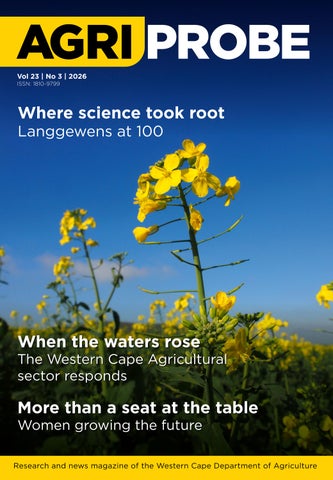
AGRI PROBE Vol 23 | No 3 | 2026 ISSN: 1810-9799
Where science took root Langgewens at 100
When the waters rose
The Western Cape Agricultural sector responds
More than a seat at the table Women growing the future
Research and news magazine of the Western Cape Department of Agriculture
LANDBOU RADIO RSG Landbou word elke Vrydag om 5:00 vm. en Saterdae om 11:45 vm. uitgesaai. Tydens ons programme maak ons kennis met innoveerders, boere-planmakers, asook diegene aan die voorpunt van landbou-tegnologie en navorsing. Maak gerus kontak en laat jou stem gehoor word. Ek nooi jou graag uit om stories van hoop en inspirasie met my te deel. Stuur gerus wenke en idees na Eloise Pretorius | eloise.pretorius@westerncape.gov.za
Elo ise Pr e
“Sien” jou binnekort op die radio!
r to
s iu
Vir meer inligting Meer inligting oor die programreeks is beskikbaar op www.rsg.co.za en die uitsendings kan ook afgelaai word.
Potgooie Vir aflaai van potgooie, skandeer die kode of besoek www.rsg.co.za/ rsg/page_id344/
Nou ook beskikbaar op die RSG toep!
EDITORIAL
Setting Setting the
SCENE by Michael Brinkhuis
A
Agricultural Producer Support and Development: Bridging research, extension and farmer success From knowledge generation to practical impact Agricultural producer support and development remain central to ensuring a competitive and sustainable agricultural sector in South Africa. In the Western Cape, where agriculture contributes significantly to economic growth, employment, exports and food security, producer support is not limited to the provision of technical advice or inputs alone. A key component of success lies in the ability to translate scientific research into practical solutions that farmers can apply on their farms. This acknowledges the indispensable role played by Extension and Advisory Services in connecting innovation with implementation. The Western Cape agricultural sector faces increasingly complex challenges ranging from climate change, recurring droughts, rising input costs, biosecurity threats, evolving market requirements and market volatilities, which demand that producers continually adapt their production systems for farming efficiencies.
“
The real value of research emerges when it improves productivity, profitability and sustainability at farm level.
”
At the same time, new-generation farmers require targeted support to improve productivity, access markets, build business sustainability and participate meaningfully in the agricultural value chain. These realities have elevated the importance of a wellcoordinated producer support and development system built on research, innovation, new varieties, improved production technologies and effective extension services.
Collaboration with stakeholders, such as research institutions, financiers, commodity organisations, government departments, universities and other academic institutions, to augment investment in the sector is a strong focus of the province.
AgriProbe Vol 23 | No 3 | 2026
» 1
EDITORIAL
The sector takes pride in its achievements to develop outputs such as new knowledge, improved varieties, enhanced animal health protocols, precision agriculture technologies and climate-smart farming practices to provide solutions to some of the sector's challenges. However, these research achievements are of little value if it remains confined to scientific journals, conference presentations or experimental stations. The real value of research emerges when it improves productivity, profitability and sustainability at farm level.
This is where practical application becomes essential. Farmers require the valuable academic research outputs to be translated in a “language” that speaks to production practices on the farm.
Photo © Roger de la Harpe
Extension Services: The critical link in agricultural development At this juncture Extension and Advisory operatives form the critical link to bridge the gap between the new knowledge and the practical implementation thereof to address production challenges. Whether it involves improving wateruse efficiency in vineyards, introducing integrated pest management strategies in fruit orchards, enhancing fodder production in livestock systems, implementing conservation agriculture practices in grain production, or employing AI and other technologies, farmers need to be serviced with practical and context-specific guidance and support. The successful transfer of innovation from laboratory to land is the mandate that rests squarely on the shoulders of Extension and Advisory Services.
2
AgriProbe Vol 23 | No 3 | 2026
Extension and Advisory Services serve as the bridge between scientific discovery and on-farm implementation. Extension practitioners occupy an important position within the agricultural ecosystem. Strong relationships are fostered that lead to collaboration with the scientific experts to ensure the proper understanding and interpretation of the scientific principles underpinning new technologies and translating it into the practical applications required by producers. These interdepartmental collaborations come to fruition through farm visits, demonstrations, training sessions, workshops and continuous technical support as extension personnel help farmers evaluate, adapt and adopt innovations that can improve their operations.
EDITORIAL
Recognising excellence and strengthening the future Despite the importance of the role, extension practitioners in general do not always receive the recognition they deserve. The success of agricultural development initiatives is frequently attributed to projects, technologies or funding programmes, while the professionals responsible for translating these interventions into practical outcomes remain largely invisible. Recognition of Extension and Advisory Services is therefore appropriate in order to recognise and celebrate this integral component of agricultural producer support. Recognising excellence not only rewards achievement but simultaneously elevates the status of the profession and encourages continuous improvement. Extension practitioners serve as educators, facilitators, mentors, co-researchers and change agents. Their contribution extends beyond productivity gains and encompasses rural development, contribute to food security, lead to social transformation and economic growth.
Agriculture
TURE T OF AGRICUL E DEPARTMEN LOGY WESTERN CAP AND TECHNO 5 - RESEARCH S 2024-202 PROGRAMME NT SERVICE DEVELOPME
Learn more! Scan the QR code or visit https://tinyurl.com/ wadn6b8k to explore the Western Cape Department of Agriculture’s Research and Technology Development Services programme and the research, innovation and technology being developed to support producers across the province.
Photo © Savanna Strauss
Did you know? Langgewens Research Farm celebrates its centenary in 2026. Established in the Swartland in 1926, the farm has grown into an important centre for agricultural research and technology transfer – advancing conservation agriculture, crop rotation, soil health and cultivar evaluation, while helping translate scientific knowledge into practical solutions for farmers.
Watch this! Scan the QR code or visit https://youtu.be/36fYcuLoTBU to see research and innovation in action during the first Case IH visit to Langgewens Research Farm.
Agricultural development ultimately succeeds when research informs practice, when producers adopt innovations with confidence, and when extension practitioners are empowered and recognised as essential partners in the development process. The Western Cape has demonstrated leadership and nailed its colours to the mast demonstrating its intent to continue with an integrated approach promoting professional excellence among extension personnel, investing in capacity-building, and a recognition programme in its commitment to build a resilient agriculture sector and empowering its agricultural producers. #ForTheLoveOfAgriculture
Michael Brinkhuis AgriProbe Vol 23 | No 3 | 2026
3
CONTENTS
6
12
EDITORIAL Setting the scene
MINISTERIAL Agriculture: A return to our shared humanity
DIARY AND EVENTS Where science took root: Langgewens at 100
24
1
#YouthBuild2026 graduates encouraged to ‘perfect’ their skills
36
ECONOMIC NEWS Success in the wool industry
40
TAKING OUR SERVICES OUT THERE Vaccinating your animals: Why it matters (and what the law requires) 42 What is Salmonellosis?
44
The importance of traceability of animal products for export
46
RESEARCH NEWS Fuelling the Percheron powerhouse – Part 1: Understanding how horses evolved to eat
48
18
22
24
Rooibos in Space
27
AgriProbe Vol 23 | No 3 | 2026
Equine Unit at Elsenburg: A resilient performer in agricultural training
12
NEWS SNIPPETS When the waters rose: The Western Cape agricultural sector responds
4
HUMAN CAPITAL DEVELOPMENT More than a seat at the table: 4 women growing the future of agriculture 30
6
Caring in action: Supporting vulnerable communities in Greater Knysna 15 Advisory Services at the heart of agricultural success
30
COVER INSPIRATION This cover celebrates a season of renewal in Western Cape agriculture. A vibrant canola landscape anchors the September edition in colour, place and purpose, while honouring Langgewens at 100, a century of agricultural research in the Swartland. It also creates a strong visual link to two timely companion stories: When the waters rose, reflecting the sector’s resilience, and Women growing the future, celebrating the women helping shape a stronger agricultural landscape.
AGRI PROBE
Vol 23 | No 3 |
ISSN: 1810-9799
Cover image © Savanna Strauss
51
2026
Where science
Langgewens at
took root
100
55 When the water
s
rose The Western Cap e Agricultural sector respond s More than a sea t at the table
Women growin
g the future
OUR NATURAL RESOURCES The strategic role of land use management in disaster resilience in South Africa 51
ELSENBURG JOURNAL South Africa and Western Cape food price: Agricultural trade, energy prices, and Strait of Hormuz update 55
Research and
news magazine
of the Western
Cape Department
of Agriculture
EDITOR Mary James (021 808 5008) mary.james@westerncape.gov.za CHAIRPERSON Stephanie Thomas (021 808 5190) stephanie.thomas@westerncape.gov.za VICE CHAIRPERSON Dr Filicity Vries (021 808 5014) filicity.vries@westerncape.gov.za SECRETARIAT Giselle Terblanche (021 808 5022) giselle.terblanche@westerncape.gov.za EDITORIAL COMMITTEE Arie van Ravenswaay (021 808 5085) arie.vanravenswaay@westerncape.gov.za Ashia Petersen (021 808 5010) ashia.petersen@westerncape.gov.za Daniel Johnson (021 483 3261) daniel.johnson@westerncape.gov.za Luyanda Dyantjies (021 808 5047) luyanda.dyantjies@westerncape.gov.za Dr Lesley van Helden (021 808 5017) lesley.vanhelden@westerncape.gov.za
PUBLISHING TEAM Publisher: Erika Alberts Layout & design: Carmen le Roux Copy editor: Aletta Pretorius-Thiart Financial director: Pat Botha For integrated communication and publishing solutions, e-mail: media@mlpmedia.co.za
Londiwe Thabethe (021 808 7733) londiwe.thabethe@westerncape.gov.za Vusumzi Zwelendaba (021 808 5226) vusumzi.zwelendaba@westerncape.gov.za Zenovia Parker (021 808 7798) zenovia.parker@westerncape.gov.za Juan de Lora (021 808 5383) juan.delora@westerncape.gov.za
AgriProbe Vol 23 | No 3 | 2026
5
MINISTERIAL
Photo © Roger de la Harpe
Agriculture:
A return to our shared humanity by Minister Ivan Meyer and Daniel Johnson
T
The world is living through an era of uncertainty. Wars and geopolitical tensions, trade disputes, rising protectionism, economic instability and the growing threat of climate change have created a period of profound disruption. These challenges demand leadership that promotes economic development, protects the rule of law, strengthens global stability and encourages cooperation across borders.
6
AgriProbe Vol 23 | No 3 | 2026
Yet beyond policies, institutions and technology, the world needs something even more fundamental: a return to a shared sense of humanity. At the heart of our response to these turbulent times must be the recognition that we are all connected. The isolation, division and distrust that increasingly characterise global affairs are not the natural condition of humanity. Human beings are social creatures. We are united by our awareness of mortality, our capacity for compassion, our desire to act ethically and our need for connection and belonging. These timeless characteristics remind us that our futures are intertwined.
MINISTERIAL
The question, therefore, is where we can rediscover and strengthen this shared humanity. The answer may well lie in agriculture.
Agriculture is often described as humanity’s first profession. Long before there were governments, corporations or modern economies, people cultivated crops, tended livestock and worked together to produce food. Agriculture enabled the development of civilisation itself. It transformed communities from scattered groups of hunters and gatherers into organised societies capable of building cities, cultures and economies. Today, thousands of years later, agriculture remains as relevant as ever
“
Agriculture is not merely an industry; it is the foundation upon which human life depends. It is the one activity that connects us all.
”
because every person, regardless of nationality, language, religion or political belief, depends on food. Agriculture is not merely an industry; it is the foundation upon which human life depends. It is the one activity that connects us all. For this reason, agriculture is both humanity’s first and last profession.
AgriProbe Vol 23 | No 3 | 2026
7
»
MINISTERIAL
What makes agriculture especially important in our current age is that it reconnects us with the values that define our humanity. Farming teaches patience in an era obsessed with immediacy. It requires stewardship in a time often characterised by consumption. It rewards cooperation rather than division. Most importantly, it reminds us that growth and abundance emerge through nurturing relationships – with the soil, with nature and with one another. The Covid-19 pandemic offered a powerful reminder of this truth. While many sectors were forced to pause, agriculture continued. Across the Western Cape, farmers, agri workers, community leaders, businesses and civil society organisations demonstrated extraordinary resilience and compassion.
Case study 2 Geronimo & Valentino de Klerk – Feed the Future In Elsies River, brothers Geronimo and Valentino de Klerk helped turn unused urban spaces into productive food gardens through Feed the Future. Established during the Covid-19 pandemic, the initiative supplied fresh produce to feeding schemes while creating opportunities for young people to participate in agriculture.
Learn more! Scan the QR code or visit https://tinyurl.com/8t79fenm to read “How to start farming with no money.”
Case study 1 Natasha Johannes – Garden of Hope After facing serious illness and food insecurity, Natasha Johannes transformed a former dumping site in Mitchells Plain into the Garden of Hope. What began as a means of growing nutritious food became a community garden and an example of how agriculture can restore purpose, wellbeing and hope.
Learn more! Scan the QR code or visit https://tinyurl.com/5ybxfu4w to read “Cancer survivor gets a new lease on life with her Garden of Hope.”
8
AgriProbe Vol 23 | No 3 | 2026
They became what we came to call “Warriors of Hope” – people who showed that agriculture is not only about producing food, but also about restoring dignity, strengthening communities and sustaining hope in difficult times. In Mitchells Plain, Natasha Johannes transformed a dumping site behind her home into the Garden of Hope after being diagnosed with colon cancer and experiencing food insecurity. With determination and support, a neglected space became a thriving food garden that now empowers others in her community to grow nutritious food. Her story reminds us that agriculture is not only about crops; it is about healing, resilience and possibility.
MINISTERIAL
Similar stories emerged during the pandemic in communities such as Elsies River, where brothers Geronimo and Valentino de Klerk transformed an abandoned dumping site into the Feed the Future food garden. What began as a response to hardship became a catalyst for community renewal. The garden now supports feeding schemes, creates opportunities for young people and demonstrates how agriculture can transform neglected spaces into centres of purpose and hope. As Geronimo observed, “When I see open unused spaces, I see opportunities.”
Case study 4 Natasha Love – growing opportunity At Ebenhaeser on the West Coast, Natasha Love developed a two-hectare Chenin Blanc vineyard with support from the Western Cape Department of Agriculture. Her grapes are supplied to Cederberg Cellar, connecting a small-scale farming enterprise with an international wine market.
Learn more! Scan the QR code or visit https://tinyurl.com/4v29bzy5 to read “WC Agri Minister Ivan Meyer visits small-scale farmers in Ebenhaeser.”
Case study 3 One Home, One Garden The Western Cape Department of Agriculture’s One Home, One Garden initiative helps households establish their own vegetable gardens, moving the emphasis from short-term food relief towards sustainable household food production. Thousands of gardens have been supported across the province, strengthening food security, skills and self-reliance.
Learn more! Scan the QR code or visit https://tinyurl.com/mry5urd4 to read “Food gardens give households affordable access to food, dignity and wellbeing.”
The One Home, One Garden initiative similarly illustrated agriculture’s power to strengthen food security and social cohesion. Thousands of households were empowered to produce their own food, reducing vulnerability while reconnecting families and communities with the satisfaction and dignity that come from growing something with their own hands. Families discovered that food gardens provide more than nutrition; they cultivate teamwork, self-reliance and optimism. Agriculture also creates pathways for economic participation and entrepreneurship. In the Matzikama Municipality, Natasha Love built a successful wine grape enterprise that contributes to local economic development while linking a rural community to global markets. Her story demonstrates how agriculture creates opportunities, unlocks aspirations and enables people to shape their own futures.
AgriProbe Vol 23 | No 3 | 2026
9
»
MINISTERIAL
Dr Ivan Meyer holds the “Make Humanity Great Again” messages – reflecting his call for leadership and agriculture to help reconnect people around a common purpose. #makehumanitygreatagain
Case study 5 Ingrid Lestrade – Middelpos At Middelpos Farm in the Swartland, Ingrid Lestrade and the Inspire Children and Youth initiative have used food production, education and skills development to strengthen rural families. During the pandemic, a community that had itself faced hardship expanded its food-growing efforts to support hundreds of other vulnerable families.
Learn more! Scan the QR code or visit https://tinyurl.com/2b3vhj6b to read “ABUNDANT HARVEST. Covid-19 : Warriors of Hope.”
At Middelpos Farm in the Swartland, Ingrid Lestrade has used agriculture as a vehicle for social development. Through food production, skills development and youth empowerment, she has helped farm families break cycles of poverty while fostering a culture of service, responsibility and hope. During the pandemic, community members who had once depended on assistance became providers of support for hundreds of vulnerable families. Their journey illustrates agriculture’s extraordinary capacity to transform people from recipients into contributors.
10 AgriProbe Vol 23 | No 3 | 2026
Agriculture’s impact extends far beyond individual communities. During the pandemic, fruit farmers donated hundreds of tonnes of fresh produce to feeding schemes and vulnerable households. Dairy farmers, processors and community organisations worked together to distribute milk and dairy products to people in need. Farmers who themselves faced uncertainty still chose to share what they had with those who had even less. These actions reflected a profound understanding that agriculture is ultimately about serving others. These stories reveal an important truth: Agriculture is far more than an economic sector. It is a vehicle for human development. It brings people together around a common purpose. It creates spaces where communities collaborate rather than compete. It promotes dignity through work, empowerment through knowledge and stability through food security.
The world’s greatest challenges cannot be solved through technology, capital or policy alone. They also require empathy, compassion and a renewed commitment to one another. They require us to recognise our common humanity and our shared responsibility for the future.
MINISTERIAL
Agriculture offers a practical pathway towards that goal. Every seed planted represents an act of faith in tomorrow. Every harvest reflects the rewards of patience, stewardship and cooperation. Every food garden demonstrates that ordinary people can achieve extraordinary things when they work together. Photo © Roger de la Harpe
“
Agriculture is both humanity’s first and last profession.
”
Every farmer who continues to produce food despite uncertainty reinforces a truth that often goes unnoticed: Agriculture is fundamentally an investment in the wellbeing of others. In an age increasingly defined by division, agriculture reminds us of what unites us. As humanity searches for ways to build a more resilient, inclusive and compassionate future, agriculture remains uniquely positioned to lead the way. It fed humanity at the beginning of civilisation, and it will continue to sustain humanity in the centuries to come. The world needs a return to humanity. Agriculture is the vehicle that can take us there. AP
AgriProbe Vol 23 | No 3 | 2026
11
DIARY & EVENTS
Where science took root: Langgewens at 100 by Mary James
“
Success is inevitable when great minds – researchers and farmers – listen to each other, learn from each other and execute the plan in a practical manner. – Andries Theron, Swartland farmer
”
Photo © Savanna Strauss
S
Some places are remembered for what happened there. Others are remembered for what they made possible. For one hundred years, Langgewens Research Farm has been such a place. In the Swartland, it has quietly helped shape how farmers understand their soil, choose their crops, manage their livestock and prepare for seasons that seldom unfold exactly as expected. Established in 1926, Langgewens began with practical questions. Which winter cereals were best suited to local conditions? How should wheat, oats and barley be rotated? Which planting methods could improve yields, and which fodder crops could support livestock alongside grain? The tools were simpler then, but the purpose was clear: research
12 AgriProbe Vol 23 | No 3 | 2026
had to serve the people farming the land. A century later, that principle remains at the heart of Langgewens. The story is now captured in A Century of Soil, Science and Seasons: 1926– 2026, a commemorative coffee-table book produced by the Western Cape Department of Agriculture. Through historical photographs, present-day research and the voices of scientists, agri workers, partners and producers, the book traces not only how Langgewens changed, but how agriculture changed with it. Its pages take readers from early variety tests, crop-rotation experiments and loaves baked from wheat cultivars in the 1950s to sheep research, mechanisation and conservation tillage.
DIARY & EVENTS
A century at a glance
1926
1976
1996
2026
Langgewens established
Long-term minimaltillage trial begins
Conservation-agriculture croprotation research begins
Centenary
They follow the emergence of conservation agriculture and the longterm trials that established Langgewens as an internationally respected reference point for dryland farming. Those trials matter because soil does not reveal all its secrets in a single season. The effects of rotation, tillage, retained crop residue and livestock integration become visible over years – sometimes decades. Langgewens gave researchers the time to observe those changes. Farmers gained evidence they could question, test and adapt on their own farms. This is where the book is at its strongest. It reminds us that agricultural research is never only about trial plots, data tables or scientific publications. Its true value becomes visible when knowledge crosses the farm gate. Farmer stories bring that impact to life. Some recall arriving at Langgewens sceptical of minimum tillage or unfamiliar production systems. Others describe healthier soils, stronger medic pastures, better-performing wheat and farming businesses more capable of withstanding drought and rising costs. Their experiences show that meaningful change requires evidence, trust and the courage to think differently. The Langgewens story is also wider than grain. Sheep have formed part of the farm’s research journey for decades, linking animal production to crop and pasture systems.
Photo © Savanna Strauss
Learn more! A century of research in the Swartland Scan the QR code or visit https://tinyurl.com/48z892nc to explore Langgewens Research Farm, its long-term trials, research programmes and contribution to sustainable agricultural production.
Today, its diverse flock supports research into animal health, heat tolerance, adaptation and productivity under Western Cape conditions. It reflects farming as it is experienced in the real world: soil, crops, livestock, climate and economics are connected.
AgriProbe Vol 23 | No 3 | 2026
» 13
DIARY & EVENTS
Dr Ivan Meyer
Photo © Savanna Strauss
That same connection runs through the book’s “Partners in Progress” chapter. Agricultural organisations, universities, research institutions, producer groups and farmers have helped sustain work whose benefits often take years to emerge. Researchers asked difficult questions. Technicians and farm staff protected the trials. Partners invested in knowledge. Producers gave research its ultimate test – whether it worked beyond the boundary fence. Earlier in September, this collective legacy was celebrated where it began: on the farm itself. Dr Ivan Meyer, Western Cape Minister of Agriculture, Economic Development and Tourism, and Dr Mogale Sebopetsa, WCDoA Head of Department, joined representatives of the agricultural sector, researchers, partners, farmers and staff in marking the 100-year milestone. One of the day’s significant moments was the unveiling of a commemorative plaque by Minister Meyer and Dr Mogale Sebopetsa. More than a marker of time, the plaque recognises generations of people whose work, vision and commitment helped build Langgewens.
For more information, contact Mary James:
14 AgriProbe Vol 23 | No 3 | 2026
The gathering was both a celebration of what has been achieved and a reminder that this legacy belongs to agriculture. The book therefore does not present Langgewens as a museum to past achievement. It looks towards what comes next: restoring soil health, managing herbicide-resistant weeds, improving water-use efficiency, evaluating new crops and cultivars, strengthening climate resilience and using technology more intelligently. It also celebrates the young scientists building on knowledge gathered long before they arrived. Perhaps that is the real meaning of a centenary. It is not simply a moment to count the years, but to recognise what one generation leaves for the next.
Ease your curiosity Scan the QR code or visit https://tinyurl.com/2v88s45k to read the full Langgewens Research Farm centenary book.
In forthcoming editions, AgriProbe will share more of the people, discoveries and partnerships featured in the centenary book – stories that reveal how patient science became practical progress across the Western Cape. AP
mary.james@westerncape.gov.za
DIARY & EVENTS
Caring in action:
Supporting vulnerable communities in Greater Knysna by Vusumzi Zwelendaba and Phumla Mkatshwa
Nelson Mandela (1918–2013), South Africa’s first democratically elected President and a global symbol of reconciliation and public service.
F
For the Western Cape Department of Agriculture, it has become a muchloved tradition that, as July approaches – the month in which the Departmental Extension and Advisory Services Symposium takes place – Nelson Mandela Day is commemorated in the same area or region where the symposium is hosted. This year was no different. Two community projects in the greater Knysna area were identified for support: 1
The Vermont Centre Food Garden
The Knysna Association for Persons with Disabilities (KAPD) – Die Werkswinkel Food Garden Project. 2
The theme for Nelson Mandela Day 2026, “It’s still in our hands to combat poverty and inequality”, provided a powerful backdrop to the Department’s activities. The theme served as both a challenge and a call for solidarity, encouraging people to take action to tackle poverty, address inequality and build a society grounded in dignity, justice and shared humanity. The initiative aimed to inspire meaningful action towards a more equitable and just society, while supporting vulnerable members of the community, particularly elderly people and persons living with disabilities.
Did you know? Nelson Mandela International Day is observed annually on 18 July, Mandela’s birthday. The United Nations formally declared the day in 2009 in recognition of his contribution to peace and freedom. People around the world are encouraged to devote 67 minutes to community service, symbolising Mandela’s 67 years of public service and commitment to social justice.
Learn more! Scan the QR code or visit https://tinyurl.com/2vdycjwa to read more.
The activities provided a practical expression of the Western Cape Government’s value of caring for those who are served and those who serve the people. The work was preceded by painting activities at both facilities, followed by improvements to the food gardens, infrastructure and equipment needed to support sustainable food production. »
AgriProbe Vol 23 | No 3 | 2026
15
DIARY & EVENTS
Vermont Centre Food Garden Vermont Centre is a non-profit organisation established in 1995, with its primary focus on providing care and support to elderly people in the community. The Centre accommodates 50 residents in frail care and six in assisted living, and employs 33 people. Its residents include 22 men and 28 women, while its broader beneficiaries include people of different ages. As part of the Mandela Day activities, raised beds were prepared and composted in preparation for planting a variety of vegetables and strawberries. Flowers were also planted to improve the surroundings.
Agricultural Producer Support and Development Director, Douglas Chitepo, gets ready to plant lettuce seedlings.
Departmental representatives hand over gardening tools, seedlings and supplies to the Vermont Centre.
Departmental representatives hand over gardening tools, seedlings and supplies to Die Werkswinkel.
Agricultural Advisor Philip Swart shares seeds for planting.
16 AgriProbe Vol 23 | No 3 | 2026
The work was preceded by painting one bedroom, including the walls and ceiling, contributing to a more welcoming environment for residents. Support to the project included fencing material, water-harvesting equipment and fittings, as well as production inputs such as seeds, seedlings, fertiliser, topsoil, compost and pest-control products. A range of gardening tools was also provided, including spades, wheelbarrows, forks, rakes, watering cans, a 16-litre knapsack sprayer, gloves and hosepipes. Painting and maintenance equipment, including brushes, rollers, pruning tools and a six-step ladder, were also supplied. The support will assist the Centre in strengthening its food garden and increasing its capacity to produce fresh food for the benefit of its residents.
DIARY & EVENTS
Seeds are covered with large leaves for protection.
Knysna Association for Persons with Disabilities (KAPD) – Die Werkswinkel Food Garden Project The Knysna Association for Persons with Disabilities (KAPD), also known as Die Werkswinkel, has served the greater Knysna community since opening its doors in November 1993. The Centre was established by five volunteer women who identified the need for a protected workshop for persons living with disabilities. What began with a focus on carpentry and sewing has grown into a diverse programme that includes the production of furniture and other items, wheelchair repairs, life-skills activities and educational programmers. The Centre currently supports 28 beneficiaries, with nine attending each day. Some beneficiaries receive disability SASSA grants, while others receive stipends through the Community Work Programme (CWP). The Department of Social Development is the Centre’s main funder. The Mandela Day activities focused on practical improvements to the Centre and its food garden. The work was preceded by painting the reception area. Planter boxes were then filled with topsoil and a variety of vegetable seedlings were planted. Sandbags were also placed along the fence to help prevent water from entering the premises.
The project received wooden planter boxes, shade netting, water-harvesting equipment and fittings, as well as production inputs including seeds, seedlings, fertiliser, topsoil and pestcontrol products. Garden tools included a wheelbarrow, spades, garden sets, gloves, watering cans and hand sprayers. A sewing machine, paint, brushes and rollers with extensions were also provided.
Through these practical interventions, the Department strengthened two community projects that make a meaningful difference in the lives of vulnerable people in the greater Knysna area.
The initiative demonstrated that the message of Mandela Day extends beyond a single day. It is a call to action – to work together, address inequality and support communities in ways that promote dignity, justice and shared humanity. In the greater Knysna area, the Department turned this call into tangible support for two organisations dedicated to caring for others. AP Vermont residents and staff.
For more information, contact Vusumzi Zwelendaba: vusumzi.zwelendaba@westerncape.gov.za or Phumla Mkatshwa: phumla.mkatshwa@westerncape.gov.za AgriProbe Vol 23 | No 3 | 2026
17
DIARY & EVENTS
Advisory Services at the heart of agricultural success by Dane McDonald and Jerry Aries
In his opening address via video, Dr Ivan Meyer, Western Cape Minister of Agriculture, Economic Development and Tourism, thanked Extension and Advisory Services personnel for their dedication during what has been a challenging year for agriculture. “Farmers are experiencing floods, disasters, and the recent storms we have seen – it was devastating! Losses were in the region of R9 bn,” he told delegates.
The stage was set for the 15th Annual Departmental Extension and Advisory Services Symposium, hosted from 15–17 July 2026 at the Premier Hotel, Knysna. Dr Mogale Sebopetsa delivered his welcome address at the Symposium.
Watch this! Scan the QR code or visit https://tinyurl.com/bdfb9tp6 to watch the video.
T
The 15th Departmental Extension and Advisory Services Symposium demonstrated how knowledge, partnerships and innovation are helping Western Cape farmers build resilience in an increasingly uncertain agricultural landscape.
18 AgriProbe Vol 23 | No 3 | 2026
Against a backdrop of climate uncertainty, market pressures and increasing demand for food security, the Symposium explored how innovation, research, partnerships and Extension and Advisory Services can strengthen the resilience and competitiveness of agricultural businesses in the Western Cape. Land reform beneficiary Alec Abrahams (right) joined Agricultural Advisor Johannes Links following the presentation on Siyazama Klipland Boerdery’s turnaround strategy.
DIARY & EVENTS
Figure 1: Annual grape production at Siyazama Klipland Boerdery illustrating the impact of structured departmental and industry advisory support. Scan the QR code or visit https://tinyurl.com/5esutw8k to learn more.
Farmer perspective One person who left the Symposium with a renewed appreciation for the profession was Alec Abrahams, a successful land reform beneficiary. “They often provide advice and support over weekends and outside of normal working hours. Many officers become so invested in a farm or business that they feel part of it – if a farming project fails, they often feel as though they have failed too,” he told AgriProbe. Abrahams added that the Symposium strengthened his appreciation for the Department’s work and highlighted the importance of collaboration between farmers, research, skills development and Advisory Services. From advice to results The value of the Western Cape commodity approach or partnership was illustrated through Abrahams’ own farming journey.
Between 2015 and 2020, his Siyazama Klipland Boerdery faced production constraints and declining yields. By 2018, it had become clear that a structured intervention was needed to improve the farm’s productivity and long-term sustainability. A formal turnaround strategy was implemented during 2021 with assistance from South African Table Grape Institute (SATI), Sustainable Resource Use and Management (SRUM), In2Fruit, Skills4U and Johannes Links, the Agricultural Advisor of the Agricultural Producer Support and Development (APSD) Programme in the Cape Winelands District. Presenting the case study, Links shared impressive turnaround results, demonstrating how underperforming agricultural enterprises can be successfully revitalised through targeted advisory services support, conservation agriculture practices and structured management interventions. “We are exporting!” Abrahams exclaimed triumphantly after joining Links on stage. »
AgriProbe Vol 23 | No 3 | 2026
19
DIARY & EVENTS
Building resilience Given the recent droughts, diseases, fires and floods in the province, climate resilience emerged as one of the Symposium’s strongest themes. National, provincial and private-sector experts tackled the combined challenges of climate change, economic uncertainty and operational pressures with a shared vision of building a more resilient agricultural sector.
Dr Bukelwa Grwambi, Senior Agricultural Economist, was acknowledged for graduating with PhD in Sustainable Agriculture.
Gavilin Daries, Senior Agricultural Advisor for the Central Karoo District and PhD candidate, explored the role of agricultural extension in strengthening the resilience of smallholder farmers in the Western Cape.
He described agricultural resilience as the ability of farming systems and households practicing agriculture to withstand shocks, adapt to changing conditions and continue functioning sustainably over time. One of his study’s key findings showed that agricultural extension support contributes positively to farmers’ resilience. Access to advisory services improves knowledge, decisionmaking and adaptive capacity, enabling producers to respond more effectively to changing conditions. Throughout the Symposium, presentations explored practical ways of building resilience through improved disaster management, water stewardship, soil health, conservation agriculture, digital technologies and evidence-based decision-making. Partnerships driving innovation
20 AgriProbe Vol 23 | No 3 | 2026
Stephen Modiba, Agricultural Specialist (Animal Science), posed a question during a session Q&A.
Strong partnerships also featured throughout the programme. Dr Mogale Sebopetsa, Department of Agriculture Head, acknowledged collaborations with the National Department of Agriculture, ARC, SSK HORTGRO, SATI, SA Wine and Potatoes SA among others, highlighting how partnerships between government, researchers, industry and farmers continue to build capacity across the agricultural sector. Innovation featured strongly in his address as he encouraged officials to pursue original thinking and continuous improvement while ensuring research findings are shared, published and translated into practical value for producers.
DIARY & EVENTS
APSD Metropole staff attending the 15th Annual Departmental Extension and Advisory Symposium.
Throughout the Symposium, delegates repeatedly returned to the importance of strengthening the relationship between researchers, Advisory Services and farmers – ensuring that scientific knowledge finds practical application on farms.
unique project were Sustainable Resource Use and Management (SRUM), Agricultural Producer Support and Development (APSD), and Research and Technology Development Services (RTDS). Looking ahead
Recognising excellence The Symposium also featured a gala evening showcasing the Department’s Excellence Awards, recognising qualification upgrading and outstanding contributions across Advisory Services. According to Jerry Aries, Director of Agricultural Producer Support and Development (APSD), the awards aim to stimulate excellence in service delivery while promoting professionalism and strengthening the image of Advisory Services. He also highlighted the importance of collaboration across programmes, reflected in the Best Advisory Service Innovator Team Award presented jointly to the Overberg conservation agriculture programmes. Programmes included in this
From artificial intelligence and geographic information systems to climate resilience, financial management, disaster preparedness and research partnerships, the Symposium demonstrated that Advisory Services continue to play a pivotal role in helping farmers make better decisions and build more resilient farming businesses.
For more information, contact Dane McDonald:
As the agricultural sector faces an increasingly uncertain future, the Symposium reinforced that knowledge, innovation and strong industry partnerships remain essential to sustaining agriculture in the Western Cape. AP
dane.mcdonald@westerncape.gov.za
AgriProbe Vol 23 | No 3 | 2026
21
DIARY & EVENTS
#YouthBuild2026 graduates encouraged to ‘perfect’ their skills by Dane McDonald
G
The Youthbuild class of 2026 show off their graduation certificates.
Graduates of the #YouthBuild2026 programme were encouraged to hone and further develop their skills at the annual graduation ceremony held at the Western Cape Department of Agriculture's Elsenburg facility. John Constable, Deputy Director (External Development Initiatives) at the Department, told graduates that the skills programme was designed to equip them with practical skills that would enable them to work for themselves and serve their communities.
22 AgriProbe Vol 23 | No 3 | 2026
"You've got scarce skills. Perfect your skills. You have completed your training. The remainder of the programme is for you to gain practical exposure," Constable told graduates and stakeholders attending the event. The project was established to address the socio-economic challenges faced by the youth of Vaaldraai. The community experiences a high schooldropout rate, with many young people not completing matric.
DIARY & EVENTS
Department of Agriculture Deputy Director (External Development Initiatives), John Constable, motivates the WCDoA Youthbuild 2026 graduates.
Ideal solution
Dr Mogale Sebopetsa, WCDoA Head of Department, and Phumza Mbokwana, NHBRC Training Coordinator, explore the graduates’ gift toolboxes.
The #YouthBuild2026 programme is a major youth empowerment initiative by the National Home Builders Registration Council (NHBRC) and TJEKA Training Matters, aimed at tackling youth unemployment and developing critical skills in South Africa’s construction and built environment sectors.
The Western Cape Government and the National Department of Human Settlement support the initiative through the Expanded Public Works Programme (EPWP).
Learn more! Scan the QR code or visit https://tinyurl.com/2mfx3ac6 to read more about the Expanded Public Works Programme (EPWP).
Each graduate received a toolbox valued at approximately R3 500.
“The EPWP therefore offered an ideal solution as it enables the skilling of these young people while simultaneously equipping them to apply their newly acquired skills as entrepreneurs,” Constable told AgriProbe. The initiative gifted each graduate a toolbox valued at approximately R3 500 each. AP
For more information, contact Dane McDonald:
dane.mcdonald@westerncape.gov.za
AgriProbe Vol 23 | No 3 | 2026 23
NEWS SNIPPETS
When the waters rose:
The Western Cape agricultural sector responds by Mary James
Floodwaters caused extensive damage to agricultural production infrastructure, including protective crop tunnels and cultivated areas, disrupting farming operations and recovery efforts.
F
For many farming communities across the Western Cape the severe weather events of May 2026 tested more than infrastructure, crops and farming operations. They tested the resilience of a sector that plays a critical role in feeding communities, sustaining livelihoods and driving economic growth. While the floods left widespread damage across agricultural regions, they also demonstrated the strength of partnerships and the importance of coordinated action during times of crisis. From the earliest weather warnings through to ongoing recovery efforts, municipalities, provincial departments, organised agriculture, commodity organisations and industry partners worked together to support affected communities and producers. Through Joint Operations Committee (JOC) structures and various disaster management platforms, information was shared rapidly,
24 AgriProbe Vol 23 | No 3 | 2026
Watch this! See how the Western Cape agricultural sector responded to the severe May 2026 floods, with government, producers and industry partners working together to assess damage, support affected communities and begin the road to recovery. Scan the QR code or visit https://tinyurl.com/mvyattpf to watch the news report: “Climate Change | Western Cape Dept. of Agriculture assessing impact of damaging storms”. Published by SABC News, 21 May 2026.
damage assessments were coordinated, and support interventions were prioritised. The impact on agriculture was significant. Key production areas including the Hex River Valley, Grabouw, Elgin, Ceres and Worcester experienced severe flooding, resulting in damage to agricultural infrastructure, irrigation systems, roads, bridges and production areas. The effects extended beyond individual farms, with disruptions to transport networks, harvesting activities and agricultural value chains. To support recovery planning, the Western Cape Department of Agriculture (WCDoA) activated several response mechanisms, including the use of its Disaster Risk Reduction (DRR) Damage Assessment App. The platform enabled officials to collect real-time information from affected farming areas, helping to guide decision-making and identify priority interventions.
NEWS SNIPPETS
A resident reflects on the damage caused by the floods. Behind every damage assessment and recovery plan are people whose homes, possessions and sense of security were impacted by the disaster.
The app also assisted in capturing humanitarian needs in rural communities, allowing relevant support services to respond where assistance was required most urgently. As assessments continued, the Department worked closely with municipalities, commodity organisations and producers to quantify damages and support broader recovery processes. The Programme: Agricultural Economic Services contributed to evaluating the economic impact of the disaster, while the Rural Development Programme continued engaging affected rural communities and stakeholders.
The response extended well beyond government. Organisations such as Agri Western Cape, Hortgro, the South African Table Grape Industry (SATI), irrigation boards, water user associations and many others played an important role in supporting producers and communities. Across the province, examples of collaboration emerged as neighbours assisted neighbours, farmers shared resources and industry bodies mobilised support where it was needed most. Recovery efforts have also focused on restoring critical infrastructure and reducing future risks. In several river systems and tributaries, applications were submitted in terms of Section 30A of the National Water Act to facilitate the removal of sediment, debris and blockages that continue to threaten agricultural land, roads, bridges and irrigation infrastructure. The floods reinforced an important lesson: Resilience is built long before disaster strikes. Preparedness, effective communication, strong partnerships and access to reliable information remain essential components of a sector capable of responding to increasingly complex climate-related challenges. Photo © Charl Herbst
The scale of the impact
R6.3 billion
Potential damage and production losses estimated for the pome and stone-fruit industries following the May 2026 floods. To learn more scan the QR code or visit https://tinyurl.com/2heb5hkh. Preliminary Hortgro assessment, 22 May 2026.
Roads, riverbanks and access routes were severely eroded during the May 2026 floods, highlighting the vulnerability of agricultural infrastructure to extreme weather events.
AgriProbe Vol 23 | No 3 | 2026 25
»
NEWS SNIPPETS
World Milk Day 2026 also became an opportunity to support flood-affected communities, with 82 food hampers donated by Nestlé South Africa and distributed to affected households.
Provincial and agricultural sector representatives assess flood damage in one of the Western Cape’s affected farming regions following the severe May 2026 weather events.
That spirit of solidarity was also evident during the Western Cape’s World Milk Day commemoration in June 2026. Through a donation facilitated by Nestlé South Africa, 82 food hampers were distributed to flood-affected households. The donation was received by Prestige Agri Forum Deputy Chairperson Rita Andries on behalf of beneficiary communities, providing practical support to families affected by the disaster. Reflecting on the broader response, Head of Department Dr Mogale Sebopetsa emphasised the importance of collective action. Agriculture remains a vital contributor to the economy of the Western Cape and South Africa. As an export-oriented sector, we help feed the world, but our responsibility extends beyond production. The response to the recent floods demonstrated the power of partnerships and the importance of supporting communities during difficult times. As recovery efforts continue across the province, the events of May 2026 serve as a reminder that agriculture’s greatest strength lies not only in the crops produced or the value generated, but in the people who work together when challenges arise. From producers and agri workers to municipalities, commodity organisations, volunteers and government officials, the
response demonstrated that protecting livelihoods, communities and food systems is a shared responsibility. The sector’s recovery journey continues, but so too does its commitment to building a more resilient future. As climate-related weather events become increasingly frequent and severe, the experience of May 2026 underscores the importance of preparedness, collaboration and investment in resilient agricultural systems. The lessons learnt will help strengthen the sector’s ability to respond to future challenges while safeguarding livelihoods, food security and economic growth. AP
For more information, contact Mary James:
mary.james@westerncape.gov.za
26 AgriProbe Vol 23 | No 3 | 2026
LEARN MORE Visit the WCDoA Disaster Risk Reduction Programme: https://tinyurl.com/4zk9cdp2
1
Severe Weather Impacts the Agriculture Sector Across the Western Cape (19 May 2026) https://tinyurl.com/3smks2bx
2
Update on Response to Severe Weather and Recovery Efforts (25 May 2026) https://tinyurl.com/ycy356x7
3
NEWS SNIPPETS
Rooibos in Space by Dr Pippa Karsen
T
The Rooibos in Space initiative, led by the South African Rooibos Council, marked a bold step in linking a truly South African agricultural product with global space science at the project’s launch on 16 July 2026. In October 2026, rooibos seeds will travel to the International Space Station as part of a collaborative research and STEM education project with MaxIQ Space, the South African National Space Agency, and scholars from seven schools in the rooibos-producing area of the Cederberg.
“
In October 2026, rooibos seeds will travel to the International Space Station, linking a uniquely South African crop with space science and hands-on STEM education.
”
Replica of an Apollo 11 astronaut.
DID YOU KNOW? Rooibos/Red Bush is protected in the European Union as a Protected Designation of Origin (PDO) – a form of Geographical Indication protection recognising that authentic rooibos originates from its defined production area in South Africa.
Rooibos (Aspalathus linearis) is an indigenous shrub endemic to the Cederberg and Nieuwoudtville regions. Globally recognised as a caffeine-free herbal tea with Geographical Indication status, it holds strong cultural, economic and geographic significance. The crop supports rural livelihoods and export markets and is uniquely adapted to acidic, nutrient-poor soils, hot, dry summers and winter rainfall conditions.
Learn more! Scan the QR code or visit https://tinyurl.com/nh9nbc2z to learn more about the EU Regulation 2021/865 – Rooibos/Red Bush PDO.
AgriProbe Vol 23 | No 3 | 2026 27
»
NEWS SNIPPETS
“
Half of each seed treatment will remain on Earth as controls, while the other half spends approximately six weeks in orbit.
Treated Rooibos seeds that will be sent to space.
”
DID YOU KNOW? A total of 17 346 rooibos seeds, weighing approximately 74.2 grams, are scheduled to travel to the International Space Station. For their space journey, they will be secured inside a specially designed, 3D-printed compartment within a Voyager Nanolab, alongside other international student and research payloads.
Learn more! From the Cederberg to the International Space Station. Scan the QR code or visit https://tinyurl.com/7cr5ee5d to explore the science, education and collaboration behind South Africa's Rooibos in Space initiative.
A key component of the mission is the Nanolab, a compact research unit that houses the seeds during flight; the seeds are exposed to microgravity and elevated cosmic and ionising radiation conditions not experienced on Earth.
28 AgriProbe Vol 23 | No 3 | 2026
Rooibos seedlings.
The Springbot computer will monitor the seeds, a South African designed and manufactured platform programmed by Grade 6 scholars from Parklands College to record the cosmic data. The experiment includes three seed treatments: untreated, mechanically scarified, and coated seeds. Half of each treatment remains on Earth as controls, while the other half spends approximately 6-weeks in orbit before returning for comparison. The study aims to quantify differences in germination, early growth habits, and stress resilience under extreme conditions.
NEWS SNIPPETS
Photo © NASA
Destination: space The International Space Station photographed from the SpaceX Crew Dragon Endeavour. In October 2026, rooibos seeds are scheduled to travel to the orbiting laboratory, where they will be exposed to microgravity and the space environment before returning to Earth for comparison with control seeds.
Panel participants at the Rooibos in Space launch, held at Parklands College Innovation Centre in Cape Town on 16 July 2026, included Adele du Toit and Dawie de Villiers, Directors of the South African Rooibos Council; Judi Sandrock, Founder and Director of MaxIQ Space; Bertram Loriston, Deputy Director-General: Curriculum and Assessment Management, Western Cape Education Department; Thandile Vuntu, Manager: Science Engagement, South African National Space Agency (SANSA); and Dr Kelebogile Gasealahwe, Postdoctoral Fellow, South African Radio Astronomy Observatory (SARAO), University of Cape Town.
The project maintains a strong local footprint, with scholars from these rooibos-producing communities planting and monitoring returned seeds alongside controls on local farms, generating real world data over an 18-month growth cycle. For the Western Cape, the implications are significant. Findings may inform improved seed treatments, germination strategies, and climate resilience, particularly under drought and heat stress, while deepening scientific understanding of this uniquely adapted crop. AP
For more information, contact Dr Pippa Karsen:
pippa.karsen@westerncape.gov.za
AgriProbe Vol 23 | No 3 | 2026 29
HUMAN CAPITAL DEVELOPMENT
More than a seat at the table:
4
women growing the future of agriculture by Mary James
“
If you educate a man, you educate an individual, but if you educate a woman, you educate a nation. – Dr James Emman Kwegyir Aggrey, Ghanaian educator
M
”
More than a century later, these words still carry weight. Perhaps because investing in a woman has never been only about one woman. Armed with knowledge, opportunity, confidence and a voice, the impact
30 AgriProbe Vol 23 | No 3 | 2026
has a way of travelling into families and businesses, into communities and workplaces, and into the lives of those who come after her. Agriculture tells that story particularly well. Across the sector, women are farming, teaching, researching, leading businesses, opening markets, building enterprises, shaping policy and creating opportunities for others. Some do so from positions of leadership. Many more do it quietly, without recognition or applause. But together, they are helping shape the future of South African agriculture.
HUMAN CAPITAL DEVELOPMENT
During the 2026 Women’s Month, AgriProbe spoke to four remarkable women whose journeys reflect different parts of that story. Their paths into agriculture could hardly be more different. Some grew up with agriculture in their blood; for another, as she puts it, “agriculture found me.” Their work spans industry leadership, agricultural development, finance, marketing and inclusion. Yet listen closely to their stories and the same things keep surfacing: a love for agriculture, a deep sense of purpose, a desire to serve and, perhaps most importantly, a determination to make a difference beyond themselves. Because for these women, success is not simply about earning a seat at the table. It is about what you do once you get there – and how many others you help bring with you. Agriculture is about people For Mariette Kotzé, who grew up on a mixed farm in Waboomskraal near George, agriculture has always been about far more than what is produced from the soil. 2
Lize Marié du Toit
1
Mariette Kotzé
It is about people, caring for the land and building a legacy that can be passed from one generation to the next. Those early lessons have followed her through a career spanning production, post-harvest management, marketing, economic analysis, market intelligence, finance and project management. Today, whether supporting investment through Hortfin or contributing to strategic industry initiatives through Hortgro, the purpose remains remarkably consistent: helping people and organisations succeed. For Lize Marié du Toit, Regional Marketer and NAMPO Cape Coordinator at Grain SA, agriculture is equally personal. Her great-grandfather farmed in the Kalahari. Her father’s interest in plant breeding formed part of her childhood. An almost accidental encounter with an Agricultural Economics professor eventually brought together three things she loved – agriculture, business and food – and set her on a path that would see her serve dairy farmers before moving into the grain industry. »
AgriProbe Vol 23 | No 3 | 2026
31
HUMAN CAPITAL DEVELOPMENT
Today, she is also married to a grain farmer. Agriculture is not simply something she works in. She lives its joys, pressures and uncertainties. Perhaps that is why her proudest moments are not about titles. They are the moments when she can see that her work has made a real difference in farmers’ lives. Different journeys. The same purpose. Not every woman finds agriculture through family or farming. For the CEO of the South African Table Grape Industry (SATI), Mecia Petersen, the journey happened almost by chance. “Agriculture found me, and I haven’t looked back,” she says. What drives her passion is the opportunity to serve her country through a sector that creates jobs, contributes to the economy and carries South Africa’s name into markets across the world. 4
Karin Kleinbooi
3
Mecia Petersen
She describes agriculture beautifully as “a local industry with global impact”. But what impressed her most as a newcomer was something more human: the willingness of people in agriculture to welcome, teach, collaborate and work towards a common purpose. It is that same human dimension that drives Karin Kleinbooi, Executive Manager: Inclusion and Development at South Africa Wine. Her passion lies in widening participation and possibility. Ensuring that more people can contribute to agriculture, share in the value they create and build a meaningful stake in its future. Her work turns inclusion into tangible opportunity, connecting people and wine enterprises to funding, markets, skills and networks that enable sustainable businesses and meaningful ownership. For Karin, the true value of opportunity lies in what it enables people to become, build and ultimately create for others. Part of a much bigger story Of course, these four voices represent only a fraction of the women shaping agriculture every day.
32 AgriProbe Vol 23 | No 3 | 2026
HUMAN CAPITAL DEVELOPMENT
Their stories sit alongside those of thousands of women across the Western Cape and South Africa who contribute to agriculture in ways both visible and unseen. And that story begins long before the boardroom. It is the story of the woman farmer who takes the risk of planting another season; the agri worker who tends, harvests, sorts and packs the produce that eventually reaches our tables and markets; and the women working with livestock, in vineyards, orchards, packhouses, nurseries and fields across our province. It is the story of women building farming businesses of their own, creating employment in rural communities and carrying knowledge of the land that has been shaped over years – sometimes generations. Alongside them are women working across every part of the agricultural value chain: winemakers and cellar managers, researchers and lecturers, agricultural advisors and veterinarians, economists and scientists, administrators and communicators, entrepreneurs and industry leaders. And then there are the many women we work alongside every day – our colleagues and teammates across the
Western Cape Department of Agriculture and the broader agricultural sector. Their names may never appear in an article, but their commitment, expertise and quiet determination help keep agriculture moving. They farm. They plant. They harvest. They teach. They research. They innovate. They solve problems. They build businesses. They support farmers. They mentor young people. They strengthen communities. They lead. And, very often, they do several of these things at once.
Behind every woman whose story we tell are countless others whose hands, knowledge, courage and determination are helping agriculture grow.
The story of women in agriculture cannot be told through four women, forty women or even four hundred. It is a collective story – written every day, from the farm and the packhouse to the laboratory, classroom, office and boardroom, by women across the agricultural value chain.
AgriProbe Vol 23 | No 3 | 2026 33
»
HUMAN CAPITAL DEVELOPMENT
Making the circle bigger Perhaps this is where the stories of these women meet most powerfully. Each, in her own way, speaks about reaching back. Mariette talks about creating opportunities for those who follow. Lize Marié hopes women will continue taking their places as leaders, decisionmakers, researchers, communicators and innovators. Karin challenges women who have progressed to make the path easier for someone coming behind them. And Mecia describes it simply: “A leader creates another leader.” Sometimes that happens through a major programme or investment. But sometimes it is much quieter. It is encouraging someone’s idea. Sharing knowledge. Making an introduction. Opening a network. Mentoring a young colleague. Or simply telling a young woman: You belong in this room. There is something powerful in that multiplier effect. Women are professionals, leaders,
34 AgriProbe Vol 23 | No 3 | 2026
mothers, mentors, farmers, executives, economists, communicators, researchers and entrepreneurs. They often navigate several of these worlds at once, bringing perspectives shaped not only by what they know, but by the many spaces in which they lead, serve and care. Those perspectives matter. Beyond the farm gate Their stories also challenge another outdated idea: that a career in agriculture means you must farm. Today’s agricultural sector needs scientists, economists, financiers, engineers, communicators, marketers, researchers, policymakers, technologists, educators and entrepreneurs. There is room; more importantly, there is a need. As agriculture confronts climate pressures, changing markets, technological disruption, animal disease, economic uncertainty and the continuing challenge of building a more inclusive economy, it cannot afford to leave talent on the sidelines.
HUMAN CAPITAL DEVELOPMENT
Women should not merely be invited into agriculture; they should be shaping it. Not simply because they are women, but because their expertise, leadership, ideas and contribution deserve to be recognised. Planting for a harvest we may not see Women’s Month is therefore about more than celebrating how far women have come. It is also about asking what we are doing with the opportunities we now have. Who are we mentoring? Whose voice are we making space for? Which door can we open? And who will stand at the table tomorrow because someone sitting there today decided to make room? Agriculture teaches us that very little of value happens overnight. We prepare the soil. We plant. We nurture. We persevere through difficult seasons. And sometimes somebody else enjoys the harvest. Mariette captures this beautifully when she reflects that the most meaningful things in life take time: we plant seeds today, nurture them with care and only later see what they become. Perhaps that is also the story of women in agriculture. Women in South African agriculture Women headed 52.9% of South Africa’s agricultural households in 2022 and made up 35.9% of full-time farming employees in the Western Cape in 2018, yet represented only 15.6% of farm managers nationally. These figures were highlighted by Statistics South Africa in August 2026.
Learn more! Scan the QR code or visit https://tinyurl.com/yc7nvraa to explore Stats SA’s latest stats on women in agriculture.
For more information, contact Mary James:
Did you know? 2026: International Year of the Woman Farmer The United Nations has declared 2026 the International Year of the Woman Farmer. Importantly, FAO defines women farmers broadly – encompassing women working throughout agrifood systems, including producers, workers, processors, traders, scientists and rural entrepreneurs. The year calls for stronger access to land, finance, technology, education, services and decision-making.
Learn more! Scan the QR code or visit www.fao.org/womanfarmer-2026/en to read "International Year of the Woman Farmer".
Watch this! Scan the QR code or visit https://tinyurl.com/348ea2kf to watch the video: “Video message by FAO Director General QU Dongyu for International Women's Day 2026”. Published by FAO.
Generations of women planted before us – many without recognition, titles or even a formal seat at the table. Today’s women are harvesting some of what they planted. And now it is our turn. To plant wider. To open doors. To make the circle bigger. And to ensure that the young girl looking at agriculture today does not have to ask whether there is a place for her in its future. She knows there is – because she can see women already building it.
When you invest in a woman, you don’t change one life. You plant possibility in generations you may never meet. AP
mary.james@westerncape.gov.za
AgriProbe Vol 23 | No 3 | 2026 35
HUMAN CAPITAL DEVELOPMENT
Equine Unit at Elsenburg:
A resilient performer in agricultural training by Dr Thapelo Kekana, Dr Jasper Cloete, Marguerite van Niekerk and Janine Enslin
T
The Equine Unit at Elsenburg Agricultural Training Institute has undergone a significant transformation following a period of operational challenges, including declining student enrolment, ageing infrastructure and rising veterinary costs associated with an ageing herd. Once constrained by limited capacity and industry engagement, the unit is now emerging as a vibrant centre for practical equine training, industry collaboration and applied horsemanship in the Western Cape Province. This shift has been driven by focused interventions across six key areas.
36 AgriProbe Vol 23 | No 3 | 2026
1
Curriculum strengthening and skills development
A major milestone has been the continued alignment of Modules 1–3 with the Equestrian Qualifications Authority of South Africa (EQASA), ensuring students acquire nationally recognised competencies that enhance employability and professional credibility. The introduction of intensive two-day horsemanship short courses has further strengthened experiential learning. These courses are integrated into the academic calendar, providing structured practical exposure for both Diploma and B-Agric students in semesters 1 and 2, respectively.
HUMAN CAPITAL DEVELOPMENT
A happy horse and rider enjoying the beauty of Elsenburg.
2
Infrastructure and sustainable management
Currently, three horses are accommodated under a managed do-ityourself (DIY) boarding system, allowing students to train with their own horses and gain personalised practical experience. The training herd has been further strengthened through the donation of three young horses selected for their versatility, calm temperament and trainability. These additions have expanded learning opportunities by exposing students to different breeds, ages, management systems and disciplines, including show jumping, dressage, showing and equitation. Students also attend horse shows and equestrian competitions, where they apply their skills, build confidence and gain insight into industry standards. »
Infrastructure improvements have supported the unit’s growth, including the establishment of a newly fenced paddock comprising two camps within a 320 m x 80 m area. This development has enhanced animal management and the training environment. In addition, structured exercise programmes for older horses and targeted nutritional strategies have improved animal welfare while reducing veterinary costs, reflecting a sustainable approach to resource management. 3
Enhanced learning through resources and industry exposure
Strong industry partnerships remain central to the success of the unit. Collaboration with neighbouring equine facilities provides students with valuable real-world exposure and strengthens the integration of theory and commercial practice. The student horse-boarding programme was also reintroduced after a closure due to Covid-19.
Andrea Visser (equine student) with one of the three horses donated to the Equine Unit.
AgriProbe Vol 23 | No 3 | 2026 37
HUMAN CAPITAL DEVELOPMENT
Equine students practicing basic handling skills.
4
Innovations in nutrition and cost efficiency
The unit has reduced operational costs through improved nutritional management, with veterinary expenses decreasing by up to 50% following the introduction of a balanced feeding programme. This approach promotes animal health and performance while reducing nutrition-related disorders. Ration formulation and feed mixing are incorporated into student training, providing valuable hands-on experience aligned with animal nutrition modules.
Equine’s Infrastructure Development for Improved Animal Welfare and Management (two camps).
5
One of the donated horses supporting practical training and skills development at the Equine Unit.
38 AgriProbe Vol 23 | No 3 | 2026
Expansion into draught horse training
The introduction of Percheron horse training has broadened practical training opportunities by exposing students to draught horse handling, management and training techniques. This includes groundwork and handling skills that complement stud horse training. The initiative enhances student competencies while exposing them to draught horse production systems, highlighting their continued relevance and potential value as sustainable alternatives amid rising fuel costs.
HUMAN CAPITAL DEVELOPMENT
Elsenburg students participating in horse shows across the Western Cape.
6
Renewed growth and future outlook
These interventions have renewed confidence in the programme, reflected in increased student enrolment, with 14 students registered for 2026.
Building on this momentum, the unit plans to introduce a five-credit Equine elective module within the Diploma and B Agric programmes, as well as an equine component within the College Senior Certificate. These developments will broaden access to equine training and strengthen the pipeline of skilled graduates entering the sector.
The revival of the Equine Unit demonstrates how strategic leadership, innovation, practical training and strong industry partnerships can transform a programme facing challenges into a sustainable centre of excellence.
Students developing practical horsemanship and riding skills at the Equine Unit.
This achievement reflects the collective efforts of Dr Thapelo Kekana, Dr Jasper Cloete, Marguerite van Niekerk, external Equine Lecturer Janine Enslin, as well as college management, support staff and the Department. Through their commitment to teaching, mentorship, student development and industry engagement, they have established a strong foundation for the future of equine education at Elsenburg. AP
For more information, contact Dr Thapelo Kekana:
thapelo.kekana@westerncape.gov.za
AgriProbe Vol 23 | No 3 | 2026 39
ECONOMIC NEWS
Success in the wool industry
The centenary formed part of the NWGA’s 95th annual congress, held on 3 June 2026 at Mentorskraal, Jeffreys Bay.
by Dr Jasper Cloete
Photo © Mark and Anna Wilson
Did you know?
The National Wool Growers’ Association celebrated 100 years of service to South African wool producers in 2026, under the theme Honouring our heritage, weaving our future.
T
The National Wool Growers’ Association (NWGA) recently celebrated its 100-year anniversary with a landmark centenary congress, bringing together leaders and role players from across South Africa’s wool industry. The event also highlighted the lasting impact of agricultural education and mentorship. Dr Jasper Cloete of the Elsenburg Agricultural Training Institute was honoured with an invitation to attend this conference as a special guest, reflecting his long-standing contribution to wool production training and the development of future industry role players.
40 AgriProbe Vol 23 | No 3 | 2026
Learn more! Scan the QR code or visit https://tinyurl.com/5n97sw32 to read “A century of wool: The 95th NWGA congress”.
Former Elsenburg student Attie Odendaal, representing AJ Odendaal & Seuns of Morgenrood near Swellendam, with the award recognising the business as national second runner-up – third place overall – in the 2026 Best Economically Classed Clip competition.
ECONOMIC NEWS
Prof. J.W. Swanepoel, University of the Free State, with Dr Jasper Cloete at the NWGA centenary congress. Prof. Swanepoel participated in the congress discussion on climate-resilient wool production, one of the key themes shaping the industry’s future direction. Lusanda Nteta and Dr Jasper Cloete at the NWGA centenary congress, where South Africa’s wool industry celebrated a century of organised producer representation and development.
The success of former Elsenburg students was evident during the awards ceremony. Former student Attie Odendaal received recognition for producing the second-best classed wool clip in South Africa, a testament to excellence in wool preparation and classing. Another proud achievement came from Lusanda Nteta, whose small-scale farming group was awarded for achieving the second-highest wool price in the small-scale farming category, demonstrating the growing competitiveness and quality of wool produced by emerging farmers. These achievements underscore the value of quality agricultural training and highlight how Elsenburg graduates continue to make a meaningful contribution to the South African wool industry.
Eben van Wyk, NWGA production adviser; Dawie Botha, NWGA Manager: Production Advisory Services; and Dr Jasper Cloete of the Elsenburg Agricultural Training Institute at the NWGA centenary congress in Jeffreys Bay.
For more information, contact Dr Jasper Cloete:
Dr Cloete’s invitation to the NWGA centenary celebrations, together with the outstanding achievements of his former students, reflects a legacy of excellence that continues to strengthen the future of wool production in South Africa. AP
jasper.cloete@westerncape.gov.za
AgriProbe Vol 23 | No 3 | 2026
41
TAKING OUR SERVICES OUT THERE
Vaccinating your animals: Why it matters
(and what the law requires)
by Lesley van Helden
A
A vaccine is essentially a training session for your animal’s immune system. It introduces a weakened version of a pathogen so the body can learn how to fight it off. If your animal encounters the real virus or bacteria later in life, its immune system knows what to do. Some skills can be forgotten with time, so training should be repeated often enough to be well prepared. Teaching an animal’s immune system to defend itself is infinitely easier and cheaper than trying to treat a large-scale or life-threatening infection later on. Highly contagious diseases like canine parvovirus (Katgriep) can sweep through the dogs of a community with devastating speed, causing much suffering and death. The benefits of vaccination go far beyond your own property lines. Many animal illnesses are zoonotic, which means they can jump from infected animals to humans. By vaccinating domestic animal populations, we create a barrier that prevents pathogens from circulating and ultimately reaching humans.
42 AgriProbe Vol 23 | No 3 | 2026
This is especially vital for free-roaming domestic animals or livestock that regularly interface with wildlife reservoirs where diseases persist naturally.
“
By vaccinating domestic animal populations, we create a barrier that prevents pathogens from circulating.
”
If you own domestic animals or livestock, you should talk to your local veterinarian to find out what vaccinations are recommended in your area. However, in South Africa, animal health isn’t just a matter of personal choice. Under the Animal Diseases Act (Act 35 of 1984), the government mandates specific vaccinations to prevent animal diseases that could threaten public safety and the national economy.
TAKING OUR SERVICES OUT THERE
Brucellosis (heifers aged 4 to 8 months): Also known as contagious abortion, brucellosis causes severe reproductive failure in cattle and undulant fever in humans. The Act dictates that all female calves (heifers) must be vaccinated between 4 and 8 months of age.
African horse sickness (all horses): This insect-borne viral disease is highly lethal to equines. The law requires all horses in South Africa to be vaccinated annually. The only exception is within the African horse sickness control zones of the Western Cape. Vaccination is regulated depending on the specific control measures in that zone.
Rabies (all dogs and cats): Rabies is a fatal viral disease transmitted through the saliva of an infected animal via bites, scratches or even tiny licks. By law, your dogs and cats must be vaccinated against rabies at three months of age, receive a booster within 12 months, and be revaccinated at least every three years. If an unvaccinated pet (or a pet with vaccinations not up to date) comes into contact with a rabid animal, state veterinarians are legally empowered to euthanise the animal to protect the public.
Anthrax (all cattle): Anthrax is a severe, spore-forming bacterial disease that primarily affects herbivores but can easily kill humans who handle infected carcasses. Because the spores can survive in the soil for decades, the law mandates compulsory annual vaccinations for all cattle to prevent sudden, devastating livestock deaths.
For more information, contact Lesley van Helden:
Whether you are looking after a beloved family pet or managing livestock, keeping their vaccinations up to date is one of the most powerful ways to protect not only their health, but the health of other animals, both wild and domestic, and the health of our families, our neighbours and ourselves. AP
lesley.vanhelden@westerncape.gov.za
AgriProbe Vol 23 | No 3 | 2026 43
TAKING OUR SERVICES OUT THERE
What is Salmonellosis? by Dr Kreshalia Ephraim
Raw poultry, eggs and their products are common sources of Salmonella infection when not handled or cooked correctly. To prevent this, ensure good hygienic practices.
S
Salmonellosis is a foodborne bacterial infection that can affect both animals and people. While there are many types of Salmonella, some are of particular importance because they can spread from animals to people. This means that the disease is zoonotic. The most important include Salmonella typhimurium and Salmonella enteritidis. In animals, Salmonella often affects young animals – including livestock and poultry – and may cause diarrhoea (sometimes bloody), loss of appetite, weakness, and, in severe cases, vomiting. Some animals infected with Salmonella show no signs of illness at all, and these apparently healthy animals are known as “carrier animals”. This simply means they carry the bacteria without appearing sick. These animals can still pass Salmonella into their environment through their faeces. This can contaminate food, water, equipment and surfaces, increasing
44 AgriProbe Vol 23 | No 3 | 2026
the risk of infection in other animals and people. How does Salmonella spread? Salmonellosis is primarily transmitted through contact with contaminated faeces, food or water, or the general environment. The most common sources of infection include: • Poultry meat • Raw eggs and dried egg products • Red meat and its products, like milk • Contaminated water • Oysters, prawns and other shellfish (from polluted water sources) Poor hygiene during food preparation can also allow the bacteria to spread from contaminated foods to other foods, kitchen surfaces and utensils.
TAKING OUR SERVICES OUT THERE What happens if a person becomes infected? Most people who become infected with Salmonella develop symptoms between 6 and 72 hours after exposure. The most common form of the illness is gastroenteritis, which affects the stomach and intestines. Symptoms may include: • Diarrhoea • Stomach cramps • Vomiting • Fever • Loss of appetite • General weakness and tiredness Most healthy people recover within a few days to a week. However, some infections can become more serious. In rare cases, the bacteria can enter the bloodstream and spread to other parts of the body, causing severe illness that requires medical treatment. Young children, elderly people and individuals with weakened immune systems are at the highest risk of serious illness. These groups are also more likely to develop critical dehydration from severe diarrhoea and vomiting. Even after a person starts feeling better, they may continue to shed Salmonella bacteria in their faeces for several months, which means they can still spread the bacteria if good hygiene practices are not followed. Prevention and control The best outcomes of prevention and control are multi-factorial and requires good hygiene practices throughout the food production chain, from farms and abattoirs
to homes and restaurants.Food producers and abattoirs play an important role by following strict hygiene management systems to reduce contamination during processing. Animals showing signs of widespread infection should be correctly condemned and disposed of to prevent further spread of the bacteria. Consumers can also reduce their risk of infection by: • Cooking poultry, meat and eggs thoroughly. • Avoiding raw or undercooked animal products. • Washing hands with soap and water before handling food and after handling raw meat. • Preventing cross-contamination between raw and cooked foods. • Using clean water and keeping food preparation areas clean. • Refrigerating meat, poultry and animals products at correct temperatures. Conclusion Salmonellosis is a preventable disease that can affect both animals and people. Because some animals can carry and spread Salmonella without appearing sick, good hygiene and safe food-handling practices are essential. By taking simple precautions and ensuring food is prepared safely, consumers can significantly reduce their risk of infection and help protect the health of their families and communities. AP
Learn more! Scan the QR code or visit https://tinyurl.com/hzcj53fh to read “World Organisation for Animal Health. Terrestrial Manual 2022. Chapter 3.10.3. – Salmonellosis.”
For more information, contact Dr Kreshalia Ephraim:
kreshalia.ephraim@westerncape.gov.za
AgriProbe Vol 23 | No 3 | 2026 45
TAKING OUR SERVICES OUT THERE
The importance of traceability of animal products for export by Dr Vincent Henwood
Dr Vincent Henwood addresses delegates at the GS1 South Africa Indaba 2026, held on 15 April at Focus Rooms, Modderfontein, where he highlighted the need for integrated traceability systems to support credible certification, disease-risk management and international trade.
I
International trade in animal products from South Africa is undergoing a significant shift. Increasingly, market access is no longer determined solely by the final product, but by the ability to demonstrate the origin, movement and health status of the animals and raw materials that contributed to that product. This shift is being driven by a growing focus on disease risk, particularly in relation to transboundary animal diseases such as foot-and-mouth disease (FMD). Since the 2019 FMD outbreak in South Africa, trading partners have placed greater emphasis on the ability of exporting countries to verify disease status throughout the supply chain. Import requirements are evolving accordingly, with increased attention to the origin of raw materials and their linkage to final products.
46 AgriProbe Vol 23 | No 3 | 2026
Traditionally, traceability requirements have focused on high-risk products such as fresh meat. However, there is now a clear trend towards extending these requirements to processed animal products, including dairy derivatives such as cheese and whey powder. In these cases, compliance depends not only on the processing conditions, but also on the disease status of the farms supplying the raw materials. In practice, this presents a complex challenge. A single batch of processed product may be linked to multiple farms, each of which must meet specific diseaserelated requirements at the time of production. For example, when certifying dairy products for export, it may be necessary to verify that all supplying farms were located outside of disease control zones during the relevant period. Where this information cannot be verified in a
TAKING OUR SERVICES OUT THERE
timely and credible manner, certification may be delayed or not issued at all. Importantly, this challenge does not arise from a lack of data. Many producers and processors already collect detailed information on suppliers, production batches and product flows. The difficulty lies in the fragmentation of this information across different systems and the absence of standardised mechanisms to verify and share it across the value chain. From a regulatory perspective, it is not feasible to assess and validate each individual producer’s system for every consignment. As a result, verification processes are often manual, timeconsuming and difficult to scale. This creates a bottleneck in the certification process and introduces uncertainty into trade. Addressing this challenge requires a shift towards integrated, trusted systems that can support the efficient verification of data. Such systems should enable the linking of raw materials to final products, provide visibility of animal origin and movement, and support the validation of disease status at relevant points in the supply chain. In the Western Cape, initiatives such as the Export Certification Office System (ECOS) are contributing to this approach by facilitating the capture and management of data related to locations, movements and certification. While such systems are not a complete solution on their own, they demonstrate how digital platforms can support more consistent and credible information flows across the food chain. From a policy perspective, there is a clear need to prioritise the development and adoption of systems that enable:
The registration of all relevant production units (farms, feedlots, processing facilities). The linkage of raw materials to specific batches of final products. The recording of animal movements and product flows. The integration of data across public and private systems. The ability to verify disease status in relation to location and time.
“
Market access increasingly depends on the ability to link raw materials to final products and verify their origin and disease status.
”
These elements form the foundation of a traceability system that can meet the expectations of trading partners and support continued market access. Looking ahead, the role of certification may also evolve. While official certification will remain essential, there is potential for greater reliance on underlying systems and data to support and streamline these processes. Where systems are trusted and information is verified at the source, the need for repeated manual checks can be reduced. Ultimately, strengthening traceability for animal products is not only a compliance requirement, but a strategic necessity. The ability to move credible, verifiable information through the supply chain is becoming central to maintaining market access, managing disease risk and supporting the competitiveness of the agricultural sector. AP
For more information, contact Dr Vincent Henwood:
vincent.henwood@western.cape.gov.za
AgriProbe Vol 23 | No 3 | 2026 47
RESEARCH NEWS
PART 1
Fuelling the Percheron powerhouse: Understanding
how horses evolved to eat by Marliné Burger
A H
Horses are herbivores, which means they eat only plants. Plant material is often high in fibre and carbohydrates but low in protein and fat. Plants are therefore tough to digest, and this is why horses have specialised digestive systems to help them break down the tough, fibrous cellulose in the plant material. Ruminants like cattle, sheep and goats have rumens to help them digest the fibrous plant material. Horses are hind-gut fermenters, which means they do not have rumens, but they have a very large and intricate hind-gut or large intestine, which helps them ferment and extract energy from plants. Their
48 AgriProbe Vol 23 | No 3 | 2026
digestive system is not adapted to process meat or high-fat foods (Jackson, 2000). In nature, horses will spend 16 to 18 hours per day foraging for grass and will rarely fast voluntarily for more than 2 to 4 hours at a time (Harris, 2005). Wild horses ate grasses in semi-arid regions, and they had to travel significant distances each day in order to obtain enough grass and nutrition (Budiansky, 1997). Horses have adapted to short periods of feeding throughout most of the day and night. Feeding activity is generally more intense during daylight hours (Frape, 2000).
RESEARCH NEWS
Diagram: The hindgut fermenter. Simplified overview of the horse’s digestive system, showing the foregut and hindgut and illustrating how horses ferment fibrous plant material primarily in the caecum and large colon.
Mouth, Oesophagus, Stomach, Small intestine
Caecum, Large colon, Small colon, Rectum
Unlike cattle and other ruminants, horses ferment fibrous plant material primarily in the caecum and large colon, after feed has passed through the stomach and small intestine.
Horses evolved as grazers and their digestive systems are adapted to a small but steady flow of food that does not change much from day to day (Hintz, 2000a). So ideally, a horse’s digestive system is suited for continual intake of high-fibre feedstuffs (Venter, 1999). Feed will pass rapidly through the stomach and small intestine before slowing in the hindgut, where fermentation takes place. This is the same fermentation that happens in the rumen of a ruminant.
This digestive strategy of the horse allows it to survive on a diet of poorquality forage, provided that there is plenty available to graze. The digestive tract of horses is thus not designed for large meals of concentrate feeds. Large meals of high-starch grain pass rapidly through the stomach and small intestine, where the escaped starch is quickly fermented by hind-gut bacteria to produce lactic acid. This lowers the pH of the hind-gut and many of the other fibre-fermenting bacteria species in the hind-gut are killed off by this process. It can lead to toxin production and colic, the most frequent disease in horses.
Colic is a dangerous and costly equine disease and the only way to combat this, is to understand how the horse’s digestive tract functions and therefore to manage feeding the horse optimally (Venter, 1999).
Elsenburg Percheron horses grazing – the way nature intended.
AgriProbe Vol 23 | No 3 | 2026 49
»
RESEARCH NEWS
This is where most of modern-day horse management fails. Horses are often kept in small, enclosed environments with limited access to grazing, where feeding is restricted to two or three times a day. In addition, they are introduced to unfamiliar feed materials such as starchy cereals, protein concentrates and dried forages. As a result, horses may experience stress or boredom and express their natural urge to forage in various ways, including wood chewing, weaving, box walking and even self-mutilation. The best rules to remember when feeding horses is daily access to grazing, prolonged foraging or grazing time and contact with other horses (Harris, 2005).
This is the ideal way in which the Percheron stud at Elsenburg is managed. The horses do not sleep in stables, they are allowed 24-hour grazing in big open camps with their whole herd as company. Even the stallions, which we have to keep separate due to safety and breeding measures, can see their mates 24 hours a day, just one camp away.
“
Horses evolved as grazers and their digestive systems are adapted to a small but steady flow of food that does not change much from day to day.
”
In the next article, a closer look at the horse’s digestive system design is necessary, because failure to understand the gastrointestinal anatomy and digestive physiology of the horse can be the root of feeding errors (Jackson, 2000). AP
References Budiansky, S., 1997. The Nature of Horses: Exploring Equine Evolution, Intelligence, and Behavior. New York: Free Press (Simon & Schuster). ISBN: 978-0684827681. Frape, D. 2000. Equine Nutrition and Feeding (2nd ed.). Oxford, UK: Blackwell Science Ltd. ISBN: 978-0632041053. Harris, P., 2005. Nutrition, behaviour and the role of supplements for calming horses. The veterinarian’s dilemma. The Veterinary Journal 170, 10 -11. Hintz, H.F., 2000. Equine Nutrition. Journal of Equine Veterinary Science 20 (12), 861 – 864. Jackson, S.G., 2000. The digestive tract of the horse – practical considerations. In: Advances in Equine Nutrition. Ed. Pagan, J.D. Nottingham University Press. Nottingham, United Kingdom. 1pp. Venter, M., 1999. Practical guidelines for horse feeding. AFMA Matrix March 1999, 17 – 21.
For more information, contact Marliné Burger:
50 AgriProbe Vol 23 | No 3 | 2026
marline.burger@westerncape.gov.za
OUR NATURAL RESOURCES
The strategic role of land use management in disaster resilience in South Africa by Cor van der Walt
D
Disasters, whether natural or humaninduced, continue to pose significant threats to communities, economies and ecosystems. In South Africa, these risks are intensifying due to climate variability, rapid urbanisation and environmental degradation. While disasters cannot always be prevented, their impact can be significantly reduced through effective land use management.
In this context, land use planning is not merely a technical function – it is a legislative obligation, an economic necessity and a strategic tool for risk reduction.
At the centre of South Africa’s disaster risk framework is the Disaster Management Act (2002), which prioritises prevention, mitigation and resilience over reactive response. This is reinforced by the Spatial Planning and Land Use Management Act (SPLUMA) (2013), which establishes a unified system for spatial planning and promotes sustainable, equitable development. Together, these laws position land use management as a frontline defence against disasters, requiring all spheres of government to integrate risk considerations into planning and development decisions.
Floodwaters surge through a river near Swellendam in the Overberg.
Photo © André Van Der Veen
Learn more! Disaster Management Act 57 of 2002 Scan the QR code or visit https://tinyurl.com/4r227dse Spatial Planning and Land Use Management Act 16 of 2013 Scan the QR code or visit https://tinyurl.com/v5fc24b7
One of the most effective ways land use management reduces disaster risk is by limiting exposure to hazards. Strategic zoning ensures that high-risk areas, such as floodplains, coastal zones and unstable slopes, are not used for settlements or critical infrastructure. Where properly enforced, such measures significantly reduce damage to lives and assets. Buffer zones along rivers and coastlines further serve as natural protective barriers, reducing the impact of flooding and storm surges. However, where zoning controls are weak or poorly enforced, vulnerability increases substantially.
AgriProbe Vol 23 | No 3 | 2026
51
»
OUR NATURAL RESOURCES
Photo © Graham Montanari
Photos © Graham Montanari
The 2022 KwaZulu-Natal floods provide a stark illustration of this reality. The disaster resulted in hundreds of fatalities, displaced tens of thousands of people and caused billions of rands in infrastructure damage. While extreme weather played a major role, the scale of the devastation was amplified by land use decisions, particularly the expansion of settlements into flood-prone and environmentally sensitive areas.
Similar patterns have been observed in parts of the Western Cape where development in high-risk landscapes has increased exposure to disasters. These events highlight a persistent gap between policy commitments and implementation on the ground.
The M4 freeway near Tongaat, Durban, was washed away during the KwaZulu-Natal floods of 21 May 2022, illustrating the severe impact of flooding on critical transport infrastructure.
52 AgriProbe Vol 23 | No 3 | 2026
Devastating landslide damage at Umdloti, Durban, following the 2022 KwaZulu-Natal floods, which destroyed sections of residential buildings and surrounding infrastructure.
A critical yet often undervalued component of land use management is the role of ecosystems as natural infrastructure. Wetlands, forests and riparian zones provide essential protective functions by absorbing excess water, stabilising soil and reducing erosion. When preserved and restored, these systems act as cost-effective, sustainable defences against disasters. Conversely, their degradation increases vulnerability and shifts the burden onto expensive engineered solutions. Recognising ecosystems as strategic assets rather than passive environmental features represents a necessary shift in planning practice. Beyond risk reduction, effective land use management contributes to broader sustainable development outcomes. By aligning economic activities with environmental capacity, it enables growth without increasing vulnerability. For example, directing agriculture to suitable low-risk areas while conserving ecologically sensitive land enhances both food security and environmental resilience.
OUR NATURAL RESOURCES
Did you know? The Western Cape's land use planning legislation specifically requires planners to consider floodplains, wetlands, steep slopes, sealevel rise, storm surges, flooding and fire hazards when assessing how land should be developed.
Western Cape Land Use Planning Act Scan the QR code or visit https://tinyurl.com/bnn54skz
Well-planned urban environments also improve emergency response efficiency, reduce infrastructure strain and support faster recovery following disasters. The economic argument for improved land use management is particularly compelling. The cost of post-disaster recovery consistently exceeds the investment required for prevention. Rebuilding infrastructure, restoring services and supporting affected communities place significant strain on public resources. In contrast, risk-informed planning reduces long-term costs by avoiding damage before it occurs, making it one of the most effective forms of financial risk management available to government. Despite strong policies and clear evidence, the main challenge in South Africa remains implementation. Municipalities, as the primary custodians of land use decisions, often face constraints in capacity, enforcement and access to reliable data. Addressing these gaps requires stronger coordination across government, improved spatial data systems and a commitment to enforce zoning regulations consistently and transparently. However, this challenge is not only limited to municipalities, but National and Provincial sphere as well.
Photo © Grobler Du Preez
Strategic land use planning seeks to balance productive agriculture, infrastructure and environmental protection, ensuring development occurs where landscapes can support it sustainably.
Looking ahead, a more transformative approach is required. Land use management must be reframed as a proactive risk management instrument rather than an administrative process. This includes declaring high-risk areas as no-development zones, investing in ecosystem restoration and integrating climate science into planning decisions. As extreme weather events become more intense, failure to act will result in escalating social, economic and environmental losses. In conclusion, effective land use management remains one of the most powerful yet underutilised tools for disaster resilience in South Africa. Supported by robust legislation and reinforced by growing evidence, it offers a clear pathway to reducing risk and building sustainable communities. Ultimately, land use management is not only about organising space – it is about shaping safer, more resilient futures. AP
For more information, contact Cor van der Walt:
cor.vanderwalt@westerncape.gov.za
AgriProbe Vol 23 | No 3 | 2026 53
ELSENBURG
JOURNAL Vol 23 | No 3 | 2026
South Africa and Western Cape food price: Agricultural trade, energy prices, and Strait of Hormuz update Ayabonga Sibulali and Vanessa Barends-Jones
Did you know? Around 20% of global oil supplies and one-third of global fertiliser trade pass through the Strait of Hormuz – making disruption at this narrow shipping chokepoint a potential driver of higher fuel, fertiliser, freight and ultimately foodproduction costs.
Learn more! Scan the QR code or visit https://tinyurl.com/3z5tzpsc to read the World Bank’s Food and Nutrition Security Update No. 121, March 2026 and explore the latest global food security trends.
A crude-oil tanker transits the Strait of Hormuz, one of the world’s most strategically important shipping chokepoints. Disruption to traffic through the strait can rapidly affect global oil, fertiliser and freight costs, with consequences extending through agricultural supply chains to farm input and food prices.
54 AgriProbe Vol 23 | No 3 | 2026
Photo © Clare Jackson
ELSENBURG JOURNAL
South Africa and Western Cape food price: Agricultural trade, energy
prices, and Strait of Hormuz update by Ayabonga Sibulali and Vanessa Barends-Jones
I
Introduction
Photo © NASA Johnson Space Center
This brief provides an update of monthly food price changes in South Africa (SA) and the Western Cape (WC) in May 2026. South Africa is confronted with several socio-economic challenges: household food insecurity, low income and high unemployment rate. While food availability is not a national crisis, food access remains a critical challenge at household level across the country.
To discuss this in detail, the next section presents a global overview of food prices, followed by domestic food price changes, agricultural trade update, energy price changes, Strait of Hormuz vessel or ship movement, and the outlook as far the food prices are concerned.
Global food price The global food price index recorded an average monthly food price increase of 2.9% in May 2026, higher than the same month in 2025 (FAO, 2026). The rise in commodity group prices was underpinned by the increase in the global price indices for cereals and sugar, offset by decline in vegetable oils and dairy products, while the index for global meat remained marginally unchanged in May. The global wheat prices increased for the fourth consecutive time
Seen from the International Space Station, the Strait of Hormuz forms the narrow maritime passage between Iran and the Musandam Peninsula of Oman, linking the Persian Gulf with the Gulf of Oman and the Arabian Sea. Its strategic importance extends well beyond energy markets – disruption to shipping through the strait can influence fuel, fertiliser, freight and ultimately food costs worldwide.
in May. This was supported by the smaller anticipated harvest in major exporting regions such as the United States of America (winter wheat crop conditions least favourable for decades), and the higher fuel and fertilizer costs pressure to the global market. World maize prices demonstrate a continued support from stronger import demand in the key global markets, tighter supply availability in Brazil and the United States of America, and firmer energy prices boasting ethanol-related demand. Global prices of barley and sorghum also increased driven by spillover effects from tighter global maize and wheat markets. »
AgriProbe Vol 23 | No 3 | 2026 55
ELSENBURG JOURNAL
Photo © NASA Johnson Space Center
Seen from the International Space Station, the Strait of Hormuz links the Gulf of Oman with the Persian Gulf and remains one of the world’s most important maritime chokepoints. Roughly one-fifth of global oil supplies and a substantial share of fertiliser trade pass through this narrow waterway, making disruption here significant for energy, freight and food systems.
Global vegetable oils prices declined by 4.6% in May, a first decline since the start of 2026. The decline was observed in lower prices of palm and soy oils, more than the offset increases in sunflower and rapeseed oils prices. This decline reflects the expectation of weather global import demand, and the uncertainty associated with crude oil markets. International
meat prices slightly elevated by 0.1% in May compared to its revised value in April, above its level earlier in 2025. World sugar price in May was influenced by higher international crude oil prices, raising expectation that Brazil, the world’s top sugar exporter, would rely more on sugarcane-based ethanol during the upcoming harvest. Also, the upward pressure on global sugar prices stemmed from concerns over the impact of the Middle East conflict escalation on sugar trade flows. Domestic food price changes This section focuses on inflation rate in South Africa and Western Cape. Figure 1 shows SA and WC headline inflationary rate (all items) and food products consumed by a typical household during the period May 2019 until May 2026 on a year-on-year basis (y/y). SA’s annual headline inflation in May 2026 recorded 4.5%, higher than its record levels (2.82%) in the previous year (y/y) (see Figure 1).
Figure 1: South Africa and Western Cape year-on-year (y/y) – all items and food inflation rate May 2026
Source: (StatsSA, 2026)
56 AgriProbe Vol 23 | No 3 | 2026
ELSENBURG JOURNAL
Figure 2: May 2026 prices change for selected products in South Africa (RSA) and Western Cape (WC)
Source: (StatsSA, 2026)
While the country’s annual food price inflationary rate stood at 1.64% in May 2026 from 4.4% in May 2025 (y/y), showing a deceleration. The primary drivers of this annual food prices of 4.5% can be attributed to meat (7.3%), fish and other seafood (3.62%), sugar, confectionery and desserts (2.36%), oils and fats (1.74%), other food (4.87%), tobacco (4.4%), and non-alcoholic beverages (4.90%). From April to May 2026 (m/m), the SA marginal price increases were in fish and other seafood (1.4%), oils and fats (1.0%), milk, other dairy products and eggs (0.9%), and vegetables at 0.9%, respectively, and other food (0.7%) (Figure 2 & Table 1). The SA food items’ price declines were observed in fruits and nuts (-8.5%), followed by vegetables (-5.9%) and cereals at -1.36%. Cereal and fruit prices were driven by another better production season.
The above key food products price increases could also reflect an increase in farm-level inputs (fuel, fertilizers and freight costs), seasonal ample supplies, weather conditions, reduction in global logistical and infrastructure costs linked to the Middle East conflict escalations, disease outbreaks (i.e. foot-and-mouth disease, swine flu etc.), and short global food supplies, among other things, in the beginning of 2026 marketing year. The WC’s annual food prices in May 2026 (y/y) reached 3.5%, slightly higher than the national price (3.4%) change for the same period. The WC annual food price increases were underpinned by meat (9.2%), oil and fats (4.3%), fish and other seafood (4.4%), sugar, confectionery and desserts (2.5%), milk and other dairy products and eggs (2.6%), other food (5.5%), and tobacco (5.9%) amongst others.
AgriProbe Vol 23 | No 3 | 2026 57
»
ELSENBURG JOURNAL
The highest WC m/m price increase was observed in vegetables (2.6%), followed by oils and fats (2.0%), fish and other seafood (1.4%), cereal including bread (1.5%), and milk, other confectionery and desserts (1.1%) in May (Figure 2). Overall, the fundamentals of agricultural supply both at domestic and international level remain solid and lead to a moderation in the food prices inflation for the rest of 2026 (Sihlobo, 2026). The US-Iran deal to reopen the Strait of Hormuz is expected to further soften the food price inflation. Among other underpinning factors of food prices, are the meat (beef, poultry and mutton) price changes experienced in 2025 and beginning of 2026 that can be linked to elevated international food prices, short supplies of meat due to a
ban on meat imports from Brazil, Belgium, Denmark and the Netherlands due to a disease outbreak of highly pathogenic avian influenza (HPAI) in July 2025, high feed costs and head rebuild, rising logistical cost associated with the closure of the Strait of Hormuz, and disruption at major feedlots due to the ongoing footand-mouth disease (FMD) in South Africa. Notwithstanding product price increases, WC monthly price declines were fruit and nuts (-5.7%) products in May, this reflecting ample supply, the base effects, and the overall decline in food prices since 2025 (Figure 2 & Table 1). Moreover, observing monthly or quarterly domestic food prices does not necessarily fully reflect the global agricultural market price changes, hence a yearly observation is preferable.
Table 1: South Africa and Western Cape inflation for food and beverage products in May 2026 RSA Y/Y (%): 2025/26
RSA M/M (%): April-May 2026
Meat
7,31%
-0,8%
9,1%
0,6%
Non-alcoholic beverages
4,90%
0,4%
5,0%
0,8%
Other food
4,87%
0,7%
5,5%
0,5%
Tobacco
4,44%
0,3%
5,9%
0,2%
Fish and other seafood
3,62%
1,4%
4,4%
1,4%
Alcoholic beverages
3,57%
0,0%
1,6%
0,3%
Wine
2,59%
0,2%
-1,3%
0,7%
Sugar, confectionery and desserts
2,36%
0,0%
2,5%
0,0%
Oils & fats
1,74%
1,0%
4,3%
2,0%
Milk, other dairy products and eggs
0,91%
0,9%
2,6%
1,1%
Cereals (incl. bread)
-1,36%
0,2%
0,4%
1,5%
Vegetables
-5,99%
0,9%
-4,3%
2,6%
Fruit and nuts
-8,50%
-3,3%
-13,1%
-5,7%
Food product items
Source: (StatsSA, 2026)
58 AgriProbe Vol 23 | No 3 | 2026
WC Y/Y (%): 2025/26
WC M/M (%): April-May 2026
ELSENBURG JOURNAL
Photo © Chris
A container ship departs the Port of Cape Town, linking the Western Cape with global markets. Around 45% of South Africa’s agricultural exports move through the province, making efficient international shipping critical to agricultural trade.
Agricultural trade update There is a significant economic role played by WC within the agricultural economy of SA. It is worth noting that about 45% of SA’s agriculture exports go through the WC, and the added value of this sector stands at just under R21 billion annually (Western Cape Government, n.d.). The WC agricultural exports include deciduous fruits, wine, wheat, and fish products. More than 85% of the wine produced in SA is from the WC province (Wesgro, 2022). Consequently, the province is highly linked to the global food markets changes. The Middle East dispute and the disruption of the Red Sea and the Strait of Hormuz posed two effects on the WC during this review period. Supply chain disruption affected agricultural trade and food supplies, with ships taking a detour around Africa, incurring additional cost and transit time (Atlas Institute for International Affairs, 2025), increasing the transit time and cost in exporting WC products to Europe, the Middle East and Asia. These logistical cost pressures transferred into global consumer food prices, with WC farmers also affected given that fertiliser accounts for roughly 35% and fuel for about 13% of grain farmers’ input costs in South Africa (Daily Maverick, 2026), recording a yearly food
price increase of 3.5% in May 2026, slightly higher than the national average of 3.4% (Stats SA, 2026; Elsenburg, 2026). The Pakistan government declared that the memorandum of understanding (MOU) between the US and Iran meant Tehran would quickly open up the Strait of Hormuz and the American blockage of the Iranian ports was lifted forthwith (Al Jazeera, 2026). After the reopening of the Strait of Hormuz, Brent crude oil fell to $78 a barrel (lowest level since early March) – after increasing by over 50% during the war hostilities (Al Jazeera, 2026). If the Brent crude oil price decline persists, the WC is likely to see a decrease in the prices of freight, fuel and fertilizer in the coming months. It is also necessary to pay attention to the wine sector. There has been a decrease in the price of wine by -4.1% (y/y) in the province, whereas in the country there has been an increase in the price of wine by 2.9% (Stats SA, 2026). This is attributed to the following factors: competitive prices in exports, less demand and more supply in the local market, and the problems faced by the wine industry due to the increase in tariffs in the US and lack of progress in trade negotiations that could help in increasing exports to China and other Asian countries (AgriView, 2026). »
AgriProbe Vol 23 | No 3 | 2026 59
ELSENBURG JOURNAL
The biggest fall in prices is observed in the category of fruits and nuts (-13.1%, y/y), contrary to the national level where it equals -8.5% (Stats SA, 2026). As the production of deciduous fruits, like apples, pears and peaches, happens predominantly in the WC region, the impact of cold winters and warm, dry summers makes the volumes of exportation an important factor in price formation (Wesgro, 2022). Diversification around the Cape of Good Hope of Africa led to the increased voyage time of 10-15 days and fuel expenses up to 40% (Logistics Outlook, 2025), which affected the competitiveness of exports in price terms negatively. Speaking of the food security situation in the WC, one should consider the difference between rural and urban food security. The Cape Flats, comprising extensive parts of the eastern side of the Cape Town metropolis, contain numerous densely populated townships, such as Khayelitsha, Gugulethu and Langa. Due to inadequate infrastructure and poor accessibility in terms of transport connection between the areas and economic hubs of the
city, the availability of nutritious food is very difficult (The Conversation, 2024). Evidence indicates that the food insecurity levels are extremely high at 45% and 36% respectively among families in Gugulethu and Khayelitsha, as opposed to other wealthier districts in Cape Town (The Conversation, 2024). These townships are extremely vulnerable to food inflation since food occupies much of their budget. Energy price changes Figure 3 shows the WC monthly (m/m) price changes for electricity, gas and other fuels, fuel and transport from 2019 to 2026. In May 2026, the WC fuel prices increased by 15.4% (m/m), whereas the transport rose by 5.3%, and 1.2% in terms of electricity, gas and other fuels. As the Middle East conflict escalation persists, the price pressures in the latter commodities can intensify given that they are linked to the global Brent crude oil prices. This attribution is a direct impact of the closure and the logistical disruption occurring in the Strait of Hormuz.
Figure 3: Western Cape month-on-month price changes on electricity, gas & other fuels, fuel and transport
Source: (StatsSA, 2026)
60 AgriProbe Vol 23 | No 3 | 2026
ELSENBURG JOURNAL
Figure 4: Ship movement in and out of Strait of Hormuz
Source: (IMF, 2026)
The South African government has implemented some contingency plans that includes fuel levy to absorb the cost of fuel and energy amid the growing world crude oil prices. As the war persist, we might see more domestic fuel prices and fertilizer prices going up and this might affect the primary farm activities as mechanisation work depends on diesel fuel and transportation of farm inputs. Strait of Hormuz vessel or ship movement Figure 4 illustrates the arrivals of ships in the Strait of Hormuz (chokepoint) over the past five months in 2026. Approximately 20% of global oil supplies and one-third of global fertilizer trade transit through the Strait of Hormuz (World Bank, 2026), and fuel costs rose 30–38% while costs of many fertilizers and their components increased since the Iran conflict began (Industrial Info Resources, 2026). The number of ships passing through this canal has declined significantly from 28 February to 14 June 2026 due to the military escalation between Iran and the USA-Israel. Closure of the Strait of Hormuz and the Red Sea (a shipping
choke point) caused rerouting of ships, leading to longer transit times and higher freight charges, pushing up the landed food costs. On 14 June 2026, the 7-day moving average of the number of ships that passed through the Strait of Hormuz reached 2.57, compared to its record (115) in 2025. If the conflict escalation ends as the Iran and the USA has signed the memorandum of understanding (MoU) to end the war, the global crude oil prices will drop, leading the fuel, fertiliser, freight and processing costs to decline. This development would assist countries affecting the import-dependence on food items, fuel and fertilizer. In the light of the Strait of Hormuz being reopened and lower shipping prices, such pressure on prices will be alleviated, but the experts predict that there is no substantial traffic in the strait and big risks can interfere with the supply of oil in the coming months (CNN Business, 2026). The latest reopening up of the strait will start bringing down the pressure of inflation in the world, thereby allowing the ease of doing business and reducing price pressure for oil consumers in Asia and Europe (NPR, 2026). »
AgriProbe Vol 23 | No 3 | 2026
61
ELSENBURG JOURNAL
Concluding remarks SA’s headline inflation was at 4.5% (y/y) in May 2026, higher than its record of 2.8% in May 2025. Inflation in the food category declined to 1.64% for SA in May, from 2.87% in April, and 2.99% for the WC Province in May, from 3.32% in April. At national level, drivers of the 1.64% food price inflation were meat (7.31%), fish and seafood (3.62%), sugar, confectionery and desserts (2.36%), oils and fats (1.74%), other food (4.87%) and tobacco (4.4%). In the WC, these included meat (9.1%), fish and other seafood (4.4%), oils and fats (4.3%), sugar, confectionery and desserts (2.5%), milk, other dairy products and eggs (2.6%), other food (5.5%) and tobacco (5.9%). At the international level, the escalation of the Middle Eastern conflict has impacted logistical infrastructure and shipping lines; including the Strait of Hormuz and the Red Sea. In the past two months to date, SA motorists including farmers experienced a sharp increase in fuel prices. In South Africa, the rise in prices of meat was associated with foot-and-mouth disease, avian influenza, feed prices and weather disruptions, among others. On a monthly basis, there have been some cases of price relief in the cereals including bread, vegetable, and fruits and nuts sub-categories. One critical factor worth noting is the price drop of -5.7% recorded in the in fruits and nuts sub-category in the WC region (m/m). This can be attributed to larger domestic harvest, leading to a strong export of citrus, table grapes and stone fruit, among other products. It can be estimated that food prices will likely decline to a low level through mid-2026 as Iran and the USA signed a MoU or deal to reopen the Strait of Hormuz, easing the fuel costs (80% of food products in SA are transported on roads).
62 AgriProbe Vol 23 | No 3 | 2026
Photo © Chris
The Port of Cape Town connects Western Cape agriculture with international markets. With around 45% of South Africa’s agricultural exports moving through the province, disruptions to global shipping routes, freight costs and fuel prices can have consequences throughout the agricultural value chain.
Outlook (the near term) May 2026 global food price pressures showed a broader deceleration on various food products. The core of moderating consumer food price inflation is lower prices for grains and oil seeds, fruits and nuts, and vegetables, driven by global supplies. Scenario of de-escalation: From the Iran-USA deal to reopen the Strait of Hormuz, the expectation is to see reductions in the prices of energy and transportation leading to food price declines as the year progresses.
Domestic risk factor: Regardless of the foot-and-mouth disease cases, floods in critical production regions (WC), and escalating agricultural inputs (fertilizers and fuel), looking ahead, the mid-term risk is the El Niño drought that will affect the next season’s crop; however, this can only be determined after the 2027 domestic food price inflation.
Currently, we are experiencing moderate food price inflation in South Africa. AP
ELSENBURG JOURNAL
References Al Jazeera, 2026. Oil prices continue slide amid hopes for peace, opening of Strait of Hormuz, 17 June. Available at: https://www.aljazeera.com/economy/2026/6/17/oil-pricescontinue-slide-amid-hopes-for-peace-opening-of-strait-of-hormuz (Accessed: 19 June 2026). Atlas Institute for International Affairs, 2025. The Red Sea Shipping Crisis (2024–2025): Houthi Attacks and Global Trade Disruption, 27 March. Available at: https://atlasinstitute. org/the-red-sea-shipping-crisis-2024-2025-houthi-attacks-and-global-trade-disruption/ (Accessed: 19 June 2026). CNN Business, 2026. Oil prices are falling and stocks are up. Traders worry they’ve gone too far, 19 June 2026. Available at: https://www.cnn.com/2026/06/19/business/marketsoil-stocks-gas-strait-of-hormuz (Accessed: 19 June 2026). Daily Maverick, 2026. Fuel costs drive up the price of a basic food basket, 4 May. Available at: https://www.dailymaverick.co.za/article/2026-05-04-fuel-costs-drive-upthe-price-of-a-basic-food-basket-/ (Accessed: 19 June 2026). Elsenburg, 2026. Western Cape Agricultural Price Tracker, 18 May. Available at: https://www.elsenburg.com/wp-content/uploads/2026/05/WC_Agric-Price-Tracker_18May-2026.pdf (Accessed: 19 June 2026). FAO, 2026. fao.org. [Online] Available at: https://www.fao.org/newsroom/detail/fao-foodprice-index-dips-in-december-despite-higher-world-cereal-quotations/en [Accessed 21 April 2026]. Industrial Info Resources, 2026. Rising Fuel, Fertilizer Costs Hike Global Food, Beverage Prices, 19 April. Available at: https://www.industrialinfo.com/news/article/rising-fuelfertilizer-costs-hike-global-food-beverage-prices--356449 (Accessed: 19 June 2026). Logistics Outlook, 2025. Red Sea crisis: How fast will lines return and at what cost?, 12 December. Available at: https://www.logisticsoutlook.com/ports-shipping/red-seacrisis-how-fast-will-lines-return-and-at-what-cost (Accessed: 19 June 2026). NPR, 2026. Oil prices drop to cheapest level since early days of Middle East conflict, 14 June. Available at: https://www.npr.org/2026/06/14/nx-s1-5858115/oil-prices-trumpiran-deal (Accessed: 19 June 2026). StatsSA, 2026. Consumer Price Index (CPI), March 2026. [Online] Available at: https://www.statssa.gov.za/?page_id=1859&period=May%202025&page=2 [Accessed 22 April 2026]. The Conversation (2024). Healthy food is hard to come by in Cape Town’s poorer areas: how community gardens can fix that, 16 January. Available at: https://theconversation. com/healthy-food-is-hard-to-come-by-in-cape-towns-poorer-areas-how-communitygardens-can-fix-that-215742 (Accessed: 19 June 2026).
AgriProbe Vol 23 | No 3 | 2026 63
»
ELSENBURG JOURNAL
Wandile, S. (AgriView) (2026). Notes from our Western Cape agricultural roadshow, 7 March. Available at: https://wandile.substack.com/p/notes-from-our-western-capeagricultural (Accessed: 19 June 2026). Wesgro (2022). An Overview of the Western Cape’s Agriculture Sector. Cape Town: Wesgro Research. Available at: https://www.wesgro.co.za/uploads/files/WesgroResearch_An-Overview-of-the-Western-Capes-Agriculture-Sector_2022.11_USD-Version. pdf (Accessed: 19 June 2026). Western Cape Government (n.d.). Department of Agriculture: About Us. Available at: https://www.westerncape.gov.za/agriculture/department-agriculture-about-us (Accessed: 19 June 2026). World Bank (2026). Food and Nutrition Security Update No. 121, March 2026. Washington, DC: World Bank. Available at: https://thedocs.worldbank.org/en/ doc/40ebbf38f5a6b68bfc11e5273e1405d4-0090012022/related/Food-and-NutritionSecurity-Update-121-March-27-2026.pdf (Accessed: 19 June 2026).
Disclaimer: This document and its contents have been compiled by the Western Cape Department of Agriculture (WCDoA). Anyone who uses this information does so at his/her own risk and the WCDoA and the author(s) therefore accept no liability for losses incurred resulting from the use of this information.
For more information, contact Ayabonga Sibulali:
64 AgriProbe Vol 23 | No 3 | 2026
ayabonga.sibulali@westerncape.gov.za
FOOT AND MOUTH DISEASE PREVENTION AND CONTROL CONTACTS:
TITLE
TITLE State Veterinarian: George
CONTACT NO. CONTACT NO. 044-803-3771/0
E-MAIL E-MAIL SVGeorge@westerncape.gov.za
State Veterinarian: George
044-803-3771/0
SVGeorge@westerncape.gov.za
State Veterinarian: Boland
021-808-5028/5253
SVBoland@westerncape.gov.za
State Veterinarian: Boland
021-808-5028/ 5253
SVBoland@westerncape.gov.za
021-808-5059/ 021-808-5059/ 028-425-4850
DOA.svswellendam@westerncape.gov.za
ADDRESS 4 Varing Avenue, ADDRESS George
4 Varing Avenue, Western Cape George
Department of
State Veterinarian: Swellendam
State Veterinarian: Swellendam
028-425-4850
State Veterinarian: Beaufort 023-414-9220/1 023-414-9220/1 West State Veterinarian: Beaufort West State Veterinarian: Vredendal
State Veterinarian: Vredendal
State Veterinarian: Malmesbury
State Veterinarian: Malmesbury
State StateVeterinarian: Veterinarian:Oudtshoorn Oudtshoorn State StateVeterinarian: Veterinarian:Worcester Worcester
027-201-3514/-0
027-201-3514/-0
DOA.svswellendam@westerncape.gov.za
Western Cape Agriculture building, Department of Muldersvlei road, Agriculture building, Elsenburgroad, Muldersvlei Elsenburg
67 Voortrekker St,
67 Voortrekker St, Swellendam Swellendam
Blyth St, Beaufort DOA.svbeaufortwest@westerncape.gov.za Blyth St, Beaufort West DOA.svbeaufortwest@westerncape.gov.za West
DOA.svvredendal@westerncape.gov.za DOA.svvredendal@westerncape.gov.za
Cnr Matzikama and
Cnr Matzikama and Noord St. Vredendal Noord St. Vredendal
Cnr Spoorweg and
022-482-1380
022-482-1380
044-203-9443/5 044-203-9443/5 021-808-5052 021-808-5052
DOA.svmalmesbury@westerncape.gov.za DOA.svmalmesbury@westerncape.gov.za
Cnr Spoorweg Munisipale St, Malmand Munisipale St, esbury Malmesbury
DOA.svoudtshoorn@westerncape.gov.za DOA.svoudtshoorn@westerncape.gov.za
43 Van Der Riet St, Oudtshoorn Oudtshoorn
DOA.svworcester@westerncape.gov.za DOA.svworcester@westerncape.gov.za
30Van Van Arckel 30 Arckel St,St, Worcester Worcester
43 Van Der Riet St,
IMPORTANT: New Animal Health Regulations Apply IMPORTANT: New Animal Health Regulations Apply View the latest government notices and gazetted requirements for animal gatherings, View the latest government movement and disease control.notices and gazetted requirements for animal gatherings, movement and disease control. Scan the QR code or visit: Scan the QR code or visit: https://www.elsenburg.com/wp-content/uploads/2025/06/Government-Gazette.pdf https://www.elsenburg.com/wp-content/uploads/2025/06/Government-Gazette.pdf
TAKING DECISIVE ACTION TO
PROTECT THE WESTERN CAPE FMD Hotline “Press 1 for FMD”
Protect our province’s livestock and livelihoods. Visit www.elsenburg.com for the latest FMD updates and dashboard — or report a suspected case via the AgriProbe Vol 23 | No 3 | 2026 65 FMD Hotline: 080 928 4102.
AGRI PROBE Is a quarterly magazine, distributed to subscribers at no charge by the Western Cape Department of Agriculture. Subscription For free subscription to this quarterly magazine, please submit your details to Magrieta de Lange. Tel: 021 808 7613 Email: doa.info@westerncape.gov.za Contact us Western Cape Department of Agriculture Tel: 021 808 5111 Email: doa.info@westerncape.gov.za Web: www.elsenburg.com
Printing CTP Printers (Cape Town) Tel: 021 929 6200 Digital edition Available on the ZINIO newsstand Web: www.zinio.com Packaging Stellenbosch Work Centre for Adults with Disabilities Tel: 021 887 8688 Email: jjja@sun.ac.za
You can also read your copy online and subscribe at www.zinio.com/za/agriprobe-m40279
Don’t forget to tune into RSG Landbou every Friday morning at 05:00am and on Saturdays at 11:45am. Listen to the highly informative programmes on the Western Cape Department of Agriculture and the Agricultural Sector in general.
If you miss it on the radio, you can also listen to the programmes of the week on www.elsenburg.com/rsg-landbou/
ISSN: 1810-9799 66 AgriProbe Vol 23 | No 3 | 2026