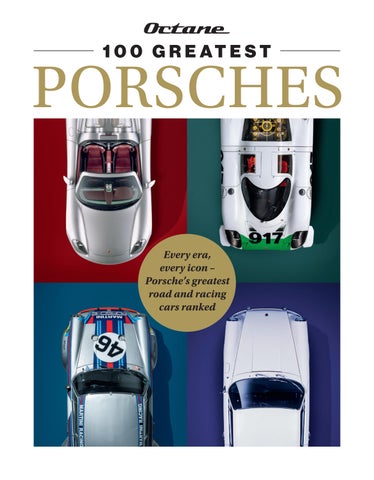
PORSCHES


Every era, every icon –Porsche’s greatest road and racing cars ranked


Welcome

Generations of greatness

James Elliott Editor-in-chief
IT IS HARD TO THINK of a motoring dynasty that has remained as steadfastedly singular for quite as long as Porsche. Even today the German manufacturer remains fiercely popular by stubbornly doing what no one else is doing – it exists on an engineering and motoring plane all of its own, as it has done ever since engineering prodigy Ferdinand Porsche created what we now call the LohnerPorsche in 1900. This car, created by a 25-year old but dreamed up years earlier, established so many firsts with its four independently electrically driven wheels and much more, that it set the template for the Porsche ethos of innovation, if not the template for its drivetrain. That said, he did follow it up by inventing the PHEV in 1901 with the Mixte!
Depending on your standpoint, the first actual Porsche – after Ferdinand busied himself with the Beetle, the Auto Union racers et al – came either in 1939 with the Type 64 or, more logically, with 1948’s unique 356/1 the mid-engined sports car that Ferdinand’s son Ferdinand (known as Ferry) came up with while his father was still incarcerated post-war (Ferdinand Snr was acquitted in 1948). With the engine moved to behind the rear axle, that one car morphed into the 356.
The next big changing of the guard was when Ferry’s son Ferdinand (known as Butzi) developed the 911 that went into production in ’64. So far, so few cars, but it was the 911 that catapulted Porsche to the heights it now occupies and is the reason we can compile a list of 100 Porsches with plenty left over. Even today, not a single car is designed or produced that cannot trace its design or styling evolution straight back to Butzi and Erwin Komenda’s original. Even through the front-engined years and SUVs, hybrids and hypercars, trace elements of that silhouette remained. That’s some legacy, not dissimilar to Lamborghini where the Miura may have planted the company’s flag in the ground, but it was the Countach that created its DNA.
And if you thought that the influence of the Porsche bloodline finished with Butzi leaving and an executive board taking the reins of the company, far from it. A member of the intertwined (financially and by marriage) Piëch family was also doing rather well. Having left Porsche, Butzi’s cousin Ferdinand (what else?) Piëch was busily turning the VW Group into the global powerhouse that it is today. Of course, VW now owns 75% of Porsche, but here’s the rub – the Porsche-Piëch family controls the VW Group. Dynasties are confusing.
EDITORIAL
Editor-in-chief
James Elliott
Writers
James Page / John Mayhead / Richard Heseltine Sub-editing / Picture research
Glen Waddington / Chris Bietzk
Designers
Debbie Nolan / Robert Hefferon
PUBLISHING AND MANAGEMENT
Managing director Geoff Love Editorial director David Lillywhite
Magazine operations coordinator Elaine Briggs
Hothouse Media
Unit 16, Enterprise Centre, Michael Way, Warth Park Way, Raunds, Northants NN9 6GR, UK www.hothousemedia.co.uk
ADVERTISING SALES
Rob Schulp (rob@flyingspace.co.uk) Sue Farrow (sue@flyingspace.co.uk)
OCTANE ADVERTISING
Group advertising director Sanjay Seetanah sanjay@octane-magazine.com
Dealer account manager
Marcus Ross marcus@octane-magazine.com
Lifestyle advertising
Sophie Kochan sophie@octane-magazine.com
Advertising inquiries
+44 (0)1628 510080; ads@octane-magazine.com
SYNDICATION AND LICENSING
Geoff Love geoff@hothousemedia.co.uk
© Hothouse Media. All rights reserved. Neither the whole of this publication nor any part of it may be reproduced, stored in a retrieval system or transmitted in any form or by any means without the written permission of the publishers.
Octane is a registered trademark.
Octane is published by Hothouse Media.
Registered address: Castle Cottage, 25 High Street, Titchmarsh, Northants NN14 3DF, UK. VAT number 309390010.
Hothouse Media uses a layered privacy notice giving you brief details about how we would like to use your personal information. For full details, please visit octane-magazine.com/privacy-policy
The publisher makes every effort to ensure the magazine’s contents are correct. All material published in Octane is copyright and unauthorised reproduction is forbidden. The editors and publishers of this magazine give no warranties, guarantees or assurances and make no representations regarding any goods or services advertised in this edition.
Octane has taken all reasonable efforts to trace the copyright owners of all works and images and to obtain permission for the works and images reproduced in this magazine. In the event that any untraceable copyright owners come forward after publication, Octane will endeavour to rectify the position accordingly.
Printed in the UK by Buxton Press Ltd Distributed by Marketforce (marketforce.co.uk) Cover photography,


PORSCHE PIONEERING SINCE THE 19th CENTURY
John Mayhead traces the remarkable, often turbulent history of a much-admired mainstay of the motoring industry
Photography Porsche
The Porsche story started not with sports cars, but with a series of pioneering electric vehicles built at the dawn of the 20th century.
When he was still in his mid-20s, Ferdinand Porsche made a name for himself as an innovative engineer by developing, for his employer Jacob Lohner & Co, a horseless carriage driven by electric motors contained within the wheel hubs. In 1901, the design was adapted to create the Lohner-Porsche Mixte, a hybrid of sorts with a Daimler petrol engine that powered a generator, which in turn provided juice for the electric motors.
In 1906 Ferdinand became the chief designer at Austro-Daimler, and he remained there until 1923, when he moved to Daimler Motoren Gesellschaft, which three years later merged with its great rival, Benz & Cie, to form Daimler-Benz. Here, as technical director, Ferdinand worked on the new Mercedes-Benz models, including the legendary supercharged, short-wheelbase SSK – among the finest of all pre-war sports cars.
In 1929, he took a similar post at Steyr, where he was responsible for introducing novel tech such as hydraulic brakes and removable cylinder heads. The company was hit hard by the Great Depression, however, and Ferdinand was made redundant in April 1930.
He decided to go it alone, and in April 1931, Dr. Ing. h.c. F. Porsche GmbH was established in Stuttgart, offering design and consulting services to the motor industry. It was a very
difficult time. The Weimar Republic was on its last legs, unemployment was surging and the German financial system was close to collapse, but Ferdinand believed that two areas of business still had the potential to generate revenue for his fledgling company: affordable cars for the masses, and motor racing.
He began developing ideas for a small car using a rear-mounted, air-cooled engine, selffunding his work at first and then creating concepts for Zündapp (the Type 12) and NSU (the Type 32), before establishing a subsidiary company to produce a rear-engined racing car (the P-Wagen). His business instincts proved to be good: in 1934, after Hitler’s rise to power, Ferdinand was commissioned to develop a people’s car, or Volkswagen. The result was, of course, the Beetle. (Ferdinand would go on to create the Volkswagen Type 82 Kübelwagen, a Beetle-based military vehicle of which over 50,000 were built during World War Two.)
Meanwhile, under the watch of Ferdinand’s son, Ferry, the P-Wagen concept was taken up by Auto Union and developed throughout the 1930s into a series of race-winning and recordbreaking cars – the Types A, B, C and D.
During World War Two, Ferdinand served as the head of the German Tank Commission based at the Volkswagen plant in Wolfsburg, and he created various designs including the Elefant tank destroyer. When the tide of the war turned in 1944, he upped sticks for Austria, moving family his to Zell-am-See and his office to a former sawmill in Gmünd.
He faced war crimes charges after the conflict on account of the work he did for the Nazi regime, and he spent nearly two years in custody, not being released on bail until July 1947, and not being formally acquitted until May 1948.
The following month he witnessed the birth of the first car to wear the Porsche badge, the 356/1, conceived by Ferry and brought to life in Gmünd. Two years later, the Porsche company relocated back to the Zuffenhausen district of Stuttgart, and production of the 356 ramped up.
THE 356 BROUGHT together and built upon many ideas that Ferdinand had developed: the aerodynamic body by Erwin Komenda drew from the Auto Union streamliners, and the car was (at least initially) mechanically similar to Ferdinand’s iconic Volkswagen. The idea wasn’t to build the most luxurious car in the world, but to create a sports car that was light and agile. Among the first to recognise the virtues of the model was US-based car importer Max Hoffman, who would play a key role in helping Porsche to break into the American market.
The marque’s desirability was helped, too, by the success of the 356 in motorsport. The model scored one of its most famous class wins in the 1954 edition of the Carrera Panamericana, a tough and all-too-often deadly road race in Mexico. To celebrate, Porsche unveiled a new, high-performance version of the 356 called the Carrera, complete with a highly sophisticated four-cam engine that is still revered today.
Further competition success followed courtesy of the 550, the 550A, the 718 and the 904 before Porsche ushered in a new era in the history of the marque by introducing a design initially called the 901.
In layout this sleek new car was similar to the 356, but the engine mounted at the rear was now a flat-six instead of a flat-four. First seen in 1963, the car was renamed the 911 and entered full production in 1964. The 911 model range expanded quickly, and in 1965 Porsche added a four-cylinder entry-level relative, the 912, which sold well in the US market.
The racing department was busy all the while, and a long-held ambition to claim an outright win at the 24 Hours of Le Mans was eventually realised in 1970, when a 917K shared by Hans Herrmann and Richard Attwood roared its way to 1st place in a particularly attritional race; only 16 cars were still running at the end, of which 12 were Porsches, including seven 911s.
Hot 911s would be a force in GT racing and in rallying throughout the 1970s, and there would be more glory for Porsche protoypes at Le Mans, and just about everywhere else that they were entered. On the road, the G-series


Left and below
The oldest surviving 356 built in Germany (rather than Austria) as it appeared at the 1950 Reutlingen Motor Show; Porsche’s stand at the 1954 Geneva Motor Show.
911 with its idiosyncratic ‘impact bumpers’ made its debut in late 1973; it would last in modified form until 1989. A landmark moment came in October 1974, when the first 911 Turbo was revealed at the Paris Motor Show, and two years later Porsche would break new ground again by launching a front-engined sports car, the 924. This comparatively inexpensive car and its front-engined relatives – the 928, the 944 and the 968 – were popular and provided an important source of revenue for Porsche, even if they puzzled 911 loyalists and some in the motoring press.
The 1980s saw Porsche consolidate its place among the world’s most important car
‘A Porsche finally won Le Mans outright in 1970 –and of the 16 cars that finished that year’s brutal race, 12 were Porsches’
manufacturers, and, to the chagrin of its rivals, it only became more dominant on the racetrack. Between them, the 936, 956 and 962 ensured that a Porsche won the 24 Hours of Le Mans every year between 1981 and 1987, and in most years other marques couldn’t even squeak their way onto the podium. In the Deutsche Rennsport Meisterschaft and the ADAC Supercup that succeeded it, Porsche was almost untouchable.
It was competitive elsewhere, too, notably winning the Paris-Dakar Rally in 1984 (with a modified 911 dubbed the 953) and in 1986. Its weapon of choice that year was the 959, which in street clothes was the fastest roadlegal production car of its time, and a pin-up for young motoring enthusiasts the world over.
TAG-branded engines, designed by Porsche for the McLaren Formula 1 team, helped secure three F1 Drivers’ titles between 1984 and 1986; and in 1987 Porsche – understandably now believing it could win any championship it cared to – turned its attention to the IndyCar World Series. Things didn’t quite go to plan across the pond, but Porsche persevered for long enough to record a race win, which was delivered by Teo Fabi in September of 1989. Back at the factory in Zuffenhausen, the staff were assembling examples of an ‘85% new’ 911, the 964-generation car, which had arrived at the end of 1988, bringing with it Porsche’s novel Tiptronic automatic transmission.


The 100 Greatest Porsches History of an iconic marque
‘Porsche enjoyed massive growth through the 2000s and 2010s as it went hunting for customers in all sorts of market segments. Annual sales passed 300,000 by 2021’


IN 1994, THE 964 was replaced by the 993, which won praise for its so-called LSA (Light, Stable, Agile) aluminium chassis, multi-link rear suspension, easy revving air-cooled engine and new, six-speed manual gearbox.
It’s fair to say, though, that success – in all areas – came less easily to Porsche in the 1990s than it had done the previous decade. For less than one half of a season the marque returned to F1 with Footworks; in six Grands Prix at the start of 1991, the team’s Porsche-powered cars didn’t manage a single finish, and Cosworth engines were used thereafter. In endurance racing, it was increasingly left to customer teams to defend Porsche’s honour, though they did a sterling job of it. The factory team won at Le Mans in 1998 with its GT1, but only after missing out on top honours two years in a row.
Away from the track, the company had to navigate its way through a major recession and a downturn in fortunes. In the mid-’90s, sales were worryingly low, and production costs were unsustainably high. Things had to change, and the 996-generation 911, which came along in 1997, represented a concerted attempt to right the ship.
The new car was radically different from those that had gone before it, featuring a watercooled engine and styling by Pinky Lai that was less deferential to the original 911 shape, and it had a good deal in common – both mechanically and visually – with the entry-level Boxster that had been introduced in 1996.
The two cars had been developed in parallel for entirely understandable reasons, but there was a cohort of 911 fans that just wasn’t interested in the business rationale behind the new model, nor in judging it on its own merits. Porsche had a particularly tough moment when the car’s engine began getting a reputation for intermediate shaft bearing and rear main seal failures, bore scoring and other cylinder issues. The cost of fixing these issues was high, but both the new 911 and the Boxster sold well enough, particularly in the USA, to return the company to profitablility. Annual sales increased as variants were added to the line-up, and in 2002 – a year in which Porsche opened a new production facility in Leipzig and unveiled the daring Cayenne SUV – the company shifted 66,803 cars.
PORSCHE ENJOYED massive growth through the rest of the 2000s and the 2010s. The company went hunting for customers in all sorts of segments of the car market, launching entry-level sports cars (Cayman), bleedingedge hypercars (918 Spyder), luxury saloons and estates (Panamera, Taycan), SUVs (Macan), and of course more varieties of 911 than we could possibly list here, from plush mile-munchers to race-bred rocketships. Annual marque sales passed 300,000 by 2021. Motorsport success during the period was often delivered by the 911 GT3, which remained consistently competitive in the hands
Left and below left
The
of
of the many privateers that adopted it. In 2014, though, the works team returned to the top class of endurance racing at Le Mans after a 16 year absence, and in 2015 it won the world’s most famous 24-hour race with the 919 Hybrid – then repeated the trick in 2016 and 2017.
Beyond the production line and the track, Porsche revamped its dealer network and expanded into new markets including China. It set up Porsche Classic to support older models. And it greatly expanded the range of products offered through Porsche Design.
The company structure changed, too, in ways that delighted newspaper editors looking for a juicy story. In 2008, Porsche SE, the holding company representing the Porsche-Piëch family, attempted to take over Volkswagen Group but, despite taking on €10bn in debt, it failed to secure 75% of shares. Volkswagen responded by buying just under 50% of Porsche AG (the public company formed by Ferry Porsche from the family-run company in 1972) and then the remaining stake in 2012, giving it total control of the company… except Porsche SE retained a controlling stake in Volkswagen. In 2022, Porsche AG was listed on the Frankfurt Stock Exchange, allowing the public to buy shares in the company for the first time (at the time of its listing it was Europe’s biggest IPO by market capitalisation) and as a result of the IPO, Porsche SE and the PorschePiëch family now hold direct ownership over the Porsche brand.


THE MEN BEHIND THE MARQUE
James Page profiles a dozen of the characters who helped build Porsche into a powerhouse
Photography Porsche

FERDINAND PORSCHE
Even if the company he founded had never gone on to make its own cars, Ferdinand Porsche would still be remembered for having had a remarkable career. Ferdinand was born in 1875 in Maffersdorf, which is today part of the Czech Republic. His early passion was for electricity, and after moving to Vienna he found a way to combine this with a growing interest in cars.
Shortly before the turn of the century, the young Ferdinand landed a job with Jacob Lohner & Co and developed a car that was driven by electric motors incorporated into the wheel hubs. He then came up with a pioneering ‘hybrid’ system in which a petrol engine powered a generator that sent a charge to the electric motors. He was clearly a talented engineer, and his reputation grew in the years he spent working for AustroDaimler, Daimler, and Steyr.
In 1931, he started his own consultancy firm in Stuttgart with support from Anton Piëch and Adolf Rosenberger, and he developed the P-Wagen racing car. This rear-engined design was adopted by Auto Union, which, along with MercedesBenz, dominated Grand Prix racing throughout the 1930s. Of greater lasting significance to the motoring world was the fact that, in 1934, Ferdinand was awarded a contract to develop an affordable ‘people’s car’ –
the Volkswagen. His proposal, which we would come to know as the Beetle, not only remained in production for 65 years but also served as a critical building block for the first car to wear the Porsche badge, the 356.
The post-war period was tough for Ferdinand, who was imprisoned for nearly two years by the French authorities due to his wartime work for Germany’s Nazi government. He died on 30 January 1951, a few weeks after suffering a stroke.

FERRY PORSCHE
Born in 1909 while his father was working for Austro-Daimler, Ferdinand Anton Ernst Porsche – known as ‘Ferry’ – was the second child of Ferdinand and Aloisia Porsche.
Fascinated by cars from an early age, he worked alongside his father from 1931 and helped to run the Porsche company throughout World War Two, relocating most of its work to
a sawmill in Gmünd, Austria, to escape the Allied bombing of Stuttgart.
In December 1945, he was arrested along with his father by the French authorities but, unlike Ferdinand, Ferry was released the following year. He and his sister, Louise, then established an Austrian-based firm, Porsche Konstruktionen GmbH, and secured a vital commission from Piero Dusio to develop a new Cisitalia Grand Prix car.
This contract brought in some much-needed funds and allowed Ferry to pursue his dream of building a Porsche sports car. Working with Karl Rabe and Erwin Komenda, he came up with the ‘Type 356’, which initially relied heavily on Volkswagen components. Starting in 1948, a short run of cars was built in Austria before Ferry struck a lucrative deal to provide design services to Volkswagen, and moved most operations back to Stuttgart in
1950. The Austrian business continued, switching its focus to importing cars. It was run first by Anton Piëch and then by Louise, whom Piëch had married in 1928.
Ferdinand Porsche may have established his eponymous company and its reputation for first-rate engineering, but it was Ferry’s talent and determination – plus that of Louise, of course – that ensured it survived the post-war years and thrived as a manufacturer of its own cars.

ERNST FUHRMANN
Vienna-born Fuhrmann was one of Porsche’s first post-war employees, joining the design office in 1947 when it was still based in Gmünd. Three years later, he earned his doctorate in mechanical engineering.
Soon after that, Ferry Porsche tasked him with developing a high-performance version of the 356’s engine. Fuhrmann, who had written his thesis on ‘Valve Trains for High-Speed Combustion Engines’, came up with a high-revving, quad-cam design that was designated the Type 547, but which has since become known simply as ‘the Fuhrmann engine’. It powered not only the 356 Carrera, but also sports-racing cars such as the 550 Spyder and the 718. Fuhrmann left the company in 1956 after being overlooked for the role of technical director, only to return in the 1970s after Porsche was restructured. As CEO throughout that decade he was a keen supporter of the 928 programme, but he was seemingly less convinced about the long-term future of the 911. Fuhrmann departed in 1980 after a year of declining sales and was replaced by Peter Schutz – and the 911, of course, remained in production.


MAX HOFFMAN
A car dealer extraordinaire who emigrated from Austria to the USA in 1941, Max Hoffman helped to popularise many European marques in the North American market, operating from 1955 out of a swanky, Frank Lloyd Wright-designed showroom on Park Avenue in Manhattan.
In 1950 he ordered two early 356s – the first to be brought into the US. Impressed by the cars, Hoffman travelled to the 1950 Paris Motor Show to meet Ferdinand Porsche, and soon became Porsche’s American importer. Story has it that he persuaded Ferry Porsche to create the famous Porsche crest, and he was also the driving force behind the creation of the 356 Speedster.
Following the formation of the Porsche of America Corporation in 1959, Hoffman’s role was reduced to selling cars in the eastern States only, and his deal with Porsche came to an end in 1964. He nonetheless continued to speak warmly of the Porsche family, and there’s no doubting his importance during the marque’s formative years.
FRITZ ‘HUSCHKE’ VON HANSTEIN
Look closely at any photo taken in the pits of a major motor race during the 1950s and ’60s, and you’ll likely spot the smiling face of Fritz von Hanstein. The son of a Prussian military officer, ‘Huschke’, as he was known, joined Porsche in 1951 and was part race director, part PR officer. He was a useful racer himself: he first competed in 1929 on motorcycles before switching to cars and enjoying successes including a win in the 1940 Mille Miglia in a BMW 328.
Von Hanstein continued to race after World War Two, and in 1956 he entered the record books as a Targa Florio winner, although he never actually took a stint in the victorious Porsche 550A Spyder: his ‘co-driver’, Umberto Maglioli, chose to stay behind the wheel for all 10 laps and eight hours of the race even with a pitiless sun frying his skin! Von Hanstein eventually stepped back from driving to concentrate on his management duties, and Porsche’s race team went from strength to strength under his stewardship.
HANS MEZGER
Engineer Mezger joined Porsche after graduating from Stuttgart Technical University in 1956 –rejecting no fewer than 28 other job offers to do so.
After cutting his teeth on the four-cam ‘Fuhrmann’ engine and the powerplant for the 804 Formula 1 car, he designed the air-cooled flat-six that was fitted to the new 911 at launch. He then switched to race development and led design work on the engines for iconic sports-racing cars such as the 908 and 917.
Mezger was instrumental in Porsche’s decision to adopt turbocharging technology in the 1970s – a decision that resulted in a period of stunning dominance in sports-car racing and eventually led to the creation of the 911 Turbo. And his TAG-badged turbocharged engines powered Niki Lauda and then Alain Prost to a trio of Formula 1 Drivers’ titles in 1984, 1985 and 1986.
Mezger retired from Porsche in 1993, but as late as 2011 the 911 was still using derivatives of the ‘Mezger’ flat-six engine. A remarkable legacy for a truly remarkable engineer.


BUTZI ’ PORSCHE
Grandson of Ferdinand and eldest son of Ferry, Ferdinand Alexander Porsche was born in 1935 and became known as ‘Butzi’. He studied at the Ulm School of Design, and joined the family business in 1958, going on to get involved with design work not only for the 911 but also for the beautiful little 904.
In 1972, Porsche became a public limited company and the family stepped away from day-to-day operations. Butzi subequently set up a studio called Porsche Design, which was initially based in Stuttgart before moving to Zell am See, an Austrian town with which the family had strong ties. He designed everything from sunglasses and watches to household appliances, and continued to be a shareholder in Porsche AG, as well as serving as a board member. When ill health forced him to retire in 2005, he was given the title of Honorary Chairman of the Supervisory Board. Butzi died in 2012, but Porsche Design lives on as a majority-owned subsidiary of Porsche AG.

FERDINAND PIËCH
For decades one of the motor industry’s heavy hitters, Piëch was born in Vienna in 1937. His father, Anton, was a co-founder of the Porsche company, while his mother, Louise, was the daughter of Ferdinand Porsche.
Piëch joined Porsche in 1963, in the engine testing department. Ambitious and energetic, he was soon handed responsibility for all development and testing, and he really made a mark when he spearheaded the creation of the 917, willing the sports-racer to completion and fending off criticism from the bean counters.
(‘Piëch was getting hell for spending all the company’s money on the 917,’ remembered Porsche driver Vic Elford.) His belief in the car’s potential was, of course, vindicated.
He moved to Audi in 1972 and oversaw the development of the groundbreaking fourwheel-drive quattro. Then, in 1993, he joined Volkswagen. Piëch revived the struggling company, which on his watch acquired Lamborghini, Bentley and Bugatti, and he remained a key figure on its supervisory board even after officially retiring in 2002.

‘Mezger joined Porsche in 1956, rejecting no fewer than 28 other job offers to do so’

JÜRGEN BARTH
Other racing drivers may have had more success in Porsche cars than Jürgen Barth, but few have been such an integral part of the company.
Jürgen’s father, Edgar, raced for Porsche during the 1950s, most notably winning the 1959 Targa Florio in a little 718 RSK shared with Wolfgang Seidel. Tragically, Edgar died of cancer in 1965 aged just 48, but the Barth family’s relationship with Porsche would continue: Jürgen had been taken on as an apprentice in 1963.
At Porsche, the young Jürgen worked in the press department and was involved with both the racing and rally programmes, and he also helped to establish the in-house archive and the works museum.
Along the way, he became a very fine driver. The undoubted highlight of his racing career came in 1977, when he won the 24 Hours of Le Mans in a 936 shared with Hurley Haywood and Jacky Ickx. He was back on the podium in 1982, and was still adding to his collection of Le Mans class wins as late as 1993, and he continued to work for Porsche right up to his wellearned retirement in 2007.

PETER FALK
Porsche’s accomplishments in Group C racing during the 1980s have been well documented. Often overlooked is the fact that at the same time as dominating at Le Mans and in the World Sportscar Championship, Porsche was also winning F1 titles with McLaren and even conquering the Paris-Dakar Rally. And masterminding all this success was the tall, calm, modest figure of Peter Falk.
After studying mechanical engineering, Falk took a job at Porsche in 1959 and quickly made a name for himself working in the experimental department and in race support. His versatility was such that he could seamlessly move from the 917 competition programme to overseeing the testing and development of road cars such as the 911, 924 and 928.
After acting as race director throughout the 1980s and the heady days of the 956 and 962, he served as head of chassis development while Porsche was working on the 993 generation of the 911. He retired in 1993, and passed away just this year at the grand old age of 93.

by becoming a racewinning driver for
Below Wendelin Wiedeking turned Porsche around in the 1990s with his relentless focus on profitability, but was ousted by the board following a headline-making attempt to acquire VW.

HARM LAGAAY
Dutch-born designer Harm Lagaay came to Porsche from Simca in 1971 and worked under Anatole ‘Tony’ Lapine (another significant figure in marque history) on the 924 and the 928, as well as on updating the 911.
After stints with Ford and at BMW, where he styled the Z1, Lagaay returned to Porsche in 1989 and led the company’s design department for the next 15 years.
Under his direction, the team came up with the 993 generation of the 911. Then came the Boxster and the 996-generation 911, two cars developed in parallel and with much in common, as required by Wendelin Wiedeking’s new production regime (see right).
Subsequent designs delivered on Lagaay’s watch included the Cayenne SUV – a critically important car to Porsche from a commercial point of view –and the fabulous Carrera GT, which Lagaay himself rates as the highlight of his long and illustrious career.
WENDELIN WIEDEKING
Porsche was not in a good place at all when Wendelin Wiedeking took the reins in 1993. Production processes were inefficient and expensive, sales were plummeting, and losses were mounting. But under Wiedeking, who had trained as a mechanical engineer, Porsche became one of the most profitable car manufacturers in the world.
After a five-year stint with the company during the 1980s, Wiedeking returned in 1991 as production director before becoming CEO. He brought in consultants from Japan to revolutionise working practices at the factory; the workforce was reduced; and the 928 and 968 were both dropped. In their place came first the ‘entry-level’ Boxster and then the Cayenne SUV, plus the flagship 911 got an overhaul and, for the first time, a water-cooled engine.
Sales boomed and Porsche’s fortunes had been transformed by the 2000s, but an audacious and politically unwise attempt to take over Volkswagen (run at the time by the wily and fiercely competitive Ferdinand Piëch) fell apart, and Wiedeking was forced to step down from his role in July of 2009.


WHAT PRICE PERFECTION?
Market expert John Mayhead analyses the post-Covid values of four benchmark Porsches, and peers into the future

PORSCHE
356 CARRERA 2
The ultimate performance iteration of the Porsche 356 was the Carrera 2, launched in 1963 and available as a coupé or a cabriolet. Fitted with a 2.0l four-cam engine derived from that used in the race-winning 550 Spyder, the car had a top speed of over 120mph, and was reined in by new ATEmanufactured disc brakes. It was well received by the motoring press, but then journos didn’t have to pay to play; the Carrera 2 was expensive, with list prices of around £5000 that inevitably limited sales – a Jaguar E-type cost less than half as much. The model was popular for a long time with collectors, and values in the UK spiked after the Covid pandemic, but have since dropped back and stabilised. The long term outlook is mixed: exceptional examples, especially of the rarer 356C models built in 1964 (and in particular the 30 or so cabriolets), will continue to be extremely collectable, though the market for them may shrink as the years progress.
Porsche 356C Carrera 2 Coupé
The UK Hagerty Price Guide ‘excellent’ value of the model has stabilised since a sharp rise back in 2022.
Values in GBP (£)

PORSCHE
911 2.7 RS
Porsche collectors have long considered this the ultimate of the first-generation 911s. Prices consequently rose, with the most recent notable increase in 2022. Since then, prices have fluctuated a little but the trend is relatively stable overall. Collectors know what they want: preferably one of the 200 Lightweight cars in exceptionally original condition, and failing that a car restored to exacting standards by the right specialists or by Porsche itself. Racing history can be a double-edged sword. A past including wins achieved by famous drivers can, of course, add value, but a car that toiled in anonymity, suffering the usual hardships of a competition career but collecting no trophies, might have its racing past held against it. The outlook is fair: although a high-quality 2.7 RS will always be a very collectable car, those who can remember the model when new are possibly of the age when they are reducing rather than adding to their collections.
Porsche 911 2.7 RS
US and UK Hagerty Price Guide ‘excellent’ values have roughly tracked each other and have stabilised since a sharp rise in 2022.
Values in GBP (£)
‘The kids of the 1980s are now the driving force behind the collector car market, so it’s no surprise that 959 prices have increased in recent years’

PORSCHE 959
Back when Group B rally regulations allowed cars with pretty much any technology as long as at least 200 roadgoing examples were built, Porsche created the 959, the most advanced supercar of its day, and, as any child of 1980s knows, a guaranteed winner in a game of Top Trumps. The kids of the ’80s are now the driving force behind the collector car market, and so it’s no surprise that 959 prices have increased in recent years. The standard ‘Komfort’ model has roughly doubled in value in the past five years, while the more track-focused ‘Sport’ version has made gains of around 75%. Production of the 959 came to an end in 1988, but between 1992 and 1993 Porsche assembled eight more cars from spare parts, these featuring a newly developed, speed-sensitive damper system. Sold to select customers in period, they were more expensive than the regular-production cars, and also command higher prices in the collector car market today.
Porsche 959 Komfort
US and UK Hagerty Price Guide ‘excellent’ values have roughly tracked each other over the last three years, with both more than doubling since 2021.
Values in GBP (£)

PORSCHE CARRERA GT
The Carrera GT was hailed as a masterpiece when it was launched in 2003, and despite the high sticker price (£300,000) it sold reasonably well, with Porsche building 1270 examples before production ended in 2006. More than 20 years on, the car remains among the most thrilling of all Porsches. Its mid-mounted 5.7-litre V10 is controlled via a manual six-speed gearbox, redlines at 8200rpm, and can shove the car all the way to 205mph. Harm Lagaay’s design, from a concept by Jason Hill, still looks remarkably modern. Prices in the US and UK have tracked each other in recent years, dropping back after a Covid-era spike, but then rising again in the past 18 months. In November 2024, a 267-mile, US-spec car complete with all the extras (luggage, hardtop) sold for more than $2m in Las Vegas. The outlook is good: the market at this sort of value and above is all about analogue supercars, a category that the Carrera GT epitomises.
Values in GBP (£)


PORSCHE
MISSON X
When the Mission X concept was revealed back in 2023, Porsche was not bashful about declaring its ambitions for the car. ‘Many Porsches have created history,’ the PR blurb went. ‘The Mission X is about to create the future. It will set new standards for the development of futuristic vehicle concepts. This is our vision of the fastest road-legal vehicle on the Nürburgring’s Nordschleife.’
It certainly looked the part. Resplendent in ‘Rocket Metallic’ paint, the Mission X was obviously influenced by Porsche’s previous no-holds-barred effort, the 918 Spyder, but there were also numerous nods – including the 917-inspired dihedral ‘Le Mans’ doors and the 906-inspired headlights – to other great Porsches of the past.
Specifics of the proposed electric powertrain were not forthcoming, but Porsche indicated that it envisioned the Mission X boasting a 1:1 power-to-weight ratio, and it went on to add that the car would offer more downforce than a 911 GT3 RS.
There were all sorts of interesting details in the cockpit, including an open-top, aeroplanestyle steering wheel; custom-fit 3D-printed seats; and a curved display that shows different clusters of digital instruments depending on whether the car is being driven on the road or on the track.
It remains to be seen if the concept will be turned into a Nordschleife-lap-record-breaking reality, but Porsche insiders claim that a production version of the Mission X could conceivably be delivered as soon as 2027. We won’t hold our breath, but we’ll certainly be keeping our fingers crossed.


‘Mid-engined road cars were almost unheard of at the time, and blazing a new trail caused a few headaches’

PORSCHE 356/1
8June 1948. For the most part, it was a Thursday like any other, but it was also the day that Porsche registered its first car, referred to as 356/1. This roadster may have been on the small side, but it proved to be enormously influential.
It was, we should mention, predated by a machine known as the Type 64, and some historians argue that this should be regarded as the first Porsche. Others disqualify it because although the Type 64 was unambiguously the work of Ferdinand Porsche and in some ways paved the way for the 356 to come, it was created at someone else’s behest. We’ll call it a proof of concept. It’s also interesting to note that the Volkswagen Beetle, designed by Ferdinand, was referred to internally during development as the Porsche Type 60.
The 356/1 was a basic design, one mapped out in mid-June of 1947 under the direction of Ferdinand son, Ferry. VW parts including the
1.1l flat-four engine, the transmission and the suspension were installed in a tubular chassis, with the distinctive ‘bathtub’ bodyshell being fashioned by hand from aluminium.
Intriguingly, the engine here was positioned amidships. Mid-engined road cars were almost unheard of at the time, and blazing a new trail caused a few headaches. The location of the flat-four was obviously ideal in terms of weight distribution, but it made cooling the thing a pain.
The layout also limited cabin room, and necessitated the use of multiple serpentine linkages for the transmission (gear changes were notchy at best). By the time car was completed, the Porsche clan had already decided that the next car would have the engine placed behind the rear axle in order to provide more interior space. The 356/1 was sold in period to Rupprecht von Senger of Zurich and now lives in the Porsche Museum.

The entry-level 924 was a good car in some ways, and a great one in others, and it brought into the Porsche fold many customers who couldn’t stretch to a 911 or a 928.
Nevertheless, there were some folk who could not forgive it for having an Audi-derived engine. It’s hard to believe in retrospect, but some in the media also criticised it for being a bit dainty. It didn’t look aggressive enough, apparently. Porsche responded by producing the 944, which sat between the 924 and the 911 SC in the model range, and it was very much a ‘true’ Porsche even if assembly was contracted out to Audi.
The 944 was introduced in late 1981. The body design was clearly rooted in that of the 924 but its wings were notably wider, giving

the new car a much more muscular appearance. The four-cylinder engine was new although it shared some DNA with the V8 that powered the 928. It featured a cast-aluminium block, and initially developed 163bhp at 5800rpm. At 2479cc, it had a relatively large displacement for a four-cylinder engine.
Like the 924, the 944 employed a transaxle arrangement, with the engine at the front and the transmission at the rear, the two joined by a rigid tube that housed a rotating driveshaft. The base model weighed in at 1180kg, and according to Porsche’s own figures it could do 0-60mph in 8.4sec and hit a top speed of 137mph. Turbocharged and soft-top variants followed, along with a one-make ‘Cup’ racer, with 163,302 cars of all types being made to the end of production in 1991.


‘Porsche responded to criticism of the 924 by introducing the more muscular 944 in 1981’

CAYMAN 981 CLUBSPORT
Having for many years focused its efforts on circuit racing, Porsche annouced in 2018 that it would be returning to rallying, sort of. There would be no immediate Dakar Rally entry or assault on the WRC, but the factory motorsport department would work to transform the brand new Cayman 718 GT4 Clubsport into a rally machine compliant with FIA R-GT regulations. These had been devised a few years earlier in a bid to attract modified production sports cars into rallying, and privately prepared Porsches were already competing in the R-GT Cup.
The first step in the process would be to deliver a proof of concept using as a platform the outgoing Cayman 981 GT4 Clubsport, which had a 3.8l naturally aspirated flat-six that produced 385bhp and 385lb ft of torque.
Two prototypes were built, and one of them served as a course car on the 2018 ADAC Rallye Deutschland, getting a warm reception. Demonstration runs on snow and ice were then arranged for January of 2019. Neither prototype was campaigned in anger – and we’re still waiting for a ‘production’ Cayman rally car to emerge from Weissach. Hurry up, Porsche…

TAYCAN TURBO GT
Packing the sort of power that would put most dragsters to shame, the Turbo GT is the most extreme version yet of Porsche’s Taycan luxury EV.
The original Taycan was revealed at the 2019 Frankfurt Motor Show, where members of the motoring press were agog at a spec sheet that promised 751bhp for the range-topping Turbo S model. Incredibly, the Turbo GT, introduced for the 2025 model year, makes the Turbo S seem
pedestrian: the maximum output of the newer car’s twin electric motors when using the Launch Control function is 1094bhp.
Maximum torque is 914lb ft.
The car has a top speed of ‘just’ 180mph in standard form but, as you can imagine, it gets moving in an awful hurry. The acceleration of the Turbo GT is astonishing, with the speedometer showing 60mph after 2.2sec, and 124mph (200km/h) after 6.6sec.

‘The car has a top speed of “just” 180mph in standard form, but it gets moving in an awful hurry’
Choose the optional Weissach Package (more aero, less weight, in a nutshell) and those times drop to 2.1sec and 6.4sec, while top speed rises to 190mph. The Turbo S, in comparison, takes a whole 1.3sec longer to get to 124mph.
These numbers, it’s worth pointing out, are Porsche’s own. Perhaps they’re stretching the truth a bit? Well, when Car and Driver tested a standard Turbo GT in late 2024, it recorded a 0-60mph time of 1.9sec. Madness.

PORSCHE
909 BERGSPYDER

Porsche dominated the European Hillclimb Championship in the 1960s with cars including the short-lived 909 Bergspyder. This little screamer, powered by a 275bhp flateight engine, was built to take advantage of 1968 EHC rules that specified a maximum engine capacity (2.0l) but no minimum weight. The man behind its creation, Ferdinand Piëch, would apparently place a magnet to the car during development, trying to detect any area where his engineers had dared to use heavy steel. His uncompromising approach resulted in a car that was frighteningly flimsy, but which weighed all of 385kg – with fuel! It could reportedly hit 62mph (100km/h) in 2.4sec.
Porsche won the 1968 EHC at a canter using mostly the proven 910, but the new 909 was given two outings: Rolf Stommelen drove one of two examples built to a 3rd-place finish at Gaisberg, and came 2nd at Mont Ventoux. The car’s competition career ended there, sadly, with Porsche focusing on circuit racing for 1969, but the 909 Bergspyder did inform the design of future Porsches, among them the 908/3.

Porsche has acted as a design consultancy for much of its history, cooking up everything from engines to entire cars for marques as diverse as Studebaker, Seat, Audi and Lada. Sometimes its involvement in a project is trumpeted loudly. Other times, not so much…
This rather plain prototype, tellingly, did not wear the Porsche badge. The C88 was developed at the request of the Chinese government, which tasked Porsche with creating a new ‘people’s car’. Porsche’s design would go head to head with concepts from other manufacturers and consultancies, with the winner earning its
maker a lucrative joint venture with China’s state-owned First Automotive Works (FAW).
The C88 employed a 1.1l flat-four engine that Porsche stated would produce 48-68bhp, and the car would be capable of around 100mph. The prototype was displayed at the International Family Car Congress in Beijing in November 1984. The promised contract, it seemed, was either going to Porsche or to Mercedes-Benz… but then it all went very quiet. The contest was abruptly cancelled. There was no contract. It was all for naught. The sole C88 prototype now lives in the Porsche Museum in Stuttgart.

‘The Chinese government tasked Porsche with creating a “people’s car”’

TURBO S (992)
Just three days before the 2020 Geneva Motor Show was due to open to the media, the organisers were forced to cancel the event due to the spread of Covid-19, and so Porsche was in turn forced to present the new, 992-generation 911 Turbo S online. The car deserved better – it was, after all, the fastest production 911 ever.
Powered by a 3.7l twin-turbo flat-six making 641bhp and 590lb ft of torque, it could sprint from a standing start to 60mph in 2.7sec, and it had a top speed of 205mph.
It retained its crown until 2025, when the 992.2-generation 911 Turbo S came along. The new challenger could only manage 200mph flat-out, but was quicker to 60mph by 0.2sec. With a hybrid 3.6l engine featuring two electric turbochargers, it had 701bhp at its disposal, giving it a slightly higher power-to-weight ratio than its predecessor even though it was 85kg heavier. It was 14sec quicker around the Nordschleife, too, thanks in part to its improved aerodynamics: with Jörg Bergmeister at the wheel, it clocked a lap time of 7:03.92.

‘THE 992-GENERATION 911 TURBO S ARRIVED IN 2020 AS THE FASTEST

PORSCHE
Like the 914 before it, the 924 was born of a collaboration between Porsche and Volkswagen, with the former contracted to design the car on behalf of the latter in 1972. Porsche worked up 1:5-scale models of three concepts, and VW selected a wedge-shaped option by Harm Lagaay – but requested that it be modified to include the large rear window seen in the proposal from Richard Söderberg.
In 1974 the car, referred to internally by the project number EA 425, was about ready when VW got cold feet, the recent oil crisis having made it question the wisdom of launching a new sports car. So Porsche bought the design back from VW and arranged for it to be built at the Audi factory in Neckarsulm.
The crisply styled 924, the first front-engined production Porsche, was revealed in late 1975 and became an important money-maker for the marque. Including all variants, 152,082 examples were sold – enough that VW bosses no doubt had the odd regret about ditching it.

‘The 924 was about ready when VW got cold feet, the recent oil crisis having made it question the wisdom of launching a new sports car’

While the smart 924 was popular with the general public thanks to its wallet-friendly price (in the UK the base model cost just under £7000 at launch), it was initially treated uncharitably by Porsche fans and by journalists. The car’s handling was praised, but the 924 was ‘a VW trying very hard to be a Porsche’ according to the great Bill Boddy. Edouard Seidler wrote in Motor Trend: ‘There is as much difference between the 911 engine and this four-cylinder Audi-[derived] powerplant as jazz buffs will find between Louis Armstrong and a modern pop singer.’
Porsche made small upgrades before giving the car a big infusion of street cred for 1979 by turbocharging the engine of which Seidler had been so dismissive, boosting its output from 123bhp to 168bhp. The 924 Turbo could do 0-60mph in 6.9sec and 142mph flat-out, making it a legitimate rival – in pure performance terms, at least – to pricier cars including the Aston Martin V8 and Porsche’s own 911 SC. In Motor Sport in 1980, Clive Richardson had to concede that the car’s origin story could no longer be held against it. ‘Here, he wrote, is a VW which has grown up into a Porsche.’
PORSCHE 911 GT3 RS (991)
Like other cars in the range of seventhgen 911s, the 991-series GT3 wasn’t rapturously received. Introduced at the 2013 Geneva Motor Show, it suffered in comparison with its predecessor: it was heavier and more complicated; it was missing a manual gearbox; and its engine was not in the lineage of the much-loved ‘Mezger’ design that had for so long been a foundational building block of the 911.
On the flipside, the car was mind-bendingly fast, and its new 3.8-litre flat-six redlined at a dizzying 9000rpm. And Porsche did eventually come round to the idea of offering the car with a manual gearbox.
There were, though, some issues concerning engine reliability to begin with. These were ultimately traced to a set of bolts made from the wrong alloy. Happily, the problem had been sorted out by the time the RS edition arrived at the Geneva Motor Show in 2015. Packing a 4.0l flat-six, this new strain came with the Club Sport package (a bolted-in roll cage and a sixpoint harness) as standard. It featured bucket seats based on those from the 918 Spyder hypercar, and it could sprint to 60mph in just 3.3sec, and on to 184mph. A thrilling machine – even if, unlike the GT3, it was only ever offered with a PDK transmission.


‘Happily, the reliability issues that plagued the GT3 had been sorted out by the time the RS edition arrived in 2015’

PORSCHE
911 SC
The job of car designers was made harder in the 1970s by new safety and emissions regulations rolled out in the USA. One of these, introduced with the aim of preventing low-speed collisions from damaging lights and other essential kit, required cars to wear bumpers capable of shrugging off a 5mph impact.
Cars such as the Lamborghini Countach were fitted with absurd, dodgem-style black bumpers for the US market, but Porsche was determined that the 911 not be similarly defiled, and came up with a better solution that was implemented on all cars – whether destined for the US or not – from 1974, when the G-series 911 arrived. Body-colour bumpers were mounted proud of the nose and tail on aluminium tubes, with rubber trim covering the gaps between bumper and body. At the front of the car, the corner grilles of old were gone, and the indicators were integrated into the bumper. Neat work.
Porsche had more difficulty figuring out how to deal with the US emissions rules of the time, but from 1978 on, European and American buyers were able to enjoy strong performance and reliability without remortgaging the house thanks to the 3.0l 911 SC – a model that is appreciated today as one of the most usable and fairly priced of all classic air-cooled 911s.
Above and right
The 911 SC in Targa form, sporting the post-1973 ‘impact bumpers’ that were polarising in period, but which most Porsche fans have come to accept as a tidy solution to a tricky problem created by US safety regulations.


1964 Porsche 901
• Rare 1964 Production 911
• Maintained and developed by Historika with no expense spared
• Proven front running pace with 2 podiums in it’s last two outings in 2025
• 3 time Goodwood Entrant - Fully Race Ready

Get in contact for further information
COCKFIELD HALL LANE, WITNESHAM, IPSWICH, IP6 9JB UK.
YESTERDAY’S PORSCHES || PRESERVED FOR TOMORROW || ENJOYED TODAY
FINE CARS // RESTORATION // RACE PREPARATION // RARE PARTS
• Sold with spare race engine, spare wheels and numerous original road car parts
• Orignal car that will be ideal on the circuits of Europe, Tour Auto or Modena Cento Ore


Left Part 911, part beach car, this 1989 concept was named after the Carrera Panamericana road race.
PANAMERICANA
Concept cars, by definition, are meant to foretell the future, to predict design trends or hint at models that are in the pipeline. Porsche’s 1989 show-stopper was no different, but it could conceivably have entered limited production had fate been kinder. The Panamericana was built under the direction of technical director Ulrich Bez, and styled by Steve Murkett and design chief Harm Lagaay. While the name may have suggested a highperformance special, as per the legendary road race that was staged in Mexico in the early 1950s, this was no such thing. In essence, the Panamericana was a 911 Targa with hints of beach buggy.
The car raised eyebrows when it was first seen at the 1989 Frankfurt Motor Show, but some of the styling provided clues to future 911 design language. The bodyshell was made of glassfibre and carbonfibre and sat on the then-new Carrera 4 platform. A few retro reference points were worked in, not least air vents sunk into the rear bonnet in homage to the 356. The car’s signature feature was its three-piece roof; its sections could be removed and stored in a bespoke leather pouch. The Speedline-made 17in wheels were unique, while the Goodyear tyres featured a tread pattern that echoed the Porsche crest.
Unlike many other concept cars, the Panamericana was no mere mock-up. It was drivable. Power came from a 250bhp flat-six (also from a Carrera 4) that was allied to a fivespeed manual transmission. According to Porsche, the car could do 0-60mph in 5.8sec.
The prototype went on to appear at the Tokyo Motor Show, after which it was gifted to Ferry Porsche on his 80th birthday. Lagaay petitioned for a limited run of replicas, and anecdotal evidence suggests that the idea found traction, but Porsche’s parlous state in the early ’90s ultimately nixed it.


PORSCHE
SAFARI
RALLY 911 SC
Porsche’s interest in rallying has waxed and waned over the years, but when it was committed, great things generally happened. It won the Monte Carlo Rally, for example, three years in a row between 1968 and 1970. However, there was one event that seemed to be beyond Porsche no matter how hard it tried: the Safari Rally. This gruelling event was among the fastest on the World Rally Championship calendar, yet it was run over more than 3000 miles of the toughest terrain imaginable, from fine sand to rutted dirt tracks – not ideal for sports cars. The 911 in various guises proved more capable than many expected, however, placing 2nd in 1972 and 1974.
Porsche went all-in for victory in 1978, with a big-budget effort sponsored by Martini. Two star drivers were recruited: Björn Waldegård, who had won a year earlier for Ford, and Safari specialist Vic Preston Jr. They were given carefully prepared 911 SCs with long-travel shock absorbers (ground clearance was raised by 280mm) and heavily reinforced bodyshells. A third car was used as a service vehicle. The much hoped-for win didn’t materialise, though. Waldegård finished 2nd, and Preston Jr 4th.

87

Porsche really found the sweet spot with this now seriously sought after model, which was among the last of the last of the pre-facelift 911s – the classic narrowbodied, slim-bumper cars. The S was a step above the E and T variants in terms of both performance and equipment; it was the 911 of choice for moneyed driving enthusiasts who didn’t want a stripped-out road-racer.

The 2.4l version of the S replaced the prior 2.2l car in 1972, the decision to increase the displacement of the engine (and lower the compression ratio) driven in part by highoctane fuel becoming increasingly hard to come by in certain markets.
The revised 2341cc flat-six produced 190bhp at 6500rpm and 160lb ft of torque at 5200rpm. It was paired with a new, stronger
‘915’ transmission derived from that of the 908 racer. The front valance was specially shaped to reduce front-end lift at high speed – and the S 2.4 was a quick car. It weighed just 1050kg and was able to dash to 60mph in 6.5sec, and would hit 143mph. Today it isn’t quite the household name that the RS 2.7 is, but to many people the S 2.4 is the quintessential classic 911.

When is a Porsche not a Porsche? When it’s a Volkswagen. The 914 wasn’t universally appreciated in period, but it sold in large numbers all the same. The car was born of a joint venture between Porsche and VW, both of which had considered building a mid-engined machine prior to joining forces.
Porsche took responsibility for designing and engineering the car, with the base model initially featuring the 1.7l flat-four engine from Volkswagen’s 411 E. The 914/6, in contrast, would be powered by Porsche’s 2.0l flat-six. The Osnabrückbased company Karmann was brought

onto the project as a sub-contractor, although final assembly of the 914/6 took place at the Porsche plant in Zuffenhausen.
The 914 was launched at the 1969 Frankfurt Motor Show, and the variants that followed included a 2.0l VW-engined car, which arrived in 1973 to replace the discontinued 914/6. In this form, the 914 was capable of 118mph and 0-60mph in 10.5sec. An entry-level 1.8-litre version was offered from 1974 with a top speed of 110mph and 0-60mph taking 12sec.
The vast majority of cars were sold in the USA, and a total of 115,646 fourcylinder cars were made to the end of production in 1976.

MACAN GTS
This ‘baby’ SUV was first seen in 2013 and entered production a year later, and it has been the best-selling model in Porsche’s line-up ever since. Countless different specifications have been offered since then, with petrol, diesel and electric powerplants all available, but the GTS variant has always been the choice of enthusiasts. As Porsche is wont to say, it is the ‘driver-focused’ option.
The first edition went on sale with a 3.0l twin-turbo V6 that produced 355bhp at 6000rpm and gave the car a top speed of 159mph. An update in 2020 saw the car receive a 2.9l twin-turbo unit that, despite the slight drop in displacement, pumped out an extra 20bhp, and power from the engine was eventually boosted all the way to 434bhp. With the optional Sport Chrono package, the latest ICE-powered GTS will rush to 60mph in 4.3sec, and on to 168mph.
It was decided that the second-generation Macan would be offered with electric power only – but a GTS model remains part of the range, and it offers a stonking 563bhp from its twin electric motors, and will complete the 0-60mph sprint in just 3.6 sec.

‘This “baby” SUV entered production in 2014 and has been the best-selling model in Porsche’s line-up ever since’


83 PORSCHE
911 SC RS
The clue was in the name. The ‘SC’ part stood for ‘Super Carrera’, and super this Rennsport 911 most certainly was. Designated the Type 954 internally, it was the brainchild of Roland Kussmaul – an engineer at Porsche and an occasional rallyist. Kussmaul and Jürgen Barth, the head of the factory’s Customer Racing department, campaigned a 911 in the 1983 Monte Carlo Rally, finishing a very creditable 11th overall. On their return, Kussmaul suggested building a car based on the 911 SC and suitable for use in rallying, and proposed a small production run.
The result was a lightweight 3.0l car that produced 255bhp at 7000rpm and 184lb ft of torque at 6500rpm. In road trim, it was good for 0-60mph in 5.3sec. However, a degree of mystery surrounds the SC RS in that there was no official launch. Everything was done on the quiet; the SC RS was yours for just shy of £50,000, but only if you happened to be aware of its existence! Twenty-one cars were built, the last of them destined for the factory museum. Five Rothmans-liveried cars were fielded in rallies by Prodrive in 1984, with the brilliant Henri Toivonen to the fore.


82 PORSCHE 804
Porsche has flirted with Formula 1 repeatedly over the years. In 1984 and 1985 it supplied the engines for the McLaren team, which won the Manufacturers’ Championship both years.
Porsche had a miserable time, though, when it partnered with Footwork (the team previously called Arrows) for the 1991 season.
The last time that Porsche built and fielded its own car in F1 was in 1962, at a time of some upheaval for the marque. Development of said car, the flat-eight-engined 804, was well under way when, at the end of 1961, technical director Claus von Rücker jumped ship to BMW.
Ferry Porsche was not convinced of the 804’s potential, and he instructed von Rücker’s replacement, Hans Tomala, to bring the team cars back to Stuttgart immediately if they performed poorly in practice at the Dutch Grand Prix, the opening race of the 1962 F1 Championship. Lead driver Dan Gurney was 8th in qualifying and climbed up to 3rd in the race – only for gearbox issues to force him back down the order and, eventually, out of the race.
Afterwards, ‘Handsome Dan’ had to sweettalk Ferry into continuing to fund the F1 programme, but things came good in July at French Grand Prix. When the rapid BRM of Graham Hill retired three-quarters of the way through the race, Gurney capitalised, and he drove faultlessly to the finish to claim the first (and only) championship Grand Prix win for a Porsche car.
He scored a 3rd-place finish in the German Grand Prix and came 5th in the US Grand Prix, too, accumulating enough points to finish the season 5th overall. His exploits, though, could not inspire in Porsche’s management team any appetite for another F1 campaign, and in 1963 Porsche focused instead on endurance racing and the European Hillclimb Championship.

‘Following the 1962 Dutch GP, Porsche driver Dan Gurney had to sweet-talk Ferry Porsche into continuing to fund the F1 programme’

911 TURBO CABRIOLET (930)
In the spring of 1983 Porsche brought to an end an 18-year spell without a traditional convertible in its line-up when it introduced the new 911 SC Cabriolet. The car was derived from the contemporary Targa, and Porsche claimed that floorpan reinforcements ensured that this was one of the most rigid open-top cars ever made.
Porsche went on to offer the SC Cabriolet with an optional ‘Turbo-Look’ styling pack, but the car’s flat-six engine remained naturally The
aspirated; customers hoping for a turbocharged drop-top 911 would have to wait until 1987 for the model you see here.
When it arrived, the 911 Turbo Cabriolet weighed in at 1350kg, and was equipped with a 3.3l 300bhp engine. Emissions regulations across the pond meant that US-spec cars were slightly down on power, but even these would dispatch 0-60mph in 5.0sec. The model remained in production to 1989, and a mere 918 cars were made.
In addition, Porsche completed 193 Turbo Targas, and through the factory’s Sonderwunsch (‘Special Request’) programme, 50 Turbo SE Cabriolets were produced for the UK market in 1988-89, all featuring the distinctive Flachbau (‘Flat Nose’) front end. These had 330bhp on tap, and with its more aerodynamic shape, the Turbo SE Cabriolet was quicker than the standard car. For all its qualities, the flat-nosed Turbo Cabriolet was polarising in period, but today it is widely coveted.

‘IN 1983 PORSCHE BROUGHT TO AN END AN 18-YEAR SPELL WITHOUT A TRADITIONAL CONVERTIBLE IN ITS LINE-UP’
Soon after winning the 1987 24 Hours of Le Mans, Porsche made the surprise announcement that its works team would be withdrawn from the World Sportscar Championship following the next round, the 200 Miles of Norisring. Porsche did still plan to field a proper works entry at Le Mans in ’88, but it was otherwise going to focus its efforts on single-seater racing in the USA.
It had taken a crack at IndyCar once before, sort of: at the start of the ’80s it had partnered with Interscope Racing to create a car that looked to have promise, but the introduction of a pointedly unfriendly set of regulations had prompted Porsche to abandon the project.
Porsche’s IndyCar weapon second time around would be the 2708, with an in-house chassis and a brand new, turbocharged 2.65l V8. Al Holbert, three times a Le Mans winner with Porsche and 4th in the 1984 Indianapolis 500, was engaged to oversee the 2708 race
programme, and four-time Indy 500 winner Al Unser Sr was recruited to drive the car.
Unfortunately, the 2708 proved both slow and unreliable on its debut, which was also the penultimate race of the 1987 IndyCar season. Unser Sr didn’t hide his feelings about the car afterwards, and Holbert took his place behind the wheel for the season-closer in Miami – and failed to qualify the car.
Acknowledging the shortcomings of its own chassis, Porsche began using March designs thereafter, and there were flashes of form: at Mid-Ohio during the 1989 season, Teo Fabi put his March-Porsche on pole and went on to deliver Porsche’s maiden IndyCar victory. He scored consistently enough the rest of the year to finish 4th in the standings – but Porsche was never able to achieve the sort of success it had grown accustomed to in sports-car racing, and it pulled the plug on the IndyCar programme following the 1990 season.
‘Driver Al Unser Sr didn’t hide his feelings about the 2708 following its sorry debut’
Below
At Mid-Ohio during the 1989 season, Teo Fabi scored what remains Porsche’s only win in IndyCar racing.


After winning the 1998 24 Hours of Le Mans with the 911 GT1, Porsche decided that ‘new regulations for Le Mans will give open sports cars a greater potential than a GT for an overall win’, and it started developing a new sports-prototype, targeting the 2000 race. But said car, known internally as the 93R, ended up being shelved, with some speculating that Porsche – then developing the Cayenne SUV with the help of Volkswagen – had agreed to stand down so as not to get in the way of the Audi R8, which would sweep the podium at Le Mans in 2000.
Porsche returned to sports-prototype racing, though, in late 2005, this time chasing class wins in the LMP2 category with the rapid RS Spyder. Its carbonfibre monocoque housed a 3.4l 90-degree V8 engine, and the car weighed just 750kg in its initial specification.
Penske Racing gave the car its first outing in October 2005 at Laguna Seca, where it won its class and finished 5th overall.
The RS Spyder was the class of the field in LMP2 for several seasons thereafter. It won the category in the American Le Mans Series in 2006, 2007 and 2008, and it took class honours at Le Mans in 2008 and 2009. Notably it finished 1st overall in the 2008 12 Hours of Sebring – quite a coup given that it had been 14 years since a car from outside the top class had won the event outright.
The RS Spyder was continuously developed and took further class and overall victories in the USA through 2010, before regulation changes rendered it obsolete ahead of the 2011 season. As an aside, the spectacular 918 Spyder hypercar was influenced by the RS Spyder, borrowing its engine architecture.
‘There was some speculation that Porsche had agreed to stand down so as not to get in the way of the Audi R8’
PORSCHE
924 CARRERA GT
Scroll back to the late 1970s and the 924 was suffering from an image problem. Like the 914 before it, it wasn’t felt to be a true Porsche by some marque aficionados. Porsche decided to initiate a 924 motorsport programme in a bid to improve the model’s standing, with an eye on the Group 4 category of the World Championship for Makes. To homologate a car for competition, Porsche would need to build 400 examples. The 924 Carrera GT was unveiled in concept form at the 1979 Frankfurt Motor Show, and
became available to buy in 1980. The new model was based on the 924 Turbo but was immediately recognisable thanks to its wider wings, its bonnet scoop, and the four air inlets between the headlights. The 1984cc engine, with its top-mounted intercooler, featured lighter-than-standard pistons and was mated to a five-speed transmission. It produced 210bhp at 6000rpm, and was capable of propelling the car from a standing start to 60mph in 6.9sec, and on to a top speed of 149mph. In the cabin there were sports seats, but the 924 Carrera
GT was not as bare-bones a proposition as many other Porsche homologation specials. Including the prototypes, 406 examples of the car were made, of which 75 were completed in right-hand-drive configuration for the UK. The Carrera GT in turn spawned the GTS, which went on sale in 1981. Fifty-nine of this model were made, of which 15 were used in circuit racing and rallying. There was also the ultra-hardcore GTR edition (17 built), which scored a 6th-place finish in the 1980 24 Hours of Le Mans.


‘PORSCHE
INITIATED A 924 MOTORSPORT PROGRAMME IN A BID TO IMPROVE THE MODEL’S STANDING’


PORSCHE
944 TURBO


The turbocharged version of the 944 went into production in 1985, and was impressive enough that it quickly became something of an automotive pin-up in an era not exactly short of iconic performance cars.
It was outwardly distinguished from its normally aspirated siblings by its restyled nose with integrated driving and fog lights, and the car had a rear diffuser, too. The windscreen was also now mounted flush to the body for improved aerodynamics and reduced wind noise; the drag coefficient of the 944 Turbo was just 0.33cd.
But the big news, of course, was what was going on underneath the bonnet. The engine had the same configuration and displacement as that of the regular 944, but boasted a KKK turbocharger, a higher compression ratio, a ceramic port liner and new forged pistons. The result was a handy 220bhp at 5800rpm and 243lb ft of torque at just 3500rpm. Porsche made much of this being the first German production car to have an identical power output with and without a catalytic converter. The 944 Turbo was only ever offered with a five-speed transmission, with options including a limited-slip differential.
The Turbo’s cabin was notably different from that of the base 944. There was a redesigned dashboard. The seats were borrowed from the 911, and the steering column was mounted 12mm higher to create more room for the driver. A four-spoke wheel was emblazoned with the ‘Porsche’ wordmark. And there were all sorts of electronic goodies as standard.
The 944 line-up was bolstered by the arrival of the more powerful Turbo S in 1988, but the variant was later dropped, with the regular Turbo thereafter being built to the enhanced S specification. In 1991, Porsche introduced the Turbo Cabriolet, of which a mere 625 examples were completed.
The Turbo version of the 944 arrived in 1985 wearing a restyled nose and a rear diffuser; the engine made 220bhp; interior was plush and featured the same seats as the contemporary 911.


‘The 944 Turbo quickly became something of an automotive pin-up in an era not exactly short of iconic performance cars’


The arrival of the 968 in the autumn of 1991 marked the final stage in the evolution of the ‘transaxle’ Porsche.
From a technical point of view, the car was a further development of its direct ancestor, the 944 S2, but a few styling cues from the 928 and 911 were sprinkled into the mix. The 968 was offered in open and closed forms, with power coming from a 3.0l, fourcylinder engine mounted longitudinally up front with the final drive at the rear. Automatic and six-speed manual transmissions were available, and the manual 968 wasn’t far off a 911 in terms of performance: 0-60mph took 5.5sec, and top speed was 157mph.
Porsche announced the 968 Club Sport variant in late 1992. It was some 50kg lighter than the regular coupé: there was less sounddeadening material, Recaro-made 911 Carrera
bucket seats on runners replaced the regular, leather-trimmed power seats, and it made do with crank-handle windows. Air-conditioning was still a feature, though.
The 968’s suspension was lowered by 20mm for the Club Sport version, and the car rolled on 17in ‘Cup’ alloys that, like the rear spoiler, were painted body colour. (The exception to the rule was that black cars received silver wheels.) An optional sports package included a limited-slip diff, but the car’s drivetrain was otherwise identical to that of the regular 968; the attraction of the Club Sport was its brilliantly balanced handling. The Club Sport was only ever offered in European markets plus Japan and Australia, and a ‘luxury’ 968 Sport version was sold in the UK in 1994 and 1995, this car offering some mod cons including power windows and a sunroof.
‘THE MANUAL 968 WASN’T FAR OFF A CONTEMPORARY 911 IN TERMS OF PERFORMANCE’

PORSCHE
C
The 356 C, built betwen 1963 and 1965, was the last hurrah for Porsche’s first production model. Since 1948, the idiosyncratic little 356 had evolved through umpteen iterations, with each one offering improvements in performance or civility, and sometimes both. The 911 would become Porsche’s standard-bearer in the mid-1960s, but the 356 C did more than just paper over the cracks until its replacement was ready.
Although outwardly similar to the 356 B, the 356 C featured several significant upgrades, including ATE-made disc brakes as standard. The base model came with a 1.6-l flat-four that produced 75bhp at 5200rpm, and it would canter to 60mph from standing in 14sec. The sportier SC variant was good for 95bhp at 4200rpm and was the most accelerative of any pushrod-engined 356: 0-60mph took 11.5sec.
Production of the 911 (or 901, as it was very briefly known) began on 14 September 1964, so there was some overlap between the old order and the new one, and initially Porsche was building around 40 356s per day to just five 911s. The final 356 C rolled off the line on 28 April 1965, although, a year later Porsche revived the model to assemble ten cars for the Dutch police.

Above and right
The 356 C, which overlapped with the 901/911, was the final iteration of the model that put Porsche on the map as a manufacturer.

74 PORSCHE PANAMERA TURBO S
The arrival of the Panamera at the 2009 Auto Shanghai show signalled a new direction for Porsche. It already offered an array of sports cars plus an SUV, and now it was wading into the luxury super-saloon market as well. Porsche had considered joining the fray in the super-saloon segment years earlier, when it developed the Harm Lagaaystyled four-door 989 between 1988 and 1991. That project lost momentum following the
departure of engineering boss Ulrich Bez, and was cancelled in January 1992. In many ways, the Panamera was a spiritual successor to the 989, and the Turbo S variant was every inch a sporting Porsche despite its relative enormity.
It employed a twin-turbocharged 4.8l V8 allied to a PDK transmission and was capable of 0-60mph in 3.3sec and 0-100mph in 7.2sec, and would keep accelerating all the way to 190mph. Displacement was reduced to 4.0l for
‘The Panamera was a sort of spiritual successor to the four-door 989, a concept abandoned back in 1992’

the second-generation car, but power went up, to 621bhp, and when a hybrid version of the car arrived in late 2024, it did so packing 771bhp and 738lb ft of torque.
Following the experience of being rocketed to 60mph in 2.9sec in a true four-seater weighing 2365kg, Car magazine’s shellshocked reviewers described the new Turbo S as ‘monstrous’ in a straight line – but noted, too, that the car was ‘stunningly agile for its size’.
PORSCHE
911 S/T (992)
This limited-edition car, which pinched the best bits from a couple of other models, was hailed as an instant classic when it was introduced back in 2024 to celebrate the 60th birthday of the 911.
The S/T comprised the 4.0-litre flat-six engine from the GT3 RS (tweaked to produce 518bhp) and the body from the GT3 Touring, plus a six-speed manual gearbox.
It slightly lighter than the GT3 RS, and there were a few elements unique to the S/T, not least the clutch that was specially developed

for the car by Porsche Motorsport. Although its name harked back to the competitionoriented 911 S/T from the 1960s, the new S/T wasn’t a track car; its suspension was calibrated for road use rather than for breaking lap records at the Nürburgring.
Just about every motoring magazine that tried the car raved about it, and the S/T was mentioned in umpteen ‘Best of 2024’ lists, ensuring that there was a right old clamour among Porsche enthusiasts for the 1963 examples produced.

PORSCHE
928 S2
Porsche was batting around ideas for a front-engined GT as early as 1968, and test mules were being experimented with by ’72. (The first prototype was a MercedesBenz 350 SL fitted with Porsche parts; the second was a reworked Opel Admiral!)
When the resulting 928 was unveiled by Porsche at the 1977 Geneva Motor Show, it gave the marque faithful quite a shock. The engine – a 4.5-litre V8 – sat in the front. What’s more, it was water-cooled. The 928 also looked unlike any other car, with strikingly modern styling by Wolfgang Möbius, who had come to Porsche from Opel with his boss, Tony Lapine.
The 300bhp 4.7-litre S version arrived in 1980 and was offered with a five-speed manual or a three-speed automatic transmission. In manual form, it was good for 155mph, with 0-60mph taking 6.6sec. In 1982 the base car was dropped here in the UK, and the 928 S, rebadged as the 928 S2, became the standard offering, with power increased slightly to 310bhp. The 928 would continue to evolve thereafter, but the S2 represented something of a sweet spot for the design, offering more aggression than the original car but sparing the owner the technical issues that sometimes plagued the S4 and GT versions.


‘The 928 was a radical departure for Porsche: a 4.5l V8 sat in the front, and what’s more it was water-cooled’

Right
The bonnet ducts, the front and rear spoilers and the large air intake in the nose give this away as one of only 14 examples of the brilliant 968 Turbo S.
71
PORSCHE
968 TURBO S
Available from October 1992, the 968 CS (Club Sport) was the accessible lightweight version of Porsche’s final front-engined sports car. As standard it had no rear seat, no air-con, no electric windows, no central locking, no airbags… The engineers took out enough mod cons that the wiring loom ended up being notably lighter than that of the regular 968!
The Club Sport was a wonderful drivers’ car and was named Car of the Year by Autocar in 1993, but that same year Porsche delivered an even more impressive variant of 968 – only hardly anybody had the opportunity to sample it. Just 14 examples were made of the superb Turbo S, a model created to homologate the even rarer 968 Turbo RS for GT competition.
Externally, the Turbo S was most obviously distinguished by a pair of ducts sunk into the bonnet and by new spoilers front and rear. The car’s turbocharged 3.0l four-cylinder engine put out 305bhp, making it roughly 25% more powerful than the standard 968 engine. It also produced 369lb ft of torque at 3000rpm, and since the car weighed 1300kg (20kg less than the Club Sport) it could really shift: 0-60mph took under 5sec, and a top speed of 175mph was achievable.
About the only thing wrong with the 968 Turbo S was the price. The car ended up costing DM 175,000 – an awful lot to ask in the weak economy of the time, particularly when a wellspecced 911 could be had for the same money or less. The few people who did pony up the cash, though, can have had no regrets.


‘About the only thing wrong with the 968 Turbo S was the price. It ended up costing DM 175,000 –a lot to ask in a weak economy’
PORSCHE 911 GT3 RS (997)
The 997-generation 911 GT3 RS, which was introduced at the 2006 Geneva Motor Show, paired a 409bhp 3.6l naturally aspirated Mezger flat-six with a sixspeed, close-ratio manual gearbox. The use of a stick shift was much commented upon in period, the mid-2000s being a time when semiautomated systems with paddle shifts were fast becoming the norm – but a stick was what the marque faithful wanted.
The cabin was as spartan as you’d expect of a Rennsport-badged car, and there was evidence of Porsche’s preoccupation with weight savings in everything from the carbonfibre front wings

to the plastic rear window (US-spec cars had to make do with a glass window to comply with competition rules across the pond).
Porsche revealed the 997.2 GT3 RS in 2010, this iteration powered by a 444bhp 3.8-litre engine. A road-legal car, modified only with the required safety equipment, was campaigned in the 2010 24 Hours of Nürburgring by a team including journalist Chris Harris. Having been driven from Weissach to the circuit, it completed 145 laps to finish a very creditable 13th overall, demonstrating that the GT3 RS could be raced (almost) straight out of the box if an owner was so inclined.
‘The use of a stick shift was much commented upon in period, but it was what the marque faithful wanted’

This spread A 1968 example of the 912. The model dismissively referred to by some as ‘the poor man’s 911’ has outrun that reputation in recent years and has a devoted following among classic car enthusiasts.


69 PORSCHE 912 SWB
L‘For some wouldbe Porsche owners the 911 was simply out of reach, and so the 912 – costing around 5000 Marks less– was born’
aunched in 1965, the 912 featured a 1.6-litre engined derived from that of the 356 SC. In addition to having two fewer cylinders than a 911, the new car also had a reduced level of equipment and trim. The reason for its introduction was unambiguous: Porsche had a loyal customer base, and for some the 911 was simply out of reach. Following the death of the 356, a whole load of would-be Porsche owners had nowhere to go, and so the 912, costing around 5000 Deutschmarks less than a 911, was born.
The car’s four-cylinder engine made 90bhp, and a four-speed manual transmission came as standard, but the optional five-speed gearbox was popular. From a standing start the 912 would hit 60mph in 13.5sec, and it topped out at 115mph.

Just like 911 shoppers, those considering a 912 could choose a Targa version, and, just like the 911, the 912 received a longer wheelbase in 1969. Its days were numbered at that point, with the 914 ready to take over as the entrylevel Porsche, but it would be resurrected for the American market as the 912E in 1975.
PORSCHE
911 TURBO (996) 68
While the 996-generation 911 bore a passing resemblance to all the 911s that had gone before it, it was an entirely new car. It was larger, with a longer wheelbase and a much roomier cabin than the outgoing model, the 993. And when it went into production in 1997, it officially brought down the curtain on the era of air-cooled 911s.
The base 911 Carrera was available from the off as a coupé or a cabriolet, but a forcedinduction option did not arrive until 2000. The 911 Turbo was marked out from its stablemates by its wider rear wings, into which air inlets were sunk. Horizontal slits were also cut into the corners of the rear valance, and up front were air intakes masked by black grilles.
The car’s 3.6-litre twin-turbo flat-six shared
some of the architecture of the 911 GT3 engine, and produced a very handy 420bhp and 413lb ft of torque. A six-speed manual gearbox came as standard but, for the first time on a 911 Turbo, the Tiptronic S transmission was also available as an option.
All of this added up to a car capable of 190mph flat-out, with the automatic version being a mere 5mph slower.

‘When it went into production in 1997, the 996 officially brought down the curtain on the era of air-cooled 911s’


‘The
new car won praise for its stiff, lightweight structure and for its scalpel-sharp handling’


PORSCHE
718 BOXSTER GTS 4.0
The fourth-generation Boxster arrived in 2016 branded the 718 Boxster, the name a reference to the flat-fourpowered, Targa Florio-winning 718 sports-racer of the 1950s and ’60s.
The new car won plenty of praise for its stiff, lightweight structure and for its scalpel-sharp handling, but not everybody was happy about the decision to use a turbocharged flat-four engine instead of a flat-six. Even in base 2.0l form, the engine was relatively powerful, and tractable with it; the only real downside to the four-cylinder unit, in fact, was the lack of a traditionally tuneful engine note.
Those who refused to be persuaded of its qualities, though, eventually got what they wanted when Porsche launched the 718 Boxster GTS 4.0 in 2020. ‘GTS’ stood for Gran
Turismo Sport, but it was the numerical part of the designation that mattered here, ‘4.0’ denoting the use of a 4.0l, naturally aspirated flat-six engine. This unit produced 395bhp at 7000rpm and 309lb ft of torque at 5000rpm, and was paired with a six-speed manual transmission. (A seven-speed dual-clutch PDK was also available for those who didn’t want the do-it-yourself experience.)
Cosmetic differences between the standard 718 Boxster and the GTS 4.0 included larger air intakes and blacked-out trim, but clearly the main attraction was that the car sounded ‘like a Porsche should’. It thrived on revs and could be safely taken to almost 8000rpm, plus it hit the sweet spot in terms of ride and handling, even if more uncompromising, track-oriented 718 variants tended to hog the limelight.
PORSCHE
TWR-PORSCHE WSC-95
Right and below Davy Jones in the winning WSC-95 at the 1996 24 Hours of Le Mans. The very same chassis would win again in 1997, this time wearing the livery seen below.
No car has ever taken a more winding road to Le Mans glory than the WSC95, a curio of a Porsche with Jaguar and Mazda ancestry. The car had its origins in the Tom Walkinshaw Racing Jaguar XJR-14, which won the World Sportscar Championship. in 1991. TWR subsequently struck a deal to supply chassis to Mazda, and the model raced as the MXR-01 in 1992, then fitted with a Judd V10 rather than the orginal Cosworth V8.
Scroll forward to 1994, and Porsche claimed its 13th Le Mans win in controversial fashion. The regulations that year were worded such that a road-legal car could run in the GT class (which was in some important respects more permissive than the prototype class) even if the maker had not yet built more than one example.

Porsche, working in collaboration with Dauer Sportwagen, took advantage to enter a roadlegal version of the 962 Group C racer, and it pipped a Toyota prototype to victory. Faced with the prospect of the rules being tightened up, though, and with other manufacturers racing ahead in the development of carbonfibre monocoque chassis, Porsche needed a new car in order to stay in the game past ’94.
Coincidentally, Tony Dowe, head of TWR in the States, had been told by Tom Walkinshaw that then largely idle US operation would be shut down unless Dowe could quickly drum up some business. Dowe approached Porsche about racing a sports-prototype based on the XJR-14 chassis, and Max Welti, who was in charge of Porsche’s motorsport activities, was
able to persuade the board to give it a go. The result was the WSC-95, powered by a 3.0l version of the Type 935 turbocharged flat-six.
Drivers including Mario Andretti were signed up to campaign the new car… only for Porsche to pull the plug on the whole enterprise when it seemed that IMSA rule changes might limit the car’s success.
However, Reinhold Joest had been following progress and the veteran privateer managed to talk Porsche into loaning him two cars to race at Le Mans in 1996. Against the odds, the car of Manuel Reuter, Alex Wurz and Davy Jones won. In 2nd place was a works 911 GT1. Remarkably, Joest Racing returned to Le Mans a year later and claimed another win with the very same car.


65

PORSCHE
356 SL COUPÉ
Ferdinand Porsche set up his engineering consultancy in 1931 in Stuttgart, but in 1944, amid the tumult of World War Two, he relocated to Gmünd in Austria.
There, in the summer of 1948, the first car to wear the Porsche badge was completed. This mid-engined roadster gave rise to the rearengined 356/2, which wore a hand-formed aluminium body. By the time Porsche moved home to Germany in 1950 and production in Austria ceased, 52 cars had been completed.
In Germany, Porsche tapped up coachbuilder Reutter to supply the bodyshells for the 356 going forward, and from then on they would be
made from steel. However, Porsche still had 11 unused aluminium bodies made in the Gmünd era, and these afforded it the opportunity to build the 356 SL (Superleicht or ‘Super Light’).
Initially powered by a 46bhp 1086cc flatfour but capable of hitting 100mph, the SL was created with an eye on the 1100cc class of racing, and Porsche decided to have a crack at the 24 Hours of Le Mans in 1951. Preparations did not exactly go swimmingly, with accidents in testing and in practice meaning that only one car made it to the startline – but that one car also made it to the finish, coming 20th overall and 1st in its (admittedly small!) class.
‘ACCIDENTS IN TESTING AND IN PRACTICE MEANT ONLY ONE CAR MADE IT TO THE START’

64 PORSCHE 963
On 16 December 2020, Porsche made headlines when it announced its intention to return to the top flight of sports car racing in the FIA World Endurance Championship and the IMSA SportsCar Championship. In May of the following year, it entered into a partnership with crack US squad Team Penske to form Porsche Penske Motorsport. This new outfit would be responsible for campaigning the monstrously quick prototype that was being developed – the car that would eventually be revealed as the 963.

Porsche selected Canadian firm Multimatic to provide a chassis and got busy designing the bodywork and drivetrain, pairing a 4.6l twinturbo V8 with an electric motor for a combined power output of around 690bhp.
The finished car made its competition debut in the 2023 24 Hours of Daytona, and recorded its first win in an IMSA race at Long Beach soon afterwards. Porsche Penske Motorsport and privateer teams went on to enjoy a strong 2024 season with the 963; Porsche won the IMSA Manufacturers’ crown and finished 2nd in the WEC, being beaten by just two points by Toyota. The 963 remains Porsche’s weapon of choice in top-flight sports car racing today, but the works is increasingly focusing its efforts on its Formula E programme, meaning that the 963 is running in IMSA competition only, and not in the WEC.
63

PORSCHE
356 AMERICA ROADSTER
The 356 America Roadster was created at the urging of Max Hoffman, the influential New York-based car importer who helped Porsche to crack the American market. He was convinced there would be interest in a lightweight, pared-back 356, and lobbied the higher-ups at Porsche to build it. They were initially reluctant, but couldn’t really turn away business from such an important client as Hoffman, and so the factory set about trying to meet his brief.
The 356 Cabriolet floorpan served as the basis for the new model, which wore an aluminium body styled by Porsche’s Erwin Komenda and produced by Gläser. With lower doors than the standard 356 and a higher engine cover, the America Roadster had an appealing look all of its own.
That body was expensive to make, though. When the model went on sale in 1952 it cost 20% more than a regular 356 – and Gläser lost money on every bodyshell it made. In the end, just 16 aluminium-bodied America Roadsters were built before Gläser went under at the end of 1952, with one more car being completed in steel as Porsche pondered ways to cut the cost of production. A final aluminium-bodied car –this one an ultra-lightweight example stripped of even its turn signals and leather bonnet straps – was built especially for Hoffman’s West Coast distributor, John von Neumann, with coachbuilder Drauz fabricating the body.

‘Coachbuilder Gläser lost money on every America Roadster body it made, and went under at the end of 1952’
PORSCHE
911 CARRERA S (993)
The Carrera S, one of the most desirable of the 993-series 911s, was essentially a mix ’n’ match car. It was introduced for 1997, the year that the water-cooled 996-generation 911 went into production, and it showed that Porsche was listening to its customers – in particular to those who wanted a 911 Turbo-style wide body but a naturally-aspirated engine.
The model, a rear-wheel-drive alternative to the four-wheel-drive Carrera 4S, was only ever offered with the 3.6-litre 286bhp flat-six found in the normal Carrera, but both manual and Tiptronic gearboxes were available.
Acceleration times for the Carrera S were comparable to those posted by the Carrera, but the S couldn’t quite match the regular car’s top speed: the increased drag created by its big haunches meant that the limit for the S was 168mph, while the Carrera in manual form could reach 171mph. The road-holding of the S was excellent, though, thanks to the wide tyres that filled those rear arches.
A total of 3714 examples were built, and today these command big money, the 996 Carrera S being for many Porsche enthusiasts the ultimate non-Turbo air-cooled 911.

‘A MIX ’N’ MATCH CAR, IT HAD A 911 TURBO-STYLE WIDE BODY

Above
Only on the Carrera S was the ventilationgrille-cum-pop-upspoiler finished in the same colour as the body; other 993-series models featured a black grille/spoiler without the centre divide seen here.

911 TARGA (HARD WINDOW)

At the 1965 Frankfurt Motor Show, Porsche displayed a 911 with a novel silhouette. Neither a coupé nor a softtop, it featured a roof panel that could be lifted out, and aft of a roll-bar-like B-pillar was a removable hood with a clear plastic window.
Porsche described it as a ‘safety cabriolet’ –a car that offered a wind-in-your-hair driving experience and structural integrity. When debating what to call the new model, the Porsche brain trust decided that the name ought to nod to the marque’s success in motor sport, and so it was christened the Targa, after the Targa Florio road race that Porsche had by then won five times.
In 1969 a fixed glass rear section was offered, and it soon became standard. The ‘hardwindow’ 911 Targa enjoyed popularity through the G-series era and 964-series years, but Porsche called time on the classic Targa design when it introduced the 993-generation 911. The Targa version of the new car had no liftout panel, but instead a modified cabriolet body with three glazed sections, the middle one of which could be retracted.


PORSCHE
911 CARRERA 4 (964)
The 964-generation 911 was a radical departure from the outgoing G-series car. The 911 Carrera 4 arrived in 1989 featuring electronically controlled, full-time all-wheel drive, a 3.6-litre ‘M64’ flat-six engine that produced 250bhp and, significantly, a redesigned suspension using coil springs instead of torsion bars. Until then, 911s had all been designed around the same basic bodyshell that dated back to the 1960s – but not the 964. All told, 85% of the car was brand new. This wasn’t a case of change for change’s
sake. The reworked (though still instantly recognisable) 911 shape, now with integrated bumpers, was more aerodynamic than the old; the Carrera 4 boasted a drag coefficient of just 0.32cd. The rear spoiler was automatically deployed at 50mph, Porsche insisting that rear axle lift had been fully eradicated at high speeds. What’s more, the front end generated moderate downforce, so there was no squatting under acceleration here. Zero to 60mph took 5.5sec, and the car would race on to a top speed of 162mph.
‘All told, 85 of the 911 Carrera 4 was brand new, and this wasn’t a case of change for change’s sake’

PORSCHE 911 GT3 R (992)

Nobody knows better than Porsche how to deliver a first-rate customer racing car, and this particular Meisterwerk was developed from the 992-generation 911 to be competitive in a raft of series including the GT World Challenge, the IMSA SportsCar Championship, the Deutsche Tourenwagen Masters and the British GT Championship. It was first glimpsed by the public at the 24 Hours of Spa meeting back in July 2022, and it made its competitive debut the following year, quickly becoming a familiar sight: according to the Porsche Motorsport division, the model racked up more than 500 race starts across the globe in just two years.
The car featured a lightweight carbonfibre body, and power coming from a 4194cc flat-six allied to a six-speed sequential transmission. It had 565bhp on tap and weighed 1250kg, although the equivalency rules in certain categories meant that ‘success ballast’ had to be added! A revised version of the GT3 R was announced in late 2025, the most obvious visual difference between the new car and the old being some additional louvres integrated into the front wheel arches to improve airflow.


PORSCHE
911 TURBO FLACHBAU (930)
The 911 Turbo Flachbau is one of the most recognisable cars in Porsche’s extensive back catalogue. The German word Flachbau translates as ‘low-rise’, but in English-speaking markets the car came to be known by a more evocative name: ‘Flat Nose’.
The distinctive styling of the car’s front end was inspired by that of the successful 935 racer, but the idea actually came from Kremer Racing, and not from Porsche. Kremer began selling Flat Nose conversion kits for the 911 Turbo in 1981, and in 1982 Porsche decided it had better get in on the action after TAG boss Mansour Ojjeh commissioned the factory to build him a special 935-based road car.
A flat-nose 911 Turbo could thereafter be ordered via Porsche’s Sonderwunsch (‘Special Request’) department, and 58 cars were made before the design was tweaked to feature popup headlights. A further 204 were built before

Porsche finally decided in 1986 to make the Flat Nose available as a regular factory model, and 686 more cars (a mix of coupés, cabriolets and Targas) were completed to 1989.
In period some Porsche fans disliked the flatnose look, feeling it spoiled the 911’s classic lines. However, it wasn’t just for show: the Flachbau was more aerodynamic than a regular 911 Turbo, and today it is among the most coveted of the 930-generation 911s.
Above

‘Commendably, Porsche opted to offer the new 718 Cayman GTS 4.0 with a good old-fashioned manual transmission’

PORSCHE
718 CAYMAN GTS 4.0
The Cayman template was significantly altered for the 718 series that came along in 2016. Porsche caused a degree of consternation among the cognoscenti by replacing the naturally aspirated flat-six engines with turbocharged four-cylinder units of varying capacities. This move was, of course, partly motivated by the need to improve efficiency and meet increasingly stringent CO2 global emissions regulations.
Fears that some of the Cayman’s character –its Porsche-ness, if you will – might have been lost were allayed the moment you drove one of the new breed, but Porsche eventually brought back a six-cylinder variant, anyway.
In 2020 it announced the 718 Cayman GTS 4.0, with power coming from a naturally aspirated 4.0l flat-six that was closely related to the unit found in the Cayman GT4. Commendably, Porsche opted to offer the new car with a good old-fashioned manual transmission for those who wanted one. While not the most hardcore Cayman and not usually the first to be singled out for praise in the motoring media, the GTS 4.0 was – and still is – the best option for use in the real world.
PORSCHE
911 CARRERA RS (993)
The base 993-generation 911 Carrera was a very fine drivers’ car to begin with, but the RS variant – revered today for being the last air-cooled 911 RS – offered even sharper performance and handling.
The naturally aspirated flat-six here had a displacement of 3746cc and produced 300bhp at 6500rpm. Peak torque – 262lb ft – arrived at 5400rpm, but the use of the new ‘VarioRam’ variable-length intake manifold system meant that there was heaps of torque available right through the rev range. Porsche offered two sixspeed manual transmissions, both of which
were allied to a limited-slip differential. If you opted for the Club Sport package, fifth gear and sixth gear were slightly shorter.
The RS was slightly lower than the regular Carrera but felt markedly stiffer (‘unyielding’ might sound more accurate to anyone who has driven an RS on poorly maintained British roads!). The car borrowed the braking system from the 911 Turbo, including its ABS setup, and it rode on ‘Cup’ wheels made by Speedline.
The RS body was seam-welded and equipped with a body-colour fixed rear spoiler. Weightsaving measures included the use of an
aluminium bonnet, thinner side and rear glazing, and the deletion of insulation material. Inside, the rear seats were removed, and much of the door furniture was done away with, too. However, you could still order a car with air-conditioning. The Club Sport package included a roll-cage, a fire extinguisher and sixpoint harnesses.
As many as 1014 cars were made in 1995 and 1996, 227 of them in Club Sport configuration. The Carrera RS wasn’t officially sold in the USA but the related RSR was raced Stateside with success.

‘Thanks to the new VarioRam system there was heaps of torque available right through the rev range’


911 RSR IROC
No one-make series has ever captured the imagination quite like the original International Race of Champions, which was conceived by driver-turned-teamowner Roger Penske, and which consisted of four races featuring identical 3.0l Porsche 911 Carrera RSRs.
The first three, 30-lap heats were run at Riverside International Raceway on 27-28 October 1973, while the venue for the 25-lap final, held on 14 February 1974, was Daytona International Raceway.
What immediately set IROC apart from other championships of the period was that all the drivers on the grid were already superstars. PORSCHE

Penske knew how to tease open corporate purse strings, and so he was able to put together a massive prize fund and attract racers including F1 champion Emerson Fittipaldi, IndyCar ace AJ Foyt and NASCAR legend Richard Petty.
The series was a huge PR coup for Porsche, and represented quite the money-spinning opportunity, too, given that the RSR had yet to be homologated in Europe.
The first 15 RSRs built were sent to the USA. Twelve would be raced, the other three serving as spares. Each car was allocated to a competitor via a lottery system. Penske mechanics looked after each Porsche, and the drivers were allowed nothing more substantive in terms of a set-up than having their seat adjusted.
Mark Donohue, who had dominated the 1973 Can-Am season driving a Porsche 917 for Team Penske, was crowned champion of the inaugural IROC. One Indy 500 winner who took part moaned that having races exclusively on road courses put him and other oval racers at a disadvantage, and the fact that Donohue set up the cars for Penske was also commented upon… Tellingly, the series used Chevrolet Camaros next time around, and mostly raced on ovals thereafter.
PORSCHE
911 GT3 RSR (997)
The 996-generation 911 GT3 RSR made its bow in 2004 and was immediately a real threat to the front-runners in the American Le Mans Series and elsewhere. It scored a class win in the 2004 24 Hours of Le Mans for the White Lightning Racing squad (the drivers included Porsche ambassador and 24 Hours of Daytona winner Jörg Bergmeister),
and the model delivered again at Le Mans in 2005, this time for Alex Job Racing.
The 997-based GT3 RSR, powered by a 465bhp 3.8-litre flat-six engine, was a worthy successor. It made its competition debut at the 24 Hours of Le Mans in 2007 and cruised to a class win with the IMSA Performance Matmut team, and Manthey Racing went on to claim

four outright victories – including three on the bounce – in the 24 Hours of Nürburgring with GT3 RSRs.
The car’s transmission was reworked in 2008 with know-how gained from the RS Spyder racing programme, and the car was treated to various aerodynamic upgrades in the course of its production run, which ended in 2012.


IPORSCHE
911 TURBO S LEICHTBAU (964)
n late 1991, Porsche was not in rude health. Sales had plummeted as major economies suffered through a recession, and it was beginning to look possible that the company would fail. Rolf Sprenger, the father of the Sonderwunsch (‘Special Request’) programme, felt there was money to be made with a sportier version of the already-quick 3.3l 911 Turbo, and he drew up a sufficiently persuasive proposal that the board swiftly approved his idea.
When the production version of the car arrived in 1992, it was distinguished visually from the regular 911 Turbo by 959-esque vents
in its powerful-looking haunches, by further cooling vents in the front bumper, and by a flatter rear spoiler. Its engine had been tuned to give 376bhp – 60bhp more than standard.
Just as notable as the things that had been added in the name of performance, though, were all the things that had been taken away. The Turbo S Leichtbau (‘Lightweight’) was a whopping 180kg lighter than its relative having been stripped of power steering, insulation, aircon and more. It was an irresistibly wild machine, and having at first anticipated making just 20-50 cars, Porsche ended up finding buyers for 86.
‘Porsche’s Rolf Sprenger felt there was money to be made with a sportier version of the already-quick 3.3l 911 Turbo’


PORSCHE
911 CARRERA 3.0 RS
Historically, Porsche had a bit of a habit of creating homologation specials and underestimating demand for them. Competition cars made just civilised enough for general use are not always a pleasure to drive, of course, but Porsche has always had a knack for building homologation specials that deliver on the road as well as on the track.
The 911 Carrera 3.0 RS is among the manufacturer’s finest specials, yet during the development of the car, some at Porsche were unconvinced that even a small number of units could be sold.
Group 4 racing regulations at the time were friendly to manufacturers able to iterate on a single basic design. Porsche had been required to build at least 500 examples of the 911 Carrera 2.7 RS in order to qualify the related 2.8 RSR for competition, but an uprated version of an already homologated car would be accepted provided the manufacturer delivered at least 50 road-going cars.
Each 3.0 RS started life as a standard G-series 911 bodyshell minus underseal and sound-deadening material – but the ‘impact bumpers’ usually fitted in deference to USmarket safety regulations were replaced with lightweight glassfibre items, on the grounds that the car wouldn’t be sold in North America.
The Carrera 2.7 RS-type suspension was modified with beefier rear trailing arms and solid bushes plus thicker, adjustable anti-roll bars, and the car received brakes similar to those used on the 917. Power (230bhp) came from a 3.0l version of the familiar Carrera RS engine – and with the car weighing just 1060kg, it could do 0-60mph in just 5.2sec.
The very first examples of the 3.0 RS were built towards the end of 1973, and despite the oil crisis that was rumbling on at the time, Porsche had no difficulty finding buyers for the model. In all, 109 cars were ultimately made, of which 50 were completed as hardcore 3.0 RSR racing machines.


PORSCHE
911 CARRERA
2.7 MFI
How do you improve on perfection?
The 911 Carrera 2.7 RS is justifiably hailed as one of the greatest sports cars that Porsche – or anybody else – has ever made. Its new-for-1974 replacement was, in effect, the same book with a slightly different cover, yet it took decades for it to be appreciated in its own right. It was announced as part of the new G-series range of 911s for the 1974 model year, and it offered the same sort of superb performance as its near relative.
Many of the differences between the 2.7 RS and the new car were cosmetic rather than mechanical. The styling of the G-series body was in part a response to US safety regulations, hence those famous – or perhaps infamous –‘impact bumpers’. The car inherited its engine from the outgoing model (just as in the 2.7 RS, it was good for 210bhp), and the use of the Bosch K-Jetronic mechanical fuel-injection
system inspired the unofficial ‘MFI’ moniker by which the G-series Carrera 2.7 is widely known in Porsche circles.
Where Porsche deviated from earlier practice was in allowing customers far greater latitude when choosing the specification of their new car. For starters, you could have a Targa version. There were different kinds of seats and seat coverings (leather, leatherette or cloth) and so on, and of course a wide array of paint colours was offered. Cars were supplied with ducktail or whale-tail spoilers depending on the country for which they were destined, and there were also different wheel sizes. The upshot was that very few cars left the factory looking exactly alike.
Production of the model carried on into 1976 despite its replacement, the Carrera 3.0, having been announced in the autumn of the previous year.

50
PORSCHE
356 (PRE-A)
‘Pre-A’, for the uninitiated, is not a model designation but rather a catchall term for the now highly soughtafter early examples of the 356.
The first car to bear the Porsche name was registered on 8 June 1948. It was a mid-engined roadster equipped with a 1.1l Volkswagen flatfour engine, and it was quickly acquired by a Swiss car dealer. The proceeds from the sale of the car (referred to as 356/1) funded the construction of a second, this time a coupé with the engine relocated behind the rear axle. This was the 356 as we came to know it, more or less. Porsche completed 52 examples of the so-called 356/2 at its temporary home in Gmünd, Austria – 44 coupés and eight cabriolets, all bodied in aluminium.
In late 1949, Porsche contracted Reutter of Zuffenhausen, Germany, to build bodyshells (now made of steel) for the 356 Coupé, with
production commencing in the spring of 1950. Cabriolet bodies were manufactured separately by another German coachbuilder, Gläser.
In 1951, Porsche introduced 1.3l and 1.5l engines, and other revisions followed, with 1952 notably seeing the arrival of a one-piece windscreen to replace the original split screen. Around 9100 cars were built to the autumn of 1955, when the 356A arrived with multiple body styles and engine options.
Interestingly, Porsche’s influential US concessionaire, Max Hoffman, believed that the 356 needed a more evocative name, and so he applied a ‘Continental’ badge to high-spec 1.5-litre cars shortly before the launch of the 356A. However, Ford owned the rights to the Continental name, and Hoffman was forced to abandon his scheme. The few 356s to wear Continental badges are among the rarest of all the Pre-A cars.


‘MAX HOFFMAN APPLIED A CONTINENTAL BADGE TO HIGH-SPEC CARS UNTIL FORD, WHICH OWNED THE RIGHTS TO THE NAME, FORCED HIM TO STOP’
PORSCHE
911 T/R P
orsche was more invested in racing than it was in rallying for much of the 1960s, and the decision to enter a 911 in the 1965 Monte Carlo Rally was made rather late. There was little pressure on Herbert Linge, the firm’s legendary test-driver/ racer, at the start of the snowy rally; Porsche motorsport chief Huschke von Hanstein told him just to focus on finishing. Making it to the end would be a victory in itself.
Linge and wingman Peter Falk exceeded expectations and came home 5th overall, and their success prompted Porsche to take more of

an interest in rallying, and to offer a rally kit package to 911 S-owning privateers in 1966.
The kit included upgraded brakes and carburettors and a special exhaust system, but the homologation rules of the day didn’t allow for such modifications. Scroll forward to 1968, and things had changed: packages could legally be applied to the 911 L for use in FIA Group 2 competition, while the 911 S and 911 T were eligible for the Group 3 category with add-ons. However, just to confuse matters, Porsche took the lighter 911 T and various tuning parts and offered the turnkey 911 T/R, a very useful

machine on the rally stage or on the track. To muddy the waters further, the car had a 911 S engine as standard, and some examples were equipped with the twin-plug flat-six from the 906 sports-racer, which made around 210bhp.
Porsche cemented itself as a force in rallying when ‘Versatile Vic’ Elford and David Stone steered a 911 T to a fabulous victory on the 1968 Monte Carlo Rally (Elford’s brilliance on the icy Col de la Couillole stage is still talked about today), with the runner-up spot going to the sister Porsche driven by Pauli Toivonen and Martti Tiukkanen.


PORSCHE
911 TURBO S (997.2)
The 997-series range of 911s included a bewildering number of variants and performance packages; there was a 911 to meet the requirements of just about every conceivable customer. The blisteringly quick Turbo model was more than exciting enough for most people, but for the few who deemed it too slow, there was always the S edition, which emerged at the Geneva Motor Show in March 2010. Porsche had tweaked the 3.6-litre flat-six found in the regular Turbo, giving it revised intake valve timing, a new carbonfibre airbox and a boost in turbo pressure. The upshot was a power output of 523bhp.
That represented a 30bhp improvement over the regular Turbo. The Turbo S also churned out an elephantine 516lb ft of torque at 2100rpm. It was only offered with the sevenspeed dual-clutch PDK transmission, and the Sport Chrono handling package came as standard. Traction permitting, the car could dash from 0-60mph in 2.7sec before maxing out at 196mph.
Porsche went on to create further iterations of the model, including the Turbo S 918 Spyder Edition – a tribute to the 918 Spyder and only ever made available to owners of that astonishing hybrid hypercar.
911 GT3 CUP
Since 1990, 911s have raced in a variety of one-make ‘Cup’ series across Europe and around the globe, and since 1998 Porsche has produced a string of GT3 Cup models. The first of them, based on the 996-generation 911, arrived in 1998, by which time the Porsche Supercup series (a fixture at F1’s Grand Prix weekends) had achieved real prominence. The car featured a naturally-aspirated flat-six engine and a cabin denuded of even token luxuries.
The GT3 Cup has evolved in line with each successive generation of 911, and the current 992 car was launched in December 2020, though buyers had to wait a couple more months for deliveries to begin. A technical marvel, it was closer to a proper GT racer than to any stripped-out road car, and it became an even more effective track weapon in 2025 when Porsche announced a package of aerodynamic updates. During the 2026 season, the teams and drivers campaigning the latest GT3 Cup car will use an eFuel blend as part of Porsche’s pledge to race in a sustainable fashion.

‘The 911 GT3 Cup featured a cabin denuded of even token luxuries’

and

The 991.2-series RSR is among the most successful GT racers of the modern era, a frontrunner in the IMSA SportsCar Championship and the FIA World Endurance Championship. It was revealed at the 2016 LA Auto Show, where it caused quite a stir. While the silhouette of the car was familiar, this latest 911-shaped racer was not like its predecessors: its naturally aspirated 4.0l flat-six was new, and the engine was positioned ahead of the rear axle rather than slung out behind it.

In the hands of semi-works team Manthey Racing, the car claimed victory in the GTE Pro class at the 2018 24 Hours of Le Mans, and it went on to win that year’s overall WEC GTE Pro title, too. As impressive as the RSR was, Porsche began work on its successor almost immediately, and when the 4.2-litre RSR-19 was displayed at Goodwood Festival of Speed in 2019, the manufacturer claimed that only the headlights, brakes, seat and some chassis parts were carried over from the 2017 car.


914/6 & 916

The four-cylinder 914 was a popular car in period, but in the eyes of some it was more of a Volkswagen than a Porsche. This was perhaps an unfair assessment, but an understandable one all the same. However, the 914/6, introduced in September 1969, had rather more Porsche content, and was assembled by Porsche in Zuffenhausen. Power came from the 911 T’s 2.0l six-cylinder unit, good for 106bhp at 5800rpm. According to the factory’s own stats, the car was capable of 125mph, with 0-60mph taking 9.9sec. Some independent testers claimed that these figures were pessimistic.
Porsche also experimented with an eightcylinder variant, but only two prototypes of the 914/8 were built, one of which was presented to Ferry Porsche on the occasion of his 60th birthday on 19 September 1969.
The firm initiated a competition programme for the 914/6 in a bid to promote the model as a ‘real’ Porsche, and the wide-arched 914/6 GT placed 6th overall and won its class in the 24 Hours of Le Mans in 1970. Variants of the design also shone in rallying in the hands of drivers including Gérard Larrousse and the great Björn Waldegård.
The visually similar 916 was intended to be a rival to the Ferrari-made Dino 246. It featured a welded-in roof (so no lift-out panel as seen on the regular car), a reinforced floorpan, an additional air cooler, and a braking system borrowed from the 911 S. However, the 916 project was scrapped after just 11 prototypes had been built when it became clear that the sticker price of the model would be higher than the market would bear. The 914/6, meanwhile, was dropped from Porsche’s line-up in 1972, by which time 3338 examples had been made.

Right Mid-mounted 1991cc flat-six of the 914/6 GT features a magnesium crankcase, twin-plug cylinder heads and two triple-throat Weber carburettors.


911 SPEEDSTER (1989)
Aleftfield choice, the first 911 Speedster nevertheless sold out quickly. Rooted in a G-series 911 SC-based concept car that was first seen in 1987, the production version arrived two years later. It borrowed styling cues from the 356 Speedster, not least the rounded, raked-back windscreen and the fabric hood that could be stowed beneath a tilt-
up glassfibre fairing. Built in part to celebrate 25 years of the 911, it was offered in either ‘narrow’ form without spoilers or in wilder Turbo-look configuration, with power coming from a normally aspirated 3164cc flat-six that produced 231bhp at 5900rpm.
The Speedster was also lighter than the regular car (as much as 150kg was removed

depending on whose estimates you credit). Aside from the roof surgery, it did away with rear seats and electric windows. According to the factory figures, the Speedster was capable of 152mph. As an aside, German-market cars were available with or without catalytic converters. 2103 Speedsters were made, of which a mere 171 were in ‘narrow’ form.


PORSCHE
911 CARRERA GTS (991)
The arrival of the 996 generation in the late 1990s had been a seismic event for Porsche-lovers, dividing air-cooled purists from those keener on the possibilities afforded by water-cooling. While the subsequent 997 had consolidated such opportunities, division arose again with the 991 in 2011, not least because this new strain was a much bigger car than the version that preceded it (the wheelbase was 100mm longer, and that’s just for starters). Nevertheless, the new strain of 911 represented a step change in terms of rigidity. That, and weight distribution, not least because of the new design of transaxle.
First seen at the LA Auto Show in November 2014, the 991-series Carrera GTS variant was that rarest of things: an underrated Porsche, and one whose praises have only largely been sung in retrospect. Power came from a 424bhp 3.8-litre flat-six (as opposed to 3.4 litres for the regular Carrera). It was allied to either a sevenspeed manual transmission or a PDK automatic set-up. Sub-4.0sec 0-60mph times came as standard. Then came another earthquake as 3.0-litre turbocharged units became standard across the board with the second-gen model launched in 2016. Payback? The 991.2 GTS gained an extra 20bhp as a result.


Introduced in late 1991, the GTS was the ultimate variant of the 928, both literally and figuratively. The 928’s proven V8 was extensively reworked, the changes including a new crankshaft with a longer stroke that increased displacement to 5397cc, plus four-valve cylinder heads, LH-Jetronic fuel injection and electronic-map ignition. The upgrades resulted in a power output of 350bhp at 5700rpm, and a thumping 369lb ft of torque at 4250rpm. More impressive still, at least 295lb ft of torque was available across a broad band of engine speeds from 1000 to 6000rpm.
Externally, the GTS was distinguished from its ‘lesser’ brethren by its flared rear wings, body-colour spoilers and a red strip between the rear lights, not to mention its larger, 17in Cup Design alloy wheels. The side mouldings common to other 928s were also deleted. Inside, the changes were largely cosmetic, although when the GTS was launched much was made of its new radio/stereo system, which offered RDS traffic reports.
The car was labelled a dinosaur by some in the media, but the GTS was arguably the finest GT car of its era. It could sprint from 0-60mph in 5.7sec (or 5.9sec if you chose the automatic version) and had a top speed of 171mph, but quarter-mile racing was not its métier Generously equipped and a pleasure to drive, it was built to be the perfect car for crossing continents in a single bound and in comfort. By the time production ended in 1995, 2831 examples had been completed, of which some 500 were fitted with the manual gearbox. Just 77 cars were officially exported to the USA.
‘The 928 GTS was labelled a dinosaur by some in the media, but it was arguably the finest GT car of its era’

TYPE 64

To some, this car represents Year Zero for Porsche as a marque. The 356 was Porsche’s first production model, but the Type 64 predated it by nine years. You could argue that this streamlined machine was a proof of concept.
The prototype was built at the request of the German government, in part to promote the high-speed autobahn road network. The car was intended to compete in the Berlin to Rome race in September 1939 (the new autobahn featured prominently in the route), but the outbreak of World War Two that same month meant that the race was cancelled.
The car’s design set the template for what was to follow; particularly notable was the decision to position the 1.0l Volkswagen flatfour engine behind the rear axle. Contrary to popular belief, there was no VW Beetle DNA in the chassis – everything here was bespoke,
and the same was true of the bodyshell, which was constructed using some 2000 rivets. Inside, the driver’s seat was fixed in place; there was no room for adjustment because the fuel tank was situated directly in front of the steering wheel, which also resulted in the pedals being offset to the right.
The Type 64 was rapid – allegedly capable of 88mph despite its meagre output of 32bhp. The prototype was ‘acquired’ by the head of the German Labour Front, Dr Bodo Lafferentz, but was returned to its designer, Ferdinand Porsche, in 1940. A second car was built for research purposes and then put into storage, where it was discovered by the US Army in 1945. Soldiers removed the roof and took it for a joyride that came to a juddering halt thanks to a blown engine. A third bodyshell had been made and this was subsequently used to repair the first car following a crash.


Above from left Tuned VW flat-four gives 32bhp – up from the standard 23.5bhp; passenger seat is set back slightly in service of the car’s streamlined shape.


This extreme variation on the 993-series 911 was first seen publically at the Geneva motor show in March 1995. Porsche made no bones about it being a means to an end; a homologation special from which evolutionary track-only cars could be built. It looked racy, that’s for sure. The 911 Turboderived body was massaged to accommodate composite wing extensions that wore their pop-rivets with pride. The front spoiler with upturned edges was similar to that used on the Carrera RS Club Sport, while the rear spoiler incorporated additional air inlets. The doors were aluminium, while the cabin was
predictably shorn of extraneous luxury. Function followed form.
That said, the GT2 was offered in a variety of packages so you could, conceivably, have opted for a stereo, electric windows and a driver’s airbag, which made a mockery of the lightweight mantra. Power, meanwhile, came from a turbocharged 3.6-litre flat-six that produced 430bhp at 5750rpm, the six-speed transmission from the regular 911 Turbo carried over with identical gear ratios. The GT2 was capable of 183mph outright, and 0-60mph took just 4.4sec. 194 road cars were made, of which seven were right-hand drive.

Above and below
This is about as extreme as the 993 got, rear-wheel drive, turbocharged and shorn of weight. You didn’t have to have red trim….


PORSCHE 911 CARRERA RS (964) 39

The 964-series Carrera RS arrived in 1992 and was heavily influenced by contemporary Carrera Cup racing cars. It was based on a Carrera 2, with weight-saving measures including thinner-gauge glass, the removal of the rear seats, and a wiring harness that was lighter thanks to the removal of many electrical load items. There weren’t even door pulls, just straps to go with the twist knobs that activated the door locks. The rear engine lid, meanwhile, was made of aluminium, and the underseal was deleted. For increased stiffness, key spot-welded joints were rewelded by hand. Physical changes included a new rear bumper
with a reprofiled centre section. The 3.6-litre engine was mounted on stiff rubber mounts rather than hydraulic ones, and, while there was negligible difference in horsepower relative to the donor car – 260bhp at 6100rpm – it was remapped to run on 98 octane fuel.
The suspension was significantly stiffer, while the braking set up – with its cross-drilled rotors and four-piston calipers – was carried over from the Carrera Cup racer. Three versions were offered: a base model with no luxury items, a Touring model with sports seats and electric windows, and the race-ready N/GT, which boasted a roll-cage.
‘FOR INCREASED STIFFNESS, KEY SPOT-WELDED JOINTS WERE REWELDED BY HAND’


‘The 908 allowed Porsche to compete on equal terms in top-flight sports car racing’
It has been overshadowed by the mighty 917 that followed it, but the 908 was a great sports-prototype in its own right, though perhaps even more important for what it represented than for the results it achieved. Prior to its arrival in 1968, Porsche was a giant-slayer; the marque ran in the ‘lesser’ classes of races and occasionally sprung an upset to claim an outright win. With the 908, it could compete on equal terms with the likes of Ferrari in top-flight sports car racing. Porsche had a big budget (around $4m), a roster of superstar drivers, and a car that, when on song, was more than worthy of their talents. Though outwardly similar to the 907, the new 2924cc flat-eight-engined machine was much more powerful, making 350bhp. In time, it would compete in both short- and long-tail configurations, and in open Spyder form, too.
The car’s maiden victory came at the 1968 Nürburgring 1000km with Vic Elford and Jo Siffert sharing the driving. Variants of the 908 went on to win the Targa Florio, the Spa 1000km, the Monza 1000km and more.
Ironically, one of the 908’s most well-known outings was in a race it didn’t win. The works car of Hans Herrmann and Gérard Larrousse battled the Ford GT40 of Jackie Oliver and Jacky Ickx right to the flag during the 24 Hours of Le Mans in 1969, losing out by only a few

seconds in the closest (unchoreographed) finish the race had ever seen.
As an aside, a 908 also opened Porsche’s account in the Can-Am series with victory at Road Atlanta in 1970. British privateer Tony Dean took an upset win in his ex-works 908/2, and broke McLaren’s stranglehold on the series in the process, albeit temporarily. It was the defining moment of his career.


911 RSR TURBO 2.1


Among the most extreme racing 911s ever made, this steroidal monster was loved and feared by its drivers in equal measure. While based on the existing RSR, this variant featured a turbocharged 2142cc flat-six that produced 490bhp. When multiplied by the FIA equivalency formula for cars using forced induction, this equated to a displacement of 2999cc for a normally aspirated car. As such, it could compete in the 3.0-litre class of the World Championship for Makes. Resplendent in Martini Racing colours with wheelarch
extensions, large front air dam and whale-tail rear spoiler, it looked unlike any other 911. While raced extensively that season, it entered into legend during the 24 Hours of Le Mans in June 1974. The RSR was faster in a straight line than the pole-sitting Matra sports-prototype, though the brace of factory cars entered were less wieldy in corners and therefore significantly slower over a single lap. Nevertheless, they came into their own during a race of high attrition. The car of Gijs van Lennep and Herbie Müller was up to second place overall by the end of the second hour, and there they remained to the end.


911 DAKAR
Porsche caught the world’s motoring media off-guard when it announced the 911 Dakar in 2023. Created in homage to the Porsche 953 that won the Paris-Dakar Rally in 1984, it helped usher in the ‘off-road’ supercar with its raised ride height, reinforced wheelarches, stainless skid plates and towhooks providing desert racer reference points. Porsche also added specially developed offroad tyres. Customers could equip their cars with roof-racks, extra lights, jerrycans, foldable spades and suchlike. There was even the option of a Rothmans-style livery, recalling the original Paris-Dakar veteran.
Based on a 992-series 911, power came from a 3.0-litre, twin-turbocharged flat-six that produced 473bhp at 6500rpm (it was the same spec as the engine employed in the 911 GTS). Despite all the add-ons, the car could still sprint from rest to 60mph in a whisker over three seconds, and boasted multiple modes that included ‘Rallye’ and ‘Off-Road.’ This ensured that, away from tarmac, it was no slouch on gravel, sand or even snow.


The 906 was built to contest the Group 6 class of the International Manufacturers’ Championship. Also known as the Carrera 6, it was announced in January 1966. 50 cars needed to be made to appease the rulemakers, homologation was granted in May of that year and, ultimately, 65 cars were built. It was powered by a ‘901’ flat-six engine and was the natural rival of the Ferrari Dino 206S –which it comprehensively bested. The 906 also starred in the ‘lesser’ Group 4 category, the upshot being that the first season of racing ended with two class titles.
Porsche also claimed outright victory on the Targa Florio, although honours fell to the privateer Scuderia Filipinetti car of ‘Wild Willy’ Mairesse and Herbie Müller after the factory bid wilted. The 906 also went on to enjoy great success at national level, and not only in Germany. Bill Bradley racked up a string of successes in one of the few cars sold new in the UK, while Ken Miles and Peter Gregg accrued several wins in the USA. The 906 also spawned the 910, which raced in open and closed forms. This, in turn, made way for the slightly-wider (and shorter) 907.

‘The 906 was the natural rival of the Ferrari Dino 206S – which it comprehensively bested’
PORSCHE
911 TURBO S (993)
Porsche ushered in the standard 408bhp 993-series Turbo at the Geneva motor show in March 1995. It was heady stuff, too, with a twin-turbocharged 3.6-litre aircooled flat-six, a six-speed manual transmission, and all-wheel drive. The bodywork also featured wider arches relative to the Carrera that bore it. This latest strain of 911 Turbo was everything its makers promised it would be – a practical (all things being relative) and surefooted supercar that was usable in the real world. It was a production model, and one that was available to anyone with the spare cash.
The Turbo S, in contrast, was strictly limited, but then it was built by the Porsche Exclusive department. Power was reputedly boosted to around 450bhp at 5750rpm (the precise figure is a source of conjecture) thanks to larger KKK turbochargers, revised dual-charge intercooling and a remapped ECU. According to the factory,

throttle response at low revs was improved and turbo lag was near absent. US-market cars, however, produced 424bhp. The S was physically identifiable from a regular Turbo thanks to its GT2-esque front and rear spoilers, larger air intakes and bespoke badging plus four exhaust outlets. Inside, it was awash with carbonfibre and shorn of sound-proofing (though not for all, befitting its custom-made status). The Turbo S was among the fastest road cars of its day, too, being capable of 0-60mph in 3.6sec and on to 184mph.
Cars made in 1997-98 featured a raft of upgrades, many of them electronic, plus stronger transmission input shafts to deal with the torque loads. As an aside, Porsche Exclusive also built 14 993-series Cabriolets with the turbo engine, the conversion stretching to a rigidly mounted rear wing borrowed from the 964-generation Turbo.


‘THE TURBO S WAS AMONG THE FASTEST ROAD CARS OF ITS DAY, BEING CAPABLE OF 184MPH’


PORSCHE
911 GT3 RS 4.0 (997)
Porsche proved that dying embers burn hottest via this, the final car to be powered by the track-rooted ‘Mezger’ engine (so named after Porsche stalwart Hans Mezger, who was the father of the Type 901 and all its developments). This legendary engine had been used for circuit campaigns dating back to the 1980s although, strictly speaking, the flat-six employed in this road/ track 911 also shared DNA with other units. Devised by Porsche Motorsport, and introduced in 2011, the basis here was the 3.8-litre GT3 RS engine with a larger bore and stroke to make 4 litres. It also had commonality with the GT3 RS, and produced a handy 493bhp at 8250rpm and 339lb ft.
In addition to being a swansong for this great engine, this road-racer was also the last GT3 Porsche to be offered with a manual transmission. Weighing in at 1360kg (2998lb), it was capable of sprinting from rest to 60mph in a mere 3.8sec and on to 193mph. Prices in the UK started at £128,466, with global sales being limited to a mere 600 cars. One attained a seven-figure price at auction in 2025, which speaks volumes.


911 GT3 RS (992)
This wild road-racer remains the most hardcore variant of the 992-series 911, being two parts competition tool and one part street car. Introduced in August 2022, power here comes from a 4.0-litre naturally aspirated flat-six engine that produces 518bhp at 8500rpm (yes, peak power at 8500rpm!) and 343lb ft of torque at 6300rpm. It also likes to rev, the redline being set at 9000rpm, with power transmitted to the rear wheels via a seven-speed PDK dual-clutch transmission.
The body, meanwhile, has significant carbonfibre content, and aero mods resulting

in more downforce than even a track-only 992 Cup car (peak downforce is 860kg at 177mph, which isn’t far off that of a contemporary 911 RSR Le Mans weapon).
The end result is a car that can sprint from rest to 60mph in 3.2sec and top out at 184mph. Prices in the UK started at £192,600. It was greatly lauded on its release, too, with evo magazine going so far as to state: ‘As a do-it-all road and track car, nothing can match it.’
The only criticism levelled at it from some quarters was that, if anything, it could handle even more power…


‘This four-cylinderengined sports-racer soon proved to be one of the stand-out stars in its class’
PORSCHE 718 RSK
This shapely machine was campaigned in various forms, not least as a singleseater Formula 2 car with fully enveloping body. The RSK Mittellenker (‘centre-steer’) enjoyed success in period, often with Jean Behra at the helm. In sports car form, a prototype was entered in the 24 Hours of Le Mans in 1957, its mostly aluminium body featuring vestigial fins at the rear, which were subsequently dropped for the production variant. An accident ended play early in the race. However, this 1.5-litre, fourcylinder-engined sports-racer soon proved to be one of the stand-out stars in its class.

The works entry of Behra and Edgar Barth claimed category honours in the following year’s Sebring 12 Hours, and finished an impressive third overall. Larger-capacity engines followed, Barth going on to conquer the 1959 European Hillclimb Championship aboard his factory car. He also claimed victory on the Targa Florio in an RSK when paired with Wolfgang Seidel. 1960 saw the arrival of the RS60 variant with a larger windscreen, as mandated by new regulations. The wheelbase was also lengthened by 100mm/3.9in.
Notable successes for the RSK that year included class honours in the season-opening
Buenos Aires 1000 Kilometres. Works drivers Graham Hill and Jo Bonnier also placed third overall. Then there was outright victory in the Sebring 12 Hours for Olivier Gendebien and Hans Herrmann. Their factory RSK was trailed home by the Brumos-entered RSK of Bob Holbert and Roy Schechter. Bonnier and Herrmann went on to win the Targa Florio that season, the former then joining Bonnier to claim class honours and second place overall in the Nürburgring 1000 Kilometres. The RS61 followed with detail revisions in 1961, the works team also fielding 2.0-litre and coupé variants in selected races that season.

PORSCHE
BOXSTER (986)
The importance of the Boxster in Porsche lore cannot be underestimated. It helped save the company, or at the very least maintain its independence. The Boxster in concept form appeared at the Detroit Auto Show in January 1993 and caused a furore. While the name was deemed awkward, being a contraction of ‘Boxer’ and ‘Roadster’, the car itself was lauded. It married retro design features from the 550 Spyder and 718 RSK while appearing strikingly modern. Porsche promised to consider it for production.
Fast-forward to the autumn of 1996 and manufacture had started, although the transition from show queen to mainstream model hadn’t been without its casualties. The production car was significantly different, employing several styling features that were destined to appear on the new generation of 911 Carrera that was still a year away (the headlight units were common to both). The Boxster was styled by Pinky Lai and Grant Larson under the watchful eye of studio chief Harm Lagaay, and had a drag coefficient of just 0.31cd, which put it in rarified company.
Power came from a mid-mounted 2.5-litre water-cooled flat-six that produced 204bhp at 6000rpm and 254lb ft of torque at 4500rpm. This was allied to a five-speed transmission (a Tiptronic set-up was also offered in time). It’s worth recalling that the motoring media
raved about the Boxster’s handling when the car was new. Some road-testers claimed that it handled better than the outgoing 993-series 911. The Boxster was priced at £33,950 when launched in the UK in 1997, and demand outstripped supply. The base model gained a 2.7-litre engine for the 2000 model year, while the new Boxster S boasted a 3.2-litre unit. Production ended in 2005 when it was replaced by the 987-series edition.


CELEBRATING THE STORIES BEHIND THE CARS WE LOVE
Ι An all-new event with a curated selection of the greatest cars and motorcycles
Ι Meet the designers, engineers, drivers, restorers, collectors and historians
Ι Fascinating talks, interviews and panel discussions throughout the three days
Ι Wilton House fully open to visitors – see its world-class art, sculpture and interior
Ι Plus automotive art, craft workshops, book signings, retail avenue and more
CONCOURS DES LÉGENDES 2026
19 – 21 JUNE 2026
WILTON HOUSE, SALISBURY


718 CAYMAN GT4 (& RS) / SPYDER (& RS)

Porsche dubbed the 718 Cayman GT4 ‘…a perfectly irrational car’. Maybe, but a brilliant one all the same. The GT4 arrived in 2020 and evo magazine labelled it an ‘instant classic’. Its 4.0-litre flat-six produced 414bhp and would happily rev to 8000rpm, providing an ear-tingling soundtrack while it was about it. Two transmissions were available: a six-speed manual, the first two gears being uncommonly high (you could reach 85mph in second gear!), then there was the excellent seven-speed PDK set-up.
Porsche upped the ante in 2021 with the 493bhp RS, lighter still, with a half roll-cage and other track-oriented elements, plus all manner of aero mods (it purportedly generated 25% more downforce). It also revved insanely to 9000rpm! But it wasn’t only the fixed-head ‘junior’ Porsche that was having all the fun.
The 718 Boxster Spyder mirrored the GT4 in roadster form, but did away with the outré addons such as the large rear spoiler for more subtle aero trinkets. The 2025 RS version, in contrast, was every bit as lairy as its Cayman sibling, as befitted the first open Porsche ever to feature the RS nomenclature.


LOHNER-PORSCHE
Something of a cuckoo in the nest here, this curio was created long before the Porsche marque was born, and its importance has been celebrated only in retrospect. The Lohner-Porsche was conceived by Ferdinand Porsche, rooted in the electric vehicle designs dreamt up by this prolific engineer while he was at university in Vienna.
It was first seen at the Exposition Universelle in Paris in 1900, was the first car to employ a steerable wheel hub, the first not to feature a transmission, and boasted the claim of being the world’s first four-wheel-drive car. There were four wheel-hub motors, each of which produced around 1500 watts.
Porsche had joined the Viennese carriagemaker Jacob Lohner & Co in 1898. While there, he moved on to develop an even more prophetic variation on the theme. It was christened ‘Semper Vivus’ (‘always living’ in Latin) by its creator, yet became commercially available as the ‘Mixte-Wagen’. It blazed a trail by employing a piston-engine to power its wheel-hub motors. Yes, here was the world’s first petrol-electric hybrid. It took a century for such vehicles eventually to catch on. The 100 Greatest Porsches
Above and right
The Lohner-Porsche was a pioneer battery EV and the first car with four-wheel drive. The subsequent Mixte-Wagen was the world’s first petrolelectric hybrid.


PORSCHE 911 TURBO
3.6 (964)

To understand the importance of the 3.6 Turbo in marque lore, first you need to appreciate just how radical a departure the regular 964 (Porsche’s in-house designation) was over the preceding 911 Carrera 3.2. It carried over only 13% of its ancestry from the outgoing model. Introduced in Carrera 4 form in January 1989, this fourwheel-drive machine was a technical tour de force, sharing at least a modicum of DNA with the 959/961. Save for the roof, some side panels and the deck lid, its body shared little commonality with the previous iteration.
From October 1989, Porsche began offering the Carrera in rear-wheel-drive form and five months later the company ushered in the steroidal 3.3-litre Turbo (which featured the ‘930’ generation engine). Just to add to the confusion, the Turbo received the 3.6-litre ‘M64’ engine in time for its re-launch in October 1992. And then there was the Turbo S, the endlessly entertaining Carrera RS and the jaw-slackening, eye-widening Carrera RS 3.8 and… It seemed as if a week didn’t go by without another permutation coming on-line as yet another one disappeared.

PORSCHE
356 SPEEDSTER


The Speedster established the 356 in the USA – and how. It was conceived by Austrian émigré Max Hoffman, whose New York emporium sold European sports and luxury cars. His Frank Lloyd Wrightdesigned showroom on Park Avenue was the centre of the universe for East Coast lovers of exotic cars, but the Speedster did even better on the West Coast. Hoffman reasoned that there was a market for a bare-bones version of the ‘Bathtub’ Porsche with a cut-down ’screen and mere nods to weather gear, unlike the regular ‘bent window’ Cabriolet. Launched in the autumn of 1954, it was an instant hit in the USA, not least because of its relative bargain price of $2995 – in stark contrast to its position today as one of the most sought-after and valuable 356s. Its launch coincided with new three-piececrankshaft engines, which saw the end of Volkswagen-sourced units. The Speedster rode on 16in wheels (later 15in), and also sported a newly designed fascia, with a padded cover atop three gauges. There were further upgrades in line with sister versions of the 356, and 4854 were made to the end in late 1958. It was replaced by the Convertible D (the ‘D’ representing Drauz, which made the bodies).


‘This was a bare-bones version of the “Bathtub” Porsche with a cut-down ’screen and mere nods to weather gear’


25

PORSCHE 911 SWB
The term Short Wheelbase (usually abbreviated to SWB) when applied to a 911 is a bit of a misnomer. Firstly, it wasn’t an official designation. It became a catch-all term for early cars. The time-defying 911 was introduced as the 901 at the Frankfurt motor show in September 1963. The change of numerical designation was due to Peugeot being aggrieved because it had trademarked all three-digit numbers with a zero in the middle for the home market. Porsche immediately changed it to 911. There were different iterations of the model during the pioneering era of this sporting classic, but they all shared the same platform.
The wheelbase was increased by 57mm in late 1968 by lenthening the rear trailing arms, decreasing the engine’s pendulum effect in a bid to make the 911 less skittish. Some argue that any improvement in handling could also be down to the engine (slung out back) having undergone a weight reduction. There are others who insist that the early cars handled well on skinny tyres, and the benefits were only really felt when engine capacities and power outputs increased dramatically.


Just to prove that more could be done with less, Porsche unleashed the 908/3 for selected rounds of the 1970 International Championship for Manufacturers – the ones that required something smaller and more agile than a 917. In essence this was a variation of the earlier 908/2 Flunder (‘Flatfish’), and there was nothing particularly exotic about the new car’s makeup but it worked – brilliantly. Having

already conquered the 1969 Targa Florio for Porsche in the 908/02, Brian Redman and Jo Siffert won again in 1970, with a debut victory for the 908/03.
Two Gulf-liveried 908/03s were entered for the Nürburgring 1000km race four weeks later: Redman was leading before pitting to hand over his car to Siffert, only for the engine to let go on the Swiss star’s out lap. Fellow Gulf driver Leo Kinnunen, meanwhile, left the road on his first tour after taking over from team-mate Pedro Rodríguez who had also led. It was left to the rival Team Salzburg to claim a 1-2 finish for the 908/03.
Gulf team principal John Wyer was miffed subsequently to discover that, while each 908/03 was factory-built and tended, neither of the Gulf cars had large-capacity oil tanks like those of their Austrian rivals. Siffert’s engine had seized due to a lack of oil...
Left
Brian Redman and Jo Siffert achieved a debut victory for the 908/03 on the 1970 Targa Florio.


This sports-prototype was a belated successor to the all-conquering 917. The turbocharged, flat-six-engined 936 was built to compete in the Group 6 category of sports car racing, and it conquered the 24 Hours of Le Mans in 1976 with Gijs van Lennep and Jacky Ickx at the helm. It won again in 1977 in dramatic fashion. In many ways, you could argue that this victory largely belonged to Ickx. Nevertheless, the Belgian’s chances of securing the silverware appeared lost early on after his team-mate Henri Pescarolo retired their car barely four hours in.
The sister Porsche of Hurley Haywood and Jürgen Barth, meanwhile, had troubles of its own. All appeared lost until Ickx was installed and told to win or break it trying. This led to one of the greatest comeback drives of all time, with Ickx blitzing each lap at ten-tenths. The car was lying in 41st place two hours in. It assumed the lead with six hours to go.
A revised 936 with an engine originally designed for a stillborn IndyCar programme also won at Le Mans in 1981, with Ickx winning yet again, accompanied by Derek Bell.

911 CARRERA 3.2 CLUBSPORT
Perhaps the most widely celebrated ‘G-series’ 911, the Clubsport was – and remains – the purist’s choice. Introduced in 1987, it picked up from where the standard 3.2 Carrera left off. It wasn’t more powerful –the 3.2-litre flat-six still produced 231bhp, but the engine management system was new, while the rev-limit was higher (6840rpm from 6520rpm). It was lighter, too, to the tune of 100kg (220lb), with rear seats, sound insulation, passenger-side sun-visor and coat hooks, even much of the underseal gone.

Here was an RS 911 in all but name – it looked much the same as the car that bore it save for the added ‘Carrera CS’ decals and the lack of fog lights. It wasn’t faster overall than a regular 3.2 Carrera (top speed was 156mph); nevertheless, it pulled more cleanly regardless of gear (the shift movement also being shorter) and felt wieldier, thanks to revised suspension settings. Production started in September 1987, 340 cars being made to the end in September 1989. Of these, 28 went to the USA with 217bhp engines.
Top and above
A 911 RS in all but name, the Clubsport was lighter and sharper though no more powerful; here it’s seen in prototype form.

PORSCHE
911 GT2 RS (997)
For some, the regular 997-series 911 GT2 was the hardcore option. After all, its twin-turbocharged 3.6-litre flat-six produced a thumping 523bhp at 6500rpm, and 502lb ft of torque at 2200rpm. That was sufficient for a sub-4sec 0-60mph time and a top speed of 204mph. However, Porsche’s ‘skunkworks’ couldn’t leave well alone, the ‘727’ RS variant being developed under the
watchful eye of ‘Mr GT’, Porsche Motorsports manager Andreas Preuninger. He stated in later years that the car was conceived as a retort to the Nissan GT-R, which had established a new lap record around the Nordschleife at the Nürburgring. Porsche was eager to win it back. Some 70kg was removed from the GT2, the new strain also receiving an extra 97bhp just to keep things interesting. According to the
factory’s own figures, it could sprint from rest to 60mph in 3.4sec, although the exact top speed remained open to conjecture. Walter Röhrl claimed a new lap record at the Nürburgring but Porsche test driver Timo Kluck unofficially went even faster, according to some insiders. The RS was announced in May 2010 with production limited to just 500 cars globally.
PORSCHE 911 GT3 (996)
Introduced in May 1999, the 996-series 911 GT3 was powered by a high-performance, normally aspirated engine. Like its spiritual ancestor, the Carrera 2.7 RS, it was also significantly lighter than its stablemates and built with competition in mind, as a racing car in its own right and as a means of homologating further evolutionary models that were destined only for track use. And, like the Carrera 2.7 RS, it entered into legend in an instant.
Power came from a flat-six that borrowed some its architecture from the ‘Mezger’ engine that propelled the 962 and 911 GT1 racers.

This 3.6-litre variant produced 360bhp at 7000rpm, with power transmitted to the rear wheels via a six-speed manual gearbox. The suspension was also 30mm lower relative to the 996-series Carrera that bore it. The bodyshell was derived from a Carrera 4’s, but modified to accommodate the separate dry-sump oil tank. External changes ran to a reprofiled nose and sills, plus a large rear spoiler that was integrated into the engine cover (the wing seen here is an upgrade). This hottest of 911s had a top speed of 188mph, and a series of even-faster GT3s followed in its wake.


‘Here was a fearsome sports-racing car that vanquished all comers’


PORSCHE
917/30
The 917/30’s reputation preceded it. Here was a fearsome sports-racing car that vanquished all comers and did so in dramatic fashion. It followed a line of cars built for the Group 7 Can-Am series in North America. Among these was the underwhelming 917PA, of which two examples were built: one raced with the customary 917 flat-12 unit, the other served as a test-bed for a 16-cylinder engine. Porsche returned to the series in limited form in 1971 with the 917/10, which featured a 12-cylinder engine and pared-back bodywork. Again success was limited. With the 917 being excluded from the International Championship for Makes for the 1972 season, Porsche placed greater emphasis on Can-Am. A twin-turbocharged 917/10 driven by Team Penske’s George Follmer claimed that year’s title. Penske and Porsche returned a year later with the evolutionary 917/30, which boasted a longer wheelbase. That, and a turbocharged 5.4-litre engine that produced 1100bhp. The team’s lead driver, Mark Donohue, demolished the opposition to win the 1973 title, claiming six wins from eight starts. He also became the first driver in the series’ history ever to finish every round of a season.


BOXSTER (987) 18
Porsche’s entry-level roadster always was a good car. The arrival of the second-generation Boxster in 2004 saw it mature into a great one. The 987-series edition was ushered in at that year’s Paris Salon. To the untrained eye, it appeared to be an evolution of the old car rather than a new model per se, but this was no mere rehash. Mechanically, there was some carry-over, early cars featuring proven flat-six units with displacements ranging from 2.7 to 3.2-litres, but Porsche insisted that the latest edition shared 20% of its components with its forebear. Even in entry-level 2.7-litre form, the Boxster could sprint from rest to 60mph in 6.2sec and on to 159mph (155mph with the Tiptronic transmission). Blessed with excellent handling, the chassis was more than capable of handling extra power. The ‘S’ edition subsequently received a capacity hike to 3.4 litres, which meant a top speed of 169mph, while the new-for-2009 987.2 iteration also saw the introduction of direct fuel-injection and a new PDK dual-clutch transmission. Production ended in 2012 when the model was superseded by the 981-series Boxster.


This page and opposite 987 evolved from the original 986 Boxster, and is shown here in rarer, lighter, more powerful Spyder spec.


904 CARRERA GTS
One of the prettiest racing cars of the 1960s, the 904 Carrera GTS made its debut at the Solitudering in November 1963. The outline by Ferdinand Alexander ‘Butzi’ Porsche was perfectly proportioned, but the car deviated from prior Porsche construction methodology by combining a steel box-section ladderframe chassis that weighed a mere 50kg (110lb) with a lightweight glassfibre bodyshell. The car sat just 42in (1065mm) off the deck, the doors being cut partway into the roof for ease of entry and exit. Power, meanwhile, came from a 1966cc air-cooled four-cylinder unit that initially produced 180bhp at 7200rpm.
Weighing only 740kg (1631lb), the streamlined sportsracer could sprint from rest to 60mph in 5.5sec. According to the factory’s own figures, 106 cars were made. A small run of six-cylinder variants (the 904/6) and a brace of two eight-cylinder prototype racers came after. The 904 also spawned a trio of Bergspyder variants for hillclimb racing, with six- and eight-cylinder power. These open-top cars shared little aesthetically with the cars that bore them (they were as ugly as the regular 904 was pretty).

‘THE OUTLINE BY FERDINAND ALEXANDER “BUTZI” PORSCHE WAS PERFECTLY PROPORTIONED’


904s enjoyed great success on-track, including a superb overall win on the Targa Florio in 1964. A year later, works Porsches claimed honours in two distinct classes on this Sicilian road race, and also accrued category honours in the Spa 500 Kilometres, the Nürburgring 1000 Kilometres, and the 24 Hours of Le Mans (Porsche won in two classes with four- and six-cylinder cars).
The 904 dominated in small-displacement sports car and GT races at international level during 1964 and much of 1965. While not as successful in terms of outright wins as the 718 RSK that preceded it, the 904 represented a step-change in how Porsche approached motorsport, not least in terms of design and engineering. It set the template for the midengined sports-prototypes that followed in its wake.
Ironically, its greatest feat was not achieved in circuit racing. In 1965, Eugen Böhringer and Rolf Wütherich hustled a 904/6 to a class win and second place overall on the Monte Carlo Rally. They did so in appalling conditions, although their extraordinary feat was overshadowed by the heroic performance of Mini aces Timo Mäkinen and Paul Easter, who took victory. Böhringer, who won several major rallies, most of them with Mercedes-Benz, often cited his drive on this event as his best ever.

PORSCHE 935
The 935 was among the most successful racing cars ever made regardless of marque. That said, there was no standard specification so not all 935s were born equal. Just to add to the confusion, ‘lesser’ 911s morphed into 935s retrospectively, while the factory offered a package whereby 934s could be updated to 935spec. Though they didn’t appear on-track until the following year, two prototypes were built in 1975, recognisable as being rooted in a 911 thanks to their fixed headlights. A flatter ‘slant-nose’ front end soon became standard.
Works cars in Martini livery raced in the World Championship for Makes in 1976 alongside a sportsprototype programme, with cars offered to privateer teams in 1977 (as the 935/77). Permutations followed, not least the wild-looking ‘Moby Dick’ 935/78 with its freakishly

long overhangs. It fell to non-works outfits to maintain the 935’s relevance after the works team lost interest, with the Kremer Brothers squad to the fore. With little manufacturer interest in sports car racing in the late 1970s and early ’80s, it wasn’t uncommon for grids to comprise mostly 935s.
The model enjoyed great success, not least outright honours at Le Mans in 1979, plus six victories apiece in the Daytona 24 Hours and the Sebring 12 Hours. Such was the 935’s near-hegemony internationally, Porsche walked to three World Championship of Makes titles in 1977-79, with variations on the theme also claiming multiple IMSA GTX and GTP crowns in the USA when driven by the likes of John Fitzpatrick and John Paul Jr. Even when of pensionable age by racing car standards, 935-derived weaponry still featured at national level into the early 1990s.

Above and right
One of the wildest of all 911-based cars, the 935 was also one of the most successful racers of any kind.

15 PORSCHE 911 RSR

This Group 4 racer was spun off the Carrera 2.7 RS. Though obviously a purpose-built racer, it was officially referred to as a conversion/upgrade package. It had a distinct look of its own, thanks in no small part to the wider track and swollen wheelarches. Then there was the front air-dam and low stance, adjustable suspension with revised pick-up points and (relatively) low-profile tyres. The 2.8-litre engine, meanwhile, produced around 300bhp at 8000rpm, and that was just for starters. More was extracted over time.
Results on-track came in thick and fast. The Brumosrun RSR of Peter Gregg and Hurley Haywood claimed overall honours in the 1973 Daytona 24 Hours against stiff competition. The Martini-liveried car of Gijs van Lennep and Herbert Müller won its class in that year’s 24 Hours of Le Mans, placing fourth overall behind three sports-prototypes. The Dutch-Swiss duo also triumphed on the Targa Florio that season aboard their works car. As many as 49 2.8-litre RSRs were made before a 3.0-litre version was introduced.
‘It had a distinct look of its own, thanks to the wider track and swollen wheelarches’


The 550 Spyder, created in 1953, came to represent a significant leap forward for Porsche as it gradually left its Volkswagen roots behind. Though the earliest cars were powered by a proven pushrod flat-four, the 550 soon received a sophisticated 1.5l four-cam flat-four designed by Ernst Fuhrmann. Each example of this jewel-like powerplant, designated the Type 547, could take 120 hours to assemble, with the timing alone occupying a skilled worker for a good eight hours.
The car initially had a simple ladderframe chassis but boasted a near 50:50 weight distribution (the engine was mounted inboard of the rear axle), and it was a winner right out of the box. Still equipped with

a pushrod engine and wearing a removable hardtop, a 550 finished top of the heap in the 1.5l class at the 1953 24 Hours of Le Mans.
The 550 evolved into the 550A, benefitting from a lighter and stiffer spaceframe chassis as well as the aforementioned four-cam engine, which was eventually tuned to give around 135bhp. This was a car that could compete for overall race wins, and indeed a 550A claimed Porsche’s first overall victory in the Targa Florio, in 1956.
The 550 Spyder also made headlines for a less happy reason that year, when Hollywood star James Dean was killed at the wheel of his car. Near Cholame in California, a Ford Tudor wandered across the road and hit the little Porsche, which inevitably came off worse in the collision.

Of the 90 or so 550s produced, no two were exactly alike. Smallerthan-standard engines were sometimes fitted for particular racing classes, and there were different body configurations. At the 1956 24 Hours of Le Mans, for example, two works 550A Coupés were fielded, with the car of Wolfgang von Trips and Richard von Frankenberg coming home 1st in class and 5th overall.
Some cars also featured faired-in headrests. These included the 550 belonging to Ed Hugus, which delivered another Le Mans class win for Porsche in 1957. By then the 718 RSK had become the factory racer of choice for Porsche, but the company did provide Stirling Moss and Jean Behra with a highly-developed 550A to race in the 1958 1000km Buenos Aires in January 1958, with the pair finishing 3rd overall.


There has never been a shortage of hardcore 911s, and this car marked the jumping-off point for small-run circuit weaponry. Work began on the R (Racing) prototype in October 1967, the base car undergoing a dieting regime to the point that the doors, bonnet and engine-lid were made of ultra-thin glassfibre, the side and rear glazing was replaced with Perspex, and much of the interior trim was deleted. The result was a 230kg (500lb) weight saving, and the R was distinguishable from the production model thanks to its flared wheelarches, smaller bumpers and circular rear lights.
Power came from a ‘Typ 901/22’ engine from the Carrera 6 sports-racer, and this run inspired a further batch of cars, some featuring Weber 46 IDA3C carburettors, others being fed by mechanical Bosch fuel-injection. The four-cam ‘901/21’ was also employed. As many as 20 customer cars were built in 196768, in addition to four prototypes.
The 911 R was usually obliged to run in the prototype classes of sports car racing because it wasn’t homologated as a GT car, yet still it accrued multiple wins. Major successes included outright honours on the 84-hour Marathon de la Route in 1967.

919 HYBRID
Porsche returned to the premier class of sports car racing in 2014 with the radical 919 Hybrid. It did so following a 16-year absence, the new car being built to compete in the LMP1 category of the FIA World Endurance Championship. The car was powered by a turbocharged V4 unit allied to a flywheel energy recovery system (ERS) and two electric motors; one at the front, the other at the rear. They recovered energy under braking that was then stored and used under acceleration.
The 919 Hybrid was hugely successful, too, claiming 17 wins from 34 starts between
2014 and 2017. Among these were three consecutive victories in the 24 Hours of Le Mans (2015-17) before Porsche decided to withdraw from the class.
While the car may have dominated by dint of its superior pace, the 919 Hybrid also benefited from bulletproof reliability. The 2016 running of the 24 Hours of Le Mans saw the Toyota TS050 of Anthony Davidson, Sébastien Buemi and Kazuki Nakajima in command in the closing stages. All they had to do was bring it home. Then their car’s engine died without warning on the penultimate lap. And thus, Porsche won.


11 PORSCHE CAYENNE TURBO


The arrival of the Cayenne in 2002 caused a furore. The marque faithful couldn’t believe that Porsche could create an SUV, and were quick to voice their displeasure. Sure, there’d been fourwheel-drive 911s, even tractors, yet this –Porsche’s first four-door – represented a massive departure from the norm, and some sectors of the media were quick to heap scorn on it, too. What was Porsche thinking?
And then they drove one. While clearly not to all tastes, this luxury off-roader created a benchmark and sold in huge numbers. So much so, practically all luxury car brands now
have an SUV in their range, even if they end up contorting themselves into knots trying not to label them as such.
The Turbo and Turbo S variants in 955-series and facelifted 957-series forms were ferociously fast given their enormity. The Turbo S arrived in 2006, its twin-turbocharged 4.5-litre V8 producing 514bhp at 5500rpm and a thumping 530lb ft of torque at 3750rpm. It could sprint from rest to 60mph in just 5sec and on to 167mph. The revised 2008 edition was tastier still. The second-generation ‘92A’ Cayenne featured a raft of powerplant options. Launched in 2012, this new strain employed everything
from twin-turbo V8s and turbo V6s to turbodiesels via plug-in hybrid arrangements. The petrol-engined version was 250kg (551lb) lighter than its predecessor.
The slightly longer (and lower) thirdgeneration Cayenne was launched in 2017, arguably the most extreme variant being the Turbo GT that was announced four years later. Based on the Cayenne Coupé, its 4.0-litre twin-turbo V8 produced 631bhp at 6000rpm and made it capable of 0-60mph in 3.3sec, according to official figures. An SUV it may still be, but Porsche’s high-performance mantra remained intact, that’s for sure.

Porsche withdrew from factory involvement in sports car racing following the 1988 Le Mans 24 Hours. It offered support to customer teams thereafter, and went so far as to build the 911 GT2, which was raced with moderate success by privateers up to the mid-1990s after the Group C category imploded in 1992. GT racing represented the future, with the FIA governing body viewing production car-based fare as being a relatively inexpensive way of keeping sports car racing afloat given that the sports-prototypes were gone.
The definition of ‘production car’ was a loose one, though. Porsche returned to top-flight competition in 1996 with
a car that was 911-based – if you believed Porsche. In reality, it shared only the front and rear lights with a mainstream production model. It was a pure-bred racing car with token nods to road use with all that entails. However, unlike some other ‘boutique’ brands that had similar ideas, Porsche had the wherewithal to build replicas. You could actually buy one… assuming you too had the wherewithal.
This mid-engined device shared significantly more of its DNA with the 962 sports-prototype of old than with any 911, not least the Group C car’s 3164cc flat-six, which boasted twin turbochargers. The model made its race debut in the BPR 4 Hours of Brands Hatch in September 1996.

Porsche old boys Hans-Joachim Stuck and Thierry Boutsen won at a canter. The German-Belgian duo then claimed honours next time out at Spa, while Ralf Kelleners and Emmanuel Collard triumphed at Zhuhai.
Two road cars were registered that year, while 20 roadlegal Strassenversion GT1s with 996-style headlights were made in 1997. The Evo race car, meanwhile, faced new opposition that year from Mercedes-Benz. Porsches led the 24 Hours of Le Mans outright but failed to go the distance (the top speed was a relatively meek 203mph). A single 911 GT1-98 road car was built to homologate the ultra-hardcore 1998 racing variant, the new strain of track weapon being a


radical departure to the point that all pretence of this being a production car evaporated.
Aside from the more radically profiled body, the new car employed engine management upgrades and a sequential gearbox. Porsche vanquished all comers in the 24 Hours of Le Mans in June 1998 against competition that included McLaren, Nissan, BMW and Toyota. It marked Porsche’s
16th victory in the great race. Nevertheless, the factory team withdrew from top-level motorsport at the end of the season, as did all other major works GT1 competitors bar Mercedes-Benz. As such, the FIA was effectively forced to axe the category ahead of the 1999 season. All told, the 911 GT1 in all its various guises won 47 races spanning various championships.


‘IT WAS A ROAD CAR INFUSED WITH RACING CAR DNA BUT STILL DRIVABLE IN THE REAL WORLD’

PORSCHE
CARRERA GT
Here is a hypercar from a period before the term existed. In a roundabout way, it borrowed architecture from prior Formula 1 and sportsprototype projects, and did so in devastating fashion. It was a road car infused with racing car DNA but still drivable in the real world, as demonstrated by two-time World Rally Champion Walter Röhrl, who piloted the concept version down the Champs-Élysées to the Louvre on the eve of its unveiling at the Paris Salon in September 2000. The truly remarkable part, though, is that the car had only been dreamed up 18 months previously.
The heart of the Carrera GT was a normally aspirated V10 powerhouse, a turbocharged flat-six having been discounted early on. This engine was rooted in a 3.5-litre unit built for the Footwork (née Arrows) F1 team in 1992. It never raced but, not being one to waste things, Porsche dusted off the design for a sports-prototype codenamed ‘9R3’. It could conceivably have taken the fight to BMW and Audi at Le Mans in 5.5-litre form had Porsche’s board not cancelled the scheme in early 1999 (a car was tested but Porsche denied its existence for more than two decades).
Instead, Porsche made use of the engine in the Carrera GT concept car, the decision to build it in series being announced by the company’s chairman, Dr Wendelin Wiedeking, at the Detroit Auto Show in January 2002. What’s more, he expected Porsche would build around 1000 cars, with production starting in the autumn of the following year. The end product remained faithful to the original concept, too, although the engine’s displacement was boosted to 5.7 litres. It produced 612bhp at 8000rpm and 435lb ft at 5750rpm.


The engine was sited longitudinally behind the seats, feeding power through an ultra-compact six-speed transmission that was created from scratch for the Carrera GT and installed transversely. The car employed a carbonfibre-reinforced plastic (CFRP) chassis with a central monocoque, the exterior design evoking several models from Porsche’s back catalogue, including the 718 RSK Spyder, though without being overtly retro. The long wheelbase and short overhangs were apparent, the doors being inset towards the centreline so as to provide room for the front wheelarch air extractors and rear cooling apertures.
The Carrera GT could be enjoyed in open or closed
forms, while the rear spoiler was actuated at speeds above 75mph via electronically controlled hydraulics. Inside, it was equally striking, with leather-clad carbonfibre/Kevlar seats (which were available in two widths) and a fascia that was resplendent in titanium-painted carbonfibre. The centre console, meanwhile, was made of magnesium, while the stubby gearlever was topped by a wooden knob.
According to the factory, the Carrera GT was capable of 205mph and could sprint to 124mph (200km/h) from a standstill in just 9.9sec. Each of the 1250 cars produced to 2005 were handmade in Leipzig. And the price of such blistering performance? A mere €452,690.

For the greatest Porsches ever built.
Cover can include:
• 15% Porsche club member discount
• Free UK & EU Roadside assistance
• Free legal cover
• Agreed value
• Track days
• Salvage retention
• Your choice of repairer
PORSCHE
356 CARRERA GS
There was a degree of inevitability that the Ernst Fuhrmann-designed 1498cc, quad-cam ‘Type 547’ flat-four developed for the 550 sports-racer would find its way into the back of a 356. It was a gem of an engine, too, if fiendishly complex in parts. Each bank of cylinders had dual overhead camshafts, operating just four valves. Beneath each cam-box was a tiny camshaft with one lobe either side of the central bevel gears, driven by a series of shafts from the roller-bearing crankshaft.
Unveiled at the 1955 Frankfurt motor show, the 356 A Carrera 1500 GS (named in honour of the marque’s prior success in the Carrera Panamericana road race) was warmly received. Capable of 0-60mph in less than 12sec, and a top speed of 124mph, this range-topper was offered in coupé
and cabriolet forms. A Speedster variant followed in ’57, as did the GT (with lighter bumpers and alloy doors, wheels and boot/bonnet lids), aimed at the competition fraternity. For those craving greater comfort there was also the more luxurious De Luxe edition, complete with heater (that would be the luxury bit…) and wind-up windows.
Though undeniably an accomplished racing engine, the Type 547 unit was not best-suited to everyday road conditions. It would run for long distances on the track without a murmur but wasn’t happy idling in traffic: it would oil its plugs while simultaneously failing to adequately lubricate its roller bearings. Porsche being Porsche, it responded with the ‘692/1’ engine that was less temperamental and marginally more powerful: it dispensed

Below and right
With or without a roof or a heater, the Carrera GS featured an uncompromisingly complex engine.


‘The 356 Carrera in any of its various guises was a roadgoing racing car’


with the roller bearings in favour of conventional shells. The model continued to garner results, the Carrera’s undoubted golden moment being a 1-2-3 class finish on the Mille Miglia in 1957, the Paul-Ernst Strähle/Herbert Linge pairing heading the way home in 14th place overall.
The engine, in lightly uprated 692/2 form, was consequently applied to road cars from 1958. The Carrera tag was dropped momentarily in late 1959 with the arrival of the revamped 356 Bs, which featured sharper styling –raised headlights, revised bonnet, larger rear window and more substantial bumpers – though the name would soon reappear with the 2000 GS version.
For the 1961 model year, a new 1966cc unit, the ‘Type
587, was borrowed from the 718 RSK sports-racer and inserted behind the rear axle. The redubbed Carrera 2 was the fastest production Porsche road car yet offered by the factory, evolving stylistically (as the 2000 GS/GT Carrera 2) in line with the regular pushrod 356C of 1962. This, the final and ultimate variation on the theme, was tested by Auto Motor und Sport magazine, which recorded a 0-60mph time of a still impressive 8.6sec.
The 356 Carrera in any of its various guises was a roadgoing racing car, and one that represented the jumping-off point for the Carrera name as a marque constant. It also helped reinforce the brand’s reputation for precision engineering. And how.


PORSCHE
918 SPYDER
The Porsche 918 Spyder heralded the arrival of the hybrid hypercar. First seen in concept form at the Geneva motor show in March 2010, it picked up the baton from the Carrera GT as a calling card. Manufacture began at Porsche’s Zuffenhausen facility on 18 September 2013, the transition from show-stopper to production car having been completed without diluting the dramatic styling by Michael Mauer and Hakan Saracoğlu. Like the car that preceded it, the 918 Spyder featured a partially removable roof, but that was where the similarity began and ended.
At the time of its launch, Porsche stated: ‘After just three years in development, the 918 Spyder is now continuing the series of super sportscars in Porsche’s history. Following the ultimate sportscars of their decade – the 550 Spyder, the Carrera GTS, the first Porsche 911 Turbo, the 959, the 911

GT1 and the Carrera GT – the 918 Spyder is providing new and key momentum for developing future vehicle concepts.’ This was more than mere PR puff, too.
Porsche wasn’t the first to employ a hybrid set-up in a hypercar, but it set the bar impossibly high for a machine built in relatively high numbers (918, as per its designation). It also beat the ostensibly similar Ferrari LaFerrari and McLaren P1 into production, while its other anticipated rival, an all-new Lotus Esprit that was to have employed a Toyota V10 and hybrid set-up, was axed at the eleventh hour. The Porsche’s naturally aspirated V8 unit was rooted in that employed in the LMP2 series-winning RS Spyder that produced 608bhp. When paired with two electric motors – one per axle – total output was raised to 887bhp. This set-up borrowed much from the successful 911 GT3 R hybrid, as developed by Porsche’s competition department.


The all-wheel-drive 918 Spyder also boasted advanced torque vectoring and adaptive aerodynamics. Molten traction ensured it could sprint from rest to 100mph in 4.9sec and on to a top speed of 214mph. In 2013, it became the first production car to break the seven-minute barrier at the Nürburgring (it posted a time of a 6min 57sec). When using its 6.8 kWh liquid-cooled lithium ion battery alone, it had a range of around 12 miles. The car’s body, meanwhile, was also radically new in that it was of carbonfibre-reinforced polymer construction.
Other innovations included a new breed of seven-speed transmission, Porsche building on experience of dual-clutch arrangements that stretched back to the Group C era. There were further permutations to the end in June 2015, by which time the 918 Spyder had further bolstered Porsche’s reputation for breaking moulds and pushing envelopes during a period in which rival marques weren’t exactly sitting still. It also acted as a milestone in Porsche’s evolution as a manufacturer of high-performance cars during the transition from piston power to (purportedly) an electrified future.

‘In 2013, it became the first production car to break the seven-minute barrier at the Nürburgring’


High security private parking in central London


6 PORSCHE 962
The 962 picked up from where the 956 left off and outlived its natural lifespan to claim major victories for the better part of a decade. The end of the 1983 season witnessed an unexpected rule change in Group C, whereby plans to reduce fuel consumption by 15% for the 1984 season were scrapped. This angered Porsche, which had invested heavily in making the works 956s more fuel-efficient. The FIA also decided to allow cars from the North American IMSA GTP series into the World Endurance Championship, provided they conformed to Group C rules.
Porsche had developed the new 962 for the IMSA GTP championship, the biggest deviation from the 956 being the use of a single-turbo, 935-derived engine (2.8l and later 3.2l) and a longer wheelbase to bring the pedal box behind the front axle line. Wrongfooted by the FIA’s rule change, Porsche entered the 962 – or rather the 962C, in Group
C-spec – on the international stage in place of the 956. It would go on to take honours in the World Sportscar Championship, the Interserie, IMSA GTP and the All-Japan Sports Prototype Championship. The works team also claimed victory at Le Mans in 1986 and again in 1987.
However, Porsche was by then looking to pastures new. Having turned its attentions to IndyCar racing, in 1988 it didn’t compete in sports cars save for a tilt at the 24 Hours of Le Mans. No matter: the beauty of the 962 was that it was a turnkey racing car and, as in the case of the 956, non-works teams picked up the baton when interest from the factory waned, a raft of ‘bespoke’ 962s appearing in the late 1980s and early 1990s.
Within the cottage industry of independent chassis builders, the TC Prototypes concern run by John Thompson was well regarded; buyers of his honeycomb aluminium monocoques included Walter Brun and the Kremer brothers. The Kremers later experimented with a Kevlar/

carbonfibre set-up of their own, while the likes of Holbert Racing and Dave Klym’s Fabcar company catered to the US market.
One of the 962-based racers that wandered furthest from Porsche’s original design was that of Vern Schuppan’s equipe. Schuppan, a winner at Le Mans for the Porsche factory team in 1983, went so far as to initiate a streetlegal adaptation of his creation in 1991, and it was a road-going car that gave the 962 its sendoff at international level – sort of.
Like Schuppan, the German Jochen Dauer offered his own take on the 962, the Dauer 962 Le Mans, which featured largely new bodywork but was still recognisably a Porsche racing car. With help from Porsche, two examples were entered at Le Mans in 1994 in the GT1 class. This upset those that had fielded legitimate GT racers, but the rules were vague when it came to defining a ‘production’ car. The 962 LMs ended up finishing 1st and 3rd. Tellingly, they weren’t invited back.


Few racing cars are more redolent of their era than the Porsche 956. Those who followed the World Endurance Championship in its pomp still recall the car with awe and reverence.
Introduced in 1982, the Group C class breathed life back into top-flight sports car racing, interest in the previous Group 6 class having ebbed as manufacturer involvement had dwindled. The governing body, FISA, had responded with a series based on fuel efficiency, which tempted many manufacturers, including Porsche, to re-enter the fray.
Work commenced on the 956 in August 1981 and, departing from standard Porsche methodology, the new car employed a monocoque, due largely to its amenability to ground effects. Designed under the direction of Norbert Singer, the monocoque was comprised of sheet aluminium with body panels in Kevlar and glassfibre. The 956’s heart, transplanted from the 1981 Le Mans-winning 936/81, was a fuel-injected 2.65-litre flat-six

with a pair of KKK turbochargers. The gearbox was designed specifically for the model.
The 956 made its competition debut during the Pace Petroleum Six Hours meeting at Silverstone in May 1982, where Porsche squandered an opportunity to claim a maiden win. The team calculated fuel consumption for 1000km rather than for six hours (1100km), so Derek Bell and Jacky Ickx had to run 5sec off their real pace and settle for 2nd behind the Lancia LC1 of Riccardo Patrese and Michele Alboreto. A month later, Porsche descended on Le Mans for the 24 Hours and it was a different story. The Rothmans-backed factory squad swept the podium, with Ickx and Bell hoisting the winner’s trophy.
Ickx went into the final round of the 1982 World Endurance Championship, the 1000km Brands Hatch, vying for the Drivers’ title with Patrese, who was sharing his Lancia with Teo Fabi. Only one 956 was entered, with Bell driving alongside Ickx, and the race was so waterlogged and strewn with crashes that it
was red-flagged. When it was restarted, Ickx reduced the gap to the leading Lancia by enough to win on aggregate on the final lap, though the Lancia was still just ahead on the road. Porsche was back at the top of the sportscar racing world.
In 1983 the 956 picked up right where it had left off, establishing itself as the dominant force of its time. At Le Mans the podium belonged to the model again, and rivals were tearing their hair out when it completed a third straight sweep in 1984. That year the winning car was a 956B run by Joest Racing, and the very same chassis would take 1st in ’85 – when the podium featured only two 956s… and a Porsche 962!
Fifteen customer cars were built, and some teams weren’t above going their own way and initiating redesigns. Richard Lloyd Racing kicked things off with its 956 GTi, while Kremer, Brun and Schuppan also ensured the 956 remained in the hunt until the new 962 was made available to privateers.


PORSCHE 911 TURBO (930)
The mid-1970s were not kind to high-performance cars, thanks in no small part to the after-effects of 1973’s Oil Shock. Nevertheless, it was against this backdrop that Porsche introduced the mighty 911 Turbo at the 1974 Paris Salon. Production began in the spring of the following year, the initial plan being to build a limited run so that the ‘evolutionary’ 934 could be homologated for competition. However, such was the response following the car’s unveiling, that Porsche’s sales department was obliged to have a rethink.
Even then, it repeatedly underestimated demand, the 911 Turbo going on to become a range-topping mainstay for a decade and a half. Often referred to by its internal 930 project designation, the original 911 Turbo was distinguished by its steroidal bodywork, which was 120mm (5in) wider than the 911 Carrera’s. The front and rear wings appeared particularly swollen in comparison, and the front end carried a purposeful-looking black polyurethane splitter. At the rear, a distinctive black polyurethane spoiler sprouted out of the engine lid, the ‘whale tail’ entering into legend in an instant.
The rear-mounted 2994cc air-cooled flat-six employed special forged-aluminium alloy pistons, a reinforced crankshaft and a turbocharger made by KKK (Kühnle, Kopp & Kausch). It initially developed 260bhp at 5500rpm and 254lb ft of torque at 4000rpm. Porsche had plenty of experience of turbocharging via its various competition programmes, and here the boost settings were relatively modest. Power was transmitted to the rear wheels via a four-speed manual gearbox. For years Porsche refused to countenance adopting the five-speed unit, insisting that four ratios were ideal, such was the torque available.
Performance was explosive for the era. According to the factory’s own figures, the 911 Turbo could sprint to 60mph from a standstill in 5.5sec. If anything, they were pessimistic given that several magazines recorded faster times: Car & Driver recorded 0-60mph in 4.9sec. Some 2819 examples were made to 1977, from which point Porsche decided to develop the theme further. The new variant enjoyed a displacement hike to 3.3 litres plus a new braking system derived in part from that previously used on the 917. The 911 Turbo thus became the first production car ever to employ four-piston fixed alloy calipers. Despite being conceived in the 1970s, the 911 Turbo went on to become inextricably linked with the go-go 1980s. In the UK, no self-respecting City trader was seen without one (usually in red). Porsche didn’t rest on its laurels, either. Power was boosted to 330bhp in 1983, and the factory wasn’t above making even more powerful cars to suit the whims of the moneyed elite on a built-to-order basis. Not that the 911 Turbo ever quite managed to escape its reputation for scaring those who overstepped the mark. Drivers who dropped their guard, or couldn’t differentiate between braking and turning, would usually get schooled the hard way. Production of the 930-series model finally ended in 1989.


‘The 911 Turbo never quite managed to escape its reputation for scaring those who overstepped the mark’


Spanning more than 650 pages across two exceptional volumes, The Art of Racing: Helmets presents an unparalleled collection of original, race-worn motor racing helmets – from their pre-war beginnings to the end of the 2024 season. £475
Limited stock selling quickly, only 200 copies remaining Don’t miss out, secure your copy today at magnetomagazine.co.uk

3 PORSCHE 959
First seen in concept form at the Geneva show in March 1983, the ‘Gruppe B’ styling study foretold the supercar that was to follow. The definitive 959 emerged at Frankfurt in 1985 but, contrary to popular belief, it shared little with the 911. Even the glazing was new, the only carryover of any substance being the taillight clusters. The outline was created to cleave the air efficiently, complete with a flat floor panel to harness airflow beneath the car as well as above it. Remarkably, the shape was honed in a mere four months with British freelancer Simon Saunders (who would later create the Ariel Atom) being among those responsible. The eventual drag coefficient of just 0.31 was somewhat better than the 0.38 recorded by its arch rival, the Ferrari 288 GTO.
The 959 also thrashed the 189mph Ferrari in the top speed war. Despite being around 181kg (400lb) heavier than the Italian machine, the Zuffenhausen challenger could reach an independently verified 197mph – and with fewer cylinders. The car’s 962-derived flat-six was a technical marvel, with air-cooled cylinders and water-cooled cylinder heads, dry-sump lubrication and clever turbo wizardry: at 1800rpm, the first KKK turbo kicked in with the exhaust gases of all six cylinders ensuring maximum boost. Stay committed past 4300rpm, and the gases of one bank were then diverted to the second turbo for sustained thrust. In true Porsche style, the 450bhp unit was sited behind the rear axle line, with permanent four-wheel drive ensuring it stayed planted.
It’s hard to believe that the 959’s specification was mapped out four decades ago. It had torque sensors front and rear that detected when a tyre was starting to spin and distributed power to each corner accordingly via an ultracomplex 13-plate electronically controlled clutch. The ride height could also be adjusted from a ground-hugging

‘IT’S HARD TO BELIEVE THAT THE 959’S SPECIFICATION WAS MAPPED OUT FOUR DECADES AGO’


119mm (4.7in) to a borderline off-roading 180mm (7.1in). What’s more, it would automatically lower itself back down at 100mph should you forget to flick the switch. Add into the mix anti-lock brakes, adjustable dampers, a six-speed gearbox and run-flat tyres and it is no great surprise that Porsche never recouped its investment on each of the cars made despite their lofty £140,000 price tags. Returning a profit wasn’t the point of the exercise, though. It was about bragging rights. The 959 foretold a generation of Porsches and, prior to the Carrera GT, it was the firm’s last true ‘halo’ product. It was devastatingly effective and served its purpose in making all other supercars appear antiquated. A total of 292 series-production cars were made (200 was the homologation requirement for competing in the Group B category of the World Endurance Championship in addition to Rally Raids). The 959 claimed honours on the Paris-Dakar marathon in 1986, while the 961 derivative finished seventh overall in the 24 Hours of Le Mans that same year and also claimed class honours.


‘While not the first competition variant of the 911, this was the first truly great all-rounder’

PORSCHE
911 CARRERA 2.7 RS 2

Never meet your heroes. It’s an overused but still apt maxim, and one that doesn’t apply to the 911 Carrera 2.7 RS. It more than lives up to the billing as one of the all-time greats. It remains not only one of the best-ever Porsches, but one of the best cars, period. While not the first competition variant of 911, this was the first truly great all-rounder. This glorious throwback set the benchmark for the seemingly endless permutations of Carreras, GT2s and GT3s that have followed in its wake over the past half-century. Most are faster but none matches it for entertainment value.
The thing is, this was no boundary-pushing technical marvel. It was, in effect, a lightweight version of a regular 911 2.4 S. While not exactly on the hefty side, the base car underwent a diet for the RS makeover with thinner-gauge steel for doors, roof, front bonnet, wings and more. Similarly, slimmer glass was used all-round and sound-deadening material deleted. Porsche cabins were often on the barren
side in period, but the Carrera’s was home to rubber mats, hip-hugging Recaro bucket seats and not much else.
Then there was the engine: the bores received a layer of nickel-silicon carbide, deposited via electrolysis. This process, known as Nikasil, had first been tried on the 917. Displacement was hiked to 2687cc from 2341cc, with stroke unchanged at 70.4mm. Such detail-driven tweaks led to 210bhp at 6300rpm and 188lb ft at 5100rpm. Visually, changes were subtle but striking, the most obvious being the broader rear ’arches, widened to accommodate 7in wheels, and the ducktail – or Bürzel – spoiler on the glassfibre engine lid, which provided downforce.
As a homologation special, its main purpose was to pave the way for the RSR and 3.0 RS models. Porsche’s sales department had little faith that it could shift the requisite 500 cars needed to ensure Group 4 (Special Grand Touring Cars) eligibility. However, the ballyhoo that greeted the Carrera’s launch at the 1972 Paris Motor Show prompted


Left and below
A capacity boost to 2.7 litres, that inimitable ‘ducktail’ spoiler and lightweight bodywork added up to a Porsche legend.

a rethink. 500 orders were taken in a single week. Some 1580 were built in 1972-73, of which only 111 came to the UK in right-hand-drive configuration.
Predictably, not everyone who bought into the highperformance Porsche wanted austere efficiency, and Porsche responded with a Touring version, which featured token sound-deadening, a rear seat-cum-foldable luggage shelf and lots of other weight-adding stuff. There were deviations between Tourings, too, with some UK cars even boasting electric windows and a sunroof.
This was a proper road-going racer, one that was good enough for the likes of F1 stars James Hunt and John Watson. It was as happy being spat out of the Karussell at the Nürburgring as popping down to the supermarket for the weekly shop. Believe the hype.


PORSCHE

Back in the late 1960s, motorsport’s governing body, the FIA, had been made to look foolish once too often. Manufacturers would swear blind that they had made a sufficient number of cars to homologate them for competition. They would show documents ‘proving’ as much, or a batch of parts with serial numbers that added up to the requisite figure. The FIA had hitherto rubber-stamped just about everything, but this time it was different. Following a visit to the Porsche factory in March 1969, it refused to believe that Porsche could possibly build 25 copies of the 917 needed to ensure that it could compete as a ‘production car.’
And Porsche’s response? ‘Come back in a month.’ When the FIA’s team returned, they were greeted with 25 gleaming
917s. They weren’t mere bodyshells propped up on bricks, either. The scheme’s architect, Ferdinand Piëch, casually asked if they would like to try one. He even went so far as to proffer keys. The FIA’s reluctance to believe Porsche is understandable, given that this batch of cars was developed and built in haste. The 917 was ushered in as a response to the axing of the blanket three-litre limit to all sportsprototypes, while also allowing a five-litre limit for production sports cars of which a minimum of 25 cars had been made.
The 917 boasted a 4.5/4.9-litre, air-cooled flat-12 engine, an ultra-lightweight multi-tubular spaceframe chassis (it weighed just 47kg/104lb with bracketry in situ) and a glassfibre body. Porsche came close to claiming a debut win

at Le Mans in 1969, with drivers Vic Elford and Richard Attwood having led by five laps at one point, only to retire their 917 in the closing stages. It was a bravura performance by the two British drivers in a car that was largely undeveloped. It was reportedly a handful, too, given that it suffered from an aerodynamic imbalance and a degree of chassis twist.
A year later, nine 917s were entered in the race, of which seven started. Attwood and Hans Herrmann won by five laps in their 917K (Kurzheck: ‘short-tail’) from the 917-mounted Gérard Larrousse and Willi Kauhsen. There was, however, a degree of tension between the two works teams. There was only meant to be one – Gulf/JW Automotive – but they


were suddenly up against Team Salzburg, which was Piëch’s outfit. Nevertheless, it was the Gulf squad that ironed out the car’s more unruly tendencies, blue-and-orange 917Ks claiming six of the ten International Championship for Manufacturers rounds held in 1970 alone.
A year later the Porsche steamroller continued, with the Martini-liveried 917K of Helmut Marko/Gijs van Lennep winning the 24 Hours of Le Mans at a canter. This was the same year that Derek Bell, in a Gulf-liveried 917 Langheck (‘long-tail’) with its ultra-streamlined body, recorded a top speed of 246mph along the Mulsanne Straight. Then there was another rule change and the 917 was effectively outlawed at the end of the year, more’s the pity.


CHECK OUT HERE
2026 EVENTS EXPLORE HERE PORSCHE FLEET