


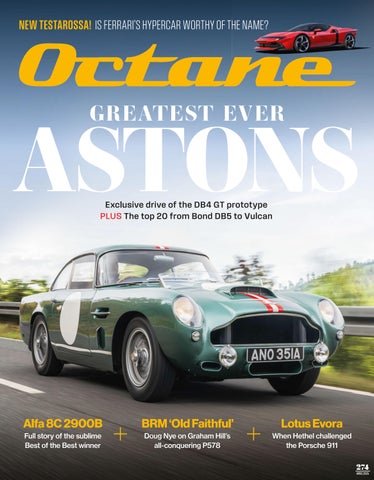
NEW TESTAROSSA! IS FERRARI’S HYPERCAR WORTHY OF THE NAME?


![]()


NEW TESTAROSSA! IS FERRARI’S HYPERCAR WORTHY OF THE NAME?


Exclusive drive of the DB4 GT prototype PLUS The top 20 from Bond DB5 to Vulcan Full story of the sublime Best of the Best winner When Hethel challenged the Porsche 911


Entries Invited


Forthcoming auctions


Ferrari Classiche certifi ed 1967 FERRARI 330 GTC COUPÉ
Sold for 402,500 at Goodwood in 2025


THE MIAMI AUCTION | 3 MAY
THE GREENWICH AUCTION | 31 MAY
+1 (917) 206 1630 | uscars@bonhamscars.com
THE BONMONT SALE, CH | 21 JUNE
+33 (1) 42 61 10 11 | eucars@bonhamscars.com
ENQUIRIES
+44 (0) 20 7468 5801 ukcars@bonhamscars.com bonhamscars.com/members


Entries Invited
Fairmont Hotel, Monaco 24 April 2026

Goodwood, Chichester 19 April 2026 Prices shown include buyer’s premium. Details can be found at bonhams.com

Off ered from 47 years of private ownership 1927 BUGATTI T35 B
Sold for €2,000,000 at Monaco in 2022


ENQUIRIES
+33 (1) 42 61 10 11
eucars@bonhamscars.com bonhamscars.com/monaco

PAGE
‘HILL AND GINTHER WERE THE BEST DRIVING TEAM IN BRM’S HISTORY AND THE NEW CAR WAS POTENTIALLY
BRM’S BEST EVER’
BRM P5781 ‘OLD FAITHFUL’


ASTON MARTIN DP199 52
Driving the unique cut-and-shut DB4 GT prototype that instigated Aston Martin’s most exalted line of road-racers
GREATEST EVER ASTONS 62
From more than a century of history, these are the marque’s 20 most significant cars
ALFA ROMEO 8C 70
Under the skin of the Peninsula Best of the Best winner, recently announced as the ex-Nino Farina 1938 Alfa Romeo 8C 2900B
LOTUS EVORA 80
How Lotus set a revolutionary post-Elise template and took on Porsche’s 911
MICHAEL TURNER 88
The life works of one of the most highly regarded historic motorsport artists
BRM ‘OLD FAITHFUL’ 94
Extraordinary history of the BRM that brought Graham Hill the 1962 F1 Drivers’ Championship
THE OCTANE INTERVIEW 104
James Elliott meets Lord Pembroke to discuss 2026’s new Wilton Concours des Légendes
HISTORIC DRIVING SCHOOL 108
Lessons in car control from a bygone era
FERRARI 849 TESTAROSSA 114

62
This 1036bhp twin-turbo V8 hybrid is Maranello’s most powerful hypercar yet. Does it live up to its hallowed name? 114 70 108

88


EVENTS & NEWS 16
The month’s best happenings; top dates for your diary; why 2026 is going to be a huge year for classic car concours and events
COLUMNS 41
Motoring sense and otherwise from Leno, Bell, Bayley and Coucher
LETTERS 49
Gordon Murray’s humble Honda hybrid
OCTANE CARS 124
Early Range Rover and MGB join the fleet
NEW! READERS’ DRIVES 130
Morris Mini-Minor: a fi ing tribute to dad
OVERDRIVE 132
Ultra-modern yet 1960s-style Nichols N1A
GONE BUT NOT FORGOTTEN 136
Long-lived motorsport journalist Bill Boddy
GEARBOX 138
Rupert Cobb of Gun Hill Studios
ICON 140
The Martin Dreadnought guitar, loved by Elvis CHRONO 142
Dive into the world of the helium escape valve BOOKS 144


Rarefied realm of Ferrari’s prototype racers
GEAR
Objects of utility and desire


THE MARKET 148

Insider tips, auction news, facts and figures, cars for sale, Mercedes R129 SL buying guide
AUTOBIOGRAPHY 186


Endurance racing boss Sam Higne


A gathering of the rarest and most significant historic automobili italiane in the heart of historical Rome. Join us for a vibrant three-day celebration of the very best in Roman hospitality, Italian cuisine and luxury style. For exclusive VIP guest packages and entry tickets to the Concorso, visit the website.
anantaraconcorsoroma.com


SELECTING THE 20 greatest Aston Martins is a lot more di cult than you might think. Of course, to the company itself, its greatest car is always the next one; but for us, with more than 110 years of rich history to play with, it’s a bit more complicated. ere are the landmark cars, the racing cars, the prototypes, the (rare) commercial successes, the historically important-from-birth chassis, the examples that have become historically important through a rition and, perhaps for Aston Martin more than any other marque, the silver screen stars. And then all of those merits must be blended by measuring (somehow) a bunch of seemingly incompatible immeasurables.
It’s Krypton Factor stu . For example, speaking as a motor racing fan born in 1968, when we started compiling the list I couldn’t conceive of one without either Robin Hamilton’s Nimrod or Muncher, but wiser heads prevailed and we realised that we needed guidance to put aside our prejudices and get this right. To that end we are massively indebted to o cial Aston Martin historian Steve Waddingham, who volunteered to be our ‘consultant’ in this exercise and helped us to see the wood through the trees. So while our list may not quite be the o cial Aston Martin factory verdict, we do like to think of it as a Sanction 1 version.
FINALLY, THERE ARE a couple of goodbyes for me to make this month. e rst is to Mark Dixon who, having been with Octane since very nearly the start, is moving on to pastures new. He will, of course, be hugely missed by the team and readers alike, but carries all our best wishes into his new role. e second is Marc Sonnery, a regular contributor to Octane over many years, who sadly passed away far too young late last year. is issue carries one of the last feature stories that Marc wrote for us, about his experience at the Charade Racing School, and is an emotional reminder that our old friend has raced his nal lap. Farewell, Marc, and fare well, Mark.
FEATURING…

DOUG NYE
‘Back in 1962 I followed the successes of Graham Hill and “Old Faithful” as a wildly enthusiastic teenager. It was thrilling that he won the World Championship so narrowly from Jim Clark, but we weren’t fan-boys back then. Absolutely every F1 driver was to be admired.’
Find out all about BRM P5781: pages 94-102

HEINRICH HÜLSER
‘It’s always a great honour to shoot cars of such significance and beauty, to play with the lighting and to help bring to life the design of this iconic piece of automotive history.’
Heinrich’s superb photography accompanies James Ellio ’s story of the unique Aston Martin DB4 GT prototype on pages 52-60

ELLIOTT HUGHES
Two contrasting track-tests in southern Spain: Ellio headed first to Guadix to drive a modern interpretation of the McLaren M1A Can-Am car, and then to Monteblanco for a new hypercar with an historic name…
Ferrari 849 Testarossa, pages 114-120; Nichols N1A, pages 132-133.

FRIDAY AUG 14 I SATURDAY AUG 15

THURSDAY NOV 19
FRIDAY NOV 20
ISSUE 275, ON SALE 25 MARCH


All the best buys from the era that brought you the Lotus Elise, Renault Clio Williams, Aston DB7, BMW E39 M5, Ferrari 348 and more
Dick Protheroe E-type
Exclusive drive of the sister car to CUT 7
Ferrari 195 Inter
Driving the super-rare early-1950s luxury GT
1959 Edsel Corsair
Stephen Bayley picks on the controversial convertible Riccardo Patrese interview
Time with the F1 stalwart who kept Senna honest
(Contents may be subject to change)
Editor-in-chief
Associate editor Glen Waddington glen@octane-magazine.com
Art editor Robert Hefferon roberth@octane-magazine.com
Markets editor
Contributing
Advertising inquiries Tel: +44 (0)1628 510080 Email: ads@octane-magazine.com Inquiries to info@octane-magazine.com
ADVERTISING
Group advertising director Sanjay Seetanah sanjay@octane-magazine.com
Dealer account manager Marcus Ross marcus@octane-magazine.com
Lifestyle advertising Sophie Kochan sophie@octane-magazine.com
Subscribe online at octane-magazine.com/subscribe Tel: +44 (0)20 3966 6695 Email: customerservice@octane-magazine.com Back issues can be purchased at octane-magazine.com

To take advantage of our special offer and get three issues of Octane for £5,either visit octane-magazine.com/subscribe or call +44 (0)20 3966 6695


PUBLISHING AND MANAGEMENT
Managing director Geo Love Editorial director David Lillywhite
Marketing and events manager Rochelle Harman
Marketing and events executive Hannah-Maria Ward
Accounts administrator Jonathan Ellis accounts@hothousemedia.co.uk
Magazine operations coordinator Elaine Briggs
Hothouse Media Unit 16, Enterprise Centre, Michael Way, Warth Park Way, Raunds, Northants NN9 6GR, UK www.hothousemedia.co.uk


Octane is available at the usual branches of UK shops, such as Tesco, Sainsbury’s, Waitrose and independents, as well as WH Smith Travel. You can order the latest magazine or a back issue, delivered direct to your door, by visiting octane-magazine.com
Download the Octane Magazine app on Android or Apple and you will be able to enjoy the new issue. Alternatively you can source the digital edition via either Zinio or Readly.
Subscribe
You can find superb offers on print and digital at octane-magazine.com/subscribe Order before 13 March to start with issue 275.
Problems with your subscription? Please email customerservice@octane-magazine.com
Syndication and licensing Geo Love geo @hothousemedia.co.uk
Germany Ulrich Sa erling Japan Shiro Horie Netherlands Ton Roks France Yan-Alexandre Damasiewicz Hong Kong, China Chi Chai Chan
Octane is available for international licensing and syndication


A true restoration is not just about perfection — it’s about soul. Every car has a story, and at B.I. Collection, we restore it with absolute authenticity. From the first detailed evaluation to the final finishing touches, every step is documented, every decision made with full transparency. Clients are involved throughout, knowing their vehicle is in the hands of experts who care. The result: impeccable craftsmanship, preserved history, and a car that is as alive as the day it first roared to life.


30-31 January

The bulk of the concours element (ICE officially stands for International Concours of Elegance) took place on the first day, with the five best-of-class winners being a 1976 Lancia Stratos, 1949 Maserati 4CLT, 1993 Jaguar XJ220, 1955 Ferrari 750 Monza and 1937 Talbot-Lago T150C SS ‘Teardrop’, plus a special Best Sound award being presented to the Pontiac Vivant (Octane 175). The Saturday saw the mesmerising free laps by the concours cars on the frozen lake and the reveal of Best of Show, the Lord Foster-designed trophy being awarded to the Teardrop Talbot-Lago. The public award went to the 1996 McLaren F1 GTR ‘Lark’, and the 1967 Ferrari Dino 206 S took the Spirit of St Moritz trophy.
Andrea Klainguti & Mattia Tagliavini for The ICE St Moritz


Rétromobile
28 January – 1 February
Huge things were expected as the show started by Marc Nicolosi in 1976 celebrated its 50th anniversary and the Paris super-event didn’t let us down. A record 181,000 a endees lapped up a magnificent display of BMW art cars and a cornucopia of exotic stands, including plenty of Brits, yet for most the star of the show was the awesome Buga i Autorail powered by four Royale 12.7-litre straight-eights. There was also jaw-dropping auction action across the French capital (p148).
Michael Stokes


CLOCKWISE, FROM TOP Grand National Roadster Show 30 Jan – 1 Feb
Nicole Bairds’ 1932 Ford Roadster built by Squeeg’s Kustoms was crowned America’s Most Beautiful Roadster at the huge event in Pomona, California. Evan Klein
Brands Hatch Winter Stages 17 January
Ian Broadfoot in his rare Ford Escort Mk4 tackles Druids – in the wrong direction – during the opening event of Brands’ centenary year.
Ben Lawrence
Maastricht 14-17 January
Despite a focus on Japanese cars for the 31st edition, an Aldo Brovarone-designed ’55 FIAT 8V Berlinetta Speciale Pininfarina stole the show.
Mario Laguna
VSCC Measham Rally 17-18 January
Gareth Frank’s 1930 Lea-Francis tourer during the VSCC’s ardous overnight 170-miler.
Steve Shelley
Clee Hill Trial 18 January
Jack Selwood and Tilly Hoggart getting airborne in their 1496cc DP Ford.
Ben Lawrence
HRCR open day at the British Motor Museum 10 January
A great turn-out of rally cars of all types and ages at Gaydon.
Chris Tarling


27 February – 1 March
A Novice Trial
Based at Hellidon Lakes Hotel in Northamptonshire, this is the ideal introduction to regularities, driving tests and Tulip books. Training sessions are held on the first two days, and the event concludes with a 90-mile rally featuring four special tests. hero-era.com
27 February – 1 March
Sydney Harbour Concours
Hand-picked classics fight it out for Best of Show honours on Cockatoo Island – a UNESCO World Heritage Site close to the Sydney Harbour Bridge. sydneyharbourconcours.com.au
27 February – 1 March
ModaMiami
Headlined by a celebration of the Lamborghini Miura, but featuring classes for everything from ‘Cadillac’s Art Deco Machines’ to ‘Cult Classics & Curiosities’. modamiami.com
28 February
Los Clásicos de Cuba
Held in the heart of Old Havana and showcasing some of the
classics maintained by Cuba’s resourceful car enthusiasts. losclasicosdecuba.com
28 February – 19 March
Royal Rajasthan
A drive around India’s largest state, timed so that the crews arrive in Jaipur in time for Holi, the Hindu ‘festival of colours’. bespokerallies.com
1 March
Haynes Breakfast Club
A Continental breakfast: the themed paddock at the Haynes Museum’s March event is for French cars. haynesmuseum.org
5-8 March
The Amelia Concours
A new schedule for 2026 will see the main concours supported by events including RADwood (dedicated to the cars and pop culture of the 1980s and ’90s) and Cars & Caffeine (a display of 400plus cars from across the US). ameliaconcours.com
5-14 March
Route des Andes
A 2650km route winds through
the extraordinary landscape of Patagonia, crossing the border between Argentina and Chile several times. rallystory.com
7 March
VSCC John Harris Trial
On the edge of the Peak District, members of the VSCC compete for the Dick Batho and Patrick Marsh trophies. vscc.co.uk
12-15 March
Coppa delle Alpi
Crews in pre-2000 cars tackle 90odd time trials around St Moritz, competing not only for bragging rights but also for a guaranteed entry in the 2027 Mille Miglia. 1000miglia.it
13-14 March
Three Legs of Mann ‘Relentless’ action on the Isle of Man: entrants in pre-1991 cars will start in front of the IoM TT grandstand on Glencrutchery Road, and before the finish will face 16 difficult regularity sections and no fewer than 30 special tests on closed roads. hero-era.com
13-15 March
Phillip Island Classic
The Southern Hemisphere’s biggest historic racing meet, held on Phillip Island, a couple of hours south of Melbourne. vhrr.com.au
15 March
Shelsley Walsh Breakfast Club
Shelsley Walsh hillclimb hosts its second Breakfast Club gathering of 2026. All cars are welcome, and tickets cost £5 per person. shelsleywalsh.com
19-21 March
WinteRace
A field of 70 pre-2000 cars; an expertly plotted, 450km route through the Dolomites; and heaps of snow. winterace.it
20-22 March
NEC Restoration Show
Barn-finds, pristine restorations and groaning trade stands fill Birmingham’s NEC. necrestorationshow.com
20-22 March
Salão Motorclassicó
Held in the Portuguese capital, Lisbon, at an exhibition centre that began life as a naval ropemaking factory, and headlined this year by displays celebrating the Lamborghini Miura, the Toyota Land Cruiser and Vespa. motorclassico.com
20-22 March
Generations Rally
Based at the St Pierre Country Club near Chepstow and created to introduce youngsters to the joys of endurance rallying, this 350-mile event is exclusively for multi-generation crews. rallytheglobe.com
21 March
Zoute Revival Rally
Pre-1976 cars criss-cross the pretty area around Knokke-Heist in Belgium, where the event concludes with a slap-up dinner. zoutegrandprix.be
22 March
Coffee & Classics
Car enthusiasts roll up to the Classic Motor Hub in Bibury to enjoy tasty breakfast grub and some live music. classicmotorhub.com
26-29 March
Coppa Milano-Sanremo
A regularity rally that pays tribute to the Milano-Sanremo races of old. The event will begin again with scrutineering and special tests at Monza Circuit. milano-sanremo.it
27-29 March
Espíritu de Montjuïc
Peter Auto opens its racing season with a meeting at the challenging Circuit de Catalunya in Barcelona, Spain. peterauto.fr
28 March – 16 April
Badawï Trail to the Last Oasis
This Arabian adventure begins in Jeddah, on the Red Sea, and takes crews through the jawdropping mountains and sands of Saudi Arabia before crossing into the UAE and Oman. hero-era.com
29 March
Scramblers Assembly
The first of four car gatherings in 2026 exclusively for paid-up members of Bicester Motion’s Scramblers club. bicestermotion.com
4 April
Brooklands Easter
Classic Gathering
Every bit of outdoor space at
Brooklands Museum is filled with pre-1997 cars and motorcycles, and trade stalls. brooklandsmuseum.com
5 April
Haynes Breakfast Club
‘Aston Martin vs Jaguar’ has been announced as the theme for April’s meeting. haynesmuseum.org
9-11 April
Charlotte AutoFair
This enormous autojumble, held at Charlotte Motor Speedway, attracts more than 5000 vendors each year and also features car displays courtesy of the AACA and local marque clubs. charlotte-autofair.com
10-11 April
1000km de Navarra
Teams of up to four drivers in pre-1991 cars contest an eighthour endurance race at the recently revised Circuito de Navarra in northern Spain. vdev.fr
11 April
Food & Fuel
Food & Fuel brings its unique brand of car show back to Bicester Motion; here the assortment of first-rate food trucks is as much of a draw as the cars on display. foodfuel.co.uk
11 April
VSCC Spring Start
The VSCC kicks off its racing season at Silverstone, where there will also be a grid for 1950s sports cars courtesy of FISCAR. vscc.co.uk


Secure your place; make travel plans
Monaco Historic Tour 21-27 April
V Events has been running tours down to the Grand Prix Historique de Monaco since 2016 and is returning with a six-night event combining the magic of Provence with a weekend of five-star hospitality in Monaco. Entry is limited to 20 cars (both classic and modern) and for further info contact Chris Bucknall on chris@v-management.com. v-events.co.uk
Octane Bluebird Legacy Tour 8-12 May
Join Octane on a unique pilgrimage tracing the Bluebird story from Chelsea and Brooklands to Coniston. This exclusive journey will culminate in witnessing the legendary world water speed record holder Bluebird K7 run on Coniston Water, celebrating the courage, innovation and enduring legacy of Donald Campbell, alongside fellow enthusiasts and the Campbell family. classicgt.co.uk/tour/bluebird-legacy-tour-2
Dolomites Grand Tour 14-19 June
The Dolomites Grand Tour will be based at the five-star Hotel Fanes in San Cassiano, surrounded by the spectacular Alta Badia. Although described as ‘high-energy’ by organisers, it is non-competitive, with the emphasis on gourmet cuisine and spectacular Italian scenery. canossa.com/rally/dolomites-grand-tour/
Yorkshire Elegance Driving Tour 13-14 July
The tour will start and finish at Grantley Hall and head north through the Yorkshire Dales and on up into Northumberland. It will cover 260 miles with no more than four hours’ driving a day and includes a stay at Matfen Hall. The Platinum Package is complete with three nights’ board and hospitality for Yorkshire Elegance (15-16 July). yorkshireelegance.com/tickets-packages/
Coming attractions, from leisurely sightseeing breaks to all-action competitive events

Key:
T = tour
R = regularity rally
C = featuring closed-road or circuit racing
L = long-distance (1000 miles or more)
19-23 April
California Mille (R,L)
Just as the original Mille Miglia inspired today’s regularity rally, the regularity rally inspired this US event, first staged back in 1991. The route for 2026 runs between Palo Alto and dreamy Santa Barbara. californiamille.com
23-26 April
Durbuy Rally (R,T)
The dinky Belgian city of Durbuy hosts a regularity rally for cars
built between 1920 and 1975. There’s a Touring class for those who want to take part but who would prefer not to have to keep one eye on the stopwatch. zoutegrandprix.be
23-26 April
The Flying Scotsman (R) Pre-1948 cars rumble through the wild Cairngorms and up to the north-east of Scotland before turning south again and making for the finish at Gleneagles. hero-era.com
30 April – 3 May
Le Flair (R)
On the roads around Lake Geneva, crews in classic and modern cars are tested by time trials and regularity sections, before unwinding each evening at the ritzy Le Mirador Resort & Spa. le-flair.com
3-9 May
Tour Auto (R,C,L)
Starting in Paris and finishing this time in Biarritz, and featuring four track races in-between, at venues including Magny-Cours and Nogaro. peterauto.fr
7-10 May
Terre di Canossa (R)
Crews drive three loops through beautiful Tuscany, each one bringing them back to the seaside town of Forte dei Marmi. terredicanossa.canossa.com
8-9 May
VSCC Scottish Tour (T)
Based at Mansfield House Hotel in Hawick, this is just one of 19 regional tours being run by the VSCC in 2026. Check the club’s website for details of the rest. vscc.co.uk
11-14 May
Vintage Shamrock (R)
Pre-1946 cars motor round south-east Ireland on winding roads, tackling regularity sections and tests along the way. rallytheglobe.com
15 May
Hope Classic Rally (T)
Entrants motor through Berkshire and beyond in classics provided by a group of generous owners. (You can take part in your own car, too.) The event raises money for the kids’ charity WeSeeHope. hopeclassicrally.org
23-28 May
Rallye des Princesses
Richard Mille (R)
The popular, ladies-only regularity rally starts in central Paris and finishes this time in Saint-Tropez. peterauto.fr

29 May – 7 June
Romania and the Legend of Transylvania (T)
A combination of sightseeing and motoring fun; the route of course includes a blast along the thrilling Transfăgărășan road. sceniccartours.com
2-5 June
The Three Castles Trial (R,T)
A ‘relaxed competition’ held on the quiet, pretty roads around Llandudno, and with sufficient gastronomic interruptions to ensure you’ll never be driving on an empty stomach. three-castles.co.uk
5-7 June
Grand Prix Bordino (T)
A tour of Italy’s picture-postcard Cinque Terre and the surrounding areas, with a schedule that includes an evening boat cruise. pbordino.com
5-28 June
Magical Madagascar (T,L)
Crews in hired 4x4s explore the world’s fourth-largest island, from the desert to the highlands, keeping their eyes peeled for its many amazing endemic species. bespokerallies.com
9-13 June
Mille Miglia (R,L)
Brescia to Rome and back in the company of some of the world’s greatest classic cars, following a figure-of-eight route inspired by the early Mille Miglia road races. 1000miglia.it

10-13 June
Kitzbühler Alpenrallye (R,T)
Crews in four classes (including one that doesn’t bother with regularity sections) enjoy the jaw-dropping roads of Austria’s Tyrol region. alpenrallye.at
18-21 June
La Leggenda di Bassano (R)
A first-rate regularity rally for classic open-top competition cars, held in northern Italy. laleggendadibassano.com
20-28 June
The Great Race (R,L)
More than 120 crews – all chasing a substantial cash prize as well as a good time – drive from

Springfield, Illinois, to Pasadena, California, following the path of the iconic Route 66, which was established a century ago. The event is part of the official Route 66 Centennial celebrations. greatrace.com
28 June – 10 July
Nordic Challenge (R,L)
Copenhagen to Oslo, the long way: entrants will reach the finish in Denmark having driven through Sweden and Finland, and having enjoyed 4000km of empty roads and fabulous gravel tracks. rallytheglobe.com
2-4 July
Midnight Sun Rally (R,C)
For crews in the Regularity class, the 2026 edition of this longrunning Swedish rally will begin in Stockholm. They’ll drive north to Tierp Arena to meet up with the speed demons of the Competition class, and the two groups will then push on together. midnattssolsrallyt.com
2-6 July
Le Mans Classic Legend Tour (T)
Fantastic Roads is running tours to both the 24 Hours of Le Mans and the Le Mans Classic Legend – a new variation of the Classic exclusively for cars of a type that competed at Le Mans between 1976 and 2015. fantasticroads.com
3 July
Yorkshire Dales Day (T)
Classic Travelling is running a series of single-day UK tours in 2026; this one will see entrants roam around the Yorkshire Dales before the 120-mile route reaches its end at Simonstone Hall, where dinner awaits. classictravelling.com
5-12 July
Dublin to Donegal (T)
Crews will set out from Dublin on a drive around the northern half of Ireland, taking in parts of the breathtaking Wild Atlantic Way. cctmk.co.uk
9-11 July
Silvretta Classic
Rallye Montafon (R)
A 600km regularity rally with a route that runs from Austria into Switzerland and Liechtenstein. It’s a more inclusive event than some of its type, admitting cars built as recently as 2006, and classics are available to hire, too. event.motorpresse.de
13-14 July
Yorkshire Elegance
Driving Tour (T)
This year’s Yorkshire Elegance includes a new tour in the Dales, open to all classic and prestige marques and paying tribute to the Mille Miglia with a couple of just-for-fun time trials. yorkshireelegance.com


22-25 July
Ennstal Classic (R)
A regularity rally on superb roads in the Austrian province of Styria, which always attracts special cars and famous faces. ennstal-classic.at
29 July – 2 August
Safari 500 (R)
A relatively gentle 500 miles over three days gives you time to take in the spectacular South African scenery, wildlife and hospitality. safari500.com
27-30 August
Passione Engadina (R)
Based in St Moritz and now with one-day rallies for female crews and under-25s in addition to the two-day main event. passione-engadina.ch
12-17 September
The Derek Bell Tour (T) Octane columnist Derek Bell leads a jaunt through Provence. v-events.co.uk
13-19 September
Vintage El Clavel (R,L)
Modelled on Vintage Shamrock, this rally for pre-1946 cars kicks off in Las Caldas in Spain and runs across the north of the country. rallytheglobe.com
16-21 September
Circuit des Remparts Tour (T) Drive to Angoulême from St Malo, arriving at the French city for the Circuit des Remparts. classicgt.co.uk

17-20 September
Gran Premio Nuvolari (R)
The rally celebrating racer Tazio Nuvolari starts and finishes in his UNESCO-listed hometown, Mantua, with stunning scenery throughout: en route are Rimini, Siena and Ravenna, plus a number of mountain passes. gpnuvolari.it
20-28 September
Scotland and North Coast 500 Tour (T,L)
From Scone Palace in Perthshire, the entrants will head into the Cairngorms and on to the far north of Scotland, where they will drive all the best bits of the famous North Coast 500 route. classictravelling.com

25-27 September
The Founders’ Run (T) Pre-war cars roll from Figueira da Foz to Lisbon, approximating the route taken by Portugal’s first motor race back in 1902. fundadores.pt
3-10 October
Tour de Corse Historique (R,C)
Closed-road stages account for over a third of this 1000km rally around Corsica, but you needn’t be Walter Röhrl to take part: crews can enter in a low-speed regularity class if they choose. en.tourdecorse-historique.fr
6-11 October
Modena Cento Ore (R,C)
An action-packed 1000km rally starting in Riccione, finishing in Modena, and featuring races at circuits including Imola. modenacentoore.canossa.com
8-10 October
Zoute Rally (R,T)
Part of the Zoute Grand Prix in Belgium, and with a route that takes crews through Flanders Fields and the Dutch polders. zoutegrandprix.be
11-15 October
The Belgian Classic (T)
A tour of Belgium’s Wallonia region, including visits to the MahyMobiles car museum and Spa-Francorchamps Circuit. backwatertours.co.uk
11-21 October
Discover Sicily (T,L)
The first of a planned series of non-competitive events from Rally the Globe, this relaxing tour explores the ‘heel and toe’ region of Italy for a few days before moving on to Sicily. rallytheglobe.com
14-21 October
Transmaroc (R,T)
Crews will spend most of their time in Morocco’s desert, but don’t be daunted: those without a 4x4 of their own can hire one, and instruction will be given to anyone new to driving on sand. zaniroli.com
21 October – 3 November
Roads of the Rising Sun Tour (T)
Participants will drive around the central part of Japan’s biggest island, Honshu, beginning in Tokyo and taking in highlights including Mount Fuji, the temples of Kyoto and the Japanese Alps. classicgt.co.uk
22 October – 25 November Grand Prix of South America (R,T,L)
This rally, inspired by a similarly named 10,000km road race held in 1948, starts in Uruguay and travels through Argentina, Bolivia, Peru, Ecuador and, finally, Colombia, ending in Cartagena on the Caribbean. bespokerallies.com


30 October – 11 November
Namibia Tour (T,L)
Crews in 4x4s follow a 1600-mile route that will take them from otherworldly deserts to game parks teeming with wildlife. classictravelling.com
1 November
RM Sotheby’s London to Brighton Veteran Car Run (T) Pre-1905 cars putter from Hyde Park to Brighton, commemorating the Emancipation Run of 1896. veterancarrun.com
2-28 November
Gaucho Trail Motor Challenge (R,L)
An 11,000km marathon running through Uruguay, Brazil, Paraguay, Argentina and Chile. The crews will follow a route devised by rally driver and adventurer Kim Bannister, who has blazed many a trail across South America. hero-era.com
2-30 November
The Ultimate Australian Road Trip (T,L)
An epic drive from Adelaide all the way up Australia’s east coast to Cairns, where the crews will swap their cars for a boat to explore the Great Barrier Reef. sceniccartours.com
19-22 November
Rally of the Tests (R)
This year the crews will face 22
regularity sections and 30 special tests as they motor from the north of Wales to the south. hero-era.com
27 November – 4 December
Silver Fern Rally (R,C,L)
New Zealand’s South Island hosts a rally featuring over 1000km of special stages that are the equal of any in the world. silverfernrally.co.nz
16-19 January
Le Jog (R,L)
The 30th edition of the famously challenging Land’s End to John O’Groats Trial will include a number of classic sections and driving tests from past events. hero-era.com
24 February – 26 March
Maya Classic Rally (T,L)
A month-long journey from Panama to New Orleans that will take crews through eight countries and to a selection of fascinating Mayan ruins. bespokerallies.com
15 March – 11 April
Classic Safari (R,L)
There are classes for everything from Pioneer (pre-1921) cars to pre-1984 4x4s on this sensational classic rally, which will see crews drive a 6500km route around southern Africa. They’ll head
25-26 September
Ardennen Rennen (R)
Air-cooled Volkswagens and Porsches, including go-faster outlaws and coachbuilt creations, are hustled through the Belgian Ardennes. ardennenrennen.be
Autumn (dates TBC)
The Peninsula Motoring Series: Japan (T)
Back on the calendar following a successful debut in 2025, and again set to begin in Tokyo and conclude with a visit to the incredible private racetrack at Magarigawa Club. peninsula.com
13 October – 11 November
28 States Marathon (R,L)
clockwise from the Namib Desert through Botswana before crossing into South Africa, and, with the schedule allowing a good amount of time for wildlife watching, they’ll hopefully arrive at the finish in Cape Town having seen all of the Big Five. hero-era.com
19 September – 9 October
Sahara Challenge (R,L)
The fifth Sahara Challenge is set to be the most adventurous yet: a new 5250km route will take crews from Lisbon to Dakar via the seemingly endless Sahara Desert, where everybody will bivouac under the stars for a couple of nights. hero-era.com
Pre-1986 classics will gather in charming Cape Cod in the northeast of the USA for the start of an 11,000km rally that ends in Savannah, Georgia. Highlights are set to include the drive through the Great Lakes region, and stops in the music meccas of New Orleans and Nashville. rallytheglobe.com
3-11 December
East African Safari Classic (R,C,L)
The route is still being worked out by the team at Rally HQ in Kenya, but crews can expect a total distance of 3600km this time, of which 1800km will be competition sections on unsealed roads and tracks. eastafricansafarirally.com


March 23-26: Norfolk Canine Car Tour
April 18-23: Brittany FULL
April 24: New Forest Driving Day
May 3-17: Croatia & Slovenia (E-type/XK Clubs)
May 18-June 1: Croatia & Slovenia (RREC)
June 5: Rutland Driving Day
June 16-30: Norwegian Fjords Tour FULL


July 3: Yorkshire Driving Day
August 21: Wales Driving Day
September 8-13: Normandy Gardens & Battlefields
September: Dolomites
September 20-29: Scotland & NC500
October 12-15: Cotswolds
October 30-November 12: Namibia 2026 Tours


9-11 JUNE, EC1


Refined elegance, effortless entertaining and a world-class line-up of cars in the heart of the square mile.
Classes for 2026; Porsche Sonderwunsch, Dream Cars, Alfa Romeo, Restomods, Hypercars, Tuners, Wildcards & American Muscle.
Three days, three iconic displays; Porsche Perfection, Jaguar XK and Supercar Day.


AS THE START of the 2026 season looms, it is already shaping up to be a watershed year for classic car events, with a raft of new concours, regime changes and venue swaps.
The biggest new UK event will be the Wilton Concours des Légendes at Lord Pembroke’s Wiltshire stately home on 19-21 June. The event is rapidly gathering momentum, with tickets being sold and a trio of major manufacturers signed up.
The concours also has an auction partner in Dore & Rees, which will hold three sales over the long weekend: Fine Motor Cars, Automobilia, and Watches & Jewellery. Nick Wells, MD of Dore & Rees Motoring, said: ‘We are delighted to be part of the story-led concours at Wilton
2026 could be the most seismic year for events for decades
House. As well as the auctions, we’ll be offering advice and valuations for visiting collectors.’
The objective of the event is not merely to display delectable and exotic concours cars, but to bring their histories to life through experts, owners and discussions. Tickets and more at concoursdeslegendes.co.uk.
Another highly anticipated debut will be Anantara Concours (anantaraconcorsoroma.com) in the heart of Rome. The all-Italian 70-car event was all set for take-off last year when it was postponed due to the funeral of Pope Francis. Unbowed, the concours will instead take place on 16-19 April and has already announced a blockbuster trio of Le Mans-winning Ferraris in 1964 Ferrari 250 LM, 1963
Ferrari 275P and Ferrari 499P.
At the same time as the Italian event, Salon Privé London is set to make a welcome return after a year off in 2025. Back at the Royal Hospital Chelsea on 16-18 April (salonprivelondon.com), it promises the same mix of classics, cars for sale, luxury goods and manufacturer reveals.
Meanwhile, Bonhams, which has held its annual Monterey sale at Quail Lodge for almost 30 years, has announced a shock move to Laguna Seca. A similarly big change is taking place in Germany, where Retro Classics Essen on 8-12 April has the unenviable task of filling the hole left by the departure of SIHA and the Franssen family’s TechnoClassica, which for sheer scale if nothing else has ruled the
European roost for decades. The incoming team is hardly wet behind the ears, however, having launched similar, hugely successful events in Stuttgart and Nuremberg. Neither does the original show disappear completely, it just moves to a 50,000m2 space in Dortmund on 24-27 September.
With Peter Auto now planning to run the Le Mans Classic annually, 2026 will be the first of its Legends events focusing on newer, post-1970 machinery stretching right into this millennium. Classic Le Mans Legend will alternate with a Heritage version running older cars from the dawn of the event until the late 1960s.
The most ambitious spreading of wings by a French event,


And what are they?
Dealing with people from all walks of life, connecting with people, telling stories, building and running a team, being able to inspire the people to do really hard work without a lot of supervision, and also negotiating deals and getting things done.
Sandra will be a tough act to follow…
When I was interviewing, I said: ‘Look, I’m not Sandra. I’ll never be Sandra. If that’s what you’re looking for, then good luck.’ She’s an institution and irreplaceable. What I hope to do is be able to carry on what she’s built here.
So how will you make your mark?


however, will be Rétromobile marking the 50th anniversary of Marc Nicolosi’s first event in Paris by holding a show in New York (retromobile.us).
Organisers are promising 250 exhibitors and a Gooding Christie’s auction in the heart of Manhattan on 19-22 November, and are confidently predicting 70,000 attendees over the four days.
One event that will sadly be missing this year due to an overrun of building works will be the Savile Row Concours, but that is promised to be back on the calendar for May 2027.
Finally, after a generation at the helm of the Pebble Beach Concours d’Elegance, this will be Sandra Button’s last year in charge before moving on to an ambassadorial role.
Taking over from her as president of the event from 1 October will be Vince Finaldi and he gave Octane an exclusive interview about the role he is taking on. See right.
Above
Anantara (top left and bottom, second from right) will make its delayed debut in 2026; Wilton Concours des Légendes (centre top and bottom right) will also have its first run out; Retro Classics adds Essen (top right) to its Stuttgart (bottom left) event; end of an era for Pebble Beach (bottom, second left).
Vince W Finaldi takes the helm at Pebble Beach Concours d’Elegance in October. David Lillywhite puts the questions…
Where are you at the moment?
My workshop’s in Monterey, but I live in the Carmel Highlands. My wife and I had been coming here for years and bought a vacation home. Then Covid happened, a lot of jobs went online and we said, let’s take the kids and just go live up there. We haven’t regretted it.
What were you doing at the time?
I litigated full-time for 22 years as a trial lawyer across the US, representing cases with 800 or 900 plaintiffs.
Why did you quit the legal profession?
There’s a pattern [among lawyers] of divorce, heart attacks, strokes and general unhappiness. I always said I would get out at the right time.
To work with old cars?
I’d grown up in the car business. My grandfather left Italy to work at GM and then returned to set up his own auto shop. My dad and my uncles set up shops. I was always buying cars, selling cars, restoring cars… I just transitioned to doing it full-time.
So how did you come to be president of Pebble Beach Concours?
I’d heard they were looking for someone and my wife just said: ‘What is your hesitation? You love the concours, you love cars, you love travelling. You go to all these events. All your friends are there.’ I’d never thought about having that position but I talked to some of the people involved and learned that not only are our interests aligned, but a lot of what it takes to do the job, and do it right, are things I happen to have in my resumé.
My initial plan is to learn everything I can alongside Sandra. In the short term, I don’t see any major changes but a concours is a living, breathing event. The way collectors collect and use their cars is always changing. People pass away, new collectors come in. So, in order to stay alive and to stay at the forefront, the concours has to take into account those changes.
What’s the biggest change you foresee?
It’s going to be important to keep the history of Pebble Beach alive while still recognising the changes that have to be made to make it an event that younger collectors are going to want to come to and participate in. That’s one of the reasons I think the Thursday tour is such a great thing – it’s where you get the kids interested.
Do you think the interest is there?
It is definitely there, but we’ve got to make it accessible to them. They are on the street [filming the cars] because they want to see the cars moving; they want to see them in action.
Is there still a future for pre-war cars at Pebble Beach?
Great cars are always going to be great cars. The cars from the ’30s – the styling, the engineering – they’re always going to be special. But there are just as many great things about styling and engineering in the ’50s cars and the ’60s cars, especially the race cars. I do see there being more post-war winners, but what’s important is that the right cars get there and the right people get there, and everyone has a wonderful event.

STAR CLASS at the 2026 London Concours is expected to be Porsche Sonderwunsch (‘Special Request’), assembling ten cars from Porsche’s personalisation programme. Having originated in the ’70s, it allows customers to collaborate with Porsche’s design and engineering teams in creating their car. The cars at the Honourable Artillery Company on 9-11 June will be curated and presented by Boxengasse, the 100-acre Porsche-focused ‘campus’ that hosts Megaphonics. Boxengasse CEO Frank Cassidy said: ‘The Sonderwunsch Class represents the ultimate expression of personalisation, and the London Concours is the perfect setting to celebrate these remarkable cars.’
There will be eight other classes at the London Concours (londonconcours.co.uk), including Yellow Dream, Alfa Romeo, Icons Remastered, Hypercars, The Tuners, Wildcards, and American Muscle, ensuring a broad and compelling celebration of automotive design and performance. In addition to the concours classes, each day the event will be themed, with Tuesday celebrating Porsche Perfection, Wednesday the Jaguar XK, and Thursday rounding off the event with Supercar Day.
Andrew Evans, MD of Thorough Events, added: ‘Boxengasse is a natural fit for the London Concours and the Concours of Elegance. Their expertise, passion, and deep connection to Porsche culture will elevate the Sonderwunsch Class to another level.’

The 2026 Hope Classic Rally raising money for children in sub-Saharan Africa will take place on 15 May. You can opt either to be allotted one of the dream cars loaned by generous supporters or to take part in your own classic or performance car. See hopeclassicrally.org for more.

Massive museum numbers
Just shy of a million people visited the Mercedes-Benz Museum in 2025, up more than 7% over 2024, the previous record year. Even more are expected in 2026 thanks to 20 Years of the Museum, 100 Years of Mercedes-Benz, 130 Years of Commercial Vehicles and 140 Years of the Automobile.

Following events in Japan and California, the latest rally in the Peninsula Motoring Series will hit Scotland in September, promising six days of winding mountain passes and historic estates. Participants will meet at the Peninsula London before flying to Scotland for the rally, which costs £27,500 for two guests including a classic vehicle. See peninsula. com/motoring-series for more.

Turner prints available
All the pictures reproduced in our retrospective on the life and work of motoring artist Michael Turner (see page 88) plus many more are available to buy as prints from the company he set up with his wife Helen in ’63. See studio88.co.uk.

GT40 reunion at Goodwood Goodwood’s Festival of Speed and Revival Meetings are to reunite the trio of Ford GT40s that took part in the famous blanket finish at Le Mans 60 years ago. It will be the first time in a decade that P/1046, P/1015 and P/1016 will not only appear together but run, too. All three Goodwood events will also honour British motorcycle racing legend Barry Sheene, 50 years after his first world championship.
Donald Osborne, ASA, classic car historian, author, appraiser, consultant, Consulting Director and former CEO of Audrain Automobile Museum, has been appointed as the official North American Representative for European governing body Fédération Internationale des Véhicules Anciens (FIVA).

Middle Eastern comeback
The Royal Bahrain Concours will return in 2026, taking place on 6-7 November at the Royal Golf Club, under the patronage of His Royal Highness Prince Salman bin Hamad Al Khalifa, Crown Prince and Prime Minister of Bahrain. BBK will be the concours’ Banking Partner.

HEROs celebrated
Main winners in the recent HERO-ERA Awards 2025 were Dick Baines (HERO Cup winner) and Pete Johnson (Golden Roamer). Announcements during the event included James Phillips’ appointment as Head of Competition, and Tudor Watches becoming official timekeeper.
Thanks to the Michael Sedgwick Memorial Trust, budding authors can get a wealth of insight and advice at a special event on 21 March in the Hagerty Clubhouse at Bicester Motion. Ian Wagstaff, Giles Chapman and Paul Skilleter will be among those imparting their wisdom and experience. It costs £12 to attend, with booking via michaelsedgwicktrust.co.uk.

French resistance
Some 722 vehicles took part in the 26th winter Traversée de Paris on 25 January. The 37km drive attracted 542 cars, 155 twowheelers, 21 tractors and four 1930s Renault buses.
A decade of success
Girls on Track UK, which has supported thousands of young people trying to get into motorsport and associated industries, marked its tenth anniversary at London’s RAC.

1800 ES packing a T5 lump
New from Niels van Roij Design’s restomod wing Autoforma is Norrsken, a T5-powered Volvo 1800 ES built in collaboration with Dutch specialist Volvo Lotte. Just five cars a year will be built at €300,000 excluding taxes.

Beetle revivers rewarded
Lord Montagu of Beaulieu has presented certificates to a group of 14-17-year-old students with no previous car mechanic experience who restored a 1973 VW Beetle on the Mechanix course, organised by St Andrew’s & All Saints’ Church in Dibden, Hants. The students repaired the VW Beetle in a working garage in Dibden during evening classes.
Peter Falk
Former Porsche engineer and race director Peter Falk has died, aged 93. He was at Porsche from 1959 to 1993, helped bring the 911 to the road via his role in vehicle testing, and spent more than 30 years at the heart of Porsche’s pre-eminent motorsport programme, helping develop 904, 917, 956 and 962, and serving as racing director during the Group C era. He also contributed to the technical direction of the 911, 924 and 928. See a full obituary here: tinyurl.com/ezmdzn36.
Eric Dymock
After an early career as a researcher and script-writer for the BBC series Wheelbase and Thames TV’s Drive-in, Dymock worked extensively in radio and print, including time as News of the World motoring editor in the 1970s, and road-testing for both Motor and Autocar. He will be best known to many, though, as an author, especially of his award-winning biography of Jim Clark and similarly revered tome on Sir Jackie Stewart.
Paul Grist
Glamorgan-born pre-war Alfa guru Paul Grist, who turned to maintaining and restoring Milanese icons such as the 8C after a career in acting, has died at the age of 86. His Hertfordshire workshop carried out many award-winning restorations but, ironically for an Alfa man, the most notable was a Lancia Astura that triumphed at Villa d’Este.
Ed Iskenderian
‘The Camfather’ has died at the age of 104. Born and raised in California by Armenian parents, Ed ‘Isky’ Iskenderian built his first car in high school and immersed himself in the rodding and racing scenes. He is credited with pioneering high-density chilled iron lifters, hydraulic racing cams, anti-cam-walk kits and much more, as well as helping set up the Speed Equipment Manufacturers Association (SEMA), of which he was the first president. Obituary here: tinyurl.com/4fkm8fzz.

SATURDAY JUNE 13th 2026


Jersey’s picturesque landscape will once again provide the backdrop for its fifth Concours d’Elegance, celebrating 75 years since the island hosted its very first Concours.
The Concours has been meticulously planned by Le Riche Automobile Restorers, Jersey’s leading vintage and classic car specialists, in collaboration with ROK Construction, the principle sponsor.


• Pay just £1.66* each for your first three issues
• All subscriptions now include access to the magazine archive via the Octane digital app
• Never miss an issue
• Money-back guarantee –cancel and we will refund your remaining issues
• Unique subscriber-only covers
Order and manage your subscriptions online, or call our helpline on +44 (0)20 3966 6695


Estimate: $1,400,000 - $1,800,000 OFFERED WITHOUT RESERVE

Estimate: In Excess of $1,000,000

Estimate:

Zen and the art of modern hypercar maintenance
Irecently put in my order for the new McLaren W1 and expect it to be delivered around September of this year. When it nally gets here I’d like to think I have the Holy Trinity of McLarens: the F1, the P1 and now the W1.
I have to admit that the main reason I bought it was to see how much be er it is than the P1. I’m certainly no expert, but I found the P1 to be the purest example of the last round of supercars over a decade ago.
I know it’s odd to think of the P1 as analogue but when I compare it against some of the other supercars of that era – with four-wheel drive, rear-wheel steering and so on – I think it’s the most analogue of the bunch. Rear-wheel drive, sublime steering, crazy amounts of power so you can just kick the rear end out if and when you feel like it, and exactly the right amount of safety equipment – you know, traction control – to keep you from killing yourself. As much as I love my old F1, I still get chills when I think about the time I was on the highway, downshi ed to third gear, hit the gas hard and ended up sliding across two lanes of tarmac. A li le more safety is all you need.
I consider myself to be just an average guy who has been extremely fortunate to have access to this level of equipment. It’s so out of my league, I pinch myself every time I get in it. Although I have taken some of them to the track I don’t track my cars o en because I don’t need to know just how bad a driver I am.
I was reminded at a Cars & Co ee parking lot event recently that not everybody has that degree of self-awareness. I came across a guy just revving the crap out of his 720S. He was literally bouncing it o the rev-limiter.
I asked him: ‘Hey – what are you doing?’
He looked at me like I was crazy. ‘ ey love it,’ he said, ‘they love to rev.’
No they don’t!
I constantly meet people with supercars who are not the least bit interested in how their complex, delicate, expensive machines operate. I’ve met a few Porsche 918 owners who moan about the fact that they’re on the third or fourth hybrid ba ery and complain about how expensive they are. Well, just plug it in once in a while. My P1 is still on its original hybrid ba ery and when I tested it last week it was
still at 92%. Any time I’m not driving it I’m charging it. at’s the rule. at’s the secret to a long-time ba ery storage.
I have a great deal of respect for machinery of this calibre and enjoy trouble-shooting problems and solving them. I’ve always admired drivers who have mechanical sympathy for their machines. One of the greatest in this regard was Phil Hill, America’s rst Formula 1 World Champion. And he learned that part of his cra the hard way.
As a young man, Phil had been a Packard mechanic as well as a Jaguar technician. It meant that he developed a musician’s ear for tuning engines; he could hear when they were stressed. And he never broke a car or crashed one. e only time Phil was ever frightened while in a car was when customers would try to impress him with how fast they could drive. I took great joy in hearing Phil regale the crowd with these stories of him white-knuckling around the roads near his shop.
By way of contrast, one of my proudest McLaren moments occurred when the engine service light came on in my Mercedes-Benz SLR McLaren. e rst thing I did was to tighten the gas tap, which usually solves the problem. at didn’t work on this occasion, but I knew the light was coming on because there was a slight pressure leak somewhere in the fuel system. Yet there was no gasoline anywhere. I opened the trunk and immediately started tracing fuel lines. I’ve had this car for a li le over 20 years and I’ve never been a fan of hard plastic fuel lines because they can crack with age.
Using a magnifying glass I nally found a plastic T- ing that had a slight bronze colour in the bend. at could be evidence of a weak point. Not a big enough break to leak gas, mind you, but certainly enough to allow fumes out, which could stain the white plastic ing and turn the Check Engine light on. Which is exactly what happened. I replaced it with a brass ing and that should be good for the next 100 years. I started the car and the Check Engine light immediately went out. at’s how I justify owning these vehicles. I might not be able to beat Chris Harris around Dunsfold Aerodrome but at least I can a empt to x my cars. And if I’m lucky, I’ll make Phil Hill proud of me.
Jay was talking with Jeremy Hart.
‘I DON’T TRACK MY CARS OFTEN BECAUSE I DON’T NEED TO KNOW JUST HOW BAD A DRIVER I AM’


Ι An all-new event with a curated selection of the greatest cars and motorcycles
Ι Meet the designers, engineers, drivers, restorers, collectors and historians
Ι Fascinating talks, interviews and panel discussions throughout the three days
Ι Wilton House fully open to visitors – see its world-class art, sculpture and interior
Ι Plus automotive art, craft workshops, book signings, retail avenue and more
19 – 21 JUNE 2026


The ups and downs of a long career in motorsport
The British famously have a preoccupation with the weather. I know I do. I am currently holed-up at our place in Florida wishing I had my big coat; the one that I le behind in the UK. I hadn’t expected it to be like this, for no other reason than it never usually is. ere is no reason for me mentioning this other than the next 800 words might be a bit more sca ergun than usual. I suspect the onset of hypothermia is playing havoc with my neurons and, as such, I am buzzing between thoughts and ideas like a demented bluebo le. So there, I’ve said it.
As I brie y touched upon last time around, I was literally and guratively honoured with a lifetime achievement gong during a wonderful do at the Royal Automobile Club in London. I don’t wish to sound maudlin, not least because I’m not that sort of chap, but I did chuckle to myself that I received it only because so few of us old ’uns are still upright. Seriously, though, it was very gratefully received. I will treasure it because there were times during my career when it was blooming tough. It wasn’t all laurels, Champagne and silverware.
I am forever thankful to those who had faith in me, and who picked me up when I was down. e late 1970s and early ’80s in particular were hard-going, in no small part due to the lack of drives. en I won the 24 Hours of Le Mans again with Jacky Ickx in 1981 and everything changed.
As a result, I went on to have a lot of success on the track at an age when most racing drivers were hanging up their helmets. I am no saint, but I hope I have given credit where it is due because I owe an awful lot to an awful lot of people. In all sports, timing is o en everything. Forging strong relationships even more so.
Anyway, dragging myself back to the awards dinner, it was wonderful to see participants from all manner of motorsport disciplines being honoured. ere were single-seater racers and rally drivers, but also competitors in sporting trials, hillclimbing, sprinting and so on. I love that the UK has such a diverse landscape when it comes to motorsport. We will campaign just about anything, anywhere. I was always keen to try my hand at di erent things, whether it was hillclimbing or competing in the Brighton Speed Trials. I had a go and I salute those
that are out there every weekend knowing that fame and big bucks aren’t waiting at the nish line.
It was also great to see so many veteran competitors and their o spring who have picked up the baton. ere were ‘lads and dads’ racers and even a few multi-generation aces. Which brings me on to the Monte Carlo Rally. I have a bit of a thing for this event, in no small part because it has such a rich history. I was delighted to see Oliver Solberg claim a fairytale win. e young charger is on the nursery slopes at this level, but he has talent to spare. Success on the Monte eluded his father, Pe er, who nevertheless won the World Rally Championship way back when. I fully expect Oliver to be even more successful over the long run.
I must admit that I didn’t really pay a lot of a ention to the 24 Hours of Daytona in January, other than to watch bits of it on TV. Much of the race appeared to have been run under safety car conditions due to fog. I had my fair share of drama in this race, which, as I have o en said, is the toughest round-the-clock event in that there’s no let-up. You can never relax.
I also know what it’s like to take ight there when things go badly wrong. One year, we also had fog and were obliged to park our cars. We weren’t allowed to go to our motorhomes and rest prior to the restart, even though we clearly weren’t going to be returning trackside anytime soon. We weren’t allowed to stray more than a few feet from our cars so ended up kipping on the pit counters.
I have relatively li le to do with Porsche on an o cial basis these days, but we have a lot of shared history all the same. As such, it was nice to see the Penske Porsche Motorsport 963 on top, a mere 1.5sec ahead of the factory Cadillac sportsprototype. Forgive me for mentioning this, but I still have trouble wrapping my head around the idea of a Cadillac racing car, but I guess that’s an age thing. I tend to think of Cadillacs as land-yachts rather than mid-engined circuit weaponry. ey have done great things on-track with sports cars in recent years, though. Fair play.
It will be interesting to see how Cadillac fares in Formula 1 this year as the new boys. I wish them well. I have no idea how this season will play out, not least due to the new regulations, but it will be fascinating to watch everything unfold. I can’t wait.
‘THERE WERE TIMES IN MY CAREER WHEN IT WAS TOUGH. IT WASN’T ALL CHAMPAGNE AND SILVERWARE’


The ruin and fate of a manufacturer once known for good taste
Just as Gibbon was inspired to write his great history of ruin and fate by dwelling in and on the rubble of Rome’s Forum, with the barefooted friars mournfully singing nearby, something has put me in mind of a book yet to be wri en called e Decline and Fall of the Torinese Empire
It may have been a memory of the Lancia esis, one of Turin’s weirdest-ever o erings. Perhaps the memory came as a nightmare about dirty tricks in the Papal motor pool, with Stanley Tucci and Ralph Fiennes in their scarlet cassocks and skullcaps peering under the bonnet of a steaming esis with a hex-drive in each hand and looking solemn.
Certainly, to my eye, this strange car has an ecclesiastical feel. Haunted, like an old church. Possibly even musty. If the Vatican were ever to design a sex toy, it would surely resemble the esis: pious, ne, smooth, but suggestive too. And like anything associated with the end of an empire, the Lancia esis is in nitely moving. Not perhaps on the road, but certainly in the imagination.
Never mind my dreams, I once saw a real one in Knightsbridge. Torino plates, a colour the brochures would call ‘Champagne’ but to me was metallic pee. Despite or because of this, the car had a powerful, subtle presence. Genuine bella gura in a London street rammed with o -the-shelf rich men’s get-out-of-my-way black-painted rides to Harrods.
I saw my second in a nondescript town in Tuscany, painted in dark aubergine, parked outside a small alimentari in a side street. I imagine it was the property of a local crime boss, either buying vegetables or visiting his mistress; possibly both. And then I believe the Italian ambassador had one, registration ITA 1. at makes three: my sightings probably account for the greater part of esis production. It was a ne machine, but a commercial calamity. And, like Lancia itself, almost forgo en.
Yet its strange, haunting body was drawn by Flavio Manzoni, nowadays the debonair impresario of Ferrari design. Like an opera with lots of costume changes, Lancia has a long association with Ferrari. Within living memory the cars from Borgo San Paolo were only just second-best to those of Maranello. In the 1950s and ’60s, there were at least as many beautiful Lancias as there were Ferraris. Each was a demanding client of Pininfarina.
And Lancias were more technically sophisticated, at least in the sense of gentility. While Ferrari had brutally wonderful engines and crude cart axles, Lancia had exquisite V4s and V6s, lightweight construction and elegant front-wheel drive. When Lancia was tempted into Formula 1 in the ’50s, its monoposto D50s were taken over by Ferrari, as Lancia felt a nancial chill. e handsome and audacious D50, many said, was Vi orio Jano’s and Lancia’s masterpiece… not Ferrari’s.
Lancia was soon sold to a cement manufacturer. Both beauty and oddness were always fundamental to the marque proposition. e Gamma Coupé is one of the most peculiar cars ever, its body drawn by Aldo Brovarone, who proved himself to the world an artist for all time with the Dino. Supremely elegant, the Gamma’s 2.5-litre at-four made it feel like driving a tug-boat while dressed in ne tailoring.
Perhaps the most beautiful car ever is the Lancia Aurelia B20 of 1951, which established ‘GT’ as a concept and a style. I would say the esis is haunted by it. Nearly second most beautiful is the ’65 Fulvia Coupé, drawn by Piero Castagnero… Manzoni’s mentor. Artistically speaking, it could be improved neither by adding nor subtracting any element.
As for dynamics, anybody experiencing the Delta Integrale Evo has touched the faces of the driving gods. Other spectacular competition cars included Gandini’s lunatic Stratos and the 037 wherein Walter Röhrl experienced a ‘continuous state of ecstasy’ while hygienically contained in his bucket seat.
But beauty and taste are Lancia essentials. In New York’s Museum of Modern Art in 1953, the curator Arthur Drexler expanded his in uential ‘8 Automobiles’ show of two years before, coining the term ‘rolling sculpture’ to describe car design. And in 1953 the B20 was included because ‘ at and curved planes here contrasted without irrelevant detail’. at’s an e ective way to describe the magic of design. at magic lived on into the lonely esis, the last real Lancia before it became disgraced by the brainless kitsch of ‘badge engineering’. Shamefully, a Lancia badge has appeared on various Chryslers (and vice versa). In Europe the Ypsilon was newly relaunched last year. Not even the Italians want it.
Me? I look at the Ypsilon and think as Gibbon thought in the Forum: decline and fall. I am tempted to look for a esis to recapture lost magic.
‘IF THE VATICAN WERE TO DESIGN A SEX TOY, IT WOULD RESEMBLE THE LANCIA THESIS’


Artificial Intelligence? There’s good reason to prefer the real thing
Rumour has it that Arti cial Intelligence is going to take over all our jobs. As in the past, when Great Britain de-industrialised and thousands of blue-collar workers lost theirs, AI is coming a er white-collar workers, especially scribblers like me. Who needs to read a beautifully produced print magazine when you can simply tap a request into your mobile device and all is revealed in an instant?
ought I’d be er give it a try, so swiping to the ChatGPT app on my ’phone I asked: ‘What did the Right Honourable Alan Clark MP think of Aston Martin?’ Within a few seconds the reply came: ‘Alan Clark (the Conservative MP, diarist and motoring enthusiast) loved Aston Martin and wrote about the marque with real a ection… From his published articles he saw Aston Martin as the quintessentially English grand touring car – elegant, fast, aristocratic and a li le rakish and slightly anachronistic. He admired the combination of beauty, performance and understatement, valuing their cra smanship and “gentleman’s express” character.’
To use one of Clark’s favourite expletives: that’s u er sh*t! In a previous life as editor of Classic Cars magazine, I persuaded Alan to contribute his Back re column on a monthly basis. Initially he was tetchy if pressed on deadline, but when he was complimented on it by the Spanish Ambassador at Westminster (as he later told me) he became more emollient. On occasional car-related visits down to his decrepit Saltwood Castle in Kent, I was always amazed to observe how careworn his substantial collection of vintage and classic cars was. Unwashed and not ‘presented’ in any way, the cars were well-used and largely original. Clark scorned over-restored show ponies and thought polishing rather common.
As with most of us, he had an interest in speci c marques. He appreciated what he thought were underrated Derby Bentleys and fast R-Type Bentley Continentals, a Rolls-Royce Silver Ghost hot rod, various American automobiles, a Citroën 2CV as well as Porsches and VWs – he had a xation with many things German, but we won’t go there.
His real love was Jaguars, including an SS 100 and an XK120 he bought new at 21 years of age, as well as an aluminium-skinned C-type upon which his Ro weiler dogs used to sleep, allowed to do so ‘just
to annoy the purists’. He was a Jaguar man. And that made Aston Martin a sort of sibling rival.
Back to the ChatGPT and AI’s clichéd response. Having edited Alan Clark’s motoring book Back re, I recall Aston was not his poison and, turning to page 175 – in the old-tech book with serif typography on slightly yellowing paper – I see his thoughts were recorded: ‘As for Aston Martins – they are still the most over-valued classic cars. eir reputation rests on snobbery – a direct line from a bemonocled Laurence Pomeroy in the early ’50s, through David Brown, who maintained a racing team to compensate for the fact that he was ve feet and one quarter inches high, and only won Le Mans a er Jaguar and Mercedes stopped entering, to James Bond and the poor Prince of Wales stranded by an “electrical fault” on the Hammersmith Bridge yover at rush hour.’
I won’t tell you his thoughts on ‘ ashy’ Ferraris!
Chat GPT’s ‘standard issue response’ to my question about Clark was wide of the mark because he was anything but standard issue. e man was as tight as a duck’s arse and reasoned that you could get as much out of a Jaguar for half the price of an Aston. He was iconoclastic, opinionated, enthusiastic and bloody funny. Just what you want in a columnist. In this issue we are celebrating some of the greatest Aston Martins extant. Unlike Clark, I am an admirer and think them handsome, well-engineered, romantic and beautifully made, if anachronistic. Every one I’ve driven has been an experience. Probably the most special was a scarlet 1964 DB4 GT Zagato. Weighing just 1200kg and sounding glorious along our test route through the sunny Alps, it le me thinking: ‘ e Zagato is a proper thoroughbred that makes its driver feel like a million dollars. Actually, more like ve million dollars.’ at was 17 years ago. e most disappointing was an Aston Vantage X-Pack, tested against a ( ashy!) Ferrari 512BB (Octane 90). I was surprised that the Ferrari responded like a re ned, pure-bred Arabian whereas the powerful Aston behaved like a Su olk Punch fed too much Colombian marching powder. And the best? Undoubtedly a DB4 GT. e car in question was nished in discreet BRG with a delicious, patinated interior. It felt comfortable, lusty, engaging and rapid and I preferred it to its test rival – a fast and furious Ferrari 250 SWB. Too ashy for me. Wonder what ChatGPT might regurgitate?
‘THE FERRARI RESPONDED LIKE A PUREBRED ARABIAN WHEREAS THE ASTON BEHAVED LIKE A SUFFOLK PUNCH’


THERE’S CLEARLY a love for Gordon Murray and his obsession with lightweight and fit-forpurpose cars among Octane writers and readers alike. There has also been a bit of coverage of the first hybrid car available outside Japan, the 1999-2005 Honda Insight, as previously owned by Octane’s Dixon, Metcalfe and Leno, among others.
I had a low-mileage silver Insight from 2001 for a few years and stupidly sold it during the 2020 pandemic, since it was sitting outside my office window and not getting much use. It was surprisingly good fun to drive, and was so narrow and light that it could carry surprising speed once it got up and running.
It passed into the hands of a trader who I thought wanted it for himself but who instead tried to flip it for double what he paid me, before it ended up at a Bonhams auction some months later. I always regretted selling it. The car recently resurfaced [above] at an Historics auction in November 2025, with all the proceeds going to a cancer charity.
Hereford was an exciting place to be when I was growing up there 60 years ago. Being close to Wales meant rallying was omnipresent, yet there was also Shelsley Walsh Hill Climb just over the county border in Worcestershire.
The roads then were largely occupied by plodding saloons and to see a Ferrari or Maserati was extremely rare, so being introduced to something otherworldly at the age of 14 while walking to school was gobsmackingly wonderful.
The year was 1966. A low, squat, bright red projectile emerged in the distance, growing menacingly bigger as it headed at flat-chat towards us, heat haze rising above it in the cold morning air, before flashing past and disappearing towards the town centre.
I’m talking, of course, about your cover car in Octane 273, the Lamborghini Miura [below].
I thought that I might buy it back, an idea that was quickly vetoed by my wife, who never much liked it. I think parts availability is becoming more of a problem, too; I could see high-milers and tatty examples being scrapped for parts, which is sad. It ended up selling for more than I wanted to spend, anyway; good news for the charity.
While I was driving and listening to various podcasts later in 2025, the Chris Harris on Cars Christmas Special featured Prof Murray as a guest, and he got talking about light cars. I knew he drove a Honda NSX extensively when he was developinsg the McLaren F1, and I wondered if he’d ever turned the wheel of an Insight. Also made of aluminium, lightweight at only 850kg, and hand-assembled at the same Tochigi factory as the NSX…
Gordon then said excitedly that he’d just bought two cars, including one at auction whose proceeds were going to charity. He’s only gone and bought ‘Sparky’, my little Insight!
Ewan Dalton, Berkshire
OF THE MONTH wins a Ruark R1S Smart Radio, worth £299
Polls show that radio is still many people’s favourite entertainment. With wi-fi and Bluetooth built in, the R1S is not just a radio, but a complete musical solution that’s small enough to fit easily into your house or garage.
Ruark is a family-owned British company, passionate about sound and design. Its aim is to make premium music systems that look and sound fabulous, products that will enhance your home and life, including radios, compact active speakers and all-in-one music systems – all with Ruark’s long high-fidelity heritage at their core. Visit ruarkaudio.com for more information.
The car we saw belonged to a local potato farmer, Johnnie Moore, who would drive to the local fertiliser store in Hereford.
Miura guru Simon Kidston has since confirmed the identities of car and owner, so my memory of those times is still quite lucid.
David Morys, Worcestershire

The 1953 Lincoln Capri Carrera Panamericana [pictured overleaf] in Octane 273 is indeed a replica of an unlikely champion, but


perhaps not as unlikely as the car that came third in the previous year’s Carrera Panamericana.
I am sure Ford did want to promote its new V8 and its ‘ball joint’ suspension, but the more likely reason that the Lincoln Capri project got the green light for 1952 was the extraordinary performance of the Kiekhaefer Mercury Chrysler Saratoga the previous year. This car was driven by Bill Sterling and entered by the fiercely competitive Carl Kiekhaefer, creator of the well-known Mercury outboard motors empire.
In 1951 there was no division between ‘sports’ cars and ‘stock’ cars, and Sterling brought the Saratoga home in third place behind a pair of works Ferrari 212s. But, then, Carl Kiekhaefer did not do things by halves. The highlight of the Mercury end-ofyear sales meetings was the lighting of a huge bonfire, into which a competitor’s latest and biggest outboard would be ceremonially lowered!
It seems probable that the publicity surrounding the fact that a more-or-less stock (maybe) Chrysler had harried a pair of Ferraris to the finish line in 1951 was a major factor in Ford’s decision to get a slice of the action in 1952.
Bill Gysin, Cambridge
I loved your ‘25 Cars That Changed The World’ cover feature in Octane 272 – all my favourites made the cut – but I wonder whether, in a few decades’ time, a feature like this could be done again? I say this because I fear I am going to lose my superpower…
Let me explain. When travelling in the car with my daughter, we play a game where she points at a car, any car, and I say what make and model it is.
‘That one? ‘That’s a Peugeot 308’. ‘That one?’ ‘That’s a Land Rover Defender 90.’ ‘That one?’ ‘That’s a Mercedes, I don’t do Mercedes.’ (Never thought I could afford one, so stayed away from them and their strange numbering system.) She laughs every time!
Robert Coucher’s diatribe against EVs in Octane 272 risks you losing credibility. The Chinese are making EVs cheaper and cheaper. You don’t need charging in ‘the luxury of a private parking space at work’ – or, at least, not unless your daily round trip is 200-miles plus; charging at home is useful. Incidentally, I drive a Porsche 981 Boxster on the road and a Caterham on track, and my ‘daily’ is an old Golf.
Rory Todd, Oxford

First and purest
Your articles about Giorgetto Giugiaro in Octane 271 were very interesting, but as the owner of a ‘stepnose’ Alfa Romeo Giulia GT Junior [above] I think the later car you featured lacked the purity of the original design – something specifically celebrated in the text.
Emile van de Loo, The Netherlands
Circus performer
The photo of the Messerschmitt TG500 [right] in your feature
about the National Microcar Rally in Octane 272 really caught my eye. It had previously been owned by Vic Hyde of Florida, and in 1987 I visited him to collect a KR200 three-wheeler, which turned out not to be ready. Instead, Vic offered me the Tiger for $8000 rather than the $4000 I planned to pay for the lesser vehicle. I declined the ‘bait and switch’ and forever regretted my decision, as the four-wheeler goes for well over $100,000 now!
Vic Hyde deserves an article by himself. Post-war he drove around small towns in central Europe in a Messerschmitt KR175, performing in travelling circuses as a clown who played five trumpets in harmony as well as other comical instruments.
Part of his act was to arrive in the centre of the circus in his ’Schmitt and this brought the car a lot of attention, such that Fritz Fend (the manufacturer) gifted him the prototype KR200. He still had it in 1987.
Paul Bates, Pittsburgh, USA

But the way things are now, with all the new and obscure names and generic styling, and the majority of them being EVs so I can’t even train my ear to identify different engine sounds, this is now a lost cause.
That’s why I need Octane to run features like this, to remind us of all the amazing cars from over the years.
Craig Janik, Monmouth

Here’s a feature suggestion for you: smart vs Mercedes A-class [above] vs Audi A2. Weren’t they all around at the same time? Was that due to political pressure from the Greens? And how much money did they all lose?
Nick Binns, Derbyshire
Send your letters to letters@octane-magazine.com
Please include your name, address and a daytime telephone number. Letters may be edited for clarity. Views expressed are not necessarily those of Octane.


A single, simple cut-and-shut prototype fathered Aston’s most exalted line of high-performance road-racers.
James Elliott drives it
Photography Heinrich Hülser


Something is not right. Racing cars are meant to be more difficult to drive than road cars; extra power and performance but less harnessed, so trickier to access and control than with the engineering amelioration for the great unwashed. But that’s not the case here, not at all. The German roads we are on, beautifully maintained (of course), are deserted (of course), and undulating between hills and valleys to offer the perfect proving ground for this experimental racer.
And this historically important Aston Martin is taking full advantage, scything through the empty countryside like it’s got a bridge to capture. But not at the expense of even one iota of comfort or usability. Remarkable.
Equally remarkable is this car’s history, provenance and place in the pantheon of Aston Martin greats. It may superficially resemble one of the 75 DB4 GTs as it flashes past (or, to the less initiated, maybe even a DB5, thanks to the faired-in lights), but it is a crucial stepping stone in the company’s road and race car history. And it’s unique. Prototype 1 of one, known universally as DP199.
If value (a vulgar measure though it may be) can be taken as at least a rough guide to significance, the $6,765,000 this car made at auction when it last came up for public sale is around three times the current price of a concours GT: a pretty good indicator of the DB4 GT prototype’s standing. In fact, when it sold at RM Sotheby’s in Monterey in 2017, it was just as Aston Martin’s 25 brand new continuation DB4 GT track cars were coming on stream at £1.5million apiece.
The reason for such financial reverence is that this car was not just the seed for the racing lightweight DB4 GTs (the MP203s), but also for the DB4 GT Zagatos and then the awesome project cars that followed in the early 1960s to bookend Aston Martin’s feverish sports-racing era before the factory officially took up the cudgels again with Prodrive in 2004.
The DB4 is anyhow a misunderstood era in Aston history, almost entirely unrelated to what came before, despite the conspicuous aesthetic continuity. Following the DB2/4 and MkIII, when unveiled at London in 1958 the DB4 had both a new platform chassis and a new engine. The chassis was still shrouded in a delectable

‘This car was not just the seed for the racing lightweight DB4 GTs but also for the DB4 GT Zagatos’


tube-supported Superleggera (‘superlightweight’) body by Federico Formenti at Touring, but the engine, designed by Polish engineer Tadek Marek, was an allaluminium twin-overhead-cam straight-six of 3670cc. Compared to the 120-140bhp Lagonda six in the DB2/4, Marek’s 240bhp twin-SU-fed lump made the DB4 lightning quick, propelling it to a top speed of 140mph (up from 120mph) and from rest to 60mph in 9.3sec (down from 10.5sec). Most of the rest of the engineering was up to date as well, with servo discs all round, rackand-pinion steering and independent front suspension. The rear axle remained live. It was an instant hit and over five series the stock DB4 would sell 1200-strong in the next five years. Make no mistake, that represents close to mass production for a company that built 550 interim DB MkIIIs from 1957 to ’59 and 764 DB2/4s from 1953 to ’57. Aston Martin’s Newport Pagnell era, with the Superleggera cars being fully constructed on home soil for the first time, had arrived in the most dramatic and arresting fashion.
Of course, at that stage in Aston history, the road cars were only one string to the bow, tractor tycoon David Brown equally pursuing track glory with an intensive programme of sports car racing that would culminate with the World Sports Car Championship and glory at Le Mans, with Shelby and Salvadori in the DBR1, in 1959. Just because no one ever seems to mention it, the works came second, too, with French hero Maurice Trintignant and Belgian racer-journo Paul Frère only one lap behind in the sister car.
Although Aston Martin had a rich history of racing from the outset, and the Count Zborowski-commissioned GP cars of 1922, the factory quest for sports-racing glory had started in earnest in 1950, when David Brown engaged John Wyer to launch a factory competition programme. The first fruits were Robert Eberan von Eberhorst’s overweight DB3, which enjoyed moderate success but, in a Salieri/Mozart moment, was monstrously overshadowed by the DB3S devised by his protégé William Watson. Unleashed in 1953 with a dramatically sculpted Frank Feeley body, the DB3S was hugely successful in Britain, but still failed to have quite the anticipated impact globally, where it was all too frequently the bridesmaid.
The whole team – the whole company, the whole country! – could almost taste the glory and the programme moved on to creating the eventually dominant DBR1 and Ted Cutting’s doomed F1 car, the DBR4.
Given the febrile atmosphere and the rampant ambition of Aston at that time, no new road car launched into such a maelstrom was ever going to enter the canon without there being a racing version of it. And who better to mastermind the conversion than competitions engineering wizard John Wyer, who had been eyeing the DB4 even before launch? In May 1958 he got the goahead for three prototypes, though in the end only one – this car – was ‘cobbled together’ (Wyer’s words, not mine). It was a straightforward cut-and-shut. For DP199 the team simply took five inches out of the middle of a DB4 to set the 93in wheelbase template for the production cars and then strengthened it with splice bars (if you are an engineer; fishplates if you wear overalls), ironically increasing weight.
The only real care they took was to cut it where the curves were flattest, so the two pieces were best matched. With that splice happening just behind the front seats, the doors and door glass were shrunk to suit and the 2+2 rear seating was lost. Wyer himself thought the result looked awkward, but with faired-in headlights (suggested by veteran draughtsman Bert Thickpenny) and riding on Borranis, the shorter, more pugnacious profile was a winner.
DP199’s first outing was somewhat surreptitious, the conspicuously ‘different’ DB4 being allowed to run at the Le Mans test weekend in April 1959 solely on assurance from Wyer that sufficient production cars would follow. Hubert Patthey and Kenaud Calderari drove it for Ecurie des Trois Chevrons, then purportedly fitted with a 3.0-litre DBR3/1 engine. They were seventh and 12th quickest respectively.
The prototype’s first home outing was a dream debut, but a carefully curated one. Pitched against lesser cars and with the marque-loyal ‘Mr Motor Racing’ Stirling Moss at the wheel, DP199 took its maiden victory at Silvertone in May, when he qualified five seconds quicker than anyone else and brought it home comfortably ahead of Roy Salvadori’s Coombs Jag Mk1 in the International GT race support for the International Trophy. That day Moss was running a 280bhp single-plug 3.7, even


had the prototype restored to 1959 Le Mans spec, though with later 3.7-litre engine; delectable profile works even though its creator John Wyer initially thought it awkward.
though Ted Cutting had already devised a twin-plug head that ran a 9:1 compression ratio, with bigger valves, triple twin-choke Webers and uprated cams for 302bhp at 6000rpm. Cutting hadn’t got his way on the gearbox, though. He had fought for reviving the pricey five-speed David Brown S532 gearbox designed for the V12 Lagonda but was forced to settle for the S432 fourspeeder. Moss said: ‘All the road-going Astons seemed muscular and strong… but the DB4 GT was also quite well-balanced. It had bags of power and, when I drove it against Jaguar saloons, it was no contest.’
After Silverstone, DP199 went back to Le Mans with Patthey and performed extremely well before retiring ignominiously after 21 laps, but that year of all years, no one noticed a singular Aston Martin failure.
Back in the UK, DP199 was then readied for the motor show at Earl’s Court at the end of October, where the DB4 GT was revealed (for a huge £4534 including taxes). Here, with only a few aberrations from the production cars – they did not rebody the entirety of DP199 in 18-gauge (from 16) ally nor replicate its air scoop arrangement – our car was the billboard for the 75 GTs, plus the further 19 that would receive the Zagato treatment and even the Bertone Jet.
After the show it was road-registered to fulfil its role as a test mule and press car, including a test by John Bolster of Autosport, who waxed lyrical about it and achieved a claimed (if unlikely) 152mph at 6000rpm. He concluded: ‘The DB4 GT is a stupendous high-performance car that is yet also tractable for everyday use, even in the thick of city traffic.’
DP199’s first private owner was the Queen’s cousin, the Hon Gerald Lascelles, who bought it in 1961 when it was on its third factory-fitted engine, 370/0184/GT, but with the early block and original casting intact. Lascelles sold it on to Ferrari salesman, racer and incorrigible snob Mike Salmon in 1965 and thereafter it was owned and actively campaigned variously by Chris Stewart, John Norrington, David Preece, Anthony Mayman and Jimmy Wilson, until it was bought by Peter Livanos in 1986. Livanos commissioned Aston Martin to carry out a complete restoration of DP199 in 1989 to Le Mans 1959 spec but with the larger-capacity, 3.7-litre engine.
Thankfully, at a time when boiled sweet restos were the order of the day, Livanos
took what was then quite a visionary approach and ordered the emphasis be on preservation rather than replacement. Once the job was done, the DB4 GT prototype travelled to the US, where it won its class at Pebble Beach. It was sold a few more times and then bought back by Livanos, who retained it until the 2017 sale. It now lives in the astonishing Nationales Automuseum, The Loh Collection, in Germany.
Aston authority Stephen Archer, who assessed and drove it prior to the 2017 auction, says: ‘The pragmatic audacity of John Wyer’s team was exemplified in DP199. Take a pre-production car, cut it in half, simplify it and add a race engine and a few weeks later get Stirling to give it a maiden win.
‘Wyer did not like the look of it much, but Bert Thickpenny’s work on the front lights was seminal and made the car instantly recognisable as a pure GT race car. The “gentleman’s hot rod” was born and being seen in one was the ultimate paddock statement – and still is.’
Official Aston Martin historian Steve Waddingham adds: ‘DP199 will always be remembered, first and foremost, for being the first of the few DB4 GTs. This car has an impeccable history and did great things in period, it’s great to see it being cherished and enjoyed – a very special Aston.’
No pressure, then…
From the outside, as restored, this car is all about Le Mans rather than Earl’s Court 1959. Clearly Wyer and his team had not been idle, with its stripe, bonnet straps, twin fillers, huge wind deflector (plus smaller ones on the wipers), Le Mans lights on door and boot, gaping, grille-less mouth and bumperless stance. But still there is great beauty – those faired-in headlights, the delicate sculpted-in rears.
Inside it is a different story, with only the figure-hugging checked bucket seats, spartan floor coverings, drilled pedals slightly offset to the right, and after-market rally clocks giving the game away. Ironically, thanks to bucket seats (with discreetly added cushions that vastly improve comfort and very slightly raise the driving position), it is roomy, and headroom is not an issue. It is a place where endurance racing would be little hardship.
Fire it up and at first the bark through twin exhaust stubs is neither outright racer nor road car, yet few noises are better than
Right
Bred purely for the track, yet the DB4 GT is just at home on a sinuous country road, at once delicate yet fearsomely fast.


‘None of its smoothness and agility can mask how brutally quick this DB4 GT can be’

a British twin-cam straight-six screaming off and up through the gears; accompany that with the purposeful gulping of a trio of Weber 45 DCOES and, well, wow. The Borg & Beck 9in twin-plate clutch is easy, and you can happily pull away and drive this GT like a docile road car, but as you start to build the revs past 3000-4000 and towards the redline at 6000rpm it doesn’t change character, but simply tones up into the elite athlete version of itself.
Then the quality of its engineering and set-up comes to the fore. Gearboxes are so important to the driving experience and capability that I never feel guilty about judging whole cars by them, by getting childishly excited when they are exemplary. And this is one worth getting childishly excited about: forgive the clichés, and forget everything negative you have ever heard about notchy David Brown ’boxes; with a short-throw stubby gearlever, all-synchro and close ratios, plus butter-smooth action and a reassuring click into place every time, this one is snick-snick perfection, peak driving and engineering efficiency and
usability. Steering is similarly impressive, light and direct and perfectly weighted, through a smaller three-spoke woodrimmed wheel that is set low and flows through the hands like water.
DP199 is almost neutral in cornering at speed, with excellent balance and little lean, grip superb through the wires shod with 185 R16 93V Avon Turbospeeds, but there is understeer when you push it hard and, after pushing it a lot, the Girling disc brakes fade a little sooner than expected.
Let none of this smoothness and agility mask how brutally quick it can be. In 1960 at MIRA Reg Parnell set a 0-100-0mph time of just 24sec in this car (with reports that he later knocked another four seconds off) and that was a record that stood for well over a decade until it was obliterated by the Cobra. It can get to 60mph from rest in just over six seconds, quick even by today’s standards.
I’ve driven a lot of Astons, but never one like this. It is by some distance the nicest Aston of its era that I have encountered. Everything is so much sharper, tauter and lighter than a standard DB4 yet the biggest
surprise is how easy and friendly it is to drive; sometimes it doesn’t feel like a race car at all. At others it is so immediate and exhilarating; not so modern-feeling that it detracts from the experience or tactility but as if people have been honing it not just in 1958-59 but ever since, constantly tweaking it until perfect.
YEARS AGO I worked in a pub restaurant. Often, to make the soup of the day, the staff would take it in turns to pick a handful of ingredients when in the kitchen alone and throw them in the pot. Unsurprisingly, many soups were inedible and many more nothing special, but one day we honestly made the greatest soup that had ever been created by human hands. The problem was that we could never quite replicate it and we knew it, so we stayed long after service that night, eating soup until it came out of our nostrils. Rather a bizarre analogy for a one-off Aston, but…
THANKS TO Nationales Automuseum, The Loh Collection, nationalesautomuseum.de.


We remain proud of our factory appointed Heritage dealer status and respected worldwide reputation.
EST. 1931 - OUR 95TH ANNIVERSARY
TO DEAL WITH ALL YOUR ASTON MARTIN REQUIREMENTS

Meticulously caring for the post war models right through to the very latest and current


models, our full on-site AMDS 2.0 Aston Martin Diagnostic System helps us identify problems quickly and efficiently.
A proud family business now in its third generation, we treat every car as if it were our own. From routine servicing and health checks to complete,
ground-up restorations, your vehicle is in experienced hands. We’re also the UK’s longest-established parts distributor, holding the largest stock of parts outside of Aston Martin Lagonda.
Forever at your disposal, our services are designed with you in mind as well as your Aston Martin.
■ NEW WEBSITE LAUNCHING 25th February, featuring a comprehensive ONLINE SHOP with more parts available. Genuine, used, and new-old stock for all Aston Martin & Lagonda cars will be added daily until our entire inventory is listed in one place
■ Parts Manufacturing Service Workshop for annual maintenance through to major restoration
■ Our own in-house engine building
■ In-house paint booth handling everything from minor touch-ups to full bare-metal resprays
■ Full Aston Martin Diagnostic System capabilities
■ 95 years of technical marque specific knowledge at your disposal
■ Original build records
73 Ringwood Road, Longham, Ferndown, Dorset BH22 9AA UK
CALL +44 (0) 1202 574727
info@astonservicedorset.com www.astonservicedorset.com
Aston Martin can trace its history back to before World War One. These are its most significant cars
Consultant Steve Waddingham Photographs courtesy Aston Martin Heritage Trust

‘Coal Scuttle’
The very first Aston Martin, built in 1914, just months before the start of the First World War. Development of the car slowed for obvious reasons, yet that didn’t stop Lionel Martin driving it to Wiltshire from his London base to obtain a registration with the letters ‘AM’ in 1915. ‘Coal Scuttle’, named for the rudimentary appearance of its body, took part in the first available competitive event in 1919 (the London to Edinburgh Trial) and served as a team race and trials car throughout the early 1920s. It was sold in 1925 for £50, and its whereabouts have been a mystery ever since.
‘Green Pea’
Partly financed by Brooklands racer Count Louis Zborowski, the Bamford and Martin team built two new twincam 1.5-litre race cars in 1922, intended for the Isle of Man TT. Development delays meant TT1 and TT2 made their debut at the French GP in Strasbourg, and after two seasons they were rebuilt and sold. TT1 was purchased by Marion Morgan, who nicknamed the car ‘Green Pea’ (after its ‘GP’ provenance) and raced it extensively. The car has a continuous history and has been in the ownership of the current family since the late 1950s. It is still a regular competitor at various events.

Early Astons were built with a purpose in mind. Despite the business starting in 1913, cars were not made available to the public until 1923. The last of these company-owned team cars was given chassis number 1915 and was ready for record-breaking action the same year. The car we now know as ‘Razor Blade’ was clothed with a wind-cheating body by aircraft maker De Havilland over an ultra-narrow chassis. It originally had a hinged cover for the shoulders of the driver, resulting in the nickname ‘Oyster Shell’; it was later removed. Having evolved over the years, today the car is resplendent in bare aluminium. Legend has it that ‘Razor Blade’ is the car incorporated into the BRDC badge.


Following company ownership changes, newly formed Aston Martin Motors Ltd was keen to promote its new range of OHV 1.5-litre models. The first of two factory team cars debuted at Le Mans in 1928, aptly named LM1 and LM2. Missing out number 13, new team cars were built every year until 1935, the last numbered as LM21 (LM22 and LM23 were built for 1936, but sadly never raced for the team). Thankfully all of these cars survive in one way or another (LM11 and LM12 were stripped and rebuilt as LM15 and LM16), and all have incredible histories. Of the 20 cars, LM20 had the best result, finishing third overall and first in class at Le Mans in 1935 at the hands of Charles Brackenbury and Charles Martin.

The Aston story is one of constant ownership and management changes, especially during the 1920s and ’30s. By 1936, owner and MD Gordon Sutherland was keen to move away from competition to focus on luxurious sporting cars. The new 2.0-litre models featured a choice of body styles that even included a four-door sports saloon. Sensing that the conventional chassis had had its day, in 1939 chief engineer Claude Hill came up with an all-new design, using tubular frame construction and an aerodynamic outer body. That obviously turned out to be a bad year for readying a concept car and the 1940 British motor show was cancelled, yet the new test-bed, named Atom, was discreetly developed throughout hostilities, clocking up thousands of miles and becoming the car that David Brown would test drive, leading him to buy the company.
The Yorkshire industrialist David (later Sir David) Brown purchased Aston Martin in February 1947. Picking up on the Atom project, work began on a new 2.0-litre touring car that would go on to be known retrospectively as DB1. Aston Martin was keen to explore its competition potential, so its underpinnings were used to form a racer, clothed in a simple, slightly oldfashioned and ungainly open body. The new car performed beyond expectations in the 1948 Spa 24 Hours race and finished first. It was stripped and rebuilt and became the star of the company’s stand at the 1948 London Motor Show. Priced at over £3000, there were no takers and attention was switched to building the Two Litre Sports.

The Frank Feeley-designed DB3S was a superb-looking sports racing car that won every race it entered apart from Le Mans in 1953. Over the next three years 11 works cars and 20 customer versions were built, the works cars evolving via a number of modifications, including body styles. The fifth works car, DB3S/5, was reserved for David Brown as his personal car and built with a GRP body, but a run of bad luck within the factory team saw it fitted with a standard body and pressed into service. Raced by a list of notables, followed by private ownership, DB3S/5 has a colourful history and is also notable for its role in the comedy film School for Scoundrels. Thinly disguised as the ‘Bellini’, DB3S/5 was driven by cad Raymond Delauney, played by Terry-Thomas. For that reason this is surely the most famous of all DB3Ss, watched by racing crowds and cinemagoers alike.

The lesser-known coachbuilt cars from the Feltham period came long before the Zagato-bodied DB4 GTs. Three DB2/4 MkII Spyders were built by Touring, the first offered in a Daily Mail competition and won by a young chap who couldn’t drive. It was built using the patented Superleggera lightweight tubular frame method, and the design caught the eye of David Brown himself – which led to Touring being commissioned to design the DB4. What would the Aston Martin story look like without the DB4, which later morphed into the famous ’5? Had this pivotal car not been built, the company might not have taken its familiar, definitive turn.


Another Aston Martin racer that needs little in the way of introduction is the now-iconic DBR1. Five of these beautiful yet purposeful beasts were built, four as works cars and one for privateer Graham Whitehead. The five cars filled the trophy cabinets at the Feltham works with podium results achieved at Spa, the Nürburgring, Silverstone, Aintree, Goodwood and – most importantly for Aston – Le Mans. Driven by Carroll Shelby and Roy Salvadori, ahead of team-mates Maurice Trintignant and Paul Frère to a 1-2 finish, the now-legendary DBR1/2 is without doubt the most important Aston Martin racing car so far and is utterly priceless.

The DB4 became a multi-stranded family of models for Aston Martin, the elegant original saloon spawning the gentleman racer GT, the potent Vantage and a convertible. Taking the already lighter GT a step further, Milan-based coachbuilder Zagato was drafted-in to design a functional yet beautiful closed body. With light weight its key aim, the body was built using 20-gauge magnesium alloy outer panels and the car weighed around 68kg (150Ib) less than the standard GT. Of the 19 examples built, perhaps best-known are the pair that were destined for John Ogier’s team, Essex Racing Stable. The two cars were registered 1 VEV and 2 VEV. Immortalised by the images of Jim Clark cornering at Goodwood in 1961, 2 VEV takes its place in this list of the top 20 most important Aston Martins.

DB5 DP216/1: the Goldfinger car Arguably the most significant Aston Martin in its 113-year history, the DB5 prototype –DP216/1, be er known as the ‘gadget car’ from Goldfinger – DP216/1 started life as a late DB4, painted red. Still red (the shade is still argued over, along with a story that it was originally ordered in Snow Shadow grey), DP216/1 starred in an episode of TV series The Saint, alongside a future Bond, one Roger Moore. Modified by the chaps at Pinewood, DP216/1 sported a memorable set of weapons, an ejector seat and new Silver Birch paint. A worldwide tour followed the film’s release, and it appeared again in the opening scenes of Thunderball. A series of private owners followed its disposal, stripped of modifications, by the factory. Having been in the US for many years, the car was stolen in the late 1990s and remains at large.

If the James Bond DB5 is the most famous car in the world, then the DB6 Mk2 Volante owned by HM King Charles III possibly holds the record for the Aston Martin seen by the largest audience on a single occasion: that of the wedding between his son Prince William and Kate Middleton. For many years it was incorrectly believed that the car was a 21st birthday gi from his mother, HM Queen Elizabeth II, though that is not true. The Prince of Wales, as he was then, purchased the car himself in 1969 and has been driving it, mostly when o duty, ever since.


This list of cars contains a number that have become famous through film, TV and celebrity associations. This DBS is no exception, having been used throughout the filming of the TV series The Persuaders. Actually a six-cylinder DBS fi ed with the GKN alloy wheels and badges from the newly introduced V8 version, it featured throughout the series, driven by Roger Moore as the debonair Lord Bre Sinclair. The car was finished in eyecatching Bahama Yellow and loaned the registration BS 1 by a generous Billy Smart of circus fame. It’s interesting that Moore is the only James Bond actor not to have driven an Aston in the role of 007, yet drove both this car and the now-missing Bond DB5 in The Cannonball Run. As another 1960s actor might have said: ‘Not a lot of people know that…’


While Aston Martin carried on producing the more traditional V8 models, which had been developed from the original 1967 DBS, by the late 1970s it was keen to build on the success of its ultra-modern wedgeshaped Lagonda. A car was designed that would showcase the firm’s engineering talent, project K-9, betterknown as the Bulldog. Styled by DBS and Lagonda designer William Towns, the Bulldog had a twin-turbocharged version of the Tadek Marek-designed V8, offering a rumoured 700bhp and wild predicted top speeds in excess of 200mph. After years of obscurity, the Bulldog was fully restored and exceeded the magic ‘double ton’ in June 2023.


Another equally famous royal car, and one that inspired another 21 for owners wanting the same, subtle coachwork. Known ever since as the ‘Prince of Wales’ specification, the car ordered by the then-future King was a potent V8 Vantage Volante devoid of the usual wide wheelarches, flared sill panels and deep front air-dam that looked so aggressive (if appropriate for the excessive ’80s). Interior features included a row of sunken switches that normally sat proud of the leather-covered front console, and, in the car built specifically for the then-Prince, a larger central cubby included a bespoke container for sugarcubes – treats for his polo horses. These special cars have aged better than the brasher Vantage Volante on which they were based and have become among the most sought-after of ’80s Astons.
The first of what would become more than 7000 cars, the DB7 prototype was daringly revealed ahead of final approval from parent company Ford at the 1993 Geneva motor show. Although it was mostly identical to the production cars, the prototype featured a large removable roof panel that didn’t make it any further. If the Goldfinger DB5 put Aston on the map permanently, then it was the more affordable DB7, set to be built in bigger volumes than ever before, that well and truly ‘saved the company’. This example is the very car that earned thousands of deposits – bear in mind that Aston Martin had built no more than 13,000 cars in its 80year history to that point!


The success of the DB7 convinced Ford that there was a future for Aston Martin. The ageing Virage-based models, handbuilt at Newport Pagnell, were in desperate need of replacement, so the company dug deep in the group parts bin to build a concept car called Project Vantage. Superformed aluminium panels were bonded to composites and carbonfibre to form a modern yet instantly recognisable flagship. Its new V12 engine would soon appear in the DB7 Vantage, albeit without the robotised-manual transmission. Project Vantage stole the 1998 Detroit Auto Show, a three-year order book followed, and the production version was launched as the Vanquish in 2001.

Motor manufacturers rarely let concept cars loose in the wild, but that’s what happened with this car. Unveiled as part of the opening of Aston’s purpose-built design studio at its Gaydon HQ in 2007, the RS Concept paved the way for the production V12 Vantage. In some ways it was more racer than road car, with Prodrive supplying a tuned dry-sump V12 that remains unique to this car. As the first example of a much-loved model, the one-off RS Concept was made road-legal and sold to a VIP client, making it highly unusual.
Following the sale of the company by Ford in 2007, Aston Martin started to diversify its range of cars, which included its first production hypercar, the One77. Built around a carbonfibre tub, with an aluminium outer body, the One77 was an incredible road car. Thrill-seeking owners headed for private tracks but soon found it had an appetite for brakes and tyres. Aston listened to the customer requests and hatched a plan to build a handful of suitable track versions. The project soon developed into a purpose-built car, with a unique carbonfibre body and a plan to sell
24 examples, suitably named Vulcan. Sold as ‘track only’, one example received the required updates to allow it to be road-legal, and rumour has it that it has clocked up several thousand kilometres since.


At the opposite extreme to the One77, Aston Martin caused shock and awe when it unveiled its Cygnet city car in 2009, a joint venture with Toyota, using its radical iQ as the basis. This was a controversial model from the start, built with urban driving and efficiency in mind rather than performance, in a quest to improve the company’s corporate average fuel economy and emissions figures as well as offer a city-car to customers. But that didn’t stop a group of Aston engineers from fitting a 4.7-litre V8 for fun. It was built in secrecy, out of hours, and rumours of the little hot rod project came to the attention of a customer who offered to buy the car if it could be finished and made road-legal. A crowd-pleasing reveal at the Goodwood Festival of Speed in 2018 and occasional appearances at shows followed. In 2025 the car caused an internet sensation when it was offered for sale, and it is now a more regular spot at events around the UK.


The development of this exquisite 1/8 scale model took over two thousand hours of dedicated effort by our team of expert designers and technicians.


Meticulous attention to the finest detail has captured the very essence of the iconic hypercar. The assembly of each model takes 36 hours and is subject to rigorous inspection at every stage to ensure it is perfect in every external and interior detail, ready to take pride of place as the centrepiece of your collection. OUR EXCLUSIVE LUXE PRIVÉ PACKAGE
Zenit International is delighted to offer this exclusive Luxe Privé package that includes an exquisite hand-built model in your choice of two striking colours, a tailor made showcase and a complimentary copy of the beautiful hardcover book, “A Wild Ride - The Making of Valkyrie.”

“A


You will also receive a signed and numbered Certificate of Authenticity attesting to the status of your Luxe Privé model as one of a limited worldwide issue of just 30 pieces in each body colour.
Your model is delivered in a quality leather covered presentation box complete with the iconic Aston Martin winged logo and contrasting feature stitching.


“As a major supplier to the exotic supercar and race car market for over 20 years I have no hesitation in declaring this model of the Aston Martin Valkyrie as simply stunning!”
Paul Barker MD BPA Engineering Ltd
REQUEST YOUR FREE “PROSPECTUS” NOW!
We invite you to send for our free 12 page, full colour, prospectus. It provides a fascinating insight into the design and manufacture of the model along with photographs of the colour options available.
Please request the prospectus at info@interzenit.com, or telephone us on 07517 155630.


First it won the Amelia Concours. Then it was crowned ‘Best of the Best’. Now David Burgess-Wise recounts the extraordinary history of the ex-Nino Farina Alfa Romeo 8C 2900B


Beauty,’ said the 18th Century Sco ish philosopher David Hume, ‘is no quality in things themselves: it exists merely in the mind… and each mind perceives a di erent beauty.’ at di erence in perception is the problem with concours d’élégance: the car declared best of show at one event might fall short at another. e late Yves Carcelle was chairman and CEO of Louis Vui on and the moving spirit behind the Louis Vui on international network of Concours d’Élégance events. He rst conceived the idea of an occasion that would compare the winners of the top concours events – a rst-among-equals contest that would determine which was the ‘best of the best’.
A er Carcelle’s passing in 2014, the ‘Best of the Best’ event was enthusiastically taken up by e Hongkong and Shanghai Hotels company, chairman of which is the Hon Sir Michael Kadoorie – a discriminating collector of antique and classic automobiles. It is, says Sir Michael, ‘more than just a showcase of the world’s nest motorcars. It is a unique moment where we can pause, meet face-to-face, and enjoy the personal connections that de ne the motoring community.’
Seven contenders vied for this year’s title: the 1926 Rolls-Royce Phantom I ‘Phantom of Love’ (which won
Best of Show in the Concours of Elegance at Hampton Court Palace); 1934 Alfa Romeo Tipo B (Concorso d’Eleganza Villa d’Este); 1936 Mercedes-Benz 500K Spezial Roadster (Salon Privé); 1938 Alfa Romeo 8C 2900B ( e Amelia Concours); 1951 Bentley MkVI Cresta II (Cartier Style et Luxe); 1954 Ferrari 375 MM (Cavallino Classic) and 1996 Ferrari F50 GT ( e Quail, A Motorsports Gathering).
Seven very di erent cars, each one representing a very di erent perception of beauty, all prestigious concours winners in 2025. A conclave of independent judges including Jay Leno, Gordon Murray and Henry Ford III declared the Farina-bodied Alfa Romeo 8C 2900B from the Keller Collection at the Pyramids from Petaluma, California, as this year’s overall winner. Comments Sir Michael: ‘ e magni cent 1938 Alfa Romeo 8C 2900B is a very worthy champion from the world-class collection of the late Arturo Keller. I am delighted that Deborah Keller continues to honour her husband Arturo’s vision and celebrate his extraordinary legacy.’ e winning Alfa Romeo – chassis 412028 – stands unique among the limited production run of the 8C 2900B as the only one of the reported 30 examples of this model built between 1937 and 1939 to have been bodied by Stabilimenti Farina of Turin; most of the rest were clothed by Carrozzeria Touring of Milan. It was

Clockwise, from opposite Resplendent in blue, and out celebrating its Best of the Best status; a cover star in red, 1951, a er being sold by the Tommy Lee estate; that same year, seen on the polo field at the Pebble Beach road circuit.


obvious that bodywork by Touring would not do for the first owner of this Alfa Romeo 8C 2900B, the famous Italian racing driver Giuseppe Antonio ‘Nino’ Farina, for his coachbuilder father Giovanni Carlo Farina had founded the Stabilimenti Farina carrozzeria on the day of his son’s birth in 1906; Nino’s favourite uncle Battista ‘Pinin’ Farina would found his own company in 1930. Nino Farina had been the Italian Champion in 1937 and 1938, would become Italian Champion in 1939, and was the first Formula 1 World Champion in 1950.
With such a family background, the hard-driving Nino Farina – a qualified doctor of law, nicknamed ‘The Gentleman of Turin’ – could hardly go outside the family circle to commission the bodywork for his new car. Moreover, its gorgeous bodywork was designed for nephew Nino by Uncle Pinin, despite the fact that Pinin Farina ran a rival company. Its pure lines are similar to those of Pinin Farina’s famous ‘Tipo Bocca’ coachwork, which had won many prizes at concours d’élégance.
There was no interfamilial jealousy in the making of the car. Anyone who has ever had the good fortune to spend time in the ‘metal shop’ of an Italian carrozzeria will know the magic of watching a skilled artisan shape divine contours into a blank sheet of metal – and the craftsmen of Stabilimenti Farina did not disappoint. With a profile that flows smoothly from nose to tail and aerofoil-section wings, this glorious Alfa Romeo was obviously built for speed. Its makers claimed 185km/h
(115mph), making it one of the very fastest cars on the roads in its day. An unusual feature was its ‘stingray’ (faux shagreen) upholstery.
The Alfa Romeo 8C 2900B was not only the fastest Italian car of its day, it was the costly, too. Launched in 1937, it was the result of experience gained with the limited-production (only six built) 1935 2900A, which was virtually a Grand Prix car in roadgoing form.
Its Vittorio Jano-designed eight-cylinder engine was the culmination of a series of straight-eights that had begun with the 8C 2300 of 1931-34, and in its several capacities scored at least one victory in every major race and championship of its day. In its initial 1931 configuration the engine displaced 2336cc; it grew gradually to 2905cc, primarily by increasing the stroke. The engine was created by mounting two alloy blocks of four cylinders on a single crankcase. On top of the two blocks an alloy head was installed, housing two camshafts. Aspiration was forced, through two Rootstype superchargers.
Perhaps inevitably, production of the 8C 2900B was exclusive, due to their high price (lire109,000 for the short ‘Corto’ chassis, lire115,000 for the long ‘Lungo’ version). Though rumour says there may have been a couple more, marque historian Luigi Fusi has declared ten of the Lungo and 20 of the Corto were built before manufacture ended in 1939. Fusi should know: he was the founding father of the Alfa Romeo factory museum,


and his intimate knowledge of the 8C 2900B stemmed from first-hand knowledge of Jano’s designs for Alfa Romeo, for which he worked for over 65 years.
As that hugely influential old-car writer Ken Purdy commented in 1965: ‘A twin-supercharged, independent-front-suspension sports car of the first order. Who could afford one bought it on sight: Michael of Rumania and Bernhard of Holland, to name two.’
The roots of the 8C 2900B lay in the Vittorio Jano-designed 265bhp 1935 Tipo B – or P3 – Grand Prix car, from which had been derived the stripped-forspeed 220hp 8C 2900A two-seat road-racer, outright winner of the 1936 and 1937 Mille Miglias and of the 1936 Spa 24 Hours race. The 8C 2900B was a less powerful sports car version with a detuned version of the road-racer’s twin-supercharged Grand Prix-derived twin-overhead-cam engine (180bhp against 220); its impressive specification included a four-speed transaxle and independent suspension front and rear. It was one of the finest sports cars of the 1930s, and recorded two victories in the Mille Miglia (1938 and 1947) and one in the Spa 24 Hours race (1938).
This particular car was possibly built as a prototype of the victorious 1938 Mille Miglia racers, though the first official record of the existence of chassis 412028 is a Certificato d’Origine document issued on 13 July 1938;


‘THE 8C 2900B WAS ONE OF THE FINEST SPORTS CARS OF THE 1930S AND RECORDED TWO VICTORIES IN THE MILLE MIGLIA’


it was registered to Alfa Romeo the following day. It must have existed as a complete car prior to the issuing of the Certificato d’Origine, a legal document that can carry more than one meaning and which only certifies the place of production, as it is recorded as having been present at the German Grand Prix at the Nürburgring on 24 July (where came a sensational victory for the British driver Dick Seaman in a Mercedes-Benz). It obviously hadn’t been just a bare chassis ten days earlier. On 31 January 1939, the 8C 2900B was registered to Nino Farina. As Deborah Keller observes: ‘It was built by Farina, for Farina.’ Nino Farina’s tenure of the car was brief: he sold it to the next owner after less than three months – the sale date was recorded as 20 April 1939. That same month the Alfa was the cover car of the magazine Motor Italia
A little over a year later, Benito Mussolini had dragged Italy into the war; in the aftermath, Alfa Romeo chassis 412028 – like so many other desirable automobiles regarded as ‘spoils of war’ – was on the far side of the Atlantic. In the late 1940s it had found its way into the hands of playboy Tommy Lee, whose father Don – the exclusive West Coast distributor for Cadillac automobiles and provider of customised Caddies to California’s rich and famous – had passed away at the age of 54 in 1934 after a hedonistic life, leaving a substantial fortune to be squabbled over by his widow, two ex-wives, two step-daughters and 28-year-old Tommy. The disputed estate wasn’t settled until 1948, when Tommy was at last free to spend his millions. And
spend them he did, on wine, women, song… and exotic motor cars. Among them were no fewer than four 8C 2900Bs supplied by New York Ferrari dealer Luigi Chinetti, whose links with Alfa Romeo ran deep – after all, hadn’t he won Le Mans twice in the 1930s, plus a second place, at the wheel of Alfa 8C 2300s?
But all was not well with Tommy Lee. A serious car accident in the early 1940s, when his car had been side-swiped by a lorry in Los Angeles, had left him in constant pain with spinal injuries that called for a diet of pills. Eventually it all got too much: in January 1950 he flew to Los Angeles from his hideaway bungalow in La Quinta, near Palm Springs, to keep a dental appointment in the 12-storey, 155ft high Art Deco Pellissier Building. ‘I’ll only be a few minutes,’ he told the nurse and private pilot who had accompanied him. Then he took the lift to the top floor and jumped.
His will left everything to an uncle, who wasn’t interested in Tommy’s cars and aircraft – but Willet H Brown, founding executive of the Mutual Broadcasting System and assistant general manager of the Hollywoodbased Don Lee Inc regional network of radio stations, certainly was. He was able to acquire all of the cars, and kept some of them until his death in 1995.
Among those Willet Brown sold was chassis 412028, which had been painted grey by Tommy Lee. It was advertised for sale by one AB Clarke of Los Angeles in the December 1950 issue of Road & Track magazine, and was acquired by Peter Satori, a multi-marque automobile dealer based in Oakland and Berkeley,


California, who was described as ‘the West’s largest dealer in British cars’. The Alfa Romeo was the salon and cover car of the October 1951 issue of Road & Track, by which time it had been painted Alfa red.
By the mid-1960s the car was part of the collection of 1200 or so owned by William Harrah, the Reno, Nevada, casino magnate. Only, in Harrah’s own words: ‘I’m not going to try to dictate what happens to them after I die.’ Two years after he passed away in 1978, the Holiday Inns Corporation bought his Harrah’s Casinos, Inc business – including the car collection – for $300million. Though there were various attempts to save the collection, the museum was losing money at the rate of a million dollars a year, and Holiday Inns auctioned off the bulk of it – chassis 412028 among them – in three massive sales in 1984, ’85 and ’86, saving only a core collection of some 175 that were donated to create the National Automobile Museum in Reno.
The Farina 8C 2900B was acquired by the discriminating collector Arturo Keller and carefully restored, emerging in a new dark blue livery. During the restoration, it was found that the car was an original short-chassis model, and the engine had characteristics different from those of the Sport 8C 2900, including a different, larger exhaust system. Arturo believed in driving his cars and, when he took part in the Rallye Monte-Carlo Historique, he drove the 8C 2900B from London to Monaco in company with friends in his 1933 Touring-bodied Alfa Romeo 8C 2300, which had come second at Le Mans in 1935.
In Monte Carlo, the 8C 2900B was voted ‘Best of Show’. As recalled by Arturo in 2019: ‘Prince Rainier loved the car and we started talking about it in Spanish, which he spoke very well. All the bodyguards were mad because they didn’t understand a word of it!’
Though Arturo passed away in 2024 at the age of 91, his widow Deborah continues to show his cars; indeed, the Alfa was entered in the name of their grandson Alejandro Tonda Keller at Amelia Island last year, and when it was voted ‘Best of Show’ Deborah delightedly remarked: ‘Arturo would have been proud to have this car win. It was in the stars today. It took a lot of work to get it here in time. I’m thrilled!’
Those stars must surely have converged again: Deborah Keller cannot have failed to be doubly thrilled by this ultimate honour.


*curated selection of available parts


We maintain a comprehensive stock of original OEM spare parts for the Mercedes-Benz

300 SL Coupé and Roadster, along with refined reproductions and discreet improvements developed to the highest standards.
Contact us to receive detailed information on availability, individual quotations and worldwide shipping.


The Evora was a calm new direction ahead of a turbulent era at Lotus – and its impact is still being felt


Fair to say I’ve always been a Lotus Elise fan. Lightweight, apparently simple yet deceptively, even archly intelligent in concept, it redefined Lotus for its era. It’s incredible to think that the Elise went into production fully three decades ago, as close to the launch of the Europa (Lotus’s first mid-engined road car) as it is to today. But after ten years of development that brought ever more hardcore options such as the track-ready Exige, plus the evolutionary, legislation-led S2 that was enabled via collaboration with GM, Lotus sought the prospect of a broader market beyond minimalist, bare-knuckle sports cars. It needed a car that people who wore suits rather than hairshirts could drive daily. The Elise-based Europa S, developed hastily for Lotus’s Malaysian then-backer Proton, just wasn’t cutting it. It needed the Evora.
‘This was the last project of people who’d had a direct connection with Colin Chapman,’ says Russell Carr, design chief at Lotus during development of the Evora and in that chair again since 2014. ‘We were given our objective by Mike Kimberley; we used to receive faxes that were like reading GP notes.’
Kimberley had been a guiding light at Lotus during the 1970s, working under company founder Colin Chapman. He’d returned as acting CEO in 2006, and the Evora project was kicked off in the autumn of that year. ‘It was a fast-track programme. We had a scale model by Christmas and spent the whole of 2007 developing the theme. Mike’s vision statement was that it should be visually stunning, would have modern usability, high performance through light weight, be compact, and that form must follow function. He would also reiterate the term “plus 2”. It had to have rear seats.’
I well remember seeing the fruits of that project for the first time on its launch at the 2008 British International Motor Show, held at London’s ExCeL, where the Evora name was heard for the first time and Lotus’s stand vied with that for the latest Ford Focus RS (the five-cylinder one, remember it?) for sheer depth of throng. When I saw one recently, it occurred to me that they aren’t exactly thick on the ground: ‘Ooh, an under-the-radar Lotus, one designed and built specifically to take on the Porsche Cayman. Must be worth a look.’ At which point I discovered that they are more valuable than I’d figured. Rare, yes: 6117 built between 2009 and 2021. Desirable too? Definitely. You won’t find the standard car for much less than £30,000; the later Evora 400 easily commands close to £50,000, and you’re looking at nearly twice that for the best GT430s, rarest of all.
We have here a 2010 Evora (the green car) belonging to Andrew Betts, better known to many Lotus enthusiasts as Bibs, founder of The Lotus Forums. In his own words: ‘I’ve owned it for eight years. It’s pretty standard bar a GTE carbon diffuser and exhaust/intake. I use it often, including at least one trip to Spa and another to the ’Ring each year. It makes me grin from ear to ear every time I drive it.’ That thing Russell mentioned about usability? Clearly it worked. Bibs’ car represents the Evora in its original launch spec. Bookending it is Danny Elphick’s 2019 Evora GT410 Sport, and comparing the two allows us to examine just how the Evora evolved and what it led to. Apart from its grey paint, you’ll spot Danny’s car thanks to its sharper, re-profiled nose and sills, more dramatic tail styling, and a louvred carbon engine lid in place of the original glass hatch. The interior is all-new and there are more radical differences underneath, but we’ll come to that.


‘It was important to be modern and new, yet there had to be strong Lotus DNA in the styling,’ says Russell. ‘The oval air intake at the front, the “Lotus mouth” – that dates back beyond the Elise to the original Elan. We made functional additions for downforce, such as the diffuser and undertray, and the shape had to express agility, to be sleek and athletic in line with the tangible experience of driving. We shrink-wrapped the mechanicals, and the wraparound, visor-like sensation of the glazing was important. We wanted drivers to feel like they were wearing the car.’
That was all during development, but change was afoot within Lotus. While it was expected that the Elise and its offspring would continue below the Evora, Kimberley retired soon after it was launched and Dany Bahar (formerly of Red Bull Racing and Ferrari) became CEO. He made bullish claims about developing no fewer than five new models (there had been plans for two more variants) in a bid to shift upmarket. Only they didn’t come to pass and Bahar left in controversial circumstances. Jean-Marc Gales took the reins in 2014 and Lotus moved into profitability for the first time in decades. And the Evora evolved – all of which was made easier because the team had begun with a clean sheet.
‘The Elise had been restricted in size; here we could employ subframes to isolate noise and make repairs easier. We could have airbags. The chassis team faced the biggest task but we were as big a team as you’d find anywhere,’ says Gavan Kershaw, these days Lotus’s Director of Attributes and Product Integrity (basically in charge of making a Lotus feel like a Lotus) and a career-long employee who began as an engineering apprentice and worked on the Evora from its inception.


‘We needed something “everyday”, something that rode better, offered seat comfort and space. The Porsche Cayman was in; we benchmarked and drove those. There was a market for a car more comfortable than a Caterham but still dynamic, and which could be driven in all weathers.’
Mike Kimberley’s existing relationship with Toyota made the 3.5-litre Camry V6 the obvious choice for power. ‘They had 280bhp,’ says Gavan, ‘but the early cars were geared like a Bugatti Veyron! Our first engineering programme after launch was to develop a sports-ratio gearbox. But there was great rigidity thanks to the bonded roof, we had excellent partners such as Bilstein for dampers, AP for brakes, Yokohama for tyres, Bosch for switchable traction and slip control. This was the most serious Lotus for a while.’
In engineering concept, the Evora is not unlike the Elise, with a bonded and riveted aluminium tub to which glassfibre panels are attached, and with a mid-mounted engine driving the rear wheels. Suspension is by forged aluminium wishbones with Eibach coaxial coil springs and Bilstein gas dampers. There is an additional aluminium front crash structure and the engine and transmission are mounted within a steel subframe. Steering is via a hydraulically assisted rack-and-pinion set-up.
True to concept, Bibs’ Evora is far easier to get into than an Elise. The door doesn’t quite thud shut like a Porsche’s but neither does it clatter like an Elise’s. The dashboard is sculpted not unlike an original 1950s Elite’s, the instrument binnacle forming the high point of a sports coupé-like outline. There’s a nav screen to the left and simplelooking switchgear, mainly round flush touch-buttons, plus Fordsourced column stalks. ‘We played at what we’re good at,’ says Russell. ‘Low volume means hand-finishing is a benefit. Mike was keen that it should be less angry roadster, more subtle sports coupé.’
Press the starter button and you’re greeted not by a highly strung shriek, but a cultured bark. Despite roots in a saloon car most popular among the middle classes of the USA, that 24-valve V6 is richly tuneful. Figures of 1383kg and 276bhp (it’s 280 in metric) undercut and outreach a contemporaneous Cayman with some to spare, so it’s no surprise to find that the Evora accelerates with vigour; test figures suggested 0-60mph in 5.0sec, so you were really getting performance more in line with a base-model 911. The sixspeed trans feels a bit knuckly but shifts quickly enough.
That much should be sufficient to satisfy many, but in its management of motion the Evora reminds you what Lotus has always done better than almost anyone else. The steering is a masterclass, brimming with texture, alive to the smallest changes in camber and grip. You don’t so much point the Evora as suggest it into corners. There is a delicacy to its responses, a sense of balance that feels innate rather than engineered.
Yet this is not a fragile thing. The Evora rides with poise and a suppleness that borders on luxurious by sports car standards. Broken B-roads, the kind that reduce many performance cars to fidgety caricatures of themselves, are dispatched with calm authority. The suspension breathes with the surface, maintaining contact and composure. It’s here that the Evora reveals its true depth: this is a car designed for real roads, not just smooth tarmac and stopwatch heroics. It eases where a Cayman pummels.
Yet still there was the clamour for more power. Perhaps that’s to be expected when the car in question handles with such conspicuous flair. The answer came in 2010 with the Evora S; I was there (Octane 91), blasting around the Mars-like hills of the Rio Tinto mines in southern Spain, bowled over by the increase in pace achieved thanks to 345bhp newly afforded by a Harrop twin-vortex


From far left Later car (on right) features more dramatic tail, re-sculpted sills, carbon roof and engine cover plus restyled dashboard; intercooled and supercharged V6 now good for 410bhp.

‘PRESS THE STARTER BUTTON AND YOU’RE GREETED NOT BY A HIGHLY STRUNG SHRIEK, BUT A CULTURED BARK’
supercharger (0-60mph in 4.6sec; 172mph at the top end). The damping, bushing and geometry were tweaked, spring rates unchanged; you could tell an S from the standard car by its black mirror housings; I slagged off the gearshift.
Bigger changes came in 2015, under the gaze of Jean-Marc Gales, with a new marketing plan and a focus on improving quality. The Evora 400 was the result, an Edelbrock intercooler releasing more power, bringing the V6 up to 400bhp, while aero tweaks afforded an extra 23kg of downforce. Narrower sills made it easier to get in and out, and inside came a new dash, centre console and doorcards, with new materials to match. ‘There’d been a real change in the market, not only the Cayman but the Z4 and even the Corvette building at the expense of TVR and Noble,’ says Russell. ‘The market was becoming more mature. It was a case of armchair sports cars versus attitude sport cars. Lotus fans were craving more of the latter; lighter, more performance, greater presence.’
And so things moved even further. ‘It morphed towards the GT430,’ says Gavan. ‘Carbon panels, new dampers, brakes, a deepcontent uplift.’ Only 60 of those were built, appearing in 2017 with 430bhp and kerbweight down to 1258kg. Just before that came the bewinged Sport 410, but just after came the GT410 Sport, in Gavan’s words ‘the most extreme of the mainstream Evoras, still a great allround practical car’. As evo magazine referred to it, ‘the Cayman GT4 of the Evora range’. Yes, Porsche comparisons were frequent. And the difference is immediate. Sure, the carbon roof and visor over the engine are obvious, and the interior looks neater, the dash layout clearer, better-defined. But you hear it in the more aggressive bark of the engine, feel it in the crisper gearshift and undoubtedly the bigger kick in the back, given the power output of 410bhp for figures of 0-60mph in 4.2sec and a top speed of 190mph. Proper fast.
Then there’s the ride. Gone is the magic carpet, in its place more rigid body control, fearsome turn-in, a greater feeling of command
and agility. It doesn’t suit everybody; even owner Danny was hankering after a damper swap (the springs are unchanged) to the softer ones of the 400. It is still a refined ride, however, rather like that of a 911 GT3: firm, sure, but brilliantly tied down, so you feel surface harshness with greater fidelity but you’re not lurching over bumps, and it’s not so rigid that you suffer BTCC-style headbobbing over corrugations. Personally? As a confirmed softie, I surprise myself by preferring it.
In some respects the Evora lives on. These days Lotus derives most of its volume from the building of larger electric vehicles, but the Emira is still made in Hethel – and it owes much to the Evora. ‘We only had to match that and carry it forward. We had written the manual!’ says Gavan.
‘Yeh, we developed the Evora right up until the end,’ adds Russell. That end came in 2021 and the Emira took over in 2022, based on the same platform and, in V6 form, powered by the same engine.
‘That’s how versatile that tub is,’ says Gavan. ‘Lotus Engineering Division grew around the Evora, Hethel changed its shape and look. Then we moved into a new chapter. Ergonomically, the Emira followed from the Evora, we just refined it in ways such as pedal spacing, steering wheel position, vision angles. We were very much not starting from scratch.’
Comparing early and late Evoras reveals how little the core experience changed. As Russell describes it: ‘You can be demanding of a car without it being demanding of you.’ During its 12-year career, the Evora remained a car defined by feel. You drive it with your fingertips and the base of your spine. It communicates, constantly and clearly, and in an era increasingly dominated by filters, modes and artificial enhancement, the Evora feels refreshingly honest. It proved that Lotus could evolve without losing its core values.
THANKS TO owners Andrew Betts and Danny Elphick; thelotusforums.com.


Michael Turner, the recently passed doyen of motoring artists, was a car fanatic and an equally keen flyer
Words Christopher Mann Pictures Graham Turner/Studio88
MICHAEL TURNER, WHO died last year on 1 December, aged 91, was a towering gure in motorsport and aviation art.
He spent his early years in Harrow and was obsessed with all things aeronautical, extending that fascination to cars and motorsport a er a 1947 family holiday to the Isle of Man, where he saw his rst motor race, the British Empire Trophy.
A er art college and National Service with the Royal Electrical and Mechanical Engineers, Michael was taken on as an illustrator by a London advertising agency. Already an enthusiastic motorist, his rst car was an Austin Seven special, followed by an MG F-Type Magna and, in 1955, an SS100 Jaguar, a car so good he bought it twice (see Octane 250 for the full story).
When Michael rst bought the modi ed SS, registered DTF 28, he harboured ambitions to be a racing driver but was reliant on it for daily transport and, a er witnessing a major accident at Silverstone, decided that racing was too risky.
Michael enjoyed friendships with most of the top drivers and team owners of the era and, being as celebrated in his eld as they were in theirs, he was elected to the prestigious British Racing Drivers’ Club.
Key to Michael’s success were his obsessive a ention to detail and his regular presence at races, which allowed him to examine cars, circuits and drivers in depth. As he later recalled, back then ‘drivers o en had the time to spend the day a er a Grand Prix relaxing’, so, a er Monaco 1965 (for which he had produced the publicity maque e), he joined Graham Hill, Jo Bonnier and Bruce McLaren for a day’s sunbathing and swimming at Cap Ferrat.
Bruce McLaren had set up his race team a couple of years earlier (for which Michael had designed the logo) and, at Cap Ferrat, he asked Michael if he would style the body for his new sports-racer, the M1B, due for completion in just eight weeks, ahead of the upcoming Can-Am Challenge series.
Below
Feeling increasingly constrained by his job, in 1957 he went freelance and embraced the uncertain life of self-employment at the same time as ‘going steady’ with Helen Sharpe. e couple married in 1960 and had three children – Graham, Alison and Suzie – which meant that more practical transport was required, leading to the purchase of an Austin A40 Farina. e SS100 was retained despite an o er from Jaguar to swap it for a brand-new E-type so they could add the SS100 to the factory collection. Michael later recalled: ‘Although I’d tried E-types and loved them, I couldn’t bring myself to part with my SS.’
In 1963 Michael and Helen set up Studio 88 and Michael became a highly successful aviation and motoring artist, his work seen everywhere from magazines to the walls of Mayfair’s legendary Steering Wheel Club.


Working from engineering blueprints and with his initial sketch approved, Michael reproduced the dimensional proportions on large sheets of graph paper spread on the studio oor. He recalled: ‘Tyler Alexander supervised the transposition of my drawings into metal and the semi-painted prototype was wheeled out of the Colnbrook factory the morning that it was to be airfreighted across the Atlantic for the opening race.’ e result was almost identical to the concept. Meanwhile Studio 88 thrived. Michael’s son Graham, himself an artist of considerable repute, came on board and, when Michael and Helen decided to take a step back, Graham and his wife Anita took over. ey still run it today.
A member of the Guild of Motoring Writers for many years, Michael was an honorary fellow of the Guild of Motoring Artists and a founder member of e Guild of Aviation Artists, later serving as both chairman and president. He was also a keen pilot – the picture, top le , opposite, shows him with legendary Kiwi pilot Ray Hanna and a Red Arrows Gnat – and ew his De Havilland Chipmunk well into his eighties. Despite the loss of Helen and the medical challenges he faced in recent years, Michael was unfailingly cheerful and goodhumoured, a gentleman in every sense and a huge loss to friends, colleagues and family.
Michael Turner was a one-o , a great artist and an even greater human being. He will be much missed and long remembered.


Stirling Moss and Denis Jenkinson on their way to victory in the 1955 Mille Miglia at a record-breaking 99mph-plus average.
This picture shows Michael in his ex-RAF De Havilland Chipmunk, which he flew well into his eighties. His obsession with clouds and tendency to stop at the side of the road to take pictures of a cloud formation became a family joke.
The first Le Mans victory for the Porsche 917, piloted by the recently deceased Hans Herrmann and Richard Attwood. Le Mans was an annual pilgrimage for Michael and Graham, who fondly recalls their many adventures there in a little camper van.
Michael’s friend Graham Hill in his Lotus 49 leading Stewart, Rindt, Amon, Surtees and Siffert in the 1968 Mexican GP, the final race of the F1 season. The Lotus 49 settled the title in Hill’s favour.
Silverstone had a special place in Michael’s heart and he was a proud BRDC member, with many of his pictures in the Clubhouse. This one depicts eventual winner Lewis Hamilton leading the field onto Hangar Straight in 2017, his fourth championship year.
Jackie Stewart, another close friend, on his way to victory in the 1973 German GP, at the Nürburgring in his Tyrrell-Ford. Jackie hated ‘The Green Hell’ but excelled there, despite the inherent danger.
Michael painted this years after the race, but his notes show his obsession with accuracy. ‘Moss is coming out of the Chicane and onto the harbour front, the angle of the light indicating that it is about the mid-point of the race. Colour accuracy can be a problem but I was able to identify the slightly strange grey/green of the First Aid post and the yellow funnel on Aristotle Onassis’ yacht, the Christina O, on which Prince Rainier and Princess Grace had held their wedding reception one month earlier. My photos from my first visit to Monaco in 1958 were a useful back-up’.


Reigning world champion Emerson Fittipaldi hugs the Armco at Rascasse in the closing stages of the 1975 Monaco Grand Prix. Michael, who first visited Monaco in 1958, appears to have painted himself into the foreground, his jacket and distinctive press armband clearly remembered by Graham. He did posters for Monaco in the 1960s and had many a painting commissioned by the ACM.
Michael was at the race in period, but this picture was painted many years later and he shows his impish sense of humour by positioning himself just trackside at Zandvoort. The driver is Wolfgang ‘Taffy’ von Trips in his Ferrari Dino 156 ‘Sharknose’. He went on to win the race but was killed in an horrific crash at Monza later that year, when on the cusp of winning the Championship.
Eric ‘Winkle’ Brown was the greatest naval pilot of his era, holding the (still extant) records for the greatest number of different aircraft types (487) and the greatest number of aircraft carrier deck-landings (2407). In later life Brown and Michael struck up a friendship and the pair conceived a book comprising a series of significant events from the former’s flying career, described by Eric and illustrated by Michael. This illustrates Brown flying a Seafire over the Firth of Forth. On impulse, he decided to do a loop-the-loop under the first span of the
Forth Bridge, following up with the other two spans! His efforts did not go unnoticed and an angry local phoned the local RAF base to complain that a pilot was carrying out dangerous stunts in a Spitfire. The RAF base commander went ballistic, but as Brown was not an RAF pilot and was not flying a Spitfire but its naval cousin, he was never found out, only confessing in his nineties! A German speaker, Brown was an interpreter at the Nuremberg trials, interviewing high-ranking Nazis such as Göring and von Braun.
Another legendary pilot who was close to Michael was Alex Henshaw. Here he is seen swooping low over Hatfield in his Mew Gull, winning the King’s Cup at an average speed of 252.85mph, the fastest ever recorded by a British aircraft. Henshaw and the Mew Gull set a London to Cape Town round-trip record, flying 12,754 miles in 4 days, 10 hours and 16 minutes, a record only beaten in 2009.
This picture of Jim Clark at a rain-soaked Spa in 1963 was one of Michael’s favourites. He recalled: ‘The Belgian track was not one of Clark’s favourites but he won there several times, displaying his natural talent and balance. The water-filled ditch in the foreground is one I stepped into inadvertently during the race. Physical first-hand involvement with the events I portray is essential in order to impart with some authority a sense of being there’.


24 -27 SEPTEMBER 2026


AN C E
BRM P578 ‘Old Faithful’ is one of the most successful single Formula 1 racing cars of all time – and rescued the BRM team from dissolution. Doug Nye charts its remarkable career


F‘lash Alf’ Martin was a welder, but not just any welder. He was a brilliant welder. He worked for the Rubery Owen Group, which owned British Racing Motors, the BRM Formula 1 team. In its factory at Bourne in Lincolnshire, ‘Flash Alf’ was the man who welded together the multi-tubular chassis frame of the most significant Grand Prix car BRM ever produced – the gorgeous 1962 Type 578, chassis no.1, which became perhaps better-known as ‘Old Faithful’.
It earned that nickname during the 1962 season, when it was driven by team leader Graham Hill in all but one of the year’s premier-Formula races. 5781 was not only BRM’s first prototype of its new breed of V8-engined 1½-litre Formula 1 cars, it also ended that season as winner of no fewer than three of its nine World Championship-qualifying Grand Prix races, plus outright winner of two non-Championship races and heat winner of a third. To be added to that honour roll were seven second places, two at Grand Prix level.
The success was timely. All this came in a season that had begun with BRM team owner Sir Alfred Owen issuing an ultimatum, in despair of ever seeing a prestigious return on his motor racing investment.
As it ensued, BRM not only won those races, no.1 team driver Graham Hill also clinched the Formula 1 Drivers’ World Championship title, and the team became Formula 1 Constructors’ World Champion. For the following three years BRM finished consistently
runners-up in the Constructors’ competition. Under its alter ego as the Owen Organisation’s ‘Engine Development Division’ it gained lucrative international R&D contracts for wider industry, and would continue in major-league motor racing with Grand Prix, four-wheel-drive, sports-racing and even gas turbine designs into the 1970s.
Set that record against BRM’s background as a project that made the post-war British public motor racingminded through the late-1940s and early ’50s, only for its grand-gesture supercharged V16 programme to prove an embarrassing flop, and you understand Owen’s concern. The V16’s replacement, a simplified fourcylinder 2½-litre Formula 1 car campaigned from 1955 to 1960, had achieved little to relieve that shadow apart from a lone World Championship-qualifying victory in the 1959 Dutch GP.
BRM had been early in following Cooper’s lead into rear/mid-engined F1 design with its 1960 P48 model, but after opposing the FIA’s creation of a brand-new 1½-litre Formula 1 for 1961-63 (later extended to 1965) the Bourne team embarked upon a late-starting programme to build a new V8 and a fresh car to carry it.
Enter ‘Flash Alf’ and his workmates on the Bourne build team. While the new V8 engine was in its highly pressured design stage, the team ran a rear-engined P57 chassis with bought-in Coventry Climax FPF fourcylinder engines behind the shoulders of works drivers Graham Hill and Tony Brooks. These P57-Climax cars were intended merely as an early-season ’61 model, soon to be replaced by the first V8s – led by 5781.
The P578 frames used aeronautical BSS T45 tube and BS3 S3 sheet material: T45 gave a tensile strength of 45 tons after normal gas or electric welding. Assistant chief engineer Tony Rudd had worked with Rolls-Royce during wartime on the Merlin aero engine, Rolls-Royce’s own mounts for which had been gas-welded. Those made by Morris Motors were electric-welded. Both were equally effective. ‘Flash Alf’ now electric-welded these new BRM chassis.
The first P578 frames had been stress-designed in effect as hinged pin-jointed structures, the idea being that they would be self-supporting regardless of any rigid joints. The frames were formed from 16-gauge tube and, once welded, would prove very effective. The first two chassis were completed early in 1961.
They then had to await completion until the first V8 engines became available – only ten months after design initiation – at Monza that September. BRM had feverishly completed its first V8 engine to running order on 12 July 1961. Despite myriad assembly problems it had finally been rushed to the team’s test house on the remote Folkingham aerodrome site in darkest Lincolnshire, some ten miles north of the team’s Bourne base. As Tony Rudd would explain ‘…it was already 12 July and no way was anybody going to let

the engine start for the first time on the 13th!’ They succeeded, with minutes to spare.
In mid-August, Tony Rudd drove the unpainted prototype 5781 with its new V8 engine at the disused Witham aerodrome near Grantham. When Graham Hill heard that Tony had been out in the new car he was livid. He then took the new engine up to 10,000rpm at Witham, so serious high-speed testing was planned for Monza. Hill agreed with Rudd’s opinion that the car felt very good. It was small, svelte and pretty, quite longnosed, and proved to be very nicely balanced.
On 3 September, 5781 was delivered to Monza with its first sister, 5782. The Italian press christened it ‘Little Miss Elegance’. Alongside the five ‘Sharknose’ Ferraris there it looked tiny. The strong bond between Rudd and Hill sadly left team driver Tony Brooks with hardly a look-in on V8 testing, covering a mere 9.75 miles. Such treatment – in part – contributed to his abrupt retirement at year’s end.
An engine fire erupted on the Monza banking, interrupting 5781’s testing. Graham described fighting the car to a halt, then gathering up ‘…great handfuls of earth’, which he threw onto the engine to kill the flames. ‘I took off the top of my overalls and the long woollen vest that I wore underneath and started beating the
This page and opposite 5781 looking absolutely glorious in stack-pipe spec; from above with bodywork removed, there’s not an inch to spare in this example of perfect race-car packaging.

flames with these. I must have looked a right Charlie, beating my car with my vest, naked from the waist up. In the end I stuffed the woollen vest down into the engine right over the flames and got it all out. I was a bit annoyed,’ he admitted. Prototype 5781 finally completed 280.25 miles running, using two engines.
Despite a winter weight reduction programme, the new P578s remained some 60lb over the minimum limit. Ferrari’s American test driver Richie Ginther was recruited to join Graham in BRM’s ’62 team in Tony Brooks’s place. On 18 March his introduction to the P578 – driving chassis no.2 – was catastrophic. After a few laps at Witham he felt first a chill spray of volatile fluid against the back of his neck, then a searing furnaceblast of heat. As had happened to Graham at Monza, a fierce fire had erupted in the engine bay. A banjo coupling on the V8’s Lucas fuel injection system had worked loose; fuel, escaping at 100psi, had ignited.
Little Richie bravely aimed for the pit crew. He’d nearly stopped when he stood in the seat and baled
out, the back of his overalls blazing. Mechanic Arthur Hill, an ex-Tank Corps wartime sergeant, rugbytackled him to the ground and smothered the flames. The car fire was doused but then re-ignited as it rolled over some burning debris. A second extinguisher was emptied. The shocked BRM crew could then only watch the P578 burn out. When fellow mechanic John Sismey visited Richie in hospital he was told: ‘Thank God it happened in front of you British mechanics – if it had happened at Ferrari the Italians would all have run away. You guys ran towards me.’
Tony Rudd identified the cause of these two early fires. ‘A wire-braided 10mm-bore hose becomes so stiff under high pressure that it can act like a spanner – it can undo a standard banjo bolt fuel-system fitting. So we knew where the fuel leak came from, but I was mystified as to what had ignited it. Finally, at Folkingham, we ran an engine with the Test House lights switched off, and saw that the little metal clips securing the plug terminals over the leads were sparking to the water
outlet connections. Thereafter, we whipped them on with nylon fishing line.’
Tony was then summoned to an urgent meeting with Sir Alfred Owen at Rubery Owen’s Darlaston base. ‘He told me he had spent a million pounds on motor racing yet had nothing to show for it. His brother Ernest was pressing him to stop wasting money on BRM.’ Owen had told Tony’s superiors, Raymond Mays and Peter Berthon, that unless there was a major improvement, 1962 would be the team’s last year. ‘After Ginther’s fire he could not justify to himself even continuing until the end of that season. Even his sister – Jean Stanley, one of BRM’s most enthusiastic supporters – agreed with him. But she persuaded him to give the team one last chance, arguing that Hill and Ginther were the best driving team in BRM’s history and the new car was potentially BRM’s best ever. It would be folly to throw it all away when on the threshold of success.’ Sir Alfred relented, telling Tony: ‘In the last ten years you have won one World Championship race. This year you must win two.’ And Tony replied: ‘Yes, I can do that.’
Next day he set off for the non-Championship Brussels Grand Prix at Heysel, near the city’s Atomium. There Graham Hill would drive 5781 in its maiden race.
He finished first in Heat 1 and the success kept rolling.
Hill then won April’s non-Championship Goodwood Glover Trophy, May’s non-Championship BRDC International Trophy at Silverstone, and the Dutch GP at Zandvoort the same month. In June he was leading at Monaco when forced to retire, then finished second at Spa and again at Reims in July. Victory came on 5 August in the German Grand Prix at the Nürburgring and on 16 September in the Italian GP at Monza. Finally, on 29 December, Hill came first in the South African GP, clinching his Formula 1 Drivers’ World Championship and for BRM the Formula 1 Constructors’ title.
The car’s enduring nickname was earned at the German Grand Prix. BRM had completed a new ‘Lightweight’ car for Hill, chassis 5785, though known to the team as 5783. Its chassis frame, using lighter 18-gauge main tubes in place of the earlier 16-gauge, was an inch narrower amidships, its bag-type fuel tanks squeezed tighter each side and down behind the driver’s shoulders. It proved to be 10lb lighter and 8% stiffer.
After a very quick practice lap in 5781 Hill believed the new car would be five seconds faster. He set out to prove it. But halfway round the long circuit he struck a shattered movie camera lying on the track where it had
‘HILL DROVE 5781 IN ITS MAIDEN


Bottom, left and right
Graham Hill in 5781, Gasworks Hairpin at Monaco, 1962, before retirement while leading; the same year at Zandvoort, victorious Hill in car, Tony Rudd far left.
‘GURNEY LED THE OPENING LAP BEFORE HILL OVERTOOK TO LEAD TO THE FINISH IN “THE HARDEST RACE I’VE EVER DRIVEN”’
fallen from Dutch privateer Count Carel de Beaufort’s four-cylinder Porsche. The impact burst the new ‘Lightweight’ BRM’s nose-mounted oil tank, and Graham smashed through the hedge into a ditch. Cooper no.2 Tony Maggs crashed on the spilled oil.
Hill returned to the pits – with the camera. The battered ‘Lightweight’ was retrieved later, its close-ratio gearbox removed and fitted to its intended back-up: 5781. Graham then qualified second-fastest beside Dan Gurney’s flat-eight air-cooled Porsche on pole. Jim Clark’s Lotus completed the front row. But pre-start, Jimmy forgot to switch on his electric fuel pump and stalled, losing 20sec. Gurney led the opening lap before Graham overtook to lead to the finish. He later told the team it had been ‘the hardest race I’ve ever driven’. But the result precisely explains how 5781 earned its epithet ‘Old Faithful’.
Once the car was retired from full-time works team duty in 1963, it was loaned to the Italian Mimmo Dei for his BP Italia-backed Scuderia Centro Sud, for which it debuted at May’s Silverstone BRDC International Trophy meeting. 5781 had been repainted red and was driven by former Ferrari cadet driver Lorenzo Bandini. He made a long pit stop during which the ignition and injection systems were checked and spark-plugs changed. After refusing to restart, the car was pushstarted – and so disqualified. The fault had been a failed rectifier in the charging system.
The car was returned to Bourne by Centro Sud. Finished once again in works ‘dark lust green’ livery, it arrived in Monaco as Graham Hill’s spare, though he raced 5785 instead, scoring the first of his five Monaco Grand Prix wins. ‘Old Faithful’ reappeared in June, wearing green with Centro Sud red stripes, at the French Grand Prix at Reims with Bandini driving. He finished tenth after a long stop due to a wire becoming disconnected in the charging system.
In the German Grand Prix, back at the Nürburgring, ‘Old Faithful’ was once more in Centro Sud colours, and Bandini clocked an incredible third-fastest time in practice to start on the front row – only to collide on the opening lap with Innes Ireland’s Lotus-BRM at the Karussel. Regardless, Ferrari noticed, and for the Italian Grand Prix Bandini would be re-engaged by them.
So Mimmo Dei then entrusted ‘Old Faithful’ to French veteran Maurice Trintignant for the Italian race. He finished ninth, and began negotiations with BP France and BRM to buy the car for what would be his swansong Grand Prix season in 1964. Therefore, on Easter Monday ’64, ‘Old Faithful’ made its works team farewell, driven by none other than newcomer Richard Attwood in the Goodwood non-Championship F1 race. He finished a respectable fourth.
The BP France/Trintignant deal then went through and, on 10 May 1964, the car was entered for the Monaco GP in French blue livery, with previous twotime race winner Trintignant its private owner/driver. Overheating caused his retirement and he reappeared in it in June at the Mont Ventoux mountain climb, setting a new course record of 11min 17.2sec.


Trintignant and 5781 were unremarkable at Rouen and Brands Hatch, but the German GP followed, the third in a row for ‘Old Faithful’, and there Trintignant excelled, benefiting from others’ retirements to finish a points-scoring fifth overall. He then made his farewell Grand Prix appearance at Monza in the Italian round, though his run was ended by ignition failure.
Extraordinarily, there were quite a few racing miles left yet in ‘Old Faithful’, though they saw somewhat limited success. The car was driven in Dei’s Centro Sud livery by Masten Gregory at the 1965 Race of Champions at Brands Hatch, only to break a halfshaft (a rare BRM failure), and then team-mate Roberto Bussinello was scuppered at Syracuse when the gearbox failed in practice. Chris Amon was subsequently recruited by Dei for the BRDC International Trophy at Silverstone, retiring with an early engine seizure. Everything about the car’s preparation was hamstrung by age and poverty. A Belgian GP entry made for exFerrari driver Willy Mairesse was not fulfilled.
August’s Mediterranean GP at Enna, Sicily, saw Gregory back in ‘Old Faithful’, though the hard-pressed old V8’s oil pressure zeroed, and ‘The Kansas City Flash’ Gregory’s goggles were also severely starred by flying stones. Scuderia Centro Sud fittingly bade

farewell to 5781 at the scene of its Italian GP victory three years previously: Monza. There, on 12 September 1965, it was driven by obscure Italian hopeful Giorgio Bassi, although Gregory had tried it during practice only to race the team’s sister BRM 5783 instead. Bassi’s engine failed after nine laps.
During its four seasons in Formula 1, it is believed that ‘Old Faithful’ exceeded 20,000km of timed race circuit use. After final retirement it was preserved by BRM until being sold off to the Patrick Collection. I was involved in that sale and subsequently helped with its auction from the Patrick Collection to South African collector David Cohen. From him it was acquired by Miles Collier for his Revs Institute Collection in Naples, Florida. And there its historic stature has been preserved – in excellent running order. Most recently it was shortlisted for Car of the Year in the 2025 International Historic Motoring Awards.
The BRM boys at Bourne, including ‘Flash Alf’ himself, could be proud of their fine, record-setting, World Championship-winning product. Its comfortable retirement has been well-earned.
THANKS TO Revs Institute, revsinstitute.org, and Simon Owen at BRM.


Car enthusiast, collector, peer of the realm, and now the founder of 2026’s hottest new concours event
Words James Elliott Photography Rich Pearce
WE HAVEN’T EVEN sat down and Will Pembroke is already infecting us with his enthusiasm. He is in his office at Wilton House, the Wiltshire stately home that, as William Alexander Sidney Herbert, 18th Earl of Pembroke and 15th Earl of Montgomery, he has been running since 2003. Yet the day-to-day at this famous estate – watch The Crown or Bridgerton and you’ll recognise it – is clearly less exciting than the Lemke Collection LeGrande 1:8 Mercedes-Benz 300 SLR Uhlenhaut Coupé model he has recently completed.
It is a thing of great beauty; photographer Rich Pearce and I are encouraged to feel its weight and check out the intricate details as he waxes lyrical about the build. Seeing as you want to know, it’s taken 100 hours all-in since he received it for Christmas in 2024, 12 hours in the wheels alone, each with about 60 needle-like spokes to be fitted (and there are six of them because the model has two in the boot, as it should).
What will he do with his spare time now it is finally finished? Well, luckily he received a similar Pocher Porsche 917K (Martini livery) model for Christmas just gone. Plus, he is unlikely to have any spare time for the foreseeable future, 2026 being the year in which his long-held ambition to run ‘a new type of concours’ at Wilton House will come to fruition.
Having studied design at Leeds College
of Art and Design and Sheffield Hallam University, Will (Lord Pembroke, formally) then worked for Sebastian Conran for a while. He says: ‘Design is what my brain is wired to do. Running an estate didn’t come naturally, but it’s something that I’ve learned over time, with the help of a brilliant team.’ Some 34 people help run Wilton, which includes 12 farms, 14,000 acres of farmland and forestry, a residential and commercial property portfolio, a garden centre, a 250head Angus beef herd, plus the main house – itself home to one of the country’s finest art collections and which attracts about 30,000 visitors a year.
Little did they imagine a few years ago that filming would contribute so much to revenues: ‘It’s one of the highest incomes now. They pay well and look after the house and that’s helped pay for a lot of restoration to the house and grounds. The income is welcome because at any point it’s likely one of the enterprises will require support. Currently arable is struggling and beef is really strong; a couple of years ago it was the other way around.’
Where he inherited his title and job from is well-documented, but the source of his devotion to cars is more of a mystery. ‘My father had no interest in cars, even though I tried to convert him. My sisters, who were both into cars, remember me aged three or four naming everything that drove past.
‘I used to cause havoc dashing around the house and cloisters in a pedal car, clipping corners and drifting between 2000-year-old Roman statues. Then my dad bought me a little petrol kart that I could drift around the tracks in the garden and do less damage. I got all the magazines and models and the only car eight-year-old me ever wanted was a gold Rolls-Royce like my Matchbox model. And a Porsche 959!’
Will got his first car – a Ford Puma –towards the end of his university days, followed by a Honda S2000. Then came the first model to really stick: ‘Growing up as a PlayStation kid – I learned to drive on the PlayStation! – I had my eyes opened to JDM cars. I went to Japfest at Billing Aquadrome when I was 26 and there was a silver R34 Skyline V-Spec. Forget about saving for a house deposit – I got my first Skyline, which was a very special moment.
‘For a couple of years it was my daily, street-parked in London. Then one morning it was gone. The insurance company was great and I found a Bayside Blue V-Spec II in Japan that I still have. I get very attached to cars and I’m fortunate not to have to sell all of them, but any time I have two pennies to rub together, I spend them on cars.’
Because he doesn’t fit in a Bizzarrini Strada, top of his current shopping list is a Fiat Panda 100HP, but there’s been a 997 Carrera 2S (‘so perfect it lacked character’), 240Z (‘looked great but was an expensive rotbox, a valuable lesson’), 3.0 CSL (‘another folly, rotten to the core’), a pricerecord-setting M635 CSi (‘I got carried away’), a Gullwing (‘too original to enjoy’), 288 GTO, 991 GT3 Touring, B7 RS4, E-type S1 4.2, Alfa 8C Competizione, Renault Clio Cup and a series of Discoverys. Since he branched out into trackdays and historic motorsport in his thirties, he has

acquired a beautifully prepped (by Simon Blake at Historic Automobiles) Mustang, a track-focused Honda S2000 and, most recently, a BMW M4 GTS. ‘I’ve been trying to spend a lot of time at the Nürburgring, but I’m only about 50 laps in, so I’m not at the point where I’ve got 100% conviction in every corner. I’ve got three more days booked this year, by the end of which I think I’ll be getting close to setting a time.’
But one car changed everything, almost 20 years ago. ‘I’d adored the Bugatti Veyron since it was a concept and, after a friend and I tested one on the A303, it was unlike

Clockwise, from left Team Pembroke’s class victory on 2011 Spa-Francorchamps 25-Hour Fun Cup; at home with 100 hours’ worth of model; with Mustang on the 2023 Modena Cento Ore; the pub meet to which Will took his Veyron and ended up creating a festival; his storied Skyline in front of Wilton House; not all the art is Old Masters.
anything I’d experienced. I had to have one. I part-funded it by selling a David Hockney painting that my father, who was friends with Hockney, had bought. It sounds crazy but they were huge and we had nowhere to put this one. It was either going into storage or to a gallery where it could be on display and appreciated. So I sold one to help buy the Bugatti and put the rest on finance, which crippled me so much that, when I went to collect it, I flew Germanwings from Bournemouth because it was only £40.’
Sadly, after a while the Bugatti had to go. ‘At one point I had the Veyron, the Gullwing and the 280 GTO, which was a trilogy I will dine out on for life, but I’d just done one set of tyres and one service on the Veyron and that was enough to terrify me. I realised that if anything major went wrong it would end up on bricks, so common sense prevailed.’
By that point the Molsheim supercar had already worked its magic and led Will into a completely new field: events. ‘That car put me on the map. Up until then, I just had my cars, I didn’t move in car circles or go to car events. There was a guy called Jay Broom, who invited me to a meet at Chris Evans’ pub after seeing my Bugatti in The Daily Mail. About 60 cars turned up and it was a bit of a squeeze so I said: “Why don’t you bring the cars to mine next time, and we’ll
‘I had the Veyron, the Gullwing and the 280 GTO, a trilogy I will dine out on for life’
see if we can raise money for a local charity?”
Wilton Classic & Supercars was born.’
At the first event in 2009 there were about 150 cars, 5000 people and a couple of burger vans, but by 2015 it had become a huge full-on festival with motorcycle displays and 10,000 visitors. And that was the problem. ‘It was getting so dominant that I had to put the brakes on. I had four children under the age of six, who I wanted to spend more time with, plus an estate to run and an event that was getting unmanageable and also very timeconsuming, expensive and risky.
‘I’d also started my charity Wilton Wake Up Breakfast Club, which was taking off and, in comparison, they were really easy to organise and gave me the excuse to have a slap-up fried breakfast once a month.’
The Wilton Classic & Supercar Show may have been put on the back-burner, but the idea of presenting a new type of event did

not dim and this year, on 19-21 June, Wilton will host its first Concours des Légendes. How will this be different? ‘I go to so many shows and I see beautiful cars and I have a glass of Champagne, chat with some friends, buy something more expensive than I intended to buy from one of the stands, but I never really get under the skin of the cars. I admire their patina but I don’t know how they earned it, and it is that history that Concours des Légendes will bring to life.
‘I have a vision of a tent with a stage, a couple of comfy chairs, a big screen and some old boy that used to race the car in the 1940s being interviewed and just sharing all these incredible stories in front of videos of him racing as a 20-year-old.
‘Cars and people have all these incredible tales to tell but there don’t seem to be any shows that really bring the cars and people to life in that way. I just thought how cool it would be to have a show based around all these amazing stories. It could be a rusty VW Beetle worth two or three grand that looks like a piece of junk, but one family’s owned it for 70 years and has driven it to the North Pole and twice around the world.’
Of course, Will has the perfect car for the event himself, his ex-Raymond Mays, Shelsley-winning Low Chassis Invicta S Type (Octane 195), a car that so entranced him that he sold a ‘beautiful but historyless’ Ferrari 288 GTO to buy it – he has since tried to avoid comparing value trajectories! The Invicta is particularly special because it ties in with ancestral


motoring history that, for a long time, he didn’t know he had. ‘When my grandfather on my mother’s side died we found old photo albums with dozens of photos of my maternal greatgrandfather racing at Brooklands. His grandfather was Sir Henry Tate, of Tate & Lyle sugar, and for his 21st birthday he was given a 1908 GP race Mercedes. Thanks to Ben Collings I managed to track it down; it’s now owned by George Wingard. We had no idea! And then Oliver Lyle from the same company was a seed investor in Noel Macklin’s Invicta company, so it just feels right.’
So, let’s imagine it is a sunny day in June and Wilton’s Concours des Légendes is in full swing and the MC announces that the host is going to come up in one of his cars and drive through the tent and sit in one of the comfy chairs and tell us all about it. That’s going to be the Invicta, obviously.
‘When I drive the Invicta I love thinking of the fact that Raymond Mays held that steering wheel, that he was sat in the same seat driving around Brooklands. I think of the car driving around Africa and I think of the engineering that went into it and Reid Railton sitting at a drawing board designing its competition engine. Whenever I am in the car I’m feeling that history the whole time, so yeah. No question, that’s the one… ‘...Or the Skyline. That car’s also got some amazing stories. And all the Skyline’s stories are my stories, too.’
VISIT www.concoursdeslegendes.co.uk.


Marc Sonnery discovered a challenging timewarp track experience hidden away in the mountains of France
Photography Didier Charre

HIDDEN WITHIN FRANCE’S Auvergne volcano country is a school like no other: a racing school at which you drive only historic cars. It’s the brainchild of Julien Chaffard, a competitive skier who grew up in the Alps region and studied engineering. He had an epiphany while a trainee at what was left of the AGS Formula 1 team, which ran a few F1 and F3 cars for thrill-seeking pupils. While sorting out the gearbox synchros on a Prost AP02, Chaffard needed a pro driver to assess it – but the school suggested he test it himself, and so he suddenly found himself driving an F1 car. In a corner of the workshop were a Lotus 51 and 69 and a Dulon: junior single-seaters gathering dust. Surely they would be appropriate for a racing school? They certainly helped germinate his idea… The quest began with schoolfriend Morgan Pezzo, and research led the pair to Crosslé, the single-seater manufacturer based near Belfast in Northern Ireland. Realising the company could still build the period Formula Fords required, they made an appointment,
visited, placed an order – then went home to sell the idea to investor sponsors. Some of the initial backing came from a man with a Matra Le Mans racer, a Daytona Group 4, 512BB LM and others… it turned out to be ‘Mister John of B’, alias the successful historic racer. From there it snowballed, more cars were ordered and Classic Racing School was born.
Another question arose, however: where to establish it? Perched 850m up in the volcanic hills above Clermont-Ferrand, the host of four French Grands Prix between 1965 and 1972 and a very challenging course, Charade had preserved its bygone-era look after being shortened to 4km and was under-exploited. And so a deal was made to rent garages in which to store the cars and to create space for guests in which to learn the craft and relax between stints. Dark wooden walls and clubby couches would set a suitably period mood.
That was in 2017. Now I find myself arriving at Charade early on a sunny morning, getting to know my fellow pupils, French and Swiss. One of them, 80 years young, is Patrick Auchatraire, son of the circuit’s founder Jean, and who has just finished writing about Charade’s history. It’s his first time in a single-seater.
Most of the 12 instructors speak English. The class briefing is conducted by Julien, who explains the car and the procedures in a relaxed yet thorough manner. We learn about the racing line, the handling, what to do and not to do behind the wheel, the critical point being to brake in a straight line as the Formula Ford’s weight distribution is heavily rear-biased, so it can easily lose grip and spin. The kerbs are to be avoided; they are quite high and will upset your balance.
The outfit is a special touch, too: vintage-looking, purpose-made suits, shoes and gloves, teamed with state-of-the-art helmets, waiting in an old-fashioned school locker that even has your name on it. I halfexpect a maths lesson rather than racing tuition.
As for where we are, no less a legend than Sir Stirling Moss once said: ‘I don’t know a more wonderful track than Charade.’ Some describe the original as ‘France’s Nürburgring’, all 8055m of it, a terrifying rollercoaster in the Auvergne mountains. The new circuit, inaugurated in 1989, is shorter at 3975m, but, in sharp contrast to the bland modern ’Ring, its new portion is flowing and challenging like Spa, though tighter and with even more gradients.
A fleet of Crosslé 90Fs is at hand, all in pleasing period liveries; there is even a Ligier-style Gitanesthemed car so you can pretend to be Jacques Laffite. They wear big silencers to appease stringent noise regulations, to allow more days of track usage. The Northern Irish manufacturer suggested Ford’s bigger 125bhp 2.0-litre Zetec engine instead of the standardissue 1.6 because of its greater torque, which would be more forgiving with novice drivers. As the cars weigh only 420kg, there’s a power-to-weight ratio like that of a 400bhp sports car but only a quarter of its inertia. Suspension is by double wishbones and coil springs, braking by discs, inboard at the rear. Semi-slick Hoosier VFFs feel softer than the tyres I remember from racing Formula Fords in the 1980s.
Stand on the seat, brace yourself on the chassis tubes and slide your legs under the dash, six-point harness on, then refit the small steering wheel. The dash is simple: cut-off and ignition switches, starter

Opposite and below
The cars are new, but very much period 1960s Formula Ford in style and engineering; racesuits, boots and helmets are styled to match, but HANS device bang up to date.

bu on, an oil pressure gauge (and a red light for the dry-sump block), central rev-counter with 6500rpm as your hard limit. e gears are rst up le , fourth bo om right. One element of kit that is not classic is the HANS device. is is the rst school in France to have implemented it; some track insurance companies have consequently made it mandatory.
Power and ignition switches on, you push the magic bu on and the Zetec awakens, rough and ready. A er a moment of fussing, the Hewland ’box reluctantly consents rst gear, and as you exit the pitlane the feather-light 90F is eager like a puppy at feeding time.
e steering is extremely reactive and direct; you shi the non-synchro gears no higher than 5000rpm for now. e driving experience is distilled to its purest, raw essence: tiny cockpit and steering wheel, exposure to the elements, inches from the ground, the wind bu eting your helmet, front tyres ruling your horizon… then it’s time to brake.
e brakes are unassisted and you need to push hard at rst (yes, always in a straight line lest you end up facing the wrong way!), gradually decreasing pressure as you approach the turn-in point. Several pupils have been advised to focus on that as this is very di erent from their road cars.
anks to the low weight, acceleration is like that of a motorcycle; similarly, the agility of a Formula Ford – and the very physical experience of driving it –awakens today’s learners to a new world. Several ask for their harnesses to be tightened for the second session a er nding their shoulders pressed painfully into the cockpit side while cornering.
Ge ing used to the car is one thing, but you have to learn the track, too, with its blind brows, dips, rises and o -camber corners. Time spent the previous day

watching onboard video has helped drill it into mind; there are also cones placed by the instructors for braking points and apexes, and to mark points of risk, shepherding you to the correct side of the circuit.
Past the pits is a third-gear long le before which you dab the brakes, arc cleanly out to the wall onto the straight, up to fourth, cross over to the le for the subsequent tight right-hander, which begins the new shorter course. Brake hard down to second gear.
Here is the rst of an astonishing number of very late-apex turns, the cones guiding you away from the wrong line. A short straight takes you to mediumspeed esses in third, then the track rises up another short straight and sharper still into a blind le -right double kink. en a short straight over a blind brow at the highest point of the circuit, always in third, into a blind right-le double kink and suddenly you are heading downhill in fourth at a vertiginous angle on a not-quite-straight section, slightly kinked to the le . is is the most critical point of the circuit, where you don’t want things to go wrong. Cones on the tarmac on the le side of the track force you to the right along the curving straight, ready to brake when approaching the upcoming right-hand hard downhill hairpin. en you cut across from the right side towards the le turn-in point as you brake, perfectly straight, down into third, mindful of narrow gravel traps and close walls.
‘The agility of a Formula Ford and the physical experience of driving it awaken learners to a new world’


Now it gets really rollercoaster-like. The hairpin is steep downhill, shedding a lot of altitude like it would on a mountain road – which is what this is. Here you rejoin the old long course. Exiting cones keep you on the right because a highly cambered tight left-right is coming at you, cambered favourably at first but with a brow where your car gets light at the exit, so do your turning before it, and pass over the brow in a straight line. Then up into fourth gear, heading slightly downhill on the longest straight of the circuit, though it actually undulates through flatout sweepers, up and down over varying cambers like a ship in a gale, the 90F wanting to pull left and right like that puppy on its leash.
You gather speed, feel the air flowing into the cockpit and brake hard for the lowest point, the wide third-gear Petit Pont uphill hairpin left. Another late
apex, flow to the right side-wall, you climb steeply and move over to the left for the tightest hairpin of all, almost a first-gear affair, with an apex so late you are practically in the gravel as you turn-in uphill. The shortest straight leads to a steep uphill left, transitioning into a constant-radius right that rises then begins a downhill section as it goes from positive to negative camber.
Many become impatient here: the corner is boss, not you, just wait it out and the exit eventually transitions into a fast left that leads you into a straight before the last turn onto pit straight, an abrupt hardright kink. Here the ideal line is counter-intuitive; you stay right then head straight across for your line to the final apex (another late one, of course).
It should come as no surprise that, during the 1969 Grand Prix, Jochen Rindt declared that the track
Opposite and above
Charade employs a fleet of Crosslé single-seaters, in which 125bhp goes a very long way – all the better to make the most of a truly challenging track.
made him dizzy, and the new section is at least as dramatic. You string laps together, gradually improving in front of instructors strategically peppered around the course, in touch via walkietalkies to share comments for later feedback. Julien advises me after the first session to smooth my transition from end-of-braking to turn-in under mild acceleration, duly noted and implemented (I think). A GoPro camera atop each car’s rollbar helps them to dissect your driving and lines even more, and provides a keepsake recording.
The first session ends and several pupils, strained but grinning, comment on how intense the experience is, with so much to take in. The coffee-break allows you to gather your thoughts and focus on suggested improvements before heading back out, this time using the full rev range as you develop an improving flow. Very much with those walls in mind…
The school is very well-run, entertainment value off the scale, the physical effort more than you might expect. The experience is untamed, raw and pure, refreshing in an age of ever-heavier, more automated road cars. Lunch in the pitlane concludes proceedings with jovial exchanges and news that the entire school sometimes relocates with its cars for tuition days at Lédenon, Nogaro, Albi and Grand Sambuc, or Castellolí in Spain.
There are half-day, full-day and two-day courses, the latter leading to arrive-and-drive races that take all the logistical pain out of the driver’s hands. You can fly here via Clermont-Ferrand, but the region is spectacular, replete with fabulous twisting backroads. Who could resist a road trip?
THANKS TO Julien Chaffard and Blandine Capellier; visit classicracingschool.com.


Time for a pilgrimage. After leaving the modern circuit the daunting old loop heads via the D5F. It continues along the straight after the first turn, heading uphill past the current circuit exit, through a roundabout and past the hamlet of Charade – the highest point of the old 8km circuit – then heads down gently towards the plain far below. A hard left sharply downhill leads to a right-hand hairpin, then dropping through a series of fast sweepers, hugging the mountain, overlooking ClermontFerrand. No Armco, just a dirt bank. To think of the speeds F1 cars drove through here is breathtaking; Sir Jackie Stewart recently quipped that it was better they did not remember it all!
The course reaches Gravenoire, its lowest point, a flat-out right-hand sweeper, and the road begins to rise – just where twice Le Mans winner Ivor Bueb met his fate, being thrown from his BRP Cooper-Borgward in 1959. Remarkably, he was the only driver to lose his life in the Auvergne mountains. The road then flows fast uphill to a condemned section of the old track, which abuts the current course alongside the section where the new circuit rejoins the old. After its inauguration in 1989, the new circuit was made permanent in 2000 thanks to the construction of a public road section, detouring up to the roundabout.
There never was a more daunting circuit, and you can feel the history here like at few others, even recalling the scenes filmed for John Frankenheimer’s Grand Prix. The film’s entourage set up camp here for two months in the summer of 1965.

Join Octane for a four-day pilgrimage through one of Britain’s most courageous & compelling racing stories.
Travel from Chelsea, where the story began, to Brooklands Museum, the cradle of British speed, before continuing to Coniston - where speed king Donald Campbell CBE pursued his dream in the iconic Bluebird K7.
Along the way, enjoy exclusive talks, private tours, and prime viewing of the Bluebird K7 demonstration runs on Coniston Water, with privileged access as invited guests of the Ruskin Museum.
Take part in your classic or supercar, sharing the journey with fellow enthusiasts.
8th - 12th May 2026


Elli o HughesdrivestheFerrari849TestarossainAndalusia and finds out how this


brandnew1036bhphypercardeliverson its historic name Photography Ferrari


Reviving the Testarossa name places the new 849 alongside the 12Cilindri at the top of Ferrari’s series-production range. It replaces the SF90 –an ambitious supercar defined by a V8 hybrid powertrain that was both immensely powerful and complex. An evolved version of that system carries over into the 849. Set against even only the most recent historical connotations of the Testarossa badge, applying that name to a V8 hybrid without a single side-strake is provocative to say the least.
gears and the speed is a visceral manifestation of the Prancing Horse on the steering wheel. Four-figure power outputs may no longer shock on paper, but the physics involved in a car capable of reaching 124mph in just over six seconds feels as fierce as it should.
As the route climbs into the hills north of Chucena, the road narrows, flowing between Armco barriers with only the occasional straight punctuating the long combinations of corners. Here the 849 begins to feel constrained, full throttle reduced to little more than staccato bursts between corners.
Such a road does, however, reveal its agility – and the quality of its variable-ratio electric power steering. Set to Sport mode, the natural sweet-spot for road driving, the steering is quick and precise, a small input enough for the nose to dart eagerly into corners. Combined with a clear view of the front wheelarches, the steering makes placing the 2m-wide Ferrari less anxiety-inducing than you might expect.


Within, there’s an immediate sense of incongruity between the Prancing Horse on the steering wheel and the sound the 849 makes when I jab the Engine Start button for the first time with the e-Manettino in its Hybrid setting. Instead of an angry eight-cylinder bark, I’m greeted by a computerised jingle announcing that the car is ‘on’. That aside, the cabin feels reassuringly driver-focused. You sit low, and Ferrari’s Comfort seats strike a balance between cushioning and support. Much of the interior’s cocooned atmosphere comes from the raked windscreen and the carbonfibre pillar dividing driver and passenger. This ‘central sail’, as Ferrari calls it, was inspired by the F80 hypercar. Another F80 carryover is the return of proper, tactile buttons, replacing the frustrating haptic controls of the SF90.
Opposite Styling by Flavio Manzoni is an evolution of the SF90 that went before it, but with nods to the 1980s Testarossa; likewise within and in the hybrid powertrain, but headline 1036bhp output is new.
Scarlet-clad Ferrari mechanics have been moving between cars, polishing bodywork and checking the 849 Testarossas’ tyre pressures in the pitlane of Monteblanco Circuit in southern Spain. The orange dawn is brightening and we’re ready for the off as a 130km test route beckons, snaking through western Andalusia, heading through the tiny village of Chucena before climbing into a stretch of winding hillside roads. From there it sweeps past the Pantano de Melonares reservoir, before dropping back towards Monteblanco through rugged foothills near Guillena.
To get acclimatised, I leave the car’s e-Manettino as I found it for the first few kilometres. The bandwidth of these modern supercars is astounding. Drive with restraint and there’s little to reveal 1036bhp and 621lb ft of torque lurking beneath your right foot. Remain light-footed and the 4.0-litre V8 stays dormant, taking a back seat to the futuristic whirr of the electric motors driving the front axle. Apply a more liberal dose of throttle and the near-silence is broken as the V8 bursts into life like a Le Mans Hypercar leaving its pit box. And this car was never built to trundle meekly through the countryside. Hit the throttle, pull a few
Confidence builds and so does pace, revealing the merits of the suspension set-up. Riding on semiactive MagneRide dampers, the 849 feels agile and composed on these serpentine roads, cornering flat and keeping the Pirelli P Zero Rs dialled into the asphalt. Even over rougher sections, ride quality remains supple, striking a deft balance between pliancy and support – particularly with Ferrari’s Bumpy Road setting engaged.
The carbon-ceramic brakes drew criticism in the 849’s predecessor. Here, they feel progressive and natural, the brake-by-wire system having evolved to the point where the transition between hydraulic and electrical braking is imperceptible.
We arrive back into the Monteblanco paddock, tingling and exhilarated. On these roads, the 849’s sheer breadth of ability – whether sedately cruising in the all-electric eDrive setting or banging through gears in racier modes – is mind-blowing. That said, it’s equally clear that there’s no way fully to explore its capabilities amid the perils of Armco barriers and oncoming traffic. Cue some laps of the circuit.
The 849 idling in the pitlane offers access to levels of performance that remain unreachable on public roads. Fitted with Ferrari’s optional Assetto Fiorano package (£42,115 on top of the £407,617 asking), this Rosso Fiammante car is around 30kg lighter than a standard 849, thanks to reduced sound insulation, carbon-shelled bucket seats and a pared-back interior. Even before leaving the pits, the differences are obvious. The manually adjustable bucket seat and four-point harness add theatre and intent, while exposed carbonfibre doorcards give the cabin a raw, motorsport-inspired feel.


Coming straight from the road drive, I’m prepared for the breathlessness-inducing burst of acceleration heading into turn one. What’s even more shocking is how the 849 continues to pull relentlessly through its ratios, the hybrid V8 delivering uninterrupted power all the way to the 8300rpm limiter. With less sound deadening, the flatplane soundtrack is noticeably louder – even through a helmet.
That unrelenting acceleration is partly down to the fact that the 849 runs the largest turbochargers ever fitted to a series-production Ferrari. Turbo-lag is kept in check by lowfriction bearings, while the additional boost is supported by a comprehensively revised V8, with upgrades to the engine block and internals. The hybrid hardware carries over from the SF90, albeit with improved cooling, combining a 7.4kWh battery with a pair of frontmounted radial-flux motors and a rearmounted axial-flux unit to fill the torque gaps.
I’m travelling at around 175mph, deep into the pedal before turning into the first hairpin. Even here, there’s no discernible transition between hydraulic and regenerative braking, and the carbon-ceramics show no hint of fade. Aided by the brake-by-wire ABS Evo system, the braking consistency quickly frees up mental bandwidth, allowing you to acclimatise to the speed and focus on braking points, lines and throttle application.
Clockwise, from top left Twin-turbo V8 is shown-off, three electric motors are not; driver-centric cockpit divided by trademark ‘central sail’; outline elegantly simple, detailing less so; twin spoilers for distinctive tail.
While the performance sounds intimidating on paper, the 849 allows you to build confidence quickly on circuit. The balance feels neutral and rear-driven, yet there’s huge traction on corner exit thanks to the motors driving the front wheels. High-speed grip is just as convincing, with the floor and bodywork generating up to 415kg of downforce at 155mph.
The brakes are even more impressive on track than they were on the road. By the end of the pit straight
With confidence high, I leave the e-Manettino in its angriest Qualify setting but move the rotary Manettino switch from Race into CT Off for the final stint. This dramatically changes the car’s characteristics. While the on-board computers temper clumsier throttle and steering inputs in Race, CT Off makes the chassis receptive to my actions and I become more attuned to the fixed-rate Multimatic dampers, which feel firm and controlled while absorbing bumps and kerbs without upsetting the car’s balance. Perhaps lulled into a false sense of security, on the second ‘CT Off’ lap I experience a lurid snap of oversteer on exit from a hairpin. A quick lift and a measure of opposite lock see it gathered up, leaving little more than a pair of black lines across the asphalt. Moments like that underline the role of Ferrari’s Intelligent Vehicle Estimator. Running in real time, it monitors the car’s dynamic behaviour and feeds its


‘Perhaps lulled into a false sense of security, I experience a lurid snap of oversteer on exit from a hairpin’


Testarossa graces a supercar again, yet dates back to 1950s racers
Testarossa – or ‘red head’ in English – is one of Ferrari’s most evocative names. A reference to the red-painted rocker covers of its most potent engines in the 1950s, it became better-known in 1984 as the name of Ferrari’s side-straked, mid-engined flagship. Yet the origins of the name lie not on the road but in Ferrari’s sports-racing cars.
Like the Ferrari ‘Daytona’ and Mercedes-Benz 300SL ‘Gullwing’, Testa Rossa began as an informal
nickname rather than a marketing invention. When Maserati emerged as a growing threat in the World Sports Car Championship, Ferrari responded by evolving its fourcylinder racers. The resulting 500 Testa Rossa, developed from the 500 Mondial, was powered by a new engine – with red rocker covers –designed by Aurelio Lampredi and (ironically) former Maserati engineer Alberto Massimino.
The badge soon became
estimates into the traction, stability and braking systems, determining how much support they should provide. The result is a safety net that scales with the Manettino settings, while still allowing the driver to flirt with the car’s limits.
With the driving done and the 849 safely back in the pitlane, it becomes clearer what Ferrari believes the Testarossa badge should represent today: the absolute pinnacle of the range, pushing the boundaries of supercar engineering. Under that definition, the 849 is a worthy member of the ‘Red Head’ family. Its immense capability – and the need for a circuit to exploit it properly – ties it neatly to the Testa Rossa race cars of the 1950s.
Flavio Manzoni’s design ensures the 849 has as much presence as the side-straked icon most commonly associated with the Testarossa badge. Creating something entirely new while still subtly referencing the past – through its twin tail spoilers and a nose styled with a nod to those 1980s pop-upheadlights – is no small achievement, and the car is far more convincing in the metal than it appeared in its launch renderings.
If the 849 Testarossa leaves any question unanswered, it is philosophical rather than technical. When a car’s performance and complexity are so great that they can meaningfully be explored only on a circuit, where do supercars go next? That observation is less a criticism of the 849 itself than of the broader horsepower arms race that has shaped this generation of flagships. For the record, those massive turbos bring the V8 up by 50bhp to 819bhp; the e-motors inject the 217bhp balance and disguise any lag. However academic it may be in everyday life, a 0-62mph sprint in 2.2sec is the result. This is the sharp end of the supercar experience.
synonymous with motorsport success, most famously for the V12-powered 250 TR that secured three outright victories in the 24 Hours of Le Mans in 1958, 1960 and 1961. Ferrari paid homage to those achievements when it revived the name for its flagship flat-12-powered supercar in the 1980s.
Its latest revival marks the 849’s place at the top of the range, with motorsport-derived performance and dramatic styling.


ESTABLISHED IN 1983, Aston Engineering is a world-renowned Aston Martin specialist, catering for the DB4 through to the original Vanquish. Over the past 40 years the company has gone from strength to strength, and its state-of-the-art facility caters for all of your Aston needs. Being a founder member of the Aston Martin Heritage specialist partnership, which was established in 2002, the business is proud to have a long association with Aston Martin.
The company’s workshop facilities offer everything from inspection and assessment for prospective new owners through to routine servicing and full restorations. Many upgrades and improvements have been created in-house, which can now be discreetly added to your Aston Martin for additional refinement and driver comfort. These include handling kits, air conditioning and power-assisted steering. Given the company’s strong engineering background, its in-house engine shop has developed both the six-cylinder and V8 engines for highly successful international track use. This in-depth knowledge has allowed Aston Engineering to offer upgrade packages for road engines, which are all fully run-in and power-tested on its dynamometer.
The parts department strives to be a one-stop shop, catering for all your requirements. As an Aston Martin appointed Heritage Parts Partner, it has an extensive stockholding of genuine parts on-site for same-day worldwide dispatch. The online store allows you to sample a selection of the many thousands of items available.
Enthusiastic clients, both old and new, have the chance annually to join the ‘Peak Classic’ tour organised by Aston Engineering, enabling likeminded owners to enjoy the cars and each other’s company at an exclusive venue (peak-classic.co.uk).
Aston Engineering has decades of experience with the marque and is actively involved in the sale of these historic cars, selecting only the finest examples.

World-renowned Aston Martin specialist and official Heritage Parts Partner established in 1983. +44 (0)1332 371566 www.astonengineering.co.uk


(0)1825 873636 www.autohistoric.co.uk


POTHOLES AND ROAD SAFETY
Road safety matters to us all, yet Britain’s deteriorating road network suggests it is slipping down the list of safety priorities. While the UK Government’s Road Safety Strategy, published in January with five associated public consultations, rightly focuses on drivers as the principal risk, the strategy could be better integrated with infrastructure policy. The Department for Transport has followed up with a Road Maintenance Ratings map intended to name and shame local authorities into improving road maintenance; however, this reactive approach misses the bigger picture.
Classic car enthusiasts have long voiced concerns about the condition of Britain’s rural roads – where historic vehicles are most often enjoyed. Potholes and crumbling surfaces cause costly damage to tyres, wheels and suspension, and the risk of collisions is all too real. Yet too much emphasis is placed on late, poor-quality pothole repairs rather than on proper, preventative infrastructure maintenance.
In many other countries, the road authorities act sooner and more effectively, sealing surface cracks with hot-tar injection before water and ice can penetrate. This proactive approach prevents many potholes from forming in the first place, saving money, improving safety and protecting vehicles of all ages.
Britain must move away from a ‘fix it when it fails’ mindset and instead invest in long-term road preservation. Preventative maintenance is not only safer and more cost-effective, it keeps Britain moving safely and efficiently and protects taxpayer investment in the road network. Engagement with Government agencies on road safety and vehicle standards is an active workstream under the HCVA regulation and policy pillar.
The HCVA exists to protect our vehicle heritage for future generations. You too can support a positive future for our vehicle heritage by joining us as a Trade member, Fellowship member or supporting enthusiast at hcva.co.uk.
Dale Keller, CEO

The trials and tribulations of the cars we live with
1965 MGB & 1971 Range Rover
Charlie Magee

IN MY JOB as a freelance photographer, I’d been on the 2012 press launch of the L405 Range Rover in Morocco, where ‘Mr Land Rover’, Roger Crathorne, had brought over a couple of original 1970 Velar prototypes to ferry people about in between venues. Jumping in the back of a Masai Red car to get dropped back at the airport in Marrakesh is what sparked my interest in getting one: as a family, we’d been looking for a runabout for a few months and this, strangely, seemed like it could be the perfect city car.
Later, when I was working near Hamburg, I would sometimes drive back to the UK through Holland. I’d spotted this 1971 ‘Suffix A’, as they’re known to
Range Rover geeks, advertised online near Arcen on the GermanDutch border. What attracted me, apart from the price, was the fact that it was right-hand-drive, having been exported from the UK about ten years before. It had also retained its original 3.5-litre Rover V8, which is not always the case back home.
After a bit of test driving and haggling, I’d done a deal with ‘Range Rover Ron’ to have the car readied for collection the next week. Ron had thrown in a few parts, which would be the first of many to be fitted to the car –including a Fairey overdrive unit, bought from Octane’s Mark Dixon. I had been a bit hasty in purchasing the Range Rover, distracted by its shiny paintwork
and burbling V8, which became evident when I took it to Land Rover specialist Famous Four in Lincolnshire. Whatever you pay for it, there’s no such thing as a cheap three-door Range Rover.
The Range Rover is still a rolling resto. I’ve gradually been replacing panels from the front towards the back, and last on the list are two doorskins and two rear wings. It’s more together than my other classic, however… I bought my 1965 MGB Roadster from Wickford, Essex, in 1985, when it had been partly restored but not to a very high standard. In retrospect I probably could have found a better example but when you’re 19 years old you tend to let impatience get the better of good judgment.
‘Whatever you pay, there’s no such thing as a cheap threedoor Range Rover’

If I’d chosen better, I wouldn’t have got so involved in the mechanicals quite so quickly. I’d bought the car as a daily driver to replace my old motorbike. When I was driving to work in Clerkenwell each day from East London, that was a completely logical move. About two weeks into my regular morning tour of North London, however, the exhaust started emitting a cloud of steamy, grey smoke, which was closely followed by a sudden loss of power. So the motorbike got a stay of execution and another journey began: ‘I have nothing to offer but blood, sweat and grazed knuckles.’
Four engines and three gearboxes later, plus countless other parts, I still have the car. Recently, I removed the engine and ’box yet again for an engine bay respray and tidy-up. I took the opportunity to have the engine rebuilt, as oil consumption had become unacceptable – I could’ve measured it in gallons-per-mile.
Next on the agenda is to rebuild the diff. It seems to be the only major mechanical component that’s not had any attention, and it finally started to complain. I’ve also managed to get a set of period MGB GT steel wheels, which were manufactured an inch wider than their Roadster counterparts, and I’m planning to fit hubcaps
Opposite, above and below Range Rover was bought in the Netherlands, yet is right-hand drive; Charlie has had the MGB 40 years – now for its latest engine rebuild.
and a set of Pirelli Cinturatos to move away from the boy-racer Minilite lookalikes.
The MG and I have been together now for 40 years and there has always seemed to be something that needed doing –but it’s a keeper, all the same.


These are the cars run by Octane’s staff and contributors
JAMES ELLIOTT
Editor-in-chief
• 1965 Triumph 2.5 PI
• 1968 Jensen Interceptor
• 1969 Lotus Elan S4
ROBERT COUCHER
Founding editor
• 1955 Jaguar XK140
GLEN WADDINGTON
Associate editor
• 1989 BMW 320i Convertible
• 1999 Porsche Boxster
• 2001 BMW 525i Sport Touring
SANJAY SEETANAH
Advertising director
• 1981 BMW 323i Top Cabrio
• 1998 Aston Martin DB7 Volante
MARK DIXON
Contributing editor
• 1927 Alvis 12/50
• 1927 Ford Model T pick-up
• 1955 Land Rover Series I 107in
• 1970 Rover 3500S
• 1998 Isuzu Trooper 3.1Td
ROBERT HEFFERON
Art editor
• 2004 BMW Z4 3.0i
DAVID LILLYWHITE
Editorial director
• 1971 Saab 96
• 1991 VW Golf Mk2 GTI
MATT HOWELL
Photographer
• 1962 VW Beetle 1600
• 1969 VW/Subaru Beetle
• 1982 Morgan 4/4
BEN BARRY
Contributor
• 2007 Mazda RX-8
MASSIMO DELBÒ
Contributor
• 1967 Mercedes-Benz 230
• 1972 Fiat 500L
• 1982 Mercedes-Benz 500SL
• 1985 Mercedes-Benz 240TD
SAM CHICK
Photographer
• 1969 Alfa Romeo Spider
JORDAN BUTTERS
Photographer
• 2007 Porsche 997
ROWAN ATKINSON
Contributor
• 2004 Rolls-Royce Phantom
BERTHOLD DÖRRICH
Contributor
• 1939 Alvis 12/70 Special
• 1958 Austin-Healey Sprite
• 1972 Porsche 911T
CHARLIE MAGEE
Photographer
• 1965 MGB Roadster
• 1971 Range Rover
RICHARD HESELTINE
Contributor
• 1971 Honda Z600
TON ROKS
Contributor
• 1977 Alfa Romeo Giulia
• 1977 MGB V8 Roadster
PETER BAKER
Contributor
• 1934 Sunbeam 25
• 1954 Daimler Conquest
• 1955 Daimler Conquest Century
• 2005 Maserati 4200GT
DAVID BURGESS-WISE
Contributor
• 1924 Sunbeam 14/40
• 1926 Delage DISS
JOHN MAYHEAD
Contributor
• 1946 MG TC
• 1970 VW Type 2 Westfalia
• 1988 Porsche 944
MATTHEW HAYWARD
Markets editor
• 1990 Citroën BX 16v
• 1994 Toyota Celica GT-Four
• 1997 Peugeot 306 GTI-6
• 2000 Honda Integra Type R
• 2002 Audi A2
JESSE CROSSE
Contributor
• 1968 Ford Mustang GT 390
• 1986 Ford Sierra RS Cosworth
MARTYN GODDARD
Photographer
• 1963 Triumph TR6SS Trophy
• 1965 Austin-Healey 3000 MkIII
DELWYN MALLETT
Contributor
• 1936 Cord 810 Beverly
• 1937 Studebaker Dictator
• 1946 Tatra T87
• 1950 Ford Club Coupe
• 1952 Porsche 356
• 1955 Mercedes-Benz 300SL
• 1957 Porsche Speedster
• 1957 Fiat Abarth Sperimentale
• 1963 Abarth-Simca
• 1963 Tatra T603
• 1973 Porsche 911 2.7 RS
EVAN KLEIN
Photographer
• 1974 Alfa Romeo Spider
• 2001 Audi TT
1991 VW Golf Mk2 GTI
David Lillywhite
TWO WEEKS into the ownership of this Montana Green Mk2 GTI, I’ve got my hands dirty and my bank account mildly flustered – and I’m over the moon with my new purchase.
The first thing I did was to make a list of the jobs that needed doing and parts that needed buying. Of course, that list just kept getting longer but there weren’t any nasty surprises; it’s clearly been well looked after, and I’ve enjoyed staying in touch with its conscientious and knowledgeable owner.
I knew the car had received a recent oil and filter change but I wasn’t so sure about the cambelt, so I took a look at that first of all. Hmm… OK but clearly a bit old. The distributor cap was mucky and, when I took that off, the contacts were worn and burnt, so the cap and rotor arm went on the list, quickly followed by the spark plugs after the electrode pulled out of number 2 plug when I pulled away the HT lead. Amazing that it hadn’t misfired! I changed the ignition parts and started on the cambelt, which is relatively easy as belt changes go. But then a reality check: it would be sensible to change the water pump at the same time, and did I want to be draining coolant and grovelling around under the car when there were so many more

rewarding tasks to do? As much as I was enjoying this return to spannering, I took the Golf to my friendly Peterborough garage, Express Autocare, and asked them to do the belt and pump, plus fix a leaking coolant pipe joint. They also noticed that the front engine mount was shot and the radiator was past its best, so replaced those too. Thanks guys!
There was no shortage of minor jobs left for me: the bonnet sat too low at the front by a few millimetres, and needed a good slam, and the driver’s door didn’t shut with the customary Golf thud. Five minutes adjusting the catches and both were sorted.
The advert for the car had mentioned that the heater fan was horribly noisy. Usually, heater fans are a nightmare to change but in the Golf it’s a case of removing a plastic shelf above the passenger footwell, pulling away a bit of foam insulation and twisting the fan motor a few degrees to release it. I bought a new/old-stock

original on eBay for £35 and it took ten minutes to fit.
A couple of missing minor trim pieces in the interior cost a couple of pounds each. The stiff driver’s window winder mechanism? Simply a case of gummed-up grease, so I just cleaned and refitted it. The slightly vague feeling to the steering I mentioned last time turned out to be an even easier fix – the car had been sat for a while and the tyre pressures were too low.
Of course, things started to get silly then. A couple of the caps over the numberplate fixings were missing, exposing rusty screws. I’ve fixed that. Oh, and the original toolkit and jack set was missing its 10/13mm doubleended spanner and its reversible screwdriver. Not any more!
I really should keep away from eBay…
Above and below
In the garage for new cambelt, water pump and radiator, allowing David time to fettle other things.

1981 BMW 323i Top Cabrio Sanjay Seetanah
I HAVE no idea where the last year has gone but it was a significant one in terms of the classic car fleet. Having relied on friends and family for too long to store my cars, I decided that my newly built garage was going to include the cars that we actually use. Between me and my other half, Sam Snow, who has recently left Octane for pastures new, we owned five classics and two modern cars. And that was simply too many.
Two cars in particular were just not being used. Sam bought her Triumph Herald 13/60 Convertible four years before we were married and, after we had it totally restored in 2003, we regularly used to strap our three kids in the back and go off on various adventures. However, between 2015 and 2025, we had driven it just 1500 miles. So with a heavy heart, after almost 40 years of ownership, we have found a buyer.
We sold two other cars in 2025: our 1989 Mercedes R107 300SL that had been stored for three years, and our 2011 BMW E91 M Sport. To replace the

latter, we bought a BMW i3! I love it and it’s pretty damn quick; life with an EV isn’t all that bad if you find the right one.
We now have room for just two classic cars, which are going to be the 323i Baur Cabrio and the DB7. I finally got the Baur back from Radford Restorations after 18 months of major repairs that included renewing the floorpan. I then made the critical mistake of wanting Recaro seats instead of the standard seats that it had been fitted with new…
I already had new fabric, so chose to buy a pair of seats that needed restoration. But having the material is just the tip of the iceberg: almost every part of the seats had to be repaired or renewed, from seat foams to new webbing straps and release cables. I’m still not 100% happy with the results and think in retrospect it would have been more sensible to buy alreadyrestored seats from a specialist. Learn from my mistakes!
Below
Having slimmed down the fleet, Sanjay has upgraded his BMW Baur’s seats to period Recaros.


1970 Rover 3500S & 1998 Isuzu Trooper 3.1 Mark Dixon
FORTY DAYS and forty nights; that’s how long it seems to have been raining. It’s also my excuse for not having fixed the Rover yet, after it was sidelined by a mysterious ignition fault. The car is housed in an open-fronted barn, which keeps most of the weather off but isn’t quite deep enough that I can work on the engine without getting water pouring off the roof and down my neck.
However, I think I’ve worked out what caused the engine suddenly to start running very roughly. The Pertronix electronic ignition module (ironically, one of the very few non-Rover parts on the car) had been knocked out of its seat on the distributor’s inner baseplate by the prong from the external advance-retard unit,

which projects inside the dizzy casing to rotate the baseplate and so alter the ignition timing. Somehow it appears to have bent itself upwards, sending the module askew and creating a massive air-gap between it and the contacts on the central shaft.
Not being convinced about the effectiveness of the vacuumoperated diaphragm inside the advance-retard unit, I sourced a NOS Lucas item from eBay and, as soon as it stops raining, I hope the car will be back to its usual rude health. I’m really missing it!
To be honest, having the Rover off the road in this dreadful weather has not been such a bad thing, and I’m pleased to say that my nearly 30-years-old Isuzu Trooper has been performing like, well, a trouper. Fortunately, I’d had its underside professionally cleaned and Lanoguarded before winter’s worst descended.
I’d also ditched the horrible aftermarket split-rim wheels it came with, in favour of original steelies that I had refurbished by Richard Skinner of Tudor Wheels in the New Forest (search for him by name on Facebook; he doesn’t advertise because, like all much-in-demand specialists,
he has no need to). I spent ages cleaning up the blingy chromedplastic hub covers and repainting their centres, but the results looked fantastic, especially when my newly painted rims were shod with meaty Goodyear Wrangler MT/R 235/85 R16 tyres.
I’d agonised over the choice of tyre, since the Trooper has had a mild suspension lift and I wanted something that would help fill the ’arches. The Goodyears turned out to be brilliant, with a suitably chunky tread pattern that will prevent embarrassment when I’m cosplaying at being a smallholder at farm equipment sales, yet with decent grip on-road. The final test came during a bout of heavy snow a few weeks ago. While the MT/ Rs did feel a little slidey compared with proper winter tyres, the Trooper always kept going –helped by the factory-fit limitedslip rear diff that supplements its four-wheel drive.
Sadly, this will be my last contribution to Octane Cars, since I am leaving this magazine to enter the world of book publishing. I’m hoping I can still run the Rover and the Trooper as my daily drivers so, if you see me on the road, do give me a wave.
Left and top Trooper earns its keep as a winter daily; Rover has an ignition fault – but there’s always the Model T…
‘The 1970 Volkswagen Campmobile has a few spots of rust appearing on the bottom of the B-pillar and on the sliding door mechanism cover, so I’ve booked her in to have those rectified shortly’ John Mayhead
‘Some rather special new wheels are on order for the 911 GT3, and I’ll be having the suspension geometry reset to suit, ready for some fun in the spring’ Jordan Butters
‘Three thousand, one hundred and four miles over nine days in a 70-year-old classic Daimler, now done and dusted. Time to break open the Champagne’ Peter Baker
‘While the ’Healey is still tucked up in its garage for winter, I decided to test out its new hood – but needed the help of a neighbour to clip it to the windscreen frame! I’m hoping it will stretch a little, now it’s up’
Martyn Goddard
‘After plenty of final snagging, my Mustang GT 390 rebuild is close to the point where I can prime the oil pump, put in fuel and coolant, and fire up the V8!’
Jesse Crosse


1965 Morris Mini-Minor Kevin Webb
IN THE LATE 1960s, my dad (Don Webb) was the assistant bodyshop manager at Autobody Repairs, the bodyshop for the Ford dealer in Chichester, D Rowe & Company. One day in 1968 a maroon Morris Mini-Minor De Luxe came in as a total loss. Dad bought the salvage and set about sorting the mechanicals, while workmates dealt with welding and painting. He sold the car three years later, just before I was born, and sadly there is no sign it survived.
Dad shared his slide collection with me when I was a teenager and among them were images of his Mini rebuild, which inspired my lifetime interest in Minis. My rst car was a three-year-old Mini 30, before the o er of a company car led to its sale.
A er this, although I still maintained an interest in classic Minis, all thoughts of owning


another (never mind a Mk1 exactly like my dad’s) faded until, quite by chance, I found its doppelgänger for sale with a dealer in February 2016.
FUT 383D was built at the British Motor Corporation’s Cowley factory on 8 December 1965 and registered in Leicester on 1 January 1966.
e bill of sale shows that it was sold new by e Stoneygate Garage Company to Mrs Kathleen Mary Scrimshaw of e Broadway, Oadby, Leicestershire.
e price was £574 5s 1d, the equivalent of £9455 today. It covered just over 60,000 miles in its rst 50 years.
Although I took it to shows in the summer of 2016, it needed a lot of work. e paintwork was a quick blowover job, covered in microblisters, and there were many ominous rust bubbles. I entrusted the rebuild to


Somerford Mini and the work took six months, January to June 2017. e aim was to return it to showroom condition while retaining as much of the original structure and ings as possible.
e list of replacement panels was extensive and included a complete oorpan, boot oor, rear wheelarches, rear quarterpanels, doorskins and lower part of the door frames, and a complete front end. e original seat frames, vinyl fabric and doorcards were retained, but the headlining and carpet were in poor condition and were replaced with modern reproductions.
e original 848cc engine was rebored, converted to run on unleaded, and electronic ignition and an alternator were ed.
My dad had spoken enthusiastically about the Hydrolastic suspension of his Mini, so I decided that the Hydrolastic components should be refurbished rather than converting to ‘dry’ suspension. ere have been several highlights during my ownership: being presented by Edd China with Best in Show out of the 2100 Minis that took part in the 2018 London to Brighton Mini Run, and joining the o cial Mini60 photoshoot at BMC Cowley/BMW MINI Plant Oxford. Only 60 cars, one from each year of production since 1959, were invited. We’ve also taken part in the Goodwood

unique British Racing Green document case handmade especially for your car from the finest Tuscan leather could be yours simply for sharing the story of your classic. Send 750 words plus photographs to james@octane-magazine.com Visit jordanbespoke.com for luxury goods and accessories.
Road Racing Club annual open day of members’ cars outside Goodwood House; and participated in the Mini60 Track Parade at the 2019 Goodwood Revival, with Paddy Hopkirk and Rauno Aaltonen in the 1964 Monte Carlo-winning 33 EJB plus over 100 other pre-66 Minis. A photo of my dad and me, driving onto the start/ nish straight, was taken by Drew Gibson and used for a long time as a banner on the Goodwood Revival website. at was the last time my dad travelled in the car, so it is very precious to me.
We also took part in an episode of Wheeler Dealers with Mike Brewer and Marc Priestley in July 2021 at former F Woodbridge. I had told my dad about the lming and was looking forward to him seeing his old car’s doppelgänger on the TV, but it turned out to be a very bi ersweet day. We had just nished lming for the morning when my brother rang to tell me dad had died of a heart a ack. He never got to see ‘his’ car on TV. I’ve now had FUT 383D for ten years, the longest I’ve ever owned a car. It never made nancial sense to restore it, but it’s my homage to my dad and I’ve no intention of ever selling it.
father trying FUT 383D for size; the near-identical total-loss car that dad bought and restored in the ’60s.


Immerse yourself in scores of car stories at the new Concours des Légendes at Wilton House on 19-21 June. See concoursdeslegendes.co.uk.


‘I WENT A little deep into that corner – ended up in the kitty litter,’ laughs Steve Nichols. I’m sitting in the back seat of a Range Rover Velar, shoulder-to-shoulder with the design maestro behind the legendary McLaren MP4/4 that Ayrton Senna and Alain Prost drove to dominate the 1988 Formula 1 season. Young Australian hotshoe – and Aston Martin F1 simulator driver – Bart Horsten is at the wheel, sighting a lap of southern Spain’s Guadix Circuit. Steve, unusually gregarious for an engineering genius, is along for the craic. His jocularity is in stark contrast to my growing trepidation.
Clouds build as we clamber out of the Velar and gather around the 700bhp, sub-900kg, rear-drive creation that bears his name: the Nichols N1A. Tap, tap, tap. The car’s curvaceous bodywork and
2025 Nichols N1A Elliott Hughes
Perspex screen are being peppered by spots of rain. Not ideal. Yet not even January gloom can diminish the N1A’s purposeful presence. Dimensionally, its footprint is close to that of a modern Alpine A110 although it’s far lower –think table-height. Exposed Jenvey throttle-body trumpets rise in lizard-like spines from its rear deck, while the transaxle gearbox casing peeks provocatively from the rear diffuser.
Its sculptural composite bodywork – and the barnstorming 7.0-litre Chevy V8 lurking beneath – is a modern interpretation of the mythical McLaren M1A Can-Am car that Bruce McLaren used to claim the first of his marque’s five consecutive series titles. The idea of creating this unapologetically analogue machine came from former automotive consultant
John Minett, who enlisted Steve Nichols as technical director. Rain always seems worse from inside a helmet. Particularly when you’re trundling out of the pitlane in a car with a higher power-toweight ratio than a 1578bhp Bugatti Chiron Super Sport. The awe-inspiring sound and vibrations created by that vociferous V8 dominate the experience. Steve, John and several other members of the Nichols team watch from the pitwall as I squeeze the throttle and flick the six-speed gated manual into second. The low-speed V8 warble builds to metallic thunder.
Even in the tamest 450bhp engine map, it’s seriously fast. The engine delivers power like a hammer to an anvil. The cold Michelin Cup 2 R tyres protest as they scrabble for grip out of the
first chicane. A touch too much entry speed into the off-camber right-hander is punished by a sharp snap of oversteer, but a reactionary flick saves an undignified spin. I take a deep breath, thankful I’ve avoided the dreaded kitty litter. Although equipped with carbon-ceramic AP racing brakes and motorsport-grade ABS and traction control, this is a car that demands respect. It’s also hugely rewarding. After a few laps, confidence grows – even on a wet circuit. The damp demonstrates the value of unassisted steering. It repays low-speed heft by transmitting valuable information through the Alcantara-wrapped wheel, and encourages more considered inputs than does the EPAS of most modern supercars. The race pedal-box is equally brilliant. Perfectly weighted with
a firm brake, it makes your inputs easy to judge, and the spacing is spot-on for heel-and-toe downshifts – essential for circuit driving with an H-pattern stick. Once the tyres are warm, getting to grips with the gated shifter – its anodised knob is inspired by the one from Senna’s MP4/4 – is the trickiest aspect. It demands patience with your shifts, and the lever’s right-hand location makes it slightly trickier for drivers used to right-handdrive cars. It also heightens the sense of achievement in mastering an analogue car with this level of performance.
Finally the sun begins to cut through the clouds, drying the track after my first run. About 45 minutes later, I’m back in the cockpit and the newly dry surface allows the N1A to showcase its remarkable performance. Press
the appropriately named ‘11’ button at the top of the dash and the V8 goes from angry to full-on berserk. The intake trumpets dominate the aggressive soundtrack, and it’s loud – you’d want earplugs for a long session. Then there’s the speed. In 11 mode, the N1A devours the straights with terrifying ease.
Of course, while it’s an assault on the senses, such pace shouldn’t be entirely surprising. What is surprising is how it behaves in the corners. Agile and planted, it works with you, rewarding smoothness and bravery while telegraphing mistakes through a progressive break in traction. There’s no perceptible body-roll, yet the suspension is supple, the Quantum dampers letting you attack the kerbs with confidence.
Most astonishing of all is that, once you’re used to the speed, the
N1A feels just as manageable in its top engine map – largely because the sharper throttle response makes rev-matching easier. But the dry run also reveals just how physical this car really is. After only five laps, my left deltoid is fatigued from the steering effort, and my neck muscles ache – such is the level of mechanical grip. My Garmin shows that my heartrate hit 106bpm.
Then a road route outside the circuit reveals a more easygoing side to the N1A. The light Audi R8 clutch and buttery-smooth gearbox make low-speed driving far easier than you’d expect. It’s no long-distance GT, that’s for sure, but the wind is tolerable without a helmet up to motorway speeds and for a summer B-road blast it would be epic.
This development car is being used to refine the 15 ‘Icon 88’
Opposite and below
N1As – one for each of the McLaren MP4/4’s Grand Prix wins – ahead of customer deliveries in spring. These are top-spec machines, powered by an upgraded version of the development car’s 7.0-litre V8, good for 730bhp and priced at £500,000 each. Once the run of Icon 88s is complete, Nichols will expand the N1A line-up with a wider range of engine options, including Chevrolet LS crate engines.
The company’s analogue, driver-focused philosophy is especially welcome at a time when supercars have ballooned in size and weight while becoming so reliant on complex hybrid systems and electronics. The N1A is for enthusiasts who want the unadulterated performance car experience – and that’s all too rare in 2026.
The N1A is deliberately intended to evoke the styling of the McLaren M1A Can-Am racer. Analogue driving enthusiasts, form a queue.


2026 Corvette E-Ray Matthew Hayward
GM SET OUT to ruffle feathers with its mid-engined Corvette Stingray in 2020, but the 634bhp, four-wheel-drive hybrid E-Ray is pushing hardest. Attaching the word ‘hybrid’ to something has long conjured visions of small eco cars with little driver appeal, yet we now live in a world where most of the fastest cars rely on electric assistance in some way – not only to improve straight-line performance but also to open up more handling options.
Our American readers might be wondering what the fuss is about, as the Corvette E-Ray was made available in its homeland at the end of 2023. While the standard Stingray has been offered in right-hand-drive for a while now, the launch of the hybrid E-Ray here spearheads an expanded three-model range – topped by the hardcore Z06 – to be sold through a larger dealership network across the UK. The E-Ray has undergone much tweaking since launch, too, and development driver (and Corvette GT racing legend) Oliver Gavin is on hand, hinting that if he had to choose just one Corvette to live with, it would be this.
I know the interior has always been a bit of an acquired taste, but I actually love the way it envelops the driver, and the various buttons and switches are easy to navigate once you get your bearings. The driving position is spot-on, and that quartic wheel feels great.
It’s time to head out onto damp, greasy Northamptonshire roads, testing one of the E-Ray’s trick features as I leave the car park.
‘Stealth Mode’ allows you to drive in full EV mode, although you can use this only on first start-up, allowing a quiet exit from your driveway to keep the neighbours happy. There’s a pleasing motor sound, which, although I’m told is artificial and piped in, instantly transports me back to the highpitched whine of the hybrid hypercars in the Le Mans pitlane (Octane 243).
That motor powers the front wheels independently, providing the equivalent of 160bhp to supplement the Stingray’s 475bhp LT2 pushrod (yes, really) V8 and eight-speed dual-clutch transmission at the back. The E-Ray makes use of the same wider bodyshell as the Z06 model, along with wider 345-section rear tyres – fitted to the optional carbonfibre wheels (an almost-£10,000 option) – which give the car a tougher-looking stance than the Stingray. Carbon-ceramic brakes are standard; the hybrid drivetrain brings the weight up to 1944kg for this convertible version. That weight is well-disguised though, and the magic I recall of the Stingray is still there, although the greater width is noticeable on tighter lanes. The E-Ray operates at a higher level across the board: more performance, more grip and a chassis that inspires way more confidence, even in patchy conditions. Acceleration is ballistic, the 0-62mph sprint claimed to be even quicker than the Z06’s (2.9 vs 3.1sec). It’ll top out at 180mph, although the electric assistance cuts off above 150mph. It feels more supercar than sports car.
It takes a few miles to tune into the slightly distant-feeling steering but grip and traction are monumental. The eight-speed DCT is up there with the best, fine left in auto mode while cruising, but manual mode elevates the whole experience. Various drive modes offer pre-sets for damper settings, throttle and gearbox maps, plus steering weight adjustment, and the configurable ‘Z’ mode means you can tweak to suit your tastes.
At £153,440 for the coupe and £159,230 as a convertible, the E-Ray isn’t exactly a bargain, but it’s an impressive car that will stand out in a car park full of 911s. And I’d agree with Gavin: this is by far the best all-round Corvette of the three models now on offer.


Gone but not forgotten
Words by Richard Heseltine; picture

Though ‘founding editor’ was a misnomer, he put in a 55-year shift as editor of Motor Sport
IT WAS A constant source of bewilderment during press week. Scroll back a few decades or so and Motor Sport magazine was a hive of activity at the best of times, but the last few days before an issue went to press were always intense. It was at this juncture that the fax machine would whirr into life and sheets of raw copy would be spat out, all of which had ‘PTO’ scribbled at their base. None of this made much sense given that the reverse side of each page was obviously blank. It then fell to the office factotum to transcribe everything onto a computation device so that they could be put onto a server and edited.
Not that you were ever allowed to edit Bill Boddy’s copy, you understand. He may – may – have allowed a comma to be inserted, or perhaps even removed, but mostly he would insist that his text was committed to print intact. And repeat. Even in his tenth decade, and living in Llandrindod Wells, his presence loomed large despite his physical absence. Universally known as ‘WB’ to his followers, or The Bod to his colleagues, William Charles
Boddy edited Motor Sport for 55 years. Contrary to popular belief, he wasn’t the founding editor; he was 11 years old when it was launched. He merely took the helm in 1936 and remained there until 1991.
Boddy even sustained publication during World War Two, despite the absence of motor racing – and serving with the Ministry for Aircraft Production at Farnborough. His influence stretched beyond just the one title, though. Boddy had an encyclopaedic knowledge of all things car-related, his interest having been developed at an early age. He was born in Wandsworth, London, in 1913 and his father died during World War One, so it fell to his Welsh-born mother to raise him alone. He was a prolific writer of letters to the fledgling The Autocar and Motor Sport in his youth, often correcting mistakes.
He also wrote to car manufacturers, requesting brochures and other ephemera. He arranged demonstrations of the latest hardware, and reminisced in later years that he had enjoyed a 100mph passenger run in a Mercedes-Benz 36/220. Boddy was 14 years old and the salesman was a mite nonplussed when he turned up at the allotted time to be greeted by a schoolboy.
His mother arranged an apprenticeship at a garage in Clapham, but he had little interest in wielding spanners. Boddy soon departed because he had discovered Brooklands. He first visited in 1926 on a weekday. He returned a year later to watch his first motor race and the die was cast.
Left
The
Life took a tumble, however, after his mother died when he was 17. He was on his own and needed to earn a living. He took a menial job in a shop, only to be fired after he skived off, claiming to be ill. His boss was spectating at Brooklands and spotted his young charge in the throng. The teenager turned to journalism as a means to an end, and his first freelance article appeared in Motor Sport in March 1930. Boddy then took an editorial position with Brooklands Track and Air in 1933, its centre of operations being a former mortuary.
Despite being unable to drive, he wrote exhaustive road tests by observing what was going on from the passenger seat. He was 24 years old before he obtained a licence and bought a car – an ABC, which cost £5. Boddy’s passion for the old stuff (preferably something obscure) led him to suggest the creation of an organisation that could preserve and foster interest in such machinery. From this emerged the Vintage Sports-Car Club. His significance in the growth of the historic car movement cannot be overestimated. He vigorously promoted the use of vintage and veteran cars at a time when driving an old crock was tantamount to admitting you were either poor or eccentric. Or both.
Boddy subsequently found himself sidelined as a journalist and pushed into the role of advertising manager. His profound shyness got in the way of success and he was sacked. He returned to life as a freelancer, only then to be approached to helm Motor Sport It was indebted to a printing firm that had inherited the magazine, its notoriously irascible MD Wesley Tee becoming the magazine’s proprietor for better or worse. Boddy would make the title his own, and found a collaborator and foil in Denis Jenkinson. Both weren’t shy of voicing an opinion over the decades that followed, whether it be laying into, say, the Austin A55 or fulminating over the Common Market.
Boddy also completed 39 London to Brighton Runs, and once planned to open a motor museum with Jenks. In later years he launched Vintage and Thoroughbred Car, and wrote definitive histories of Brooklands (or ‘The Track’ as he insisted on calling it). He also founded the Brooklands Society in 1967 to save much of the then-derelict Surrey circuit for future generations.
Taciturn and opinionated to the last, Boddy died in July 2011, a week or so after filing his final article.


£2,395,000
We are delighted to offer this sensational DB4 GT, finished in Sea Green with VM3253 Connolly Green hides, as when delivered new. This superb example of the rare and highly coveted DB4 GT, has an excellent history, been the recipient of a world class restoration and has covered limited mileage, since completion of the ‘world class’ restoration in 2015.

2000 Aston Martin V8 Vantage Volante ‘Special Edition’ £695,000


1988

V8
£350,000 1967 Aston Martin DB6 Volante £535,000 1997 Aston Martin V8 Coupe ‘Works Driving Dynamics’ £115,000


Nicholas Mee & Co Ltd, Essendonbury Farm, Hatfield Park Estate, Hertfordshire, AL9 6AF 0208 741 8822 info@nicholasmee.co.uk nicholasmee.co.uk


Trumpeter, record producer and fi lm-maker who founded Gun Hill Studios in 2014 to focus on photographing the classic cars he adores


1. I’ve always felt imagery and sound have equal importance. This was certainly the case when I worked with Mike + The Mechanics. That journey started out working on grooves –producing, mixing – and by the time we toured Europe I was handling three laptops, two keyboards, a trumpet and the stadium visuals!


2. Although I use computers for making music, I prefer to be out of the box and this Native Instruments Maschine beat-box is the best of both worlds. I’ve introduced it to artists from Peter Van Hooke to Fred Again. I’m so proud of Fred: he has amazing talent, dedication and focus. I always try to share knowledge and help people. Some say this is naive and I should keep it to myself, but I won’t live in that world.


3. A family of five. Holidays. Travelling by Mini Countryman, being smallest and youngest… I think that’s linked. I would be squeezed in the middle but there was always time to stretch my legs when the car broke down!


4. I was anti-computers until I bought an Atari to print out sheet music I had been writing by hand. Then came the beats and the four-track.
5. Photography: a darkroom at 16, shooting on stage with my Canon A1 between trumpet solos, 24 shots of Ilford HP5 and destroying the kitchen with developer in the dead of night.


6. Later in Spike Milligan’s life I taught him to play the trumpet again. He was still sharp. When he wouldn’t answer the door I’d phone him: ‘Spike I’m here for your lesson.’ ‘Ring the doorbell.’ ‘I did.’ ‘Well ring it louder!’


7. What A Wonderful World performed by Louis Armstrong. At the highest and lowest points of my life this same record has come on. It’s a song that tells me to keep going, keep trying, keep shining a light on talent you come across.


8. A wise trombone player once told me: ‘There are places it’s not safe to go with your Visa Gold Card, but you can go anywhere with your Brass Card!’ My trumpet has taken me all over the world and, if the going gets tough, a quick tune or a jam with a local band sorts things out.


9. My first transport was a pedal-start Raleigh Runabout moped. Rehearsing in Brighton on a Monday night with £5 expenses meant I was up £4 because I rode a moped in from Eastbourne. Now my daily ride is a BMW F800GT, which was an amazing surprise gi from a music artist.
10. Gun Hill Studios. The Journey is the destination. Abbey Road Studios, Mike + The Mechanics, Bad Manners etc all culminated in the forming of Gun Hill Studios. A canvas for sight and sound, shining a light on passion. The best classic Arri cinema lighting with the best sound. Peter Van Hooke asked me how I ended up shooting iconic vehicles when I had spent so much of my life in the music industry? The answer is simple. The writing of a song, the journey of a classic car: both are about obsession and devotion. It’s what drives us. As I’m shooting a car and listening to the passion that went into the race or restoration, I’m inspired to write the music for that machine.


FACTORY FITTED GT ENGINE / OVERDRIVE / LEFT-HAND DRIVE
One of 4 Left-Hand Drive Series IV DB4’s to leave the ‘Works’ with a GT engine fitted from new
The only Series IV DB4 with GT engine to have overdrive
Matching numbers throughout & retaining its important factory fitted GT engine
Documented five year bare metal restoration to original specification of Snow Shadow Grey with Dark Blue interior
An extremely rare Aston Martin & regarded as ‘the gentleman’s continental sports car’
Words by Delwyn Mallett

ON SUNDAY 31 JULY 1955 the 20-year-old music sensation Elvis Aaron Presley topped the bill at the Fort Homer Hesterly Armory in Tampa, Florida, the final act in the ‘Country Music’s Mr Rhythm’ tour. On hand to shoot publicity stills was local photographer ‘Red’ Robertson. Flash forward to 23 March 1956 and one of Robertson’s shots appears as the cover artwork on Elvis’s first album. It was known as the ‘tonsil shot’: the photographer’s flash illuminated the inside of the singer’s wide-open mouth while the low angle showed to advantage Elvis’s Martin D-28 guitar. The raw energy and excitement that the cover captured set a template for the rock ’n’ roll generation and cemented the reputation of the Martin Dreadnought, which would become the most copied guitar ever.
Christian Frederick Martin was born in 1796 in Markneukirchen, Germany, and served his apprenticeship as a luthier (there’s a word for trivia enthusiasts) with one of Vienna’s foremost guitarmakers before returning to his hometown. He emigrated to the USA in 1833 and opened his own business in New York, then five years later relocated it to Nazareth, Pennsylvania – an historically German settlement with many woodworking craftsmen – where it has remained for six generations of Martins. Early Martin guitar innovations included internal ‘X’ bracing instead of traditional fan bracing and attaching neck to body with a sturdy dovetail joint. In 1916 Martin was asked by one of its
Built like a battleship and as loud as one, too
major retailers, Oliver Ditson Co of Boston and New York, to build an extra-large guitar to satisfy the acoustic needs of a customer. Its response was the Dreadnought, named after the British class of World War One battleships, – the world’s largest.
Although Martin’s Dreadnought was light on ordnance, it was bigger than other guitars and, importantly, big on sound. It was claimed in a trade journal to produce ‘the biggest tone of any instrument of its kind’ and as ‘being used in the making of phonograph records’. That’s significant because recordings then were still analogue via a large horn – electric recording via a microphone was still a decade away – and loudness was very important.
The first Dreadnoughts were primarily steel guitars – played in the Hawaiian slide style –that were then sweeping the nation and were not particularly popular among regular guitar players, with Martin making them only to special order. That all changed in 1933 when country music superstar Gene Autry, ‘The Singing Cowboy’, gave Martin a major boost by ordering a personalised custom-built D-45. Dreadnoughts were prefixed by a ‘D’ followed by a number and the 45 was the top of the range, made from more exotic woods and with decorative inlays.
World War Two interrupted production in 1942 and all pre-war Martins are now much sought after, but of those only 91 were D-45s and these are now considered to be the Holy Grail of acoustic guitars.
When Elvis cut his first discs at Sun Studios in Memphis in 1954, he played a 1942 D-18 that he traded for the new D-28 that appeared on his album cover the following year. It was supplied by the OK Houck Piano Company in Memphis, where an employee who was a gifted leatherworker produced a hand-tooled leather ‘face’ for it, embossed Elvis.
It would probably be easier to list the music legends who haven’t at some point in their careers become enamoured of the sound and feel of a Martin Dreadnought. Even while The Pelvis’s gyrations were raising the temperature of young girls and causing moral outrage
Top and right
A pre-war D-45 remains the Holy Grail of Martin guitars; Elvis played his D-28 in the famous ‘tonsil shot’ that adorned his breakthrough 1956 album.
among old men, less athletically inclined country music artists were increasingly adopting Dreadnoughts. Through the late 1940s the Dreadnought had become the rhythm guitar of choice for the Bluegrass and Country boys. Hank Williams played a variety of Dreadnoughts in his short and turbulent career, and his 1941 D-28 eventually found its way into the hands of Neil Young.
Johnny Cash used Martin guitars almost exclusively throughout his career, and gave one to Bob Dylan in 1964 when they both appeared at the 1964 Newport Jazz Festival. Joan Baez, Dylan’s on/off girlfriend of the day, also played a Martin, but a smaller, more delicately toned 0-45 of 1929 vintage. In the early ’70s the ‘Man in Black’ had a custom gloss-black D-35 made, which he played for over two decades. In his heart-rending video for Hurt he strums his signature black D-35.
Joni Mitchell loved her ‘dear one’, a 1956 D-28 that was a gift from a returning Vietnam officer, and was devastated when it was pinched from an airline carousel. Paul Simon, Jimi Hendrix, Lennon and McCartney, Keith Richards, Robbie Robertson and many more also made marvellous music on Martins.
Of course, celebrity-strummed guitars of all stripes now fetch huge sums at auction. Dave Gilmour’s Martin D-35 sold for $1million in 2019, but the record goes to Kurt Cobain’s 1958 Martin D-18E (acoustic body, electric pick-ups) that sold for $6m (£4.9m) in 2020, making it the most expensive guitar ever. Curiously, in its day it was the least successful of Martin guitars, with only 302 made.


by Mark McArthur-Christie
Watchmakers overcame the destructive force of deep-sea helium penetration with clever valves
WE’VE NEGLECTED our saturation diving readership for too long. Apart from a brief foray into the depths with our now-famous Casioil (an oil- lled £10 Casio F-91W that damn’ nearly survived a proper sat-diving job in 2020), we’ve barely touched on the issues that spending a couple of weeks at 300m down brings for your wristwatch.
A Sub or a Fi y Fathoms will give you some decent pub boasting rights, but to have serious bar-diver credibility you need something with a helium escape valve (HEV). Yet you don’t only have to have the watch; for full kudos you have to understand the whys and the hows of helium and diving.
e air you’re breathing now (unless you do happen to be reading this in a sat-diving chamber) is, near as spit, 78% nitrogen. at’s ne at normal atmospheric pressure, but nip down 30 or 40 metres underwater and it’ll start doing some nasty things to your nervous system. e impairment looks and feels rather similar to being drunk. Drop much further below that and you’ll be incapacitated by full-on nitrogen narcosis.
A xed oil platform can be anchored on the seabed in 120-160 metres (around 400-525 ) of water, so there’s no way a commercial diver can survive – let alone work – in those conditions with surface air. And there are plenty of commercial diving projects at far greater depths – hence the need for a saturation diving chamber, where nitrogen in the air mix is largely replaced with helium. is is good news for oil company CFOs, who can rejoice that their divers aren’t spending more time decompressing than working, but it presents a problem for anyone with a conventional diving watch. at’s because helium atoms are tiny and like to


di use rapidly. During sat-diving, they’ll sneak in through microscopic gaps in case seals designed to keep out water. at’s no big deal at 100m of pressure but, as you decompress, the external pressure drops faster than the trapped helium can escape. e pressure imbalance can force the weakest part of the case –o en the crystal – and o it pops. is leaves watchmakers with a choice: nd a way to release the pressure or don’t let any helium in. One way of stopping the stu ge ing inside is a one-piece case, as with the Omega Ploprof. e only openings are for the crown and the crystal. Crown tubes are (relatively) easily proofed and, as crystal seals don’t undergo the same torsion as they’re twisted home (unlike screwdown casebacks), you reduce the pop potential.


André Zibach, but it was also the rst commercially available watch with the HEV. Seiko followed suit in 1975 with its Professional Diver 600M.
For most of us, who never venture deeper than the swim-up bar on holiday, a helium escape valve is a solution in search of a problem, but head down that rationalist path and you’ll be hanging up your Ploprof for a dive computer – and where’s the fun in that?
Omega’s Seamaster Diver 300M, introduced in 1993, went a di erent route. You need to remember to give the screwdown helium escape valve (it looks like a spare crown at 11) a twiddle to release it as you depressurise. Rolex (with the 1967 Seadweller) removed any potential for user error with an automatic escape valve for the gas. Despite sounding more complicated, it was far simpler – a hole in the case side, a special gasket, a strong spring and a plug.
Above and below
Original patent for the helium escape valve; in 1969 Doxa was first to market with its HEVequipped watch, developed with Cousteau.


Doxa used the same approach with its SUB 300T Conquistador in 1969. is comes with perhaps ultimate boasting rights: it was not only co-developed with undersea pioneer Jacques Cousteau and remarkable watchmaker

A Kraken from the deep that is a rare fi nd today

IT MAY BE EASIER to nd rocking horse shoes than an original ’69 Conquistador. As you can imagine, there weren’t too many saturation divers in the late 1960s in any case, and even fewer prepared to stump up the cash for their own watch. But should you manage to snag an original, you’ll have a chunk of diving watch history. As subtle as an oncoming Great White, the SUB’s orange dial still stands out today – it was designed to be easily read in sub-sea low-light conditions. And, on the case ank, will be the original HEV. Cool, whether you need it or not.


ED HEUVINK
McKlein, €350, ISBN 978 3 947156 66 5

When you see that a book has been published by McKlein, you have a good idea of what to expect: superb motorsport images, used large and printed on high-quality stock. This one is no exception.
Ferrari built only 22 chassis under the ‘P’ for Prototipo label from 1963 to ’67, when a 3.0-litre limit for the FIA’s Prototype class meant its 4.0-litre P4 became obsolete overnight. There would be sporadic entries in the Sports and Prototype classes during the early 1970s, with the 5.0-litre 512S and 512M in the former and the 3.0-litre 312PB in the latter, but after that it wasn’t until 2023 that Ferrari again fielded works entries in the Prototype class, taking a 1-2 overall at Le Mans with its 499P.
So the 1960s was the heyday for Ferrari’s sports prototypes and this slipcased doorstop of a photo album – 470 pages and 494 illustrations – tracks the individual race history of each one, following a build-up in three chapters to

describe how the marque reached this point.
The great joy of books like this is the huge amount of detail revealed when its period images are blown up to a size that allows you truly to savour them. Take a look at the spread pictured here, top left, and note the three central figures: the film-maker bending down to his camera, and the glamorous lady – perhaps a driver’s wife? – caught in mid-step towards the man (possibly a journalist, since he is holding a pen or pencil) in his oh-so-1960s smart-casual clothes. Photos like this are full of such cameos, and this book is full of such photos.
Another benefit is that you get to see just how rough around the edges these now-hallowed racing cars really were. One such image, also used across a spread, shows the cockpit of Mike Parkes’ 330P at Silverstone for the 1963 Grand Prix in almost microscopic clarity, right down to the black vinyl trim curling away from the dashboard face, and the stained and torn driver’s seat. If anyone really wants to restore a racing Ferrari to completely authentic period condition, complete with polishing swirl marks in the red paint, they could learn much from studying these photographs, a high proportion of which are in glorious colour.
Unusually, there is next-to-no caption information, other than basic car/driver details, and neither is there any individual car history after 1968. The reason for the latter is explained on the very last page: ‘It is still not possible to give all these vehicles the correct chassis number… a definite and correct – or for that matter a legal – list of such numbers has never been published.’ Note the inclusion of the word ‘legal’: no one wants to be sued by an annoyed billionaire collector. No matter, just dive into the images and enjoy them for what they are.

Intriguingly, this book about that most American of sports, drag racing, has been produced by a Brit who has been a fan since the early 1960s. However, this paean to ‘the loudest and most powerful cars on Earth – bar none’ is strictly US-orientated; you’ll find no mention of Sydney Allard here. With that in mind, it’s a comprehensive and engrossing account that has been entirely written, illustrated and designed by the author, featuring dozens of significant cars and drivers from first beginnings to the ’80s.
BARRY JOHN, Evro, £50, ISBN 978 1 910505 95 3


While it follows on from similar volumes on the Range Rover, Porsche 911 and Honda Civic, this one must have been a particular passion project for M’sier Bouet, who has owned over two-dozen MX-5s. It tells the car’s evolution in period adverts and promo material from all over the world – and this time we also get mini-features on related MX-5 matters: special cars, road trips, people etc. Running to 244 pages, with text in French and English, it’s a big, attractive hardback that any MX-5 owner will cherish.
FRANÇOIS BOUET, Les Cahiers de l’Edition, €69, ISBN 978 2 958 60200 0

There aren’t many books dedicated to these handsome big Jaguars, so this quality hardback has to be a welcome addition. First, though, a caveat: it’s very much centred on New Zealand, which is the author’s native country. A solid quarter of the book is devoted to ‘survivor cars’ there, and much of the content surrounding those pages also has a strong New Zealand flavour. That’s not necessarily a drawback but it’s not evident in any way from the cover.
So, that said, what’s the book like as a whole? Nicely produced, for a start: there are hundreds of well-presented illustrations, and the text is easy on the eye in terms of size and layout. But there’s also valuable new information on the design genesis of the original MkVII. Rather than following on from the MkV and XK120 designs, factory photos reproduced here show that the MkVII was styled in parallel with them – and the first iteration of the VII is pure 1940s Alfa Romeo Berlinetta by Touring! It’s fascinating to see how it rapidly evolved through various clumsy alternative forms before morphing into the final, elegant version, a full two years before launch in October 1950. Some interesting appendices cover the cars’ race and rally appearances, toys and models, other books and articles, plus technical info, and it adds up to a satisfying and attractive package that will entrance any Jaguar enthusiast – regardless of where they live. Sadly, hardback versions are currently too expensive for the author to post overseas and he suggests you try eBay or Amazon to source the softbacks, which are a definite bargain at a typical £23/£24 including postage.
RICHARD WAUGH, The Kynaston Charitable Trust, £23/24 (see text), ISBN 978 0 473 74937 8

What distinguishes the author’s thrillers about a pair of classic car dealers up to their necks in high-stakes adventures is his own professional classic car knowledge. This time our heroes are off to the Tunisian desert on the trail of a wrecked 1939 Rolls Phantom stuffed with smuggled jewels; the many encounters with classics (including a hoard of WW2 relics) are spot-on in terms of accuracy, and the pace never lets up. Yes, it’s complete hokum, but it’s entertaining hokum. The perfect holiday read.
MICHAEL KLIEBENSTEIN, Porter Press International, £13.99, ISBN 978 1 916578 05 0

Were people just cleverer back in the day? Syd Enever, who became chief engineer at MG and oversaw the the MGA and the MGB as well as the EX record-breakers, left school when he was barely 15 to work as the ‘shop boy’ at the Morris Garages showroom in Oxford. He had little formal education yet was a brilliantly intuitive engineer, one who was – according to his contemporary John Thornley – on a par with Alec Issigonis. Now Enever has his own in-depth biography. Because Enever was so deeply bound up with the company – after his enforced retirement at 65, he seems to have struggled to find a purpose in life – this 240-page hardback is also a detailed history of MG, and of its many other key players. The book is stuffed with period images and densely packed text; while perfectly clear, it’s informative rather than a work of art. But it’s hard to imagine any avenues having been left unexplored, not least Enever’s post-Abingdon consultancy for Kjell Qvale’s Jensen Motors. Recommended.
DAVID KNOWLES, Herridge & Sons, £35, ISBN 978 1 914929 14 4
Compiled by Chris Bietzk and Sophie Kochan


Drivers competing in the 2026 Porsche Supercup will have spent recent weeks ge ing to grips with the new 911 Cup car, touted by Porsche as ‘a scalpel for the track’, and it turns out that we ordinary folk can get behind the wheel, too, sort of: VPG, with help from Porsche, has created a perfect replica of the car’s steering wheel for sim racing use. Produced in the same facility as the real thing, it’s cra ed largely from carbonfibre and weighs just 1030g, making it the lightest high-end sim racing wheel on the market. From £1199 plus VAT. vpgsim.co.uk
A fun throwback to 1977, when the great Eddy Merckx turned to Fiat to sponsor his team. ‘The Cannibal’ was by then 31 and close to hanging it up a er contesting some 1800 races, but he still had a li le juice in the tank – enough to take a final Tour de France stage win, albeit one that, for arcane technical reasons, wasn’t o cially recorded. £79. prendas.co.uk


A model of Volvo’s improbable entry for the 1994 British Touring Car Championship season, during which Rickard Rydell and Jan Lammers proved that it was perfectly possible to score points driving a (Tom Walkinshaw Racing-prepped) family wagon. £49.99. uk.scalextric.com

Paul Newman sunglasses by
Oliver Peoples


Based on the pilot-type glasses favoured by the screen-iconturned-racer, and part of the proceeds from each pair sold will go to the Newman’s Own Foundation for children in need. £409. oliverpeoples.com


In the UK, the 1984 Winter Olympics in Sarajevo are generally best remembered for Torvill & Dean’s ice dancing exploits. Here we think first, though, of Michela Figini storming to a gold medal in the downhill at just 17 years old, and then of the striking posters designed for the Games by Ismar Mujezinović – and a beautifully preserved example of the Bosnian artist’s work is currently available at Galerie 1 2 3 in Geneva. CHF 470. galerie123.com

The seldom-seen, white-dial 417 ES of the 1950s is the white whale of many a Hanhart collector, hence its nickname. All the Ahabs out there were only so impressed when the model was revived in 2024 with a 42mm case, but Hanhart has now issued a period-correct 39mm version. €2090. hanhart.com


‘Zemonsta’


Playforever is once again going to relieve a lot of big kids of their pocket money; this chunky new toy, measuring 17cm from nose to Kurzheck, will be irresistible to admirers of the Porsche 917. £43.50. playforever.co.uk
Edited by Matthew Hayward

Mecum’s wild Bachman auction was only the beginning for Prancing Horse legends
YOU KNOW THAT something is out of the ordinary when a 250 GTO is sold at auction, but the whole world is talking about something else. The final $38.5m figure paid by collector David Lee for the white GTO did top the sales figures for the month as well as Mecum’s Kissimmee auction, yet still it fell below many people’s expectations. Being the only white GTO to leave the factory shouldn’t have negatively affected the value, but several other factors might have. The big one was the fact that this GTO no longer retains its original engine, and its fairly limited in-period racing history and righthand-drive configuration might also have served to tame the bidding. All we know is that its new owner got an absolutely great deal.
In total Mecum achieved $441m in sales, and another huge part of that result was the Bachman Collection of Ferraris, which generated $125m. John Mayhead offers deeper analysis of the Ferrari figures on the opposite page, but suffice to say that the record-smashing figures have caused something of an immediate recalibration.
The RM Sotheby’s Scottsdale auction achieved $63m in sales, one again led by Ferrari Enzo, F50 and LaFerrari results. Other significant sales of note were the 2005 Porsche Carrera GT that sold for $3,085,000 and the 1988 Porsche 959 Komfort at $2,535,000, both auction records.
Over in Paris for the Rétromobile sales, a busy schedule saw all the big auction players in action. Gooding Christie’s held a cracking first sale as official partner, achieving more than €50m – with a 288 GTO topping the event and exceeding the fresh Bachman record at €9,117,500. Three other Ferraris broke records, too, and a 1975 Lancia Stratos HF Stradale sold for €815,000, a new high for the model.
RM Sotheby’s had the biggest sale of the week, with an €81m total – its highest European tally ever. Artcurial’s €15m sale saw €4.4m achieved for the ‘barn-find’ Gullwing, a new benchmark for a steel-bodied example. Bonhams achieved a total of €9m; Broad Arrow’s €18.3m sale was online only. You can read the full reports for each of these sales on the Octane website. Matthew Hayward
TOP 10 PRICES JANUARY 2026
£28,771,050 ($38,500,000)
1962 Ferrari 250 GTO
Mecum Auctions, Kissimmee, Florida, USA, 17 January
£13,357,987 ($17,875,000)
2003 Ferrari Enzo
Mecum Auctions, Kissimmee, Florida, USA, 17 January
£12,185,268 (€14,067,500 )
1960 Ferrari 250 California SWB
RM Sotheby’s, Paris, France, 28 January
£9,247,837 ($12,375,000)
1966 Ford GT40 MkII
Alan Mann Lightweight
Mecum Auctions, Kissimmee, Florida, USA, 16 January
£9,124,533 ($12,210,000)
1995 Ferrari F50
Mecum Auctions, Kissimmee, Florida, USA, 17 January
£8,302,503 ($11,110,000)
2003 Ferrari Enzo
Mecum Auctions, Kissimmee, Florida, USA, 17 January
£8,220,300 ($11,000,000)
2017 Ferrari LaFerrari Aperta Mecum Auctions, Kissimmee, Florida, USA, 17 January
£7,903,960 (€9,117,500)
1984 Ferrari 288 GTO
Gooding & Company, Paris, France, 29 January
£7,020,551 (€8,105,000)
2004 Ferrari Enzo
RM Sotheby’s, Paris, France, 28 January
£6,815,040 ($9,300,000)
2003 Ferrari Enzo
RM Sotheby’s, Scottsdale, Arizona, USA, 23 January
The top ten data is supplied courtesy of HAGERTY
Last month the market was a curate’s egg: the new year has served to reinforce that view
THE FUN BEGAN in the USA, where Mecum’s Kissimmee, Florida, sale in early January was followed by the Arizona sales of Barre -Jackson, Bonhams and RM Sotheby’s. ese are huge auctions: a total of 4702 cars were tracked by Hagerty as sold across the four sales with a total value of $678m, up 52% from 2025. Hagerty also reported that the average sale price had increased signi cantly year-on-year from $93,037 to $144,161, with many of the big sales focused on high-end modern collectable sports cars.
Headlines were targeted on Mecum’s Bachman Collection of over 45 cars, mainly modern Ferraris, most with delivery mileage and ultra-rare spec. Mecum reported 19 world records, with all ve Ferrari ‘halo’ cars (288 GTO, F40, F50, Enzo and LaFerrari) se ing new levels, including a phenomenal $17.875m for an Enzo. e following week, halo Ferraris again hit big at the RM Sotheby’s Arizona sale, with Enzo and F50 both selling well in excess of Hagerty Price Guide’s top ‘concours’ value. e focus shi ed across the Atlantic to Paris and the big spenders came out again for modern-classic Ferraris. A very low-mileage 2004 Enzo sold at RM Sotheby’s for €8.105m; Gooding Christie’s sold a 1984 288 GTO for €9,117,500 and a 2018 FXX K Evo for €6.98m, both world records.
On the face of it this market segment is booming, but time with the dealers in the Paris salerooms suggested a more circumspect view. ere was much cha er about halo Ferraris, and lots of wariness. Without the high bar being set by Mecum, it’s likely that the sales in Arizona and Paris would not have reached such levels as they did. In the past, we’ve seen cars sell for much more than they’re worth when two commi ed, wealthy bidders won’t back down, but to have car a er car smash records in a single sale makes people in the trade wary. ose Mecum results were extraordinary in the literal sense: the near-$18m Enzo sale didn’t just break the previous record, it tripled it. You can argue that it was of unique spec and extremely low mileage, but previous high sellers, both around $6m, also had phenomenal history: one was the rst Enzo made (and owned by Fernando Alonso) and the other was the last, built by Ferrari a er the main production run for the Pope and auctioned for charity.
Although the Bachman Collection sale no doubt in uenced the prices of similar cars since Kissimmee, I’d argue that the e ect was localised. ere were some major no-sales of modern performance cars even at Mecum, including a 2015 McLaren P1, a 2018 Koenigsegg Agera RS and a 2024 Ferrari SF90 XX. And in Paris: other than the Enzo, notably contested by two internet bidders for some time, the RM Sotheby’s auction was quite slow and there were
signi cant no-sales, including two pre-war Alfa Romeos and a 1967 Dino 206S. e headline 1956 Ferrari 250GT Tour de France stopped short of its €13m+ estimate, although now shows as sold. e following Gooding Christie’s sale was faster-paced but major no-sales included a 1958 250 California Spider, a ’62 400 Superamerica, a 1960 250 SWB and a 1920 Ballot Grand Prix.
Yet take the halo cars out of the mix and the headlines change massively: for me, Paris 2026 was about bluechip cars, notably the Mercedes 300SL (Artcurial, €4.41m) and the Lamborghini Miura (P400S at Broad Arrow, €1.7m; SV at RM Sotheby’s, €3.72m; SV at Gooding Christie’s, €3.38m), rising against the backdrop of almost all their peers falling. When it comes to €1m+ cars sold, there were 29 this year compared to 13 in 2025 and nine in 2024. Despite the focus on modern Ferraris, the 1960s was the most represented decade. And note how F1 cars are regularly traded but that race success is everything: compare Broad Arrow’s €5.082m 1992 Bene on B192 (in which Schumacher took his rst win) with the no-sale RM Sotheby’s 1997 Ferrari F310B that Schumacher had used in qualifying Cars on the stands of Macari, Girardo, Fisken and (Swiss-based) Kidston were extraordinary yet, while British dealers dominated, American bidders were out in force despite the US dollar being at a ve-year low against the euro. Some privately admi ed they were leaving their cars in Europe to avoid ‘tari uncertainty’, which bene ts restoration and storage businesses on this side of the Atlantic.
Whatever the motivation of the bidders on the Bachman Ferraris and whether the prices paid are indicative of future values or a spike that will se le back, let’s see it for what it is: a small segment of the market has been red into the stratosphere, but that shouldn’t a ect the rest of us on the roads below.

By decade of manufacture, the number of €1m+ cars recorded as sold on the day of auction by Broad Arrow, Artcurial, RM Sotheby’s, Gooding Christie’s and Bonhams, Paris, in January 2026.


Bonhams, Reno, Nevada, USA
13 June


AS ONE OF the big names associated with building a collection of automobiles, the casino magnate William ‘Bill’ Harrah amassed an incredible variety of one-o s, prototypes and other vehicles that played an important role in the history of the motor car. Some of that collection now resides as the National Motor Museum in Reno, Nevada; as part of a recent $4m renovation programme, a selection of 80 cars will soon be o ered for auction by Bonhams. A further 30 will also be consigned from the Minden Automobile Museum.
Lots will span the period from the late 1800s to the 1960s, and the catalogue re ects Harrah’s interest in prototypes. Highlights include a


supercharged experimental 1936 Cord once owned by EL Cord himself, joined by the fascinating 1960 Fiat Pininfarina ‘Y’ – a one-o aerodynamic study that was given to the museum by Sergio Pininfarina himself.
Other featured cars include a Brooks Stevensdesigned 1959 Scimitar Station Sedan prototype and an exceptionally early 1902 Capitol Chariot steam car. Most extreme is the 1960 Flying Caduceus, a turbojet-powered Land Speed Record car with an engine from a Convair B-36 bomber. Many of the cars are sole survivors that have not been o ered on the open market for over half a century. All 110 cars are o ered with no reserve; we expect a few surprise results. cars.bonhams.com
RM Sotheby’s, Miami, Florida, USA
27 February
THE BRITISH ROLE in Ford’s epic GT40 story is o en overlooked in the US, but part of this Mk1’s interesting history includes a photo of the car in the Slough factory. It is actually one of 31 Mk1s built in road trim, in an e ort to satisfy homologation regulations. Chassis P/1058 was shipped to Dearborn in late 1966 and formed part of Ford’s Promotion and Disposal Program, meaning that it sat in a dealership to a ract potential customers. It was sold and thankfully remained in road trim throughout a string of owners, at one point painted white with blue stripes. Correctly restored in the early 2000s, it carries an estimate of $6.5-8million. rmsothebys.com


1951 Ferrari 342 America Coupé
Gooding Christie’s, Florida, USA 5-6 March, goodingco.com
If only cars could talk, this extremely rare, never-beforerestored Ferrari would have some fascinating stories to tell. The original London and Paris motor shows car, it was first owned by David Brown of Aston Martin, before disappearing to the USA. O ered on the open market for the first time, it’s expected to make $900,000-1,200,000.

2015 Land Rover Defender 90 H&H, Newark, No s, UK
18 March, handh.co.uk
Although the classic Defender has been out of production for ten years, the supply of deliverymileage examples has only recently started to dwindle. This rare pick-up verson has only 124 miles from new and has been dry-stored. The perfect base for a custom project, or possibly just a fresh working vehicle for someone, it’s guided at £50,000-60,000.
By 1910 the pneumatic self-playing piano had become a familiar sight, but there was astonishment among the crowd at that year’s International Expo in Brussels when German company Hupfeld unveiled this related invention: the Phonoliszt Violina. e piano was easy to automate, because the most uneducated press of a key will still produce an acceptable note. Automating a bowed instrument was far more di cult, but Hupfeld had gured out how to do it. Suspended above the player piano that formed the base of the Violina were three violins, each with just one active string. A wheel laced with horsehair bowed all three simultaneously, and mechanical ngers selected notes as directed by a steadily unspooling, perforated paper roll that controlled a ow of pressurised air. (Over 900 pieces of music were published in roll form for the Violina.) e contraption was capable of an amazing level of ‘musicianship’, and by 1930 some 3500 examples had been sold. Today only 63 are known to survive, and the one being o ered by Auction Team Breker in Cologne on 14 March is estimated to be worth €200,000-350,000. to string.
Thought you’d like to know: Garwood Miss America VIII (see Octane 272) sold for $2.2m; study by Michelangelo for the Libyan Sibyl (see Octane 273) sold for $27.2m.
2001 RUF RGT
Broad Arrow, Florida, USA 6-7 Mar, broadarrowauctions.com
While RUF might be synonymous with huge turbocharged power outputs, this was the company’s interpretation of the 996 GT3, with a tuned naturally aspirated 3.6-litre flat-six, pushing out nearly 400bhp. One of just 17 true factory-built examples, this 32,655-mile car is finished in an eye-catching copper with a co-ordinating two-tone red and brown interior. It’s estimated at $250,000-280,000.

The Brian Ford Collection Dore & Rees, Wiltshire, UK 14 March, doreandrees.com
This substantial collection of pre-war and early post-war classics is being o ered in its entirety direct from the family of Brian Ford. Major highlights include a 1929 Rolls-Royce Phantom II Limousine, 1931 Rolls-Royce 20-25 Saloon, 1930 Lea-Francis Avon and 1936 Austin 12/4 Taxi, among several Jaguars, starting with a 1938 SS 2.5 Saloon.
27 February
RM Sotheby’s, Miami, USA 5-6 March
Gooding Christie’s, Amelia Island, USA 6-7 March
Broad Arrow Auctions, Amelia Island, USA
7 March
Barons Manor Park Classics, Southampton, UK
Historics, Ascot, UK 8 March
Hampson, Ta enhall, UK 11-13 March
Mathewsons, online 12 March
Charterhouse, Sparkford, UK (motorcycles) 14 March
Dore & Rees, Bradford-on-Avon, UK
15 March
Agu es, Paris, France
Artcurial, Paris, France 17-21 March
Mecum, Glendale, USA
18 March
H&H Classics, Newark, UK 21 March
Oldtimer Galerie, To en, Switzerland
WB & Sons, Killingworth, UK 21-22 March
Classic Car Auctions, Birmingham, UK 23 March
Osenat, Fontainebleau, France 25 March
H&H Classics, Solihull, UK (motorcycles)
26 March
Charterhouse, Sparkford, UK 27-28 March
Branson Auction, Branson, USA 1 April

Brightwells, online 2 April
Ewbank’s, Send, UK 9-11 April
Mecum, Houston, USA 10-11 April
Manor Park Classics, Runcorn, UK 11-12 April
ACA, King’s Lynn, UK 15-17 April
Mathewsons, online 16-18 April
Barre -Jackson, Palm Beach, USA 18 April
Barons Manor Park Classics, Southampton, UK
AUCTION DIARY IN ASSOCIATION WITH

Once at the forefront of the classic car movement, now becoming more affordable
THE FIRST OF Sir William Lyons’ cars with the Jaguar name has dropped in recent years from its position as one of the most collectable British sports cars and now may be overlooked. Unveiled at the 1935 Olympia Motor Show, this new open two-seater improved on the previous SS 90 with a 2663cc OHV straight-six that fed a healthy 100bhp via a four-speed gearbox (synchro on the top three), allowing a top speed close to 100mph.
The elegant SS 100 found immediate racing success when Tommy Wisdom and his wife Elsie (better known as ‘Bill’) topped the ranking at the 1936 Alpine Trial in BWK 77. It was the first competition success for a car bearing the Jaguar name.
The car/boat curio once hailed in the American press as ‘a vehicle that promised to revolutionise drowning’ remains the most successful civilian amphibious vehicle ever made. And if you feel like splashing out, the market is less buoyant than it once was.
The Amphicar 770 – named for 70mph on land, 7mph on water – was the brainchild of German engineer Hans Trippel, whose earlier experiments had brought us VW’s military Schwimmwagen. At launch in 1961, hopes were that the rearengined, steel-bodied aquatic hybrid with twin props under its stern would bring car-boats to the masses. The engine was the 1147cc Triumph Herald fourpot; transmission had Porsche elements; brakes and suspension were largely from Mercedes. As for the Americans, they were supposed to buy fleets of
Although some at the time dismissed it as ‘flashy’, time has been kind and many elements reinforce its blue-chip status: small numbers made; one of the first performance models from a prestigious, well-loved marque; powerful compared with its peers, especially with 3485cc and 125bhp from 1938. As the classic car movement in the UK gained momentum in the 1980s, prices rose significantly and continued into the 2000s. In May 2016, Hagerty Price Guide values reached £479,000 for a 3.5 in excellent condition (£424,000 for the 2.5). Auction prices peaked in the same period: in 2016 at RM Sotheby’s in Arizona a one-off ex-Brussels motor show Figoniinspired SS 100 by Vanden Plas
sold for $1.4m; a matchingnumbers 3.5-litre was sold by Bonhams at Goodwood Revival for £631,000 in 2018.
Prices have fallen in the last five years: the 2.5 is down 24.3%, the more collectable 3.5 by 12%. Last November, RM Sotheby’s sold a repainted 3.5 in London with a replacement engine in need of recommissioning for £169,625.
The outlook is mixed: the model’s cachet isn’t what it once was, yet its value is high so they’re not often seen out and about. Other pre-war alternatives have fallen faster in price and are seemingly better value for money, but the SS 100 is still eligible for various events that can help maintain its value longer-term.
John Mayhead
them as, on a bow-wave of optimism, the Amphicar Corporation forecast sales of 20,000 a year. In reality, perhaps its 1 April 1961 New York Auto Show launch date was portentous. From 1961 to 1968 around 3800 Amphicars were sold. Today it’s thought there are no more than 500 in seaworthy condition. Suffice to say, there’s limited liquidity in the market.
Initial price in the US in 1961 was $3395, which was on a par with the Austin-Healey 3000. In 2023 the Amphicar achieved a high-water mark at auction with an auction transaction at $165,000 (£132,000). That, however, was for a car restored with no expense spared and electrified with Tesla cells. A flurry of interest either side of that transaction saw several sell at over $100,000.
That’s the nature of a novelty market, but aside from this blip and occasional outliers Amphicar prices have achieved only 0.9% compound annual growth over five years. That’s below inflation
and adrift of the HAGI Top overall market measure for collector-grade classics. A budget of £50,000-70,000 pitches you into the top tier of the market. Notably, after all these years, the Amphicar retains price parity with the Austin-Healey 3000. The difference is that the ’Healey offers lots of alternatives; to the quirky Amphicar there are none.
In 1965 two British Army captains crossed the English Channel in a pair of Amphicars. Other intrepid crossings were
2663cc
49 of all types exported, the rest sold in Britain 198 MADE 102bhp
£321,
1ST COMPETITION WIN FOR A JAGUAR -BRANDED CAR
made from San Diego to Catalina Island and from Morocco to Spain. And US president Lyndon B Johnson used to prank guests on his estate by pretending the brakes had failed and ploughing headlong into the lake.
If escapades like that float your boat, the Amphicar really is the only way to go. HistoricAutoGroup.com


In excess of £20million, from Furlonger Cars, Kent, UK
FER RI’S ADOPTION OF paddleshi transmission technology helped to reshape the Formula 1 grid, not to mention in uencing roadgoing performance cars and widespread adoption of the technology. is remarkable ve-car collection o ered by Furlonger brings together two pivotal Grand Prix machines and three landmark road cars, all of which share a common motorsport thread.
Most special is the Formula 1 pairing. e one on the le is the second of just two factory-built 1988 Tipo 639 prototypes and the only example in private hands. It served as the test-bed for the semi-automatic gearbox, and was retained by the factory until 1999. Fully driveable, it has appeared at Goodwood and Silverstone in recent years.
Next up is the 1989 Ferrari 640 F1 – chassis 110 – which was the rst F1 car to race with a paddleshi ’box in the World Championship. Driven by Gerhard Berger in ve Grands Prix, it has since been restored and Ferrari Classiche-certi ed a er a period on static display. More recently, it was reunited with Berger at the 2024 Goodwood Members’ Meeting and claimed the Chairman’s Trophy at the 2025 Pebble Beach Concours d’Elegance.
As for the three at the back, the F40 and F50 really require no introduction, though the F355 might seem a li le out of place. at model was, of course, the rst Ferrari road car to employ the F1 paddleshi gearbox, and presented here is a stunning 5500-mile F355 Spider. simonfurlonger.co.uk

1987 Porsche 911 Carrera 3.2
£84,995
Not an original Flachbau, but a nicely converted car that was recently imported from the US. Fresh from restoration, it sits nicely on a set of matching genuine Fuchs alloy wheels. dukeoflondon.co.uk (UK)

1999 Nissan Skyline GT-R V-Spec, $189,900
A recent import into the USA under the 25-year rule, this 17,500km R34 is beautifully preserved. The desirable V Spec model includes an active rear di erential and underbody aero. thebarnmiami.com (US)

1994 MG RV8
$59,990 NZD
The Insider
How long have you been in business? My father Al founded Mohr Imports in 1984 and I grew up around it. What cars were core to the company’s early growth? Period European sports cars, but just as important were relationships my father built within those communities. What cars are most in demand now? e late-1980s through early-2000s era has come into its own. Across all generations, the Porsche 911 remains strong. Is the ‘Imports’ part of the name still as relevant as it was in the beginning? Yes, today our focus remains primarily on European cars rather than domestic models. Where do you mainly import from? Germany remains the primary source, followed by Canada; more recently some interesting cars have come from Norway. What has the biggest mark-up between its country of origin and the US? Porsches tend to carry the strongest premium in the US market. What cars do you own? A 1959 Porsche 356A 1600 S in Glacier White over green, a Guards Red 1974 Porsche 911 Carrera, and a Polar Silver 2001 Porsche 996 C4S. What’s your dream car? If it’s Monterey Car Week and I’m heading down Highway 1 for a long lunch, I’d choose a Ferrari 250 MM Spyder – ideally with my father riding along. I might even let him drive!

One of the many RV8s originally sold in Japan, although specified unusually without air-con and in the rarer shade of Nightfire Red. Exported to New Zealand in 2010, now showing 45,290km. waimakclassiccars.co.nz (NZ)

1969 Seat 850 Sport Spider
€11,900
This rare gem is an example of the only roadster model ever o ered by Spanish maker Seat. It’s a beautifully original oneowner car, and has recently been sympathetically refurbished. spanishclassiccars.com (ES)


Chassis 165 is one of only 77 S Types built and was fitted from new with the desirable coachwork by Carbodies. The rakish look of the car stems from the underslung chassis and is enhanced by exposed chrome exhausts, 270 polished bonnet rivets and a regiment of louvres on its flanks. The 4½ Litre straight six engine with twin carbs, twin ignition and twin fuel delivery systems all add substance to the style. S 165 was the only Invicta delivered new to India and has paperwork and photographs from its earliest days revealing a colourful international history. More recently the car has been a participant in the Mille Miglia, the Goodwood Revival and some historic rallies. Offered for sale in super mechanical condition with matching number integrity.


Only 208 examples of the R Type Continental were built which means they are rare and accordingly desirable. They also deliver in the driving department, so not just style over substance, which makes them even more sought after. However, some are better than others and the spec of BC 22 A reads like a list of ‘must haves’. Mulliner’s aluminium coachwork is always stunning but the early cars are the elite; they are narrower at the waist and that couple of inches makes all the difference. It is generally acknowledged that the combination of a manual gearbox and lightweight seats is best along with spats over the rear wheels. Add to the list retro fitted air-conditioning, a modern generator and a radiator fan to keep everything cool throughout hot summer use. A few of the early cars had a factory exchange engine upgrade and the ultimate specification was the high compression 4.9 litre

Only 208 examples of the R Type Continental were built which means they are rare and accordingly desirable. They also deliver in the driving department, so not just style over substance, which makes them even more sought after. However, some are better than others and the spec of BC 22 A reads like a list of ‘must haves’. Mulliner’s aluminium coachwork is always stunning but the early cars are the elite; they are narrower at the waist and that couple of inches makes all the difference. It is generally acknowledged that the combination of a manual gearbox and lightweight seats is best along with spats over the rear wheels. Add to the list retro fitted air-conditioning, a modern generator and a radiator fan to keep everything cool throughout hot summer use. A few of the early cars had a factory exchange engine upgrade and the ultimate specification was the high compression 4.9 litre ‘OPWAS’ unit and that is what sits under the bonnet of BC 22A.
1360 is a Short Chassis Speed Model still fitted with its original Vanden Plas coachwork. It has been uprated with a perky 4½ litre engine giving it a good turn of speed and mechanically feels good on the road. The talented Mr. Getley at Kingsbury Racing has maintained it. However, a number of previous owners have taken a dogged delight in willfully ignoring the paintwork and it has accordingly developed a depth of patina you could drown in. Its bears its battle-scars and witness marks as badges of honour and has appeared with distinction on at least three Flying Scotsman Rallies and raced at the Goodwood Revival. Concours types and ‘try-hards’ need not apply but will suit any

YK 1360 is a Short Chassis Speed Model still fitted with its original Vanden Plas coachwork. It has been uprated with a perky 4½ litre engine giving it a good turn of speed and mechanically feels good on the road. The talented Mr. Getley at Kingsbury Racing has maintained it. However, a number of previous owners have taken a dogged delight in willfully ignoring the paintwork and it has accordingly developed a depth of patina you could drown in. Its bears its battle-scars and witness marks as badges of honour and has appeared with distinction on at least three Flying Scotsman Rallies and raced at the Goodwood Revival. Concours types and ‘try-hards’ need not apply but will suit any number of bounders, blaggards or cads.
Ticking all those boxes is impressive but this car also spent its early years in the USA, away from corrosive British winters and had a body off restoration in 1996, so it is structurally really good. The meticulous current owner has invested in excess of £ 100,000 in the last few years, including a repaint in the original colour, a new clutch, blue tooth audio, even hazard lights.
YK 1360 is a Short Chassis Speed Model still fitted with its original Vanden Plas coachwork. It has been uprated with a perky 4½ litre engine giving it a good turn of speed and mechanically feels good on the road. The talented Mr. Getley at Kingsbury Racing has maintained it. However, a number of previous owners have taken a dogged delight in willfully ignoring the paintwork and it has accordingly developed a depth of patina you could drown in. Its bears its battle-scars and witness marks as badges of honour and has appeared with distinction on at least three Flying Scotsman Rallies and raced at the Goodwood Revival. Concours types and ‘try-hards’ need not apply but will suit any number of bounders, blaggards or cads.
So some Continentals are better than others and this is one of the best. Quite mediocre examples were trading at £800,000 and BC 22 A can be yours for less than half of that.
Ticking all those boxes is impressive but this car also spent its early years in the USA, away from corrosive British winters and had a body off restoration in 1996, so it is structurally really good. The meticulous current owner has invested in excess of £ 100,000 in the last few years, including a repaint in the original colour, a new clutch, blue tooth audio, even hazard lights.
The BMW 328 was the best sportscar built before the war. Its spec dwarfed everything else on the market. Frazer Nash knew a winner when they saw one and quickly did a deal to be the importers. BMW built them 45 in right hand drive. JPA 3 is one of these few. It is in superb condition fresh from a 400,000 Euro ‘down to the chassis’ restoration by marque specialist, Thomas Feierabend. All, and I mean all, the mechanical elements were rebuilt and there are over 2000 detailed photographs of these operations. The 328 is the weapon of choice at the serious end of historic rallying with good reason, but they are equally capable on track. Complete with under-trays, tonneau cover, side-screens, car cover and a blizzard of paperwork. This is one of the best and eligible for everything.
Ticking all those boxes is impressive but this car also spent its early years in the USA, away from corrosive British winters and had a body off restoration in 1996, so it is structurally really good. The meticulous current owner has invested in excess of £ 100,000 in the last few years, including a repaint in the original colour, a new clutch, blue tooth audio, even hazard lights.
So some Continentals are better than others and this is one of the best. Quite mediocre examples were trading at £800,000 and BC 22 A can be yours for less than half of that.
Also available
So some Continentals are better than others and this is one of the best. Quite mediocre examples were trading at £800,000 and BC 22 A can be yours for less than half of that.
1953 Bentley R Type Continental 1952 Frazer Nash Targa Florio
So some Continentals are better than others and this is one of the best. Quite mediocre examples were trading at £800,000 and BC 22 A can be yours for less than half of that.
See Website for more details

Bruno Sacco’s SL is a great cruiser, looks sharp and is excellent value for money
A TRADITIONAL MERCEDES-BENZ makes its driver feel special. The combination of light yet positive steering, effortless power and a deliberately slow automatic gearbox means you arrive at your destination more relaxed than when you set off. The R129 is a prime example. Sporting it isn’t, but there’s real depth to the driving experience. This generation of SL dates from MB’s peak era for over-engineering, and offers serious value for money today.
Launched in 1988, this ultra-modern Bruno Sacco-designed convertible moved the game on hugely from the ageing ‘Bobby Ewing’ R107. Based on a shortened W124 platform and underpinned by multi-link rear suspension, it looked sharp and featured a whole host of cutting-edge safety and comfort features – notably a roll-over protection bar.
Three engines were offered from launch: two 3.0-litre straight sixes (a 188bhp 12-valve single-cam and 228bhp 24-valve twin-cam) with four-speed automatic or five-speed manual transmission, and the range-topping 500 SL, which was fitted with a 5.0-litre 322bhp V8. The monster 48-valve 6.0-litre V12 in the SL 600 toppled this in 1992. Six-cylinder performance is reasonable, but you’ll want a V8 to make swift progress – plus it sounds
much better with the roof down! There’s not a huge difference in economy between the two.
The naming convention changed in 1994, so the 300 SL became the SL 300, and a facelift in 1996 introduced more meaningful differences. Bodycoloured bumpers updated the look and heralded a new five-speed automatic gearbox.
1998 saw the R129’s final facelift, with the straight-six dropped in favour of new M112 V6 engines, and the related M113 V8 for the 500. Larger wheels and various trim changes came, too. This was the era of Mercedes cost-cutting, so newer doesn’t necessarily mean more desirable.
The AMG versions deserve a separate guide of their own, as several different hot SLs were offered. Most common is the 6.0-litre V8-powered SL60, offered from 1993 to ’98, when it was replaced by the 5.4-litre SL55. Most highly prized are the V12s, in both 7.1-litre and ultimate 7.3-litre form – an engine that would later find its way into the Pagani Zonda.
It’s fair to say that the R107 was traditionally enjoyed by the older gentleman, but today the R129 is being appreciated by a younger, cooler crowd. After all, most are a set of AMG wheels away from being prime RADwood material. Matthew Hayward
On the market Find these and more cars for sale at octane-magazine.com

1995 Mercedes-Benz SL 500
£27,950, DD Classics, UK
Exceptionally clean and original left-hand-drive example, with the desirable V8 engine. Imported from Japan, where it was perfectly maintained from new, and showing just 35,000km on the clock.

Six-cylinder models are the entry point, and offer great value. A £6000-8000 budget should find a good selection of well-maintained cars with reasonable mileage. Unloved examples can be found for less than £5000. Low-mileage cars in excellent condition can command £10-15k; more for special examples.
For the V8, be prepared to spend a little more, with £8000-15,000 offering a spread of good-to-excellent examples, and the best upwards of £20,000.
Standard V12 models are few and far between, but expect to pay upwards of £40,000 for a top example. V8 AMG models range from £25,000 to £50,000; V12 AMGs are in a league of their own – the last SL73 sold at auction in 2024 for $610,000…
Correctly maintained sixcylinder engines are known to run for 400,000 miles without issue; just check for oil leaks from the head gasket. The V8s require a bit more attention, but are similarly rugged.
Mercedes changed the original ‘sealed for life’ gearbox fluid to 40,000-mile intervals, so ensure it has been replenished. Post-1993 SLs suffer wiring harness issues, so proof of replacement is good.
Expect supercar bills for V12s, especially those with the ‘Active Damping System’ suspension. Parts availability is generally good, but can prove expensive.
1991 Mercedes-Benz 300 SL-24
€30,000, Reichel-Classics, Germany
A well-used 190,000km pre-facelift example with the 24-valve engine that has had more than €20,000 of restoration work carried out. On a rare set of Brabus wheels, too.


1960 ASTON MARTIN DB4 GT
(CHASSIS NO; 0137/R)
1 of 75 cars produced, finished in Snow Shadow grey with red leather interior, original matching numbers car with original registration, full nut and bolt restoration in 2015 by marque specialists Post Vintage, Bodylines and Spraytech, extensive racing history, comprehensive history file


+44 (0) 1772 613 114
sales@williamloughran.co.uk www.williamloughran.co.uk


1965 (2004) Shelby Automobiles CSX4000 Cobra 427
The second of only ten produced with a carbon fibre body

1962 Jaguar E-Type 3.8 Roadster Series I
An excellently restored original RHD, matching numbers, dished-floor example

1925 Bentley 3/4.5 Litre Le Mans. Excellent history. Very resonably priced. £245,000.

1924 Bentley 3 Litre Speed Model. 2 Seater by Gurney Nutting. £245,000

Connaught B-Type Historic Grand Prix Car. Ready to race. Full HTP Papers.

1929 Bentley 4.5 Litre Tourer. A very resaonably priced 4.5 Litre. Matching numbers. £295,000.


1959 Lotus Elite. An excellent example of one of the most exciting British cars.
“ Attention to Detail”

Bentley 3 ½ Litre 1934 Drophead Coupé by Barker
Black and Grey with Black hood and Grey hide upholstery. Very good well maintained condition with extensive history. One of very few drophead coupes made by Barker. Good long distance touring car.
Chassis number B112AH.

Bentley S2 Continental 1962 Flying Spur by H.J. Mulliner
Special order Light Green with Champagne hide upholstery.
Maintained by P & A Wood since the late 1960’s with 458,000 miles from new. Exceptional and extensive history with two long term owners.
Chassis number BC109CZ.

Bentley Azure Mulliner LHD January 2001
Racing Green with Beige hood and Barley hide contrast Tangier. 18,000 miles with history. Maintained by P & A Wood in recent years. One of relatively few wide bodied Mulliner models made. Excellent condition.


Bentley 4 ¼ litre MR Series 1938 Semi Razor Edge Sports Saloon by Park Ward
Siam Blue with Grey hide upholstery. Rare and attractive coachwork. Very desirable as one of the MR chassis series featuring the overdrive gearbox, Marles steering box and smaller 17 inch wheels.
Chassis number B54MR

Rolls-Royce Silver Cloud III 1964 Standard Saloon
Tudor Grey over Pewter with Blue hide upholstery. Maintained by P & A Wood for nearly ten years under the current ownership. Two owners since 1988. Very attractive car in excellent useable condition. Fitted with air conditioning.
Chassis number SGT383.

Rolls-Royce Ghost Extended April 2016
Jubilee Silver over Blue Velvet with Crème Light leather interior. 32,500 miles from new with full Rolls-Royce service history latterly with P & A Wood. High specification example. Rare extended wheelbase model. Excellent condition.
Great Easton, Dunmow, Essex CM6 2HD, England
Telephone: 01371 870848 Fax: 01371 870810
E-mail: enquiries@pa-wood.co.uk www.pa-wood.co.uk

1970 Maserati Ghibli 4.7 Spyder Campana - POA
This was subject to a full restoration and mechanical reconditioning. It has its 4.7


- Driver-focused upgrades including: Power steering, 5-speed gearbox, Telescopic dampers, Kenlowe electric fan.
- Race-inspired enhancements add motorsport character: Twin Brooklands aero screens, Recessed Monza-style fuel filler, Period-style bucket seats.


MARTIN 1967 DB6
Full body-off restoration completed by Aston Engineering in June 2021. Finished in Meteorite Silver with Kestrel Tan trim and Wilton Phantom Grey carpet. Enhancements include a 4.7L ‘AE’ specification engine, handling kit, chrome wire wheels, electronic power steering and Italian style mirrors. £P.O.A.
Full body-off restoration completed by Aston Engineering in July 2018. Finished in Silver Birch with Black trim. Enhancements include a 4.2L ‘AE’ specification engine and chrome wire wheels. £P.O.A. Book now for our exclusive Aston Martin tour, based at the five-star Grantley Hall Hotel in the Yorkshire Dales. www.peak-classic.co.uk


Tel: +44 (0)1332 371566


Rare MkIII continuation Cobra built using original 1960s tooling to full 1966 competition specification. Supplied new as a rolling “Glider” chassis and retained in single ownership from new, with just 42 miles recorded. Powered by a 427ci Ford Side-Oiler V8 producing 443.7 hp and 490 ft/lbs, paired with a Toploader 4-speed manual. £349,995
1 of 37 examples manufactured by AC Cars Group at the Brooklands Factory. This exceptional vehicle has covered only 13,500 miles from new with 4 previous owners. Factory hardtop and spares package. £79,995


Matching-numbers engine with four-speed overdrive gearbox. Restored in its original colour scheme by a marque specialist, with a recent mechanical overhaul. Current FIVA papers. £184,995
1964 AC Cobra 289
Matching numbers, cosmetic restoration by AC Heritage. Hillclimb history with Paul Channon, continuous history from new. Factory hardtop and weather gear, one of the finest examples of the marque. POA

The first AC Bristol exported to Australia. Set a womens land speed record in 1957. Extensive race history in NSW. Full matching numbers and conservation restoration by AC Heritage. FIA HTP expires 2030. POA
For more information about any of these vehicles, please contact our sales team. AC Heritage · International Broker of Historic & Classic Motorcars · Brooklands Motor Circuit, Surrey, UK Telephone +44(0)1932 828545 · Mobile +44(0)7557 878123 · www.acheritage.com


1970 Aston Martin DB6 MK1 Saloon Smoke Grey with Bordeaux interior. 55,137 Miles. Recent Full Restoration. £379,850

2024/24 BMW Alpina B5 GT Touring. Special Order Verde British over a Lavalina Cognac Hide Package 2 interior. Fantastic Optional Specification. 1,000 Miles. £174,850


1967 Aston Martin DB6 MK1 Saloon Chichester Blue with Linen interior. 37,454 Miles. Fully Restored. £329,850


1996 Ferrari 355 Spider Rosso Corsa with Crema interior. 31,115 Miles. Maranello Restoration. £179,850
2023/73 Porsche 992 GT3. PTS Black Olive with a Black Leather and


2020 Ferrari F8 Tributo Rosso Corsa with Crema interior. 2,257 Miles. £239,850
2015/15 Ferrari 458 Speciale. Grigio Silverstone over a Charcoal and Nero Alcantara interior. 1 Owner From New. 4,560 Miles. £379,850


1994 Bamford 275 NART Spyder Believed to be 1 of 10 Built. 3,157 Miles. £POA
2018/18 Porsche 991.2 GT3 RS. White with a Black Leather and Race-Tex


2023 Bentley Bentayga Azure Dark Sapphire with Imperial Blue and Camel interior. 16,663 Miles. £149,850
2019/69 Ferrari 812 Superfast. Verde Abetone over a Cuoio Leather interior. 5,303 Miles. £239,850


2024/73 Porsche 992 GT3 Manual. Arctic Grey with an Exclusive Manufaktur Houndstooth interior. Clubsport Package, Front Axle Lift System, Porsche Ceramic Brakes, BOSE Sound System +++. 354 Miles. £204,850

2004 Porsche 996 Carrera 4 S Forest Green Metallic with Black interior. 48,982 Miles. Recently Restored. £69,850
2013/13 Mercedes-Benz SLS Roadster. Imola Grey over a Black Leather interior.


2022 Porsche 992 GT3 Touring
Steve McQueen Slate Grey (PPF) with Exclusive Manufaktur Cognac and Black interior. 3,508 Miles. £174,850
2006/06 Ferrari F430 Spider Manual. Giallo Modena over a Nero Leather interior. 27,750 Miles. £134,850

Selection of other cars available:
1931 Alfa Romeo 6C 1750 Gran Sport Zagato
1953 Alvis Healey 3Litre Sports Convertible. 1 of 25. Alloy body
1933 Aston Martin Le Mans Short Chassis. Matching #s. Superb
1958 Aston Martin DB2/4 MK.III Coupe
1923 Bugatti Type 30 w. T35A engine and Grand Prix body
1938 Delahaye 135M Figoni & Falaschi Cabriolet. Concours
1969 Ferrari 365GT 2+2. Azzurro Metallizzato. 28.000km
1977 Ferrari 308 GTB. Black over beige
1979 Ferrari 512BB. Rosso Corsa over beige. Mint. Coming in
1935 Lagonda M35 Rapide Open Tourer Special
1963 Mercedes Benz 190SL w. Factory Hardtop
1965 Mercedes Benz 300SE Coupe. Silver Grey over red. Coming in
1969 Porsche 911T 2.0Litre. Matching #s. Rare ‘Goldgrün’ colour
2007 Porsche GT3 RS. 22.000km. Orange. Now sold Phone: +45 5363 8956 | Email: info@centurylimited.eu WWW.CENTURYLIMITED.EU

TAR ROAD ADVENTURES offers a base in the heart of the alpes designed for riders and drivers who want to explore Europes most spectacular roads. Located in the town of bourg d’oisans at the foot of the famous alpe d’huez with secure accommodation, local expertise in easy access to iconic routes across Italy and france.
7 DAY STAYS AVAILABLE THROUGH SUMMER AND AUTUMN DISCOUNT CODE 'OCTANE5'

Website https://tarroadadventures.com Instagram @tar_roadadventures Whatsapp ±447768613700
Email mike@tarroadadventures.com

AS Motorsport ltd
AS Motorsport ltd
Poplar Farm, Bressingham, Diss, Norfolk, IP22 2AP
Tel: 01379688356 Mob: 07909531816
Web: www.asmotorsport.co.uk
Email: info@asmotorsport.co.uk

OpenCharity DayChildren’sInaidofEastAngliaHospice.April26th


This 2018 Aston Martin DB11 Volante, finished in Mariana Blue metallic with a Dark Night and Ivory leather interior, is a beautifully presented open-top grand tourer. Its 4.0-litre V8 Twin Turbo produces 503 bhp through an 8-speed automatic gearbox, delivering thrilling performance and a 187 mph top speed. Having covered 16,000 miles with a full Aston Martin service history and two known previous owners, it has been meticulously maintained. Fitted with the Sports Dynamic Handling Pack and premium features throughout.

1985 ASTON MARTIN V8 VANTAGE SALOON £264,995
Stratton Motor Company present this 1985 Aston Martin V8 Vantage Saloon, revived in 1977 to restore the marque’s performance pedigree. Its upgraded 5.3-litre engine produced around 375–380bhp, returning the V8 to supercar status. With 0–60mph in 5.2 seconds and a 175mph top speed, it was once the world’s fastest accelerating production car. This ‘Series 2’ example has been extensively restored and comes with a substantial history file, fresh MOT, and original tools.


Preserving the past, present and future


Since 1991, at our premises in Norfolk, we have been producing innovative, practical and functional, multi-award winning ranges of tailored car covers and car storage accessories.
Our Superstretch® indoor car and bike covers are designed in the UK to ensure a perfect, sleek, tailored look. Our outdoor covers consist of three tailored ranges: StormGuard®, SuperStretch® and SuperStorm®. Our waterproof Half-Covers are available Tailored for convertible cars, and Semi-Tailored for all cars.
Our knowledgeable team is here to help. For advice please email us at orders@richbrook.co.uk, or call us on 01328 862387. To see our full range, colour options and accessories visit our website at www.richbrook.co.uk
...Because it’s more than just a car.


Situated 5 minutes from the A3 on the Surrey / Hampshire / Sussex borders convenient for Goodwood Discreet secure insulated storage facility for any car or motorcycle.
Onsite service and repair available
For further information Tel: 01420 472 273 E-mail: southlandsccs@gmail.com Web: www.southlandscherishedcarstorage.co.uk


2019 Aston Martin Vanquish Zagato Shootingbrake

2005 Aston Martin Vanquish ‘S’
2021 289 Cobra Recreation By Hawk Cars who we consider produce the very best Cobra copies. Highly detailed throughout with superb build quality, Rover 3.9 tuned V8 coupled to a 5-speed gearbox, Cobra Rocker covers, adjustable pedal box. Sensibly priced at £49,950 Mobile 07836 222111 Telephone 01753 644599 Established 1978 Email: martin@runnymedemotorcompany.com | www.runnymedemotorcompany.com
1964 Jaguar series one 3.8 E type Roadster
Indistinguishable from new in rare Lava red with bespoke black interior.
1966 Jaguar series one 4.2 E type Fixed Head Coupe
Built to Launch specification, 2,745 miles only with full-service history. No 32 of only 99 cars produced, Very rare and collectable and competitively priced at £396,000
Finished in Carmen Red with black hide interior. Fully restored with a well-documented pictorial restoration file. Just reduced to less than the build cost. £79,950

2007 Aston Martin DB9 Volante
In Carmen red with black hide interior. Upgrades include Power steering, Air Conditioning, 5 speed and an upgraded engine. Simply the best £99,950
Finished in Artic White with unmarked black hide interior. This is a superbly maintained example with just 17,000 recorded miles from new with a complete service history. It is 2+2 configuration with an excellent specification, sitting on multi-spoke alloy wheels with contrasting red brake callipers. Sensibly priced at £59,950

2007 model year Aston Martin DB9 Coupe
1997 Aston Martin Wide Bodied Virage Volante, (6.3 Cosmetic)
In Oxford Blue with only 29,000 miles and a perfect Main Dealer Service History
£32,950
Finished in Oxford Blue with Cream hade interior. 25,000 miles only with huge service history, beautifully kept, very collectable, unlikely to depreciate. £79,950

2009 Aston Martin V12 Vantage
In Hammerhead Silver with Onyx black hide interior. 29,000 miles only, comprehensive service history, seriously quick widow maker. Treat yourself, only £64,950
2003 Aston Martin Vanquish
Finished in Tungsten Silver with contrasting two tone pale grey 2+2 interior. Unbelievably good condition, 36,000 miles only with a chronologically kept record of all expenditure. Really not expensive at £49,950

2001 Built AC Cobra 289 By
1966 Jaguar 3.8 MkII
Finished in Opalescent dark blue with red had interior. UK supplied, matching numbers, never raced but built to fast road spec with high compression fully balanced engine, 5-speed Tremac box, uprated brakes and a handling kit, so much better than when it left Browns Lane. It’s a real driver’s car and wonderful value at £49,950
1996 Aston Martin Wide Bodied Virage Volante, (6.3 Cosmetic)
In Brilliant Silver with Oxblood interior, 36,000 miles with a fully stamped main dealer and specialist service history. Fabulous car at £29,950
Finished in Rare Cheviot Red with cream hide interior piped in red, 14,00 miles only form new with continuous service history, completely unmarked, Unlikely to depreciate, £ please ask

1959 Aston Martin DB MkIII
From the final year of production. Fully restored including a full engine rebuild, Fitted with the essential Overdrive, Just Beautiful. £179,950
2007 Aston Martin DB9
RARE 6 SPEED MANUAL TRANSMISSION. Finished in Midnight blue with Sandstorm hide interior. 39,000 miles only with continuous service history. Last owner for 7 years, Extremely well kept. £31,950

1967 Aston Martin DB6
Completely rebuilt and now indistinguishable from one of the original 37 cars built. We call this No 38. Fabulous throughout £575,000


Interview by Tamara Hinson

Le Mans racer, co-founder of
Jota Sport and supercar geek
MY FATHER HAD a BMW dealership and at the time – around 1979 and 1980 – BMW had something called the BMW County Championship, and his dealership ran a car in that competition. They were the early 3 Series, although I don’t think they were even called 3 Series then. The first picture of me was as a baby, asleep in one of those cars in the paddock. I was at Goodwood a while back, talking to a former driver – I think it was Nigel Mansell – and he said: ‘You were the baby in the photograph!’ So that was my first foray into motorsport.
Later I did an internship at McLaren. Internship is a strong word – I terrorised them by continually writing to them until they agreed it would be easier for me just to come in. It was in the composites department, supporting design work on McLaren F1s, the
road cars. I then went to university, but only because someone at McLaren said I needed a degree to get a job. The easiest course to get on at Imperial College London was Materials Engineering. During university I worked part time at Brands Hatch’s racing school as an instructor and I was doing some racing but couldn’t afford to continue, so I started my own motorsports team. I managed to get a mechanic and a sponsor – a flooring company that gave me a corner of its factory in Tunbridge. That’s how Jota started.
My fascination was always with endurance and Le Mans. There are so many additional problems to solve because of the duration; every team member can impact the outcome. But McLaren is where my interest in composites comes from. The methodology hasn’t evolved – it’s still labour-intensive, but the materials have improved, as has designers’ understanding of how to optimise them, how they’re laid-up and how they work together. I really enjoy learning about our partners, and how you make those relationships work. Previously Jota had the relationship with Jackie Chan DC Racing for the FIA World Endurance Championship in 2017, then Russia’s G-Drive Racing, and now it’s Cadillac. Cadillac is great. They allow us to do our job, but they’ve also got fantastic resources and some very talented people improving the car.
The transition from LMP (Le Mans Prototype) racing to the Hypercar category was staggered. Everyone knew it was coming in 2023 and that it was going to be big. Teams such as Prima and Penske wanted to get a foot in the door and win hypercar factory contracts, and Le Mans Prototype 2 became really competitive – an arms race. Some of the tech we used back then got banned. The rule makers had to try to keep up with us.
At Jota there was this increase in the size of the team. We were developing processes and systems, and in 2023 we had our first hypercar. There’s definitely a real trickle-down from this current generation of hypercars into road cars. We see all sorts of systems being looked at for road use, from traction control to aerodynamic systems.
Career highlights include Le Mans in 2017, when Jackie Chan DC Racing x Jota came second and third overall, and Jota took first and second in the LMP2 class. But the biggest highlight was 2022, the LMP2 FIA Endurance Trophy win. In LMP2 you had to have one amateur driver (a ‘silver driver’). Teams were going all-out to find some kid in Japan who’d fallen off the FIA grading system, but we found this gentleman, Roberto González, who
had this huge family business, Mission Foods. Just a middle-aged Mexican dude who’d made his fortune and had come back to racing after initially competing in the American Le Mans Series. He was very good for a middle-aged racing driver, but no 19-year-old kid from Japan, and beating everyone – with our middle-aged, genuine silver driver – was probably our greatest achievement.
One of my most memorable driving experiences occurred during my stint at McLaren. A new cleaning company had mistakenly sprayed silicone onto the tyres of some McLaren F1 road cars on the production line. They couldn’t be given to customers, so I ended up at the MIRA test track after we were sent there to do doughnuts to remove the silicone. I got to sit in the passenger seat – I think racing driver Andy Wallace, who I believe was a test driver for McLaren F1 development, was in the driver’s seat. That was probably my favourite experience, especially given I was only 18. I’ve driven some amazing cars. I did a lot of development work on the Caparo T1 – a crazy supercar from around 20 years ago. Currently I drive a 2018 VW Golf. It’s got the best Bluetooth of any car of that generation, and it’s the last car that doesn’t shout at you if you do things like go slightly over the speed limit. But my favourite car was my first one, a 1983 BMW 3 Series with a carburettor, the last one without fuel injection. My dream car would be the Ferrari F40 or Porsche 959. Along with the McLaren F1s, these are the very definition of supercars.
As for my hopes for the year ahead? Jota was founded in 2000, and those 25 years have flown past. It’s amazing when you think about what we’ve done, but in 2026 we’re definitely looking forward to having a good go at Le Mans again.


1972 FERRARI DINO 246 GT AND 1973 FERRARI DINO 246 GTS


Two exceptional UK RHD examples with great histories.


RM 33-03
Skeletonised automatic winding calibre
42-hour power reserve (± 10%)
Baseplate and bridges in grade 5 titanium
Date display
Off-centre monobloc platinum rotor
Case in Carbon TPT® and 5N red gold