
WITH ONE ACCORD: Sacraments

Page 1


Volume Six, Issue 1

Sacraments

CONTENTS

EDITORIAL

Lucinda M. Vardey

FOUR WOMEN AND THE EUCHARIST

Susan Muto

THE PRIEST AND HOLY ORDERS

Chidiebere JohnBosco Ezeakacha O.C.D.

THE WOMAN’S ANOINTING

Emily VanBerkum and John Dalla Costa

Winter 2026

THE MAGDALA INTERVIEW: ON CONFESSION AND RECONCILIATION

Emily VanBerkum with Fr. Liam Finnerty O.C.D.

ON RECEIVING THE SACRAMENTS AS AN ADULT

Suzanne Gregory

SAINTS ZÉLIE AND LOUIS MARTIN: A PORTRAIT OF SACRAMENTAL MARRIAGE

Annette Goulden

BOOKS OF INTEREST

Lucinda M. Vardey

RESPONSES FROM READERS

Editorial

Sacraments are a primary component in Catholic spiritual life. The seven official sacraments are Baptism, Confirmation, Eucharist, Reconciliation, Anointing of the Sick, Holy Orders and Matrimony. Baptism is the first sacrament because it provides “a gateway to life in the Spirit” (catechism #1213) and serves as the fountainhead for all the other sacraments that make “the process of salvation easier.”1 Vatican II emphasized that the gifts of the Holy Spirit in Baptism bring women and men into Christ’s ministry for creating God’s kingdom through priestly and prophetic dimensions.

Sacraments are “symbolic or ritual acts of incorporation into the sphere of Christ’s grace and mission.”2 Such rituals involve the pouring of water, laying on of hands, anointing with oil or chrism, ingesting bread (the body of Christ) drinking wine (his blood) and exchanging rings (with marital vows). All sacraments then involve an embodied participation in “a mystery of grace at the heart of human life”3 and bring us into a formal relationship with Christ and Christ’s Church.

Receiving the Sacraments of the Sick and Reconciliation also provide special graces while undergoing difficulties, as does the Eucharist. We can usually recall, and keep close to our hearts, the times when we received comfort, strength, consolation and healing from participating in one or more of these sacraments. And we can also frequently find ourselves ministering sacramentally, even if informally, at bedsides of the dying, or at an accident, or visiting the sick, shut-ins and those in prisons. With the sacraments we are not only received into community but also become community for others. Sacraments “are signs that the redemptive love and service of Christ to another is continuing in the world.”4

In addition to the seven canonical sacraments, there are a number of what the catechism terms “sacramentals” which, in short, mean blessings on “various occasions in life” that can render each situation holy. These sacramentals, like the seven sacraments, are to be solely administered by the Church’s ordained, therefore by male clergy. However, with the shortage of priests and vocations to the priesthood, the bestowing of sacramental blessings may well need to be reviewed and revised. American theologian, Susan Ross (whose seminal book is reviewed in this issue) claimed that “if the sacraments are effective, they work to unite rather than to divide.” As Emily VanBerkum explores with Fr. Liam Finnerty in the Magdala interview on Confession and Reconciliation, division can occur especially when women are reticent about confessing to a priest fearing (rightly or wrongly) that their experiences and struggles would not be heard with compassion or that they could be unfairly judged.

The dividing line between the formal and informal experiences of sacramentality is also widening. Again due to the growing lack of priests, women are naturally responding with their charisms to the needs of congregations by taking on roles previously assigned to a pastor. An increasing dilemma exists when—particularly in rural parishes and communities—women and other members of the laity are not fully supported and recognized in these leadership roles by the Church. These and other misalignments between pastoral needs and the availability of ordained priests, calls for a more concentrated discernment, re-examining roles for presiding and administering not only sacramental blessings but the whole sacramental life of the community.

The gospels of course always have the answer. Jesus reminded us that the unnamed woman who anointed him—a prophetic act that was also a sacramental preparation for his death and burial—would be remembered for all time (Cf. Mark 14:3-9). And so she is remembered again in this issue.

Susan Muto gives us an overview of women’s intimacy and union with Jesus in the Eucharist through the expressions of four women saints, and Carmelite deacon, Chidiebere JohnBosco Ezeakacha, shares his views and vocational journey towards Holy Orders. Annette Goulden writes on sacramental marriage as exemplified in the life of St. Thérèse’s parents, Zélie and Louis Martin, and Suzanne Gregory gives us a capsule of her conversion that led to the Rite of Initiation and the receptivity of Baptism, Confirmation and Communion.

Because the sacraments are part of life, they are forever being renewed by our personal growth and development as well as that of our communities.” ■

“It is clear that how and why the Church celebrates the sacraments, and understands its own sacramentality, is in the midst of great change. And women are at the centre of this change.”
Susan A. Ross (Extravagant Affections: A Feminist Sacramental Theology).

Susan Muto is Executive Director of the Epiphany Association and Dean of its Epiphany Institute of Formative Spirituality in Pittsburgh, Pennsylvania (www.epiphanyassociation.org). As a frequent contributor to scholarly and popular journals, she has authored and co-authored more than forty books. She lectures nationally and internationally on the treasured wisdom of the Judeo-Christian faith and formation tradition and on many foundational facets of living human and Christian values and virtues in today’s world. Honoured with a lifetime achievement award in 2009 by the Catholic Historical Society of Western Pennsylvania, she is also the recipient of the 2014 Aggiornamento Award from the Catholic Library Association. Her most recent book is “Formation for the Spiritual Life: Questions and Reflections for Today’s Christian” published in 2023 by The Teresian Press. Her previous book “A Feast for Hungry Souls: Spiritual Lessons from the Church’s Greatest Masters and Mystics “ won the 2021 first-place award for Spirituality from the Catholic Media Association.

Four Women and the Eucharist

The Eucharist as the fountainhead of our entire sacramental life brings us into communion with the Church both on earth and in heaven. When the hour to depart from us had come, Christ left us these unforgettable words of consecration: “This is my body which is given for you. Do this in remembrance of me…This cup which is poured out for you is the New Covenant in my blood” (Lk 22:19-20). Just as the Eucharist is the centre of the Church’s life, so must it be central to our faith and formation traditions.

For women the appeal of the Eucharist is twofold. First, the reception of Christ’s body and blood is a relational experience. Women resonate with Christ’s invitation to come and be with him in a heart-to-Heart relationship. Second, women understand from experience the invitation to intimacy with the Trinity inherent in their reception of this sacrament. Christ invites them not merely to know about him but to know him in the fullness of his humanity and divinity.

In her masterpiece, The Dialogue,

St. Catherine of Siena (1347-1380) hears the Lord speaking to her of the mystic body of Holy Church where Christ feeds our soul and quenches our thirst. Just as the sun cannot be divided neither, says the Lord, can his wholeness. Were the host cut into a thousand tiny bits, he would still be there, wholly God and wholly human.

St. Catherine contemplates the marvellous state of every soul who partakes of the Eucharist. Jesus reveals to her that she lives in him and he lives in her just as a fish is in the sea and the sea in the fish.

Catherine’s sister in the faith and herself a saint and doctor of the Church, Teresa of Avila (1515-1582), displays in her life and writings an incredible devotion to the reception of Holy Communion. It is for her a way to honour the memory of Jesus as well as an event happening hereand-now. Flowing from this grace of inner transformation is other-centred love or charity, refreshed daily by this supper of the Lord and shared with our neighbour.

In The Way of Perfection , Teresa counsels

her sisters not to go looking for Jesus elsewhere because there in the host he is with them. To prove her point, she recalls in The Interior Castle a favour Jesus granted to her—a vision of his sacred humanity and divinity. He represented himself to her after she received Communion in all of his mystical splendour while reminding her that he belongs to her as much as she belongs to him. Theirs is a mystical marriage where the Lord himself espouses her and confirms that he will never be separated from her.

From the time St. Thérèse of Lisieux (1873-1897) received her first Holy Communion to the end of her short life, she found in this sacrament unspeakable consolation. In her autobiography, Story of a Soul, she reveals that every time she prepared herself to receive the Eucharist, she pictured her soul as a tract of land. She proceeded to ask the Holy Mother to clean any rubbish lying there (any trace of sin) and then to erect on that inner acreage a tent where all the angels and saints could enter and conduct a magnificent concert, welcoming Jesus into her heart. Such love casts out fear; it taught Thérèse how to benefit from her suffering and to do nothing to displease Jesus.

St. Teresa of Calcutta (1910-1997), devoted as she was to the little way of spiritual childhood, says that without daily Communion her life would have been empty and useless. She would not have had the courage to be a Missionary of Charity and to spread this charism around the world. Strengthened by each Communion she received, she defended life from birth to death. She protected the dignity of every person and saw each one as a child of God.

It was impossible for Mother Teresa to imagine a single day without being with Jesus in the Eucharist. She sees his appearance in the bread as a pointer to his manifestation in every person entrusted to her care. In the distressing disguise of the poor, in the broken body of a child left in the street to die, there is Christ in all his eucharistic splendour. That is why she counsels us to never forget that his thirst for us is the fullest response to our thirst for him.

These four holy women, unique as they are, speak in one voice. All agree that Holy Communion saves us from the deadening effects of self-sufficiency; it reveals the truth of our utter dependence on Trinitarian love.

Communion is the inspiration we need to implement whatever task the Lord assigns to us. In this way, we become the disciplined, evangelizing, and eucharistic people of God we are meant to be. We live in the light of God’s word; imbibed by the Lord’s Real Presence in Holy Communion. Day by day we experience the paradoxical reality that a host this small offers living proof that without Jesus not one hour of our life would have any ultimate meaning. ■

Chidiebere JohnBosco Ezeakacha O.C.D. of the Holy Family is a Discalced Carmelite Friar. He is also a Deacon of the Church. He holds a degree in Philosophy from The Dominican Institute, Ibadan, Nigeria. He resides at the Carmelite Priory in Oxford while undertaking his studies in Catholic Theology at the Blackfriars Studium in Oxford. He is a trained Pastoral Supervisor. He is also undergoing a formation course in Spiritual Direction (Carmelite Tradition). He is very passionate about Spiritual Direction. Equally he is immensely thrilled at the divine experience gained during the Liturgy, and looks forward to exploring this more deeply both intellectually and experientially.

The Priest and Holy Orders

The mystery behind God’s call is indeed marvellous. In the Old Testament when the prophets recount how God called them, their stories often evoked a vivid visual image. With the immense sense of wonder, we imagine God’s voice resounding throughout creation, while prophets step forward in response. Then God commissions them and empowers them to be God’s voice in the world.

In his well-known song, “Here I am, Lord,” Dan Schutte describes the response of one who is being called to share in the divine ministries. He wrote, “Here I am, Lord, is it I, Lord? I have heard you calling in the night. I will go, Lord, if you lead me. I will hold your people in my heart.” I understand the night as an exclusive, quiet, and personal time when God whispers this invitation. The words of this song were shaped by the responses of some of the prophets from the past, and even in our day, we hear those being called by God re-echoing the exact words in response: “Here I am, Lord.”

God’s call to the priesthood is quiet, calm, yet keeps the heart in a restless mode. This brings to mind the words of St. Augustine, “You have made us for yourself, O Lord, and our hearts are restless until they rest in You.” He calls in the night; in the stillness of creation, he sends out his invitation. In my night of innocence as a very young boy, he began to prepare and shape my heart into a place that can hold his people in love and compassion. I never heard my name spoken compelling me to answer. Instead, in hindsight, God subtly guided and guarded my heart through my choices. One of

those choices—to which I felt a spiritual seduction—was to join the Order of Discalced Carmelites. Oh, what a marvel that was and what a joy that God in God’s mighty splendour would choose me for the priesthood!

We have all been called through baptism to be priests; however, by divine institution, some Christian faithful are marked with an indelible character and constituted as sacred ministers by the sacrament of Holy Orders (cf. Canon 1008) . In the Letter to the Hebrews (5:1-4), we read that a high priest is chosen from among his people to act as a representative of God. The sacred priesthood draws its power from the eternal priesthood of Christ. While retaining his human character, a priest receives an eternal character from Christ in whose ministry he has been ordained.

At the Rite of Ordination, the ordaining minister stretches forth his hands on the person to be ordained, prays and calls on the Holy Spirit to come and fill his heart, fill his entire being, so that by becoming transformed, he begins anew to live the life of the Holy Spirit, the life of God. Holy Orders are the way that the Holy Spirit can work through the ordained and effect graces on the faithful who come to be nourished by the sacraments.

In a special way, the priest dwells in two realms: he dwells with God, whose priest he is, and he dwells with the people, whose pastor he is. His priestly presence is a type of Christ’s presence during his ministry on earth. The gospel uses words like: Christ came to the people; Christ touched to heal; Christ walked with them; Christ ate with them, and so on. In the same way, the priestly ministry makes the priest’s presence felt among the people. He stands in their midst to teach, pray, laugh, suffer, chat, eat and offer supplications. Through baptism, he becomes not only a priest but also a father whose souls the Lord has entrusted to him. He takes up the task of guiding souls, feeding them with the Word of God, and administering the sacraments.

We Christians are called to collaborate with the Holy Spirit and with the clergy in this ministry of grace. A priest is not ordained for himself; he does not confer the sacraments for himself. He is not a priest for himself. He is a priest for God’s people, the friends of Christ. Through priests’ ministries, through their lives, through this special calling to the priesthood, they encourage us in the faith and belief that Christ is still within the Church. Christ keeps his promise, Christ is with each of us, and Christ will be with us until the end of time. ■

John Dalla Costa is an ethicist, theologian and author of five books. He also publishes on sapielbooks.com. For more on his background please visit our website

Emily VanBerkum is Associate Editor of With One Accord. For more information on her background please visit our website.

The Woman’s Anointing

Although differing in narrative details, all four gospels recall an encounter of Jesus being anointed by a female disciple. To the dismay of the male guests and disciples present, expensive perfumed oil is poured over Jesus’ head or feet by a woman expressing repentance for past misdeeds. The anonymous woman’s anointing of Jesus just before his passion and death begs the question by what authority could this woman appoint herself to mark Jesus as sacred sacrifice and High Priest? By what audacity did she presume to publicly conduct a ritual that, for a millennium of Jewish tradition, had been the purview of male prophets or priests?

The act that ruptured male expectations reveals a great deal about feminine holiness and the urgency for a response to this exceptional example of Jesus recognizing women and having him be recognized and blessed by women in return.

Though with varied locations, identities, and discourse, the gospel accounts of the woman anointing Jesus sparks fierce resistance and disagreement among those in attendance. In Matthew’s gospel an uninvited woman enters a dinner gathering, breaks an alabaster jar containing precious oils, and proceeds to pour the entirety of the costly ointment over Jesus’ head. His own apostles, likely speaking for everyone else in the room, are outraged, noting the extravagance as a waste. Instead of admonishing this woman, Jesus commends her for “providing a good service for me” because “she has prepared me for burial.” Jesus goes on to confer on her a recognition that no one else in the four gospels ever received: “Truly, I tell you wherever the good news is proclaimed in the whole world, what she has done will be told in remembrance of her” (Matthew 26: 11-13).

Scripture commentary on this bold encounter emphasize its two-fold significance: the woman recognized Jesus as the Messiah and foreshadowed his passion, death, (and resurrection) by anointing him with funerary ointment. American Episcopal priest and author, Cynthia Bourgeault wrote, “however much [Jesus’] followers may have wished for the ceremonial anointing that would have proclaimed him the Davidic Messiah, the fact is that he became ‘the Anointed One’ at the hands of an unidentified woman

who appeared out of nowhere at a private dinner bearing a jar of precious perfume and sealed him with the unction of her love.”1

Sealed with oils expressing this woman’s love, Jesus is sent to the cross in order to realize the Kingdom of God. Later it would be other women bearing oils to tenderly embalm his body for burial that would be the first to encounter the Risen Lord. Indeed, women anointing Jesus are the parentheses for the Paschal Mystery, prophetically understanding his imminent sacrifice and death, and apostolically-charged to spread that breaching of death and rising to new life that is the essential and central tenant of Christian faith. Theologian Bruce Chilton insisted that it is women who hold Jesus in love from death to resurrection and are instrumental in “establishing the place of anointing as the central ritual in Christianity.”2

THE SEAL OF THE SPIRIT

How did anointing come to be a central ritual in the Christian tradition? Usually the responsibility of prophets and priests in Egyptian and Canaanite customs—and eventually the Jewish scriptural tradition— the act of anointing by pouring oil over the head or marking the hands and feet, was meant to consecrate the recipient for a special office or purpose. It was usually a symbolic conferral of blessing and protection.

Israelites anointed priests and kings with oil, and regarded prophets as being designated as God’s messengers by the Spirit. For example, Moses’ brother Aaron and his sons were anointed with oil on their heads and ordained priests forever in Exodus 28:40-42. Jehu, son of Nimshi,

was anointed king over Israel, and Elisha, son of Shaphat, was anointed prophet in 1 Kings 19:16. Moreover, God sent the Prophet Samuel to anoint Saul’s head with oil and proclaim him to be the first king of Israel.

In Hebrew, the word “seal” had the literal meaning of “stamp,”3 anything used to “engrave stone or make an impression in clay or wax.” In the ancient Near East, “the seal served as a sign of authority, or as a mark of a document’s authenticity or legal validity.”4 Having emerged in a Jewish milieu, the Christian tradition adopted the literal meaning of “seal” into a poetic metaphor to “signify anything that comes from or belongs to God,” leaving a permanent spiritual mark, or seal, on the human soul. 5 Certainly, Christ’s own baptism in the River Jordan by John further reveals God’s approval of Christ’s divine status. In John 6:27 or 10:36, Christ is described as the Messiah who has received the seal of God. Over the course of centuries, the Catholic Church developed a series of sacraments linking together revelation and experience, as well as belief and practice, in which the faithful could participate in outward signs of internal grace instituted by Christ.

The anointing of Jesus by a woman may be considered to be a protosacramental action and returns to the origins of the “seal of the Holy Spirit” as a poetic metaphor turned real scriptural encounter. If we are to consider “a seal as a stamp that leaves its image” (the image and likeness of God’s own spirit) on that which is sealed, then this sacred encounter between the woman and Jesus reveals the woman’s status as a prophetic figure, for having revealed Jesus’ Kingship as the true Messiah.6

According to theologian, Susan Miller “the extravagance of the gift of perfume foreshadows both the loss of Jesus’ life and the abundant life all will receive in the new creation.”7 Miller writes “the Spirit, which is symbolized by the anointing oil, is the eschatological gift of the new age. God’s action in giving the Spirit sets a new series of events in motion… the woman employs the tangible sign of anointing to give witness to her self-giving love outpoured upon Jesus, just ‘as God has poured out the Spirit upon Him.’ Ultimately, this foreshadowing links the woman’s gift of prophetic anointing with the power of the Holy Spirit—the power that resurrects Jesus from the dead.”8 Jesus accepts the oil from her with the same humility as he received his baptism from John.

By their proto-sacramental acts, both John and the unnamed woman, fortified Jesus with the Holy Spirit. Prepared for his initial ministry in Galilee and Jerusalem by John’s baptism, Jesus was prepared for his ultimate ministry on the cross and in the tomb by the woman’s anointing.

WHAT AUTHORITY?

We know that this woman’s act had the veracity and authority of gospel because Jesus claimed it as such, and because it produced the exact same tensions, divisions, and resistance that Jesus posed by his own life, ministry and teaching.9

Another proof of this woman’s authority is paradoxically her namelessness. Feminist theologians have helped us recognize namelessness as another abuse of power. While this erasure is no doubt a factor, theologian Ryan Patrick McLaughlin contends that this anonymity may also be part of what makes this woman “more than a summary of the

gospel.” Shattering the alabaster jar, she gave her gift in full. Her kenotic act extended to her very identity, so that “in light of the paradox of Jesus’ promising her unique honour, her namelessness creates an open space for the outsider, the nameless, and those without recognized title.”10

The woman anointing—like the haemorrhaging woman seeking to be cured, and the Syrophoenician woman arguing with Jesus for table-scraps— shows her conversion through a highrisk audacity that defies convention and protocol. For the men, including Jesus’ apostles, witnessing these acts of daring conversion stirred up unresolved tensions between the Messiah they glimpsed amongst them, and the conventional expectations of power, place, and political redemption. Perhaps in the midst of women’s audacious acts of conversion, the men needed to accept their own conversion from knowing to not-knowing, to embrace their own inadequacy in the face of such acts of grace and love.

The Word who became flesh acknowledged the woman’s act as being the embodiment of the spirit of that Word before it was fully uttered and understood.■

Liam Finnerty O.C.D. is a Carmelite priest with degrees in Theology and Social Work from the Jesuit, Milltown Institute in Dublin and Glasgow University. He is a certified Pastoral Supervisor from the Institute of Pastoral Supervision and Reflective Practice. He has served the Anglo-Irish Province of Carmelite friars as Prior, Novice Master and Formator, and in Safeguarding roles. He is currently serving on the team of the Centre for Applied Carmelite Spirituality at the Carmelite Priory, Boars Hill, Oxford (www. carmelite.uk.net). With years of experience in retreat ministry and spiritual direction, Fr Liam has a keen interest in helping the younger generations discover the treasures of Christian-Carmelite spirituality in today’s challenging culture.

Emily VanBerkum is Associate Editor of With One Accord. For more information on her background please visit our website.

“By contrition we are made clean, by compassion we are made ready and by true longing for God we are made worthy.”
Julian of Norwich (from her Thirteenth Revelation).

Suzanne Gregory is a parishioner and volunteer at St. Basil’s Catholic Parish in Toronto located near her home, which she shares with her husband of 21 years. She completed the Rite of Christian Initiation of Adults (RCIA) program in 2017 and received the Sacraments of Initiation at that year’s Easter Vigil. After a satisfying career in healthcare—cut short by the pandemic— she is now pursuing an undergraduate degree in English Literature at York University where she has led Peer-Assisted Study Sessions (PASS) for first-year students.

On Receiving the Sacraments as an Adult

During last year’s Easter Vigil Mass, I felt fortunate to witness women and men, young and old, receive the Sacraments of Initiation: Baptism, Confirmation and Eucharist. It reminded me of my own Initiation in 2017 after participating in the Rite of Christian Initiation of Adults (RCIA) program.

The journey to my Initiation began in February 2016 when a dear friend of many years invited me to a Wednesday noonday Mass offered for the departed soul of a mutual friend. Other than weddings and funerals, it was my first experience of a Catholic Mass, having been raised a Protestant. This Mass left me with a lasting impression. I was struck by the number of people who would take time out of their busy day to commune and pray together. There was a peacefulness in the Church and a respect for one another’s prayerful space while participating in the Mass as a community. My friend pointed out that the candle flickering within a red glass shade in the Sanctuary was the sign for the presence of Jesus in the tabernacle. I understood then why being there felt so holy.

Everything about that encounter made me want to return. I asked my friend if I could attend the noonday Mass the following Wednesday, and did so every week for the next few months. During that time I felt a sense of deepening peace and increasing joy, something I attributed to my midweek communing with others in that holy place.

TAKING THE NEXT STEPS

Seeking acceptance into the RCIA program felt like a natural next step based on my newfound peace and joy, with Jesus having moved from beyond the tabernacle and into my life. After being accepted into the RCIA program—and the feeling of grace that comes with that—my husband graciously agreed to a Catholic marriage blessing, since our marriage had been performed by a Justice of the Peace. So, hours before the first RCIA session, our marriage was blessed by the Church’s Pastor in the Sanctuary, with my dear friend of many years and her husband as our witnesses.

During the RCIA sessions I had many questions, with the answers I received satisfying my genuine interest. For instance, I asked how to reconcile certain biblical stories where the laws of nature are broken. The theology presenter provided me with a helpful response by explaining that some biblical stories are allegorical, leaving room for interpretation. With gratitude for the explanations I received, my commitment toward the Sacraments of Initiation became an informed one.

BAPTISM, CONFIRMATION AND COMMUNION

I still recall the strong impressions of that memorable Easter Vigil when I was graced with the Sacraments of Initiation, beginning with my baptism. I felt overjoyed and yet peaceful as I stood with my fellow RCIA participants in front of the congregation in overflowing pews, with my supportive husband and sisterin-law among them. Our sponsors, team leaders and numerous clergy enveloped us as we each took our turn approaching the baptismal font, well-prepared to receive the grace of renewal. Stepping into the cool water, I felt invigorated, and the feeling was amplified with each pour from the pastor’s pitcher of purified water on my willing head as he spoke these words: “I baptize you in the name of the Father, the Son and the Holy Spirit” Amen!

Reverberating from my baptismal experience, I steadied myself for the next Sacrament of Initiation: my confirmation. In our RCIA program, we were asked to reflect on and choose the name of a saint with whom we resonated. I chose St. Hildegard of Bingen (1098-1179) for her holiness and original teachings. It was her spiritual leadership and accomplishments as an environmentalist, painter, composer and author that inspired me. Supported

and encouraged by St. Bernard of Clairvaux—a leading figure in the Church at that time—Hildegard’s message for the inclusion of feminine wisdom and her example of female leadership in the Church is evermore relevant today. As my new name was called—“Suzanne Hildegard”—I initially felt unworthy given St. Hildegard’s holiness and accomplishments, but later found comfort and strength to have her by my side as spiritual inspiration, patron and guide.

During my confirmation, the presider traced the sign of the cross on my forehead with sacred chrism: a consecrated oil with a strong—but not unpleasant—scent of balsam. Wanting to immerse myself in the experience, I closed my eyes. With each trace of the cross, my sense of belonging grew.

My baptism and confirmation now prepared me to receive the Eucharist. In the past, I could only receive a blessing during Mass but not a consecrated host. Now, at last, I was grateful to participate in this tangible ritual of grace during this, my First Communion.

Writing about the Eucharist, Ronald Rolheiser O.M.I. reminds us that “Jesus… left us one ritual, the Eucharist. He refers to other rituals…but Jesus, himself, left us only his Word and the Eucharist.” 1 This significant “one ritual” Fr. Rolheiser refers to has become a nourishing ritual for me. It is also a communal ritual where I feel blessed to participate with other people of faith in our shared devotion to God.

LIFE AS A CATHOLIC

During the eight years since Baptism, Confirmation and First Communion, I have been granted the privilege of training and serving in many of the Liturgical ministries

at my parish. Engaging in these ministries has allowed me to deepen in faith by participating with clergy and laity while serving the community. Being a relatively new Catholic, I was unaware that women were only recently permitted to officially serve in Liturgical roles. My hope is that leadership opportunities will continue to be made available for women in the Church, such as women serving as Deacons in the future. Until then, I remain grateful for the gifts of grace I have received—and continue to receive—as I do my best to embody the teachings of Jesus with guidance from the Holy Spirit and inspiration from St. Hildegard. ■

“The celebration of the sacraments is a beginning and not an end.”
J.D. Crichton (The Sacraments and Human Life).

Annette Goulden is a Secular Carmelite, and currently National President of the Secular Order in England and Wales. She has served the Discalced Carmelite Order in numerous capacities over twenty years and completed a course in Spiritual Direction. Her book “Called to a Deeper Love, Louis and Zélie Martin: Models of Married Love, Family Life, and Everyday Holiness” was published by ICS publications in 2021. Before retirement, Annette worked as a doctor in the National Health Service specializing in child and adolescent psychiatry. She is on the editorial team for the Mount Carmel magazine to which she also contributes articles.

Saints Zélie and Louis Martin: A Portrait of Sacramental Marriage

Goulden

As this year marks the tenth anniversary of the canonization of St. Thérèse’s parents, Zélie and Louis Martin, it provides an opportunity to explore why they are recognized as patron saints of marriage and family life.

Zélie and Louis exchanged marital vows on 13th July 1858, with different intentions. Zélie wanted to have children and Louis to have a “white” marriage, with no consummation of the marriage

vows. However, his confessor encouraged him to relinquish his monastic viewpoint, and the family was born. The first children, Marie and Pauline, were a joy to both parents, and Zélie glowed with pride while out shopping and being told how beautiful they were.

When Pope St. John Paul II emphasized in his apostolic letter Mulieris Dignitatem that “the moral and spiritual strength of a woman is joined to her awareness that God entrusts the human being to her in a special way ” (MD 30) , he did not intend to imply that children give a woman credit or honour but that they make her strong . This would indeed be the case for Zélie with her third daughter, Léonie.

Unlike her two older sisters, Léonie was the “problem child.” Her little body was covered with eczema, she was late walking and talking, and, of all the Martin children, was, in her mother’s eyes, not cut out to be a saint. Zélie wrote “the poor child is covered in faults like a blanket. We don’t know how to handle her, but God is so merciful that I’ve always had hope, and I still hope.”1 Now we can gain insight into the sacramentality of this marriage. Not knowing how to cope, both parents relied on God and neither blamed the other. As the future looked bleak for this child, Zélie said “What will become of her if I am no longer here? I don’t dare think about it.”2 Later she would say, “How many times I trembled at the thought of the unhappy future that awaited her.”3 It is reassuring for parents with similar anxieties about their children to know that, paradoxically, Léonie’s beatification is presently under review.

CAREER AND PARENTHOOD

Zélie’s parents were not able to afford a dowry for her to enter a convent or find a husband, which left her anxious to become self-sufficient and provide for the family. As her earlier desire to enter religious life with the Daughters of Charity was rejected, she became a renowned artisan of Alençon lace, which was much in demand by Napoleon III and the nouveaux riches at the time. Louis sold his watchmaking business to raise orders from the grand new stores in Paris and farther afield. Zélie combined this demanding career not only with motherhood and family concerns, but with managing her team of lace-makers.

CARE OF THEIR SOULS

By giving themselves to the service of others, both Zélie and Louis required spiritual support. They both nurtured their spirituality at a time when the Catholic Church in France was in revival, and being Catholic was not easy. The anti-clericalism of postrevolutionary France with its promotion of secularism, led to intense persecution of the Catholic Church. Even in the face of these threats, attending daily Mass was a tenminute walk down the road, and Louis took frequent pilgrimages, especially when a family crisis needed special prayer.

Zélie found a spiritual home with the Third Order Franciscans and both she and Louis had spiritual directors. With First Communions, processions, parish missions and education of their growing family, the Martins proved to be precursors of a “domestic church.” The World Bishops’ Message to Families in 1980 proclaimed “the family will be as it were, a ‘domestic church,’ a community of faith living in hope and love, serving God and the entire human family.” In Amoris Laetitia, Pope Francis wrote “the family lives its spirituality precisely by being at one and the same time a domestic church and a vital cell for transforming the world” (AL 324).

NURTURING FAMILY

After a rocky start, the Martin family began to flourish. However, infant death was a common occurrence due to a lack of antibiotics and unpasteurized milk. Zélie was unable to breast-feed her fourth baby, Hélène, so Louis was dispatched to find a wetnurse. Hélène survived only to die at aged five. Both subsequent baby boys died as infants, and the seventh child, Céline, nearly died at the hands of a drunk and neglectful wet-nurse. The eighth baby, Marie-Thérèse also died, but the ninth baby survived to become our beloved Little Flower, Thérèse of Lisieux.

Zélie’s palpable and ongoing grief at the loss of her babies was augmented by the death of her father who had come to live with them. In spite of these losses, Zélie was able to console her brother after the still-birth of his child with the words, “For our own good, God may allow us to suffer a great deal, but never without his help and his grace.” 4 Through the depths of tragedy Zélie and Louis entered the depths of sacramentality by trusting in God’s love and care for them.

Further tragedy awaited the Martins. Thérèse was a feisty four-year-old who brought energy and joy to the family. Even though Zélie recognized the unique spiritual maturity of her youngest daughter, she was unable to spend much time with her. After discovering a lump on her breast, it took her eleven years to seek medical advice for her “bothersome gland.” As it was too late for surgery, the family insisted she go to Lourdes for a cure. With no miracle, she maintained her total trust in God: “when it’s a real misfortune, I’m completely resigned to it and await God’s help with confidence.”5 She died on 28th August 1877 at the age of forty-five. Louis became an only parent for the five girls until his death on 29 th July 1894.

This couple gives us insights into the sacramentality of marriage and family. They lived as a domestic church, involving communion around the table, initiating faith and creative expression in their children, nourishing prayer, sharing spirituality, keeping

God central in the home culture, caring for and cherishing the gifts of the other and supporting their own and their children’s vocations.

Understanding how God worked through their lives together provides us with a window into how God is present in the sacrament of marriage and family life. Every new day brings new situations, however repetitive and routine the activities of school runs or commutes to work. Whether it is a smile across the kitchen table or quietly emptying the dishwasher, small generous acts can become sacramental signs of God’s presence, of God’s love in the heart of the family.

Pope Francis wrote in Amoris Laetitia:

“We have always spoken of how God dwells in the hearts of those living in his grace. Today we can add that the Trinity is present in the temple of marital communion.

The Lord’s presence dwells in real and concrete families, with all their daily troubles and struggles, joys and hopes [...] The spirituality of family love is made up of thousands of small but real gestures”(AL 314-315).

We can recognize how much St. Thérèse was influenced by her family and home upbringing. What her mother, father and sisters gave her as a child she eventually gave to us all through sharing her “little way.” ■

Books of Interest

Although theologian Susan Ross’ book Extravagant Affections: A Feminist Sacramental Theology was published twenty-five years ago, her research and ideas are just as pertinent today. Defining the sacraments as serving to express “the

intrinsic unity of the spiritual and material, sacred and secular” she points to many women’s understanding and experiences of sacramental life.

Ross’ feminist focus is well worth considering as she defines the central— and vital—issues that challenge the inclusive role of women in the Church. The traditional attitudes held by the institution—and even formulated as canonical—have kept women at the margins of sacramental life, limiting their involvement to auxiliary functions such as catechesis. As Ross underscores, marriage is the only sacrament which recognizes the participation of women. For all the

rest “the presence of women is completely unnecessary.”

Ross’ research was already addressing the decline in priestly vocations that was causing rural and smaller communities to draw more women into pastoral ministry. Even when members of those parishes embraced these women as de facto pastors, their sacramental role was constrained because of not being officially recognized by the Church. Ross notes that where women have filled in priestly gaps to provide catechesis, formation, and other pastoral services are examples of improvisations that are “transforming from the inside.” Pastoral necessity has prompted for innovations, but the ethical onus is on the Church to acknowledge that its claim of “equal dignity” is still not inclusive of women.

Ross believed a quarter-century ago that the Church viewed women’s roles as temporary stop-gaps. What has become clear since—and which the recent Synod on Synodality has yet to address—is the role that women can play amid the rapidly growing shortage of priests, and closures of parishes. Although much ambiguity exists, what is clear is that “the context for change” demands a new sacramental framework which involves, serves, and reflects the spirituality of women as well as men. Ambiguity, claims Ross, provides “an invitation to deal with the issues of great complexity: the complexity of God’s mystery and the role of the Holy Spirit.”

As the Synod continues its deliberations and moves to implementation, this book serves as an essential resource for not only the necessary conversations about women’s inclusion, but also for creative solutions going forward. Susan Ross’ scholarship is prophetic in that it provides clear and concrete directions for widening our concepts of the sacramental as they relate to community, family, caring, creation and the natural order.

Women have identified the importance of sacramental ritual as it relates to ordinary daily life, the dynamic of interdependence, the ministry of welcome, the responsibility to care, to bring to the public sphere those feminine attributes more commonly practiced in private.

Noting that creation and universal natural order involves “change and diversity” as part of its structure, the author calls for a “clearer understanding of God and God’s interaction with the world.” The mystery of grace that imparts from sacramental participation is naturally “unpredictable and unexpected.” Therein Ross suggests an embodied participation where “sacramental moments” reflect God’s presence, not just as an “otherworldly reality” but a community “in which all eat and drink together at a common table, in which justice is a reality, in which the sacramental lives of Christians reflect and inspire their lives.” In short, sacraments are not experienced in one moment of time, but as a process through which we continually grow, share and participate.

Extravagant Affections: A Feminist Sacramental Theology

240 pages

Responses from Readers

about the Autumn 2025 issue on Theology

I really appreciated the whole edition. What stood out for me was the way it kept circling around the need to bring the dogmatic and the mystical into conversation. The feminine approach woven through the pieces seemed to touch the pulse of what could open a more sustainable future for theology. And of course, without dialogue none of this would be possible — which makes your work feel all the more vital.

Grateful for the chance to share in it, and for the care that shines through.

—Fr. B (London, England).

I really appreciated that the approach to theology and the study of women stems from experience, not academic speculation; it truly seems like the only way forward. I remember when I was studying Byzantine art, our professor explained to us that in the East, only great mystics hold the title of theologian, and Saint Francis reminded us that study must never take precedence over “holy prayer and devotion”!

—Fr. M (Tuscany, Italy).

“Writing is important. And so is reading, today more than ever.”
Pope

Leo XIV (Commenting on Dorothy Day in General Audience Nov 22, 2025).

With One Accord

O God, our Creator, You, who made us in Your image, give us the grace of inclusion in the heart of Your Church.

R: With one accord, we pray.

Jesus, our Saviour, You, who received the love of women and men, heal what divides us, and bless what unites us.

R: With one accord, we pray.

Holy Spirit, our Comforter, You, who guides this work, provide for us as we hold in hope Your will for the good of all.

R: With one accord, we pray.

Mary, mother of God, pray for us. St. Joseph, stay close to us. Divine Wisdom, enlighten us.

R: With one accord, we pray. Amen.

We welcome your comments and reactions and will consider sharing them in future editions or on our website.

Please send to editor@magdalacolloquy.org

If you haven’t already subscribed, you can do so at any time at no cost due to the generous support of the Basilian Fathers of the Congregation of St. Basil. Just visit our website www.magdalacolloquy.org where you can also read past issues of the journal and be informed of our ongoing activities and news items.

With One Accord journal is published in English and Italian and some past issues are also available in French. To access the other language editions please visit our website.

With One Accord signature music for the Magdala interview composed by Dr. John Paul Farahat and performed by Emily VanBerkum and John Paul Farahat.

Lucinda M. Vardey — Editorial

1 Joseph T. Nolan Sacraments: Do we Still Need the Sacraments? in “The Sacraments: Readings in Contemporary Sacramental Theology” ed. Michael J. Taylor S.J. (Alba House, New York, 1981) p. 5.

2 Jared Wicks S.J. The Sacraments: A Catechism for Today in “The Sacraments” (as above), p. 29.

3 Michael J. Taylor S.J. in Introduction to “The Sacraments” (as above) p. xi.

4 Joseph T. Nolan, p. 12

Emily VanBerkum and John Dalla Costa — The Woman’s Annointing

1 Cynthia Bourgeault The Meaning of Mary Magdalene (Shambhala, 2010) p. 181.

2 Bruce Chilton Mary Magdalene: A Biography (Image Books, 2006) p. 52.

3 Joseph Martos The Saraments (Michael Glazier, 2009) p. 35.

4 Ibid, pp 35-36.

5 Ibid, p. 36

6 Susan Miller The Woman who Anoints Jesus: A Prophetic Sign of the New Creation essay in “Feminist Theology” (Sage Publications, Vol 14/2, 2006) pp 221-236.

7 Ibid.

8 Ibid.

9 Ibid.

10 Ryan Patrick McLaughlin The Interruption of Patriarchal Calculation by the Unnamed Female Other in Mark 14: 3-9 essay in “Biblical Theology Bulletin, Vol 45/2, 2015) pp. 99-107.

Suzanne Gregory — On Receiving the Sacraments as an Adult

1 Ronald Rolheiser. Our One Great Act of Fidelity: Waiting for Christ in the Eucharist (Crown Publishing, 2011) p. 19.

Annette Goulden — Saints Zélie and Louis Martin: A Portrait of Sacramental Marriage

1 CF: Correspondance Familiale: A Call to a Deeper Love: the Family Correspondence of the Parents of Saint Thérèse of the Child Jesus, 1863-1885, edited by Frances Renda, translated by Ann Connors Hess, (New York, Society of St. Paul, 2011).

2 Ibid, p.184.

3 Ibid, p. 201.

4 Ibid, p. 71.

5 Ibid, p. 140.

Images used in this edition:

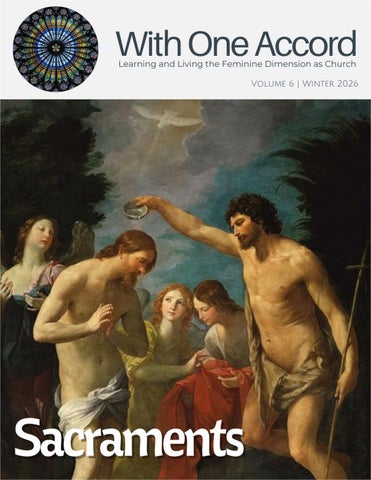
Cover: “The Baptism of Christ” by Guido Reni (1575-1642).

Page 2 Detail from “The Baptism of Christ” (as above).

Page 8 “Main altar at St. Peter’s Basilica, Rome” photo by John Dalla Costa.

Page 10 Detail from “Maria Magdalena” by Jan van Scorel (1495-1562).

Page 11 “Mary Magdalene” by Andrea Solari (1460-1524).

Page 12 “The Confession” by Giuseppe Molteni (1838).

Page 12 “Christ and the Samaritan Woman” by Angelika Kauffmann (1741-1807).

Page 15 “Church Interior” by Théodore Jacques Ralli (1852-1909).

Page 20 Detail from “Sant’Ambrogio” by Rutilio Manetti (1571-1639).

www.magdalacolloquy.org

This edition

Copyright © 2026 Saint Basil’s Catholic Parish, Toronto, Canada For editorial enquiries, please contact editor@magdalacolloquy.org ISSN 2563-7924

PUBLISHER

Morgan V. Rice, CSB

EDITOR

Lucinda M. Vardey

ASSOCIATE EDITOR

Emily VanBerkum

CONTRIBUTING EDITOR

Gregory Rupik

PRODUCTION COORDINATOR

Michael Pirri

VIDEO EDITOR

Michael Pirri

CONSULTANT

John Dalla Costa

ITALIAN TRANSLATOR

Elena Buia Rutt

Turn static files into dynamic content formats.
Create a flipbook
WITH ONE ACCORD: Sacraments by Magdala Colloquy - Issuu