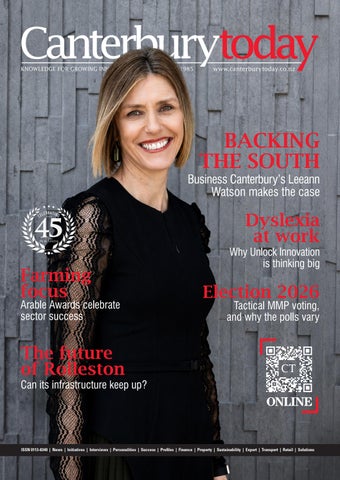
BACKING THE SOUTH
Business Canterbury’s Leeann Watson makes the case
Dyslexia at work
Farming focus
Arable Awards celebrate sector success
Why Unlock Innovation is thinking big
Election 2026 Tactical MMP voting, and why the polls vary
The future of Rolleston
Can its infrastructure keep up?
ONLINE
Homes for the way South Islanders live For many South Islanders, building a home is about more than creating a place to live. It is about building a lifestyle that suits the land, the climate, and the people who will live there for years to come. That practical approach is what continues to shape the work of Heartland Homes South Island, a locally operated building company delivering homes designed for the realities of South Island living. Based in North Canterbury and servicing regions throughout the South Island, Heartland Homes South Island has built a reputation around flexibility, personalised service, and homes that balance affordability with quality construction. Whether it is a rural family home, a compact farm cottage, a lifestyle block build, or a modern custom-designed residence, the company focuses on creating homes that work for the people who live in them. Unlike many volume builders, Heartland Homes places strong emphasis on tailoring each build to suit the customer’s section, budget, and lifestyle needs. Clients can choose from a wide range of existing plans or work with the team to create a fully customised design. This flexibility has become increasingly important as more South Islanders look for homes that reflect changing family needs, rural lifestyles, or multi-generational living arrangements. The company also understands the unique challenges that come with building across the South Island. Weather conditions, site access, rural infrastructure, and varying
terrain can all impact a project, which is why Heartland Homes focuses heavily on planning and communication throughout the process. Their team works closely with clients from initial design discussions through to final handover, helping simplify what can often feel like an overwhelming process. Another key focus for Heartland Homes South Island is value for money. Rising construction costs continue to place pressure on homeowners across New Zealand, and the company aims to provide practical building solutions without compromising on workmanship or materials. Their staged payment structures and transparent project management approach are designed to give clients confidence throughout the build journey. Heartland Homes also offers a broad range of housing styles suited to both urban and rural settings. Their projects include family homes, transportable-style cottages, holiday homes, investment properties, and lifestyle block residences. For many rural landowners, the ability to create functional homes
Rising construction costs continue to place pressure on homeowners across New Zealand, and the company aims to provide practical building solutions without compromising on workmanship or materials.
that suit farming or country living remains a major drawcard. Customer relationships remain central to the business. South Island owners Geoff and Vicki Foster have built the company around approachable service and long-term trust, with much of their work coming through referrals and repeat customers. That local
connection continues to be an important part of the Heartland Homes identity. As housing needs continue to evolve across Canterbury and the wider South Island, Heartland Homes South Island remains focused on delivering homes that are practical, durable, and built to suit the way Kiwis live.
*Onsite Build * Transportable *Kitset
Build your dream. Any style, anywhere At Heartland Homes, we make your dream a reality by creating unique residences tailored to meet your lifestyle and family needs. From serene rural abodes to grand mansions, each project is managed with a sharp focus on quality, affordability, and personal service. SOUTH ISLAND 119 Carters Road, Amberley Geoff Foster 027 522 4061 | Vicki Foster 027 696 6391
www.heartlandhomes.co.nz
10
LOOKING FOR STAFF? LAUNCH YOUR SEARCH WITH US! Use the most cost effective and easiest job site in New Zealand. Now with a new and improved website making things even easier, ensuring you get quality applicants, every time!
COVER STORY Page 10
Issue 184
Business Canterbury's Leeann Watson makes the case for backing the South Island.
Leeann Watson, chief executive of Business Canterbury, is backing the South Island. She wants the settings sorted before the growth arrives, and eight chambers have gone into this election agreeing with her.
At the first South Island Election Conference, 640 business leaders met 35 MPs. Eight chambers and 7,000 businesses want infrastructure that holds up, affordable energy and regulation that gets out of the way. The future Watson points to is food and fibre, renewable energy and aerospace.
The team at
Rolleston shows what happens when they arrive late. The town was planned in 1973 for 50,000 people, the plan was scrapped two years later, and it has grown 1,246% since 2000 without one. Eight schools and a library have followed. A hospital has not. The rest is closer to your desk. Leave stops being counted in days, the thinking you are hiring for may already be on the payroll, an MBIE ruling changes what short-stay landlords can assume, and not every problem needs AI. Our columnists take on contractors, succession and the self-scan checkout. And a general election, whichever way it lands. Enjoy.
0800 486 329 HEAD OFFICE 38 LOWE ST, ADDINGTON, CHRISTCHURCH 8011 AUCKLAND OFFICE LEVEL 3/205 QUEEN STREET, AUCKLAND CBD, AUCKLAND 1010
FOR ALL ADVERTISING ENQUIRIES: (03) 961 5184 sales@academygroup.co.nz www.canterburytoday.co.nz
• PLUMBING • DRAINLAYING • GAS SUPPLIER & FITTING • ROOFING
K J Morgan Plumbing Ltd 11 Purkiss Street, PO Box 925, BLENHEIM 7240 t: 03 578 0060 e: info@morganplumbing.co.nz
www.morganplumbing.co.nz
Davo 021 222 8662 Firewood orders Andrea 021 222 8661 838 Jones Road, Rolleston | E woodntree
24
BUSINESS NEWS, ANYTIME, ANYWHERE 12
THE LATEST INFORMATION FROM THE FRONT LINES OF INDUSTRY, MEDIA, TECHNOLOGY, AND COMMERCE.
50
Viewpoints
40
The Holidays Act is replaced, contractors versus employees, and more 20
42
Dyslexia at work
Glassons let its customers do the advertising
48
Asbestos in play sand Family wins payout from Kmart
50
Farming focus Arable Awards celebrate sector success
54
Identity theft How businesses can fight impersonation scams
56
Does AI always pay off?
The queue that sold the store 28
The future of Rolleston
Why the polls disagree Will the Opportunity Party meet 5%
Why Unlock Innovation is thinking big 24
The overhang loophole
Christmas party chaos Who carries the liability?
22
Tactical voting and MMP
Automation may be the answer
Can its infrastructure keep up?
28 B2B News is New Zealand’s rapidly growing destination for business-to-business news, insight and innovation.
MAGAZINES TODAY OVERVIEW Academy Group has grown to be one of New Zealand’s largest privately owned publishing houses, with carefully targeted publications offering in-depth analysis of current issues, exciting profiles, interesting people, and details of the latest projects and products making news. HEAD OFFICE - CHRISTCHURCH
38 Lowe Street, Addington, Christchurch 8011 AUCKLAND
Level 3/205 Queen Street, Auckland CBD, Auckland 1010
(03) 961 5050 admin@academygroup.co.nz www.canterburytoday.co.nz
B2BNEWS.co.nz
Gary Collins Kylie Palermo Angela Elley Jarred Shakespeare
MANAGING DIRECTOR
Amber Mundy
PRODUCT COORDINATOR MANAGER
GENERAL MANAGER OF OPERATIONS SALES MANAGER ART DIRECTOR
Jessica Ann, Sarah Betman DESIGN
ISSN 0113-8340 (PRINT) ISSN 2230-6331 (ONLINE)
This publication is provided on the basis that AMark Publishing NZ Ltd is not responsible for the results of any actions taken on the basis of information in these articles, nor for any error or omission from these articles and that the firm is not hereby engaged in rendering advice or services. AMark Publishing NZ Ltd expressly disclaim all and any liability and responsibility to any person in respect of anything and of the consequences of anything done, or omitted to be done, by any such a person in reliance, whether wholly or partially upon the whole or any part of the contents of this publication. This publication may include content created, edited, or assisted by Artificial Intelligence (AI) tools. Advertising feature articles are classified as advertising content and as such, information contained in them is subject to the Advertising Standards Authority Codes of Practice. Contents Copyright 2013 by AMark Publishing NZ Ltd. All rights reserved. No article or advertisement may be reproduced without written permission. You can read the full list of T&C’s on:
www.academygroup.co.nz/terms-conditions | www.academygroup.co.nz/competition-terms/
TECH TRENDS
Magnetic Wireless Power Bank Keep your phone charged while you are out and about with the Cygnett MagSlim 10K Magnetic Wireless Power Bank. Designed for compatible smartphones, it attaches magnetically for convenient wireless charging and also features USB-C connectivity. Its portable design makes it ideal for travel, work and everyday use. RRP $100 | www.jbhifi.co.nz
Portable Espresso Maker
Mini Thermal Label Printer
Enjoy freshly brewed coffee wherever the day takes you with the Outin Nano Portable Espresso Maker. Compact and easy to carry, this handy coffee gadget is suited to home use, road trips, camping and the office. It is a convenient option for coffee lovers who want espresso without a full-sized machine.
Bring some extra organisation to your home or office with a mini thermal label printer. Connecting wirelessly to your smartphone, this compact gadget prints labels, notes, lists and stickers without requiring ink. It is a practical tool for labelling containers, organising paperwork, creating craft projects and personalising gifts.
RRP $238 | www.jbhifi.co.nz
RRP $35 | www.kmart.co.nz
TESSAN Ultra-Slim Universal Travel Adapter
Smart Plug Give an ordinary household appliance a smart upgrade with the IKEA GRILLPLATS smart plug. Once connected, the plug allows users to control appliances remotely and schedule when they switch on or off. It offers a simple way to automate lamps and other devices without replacing existing equipment.
Stay connected wherever you travel with the TESSAN Ultra-Slim Universal Travel Adapter. Featuring two USB-C ports and one USB-A port, this compact gadget allows you to charge multiple devices while supporting a range of international plug types. Its slim design makes it easy to pack. RRP $40 | www.amazon.com
RRP $16 | www.ikea.co.nz
7
Premium living at Rosebank Welcome to Rosebank Lifecare, a trusted community offering a safe, supportive environment where residents feel genuinely cared for. We provide Residential Care, Independent Villas, and onebedroom and studio care suites, with personalized support to suit a range of needs. Located near the beautiful Ashburton Domain, Rosebank Village offers modern two- and three-bedroom villas designed for relaxing living. Enjoy spacious interiors, private gardens, and internal-access garages. Family, friends, and even your furry companions are welcome.
Looking for your ideal villa?
A villa is available now – enquire today discover the lifestyle you’ve been waiting for. Enjoy a friendly community, organized activities, and support from our village coordinator who helps create enjoyable outings, exercise classes, and social events. At Rosebank, you can enjoy independent living within a caring community, where neighbours become friends and every day offers opportunities to stay active and connected.
Comfort and Care You Can Trust. Rosebank’s one-bedroom and studio care suites offer the privacy of your own space with personalized support when needed. Enjoy chef-prepared meals, housekeeping and laundry services, flexible care options, and the peace of mind of maintenance and security taken care of. Discover Rosebank’s Care Suites today.
For a tour of our Village please phone our Sales person on 03 3070657 or email an enquiry Sales@rosebanklifecare.co.nz Residential and Hospital enquiries please phone our Manager on 03 3080111 or email manager@rosebanklifecare.co.nz
BACKING THE SOUTH The South Island contributes around $100 billion to the national economy and generates roughly one third of New Zealand’s goods exports. It hosts a large share of international visitor spending, and its exporters, manufacturers, food and fibre producers, universities and tech firms compete on the world stage. What it hasn’t always had is a single voice in Wellington.
Rt Hon Chris Hipkins gives Labour Party Leader's Address.
By Ben O’Connell
That changed in 2026. For the first time, the eight South Island Chambers of Commerce, Business Canterbury among them, have come together behind a shared election platform representing about 7,000 businesses and organisations. The manifesto, Growing New Zealand from the South: A Policy Platform for Election 2026, provides a clear and actionable blueprint for supporting regional business success. The platform sets out what South Island firms need to grow: infrastructure that holds up, workforce and immigration settings that reflect regional realities, reliable
and affordable energy, access to capital, export-focused policy and regulation that doesn’t get in the way of productivity.
Rt Hon Christopher Luxon gives National Party Leader's Address.
The appetite for that conversation was on display at the inaugural South Island Election Conference, which drew more than 640 business leaders alongside 35 MPs and Ministers, including the Prime Minister and the Leader of the Opposition. With the 2026 election ahead, Business Canterbury chief executive Leeann Watson makes the case for why backing the South Island is one of the smartest investments a future government can make. CT
The South Island Election Conference drew more than 640 business leaders alongside 35 MPs and Ministers. MPs form the Economy Panel at the South Island Election Conference. 2026.
10
Cover Story
Invest in the South Island, invest in New Zealand By Leeann Watson, Business Canterbury chief executive
As New Zealand moves towards the 2026 election, one thing is becoming increasingly clear – if we want stronger productivity, higher incomes, greater resilience and a more competitive economy, the South Island is one of the best investments a future government can make. We already contribute around $100 billion to the national economy. We generate approximately one-third of New Zealand’s goods exports, host a substantial share of international visitor spending and support industries that are critical to New Zealand’s prosperity and resilience. Growth is already happening here. The opportunity is to enable more of it. Businesses in the South Island need infrastructure that supports growth and resilience. They need workforce and immigration settings that recognise regional realities. They need reliable and affordable energy. They need access to investment and capital. They need export-focused policies that help businesses compete internationally. And they need a regulatory environment that enables productivity and innovation rather than creating unnecessary friction. One of the most encouraging developments across the South Island over the past year has been the emergence of a genuinely aligned voice around what growth requires. Not just a shared ambition, but also a growing consensus on the practical steps needed to unlock it. Governments face no shortage of competing priorities and competing demands. They want to understand where opportunities exist, what
barriers need addressing and where there is broad support for action. And we are pitching the solution to these policy and investment opportunities as a partnership between government and business. That is exactly what has underpinned the work of the eight South Island Chambers of Commerce, including Business Canterbury, which for the first time have come together around a shared election platform. Together, we represent around 7,000 businesses and organisations that see significant potential not only for the South Island, but for the whole country.
Leeann Watson welcomes the South Island Election Conference 2026.
The South Island is an incredibly diverse part of New Zealand. We are home to globally connected exporters, world-class tourism destinations, leading universities, advanced manufacturers, technology companies, food and fibre producers, renewable energy resources, aquaculture businesses and emerging industries that are competing on the world stage.
Our job in the South Island is to be clear on the outcomes we want, aligned on the steps needed to achieve them and committed to working in partnership with governments to deliver them.
This spirit of partnership was evident at the inaugural South Island Election Conference, which brought together more than 640 business leaders alongside 35 MPs and Ministers, including both the Prime Minister and the Leader of the Opposition. The scale of engagement reflected growing recognition that the South Island has an increasingly important role to play in New Zealand’s economic future.
Some of the most powerful levers available to any government are policy, regulation and the broader settings that influence business confidence. The choices made around infrastructure, workforce development, energy, immigration, compliance, innovation and capital all have a direct impact on whether businesses choose to invest, expand and create jobs.
The conversations were constructive, future-focused and centred on opportunity. The discussion was not about what the South Island needs from New Zealand. It was about what the South Island can contribute to New Zealand and how we can work together to unlock that potential through the right investments. Importantly, when we talk about investment, we are talking about far more than government spending.
At a time when many countries are grappling with low productivity growth, infrastructure challenges and increasing global competition, New Zealand has an opportunity to lean into areas of genuine competitive advantage. The South Island’s strengths in food and fibre, advanced manufacturing, renewable energy, tourism, technology, education, aerospace and aquaculture provide a strong platform for future growth. With the right settings, those strengths can
drive higher productivity, stronger exports, better incomes and more resilient communities – right across New Zealand. We want future governments to recognise momentum already existing here makes us a more attractive, not less necessary partner on creating the right policy, regulatory and investment settings. Our job in the South Island is to be clear on the outcomes we want, aligned on the steps needed to achieve them and committed to working in partnership with governments to deliver them. As political parties shape their priorities for the election ahead, the proposition is a simple one – if New Zealand wants stronger productivity, greater resilience, higher incomes and a more competitive economy, backing the South Island is one of the smartest investments we can make. CT 11
Viewpoints
Employment Leave Bill – about time! The Employment Leave Bill 2026 has just passed its final reading in Parliament, noting that there is a 24-month transition period to allow for the updating of payroll systems and employment agreements. This legislation represents one of the most significant and long-awaited reforms to leave entitlements. It replaces the Holidays Act 2003, which had long been criticised for being overly complex and difficult to administer, with many employers being forced to rectify unintentional underpayments to employees. A key feature of this legislation is the shift to an hour-based approach for annual (0.0769 hours per standard hour worked) and sick leave (0.0385 hours per standard hour worked).
Instead of leave being measured primarily in days or weeks, employees will accrue leave in direct proportion to their standard hours of work. Andrew Shaw
Instead of leave being measured primarily in days or weeks, employees will accrue leave in direct proportion to their standard hours of work. There is logic in this approach; a day can be 1 to 24 hours, a week can be 1 to 7 days, but an hour is an hour. This legislation also introduces several changes aimed at increasing flexibility for employers and employees. Annual leave, sick leave, bereavement leave, and family (domestic) violence leave will be available from the first day
of employment, rather than waiting six months. Employees will be able to cash up to 25% of their annual leave balance each year (currently capped at one week), and a single hourly rate will be used when calculating paid leave across different leave types. This legislation has attracted some criticism. Opponents argue that certain groups, particularly part-time, casual, and irregular workers, could be disadvantaged under the new system. Concerns have also been raised that some employees may accrue less
leave than they would under current arrangements. However, there is a provision for a 12.5% compensation payment for additional and casual hours over and above standard hours. This has always been a complex area, and it is difficult to please everyone. However, the provisions in this legislation are a marked step forward and should allow employers and employees alike to have more clarity of their rights and obligations when it comes to taking and paying for leave. CT
Succession - the philosophy of letting go You’ve spent the last 35 years building your business, and either now, or soon, it will be time to let it go. The question of ‘who runs this after me’ is starting to take your attention. For some it will become an anxiety or disappointment. Letting go asks something harder than logic. It asks whether you know yourself well enough to trust someone else with what you built. You only know others once you know yourself, and most owners skip that step because it’s uncomfortable. Time doesn’t stop. It moves on, and so do people. Hold on too long and those capable of taking over will leave or be old like you and past their best. 12
Bruce Sheppard
The kindest thing you can do for your successor, and yourself, is to be in the room for the handover rather than absent from it, even if neither of you feel it for the first year or two. It’s never really a transaction. The structures and economics can be sorted. What decides whether it works is the emotion, and that belongs to people, not paperwork. Most treat succession as a planning problem: draft the agreement, brief the lawyers, set the timeline. Necessary, but not sufficient.
Business is mostly a human experience from which economic outcomes are derived.
To read more go to gilligansheppard. co.nz/bruce/succession-the-hardestpart-is-letting-go CT
So, trust the people, not the process. Structure helps, but it will not save a transition if those involved do not share something bigger than their own seat. Get that right, and the rest becomes manageable. Get it wrong, and no framework holds it together.
Bruce Sheppard is Founder and CEO of Gilligan Sheppard: Problem-solvers for businesses
Tips:
1. Understand your business or family. Be authentic and ensure communication is clear in both directions. Speak, and listen. You might not like what you hear, so adapt. 2. Prioritise diversity in thought. Look for shared values as thoroughly as
possible to achieve alignment and performance faster. 3. If you have an internal candidate in mind, ensure they’re ready and want it. If it’s an external candidate, make sure they want it for the ‘right’ reasons.
Are you at risk of melanoma? Did you know that New Zealand has the highest rate of melanoma in the world? Every day, around 7 New Zealanders are diagnosed with melanoma - it’s the most serious form of skin cancer and it can quickly become deadly.1,2 That’s why MoleMap’s proven skin-mapping system is designed to detect skin cancers such as melanoma early – when it’s most treatable.3
We check. And double-check. With MoleMap you get two sets of expert eyes examining any moles of concern: a trained Melanographer and an experienced specialist Dermatologist.
Fewer scars. Fewer scares. Because MoleMap can more accurately identify melanoma, there is less need to surgically remove benign (harmless) moles.1
Early detection makes a difference. Early melanoma detection offers a up to 95% chance of survival within 5 years. That’s why it’s always worth checking.
Clinics held weekly in Rangiora, Ashburton and Timaru
0800 665 362 | molemap.co.nz References: 1. Health Promotion Agency and the Melanoma Network of New Zealand (MelNet) 2017: New Zealand Skin Cancer Primary Prevention and Early Detection Strategy 2017 to 2022. 2. https://www.melanoma.org.nz/facts-risk-factors 3. https://www.melanoma.org.nz/early-detection
Viewpoints
Shop & Go error a symptom of a wider problem In July Consumer NZ reported on a Christchurch shopper who was charged the wrong price for 26 items in her weekly shop after using a Shop & Go scanner at New World St Martins. The total on the scanner was $360, but jumped to $410 when the customer went to pay at the checkout. She reported the discrepancy and New World refunded her (although initially not the full amount she was entitled to under Foodstuffs South Island’s refund policy). Pricing errors aside, scan-as-you-go technology can offer convenience for shoppers who want a way to keep an eye on what they’re spending as they shop. After the initial investment, they also save the supermarket money, most obviously on the cost of labour. Combine scanner tech with the proliferation of automated checkouts and you can easily do your weekly shop without interacting with a supermarket employee. Supermarkets are platforms that sit between suppliers and consumers. The Commerce Commission recently raised concerns around the $6 billion suppliers are forced to pay the major supermarkets
Jon Duffy
“If shoppers are doing the work and suppliers are paying for the labour, where are all those cost savings going?”
annually for over 50 types of activities. These activities include shelf restocking, aisle-cleaning and other in-store services. On one side of the platform, supermarkets are increasingly automating the shopping experience for customers which translates to shoppers scanning and packing their own groceries, something I used to be paid by a supermarket to do for customers as an after-school job. On the other side of the platform, supermarkets are charging suppliers to have shelves restocked and aisles cleaned – again things I was paid to do by the supermarket as an employee.
New York State is currently considering a Self-Checkout Bill that would mandate a 10% discount for all goods purchased from a food retail establishment through a selfcheckout kiosk. New York is asking, if customers are doing the work checkout operators used to; why are groceries not cheaper? In the New Zealand context, we could also ask; if suppliers are paying for the labour to keep the shelves full, where are all those cost savings going? Such is the dominant position of the supermarket duopoly and the lack of meaningful competition (or threat of competition) within the sector, that the supermarkets can enshittify the shopping experience for customers by turning them into supermarket employees and extract $6 billion dollars in duopoly rents from suppliers, with little
14
concern for a backlash from either side. Our regulators and successive Governments seem powerless to fix the structural problems that facilitate this conduct, despite their rhetoric. Maybe there is something in the New York law for New Zealand politicians struggling with ideas. For those shoppers who can afford to, maybe there is also something in supporting the real humans at their local independent green grocer, bakery or butcher and breaking at least part of the stranglehold the duopoly has over our weekly shop. CT Jon Duffy is the chief executive of Consumer NZ
Viewpoints
Contractor or employee? The label is not the answer Many businesses engage people as contractors because it appears flexible and straightforward. But a contractor agreement is not conclusive. The real question is how the relationship operates day to day. The recent Supreme Court decision involving Uber is a timely reminder. Although the drivers’ agreements described them as independent contractors, the Court found that, while using the app, the drivers were employees. Uber exercised substantial control over the service, drivers could not subcontract the work, and their opportunity to build an independent business was limited. This does not mean every contractor is an employee. It does mean businesses should look beyond the label. Ask three practical questions. First, who controls the work: its timing, method, price and standards? Secondly, can the person genuinely work for others, send a substitute, and make their own commercial decisions? Thirdly, do they carry real business risk and have a genuine opportunity to profit through their own enterprise?
Events diary Women in Business Forum September 24 2026 One New Zealand Stadium Max Whitehead
Uber exercised substantial control over the service, drivers could not subcontract the work, and their opportunity to build an independent business was limited.
Business Canterbury brings women in business together at the new stadium on 24 September, 4pm to 6.30pm. A panel and Q&A hosted by the chief executive covers what drives women into leadership, the barriers in the way, and the trade-offs nobody puts in the job description. Speakers include Mary Devine ONZM, Alice Fitzgerald and Hon Nicola Grigg. www.businesscanterbury.co.nz Pink Ribbon Walk October 4 2026 North Hagley Park Breast Cancer Foundation NZ’s Pink Ribbon Walk sets off from North Hagley Park at 1.30pm on 4 October, with 5km and 10km routes to choose from. Every entry comes with a fundraising page, and the money raised goes to research, education and support for people going through treatment. Early bird pricing closes 4 September. www.fundraise.bcf.org.nz/event/pinkribbonwalk
Recent legislative changes have also introduced a new contractor gateway test. Where its requirements are met, a contractor may be prevented from challenging their status. However, that is not a substitute for getting the arrangement right at the outset. A misclassification can be expensive. If a contractor is later found to be an employee, there may be claims for minimum entitlements, leave, wages and other remedies. The sensible approach is to review both the written agreement and the reality of the work. If they do not match, it is time to obtain advice before a dispute arises. CT Max Whitehead is an employment relations specialist who has advised employers and employees throughout New Zealand for more than 30 years.
A misclassification can be expensive. If a contractor is later found to be an employee, there may be claims for minimum entitlements, leave, wages and other remedies.
Christchurch AI Meetup October 12 2026 EPIC Innovation Centre Canterbury’s monthly AI community gathering returns on the second Monday of October, running 5.30pm to 8pm at EPIC. The format follows the usual mix of drinks and networking, followed by two speaker talks covering practical AI tools, governance or business applications, with open Q&A to close. It draws developers, founders, business leaders and researchers working with or curious about AI in Canterbury. Free to attend. www.christchurch-ai.com Summer Startup Programme: November 9 2026 UC Centre for Entrepreneurship, University of Canterbury The University of Canterbury's Summer Startup Programme kicks off on 9 November, running weekdays through to 11 December before resuming in January. Founders get a dedicated workspace alongside a run of workshops, mentor sessions and industry speakers covering business fundamentals, revenue models and intellectual property. The programme wraps with a showcase where ten selected ventures pitch to a room of investors, advisors and mentors. Applications close 13 September. www.canterbury.ac.nz/business/centre-for-entrepreneurship/ summer-startup-programme
Discover Christchurch with a trusted local guide www.myguidechristchurch.com
15
BUILD. RENOVATE. INNOVATE.
Award-winning builders with 35+ years of experience Darryl Gardiner has been in the building industry for over 35 years. He completed his initial building apprenticeship with a well-known local building company and stayed with them for over 24 years. As a dedicated apprentice, Darryl was the foreman of a number of projects, including a large house built in Nelson that won the Supreme Award in New Zealand with Master Builders. Following a successful career as a builder, Darryl founded Gardiner Building Contractors in 2005 and has been carrying out high-quality builds and renovations ever since.
Contact us today, if you’re looking for an experienced team of award-winning builders dedicated to providing the best construction services in Nelson.
5 McPherson Street, Richmond, Nelson M. 027 484 0719 P. 0800 033 939 E. gbc.ltd@xtra.co.nz facebook@GardinerBuildingContractors www.gardinerbuildingcontractors.co.nz
LEADING THROUGH INNOVATION.
Over 35 years of building experience. Why choose us?
✓ Market Knowledge ✓ Licensed Builders ✓ Award-Winning ✓ Customer-Focussed Our Services BUILDING SERVICES IN THE NELSON, MOTUEKA, GOLDEN BAY AND HAVELOCK AREAS.
New homes Renovations & alterations Architectural homes Decking Retaining walls Commercial lighting Building advice & consultation Pre-purchase inspection Shop fit-outs
M. 027 484 0719 E. gbc.ltd@xtra.co.nz 5 McPherson Street, Richmond, Nelson facebook@GardinerBuildingContractors gardinerbuildingcontractors.co.nz
One team, one venue, any occasion
Addington Raceway & Events Centre is one of Christc hurch's most flexible and distinctive venues, and its experience d events team can bring just about any kind of function to life. The spaces work as a true blank canvas. Conferences, product launches, meetings, seminars, workshops and dinners - Addington’s spaces can be tailored to suit events of all sizes from 10 to 800 guests. Free on-site parking adds a practical bonus that many central city venues simply cannot match. The process is refreshingly straightforward. Tell the team what you need and what you want to spend, and they build the event around that. Everything runs inhouse, from the catering to the floor plans - so you work with a single team from your first enquiry right through to the event itself. For a ready-made night out, Addington's signature Trackside Dining experience is available on selected evenings throughout September and October. Exceptional cuisine, premium trackside views, and the excitement of live harness
racing come together for an evening that is genuinely hard to beat - all from just $65 per person. Everything runs in-house, from the catering to the floor plans, so you work with a single team from your first enquiry right through to the night itself.
And for something with a little extra flavour, Oktoberfest arrives at Addington on Friday 2nd October, bringing Bavarianinspired dining, live music, and exciting harness racing to the Christian Cullen Lounge for just $85 per person. It's a fantastic option for a team night out with a difference. That same flexibility carries into Christmas, when Addington transforms into a festive celebration creating the perfect setting for end-of-year events.
You can book a private function using the Suites, Lounges, Spectators Bar, the Lawns or The Terrace. For those who prefer a readymade celebration, Christmas at Addington race nights are the perfect solution. Running across four Fridays from late November, each night combines a threecourse buffet and live entertainment with thrilling harness racing. Simply choose your date and your package, and the team handles everything else. Packages start from $80 per person and extend to $155, offering genuine options whether you're planning a small team
night out or larger-scale work party. Trackside TVs, TAB facilities, and racebooks are all included, adding to the authentic race night experience. Calendars are filling up fast and the most popular Christmas at Addington dates sell out well in advance. If you are planning an event, conference, or an end-ofyear celebration your team will actually look forward to, the time to book is now.
Head to their website for further information and to book - addington.co.nz.
TAKE THE TUESDAY. NZ TROTTING CUP DAY 10 TH NOVEMBER
TICKETS ON SALE NOW ADDINGTON.CO.NZ
20th Nov 4th Dec
27th Nov 11th Dec
Book now at addington.co.nz
Corporate Events | Christmas
The other event season December is a key period but it’s only one part of Canterbury’s corporate events calendar. Te Pae Christchurch has the numbers to prove it. In the year to June 2026, conventions held at the centre generated $73.8 million for the economy, with more than $60 million landing directly in Canterbury and 827 jobs supported. That came from 56 conventions, plus another 133 exhibitions, banquets, meetings and live events, and more than 125,000 people through the doors. Te Pae general manager Ross Steele says organisations “increasingly want events that deliver meaningful outcomes for delegates while aligning with their environmental and social values”. That means fewer events built around a room and a run sheet, and more built around a brief.
Venues are fielding questions they weren’t asked a decade ago: waste, local suppliers, accessibility, whether delegates can get there without a car. That money moves through a long local chain. Steele credits an integrated regional effort taking in Christchurch City Council, ChristchurchNZ, Christchurch Airport, accommodation and hospitality providers, local food and beverage suppliers, and the entertainers, designers and performers who fill out a programme. For Canterbury suppliers, the events calendar is a market as much as a cost. Add One New Zealand Stadium at Te Kaha, open since March 2026 with function spaces of its own, and Christchurch has a spread of purpose-built rooms that would have been unimaginable 15 years ago. Local business should know that the same venues that host a 1,200-delegate international congress will do an AGM, an awards evening, a product launch, a client day or an internal conference for 60.
A business that only ever books a room in December is using its own city once a year. The off-peak advantages are unglamorous and real. February, March and July give you a real choice of dates. Rates are better and caterers have room to move. Te Pae’s own shoulder season carried The Art of Banksy and more than 38,000 visitors.
"Organisations increasingly want events that deliver meaningful outcomes while aligning with environmental and social values." There’s a tax edge as well. Inland Revenue treats a social function as entertainment, so half the spend is deductible. Food and drink at a conference or training event
running four hours or more is fully deductible. Build the off-peak event as a genuine half-day programme and the same money is treated differently. Worth checking with your accountant before you book. The harder question is what the event is for. Plenty happen because one happened last year, which makes them a budget line rather than a decision. A useful test: write the outcome down before you book anything. Signed leads, a strategy people can repeat back the following week, 40 clients who know what the new division does. If nothing survives that sentence, you’re just organising catering. None of this makes the December function redundant. It’s a different event with a different job, and it belongs on the calendar. But the business that only shows up for that one is watching $60 million a year move through Canterbury and treating it as somebody else’s economy. The venues are here and the quiet months are wide open. CT 19
Corporate Events | Christmas
Is the boss liable for Christmas party chaos? Somewhere in Christchurch an office manager is already ringing venues for the first week of December. Perhaps it’s already organised. Leave it later and the choice narrows to whatever nobody else wanted. The groundwork that secures a decent venue is also what keeps the night from becoming an employment problem. Under the Health and Safety at Work Act 2015, a PCBU must ensure the health and safety of its workers so far as is reasonably practicable, and that duty doesn’t politely stop at 5pm on the second Friday in December. If the business organises the function, pays for it, invites staff and holds it out as a work event, it’s generally treated as an extension of the workplace, whether that’s the staff room, a spicy Riccarton restaurant or a boat in Lyttelton Harbour. Making attendance voluntary doesn’t change the analysis much. Most staff read an optional work function the way they read an optional 7am meeting. The opposite myth needs killing. WorkSafe put out a release in December 2016 headlined “Health and safety isn’t the Christmas grinch”, knocking back claims that the Act had made decorations and dance floors legally radioactive. The test is what’s reasonably practicable, not what’s theoretically possible. Almost every function that turns into a legal problem has alcohol somewhere in the chain. The Employers and Manufacturers Association’s November 2025 guidance is the least glamorous advice imaginable, which is why it works. Feed people properly. Make non-alcoholic options genuinely available rather than a jug 20
of warm orange juice at the end of the table. Cap or close the tab at a set time. Nominate someone senior who isn’t drinking and whose job that night is noticing when things go sideways. EMA manager of employment relations and safety Paul Jarvie put it bluntly, noting that “the full force of employment law, including health and safety and ACC, remain in force, particularly when alcohol is part of the equation.” If you have staff under 18, supplying them alcohol is a Sale and Supply of Alcohol Act matter first. Transport is the cheapest risk management available. An employer that monitors the tab, arranges taxis or ride-share vouchers and sees people off safely sits in a different position from one that runs an open bar for four hours then turns the lights off. Conduct obligations under the Employment Relations Act and the
Human Rights Act are unaffected by the venue or the hour. In February 2025, a senior law firm partner faced the Lawyers and Conveyancers Disciplinary Tribunal over his behaviour at two work Christmas parties, with junior staff describing a reluctance to speak up given his seniority. He was later suspended for 15 months.
Before December, make sure staff know the conduct policy still applies and who to raise something with, and that it isn’t the person holding the microphone. The rest is the enjoyable part. Tell people the format, who’s speaking and when it finishes, don’t build the evening around drinking, and let the early leavers leave. CT
Where Canterbury goes to see dolphins Ninety minutes from Christchurch, Akaroa Harbour fills an ancient volcanic crater, its entrance guarded by dramatic sea cliffs and hidden caves. The Akaroa Harbour Nature Cruise spends two hours out on that water, and for a lot of Cantabrians it is the closest thing to standing inside a wildlife documentary. The main draw is the Hector’s dolphin, the world’s smallest and rarest marine dolphin, found nowhere else on earth. Banks Peninsula is home to around 2,500 of them, part of an estimated national population of 15,000, and
they are regular company on the cruise. New Zealand fur seals, white-flippered penguins, shags and the occasional albatross round out the cast, while the skipper reads the harbour’s wildlife, geology and history
over live commentary rather than a recording. Black Cat Cruises has been doing this longer than anyone. It was New Zealand’s first eco-tourism operator and the first to run cruises in Akaroa more than four decades ago, and it remains one of only a few operators licensed to work inside the Banks Peninsula Marine Mammal Sanctuary. It also partners with the Department of Conservation and the Banks Peninsula Conservation Trust. That confidence shows in the Dolphin Promise, a free re-cruise voucher for anyone who does not see a dolphin on the day.
The Canterbury Cat carries all of this in comfort, with two open viewing decks, an enclosed cabin wrapped in windows, complimentary hot drinks and a licensed bar. Cruises run year-round, most days, with two or three sailings daily and an extra late-afternoon departure from December to March. For anyone with a spare morning or afternoon in Akaroa, two hours on the harbour is an easy yes. Book the Akaroa Harbour Nature Cruise at blackcat.co.nz or call the Akaroa team on 03 304 7641.
AKAROA NATURE CRUISE Just 90-minutes from Christchurch, embark on our award-winning dolphin and wildlife cruise in Akaroa Experience a 2 hour dolphin cruise in Akaroa and encounter the world’s smallest and rarest marine dolphin, the endangered Hector’s dolphin. View Akaroa’s dramatic volcanic sea cliffs, New Zealand fur seal colonies, and marine birdlife, all while gaining insight into the area’s rich natural and cultural history.
Award-Winning Hector’s Dolphin & Wildlife Cruise in Akaroa | New Zealand
Black Cat Cruises are leaders in eco-tourism. During your cruise with us, you’ll learn about Akaroa’s incredible wildlife, the conservation efforts aimed at protecting the Hector’s dolphins, and explore how we can all contribute to their thriving future for generations to come.
The award-winning Black Cat Cruises is not only an acclaimed success in New Zealand’s tourism industry but also internationally recognised as an eco-tourism pioneer. We hold the honour of being the first to introduce cruises in Akaroa, and we’re proud to be New Zealand’s very first eco-tourism operator.
í 61 Beach Road, Akaroa
¼ 03 304 7641
º akaroa@blackcat.co.nz
www.blackcat.co.nz
Unlock Innovation Why the thinking you’re hiring for may already be on the payroll By Ben O’Connell
Unlock Innovation suggests that dyslexic thinking can be a key driver in innovation. Their message for employers is that the talent they’re looking for has long been part of the team. Dorenda Britten and Chris Cole co-founded the organisation, which works out of Christchurch and Invercargill and trains organisations to recognise and enable dyslexic thinking. Around one in five New Zealanders, so over one million of us, are dyslexic. As the pair describe it, dyslexic thinking runs strong on pattern recognition, spatial reasoning and the big picture. “If we cannot access that knowledge and that thinking, we’re dooming people to be unrecognised and frustrated at work. This is a multifaceted productivity issue and it promotes organisational churn and missed innovation opportunities.” Britten says. 22
Most dyslexic thinking stays undeclared at work given the shame associated with it through the education system, the pair say. Employers are already paying for skills they are not using. “We cannot grow and we cannot enhance our productivity as a nation doing the same things repetitively,” Britten says. “For that, we need a lot of different brains around the table.” Britten spent a career in design and business without knowing she was dyslexic. Cole, who had long worked in the field, was the one who raised it. Britten was in her seventies by then. “We, as dyslexics, are questioners and big picture thinkers,” she says. “We need to know why we’re making that decision. What’s all the undiscovered information around making that decision? And the accepted business system doesn’t have time for that.” In a working week, that might look like the colleague who slows a meeting down to ask why a decision is being made without understanding the broader consequences.
“We, as dyslexics, are questioners and big picture thinkers. We need to know why we’re making that decision. What’s all the undiscovered information around making that decision? And the accepted business system doesn’t have time for that.” - Dorenda Britten
Businesses under pressure drop the question to save an hour and the need for corrections turns up later anyway. Previous work Unlock Innovation undertook with NZTech and Canterbury Tech set out to test whether current recruitment
processes were sifting out misunderstood capability. Dyslexic staff were working around their difficulties quietly, and HR teams were running on old assumptions about what dyslexia is. Cole is a dyslexia coach for adults, most of whom arrive with no words for how they think, she says. “They don’t realise that some of their strengths are specific to being dyslexic thinkers. They think everyone thinks like that.” Awareness of dyslexia sits well behind ADHD and autism in most workplaces, so the strengths go unnamed along with the difficulties. “If you don’t notice it, you can’t embrace it.” Employers who assume dyslexia means someone cannot read may notice only the slow report writing or the rough email. Those visible challenges can then become the focus of performance reviews, while the person’s strengths go unrecognised. Cole encourages managers to consider both. “I can write and I love reading.”
Business
“If we cannot access that knowledge and that thinking, we’re dooming people to be unrecognised and frustrated at work. This is a multi-faceted productivity issue and it promotes organisational churn and missed innovation opportunities.” - Dorenda Britten
The pair have founded a University of Canterbury research project examining whether dyslexic thinkers in a team measurably lift innovation. They want arm’s length evidence for New Zealand businesses. Britten expects Canterbury to have its share of dyslexic minds. “We reckon around 90,000 people.” This points to all business sectors including manufacturing and farming. Cole puts it bluntly. “It’s about increasing innovation and building stronger businesses.” Cole works one-to-one with dyslexic staff so they can tell a manager how they absorb information: “My brain prefers communication this way”. The pair also run sessions for companies, who know only what their dyslexic staff find hard. They leave with things to do differently that work well for everyone. Britten says the key is making those changes without singling out the people they’ve intended to support. What comes up most in those sessions is communication, they say. They are building a workplace tool with two collaborators that intends to streamline and integrate
ways to improve communication between different thinkers. It’s dyslexia-informed rather than dyslexia-only. They are currently prototyping and seeking two more pilot companies for the tool. As for what employers can do, the first moves cost nothing, Cole says. Small changes do more than employers expect, making work easier for everyone. Rather than waiting for dyslexic staff to disclose, employers can look at where everyday ways of working may be creating unnecessary barriers. Read a performance review for what someone is good at, as well as what takes them longer. Give reasoning with the decision, Britten says, because the questioner moves faster once they have it. Ask people how they absorb information rather than assuming an email lands the same for everyone.
The thinking is the job Lincoln University food scientist Dr Keegan Burrow says academia is full of dyslexic people. The work is curious, patternfinding, inferences, long problems. The part he finds hard is the written output institutions run on. What it costs him is time. The work takes longer, he says, without the outcome being any worse. Reading has never been the difficulty. Writing is, and reading aloud. He was diagnosed late in high school and worked out at university what helped. He prints documents in the OpenDyslexic font and proofreads them on paper. Reading back catches the errors and improves the writing. “Ironically enough, technology is not the solution in my case,” he says.
Being open about it has been the most useful thing he’s done, Burrow says. There’s understanding anyway, but more once the label is out; a misspelling or a mispronounced word gets explained instead of hidden. Not to mention many colleagues are neurospicy themselves. Support is personal, he says, so what helps one dyslexic employee won’t help the next and a company-wide accommodation misses most. He does the same for his students. The habits dyslexia forces on him are ones anyone would gain from. Read the document properly. Make notes. Think deeply. “Those are things that can benefit even people who don’t have specific learning disabilities. It’s just that for people with specific learning disabilities we have no choice other than to do those things.” CT
They suggest starting with the paperwork. Do your reporting and review processes measure the work, or the writing? CT
23
Business
Glassons let its customers do the advertising By Ben O’Connell
Women’s fashion chain Glassons opened a new store at Miranda in southern Sydney in mid-August. The first 20 people through the door were promised an Ultimate Shire Pack worth up to A$400. The next 150 were promised gift boxes. Shoppers started lining up outside the shopping centre before 5am. Security wouldn’t let them wait inside the mall, so the queue sorted itself out, with people numbering themselves in the order they arrived. When the doors opened about 6.10am, more shoppers turned up and the system broke down. The crowd ran through the mall and up the escalators. Reports said people 24
were pushed from behind, shoved into walls and lost shoes. Of course, this was a crowdcontrol and safety problem. But the scramble ended up worth a lot to Glassons. Plenty of people filmed the frenzy and the footage travelled far. Massey University marketing professor Bodo Lang told the NZ Herald the free exposure from all that user-generated content “would have been worth easily in the tens of thousands, maybe even in the hundreds of thousands of dollars”. As he put it, the shoppers became the advertisers. Australian retail analyst Trent Rigby told SmartCompany that openings like this are the new Boxing Day midnight sales, and that “the queue itself has become the experience”. “Hundreds of people camping outside your store is marketing you simply just can’t buy,” he said, “and it’s created and distributed for free by the customers themselves.”
“Being the shop that everyone grew up with is worth plenty, but it also costs you the queue.” New Zealand does the same thing, just not for Glassons. Hundreds queued for IKEA’s Sylvia Park opening in December, while similarly large crowds turned out for Costco at Westgate in 2022, with some shoppers camping overnight. Both were brands opening their first New Zealand stores. That is the mechanism. A giveaway pulls a crowd only when the shop is new. Glassons started in Christchurch in 1918 as a mail-order clothing business founded by JH Glasson, and merged with Hallensteins in 1985 to form the NZX-listed company that owns it now. To a New Zealand shopper, it’s the
store that has been in your local mall since you were 13, with four Canterbury branches: High Street, Riccarton, Northlands and Hornby. It cannot be new here again. Australia met it later, and plenty of shoppers there found it on TikTok. The accounts show the difference, if not as cleanly as they look. In the year to 1 August 2025, Glassons Australia made A$251.5 million in sales, up 15.3%, against NZ$111.9 million here, up 1.7%. Some of it is arithmetic. Australia has five times the population and Glassons continues to open stores there. But the gap keeps widening. In the halfyear to February, Australian sales were up 22.4%. Being the shop that everyone grew up with is worth plenty, but it also costs you the queue. But familiarity isn’t the whole story. Give loyal shoppers a real deadline and they’ll still turn up. Read an extended version of this article on www.b2bnews.co.nz CT
25 GLENCAIRN ROAD, TWIZEL
Our boutique accommodation is situated in a quiet, peaceful location on the edge of Twizel, the nearest town to Aoraki/Mount Cook. Set back off the road, Rosedale Cottages have stunning views of the Ben Ohau range and Mount Cook. It’s only a short walk into town, where there is a good selection of cafes and restaurants, grocery and convenience stores, walk tracks, swimming holes and golf course. All nearby. Twizel is an alpine village situated in the playground of the magnificent Mackenzie high country, about 45 minutes from Aoraki Mount Cook. It’s the ‘watering hole’ between Tekapo and Omarama on your way south to Queenstown.
027 673 3253 | info@rosedalecottages.co.nz
www.rosedalecottages.co.nz E
HO KITIKA
Shelley Bainbridge OW N E R / P R I N C I PA L / L I C E N S E D AG E N T
If you are on the West Coast and thinking of selling or buying a property she is the person to go to. Her expertise, warmth and commitment to genuine results makes her a trusted name in real estate.
m 027 340 2400 k shelley.bainbridge@raywhite.com E Shelley Bainbridge Real Estate
Shelley is the Principal and Licensed Agent for Ray White Hokitika. My real estate journey has grown into the proud ownership of Ray White Hokitika, where I thrive on the privilege of guiding clients through one of the biggest decisions of their lives. Whether buying or selling residential or rural property, I embrace every challenge with enthusiasm and a genuine desire to achieve the very best outcomes. Earning Premier status in my career reflects my unwavering commitment to excellence and the consistent results I deliver for both vendors and purchasers. At heart, I’m a true people person. I place immense value on building authentic, lasting relationships and taking the time to truly understand what matters most to my clients. To me, real estate is far more than a series of transactions—it’s about supporting individuals and families as they realise their dreams, move into new chapters, and confidently embrace their next adventure.
Shelley Bainbridge
Verdant Real Estate Limited Licensed (REAA 2008).
NZ’s fastest growing town was once the future of urban planning. What happened? By Katie Pickles, Professor of History, University of Canterbury
Travel 25 kilometres south from Christchurch on the new 110kilometre-per-hour, multi-million-dollar “road of national significance” and you’ll reach New Zealand’s fastest growing town. Situated within the country’s fastest growing district of Selwyn, Rolleston now boasts a population over 34,000 – predicted to reach 50,000 by 2050. It is already Canterbury’s second-biggest urban area, surpassing Timaru and Ashburton. Rolleston was growing fast before the 2010–11 Canterbury earthquakes. And its continued expansion – including a proposed large-scale housing development – is part of a national pattern of mushrooming, car-dependent 28
satellite towns and fast-tracked urban sprawl. From 2000 to 2025 the town grew by a staggering 1,246%, or 11% annually. By comparison, New Zealand grew by 38% in that period, or 1% a year. But the Rolleston that has evolved – largely a dormitory suburb of Christchurch built on onceproductive land – is very different to the town first envisaged by planners in the early 1970s.
‘Town of the future’ According to the 2023 census, 52.9% of Rolleston’s residents commute to Christchurch for work, compared to the 32.4% living and working in the town. As my research has found, this was not the original intention. In November 1973, the Labour government of Norman Kirk announced the controversial
purchase of 10,000 acres (4,000 hectares) of land to develop a town for up to 50,000 people. Influenced by postwar international trends for new towns, the ambitious “town of the future” project was intended as a solution to Christchurch’s growing population. A separate, planned town would help preserve the city’s greenbelts, avoid urban sprawl and encourage economic and population growth in the South Island, away from Auckland in the north. It was hoped the town would be “as self-sufficient as possible in terms of industries and recreation to avoid adding further to the problems of Christchurch”. The planning work was careful, progressive and informed by international examples. Among its aspirations were affordable housing, alternative transport, sustainable
energy and water systems, and a “balanced community”. But in November 1975, when Robert Muldoon and his farmer-friendly National Party came to power, the new government fulfilled an election promise and scrapped what Muldoon called “ill-conceived” plans for Rolleston. Colin McLachlan, the National MP for Rakaia and close colleague of Muldoon, had always opposed the compulsory purchase of farmland. And there were fears of creating an under-resourced, “one class, one age”, isolated and socially deprived suburb. Looking back with the benefit of hindsight, however, we have to ask whether Rolleston’s original plan, and ideas from the 1970s in general, might have been on the right track – and could perhaps inform today’s planning.
Society
"From 2000 to 2025 the town grew by a staggering 1,246%, or 11% annually. By comparison, New Zealand grew by 38% in that period."
Haphazard development Those 1970s plans had hoped to avoid cars shaping urban form. Green spaces featured, with a focus on urban design that did away with rows of spread-out houses with big garages facing dominant roads. Aware of the social and environmental pitfalls of car dependency, the plans encouraged walking, cycling and public transport – potentially capitalising on Rolleston’s origins as a railway junction. The plans also emphasised the importance of creating a wide range of industry and employment in the town. Public service jobs were suggested, along with various kinds of manufacturing. The possibility of a major industrial area adjacent to the town was raised. Building an inclusive, resilient community was a priority. It should have a marae, be accessible to disabled and older people, and have
strong public services. Maori and Pacific people were to “retain valued traditions and customs”. But as Muldoon’s command economy gave way to the neoliberal market revolution of the mid-1980s, Rolleston’s urban form was left more to chance than planning. Predictably, private real estate interests have dominated its rapid, haphazard development. Climate resilience, such as extensive tree planting and solar panel installation, has not been a priority. As predicted in the 1970s, without adequate resourcing, infrastructure
and social services struggle to keep up with demand. Rolleston now has eight schools, two sports centres and Te Ara Atea – a library, community and cultural centre. But it is constantly playing catch-up. Much needed after-hours medical care has recently begun, but there is no hospital offering emergency services.
Learning from the past With the government’s new fast-track law speeding up the proliferation of new subdivisions, the district council (along with others throughout New Zealand) is calling
This article is republished from The Conversation under a Creative Commons licence.
for a halt to more greenfield housing applications and the removal of residential developments in rural areas from the Fast-Track Approvals Act. Meanwhile, car-dependent, big-box retail is thriving, including the biggest supermarket in the South Island, with 500 parking spaces. Traffic congestion within the Rolleston town centre is rising. The projected expansion of the Inland Port, a transport and logistics hub located to the west of the town near major rail and road systems, promises more employment – but will also increase road use. Rolleston’s experience is familiar, of course. Dormitory suburbs with few new jobs, traffic congestion, expensive new roads, struggling infrastructure, shrinking section sizes, bigger carparks and sprawling growth on arable land have become features of New Zealand development. But with climate change affecting how and where we live, building resilient places is more important than ever. Rolleston offers a case study in the challenges facing planners now – but also in how historical models might show an economic, social and cultural way forward. CT 29
Society
Christchurch Airbnb owners face consent warning A Christchurch apartment used for short-term accommodation is at the centre of a buildingcode ruling that could have wider implications for residential properties being used as short-stay rentals.
The ruling does not automatically apply to every Airbnb in Christchurch, but the council says it could have wider implications for short-stay accommodation operating from residential properties. Christchurch City Council says changes of use can trigger additional building requirements, including those relating to access and facilities for people with disabilities.
MBIE has backed Christchurch City Council’s position that a groundfloor apartment on Gloucester Street had changed its consented residential use after being offered for short-term stays.
different occupants for stays of one night or more.
The unit received a code compliance certificate as a multi-unit dwelling in May 2025. However, the council said it had no evidence it had ever been occupied for its consented residential purpose. Instead, it was being offered to
MBIE principal adviser determinations Rebecca Mackie agreed the pattern of use amounted to a change of use. “That pattern of occupation is transient, rotational and commercial in character.”
The owners had not notified the council of the change of use or obtained written confirmation that the building complied with the requirements applying to its new use. MBIE confirmed the council’s decision to issue a notice to fix, requiring the Building Act contravention to be remedied.
Christchurch councillor Nathaniel Hertz Jardine said the ruling reinforced the case for a national bed register so councils could identify short-stay properties operating through platforms such as Airbnb. “We still really need central government to help us with a register so we can get that information directly from platforms like Airbnb,” he said. CT
Christchurch rules out super city merger Christchurch City Council has voted to pursue a city only unitary authority, ruling out a Greater Christchurch super city merger with Selwyn and Waimakariri. The 9-8 vote keeps the city’s current boundaries while combining functions currently split between the council and Environment Canterbury. The decision forms part of a proposal under the Government’s Head Start reform process rather than a final ruling on how the region will be governed. The move follows months of public debate over whether Canterbury’s fastest growing districts should merge into a single super city model. Selwyn’s rapid growth, particularly in Rolleston, Lincoln and 30
Prebbleton, had fuelled arguments that the districts already function as one economic area despite separate governance. Opponents countered that amalgamation risked diluting local identity and decision making, pointing to concerns raised after Auckland’s 2010 super city reform. Mayor Phil Mauger, who backed the wider Greater Christchurch option, said he was disappointed the proposal fell short but welcomed having Christchurch’s plan on the table. “It’s now up to us to join with our neighbours and the Government
to work out the best way forward for our region,” he said. Councillor Tyrone Fields supported the city only model, arguing Christchurch should not absorb communities that had not agreed to join. Environment Canterbury chair Dr Deon Swiggs has remained neutral on the outcome but stressed that flood protection, public transport and regional planning must stay
integrated. “Our rivers, catchments, transport systems, natural hazards and ecosystems don’t stop at council boundaries,” he said. Christchurch’s proposal was submitted to the Government on 9 August, with Cabinet expected to consider it in September. Selwyn District Council has separately chosen to stand alone, leaving Canterbury’s future governance structure still unresolved ahead of the October 2028 local elections. CT
MOVE FASTER withRAPID MOVERS
Looking for the best moving company? Choose Rapid Movers for stress-free and efficient moving in Christchurch. As one of the top moving companies, we specialize in seamless relocations for homes and businesses. Our experienced house movers Christchurch ensure your belongings are handled with care every step of the way.
New Zealand #1 Best Moving Company OUR SERVICES • RESIDENTIAL MOVING
• INTERCITY MOVING
• OFFICE RELOCATION
• FREIGHT TRANSPORT
• SENIOR MOVE MANAGERS
• SPA POOL PIANO MOVING
Contact Us! 2/312 Armagh St Christchurch Central Christchurch 0800 800 784 | Info@rapidmovers.co.nz | www.rapidmovers.co.nz
Society
Sheraton Christchurch set for 2027 opening A new $150 million hotel is on track to open in the heart of Christchurch, with Marriott International confirming Sheraton Christchurch will welcome guests from mid-2027. The 14-storey development will rise on the site of the former Noah’s Hotel, adjacent to Te Pae Christchurch Convention Centre and fronting the Avon River. It will deliver 240 premium guest rooms and suites, along with a restaurant, rooftop bar, club lounge, event spaces and a wellness-focused fitness centre.
Mainland Capital director Ben Bridge said bringing a global operator to the project marked a significant step for the site and the city. “Partnering with a world-class hospitality brand like Sheraton validates both our vision for this project and Christchurch’s emergence as a destination for leisure and corporate travel.”
Construction is already under way. Demolition and structural strengthening have been completed, creating an A grade structure that meets New Zealand’s building code requirements.
The Noah’s Hotel building had sat unresolved since the Canterbury earthquakes, and its redevelopment closes off one of the CBD’s longstanding problem sites. Positioned beside the city’s largest convention
venue, the hotel is designed to capture demand from conference delegates, corporate travellers and leisure visitors drawn to the rebuilt central city. Dalman Architects and Nic Graham & Associates Interior Design Studio are behind the design, which aims to combine international
five-star standards with the character of the city. Sheraton Christchurch will be Marriott International’s first hotel in the city and its third in New Zealand, joining its existing Auckland properties, adding further momentum to the CBD’s hospitality and events sector growth. CT
South Island transport funding a “highway robbery” South Island local government leaders have presented a report to Parliament arguing the region is receiving a disproportionately small share of national transport funding compared with its economic contribution. “Whatever way you look at it, there’s a bit of highway robbery in terms of the funding which is being generated in the South Island and what is being returned,” said Environment Canterbury chairperson Dr Deon Swiggs, who also chairs the Canterbury Regional Transport Committee. He presented the findings alongside regional transport chairs from Nelson, Otago and Southland. 32
the first time since World War II (WWII) the South Island is growing faster than the North Island and we are not seeing proportionate investment.” He warned that storm damage and ageing infrastructure meant deferred maintenance would become significantly more costly if investment did not keep pace.
Commissioned by the South Island Regional Transport Committee Chairs Group, the report found the region received just 11% of funding from the 2024/27 National Land Transport Programme in 2025, despite making up 24% of the population, generating 22% of GDP and a third of the country’s goods exports, and accounting for 40% of international visitor spending.
The South Island maintains 43% of the national roading network and 45% of the state highway network, while generating only 27% of national vehicle kilometres travelled, meaning maintenance costs are spread across comparatively little traffic. Swiggs said the funding gap was increasingly difficult to justify given current growth patterns. “For
The Government disputes the characterisation. Rangitata MP James Meager said the South Island had received a 42% funding increase under the current National Land Transport Programme, double the rate of increase seen in the North Island, along with more than $150 million committed in Budget 2026 for at risk state highways. Transport chairs are calling on political parties to commit to rebalancing the transport budget across roading, public transport, bridges and rail ahead of the next funding round. CT
Find your perfect fit garage door We have the right DOOR for you We are a locally owned and operated family business with a wealth of knowledge and experience when it comes to garage door sales, service or repairs.
Contact Garador Christchurch for a FREE measure & quote today! 2/26b Parkhouse Road, Wigram, Christchurch 03 341 3331 | www.garadorchristchurch.co.nz
Insight | Inform
Gas loans open, licence rules apply Government-backed loans to help businesses move off natural gas opened for applications on 31 July 2026, with five banks taking part. The Gas Transition Loan Guarantee Scheme, announced in Budget 2026, makes up to $1.2 billion of bank lending available to businesses cutting gas use. The Crown guarantees 80% of the default risk on eligible loans in return for banks passing on lower interest rates. ANZ, ASB, BNZ, Kiwibank and Westpac are participating. Eligibility begins at 1000 gigajoules of gas a year. “To access this finance, businesses must achieve genuine gas savings of at least 15% while maintaining or increasing production,” Energy Minister Simeon Brown said. Associate Energy Minister Shane Jones pointed to supply pressure. “The
most recent figures show a 23% decline in New Zealand’s gas reserves in the past year,” he said. The projects that follow involve gasfitting, electrical work and often working at height. Two of those three may only be carried out by licensed practitioners, and the business commissioning the work retains duties under health and safety law. All gasfitting work is restricted under the Plumbers, Gasfitters and Drainlayers Act 2006. Disconnecting appliances, purging and capping lines and removing pipework can only be carried out by a licensed person, and removal carries the
same obligation as installation. A Gas Safety Certificate is required once an installation is connected. The Plumbers, Gasfitters and Drainlayers Board secured an $8,000 fine in April 2026 against a Central Otago tradesman who pleaded guilty to eight charges over unlicensed restricted plumbing and drainlaying work. The outcome “reflects the importance of maintaining standards and ensuring only authorised practitioners carry out restricted work,” the Board said. Switchboard upgrades, new submains and three-phase supply are prescribed electrical work under the Electricity (Safety) Regulations 2010. That work requires a registered electrical worker with a current practising licence and a Certificate of Compliance, with an Electrical Safety Certificate issued within 20 working days of connection. Energy Safety, the WorkSafe unit regulating electricity and gas, prosecutes offences under the Electricity Act. Roof-mounted plant adds work at height. WorkSafe describes working at height as a leading cause of serious injury and death in New Zealand.
Our Roll Out Roll Under Automatic Slatted Covers (new pools & existing pools) Coverstar-Automatic Vinyl (new pools and existing pools)
09 426 0625 | 027 663 8605 sales@autopoolcovers.co.nz www.covers4pools.co.nz
34
Engaging a contractor does not transfer the duty. A PCBU holds a primary duty of care under the Health and Safety at Work Act 2015, and where duties overlap the parties must consult, cooperate and coordinate. The Health and Safety at Work Amendment Act, in force from 1 April 2027, introduces a defined “critical risk” and narrows the duties of businesses with fewer than 20 workers. Civil Contractors NZ chief executive Alan Pollard said the threshold “makes no sense,” noting a 21-person accounting firm must manage all risk while a 19-person abseiling and soil stabilisation company will not. The PGDB and the Electrical Workers Registration Board hold public registers where licences can be checked before work starts. Certificates issued on completion are the record that the work was done lawfully. Without them, an insurer has grounds to decline a claim, and the obligation to check sits with the business that engaged the contractor. CT
NEW BUILDS ALTERATIONS MAINTENANCE WET BACK SYSTEMS PUMPS & FILTERS GASFITTING k ken@ktpl.co.nz m 03 421 6829 or 021 2 TOOHEY E facebook.com/KenTooheyPlumbing K www.ktpl.co.nz
Insight | Inform
Safe options for disposal of household and small power-tool batteries in Waimakariri District Household batteries deteriorate if not in use and need to be disposed of safely.
Loose batteries that can be dropped off for free in the specialised Battery Recycling Units:
As New Zealand currently lacks the infrastructure to recycle batteries, we’ve partnered with Phoenix Recycling Group to collect undamaged batteries from our sites and ship them offshore under strict hazardous waste permits. Phoenix works exclusively with approved facilities that are equipped to safely process the batteries, recover valuable materials, and minimise environmental impact. If your old phone doesn’t have a removable battery, drop it off at a One NZ, Spark, or 2Degrees retailer, and it will be recycled. The Council will also accept mobile phones at Southbrook Resource Recovery
Save your old batteries… Drop your used, undamaged household batteries into a battery recycling station at your local transfer station or the Kaiapoi Library.
Park, Kaiapoi Library, Oxford Library and Rangiora Library. Lead-acid and Gel car batteries can be dropped off at the Southbrook Resource Recovery Park and Oxford Transfer Station recycling area.
— Find out more recycling tips at rethinkrubbish.co.nz
rethinkrubbish.co.nz
BUSINESS NEWS, ANYTIME, ANYWHERE
SHEPHERD & KIME LTD
THE LATEST INFORMATION FROM THE FRONT LINES OF INDUSTRY, MEDIA, TECHNOLOGY, AND COMMERCE.
Collision Repair
Our skilled technicians have many years of professional experience in this industry and aim to get you mobile as soon as possible.
www.B2BNEWS.co.nz
BENCH TOPS
Kitchens • Vanities • Laundries • Caravans • Bars • Buses Anything Considered • Custom Made or Made to Specifications
RETAIL & WHOLESALE LAMINATE FABRICATOR
Phone 03 684 8477
FIND US ON
14 Redruth St, Timaru blacksbenchtops@xtra.co.nz
We offer a full range of collision repair services including Pick up and delivery Competitive rates Guaranteed workmanship FREE QUOTES One Handy City Location Shepherd & Kime Ltd: 440 Selwyn Street P. 366 8256 | M. 021 669 308 | E. admin@sandk.co.nz
WWW.SHEPHERDANDKIME.CO.NZ 35
Wellbeing
Wellness at the heart of Christchurch Inner-city Christchurch has undergone a major recovery, and now revival. 15 years on from the quakes, the city centre has largely shed its transitional identity and is now more settled and intentional. New apartments line the streets, hospitality has returned to Oxford Terrace, and major venues such as Te Kaha stadium have reinforced the CBD as somewhere people stay, work and live. A cultural shift has emerged in turn, around what it means to live well in a compact urban centre. Wellness is no longer something reserved for weekends or out-of-town adventures. Instead, it’s been absorbed into the rhythm of the working week, part of the lunch hour, the commute 36
and the short break between errands and obligations. With its proximity to green space and coastline, Christchurch has always made outdoor wellbeing easy. Hagley Park remains a daily release valve for many, while the Port Hills and surrounding beaches offer a quick reset from city life. But as the city has densified, a new question has arisen: what does recovery look like when you only have an hour, and don’t want to leave the city to find it? The growing wellness culture of the central city is one that favours efficiency without compromising on calm or comfort (or discomfort, if that’s for you). Sauna, cold plunge, and hydrotherapy are now part of everyday routines. Located within one of the city’s most recognisable heritage landmarks, the former government building on Cathedral Square, the Heritage Health Club brings premium wellness to the heart of the CBD.
“We are locally owned by down to earth people who will greet you and care about your health and wellness goals. Members love the club. It’s one of Christchurch’s best hidden secrets and many members have become friends over the years.” The team envisioned a quiet environment where guests can take a break from their busy lives. “We also recognise that wellbeing is more than just a workout, which is why the blend of gym, pool, spa, plunge pool and sauna provides a unique environment to help members stay motivated, recharge, and make health a priority.” As it’s housed within such a character-rich heritage building, the club has been carefully designed to complement its surroundings rather than compete with them. Luxury shows up in the details, from fresh towels to access to experienced
trainers and a clean, uncrowded space. Memberships are capped, meaning it often feels more like a private retreat than a busy city gym. Locally owned and operated, the club has also developed a strong sense of community. For many members, it’s become a low-key social hub as much as a place to train. “We are locally owned by down to earth people who will greet you and care about your health and wellness goals. Members love the club. It’s one of Christchurch’s best hidden secrets and many members have become friends over the years.” CT
Purapura Whetū – Two Decades of Whānau-Centred Support in Waitaha Purapura Whetū Trust was founded in 2002 by a small group of passionate individuals who saw a need for more responsive, culturally grounded mental health care for Māori in Ōtautahi Christchurch. At a time when mainstream services often fell short for tangata whenua, the goal was simple but bold: to create the best kaupapa Māori mental health service possible. “Our aspiration was to build the best kaupapa Māori mental health services we could provide in communities,” reflects founding member and CEO Karaitiana Tickell. Drawing inspiration from the Waka Framework which weaves together Māori values like Tapu, Mana, Mauri, Tinana, Wairua, Hinengaro, Mātauranga Māori, Ūkaipō, and Whanaungatanga, Purapura Whetū has stayed true to its vision from day one. These values continue to guide how care is delivered, not just clinically, but holistically, embracing the spiritual, emotional, physical, and social wellbeing of whānau. From humble beginnings with just five kaimahi, Purapura Whetū has
grown into a trusted, communityled organisation of over 200 staff, delivering more than 30 services to people of all ages. These services span the full spectrum of wellbeing: from early childhood programmes and rangatahi resilience, to kaumatua support, addiction and reintegration services, crisis helplines, and collaborative initiatives responding to systemic gaps.
The organisation has also played a pivotal role in post-crisis community healing following major events such as the 2011 Christchurch Earthquakes and the 2019 Mosque Attacks. In response to the latter, Purapura Whetū developed a dedicated, culturally safe support service for Muslim communities in Ōtautahi, providing long-term, wraparound care for affected whānau.
Purapura Whetū has led and contributed to some of the region’s most impactful community initiatives. This includes Mana Ake, a primary school-based mental health and wellbeing service, and the Tupuranga Attendance Service, both designed to address educationrelated challenges through holistic, whānau-centred responses. In the health and justice sectors, Purapura Whetū co-leads Kā Pou Whenua, a culturally grounded response to mental distress alongside Te Whatu Ora and the New Zealand Police, and is a key partner in Fast Track, a rapid intervention initiative addressing youth offending in collaboration with Oranga Tamariki, New Zealand Police, and community providers.
At its core, Purapura Whetū is an agent for change. It works alongside whānau to remove barriers, promote hauora, and advocate for whānauled solutions. Several of the Trust’s free services, welcome referrals from whānau, friends, or health professionals. Over 22 years on, the kaupapa remains the same: support whānau to get well, stay well, and live well. And as the needs of the community continue to grow and evolve, so too does Purapura Whetū, anchored in tikanga, connected to whānau, and reaching always toward the stars.
WWW.PW.MAORI.NZ
A safe place to pause in Otautahi Ko Tatou Recovery Café is a safe, welcoming space in Otautahi Christchurch for tangata whaiora aged 18 and over who are experiencing distress or crisis. It opened to give people another way to get support, one they can reach without going to a hospital emergency department. The café is at 385 Colombo Street in Sydenham. People can come as they are, sit down, and talk with kaimahi who have their own lived experience of distress and recovery. The setting is deliberately non-clinical. There is no waiting list, no assessment, and no paperwork before someone will listen. Ko Tatou is for anyone feeling overwhelmed, anxious, distressed
or emotionally unsafe. You might come because you need someone to talk to, because you feel isolated, because you are not sure where else to go, or because you want a calm place to pause before things get worse. The aim is to offer support early, before a hard day becomes a crisis. The name reflects the approach. Ko Tatou means “it is us”, or “all of us”, a reminder that distress is something many people go through, and that asking for help is normal. Ko Tatou is run in partnership by three Canterbury organisations,
The name reflects the approach. Ko Tatou means “it is us”, or “all of us”, a reminder that distress is something many people go through, and that asking for help is normal.
38
Purapura Whetu Trust, Odyssey House and Stepping Stone Trust. Each brings its own strengths, and together they have built a peer-led service centred on manaakitanga. For Purapura Whetu, a kaupapa Maori health and social services provider, the café fits its wider purpose of supporting whanau to get well, stay well and live well. The team is led by Crisis Recovery Lead Maree Hansen. Peer support is how Ko Tatou works. Rather than being assessed or treated, people are met by someone who has been through hard times and can sit alongside them. For many, that makes a real difference. It is often easier to open up to a person who understands from experience than to explain yourself in a clinical room. The café also eases pressure elsewhere. Emergency departments and crisis teams do important
work, but they are not always the right place for someone who is struggling and needs to talk. Ko Tatou gives Cantabrians another door to walk through, in the evenings, when many other services have closed for the day. If you or someone you know is having a hard time, you are welcome to call in. For urgent help at any hour, you can phone or text 1737 free to talk with a counsellor, or dial 111 in an emergency. Purapura Whetu Trust has supported whanau across Christchurch for years, and Ko Tatou adds another way to reach people who need support. The idea is plain and the delivery is solid. In the evenings the door is open, and someone is there to listen to whoever walks in.
Ko Tātou Recovery Café A safe and welcoming space in Ōtautahi Christchurch where tangata whaiora can connect, belong, and find support.
Located at 385 Colombo Street, Sydenham, Ko Tātou offers a calm, respectful environment where people can pause, talk, be heard, and connect with our compassionate lived-experience kaimahi. No referral is needed. People can come as they are and receive peer-led support in a non-clinical setting. Ko Tātou is for people who may be feeling overwhelmed, anxious, distressed, isolated, or unsure where to turn, and who would benefit from a supportive place before things escalate. Ko Tātou is delivered in partnership by Purapura Whetū Trust, Odyssey House, and Stepping Stone Trust, creating another pathway of support for people in Ōtautahi outside of emergency department settings.
385 Colombo Street, Sydenham, Ōtautahi Christchurch
Who Ko Tātou is for You might come to Ko Tātou if you are: Feeling overwhelmed, anxious, distressed, or emotionally unsafe Needing someone to talk to Feeling isolated or alone Unsure where to go for support Wanting a calm place to pause before things get worse Looking for support outside of a clinical or hospital department settings
Follow the QR code for opening hours and more information!
Election Year
Will tactical voting end MMP? By Ben O’Connell
New Zealand ditched first past the post because of elections where the party with the most votes still lost. It happened in 1978 and 1981, and by 1993 voters had had enough. Thirty years into MMP, the same outcome is back on the table, and nobody would be breaking a rule. At its campaign launch in Gisborne in August 2026, Te Pati Maori asked supporters to split their ballot deliberately: candidate votes for Te Pati Maori, party votes for its allies on the left. No party had made that ask so openly before. The pitch works because of the overhang rule. Win more electorates than your party vote entitles you to and you keep the lot; Parliament simply gets bigger than 120. Te Pati Maori expects to take its seats through the Maori electorates regardless, which makes its party vote spare change, better spent on Labour or the Greens. The New Zealand Initiative puts the gain at three or four extra seats for the left on current polling. It’s clever, it’s legal, and that’s the problem. Every party has understood this arithmetic for thirty years. None of them touched it, because the first mover would wear the backlash.
40
The bigger risk isn’t the overhang itself. It’s the reply. National, on current polling, will also win more electorates than its party vote covers, leaving close to 900,000 National party votes with no bearing on the result. In its research note Unravelling MMP, the Initiative models what happens if one National voter in nine shifts their party vote to a coalition partner: the Government takes a majority even while the opposition wins more votes nationwide. The mirror-image pitch is already doing the rounds among centre-right supporters online. So, the party with the most votes loses, the exact failure MMP was brought in to end. It didn’t have to go this way. The Electoral Commission’s 2012 review of MMP recommended changes that would have dealt with the overhang. None of the fixes were radical: scrap the one-electorate threshold, drop the party vote threshold from 5% to
“A Parliament built on tactical splits risks making the party vote mean something voters never intended.” 4%, and stop overhang seats from inflating the size of Parliament. Parliament received them and did nothing. Fourteen years on, the loophole is still open, and parties are now openly campaigning through it. Christopher Luxon has promised a referendum on MMP if he is reelected. Still, voters were asked in
2011 and kept MMP comfortably. What they never got was the tidy-up it was meant to produce. The Electoral Commission did the work, Parliament shelved it, and the overhang survived intact. Perhaps appetite would return overnight if the 2026 result came down to which side gamed split voting best. Neither side is breaking rules, which is the uncomfortable part. The overhang has been an open door since 1996 and both blocs are now walking towards it. A Parliament assembled out of tactical splits is one where the party vote stops meaning what voters think it means. Lose that, and the case for MMP loses the argument it won in 1993. CT
SPECTRUM
Painters & Decorators Spectrum Painters is a Dulux accredited Wanaka based painting and decorating company. Taking great pride with our works.
To know more of our list of services, visit or contact us now!
¼ 0210 224 6011
º trish.mulqueen@hotmail.co.nz Ô spectrumpainters.co.nz
Î/spectrum.painters.decorators
Election Year
Why the polls disagree about Opportunity By Ben O’Connell
The Opportunity Party crossed the 5% threshold in a major New Zealand poll for the first time in its history when a Curia survey for the Taxpayers’ Union put it on 6.1%, up 2.8 points. Within a fortnight a 1News/ Verian poll had it on 8%. Weeks earlier the same company had recorded 4.6%, which would have left it outside Parliament altogether. Other firms have landed elsewhere. Talbot Mills recorded 4.7%. Roy Morgan has published readings of 6% and 6.5%. RNZ’s Reid Research settled on 5.3%, and on its accompanying seat projection that gives Opportunity six seats and leaves neither the Labour, Greens and Te Pati Maori bloc nor the National, New Zealand First and ACT bloc able to reach the 61 needed to govern. Motu Research, which builds the Herald’s Poll of Polls, treats that variation as measurable rather than mysterious. Its model estimates each pollster’s house effect, meaning the systematic lean a firm shows against the consensus of all polls over the preceding 18 months, and strips it out before aggregating. Motu has also been developing a second model to handle the fact that Opportunity is reported by some pollsters and not others. Sample size accounts for much of the rest, since a poll of about 1,000 people carries a margin of error near three points, wide enough to contain every reading published so far. Qiulae Wong, who leads Opportunity, told interest.co.nz the party would take the crossbenches or sit in opposition rather than supply votes 42
to a government without influencing policy, and has promised “really clear bottom lines” before the election. She told RNZ she sees the party replacing New Zealand First as the kingmaker, and that it would negotiate first with whichever major party wins the most votes. Christopher Luxon has ruled National out of working with Opportunity, a call Wong has described as premature. She has also said the party would be open to a confidence and supply arrangement rather than a full coalition. Where the support has come from is less settled. Talbot Mills polling of Opportunity voters, on a sample of 107 the pollster flagged as small, found more had voted National in 2023 than for any other party. Reid Research found 43.4% of them would prefer a Labour-led government against 37.7% for a National-led one. Richard Shaw, Professor of Politics at Massey University, writing in The Conversation, has framed the party’s position as a choice over whether the next government leads from the left or the right.
For businesses weighing capital spending, hiring or procurement, the consequence of an unresolved question like that one is timing. The shape of a coalition, and the tax, employment and consenting settings that follow it, are not fixed on election night. Special votes have taken about three weeks
to count in recent elections, and negotiations have run past that. Until the count is done, the figure that decides Opportunity’s position is not its standing in any single survey but where it finishes on the night, above or below a line it has spent the campaign sitting on. CT
Crafted Edge Construct
Christchurch Construction Specialists
Trusted Builders in Christchurch From complete new homes to renovations and outdoor construction, Crafted Edge Construct delivers professional building services throughout Christchurch and the wider Canterbury region.
• New Home Builds • Home Renovations • Deck Construction • Retaining Walls
Quality Building Solutions Crafted From Start to Finish YOUR LOCAL CHRISTCHURCH BUILDER Crafted Edge Construct is a builder-owned construction company helping homeowners improve, transform and add value to their properties throughout Christchurch and Canterbury. Led by owner and builder Alex, every project receives direct attention from the initial consultation through to completion. This hands-on approach provides clear communication, greater accountability and confidence that your building work is being managed with care. Whether you are planning a new build, renovating your home or improving your outdoor living area, we provide practical building solutions tailored to your property, goals and budget.
Why Choose us?
➤ Builder-owned & operated ➤ Quality workmanship ➤ Clear & honest communication
➤ End-to-end project management ➤ Tailored building solutions ➤ Local Christchurch expertise
CRAFTED EDGE CONSTRUCT 61 Deepdale Street, Burnside, Christchurch, New Zealand
027 934 4339 | alex@craftededgeconstruct.co.nz craftededgeconstruct.co.nz
STRIP OUT. DEMOLISH. TRANSFORM.
BUILT ON STRENGTH. DRIVEN BY PRECISION. About us ARMOR DEMOLITION
Who we are
Trusted demolition and soft strip specialists based in Christchurch and Queenstown, delivering reliable services across Canterbury, Otago, and the wider South Island.
✓ Quality you can
We work with builders, contractors, architects, and homeowners to provide safe, efficient demolition — done properly, without delays or surprises. From early planning through to final site clearance, our team manages the entire process with a focus on safety, communication, and keeping your project moving forward.
count on
✓ Safety comes first ✓ Integrity & honest communication
✓ Experienced demolition specialists
OUR SERVICES
● Structural Demolition ● Heritage & Selective Demolition ● Commercial Demolition ● Residential Demolition
● Interior Strip-Outs ● High Access & Facade Removal ● Structural Dismantling & Steel Removal ● Industrial Demolition
Contact Armor Demolition today to discuss your next project, request a free quote, or learn more about our demolition and soft strip services throughout Christchurch, Queenstown, and the wider South Island.
Contact us Office / Accounts
Jessie Sanders - Administrator Ph. 027 2159021 office@armordemolition.co.nz
Quotes / Enquiries
Tim Murphy - Managing Director Ph. 027 226 4449 tim@armordemolition.co.nz
Salvage Queries
Jess Joli - Yard/Salvage Ph. 021 281 8532 salvage@armordemolition.co.nz
www.armordemolition.co.nz
Motoring
Chinese brands reshape electric vehicle market Anyone shopping for a new vehicle in New Zealand is choosing from a very different list than three years ago. The Motor Trade Association counts 29 Chinese vehicle brands now represented here, among them BYD, Chery, Dongfeng, Geely, GWM, Leapmotor and Zeekr. The count excludes established global manufacturers such as BMW, Honda, Kia, Mazda and Tesla that build some electric models in China. The import figures show how quickly it happened. Stats NZ reported the value of reducedemission vehicle imports rose 33% to $2.9 billion in the year to June 2026, accounting for 48% of the total value of passenger vehicle imports. Fully electric imports more than doubled, rising 105% to $810 million, and plug-in hybrids increased 76% to $413 million. China supplied 73% of the fully electric vehicles, up from 42% two years earlier and 10% in 2020. MTA sector manager Larry Fallowfield said the lower price points had opened the market up. “By lowering that price point, perhaps buyers who were not 46
looking at battery-electric vehicles are now looking at battery-electric vehicles,” he said. “Traditionally we bought British cars. But over time Chinese manufactured vehicles have come into the country with all the technology [found] in established brands, safety features, advanced driving, big touch screens.” The sales data followed. BYD, GWM, MG, Chery and Zeekr all appeared among the top 15 passenger vehicle makes in July, with BYD third on 622 registrations, up 143% on a year earlier. Vehicles with a plug averaged 25% of buyer purchases between March and July. More manufacturers are preparing to enter a market that is already
crowded, and the industry expects a reckoning. BYD New Zealand general manager Warren Willmot said BYD founder and chairman Wang Chuanfu expected a global consolidation, with about 30% of brands currently in the market withdrawing within two years. Willmot said the pressure would fall on established Western and Japanese brands as much as on newer Chinese entrants. “Some Chinese brands think entering export markets will help them survive,” he said. “It’s not going to be the case. The same can also be said of some established Western and Japanese brands.” Two brands have already lost their New Zealand distributor. Inchcape announced in July that it would end its distribution agreements with KGM, a South Korean brand, and the Chinese brand LDV. KGM said it would continue to operate here. Auto Distribution Holdings chief executive Simon Rutherford, whose company introduced Dongfeng to New Zealand in late 2025, said competitive pricing on its own would not guarantee a brand’s survival. He said brands needed to offer strong overall value and an ownership experience good enough to build
"Traditionally we bought British cars. But over time Chinese manufactured vehicles have come into the country with all the technology [found] in established brands, safety features, advanced driving, big touch screens.”
sustainable market share. Dongfeng has delivered more than 900 vehicles in New Zealand since its launch. “We are well on our way to our first 1000-unit sales milestone,” Rutherford said. Fallowfield said the Chinese manufacturers already established here were positioned to keep growing, though probably at a slower rate than the expansion of the past two years. CT
MT DRUMS 2026 LTD ON THE COAST WITH THE MOST Visit our website: www.mtdrums.co.nz
Under New Ownership Ross and Rebecca Blackburn and the team service Hokitika Monday to Thursday, and Greymouth on Wednesday. Remember if your rubbish bin is too small and you need something bigger, we have your needs sorted.
• Skip bins available • We can do green waste • Bins out the night before Ross 021 023 054 78
Truck 027 4358 957
mtdrums2026@gmail.com
NZDAA | Asbestos
Family wins payout from Kmart over asbestos in play sand By Ben O’Connell
A Christchurch couple has won a nine-month battle with Kmart after coloured play sand bought for their toddler twins was found to contain tremolite asbestos, a form of the mineral linked to higher cancer risk even at low exposure levels. The saga began in November 2025, when Kmart issued a nationwide recall of several coloured sand products after testing confirmed asbestos contamination. More than 67,000 units had been sold before the four affected lines were pulled from sale. Families, early childhood centres and schools around the country responded by throwing out toys, ripping up carpet and testing homes and classrooms. Kmart told customers the sand posed a low risk, an assessment that relied on a suppliercommissioned report relating to a different product entirely. That assessment was then folded into the recall notice issued alongside the MBIE. Unconvinced, the family commissioned their own testing, which confirmed asbestos in the sand. They spent months gathering evidence and covering costs including testing, an urgent relocation, replacement of household items and property remediation, before taking their case to the Disputes Tribunal. The Tribunal ordered Kmart to pay just over $15,000. Referee Cynthia Hawes found the sand was unsafe, not fit for purpose and not of acceptable quality under the Consumer Guarantees Act, and said no reasonable parent aware the sand contained asbestos would have bought it for a child to play with. Kmart had challenged some of the family’s actions 48
Consumer NZ understands this is the first Disputes Tribunal ruling in New Zealand concerning the recalled sand, and says it exposes serious gaps in the country’s product safety system. as unnecessary or excessive, arguments the referee rejected as unreasonable given what the family was dealing with. The family chose not to settle confidentially, saying the safety of New Zealand children was a matter of public interest. “My silence could not be bought. I wanted the truth on the record,” one of the parents said. “We are busy, hardworking Kiwis who put our trust in other people to do the right thing. Others deserve to know the truth.”
Consumer NZ understands this is the first Disputes Tribunal ruling in New Zealand concerning the recalled sand, and says it exposes serious gaps in the country’s product safety system. Gemma Rasmussen, the organisation’s head of research and advocacy, says the case shows how difficult it can be for consumers to get redress once a product safety failure occurs, particularly when a retailer insists a contaminated product is low risk.
Disputes Tribunal rulings do not set legal precedent, but Consumer NZ says the outcome is still a meaningful result for the thousands of families who purchased the recalled products. Many were told their sand was low risk and received nothing more than a refund, despite facing their own testing and remediation costs. Schools and centres that bought the recalled sand and incurred testing, disposal or remediation costs beyond a refund now have a reference point for pursuing those costs through the Disputes Tribunal, should Kmart decline to cover them directly. Anyone weighing a claim should keep receipts, invoices and test results from the outset, as the referee’s decision rests on itemised evidence of the costs incurred. CT
NZDAA | Asbestos
When it’s in the building, not the bag Most asbestos exposure in New Zealand still comes from buildings, not consumer goods. Any home or industrial site built or renovated before 2000 should be treated as likely to contain asbestos, from roofing and cladding to vinyl backing, textured ceilings and pipe lagging, and the debris left after a fire or partial demolition. The Health and Safety at Work (Asbestos) Regulations 2016 set the rules. A Class B licence covers nonfriable material; friable asbestos, and asbestos-contaminated dust or debris, requires a Class A licence. Licensed work must be notified to WorkSafe at least five days out, the area isolated and controlled, and Class A jobs need air monitoring and an independent clearance before
anyone goes back in. Removing more than ten square metres of non-friable material without a licence is an offence. Disposal is where residential jobs most often come unstuck. Contaminated material must be wetted down, double-wrapped, labelled and taken to a landfill consented to receive it, with the
DEMOLITION & ASBESTOS REMOVAL
paperwork to match. Skip bins, farm burials and general transfer stations are not options, and contaminated soil on industrial sites usually needs its own assessment and disposal pathway. Buildings known to contain asbestos also need a management plan, kept current, before any work starts. Check the licence class matches the job, and check the contractor is listed on the NZDAA members
directory. Before making final payment, ask for the WorkSafe notification, clearance certificate and landfill disposal dockets. The Christchurch case shows what it costs when contamination is handled badly and the person left carrying it has to prove the damage themselves. On a building site, the gap between a compliant removal and a cheap one gets measured the same way. CT
“Put our experience to work on your project” Commercial & Residential Demolition Asbestos removal - classes A & B Large or small projects Contact us for a no obligation quote Member of the NZDAA
CITY SALVAGE CONTRACTORS W: www.citysalvage.co.nz E: contracts@citysalvage.co.nz 544 Tuam Street, Christchurch, PO Box 32139 Christchurch
CONTACT: 0274 324 878 OFFICE PHONE: 03 389 9650
Farming
Arable Awards celebrate sector successes Nearly 500 people filled the Air Force Museum in Christchurch on 20 August for the fourth Arable Awards, run by the Foundation for Arable Research. John and Mel McCaw are the 2026 Arable Farmers of the Year, having won Seed Grower of the Year first, which qualified them for the top award. The McCaws grow herbage seed on 560 hectares near Methven, mostly ryegrass and cocksfoot, with their own dressing plant.
“The arable industry has had a couple of tough years, but this is an opportunity to push forward and make changes that will see the industry go from strength to strength in the future.”
The judges rated their integration of crops and livestock alongside trees, cover crops and reduced tillage, but weighed industry work as heavily as paddock performance. John chaired the Federated Farmers herbage seed subsection for six years and was its 2026 arable advocate of the year. “The arable industry has had a couple of tough years, but this is an opportunity to push forward and make changes that will see the industry go from strength to strength in the future,” McCaw said. Andrew and Amy Darling, who farm 500 hectares south of Timaru, took Cereal Growers of the Year and the United Wheat Growers feed wheat award. The judges called it “a dedication to excellence that sets a 50
2026 Hall of Fame inductees
vegetables, and for sharing what it learns. Sean Mulligan of PGG Wrightson Seeds took Agronomist of the Year. The Working Together Award went to the SCID Rebuild Team, which rebuilt the seed crop isolation distance system under pressure, infrastructure the seed trade depends on. Dan and Tash White (Willowbank Ag) and Robin and Lisa Kingsbury (Tahuri Farm) won the milling and premium milling wheat awards.
2026 Arable Farmers of the Year John and Mel McCaw.
benchmark for cereal production”. Andrew was simpler. “You have to do what you love and we love to grow a good crop of wheat.” Mark Shera won Maize Grower of the Year for Parkfields Farm near Ashburton, which he runs with wife Leigh and her parents Neville and Andrea Chalmers. It is the largest maize grain operation in the South Island, 250 hectares inside a 1200-hectare arable business, and
the first time the award has left the North Island. Marty and Georgina Skurr took the Innovation Award for Minchins Milling, a stone-ground flour business on the farm Marty's greatgrandfather started in the 1920s, milling and selling direct. Lovett Family Farms near Ashburton won Positive Environmental Impact for soil and water work across wheat, barley, seed crops and
Four went into the Arable Industry Hall of Fame. John McKay is managing director of South Pacific Seeds, which has grown since 1993 into the country’s largest vegetable seed producer. John McKenzie founded Agricom in the mid-1980s, sold it to PGG in 2005 and is now executive vice president and CEO for Oceania at DLF. Eric and Maxine Watson have farmed at Wakanui for 30-plus years and hold the Guinness wheat yield record twice over, 16.791 tonnes a hectare in 2017 and 17.398 in 2020. The late Murray Kelly lifted seed yields as a senior research agronomist at PGG Wrightson Seeds. CT
Mid Canterbury SOLD
SOLD
SOLD
SOLD
SOLD
SOLD
SOLD
SOLD
SOLD
SOLD
SOLD
SOLD
SOLD
SOLD
SOLD
SOLD
Your local rural and lifestyle sales consultant
Looking to buy, sell, or invest in real estate? Enquiries have been at an all time high for lifestyle and good quality rural properties in the Mid Canterbury area.
CALL TODAY
pggwre.co.nz
JEFF DONALDSON M 027 265 1290 E
PGG Wrightson Real Estate Limited, licensed under the REAA 2008.
Helping grow the country
Every farewell handled with care When someone you love dies, the hardest part is often not knowing what happens next. For most people it’s unfamiliar ground, and the questions come quickly. Who do you call? What has to happen before anything else? How much is this going to cost? That’s where a funeral director should step in, says Charlie McKenzie, founder of Archway Funeral Services in Sydenham, Christchurch. He sees the role as part guide, part advocate; someone who takes the practical weight off a family so they can grieve. “When a loved one passes away, so many people don’t know what the next step is,” he says. “It’s important they get the help they need by contacting a funeral director. That’s how we present ourselves, as advisors, there to help them work through it, whether that’s by using our services or just for general information.” Some of that guidance is very practical. A sudden or unexpected death follows a different path to an expected one, and a death at home is handled differently again. Archway Funeral Services walks loved ones through what applies to them, from the coronial and medical steps
“The respect people deserve is what matters most. Understanding the culture and being respectful is what I set out to do.”
to who needs to be involved, so nothing catches them off guard at an already difficult time. Cost is the other question almost everyone has, and it’s the one that led Charlie into the profession. He spent about 30 years as a funeral celebrant before becoming a director, and in that time, he saw too many families, particularly those on
low incomes, weighed down by the price of a funeral. “I wanted to set up a service that gave loved ones a caring farewell at a low cost,” he says. “That’s why we established Archway, and that’s how we’ve carried on ever since.” Archway opened in 2020, and those early years included the pandemic, when the team walked alongside families through some of their hardest days. Still, Charlie describes it as a privilege rather than a job. For him, the difference comes down to genuine care rather than a clinical process. A funeral director’s job, he says, is not only to look after the person who has died but to look after the living as well. “What people need at that time is someone who really cares about them,” he says. “When someone
52
says they can see why I do this work, that means a great deal.” That care extends to culture. Charlie has spent many years within Maori and Pasifika communities and his church, and has supported whanau through tangihanga, learning to treat each family’s customs as the heart of the work rather than a formality. “The respect people deserve is what matters most,” he says. “Understanding the culture and being respectful is what I set out to do.” That respect sits alongside a plain promise: costs laid out up front with nothing hidden, and a director who stays for as long as a family needs. To talk things through, with no pressure and no obligation whether or not you’re ready to decide anything, reach out to the Archway team.
Funeral Directors Christchurch
When it comes to handling the loss of a loved one, you want to make sure you have compassionate and respectful guidance. Since 2020, Archway Funeral Services has been supporting members of our community in their difficult times of mourning. Located in Christchurch City area, people come from all over to experience our high level of service from our compassionate and caring team. From embracing the traditions and values of each family to reaching out with helpful resources, our Funeral Home is here for you through every step.
OUR FUNERAL DIRECTORS
Charlie McKenzie & Betsy Williams
Archway Funeral Services are the Affordable and Caring Funeral Directors in Christchurch
PLANNING FUNERALS and CREMATIONS Ensuring memories live on
65b Brisbane Street, Sydenham, Christchurch 8024 0800 743 86732 ● 022 635 6405 |
charlie@sifunerals.co.nz | www.archwayfuneralservices.co.nz
Business | HR
How businesses can fight impersonation scams By Ben O’Connell
Scammers don’t always need to break into a company’s systems to steal from its customers. More and more, they just pretend to be that company. They copy a logo, a colour scheme, the way a business writes its emails, then use that borrowed trust to ask for money or personal details. In April 2026, Netsafe warned that scammers had shifted to domain registrations, hosting accounts, invoices and renewal notices. New Zealanders lost close to $65,000 in the first three months of 2026, $58,744 of it to unauthorised billing. Between February and March, fake website losses rose 35%. “Scammers are no longer just pretending to be organisations, they are targeting and replicating the systems that make organisations trustworthy,” said Netsafe digital harms services manager Alex Yi. A message that creates urgency, like an unpaid toll, a locked account or a parcel stuck in customs, is designed to make people click before they think. Little of that’s new. Fake NZTA toll texts have been circulating since late 2022, alongside versions impersonating NZ Post, Inland Revenue and most major banks. The most reliable tell is the sending number. Banks, NZTA and Inland Revenue send bulk texts from fourdigit shortcodes. A message from an ordinary mobile number claiming to be one of them is almost certainly fake. Never click a link in an unexpected text or email. Open the company’s official app or type its web address manually. Scam texts can be forwarded free to 7726. 54
For businesses being impersonated, the damage is twofold: financial harm to customers, and the reputational cost of a scam you didn’t create. The National Cyber Security Centre recorded $12.4 million in direct losses between July and September 2025, up 118% on the previous quarter. Attackers get into legitimate email accounts, then alter payment details or issue false invoices. “A rise in unauthorised access to email accounts was one of the main
drivers of this increase in potentially nationally significant incidents,” said NCSC chief operating officer Mike Jagusch. Businesses on everyday cloud email platforms are exposed if login details aren’t protected. Telling customers plainly what the business will and won’t ask for by text or email removes much of the confusion scammers rely on. Searching regularly for copycat sites using your name, logo or branding catches them earlier. Netsafe’s ScamProof tool does this
“Scammers don’t need to breach your systems when they can simply borrow the trust you’ve built with your customers.”
automatically, ingesting a brand’s fonts, logos and colours, then blocking sites that mimic them and reporting them to global scam databases. Around 68% of scam attempts in New Zealand go unreported, and the most common reason is not knowing who to tell. Report to Netsafe, to the NCSC on 0800 114 115 for a hacked account or compromised system or to police on 105 where money has been lost. A little scepticism toward unexpected messages, some basic account hygiene, and a habit of reporting suspicious activity go a long way toward closing the gap scammers are counting on. CT
CLUB WAIMEA Club Waimea is a friendly place for Members to meet up with friends and family & guests. Affiliated Clubs NZ Members are also welcome to use our facilities. With over 14 sporting sections, various entertainment each week, weddings, work place training etc.
Catering • Functions • Activities • Entertainment • Caravan Park
OPENING HOURS: Monday - Friday 9am - late | Sat, Sun & Public Holidays 11am - late Restaurant (Thu - Sun) from 5:30pm
Become a member of the club today! Help us support the community and take advantage of member benefits while engaging with your local community.
¼03 543 9179
345 Queen Street, PO Box 3183, Richmond, Nelson ºreception@clubwaimea.co.nz Ôwww.clubwaimea.co.nz
Business | HR
Does AI always pay off? By Ben O’Connell
Plenty of businesses have bought the tools, run the training and still can’t point to much that got faster. Sydney-based technology advisory Omniche Advisory, which advises executive teams and boards, says the reason is usually straightforward: the technology was pointed at the wrong problem. CEO Peter Gunn says the starting point shouldn’t be a product at all. “Not everybody needs AI. Everybody needs automation. The question is: where are we spending time that could be spent helping customers, being creative, solving problems or developing people,” he says. “Sometimes the answer is AI. Sometimes it’s automation. Sometimes the problem is the process itself. We don’t want to put AI on a problem that doesn’t need it.” That last point is where a lot of investment quietly goes to waste. Automating a broken process just produces bad output faster, and a model layered over messy data does the same. Omniche argues that the productivity opportunity for most organisations sits in what it calls “work about work” such as admin, reporting, email and data-gathering
that eats into the week of otherwise skilled staff. Christie Cash, AI and data executive advisor at Omniche, says the framing matters. “The conversation around AI has become too focused on what technology might replace, when the more useful question is what it can give back to people,” she says. But time given back can be lost again just as easily. Freeing up hours without deciding what they’re for isn’t a productivity gain, just a reshuffle. “The goal isn’t to make
people work faster so we can give them even more work,” she says. “It’s about asking what we could do with the time we give back to them.” The second failure mode is trusting the output. AI produces confident work quickly, which is precisely the risk. Cash compares it to an enthusiastic intern: “It can produce something incredibly useful, but you wouldn’t take what an intern gives you and send it straight to a client without checking it.” Staff need to know when to question a result and when review isn’t optional. The third is culture. Gunn says teams that hide their failed experiments never learn what works. “People need to feel safe saying, “I tried this and it didn't work,” he says. “If we’re going to get the benefits of these technologies, we need curiosity. We don’t want people hiding how they’re using them because they’re worried about getting it wrong.” Omniche’s approach is to sit with leaders across finance, HR, marketing, IT and operations, map where work gets stuck, then weigh each opportunity against
56
“People need to feel safe saying, ‘I tried this and it didn’t work. If we’re going to get the benefits of these technologies, we need curiosity. We don’t want people hiding how they’re using them because they’re worried about getting it wrong.” - Peter Gunn
impact, effort, risk and return before anything is bought. If we can take three days of manual work and turn it into three hours, that’s not just an AI story,” Cash says. “That’s three days of someone’s time that can be used differently.” Not the tools purchased nor the sessions attended, but the hours. CT
SECURITY. FENCING. SOLUTIONS.
We can help Security Fencing ✔ Security Gates (Hinged or Sliding) ✔ Compounds & Enclosures ✔ Repairs ✔
Razor Wire ✔ Tennis Court Fencing ✔ Safety Fencing ✔ Pool Fencing ✔
Call or Email us now Freephone 0800 4 A Fence (0800 423 362) Phone (03) 374-3510
Office & Factory: 19 Yukon Place, Hornby South info@kcfencesystems.co.nz
kcfencesystems.co.nz
Business | HR
The hidden cost of the break nobody takes By Ben O’Connell
Walk through most workplaces at lunchtime and you’ll find a familiar sight: someone eating at their desk, still answering emails, telling themselves they’ll take a proper break tomorrow. It rarely happens. Skipped breaks have become one of the more overlooked productivity and wellbeing issues facing employers, and the habit is costing more than most businesses realise. Under the Employment Relations Act, employees working a shift of more than four hours but not more than six hours are entitled to a paid rest break and an unpaid meal break, with further entitlements kicking in for longer shifts. The minimum length required by law is ten minutes for rest breaks and thirty minutes for meal breaks, and employment agreements cannot lawfully exclude these entitlements regardless of workload or workplace culture. 58
Yet across busy sectors like hospitality, construction and healthcare, breaks are often the first thing to disappear when things get hectic, usually with an unspoken assumption that pushing through shows commitment. The reality runs the other way. Fatigue researchers have consistently found that performance, accuracy and decision-making all decline the longer someone works without pause, regardless of how skilled or motivated they are. Skipped breaks compound over a week, showing up as more mistakes, slower recovery from minor illness, and a workforce that’s technically present but running on empty. For employers, the flow-on effects include higher sick leave, more workplace incidents and, increasingly, formal grievances. Employment New Zealand and industry advisers note that skipping breaks without proper agreement constitutes a breach, and unresolved break disputes can end
up with the Employment Relations Authority, which weighs both the legal entitlement and what actually happened in practice.
point of difference in a tight labour market, particularly for roles competing against more flexible or remote alternatives.
There’s also a cultural dimension recruiters are increasingly flagging. Younger candidates entering the job market are asking pointed
Fixing this rarely needs a policy overhaul. Rosters that build in coverage so someone can genuinely step away, managers who model taking their own lunch break rather than working through it, and simply normalising the idea that a ten-minute pause isn’t a productivity loss all shift the culture faster than any memo.
“Employers who protect breaks don’t just improve wellbeing — they reduce mistakes, support retention and lower costs.” questions at interview about break culture and after-hours expectations, treating it as a genuine indicator of how a business treats its people day to day. A workplace where breaks are protected, rather than quietly discouraged, has become a real
Employers who treat breaks as a compliance box to tick are missing the more useful read: teams that actually stop, even briefly, come back sharper, stay longer and cost the business less in the long run. Protecting that time isn’t a soft perk. It’s one of the cheapest retention and safety tools most businesses already have and simply aren’t using. CT
Wellbeing
Why psychology says you hate your boss You made your mind up about your boss a long time ago. Maybe it was a meeting that went badly, an email that read as cold, a decision that went the other way. Since then every new thing they do has slotted neatly into the file. Australian mentalist and speaker Andy Nunn offers a new perspective. Nunn has spent more than 25 years studying how people think, first through stage mentalism and later through behavioural psychology and coaching leaders. He delivers around 50 keynotes a year to organisations including Google, Amazon and EY, and his subject is cognitive bias. "It affects every decision we make, every conversation we have, every relationship we build and every opportunity we either take or miss," Nunn said. "The uncomfortable truth is that most of us aren't seeing reality, we're seeing our version of reality." The one doing most of the damage, he said, is confirmation bias. "We 60
naturally seek information that confirms what we already believe while dismissing anything that challenges our thinking. Instead of searching for the truth, we search for reassurance." Which is exactly what a soured working relationship actually looks like. The same pattern applies to personal relationships. "We assume we know what our partner meant, we jump to conclusions and we replay conversations through our own emotional filter instead of asking better questions," he said. "Most conflict begins with a story we've invented in our own minds." What if you’re the one being reported to? Your own version of reality is also shaping the place you run, Nunn says, and this is where bias costs money. Leaders promote the people who think like them. Teams dismiss good ideas because they came from the wrong person. Businesses ignore warning signs because they are emotionally invested in a strategy. "The organisations that succeed are not necessarily the smartest, they're the ones willing to question themselves," Nunn said. "They
The same pattern applies to personal relationships. "We assume we know what our partner meant, we jump to conclusions and we replay conversations through our own emotional filter instead of asking better questions," he said. "Most conflict begins with a story we've invented in our own minds."
are the ones that are prepared to open up to unfettered feedback and take the comments and criticism on board in a positive way and act on it." He believes AI and social media are making all of this harder, because algorithms reward certainty rather than challenge it. Nunn is not asking anyone to become bias-free. He teaches a three-step habit. Catch it, by pausing before an important decision and noticing the story you are telling yourself. Challenge it, by asking what evidence could prove you wrong. Change it, by seeking out the views that push back on
your thinking rather than the ones that agree with it. "The smartest people aren't those who always have the answers, they're the people courageous enough to admit they might not," he said. "The key is to be able to recognise bias and put aside pride." So, the person you cannot work with might be exactly who you think they are. Or you might have written most of them yourself, months ago, on a bad day, and CT never gone back to check. CT
LOOKING FOR STAFF? LAUNCH YOUR SEARCH WITH US!
Use the most cost effective and easiest job site in New Zealand. Now with a new and improved website making things even easier, ensuring you get quality applicants, every time! Purchase 1 ad (for 1 month) for $157+gst or unlimited ads for 12 months for $1597+gst
100% money back guarantee if you don’t think it’s the best money you’ve spent all year, plus we’ll give you another 12 months free! Include your company profile so applicants can see why they want to work for you! (once again, other companies charge for this)
0800 486 329 WWW.JOBSPACE.CO.NZ HEAD OFFICE - 38 LOWE ST, ADDINGTON, CHRISTCHURCH 8011 AUCKLAND OFFICE - LEVEL 3/205 QUEEN STREET, AUCKLAND CBD, AUCKLAND 1010
Simplicity Funerals Christchurch Simply respectful, simply personal Simplicity Funerals Christchurch is a compassionate and professional funeral service provider, offering families a respectful and personal way to honour their loved ones. Located at the corner of Gasson and Coleridge Streets in Sydenham, the funeral home has served the Canterbury region for over 145 years. The team at Simplicity Funerals believes that saying goodbye to a loved one should feel personal, meaningful, and never rushed. Their philosophy is “simply respectful and simply personal”, aiming to reduce stress during what is often one of the most difficult times in a person’s life. They walk alongside families, providing gentle guidance every step of the way, ensuring no one feels alone throughout the planning process. “Arranging a funeral can be overwhelming and grief doesn’t always make sense. Our services are designed to give you comfort, respect and dignity. We help people honour lives. We bring families, friends and communities together
to say goodbye on their terms and within their means.” Their services are wide-ranging and designed to accommodate the wishes of all families, no matter their preferences or traditions. Options include full-service funerals, simple cremations, repatriation, memorial keepsakes, tribute coordination, and much more. For those unsure of what they need or where to begin, Simplicity offers free information and funeral planning advice, along with a helpful FAQ section and an online enquiry form on its website.
“Our team provides comfort, respect and compassion. We can provide a funeral in any venue the family chooses. They have a lot of experience in being there for people and helping them find the right venue is important. The choice is the client’s – a funeral could be held in the Canterbury or Harewood Crematorium Chapels, at the client’s home, at a church, at a graveside service at the cemetery, somewhere personal, or family gatherings can be held in Simplicity Funerals’ Memories Lounge for a small group.
No matter where the service is held, the focus remains on honouring the life of the person who has passed in a way that truly reflects their values, personality, and the love they shared.” Simplicity also offers practical support, including a selection of caskets and urns, transport arrangements such as hearses and family vehicles, and online tribute services for those who cannot attend in person. They’re also able to provide financial guidance, offering clear pricing and helping families access available assistance. Jamie Harvey and his team of experienced funeral directors pride themselves on providing a service that is approachable and empathetic. Every detail, from legal documentation to personal touches, is handled with care. Importantly, Simplicity Funerals Christchurch is available 24 hours a day, seven days a week. Whether you are in immediate need or pre-planning for the future, help is always just a phone call away at (03) 379 0196. You can also visit their website: christchurch. simplicity.co.nz, or stop by their welcoming Sydenham location.
62
Christchurch Faces You Can Trust
Simply respectful. Simply personal. We're Simplicity Funerals Christchurch, we're here to help you through one of life's toughest times. Our local team understands the importance of a sincere, meaningful farewell without the complexity and cost. We believe arranging a funeral should be straightforward and affordable, allowing you to focus on what truly matters,
Remembering Your Loved One
christchurch.simplicity.co.nz 03 379 0196
IS GAMBLING AFFECTING YOUR WHĀNAU? WE CAN HELP!
CONTACT MAHLO ON 0800 4 WHETU
WWW.PW.MAORI.NZ