
Madeira Today, Winter 2026

Page 1


Madeira

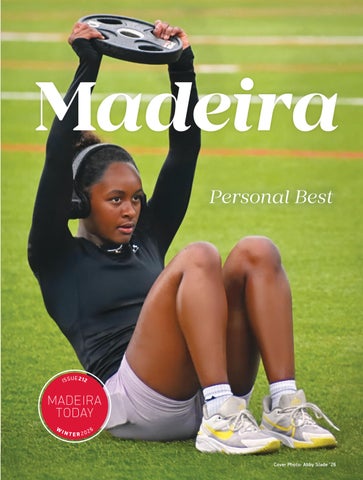
Cover Photo: Abby Slade ’26

$1 Million Challenge

TO BUILD THE FUTURE OF RIDING AT MADEIRA

Madeira is deeply grateful to Nancy David Dillon ’74 for her leadership gift establishing a $1 million dollarfor-dollar challenge to support the new Equestrian Center, doubling every gift for a total impact of $2 million. This challenge honors the enduring legacy of Mildred Gaines, whose name will remain proudly associated with the Riding Program. The firm foundation she laid continues to inspire Madeira students today.

For Nancy and many others, the Riding Program built self-confidence, discipline, responsibility, compassion, and lifelong qualities with daily benefits. Nancy invites the Madeira community to join her in strengthening this program that has long advanced the School’s mission. Gifts made toward the Equestrian Center through December 31, 2026 will be matched, accelerating progress and beginning a new era of discovery for riders and non-riders alike.

“Horse / human relationships reveal big lessons for anyone with curiosity and willingness. That is a legacy worth preserving.”
NANCY DAVID DILLON ’74

14page

See our progress on the new Equestrian Center

HAVE YOUR GIFT MATCHED! When you give, Madeira students thrive. madeira.org/community/giving

Nancy David Dillon ’74 on Mr. Peepers

Madeira Today

WINTER 2026, Number 212

Published by The Madeira School 8328 Georgetown Pike McLean, VA 22102

EDITOR: Karen Joostema

DESIGN: LucidCreative.co

COMMUNICATIONS: Sean Brunett & Shannon McCarthy

PHOTOGRAPHY: Sam Peat, James Kegley, & Freed Photography

BOARD OF TRUSTEES 2025–26

Amanda Adams ’95

Karina Agudelo P’26

Parents’ Association President

Lili Marian Avery ’72

Andy Blocher P’21, ’26

Laura De Sole ’00

Secretary

Virginia “V.A.” Falzon ’09 Alumnae Council President

Aileen Hawkins P’23,’25

Ains Hill ’97

Mary Dana Hinton

Sue Luangkhot Hoppin ’87

Bronwyn Hughes ’83

Carrie Southworth Johnson ’95 Chair

Joy S. Johnson ’77 Vice President

George Kaczmarskyj P’19,’22 Treasurer

Emi Kolawole ’00

Christina Kyong Head of School

Phoebe H. Lang ’85

David McKinney P’26

Tara Palmore ’88

Tracy G. Savage ’66

Jose Maria Zertuche Trevino P’27

Kate Wisniewski Weir ’02

Dudley Winthrop P’26,’28

To unsubscribe from

CHRISTINA’S CORNER

It is such a gift to be leading a school that can support each individual student’s journey to be the best they can be. Not to be better than the rest, but rather the best that they set out for themselves. ”

Dear Madeira Community & Friends,

I was recently hosting a group of Northern Virginia Independent School Heads and I asked them to introduce themselves and to name “What is sacred?” at their school. As each of the 13 Heads shared their introductions, I heard answers like being known as “tight-knit supportive communities” and “individualized attention” and “a place where everybody knows your name, á la Cheers.”  Madeira is known for all those things but when the question came to me, I shared that I am blessed to be at a school where our founder valued that each girl’s journey is to be their personal best. We do not seek rankings or list our students based on their GPAs, because we encourage our students to find their passions and interests on their path to their personal best. None of those rankings or numbers give us any lasting satisfaction or real value of who we are as a person.

I refer to Miss Madeira’s personal best philosophy all the time. It is such a gift to be leading a school that can support each individual student’s journey to be the best they can be. Not to be better than the rest, but rather the best that they set out for themselves. That frees us from the external motivations and the fleeting rewards of being the best. Long-term studies have shown that intrinsic motivation fuels deeper learning, creativity, and resilience; it leads to greater satisfaction and psychological well-being and is more sustainable than extrinsic motivators like grades, money, or praise.

CHRISTINA KYONG, HEAD OF SCHOOL

FROM THE EDITOR

One of Miss Madeira’s most memorable directives was, “Function in disaster, finish in style, and keep calm at the center of your being.” This is brilliant because it acknowledges that life will bring chaos, unpredictability, and disappointment. And we know that being our personal best shines not just in smooth sailing—it especially shines when one keeps going despite the storms.

I am excited that we have launched our Strategic Vision this year and we are hosting listening sessions with our Dream Teams. We appreciate many of you participating in those listening sessions. This is one of the most exciting parts of a School’s work—to dream about the future and to set a vision that ignites us to continue the work that inspires pride.

We have been exploring the best of Madeira’s past as we plan for its exciting new chapters. A quintessential thread that connects the School’s founding vision to Madeira’s “Bold & Irresistible Future” (page 48) is Lucy Madeira’s “personal best” philosophy. The concept of measuring success by one’s own progress rather than by comparison to others remains a powerful force. From academics to arts to athletics, personal best is at the core of Madeira’s ethos. As we look to the promise and possibilities of 2026, we take Miss Madeira’s philosophy to heart and recognize that each of us is on a personal journey, one which may look different from others, yet will be rich and rewarding. And, let’s take time to recognize the inherent value in doing something well and taking ownership of our growth, just as Miss Madeira taught. Please enjoy exploring your personal best through stories of Madeira Today.

KAREN JOOSTEMA Send comments to kjoostema@madeira.org

Madeira Hits Highest -

STRONG RETENTION RATES

Madeira remains an in-demand school, continuing the trend of strong admissions. The 2025–26 school year began with 344 students—the highest enrollment ever!

In addition to admitting a highly selective group of 93 impressive new students, Madeira welcomed back an outstanding group of returning students. One of the most powerful indicators of success in admissions and student life is retention, and this year Madeira reached its lowest attrition rate in several decades. That level of continuity speaks to the trust families place in the School and the value students find in their Madeira journey.

STUDENT BODY PROFILE

344

51% Boarding

14%

International (non-US citizens)

20

Students, the largest enrollment in the School’s history! States (including DC) represented

42

93 New Students

Countries represented by citizenship or residency

36%

Financial Assistance in the form of aid/ merit scholarship

49 %

Students of Color

(NAIS definition: US citizens and green card holders)

22%

Legacies (75 students, including 54 sisters)

Ever Enrollment

Our 93 new students come to Madeira from near and far, and their talents and interests are just as varied. We welcome our future changemakers, including these artists, athletes, and advocates:

NEW STUDENT HIGHLIGHTS

Co-designed a website to raise awareness of mental health support services

Created an app in 5th grade to help students learn to read; now runs sewing camps

Two-time National Junior High Rodeo Finals Qualifier and county fair winner

• USAG Level 8 Gymnast

Published author of two books in Portuguese, including one on the US Capitol (in which Madeira is mentioned)

Co-designed a smart shoe for the blind with mobile-connected sensors

• National Youth Speedskating Champion

Led a student rock band called “put FUN in disFUNction”

• Winner of the Crescendo International Cello Competition and national art contests

Completed her Arangettam (Indian classical dance debut) and attended 7 Model UNs

• Created CheetahZone.com to raise awareness for cheetah conservation

Received a certificate from the King of Bhutan for topping national board exams

• Trilingual volunteer who taught English to 70 students in Mozambique

• Developed a spherical robot as part of an award-winning robotics team

STUDENT2025-26BODYMAP

Students at Madeira come from 42 countries & 20 states*

20 US States Represented

Algeria

Argentina

Australia

Belgium

Bhutan

Brazil

Canada

Countries Represented

China

Colombia

Costa

Cyprus

Czech

Denmark

Ecuador

Hong

Philippines

Saudi

Singapore

South

Spain

Switzerland

Taiwan

Thailand

Turkey

United Kingdom

United States

Vietnam

KNOW A STUDENT WHO BELONGS AT MADEIRA ? Complete our Inquiry Form! madeira.org/refer

Festina Lente, Class of 2025!

Class of 2025 College Destinations

The 80 members of the Class of 2025 have chosen 56 different colleges or universities.

Babson College

Bard College

Barnard College

Bates College

Bocconi University

Boston University (2)

Brown University

Colby College

Colgate University

Colorado School of Mines

Columbia University (2)

Converse University

Cornell University (3)

Drew University

Drexel University

Emory University

Furman University

Georgetown University (2)

Indiana University

Lewis & Clark College

Louisiana State University

New York University (2)

Northeastern University (2)

Nova Southeastern University (2)

Penn State University

Randolph-Macon College

Rutgers UniversityNew Brunswick

Santa Clara University

Seoul National University

Smith College (3)

Syracuse University (2)

Tufts University

Tulane University

University of California-Berkeley (2)

University of California-Irvine

University of California-Los Angeles

University of California-San Diego

University of Chicago (2)

University of Florida

University of Maryland (2)

University of Miami

University of Michigan

University of North Carolina at Chapel Hill (2)

University of Pittsburgh

University of Tennessee

University of Vermont

University of Virginia (7)

University of Washington

University of Wisconsin-Madison

Villanova University

Virginia Commonwealth University

Wake Forest University (2)

Waseda University

Washington & Lee University

Wellesley College

William & Mary (2)

As we look ahead to the future of Madeira’s Riding Program, soon to be housed in our brand-new Equestrian Center, we also honor the program’s prolific past and its beating heart: the horses.

We invite you to think back fondly on the horses that had an impact on your time at Madeira.

HOOFPRINTS ON HEARTS

Alex Woodruff ’24 riding Indy
Kat Adstedt ’14
Nancy David Dillon ’74 with Mr. Peepers
Cathy Cloutier ’67
Daisy Ballantine ’24 with Ivan
Josephine ‘Ingrid’ Raysor ’69
Susanna Hardee ’23 with Patch
Rambler
Chloe Plaschka ’22 with Aviator
Riya Myneni ’26 with Daisy
Emily Cyrway ’19 riding Orion
The Drill Team, c. 1970
Stephanie Himelfarb ’10
Kate Wisniewski Weir ’02 riding Henry
Christina Floyd Myers ’00 on Billy
Suki Penson Jarzemsky ’66
Clare Hudson Payne ’70 riding Bopper
Kristin Douglas ’02 on Chloe
Kim Marra ’75 on Rossmore
Tara Mered ’22
Hailey Rook ’25 on Tucson
Christina Kyong with Rambler

A LASTING IMPRINT

AS WE BUILD OUR NEW STABLES, WE ARE INSPIRED BY THE SPIRIT OF THE GENERATIONS OF HORSES (AND THEIR RIDERS) WHO MADE THE SPACE HOME AND PAVED THE WAY FOR THE NEW EQUESTRIAN CENTER.

• ACORN

• ADVENTURE

• ALDAN

• AUTOCRAT

• BANNER

• BARRLEI

• BEACON

• BEAR

• BERTHA

• BLUES

• BOPPER

• BRANDY

• BRAZIER

• BRISTOL

• BROWN TINTS

• BUNNY

• CHARMER

• CIMBER

• CLOVER

• CLYDE

• COLE

• DAISY

• DARKCLOUD

• DENZEL

• DITTO •

• DOUBLEMINT

• DUMPLING’S DELAY

• DUMPLING’STARDY

• DUSTY

• DYNAFLOW

• EASTER

• EPID’OR

• FRANKIE

FROSTY

ADD YOUR FAVORITE HORSE’S NAME TO OUR TRIBUTE WALL. madeira.org/horses

GESTURE

• GREYMIST

HAPPY

• IRISHDUMPLING

• IRONING SOCKS

IRONY

JACK

JARGO

JJ

JOE

JOURNEY

JUNIPER

KAROL

KITE

KNICKERS

LANE

LEILANI

LIGHTNING

LITTLEBOY

LITTLECHRISTIAN

MAGICGINOBI

MASQUE

MISSY

MISTY

MM

MOON’SPRIDE

MOUNTIAN

• MR.PEEPERS

MR.X

MUFFIN

MUSTANG SALLY

NIGHTCOMMAND

O’REILLY

OSCAR

PATTY

PEGGY

PERCHANCE

POPPINS

POWDER

RAMBLER

RED

SHEMAY

SHORTY

SMALLFRY

SNOWBALL

SOCKS

SOX

SPORTY

SUGIRTO

SULLY

SUSIEQ

TETEY

T-BIRD

TRIALS

TRIBULATION

TRUSTY

TUCSON

UMBER

WEEKEND

WEFOUND

WINSTON

BUILD THE FUTURE OF RIDING AT MADEIRA

To continue our successful progress, we need your help. For more information or to make a gift to the new Equestrian Center, please contact Caitlyn Gart Goodman ’07 at cgoodman@madeira.org or 703-556-8258. $1 MILLION CHALLENGE! Every gift is doubled through December 31, 2026.

Personal Best

A Legacy That Endures at Madeira

When Lucy Madeira founded her School in 1906, she envisioned something quietly radical. In an era when many girls’ schools resembled finishing academies, she imagined a place where young women would think deeply, work earnestly, and measure success by their own progress rather than by comparison to others.

“There will be no honors or awards at The Madeira School,” she often told her students at early gatherings in the Schoolhouse.

“Every girl is simply expected to do her best.”

Those words were more than a philosophy; they were different from the norms of her day.

At a time when external rewards and social polish defined girls’ education, Miss Madeira built a school rooted in discipline, service, and joy in the work itself.

“One must be conscious constantly of the disciplines that are necessary to make the spirit firm,” she wrote. “These come from work well done, done on time, done in a happy frame of mind. As we have no Rewards here in the School connected with learning, we try to teach a girl the importance and the value of the reward which is inherent in the thing itself.”

Miss Madeira’s founding principle of “personal best” remains a quintessential thread that has bound together generations of students. Today, Head of School Christina Kyong calls personal best Madeira’s “secret sauce,” the philosophy that liberates students from external comparison and competition, encouraging intrinsic motivation, purpose, and joy in lifelong learning. “Why should learning be about comparison?” Kyong asks. “The only person you should be competing against is your own idea of who your best self is.”

A Century Ahead of Her Time

Miss Madeira’s approach anticipated what today’s educators call “student-centered learning.” She tailored each student’s experience “with reference to her particular tastes, abilities, and future plans,” believing that motivation flourishes when learning feels purposeful and personal.

Kyong sees that same conviction animating Madeira’s classrooms today. “It is such a gift to be leading a school that can support each individual student’s journey to be the best they can be. Not to be better than the rest, but the best that they set out for themselves. That frees us from the external motivations and the fleeting rewards of being ‘the best’.” Long-term studies have shown that intrinsic motivation fuels deeper learning, creativity, and resilience. It leads to greater satisfaction and psychological well-being and is more sustainable than extrinsic motivators like grades, money, or praise.

AVITAL SHALVA ’27, ON WHAT PERSONAL BEST MEANS TO HER : “Madeira’s belief in always striving for personal best has truly changed the way I see learning. It’s helped me focus on steady progress rather than perfection, and it’s taught me to forgive my mistakes and use them as lessons to improve.”

That belief quickly took institutional form. In 1911, Madeira students launched the Social Welfare League, raising funds annually for charitable projects they voted to support. As Miss Madeira explained, service and learning were intertwined: “We should be taught to see the value inherent in doing a task well…to help others because it is the right course of action, not an expedient or profitable one.”

Miss Madeira’s founding principle of “personal best” remains a quintessential thread that has bound together generations of students.

Miss Madeira also believed that competition distorted authentic growth. “No girl shall ever be singled out,” she would remind her students. “Every girl is simply expected to do her best.” The goal was not to lower expectations but to foster internal drive; a conviction that effort, reflection, and service would yield their own satisfaction.

Kathleen “Kiki” Galvin Johnson ’53 , who would later serve as Acting Headmistress from 1980 to 1981, remembers hearing those words as a student of Miss Madeira’s, then recalling the ideals echoing decades later.

“You didn’t need an honor roll to tell you you’d done well,” Johnson said. “You learned from feedback, from mistakes, and tried not to repeat them.”

Avital Shalva ’27 echoes the benefits of learning from mistakes in striving for personal best. “Madeira’s belief in always striving for personal best has truly changed the way I see learning. It’s helped me focus on steady progress rather than perfection, and it’s taught me to forgive my mistakes and use them as lessons to improve.”

“Personal best isn’t about being better than others; it ’s about honoring your own growth. Progress, not perfection, is what really defines success.”

Each week, leaders introduce one of the emotions or experiences Brown maps in her book. When the emotion of “comparison” was featured, the conversation centered on how comparison erodes creativity and self-worth. Brown writes that, “Comparison is actually not an emotion, but it drives all sorts of big feelings that can affect our relationships and our self-worth.” She notes that social comparison often happens beneath our awareness, shaping our sense of identity and aspiration.

A Culture of Purpose

Charles Saltzman, who led the School from 1981 to 1988, saw personal best as the quiet engine of Madeira’s culture. “Madeira was doing hard-nosed science for girls when most girls’ schools were more like finishing schools,” he said. “There was a generally understood sense that you were there for a serious purpose, and you were going to do the best you could.”

Saltzman recognized the concept of personal best everywhere: in the rigor of study, the balance between independence and cooperation, and the sense of mutual respect that defined campus life. “You would do well,” he said, “but you didn’t have to be stepping on your sisters to do it.”

Kyong describes that same spirit as “the freedom of not having to compare yourself constantly to a number or a person.” She said, “It’s a gift to grow in a place where you can cheer for your classmates and still feel proud of your own path. Here, we’re cheering each other on to each be our personal best.”

As Brown notes in Atlas of the Heart, “Comparison is the crush of conformity from one side and competition from the other. It’s trying to simultaneously fit in and stand out.”

Kyong sees profound alignment between Brown’s insights and Madeira’s founding ideals. “Lucy Madeira knew that when you remove rankings and awards, you make space for curiosity and courage,” Kyong said. “That’s what we’re still doing today; teaching students to return to their own lane, wish others well, and focus on their personal journey.”

Leadership Through the Years

Former Head of School Pilar Cabeza de Vaca, who served from 2010 to 2020, describes personal best as Madeira’s defining ethos; one that shaped both her students and her own leadership.

“You would do well, but you didn’t have to be stepping on your sisters to do it.”
CHARLES SALTZMAN HEAD OF SCHOOL 1981–1988

Authenticity is a word often associated with Madeira’s community, and Jasolyn Spears ’27 connects personal best to that very concept.

“Personal best isn’t about being better than others; it’s about honoring your own growth,” she said. “Progress, not perfection, is what really defines success.”

This year’s School theme, THRIVE, and communitywide read of Brené Brown’s Atlas of the Heart invite Madeira students and adults to explore that very idea.

“Girls competed with themselves,” she said. “It wasn’t this race to the death to get the perfect GPA or the perfect college. You can do your best without being criticized for it.”

That spirit, she added, created a culture of both high standards and deep support. “I saw girls rallying together. They had each other’s backs. You didn’t have cutthroat competition, and you didn’t have slackers either.”

AVA DONOHUE ’24 , A RECENT GRADUATE AND ATHLETE, CARRIES THE LESSON FORWARD.
“To

me, personal best means giving your 100% every day, no matter what that takes. When I first arrived at Madeira, I saw success as doing more than others. Over time, I learned that my only competition was myself. Focusing on getting 1% better each day motivates me toward my personal best; progress that adds up over time.”

pride. “As an actor, I know I’ve reached my personal best when I can leave the stage without worrying how the audience will react and without feeling the need to compare myself to my castmates,” she said. “My definition of personal best has evolved so much. I used to rely on others to tell me what I was capable of. Now, I can set goals that challenge me and feel proud of my progress on my own terms.”

Beverly Lee ’26 finds applications for the personal best philosophy in Madeira’s creative and residential life.

“Madeira’s philosophy of doing your personal best has taught me to focus on passion rather than competition,” she said. “The philosophy helps build a community rooted in collaboration instead of rivalry.”

Beyond the classrooms and dorms, Kyong notes that she witnesses the spirit of personal best demonstrated on the athletic fields.

“Personal best in athletics is all about improving together and building the kind of teamwork that helps every player grow,” she said. “The joy comes from the progress, not the points.”

Ava Donohue ’24 , a recent graduate and athlete, carries the lesson forward.

Personal best encourages adults and students alike to rise to challenges. One of Miss Madeira’s most memorable directives was “Function in disaster, finish in style, and keep calm at the center of your being.” This is brilliant because it acknowledges that life will bring chaos, unpredictability, and disappointment. And we know that being our “personal best” shines not just in smooth sailing—it especially shines when you keep going well despite the storms.

“It’s a gift to grow in a place where you can cheer for your classmates & still feel proud of your own path.”
CHRISTINA KYONG HEAD OF SCHOOL

“To me, personal best means giving your 100% every day, no matter what that takes,” she said. “When I first arrived at Madeira, I saw success as doing more than others. Over time, I learned that my only competition was myself. Focusing on getting 1% better each day motivates me toward my personal best; progress that adds up over time.”

That same conviction is echoed by Elisabeth “Betsy” Griffith, who led Madeira from 1988 to 2010. “Personal best is not a measure in competition with others but with oneself,” she said. “Did I try? Did I do the best I could? It measures us against our own standard. I’m thankful to have worked in a school with such a core value.”

Olivia Tirol ’27, a member of Madeira Arts, defines personal best as a shift from external approval to internal

Gretchen Warner , who led Madeira from 2020 to 2023 through the unprecedented years of the COVID-19 pandemic, saw the philosophy deepen under pressure.

“Personal best at Madeira was never about competition; it was about authenticity and helping each student discover her purpose and take ownership of her growth.” She added, “Its timelessness lies in its moral foundation; that one’s best self emerges through reflection, perseverance, and empathy.”

Kyong sees the same foundation guiding Madeira now. “It’s so hard to be a citizen of this world right now because we’re being told our voices don’t matter,” she said. “That’s why personal best is more important than ever. It centers each student in her purpose and helps her see her own worth.”

M.A. MAHONEY, DEAN OF ACADEMICS PERSONAL BEST IN ACTION

If we think of the School itself as a larger classroom, then walk into Madeira’s auditorium with me, if you will, and sit down and enjoy a dance assembly, or find yourself a spot on the bleachers in The Hurd, during a pep rally or a game. If you are like me, you will be astonished by the enthusiastic cheering for classmates as they perform high-level choreography or practice a new team move. The genuine joy in the community, as a dancer completes four or sixteen fouettés en pointe, is enough for me to wonder, each time, “How is this happening?” At Community Meeting Time (CMT) each Tuesday, students representing clubs and organizations of all types receive claps and nods as they announce their next meeting. I don’t take any of this openness for granted, and I attribute it to the philosophy of our founder. In this community, we celebrate growth. And we also celebrate the work of teachers. As Allegra Maynard said of Miss Madeira in 1961 on Miss Madeira’s birthday, “Indeed all her life she did everything she knew how to enhance the prestige of the teacher.”

Teaching and Leading the Madeira Way

Miss Madeira did not believe in rewards or competition. As she shared in her 50th Anniversary Address (1956), “We have no Honor Rolls, and no Prizes…She is treated always as an individual. She is never put to shame or allowed to be puffed up with pride because of her mental attainments.” Miss Madeira’s philosophy allowed time and space for a young person to grow, learn, and develop her capacities. There’s room for every learner in a highly ambitious, focused, academic environment.

Madeira educators recognize that every learner is on a personal journey, which may or may not look like her neighbor’s, but which will be equally rich and rewarding. Miss Madeira also said in her 50th Anniversary speech that, “They are taught to see the value inherent in doing a thing well, and this is a spiritual value.”

For today’s teachers, the philosophy remains a daily practice. M.A. Mahoney, Dean of Academics, often reflects on how the relationship between teacher and student embodies Miss Madeira’s philosophy. “If I knew how to call a séance, I would, so I could have a sit-down with Miss Madeira,” she joked. “What I wouldn’t give to tell her that our understanding of her philosophy still guides teacher practice and program structure almost 125 years later. How was she, born in 1873, able to see into the future to imagine just the learning environment which would allow a young woman to thrive in the second quarter of the 21st century?”

Drawing on Lev Vygotsky’s concept of the ‘zone of proximal development,’ Mahoney sees a direct link to personal best. “Miss Madeira didn’t value the speed with which a student learned. She believed the teacher’s role was to know each student well enough to see her potential—even before she might recognize it herself—and to build the relationship that helps her reach it.”

HARPER MORRILL ’26 , HEAD OF DAY, SAYS MADEIRA HAS TRANSFORMED HER VIEW OF EXCELLENCE:

“Coming to Madeira, I was definitely a perfectionist… But I’ve realized that it’s in the flaws; in the places where it’s not perfect; that you learn.”

Madeira educators strive to see the potential in each learner and help each understand her capacities. Teachers guide each student just past the point where she believes she is capable.

Dr. Keith Ward , English Department Chair, sees personal best as the moral fabric of Madeira’s pedagogy. “Thinking of Madeira’s personal best philosophy puts us in touch with the deep grain of the School,” he said. “It privileges student achievement over the promotion of some archetypal standard. Yes, our bar is set high, but I like to imagine there is no bar; or, rather, that our students set their own height.”

Students are given myriad opportunities to seek their personal best. Harper Morrill ’26 , Head of Day, says Madeira has transformed her view of excellence. “Coming to Madeira, I was definitely a perfectionist…But I’ve realized that it’s in the flaws, in the places where it’s not perfect, that you learn.”

Madeira educators recognize that every learner is on a personal journey, which may or may not look like her neighbor’s, but which will be equally rich and rewarding.

Lucy Pollard, Dean of Teaching and Learning, notes, “The personal best grading philosophy asks teachers to connect with each individual student and meet her where she is.”

Andrew Sharp , Director of CoCurriculum, adds that, “Personal best reframes learning: ‘What have I learned about myself, and how can I keep growing?’” Experiential learning through Co-Curriculum internships is a critical component in a student’s growth.

In reflecting about how she views personal best, Jasmine Meade, Director of Belonging and Global Education, calls it “a lifelong reflection; about taking the time to understand yourself and what you need to feel and do your best.”

Damalie Mussina ’26, Head of Student Government, sees personal best as rooted in trust. “It means Madeira believes in my ability to strive and grow, giving me freedom to explore, make mistakes, and learn from them deeply.”

A Living Legacy

Mahoney believes that connection endures because Madeira was, from its founding, designed as what she calls a “container for students to grow their learning power.” Quoting both Vygotsky and contemporary researcher Zaretta Hammond, she notes that, “Children grow into the intellectual life around them.” Mahoney views Madeira as that intellectual life.

Madeira is a place where every learner, no matter her pace, has room to thrive. Olivia Tse ’25 sees that same spirit of growth in her own leadership journey. “Before coming to Madeira, I thought of personal best as something linear, just about academics or sports,” she said. “Now I know it extends into being an exceptional classmate and community member. Each Madeira girl is doing her personal best in a way that’s authentic to herself, that’s what connects us.”

Across generations, Madeira’s personal best philosophy has remained a steady guide; anchoring change, shaping leaders, and reminding every student that excellence is both a standard and a journey.

attention, feedback, and perseverance. You learn from failure, and you get up the next morning and make haste slowly.”

“Madeira is a place where every learner, no matter her pace, has room to thrive. Gone far beyond the horizon are the speed of learning, competition, and reward.”
M.A. MAHONEY DEAN OF ACADEMICS

Madeira’s chosen motto, Festina Lente (Make Haste Slowly), still echoes that truth. As Acting Headmistress Johnson noted, “Doing your best isn’t simple. It requires

LUCY MADEIRA, 75TH BIRTHDAY SPEECH, MAY 19, 1948

“To look into a young person’s mind to try to find out what she herself is trying to find out, and, as a teacher, to try to help her accomplish this, is about as stimulating an experience as a person can have. It is taking a journey into the countries of the mind. It is always an adventure, an endless one.”

Kyong hears that same rhythm every day. “Everyone keeps talking about the secret sauce that makes Madeira special,” she said. “Honestly, I think the secret sauce is personal best. It’s just a lovely thing to be able to say, ‘What’s your personal best? What’s your journey? What’s your passion?’” At Madeira, that question and the freedom to answer it are what learning has always been about.

A booklet prepared for the School’s 75th Anniversary in 1981 quoted, “The justification for a private school, as she (Miss Madeira) said repeatedly, was that it could offer individual attention so each girl could thrive.” Now, in this 2025–2026 school year, where Head of School Christina Kyong has made “THRIVE” the annual theme, we see so clearly the thread between Miss Madeira’s founding of the School and Mrs. Kyong’s beautiful caretaking and oversight of it today. Held together by a through line of creating conditions in which young women can thrive, with a shared picture of what thriving looks like (and a belief that it is done in community), the foreground of this picture is the teacherstudent relationship with its emphasis on potential. All in the community share deeply the knowledge that learning takes time and that building the essential teacher-student relationship takes time. Gone far beyond the horizon and missing from this picture are speed of learning, competition, and reward. What a legacy from Miss Madeira. What a visionary she was. How deeply she has informed the work of this community even today.

As we look with great excitement toward Madeira’s future, we will remain grounded in our founder’s wise vision of personal best.

Solving Mysteries and Building Futur

Madeira’s Forensics Program

When junior Eliana Vakis ’27 first toured Madeira, she walked past a classroom buzzing with activity—students analyzing evidence, discussing crime scenes, and piecing together clues. “I knew it was something I would be interested in doing,” she recalls. That glimpse into Madeira’s Forensics class exemplifies what makes our curriculum exceptional: hands-on, intellectually engaging coursework that transforms curiosity into expertise. In an era where single-sex education continues to prove its value in empowering young women in science fields, Madeira’s Forensics classes stand as a testament to what happens when rigorous academic standards meet experiential learning.

Empowering young women in science fields…
“I learned that forensics is more complicated than it is often portrayed in TV shows and movies, which made me realize that while many people think they know how forensic science works, it’s actually pretty different!”
– ALLISON CADENA ’27

Making Scientific Investigation Relevant

For nearly two decades, Madeira’s Forensics Program has tapped into a cultural fascination with crime-solving. Dr. Stacey Boyette, who has been teaching the course since the 2010–2011 academic year, notes the connection between popular media and student interest. “The original CSI TV show first aired in 2000, then NCIS in 2003, and many similar shows followed. Our students have been captivated by crime shows ever since.”

But while television may spark initial curiosity, what students discover in Madeira’s Forensics classroom is far more nuanced and challenging than anything portrayed on screen. Allison Cadena ’27 shared, “I learned that forensics is more complicated than it is often portrayed in TV shows and movies, which made me realize that while many people think they know how forensic science works, it's actually pretty different!”

That real science demands more critical thinking, precision, and patience than its entertainment counterpart is exactly the kind of intellectual growth that defines a Madeira education.

Two Distinct Pathways in Forensic Science

Originally offered as a semester-long course, the Forensics Program evolved alongside Madeira's innovative Modular schedule. Today, students can choose between two independent, one-Mod courses that allow for deeper exploration of specific topics.

Forensics: Physical Evidence examines the tangible traces left behind at crime scenes, covering fingerprint patterns and analysis, footwear and tire print impressions, ballistics evidence, glass density and refractive index, fiber burn and dye tests, and handwriting analysis.

Forensics: Biological Evidence delves into the biological components of criminal investigation, including hair microscopy, blood spatter analysis, DNA profiling and gel electrophoresis, as well as the analysis of bones (specifically, how to determine sex, age, and race from skeletal remains).

Both courses ground students in foundational concepts like crime scene tools and techniques, types of witnesses and evidence, and the rules for admissibility of evidence in court. This comprehensive curriculum ensures that whether a student gravitates toward chemistry, biology, or physics, they will find relevant applications in forensic science.

At Madeira, we believe that true understanding comes from doing.

Experiential Learning at Its Finest

At Madeira, we believe that true understanding comes from doing. The Forensics courses embody this philosophy through laboratory work that transforms students from passive learners into active investigators.

The highlight of both courses is the mock crime scene investigation. Dr. Boyette stages elaborate fake crime scenes throughout campus, and students must employ everything they've learned to search for, collect, and analyze evidence.

"The lab that stood out was one where Dr. Boyette staged fake crime scenes, and we were tasked with investigating these as forensic detectives," Vakis explained. "Not only was this lab incredibly fun and interactive, but it forced us to take everything we had learned and try to use these skills to solve a (fake) crime. This meant we all had to collaborate in searching and classifying evidence. The lab helped put into perspective how hard finding relevant evidence can be."

Cadena echoed this enthusiasm. "I loved it because it was so interactive and engaging, and I really felt like a crime scene investigator!"

This type of immersive, hands-on learning exemplifies Madeira’s approach to learning at its best. Students aren't simply memorizing facts about evidence collection; they're experiencing the challenges, frustrations, and ultimate satisfaction of scientific investigation. They're learning to think critically, work collaboratively, and persist through complex problems.

Why Forensics Matters for College Preparation and Career Prospects

While the Forensics Program is undeniably engaging, its value extends far beyond entertainment. The skills students develop translate directly to college preparation and future career prospects.

Critical Thinking and Analysis:

Forensic investigation requires students to examine evidence objectively, form hypotheses, test theories, and revise their thinking based on new information. These are the exact skills that college professors and employers consistently identify as essential for success.

Scientific Literacy:

Understanding the limitations and appropriate applications of scientific evidence is crucial in an era of misinformation and scientific skepticism.

Laboratory Skills:

Students gain hands-on experience with microscopy, chemical testing, pattern analysis, and other laboratory techniques that provide a strong foundation for college-level science courses.

Attention to Detail:

Success in forensics demands meticulous observation and documentation— skills that serve students well in any academic or professional pursuit.

Collaborative Problem-Solving:

The mock crime scene investigations require students to work in teams, delegate responsibilities, communicate findings, and integrate multiple types of evidence into coherent conclusions.

Personal Best in Action

A striking example of student engagement and striving to reach one’s personal best occurred at the end of last school year. Dr. Boyette assigned The Deathboat, an unsolved murder mystery involving lottery winner Waverly Berg. Each group received a complete evidence file including ship manifests, interviews, fingerprints, DNA profiles, and suspect information. With only two days before the seniors’ last day of classes, the pressure was on. Yet rather than rushing through the assignment, students delved deeply into analysis.

“I was astounded at how invested the students were,” Dr. Boyette recalls. "Each group developed their own theory about who had murdered lottery winner Waverly Berg and a lively discussion was held on the very last day of their Madeira careers. Truly impressive."

The Advantage of Single STEAM Education

Research consistently demonstrates that young women in single-sex educa tional environments show increased confidence in STEAM fields, greater willingness to take risks in learning, and higher rates of pursuing science careers. According to a survey conducted by the Goodman Research Group, “Girls’ school graduates are six times more likely to consider majoring in math, science, and technology compared to girls who attended coeducational schools.”

In a coeducational classroom, girls may hesitate to speak up, take leader ship roles in lab work, or pursue advanced science courses. At Madeira, every hypothesis proposed comes from a young woman. Every successful analysis reinforces the message that women belong in scientific fields. By providing young women with authentic scientific experiences in a supportive environ ment, Madeira prepares them to enter and excel in any field they choose.

Building on Curiosity, Preparing for the Future

After nearly two decades, the Forensics Program at Madeira continues to capti vate students because it answers a fundamental question, “How do we know what we know?” In engaging deeply to solve fictional crimes, students learn real methods for pursuing truth—lessons that apply far beyond the crime scene.

In a world that increasingly demands scientific literacy, critical thinking, and the ability to navigate complex information, the skills developed in Forensics class are invaluable. Whether students ultimately pursue careers in forensic science, law, medicine, research, or entirely different fields, they leave this course with strengthened analytical abilities and deepened confidence in their capacity to solve problems.

Research consistently demonstrates that young women in single-sex educational environments show increased confidence in STEAM fields, greater willingness to take risks in learning, and higher rates of pursuing science careers.

ARTS Shakespeare Shines

MADEIRA STAGE TURNED INTO ICONIC GLOBE THEATER

“But how will it end…I don’t know. It’s a mystery.” If you have ever seen the movie or stage adaptation of Shakespeare in Love by Tom Stoppard and Marc Norman, then you probably recognize this iconic line of dialogue. It is spoken multiple times throughout the plot in moments where our Shakespearean era characters are at a loss for how the seemingly insurmountable task of producing Romeo and Juliet will come to fruition. This line deeply resonates with actors, stagehands, and theatrical producers alike, for the task of mounting a show can feel complicated and mysterious. This fall, Madeira Theater navigated the ups and downs of learning Shakespearean language, mastering sword play, building a ball gown for Queen Elizabeth I, and even replicating the iconic Globe Theater on stage for the production of Shakespeare in Love.

THE PLOT – Penniless and indebted to two demanding producers, struggling young playwright William Shakespeare is tormented by writer’s block until he meets the beautiful Viola de Lesseps, daughter of a wealthy merchant, whose fiery passion for poetry and drama leaves her secretly longing to be an actor. Both are despondent when they learn that Viola’s father has promised her to the stuffy Lord Wessex in order to gain a title for their family. Under the veil of secrecy, Will and Viola’s love affair becomes the basis of the very play he is writing—Romeo and Juliet. With opening night—and the wedding day—fast approaching, the plots race toward a parallel conclusion. Will it all work out in the end or are the two star-crossed lovers destined for tragedy?

Tro Shaw Allen, Theater Director, shared, “When we began searching for a comedy style fall play, Shakespeare in Love quickly rose to the top of our list because of the challenge it posed in having the students play witty humor mixed with physical humor, all set in Elizabethanera England. The students really leaned in and worked together to craft some very powerful scenes as well as highly comical moments of storytelling in this production. It was a labor of love for us all.”

STUDENT SET-BUILDING AND COSTUME DESIGN CHALLENGES

Behind the scenes, the Stagecraft class set the visual aesthetic for the production, diving deep into creating classical Elizabethan silhouettes and a mini replica of the timber- framed Globe Theater on stage. “I have always felt this show to be Stoppard and Norman’s love letter not just to William Shakespeare but to the whole era of great theater set in these iconic playhouses. In designing this set

I thought: What better background to set it against than the Globe itself,” says Artistic Director and Set Designer Sasha Newman, who worked with the Stagecraft students to recreate the rough-hewn timber beams from foam and capture the right look.

“This show was a big challenge because of the cast size and complexity of the costume needs. Period costuming requires more detailing and time to complete the authentic look of each character,” added Newman.

Mounting a challenging production like Shakespeare in Love on the Madeira stage was a work of dedication, passion, and exploration for students and teachers alike. Each actor came excited and ready to learn. They were also willing to embark on a somewhat unknown journey into developing their skills, building ensemble friendships, and trusting in the process of producing a show. It is with this sense of mystery and joy that we see Madei ra Theater continue to grow and thrive each year.

A Win for School Spirit &

a Touchdown for Charity

“The

Big Game” A new tradition

“Madeira Football,” reads one of the most popular school store sweatshirts.

“Over 100 years and still undefeated.”

This crowd-favorite item highlights a peculiarity at a girls’ school: Does the absence of a football team mean no traditional Homecoming game? As Madeira students often do, they used their passion and creativity to start a new tradition that not only celebrates our School but gives back to the community as well.

“The Big Game,” a flag football game between the different grades, started out as the “Powderpuff Game” in spring of 2018. There was a desire among students to create an event that would bring the Madeira community together in school spirit. Thus, the Powderpuff Game was born, giving students the opportunity to play on the field or cheer on their classmates, with a spirited halftime perfor mance featuring the Dance Team.

The tradition went dormant throughout the COVID-19 pan demic and social distancing precautions until the Class of 2022 revamped the idea. The Big Game, as we now know it, was reborn in the fall of 2021. The student Heads of School wanted to foster school spirit and bring the community together after so many months of physical and emotional distance. They recog nized that, though they’d been able to learn community members’ names and get to know each other when they were underclassmen, this was not as easy in pandemic times. So, they took action.

Student leaders wanted to generate excitement for the upcom ing Homecoming dance and recognized that a football game was a huge part of this weekend at other schools. Initially they went with the traditional label of “Powderpuff,” but as the leaders kept asking students, “Are you excited for the big game?,” the name ended up sticking. From then on, we’ve celebrated The Big Game.

A SPIRITED EVENT

The tradition is now a much-anticipated, highly spirited event. In the beginning, each grade level was assigned a specific color to wear, drawing on anything in their closets that suited the theme. Later, stu dents took a more DIY approach, crafting team shirts with markers and paint. In recent years, the Dean of Student Life and Culture office has created official Big Game shirts, uniting us in school spirit. This

2018 Inaugural Powderpuff Game

ADMISSIONS

’29

“For me, The Big Game is all about memories, laughing with my friends, losing my voice cheering, and feeling that rush of excitement and pride when our class steps onto the field and wins. It’s the kind of moment you never forget.” JASOLYN SPEARS ’27

’28

’27

’26

fall, classes had the opportunity to bond during tie-dye events as they donned their assigned class colors. Many community adults also got in on the fun!

This annual event does more than bring our campus together. It offers students a way to give back to the community at large. Each year, students have the opportunity to make a donation when picking up their Big Game t-shirts. The class that wins The Big Game gets to vote on which charitable organization will receive the donations.

RALLYING THE WHOLE COMMUNITY

The Big Game, which includes parent spectators and food provided by the Madeira Dads’ group, allows our entire campus family a chance to let loose and spread joy. “I love refereeing The Big Game because it means I get to be in the middle of one of the most energized days of the year,” shared Lucy Pollard, Dean of Teaching and Learning. “Our students are so competitive and so enthusiastic in trying to win for their grade, and that makes the day incredibly fun.”

Enthusiasm for this new tradition is shared by the student body as well. “For me, The Big Game is all about memories, laughing with my friends, losing my voice cheering, and feeling that rush of excitement and pride when our class steps onto the field and wins,” said Jasolyn Spears ’27. “It’s the kind of moment you never forget.”

Now, in the fifth year of its new life, The Big Game has become an integral part of the student experience here at Madeira. Head of Boarding, Mia Adams ’26 summed it up perfectly, “It was a great bonding moment for the class, and I didn’t want to miss out!”

Alum Authors

PRIDE AND PLEASURE: THE SCHUYLER SISTERS IN AN AGE OF REVOLUTION

Acclaimed biographer Amanda Vaill reimagines America’s Founding Era through the intertwined lives of sisters Angelica and Elizabeth Schuyler, two women as bold and complex as the men they loved—among them Alexander Hamilton. Born into privilege in New York’s Hudson Valley, Angelica and Eliza defied expectations to become players in the drama of a nation’s birth. Glamorous, impulsive Angelica sought fulfillment through power and passion, charming figures from Benjamin Franklin to the Prince of Wales, while steadfast, principled Eliza built a life with Hamilton, navigating his rise (and scandals) with courage and conviction. When tragedy struck, each sister was irrevocably transformed: one lost her spirit, the other discovered a new independence. Drawing on extensive archival research and never-before-published letters, Vaill crafts a richly detailed, novelistic portrait of ambition, loyalty, betrayal, and resilience. Pride and Pleasure reveals the revolutionary women who shaped their own destinies while living in the shadow of history’s brightest light.

FUR MAMA: HOW I FOUND MY BEST LIFE ADOPTING A RETIRED RACEHORSE AND A SHELTER DOG

In Fur Mama, Diana du Pont delivers a deeply personal and insightful memoir about transformation, love, and redefining what it means to be family. A driven, child-free career woman whose identity revolved around professional success, du Pont’s life changes when a new job leads her to a town steeped in equestrian culture—and to the unexpected adoption of a spirited ex-racehorse and a rescue dog. As she learns to care for these vulnerable companions, she’s pulled into an emotional journey that challenges her Type-A instincts and reshapes her understanding of motherhood, responsibility, and self-worth. With intelligence, humor, and heart, du Pont explores how nurturing animals can awaken our most human instincts, illuminating the growing cultural movement of those who find meaning and connection through animal companionship. Fur Mama ultimately offers a poignant meditation on love, loss, and the many ways we build, and are built by, the families we choose

BLACK CAPITALISTS: A BLUEPRINT FOR WHAT IS POSSIBLE BY RACHEL

Wall Street professional and Yaletrained anthropologist Dr. Rachel Laryea challenges long-held assumptions about who can benefit from capitalism and how. Drawing from her own remarkable journey—from the daughter of a Ghanaian immigrant and single mother to the Ivy League and Wall Street—Laryea asks a provocative question: can one thrive within capitalism without exploiting others? Through vivid storytelling, on-theground reporting, and rigorous historical analysis, she reveals how race profoundly shapes participation in the global economy. Highlighting innovators from Nigerian tech founders to finance professionals on Wall Street, Laryea shows how Black entrepreneurs are reclaiming the tools of capitalism to advance social good. Their stories reveal both the constraints and the possibilities of working within a system built on exclusion. Black Capitalists ultimately celebrates the creativity, resilience, and vision of those working to transform an imperfect economic order into a more inclusive and equitable path to prosperity.

Investing in the Next Generation

Ella Boylen ’26 (center) with hosts of Balance of Power on Bloomberg News

When Kay Taylor Winthrop ’26 witnessed her first kidney transplant during her Co-Curriculum senior internship, she experienced something no textbook could teach. Standing in the operating room at George Washington University Hospital, she saw firsthand the intersection of cutting-edge medicine, compassionate care, and life-changing impact. It’s the kind of transformative moment that happens when Madeira alums and parents open their professional doors to the next generation of Co-Curriculum students.

For nearly 60 years, Co-Curriculum has been Madeira’s signature program, providing students with real-world work experiences that shape careers and build confidence. Behind those 16,000 internships are countless professionals who have said “yes.” Yes to mentoring, yes to sharing their expertise, and yes to investing in young women who will change the world. We spoke with four community members who are doing exactly that, hosting Madeira interns across fields as diverse as mergers and acquisitions, mental health diagnostics, cardiovascular medicine, and government relations.

Navigating the Corridors of Power

Robb Watters P’24, former Head of Madeira’s Fathers’ Committee and parent of Marin Watters ’24, brings interns into the fast-paced world of government relations through The Madison Group, the bipartisan, bicameral firm he founded over 20 years ago.

At The Madison Group, interns don’t just observe. They participate and gain exposure to how policy and politics interact. They attend congressional hearings and industry briefings, then write business summaries analyzing what they learned. They assist with fundraising and social events, including high-profile gatherings such as The Oxford Union, the Wake Forest Washington reception, and an event with Mayor Karen Bass and Senator Lisa Blunt Rochester. They even attend tapings of Balance of Power on Bloomberg News.

“We offer our interns opportunities to hone their writing abilities, use critical thinking, and advance their social skills,” Watters notes. It’s a comprehensive approach to professional development that mirrors the sort of thinking Madeira instills in its students. Watters underscores the impact that internships provide. “This is an important developmental tool for our girls. Exposing them to different facets of work and life is a meaningful pedagogical process for their growth.. The experiences and connections they make will promote their future and help them become effective leaders.”

One moment particularly stands out to Watters. “I was delighted when Ella Boylen ’26 spoke with the EVP of Wake Forest and met many alums, some of whom are CEOs or government officials.” These aren’t token interactions. They are genuine networking opportunities that can shape a young woman’s understanding of what is possible.

Watters’ message to potential hosts: “Madeira interns are industrious, keen-minded, and hard-working. Teach them and give them meaningful tasks. They are bright young women and will exceed expectations.” Watters notes, “We are always delighted to include Madeira in our robust college internship program.”

MADEIRA INTERN: Ella Boylen ’26
ROBB WATTERS P’24
THE MADISON GROUP
MENTOR

MADEIRA INTERN:

Merina Pinto ’26

LIMONCIELLO WAS PARTICULARLY MOVED BY PINTO’S FINAL PRESENTATION.

“IT WAS FUN TO SEE FROM MERINA’S PERSPECTIVE WHAT SHE TOOK AWAY FROM THE EXPERIENCE, AND SHE DID A GREAT JOB.”

Caitlin Elmore Limonciello ’02

Building the Future of Mental Health Care

Caitlin Elmore Limonciello ’02 leads the clinical research department at Senseye, a startup that is developing novel, objective diagnostics for mental health conditions. When Peaks’ email arrived, Limonciello, a Red Team member, thought back fondly to her own Co-Curriculum days. Her company had already successfully hosted a high school intern over the summer, so she knew they could provide meaningful mentorship.

What makes Limonciello’s workplace particularly rich for interns is the variety of exposure it offers. Depending on their interests and company needs, interns might run participants in clinical trials, perform data analysis, conduct literature reviews, or edit images for use in products. When Merina Pinto ’26 expressed interest in machine learning, Limonciello made sure she got hands-on experience with data science and machine learning tasks.

The experience proved transformative in unexpected ways. “Merina noted that she learned to ask questions when she felt stuck, which wasn’t easy for her,” Limonciello recalls. “I think that’s such an important life lesson, knowing when to ask for help, and I’m glad Merina gained that experience.”

Limonciello was particularly moved by Pinto’s final presentation. “It was fun to see from Merina’s perspective what she took away from the experience, and she did a great job.” Limonciello also noted what many workplace hosts discover. “Merina kept asking for more work, which was great to see. She was efficient and hardworking, and we really appreciated her help.”

Limonciello noted how seamless it was to work with the Co-Curriculum office and encourages others to strongly consider hosting a Madeira intern. “Madeira girls work hard and are smart,” she noted. “And Madeira’s Co-Curriculum team made it very easy for us to get started. We would gladly do it again.”

Released juvenile prison lifers with CFSY leaders

CAITLIN ELMORE LIMONCIELLO ’02 SENSEYE
MENTOR
AS A MADEIRA PARENT, IT’S A PRIVILEGE TO PARTICIPATE IN THE LIVES OF THESE YOUNG INDIVIDUALS TO HELP THEM TO ‘THRIVE’ THROUGH THE LENS OF MY MEDICAL LIFE.

Dr. Andrew Choi P’28,’29

Inspiring the Next Generation of Physicians

Dr. Andrew Choi’s P’28, ’29 motivation for hosting Madeira interns is deeply personal. As a “MAD Dad” (Fathers’ Committee member) to Isabella ’28 and Olivia ’29, and Professor of Medicine and Radiology at George Washington University (GW), he recognizes an urgent need to inspire young women to enter cardiovascular medicine, a specialty in which only one in six professionals are women.

“By addressing the pipeline early, my wish is to directly inspire young Madeira students who seek an opportunity to change the world to consider the prism of health to address the needs of people at times in which they may be the most vulnerable,” explains Choi, who serves as Director of Noninvasive Cardiology and clinical lead for GW’s complex lipid program.

Through Madeira’s established partnership with GW’s renal transplantation program, Co-Curriculum interns experience the full multidisciplinary nature of health care. They connect with social workers, nurses, advanced practitioners, and physicians, gradually grasping what it takes to care for complex patients. The experience also includes opportunities to observe contemporary approaches to cardiac care and yes, sometimes witnessing a kidney transplant.

“I think the students have found that to be the most profound, witnessing an actual kidney transplant,” Choi notes. But beyond the dramatic moments, he hopes interns will understand the duality of health care. “Addressing health is simple, yet complex,” he reflects. “The practice of medicine requires not just scientific knowledge but also active listening, empathy, compassion, and care.”

What surprised Choi the most? “The Co-Curriculum students have high levels of energy, motivation, and an eagerness to learn all that they can. Their perspective and questions are insightful and challenge my own thinking.”

Most importantly, he values learning about “the passionate ideas and dreams of current Madeira students.”

His advice to potential hosts is to consider how to structure the internship. “It is helpful to think carefully through the structure of the experience, how they are supervised throughout the day/week and how the Co-Curriculum internship can provide a structured project or deliverable.” At GW, a dedicated advanced practitioner serves as the main point of contact, and Choi sets aside time at the end of the experience for reflection and mentoring.

For Choi, hosting interns and “nurturing students in the Madeira community to be their best selves” connects directly to Madeira’s mission of launching women who change the world. “As a Madeira parent, it’s a privilege to participate in the lives of these young individuals to help them to ‘THRIVE’ through the lens of my medical life.”

MADEIRA INTERN:
Kay Taylor Winthrop ’26
DR. ANDREW CHOI P’28,’29 GEORGE WASHINGTON UNIVERSITY
MENTOR

MADEIRA COMMUNITY STEPS UP

What do you do when the longest government shutdown in history prevents 18 juniors and two seniors from participating in their internships? You call on the Madeira network of parents and alums, who know how to function in disaster and finish in style. Madeira is grateful to all who shared their time and expertise in providing programming for our Co-Curriculum students at a moment’s notice.

Sequoia Ragland ’17, health policy advisor to Congressman Marc Vessey (D-TX), spoke about the health policy issues at the heart of the shutdown and working on the Hill.

Michelle Korsmo P’26,’28 hosted students at the National Restaurant Association, where she is President & Chief Executive Officer. Korsmo gave a tour and arranged a panel who spoke about their legislative work.

Beverley Hatcher-Mbu ’06, Director of Policy at Development Gateway, invited juniors for a tour and a talk about her work with development policy, and arranged internships for two seniors whose original placements were affected by the government shutdown.

Troy Poppe P’27, Senior Principal, Amazon Dedicated Clouds Security, organized a tour of Amazon’s new HQ2 in VA along with a panel of women leaders who spoke about working in the tech industry at Amazon Web Services.

Jason Torchinsky P’26, twice hosted students at Holtzman Vogel law offices where he and his legal team spoke about their work with elections and campaign finance law.

Virginia Frediani ’11, Senior Program Officer at World Wildlife Fund, and a colleague spoke about wildlife conservation.

Congresswoman Janelle Bynum (D-OR) ’92, opened up her Capitol Hill office to our students and spoke about her work as a legislator.

Erin Polak ’97, P’29, Senior Vice President, Government Affairs, Policy, and Alliance Development at GRAIL , Inc., hosted a day at her DC offices. Students heard from speakers on cancer research and policy, and were treated to lunch.

Jill Crissman ’95, Policy Advisor for the Senate Special Committee on Aging and Senator Kirsten Gillibrand (D-NY), spoke about career paths and working as a federal employee.

Aves Mocek ’19, the Military Legislative Assistant for Senator Jim Justice (R-WV), shared her experience working on the Hill and networking tips.

Avery Miller ’86, P’19, Executive Producer of The Lead with Jake Tapper, gave a tour of CNN and spoke about changes in media as well as thinking about careers.

Madeira interns at Amazon’s Virginia headquarters

Opening Doors in Finance

Ingrid Braun ’15 didn’t hesitate when the Co-Curriculum Office reached out about hosting an intern at Capstone Strategic, a boutique mergers and acquisitions (M&A) firm where Braun works as a Senior Analyst. “I was instantly excited to have a Madeira intern because I know how valuable my internship experiences were to me,” says Braun, a proud member of the Red Team and sister of Krista Braun ’12

At Capstone Strategic, which focuses on the privately held middle market, Braun’s Madeira intern Olivia Donnelly ’26 dove deeply into the mechanics of corporate transactions. She helped prepare companies to go to market, working on confidential information memorandums, creating teasers, and identifying potential buyers. It is sophisticated work that offers a window into a competitive field where women remain underrepresented. For Braun, that representation matters. “I hope that Olivia will get a taste of the M&A world and a better understanding of the business world in general, especially as a woman,” she explains. It is the kind of perspective that comes from living it by navigating a demanding industry while remembering what it felt like to be a Madeira student exploring career possibilities.

REAL-WORLD EXPERIENCE

Check out some amazing internships! madeira.org/cc

FOR BRAUN, REPRESENTATION MATTERS.

“I HOPE THAT OLIVIA WILL GET A TASTE OF THE M&A WORLD AND A BETTER UNDERSTANDING OF THE BUSINESS WORLD IN GENERAL, ESPECIALLY AS A WOMAN.”

The Ripple Effect

What emerges from these four stories is a portrait of partnership—across generations, beyond the classroom, between Madeira’s mission and the professionals who believe in it. These hosts represent different industries and connections to Madeira, yet they share common ground. They understand that investing time in a young woman’s professional development creates ripples that extend far beyond a five-week placement.

These placements provide front-row seats to careers that might become callings. They teach professional skills that textbooks can’t convey. As Madeira continues this longstanding tradition of experiential learning, the program’s strength lies in community members who open their doors, share their expertise, and invest their time. Whether it is in an operating room, a startup’s research lab, a government relations firm, or an M&A office, these professionals are doing more than hosting interns. They’re shaping the women who will indeed change the world.

For those considering joining them, the message is clear: Madeira students are ready to work, eager to learn, and capable of exceeding expectations. All they need is someone willing to say “yes.”

Interested in hosting a Madeira intern in your workplace? Contact Ellie Peaks at EPeaks @ madeira.org or 703-556-8383

MADEIRA INTERN: Olivia Donnelly ’26
INGRID BRAUN ’15
CAPSTONE STRATEGIC
MENTOR

Madeira’s Bold & Irresistible Future

Strategic Visioning Process Launched

Madeira partnered with The Big Questions Institute to launch its strategic planning process at a Dream Summit in September 2025. This work built upon the catalytic questioning and visioning efforts the Board began last winter and the Senior Administration Team continued through the summer. The Dream Summit leaders asked over 100 alums, students, parents, and faculty to create headlines for the future of Madeira. And from those headlines, the group created a guiding vision for Madeira’s Bold & Irresistible Future:  Madeira— for the world, with the world— changing the world together!

FOR THE WORLD

Expand access to young women who otherwise couldn’t receive a Madeira education.

WITH THE WORLD

Expand opportunities for impact, learning mindsets, skill sets, and capacities for Madeira girls who will learn with the world while they change the world.

Five Dream Teams, comprised of students, faculty, and Board members were formed to address each catalyst identified at the Dream Summit. Each team hosted listening sessions for the broader community to give input on their hopes for Madeira’s Bold & Irresistible Future.

1. ENVIRONMENTAL STEWARDSHIP AND CAMPUS AS A LEARNING ECOSYSTEM

Students and adults co-create a sustainable future by caring for their physical environment, shaping innovative uses of campus spaces, and cultivating responsibility for their land.

2. FINANCIAL SUSTAINABILITY AND FUTURE READINESS

Ensuring long-term stability through strategic resource management, mission-aligned investments, and sustainable growth that benefits future generations of students.

3. INNOVATIVE TEACHING AND LEARNING

Evolving teaching and learning to prepare global changemakers by rethinking our use of time and space, and by harnessing the power of interdisciplinary approaches, experiential learning, and emerging technologies.

4. THE INTERSECTION OF GLOBAL EDUCATION, BELONGING, AND EXPERIENTIAL EDUCATION

Experiential learning connected to real-world issues— environmental, social, civic, and cultural so that students develop belonging through contribution, see themselves as capable of influence, and understand their role in a global community.

5. THE SECRET INGREDIENT: MADEIRA’S CULTURE OF RESILIENCE, WELL-BEING, AND PERSONAL BEST

Connect with community members to explore and define what makes Madeira culture distinct, not as nostalgia, but as strategic groundwork. By identifying what makes our culture unique, what is essential to maintain, and what needs adjustment as we dream of what is to come, we position Madeira to seize emerging opportunities and navigate future challenges from a place of clarity and confidence.

From the Archives

In Madeira’s storied equestrian history, legendary names that are frequently mentioned include Mildred Gaines and Madge Barclay. They not only transformed Madeira’s Riding Program into one of the finest in the country but also became institutions themselves.

ACHIEVING PERSONAL BEST

As Feroline Burrage Higginson ’70 wrote in Madeira’s Strong in Her Girls Centennial book, “The riding lessons were challenging enough with Miss Barclay at one end of that big ring and Miss Gaines at the other, each correcting your position, urging you to use more leg and occasionally yelling contradictory orders. Miss Gaines was always bent on pushing you beyond what you thought were your limits.”

Echoing the thought of how these iconic equestrian instructors inspired personal best from generations of riders, Clare Hudson Payne ’70 shared, “I am indebted to Madge Barclay and Mildred Gaines for the horsemanship skills I learned from them. They taught me how to care for a horse, and how to ride on the flat and over fences. They were very different in their approach, but they both got so much out of me.”

Bentley Andrews ’72
Madge Barclay giving a lesson on an outdoor course
Mildred Gaines

DTHE OUTDOOR DAYS

uring her 37-year tenure leading Madeira’s Riding Program, beginning in 1941, Mildred Gaines developed an internationally famous Riding Program with the first cross-country course built in this area and a state-of-the-art indoor arena, donated by Edith Corning ’47. But prior to having the indoor arena, riding was strictly an outdoor sport at Madeira. “These were the Madge and Mildred days of drill in the winter courtyard. No fleece then,” said Bentley Andrews ’72 “My fingers still turn white at the hint of frost.”

According to Higginson, “There were endless hours riding around the outdoor ring on the coldest days of winter, practicing Mildred’s version of the Canadian Mounted Police Drill and the subsequent thrill of performing that set of complicated maneuvers before a crowd of parents with your horse’s hooves keeping beat to the scratchy record.”

An outdoor equestrian program meant students rode through all kinds of weather. Payne recalls, “I remember riding at the school end-of-year show in an open jumper type speed class. It was pouring rain, not drizzling, pouring. When the parents and girls looked around, wondering if the show would be called off Mildred yelled out, “If our boys in Vietnam can be there in the rain, we can ride in the rain.”

Timeless Passion

On the cusp of opening an exciting new Equestrian Center to usher in the next generation of riders, Kim Marra ’75 summarizes timeless thoughts about Madeira’s program. “Gallops around the cross-country jumps in the field by the road next to the old outdoor ring provided highlights of exhilaration… while slower rides on the woodsy trails offered calmer joy. Just hanging out with the horses at the stable, grooming them, cleaning tack, etc., provided sustaining comfort and lots of banter and fun.”

Clare Hudson Payne ’70
Kim Marra ’75
Mildred Gaines with Edith Corning ’47

Turn static files into dynamic content formats.
Create a flipbook
Madeira Today, Winter 2026 by madeiraschool - Issuu