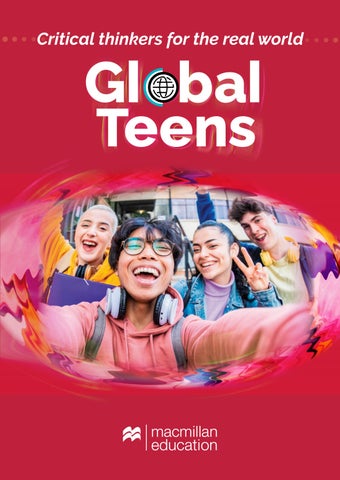
Critical thinkers for the real world
Global Teens is a 4-level series designed with global skills as the central strand to give students the chance to broaden their perspective and develop their critical thinking skills.
How can Global Teens help you ignite your students’ curiosity? It includes thought-provoking texts that trigger the discussion of issues such as diversity, inclusion and sustainability in the Global goals sections. It provides students with tools to face daily challenges and solve real-life problems in the Skills for life sections. It helps students develop creative, collaboration, communication and feedback skills through the Projects at the end of each unit. It promotes the active use of English through engaging Mediation tasks and boosts student’s listening skills with the Podcast circle episodes.
Engaging real-world topics that trigger the discussion of thought-provoking issues Interview with a park ranger 1 Read Where does Bimo work? What’s special about this place? 2 Complete the questions and choose 2 interes ting facts. Then share them with the class.
Grammar review: Questions p a ge
go t
o
122
7 ... ... big?
Yes, they are! They’re very big lizards. They can be 3 metres long. They are strong too and they’re great hunters.
8 ... ... they ... ?
They eat small and big animals, for example , rats and buffaloes.
9 ... ... ... do? 1 Hello Bimo. You’re a park ranger, right? Where ... ... work? I work at Komodo National Park.
They can run fast and climb trees. They can detect smells with their tongues.
10 ... ... swim?
Yes, they can! They can swim between the islands.
2 Where ... ... ?
It’s in Indonesia, and it includes three islands: Komodo, Rinca and Padar.
11 ... ... ... any enemies?
No, they haven’t. When they’re adults, they’re at the top of their food chain!
3 ... ... any beaches at the park?
12 ... ... they ... ?
4 ... is a good time to visit?
13 And what ... ... do on a typical day, Bimo?
Yes, there are! There are beaches with white, pink and black sand. They’re beautiful.
They sleep in burrows or caves.
From April to November. In July and August there are a lot of visitors! And the weather is very hot.
I guide visitors on walks to see the dragons and answer their questions. I protect visitors, the park and its animals.
5 ... is special about this park?
It’s a World Heritage Site and Komodo dragons live here.
6 ... these dragons ... in any other places around the world? No, they don’t. They only live in the park.
3 Speak Write questions about the Komodo dragons . Then work in pairs and take turns to answer. 1 a long tongue ? 2 live in the water ? 3 strong ? 4 hunt ? 5 climb trees ?
6 slow ?
Globa l goals Protected sites UNESCO World Heritage Sites are cultural and/or natural locations around the world that are protected because they are very special and unique places. Discuss in pairs. Then as a class.
Why is the Komodo National Park a UNESC O World Heritage Site? Are there any World Heritage Sites in your country? Find out!
74 WB go to page 116
The Global goals sections encourage students to discuss global issues such as diversity, inclusion and sustainability. These sections also help them develop the skills they need to become responsible and committed global citizens.
Thorough language practice and reinforcement in one book Extra Grammar practice
1
Present simple: affirmative, negative and
The life of a K-pop student What’s 1 Read Answer: Where’s Lee from?
special about his school? Then study
the Grammar box. Grammar
Interview with Lee,
Present simple
Do you go to a special school? Yes, I do. / No, I don’t.
Do you go to a special school?
. Yes, I do. I go to a K-pop academy 9.00 am We have normal lessons from school to 5.00 pm and then we stay at
go t
p a ge
1 Jake
at 7.00 am on Mondays. 2 I don’t with my mum because she goes to work before I get up. 3 Clara at home, but some of her friends eat at school.
118
4 We we
Checkpoint
What do you do after 5.00 pm?
you
they
he
she
I
we
it
2 Tania loves sport and on Fridays she plays
b Form a Wh- question. do / go / you / When / home?
Does she train very hard?
lessons and goes Yes, she does. She takes extra that time! home at midnight. I’m in bed at
What
Does
5 After school, Tania goes out on her bike and sees her friends.
Where
What time
Yes, he ... . No, I ... .
/ to / football ? 3 go / Jamie / a / Does / academy No, she ... . lessons / Do / / the / have / in / 4 they / normal morning ? Yes, they ... .
For example,
(take) photos. My best friend,
I take! I 5 brother and I 6
(like) the photos (like) music too. My
all the time. I also 7
(listen) to music
about music, but my brother 8
(read) books
(not like) reading. He 9
programmes about music on TV.
(listen) (watch)
4 Order the words to make Wh- and Yes/No questions. Then answer about you. 1 do / What / get up / you / time ? 2 like / video games / Do / you ? 3 school / brother / does / Where / to / your 4 go / school / you / the / Do / afternoon
/ go ?
/ to / in ?
/ at / to ?
Vaibhav Suryavanshi 1 are / is a 14-year-old teenager from India. He lives in Tajpur, a small village, with 2 he / his family. He 3 got / ’s got 2 brothers. 4 Vaibhav is / Is Vaibhav different from other teenagers? Yes, he 5 is / has. He is an amazing cricket player! He 6 play / plays for the Rajasthan Royals in the Indian Premier League and for the India Under-19 National Cricket Team. During the week, he 7 do / does a lot of exercise and he 8 goes / go to school too. His mum 9 get up / gets up very early to prepare his food and his dad 10 take / takes him to cricket practice. 11 Does he do / Does he a lot of free time activities? No, he 12 doesn’t / does. But he 13 like / likes connecting with his fans!
Do you do sport at weekends? No, I don‘t. What do you do? I play video games. s. Rami doesn‘t do sport at weekend He plays video games.
to do other things in my free time.
I3
Tony, really 4
(play) (not do) I prefer
Choose the correct option.
to ask and answer
Yes, he does.
Some students in my class 1
basketball after school. I 2 sport apart from PE lessons at school.
Grammar challenge
games play football do sport play video school at weekends on Fridays after
live in Korea want to be famous practise ballet practise K-pop finish school late go home at midnight
3 Complete the text about Jonah with the present simple form of the verbs in brackets.
5 go / When / you / weekends / bed / do
to ask and answer 4 Speak Work in pairs. Take turns te’s answers questions. Then share your classma with the class.
/ o’clock ? 2 you / Do / finish / at / four / school
basketball.
4 I don’t have lunch at school.
You
When
Unit 1
questions
to podcasts and 10
3 I relax when I get home from school.
c Tick ( ) all the correct options. use: To start Wh- questions, we can
questions. 2 Order the words to make Yes/No Then complete the answers. / Does ? go / 1 to / Lee / special / a / school
on Saturdays.
2 Change I sentences to Tania and Tania sentences to I. 1 I have breakfast and then I go to school.
Does
Do
want
I just enjoy No, I don’t. I don’t want to be famous. Jamie wants singing and dancing. But my friend to be a star.
at 9.00 am and at 3.30 pm.
5 Freya doesn’t She does it on Sundays.
a Match. To start Yes/No questions, we use:
We have lessons in dancing and pm. singing. Our lessons finish at 10.00
3 Speak Work in pairs. Take turns questions about Lee.
o
Does she train very hard? Yes, she does. / No, she doesn’t.
to practise K-pop.
Does Lee live in Korea?
do homework get up have breakfast have lunch start/finish school
the text and Look at the sentences based on discover the rules. answers short and Yes/No questions
a student at a K-pop academy in Korea
Wow! That’s very late! Do you to be a star?
1 Complete the sentences with the present simple form of the verbs in the box.
123
13
WB go to page 89
Extra Grammar practice
Student’s Book Grammar reference
Students get enough language practice and reinforcement opportunities with the Student's Book and Workbook pack that includes a Grammar reference section, extra grammar activities and the MEE App.
Problem-solving and critical thinking skills 5 Taking a digital pause in the photo 1 Read Answer: What is the girl
ar box.
doing? Why? Then study the Gramm
Must
Grammar
students must In some schools across Europe, home. In other leave their mobile phones at in phone pockets schools, they must put them ms. when they get into their classroo es think that Why is this? Because local authoriti in class. They attention more pay students must their phones during also think that they mustn’t use have more real-life breaks or lunchtime – they must authorities want to interactions instead. Also, some methods. In Italy, for go back to traditional learning diaries to write example, students must use paper homework assignments by hand.
measures? What are the objectives of these social interaction Less distraction in class, more For now, a lot of and less stress and cyberbullying. schools are happy with the results.
the text and Look at the sentences based on verbs. Then complete them with the missing discover the rules. Affirmative
at Students must ... their mobile phones class. They must ... more attention in
Negative
home.
o
They mustn’t ... their phones during breaks.
p a ge
go t
Going smartphone-free
2 Everyday heroes
121
Checkpoint ustn’t, person a Complete the rules with must/m and verb. person + ... + ... . use: • In affirmative sentences, we ... + ... + ... . • In negative sentences, we use:
Real-life heroes
Work ing to make a diffe rence
or 3 rules for your 3 Write Work in pairs. Write 2 . Then share the classroom. Use must and mustn’t class. rules with the
play use bring help
games in Students mustn’t play ball classroom.
technology for Students with disabilities 1 ... ... to school and learning. They 2 ... ... their phones them in class. use to them ... ... 3 s their teacher Students 4 ... ... games at school.
Melisa Garrone
PE teacher, athlete and lifegua
the
She enjoys reading books, being on the beach and hanging out with friends. But above all, she loves helping people and learning something new every day.
Discuss in pairs. Then as a class. in Do you use your mobile phone do class? And during breaks? What
ers in class to do Students sometimes use comput ... safe websites. online research. For this, they 5 ... ... on their work. They 6 ... ... social media. They 7 ...
Melisa started her career working as a lifeguard in swimming pools in Argentina and then on the river in her hometown. After that, she moved to Costa Rica, where she became an expert lifeguard.
you use it for? e or Do you use it a lot? What negativ have? positive effects do those uses pause is Do you think taking a digital a good idea? Why?
At the moment, she is a volunte er with the International Surf Lifesaving Association (ISLA), so she travels to other countrie s to work with people from differen t cultures. She teaches other lifeguards, but she also learns from them. She likes working in a team and sharing experie nces because it helps her grow both personally and professionally.
63
WB go to page 109
The Skills for life sections provide students with tools to solve problems in their daily lives.
rd
Melisa Garrone is from Villa Regina in the Province of Río Negro, Argentina.
Skills for life
use concentrate visit
Give opinions about jobs. Talk about what real-life heroes did. Describe actions to help the environment. Talk about past events. Show interest in a conversation. Write an email. Collaborative Create a timeline of project the life of a special person. Skills for life Turn problems into opportunities. Global goals Protect natural habitats and ecosystems.
1 Get ready Look at the website . What’s it about? What’s Melisa’s profession? 2 Read Where’s Melisa from? What does she like doing?
b Circle the correct option. (I, you, he, Must is / isn’t the same for all persons she, they, etc.). or mustn't. c Complete the rules with must strong • We use ... for rules and to express obligation or necessity. • We use ... to express prohibition.
or mustn’t and 2 Complete the texts with must the verbs in the boxes.
Unit goals
QUOTE ‘A leader is not a person with a lot of followers, but a person who leaves footprin ts behind.’
The story Scott Hunthausen, a lifeguar d instructor from California, travelled to Nicaragua in 2008 to study for a semester. He was there when 70 people died from drowning in 4 days during the Easter holiday. Back in California, he decided to take action to prevent so many deaths from drowning, so he started ISLA with 3 other instructors that same year. ISLA today Today, ISLA is a team of volunteer lifeguards, doctors , nurses, firefighters, police officers, paramedics and military personnel from differen t countries. They go on mission s around the world to train lifeguards and provide help.
What do you think? Discuss in pairs. Then as a class.
Read Melisa’s quote. Do you
agree? What is Melisa doing
to leave her footprints behind?
20
The What do you think? sections give them the chance to think critically and give their opinion on the units’ topics.
Project work Project
Project
Design a robot to solve a problem.
to: In this project, you are going robot • Choose a problem that a can solve. • Give the robot a name. . • Find a photo or make a drawing
• Write its fact file. class and • Present your project to the answer questions about it. tes’ • Give feedback on your classma projects.
A. Time to discover r. Look at the model and answe 1 What kind of robot is it? doing? it 2 Where is it? What is
Y DRONE EDD – EXPRESS DELIVER
. Traffic doesn’t stop it!
e can do very fast deliveries
The Express Delivery Dron
by Izzy and Zac
5 B. Time to work 1 Work in groups of 3–4. Follow Steps a–c to think of a problem and design a robot to solve it. Use the key phrases in the Communication skills box. Comm unica tion skills
Key phrases to share and
I’ve got an idea. OK, I agree. / I’m not sure.
accept or refuse ideas
a Look at this diagram. Then make a new diagram with your ideas for a robot.
FACT FILE Characteristics: light and fast
•
•cheap •easy to use
Abilities: It can fly. It can carry heavy objects. et. It can connect to the Intern It can use online maps.
Limitations: It can’t fly on rainy days. Requirements: It must use a light battery. Users must have a good internet connection. app. Users must have the EDD
What’s the problem? Slow and expensive deliveries. Who’s got the problem? Where? People in big cities.
What’s the solution? A drone.
Main abilities: fly, carry objects
b To finish designing your robot, read EDD’s fact file on page 68 again. Then: 68
• Give your robot a name. • Make a drawing of your robot or go online to choose a photo. • Think of adjectives to describ e it. • Make a list of its abilities, limitations and requirements. c Use your notes from Step b to write a clean copy of your robot’s fact file.
2 Read the tips below and in the column on the right. Then prepare your presen tation. How to make a digital presen tation • Slide 1: Use big letters to write a title. Use smaller letters to write your names. • Slide 2: Write a short senten ce or key words explaining the problem. Use clear font, make letters big.
• Slide 3: Introduce your robot (name + drawing or photo) • Slide 4: Include the robot’ s fact file. You can divide the fact file into 2 slides if necessary. • Slide 5: You can use a final photo or drawing to close your presentation . Don’t forget to say Thank you!
C. Time to share 3 Give your digital presentation and answer your classmates’ questions about it. 4 After listening to all the presen tations, choose 1 of your classmates’ ideas and say why you like it. I really like EDD. It’s a great idea. It can take objects to hospitals. It can take hot pizza fast too!
Refle ct on your proje ct Circle the stars. I used language from the unit.
I’ve got a good solution to a
problem.
I made a clear presentation and included information for all the catego ries.
I enjoyed asking questions and making comments about my classmates’ robots .
69
A Project at the end of each unit helps to integrate the language students have learnt and also develops creative, collaboration, communication and feedback skills.
Mediation tasks and Podcast circle sections
Mediation Imagine one of your friends has trouble getting organised. Read the text on page 14 and the text above again, and send them a text message suggesting 2 ideas for organising their time.
Podcast circle Episode 1
A day in our lives 13
After you listen, complete 1 of these tasks: 1 Write 2 or 3 things that Emma and Leo have in common. 2 Write 2 or 3 things that are different between you and Emma or Leo.
The Skills challenge section at the end of each unit in the Workbook presents a Mediation task that allows students to use English in a practical context. It also features the Podcast circle section with engaging activities that boost students’ listening skills.
Engaging digital components FOR STUDENTS WHAT CAN YOU FIND IN THE APP?
• Digital Student’s Book + Workbook • On-the-Go Practice: » Interactive, gamified activities that help students revise and
consolidate the target language anytime they want. » Challenge Mode activities that motivate students to practise more by collecting rewards. » Progress tracker that gives students instant feedback on how well they have completed the task and allows teachers to monitor students’ progress.
• Student’s Resource Centre:
Extra practice worksheets and videos.
The MEE app offers digital resources that motivate students by giving them more chances to practise in a game-like way.
Engaging digital components FOR TEACHERS WHAT CAN YOU FIND IN THE APP?
• Classroom Presentation Kit: » Access the Digital Student’s Book + Workbook and the Digital Teacher’s Book. » Project the Digital Student’s Book + Workbook in class.
• Progress Tracker: Monitor students’ work remotely, track their progress or get reports if homework has been done.
• Homework tool: » Create customisable homework and tailored to your students’ level with this intuitive tool. » Assign homework remotely. » Choose from the On-the-Go Practice tasks or set your own.
• Assessment tool: » A digital tool to create customisable
tests and tailored to your students’ level. » All tests can be printed and used in classrooms where connectivity is limited.
• Teacher’s Resource Centre: A wealth of
extra resource materials and worksheets.
The MEE app offers digital resources that help teachers deliver stimulating lessons.
FOR STUDENTS
FOR TEACHERS
• Student’s Book + Workbook
• Access to the MEE App with: • Classroom Presentation Kit:
• Access to the MEE App with: • Digital Student’s Book + Workbook • Digital Games • On-the-Go Practice • Student’s Resource Centre
Digital Student’s Book + Workbook, and On-the-Go Practice • Digital Teacher’s Book • Teacher’s Resource Centre • Homework and Progress Tracker tools • Assessment tool
Starter Level
Level 1
Level 2
Level 3
Student’s Book + Workbook with App
978-987-672-820-1
978-987-672-821-8
978-987-672-822-5
978-987-672-823-2
Digital Teacher’s Book with App
Free on adoption
Free on adoption
Free on adoption
Free on adoption
To learn more about Global Teens visit: highlights.macmillan.com.ar/secondary/global-teens.php
macmillanenglish.com/ar Macmillan Argentina
ar.eltinfo@macmillaneducation.com
macmillanargentina
Macmillan Argentina