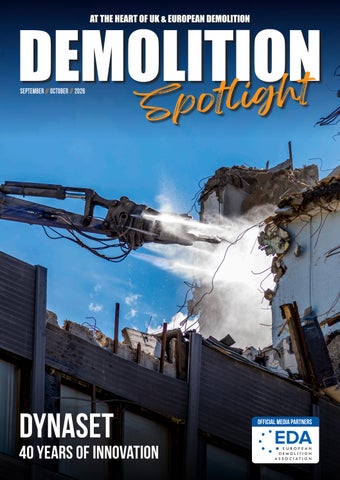
AT THE HEART OF UK & EUROPEAN DEMOLITION
september // october // 2026
Dynaset
40 years of innovation
official media partners
Passionate about
PLASTERBOARD
Customer Service – Flexibility – Nationwide Collection Over the last 10 years PRG has become the UK’s leading plasterboard recycler with over 300,000 tonnes of waste recycled annually into quality gypsum products for our plasterboard manufacturing customers.
Call us now on +44 1325 730168 or email info@prg.uk.com
www.prg.uk.com
There is perhaps no greater irony in construction than an industry built around taking things apart increasingly finding itself at the forefront of the conversation about how we can build a more sustainable future.
is published by Machine Power Media Ltd. St Johns House, St Johns Street, Chichester, West Sussex, PO19 1UU 07779 405885
Demolition has changed. The days of simply knocking something down, loading the debris onto a fleet of trucks and sending it away are, thankfully, becoming a thing of the past. Today, the real value of a demolition project can often be found in what doesn’t end up in the waste stream. Concrete can be crushed and reused. Steel can be recovered. Timber, brick and other materials can be carefully separated and given another life. Even the machines doing the heavy lifting are undergoing something of a transformation, with manufacturers exploring electrification, alternative fuels, more efficient powertrains and technology designed to reduce unnecessary fuel consumption.
demolition spotlight // introduction
Breaking Down the Sustainability Question
demolition spotlight
But sustainability isn’t simply about buying a greener machine.
It is about changing the way we approach demolition from the very beginning of a project. Better surveys, improved material identification, greater segregation on site and a genuine focus on reuse can all make a difference. And, as the industry continues to embrace the principles of the circular economy, the demolition contractor increasingly has an important role to play in determining what becomes waste – and what becomes a resource.
That makes the upcoming Environmental Services & Solutions Expo (ESS Expo), at Birmingham’s NEC on 16–17 September, particularly interesting for our industry. Bringing together businesses and professionals from across the environmental, waste, resource and sustainability sectors, the event offers demolition contractors an opportunity to look beyond the traditional boundaries of our industry and see where the next generation of solutions might come from. The co-located Resource & Waste Management Expo should be particularly relevant, with resource recovery, recycling, waste management and the technology supporting these areas all firmly on the agenda. For me, that wider conversation is increasingly important.
Because demolition shouldn’t just be about making space for what comes next. It should be about making sure there is as little waste as possible left behind when we get there.
And perhaps the most sustainable demolition project isn’t the one that removes the most material – but the one that finds the most value in what it removes. Happy reading!
Rebecca Phillips Managing Editor
Copyright
Machine Power Media Ltd. © 2026 all rights reserved.
Reproduction in whole or part is prohibited except with permission in writing from the company. Note to contributors: articles submitted to the Editor for consideration must be the original work of the author.
Where photographs are included that are not the property of the company or contributor, permission to reproduce them must have been received from the owner of the copyright. Any views or opinions expressed within this magazine are not necessarily those of the company. Registered in England No: 16081082
Conditions for Advertising All advertisements are accepted subject to Machine Power Media’s standard of insertion. For a copy of Advertising Terms & Conditions, please write to:
Darren Shelton, Machine Power Media Ltd. St Johns House, St Johns Street, Chichester, West Sussex, PO19 1UU
Find Us Online @demolitionspotlight
september // october // 2026
OUR demolition spotlight PARTNERS
3
contents // demolition spotlight
36 // Front Cover Story
Dynaset
36
From Garage to Global: 40 years of Dynaset innovation.
8 // Latest news
The latest news from the plant machinery industry over the past two months.
28 // feature article
JCB Hydromax
JCB has, for the second time in the company’s history, set a World Land Speed Record on the Bonneville Salt Flats in Utah, USA.
32 // preview
RWM 2026
What you have to look forward to at this year’s ESS Expo!
46 // company profile
Donaldson Filtration
Built for Demanding Environments: More Than a Century of Donaldson Filtration Expertise.
52 // Feature Article
IDE
The Demolition Diploma: Capturing Knowledge to Advance the Profession.
56 // Feature Article
BBC Television Centre Rebuilding Britain’s Home of Television.
60 // Feature Article
Worsley Plant
Skillings Crushing Puts New Rotar RDP 50 Through Its Paces at Skelton Grange.
september // october // 2026
64 // Feature Article
4
From Site to Roadside Following the Waste Paper Trail.
32
demolition spotlight // contents
56
46 60
september // october // 2026
5
64
our team contributors
team & contributors // demolition spotlight
DARREN SHELTON MANAGING DIRECTOR
PHIL EVERY GROUP SALES DIRECTOR
REBECCA PHILLIPS MANAGING EDITOR
CHRIS HART SENIOR SALES CONSULTANT
MARTINA TONELLI MARKETING SPECIALIST
ALEX COX JOURNALIST & CONTENT CREATOR
TULIA MATTILA DYNASET SYLVIA GITHUMBI DONALDSON FILTRATION SILVIA NAVARRO NFDC ALEX COX FABLE KRAFT PAULA CASTILLO EUROPEAN DEMOLITION ASSOCIATION
september // october // 2026
YAZAN OSAILY IDE
6
For all content related queries, contact editor@machinepowermedia.co.uk For all sales related queries, contact chris@machinepowermedia.co.uk
STEVE WILSON DESIGN MANAGER
DEMOLITION PULVERIZER Installed on excavators, backhoe loaders and skid steer loaders, they are designed for primary and secondary crushing. 1,5 - 25 ton
Scan for the full range of attachments MBCRUSHER.COM
mb crusher // NEWS // demolition spotlight
IS GREEN JUST THE COLOUR OF MONEY?
WHAT REALLY HAPPENS WHEN A BUILDING COMES DOWN
F
or decades, on construction sites — and not just there — “green” had a straightforward meaning: money. Saving on transport costs, reducing disposal expenses, finishing the job faster. Everything revolved around the bottom line. Today, however, green tells another story. It’s the story of sustainability, the circular economy, and urban regeneration. Yet, interestingly, it still comes back to money. Because recovering materials instead of disposing of them often makes solid business sense. And perhaps this is precisely where economics and environmental responsibility stop travelling along separate roads. Let’s start with a simple idea: a building awaiting demolition is not just a pile of rubble to be hauled away. It’s more like an urban mine, hidden within the walls of every building, warehouse, or bridge that reaches the end of its life. Concrete, steel, bricks, every one of these materials required resources and investment to produce, and nobody wants to pay twice by sending them to landfill.
september // october // 2026
This is where what we could call the “crushing duo” comes into play: on one side, the demolition pulverizer; on the
8
other, the crusher bucket. Naturally, both from MB Crusher. The pulverizer works with surgical precision. It demolishes only where required, avoids unnecessary destruction while preparing the material for the next stage. When paired with an MB Crusher sorting grapple, material separation becomes even faster and more accurate. The crusher bucket then gives that material a second life. Demolished concrete remains on site, is crushed to the required size, and becomes a new recycled aggregate ready for reuse. When a project calls for specific grading, MB Crusher’s screening bucket completes the process by separating the material directly on site. This approach is becoming increasingly
valuable in urban environments. Today, many demolition projects take place alongside homes, schools, hospitals, or buildings that must remain fully operational while demolition is underway. In these situations, precision matters; but so do noise, vibration, and dust. Controlled demolition minimises impact, helping to protect neighbouring structures. MB Crusher’s dust suppression system, available for both crusher and screening buckets, helps reduce airborne dust emissions, improving working conditions while minimising disruption for nearby residents and businesses. So much for the theory. But what actually happens on site?
demolition spotlight // NEWS // mb crusher
1. Germany: one Garage and one neighbour not to disturb
After removing the garage door, propping the floor slab, stripping the roof waterproofing, and cutting the separation joint between the two structures, the concrete demolition began. A hydraulic breaker was never due to the risk of transmitting vibrations to the
sub-bases, backfilling and ground stabilisation without ever leaving the project.
In other words, the demolition pulverizer didn’t simply demolish the structure—it preserved the value of the material.
Video: https://vimeo.com/1191881672
Because high-quality recycling always starts with high-quality demolition. Video: https://vimeo.com/1176501250
2. Poland: When Material Never Leaves the Jobsite
Reducing operating costs by as much as 30–40% using material that was once considered nothing more than waste. That’s exactly what MBKOP, a Polish company specialising in demolition and earthmoving, achieved by recycling demolition debris directly on site with an MB Crusher BF80.3 crusher bucket. The turning point came by eliminating one of the biggest productivity bottlenecks: dependence on haulage, landfill sites and external aggregate suppliers. Today, demolition waste is crushed and reused on site for
The benefits are significant: faster project execution, fewer truck movements, no landfill disposal costs, and no need to purchase new aggregates.
So, what is green demolition really all about? It means recovering as much material as possible exactly where it already is, without transporting it away only to bring new material back. Less waste to dispose of, fewer truck movements and less demand for newly quarried aggregates. It also aligns with the regulations adopted in many countries, where construction and demolition (C&D) waste recovery targets exceed 70%, and public procurement increasingly rewards, or even requires, the use of recycled materials. And, returning to our opening play on words, perhaps that’s what green really means today: keeping a little more green on site, in every sense of the word.
september // october // 2026
During the partial demolition of a double garage, Thomas Hugo Baggerarbeiten, based in Sulzbach am Main, chose the MB Crusher MB-P380 demolition pulverizer mounted on a 5.5-ton Bobcat E55 excavator. The goal was to selectively demolish one half of the garage without damaging the adjoining structure.
neighbouring building. Instead, the MBP380 delivered controlled, vibration-free demolition. Its integrated cutting blades allowed the reinforcing steel to be cut during the demolition process itself. Concrete and steel reinforcement were cleanly separated and reduced on site to a size suitable for crushing.
9
// NEWS // demolition spotlight volvo
VOLVO CONSTRUCTION EQUIPMENT TESTS FIRST EVER EC500 ELECTRIC PRE-BUILD MACHINE IN NORWAY
V
olvo Construction Equipment (Volvo CE) is taking another important step in the development of electric construction solutions as it begins customer testing of the first ever EC500 Electric pre-build machine in Norway. Equipped with both battery and gridconnected capability, including a 35m cable reel, the 50-tonne class machine is being tested in demanding realworld applications, as Volvo CE work in collaboration with their customers to help refine the final product development. The EC500 Electric is a 50-tonne class electric excavator designed to deliver the same performance as the conventional EC500 while offering flexible electric operation through both grid connection and onboard battery power. This is an important milestone in the development of our electric excavator offering. By testing the EC500 Electric pre-build machine together with customers in real applications, we are building the product around the realities of the job site – helping us to strengthen machine reliability and provide even more quality assurance. The feedback we receive from Norway will be invaluable as we continue to develop a high-performance electric solution designed to achieve optimum results in demanding applications.
Electric performance in the 50-tonne class
september // october // 2026
The EC500 Electric pre-build machine has been developed to deliver the same high levels of performance customers expect from the EC500, while introducing a flexible electric power system. The ability to operate on onboard battery power, or in combination with a grid connection supported by the battery system, the machine gives customers greater flexibility in how electric power is used on site.
10
Equipped with a cable reel, the EC500 Electric machine can operate while connected to the grid, supported by its onboard battery system. Battery capacity enables 2–3 hours of working, depending on application and operating conditions, while also supporting intelligent grid energy management. The intelligent electric system is designed to adapt to various grid
conditions on a 400V base, helping customers manage the practical realities of site power availability, providing greater flexibility while reducing the demands placed on job site power infrastructure. With onboard battery capacity, the EC500 Electric can move, load and unload, relocate for blasting, or continue working without grid connection, helping operations stay productive even when access to power is restricted. Combined with intelligent grid energy management, the battery system can also support peak shaving and adapt to varying grid conditions, reducing the need for high-capacity grid infrastructure, helping customers lower investment costs and increase the feasibility of electric power, while maintaining the performance required from a 50-tonne class machine.
Developed in partnership with customers
Customer input is central to the development of the EC500 Electric. By testing the machine in live working environments, Volvo CE is able to
gather detailed feedback on machine behavior, performance, charging and grid connection, operator experience and practical site integration. This collaborative approach ensures that the machine is developed not only around technical considerations, but around the day-to-day requirements of customers working in some of the most demanding applications. The machine is currently being put to work across a range of demanding customer applications, including quarrying, road building and tunnel projects. The purpose of the testing programme is to gather direct customer input into the final stages of development, with insights from the customer testing programme in Norway feeding directly into the final development of the product, ensuring the machine is refined in line with real job site requirements. The EC500 Electric is expected to be for sale from Spring 2027 with serial delivery from the end of 2027.
1946
-
2026
80 YEARS
MCHALE KOMATSU // NEWS // demolition spotlight
MCHALE KOMATSU: WORKING TO BE A ‘TRUE PARTNER’ TO THE DEMOLITION SECTOR
A
t McHale Komatsu, a number of very significant moves are underway all with the purpose of providing demolition contractors with equipment designed to perform safely, reliably and efficiently in what can be some of the most challenging working environments. Principal amongst them is the development and production of machines purpose-built for demolition, machines engineered specifically for demolition applications. These are not simply adapted from standard construction machines but developed to deliver the specialist solutions that only a demolition contractor would know. To support their goal to be a trusted and valued partner across the demolition sector, the company recently appointed Fred Stearn as Demolition Sales Manager, an appointment that sits alongside his Affiliate Membership of the Institute of Demolition Engineers (IDE) and McHale Komatsu’s own Associate
Membership of the National Federation of Demolition Contractors (NFDC). Speaking to Demolition Spotlight, Fred stressed the importance of ‘earning the trust of contractors’ such as their Komatsu LCD demolition excavator and HRD High Reach Demolition excavator ranges are designed to do.
A long way away from what Fred cautions against in demolition scenarios (the standard excavator fitted with cab guards and some added protection) the Komatsu LCD and HRD ranges are “purpose-built and certified demolition machines, designed from the ground up to meet the rugged demands of demolition.”
“Designed and manufactured at Komatsu’s Birtley factory in the North East of England, the LCD and HRD machines are the result of decades of experience, of knowing and delivering the specialist solutions that demolition professionals across the UK and Ireland require,” Fred said.
“Enhanced operator protection, reinforced structures, specialised hydraulic systems and demolitionspecific configurations ensure that every machine is optimised for the task at hand while helping contractors meet increasingly stringent safety standards,” he said.
At their heart is a combination of robust engineering, operator safety and outstanding productivity, coupled with the high-grade components, quality materials, build standard, and classleading longevity in terms of operational life for which Komatsu is famed.
Continuing to strengthen their demolition offering, Komatsu’s recent introduction was their new PC950LCD demolition specification excavator - an impressive newcomer which, Komatsu says: “provides customers with greater capability for heavy-duty demolition applications, delivering the power, reach and durability required for the industry’s most demanding projects.” Alongside the LCD range, Komatsu’s HRD high reach demolition excavator remains among the most versatile and productive machines available. Particularly noteworthy is its modular boom configuration, excellent stability, and industry-leading safety features that allow contractors to tackle a wide range of structures efficiently, while maximising utilisation and return on investment.
september // october // 2026
Constantly focused on customer service, as many would testify, McHale Komatsu looks far beyond the supply of equipment, driven by the shared benefits they know will come from being a true partner to their customers.
12
Supporting them throughout the lifecycle of their investment, Fred stresses: “our aim is to be a one-stop-shop for the demolition industry, providing a complete solution that includes consultation, machine selection, quick couplers, attachments, aftersales support, service and finance packages tailored to individual circumstances.” For contractors seeking purposebuilt demolition equipment backed by specialist support and industry expertise, Komatsu’s expanding range and McHale Komatsu’s customer-focused approach suggest a combination well equipped to meet the demands of a changing market.
MARK HOAD, SALES AND MARKETING DIRECTOR AT SUNBELT RENTALS UK & IRELAND
D
emolition projects are complex operations that demand detailed planning, specialist expertise and close coordination. From major deconstruction programmes to work on controlled live sites, contractors are managing safety, logistics, environmental requirements and changing equipment needs while maintaining control at every stage. For the hire industry, that means our role is changing and we must go beyond responding when equipment is needed to be becoming a partner and engaging with demolition contractors early, understanding how the project will be delivered and bringing the right expertise into those conversations.
Partnership starts with understanding the project
The strongest hire relationships are built well before the first delivery arrives on site. For demolition contractors, early engagement gives the supply chain time to understand the programme, the site and how requirements are likely to change as work progresses. That early involvement gives us the opportunity to plan around the realities of the project, from understanding how equipment requirements will change as work progresses to considering movement around the site, power, welfare, environmental monitoring and
specialist support. It also means we can identify opportunities to reduce unnecessary movements and minimise downtime, helping the project run safely and efficiently from the outset. This becomes particularly important on complex projects, where multiple suppliers and changing requirements can create additional coordination for site teams. A more joined-up approach can help simplify that process, while giving contractors the flexibility to adapt as the project develops.
Putting new technology to work
We have seen growing interest in implementing low or zero-emission equipment, alternative power solutions and innovative technology on site, but the important consideration is how these solutions perform in demanding demolition environments. That is where early engagement and trials become important, creating the opportunity to introduce and test new solutions before considering implementation across the wider site. Different charging requirements, fuelling patterns, maintenance and logistics all need to be considered, particularly on complex demolition sites where equipment is working in demanding conditions. Undertaking a trial allows contractors and hire companies to understand those requirements together, monitor
performance and identify any challenges before considering wider adoption. It provides the evidence needed to understand what works, where it works and what may need to change operationally to make it successful. For me, that practical approach is important because innovation has to work on site, support the people using it and ultimately deliver the desired outcome for the customer. Having the right expertise alongside that technology is just as important, with contractors needing teams who understand the application, the equipment and the realities of working in demanding site environments. Data can then strengthen those decisions further, with accurate delivery information, tracking data, electronic documentation and proactive updates providing greater visibility of how equipment is being used and performing across a project, helping teams to plan more effectively as requirements change.
demolition spotlight // NEWS // Sunbelt Rentals UK & Ireland
PLANNING DEMOLITION DIFFERENTLY: WHY EARLY ENGAGEMENT MATTERS
We know that the role of hire is continuing to evolve, but the principle is straightforward. We need to engage earlier, understand what the contractor is trying to achieve and bring the right people, equipment, data and expertise together around that challenge. That is how partnership can deliver practical value throughout a demolition project.
september // october // 2026 13
Smart Storm // NEWS // demolition spotlight
WHY GROUTING CREATES ONE OF TUNNELLING’S BIGGEST WASTEWATER CHALLENGES
G
routing is fundamental to modern tunnel construction, strengthening ground, sealing water ingress and stabilising tunnel linings. However, every stage of the process - (mixing/pumping/ equipment washdown) generates highly alkaline wastewater that presents a significant environmental challenge. Grout wash water is typically pH between 11 and 13.5 and contains high concentrations of suspended cement particles. If discharged untreated, it can severely impact rivers, groundwater and drainage systems, while placing contractors at risk of breaching environmental permits under UK legislation. Traditionally, pH correction has relied on hazardous acid dosing, but acids requiring careful handling and precise dosing to avoid over-correction. Smart Storm’s NeutraliZer® offers a safer and more intelligent alternative. Using carbon dioxide (CO₂) rather than hazardous acids, the NeutraliZer automatically reduces pH to compliant levels through a self-buffering process that virtually eliminates the risk of overdosing. Combined with continuous
pH monitoring, automated control and optional remote telemetry, the system provides reliable, hands-free treatment with full visibility of the process. The compact, skid-mounted design is ideal for tunnelling and construction projects, allowing rapid deployment as work progresses. Treated water can then be safely discharged under permit or reused on site, reducing disposal costs and supporting more sustainable construction practices.
Smarter Wastewater
As environmental expectations continue to increase, effective wash water treatment is no longer simply about compliance—it is about protecting the environment while delivering safer, more efficient construction operations. Smart Storm NeutraliZer® transforms high-pH construction wastewater from a compliance risk into a controlled, sustainable process.
MONITOR
TREAT
COMPLY
Intelligent flow, level, pH, and water quality instrumentation for real-time insight and accuracy.
Bespoke trade effluent treatment and pH balancing systems designed to meet your operational needs.
Reduce environmental risk, ensure discharge compliance, and achieve optimal performance.
Monitoring & Treatment
Solutions that protect your business and the environment
Featuring
september // october // 2026
Complete Wastewater Solutions
14
• Monitoring - dosing - pH Balancing • Effluent treatment plants • FOG removal and reclamation • Wastewater bill analysis • Chemicals, surveys, hire
Innovative inline CO2 based pH balancing technology for industrial wastewater and concrete washout applications. A safer, faster alternative to hazardous chemical dosing.
Contact - Sales@smartstormgroup.com
Visit - www.smartstormgroup.com
I
ndustry initiative will help individuals gain recognised accreditation and begin or progress a career in demolition.
The National Federation of Demolition Contractors (NFDC), in partnership with the National Demolition Training Group (NDTG), is offering 60 fully funded CCDO Labourer Card pathway places to eligible individuals seeking to start or progress a career in the demolition industry. The initiative has been created to remove some of the financial barriers that can prevent people from accessing industryrecognised training and employment opportunities. The campaign is part of the NFDC’s wider commitment to supporting the demolition sector, strengthening its workforce and encouraging more people to become appropriately trained and qualified.
Adrian Corrigan, President of the NFDC, said: “Supporting people into demolition and helping them gain recognised industry accreditation is an important part of our role as a Federation. “This initiative is about creating opportunities, supporting the future workforce and helping more people enter the industry with the knowledge and qualifications they need to work safely and responsibly. Demolition offers a wide range of long-term career opportunities,
and we hope these funded places will provide a valuable first step for people who may not otherwise have been able to access the training.” Whether applicants are considering a completely new career or are already working in construction and want to develop specialist demolition skills, the opportunity offers a chance to join one of the built environment’s most dynamic and highly skilled sectors.
demolition spotlight // NEWS // NFDC
NFDC LAUNCHES 60 FREE DEMOLITION TRAINING PATHWAYS
CERTIFICATE OF COMPETENCE OF DEMOLITION OPERATIVES
Each funded pathway includes both the CCDO Labourer training course and Asbestos Awareness training, providing successful learners with the qualifications required to apply for a CCDO Labourer Card. Before attending the training, applicants must have passed the required Operative Health, Safety and Environment test. Candidates are encouraged to complete the appropriate test through CITB or NOCN. Applicants must also be able to understand, communicate and read English to the level required to participate safely and successfully in the training. Courses will take place during September, October and November 2026 and will be delivered either live online or at the NDTG training centre in Hemel Hempstead.
Commence your CCDO career pathway FREE CCDO Labourer Training. The National Federation of Demolition Contractors (NFDC), in partnership with the National Demolition Training Group (NDTG), is offering 60 free Certificates of Competence of Demolition Operative (CCDO) Labourer Card pathway places for eligible individuals. Each learner will complete both the CCDO Labourer and Asbestos Awareness training courses.
CSCS This opportunity is suitable for individuals who are exploring a new career route.
We welcome CSCS operatives looking to progress from general site work to demolitionspecific competence and a recognised CCDO pathway.
Requirements:
Applicants must have passed the required Operative, Health, Safety and Environment Test through CITB or NOCN.
Course dates:
September through to November.
Course delivery:
Online or at our training rooms in Hemel Hempstead. You can choose what suits you best. 01442 217144 (Option 2)
Places are limited and allocated on a first-come, first-served basis, subject to eligibility and full pathway completion.
For more information and eligibility scan the QR code
hello@ndtg.training
15
Rotar // NEWS // demolition spotlight
WHAT ‘LOW PURCHASE PRICES’ REALLY COST
S
ome manufacturers of sorting grapples often advertise low prices. Rotar, on the other hand, takes a different approach: the company focuses on high quality and the long-term reliability of its attachments, because the costs of downtime in a recycling yard can quickly wipe out any supposed savings made at the time of purchase.
september // october // 2026
A recycling company will work successfully when its operations are well-planned and structured, and its processes run according to schedule, are optimised and are therefore costeffective. Material arrives continuously by truck, sorting, redistribution and further processing must run without interruption to supply the subsequent stages of the recycling chain with material. Very often, these highly efficient processes depend on the reliability of one or a few strategically important handling machines fitted with sorting grapples.
16
But what will happen if such a machine suddenly breaks down due to a fault with the sorting grapple, bringing everything to a standstill? How long does it take before the well-organised recycling plant will descend into utter chaos? What does such a downtime cost the company on every day when no material is sorted out and piles up unprocessed? Business owners know how quickly large amounts of lost money can mount up in such situations.
Downtime is no option
Louis Broekhuizen, Managing Partner, explains: “Here at Rotar, we are aware that business owners are busy with precisely these issues and that standstill in recycling companies must be avoided and a steady throughput ensured.” Rotar’s management and sales team offer decades of experience in the industry and understand its requirements just as well as they know about the examples of many companies that have already had to endure such negative experiences. Ensuring smooth and profitable operations at its customers’ sites is what drives the Dutch manufacturer to produce high-quality and reliable attachments. Dominik Erath, Managing Partner, explains the Dutch manufacturer’s approach: “We do not rate sorting grapples as just one of many attachments, but as the key piece of equipment in the waste and recycling industry, which must do its job reliably day in, day out to avoid downtime and unnecessary costs. Our standards for our quality are correspondingly high.”
A question of responsibility
Rotar sees it as its responsibility to manufacture attachments that increase its customers’ productivity and minimise machine downtime in their businesses.
Rotar grapples are reliable and increase customers’ productivity in the recycling yard.
For this reason, Rotar makes no compromises whatsoever – for cost reasons – when it comes to well-thoughtout design or the quality of the materials and components used; instead, it manufactures robust, durable sorting grapples. Whilst these may be slightly more expensive to purchase than those of some competitors, they nevertheless offer users the lowest total cost of ownership (TCO, which quantifies the total cost of a piece of equipment over its entire service life), as they operate reliably for a very long time. Conversely, equipment with a lower purchase price may ultimately result in a higher TCO if it leads to breakdowns and associated costs.
Always reliable quality
Rotar sorting grapples are durable for many reasons: they feature doublewalled, highly robust constructions with components that function reliably even under the toughest conditions. They also incorporate solid slewing rings with powerful drives, oversized and fully sealed bearing assemblies, as well as shells that offer maximum torsional rigidity. All these components are designed in such a way that damage to the grapple is virtually impossible, thereby preventing machine downtime.
K100 boom change system for Komatsu PC490HRD-11
The K100 boom change system allows to reconfigure your PC490HRD-11 high-reach demolition excavator within minutes. From the safety of your cab, without any outside help required. The most effective equipment can be used at every stage on the job site, offering you a new level of demolition project efficiency. McHale Komatsu, Padgets Lane, Redditch, Worcestershire B98 0RT Tel: 01527 512512 · info@mchalekomatsu.com · www.mchalekomatsu.com
Kelly Tanks // NEWS // demolition spotlight
KELLY TANKS – A LEADER IN INNOVATIVE CONCRETE WASHOUT AND WATER TREATMENT SOLUTIONS
A
s the construction industry continues to expand, so does the need for responsible waste management and environmental stewardship. Kelly Tanks has emerged as a leading player in this landscape, helping to mitigate the environmental impact of construction activities. In providing critical services for managing concrete washout and water treatment, Kelly Tanks demonstrates a commitment to sustainability, compliance, and operational efficiency, and with a forward-thinking approach, they are setting standards for responsible construction practices.
september // october // 2026
Concrete washout and water treatment management plays a crucial role in mitigating the environmental impact of construction activities. Through effective waste management, innovative recycling practices, and a commitment to sustainability, construction sites are able
18
to help protect ecosystems and promote responsible resource use. Kelly Tanks product range and customer support is designed to ensure sites are equipped to: • Comply with regulations
• Minimise waste and environmental impact • Prevent contamination/pollution • Promote responsible waste management
Capturing and retaining waste from concrete washout and Hydrodemolition waste before neutralising the pH and recycling the remaining water, Kelly Tanks diverse fleet of washouts are products of choice and best practice across the construction industry. Also boasting a fleet of Water Treatment Systems to include settlement, flocculation, oil/water separation, pH
control, chemical treatment, renewable energy, storage tanks and real time monitoring, Kelly Tanks’ commitment to supplying not only the best products, but the best service has led to more time on site providing assistance, familiarisation training, CPD Courses and Concrete Washout/Water Treatment Toolbox talks. Onsite is also where Kelly Tanks gain valuable insight and feedback, ensuring they develop their solutions to suit you and your site.
The Path Forward
As regulations surrounding environmental protection become more stringent, the role of concrete washout and water treatment companies will only grow in importance. Kelly Tanks is not just service provider; they are partners in fostering a sustainable construction industry. By investing in innovative technologies and practices, they contribute to a cleaner, more responsible approach to construction.
T
he concrete and masonry industry doesn’t stand still, and neither should you. With 47,400 + professionals last year, World of Concrete 2027 delivers the relationships, breakthrough resources, cutting-edge innovations, and practical solutions you need to tackle today’s toughest challenges and prepare for tomorrow’s opportunities. Face-to-face, hands-on, and ready to implement. The way it should be.
Why It Matters Now
Workforce shortages, sustainability demands, and technological disruption require dynamic action. The World of Concrete 2027 is where the concrete and masonry community gathers to build something bigger than any single project. People, products, and proven practices that move the entire industry forward.
Where connections become collaborations and where problems meet solutions
Game-Changing Innovations and Expertise in Action: It’s more than just another trade show-it’s a pulse check on
the future of construction. Thousands of leading exhibitors across indoor and outdoor zones-Material Handling, Technology for Construction, Concrete Repair & Demolition, World of Masonry, among other exhibits- will help you navigate solutions that matter most. Education: From January 18, the industry’s leading experts will share their knowledge, respond to questions, and help you to discover breakthrough resources to improve your skills. More than 175 educational sessions cover over 65 new topics — all designed to address the latest developments in technical applications, sustainability, safety and workforce growth. Relationships & Networking: World of Concrete 2027 offers unparalleled opportunities to forge the strategic connections to strengthen your business and propel it forward. Beyond the exhibition hall, networking experiences are curated to facilitate meaningful dialogue with peers facing similar operational challenges, potential partners who can expand your capabilities, and innovators that push
the boundaries of what’s possible. Special Events & Competitions: High-intensity competitions and immersive experiences that celebrate craftsmanship across the industry will be held across the different halls to show to the audience the best of their kind: Watch mason competitors work against the clock in MCAA’s Fastest Trowel on The Block competition, or attend the SPEC MIX BRICKLAYER 500® World Championship, where the world’s best bricklayers compete for cash, prizes, and the title of “World’s Best Bricklayer.” Competitions and connections that you don’t want to miss.
demolition spotlight // NEWS // World of Concrete 2027
BE RESILIENT | DISCOVER WHAT’S NEXT IN CONCRETE & MASONRY
New Show Hours:
Tuesday, January 19: 9:00 AM – 5:00 PM Wednesday, January 20: 9:00 AM – 5:00 PM
Thursday, January 21: 9:00 AM – 3:00 PM Exhibits: January 19-21, 2027
Education: January 18-21, 2027
Your next breakthrough is waiting in Las Vegas.
www.worldofconcrete.com
september // october // 2026
World of Concrete 2027 | January 19-21, 2027 | Las Vegas Convention Center
19
eda // NEWS // demolition spotlight
EDA ANNUAL CONVENTION 2026: WRAP-UP
All eyes on next year’s edition in Athens
T
he EDA Annual Convention 2026 in Dublin took place from June 8 to 12 and concluded as a major success. Our annual event brought together a truly international community of professionals from across the demolition, decontamination, and recycling sectors. The main venue was the magnificent Croke Park Stadium, one of the charismatic locations in the city, which for over three days became the focal point for technical exchange, industry debate, and collaboration, offering a complete program with high-level conference sessions, specialist workshops, and an exhibition area that remained consistently active with networking and partner engagement.
september // october // 2026
A comprehensive program
20
This year’s program covered a lot of topics, from circular economy applications and nuclear decommissioning to digital technologies, regulatory developments, and large-scale industrial and offshore case studies. In addition, the diversity of speakers and perspectives once again underlined the global nature of the sector and the shared challenges shaping its future. If you could not attend the event or want to consult the conference materials, do not miss out and get the Conference Book of the 2026 Convention, available on the EDA Library, accessible on our website.
Leisure activities: traditional Irish experience
The program was not only a technical program, it included leisure activities to enhance networking. The Welcome Cocktail and Dinner at the Guinness Storehouse strengthened connections within the EDA community. The leisure program, which took place on June 12, the last day, also supported engagement among participants through sightseeing of Dublin’s landmarks, concluding with a lunch at The Church restaurant. EDA extends its sincere thanks to all speakers, delegates, partners, and sponsors whose support made this edition possible.
One of the highlights of the EDA Annual Convention 2026 was the announcement of the next edition of our flagship event. We are looking forward to meeting you at the next edition, the EDA Annual Convention 2027 in Athens, Greece, which will take place from June 10th to 12th, 2027. Hosted in collaboration with PEDMEDE, the Panhellenic Association of Engineers Contractors of Public Works, and supported by leading industry partners, the convention will once again bring together professionals from the demolition, decontamination, and recycling (DDR) sectors from across Europe and beyond.
More details on the programme, Call for Papers, and registration will be shared at the beginning of 2027. Stay tuned! Visit EDA!
www.europeandemolition.org
Join The Green Switch Reduce your emissions by up to 90% with the UK’s largest solar lighting range
BPH Attachments // review // demolition spotlight
BPH Attachments Open Day 2026 There are general trade events, and then there are the kind of days that remind you why this industry is worth being part of. The BPH Attachments Open Day, held on 10 July at their site in Ashington, West Sussex, was firmly in the second category. From the moment the gates opened at 9 am, it was clear that BPH had put serious thought into what an open day should look like. Not a simple trade show. Not a sales pitch.
september // october // 2026
Just a genuinely well-organised, well-attended day out for people who care about plant, attachments and the industry they work in. The Demolition Spotlight team was on the ground from the start, and we left seven hours later thoroughly impressed.
22
The BPH site in Ashington provided the perfect backdrop. Spacious, well laid out and with enough room to accommodate live demonstrations, workshop tours, exhibitor areas and hospitality without any of it feeling cramped or rushed. The giant inflatable Prodem attachment towering over the BPH container unit set the tone immediately. This was a team that had gone to real effort to make the day feel like an event. Everywhere you looked, there was the iconic black and yellow of the BPH logo and the purple of the Prodem brand. The clear pride and confidence they have in their work was pretty infectious. The site was busy throughout the day, with a steady flow of contractors, plant operators, hire companies and industry professionals making the most of everything on offer. The live demonstration area was the beating heart of the day. Watching an RM crusher work through a pile of material in the summer sunshine, dust catching the light against a blue West Sussex sky, was the visual that reminds you just how impressive this machinery is when you see it in the flesh rather than on a screen. Greenshields JCB brought a machine to the day, which quickly became one of the most talked-about attractions. The challenge was simple but brilliant: use the JCB excavator to pick up a tyre, drop it inside the cones and return it to the start.
The attachment display across the site was exceptional. Prodem hydraulic breakers and pulverisers were lined up in bold purple, turning heads from every angle. LaBounty demolition shears sat alongside them in vivid red, a striking contrast that made for some genuinely great photography. The Prodem PHP250R pulveriser on standalone display was a particular highlight, a seriously impressive piece of kit that drew its fair share of conversation. The exhibitor lineup added real breadth to the day. Every company there that day was worth talking to, and each brought something genuinely useful to the table. Eurogreen Environmental had a full liveried truck on site, showcasing their recycled aggregates, topsoil and landscaping materials in a way that felt practical and relevant rather than promotional. HMT Holemaker Technology drew a consistent crowd at their VersaDrive stand, with live demonstrations keeping people engaged throughout the afternoon. OilQuick were also on hand, giving visitors a look at their fully automatic quick coupler technology, which allows hydraulic attachment changes straight from the cab, a genuine timesaver for anyone regularly switching between tools on site. Pirtek, Auger Torque, Holm Filters, Brown and Brown Insurance and Red Knight 6 all contributed to a day that covered hire, sales, service, insurance and beyond in a single visit. Red Knight 6 also provided the RM Crusher machine in the demo area.
demolition spotlight // review // BPH Attachments
It sounds straightforward until you are the one in the cab. The winding queue of onlookers said everything about how much people enjoyed it, and the competitive spirit it brought out in grown adults operating heavy plant was genuinely entertaining to watch.
We were so delighted that the Demolition Spotlight and Plant Planet stand was well positioned for the crowd, with copies of both magazines doing the rounds throughout the day and some great conversations with visitors who stopped to find out more about what both titles cover. What struck us most about the day was the atmosphere. These events live or die by the people who attend them, and the BPH Open Day had the right people in the right place. Conversations felt genuine. Nobody was rushing between appointments or checking their phone every five minutes. People were properly engaged, whether they were watching a live demo, talking to a supplier or simply catching up with someone they had not seen since the last show. The addition of a proper ice cream van was a masterstroke in July heat. There is something about a 99 flake in the sunshine that relaxes people, and it did exactly that. The foosball table outside the BPH container added another touch that made the day feel like more than just a commercial event. It felt like a community. BPH Attachments have set a high bar for what a manufacturer open day can and should be. The combination of live demonstrations, a strong exhibitor lineup, workshop tours, brilliant hospitality and genuine industry engagement made for one of the most enjoyable days the Demolition Spotlight team has had on the road this year.
A huge well done to everyone at BPH Attachments for putting it all together. We left with full notebooks, great photos and a genuine sense that this is a company that cares deeply about the people it works with.
www.bphattachments.com
september // october // 2026
Events like this matter. In an industry that increasingly communicates through screens and social media, there is still nothing quite like getting in front of the kit, meeting the people behind it and having the kind of conversations that only happen face to face.
23
SCRAP - RECYCLING MAXIMUM PERFORMANCE LOWEST OPERATIONAL COSTS HIGHEST RELIABILITY
T
he Lighthouse Charity has been nominated as the front of shirt sponsor for Plymouth Argyle’s men’s third kit and they will adorn the front of the shirt for the duration of the 2026/27 Sky Bet League One season. Classic Builders, front of shirt sponsors and long term supporters of both Argyle and the Lighthouse Charity, seized the opportunity to share the limelight with their chosen charity. Lighthouse Charity provides 24/7 holistic support to our UK and Ireland construction community covering all aspects of emotional, physical and financial wellbeing. This support is delivered through their free and confidential 24/7 helpline and 1:1 online chat service as well as through their free Lighthouse Charity app.
Sale of the third kit shirts started on Saturday 15th August and have already proved to be very popular with fans. The third kit shirt was proudly worn for the first time by the ‘Pilgrims’ on Saturday 22nd August in their away match to Wycombe Wanderer which resulted in a draw after Argyle took an early lead. Sarah Bolton, CEO of the Lighthouse Charity, added: “We’re absolutely delighted that our charity has been nominated as Argyle’s third kit shirt sponsor. This amazing opportunity has been made possible by our long term supporters, Classic Builders who have been incredibly generous in shining a spotlight
on the Lighthouse Charity and the work we do to support our construction community. Football connects people, especially within construction, so seeing our logo and charity name front and centre on the shirts is a very proud moment for us.” The shirts and other gift items are available now from the Plymouth Argyle Online shop.
demolition spotlight // NEWS // lighthouse
CLASSIC BUILDERS NOMINATE LIGHTHOUSE CHARITY AS PLYMOUTH ARGYLE’S FRONT OF SHIRT SPONSOR
If you or anyone you know is struggling, reach out for 24/7 free and confidential support; 24/7 Helplines; 0345 605 1956 (UK) 1800 939 122 (ROI) 24/7 1:1 online chat www.lighthousecharity.org
Their #MakeItVisible team visits construction sites across the country, sharing their own lived experiences and helping to reduce the stigma of starting a conversation and creating a safe space for people to talk. Classic Builders are a well-renowned building firm that operates throughout the South West is led by four life long Argyle fans; Fred Bennetton, Adam Brimacombe, Darren Wills, and Jason Battle. The company has also been a stalwart supporter of the Lighthouse Charity South West region for a number of years. Fred Bennetton, Classic Builders Director, said, “We’re absolutely delighted to return as front-of-shirt sponsors of Plymouth Argyle and we immediately wanted to use this opportunity to give something back to our community and our long standing charity partner, the Lighthouse Charity.
september // october // 2026
I started in construction as an apprentice bricklayer in 1986 and it’s an amazing industry to work in. It also has its challenges so we wanted to raise awareness of the Lighthouse Charity and the fantastic work they do to support our workforce. Being in the position of being able to give something back to our community makes us incredibly proud and emotional and our amazing relationship with the Lighthouse Charity means that we are helping to change and save lives. Seeing our name on the home shirts still brings a lump to my throat, and now seeing the Lighthouse Charity’s name on the third kit shirts is the equivalent of lifting a trophy for us.”
25
datatag // NEWS // demolition spotlight
CRAIG WATSON JOINS DATATAG AS SALES AND MARKETING DIRECTOR
september // october // 2026
D
26
atatag has appointed Craig Watson as its new sales and marketing director, bringing more than 20 years of senior sales and marketing experience to the business.
agricultural and marine sectors. He will work with existing customers and industry partners, develop new commercial opportunities and help shape the company’s longer-term sales and marketing strategy.
A qualified agricultural engineer, Craig combines a strong technical background with extensive commercial experience gained across the motorcycle, ATV, sideby-side, marine and personal watercraft sectors.
He will also support Datatag’s continued work in delivering the technology behind the Official CESAR Scheme, the construction and agricultural equipment security and registration scheme owned by CEA (Construction Equipment Association).
Throughout his career, he has worked closely with manufacturers, dealer networks and industry partners, giving him a broad understanding of many of the markets in which Datatag operates. Craig is also a committed mountain biker and has a strong personal interest in the cycling sector, another important market for Datatag’s security identification technology. In his new role, Craig will support Datatag’s continued growth across the motorcycle, cycle, construction,
Kevin Howells, Managing Director of Datatag, said: “Craig brings an excellent combination of commercial experience and genuine technical knowledge. He understands manufacturers, dealer networks and the industries we work in, which makes him a very strong addition to the Datatag team. “He joins us at an important point in the development of the business and will play a key role in strengthening our existing partnerships, identifying
new opportunities and supporting the continued success of Datatag and our work with the Official CESAR Scheme. “I’m delighted to welcome Craig to Datatag and have every confidence that his knowledge, experience and leadership will be a tremendous asset to the business, our customers and our partners.” Craig Watson said: “I’m delighted to be joining Datatag at such an exciting time for the business. I’ve spent much of my career working across industries that Datatag already knows extremely well, so a lot feels familiar, but there’s also a huge amount of opportunity. “Datatag has a strong reputation for its security technology across a wide range of sectors, alongside its important role in delivering the technology behind the Official CESAR Scheme. I’m looking forward to working with the team, our customers, manufacturers, dealers and industry partners to build on that success and develop new opportunities for the business.”
JCB Hydromax // feature // demolition spotlight
JCB Hydromax JCB has, for the second time in the company’s history, set a World Land Speed Record on the Bonneville Salt Flats in Utah, USA. The JCB Hydromax car, driven by Wing Commander Andy Green, the world’s fastest man, achieved an average over two measured mile runs of 406.320mph (653.909km/h). This set a new speed for a car powered by hydrogen engines, following the company’s diesel-powered record, set at the same location 20 years ago.
september // october // 2026
The JCB Hydromax team was set the challenge of designing, engineering and then running a hydrogen powered land speed car just over a year ago, as part of Chairman Lord Bamford’s £100m drive to demonstrate that hydrogen is a viable zero emission fuel for construction and agricultural equipment. JCB has already launched a hydrogen-powered generator set and the innovative 3CX Hydrogen backhoe loader to the market.
28
“The internal-combustion engine powered by hydrogen can be one of the important solutions for the future, particularly for the heavy-duty machinery that builds our roads, our homes, our cities and our infrastructure,” said Lord Bamford. “That is incredibly important to JCB. We are not demonstrating a technology that exists only in a laboratory. At its heart, this technology is based upon the engines and engineering principles that we understand and that we use every day in construction machinery around the world.”
The car arrived in Bonneville in time for the annual Speed Week festival in August, where a huge variety of cars and motorcycles take on the challenge of breaking various speed records. Under the control of the South California Timing Association (SCTA), which runs Speed Week, the team achieved an SCTA record of 368.347mph, while running with two engines each developing around 600hp. Over the weekend following Speed Week, JCB swapped out those engines in favour of new motors, that had been checked and sealed at the factory in the UK by the FIA (Federation Internationale de l’Automobile). These two engines promised up to 800hp each, indicating that higher speeds were still to come. For the FIA-sanctioned land speed record runs, the car travels along a 10-mile course that has been marked on the compacted salt surface. To achieve a record, the car has to be timed through mile 5.5-6.5 in one direction, be turned around, refuelled and readied and then pass through the same measured mile in the opposite direction within one hour. While that may sound simple, the JCB Hydromax is almost 32-foot long and it has not been designed to make three-point turns. JCB therefore loaded the car onto a trailer to make rotating it through 180 degrees easier. Every time the car was
run above 300mph it was necessary to fit a new set of tyres, while up to 250kg of ice had to be loaded into the cooling system, melting as the car completed each run. The six-speed gearbox, that passes drive from the two engines to both axles, is designed to function from around 50mph, making it necessary for a powerful Land Rover Defender to push the JCB Hydromax up to that speed, before Andy Green could engage drive. That said, the two engines produced so much torque, that it was necessary to limit their performance in first and second gears, just to prevent wheelspin on the ever-changing salt surface. Green then accelerated through the first four miles, to enter the timed mile at a desired speed of around 410-415mph. Unbelievably, Green would then turn off the engines while still in that flying mile. This helped to start the slowing process, purge any remaining hydrogen from the engines and helped with cooling. JCB Hydromax is fitted with powerful carbon brakes that are used to slow from 200-100mph.
demolition spotlight // feature // JCB Hydromax
The company called on long-time supporters Prodrive and Ricardo to help with development of the car and the engines. Ryze Power supplied the hydrogen on site, while Goodyear developed a unique set of tyres, capable of achieving the desired speeds. In total, a team of 65 was assembled, crucially including 25 staff from within JCB’s own varied engineering divisions.
The engines were then declutched before the first of two parachutes was deployed. As that first parachute creates up to 1G of deceleration, it is important to stop the engines before deployment, as the sudden brake force could cause momentary oil starvation within the engines if still operating. A second parachute was then deployed to bring the car to a halt. Following a nervous wait, while FIA officials checked their timing gear, JCB Chairman Lord Bamford was presented with the World Land Speed Record trophy, standing among the team and the extended Bamford family, who had travelled to Utah to witness the event.
september // october // 2026
the internal-combustion engine powered by hydrogen can be one of the important solutions for the future
29
JCB Hydromax // feature // demolition spotlight “This achievement is about more than going fast,” said Lord Bamford. “It is about demonstrating engineering solutions, that the internal combustion engine powered by hydrogen can be part of the solution for the future.
transported to site, but refuelling can be carried out in a matter of minutes. That fact, as much as the power and speed of the race car, proves that hydrogen on a construction project can provide a zero-carbon solution for a wide range of equipment.
“This technology is based on the machines that we are building today. It proves that we are still designing, still engineering and still prepared to take risks.”
When the dust settles on a memorable few weeks on the salt, the JCB Hydromax legacy will reach far further than a trophy in the company’s Staffordshire reception.
JCB Engineering Director and project leader Ryan Ballard added: “This record belongs to the engineering team, which took a hydrogen digger engine and made it the fastest of its kind on earth. This has been an amazing challenge. We came here fully prepared and the car delivered.” The two engines in the car share their block with the hydrogen engine in the latest 3CX Hydrogen backhoe loader, along with many of the internal components, even the crankshafts are the same. But the transfer of technology from salt to site doesn’t stop there. While the land speed record validates Lord Bamford’s belief that hydrogen is a potential fuel of the future for construction and agricultural equipment, the experience gained throughout the project is already having an effect on JCB’s machines today and tomorrow. By working with hydrogen provider Ryze Power, the team also demonstrated that supplying fuel to a remote off-grid site can be easily accomplished. Not only can the fuel be safely
30
demolitionsummit.com
#WORLDDEMOLITIONSUMMIT
DEMOLITION SUMMIT2O26
3-5
REGISTER NOW
MADRID
NOV 2O26
The 18th year of the premier international event honouring excellence and innovation in the demolition & recycling industry. HEADLINE SPONSOR
GOLD SPONSOR
DIAMOND SPONSOR
SILVER SPONSORS
BRONZE SPONSORS
IN PARTNERSHIP WITH
WATER SPONSOR
IN COOPERATION WITH
SUPPORTING ASSOCIATIONS
PLATINUM SPONSORS
AWARDS DRINKS RECEPTION NETWORKING DRINKS
POST DINNER DRINKS
BREAKFAST SPONSOR
APP SPONSOR
LANYARD SPONSOR
POWERED BY
CREATED BY
RWM Expo 2026 // preview // demolition spotlight
One month to Go: Everything Visitors Need to Know Before RWM Expo 2026
The UK’s leading event for the waste, recycling and resource management sector returns to the NEC Birmingham on 16–17 September – and this year’s show has more for visitors than ever before. With just weeks until doors open, RWM Expo 2026 has organised its most feature-packed edition yet. Whether you’re a fleet operator, a local authority professional, a plant manager or looking for the latest innovation in waste and resource management, there’s a plethora of prospects waiting for you on the show floor.
september // october // 2026
Waste Trucks Live: Compare Specialist Waste Vehicles
32
New for 2026, Waste Trucks Live, sponsored by NRG Riverside, is the most comprehensive showcase of specialist waste vehicles ever brought together at a live event in the UK. Designed as a one-stop-shop, the zone brings leading manufacturers together on site so fleet operators, managers and buyers can compare specifications, configurations and applications side by side, in a practical, real-world setting. Vehicles are grouped by body type - RCVs, skip & hook loaders, food waste trucks, tippers & tankers, sweepers and
specialist bodies - so visitors can navigate the area quickly and focus on the solutions relevant to their operation. Across both days, timetabled live demonstrations at 10:30am, 12:30pm and 2:30pm give visitors the chance to see vehicles in action and speak directly to the teams behind them. Confirmed demonstrators so far include Diamond Trucks, Electra Commercial Vehicles, Kärcher, and MACPAC Refuse Bodies Ltd. If fleet investment and specification decisions are on your radar, this is where you’ll find the answers - all in one place, without the usual back-and-forth of separate manufacturer visits.
VIP Fleet Professionals Programme
Fleet operators, managers and buyers can go further this year by registering as a VIP Fleet Professional - free, via the standard registration form. VIP benefits include: • Fast-track entry with a badge sent ahead of the show • Complimentary on-site parking
• An exclusive, invitation-only fleet networking event on the afternoon of 16 September at The Big Red Bus Bar (sponsored by Panda) with free drinks • Complimentary refreshments throughout the day
The programme, sponsored by CameraMatics, is designed to put senior fleet decision-makers directly in front of the suppliers shortlisted for their next procurement cycle.
For visitors who want to see waste processing equipment doing what it does best, the Live Demonstration Area is one of the unmissable features of RWM Expo. Running across both days, Waste Processing Live brings together leading waste and recycling equipment manufacturers for working demonstrations you won’t find anywhere else - shredders, sorting technology, balers, material handlers and recycling equipment, all operating in the environment they were built for. Confirmed demonstrators so far include Natural Engineering, Hammel, LiuGong and JCB Global Machinery Solutions, with live displays running at 10:30am, 12:30pm and 2:30pm on both days in the outside demonstration area.
demolition spotlight // preview // RWM Expo 2026
Waste Processing Live: Watch Machinery in Action at the Live Demonstration Area
If you’re weighing up equipment for your operation, this is your chance to see it under real working conditions before you commit - no showroom gloss, just machinery doing the job in its intended environment.
The LARAC Lounge: The Meeting Place for Local Authority Professionals
Located at the heart of the Collections & Transport Zone, the LARAC Lounge - sponsored by PermiServ - is the dedicated space for local authority waste and recycling professionals to connect, share ideas and explore the latest solutions shaping collections. Whether your focus is fleet procurement, service delivery or wider local authority strategy, the lounge gives you a welcoming space to network with peers, meet suppliers and take a breather from the show floor with a complimentary tea or coffee. While there, visitors can also: • Book a one-to-one with a LARAC Policy Officer
• Catch up with colleagues and make new contacts in a dedicated networking space • Hold informal supplier meetings away from the main aisles
• Attend the Garden Waste Awards on day one, hosted by PermiServ
• Join the LARAC Networking Drinks Reception at 2pm on day one • Access free parking as a qualifying local authority visitor
Speaker Programme: 100+ Sessions Across Six Theatres
RWM’s speaker programme is the largest in the sector’s calendar, with over 100 sessions across two days spanning a multitude of theatres: Collections & Transport, Commercial, Industrial & Hazardous Waste, Construction & Demolition, Circular Economy & Sustainability, Packaging & EPR, and the Future Talent Hub.
september // october // 2026
Highlights across the two days include senior leadership panels on the future direction of the UK waste sector featuring speakers from Biffa, SUEZ, Veolia, FCC and Encyclis; practical sessions on Digital Waste Tracking ahead of the Environment Act 2021 deadline; a DRS “One Year to Go” readiness panel with Coca-Cola European Partners, Biffa and Tomra; deep dives into PPWR and Packaging EPR Year 2 with Valpak; and a keynote from Merijn Tinga, the “Plastic Soup Surfer,” on his journey to bring deposit return schemes to European policymakers including a private audience with the Pope.
33
RWM Expo 2026 // preview // demolition spotlight
Elsewhere, the Future Talent Hub runs sessions on the green skills gap, diversity and inclusion, and the 35 Under 35 Awards, while the Circular Economy & Sustainability Theatre, explores everything from fabric design and textile reuse to consumer behaviour change and applied circularity. Whatever your part of the sector, there’s a session built around the challenges you’re dealing with right now.
300+ World-Class Suppliers
RWM brings together more than 300 cutting-edge exhibitors spanning the full waste and resource management supply chain - from global leaders to emerging innovators - across collections and transport, construction and demolition, packaging and EPR, commercial and hazardous waste, and circular economy solutions. For visitors, that means the chance to compare suppliers, assess technology and start conversations that would otherwise take months of separate meetings, all in a single, high-impact visit.
RWM Connect: The Connections Don’t Stop When the Show Floor Closes New for 2026, RWM Connect is a flagship networking evening co-hosted between RWM Expo and CIWM, taking place on the evening of day one - 16 September, from 7:00pm at The VOX, Resorts World Birmingham, on-site at the NEC. Uniting the audiences of the former ESS Connect Party and CIWM Gala Dinner, RWM Connect brings together 900+ industry professionals for a relaxed, informal evening to unwind after a busy day on the floor.
september // october // 2026
Tickets include a complimentary welcome drink, free beer, wine and soft drinks from 8-10pm, food stations throughout the venue, and live entertainment including a DJ, casino tables and games, alongside dedicated quieter spaces for those who’d rather talk shop than dance. The evening runs from arrival and drinks at 7pm through to carriages at midnight.
34
Commenting on this year’s show, Rob Mowat, Managing Director at Roar B2B, organisers of RWM, said: “RWM has always been about bringing the whole resource management sector together in one place, and this year the breadth of what’s on offer for visitors is bigger than ever. Between Waste Trucks Live, the Live Demonstration Area, 300-plus exhibitors and a speaker programme running across six theatres, there’s something for every part of the industry - whether you’re on the operational side, a local authority, or driving innovation across the supply chain. And with RWM Connect now closing out day one, visitors don’t need to choose between doing business and enjoying the sector’s biggest social night of the year - they can do both.”
Plan Your Visit
RWM 2026 takes place at the NEC Birmingham on 16–17 September. Registration is free – secure your place today. SECURE YOUR FREE TICKET:
www.ess-expo.co.uk/rwm
JOIN THE UK'S LEADING EVENT FOR WASTE, RECYCLING AND RESOURCE PROFESSIONALS
FREE TICKETS
16-17 SEPTEMBER 2026 NEC BIRMINGHAM 13,000+ WASTE & RECYCLING LEADERS #RWM26 PART OF THE UK'S LARGEST ENVIRONMENTAL EVENT
Dynaset // front cover story // demolition spotlight
From Garage to Global: 40 years of Dynaset innovation
Rebecca Phillips sits down with Anni Karppinen, Dynaset’s CEO, to find out from the Finnish pioneer why customer understanding, technical courage and a willingness to embrace change have shaped four decades of hydraulic and electric innovation.
september // october // 2026
Few companies reach their 40th anniversary without evolving into something entirely different. Fewer still can say that the principles which guided them from the very beginning remain as relevant today as they were when the business was founded.
36
For Dynaset, however, that connection between past and present is central to its identity. The Finnish company may now operate internationally, with a product portfolio spanning eight categories and applications ranging from demolition and construction to demanding industrial and offshore environments, but its story began in a far more modest setting: the garage of a young family in Finland. Founded in 1986 by engineer Reijo Karppinen, Dynaset was built around a simple but ambitious idea: to use the hydraulic power already available from a working machine and turn it into something more useful.
Their first product was a hydraulic generator, capable of converting a machine’s hydraulic power into electricity. Put simply, an excavator could become a mobile source of electrical power, reducing the need for separate equipment on site and immediately making the base machine more versatile. Yet what is perhaps most remarkable about the company’s early years was the scale of its ambition. “From the very beginning, he didn’t see Dynaset as just one product or one local company,” explains Anni Karppinen, Reijo’s daughter and CEO of Dynaset. “He had a wider vision of an international company.” That ambition was reflected even in the company’s name. Rather than choosing a traditional engineering or family-business name, Reijo wanted something with international appeal; a name that could stand independently as a recognisable brand and even carry the character of a product name.
Believing in a Market that Others Could Not See
As with many pioneering technologies, having an idea is not the same as having an established market. In Dynaset’s early days, not everyone was convinced there would be sufficient demand for the company’s solutions. The hydraulic generator was an unfamiliar concept, and customers first had to understand why they might need such a product before they could decide to buy one. That required both technical confidence and considerable courage. Reijo was willing to demonstrate and install the products himself, often working on the basis that customers could return the equipment without paying if it did not perform as promised. It was a bold approach, but one built on confidence in the technology.
demolition spotlight // front cover story // Dynaset
Dynaset, originating from the idea of a “dynamic set” of products, reflected a vision that was already broader than a single innovation. The intention was to build multiple product families around a common technological principle, and this principle has remained Dynaset’s guiding concept for four decades: finding new ways to utilise the power already available from mobile machinery.
“He really believed that there was a market and there was a need for the customers, even though there was not an existing market for it,” Anni says. The same belief would prove important when Dynaset began looking beyond Finland. By the early 1990s, the business had established itself in its home market and Reijo was already considering international expansion. He sought outside advice and a market study was carried out across Europe. The conclusion was not encouraging. “There is no market,” was effectively the message. Dynaset’s response was equally straightforward: They would still try. Reijo booked an exhibition stand in Stockholm, took a Swedish-speaking friend to help communicate with visitors and began introducing the company’s products to an entirely new market. The experience proved to be a turning point. The potential in Sweden was no different to that in Finland. If customers could be shown the practical benefits of the technology, there was a market. Therefore, the same logic could apply elsewhere in Europe. “It was really eye-opening,” Anni recalls. “He had built the trust and proved that the market in Sweden was no different from the market in Finland.”
Certainly, it was an approach that would be difficult to describe as conventional market development, but it established an important part of Dynaset’s culture: if customers could not yet see the value of an innovation, the company would go to them and demonstrate it. That pioneering mindset remains central to the business today.
september // october // 2026
International expansion began, and Dynaset’s early growth was driven by a distinctly hands-on approach. Products were packed into a van in Finland, taken across Europe for demonstrations and, ideally, the company returned with an empty vehicle after the equipment had been sold.
37
Dynaset // front cover story // demolition spotlight
Innovation Starts with the Customer
Dynaset’s portfolio has expanded considerably since the launch of its first hydraulic generator. While hydraulic generators were the company’s original starting point, the product range quickly grew to include solutions for highpressure water pump, compressed air and other applications. Water pumps and air compressors followed, with the business gradually developing the eight product categories that make up its current portfolio. However, the company does not describe its product development strategy as a process of studying competitors and producing alternatives. Instead, innovation starts with understanding how customers work. “We don’t look at the market and say, ‘We could create a competing product for this,’” Anni explains. “It is more that we try to understand the customer and their work, and then how we can make it more productive and more efficient.” That philosophy is particularly relevant to demolition, where contractors regularly face demanding site conditions, changing applications and constant pressure to improve productivity.
september // october // 2026
One of Dynaset’s more recent innovations, the HRVB Hydraulic Recycling Vacuum Bucket, illustrates this approach.
38
The excavator-mounted system can collect material while allowing it to be sorted, helping operators separate valuable material from unwanted waste. The objective is not simply to replace an existing product with another version of the same thing. It is to reconsider how a familiar task can be completed. Rather than asking the market what product it wants, Dynaset asks where work could be made easier, more efficient or more productive. This innovation has been recognised in several major industry awards, such as the INTERMAT Innovation Awards 2024, where it won in the Earthmoving, Demolition and Transport category, the SaMoTer Innovation Award 2026, where it won in the Lifting and Attachments category and also the BICES 2025, where it was shortlisted for the list of New Technologies, New Products and New Achievements in the Construction Machinery Industry. “That job has been there for ages,” Anni continues, “but it is about thinking how to make it easier and more productive and efficient for our customers.” For demolition contractors, where established methods can sometimes become deeply ingrained, this kind of thinking has clear value. A solution may not be something a customer was actively searching for until they see what it can achieve. The result is a business model built around more than simply supplying equipment, and Dynaset is helping customers understand new ways to use the machinery they have already invested in.
demolition spotlight // front cover story // Dynaset
Getting More from the Base Machine
The base machine is often the largest single investment a contractor makes. An excavator, for example, represents a substantial capital commitment, and the more productive and versatile it can be made, the greater the potential return. This is where Dynaset sees its role. The company’s products are designed to enhance the capabilities of the machine rather than require customers to invest in multiple additional power units or separate pieces of equipment. By using the power already available from the base machine, a single excavator can be adapted to perform a wider range of tasks. “In many ways, our business means that we are showing our customers how the existing machine power can be used,” says Anni. “You can do the same job more efficiently and more productively, and you don’t need to have so many separate machines.” That can be particularly valuable on demolition sites, where space is often limited and the ability to reduce the amount of equipment required can bring practical as well as financial benefits. The principle also has environmental advantages. Dynaset’s approach has always been to utilise existing power rather than introduce additional engines or motors wherever possible. It is a philosophy that aligns naturally
with the industry’s increasing focus on reducing emissions, fuel consumption and unnecessary resource use. They are not, therefore, simply focused on creating more equipment, but instead on making existing machinery work harder and smarter. That same thinking extends to the education and support provided around the products. Dynaset says innovation alone is not enough. A product must solve a real problem in the field and customers must be able to use it effectively. “The real innovation starts from understanding the customer’s everyday work,” Anni explains. “Technology alone is not enough. You have to solve a real problem in the field; make work easier, safer, faster, improve productivity or help the customer in some way.”
Built for the Toughest Environments
Understanding how customers work also means understanding where they work. For a company supplying equipment across multiple industries, those environments can vary enormously. Dynaset products may be used in city-centre applications, on demanding demolition projects, in remote locations and even in deep-sea operations. That breadth of application has shaped the company’s approach to quality. “If the product is working, for example, under the sea, it is not so easy to just exchange it,” Anni points out.
september // october // 2026 39
BUILT FOR HEAVY METAL HANDLING DYNASET Magnet Power product family includes hydraulic magnets, hydraulic magnet generators, and lifting magnets for mobile machinery. Whether you need a complete plug-and-play system or a flexible modular setup, we have the solution.
Designed to withstand even the most demanding conditions – Experience it yourself.
There are still Dynaset products manufactured in the 1990s that remain in service. In some cases, the original base machine has been repeatedly replaced, but the Dynaset equipment has continued to perform and has been transferred to newer machinery. “That customer trusts the performance so much that he doesn’t want to replace it,” Anni says. For demolition contractors, equipment reliability is a fundamental issue. A failure can mean lost production, disrupted schedules and expensive downtime. The value of an attachment or auxiliary system is therefore measured not only by what it can do when everything is running smoothly, but by how it performs over years of demanding use. Dynaset’s approach to aftercare reflects that understanding. The company provides service manuals and maintenance videos, while its international partner network works closely with customers to provide local support. In more complex cases, Dynaset’s own technical team can become directly involved. The aim, however, is not to create a system where every issue depends on a specialist travelling from Finland. By providing customers and partners with the information needed to carry out maintenance and resolve straightforward issues, the company can support faster response times while maintaining its own technical expertise for more challenging applications. That balance between independence and expert support is another expression of the company’s customer-focused approach.
Electrification without Abandoning Hydraulics
Few issues are shaping construction and demolition equipment development more significantly than the transition towards alternative power sources. For a company whose identity has been closely linked to hydraulics for almost 40 years, the rise of electrification might appear to represent a major challenge. For Dynaset, it has certainly required a significant internal shift, but not an abandonment of its roots. The company sees electrification as a natural continuation of its core expertise. As machines become increasingly electric, customers will still need auxiliary equipment and systems capable of making those machines more productive and versatile. The fundamental customer need does not disappear simply because the power source changes. “Adding electric products to our product range does not mean abandoning hydraulics,” Anni says. “It is expanding our portfolio.”
demolition spotlight // front cover story // Dynaset
For that reason, durability and reliability are considered from the earliest stages of product design. Materials, manufacturing methods and components are selected with demanding operating environments in mind. Anni says this emphasis on longevity is not simply a marketing claim.
That distinction is important. Dynaset is moving from seeing itself primarily as a company that utilises hydraulic power to a business capable of utilising the power available from the machine, whatever form that may take. Hydraulic, electric, hydrogen or a combination of technologies, the objective remains the same. “We want to help our customers get more productive, versatile and efficient with their equipment. That doesn’t change. Only the power source changes.” Internally, that has required new knowledge, skills and ways of thinking. Anni admits that the biggest transition was philosophical. After decades of “breathing hydraulics”, Dynaset had to broaden its view of what the business could be. But once that change in mindset had taken place,
september // october // 2026 41
Dynaset // front cover story // demolition spotlight
however, the move into electric solutions opened new opportunities. The company is also conscious that the future of construction machinery is unlikely to be defined by a single technology. Electric machines are growing in importance, particularly in urban and environmentally sensitive locations, but hydraulics continue to play a role in many electrically powered machines. Similarly, hydrogen is also becoming increasingly significant. Machine manufacturers are still determining the most practical combinations of technologies for different applications, and Dynaset’s ambition is to remain relevant throughout that evolution. “Whatever type of machine they have, we will help them make it more efficient or more versatile,” Anni says. For demolition contractors operating increasingly mixed fleets, that could prove an important distinction.
High-Pressure Water at the Heart of the Solution
When asked which product best represents Dynaset’s approach to innovation, Anni’s answer is the HPW High Pressure Water Pump. The reason? Versatility. Using the existing power available from the base machine, the system can provide high-pressure water for a wide range of applications, including street washing, industrial cleaning and demolition. The pump itself is only part of the story. Around that core product, Dynaset has developed complete customer-focused systems designed to provide additional value. One example is its HPWDUST High Pressure Dust Suppression System. Rather than attempting to control dust after it has already spread across the site, the system is designed to tackle it at the point where it is generated. Nozzles can be installed close to the demolition tool, allowing dust to be suppressed directly at source. The result? More efficient dust control while using less water, so it ticks multiple boxes.
september // october // 2026
“We are treating the dust where it happens,” Anni explains.
42
That approach has obvious benefits for demolition operations, where dust management is increasingly important for worker safety, environmental performance and compliance. Crucially, the system remains versatile. The same high-pressure water solution can also be used for washing tasks around the site, meaning contractors can gain multiple functions from a single system. That combination of practicality, versatility and efficient use of existing machinery is why Dynaset sees the HPW as such a strong representation of the company’s identity. It is not simply a pump. It is a way of turning the power already available from a machine into multiple useful capabilities.
When asked to choose a project that best represents Dynaset, Anni simply couldn’t identify one flagship case. The reason is that the most representative projects are often not defined by their location or scale, but by the complexity of the challenge. Dynaset has developed a reputation for becoming involved when applications are particularly demanding or when a customer faces a difficult technical problem.
“We are often this go-to company when there is something really challenging,” she says. Those projects bring together the company’s technical expertise with a detailed understanding of the customer’s machinery and operating requirements, whilst also creating opportunities to learn. Every unusual application provides insight into how customers work, what they value and where further innovation may be possible. Not every development project is straightforward, and not every solution develops exactly as originally planned. Dynaset sees that as part of building long-term partnerships rather than pursuing quick wins.
demolition spotlight // front cover story // Dynaset
Solving the Problems Others Bring
“If there are troubles later on, our customers can really trust that we will still be there and try to help them solve the problem.” That commitment to long-term relationships is particularly significant as the demolition industry enters a period of technological change. Contractors are balancing established equipment and working practices with new requirements around emissions, dust, efficiency and sustainability. The most valuable suppliers may increasingly be those capable not simply of selling a product, but of helping customers navigate technical challenges over time.
The Next Chapter
Looking ahead five years, Dynaset expects to continue growing internationally while remaining firmly connected to the principles that built the business.
Dynaset’s future ambitions, however, extend beyond technology. Investment in people is also a central part of the company’s long-term strategy, as is the continued development of its international partner network. The business is not looking for rapid or short-term gains. “We are here for the long run,” Anni confirms.
september // october // 2026
Product development will continue to follow the evolution of machinery, with hydraulic and electric solutions developing alongside one another. Anni is well aware that hydraulicpowered solutions will not disappear altogether and will continue to play an important role in many machines, including those powered by electricity. At the same time, electric solutions will become increasingly important. The goal will remain to help customers become more productive, versatile and efficient regardless of the machine or power source they operate.
43
Dynaset // front cover story // demolition spotlight
For them as a company, that means ensuring its people have the skills, courage and shared direction required to continue innovating as the machinery world changes. It also means working more closely with partners so that Dynaset’s solutions are understood, applied and supported effectively in local markets. In many ways, then, the company’s next chapter will look remarkably similar to its first – at least in spirit. Forty years after a young Finnish engineer began developing products in a garage, the technology may be more sophisticated, the markets more international and the power sources more varied. But the same principles remain. Courage. Trust. Technical expertise. And, above all, a genuine desire to help customers succeed. That continuity may be Dynaset’s greatest achievement. The company has evolved from a single hydraulic generator into a global supplier with a broad and increasingly technology-neutral approach to machine power. Yet rather than losing its identity as it has grown, it has expanded the original idea behind it. The garage may be long gone, but the pioneering mindset remains.
september // october // 2026
And as demolition equipment continues to evolve – from hydraulic systems to battery-electric machines and potentially hydrogen-powered fleets – Dynaset is determined to ensure that whatever provides the power, there will still be an opportunity to make it work harder.
44
Donaldson // company profile // demolition spotlight
Built for Demanding Environments: More Than a Century of Donaldson Filtration Expertise On construction and demolition sites, heavy equipment operates in some of the toughest conditions. Dust, fine particles, heavy loads and long operating hours place continuous pressure on engines, hydraulic systems and other critical components.. For more than a century, Donaldson has focused on one fundamental challenge: helping protect equipment from contamination. Today, Donaldson filtration technology supports a broad range of heavy-duty applications, from excavators and wheel loaders to bulldozers, crushers and articulated dump trucks operating across construction, demolition, quarrying and aggregate environments. And the Donaldson story began with a remarkably similar challenge more than 100 years ago.
An Innovation Born in the Dust
Donaldson was founded in 1915 after Frank Donaldson Sr., then a salesman for the Bull Tractor Company, visited a customer whose tractor was experiencing problems while operating in a dusty field. Recognising the impact of dust entering the engine, Donaldson developed an air cleaner designed to protect it from contamination. That innovation became the foundation of Donaldson Company and more than a century of filtration development. The principle remains highly relevant today: when heavy equipment operates in challenging environments, effective contamination control plays an important role in protecting critical components and supporting equipment performance.
september // october // 2026
Donaldson has since grown into a global filtration company with operations in more than 40 countries, more than 150 facilities and over 100 technical laboratories. Its technologies serve industries ranging from construction and agriculture to transportation, manufacturing and aerospace. Heavy-duty equipment, however, remains closely connected to the company’s origins.
46
Protecting the Machines That Keep Sites Moving
Construction and demolition equipment represents a significant investment, and productivity depends on keeping those machines operational. An excavator waiting for repairs is not moving material. A wheel loader experiencing hydraulic problems is not loading trucks. Contamination-related component wear can quickly turn a productive machine into costly downtime. This makes filtration much more than a routine maintenance item.
Donaldson’s Engine & Equipment portfolio addresses these challenges with solutions for air intake, fuel, lubrication, hydraulics, coolant and bulk fluid filtration, providing protection across many of the critical systems found on modern heavy equipment.
When Dust Is Part of the Job
Few environments demonstrate the importance of air filtration better than construction and demolition. Breaking concrete, crushing material, handling aggregates and operating on unpaved surfaces can generate significant airborne dust. While larger particles are clearly visible, smaller contaminants can present a serious challenge to engine protection. The air intake system therefore provides an important first line of defense. Donaldson’s roots are in engine air filtration, and the company continues to develop solutions for heavy-duty on- and offroad equipment. Its portfolio includes conventional filtration alongside technologies such as PowerCore®, designed to provide effective filtration performance within compact air cleaner configurations.
Excavators, loaders and breakers depend on hydraulic power for lifting, digging, breaking and steering. Pumps, valves and actuators can operate with tight tolerances, making fluid cleanliness an important factor in system reliability. Contamination can contribute to component wear, efficiency losses and unplanned downtime. Donaldson offers hydraulic filtration solutions covering low-, medium- and high-pressure applications, supported by filtration media developed for demanding environments. Technologies including Synteq™ synthetic media and AlphaWeb® fine-fibre technology are designed for effective contaminant capture while maintaining the flow required by the hydraulic system. For equipment operating under high loads, effective contamination control can help protect critical components and contribute to longer equipment and fluid life.
Clean Fuel for Modern Diesel Engines
Fuel filtration has become increasingly important as diesel engine technology has evolved. Modern high-pressure common-rail systems deliver the efficiency and performance demanded from today’s heavy equipment, but their precision components can also be sensitive to particulate contamination and water.
For operators, effective air filtration is ultimately about helping protect the engine while maintaining the airflow required for performance – particularly when machines spend much of their working lives surrounded by dust.
Donaldson offers fuel filtration solutions for on- and off-road applications, including primary filtration, water separation and high-efficiency secondary fuel filtration. But contamination control does not begin when fuel reaches the machine.
Protecting Hydraulic Systems
Fuel can encounter contaminants during transportation, transfer and storage. For contractors operating on-site fuel tanks or mobile refueling systems, controlling contamination before fuel enters the equipment provides another layer of protection.
If the engine is the heart of a piece of heavy equipment, hydraulics provide much of its muscle.
demolition spotlight // company profile // Donaldson
Heavy equipment relies on several interconnected systems. Engines require clean air intake, modern diesel injection systems depend on clean fuel, hydraulic components require controlled fluid cleanliness, and lubrication systems need protection against harmful particles.
september // october // 2026 47
Donaldson // company profile // demolition spotlight
Donaldson’s bulk fluid filtration solutions help operators manage fuel cleanliness during storage and dispensing – creating a more complete approach from the storage tank to the machine.
From Original Equipment to the Aftermarket
One of Donaldson’s strengths in the heavy-duty sector is its experience across both original equipment and replacement filtration. Donaldson engineers work with equipment and engine manufacturers to develop filtration solutions for new platforms across areas including air intake, fuel, hydraulics, lubrication and emissions. This OE experience also supports Donaldson’s aftermarket offering. For equipment owners, distributors and service teams, this means access to replacement filtration from a company with extensive experience developing technologies for demanding original-equipment applications. This is particularly valuable for mixed fleets, where contractors may operate machines from several manufacturers, different generations and across multiple applications.
Filtration as Part of the Uptime Strategy
The cost of filtration is relatively small compared with the value of the equipment it protects – and even smaller compared with the potential cost of unplanned downtime. For demolition and construction contractors, schedules can be tight and equipment utilisation high. Machines frequently move between sites while operating in environments where contamination is unavoidable.
september // october // 2026
The objective therefore is not simply to eliminate contamination from the working environment, but to control its impact on equipment. Correct filter selection, appropriate service and good fuel and fluid handling practices can all contribute to equipment protection.
48
Donaldson also offers service indicators and monitoring solutions that support more informed maintenance decisions by helping operators understand when filter service is required. Filtration therefore becomes part of a wider strategy for protecting equipment, managing maintenance and supporting uptime.
From a Century of Innovation to What Comes Next
More than 100 years after Frank Donaldson developed his first air cleaner, innovation continues to shape the company’s future. Today, Donaldson’s expertise extends beyond heavy-duty equipment. Across Mobile Solutions, Industrial Solutions and Life Sciences, the company applies filtration science to challenges ranging from protecting engines and hydraulic systems to supporting industrial processes and life sciences applications. That broader expertise is also helping shape Donaldson’s future. As equipment becomes more connected, industries adopt new technologies and customers seek more efficient and sustainable ways to operate, Donaldson continues to invest in material science, filtration media, advanced manufacturing and monitoring technologies to address the next generation of filtration challenges. For construction and demolition customers, this means combining more than a century of heavy-duty filtration experience with the capabilities of a global technology company that continues to evolve. The applications may change, but Donaldson’s focus remains: advancing filtration for a cleaner, more efficient world.
www.donaldson.com/en
NFDCTALKS
INTELLIGENT DEMOLITION PLANNING CRITICAL KNOWLEDGE TO PLAN SAFE, COMPLIANT AND SUCCESSFUL PROJECTS Intelligent demolition begins with smart planning. Join us to learn how In 2026, NFDC Talks are back, refreshed and reshaped, building on the fantastic feedback from last year’s programme. In partnership with the HSE and IDE, the series equip construction professionals with the must-have knowledge to plan safe, successful, and compliant demolition works. Learn from the best – Hear directly from the NFDC, HSE and IDE experts.
In partnership with:
Know your responsibilities – Understand your legal obligations as a client. Choose wisely – Discover what to look for in a reliable demolition contractor. Get informed – Know the skills, training, and certifications that matter. Whether you’re a project manager, developer, designer or planner, if you’re involved in pre-construction or demolition procurement,
you can’t afford to miss this.
Scan the QR code to book your free place now NFDCTalks@demolition-nfdc.com demolition-nfdc.com
FREE to attend | Expert-led | Coming to a city near you in 2026 Manchester 17th June
Bristol 24th June
Phone: 01442 217144 (Option 1)
London 22nd September
Cardiff 15th October
Email: info@demolition-nfdc.com
Glasgow 11th November Web: demolition-nfdc.com
utv products // news // demolition spotlight
OEM LOOKS MEETS HIGH PERFORMANCE: WHY THE UTV3012 IS THE IDEAL LED UPGRADE FOR CONSTRUCTION MACHINERY
W
hen you’re working long hours on site, good lighting isn’t a luxury—it’s essential. Whether you’re finishing groundwork after dark, working through the winter months, or operating in poorly lit environments, visibility directly impacts productivity, accuracy and safety. That’s exactly why UTV Products developed the UTV3012. Delivering 3,400 actual lumens from a compact 45W package, the square LED work light has been designed to retain the OEM appearance of the original halogen lights found on many construction machines. It fits neatly into factory caged mounting positions, making it an ideal upgrade for machines from Kubota, JCB, Volvo, Case, Kramer and many other manufacturers, without looking like an aftermarket add-on. One operator who has already experienced the difference is Craig, better known as The Dirt Monkey, who recently upgraded his Kubota KX060-5 with the UTV3012.
september // october // 2026
“They are really bright! Not only do they give you a clean OEM look, but now I can work comfortably at night with perfect visibility.”
50
Craig’s reaction mirrors what UTV Products hears time and time again. Even operators upgrading from factory-fitted LEDs are often surprised by just how much usable light the UTV3012 produces. As the days become shorter, the right lighting enables operators, like Craig, to safely finish jobs and make the most of every working hour, rather than letting daylight dictate when work has to stop. According to Jack Campbell, Engineering Manager at UTV Products, the idea came directly from customers. “We kept hearing from operators who wanted the performance of LED lighting without changing the original appearance of their machine. They didn’t want oversized or overly modern lights on the cab—they wanted something that looked like it belonged there while offering a huge improvement in light output.” Like every UTV Products light, the UTV3012 has been UK engineered by the company’s in-house development team. Extensive research, CAD design, prototyping and real-world testing ensured it not only delivered the OEM look, but also the durability expected from professional operators. Built to withstand vibration, mud, dust, water and the knocks of everyday construction work, the UTV3012 has been designed
to keep performing in demanding environments, season after season. Performance extends beyond brightness too. The UTV3012 produces a crisp white beam for exceptional visibility while maintaining zero radio interference, ensuring radios, CBs and GPS systems continue to operate without disruption. An adjustable swivel bracket also allows operators to position the light exactly where it’s needed, improving visibility around the machine without compromising the clean factory appearance. For contractors, plant operators and hire fleets looking to upgrade machinery without compromising its original styling, the UTV3012 offers the best of both worlds: OEM looks, modern LED performance and the reliability of UKengineered design. It’s proof that the best upgrades aren’t always the most obvious – they’re the ones that help operators work safer, smarter and for longer, every single day.
Reliable Stay precise under pressure. At World of Concrete, commitment runs deep — to the craft, to your success and to the future of the industry. Come to the only annual international event for concrete and masonry professionals and gather with your community to connect and excel.
Unleash what drives you. Register now at worldofconcrete.com.
EXHIBITS: JANUARY 19-21, 2027 EDUCATION: JANUARY 18-21 LAS VEGAS CONVENTION CENTER GLOBAL EVENTS
REGISTER
The Demolition Diploma // feature // demolition spotlight
The Demolition Diploma: Capturing Knowledge to Advance the Profession Demolition has always been an experience-led profession. The people who plan and deliver demolition projects carry knowledge that has been built up over years – an understanding of how structures actually behave, how hidden hazards present themselves, how conditions on site change as work progresses, and how to make sound decisions when the information available is never quite complete. That knowledge is one of the industry’s genuine strengths. It is also its most fragile asset. When experienced professionals move on, retire or step back, much of what they know goes with them. It rarely makes it into any formal record. And a profession that relies so heavily on individual experience, without doing much to capture or organise it, will keep having to relearn the same lessons. This is part of what the Demolition Diploma was designed to address.
september // october // 2026
The other part is a perception problem that the industry has lived with for a long time. Within the wider construction world, demolition is often treated as straightforward - a preliminary activity, something to get done before the real work begins. The complexity that sits behind it tends to go unacknowledged. Structural behaviour, temporary works, sequencing, hazardous materials, environmental considerations, programme, cost and risk do not arrive neatly one at a time on a demolition project. They overlap, they interact, and they demand professional judgement across all of them at once.
52
That complexity is still not widely recognised, even within parts of the wider construction industry. The Diploma was built in part to change that, by presenting demolition properly as the professional discipline it is. Developed by Perses Academy and endorsed and fully supported by the Institute of Demolition Engineers, the programme brings together more than 50 lessons covering demolition management, occupational health,
Rather than developing content and then seeking review, the team went to the industry first. More than 50 demolition professionals from around the world were involved in the development process - contributing expertise, reviewing material, questioning terminology and bringing perspectives shaped by different types of project, different countries and different areas of specialism. Some subjects that appeared simple turned out to generate genuine disagreement among experienced practitioners. Others raised questions that had rarely been discussed in any structured way.
demolition spotlight // feature // The Demolition Diploma
decommissioning and major-hazard environments. But the approach to building it was different from most professional training programmes, and that difference matters.
That became one of the Diploma’s central purposes: not just to deliver information, but to surface the assumptions and misconceptions that sit inside the industry and rarely get examined. A learner who arrives confident they understand a particular subject might find that a colleague with thirty years of experience approaches it quite differently. That kind of challenge is built into the programme deliberately. So is the way it is delivered. The Diploma does not ask learners to work through slides and answer recall questions. Photographs of real structures, video content, interviews with practitioners, practical exercises and interactive scenarios run through the whole programme. Learners are shown real sites and asked to work out what they’re looking at before comparing their observations with those of an experienced professional. They’re dropped into situations without warning - a crisis unfolding, a decision needed immediately - and have to respond before the programme shows them how it should actually be handled.
This also reflects how demolition actually works. On a real project, you are rarely dealing with one thing at a time. Structural decisions affect temporary works. Temporary works affect programme. Programme affects cost. Occupational health considerations run through all of it. The Diploma moves
september // october // 2026
The aim is to make learners think rather than just inform them. People who have worked through the programme tend to describe it as genuinely engaging - not in a way that feels like a concession to making learning palatable, but because the content consistently asks something of them.
53
The Demolition Diploma // feature // demolition spotlight
between subjects in a way that reflects those connections rather than treating each topic as self-contained. The breadth of what it covers - from structural behaviour and demolition by explosives through to occupational health hazards, decommissioning in high-hazard environments, COMAH regulations, mental health and crisis management - is itself part of the point. Demolition competence is wider than most training programmes suggest, and the Diploma is designed to show that. It is delivered online, so learners can work through it around live projects and existing commitments. Around 40 hours of study are expected. All content has been peer reviewed by IDE professionals, and the programme now sits within a structured IDE membership pathway; giving UK and international demolition professionals a route from the Diploma through to formal professional recognition.
september // october // 2026
The profession already has the knowledge. What it has lacked is a structured way to share it, challenge it and pass it on. That is what the Diploma was built to do.
54
BBC Television Centre // feature // demolition spotlight
BBC Television Centre: Rebuilding Britain’s Home of Television For more than half a century, BBC Television Centre served as the heart of British broadcasting. From reporting the most important events of the late 20th century to producing iconic and globally beloved programmes such as Monty Python’s Flying Circus and Only Fools and Horses, Television Centre remains one of the most recognisable homes of television production in the UK. However, the complex standing today is vastly different from the one officially opened in 1960. Much of the original site has since been demolished and redeveloped, yet its most recognisable structures, several working studios and even its original purpose have survived, providing an excellent example of how redevelopment does not necessarily have to mean a new beginning.
From Humble Beginnings To British Institution
The origins of the BBC can be traced back over a century to 1922, when a group of radio manufacturers formed the British Broadcasting Company to provide the general public with regular wireless programmes and, ultimately, a reason to purchase their relatively new-to-market products. However, under the leadership of the fledgling BBC’s first General Manager, John Reith, the broadcaster adopted a public-service philosophy built around informing, educating and entertaining its audience. Known as the Reithian model, this rejection of commercial cynicism helped the BBC to become a publicly funded institution under Royal Charter in 1927, and has shaped its operating philosophy to this day.
september // october // 2026
Approximately a decade later, television appeared in the UK and was incorporated into the BBC’s remit. Following
56
John Reith
several years of experimental transmissions, Alexandra Palace became its first official television broadcasting centre in 1936, delivering one of the world’s first regular television services. Its schedule comprised two single-hour blocks featuring news, cookery, gardening, drama, music, variety and talk shows. Television broadcasting was suspended by the outbreak of the Second World War, with Alexandra Palace’s transmission equipment adapted for the wartime use of jamming Luftwaffe radio-navigation systems. Television broadcasting resumed in 1946, but returned to a radically changing consumer market. Post-war television ownership grew rapidly, placing considerable pressure on Alexandra Palace’s facilities, which were never designed for the large-scale television production the BBC was now expected to deliver. The former Gaumont film studios at Lime Grove were acquired by the BBC to ease pressure, alongside several other buildings across London, but by the late ’40s the need for a purpose-built complex capable of bringing studios, scenery, production, engineering and office facilities together had become unavoidable. The answer came from the largely redundant site of a former exhibition ground in West London: White City. Acquired by the BBC in 1949, the site provided the space needed to create what was intended to become one of the largest and most advanced television production centres in the world.
The Home of British Broadcasting
With a 13-acre site acquired, the BBC commissioned Graham Dawbarn of Norman & Dawbarn to design its new purpose-built television centre. Dawbarn had extensive experience designing airport terminals, which ideally suited the BBC’s requirement to separate the movements of performers, audiences, staff, scenery and technical operations wherever possible.
demolition spotlight // feature // BBC Television Centre
Graham Dawbarn
Anecdotally, Dawbarn is said to have arrived at the basic layout after sketching a question mark on an envelope. Its circular head evolved into the central main block, which came to be known as the “doughnut”, while studios radiated around it and technical facilities extended along a projecting spur. Construction commenced in 1950, but post-war restrictions quickly brought work to a halt until it could continue in 1953. Built around a steel frame with brick cladding, reinforced concrete and areas of curtain walling, the main complex opened on 29 June 1960 with a special broadcast to mark the occasion. Dawbarn’s airport experience was evident throughout the complex. Corridors were designed around high levels of movement, a service road ran around the studios, and a dedicated scenery runway allowed fully assembled set pieces measuring up to 25ft high to travel directly from workshops to studio floors. The studios themselves were large, acoustically isolated spaces equipped with lighting grids, galleries and substantial scenery access. At 10,800 sq ft, Studio 1 was the largest
production space at Television Centre and, following extensive modernisation, remains a state-of-the-art working television studio today. At the heart of the complex stood Helios, a three-metre gilded bronze sculpture by T. B. Huxley-Jones depicting the Greek sun god above figures representing Sound and Vision. Designed to symbolise the radiation of television around the world, it formed the symbolic centrepiece of Dawbarn’s circular main block.
Outgrowing Television Centre
While remaining a world-leading television production facility for decades, Television Centre was repeatedly expanded with additional studios, offices and news facilities. The site also had to accommodate major technological shifts, including the arrival of colour television from the late ‘60s and digital broadcasting from the late ‘90s. By the 2000s, decades of additions and upgrades had left the BBC maintaining an increasingly complex and fragmented estate. In 2007, it decided to leave Television Centre as part
september // october // 2026 57
BBC Television Centre // feature // demolition spotlight
of a wider consolidation programme, with major operations subsequently moving to Broadcasting House and MediaCityUK. The central ring and Studio 1 were Grade II listed in 2009, before the site was sold to Stanhope for £200 million in 2012. Working with the BBC and architects AHMM, Stanhope proposed a mixed-use redevelopment incorporating around 1,000 homes, offices, hotel and leisure facilities, new public spaces and retained television studios, while preserving the listed “doughnut” and Studio 1. Before demolition could begin, engineers had to untangle more than half a century of broadcasting infrastructure, including 22 satellite links, more than 7,000 circuits and miles of cabling. More than £4 million of equipment was redistributed across the BBC. A 250,000 sq ft building was subsequently demolished while parts of the site remained operational, before Studios 1, 2 and 3 were comprehensively refurbished alongside the new development.
Resuming Regular Scheduling
Following extensive renovation, Studios 1, 2 and 3 resumed production in 2017, before the wider site reopened with new residential, commercial and leisure tenants the following year. Despite initial concerns around preserving its heritage, public perceptions of the new site have been broadly positive, particularly towards the careful restoration of the original architectural and design elements. For the BBC, the redevelopment largely achieved its objectives. The sale generated £200 million and greatly reduced the cost of maintaining an increasingly complex estate, while retaining access to state-of-the-art production facilities. More than a decade after the BBC left Television Centre, programme production is still ongoing, Dawbarn’s original designs remain recognisable and Helios still proudly presides as a centrepiece of the doughnut.
september // october // 2026
In stark contrast to most British redevelopment projects, Television Centre demonstrates that renewal does not necessarily require starting from scratch. Significant elements of an existing site can not only be retained, but can actively contribute to the success and identity of what replaces them, particularly when, as with Television Centre, those elements already hold considerable cultural and heritage value.
58
Worsley Plant // feature // demolition spotlight
Skillings Crushing Puts New Rotar RDP 50 Through Its Paces at Skelton Grange Customer Feedback Helps Shape Rotar’s Latest Demolition Processor. At the former Skelton Grange power station near Leeds, Skillings Crushing is tackling one of the largest reinforced concrete demolition projects currently underway in the UK. Working on behalf of Howard Group, the Burnley-based demolition specialist has deployed a significant portion of its fleet to process thousands of tonnes of reinforced concrete as the former power station continues to be dismantled. With tight deadlines and demanding production targets, efficiency on site is critical. Every attachment change, every delay and every interruption to production have the potential to impact overall progress. That is why Skillings Crushing has become one of the first UK contractors to put Rotar’s new RDP 50 demolition processor to work. More significantly, the attachment’s development was influenced by feedback from Skillings Crushing who use demolition equipment day in, day out on some of the country’s toughest projects.
Solving a Common Demolition Challenge
For most demolition contractors, reinforced concrete structures often require two stages of work. A primary demolition attachment is used to bring down the structure before a secondary attachment is brought in to separate concrete from steel reinforcement and prepare material for crushing and recycling. The process works, but it also means changing attachments, moving machines and potentially disrupting workflow.
september // october // 2026
The Rotar RDP 50 has been designed to bridge that gap.
60
Capable of carrying out both primary demolition and secondary processing, the attachment allows operators to move from breaking down structures to processing material without changing tools. For contractors working to tight programmes, the benefits are obvious. Less downtime, fewer attachment changes, and more time spent processing material.
Over the years, both companies have worked closely together to ensure Skillings has the right attachments for its expanding demolition fleet. That collaboration has gone beyond simply supplying equipment.
While the increase in weight over the previous model is relatively small, Rotar has completely redesigned the attachment’s geometry to improve performance throughout the demolition cycle. The revised geometry increases crushing force at the mouth opening tip from 105 tonnes on the RDP 45 to 117 tonnes on the RDP 50. Crushing force has also been improved, rising from 199 tonnes on the RDP 45 to 215 tonnes on the RDP 50.
As Skillings Crushing continued working with Rotar attachments across demanding demolition projects, the business identified opportunities for further improvements in performance and productivity.
The result is an attachment that delivers greater force throughout the crushing process, enhancing both primary demolition performance and secondary material processing capabilities.
Those observations were fed back through Worsley Plant to the engineering team at Rotar in the Netherlands.
The attachment features a revised jaw design with a central set of teeth to improve material processing and reinforcement separation, while removable Manganese wear components help simplify maintenance and reduce downtime.
Skillings Crushing’s relationship with Worsley Plant began in 2013 when the company purchased its first Rotar RDP 42.
The result is the RDP 50. “This wasn’t simply about creating a bigger attachment,” explained Worsley Plant Managing Director Adrian Nixon. “Through discussions with customers working in real demolition environments, the focus was on developing an attachment capable of delivering the versatility and performance modern contractors need. Power, Speed and Performance.”
Built for Real-World Demolition
Replacing the established RDP 45, the new RDP 50 weighs approximately 4,950kg and is suitable for carriers up to 70 tonnes. It also boasts class-leading opening and closing times thanks to its integrated speed valve, allowing more crushing cycles per minute and helping to maximise productivity on site.
demolition spotlight // feature // Worsley Plant
A Relationship Built Over More Than A Decade
The changes go beyond simply achieving a higher headline force figure. The RDP 50 has been developed around how the attachment needs to perform throughout primary demolition and secondary material processing. For Skillings Crushing, another important feature is the integrated OilQuick headstock. Having already worked with Rotar attachments equipped with integrated OilQuick systems, Skillings’ operators benefit from a more compact overall package while retaining the ability to change attachments quickly when required. The complete attachment was supplied ready for installation by Worsley Plant, allowing it to go straight to work upon delivery.
september // october // 2026 61
Worsley Plant // feature // demolition spotlight
Proving Itself on Site
One of the first tasks for the new attachment has been demolishing and processing a substantial reinforced concrete inlet channel that once supplied water from the River Aire to the power station. Mounted on a Liebherr R 956 excavator, the RDP 50 has been placed in the hands of experienced operator Craig Payton. For Payton, the attachment’s strengths became apparent quickly. “We’ve found the Rotar to be a very productive addition to the fleet,” he said. “The integrated OilQuick headstock makes it that little bit shorter than some of our equivalent attachments, which always helps, and it’s a powerful tool. “The concrete we’re dealing with here isn’t as heavily reinforced as originally expected, but it is extremely hard. The Rotar handles it easily and separates any rebar we do find, leaving it clean and easy to process for recycling.”
Support Matters
For Skillings Crushing, equipment performance is only one part of the equation. Reliable aftersales support is equally important when operating on high-profile demolition projects. “The RDP 50 is a great addition to the fleet, and we know from experience that the support and service we receive from Worsley is first class,” said Site Manager Liam McCarthy. “We had a minor issue with a hose shortly after arriving on site and resolved it ourselves within minutes. Even so, Worsley still sent a fitter out to inspect the machine and make sure everything was exactly as it should be. “As far as I’m concerned, you can’t ask for more than that.”
From Site Feedback to Site Performance
For Skillings Crushing, the arrival of the RDP 50 represents the latest step in a partnership spanning more than a decade.
september // october // 2026
For Worsley Plant and Rotar, it demonstrates the value of listening to the people who use demolition attachments in the real world.
62
The challenges faced on projects such as Skelton Grange helped shape the development of an attachment designed to increase productivity, reduce downtime, and simplify the demolition process. In an industry where efficiency can make the difference between profit and loss, the concept is straightforward. One attachment. Two jobs. Less time lost changing tools and more time getting the work done.
WORLD’S BEST SELLING QUICK COUPLER
SCAN TO SEE THE VIDEO
FULLY AUTOMATIC QUICK COUPLER SYSTEMS FOR MAXIMUM PERFORMANCE! • Lightning fast change of hydraulic, electrical and mechanical attachments from inside the cab. • Always the right attachment for the job. • Distributes oil, grease, water and electricity.
• Increased productivity. • Increased profitability. • Eliminates oil spills. • Protected hose routing. • Less dirt in the cab.
• No staff around the machine during tool changes. • Meets and exceeds safety standards globally. • Improved safety. • Reduces the number of machines on the site.
OQ FULLY AUTOMATIC QUICK COUPLERS FOR EXCAVATORS FROM 1 TO 120 TONNES
• Reduced transport costs.
OILQUICK – SNABBT, ENKELT, Now manufacturing in USA! EFFEKTIVT OCH SÄKERT OILQUICK – SNABBT, ENKELT, EFFEKTIVT OCH SÄKERT oilquick.com
oilquickamericas.com OILQUICK – THE ORIGINAL SINCE 1993
From Site to Roadside // feature // demolition spotlight
From Site to Roadside: Following the Waste Paper Trail Down a sleepy country lane in rural Cambridgeshire, several tonnes of broken plasterboard, timber, insulation, rubble and even an old washing machine block the entrance to a farmer’s field. While it may be a shocking discovery for both locals and the landowner alike, it’s a scene plaguing councils up and down the UK. English councils alone recorded 1.26 million flytipping incidents during 2024/25, representing an increase of 9% over the previous year. Of those incidents, around 70,000 involved construction and demolition material, representing a 12% increase. It’s worth noting these figures do not include 98 largescale illegal dumping incidents dealt with separately by the Environment Agency, and exclude the majority of incidents taking place on private land, where clearance costs ordinarily fall to the landowner. So where is the waste coming from, and why is fly-tipping getting worse?
From Ashpit to Audit Trail
september // october // 2026
Answering that question first requires understanding how waste went from something simply removed from sight to a regulated material carrying legal and financial responsibility.
64
For most of British history, waste was treated as a local nuisance, but not one that the Government was responsible for. Waste that retained value was processed and reused much in the same spirit as it is today, while unwanted refuse was burned, buried, tipped and used as fill material with little to no thought put into the wider implications of these actions. This began to change with the introduction of the Public Health Act 1875. While this legislation was part of a much wider Victorian effort to tackle disease throughout Britain, it empowered local authorities to keep urban environments sanitary, which included the regular collection and disposal of household refuse. Much later, the Control of Pollution Act 1974 introduced controls over where waste could be deposited and established a licensing system for waste disposal sites. The Environmental Protection Act 1990 went considerably further, prohibiting unauthorised disposal and imposing a duty of care on those producing, carrying, keeping, treating and ultimately disposing of waste. The Landfill Tax followed in 1996, increasing the cost of disposal as a means of encouraging waste producers to seek more sustainable alternatives. Construction-specific controls followed in 2008,
when Site Waste Management Plans became compulsory for English projects valued at more than £300,000. These required project teams to plan how waste would be managed, identify carriers and intended destinations, and maintain records as work progressed. The regulations were revoked in 2013 as part of the Government’s Red Tape Challenge, with ministers citing weak enforcement, limited evidence of reducing fly-tipping and unnecessary administrative costs. While their removal cannot reasonably be blamed for today’s problem, it did end a mandatory requirement for larger construction projects to plan and record how their waste was managed.
Where the Waste Comes From
Reassuringly, the available 2024/25 figures reveal that household waste accounted for 62% of recorded fly-tipping incidents, while construction and demolition waste accounted for approximately just 6%. What’s more, almost a third of all incidents amounted to no more than a small van load. However, Defra’s (Department for Environment, Food & Rural Affairs) household waste category includes furniture, house clearances and material generated by small DIY projects. So while the façades of ‘60s Brutalist buildings or
decommissioned industrial infrastructure are not what’s being found at most fly-tipping sites, this overlap, alongside the 70,000 more clearly identified construction and demolition waste incidents, means the industry is far from vindicated. The Environment Agency theorises that cost control is one of the primary motivators for the noticeable uptick in flytipping incidents in recent years. Legitimate waste handling carries unavoidable costs through collection, haulage, sorting, treatment and disposal, which illegal operators can avoid by simply pushing onto local councils and private landowners. In addition to financial gain, low detection rates and weak enforcement make fly-tipping a particularly lucrative activity for illegal operators. While rising operating costs continue to challenge companies throughout the UK, the old ‘too good to be true’ adage has proven particularly poignant when it comes to avoiding the temptation of an unbelievably low waste disposal quote.
september // october // 2026 65
From Site to Roadside // feature // demolition spotlight
Breaking the Chain
When procedures are followed correctly, reputable UK waste and recycling companies are highly effective at recovering construction and demolition materials, and disposing of contaminated waste responsibly. To do this, waste must be correctly described through a transfer note, collected by an authorised carrier and sent to a facility permitted to receive it, with appropriate records retained throughout the process. However, a waste transfer note can only record the declared movement of material from a site. Once that waste leaves with an authorised carrier, material may legitimately pass through brokers, transfer stations or be split and redirected to other facilities. Each additional movement is entirely manageable when properly recorded, but also creates another point at which visibility can be lost. Even where larger demolition contractors select reputable waste partners, disparities can exist between paperwork that records material leaving site and the evidence showing where it ultimately went, what was received and how it was processed.
september // october // 2026
Closing the loop
66
Following Waste Digitally
Moving in a similar direction to their Flemish counterparts, the UK Government is due to introduce the first wave of its Digital Waste Tracking service in October 2026. From this point, permitted and licensed receiving sites in England and Wales will be required to digitally report incoming waste. From October 2027, the second wave is due to include carriers, brokers and dealers. By bringing the fragmented records kept by all individual waste handling companies together under one standardised system, regulators should gain a much clearer picture of waste movements throughout England and Wales.
Rubbish Responsibility
In August, the Government announced a renewed crackdown on fly-tipping which will see the Environment Agency work more closely with police forces and the National Crime Agency to target serious and organised waste crime. Fly-tippers can expect to face unlimited fines, custodial sentences and asset seizures. However, waste producers who have failed to meet their duty-of-care can also face unlimited fines, as well as prosecutions and criminal records for all individuals found to be involved.
Responsible demolition contractors already go considerably further than the basic legal requirements, using weighbridge tickets, destination records, audits and reporting from established waste partners to account for material leaving site.
Additionally, construction and demolition companies will have to shoulder the reputational damage of public association with organised criminal activity, regardless of whether it was through negligence or intent, from which it may never recover.
The process for managing hazardous waste is also much more of a closed loop, with receiving facilities required to report back to the producer on what was accepted and how it was treated.
Beyond personal liability, fly-tipping is far from a victimless crime. Aside from the devastating environmental damage fly-tipping can cause, the 2024/25 impact of large flytip clearance on Councils was £19.3m, with unpublished smaller clearances likely pushing this figure far higher. For landowners, costs were reported anywhere from £1000 to £100,000 to clear.
Therefore, the answer for modern Britain may ironically be found in Victorian legislation. Responsibility for monitoring waste movement through an increasingly complex chain cannot reliably rest with every producer. An independent system is required to ensure suitable oversight and compliance. In Flanders, Belgium, the authorities do just this. Larger demolition projects are independently monitored through a recognised demolition management organisation, with material movements and disposal evidence recorded before a demolition certificate can be issued.
While the consequences of getting waste disposal wrong can be catastrophic, the solution is as simple as asking not just where waste goes, but whether you can prove where it’s gone.
HFR 2.0
DETECTION WAS J U S T T H E BEGINNING See us at RWM 2026 Stand CT-E320
This is the next generation of AI safety at the industrial edge.
Human Form Recognition transformed industrial safety by detecting people around moving machinery in real time. Now, Safety Shield is introducing the next evolution. Powered by Nexus, HFR 2.0 transforms high-volume safety data into contextual, predictive intelligence, automatically prioritising critical risks and reducing risks requiring action by up to 95%
Request a demo today UK: +44 (0)1606 210 340
99.6% Accuracy
95%
Reduction in Risks Requiring Action
0.05%
False Detections
88%
Reduction in At-Risk Behaviours
info@safetyshieldglobal.com safetyshieldglobal.com
DURAMAX
®
“ORANGE STANDARD” IN HYDRAULIC FILTERS
DEMOLITION IS TOUGH. YOUR FILTRATION SHOULD BE TOUGHER. Dust. Debris. Heavy loads. Demolition puts hydraulic systems under constant pressure. Donaldson Duramax ® hydraulic filters are engineered to help protect critical components, maintain system cleanliness and keep hard-working equipment moving.
SCAN THE QR CODE TO EXPLORE DONALDSON CONSTRUCTION SOLUTIONS
ADVANCED FILTRATION SOLUTIONS FOR A CLEANER WORLD