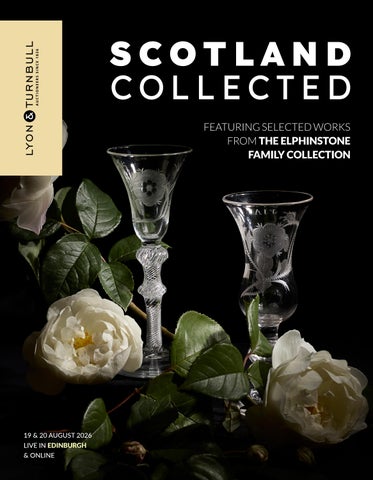
FEATURING SELECTED WORKS FROM THE ELPHINSTONE FAMILY COLLECTION
19 & 20 AUGUST 2026 LIVE IN EDINBURGH & ONLINE
1
FEATURING SELECTED WORKS FROM THE ELPHINSTONE FAMILY COLLECTION
WEDNESDAY 19 & THURSDAY 20 AUGUST 2026 FROM 10AM
Printed by Park Communications,
Sale Number LT908
a Carbon Neutral Company, on FSC® certified paper.
Lyon & Turnbull 33 Broughton Place EDINBURGH EH1 3RR
Park works to the EMAS standard and its Environmental
VIEWING
Management System is certified to ISO 14001.
Sunday 16th August, 12noon-4pm Monday 17th August, 10am-4pm Tuesday 18th August, 10am-4pm Day of Sale, 9am-12 noon
This publication has been manufactured using 100% offshore wind electricity sourced from UK wind. 100% of the inks used are vegetable oil based, 95% of press chemicals are recycled for further use and, on average 99% of any waste associated with this production will be recycled and the remaining 1% used to generate energy. This document is printed on Magno Satin paper made of material from well-managed, FSC®-certified forests and other controlled sources.
Front Cover Lots 475 & 517 Left Lot 10
CONTACT EDINBURGH +44 (0) 131 557 8844 LONDON +44 (0) 207 930 9115 info@lyonandturnbull.com
2
BUYER'S GUIDE
This sale is subject to our Standard Conditions of Sale (available at the back of every catalogue and on our website). If you have not bought at auction before we will be delighted to help you.
BUYER’S PREMIUM The buyer shall pay the hammer price together with a premium, at the following rate, thereon. 27% up to £20,000 26% from £20,001 to £800,000 20% thereafter
REGISTRATION All potential buyers must register prior to placing a bid. Registration information may be submitted in person at our registration desk, by email, or on our website. Please note that first-time bidders, and those returning after an extended period, will be asked to supply the following documents in order to facilitate registration: 1 – Government issued photo ID (Passport/Driving licence) 2 – Proof of address (utility bill/bank statement). We may, at our option, also ask you to provide a bank reference and/ or deposit. (Particularly for bidding on lots marked by the high value lot symbol ) By registering for the sale, the buyer acknowledges that he or she has read, understood and accepted our Conditions of Sale (available at the back of every catalogue and on our website).
VAT will be charged on the premium at the rate imposed by law (see our Conditions of Sale at the back of this catalogue).
ADDITIONAL VAT † VAT at the standard rate payable on the hammer price ‡ Reduced rate of 5% import VAT payable on the hammer price Ω Standard rate of import VAT on the hammer price Lots affixed with ‡ or Ω symbols may be subject to further regulations upon export /import, please see Conditions of Sale for Buyers Section D.2. No VAT is payable on the hammer price or premium for books bought at auction. DROIT DE SUITE § indicates works which may be subject to the Droit de Suite or Artist’s Resale Right, a royalty payment for all qualifying works of art. Under legislation which came into effect on 1st January 2012, this applies to living artists and artists who have died in the last 70 years. This royalty will be charged to the buyer on the hammer price and in addition to the buyer’s premium. It will not apply to works where the Hammer Price is less than £1,000. The charge for works of art sold at and above £1,000 and below £50,000 is 4%. For items selling above £50,000, charges are calculated on a sliding scale. More information on Droit de Suite is available at www.dacs.org.uk.
BIDDING & PAYMENT For information on bidding options see our Guide to Bidding & Payment at the back of the catalogue. REMOVAL OF PURCHASES Responsibility for packing, shipping and insurance shall be exclusively that of the purchaser. See Collections & Storage section for more info specific to this particular auction. CATALOGUE DESCRIPTIONS All item descriptions, dimensions and estimates are provided for guidance only. It is the buyer’s responsibility to inspect all lots prior to bidding to ensure that the condition is to their satisfaction. Our specialists will be happy to prepare condition reports and additional images. These are for guidance only and all lots are sold ‘as found’, as per our Conditions of Sale.
IMPORT/EXPORT
Prospective buyers are advised that several countries prohibit the importation of property containing materials from endangered species, including but not limited to; rhino horn, ivory, coral and tortoiseshell. Accordingly, prospective buyers should familiarise themselves with all relevant customs regulations prior to bidding if they intend to import lots to another country. It is the buyer’s sole responsibility to obtain any relevant export or import licence. The denial of any licence or any delay in obtaining licences shall neither justify the recession of any sale nor any delay in making full payment for the lot. ENDANGERED SPECIES Please be aware that lots marked with the symbol Y contain material which may be subject to CITES regulations when exporting outside Great Britain. For more information visit http://www.defra.gov.uk/ ahvla-en/imports-exports/cites COLLECTION OF PURCHASED LOTS All collections will be by appointment only (this applies to both carriers and personal collections). To make an appointment call 0131 557 8844 or email info@ lyonandturnbull.com. Please ensure payment has been made prior to collection. This can be done by bank transfer, and debit/credit card online (powered by Stripe) - details will be shown on your invoice. Please note we are unable to take payments over the phone.
26.1
3
MEET THE SPECIALISTS At Lyon & Turnbull we want to make buying at auction as easy and enjoyable as possible. Our specialist team is on hand to assist you, whether you are looking for something in particular for your home or collection, require more detailed information about the history or condition of a lot, or just want to find out more about the auction process.
John Mackie
Harry Fletcher
Head of Sale
Furniture & Works of Art
john.mackie@lyonandturnbull.com
harry.fletcher@lyonandturnbull.com
Katherine Wright
Kier Alexander
Ceramics & Glass katherine.wright@lyonandturnbull.com
Silver kier.alexander@lyonandturnbull.com
Ursula Goldsmith
Colin Fraser
Sale Co-ordinator ursula.goldsmith@lyonandturnbull.com
Consultant Specialist in Silver, Whisky and Arms & Armour colin.fraser@lyonandturnbull.com
4
ORDER OF SALE Lot No.
1-24
WEDNESDAY, 19TH AUGUST AT 10AM Wemyss Ware
25-101
Hardstone Jewellery Including the Property of a Lady
102-168
Scottish Furniture & Works of Art Including a Collecton of Mauchlineware
169-198
Whisky
THURSDAY, 20TH AUGUST AT 10AM 199-306
Provincial Scottish Silver Including a Collection of Alexander Ritchie Iona Jewellery
307-380
Modern Scottish Silver
381-422
Antique Scottish Silver
423-442
Selected Works from the Elphinstone Family Collection
443-510
Jacobite Works of Art from the Private Collection of a Gentleman
511-532
Jacobite Works of Art
533-555
Arms & Armour
5
WEMYSS WARE 1 WEMYSS WARE A ‘SWEET PEAS’ INKWELL glazed earthenware, painted and impressed maker’s marks 6cm high
£300-500
2 WEMYSS WARE A ‘DAFFODILS’ LADY EVA VASE glazed earthenware, painted and impressed marks, 15.5cm high; together with a ‘YELLOW ROSES’ BISCUIT BARREL, 11cm high (2) £400-600
3 WEMYSS WARE A ‘DAFFODILS’ PART WASH SET glazed earthenware, various painted, impressed and printed marks, comprising: a LARGE EWER AND BASIN, ewer 23cm high, basin 39cm diameter; a SPONGE DISH AND LINER, 24cm diameter across handles; a SOAP DISH AND COVER, 15cm diameter; together with a BEAKER VASE, 11cm high; and a COMB TRAY, 25.5cm wide (6) £500-700 Other fees apply in addition to the hammer price: see the ‘Buyer’s Guide’ section on page 2
6
4 WEMYSS WARE A ‘CABBAGE ROSES’ CHRISTENING MUG glazed earthenware, inscribed MURIEL/ 1911, impressed maker’s mark 7.5cm high
£250-350
5 WEMYSS WARE FOUR LARGE MUGS, CIRCA 1900 glazed earthenware, comprising: a ‘CHERRIES’ example, 13.7cm high; an ‘APPLES’ example, 14cm high; a ‘TULIPS’ example, 14.2cm high; and a ‘PURPLE PLUMS’ example, 14.5cm high; various impressed and printed marks (4) 13.5cm-14cm high
£300-500
6 WEMYSS WARE THREE DOG BOWLS, CIRCA 1900 glazed earthenware, each with an inscription, comprising: ‘QUI AIME JEAN/ AIME SON CHIEN’, 21cm diameter; ‘LOVE ME/ LOVE MY DOG’, 16.5cm diameter; ‘EVERY DOG/ HAS HIS DAY’, 12cm diameter; various painted, impressed and printed marks (3) £400-600
7 WEMYSS WARE A COLLECTION OF ‘CABBAGE ROSES’ PATTERN glazed earthenware, various painted, impressed maker’s marks, comprising: TWO LADY EVA VASES, 15.5cm and 15cm high; a CANDLESTICK, 17.5cm high; together with a ‘DOG ROSES’ LARGE LADY EVA VASE, 20.5cm high (4) £250-350
7
8 WEMYSS WARE AN EARLY TWIN-HANDLED VASE glazed earthenware, impressed maker’s mark 38cm high, 26.5cm wide Provenance: Bears a paper label for ‘The Iris Fox Collection’, Sotheby’s, Lot 406
£400-600
9 WEMYSS WARE TWO GORDON DESSERT PLATES glazed earthenware, painted and impressed maker’s marks, comprising: an ‘APPLES’ and an ‘ORANGES’ example, 20.5cm diameter; together with a MEDIUM ‘ORANGES’ PRESERVE JAR AND COVER, 12.5cm high (3) £300-500 Other fees apply in addition to the hammer price: see the ‘Buyer’s Guide’ section on page 2
8
10 WEMYSS WARE A LARGE BLACK AND WHITE PIG glazed earthenware, stamped and impressed maker’s marks 28cm high
£2,000-3,000
9
11 WEMYSS WARE A ‘CABBAGE ROSES’ PIGLET glazed earthenware, inscribed CHARLES WOOD WALLACE/ BORN 12 NOVR 1920, painted and impressed maker’s marks 10cm high
£700-900
12 WEMYSS WARE A BLACK AND WHITE PIGLET glazed earthenware, impressed maker’s marks 10cm high
£400-600
Other fees apply in addition to the hammer price: see the ‘Buyer’s Guide’ section on page 2
10
13 WEMYSS WARE A RARE ‘BEE SKEP’ HONEY POT AND COVER glazed earthenware, painted maker’s marks 18cm high
£2,000-3,000
14 WEMYSS WARE A ‘BEES AND HIVE’ LARGE MUG, CIRCA 1900 glazed earthenware, impressed maker’s mark 14.5cm high
£300-500
Other fees apply in addition to the hammer price: see the ‘Buyer’s Guide’ section on page 2
11
15 WEMYSS WARE AN ‘EARLSHALL’ MILK JUG, CIRCA 1914 glazed earthenware, impressed and painted maker’s marks 15cm high
£600-800
16 WEMYSS WARE A LARGE ‘EARLSHALL’ MUG, CIRCA 1914 glazed earthenware, impressed maker’s mark 14.5cm high
£400-600
17 WEMYSS WARE AN ‘EARLSHALL’ JUG, CIRCA 1914 glazed earthenware, inscribed OR WHILES A CLAN O’ ROOSTY CRAWS CANGLE THEGITHER, impressed and painted maker’s marks 14.5cm high
£300-500
12
18 WEMYSS WARE A LARGE BLACK AND WHITE CAT glazed earthenware, with green glass eyes, stamped maker’s marks 32.5cm high
£2,000-3,000
13
19 WEMYSS WARE FOR PLICHTA, LONDON A PAIR OF ‘CORNFLOWER’ CATS glazed earthenware, with green glass eyes, printed maker’s marks (2) 26cm high
£600-900
Other fees apply in addition to the hammer price: see the ‘Buyer’s Guide’ section on page 2
14
20 WEMYSS WARE A ‘BROWN COCKERELS AND HENS’ VASE glazed earthenware, stamped and impressed maker’s marks, black painted 5 12.5cm high
£300-500
21 WEMYSS WARE TWO LARGE MUGS, CIRCA 1900 glazed earthenware, comprising; a ‘GEESE’ example, impressed and painted maker’s marks, 14.5cm high; a ‘BLACK COCKEREL AND HENS’ example, impressed maker’s mark, 14cm high (2) £300-500
22 WEMYSS WARE A ‘DRAGONFLY’ LINCOLN VASE, CIRCA 1900 glazed earthenware, impressed and painted maker’s marks 18cm high
£400-600
Other fees apply in addition to the hammer price: see the ‘Buyer’s Guide’ section on page 2
15
23 WEMYSS WARE FOR PLICHTA, LONDON A LARGE ‘CLOVER’ PIG glazed earthenware, stamped and painted maker’s marks 28.5cm high
£600-800
24 WEMYSS WARE A ‘THISTLES’ CUP AND SAUCER glazed earthenware, saucer inscribed ‘Help yersel and dinna be blate’, impressed maker’s mark to the saucer (2) saucer 13cm diameter, cup 6cm high
£300-400
16
PROPERTY OF A LADY
17
HARDSTONE JEWELLERY
PROPERTY OF A LADY 25 AN IMPRESSIVELY LARGE SCOTTISH HARDSTONE LUCKENBOOTH BROOCH UNMARKED Of conjoined open heart form with crown surmount, set throughout with varying panels of bloodstone, chalcedony, Montrose agate and other agates, to an unmarked brooch fitting 9.5cm long
£800-1,200
26 A VICTORIAN SCOTTISH CARNYX PLAID BROOCH ROBERT & HENRY BRUCE KIRKWOOD, EDINBURGH 1894 Modelled as a pierced annular brooch with graduating bosses, engraved with Celtic beast motifs, the pin modelled as a carnyx 9.5cm diameter
£800-1,200
Other fees apply in addition to the hammer price: see the ‘Buyer’s Guide’ section on page 6
18
PROPERTY OF A LADY
27 AN IMPRESSIVELY LARGE VICTORIAN SCOTTISH HARDSTONE ANCHOR BROOCH UNMARKED Modelled as a fouled anchor, the engraved mounts set with varying shaped panels of bloodstone, chalcedony, Montrose agate etc., with coiled rope-twist, to a brooch fitting 19cm long
£1,500-2,500 Other fees apply in addition to the hammer price: see the ‘Buyer’s Guide’ section on page 6
19
20
PROPERTY OF A LADY
28 A SCOTTISH NIELLO-DECORATED PLAID BROOCH UNMARKED, LATE 18TH CENTURY Of annular form, with engraved and niello decoration incorporating circular panels, scrolls, knotwork and Celtic motifs, swing pin with engraved geometric motifs 7.5cm diameter
£1,000-1,500
29 A VICTORIAN SCOTTISH HARDSTONE AND GEM-SET BROOCH UNMARKED Of annular outline, the upper hemispherical section collet-set with an oval facetted foil-backed amethyst, in an engraved border, flanked to either side with chalcedony lozenges, the lower section, collet-set with a larger oval facetted foil-backed citrine, flanked to either side by agate lozenges, engraved to the reverse, ‘Ellen Dunnet 1870’, to a brooch fitting and safety chain 7cm long
£400-600
30 A VICTORIAN SCOTTISH HARDSTONE AND GEM-SET PLAID BROOCH UNMARKED Of shaped circular outline, claw set to the centre with a Cairngorm citrine, the outer border set with alternating panels of various hardstones, including jasper, bloodstone, and Montrose agate, interspaced by clawset facetted amethysts, citrines and garnets, modelled in an unmarked yellow metal with brooch and bale fittings
31 A VICTORIAN SCOTTISH HARDSTONE BRACELET UNMARKED
6.5cm diameter
Formed of seven links each modelled as a shield, set with various shaped panels of varying agates, including bloodstone, chalcedony etc., the central boss, set with a Montrose agate cabochon, to a concealed clasp
£1,200-1,800
17cm long
£1,200-1,800 Other fees apply in addition to the hammer price: see the ‘Buyer’s Guide’ section on page 6
PROPERTY OF A LADY
32 A VICTORIAN HARDSTONE AND GEM-SET JAPONISME FAN BROOCH UNMARKED Claw set with a facetted citrine, in a border of fan motifs, each collet set with a yellow paste and set with alternating panels of varying hardstones, including Montrose agate, bloodstone, chalcedony etc., to a brooch fitting and safety chain 4.5cm diameter
£300-500
21
22
PROPERTY OF A LADY
33 A VICTORIAN SCOTTISH HARDSTONE BROOCH UNMARKED Modelled as a mask in a garter border, set with alternating bloodstone and chalcedony panels and cabochons 4cm wide
£250-350
34 A VICTORIAN SCOTTISH GEM-SET AND HARDSTONE SET FOLIATE BROOCH UNMARKED Of foliate outline, claw-set to the centre with a facetted citrine, in a double border of polished varying hardstones, including bloodstone, jasper, Montrose agate etc., brooch and bale fittings, with indistinct Victorian registration mark 4cm diameter
£700-900
35 A VICTORIAN SCOTTISH HARDSTONE SPECIMEN TARGE BROOCH UNMARKED Modelled as a targe, set with graduated panels of varying hardstones, including moss agate, Montrose agate, banded agate etc., to a brooch fitting and safety chain 6cm diameter
£600-800
Other fees apply in addition to the hammer price: see the ‘Buyer’s Guide’ section on page 6
PROPERTY OF A LADY
36 A VICTORIAN SCOTTISH HARDSTONE WHEEL BROOCH UNMARKED Modelled as a wheel with spokes, set to the centre with a banded agate cabochon, within varying panels of banded and moss agate, to a brooch fitting 4.5cm diameter
£400-600
37 A VICTORIAN SCOTTISH HARDSTONE LYRE BROOCH MARKED MC Modelled as a lyre with a coronet surmount, set with varying bloodstone and chalcedony panels, to a brooch fitting with loop bale 7cm long
£300-500
38 A VICTORIAN CELTIC HARP AND CLOVER BROOCH UNMARKED Of circular outline with engraved scroll decoration, the applied harp to the centre set with various panels of varying hardstones, flanked by three bloodstone set three-leaf clovers, in a openwork scroll border, brooch fitting to reverse and loop bale 5.5cm diameter
£500-800
23
24
PROPERTY OF A LADY
PROPERTY OF A LADY
25
39 A VICTORIAN MALACHITE ANNULAR BROOCH UNMARKED Of annular outline, set with panels of malachite, with an engraved border, brooch fitting to reverse 4.7cm diameter
£500-800
40 A VICTORIAN MALACHITE AND AGATE CONCH SHELL BROOCH UNMARKED Modelled as a conch shell, set with various panels of malachite, fossilised crinoid and agate, to a brooch fitting 6.5cm wide
£400-600
41 A VICTORIAN FOSSILISED CRINOID AND MALACHITE SET BROOCH UNMARKED Of oval outline, composed of alternating panels of crinoid and malachite, with agate spacers, to a rope-twist border and slate panel back, with brooch fitting 6cm wide
£400-600
42
43
A VICTORIAN FOSSILISED CRINOID AND HARDSTONE BRACELET
A VICTORIAN FOSSILISED CRINOID AND MALACHITE SET BROOCH
UNMARKED
UNMARKED
Composed of six graduated oval panels, each set with alternating panels of crinoid fossil, malachite and agate, to a concealed clasp
Of oval outline, composed of alternating panels of crinoid with malachite spacers, to a moulded border and slate panel back, with brooch fitting
18cm long
5.5cm wide
£800-1,200
£400-600
Other fees apply in addition to the hammer price: see the ‘Buyer’s Guide’ section on page 2 6
26
PROPERTY OF A LADY
44 A VICTORIAN SCOTTISH GRANITE HERALDIC BROOCH UNMARKED Of annular form, applied saltire and shield set with grey and pink granite, with central overlaid gold lion rampant, crown surmount, engraved to the reverse ‘From CJK 1881’, with brooch and loop fitting 4cm diameter
£1,200-1,800
45 A VICTORIAN SCOTTISH PINK AND GREY GRANITE PENDANT MIDDLETON RETTIE & SONS, ABERDEEN Formed as an interwoven cross, set with panels of grey and pink granite, with a central pink granite cabochon to the centre, to a tapering bale set with pink and grey granite 6.5cm long
£500-700
Other fees apply in addition to the hammer price: see the ‘Buyer’s Guide’ section on page 6
27
28
PROPERTY OF A LADY
46 A VICTORIAN SCOTTISH PINK & GREY GRANITE CLOVER BROOCH MIDDLETON RETTIE & SONS, ABERDEEN Of oval outline, the open-work centre set with four three-leaf clovers, set with pink granite to the clovers and grey granite to the oval border, to a brooch fitting, engraved Gothic monogram to the reverse 6cm wide
£400-600
47 A VICTORIAN SCOTTISH GREY GRANITE CLOVER BROOCH MIDDLETON RETTIE & SONS, ABERDEEN Of oval outline, the open-work centre set with four three-leaf clovers, set with grey granite throughout, to a brooch fitting 6cm wide
£400-600
48 A VICTORIAN SCOTTISH PINK GRANITE FLORAL BROOCH MIDDLETON RETTIE & SONS, ABERDEEN Modelled as a five-petalled flower, set with polished panels of pink granite, to a brooch fitting 4.5cm wide
£300-500
49 A VICTORIAN SCOTTISH GRANITE AND ENAMEL SET BROOCH MIDDLETON RETTIE & SONS, ABERDEEN The pink granite formed to a point, set in a border with blue enamel curlicue decoration, to a brooch fitting 3.5cm diameter
£500-800
Other fees apply in addition to the hammer price: see the ‘Buyer’s Guide’ section on page 6
29
PROPERTY OF A LADY
50 A VICTORIAN SCOTTISH GRANITE AND ENAMEL SET BROOCH MIDDLETON RETTIE & SONS, ABERDEEN The grey granite formed as a point, set in a border with light-blue enamel Greek-key decoration, to a brooch fitting 4.5cm diameter
£500-800
30
PROPERTY OF A LADY
51 A VICTORIAN SCOTTISH GRANITE FOLIATE BROOCH MIDDLETON RETTIE & SONS, ABERDEEN Of stylised oval outline, the open-work centre set with a four-petal flower 5.5cm wide
£500-700
52 A VICTORIAN SCOTTISH GRANITE STAR BROOCH J. DUNCAN ABERDEEN Modelled as a six-pointed star, set with varying panels of pink and grey granite, to a brooch and loop fitting 5.2cm wide
£300-500
53 A PAIR OF VICTORIAN SCOTTISH GRANITE BROOCHES UNMARKED Each of circular outline, set to the centre with a grey granite six-pointed star, in a border of pink granite, to a brooch fitting 4.5cm diameter
£500-700
54 A VICTORIAN SCOTTISH GRANITE SET SALMON BROOCH REGISTRATION MARK 16th SEPTEMBER 1878 Of oval outline, formed of two engraved crossed salmon, in a border of pink and grey granite, to a brooch fitting; together with a grey and pink granite set butterfly brooch and a diamond-shaped brooch set with alternating panels of pink and grey granite (4) 4cm wide
£700-900
Other fees apply in addition to the hammer price: see the ‘Buyer’s Guide’ section on page 6
PROPERTY OF A LADY
31
55 A VICTORIAN MONTROSE AGATE SNOWFLAKE BROOCH UNMARKED Of angular shaped oval outline, set with alternating polished kiteshaped and rectangular-shaped Montrose agates, to a brooch fitting and loop with safety chain 6cm wide
£300-500
56 A VICTORIAN MONTROSE AGATE DIRK BROOCH / KILT PIN UNMARKED Modelled as a Montrose agate set dirk, with facetted paste to pommel, the bi-knife and fork with faceted citrine handle, with pin 11cm long
£400-600
57 A VICTORIAN MONTROSE AGATE BROOCH UNMARKED Of shaped oval outline, set with varying polished Montrose agate panels forming a plaited pattern, with brooch and loop fittings 8cm wide
£400-600
58
59
60
A VICTORIAN MONTROSE AGATE AND CITRINE SET BRACELET
A VICTORIAN MONTROSE AGATE BELTED GARTER BROOCH
A VICTORIAN MONTROSE AGATE AND CITRINE SET BROOCH
The central oval panel collet-set with a facetted citrine, in a pierced border with engraved scroll detail, the border set with panels of Montrose agate, to graduated articulated links, each set with a Montrose agate panel in an engraved scroll border, to a clasp
UNMARKED
Modelled as a belted garter, claw set to the centre with a facetted citrine, in a pierced scroll-engraved foliate border, the garter set with panels of Montrose agate, with engraved scroll detail throughout, to a brooch fitting
16.5cm long
£250-400
UNMARKED
Modelled as a belted garter, set with varying panels of Montrose agate, the silver mounts engraved with scroll decoration 5.7cm wide
UNMARKED
5cm diameter
£250-400
£600-800
Other fees apply in addition to the hammer price: see the ‘Buyer’s Guide’ section on page 6
32
PROPERTY OF A LADY
61 A VICTORIAN SCOTTISH HARDSTONE AND GEMSTONE BROOCH 19TH CENTURY Modelled as a dirk, engraved mounts, the body set with alternating panels of various hardstones, below a fancy-cut citrine set pommel, the miniature bi-knife and fork each set with a facetted citrine 5.5cm long
£700-1,000
62 A VICTORIAN MULTI-GEM SET FLORAL BROOCH UNMARKED Of octagonal lobed outline, each claw-set with a facetted foil-backed quartz, including amethyst, smoky quartz and rock crystal 5.5cm wide
£1,000-2,000
63 A VICTORIAN SCOTTISH HARDSTONE SET STAR BROOCH UNMARKED Modelled as a six-pointed star, set to each arm with a polished agate, to an engraved border, brooch fitting and loop bale 4.5cm wide
£700-900
64 A VICTORIAN SCOTTISH HARDSTONE AND CITRINE SET FLORAL BROOCH UNMARKED Modelled as a flowerhead, claw-set to the centre with a facetted citrine, in an openwork border of petals set with panels of varying hardstones, including bloodstone, Montrose agate, and other agates etc., to a brooch fitting 6cm wide
£300-500
Other fees apply in addition to the hammer price: see the ‘Buyer’s Guide’ section on page 6
PROPERTY OF A LADY
33
65 A VICTORIAN CITRINE AND AMETHYST SET THISTLE BROOCH UNMARKED Modelled as two thistles to the centre, set with a facetted amethyst and citrine flowerhead, in a border of alternating claw-set amethysts and citrines, to a brooch fitting 4.5cm diameter
£500-800
66 A VICTORIAN GEM-SET KILT PIN/ BROOCH REGISTRATION MARK, 28th AUGUST 1865 Modelled as a broadsword with targe, set with a central fancy-cut smoky quartz and throughout with further foil-backed quartz, to a pin 10.5cm long
£600-800
67 A VICTORIAN SCOTTISH HARDSTONE SET CROSS UNMARKED Modelled as a cross, set with diamond shaped and halfdiamond shaped panels of varying agates, to a loop bale 6.3cm long (including bale)
£200-300
68 A VICTORIAN OAK LEAF PENANNULAR BROOCH UNMARKED Of traditional form, foliate engraved decoration, the terminals each modelled as an acorn, collet-set with a smoky quartz cabochon and capped with oak leaf, the swing-pin modelled as a thistle, collet-set with an amethyst to terminal 6cm wide
£300-500
Other fees apply in addition to the hammer price: see the ‘Buyer’s Guide’ section on page 6
34
PROPERTY OF A LADY
69
70
A VICTORIAN SCOTTISH HARDSTONE NECKLACE
A BANDED AGATE BRACELET
UNMARKED
Composed of nine polished stepped octagonal banded agate links, strung on elastic thread; together with another formed of eight polished red banded agate links, to a polished larger oval central link, strung on elastic thread (2)
Composed of alternating polished varying agate beads, to openwork scroll and lozenge links 47cm long
£300-500
5cm diameter (internal), 5.5cm diameter (internal)
£300-500
71
72
A VICTORIAN SCOTTISH HARDSTONE BRACELET
A VICTORIAN HINGED SCOTTISH HARDSTONE BANGLE
UNMARKED Modelled as a belt, composed of alternating panels of hardstone and engraved links, to an engraved buckle clasp, two tassel pendants and safety chain
UNMARKED
20cm long (approximately)
The crossover bangle set throughout with panels of varying hardstones, including Montrose agate, banded agate, moss agate etc., with applied ivy leaf and scroll tendril
£500-800
5.5cm (internal diameter)
£500-800
Other fees apply in addition to the hammer price: see the ‘Buyer’s Guide’ section on page 6
PROPERTY OF A LADY
74 A VICTORIAN SCOTTISH HARDSTONE NECKLACE UNMARKED Composed of alternating varying polished agate octagonal prism links and double baluster links, the mounts with engraved detail, to a concealed clasp
73 A VICTORIAN SCOTTISH CITRINE AND HARDSTONE SET THISTLE BROOCH UNMARKED Collet set with a central facetted citrine, surrounded by crosshatch panels of varying agates, in a cast thistle border, to a brooch fitting
39cm long (approximately)
£600-800
5.5cm diameter
£300-500
75 76 A GEORGE III AGATE SET PLAID BROOCH
A VICTORIAN SCOTTISH AGATE BRACELET UNMARKED
Of annular outline, collet-set on pedestals with six varying banded/ moss agates, with hinged-pin fitting
Composed of pierced cylindrical banded agate links, interspaced with engraved silver cylindrical links, to a padlock terminal set with an agate panel to one side and a glazed panel to the other
7.5cm diameter
19cm long
£600-800
£500-800
UNMARKED
35
36
PROPERTY OF A LADY
77 A COLLECTION OF MONTROSE AGATE JEWELLERY Comprising an anchor, set with Montrose agate and banded agate; a Montrose agate luckenbooth brooch, a pair of Montrose agate cufflinks and a Montrose agate heart-shaped pendant (4) 5.5cm long (length of anchor)
£600-800
78 A VICTORIAN CELTIC STYLE PENANNULAR BROOCH REGISTRATION MARK 25th JULY 1875 Of traditional form, finely interlaced Celtic terminals with plain bosses, simple swing pin, the reverse engraved with Ogham script 5.8cm diameter Note: For a similar brooch, please see British Museum accession number 1869,0301.1 for a penannular brooch found in Galway
£300-500
79 A VICTORIAN IRISH BOG OAK REPRODUCTION TARA BROOCH Wm ACHESON, DUBLIN AND J. JOHNSON Note: The original Tara brooch is currently housed in the National Museum of Ireland in Dublin, and was found in 1850 by a peasant woman, not on the Hill of Tara from which the piece takes its name, but on the beach in County Meath. She claimed to have come across the piece in a box there, and took it to a local jewellery dealer who, seeing the craftsmanship and value of the item, was quick to rename it after the seat of the high kings of Ireland, aligning it with a period of history which was at the time very popular, and more importantly, lucrative. It dates from about AD700, and is one of the most impressive examples of its kind, cast in silver with intricate gold filigree decoration and glass, amber and enamel detail, it is considered to represent the pinnacle of early medieval Irish metalworkers’ achievement. Before it made its way into the Royal Irish Academy’s collection in 1872, it was a central piece at The Great Exhibition in London in 1851, and the Paris Exposition Universelle. It was even sent to Windsor Castle for inspection by Queen Victoria before the Dublin exhibition in 1853.
Other fees apply in addition to the hammer price: see the ‘Buyer’s Guide’ section on page 6
The annular brooch formed of bog oak in traditional form, marked J.JOHNSON PATENTED, the gilt metal swing pin marked Wm ACHESON, DUBLIN 6.2cm diameter (of brooch)
£200-400
PROPERTY OF A LADY
37
80 A VICTORIAN CITRINE SET SPORRAN BROOCH REGISTRATION MARK 12th JUNE 1861, BUNDLE 3
81 A VICTORIAN NOVELTY SPORRAN VESTA CASE UNMARKED
Modelled naturalistically as a sporran, the cantle with thistle motif in an engraved floral border, the tassels each set with a facetted citrine drop, hinged pin to reverse 7cm long
£800-1,200
Modelled naturalistically as a sporran, the cantle engraved with a thistle in a scroll border, hinged lid to upper section, the engraved hair body with two engraved hair tassels, with a belcher chain and loop bale 6.5cm long
£300-500
82 AN EDWARDIAN SPORRAN CHATELAINE PURSE JAMES AITCHISON, EDINBURGH 1906 The thistle and scrollengraved cantle collet-set with an oval facetted citrine, flanked to either side by an oval facetted amethyst, to a tooled leather bag with two plaited tassels, suspended on a long link chain with shaped chatelaine belt clip 10cm wide (cantle), 26cm high (overall) Provenance: Property of a Lady
£300-500 Other fees apply in addition to the hammer price: see the ‘Buyer’s Guide’ section on page 6
38
OTHER PROPERTIES 83 Y A VICTORIAN DOUBLE PORTRAIT MINIATURE BROOCH Of oval outline, the two portraits on ivory of a Highlander and a welldressed gentleman, set within silver-mounted Montrose agate 5.5cm wide, 8cm high
£300-500
84 A SCOTTISH GRANITE AND CHRYSOBERYL BRACELET RETTIE & SONS, ABDERDEEN The central floral motif and tapering panels all set with polished Aberdeen granite, collet-set with a central pale yellow chrysoberyl, stamped RETTIE & SONS ABERDEEN, in a fitted red leather box 19cm long
£600-800
85 ABERDEEN – A SCOTTISH PROVINCIAL GRANITE BRACELET MIDDLETON RETTIE & SONS, MARKED IN A CIRCLE RETTIE & SONS ABERDEEN (INCUSE) Composed of nine circular panels, quarter inlaid with alternating pink and grey granite, with integral clasp and safety chain 15mm diameter (each link)
£250-350
39
86 A LATE 19TH CENTURY SCOTTISH AGATE BROOCH UNMARKED Of circular outline, set with calibré-set Aberdeen and Peterhead granite sections in a star motif 5cm diameter
£400-600
87 A VICTORIAN SCOTTISH CITRINE AND ENAMEL BROOCH UNMARKED Of stylised Celtic design, claw-set with a round-cut citrine, in a blue and white enamel border 4.3cm diameter
£500-700
88 A VICTORIAN SCOTTISH AMETHYST BROOCH UNMARKED Of circular outline in the Celtic style, collet-set with five graduated round-cut amethysts, engraved and beaded detail throughout 4.4cm diameter
£500-700
89 A SMOKEY QUARTZ ‘DEER HOOF’ BROOCH UNMARKED Modelled as a deer’s leg with engraved detail, set with a polished smokey quartz hoof and terminal 7.5cm long
£300-500
Other fees apply in addition to the hammer price: see the ‘Buyer’s Guide’ section on page 2
40
90 A RARE NATIVE SCOTTISH GOLD MEMORIAL RING UNMARKED The simple shank engraved to interior KILDONAN, the outer edge set with plaited hair in simple chased foliate border, with vacant shield cartouche Ring size: R Provenance: ’Gold: Power and Allure, 4500 years of gold treasures from across Britain’, The Goldsmiths Company 1st June – 28th July 2012
£800-1,200
Note: Although there is much Scottish gold jewellery made and surviving from as early as c1700, very little has been recorded which can be proven to come from natively sourced Scottish gold. While native gold has been mined and sourced for centuries in Scotland it was more commonly found as a by-product of other mining activities, notably lead. Except in the few rare occasions of miniature gold rushes in Scotland such as Kildonan in 1818 and again in 1868. It was reported by the Inverness Courier in 1869 that ‘Messrs D. C. Rait and Sons, of Buchanan Street, Glasgow, have been active purchasers of Sutherland gold from the commencement of the discovery, and have assayed several specimens officially. These have ranged from 19 to 19¾ carats. Mr Robert Gilchrist, the original discoverer, seems to have been very successful of late at the Kildonan burn’.
The amounts of Scottish gold available for work were however rare, rarer still are examples noted and sold as such like this example. Various pieces by Glasgow companies, D C Rait and Muirhead & Sons, as well as Inverness makers have been noted. These generally follow the interest in native materials by combining the gold with other materials synonymous with Scotland such as freshwater pearls and Cairngorm stones. This fitted perfectly into the wider Scottish historical and national revival started as early as George IV’s visit in 1822 and continued with the Royal purchase of Balmoral and beyond into the early 1900’s. Pieces of native Scottish gold feature in the collections of both the National Museum of Scotland and Kelvingrove Museum & Art Gallery but seldom are seen at auction.
91 A VICTORIAN SCOTTISH AGATE BRACELET UNMARKED Composed of alternating pyramidal links, set with various banded and moss agates, engraved detail to borders, agate clasp with glazed panel to reverse 19cm long
£600-800
92 A VICTORIAN SCOTTISH AGATE AND PENANNULAR BROOCH Of traditional design, set throughout with various polished agate panels and cabochon citrines, engraved detail, Victorian registration mark to reverse 6.5cm long
£300-500
41
93 A VICTORIAN GOLD GEM-SET AND HARDSTONE KILT PIN UNMARKED Modelled as a dirk, set with various hardstones, engraved mounts, fancy cut citrine set to pommel and miniature bi-knife and fork; together with a paste and hardstone set brooch, of annular form, collet set with various coloured pastes and applied coat of arms (2) 10cm long
£400-600
94 A COLLECTION OF VICTORIAN HARDSTONE JEWELLERY
95 A LARGE CITRINE PLAID BROOCH ARTHUR MEDLOCK, INVERNESS Of circular outline with Celtic knot detail, clawset to the centre with a round-cut citrine, stamped MEDLOCK INVss to reverse; in a fitted presentation case
Comprising a bracelet, composed of alternating panels of banded agates, to an engraved scroll concealed clasp; an oval brooch formed as a belted garter, set with two malachite panels and a chalcedony panel; a citrine set kilt pin, unmarked; a banded agate brooch, formed of interlaced panels with drop dependent and a banded agate locket pendant (5) 17cm long (bracelet)
£300-500
7.2cm diameter
£300-500 Other fees apply in addition to the hammer price: see the ‘Buyer’s Guide’ section on page 2
42
96 A SCOTTISH VICTORIAN SILVER AND ENAMEL BRACELET UNMARKED Composed of three hinged rectangular panels with blue enamel and engraved scroll borders, each panel set with a thistle and fleur-delys motif, the central panel formed as a cross, with the thistle and fleur-de-lys design, in a pierced circular border, to a concealed clasp 15cm approx internal diameter
£300-500
97 A VICTORIAN SCOTTISH AGATE BROOCH UNMARKED Modelled as a garter and buckle with applied central thistle motif, set throughout with various banded and moss agates, and two facetted purple and orange pastes; together with a small curly horn snuff mull (2) 5.2cm (width of brooch)
£200-300
98 A DEMI-PARURE OF CELTIC JEWELLERY CELTIC ART INDUSTRIES, EDINBURGH 1975 Comprising a necklace, bracelet and a ring, each of open-work design, with Celtic scroll motif throughout and claw-set with a facetted smokey quartz; together with a collection of amethyst jewellery, comprising a bracelet, and two pendants, one with chain (6) 13.5cm wide (necklace)
£250-400
99 A SCOTTISH HARDSTONE INLAID SNUFF BOX JAMES FENTON, BIRMINGHAM 1922 Of slightly rounded rectangular form, the hinged lid inset with various panels of chalcedony and bloodstone to form an eight-sided star; together with a George III vinaigrette, Birmingham, engraved Elizabeth to the hinged cover (2) 5cm wide, 86g (combined)
£250-400
43
100 A VICTORIAN HARDSTONE INKWELL HENRY TATTON, EDINBURGH 1924 Raised on three agate ball feet, the body of squat form, set throughout with various hardstones, including bloodstone, chalcedony, etc, to an engraved scrollwork ground, the hinged lid claw set with a facetted smokey quartz, opens to a gilt interior with ink well (glass lacking) 9cm high, 9.5oz (gross)
£800-1,200
101 A VICTORIAN PICKLE FORK JAMES FENTON, BIRMINGHAM 1899 The handle set with various lozenge panels of bloodstone, Montrose agate, chalcedony etc, the terminal collet set with an orange paste; together with a letter opener, modelled as a broadsword, apparently unmarked (2) 17cm each
£200-400 Other fees apply in addition to the hammer price: see the ‘Buyer’s Guide’ section on page 2
SCOTTISH FURNITURE & WORKS OF ART
46
The Men’s Ba’ is thrown up from the Merket Cross, when the St Magnus cathedral bell strikes one o’clock. The person chosen to “throw up” the ba’, or begin the game, is usually an older Ba’ stalwart, but the honour is occasionally given to a local public figure. The waiting scrum can number up to 350 men and is a sight to behold. Once thrown up, the Ba’ disappears into the scrum and much surging play occurs while the two sides weigh each other up and determine who has the weight on their side on this occasion. Much exciting surging and turning play often occurs on this wider part of the street, which can frequently determine the outcome. Occasionally, the ba’ appears out of the scrum and someone makes a dash through the crowds of spectators. To the casual onlooker this can happen at any moment, but the seasoned Ba’ watcher can often see what is happening long before the ba’ suddenly erupts. The rival sides then battle to move the ba’ through the town to their opposing goals. The Doonies’ goal is the sea, normally within the Basin of the Harbour, but so long as it is immersed in the salt water of Kirkwall Bay, the Ba’ has gone doon. The Uppies must round the Lang, or Mackinson’s corner at the junction of Main Street with New Scapa Road, opposite the Catholic Church, which was the site of the old town gates. The last remains of the town gates were removed in the 1950s, leaving the Uppie goal as the The Kirkwall Ba’ Game (known locally as The Ba’) is one of the main annual events held in the town of Kirkwall, Orkney. It is one of a number of Ba’ Games played in the streets of towns around Scotland and is an example of a medieval football game which is still played today. The games, both a boys’ and a mens’, are played twice a year, normally on Christmas Day and New Year’s Day, unless those days fall on a Sunday in which case the game is moved to the following day. The Youths’ Ba’ was a separate short lived version, only being played from New Year’s Day 1892 until 1910. It is played by two sides, known as the ‘Uppies’ and the ‘Doonies’, or more correctly, “Up-the-Gates” and “Doon-the-Gates”. The tradition belongs to Kirkwall and the surrounding area of St Ola, and has always been played by men from those two areas since before records began. In the past 50 years, mainly
gable end of a house on Mackinson’s Corner. Once the Ba’ has been goaled Up or Doon, a lengthy argument often ensues among players on the winning side before a popular individual winner is acclaimed. To stalwart Ba’ players, the ultimate honour is to be awarded a ba’. To have any chance of this honour, a player generally has to have played consistently well for a long period of time, usually around 20 years minimum. Ba’ winners range from outstanding players in their early thirties to veterans in their mid to late forties. This winner is then awarded the trophy of the game, which is the ba’ itself. When the winner is finally decided, he is normally held aloft and carried shoulder-high from the goal by his teammates in celebration, passing into the ranks of Ba’ winners and into Kirkwall history.
due to improved transport, the game’s popularity has grown
The history and cultural importance of the Ba’ is detailed by
to include players from all areas of Orkney, including some
John Roberston in his book ‘Uppies & Doonies’, the story of the
of the outer isles. The game has no official rules, but there
Kirkwall Ba’, of 1967, which he later revised and expanded on
is a code of honour among players whereby certain acts
in ‘The Kirkwall Ba’, Between the Water and the Wall’ published
are considered strictly unacceptable. This code is generally
in 2005. A lifelong enthusiast of the Ba’, he won the coveted
adhered to extremely well by those who play the game
trophy on New Year’s Day 1966, and was chairman of the
and as a result the game is self-regulating and self-policing,
Ba’ Committee for many years. He contributed significantly
requiring no intervention from outside parties.
to the game’s robust following today. He owned several examples of historic ba’, some of which he was known to have purchased at auction during his lifetime.
Other fees apply in addition to the hammer price: see the ‘Buyer’s Guide’ section on page 2
47
102 A KIRKWALL BA’ 1907 CHRISTMAS DAY YOUTH’S BA’, AWARDED TO PAT GUNN (UPPIES) made by John Costie & Family, leather, of spherical form in four sewn sections, surmounted on a wooden turned plinth; together with a copy of the book by John D M Robertson, The Kirkwall Ba’, Between the Water and the Wall, Dunedin Academic Press, Edinburgh, 2005 (3) 17cm diameter (approximately), 26cm high (on plinth) Literature: John D M Robertson, The Kirkwall Ba’, Between the Water and the Wall, Dunedin Academic Press, Edinburgh, 2005, p.67, fig. 54, Ba’s of different styles, where the present lot is illustrated in the centre of the display Provenance: Personal collection of John Davie Manson Robertson CBE (Scottish 1929-2015), thence by descent
£300-500
103 A SCOTTISH HIGHLAND LEATHER AND SEAL SKIN PURSE / POUCH, POSSIBLY SHETLAND ISLES LATE 19TH / EARLY 20TH CENTURY the cylindrical body formed of a large panel of sealskin with delicate stitched leather borders and diamond pattern panels, secured by a leather tie; together with a small sealskin coin purse, early 20th century, with two sided brass clasp (2) 13cm long; 9.5cm long
£250-350
48
104 A SCOTTISH NORTHERN ISLES VERNACULAR OAK AND PINE CHAIR LATE 19TH / EARLY 20TH CENTURY probably Orkney or Shetland, the shaped top rail with two thin splats above a lower pine board solid back, the low panelled arms and board solid seat on square legs united by stretchers 98cm high, 55cm wide, 45cm deep Provenance: Personal collection of John Davie Manson Robertson CBE (Scottish 1929-2015), thence by descent Note: See Scottish Vernacular Furniture, Thames & Hudson, London 2008, Bernard D. Cotton, Chairs of the Northern Isles, pages 231-249
£250-350
John Roberston was the author of ‘Uppies & Doonies’, the story of the Kirkwall Ba’, written in 1967, which he later revised and expanded on in ‘The Kirkwall Ba’, Between the Water and the Wall’ published in 2005. A lifelong enthusiast of the Ba’, he won the coveted trophy on New Year’s Day 1966, and was chairman of the Ba’ Committee for many years. He was an important member of Orcadian society and contributed much to the islands’ businesses and community.
105 A SCOTTISH NORTHERN ISLES VERNACULAR OAK AND PINE CHAIR LATE 19TH / EARLY 20TH CENTURY probably Orkney or Shetland, the flat square top rail with pine board solid back, over outswept oak arms and pine board solid seat, on square legs united by stretchers 92cm high, 61cm wide, 42cm deep Provenance: Personal collection of John Davie Manson Robertson CBE (Scottish 1929-2015), thence by descent Note: See Scottish Vernacular Furniture, Thames & Hudson, London 2008, Bernard D. Cotton, Chairs of the Northern Isles, pages 231-249
£250-350
49
106 A PAIR OF UNUSUAL CARVED OAK CANDLESTICKS 18TH / 19TH CENTURY possibly cut down from larger carvings, formed of a thistle on a Celtic knotted stem, supported by carved serpents, one with a carved Celtic star to the base, each drilled with a small hole to the top, each base with weathering to the grain (2) 42cm high, 10cm wide
£400-600
107 A VERNACULAR OAK CHAIR 19TH CENTURY possibly Scottish Highlands or Northern Isles, the high arched back with a vasiform centre splat, the curved arms on turned supports over a solid plank seat, on square legs with canted inner angles united by stretchers, the underside stamped with maker/ ownership stamp ‘RH’ 112cm high, 56cm wide, 52cm deep
£250-350
Other fees apply in addition to the hammer price: see the ‘Buyer’s Guide’ section on page 2
50
108 A CUMNOCK POTTERY SALT BUCKET DATED 1907 the redware body applied with cream sprig decoration in the form of flowerheads and acanthus leaves, the top surmounted with a slipware cloaking hen with chicks on a nest, the slip inscribed ‘Mrs J Manderson / 15 Fauldhouse St / Glasgow / 1907’, the base inscribed Cumnock 32cm high, 18cm wide
£300-500
109 A SEATON POTTERY SGRAFFITO DECORATED BOWL DATED 1889 the redware body centred with a stylised flowerhead motif and with slip cut stylised panels including love heart motifs; inscribed ‘Mrs WEBSTER / ABERDEEN / 18th APRIL 1889’ 41cm diameter, 13.5cm high
£400-600
110 A SEATON POTTERY SGRAFFITO DECORATED BOWL DATED 1889 centred with a central stylised flowerhead motif, with slip cut panels incorporating love hearts; inscribed ‘Mrs FANNY ROGERS / 33 York Street / ABERDEEN / JAN 1st 1889’ 42cm diameter, 13.5cm high
£200-300 Other fees apply in addition to the hammer price: see the ‘Buyer’s Guide’ section on page 2
51
111 A SCOTTISH OAK ORKNEY CHAIR, DAVID MUNRO KIRKNESS, KIRKWALL EARLY 20TH CENTURY with woven straw cowled hood and curved back, above open scroll end arms and seagrass drop-in seat, on square tapering legs linked by stretchers, the frame stamped below the seat ‘D. M. Kirkness, Kirkwall, Orkney, Made in Scotland’ and with initials ’R L’ centred by a thistle 142cm high, 63cm wide, 58cm deep
£800-1,200
112 A SCOTTISH OAK ORKNEY CHAIR, DAVID MUNRO KIRKNESS, KIRKWALL EARLY 20TH CENTURY with woven straw back, above open scroll end arms and seagrass drop-in seat, on square tapering legs linked by stretchers, the frame stamped below the seat ‘D. M. Kirkness, Kirkwall, Orkney, Made in Scotland’ and with initials ’R L’ centred by a thistle 107cm high, 104cm wide, 59cm deep
£700-900
Note: Kirkness was the pioneer of Orkney strawbacked chairs from 1880s until his death in 1936. Born on the island of Westray in 1855, both his father and grandfather were joiners. Kirkness moved to Kirkwall to be apprenticed to the joiner, John Pearce of Albert Street. In about 1880 he established his own business as carpenter, joiner and undertaker. He started to specialise in the manufacture of Orkney chairs, c. 1884, and his workshop and dwelling were at 12-14 Palace Street (later Palace Road) for his rest of his life. He employed craftsmen in his workshop to make the wooden frames, which were then sent out to workers on different islands to make the backs. The rise of the Arts & Crafts Movement in both Scotland and England from the 1880s undoubtedly helped the popularity of the Orkney straw-backed chairs. He supplied both Liberty’s and Wylie & Lockhead and the ‘straw chair’ graced many drawing & sitting rooms designed by Charles Rennie Mackintosh and other architect/designers. It is believed that his workshop produced approximately 14,000 chairs in the period of 1884-1936. His business offered a range of Orkney
chairs of different sizes and styles (Hooded, Gentleman’s, Lady’s and Child’s), colour, finishes, and seats of rush or wood seats. Cubbies or caises (traditional baskets) were often supplied with chair commissions. After Kirkness’ death, Reynold Eunson, a wood sculptor and carver, moved into his premises in Palace Road and continued the business producing traditional Orkney chairs and stools, as well as church furniture and furnishings. Examples of Kirkness chairs, label and price list are illustrated in Cotton, Scottish Vernacular Furniture (2020), p. 258-261. A further example dated 1921 with his label ‘Joiner and Orkney Chair Maker’ made from oak from St Magnus’s Cathedral are illustrated in Gilbert, English Vernacular Furniture 1750-1900 (1991), fig. 237. A hooded Kirkness chair, c. 1890-1900, is in the collection of the Victoria & Albert Museum, (W.1-2012) and two examples of the Gentleman’s chair, c. 1900, are at the National Museum of Scotland, Edinburgh (H.KN 3 & H.KN 10).
53
113 AN UNUSUAL MAUCHLINE WARE SYCAMORE AND BLACK INK TEA CADDY MID-19TH CENTURY of octagonal form, hidden hinged top, the interior with the remnants of foil lining, the lid and four sides with scenes of transport, including a Mail coach and six horses to the lid, an early steam engine ‘North Star’ pulling the ‘Liverpool and Manchester Railway’ (After an engraving dated 1832-33 by SG Hughes) to the front, a scene of horse racing at Goodwood to the right side (After an engraving dated 1839 titled ‘Grandstand Goodwood), a hunting scene to the left side, and a scene of Burn’s Cottage to the back, on four ebonised bun feet 14cm wide, 10cm high, 11.5cm deep Literature: Mauchline Ware Collector’s Club Journal, No.119, August 2025
£600-800
114 A GROUP OF TARTANWARE MINIATURE GAMES 19TH CENTURY various tartans, comprising a boxed SET OF DOMINOES, 5.4cm long; a SPINNING TOP, 2.8cm wide; a WHIST MARKER, cm diameter; 4.6cm diameter; a boxed TANGRAM PUZZLE, 4.8cm square; and a BOX OF FOUR COUNTERS, each counter 2.3cm diameter (5) £400-600
115 A RARE MAUCHLINE WARE MANTEL CLOCK 19TH CENTURY transferred with scenes from the Isle of Man, with single train movement by Jerome & Co., New Haven 12.3cm wide, 16cm high, 5.2cm deep
£300-500
116 A SET OF TARTANWARE STATIONERY OR POSTAL SCALES 19TH CENTURY in Stuart tartan, with brass weights and scales stamped GUARANTEED ACCURATE 18cm wide, 8.5cm high, 11cm deep
£300-500
Other fees apply in addition to the hammer price: see the ‘Buyer’s Guide’ section on page 2
54
117 A MAUCHLINE WARE SNUFF BOX 19TH CENTURY the penwork-decorated body painted to the cover with a sailing ship, unmarked 8.2cm wide
£300-500
118 A MAUCHLINE WARE LADLE EARLY 19TH CENTURY the terminal with painted scene from Tam O’Shanter, 35cm long; together with another LADLE, transferred with a cottage scene inscribed BURN’S COTTAGE, 18.3cm long (2) £500-700
119 TWO MAUCHLINE WARE CIGAR CASES, CRICKET INTEREST 19TH CENTURY comprising; ‘PLAY’, decorated with a scene of a bowler and batsman, 12.5cm long; and another case decorated with a scene of a batsman above a scene of a huntsman and hounds, 13cm long (2) the larger 13cm long
£300-500
55
120 RARE SCOTTISH BURR SNUFFBOX CIRCA 1800 the hinged cover decorated in penwork with a cooper making a whisky barrel 8cm wide, 4cm high
£300-500
121 A RARE MAUCHLINE WARE CIGAR BOX 19TH CENTURY the decorated box with penwork panel depicting the BATTLE OF THE BOYNE, inscribed BOYNE to the front and verso NO SURRENDER and LIMERICK/ ENNISKILLEN/ AUGHRIM/ DERRY/ THE GLORIOUS MEMORY/ 1690, stamped to interior SMITH/ MAUCHLINE 13cm long x 6.8cm wide
£300-500
122 A TARTANWARE CIGAR CASE 19TH CENTURY with inset cast silver plaque depicting a scene from Tam O’Shanter, the silvered shaped interior stamped SMITH/ MAUCHLINE 13cm x 8cm x 2.5cm
£500-700
123 A MAUCHLINE TARTANWARE AND INK PLAQUE 19TH CENTURY depicting a tavern scene of ‘The Village Politicians’, with a wide diamond line border, the sycamore plaque mounted in a birds eye maple frame plaque 12cm high, 16cm wide; 19cm high, 24cm wide overall
£250-350 Other fees apply in addition to the hammer price: see the ‘Buyer’s Guide’ section on page 2
56
124 THREE TARTANWARE NEEDLE CASES LATE 19TH CENTURY two in Stuart tartan and one in McBeth tartan, one with a painted scene of Loch Leven, 5.5cm high; one with a painted scene, inscribed DUMBARTON CASTLE, 5.4cm high; and the other transferred with a figural group, 5.5cm high (3) £300-500
125 A TARTANWARE SEWING BOX 19TH CENTURY covered in McLean tartan, with stell fittings and woven leather handles, the silk lined interior fitted with sewing equipment, printed mark THE ROYAL EXHIBITION PRIZE MEDAL AWARDED TO W&A SMITH, MAUCHLINE, 16.5cm wide, 10cm high, 8cm deep; together with a MAUCHLINE WARE SEWING BOX, with transferred scenes of Dunkeld and environs, inscribed FROM THE ATHOLE PLANTATIONS, DUNKELD etc., with woven leather handles and a fitted interior and sewing equipment, 19.8cm wide (2) £700-900
126 TWO MAUCHLINE WARE WORK BOXES BY CHARLES STIVEN AND W. CRAB, LAURENCEKIRK, 19TH CENTURY both with stamped maker’s marks, the Crab example decorated with a central eagle crest within a foliage border, with lined interior, (key present), 23.5cm wide, 7cm high, 17.5cm deep; the Stiven example with allover tartan decoration, 28cm wide, 9.5cm high, 19cm deep (2) £400-600
57
127 A TARTANWARE BRACELET 19TH CENTURY in ‘Prince Charlie’ tartan, the larger panel painted with a loch-side scene, inscribed verso LOCH KATRINE approx. 18cmn diameter (elasticated)
£400-600
128 A MAUCHLINE WARE SNUFF BOX EARLY 19TH CENTURY decorated in penwork with interior scene inscribed AULD ROBIN GRAY, and transferred with the music and lyrics to a Scot’s Ballad written by the Poet Lady Anne Lindsay in 1772, the box stamped RUSSELL/ GLASGOW, 8cm wide; together with another EARLY 19TH CENTURY SNUFFBOX, with penwork scene to lid inscribed DUNDRENNAN ABBEY, and a coastal scene to the base inscribed KIRKCUDBRIGHT, stamped to interior CRAWFORD/ CUMNOCK, 8cm wide (2) £500-700
129 TWO TARTANWARE SEWING BOXES 19TH CENTURY one in ‘Albert’ tartan, in the form of a book cover, with leather ‘book’ with gilt-tooled spine inscribed THE GEM, fully fitted with sewing tools and threads, 12cm x 7cm x 2cm; together with a hinged box in ‘McKenzie’ tartan, partially fitted with a bobbin and a thimble,7cm wide (2) £400-600
130 FIVE MAUCHLINE WARE SNUFFBOXES 19TH CENTURY comprising a decorated example, with penwork portrait panel inscribed DANIEL O’CONNELL ESQRE., stamped to interior MILLAR/ CUMNOCK, 8.7cm wide; a tartanware example, with penwork portrait panel inscribed LORD JOHN RUSSELL, 8.2cm wide; and an oak example, with silver plaque inscribed WALLACE’S OAK/ ELDERSLIE/ 1856, stamped to interior SMITH/ MAUCHLINE, 8.7cm wide; another oak example inscribed OAK OF/ JOHN KNOX’S HOUSE/ EDINBURGH, 8.2cm wide; and another inscribed MADE FROM THE WOOD OF/ LAGS BED GARRYHORN/ CARSPHAIRN, 6.3cm wide (5) Note: Daniel O’Connell (1775-1847), hailed in his time as ‘The Liberator’, was the acknowledged political leader of Ireland’s Roman Catholic majority in the first half of the 19th century. John Russell, 1st Earl Russell (1792-1878), known as Lord John Russell before 1861, was a British Whig and Liberal statesman who was Prime Minister of the United Kingdom from 1846 to 1852 and again from 1865 to 1866.
£300-500 Other fees apply in addition to the hammer price: see the ‘Buyer’s Guide’ section on page 2
58
131 A SCOTTISH PINE CHILD’S ORKNEY CHAIR EARLY TO MID 20TH CENTURY with woven straw back and open scroll end arms above drop-in seagrass cord seat on square tapering legs linked by stretchers 83cm high, 54cm wide, 48cm deep
£250-350
59
132 A GEORGE IV BRONZE ‘BELL METAL’ QUAICH
133 A RARE SCOTTISH PEARLWARE POTTERY FIGURE MODELLED AS ‘ROB ROY MACGREGOR’S PIPER’ DATED 1835, PROBABLY PORTOBELLO depicting a male figure wearing a blue bonnet, jacket and tartan kilt, seated on a keg playing pipes, raised on a yellow ground rectangular plinth base, inscribed ROB ROY/ MACGREGOR’S/ PIPER/ 1835’, the sides enamelled with marbled effects
CIRCA 1824 of traditional form with twin flared lugs, the body engraved MADE FROM FRAGMENTS OF LARGE BELL IN THE TRON KIRK, EDINBURGH MELTED DURING THE GREAT FIRE 16TH NOV 1824 8cm wide [Across lugs]
£200-300
20.5cm high
£600-800
134 PAIR OF LARGE SCOTTISH FIFE POTTERY FIREPLACE SPANIELS 19TH CENTURY modelled seated with pale brown glaze, on an oval plinth base with green, blue and brown mottled glaze, unmarked (2) 42cm high, 30cm wide, 20cm deep
£800-1,200
Other fees apply in addition to the hammer price: see the ‘Buyer’s Guide’ section on page 2
60
135 A SCOTTISH STAINED PINE ORKNEY CHAIR EARLY 20TH CENTURY with woven straw back and open scroll end arms, above a solid seat and base with a single drawer to the front 101cm high, 61cm wide, 48cm deep Provenance: Personal collection of John Davie Manson Robertson CBE (Scottish 1929-2015), thence by descent
£400-600
136 A SCOTTISH STAINED PINE CHILD’S ORKNEY CHAIR EARLY 20TH CENTURY with woven straw back and open scroll end arms above a solid seat, on square tapering legs linked by stretchers 83cm high, 54cm wide, 41cm deep Provenance: Personal collection of John Davie Manson Robertson CBE (Scottish 1929-2015), thence by descent
£300-500
137 A SCOTTISH OAK CRADLE 19TH CENTURY with raised panel sides and an arched hinged hood, with turned finials, on curved rocking rails 91cm long, 58cm wide, 69cm high Note: For a similar cradle with an arched hood, an example is illustrated in Bernard D Cotton, Scottish Vernacular Furniture, 2008, p53. Another similar is illustrated in the painting Dawn to Sunset by William Faed, circa 1850, on the same page.
£300-500
61
138 TWO SCOTTISH PINE ORKNEY CHAIRS EARLY TO MID-20TH CENTURY including one with woven straw back and open scroll end arms above a drop-in seagrass cord seat on square tapering legs linked by stretchers; the other example with woven straw back and open scroll end arms above a drop-in seagrass cord seat on a solid base with a brass handled single drawer to the front (2) 108cm high, 63cm wide, 54cm deep; 103cm high, 63cm wide, 54cm deep
£1,500-2,000
Other fees apply in addition to the hammer price: see the ‘Buyer’s Guide’ section on page 2
62
139 A SCOTTISH VERNACULAR ELM DARVEL WINDSOR CHAIR 19TH CENTURY the straight bow on eight thin spindles, the elm wishbone arms each on five short spindles with turned fronts, the D saddle seat on tapered legs united by a turned H stretcher 106cm high, 63cm wide, 65cm deep Note: For a stamped Darvel chair of very similar form see Scottish Vernacular Furniture, Thames & Hudson, London 2008, Bernard D. Cotton, figure 358, page 204
£300-500
140 A SCOTTISH VERNACULAR OAK BOBBIN CHAIR 19TH CENTURY the six bobbin turned spindle back over a plank seat, on legs united by stretchers 80cm high, 48cm wide, 42cm deep
£250-350
141 A LARGE OAK DINING / BOARDROOM TABLE, TIM STEAD MBE (SCOTTISH 1952–2000) LATE 20TH CENTURY the solid oval top on two turned slender supports on trestle bases united by a centre stretcher 335cm long, 74cm high, 122cm wide Provenance: This table was a private commission from Tim Stead and his workshop during the 1990s by the present vendor
£800-1,200
Other fees apply in addition to the hammer price: see the ‘Buyer’s Guide’ section on page 2
63
142 A PAIR OF SCOTTISH VERNACULAR ELM DARVEL-TYPE WINDSOR CHAIRS LATE 19TH / EARLY 20TH CENTURY the shaped bow on nine thin spindles, the wishbone arms each on four short spindles, the D saddle seat on turned legs united by an H stretcher, both seats drilled with a centre hole, later varnish the larger 94cm high, 60cm wide, 54cm deep
£400-600
64
143 A VICTORIAN SILVER-PLATED CURLY HORN TABLE SNUFF MULL LATE 19TH CENTURY the large curled horn set with top and end mounts, the collar with egg and dart detail to rim of the circular domed lid, the scroll foot support with a scalloped mount, the interior of the lid stamped ‘GCS Sheffield Silver Plate’ 33cm long, 20cm high
£500-800
144 A SCOTTISH GEORGE IV MAHOGANY GUILD CHEST OR STRONG BOX, GLASGOW UPHOLSTERERS DATED 1821 of sarcophagus form with a moulded caddy top lid, the front of the lid with a brass plaque of the ‘Glasgow Upholsterers’, the front panel with three brass mounted escutcheons above a brass shield engraved with three tents above a lamb of God, the motto UNITE AND BE STEADY and dated 1821 on separate plaques below, raised on bun feet 68cm wide, 42cm high, 39cm deep
£500-800
145 A PLASTER MAQUETTE OF SIR WALTER SCOTT, AFTER JOHN GREENSHIELDS (SCOTTISH 1794–1835) 19TH CENTURY patinated plaster, unsigned; raised on an oak panelled plinth (2) the figure 57cm high, 46cm wide, 31cm deep; the plinth 79.5cm high, 47cm wide, 37cm deep; 136cm high overall
£400-600
Other fees apply in addition to the hammer price: see the ‘Buyer’s Guide’ section on page 2
65
146 A VICTORIAN BARONIALSTYLE ANTLER CEILING LIGHT AND A PAIR OF WALL SCONCES 20TH CENTURY each formed of deer antler sections, fitted for electricity (3)
147 A VICTORIAN BARONIALSTYLE ANTLER SETTEE MODERN with back and legs formed from entwined antlers, with seat and padded back upholstered in Anta Cawdor wool tweed, with two matching square cushions 138cm wide, 98cm high, 56cm deep; seat 50cm high
£1,000-1,500
the ceiling light 105cm high, the scones 42cm high
£300-500
66
148 A VICTORIAN CURLY HORN SNUFF MULL DATED 1884 unmarked, the domed white metal hinged lid with a border of chased and repoussé foliate design, collet set to the centre with a facetted large foil backed orange paste, applied shield shaped panel with presentation inscription 9cm long
£300-500
149 TWO SILVER MOUNTED BALUSTER HORN SNUFF MULLS 18TH CENTURY each of traditional form with simple unmarked silver collar and butterfly hinges, each with cartouches to hinged covers (2) 5.5cm and 4.6cm high
£400-600
150 AN EARLY VICTORIAN NOVELTY COW HORN SNUFF MULL DATED 1840 unmarked, the polished cow horn body modelled as a mythical monster, the silver collar engraved TO WM MCLEAN FROM JA WATTIE 24TH OCT 1840, with butterfly hinge to cow horn cover 11.5cm long
£400-600
Other fees apply in addition to the hammer price: see the ‘Buyer’s Guide’ section on page 2
67
151 A PORTRAIT MINIATURE OF ROBERT BURNS LATE 18TH CENTURY AND LATER the slightly concave oval portrait likely enamel on copper, set within a Georgian yellow metal locket, the reverse with a pearlescent enamel panel set with twin locks of hair set in a peal mount, enclosed by a blue glass border, inside a silk lined red Morocco leather case the miniature 6.5cm high; 9cm high overall
£600-800
152 A PORTRAIT MEDALLION OF REV. JAMES RUSSELL, JAMES TASSIE (SCOTTISH 1735-1799) DATED 1795 dark red stained wax, modelled in silhouette, set on an oval glass plate, impressed ‘James Russell, Townhead, 1795’ and ‘Tassie F’, in an oval moulded ebonised frame, with suspension loop, the portrait 7.5cm high, the frame 12cm high; together with A WILLIAM IV / EARLY VICTORIAN PORTRAIT MEDALLION OF A GENTLEMAN, JOHN FILLANS (SCOTTISH C.1817-1867), CIRCA 183555, white paste or wax, modelled in silhouette, set on a brown velvet backing board, incised ‘by John Fillans’, in an oval gilt slip and glazed moulded rosewood frame, the portrait 7cm high, the frame 30.5cm high (2) the larger 30.5cm high [including frame] Note: A portrait of the Rev. James Russell is noted as catalogue entry No.348, ‘RUSSELL, REV. JAMES. ‘ JAMES RUSSELL TOWNHEAD 1795 Tassie F. 3in’, in “James and William Tassie, A Biographical and Critical Sketch with a Catalogue of Their Portrait Medallions of Modern Personages”, John M. Gray FSA (Curator of the Scottish National Portrait Gallery, and keeper of the Tassie Collection in the possession of the Board of Manufactures, Edinburgh), Walter Greenoak Patterson, 54 George Street, Edinburgh, 1894
£300-500
68
153 VICTORIAN SCOTTISH SCHOOL, AFTER LANDSEER DIGNITY AND IMPUDENCE oil on canvas, dated 1873 in an inscription verso, gilt gesso frame 82cm x 67cm; 112cm high x 96cm wide overall
£300-500
154 A VICTORIAN STAINED PINE METAMORPHIC LIBRARY STEPS HALL CHAIR LATE 19TH CENTURY probably Scottish, the carved scroll and shield shaped back over a plank seat with turned and facetted front legs, opening to a set of four steps 90cm high, 41cm wide, 44cm deep
£300-500
69
155 A PAIR OF SILHOUETTE GROUP PORTRAITS, AUGUSTE AMANT CONSTANT FIDÈLE EDOUART (1789-1861) DATED 1830 cut out silhouettes with pencil and watercolour, depicting Managers of the Orphan Hospital, Edinburgh and The School Room of the Orphan Hospital, Edinburgh, each signed and dated 1830, framed, the frames bearing the names of the managers and staff members (2) 45cm x 72cm
Exhibited: Scottish National Portrait Gallery, Edinburgh Cut and Dried: The Silhouettes of Augustin Edouart and Watercolours of Harry More Gordon, December 2, 2005 – March 26, 2006 Literature: Jackson E.N., Ancestors in Silhouette, John Lane, London, 1921, p.33 Note: In 1727 Edinburgh merchant Andrew Gairdner set up a charitable subscription to raise funds for an orphan institution. The first Orphan Hospital took in 30 orphans in 1733 before a larger purpose-built hospital opened below North Bridge. In 1799 the Orphanage was moved to Leith to escape the industrialisation of the city.
£2,000-3,000 Other fees apply in addition to the hammer price: see the ‘Buyer’s Guide’ section on page 2
70
156 AN ARTS & CRAFTS THRONE CHAIR, ATTRIBUTED TO SIR ROBERT LORIMER (SCOTTISH 1864-1929) FOR SCOTT MORTON & CO., EDINBURGH CIRCA 1910 oak, carved to the rear with a flowering foliate panel and surmounted with winged angels holding a crest with the Scottish saltire and lion rampant, probably carved by W. & A. Clow, the open arms carved with wolf and sheep terminals 70cm wide, 140.5cm high, 60cm deep
£1,000-1,500
157 A SCOTTISH SCHOOL FIRESCREEN, ATTRIBUTED TO THOMAS HADDEN (SCOTTISH 1871–1940) CIRCA 1920 patinated cast and wrought iron £400-600
Other fees apply in addition to the hammer price: see the ‘Buyer’s Guide’ section on page 2
71
158 A CREWELWORK BED HANGING, SIR ROBERT LORIMER (SCOTTISH 1864-1929) DATED 1893 each worked with allover sprays of flowers with insects within a meandering border of flowers and birds, russet silk embroidery on a natural linen ground, with later linen backing, bears penwork label verso WORKED BY J.R.S. MACKENZIE/ IN 1893 227.5cm x 96.5cm Provenance: Earlshall Castle, Fife, Scotland Note: In 1890 Sir Robert Lorimer was commissioned by R.W.R. Mackenzie to restore and enhance his sixteenth century tower house, Earlshall, near Leuchars in Fife, Scotland. Lorimer designed several pieces of furniture for the house, including the settle now in LACMA and the buffet which Walter Shaw Sparrow illustrated in his The British Home of To-Day (1904). The work included embroideries to complete the decorative scheme. Walter Shaw Sparrow illustrated the bedcover from this set (now with The National Museums of Scotland) in The Modern Home (published in 1908). These embroideries were worked by Mackenzie’s wife Jessie and her friends in 1893 and remained at Earlshall until the contents were sold in 1983. Sir William Bruce built the castle in 1546. He had fought at, and unusually, survived the Battle of Flodden in 1513. Mary, Queen of Scots, visited in 1561. One of the family was killed at the Battle of Worcester in 1651, fighting for Charles II; and another Sir Andrew is known as “Bloody Bruce”. He and his men killed Richard Cameron, a noted Covenanter, at Airds Moss. Bruce then hacked off Cameron’s head and hands and took them back to Edinburgh. The castle was abandoned and ruinous before being restored for R.W.R. Mackenzie by Sir Robert Lorimer in 1892. The gardens were relaid and the formal garden replanted.
£2,000-3,000
72
159 A SCOTTISH VELVET, SILK AND COTTON CHINTZ PATCHWORK QUILT / COVERLET LATE 19TH / EARLY 20TH CENTURY worked in multicolour patterned hexagonal patches against a black velvet ground, the field with repeating flowerheads, enclosed by a wide chain border, the corners set with stars, with a foliate chintz backing to the reverse 212cm x 192cm Note: For several comparable examples of Scottish quilts of a similar period with hexagonal construction see Warm Covers, A Scottish Textile History, Janet Rae, Sansom & Co, 2016, p.81
£250-350
Other fees apply in addition to the hammer price: see the ‘Buyer’s Guide’ section on page 2
73
160 PHILIP RICKMAN (BRITISH 1891-1982) A PAIR OF ENGLISH PARTRIDGE IN FLIGHT signed, watercolour 22cm x 20cm; 34.5cm high, 32.5cm wide overall
£300-500
161 PHILIP RICKMAN (BRITISH 1891-1982) PHEASANTS IN FLIGHT signed, watercolour 38cm x 51cm; 58cm high, 72cm wide overall
£400-600
162 PHILIP RICKMAN (BRITISH 1891-1982) PHEASANT TAKING FLIGHT signed, watercolour; together with two others of Mallards in flight, each signed, watercolour (3) 17cm x 19cm; 17cm x 23cm; 14cm x 20cm; the largest 38cm wide overall
£300-500
74
163 TWO SCOTTISH MOHAIR OUTERWEAR GARMENTS, BERNAT KLEIN (1922-2014) CIRCA 1970-1990 including a short lady’s jacket in tones of green, brown and blue, with three large textured resin buttons, and a lady’s three quarter length belted coat in tones of orange, yellow and green, each with Bernat Klein labels to the interior the jacket 52cm high; the coat 117cm long
£250-350
Note: Serbian born textile designer Bernat Klein settled in the Scottish Borders, basing his business in Galashiels. Then the Borders area was a thriving hub of textile design and production. Principally a modernist, Klein was eclectic in his work interests which included architecture and painting but he is probably best known for his textile designs supplying couture fabrics to fashion houses such as Dior and Chanel. He collaborated with local dyers and explored new colour making techniques including random dyeing which allowed for the development of new colours which came about during the process and which could not be predicted and space dyeing which allowed explosions of colour and combinations close to those found in nature. His legacy was celebrated by the National Museum of Scotland in a major retrospective of his work titled ‘Bernat Klein: Design in Colour’ (5 November 2022 – 23 April 2023). His house near
Selkirk, High Sutherland, was designed in 1957 for Klein by the modernist architect Peter Womersley, followed in 1972 by a studio set below the house. Lyon & Turnbull offered selected pieces from High Sutherland on behalf of the Estate of Bernat Klein in the ‘Design Since 1860’ sale (11 April 2018), including the original architect’s model of the Klein studio. The Klein studio was recently purchased at auction in the summer of 2025 by the Bernat Klein Studio Restoration Project, led by the Scottish Historic Buildings Trust (SHBT) in coalition with the Bernat Klein Foundation and the National Trust for Scotland, who are working to secure, restore and reimagine Peter Womersley’s 1972 masterpiece for future generations.
75
164 SIR ROBIN PHILIPSON R.A., P.P.R.S.A., F.R.S.A., R.S.W., R.G.I., D.LITT., L.L.D. (SCOTTISH 1916-1992) DESIGN FOR THE EDINBURGH FESTIVAL PROGRAMME COVER 1958 mixed media on paper 30cm x 24.5cm; 49cm high, 43cm wide overall
£400-600
165 JEAN COCTEAU (FRENCH 1889-1963) DESIGN FOR THE EDINBURGH FESTIVAL 1961 Ink and crayon on paper, signed 13cm x 10cm; 31cm high, 25cm wide overall
£400-600
166 SCOTTISH SCHOOL, CIRCA 1930S FISHING ON LOCH NESS, 1934 coloured crayon on buff paper, titled and dated 1934, signed ‘Jamie’ bottom left 30.5cm x 25cm
£250-350 Other fees apply in addition to the hammer price: see the ‘Buyer’s Guide’ section on page 2
76
167 A PERSONAL ARCHIVE OF LEITH HARBOUR PILOT, THOMAS PATERSON (SCOTTISH 1841-1913) LATE 19TH / EARLY 20TH CENTURY including a large Union Jack flag, and a selection of documents, notebooks, discharge papers, carte de visité, letters etc, all contained in a black toleware box (qty) the union jack 260cm x 125cm; the black toleware box 38cm long, 28cm wide, 12cm high Note: Thomas Paterson (1841-1913) was a licensed pilot for Firth of Fort, Leith & Granton, residing at 40 Craighall Road, Newhaven. Death notice in “The Scotsman”, dated 23rd May 1913; “Death of a Leith pilot - One of Leith’s oldest pilots, Mr Thomas Paterson, who resided at 40 Craighall Road, Trinity, has died at the age of 72. He retired about two years ago. For over forty years Mr Paterson acted as a pilot at Leith, during which time he was the means of saving many people from drowning. On one occasion his boat was run into and sunk by a sailing ship he was about to board, and he was instrumental in saving the lives of his two brothers, who were along with him. At another time he was the means of effecting the rescue of his three shipmates when their boat sank.” It appears that two of his sons also worked as pilots too at some point in their lives, it is assumed that the present flag probably belonged to one of them.
£300-500
The Great Michael was the largest ship built by King James IV
Scammell is known to have produced at least three large
of Scotland, finished in 1512. The construction was too large
scale versions of The Great Michael , built of pier timbers from
for the existing ports of Leith or Fife, so a new yard was built
Hound Point on the Firth of Forth. A photograph of 1964,
at the deeper waters of Newhaven.
from the archive of the collections of Edinburgh Libraries,
George Scammell was the son of a Granton trawlerman and created a large array of ship models over almost 50 years, becoming one of Scotland’s most prolific self taught modelship builders. They were built in his two-bedroom flat in Granton Terrace and ranged from small-scale versions to eight-foot replicas of Leith’s most historic vessels. He was in his 30s when he began crafting the models and he had a huge passion for 14th and 15th century galleons, eventually
Museums and Galleries, shows Scammell standing with Dr Marshall and the Rev. Elizabeth Wardlaw next to his earlier model of The Great Michael. This example was temporarily in Trinity House (Maritime Museum), another version which used to be held in the Newhaven Community Fishing Museum is now displayed at Ocean Terminal on the Leith Shore. The present model is believed to be the largest and has been consigned from a private home in Leith.
building every one of the Scottish fleet which numbered more than 30. Known locally as the ‘Captain’, for his perennial
168
habit of wearing a cap and love of watching the boats near
A VERY LARGE SCRATCH BUILT MODEL OF ‘THE GREAT MICHAEL’, GEORGE SCAMMELL OF GRANTON (SCOTTISH 1927-2010)
his home, he continued to be a well-known and colourful figure of the community who took a keen interest in the preservation of his beloved Granton and Leith. His models have passed into private collections and those of public organisations, including Scottish museums and libraries.
CIRCA 1986 the handmade model with a large carved pine hull, masts, hand knotted rigging and painted sails, mounted on an ebonised stand with a small presentation plaque ‘The Great Michael, Built by George Scammell 1984-85-86’ 188cm high, 150cm wide, 68cm deep
£300-500 Other fees apply in addition to the hammer price: see the ‘Buyer’s Guide’ section on page 2
77
Other fees apply in addition to the hammer price: see the ‘Buyer’s Guide’ section on page 2
79
WHISKY HIGHLAND
169 HIGHLAND PARK - 30 YEAR OLD In presentation wooden box 48.1%/ 70cl
£600-800
170 HIGHLAND PARK 1974 20 YEAR OLD - FIRST CASK Cask 4329, bottle 2, 46%/ 70cl; Lowland (Bladnoch) 1980 - First Cask, cask 89/591/11, bottle 374, 46%/ 70cl (2) £300-500
171 HIGHLAND PARK 1974 20 YEAR OLD - FIRST CASK Cask 4327, bottle 119 46%/ 70cl
£200-300
172 TOMATIN 1976 18 YEAR OLD - FIRST CASK Cask 27635, bottle 273, 46%/ 70cl; TOMINTOUL 1976 18 YEAR OLD - FIRST CASK, cask 7349, bottle 290, 46%/ 70cl; GLEN ROTHES 1975 21 YEAR OLD - FIRST CASK, cask 6052, bottle 244, 46%/ 70cl (3) £300-500
173 BALBLAIR 1975 22 YEAR OLD - FIRST CASK Cask 7282, bottle 581, 46%/ 70cl; DAILUAINE 1975 27 YEAR OLD - FIRST CASK, cask 5524, bottle 154, 46%/ 70cl; AUCHROISK 1979 26 YEAR OLD - FIRST CASK, cask 21456, bottle 3, 46%/ 70cl (3) £300-500
174 MACDUFF 1973 28 YEAR OLD - FIRST CASK Cask 3135, bottle 15, 46%/ 70cl; LINKWOOD 1974 2 YEAR OLD - FIRST CASK, cask 8438, bottle 168, 46%/ 70cl (2) £200-300
Other fees apply in addition to the hammer price: see the ‘Buyer’s Guide’ section on page 2
80
ISLAY
178 177 176
175
177
179
181
BOWMORE - 23 YEAR OLD
LAPHROAIG 15 YEAR OLD (1990’S)
BOWMORE 1974 24 YEAR OLD - FIRST CASK
PORT ELLEN 1980 16 YEAR OLD - FIRST CASK
Distilled 1989, bottled 2013, in presentation box
In presentation tin
cask 2110, bottle 213
Cask 89/589/43, bottle 338
70cl/ 50.8%
43%/ 75cl
46%/ 70cl
46%/ 70cl
£150-250
£600-800
£300-500
£250-350
176
178
180
182
ARDBEG 1975 No cask age stated, in carton
LAPHROAIG 1967 28 YEAR OLD - FIRST CASK
PORT ELLEN 1976 18 YEAR OLD - FIRST CASK
43%/ 70cl
Cask 2202, bottle 180
BUNNAHABHAIN 1979 25 YEAR OLD - FIRST CASK
£400-600
46%/ 70cl
Cask 11890, bottle 174, 46%/ 70cl; together with BUNNAHABHAIN 1980 19 YEAR OLD - FIRST CASK, Cask 5645, bottle 30, 46%/ 70cl (2)
46%/ 70cl
£400-600
£200-300
Cask 4785, bottle 178 £250-350
183 PORT ELLEN 1976 18 YEAR OLD - FIRST CASK Cask 4782, bottle 27, with later wooden case 46%/ 70cl
£400-600
Other fees apply in addition to the hammer price: see the ‘Buyer’s Guide’ section on page 2
81
SPEYSIDE 187
184
GLEN GRANT 1976 24 YEAR OLD FIRST CASK
GLENFARCLAS 40 YEAR OLD In carton
Cask 2885, bottle 550, 46%/ 70cl; together with Glen Grant 1976 20 Year Old, First Cask, cask 2881, bottle 30, 46%/ 70cl (2)
46%, 70cl
£500-800
193
£500-800
185 GLENLIVET 1974 24 YEAR OLD FIRST CASK Cask 5131, bottle 72, 46%/ 70cl; together with INCHGOWER 1980 24 YEAR OLD FIRST CASK, cask 1418, bottle 335, 46%/ 70cl (2) £250-350
188 CRAIGELLACHIE 1978 16 YEAR OLD FIRST CASK Cask 7705, bottle 414, 46%/ 70cl; STRATHMILL 1974 26 YEAR OLD - FIRST CASK, cask 1215, bottle 110, 46%/ 70cl (2) £200-300
186 GLEN GRANT 1976 20 YEAR OLD FIRST CASK Cask 2881, bottle 443
189 GLENALLCHIE 1981 22 YEAR OLD FIRST CASK Cask 599, bottle 123, 46%/ 70cl; GLEN SPEY 1976 29 YEAR OLD - FIRST CASK. cask 1062, bottle 6, 46%/ 70cl; STRATHMILL 1977 27 YEAR OLD - FIRST CASK, cask 4484, bottle 34, 46%/ 70cl (3)
46%/ 70cl
£200-300
£250-350
190 DALLAS DHU 1974 23 YEAR OLD FIRST CASK Cask 2602, bottle 199 46%/ 70cl
£150-180
191 184
CONVALMORE 1981 16 YEAR OLD FIRST CASK
193
Cask 89/604/109, bottle 29, 46%/ 70cl; MORTLACH 1975 22 YEAR OLD, cask 6254, bottle 215, 46%/ 70cl (2)
MACALLAN 1965 29 YEAR OLD FIRST CASK
£250-350
46%/ 70cl
Cask 1056, bottle 72 £2,500-4,000
192 MACALLAN - GLENLIVET 1975 20 YEAR OLD - FIRST CASK Cask 8902, bottle 116 46%/ 70cl
£500-800
194 INCHGOWER 1976 18 YEAR OLD FIRST CASK Cask 9891, bottle 214, 46%/ 70cl; Speyside (Convalmore) 1981, 16 year old FIRST CASK, cask 89/604/115, bottle 392, 46%/ 70cl (2) £300-500
82
LOWLANDS 195 LINLITHGOW / ST. MAGDALENE 1975 24 YEAR OLD - FIRST CASK Cask 96/3/6, bottle 114 46%/ 70cl
£200-300
196 ST. MAGDALENE 1966 CONNOISSEUR’S CHOICE BOTTLED 1994 Gordon & MacPhail, in carton 40%, 70cl
£300-500
197 SPRINGBANK 1969 26 YEAR OLD - FIRST CASK Cask 1641, bottle 42 46%/ 70cl
£500-800
198 PENTLANDS SCOTCH WHISKY RESEARCH LTD. - A FRAMED PRINT OF ‘THE FLAVOUR TERMINOLOGY OF SCOTCH WHISKY’ CIRCA 1980s/ 1990s Depicting a flavour wheel 77.5cm x 108.5cm (print)
£200-400
END OF DAY ONE Other fees apply in addition to the hammer price: see the ‘Buyer’s Guide’ section on page 2
DAY TWO THURSDAY 20 AUGUST 2026 FROM 10AM
84
PROVINCIAL SCOTTISH SILVER
208
204
199
202
205
ABERDEEN – A SET OF SIX SCOTTISH PROVINCIAL TABLESPOONS
ABERDEEN - A SCOTTISH PROVINCIAL PUNCH LADLE
ABERDEEN – A SCARCE SCOTTISH PROVINCIAL TABLESPOON
PETER GILL & SONS
WILLIAM JAMIESON
JAMES T MCKAY
Marked PG, &, SON, A, B, D, of Fiddle pattern with script initials McL to terminal (6) 22.5cm long, 13.6oz
Marked WJ, ABD, of traditional form, twisted baleen handle together with a similar smaller pair, EM, London (3)
£400-600
38cm long, 18cm long
Marked JTMcK, ABD, of Fiddle pattern with gothic initial M to terminal; together with a TODDY LADLE by J Hogg or Perth, W. Mill Montrose, a DESSERT SPOON by J. Stobie Perth; and a PAIR OF BUTTER KNOVES by W. Jamieson, Aberdeen (6)
£300-500
200 ABERDEEN - A PAIR OF TODDY SCOTTISH PROVINCIAL LADLES JAMES ERSKINE Marked J.E. B, boar’s head, thistle, of Old English pattern, crest and Earl’s coronet engraved to terminal; together with another toddy ladle, James Erskine, marked hand and dagger, E, three towers, of Fiddle pattern; together with a collection of three caddy spoons and two condiment spoons, various marks including Aberdeen (9) 15cm long, 5.2oz (combined)
£300-500
201 ABERDEEN – A SET OF FOUR SCOTTISH PROVINCIAL TABLESPOONS CHARLES TORCHETTI Marked CT, gothic A, fleur de lis, gothic A, CT, of Fiddle pattern with foliate script initials LMG to terminal (4) 22cm long, 8.9oz
£300-500
203 ABERDEEN - A SCOTTISH PROVINCIAL SOUP LADLE
5oz (weighable)
£300-500
PETER ROSS
206
Marked PR, ABD, PR, of Fiddle and Shell pattern, engraved crest to terminal
ABERDEEN – A SCOTTISH PROVINCIAL 18CT GOLD WEDDING RING
30cm long, 7oz
JAMES MORRISON
£300-500
Marked JM ABD, 18ct, of simple form with engraved script initials to inside of shank
204
1.3g
ABERDEEN – A SCOTTISH PROVINCIAL DISRUPTION BROOCH A & J SMITH Marked A&JS, ABDN, of hollow circular form, formed as thistle wreath overlaid with ribbons on which are inscribed significant dates from the history of the Church of Scotland, the reverse inscribed with a short history of the disruption, with registration mark
£250-350
207 ABERDEEN – A SCOTTISH PROVINCIAL MUG WILLIAM JAMIESON
55mm diameter
Marked Edinburgh 1829, WJ, the tapered baluster form with everted reeded rim, raised on a short stem with spreading foot with fine rope twist rim, with S-scroll handle
£300-500
9.5cm high, 4oz
£350-450
85
208 ABERDEEN – A SCARCE SCOTTISH PROVINCIAL TOAST RACK JAMES BEGG Marked J.B, thistle, J.B, thistle, of octagonal outline with seven bars, the central bar with shaped knop handle engraved with crest and initials, raised on four bracket feet
209
16cm wide, 5.9oz
£500-800
209 ABERDEEN – A SCARCE SCOTTISH PROVINCIAL TEAPOT NATHANIEL GILLET Marked N, thistle, G, of large slight bellied form with plain body and reeded upper area, with engraved foliate and scroll cartouche with stylised thistle above, with scroll spout and simple C scroll wooden handle, the hinged cover with fluted finial 18.5cm high, 22oz
£800-1,200
210 Y ABERDEEN - A WILLIAM IV COFFEE POT ELDER & CO, EDINBURGH 1834 Retailed by William Jamieson of Aberdeen, of large baluster form with chased Rococo and foliate scroll cartouches with engraved armorial and crest, with acanthus clasped S-scroll spout and handle with ivory insulators, the hinged domed cover with foliate finial 29cm high, 32oz Note: With non-transferable CITES self-certification number: D8LKVUY7
210
£1,200-1,800
211 OLD ABERDEEN – A SCARCE SCOTTISH PROVINCIAL TABLE FORK ROBERT CRUICKSHANK Marked AB, RC, of Hanoverian pattern with three tines and later engraved crest to terminal
211
18.5cm long, 55.4g
£300-500 Other fees apply in addition to the hammer price: see the ‘Buyer’s Guide’ section on page 2
86
216
215
212
214
216
ARBROATH - A COLLECTION OF SCOTTISH PROVINCIAL SPOONS
BRAEMAR - A RARE SCOTTISH PROVINCIAL SILVER NAPKIN RING
CANONGATE – A RARE SCOTTISH PROVINCIAL TABLESPOON
ANDREW DAVIDSON
WILLIAM WALTER RANDLE
PETER CUTHBERTSON
Comprising a teaspoon, marked AD, pot of lilies twice, portcullis, of Fiddle pattern, italic A engraved to terminal and another similar, marked AD, crowned head, device, portcullis, of Fiddle pattern, italic initials to terminal and a pair of condiment spoons, marked AD, crowned head twice, portcullis, of Fiddle pattern; together with a group of Aberdeen spoons, various makers, and patterns, most with engraved initials to terminal (qty)
Marked WWR, BMR, Edinburgh 1937, of simple oval outline with collet set citrine and engraved initial D
Marked PC, stag’s head, PC, of Hanoverian pattern with script initial W to terminal
5.5cm wide 44g
Note: Items by Peter Cuthbertson are particularly rare and to date only a small amount of flatware has been recorded. For an example with his alternative maker’s mark see Lyon & Turnbull ‘Scottish Silver’ 16th August 2001, lot 161
7.7oz (combined)
£300-500
213
Note: Exhibition: ‘Silver; Made in Scotland’, piece and marks illustrated 6.22 for another example of the same pattern with different engraved initial Notes: Randle was William Robb’s son in law and after his death took over the running of the successful Braemar branch. Randle was however not a maker and is considered a retailer of the Robb work and continued the tradition for many years later. As a retailer, rather than maker, items bearing Randle’s makers mark are rare and to date only a few are known.
£300-500
BANFF - A COLLECTION OF SCOTTISH PROVINCIAL TEASPOONS JOHN KEITH / JOHN McQUEEN / GEORGE ELDER / DAVID IZAT / WILLIAM SIMPSON Comprising five by John Keith, of Old English pattern, initials engraved to terminals; four by John McQueen, three of Fiddle pattern; another by William Simpson, of Fiddle pattern and one by George Elder; together with a preserve spoon by David Izat, of Fiddle pattern, engraved initials to terminal (12)
215 CANONGATE – A SCARCE SCOTTISH PROVINCIAL TABLESPOON COLIN MITCHELL
21cm long, 66.7g
£500-800
217 CANONGATE – A SCARCE SCOTTISH PROVINCIAL TABLESPOON WILLIAM CRAW Marked WC, stylised thistle (?), WC, of long Hanoverian pattern with script initial H to terminal 22.6cm long, 75g
£300-500
Marked CM, CM, L, of Hanoverian pattern with vacant terminal 20.2cm long, 64.5g
£300-500
5.4oz (combined)
£300-500
222
Other fees apply in addition to the hammer price: see the ‘Buyer’s Guide’ section on page 2
214
87
223
218
221
224
DINGWALL - A SCOTTISH PROVINCIAL TEASPOON
DUMFRIES – A SCARCE SCOTTISH PROVINCIAL TABLESPOON
DUNDEE - A COLLECTION OF SCOTTISH PROVINCIAL FORKS
ALEXANDER ROSS
ARCHIBALD & JAMES DALZIEL
ALEXANDER CAMERON
Marked AR, sunburst, of Old English pattern, engraved initials to terminal; together with a similar larger, marked AR and a collection of Inverness teaspoons and salt spoon, various makers, including Robert Naughten, Alexander Stewart, Donald Frazer etc., of various patterns, most with initials to terminal (9)
Marked A&ID, S, A&ID, S of Old English pattern with engraved initial ‘H’ to terminal
Comprising three table forks, marked CAM/ ERON, Edinburgh 1821 DUN/DEE, of Fiddle pattern, engraved initial to terminal; two dessert forks, marked CAM/ERON, C, thistle, pot of lilies, Dundee, of Fiddle pattern and a set of three dessert forks, Edinburgh 1833, of single-struck Queen’s variant pattern, engraved initial to terminal (8)
13cm long, 117g (combined)
£300-500
219 DUMFRIES - A SCOTTISH PROVINCIAL TEASPOON ADAM BURGESS Marked AB, castle, thistle, Gothic D, tree, of Fiddle pattern with script initials to terminal; together with a collection of teaspoons and condiment spoons, various makers including two by Mark Hinchscliffe; two by Joseph Pearson; and four by David Gray, all of Fiddle pattern, most with engraved initials to terminal; together with two mustard spoons, David Gray of Fiddle pattern; and another by James Dalziel, of Old English pattern, engraved initials to terminal (12) 14cm long, 5.7oz (combined)
£300-500
220 DUMFRIES – A SCARCE SCOTTISH PROVINCIAL TABLESPOON JOHN DALZIEL Marked ID, anchor, ID, o, of Hanoverian pattern with later script initials to terminals 21.2cm long, 68.9g
£300-500
22.5cm long, 58g
£300-500
222 DUMFRIES – A RARE SCOTTISH PROVINCIAL COWRIE SHELL SNUFF BOX JOHN DALZIEL Marked incuse star, ID, incuse star, the polished shell with scalloped edge silver mount and flush hinge, the flat cover with simple pricked engraved border and heart
22cm long, 14.4oz (combined)
£300-500
225 DUNDEE – A GROUP OF TWELVE TEASPOONS
6.4cm long
ALEXANDER CAMERON
£500-800
Marked C, thistle, pot of lilies, AC, of Fiddle pattern, engraved initials to terminal (12)
223
14.2cm long, 7oz
DUNDEE - A PAIR OF SCOTTISH PROVINCIAL PUNCH LADLES EDWARD LIVINGSTONE Marked EL, heart, D, heart, of traditional form, feather edge to both with one engraved W, the part twisted baleen handle with simple cap finial; together with a pair of toddy ladles, John Keith, Banff, marked IK, fish, R B of Old English Shell pattern (4) 38cm long, 2oz (toddy ladles)
£500-700
£200-300
226 DUNDEE – A SCARCE SCOTTISH PROVINCIAL COWRIE SHELL SNUFF BOX ROBERT FARQUHARSON (ATTRIBUTED) Marked pot of lilies, RF, pot of lilies, the polished shell simply mounted with silver cover, the three quarter opening lid with wriggle work border and engraved within ‘John Thomson from Mrs Gillon’ 7.3cm long
£300-500
88
229 228
227
229
ELGIN – A SCOTTISH PROVINCIAL TABLESPOON
ELGIN - A MATCHED SET OF SIX SCOTTISH PROVINCIAL FORKS
WILLIAM FERGUSON
CHARLES FOWLER
Marked WF, ELGIN, WF, of Fiddle pattern with script initial F to terminal; together with a toddy ladle by the same maker marked WF, E, L G, I, N, of Fiddle pattern with script initial Y to terminal (2)
Three marked, CF, ELGIN, three marked, CF, ELGIN, St Giles, each of Old English pattern, engraved initial y to terminal (6)
22.2cm and 16.4cm long
£400-600
21cm long, 13oz
£200-250
230 228
ELGIN - A SCOTTISH PROVINCIAL DESSERT SPOON
ELGIN - A VERY RARE SCOTTISH PROVINCIAL TABLESPOON
JOSEPH POZZI & ROBERT STEWART
WILLIAM LIVINGSTONE
20cm long, 2oz
Marked J P ELn RS, of Old English pattern, engraved initials to terminal; together with a collection of teaspoons, including William Ferguson, Charles Fowler, Joseph Pozzi etc., various marks and patterns, all with initials to terminal (8)
Provenance: Scottish Silver, Lyon & Turnbull 13th February 2008, lot 87
7.5cm long, 5oz (combined)
Note: William Livingstone is among the earliest Elgin silversmiths with work still extant, the only other possible contender being William Scott, who is known from circa 1708. Livingstone was the maker of the Communion beakers for Dundurcas Parish (the Kirks of Rothes and Boharm) (see Burn Communion plate p381 for details of the beaker and p523 for details of the maker). These beakers are marked with the same marks as this spoon; it does not appear he changed his pseudo date letter through his career. Work by this maker is extremely rare, and to date only a small number of tablespoons and the above communion beakers are recorded.
£300-500
Marked WL (conjoined), ELG (serif above), gothic O, of ribbed Hanoverian pattern with long rat tail to bowl, later engraved script M
£600-800
231 ELGIN - A SCOTTISH PROVINCIAL PRESERVE SPOON WILLIAM S FERGUSON Marked WF, ELGIN, thistle, of Fiddle pattern, D McK, engraved to terminal; together with a set of four toddy ladles, Dundee, marked pot of lilies four times, of Fiddle pattern, engraved H to terminal (5) 15cm long, 4.4oz (combined)
£250-400
89
232
233
238
232
235
237
FORRES – A SCARCE SCOTTISH PROVINCIAL DESSERT SPOON
FORRES – A SCARCE SCOTTISH PROVINCIAL SALT SPOON
FORRES – A SCOTTISH PROVINCIAL TEASPOON
J & P RIACH
J & P RIACH
WILLIAM FERGUSON (OF ELGIN)
Marked I, I&PR FORRES, I, of Old English pattern with script initial L to terminal
marked IPR broken tower thrice, of Fiddle pattern with foliate script initial H to terminal
Marked WF, tower, gothic M, of Fiddle pattern with vacant terminal
17.2cm long, 30.8g
8cm long 8.6g
41.2cm long, 16.5g
Note: Although any work by John & Patrick Riach of Forres can be considered rare it must be this combination of makers and town mark that is the rarest. It is assumed it replaced their much more commonly and recognisable Tower mark which is often seen struck in a state of damage.
£250-350
Note: William Ferguson of Elgin and Peterhead is not recorded working in Forres so it must be assumed these marks are his as a retailer. The use of the iconic Forres Tower punch exclusively used by the Riach’s would suggest they are supplying him with work.
£300-500
ALEXANDER CUNNINGHAM
£250-350
Marked AC, F, thistle, of Fiddle pattern with gothic initial M to terminal
238
233 FORRES – A PAIR OF SCOTTISH PROVINCIAL SUGAR TONGS
236 FORRES – A SCARCE SCOTTISH PROVINCIAL DESSERT SPOON
17.7cm long, 34.1g
16.5cm long, 48.9g
Note: Little is recorded of Alexander Cunningham’s career; however, he is noted in various trade directories from 1852 – 1877 and sent work to Edinburgh for official hallmarking in 1871. His local marks are rarely recorded, so he likely acted as a retailer of other, already marked, wares and rarely produced and marked his own.
£400-600
£300-500
J & P RIACH Marked IPR, tower to each arm, of Fiddle pattern with rounded bowls, the bow engraved in foliate script MAM
FORRES - A SCOTTISH PROVINCIAL TEASPOON JOHN AND PATRICK RIACH Marked tower, IPR, tower, of Fiddle pattern, italic B to terminal 14cm long, 15g
£300-500
234 FORRES - A SCOTTISH PROVINCIAL TEASPOON ROBERT STUART Marked RS, F, RS, of Fiddle pattern with script initial G to terminal 13.7cm long, 15.5g
£250-350 Other fees apply in addition to the hammer price: see the ‘Buyer’s Guide’ section on page 2
90
241 243
239
241
243
GLASGOW - A PAIR OF SCOTTISH PROVINCIAL TABLESPOONS
GLASGOW - A SCOTTISH PROVINCIAL TWIN-HANDLED CUP
GREENOCK - A SCOTTISH PROVINCIAL TUMBLER CUP
JAMES WRIGHT (POSSIBLY)
MILNE AND CAMPBELL
JAMES ORR OR JONAS OSBOURNE
Marked JW, town mark, JW, of Hanoverian pattern (2)
Of traditional form, acanthus clasped S-scroll handles, raised on a domed stepped foot
21cm long, 4.2oz
13cm high, 16.4oz
Marked to base JO thrice, of simple form with rounded base, engraved with crest and motto
£400-600
£800-1,200
5cm high, 38g
240
242
GLASGOW – A SCARCE SCOTTISH PROVINCIAL CREAM BOAT
GREENOCK - A PAIR OF SCOTTISH PROVINCIAL TODDY LADLES
MILNE & CAMPBELL
JOHN SUMMERS
Marked M&C, Glasgow town mark, M&C, O, of low baluster form, the everted scalloped rim with chased foliate scrolls and flowers, the body engraved with crest and initials, with cast S scroll handle and raised on three scroll and paw feet
Marked SS, G, urn, thistle, ship in sail, of Fiddle and Shell pattern with script initials F to terminal; together with an Old English pattern toddy ladle by unknown maker NN, marked G, urn, thistle, ship in sail and another marked MC, anchor, W (4)
22cm long, 8oz
15.5cm, 14cm and 16.2cm long, combined weight 3.5oz
£300-500
£400-600
245
£600-800
£1,000-1,200
244 GREENOCK - A COLLECTION OF SCOTTISH PROVINCIAL FLATWARE JOHN HERON With Edinburgh and Glasgow hallmarks, to include a tablespoon, toddy ladles, teaspoons etc Combined weight 16oz
GREENOCK - A SET OF TWELVE SCOTTISH PROVINCIAL TABLESPOONS THOMAS DAVIE Marked TD, anchor, ship in sail, c, oak tree, of Celtic Point pattern with foliate script initials McA to terminal (12) 240
24cm long 25oz
£600-800
91
250
246
248
249
INVERNESS - A SCOTTISH PROVINCIAL SAUCE BOAT
INVERNESS – A GOLD MOUNTED GROUSE CLAW BROOCH
INVERNESS – A SCOTTISH PROVINCIAL PLAID BROOCH
JOHN FERGUSON
Of large annular form, panels of intertwined Celtic beasts and malachite cabochons, vacant centre, set with hinged pin, in original box inscribed to lid JOHN FRASER OF SILVERCRAFT, INVERNESS SCOTLAND
ROBERT NAUGHTEN Marked RN, INS to foot, the deep bowl with S-scroll handle, raised on an oval foot 9cm high, 4.9oz
£500-800
247 INVERNESS – A SCOTTISH PROVINCIAL COWRIE SHELL SNUFF BOX JOHN MCRAE
Marked JOHN FERGUSON INVERNESS, the taxidermy claw set with an oval citrine to knuckle, the main mount formed as a thistle head with engraved detail and facetted stone, with hinged clasp
Marked JMcR, INS, the polished shell simply set with silver mounts, with wriggle engraved border, the three quarter opening flush hinged lid engraved A GIFT FROM DMK TO AL AB
9.5cm long
6.4cm long
£300-500
Provenance: Lyon & Turnbull, Scottish Silver 8th February 2012, lot 275
JOHN FRASER, EDINBURGH 1967
7.5cm, 2.4oz
£200-300
250 INVERNESS – A SET OF SCOTTISH PROVINCIAL HIGHLAND DRESS BUTTONS JOHN FRASER Marked JF, Edinburgh 1988 and 1989, comprising twenty large and six small, each of circular outline with open Celtic knotwork design, in original fitted case 21mm and 16mm diameter
£400-600
£600-800
251 INVERNESS - A SCOTTISH PROVINCIAL CARVED OAK PRESENTATION BOX WILLIAM REID CHRISTIE, DATED 1904
246
Marked W.RC, INS, with silver presentation plaque ‘To Wm Macbean Esqr/Chairman of Invernss School Board/ from/ the teaching staff of the pub. schools/ on attaining his semijubilee/ as a member of the board, Invernss/ 16th April 1904’, the entirety of the box decorated with celtic knotwork designs, the lid decorated with two scenes of a crest ‘Concordia et fidelitas’ and a classical column, the front decorated with two scenes of a riverside town and castle ramparts (key present) 45cm wide, 14.5cm high, 15.5cm deep
£600-800
Other fees apply in addition to the hammer price: see the ‘Buyer’s Guide’ section on page 2
92
ALEXANDER RITCHIE: THE CELTIC CRAFTSMAN OF IONA
Born in Tobermory on the Isle of Mull in 1856, Alexander Ritchie had
specialist silversmiths, reflected in the range of assay marks found
his roots firmly in Scotland’s west coast, surrounded by the sea that
on surviving pieces from Glasgow, Birmingham, and Chester. These
would shape much of his early life. Originally training as a marine
hallmarks illustrate both the popularity of the Ritchies’ designs and
engineer, he spent the first twenty years of his adult life travelling the
the wider enthusiasm for the Arts and Crafts movement across
world with the British India Steam Navigation Company. Even during
Britain.
these years at sea, Ritchie was known as a skilled woodworker, drawing inspiration from the ships, coastlines, and maritime landscapes that surrounded him. It would be easy to assume that the Celtic wares produced on Iona at the turn of the twentieth century were simply created to satisfy the growing tourist trade. While their work undoubtedly appealed to visitors to the island, the legacy of Alexander Ritchie and his wife, Euphemia Catherine Ritchie (née Thomson), extends far beyond that of souvenir makers. Together, they became two of the most influential figures in Scotland’s Arts and Crafts movement, vhelping to define a distinctly Scottish interpretation of the Celtic Revival. A CREATIVE PARTNERSHIP
THE CELTIC REVIVAL The Celtic Revival sought to rekindle interest in the artistic, literary, and spiritual traditions of the early medieval Celtic world. In Ireland, treasures such as the Book of Kells and the Tara Brooch became powerful symbols of national identity. In Scotland, masterpieces including the Hunterston Brooch inspired a renewed appreciation for the country’s own artistic heritage, offering an alternative to the mass-produced goods of the Victorian industrial age. For Alexander and Catherine Ritchie, however, the Celtic Revival was more than an artistic movement. They embraced the religious and cultural traditions of Celtic Christianity, becoming active participants in Iona’s spiritual renewal. Alongside supporters such
It was not until his early forties that Alexander Ritchie decided
as Lady Victoria Campbell, daughter of the 8th Duke of Argyll, they
to pursue art professionally. In the mid-1890s he enrolled at the
helped foster renewed interest in the island’s ecclesiastical heritage.
Glasgow School of Art, where he met his future wife, Euphemia
In 1900, Alexander—known to friends as Alec—was appointed
Catherine Thomson. Both artists were immersed in the emerging
custodian of Iona Abbey, a role that reflected both his artistic
Glasgow Style, studying in an environment shaped by figures such as
abilities and his deep commitment to the island’s history.
Francis Newbery and alongside contemporaries including Charles Rennie Mackintosh and Jessie M. King. Following their marriage in Glasgow, the couple settled on the island of Iona, where they established their home at Shuna Cottage. More than simply a residence, it became a gathering place for artists, writers, and visitors inspired by the island’s remarkable landscape and spiritual history. Among their regular guests was the Scottish Colourist Francis Cadell, who found lasting inspiration in Iona and produced some of his most celebrated paintings there. AN ISLAND OF INSPIRATION
A LASTING LEGACY The Ritchies formed part of a thriving artistic community on Iona. Local craftsmen such as John McGilvray had been producing Celticinspired silverwork from at least the 1880s and offered friendly competition. Yet it was the Ritchies’ exceptional craftsmanship, scholarly understanding of early Celtic art, and distinctive artistic vision that established their reputation. Their influence continued long after their workshop closed. Craftsmen including Robert Allison continued producing jewellery based on Ritchie designs well into the mid-twentieth century,
The Ritchies established Iona Celtic Art, a workshop and shop
ensuring that their interpretation of the Celtic Revival remained
that reflected the breadth of their artistic talents. They produced
alive for future generations. Today, their legacy endures through
jewellery, silverwork, leatherwork, embroidery, engraving,
collections across Britain, while the Iona Heritage Centre preserves
enamelling, and carved wooden objects, all drawing upon the rich
a permanent display celebrating their remarkable contribution to
visual language of early Celtic art. Ritchie’s earliest surviving works
Scottish decorative arts.
are in wood, the medium in which he was initially most accomplished, before expanding into metalwork and jewellery.
Alexander Ritchie died in 1941, just two days after the death of his wife Euphemia. After a lifetime spent working side by side, they were
Contemporary photographs of the workshop reveal an extraordinary
buried together in Reilig Odhrain, Iona’s ancient burial ground, a
display of craftsmanship. Mirrors with zoomorphic decoration,
resting place traditionally associated with Scottish, Irish, and Norse
carved Celtic crosses, galleon ship pendants, penannular brooches,
kings. Their shared grave on the island that shaped both their lives
and countless other objects filled every available space. As demand
and their art remains a fitting memorial to one of Scotland’s most
for their work increased, elements of production were entrusted to
remarkable creative partnerships.
93
Other fees apply in addition to the hammer price: see the ‘Buyer’s Guide’ section on page 2
94
252 IONA - A SCOTTISH PROVINCIAL BAR BROOCH ALEXANDER RITCHIE Marked AR, IONA, registration mark, 656298, of rectangular outline, with rope twist border enclosing pierced intertwined mythical beast and foliate scrolls; together with another similar not pierced bar brooch, marked AR, IONA, registration mark, 656298 of oval outline, rope twist border (2) 7.5cm wide (widest), 11g and 17g
£400-600
253 IONA - A SCOTTISH PROVINCIAL PENANNULAR BROOCH ALEXANDER RITCHIE, IONA CELTIC ARTS, BIRMINGHAM 1937 With ribbed detail, the terminals modelled as Celtic knotwork; together with another smaller, Iona Celtic Arts Birmingham 1938, with embossed scrolling nautical detail and an annular brooch, Glasgow 1930, with plaited detail and boss terminals (3) 5cm diameter (widest), 44g (combined)
£400-600
254 IONA - A SCOTTISH PROVINCIAL BROOCH ALEXANDER & EUPHEMIA RITCHIE Marked A.E.R IONA, hallmarked for Glasgow 1928, of annular form, foliate design; together with another similar, marked A.E.R. IONA, ICA, hallmarked for Birmingham 1939, with plaited design and another, Alexander Ritchie, Glasgow 1926, engraved Gothic design (3) 5.3cm diameter (widest), 65g (combined) Note: Literature: MacArthur, Mhairi E ‘Iona Celtic Art: The Work of Alexander and Euphemia Ritchie’, Iona 2003, p.64, pl. 2d and pg 69
£300-500 Other fees apply in addition to the hammer price: see the ‘Buyer’s Guide’ section on page 2
95
255 IONA - A SCOTTISH PROVINCIAL ANNULAR BROOCH ALEXANDER RITCHIE Marked AR IONA, embossed W.M.C - 1919, formed as a cross in a Celtic knotwork border; together with a penannular brooch, Iona Celtic Arts, Birmingham 1938 and another, marked IONA (3) 4cm diameter, 42g (combined) Note: Literature: MacArthur, Mhairi E ‘Iona Celtic Art: The Work of Alexander and Euphemia Ritchie’, Iona 2003, p.69
£300-500
256 IONA - A SCOTTISH PROVINCIAL MARRIAGE BROOCH ALEXANDER RITCHIE Stamped AR, IONA, of annular form, engraved border; together with a penannular brooch, Iona Celtic Art, Birmingham 1935, each terminal with a Celtic boss detail (2) 5cm diameter (each), 48g (combined)
£300-500
257 IONA - A SCOTTISH PROVINCIAL ‘PRIORESS ANNA’ BROOCH ALEXANDER RITCHIE Stamped A.R. IONA, RdNo 664083 IONA, of circular outline, embossed Celtic knotwork and Celtic cross motif to centre, each arm decorated with an effigy on Prioress Anna’s tomb slab, the central raised knot embossed ‘Prioress Anna Iona’; together with Celtic cross style brooch, stamped AR, IONA, Glasgow 1924 and another nautical themed Ritchie style brooch, marked Robert Allison Glasgow 1961 (3) 4.5cm diameter, 55g (combined)
£300-500
96
258 IONA - A SCOTTISH PROVINCIAL BROOCH ALEXANDER RITCHIE Marked AR IONA, modelled as two intertwined birds; together with a targe brooch, Alexander Ritchie, Glasgow 1927 and another annular brooch of stylised square outline, Glasgow 1930 (3) 5cm wide, 43g (combined)
£300-500
259 IONA - A SCOTTISH PROVINCIAL BROOCH ALEXANDER RITCHIE, GLASGOW 1929 Of unusual crescent and V rod form with arched and swirl motifs; together with an enamel set nautical brooch, with longboats on blue enamelled ground, stamped A.R. IONA (2) 3cm wide, 2.5cm diameter, 15g (combined) Note: Literature: MacArthur, Mhairi E ‘Iona Celtic Art: The Work of Alexander and Euphemia Ritchie’, Iona 2003, p.40, pl. 8d for a similar example of the enamel brooch and pg. 45, pl. 11b
£300-500
260 IONA - A SCOTTISH PROVINICAL PENDANT ALEXANDER RITCHIE Marked AR IONA, modelled as a stylised dove in an open circular Celtic style border, with brooch and pendant fittings; together with a brooch, marked AR IONA, of navette outline, with a Viking longship in full sail on a blue enamelled ground (2) 5cm wide, 9g each
£300-500
261 IONA - A SCOTTISH PROVINCIAL ENAMEL SET ANNULAR BROOCH ALEXANDER RITCHIE Marked AR IONA, with turquoise enamel set hemi-spherical lozenges, to fleur-de-lys spacers, the pin with similar fleur-de-lys terminal; together with another enamel set brooch, marked AR, IONA, embossed AER IONA, with geometric enamel motifs (2) 5.2cm 5.7cm diameter, 36g (combined) Note: Literature: E. Mairi MacArthur Iona Celtic Art: The Work of Alexander and Euphemia Ritchie, Iona 2003, p. 40, plate 8 where a similar brooch of the same date is illustrated in blue enamel
£400-600
97
262 IONA - A COLLECTION OF SCOTTISH PROVINCIAL BROOCHES ALEXANDER RITCHIE Comprising an annular brooch Ritchie, Glasgow 1921, with Celtic boss detail and two penannular brooches, each Iona Celtic Arts, Birmingham (3) 5cm diameter, 48g (combined) Note: Literature: MacArthur, Mhairi E ‘Iona Celtic Art: The Work of Alexander and Euphemia Ritchie’, Iona 2003, p.59, pl. 19c
£300-500
263 IONA - A PAIR OF SCOTTISH PROVINCIAL PENANNULAR BROOCHES ALEXANDER RITCHIE / IONA CELTIC ARTS, BIRMINGHAM 1938 Each with embossed Celtic knotwork design; together with another two similar penannular brooches (4) 4.5cm widest, 35g (combined)
£300-500
264 IONA - A SCOTTISH PROVINCIAL ‘PRIORESS ANNA’ BROOCH ALEXANDER RITCHIE, GLASGOW 1928 Of circular outline, embossed Celtic knotwork and Celtic cross motif to centre, each arm decorated with an effigy on Prioress Anna’s tomb slab, the central raised knot embossed ‘Prioress Anna Iona’; together with another Ritchie brooch, Glasgow 1931, of pierced circular outline, with Celtic beast motifs and another, Glasgow 1924, modelled as a targe with central Celtic knotwork boss (3) 4.5cm diameter (widest), 53g (combined)
£300-500
Other fees apply in addition to the hammer price: see the ‘Buyer’s Guide’ section on page 2
98
265 IONA - A SCOTTISH PROVINCIAL PLAID BROOCH ALEXANDER & EUPHEMIA RITCHIE STYLE, WITH LATER MARKS MHIANN ARTS, EDINBURGH 2001 Of annular form, foliate and Celtic knotwork design; together with another two similar, the first of plaited design, stamped A.E.R.IONA to reverse, the second, marked for Iona Celtic Arts, Birmingham 1936, with Celtic knotwork and boss designs (3) 5.5cm diameter, 68g (combined) Note: Literature: A similarly early Ritchie plaid brooch of matching pattern features on the front cover of the publication ‘Iona Celtic Art’, by Mairi MacArthur
£400-600
266 IONA - A PAIR OF MATCHED SCOTTISH PROVINCIAL KILT PINS ALEXANDER RITCHIE One for Iona Celtic Arts, Birmingham 1937 and one marked AR IONA, both modelled as a broadsword with plaited blade; together with a pin, Iona Celtic Arts, the diamond lozenge with embossed long boat; an annular brooch stamped ER, with Celtic bosses and another brooch Iona Celtic Arts, Birmingham 1939, pierced with a galleon ship (5) 7.5cm long (kilt pin), 36g (combined)
£500-800
267 IONA - A COLLECTION OF SCOTTISH PROVINCIAL BROOCHES ALEXANDER RITCHIE Comprising an oval pierced nautical brooch; a Celtic beast bar brooch and a foliate bar brooch, all stamped A.R. IONA, Iona Celtic Arts, Birmingham hallmarks; together with a targe brooch stamped AR, Glasgow 1927, with various bosses throughout (4) 6cm long (foliate bar brooch), 24g (combined) Note: Literature: MacArthur, Mhairi E ‘Iona Celtic Art: The Work of Alexander and Euphemia Ritchie’, Iona 2003, p.39, for the bird’s head brooch
£300-500
99
268 IONA - A COLLECTION OF THREE SCOTTISH PROVINCIAL BROOCHES ALEXANDER RITCHIE / IONA CELTIC ARTS, BIRMINGHAM 1931/ 1939 / INDISTINCT Comprising a foliate brooch, a pierced annular knotwork brooch and a claymore style brooch; together with two bar brooches, one marked SILVER (5) 7cm wide (widest), 28g (combined) Note: Literature: MacArthur, Mhairi E ‘Iona Celtic Art: The Work of Alexander and Euphemia Ritchie’, Iona 2003, p.22, pl. 1a
£300-500
269 IONA - A COLLECTION OF SCOTTISH PROVINCIAL BROOCHES ALEXANDER RITCHIE/ IONA CELTIC ARTS Comprising: a <i>Peace to Thee</i> Iona brooch; a pierced nautical brooch; a <i>Mackinnon Griffon</i> Iona badge; and a foliate bar brooch, all marked A.R. IONA, ICA, Birmingham hallmarks (4) 7cm long (foliate bar brooch) 29g (combined) Note: MacKinnon’s Cross is a shaft of a Celtic cross, found on the island of Iona
£300-500
270
272
274
IONA - A SCOTTISH PROVINCIAL CADDY SPOON
IONA - A PAIR OF SCOTTISH PROVINCIAL NUNNERY SPOONS
IONA - A PAIR OF SCOTTISH PROVINCIAL SPOONS
ALEXANDER RITCHIE / IONA CELTIC ARTS, BIRMINGHAM 1933
ALEXANDER RITCHIE, GLASGOW 1929
ALEXANDER RITCHIE / IONA CELTIC ARTS
The petal-shaped bowl with floral decoration, the terminal with Celtic knotwork decoration, with a stylised finial (2) Note: Literature: MacArthur, Mhairi E ‘Iona Celtic Art: The Work of Alexander and Euphemia Ritchie’, Iona 2003, p.50
Marked I.C.A., A.R. IONA, Birmingham 1937, each with a rounded well and cast handle depicting an angel below a pierced Vikingstyle ship, marked with ICA/ A.R./ IONA, and hallmarked Birmingham; together with another similar and a sugar shovel with Celtic Beast and galleon decoration (4)
9cm, 12.5cm long, 71g (combined)
£300-500
12cm long (approx), 95g (combined
Note: Literature: MacArthur, Mhairi E ‘Iona Celtic Art: The Work of Alexander and Euphemia Ritchie’, Iona 2003, p.56, pl. 18b and pg59 pl. 19b
273
The pear-shaped bowl with engraved foliate motif, the disc handle with Celtic knotwork design; together with a another caddy spoon, Alexander Ritchie/ Iona Celtic Arts, Birmingham 1937, with large flared Celtic terminal above a shovel bowl (2)
£300-500
271 IONA - A SCOTTISH PROVINCIAL CASED PAIR OF MATCHED PRESERVE SPOONS ALEXANDER RITCHIE GLASGOW AND ALEXANDER RITCHIE / IONA CELTIC ARTS, BIRMINGHAM The first with galleon terminal, stamped IONA, the second with foliate and Celtic knotwork terminal, presented in a fitted case, ‘ALEC RITCHIE…’ to the silk interior (2)
20cm long, 100g (combined)
£400-600
IONA - A CASED SET OF MATCHED SCOTTISH PROVINCIAL ‘NUNNERY’ COFFEE SPOONS
274
ALEXANDER RITCHIE / IONA CELTIC ARTS Each stamped A.R. ICA, most with Birmingham hallmarks, of Roman-style design, with cast foliate stems and pointed oval bowls, presented in a fitted case; together with six more and three gilt examples (15) 7.5cm, 89g (combined)
£300-500
14cm long, 58g (combined)
£300-500 Other fees apply in addition to the hammer price: see the ‘Buyer’s Guide’ section on page 2
100
279
275
277
IONA - A COLLECTION OF SCOTTISH PROVINCIAL SPOONS
IONA - A SCOTTISH PROVINCIAL LETTER OPENER
ALEXANDER RITCHIE / IONA CELTIC ARTS Comprising a matched set of three spoons, the trefoil shaped terminals with intertwined leaves, with stipple stem and simple Celtic knotwork to join with bowl; another matched set of three spoons, with a nautical terminal and embossed IONA to stem; together with two similar spoons, each with a Celtic warrior to the terminal and a matched pair of teaspoons, the tapered stem with embossed Celtic knotwork design, embossed IONA and dove with olive branch embossed to bowl (10) 12cm long (longest), 4.3oz (combined)
£300-500
276 IONA - TWO SCOTTISH PROVINCIAL NAPKIN RINGS ALEXANDER RITCHIE, GLASGOW AND ALEXANDER RITCHIE / IONA CELTIC ARTS, BIRMINGHAM Of simple narrow D section with galleon in shield cartouche flanked by Celtic knotwork; the other, with entwined Celtic beasts and knotwork (2) 5cm wide, 4cm internal diameter, 72g (combined) Note: Literature: MacArthur, Mhairi E ‘Iona Celtic Art: The Work of Alexander and Euphemia Ritchie’, Iona 2003, p.34
£400-600
Right: 278
ALEXANDER RITCHIE, GLASGOW 1931, REGISTRATION MARK 645370 Modelled as a claymore sword with entwined Celtic knot motifs to the blade 16cm long, 28g
£300-500
278 ALEXANDER RITCHIE (1856-1941) ’IONA’ BLOTTER, CIRCA 1900 carved oak, with red leather interior 21cm wide (closed), 28.5cm high, 3cm deep See illustration (detail) on following page
£600-800
279 ALEXANDER RITCHIE (1856-1941) ’IONA’ TRAY, CIRCA 1900 repoussé-decorated brass, signed in the brass A.R. IONA 23.5cm wide, 16.5cm deep, 1.5cm high
£400-600
280 A CARVED OAK IONA CROSS, ALEXANDER RITCHIE (1856-1941) LATE 19TH CENTURY Carved and stained oak, on a stepped stand with relief carved ‘Iona’, the base with a later paper inscription “Souvenir from William Edward Cawthone’s travels c.1890. A copy apparently of St. Martin’s Cross, Iona (8th century). Original illustrated at Plate 103, The Celtic Realms by Dillon & Chadwick (Weidenfeld and Nicolson, 1972)” 26cm high, 10cm wide
£600-800 Other fees apply in addition to the hammer price: see the ‘Buyer’s Guide’ section on page 2
280
102
282
281
£1,000-1,500
281 KILMAURS - A RARE SCOTTISH PROVINCIAL LATE 17TH CENTURY KNIFE AND FORK ADAM BIGGART Marked to pommel caps AB and to blade B and scimitar, the canon handles formed from panels of tortoiseshell with twisted wire between, engraved initials AC to upper area, with reeded mounted and domed pommel caps, with shaped steel blade and two-pronged fork Knife 20cm long, Fork 18cm long Note: Although rarely encountered, Kilmaurs was a centre of cutlery and steel production in the late 17h century. A ‘family’ of makers various named Biggart or Biggar seem to have been the makers of most of the high quality examples. Seen with makers marks DB or AB, relating to a possible father and son of David and Alexander Biggart. While little is currently known, important Hanger marked with the DB punch and a town mark in full of KILMARES does survive. Interestingly, much like the example under discussion, it shows to a very high quality the work in tortoiseshell which was so rare in Scotland. This Hanger has proved instrumental in the attribution of the other small group of cutlery for Kilmaurs, and the addition of the town mark to the hilt has proven the location, as to date no other examples are recorded. Only a very small number of pieces are recorded of any type for Kilmaurs mainly taking the shape of steel blade knives and forks. All are of a recognisable pattern although must date over a period of 30 years or more, from circa 1680 - 1710. For another example from the Earl’s of Kintore collection see Scottish Silver & Accessories, Lyon & Turnbull 13th August 2014, lot 324. For further reading, please see <i>The Finial </i>Volume 25/04, March/April 2015 for Part I and for Part II May/June 2015, vol. 25/05
282 KINCARDINE O’ NEIL - A RARE SCOTTISH PROVINCIAL MEDALLION WILLIAM ROBB Marked ROBB, K’ON (both incuse), London marks 1876, of shaped circular outline with arched engraved border, the vacant domed centre inscribed around LUMPHANAN 1895, HORSES & HARNESS, with integral suspension loop 62mm high, 20.7g Note: Within a few years of starting business, after training in Aberdeen, William Robb moves to the small village of Kincardine O’Neil, 25 miles from Aberdeen. The choice of this early location does appear short sighted as the local trade and indeed passing trade would be minimal and it seems very unlikely would have enough work to support a craftsman or even working and retailing jeweller / silversmith. This must be more than a small part as the reason for the many moves that Robb makes at this early point in his career. Only a very small amount of marked work is known to survive for this period of Robb’s career and once again it is known he predominantly worked as an out worker. To date, a small number of farming medals, wishbone sugar tongs and a pair of menu holders have been recorded. In less than five years Robb would leave Kincardine O’Neil and makes the shrewd move to set up what is to become his most successful venture by far, in Ballater.
£600-800
103
283
284
285
283
285
MONTROSE - A RARE SCOTTISH PROVINCIAL TABLESPOON
PETERHEAD – A SCARCE SCOTTISH PROVINCIAL TODDY LADLE
THOMAS JOHNSTON Marked T.I, Rose, B, of Hanoverian pattern with original script initials ‘MO’ to reverse of terminal, the deep bowl with facetted heel 20.5cm long, 72g
WILLIAM FERGUSON Marked WF, PHD (both in shield shaped punches), of Fiddle pattern with foliate script initials ST to terminal
Note: Examples by Thomas Johnstone are rare. His known production of hollow ware to date are the mid-18th century pair of communion cups for the Parish of Marykirk. A small group of Hanoverian or Scot’s Fiddle pattern spoons have appeared in the market place on occasion. For an example from the same original set see ‘Scottish Silver & Applied Arts’ Lyon & Turnbull 15th August 2018 lot 426.
16cm long, 31.9g
£400-600
GEORGE ANGUS
284
Marked GA, PHD, GA, each of Fiddle pattern with three initials in script engraved to terminal (2)
MONTROSE - A SCOTTISH PROVINCIAL MEAT SKEWER
13cm and 13.1cm long 32g (combined)
WILLIAM MILL
£300-500
£350-500
286 PETERHEAD – TWO SCOTTISH PROVINCIAL TEASPOONS
Marked rose twice, WM, rose, WM, of traditional plain form with loop handle, italic AC engraved to stem; together with a serving spoon, John McQueen, marked B A thistle, McQ (2) 30.5cm long, 6oz (combined)
£600-800 Other fees apply in addition to the hammer price: see the ‘Buyer’s Guide’ section on page 2
104
288
293
287
290
293
STONEHAVEN - A SCOTTISH PROVINCIAL TEASPOON
TAIN – A SCARCE SCOTTISH PROVINCIAL TABLESPOON
TAIN – A RARE SCOTTISH PROVINCIAL TABLESPOON
JAMES ROBB
RICHARD WILKIE
HUGH ROSS
Marked ROBB STONEHAVEN, of plain design, the terminal collet set with a navette-shaped citrine; together with another spoon, William Robb of Ballater, Edinburgh 1906, the terminal pierced with initials AE in a scroll border (2)
Marked RW, TAIN, thistle, sunburst, of Fiddle pattern with script initials WM to terminal
Marked HR (conjoined), St Duthac flanked by S and D, script E, of Hanoverian pattern with engraved crest and motto Luceo Non Urc, for MacKenzie
10cm long, 7g, 18cm long, 46g
291
£400-600
288
22.5cm long, 69.6g
£500-800
20.6cm long, 57g
TAIN – A SCOTTISH PROVINCIAL TEASPOON ALEXANDER STEWART
TAIN - A SET OF THREE DESSERT SPOONS
Marked A.S, TAIN, of short Fiddle pattern with gothic initial L to terminal
ALEXANDER STEWART
13.4cm long, 14.3g
Marked AS TAIN sunburst, of Fiddle pattern, engraved italic M to reverse of terminal (3)
£200-300
18cm long, 91g
292
£600-800
289
TAIN – A SCARCE PAIR OF SCOTTISH PROVINCIAL SUGAR TONGS RICHARD M WILKIE
TAIN – A MATCHED PAIR OF SCOTTISH PROVINCIAL DESSERT SPOONS
Marked RW, TAIN (to both arms), of Fiddle pattern with chased shell bowls
ALEXANDER STEWART
15cm long, 46.5g
Marked AS, TAIN, C, of Oar pattern, with vacant terminal the other with initial F (2)
£400-600
18.9cm long, 2.5oz
£600-800
291
290 Other fees apply in addition to the hammer price: see the ‘Buyer’s Guide’ section on page 2
Note: The Crest of the Family of Mackenzie The crest as engraved is that of the family of Mackenzie. It may be blazoned as follows: Crest: A sun in splendour proper Motto: Luceo non uro [I shine but do not burn] This crest with its associated motto was borne both by the Mackenzies of Tarbet in the County of Cromarty and the Mackenzies of Scatwell in the County of Ross. Both families were created Baronets within the Baronetage of Nova Scotia (or of Scotland) in 1628 and 1703 respectively. Sir George Mackenzie of Tarbet, the 2nd Baronet (born 1630 died 1714) was created Viscount of Tarbet and Lord MacLeod and Castlehaven within the Peerage of Scotland in 1685 and again these same two peerages were granted unusually to Sir George once again by Queen Anne, together with the Earldom of Cromartie on the 1st January 1702 - 03. George, the new Earl of Cromartie subsequently resigned the baronetcy of Tarbet in favour of his second son, The Honourable Kenneth Mackenzie (died 1728) in 1704, who was created a Baronet of Nova Scotia styled ‘of Cromarty and Grandvale’. As mentioned, the Mackenzies of Scatwell also bore this crest as they descended from a younger brother of Sir John Mackenzie of Tarbet, the 1st Baronet of Tarbet.. Given that the crest and its corresponding motto appear on this pair of spoons there must be a presumption that they were not in the ownership of the Mackenzie, Earls of Cromartie as there is no incident of the peerage shown (ie: an Earl’s coronet). Therefore there is a likelihood that they were in the possession of either Sir George Mackenzie of Cromarty and Grandvale, the 2nd Baronet (died 20th May 1748) or Sir Roderick Mackenzie of Scatwell, 2nd Baronet (born circa 1687 died 1750) who succeeded to the Scatwell baronetcy in 1730, the year of the manufacture of this pair of spoons. So saying, there is a very slim possibility that they were acquired by Sir Roderick’s father, Sir Kenneth, the 2nd Baronet of Scatwell before his death in 1730.
£600-800
105
296
296
296
294
295
296
TAIN – A RARE SCOTTISH PROVINCIAL TABLESPOON
TAIN – A RARE SCOTTISH PROVINCIAL TABLE FORK
TAIN – A RARE PAIR OF SCOTTISH PROVINCIAL TEASPOONS
HUGH ROSS
ALEXANDER STEWART
HUGH ROSS
Marked HR (conjoined), letter, St Duthac head, St Duthac in full, of Hanoverian pattern with vacant terminal
Marked AS, wheat sheaf, TAIN, C, of Fiddle pattern with crest engraved to terminal and three prongs
20.6cm long, 69.2g
20cm long, 70.2g
Marked HR, St Duthac, of Scots Fiddle pattern engraved to terminals over two lines in contemporary script ‘Jean Moffat to Ka. Fraser’ (2)
Note: While all work and marks by Hugh Ross are rare, this St Duthac punch must be considered the rarest. It should be noted it is not the same as the more commonly seen with the letter S and D flanking but a separate punch. For an example on a large hash spoon, see <i>The Tain Silver Collection</i>, in Tain & District Museum page, 28
Note: Known to be from a larger, now split, set, this fork is an unusual combination of traditional Fiddle pattern and the earlier fashion for three prongs. The engraved crest has been attributed to Donald Williamson, who was factor to the local Balnagown Estate, and who in 1834 married into the local Ross of Pitclanie family. For further discussion and an illustration of a pair from the same original set see <i>The Tain Silver Collection</i>, Tain & District Museum page 46.
£600-800 294
£600-800
295
12.6cm long, 18.6g (combined) Provenance: The Scottish Sale, Bonhams 22nd – 24th August 2007, lot 286 Note: This pair of spoons match another single example researched and written up in great detail by Estelle Quick (see <i>The Tain Silver Collection</i>, in Tain & District Museum page, 46 and <i>The Finial</i> - A Big Story From A Little Spoon by Estelle Quick, Volume 21/05, May/ July 2011, page 10- 11) Through the very unusual inscription, it is clear these spoons were the gift of a mother Jean Moffat to her daughter Katherine Fraser (who had married a local Minister to Tain). Jean was born around 1665 in Selkirkshire, to a staunchly Covenanting family. Persecuted for their religious beliefs she was imprisoned in Dunnottar Castle in 1685. Here he met fellow prisoner John Fraser of Pitcalzean near Tain. They were later that year both transported, as slaves, to New Jersey. They escaped this fate and settled in Connecticut where they married in 1689. On the accession of William of Orange they returned to Scotland and John Fraser become minister in Alness, until his death in 1711. Jean long outlived him and died in about 1750.
£600-800
106
300
301
297
299
298
300
£1,000-1,500
£350-450
298
300
WICK – A SCOTTISH PROVINCIAL CREAM LADLE
WICK - A SET OF SIX SCOTTISH PROVINCIAL TEASPOONS
Marked DF, WICK, DF, of tapered long Fiddle pattern with foliate script initials JML to terminal and shallow circular bowl
JOHN SELLAR
JOHN SELLARS
Marked JS, WICK, of Fiddle pattern with script initials JCB to terminal
Marked JS, WICK, each of Fiddle pattern, engraved initials to terminal (6)
28.5cm long, 3.8oz
17.8cm long, 33.8g
15cm long, 3.7oz (combined)
Provenance: Likely Philips Edinburgh 20th May 1983, lot 264 Likely Scottish Provincial Silver from the David Morris Collection, Christie’s Scotland 3rd July 1984 lot 63
£400-600
£1,000-1,500
299
301
WICK – A SCOTTISH PROVINCIAL TODDY LADLE
WICK - A SET OF SIX SCOTTISH PROVINCIAL TEASPOONS
JOHN SELLAR
JOHN SELLARS
Marked JS, WICK, JS, of Fiddle pattern with script initials ACL to terminal
Marked JS, WICK, Of Fiddle pattern, initials engraved to terminal (6)
15.6cm long, 36.2g
15cm long, 3.7oz (combined)
297 WICK – A RARE SCOTTISH PROVINCIAL SOUP LADLE DONALD FRASER
Note: Very little is recorded by Donald Fraser bearing Wick marks. It appears that in the 1983 Philips sale mentioned above three lots were sold (262 and 262 sauce ladles and 264 like this soup ladle), all bearing the same initials. Little else has been seen since and this combination of marks must be considered amongst the rarest in Scottish Provincial silver. It would appear they relate to Donald Fraser of Inverness however it is not known if he is working in Wick or retailing work from the town. The marks are so well struck and with no signs of distortion or overstriking, it seems fair to assume all marks were struck by the same hand at the same time, perhaps suggesting a period of Fraser’s career in Wick.
301
107
306
303
£1,000-1,500
£1,000-1,500
£300-500
302
304
306
WICK – A SCOTTISH PROVINCIAL TEASPOON
UNASCRIBED - A SCOTTISH PROVINCIAL TEASPOON
UNASCRIBED / IRISH – A COWRIE SHELL SNUFF BOX
JOHN SELLAR
Marked HW overstruck GT, St Andrew on cross, anchor, TL, of King’s pattern 15cm long, 33g
Maker’s mark only AK, the polished shell with full opening hinged cover with reeded rim, engraved within a foliate script BW
£300-500
7.6cm long
Marked JS, AF (conjoined), JS, of Fiddle pattern with script initials HELC to terminal 15cm long, 25.1g Note: Although lacking the WICK town mark, the use of the conjoined AF punch is unique to the town. It is unclear what this mark relates to or is meant to signify but its use with the standard JS and WICK punches is well recorded.
£200-300
303 WICK - A SCOTTISH PROVINCIAL STRAINER JOHN SELLAR Marked JS, WICK, JS, of traditional twinhandled form, gadrooned border throughout, pierced dish
305 UNIDENTIFIED - A SCOTTISH PROVINCIAL NUTMEG GRATER Marked WJ, thistle, rose, formed as a Classical urn, folding out to the internal grater, raised on a square foot with canted edges; together with another similar, unmarked, engraved stag’s crest (2)
Note: Although previously thought to be Alexander King of Peterhead, close comparison with his rare maker’s mark suggests he is not the maker. His mark is larger and cruder while this is more compact. The overall style of the box’s lid is also reminiscent of Irish examples.
7cm, 46g (gross), 8cm 43g (gross) Note: For a similar mark, see National Museums Scotland Archive
22cm wide (across lugs), 4oz
Other fees apply in addition to the hammer price: see the ‘Buyer’s Guide’ section on page 2
108
Other fees apply in addition to the hammer price: see the ‘Buyer’s Guide’ section on page 2
109
MODERN TO ANTIQUE SCOTTISH SILVER Other fees apply in addition to the hammer price: see the ‘Buyer’s Guide’ section on page 2
110
307 A 2020S MODEL OF A ROE DEER RETAILED BY HAMILTON & INCHES, LONDON 2023 Modelled naturalistically with front leg raised and ears alert, with accompanying Hamilton & Inches pochette and box 6cm high, 75g
£300-500
308 A SET OF THREE 1970S GRADUATED HORSES DREW & SONS, LONDON 1977 Each modelled naturalistically 9cm high (tallest), 10.5oz (combined)
£600-800
309 A 1970S MODEL OF A HORSE DREW & SONS, LONDON 1977 Modelled naturalistically in movement 11cm high, 18.5oz
£700-1,000
Other fees apply in addition to the hammer price: see the ‘Buyer’s Guide’ section on page 2
MODERN SCOTTISH SILVER
111
310 AN EDWARDIAN CONTINENTAL MODEL OF A PHEASANT PSEUDO HANAU MARKS, IMPORT MARKS FOR BERTHOLD HERMANN MULLER, LONDON 1903 Modelled naturalistically feeding 8cm high, 12oz
£400-600
311 A 1920S CONTINENTAL MODEL OF A PHEASNAT PSEUDO HANAU MARKS, IMPORT MARKS FOR L. NERESCHEIMER & CO., LONDON 1925 Modelled with wings outstretched 11cm high, 9oz
£400-600
312 A BRACE OF 1930S CONTINENTAL MODELS OF A PARTRIDGES PSEUDO HANAU MARKS, WITH IMPORT MARKS FOR ADOLPH BARSACH DAVIS, LONDON 1930 Each modelled naturalistically, one feeding, one strutting (2) 7cm high, 19.5oz (combined)
£500-800
313 A BRACE OF 1990S PHEASANTS HAMILTON & INCHES, EDINBURGH 1999, WITH MILLENNIUM MARK Each modelled in motion, the male with wings outstretched and the female strutting 11.5cm high, 24oz (combined)
£1,000-1,500
314 AN EDWARDIAN CONTINENTAL MODEL OF A WOODCOCK PSEUDO HANAU MARKS, IMPORT MARKS FOR BERTHOLD HERMANN MULLER, LONDON 1901 Modelled with wings outstretched 13.5cm high, 16oz
£400-600
112
315 § A 2000’s CONTEMPORARY BANGLE MALCOLM APPLEBY, EDINBURGH 2009 Of organic circular outline, engraved concentric geometric and circular motifs to either side with a silver-gilt bead detail, together with a similar ring and another larger ring, Malcolm Appleby, Edinburgh 2006, engraved with a wave motif (3) 6.7cm (internal diameter), 7.2cm (external diameter), J/K, T/U
£300-500
316 § A CONTEMPORARY THISTLE JAM POT GRAHAM STEWART, EDINBURGH 2003 Of planished finish, the hinged lid with thistle finial, all raised on a circular foot 10.5cm high, 10.5oz
£800-1,200
317 § A CONTEMPORARY EARLY 2000S SEED POD DISH GRAHAM STEWART, EDINBURGH 2001 Of navette boat form, organic planished finish, the gilt recess, with hollowed seed detail 20cm long, 21oz
£2,500-4,000 Other fees apply in addition to the hammer price: see the ‘Buyer’s Guide’ section on page 2
114
115
318 § A MILLENNIUM SERVING DISH GRAHAM STEWART, EDINBURGH 2000 The fig-shaped bowl with oval foot, to a scroll handle with thumb loop 13cm long, 4.7oz
£300-500
319 § A PAIR OF 1990S COMMEMORATIVE SPOONS GRAHAM STEWART, EDINBURGH 1991 Each with a hammered bowl, engraved to the reverse ‘HF AF 1952-1992’ the elongated rat-tail stem to a poppy head finial 17.5cm, 3.2oz (combined)
£250-400
320 § A PAIR OF CONTEMPORARY 1990S SERVING SPOONS GRAHAM STEWART, EDINBURGH 1999 WITH MILLENNIUM MARKS Each of slender form, feature hallmarks to stem, the terminals each modelled as a crocus flower 25cm long, 10.4oz (combined)
£1,200-1,500
116
321 A SET OF THREE 1990S BIRD BROOCHES RODGER DREW, EDINBURGH 1992 Each formed of four birds in flight; together with a collection of cast jewellery, comprising three pairs of fish annular earrings 1989, two jumping fish earrings 1991, three pairs of annular swallow earrings 1989 and four pairs of annular hare earrings 1990 (27) 5.5cm wide, 261g (combined) Provenance: The Rodger Drew Studio Collection
£500-800
322 A SET OF FOUR 1990S NEO-CELTIC BEAKERS RODGER DREW, EDINBURGH 1990 The deep bowls, each chased with Celtic scroll motifs to a planished ground, raised on a circular foot (4) 6.5cm high, 16.7oz (combined) Provenance: The Rodger Drew Studio Collection
£800-1,200
323 A SET OF SIX 1980S TORSO BEAKERS RODGER DREW, EDINBURGH 1986 Each of slightly tapered form, chased with two pairs of nude forms, raised on a circular foot 8.5cm high, 29.9oz (combined) Provenance: The Rodger Drew Studio Collection
£1,200-1,500
324
326
A 1990S CELTIC QUAICH
A PAIR OF 1990S NUDE BROOCHES
RODGER DREW, EDINBURGH 1991
RODGER DREW, EDINBURGH 1990
The bowl of plain design with a simple collet foot, the lugs each of S-scroll design, inset with double S-scroll and gilt balls
Each of rectangular outline, chased depicting a frontal female nude and a reverse nude (2)
12.5cm (across lugs), 93g
8cm long, 45g (combined)
Provenance: The Rodger Drew Studio Collection
Provenance: The Rodger Drew Studio Collection
£150-200
£250-400
325 A COLLECTION OF FOUR 1990S MARINE BROOCHES RODGER DREW, EDINBURGH 1991 Each of moulded rectangular outline, chased depicting an octopus and a dolphin (4) 8cm long, 123g (combined) Provenance: The Rodger Drew Studio Collection
£250-400 Other fees apply in addition to the hammer price: see the ‘Buyer’s Guide’ section on page 2
327 A PAIR OF 1980S ‘SILVER DARLING’ CADDY SPOONS RODGER DREW, EDINBURGH 1988 The cast handle each modelled as intertwined fish, to an almondshaped bowl (2) 8.5cm long, 70g (combined) Provenance: The Rodger Drew Studio Collection
£250-400
328 A PAIR OF 1980S NEO-CELTIC BEAKERS RODGER DREW, EDINBURGH 1987 The deep bowls, each chased with Celtic scroll motifs to a planished ground, raised on a circular foot (2) 6.5cm high, 7.7oz (combined) Provenance: The Rodger Drew Studio Collection
£400-600
329 A 1980S CHASED PHOENIX MEDALLION RODGER DREW, EDINBURGH 1987 Of circular outline, depicting a phoenix in motion, with silver-gilt bead eye, set to a wooden plaque 9cm diameter of medallion, 116g (medallion) Provenance: The Rodger Drew Studio Collection
£400-600
330 A 1990S GOBLET WITH BURR ELM STEM RODGER DREW, EDINBURGH 1991 The deep bowl with planished finish and simple collet foot, with a detachable turned burr elm stand with knopped stem 8cm high (cup), 15cm high (overall), 5.4oz Provenance: The Rodger Drew Studio Collection
£400-600
118
336
334
331
333
335
A SCOTTISH BASKET HILTED BROADSWORD LETTER OPENER
A 1950S TWIN-HANDLED PRESENTATION CUP
A PAIR OF WHISKY NOGGINS
ALISTAIR FRASER CAMPBELL, EDINBURGH 1993, PART MARKS TO BASKET
ADIE BROS, BIRMINGHAM 1955
Each with glass body of typical form, with star cut base, the flat hinged cover engraved with italic K, plain thumb-piece; together with a spirit label, Hukin & Heath, London 1904, engraved Whiskey (4)
The basket with pierced and engraved detail and thistle motifs to a fluted pommel, Edinburgh Assay Office part mark, leather grip, with simple tapered blade 15.5cm long, 69g
£300-500
332 A 1990S BOX AND INLAID COIN COVER DAVID JOHN FRANCIS HODGE, EDINBURGH 1990 The box of hemispherical form on a stepped circular foot, the pull-off lid inset with 1703 Spanish Dutch Ducaton; together with a set of five pin trays, each set with a various coin (6) 6.5cm high, 9.5cm diameter, 9cm diameter (pin tray), 19.5oz (combined)
£400-600
The bowl with crenelated border with shell details, presentation inscription engraved to body ‘PRESENTED BY THE PROPRIETORS OF CALEDONIA FLOUR MILLS LEITH TO THE EDINBURGH BAKERY STUDENTS FOR ANNUAL COMPETITION’ S-scroll handles, raised on a plastic plinth 15cm high (cup), 22cm high (overall), 30.4oz (gross with plinth)
HUKIN & HEATH, BIRMINGHAM 1904
9.5cm high
£300-500
336
£400-600
A 1940S MATCHED FOUR PIECE TEA SERVICE
334
ALEXANDER SCOTT (OF GLASGOW), LONDON 1940/41
A 1940S QUAICH A & G CAIRNCROSS, EDINBURGH 1949 The bowl of planished finish with downturned lugs, raised on a circular foot; together with a smaller, Edinburgh 2001, the lugs of Celtic knotwork design (2) 20cm (across lugs), 7.2oz, 11.5cm across lugs, 2.7oz
£500-800
Comprising a water pot, teapot, twin-handled sugar basin and a milk jug, all of tapered form with cast Celtic knotwork and beast border, angular handles, raised on a domed circular foot (4) 19cm high (water pot), 61oz (combined)
£2,000-3,000
119
337
341
340
337
339
341
A PAIR OF WHISKY NOGGINS
A 1930S QUAICH
A PAIR OF 1920S CAST CANDLESTICKS
HUKIN & HEATH, BIRMINGHAM 1925
WILSON & SHARP (OF EDINBURGH), BIRMINGHAM 1934
BROOK & SONS, EDINBURGH 1928
Each with glass body of typical form, with star cut base, plain flat hinged cover and thumbpiece; together with a spirit label, Hukin & Heath, Birmingham 1924, engraved Whiskey (4) 9.5cm high
£300-500
338 A PAIR OF WHISKY NOGGINS S BLANCKENSEE & SON LTD., CHESTER 1935 Each with glass body of typical form, with star cut base, plain flat hinged cover and thumbpiece; together with a spirit label, Goldsmiths & Silversmiths Co. Ltd., London 1934, engraved Whiskey (4)
Of traditional form, waisted lugs 17.5cm wide (across lugs), 7.5oz
£250-400
Each with slender columns to a square base with beaded borders, engraved to the underside E&K, the drip pans with similar beaded detail (2) 31cm high, 61oz (combined)
340
£2,000-3,000
A 1920S NOVELTY GOLF LETTER OPENER AND STAND
342
ROBERT SAWERS, EDINBURGH 1929 The blade modelled as a collection of golf clubs, with the sheath modelled as a golf bag, the stand modelled as two cross clubs, surmounted on a wooden plinth 11cm long (letter opener), 14cm wide (plinth), 64g (weighable)
A 1920S REPRODUCTION TRAPRAIN HOARD SPOON BROOK & SONS, EDINBURGH 1928 The bowl of oval form, the handle formed as a Celtic beast holding a ball in their mouth 11.5cm long, 43g
£300-500
£300-500
9.5cm high
£300-500
Other fees apply in addition to the hammer price: see the ‘Buyer’s Guide’ section on page 2
120
344
343 A 1920S QUAICH BROOK & SON, EDINBURGH 1927 Of traditional form, waisted lugs; together with a wine taster J B Chatterley & Sons Ltd, Birmingham 1989, the handle formed as a coiled snake (2) 15cm wide (across lugs), 7oz (combined)
£300-500
344
345
347
A 1920S ‘AMPHITRITE’ TRAPRAIN REPRODUCTION BOWL
A SET OF THREE CELTIC METHER CUPS
A 1920S FOUR PIECE TEA SERVICE
BROOK & SON, EDINBURGH 1925
BROOK & SON, EDINBURGH 1926
Of tapering square form with four handles; together with a desk accessory modelled as a junk boat (3)
R & W SORLEY (OF GLASGOW), SHEFFIELD 1924
Of lobed circular outline, alternating panels of concave panels to engraved panels, the circular dish engraved with a sea nymph seated on an allegorical sea monster, the handles formed of two sea monsters with swan-like necks, raised on a circular foot 30cm diameter, 34.5oz Note: Discovered in 1919 at Traprain Law in East Lothian, the Traprain hoard of silver is one of the largest hacked silver hoards outside the Roman Empire due to the fact that it was a culmination of many collections. The hoard dates from the 5th century and can now be found in the collection of National Museums Scotland. Following the discovery the Edinburgh silversmiths Brook and Son who later merged to be better known as Hamilton & Inches, the company reproduced items from the collection. The Amphitrite dish seen here is No 6524 in the original Brook and Son catalogue.
5.5cm high, 5.9oz (combined)
£300-500
346 A CASED 1920S DRESSING TABLE SET ADIE BROS, BIRMINGHAM 1925/26 RETAILED BY HAMILTON AND INCHES, EDINBURGH Comprising various brushes, combs and mirror, engraved initials to each, all presented in a fitted green silk case retailed by Hamilton & Inches 39cm wide (case)
£400-600
£2,000-3,000
Other fees apply in addition to the hammer price: see the ‘Buyer’s Guide’ section on page 2
Comprising a teapot, water pot, twin-handled sugar basin and a milk jug, each of octagonal form, engraved initial to body, bright-cut engraved border, stepped hinged lid with pineapple finial to water pot and teapot (4) 18.5cm high (water pot), 53.5oz (combined)
£600-800
348 A 1920S THREE PIECE TEA SERVICE HAMILTON & INCHES, EDINBURGH 1921 Comprising a teapot, twin-handled sugar basin and a milk jug, all of bellied oval form, stylised C-scroll handles and borders, each raised on four foliate clasped paw feet; together with a pair of sugar tongs, Birmingham, with twisted arms (4) 14cm high (teapot), 43oz (combined)
£700-1,000
121
353
349
351
353
A MATCHED PAIR OF TWIN-HANDLED SPILL VASES
A GEORGE V CRUMB SCOOP
AN EDWARDIAN ‘CLAN CAMPBELL’ CANTEEN
GEORGE EDWARD & SONS, GLASGOW 1921 AND INDISTINCT, GLASGOW 1934
Of conventional form with arched blade and long rat tail, socket set to a baluster ebony handle
Each of baluster outline, foliate borders the bi-furcated handles, knopped stem, raised on a domed foot; together with a spill vase, George Edwards and Sons, Glasgow 1906, of tapered planish finish, with three supports to a domed foot (3) 20cm high, and 20.5cm high 18.8oz (combined) 20.5cm high, 5.5oz
£600-800
350 A GEORGE V SALVER HAMILTON & INCHES, EDINBURGH 1915 Of moulded circular form, gadrooned border, engraved italic M to centre, raised on three ball and claw feet 31.5cm diameter, 28.5oz
£400-600
HAMILTON & INCHES, EDINBURGH 1913
30cm long (overall)
£300-500
352 AN EDWARDIAN TEA KETTLE ON STAND BROOK & SON, EDINBURGH 1907 The kettle of plain form with short spout and rattan handle, the stand of pierced basket form, slender S-scroll handles, raised on four legs with hoof feet, with associated plated burner 21cm high, 24.5oz (weighable)
£300-500
LAWSON & CO., GLASGOW 1907 Comprising eighteen table forks, eighteen tablespoons, eighteen dessert spoons, eighteen dessert forks, a pair of sauce ladles, a soup ladle and a pair of gravy spoons, all of Old English pattern, engraved crest for Clan Campbell to terminal, presented in a fitted canteen, the rounded rectangular top with inlaid brass shield inscribed ‘Ne Obliviscaris’, the twin-panelled doors enclosing three graduated drawers with fold-away handles 173oz (weighable)
£6,000-8,000
354 AN EDWARDIAN QUAICH MACKAY & CHISOLM, EDINBURGH 1906 Of traditional plain form with waisted lugs; together with a pair of menu holders, with an applied luckenbooth to each (3) 25cm across lugs, 12.4oz (combined)
£400-600
122
355
355 AN EDWARDIAN MATCHED EIGHT PIECE TEA SERVICE R & W SORLEY, GLASGOW 1903/4 Comprising kettle, teapot, water pot and another smaller, slop basin, twin-handled sugar basin, milk jug and fitted tray, all of elegant form, engraved crest and motto for the Connell family, the tray of moulded outline, fitted divots for each piece with rivets to the underside (8) 21cm high (spirit kettle), 216oz (combined) Note: The Connell family were among the most distinguished shipbuilding dynasties on the River Clyde. Charles Connell (1822–1894) established Charles Connell & Co. at Scotstoun, Glasgow in 1861 after serving as manager of Alexander Stephen & Sons. The family firm quickly earned an international reputation for the construction of elegant sailing ships before successfully adapting to the age of steam, producing high-quality merchant vessels, passenger ships and naval craft. Remaining under family management for more than a century, the yard launched over 500 vessels and was renowned for the exceptional standard of its workmanship. During the First World War the company made a significant contribution to Britain’s war effort, constructing both merchant shipping and Admiralty vessels, and remained one of the leading Clyde shipbuilders until its incorporation into Upper Clyde Shipbuilders in 1968. The Connell family were therefore closely associated with Glasgow’s emergence as one of the world’s foremost centres of shipbuilding during the nineteenth and early twentieth centuries.
£6,000-8,000
356 Y A MATCHED LATE VICTORIAN FOUR PIECE TEA SERVICE EDWARD AND SONS, GLASGOW 1900/ 1901 Comprising water pot, teapot, twin-handled sugar basin and a milk jug, all of oval form with chased floral, shell and scroll motifs, engraved initials JM to cartouche, cast floral border, foliate clasped S-scroll handles, ivory insulators to water pot and teapot, each raised on a cast floral bracket foot; together with an associated pair of sugar tongs (5) 23.5cm high (height of water pot), 86.9oz (combined) Note: With non-transferable CITES self-certification number: 2DF9JTNE
£2,500-4,000
123
362
361
361 Y A VICTORIAN WATER JUG MACKAY, CUNNINGHAM & CO., EDINBURGH 1873 Of squat form, all-over engraved foliate and floral design, C-scroll handle with ivory insulators, the everted rim with spout to a hinged lid with ball finial
359
17.5cm high, 20.9oz
357
359
A VICTORIAN SCOTTISH BASKET HILTED BROADSWORD LETTER OPENER
A GLASGOW FREEDOM BOX
J AITCHISON, EDINBURGH 1897
Of rectangular outline, chased and repoussé scroll decoration throughout with chased and repoussé panels of the Glasgow coat of arms, St. Andrews, St. Mungo and a lion rampant
Note: With non-transferable CITES selfcertification number: GYRGGJHJ Note: Please be aware that this lot contains material which may be subject to import/export restrictions, especially outside the EU, due to CITES regulations. Please note it is the buyer’s sole responsibility to obtain any relevant export or import licence. For more information visit http://www.defra.gov.uk/ahvla-en/importsexports/cites/
14.5cm wide, 11.5oz
£700-1,000
Of conventional form with pierced and engraved basket hilt with red felt liner and tapered blade; together with a larger example by J M Talbot, Edinburgh 1909, with heart pierced basket and ebony grip, the tapered blade ‘signed’ ANRRIA & FERARA (2) 16cm and 20.4cm long
£300-500
JAMES REID, GLASGOW 1875
£600-800
362 360
A VICTORIAN SILVER MOUNTED COCONUT CUP - JAMAICA INTEREST
A VICTORIAN WATER JUG HAMILTON & INCHES, EDINBURGH 1874
CIRCA 1870s
A LATE VICTORIAN DOUBLE-ENDED JIGGER
Of baluster form with wide flared pouring spout and rim, with C-scroll wooden handle with reeded terminals
GEORGE EDWARD AND SONS, GLASGOW 1896
13.2cm high, 9.3oz
The carved nut with demi-fluting and foliate scroll decoration, applied shield cartouche engraved ‘A.R Begg St. Ann’s Jamaica’, to a short spreading circular foot
358
Of traditional form, Tam O’Shanter and Souter Johnny depicted to body, all-over chased thistle decoration, vacant cartouche 11.5cm long, 88g
£300-500
14cm high Note: Completed around 1871, St Ann’s Church was built by the Scottish Civil Engineer, William Climie.
£600-800
£250-400 Other fees apply in addition to the hammer price: see the ‘Buyer’s Guide’ section on page 2
124
363 A SET OF SIX VICTORIAN FORKS DAVID DUNCAN, EDINBURGH 1864 Of Fiddle pattern; together with a set of three tablespoons, London various makers and dates, of Old English pattern (9) 20cm long, 20oz (combined)
£400-600
364 A SET TWELVE VICTORIAN TABLE FORKS JAMES & WALTER MARSHALL, EDINBURGH 1852 Of Fiddle pattern, foliate D to terminal (12) 21cm long, 31.5oz (combined)
£800-1,200
365 A SCARCE VICTORIAN SCOTTISH SCENE ‘CASTLE TOP’ VINAIGRETTE NATHANIEL MILLS BIRMINGHAM 1849 The shaped oval vinaigrette, with engraved scene of Perth with railway bridge and Puller Dye Works in foreground, the hinged cover opening to a pierced and engraved hinged grill with different maker’s mark to interior 5.4cm wide, 25.5g
£500-800
366 Y A VICTORIAN CLARET JUG JAMES & WALTER MARSHALL, EDINBURGH 1839 Of Classical ewer form, the baluster body with chased vine and fruit decoration, the lower body with chased acanthus detail to cornucopia motifs, C-scroll handle with ivory insets, the domed hinged lid with budding finial, raised on a domed foot with floral border
366
33cm high, 34.5oz Note: With non-transferable CITES selfcertification number: JZR3QQA5
£2,500-4,000
365
Other fees apply in addition to the hammer price: see the ‘Buyer’s Guide’ section on page 2
BROUGHTON MCDONALD PARISH CHURCH COMMUNION SILVER Few objects better reflect the history of a Scottish
Broughton Place Church when they resided in the building at
Presbyterian congregation than its communion plate. Used in
33 Broughton Place, where Lyon & Turnbull is now housed.
the administration of the Lord’s Supper, these cups became
Broughton Place is part of the New Town of Edinburgh
central to congregational life, witnessing generations of
where elegant Georgian streets, designed during the
worshippers gathered around the communion table.
Scottish Enlightenment, attracted an expanding population
As congregations divided, united, or moved to new buildings, the communion plate often remained their most enduring
of merchants, lawyers, physicians, academics and skilled craftsmen.
possession, linking successive generations through a
The church itself was founded by the followers of the
shared act of worship. As Lyon & Turnbull celebrates its
Reverend James Hall, whose rapidly growing Secession
200th anniversary, we are delighted to offer to sale part
congregation outgrew its earlier premises in Rose Street
of the collection of communion silver which was used by
during the opening decades of the nineteenth century. Furthermore, opposition to the system of patronage within
126
the established Church of Scotland led many ministers
before each service and distributed amongst the elders as
and congregations to separate, forming independent
they served the congregation seated at long communion
Presbyterian denominations that emphasised the authority
tables arranged throughout the church.
of scripture, evangelical preaching, and the rights of individual congregations. In 1820, six years prior to the establishment of Lyon & Turnbull, construction began on a new church in Broughton Place to the designs of the distinguished architect Archibald Elliot. Completed the
The Church has been an iconic setting in Edinburgh throughout its history and was even used in the 1981 film Chariots of Fire, where Eric Liddell the Olympic athlete took to the pulpit to deliver his sermon.
following year, the building remains one of Edinburgh’s finest
As Lyon & Turnbull celebrates its bicentenary in 2026, these
examples of Greek Revival architecture. Its monumental
communion cups offer a fitting reflection on two centuries
Ionic portico, restrained classical detailing, and harmonious
of Edinburgh’s cultural and commercial heritage. Created
proportions reflected the architectural ideals of the New
for a congregation at the heart of the city’s expanding
Town, where elegance was achieved through balance
New Town, they have survived alongside the remarkable
rather than ornament. In 1821 the congregation entered its
institutions that have shaped Scotland’s artistic and historical
impressive new church on Broughton Place.
landscape. Their preservation echoes Lyon & Turnbull’s own
Within this elegant setting, the communion cups became an essential part of Presbyterian worship. Unlike Anglican churches, where communion was celebrated frequently at the altar, Scottish Presbyterians traditionally observed the Sacrament only a handful of times each year. These Communion Seasons were among the most important occasions in the religious calendar, often lasting several days and drawing worshippers from neighbouring congregations. The Communion ware would have been carefully prepared
long-standing commitment to documenting, researching, and bringing to market objects of national importance. Two hundred years after the firm’s foundation, these cups continue to tell the story of faith, craftsmanship, and community, reminding us that the most enduring works of Scottish history are often those that remained in continuous use, quietly serving generations.
127
367 A PAIR OF VICTORIAN COMMUNION CUPS JAMES KIRKWOOD, EDINBURGH 1881 The deep bell-shaped bowl with slightly everted rim, raised on a knopped stem with domed spreading foot and reeded foot rim(2) 23cm high, 14.3oz (each)
£1,000-1,500
368 A PAIR OF VICTORIAN COMMUNION CUPS JAMES MACKAY FOR MACKAY CUNNINGHAM & CO., EDINBURGH 1865 The deep bell shaped bowl with slightly everted rim, raised on a knopped stem with domed spreading foot and reeded foot rim (2) 23cm high, 16.7oz (each)
£1,200-1,500
Other fees apply in addition to the hammer price: see the ‘Buyer’s Guide’ section on page 2
128
373 376
377
369
372
375
A PAIR OF VICTORIAN SILVER-PLATED FLAGONS
A 19TH CENTURY SCOTTISH PEWTER CHARGER
A PAIR OF GEORGE III COMMUNION CUPS
MARTIN HALL & CO., SHEFFIELD
WILLIAM HUNTER, EDINBURGH
GEORGE McHATTIE, EDINBURGH 1806
Of straight-sided cylindrical form on flared stepped foot, with scrolling handle, the hinged domed covers with foliate finials (2)
The dish of circular form, with simple moulded rim 42cm diameter
The deep bell-shaped bowl with slightly everted rim, raised on a knopped stem with domed spreading foot and reeded foot rim (2)
41cm high
£200-300
23cm high, 14.7oz (each)
£300-500
£1,000-1,500
373 370 A GEORGE III COMMUNION CUP GEORGE FENWICK, EDINBURGH 1806 The deep bell-shaped bowl with slightly everted rim, raised on a knopped stem with domed spreading foot and reeded foot rim 23cm high, 18oz
£600-800
371 A 19TH CENTURY SCOTTISH PEWTER CHARGER WILLIAM SCOTT, EDINBURGH The dish of circular form, with simple moulded rim 42cm diameter
£200-300
AN EARLY 19TH CENTURY SCOTTISH PEWTER FLAGON Marked to interior of base, EDINBURGH, of flared cylindrical form with moulded girdle and stepped foot, short spout and S-scroll handle, the flat hinged lid with scroll thumbpiece
376 A PAIR OF GEORGE III COMMUNION CUPS GEORGE FENWICK, EDINBURGH 1806 The deep bell-shaped bowl with slightly everted rim, raised on a knopped stem with domed spreading foot and reeded foot rim (2)
26cm high
23cm high, 18oz (each)
£300-500
£1,200-1,500
374
377
A PAIR OF GEORGE III COMMUNION CUPS
A GEORGE V QUAICH
ANDREW WILKIE, EDINBURGH 1803 The deep bell-shaped bowl with slightly everted rim, raised on a knopped stem with domed spreading foot and reeded foot rim, engraved to underside B.P.C (2) 23cm high, 16.5oz (each)
£1,200-1,500
L & R, BIRMINGHAM 1933 Of traditional form, waisted lugs, the foot with engraved inscription ‘IN MEMORIAM NORMAN B. STEWART AND JANE STEWART 1924-1951’ 37cm across lugs, 34oz
£1,200-1,500
129
378
378
379
380
A CASED SET OF SIX WILLIAM IV COMMUNION CUPS
A CASED SET OF SEVEN SILVER-PLATED COMMUNION CUPS
A PAIR OF 20TH CENTURY SILVERPLATED FLAGONS
DAVID HODGES, EDINBURGH 1831
MARTIN HALL & CO., SHEFFIELD
The deep bell-shaped bowl with slightly everted rim, raised on a knopped stem with domed spreading foot and reeded foot rim (6)
The deep flared bowl of tulip form, to a knopped stem and spreading stepped foot
Of slightly flared form, with foliate scroll handle, domed hinged cover with foliate finial and scroll thumb-piece
24cm high
39cm high
23cm high, 15oz (each)
£200-300
£200-300
£3,000-5,000 Other fees apply in addition to the hammer price: see the ‘Buyer’s Guide’ section on page 2
130
ANTIQUE SCOTTISH SILVER
385
381
384
386
A SET OF TWELVE WILLIAM IV TABLESPOONS
A SUITE OF MATCHED WILLIAM IV FLATWARE
A PAIR OF GEORGE IV SERVING SPOONS
CHARLES BRYSON, GLASGOW 1836
EDINBURGH
Of Fiddle pattern, foliate D engraved to terminal (12)
Comprising six tablespoons, Adam Elder & J & W Marshall, Edinburgh 1830, six dessert spoons, Elder & Co, Edinburgh 1831, ten teaspoons and a pair of sugar tongs, J Asherheim, Edinburgh 1835, all of single struck King’s pattern, engraved initials to teaspoons and tongs (23)
Of Old English pattern, elongated fig-shaped bowls (2)
23cm long, 35oz (combined)
£800-1,200
382 A SET OF SIX WILLIAM IV TODDY LADLES RG, EDINBURGH 1835 Of Fiddle pattern, engraved italic EH to terminal (6) 14cm long, 6.7oz (combined)
£400-600
383 A SET OF TWELVE WILLIAM IV TABLE FORKS ROBERT GRAY & SONS, GLASGOW 1831 Each of single struck Fiddle and Shell variant pattern, engraved C to terminal
32.4oz (combined)
£700-1,000
385 A GEORGE IV PUNCH BOWL F & Sb (UNKNOWN), EDINBURGH 1826 The deep gilt bowl with chased floral design, central cartouches to each side, flanked by cherubs, raised on a short stem and domed foot with chased floral border 26.5cm diameter, 14.5cm high, 41oz
£1,800-2,500
21cm long, 34oz (combined)
£1,000-1,500
WILLIAM SCOTT PEAT, EDINBURGH 1825
30cm long, 8oz (combined)
£250-400
387 Y A GEORGE IV BRANDY PAN JAMES McKAY, EDINBURGH 1824 Of bellied form with spout with turned wooden handle, the pull-off lid with articulated cover for the spout and ivory finial 15cm high, 8oz Note: With non-transferable CITES selfcertification number: Q8J4ZKBD
£400-600
388 A LATE GEORGE III QUAICH FRANCIS HOWDEN, EDINBURGH 1818 Of traditional form, Squabase engraved to bowl, coat of arms for Steuart of Dalguise impaling Oliphant on waisted lug and foliate initial to the other 11.5cm across lugs, 75g
£400-600
Other fees apply in addition to the hammer price: see the ‘Buyer’s Guide’ section on page 2
131
390
391
389
391
394
A GEORGE III ‘REGENCY’ PUNCH BOWL AND LADLE
A GEORGE III PRESENTATION BOX
A GEORGE III OVAL SALVER
ROBERT GRAY AND SONS (OF GLASGOW), EDINBURGH 1814
McHATTIE & FENWICK, EDINBURGH 1802
J W HOWDEN & CO., EDINBURGH 1818 The hemi-spherical bowl with cast fruiting and scroll border, engraved to centre ‘JAMES SCOTT ESQr OF SILVERBUTHHALL late Schoolmaster at Yarrow…as a token of their respect for his excellent character as a Man 3rd August MDCCCXIX’ raised on a short stem to a circular foot with similar border, together with corresponding ladle, with turned wooden handle and a book and associated correspondence regarding the presentation, all presented in a fitted case (4)
Of rectangular outline, inset James I and Elizabeth I coins throughout
Of oval outline, threaded border, engraved crest to centre, raised on four bracket feet with ball detail
16cm wide, 23.5oz
24cm wide, 11oz
£2,500-4,000
£600-800
392
395
A ‘REGENCY’ GEORGE III SALVER
A MATCHED SET OF TWELVE GEORGE III TABLESPOONS
WILLIAM AND PATRICK CUNNINGHAM, EDINBURGH 1813
ALEXANDER HENDERSON, EDINBURGH 1811 AND ROBERT WILSON, EDINBURGH 1800
29cm diameter, 16cm high, 60oz (bowl), 38cm long (ladle)
Of circular outline, cast gadrooned and foliate border, the dish engraved with the Robertson coat of arms
£2,000-4,000
25.5cm diameter, 18.5oz
Of Old English pattern, engraved initials to terminal (12)
£400-600
22cm long, 22.5oz (combined)
390
£700-1,000
Y
A GEORGE III ‘REGENCY’ THREE PIECE TEA SERVICE GEORGE McHATTIE, EDINBURGH 1817 Comprising a teapot, twin-handled sugar basin and a milk jug, all of demi-fluted oval form, cast gadrooned, foliate and shell border, foliate clasped C-scroll handles, with ivory insert to the teapot, each raised on four ball feet (3) 47oz (combined) Note: With non-transferable CITES selfcertification number: 66SG9L4N
£2,000-3,000
393 A MATCHED PAIR OF GEORGE III TODDY LADLES JOHN GRAHAM, EDINBURGH 1808 Each of Fiddle pattern, engraved crest and motto, for the Boyd clan, above engraved initials; together with another toddy ladle, John Muir, Glasgow 1830, of Fiddle pattern, and a marrow scoop, Marshall & Sons, Edinburgh 1806, of Old English pattern (4) 16cm long, 4oz (combined)
£500-800
132
396 Y A GEORGE III HOT WATER URN WILLIAM AND PATRICK CUNNINGHAM, EDINBURGH 1795 Of tapered urn form, chased floral and foliate scroll borders, engraved coat of arms to body, ram’s head loop handles, to a slender spreading stem raised on a square base with four ball feet, the spout with ivory finial, the pull-off lid with chased foliate detail and budding finial 36cm high, 51oz With non-transferable CITES self-certification number: M4TD14WK
£5,000-8,000
Note: The engraved armorials identify the original owners as Francis Grant of Glenlochy and Kilgraston House, Perthshire (1746–1818), and his wife Anne Oliphant of Rossie, whom he married in February 1796. As the urn bears Edinburgh hallmarks for the hallmarking year 1795–96, it was almost certainly commissioned to commemorate their marriage or formed part of the furnishings acquired for the establishment of their new household.
The timing of the commission coincided with an important moment in the family’s history. Francis had inherited the Kilgraston estate following the death of his elder brother, John Grant, former Chief Justice of Jamaica, in 1793. John had acquired the estates of Kilgraston and neighbouring Pitkeathly in the 1780s, but died without issue, leaving Francis to establish the family’s seat in Perthshire. Shortly afterwards, Francis designed and built the present Kilgraston
House, a distinguished Adam-style country house dating from the mid-1790s. The marriage united two prominent Scottish families. Anne was the eldest daughter of Robert Oliphant of Rossie, who served as Postmaster General for Scotland, strengthening the Grants’ position within the Perthshire landed gentry. Their descendants would become one of Scotland’s most distinguished nineteenth-century families. Their fourth son, Sir Francis Grant PRA (1803–1878), born at Kilgraston House, became one of Britain’s leading portrait painters and served as President of the Royal Academy, while their youngest son, General Sir James Hope Grant, enjoyed a celebrated military career in India and China. Made by the distinguished Edinburgh partnership of William & Patrick Cunningham, the urn is an exceptional example of late eighteenthcentury Scottish Neoclassical silver. The elegant urn-shaped body stands upon a finely fluted pedestal and square plinth with ball feet, while richly chased acanthus ornament decorates the domed cover. Particularly striking are the boldly modelled ram’s-head ring handles and finely cast tap, demonstrating the quality of the Cunningham workshop. Combining exceptional craftsmanship with impeccable provenance, the urn survives not merely as an elegant domestic object but as a tangible record of the establishment of one of Perthshire’s most prominent Georgian households.
133
401
397
399
401
A MATCHED GEORGE III WINE FUNNEL AND STAND
A GEORGE III SERVING SPOON
A SCARCE PAIR OF GEORGE III TEA CADDIES
FUNNEL EMES & BARNARD, LONDON 1795, STAND RETAILED BY A CAMERON (OF DUNDEE), EDINBURGH 1819 Both pieces with gadrooned rim, the funnel of baluster form with pull off spout and engraved crest (2)
ROBERT GRAY (OF GLASGOW), EDINBURGH 1792
ALEXANDER SPENCE, EDINBURGH 1789
Of Old English pattern, engraved double crest and motto, for Robertson and the Ramsay Baronet of Balmain 32.5cm long, 3.4oz
Each of oval form, engraved with stylised bands and crest within a cartouche, the flat lockable lids, with keys, similarly decorated with urn finials (2)
£150-250
12cm high, 19.5oz (combined)
Funnel 15cm high, stand 10.8cm diameter, 7.5oz
£300-500
398 A LATE 18TH CENTURY COCONUT CUP WILLIAM ROBERTSON, EDINBURGH 1795
Provenance: Bonhams, The Scottish Sale, 21st -23rd August 2003, lot 31
400 A GEORGE III TWIN-HANDLED CUP
£1,500-2,500
WILLIAM PATRICK CUNNINGHAM, EDINBURGH 1792
The coconut shell bowl carved with intricate spiralled bosses within cross-hatched border and panels with silver rim and lining, raised on a simple stem and domed foot with engraved crest and motto of Colquhoun
The tapered bowl with engraved garland border, the oval cartouche both in a swag and garland border, engraved with initials to the front and presentation inscription to the reverse, foliate clasped C-scroll handles, raised on an octagonal foot
16.5cm high
28cm high, 25.4oz
£700-900
£1,000-1,500 Other fees apply in addition to the hammer price: see the ‘Buyer’s Guide’ section on page 2
134
407
407
404
402
404
407
A GEORGE IIII TWIN-HANDLED CUP
A GEORGE III COFFEE POT
A GEORGE IIII TWIN-HANDLED CUP
PATRICK ROBERTSON, EDINBURGH 1789
JAMES HEWITT (POSSIBLY), EDINBURGH 1784
PATRICK ROBERTSON, EDINBURGH 1775
The tapered bowl with engraved foliate swag borders, crest, motto and initials to oval cartouche to one side and armorial to the other, slender scroll handles to a spreading foot with the coat of arms of the Earl of Perth and Latin inscription to the border
Of urn form, beaded border engraved swag and foliate decoration, the bold spout and handle each with eagle’s head, the hinged domed lid with nut finial, raised on a circular foot with beaded border
Of traditional urn form, with bright-cut engraved floral swag detail, engraved crest and motto for Clan MacDonald to one side and italic A to the other, the C-scroll handles with acanthus clasped detail, raised on a spreading circular foot
24cm high, 21.5oz
24.5cm high, 21.5oz
22cm high, 28oz
Note: Please see online for more information.
£600-800
£800-1,200
£800-1,200
405
408
403
A GEORGE II BALUSTER MUG
A GEORGE III WAITER
A GEORGE III SUGAR BASKET
EDINBURGH CIRCA 1735
JAMES OLIPHANT, EDINBURGH 1765
ALEXANDER GAIRDNER, EDINBURGH 1789
Assay Master Archibald Ure, of squat baluster form, S-scroll handle, raised on a circular foot, engraved initials to underside
Of shaped circular outline with shell and crescent border, raised on three simple hoof feet
9cm high, 5oz
18.5cm diameter, 7oz
£600-800
£300-500
19.5cm high, 10oz
406
409
£300-500
A GEORGE III SOUP LADLE
A GEORGE III SOUP LADLE
PETER MATHIE, EDINBURGH 1777
ALEXANDER GARNER, EDINBURGH 1766
Of Old English pattern, feather edge to bowl, engraved initials to terminal
The shell bowl to a part twisted stem, engraved initials to stem
36cm long, 6.3oz
37cm long, 6.5oz
£300-500
£300-500
Of pointed oval outline with reeded rim and finely engraved foliate and ribboned borders, with foliate script initials MA to cartouche, with reeded swing handle, raised on a short stem with spreading foot
136
410
410
412
415
A RARE GEORGE III BEER JUG
A GEORGE II BEAKER
PATRICK ROBERTSON, EDINBURGH 1765
WILLIAM KER, EDINBURGH 1758
A SET OF THREE GRADUATED GEORGE II CASTERS
Of baluster form, crest engraved below Earl’s coronet, short spout and a double scroll handle
Of simple tapered form with slight flared rim
JAMES KER, EDINBURGH 1745
8cm high, 6oz
23cm high, 33.5oz
£600-800
Assay Master Hugh Gordon, each of tapered bellied form, engraved cypher below Earl coronet to lower body, the pierced pull-off lids to two with scroll and crosshatch decoration, blind to the third, each with urn finial (3)
Provenance: Sotheby’s Precious Objects from Asprey & Garrard, 18th and 19th December 2001, London, lot 780 Note: The unicorn’s head erased crest is used by the Kerr and Conynham families both of whom have subsidiary Earldoms but in 1765 had not yet been created. It therefore sees possible that the crest is for a courtesy titled member of the family of the Dukes of Roxburghe
413 A GEORGE II HASH SPOON ALEXANDER ZEIGLER, EDINBURGH 1758 Of Hanoverian pattern 40cm long, 6.5oz
£600-800
£3,000-5,000
414 411 AN EARLY GEORGE III COFFEE POT
A PAIR OF GEORGE II CAST CANDLESTICKS
ROBERT CLARK, EDINBURGH 1764
ALEXANDER GARDNER, EDINBURGH 1755
Of baluster form, chased floral scroll borders throughout, acanthus clasped spout, S-scroll wooden handle, the domed lid with similar chased detail and knopped acorn finial, raised on a domed foot
Assay Master Hugh Gordon, of conventional form with knopped stem, on a swept square foot with scrolling decoration, engraved crest and motto for Robertson to foot, the detachable square sconce with shell detail (2)
27cm high, 32oz
20.5cm high, 33.4oz (combined)
£1,500-2,500
£3,000-5,000
17.5cm high (tallest), 20.5oz (combined)
£800-1,200
137
414
417
416 A GEORGE II TREFID SPOON WILLIAM AYTOUN, EDINBURGH 1744 Assay Master Hugh Gordon, with additional ‘Breadalbane’ collector’s mark incuse to stem, of plain Trefid pattern with two stage rat tail to bowl 21.5cm long, 51g Note: The unmistakable ‘Breadalbane’ in script struck incuse confirms without doubt that this originates from one of the earliest and arguably most important collections of Scottish silver. See online for more information.
£150-250
417 AN EARLY GEORGE II BULLET TEAPOT 419
JAMES TAIT, EDINBURGH 1729 Assay Master Archibald Ure, of bullet form, on slightly domed circular foot, with ball finial to the domed cover, straight spout and heavy scroll handle, with diaper and fringed chevron engraved border where the cover meets the body and decorative scroll hinge, initial EC in script beneath the spout 16cm high, 22.5oz Provenance: Lyon & Turnbull, 27th January 2006, The Drambuie Collection Part II, lot 119 Note: Note: The spherical or ‘bullet’ form of this teapot, is regarded as a traditionally Scottish design. The restrained narrow band of engraved decoration around the shoulder is also characteristic of Scottish hollow ware of this period. It is known that a jeweller and silversmith called ‘Tate’ accompanied Prince Charles Edward Stuart back to France in 1746.
£1,500-2,500
418
419
A GEORGE II TRENCHER SALT
AN IMPRESSIVE LARGE GEORGE I APPLE TEAPOT
JAMES KER, EDINBURGH 1729 Of traditional canted rectangular form with reeded foot, engraved to underside of rim A / IMT
CHARLES DUNCAN, EDINBURGH 1725
7cm wide, 3oz
Assay Master Edward Lothian, of apple shape, S-scroll handle, straight spout, the hinged lid with an acorn finial
£300-500
15cm high, 17.8oz
£3,000-5,000
138
421
422
420 A SCARCE QUEEN ANNE THREE PRONGED FORK ROBERT INGLIS, EDINBURGH 1708 Assay Master Edward Penman, of Dognose pattern with three prongs and initial K engraved to terminal 19.1cm long, 54.5g
£300-500
421 A QUEEN ANNE BASTING SPOON COLIN MCKENZIE, EDINBURGH 1708 Assay Master Edward Penman, rat-tail bowl to reverse of bowl, to a tapered stem with engraved crest, the turned wooden handle with knopped finial 43cm long
£2,000-3,000
Other fees apply in addition to the hammer price: see the ‘Buyer’s Guide’ section on page 2
422 A MINIATURE DRAM CUP UNMARKED Of slight baluster form, the lower section with chased flutes, the upper flared section with chased scrolling foliage and dot border, with simple S scroll cast handle and slightly flared foot rim 3.6cm high
£300-500
SELECTED WORKS FROM THE ELPHINSTONE FAMILY COLLECTION
SELECTED WORKS FROM THE ELPHINSTONE FAMILY COLLECTION
SELECTED WORKS FROM THE ELPHINSTONE FAMILY COLLECTION
There are few families who can claim a longer and closer
He fled to France and stayed with James Stuart as close
relationship with the Scottish crown than the Clan Keith.
advisor at the court in Avignon. This would lead him to be
Since the reigns of Malcom IV (1153 – 1165) and William
Stuart Ambassador to Spain, a role in which he appears
The Lion (1165 – 1214) the leader of the Keith clan held
to have been very successful, culminating in the Spanish
the title of Marischal of Scotland. This title would continue
marines support of the ill-fated rising and invasion of 1719.
in an unbroken line until Robert The Bruce, in 1324, raised
This rising was quickly put down by the Hanoverian troops
the then leader Sir Robert de Keith (died 1346) to Great
and following defeat at the Battle of Glen Sheil, he would
Marischal of Scotland. It was Sir Robert’s great grandson who
again return to the continent.
would be raised to the rank of Earl by King James II in 1458.
His support was rewarded by James creating him a Knight of
The earldom would continue for ten generations when it was
the Order of the Thistle and in 1740 as commander in chief in
forfeited by George Keith (1693 – 1778), 10th Earl, by joining
Scotland.
the Stuart cause in the rising of 1715, having only held it for three years since the death of his father.
However, Keith’s time in the court was not to last longer after this retiring in 1741. Unable to follow Prince Charles Edward
George was a staunch supporter of the Stuarts, and had
Stuart’s leadership and not trusting his plans, he was perhaps
served in the British Army and was latterly Colonel of the
seen as the old guard who had failed to secure the Stuart
2nd Troop Horse Grenadier Guards, again giving up this title
right and was being ostracised by Charles in favour of new
upon the death of Queen Ann in preference for the Stuart
thinking and action.
succession above that of George I.
His military career would not end here, as he immediately
He would take his military skills onto the battlefield on behalf
took a commission in the Prussian Army. Frederick the Great
of the Stuarts, leading troops at the Battle of Sheriffmuir in
made him the Ambassador to France in 1751 and in 1759 to
1715, an act which resulted in him being attained for treason
Spain. During the Seven Years War, when Prussia was aligned
and his estates being seized.
with Great Britain, Keith, in a rare show of support for the Hanoverians, alerted them to the Spanish plans to join the fight on the side of France and therefore against the British.
141
142
SELECTED WORKS FROM THE ELPHINSTONE FAMILY COLLECTION
423 LATE 17TH / EARLY 18TH CENTURY SCOTTISH SCHOOL PORTRAIT OF JOHN, 8TH LORD ELPHINSTONE oil on canvas, inscribed lower right JOHN, 8TH LORD ELPHINSTONE, framed 27.5cm x 21cm; 34cm high, 28cm wide overall Note: This composition is similar, if mirrored, to a portrait of John Elphinstone (1649–1718), 8th Lord Elphinstone, by John Scougal (1645–1730) at Thirlestane Castle, Lauder (Thirlestane Castle Trust, Accession Number, H.4722).
£600-800
This act lead to King George II, in 1759, pardoning him for
A family with deep rooted connections to Aberdeen, they
his support of the Stuart’s in the ’15. Returning his title and
would ultimately settle at Elphinstone Tower, south of
estate, although Keith would only rarely return, selling and
Tranent, from the 15th century and, in the 16th century,
remaining in Prussia as a close friend of Frederick until his
Carberry Tower, south east of Musselburgh.
death in 1778.
The coming together of the Elphinstone and Keith families,
The clan had various seats, notably Dunnottar Castle from
families of longevity and distinction, is one of relatively
1392, until it was sold under forfeiture in 1717. The castle
modern times. The marriage of Lady Clementina Fleming
would famously protect the Honors of Scotland from the
daughter of John Fleming, 6th Earl of Wigton and Lady Mary
invading Cromwellian armies in the mid-17th century.
Keith married Charles Elphinstone, 10th Lord Elphinstone in
The provenance of the following lots are also tied with another important and ancient Scottish family, Elphinstone.
1735. The union would cement the family wealth, status and coin the Keith Elphinstone naming tradition.
Among their earliest rank includes William Elphinstone
The family would continue to serve Britain and the crown
(1431 – 1514) who was an important Scottish statesman and
with many notable title holders and various generations
in 1483 became Bishop of Aberdeen. He was an enlightened
serving in the armed forces, notably Major-General William
man who not only founded Aberdeen University but
George Keith Elphinstone who served through the 19th
sponsored printing in Scotland and had a large library. He
century notably at Waterloo (see lot 432) and Kabul in the
was instrumental in the improvement of Aberdeen, building
first Afghan War and Admiral George Keith Elphinstone, 1st
bridges, roads and of course churches. The Papal permission
Viscount Keith, GCB, FRS who served with distinction in the
to found the university came to him in 1495 and was added
navy, being elevated to Admiral of the Red for his long and
to by a college named for King James IV.
illustrious service. This remarkable group of pieces has descended by direct descent coming to market for the first time in their history, remarkable relics of two intertwined powerful Scottish families.
Other fees apply in addition to the hammer price: see the ‘Buyer’s Guide’ section on page 6
144
SELECTED WORKS FROM THE ELPHINSTONE FAMILY COLLECTION
424 THE EARL MARISCHAL QUAICH A LARGE LATE 17TH / EARLY 18TH CENTURY STAVED QUAICH Composed of feathered staves with three integral tapered lugs, the centre set with domed boss with scalloped rim, engraved with crown above cross sword and sceptre dated 1722, the three lugs with chevron border and engraved EM, Jas R and JR in script monograms, the exterior of the bowl and foot with withy binding, the underside of foot with later silver plaque to centre and impressed turner’s mark IG Bowl 19cm diameter Provenance: Likely the property of John Elphinstone (1649–1718) the 8th Lord Elphinstone By direct descent
£3,000-5,000
The makers of staved wooden quaichs
This quaich forms part of a small group
Other examples are noted in the
are sadly unrecorded or at least
of early staved quaichs which show
collection of the staunch Jacobite
their names cannot be tied to extant
allegiance to King James. Presumably
Drummond family - see Stobhall:
examples. This example is extremely
some show this to suggest James had
Property of the Viscount Strathallan,
unusual showing an impressed IG to
used the quaich, and others purely
Bonhams 2nd May 2012, lot 66 and
the underside. It must be assumed
showing their support. Given the Keith
The Drambuie Collection, also see
this is the maker although they remain
family’s close ties with the court it is
Bonnie Prince Charlie and the Jacobite’s,
untraced.
tantalising to consider if it was used by
National Museum of Scotland 2018.
the Stuart King James himself.
Other fees apply in addition to the hammer price: see the ‘Buyer’s Guide’ section on page 6
SELECTED WORKS FROM THE ELPHINSTONE FAMILY COLLECTION
147
425 A MID-18TH CENTURY PORTRAIT RING UNMARKED The oval head with a portrait of a gentleman in brown wig and red coat, in a border of diamonds, the closed back setting to a reeded and split shank Ring size: L Note: Believed to after a portrait of the 9th Lord Elphinstone, by William Aikman By direct descent
£2,000-3,000
426 AN EARLY 18TH CENTURY SILVER DOG COLLAR UNMARKED The simple collar with reeded border and inscribed ‘The Countess of Wigtown her dog 1710’, with three locating loops and silver padlock 8.3cm diameter (approx), 40g Provenance: Property of Lady Mary Keith Countess of Wigton, daughter of William Keith, 8th Earl Marischal and Lady Mary Drummond. By direct descent
£800-1,200
427 LORD BALMERINO’S PRAYER BOOK CIRCA 1692 with 52 bound in religious engravings of biblical subjects, and including No 51 ‘Gun-Powder Treason’ fronting the form of prayers for the delivery of the King and with added prints of The Old and The Young Pretenders. Long manuscript of owner at the front for two generations of the Elphinstone family, Lords Balmerino and their ladies, including ownership of the 2nd Lord Balmerino (perhaps not in his own hand), executed for his Jacobite sympathies in 1736; together with ‘A PERSPECTIVE VIEW OF TOWER HILL AND THE PLACE OF EXECUTION OF THE LORDS KILMARNOCK AND BALMERINO’, on Monday 18 of August 1796, print, framed, 28.5cm x 45cm (frame size 34cm x 50.5cm), and an ANONYMOUS ACCOUNT OF THE EXECUTION, published circa 1820, an extract from ‘The Welsh Mountaineer’ (3) Provenance: Anne Lady Balmerino (1657-1712) Anne Elphinstone (1695-1723) Alexander Elphinstone (1693-1733) Lord John Balmerino (1652-1736) Lord Arthur Balmerino (1688-1746) By direct descent
£400-600 Note: Arthur Elphinstone was a member of a family with the tradition of ‘fierce Episcopalian nationalism’. His father before him had been an opponent to the Act of Union in 1707, however Arthur wrestled with his beliefs and accepted (as many other Jacobite did) a commission under Queen Anne in Lord Shannon’s regiment. Fighting in the ’15 for the Hanoverians, he deserted to the Jacobites and on the eventual defeat of the uprising had to flee to Avignon where he appears as a Lieutenant Colonel in the refugee lists. By the ’45 he had cemented his part within the Jacobites and joined Prince Charles Edward Stuart in October as an Honorary Colonel commanding forty horses in the Life Guards. He was present on the march south to England and was the first commander to take his troops into Derby. At Culloden he was at Prince Charles side and as the battle led to defeat, he helped Charles away from the field and to his eventual escape. After the defeat, and against Lord Elcho’s advice, Balmerino gave himself up to the Hanoverian troops. His thinking behind this is unclear, as a nobleman
so closely involved in the ’45 and in ’15 (and worse as a deserter to the Hanoverians). He was charged on 29 July with high treason and pled not guilty. He conducted his own defence and, unlike Kilmarnock and Cromarty, he did not request mercy. He is perhaps best remembered, along with Kilmarnock, as the two voices which stood beside Prince Charles and defended the Hanoverian claims that Charles had ordered no quarter be given to Hanoverian prisoners or soldiers. Not only did Balmerino refute this in a public interview with Kilmarnock but also in his final moments from the gallows before his death. On the gallows he wore a plaid cap under his wig, showing his loyalty to Scotland to his final moments. He also handed the executioner, John Thrift, 3 guineas requesting he carry his work out professionally and swiftly. However it still took three blows to sever to his head. Adamant to the end, he finished his support for the cause in such a staunch manner no doubt as to his commitment could be levied. Other fees apply in addition to the hammer price: see the ‘Buyer’s Guide’ section on page 6
148
SELECTED WORKS FROM THE ELPHINSTONE FAMILY COLLECTION
428 AFTER HENRI PIERRE DANLOUX ADMIRAL GEORGE KEITH ELPHINSTONE, 1ST VISCOUNT KEITH, GCB, FRS (1746-1823) mezzotint, inscribed in graphite, lower right: “Vol.4 P.192”, inscribed lower left: “Painted by H.P. Danloux.”; inscribed lower centre: “This Plate of The Hon Sir Geo Keith Elphinstone KB now | RIGHT HON. LORD KEITH, | On the 7th of Augt.1795 at the ATTACK made upon the PASS of MUYSENBURGH, at the CAPE of GOOD HOPE, is by Permission | most humbly Dedicated to THE HON EAST INDIA COMPANY by their obedient Servant | H.P. Danloux | London, Published Feby 9th 1801, by H.P. Danloux”; lettered, lower right: “Engraved by S.W. Reynolds.”, framed 72.5cm x 51cm (frame size 81cm x 59.5cm)
£100-200
429 A PAIR OF 18TH CENTURY GOLD SLEEVE LINKS INDISTINCTLY MARKED Likely converted from buttons, the circular terminals formed of concentric granulated borders, with simple elongated bar link, with 19th century manuscript labels ‘sleeve links belonging to Field Marshall Keith, son of 9th Earl Marischal and Marshall Keith son of 9th wore these links’ Terminals 12mm diameter Provenance: Field Marshall Keith By direct descent
£1,200-1,800 Note: These continental gold sleeve links were likely original buttons from a waistcoat worn by George Keith (1693 – 1778), 10th Earl Marischal, when in exile and serving with the Jacobite court. Converted and worn in the 19th century as a relic of one of the family’s most famous sons.
Other fees apply in addition to the hammer price: see the ‘Buyer’s Guide’ section on page 6 2
430 SIR HENRY RAEBURN R.A. (SCOTTISH 1756-1823) JAMES ELPHINSTONE OF LOGIE ELPHINSTONE, ABERDEEN oil on canvas, framed with inscription to label on frame JAMES DALRYMPLE HORN ELPHINSTONE/ BORN 1762. DIED 1798? BY/ SIR HENRY RAEBURN, bears paper label verso inscribed JAMES D.H. ELPHINSTONE ESQR./ OF LOGIE ELPHINSTONE/ ABERDEENSHIRE/ BY/ SIR HENRY RAEBURN 73cm x 60cm (frame size 99cm x 86cm)
£4,000-6,000
150
SELECTED WORKS FROM THE ELPHINSTONE FAMILY COLLECTION
431 JOHN OPIE R.A. (BRITISH 1761-1807) WILLIAM, THIRD SON OF THE TENTH LORD ELPHINSTONE oil on canvas, framed, inscribed to labels on frame OPIE/ 48 124.5cm x 99cm (frame size 159.5cm x 134cm)
£1,500-2,000 Other fees apply in addition to the hammer price: see the ‘Buyer’s Guide’ section on page 6
151
432 WATERLOO - A VICTORIAN SILVER MOUNTED INKWELL WILLIAM NEALE, LONDON 1838 the horse’s hoof with naturalistic engraved hair to rim and hinged cover, the cover set with Waterloo medal, the gilded interior engraved to cover above the medal A BLACK MARE TAKEN TO SPAIN IN 1813 BY CAPT. JAMES DRUMMOND ELPHINSTONE, 7TH HUSSARS, RIDDEN AT QUATRE BRAS & WATERLOO BY LT COL WILLIAM KEITH ELPHINSTONE 33RD REGT, WHERE SHE WAS WOUNDED LOST, RECOVERED IN BRUSSELS FIVE WEEKS AFTER further engraved below the medal DIED AT EAST LODGE MARCH 1839 IN POSSESSION OF MJ GENL W K ELPHINSTONE Approx 13cm long Provenance: Major-General William George Keith Elphinstone By direct descent
£5,000-8,000
Major-General William George Keith Elphinstone, while a Lieutenant Colonel, purchased his commission in the 33rd (Duke of Wellingtons) Regiment of foot in 1813. Having joined the army and risen the ranks since 1804, this commission would see him command the regiment at Waterloo in 1815. The 33rd formed part of the Infantry Division under General Sir Colin Halkett G.C.B, G.C.H, K.T.S and were heavily engaged in the action at Quatre Bras and Waterloo. At Quatre Bras the 33rd had marched some 20 miles to relieve the defenders who had been caught off guard by the unexpected arrival of the Napoleonic troops. Arriving at 5.30pm they engaged the French troops and saw off an initial attack. As described by Lieutenant William Thain, the Regimental Adjutant, “We gave them a most beautiful volley and charged, but they ran faster than our troops (already fatigued) could do, and we consequently did not touch them with the bayonet.”
Later, they and the 69th came under heavy attack from French Cuirassiers having cannon shot, cavalry charge and shells rained down upon them. Even with the full attack and holding their ground they only lost 16 men, 71 injured and 9 missing. Waterloo would prove another important battle for the regiment and they would fight hard, taking sustained heavy fire and lost almost half its ranks, some 277 of 561 were recorded as casualties. They were stationed on the right centre of battle and behind the Hougoumont Chateau and the farm of La Haye Sainte. These outposts were fiercely fought as the defensive line could prove key to victory or defeat for either side. They stood their ground through many sustained charges and attack. The length and ferocity of the battle took its toll and the men were undoubtedly tired and worn. Halkett’s, whose command they were under, had asked for relief for the men but was denied by Wellington. When in the darkest hours loss of their position looked possible Halkett took the 33rd’s regimental colours from the dying hands of Lieutenant Cameron and led them onwards. Halkett was wounded and command of the whole brigade was the responsibility of William Elphinstone. In sight of the French he would again advance further towards their position. William’s command and actions saw him awarded a Companion of the Bath, a Knight of the Military Order of William from the Dutch Royal and Order of Saint Anna 2nd Class from the Russians. His military career however ended in failure compared to his earlier career when in charge of the garrison of Kabul in 1841. His age and reported poor health perhaps lead to poor command choices. This would ultimately lead to his retreat after continued pressure from the Afghan forces in 1842. Taking his entire command from the garrison they were annihilated on the retreat and he himself was wounded and taken prisoner. His captivity would result in his death, dying from dysentery only a few months later.
Other fees apply in addition to the hammer price: see the ‘Buyer’s Guide’ section on page 6
152
433 A CASED LOCK OF HAIR FROM NAPOLEON UNMARKED The circular glazed locket surmounted by displayed eagle and crown, engraved to rim ‘Hair of Napoleon’ Locket diameter 30mm, overall height 48mm Provenance: Believed to have been collected by Major-General William George Keith Elphinstone, 33rd Regiment, while Lt. Col. serving on active duty after Waterloo. By direct descent
£2,000-3,000
434 Y A PORTRAIT MINIATURE OF THE KING OF HANOVER CIRCA 1850 oval, likely watercolour on ivory, set inside a glazed gilt metal locket, the reverse also glazed, framing ink inscription FROM THE TOP OF A DIAMOND SNUFF BOX GIVEN TO XIII LORD ELPHINSTONE IN 1853 BY THE KING OF HANOVER, THE DIAMONDS WERE SET IN A BRACELET IN 1865 the miniature 3.5cm high, 5cm high overall Provenance: Formed the lid of a snuff box gifted to John Elphinstone, 13th Lord Elphinstone, 1st Baron Elphinstone (Scottish 1807-1860) by King George V of Hanover (1819-1878) in 1853. By direct descent Note: With non-transferable CITES self-certification number: 1EXAH5ES
£300-500
435 TWO CARICATURE ENGRAVINGS OF GEORGE IV IN SCOTLAND EARLY 19TH CENTURY handcoloured on paper, two plates from ‘Sketches from Scotland’, Plate 1 titled ‘Twa Bonie laddie’s ‘mang the Lassies!’, Plate 2 ‘The Benefits of a Northern Excursion..’, each with hand inscribed annotated mounts highlighting the members of the Elphinstone family depicted in the scenes, each mounted, framed and under glass (2) the plates 25cm x 33cm; 41cm high, 48cm wide overall
£250-350
Other fees apply in addition to the hammer price: see the ‘Buyer’s Guide’ section on page 6
SELECTED WORKS FROM THE ELPHINSTONE FAMILY COLLECTION
436 FOLLOWER OF SIR JOHN WATSON GORDON JANET ELLIOT OF WOLFLEE (SIC), WITH HER SON JOHN, 13TH LORD ELPHINSTONE oil on canvas, framed and inscribed with label to frame JANET HYNDFORD ELLIOT/ OF WOLFLEE./ WIFE OF JOHN, 12TH LORD ELPHINSTONE/ WITH HER SON/ JOHN, 13TH LORD ELPHINSTONE 76cm x 63.5cm (frame size 102.5cm x 90cm)
£2,000-3,000
153
154
SELECTED WORKS FROM THE ELPHINSTONE FAMILY COLLECTION
437
438
439
SIR GEORGE REID P.P.R.S.A., R.S.W., H.R.O.I. (SCOTTISH 1841-1913)
A WHITE METAL CIGARETTE LIGHTER
A CASED 1937 CORONATION MEDAL
SIGNED J C VICKERY, REGENT ST.
SIDNEY HERBERT, 16TH LORD ELPHINSTONE
Of rectangular form with engraved Elphinstone crest, the push released hinged cover with automatic action within
In original red cardboard box with matching miniature
oil on canvas, signed, framed, bears inscription on label to frame SIDNEY HERBERT/ 16TH LORD ELPHINSTONE/ BY SIR GEORGE REID, 1910 64cm x 53cm (frame size 88.5cm x 76cm)
£500-700
6cm high Provenance: Believed to have been owned by Sidney Herbert, 16th Lord Elphinstone
£50-80
Provenance: Likely presented to the 15th Lord Elphinstone By direct descent
£30-50
155
440 A ROYAL PRESENTATION NECKLACE The pendant, formed as the Prince of Wales’ feathers, coronet and motto, to a fine arch link chain tension set to reverse with twin tassels, with 19th century manuscript label GIVEN BY QUEEN VICTORIA TO LADY ELPHINSTONE Pendant 26mm high Note: Likely gifted by Queen Victoria to either Hester Maria Elphinstone, Viscountess Keith (1764 – 1857) or Mary Frances Elphinstone, Lady Elphinstone GCVO (née Bowes-Lyon 1883 – 1961) By direct descent
£800-1,200
441 JOHN ELPHINSTONE PLASTER CAST AND ONE OTHER LIKELY MID-19TH CENTURY The large oval form for William Elphinstone Bishop of Aberdeen AD 1484-1514; the smaller circular for John Elphinstone AD 1292 £50-80
Note: John Elphinstone (recorded 1292) is among the earliest recorded members of the Elphinstone family, appearing in documentary records dating from 1292. Although little is known of his personal life, his appearance in medieval records provides important evidence of the family’s presence in Scotland during the late thirteenth century. He represents an early link in the long history of the Elphinstone name, which would later become associated with notable figures in Scottish public, ecclesiastical and military life. William Elphinstone, Bishop of Aberdeen (1484–1514) Was one of the most distinguished Scottish churchmen and scholars of the late medieval period. Appointed Bishop of Aberdeen in 1484, he served the Scottish Crown as a trusted adviser during the reigns of James III and James IV. His legacy is closely associated with the founding of the University of Aberdeen in 1495, an institution established through his vision for the advancement of learning in Scotland. His career reflects the influence and importance of the Elphinstone family within ecclesiastical, academic and political circles of the period.
442 AN IMPERIAL QING DYNASTY CHINESE PASSPORT, ISSUED TO LORD ELPHINSTONE DATED 1901 black ink and red seal marks on paper, a paper label verso inscribed ‘Chinese passport used by Lord Elphinstone in Mongolia & Chinese Turkestan 1901’, framed and under glass 55cm x 38cm; 60.5cm high, 63cm wide overall Note: According to the document, the passport was issued on the 9th day, 1st lunar month of the Guangxu 27th year, equivalent to 1901. Lord Elphinstone (愛爾費思登) arrived at Tarbagatai on the 29th day, 5th lunar month of the same year the passport was issued, and left on the same year, 3rd day, 6th lunar month.
£400-600
END OF COLLECTION Other fees apply in addition to the hammer price: see the ‘Buyer’s Guide’ section on page 6
JACOBITE WORKS OF ART FROM THE PRIVATE COLLECTION OF A GENTLEMAN
JACOBITE WORKS OF ART FROM THE PRIVATE COLLECTION OF A GENTLEMAN
157
443 A SILVER BIRTH OF PRINCE CHARLES MEDALLION ENGRAVER UNKNOWN, 1630 Obverse the four heraldic shields of England and France, Scotland, Ireland and France with motto HACTENVS. ANGLORVM. NVLII, revers with a decorated tablet the inscription HONOR’. PRIN’, MAD’, BRIT’, FRA’, ET. HIB. NAT’, 29. MAI’, ANN’. 1630’ 30mm (diameter) Provenance: Private Collection of a Gentleman Literature: Eimer, C., ‘British Commemorative Medals, and their values’, item 115
£150-250
Great collections are seldom assembled by chance. They
The collection reflects both the breadth of Jacobite artistic
are shaped by curiosity, patience and a willingness to ask
production and the deeply personal nature of its assembly.
questions of the objects themselves. Over the course of two
Jacobite drinking glasses sit alongside portrait miniatures,
decades, this remarkable collection of Jacobite works of art
commemorative medallions, paintings, letters, manuscripts
has been brought together, not simply through acquisition,
and objects of devotion, each chosen not simply for its rarity
but through careful research and an enduring fascination
or aesthetic appeal, but for the story it tells. Together, these
with one of the most compelling chapters in British history.
works chart the fortunes of the exiled Stuart court, the
The collector came to Jacobite history later in life. Following a distinguished career in garden design and horticulture,
loyalty of its supporters, and the enduring symbolism of the Jacobite cause long after the military campaigns had ended.
he embarked upon a new academic pursuit, studying
Additionally, correspondence with museum curators,
the Georgian period. It was through this exploration
university academics, archivists, and leading specialists
of eighteenth century Britain that he encountered the
reveals the collector’s determination to understand each
complex political, artistic and cultural legacy of the Jacobite
object fully. Questions of attribution, provenance, symbolism
movement. What began as an academic interest soon
and historical context were pursued with the same
developed into a passionate commitment to preserving the
enthusiasm as the acquisition of the objects themselves.
material culture of the Stuart cause.
In many respects, these letters and research notes have become part of the collection’s own history, documenting an intellectual journey as much as a collecting one. Rather than viewing Jacobite material solely through the lens of romance or rebellion, this collection presents it as a rich and complex cultural legacy. It demonstrates how works of art, however modest or magnificent, can illuminate the lives, beliefs and aspirations of those who created, cherished and preserved them. As a whole, it stands not only as an important private collection, but as a testament to the enduring power of scholarship, curiosity and the lifelong pursuit of history.
Other fees apply in addition to the hammer price: see the ‘Buyer’s Guide’ section on page 6
444 A MARRIAGE OF CHARLES I TO HENRIETTA MARIA MEDALLION P REGNIER, 1625 The facing busts with celestial rays above and motto CG. MAG. ET. HEN. MA. BRIT. REX. ET. REG, reverse with walking cupid scattering roses and lilies with motto FVNDIT. AMOR. LILIA. MIXTA. ROSIS 23mm (diameter) Provenance: Private Collection of a Gentleman Literature: Eimer, C., ‘British Commemorative Medals, and their values’, item 105a
£200-300
445 TWO EARLY 17TH CENTURY SILVER TOKENS / MEDALLIONS ATTRIBUTED SIMON VAN DE PASSE Each with fine portrait of James I and motto surrounding, one uniface and with simple pin to reverse (2) Provenance: Private Collection of a Gentleman
£200-300
446 A SILVER CHARLES I ROYALIST SUPPORTER’S BADGE DESIGNED BY CHARLES RAWLINS, CIRCA 1645 Of oval form, bust of Charles to right, border engraved “Carolus. DG. Mag. Bri. Fr. Et. Hib. Rx.” fixed suspension loop, the reverse with Royal Arms and motto Provenance: Private Collection of a Gentleman Note: Various Stuart supporters badges such as this were created from the 1660’s when Charles I was overthrown and latterly beheaded. Worn by supporters of the Stuart royal family they would have been hidden under clothing and a highly personal accessory. They were presumably only shown to other supporters or to back up a persons claim to be a supporter. Their use and significance took on a further role with the ousting of King James and the growing Jacobite cause.
£200-300
447 A SILVER STUART / CHARLES I SUPPORTER’S MEDALLION UNMARKED, CIRCA 1650 The uniface medallion with crowned rose within a simple beaded border; together with a copy / fantasy medallion commemorating Prince Charles Edward Stuart and a Culloden Volunteer’s tunic button (3) Provenance: Private Collection of a Gentleman
£150-250
JACOBITE WORKS OF ART FROM THE PRIVATE COLLECTION OF A GENTLEMAN
159
448 A CHARLES II SILVER CORONATION MEDALLION BY T. SIMON, 1661 Crown bust facing right with motto CAROLVS. II. D.G. ANG. SCO. FR. ET. HI. REX, reverse the king throned being crowned by Peace, EVERSO. MISSVS. SVCCVRRERE. SECLO. XXIII. APR. 1661 29mm (diameter) Provenance: Private Collection of a Gentleman Literature: Eimer, C., ‘British Commemorative Medals, and their values’, item 221
£300-500
449 A SILVER MARRIAGE OF CHARLES II AND CATHERINE OF BRAGANZA MEDALLION J. ROETTIERS, 1662 Laurette bust facing right with motto CAROLVS. II. D.G. MAG. BRIT. FRAN. ET. HIB. REX, signed with script R below bust, reverse with right facing bust and mottos CATHER. D.G. MAG. BRIT. FRAN. ET. HIB. REGINA 43mm
£150-250
450 A SILVER JAMES II CORONATION MEDALLION J. ROETTIER, 1685 Laureate bust facing right with motto IACOBVS. II. D.G. ANG. SCO. FR. ET. HI. REX, the reverse crown held over wreath on cushion with motto A. MILITARI. AD. REGIAM, and dated 1685 34mm (diameter) Literature: Eimer, C., ‘British Commemorative Medals, and their values’, item 273
£300-500
Other fees apply in addition to the hammer price: see the ‘Buyer’s Guide’ section on page 6
160
JACOBITE WORKS OF ART FROM THE PRIVATE COLLECTION OF A GENTLEMAN
451 A BRONZE JAMES II MEDALLION J DASSIER 1731 Bust facing left with motto IACOBUS II. D.G. MAG. BR. FR. ET. HIB. REX, reverse with decorated monument with seated figure and attributes etc. with dates in exergue 41mm Literature: Eimer, C., ‘British Commemorative Medals, and their values’, item 384 Although struck to commemorate the death of James II in 1701 this medal was originally issued as part of J Dassier’s thirty-four medallion series ‘Kings & Queens of England’. This set illustrates the monarchs from William I to the then-current monarch George II. This set was available in silver and bronze at a cost of fifteen or six guineas and is occasionally found in original wooden trays.
£300-500
452 A BRONZE JAMES I MEMORIAL MEDALLION J DASSIER 1731 Bust facing right with motto IACOBUS. I. D.G. M. BR. FR. ET. HIB. REX, reverse with decorated monument with figures and Scottish arms etc. with dates in exergue 41mm Literature: Eimer, C., ‘British Commemorative Medals, and their values’, item 104 Although struck to commemorate the death of James I in 1625 this medal was originally issued as part of J Dassier’s thirty-four medallion series ‘Kings & Queens of England’. This set illustrates the monarchs from William I to the then-current monarch George II. This set was available in bronze and silver at a cost of six or fifteen guineas and is occasionally found in original wooden trays.
£100-200
453 A BRONZE CHARLES I MEMORIAL MEDALLION BY J & N ROTTIER, 1679 Armoured and draped bust of King Charles I, reverse showing a hand issuing from heaven, holding a celestial crown 50mm Literature: Eimer, C., ‘British Commemorative Medals, and their values’, item 162a
£400-600
Other fees apply in addition to the hammer price: see the ‘Buyer’s Guide’ section on page 6
161
454 A GILT BRONZE CHARLES I MEMORIAL MEDALLION, BY J & N ROTTIER, 1679 Armoured and draped bust of King Charles I, reverse showing a hand issuing from heaven, holding a celestial crown 50mm Literature: Eimer, C., ‘British Commemorative Medals, and their values’, item 162a
£150-250
455 TWO BRONZE STUART COMMEMORATIVE MEDALLIONS J DASSIER 1731 Charles I memorial left facing bust draped and with laurel motto CAROLUS I. D.G. M. BR. FR. ET. HIB. REX, reverse Britannia seated on a tomb with his memorial below: Charles II memorial, right facing draped bust with motto CAROLUS II. D.G. M. BR. FR. ET. HIB. REX, signed under bust, reverse Mercury inscribing a tomb with Charles II memorial (2) 42mm (diameter) Literature: Eimer, C., ‘British Commemorative Medals, and their values’, item 164 & 271 Although struck to commemorate the death of James I in 1625 this medal was originally issued as part of J Dassier’s thirty-four medallion series ‘Kings & Queens of England’. This set illustrates the monarchs from William I to, the then current monarch George II. This set was available in bronze and silver at a cost of six or fifteen guineas and is occasionally found in original wooden trays.
£200-300
456 A SILVER BIRTH OF JAMES III MEDALLION BY G BOWER ?, 1688 With infant in cradle flanked by serpents, motto MONSTRIS. DANT. FVNERA. CVNAE, reverse with Prince of Wales feathers within a crown and motto FVLTA. TRIBVS. METVENDA. CORONO. Dated 1688 30mm Literature: Eimer, C., ‘British Commemorative Medals, and their values’, item 294
£150-250
162
JACOBITE WORKS OF ART FROM THE PRIVATE COLLECTION OF A GENTLEMAN
457 A GROUP OF JACOBITE JAMES III THE TRUE BORN PRINCE MEDALLIONS BY N. ROETTIER, CIRCA 1697 All with left-facing portrait of James III and motto, IAC: WALLIAE PRINCEPS, signed underbust to include two examples with a mine exploding against a bastion; two examples with sun rising; and another with the sun in partial eclipse; also to include a bronze James III 1708 attempted invasion medallion (6) Literature: Woolf, N., ‘The Medallic Record of the Jacobite Movement’, item 14:4, 14:5A, 14:3 Eimer, C., ‘British Commemorative Medals, and their values’, item 21:1A
£400-600
458 A PEWTER SOUTH SEA BUBBLE / APPEAL AGAINST THE HOUSE OF HANOVER MEDALLION O. HAMERANI, 1720 With Laurette bust of James III facing right with motto VNICA SALVS, reverse with Hanoverian horse trampling on English Lion and Scottish unicorn with London in the background, motto QVID. GRAVIVS. CAPTA, dated MDCCXXI 50mm Literature: Woolf, N., ‘The Medallic Record of the Jacobite Movement’, item 40 Eimer, C., ‘British Commemorative Medals, and their values’, item 493
£200-300
459 A SCARCE DEATH OF PRINCESS LOUISA SILVER MEDALLION N ROETTIER, 1712 Laurette bust of James III facing left with motto IACOBVS. III. D.G. M. B. F. ET. H., reverse left facing bust motto PRINCEPS. LVD. SER. MAG. BRI. REGIS. SOROR, signed with script initials under both busts 30mm (diameter) Provenance: Private Collection of a Gentleman Literature: Woolf, N., ‘The Medallic Record of the Jacobite Movement’, item 25:1 Eimer, C., ‘British Commemorative Medals, and their values’, item 455
£150-250
Other fees apply in addition to the hammer price: see the ‘Buyer’s Guide’ section on page 6
163
460 A GROUP OF THREE QUEEN ANNE COMMEMORATIVE MEDALLIONS To include a 1702 Accession to the throne by J Croker and two 1702 Coronation examples by J Croker (3) 35mm Literature: Eimer, C., ‘British Commemorative Medals, and their values’, items 388 and 390
£400-600
461 A SCARCE BRONZE DEATH OF CLEMENTINA SOBIESKA MEDALLION O HAMERANI, 1742 Obverse bust of Pope Benedict XIV facing right with motto BENED. XIV. PONT. M. A. III, reverse showing Maria’s monument in St Peters Rome with motto MEMORIAE. M. CLEM. M. BRIT. REGINAE; together with a lead striking of William III memorial medallion by J Dassier, 1731, with a draped bust facing right and motto GULIEELMUS. III. D.G. M. BR. FR. ET. HIB. REX., reverse with Aeternitas on a pedestal flanked by Britannia and Hercules with memorial below (2) 35mm and 41mm (diameter) Literature: Woolf, N., ‘The Medallic Record of the Jacobite Movement’, item 45:2 Eimer, C., ‘British Commemorative Medals, and their values’, item 387 & 570
£200-300
462 A JACOBITE SILVER TREATY OF AIX-LA-CHAPELLE MEDALLION J ROETTIER, 1748 Obverse, right facing bust of Prince Charles, legend CAROLUS WALLIEA PRINCEOPS (Charles Prince of Wales) 1745, reverse standing figure of Britannia with union flag within shield protecting a globe showing the British Isles, with rock and seaweed in foreground and ships in sail behind, legend AMOR ET SPES (Love and Hope), with BRITANNIA in exergue, on thin flan with grained edge Literature: Woolf, N., ‘The Medallic Record of the Jacobite Movement’, item 59:1 Eimer, C., ‘British Commemorative Medals, and their values’, item 595b
£300-500
Note: Often termed the Treaty of Aix-la-Chapelle medallion it is also known as the ‘Young Pretender 1745’ medallion. The Treaty of Aix-la-Chapelle ended Europe’s wide political and monarchical turmoil in the late 1740s. Although not directly linked to the Jacobite’s or Stuart succession, the British Hanoverian Government and Monarchy used it as an opportunity to shut the door on the support offered by France. Part of their demands in the treaty were that France’s monarchy were to denounce the Stuart claim and instead offer support to the reigning Hanoverian monarchy, with the result of expelling the Stuarts from France. It appears that Charles took this opportunity to try and garner support for his cause and commissioned these medallions, issued in various sizes and metals. The medallions seem to have almost caused some political tension and offence to both France and Britain. Although dated 1745, they date to
1748 with the Treaty and commemorate the uprising of ‘45. With the understanding he would be expelled from France, Charles took the opportunity, in his usual brash fashion, to commission these. It is quoted by Ascanius (aka the Young Adventurer) that Charles “first indication he gave of his disgust [of the Treaty] was to cause a great number of medals both of silver and copper to be cast having his head and this inscription, CAROLUS WALLIAE PRINCEPS: and the reverse Britannia and shipping with the motto, AMOR ET SPES BRITANNIA, Everyone was surprised at the device; as France was reduced to the condition of peace entirely by the bravery of the British fleet, this device gave great offence to the French ministry...” Indeed, it would appear that Joseph Charles Roettier was embarrassed and concerned to take the commission, as he worked for the French Mint at the time.
164
JACOBITE WORKS OF ART FROM THE PRIVATE COLLECTION OF A GENTLEMAN
463 A SILVER DEATH OF CHARLES EDWARD STUART MEDALLION G HAMERANI, 1788 Obverse right facing portrait of Cardinal Duke of York with motto HEN. IX. MAG. BRIT. FR. ET. HIB. REX. FID. DEF. CARD. EP. TVSC, reverse Religion standing holding the cross with St Peters Rome behind, motto NON. DESIDERIIS. HOMINVM. SED. VOLVVNTATE, DEI. AN. MDCCLXXXVIII; together with a Birth of Charles Edward Stuart medallion, N Roettier, 1720, obverse conjoined busts with motto IACOB. III. R. CLEMENTINA. R., reverse Providence holding an infant pointing to a globe showing his territories, motto PROVIDENTIA OBSTETRIX, in exurge CARLO. PRINC: VALLIAE NAT: DIE. VLTIMA A: MDCCXX (2) Provenance: Private Collection of a Gentleman Literature: Woolf, N., ‘The Medallic Record of the Jacobite Movement’, item 73 & 38.1 Eimer, C., ‘British Commemorative Medals, and their values’, item 823 & 488
£300-500
464 A SILVER TOUCH PIECE OF CARDINAL YORK, KING HENRY IX F. HAMERANI, CIRCA 1788 Obverse three masted sailing ship, reverse, St. Michael slaying the dragon, borders with radial lines between two circles 21.5mm diameter Provenance: Collection of Laura Miroballa, Rome 2025 Private Collection of a Gentleman Literature: Woolf, N., ‘The Medallic Record of the Jacobite Movement’, item1 74:1 The last recorded Royal Touching ceremony was conducted by Cardinal York 1808
£500-800
465 A GROUP OF THREE ANTI JACOBITE MEDALLIONS To include a silver Rebels Retreat of Scotland, Thomas Pingo 1745, obverse armoured bust of Duke of Cumberland motto GVLIELMVS. DVX. CVMBRIAE, reverse a lion subdues a wolf motto IVSTITIA. TRIVMPHANS, MDCCLXV; A Carlisle Recaptured / Jacobite Rebels Repulsed bronze medallion obverse draped bust of Duke of Cumberland motto GUL. DUX. CUMB. DELICIAE. MILITUM NATVS. 15. APR. 1721, reverse with Duke as a warrior attacking a hydra, motto PRO. PATRE. ET. PATRIA, REB. EX. ANG. PULLSI & CARL. REDACTUM. DEC. 1745; and A Carlisle Recaptured / Jacobite Rebels Retreat to Scotland medallion, obverse draped bust of Duke of Cumberland motto WILL: DUKE: CUMB: BRITISH: HERO. BORN. 15. APRI. 1712, reverse Duke on horseback directs solider with two Jacobite prisoners, motto REBELLION: JUSTYL: REWARDED: AT. CARLILE. DEC: 1745 (3) 30mm, 37mm and 34mm (diameter) Provenance: Private Collection of a Gentleman Literature: Woolf, N., ‘The Medallic Record of the Jacobite Movement’, item 53:4, 52:1a 752:5A Eimer, C., ‘British Commemorative Medals, and their values’, item 600, 597 & 599
£250-350 Other fees apply in addition to the hammer price: see the ‘Buyer’s Guide’ section on page 6
165
466 A GOLD REPLICA TOUCH PIECE OF KING CHARLES II Minted in 1973 by Johnson Matthey, framed and enclosed in plastic mount 2cm x 2cm (measured in mount) Provenance: Private Collection of a Gentleman
£300-500
166
JACOBITE WORKS OF ART FROM THE PRIVATE COLLECTION OF A GENTLEMAN
467 AN ENGRAVED JACOBITE ‘FIAT’ GLASS MID-18TH CENTURY the trumpet bowl engraved with a six petal rose on a thorny stem, issuing a closed bud and an opening bud, on a multi spiral air twist stem, over a round conical foot 16cm high Provenance: Collection of Frances L. Dickson (1876 - 1967) Private Collection of a Gentleman
£700-900
468 AN ENGRAVED JACOBITE STYLE WINE GLASS 19TH CENTURY OR LATER the bell shaped bowl engraved with a five petal rose issuing leafy stems and two closed buds, on a multi spiral mercury twist stem, with a terraced round flat foot 15.7cm high Provenance: Purchased from a Private American collector Private Collection of a Gentleman
£400-600
469 AN ENGRAVED JACOBITE AIRTWIST WINE GLASS MID-18TH CENTURY the round funnel bowl engraved with a six petal rose, issuing two leafy stems and one opening bud, on a shoulder knopped multi spiral airtwist stem, over a round conical foot 16cm high Provenance: Private Collection of a Gentleman
£800-1,200
470 AN ENGRAVED JACOBITE WINE GLASS MID-18TH CENTURY the round funnel bowl engraved with a stylised six petal flower, on a leafy stem issuing a closed bud, with a bird in flight to the reverse, over an opaque twist stem and a round conical foot 16cm high Provenance: Private Collection of a Gentleman
£300-500
Other fees apply in addition to the hammer price: see the ‘Buyer’s Guide’ section on page 6
167
471 AN ENGRAVED GLASS OF JACOBITE INTEREST MID-18TH CENTURY the ogee bowl engraved with a stylised sunflower on a leafy stem, with a bird in flight to the reverse, on an opaque twist stem and round conical foot 14.7cm high Provenance: Private Collection of a Gentleman
£300-500
472 A ‘DISGUISED’ JACOBITE WINE GLASS MID TO LATE 18TH CENTURY the round funnel bowl cut with six arched and pointed facets at the base of the bowl, creating the appearance of a six petal rose to the interior of the bowl, on a faceted stem and a round conical foot 15.7cm high Provenance: Sworders, Fine Interiors, 14th September 2022, lot 342
£250-400
473 AN ENGRAVED GLASS OF JACOBITE INTEREST LATE 18TH CENTURY the trumpet bowl engraved with two stylised flowers on leafy stems, along with a moth and a bee, over a facet cut stem, on a round conical foot 16.6cm high Provenance: Private Collection of a Gentleman
£400-600
474 A MASSIVE ENGRAVED GOBLET OF JACOBITE INTEREST 19TH CENTURY OR LATER the round funnel bowl engraved with a hand passing a glass ‘over the water’, within an oval roundel flanked with roses and thistles, inscribed to the reverse ‘FIAT’ over a star, within a garland of acorns, above a hollow double knopped stem, on a round conical foot 22.8cm high Provenance: Private Collection of a Gentleman
£300-500 Other fees apply in addition to the hammer price: see the ‘Buyer’s Guide’ section on page 6
168
475 AN ENGRAVED JACOBITE WINE GLASS MID-18TH CENTURY the bell shaped bowl engraved with a six petal rose on a thorny stem, issuing an opening bud and a closed bud, on a double knopped airtwist stem, over a round conical foot 16.2cm high Provenance: Private Collection of a Gentleman
£800-1,200
476 AN ENGRAVED ‘FRIENDLY HUNT’ FIRING GLASS OF JACOBITE INTEREST MID-18TH CENTURY the drawn trumpet bowl inscribed ‘THE FRIENDLY HUNT’ with a floral sprig, on a short plain stem and a heavy conical foot 9cm high Literature: Geoffrey B Seddon, ‘The Jacobites and their Drinking Glasses’ (1995), p.120, pl. 86 Arthur Churchill, ‘History in Glass ’(1937), pl.20, no.92. Peter Lole, ‘A Digest of the Jacobite Clubs’, Royal Stuart Society Paper LV (1999).
£500-800
Note: The Friendly Hunt was most likely connected with a Jacobite society in Worcester known as The Friendly Association. Founded in 1747, the Association met annually in rotation in the neighbouring towns of Droitwich, Bromsgrove, Kidderminster and Stourbridge. There are similar examples found in the Victoria and Albert Museum (inv. no.C.257-1925), one in the Harding Collection, Christ Church College, Oxford and one sold by Bonhams, The Scottish Sale, 15th May 2019, lot 106.
477
478
AN ENGRAVED WINE GLASS OF POSSIBLE JACOBITE INTEREST
A MASSIVE JACOBITE STYLE ‘FIAT’ GLASS FLUTE
MID-18TH CENTURY
19TH CENTURY
the conical bowl engraved with a stylised sunflower, with a bird in flight to the reverse, on a short plain stem over a round conical folded foot 11.5cm high
the conical bowl inscribed ‘FIAT’ above a star, engraved with a six petal rose on a thorny stem issuing an open bud and a closed bud, on a wrythen twist stem over a round conical foot
Note: Accompanied by a handwritten note by the vendor
27.2cm high
£250-400
£200-300
Other fees apply in addition to the hammer price: see the ‘Buyer’s Guide’ section on page 6
JACOBITE WORKS OF ART FROM THE PRIVATE COLLECTION OF A GENTLEMAN
479 FOLLOWER OF PAUL VAN SOMER HEAD AND SHOULDER PORTRAIT OF JAMES VI (OF SCOTLAND) AND I (OF ENGLAND) Oval, oil on cradled panel 63.5cm x 53.5cm (25in x 21in)
£1,500-2,500
169
170
480 A PORTRAIT MINIATURE OF MARY QUEEN OF SCOTS GEORGE BERFECT HARDING (1779-1843) AFTER ISAAC OLIVER The oval half-length portrait of Mary with lace bonnet ruff and veil over black dress, watercolour on paper, mounted on card, reverse with 18th century manuscript title etc. 9.5cm x 7.5cm Provenance: Sworders Fine Sale 25th June 2024, lot 119 Private Collection of a Gentleman
£500-700
481 Y A PORTRAIT MINIATURE OF CHARLES I ENGLISH SCHOOL The oval half-length portrait, depicting Charles wearing a slashed red doublet and lace ruff with dropped stole, watercolour on ivory 5.7cm x 3.5cm Provenance: Tennants, Summer Fine Art sale, 13th July 2019, lot 337 Private Collection of a Gentleman Note: With non-transferable CITES self-certification number: 93KRHTSW Note: Please be aware that this lot contains material which may be subject to import/export restrictions, especially outside the EU, due to CITES regulations. Please note it is the buyer’s sole responsibility to obtain any relevant export or import licence. For more information visit http://www.defra.gov.uk/ahvla-en/imports-exports/cites/
£800-1,200
482 A PORTRAIT MINIATURE OF QUEEN MARIA HENRIETTA FOLLOWER OF CORNELIS JONSON, 17TH CENTURY The oval half-length portrait of Queen Henrietta Maria, her dark hair in ringlets, with a flower in her hair, pearl earrings, pearl choker and pearl stomacher, oil on copper to a later papier maché and gilt brass frame 6.3 x 5.3cm Provenance: Sworders, Fine Interiors, 14th December, 2021, lot 364 Private Collection of a Gentleman
£400-600 Other fees apply in addition to the hammer price: see the ‘Buyer’s Guide’ section on page 6
JACOBITE WORKS OF ART FROM THE PRIVATE COLLECTION OF A GENTLEMAN
171
483 A PORTRAIT MINIATURE OF MARY OF ORANGE CIRCLE OF GONZALES COQUES (1614-1684) ANTWERP GUILD The oval half-length portrait of Mary of Orange, with a pearl necklace, ribboned lace blouse top, to a gilt frame with ribbon border, oil on copper 6.4cm x 5.2cm Provenance: A Private French Collector, Boris Wiltnitsky, Vienna Private Collection of a Gentleman
£500-800
484 A PORTRAIT MINIATURE OF CLEMENTINA SOBIESKA ITALIAN SCHOOL, MID-18TH CENTURY The half-length portrait, depicting Clementina wearing a patterned grey silk dress with purple drops to her left, later white metal frame with loop, oil on copper 4cm x 5.5cm, 11cm x 9cm (frame) Provenance: Sotheby’s Portrait Miniatures, Objects of Vertu & Silver 13th July 1999, lot 1 Boris Wilnitsky, Vienna Private Collection of a Gentleman Note: Although this image is of a mature woman, the vendor suggests an earlier date (Clementina died 1735) and that this is copied from possibly a Tersiano painting.
£1,200-1,800
485 Y A PORTRAIT MINIATURE OF MARY STUART ITALIAN SCHOOL The oval half portrait, depicting Mary in a lace bonnet and a large lace ruff with a striped blue and grey dress, with a badge and pearl earring, to a tortoiseshell and ivory surround 8cm x 6cm 14cm x 12.2cm (frame) Provenance: Private Italian Collector, purchased 2022 Private Collection of a Gentleman Note: With non-transferable CITES self-certification number: UUKSD57H
£100-200
Other fees apply in addition to the hammer price: see the ‘Buyer’s Guide’ section on page 6
z
172
JACOBITE WORKS OF ART FROM THE PRIVATE COLLECTION OF A GENTLEMAN
486 A PORTRAIT MINIATURE OF MARY OF ORANGE MANNER OF SAMUEL COOPER 1609-1672 The oval half-length portrait, on vellum, of Mary of Orange, in a blue and white dress with pearl necklace 4.4 x 3.6cm Provenance: With D S Lavender Antiques. Sworders, Fine Art, 4th April 2023, lot 40 Private Collection of a Gentleman
£2,000-3,000
MARY, PRINCESS ROYAL AND PRINCESS OF ORANGE (1631–1660)
SAMUEL COOPER (1609-1672)
Born into one of Europe’s most distinguished royal dynasties, Mary was the eldest
Nephew of John Hoskins, Cooper
daughter of Charles I and Henrietta Maria of France, with illustrious ancestry that
is regarded as one of the finest
included Anne of Denmark and Henry IV of France. In 1642 she became the first
English miniaturists of the 17th
English princess to be granted the title Princess Royal, a distinction created by her
century. Accepting commissions
father in emulation of the French royal court.
from both sides of the Civil War,
At just eight years of age, Mary was betrothed to William II, Prince of Orange, and the marriage, solemnised in 1641, cemented the political alliance between the Stuart monarchy and the House of Orange. She was the sister of both Charles II and James II, and through the birth of her only son, William III, continued the Stuart bloodline. Her Protestant son, William III of Orange, led the Glorious Revolution of 1688, deposing his Catholic uncle and father-in-law, James II, and ascending the English, Scottish and Irish thrones alongside his wife, Mary II. In this way, Mary, Princess Royal, became the vital dynastic link between the Stuart monarchy and the constitutional settlement that reshaped Britain. Other fees apply in addition to the hammer price: see the ‘Buyer’s Guide’ section on page 6
many examples now form part of institutional collections, with several in the Victoria and Albert Museum, including the Duke of York, later James II (P.45-1955).
JACOBITE WORKS OF ART FROM THE PRIVATE COLLECTION OF A GENTLEMAN
173
Other fees apply in addition to the hammer price: see the ‘Buyer’s Guide’ section on page 6
174
487 17/18TH CENTURY BRITISH SCHOOL HALF LENGTH PORTRAIT OF KING CHARLES II IN ARMOUR Feigned oval, oil on panel35.5cm x 29.5cm (14in x 11.5in)
£1,000-1,500
488 17/18TH CENTURY BRITISH SCHOOL HALF LENGTH PORTRAIT OF KING CHARLES II IN ARMOUR Feigned oval, oil on canvas 76cm x 61cm (30in x 24in)
£800-1,200
JACOBITE WORKS OF ART FROM THE PRIVATE COLLECTION OF A GENTLEMAN
175
489 A PORTRAIT MINIATURE OF PRINCE CHARLES EDWARD STUART UNKNOWN ARTIST, FRENCH SCHOOL 18TH CENTURY The oval half-length portrait, wearing the insignia of the Order of the Golden Fleece, in armour with garter sash and crown to the left-hand side, surmounted by a gilt metal device of oak leaves, shamrock and a thistle, watercolour on mother-of-pearl 2.3cm x 1.8cm Provenance: Cheffins, The Fine Sale, 20th September 2023, lot 108 Private Collection of a Gentleman
£300-500
490 Y A PORTRAIT MINIATURE OF PRINCE CHARLES EDWARD STUART The oval half-length subject wears a blue bonnet with white cockade, plaid over left shoulder, neck decoration and red sash, oil on ivory, mounted on card 8cm x 6.5cm, 13.5cm x 12cm (frame) Provenance: Peacocks Bedford 2010 Private Collection of a Gentleman Note: With non-transferable CITES self-certification number: YQ325HJZ
£600-800
Other fees apply in addition to the hammer price: see the ‘Buyer’s Guide’ section on page 6
176
JACOBITE WORKS OF ART FROM THE PRIVATE COLLECTION OF A GENTLEMAN
491 FOLLOWER OF GIORGIO DOMENICO DUPRA HALF-LENGTH PORTRAIT OF KING CARLO EMANUELE IV OF SARDINIA (1751-1819) Inscribed verso ‘CARLO EM.le FERDdo. Ma. PRIo. PIEMte. Nato li 24 Mago. 1751’, oil on canvas 62cm x 51cm (24in x 20in) Provenance: The Collection of S.A.R. La Principessa Reale Maria Beatrice di Savoia; Her Sale, Christie’s, London, 22 April 2005, lot 1055; Private Collection of a Gentleman
£2,000-3,000
Note: Carlo Emanuele was the eldest son of King Victor Amadeus III of Sardinia and his wife, the Infanta Antonia of Spain. In 1775, he married Marie Clotilde, sister of King Louis XVI of France, in a union arranged for political reasons. At the time of his succession to the throne in 1796, he ruled over a kingdom which included the island of Sardinia and territories in north-west Italy. However, by 1798, he was forced to abdicate his territories on the Italian mainland to the French Republic. He and his wife henceforth lived in Rome and Naples as guests of the wealthy Colonna family. After the death of his wife in 1802, Carlo Emanuele was said to be so distraught that he abdicated his Sardinian throne to his brother Vitorrio Emanuele. He retained his personal title of king and lived in Rome and Frascati, where he often visited his cousin, Henry Benedict Stuart, Cardinal Duke of York. Following the latter’s death, Carlo Emanuele was recognised by the Jacobites as King Charles IV of England, Scotland, France and Ireland, although he never made any attempts to pursue the British throne. In 1815, he took vows in the Society of Jesus and lived out the rest of his life at the Jesuite novitiate in Rome.
177
492 Y A PORTRAIT MINIATURE OF CHARLES EMMANUEL IV KING OF SARDINIA JEAN-ÉTIENNE LIOTARD, CIRCA 1760 the half-length portrait depicting Charles Emmanuel, robed in armour with neckerchief and ermine drape, watercolour on ivory, mounted in a Neo-Classical gold locket 4.5cm x 3.3cm Provenance: Sotheby’s 2nd June 1975 lot 27 Boris Wiltnitsky, Vienna Private Collection of a Gentleman With non-transferable CITES self-certification number: L17GCXSE
Note: Jean-Étienne Liotard (1702 –1789) was born in Geneva. He belonged to a distinguished French Huguenot family of painters, miniaturists and art dealers. Active in many of the principal capitals of Europe, the family enjoyed the patronage of both aristocratic and royal courts. In 1723, working in Paris, he received a commission in 1735 for a portrait of Pope Clement XII. His artistic style was shaped by extensive travel, particularly time spent in Turkey, where exposure to Ottoman art and culture introduced an exotic influence that distinguished their work from that of many of their European contemporaries. After four years in the Middle East he returned to Paris. His work forms part of notable collections including The Rosalinde and Arthur Gilbert Collection now on loan to the V&A museum, which showcases a box by Liotard, depicting John, 1st Earl of Spencer - Loan:Gilbert.408-2008.
£300-500
493 Y A PORTRAIT MINIATURE POPE PIUS VII AFTER VINCENZO CARNUCCI, EARLY 19TH CENTURY The half-length portrait derived from a full-length portrait, verso on reverse of frame engraved ‘Pius VII when a prisoner at Fontainbleau’, watercolour on ivory 7cm x 5.5cm Provenance: From the Estate of Barry Lock 1934-2021- Cheffins Private Collection of a Gentleman Note: Pope Pius VII (1742–1823) Born Barnaba Chiaramonti in Cesena, Italy, was head of the Roman Catholic Church from 1800 until his death in 1823. A Benedictine monk and Cardinal before his election, he became pope during a period of great political upheaval caused by the French Revolution and the rise of Napoleon Bonaparte. One of the most important events of his pontificate was his relationship with Napoleon. In 1801, Pius VII negotiated the Concordat with France, which restored the Catholic Church after the disruptions of the Revolution. At first, the pope and Napoleon cooperated, but tensions grew as Napoleon attempted to control Church affairs and annexed the Papal States. In 1809, after Pius VII refused to accept Napoleon’s interference in the Church and condemned the seizure of papal territory, French troops arrested him. He was held prisoner for nearly five years, first in Savona and later in Fontainebleau, France. Despite pressure from Napoleon, he remained committed to the independence of the papacy. Following Napoleon’s defeat in 1814, Pius VII returned to Rome and was welcomed as a symbol of resistance and faith. Some writers have suggested that Pius VII was a Jacobite. The papacy had long-standing ties with the exiled Stuart family, who lived in Rome, and Pius VII honoured Cardinal Henry Benedict Stuart after his death in 1807. However, there is no clear evidence that Pius VII actively supported the Jacobite cause. By the early nineteenth century, Jacobitism was largely a historical movement, and the pope’s main concern was the survival and independence of the Church during the Napoleonic era. Pius VII is remembered chiefly for his courage during his imprisonment, his defence of papal independence, and his generosity towards Napoleon after the emperor’s downfall. His reign remains one of the most significant in modern papal history. With non-transferable CITES self-certification number: 8QVVN538
£200-300
494 A COLLECTION OF PRINTS COMMEMORATING STUART MONARCHS Including Charles I, James I, Henry Stuart Prince of Wales etc. £300-500
495 A COLLECTION OF 18TH/19TH CENTURY PORTRAITS AND PRINTS Comprising various prints predominantly of portraits, including Henry Duke of Gloucester, Mary Beatrix Queen of England, Scotland, France and Ireland (19) £300-500 Other fees apply in addition to the hammer price: see the ‘Buyer’s Guide’ section on page 6
178
496 ANNE (1665-1714), QUEEN OF GREAT BRITAIN AND IRELAND LETTER SIGNED TO THE DUKE OF LORRAINE London, St James’s Palace, 23 April 1709. In French, single bifolium written on 2 sides, the body of the letter in a neat clerical hand, signed and with autograph subscription by Anne at foot, ‘Mon Frere, Votre bonne soeur, Anne R’, conjugate address leaf retaining wafer seal Note: Writing in the midst of the War of the Spanish Succession, Anne thanks Leopold, Duke of Lorraine (1679-1729) for ceding his claim to the duchy of Montferrat, and promises to do her utmost to see that the terms of any peace are in his interests (‘vous pouvez etre assuré, que cette demarche m’obligera à prendre plus fortement à coeur les Interets de votre Maison, et de les appuier de tout mon Credit aupres des Hauts alliez, afin que la Paix ne soit point conclue, sans qu’on prenne les mesures les plus propres det les plus convenables pour vous procurer une satisfaction equitable’. Under the terms of the Treaty of Utrecht, which brought an end to the war in 1713, Louis XIV of France agreed to cease harbouring James Stuart, the ‘Old Pretender’, who was in consequence exiled to the duchy of Lorraine. After the Fifteen, Stuart sought to return to the duchy, but Leopold, under pressure from the regent of France, refused to receive him.
£400-600
497 JOHN ERSKINE (1675-1732), 22ND OR 6TH EARL OF MAR, JACOBITE DUKE OF MAR AUTOGRAPH LETTER SIGNED Whitehall. 27 January 1708. Single bifolium (22.4 x 18cm), written on 2 sides, conjugate leaf blank, tipped to album leaf, the letter addressed to ‘My Dear Harie’ (possibly Harry Maule, 1659-1734, titular 5th Earl of Panmure, maternal uncle of Mar, and fellow participant in the Jacobite Rebellion of 1715 and the Battle of Sheriffmuir) Note: A detailed and important letter in which Mar discusses the first parliament of Great Britain, that is, the first session of parliament since the 1707 Act of Union, with special regard to the activities of the pro-Union faction led by Lord Tweeddale (the ‘squadronie’): ‘I fancie you are prittie indifferent how to Parl[iament] of Britain orders matters. I cannot imagin that the people of Scotland who wish for no thorow revolution are much pleased wth [what] the Squadronie does […] I hope the squadronie shall not succeed farr that way, but you’ll say I’m too long a thinking so […]’.
£300-500
Other fees apply in addition to the hammer price: see the ‘Buyer’s Guide’ section on page 6
JACOBITE WORKS OF ART FROM THE PRIVATE COLLECTION OF A GENTLEMAN
498 JAMES FRANCIS EDWARD STUART (1688-1766), ‘JAMES III’, ‘THE OLD PRETENDER’ LETTER SIGNED Rome, 29 December 1742. In French, single bifolium, written on one side only, with address panel on verso of conjugate leaf, 27.6 x 20cm, the body of the letter in a clerk’s hand, with James’ autograph signature ‘Votre bon amy Jacques R’ at foot, and an autograph postscript by James in Italian, initialled ‘GR’ (i.e. Giacomo Re’), the letter addressed to the Archbishop of Iconium and Apostolic Nuncio to Vienna (‘Iconie’ misspelt ‘Ionie’ in letter but correctly on address leaf), thanking him for his Christmas wishes, retaining red wax seal (with concomitant seal tear) to address leaf
179
499 HENRI BENEDICT STUART (1725-1807), CARDINAL YORK AUTOGRAPH LETTER SIGNED Rome, 10 June 1767. Single sheet (24 x 17.6cm) written on one side only, in French, to ‘Monsieur mon Cousin’, a letter of recommendation on behalf of the son of the Comte Gastaldi, seeking to serve in the army of the Queen Emperor, old reinforcement to verso along edges £300-500
£400-600
Other fees apply in addition to the hammer price: see the ‘Buyer’s Guide’ section on page 6
180
JACOBITE WORKS OF ART FROM THE PRIVATE COLLECTION OF A GENTLEMAN
500 JACOBITES AND STUARTS COLLECTION OF LETTERS AND DOCUMENTS ‘INTERTAINMENTS AT LADY LANRICKS BURIALL JANUARY 4 1745, PRINCIPALL TABLE’, manuscript table-setting (apparently contemporary with the stated date), 23 x 20cm, together with 2 similar documents, one captioned ‘the table in the bed chamber’, 19 x 16cm (this pinned to a sheet of paper with recent caption ‘Occasion used for plotting “45” rebellion, Stewarts of Ballachulish House’), the other captioned ‘Scullery’, 20 x 16cm; LOUISE STUART, COUNTESS OF ALBANY, autograph letter signed in French to Luigi Farnesi, 1815, 1 p., folio; JOHN HOSSACK, PROVOST OF INVERNESS (reputed interceder on behalf of wounded Jacobites after Culloden), letter signed (possibly autograph) to Bailie Gilbert Gordon, Edinburgh, 1 July 1749; and 1 other £300-500
501 A SCRAPBOOK OF PORTRAITS AND JACOBITE PRINTED EPHEMERA 18TH CENTURY AND LATER accumulated collection, including maps, battle depictions, portraits etc £300-500
502 A COLLECTION OF 18TH/ 19TH CENTURY BOOKS Including, Oxford Riot 1747, Forfeited Estates etc £300-500
503 A COLLECTION OF MODERN REFERENCE BOOKS AND AUCTION CATALOGUES Including catalogues from Lyon & Turnbull, Bonhams, etc, publications including Fleming A., Scottish and Jacobite Glass, Woolf, N, The Medal Record of the Jacobite Movement etc. £300-500
Other fees apply in addition to the hammer price: see the ‘Buyer’s Guide’ section on page 6
181
182
JACOBITE WORKS OF ART FROM THE PRIVATE COLLECTION OF A GENTLEMAN
504 A CLAN BRODIE FOB SEAL AN EARLY 19TH CENTURY CARNELIAN FOB SEAL The fluted and scrolling mount enclosing a rounded rectangular carnelian matrix, finely engraved with arms, for Clan Brodie 1.6cm x 1.4cm (matrix), 3cm (overall)
£400-600
505 A STEEL DOUBLE-SIDED SWIVEL SEAL - JACOBITE INTEREST MID-18TH CENTURY The polished steel bracket to a swivel seal, one side with the profile head and shoulders of Charles Edward Stuart, the other side with crests and motto 3.5cm long, matrix: 1.5cm Provenance: Lyon & Turnbull, Scottish Works of Art & Whisky, 16th August 2023, lot 358 Private Collection of a Gentleman
£1,000-1,500
506 A FRAMED SET OF TWO WAX IMPRESSIONS FROM MARY QUEEN OF SCOTS SEAL The red wax impressions of moulded circular form applied to card with handwritten note ‘The armorial seal of Mary Queen of Scots’ (in modern frame) 12cm x 12cm (frame) Note: The wax impressions are taken from her ring, which is now in the Royal Collection, previously was exhibited at Holyrood Palace in 1843, and these facsimiles were sold as souvenirs.
£200-300
Other fees apply in addition to the hammer price: see the ‘Buyer’s Guide’ section on page 6
183
507 A COLLECTION OF STUART COINAGE To include a framed display of silver coins of James I, Charles I, Charles II, James II, William and Mary, Queen Anne; also to include a Charles II crown 1671, and various small silver and bronze coinage (qty) £500-700
508 A SCOTTISH POWDER HORN EARLY TO MID-18TH CENTURY The polished cow horn with reeded terminal and pull-out stopper, the wide end with wooden plug and five floral bosses 35cm long
£400-600
509 A CULLODEN BATTLEFIELD RELIC The spoon bowl applied to a brass plaque, engraved ‘FOUND ON CULLODEN MOOR MAY 1931’, wooden shield mount 13cm x 9.5cm
£100-200
510 AN 18TH CENTURY PASTE COPY OF A JACOBITE MEDALLION Showing the obverse of The Children of James III medallion, in modern frame; together with a pair of Jacobite revival early 19th century brass show buckles, cased; an 18th century cow horn snuff mull and a silver armorial fob seal (4) Literature: Woolf, N., ‘The Medallic Record of the Jacobite Movement’, item 43:1
£250-350
END OF COLLECTION Other fees apply in addition to the hammer price: see the ‘Buyer’s Guide’ section on page 6
JACOBITE WORKS OF ART
185
511 A CONTINENTAL JACOBITE OPAQUE TWIST SODA FIRING GLASS MID-18TH CENTURY the drawn trumpet bowl engraved with a six petal rose on a thorny stem issuing an opening bud and a closed bud, engraved with an oak leaf to the reverse, the short opaque twist stem on a flat, round foot 11.3cm high
£300-500
512 A RARE JACOBITE PLAIN STEM GLASS WITH PRINCE OF WALES FEATHERS MID-18TH CENTURY the drawn trumpet bowl engraved with a six petal rose on a thorny stem issuing a closed bud and an opening bud, the plain stem with a tear drop, the round conical foot engraved with Prince of Wales feathers and inscribed ICH DIEN 16.8cm high
£1,500-2,500
513 A JACOBITE ENGRAVED WINE RINSER EARLY 19TH CENTURY the double lipped waisted ogee bowl engraved to both sides with a seven petal rose on a thorny stem issuing two opening buds 8cm high, 15cm wide Note: For a similar pair sold within these room see ‘Scottish Works of Art & Whisky, 16th August 2023 lot 336. A similar finger bowl and stand can be seen in ‘The Jacobites and their Drinking Glasses’, G Seddon, plate 33.
£400-600 Other fees apply in addition to the hammer price: see the ‘Buyer’s Guide’ section on page 2
186
514 AN OPAQUE TWIST JACOBITE ‘FIAT’ GLASS MID-18TH CENTURY the ogee bowl engraved with a five petal rose on a thorny stem issuing a thistle, inscribed ‘FIAT’ to the reverse, the short opaque twist stem on a flat round foot 12.7cm high
£400-600
515 A PAIR OF JACOBITE AIR TWIST WINE GLASSES MID-18TH CENTURY each with a bell shaped bowl engraved with a six petal rose and a single closed bud on a leafy stem, on a multi spiral air twist stem and round conical foot (2) 16cm high Provenance: The Scottish Sale, Bonhams Edinburgh, 23 August 2006, lot 472
£600-800
516 TWO ENGRAVED JACOBITE GLASSES MID-18TH CENTURY one with a drawn trumpet bowl engraved with a six petal rose on a thorny stem issuing a closed bud and an opening bud, on a plain stem and a conical foot; the other with bell shaped bowl engraved with a multi-petal rose on a thorny stem with a bud, a star engraved to the reverse, on a multi spiral airtwist stem and a conical foot (2) 15.8cm high, 16.5cm high
£300-500
187
517 A JACOBITE BALUSTER ‘FIAT’ WINE GLASS MID-18TH CENTURY the elongated tulip shaped bowl engraved with a six petal rose on a leafy, thorny stem issuing a closed bud and an opening bud, the reverse engraved with a star over an oak leaf and the inscription ‘FIAT’, the stem with a central beaded knop, on a domed foot Note: For a similar example see Lyon & Turnbull Scottish Works of Art 16 August 2023, lot 351
£1,000-1,500
518 A JACOBITE OPAQUE TWIST WINE GLASS MID-18TH CENTURY the bell shaped bowl engraved with a six petal rose on a thorny stem issuing a closed bud and an opening bud, and with a moth in flight, the opaque twist stem over a round conical foot 16.5cm high
£300-500
519 A JACOBITE OPAQUE TWIST GLASS LATE 18TH CENTURY the bell shaped bowl engraved with a six petal rose on two thorny, leafy stems, and to the reverse with a moth, on a double series opaque twist stem and a round conical foot 15.7cm high
£400-600
520 A LARGE ENGRAVED JACOBITE WINE GLASS 19TH CENTURY the round funnel bowl engraved with two six petal roses on a thorny stem with a closed bud, the plain stem over a round conical foot 18.3cm high
£200-300
Other fees apply in addition to the hammer price: see the ‘Buyer’s Guide’ section on page 2
188
521 MARY (1542-1567), FOURTH PERIOD 1566 RYAL Mint mark thistle to reverse, dark tone and uneven edge, S.5425 31g
£600-800
522 AN EARLY 19TH CENTURY ‘MARY QUEEN OF SCOTS’ MEMORIAL RING UNMARKED The oval portrait miniature depicting Mary Queen of Scots in a frill collar and cap, bright-cut detail to shoulders Ring size: M
£600-800
523 A SCARCE 18TH CENTURY SHEFFIELD PLATE JACOBITE SNUFF BOX Of circular outline, the base with slight inswept sides and rococo cartouche, the pull off cover with bust of Prince Charles Edward Stuart in armour with sash with Rocco shell surround 5.6cm diameter
£500-700
524 MANUSCRIPT JACOBITE POEM UNDER THE PRETENDERS PORTRAIT WITH HIS SWORD DRAWNE THESE LINES ARE WRITT c.1700, single sheet of laid paper, 19.6 x 15.5cm, composed in 2 stanzas of 14 and 4 lines with a 2-line title at head, in an outdated secretary hand, incipit ‘Born to a triple empire I submitt’; John Stewart, 2nd Duke of Albany (c.1482-1536), Regent of Scotland during the minority of James V. Document signed
‘Jehan’, 13 May 1516, on paper, issued in the name of ‘my Lord Gordoun’ (presumably Alexander Gordon, 3rd Earl of Huntly, Scottish nobleman and commander at Flodden), granting the ward of lands in Lochaber (Glen Loy, Loch Arkaig, Glen Roy, Glen Spean and ?Ardreansk) formerly in the possession of Ferquhard Macintosh (12th chief of clan Macintosh, d.1514) to Huntly’s cousin James, earl of [?], signature at foot, marginal losses and repairs, a couple of small losses to text (2) Note: First item: an early copy of a known Jacobite poem written from the perspective of James Stuart (James III, the Old Pretender). as he accepts the accession of Anne as part of God’s design before predicting her eventual abdication in his favour. In the 19th century a copy of the work was recorded in the library of the Easy Club, an Edinburgh literary society (Rogers, Social Life in Scotland from Early to Recent Times, 1884, vol. 2, pp. 364-5).
£300-500
189
525 AN 18TH CENTURY PLUMBAGO PORTRAIT MINIATURE OF PRINCE CHARLES EDWARD STUART BY JAMES FERGUSON (1710-1776) The oval half-length portrait of Prince Charles wearing tartan coat, garter sash and thistle breast badge, in turned wooden frame 5.1cm high Provenance: The Jacobites and Their Adversaries, Christie’s Glasgow 12th June 1996, lot 174 Gardner Galleries 25th & 26th June 2006, lot 63 (part)
£2,000-3,000
Note: While miniatures of Prince Charles are anything but rare, features of this example make it virtually unique. It must be considered one of the few portrait miniatures which can be attributed with confidence to a Scottish artist working in Edinburgh at the time Charles was present in the city. While there is no suggestion it was produced from life it was likely created at the time after original work by Strange or Ramsay, both of whom Charles sat for. It shows close comparison to an example in the Drambuie Collection (see Bonnie Prince Charlie and the Jacobites, National Museum of Scotland 2018, item 164) although this example very unusually shows no order of chivalry. The image of the Prince in tartan jacket usually shows him wearing orders of chivalry, most the Order of The Thistle. This deliberate use of orders was portraying him as a Scottish Noble working for the Scottish cause. While more commonly south of the Border he is seen in red jacket with Order of the Garter showing and competing for his right against the Hanoverian royal family. The medium in which it is executed, Plumbago, the use of graphite or ink on vellum, has only been recorded rarely for an image of the Prince. James Ferguson is seen producing various miniatures in this way mainly of unknown gentlemen or lady sitters, likely Edinburgh society and political figures. The fine quality and virtually monochrome palate gives a subtle but bold representation of the sitter and the fine detail imparted by the technique adds to the appreciation when viewed in detail.
526 AN 18TH CENTURY FRAMED PIECE OF TARTAN A section of tartan in gilt mount and walnut frame, the reverse with manuscript label stating ‘A piece of the Plaid which the Prince certainly had on when he arrived at Moy-Hall’ and with further scrap of label which appears to read ‘Rev J S Ki….. 19 Howard Place Ed’ Frame 16.2cm x 19cm Provenance: The Jacobites and Their Adversaries, Christie’s Glasgow 12th June 1996, lot 124 Gardner Galleries 25th & 26th June 2006, lot 63 (part)
£600-800
527 A CHARLES II SNUFF BOX UNMARKED Of oval form, the tortoiseshell lid with a silvermounted Charles II portrait, engraved initials to the silver sides, tortoiseshell base 10cm wide
£200-400
Other fees apply in addition to the hammer price: see the ‘Buyer’s Guide’ section on page 2
190
528 A JAMES II STUART MONARCH RELIQUARY The tortoiseshell reliquary, containing a glazed panel set with gilt-edged paper scroll-work, the cypher of James II and crown above a heart flanked to either side with a lozenge, in a border of scroll detail to a purple silk mount, the interior of the lid applied with purple silk, the border with a handwritten note ‘Blood, Hair and Garter of King James the second … ***’, the turned wooden base with applied sticker, numbered 167 6cm diameter (widest)
£1,000-1,500
Note: James II (1633–1701), (of England and Ireland) and James VII (of Scotland), the grandson of James VI of Scotland and I of England—the first monarch to unite the crowns of England, Scotland and Ireland—was the last Roman Catholic king to reign over England, Scotland, and Ireland. His reign lasted from 1685 until his overthrow during the Glorious Revolution of 1688, an event that permanently altered the British monarchy and established Protestant succession. James succeeded his elder brother, Charles II, in 1685 after Charles died without legitimate heirs. Although James had secretly converted to Roman Catholicism while living in exile in France during the English Civil War, many hoped the succession would eventually pass to his Protestant daughter, Mary, and her husband, William of Orange. However, the birth of James Francis Edward Stuart to James and his second wife, Mary of Modena, in June 1688 transformed the political landscape. The infant prince, later known as ”The Old Pretender,” represented the prospect of a continuing Catholic dynasty, provoking widespread alarm among England’s Protestant political elite. James’ life was shaped by conflict long before he became king. During the English Civil War, he fled into exile alongside the royal family following the execution of his father, Charles I. After the Restoration of the monarchy in 1660, James returned to England and served with distinction as Lord High Admiral, commanding the Royal Navy until 1673. His military experience and years spent in continental Europe profoundly influenced both his political outlook and his religious convictions. Although his reign lasted only three years, James continued the traditions and ceremonial honours of the Crown, including appointments to the prestigious Order of the Garter. Following the Glorious Revolution of 1688, James fled to France under the protection of his cousin, King Louis XIV. There he established a court in exile at the Château de Saint-Germain-en-Laye, remaining steadfast in his claim to the thrones of England, Scotland and Ireland. Although several attempts were made to restore him—including his
Other fees apply in addition to the hammer price: see the ‘Buyer’s Guide’ section on page 2
unsuccessful campaign in Ireland, which ended with defeat at the Battle of the Boyne in 1690—James never regained his kingdoms. He spent the remainder of his life in religious devotion and the affairs of the Jacobite court, dying in exile at Saint-Germain-en-Laye on 16 September 1701. His death did not end the Stuart claim, however; it passed to his son, James Francis Edward Stuart, the “Old Pretender,” who continued to lead the Jacobite cause for many years thereafter. Founded in 1348 by King Edward III, the Order of the Garter is the oldest and most senior order of chivalry in Britain. Membership is limited to the Sovereign, members of the Royal Family, and twenty-four Companion Knights, who are personally selected by the monarch in recognition of exceptional public service or national achievement. During James II’s reign, seven men were invested as Knights Companion of the Order of the Garter: The riband of the Order of the Garter has traditionally been worn in a rich, vibrant blue, seen in the iconic portrait held in the National Portrait Gallery accession number NPG 666. It is possible that the dyes used in this example have degraded over time, resulting in the more purplish tones visible today. Contemporary portraits and surviving examples confirm that the original colour would have been a striking deep blue, consistent with the Order’s longestablished ceremonial dress. Following the failure of the Jacobite rebellions, many royal and Jacobite relics were carefully preserved by loyal families, often passing quietly through successive generations. As no auction records or exhibition history are known for this riband, it is likely that it has remained in private family ownership since its manufacture, preserved by descent rather than entering the public market. Such uninterrupted provenance is characteristic of many surviving Jacobite reliquaries and adds significantly to the historical interest of the piece.
191
529 GABRIEL FRANCOIS DOYEN (FRENCH 1726-1806) HALF-LENGTH PORTRAIT OF PRINCE CHARLES EDWARD STUART Signed, oval, pastel 63.5cm x 51cm (25in x 20in)
£3,000-5,000
This recently attributed copy of the, lost, original 1747 / 48 portrait in pastel by Maurice Quentin de la Tour brings Gabriel Francois Doyen into a group of quality 18th century artists copying this iconic image. While the original is lost, various copies are recorded in full size and miniature and engraving. The various miniatures are often attributed to Kamm and were likely painted circa 1749 when George Watts, banker to Prince Charles, had been convinced by Princess de Talmont, Prince Charles mistress, to lend his original for copies to be produced.
530 A ROYAL GENEALOGICAL TREE OF THE STUARTS, JACOBITE INTEREST DATED 1750 engraving on paper, ‘An historical genealogical tree of the Royal Family of Scotland and the name of Stewart [Stuart] for 1000 years back to…’, engraving, published by Robert Douglas, MDCCL (1750), engraved by Baillie, Edinburgh in a glazed faux grain painted mulberry glazed framed and glazed image 51cm x 68cm; 58cm high, 74.5cm wide overall
£300-500
192
531 JAMES N. MADISON (1940-1982) THE HIGHLAND CHARGE OF DRUMMOSSIE MOOR - THE BATTLE OF CULLODEN, 16th APRIL 1746 Signed lower right, oil on canvas, 1979, glazed and framed 121cm (high) x 183cm (wide), 196cm x 134.5cm (frame) Provenance: Previously on loan to Historic Scotland, accession number NHS342
£800-1,200
Note: Few events have occupied such a powerful place in Scotland’s historical imagination as the Battle of Culloden. Fought on Drummossie Moor, near Inverness, on 16 April 1746, it brought the Jacobite Rising of 1745 to its dramatic conclusion. Lasting little more than an hour, the battle marked the final pitched engagement fought on British soil and ended the Stuart claim to the throne as a viable military cause. The years that followed witnessed profound changes throughout the Highlands, including the suppression of traditional Highland dress, the disarming of the clans, and the gradual dismantling of the ancient clan system. It was this defining moment that inspired Scottish artist James N. Madison. Throughout his career, Madison became recognised for his dramatic reconstructions of Scotland’s military history, particularly those associated with the Jacobite period. His paintings sought not merely to illustrate historical events but to immerse the viewer within them, combining careful historical research with an instinctive understanding of movement, atmosphere, and narrative. Rather than portraying the inevitable Jacobite defeat, Madison chooses the battle’s most dramatic and decisive moment—the Highland charge itself. Unlike many earlier depictions of Culloden, which often isolate individual heroes or romanticise the aftermath, Madison presents the battle as organised chaos. Every part of the canvas is alive with movement. Officers issue commands amidst clouds of musket smoke, regimental colours rise above the mêlée, while ranks of red-coated infantry brace themselves against the advancing Highlanders. The viewer is placed almost within the Government line itself, confronted by the momentum of the Jacobite assault as it crashes towards the waiting bayonets. Madison’s attention to military detail is particularly noteworthy. Distinctions between Highland clansmen and Government infantry are carefully observed through costume, weaponry and regimental formations. Standards and banners punctuate the composition, lending
colour and movement while helping to guide the eye across the battlefield. Rather than relying solely on spectacle, the artist demonstrates a clear appreciation for the tactics and realities of eighteenth century warfare. Born in 1940, James N. Madison established a reputation as one of Scotland’s foremost painters of historical and military subjects during the latter half of the twentieth century. His work reflects a lifelong fascination with Scotland’s past, particularly the Jacobite Risings, producing paintings that remain popular with collectors of Scottish historical art. Working at a time when interest in Jacobite history was undergoing renewed scholarly attention, Madison occupied a position between historical reconstruction and artistic interpretation. This painting enjoys a distinguished modern provenance, having been placed on long-term loan to Historic Scotland under accession number NHS342. During this period it was displayed within Edinburgh Castle, where thousands of visitors encountered Madison’s dramatic interpretation of Scotland’s most famous battlefield. Few settings could have been more appropriate. Edinburgh Castle has stood at the heart of Scotland’s national story for nearly a millennium, witnessing sieges, royal ceremonies, political upheaval, and military conflict. Within its walls, Madison’s depiction of Culloden became part of the wider narrative presented 532 to visitors exploring Scotland’s LATE VICTORIAN CAST IRON JACOBITE history. Rather than existing solely as a work of art, the painting served NOVELTY STICK STAND as an educational and interpretive LATE 19TH CENTURY piece, bringing to life an event that after Coalbrookdale, modelled as Bonnie Prince Charlie fundamentally reshaped the nation. holding a sword and a shield, on an integral plinth base More than two and a half centuries after the battle, Culloden continues moulded with thistles and removable drip tray to resonate within Scotland’s cultural 74cm high, 56cm wide, 25cm deep memory.
£300-500
Other fees apply in addition to the hammer price: see the ‘Buyer’s Guide’ section on page 2
193
ARMS & ARMOUR
194
533 A VICTORIAN SCOTTISH TIPSTAFF Unmarked, the ebony cylindrical shaft with central ribbed mount, the end caps engraved with VR and crown above, 2ND COM. 6TH WARD and to base mount, a depiction of Leith and the ship industry and Leith Police 1842 12.7cm long
£600-800
534 74TH HIGHLANDERS / HIGHLAND LIGHT INFANTRY - A VICTORIAN BOTTLE HOLDER HAMILTON & CO, LONDON 1898 (PROBABLY) Additionally signed to base, the simple flared cylindrical holder with reeded rim and foot, engraved with the regimental standards and flags 11cm diameter, 8.9oz
£300-500
535 BLACKWATCH - AN INDIAN SILVER MOUNTED WALKING CANE The Indian silver cane top with embossed foliate scrolls around the regimental badge of the 42nd Royal Highlanders, indistinctly engraved to lower rim R BROWN, set to a finely and profusely carved tapered hard wood cane, with spiralled panels of zig zag borders and foliate decoration, with steel ferrule to tip Overall length 93.5cm
£400-600
195
536 A WWI ARGYLL & SUTHERLAND HIGHLANDER OFFICER’S SGIAN DUBH HENRY TATTON, EDINBURGH 1916 The basket weave carved wooden handle set with crowned cipher and Celtic knot collet mount to pommel enclosing a foil back crystal, the leather covered wooden scabbard with Celtic beast mounts, with scalloped edge blade 20cm long (overall)
£300-500
537 A HIGHLAND DRESS DIRK ROBERT ALLISON (OF GLASGOW), EDINBURGH 1931 The carved wooden handle with thistle decorated collet mount to pommel enclosing a faceted paste, the leather covered scabbard with embossed thistle mounts set with en suite bi-knife and fork 29cm long (blade), 50cm long (overall)
£600-800
538 AN 18TH CENTURY HIGHLAND DIRK The baluster wooden handle carved with four bands of Celtic knotwork and flared upper section to a domed pommel, the double-edged tapered blade likely formed from a cut-down sword, the leather-covered wooden scabbard with shaped and thistle-engraved brass mounts, the simple bi-knife and fork with carved saltire set side by side in a single mount Blade 30cm, overall length 48.5cm
£800-1,200
539 A MID-20TH CENTURY ARGYLL & SUTHERLAND HIGHLANDERS OFFICER SGIAN DUBH MARKED ‘MADE IN SCOTLAND’ The basketweave-carved handle with applied cypher and studs, with Celtic knotwork, the collet mount enclosing faceted paste to pommel, the leather covered wooden scabbard with Celtic beast mounts 19.5cm long
£250-400
540 A 20TH CENTURY ARGYLL & SUTHERLAND HIGHLANDERS OFFICER SGIAN DUBH WILLIAM ANDERSON & SONS, EDINBURGH 1928 The basket weave carved handle with applied cypher and studs, with Celtic knotwork, the collet mount enclosing faceted paste to pommel, the leather scabbard with Celtic beast mounts 18.5cm long
£300-500 Other fees apply in addition to the hammer price: see the ‘Buyer’s Guide’ section on page 2
196
541
542
AN EARLY 20TH CENTURY SGIAN DUBH
A VICTORIAN HIGHLAND DRESS BELT BUCKLE
THOMAS KERR EBBUTT, EDINBURGH 1914
UNMARKED
The carved basket weave handle with engraved Celtic decoration, collet set paste to the pommel, the leather covered scabbard with Celtic engraved mounts 19cm long
Of curved rectangular outline with applied heather detail to corners flanking a crest of a stag’s head, the reverse set with a simple loop and tongue 10cm x 7.2cm
£300-500
£250-350
543 AN EARLY / MID 18TH CENTURY SCOTTISH POWDER HORN The flattened and polished cow horn with carved foliate scrolls and simple zig zag border, the wide end with simple wooden plug and with shaped detail to spout 14cm long
£300-500
544 A LATE 17TH CENTURY SCOTTISH POWDER HORN The polished cow horn point inscribed MAGNUS MORAY 1671, with mythical beasts, thistle, eagle and sea monster, with brass cap detail also engraved with thistle and 1671, with a 19th century exhibition label titled ‘very old Scotch gun powder horn’ 53cm long
£500-800
545
546
AN EARLY 20TH CENTURY SGIAN DUBH
AN EARLY 20TH CENTURY SGIAN DUBH
HENRY TATTON, EDINBURGH 1912
JOHN FB DONALDSON, EDINBURGH 1913
The carved basket weave handle with Celtic engraved decoration, collet set paste to pommel, the leather covered scabbard with Celtic engraved mounts; together with a Celtic decorated sgian dubh by TK Ebutt, Edinburgh 1953 (2) Overall lengths 17.5cm and 19cm long
Basket weave carved handle, the mount with engraved displayed thistles; together with Victorian brass mounted sgian dubh, with faceted paste to pommel, with leather scabbard with simple shaped brass mounts (2)
£300-500
18.5cm and 20.5cm long
£300-500 Other fees apply in addition to the hammer price: see the ‘Buyer’s Guide’ section on page 2
197
547 A SCOTTISH MID VICTORIAN DRESS POWDER HORN UNMARKED The flattened and polished cow horn with boldly embossed thistle mount enclosing an oval facetted foil-backed paste, the point mount formed as a thistle head with faceted citrine set within thistle head mount, suspended from an oval link chain 32cm long
£400-600
548 A VICTORIAN SILVER MOUNTED DRESS POWDER HORN With indistinct London hallmarks, the polished flattened cow horn set with a faceted citrine within an engraved thistle mount, the tapered mount formed as a thistle head with citrine set to pommel, with twin suspension loops and belcher link chain 32cm long
£400-600
198
549 A VICTORIAN BLACKWATCH OFFICER’S DRESS SPORRAN LATE 19TH CENTURY The arched gilt brass cantle with a thistle border, centrally with St Andrew on the cross, the white horse hair body with five gilt bullion levée dress tassels, with red leather backing and pouch Cantle 16cm wide, overall length 49cm
£300-500
550 A WWI BLACK WATCH OFFICER’S SPORRAN The cantle marked Romanes & Patterson, Edinburgh, the pouch by Nicol Brothers Bankfoot, the arched brass cantle with cast thistle border and regimental badge of St Andrew, the white horsehair body with five black horsehair tassels with simple leather bells, the brown leather pouch with pocket, named CSM D. D. Hooks Cantle 15.5cm wide, 45.5cm long (overall)
£250-350
551 AN EARLY 20TH CENTURY OTTER MASK SPORRAN BY R W FORSYTH EDINBURGH, GLASGOW & LONDON The taxidermy head flap on an otter fur body set with two paws, the reverse with tooled patent brown leather with maker’s stamp 20cm wide (at widest point), 26cm long
£600-800
199
552 AN UNUSUAL VICTORIAN ‘FEATHER’ SPORRAN HAMILTON CRICHTON & CO OF EDINBURGH CIRCA 1880 Maker’s mark only, the arched cantle with five ball finials and intricate pierced border of V shapes with beaded detail, with engraved border surrounding, set behind with patent leather, hinged to reveal pocket, the body formed of black feathers set with three knotted leather tassels with pierced and engraved cone surmounts, the reverse of body with brown leather backing Cantle 15.2cm wide, 25.5cm long (overall)
£600-800
553 AN EARLY / MID 20TH CENTURY SPORRAN The arched cantle with displayed thistles flanking a St Andrews cross with lion rampant crest above, with white horse hair body and five black horsehair tassels with embossed thistle bells, the black leather body with pouch Cantle 16.5cm wide, 40cm long (overall)
£300-500
554 AN EDWARDIAN SPORRAN The angular cantle with intricate engraved Celtic interlace border around a Celtic tooled black leather inset with brass studded detail, the sealskin body with three tassels set with simple arched and engraved cone bells, the green leather reverse with simple opening and marked ‘Made in Scotland, Real Leather’ and ‘Patent No 714,788’ Cantle 16cm wide, 23cm long (overall)
£300-500 Other fees apply in addition to the hammer price: see the ‘Buyer’s Guide’ section on page 2
200
555 AN 1865 PATTERN OFFICER’S BASKET HILTED SWORD Blade marked BR with crown above, the basket of traditional form with red felt lining and silk tassel, with double fullered blade, the leather scabbed with simple plain mounts Blade 83cm long, overall length 104cm
£400-600
Stanley Cursiter
Illustrated:
A PAINTER OF DISTINCTION
THE GREY ROOM
Marking 50 years since the death of one of Scotland’s most important twentieth-century artists, this exhibition celebrates the remarkable career of Stanley Cursiter (1887- 1976). A painter, printmaker, administrator and enthusiast of modern art, Cursiter is remembered both for his own artwork and for his leadership of Scotland’s national art institutions.
EDINBURGH
LONDON
16 - 24 August 2026 33 Broughton Place Edinburgh EH1 3RR
02 - 07 September 2026 22 Connaught Street London W2 2AF
He served as Director of the National Galleries of Scotland from 1930 to 1948 and as Secretary of the Royal Scottish Academy from 1953 to 1955. Above all, however, Cursiter was an exceptional painter. The exhibition brings together paintings spanning more than five decades; his pioneering Futurist-inspired works, his celebrated interiors and the Orkney landscapes for which he became widely admired.
202
CONDITIONS OF SALE 26.1 FOR BUYERS (UK) These Conditions of Sale and the Saleroom Notices as well as specific Catalogue terms, set out the terms on which we offer the Lots listed in this Catalogue for sale. By registering to bid and/or by bidding at auction You agree to these terms, we recommend that You read them carefully before doing so. You will find a list of definitions and a glossary at the end providing explanations for the meanings of the words and expressions used. Special terms may be used in Catalogue descriptions of particular classes of items (Books, Jewellery, Paintings, Guns, Firearms, etc.) in which case the descriptions must be interpreted in accordance with any glossary appearing in the Catalogue. These notices and terms will also form part of our terms and conditions of sales. In these Conditions the words “Us”, “Our”, “We” etc. refers to Lyon & Turnbull Ltd, the singular includes the plural and vice versa as appropriate. “You”, “Your” means the Buyer. Lyon & Turnbull Ltd. acts as agent for the Seller. Lyon & Turnbull Ltd. acts as agent for the Seller. On occasion where Lyon & Turnbull Ltd. own a lot in part or full the property will be identified in the catalogue with the symbol (🄰) next to its lot number.
A. BEFORE THE SALE A1. DESCRIPTIONS OF LOTS Whilst we seek to describe Lots accurately, it may be impractical for us to carry out exhaustive due diligence on each Lot. Prospective Buyers are given ample opportunities to view and inspect before any sale and they (and any independent experts on their behalf) must satisfy themselves as to the accuracy of any description applied to a Lot. Prospective Buyers also bid on the understanding that, inevitably, representations or statements by us as to authorship, genuineness, origin, date, age, provenance, condition or Estimated selling price involve matters of opinion. We undertake that any such opinion shall be honestly and reasonably held and only accept liability for opinions given negligently or fraudulently. Subject to the foregoing neither we the Auctioneer or our employees or agents accept liability for the correctness of such opinions and no warranties, whether relating to description, condition or quality of Lots, express, implied or statutory, are given. Please note that photographs/images provided may not be fully representative of the condition of the Lot and should not be relied upon as indicative of the overall condition of the Lot. All dimensions and weights are approximate only.
A2. OUR RESPONSIBILITY FOR OUR DESCRIPTION OF LOTS We do not provide any guarantee in relation to the nature of a Lot apart from our authenticity warranty contained in paragraph E.2 and to the extent provided below.
(a) Condition Reports: Condition Reports are provided on our Website or upon request. The absence of a report does not imply that a Lot is without imperfections. Large numbers of such requests are received shortly before each sale and department specialists and administration will endeavour to respond to all requests although we offer no guarantee. Any statement in relation to the Lot is merely an expression of opinion of the Seller or us and should not be relied upon as an inducement to bid on the Lot. Lots are available for inspection prior to the sale and You are strongly advised to examine any Lot in which You are interested prior to the sale. Our Condition Reports are not prepared by professional conservators, restorers or engineers. Our Condition Report does not form any contract between us and the Buyer. The Condition Reports do not affect the Buyer’s obligations in any way. (b) Estimates: Estimates are placed on each Lot to help Buyers gauge the sums involved for the purchase of a particular Lot. Estimates do not include the Buyer’s Premium or VAT. Estimates are a matter of opinion and prepared in advance. Estimates may be subject to change and are for guidance only and should not be relied upon. (c) Catalogue Alterations: Lot descriptions and Estimates are prepared in advance of the sale and may be subject to change. Any alterations will be announced on the Catalogue alteration sheet, made available prior to the sale. It is the responsibility of the Buyer to make themselves aware to any alterations which may have occurred. A3. WITHDRAWAL Lyon & Turnbull may, at its discretion, withdraw any Lot at any time prior to or during the sale of the Lot. Lyon & Turnbull has no liability to You for any decision to withdraw.
A4. JEWELLERY, CLOCKS & OTHER ITEMS (a) Jewellery: (i) Coloured gemstones (such as rubies, sapphires and emeralds) may have been treated to enhance their look, through methods such as heating and oiling. These methods are accepted practice but may make the gemstone less strong and/or require special care in future. (ii) All types of gemstones may have been improved by some method. You may request a gemmological report for any Lot which does not have a report if the request is made to us at least three weeks before the date of the sale
and You pay the fee for the report in advance of receiving said report. (iii) We do not obtain a gemmological report for every gemstone sold in our sales. Where we do get gemmological reports from internationally accepted gemmological laboratories, such reports may be described in the Sale Particulars. Reports will describe any improvement or treatment only if we request that they do so, but will confirm when no improvement or treatment has been made. Because of differences in approach and technology, laboratories may not agree whether a particular gemstone has been treated, the amount of treatment or whether treatment is permanent. The gemmological laboratories will only report on the improvements or treatments known to the laboratories at the date of the report. (iv) For jewellery sales, all Estimates are based on the information in any gemmological report or, if no gemmological report is available, You should assume that the gemstones may have been treated or enhanced. (b) Clocks & Watches: All Lots are sold “as seen”, and the absence of any reference to the condition of a clock or watch does not imply the Lot is in good condition and without defects, repairs or restorations. Most clocks and watches will have been repaired during their normal lifetime and may now incorporate additional/newer parts. Furthermore, we make no representation or warranty that any clock or watch is in working order. As clocks and watches often contain fine and complex mechanisms, Buyers should be aware that a general service, change of battery or further repair work, for which the Buyer is solely responsible, may be necessary. Buyers should also be aware that we cannot guarantee a watch will remain waterproof if the back is removed. Buyers should be aware that the importing watches such as Rolex, Frank Muller and Corum into the United States is highly restricted. These watches cannot be shipped to the USA and only imported personally. Clocks may be sold without pendulums, weights or keys. (c) Alcohol: may only be sold to persons aged of 18 years and over. By registering to bid, You affirm that You are at least that age. All collections must be signed for by a person over the age of 18. We Reserve the right to ask for ID from the person collecting. Buyers of alcohol must make appropriate allowances for natural variations of ullages, conditions of corks and wine. We can provide no guarantees as to how the alcohol may have been stored. There is always a risk of cork failure and allowance by the Buyer must be made. Alcohol is sold “as is” and quality of the alcohol is entirely at the risk of the Buyer and no warranties are given. (d) Books-Collation: If on collation any named item in the sale Catalogue proves defective, in text or illustration the Buyer may reject the Lot provided
he returns it within 21 days of the sale stating the defect in writing. This, however, shall not apply in the case of unnamed items, periodicals, autographed letters, music M.M.S., maps, drawings nor in respect of damage to bindings, stains, foxing, marginal worm holes or other defects not affecting the completeness of the text nor in respect of Defects mentioned in the Catalogue, or at the time of sale, nor in respect of Lots sold for less than £300. (e) Electrical Goods: are sold as “works of art” only and if bought for use must be checked over for compliance with safety regulations by a qualified electrician first. Use of such goods is entirely at the risk of the Buyer and no warranties as to safety of the goods are given. (f) Upholstered items: are sold as “works of art” only and if bought for use must be checked over for compliance with safety regulations (items manufactured prior to 1950 are exempt from any regulations). Use of such goods is entirely at the risk of the Buyer and no warranties as to safety of the goods are given. We provide no guarantee as to the originality of any wood/material contained within the item.
B. REGISTERING TO BID B1. NEW BIDDERS (a) If this is Your first time bidding at Lyon & Turnbull or You are a returning Bidder who has not bought anything from us within the last two years You must register at least 48 hours before an auction to give us enough time to process and approve Your registration. We may, at our discretion, decline to permit You to register as a Bidder. You will be asked for the following:
(i) Individuals: Photo identification (driving licence, national identity card or passport) and, if not shown on the ID document, proof of Your current address (for example, a current utility bill or bank statement) (ii) Corporate clients: Your Certificate of Incorporation or equivalent document (s) showing Your name and registered address together with documentary proof of directors and beneficial owners, and; (iii) Trusts, partnerships, offshore companies and other business structures please contact us directly in advance to discuss requirements. (b) We may also ask You to provide a financial reference and/or a deposit to allow You to bid. For help, please contact our Finance Department on +44 (0)131 557 8844. B2. RETURNING BIDDERS We may at our discretion ask You for current identification as described in paragraph B.1. (a) above, a finance reference or a deposit as a condition of allowing You to bid. If You have not bought anything from us in the last two years, or if You want to spend more than on previous occasions, please contact our Finance Department on +44 (0)131 557 8844.
203 B3. FAILURE TO PROVIDE THE RIGHT DOCUMENTS If in our opinion You do not satisfy our Bidder identification and registration procedures including, but not limited to, completing any anti-money laundering and/or anti-terrorism financing checks we may require to our satisfaction, we may refuse to register You to bid, and if You make a successful bid, we may cancel the contract between You and the Seller. B4. BIDDING ON BEHALF OF ANOTHER PERSON (a) As an authorised Bidder: If You are bidding on behalf of another person, that person will need to complete the registration requirements above before You can bid, and supply a signed letter authorising You to bid for him/ her.
(b) As agent for an undisclosed principal: If You are bidding as an agent for an undisclosed principle (the ultimate Buyer (s)) You accept personal liability to pay the Purchase Price and all other sums due, unless it has been agreed in writing with us before commencement of the auction that the Bidder is acting as an agent on behalf of a named third party acceptable to us and we will seek payment from the named third party. B5. BIDDING IN PERSON If You wish to bid in the saleroom You must register for a numbered bidding paddle before You begin bidding. Please ensure You bring photo identification with You to allow us to verify Your registration. B6. BIDDING SERVICES The bidding services described below are a free service offered as a convenience to our clients and we are not responsible for any error (human or otherwise), omission or breakdown in providing these services.
(a) Phone bids Your request for this service must be made no later than 12 hours prior to the auction. We will accept bids by telephone for Lots only if our staff are available to take the bids. If You need to bid in a language other than English You should arrange this Well before the auction. We do not accept liability for failure to do so or for errors and omissions in connections. (b) Internet Bids For certain auctions we will accept bids over the internet. For more information please visit our Website. We will use reasonable efforts to carry out online bids and do not accept liability for equipment failure, inability to access the internet or software malfunctions related to execution of online bids/ live bidding. (c) Written Bids While prospective Buyers are strongly advised to attend the auction and are always responsible for any decision to bid for a particular Lot and shall be assumed to have carefully inspected and satisfied themselves as to its condition we shall, if so instructed,
clearly and in writing execute bids on their behalf. Neither the Auctioneer nor our employees nor agents shall be responsible for any failure to do so. Where two or more commission bids at the same level are recorded we Reserve the right in our absolute discretion to prefer the first bid so made. Bids must be expressed in the currency of the saleroom. The Auctioneer will take reasonable steps to carry out written bids at the lowest possible price, taking into account the Reserve. If You make a written bid on a Lot which does not have a Reserve and there is no higher bid than Yours, we will bid on Your behalf at around 50% of the lower Estimate or, if lower, the amount of Your bid.
C. DURING THE SALE C1. ADMISSION TO OUR AUCTIONS We shall have the right at our discretion, to refuse admission to our premises or attendance at our auctions by any person. We may refuse admission at any time before, during or after the auction. C2. RESERVES Unless indicated by an insert symbol (∆), all Lots in this Catalogue are offered subject to a Reserve. A Reserve is the confidential Hammer Price established between us and the Seller. The Reserve is generally set at a percentage of the low Estimate and will not exceed the low Estimate for the Lot. C3. AUCTIONEER’S DISCRETION The maker of the highest bid accepted by the Auctioneer conducting the sale shall be the Buyer and any dispute shall be settled at the Auctioneer’s absolute discretion. The Auctioneer may move the bidding backwards of forwards in any way he or she may decide or change the order of the Lots. The Auctioneer may also; refuse any bid, withdraw any Lot, divide any Lot or combine any two or more Lots, reopen or continuing bidding even after the hammer has fallen. C4. BIDDING The Auctioneer accepts bids from:
(a) Bidders in the saleroom; (b) Telephone Bidders, and internet Bidders through Lyon & Turnbull Live or any other online bidding platform we have chosen to list on and; (c) Written bids (also known as absentee bids or commission bids) left with us by a Bidder before the auction. C5. BIDDING INCREMENTS Bidding increments shall be at the Auctioneer’s sole discretion. C6. CURRENCY CONVERTER The saleroom video screens and bidding platforms may show bids in some other major currencies as Well as sterling. Any conversion is for guidance only and we cannot be bound be any rate of exchange used. We are not responsible for any error (human or otherwise) omission or breakdown in providing these services.
C7. SUCCESSFUL BIDS Unless the Auctioneer decides to use their discretion as set out above, when the Auctioneer’s hammer falls, we have accepted the last bid. This means a contract for sale has been formed between the Seller and the successful Bidder. We will issue an invoice only to the registered Bidder who made the successful bid. While we send out invoices by post/or email after the auction, we do not accept responsibility for telling You whether or not Your bid was successful. If You have bid by written bid, You should contact us by telephone or in person as soon as possible after the auction to get details of the outcome of our bid to avoid having to pay unnecessary storage charges. C8. RELEVANT LEGISLATION You agree that when bidding in any of our sales that You will strictly comply with all relevant legislation including local laws and regulations in force at the time of the sale for the relevant saleroom location.
D. T HE BUYER’S PREMIUM, TAXES AND ARTIST’S RESALE ROYALTY D1. THE PURCHASE PRICE For each Lot purchased a Buyer’s Premium of 27% of the Hammer Price of each Lot up to and including £20,000, plus 26% from £20,001 to £800,000, plus 20% from £800,001 thereafter. VAT at the appropriate rate is charged on the Buyer’s Premium. No VAT is payable on the Hammer Price or premium for printed books or unframed maps bought at auction.
Live online bidding may be subject to an additional premium (level dependent on the live bidding service provider chosen). This additional premium is subject to VAT at the appropriate rate as above. D2. VALUE ADDED TAX Value Added Tax is charged at the appropriate rate prevailing by law at the date of sale and is payable by Buyers of relevant Lots.
(a) Lots affixed with (†): Value Added Tax on the Hammer Price is imposed by law on all items affixed with a dagger (†). This imposition of VAT maybe because the Seller is registered for VAT within the European Union and is not operating under a Margin Scheme. (b) Lots affixed with (*): A reduced rate of Value Added Tax on the Hammer Price of 5% is payable. This indicates that a Lot has been imported from outwit the European Union. This reduced rate is applicable to Antique items. (c) Lots affixed with [Ω]: Standard rate of Value Added Tax on the Hammer Price and premium is payable. This applies to items that have been imported from outwit the European Union and do not fall within the reduced rate category outlined above.
D3. A RTIST’S RESALE ROYALTY (DROIT DE SUITE) This symbol § indicates works which may be subject to the Droit de Suite or Artist’s Resale Right, which took effect in the United Kingdom on 14th February 2006. We are required to collect a royalty payment for all qualifying works of art. Under new legislation which came into effect on 1st January 2012 this applies to living artists and artists who have died in the last 70 years. This royalty will be charged to the Buyer on the Hammer Price and in addition to the Buyer’s Premium. It will not apply to works where the Hammer Price is less than £1,000. The charge for works of art sold at and above £1,000 and below £50,000 is 4%. For items selling above £50,000, charges are calculated on a sliding scale. All royalty charges are paid to the Design and Artists Copyright Society (‘DACS’) and no handling costs or additional fees are retained by the Auctioneer. Resale royalties are not subject to VAT. More information on Droit de Suite is available at www.dacs.org.uk.
E. WARRANTIES E1. SELLER’S WARRANTIES For each Lot, the Seller gives a warranty that the Seller;
(a) Is the owner of the Lot or a joint owner of the Lot acting with the permission of the other co-owners, or if the Sellers is not the owner of or a joint owner of the Lot, has the permission of the owner to sell the Lot, or the right to do so in law, and; (b) Had the right to transfer ownership of the Lot to the Buyer without any restrictions or claims by anyone else. If either other above warranties are incorrect, the Seller shall not have to pay more than the Purchase Price (as defined in the glossary) paid by You to us. The Seller will not be responsible to You for any reason for loss of profits or business, expected savings, loss of opportunity or interest, costs, damages, other damages or expense. The Seller gives no warranty in relation to any Lot other than as set out above and, as far as the Seller is allowed by law, all warranties from the Seller to You, and all obligations upon the Seller which may be added to this agreement by law, are excluded. E2. AUTHENTICITY GUARANTEE We guarantee that the authorship, period, or origin (collectively, “Authorship”) of each Lot in this Catalogue is as stated in the BOLD or CAPITALISED type heading in the Catalogue description of the Lot, as amended by oral or written saleroom notes or announcements. We make no warranties whatsoever, whether express or implied, with respect to any material in the Catalogue other than that appearing in the Bold or Capitalised heading and subject to the exclusions below.
In the event we, in our reasonable opinion, deem that the conditions of the authenticity guarantee have been satisfied, it shall refund to the original
204 purchaser of the Lot the Hammer Price and applicable Buyer’s Premium paid for the Lot by the original purchaser. This Guarantee does not apply if: (a) The Catalogue description was in accordance with the opinion (s) of generally accepted scholar (s) and expert (s) at the date of the sale, or the Catalogue description indicated that there was a conflict of such opinions; or (b) the only method of establishing that the Authorship was not as described in the Bold or Capitalised heading at the date of the sale would have been by means or processes not then generally available or accepted; unreasonably expensive or impractical to use; or likely (in our reasonable opinion) to have caused damage to the Lot or likely to have caused loss of value to the Lot; or (c) There has been no material loss in value of the Lot from its value had it been in accordance with its description in the Bold or Capitalised type heading. This Guarantee is provided for a period of one year from the date of the relevant auction, is solely for the benefit of the original purchaser of the Lot at the auction and may not be transferred to any third party. To be able to claim under this Authenticity Guarantee, the original purchaser of the Lot must: (a) notify us in writing within one month of receiving any information that causes the original purchaser of record to dispute the accuracy of the Bold or Capitalised type heading, specifying the Lot number, date of the auction at which it was purchased and the reasons for such dispute; and (b) return the Lot to our registered office in the same condition as at the date of sale to the original purchaser of record and be able to transfer good title to the Lot, free from any third party claims arising after the date of such sale. We have discretion to waive any of the above requirements. We may require the original purchaser of the Lot to obtain, at the original purchaser of Lot’s cost, the reports of two independent and recognised experts in the field. The reports must be mutually acceptable to us and the original purchaser of the Lot. We shall not be bound by any reports produced by the original purchaser of the Lot, and Reserves the right to seek additional expert advice at its own expense. It is specifically understood and agreed that the rescission of a sale and the refund of the original Purchase Price paid (the successful Hammer Price, plus the Buyer’s Premium) is exclusive and in lieu of any other remedy which might otherwise be available as a matter of law. Lyon & Turnbull and the Seller shall not be liable for any incidental or consequential damages incurred or claimed, including without limitation, loss of profits or interest.
E3. YOUR WARRANTIES (a) You warrant that the funds used for settlement are not connected with any criminal activities, including tax evasion and You are neither; under investigation, have been charged with or convicted of money laundering, terrorist activities or other crimes.
note we do not accept cheques. We can provide You with a list of shippers. However, we will not be responsible for the acts or omissions of carriers or packers whether or not recommended by us.
(b) Where You are bidding on behalf of another person You warrant that:
(g) It is the Buyer’s responsibility to ascertain collection procedures, particularly if the sale is not being held at our main sale room and the potential storage charges for Lots not collected by the appropriate time.
(i) You have conducted appropriate customer due diligence on the ultimate Buyer (s) of the Lot (s) in accordance with all relevant anti-money laundering legislation, consent to us relying on this due diligence, and You will retain for a period of not less than five years the documentation evidencing the due diligence. You will make such documentation promptly available for immediate inspection by a third party auditor upon our written request to do so; (ii) The arrangements between You and the ultimate Buyer (s) in relation to the Lot or otherwise do not, in whole or in part, facilitate tax crimes, and; (iii) You do not know, and have no reason to suspect that the funds used for settlement are connected with the proceeds of any criminal activity, including tax evasion, or that the ultimate Buyer (s) are under investigation or have been charged with or convicted of money-laundering, terrorist activities, or other crimes.
F. PAYMENT F1. MAKING PAYMENT (a) Within 7 days of a Lot being sold You will pay to us the Total Amount Due in cash or by such other method as is agreed by us. We accept cash, bank transfer (details on request), debit cards and Visa or MasterCard credit cards. Please note that we do not accept cash payments over £5,000 per Buyer per year.
(b) Any payments by You to us can be applied by us towards any sums owing by You to us howsoever incurred and without agreement by You or Your agent, whether express or implied. (c) We will only accept payment from the registered Bidder. Once issued, we cannot change the Buyer’s name on an invoice or re-issue the invoice in a different name. (d) The ownership of any Lots purchased shall not pass to You until You have made payment in full to us of the Total Amount Due. The risk in and the responsibility for the Lot will transfer to You from whichever is the earlier of the following: (i) When You collect the Lot; or (ii) At the end of the 30th day following the date of the auction, or, if earlier, the date the Lot is taken into care by a third party unless we have agreed otherwise with You in writing. (e) You shall at Your own risk and expense take away any Lots that You have purchased and paid for not later than 7 working days following the day of the auction or upon the clearance of any payment whichever is later. Please
(f) No purchase can be claimed or removed until it has been paid for.
F2. IN THE EVENT OF NON-PAYMENT If any Lot is not paid for in full and taken away in accordance with these Conditions or if there is any other breach of these Conditions, we, as agent for the Sellers and on their behalf, shall at our absolute discretion and without prejudice to any other rights we may have, be entitled to exercise one or more of the following rights and remedies:
(a) To proceed against You for damages for breach of contract; (b) To rescind the contract for sale of that Lot and/or any other Lots sold by us to You; (c) To resell the Lot (s) (by auction or private treaty) in which case You shall be responsible for any resulting deficiency in the Total Amount Due (after crediting any part payment and adding any resale costs). (d) To remove, store and insure the Lot in the case of storage, either at our premises or elsewhere and to recover from You all costs incurred in respect thereof; (e) To charge interest at a rate of 5% a year above the Bank of Scotland base rate from time to time on all sums outstanding for more than 7 working days after the sale; (f) To retain that or any other Lot sold to You until You pay the Total Amount Due; (g) To reject or ignore bids from You or Your agent at future auctions or to impose conditions before any such bids shall be accepted; (h) To apply any proceeds of sale of other Lots due or which become due to You towards the settlement of the Total Amount Due by You and to exercise a lien over any of Your property in our possession for any purpose until the debt due is satisfied. You will be deemed to have granted such security to us and we may retain such property as collateral security for Your obligations to us; we may decide to sell Your property in any way we think appropriate. We will use the proceeds of the sale against any amounts You owe us and we will pay any amount left from that sale to You. If there is a shortfall, You must pay us the balance; and (i) Take any other action we see necessary or appropriate.
G. C OLLECTION & STORAGE (1) It is the Buyer’s responsibility to ascertain collection procedures, particularly if the sale is not being held at our main sale room and the potential storage charges for Lots not collected by the appropriate time. Information on collection is set out in the Catalogue and our Website (2) Unless agreed otherwise, You must collect purchased Lots within seven days from the auction. Please note the Lots will only be released upon full payment being received. We will assume your authority to release your item(s) to a recognised shipper providing they can provide your invoice details. (3) If You do not collect any Lot within seven days following the auction we can, at our discretion; (i) Charge You storage costs at the rates set out on our Website. (ii) Move the Lot to another location or an affiliate or third party and charge You transport and administration costs for doing so and You will be subject to the third party storage terms and pay for their fees and costs. (iii) Sell the Lot in any way we think reasonable.
H. TRANSPORT & SHIPPING H1. TRANSPORT AND SHIPPING We will include transport and shipping information with each invoice sent to You as well as displayed on our Website. You must make all transport and shipping arrangements. H2. EXPORT OF GOODS Buyers intending to export goods should ascertain;
(a) Whether an export licence is required; and (b) Whether there is any specific prohibition on importing goods of that character, e.g. items that may contain prohibited materials such as ivory or rhino horn. It is the Buyer’s sole responsibility to obtain any relevant export or import licence. The denial of any licence or any delay in obtaining licences shall neither justify the recession of any sale not any delay in making full payment for the Lot. H3. C ITES: ENDANGERED PLANTS AND ANIMALS LEGISLATION Please be aware that all Lots marked with the symbol Y may be subject to CITES regulations when exporting these items outside the EU. These regulations may be found at http:// www.defra.gov.uk/ahvla-en/importsexports/cites
We accept no liability for any Lots which may be subject to CITES but have not be identified as such.
I. OUR LIABILITY TO YOU (a) We give no warranty in relation to any statement made, or information give, by us, our representatives or employees about any Lot other than as set out in the authenticity warranty and as far as we are allowed by law, all warranties and other terms which may be added to this agreement by law
205 are exclude. The Seller’s warranties contained in paragraph E.1 are their own and we do not have a liability in relation to those warranties. (b) (i) We are not responsible to You for any reason whether for breaking this agreement or any other matter relating to Your purchase of, or bid for, any Lot other than in the event of fraud or fraudulent misrepresentation by us other than as expressly set out in these conditions of sale; or (ii) We do not give any representation, warranty or guarantee or assume any liability for a kind in respect of any Lot with regard to merchantability, fitness for a particular purpose, description, size, quality, condition, attribution, authenticity, rarity, importance, medium, provenance, exhibition history, literature or historical relevance, except as required by local law, any warranty of any kind is excluded by this paragraph. (c) in particular, please be aware that our written and telephone bidding services, Lyon & Turnbull Live, Condition Reports, currency converter and saleroom video screens are free services and we are not responsible for any error (human or otherwise) omission or breakdown in these services. (d) We have no responsibility to any person other than a Buyer in connection with the purchase of any Lot (e) If in spite of the terms of this paragraph we are found to be liable to You for any reason, we shall not have to pay more than the Purchase Price paid by You to us. We will not be responsible for any reason for loss of profits, business, loss of opportunity or value, expected savings or interest, costs damages or expenses.
J. OTHER TERMS J1. OUR ABILITY TO CANCEL In addition to the other rights of cancellation contained in this agreement, we can cancel the sale of a Lot if;
(i) Any of our warranties are not correct, as set out in paragraph E3, (ii) We reasonably believe that completing the transaction is or may be unlawful; or (iii) We reasonably believe that the sale places us or the Seller under any liability to anyone else or may damage our reputation. J2. RECORDINGS We may videotape and record proceedings at any auction. We will keep any personal information confidential, except to the extent disclosure is required by law if You do not wish to be videotaped, You may make arrangements to bit by telephone or a written bid or bid on Lyon & Turnbull Live instead. Unless we agree otherwise in writing, You may not videotape or record proceedings at any auction.
J3. COPYRIGHT We own the copyright in respect of all images, illustrations and written material produced by or for us relating to a Lot. (Including Catalogue entries unless otherwise noted in the Catalogue) You cannot use them without our prior written permission. We do not offer any guarantee that You will gain any copyright or other reproductions to the Lot. J4. ENFORCING THIS AGREEMENT If a court finds that any part of this agreement is not valid or is illegal or impossible to enforce, that part of the agreement will be treated as deleted and the rest of this agreement will remain in force. J5. TRANSFERRING YOUR RIGHTS AND RESPONSIBILITIES You may not grant a security over or transfer Your rights of responsibilities under these terms on the contract of sale with the Buyer unless we have given our written permission. This agreement will be binding on Your successors or estate and anyone who takes over Your rights and responsibilities. J6. REPORTING ON LYONANDTURNBULL.COM Details of all Lots sold by us, including Catalogue disruptions and prices, may be reported on www.lyonandturnbull. com. Sales totals are Hammer Price plus Buyer’s Premium and do not reflect any additional fees that may have been incurred. We regret we cannot agree to requests to remove these details from our Website. J7. SALE BY PRIVATE TREATY (a) The same Conditions of Sale (Buyers) shall apply to sales by private treaty.
(b) Private treaty sales made under these Conditions are deemed to be sales by auction and subject to our agreed charges for Sellers and Buyers. (c) We undertake to inform the Seller of any offers it receives in relation to an item prior to any Proposed Sale, excluding the normal method of commission bids. (d) For the purposes of a private treaty sale, if a Lot is sold in any other currency than Sterling, the exchange rate is to be taken on the date of sale. J8. THIRD PARTY LIABILITY All members of the public on our premises are there at their own risk and must note the lay-out of the premises, safety and security arrangements. Accordingly, neither the Auctioneer nor our employees or agents shall incur liability for death or personal injury or similarly for the safety of the property of persons visiting prior to, during or after a sale. J9. DATA PROTECTION Where we obtain any personal information about You, we shall use it in accordance with the terms of our Privacy Policy (subject to any additional specific consent (s) You may have given at the time Your information was disclosed). A copy of
our Privacy Policy can be found on our Website www.lyonandturnbull.com or requested from Client Services, 33 Broughton Place, Edinburgh, EH1 3RR or by email from data enquiries@ lyonandturnbull.com. J10. FORCE MAJEURE We shall be under no liability if they shall be unable to carry out any provision of the Contract of Sale for any reason beyond their control including (without limiting the foregoing) an act of God, legislation, war, fire, flood, drought, failure of power supply, lock-out, strike or other action taken by employees in contemplation or furtherance of a dispute or owing to any inability to procure materials required for the performance of the contract. J11. LAW AND JURISDICTION (a) Governing Law: These Conditions of Sale and all aspects of all matters, transactions or disputes to which they relate or apply shall be governed by, and interpreted in accordance with, Scots law
(b) Jurisdiction: The Buyer agrees that the Courts of Scotland are to have exclusive jurisdiction to settle all disputes arising in connection with all aspects of all matters or transactions to which these Conditions of Sale relate or apply.
K. DEFINITIONS & GLOSSARY The following words and phrases used have (unless the context otherwise requires) the meaning to given to them below. The go Glossary is to assist You to understand words and phrases which have a specific legal meaning which You may not be familiar with. K1. DEFINITIONS “Auctioneer” Lyon & Turnbull Ltd (Registered in Scotland No: 191166 | Registered address: 33 Broughton Place, Edinburgh, EH1 3RR) or it’s authorised representative conducting the sale, as appropriate;
hammer; “High Cumulative Value of Lot” several Lots with a total lower Estimate value of £30,000 or above; “High Value Lot” a Lot with a lower Estimate of £30,000 or above; “Lot” each Item offered for sale by Lyon & Turnbull; “Purchase Price” is the aggregate of Hammer Price and any applicable Buyer’s Premium, VAT on the Hammer Price (where applicable), VAT on the Buyer’s Premium and any other applicable expenses; “Reserve” the lowest price below which an item cannot be sold whether at auction or by private treaty; “Sale” the auction sale at which a Lot is to be offered for sale by us. “Seller” the person who offers the Lot for Sale. We act as agent for the Seller. “Total Amount Due” the Hammer Price in respect of the Lot sold together with any premium, Value Added Tax or other taxes chargeable and any additional charges payable by a defaulting Buyer under these Conditions; “VAT” value added tax at the prevailing rate at the date of the sale in the United Kingdom. “Website” Lyon & Turnbull’s Website at www.lyonandturnbull.com K2. GLOSSARY The following have specific legal meaning which You may not be familiar with. The following glossary is intended to give You an understanding of those expressions but is not intended to restrict their legal meanings:
“Artist’s Resale Right” the right of the creator of a work of art to receive a payment on Sales of that work subsequent to “Knocked Down” when a Lot is sold to a Bidder, indicated by the fall of the hammer at the Sale.
“Bidder” a person who has completed a Bidding Form
“Lien” a right for the person who has possession of the Lot to retain possession of it.
“Bidding Form” our Bidding Registration Form our Absentee Bidding Form or our Telephone Bidding Form.
“Risk” the possibility that a Lot may be lost, damaged, destroyed, stolen, or deteriorate in condition or value.
“Buyer” the person to whom a Lot is knocked down by the Auctioneer. The Buyer is also referred to by the words “You” and “Your”
“Title” the legal and equitable right to the ownership of a Lot.
“Buyer’s Premium” the sum calculated on the Hammer Price at the rates stated in Catalogue. “Catalogue” the Catalogue relating to the relevant Sale, including any representation on our Website “Condition Report” the report on the physical condition of a Lot provided to a Bidder or potential Bidder by us on behalf of the Seller. “Estimate” a statement of our opinion of the range within the hammer is likely to fall. “Hammer Price” the level of bidding reached (at or above any Reserve) when the Auctioneer brings down the
26.1
206
GUIDE TO BIDDING & PAYMENT REGISTRATION
BIDDING OUTSIDE THE SALEROOM
PAYMENT
All potential buyers must register prior to placing a bid. Registration information may be submitted in person at our registration desk, by email, or on our website. Please note that first-time bidders, and those returning after an extended period, will be asked to supply the following documents in order to facilitate registration:
BY PHONE
Our accounts teams will continue to be available to process payments and answer queries. We will be able to accept online payments through our website and bank transfer. On-site payment facilities are available by appointment. Payment is due within seven (7) days of the sale. Lots purchased will not be released until full payment has been received. Payment may be made by the following methods:
1–G overnment issued photo ID (Passport/Driving licence) 2–P roof of address (utility bill/bank statement). We may, at our option, also ask you to provide a bank reference and/or deposit. By registering for the sale, the buyer acknowledges that he or she has read, understood and accepted our Conditions of Sale. BIDDING IN THE SALEROOM
At the Sale Registered bidders will be assigned a bidder number and given a paddle for use at the sale. Once the first bid has been placed, the auctioneer asks for higher bids in increments determined by the auctioneer. To place your bid, simply raise your paddle until the auctioneer acknowledges you. Please ensure that the auctioneer repeats your bidder number correctly when confirming the sale. If there is any doubt at this stage as to the hammer price or buyer it must be brought to the auctioneer’s attention immediately. All lots will be invoiced to the name and address given on your registration form, which is nontransferable.
A limited number of telephone lines are available for bidding by phone through a Lyon & Turnbull representative. Phone lines must be reserved in advance. All bid requests must be received an hour before the sale. All telephone bids must be confirmed in writing, listing the relevant lots and appropriate number to be called. We recommend that a covering bid is also left in the event that we are unable to make the call. We cannot guarantee that lines will be available, or that we will be able to call you on the day, but will endeavour to undertake such bids to the best of our abilities. This service is available entirely at our discretion and at the bidder’s risk. IN WRITING
Bid forms are available at the sale and/or the back of the catalogue. These should be submitted in person, by post, or by fax as soon as possible prior to the sale and we will bid on your behalf up to the limit indicated. In the event of receiving two identical bids the first one received will take precedence All bids must be received an hour before the sale. This service is provided entirely at the bidder’s risk.
BANK TRANSFER
Account details are included on any invoices we issue or upon request from our accounts department. ONLINE CREDIT OR DEBIT CARD PAYMENTS
We no longer accept card payments by phone. Please use our online payment service (provided by Stripe). You will find a link to this service in any email invoice issued or you can visit the payments section of our website. CASH
No cash payments will be accepted for this auction. COLLECTION OF PURCHASED LOTS
Please refer to page 2 of this catalogue.
ON THE INTERNET - ABSENTEE BIDDING
Leave a bid online through our website, call us on 0131 557 8844 or email info@lyonandturnbull.com - BID LIVE ONLINE
Bid live online, for free, with Lyon & Turnbull Live. Just click the button from the auction calendar, sale page or any lot page online to register.
Right Lot 529 [detail]
LO NDO N | E D IN BURGH | GLA S GO W LYON AN DTUR N BULL .C OM